US9418406B2 - Anisotropy in resolution spatial filter image processing apparatus, and information processing method - Google Patents
Anisotropy in resolution spatial filter image processing apparatus, and information processing method Download PDFInfo
- Publication number
- US9418406B2 US9418406B2 US14/082,536 US201314082536A US9418406B2 US 9418406 B2 US9418406 B2 US 9418406B2 US 201314082536 A US201314082536 A US 201314082536A US 9418406 B2 US9418406 B2 US 9418406B2
- Authority
- US
- United States
- Prior art keywords
- filter
- image
- spatial filter
- spatial
- elements
- Prior art date
- Legal status (The legal status is an assumption and is not a legal conclusion. Google has not performed a legal analysis and makes no representation as to the accuracy of the status listed.)
- Active, expires
Links
Images




Classifications
-
- G—PHYSICS
- G06—COMPUTING OR CALCULATING; COUNTING
- G06T—IMAGE DATA PROCESSING OR GENERATION, IN GENERAL
- G06T5/00—Image enhancement or restoration
- G06T5/73—Deblurring; Sharpening
-
- G06T5/003—
-
- G—PHYSICS
- G06—COMPUTING OR CALCULATING; COUNTING
- G06T—IMAGE DATA PROCESSING OR GENERATION, IN GENERAL
- G06T5/00—Image enhancement or restoration
- G06T5/20—Image enhancement or restoration using local operators
-
- H—ELECTRICITY
- H04—ELECTRIC COMMUNICATION TECHNIQUE
- H04N—PICTORIAL COMMUNICATION, e.g. TELEVISION
- H04N23/00—Cameras or camera modules comprising electronic image sensors; Control thereof
- H04N23/80—Camera processing pipelines; Components thereof
- H04N23/81—Camera processing pipelines; Components thereof for suppressing or minimising disturbance in the image signal generation
-
- H—ELECTRICITY
- H04—ELECTRIC COMMUNICATION TECHNIQUE
- H04N—PICTORIAL COMMUNICATION, e.g. TELEVISION
- H04N25/00—Circuitry of solid-state image sensors [SSIS]; Control thereof
- H04N25/60—Noise processing, e.g. detecting, correcting, reducing or removing noise
- H04N25/61—Noise processing, e.g. detecting, correcting, reducing or removing noise the noise originating only from the lens unit, e.g. flare, shading, vignetting or "cos4"
- H04N25/615—Noise processing, e.g. detecting, correcting, reducing or removing noise the noise originating only from the lens unit, e.g. flare, shading, vignetting or "cos4" involving a transfer function modelling the optical system, e.g. optical transfer function [OTF], phase transfer function [PhTF] or modulation transfer function [MTF]
-
- H04N5/217—
-
- H04N5/3572—
-
- G—PHYSICS
- G06—COMPUTING OR CALCULATING; COUNTING
- G06T—IMAGE DATA PROCESSING OR GENERATION, IN GENERAL
- G06T2207/00—Indexing scheme for image analysis or image enhancement
- G06T2207/20—Special algorithmic details
- G06T2207/20004—Adaptive image processing
- G06T2207/20012—Locally adaptive
Definitions
- the present disclosure relates to an image processing apparatus, an information processing method and a program thereof.
- the resolution of an image photographed by, for example, a digital camera is often degraded in the periphery of the image.
- the resolution in the periphery tends to degrade with respect to a central portion around an optical axis due to the dependence of an angle of view of an aperture size or aberration of a lens optical system.
- the vignetting of an aperture is regarded as one of the causes of degradation.
- a circular-shaped radial aperture formed in the circumferential direction is vignetted to form an elliptical aperture at an area where an angle of view is wide and thus, an image becomes blurred. As a result, the resolution in radial direction is degraded.
- the level of resolution tends to be different depending on a direction and the property is referred to as anisotropy in resolution.
- the level of resolution in the radial direction around an optical axis is different from that in the circumferential direction.
- an information processing method including calculating a second spatial filter having a size of the number of elements larger than a blur size of an image using a finite first spatial filter having an anisotropy in resolution of the image and a finite filter in which a value of a total sum of elements is zero and at least two elements have a non-zero value, and generating a plurality of spatial filters having a predetermined number of elements or less from the second spatial filter.
- FIG. 1 is a view illustrating an exemplary optical system.
- FIG. 2 is a view illustrating an example of an aperture according to a position in an image.
- FIG. 3 is a view illustrating a direction of blur according to the position in an image.
- FIG. 4 is a view for explaining the resolution when a wedge-shaped chart is used.
- FIG. 5 is a view illustrating a resolution measurement result measured using the wedge-shaped chart.
- FIG. 6 is a view illustrating degradation according to the position in a photographed image.
- FIG. 7 is a view illustrating an example of a wedge-shaped chart of an end portion in the photographed image.
- FIG. 8 is a view illustrating a resolution analysis result for the wedge-shaped chart illustrated in FIG. 7 .
- FIG. 9 is a view illustrating an example of a wedge-shaped chart for a central portion of the photographed image.
- FIG. 10 is a view illustrating a resolution analysis result for the wedge-shaped chart illustrated in FIG. 9 .
- FIG. 11 is a view illustrating an example of characteristic when a blur function is Fourier-transformed.
- FIG. 12 is a view illustrating a reciprocal of the K( ⁇ ).
- FIG. 13 is a view illustrating an inverse filter when a predetermined value is added to the denominator.
- FIG. 14 is a view illustrating an inverse filter in a case where gain has gradually dropped at higher frequencies.
- FIG. 15 is a view illustrating an example of an elliptical PSF.
- FIG. 16 is a view illustrating an example of characteristic when an elliptical blur function is Fourier-transformed.
- FIG. 17 is a view illustrating a reciprocal of the K( ⁇ , ⁇ ).
- FIG. 18 is a view illustrating an inverse filter when a predetermined value is added to the denominator.
- FIG. 19 is a view illustrating an inverse filter in a case where gain has gradually dropped at higher frequencies.
- FIG. 20 is a view illustrating an exemplary inverse filter in order for improving anisotropy in resolution.
- FIG. 21 is a block diagram illustrating an exemplary schematic configuration of an image capturing apparatus including a spatial filter generation device.
- FIG. 22 is a view explaining rotation.
- FIG. 23 is a view illustrating an example of two-dimensional spatial frequency distribution of an inverse filter K inv .
- FIG. 24 is a view illustrating an example of distribution along the spatial frequency direction of the inverse filter K inv .
- FIG. 25 is a block diagram illustrating an exemplary function of a coefficient analysis unit.
- FIG. 26 is a view explaining a calculation sequence of the PSF.
- FIG. 27 is a view illustrating an exemplary image for which twelve charts are photographed.
- FIG. 28 is a view illustrating an example of a spatial filter table.
- FIG. 29 is a view illustrating an example of a spatial filter.
- FIG. 30 is a view illustrating the intensity of a finite spatial filter.
- FIG. 31 is a view illustrating an example of Moiré generated in a corrected image.
- FIG. 32 is a view illustrating a resolution analysis result for an image corrected with the finite spatial filter.
- FIG. 33 is a view illustrating a resolution analysis result for an image corrected by suppressing generation of the Moiré.
- FIG. 34 is a view illustrating an example of a PSF representing blur of an image.
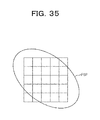
- FIG. 35 is a view illustrating the size of a PSF.
- FIG. 36A is a view illustrating an exemplary configuration 1 for correcting an image generated on the assumption that the PSF size is smaller than the number of elements.
- FIG. 36B is a view illustrating an exemplary configuration 2 for correcting an image generated on the assumption that the PSF size is smaller than the number of elements.
- FIG. 37 is a view illustrating an example of a resolution analysis result after correction when the number of elements is smaller than the PSF size.
- FIG. 38A is a view illustrating an example of filters, into which the spatial filter F is divided, in plural stages in embodiment 1.
- FIG. 38B is a view illustrating an example of filters, into which the spatial filter F′ is divided, in plural stages in embodiment 1.
- FIG. 39 is a block diagram illustrating an exemplary schematic configuration of an image capturing apparatus including an image processing apparatus in the embodiment 1.
- FIG. 40 is a block diagram illustrating an exemplary (first) schematic configuration of a filter control unit and a filter processing unit in the embodiment 1.
- FIG. 41 is a view for explaining a linear interpolation of a target pixel.
- FIG. 42 is a block diagram illustrating an exemplary (second) schematic configuration of the filter control unit and the filter processing unit in the embodiment 1.
- FIG. 43 is a view illustrating (first) intensity at each pixel of a spatial filter F9′.
- FIG. 44 is a view illustrating (second) intensity at each pixel of the spatial filter F9′.
- FIG. 45 is a view illustrating intensity at each pixel of a spatial filter F9.
- FIG. 46 is a view for explaining a method of obtaining the spatial filters in plural stages according to division method 1.
- FIG. 47A is a view for explaining analysis for the division method 1.
- FIG. 47B is a view illustrating intensity at each pixel of a spatial filter F9′.
- FIG. 48A is a view illustrating a corrected image according to the division method 1.
- FIG. 48B is a view illustrating a result of the MTF after correction according to the division method 1.
- FIG. 49A is a view illustrating an example of the spatial filter F5A′.
- FIG. 49B is a view illustrating an example of a spatial filter F5B′.
- FIG. 49C is a view illustrating the result of the MTF after correction according to the division method 2.
- FIG. 50A is a view illustrating an example of the spatial filter F5A′.
- FIG. 50B is a view illustrating an example of a spatial filter F5B′.
- FIG. 50C is a view illustrating a result of the MTF correction according to the division method 3.
- FIG. 51A is a view illustrating an example of the spatial filter F5A′.
- FIG. 51B is a view illustrating an example of a spatial filter F5B′.
- FIG. 51C is a view illustrating a result of the MTF after correction according to the division method 4.
- FIG. 52 is a view for explaining an outline of division method 5.
- FIG. 53 is a view for explaining a calculation example of the filters in plural stages according to the division method 5.
- FIG. 54 is a view illustrating intensity at each pixel of a spatial filter F5.
- FIG. 55 is a view illustrating intensity at each pixel of a spatial filter F5′
- FIG. 56A is a view illustrating an example of the filter processing unit.
- FIG. 56B is a view illustrating an example of the filter processing unit.
- FIG. 57 is a view illustrating a resolution analysis result for an image after correction according to the division method 5.
- FIG. 58 is a view illustrating a (first) relationship between a predetermined number of elements and a size of blur.
- FIG. 59 is a view illustrating a (second) relationship between the predetermined number of elements and the size of blur.
- FIG. 60A is a view illustrating an example of the filter processing unit which multiplies a value processed with each spatial filter by predetermined gain.
- FIG. 60B is a view illustrating an example of the filter processing unit which multiplies each spatial filter by gain to generate a new spatial filter.
- FIG. 61 is a block diagram illustrating another exemplary schematic configuration of the filter processing unit in the embodiment 1.
- FIG. 62 is a flow chart illustrating an example of a filter generation process in the embodiment 1.
- FIG. 63 is a flow chart illustrating an example of a gain determination process in the embodiment 1.
- FIG. 64A is a view illustrating an example of a noise at the flat portion of the captured image.
- FIG. 64B is a view illustrating an example of a noise after resolution is corrected.
- FIG. 65 is a view illustrating luminance decrease.
- FIG. 66 is a view for explaining amplitude degradation according to a coring process.
- FIG. 67A is a view illustrating a resolution analysis result in a case where the coring process is applied to luminance value after the filtering of the spatial filter in a first stage.
- FIG. 67B is a view illustrating a resolution analysis result in a case where the coring process is applied to luminance value after the filtering of the spatial filter in a second stage.
- FIG. 67C is a view illustrating a resolution analysis result in a case where the coring process is applied to the luminance value after the filtering process of the spatial filters in the first and the second stages.
- FIG. 68 is a view illustrating an example of an input-output relationship of a luminance value in the embodiment 2.
- FIG. 69 is a block diagram illustrating another exemplary schematic configuration of the filter processing unit in the embodiment 2.
- FIG. 70 is a view for explaining a (first) corrected image generation process in the embodiment 2.
- FIG. 71 is a view for explaining a (first) gain determination in the embodiment 2.
- FIG. 72A is a view for explaining an (first) effect according to the embodiment 2.
- FIG. 72B is a view which magnifies a portion (e.g., a flat portion) where variation of amplitude is smaller than the threshold value.
- FIG. 73A is a view for explaining an (second) effect according to the embodiment 2.
- FIG. 73B is a view which magnifies a portion (e.g., a flat portion).
- FIG. 74 is a view illustrating a resolution analysis result for an image after a threshold processing in the embodiment 2.
- FIG. 75 is a view illustrating an example of a corrected image generation process in the embodiment 2.
- FIG. 76 is a view illustrating an example of a (first) gain determination process in the embodiment 2.
- FIG. 77 is a view illustrating an example of a (second) gain determination process in the embodiment 2.
- FIG. 78 is a view for explaining a (second) corrected image generation process in the embodiment 2.
- FIG. 79 is a view for explaining a (third) corrected image generation process in the embodiment 2.
- FIG. 80 is a view for explaining a (fourth) corrected image generation process in the embodiment 2.
- FIG. 81A is a view for explaining another example of a (second) gain determination process in the embodiment 2.
- FIG. 81B is a view for explaining a (third) gain determination process in the embodiment 2.
- FIG. 82 is a block diagram illustrating an exemplary schematic configuration of an image processing apparatus in the embodiment 3.
- FIG. 83 is a view illustrating an example of a (first) chart.
- FIG. 84 is a view illustrating an example of a (second) chart.
- FIG. 85 is a view illustrating an example of a (third) chart.
- a convolutional correction is normally performed with a finite spatial filter in order to provide a filtering function to the hardware such as a digital camera.
- a spatial filter having anisotropy is limited to have a finite number of elements and thus, the degradation levels of high frequency components become different with each other depending on the directions, thereby generating Moiré depending on the direction.
- the convolutional correction is performed with a finite spatial filter
- the finite spatial filter is installed in the hardware, there are needs to reduce the size of the spatial filter to a predetermined number of filter elements (e.g., 5 ⁇ 5) or less.
- a predetermined number of filter elements e.g., 5 ⁇ 5 or less.
- the number of filter elements is doubled, the amount of calculations is quadrupled and thus, the size of the spatial filter is desired to be limited to a predetermined number of filter elements or less.
- the size of a PSF indicative of blur may become larger than the number of elements of the spatial filter. In this case, an amount of blur information may be missed and thus, the anisotropy in resolution or Moiré may not be prevented from being generated.
- the disclosed technique intends to provide an image processing apparatus capable of preventing the quality of image from being degraded when the spatial filter having anisotropy of resolution is limited to have a predetermined number of elements, an information processing method and a program thereof.
- An image processing apparatus includes a calculation unit configured to calculate a finite first spatial filter having an anisotropy in resolution of an image and a second spatial filter having a larger number of filter elements than a blur size of an image using a finite filter in which a total sum of elements is zero and at least two elements have a value of non-zero, and a generation unit configured to generate a plurality of spatial filters having a predetermined number of elements or less from the second spatial filter.
- the quality of image may be prevented from being degraded when a spatial filter having anisotropy in resolution is limited to have a predetermined number of elements.
- FIG. 1 is a view illustrating an exemplary optical system.
- FIG. 2 is a view illustrating exemplary apertures according to the position in an image.
- the aperture is circular at the center of the optical axis as illustrated in FIG. 2 .
- an angle of view is wide, a vignetting occurs due to the aperture.
- the shape of the apertures becomes an ellipsis according to the position in the image.
- FIG. 3 is a view illustrating the direction of blurs according to the position in an image.
- the optical system illustrated in FIG. 1 when the aperture becomes narrower, resolution is degraded and thus, the direction of blur tends to degrade in the radial direction, as illustrated in FIG. 3 .
- a tendency of degradation of resolution may be analyzed in detail by taking photographs of a Siemens star in which edges are radially distributed.
- FIG. 4 is a view for explaining a resolution when a wedge-shaped chart is used.
- plural data in the direction perpendicular to a direction indicated by an arrow are acquired in order to measure the resolutions in the arrow direction.
- a wedge-shaped Siemens star illustrated in FIG. 4 As it goes from an end portion to a central portion, the width of line becomes more narrowed and line pairs per pixel is more increased.
- the central portion indicates high frequency components.
- the amplitude (Intensity) of luminance value is more decreased as it goes from the end portion to the central portion.
- a subject which is widening radially for example, a wedge-shaped subject may be used and thus, the resolution may be analyzed according to a direction (MTF: Modulation Transfer Function).
- MTF Modulation Transfer Function
- FIG. 5 is a view illustrating a resolution measurement result measured using the wedge-shaped chart.
- FIG. 5 illustrates a graph in which the resolution is measured in the direction illustrated in FIG. 4 .
- a longitudinal axis illustrated in FIG. 5 indicates amplitude of luminance values and a transversal axis indicates line pairs (LP) per pixel.
- a form (MTF) can be seen from the analysis that the amplitude becomes more smaller as it goes to the central portion and the resolution becomes more degraded as it goes toward higher frequency components (right direction in the transversal axis).
- FIG. 6 is a view illustrating the degradation of an image according to a position in the photographed image.
- the degradation of resolution at the end portion may be analyzed.
- the Dx direction and the Dy direction indicate a circumferential direction and a radial direction, respectively. These definitions of the Dx direction and the Dy direction are also applied to FIG. 7 to FIG. 85 .
- FIG. 7 is a view illustrating an example of a wedge-shaped chart for an end portion of a photographed image.
- the resolution is analyzed in a direction (radial direction) perpendicular to the Dx direction, and a direction (circumferential direction) perpendicular to the Dy direction.
- FIG. 8 is a view illustrating a resolution analysis result analyzed for the wedge-shaped chart illustrated in FIG. 7 .
- the resolution in the radial direction is more degraded than in the circumferential direction. Accordingly, it may be seen that the anisotropy in the resolution occurs in the end portion of the image and the resolution may also be quantitatively measured.
- FIG. 9 is a view illustrating an example of a wedge-shaped chart for a central portion of the photographed image.
- anisotropy resolution is analyzed in a direction perpendicular to the Dx direction (radial direction), and a direction perpendicular to the Dy direction (circumferential direction).
- FIG. 10 is a view illustrating a resolution analysis result analyzed for the wedge-shaped chart illustrated in FIG. 9 . As illustrated in FIG. 10 , there is little difference between the resolutions in the radial direction and the resolution in the circumferential direction. Accordingly, anisotropy in resolution is not seen in the central portion of image.
- PSF point spread function
- the PSF is, for example, a function representing blur.
- the function representing blur is also referred to as a blur function.
- noise n is included, but omitted here in order to simplify the description.
- ⁇ represents the spatial frequency
- inverse filter an inverse filter function
- inverse filter inverse filter
- the zero-dividing means that it is divided by a value at zero or close to zero.
- the reciprocal becomes an extremely high value and thus, the high frequency component of noise is emphasized.
- FIG. 11 is a view illustrating an example of characteristic when the blur function is Fourier-transformed.
- FIG. 11 represents the K( ⁇ ), and the K( ⁇ ) becomes close to zero at higher frequencies.
- FIG. 12 is a view illustrating the reciprocal of the K( ⁇ ).
- FIG. 12 represents K inv according to the equation (3).
- the denominator is close to zero at higher frequencies and thus, the noise at higher frequencies is increased.
- K( ⁇ ) is a conjugate complex number
- FIG. 13 is a view illustrating an inverse filter when a predetermined value is added to the denominator.
- FIG. 14 is a view illustrating an inverse filter when gain has been gradually dropped at higher frequencies. As illustrated in FIG. 13 or FIG. 14 , weights are applied to each frequency component to reduce noise.
- FIG. 15 is a view illustrating an example of an elliptical PSF.
- the resolution in the Dy direction is poorer than the resolution in the Dx direction. That is, the resolution in the Dy direction is further degraded than the resolution in the Dx direction.
- the PSF of ellipse represented by k(r, ⁇ ).
- the “r” represents a radius and ⁇ represents a direction.
- the PSF of an ellipse is represented by a function of the radius “r” and the direction ⁇ .
- K(w, ⁇ ) fk(r, ⁇ ).
- the “f” represents Fourier transform.
- the K(w, ⁇ ) after Fourier transform is a function of a spatial frequency ⁇ and the direction ⁇ .
- FIG. 16 is a view illustrating an example of characteristic when an elliptical blur function is subjected to Fourier transform.
- FIG. 16 utilizes the blur function of FIG. 15 and the characteristics of the blur function are different according to the direction ⁇ . As illustrated in FIG. 16 , it may be seen that the characteristic in the Dx direction is different from that in the Dy direction having a poorer resolution.
- FIG. 17 is a view illustrating the reciprocal of the K(w, ⁇ ).
- FIG. 17 represents K inv represented by the following equation (7).
- the denominator is close to zero at higher frequencies and thus, the noise at higher frequencies is increased.
- K inv ( ⁇ , ⁇ ) 1/ K ( ⁇ , ⁇ ) (7)
- K inv ( ⁇ , ⁇ ) K ( ⁇ , ⁇ )/( K ( ⁇ , ⁇ ) K ( ⁇ , ⁇ ) + ⁇ ⁇ ) (8)
- FIG. 18 is a view illustrating an inverse filter when a predetermined value is added to the denominator.
- FIG. 19 is a view illustrating an inverse filter when gain has been gradually dropped at higher frequencies. As illustrated in FIG. 18 or FIG. 19 , weights are applied to each frequency component to reduce noise.
- the blur function e.g., PSF
- the resolution in a direction along which the resolution is poor e.g., Dy direction
- the anisotropy in resolution may not be improved only by simply applying weighting. Therefore, the inventors found out that the anisotropy in resolution may be improved by calibrating an appropriate weight function according to a direction.
- FIG. 20 is a view illustrating an exemplary inverse filter for improving the anisotropy in resolution.
- the gain has been gradually dropped at higher frequencies but improvement of resolution in the Dy direction having poorer resolution is further emphasized.
- FIG. 21 is a block diagram illustrating an exemplary schematic configuration of an image capturing apparatus including a spatial filter generation device.
- An image capturing apparatus illustrated in FIG. 1 includes an optical system 1 , an image capturing element 2 , an AFE (Analog Front End) 3 , an image processing unit 4 , a post-processing unit 5 , a driving control apparatus 6 , a control apparatus 7 , an image memory 8 , a display unit 9 and a coefficient analysis unit 10 .
- AFE Analog Front End
- An optical system 1 condenses light from a subject (K) having a radial shape onto a surface on which image is captured.
- the optical system 1 includes lenses 11 a , 11 b , 11 c and a diaphragm 12 .
- the lenses 11 a , 11 b , 11 c and the diaphragm 12 condense light from the subject (K) onto the image capturing surface of the image capturing element 2 to image the subject.
- the driving control apparatus 6 is able to control, for example, a location of the lenses 11 a , 11 b , 11 c or a degree of narrowing of the diaphragm 12 .
- a configuration of the optical system 1 is not limited to a particular configuration.
- the image capturing element 2 converts light from the subject (K) condensed by the optical system to electrical signal (analog signal).
- the image capturing element 2 includes, for example, a two-dimensional image capturing element such as a CCD/CMOS, and the two-dimensional image capturing element converts an image of the subject into electrical signal (image signal) and output the converted signal to the AFE 3 .
- the AFE 3 converts the analog signal of the captured image into digital signal.
- the AFE 3 includes, for example, an A/D (analog-to-digital) converter 31 and a timing generator 32 .
- the timing generator 32 generates a timing pulse used for driving the image capturing element 2 based on control signal from the control apparatus 7 and outputs the timing pulse to the image capturing element 2 and the A/D converter 31 .
- the image processing unit 4 maintains an image of the digital signal to perform a predetermined image processing on the image.
- the image processing unit 4 includes, for example, a RAW memory 41 in which an image (RAW image) is converted into the digital signal by the A/D converter 31 .
- the image processing unit 4 may perform a predetermined processing on the RAW image.
- the image on which the predetermined processing is performed is recorded in the image memory 8 .
- the post-processing unit 5 performs further necessary processing on the image undergone a predetermined processing to generate a display image.
- the post-processing unit 5 reads, for example, the image undergone a predetermined processing from the image memory 8 to perform a necessary processing and generates an image for displaying to output the image to the display unit 9 .
- the image memory 8 stores an image after the predetermined processing.
- the display unit 9 includes, for example, a VRAM in which an image is recorded and a display which outputs an image of the VRAM.
- an image capturing apparatus may not necessarily include a display function, and may be provided with a recording unit (e.g., VRAM) in which image for displaying is recorded instead of the display unit 9 .
- the driving control apparatus 6 controls the optical system 1 .
- the control apparatus 7 controls the AFE 3 and the post-processing unit 5 .
- the coefficient analysis unit 10 analyzes the resolution in each direction in each image position from the image for which the chart is photographed to determine an appropriate filter data for improving the anisotropy in resolution. Details of the coefficient analysis unit 10 will be described later.
- the filter data may be formed with a set of parameters necessary for filtering for an image correction similarly to, for example, a de-convolution kernel.
- the de-convolution kernel may be represented using an area in which a circular or an elliptical shaped subject image according to the PSF is distributed and data (these data referred to as de-convolution distribution) which indicates weight of each pixel in the area.
- the inverse filter utilized in the embodiment will be described.
- a calculation sequence of the inverse filter which improves anisotropy in resolution for example, performs adjustment for a direction along which resolution is poor.
- the inverse filter is also simply referred to as a filter.
- the original image “x”, a PSF “k” and the blur image “y” are considered.
- the original image “x” is obtained, if the following equation (9) becomes a minimum in inverse problem, an image close to the original image may be obtained.
- ⁇ represents a weight coefficient
- d m and d n represent derivative filters in the direction of matrix.
- the d m is d m [ ⁇ 1 1]
- the d n is
- X ⁇ ( ⁇ ) K ⁇ ( ⁇ ) ⁇ Y ⁇ ( ⁇ ) K ⁇ ( ⁇ ) 2 + ⁇ ⁇ ⁇ D m ⁇ ( ⁇ ) 2 + D n ⁇ ( ⁇ ) 2 ⁇ ( 12 )
- X( ⁇ ), Y( ⁇ ), K( ⁇ ), Dm( ⁇ ), Dn( ⁇ ) represent x, y, k, d m , d n , respectively.
- K inv ⁇ ( ⁇ ) K ⁇ ( ⁇ ) K ⁇ ( ⁇ ) 2 + ⁇ ⁇ ⁇ D m ⁇ ( ⁇ ) 2 + D n ⁇ ( ⁇ ) 2 ⁇ ( 14 )
- K inv ⁇ ( ⁇ ) K ⁇ ( ⁇ ) _ K ⁇ ( ⁇ ) ⁇ K ⁇ ( ⁇ ) _ + ⁇ ⁇ ⁇ D m ⁇ ( ⁇ ) ⁇ D m ⁇ ( ⁇ ) _ + D n ⁇ ( ⁇ ) ⁇ D n ⁇ ( ⁇ ) _ ⁇
- K( ⁇ ) is a conjugate complex number
- an axis of derivative coefficient is rotated in a direction with an angle of ⁇ using a rotation matrix in order to adjust resolution in a direction along which resolution is poor, as represented in the following equations (16) and (17).
- D X ( ⁇ , ⁇ ) D m ( ⁇ )cos ⁇ D n ( ⁇ )sin ⁇ (16)
- D Y ( ⁇ , ⁇ ) D m ( ⁇ )sin ⁇ + D n ( ⁇ )cos ⁇ (17)
- the inverse filter may be made to have a directionality by using the rotation matrix.
- FIG. 22 is a view explaining a rotation.
- the Dy direction is formed by rotating the Dn direction by “ ⁇ ”
- the Dx direction is formed by rotating the Dm direction by the angle of ⁇ .
- K inv ⁇ ( ⁇ , ⁇ ) K ⁇ ( ⁇ , ⁇ ) _ K ⁇ ( ⁇ , ⁇ ) ⁇ K ⁇ ( ⁇ , ⁇ ) _ + ⁇ ⁇ ⁇ D X ⁇ ( ⁇ , ⁇ ) ⁇ D X ⁇ ( ⁇ , ⁇ ) _ + ⁇ ⁇ ⁇ ⁇ D Y ⁇ ( ⁇ , ⁇ ) ⁇ D Y ⁇ ( ⁇ , ⁇ ) _ ⁇ ( 18 )
- ⁇ is a weight coefficient according to the direction of the inverse filter and ⁇ is an weight coefficient.
- the coefficient analysis unit 10 adjusts the weight ⁇ for the direction (Dy direction) along which resolution is poor.
- the weight coefficient ⁇ is made to be smaller and thus, the resolution in the direction along which the resolution is poor may be improved.
- FIG. 23 is a view illustrating an example of two-dimensional spatial frequency distribution of an inverse filter K inv .
- the weight coefficient ⁇ , ⁇ (especially, ⁇ ) is determined in such a manner that the resolution in the Dy direction is further improved than the resolution in the Dx direction.
- FIG. 24 is a view illustrating an example of distribution along a spatial frequency direction of the inverse filter K inv .
- the weight coefficient for the Dy direction is made smaller such that improvement of resolution in the Dy direction may be emphasized.
- the coefficient analysis unit 10 determines a spatial filter for improving anisotropy in resolution.
- FIG. 25 is a block diagram illustrating an example of a function of a coefficient analysis unit 10 .
- the coefficient analysis unit 10 illustrated in FIG. 25 includes a resolution analysis unit 101 and a determination unit 102 .
- the coefficient analysis unit 10 performs a coefficient analysis on an image for which a chart image is photographed first. In an example described in below, the coefficient analysis is performed, for example, on a wedge-shaped image located at upper left for which the chart image is photographed first.
- the resolution analysis unit 101 analyzes the degradation of resolution of the image in which the subject having a radial shape is captured at least at two directions.
- the analysis method uses a method described in, for example, FIG. 4 and FIG. 5 .
- the resolution analysis unit 101 may analyze MTF.
- the lines pairs per pixel may use line pairs per unit distance at a location of the subject.
- a chart having a wedge shape as well as radial shape is used and thus, the MTF according to a direction may be analyzed as illustrated in FIG. 5 in the embodiment.
- FIG. 26 is a view explaining a calculation sequence of the PSF.
- the determination unit 102 calculates an angle and an ellipticity according to a position in the image.
- the determination unit 102 may obtain an ellipsis when contour lines of a constant threshold value (about a half of maximum amplitude) are plotted in the MTF calculated for each predetermined angle.
- the determination unit 102 may calculate an ellipticity using a major axis and a minor axis obtained.
- the determination unit 102 calculates the angle ⁇ 1 geographically based on the position in the image. Further, the determination unit 102 may calculate the angle ⁇ 1 using the major axis and the minor axis of the ellipsis of resolution. An angle may be calculated in line with an actual blur state in the calculation of the angle ⁇ 1 using the major axis and the minor axis.
- the blur in the radial direction is large, as illustrated in FIG. 3 .
- the determination unit 102 only needs to calculate, for example, an angle between a longitudinal direction and the radial direction.
- the center of an optical axis is basically the center of an image, but the center of the optical axis may be misaligned due to the offsetting of lens.
- the determination unit 102 determines the PSF using the ellipticity and the angle calculated. An ellipsis of the determined PSF is rotated by 90 degrees from an ellipsis obtained from the contour lines of the MTF.
- the determination unit 102 determines filter data having anisotropy of the inverse filter with respect to the image corrected by the filter (e.g., the inverse filter described above) according to the blur function (PSF) of the image, based on the resolution analysis result for the image after correction.
- the filter e.g., the inverse filter described above
- PSF blur function
- the determination unit 102 changes and determines the weight coefficient (for example, ⁇ ) with respect to the derivative direction of the image.
- the weight coefficient of the Dx direction is set to 1 (one) and the weight coefficient of the Dy direction is set to the weight coefficient ⁇ to change the ⁇ . Accordingly, the anisotropy in resolution may be improved.
- the determination unit 102 rotates (the image) (e.g., ⁇ ) with respect to the derivative direction to determine the weight coefficient. Accordingly, a direction along which the resolution is poor may be detected and thus a filtering of an image may be made.
- the determination unit 102 adjusts, for example, the weight coefficients ⁇ and ⁇ to determine an appropriate weight coefficient ⁇ and ⁇ .
- the weight coefficient ⁇ represents the weight coefficient of filter parameters of the direction along which resolution is poor.
- the filter parameters of the direction along which resolution is poor are, for example, Dy( ⁇ , ⁇ ) with respect to the weight coefficient ⁇ of the equation (18) and a conjugate complex number of the Dy( ⁇ , ⁇ ).
- the determination unit 102 includes an adjustment unit 121 , an image correction unit 122 , a coefficient determination unit 123 and a filter determination unit 124 in order to adjust and determine the weight coefficient.
- the adjustment unit 121 adjusts, for example, the weight coefficient E which does not depend on the direction and the weight coefficient ⁇ which depends on the direction.
- the adjustment unit 121 sets initial values of the weight coefficients ⁇ , ⁇ and submits the initial values to the image the correction unit 122 .
- the image correction unit 122 performs an image correction using the weight coefficient acquired from the adjustment unit 121 .
- the image correction unit 122 filters and corrects the image using the inverse filter indicated in the equation (18).
- the image correction unit 122 submits the image after correction to the resolution analysis unit 101 to analyze degradation of resolution again.
- the coefficient determination unit 123 determines the weight coefficient such that the difference of degradation of resolution between two directions becomes small based on the resolution analysis result for the image after correction.
- the coefficient determination unit 123 maintains analysis results of the image corrected by various weight coefficients and determines the weight coefficients ⁇ and ⁇ , such that a difference between the values of spatial frequency becomes minimal, for example, in a predetermined intensity of amplitude (determination process 1).
- the coefficient determination unit 123 may determine the weight coefficients ⁇ and ⁇ , such that the difference between the intensities of amplitude becomes minimal in the predetermined spatial frequency (determination process 2).
- Plural threshold values 1 and threshold values 2 may be set and the coefficient determination unit 123 may determine the weight coefficients such that sum of squares of the differences becomes minimum. In the meantime, the coefficient determination unit 123 may determine the weight coefficients such that a predetermined difference becomes a threshold value or less preset.
- the threshold value may be set by, for example, a preliminary experiment.
- the coefficient determination unit 123 may determine the weight coefficients such that the difference between sum of squares of the differences of resolution in two directions at a central portion of image and the sum of squares of the differences of resolution in two directions at the peripheral portion other than the central portion of image become a predetermined value or less. Further, the coefficient determination unit 123 may determine the weight coefficients such that sum of squares of the differences of resolution between the central portion of image and the peripheral portion of the image becomes minimal.
- the determination for minimization by the coefficient determination unit 123 may be calculated either by using a minimization function or by a person.
- the minimization function includes, for example, a simplex search method, a steepest descent method or a conjugate gradient method.
- the determination unit 102 changes and adjusts the weight coefficient, obtains the inverse filter using the weight coefficient after adjustment, corrects the image using the obtained inverse filter, and determines the optimum weight coefficient based on the resolution analysis result for the image after correction.
- the adjustment of the weight coefficient, the calculation of the inverse filter, the correction with filtering, and the resolution analysis processing are repeated until the optimum weight coefficient is determined.
- the filter determination unit 124 calculates the inverse filter K inv which utilizes the optimum weight coefficient determined by the coefficient determination unit 123 as in the following equation (19) and obtains the inverse filter k inv in spatial domain from the inverse filter K inv in frequency domain as in the following equation (20).
- the inverse filter in spatial domain is referred to as a spatial filter.
- k inv f - 1 ⁇ K ⁇ ( ⁇ , ⁇ ) _ K ⁇ ( ⁇ , ⁇ ) ⁇ K ⁇ ( ⁇ , ⁇ ) _ + ⁇ ⁇ ⁇ D X ⁇ ( ⁇ , ⁇ ) ⁇ D X ⁇ ( ⁇ , ⁇ ) _ + ⁇ ⁇ ⁇ ⁇ D Y ⁇ ( ⁇ , ⁇ ) ⁇ D Y ⁇ ( ⁇ , ⁇ ) _ ⁇ ( 20 )
- the coefficient analysis unit 10 performs the processes as described above at each position where the chart is present in the image.
- the coefficient analysis unit 10 analyzes anisotropy in resolution at each position in the image and determines the spatial filter of which anisotropy is to be improved.
- the spatial filter of which anisotropy is to be improved may be determined while correcting the blur with respect to a predetermined the position of image. For example, a direction along which resolution is poorer than other directions may be detected to determine the weight coefficient with which resolution in the direction having poorer resolution is more improved.
- FIG. 27 is a view illustrating an example of image in which twelve charts are photographed.
- the example illustrated in FIG. 27 is only an example, and even though the number of charts is not twelve charts, each chart may be present in plural areas formed by dividing the image.
- the coefficient analysis unit 10 determines the filter data at each area in which each chart is present to calculate the spatial filter.
- the coefficient analysis unit 10 prepares a table in which a position in the image and the spatial filter is mapped. Further, the coefficient analysis unit 10 may associate the size of the calculated ellipsis with the table.
- FIG. 28 is a view illustrating an example of the spatial filter table.
- the spatial filter table illustrated in FIG. 28 pixel coordinates of upper left portion of each area and the spatial filter calculated by the chart of the area are mapped.
- the spatial filter (FIL1) is mapped on the position (x 1 ,y1).
- the image processing apparatus including the coefficient analysis unit 10 may determine the spatial filter for which anisotropy in resolution is improved.
- the spatial filter for which anisotropy in resolution is improved is not limited to the example as described above and may include the spatial filter obtained by a technology described in, for example, Japanese Laid-Open Patent Publication No. 2012-23498. In this case, the spatial filter is made to have anisotropy in resolution.
- the image processing unit 4 may be configured by, for example, a DSP (Digital Signal Processor).
- the RAW memory 41 may be a memory built-in the DSP or an external memory.
- the post-processing unit 5 , the image memory 8 , the coefficient analysis unit 10 , the VRAM for displaying may be formed integrally with an integral DSP together with an image processing unit 4 .
- the coefficient analysis unit 10 may be formed as an image processing apparatus formed as a single unit or including other processing units.
- a predetermined program may be executed not by a dedicated processor for specific processing, such as a DSP, but by a general processor, such as a CPU, to implement functions of the image processing unit 4 or the coefficient analysis unit 10 .
- the driving control apparatus 6 , the control apparatus 7 and the post-processing unit 5 may also configured by at least one dedicated processor for specific processing or a general processor.
- the program which causes the processor to serve as the image processing unit 4 or the coefficient analysis unit 10 and a recording medium in which the program is recorded are also included in the embodiments of the present disclosure.
- the recording medium is a non-transitory medium, and a transitory medium such as signal itself is not included as the recording medium in the embodiments of the present disclosure.
- the spatial filter having anisotropy When the spatial filter having anisotropy is finitized, information for a portion other than a portion where the extracted taps (elements) of the spatial filter are extracted is missed.
- the spatial filter has anisotropy and thus, information which becomes missing is different depending on a direction. Further, the sums that add the elements are not equal.
- High frequency information is included in the missed information and thus, when the image is corrected by the finite spatial filter, a degree of correction becomes different depending on the direction of correction.
- FIG. 29 is a view illustrating an example of a spatial filter.
- the spatial filter illustrated in FIG. 29 has an anisotropy based on the equation (20) as described above. Values of the elements of the spatial filter are represented with colors in FIG. 29 .
- FIG. 30 is a view illustrating the intensities of a finite spatial filter.
- the number of taps is, for example, 9 (nine)
- nine elements by nine elements (9 ⁇ 9) are extracted from the center in an example illustrated in FIG. 30 .
- the intensities of the finite spatial filter are represented in a longitudinal axis in an example illustrated in FIG. 30 .
- the spatial filter has anisotropy and thus, the high frequency information which becomes missing is different depending on the direction.
- FIG. 31 is a view illustrating an example of Moiré generated in a corrected image. Moiré caused by finitization of the spatial filter as illustrated in FIG. 31 is generated.
- FIG. 32 is a view illustrating a resolution analysis result for an image corrected with the finite spatial filter. The degree of correction for degradation of frequency becomes different depending on the direction as illustrated in FIG. 32 .
- FIG. 33 is a view illustrating a resolution analysis result for an image a corrected by suppressing generation of the Moiré.
- improvement of high frequency is suppressed in order to prevent the generation of Moiré, such that anisotropy in resolution is remained.
- the spatial filter when installed, there is a demand to limit the size of the spatial filter to the predetermined number of filter elements or less from a point of view of an amount of computation and a memory.
- the spatial filter having a size of, for example, 5 ⁇ 5 elements or less may be used.
- the size of the PSF indicating blur becomes larger than the number of elements and thus, an amount of information is missed. Therefore, the quality of image may be degraded.
- FIG. 34 is a view illustrating an example of the PSF representing blur of an image. Brightness of pixel indicates luminance value of the PSF in an example illustrated in FIG. 34 .
- FIG. 35 is a view illustrating an example of a size of the PSF. As illustrated in FIG. 35 , it is assumed that the PSF is larger than the size of 5 ⁇ 5 pixels. In the meantime, one element of the filter corresponds to one pixel of image.
- the number of elements of the spatial filter is smaller than the size of blur and thus, information of blur is missed when the image is corrected.
- FIG. 36 is a view illustrating an example of a configuration for a corrected image generated on the assumption that the PSF size is smaller than the number of elements.
- FIG. 36A illustrates an example of configuration 1 .
- a corrected image “x” is generated by convolving the calculated spatial filter F with the original image “y” and subtracting the result from the original image as represented in the following equation (21) is generated. x ⁇ y ⁇ F y (21)
- FIG. 36B illustrates an example of configuration 2 .
- a corrected image “x” is generated by convolving the calculated spatial filter F′ with the original image “y”, as represented in the following equations (22), (23), (24) and (25).
- FIG. 37 is a view illustrating an example of the resolution analysis result when the number of elements of the spatial filter is smaller than the PSF size.
- the number of elements is set as 5 ⁇ 5 elements and the number of elements of the spatial filter is smaller than the size of the PSF, an anisotropy correction characteristic is degraded.
- an image signal is made to pass through a finite high pass filter to reduce a portion at which luminance abruptly varies and thus, a difference in the degree of correction of high frequency information which is different depending on the direction is reduced. Accordingly, the generation of Moiré caused by the degradation of frequency information depending on the direction may be prevented.
- a finite high pass filter may be a finite filter in which a total sum of values of elements is 0 (zero) and at least two elements have a value of non-zero.
- description will be made using a finite high pass filter as the finite filter.
- an object to be solved in installation may be achieved by dividing the calculated spatial filter to generate spatial filters in plural stages, and each spatial filter has a predetermined number of elements or less.
- FIG. 38 is a view illustrating an example of a filter having plural stages in embodiment 1.
- the spatial filter F illustrated in FIG. 36A is divided into the spatial filters (5 ⁇ 5) in plural stages.
- the spatial filter F′ illustrated in FIG. 36B is divided into the spatial filters (5 ⁇ 5) in plural stages.
- plural inverse filters having anisotropy are formed and combined with plural spatial filters to improve anisotropy.
- the image capturing apparatus including the image processing apparatus in the embodiment 1 will be described next.
- the degradation of quality of image when the size of the spatial filter having anisotropy in resolution is finitized to a predetermined number of elements may be prevented.
- FIG. 39 is a block diagram illustrating an exemplary schematic configuration of an image capturing apparatus including the image processing apparatus in the embodiment 1.
- the same reference numerals will be given to the same configuration as FIG. 21 in the configuration illustrated in FIG. 39 .
- the image processing unit 15 in the embodiment 1 will be primarily described.
- the image processing unit 15 includes a RAW the memory 41 , a filter control unit 151 and a filter processing unit 152 .
- the filter control unit 151 maintains the spatial filter table illustrated in FIG. 28 .
- the filter control unit 151 calculates the spatial filter having the number of elements larger than the blur size with respect to each spatial filter in the spatial filter table.
- the filter control unit 151 then divides the calculated spatial filter into the spatial filters in plural stages to have a predetermined number of elements or less.
- the filter control unit 151 outputs the spatial filters in plural stages to the filter processing unit 152 . That is, the filter control unit 151 outputs the spatial filters in plural stages corresponding to each position in the image to be processed to the filter processing unit 152 .
- the filter processing unit 152 performs a filtering at the corresponding position in the image using the spatial filters in plural stages acquired from the filter control unit 151 . Accordingly, the anisotropy in resolution which is different at each position in the image may be improved to prevent the generation of Moiré and enhance the quality of the image.
- FIG. 40 is a block diagram illustrating an exemplary (first) schematic configuration of a filter control unit and a filter processing unit in the embodiment 1.
- the filter control unit 151 will be described first.
- the filter control unit 151 includes a filter storage unit 201 , a filter acquisition unit 202 , a filter calculation unit 203 and a filter generation unit 204 .
- the filter storage unit 201 stores at least a first spatial filter 211 , a second spatial filter 212 and spatial filters 213 in plural stages. Each filter may be stored in different storage areas, respectively.
- the first spatial filter 211 is a spatial filter having an anisotropy in resolution.
- the first spatial filter 211 corresponds to, for example, each filter in the spatial filter table illustrated in FIG. 28 .
- the second spatial filter 212 is a filter calculated by the filter calculation unit 203 .
- the second spatial filter is a filter, for example, obtained by convolving the high pass filter with the first spatial filter 211 .
- the spatial filters 213 in plural stages are a group of spatial filters generated by the filter generation unit 204 .
- the filter acquisition unit 202 acquires a finite spatial filter having anisotropy in resolution of the image.
- the filter acquisition unit 202 acquires the first spatial filter 211 from, for example, the filter storage unit 201 .
- the filter acquisition unit 202 outputs the first spatial filter 211 acquired to the filter calculation unit 203 .
- the filter calculation unit 203 calculates a second spatial filter by convolving a finite filter in which a total sum of values of elements is 0 (zero) and at least two elements have a value of non-zero with the first spatial filter 211 acquired from the filter acquisition unit 202 .
- the filter calculation unit 203 calculates the second spatial filter having the number of elements larger than the size of blur (e.g., the size of an ellipsis of the PSF).
- the filter calculation unit 203 includes a determination unit 231 , and the determination unit 231 determines the blur size from, for example, the size of the PSF stored in the filter storage unit 201 . Further, the determination unit 231 may determine the blur size from the acquired PSF in a case where the PSF may be acquired from a lens design value by simulation as described in, for example, Japanese Laid-Open Patent Publication No. 2012-23498.
- the filter calculation unit 203 calculates the second spatial filter by convolving the first spatial filter having the number of elements larger than the size of the blur of image with the finite high pass filter.
- the filter calculation unit 203 maintains the finite high pass filter in advance.
- the finite high pass filter is intended to be defined as, for example, a filter of having 3 ⁇ 3 elements
- the finite high pass filter may be obtained using the following equations (26) and (27).
- the anisotropy described in the embodiment depends on a filter at an angle in any direction and thus, the filter of which all elements have coefficients of non-zeros as represented in the equation (27) may be used.
- the filter calculation unit 203 defines the spatial filter k inv as a filter of 7 ⁇ 7 elements when the high pass filter is defined as a filter of 3 ⁇ 3 elements and convolves the two filters to calculate a filter of 9 ⁇ 9 elements. As described above, the filter calculation unit 203 convolves the high pass filter with the spatial filter to calculate the filter having the desired number of taps.
- the filter calculation unit 203 stores the second spatial filter F9 calculated by the equation (28) described above in the filter storage unit 201 .
- the filter calculation unit 203 may be installed in a separate apparatus, and the filter control unit 151 may store the second spatial filter 212 obtained from the separate apparatus.
- the filter generation unit 204 acquires the second spatial filter 212 from the filter storage unit 201 and generates the spatial filters in plural stages having a predetermined number of elements or less from the second spatial filter 212 . Descriptions regarding the generation of the spatial filters in plural stages will be described later.
- the filter generation unit 204 stores the generated spatial filters 213 in plural stages in the filter storage unit 201 .
- the filter processing unit 152 includes a convolution operation unit 301 and a subtraction unit 302 .
- the convolution operation unit 301 acquires the image from the RAW memory 41 and convolves the image in the spatial filters 213 in plural stages to perform filtering.
- the convolution operation unit 301 may perform filtering on the image in such a manner that the spatial filter 213 in plural stages causes a single convolution circuit to perform convolution plural times or prepares and causes plural convolution circuits to perform convolution.
- the convolution operation unit 301 outputs the image after filtering to the subtraction unit 302 .
- the subtraction unit 302 subtracts the image after filtering from the image acquired from the RAW memory 41 to generate a corrected image.
- the corrected image is output to the post-processing unit 5 or the image memory 8 .
- the filter processing unit 152 may obtain a pixel value of a target pixel here by performing a linear interpolation using adjacent spatial filters rather than using a single spatial filter on each pixel of each area of the image.
- FIG. 41 is a view for explaining a linear interpolation of a target pixel.
- the filter processing unit 152 may perform the linear interpolation according to a distance of each pixel using a center pixel of each area calculated in four adjacent spatial filters to obtain the pixel value of the target pixel.
- the filter processing unit 152 performs the linear interpolation on the pixel value of each area obtained from FIL1, FIL2, FIL5 and FIL6 to calculate the pixel value of the target pixel.
- the filter processing unit 152 may calculate the pixel value after the spatial filter itself for the target pixel is obtained with the linear interpolation. Further, in the above example, the number of spatial filters set four adjacent spatial filters, but not limited thereto and may use different plural spatial filters. Additionally, the linear interpolation using a distance is performed but other interpolation scheme may be used. Further, interpolation may be performed for each sub-area resulted from sub-division of an area or performed for each pixel.
- FIG. 42 is a block diagram illustrating an exemplary (second) schematic configuration of the filter control unit 1512 and the filter processing unit 152 in the embodiment 1.
- the filter control unit 151 will be described first.
- the filter control unit 151 includes a filter storage unit 401 , a filter acquisition unit 202 , a filter calculation unit 402 and a filter generation unit 403 .
- the filter storage unit 401 stores a third spatial filter 411 calculated by the filter calculation unit 402 and the spatial filters 412 in plural stages calculated by the filter generation unit 403 .
- the filter calculation unit 402 calculates a third spatial filter 411 which does not need a subtracting process between the images described above.
- the filter calculation unit 402 may make unnecessary subtracting process by performing deformation of equation using the equations (22), (23), (24) and (25). In this example, it is assumed that a third spatial filter F9′ of 9 ⁇ 9 elements.
- the finite spatial filter F9′ which does not need a subtracting process between the images may be generated.
- the filter calculation unit 402 stores the calculated spatial filter F9′ in the filter storage unit 401 .
- the spatial filter F9′ is the third spatial filter 411 .
- the filter generation unit 403 acquires the third spatial filter 411 from the filter storage unit 401 and generates the spatial filters in plural stages having the predetermined number of elements or less from the third spatial filter 411 . Generation of the spatial filters in plural stages will be described later.
- the filter generation unit 403 stores the generated spatial filters 412 in plural stages in the filter storage unit 401 .
- the filter processing unit 152 includes a convolution operation unit 501 .
- the convolution operation unit 501 performs convolution on the spatial filters 412 in plural stages and generates a corrected image “x”.
- FIG. 43 is a view illustrating (first) intensity at each pixel of a spatial filter F9′.
- the intensity at each pixel is represented by colors.
- FIG. 44 is a view illustrating (second) intensity at each pixel of the spatial filter F9′.
- Intensity variation in two directions e.g., Dx is a transversal direction and Dy is a longitudinal direction
- Dx is a transversal direction
- Dy is a longitudinal direction
- a total sum of elements of the spatial filter F9′ becomes 1 (one).
- FIG. 45 is a view illustrating intensity at each pixel of a spatial filter F9. Intensity variation in two directions (e.g. Dx is a transversal direction and Dy is a longitudinal direction) of the spatial filter F9 is represented in an example illustrated in FIG. 45 . In this case, a total sum of elements of the spatial filter F9 including high pass information becomes 0 (zero).
- the filter generation unit 403 assumes one filter as a basis for dividing and obtains other filters with optimization based on the assumed filter.
- the spatial filter F5A′ is defined as a filter formed by extracting a central portion of 5 ⁇ 5 elements of the third spatial filter F9′.
- FIG. 46 is a view for explaining a method of obtaining spatial filters in plural stages according to division method 1.
- the filter generation unit 403 may determine the spatial filter F5A′ to minimize the estimation function represented by the following equation (30) to obtain the spatial filter F5B′.
- e 2 ⁇ F 9′ ⁇ F 5 A′ F 5 B′ ⁇ 2 (30)
- the obtained spatial filter F5B′ is illustrated in FIG. 46 .
- FIG. 47 is a view for explaining analysis for the division method 1.
- the spatial filter F5A′ is just formed by extracting 5 ⁇ 5 elements from the spatial filter F9′ in the division method 1.
- the original high pass information is missed as illustrated in FIG. 47B . That is, it becomes unable to satisfy a condition of a total sum of elements.
- FIG. 48 is a view illustrating the result of correction according to the division method 1.
- FIG. 48A illustrates the corrected image according to the division method 1. As illustrated in FIG. 48A , high pass information is missed and an effect of correction is different according to a direction and thus, Moiré is generated.
- FIG. 48B illustrates a result of the MTF after correction according to the division method 1. It may seen also from the result illustrated in FIG. 48B that Moiré is generated.
- the spatial filter F5A′ in a first stage is defined as a filter having anisotropy.
- the spatial filter F5A′ is formed with just a reciprocal of an anisotropic PSF.
- FIG. 49 is a view for explaining division method 2.
- FIG. 49A is a filter illustrating an example of the spatial filter F5A′.
- FIG. 49B is a spatial filter F5B′ obtained by minimizing the estimation function.
- FIG. 49C illustrates the result of the MTF after correction according to the division method 2.
- the resolution is different in each direction in the result, illustrated in FIG. 49C and thus, Moiré is generated.
- the spatial filter F5A′ in a first stage is defined as a filter having isotropy.
- the spatial filter F5A′ is formed with just a reciprocal of an isotropic PSF.
- FIG. 50 is a view for explaining division method 3.
- FIG. 50A is a filter illustrating an example of the spatial filter F5A′.
- FIG. 50B is a spatial filter F5B′ obtained by minimizing the estimation function.
- FIG. 50C illustrates a result of the MTF after correction according to the division method 3.
- the result illustrated in FIG. 50C is not enough to generate Moiré, but improvement of high frequency is insufficient.
- the spatial filter F5A′ in a first stage is defined as a filter having isotropy and formed by convolving the reciprocal of the PSF with the high pass filter.
- FIG. 51 is a view for explaining division method 4.
- FIG. 51A is a filter illustrating an example of the spatial filter F5A′.
- FIG. 51B is a spatial filter F5B′ obtained by minimizing the estimation function.
- FIG. 51C illustrates a result of the MTF after correction according to the division method 4.
- An improvement of anisotropy becomes insufficient in the result illustrated in FIG. 51C . This is because the high pass filter is convolved in the filter in the first stage in order not to generate Moiré but the filter is isotropic and thus, anisotropy may not be improved in the filter in the second stage.
- the spatial filter in the first stage is isotropic
- information of anisotropy becomes a single filter and thus, the number of elements becomes short.
- FIG. 52 is a view for explaining an outline of the division method 5.
- the filter generation unit 403 calculates the spatial filter F5A′ (e.g., a fifth spatial filter) in a first stage by convolving the spatial filter F3A (e.g., a fourth spatial filter) having anisotropy with the high pass filter F3 and subtracting the result from I5 0 .
- the filter generation unit 403 calculates the spatial filter F5B′ (e.g., a sixth spatial filter) in the second stage by minimizing the estimation function.
- the high pass filter is formed in the first stage to prevent the generation of Moiré and further, a configuration for improving anisotropy is formed such that a filter is divided into filters in plural stages. Therefore, it is possible to cope with the improvement of the blur having the size larger than the number of elements.
- FIG. 53 is a view for explaining the calculation of the filters in plural stages according to the division method 5.
- the filter generation unit 403 extracts a filter of 3 ⁇ 3 elements from the first spatial filter 211 and calculates the spatial filter F5A of 5 ⁇ 5 elements by convolving the extracted filter with the high pass filter (e.g., equation (26) or equation (27)) of 3 ⁇ 3 elements.
- the filter generation unit 403 calculates the spatial filter F5A′ by subtracting the spatial filter F5A from JO.
- the filter generation unit 403 may calculate the spatial filter F5B′ in the second stage by minimizing the estimation function using the third spatial filter F9′ and the spatial filter F5A′.
- FIG. 54 is a view illustrating the intensity at each pixel of the spatial filter F5.
- An example illustrated in FIG. 54 represents intensity variation of the spatial filter F5 in two directions (e.g., Dx is a transversal direction and Dy is a longitudinal direction). In this case, a total sum of values of elements of the spatial filter F5 becomes 0 (zero).
- FIG. 55 is a view illustrating intensity at each pixel of a spatial filter F5′.
- An example illustrated in FIG. 55 represents intensity variation of the spatial filter F5′ in two directions (e.g., Dx is a transversal direction and Dy is a longitudinal direction). In this case, a total sum of values of elements of the spatial filter F5′ becomes 1 (one).
- FIG. 56 is a view for explaining generation of a corrected image in the embodiment 1.
- the filter processing unit 152 generates a corrected image “x” using the following equations (31) and (32).
- y 1 y ⁇ F 5 A y (31)
- x y 1 ⁇ F 5 B y 1 (32)
- the filter processing unit 152 generates a corrected image “x” using the following equations (33), (34), (35) and (36).
- y 1 F 5 A′ y (33)
- F 5 A I 0 ⁇ F 5 A′ (34)
- X F 5 B′ y 1 (35)
- F 5 B I 0 ⁇ F 5 B′ (36)
- the spatial filter F5A′ is a combination of the spatial filter having anisotropy and the high pass filter, and the spatial filter F5B′ is responsible for supplementing omission of the spatial filter having anisotropy. Further, a convolution sequence may be reversed.
- FIG. 57 is a view illustrating the resolution analysis result for an image after correction according to the division method 5.
- the division method 5 when the spatial filters in anisotropy in resolution are finitized to a predetermined number of elements, degradation of image quality may be prevented. That is, the spatial filter may be divided into the spatial filter in plural stages and thus, generation of Moiré may be prevented while improving anisotropy in the division method 5.
- the filter generation units 204 , 403 determine the numbers of spatial filters to be divided based on a size of a first spatial filter and a predetermined number of elements when dividing the spatial filters into the spatial filter in plural stages.
- FIG. 58 is a view illustrating a (first) relationship between a predetermined number of elements and a size of blur.
- the predetermined number of elements is 5 ⁇ 5 elements and the size of blur is less than 9 ⁇ 9 elements.
- the filter calculation units 203 , 402 calculate a first spatial filter of 9 ⁇ 9 elements.
- the filter generation units 204 , 403 generate two-stage spatial filters of 5 ⁇ 5 elements based on the first spatial filter of 9 ⁇ 9 elements.
- FIG. 59 is a view illustrating a (second) relationship between the predetermined number of elements and the size of blur.
- the predetermined number of elements is 5 ⁇ 5 and the size of blur is less than 13 ⁇ 13 elements.
- the filter calculation units 203 , 402 calculate the first spatial filter of 13 ⁇ 13 elements.
- the filter generation units 204 , 403 generate three-stage spatial filters of 5 ⁇ 5 elements based on the first spatial filter of 13 ⁇ 13 elements.
- the filter generation unit 204 , 403 first divide a second spatial filter of 13 ⁇ 13 elements or a third spatial filter of 13 ⁇ 13 elements into a spatial filter of 9 ⁇ 9 elements and the spatial filter of 5 ⁇ 5 elements. Subsequently, the filter generation units 204 , 403 divide the spatial filter of 9 ⁇ 9 elements into two-stage spatial filters of 5 ⁇ 5 elements in the same manner.
- the filter generation unit 204 , 403 need to divide the spatial filter into more plural stages. Further, when the number of elements of the first spatial filter generated by the filter calculation unit 203 is 7 ⁇ 7 elements, the filter generation units 204 , 403 divide the spatial filter into two-stage spatial filters of 5 ⁇ 5 elements and 3 ⁇ 3 elements. As such, sizes of filters to be divided may differ from each other.
- the filter processing unit 152 uses one convolution circuit to repeatedly perform the same process at least two times. Therefore, the spatial filter in plural stages having the same number of elements and having a larger size of the spatial filter is more efficient. Accordingly, when the filter calculation unit 203 sets the size of the first spatial filter larger than the blur to 9 ⁇ 9 elements, the filter generation units 204 , 403 may generate two-stage spatial filters having the same number of elements (for example, 5 ⁇ 5 elements).
- the error of difference “e” does not become zero with respect to the estimation function represented by the following equation (30). Accordingly, gain is set and multiplied to the spatial filter in plural stages obtained by minimizing the estimation function to improve accuracy.
- FIG. 60 is a view illustrating generation of a corrected image when multiplying gain.
- the filter processing unit 152 multiplies a value processed with each spatial filter by a predetermined gain. That is, the filter processing unit 152 generates the corrected image “x” using the following equations (37) and (38).
- y 1 y ⁇ Gain1 ⁇ F 5 A y (37)
- x y 1 ⁇ Gain2 ⁇ F 5 B y 1 (38)
- Gain1 and Gain2 are obtained by, for example, minimizing the estimation function using the chart illustrated in FIG. 4 .
- the gain estimation function is, for example, a function which represents a distance of MTF in two directions, and Gain1 and Gain2 that minimize the estimation function are obtained.
- the estimation function of gain may be, for example, a function which represents a distance of MTF in the middle of two directions.
- the gain calculation may be made by the post-processing unit 5 .
- FIG. 60B illustrates an example in which the filter processing unit 152 multiplies each spatial filter by gain to generate a new spatial filter.
- the filter processing unit 152 generates a corrected image “x” using the following equations (39) and (40).
- y 1 y ⁇ F 5 A new y (39)
- x y 1 ⁇ F 5 B new y 1 (40)
- FIG. 61 is a block diagram illustrating another exemplary schematic configuration of the filter processing unit in the embodiment 1.
- the filter processing unit 152 illustrated in FIG. 61 includes the convolution operation unit 301 , a gain multiplication unit 303 and the subtraction unit 302 .
- the same reference numerals are given to the same configuration as illustrated in FIG. 40 .
- the gain multiplication unit 303 multiplies a value after processing of each spatial filters divided in plural stages by a predetermined gain.
- the gain multiplication unit 303 analyzes resolution before and after multiplication of gain is performed to acquire gain with which anisotropy may be best improved from the post-processing unit 5 as a predetermined gain.
- the configuration illustrated in FIG. 61 is based on the configuration of FIG. 60A , but the gain multiplication unit 303 may be included in the convolution operation unit 301 (e.g., see FIG. 60B ).
- FIG. 62 is a flow chart illustrating an example of a filter generation process in the embodiment 1.
- the process illustrated in FIG. 62 represents a filter generation process by the division method 5.
- the filter acquisition unit 202 acquires the first spatial filter from the filter storage unit 201 .
- the determination unit 231 determines the blur size of PSF.
- the determination unit 231 determines, for example, the blur size of PSF based on a major axis and a minor axis obtained with analysis of resolution. Further, the determination unit 231 may acquires the PSF which is a result acquired from a lens design value by simulation as described in Japanese Laid-Open Patent Publication No. 2012-23498.
- the filter calculation unit 402 extracts the spatial filter having the number of elements larger than the size of the blur from the first spatial filter and convolves the finite high pass filter to calculate the second spatial filter (e.g., F9).
- the second spatial filter e.g., F9
- the filter calculation unit 402 subtracts the second spatial filter from a filter in which a value of the center element is 1 (one) and values of elements other than the center element is 0 (zero) to calculate the third spatial filter (e.g., F9′).
- the third spatial filter e.g., F9′
- the filter generation unit 403 divides the third spatial filter into plural spatial filters. For example, the filter generation unit 403 extracts the fourth spatial filter (e.g., F3) from the first spatial filter.
- the fourth spatial filter e.g., F3
- the filter generation unit 403 generates a filter (e.g., F5A) obtained by convolving a finite filter in which total sum of values of elements is 0 (zero) and at least two elements are non-zero with the fourth spatial filter.
- the filter generation unit 403 subtracts the generated filter from a filter in which a value of the center element is 1 (one) and values of elements other than the center element is 0 (zero) to calculate the fifth spatial filter (e.g., F5A′).
- the filter generation unit 403 minimizes the estimation function using the third spatial filter and the fifth spatial filter to calculate the sixth spatial filter (e.g., F5B′).
- the filter generation unit 403 determines whether the fifth spatial filter and the sixth spatial filter are filters having the predetermined number of elements or less. When it is determined that each of the generated the spatial filters has the predetermined number of elements or less (“YES” at step S 105 ), the fifth spatial filter and the sixth spatial filter are defined as the spatial filter, in plural stages. Further, when at least one of the generated spatial filters have the number of elements larger than the predetermined number of elements, the process goes back to step S 104 . The above-described process of generating plural spatial filters is repeated until each of the generated spatial filters becomes the predetermined number of elements or less.
- FIG. 63 is a flow chart illustrating an example of a gain determination process in the embodiment 1.
- the image capturing apparatus captures a chart image.
- the post-processing unit 5 analyzes resolution before correction.
- the post-processing unit 5 set an initial value of gain.
- the image processing unit 15 multiplies the above-described plural spatial filter by the set gain to correct the image.
- the post-processing unit 5 analyzes resolution after correction.
- the post-processing unit 5 determines whether the gain estimation function becomes minimal. When it is determined that the gain estimation function is minimal (“YES” at step S 206 ), the process proceed to step S 207 . When the gain estimation function is not minimal (“No” at step S 206 ) the process goes back step S 203 , and gain is changed.
- the post-processing unit 5 determines gain with which the gain estimation function becomes minimal and sets the determine gain in the gain multiplication unit 303 .
- the flat portion as well as noise component are included in the captured image. Therefore, even the flat portion causes an image to include a minute amplitude variation.
- FIG. 64 is a view illustrating an example of a noise before and after the resolution is corrected.
- FIG. 64A illustrates an example of noise at the flat portion of the captured image.
- FIG. 64B illustrates an example of noise after resolution is corrected. Noise is emphasized due to the correction of resolution in the example illustrated in FIG. 64B .
- a low pass filter is used to reduce noise.
- the low pass filter filters the entire image and thus, when the noise in the flat portion is to be reduced, the edge portion originally intended to be corrected changes to a gentle shape.
- an output is made to be 0 to prevent the noise from being emphasized. Further, in the coring process, when an input value is larger than a threshold value, the amplitude of an output is reduced to be small such that a discontinuity is avoided.
- FIG. 65 is a view illustrating luminance reduction. Luminance is reduced in the coring process as illustrated in FIG. 65 . Accordingly, even when the coring process is applied to any one of the spatial filters in plural stages in the embodiment 1, the gain balance of the coring process to degradation of amplitude is different depending on the direction due to anisotropy of the spatial filter and thus, it is unable to improve anisotropy.
- FIG. 66 is a view for explaining amplitude degradation according to a coring processing. The coring process is applied such that the amplitude of luminance value is reduced as illustrated in FIG. 66 .
- FIG. 67 is a view illustrating a resolution analysis result for an image to which the coring processing is applied.
- FIG. 67A illustrates a resolution analysis result in a case where the coring process is applied to luminance value after the filtering of the spatial filter in a first stage.
- FIG. 67B illustrates a resolution analysis result in a case where the coring process is applied to luminance value after the filtering of the spatial filter in a second stage.
- FIG. 67C illustrates a resolution analysis result in a case where the coring process is applied to the luminance value after the filtering process of the spatial filters in the first and the second stages.
- the coring process accompanying the degradation of amplitude is applied in the filtering of filters in plural stages having anisotropy, the degradation of gain varies depending on the direction and thus, it is unable to improve anisotropy.
- a predetermined gain is determined with respect to an absolute value of a value after the filtering of the filter in such a manner that when the absolute value is equal to or less than a lower threshold value, gain is set to 0 (zero).
- gain is set to a constant value, and when the absolute value is between the lower threshold value and the upper threshold value, gain is made to be varied in stepwise fashion.
- FIG. 68 is a view illustrating an example of an input-output relationship of the luminance value in the embodiment 2.
- an input in(dy)
- an output is set to 0 (zero) and when the input (in(dy)) is larger than a threshold value Th1, the input and the output are the same.
- the output varies in stepwise fashion.
- the image capturing apparatus in the embodiment 2 is similar to the image capturing apparatus in the embodiment 1 and thus, the same reference numerals are given to the same components to describe the embodiment 2.
- FIG. 69 is a block diagram illustrating another exemplary schematic configuration of the filter processing unit in the embodiment 2.
- the filter processing unit 152 will be described.
- the filter processing unit 152 includes a convolution operation unit 301 , a gain determination unit 601 , a gain multiplication unit 602 , a subtraction unit 603 and a filter analysis unit 604 .
- the gain determination unit 601 determines the threshold value of an absolute value of the luminance value subjected to convolution to determine gain. A gain determination process will be described later.
- the gain multiplication unit 602 multiplies the luminance value after the filtering by gain determined by the gain determination unit 601 . Further, the gain multiplication unit 602 , when convolution is performed at plural stages, at least one gain multiplication may be performed or gain multiplication may be performed at all the plural stages.
- the subtraction unit 603 calculates the difference between the image to which gain is multiplied and the original image.
- the processing described above performed the number of times that is equals to the number of plural stages.
- the filter analysis unit 604 analyzes intensity of filter of the spatial filters in plural stages based on coefficients of filter and determines the spatial filter for which gain is multiplied based on a result of analysis. For example, the filter analysis unit 604 determines a spatial filter in such a manner that a value subjected to the filtering in the spatial filter having the strongest intensity of filter is multiplied by gain. In the meantime, the filter analysis unit 604 is not a necessary component for the filter processing unit 152 . Further, the filter analysis unit 604 is just needed to determine that the intensity of filter is stronger as the difference between the maximum filter coefficient and the minimum filter coefficient becomes gradually larger.
- FIG. 70 is a view for explaining a (first) corrected image generation process in the embodiment 2.
- the luminance value obtained by convolving the original image with a filter of 5 ⁇ 5 elements in a first stage of is denoted by the value (dy(in)).
- the gain determination unit 601 determines gain by the value (dy).
- the gain multiplication unit 602 multiplies the “dy” by the determine gain.
- the “dy” to which gain is multiplied is subtracted from the original image.
- the original image after subtraction is subjected to the filtering in a second stage.
- a corrected image is generated by subtracting the result of the second stage of the filtering from the original image after subtraction.
- FIG. 71 is a view for explaining a (first) determination of gain in the embodiment 2.
- two threshold values e.g., Cth which is also referred to as a threshold value identification coefficient
- the gain determination unit 601 sets gain to 0 (zero).
- the gain determination unit 601 sets gain to be varied in stepwise fashion.
- a relationship between the input (dy) and the output (out) is represented as illustrated in FIG. 68 .
- FIG. 72 is a view for explaining an (first) effect in the embodiment 2.
- the expression “threshold value processing is absent” illustrated in FIG. 72 represents a result of processing performed in the embodiment 1.
- the expression “threshold value processing is present” illustrated in FIG. 72 represents a result of processing performed in the embodiment 2.
- FIG. 72A the degradation of amplitude is negligible in the “threshold value processing is present” compared to that in the “threshold value processing is absent” at a portion where the amplitude is large.
- FIG. 72B is a view which magnifies a portion (e.g., a flat portion) where variation of amplitude is smaller than the threshold value. As illustrated in FIG. 72B , it may be seen that the amplitude in the “threshold value processing is present” is not much emphasized compared to that in the “threshold value processing is absent” at the flat portion.
- FIG. 73 is a view for explaining an (second) effect in the embodiment 2.
- the expression “before correction” illustrated in FIG. 73 represents the original image.
- the resolution in the “threshold value processing is present” increases compared to that in the “before correction” at a portion where the amplitude is large.
- the gain is set to zero in the “threshold value processing is present” and thus, the “threshold value processing is present” is equal to “before correction” and noise is not emphasized, at the flat portion.
- FIG. 74 is a view illustrating the resolution analysis result for an image after a threshold processing in the embodiment 2. As illustrated in FIG. 74 , there is an effect of improving the anisotropy in resolution depending on the direction. That is, the anisotropy in resolution is improved and noise is prevented from being emphasized at the flat portion in the embodiment 2.
- FIG. 75 is a view illustrating an example of a corrected image generation process in the embodiment 2.
- the convolution operation unit 301 performs the first stage of the filtering on the original image.
- the gain determination unit 601 determines gain based on a value after the first stage of the filtering. The gain determination process will be described later.
- the gain multiplication unit 602 multiplies the value (dy) by the gain determined in the gain determination unit 601 .
- step S 304 the subtraction unit 603 subtracts the value (dy) to which gain is multiplied from the original image.
- the convolution operation unit 301 performs the second stage of the filtering on the original image for which subtraction is performed.
- the subtraction unit 603 subtracts the result of the second stage of the filtering from the original image for which subtraction is performed to generate a corrected image.
- the gain is multiplied after the first stage of the filtering in the above-described process, the gain may be multiplied after the second stage of the filtering or after each filtering as described in later.
- FIG. 76 is a view illustrating an example of a (first) gain determination process in the embodiment 2.
- the gain determination unit 601 obtains an absolute value (Cth) of the value (dy) which has been subjected to a convolution.
- the gain determination unit 601 determines whether the absolute value (Cth) is equal to or more than the upper threshold Th1. When it is determined that the Cth is equal to or more than the Th1 (Cth ⁇ Th1) (“YES” at step S 402 ), the process proceeds to step S 403 . When the Cth is less than the Th1 (Cth ⁇ Th1) (“NO” at step S 402 ), the process proceeds to step S 404 .
- the gain determination unit 601 sets an output gain (Gain_th) to the “Gain”.
- the “Gain” is a preset value and may be, for example, 1 (one).
- the gain determination unit 601 determines whether the absolute value (Cth) is equal to or less than the lower threshold value (Th0). When it is determined that the Cth is equal to or less than the Th0 (Cth ⁇ Th0) (“YES” at step S 404 ), the process proceeds to step S 405 . When the Cth is larger than Th0 and less than Th1 (Th0 ⁇ Cth ⁇ Th1) (“NO” at step S 404 ), the process proceeds to step S 406 .
- the gain determination unit 601 obtains the output gain (Gain_th) from the following equation 41.
- Gain_ th ( Cth ⁇ Th 0)/ Th 1 ⁇ Gain (41)
- the gain determination unit 601 sets the output gain (Gain_th) to 0 (zero).
- FIG. 77 is a view illustrating an example of a (second) gain determination process in the embodiment 2.
- the gain determination unit 601 obtains an absolute value (Cth) of the value (dy) which has been subjected to convolution.
- the gain determination unit 601 determines whether the absolute value (Cth) is equal to or less than the lower threshold value (Th0). When it is determined that the absolute value (Cth) is equal to or less than the threshold value (Th0) (Cth ⁇ Th0) (“YES” at step S 502 ), the process proceeds to step S 503 . When the absolute value (Cth) is larger than the threshold value (Th0) (Cth>Th0) (“NO” at step S 502 ), the process proceeds to step S 504 .
- the gain determination unit 601 obtains the output gain (Gain_th) from the following equation 42.
- Gain_ th ( Cth ⁇ Th 0) ⁇ Keisya (42).
- the gain determination unit 601 sets the output gain (Gain_th) to zero (0).
- anisotropy in resolution may be improved and noise may be prevented from being emphasized at the flat portion.
- FIG. 78 is a view for explaining a (second) corrected image generation processing in the embodiment 2.
- the luminance value obtained by convolving a filter of 5 ⁇ 5 elements in second stage with the original image for which subtraction is performed is denoted by the value (dy(in)).
- the gain determination unit 601 determines gain according to the value of the “dy”.
- the gain multiplication unit 602 multiplies the value (dy) by the determined gain.
- An image after having been subjected to the first stage of the filtering is subtracted from the original image.
- the original image after subtraction is subjected to the second stage of the filtering.
- the luminance value after the second stage of the filtering is multiplied by gain.
- the corrected image is generated by subtracting the image after gain multiplication from the original image after subtraction.
- the filter having a larger intensity is determined by the filter analysis unit 604 based on the filter coefficient, and the gain determination unit 601 and the gain multiplication unit 602 may perform the gain determination and the gain multiplication, respectively, after the filter determined by the filter analysis unit 604 is subjected to the filtering.
- FIG. 79 is a view for explaining a (third) corrected image generation processing in the embodiment 2.
- the luminance value obtained by convolving a filter of 5 ⁇ 5 elements in the first stage with the original image is denoted by the value (dy)
- the luminance value obtained by convolving a filter of 5 ⁇ 5 elements in the second stage with the original image for which the subtraction processing is performed is denoted by the value (dy′(in)).
- the gain determination unit 601 determines gain according to the values of the value (dy) and the value (dy′).
- the gain multiplication unit 602 multiplies the value (dy) and the value (dy′) by each gain determined.
- the value (dy) after the first stage of the filtering is multiplied by gain and then the value is subtracted from the original image.
- the original image after subtraction is subjected to the second stage of the filtering.
- the value (dy′) after the second stage of the filtering is multiplied by gain.
- the corrected image is generated by subtracting the image after gain multiplication from the original image after subtraction.
- the example illustrated in FIG. 79 may be applied in a case where intensity of filters in the first stage and the second stage are about the same degree of intensity.
- FIG. 80 is a view for explaining a (fourth) corrected image generation processing in the embodiment 2.
- the luminance value obtained by convolving a filter of 5 ⁇ 5 elements in the first stage with the original image is denoted by the value (dy).
- the gain determination unit 601 determines gain according to the value of the value (dy).
- the gain multiplication unit 602 multiplies the value (dy) by the determined gain.
- the gain values may become the same in the first stage and the second stage. Therefore, for example, when the gain processing is performed only in the first stage filtering, the gain multiplication unit 602 needs to only multiply the maximum gain (Gain) which is the same as in the first stage of the filtering in the second stage of the filtering.
- the gain multiplication unit 602 needs to only multiply the maximum gain (Gain) which is the same as in the second stage filtering in the first stage filtering. Further, when the gain processing is performed in both the first stage filtering and the second stage filtering, the gain determination unit 601 needs to make the maximum gain (Gain) in both the first stage filtering and the second stage filtering to be the same.
- FIG. 81 is a view for explaining another example of the gain determination in the embodiment 2.
- FIG. 81A is a view for explaining the (second) gain determination in the embodiment 2.
- the lower threshold value (Th0) is set to 0 (zero) as illustrated in FIG. 81A .
- FIG. 81B is a view for explaining (third) the gain determination in the embodiment 2. As illustrated in FIG. 81B , when an upper-most threshold value Th2 is defined and the absolute value (Cth) becomes equal to or more than the upper-most threshold value Th2, the gain determination unit 601 may determine the gain in a stepwise fashion.
- the processing by the coefficient analysis unit 10 described above and the processing of the image processing unit 15 of the embodiment 1 or embodiment 2 is made to be performed, respectively, by, for example, the CPU or the DSP.
- FIG. 82 is a block diagram illustrating an exemplary schematic configuration of an image processing apparatus in the embodiment 3.
- the image processing apparatus illustrated in FIG. 82 includes a control unit 702 , a main storage unit 704 , an auxiliary storage unit 706 , a communication unit 708 , a recording medium I/F unit 710 , and a camera I/F unit 712 .
- Each unit is connected to be able to transmit and receive data with each other via bus.
- the image processing apparatus may be equipped with information processing functions such as, for example, a PC (Personal Computer), a server, a smart phone, and a tablet terminal.
- PC Personal Computer
- the control unit 702 may be, for example, a CPU (Central Processing Unit) which controls various apparatus or operates or manipulates data in a computer. Further, the control unit 702 may be an operation apparatus which executes a program stored in the main storage unit 704 or in the auxiliary storage unit 706 .
- a CPU Central Processing Unit
- control unit 702 may execute the program for a coefficient analysis processing or an image processing stored in the auxiliary storage unit 706 to perform each processing as described above.
- the main storage unit 704 may include, for example, a ROM (Read Only Memory) or a RAM (Random Access Memory), and is a storage apparatus which temporarily stores data or a program such as an application software or an OS which is a basic software executed by the control unit 702 .
- ROM Read Only Memory
- RAM Random Access Memory
- the auxiliary storage unit 706 may include, for example, a HDD (Hard Disk Drive), and may be a storage apparatus which stores data relating to, for example, the application software. Further, the auxiliary storage unit 706 may store the program for the coefficient analysis processing or the image processing acquired from, for example, the recording medium 714 .
- a HDD Hard Disk Drive
- the communication unit 708 may perform a wired or wireless communication.
- the communication unit 708 may acquire a plurality of images from, for example, the server and stores the plurality of images in, for example, the auxiliary storage unit 706 .
- the recording medium I/F (interface) unit 710 is an interface between the recording medium 714 (e.g., a flash memory) connected via a data transfer path such as a USB (Universal Serial Bus) and the image processing apparatus.
- a data transfer path such as a USB (Universal Serial Bus)
- USB Universal Serial Bus
- the image processing program or the coefficient analysis program described in the embodiment 1 and the embodiment 2 may be stored in the recording medium 714 and the program stored in the recording medium 714 may be installed in the image processing apparatus via the recording medium I/F unit 710 . Accordingly, the coefficient analysis program and the image processing program installed may be executed by the image processing apparatus.
- the camera I/F unit 712 is an interface which communicates with the camera 716 .
- a chart image or an ordinary image to be corrected captured from the camera 716 is acquired by the camera I/F unit 712 from the camera 716 and is stored in, for example, the auxiliary storage unit 706 .
- the camera 716 may photograph a chart image as illustrated in FIG. 6 or ordinary scenes and people.
- the photographed image is received by the image processing apparatus via the camera I/F unit 712 .
- the camera 716 may be built in the image processing apparatus.
- the image processing apparatus may acquire the chart image and calculate the spatial filter at each position to correct the image to be correct using the calculated spatial filter.
- the program for implementing the coefficient analysis processing or the image processing may be stored in the recording medium 714 to cause the computer to perform the above-described coefficient analysis processing or the image processing.
- the program may be recorded in the recording medium and the recording medium in which the program is recorded may be allowed to be read by, for example, a computer, a portable terminal, a smart phone, and a tablet terminal in order to implement the coefficient analysis processing or the image processing.
- the recording medium may include various recording medium in which information is recorded optically, electrically or magnetically such as, for example, a CD-ROM, a flexible disk, an opto-magnetic disk and a semiconductor memory.
- the recording medium may also include a ROM and a flash memory where information is electrically recorded.
- the recording medium does not include a transitory medium such a carrier wave.
- FIG. 83 is a view illustrating an example of a (first) chart.
- the resolution may be analyzed at least two directions.
- FIG. 84 is a view illustrating an example of a (second) chart in which the resolution may be analyzed radially at all of the directions.
- the chart illustrated in FIG. 84 is appropriate for the resolution analysis.
- FIG. 85 is a view illustrating an example of a (third) chart in which the resolution in the central portion is different from the resolution in outer side portion. Though the chart illustrated in FIG. 84 is appropriate for analysis, an anisotropy in resolution may be analyzed with the chart illustrated in FIG. 83 or FIG. 85 .
Landscapes
- Engineering & Computer Science (AREA)
- Physics & Mathematics (AREA)
- General Physics & Mathematics (AREA)
- Theoretical Computer Science (AREA)
- Multimedia (AREA)
- Signal Processing (AREA)
- Image Processing (AREA)
- Studio Devices (AREA)
Abstract
Description
y=k

Y(ω)=K(ω)X(ω) (2)
K inv(ω)=1/K(ω) (3)
X(ω)=K inv(ω)Y(ω) (4)
K inv(ω)=1/(K(ω)+λ) (5)
K inv(ω)=K(ω)/(K(ω)
K inv(ω,θ)=1/K(ω,θ) (7)
K inv(ω,θ)=K(ω,θ)/(K(ω,θ)
∥y−k
∥y−k
∥y−k
X(ω)=K inv(ω)Y(ω) (13)
D X(ω,θ)=D m(ω)cos θ−D n(ω)sin θ (16)
D Y(ω,θ)=D m(ω)sin θ+D n(ω)cos θ (17)
x−y−F
F9=Lap
F9′=F5A′
e 2 =∥F9′−F5A′
y1=y−F5A
x=y1−F5B
y1=F5A′
F5A=I0−F5A′ (34)
X=F5B′
F5B=I0−F5B′ (36)
y1=y−Gain1×F5A
x=y1−Gain2×F5B
y1=y−F5A new
x=y1−F5B new
Gain_th=(Cth−Th0)/Th1×Gain (41)
Gain_th=(Cth−Th0)×Keisya (42).
Keisya=1/(Th1−Th0)×Gain
Claims (12)
Applications Claiming Priority (2)
| Application Number | Priority Date | Filing Date | Title |
|---|---|---|---|
| JP2012-268753 | 2012-12-07 | ||
| JP2012268753A JP5983373B2 (en) | 2012-12-07 | 2012-12-07 | Image processing apparatus, information processing method, and program |
Publications (2)
| Publication Number | Publication Date |
|---|---|
| US20140160325A1 US20140160325A1 (en) | 2014-06-12 |
| US9418406B2 true US9418406B2 (en) | 2016-08-16 |
Family
ID=50880564
Family Applications (1)
| Application Number | Title | Priority Date | Filing Date |
|---|---|---|---|
| US14/082,536 Active 2034-11-13 US9418406B2 (en) | 2012-12-07 | 2013-11-18 | Anisotropy in resolution spatial filter image processing apparatus, and information processing method |
Country Status (5)
| Country | Link |
|---|---|
| US (1) | US9418406B2 (en) |
| JP (1) | JP5983373B2 (en) |
| KR (1) | KR101578583B1 (en) |
| CN (1) | CN103873740B (en) |
| TW (1) | TWI538506B (en) |
Families Citing this family (12)
| Publication number | Priority date | Publication date | Assignee | Title |
|---|---|---|---|---|
| JP6468751B2 (en) * | 2014-08-01 | 2019-02-13 | キヤノン株式会社 | Image processing apparatus, image processing method, and program |
| CN105469363B (en) | 2014-09-05 | 2018-05-18 | 华为技术有限公司 | Method and apparatus based on blurred picture generation clear image |
| KR102402678B1 (en) | 2015-03-18 | 2022-05-26 | 삼성전자주식회사 | Event-based sensor and operating method of processor |
| US10989838B2 (en) | 2015-04-14 | 2021-04-27 | Utopus Insights, Inc. | Weather-driven multi-category infrastructure impact forecasting |
| US20170148145A1 (en) * | 2015-11-24 | 2017-05-25 | Gopro, Inc. | Sharpening Algorithm For Images based on Polar Coordinates |
| DE102015122415A1 (en) * | 2015-12-21 | 2017-06-22 | Connaught Electronics Ltd. | Method for detecting a band-limiting malfunction of a camera, camera system and motor vehicle |
| KR102567186B1 (en) * | 2016-04-21 | 2023-08-16 | 가부시키가이샤 크리프톤 | Image processing apparatus, image processing program and image processing method, and image transmission/reception system and image transmission/reception method |
| CN110717942B (en) * | 2018-07-11 | 2022-06-10 | Oppo广东移动通信有限公司 | Image processing method and apparatus, electronic device, computer-readable storage medium |
| US10764507B1 (en) | 2019-04-18 | 2020-09-01 | Kneron (Taiwan) Co., Ltd. | Image processing system capable of generating a snapshot image with high image quality by using a zero-shutter-lag snapshot operation |
| WO2021125063A1 (en) | 2019-12-18 | 2021-06-24 | ソニーグループ株式会社 | Information processing device, information processing method, program, and moving body |
| CN111488701B (en) * | 2020-06-28 | 2020-10-16 | 中国人民解放军国防科技大学 | A computer-aided assembly method, device and equipment based on point spread function |
| US12368814B2 (en) * | 2023-09-27 | 2025-07-22 | Dell Products L.P. | System and method to measure optical bokeh of cameras of information handling systems |
Citations (8)
| Publication number | Priority date | Publication date | Assignee | Title |
|---|---|---|---|---|
| KR20060010905A (en) | 2004-07-29 | 2006-02-03 | 매그나칩 반도체 유한회사 | Adaptive auto focusing device and method |
| JP2009025862A (en) | 2007-07-17 | 2009-02-05 | Seiko Epson Corp | Image processing apparatus, image processing method, image processing program, and image display apparatus |
| KR20090028267A (en) | 2007-09-14 | 2009-03-18 | 삼성전자주식회사 | Auto focusing device and method |
| US20110135208A1 (en) * | 2009-12-03 | 2011-06-09 | Qualcomm Incorporated | Digital image combining to produce optical effects |
| US20110135216A1 (en) | 2009-12-09 | 2011-06-09 | Canon Kabushiki Kaisha | Image processing method, image processing apparatus, and image pickup apparatus for correcting degradation component of image |
| JP2012023498A (en) | 2010-07-13 | 2012-02-02 | Fujitsu Ltd | Image processing device and image processing program |
| US8306348B2 (en) | 2007-04-24 | 2012-11-06 | DigitalOptics Corporation Europe Limited | Techniques for adjusting the effect of applying kernels to signals to achieve desired effect on signal |
| US9025058B2 (en) * | 2012-06-22 | 2015-05-05 | Fujitsu Limited | Image processing apparatus and information processing method for improving resolution of direction exhibiting degraded resolution |
Family Cites Families (9)
| Publication number | Priority date | Publication date | Assignee | Title |
|---|---|---|---|---|
| JPH0837604A (en) * | 1994-05-17 | 1996-02-06 | Olympus Optical Co Ltd | Image processor |
| KR100450836B1 (en) * | 2001-12-11 | 2004-10-01 | 삼성전자주식회사 | Apparatus for generating 3-dimensional image from 2-dimensional image |
| JP2005141477A (en) * | 2003-11-06 | 2005-06-02 | Noritsu Koki Co Ltd | Image sharpening processing method and image processing apparatus for implementing the method |
| KR101089124B1 (en) * | 2003-12-01 | 2011-12-05 | 코닌클리케 필립스 일렉트로닉스 엔.브이. | Motion compensation inverse filtering by band pass filters for motion blur reduction |
| FR2881011B1 (en) * | 2005-01-19 | 2007-06-29 | Dxo Labs Sa | METHOD FOR PRODUCING AN IMAGE CAPTURE AND / OR RETRIEVAL APPARATUS AND APPARATUS OBTAINED THEREBY |
| JP4383379B2 (en) * | 2005-03-30 | 2009-12-16 | 三洋電機株式会社 | Image stabilizer |
| JP2009054130A (en) * | 2007-07-27 | 2009-03-12 | Ricoh Co Ltd | Image processing apparatus, image processing method, and digital still camera |
| JP5188651B2 (en) * | 2010-03-31 | 2013-04-24 | キヤノン株式会社 | Image processing apparatus and imaging apparatus using the same |
| JP5654860B2 (en) * | 2010-12-13 | 2015-01-14 | キヤノン株式会社 | Image processing apparatus, control method therefor, and program |
-
2012
- 2012-12-07 JP JP2012268753A patent/JP5983373B2/en active Active
-
2013
- 2013-11-18 US US14/082,536 patent/US9418406B2/en active Active
- 2013-11-21 TW TW102142435A patent/TWI538506B/en active
- 2013-12-05 KR KR1020130150513A patent/KR101578583B1/en active Active
- 2013-12-06 CN CN201310656763.7A patent/CN103873740B/en active Active
Patent Citations (10)
| Publication number | Priority date | Publication date | Assignee | Title |
|---|---|---|---|---|
| KR20060010905A (en) | 2004-07-29 | 2006-02-03 | 매그나칩 반도체 유한회사 | Adaptive auto focusing device and method |
| US8306348B2 (en) | 2007-04-24 | 2012-11-06 | DigitalOptics Corporation Europe Limited | Techniques for adjusting the effect of applying kernels to signals to achieve desired effect on signal |
| JP2009025862A (en) | 2007-07-17 | 2009-02-05 | Seiko Epson Corp | Image processing apparatus, image processing method, image processing program, and image display apparatus |
| KR20090028267A (en) | 2007-09-14 | 2009-03-18 | 삼성전자주식회사 | Auto focusing device and method |
| US20090074393A1 (en) | 2007-09-14 | 2009-03-19 | Samsung Electronics Co., Ltd. | Method and apparatus for auto focusing |
| US20110135208A1 (en) * | 2009-12-03 | 2011-06-09 | Qualcomm Incorporated | Digital image combining to produce optical effects |
| US20110135216A1 (en) | 2009-12-09 | 2011-06-09 | Canon Kabushiki Kaisha | Image processing method, image processing apparatus, and image pickup apparatus for correcting degradation component of image |
| JP2011123589A (en) | 2009-12-09 | 2011-06-23 | Canon Inc | Image processing method and apparatus, image capturing apparatus, and image processing program |
| JP2012023498A (en) | 2010-07-13 | 2012-02-02 | Fujitsu Ltd | Image processing device and image processing program |
| US9025058B2 (en) * | 2012-06-22 | 2015-05-05 | Fujitsu Limited | Image processing apparatus and information processing method for improving resolution of direction exhibiting degraded resolution |
Non-Patent Citations (13)
| Title |
|---|
| "Image Processing Theory", First Edition, Japan, Shokodo Co., Ltd., Kuniaki AI, Apr. 25, 2011, pp. 74-76. |
| Brodic, D. et al., "Rotation of the Anisotropic Gaussian Kernel for the Improvment of the Text Skew Identification", UNITECH '10, International Scientific Conference, Nov. 19-20, 2010, pp. I-461-I-466, XP002712724, GABROVO Retrieved from www.singipedia.com/attachment.php?attachmentid=1837&d=1295531636. |
| Extended European Search Report of European Patent Application No. 13163823.1 dated Sep. 12, 2013, 3 pages. |
| Fisher et al., "Laplacian/Laplacian of Gaussian", 2003, Hypermedia Image Processing Reference (HIPR2), , p. 1-6. * |
| Fisher et al., "Laplacian/Laplacian of Gaussian", 2003, Hypermedia Image Processing Reference (HIPR2), <http://homepages.inf.ed.ac.uk/rbf/HIPR2/log.htm>, p. 1-6. * |
| Fisher, R. et al., "Unsharp Filter", 2003, XP002712725, Retrieved from http://homegages.inf.ed.ac.uk/rbf/HIPR2/unsharp.htm, pp. 1-10. |
| Gomes, Abel J.P., "Visual Computing and Multimedia", Lab.3, Edge Detectors, Departamento de Informatica Universidade da Beira Interior, Portugal, 2011, XP002712726, Retrieved from www.di.ubi.pt/~agomes/cvm/praticas/03-lab-edgedetectors.pdf, section 3.3, 11 pages. |
| Gomes, Abel J.P., "Visual Computing and Multimedia", Lab.3, Edge Detectors, Departamento de Informatica Universidade da Beira Interior, Portugal, 2011, XP002712726, Retrieved from www.di.ubi.pt/˜agomes/cvm/praticas/03-lab-edgedetectors.pdf, section 3.3, 11 pages. |
| Japanese Office Action dated Jan. 26, 2016 in corresponding Japanese Patent Application No. 2012-141394, 3 pages. |
| Korean Office Action dated Jan. 7, 2015 in Korean Patent Application No. 10-2013-0150513. |
| Korean Office Action mailed Jun. 29, 2015 in related Korean Application No. 10-2013-0150513. |
| Notice of Allowance dated Mar. 3, 2015 issued in U.S. Pat. No. 9,025,058. |
| Office Action dated Dec. 3, 2014 issued in U.S. Pat. No. 9,025,058. |
Also Published As
| Publication number | Publication date |
|---|---|
| CN103873740B (en) | 2017-06-09 |
| US20140160325A1 (en) | 2014-06-12 |
| CN103873740A (en) | 2014-06-18 |
| TWI538506B (en) | 2016-06-11 |
| KR101578583B1 (en) | 2015-12-17 |
| JP2014115790A (en) | 2014-06-26 |
| KR20140074222A (en) | 2014-06-17 |
| TW201429243A (en) | 2014-07-16 |
| JP5983373B2 (en) | 2016-08-31 |
Similar Documents
| Publication | Publication Date | Title |
|---|---|---|
| US20140160325A1 (en) | Image processing apparatus, and information processing method | |
| JP6024107B2 (en) | Image processing apparatus, imaging apparatus, image processing method, and program | |
| US8941762B2 (en) | Image processing apparatus and image pickup apparatus using the same | |
| US9324153B2 (en) | Depth measurement apparatus, image pickup apparatus, depth measurement method, and depth measurement program | |
| US6822758B1 (en) | Image processing method, system and computer program to improve an image sensed by an image sensing apparatus and processed according to a conversion process | |
| KR20190089922A (en) | Digital calibration of optical system aberrations | |
| US11272146B1 (en) | Content adaptive lens shading correction method and apparatus | |
| US9280811B2 (en) | Multi-scale large radius edge-preserving low-pass filtering | |
| US10217193B2 (en) | Image processing apparatus, image capturing apparatus, and storage medium that stores image processing program | |
| US11599973B2 (en) | Image processing apparatus, lens apparatus, and image processing method for sharpening processing | |
| US10204400B2 (en) | Image processing apparatus, imaging apparatus, image processing method, and recording medium | |
| US9202264B2 (en) | Image processing apparatus and image processing method | |
| US20150161771A1 (en) | Image processing method, image processing apparatus, image capturing apparatus and non-transitory computer-readable storage medium | |
| JP2014027337A (en) | Image processing device, image processing method, program, and imaging device | |
| US9165343B2 (en) | Image processing apparatus and image processing method | |
| US9275446B2 (en) | Large radius edge-preserving low-pass filtering | |
| USRE47947E1 (en) | Image processing apparatus and information processing method for improving resolution of direction exhibiting degraded resolution | |
| KR20100114343A (en) | Apparatus for correcting channel sensitivity and lens shading of a photographed image and method thereof | |
| JP2017108243A (en) | Image processing device and image processing method | |
| WO2016063452A1 (en) | Image processing apparatus, image pickup apparatus, image processing system, and image processing process |
Legal Events
| Date | Code | Title | Description |
|---|---|---|---|
| AS | Assignment |
Owner name: FUJITSU LIMITED, JAPAN Free format text: ASSIGNMENT OF ASSIGNORS INTEREST;ASSIGNORS:HIRAI, YUKIO;YOSHIKAWA, HIROYASU;REEL/FRAME:031720/0408 Effective date: 20131111 |
|
| STCF | Information on status: patent grant |
Free format text: PATENTED CASE |
|
| MAFP | Maintenance fee payment |
Free format text: PAYMENT OF MAINTENANCE FEE, 4TH YEAR, LARGE ENTITY (ORIGINAL EVENT CODE: M1551); ENTITY STATUS OF PATENT OWNER: LARGE ENTITY Year of fee payment: 4 |
|
| MAFP | Maintenance fee payment |
Free format text: PAYMENT OF MAINTENANCE FEE, 8TH YEAR, LARGE ENTITY (ORIGINAL EVENT CODE: M1552); ENTITY STATUS OF PATENT OWNER: LARGE ENTITY Year of fee payment: 8 |