US9399916B2 - Fluid-actuated rotary drive device - Google Patents
Fluid-actuated rotary drive device Download PDFInfo
- Publication number
- US9399916B2 US9399916B2 US13/983,368 US201113983368A US9399916B2 US 9399916 B2 US9399916 B2 US 9399916B2 US 201113983368 A US201113983368 A US 201113983368A US 9399916 B2 US9399916 B2 US 9399916B2
- Authority
- US
- United States
- Prior art keywords
- stop
- space divider
- snap
- drive device
- rotary drive
- Prior art date
- Legal status (The legal status is an assumption and is not a legal conclusion. Google has not performed a legal analysis and makes no representation as to the accuracy of the status listed.)
- Active, expires
Links
Images




Classifications
-
- F—MECHANICAL ENGINEERING; LIGHTING; HEATING; WEAPONS; BLASTING
- F01—MACHINES OR ENGINES IN GENERAL; ENGINE PLANTS IN GENERAL; STEAM ENGINES
- F01C—ROTARY-PISTON OR OSCILLATING-PISTON MACHINES OR ENGINES
- F01C1/00—Rotary-piston machines or engines
- F01C1/30—Rotary-piston machines or engines having the characteristics covered by two or more groups F01C1/02, F01C1/08, F01C1/22, F01C1/24 or having the characteristics covered by one of these groups together with some other type of movement between co-operating members
- F01C1/32—Rotary-piston machines or engines having the characteristics covered by two or more groups F01C1/02, F01C1/08, F01C1/22, F01C1/24 or having the characteristics covered by one of these groups together with some other type of movement between co-operating members having both the movement defined in group F01C1/02 and relative reciprocation between the co-operating members
- F01C1/324—Rotary-piston machines or engines having the characteristics covered by two or more groups F01C1/02, F01C1/08, F01C1/22, F01C1/24 or having the characteristics covered by one of these groups together with some other type of movement between co-operating members having both the movement defined in group F01C1/02 and relative reciprocation between the co-operating members with vanes hinged to the inner member and reciprocating with respect to the outer member
-
- F—MECHANICAL ENGINEERING; LIGHTING; HEATING; WEAPONS; BLASTING
- F15—FLUID-PRESSURE ACTUATORS; HYDRAULICS OR PNEUMATICS IN GENERAL
- F15B—SYSTEMS ACTING BY MEANS OF FLUIDS IN GENERAL; FLUID-PRESSURE ACTUATORS, e.g. SERVOMOTORS; DETAILS OF FLUID-PRESSURE SYSTEMS, NOT OTHERWISE PROVIDED FOR
- F15B15/00—Fluid-actuated devices for displacing a member from one position to another; Gearing associated therewith
- F15B15/08—Characterised by the construction of the motor unit
- F15B15/12—Characterised by the construction of the motor unit of the oscillating-vane or curved-cylinder type
Definitions
- the invention relates to a fluid-actuated rotary drive device, with a housing in which is formed a working chamber, which has at least partially a circular external contour extending concentrically in a main circumferential direction around a central axis, wherein there is mounted in the working chamber a swivel piston connected torque-proof to an output member accessible from outside the housing and able to execute a swivelling movement around the central axis, and with a space divider and stop unit which, in adopting an operating position, is or may be inserted in the working chamber so as to be immovable in such a way that it divides the working chamber, together with the swivel piston, into two drive chambers which may be pressurised in a controlled manner by a driving fluid to generate the swivelling movement of the swivel piston, and at the same time presets the maximum possible swivel angle of the swivel piston, wherein the space divider and stop unit has a space divider element fixed immovably
- a rotary drive device of this kind known from JP 60-192287 U has a swivel piston fitted with the ability to swivel in a working chamber and which, together with a space divider and stop unit similarly inserted in the working chamber, makes a fluid-tight separation from one another of two drive chambers, each of which may be pressurised in a controlled manner by a driving fluid in order to generate the swivelling movement of the swivel piston.
- the space divider element consists of several elements releasably connected, in particular a space divider element, and a stop element separate from the former.
- the space divider element carries a seal with which it cooperates in sealing not only with the housing of the rotary drive device but also with the swivel piston. If it is used without an additional drive element, it simultaneously forms a stop for the swivel piston. A different maximum possible swivel angle of the swivel piston may be preset by the stop element which may be attached additionally.
- the space divider and stop unit may be pre-assembled into an assembly module. In particular with a larger number of elements, handling is relatively laborious, since care must be taken to ensure that the space divider and stop unit does not fall apart. This is especially problematic in series production, in which short assembly times are important.
- a rotary drive device described as a swivel piston motor which has a housing defining a working chamber, wherein the working chamber contains a swivel piston and an immovable inserted space divider.
- a setting device is provided on the outside of the housing and allows variable presetting of the swivel angle.
- the invention is based on the problem of taking measures to promote cost-efficient and quick assembly of a rotary drive device equipped with a swivel piston.
- each stop element is fixed in its stop position by sole interaction with the space divider element by means of a snap-in connection on the space divider element, with snap-in connection means formed on the stop element making positive snap-in engagement with complementary snap-in connection means formed on the space divider element.
- the space divider element has two opposing sides oriented in the main circumferential direction of the working chamber, wherein there is provided on only one of these two sides or on both sides an assembly interface with assigned snap-in connection means which make possible the attachment of a stop element equipped with complementary snap-in connection means.
- the provision of an assembly interface on both sides makes it possible to equip the space divider element with at least one stop element either just on one side or simultaneously on both sides, depending on the desired swivel angle presetting. If the space divider element has an assembly interface on only one side. It can be equipped with one or more stop elements only on one side.
- stop elements with different circumferential lengths are or may be fitted alternatively to the space divider element. This assumes, however, the provision of stop elements of differing design.
- the rotary drive device is equipped with several stop elements which, forming a stop element chain, are or may be fitted to at least one of the assembly interfaces of the space divider element.
- the directly consecutive stop elements in the main circumferential direction are here fixed to one another by complementary snap-in connection means, just like the first stop element of the stop element chain and the space divider element.
- the stop element which terminates the stop element chain on the side opposite the space divider element has a stop face for the swivel piston to preset its maximum swivel angle.
- the space divider element is equipped with two assembly interfaces on opposite sides, then these assembly interfaces may at the same time be equipped with a different number of stop elements. So for example on one assembly interface just a single stop element may be fixed by snap-in engagement, while at the same time a stop element chain comprised of two or even more stop elements may be fixed by snap-in engagement at the other assembly interface.
- This provides a highly modular structure for the space divider and stop unit with the option, depending on the number and distribution of stop elements, of presetting different maximum swivel angles for the swivel piston.
- Each stop element which is or may be integrated in the space divider and stop unit has two first and second end faces opposite one another and oriented in the main circumferential direction, wherein expediently there is formed in the area of the first end face a first mounting interface with snap-in connection means for snap-in connection with an assembly interface formed on the space divider and having complementary snap-in connection means.
- a second mounting interface complementary to the first mounting interface and with snap-in connection means complementary to the snap-in connection means of the first mounting interface.
- each stop element has at the second end face a second mounting interface and a stop face.
- An especially cost-effective variant of the rotary drive device provides for all stop elements to be identical in form.
- the stop elements may then be made using one and the same shaping tool.
- Maximum swivel angles of the swivel piston of different magnitude may then be preset by the integration of differing numbers of stop elements in the space divider and stop unit.
- a design of the space divider and stop unit such that the diverse elements connected to one another by snap-in connection may also be released from one another at any time.
- expediently, releasable snap-in connections are used.
- Each stop element is preferably so designed that, after its fitting, the swivel angle available to the swivel piston is 45° less than with the stop element not fitted.
- each stop element has preferably a dimension in the main circumferential direction conforming to a curve angle of 45°.
- the rotary drive device facilitates an especially compact design when the stop elements have a curved circular arc shape in particular such that, in the operating position of the space divider and stop unit, they follow the main circumferential direction. Stop elements thus designed take up only very little space in the radial direction of the central axis, so that the working chamber may if required have a very small diameter.
- Each stop element has preferably at least substantially a shape corresponding to a circumferential section of a hollow cylinder.
- a design of this kind applies expediently to the whole space divider and stop unit.
- the latter has preferably a curved circular arc shape in which the centre of curvature, viewed in the operating position, lies on the central axis.
- each stop element has an inner surface which, in the operating position, faces the swivel piston and the central axis respectively and has a circular arc shape, wherein the curve centre lies on the central axis.
- the inner surface has preferably the shape of a circumferential section of the lateral surface of a circular cylinder.
- the complementary snap-in connection means are expediently in each case component parts of a plug connection device formed on the elements to be fixed to one another. Consequently both the space divider element and each stop element which may be engaged with the space divider element together form a plug connection device, the components of which are located partly on the space divider element and partly on the stop element. Similarly, two stop elements connected to one another to form a stop element chain form a plug connection device in the joining area, the components of which are located partly on one and partly on the other stop element.
- Each plug connection device is in particular so designed that the direction of plugging-in, in which the elements to be fitted together are moved relative to one another during the assembly process, runs in a radial direction relative to the central axis, when the arrangement is viewed in the operating position of the space divider and stop unit,
- the plug connection devices are in particular so designed that the direction of plugging-in runs in the radial direction relative to this centre of curvature and/or in a plane at right-angles to the central axis.
- the snap-in connection means which are complementary to one another are preferably hook-shaped, but may also take another form.
- the space divider element has preferably a multi-component structure, including a base body which lends the space divider element stability, and a seal fixed to the base body by material bonding and, in the operating position, in sealing contact with the housing of the rotary drive device.
- the seal may be fixed to the base body in particular by injection moulding.
- FIG. 1 a preferred embodiment of the rotary drive device according to the invention in a perspective view
- FIG. 2 a cross-section through the rotary drive device of FIG. 1 along section line II-II
- FIG. 3 the rotary drive device of FIG. 1 in a perspective view and seen with the housing split along section line III-Ill
- FIG. 4 a detail view of the space divider and stop unit fitted to the rotary drive device of FIGS. 1 to 3
- FIG. 5 the space divider and stop unit of FIG. 4 in a perspective view
- FIG. 6 the space divider and stop unit shown in FIGS. 4 and 5 in a rear view looking in the direction of arrow VI of FIGS. 4 and 5
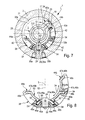
- FIG. 7 the rotary drive device in a sectional view corresponding to FIG. 2 , in which the space divider and stop unit is equipped with a further stop element to form a stop element chain
- FIG. 8 a detail view of the space divider and stop unit provided in the embodiment of FIG. 7
- FIG. 9 the space divider and stop unit of FIGS. 7 and 8 in a perspective view
- FIG. 10 the rotary drive device in a sectional view corresponding to
- FIG. 2 in which the space divider and stop unit is equipped with an even greater number of stop elements, so that a stop element chain comprising in each case two stop element lies either side of the space divider element
- FIG. 11 the rotary drive device of FIG. 10 in a perspective view with housing partly removed and comparable to the view in FIG. 3
- FIG. 12 a detail view of the version of a space divider and stop unit used in the rotary drive device according to FIGS. 10 and 11
- FIG. 13 the space divider and stop unit of FIG. 12 in a perspective view
- FIG. 14 a detail view of the space divider and stop unit illustrating the assembly process for the purpose of adding two further stop elements
- FIG. 15 the space divider and stop unit illustrated in FIGS. 4 to 6 in a perspective detail view before assembly of its components
- FIG. 16 the arrangement of FIG. 15 in a rear view looking in the direction of arrow XVI of FIG. 15
- FIG. 17 a perspective detail view of one of the stop elements used in the rotary drive device
- FIG. 18 the stop element of FIG. 17 from a different angle of view
- FIG. 19 a perspective detail view of the space divider element used in the rotary drive device of the other Figures
- FIG. 20 the space divider element of FIG. 19 from a different angle of view
- the fluid-actuated rotary drive device designated in its totality by reference number 1 has a housing 2 , in which is formed at least one substantially cylindrical working chamber 3 , which has a preferably circular-cylindrical lateral surface 4 which is responsible for a circular external contour of the working chamber 3 .
- This lateral surface 4 extends coaxially around an imaginary central axis 5 which preferably coincides with the longitudinal axis 6 of the housing 2 .
- the working chamber 3 is also bounded by two axial end faces, spaced apart in the axial direction of the central axis 5 .
- the housing 2 has a substantially circular-cylindrical external contour. It is also of advantage if it is comprised of two preferably equal housing parts 7 , 8 , arranged consecutively along the longitudinal axis 6 and joined together with sealing in a joining plane at right-angles to the central axis 5 . Each of these housing parts 7 , 8 is cup or pot-shaped and defines with its interior an axial half of the working chamber 3 . The two housing parts 7 , 8 are put together with their open sides leading to form the working chamber 3 and joined together by means of screws 12 or other means of connection. The screw holes are not shown in the sectional views of the drawing.
- An output member 13 passes coaxially through the working chamber 3 .
- the output member is rotatably mounted in two end walls 14 , 15 of the housing 2 , spaced apart on the longitudinal axis 6 , by means of suitable bearing devices.
- Each of the two end walls 14 , 15 defines one of the two end faces axially bounding the working chamber 3 .
- the output member 13 passes through at least one and preferably both end walls 14 , 15 .
- at least one end section of the output member 13 extending out from the housing 2 forms a tapping section 16 at which a rotary movement may be tapped.
- a machine part for example, may be actuated by such a rotary movement.
- a swivel piston 18 which may be driven by fluidic pressurisation to make a swivelling movement indicated by a double arrow 17 .
- the swivel axis for the swivelling movement 17 of the swivel piston 18 coincides with the central axis 5 .
- the swivel piston 18 is also connected non-rotatably to the output member 13 , which is realised preferably by form-fitting of a bushing section 22 of the swivel piston 18 with internal teeth on to a length section of the output member 13 having external teeth and passing through the working chamber 3 .
- the working chamber 3 has a larger diameter than the outside diameter of the bushing section 22 . This creates an annular space 21 extending all around the bushing section 22 , but which is interrupted at two points. One interruption results from a vane section 23 of the swivel piston 18 , and the other interruption from a space divider element 24 , to be explained in more detail, inserted immovably in the working chamber 3 .
- the vane section 23 protrudes radially from the outer periphery of the bushing section 22 . It passes through the radial width of the annular space 21 , making sliding and sealing contact with the lateral surface 4 of the working chamber 3 .
- the swivel piston 18 makes sliding and sealing contact with the two end faces axially bounding the working chamber 3 .
- the sealing cooperation results from the fact that the swivel piston 18 , at least in the areas in which it is in contact with the housing 2 , is provided with a sealing structure 25 made of material with rubber-elastic properties.
- the sealing structure 25 extends preferably on all sides around the entire swivel piston 18 .
- the swivel piston 18 has in particular a core body 26 made of a rigid and load-bearing material, and coated with the sealing structure 25 on the outside.
- the radially outwards oriented outer lateral surface 27 of the bushing section 22 is made preferably of a material with rubber-elastic properties and is formed in particular by a hollow cylindrical section of the sealing structure 25 , arranged concentrically to the central axis 5 .
- the space divider element 24 is inserted radially between the bushing section 22 and the lateral surface 4 of the working chamber 3 , and extends over the entire axial length of the working chamber 3 .
- It has expediently a base body 28 made of a rigid and in particular plastic material, and a seal 29 at least partly covering the outer surface of this base body 28 .
- the seal 29 is fixed to the base body 28 by material bonding, in particular by means of an injection moulding process.
- the space divider element 24 has on its inner side facing the central axis 5 a sealing face 32 which fits up against the lateral surface of the bushing section 22 . It is preferably strip-shaped and extends parallel to the central axis 5 . Preferably it is formed by the outer surface of the base body 28 which is not covered by the seal 29 in this area.
- the seal 29 extends with an outer sealing section 29 a along the outside of the space divider element 24 facing radially away from the central axis 5 , and is in contact via this outer sealing section 29 a , with the space divider element 24 fitted and under static sealing, with the lateral surface 4 of the working chamber 3 .
- the seal 29 has two end sealing sections 29 b , each extending to one of the two axially oriented end faces of the space divider element 24 and, with the space divider element 24 fitted, making static sealing contact with one of the two axial end faces of the working chamber 3 formed on the end walls 14 , 15 .
- the fitted space divider element 24 divides the working chamber 3 with sealing into two drive chambers 33 a , 33 b , which are arranged consecutively in a circumferential direction around the central axis 5 .
- this circumferential direction is described below as the main circumferential direction 34 and is in the drawing partly designated by the same double arrow as the swivelling movement 17 .
- Opening out into each of the two drive chambers 33 a , 33 b is one of two control passages 35 a , 35 b passing through the housing 2 .
- the two drive chambers 33 a , 33 b may be pressurised by a driving fluid or relieved of pressure in a coordinated manner.
- the pressure difference between the two drive chambers 33 a , 33 b produced by this means generates a torque at the swivel piston 18 and effects its swivelling movement 17 .
- This swivelling movement 17 may be tapped as a rotary movement, outside the housing 2 , at the tapping section 16 of the output member 13 .
- the fixing, immovable relative to the housing 2 , of the space divider element 24 mounted in the working chamber 3 is produced by direct fixing or attachment of the space divider element 24 to the housing 2 .
- form-fitting attachment is provided.
- the space divider element 24 has at each of its two end faces oriented in the axial direction of the central axis 5 and opposite one another at least one axially protruding bearing projection 36 , each engaging in a complementary bearing recess, not further apparent in the drawing, which is formed in the facing axial end face of the end walls 14 , 15 which axially bound the working chamber 3 . This arrangement may also be transposed.
- the bearing projection 36 and the assigned bearing recess are in particular, when they are not only present singly, expediently non-circular in cross-section, so that the fitted space divider element 24 is fixed with stable orientation and in particular also non-rotatable relative to the housing 2 .
- the space divider element 24 may be provided as part of a multi-part space divider and stop unit 38 .
- This space divider and stop unit 38 also includes, besides the space divider element 24 , at least one and preferably several stop elements 42 .
- the rotary drive device 1 contains a multiplicity of stop elements 42 , which may be combined in variable numbers with the space divider element 24 to from the space divider and stop unit 38 .
- the stop elements 42 not integrated in the space divider and stop unit 38 here may be kept for possible conversion of the rotary drive device 1 or used for another rotary drive device 1 .
- the space divider and stop unit 38 is installed in the working chamber 3 , it adopts a position designated as “operating position”.
- This operating position is preset irrevocably by the preferably direct mounting of the space divider element 24 on the housing 2 .
- the space divider element 24 performs the dividing function referred to above in respect of the two drive chambers 33 a , 33 b which may be supplied with fluid pressure, and also functions as support for the stop elements 42 expediently not fastened directly to the housing 2 .
- the space divider and stop unit 38 also serves to preset for the swivel piston 18 the maximum possible swivel angle in the course of its swivelling movement 17 .
- the space divider and stop unit 38 performs a stop function.
- the swivel piston 18 may be swivelled between two swivel end positions in which it makes contact with one of the two vane edges 43 a , 43 b of its vane section 23 which lie opposite one another and are oriented in the main circumferential direction 34 , on the space divider and stop unit 38 lying in the swivel path.
- the space divider and stop unit 38 has two stop faces 44 a , 44 b which are oriented in the main circumferential direction 34 and facing toward the vane section 23 . They are oriented opposite one another in the main circumferential direction 34 , with the one stop face 44 a designed to interact with the one vane edge 43 a and the other stop face 44 b designed to interact with the other vane edge 43 b.
- the two stop faces 44 a , 44 b are located at the two opposite end sections, oriented in the main circumferential direction 34 , of the space divider and stop unit 38 .
- both stop faces 44 a , 44 b are formed on a stop element 42 fixed to the space divider element 24 , in each case adopting a stop position.
- the space divider element 24 has two sides 30 , opposite one another and each oriented in the main circumferential direction 34 , at which it is equipped with in each case one of two assembly interfaces 45 a , 45 b .
- Each of these assembly interfaces 45 a , 45 b is equipped with snap-in connection means 46 a , 46 b .
- Each of the two assembly interfaces 45 a , 45 b is suitable for having a stop element 42 , adopting a stop position, fastened to it.
- Each stop element 42 has, viewed in the operating position, two first and second end faces 47 a , 47 b , opposite one another and oriented in the main circumferential direction 34 .
- a second mounting interface 48 b with snap-in connection means 49 b is formed in the area of the second end face 47 b.
- the two assembly interfaces 45 a , 45 b provided on the opposite sides 30 of the space divider element 24 are identical to one another, but mirror-symmetrical relative to a radial plane 52 running between them and containing the central axis 5 .
- Each assembly interface 45 a , 45 b including the snap-in connection means 46 a , 46 b belonging to it has a complementary design to the first mounting interfaces 48 a and their assigned snap-in connection means 49 a . In this way it is possible to fix each stop element 42 with its first mounting interface 48 a to each of the two assembly interfaces 45 a , 45 b , to form a snap-in connection.
- each second mounting interface 48 b including the associated snap-in connection means 49 b is designed to be complementary to the first mounting interface 48 a including the snap-in connection means 49 a belonging to this first mounting interface 48 a .
- each assembly interface 45 a , 45 b is identical in form to each second mounting interface 48 b.
- This design makes it possible to fix stop elements 42 to one another by bringing them into engagement with their first and second mounting interfaces 48 a , 48 b , to create a snap-in connection.
- a stop element 42 may be fixed as part of a snap-in connection by means of the first mounting interface 48 a formed on it.
- the snap-in connection means 46 a , 49 a and 46 b , 49 a which in this connection make form-fitting engagement with and are complementary to one another, ensure captive cohesion of the elements fastened together on account of positive interlocking.
- the space divider and stop unit 38 contains only two stop elements 42 , each fitted to one of the two assembly interfaces 45 a , 45 b , then the second end faces 47 b of the two stop elements 42 facing away from the space divider element 24 function as the two stop faces 44 a , 44 b for the vane section 23 .
- the second mounting interfaces 48 b formed on the second end faces 47 b of the stop elements 42 are in this connection without function.
- the two stop faces 44 a , 44 b are formed by the end faces, oriented opposite one another, on the two sides 30 of the space divider element 24 .
- the space divider and stop unit 38 consists only of the space divider element 24 .
- each stop element 42 with a first mounting interface 48 a and a second mounting interface 48 b complementary to the former creates the advantageous possibility of combining several stop elements 42 to form a stop element chain which adjoins one of the two assembly interfaces 45 a , 45 b .
- only the stop elements 42 to be linked together are brought into engagement with the first and second mounting interfaces 48 a , 48 b , complementary to one another, with the assigned snap-in connection means 49 a , 49 b ensuring the stability of the connection.
- the number of stop elements 42 to be linked in a chain may in principle be as desired.
- FIGS. 7 to 9 Shown in FIGS. 7 to 9 is a version of the space divider and stop unit 38 in which only a single stop element 42 is fixed to the one assembly interface 45 a , while a stop element chain of two stop elements 42 lined up side by side is attached to the other assembly interface 45 b .
- the single stop element 42 fitted on the one side of the space divider element 24 forms the one stop face 44 a
- the other stop face 44 b is defined by the last stop element 42 b of the stop element chain, opposite the space divider element 24 .
- the space divider and stop unit 38 is equipped at both assembly interfaces 45 a , 45 b with in each case one stop element chain comprised of two stop elements 42 lined up side by side and positively engaging with one another.
- each stop element chain forms with its outer stop element 42 one of the two stop faces 44 a , 44 b.
- the elements 24 , 42 attached to one another are engaged together by the snap-in connection means 46 a , 46 b , 49 a , 49 b , so that a stable, inherently cohesive assembly is formed, which may be inserted into the working chamber 3 as an easily handled assembly module during assembly of the rotary drive device 1 .
- the complementary snap-in connection means 46 a , 46 b , 49 a , 49 b are so designed that the snap-in connections which can be created with their aid are releasable.
- the rotary drive device 1 in respect of the design of the space divider and stop unit 38 , may be modified at any time to meet a changed application requirement.
- the rotary drive device 1 is especially cost-effective if all stop elements 42 are designed to be identical to one another. This is the case in the embodiment. All stop elements 42 may therefore be produced using one and the same production tool. Moreover, stockholding is reduced to a minimum, since only a single type of stop element 42 must be provided.
- the maximum swivel angle of the swivel piston 18 is preset by the stop faces ( 44 a ) formed on this space divider element 24 . In the embodiment this measure gives a maximum swivel angle of 270°.
- Each stop element 42 is expediently so designed that, after its integration into the space divider and stop unit 38 , a reduction of the preset swivel angle by an angular range of 45° occurs. Accordingly, in the embodiment of FIGS. 1 to 6 , which is equipped with two stop elements 42 , there is still a maximum swivel angle of 180°. In the embodiment of FIGS. 7 to 9 , the maximum possible swivel angle is 135° and in the embodiment of FIGS. 10 to 13 it is 90°.
- Each stop element 42 expediently has a curved circular arc shape such that the centre of curvature, viewed in the operating position, lies on the same side as the central axis 5 , and in particular lies directly on this central axis 5 . It is also of advantage if each stop element 42 has at least substantially a contour corresponding to a circumferential section of a hollow cylinder extending a short distance around the longitudinal axis.
- the whole space divider and stop unit 38 irrespective of the number of stop elements 42 with which it is equipped, has a shape corresponding to a circumferential section of a hollow cylinder.
- each stop element 42 preferably has an inner surface 53 facing the swivel piston which is concave and has a circular-arc-shaped contour, with its centre lying on the central axis 5 .
- the snap-in connection means 46 a , 49 a ; 46 b , 49 a ; 49 a , 49 b are expediently in each case part of a separate plug connection device 54 .
- the various elements 24 , 42 of the space divider and stop unit 38 may be easily plugged together for mutual fixing, while the snap-in connection is a result of this plugging-in process.
- the direction of plugging-in 55 shown by arrows in the drawing runs, viewed in the operating position of the space divider and stop unit 38 , in particular in a plane at right-angles to the central axis 5 and preferably radially relative to the central axis 5 .
- the elements 24 , 42 may be preferably plugged together in a direction transverse to and in particular at right-angles to the main circumferential direction 34 , and may as required also be released from one another.
- the first assembly interface 45 a formed on the space divider element 24 may form, together with a first mounting interface 48 a of any desired stop element 42 , a plug connection device 54 .
- the second assembly interface 45 b provided on the space divider element 24 may also, together with the first mounting interface 48 a of each stop element 42 , form a plug connection device 54 .
- the first mounting interface 48 a of any desired stop element 42 may, together with the second mounting interface 48 b of any desired further stop element 42 , likewise form a plug connection device 54 .
- the snap-in connection means 46 a , 46 b , 49 a , 49 b are expediently hook-shaped, as may be seen especially clearly in FIGS. 4, 8, 12 and 14 .
- the hook-shaped snap-in connection means 46 a , 46 b of the two assembly interfaces 45 a , 45 b bound a plug-in socket 55 .
- the plug-in sockets 55 are in particular open towards the radial outside of the space divider element 24 and the stop elements 42 opposite the central axis 5 .
- the hook-shaped snap-in connection means 49 a of the first mounting interface 48 a formed on each stop element 42 have preferably the shape of substantially L-shaped arms extending to the side, with a width so matched to the width of the plug-in sockets 55 that they may be plugged into these plug-in sockets 55 .
- the arm-like snap-in connection means 49 a of the first mounting interface 48 a are inserted or pushed into a plug-in socket 55 of the space divider element 24 or stop element 42 to be connected until the snap-in connection means 49 a engage or snap into the other snap-in connection means 46 a , 46 b , 49 b and thereby an element linkage, preferably easily releasable, is created.
- the snap-in connections involved in assembly of the space divider and stop unit 38 may also be described as snap connections.
- the stop elements 42 are preferably single-piece parts made of plastic material. The same plastic material is used preferably in production of the base body 28 of the space divider element 24 .
- compressed air is used as driving fluid for the fluid-actuated rotary drive device 1 , although any other gaseous medium or even fluidic medium may be used for this purpose.
Landscapes
- Engineering & Computer Science (AREA)
- Mechanical Engineering (AREA)
- General Engineering & Computer Science (AREA)
- Physics & Mathematics (AREA)
- Fluid Mechanics (AREA)
- Actuator (AREA)
Abstract
Description
Claims (18)
Applications Claiming Priority (1)
| Application Number | Priority Date | Filing Date | Title |
|---|---|---|---|
| PCT/EP2011/004839 WO2013044934A1 (en) | 2011-09-28 | 2011-09-28 | Fluid-actuated rotary drive device |
Publications (2)
| Publication Number | Publication Date |
|---|---|
| US20130309115A1 US20130309115A1 (en) | 2013-11-21 |
| US9399916B2 true US9399916B2 (en) | 2016-07-26 |
Family
ID=44719849
Family Applications (1)
| Application Number | Title | Priority Date | Filing Date |
|---|---|---|---|
| US13/983,368 Active 2032-10-09 US9399916B2 (en) | 2011-09-28 | 2011-09-28 | Fluid-actuated rotary drive device |
Country Status (4)
| Country | Link |
|---|---|
| US (1) | US9399916B2 (en) |
| EP (1) | EP2614260B8 (en) |
| CN (1) | CN103732926B (en) |
| WO (1) | WO2013044934A1 (en) |
Families Citing this family (8)
| Publication number | Priority date | Publication date | Assignee | Title |
|---|---|---|---|---|
| US8915176B2 (en) | 2013-02-06 | 2014-12-23 | Woodward, Inc. | Hydraulic blocking rotary actuator |
| US9841021B2 (en) | 2013-03-14 | 2017-12-12 | Woodward, Inc. | No corner seal rotary vane actuator |
| EP2789403B1 (en) * | 2013-04-10 | 2015-12-16 | ABI Anlagentechnik-Baumaschinen-Industriebedarf Maschinenfabrik und Vertriebsgesellschaft mbH | Oscillation exciter for construction machines |
| US9957831B2 (en) * | 2014-07-31 | 2018-05-01 | The Boeing Company | Systems, methods, and apparatus for rotary vane actuators |
| CN105443489B (en) * | 2015-12-16 | 2018-01-09 | 中船重工中南装备有限责任公司 | A kind of compensation hydraulic formula buffer swing cylinder |
| DE102018205636B4 (en) | 2018-04-13 | 2020-01-16 | Festo Ag & Co. Kg | actuator assembly |
| DE102018205638B4 (en) * | 2018-04-13 | 2024-06-13 | Festo Se & Co. Kg | Rotary drive device and robot arm of a robot equipped with it |
| WO2021244739A1 (en) * | 2020-06-03 | 2021-12-09 | Zündel Kunststofftechnik Gmbh | Drive system for a moulding plate of a multi-component injection mould, which moulding plate is rotatable about a rotational axis by means of a drive |
Citations (12)
| Publication number | Priority date | Publication date | Assignee | Title |
|---|---|---|---|---|
| US3237528A (en) * | 1964-01-07 | 1966-03-01 | Jamesbury Corp | Fluid pressure rotary vane actuator |
| FR1566834A (en) | 1968-04-11 | 1969-05-09 | ||
| DE2905193A1 (en) | 1979-02-12 | 1980-08-21 | Rogatti Fa Harri | Pressure operated rotary actuator - has one-piece seal completely enclosing vane and shaft and fitting inside cylinder |
| US4492150A (en) * | 1983-07-01 | 1985-01-08 | Yates Harlan W | Actuator for mechanical apparatus |
| JPS60192287A (en) | 1984-03-13 | 1985-09-30 | Toyo Commun Equip Co Ltd | Alarm clock with earphone |
| US5017106A (en) * | 1989-04-28 | 1991-05-21 | Arthur Pfeiffer Vakuumtechnik Wetzlar Gmbh | Pump for conveying gases and providing a differential pressure |
| DE19511488A1 (en) | 1995-03-29 | 1996-10-02 | Festo Kg | Oscillating piston fluid-driven motor |
| US5732613A (en) * | 1996-03-28 | 1998-03-31 | Festo Kg | Fluid operated rotary drive with position detector |
| US20030126985A1 (en) * | 1999-03-18 | 2003-07-10 | Alstom | Actuator with sealing assembly |
| US20060039776A1 (en) * | 2004-08-14 | 2006-02-23 | Udo Schutz | Plastic screw cap |
| US20060137150A1 (en) * | 2003-06-24 | 2006-06-29 | Ishizaki Shizai Co.,Ltd. | Coupling/uncoupling method, plastic coupler and envelop, bag and binder |
| DE102007012398A1 (en) | 2007-03-15 | 2008-09-18 | Festo Ag & Co | Protective hood and thus equipped drive device |
Family Cites Families (4)
| Publication number | Priority date | Publication date | Assignee | Title |
|---|---|---|---|---|
| JPS60192287U (en) | 1984-05-31 | 1985-12-20 | エスエムシ−株式会社 | Detachable stopper for vane type swing motor |
| DE10346091B3 (en) * | 2003-10-04 | 2004-12-30 | Festo Ag & Co. | Fluid-operated rotary drive for machine components has cover with two spaced-out bearing sections |
| DE202006005174U1 (en) * | 2006-03-31 | 2006-06-22 | Festo Ag & Co | Fluid operated rotary actuator |
| DE102009011764A1 (en) * | 2009-03-04 | 2010-09-09 | Festo Ag & Co. Kg | Rotary drive device |
-
2011
- 2011-09-28 US US13/983,368 patent/US9399916B2/en active Active
- 2011-09-28 WO PCT/EP2011/004839 patent/WO2013044934A1/en not_active Ceased
- 2011-09-28 EP EP11763603.5A patent/EP2614260B8/en active Active
- 2011-09-28 CN CN201180071410.XA patent/CN103732926B/en active Active
Patent Citations (13)
| Publication number | Priority date | Publication date | Assignee | Title |
|---|---|---|---|---|
| US3237528A (en) * | 1964-01-07 | 1966-03-01 | Jamesbury Corp | Fluid pressure rotary vane actuator |
| FR1566834A (en) | 1968-04-11 | 1969-05-09 | ||
| DE2905193A1 (en) | 1979-02-12 | 1980-08-21 | Rogatti Fa Harri | Pressure operated rotary actuator - has one-piece seal completely enclosing vane and shaft and fitting inside cylinder |
| US4492150A (en) * | 1983-07-01 | 1985-01-08 | Yates Harlan W | Actuator for mechanical apparatus |
| JPS60192287A (en) | 1984-03-13 | 1985-09-30 | Toyo Commun Equip Co Ltd | Alarm clock with earphone |
| US5017106A (en) * | 1989-04-28 | 1991-05-21 | Arthur Pfeiffer Vakuumtechnik Wetzlar Gmbh | Pump for conveying gases and providing a differential pressure |
| DE19511488A1 (en) | 1995-03-29 | 1996-10-02 | Festo Kg | Oscillating piston fluid-driven motor |
| DE19511488C2 (en) | 1995-03-29 | 1998-09-17 | Festo Ag & Co | Fluid operated swing piston motor |
| US5732613A (en) * | 1996-03-28 | 1998-03-31 | Festo Kg | Fluid operated rotary drive with position detector |
| US20030126985A1 (en) * | 1999-03-18 | 2003-07-10 | Alstom | Actuator with sealing assembly |
| US20060137150A1 (en) * | 2003-06-24 | 2006-06-29 | Ishizaki Shizai Co.,Ltd. | Coupling/uncoupling method, plastic coupler and envelop, bag and binder |
| US20060039776A1 (en) * | 2004-08-14 | 2006-02-23 | Udo Schutz | Plastic screw cap |
| DE102007012398A1 (en) | 2007-03-15 | 2008-09-18 | Festo Ag & Co | Protective hood and thus equipped drive device |
Non-Patent Citations (2)
| Title |
|---|
| DE 19511488-Machine Translation from ESPACENET, Oscillating piston fluid-driven motor, Pub date-Oct. 1996. * |
| JP 60192287-Machine Translation from USPTO, Detachable stopper of vane-type swing motor, Pub date-Dec. 1985. * |
Also Published As
| Publication number | Publication date |
|---|---|
| EP2614260B1 (en) | 2015-06-10 |
| EP2614260A1 (en) | 2013-07-17 |
| CN103732926A (en) | 2014-04-16 |
| WO2013044934A1 (en) | 2013-04-04 |
| CN103732926B (en) | 2016-08-24 |
| US20130309115A1 (en) | 2013-11-21 |
| EP2614260B8 (en) | 2015-07-15 |
Similar Documents
| Publication | Publication Date | Title |
|---|---|---|
| US9399916B2 (en) | Fluid-actuated rotary drive device | |
| US7886840B2 (en) | Motor assembly for pneumatic tool | |
| CN203594824U (en) | Valve module and valve actuator | |
| US11384852B2 (en) | Ball valve | |
| GB2497163A (en) | Connector for connecting to air inflation valve | |
| EP2484948A1 (en) | Motorized needle valve | |
| TWI660123B (en) | Diaphragm pump | |
| US10947998B2 (en) | Fluid pressure cylinder | |
| US8739832B2 (en) | Motor assembly for pneumatic tool | |
| CN104114867A (en) | Rotary piston pump | |
| WO2013141212A1 (en) | Piston-format working-fluid-pressure actuator and control valve | |
| CN119309032A (en) | A valve device | |
| KR101861424B1 (en) | Rotary fluid regulator | |
| CN210440618U (en) | Four-way valve | |
| KR102665510B1 (en) | Actuator arrangement | |
| EP3037667B1 (en) | Vacuum pump mechanism | |
| KR101252464B1 (en) | Actuator quick exhaust value | |
| US12098734B2 (en) | Electric fluid pressure cylinder and moving structure body | |
| IL258552B1 (en) | Hydraulic machine and reversible metering pump equipped with such a machine | |
| CN114069932A (en) | Motor element and have its three-way valve | |
| KR101357190B1 (en) | Prefabricated fluid control valve | |
| TW201537069A (en) | Throttle valve | |
| JP4308539B2 (en) | Fluid pressure cylinder | |
| CN223689881U (en) | A telescopic air pump structure | |
| CN113323727A (en) | Distributed power valve, engine and vehicle with distributed power valve and engine |
Legal Events
| Date | Code | Title | Description |
|---|---|---|---|
| AS | Assignment |
Owner name: FESTO AG & CO. KG, GERMANY Free format text: ASSIGNMENT OF ASSIGNORS INTEREST;ASSIGNORS:THORWART, GERHARD;HOHL, ULRICH;MENIKHEIM, FRANK;REEL/FRAME:030932/0464 Effective date: 20130529 |
|
| FEPP | Fee payment procedure |
Free format text: PAYOR NUMBER ASSIGNED (ORIGINAL EVENT CODE: ASPN); ENTITY STATUS OF PATENT OWNER: LARGE ENTITY |
|
| STCF | Information on status: patent grant |
Free format text: PATENTED CASE |
|
| MAFP | Maintenance fee payment |
Free format text: PAYMENT OF MAINTENANCE FEE, 4TH YEAR, LARGE ENTITY (ORIGINAL EVENT CODE: M1551); ENTITY STATUS OF PATENT OWNER: LARGE ENTITY Year of fee payment: 4 |
|
| AS | Assignment |
Owner name: FESTO SE & CO. KG, GERMANY Free format text: CHANGE OF NAME;ASSIGNOR:FESTO AG & CO. KG;REEL/FRAME:052136/0406 Effective date: 20200131 |
|
| MAFP | Maintenance fee payment |
Free format text: PAYMENT OF MAINTENANCE FEE, 8TH YEAR, LARGE ENTITY (ORIGINAL EVENT CODE: M1552); ENTITY STATUS OF PATENT OWNER: LARGE ENTITY Year of fee payment: 8 |