US9387468B2 - Cobalt catalysts and their use for hydrosilylation and dehydrogenative silylation - Google Patents
Cobalt catalysts and their use for hydrosilylation and dehydrogenative silylation Download PDFInfo
- Publication number
- US9387468B2 US9387468B2 US14/547,641 US201414547641A US9387468B2 US 9387468 B2 US9387468 B2 US 9387468B2 US 201414547641 A US201414547641 A US 201414547641A US 9387468 B2 US9387468 B2 US 9387468B2
- Authority
- US
- United States
- Prior art keywords
- aryl
- group
- alkyl
- substituted
- unsaturated
- Prior art date
- Legal status (The legal status is an assumption and is not a legal conclusion. Google has not performed a legal analysis and makes no representation as to the accuracy of the status listed.)
- Active
Links
- 0 [1*]C1=N([7*])[Co]2(C)([Si]([8*])([9*])CC([10*])([11*])/C([12*])=C(/[13*])[14*])N3=C1C([2*])=C([3*])C([4*])=C3/C([5*])=N\2[6*] Chemical compound [1*]C1=N([7*])[Co]2(C)([Si]([8*])([9*])CC([10*])([11*])/C([12*])=C(/[13*])[14*])N3=C1C([2*])=C([3*])C([4*])=C3/C([5*])=N\2[6*] 0.000 description 16
- XJVNAEKXMYEHOI-VEBBEOBHSA-N C=CCO[Si](C)(C)[Co]12(C)N(C)=C(C)C3=N1C(=CC=C3)/C(C)=N\2C Chemical compound C=CCO[Si](C)(C)[Co]12(C)N(C)=C(C)C3=N1C(=CC=C3)/C(C)=N\2C XJVNAEKXMYEHOI-VEBBEOBHSA-N 0.000 description 7
- HPCRQQLSXBPCDS-VZFXNHKXSA-N C=CCO[Si](C)(C)[Co]12(C)N(C3=C(C)C=C(C)C=C3C)=C(C)C3=N1C(=CC=C3)/C(C)=N\2C1=C(C)C=C(C)C=C1C Chemical compound C=CCO[Si](C)(C)[Co]12(C)N(C3=C(C)C=C(C)C=C3C)=C(C)C3=N1C(=CC=C3)/C(C)=N\2C1=C(C)C=C(C)C=C1C HPCRQQLSXBPCDS-VZFXNHKXSA-N 0.000 description 7
- CDWQPMHKSSYZIO-JMYCEDPYSA-N C=CCO[Si](C1=CC=CC=C1)(C1=CC=CC=C1)[Co]12(C)N(C)=C(C)C3=N1C(=CC=C3)/C(C)=N\2C Chemical compound C=CCO[Si](C1=CC=CC=C1)(C1=CC=CC=C1)[Co]12(C)N(C)=C(C)C3=N1C(=CC=C3)/C(C)=N\2C CDWQPMHKSSYZIO-JMYCEDPYSA-N 0.000 description 7
- GUWAGCJNWHTKCS-VZFXNHKXSA-N C=CCO[Si](C1=CC=CC=C1)(C1=CC=CC=C1)[Co]12(C)N(C3=C(C)C=C(C)C=C3C)=C(C)C3=N1C(=CC=C3)/C(C)=N\2C1=C(C)C=C(C)C=C1C Chemical compound C=CCO[Si](C1=CC=CC=C1)(C1=CC=CC=C1)[Co]12(C)N(C3=C(C)C=C(C)C=C3C)=C(C)C3=N1C(=CC=C3)/C(C)=N\2C1=C(C)C=C(C)C=C1C GUWAGCJNWHTKCS-VZFXNHKXSA-N 0.000 description 7
- IVRLNRAFXCIYBA-XDCRYNCJSA-N C.C=CCCCCCC.C=CCO[Si](C1=CC=CC=C1)(C1=CC=CC=C1)[Co]12(C)N3=C(C=CC=C3/C(C)=N\1C)/C(C)=N\2C.CCCCCCCCO(CC)[SiH](OCC)OCC.[H][Si](C)(OCC)OCC Chemical compound C.C=CCCCCCC.C=CCO[Si](C1=CC=CC=C1)(C1=CC=CC=C1)[Co]12(C)N3=C(C=CC=C3/C(C)=N\1C)/C(C)=N\2C.CCCCCCCCO(CC)[SiH](OCC)OCC.[H][Si](C)(OCC)OCC IVRLNRAFXCIYBA-XDCRYNCJSA-N 0.000 description 2
- USFFFZVVWRUBDJ-PJWOMWSZSA-N C.C=CCCCCCC.C=CCO[Si](C1=CC=CC=C1)(C1=CC=CC=C1)[Co]12(C)N3=C(C=CC=C3/C(C)=N\1C1=C(C)C=C(C)C=C1C)/C(C)=N\2C1=C(C)C=C(C)C=C1C.CCCCCC=CCO(CC)[SiH](OCC)OCC.CCCCCCCC.[Ar].[H][Si](C)(OCC)OCC Chemical compound C.C=CCCCCCC.C=CCO[Si](C1=CC=CC=C1)(C1=CC=CC=C1)[Co]12(C)N3=C(C=CC=C3/C(C)=N\1C1=C(C)C=C(C)C=C1C)/C(C)=N\2C1=C(C)C=C(C)C=C1C.CCCCCC=CCO(CC)[SiH](OCC)OCC.CCCCCCCC.[Ar].[H][Si](C)(OCC)OCC USFFFZVVWRUBDJ-PJWOMWSZSA-N 0.000 description 2
- URUSUSXFHIPHMZ-FOZGBXBOSA-N C.C.C.C=CCO[Si](C1=CC=CC=C1)(C1=CC=CC=C1)[Co]12(C)N3=C(C=CC=C3/C(C)=N\1C)/C(C)=N\2C Chemical compound C.C.C.C=CCO[Si](C1=CC=CC=C1)(C1=CC=CC=C1)[Co]12(C)N3=C(C=CC=C3/C(C)=N\1C)/C(C)=N\2C URUSUSXFHIPHMZ-FOZGBXBOSA-N 0.000 description 1
- GAFBPCNRNMBQLF-UHFFFAOYSA-N C.C.C=CCO.C=CCO[SiH](C1=CC=CC=C1)C1=CC=CC=C1.CCCC.CCNCl.C[SiH](C)Cl Chemical compound C.C.C=CCO.C=CCO[SiH](C1=CC=CC=C1)C1=CC=CC=C1.CCCC.CCNCl.C[SiH](C)Cl GAFBPCNRNMBQLF-UHFFFAOYSA-N 0.000 description 1
- GBPZKOUBRJRKNE-UHFFFAOYSA-N C.C.C=CCO.C=CCO[SiH](C1=CC=CC=C1)C1=CC=CC=C1.CCCC.CCNCl.Cl[SiH](C1=CC=CC=C1)C1=CC=CC=C1 Chemical compound C.C.C=CCO.C=CCO[SiH](C1=CC=CC=C1)C1=CC=CC=C1.CCCC.CCNCl.Cl[SiH](C1=CC=CC=C1)C1=CC=CC=C1 GBPZKOUBRJRKNE-UHFFFAOYSA-N 0.000 description 1
- XRNGIZWIWKLDIZ-GOWUEXCESA-N C.C.C=CCO[Si](C)(C)[Co]12(C)N3=C(C=CC=C3/C(C)=N\1C)/C(C)=N\2C.C=C[Si](C)(C)O[Si](C)(C)C=C.CC(C)(C)O[Si](C)(C)CC[SiH3].CC([SiH3])[Si](C)(C)CC(C)(C)C.[H][Si](C)(O[Si](C)(C)C)O[Si](C)(C)C Chemical compound C.C.C=CCO[Si](C)(C)[Co]12(C)N3=C(C=CC=C3/C(C)=N\1C)/C(C)=N\2C.C=C[Si](C)(C)O[Si](C)(C)C=C.CC(C)(C)O[Si](C)(C)CC[SiH3].CC([SiH3])[Si](C)(C)CC(C)(C)C.[H][Si](C)(O[Si](C)(C)C)O[Si](C)(C)C XRNGIZWIWKLDIZ-GOWUEXCESA-N 0.000 description 1
- HPCUVTXUYQGREP-RPYXMSEKSA-N C.C/C1=N(\C)[Co]2(C[Si](C)(C)C)(C[Si](C)(C)C)N3=C(C=CC=C13)/C(C)=N\2C.C=CCO[Si](C)(C)[Co]12(C)N3=C(C=CC=C3/C(C)=N\1C)/C(C)=N\2C.[H][Si](C)(C)OCC=C Chemical compound C.C/C1=N(\C)[Co]2(C[Si](C)(C)C)(C[Si](C)(C)C)N3=C(C=CC=C13)/C(C)=N\2C.C=CCO[Si](C)(C)[Co]12(C)N3=C(C=CC=C3/C(C)=N\1C)/C(C)=N\2C.[H][Si](C)(C)OCC=C HPCUVTXUYQGREP-RPYXMSEKSA-N 0.000 description 1
- QBKRJAKNCASLKK-VCZGLWGHSA-N C.C/C1=N(\C)[Co]2(C[Si](C)(C)C)(C[Si](C)(C)C)N3=C(C=CC=C13)/C(C)=N\2C.C=CCO[Si](C1=CC=CC=C1)(C1=CC=CC=C1)[Co]12(C)N3=C(C=CC=C3/C(C)=N\1C)/C(C)=N\2C.N#N.[H][Si](OCC=C)(C1=CC=CC=C1)C1=CC=CC=C1 Chemical compound C.C/C1=N(\C)[Co]2(C[Si](C)(C)C)(C[Si](C)(C)C)N3=C(C=CC=C13)/C(C)=N\2C.C=CCO[Si](C1=CC=CC=C1)(C1=CC=CC=C1)[Co]12(C)N3=C(C=CC=C3/C(C)=N\1C)/C(C)=N\2C.N#N.[H][Si](OCC=C)(C1=CC=CC=C1)C1=CC=CC=C1 QBKRJAKNCASLKK-VCZGLWGHSA-N 0.000 description 1
- ZYUQKWHBSNMDHI-BPDXCSRGSA-N C.C/C1=N(\C)[Co]2(C[Si](C)(C)C)N3=C(C=CC=C13)/C(C)=N\2C.C=CCO[Si](C)(C)[Co]12(C)N3=C(C=CC=C3/C(C)=N\1C)/C(C)=N\2C.[H][Si](C)(C)OCC=C Chemical compound C.C/C1=N(\C)[Co]2(C[Si](C)(C)C)N3=C(C=CC=C13)/C(C)=N\2C.C=CCO[Si](C)(C)[Co]12(C)N3=C(C=CC=C3/C(C)=N\1C)/C(C)=N\2C.[H][Si](C)(C)OCC=C ZYUQKWHBSNMDHI-BPDXCSRGSA-N 0.000 description 1
- IDLSBSIVMSQCAA-HWZAUZRUSA-N C.C=CCCCCCC.C=CCO[Si](C)(C)[Co]12(C)N3=C(C=CC=C3/C(C)=N\1C)/C(C)=N\2C.CCCCCC=CCO(CC)[SiH](OCC)OCC.CCCCCCCCO(CC)[SiH](OCC)OCC.[H][Si](C)(OCC)OCC Chemical compound C.C=CCCCCCC.C=CCO[Si](C)(C)[Co]12(C)N3=C(C=CC=C3/C(C)=N\1C)/C(C)=N\2C.CCCCCC=CCO(CC)[SiH](OCC)OCC.CCCCCCCCO(CC)[SiH](OCC)OCC.[H][Si](C)(OCC)OCC IDLSBSIVMSQCAA-HWZAUZRUSA-N 0.000 description 1
- LFJTXFIGVNLLSL-GGCAXNEPSA-N C.C=CCCCCCC.C=CCO[Si](C)(C)[Co]12(C)N3=C(C=CC=C3/C(C)=N\1C)/C(C)=N\2C.CCCCCCCCO(CC)[SiH](OCC)OCC.[H][Si](C)(OCC)OCC Chemical compound C.C=CCCCCCC.C=CCO[Si](C)(C)[Co]12(C)N3=C(C=CC=C3/C(C)=N\1C)/C(C)=N\2C.CCCCCCCCO(CC)[SiH](OCC)OCC.[H][Si](C)(OCC)OCC LFJTXFIGVNLLSL-GGCAXNEPSA-N 0.000 description 1
- YFHNYDFYHRYTNU-PJWOMWSZSA-N C.C=CCCCCCC.C=CCO[Si](C)(C)[Co]12(C)N3=C(C=CC=C3/C(C)=N\1C1=C(C)C=C(C)C=C1C)/C(C)=N\2C1=C(C)C=C(C)C=C1C.CCCCCC=CCO(CC)[SiH](OCC)OCC.CCCCCCCC.[Ar].[H][Si](C)(OCC)OCC Chemical compound C.C=CCCCCCC.C=CCO[Si](C)(C)[Co]12(C)N3=C(C=CC=C3/C(C)=N\1C1=C(C)C=C(C)C=C1C)/C(C)=N\2C1=C(C)C=C(C)C=C1C.CCCCCC=CCO(CC)[SiH](OCC)OCC.CCCCCCCC.[Ar].[H][Si](C)(OCC)OCC YFHNYDFYHRYTNU-PJWOMWSZSA-N 0.000 description 1
- YOSKKOHUUFUHBH-QORFIJBESA-N C.C=CCO[Si](C)(C)[Co]12(C)N3=C(C=CC=C3/C(C)=N\1C)/C(C)=N\2C.C=C[Si](C)(C)C.CC([SiH3])[Si](C)(C)C.C[Si](C)(C)CC[SiH3].[H][Si](C)(O[Si](C)(C)C)O[Si](C)(C)C Chemical compound C.C=CCO[Si](C)(C)[Co]12(C)N3=C(C=CC=C3/C(C)=N\1C)/C(C)=N\2C.C=C[Si](C)(C)C.CC([SiH3])[Si](C)(C)C.C[Si](C)(C)CC[SiH3].[H][Si](C)(O[Si](C)(C)C)O[Si](C)(C)C YOSKKOHUUFUHBH-QORFIJBESA-N 0.000 description 1
- FITKBSVNMWCGQS-QORFIJBESA-N C.C=CCO[Si](C)(C)[Co]12(C)N3=C(C=CC=C3/C(C)=N\1C)/C(C)=N\2C.C=C[Si](C)(O[Si](C)(C)C)O[Si](C)(C)C.CC(C)O[Si](C)(C)C.CC([SiH3])[Si](C)(O[Si](C)(C)C)O[Si](C)(C)C.C[Si](C)(C)O[Si](C)(CC[SiH3])O[Si](C)(C)C Chemical compound C.C=CCO[Si](C)(C)[Co]12(C)N3=C(C=CC=C3/C(C)=N\1C)/C(C)=N\2C.C=C[Si](C)(O[Si](C)(C)C)O[Si](C)(C)C.CC(C)O[Si](C)(C)C.CC([SiH3])[Si](C)(O[Si](C)(C)C)O[Si](C)(C)C.C[Si](C)(C)O[Si](C)(CC[SiH3])O[Si](C)(C)C FITKBSVNMWCGQS-QORFIJBESA-N 0.000 description 1
- QPJYNASGRUUWSV-JHQOTBRASA-N C.C=CCO[Si](C)(C)[Co]12(C)N3=C(C=CC=C3/C(C)=N\1C1=C(C)C=C(C)C=C1C)/C(C)=N\2C1=C(C)C=C(C)C=C1C.CC1=CC(C)=C(/N2=C(\C)C3=CC=CC4=N3[Co]2(C)/N(C2=C(C)C=C(C)C=C2C)=C\4C)C(C)=C1.N#N.[Ar].[Ar].[H][Si](C)(C)OCC=C Chemical compound C.C=CCO[Si](C)(C)[Co]12(C)N3=C(C=CC=C3/C(C)=N\1C1=C(C)C=C(C)C=C1C)/C(C)=N\2C1=C(C)C=C(C)C=C1C.CC1=CC(C)=C(/N2=C(\C)C3=CC=CC4=N3[Co]2(C)/N(C2=C(C)C=C(C)C=C2C)=C\4C)C(C)=C1.N#N.[Ar].[Ar].[H][Si](C)(C)OCC=C QPJYNASGRUUWSV-JHQOTBRASA-N 0.000 description 1
- WNVRHZLECKCCSI-JHQOTBRASA-N C.C=CCO[Si](C1=CC=CC=C1)(C1=CC=CC=C1)[Co]12(C)N3=C(C=CC=C3/C(C)=N\1C1=C(C)C=C(C)C=C1C)/C(C)=N\2C1=C(C)C=C(C)C=C1C.CC1=CC(C)=C(/N2=C(\C)C3=CC=CC4=N3[Co]2(C)/N(C2=C(C)C=C(C)C=C2C)=C\4C)C(C)=C1.N#N.[Ar].[Ar].[H][Si](OCC=C)(C1=CC=CC=C1)C1=CC=CC=C1 Chemical compound C.C=CCO[Si](C1=CC=CC=C1)(C1=CC=CC=C1)[Co]12(C)N3=C(C=CC=C3/C(C)=N\1C1=C(C)C=C(C)C=C1C)/C(C)=N\2C1=C(C)C=C(C)C=C1C.CC1=CC(C)=C(/N2=C(\C)C3=CC=CC4=N3[Co]2(C)/N(C2=C(C)C=C(C)C=C2C)=C\4C)C(C)=C1.N#N.[Ar].[Ar].[H][Si](OCC=C)(C1=CC=CC=C1)C1=CC=CC=C1 WNVRHZLECKCCSI-JHQOTBRASA-N 0.000 description 1
- NPRPRPMZUDOLPI-POYMKLBRSA-N C/C1=N(\C)[Co]2(C[Si](C)(C)C)(C[Si](C)(C)C)N3=C(C=CC=C13)/C(C)=N\2C.C/C1=N(\C)[Co]2(C[Si](C)(C)C)N3=C(C=CC=C13)/C(C)=N\2C.C1CCOC1 Chemical compound C/C1=N(\C)[Co]2(C[Si](C)(C)C)(C[Si](C)(C)C)N3=C(C=CC=C13)/C(C)=N\2C.C/C1=N(\C)[Co]2(C[Si](C)(C)C)N3=C(C=CC=C13)/C(C)=N\2C.C1CCOC1 NPRPRPMZUDOLPI-POYMKLBRSA-N 0.000 description 1
- VHTLCYFWBQYBAA-UHFFFAOYSA-N CCCCCCC=N Chemical compound CCCCCCC=N VHTLCYFWBQYBAA-UHFFFAOYSA-N 0.000 description 1
Classifications
-
- B—PERFORMING OPERATIONS; TRANSPORTING
- B01—PHYSICAL OR CHEMICAL PROCESSES OR APPARATUS IN GENERAL
- B01J—CHEMICAL OR PHYSICAL PROCESSES, e.g. CATALYSIS OR COLLOID CHEMISTRY; THEIR RELEVANT APPARATUS
- B01J31/00—Catalysts comprising hydrides, coordination complexes or organic compounds
- B01J31/16—Catalysts comprising hydrides, coordination complexes or organic compounds containing coordination complexes
- B01J31/22—Organic complexes
- B01J31/2282—Unsaturated compounds used as ligands
- B01J31/2295—Cyclic compounds, e.g. cyclopentadienyls
-
- C—CHEMISTRY; METALLURGY
- C07—ORGANIC CHEMISTRY
- C07F—ACYCLIC, CARBOCYCLIC OR HETEROCYCLIC COMPOUNDS CONTAINING ELEMENTS OTHER THAN CARBON, HYDROGEN, HALOGEN, OXYGEN, NITROGEN, SULFUR, SELENIUM OR TELLURIUM
- C07F15/00—Compounds containing elements of Groups 8, 9, 10 or 18 of the Periodic Table
- C07F15/06—Cobalt compounds
-
- C—CHEMISTRY; METALLURGY
- C07—ORGANIC CHEMISTRY
- C07F—ACYCLIC, CARBOCYCLIC OR HETEROCYCLIC COMPOUNDS CONTAINING ELEMENTS OTHER THAN CARBON, HYDROGEN, HALOGEN, OXYGEN, NITROGEN, SULFUR, SELENIUM OR TELLURIUM
- C07F15/00—Compounds containing elements of Groups 8, 9, 10 or 18 of the Periodic Table
- C07F15/06—Cobalt compounds
- C07F15/065—Cobalt compounds without a metal-carbon linkage
-
- C—CHEMISTRY; METALLURGY
- C07—ORGANIC CHEMISTRY
- C07F—ACYCLIC, CARBOCYCLIC OR HETEROCYCLIC COMPOUNDS CONTAINING ELEMENTS OTHER THAN CARBON, HYDROGEN, HALOGEN, OXYGEN, NITROGEN, SULFUR, SELENIUM OR TELLURIUM
- C07F7/00—Compounds containing elements of Groups 4 or 14 of the Periodic Table
- C07F7/02—Silicon compounds
- C07F7/08—Compounds having one or more C—Si linkages
- C07F7/0834—Compounds having one or more O-Si linkage
- C07F7/0838—Compounds with one or more Si-O-Si sequences
-
- C07F7/0856—
-
- C—CHEMISTRY; METALLURGY
- C07—ORGANIC CHEMISTRY
- C07F—ACYCLIC, CARBOCYCLIC OR HETEROCYCLIC COMPOUNDS CONTAINING ELEMENTS OTHER THAN CARBON, HYDROGEN, HALOGEN, OXYGEN, NITROGEN, SULFUR, SELENIUM OR TELLURIUM
- C07F7/00—Compounds containing elements of Groups 4 or 14 of the Periodic Table
- C07F7/02—Silicon compounds
- C07F7/08—Compounds having one or more C—Si linkages
- C07F7/0834—Compounds having one or more O-Si linkage
- C07F7/0838—Compounds with one or more Si-O-Si sequences
- C07F7/0872—Preparation and treatment thereof
- C07F7/0876—Reactions involving the formation of bonds to a Si atom of a Si-O-Si sequence other than a bond of the Si-O-Si linkage
- C07F7/0878—Si-C bond
- C07F7/0879—Hydrosilylation reactions
-
- C—CHEMISTRY; METALLURGY
- C07—ORGANIC CHEMISTRY
- C07F—ACYCLIC, CARBOCYCLIC OR HETEROCYCLIC COMPOUNDS CONTAINING ELEMENTS OTHER THAN CARBON, HYDROGEN, HALOGEN, OXYGEN, NITROGEN, SULFUR, SELENIUM OR TELLURIUM
- C07F7/00—Compounds containing elements of Groups 4 or 14 of the Periodic Table
- C07F7/02—Silicon compounds
- C07F7/08—Compounds having one or more C—Si linkages
- C07F7/18—Compounds having one or more C—Si linkages as well as one or more C—O—Si linkages
- C07F7/1804—Compounds having Si-O-C linkages
-
- C07F7/1836—
-
- C07F7/184—
-
- C—CHEMISTRY; METALLURGY
- C07—ORGANIC CHEMISTRY
- C07F—ACYCLIC, CARBOCYCLIC OR HETEROCYCLIC COMPOUNDS CONTAINING ELEMENTS OTHER THAN CARBON, HYDROGEN, HALOGEN, OXYGEN, NITROGEN, SULFUR, SELENIUM OR TELLURIUM
- C07F7/00—Compounds containing elements of Groups 4 or 14 of the Periodic Table
- C07F7/02—Silicon compounds
- C07F7/08—Compounds having one or more C—Si linkages
- C07F7/18—Compounds having one or more C—Si linkages as well as one or more C—O—Si linkages
- C07F7/1804—Compounds having Si-O-C linkages
- C07F7/1872—Preparation; Treatments not provided for in C07F7/20
- C07F7/1876—Preparation; Treatments not provided for in C07F7/20 by reactions involving the formation of Si-C linkages
-
- C—CHEMISTRY; METALLURGY
- C08—ORGANIC MACROMOLECULAR COMPOUNDS; THEIR PREPARATION OR CHEMICAL WORKING-UP; COMPOSITIONS BASED THEREON
- C08G—MACROMOLECULAR COMPOUNDS OBTAINED OTHERWISE THAN BY REACTIONS ONLY INVOLVING UNSATURATED CARBON-TO-CARBON BONDS
- C08G81/00—Macromolecular compounds obtained by interreacting polymers in the absence of monomers, e.g. block polymers
- C08G81/02—Macromolecular compounds obtained by interreacting polymers in the absence of monomers, e.g. block polymers at least one of the polymers being obtained by reactions involving only carbon-to-carbon unsaturated bonds
-
- B—PERFORMING OPERATIONS; TRANSPORTING
- B01—PHYSICAL OR CHEMICAL PROCESSES OR APPARATUS IN GENERAL
- B01J—CHEMICAL OR PHYSICAL PROCESSES, e.g. CATALYSIS OR COLLOID CHEMISTRY; THEIR RELEVANT APPARATUS
- B01J2231/00—Catalytic reactions performed with catalysts classified in B01J31/00
- B01J2231/10—Polymerisation reactions involving at least dual use catalysts, e.g. for both oligomerisation and polymerisation
- B01J2231/14—Other (co) polymerisation, e.g. of lactides or epoxides
-
- B—PERFORMING OPERATIONS; TRANSPORTING
- B01—PHYSICAL OR CHEMICAL PROCESSES OR APPARATUS IN GENERAL
- B01J—CHEMICAL OR PHYSICAL PROCESSES, e.g. CATALYSIS OR COLLOID CHEMISTRY; THEIR RELEVANT APPARATUS
- B01J2231/00—Catalytic reactions performed with catalysts classified in B01J31/00
- B01J2231/30—Addition reactions at carbon centres, i.e. to either C-C or C-X multiple bonds
- B01J2231/32—Addition reactions to C=C or C-C triple bonds
- B01J2231/323—Hydrometalation, e.g. bor-, alumin-, silyl-, zirconation or analoguous reactions like carbometalation, hydrocarbation
-
- B—PERFORMING OPERATIONS; TRANSPORTING
- B01—PHYSICAL OR CHEMICAL PROCESSES OR APPARATUS IN GENERAL
- B01J—CHEMICAL OR PHYSICAL PROCESSES, e.g. CATALYSIS OR COLLOID CHEMISTRY; THEIR RELEVANT APPARATUS
- B01J2231/00—Catalytic reactions performed with catalysts classified in B01J31/00
- B01J2231/70—Oxidation reactions, e.g. epoxidation, (di)hydroxylation, dehydrogenation and analogues
- B01J2231/76—Dehydrogenation
- B01J2231/766—Dehydrogenation of -CH-CH- or -C=C- to -C=C- or -C-C- triple bond species
-
- B—PERFORMING OPERATIONS; TRANSPORTING
- B01—PHYSICAL OR CHEMICAL PROCESSES OR APPARATUS IN GENERAL
- B01J—CHEMICAL OR PHYSICAL PROCESSES, e.g. CATALYSIS OR COLLOID CHEMISTRY; THEIR RELEVANT APPARATUS
- B01J2531/00—Additional information regarding catalytic systems classified in B01J31/00
- B01J2531/80—Complexes comprising metals of Group VIII as the central metal
- B01J2531/84—Metals of the iron group
- B01J2531/845—Cobalt
Definitions
- This invention relates generally to transition metal-containing compounds, more specifically to cobalt complexes containing pyridine di-imine ligands and their use as catalysts for hydrosilylation and dehydrogenative silylation reactions.
- Hydrosilylation chemistry typically involving a reaction between a silyl hydride and an unsaturated organic group, is the basis for synthetic routes to produce commercial silicone-based products like silicone surfactants, silicone fluids and silanes as well as many addition cured products like sealants, adhesives, and coatings.
- Typical hydrosilylation reactions use precious metal catalysts to catalyze the addition of a silyl-hydride (Si—H) to an unsaturated group, such as an olefin. In these reactions, the resulting product is a silyl-substituted, saturated compound.
- This reaction termed a dehydrogenative silylation, has potential uses in the synthesis of new silicone materials, such as silanes, silicone fluids, crosslinked silicone elastomers, and silylated or silicone-crosslinked organic polymers such as polyolefins, unsaturated polyesters, and the like.
- platinum complex catalysts are known in the art including a platinum complex containing unsaturated siloxanes as ligands, which is known in the art as Karstedt's catalyst.
- Other platinum-based hydrosilylation catalysts include Ashby's catalyst, Lamoreaux's catalyst, and Speier's catalyst.
- metal-based catalysts have been explored including, for example, rhodium complexes, iridium complexes, palladium complexes and even first-row transition metal-based catalysts to promote limited hydrosilylations and dehydrogenative silylations.
- U.S. Pat. No. 5,955,555 discloses the synthesis of certain iron or cobalt pyridine di-imine (PDI) complexes bearing two ionic ligands.
- the preferred anions are chloride, bromide, and tetrafluoroborate.
- U.S. Pat. No. 7,442,819 discloses iron and cobalt complexes of certain tricyclic ligands containing a “pyridine” ring substituted with two imino groups.
- U.S. Pat. Nos. 6,461,994, 6,657,026 and 7,148,304 disclose several catalyst systems containing certain transitional metal-PDI complexes.
- 7,053,020 discloses a catalyst system containing, inter alia, one or more bisarylimino pyridine iron or cobalt catalyst. Chirik et al describe bisarylimino pyridine cobalt complexes with anionic ligands (Inorg. Chem. 2010, 49, 6110 and JACS. 2010, 132, 1676.) However, the catalysts and catalyst systems disclosed in these references are described for use in the context of olefin hydrogenation, polymerizations and/or oligomerisations, not in the context of dehydrogenative silylation reactions.
- U.S. Pat. No. 8,236,915 discloses hydrosilylation using Mn, Fe, Co, and Ni catalysts containing pyridinediimine ligands. However, these catalysts are sensitive to air.
- homogeneous metal catalysts suffer from the drawback that following consumption of the first charge of substrates, the catalytically active metal is lost to aggregation and agglomeration and its beneficial catalytic properties are substantially diminished via colloid formation or precipitation. This is a costly loss, especially for noble metals such as Pt.
- Heterogeneous catalysts are used to alleviate this problem but have limited use for polymers and also have lower activity than homogeneous counterparts.
- the two primary homogeneous catalysts for hydrosilylation, Speier's and Karstedt's often lose activity after catalyzing a charge of olefin and silyl- or siloxyhydride reaction. If a single charge of the homogeneous catalyst could be re-used for multiple charges of substrates, then catalyst and process cost advantages would be significant.
- the present invention provides cobalt complexes.
- the cobalt complexes can be used as catalysts for hydrosilylation and/or dehydrogenative silylation processes. Additionally, the present cobalt complexes exhibit air-stability that allows handling under atmospheric conditions.
- the present invention provides a complex of the formula:
- each occurrence of R 1 , R 2 , R 3 , R 4 , R 5 , R 8 , R 9 , R 10 , R 11 , R 12 , R 13 , and R 14 is independently hydrogen, a C1-C18 alkyl, a C1-18 substituted alkyl, a C6-C18 aryl, a substituted C6-C 18 aryl, or an inert substituent, wherein one or more of R 1 -R 5 and R 8 -R 14 , other than hydrogen, optionally contain at least one heteroatom; each occurrence of R 6 and R 7 is independently a C1-C18 alkyl, a C1-C18 substituted alkyl, a C6-C18 aryl or a substituted C6-C18 aryl, wherein one or both R 6 and R 7 optionally contain at least one heteroatom; optionally any two of R 1 , R 2 , R 3 , R 4 , R 5 , R 6 , and R 7
- Z is O, and R 8 and R 9 are independently chosen from a C1-C4 alkyl or a C6-C10 aryl. In one embodiment, Z is O, and R 8 and R 9 are independently chosen from methyl or phenyl.
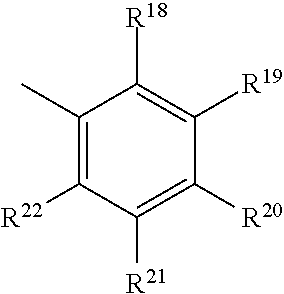
- R 6 and R 7 are independently chosen from a C1-C8 linear, branched, or cyclic alkyl, a C6-C18 aryl, or a substituted C6-C18 aryl. In one embodiment, R 6 and/or R 7 comprise an aryl of the formula:
- each occurrence of R 18 , R 19 , R 20 , R 21 , and R 22 is independently hydrogen, a C1-C18 alkyl, a C1-C18 substituted alkyl, a C6-C18 aryl, a substituted C6-C18 aryl, or an inert substituent, wherein one or more of R 18 -R 22 , other than hydrogen, optionally contain at least one heteroatom.
- R 18 , R 20 , and R 22 are a C1-C4 alkyl, and R 19 and R 21 are hydrogen.
- the complex is of the formula:
- the complex is immobilized on a support.
- the support is chosen from carbon, silica, alumina, MgCl 2 , zirconia, polyethylene, polypropylene, polystyrene, poly(aminostyrene), sulfonated polystyrene, or a combination of two or more thereof.
- at least one of R 1 , R 2 , R 3 , R 4 , R 5 , R 6 , and/or R 7 comprises a functional group that covalently bonds with the support.
- the present invention provides, a process for producing a dehydrogenatively silylated product comprising reacting a mixture comprising (a) an unsaturated compound containing at least one unsaturated functional group, (b) a silyl hydride containing at least one silylhydride functional group, and (c) a catalyst, optionally in the presence of a solvent, in order to produce the dehydrogenatively silylated product, wherein the catalyst is a complex of the Formula (I) or an adduct thereof:
- each occurrence of R 1 , R 2 , R 3 , R 4 , R 5 , R 8 , R 9 , R 10 , R 11 , R 12 , R 13 , and R 14 is independently hydrogen, a C1-C18 alkyl, a C1-C18 substituted alkyl, a C6-C18 aryl, a substituted C6-C18 aryl, or an inert substituent, wherein one or more of R 1 -R 5 and R 8 -R 14 , other than hydrogen, optionally contain at least one heteroatom; each occurrence of R 6 and R 7 is independently a C1-C18 alkyl, a C1-C18 substituted alkyl, a C6-C18 aryl or a substituted C6-C18 aryl, wherein one or both R 6 and R 7 optionally contain at least one heteroatom; optionally any two of R 1 , R 2 , R 3 , R 4 , R 5 , R 6 , and
- R 6 and R 7 comprise an aryl of the formula:
- each occurrence of R 18 , R 19 , R 20 , R 21 , and R 22 is independently hydrogen, a C1-C18 alkyl, a C1-C18 substituted alkyl, a C6-C18 aryl, a substituted C6-C18 aryl, or an inert substituent, wherein one or more of R 18 -R 22 , other than hydrogen, optionally contain at least one heteroatom.
- R 18 and R 22 are independently methyl, ethyl or isopropyl groups and R 3 is hydrogen or methyl.
- R 18 , R 20 , and R 22 are each methyl.
- R 1 and R 5 are independently methyl or phenyl groups.
- R 2 , R 3 , and R 4 are hydrogen.
- the catalyst is chosen from a complex of the formula:
- the process further comprises removing the complex and/or derivatives thereof from the dehydrogenative silylated product.
- the dehydrogenatively silylated product comprises a silane or siloxane containing a silyl group and an unsaturated group.
- the unsaturated group is in the alpha or beta position relative to the silyl group.
- the molar ratio of the unsaturated group in said component (a) relative to the silylhydride functional group in said component (b) is equal to 2:1 or greater.
- the dehydrogenatively silylated product contains two or more terminal silyl groups derived from component (b).
- component (a) is a mono-unsaturated compound.
- component (a) is selected from the group consisting of an alkyne or an olefin; a cycloalkene; an alkyl-capped allyl polyether; a vinyl-functional alkyl-capped allyl or methallyl polyether; an alkyl-capped terminally unsaturated amine; an alkyne; terminally unsaturated acrylate or methacrylate; unsaturated aryl ether; vinyl-functionalized polymer or oligomer; vinyl-functionalized and/or terminally unsaturated alkenyl-functionalized silane and/or silicone; an unsaturated fatty acid; an unsaturated ester; or a combination of two or more thereof.
- the reaction is conducted in the presence of a solvent selected from the group consisting of hydrocarbons, halogenated hydrocarbons, ethers, and combinations thereof.
- the reaction is carried out at a temperature of ⁇ 40° C. to 200° C.
- the silylated product comprises an anti-Markovnikov addition product, a Markovnkiov addition product, or a combination thereof.
- the present invention provides a process for producing a crosslinked material, comprising reacting a mixture comprising (a) a silyl-hydride containing polymer, (b) a mono-unsaturated olefin or an unsaturated polyolefin, or combinations thereof and (c) a catalyst, optionally in the presence of a solvent, in order to produce the crosslinked material, wherein the catalyst is a complex of the Formula (I) or an adduct thereof;
- each occurrence of R 1 , R 2 , R 3 , R 4 , R 5 , R 8 , R 9 , R 10 , R 11 , R 12 , R 13 , and R 14 is independently hydrogen, a C1-C18 alkyl, a C1-C18 substituted alkyl, a C6-C18 aryl, a substituted C6-C18 aryl, or an inert substituent, wherein one or more of R 1 -R 5 , and R 8 -R 14 other than hydrogen, optionally contain at least one heteroatom; each occurrence of R 6 and R 7 is independently a C1-C18 alkyl, a C1-C18 substituted alkyl, a C6-C18 aryl or a substituted C6-C18 aryl, wherein one or both R 6 and R 7 optionally contain at least one heteroatom; optionally any two of R 1 , R 2 , R 3 , R 4 , R 5 , R 6 , and
- the present invention provides a process for the hydrosilylation of a composition comprising hydrosilylation reactants chosen from (a) an unsaturated compound containing at least one unsaturated functional group, and (b) a silyl hydride containing at least one silylhydride functional group, the process comprising contacting the composition comprising the hydrosilylation reactants with a complex of the formula:
- each occurrence of R 1 , R 2 , R 3 , R 4 , R 5 , R 8 , R 9 , R 10 , R 11 , R 12 , R 13 , and R 14 is independently hydrogen, a C1-C18 alkyl, a C1-C18 substituted alkyl, a C6-C18 aryl, a substituted C6-C18 aryl, or an inert substituent, wherein one or more of R 1 -R 5 , and R 8 -R 14 other than hydrogen, optionally contain at least one heteroatom; each occurrence of R 6 and R 7 is independently a C1-C18 alkyl, a C1-C18 substituted alkyl, a C6-C18 aryl or a substituted C6-C18 aryl, wherein one or both of R 6 and R 7 optionally contain at least one heteroatom; optionally any two of R 1 , R 2 , R 3 , R 4 , R 5 , R 6 ,
- Z is O, and R 8 and R 9 are independently chosen from a C1-C8 alkyl and C6-C18 aryl. In one embodiment, Z is O, and R 8 and R 9 are independently chosen from methyl or phenyl.
- R 6 and R 7 are independently chosen from a C1-C8 linear, branched, or cyclic alkyl, a C6-C18 aryl, or a substituted C6-C18 aryl. In one embodiment, wherein R 6 and R 7 are each methyl.
- R 2 , R 3 , and R 4 are each hydrogen.
- R 1 and R 5 are each methyl.
- the complex is of the formula:
- the silyl hydride is chosen from one or a combination of compounds of the formulas: R 23 m SiH p X 4 ⁇ (m+p) ; M a M H b D c D H d T e T H f Q g ; R 29 3 Si(CH 2 R 29 ) x SiOSiR 29 2 (OSiR 29 2 ) y OSiR 29 2 H; R 29 3 Si(CHR 29 ) x SiR 29 2 H, or a combination of two or more thereof, where each R 23 is independently a substituted or unsubstituted aliphatic or aromatic hydrocarbyl group; X is halogen, alkoxy, acyloxy, or silazane; m is 0-3; p is 1-3 with the proviso that the silicon remains tetravalent; M represents a monofunctional group of formula R 24 3 SiO 1/2 ; a D represents a difunctional group of formula R 24 2 SiO 2/2 ; a T represents
- the unsaturated compound (a) is chosen from an unsaturated polyether; a vinyl functionalized alkyl capped allyl or methylallyl polyether; a terminally unsaturated amine; an alkyne; a C2-C45 olefins; an unsaturated epoxide; a terminally unsaturated acrylate or methyl acrylate; an unsaturated aryl ether; an unsaturated aromatic hydrocarbon; unsaturated cycloalkane; a vinyl-functionalized polymer or oligomer; a vinyl-functionalized silane, a vinyl-functionalized silicone, terminally unsaturated alkenyl-functionalized silane and/or silicone or a combination of two or more thereof.
- the unsaturated compound (a) is chosen from one or more polyethers having the general formula: R 25 (OCH 2 CH 2 ) z (OCH 2 CHR 27 ) w —OR 26 ; and/or R 26 O(CHR 27 CH 2 O) w (CH 2 CH 2 O) z —CR 28 2 —C ⁇ C—CR 28 2 (OCH 2 CH 2 ) z (OCH 2 CHR 27 ) w R 26 wherein R 25 is chosen from an unsaturated organic group having from 2 to 10 carbon atoms; R 26 is independently chosen from a hydrogen, vinyl,, allyl, methallyl, or a polyether capping group of from 1 to 8 carbon atoms, an acyl group, a beta-ketoester group, or a trialkylsilyl group; R 27 and R 28 are independently chosen from hydrogen, a monovalent hydrocarbon group, an aryl group, an alkaryl group, and a cycloalkyl group; a Me or H are
- the process further comprises removal of the catalyst composition. In one embodiment, removal of the catalyst composition is achieved by filtration.
- the reaction is conducted at a temperature of from about ⁇ 10° C. to about 200° C.
- the reaction is conducted in a subatmospheric pressure.
- the reaction is conducted in a supra-atmospheric pressure.
- the present invention provides a composition produced from the various process.
- the composition contains the catalyst or derivatives thereof.
- the composition comprises at least one component chosen from a silane, a silicone fluid, a crosslinked silicone, or a combination of two or more thereof.
- the present invention provides a process for producing a silylated product in the presence of the catalyst of Formula (I).
- the process is a process for producing a hydrosilylated product.
- the process is a process for producing a dehydrogenatively silylated product.
- the present invention provides a process for producing a dehydrogenatively silylated product, the process comprising reacting a mixture comprising (a) an unsaturated compound containing at least one unsaturated functional group, (b) a silyl hydride containing at least one silylhydride functional group, and (c) a catalyst, optionally in the presence of a solvent, in order to produce the dehydrogenatively silylated product, wherein the catalyst is a complex of the Formula (I) or an adduct thereof.
- the invention relates to cobalt complexes containing pyridine di-imine ligands and their use as efficient hydrosilylation catalysts and/or dehydrogenative silylation and catalysts.
- a complex of the Formula (I), as illustrated above wherein Co can be in any valence or oxidation state (e.g., +1, +2, or +3) for use in a hydrosilylation reaction, a dehydrogenative silylation reaction, and/or crosslinking reactions.
- a class of cobalt pyridine di-imine complexes has been found that are capable of hydrosilylation and/or dehydrogenative silylation reactions.
- the invention also addresses the advantage of reusing a single charge of catalyst for multiple batches of product, resulting in process efficiencies and lower costs.
- alkyl includes straight, branched and cyclic alkyl groups. Specific and non-limiting examples of alkyls include, but are not limited to, methyl, ethyl, propyl, isobutyl and cyclohexyl.
- substituted alkyl includes an alkyl group that contains one or more substituent groups that are inert under the process conditions to which the compound containing these groups is subjected.
- the substituent groups also do not substantially or deleteriously interfere with the process.
- aryl refers to a non-limiting group of any aromatic hydrocarbon from which one hydrogen atom has been removed.
- An aryl may have one or more aromatic rings, which may be fused, connected by single bonds or other groups.
- suitable aryls include, but are not limited to, tolyl, xylyl, phenyl and naphthalenyl.
- substituted aryl refers to an aromatic group substituted as set forth in the above definition of “substituted alkyl.” Similar to an aryl, a substituted aryl may have one or more aromatic rings, which may be fused, connected by single bonds or other groups; however, when the substituted aryl has a heteroaromatic ring, the attachment can be through a heteroatom (such as nitrogen) of the heteroaromatic ring instead of a carbon. In one embodiment, the substituted aryl groups herein contain 1 to about 30 carbon atoms.
- alkenyl refers to any straight, branched, or cyclic alkenyl group containing one or more carbon-carbon double bonds, where the point of substitution can be either a carbon-carbon double bond or elsewhere in the group.
- suitable alkenyls include, but are not limited to, vinyl, propenyl, allyl, methallyl, ethylidenyl norbornyl, etc.
- alkynyl refers to any straight, branched, or cyclic alkynyl group containing one or more carbon-carbon triple bonds, where the point of substitution can be either at a carbon-carbon triple bond or elsewhere in the group.
- the term “unsaturated” refers to one or more double or triple bonds. In one embodiment, it refers to carbon-carbon double or triple bonds.
- inert substituent refers to a group other than hydrocarbyl or substituted hydrocarbyl, which is inert under the process conditions to which the compound containing the group is subjected.
- the inert substituents also do not substantially or deleteriously interfere with any process described herein that the compound in which they are present may take part in.
- examples of inert substituents include, but are not limited to, halo (fluoro, chloro, bromo, and iodo), and ether such as —OR 30 wherein R 30 is hydrocarbyl or substituted hydrocarbyl.
- hetero atoms refers to any of the Group 13-17 elements except carbon, and can include, for example, oxygen, nitrogen, silicon, sulfur, phosphorus, fluorine, chlorine, bromine, and iodine.
- olefin refers to any aliphatic or aromatic hydrocarbon also containing one or more aliphatic carbon-carbon unsaturations. Such olefins may be linear, branched, or cyclic and may be substituted with heteroatoms as described above, with the proviso that the substituents do not interfere substantially or deleteriously with the course of the desired reaction to produce the dehydrogenatively silylated product.
- the present invention provides, in one aspect, a cobalt complex, which complex can be used as a catalyst in hydrosilylation or dehydrogenative silylation reactions.
- the catalyst composition comprises a cobalt complex containing a pyridine di-imine (PDI) ligand and a chelating alkenyl-substituted silyl ligand with the alkenyl substitution preferred at the beta-position relative to silicon.
- PDI pyridine di-imine
- the catalyst is a complex of the Formula (I) or an adduct thereof:
- each occurrence of R 1 , R 2 , R 3 , R 4 , R 5 , R 8 , R 9 , R 10 , R 11 , R 12 , R 13 , and R 14 is independently hydrogen, a C1-C18 alkyl, a C1-C18 substituted alkyl, a C6-C18 aryl or substituted aryl, or an inert substituent, wherein one or more of R 1 -R 5 and R 8 -R 14 contain at least one heteroatom; each occurrence of R 6 -R 7 is independently a C1-C18 alkyl, a C1-C18 substituted alkyl, a C6-C18 aryl or substituted aryl, wherein one or both of R 6 and R 7 optionally contain at least one heteroatom; optionally any two of R 1 , R 2 , R 3 , R 4 , R 5 , R 6 , and R 7 vicinal to one another, R 1 -R 2 , and/or
- At least one of R 6 and R 7 is
- each occurrence of R 18 , R19, R 20 , R 21 , and R 22 is independently hydrogen, a C1-C18 alkyl, a C1-C18 substituted alkyl, a C6-C18 aryl or substituted aryl, or an inert substituent, wherein one or more of R 18 -R 22 , other than hydrogen, optionally contain at least one heteroatom.
- R 18 and R 22 may independently include methyl, ethyl, or isopropyl groups, and R 20 may be hydrogen or methyl.
- R 18 , R 20 , and R 22 are each methyl and R 19 and R 21 are hydrogen.
- the cobalt complex is such that R 6 and R 7 are a methyl or phenyl group, R 1 and R 5 may independently be methyl or phenyl groups; and R 2 , R 3 and R 4 may be hydrogen.
- R 8 and R 9 are independently chosen from a C1-C10 alkyl, or an aryl, Z is O, and R 10 -R 14 are hydrogen. In one embodiment, R 8 and R 9 are each methyl. In still another embodiment, R 8 and R 9 are each phenyl.
- the cobalt complex is a complex of the formula:
- the catalyst is generated by reacting a catalyst precursor prepared according to published procedure with the desired alkenyl-modified silane containing an SiH group in a solvent.
- the present catalysts exhibit air stability that allows handling in the open atmosphere.
- Many iron or cobalt complexes previously known to catalyze hydrosilylation or dehydrogenative silylation exhibit poor air stability which limits their industrial application.
- the present PDI-Co complexes with the chelating alkene-modified silyl ligand have been found to overcome this major drawback.
- the catalysts can be unsupported or immobilized on a support material, for example, carbon, silica, alumina, MgCl 2 or zirconia, or on a polymer or prepolymer, for example polyethylene, polypropylene, polystyrene, poly(aminostyrene), or sulfonated polystyrene.
- a support material for example, carbon, silica, alumina, MgCl 2 or zirconia
- a polymer or prepolymer for example polyethylene, polypropylene, polystyrene, poly(aminostyrene), or sulfonated polystyrene.
- the metal complexes can also be supported on dendrimers.
- R 1 to R 7 of the metal complexes has a functional group that is effective to covalently bond to the support.
- exemplary functional groups include, but are not limited to, vinyl, SH, COOH, NH 2 or OH groups.
- the cobalt complexes of Formula (I) can be used as a catalyst for a dehydrogenative silylation process, hydrosilylation reaction process, and/or a cross-linking reaction process.
- the dehydrogenative silylation and hydrosilylation processes generally comprise reacting a silyl hydride compound with an unsaturated compound having at least one unsaturated functional group.
- the silyl hydride employed in the reactions is not particularly limited. It can be, for example, any compound chosen from hydrosilanes or hydrosiloxanes including those compounds of the formulas R 23 m SiH p X 4 ⁇ (m+p) or M a M H b D c D H d T e T H f Q g , where each R 23 is independently a substituted or unsubstituted aliphatic or aromatic hydrocarbyl group, X is alkoxy, acyloxy, or silazane, m is 0-3, p is 1-3 (with the proviso that silicon remains tetravalent), and M, D, T, and Q have their usual meaning in siloxane nomenclature.
- an “M” group represents a monofunctional group of formula R 24 3 SiO 1/2
- a “D” group represents a difunctional group of formula R 24 2 SiO 2/2
- a “T” group represents a trifunctional group of formula R 24 SiO 3/2
- a “Q” group represents a tetrafunctional group of formula SiO 4/2
- an “M H ” group represents HR 24 2 SiO 1/2
- a “T H ” represents HSiO 3/2
- a “D H ” group represents R 24 HSiO 2/2 .
- Each occurrence of R 24 is independently C1-C18 alkyl, C1-C18 substituted alkyl, C6-C14 aryl or substituted aryl, wherein R 24 optionally contains at least one heteroatom.
- the instant invention also provides hydrosilylation with hydridosiloxanes comprising carbosiloxane linkages (for example, Si—CH 2 —Si—O—SiH, Si—CH 2 —CH 2 —Si—O—SiH or Si-arylene-Si—O—SiH).
- Carbosiloxanes contain both the —Si-(hydrocarbylene)—Si— and —Si—O—Si— functionalities, where hydrocarbylene represents a substituted or unsubstituted, divalent alkylene, cycloalkylene or arylene group.
- the synthesis of carbosiloxanes is disclosed in U.S. Pat. No. 7,259,220; U.S. Pat.
- An exemplary formula for hydridosiloxanes with carbosiloxane linkages is R 29 3 Si(CH 2 R 29 ) x SiOSiR 29 2 (OSiR 29 2 ) y OSiR 29 2 H, wherein each occurrence of R 29 is independently a monovalent alkyl, cycloalkyl or aryl group such as C1-C18 alkyl, C1-C18 substituted alkyl, C6-C14 aryl or substituted aryl.
- Suitable groups include, for example, methyl, ethyl, cyclohexyl or phenyl. Additionally, R 29 independently may also be H.
- the subscript x has a value of 1-8, y has a value from zero to 10 and is preferably zero to 4.
- a specific example of a hydridocarbosiloxane is (CH 3 ) 3 SiCH 2 CH 2 Si(CH 3 ) 2 OSi(CH 3 ) 2 H.
- Hydridocarbosilanes are another class useful for the hydrosilylation and dehydrogenative silylation reactions of the instant invention. Hydridocarbosilanes have SiH bonds as well as linkages such as —Si—(CH 2 ) x —Si— (wherein x is an integer greater than or equal to 1, and is preferably 1-8) and other Si-hydrocarbylene groups in the molecular formula, but no siloxane linkages.
- hydrocarbylene refers to a substituted or unsubstituted divalent alkylene, cycloalkylene or arylene group. They can be linear, cyclic or branched and contain more than one SiH bond per molecule.
- the SiH bonds can be terminal or distributed internally along the Si-hydrocarbylene chains in the molecule.
- An exemplary formula for hydridocarbosilanes is R 29 3 Si(CHR 29 ) x SiR 29 2 H, R 29 and x having the meanings defined above.
- hydridocarbosilanes are (CH 3 ) 3 SiCH 2 CH 2 Si(CH 3 ) 2 H, H(CH 3 ) 2 SiCH 2 CH 2 Si(CH 3 ) 2 H, (CH 3 ) 3 SiC 6 H 4 Si(CH 3 ) 2 H, (CH 3 ) 3 SiC 6 H 10 Si(CH 3 ) 2 H, wherein —C 6 H 4 — is the phenylene linkage and —C 6 H 10 — is the cyclohexylene linkage.
- reactors can be used in the process of this invention. Selection is determined by factors such as the volatility of the reagents and products. Continuously stirred batch reactors are conveniently used when the reagents are liquid at ambient and reaction temperature. These reactors can also be operated with a continuous input of reagents and continuous withdrawal of dehydrogenatively silylated or hydrosilylated reaction product. With gaseous or volatile olefins and silanes, fluidized-bed reactors, fixed-bed reactors and autoclave reactors can be more appropriate.
- the unsaturated compound containing at least one unsaturated functional group employed in the hydrosilylation reaction is generally not limited and can be chosen from an unsaturated compound as desired for a particular purpose or intended application.
- the unsaturated compound can be a mono-unsaturated compound or it can comprise two or more unsaturated functional groups.
- the unsaturated group can be an alphatically unsaturated functional group.
- suitable compounds containing an unsaturated group include, but are not limited to, unsaturated polyethers such as alkyl-capped allyl polyethers, vinyl functionalized alkyl capped allyl or methylallyl polyethers; terminally unsaturated amines; alkynes; C2-C45 olefins, in one embodiment alpha olefins; unsaturated epoxides such as allyl glycidyl ether and vinyl cyclohexene-oxide; terminally unsaturated acrylates or methyl acrylates; unsaturated aryl ethers; unsaturated aromatic hydrocarbons; unsaturated cycloalkanes such as trivinyl cyclohexane; vinyl-functionalized polymer or oligomer; vinyl-functionalized and/or terminally unsaturated allyl-functionalized silane and/or vinyl-functionalized silicones; unsaturated fatty acids; unsaturated fatty esters; or combinations of two or more thereof
- Unsaturated polyethers suitable for the hydrosilylation reaction include polyoxyalkylenes having the general formula: R 25 (OCH 2 CH 2 ) z (OCH 2 CHR 27 ) w —OR 26 ; and/or R 26 O(CHR 27 CH 2 O) w (CH 2 CH 2 O) z —CR 28 2 —C ⁇ C—CR 28 2 (OCH 2 CH 2 ) z (OCH 2 CHR 27 ) w R 26 wherein R 25 denotes an unsaturated organic group containing from 2 to 10 carbon atoms such as allyl, methylallyl, propargyl or 3-pentynyl. When the unsaturation is olefinic, it is desirably terminal to facilitate smooth hydrosilylation.
- R 26 is independently hydrogen, vinyl, allyl, methallyl, or a polyether capping group of from 1 to 8 carbon atoms such as the alkyl groups: CH 3 , n-C 4 H 9 , t-C 4 H 9 or i-C 8 H 17 , the acyl groups such as CH 3 COO, t-C 4 H 9 COO, the beta-ketoester group such as CH 3 C(O)CH 2 C(O)O, or a trialkylsilyl group.
- R 27 and R 28 are monovalent hydrocarbon groups such as the C1-C20 alkyl groups, for example, methyl, ethyl, isopropyl, 2-ethylhexyl, dodecyl and stearyl, or the aryl groups, for example, phenyl and naphthyl, or the alkaryl groups, for example, benzyl, phenylethyl and nonylphenyl, or the cycloalkyl groups, for example, cyclohexyl and cyclooctyl.
- R 28 may also be hydrogen.
- Methyl is particularly suitable for the R 27 and R 28 groups.
- Each occurrence of z is 0 to 100 inclusive and each occurrence of w is 0 to 100 inclusive. In one embodiment, the values of z and w are 1 to 50 inclusive.
- the present invention is directed, in one embodiment, to a process for producing a dehydrogenatively silylated product comprising reacting a mixture comprising (a) an unsaturated compound containing at least one unsaturated functional group, (b) a silyl hydride containing at least one silylhydride functional group, and (c) a catalyst, optionally in the presence of a solvent, in order to produce the dehydrogenatively silylated product, wherein the catalyst is a complex of the Formula (I) or an adduct thereof.
- the process includes contacting the composition with a metal complex of the catalyst, either supported or unsupported, to cause the silyl hydride to react with the compound having at least one unsaturated group to produce a dehydrogenative silylation product, which may contain the metal complex catalyst.
- the dehydrogenative silylation reaction can be conducted optionally in the presence of a solvent. If desired, when the dehydrogenative silylation reaction is completed, the metal complex can be removed from the reaction product by magnetic separation and/or filtration. These reactions may be performed neat, or diluted in an appropriate solvent. Typical solvents include benzene, toluene, diethyl ether, etc. It is preferred that the reaction is performed under an inert atmosphere.
- Effective catalyst usage for dehydrogenative silylation ranges from 0.001 mole percent to 5 mole percent based on the molar quantity of the alkene to be reacted. Preferred levels are from 0.005 to 1 mole percent.
- Reaction may be run at temperatures from about ⁇ 10° C. up to 300° C., depending on the thermal stability of the alkene, silyl hydride and the specific pyridine di-imine complex. Temperatures in the range, 10-100° C., have been found to be effective for most reactions. Heating of reaction mixtures can be done using conventional methods as well as with microwave devices.
- the dehydrogenative silylation reactions of this invention can be run at subatmospheric and supra-atmospheric pressures. Typically, pressures from about 1 atmosphere (0.1 MPa) to about 200 atmospheres (20 MPa), preferably to about 50 atmospheres (5.0 MPa), are suitable. Higher pressures are effective with volatile and/or less reactive alkenes which require confinement to enable high conversions.
- the catalysts of the invention are useful for catalyzing dehydrogenative silylation reactions.
- an appropriate silyl hydride such as triethoxy silane, triethyl silane, MD H M, or a silyl-hydride functional polysiloxane (SL 6020 D1 from Momentive Performance Materials, Inc., for example)
- a mono-unsaturated hydrocarbon such as octene, dodecene, butene, etc
- the resulting product is a terminally-silyl-substituted alkene, where the unsaturation is in a beta position relative to the silyl group.
- a by-product of this reaction is the hydrogenated olefin.
- the reaction is performed with a molar ratio of silane to olefin of 0.5:1 (a 2:1 molar ratio of olefin to silane) the resulting products are formed in a 1:1 ratio.
- the reactions are typically facile at ambient temperatures and pressures, but can also be run at lower or higher temperatures ( ⁇ 10 to 300° C.) or pressures (ambient to 205 atmospheres, (0.1-20.5 MPa)).
- a range of unsaturated compounds can be used in this reaction, such as N,N-dimethylallyl amine, allyloxy-substituted polyethers, cyclohexene, and linear alpha olefins (i.e., 1-butene, 1-octene, 1-dodecene, etc.).
- the catalyst is capable of first isomerizing the olefin, with the resulting reaction product being the same as when the terminally-unsaturated alkene is used.
- a singly-unsaturated olefin may be used to crosslink silyl-hydride containing polymers.
- a silyl-hydride polysiloxane such as SL6020 D1 (MD 15 D H 30 M)
- 1-octene in the presence of the cobalt catalysts of this invention to produce a crosslinked, elastomeric material.
- a variety of new materials can be produced by this method by varying the hydride polymer and length of the olefin used for the crosslinking.
- the catalysts used in the process of the invention have utility in the preparation of useful silicone products, including, but not limited to, coatings, for example release coatings, room temperature vulcanizates, sealants, adhesives, products for agricultural and personal care applications, and silicone surfactants for stabilizing polyurethane foams.
- the dehydrogenative silylation may be carried out on any of a number of unsaturated polyolefins, such as polybutadiene, polyisoprene or EPDM-type copolymers, to either functionalize these commercially important polymers with silyl groups or crosslink them via the use of hydrosiloxanes containing multiple SiH groups at lower temperatures than conventionally used. This offers the potential to extend the application of these already valuable materials in newer commercially useful areas.
- unsaturated polyolefins such as polybutadiene, polyisoprene or EPDM-type copolymers
- dehydrogenative silylation is conducted by utilizing a cobalt catalyst of the formula (I) where R 6 and/or R 7 comprises an aryl group or a substituted aryl. In one embodiment, R 6 and/or R 7 is
- each occurrence of R 18 , R 19 , R 20 , R 21 , and R 22 is independently hydrogen, a C1-C18 alkyl, a C1-C18 substituted alkyl, an aryl, a substituted aryl, or an inert substituent, wherein one or more of R 18 -R 22 , other than hydrogen, optionally contain at least one heteroatom.
- R 18 and R 22 may independently include methyl, ethyl, or isopropyl groups, and R 20 may be hydrogen or methyl.
- R 18 , R 20 , and R 22 are each methyl and R 19 and R 21 are hydrogen.
- the cobalt complex employed in the dehydrogenative silylation process is a complex of Formula (II), Formula (III) or a combination thereof.
- the catalyst complexes of the invention are efficient and selective in catalyzing dehydrogenative silylation reactions.
- the reaction products are essentially free of unreacted alkyl-capped allyl polyether and its isomerization products or unreacted compound with the unsaturated group.
- the compound containing an unsaturated group is an unsaturated amine compound
- the dehydrogenatively silylated product is essentially free of internal addition products and isomerization products of the unsaturated compound.
- the reaction is highly selective for the dehydrogenative silylated product, and the reaction products are essentially free of any alkene by-products.
- essentially free is meant no more than 10 wt. %, preferably 5 wt. % based on the total weight of the dehydrogenative silylation product.
- Essentially free of internal addition products is meant that silicon is added to the terminal carbon.
- the cobalt complexes can also be used as a catalyst for the hydrosilylation of a composition containing a silyl hydride and a compound having at least one unsaturated group.
- the hydrosilylation process includes contacting the composition with a cobalt complex of the Formula (I), either supported or unsupported, to cause the silyl hydride to react with the compound having at least one aliphatically unsaturated group to produce a hydrosilylation product.
- the hydrosilylation product may contain the components from the catalyst composition.
- the hydrosilylation reaction can be conducted optionally in the presence of a solvent, at subatmospheric or supra-atmospheric pressures and in batch or continuous processes.
- the hydrosilylation reaction can be conducted at temperatures of from about ⁇ 10° C. to about 200° C. If desired, when the hydrosilylation reaction is completed, the catalyst composition can be removed from the reaction product by filtration.
- the hydrosilylation can be conducted by reacting one mole of the same type silyl hydride with one mole of the same type of unsaturated compound as for the dehydrogenative silylation.
- the silyl hydride can be added to a mixture containing the cobalt complex and the unsaturated olefin.
- the unsaturated olefin can be added to a mixture containing the cobalt complex and the silyl hydride.
- a mixture of silyl hydride and unsaturated olefin can be added to a mixture of the cobalt complex, silyl hydride and unsaturated olefin. It will be appreciated that the first mixtures in the above embodiments may be heated or preliminarily reacted prior to addition of the remaining components.
- the catalyst can comprise a cobalt complex of Formula (I).
- the cobalt complex is such that R 6 and/or R 7 in Formula (I) are an alkyl group. In one embodiment, R 6 and R 7 are methyl.
- the hydrosilylation process can employ a cobalt complex of Formula (IV), Formula (V), or a combination thereof.
- the cobalt complexes of the invention are efficient and selective in catalyzing hydrosilylation reactions.
- the metal complexes of the invention when employed in the hydrosilylation of an alkyl-capped allyl polyether and a compound containing an unsaturated group, the reaction products are essentially free of unreacted alkyl-capped allyl polyether and its isomerization products.
- the reaction products do not contain the unreacted alkyl-capped allyl polyether and its isomerization products.
- the hydrosilylation process can produce some dehydrogenative silylated products. The hydrosilylation process, however, can be highly selective for the hydrosilylated product, and the products are essentially free of the dehydrogenative product.
- essentially free is meant no more than 10 wt. %, no more than 5 wt. %, no more than 3 wt. %; even no more than 1 wt. % based on the total weight of the hydrosilylation product. “Essentially free of internal addition products” is meant that silicon is added to the terminal carbon.
- the catalyst composition can be provided for either the dehydrogenative silylation or hydrosilylation reactions in an amount sufficient to provide a desired metal concentration.
- the concentration of the catalyst is about 5% (50000 ppm) or less based on the total weight of the reaction mixture; about 1% (10000 ppm) or less; 5000 ppm or less based on the total weight of the reaction mixture; about 1000 ppm or less; about 500 ppm or less based on the total weight of the reaction mixture; about 100 ppm or less; about 50 ppm or less based on the total weight of the reaction mixture; even about 10 ppm or less based on the total weight of the reaction mixture.
- the concentration of the catalyst is from about 10 ppm to about 50000 ppm; about 100 ppm to about 10000 ppm; about 250 ppm to about 5000 ppm; even about 500 ppm to about 2500 ppm.
- the concentration of the metal atom is from about 100 to about 1000 ppm based on the total weight of the reaction mixture.
- the concentration of the metal e.g., cobalt
- numerical values can be combined to form new and non-disclosed ranges.
- Substrates were dried over LiAlH 4 or CaH 2 and degased under high vacuum before use.
- NMR spectra were acquired on a Varian INOVA-500 or Bruker-500 MHz spectrometer.
- the chemical shifts ( ⁇ ) of 1 H NMR spectra are given in parts per million and referenced to the solvent residual of benzene-d 6 (7.16 ppm).
- GC analyses were performed using a Shimadzu GC-2010 gas chromatograph equipped with a Shimadzu AOC-20s autosampler and a Shimadzu SHRXI-5MS capillary column (15 m ⁇ 250 ⁇ m).
- the instrument was set to an injection volume of 1 ⁇ L, an inlet split ratio of 20:1, and inlet and detector temperatures of 250° C. and 275° C., respectively.
- UHP-grade helium was used as carrier gas with a flow rate of 1.82 mL/min.
- the temperature program used for all the analyses is as follows: 60° C., 1 min; 15° C./min to 250° C., 2 min.
- Alloxydimethylsilane was prepared in a manner similar to alloxydiphenylsilane.
- a solution of allyl alcohol (2.9 g, 50 mmol) and triethylamine (5.1 g, 50 mmol) in Et 2 O (250 mL) was cooled in an ice bath. While rapid stirring, the solution was added with chlorodimethylsilane (4.7 g, 50 mmol) dropwise. Large quantities of a fluffy white precipitate (Et 3 NHCl) were observed immediately. The mixture was warmed to room temperature and stirred for 1 h. The resulting solution was filtered through Celite and washed with Et 2 O.
- This compound was prepared in a manner similar to ( Mes PDI)Co(Me 2 SiOC 3 H 5 ) (Example 5).
- a glove box to a brown solution of ( Me APDI)Co(CH 2 TMS) 2 (42 mg, 0.1 mmol) in pentane (1 mL) and Et 2 O (5 drops) was added alloxydimethylsilane (16 mg, 0.12 mmol) and stirred for 6 hours. A purple solution and precipitation of solids were observed.
- the solid was isolated through filtration and purified by dissolving in toluene and passing through Celite.
- the resulting solution was layered with pentane and stored at ⁇ 35° C. for 1 day to yield the desired product as purple crystals.
- 1-octene (112 mg, 1 mmol) and triethoxysilane (164 mg, 1 mmol) were weighed into a vial equipped with a stir bar.
- the solid Co catalyst (2-3 mg, 0.5 mol %) was weighed into a separate vial, and was subsequently added into the substrates.
- the vial was sealed with a cap and stirred. After 1 hour, the reaction was quenched by exposure to air.
- the product mixture was filtered through silica gel and eluted with hexane.
- the product mixture was filtered through a plug of silica gel (Fluka® high-purity grade, pore size 60, 230-400 mesh particle size, 40-63 ⁇ m particle size, for flash chromatography) and eluted with hexane.
- the crude product mixture was analyzed by GC. Volatiles were then removed from the crude mixture product and the resulting mixture was analyzed by 1 H and 13 C NMR spectroscopy.
- a 50 mL Schlenk flask equipped with a stir bar was charged with 1-octene (224 mg, 2 mmol) and triethoxysilane (164 mg, 1 mmol) in the glove box.
- the flask was sealed with a glass stopper and moved out of the box.
- Purple ( Mes PDI)Co(Ph 2 SiOC 3 H 5 ) (2 mg, 0.5 mol %) was weighed into a vial, brought out of the box and exposed to air for 10 minutes.
- the solid catalyst was added into the Schlenk flask under an Ar flow.
- the flask was sealed with a glass stopper and heated in an oil bath at 50° C. After 12 hours, the reaction was quenched by exposure to air.
- reaction mixture was analyzed by GC to give complete conversion and >95% allyl silane.
- residue was filtered through silica gel and eluted with hexane.
- the resulting solution was dried under vacuum and analyzed by 1 H and 13 C NMR spectroscopy.
- SL6100 and SL6020 were stored in air and used without further purification.
- a 50 mL Schlenk flask equipped with a stir bar was charged with SL6100 (1 g) and SL6020 D1 (44 mg) in air. A drop of toluene was added into the mixture. The flask was purged with Ar for 1 minute.
- ( Me APDI)Co(Ph 2 SiOC 3 H 5 ) (2 mg, 0.5 mol %) was weighed into a vial, brought out of the box and exposed to air for 5 minutes. The air-exposed solid catalyst was added into the Schlenk flask under an Ar flow. The flask was sealed with a glass stopper. During 1 h, formation of gel was observed.
- a scintillation vial was charged with 0.221 g (0.891 mmol) of 1,1,1,3,5,5,5-heptamethyl-3-vinyltrisiloxane and approximately 0.003 g (0.009 mmol) Me APDICo(Me 2 SiOAllyl) (1 mol %). Pentamethyldisiloxane (0.132 g, 0.891 mmol) was then added to the mixture and the reaction was stirred at room temperature for 1 hour, after which the mixture was quenched by exposure to air. The product mixture was filtered through silica gel and eluted with hexane. The crude product mixture was analyzed by GC.
Landscapes
- Chemical & Material Sciences (AREA)
- Organic Chemistry (AREA)
- Chemical Kinetics & Catalysis (AREA)
- Inorganic Chemistry (AREA)
- Medicinal Chemistry (AREA)
- Polymers & Plastics (AREA)
- Health & Medical Sciences (AREA)
- Engineering & Computer Science (AREA)
- Materials Engineering (AREA)
- Catalysts (AREA)
- Low-Molecular Organic Synthesis Reactions Using Catalysts (AREA)
- Silicon Polymers (AREA)
- Organic Low-Molecular-Weight Compounds And Preparation Thereof (AREA)
Abstract
Description

wherein each occurrence of R1, R2, R3, R4, R5, R8, R9, R10, R11, R12, R13, and R14 is independently hydrogen, a C1-C18 alkyl, a C1-18 substituted alkyl, a C6-C18 aryl, a substituted C6-C 18 aryl, or an inert substituent, wherein one or more of R1-R5 and R8-R14, other than hydrogen, optionally contain at least one heteroatom; each occurrence of R6 and R7 is independently a C1-C18 alkyl, a C1-C18 substituted alkyl, a C6-C18 aryl or a substituted C6-C18 aryl, wherein one or both R6 and R7 optionally contain at least one heteroatom; optionally any two of R1, R2, R3, R4, R5, R6, and R7 vicinal to one another, R1-R2, and/or R4-R5 taken together may form a ring being a substituted or unsubstituted, saturated, or unsaturated cyclic structure, with the proviso that R5-R6 and R1-R7 are not taken to form a terpyridine ring; and Z is O, NR15, or CR16R17, wherein R15, R16, and R17 is independently hydrogen, a C1-18 alkyl, C1-C18 substituted alkyl, a C6-C18 aryl, or a substituted C6-C18 aryl group, an alkaryl group, an aralkyl group, and one or more of R15, R16, and R17 optionally contain at least one heteroatom.

wherein each occurrence of R18, R19, R20, R21, and R22 is independently hydrogen, a C1-C18 alkyl, a C1-C18 substituted alkyl, a C6-C18 aryl, a substituted C6-C18 aryl, or an inert substituent, wherein one or more of R18-R22, other than hydrogen, optionally contain at least one heteroatom.


or


wherein each occurrence of R1, R2, R3, R4, R5, R8, R9, R10, R11, R12, R13, and R14 is independently hydrogen, a C1-C18 alkyl, a C1-C18 substituted alkyl, a C6-C18 aryl, a substituted C6-C18 aryl, or an inert substituent, wherein one or more of R1-R5 and R8-R14, other than hydrogen, optionally contain at least one heteroatom; each occurrence of R6 and R7 is independently a C1-C18 alkyl, a C1-C18 substituted alkyl, a C6-C18 aryl or a substituted C6-C18 aryl, wherein one or both R6 and R7 optionally contain at least one heteroatom; optionally any two of R1, R2, R3, R4, R5, R6, and R7 vicinal to one another, R1-R2, and/or R4-R5 taken together may form a ring being a substituted or unsubstituted, saturated, or unsaturated cyclic structure, with the proviso that R5-R6 and R1-R7 are not taken to form a terpyridine ring; and Z is O, NR15, or CR16R17, wherein R15, R16, and R17 is independently hydrogen, a C1-C18 alkyl, C1-C18 substituted alkyl, a C6-C18 aryl, or a substituted C6-C18 aryl group, an alkaryl group, an aralkyl group, and one or more of R15, R16, and R17 optionally contains at least one heteroatom.

wherein each occurrence of R18, R19, R20, R21, and R22 is independently hydrogen, a C1-C18 alkyl, a C1-C18 substituted alkyl, a C6-C18 aryl, a substituted C6-C18 aryl, or an inert substituent, wherein one or more of R18-R22, other than hydrogen, optionally contain at least one heteroatom.


or

or a combination of two or more thereof.


wherein each occurrence of R1, R2, R3, R4, R5, R8, R9, R10, R11, R12, R13, and R14 is independently hydrogen, a C1-C18 alkyl, a C1-C18 substituted alkyl, a C6-C18 aryl, a substituted C6-C18 aryl, or an inert substituent, wherein one or more of R1-R5, and R8-R14 other than hydrogen, optionally contain at least one heteroatom; each occurrence of R6 and R7 is independently a C1-C18 alkyl, a C1-C18 substituted alkyl, a C6-C18 aryl or a substituted C6-C18 aryl, wherein one or both of R6 and R7 optionally contain at least one heteroatom; optionally any two of R1, R2, R3, R4, R5, R6, and R7 vicinal to one another, R1-R2, and/or R4-R5 taken together may form a ring being a substituted or unsubstituted, saturated, or unsaturated cyclic structure with the proviso that R5-R6 and R1-R7 are not taken to form a terpyridine ring; and Z is O, NR15, or CR16R17, wherein R15, R16, and R17 is independently hydrogen, a C1-C18 alkyl, C1-C18 substituted alkyl, a C6-C18 aryl, or a substituted C6-C18 aryl group, an alkaryl group, an aralkyl group, and one or more of R15, R16, and R17 optionally contains at least one heteroatom.


or

or a combination thereof.
R23 mSiHpX4−(m+p);
MaMH bDcDH dTeTH fQg;
R29 3Si(CH2R29)xSiOSiR29 2(OSiR29 2)yOSiR29 2H;
R29 3Si(CHR29)xSiR29 2H,
or a combination of two or more thereof, where each R23 is independently a substituted or unsubstituted aliphatic or aromatic hydrocarbyl group; X is halogen, alkoxy, acyloxy, or silazane; m is 0-3; p is 1-3 with the proviso that the silicon remains tetravalent; M represents a monofunctional group of formula R24 3SiO1/2; a D represents a difunctional group of formula R24 2SiO2/2; a T represents a trifunctional group of formula R24SiO3/2; Q represents a tetrafunctional group of formula SiO4/2; MH represents HR24 2SiO1/2, TH represents HSiO3/2, and DH group represents R24HSiO2/2; each occurrence of R24 is independently a C1-C18 alkyl, a C1-C18 substituted alkyl, a C6-C14 aryl or substituted aryl, wherein R24 optionally contains at least one heteroatom; subscripts a, b, c, d, e, f, and g are such that the molar mass of the compound is between 100 and 100,000 Dalton; each occurrence of R29 is independently C1-C18 alkyl, C1-C18 substituted alkyl, C6-C14 aryl or substituted aryl; x is 1-8, and y is 0-10.
R25(OCH2CH2)z(OCH2CHR27)w—OR26;
and/or
R26O(CHR27CH2O)w(CH2CH2O)z—CR28 2—C≡C—CR28 2(OCH2CH2)z(OCH2CHR27)wR26
wherein R25 is chosen from an unsaturated organic group having from 2 to 10 carbon atoms; R26 is independently chosen from a hydrogen, vinyl,, allyl, methallyl, or a polyether capping group of from 1 to 8 carbon atoms, an acyl group, a beta-ketoester group, or a trialkylsilyl group; R27 and R28 are independently chosen from hydrogen, a monovalent hydrocarbon group, an aryl group, an alkaryl group, and a cycloalkyl group; a Me or H are preferred for R27; each occurrence of z is 0 to 100 inclusive; and each occurrence of w is 0 to 100 inclusive.



or

R25(OCH2CH2)z(OCH2CHR27)w—OR26; and/or
R26O(CHR27CH2O)w(CH2CH2O)z—CR28 2—C≡C—CR28 2(OCH2CH2)z(OCH2CHR27)wR26
wherein R25 denotes an unsaturated organic group containing from 2 to 10 carbon atoms such as allyl, methylallyl, propargyl or 3-pentynyl. When the unsaturation is olefinic, it is desirably terminal to facilitate smooth hydrosilylation. However, when the unsaturation is a triple bond, it may be internal. R26 is independently hydrogen, vinyl, allyl, methallyl, or a polyether capping group of from 1 to 8 carbon atoms such as the alkyl groups: CH3, n-C4H9, t-C4H9 or i-C8H17, the acyl groups such as CH3COO, t-C4H9COO, the beta-ketoester group such as CH3C(O)CH2C(O)O, or a trialkylsilyl group. R27 and R28 are monovalent hydrocarbon groups such as the C1-C20 alkyl groups, for example, methyl, ethyl, isopropyl, 2-ethylhexyl, dodecyl and stearyl, or the aryl groups, for example, phenyl and naphthyl, or the alkaryl groups, for example, benzyl, phenylethyl and nonylphenyl, or the cycloalkyl groups, for example, cyclohexyl and cyclooctyl. R28 may also be hydrogen. Methyl is particularly suitable for the R27 and R28 groups. Each occurrence of z is 0 to 100 inclusive and each occurrence of w is 0 to 100 inclusive. In one embodiment, the values of z and w are 1 to 50 inclusive.


Claims (49)


R23 mSiHpX4−(m+p);
MaMH bDcDH dTeTH fQg;
R29 3Si(CH2R29)xSiOSiR29 2(OSiR29 2)yOSiR29 2H;
R29 3Si(CHR29)xSiR29 2H,
R25(OCH2CH2)z(OCH2CHR27)w—OR26;
R26O(CHR27CH2O)w(CH2CH2O)z—CR28 2—C≡C—CR28 2(OCH2CH2)z(OCH2CHR27)wR26
Priority Applications (1)
| Application Number | Priority Date | Filing Date | Title |
|---|---|---|---|
| US14/547,641 US9387468B2 (en) | 2013-11-19 | 2014-11-19 | Cobalt catalysts and their use for hydrosilylation and dehydrogenative silylation |
Applications Claiming Priority (2)
| Application Number | Priority Date | Filing Date | Title |
|---|---|---|---|
| US201361906210P | 2013-11-19 | 2013-11-19 | |
| US14/547,641 US9387468B2 (en) | 2013-11-19 | 2014-11-19 | Cobalt catalysts and their use for hydrosilylation and dehydrogenative silylation |
Publications (2)
| Publication Number | Publication Date |
|---|---|
| US20150137033A1 US20150137033A1 (en) | 2015-05-21 |
| US9387468B2 true US9387468B2 (en) | 2016-07-12 |
Family
ID=52130809
Family Applications (1)
| Application Number | Title | Priority Date | Filing Date |
|---|---|---|---|
| US14/547,641 Active US9387468B2 (en) | 2013-11-19 | 2014-11-19 | Cobalt catalysts and their use for hydrosilylation and dehydrogenative silylation |
Country Status (6)
| Country | Link |
|---|---|
| US (1) | US9387468B2 (en) |
| EP (1) | EP3071584B1 (en) |
| JP (1) | JP6486925B2 (en) |
| CN (1) | CN105916871B (en) |
| TW (1) | TW201538510A (en) |
| WO (1) | WO2015077302A1 (en) |
Cited By (2)
| Publication number | Priority date | Publication date | Assignee | Title |
|---|---|---|---|---|
| WO2020053357A1 (en) | 2018-09-13 | 2020-03-19 | Momentive Performance Materials Gmbh | Functional polysiloxanes |
| EP3915995A1 (en) | 2020-05-29 | 2021-12-01 | Momentive Performance Materials Inc. | Process for the stepwise synthesis of silahydrocarbons |
Families Citing this family (12)
| Publication number | Priority date | Publication date | Assignee | Title |
|---|---|---|---|---|
| US9371340B2 (en) | 2012-08-16 | 2016-06-21 | Momentive Performance Materials Inc. | Dehydrogenative silylation, hydrosilylation and crosslinking using cobalt catalysts |
| US9371339B2 (en) | 2013-05-06 | 2016-06-21 | Momentive Performance Materials Inc. | Saturated and unsaturated silahydrocarbons via iron and cobalt pyridine diimine catalyzed olefin silylation |
| WO2014182670A2 (en) | 2013-05-06 | 2014-11-13 | Momentive Performance Materials Inc. | Selective 1,2-hydrosilylation of terminally unsaturated 1,3-dienes using iron catalysts |
| WO2014186513A1 (en) | 2013-05-15 | 2014-11-20 | Momentive Performance Materials Inc. | Activation of metal salts with silylhydrides and their use in hydrosilylation reactions |
| EP3071552A1 (en) | 2013-11-19 | 2016-09-28 | The Trustees of Princeton University | Hydroboration and borylation with cobalt catalysts |
| WO2015077304A1 (en) | 2013-11-19 | 2015-05-28 | Momentive Performance Materials Inc. | Cobalt catalysts and their use for hydrosilylation and dehydrogenative silylation |
| WO2015077298A1 (en) * | 2013-11-19 | 2015-05-28 | Momentive Performance Materials Inc. | Dehydrogenative silylation, hydrosilylation and crosslinking using cobalt catalysts |
| CN108359097B (en) * | 2017-01-26 | 2020-11-10 | 中国石油化工股份有限公司 | Copolymerization method of ethylene and terminal alkenyl silane/siloxane |
| JP2019064950A (en) | 2017-09-29 | 2019-04-25 | 国立大学法人九州大学 | Cobalt complex, manufacturing method therefor, and catalyst for hydrosilylation reaction |
| CN109336918B (en) * | 2018-10-12 | 2020-12-01 | 成都硅宝科技股份有限公司 | Organic siloxane flame retardant and preparation method and application thereof |
| CN109293706B (en) * | 2018-11-29 | 2020-12-08 | 上海应用技术大学 | Trivalent iridium imine complex containing iridium nitrogen double bond, preparation method and application thereof |
| EP4065630A1 (en) * | 2019-11-26 | 2022-10-05 | Dow Silicones Corporation | Processes for making polysiloxazanes and using same for producing amino-functional polyorganosiloxanes |
Citations (65)
| Publication number | Priority date | Publication date | Assignee | Title |
|---|---|---|---|---|
| US3159601A (en) | 1962-07-02 | 1964-12-01 | Gen Electric | Platinum-olefin complex catalyzed addition of hydrogen- and alkenyl-substituted siloxanes |
| US3220972A (en) | 1962-07-02 | 1965-11-30 | Gen Electric | Organosilicon process using a chloroplatinic acid reaction product as the catalyst |
| US3296291A (en) | 1962-07-02 | 1967-01-03 | Gen Electric | Reaction of silanes with unsaturated olefinic compounds |
| US3775452A (en) | 1971-04-28 | 1973-11-27 | Gen Electric | Platinum complexes of unsaturated siloxanes and platinum containing organopolysiloxanes |
| US3928629A (en) | 1973-06-23 | 1975-12-23 | Dow Corning | Coating process |
| GB2013207A (en) | 1977-11-14 | 1979-08-08 | Spencer J L | Hydrosilylation Catalysts |
| US4550152A (en) | 1983-10-28 | 1985-10-29 | General Electric Company | Nickel complex catalyst for hydrosilation reactions |
| US4572971A (en) | 1983-03-25 | 1986-02-25 | Fairchild Camera And Instrument Corporation | Tri-state driver circuit for automatic test equipment |
| US4572791A (en) | 1984-12-06 | 1986-02-25 | Gulf Research & Development Company | Production of saturated and unsaturated silahydrocarbon mixtures using rhodium catalyst, and to products produced thereby |
| US4578497A (en) | 1984-11-30 | 1986-03-25 | Gulf Research & Development Company | Tetraalkylsilane synthetic fluids |
| US4729821A (en) | 1986-11-03 | 1988-03-08 | Board Of Regents, The University Of Texas System | In situ activation of catalysts by applied electrical potentials |
| US4788312A (en) | 1988-03-16 | 1988-11-29 | Technolube Division Lubricating Specialties Co. | Trisilahydrocarbon lubricants |
| US5026893A (en) | 1990-06-11 | 1991-06-25 | Lubricating Specialties Company | Polysilahydrocarbon lubricants |
| WO1992010544A1 (en) | 1990-12-13 | 1992-06-25 | Minnesota Mining And Manufacturing Company | Radiation activated hydrosilation reaction |
| US5166298A (en) | 1989-01-19 | 1992-11-24 | Essilor International (Compagnie Generale D'optique) | Oxygen-permeable transparent polymer compositions for contact lenses of the rigid type |
| US5331075A (en) | 1991-11-29 | 1994-07-19 | General Electric Company | Heat curable organopolysiloxane compositions, preformed latent platinum catalysts, and methods for making |
| US5432140A (en) | 1991-11-29 | 1995-07-11 | General Electric Company | Heat curable organopolysiloxane compositions, preformed latent platinum catalysts, and methods for making |
| EP0786463A1 (en) | 1996-01-25 | 1997-07-30 | Wacker-Chemie GmbH | Crosslinkable compositions |
| US5866663A (en) | 1995-01-24 | 1999-02-02 | E. I. Du Pont De Nemours And Company | Processes of polymerizing olefins |
| US5955555A (en) | 1996-12-17 | 1999-09-21 | E.I. Du Pont De Nemours And Company | Polymerization of ethylene |
| US6103946A (en) | 1997-07-15 | 2000-08-15 | E. I. Du Pont De Nemours And Company | Manufacture of α-olefins |
| US6214761B1 (en) | 1996-12-17 | 2001-04-10 | E. I. Du Pont De Nemours And Company | Iron catalyst for the polymerization of olefins |
| US6265497B1 (en) | 1998-12-04 | 2001-07-24 | Wacker-Chemie Gmbh | Siloxane copolymers containing alkenyl groups |
| US6278011B1 (en) | 1999-08-30 | 2001-08-21 | The University Of Dayton | Polysilahydrocarbons as lubricants for aerospace application |
| US6281303B1 (en) | 1999-07-27 | 2001-08-28 | Eastman Chemical Company | Olefin oligomerization and polymerization catalysts |
| US6297338B1 (en) | 1998-03-30 | 2001-10-02 | E. I. Du Pont De Nemours And Company | Polymerization of olefins |
| US20020058584A1 (en) | 1998-03-30 | 2002-05-16 | Bennett Alison Margaret Anne | Polymerization of olefins |
| US6417305B2 (en) | 1996-12-17 | 2002-07-09 | E. I. Du Pont De Nemours And Company | Oligomerization of ethylene |
| US6423848B2 (en) | 1996-12-17 | 2002-07-23 | E. I. Du Pont De Nemours And Company | Tridentate ligand |
| US6432862B1 (en) | 1996-12-17 | 2002-08-13 | E. I. Du Pont De Nemours And Company | Cobalt catalysts for the polymerization of olefins |
| US6451939B1 (en) | 1997-09-05 | 2002-09-17 | Bp Chemicals Limited | Polymerization catalysts |
| US6455660B1 (en) | 1998-03-12 | 2002-09-24 | Bp Chemicals Limited | Homopolymer of ethylene |
| US6458905B1 (en) | 1999-08-16 | 2002-10-01 | Phillips Petroleum Company | Complexes of pyridldiimines with vanadium and other transition metals, and their use as olefin oligomerization and polymerization catalysts |
| US6458739B1 (en) | 1998-03-12 | 2002-10-01 | Bp Chemicals Limited | Polymerization catalysts |
| US6461994B1 (en) | 1998-09-12 | 2002-10-08 | Bp Chemicals Limited | Polymerization catalyst |
| US6472341B1 (en) | 1998-03-12 | 2002-10-29 | Bp Chemicals Limited | Polymerization catalysts |
| WO2002088289A2 (en) | 2001-04-30 | 2002-11-07 | Ciba Specialty Chemicals Holding Inc. | Use of metal complex compounds as oxidation catalysts |
| WO2003042131A1 (en) | 2001-11-15 | 2003-05-22 | Stichting Voor De Technische Wetenschappen | Hydrogenation catalyst and catalysed hydrogenation process |
| US6620895B1 (en) | 1999-03-22 | 2003-09-16 | E. I. Du Pont De Nemours And Company | Processing polyethylenes |
| US6657026B1 (en) | 1998-03-12 | 2003-12-02 | Bp Chemicals Limited | Polymerization catalysts |
| CN1727349A (en) | 2005-07-01 | 2006-02-01 | 中国科学院上海有机化学研究所 | Carboxyether bond-containing organosilicon compound, synthesis method and application thereof |
| US7053020B2 (en) | 2002-09-25 | 2006-05-30 | Shell Oil Company | Catalyst systems for ethylene oligomerisation to linear alpha olefins |
| US20060263675A1 (en) | 2005-05-19 | 2006-11-23 | Radoslav Adzic | Electrocatalyst for oxygen reduction with reduced platinum oxidation and dissolution rates |
| US7247687B2 (en) | 2002-07-17 | 2007-07-24 | Exxonmobil Chemical Patents Inc. | Late transition metal catalysts for olefin polymerization and oligomerization |
| US7268096B2 (en) | 2005-07-21 | 2007-09-11 | Chevron Phillips Chemical Company Lp | Diimine metal complexes, methods of synthesis, and methods of using in oligomerization and polymerization |
| WO2008085453A1 (en) | 2006-12-28 | 2008-07-17 | Momentive Performance Materials Inc. | Silated core polysulfides, their preparation and use in filled elastomer compositions |
| US7429672B2 (en) | 2006-06-09 | 2008-09-30 | Momentive Performance Materials Inc. | Process for the direct synthesis of trialkoxysilane |
| US7442819B2 (en) | 2004-07-09 | 2008-10-28 | E. I. Du Pont De Nemours And Company | Catalysts for olefin polymerization or oligomerization |
| US20080293878A1 (en) | 2005-12-01 | 2008-11-27 | Wacker Chemie Ag | Ionically and/or Organometallically Functionalized Silicone Polymers Crosslinkable to High-Strength Elastomers |
| US20090296195A1 (en) | 2005-10-26 | 2009-12-03 | Margherita Fontana | Coloured Particles for Electrophoretic Displays |
| WO2011006044A2 (en) | 2009-07-10 | 2011-01-13 | Momentive Performance Materials Inc. | Hydrosilylation catalysts |
| US20110009565A1 (en) | 2009-07-10 | 2011-01-13 | Delis Johannes G P | Hydrosilylation Catalysts |
| US20120130105A1 (en) | 2010-11-24 | 2012-05-24 | Cornell University | Selective non-precious metal-catalyzed mono-hydrosilylation of polyunsaturated compounds |
| US20120130106A1 (en) | 2010-11-24 | 2012-05-24 | Cornell University | In-situ activation of metal complexes containing terdentate nitrogen ligands used as hydrosilylation catalysts |
| US20120130021A1 (en) | 2010-11-24 | 2012-05-24 | Cornell University | Non-precious metal-containing 2,8-bis(imino)quinoline complexes and their use as hydrosilylation catalysts |
| WO2013043783A2 (en) | 2011-09-20 | 2013-03-28 | Dow Corning Corporation | Cobalt containing hydrosilylation catalysts and compositions containing the catalysts |
| WO2013043846A1 (en) | 2011-09-20 | 2013-03-28 | Dow Corning Corporation | Metal containing hydrosilylation catalysts and compositions containing the catalysts |
| US20130158281A1 (en) | 2011-12-14 | 2013-06-20 | Princeton University | Non-precious Metal-based Hyrdosilylation Catalysts Exhibiting Improved Selectivity |
| US20140051822A1 (en) | 2012-08-16 | 2014-02-20 | Princeton University | Dehydrogenative Silylation and Crosslinking Using Cobalt Catalysts |
| US20140243486A1 (en) | 2012-08-16 | 2014-08-28 | Aroop Kumar Roy | Reusable homogeneous cobalt pyridine diimine catalysts for dehydrogenative silylation and tandem dehydrogenative-silylation-hydrogenation |
| US20140330036A1 (en) | 2013-05-06 | 2014-11-06 | Princeton University | Saturated and unsaturated silahydrocarbons via iron and cobalt pyridine diimine catalyzed olefin silylation |
| US20140330024A1 (en) | 2013-05-06 | 2014-11-06 | Crisita Carmen Hojilla Atienza | Selective 1,2-hydrosilylation of terminally unsaturated 1,3-dienes using iron catalysts |
| US20140343311A1 (en) | 2013-05-15 | 2014-11-20 | Julie L. Boyer | Activation of metal salts with silylhydrides and their use in hydrosilylation reactions |
| WO2015023328A1 (en) | 2013-08-14 | 2015-02-19 | Momentive Performance Materials Inc. | Reusable homogeneous cobalt pyridine dimine catalysts for dehydrogenative silylation and tandem dehydrogenative-silylation-hydrogenation |
| US20150080536A1 (en) | 2012-08-16 | 2015-03-19 | Tianning Diao | Dehydrogenative silylation, hydrosilylation and crosslinking using cobalt catalysts |
Family Cites Families (3)
| Publication number | Priority date | Publication date | Assignee | Title |
|---|---|---|---|---|
| US7507775B2 (en) | 2005-10-13 | 2009-03-24 | Momentive Performance Materials Inc. | Hydrolysis resistant organomodified disiloxane surfactants |
| US7259220B1 (en) | 2006-07-13 | 2007-08-21 | General Electric Company | Selective hydrosilylation method |
| US9394325B2 (en) * | 2011-08-19 | 2016-07-19 | The Trustees Of Princeton University | Enantiopure base-metal catalysts for asymmetric catalysis and bis(imino)pyridine iron alkyl complexes for catalysis |
-
2014
- 2014-11-19 JP JP2016532104A patent/JP6486925B2/en active Active
- 2014-11-19 US US14/547,641 patent/US9387468B2/en active Active
- 2014-11-19 WO PCT/US2014/066346 patent/WO2015077302A1/en not_active Ceased
- 2014-11-19 TW TW103140144A patent/TW201538510A/en unknown
- 2014-11-19 EP EP14815499.0A patent/EP3071584B1/en active Active
- 2014-11-19 CN CN201480073603.2A patent/CN105916871B/en active Active
Patent Citations (78)
| Publication number | Priority date | Publication date | Assignee | Title |
|---|---|---|---|---|
| US3220972A (en) | 1962-07-02 | 1965-11-30 | Gen Electric | Organosilicon process using a chloroplatinic acid reaction product as the catalyst |
| US3296291A (en) | 1962-07-02 | 1967-01-03 | Gen Electric | Reaction of silanes with unsaturated olefinic compounds |
| US3159601A (en) | 1962-07-02 | 1964-12-01 | Gen Electric | Platinum-olefin complex catalyzed addition of hydrogen- and alkenyl-substituted siloxanes |
| US3775452A (en) | 1971-04-28 | 1973-11-27 | Gen Electric | Platinum complexes of unsaturated siloxanes and platinum containing organopolysiloxanes |
| US3928629A (en) | 1973-06-23 | 1975-12-23 | Dow Corning | Coating process |
| GB2013207A (en) | 1977-11-14 | 1979-08-08 | Spencer J L | Hydrosilylation Catalysts |
| US4572971A (en) | 1983-03-25 | 1986-02-25 | Fairchild Camera And Instrument Corporation | Tri-state driver circuit for automatic test equipment |
| US4550152A (en) | 1983-10-28 | 1985-10-29 | General Electric Company | Nickel complex catalyst for hydrosilation reactions |
| US4578497A (en) | 1984-11-30 | 1986-03-25 | Gulf Research & Development Company | Tetraalkylsilane synthetic fluids |
| US4572791A (en) | 1984-12-06 | 1986-02-25 | Gulf Research & Development Company | Production of saturated and unsaturated silahydrocarbon mixtures using rhodium catalyst, and to products produced thereby |
| US4729821A (en) | 1986-11-03 | 1988-03-08 | Board Of Regents, The University Of Texas System | In situ activation of catalysts by applied electrical potentials |
| US4788312A (en) | 1988-03-16 | 1988-11-29 | Technolube Division Lubricating Specialties Co. | Trisilahydrocarbon lubricants |
| US5166298A (en) | 1989-01-19 | 1992-11-24 | Essilor International (Compagnie Generale D'optique) | Oxygen-permeable transparent polymer compositions for contact lenses of the rigid type |
| US5026893A (en) | 1990-06-11 | 1991-06-25 | Lubricating Specialties Company | Polysilahydrocarbon lubricants |
| WO1992010544A1 (en) | 1990-12-13 | 1992-06-25 | Minnesota Mining And Manufacturing Company | Radiation activated hydrosilation reaction |
| US5432140A (en) | 1991-11-29 | 1995-07-11 | General Electric Company | Heat curable organopolysiloxane compositions, preformed latent platinum catalysts, and methods for making |
| US5331075A (en) | 1991-11-29 | 1994-07-19 | General Electric Company | Heat curable organopolysiloxane compositions, preformed latent platinum catalysts, and methods for making |
| US5866663A (en) | 1995-01-24 | 1999-02-02 | E. I. Du Pont De Nemours And Company | Processes of polymerizing olefins |
| EP0786463A1 (en) | 1996-01-25 | 1997-07-30 | Wacker-Chemie GmbH | Crosslinkable compositions |
| US6417305B2 (en) | 1996-12-17 | 2002-07-09 | E. I. Du Pont De Nemours And Company | Oligomerization of ethylene |
| US5955555A (en) | 1996-12-17 | 1999-09-21 | E.I. Du Pont De Nemours And Company | Polymerization of ethylene |
| US6214761B1 (en) | 1996-12-17 | 2001-04-10 | E. I. Du Pont De Nemours And Company | Iron catalyst for the polymerization of olefins |
| US6432862B1 (en) | 1996-12-17 | 2002-08-13 | E. I. Du Pont De Nemours And Company | Cobalt catalysts for the polymerization of olefins |
| US6423848B2 (en) | 1996-12-17 | 2002-07-23 | E. I. Du Pont De Nemours And Company | Tridentate ligand |
| US6103946A (en) | 1997-07-15 | 2000-08-15 | E. I. Du Pont De Nemours And Company | Manufacture of α-olefins |
| US6451939B1 (en) | 1997-09-05 | 2002-09-17 | Bp Chemicals Limited | Polymerization catalysts |
| US6657026B1 (en) | 1998-03-12 | 2003-12-02 | Bp Chemicals Limited | Polymerization catalysts |
| US7148304B2 (en) | 1998-03-12 | 2006-12-12 | Bp Chemicals Limited | Polymerization catalysts |
| US6455660B1 (en) | 1998-03-12 | 2002-09-24 | Bp Chemicals Limited | Homopolymer of ethylene |
| US6472341B1 (en) | 1998-03-12 | 2002-10-29 | Bp Chemicals Limited | Polymerization catalysts |
| US6458739B1 (en) | 1998-03-12 | 2002-10-01 | Bp Chemicals Limited | Polymerization catalysts |
| US6297338B1 (en) | 1998-03-30 | 2001-10-02 | E. I. Du Pont De Nemours And Company | Polymerization of olefins |
| US20020058584A1 (en) | 1998-03-30 | 2002-05-16 | Bennett Alison Margaret Anne | Polymerization of olefins |
| US6461994B1 (en) | 1998-09-12 | 2002-10-08 | Bp Chemicals Limited | Polymerization catalyst |
| US6265497B1 (en) | 1998-12-04 | 2001-07-24 | Wacker-Chemie Gmbh | Siloxane copolymers containing alkenyl groups |
| US6620895B1 (en) | 1999-03-22 | 2003-09-16 | E. I. Du Pont De Nemours And Company | Processing polyethylenes |
| US6281303B1 (en) | 1999-07-27 | 2001-08-28 | Eastman Chemical Company | Olefin oligomerization and polymerization catalysts |
| US6458905B1 (en) | 1999-08-16 | 2002-10-01 | Phillips Petroleum Company | Complexes of pyridldiimines with vanadium and other transition metals, and their use as olefin oligomerization and polymerization catalysts |
| US6278011B1 (en) | 1999-08-30 | 2001-08-21 | The University Of Dayton | Polysilahydrocarbons as lubricants for aerospace application |
| WO2002088289A2 (en) | 2001-04-30 | 2002-11-07 | Ciba Specialty Chemicals Holding Inc. | Use of metal complex compounds as oxidation catalysts |
| US7161005B2 (en) | 2001-04-30 | 2007-01-09 | Ciba Specialty Chemicals Corporation | Use of metal complex compounds as oxidation catalysts |
| US7456285B2 (en) | 2001-04-30 | 2008-11-25 | Ciba Specialty Chemicals Corp. | Use of metal complex compounds as oxidation catalysts |
| US20090068282A1 (en) | 2001-04-30 | 2009-03-12 | Gunther Schlingloff | Use of metal complex compounds as oxidation catalysts |
| US20080262225A1 (en) | 2001-04-30 | 2008-10-23 | Gunther Schlingloff | Use of metal complex compounds as oxidation catalysts |
| WO2003042131A1 (en) | 2001-11-15 | 2003-05-22 | Stichting Voor De Technische Wetenschappen | Hydrogenation catalyst and catalysed hydrogenation process |
| US7247687B2 (en) | 2002-07-17 | 2007-07-24 | Exxonmobil Chemical Patents Inc. | Late transition metal catalysts for olefin polymerization and oligomerization |
| US7053020B2 (en) | 2002-09-25 | 2006-05-30 | Shell Oil Company | Catalyst systems for ethylene oligomerisation to linear alpha olefins |
| US7442819B2 (en) | 2004-07-09 | 2008-10-28 | E. I. Du Pont De Nemours And Company | Catalysts for olefin polymerization or oligomerization |
| US20060263675A1 (en) | 2005-05-19 | 2006-11-23 | Radoslav Adzic | Electrocatalyst for oxygen reduction with reduced platinum oxidation and dissolution rates |
| US20070264189A1 (en) | 2005-05-19 | 2007-11-15 | Brookhaven Science Associates, Llc | Synthesis of Metal-Metal Oxide Catalysts and Electrocatalysts Using a Metal Cation Adsorption/Reduction and Adatom Replacement by More Noble Ones |
| CN1727349A (en) | 2005-07-01 | 2006-02-01 | 中国科学院上海有机化学研究所 | Carboxyether bond-containing organosilicon compound, synthesis method and application thereof |
| US7268096B2 (en) | 2005-07-21 | 2007-09-11 | Chevron Phillips Chemical Company Lp | Diimine metal complexes, methods of synthesis, and methods of using in oligomerization and polymerization |
| US20090296195A1 (en) | 2005-10-26 | 2009-12-03 | Margherita Fontana | Coloured Particles for Electrophoretic Displays |
| US20080293878A1 (en) | 2005-12-01 | 2008-11-27 | Wacker Chemie Ag | Ionically and/or Organometallically Functionalized Silicone Polymers Crosslinkable to High-Strength Elastomers |
| US7429672B2 (en) | 2006-06-09 | 2008-09-30 | Momentive Performance Materials Inc. | Process for the direct synthesis of trialkoxysilane |
| TW200902541A (en) | 2006-12-28 | 2009-01-16 | Momentive Performance Mat Inc | Silated core polysulfides, their preparation and use in filled elastomer compositions |
| WO2008085453A1 (en) | 2006-12-28 | 2008-07-17 | Momentive Performance Materials Inc. | Silated core polysulfides, their preparation and use in filled elastomer compositions |
| US7696269B2 (en) | 2006-12-28 | 2010-04-13 | Momentive Performance Materials Inc. | Silated core polysulfides, their preparation and use in filled elastomer compositions |
| US8236915B2 (en) | 2009-07-10 | 2012-08-07 | Momentive Performance Materials Inc. | Hydrosilylation catalysts |
| US8415443B2 (en) | 2009-07-10 | 2013-04-09 | Momentive Performance Materials Inc. | Hydrosilylation catalysts |
| US20110009573A1 (en) | 2009-07-10 | 2011-01-13 | Delis Johannes G P | Hydrosilylation Catalysts |
| WO2011006044A2 (en) | 2009-07-10 | 2011-01-13 | Momentive Performance Materials Inc. | Hydrosilylation catalysts |
| US20110009565A1 (en) | 2009-07-10 | 2011-01-13 | Delis Johannes G P | Hydrosilylation Catalysts |
| US20120130105A1 (en) | 2010-11-24 | 2012-05-24 | Cornell University | Selective non-precious metal-catalyzed mono-hydrosilylation of polyunsaturated compounds |
| US20120130106A1 (en) | 2010-11-24 | 2012-05-24 | Cornell University | In-situ activation of metal complexes containing terdentate nitrogen ligands used as hydrosilylation catalysts |
| US20120130021A1 (en) | 2010-11-24 | 2012-05-24 | Cornell University | Non-precious metal-containing 2,8-bis(imino)quinoline complexes and their use as hydrosilylation catalysts |
| WO2012071359A1 (en) | 2010-11-24 | 2012-05-31 | Momentive Performance Materials Inc. | Hydrosilylation catalyst |
| US8895770B2 (en) * | 2010-11-24 | 2014-11-25 | Cornell University | Selective non-precious metal-catalyzed mono-hydrosilylation polyunsaturated compounds |
| WO2013043846A1 (en) | 2011-09-20 | 2013-03-28 | Dow Corning Corporation | Metal containing hydrosilylation catalysts and compositions containing the catalysts |
| WO2013043783A2 (en) | 2011-09-20 | 2013-03-28 | Dow Corning Corporation | Cobalt containing hydrosilylation catalysts and compositions containing the catalysts |
| US20130158281A1 (en) | 2011-12-14 | 2013-06-20 | Princeton University | Non-precious Metal-based Hyrdosilylation Catalysts Exhibiting Improved Selectivity |
| US20140051822A1 (en) | 2012-08-16 | 2014-02-20 | Princeton University | Dehydrogenative Silylation and Crosslinking Using Cobalt Catalysts |
| US20140243486A1 (en) | 2012-08-16 | 2014-08-28 | Aroop Kumar Roy | Reusable homogeneous cobalt pyridine diimine catalysts for dehydrogenative silylation and tandem dehydrogenative-silylation-hydrogenation |
| US20150080536A1 (en) | 2012-08-16 | 2015-03-19 | Tianning Diao | Dehydrogenative silylation, hydrosilylation and crosslinking using cobalt catalysts |
| US20140330036A1 (en) | 2013-05-06 | 2014-11-06 | Princeton University | Saturated and unsaturated silahydrocarbons via iron and cobalt pyridine diimine catalyzed olefin silylation |
| US20140330024A1 (en) | 2013-05-06 | 2014-11-06 | Crisita Carmen Hojilla Atienza | Selective 1,2-hydrosilylation of terminally unsaturated 1,3-dienes using iron catalysts |
| US20140343311A1 (en) | 2013-05-15 | 2014-11-20 | Julie L. Boyer | Activation of metal salts with silylhydrides and their use in hydrosilylation reactions |
| WO2015023328A1 (en) | 2013-08-14 | 2015-02-19 | Momentive Performance Materials Inc. | Reusable homogeneous cobalt pyridine dimine catalysts for dehydrogenative silylation and tandem dehydrogenative-silylation-hydrogenation |
Non-Patent Citations (117)
| Title |
|---|
| Abu-Surrah et al., Journal of Organometallic Chemistry 648 (2002) 55-61. |
| Albon et al., "Metal Carbonyl Complexes Involving 2,6Bix[I-(phenylimino)ethyl]pyridine; Bidentate Corrdination of a Potentially Tridentate Ligand" Inorganica Chimica Acta, 159 (1989) 19-22. |
| Alyea et al., Syn. React. Inorg. Metal-Org. Chem., 4(6), 535-544 (1974). |
| Archer et al., "Arene Coordination in Bis(imino)pyridine Iron Complexes: Identification of Catalyst Deactivation Pathways in Iron-Catalyzed Hydrogenation and Hydrosilation," Organometallics, vol. 25, pp. 4269-4278 (2006). |
| Atienza et al. "Synthesis, Electronic Structure, and Ethylene Polymerization Activity of Bis(imino)pyridine Cobalt Alkyl Cations," Agnewandte Chem. Int. Ed. 2011, 50, 8143-8147. |
| Atienza, "Reactivity of Bis(Iminio)Pyridine Cobalt Complexes in C-H Bond Activation and Catalytic C-C and C-Si Bond Formation" PhD thesis, Jun. 2013, Princeton University. |
| Atienza, et al., "Olefin hydrosilylation and dehydrogenative silylation with bis(imino) pyridine iron and cobalt catalysts," Abstracts of Papers, 244th ACS National Meeting & Exposition, Philadelphia, PA, Aug. 19-23, 2012. |
| Bareille et al., "First Titanium-Catalyzed anti-1,4-Hydrosilylation of Dienes," Organometallics, 2005, 24(24), 5802-5806. |
| Bart et al., "Electronic Structure of Bis(imino)pyridine Iron Dichloride, Monochloride, and Neutral Ligand Complexes: A Combined Structural, Spectroscopic, and Computational Study," J. Am. Chem. Soc. 2006, 128, 13901-13912. |
| Bart et al., "Preparation and Molecular and Electronic Structures of Iron(0) Dinitrogen and Silane Complexes and Their Application to Catalytic Hydrogenation and Hydrosilation," Journal of the American Chemical Society, vol. 126, pp. 13794-13807 (2004). |
| Benkeser et al., "Chloroplatinic acid catalyzed additions of silanes to isoprene," J. Organomet. Chem. 1978, 156, 235-244. |
| Boudjouk et al., "Exclusive 13-hydrosilylation of acrylates catalysed by copper-tetramethylethylenediamine," Journal of Organometallic Chemistry, Jan. 1, 1993, pp. 41-43. |
| Bouwkamp M W, Iron-Catalyzed [2pi+2pi] Cycloaddition of alpha,omega-Dienes the Importance of Redox-Active Supporting Ligands, Journal of the Americal Chemical Society, 2006, V128 N41, P13340-13341. |
| Bouwkamp M W, Iron-Catalyzed [2π+2π] Cycloaddition of α,ω-Dienes the Importance of Redox-Active Supporting Ligands, Journal of the Americal Chemical Society, 2006, V128 N41, P13340-13341. |
| Bowman et al., "Reduced N-Alkyl Substituted Bis(imino)pyridine Cobalt Complexes: Molecular and Electronic Structures for Compounds Varying by Three Oxidation States," Inorg. Chem. 2010, 49, 6110-6123, Germany. |
| Britovsek et al., "Novel Olefin Polymerization Catalysts Based on Iron and Cobalt," Chem. Commun., 1998, 849-850. |
| Brookhart et al., "Mechanism of a cobalt(III)-catalyzed olefin hydrosilation reaction: direct evidence for a silyl migration pathway," J. Am. Chem. Soc. 1993, 115, 2151. |
| Buschbeck et al., Triethylene Glycol Ether End-grafted Carbosilane Dendrimers: Synthesis and Complexation Behavior, Inorganic Chemistry Communications, vol. 7, pp. 1213-1216, Oct. 13, 2004. |
| Castro, Pascel M. et al., "Iron-Based Catalysts Bearing Bis(imido)-Pyridine Ligands for the Polymerization of tert-Butyl Acrylate," Journal of Polymer Science: Part A: Polymer Chemistry, vol. 41, pp. 1380-1389 (2003). |
| Cetinkaya et al., Journal of Molecular Catalysis A: Chemical 142 (1999) 101-112. |
| Chen et al., "General Synthesis of Di-u-oxo Dimanganese Complexes as Functional Models for the Oxygen Evolving Complex of Photosystem II" Inorg. Chem. 2005, 44, 7661-7670. |
| Chuit et al. "Reactivity of penta- and hexacoordinate silicon compounds and their role as reaction intermediates," 2, Chem. Rev. 1993, 93, 1371-1448. |
| Connelly et al., "Chemical Redox Agents for Organometallic Chemistry," Chem. Rev. 1996, 96, 877-910. |
| Corey, Joyce Y. et al., "Reactions of Hydrosilanes with Transition-Metal Complexes: Formation of Stable Transition-Metal Silyl Compounds," Journal of Chemical Reviews, vol. 99, pp. 175-292 (1999). |
| Cornish, et al., "Homogeneous catalysis: VI. Hydrosilylation using tri(pentanedionato)rhodium(III) or tetrakis(mu-acetato) Dirhodium(II) as Catalysts," Journal of Organometallic Chemistry, Elsevier-Sequoia S.A. Lausanne, CH, vol. 172, No. 2, Jun. 12, 1979, pp. 153-163. |
| Cornish, et al., "Homogeneous catalysis: VI. Hydrosilylation using tri(pentanedionato)rhodium(III) or tetrakis(μ-acetato) Dirhodium(II) as Catalysts," Journal of Organometallic Chemistry, Elsevier-Sequoia S.A. Lausanne, CH, vol. 172, No. 2, Jun. 12, 1979, pp. 153-163. |
| De Bo et al., "Hydrosilylation of Alkynes Mediated by N-heterocyclic Carben Platinum(0) Complexes," Organometallics, 2006, 25, 1881-1890. |
| De Rycke et al., "Toward reactant encapsulation for substrate-selectivity," Tetrahedron Lett. 2012, 53, 462. |
| Dekamin et al., "Organocatalytic, rapid and facile cyclotrimerization of isocyanates using tetrabutylammonium phthalimide-N-oxyl and tetraethylammonium 2-(carbamoyl) benzoate under solvent-free conditions," Catalysis Communications 12 (2010) 226-230. |
| Doucette, "Homogeneous Iron Catalysts With Redox-Active Ligands: Synthesis and Electronic Structure," Dissertation Cornell University, Aug. 2006. |
| Doyle et al., "Addition/Elimination in the Rhodium(II) Perfluorobutyrate Catalyzed Hydrosilylationo of 1-Alkenes. Rhodium Hydride Promoted Isomerization and Hydrogenation," Organometallics, 1992, 11, 549-555, San Antonio, Texas. |
| Falck, J. R. et al. "Iridium-Catalyzed (Z)-Trialkylsilylation of Terminal Olefins," J. Org. Chem. 2010, 75, 1701. |
| Fernandez et al., "Synthesis and Reactions of Dihydrido(triethylallyl)(1,5-cycloctadiene)-Iridium(III) Complexes: Catalysts for Dehydrogneative Silylation of Alkenese," Organometallics, 1986, 5, 1519-1520. |
| Field et al., One-Pot Tandem Hydroamination/Hydrosilation Catalyzed by Cationic Iridium(I) Complexes, Organometallics, vol. 22, pp. 4393-4395, Sep. 25, 2003. |
| Figgins et al., "Complexes of Iron(II), Cobalt(II) and Nickel(II) with Biacetyl-bis-methlylimine, 20Pyridinal-methylimine and 2,6-Pyridindial-bis-methylimine" J. Am. Chem. Soc. 1960, vol. 82, 820-824. |
| Fruchtel et al; "Organic Chemistry on Solid Supports," Angewandte Chemie International Edition in English, 1996, vol. 35, Issue 1, pp. 17-42. |
| Furuta et al., "Highly efficient catalytic system for hydrosilylation of ketones with iron(II) acetate-thiophenecarboxylate," Tetrahedron Letters, 2008, vol. 49, Issue 1, pp. 110-113. |
| Gandon, et al., "Silicon-Hydrogen Bond Activation and Hydrosilylation of Alkenes Mediated by CpCo Complexes: A Theoretical Study," J. Am. Chem. Soc. 2009, 131, 3007. |
| Gibson et al., "The nature of the active species in bis(imino)pyridyl cobalt ethylene polymerisation catalysts," Chem. Commun., 2001, 2252-2253. |
| Glatz et al., "Terpyridine-Based Silica Supports Prepared by Ring-Opening Metathesis Polymerization for the Selective Extraction of Noble Metals," Journal of Chromatography A, vol. 1015, pp. 65-71 (2003). |
| Greenhalgh et al.,"Iron-Catalysed Chemo-, Regio-, and Stereoselective Hydrosilylation of Alkenes and Alkynes using a Bench-Stable Iron(II) Pre-Catalyst," Adv. Synth. Cata. 2014, 356(2-3), 584-590. |
| Haarman et al., "Reactions of [RhCI(diene)]2 with Bi- and Terdentate Nitrogen Ligands. X-ray Structures of Five-Coordinate Complexes," Am. Chem. Soc., Organometallics 1997, 16, 54-67. |
| Hori et al, "Ruthenium Complex-Catalyzed Silylation of Olefins. Selective Sysnthesis of Allysilanes," Bull. Chem. Soc. Jpn., 1988, 61, 3011-3013, Kyoto, Japan. |
| Hosokawa et al., A Chiral Iron Complex Containing a Bis(oxazolinyl)phenyl Ligand: Preparation and Asymmetric Hydrosilylation of Ketones. Organometallics, 29, 5773-5775 (2010). |
| Humphries et al., "Investigations into the Mechanism of Activation and Initiation of Ethylene Polymerization by Bis(imino)pyridine Cobalt Catalysts: Synthesis, Structures, and Deuterium Labeling Studies," Organometallics 2005, 24, 2039-2050, London, United Kingdom. |
| International Preliminary Report on Patentability for PCT/US2010/041487 dated Jan. 19, 2012. |
| International Preliminary Report on Patentability for PCT/US2011/061746 dated Jun. 6, 2013. |
| International Preliminary Report on Patentability for PCT/US2011/061752 dated May 28, 2013. |
| International Preliminary Report on Patentability for PCT/US2012/069469 dated Mar. 12, 2014. |
| International Search Report and Written Opinion of the International Searching Authority for PCT/US2014/066348 mailed Feb. 3, 2015. |
| Itoh et al, "Disproportionation reactions of organohydrosilanes in the presence of base catalysts" J. Organomet. Chem., 2001, 629, 1-6. |
| Ittel et al., DuPont's Versipol®Late Metal Polymerization Catalysts, http://www.nacatsoc.org/18nam/Orals/044-Ittel-DuPont's%20Versipol%C2%AE%20Late%20Metal%20Polymerization.pdf. |
| Ivchenko et al., "A convenient approach for the synthesis of 2,6-diformyl- and 2,6-diacetylpyridines," Tetrahedron Lett. 2013, 54, 217. |
| Jairam et al., "Ester Hydrolysis with 2,6-di(pyrazol-3-yl)pyridines and their Co 11 Complexes in Homogeneous and Micellar Media," Journal of Inorganic Biochemistry 84, 2001, 113-118, Toronto, Ontario, Canada. |
| Junge et al., "Iron-Catalyzed Reducation of Carboxylic Esters to Alcohols," European Journal of Organic Chemistry, vol. 2013, No. 11, Mar. 1, 2013, pp. 2016-2065. |
| Kakiuchi et al., "Completely Selective Synthesis of (E)-B-(triethylsilyl)styrenes by Fe3(CO)12-catalyzed Reaction of Styrenes With Triethylsilane," Journal of Organometallic Chemistry 1993, 456, 45-47, Osaka, Japan. |
| Kakiuchi et al., "Dehydrogenative Silylation of 1,5-Dienes with Hydrosilanes Catalyzed by RhCI (PPh3)3," Am. Chem. Soc., Organometallics, 1993, 12, 4748-4750, Kagawa, Japan. |
| Kaul et al., Immobilization of Bis(imino)pyridyliron (II) complexes on Silica, Organometallics, 2002, 21(1), 74-83. |
| Kickelbick et al., New J. Chem., 2002, 26, 462-468. |
| Kim et al., "2,2':6',2''-Terpyridine and Bis(2,2':6',2''-terpyridine)Ruthenium(II) Complex on the Dendritic Periphery," Journal of Organometallic Chemistry, vol. 673, pp. 77-83 (2003). |
| Kim et al., "2,2′:6′,2″-Terpyridine and Bis(2,2′:6′,2″-terpyridine)Ruthenium(II) Complex on the Dendritic Periphery," Journal of Organometallic Chemistry, vol. 673, pp. 77-83 (2003). |
| Knijnenburg et al., "Olefin hydrogenation using diimine pyridine complexes of Co and Rh," Journal of Molecular Catalysis, 232 (2005), No. 1-2, pp. 151-159. |
| Kooistra et al., Inorganica Chimica Acta 357 (2004) 2945-2952. |
| Kroll et al., "Access to Heterogeneous Atom-Transfer Radical Polymerization (ATRP) Catalysts Based on Dipyridylamine and Terpyridine via Ring-Opening Metathesis Polymerization (ROMP)," Macromolecular Chemistry and Physics, vol. 202, pp. 645-653 (2001). |
| Kuo, et al., "Electrochemical studies of nickel bis(2,2':6',2''-terpyridine) with alkyl/aryl/allyl bromides and activeated olefins in nonaqueous solvents" Jiemian Kexue Huishi, vol. 15, Issue 1, pp. 23-42, Journal, 1992. |
| Kuo, et al., "Electrochemical studies of nickel bis(2,2′:6′,2″-terpyridine) with alkyl/aryl/allyl bromides and activeated olefins in nonaqueous solvents" Jiemian Kexue Huishi, vol. 15, Issue 1, pp. 23-42, Journal, 1992. |
| Lapointe, et al., "Mechanistic Studies of Palladium(II)-Catalyzed Hydrosiliation and Dehydrogenative Silation Reactions," J. Amer. Chem. Soc. 119 (1997), pp. 906-917. |
| Lewis et al., "Hydrosilylation Catalized by Metal Colloids: A Relative Activity Study," Organometallics, 9 (1990), 621-625. |
| Lions et al., J. Chem. Soc. (A) 1957, vol. 79, 2733-2738. |
| Lu et al., "Iridium-Catalyzed (Z)-Trialkylsilylation ofTerminal Olefins," J. Org. Chem, 2010, 75, 1701-1705, Dallas, Texas. |
| Lu et al., "The Molecular Structure of a Complex of a 2,6-Diimino-Pyridine as a Bidentate Lignad with Molybdenum Carbonyl" Inorganica Chimica Acta, 134 (1987) 229-232. |
| Marciniec et al. "Encyclopedia of Catalysis" pp. 6, 7, and 20, Mar. 5, 2010. |
| Marciniec et al., "Competitve silylation of olefins with vinylsilanes and hydrosilanes photocatalyzed by iron carbonyl complexes," Inorg. Chem. Commun. 2000, 3, 371. |
| Marciniec, Bogdan, "Catalysis by Transition Metal Complexes of Alkene Silylation-Recent Progress and Mechanistic Implications," Coordination Chemistry Reviews, 249 (2009) 2374-2390. |
| Martinez, Remi et al., "C-C Bond Formation via C-H Bond Activation Using an in Situ-Generated Ruthenium Catalyst," Journal of the American Chemical Society, vol. 131, pp. 7887-7895 (2009). |
| McAtee et al, "Rational Design of a Second Generation Catalyst for Preparation of Allylsilanes Using the SilylHeck Reaction," J. Am. Chem. Soc. 2014, 136 (28), 10166-10172. |
| McAtee et al., "Preparation of Allyl and Vinyl Silanes by the Palladium-Catalyzed Silylation of Terminal Olefins: A Silyl-Heck Reaction**," Angewandte Chemie, Int. Ed. 2012, 51, 3663-3667. |
| Nagashima et al., "Dehydrogenative Silylation of Ketones with a Bifunctional Organosilane by Rhodium- Pybox Catalysts," Chem. Soc. of Jpn., Chemistry Letters, 1993, 347-350, Toyohashi, Aichi 441. |
| Naumov et al., "Selective Dehydrogentative Silylation-Hydrogenation Reaction of Divinyldisiloxane with Hydrosilane Catalyzed by an Iron Complex," Journal of the American Chemical Society, 2012, vol. 134, Issue 2, 804-807, Osaka, Japan. |
| Nesmeyanov et al., "Addition, Substitution, and Telomerization Reactions of Olefins in the Presence of Metal Carbonyls or Colloidal Iron," Tetrahedron, vol. 17, pp. 61-68 (1962). |
| Nishiyama et al., "An Iron-Catalysed Hydrosilylation of Ketones," Chem. Commun., Royal Society of Chemistry, 2007, 160-762. |
| Ojima et al., "Regioselective hydrosilylation of 1,3-dienes catalyzed by phosphine complexes of palladium and rhodium," J. Organomet. Chem. 1978, 157, 359-372. |
| Oro, L. A., et al. "Hydrosilylation of Alkenese by Iridium Complexes," J. Mol. Catalysis, 1986, 37, 151-156. |
| Pal, et al., Preparation and hydrosilylation activity of a molybdenum carbonyl complex that features a pentadentate bis(amino)pyridine lignad. Inorg Chem. Sep. 2, 2014; 53(17):9357-65. doi: 10.1021/ic501465v. Epub Aug. 20, 2014. |
| Pangborn, et al., "Safe and Convenient Procedure for Solvent Purification," Oraganometallics, 15:1518 (1996). |
| Parker et al. "1,2-Selective Hydrosilylation of Conjugated Dienes," J. Am. Chem. Soc., 2014, 136 (13), pp. 4857-4860. |
| Pettigrew, "Synthetic Lubricants and High Performance Fluids, Ch. 12 Silahydrcarbons" (second edition), L. R. Rudnick and L R. Shubkin (Editors), Marcel Dekker, NY 1999, pp. 287-296. |
| Poyatos, Macarena et al., "Coordination Chemistry of a Modular N,C-Chelating Oxazole-Carbene Ligand and Its Applications in Hydrosilylation Catalysis," Organometallics, vol. 25, pp. 2634-2641 (2006). |
| Randolph, Claudia L. et al., "Photochemical Reactions of (eta5-Pentamethylcyclopentadienyl)dicarbonyliron-Alkyl and Silyl Complexes: Reversible Ethylene Insertion into an Iron-Silicon Bond and Implications for the Mechanism of Transition-Metal-Catalyzed Hydrosilation of Alkenes," Journal of the American Chemical Society, vol. 108, pp. 3366-3374 (1986). |
| Randolph, Claudia L. et al., "Photochemical Reactions of (η5-Pentamethylcyclopentadienyl)dicarbonyliron-Alkyl and Silyl Complexes: Reversible Ethylene Insertion into an Iron-Silicon Bond and Implications for the Mechanism of Transition-Metal-Catalyzed Hydrosilation of Alkenes," Journal of the American Chemical Society, vol. 108, pp. 3366-3374 (1986). |
| Reiff, W. M. et al., "Mono(2,2′,2″-terpyridine) Complexes of Iron(II)," Journal of Inorganic Chemistry, vol. 8, No. 9, pp. 2019-2021 (1969). |
| Russell et al., "Synthesis of Aryl-Substituted Bis(imino)pyridine Iron Dinitrogen Complexes," Inorg. Chem. 2010, 49, 2782-2792. |
| Sacconi et al., "High-spin Five-Co-Ordinate Nickel (II) and Cobalt (II) Complexes with 2,6-Diacetylepyridinebis(imines)," J. Chem. Soc. (a), 1968, 1510-1515. |
| Schmidt, Roland et al., "Heterogenized Iron(II) Complexes as Highly Active Ethene Polymerization Catalysts," Journal of Molecular Catalysis A: Chemical, vol. 179, pp. 155-173 (2002). |
| Seckin, Preparation and Catalytic Properties of a Ru(II) Coordinated Polyimide Supported by a Ligand Containing Terpyridine Units, Journal of Inorganic and Organometallic Polymers and Materials, Apr. 9, 2009, 19(2), 143-151. |
| Seki et al., "Single-Operation Synthesis of Vinyl silanes from Alkenes and Hydrosilanes with the Aid of Ru (CO)12," Am. Chem. Soc., J. Org. Chem. 1986, 51, 3890-3895, Osaka, Japan. |
| Shaikh et al., "A Convenient and General Iron-Catalyzed Hydrosilylation of Aldehydes," Organic Letters, vol. 9, No. 26, Dec. 1, 2007, pp. 5429-5432. |
| Shaikh et al., "Iron-Catalyzed Enantioselevtive Hydrosilylation of Keytones," Angew. Chem. Int. Ed., 2008, 47, 2497-2501. |
| Sieh et al., Metal-Ligand Electron Transfer in 4d and 5d Group 9 Transition Metal Complexes with Pyridine, Diimine Ligands. Eur. J. Inorg. Chem., 2012:444-462. doi 10.1002/ejic.201101072. |
| Small, B. L., et al. "Highly Active Iron and Cobalt Catalysts for the Polymerization of Ethylene," J. Am. Chem. Soc. 1998, 120(16), 4049-4050. |
| Speier et al., "The Addition of Silicon Hydrides to Olefinic Double Bonds. Part II. The Use of Group VIII Metal Catalysts," Journal of the American Chemical Society, vol. 79, pp. 974-979 (1956). |
| Speier, John L., et al., "The Addition of Silicon Hydrides to Olefinic Double Bonds. Part II. The Use of Group VIII Metal Catalysts," Journal of the American Chemical Society, vol. 79, pp. 974-979 (1956). |
| Suzuki, et al., "Random and block copolymerizations of norbornene with conjugated 1,3-dienes catalyzed by novel No compounds involving N- or O-donated ligands" Reactive & Functional Polymers 59 (2004) 253-266, May 6, 2004. |
| Thammavongsy et al., Ligand-Based Reduction of CO2 and Release of CO and Iron(II). Inorg. Chem., 2012, 51 (17), pp. 9168-9170. DOI: 10:1021/ic3015404. Publication Date (Web): Aug. 20, 2012. |
| Timpa, "Non-Innocent Pyridine Based Pincer Ligands and Their Role Catalysis" dated Nov. 1, 2010. |
| Toma et al., J. Braz. Chem. Soc., vol. 7, No. 6, 391-394, 1996. |
| Tondreau et al., "Bis(imino)pyridine Iron Complexes for Aldehyde and Ketone Hydrosilylation," Am. Chem. Soc., 2008, vol. 10, No. 13, 2789-2792. |
| Tondreau, et al "Synthesis and electronic structure of cationic, neutral, and anionic bis (imino)pyridine iron alkyl complexes: evaluation of redox activity in single-component ethylene polymerization catalysts." J Am Chem Soc. Oct. 27, 2010; 132(42): 15046-59. doi: 10.1021/ja106575b. |
| Tondreau, et al., "Enantiopure Pyridine Bis(oxazoline) "Pybox" and Bis(oxazoline) "Box" iron Dialkyl Complexes: Comparison to Bis(imino)pyridine Compounds and Application to Catalytic Hydrosilylation of Ketones," Organometallics, Jun. 9, 2009, 28(13), 3928-3940. |
| Wile, et al. "Reduction chemistry of aryl- and alkyl-substituted bis(imino)pyridine iron dihalide compounds: molecular and electronic structures of [(PDI)2Fe] derivatives." Inorg Chem May 4, 2009; 48(9):4190-200. |
| Woo et al., "Redistribution of Bos- and Tris(silyl)methanes Catalyzed by Red-Al," Bull. Korean. Chem. Soc. 1996, 17, 123-125. |
| Wu et al., "A Strategy for the Synthesis of Well-Defined Iron Catalysts and Application to Regioselective Diene Hydrosilylation," Journal of the American Chemical Society, vol. 132, No. 38. Sep. 29, 2010, pp. 13214-13216. |
| Yeung, et al., "Cobalt and iron complexes of chiral C1- and C2-terpyridines: Synthesis, characterizationa dn use in catalytic asymmetric cyclopropanation of styrenes." Inorganica Chimica Acta 362 (2009) 3267-3273. |
| Yi, Chae S. et al., "Regioselective Intermolecular Coupling Reaction of Arylketones and Alkenes Involving C-H Bond Activation Catalyzed by an in Situ Formed Cationic Ruthenium Hydride Complex," Organometallics, vol. 28, pp. 4266-4268 (2009). |
| Zhang et al., "Ferrous and Cobaltous Chlorides Bearing 2,8-Bis(imino)quinolines: Highly Active Catalysts for Ethylene Polymerization at High Temperature," Organometallics, vol. 29, pp. 1168-1173 (2010). |
| Zhu et al., "(Py)2Co(CH2SiMe3)2 As an Easily Accessible Source of "CoR2"," Organometallics, 2010, 29 (8), 1897-1908. |
| Zhu et al., A Measure for *-Donor and *-Acceptor Properties of Diiminepyridine-Type Ligands, Organometallics 2008, 27, 2699-2705. |
Cited By (3)
| Publication number | Priority date | Publication date | Assignee | Title |
|---|---|---|---|---|
| WO2020053357A1 (en) | 2018-09-13 | 2020-03-19 | Momentive Performance Materials Gmbh | Functional polysiloxanes |
| EP3915995A1 (en) | 2020-05-29 | 2021-12-01 | Momentive Performance Materials Inc. | Process for the stepwise synthesis of silahydrocarbons |
| WO2021243137A1 (en) | 2020-05-29 | 2021-12-02 | Momentive Performance Materials Inc. | Process for the stepwise synthesis of silahydrocarbons |
Also Published As
| Publication number | Publication date |
|---|---|
| US20150137033A1 (en) | 2015-05-21 |
| CN105916871A (en) | 2016-08-31 |
| WO2015077302A1 (en) | 2015-05-28 |
| JP2017504565A (en) | 2017-02-09 |
| JP6486925B2 (en) | 2019-03-20 |
| TW201538510A (en) | 2015-10-16 |
| EP3071584A1 (en) | 2016-09-28 |
| EP3071584B1 (en) | 2017-11-08 |
| CN105916871B (en) | 2019-08-20 |
Similar Documents
| Publication | Publication Date | Title |
|---|---|---|
| US9387468B2 (en) | Cobalt catalysts and their use for hydrosilylation and dehydrogenative silylation | |
| US9381506B2 (en) | Cobalt catalysts and their use for hydrosilylation and dehydrogenative silylation | |
| US9371340B2 (en) | Dehydrogenative silylation, hydrosilylation and crosslinking using cobalt catalysts | |
| US9447125B2 (en) | Reusable homogeneous cobalt pyridine diimine catalysts for dehydrogenative silylation and tandem dehydrogenative-silylation-hydrogenation | |
| JP6761997B2 (en) | Hydrosilylated iron catalyst | |
| US12296325B2 (en) | Catalyst for hydrosilylation reaction, hydrogenation reaction, and hydrosilane reduction reaction | |
| US10829504B2 (en) | Isocyanide compound and hydrosilylation reaction catalyst | |
| US9381505B2 (en) | Cobalt catalysts and their use for hydrosilylation and dehydrogenative silylation | |
| US20180334470A1 (en) | Dialkyl cobalt catalysts and their use for hydrosilylation and dehydrogenative silylation | |
| EP3071583B1 (en) | Dehydrogenative silylation, hydrosilylation and crosslinking using cobalt catalysts | |
| JP6806299B2 (en) | Method for preparing a hydrosilylated iron catalyst |
Legal Events
| Date | Code | Title | Description |
|---|---|---|---|
| AS | Assignment |
Owner name: PRINCETON UNIVERSITY, NEW JERSEY Free format text: ASSIGNMENT OF ASSIGNORS INTEREST;ASSIGNORS:DIAO, TIANNING;YU, RENYUAN;CHIRIK, PAUL J.;SIGNING DATES FROM 20150422 TO 20150512;REEL/FRAME:035994/0040 Owner name: MOMENTIVE PERFORMANCE MATERIALS INC., NEW YORK Free format text: ASSIGNMENT OF ASSIGNORS INTEREST;ASSIGNORS:ROY, AROOP KUMAR;LEWIS, KENRICK;NYE, SUSAN;AND OTHERS;SIGNING DATES FROM 20150423 TO 20150527;REEL/FRAME:035993/0979 |
|
| STCF | Information on status: patent grant |
Free format text: PATENTED CASE |
|
| AS | Assignment |
Owner name: BNP PARIBAS, AS ADMINISTRATIVE AGENT, NEW YORK Free format text: FIRST LIEN TERM LOAN PATENT AGREEMENT;ASSIGNOR:MOMENTIVE PERFORMANCE MATERIALS INC.;REEL/FRAME:049387/0782 Effective date: 20190515 Owner name: KOOKMIN BANK, NEW YORK BRANCH, AS ADMINISTRATIVE A Free format text: SECOND LIEN TERM LOAN PATENT AGREEMENT;ASSIGNOR:MOMENTIVE PERFORMANCE MATERIALS INC.;REEL/FRAME:049388/0220 Effective date: 20190515 Owner name: CITIBANK, N.A., AS ADMINISTRATIVE AGENT, NEW YORK Free format text: ABL PATENT AGREEMENT;ASSIGNORS:MOMENTIVE PERFORMANCE MATERIALS INC.;MOMENTIVE PERFORMANCE MATERIALS GMBH;REEL/FRAME:049388/0252 Effective date: 20190515 Owner name: KOOKMIN BANK, NEW YORK BRANCH, AS ADMINISTRATIVE AGENT, NEW YORK Free format text: SECOND LIEN TERM LOAN PATENT AGREEMENT;ASSIGNOR:MOMENTIVE PERFORMANCE MATERIALS INC.;REEL/FRAME:049388/0220 Effective date: 20190515 |
|
| MAFP | Maintenance fee payment |
Free format text: PAYMENT OF MAINTENANCE FEE, 4TH YEAR, LARGE ENTITY (ORIGINAL EVENT CODE: M1551); ENTITY STATUS OF PATENT OWNER: LARGE ENTITY Year of fee payment: 4 |
|
| AS | Assignment |
Owner name: KOOKMIN BANK NEW YORK BRANCH, NEW YORK Free format text: SECURITY INTEREST;ASSIGNOR:MOMENTIVE PERFORMANCE MATERIALS INC.;REEL/FRAME:063197/0475 Effective date: 20230329 Owner name: MOMENTIVE PERFORMANCE MATERIALS INC., NEW YORK Free format text: RELEASE BY SECURED PARTY;ASSIGNOR:KOOKMIN BANK NEW YORK;REEL/FRAME:063197/0373 Effective date: 20230329 Owner name: MOMENTIVE PERFORMANCE MATERIALS INC., NEW YORK Free format text: RELEASE OF SECURITY INTEREST;ASSIGNOR:KOOKMIN BANK NEW YORK;REEL/FRAME:063197/0373 Effective date: 20230329 |
|
| AS | Assignment |
Owner name: MOMENTIVE PERFORMANCE MATERIALS INC., NEW YORK Free format text: TERMINATION AND RELEASE OF SECURITY INTEREST IN PATENTS;ASSIGNOR:BNP PARIBAS;REEL/FRAME:063259/0133 Effective date: 20230329 Owner name: JPMORGAN CHASE BANK, N.A., NEW YORK Free format text: FIRST LIEN TERM LOAN PATENT SECURITY AGREEMENT;ASSIGNOR:MOMENTIVE PERFORMANCE MATERIALS INC.;REEL/FRAME:063213/0472 Effective date: 20230329 |
|
| MAFP | Maintenance fee payment |
Free format text: PAYMENT OF MAINTENANCE FEE, 8TH YEAR, LARGE ENTITY (ORIGINAL EVENT CODE: M1552); ENTITY STATUS OF PATENT OWNER: LARGE ENTITY Year of fee payment: 8 |
|
| AS | Assignment |
Owner name: MOMENTIVE PERFORMANCE MATERIALS INC., NEW YORK Free format text: RELEASE BY SECURED PARTY;ASSIGNOR:KOOKMIN BANK NEW YORK BRANCH;REEL/FRAME:072039/0906 Effective date: 20250717 Owner name: MOMENTIVE PERFORMANCE MATERIALS INC., NEW YORK Free format text: RELEASE OF SECURITY INTEREST;ASSIGNOR:KOOKMIN BANK NEW YORK BRANCH;REEL/FRAME:072039/0906 Effective date: 20250717 |
|
| AS | Assignment |
Owner name: MOMENTIVE PERFORMANCE MATERIALS INC., NEW YORK Free format text: RELEASE OF SECURITY INTEREST IN PATENTS PREVIOUSLY RECORDED AT REEL/FRAME (063213/0472);ASSIGNOR:JPMORGAN CHASE BANK, N.A., AS ADMINISTRATIVE AGENT;REEL/FRAME:073168/0715 Effective date: 20251022 |