US9384894B2 - Dielectric composition to be sintered at low temperature, multilayer ceramic electronic component containing the same, and method of manufacturing the multilayer ceramic electronic component - Google Patents
Dielectric composition to be sintered at low temperature, multilayer ceramic electronic component containing the same, and method of manufacturing the multilayer ceramic electronic component Download PDFInfo
- Publication number
- US9384894B2 US9384894B2 US14/258,969 US201414258969A US9384894B2 US 9384894 B2 US9384894 B2 US 9384894B2 US 201414258969 A US201414258969 A US 201414258969A US 9384894 B2 US9384894 B2 US 9384894B2
- Authority
- US
- United States
- Prior art keywords
- mol
- component
- dielectric
- sintered
- ceramic electronic
- Prior art date
- Legal status (The legal status is an assumption and is not a legal conclusion. Google has not performed a legal analysis and makes no representation as to the accuracy of the status listed.)
- Expired - Fee Related, expires
Links
- 239000000203 mixture Substances 0.000 title claims abstract description 80
- 239000000919 ceramic Substances 0.000 title claims description 93
- 238000004519 manufacturing process Methods 0.000 title description 10
- 229910002113 barium titanate Inorganic materials 0.000 claims abstract description 18
- 238000000280 densification Methods 0.000 claims description 23
- VYPSYNLAJGMNEJ-UHFFFAOYSA-N Silicium dioxide Chemical compound O=[Si]=O VYPSYNLAJGMNEJ-UHFFFAOYSA-N 0.000 claims description 12
- 238000002844 melting Methods 0.000 claims description 11
- 230000008018 melting Effects 0.000 claims description 11
- MCMNRKCIXSYSNV-UHFFFAOYSA-N Zirconium dioxide Chemical compound O=[Zr]=O MCMNRKCIXSYSNV-UHFFFAOYSA-N 0.000 claims description 8
- 229910003349 Li2CuO2 Inorganic materials 0.000 claims description 6
- PNEYBMLMFCGWSK-UHFFFAOYSA-N aluminium oxide Inorganic materials [O-2].[O-2].[O-2].[Al+3].[Al+3] PNEYBMLMFCGWSK-UHFFFAOYSA-N 0.000 claims description 6
- 229910052681 coesite Inorganic materials 0.000 claims description 6
- NFFYXVOHHLQALV-UHFFFAOYSA-N copper(III) oxide Inorganic materials [O-2].[O-2].[O-2].[Cu].[Cu] NFFYXVOHHLQALV-UHFFFAOYSA-N 0.000 claims description 6
- 229910052593 corundum Inorganic materials 0.000 claims description 6
- 229910052906 cristobalite Inorganic materials 0.000 claims description 6
- AMWRITDGCCNYAT-UHFFFAOYSA-L manganese oxide Inorganic materials [Mn].O[Mn]=O.O[Mn]=O AMWRITDGCCNYAT-UHFFFAOYSA-L 0.000 claims description 6
- 239000000377 silicon dioxide Substances 0.000 claims description 6
- 229910052682 stishovite Inorganic materials 0.000 claims description 6
- 229910052905 tridymite Inorganic materials 0.000 claims description 6
- 229910001845 yogo sapphire Inorganic materials 0.000 claims description 6
- NLQFUUYNQFMIJW-UHFFFAOYSA-N dysprosium(III) oxide Inorganic materials O=[Dy]O[Dy]=O NLQFUUYNQFMIJW-UHFFFAOYSA-N 0.000 claims description 5
- 229910009116 xCuO Inorganic materials 0.000 abstract description 24
- 238000005245 sintering Methods 0.000 description 59
- PXHVJJICTQNCMI-UHFFFAOYSA-N Nickel Chemical compound [Ni] PXHVJJICTQNCMI-UHFFFAOYSA-N 0.000 description 17
- 238000009413 insulation Methods 0.000 description 13
- 150000001875 compounds Chemical class 0.000 description 11
- 239000003985 ceramic capacitor Substances 0.000 description 8
- 229910052759 nickel Inorganic materials 0.000 description 8
- 239000007791 liquid phase Substances 0.000 description 7
- FUJCRWPEOMXPAD-UHFFFAOYSA-N Li2O Inorganic materials [Li+].[Li+].[O-2] FUJCRWPEOMXPAD-UHFFFAOYSA-N 0.000 description 4
- 239000000654 additive Substances 0.000 description 4
- 238000005054 agglomeration Methods 0.000 description 4
- 230000002776 aggregation Effects 0.000 description 4
- 230000015556 catabolic process Effects 0.000 description 4
- 230000008859 change Effects 0.000 description 4
- XUCJHNOBJLKZNU-UHFFFAOYSA-M dilithium;hydroxide Chemical compound [Li+].[Li+].[OH-] XUCJHNOBJLKZNU-UHFFFAOYSA-M 0.000 description 4
- 238000000034 method Methods 0.000 description 4
- 239000002245 particle Substances 0.000 description 4
- 239000000843 powder Substances 0.000 description 4
- 230000008569 process Effects 0.000 description 4
- 230000000996 additive effect Effects 0.000 description 3
- 230000003247 decreasing effect Effects 0.000 description 3
- 238000009766 low-temperature sintering Methods 0.000 description 3
- 239000012071 phase Substances 0.000 description 3
- BASFCYQUMIYNBI-UHFFFAOYSA-N platinum Chemical compound [Pt] BASFCYQUMIYNBI-UHFFFAOYSA-N 0.000 description 3
- 239000011148 porous material Substances 0.000 description 3
- 230000008901 benefit Effects 0.000 description 2
- 239000003086 colorant Substances 0.000 description 2
- 230000000052 comparative effect Effects 0.000 description 2
- 239000010949 copper Substances 0.000 description 2
- 230000005684 electric field Effects 0.000 description 2
- 229910052751 metal Inorganic materials 0.000 description 2
- 239000002184 metal Substances 0.000 description 2
- 230000003647 oxidation Effects 0.000 description 2
- 238000007254 oxidation reaction Methods 0.000 description 2
- 239000002002 slurry Substances 0.000 description 2
- 239000007858 starting material Substances 0.000 description 2
- RYGMFSIKBFXOCR-UHFFFAOYSA-N Copper Chemical compound [Cu] RYGMFSIKBFXOCR-UHFFFAOYSA-N 0.000 description 1
- LFQSCWFLJHTTHZ-UHFFFAOYSA-N Ethanol Chemical compound CCO LFQSCWFLJHTTHZ-UHFFFAOYSA-N 0.000 description 1
- BQCADISMDOOEFD-UHFFFAOYSA-N Silver Chemical compound [Ag] BQCADISMDOOEFD-UHFFFAOYSA-N 0.000 description 1
- 229910010252 TiO3 Inorganic materials 0.000 description 1
- QVGXLLKOCUKJST-UHFFFAOYSA-N atomic oxygen Chemical compound [O] QVGXLLKOCUKJST-UHFFFAOYSA-N 0.000 description 1
- 239000011230 binding agent Substances 0.000 description 1
- 230000015572 biosynthetic process Effects 0.000 description 1
- 239000003990 capacitor Substances 0.000 description 1
- 229910052802 copper Inorganic materials 0.000 description 1
- BERDEBHAJNAUOM-UHFFFAOYSA-N copper(I) oxide Inorganic materials [Cu]O[Cu] BERDEBHAJNAUOM-UHFFFAOYSA-N 0.000 description 1
- KRFJLUBVMFXRPN-UHFFFAOYSA-N cuprous oxide Chemical compound [O-2].[Cu+].[Cu+] KRFJLUBVMFXRPN-UHFFFAOYSA-N 0.000 description 1
- 230000006866 deterioration Effects 0.000 description 1
- 239000003989 dielectric material Substances 0.000 description 1
- 238000007606 doctor blade method Methods 0.000 description 1
- XGZVUEUWXADBQD-UHFFFAOYSA-L lithium carbonate Chemical compound [Li+].[Li+].[O-]C([O-])=O XGZVUEUWXADBQD-UHFFFAOYSA-L 0.000 description 1
- 229910052808 lithium carbonate Inorganic materials 0.000 description 1
- 238000002156 mixing Methods 0.000 description 1
- 230000004048 modification Effects 0.000 description 1
- 238000012986 modification Methods 0.000 description 1
- 229910052760 oxygen Inorganic materials 0.000 description 1
- 239000001301 oxygen Substances 0.000 description 1
- 229910052697 platinum Inorganic materials 0.000 description 1
- 229910052709 silver Inorganic materials 0.000 description 1
- 239000004332 silver Substances 0.000 description 1
- 239000002904 solvent Substances 0.000 description 1
- 239000000758 substrate Substances 0.000 description 1
- 229910052726 zirconium Inorganic materials 0.000 description 1
Images




Classifications
-
- H—ELECTRICITY
- H01—ELECTRIC ELEMENTS
- H01G—CAPACITORS; CAPACITORS, RECTIFIERS, DETECTORS, SWITCHING DEVICES, LIGHT-SENSITIVE OR TEMPERATURE-SENSITIVE DEVICES OF THE ELECTROLYTIC TYPE
- H01G4/00—Fixed capacitors; Processes of their manufacture
- H01G4/002—Details
- H01G4/018—Dielectrics
- H01G4/06—Solid dielectrics
- H01G4/08—Inorganic dielectrics
- H01G4/12—Ceramic dielectrics
- H01G4/1209—Ceramic dielectrics characterised by the ceramic dielectric material
- H01G4/1218—Ceramic dielectrics characterised by the ceramic dielectric material based on titanium oxides or titanates
- H01G4/1227—Ceramic dielectrics characterised by the ceramic dielectric material based on titanium oxides or titanates based on alkaline earth titanates
-
- C—CHEMISTRY; METALLURGY
- C04—CEMENTS; CONCRETE; ARTIFICIAL STONE; CERAMICS; REFRACTORIES
- C04B—LIME, MAGNESIA; SLAG; CEMENTS; COMPOSITIONS THEREOF, e.g. MORTARS, CONCRETE OR LIKE BUILDING MATERIALS; ARTIFICIAL STONE; CERAMICS; REFRACTORIES; TREATMENT OF NATURAL STONE
- C04B35/00—Shaped ceramic products characterised by their composition; Ceramics compositions; Processing powders of inorganic compounds preparatory to the manufacturing of ceramic products
- C04B35/01—Shaped ceramic products characterised by their composition; Ceramics compositions; Processing powders of inorganic compounds preparatory to the manufacturing of ceramic products based on oxide ceramics
- C04B35/46—Shaped ceramic products characterised by their composition; Ceramics compositions; Processing powders of inorganic compounds preparatory to the manufacturing of ceramic products based on oxide ceramics based on titanium oxides or titanates
- C04B35/462—Shaped ceramic products characterised by their composition; Ceramics compositions; Processing powders of inorganic compounds preparatory to the manufacturing of ceramic products based on oxide ceramics based on titanium oxides or titanates based on titanates
- C04B35/465—Shaped ceramic products characterised by their composition; Ceramics compositions; Processing powders of inorganic compounds preparatory to the manufacturing of ceramic products based on oxide ceramics based on titanium oxides or titanates based on titanates based on alkaline earth metal titanates
- C04B35/468—Shaped ceramic products characterised by their composition; Ceramics compositions; Processing powders of inorganic compounds preparatory to the manufacturing of ceramic products based on oxide ceramics based on titanium oxides or titanates based on titanates based on alkaline earth metal titanates based on barium titanates
- C04B35/4682—Shaped ceramic products characterised by their composition; Ceramics compositions; Processing powders of inorganic compounds preparatory to the manufacturing of ceramic products based on oxide ceramics based on titanium oxides or titanates based on titanates based on alkaline earth metal titanates based on barium titanates based on BaTiO3 perovskite phase
-
- H—ELECTRICITY
- H01—ELECTRIC ELEMENTS
- H01G—CAPACITORS; CAPACITORS, RECTIFIERS, DETECTORS, SWITCHING DEVICES, LIGHT-SENSITIVE OR TEMPERATURE-SENSITIVE DEVICES OF THE ELECTROLYTIC TYPE
- H01G4/00—Fixed capacitors; Processes of their manufacture
- H01G4/30—Stacked capacitors
-
- C—CHEMISTRY; METALLURGY
- C04—CEMENTS; CONCRETE; ARTIFICIAL STONE; CERAMICS; REFRACTORIES
- C04B—LIME, MAGNESIA; SLAG; CEMENTS; COMPOSITIONS THEREOF, e.g. MORTARS, CONCRETE OR LIKE BUILDING MATERIALS; ARTIFICIAL STONE; CERAMICS; REFRACTORIES; TREATMENT OF NATURAL STONE
- C04B2235/00—Aspects relating to ceramic starting mixtures or sintered ceramic products
- C04B2235/02—Composition of constituents of the starting material or of secondary phases of the final product
- C04B2235/30—Constituents and secondary phases not being of a fibrous nature
- C04B2235/32—Metal oxides, mixed metal oxides, or oxide-forming salts thereof, e.g. carbonates, nitrates, (oxy)hydroxides, chlorides
- C04B2235/3201—Alkali metal oxides or oxide-forming salts thereof
- C04B2235/3203—Lithium oxide or oxide-forming salts thereof
-
- C—CHEMISTRY; METALLURGY
- C04—CEMENTS; CONCRETE; ARTIFICIAL STONE; CERAMICS; REFRACTORIES
- C04B—LIME, MAGNESIA; SLAG; CEMENTS; COMPOSITIONS THEREOF, e.g. MORTARS, CONCRETE OR LIKE BUILDING MATERIALS; ARTIFICIAL STONE; CERAMICS; REFRACTORIES; TREATMENT OF NATURAL STONE
- C04B2235/00—Aspects relating to ceramic starting mixtures or sintered ceramic products
- C04B2235/02—Composition of constituents of the starting material or of secondary phases of the final product
- C04B2235/30—Constituents and secondary phases not being of a fibrous nature
- C04B2235/32—Metal oxides, mixed metal oxides, or oxide-forming salts thereof, e.g. carbonates, nitrates, (oxy)hydroxides, chlorides
- C04B2235/3205—Alkaline earth oxides or oxide forming salts thereof, e.g. beryllium oxide
- C04B2235/3215—Barium oxides or oxide-forming salts thereof
-
- C—CHEMISTRY; METALLURGY
- C04—CEMENTS; CONCRETE; ARTIFICIAL STONE; CERAMICS; REFRACTORIES
- C04B—LIME, MAGNESIA; SLAG; CEMENTS; COMPOSITIONS THEREOF, e.g. MORTARS, CONCRETE OR LIKE BUILDING MATERIALS; ARTIFICIAL STONE; CERAMICS; REFRACTORIES; TREATMENT OF NATURAL STONE
- C04B2235/00—Aspects relating to ceramic starting mixtures or sintered ceramic products
- C04B2235/02—Composition of constituents of the starting material or of secondary phases of the final product
- C04B2235/30—Constituents and secondary phases not being of a fibrous nature
- C04B2235/32—Metal oxides, mixed metal oxides, or oxide-forming salts thereof, e.g. carbonates, nitrates, (oxy)hydroxides, chlorides
- C04B2235/3217—Aluminum oxide or oxide forming salts thereof, e.g. bauxite, alpha-alumina
-
- C—CHEMISTRY; METALLURGY
- C04—CEMENTS; CONCRETE; ARTIFICIAL STONE; CERAMICS; REFRACTORIES
- C04B—LIME, MAGNESIA; SLAG; CEMENTS; COMPOSITIONS THEREOF, e.g. MORTARS, CONCRETE OR LIKE BUILDING MATERIALS; ARTIFICIAL STONE; CERAMICS; REFRACTORIES; TREATMENT OF NATURAL STONE
- C04B2235/00—Aspects relating to ceramic starting mixtures or sintered ceramic products
- C04B2235/02—Composition of constituents of the starting material or of secondary phases of the final product
- C04B2235/30—Constituents and secondary phases not being of a fibrous nature
- C04B2235/32—Metal oxides, mixed metal oxides, or oxide-forming salts thereof, e.g. carbonates, nitrates, (oxy)hydroxides, chlorides
- C04B2235/3224—Rare earth oxide or oxide forming salts thereof, e.g. scandium oxide
-
- C—CHEMISTRY; METALLURGY
- C04—CEMENTS; CONCRETE; ARTIFICIAL STONE; CERAMICS; REFRACTORIES
- C04B—LIME, MAGNESIA; SLAG; CEMENTS; COMPOSITIONS THEREOF, e.g. MORTARS, CONCRETE OR LIKE BUILDING MATERIALS; ARTIFICIAL STONE; CERAMICS; REFRACTORIES; TREATMENT OF NATURAL STONE
- C04B2235/00—Aspects relating to ceramic starting mixtures or sintered ceramic products
- C04B2235/02—Composition of constituents of the starting material or of secondary phases of the final product
- C04B2235/30—Constituents and secondary phases not being of a fibrous nature
- C04B2235/32—Metal oxides, mixed metal oxides, or oxide-forming salts thereof, e.g. carbonates, nitrates, (oxy)hydroxides, chlorides
- C04B2235/3231—Refractory metal oxides, their mixed metal oxides, or oxide-forming salts thereof
- C04B2235/3244—Zirconium oxides, zirconates, hafnium oxides, hafnates, or oxide-forming salts thereof
-
- C—CHEMISTRY; METALLURGY
- C04—CEMENTS; CONCRETE; ARTIFICIAL STONE; CERAMICS; REFRACTORIES
- C04B—LIME, MAGNESIA; SLAG; CEMENTS; COMPOSITIONS THEREOF, e.g. MORTARS, CONCRETE OR LIKE BUILDING MATERIALS; ARTIFICIAL STONE; CERAMICS; REFRACTORIES; TREATMENT OF NATURAL STONE
- C04B2235/00—Aspects relating to ceramic starting mixtures or sintered ceramic products
- C04B2235/02—Composition of constituents of the starting material or of secondary phases of the final product
- C04B2235/30—Constituents and secondary phases not being of a fibrous nature
- C04B2235/32—Metal oxides, mixed metal oxides, or oxide-forming salts thereof, e.g. carbonates, nitrates, (oxy)hydroxides, chlorides
- C04B2235/3262—Manganese oxides, manganates, rhenium oxides or oxide-forming salts thereof, e.g. MnO
- C04B2235/3263—Mn3O4
-
- C—CHEMISTRY; METALLURGY
- C04—CEMENTS; CONCRETE; ARTIFICIAL STONE; CERAMICS; REFRACTORIES
- C04B—LIME, MAGNESIA; SLAG; CEMENTS; COMPOSITIONS THEREOF, e.g. MORTARS, CONCRETE OR LIKE BUILDING MATERIALS; ARTIFICIAL STONE; CERAMICS; REFRACTORIES; TREATMENT OF NATURAL STONE
- C04B2235/00—Aspects relating to ceramic starting mixtures or sintered ceramic products
- C04B2235/02—Composition of constituents of the starting material or of secondary phases of the final product
- C04B2235/30—Constituents and secondary phases not being of a fibrous nature
- C04B2235/32—Metal oxides, mixed metal oxides, or oxide-forming salts thereof, e.g. carbonates, nitrates, (oxy)hydroxides, chlorides
- C04B2235/3281—Copper oxides, cuprates or oxide-forming salts thereof, e.g. CuO or Cu2O
- C04B2235/3282—Cuprates
-
- C—CHEMISTRY; METALLURGY
- C04—CEMENTS; CONCRETE; ARTIFICIAL STONE; CERAMICS; REFRACTORIES
- C04B—LIME, MAGNESIA; SLAG; CEMENTS; COMPOSITIONS THEREOF, e.g. MORTARS, CONCRETE OR LIKE BUILDING MATERIALS; ARTIFICIAL STONE; CERAMICS; REFRACTORIES; TREATMENT OF NATURAL STONE
- C04B2235/00—Aspects relating to ceramic starting mixtures or sintered ceramic products
- C04B2235/02—Composition of constituents of the starting material or of secondary phases of the final product
- C04B2235/30—Constituents and secondary phases not being of a fibrous nature
- C04B2235/34—Non-metal oxides, non-metal mixed oxides, or salts thereof that form the non-metal oxides upon heating, e.g. carbonates, nitrates, (oxy)hydroxides, chlorides
- C04B2235/3418—Silicon oxide, silicic acids or oxide forming salts thereof, e.g. silica sol, fused silica, silica fume, cristobalite, quartz or flint
-
- Y—GENERAL TAGGING OF NEW TECHNOLOGICAL DEVELOPMENTS; GENERAL TAGGING OF CROSS-SECTIONAL TECHNOLOGIES SPANNING OVER SEVERAL SECTIONS OF THE IPC; TECHNICAL SUBJECTS COVERED BY FORMER USPC CROSS-REFERENCE ART COLLECTIONS [XRACs] AND DIGESTS
- Y10—TECHNICAL SUBJECTS COVERED BY FORMER USPC
- Y10T—TECHNICAL SUBJECTS COVERED BY FORMER US CLASSIFICATION
- Y10T29/00—Metal working
- Y10T29/43—Electric condenser making
- Y10T29/435—Solid dielectric type
Definitions
- the present disclosure relates to a dielectric composition to be sintered at low temperature, a multilayer ceramic electronic component containing the same and a method of manufacturing the multilayer ceramic electronic component.
- the multilayer ceramic capacitor used therein has gradually miniaturized and had high capacitance.
- the multilayer ceramic capacitor is required to stably generate capacitance and have a low dissipation factor and high reliability.
- dielectric layers should be ultra-thin.
- a dielectric composition having excellent dielectric properties is important, but connectivity of internal electrodes alternately stacked with at least one of the dielectric layers interposed therebetween is also important.
- An exemplary embodiment in the present disclosure may provide a dielectric composition capable of being sintered at a low temperature, and a multilayer ceramic electronic component manufactured using the dielectric composition.
- a dielectric composition to be sintered at low temperature may contain: BaTiO 3 as a major component; and as a minor component, wherein x is 0.1 to 0.9, and the minor component is contained in a content of 0.1 mol % to 2.0 mol % based on 100 mol % of the major component.
- the minor component may be contained in a content of 0.1 mol % to 1.0 mol % based on 100 mol % of the major component.
- the minor component may be at least one selected from a group consisting of Li 6 CuO 4 , Li 2 CuO 2 , and Li 2 Cu 2 O 3 , or a mixture thereof.
- the minor component may have a melting point of 1020° C. or lower.
- the dielectric composition may further contain: 1.0 mol % of BaO; 0.3 mol % of SiO 2 ; and 1.0 mol % of Al 2 O 3 , as first auxiliary components, based on 100 mol % of the major component.
- the dielectric composition may further contain: 1.0 mol % of Mn 3 O 4 ; 1.1 mol % of ZrO 2 ; and 5.2 mol % of Dy 2 O 3 , as second auxiliary components, based on 100 mol % of the major component.
- a multilayer ceramic electronic component may include: a multilayer body formed by stacking a plurality of dielectric layers containing BaTiO 3 as a major component and (1-x)Li 2 O-xCuO as a minor component; first and second internal electrodes alternately stacked on the dielectric layers and having different polarities; a first external electrode formed on a surface of the multilayer body to be electrically connected to the first internal electrodes; and a second external electrode formed on a surface of the multilayer body opposing the surface thereof having the first external electrode formed thereon to be electrically connected to the second internal electrodes, wherein x is 0.10 to 0.90, and the minor component is contained in a content of 0.1 mol % to 2.0 mol % based on 100 mol % of the major component.
- the minor component may be contained in a content of 0.1 mol % to 1.0 mol % based on 100 mol % of the major component.
- the minor component may be at least one selected from a group consisting of Li 6 CuO 4 , Li 2 CuO 2 , and Li 2 Cu 2 O 3 , or a mixture thereof.
- the minor component may have a melting point of 1020° C. or lower.
- the dielectric layers may have a degree of densification of 97% or higher.
- the dielectric layers may further contain: 1.0 mol % of BaO; 0.3 mol % of SiO 2 ; and 1.0 mol % of Al 2 O 3 , as first auxiliary components, based on 100 mol % of the major component.
- the dielectric layers may further contain: 1.0 mol % of Mn 3 O 4 ; 1.1 mol % of ZrO 2 ; and 5.2 mol % of Dy 2 O 3 , as second auxiliary components, based on 100 mol % of the major component.
- a method of manufacturing a multilayer ceramic electronic component may include: preparing a dielectric composition to be sintered at low temperature containing BaTiO 3 as a major component and (1-x)Li 2 O-xCuO as a minor component; preparing ceramic green sheets using the dielectric composition; forming internal electrodes on the ceramic green sheets; stacking and compressing the ceramic green sheets to prepare a ceramic multilayer body; and sintering the ceramic multilayer body, wherein x is 0.10 to 0.90, and the minor component is contained in a content of 0.1 mol % to 2.0 mol % based on 100 mol % of the major component.
- the sintering of the ceramic multilayer body may be performed at 1000° C. to 1150° C.
- FIG. 1 illustrates changes in colors of ceramic multilayer bodies sintered at respective sintering temperatures, the ceramic multilayer bodies being manufactured using dielectric compositions in which ratios of minor components of the dielectric compositions to be sintered at low temperature according to an exemplary embodiment of the present disclosure have been adjusted;
- FIG. 2 illustrates results obtained by measuring densities of ceramic multilayer bodies sintered at respective sintering temperatures, the ceramic multilayer bodies being manufactured using dielectric compositions in which ratios of minor components of the dielectric compositions capable of being sintered at low temperature according to an exemplary embodiment of the present disclosure have been adjusted;
- FIG. 3 is photographs showing a microstructure of a ceramic multilayer body after being sintered at 1094° C.
- FIGS. 4 and 5 illustrate results obtained by measuring dielectric constants and dissipation factors of ceramic multilayer bodies sintered at respective sintering temperatures, the ceramic multilayer bodies being manufactured using dielectric compositions in which ratios of minor components of the dielectric compositions capable of being sintered at low temperature according to an exemplary embodiment of the present disclosure have been adjusted;
- FIG. 6 illustrates results obtained by measuring insulation resistance (IR) of ceramic multilayer bodies at room temperature, after being sintered at respective sintering temperatures, the ceramic multilayer bodies being manufactured using dielectric compositions in which ratios of minor components of the dielectric compositions capable of being sintered at low temperature according to an exemplary embodiment of the present disclosure have been adjusted;
- IR insulation resistance
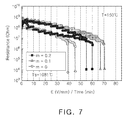
- FIG. 7 illustrates results obtained by measuring insulation resistance (IR) of ceramic multilayer bodies according to an electric field at high temperature, after being sintered at respective sintering temperatures, the ceramic multilayer bodies being manufactured using dielectric compositions in which ratios of minor components of the dielectric compositions capable of being sintered at low temperature according to an exemplary embodiment of the present disclosure have been adjusted;
- IR insulation resistance
- FIG. 8 is a perspective view of a multilayer ceramic electronic component according to another embodiment of the present disclosure.
- FIG. 9 is a cross-sectional view taken along line A-A′ of FIG. 8 ;
- FIG. 10 is a flow-chart showing a method of manufacturing a multilayer ceramic electronic component according to another exemplary embodiment of the present disclosure.
- an X-direction refers to a length direction
- a y-direction refers to a width direction
- a z-direction refers to a thickness direction
- a multilayer ceramic electronic component may include a multilayer ceramic capacitor, a multilayer varistor, a thermistor, a piezoelectric element, a multilayer substrate, or the like, each of which has a structure in which ceramic dielectric layers are stacked and internal electrodes are arranged to face each other having each of the dielectric layers interposed therebetween.
- a dielectric composition to be sintered at low temperature may contain BaTiO 3 as a major component and (1-x)Li 2 O-xCuO as a minor component.
- the dielectric composition to be sintered at low temperature may contain BaTiO 3 as a major component.
- BaTiO 3 -based dielectric powder generally used in a ceramic electronic component may be used, and (Ba 1-a Ca a )TiO 3 , Ba(Ti 1-b Ca b )O 3 , (Ba 1-a Ca a ) (Ti 1-b Zr b )O 3 , or Ba(Ti 1-b Zr b )O 3 in which Ca, Zr, or the like, is partially dissolved in BaTiO 3 may also be used.
- An average particle size of the BaTiO 3 -based powder may be 0.05 ⁇ m to 0.5 ⁇ m, but is not limited thereto.
- the dielectric composition to be sintered at low temperature may contain (1-x)Li 2 O-xCuO as a minor component.
- a phase of the minor component may be changed according to a range of values of x.
- a melting point of the minor component may be changed.
- the values of x may be 0.10 to 0.90.
- the minor component may be at least one selected from a group consisting of Li 6 CuO 4 , Li 2 CuO 2 , and Li 2 Cu 2 O 3 , or a mixture thereof.
- Li 6 CuO 4 , Li 2 CuO 2 , and Li 2 Cu 2 O 3 have a melting point of 1020° C. or lower.
- FIG. 1 illustrates changes in colors of ceramic multilayer bodies sintered at respective sintering temperatures, the ceramic multilayer bodies being manufactured using dielectric compositions in which ratios of minor components of the dielectric compositions to be sintered at low temperature according to an exemplary embodiment of the present disclosure have been adjusted.
- pure CuO has a significantly high melting point of 1300° C. or higher, pure CuO is not suitable for being used as a sintering additive for low-temperature sintering.
- a melting point thereof may be lowered, and accordingly, even when the sintering temperature is 1020° C. or lower, the (1-x)Li 2 O-xCuO compound may be in a liquid phase and low-temperature densification may be induced.
- FIG. 2 illustrates results obtained by measuring densities of ceramic multilayer bodies sintered at respective sintering temperatures, the ceramic multilayer bodies being manufactured using dielectric compositions in which ratios of minor components of the dielectric compositions capable of being sintered at low temperature according to an exemplary embodiment of the present disclosure have been adjusted.
- pure CuO has a significantly high melting point of 1300° C. or higher, pure CuO is not suitable for being used as a sintering additive for low-temperature sintering.
- a melting point thereof may be lowered, and accordingly, even when the sintering temperature is 1020° C. or lower, the (1-x)Li 2 O-xCuO compound may be in a liquid phase and low-temperature densification may be induced.
- the (1-x)Li 2 O-xCuO compound which is the minor component in Inventive Examples, may induce densification of BaTiO 3 at a low temperature, thereby lowering the sintering temperature.
- FIG. 3 is photographs showing a microstructure of a ceramic body after being sintered at 1094° C.
- the dielectric composition to be sintered at low temperature contains the (1-x)Li 2 O-xCuO compound as the minor component
- a liquid phase may be formed by the minor component at a relatively low temperature as compared with the related art, whereby densification and particle growth may be induced.
- FIGS. 4 and 5 illustrate results obtained by measuring dielectric constants and dissipation factors of ceramic multilayer bodies sintered at respective sintering temperatures, the ceramic multilayer bodies being manufactured using dielectric compositions in which ratios of minor components of the dielectric compositions capable of being sintered at low temperature according to an exemplary embodiment of the present disclosure have been adjusted.
- the liquid phase may be formed by the (1-x)Li 2 O-xCuO compound, and the dissipation factor may be stabilized by a B-site acceptor of some CuO moieties.
- the dielectric composition to be sintered at low temperature contains the (1-x)Li 2 O-xCuO compound as the minor component, dielectric properties may be improved.
- FIG. 6 illustrates results obtained by measuring insulation resistance (IR) of ceramic multilayer bodies at room temperature, after being sintered at respective sintering temperatures, the ceramic multilayer bodies being manufactured using dielectric compositions in which ratios of minor components of the dielectric compositions capable of being sintered at low temperature according to an exemplary embodiment of the present disclosure have been adjusted.
- IR insulation resistance
- the reason is that when the sintering temperature is 1051° C. or lower, the sintering of the ceramic multilayer body is not properly performed, and accordingly, sintering density may be lowered due to a decrease in the degree of densification.
- the insulation properties at low temperature may be closely associated with the degree of densification.
- the insulation properties of the ceramic multilayer body may be improved as compared to the related art.
- FIG. 7 illustrates results obtained by measuring insulation resistance (IR) of ceramic multilayer bodies according to an electric field at high temperature, after being sintered at respective sintering temperatures, the ceramic multilayer bodies being manufactured using dielectric compositions in which ratios of minor components of the dielectric compositions capable of being sintered at low temperature according to an exemplary embodiment of the present disclosure have been adjusted.
- IR insulation resistance
- the dielectric composition to be sintered at low temperature contains the (1-x)Li 2 O-xCuO compound as the minor component
- a liquid phase may be formed by the (1-x)Li 2 O-xCuO compound, the degree of densification may be improved and the sintering density may be increased.
- the following seven dielectric compositions as shown in Table 1 were prepared by adjusting a content of (1-x)Li 2 O-xCuO, the minor component.
- the dielectric composition to be sintered at low temperature may further contain 1.0 mol % of BaO, 0.3 mol % of SiO 2 , and 1.0 mol % of Al 2 O 3 as first auxiliary components, based on 100 mol % of the major component.
- the first auxiliary components, sintering additives may serve to assist in adjusting a sintering temperature, a degree of densification, IR properties, and the like.
- the dielectric composition to be sintered at low temperature may further contain 1.0 mol % of Mn 3 O 4 ; 1.1 mol % of V 2 O 5 , and 5.2 mol % of Dy 2 O 3 as secondary auxiliary components, based on 100 mol % of the major component.
- the secondary auxiliary components do not largely affect the dielectric constant and may suppress particle growth of the dielectric composition or control movement of oxygen vacancy to thereby improve sintering properties, insulation resistance, insulation breakdown voltage, an average lifetime, and the like.
- Multilayer ceramic electronic components were manufactured using the compositions of Table 1, and dielectric properties and degrees of densification thereof were evaluated.
- the dielectric properties were evaluated by measuring dielectric constants and dissipation factors, and the degrees of densification were evaluated by measuring densities of the multilayer ceramic electronic components.
- the reason is that the content of the major component may be relatively decreased due to an increase in the content of the minor component.
- the minor component may be contained in a content of 0.1 to 5.0 mol % based on 100 mol % of the major component.
- the minor component may be contained in a content of 0.1 to 2.0 mol % based on 100 mol % of the major component.
- FIG. 8 is a perspective view of a multilayer ceramic electronic component according to another embodiment of the present disclosure
- FIG. 9 is a cross-sectional view taken along line A-A′ of FIG. 8 .
- a multilayer ceramic electronic component may include a multilayer body 100 formed by stacking a plurality of dielectric layers 10 containing BaTiO 3 as a major component and (1-x)Li 2 O-xCuO as a minor component; first and second internal electrodes 20 a and 20 b alternately disposed on the dielectric layers and having opposite polarities; a first external electrode 30 a formed on one end surface of the multilayer body 100 to be electrically connected to the first internal electrodes 20 a ; and a second external electrode 30 b formed on the other end surface of the multilayer body 100 opposing one end surface having the first external electrode 30 a formed thereon to be electrically connected to the second internal electrodes 20 b.
- the dielectric layers 10 may be formed using the above-mentioned dielectric composition to be sintered at low temperature.
- the dielectric composition according to an exemplary embodiment of the present disclosure may allow the sintering process to be performed at a temperature lower than a temperature at which nickel internal electrodes are oxidized or agglomerated.
- dielectric layers having a predetermined thickness or less may not be manufactured due to a short-circuit caused by a phenomenon that the nickel internal electrodes are agglomerated at high temperature.
- the dielectric layers are formed using the dielectric composition capable of being sintered at low temperature and are then sintered at low temperature, and thus, agglomeration in the nickel internal electrodes may hardly occur.
- the thickness of the dielectric layer 10 may be 1 ⁇ m to 2 ⁇ m.
- the adjacent internal electrodes 20 a and 20 b may contact each other, causing the occurrence of a short-circuit, and in the case in which the thickness of the dielectric layer 10 exceeds 2 ⁇ m, it may be difficult to secure super high capacitance.
- the dielectric layers 10 using the dielectric composition capable of being sintered at low temperature may obtain a degree of densification of 97% or higher.
- the first internal electrodes 20 a may be formed on the dielectric layers 10 to be electrically connected to the first external electrode 30 a.
- the second internal electrodes 20 b may be formed on the dielectric layers 10 to be electrically connected to the second external electrode 30 b.
- the multilayer body 100 may be formed by alternately stacking the dielectric layers 10 including the first internal electrodes 20 a formed thereon and the dielectric layers 10 including the second internal electrodes 20 b formed thereon.
- first and second internal electrodes 20 a and 20 b may have opposite polarities by connecting a positive (+) voltage to the first external electrode 30 a and connecting a negative ( ⁇ ) voltage to the second external electrode 30 b.
- dipoles may be formed in the dielectric layer 10 disposed between the first and second internal electrodes 20 a and 20 b , and thus, the multilayer ceramic electronic component according to the embodiment of the present disclosure may act as a capacitor.
- the first and second external electrodes 30 a and 30 b may be formed on both end surfaces of the multilayer body in a length direction, respectively.
- FIG. 10 is a flowchart illustrating a method of manufacturing a multilayer ceramic electronic component according to another exemplary embodiment of the present disclosure.
- the method of manufacturing a multilayer ceramic electronic component may include: preparing a dielectric composition to be sintered at low temperature sintering containing BaTiO 3 as a major component and (1-x)Li 2 O-xCuO as an minor component (S 110 ); preparing ceramic green sheets using the dielectric composition (S 120 ); forming internal electrodes on the ceramic green sheets (S 130 ); stacking the ceramic green sheets and compressing the stacked sheets to prepare a ceramic multilayer body (S 140 ); and sintering the ceramic multilayer body (S 150 ).
- Li 2 O may be directly used or Li 2 CO 3 may be used as a starting material of Li 2 O, and CuO may be directly used or Cu 2 O may be used as a starting material of CuO.
- Li 2 O and CuO may be weighed at a suitable ratio, they may be mixed with each other and dried by a dry or wet (alcohol) process.
- the composition may be maintained at a phase formation temperature of 500° C. to 750° C. for 60 minutes.
- the ceramic green sheets may be manufactured by mixing the dielectric composition to be sintered at low temperature, a binder, and a solvent with each other to prepare slurry and forming the prepared slurry as sheets having a thickness of several ⁇ m by a doctor blade method.
- the internal electrodes may be formed on the ceramic green sheets using a conductive paste (S 130 ).
- the internal electrodes may be formed of a conductive paste composition containing conductive metal powder.
- the conductive metal powder is not particularly limited.
- silver (Ag), lead (Pb), platinum (Pt), nickel (Ni), copper (Cu), or the like, may be used alone, or a mixture thereof may be used.
- the ceramic multilayer body may be formed by separating the ceramic green sheets from carrier films and then stacking the plurality of green to be overlapped with each other (S 140 ).
- the ceramic multilayer body may be compressed, sintered, cut, and polished (S 150 ).
- the multilayer ceramic electronic component according to the embodiment of the present disclosure uses the dielectric composition to be sintered at low temperature, the sintering process may be performed at 1000° C. to 1150° C.
- the agglomeration or oxidation of the internal electrodes may be prevented, whereby the capacitance (performance) and reliability of the multilayer ceramic electronic component may be improved.
- the method of manufacturing a multilayer ceramic electronic component may further include forming external electrodes on the ceramic multilayer body to be electrically connected to the internal electrodes after the sintering of the ceramic multilayer body (S 150 ).
- the forming of the external electrodes may be performed on surfaces of the ceramic multilayer body in the length direction, that is, surfaces thereof to which the internal electrodes are exposed, using a conductive paste.
- a dielectric composition to be sintered at low temperature contains BaTiO 3 as a major component and (1-x)Li 2 O-xCuO as a minor component to thereby lower a sintering temperature, such that the dielectric composition may be sintered at a low temperature and have a dense microstructure and excellent dielectric properties.
- a sintering process may be performed at 1050° C. to 1150° C. by using the above-mentioned dielectric composition, whereby agglomeration of nickel internal electrodes may be prevented.
- a multilayer ceramic electronic component containing the dielectric composition to be sintered at low temperature may have a high degree of densification, such that high capacitance may be obtained and agglomeration of nickel internal electrodes may be prevented by lowering a sintering temperature, whereby high reliability may be secured.
Landscapes
- Engineering & Computer Science (AREA)
- Chemical & Material Sciences (AREA)
- Power Engineering (AREA)
- Ceramic Engineering (AREA)
- Manufacturing & Machinery (AREA)
- Microelectronics & Electronic Packaging (AREA)
- Materials Engineering (AREA)
- Inorganic Chemistry (AREA)
- Structural Engineering (AREA)
- Organic Chemistry (AREA)
- Ceramic Capacitors (AREA)
- Inorganic Insulating Materials (AREA)
- Fixed Capacitors And Capacitor Manufacturing Machines (AREA)
- Compositions Of Oxide Ceramics (AREA)
Abstract
Description
| TABLE 1 | ||||
| Minor Component | First Auxiliary | Second Auxiliary | ||
| Major | (mol %, per 100 mol % | Component | Component (mol %, per | |
| Ingreident | of Major | (mol %, per 100 |
100 mol % of Major | |
| (mol %) | Component) | of Major Component) | Component) | |
| composition | BaTiO3 | (1-x)Li2O—xCuO | BaO:SiO2:Al2O3 | Mn3O4:V2O5:Dy 2O3 |
| #1* | 100 | 0 | 1.0:0.3:1.0 | 1.0:1.1:5.2 |
| #2* | 100 | 0.05 | 1.0:0.3:1.0 | 1.0:1.1:5.2 |
| #3 | 100 | 0.1 | 1.0:0.3:1.0 | 1.0:1.1:5.2 |
| #4 | 100 | 0.3 | 1.0:0.3:1.0 | 1.0:1.1:5.2 |
| #5 | 100 | 0.7 | 1.0:0.3:1.0 | 1.0:1.1:5.2 |
| #6 | 100 | 2.0 | 1.0:0.3:1.0 | 1.0:1.1:5.2 |
| #7* | 100 | 2.1 | 1.0:0.3:1.0 | 1.0:1.1:5.2 |
| *Comparative Example | ||||
Claims (11)
Applications Claiming Priority (2)
| Application Number | Priority Date | Filing Date | Title |
|---|---|---|---|
| KR1020140012381A KR101973414B1 (en) | 2014-02-04 | 2014-02-04 | Dielectric composition for low temperature sintering, multilayer ceramic electronic device including the same and method for fabricating the multilayer ceramic electronic device |
| KR10-2014-0012381 | 2014-02-04 |
Publications (2)
| Publication Number | Publication Date |
|---|---|
| US20150221438A1 US20150221438A1 (en) | 2015-08-06 |
| US9384894B2 true US9384894B2 (en) | 2016-07-05 |
Family
ID=53755414
Family Applications (1)
| Application Number | Title | Priority Date | Filing Date |
|---|---|---|---|
| US14/258,969 Expired - Fee Related US9384894B2 (en) | 2014-02-04 | 2014-04-22 | Dielectric composition to be sintered at low temperature, multilayer ceramic electronic component containing the same, and method of manufacturing the multilayer ceramic electronic component |
Country Status (2)
| Country | Link |
|---|---|
| US (1) | US9384894B2 (en) |
| KR (1) | KR101973414B1 (en) |
Families Citing this family (4)
| Publication number | Priority date | Publication date | Assignee | Title |
|---|---|---|---|---|
| KR101987214B1 (en) | 2017-10-13 | 2019-06-10 | 삼성전기주식회사 | A multilayer ceramic capacitor |
| CN108493399A (en) * | 2018-04-12 | 2018-09-04 | 上海空间电源研究所 | Anode material of lithium battery and preparation method thereof and lithium battery anode, lithium battery |
| CN108558399A (en) * | 2018-06-01 | 2018-09-21 | 西北大学 | A kind of low-temperature sintering high dielectric property Y5V type ceramic capacitor dielectric materials and preparation method thereof |
| KR102900253B1 (en) * | 2020-06-05 | 2025-12-12 | 삼성전기주식회사 | Dielectric material and multi-layer ceramic electronic component using the same |
Citations (3)
| Publication number | Priority date | Publication date | Assignee | Title |
|---|---|---|---|---|
| US4764494A (en) * | 1985-04-26 | 1988-08-16 | Asahi Kasei Kogyo Kabushiki Kaisha | Dielectric ceramic compositions and process for producing the same |
| JP2001302342A (en) * | 2000-04-25 | 2001-10-31 | Toshiba Corp | Dielectric ceramic composition, multilayer ceramic capacitor and method of manufacturing the same |
| US20080030921A1 (en) | 2006-08-02 | 2008-02-07 | Kazumi Kaneda | Multi-layer ceramic capacitor |
Family Cites Families (3)
| Publication number | Priority date | Publication date | Assignee | Title |
|---|---|---|---|---|
| JP2000026160A (en) * | 1998-07-10 | 2000-01-25 | Matsushita Electric Ind Co Ltd | Dielectric porcelain composition |
| JP3050225B1 (en) * | 1998-09-28 | 2000-06-12 | 松下電器産業株式会社 | Dielectric ceramic composition, multilayer ceramic capacitor using the same, and method of manufacturing the same |
| TW201119974A (en) * | 2009-10-16 | 2011-06-16 | Nippon Chemical Ind | Composition for forming dielectric ceramic and dielectric ceramic material |
-
2014
- 2014-02-04 KR KR1020140012381A patent/KR101973414B1/en active Active
- 2014-04-22 US US14/258,969 patent/US9384894B2/en not_active Expired - Fee Related
Patent Citations (4)
| Publication number | Priority date | Publication date | Assignee | Title |
|---|---|---|---|---|
| US4764494A (en) * | 1985-04-26 | 1988-08-16 | Asahi Kasei Kogyo Kabushiki Kaisha | Dielectric ceramic compositions and process for producing the same |
| JP2001302342A (en) * | 2000-04-25 | 2001-10-31 | Toshiba Corp | Dielectric ceramic composition, multilayer ceramic capacitor and method of manufacturing the same |
| US20080030921A1 (en) | 2006-08-02 | 2008-02-07 | Kazumi Kaneda | Multi-layer ceramic capacitor |
| KR20080012178A (en) | 2006-08-02 | 2008-02-11 | 다이요 유덴 가부시키가이샤 | Multilayer ceramic capacitors |
Also Published As
| Publication number | Publication date |
|---|---|
| KR20150091758A (en) | 2015-08-12 |
| KR101973414B1 (en) | 2019-04-29 |
| US20150221438A1 (en) | 2015-08-06 |
Similar Documents
| Publication | Publication Date | Title |
|---|---|---|
| CN105693236B (en) | Low temperature sintered dielectric composition and multilayer ceramic capacitor formed therefrom | |
| JP7366604B2 (en) | Dielectric ceramic composition and multilayer ceramic capacitor containing the same | |
| JP7060213B2 (en) | Dielectric porcelain composition and multilayer ceramic capacitors containing it | |
| US20130258546A1 (en) | Multilayer ceramic electronic component and fabrication method thereof | |
| JP7585579B2 (en) | Dielectric ceramic composition and multilayer ceramic capacitor including the same | |
| US9424991B2 (en) | Dielectric ceramic composition and multilayer ceramic capacitor comprising the same | |
| JP2024091752A (en) | Dielectric ceramic composition and multilayer ceramic capacitor including the same | |
| US20130083450A1 (en) | Dielectric composition and ceramic electronic component including the same | |
| KR102854181B1 (en) | Dielectric ceramic composition and multilayer ceramic capacitor comprising the same | |
| US9458063B2 (en) | Dielectric ceramic composition and multilayer ceramic capacitor including the same | |
| US9799451B2 (en) | Dielectric composition and multilayer ceramic capacitor containing the same | |
| KR20190121143A (en) | Multi-layered ceramic capacitor | |
| JP5420603B2 (en) | Reduction-resistant dielectric composition and ceramic electronic component including the same | |
| US9384894B2 (en) | Dielectric composition to be sintered at low temperature, multilayer ceramic electronic component containing the same, and method of manufacturing the multilayer ceramic electronic component | |
| JP7311256B2 (en) | Dielectric composition and electronic component using the same | |
| JP6596547B2 (en) | Multilayer ceramic capacitor | |
| KR102827667B1 (en) | Dielectric ceramic composition and multilayer ceramic capacitor comprising the same | |
| JP7612965B2 (en) | Dielectric ceramic composition and multilayer ceramic capacitor including the same | |
| US9336947B2 (en) | Dielectric composition for low-temperature sintering, multilayer ceramic electronic component including the same, and method of manufacturing multilayer ceramic electronic component | |
| JP7613681B2 (en) | Dielectric ceramic composition and multilayer ceramic capacitor including the same | |
| US9472316B2 (en) | Dielectric composition for low-temperature sintering, multilayer ceramic electronic component containing the same, and method of manufacturing multilayer ceramic electronic component | |
| KR102409109B1 (en) | Dielectric composition and electronic component using the same |
Legal Events
| Date | Code | Title | Description |
|---|---|---|---|
| AS | Assignment |
Owner name: SAMSUNG ELECTRO-MECHANICS CO., LTD., KOREA, REPUBL Free format text: ASSIGNMENT OF ASSIGNORS INTEREST;ASSIGNORS:LIM, JONG BONG;YOON, SEOK HYUN;KIM, DOO YOUNG;AND OTHERS;REEL/FRAME:032731/0128 Effective date: 20140401 |
|
| FEPP | Fee payment procedure |
Free format text: PAYOR NUMBER ASSIGNED (ORIGINAL EVENT CODE: ASPN); ENTITY STATUS OF PATENT OWNER: LARGE ENTITY |
|
| ZAAA | Notice of allowance and fees due |
Free format text: ORIGINAL CODE: NOA |
|
| ZAAB | Notice of allowance mailed |
Free format text: ORIGINAL CODE: MN/=. |
|
| STCF | Information on status: patent grant |
Free format text: PATENTED CASE |
|
| MAFP | Maintenance fee payment |
Free format text: PAYMENT OF MAINTENANCE FEE, 4TH YEAR, LARGE ENTITY (ORIGINAL EVENT CODE: M1551); ENTITY STATUS OF PATENT OWNER: LARGE ENTITY Year of fee payment: 4 |
|
| FEPP | Fee payment procedure |
Free format text: MAINTENANCE FEE REMINDER MAILED (ORIGINAL EVENT CODE: REM.); ENTITY STATUS OF PATENT OWNER: LARGE ENTITY |
|
| LAPS | Lapse for failure to pay maintenance fees |
Free format text: PATENT EXPIRED FOR FAILURE TO PAY MAINTENANCE FEES (ORIGINAL EVENT CODE: EXP.); ENTITY STATUS OF PATENT OWNER: LARGE ENTITY |
|
| STCH | Information on status: patent discontinuation |
Free format text: PATENT EXPIRED DUE TO NONPAYMENT OF MAINTENANCE FEES UNDER 37 CFR 1.362 |
|
| FP | Lapsed due to failure to pay maintenance fee |
Effective date: 20240705 |