US9351973B2 - Pyrazolopyridyl compounds as aldosterone synthase inhibitors - Google Patents
Pyrazolopyridyl compounds as aldosterone synthase inhibitors Download PDFInfo
- Publication number
- US9351973B2 US9351973B2 US14/346,518 US201214346518A US9351973B2 US 9351973 B2 US9351973 B2 US 9351973B2 US 201214346518 A US201214346518 A US 201214346518A US 9351973 B2 US9351973 B2 US 9351973B2
- Authority
- US
- United States
- Prior art keywords
- alkyl
- halogen
- optionally substituted
- haloalkyl
- cycloalkyl
- Prior art date
- Legal status (The legal status is an assumption and is not a legal conclusion. Google has not performed a legal analysis and makes no representation as to the accuracy of the status listed.)
- Active, expires
Links
- 0 *.B.CC.[3*]C1=[2H]CN=C1C1=C([4*])C([5*])=CN=C1 Chemical compound *.B.CC.[3*]C1=[2H]CN=C1C1=C([4*])C([5*])=CN=C1 0.000 description 17
- JRHSMMCJEUNFQC-UHFFFAOYSA-N C1=CN=CC(C2=NN3C=CC=CC3=C2C2CC2)=C1 Chemical compound C1=CN=CC(C2=NN3C=CC=CC3=C2C2CC2)=C1 JRHSMMCJEUNFQC-UHFFFAOYSA-N 0.000 description 2
- NHBVZSUFLXQTEP-UHFFFAOYSA-N CC(C)(O)C1=CN=CC(C2=NN3C=CC=CC3=C2C2CC2)=C1 Chemical compound CC(C)(O)C1=CN=CC(C2=NN3C=CC=CC3=C2C2CC2)=C1 NHBVZSUFLXQTEP-UHFFFAOYSA-N 0.000 description 2
- MPMMEDZSCMXLHY-UHFFFAOYSA-N CC(C)(O)C1=CN=CC(C2=NN3C=CC=CC3=C2Cl)=C1 Chemical compound CC(C)(O)C1=CN=CC(C2=NN3C=CC=CC3=C2Cl)=C1 MPMMEDZSCMXLHY-UHFFFAOYSA-N 0.000 description 2
- ZISSAWUMDACLOM-UHFFFAOYSA-N CC(C)C(C)(C)C Chemical compound CC(C)C(C)(C)C ZISSAWUMDACLOM-UHFFFAOYSA-N 0.000 description 2
- UOADRGAJWNJVGC-UHFFFAOYSA-N CC(C)C1CCCN1 Chemical compound CC(C)C1CCCN1 UOADRGAJWNJVGC-UHFFFAOYSA-N 0.000 description 2
- XABVLEGPZUPMOT-UHFFFAOYSA-N CCC1=C2N(CCC(=O)N2C)N=C1C1=CN=CC(F)=C1 Chemical compound CCC1=C2N(CCC(=O)N2C)N=C1C1=CN=CC(F)=C1 XABVLEGPZUPMOT-UHFFFAOYSA-N 0.000 description 2
- HWXJNOLYYKFEKZ-UHFFFAOYSA-N *.B.CC1(C)OB(B2OC(C)(C)C(C)(C)O2)OC1(C)C.CCC1=C(B2OC(C)(C)C(C)(C)O2)C=NC=C1F.CCC1=C(Br)C=NC=C1F.FC1=CN=CC(Br)=C1 Chemical compound *.B.CC1(C)OB(B2OC(C)(C)C(C)(C)O2)OC1(C)C.CCC1=C(B2OC(C)(C)C(C)(C)O2)C=NC=C1F.CCC1=C(Br)C=NC=C1F.FC1=CN=CC(Br)=C1 HWXJNOLYYKFEKZ-UHFFFAOYSA-N 0.000 description 1
- BUDYAVVQGBNNQH-UHFFFAOYSA-N BrC1=CN=CC(Br)=C1.CC(C)(O)C1=CC(B2OC(C)(C)C(C)(C)O2)=CN=C1.CC(C)(O)C1=CC(Br)=CN=C1.CC1(C)OB(B2OC(C)(C)C(C)(C)O2)OC1(C)C Chemical compound BrC1=CN=CC(Br)=C1.CC(C)(O)C1=CC(B2OC(C)(C)C(C)(C)O2)=CN=C1.CC(C)(O)C1=CC(Br)=CN=C1.CC1(C)OB(B2OC(C)(C)C(C)(C)O2)OC1(C)C BUDYAVVQGBNNQH-UHFFFAOYSA-N 0.000 description 1
- NDUCPBARYSIMFN-UHFFFAOYSA-N C.CC(=O)C#N.CC(C)(O)C1=CN=CC(C2=NN3C=CC=CC3=C2)=C1.CC(C)(O)C1=CN=CC(C2=NN3C=CC=CC3=C2Cl)=C1 Chemical compound C.CC(=O)C#N.CC(C)(O)C1=CN=CC(C2=NN3C=CC=CC3=C2)=C1.CC(C)(O)C1=CN=CC(C2=NN3C=CC=CC3=C2Cl)=C1 NDUCPBARYSIMFN-UHFFFAOYSA-N 0.000 description 1
- HAWJJBICUZFPPV-UHFFFAOYSA-N C.CC1(C)OB(B2OC(C)(C)C(C)(C)O2)OC1(C)C.CC1=C(Br)C=NC=C1Br.CC1=C(C2CC2)C=NC=C1B1OC(C)(C)C(C)(C)O1.CC1=C(C2CC2)C=NC=C1Br.OB(O)C1CC1.[KH] Chemical compound C.CC1(C)OB(B2OC(C)(C)C(C)(C)O2)OC1(C)C.CC1=C(Br)C=NC=C1Br.CC1=C(C2CC2)C=NC=C1B1OC(C)(C)C(C)(C)O1.CC1=C(C2CC2)C=NC=C1Br.OB(O)C1CC1.[KH] HAWJJBICUZFPPV-UHFFFAOYSA-N 0.000 description 1
- VYPVZNURNAEOOM-UHFFFAOYSA-N C.CC1(C)OB(B2OC(C)(C)C(C)(C)O2)OC1(C)C.[C-]#[N+]C1=CN=CC(B2OC(C)(C)C(C)(C)O2)=C1.[C-]#[N+]C1=CN=CC(Br)=C1 Chemical compound C.CC1(C)OB(B2OC(C)(C)C(C)(C)O2)OC1(C)C.[C-]#[N+]C1=CN=CC(B2OC(C)(C)C(C)(C)O2)=C1.[C-]#[N+]C1=CN=CC(Br)=C1 VYPVZNURNAEOOM-UHFFFAOYSA-N 0.000 description 1
- VMRYWARQKSNQEI-UHFFFAOYSA-N C1=CN=CC(C2=NN3C=CC=CC3=C2)=C1 Chemical compound C1=CN=CC(C2=NN3C=CC=CC3=C2)=C1 VMRYWARQKSNQEI-UHFFFAOYSA-N 0.000 description 1
- SKNXBFVESDCXBB-UHFFFAOYSA-M C1CCOC1.CC(=O)C1=CC(Br)=CN=C1.CC(C)(O)C1=CC(Br)=CN=C1.C[Mg]Br Chemical compound C1CCOC1.CC(=O)C1=CC(Br)=CN=C1.CC(C)(O)C1=CC(Br)=CN=C1.C[Mg]Br SKNXBFVESDCXBB-UHFFFAOYSA-M 0.000 description 1
- RFYPUNWDQHPKNL-UHFFFAOYSA-N C1CCOC1.CC(=O)CCN1N=C(C2=CN=CC=C2)C(C#N)=C1N.N#CC1=C2\NC(=O)CCN2/N=C\1C1=CN=CC=C1.[Li]CCCC Chemical compound C1CCOC1.CC(=O)CCN1N=C(C2=CN=CC=C2)C(C#N)=C1N.N#CC1=C2\NC(=O)CCN2/N=C\1C1=CN=CC=C1.[Li]CCCC RFYPUNWDQHPKNL-UHFFFAOYSA-N 0.000 description 1
- HQNKRRYJDCFVIX-UHFFFAOYSA-N C1CCOC1.CC1=CC=C(S(=O)(=O)C#N)C=C1.ClC1=NN2C=CC=CC2=C1I.N#CC1=C2C=CC=CN2N=C1Cl.[Li]CCCC Chemical compound C1CCOC1.CC1=CC=C(S(=O)(=O)C#N)C=C1.ClC1=NN2C=CC=CC2=C1I.N#CC1=C2C=CC=CN2N=C1Cl.[Li]CCCC HQNKRRYJDCFVIX-UHFFFAOYSA-N 0.000 description 1
- XYGXQBQVUIALNU-UHFFFAOYSA-N C=CC(=O)OCC.CC(=O)CCN1N=C(C2=CN=CC=C2)C(C#N)=C1N.N#CC1=C(N)NN=C1C1=CN=CC=C1 Chemical compound C=CC(=O)OCC.CC(=O)CCN1N=C(C2=CN=CC=C2)C(C#N)=C1N.N#CC1=C(N)NN=C1C1=CN=CC=C1 XYGXQBQVUIALNU-UHFFFAOYSA-N 0.000 description 1
- LYYKOOMQVWYJAY-UHFFFAOYSA-N C=CC(=O)OCC.CC1=C(N)NN=C1C1=CC=CN=C1.CC1=C2\NC(=O)CCN2/N=C\1C1=CC=CN=C1 Chemical compound C=CC(=O)OCC.CC1=C(N)NN=C1C1=CC=CN=C1.CC1=C2\NC(=O)CCN2/N=C\1C1=CC=CN=C1 LYYKOOMQVWYJAY-UHFFFAOYSA-N 0.000 description 1
- NFOXABVWBVFYDZ-UHFFFAOYSA-N CC(=O)C1=CC(Br)=CN=C1.CC(O)(C1=CC(B(O)O)=CN=C1)C(F)(F)F.CC(O)(C1=CC(Br)=CN=C1)C(F)(F)F.CC1(C)OB(B2OC(C)(C)C(C)(C)O2)OC1(C)C.C[Si](C)(C)C(F)(F)F Chemical compound CC(=O)C1=CC(Br)=CN=C1.CC(O)(C1=CC(B(O)O)=CN=C1)C(F)(F)F.CC(O)(C1=CC(Br)=CN=C1)C(F)(F)F.CC1(C)OB(B2OC(C)(C)C(C)(C)O2)OC1(C)C.C[Si](C)(C)C(F)(F)F NFOXABVWBVFYDZ-UHFFFAOYSA-N 0.000 description 1
- QDFZGLRHTVWJGR-UHFFFAOYSA-M CC(=O)C1=CN=CC(Br)=C1.CC(C)(O)C1=CN=CC(B2OC(C)(C)C(C)(C)O2)=C1.CC(C)(O)C1=CN=CC(Br)=C1.CC1(C)OB(B2OC(C)(C)C(C)(C)O2)OC1(C)C.C[Mg]Br.F Chemical compound CC(=O)C1=CN=CC(Br)=C1.CC(C)(O)C1=CN=CC(B2OC(C)(C)C(C)(C)O2)=C1.CC(C)(O)C1=CN=CC(Br)=C1.CC1(C)OB(B2OC(C)(C)C(C)(C)O2)OC1(C)C.C[Mg]Br.F QDFZGLRHTVWJGR-UHFFFAOYSA-M 0.000 description 1
- XXLRMIBIFRVPBB-UHFFFAOYSA-N CC(C#N)C(=O)C1=CC=CN=C1.CC1=C(N)NN=C1C1=CC=CN=C1.NN.O Chemical compound CC(C#N)C(=O)C1=CC=CN=C1.CC1=C(N)NN=C1C1=CC=CN=C1.NN.O XXLRMIBIFRVPBB-UHFFFAOYSA-N 0.000 description 1
- WSATWVGCAZUKEK-UHFFFAOYSA-N CC(C#N)C(=O)C1=CC=CN=C1.CCC#N.CCOC(=O)C1=CC=CN=C1 Chemical compound CC(C#N)C(=O)C1=CC=CN=C1.CCC#N.CCOC(=O)C1=CC=CN=C1 WSATWVGCAZUKEK-UHFFFAOYSA-N 0.000 description 1
- OXVTYUCCAKLHQV-UHFFFAOYSA-N CC(C)(O)C1=CC(B2OC(C)(C)C(C)(C)O2)=CN=C1.CC(C)(O)C1=CC(Br)=CN=C1.CC1(C)OB(B2OC(C)(C)C(C)(C)O2)OC1(C)C Chemical compound CC(C)(O)C1=CC(B2OC(C)(C)C(C)(C)O2)=CN=C1.CC(C)(O)C1=CC(Br)=CN=C1.CC1(C)OB(B2OC(C)(C)C(C)(C)O2)OC1(C)C OXVTYUCCAKLHQV-UHFFFAOYSA-N 0.000 description 1
- LLJFTWIHWICTKQ-UHFFFAOYSA-N CC(C)(O)C1=CN=CC(B2OC(C)(C)C(C)(C)O2)=C1.CC(C)(O)C1=CN=CC(C2=NN3C=CC=CC3=C2)=C1.ClC1=NN2C=CC=CC2=C1 Chemical compound CC(C)(O)C1=CN=CC(B2OC(C)(C)C(C)(C)O2)=C1.CC(C)(O)C1=CN=CC(C2=NN3C=CC=CC3=C2)=C1.ClC1=NN2C=CC=CC2=C1 LLJFTWIHWICTKQ-UHFFFAOYSA-N 0.000 description 1
- NNDIGFGGNIUUHM-UHFFFAOYSA-N CC(C)(O)C1=CN=CC(B2OC(C)(C)C(C)(C)O2)=C1.CC(C)(O)C1=CN=CC(C2=NN3C=CC=CC3=C2C2CC2)=C1.ClC1=NN2C=CC=CC2=C1C1CC1 Chemical compound CC(C)(O)C1=CN=CC(B2OC(C)(C)C(C)(C)O2)=C1.CC(C)(O)C1=CN=CC(C2=NN3C=CC=CC3=C2C2CC2)=C1.ClC1=NN2C=CC=CC2=C1C1CC1 NNDIGFGGNIUUHM-UHFFFAOYSA-N 0.000 description 1
- WFRYDUFVKOHFTE-UHFFFAOYSA-N CC(C)(O)C1=CN=CC(C2=NN3C=CC=CC3=C2C#N)=C1 Chemical compound CC(C)(O)C1=CN=CC(C2=NN3C=CC=CC3=C2C#N)=C1 WFRYDUFVKOHFTE-UHFFFAOYSA-N 0.000 description 1
- GYBQGZHCECHDQO-UHFFFAOYSA-N CC(C)(c1cc(-c2n[n](cccc3)c3c2)cnc1)O Chemical compound CC(C)(c1cc(-c2n[n](cccc3)c3c2)cnc1)O GYBQGZHCECHDQO-UHFFFAOYSA-N 0.000 description 1
- FPZPWGSFHQXVRT-SFECMWDFSA-N CC(C)/C=C\C=C/C(C)C Chemical compound CC(C)/C=C\C=C/C(C)C FPZPWGSFHQXVRT-SFECMWDFSA-N 0.000 description 1
- XMDUPTCWVNKGQG-UHFFFAOYSA-N CC(C)C1=C2C=CC=CC2=CN=C1.CC(C)C1=C2N=CC=CC2=CN=C1 Chemical compound CC(C)C1=C2C=CC=CC2=CN=C1.CC(C)C1=C2N=CC=CC2=CN=C1 XMDUPTCWVNKGQG-UHFFFAOYSA-N 0.000 description 1
- CMDJCIDOEFJHSE-UHFFFAOYSA-N CC(C)N1CCCC1.CC(C)N1CCCCC1.CC(C)N1CCCCC1.CC(C)N1CCCCC1 Chemical compound CC(C)N1CCCC1.CC(C)N1CCCCC1.CC(C)N1CCCCC1.CC(C)N1CCCCC1 CMDJCIDOEFJHSE-UHFFFAOYSA-N 0.000 description 1
- NDDXCSGZQVNTMA-SGNQUONSSA-N CC1(C)OB(B2OC(C)(C)C(C)(C)O2)OC1(C)C.CC1(C)OB(C2=CC(C(F)(F)F)=CN=C2)OC1(C)C.FC(F)(F)C1=CN=CC(Br)=C1.[2HH] Chemical compound CC1(C)OB(B2OC(C)(C)C(C)(C)O2)OC1(C)C.CC1(C)OB(C2=CC(C(F)(F)F)=CN=C2)OC1(C)C.FC(F)(F)C1=CN=CC(Br)=C1.[2HH] NDDXCSGZQVNTMA-SGNQUONSSA-N 0.000 description 1
- ZSLFDGCLZKZTCZ-UHFFFAOYSA-N CC1=C(C2=NN3C=CC=CC3=C2C2CC2)C=NC=C1C1CC1 Chemical compound CC1=C(C2=NN3C=CC=CC3=C2C2CC2)C=NC=C1C1CC1 ZSLFDGCLZKZTCZ-UHFFFAOYSA-N 0.000 description 1
- WNMIGVODFJJLBO-UHFFFAOYSA-N CC1=C(C2=NN3CCC(=O)NC3=C2C2CC2)C=NC=C1 Chemical compound CC1=C(C2=NN3CCC(=O)NC3=C2C2CC2)C=NC=C1 WNMIGVODFJJLBO-UHFFFAOYSA-N 0.000 description 1
- RIPKOIOVFBHXOD-UHFFFAOYSA-N CC1=C2/N(CCC(=O)N2C)/N=C\1C1=CC=CN=C1 Chemical compound CC1=C2/N(CCC(=O)N2C)/N=C\1C1=CC=CN=C1 RIPKOIOVFBHXOD-UHFFFAOYSA-N 0.000 description 1
- UTWOSGQHXNOHGR-UHFFFAOYSA-N CC1=C2/N(CCC(=O)N2C)/N=C\1C1=CC=CN=C1.CC1=C2\NC(=O)CCN2/N=C\1C1=CC=CN=C1.CI Chemical compound CC1=C2/N(CCC(=O)N2C)/N=C\1C1=CC=CN=C1.CC1=C2\NC(=O)CCN2/N=C\1C1=CC=CN=C1.CI UTWOSGQHXNOHGR-UHFFFAOYSA-N 0.000 description 1
- ZNEFGLWMRVJNMO-UHFFFAOYSA-N CC1=C2C=CC=CN2N=C1C1=CC(C(C)(C)O)=CN=C1 Chemical compound CC1=C2C=CC=CN2N=C1C1=CC(C(C)(C)O)=CN=C1 ZNEFGLWMRVJNMO-UHFFFAOYSA-N 0.000 description 1
- UOOICUVXCZJZNH-UHFFFAOYSA-N CC1=C2C=CC=CN2N=C1C1=CC(F)=CN=C1.CC1=C2C=CC=CN2N=C1C1=CC(F)=CN=C1.CC1=C2C=CC=CN2N=C1Cl.ClC1=NN2C=CC=CC2=C1I.OB(O)C1=CC(F)=CN=C1 Chemical compound CC1=C2C=CC=CN2N=C1C1=CC(F)=CN=C1.CC1=C2C=CC=CN2N=C1C1=CC(F)=CN=C1.CC1=C2C=CC=CN2N=C1Cl.ClC1=NN2C=CC=CC2=C1I.OB(O)C1=CC(F)=CN=C1 UOOICUVXCZJZNH-UHFFFAOYSA-N 0.000 description 1
- MOEUGUFBSIQXIJ-UHFFFAOYSA-N CC1=C2C=CC=CN2N=C1Cl.COBO.ClC1=NN2C=CC=CC2=C1I Chemical compound CC1=C2C=CC=CN2N=C1Cl.COBO.ClC1=NN2C=CC=CC2=C1I MOEUGUFBSIQXIJ-UHFFFAOYSA-N 0.000 description 1
- ZNUSXAVKKIGLRC-UHFFFAOYSA-N CC1=C2N(CCC(=O)N2C)N=C1C1=CN=CC(F)=C1 Chemical compound CC1=C2N(CCC(=O)N2C)N=C1C1=CN=CC(F)=C1 ZNUSXAVKKIGLRC-UHFFFAOYSA-N 0.000 description 1
- LQQKRKWJHJAKOS-UHFFFAOYSA-N CC1=C2NC(=O)CCN2N=C1C1=CN=CC(F)=C1 Chemical compound CC1=C2NC(=O)CCN2N=C1C1=CN=CC(F)=C1 LQQKRKWJHJAKOS-UHFFFAOYSA-N 0.000 description 1
- WNXQCZBVGZMGEV-UHFFFAOYSA-N CC1=CN=CC(C2=NN3CCC(=O)N(C)C3=C2C)=C1 Chemical compound CC1=CN=CC(C2=NN3CCC(=O)N(C)C3=C2C)=C1 WNXQCZBVGZMGEV-UHFFFAOYSA-N 0.000 description 1
- PPTULYZYVWDMIM-UHFFFAOYSA-N CC1=CN=CC(C2=NN3CCC(=O)N(C)C3=C2C2CC2)=C1 Chemical compound CC1=CN=CC(C2=NN3CCC(=O)N(C)C3=C2C2CC2)=C1 PPTULYZYVWDMIM-UHFFFAOYSA-N 0.000 description 1
- HWPJVYVRGQRDSQ-UHFFFAOYSA-N CC1=CN=CC(C2=NN3CCC(=O)NC3=C2C#N)=C1 Chemical compound CC1=CN=CC(C2=NN3CCC(=O)NC3=C2C#N)=C1 HWPJVYVRGQRDSQ-UHFFFAOYSA-N 0.000 description 1
- BMQYEDCGOCFJCK-UHFFFAOYSA-N CC1=CN=CC(C2=NN3CCC(=O)NC3=C2C)=C1 Chemical compound CC1=CN=CC(C2=NN3CCC(=O)NC3=C2C)=C1 BMQYEDCGOCFJCK-UHFFFAOYSA-N 0.000 description 1
- FFQAARSNMOVRFM-UHFFFAOYSA-N CC1=CN=CC(C2=NN3CCC(=O)NC3=C2C2CC2)=C1 Chemical compound CC1=CN=CC(C2=NN3CCC(=O)NC3=C2C2CC2)=C1 FFQAARSNMOVRFM-UHFFFAOYSA-N 0.000 description 1
- ZNDADGNMZOHKLB-UHFFFAOYSA-N CCC1=C(C2=NN3C=CC=CC3=C2C)C=NC=C1F Chemical compound CCC1=C(C2=NN3C=CC=CC3=C2C)C=NC=C1F ZNDADGNMZOHKLB-UHFFFAOYSA-N 0.000 description 1
- JALFSWPFNUNRJK-UHFFFAOYSA-N CCC1=C(C2=NN3C=CC=CC3=C2C2CC2)C=NC=C1F Chemical compound CCC1=C(C2=NN3C=CC=CC3=C2C2CC2)C=NC=C1F JALFSWPFNUNRJK-UHFFFAOYSA-N 0.000 description 1
- ABULKEYMWFBNAJ-UHFFFAOYSA-N CCC1=C2N(CCC(=O)N2C)N=C1C1=C(C)C=CN=C1 Chemical compound CCC1=C2N(CCC(=O)N2C)N=C1C1=C(C)C=CN=C1 ABULKEYMWFBNAJ-UHFFFAOYSA-N 0.000 description 1
- LIWBMBBMBQNECH-UHFFFAOYSA-N CCC1=C2N(CCC(=O)N2C)N=C1C1=CC(C)=CN=C1 Chemical compound CCC1=C2N(CCC(=O)N2C)N=C1C1=CC(C)=CN=C1 LIWBMBBMBQNECH-UHFFFAOYSA-N 0.000 description 1
- RJHBKMUYCOIAMI-UHFFFAOYSA-N CCC1=C2N(CCC(=O)N2C)N=C1C1=CC=CN=C1 Chemical compound CCC1=C2N(CCC(=O)N2C)N=C1C1=CC=CN=C1 RJHBKMUYCOIAMI-UHFFFAOYSA-N 0.000 description 1
- PUUFMJTWVJDEHK-UHFFFAOYSA-N CCC1=C2NC(=O)CCN2N=C1C1=C(C)C=CN=C1 Chemical compound CCC1=C2NC(=O)CCN2N=C1C1=C(C)C=CN=C1 PUUFMJTWVJDEHK-UHFFFAOYSA-N 0.000 description 1
- UGZTXQSJHPXZTF-UHFFFAOYSA-N CCC1=C2NC(=O)CCN2N=C1C1=CC(C)=CN=C1 Chemical compound CCC1=C2NC(=O)CCN2N=C1C1=CC(C)=CN=C1 UGZTXQSJHPXZTF-UHFFFAOYSA-N 0.000 description 1
- HYQQDWMTWCAPRD-UHFFFAOYSA-N CCC1=C2NC(=O)CCN2N=C1C1=CC=CN=C1 Chemical compound CCC1=C2NC(=O)CCN2N=C1C1=CC=CN=C1 HYQQDWMTWCAPRD-UHFFFAOYSA-N 0.000 description 1
- NLBVRKTXFWFXOH-UHFFFAOYSA-N CCC1=C2NC(=O)CCN2N=C1C1=CN=CC(F)=C1 Chemical compound CCC1=C2NC(=O)CCN2N=C1C1=CN=CC(F)=C1 NLBVRKTXFWFXOH-UHFFFAOYSA-N 0.000 description 1
- WKXIKIZKDWPTNN-UHFFFAOYSA-N CI.CN1C(=O)CCN2/N=C(C3=CN=CC=C3)\C(C#N)=C/21.N#CC1=C2\NC(=O)CCN2/N=C\1C1=CN=CC=C1 Chemical compound CI.CN1C(=O)CCN2/N=C(C3=CN=CC=C3)\C(C#N)=C/21.N#CC1=C2\NC(=O)CCN2/N=C\1C1=CN=CC=C1 WKXIKIZKDWPTNN-UHFFFAOYSA-N 0.000 description 1
- ZESBDNTYMWSMHF-UHFFFAOYSA-N CN1C(=O)CCN2N=C(C3=CN=CC=C3)C(C#N)=C21 Chemical compound CN1C(=O)CCN2N=C(C3=CN=CC=C3)C(C#N)=C21 ZESBDNTYMWSMHF-UHFFFAOYSA-N 0.000 description 1
- OAOJPIGWAGSUMK-UHFFFAOYSA-N COC(=O)CC1=CC=CC=N1.ClC1=NN2C=CC=CC2=C1.ClC1=NN2C=CC=CC2=C1C1CC1.ClC1=NN2C=CC=CC2=C1I.FC1=CN=CC(C2=NN3C=CC=CC3=C2C2CC2)=C1.NC1=CN=CC(C2=NN3C=CC=CC3=C2C2CC2)=C1.O=C1CCC(=O)N1I.O=P(Cl)(Cl)Cl.OB(O)C1=CC(F)=CN=C1.OB(O)C1CC1.OC1=NN2C=CC=CC2=C1 Chemical compound COC(=O)CC1=CC=CC=N1.ClC1=NN2C=CC=CC2=C1.ClC1=NN2C=CC=CC2=C1C1CC1.ClC1=NN2C=CC=CC2=C1I.FC1=CN=CC(C2=NN3C=CC=CC3=C2C2CC2)=C1.NC1=CN=CC(C2=NN3C=CC=CC3=C2C2CC2)=C1.O=C1CCC(=O)N1I.O=P(Cl)(Cl)Cl.OB(O)C1=CC(F)=CN=C1.OB(O)C1CC1.OC1=NN2C=CC=CC2=C1 OAOJPIGWAGSUMK-UHFFFAOYSA-N 0.000 description 1
- LAIMWOKRHICVGZ-UHFFFAOYSA-N COC1=CN=CC(C2=NN3C=CC=CC3=C2C2CC2)=C1 Chemical compound COC1=CN=CC(C2=NN3C=CC=CC3=C2C2CC2)=C1 LAIMWOKRHICVGZ-UHFFFAOYSA-N 0.000 description 1
- KLVXSUXNDAWUSK-QGZVFWFLSA-N C[C@@](O)(C1=CN=CC(C2=NN3C=CC=CC3=C2C2CC2)=C1)C(F)(F)F Chemical compound C[C@@](O)(C1=CN=CC(C2=NN3C=CC=CC3=C2C2CC2)=C1)C(F)(F)F KLVXSUXNDAWUSK-QGZVFWFLSA-N 0.000 description 1
- MROKMKKSIPODQU-UHFFFAOYSA-N ClC1=NN2C=CC=CC2=C1.ClC1=NN2C=CC=CC2=C1I.O=C1CCC(=O)N1I Chemical compound ClC1=NN2C=CC=CC2=C1.ClC1=NN2C=CC=CC2=C1I.O=C1CCC(=O)N1I MROKMKKSIPODQU-UHFFFAOYSA-N 0.000 description 1
- SKOBEUJEFFYZAI-UHFFFAOYSA-N ClC1=NN2C=CC=CC2=C1C1=CC=CC=C1.ClC1=NN2C=CC=CC2=C1I.FC1=CN=CC(C2=NN3C=CC=CC3=C2C2=CC=CC=C2)=C1.FC1=CN=CC(C2=NN3C=CC=CC3=C2C2=CC=CC=C2)=C1.OB(O)C1=CC(F)=CN=C1.OB(O)C1=CC=CC=C1 Chemical compound ClC1=NN2C=CC=CC2=C1C1=CC=CC=C1.ClC1=NN2C=CC=CC2=C1I.FC1=CN=CC(C2=NN3C=CC=CC3=C2C2=CC=CC=C2)=C1.FC1=CN=CC(C2=NN3C=CC=CC3=C2C2=CC=CC=C2)=C1.OB(O)C1=CC(F)=CN=C1.OB(O)C1=CC=CC=C1 SKOBEUJEFFYZAI-UHFFFAOYSA-N 0.000 description 1
- PFXQRHZVWGVQJX-UHFFFAOYSA-N ClC1=NN2C=CC=CC2=C1C1CC1.ClC1=NN2C=CC=CC2=C1I.OBOC1CC1 Chemical compound ClC1=NN2C=CC=CC2=C1C1CC1.ClC1=NN2C=CC=CC2=C1I.OBOC1CC1 PFXQRHZVWGVQJX-UHFFFAOYSA-N 0.000 description 1
- QFYBTVKKESRLDS-UHFFFAOYSA-N FC(F)(F)C1=CN=CC(C2=NN3C=CC=CC3=C2C2CC2)=C1 Chemical compound FC(F)(F)C1=CN=CC(C2=NN3C=CC=CC3=C2C2CC2)=C1 QFYBTVKKESRLDS-UHFFFAOYSA-N 0.000 description 1
- VYUDCKYQPJHLSC-UHFFFAOYSA-N FC1=CN=CC(C2=NN3C=CC=CC3=C2C2CC2)=C1C1CC1 Chemical compound FC1=CN=CC(C2=NN3C=CC=CC3=C2C2CC2)=C1C1CC1 VYUDCKYQPJHLSC-UHFFFAOYSA-N 0.000 description 1
- ZEIDSLCYAIRCOL-UHFFFAOYSA-N N#CC1=C(N)NN=C1Br.N#CC1=C(N)NN=C1C1=CN=CC=C1.OB(O)C1=CC=CN=C1 Chemical compound N#CC1=C(N)NN=C1Br.N#CC1=C(N)NN=C1C1=CN=CC=C1.OB(O)C1=CC=CN=C1 ZEIDSLCYAIRCOL-UHFFFAOYSA-N 0.000 description 1
- OHNNVMOHWNKRII-UHFFFAOYSA-N N#CC1=C2NC(=O)CCN2N=C1C1=CN=CC(Cl)=C1 Chemical compound N#CC1=C2NC(=O)CCN2N=C1C1=CN=CC(Cl)=C1 OHNNVMOHWNKRII-UHFFFAOYSA-N 0.000 description 1
- JFAQZWYDIQFKBB-UHFFFAOYSA-N N#CC1=CN=CC(C2=NN3C=CC=CC3=C2C2CC2)=C1 Chemical compound N#CC1=CN=CC(C2=NN3C=CC=CC3=C2C2CC2)=C1 JFAQZWYDIQFKBB-UHFFFAOYSA-N 0.000 description 1
- BTOOJOGNIGARKE-UHFFFAOYSA-N O=C1CCC2=C(C=CC(C3=C4C=CC=CC4=CN=C3)=C2)N1.O=C1CCC2=C(C=CC(C3=CC=CN=C3)=C2)N1 Chemical compound O=C1CCC2=C(C=CC(C3=C4C=CC=CC4=CN=C3)=C2)N1.O=C1CCC2=C(C=CC(C3=CC=CN=C3)=C2)N1 BTOOJOGNIGARKE-UHFFFAOYSA-N 0.000 description 1
- ZVFVTQLARMUAFJ-UHFFFAOYSA-N O=C1CCN2N=C(C3=CC=CN=C3)C(C3CC3)=C2N1 Chemical compound O=C1CCN2N=C(C3=CC=CN=C3)C(C3CC3)=C2N1 ZVFVTQLARMUAFJ-UHFFFAOYSA-N 0.000 description 1
- VZCHWZLBILCIKY-UHFFFAOYSA-N O=C1CCN2N=C(C3=CN=CC(F)=C3)C(C3CC3)=C2N1 Chemical compound O=C1CCN2N=C(C3=CN=CC(F)=C3)C(C3CC3)=C2N1 VZCHWZLBILCIKY-UHFFFAOYSA-N 0.000 description 1
- UJIBOGAQJRDRES-UHFFFAOYSA-N OC1=NC=CC=C1.[H]N1C=CC=CC1=O Chemical compound OC1=NC=CC=C1.[H]N1C=CC=CC1=O UJIBOGAQJRDRES-UHFFFAOYSA-N 0.000 description 1
- UBQKCCHYAOITMY-UHFFFAOYSA-N Oc1ncccc1 Chemical compound Oc1ncccc1 UBQKCCHYAOITMY-UHFFFAOYSA-N 0.000 description 1
Classifications
-
- A—HUMAN NECESSITIES
- A61—MEDICAL OR VETERINARY SCIENCE; HYGIENE
- A61K—PREPARATIONS FOR MEDICAL, DENTAL OR TOILETRY PURPOSES
- A61K31/00—Medicinal preparations containing organic active ingredients
- A61K31/33—Heterocyclic compounds
- A61K31/395—Heterocyclic compounds having nitrogen as a ring hetero atom, e.g. guanethidine or rifamycins
- A61K31/495—Heterocyclic compounds having nitrogen as a ring hetero atom, e.g. guanethidine or rifamycins having six-membered rings with two or more nitrogen atoms as the only ring heteroatoms, e.g. piperazine or tetrazines
- A61K31/505—Pyrimidines; Hydrogenated pyrimidines, e.g. trimethoprim
- A61K31/519—Pyrimidines; Hydrogenated pyrimidines, e.g. trimethoprim ortho- or peri-condensed with heterocyclic rings
-
- A—HUMAN NECESSITIES
- A61—MEDICAL OR VETERINARY SCIENCE; HYGIENE
- A61K—PREPARATIONS FOR MEDICAL, DENTAL OR TOILETRY PURPOSES
- A61K31/00—Medicinal preparations containing organic active ingredients
- A61K31/33—Heterocyclic compounds
- A61K31/395—Heterocyclic compounds having nitrogen as a ring hetero atom, e.g. guanethidine or rifamycins
- A61K31/435—Heterocyclic compounds having nitrogen as a ring hetero atom, e.g. guanethidine or rifamycins having six-membered rings with one nitrogen as the only ring hetero atom
- A61K31/4353—Heterocyclic compounds having nitrogen as a ring hetero atom, e.g. guanethidine or rifamycins having six-membered rings with one nitrogen as the only ring hetero atom ortho- or peri-condensed with heterocyclic ring systems
- A61K31/437—Heterocyclic compounds having nitrogen as a ring hetero atom, e.g. guanethidine or rifamycins having six-membered rings with one nitrogen as the only ring hetero atom ortho- or peri-condensed with heterocyclic ring systems the heterocyclic ring system containing a five-membered ring having nitrogen as a ring hetero atom, e.g. indolizine, beta-carboline
-
- A—HUMAN NECESSITIES
- A61—MEDICAL OR VETERINARY SCIENCE; HYGIENE
- A61K—PREPARATIONS FOR MEDICAL, DENTAL OR TOILETRY PURPOSES
- A61K31/00—Medicinal preparations containing organic active ingredients
- A61K31/33—Heterocyclic compounds
- A61K31/395—Heterocyclic compounds having nitrogen as a ring hetero atom, e.g. guanethidine or rifamycins
- A61K31/435—Heterocyclic compounds having nitrogen as a ring hetero atom, e.g. guanethidine or rifamycins having six-membered rings with one nitrogen as the only ring hetero atom
- A61K31/44—Non condensed pyridines; Hydrogenated derivatives thereof
- A61K31/4427—Non condensed pyridines; Hydrogenated derivatives thereof containing further heterocyclic ring systems
- A61K31/444—Non condensed pyridines; Hydrogenated derivatives thereof containing further heterocyclic ring systems containing a six-membered ring with nitrogen as a ring heteroatom, e.g. amrinone
-
- A—HUMAN NECESSITIES
- A61—MEDICAL OR VETERINARY SCIENCE; HYGIENE
- A61P—SPECIFIC THERAPEUTIC ACTIVITY OF CHEMICAL COMPOUNDS OR MEDICINAL PREPARATIONS
- A61P1/00—Drugs for disorders of the alimentary tract or the digestive system
- A61P1/16—Drugs for disorders of the alimentary tract or the digestive system for liver or gallbladder disorders, e.g. hepatoprotective agents, cholagogues, litholytics
-
- A—HUMAN NECESSITIES
- A61—MEDICAL OR VETERINARY SCIENCE; HYGIENE
- A61P—SPECIFIC THERAPEUTIC ACTIVITY OF CHEMICAL COMPOUNDS OR MEDICINAL PREPARATIONS
- A61P13/00—Drugs for disorders of the urinary system
- A61P13/12—Drugs for disorders of the urinary system of the kidneys
-
- A—HUMAN NECESSITIES
- A61—MEDICAL OR VETERINARY SCIENCE; HYGIENE
- A61P—SPECIFIC THERAPEUTIC ACTIVITY OF CHEMICAL COMPOUNDS OR MEDICINAL PREPARATIONS
- A61P9/00—Drugs for disorders of the cardiovascular system
-
- A—HUMAN NECESSITIES
- A61—MEDICAL OR VETERINARY SCIENCE; HYGIENE
- A61P—SPECIFIC THERAPEUTIC ACTIVITY OF CHEMICAL COMPOUNDS OR MEDICINAL PREPARATIONS
- A61P9/00—Drugs for disorders of the cardiovascular system
- A61P9/10—Drugs for disorders of the cardiovascular system for treating ischaemic or atherosclerotic diseases, e.g. antianginal drugs, coronary vasodilators, drugs for myocardial infarction, retinopathy, cerebrovascula insufficiency, renal arteriosclerosis
-
- A—HUMAN NECESSITIES
- A61—MEDICAL OR VETERINARY SCIENCE; HYGIENE
- A61P—SPECIFIC THERAPEUTIC ACTIVITY OF CHEMICAL COMPOUNDS OR MEDICINAL PREPARATIONS
- A61P9/00—Drugs for disorders of the cardiovascular system
- A61P9/12—Antihypertensives
-
- C—CHEMISTRY; METALLURGY
- C07—ORGANIC CHEMISTRY
- C07D—HETEROCYCLIC COMPOUNDS
- C07D471/00—Heterocyclic compounds containing nitrogen atoms as the only ring hetero atoms in the condensed system, at least one ring being a six-membered ring with one nitrogen atom, not provided for by groups C07D451/00 - C07D463/00
- C07D471/02—Heterocyclic compounds containing nitrogen atoms as the only ring hetero atoms in the condensed system, at least one ring being a six-membered ring with one nitrogen atom, not provided for by groups C07D451/00 - C07D463/00 in which the condensed system contains two hetero rings
- C07D471/04—Ortho-condensed systems
-
- C—CHEMISTRY; METALLURGY
- C07—ORGANIC CHEMISTRY
- C07D—HETEROCYCLIC COMPOUNDS
- C07D487/00—Heterocyclic compounds containing nitrogen atoms as the only ring hetero atoms in the condensed system, not provided for by groups C07D451/00 - C07D477/00
- C07D487/02—Heterocyclic compounds containing nitrogen atoms as the only ring hetero atoms in the condensed system, not provided for by groups C07D451/00 - C07D477/00 in which the condensed system contains two hetero rings
- C07D487/04—Ortho-condensed systems
Definitions
- Aldosterone is a steroid hormone secreted in the adrenal cortex. In primary cells of the distal tubules and collecting ducts of the kidney, aldosterone binding to the mineralocorticoid receptor (MR) results in the retention of sodium and water and excretion of potassium, which in turn leads to increased blood pressure. Aldosterone also causes inflammation that leads to fibrosis and remodeling in the heart, vasculature and kidney. This inflammation may proceed by MR-dependent as well as MR-independent mechanisms (Gilbert, K. C. et al., Curr. Opin. Endocrinol. Diabetes Obes., vol. 17, 2010, pp. 199-204).
- the nonselective MRA spironolactone can also bind to and act at other steroid receptors, and as a consequence its use is associated with sexual side effects such as gynecomastia, dysmenorrhoea and impotence (Pitt, B. et al., New Engl. J. Med., vol. 341, 1999, pp. 709-717; MacFadyen, R. J. et al., Cardiovasc. Res., vol. 35, 1997, pp 30-34; Soberman, J. E. et al., Curr. Hypertens. Rep., vol. 2, 2000, pp 451-456). Additionally, both spironolactone and eplerenone are known to cause elevated plasma potassium levels (hyperkalemia) and elevated aldosterone levels.
- aldosterone levels by inhibiting aldosterone synthase could represent a new pharmaceutical strategy that might be useful in treating a disorder or disease characterized by increased stress hormone levels and/or decreased androgen hormone levels in a patient (WO2011/088188 to Novartis).
- Compounds possessing this activity might be expected to treat disease states such as heart failure, cachexia, acute coronary syndrome, Cushing's syndrome or metabolic syndrome.
- CYP11B1 is a related enzyme that catalyzes the formation of glucocorticoids, such as cortisol, an important regulator of glucose metabolism. Because human CYP11B2 and CYP11B1 are greater than 93% homologous, it is possible for nonselective compounds to inhibit both enzymes (Kawamoto, T. et al., Proc. Natl. Acad. Sci. USA, vol. 89, 1992, pp 1458-1462; Taymans, S. E. et al., J. Clin. Endocrinol. Metab., vol. 83, 1998, pp 1033-1036). It would be preferable, however, for therapeutic agents to selectively inhibit CYP11B2 and the formation of aldosterone with diminished inhibition of, or affect on, CYP11B1 and the production of cortisol.
- WO 2009/135651 to Elexopharm describes 6-pyridin-3yl-3,4,-dihydro-1H-quinolin-2-one derivatives as being CYP11B2 inhibitors.
- Two compounds described therein are lactam derivatives of the formula:
- R 1 is an optionally substituted aryl or heteroaryl group and A 5 is H or alkyl.
- R 1 is an optionally substituted aryl or heteroaryl group and A 5 is H or alkyl.
- R 1 is an optionally substituted aryl or heteroaryl group and A 5 is H or alkyl.
- R 1 is an optionally substituted aryl or heteroaryl group and A 5 is H or alkyl.
- Other benzimidazoles derivatives are known in the art.
- WO 2012/012478 to Merck describes benzimidazole analogues as having the ability to CYP11B2.
- WO2002/46168 A1 to AstraZeneca describes benzimidazoles derivatives that are useful in the treatment or prophylaxis of Alzheimer's disease, anxiety disorders, depressive disorders, osteoporosis, cardiovascular disease, rheumatoid arthritis or prostate cancer.
- U.S. Pat. No. 7,381,825 to Takeda describes histone deacetylase inhibitors of the formula Z-Q-L-M where Q is a substituted or unsubstituted aromatic ring, L is a substituent providing between 0-10 atoms separation between M and the remainder of the compound, M is a substituent capable of complexing with a deacetylase catalytic site and/or metal ion, and Z is list of bicyclic groups, including, but not limited to:
- the present application discloses a compound or a pharmaceutically acceptable salt, metabolite, solvate, prodrug or polymorph of said compound, said compound having the general structure shown in Formula I
- R 1 is H or alkyl
- R 2 is halogen; —CN; —OR 7 ; —N(R 10 )C(O)R 7 ; —NR 11 R 12 ; —C(O)R 7 ; —C(O)N(R 11 )(R 12 ); —C(O)OR 7 ; —SO 2 N(R 10 )—R 7 ; —N(R 10 )SO 2 —R 7 ; —S(O) m —R 7 ; alkyl optionally substituted one or more times (e.g., 1 to 4 times) by halogen, —OR 7 , NR 8 R 9 , —CN, —N(R 10 )C(O)R 7 , —C(O)N(R 8 )(R 9 ), —C(O)OR 7 , —SO 2 N(R 10 )—R 7 , —N(R 10 )SO 2 —R 7 or —S(O) m —R 7 ;
- R 3 is H; halogen; —CN; alkyl optionally substituted one or more times (e.g., 1 to 4 times) by halogen or cycloalkyl optionally substituted once or twice by alkyl or halogen; cycloalkyl optionally substituted once or twice by alkyl or halogen; aryl optionally substituted one or more times (e.g., 1 to 4 times) by halogen, alkyl, haloalkyl, cycloalkyl, —OR 7 , —CN, —NR 8 R 9 , —N(R 10 )C(O)(R 7 ), —C(O)N(R 8 )(R 9 ), —C(O)OR 7 —SO 2 N(R 10 )—R 7 , —N(R 10 )SO 2 —R 7 , or —S(O) m —R 7 ; or —C(O)OR 7 ;
- R 6 is independently H; halogen; —CN; —OR 7 ; —NR 8 R 9 ; —N(R 10 )C(O)R 7 ; —C(O)N(R 7 )(R 8 ); —C(O)N(R 8 )(R 9 ); —C(O)OR 7 ; —SO 2 N(R 10 )—R 7 ; —N(R 10 )SO 2 —R 7 ; —S(O) m —R 7 ; alkyl optionally substituted one or more times (e.g., 1 to 4 times) by halogen, —OR 7 , —NR 8 R 9 , —CN, —N(R 10 )C(O)R 7 , —C(O)N(R 8 )(R 9 ), —C(O)OR 7 , —SO 2 N(R 10 )—R 7 , —N(R 10 )SO 2 —R 7 or —S
- R 8 is independently H or alkyl
- R 9 is independently H or alkyl
- n 1 or 2;
- n 0, 1 or 2.
- compositions comprising a therapeutically effective amount of at least one compound of Formula I or a pharmaceutically acceptable salt thereof and a pharmaceutically acceptable carrier.
- compositions comprising a therapeutically effective amount of at least one compound of Formula I or a pharmaceutically acceptable salt thereof, a therapeutically effective amount of at least one additional therapeutic agent and a pharmaceutically acceptable carrier.
- the compounds of the present invention could be useful in the treatment, amelioration or prevention of one or more conditions associated with inhibiting CYP11B2 by administering a therapeutically effective amount of at least one compound of Formula I or a pharmaceutically acceptable salt thereof to a mammal in need of such treatment.
- the compounds of the present invention also might be useful in treating one or more conditions characterized by increased stress hormone levels and/or decreased androgen hormone levels in a mammal by administering a therapeutically effective amount of at least one compound of Formula I or a pharmaceutically acceptable salt thereof to a mammal in need of such treatment.
- Conditions characterized by increased stress hormone levels and/or decreased androgen hormone levels in a mammal include, for example, heart failure (e.g., acute heart failure, acute decompensated heart failure, chronic heart failure, chronic heart failure with impaired exercise tolerance or chromic heart failure with muscle weakness), cachexia (e.g., cardiac cachexia, COPD-induced cachexia, cirrhosis-induced cachexia, tumor-induced cachexia or viral (HIV)-induced cachexia), acute coronary syndrome, Cushing's syndrome or metabolic syndrome.
- heart failure e.g., acute heart failure, acute decompensated heart failure, chronic heart failure, chronic heart failure with impaired exercise tolerance or chromic heart failure with muscle weakness
- cachexia e.g., cardiac cachexia, COPD-induced cachexia, cirrhosis-induced cachexia, tumor-induced cachexia or viral (HIV)-induced cachexia
- acute coronary syndrome e.g., acute coronary syndrome, Cushing's syndrome or metabolic syndrome.
- Another aspect of the present invention could be the possible use of a compound of Formula I or a pharmaceutically acceptable salt thereof for the manufacture of a medicament for the treatment, amelioration or prevention of one or more conditions associated with inhibiting CYP11B2 in a patient.
- the present invention provides compounds represented by structural Formula I or pharmaceutically acceptable salt thereof, wherein the various moieties are as described as above.
- Ring A is attached to Ring B via positions D and E and is:
- R 1 is H or alkyl
- R 3 is H; halogen; —CN; alkyl optionally substituted one or more times (e.g., 1 to 4 times) by halogen or cycloalkyl optionally substituted once or twice by alkyl or halogen; cycloalkyl optionally substituted once or twice by alkyl or halogen; or —C(O)OR 7 ;
- R 4 is H; halogen; —CN; —OR 7 ; —NR 8 R 9 ; —N(R 10 )C(O)R 7 ; —C(O)N(R 8 )(R 9 ); —C(O)R 7 ; —C(O)OR 7 ; —SO 2 N(R 10 )—R 7 ; —N(R 10 )S(O) 2 —R 7 ; —S(O) o —R 7 ; alkyl optionally substituted one or more times (e.g., 1 to 4 times) by halogen, —OR 7 , —NR 8 R 9 , —CN, —N(R 11 )C(O)R 7 , —C(O)N(R 8 )(R 9 ), —C(O)OR 7 , —SO 2 N(R 10 )—R 7 , —N(R 10 )S(O) 2 —R 7 , or —S
- R 5 is H; halogen; —CN; —OR 7 ; —NR 8 R 9 ; —N(R 10 )C(O)R 7 ; —C(O)N(R 8 )(R 9 ); —C(O)R 7 ; —C(O)OR 7 ; —SO 2 N(R 10 )—R 7 ; —N(R 10 )S(O) 2 —R 7 ; —S(O) n —R 7 ; alkyl optionally substituted one or more times (e.g., 1 to 4 times) by halogen, —OR 7 , —NR 8 R 9 , —CN, —N(R 11 )C(O)R 7 , —C(O)N(R 8 )(R 9 ), —C(O)OR 7 , —SO 2 N(R 10 )—R 7 , —N(R 10 )S(O) 2 —R 7 , or —S
- R 6 is independently H; halogen; —CN; —OR 7 ; —NR 8 R 9 ; —N(R 10 )C(O)R 7 ; —C(O)N(R 7 )(R 8 ); —C(O)N(R 8 )(R 9 ); —C(O)OR 7 ; —SO 2 N(R 10 )—R 7 ; —N(R 10 )SO 2 —R 7 ; —S(O) m —R 7 ; alkyl optionally substituted one or more times (e.g., 1 to 4 times) by halogen, —OR 7 , —NR 8 R 9 , —CN, —N(R 10 )C(O)R 7 , —C(O)N(R 8 )(R 9 ), —C(O)OR 7 , —SO 2 N(R 10 )—R 7 , —N(R 10 )SO 2 —R 7 or —S
- R 7 is independently H; alkyl optionally substituted one or more times (e.g., 1 to 4 times) by halogen, —OR 10 , —NR 8 R 9 , —CN, —N(R 10 )C(O)R 10 , —C(O)N(R 8 )(R 9 ), —C(O)OR 10 or —S(O) m —R 10 ; cycloalkyl optionally substituted one or more times (e.g., 1 to 4 times) by halogen, alkyl, haloalkyl, —OR 10 , —NR 8 R 9 , —CN, —N(R 10 )C(O)R 10 , —C(O)N(R 8 )(R 9 ), —C(O)OR 10 or —S(O) m —R 10 ; aryl optionally substituted one or more times (e.g., 1 to 4 times) by halogen, alkyl,
- R 9 is independently H or alkyl
- R 10 is independently H or alkyl
- R 12 is independently H; alkyl optionally substituted one or more times (e.g., 1 to 4 times) by halogen, —OR 7 , —NR 8 R 9 , —CN, —N(R 10 )C(O)R 7 , —C(O)N(R 8 )(R 9 ), —C(O)OR 7 or —S(O) m —R 7 ; cycloalkyl optionally substituted one or more times (e.g., 1 to 4 times) by halogen, alkyl, haloalkyl, —OR 7 , —NR 8 R 9 , —CN, —N(R 10 )C(O)R 7 , —C(O)N(R 8 )(R 9 ), —C(O)OR 10 or —S(O) m —R 10 ; aryl optionally substituted one or more times (e.g., 1 to 4 times) by halogen, alkyl,
- a is 0, 1, 2, 3 or 4 (e.g., 0, 1, or 2);
- n 0, 1 or 2.
- R 2 , R 3 , R 4 , R 5 and a are as defined in Formula I.
- R 1 , R 2 , R 3 , R 4 , R 5 and a are as defined in Formula I.
- R 2 , R 3 , R 6 and a are as defined in Formula I and b is 0, 1 or 2 (e.g, where b is 0, or where b is 1 or 2 and R 6 is alkyl or halo).
- R 1 , R 2 , R 3 , R 6 and a are as defined in Formula I and b is 0, 1 or 2 (e.g, where b is 0, or where b is 1 or 2 and R 6 is alkyl or halo).
- Another embodiment of the present invention is compounds or their pharmaceutically acceptable salts of any of the embodiments of Formulae I through V, a is 0 or a is 1 or 2 and R 2 is independently halogen (e.g., F or Cl), —CN, alkyl (e.g., methyl, ethyl, n-propyl, i-propyl, n-butyl, iso-butyl, sec-butyl, tert-butyl), OR 7 (where R 7 is H, alkyl (e.g., methyl, ethyl, n-propyl, i-propyl, n-butyl, iso-butyl, sec-butyl, tert-butyl) or haloalkyl (e.g., —CF 3 )), haloalkyl (e.g., —CF 3 ), cycloalkyl (e.g., cyclopropyl or cyclohexy
- R 3 is H, halogen, —CN, alkyl (e.g., methyl, ethyl, n-propyl, i-propyl, n-butyl, iso-butyl, sec-butyl, tert-butyl), or cycloalkyl (e.g., cyclopropyl or cyclohexyl).
- alkyl e.g., methyl, ethyl, n-propyl, i-propyl, n-butyl, iso-butyl, sec-butyl, tert-butyl
- cycloalkyl e.g., cyclopropyl or cyclohexyl
- R 3 is phenyl which is optionally substitute once or twice by alkyl, halogen or haloalkyl.
- R 4 is H, halogen (e.g., —F or —Cl), —CN, alkyl (e.g., methyl or ethyl) or cycloalkyl (e.g., cyclopropyl, cyclobutyl, cyclopentyl or cyclohexyl).
- halogen e.g., —F or —Cl
- —CN alkyl
- alkyl e.g., methyl or ethyl
- cycloalkyl e.g., cyclopropyl, cyclobutyl, cyclopentyl or cyclohexyl.
- Another embodiment of the present invention is compounds or their pharmaceutically acceptable salts of any of the embodiments of Formulae I through III above where R 4 is H or alkyl (e.g., methyl or ethyl).
- R 5 is H, halogen (e.g., —F or —Cl), —CN, alkyl (e.g., methyl, ethyl, n-propyl, i-propyl, n-butyl, iso-butyl, sec-butyl, tert-butyl), —OR 7 (where R 7 is H, alkyl (e.g., methyl, ethyl, n-propyl, i-propyl, n-butyl, iso-butyl, sec-butyl, tert-butyl), haloalkyl (e.g., —CF 3 )), haloalkyl (e.g., —CF 3 ) or phenyl optionally substituted by halogen, —OR 7 (where R 7 is H, alkyl (e.
- Another embodiment of the present invention is compounds or their pharmaceutically acceptable salts thereof of any of the embodiments of Formula I through III wherein R 5 is cycloalkyl (e.g., cyclopropyl).
- R 4 is H and R 5 is H, halogen (e.g., —F or —Cl), —CN, alkyl (e.g., methyl, ethyl, n-propyl, i-propyl, n-butyl, iso-butyl, sec-butyl, tert-butyl), —OR 7 (where R 7 is H, alkyl (e.g., methyl, ethyl, n-propyl, i-propyl, n-butyl, iso-butyl, sec-butyl, tert-butyl), haloalkyl (e.g., —CF 3 )), haloalkyl (e.g., —CF 3 ) or phenyl optionally substituted by halogen, —OR 7 (where R 7 is H,
- R 5 is —C(O)OR 7 (e.g., R 7 is C 1 -C 4 -alkyl or phenyl, optionally substituted by halogen or haloalkyl).
- Another embodiment of the present inventions is compounds or their pharmaceutically acceptable salts thereof of any of the embodiments of Formula I through III described above or their pharmaceutically acceptable salts thereof where R 4 is H and R 5 is a group of the formula:
- R 3 is alkyl (e.g., methyl or ethyl), cycloalkyl (e.g., cyclopropyl), or phenyl
- R 4 is H, alkyl (e.g., methyl or ethyl), or cycloalkyl (e.g. cyclopropyl)
- R 5 is H, halogen, —OR 7 (where R 7 is H or alkyl (e.g., methyl or ethyl)); —CN; or haloalkyl (e.g., —CF 3 ).
- “Mammal” means humans and other mammalian animals.
- alkyl refers to “alkyl” as well as the “alkyl” portions of “hydroxyalkyl”, “haloalkyl”, “alkoxy”, etc.
- Alkyl means an aliphatic hydrocarbon group which may be straight or branched and comprising about 1 to about 20 carbon atoms in the chain. Preferred alkyl groups contain about 1 to about 12 carbon atoms in the chain. More preferred alkyl groups contain about 1 to about 6 carbon atoms in the chain. Branched means that one or more lower alkyl groups such as methyl, ethyl or propyl, are attached to a linear alkyl chain. “Lower alkyl” means a group having about 1 to about 6 carbon atoms in the chain which may be straight or branched.
- Halo refers to fluorine, chlorine, bromine or iodine radicals. Examples are fluoro, chloro or bromo.
- Halogen means fluorine, chlorine, bromine, or iodine.
- Haloalkyl means a halo-alkyl- group in which the alkyl group is as previously described. The bond to the parent moiety is through the alkyl.
- suitable haloalkyl groups include fluoromethyl, difluoromethyl, —CH 2 CF 3 , —CH 2 CHF 2 —CH 2 CH 2 F, or an alkyl group with one or more terminal carbons tri-substituted with a halogen (e.g., —F) such as, for example —C 1 -C 3 alkyl-CF 3 , —CH(CH 3 )(CF 3 ), —CH(CF 3 ) 2 and the like.
- a halogen e.g., —F
- Cycloalkyl means a non-aromatic mono- or multicyclic ring system comprising about 3 to about 10 carbon atoms, preferably about 5 to about 10 carbon atoms. Preferred cycloalkyl rings contain about 5 to about 7 ring atoms.
- the cycloalkyl can be optionally substituted with one or more “ring system substituents” which may be the same or different, and are as defined above.
- suitable monocyclic cycloalkyls include cyclopropyl, cyclobutyl, cyclopentyl, cyclohexyl, cycloheptyl and the like.
- Non-limiting examples of suitable multicyclic cycloalkyls include 1-decalinyl, norbornyl, adamantyl and the like, as well as partially saturated species such as, for example, indanyl, tetrahydronaphthyl and the like.
- Aryl means an aromatic monocyclic or multicyclic ring system comprising about 6 to about 14 carbon atoms, preferably about 6 to about 10 carbon atoms.
- suitable aryl groups include phenyl, naphthyl, indenyl, tetrahydronaphthyl and indanyl.
- Heterocycloalkyl means a non-aromatic saturated monocyclic or multicyclic ring system comprising about 3 to about 10 ring atoms, preferably about 5 to about 10 ring atoms, in which one or more of the atoms in the ring system is an element other than carbon, for example nitrogen, oxygen or sulfur, alone or in combination. There are no adjacent oxygen and/or sulfur atoms present in the ring system.
- Preferred heterocyclyls contain about 5 to about 6 ring atoms.
- the prefix aza, oxa or thia before the heterocycloalkyl root name means that at least a nitrogen, oxygen or sulfur atom respectively is present as a ring atom.
- Any —NH in a heterocycloalkyl ring may exist protected such as, for example, as an —N(Boc), —N(CBz), —N(Tos) group and the like; such protections are also considered part of this invention.
- the nitrogen or sulfur atom of the heterocycloalkyl ring can be optionally oxidized to the corresponding N-oxide, S-oxide or S,S-dioxide.
- Non-limiting examples of suitable monocyclic heterocycloalkyl rings include piperidyl, pyrrolidinyl, piperazinyl, morpholinyl, thiomorpholinyl, thiazolidinyl, 1,3-dioxanyl, 1,4-dioxanyl, tetrahydrofuranyl, tetrahydrothiopyranyl, oxetanyl, tetrahydrothiophenyl, lactam, lactone, and the like.
- Heteroaryl means an aromatic monocyclic or multicyclic ring system comprising about 5 to about 14 ring atoms, preferably about 5 to about 10 ring atoms, in which one or more of the ring atoms is an element other than carbon, for example nitrogen, oxygen or sulfur, alone or in combination, provided that the rings do not include adjacent oxygen and/or sulfur atoms. N-oxides of the ring nitrogens are also included, as well as compounds wherein a ring nitrogen is substituted by an alkyl group to form a quaternary amine. Preferred heteroaryls contain about 5 to about 6 ring atoms.
- the prefix aza, oxa or thia before the heteroaryl root name means that at least a nitrogen, oxygen or sulfur atom respectively, is present as a ring atom.
- a nitrogen atom of a heteroaryl can be optionally oxidized to the corresponding N-oxide.
- Non-limiting examples of suitable heteroaryls include pyridyl, pyrazinyl, furanyl, thienyl, pyrimidinyl, pyridone (including N-substituted pyridones), isoxazolyl, isothiazolyl, oxazolyl, thiazolyl, pyrazolyl, oxadiazolyl, tetrazolyl, pyrimidyl, furazanyl, pyrrolyl, pyrazolyl, triazolyl, 1,2,4-thiadiazolyl, pyrazinyl, pyridazinyl, quinoxalinyl, phthalazinyl, oxindolyl, naphthyridyl (e.g., 1, 5 or 1,7), pyrido[2,3]imidazolyl, imidazo[1,2-a]pyridinyl, imidazo[2,1-b]thiazolyl, benzofur
- heteroaryl also refers to partially saturated heteroaryl moieties such as, for example, tetrahydroisoquinolyl, tetrahydroquinolyl and the like. All positional isomers are contemplated, e.g., 2-pyridyl, 3-pyridyl and 4-pyridyl.
- heterocycloalkyl ring systems of this invention there are no hydroxyl groups on carbon atoms adjacent to a N, O or S, as well as there are no N or S groups on carbon adjacent to another heteroatom.
- N, O or S there are no hydroxyl groups on carbon atoms adjacent to a N, O or S
- N or S groups on carbon adjacent to another heteroatom there are no hydroxyl groups on carbon atoms adjacent to a N, O or S
- “carbocyclic” means a cycloalkyl, aryl or partially unsaturated ring composed of 5-7 carbon atoms wherein two of the carbons are shared between the fused rings.
- heterocyclic means a fully saturated, partially saturated or aromatic ring composed of carbon atoms and one, two or three heteroatoms selected from N, S, or O, wherein two of the carbons are shared between the fused rings.
- Representative ring include:
- each carbon and heteroatom (when present) available for substitution in the given moiety may be independently unsubstituted or substituted with specified number of substituents that are the same or different at each occurrence and which result in the creation of a stable structure as is understood to be reasonable by one skilled in the art.
- variables depicted in a structural formula with a “floating” bond such as R 2 in structural Formula III, are permitted on any available carbon atom in the ring to which each is attached.
- R 8 and R 9 together with the nitrogen to which they are attached form a saturated 5- to 7-membered heterocyclic ring, this means a saturated heterocyclic ring composed of, in addition to the one nitrogen atom, carbon atoms and optionally one additional heteroatom selected from N, S or O.
- Representative examples include:
- the present invention encompasses all stereoisomeric forms of the compounds of Formula I. Centers of asymmetry that are present in the compounds of Formula I can all independently of one another have (R) configuration or (S) configuration. When bonds to the chiral carbon are depicted as straight lines in the structural Formulas of the invention, it is understood that both the (R) and (S) configurations of the chiral carbon, and hence both enantiomers and mixtures thereof, are embraced within the Formula. Similarly, when a compound name is recited without a chiral designation for a chiral carbon, it is understood that both the (R) and (S) configurations of the chiral carbon, and hence individual enantiomers and mixtures thereof, are embraced by the name. The production of specific stereoisomers or mixtures thereof may be identified in the Examples where such stereoisomers or mixtures were obtained, but this in no way limits the inclusion of all stereoisomers and mixtures thereof from being within the scope of this invention.
- the invention includes all possible enantiomers and diastereomers and mixtures of two or more stereoisomers, for example mixtures of enantiomers and/or diastereomers, in all ratios.
- enantiomers are a subject of the invention in enantiomerically pure form, both as levorotatory and as dextrorotatory antipodes, in the form of racemates and in the form of mixtures of the two enantiomers in all ratios.
- the invention includes both the cis form and the trans form as well as mixtures of these forms in all ratios.
- the preparation of individual stereoisomers can be carried out, if desired, by separation of a mixture by customary methods, for example by chromatography or crystallization, by the use of stereochemically uniform starting materials for the synthesis or by stereoselective synthesis.
- a derivatization can be carried out before a separation of stereoisomers.
- the separation of a mixture of stereoisomers can be carried out at an intermediate step during the synthesis of a compound of Formula I or it can be done on a final racemic product.
- Absolute stereochemistry may be determined by X-ray crystallography of crystalline products or crystalline intermediates which are derivatized, if necessary, with a reagent containing a stereogenic center of known configuration.
- the atoms may exhibit their natural isotopic abundances, or one or more of the atoms may be artificially enriched in a particular isotope having the same atomic number, but an atomic mass or mass number different from the atomic mass or mass number predominantly found in nature.
- the present invention is meant to include all suitable isotopic variations of the compounds of Formula I.
- different isotopic forms of hydrogen (H) include protium ( 1 H) and deuterium ( 2 H).
- Protium is the predominant hydrogen isotope found in nature. Enriching for deuterium may afford certain therapeutic advantages, such as increasing in vivo half-life or reducing dosage requirements, or may provide a compound useful as a standard for characterization of biological samples.
- Isotopically-enriched compounds within Formula I can be prepared without undue experimentation by conventional techniques well known to those skilled in the art or by processes analogous to those described in the Schemes and Examples herein using appropriate isotopically-enriched reagents and/or intermediates.
- the invention also includes the corresponding physiologically or toxicologically acceptable salts, in particular the pharmaceutically utilizable salts.
- the compounds of Formula I which contain acidic groups can be used according to the invention, for example, as alkali metal salts, alkaline earth metal salts or as ammonium salts.
- such salts include but are not limited to sodium salts, potassium salts, calcium salts, magnesium salts or salts with ammonia or organic amines such as, for example, ethylamine, ethanolamine, triethanolamine or amino acids.
- Compounds of Formula I which contain one or more basic groups i.e.
- the invention also includes, in addition to the salt forms mentioned, inner salts or betaines (zwitterions). Salts can be obtained from the compounds of Formula I by customary methods which are known to the person skilled in the art, for example by combination with an organic or inorganic acid or base in a solvent or dispersant, or by anion exchange or cation exchange from other salts.
- the present invention also includes all salts of the compounds of Formula I which, owing to low physiological compatibility, are not directly suitable for use in pharmaceuticals but which can be used, for example, as intermediates for chemical reactions or for the preparation of physiologically (i.e., pharmaceutically) acceptable salts.
- compounds of the present invention may exist in amorphous form and/or one or more crystalline forms, and as such all amorphous and crystalline forms and mixtures thereof of the compounds of Formula I are intended to be included within the scope of the present invention.
- some of the compounds of the instant invention may form solvates with water (i.e., a hydrate) or common organic solvents.
- solvates and hydrates, particularly the pharmaceutically acceptable solvates and hydrates, of the instant compounds are likewise encompassed within the scope of this invention, along with un-solvated and anhydrous forms.
- esters can optionally be made by esterification of an available carboxylic acid group or by formation of an ester on an available hydroxy group in a compound.
- labile amides can be made.
- Pharmaceutically acceptable esters or amides of the compounds of this invention may be prepared to act as pro-drugs which can be hydrolyzed back to an acid (or —COO—depending on the pH of the fluid or tissue where conversion takes place) or hydroxy form particularly in vivo and as such are encompassed within the scope of this invention.
- Examples of pharmaceutically acceptable pro-drug modifications include, but are not limited to, —C 1-6 alkyl esters and —C 1-6 alkyl substituted with phenyl esters.
- the compounds within the generic structural formulas, embodiments and specific compounds described and claimed herein encompass salts, all possible stereoisomers and tautomers, physical forms (e.g., amorphous and crystalline forms), solvate and hydrate forms thereof and any combination of these forms, as well as the salts thereof, pro-drug forms thereof, and salts of pro-drug forms thereof, where such forms are possible unless specified otherwise.
- an embodiment of the instant invention is to provide a method for inhibiting aldosterone synthase, and more particularly selectively inhibiting CYP11B2, in a patient in need thereof, comprising administering a compound of Formula I to the patient in an amount effective to inhibit aldosterone synthesis, or more particularly to selectively inhibit CYP11B2, in the patient.
- a selective inhibitor of CYP11B2 is intended to mean a compound that preferentially inhibits CYP11B2 as compared to CYP11B1.
- the inhibition of CYP11B2, as well inhibition of CYP11B1, by the compounds of Formula I can be examined, for example, in the inhibition assays described below.
- compounds that have activity as aldosterone synthase inhibitors can be identified as those compounds which have an IC 50 of less than or equal to about 10 ⁇ M; preferably less than or equal to about 250 nM; and most preferably less than or equal to about 100 nM, in the V79-Human-CYP11B2 Assay described below.
- aldosterone synthase inhibitors that are selective for inhibition of CYP11B2 as compared to CYP11B1 are those that show at least 3-fold greater inhibition for CYP11B2 compared to CYP11B1; preferably at least 20-fold inhibition for CYP11B2 compared to CYP11B1; and more preferably at least 100-fold greater inhibition for CYP11B2 compared to CYP11B1, in the V79-Human-CYP11B2 Assay as compared to the V79-Human-CYP11B1 Assay.
- the dosage amount of the compound to be administered depends on the individual case and is, as is customary, to be adapted to the individual circumstances to achieve an optimum effect. Thus, it depends on the nature and the severity of the disorder to be treated, and also on the sex, age, weight and individual responsiveness of the human or animal to be treated, on the efficacy and duration of action of the compounds used, on whether the therapy is acute or chronic or prophylactic, or on whether other active compounds are administered in addition to compounds of Formula I. A consideration of these factors is well within the purview of the ordinarily skilled clinician for the purpose of determining the therapeutically effective or prophylactically effective dosage amount needed to prevent, counter, or arrest the progress of the condition. It is expected that the compound will be administered chronically on a daily basis for a length of time appropriate to treat or prevent the medical condition relevant to the patient, including a course of therapy lasting days, months, years or the life of the patient.
- a daily dose of approximately 0.001 to 30 mg/kg, preferably 0.001 to 20 mg/kg, in particular 0.01 to 10 mg/kg (in each case mg per kg of bodyweight) is appropriate for administration to an adult weighing approximately 75 kg in order to obtain the desired results.
- the daily dose is preferably administered in a single dose or, in particular when larger amounts are administered, can be divided into several, for example two, three or four individual doses, and may be, for example but not limited to, 0.1 mg, 0.25 mg, 0.5 mg, 0.75 mg, 1 mg, 1.25 mg, 1.5 mg, 2 mg, 2.5 mg, 5 mg, 10 mg, 20 mg, 40 mg, 50 mg, 75 mg, 100 mg, etc., on a daily basis. In some cases, depending on the individual response, it may be necessary to deviate upwards or downwards from the given daily dose.
- patient includes animals, preferably mammals and especially humans, who use the instant active agents for the prevention or treatment of a medical condition.
- Administering of the drug to the patient includes both self-administration and administration to the patient by another person.
- the patient may be in need of treatment for an existing disease or medical condition, or may desire prophylactic treatment to prevent or reduce the risk of said disease or medical condition.
- terapéuticaally effective amount is intended to mean that amount of a drug or pharmaceutical agent that will elicit the biological or medical response of a tissue, a system, animal or human that is being sought by a researcher, veterinarian, medical doctor or other clinician.
- a “prophylactically effective amount” is intended to mean that amount of a pharmaceutical drug that will prevent or reduce the risk of occurrence of the biological or medical event that is sought to be prevented in a tissue, a system, animal or human by a researcher, veterinarian, medical doctor or other clinician.
- the tems “preventing” or “prevention” are used herein to refer to administering a compound before the onset of clinical symptoms.
- a specific daily dosage amount can simultaneously be both a therapeutically effective amount, e.g., for treatment of hypertension, and a prophylactically effective amount, e.g., for prevention of myocardial infarction.
- the compound may be administered via any suitable route of administration such as, for example, orally, parenterally, or rectally in dosage unit formulations containing conventional non-toxic pharmaceutically acceptable carriers, adjuvants and vehicles.
- parenteral as used herein includes subcutaneous injections, intravenous, intramuscular, intrasternal injection or infusion techniques. Oral formulations are preferred, particularly solid oral dosage units such as pills, tablets or capsules.
- compositions comprised of a compound of Formula I and a pharmaceutically acceptable carrier.
- the pharmaceutical compositions of this invention containing the active ingredient may be in forms such as pills, tablets, troches, lozenges, aqueous or oily suspensions, dispersible powders or granules, emulsions, hard or soft capsules, or syrups or elixirs.
- Compositions intended for oral use may be prepared according to any method known to the art for the manufacture of pharmaceutical compositions and such compositions may contain one or more agents selected from the group consisting of sweetening agents, flavoring agents, coloring agents and preserving agents in order to provide pharmaceutically elegant and palatable preparations.
- Tablets contain the active ingredient in admixture with non-toxic pharmaceutically acceptable excipients, which are suitable for the manufacture of tablets.
- excipients may be for example, inert diluents, such as calcium carbonate, sodium carbonate, lactose, mannitol, calcium phosphate or sodium phosphate; granulating and disintegrating agents, for example, corn starch, or alginic acid; binding agents, for example starch, gelatin or acacia, and lubricating agents, for example, magnesium stearate, stearic acid or talc.
- compositions may also contain other customary additives, for example, wetting agents, stabilizers, emulsifiers, dispersants, preservatives, sweeteners, colorants, flavorings, aromatizers, thickeners, diluents, buffer substances, solvents, solubilizers, agents for achieving a depot effect, salts for altering the osmotic pressure, coating agents or antioxidants.
- customary additives for example, wetting agents, stabilizers, emulsifiers, dispersants, preservatives, sweeteners, colorants, flavorings, aromatizers, thickeners, diluents, buffer substances, solvents, solubilizers, agents for achieving a depot effect, salts for altering the osmotic pressure, coating agents or antioxidants.
- Formulations for oral use may also be presented as hard gelatin capsules wherein the active ingredient is mixed with an inert solid diluent, for example, calcium carbonate, calcium phosphate or kaolin, or as soft gelatin capsules wherein the active ingredients is mixed with water or miscible solvents such as propylene glycol, PEGs and ethanol, or an oil medium, for example peanut oil, liquid paraffin, or olive oil.
- an inert solid diluent for example, calcium carbonate, calcium phosphate or kaolin
- water or miscible solvents such as propylene glycol, PEGs and ethanol
- an oil medium for example peanut oil, liquid paraffin, or olive oil.
- Aqueous suspensions contain the active material in admixture with excipients suitable for the manufacture of aqueous suspensions.
- Oily suspensions may be formulated by suspending the active ingredient in a vegetable oil, for example arachis oil, olive oil, sesame oil or coconut oil, or in mineral oil such as liquid paraffin.
- the oily suspensions may contain a thickening agent, for example beeswax, hard paraffin or cetyl alcohol.
- Sweetening agents and flavoring agents may be added to provide a palatable oral preparation. These compositions may be preserved by the addition of an anti-oxidant such as ascorbic acid.
- Syrups and elixirs may be formulated with sweetening agents, for example glycerol, propylene glycol, sorbitol or sucrose.
- the instant invention also encompasses a process for preparing a pharmaceutical composition comprising combining a compound of Formula I with a pharmaceutically acceptable carrier. Also encompassed is the pharmaceutical composition which is made by combining a compound of Formula I with a pharmaceutically acceptable carrier.
- the carrier is comprised of one or more pharmaceutically acceptable excipients.
- a therapeutically effective amount of a compound of this invention can be used for the preparation of a medicament useful for inhibiting aldosterone synthase, inhibiting CYP11B2, for normalizing a disturbed aldosterone balance, or for treating or preventing any of the medical conditions described herein, in dosage amounts described herein.
- the amount of active compound of Formula I and its pharmaceutically acceptable salts in the pharmaceutical composition may be, for example but not limited to, from 0.1 to 200 mg, preferably from 0.1 to 50 mg, per dose on a free acid/free base weight basis, but depending on the type of the pharmaceutical composition and potency of the active ingredient it could also be lower or higher.
- Pharmaceutical compositions usually comprise 0.5 to 90 percent by weight of the active compound on a free acid/free base weight basis.
- the compounds of Formula I inhibit aldosterone synthase, apart from use as pharmaceutically active compounds in human medicine and veterinary medicine, they can also be employed as a scientific tool or as aid for biochemical investigations in which such an effect on aldosterone synthase and aldosterone levels is intended, and also for diagnostic purposes, for example in the in vitro diagnosis of cell samples or tissue samples.
- the compounds of Formula I can also be employed as intermediates for the preparation of other pharmaceutically active compounds.
- One or more additional pharmacologically active agents may be administered in combination with a compound of Formula I.
- An additional active agent is intended to mean a pharmaceutically active agent (or agents) different from the compound of Formula I.
- any suitable additional active agent or agents including but not limited to anti-hypertensive agents, anti-atherosclerotic agents such as a lipid modifying compound, anti-diabetic agents and/or anti-obesity agents may be used in any combination with the compound of Formula I in a single dosage formulation (a fixed dose drug combination), or may be administered to the patient in one or more separate dosage formulations which allows for concurrent or sequential administration of the active agents (co-administration of the separate active agents).
- angiotensin converting enzyme (ACE) inhibitors e.g, alacepril, benazepril, captopril, ceronapril, cilazapril, delapril, enalapril, enalaprilat, fosinopril, imidapril, lisinopril, moexepril, moveltipril, perindopril, quinapril, ramipril, spirapril, temocapril, or trandolapril); dual inhibitors of angiotensin converting enzyme (ACE) and neutral endopeptidase (NEP) such as omapatrilat, sampatrilat and fasidotril; angiotensin II receptor antagonists (e.g., candesartan, eprosartan, irbesartan, losartan, ol
- ACE angiotensin converting enzyme
- lipid lowering agents e.g., simvastatin and lovastatin which are marketed as ZOCOR® and MEVACOR® in lactone pro-drug form and function as inhibitors after administration, and pharmaceutically acceptable salts of dihydroxy open ring acid HMG-CoA reductase inhibitors such as atorvastatin (particularly the calcium salt sold in LIPITOR®), rosuvastatin (particularly the calcium salt sold in CRESTOR®), pravastatin (particularly the sodium salt sold in PRAVACHOL®), and fluvastatin (particularly the sodium salt sold in LESCOL®); a cholesterol absorption inhibitor such as ezetimibe (ZETIA®), and ezetimibe in combination with any other lipid lowering agents such as the HMG-CoA reductase inhibitors noted above and particularly with simvastatin (VYTORIN®) or with atorvastatin calcium; niacin in immediate-release or controlled release forms, and particularly in niacin
- the compounds in the invention may be produced by a variety of processes know to those skilled in the art and by know processes analogous thereto.
- the invention disclosed herein is exemplified by the following preparations and examples which should not be construed to limit the scope of the disclosure.
- Alternative mechanistic pathways and analogous structures will be apparent to those skilled in the art. The practitioner is not limited to these methods and one skilled in the art would have resources such as Chemical Abstracts or Beilstein at his or her disposal to assist in devising an alternative method of preparing a specific compound.
- the products of Formula I and all synthetic intermediates may be purified from unwanted side products, reagents and solvents by recrystallization, trituration, preparative thin layer chromatography, flash chromatography on silica gel as described by W. C. Still et al, J. Org. Chem. 1978, 43, 2923, or reverse-phase HPLC. Compounds purified by HPLC may be isolated as the corresponding salt.
- the final compounds of Formula I and synthetic intermediates may be comprised of a mixture of cis and trans isomers, enantiomers or diastereomers.
- cis and trans isomers, enantiomers and diastereomers may be separated by various methods including crystallization, chomatography using a homochiral stationary phase and, in the case of cis/trans isomers and diastereomers, normal-phase and reverse-phase chromatography.
- Preparative HPLC was performed, for example, using a SunFire Prep C18 OBD column (5 ⁇ M, 19 ⁇ 100 mm i.d.) on Gilson instruments equipped with UV detectors.
- Flash chromatography on silica gel was performed, for example, using pre-packed silica gel columns on Biotage Horizon or Biotage SP-1 instruments equipped with UV detectors.
- 2-Heteroaryl pyrazolopyridines can be synthesized according to Scheme 1.
- 2-Chloro pyrazolopyridine 1 can be treated with NIS to yield 2-chloro-3-iodo pyrazolopyridine 2 which can be converted to 3-substituted 2-chloro pyrazolopyridine 3 under Suzuki conditions. Further Suzuki reaction of 3 with an appropriate heteroaryl boronate affords the desired 2-heteroaryl pyrazolopyridine 4.
- 5-Oxo-2-heteroaryl-tetrahydropyrazolo pyrimidines can be synthesized according to Scheme 2. Reaction of pyridyl ester 5 with an appropriate nitrile yields 2-substituted 3-oxo-3-heteroaryl propanenitrile 6 which upon treatment with hydrazine hydrate may be converted to heteroaryl aminopyrazole 7. Reaction of 7 with ethyl acrylate affords 5-oxo-2-heteroaryl-tetrahydropyrazolo pyrimidine 8 which can be alkylated with methyl iodide to afford 4-methyl-5-oxo-2-heteroaryl-tetrahydropyrazolo pyrimidine 9.
- 5-Oxo-2-heteroaryl-tetrahydropyrazolo-pyrimidine-3-carbonitriles can be prepared according to Scheme 3.
- Suzuki coupling between 5-amino-3-bromo-1H-pyrazole-4-carbonitrile 10 and a pyridyl boronic acid affords 3-cyano-heteroaryl-aminopyrazole 11.
- Treatment of 11 with ethyl acrylate yields alkylated 3-cyano-heteroaryl-aminopyrazole 12.
- heteroaryl boronic acids or esters employed in these reactions may be obtained commercially, prepared by reactions known in literature or prepared by modifying reactions known in the art.
- Scheme 4 depicts one method, for example, by which one of ordinary skill in the art may be able to prepare a boronic ester:
- Treating 3,5-dibromopyridine 15 with n-butyllithium and acetone in a solvent such as toluene at low temperature provides 16.
- Heating bromide 16 and 4,4,4′,4′,5,5,5′,5′-octamethyl-2,2′-bi-1,3,2-dioxaborolane in the presence of a catalyst such as dichloro[1,1′-bis(diphenylphosphino)ferrocene]palladium (II) and a base such as potassium acetate in a solvent such as 1,4-dioxane then affords boronate ester 17.
- 1-(5-Bromopyridin-3-yl)ethanone 18 is treated with (trifluoromethyl)trimethylsilane and tetrabutylammonium fluoride in a solvent such as tetrahydrofuran to provide 19.
- the products of Formula I and all synthetic intermediates may be purified from unwanted side products, reagents and solvents by recrystallisation, trituration, preparative TLC, flash chromatography on silica gel or reverse-phase HPLC.
- Compounds purified by HPLC may be isolated as the corresponding salt.
- n-butyl lithium (92.3 mL, 0.147 mol, 1.6 M) was added to a solution of diisopropyl amine (20.1 mL, 0.147 mol) in tetrahydrofuran (120 mL) at ⁇ 78° C. and allowed to stir for 30 min at 0° C.
- the reaction mixture was cooled to ⁇ 78° C. and a solution of 3-bromo-5-fluoro-pyridine (20.0 g, 0.113 mol) in tetrahydrofuran (20 mL) was added and stirred for 30 min.
- Ethyl iodide (8.85 mL, 0.124 mol) was added to reaction mixture and allowed to stir at room temperature for 2 h.
- Phenyl chloroformate (0.764 mL, 0.0060 mol) was added to a mixture of copper iodide (1.082 g, 0.0056 mol), dimethylsulphide (2.78 mL, 0.0380 mol) and 3-bromo-5-fluoropyridine (1.0 g, 0.0056 mol) in anhydrous tetrahydofuran (25 mL) at room temperature and the mixture was stirred for 40-50 min. To this suspension cyclopropyl magnesium bromide (12.13 mL, 0.0060 mol, 0.5M solution in tetrahydofuran) was added at ⁇ 25 to ⁇ 20° C. over 30-40 min.
- Cesium carbonate (2.59 g, 0.00797 mol) was added to a stirred solution of 3,5-dibromo-4-methylpyridine (1.0 g, 0.0039 mol) and cyclopropylboronic acid (0.34 g, 0.0039 mol) in the mixture of 1,4-dioxan (35 mL) and water (15 mL).
- the reaction mixture was purged with argon for 20 min.
- Pd(dppf) 2 Cl 2 (0.14 g, 0.000199 mol) was added.
- the reaction mixture was heated at 100° C. and for 6 h. It was cooled to room temperature, filtered through a bed of CELITE and the bed was thoroughly washed with ethyl acetate.
- Step B 2-(5-(3-chloropyrazolo[1,5-a]pyridin-2-yl)pyridin-3-yl)propan-2-ol
- Step B ethyl 3-(5-amino-4-cyano-3-(pyridine-3-yl)-1H-pyrazol-1-yl)propanoate
- Step D 4-methyl-5-oxo-2-(pyridin-3-yl)-4,5,6,7-tetrahydropyrazolo[1,5-a]pyrimidine-3-carbonitrile
- N-iodosuccinimide (1.06 g, 4.74 mmol) was added to a solution of 2-chloro-pyrazolo-[1,5-a]pyridine (27-2; 0.6 g, 3.95 mmol) in acetonitrile (18.0 mL). The resulting mixture was stirred at room temperature for 2 h and then concentrated under reduced pressure. The resulting residue was diluted with dichloromethane, washed with saturated aqueous sodium chloride solution, dried over magnesium sulphate, filtered and concentrated under reduced pressure. Purification by silica gel flash chromatography (5-10% ethyl acetate in hexanes) provided the title compound.
- Step E (3-cyclopropyl-2-(5-fluoropyridin-3-yl) pyrazolo[1,5-a]pyridine
- Example 39 was prepared following the synthetic procedure as described above.
- V79 cell lines stably expressing the either the human CYP11B2 or the human CYP11B1 enzyme were generated using a standard transfection protocol.
- V79 cells were transfected with plasmids pTriEx3-Hygro-hCyp11B2 or pTriEx3-Hygro-hCyp11B1 using Lipofectamine2000 reagent.
- V79 cells that stably express the human CYP11B2 or human CYP11B1 enzyme were selected for and maintained in DMEM supplemented with 10% FBS and 400 ⁇ g/mL hygromycin for ⁇ 2 weeks.
- 25 ⁇ L of cells were added to a 384 well tissue culture treated plate and mixed with 0.3 ⁇ L of inhibitor or DMSO (1% final DMSO concentration) for 1 hour at 37° C., 5% CO 2 .
- the reaction was initiated by adding 5 ⁇ L of substrate (final concentration of 125 nM 11-deoxycorticosterone for the CYP11B2 assay or 250 nM 11-deoxycortisol for the CYP11B1 assay). The reaction was carried out for 3 hours at 37° C., 5% CO 2 and was stopped by harvesting the supernatants.
- the compounds of Examples 1-39 were tested in the V79-Human-CYP11B2 cell assay and found to have IC 50 s for inhibition of human CYP11B2 of less than 10000 nM.
- a sub-group of compounds had IC 50 s less than or equal to 250 nM, and a further sub-group of compounds had IC 50 s less than or equal to 50 nM.
- Examples 1-39 were also tested in the V79-Human-CYP11B1 cell assay. A sub-group of compounds were at least 10-fold more selective for inhibition of CYP11B2 as compared to CYP11B1, and a further sub-group of compounds were at least 30-fold more selective for inhibition of CYP11B2. Representative examples of data collected for compounds of the present invention are shown in Table 4 below Table 4
Landscapes
- Health & Medical Sciences (AREA)
- Chemical & Material Sciences (AREA)
- Organic Chemistry (AREA)
- Animal Behavior & Ethology (AREA)
- Veterinary Medicine (AREA)
- Pharmacology & Pharmacy (AREA)
- General Health & Medical Sciences (AREA)
- Public Health (AREA)
- Medicinal Chemistry (AREA)
- Life Sciences & Earth Sciences (AREA)
- Epidemiology (AREA)
- Engineering & Computer Science (AREA)
- Bioinformatics & Cheminformatics (AREA)
- General Chemical & Material Sciences (AREA)
- Chemical Kinetics & Catalysis (AREA)
- Nuclear Medicine, Radiotherapy & Molecular Imaging (AREA)
- Cardiology (AREA)
- Heart & Thoracic Surgery (AREA)
- Urology & Nephrology (AREA)
- Vascular Medicine (AREA)
- Gastroenterology & Hepatology (AREA)
- Pharmaceuticals Containing Other Organic And Inorganic Compounds (AREA)
- Nitrogen Condensed Heterocyclic Rings (AREA)
Abstract

or their pharmaceutically acceptable salts, wherein the variable are defined herein. The inventive compounds selectively inhibit aldosterone synthase. This invention also provides for pharmaceutical compositions comprising the compounds of Formula I or their salts as well as potentially to methods for the treatment, amelioration or prevention of conditions that could be treated by inhibiting aldosterone synthase.
Description

Structurally similar lactam and thiolactam compounds are disclosed by Lucas et al., J. Med. Chem. 2008, 51, 8077-8087; those compounds are said to be potential inhibitors of CYP11B2. Lucas et al. in J. Med. Chem. 2011, 54, 2307-2309 describes certain pyridine substituted 3,4-dihydro-1H-quinolin-2-ones as being highly potent as selective inhibitors of CYP11B2. An abstract of a dissertation reports that a series of novel heterocyclic-substituted 4,5-dihydro-[1,2,4]triazolo[4,3a]quinolones was evaluated for its aldosterone synthase activity; one of the compounds is reported as exhibiting excellent selectivity of CYP11B2 over CYP11B1.

wherein R1 is an optionally substituted aryl or heteroaryl group and A5 is H or alkyl. These compounds are said to be kinase inhibitors. Other benzimidazoles derivatives are known in the art. For example, WO 2012/012478 to Merck describes benzimidazole analogues as having the ability to CYP11B2. WO2002/46168 A1 to AstraZeneca describes benzimidazoles derivatives that are useful in the treatment or prophylaxis of Alzheimer's disease, anxiety disorders, depressive disorders, osteoporosis, cardiovascular disease, rheumatoid arthritis or prostate cancer. US2007/0270420 A1 toVertex Pharmaceuticals describes benzimidazole compounds that are useful of inhibitors of GSK-3 and Lck protein kineases. Other benzimidazole derivatives are described in US 2009/0018124 A1, WO2004/082638 A1, WO2008/073451 A1 and US 2005/0272756 A1.

Novartis indicates that these compounds inhibit aldosterone synthase and may be useful in the treatment of disease states such as heat failure and hypertension. In WO2010/130,796 A1 and WO2011/061168, Novartis discloses aryl-pyridine derivatives that are said to inhibit aldosterone synthase.

possess the ability to inhibit aldosterone synthase.
Z-Q-L-M
where Q is a substituted or unsubstituted aromatic ring, L is a substituent providing between 0-10 atoms separation between M and the remainder of the compound, M is a substituent capable of complexing with a deacetylase catalytic site and/or metal ion, and Z is list of bicyclic groups, including, but not limited to:

where X is CR12 or N. These compounds are said to be useful in treating cell-proliferative diseases such as, for example, leukemia, melanoma, bladder cancer, etc.

wherein:

-
- or R4 and R5 are joined together to form a 5-7 membered carbocyclic or heterocyclic ring that is fused to the pyridyl ring to which R4 and R5 are attached, wherein the ring formed by R4 and R5 is optionally substituted by 1 to 3 R6;
-
- or R8 and R9 are joined together with the nitrogen to which they are attached form a saturated 5- to 7-membered heterocyclic ring;

-
- or R4 and R5 are joined together to form a 5-7 membered carbocyclic or heterocyclic ring that is fused to the pyridyl ring to which R4 and R5 are attached, wherein the ring formed by R4 and R5 is optionally substituted by 1 to 3 R6;
-
- or R8 and R9 are joined together with the nitrogen to which they are attached form a saturated 5- to 7-membered heterocyclic ring;


-
- where:
- Ra is H, OH, or —C1-C3-alkyl optionally substituted with 1 to 3-F (e.g. —CF3);
- Rb is H, —OH, or —C1-C3-alkyl optionally substituted with 1 to 3-F (e.g. —CF3);
- Rc is —C1-C3-alkyl optionally substituted with 1 to 3-F (e.g. —CF3), is —OC1-C3-alkyl, —N(H)S(O)2—C1-C3-alkyl, optionally substituted with 1 to 3-F (e.g. —CF3), —N(H)C(O)C1-C3-alkyl, optionally substituted with 1 to 3-F (e.g. —CF3).
- where:

there is no —OH attached directly to carbons marked 2 and 5.

are considered equivalent in certain embodiments of this invention.


| TABLE 1 | |||
| Ex- | |||
| am- | |||
| ple | Structure | Name | LCMS |
| 3 |
 |
2-(pyridin-3-yl) pyrazolo[1,5- a]pyridine | 196.06 |
| 4 |
 |
2-(5-(3- methylpyrazolo [1,5-a]pyridin- 2-yl) pyridin-3- yl)propan-2-ol | 268.08 |
| 5 |
 |
2-(5-(2- hydroxypropan- 2-yl)pyridin-3- yl) pyrazolo[1,5- a]pyridine-3- carbonitrile | 279.01 |


| TABLE 2 | |||
| Ex- | |||
| am- | |||
| ple | Structure | Name | LCMS |
| 7 |
 |
3-methyl-2-(5- methylpyridin-3-yl)- 6,7- dihydropyrazolo[1,5- a]pyrimidin-5(4H)- one | 243.1 |
| 8 |
 |
3,4-dimethyl-2-(5- methylpyridin-3-yl)- 6,7- dihydropyrazolo[1,5- a]pyrimidin-5(4H)- one | 257.1 |
| 9 |
 |
3-ethyl-4-methyl-2- (5-methylpyridin-3- yl)-6,7- dihydropyrazolo[1,5- a]pyrimidin-5(4H)- one | 271.1 |
| 10 |
 |
3-cyclopropyl-2-(5- methylpyridin-3-yl)- 6,7- dihydropyrazolo[1,5- a]pyrimidin-5(4H)- one | 269.1 |
| 11 |
 |
3-ethyl-2-(5- methylpyridin-3-yl)- 6,7- dihydropyrazolo[1,5- a]pyrimidin-5(4H)- one | 257.1 |
| 12 |
 |
2-(5-fluoropyridin-3- yl)-3,4-dimethyl-6,7- dihydropyrazolo[1,5- a]pyrimidin-5(4H)- one | 261.1 |
| 13 |
 |
3-ethyl-2-(5- fluoropyridin-3-yl)- 6,7- dihydropyrazolo[1,5- a]pyrimidin-5(4H)- one | 261.1 |
| 14 |
 |
3-cyclopropyl-2-(4- methylpyridin-3-yl)- 6,7- dihydropyrazolo[1,5- a]pyrimidin-5(4H)- one | 269.1 |
| 15 |
 |
2-(5-fluoropyridin-3- yl)-3-methyl-6,7- dihydropyrazolo [1,5-a]pyrimidin- 5(4H)-one | 247.1 |
| 16 |
 |
3-ethyl-2-(4- methylpyridin-3-yl)- 6,7- dihydropyrazolo[1,5- a]pyrimidin-5(4H)- one | 257.1 |
| 17 |
 |
3-cyclopropyl-2- pyridin-3-yl-6,7- dihydropyrazolo[1,5- a]pyrimidin-5(4H)- one | 255.1 |
| 18 |
 |
3-ethyl-2-(5- fluoropyridin-3-yl)- 4-methyl-6,7- dihydropyrazolo[1,5- a]pyrimidin-5(4H)- one | 275.1 |
| 19 |
 |
3-cyclopropyl-2-(5- fluoropyridin-3-yl)- 6,7- dihydropyrazolo[1,5- a]pyrimidin-5(4H)- one | 273.1 |
| 20 |
 |
3-ethyl-4-methyl-2- pyridin-3-yl-6,7- dihydropyrazolo[1,5- a]pyrimidin-5(4H)- one | 257.1 |
| 21 |
 |
3-ethyl-2-pyridin-3- yl-6,7- dihydropyrazolo[1,5- a]pyrimidin-5(4H)- one | 243.1 |
| 22 |
 |
3-ethyl-4-methyl-2- (4-methylpyridin-3- yl)-6,7- dihydropyrazolo[1,5- a]pyrimidin-5(4H)- one | 271.1 |
| 23 |
 |
3-cyclopropyl-4- methyl-2-(5- methylpyridin-3-yl)- 6,7- dihydropyrazolo[1,5- a]pyrimidin-5(4H)- one | 283.1 |


| TABLE 3 | |||
| Ex- | |||
| am- | |||
| ple | Structure | Name | LCMS |
| 25 |
 |
2-(5-methylpyridin-3- yl)-5-oxo-4,5,6,7- tetrahydropyrazolo[1,5- a]pyrimidine-3- carbonitrile | 254.1 |
| 26 |
 |
2-(5-chloropyridin-3- yl)-5-oxo-4,5,6,7- tetrahydropyrazolo[1,5- a]pyrimidine-3- carbonitrile | 274.0 |

| TABLE 4 | |||
| LCMS | |||
| Example | Structure | Name | (M + 1) |
| 28 |
 |
3-cyclopropyl-2-(4-ethyl- 5-fluoropyridin-3- yl)pyrazolo[1,5- a]pyridine | 282.3 |
| 29 |
 |
3-cyclopropyl-2-(5- methoxypyridin-3- yl)pyrazolo[1,5- a]pyridine | 266.3 |
| 30 |
 |
3-cyclopropyl-2-(pyridin- 3-yl)pyrazolo[1,5- a]pyridine | 236.2 |
| 31 |
 |
3-cyclopropyl-2-(5- cyclopropyl-4- methylpyridin-3- yl)pyrazolo[1,5- a]pyridine | 290.3 |
| 32 |
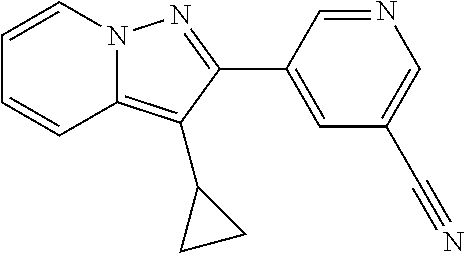 |
5-(3- cyclopropylpyrazolo[1,5- a]pyridin-2- yl)nicotinonitrile | 261.2 |
| 33 |
 |
2-(5-(3- cyclopropylpyrazolo[1,5- a]pyridin-2-yl)pyridin-3- yl)propan-2-ol | 294.3 |
| 34 |
 |
3-cyclopropyl-2-(5- (trifluoromethyl)pyridin- 3-yl)pyrazolo[1,5- a]pyridine | 304.2 |
| 35 |
 |
3-cyclopropyl-2-(4- cyclopropyl-5- fluoropyridin-3- yl)pyrazolo[1,5- a]pyridine | 294.3 |
| 36 |
 |
(R)-2-(5-(3- cyclopropylpyrazolo[1,5- a]pyridin-2-yl)pyridin-3- yl)-1,1,1trifluoropropan- 2-ol | 348.1 |


| TABLE 2 | |||
| Exam- | LCMS | ||
| ple | Structure | IUPAC Name | (M + 1) |
| 39 |  | 2-(4-ethyl-5- fluoropyridin-3-yl)- 3- methylpyrazolo[1,5- a]pyridine | 256.1 |
Assay Description and Results
| TABLE 4 | |||
| V79 Human | V79 Human | ||
| CYP11B2 | CYP11B1 | ||
| Example | IUPAC Name | IC50 (nM) | IC50 (nM) |
| 7 | 3-methyl-2-(5-methylpyridin-3-yl)-6,7- | 2.2 | 282 |
| dihydropyrazolo[1,5-a]pyrimidin-5(4H)-one | |||
| 8 | 3,4-dimethyl-2-(5-methylpyridin-3-yl)-6,7- | 9.8 | 3715 |
| dihydropyrazolo[1,5-a]pyrimidin-5(4H)-one | |||
| 9 | 3-ethyl-4-methyl-2-(5-methylpyridin-3-yl)- | 7.8 | 2344 |
| 6,7-dihydropyrazolo[1,5-a]pyrimidin-5(4H)-one | |||
| 10 | 3-cyclopropyl-2-(5-methylpyridin-3-yl)- | 13.2 | 71%* |
| 6,7-dihydropyrazolo[1,5-a]pyrimidin-5(4H)-one | |||
| 12 | 2-(5-fluoropyridin-3-yl)-3,4-dimethyl-6,7- | 19.1 | 1820 |
| dihydropyrazolo [1,5-a]pyrimidin-5(4H)-one | |||
| 13 | 3-ethyl-2-(5-fluoropyridin-3-yl)-6,7- | 11.7 | 1349 |
| dihydropyrazolo[1,5-a]pyrimidin-5(4H)-one | |||
| 15 | 2-(5-fluoropyridin-3-yl)-3-methyl-6,7- | 30.9 | 3631 |
| dihydropyrazolo [1,5-a]pyrimidin-5(4H)-one | |||
| 19 | 3-cyclopropyl-2-(5-fluoropyridin-3-yl)-6,7- | 102.3 | 38%* |
| dihydropyrazolo[1,5-a]pyrimidin-5(4H)-one | |||
| 25 | 2-(5-methylpyridin-3-yl)-5-oxo-4,5,6,7- | 61%** | |
| tetrahydropyrazolo[1,5-a]pyrimidine-3-carbonitrile | |||
| 26 | 2-(5-chloropyridin-3-yl)-5-oxo-4,5,6,7- | 51%** | 1072 |
| tetrahydropyrazolo[1,5-a]pyrimidine-3-carbonitrile | |||
| *= % inhibition at 10 μM | |||
| **= % inhibition at 1 μM | |||
Claims (5)


Priority Applications (1)
| Application Number | Priority Date | Filing Date | Title |
|---|---|---|---|
| US14/346,518 US9351973B2 (en) | 2011-09-22 | 2012-09-17 | Pyrazolopyridyl compounds as aldosterone synthase inhibitors |
Applications Claiming Priority (3)
| Application Number | Priority Date | Filing Date | Title |
|---|---|---|---|
| US201161537928P | 2011-09-22 | 2011-09-22 | |
| PCT/US2012/055699 WO2013043521A1 (en) | 2011-09-22 | 2012-09-17 | Pyrazolopyridyl compounds as aldosterone synthase inhibitors |
| US14/346,518 US9351973B2 (en) | 2011-09-22 | 2012-09-17 | Pyrazolopyridyl compounds as aldosterone synthase inhibitors |
Related Parent Applications (1)
| Application Number | Title | Priority Date | Filing Date |
|---|---|---|---|
| PCT/US2012/055699 A-371-Of-International WO2013043521A1 (en) | 2011-09-22 | 2012-09-17 | Pyrazolopyridyl compounds as aldosterone synthase inhibitors |
Related Child Applications (1)
| Application Number | Title | Priority Date | Filing Date |
|---|---|---|---|
| US15/139,361 Continuation US9844553B2 (en) | 2011-09-22 | 2016-04-27 | Pyrazolopyridyl compounds as aldosterone synthase inhibitors |
Publications (2)
| Publication Number | Publication Date |
|---|---|
| US20140288094A1 US20140288094A1 (en) | 2014-09-25 |
| US9351973B2 true US9351973B2 (en) | 2016-05-31 |
Family
ID=47914782
Family Applications (2)
| Application Number | Title | Priority Date | Filing Date |
|---|---|---|---|
| US14/346,518 Active 2032-10-18 US9351973B2 (en) | 2011-09-22 | 2012-09-17 | Pyrazolopyridyl compounds as aldosterone synthase inhibitors |
| US15/139,361 Active US9844553B2 (en) | 2011-09-22 | 2016-04-27 | Pyrazolopyridyl compounds as aldosterone synthase inhibitors |
Family Applications After (1)
| Application Number | Title | Priority Date | Filing Date |
|---|---|---|---|
| US15/139,361 Active US9844553B2 (en) | 2011-09-22 | 2016-04-27 | Pyrazolopyridyl compounds as aldosterone synthase inhibitors |
Country Status (3)
| Country | Link |
|---|---|
| US (2) | US9351973B2 (en) |
| EP (1) | EP2757884B1 (en) |
| WO (1) | WO2013043521A1 (en) |
Families Citing this family (31)
| Publication number | Priority date | Publication date | Assignee | Title |
|---|---|---|---|---|
| US9351973B2 (en) | 2011-09-22 | 2016-05-31 | Merck Sharp & Dohme Corp. | Pyrazolopyridyl compounds as aldosterone synthase inhibitors |
| EP2757883B1 (en) | 2011-09-22 | 2021-01-13 | Merck Sharp & Dohme Corp. | Triazolopyridyl compounds as aldosterone synthase inhibitors |
| EP2757882B1 (en) | 2011-09-22 | 2020-11-04 | Merck Sharp & Dohme Corp. | Imidazopyridyl compounds as aldosterone synthase inhibitors |
| GB201321733D0 (en) * | 2013-12-09 | 2014-01-22 | Ucb Pharma Sa | Therapeutic agents |
| WO2016071499A1 (en) | 2014-11-06 | 2016-05-12 | Basf Se | 3-pyridyl heterobicyclic compound for controlling invertebrate pests |
| CN112679467B (en) * | 2015-03-11 | 2024-11-01 | Fmc公司 | Heterocyclic substituted bicyclic ring Azole pesticides |
| WO2017070089A1 (en) * | 2015-10-19 | 2017-04-27 | Incyte Corporation | Heterocyclic compounds as immunomodulators |
| SG10202004618TA (en) | 2015-11-19 | 2020-06-29 | Incyte Corp | Heterocyclic compounds as immunomodulators |
| MA44075A (en) | 2015-12-17 | 2021-05-19 | Incyte Corp | N-PHENYL-PYRIDINE-2-CARBOXAMIDE DERIVATIVES AND THEIR USE AS MODULATORS OF PROTEIN / PROTEIN PD-1 / PD-L1 INTERACTIONS |
| AU2016379372A1 (en) | 2015-12-22 | 2018-08-02 | Incyte Corporation | Heterocyclic compounds as immunomodulators |
| WO2017170765A1 (en) * | 2016-03-30 | 2017-10-05 | 田辺三菱製薬株式会社 | Novel nitrogen-containing heterocyclic compound |
| AR108396A1 (en) | 2016-05-06 | 2018-08-15 | Incyte Corp | HETEROCYCLIC COMPOUNDS AS IMMUNOMODULATORS |
| WO2017205464A1 (en) | 2016-05-26 | 2017-11-30 | Incyte Corporation | Heterocyclic compounds as immunomodulators |
| HUE060256T2 (en) | 2016-06-20 | 2023-02-28 | Incyte Corp | Heterocyclic compounds as immunomodulators |
| EP3484866B1 (en) | 2016-07-14 | 2022-09-07 | Incyte Corporation | Heterocyclic compounds as immunomodulators |
| WO2018044783A1 (en) | 2016-08-29 | 2018-03-08 | Incyte Corporation | Heterocyclic compounds as immunomodulators |
| WO2018050825A1 (en) | 2016-09-19 | 2018-03-22 | Bayer Cropscience Aktiengesellschaft | Pyrazolo [1,5-a]pyridine derivatives and their use as pesticides |
| ES2874756T3 (en) | 2016-12-22 | 2021-11-05 | Incyte Corp | Triazolo [1,5-A] pyridine derivatives as immunomodulators |
| LT3558990T (en) | 2016-12-22 | 2022-12-27 | Incyte Corporation | Tetrahydro imidazo[4,5-c]pyridine derivatives as pd-l1 internalization inducers |
| WO2018119221A1 (en) | 2016-12-22 | 2018-06-28 | Incyte Corporation | Pyridine derivatives as immunomodulators |
| JP7101678B2 (en) | 2016-12-22 | 2022-07-15 | インサイト・コーポレイション | Heterocyclic compounds as immunomodulators |
| US20180179202A1 (en) | 2016-12-22 | 2018-06-28 | Incyte Corporation | Heterocyclic compounds as immunomodulators |
| SMT202500157T1 (en) | 2018-03-30 | 2025-05-12 | Incyte Corp | Heterocyclic compounds as immunomodulators |
| HUE061503T2 (en) | 2018-05-11 | 2023-07-28 | Incyte Corp | Tetrahydroimidazo[4,5-C]pyridine derivatives as PD-L1 immunomodulators |
| JP7665593B2 (en) | 2019-08-09 | 2025-04-21 | インサイト・コーポレイション | Salts of PD-1/PD-L1 inhibitors |
| PE20221038A1 (en) | 2019-09-30 | 2022-06-17 | Incyte Corp | PYRIDO[3,2-D] PYRIMIDINE COMPOUNDS AS IMMUNOMODULATORS |
| CA3160131A1 (en) | 2019-11-11 | 2021-05-20 | Incyte Corporation | Salts and crystalline forms of a pd-1/pd-l1 inhibitor |
| WO2022099018A1 (en) | 2020-11-06 | 2022-05-12 | Incyte Corporation | Process of preparing a pd-1/pd-l1 inhibitor |
| TW202233615A (en) | 2020-11-06 | 2022-09-01 | 美商英塞特公司 | Crystalline form of a pd-1/pd-l1 inhibitor |
| CR20230230A (en) | 2020-11-06 | 2023-07-27 | Incyte Corp | PROCESS FOR MAKING A PD-1/PDL1 INHIBITOR AND SALTS AND CRYSTALLINE FORMS THEREOF |
| CN119371412A (en) * | 2023-07-27 | 2025-01-28 | 长春金赛药业有限责任公司 | CYP11B2 inhibitor compounds, pharmaceutical compositions and applications thereof |
Citations (26)
| Publication number | Priority date | Publication date | Assignee | Title |
|---|---|---|---|---|
| WO1999040094A1 (en) | 1998-02-09 | 1999-08-12 | Bayer Aktiengesellschaft | Agent for sealing metallic ground coats, especially ground coats consisting of zinc or zinc alloys |
| JP2001139575A (en) | 1999-11-15 | 2001-05-22 | Fujisawa Pharmaceut Co Ltd | Novel pyrazolopyridine derivative |
| WO2002046168A1 (en) | 2000-12-07 | 2002-06-13 | Astrazeneca Ab | Therapeutic benzimidazole compounds |
| WO2003035065A1 (en) | 2001-10-26 | 2003-05-01 | Aventis Pharmaceuticals Inc | Benzimidazoles and analogues and their use as protein kinases inhibitors |
| WO2003050120A1 (en) | 2001-12-11 | 2003-06-19 | Smithkline Beecham Corporation | Pyrazolo-pyridine derivatives as antiherpes agents |
| WO2003066629A2 (en) | 2002-02-06 | 2003-08-14 | Vertex Pharmaceuticals Incorporated | Heteroaryl compounds useful as inhibitors of gsk-3 |
| EP1389618A1 (en) | 2001-04-27 | 2004-02-18 | Eisai Co., Ltd. | Pyrazolo 1,5-a]pyridines and medicines containing the same |
| WO2004082638A2 (en) | 2003-03-17 | 2004-09-30 | Syrrx, Inc. | Histone deacetylase inhibitors |
| US20050176753A1 (en) | 2002-05-02 | 2005-08-11 | Bilodeau Mark T. | Tyrosine kinase inhibitors |
| US20050272756A1 (en) | 2002-10-30 | 2005-12-08 | Leblanc Yves | Pyridopyrrolizine and pyridoindolizine derivatives |
| WO2006080821A1 (en) | 2005-01-28 | 2006-08-03 | Daewoong Pharmaceutical Co., Ltd. | Novel benzoimidazole derivatives and pharmaceutical composition comprising the same |
| WO2006092430A1 (en) | 2005-03-03 | 2006-09-08 | Universität des Saarlandes | Selective inhibitors of human corticosteroid synthases |
| US7199129B2 (en) | 2001-08-10 | 2007-04-03 | Monash University | Derivatives of morphine-like opioid compounds |
| WO2008073451A2 (en) | 2006-12-11 | 2008-06-19 | Sirtris Pharmaceuticals, Inc. | Benzoimidazole derivatives as sirtuin (sir) modulating compounds |
| US20090018124A1 (en) | 2005-01-28 | 2009-01-15 | Ji Duck Kim | Novel Benzoimidazole Derivatives and Pharmaceutical Composition Comprising the Same |
| WO2009135651A1 (en) | 2008-05-06 | 2009-11-12 | Universität Saarlandes | 6-pyridin-3-yl-3,4-dihydro-1h-quinolin-2-one derivatives and related compounds as inhibitors of the human aldosterone synthase cyp11b2 |
| WO2009156462A2 (en) | 2008-06-27 | 2009-12-30 | Novartis Ag | Organic compounds |
| US7713991B2 (en) | 2002-11-18 | 2010-05-11 | Novartis Ag | Imidazo[[1, 5-A] pyridine derivatives and methods for treating aldosterone mediated diseases |
| US20100292225A1 (en) | 2009-05-15 | 2010-11-18 | Sylvie Chamoin | Aryl pyridine as aldosterone synthase inhibitors |
| WO2011061168A1 (en) | 2009-11-17 | 2011-05-26 | Novartis Ag | Aryl-pyridine derivatives as aldosterone synthase inhibitors |
| WO2011088188A1 (en) | 2010-01-14 | 2011-07-21 | Novartis Ag | Use of an adrenal hormone-modifying agent |
| WO2012012478A1 (en) | 2010-07-21 | 2012-01-26 | Merck Sharp & Dohme Corp. | Aldosterone synthase inhibitors |
| WO2012148808A1 (en) | 2011-04-26 | 2012-11-01 | Merck Sharp & Dohme Corp. | Aldosterone synthase inhibitors |
| WO2013043520A1 (en) | 2011-09-22 | 2013-03-28 | Merck Sharp & Dohme Corp. | Triazolopyridyl compounds as aldosterone synthase inhibitors |
| WO2013043521A1 (en) | 2011-09-22 | 2013-03-28 | Merck Sharp & Dohme Corp. | Pyrazolopyridyl compounds as aldosterone synthase inhibitors |
| WO2013151876A1 (en) | 2012-04-04 | 2013-10-10 | Merck Sharp & Dohme Corp. | Aldosterone synthase inhibitors |
Family Cites Families (3)
| Publication number | Priority date | Publication date | Assignee | Title |
|---|---|---|---|---|
| JP2753659B2 (en) * | 1990-09-03 | 1998-05-20 | 株式会社大塚製薬工場 | Pyrazole derivatives |
| US7687638B2 (en) | 2004-06-04 | 2010-03-30 | Takeda San Diego, Inc. | Dipeptidyl peptidase inhibitors |
| WO2009146358A1 (en) | 2008-05-29 | 2009-12-03 | Sirtris Pharmaceuticals, Inc. | Imidazopyridine and related analogs as sirtuin modulators |
-
2012
- 2012-09-17 US US14/346,518 patent/US9351973B2/en active Active
- 2012-09-17 WO PCT/US2012/055699 patent/WO2013043521A1/en not_active Ceased
- 2012-09-17 EP EP12834135.1A patent/EP2757884B1/en active Active
-
2016
- 2016-04-27 US US15/139,361 patent/US9844553B2/en active Active
Patent Citations (33)
| Publication number | Priority date | Publication date | Assignee | Title |
|---|---|---|---|---|
| WO1999040094A1 (en) | 1998-02-09 | 1999-08-12 | Bayer Aktiengesellschaft | Agent for sealing metallic ground coats, especially ground coats consisting of zinc or zinc alloys |
| JP2001139575A (en) | 1999-11-15 | 2001-05-22 | Fujisawa Pharmaceut Co Ltd | Novel pyrazolopyridine derivative |
| WO2002046168A1 (en) | 2000-12-07 | 2002-06-13 | Astrazeneca Ab | Therapeutic benzimidazole compounds |
| EP1389618A1 (en) | 2001-04-27 | 2004-02-18 | Eisai Co., Ltd. | Pyrazolo 1,5-a]pyridines and medicines containing the same |
| US7199129B2 (en) | 2001-08-10 | 2007-04-03 | Monash University | Derivatives of morphine-like opioid compounds |
| WO2003035065A1 (en) | 2001-10-26 | 2003-05-01 | Aventis Pharmaceuticals Inc | Benzimidazoles and analogues and their use as protein kinases inhibitors |
| US7199120B2 (en) | 2001-12-11 | 2007-04-03 | Smithkline Beecham Corporation | Pyrazolo-pyridine derivatives as antiherpes agents |
| WO2003050120A1 (en) | 2001-12-11 | 2003-06-19 | Smithkline Beecham Corporation | Pyrazolo-pyridine derivatives as antiherpes agents |
| WO2003066629A2 (en) | 2002-02-06 | 2003-08-14 | Vertex Pharmaceuticals Incorporated | Heteroaryl compounds useful as inhibitors of gsk-3 |
| US20070270420A1 (en) | 2002-02-06 | 2007-11-22 | Harbeson Scott L | Heteroaryl compounds useful as inhibitors of gsk-3 |
| US20050176753A1 (en) | 2002-05-02 | 2005-08-11 | Bilodeau Mark T. | Tyrosine kinase inhibitors |
| US20050272756A1 (en) | 2002-10-30 | 2005-12-08 | Leblanc Yves | Pyridopyrrolizine and pyridoindolizine derivatives |
| US7713991B2 (en) | 2002-11-18 | 2010-05-11 | Novartis Ag | Imidazo[[1, 5-A] pyridine derivatives and methods for treating aldosterone mediated diseases |
| WO2004082638A2 (en) | 2003-03-17 | 2004-09-30 | Syrrx, Inc. | Histone deacetylase inhibitors |
| US7381825B2 (en) | 2003-03-17 | 2008-06-03 | Takeda San Diego, Inc. | Histone deacetylase inhibitors |
| WO2006080821A1 (en) | 2005-01-28 | 2006-08-03 | Daewoong Pharmaceutical Co., Ltd. | Novel benzoimidazole derivatives and pharmaceutical composition comprising the same |
| US20090018124A1 (en) | 2005-01-28 | 2009-01-15 | Ji Duck Kim | Novel Benzoimidazole Derivatives and Pharmaceutical Composition Comprising the Same |
| WO2006092430A1 (en) | 2005-03-03 | 2006-09-08 | Universität des Saarlandes | Selective inhibitors of human corticosteroid synthases |
| US20090221591A1 (en) | 2005-03-03 | 2009-09-03 | Universitat Des Saarlandes | Selective Inhibitors of Human Corticosteroid Synthases |
| WO2008073451A2 (en) | 2006-12-11 | 2008-06-19 | Sirtris Pharmaceuticals, Inc. | Benzoimidazole derivatives as sirtuin (sir) modulating compounds |
| WO2008073451A3 (en) | 2006-12-11 | 2008-09-12 | Sirtris Pharmaceuticals Inc | Benzoimidazole derivatives as sirtuin (sir) modulating compounds |
| WO2009135651A1 (en) | 2008-05-06 | 2009-11-12 | Universität Saarlandes | 6-pyridin-3-yl-3,4-dihydro-1h-quinolin-2-one derivatives and related compounds as inhibitors of the human aldosterone synthase cyp11b2 |
| WO2009156462A2 (en) | 2008-06-27 | 2009-12-30 | Novartis Ag | Organic compounds |
| US20100261698A1 (en) | 2008-06-27 | 2010-10-14 | Christopher Adams | Organic compounds |
| US20100292225A1 (en) | 2009-05-15 | 2010-11-18 | Sylvie Chamoin | Aryl pyridine as aldosterone synthase inhibitors |
| WO2010130796A1 (en) | 2009-05-15 | 2010-11-18 | Novartis Ag | Aryl pyridine as aldosterone synthase inhibitors |
| WO2011061168A1 (en) | 2009-11-17 | 2011-05-26 | Novartis Ag | Aryl-pyridine derivatives as aldosterone synthase inhibitors |
| WO2011088188A1 (en) | 2010-01-14 | 2011-07-21 | Novartis Ag | Use of an adrenal hormone-modifying agent |
| WO2012012478A1 (en) | 2010-07-21 | 2012-01-26 | Merck Sharp & Dohme Corp. | Aldosterone synthase inhibitors |
| WO2012148808A1 (en) | 2011-04-26 | 2012-11-01 | Merck Sharp & Dohme Corp. | Aldosterone synthase inhibitors |
| WO2013043520A1 (en) | 2011-09-22 | 2013-03-28 | Merck Sharp & Dohme Corp. | Triazolopyridyl compounds as aldosterone synthase inhibitors |
| WO2013043521A1 (en) | 2011-09-22 | 2013-03-28 | Merck Sharp & Dohme Corp. | Pyrazolopyridyl compounds as aldosterone synthase inhibitors |
| WO2013151876A1 (en) | 2012-04-04 | 2013-10-10 | Merck Sharp & Dohme Corp. | Aldosterone synthase inhibitors |
Non-Patent Citations (18)
| Title |
|---|
| CAS Registry, Pyrazolo[1,5-a]pyridine, 3-bromo-2-(3-pyridinyl)-, SciFinder, 2001, p. 1-3. |
| Gilbert, K.C., et. al., Curr. Opin. Endocrinol. Diabetes Obes., vol. 17, 2010, pp. 199-204. |
| International Search Report for PCT/US12/55694 (Sep. 17, 2012), mailed on Jan. 29, 2013; 3 pages. |
| International Search Report for PCT/US12/55697 (Sep. 17, 2012), mailed on Jan. 29, 2013; 3 pages. |
| International Search Report for PCT/US12/55699 (Sep. 17, 2012), mailed on Feb. 5, 2013; 3 pages. |
| Kawamoto, T., et. al., Proc. Natl. Acad. Sci, vol. 89, 1992, pp. 1458-1462. |
| Lucas, et. al., J. Med. Chem., 2008, vol. 51, pp. 8077-8087. |
| MacFadyen, R.J., et. al., Cardiovasc. Res., vol. 35, 1997, pp. 30-34. |
| Mahendra, Nath, et al; "An Expeditious Synthesis of Heteroarenes through Carbanion-Induced Ring Transformation Reactions of Suitable Functionalized Pyran-2-ones", European Journal of Organic Chemistry, vol. 1998, No. 10, pp. 2083-2088. |
| Nath et al. (European Jounal of Organic Chemistry (1998), 10, pp. 2083-2088). * |
| Pitt, B., et. al., New Engl. J. Med., vol. 341, 1999, pp. 709-717. |
| Pitt, B., et. al., New Engl. J. Med., vol. 348, 2003, pp. 1382-1390. |
| Pubchem, SCHEMBL5208366, U.S. National Library of Medicine, 2007, p. 1-12. |
| Soberman, J.E., et. al., Curr. Hypertens. Rep., vol. 2, 2000, pp. 451-456. |
| Taymans, S.E., et. al., J.Clin.Endocrinol. Metab., vol. 83, 1998, pp. 1033-1036). |
| Written Opinion of the International Searching Authority for PCT/US12/55694 (Sep. 17, 2012), completed on Jan. 15, 2013; 3 pages. |
| Written Opinion of the International Searching Authority for PCT/US12/55697 (Sep. 17, 2012), completed on Jan. 15, 2013; 3 pages. |
| Written Opinion of the International Searching Authority for PCT/US12/55699 (Sep. 17, 2012), completed on Jan. 15, 2013; 3 pages. |
Also Published As
| Publication number | Publication date |
|---|---|
| EP2757884B1 (en) | 2022-07-27 |
| US20140288094A1 (en) | 2014-09-25 |
| US20170020879A1 (en) | 2017-01-26 |
| US9844553B2 (en) | 2017-12-19 |
| EP2757884A4 (en) | 2015-05-06 |
| EP2757884A1 (en) | 2014-07-30 |
| WO2013043521A1 (en) | 2013-03-28 |
Similar Documents
| Publication | Publication Date | Title |
|---|---|---|
| US9844553B2 (en) | Pyrazolopyridyl compounds as aldosterone synthase inhibitors | |
| US9518055B2 (en) | Imidazopyridyl compounds as aldosterone synthase inhibitors | |
| US9073929B2 (en) | Aldosterone synthase inhibitors | |
| US9567333B2 (en) | Triazolopyridyl compounds as aldosterone synthase inhibitors | |
| US9745282B2 (en) | Indoline compounds as aldosterone synthase inhibitors | |
| EP2595482A1 (en) | Aldosterone synthase inhibitors | |
| RS52838B (en) | PHENOXIMETHYL HETEROCYCLIC COMPOUNDS | |
| US9522141B2 (en) | Indazole compounds as aldosterone synthase inhibitors |
Legal Events
| Date | Code | Title | Description |
|---|---|---|---|
| AS | Assignment |
Owner name: MERCK SHARP & DOHME CORP., NEW JERSEY Free format text: ASSIGNMENT OF ASSIGNORS INTEREST;ASSIGNORS:BENNETT, D. JONATHAN;CAI, JAIQIANG;HOYT, SCOTT B.;AND OTHERS;SIGNING DATES FROM 20140204 TO 20140319;REEL/FRAME:032516/0655 |
|
| AS | Assignment |
Owner name: JUBILANT ORGANOSYS LIMITED, INDIA Free format text: ASSIGNMENT OF ASSIGNORS INTEREST;ASSIGNORS:SAMANTA, SWAPAN KUMAR;KULKARNI, BHEEMASHANKAR A.;REEL/FRAME:036078/0222 Effective date: 20120818 Owner name: MERCK SHARP & DOHME CORP., NEW JERSEY Free format text: ASSIGNMENT OF ASSIGNORS INTEREST;ASSIGNOR:JUBILANT ORGANOSYS LIMITED;REEL/FRAME:036079/0724 Effective date: 20120818 |
|
| STCF | Information on status: patent grant |
Free format text: PATENTED CASE |
|
| MAFP | Maintenance fee payment |
Free format text: PAYMENT OF MAINTENANCE FEE, 4TH YEAR, LARGE ENTITY (ORIGINAL EVENT CODE: M1551); ENTITY STATUS OF PATENT OWNER: LARGE ENTITY Year of fee payment: 4 |
|
| AS | Assignment |
Owner name: MERCK SHARP & DOHME LLC, NEW JERSEY Free format text: MERGER;ASSIGNOR:MERCK SHARP & DOHME CORP.;REEL/FRAME:061102/0145 Effective date: 20220407 |
|
| MAFP | Maintenance fee payment |
Free format text: PAYMENT OF MAINTENANCE FEE, 8TH YEAR, LARGE ENTITY (ORIGINAL EVENT CODE: M1552); ENTITY STATUS OF PATENT OWNER: LARGE ENTITY Year of fee payment: 8 |