US9346941B2 - Polycarbonate resin composition having improved appearance and flowability - Google Patents
Polycarbonate resin composition having improved appearance and flowability Download PDFInfo
- Publication number
- US9346941B2 US9346941B2 US14/566,788 US201414566788A US9346941B2 US 9346941 B2 US9346941 B2 US 9346941B2 US 201414566788 A US201414566788 A US 201414566788A US 9346941 B2 US9346941 B2 US 9346941B2
- Authority
- US
- United States
- Prior art keywords
- polycarbonate resin
- resin composition
- bis
- hydroxy
- chemical formula
- Prior art date
- Legal status (The legal status is an assumption and is not a legal conclusion. Google has not performed a legal analysis and makes no representation as to the accuracy of the status listed.)
- Active
Links
- 0 [1*]P1([2*])=NP([3*])([4*])=NP([5*])([6*])=N1 Chemical compound [1*]P1([2*])=NP([3*])([4*])=NP([5*])([6*])=N1 0.000 description 6
- IQOALSQSZWVOHL-UHFFFAOYSA-N CC.CC.OC1=CC=C(CC2=CC=C(O)C=C2)C=C1 Chemical compound CC.CC.OC1=CC=C(CC2=CC=C(O)C=C2)C=C1 IQOALSQSZWVOHL-UHFFFAOYSA-N 0.000 description 1
Images

Classifications
-
- C—CHEMISTRY; METALLURGY
- C08—ORGANIC MACROMOLECULAR COMPOUNDS; THEIR PREPARATION OR CHEMICAL WORKING-UP; COMPOSITIONS BASED THEREON
- C08K—Use of inorganic or non-macromolecular organic substances as compounding ingredients
- C08K5/00—Use of organic ingredients
- C08K5/49—Phosphorus-containing compounds
- C08K5/5399—Phosphorus bound to nitrogen
-
- C—CHEMISTRY; METALLURGY
- C08—ORGANIC MACROMOLECULAR COMPOUNDS; THEIR PREPARATION OR CHEMICAL WORKING-UP; COMPOSITIONS BASED THEREON
- C08K—Use of inorganic or non-macromolecular organic substances as compounding ingredients
- C08K7/00—Use of ingredients characterised by shape
- C08K7/02—Fibres or whiskers
- C08K7/04—Fibres or whiskers inorganic
- C08K7/14—Glass
-
- C—CHEMISTRY; METALLURGY
- C08—ORGANIC MACROMOLECULAR COMPOUNDS; THEIR PREPARATION OR CHEMICAL WORKING-UP; COMPOSITIONS BASED THEREON
- C08L—COMPOSITIONS OF MACROMOLECULAR COMPOUNDS
- C08L69/00—Compositions of polycarbonates; Compositions of derivatives of polycarbonates
Definitions
- the following disclosure relates to a polycarbonate resin composition, and more particularly, to a polycarbonate resin composition that can have improved appearance and flowability and can be used as exterior materials of electronic devices such as cellular phones and the like.
- thermoplastic resin can have high flexural strength to provide excellent rigidity and therefore has been used in the manufacture of various components for automobiles, electronic devices, and the like.
- an inorganic filler is added to a thermoplastic resin, there can be various problems, such as decreased impact resistance. Thus, it can be difficult to use such materials in components which may be damaged by external shock.
- flowability can be remarkably deteriorated, and thus temperature at the time of injection-molding should be increased for effective molding.
- a glass fiber-reinforced polycarbonate resin has advantages in that excellent moldability of the polycarbonate resin can be maintained and tensile and flexural strength may be improved.
- the resin can have excellent flexural modulus and thermal resistance to be appropriate for components enduring continuous load or heat.
- glass fiber-reinforced polycarbonate resins have been used as exterior materials of electronic devices such as cellular phones and the like.
- the glass fiber-reinforced polycarbonate resin can have excellent impact resistance as compared to other glass fiber-reinforced thermoplastic resins, after injection-molding, glass fibers can protrude from a surface to thereby deteriorate appearance.
- An additive can be used in order to prevent deterioration of the appearance and to improve flowability. Use of the additive, however, can decrease impact resistance.
- Korean Patent Laid-Open Publication No. 10-2009-0018569 discloses a glass fiber-reinforced polycarbonate having excellent flowability and impact strength by adding a modified polyolefin thereto.
- the polycarbonate has problems in that improvement of flowability is still not sufficient, and an appearance of a molded article manufactured therefrom is deteriorated, such that additional processes such as blasting, and the like, are required.
- An embodiment of the present invention is directed to providing a polycarbonate resin composition that can have improved appearance and flowability. More specifically, the present invention provides a polycarbonate resin composition that can have improved appearance and flowability with minimal or no reduction of mechanical properties, by including a glass transition temperature regulator (hereinafter, referred to as a Tg regulator) containing phosphorus in a polycarbonate resin reinforced with an inorganic filler to thereby reduce a glass transition temperature (Tg).
- a glass transition temperature regulator hereinafter, referred to as a Tg regulator
- another embodiment of the present invention is directed to providing a molded article manufactured by the polycarbonate resin composition.
- the present invention provides a polycarbonate resin composition that can have improved appearance and flowability including: (A) a polycarbonate resin, (B) an inorganic filler, and (C) a Tg regulator including phosphorus.
- the polycarbonate resin composition may include (A) the polycarbonate resin in an amount of about 50 to about 85 wt %, the inorganic filler (B) in an amount of about 10 to about 40 wt %, and the Tg regulator including phosphorus in an amount of about 1 to about 10 wt %.
- the polycarbonate resin (A) may have a weight average molecular weight (Mw) of about 10,000 to 200,000 g/mol.
- the inorganic filler may be at least one selected from the group consisting of a glass fiber, a carbon fiber, a ceramic fiber, calcium carbonate, silica, alumina, aluminum hydroxide, talc, clay, mica, barium sulfate, whiskers, and mixtures thereof.
- the Tg regulator including phosphorus (C) may be a compound having a structure of the following Chemical Formula 1:
- R 1 to R 6 are the same or different and are each independently hydrogen, halogen, C1-C20 alkyl, C2-C7 alkenyl, C3-C20 cycloalkyl, C2-C20 heterocycloalkyl, C1-C20 alkoxy, C6-C20 aryl, C5-C20 heteroaryl, C1-C10 alkoxycarbonyl C1-C10 alkyl, carbonyl C1-C10 alkyl, amino or hydroxy, wherein the alkyl, alkenyl, cycloalkyl, heterocycloalkyl, alkoxycarbonylalkyl, and carbonylalkyl may be further substituted with at least one of C1-C10 alkyl, halogen, nitro, cyano, hydroxy, amino, C6-C10 aryl, C3-C10 cycloalkyl, C3-C10 heterocycloalkyl, and/or C4-C10 heteroaryl.
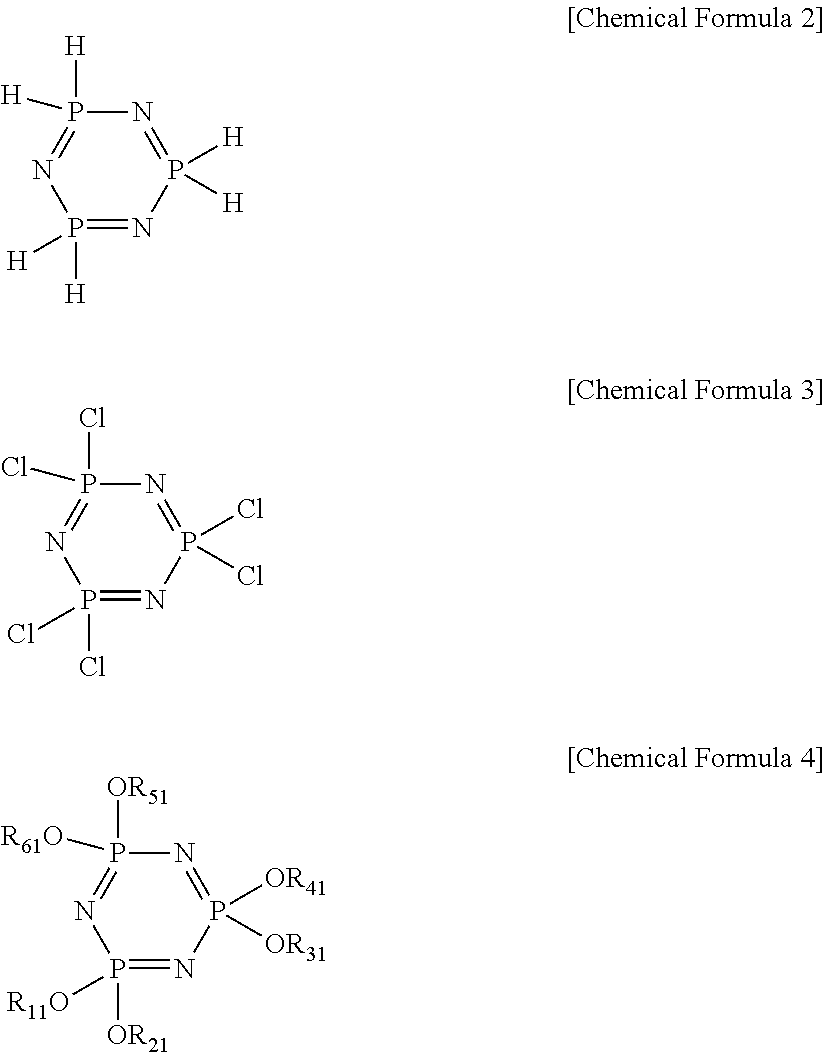
- the Tg regulator including phosphorus (C) may be a compound having a structure of the following Chemical Formula 2, a compound having a structure of the following Chemical Formula 3, and/or a compound having a structure of the following Chemical Formula 4:
- R 11 to R 61 are the same or different and are each independently hydrogen, methyl, ethyl, propyl, isopropyl, butyl, pentyl, hexyl or benzyl.
- the polycarbonate resin composition having improved appearance and flowability may further include one or more additives selected from the group consisting of antibacterial agents, heat stabilizers, antioxidants, release agents, light stabilizers, surfactants, coupling agents, plasticizers, compatibilizers, lubricants, antistatic agents, coloring agents, such as pigments and/or dyes, flame retardants, flame retardant aids, anti-dripping agents, weather resistant agents, ultraviolet radiation absorbers, ultraviolet radiation blockers, and mixtures thereof.
- additives selected from the group consisting of antibacterial agents, heat stabilizers, antioxidants, release agents, light stabilizers, surfactants, coupling agents, plasticizers, compatibilizers, lubricants, antistatic agents, coloring agents, such as pigments and/or dyes, flame retardants, flame retardant aids, anti-dripping agents, weather resistant agents, ultraviolet radiation absorbers, ultraviolet radiation blockers, and mixtures thereof.
- the present invention provides a molded article manufactured by the polycarbonate resin composition as described above.
- the molded article may satisfy the following Equations 1 to 3: 50 ⁇ Gloss ⁇ 90 [Equation 1] 80 ⁇ Yp ⁇ 100 [Equation 2] 150 ⁇ Spiral length ⁇ 200 [Equation 3]
- Gloss is a 60-degree average value of a rectangular-shaped molded sample having a size of 9 cm ⁇ 5 cm measured at 60 degrees by a Glossmeter;
- Yp is a coating yield (%) obtained by coating 100 molded samples each having a size of 10 cm ⁇ 10 cm ⁇ 1 cm, determining a article having a concave-convex portion formed therein inspected by the naked eye as a defective article, and measuring the number of non-defective articles except for the defective article;
- Spiral length is a flow length (mm) measured by injection-molding the polycarbonate resin composition of the invention using a spiral-shaped mold having a thickness of 1 mm and a width of 1 cm at 310.
- the molded article may be an exterior material of a cellular phone.
- FIG. 1( a ) is a microscope photograph showing whether or not a concave-convex portion is formed on a coated surface of a molded article manufactured using a polycarbonate resin composition according to a comparative example;
- FIG. 1( b ) is a microscope photograph showing whether or not a concave-convex portion is formed on a coated surface of a molded article manufactured using a polycarbonate resin composition according an exemplary embodiment of the present invention.
- the present inventors made an effort to develop a polycarbonate resin composition having excellent workability to provide improved molding processability and appearance properties without reducing mechanical properties such as impact resistance, and the like, and as a result, surprisingly found that a polycarbonate resin composition including a polycarbonate resin, an inorganic filler, and a Tg regulator including phosphorus may have remarkably improved flowability with minimal or no reduction of mechanical properties such as impact resistance, flexural modulus, and the like, to remarkably improve an appearance property and a coating yield, thereby completing the present invention.
- the polycarbonate resin composition of the present invention includes (A) a polycarbonate resin, (B) an inorganic filler, and (C) a Tg regulator including phosphorus.
- a polycarbonate resin according to an exemplary embodiment of the present invention may have mechanical properties such as rigidity, impact strength, and the like, an appearance property, and excellent molding processability.
- the polycarbonate resin is not limited as long as it is a polycarbonate resin prepared by generally known methods.
- Examples of the polycarbonate resin may include without limitation aliphatic polycarbonate resins, aromatic polycarbonate resins, copolycarbonate resins thereof, copolyester carbonate resins thereof, polycarbonate-polysiloxane copolymer resins, and the like, and mixtures thereof.
- an aromatic polycarbonate resin may be used.
- polycarbonate resin a linear polycarbonate resin, a branched polycarbonate resin, or mixtures of the linear and branched polycarbonate resins, in view of a structure, may be used, but the present invention is not limited thereto.
- the polycarbonate resin according to an exemplary embodiment of the present invention may be prepared by reacting an aromatic dihydroxy compound (A1) with a carbonate precursor (A2).
- the aromatic dihydroxy compound (A1) may be a compound represented by the following Chemical Formula 5 or mixtures thereof:
- X 1 and X 2 are the same or different and are each independently hydrogen, halogen, or C 1 -C 8 alkyl; a and b are the same or different and are each independently an integer of 0 to 4; and Z is a single bond, C 1 -C 8 alkylene, C 2 -C 8 alkylidene, C 5 -C 15 cycloalkylene, C 5 -C 15 cycloalkylidene, —S—, —SO—, SO 2 —, —O—, or —CO—.
- aromatic dihydroxy compound (A1) represented by Chemical Formula 5 examples include without limitation bis(hydroxy aryl)alkanes, bis(hydroxy aryl)cycloalkanes, bis(hydroxy aryl)ethers, bis(hydroxy aryl)sulfides, bis(hydroxy aryl)sulfoxides, biphenyl compounds, and the like, wherein these compounds may be used alone or as a mixture including two or more thereof.
- bis(hydroxy aryl)alkanes include without limitation bis(4-hydroxy phenyl)methane, bis(3-methyl-4-hydroxy phenyl)methane, bis(3-chloro-4-hydroxy phenyl)methane, bis(3,5-dibromo-4-hydroxy phenyl)methane, 1,1-bis(4-hydroxy phenyl)ethane, 1,1-bis(2-tertiary-butyl-4-hydroxy-3-methyl phenyl)ethane, 2,2-bis(4-hydroxy phenyl)propane(bisphenol A), 2,2-bis(3-methyl-4-hydroxy phenyl)propane, 2,2-bis(2-methyl-4-hydroxy phenyl)propane, 2,2-bis(3,5-dimethyl-4-hydroxy phenyl)propane, 1,1-bis(2-tertiary-butyl-4-hydroxy-5-methyl phenyl)propane, 2,2-bis(3-chloro-4-hydroxy
- bis(hydroxy aryl)cycloalkanes include without limitation 1,1-bis(4-hydroxy phenyl)cyclopentane, 1,1-bis(4-hydroxy phenyl)cyclohexane, 1,1-bis(3-methyl-4-hydroxy phenyl)cyclohexane, 1,1-bis(3-cyclohexyl-4-hydroxy phenyl)cyclohexane, 1,1-bis(3-phenyl-4-hydroxy phenyl)cyclohexane, 1,1-bis(4-hydroxy phenyl)-3,5,5-trimethylcyclohexane, and the like, and mixtures thereof.
- bis(hydroxy aryl)ethers include without limitation bis(4-hydroxy phenyl)ether, bis(4-hydroxy-3-methyl phenyl)ether, and the like, and mixtures thereof.
- bis(hydroxy aryl)sulfides include without limitation bis(4-hydroxy phenyl)sulfide, bis(3-methyl-4-hydroxy phenyl)sulfide, and the like, and mixtures thereof.
- bis(hydroxy aryl)sulfoxides include without limitation bis(hydroxy phenyl)sulfoxide, bis(3-methyl-4-hydroxy phenyl)sulfoxide, bis(3-phenyl-4-hydroxy phenyl)sulfoxide, and the like, and mixtures thereof.
- biphenyl compounds include without limitation bis(hydroxy aryl)sulfones such as bis(4-hydroxy phenyl)sulfone, bis(3-methyl-4-hydroxy phenyl)sulfone, and bis(3-phenyl-4-hydroxy phenyl)sulfone, 4,4′-dihydroxy biphenyl, 4,4′-dihydroxy-2,2′-dimethylbiphenyl, 4,4′-dihydroxy-3,3′-dimethylbiphenyl, 4,4′-dihydroxy-3,3′-dicyclo biphenyl, 3,3-difluoro-4,4′-dihydroxy biphenyl, and the like, and mixtures thereof.
- bis(hydroxy aryl)sulfones such as bis(4-hydroxy phenyl)sulfone, bis(3-methyl-4-hydroxy phenyl)sulfone, and bis(3-phenyl-4-hydroxy phenyl)sulfone, 4,4′-
- aromatic dihydroxy compound (A1) used in the present invention other than the compound represented by Chemical Formula 5 above include without limitation dihydroxy benzene, halogen and/or C1-C10 alkyl-substituted dihydroxy benzene, and the like, and mixtures thereof.
- resorcinol 3-methylresorcinol, 3-ethylresorcinol, 3-propylresorcinol, 3-butylresorcinol, 3-tertiary-butylresorcinol, 3-phenylresorcinol, 2,3,4,6-tetrafluororesorcinol, 2,3,4,6-tetrabromoresorcinol, catechol, hydroquinone, 3-methylhydroquinone, 3-ethylhydroquinone, 3-propylhydroquinone, 3-butylhydroquinone, 3-tertiary-butylhydroquinone, 3-phenylhydroquinone, 3-cumyl hydroquinone, 2,5-dichlorohydroquinone, 2,3,5,6-tetramethylhydroquinone, 2,3,5,6-tetra-tertiary-butylhydroquinone, 2,3,5,6-tetrafluorohydroquinone
- aromatic dihydroxy compound (A1) 2,2-bis(4-hydroxy phenyl)propane(bisphenol A) may be used.
- Examples of the carbonate precursor include without limitation dimethyl carbonate, diethyl carbonate, dibutyl carbonate, dicyclohexyl carbonate, diphenyl carbonate, ditolyl carbonate, bis(chlorophenyl)carbonate, m-cresyl carbonate, dinaphthyl carbonate, bis(diphenyl)carbonate, carbonyl chloride (phosgene), triphosgene, diphosgene, carbonyl bromide, bishaloformate, and the like. These compounds may be used alone or as a mixture including two or more thereof.
- the carbonate precursor A2 may be used in a molar ratio of about 0.9 to about 1.5 based on about 1 mol of the aromatic dihydroxy compound (A1).
- the polycarbonate resin according to an exemplary embodiment of the present invention may have a weight average molecular weight (Mw) of about 10,000 to about 200,000 g/mol, for example, about 15,000 to about 80,000 g/mol. In this case, processability may be improved.
- Mw weight average molecular weight
- the polycarbonate resin composition may include the polycarbonate resin (A) according to an exemplary embodiment of the present invention in an amount about 50 to about 85 wt %, for example about 60 to about 75 wt %, based on the total weight (100 wt %) of the polycarbonate resin composition.
- the polycarbonate resin composition may include the polycarbonate resin (A) in an amount of about 50, 51, 52, 53, 54, 55, 56, 57, 58, 59, 60, 61, 62, 63, 64, 65, 66, 67, 68, 69, 70, 71, 72, 73, 74, 75, 76, 77, 78, 79, 80, 81, 82, 83, 84, or 85 wt %.
- the amount of the polycarbonate resin (A) can be in a range from about any of the foregoing amounts to about any other of the foregoing amounts.
- the inorganic filler according to an exemplary embodiment of the present invention may be added to the polycarbonate resin to improve strength of a resin.
- Various forms and kinds of the inorganic filler known in the art may be used without limitation.
- the inorganic filler may include without limitation fibrous inorganic fillers, such as glass fiber, carbon fiber, ceramic fiber, metal fiber, and the like, calcium carbonate, silica, alumina, aluminum hydroxide, talc, clay, mica, barium sulfate, whiskers, and the like, and mixtures thereof.
- fibrous inorganic fillers such as glass fiber, carbon fiber, ceramic fiber, metal fiber, and the like, calcium carbonate, silica, alumina, aluminum hydroxide, talc, clay, mica, barium sulfate, whiskers, and the like, and mixtures thereof.
- the inorganic filler may have a cross section having various shapes such as circle, oval, rectangle, and the like.
- the inorganic filler of the present invention is a glass fiber, and all kinds and all forms of glass fibers may be used.
- the glass fiber according to an exemplary embodiment of the present invention may be a glass fiber having a cylindrical cross section and/or a plate shaped glass fiber.
- the glass fiber having a cylindrical cross section may have a cross-sectional diameter of about 5 to about 20 um, and have a length of about 2 to about 5 mm before processing.
- the plate-shaped glass fiber may have a cross-sectional aspect ratio of about 1.5 to about 10, and have a length of about 2 to about 5 mm before processing.
- processability may be improved, mechanical properties such as tensile strength, impact resistance, flexural modulus, and the like, of a molded article, and an appearance property of an injected article may also be improved.
- a surface of the inorganic filler may be coated with a surface treating agent.
- the surface treating agent include without limitation silane-based compounds, urethane-based compounds, epoxy-based compounds, and the like, and mixtures thereof.
- the polycarbonate resin composition may include the inorganic filler (B) according to an exemplary embodiment of the present invention in an amount of about 10 to about 40 wt %, for example about 20 to about 35 wt %, based of the total weight (100 wt %) of the polycarbonate resin composition.
- the polycarbonate resin composition may include the inorganic filler (B) in an amount of about 10, 11, 12, 13, 14, 15, 16, 17, 18, 19, 20, 21, 22, 23, 24, 25, 26, 27, 28, 29, 30, 31, 32, 33, 34, 35, 36, 37, 38, 39, or 40 wt %.
- the amount of the inorganic filler (B) can be in a range from about any of the foregoing amounts to about any other of the foregoing amounts.
- the amount of the inorganic filler When the amount of the inorganic filler is less than about 10 wt %, impact resistance and thermal resistance may be decreased. When the amount of the inorganic filler is more than about 40 wt %, flowability may be deteriorated to decrease molding processability, and at the time of injection-molding the composition as a molded article, since the inorganic filler may protrude, appearance thereof may be deteriorated.
- the Tg regulator including phosphorus may reduce a glass transition temperature (Tg) of the polycarbonate resin to improve flowability.
- Tg regulator including phosphorus may include without limitation phosphates, phosphonates, phosphinates, phosphine oxides, phosphazenes, and the like, and mixtures thereof.
- linear phosphazene and/or cyclic phosphazene may be used.
- the Tg regulator including phosphorus (C) may be a compound having a structure of the following Chemical Formula 1, or a mixture thereof:
- R 1 to R 6 are the same or different and are each independently hydrogen, halogen, C1-C20 alkyl, C2-C8 alkenyl, C3-C20 cycloalkyl, C2-C20 heterocycloalkyl, C1-C20 alkoxy, C6-C20 aryl, C5-C20 heteroaryl, C1-C10 alkoxycarbonyl C1-C10 alkyl, carbonyl C1-C10 alkyl, amino or hydroxy, wherein the alkyl, alkenyl, cycloalkyl, heterocycloalkyl, alkoxycarbonylalkyl, carbonylalkyl may be further substituted with one or more C1-C10 alkyl, halogen, nitro, cyano, hydroxy, amino, C6-C10 aryl, C3-C10 cycloalkyl, C3-C10 heterocycloalkyl, and/or C4-C10 heteroaryl.
- alkyl As used herein, the terms “alkyl”, “alkoxy”, and other substituents including “alkyl” include linear and/or branched alkyl, alkoxy, etc., and the term “alkenyl” includes C2 to C8 linear and/or branched alkenyl and at least one double bond.
- cycloalkyl includes C3 to C20 saturated monocyclic and/or saturated bicyclic ring structures.
- aryl includes organic radicals derived from aromatic hydrocarbon due to removal of one hydrogen, and includes single ring systems and/or fused ring systems including 4 to 7 ring atoms, for example, 5 or 6 ring atoms in each ring.
- aryl include without limitation phenyl, naphthyl, biphenyl, tolyl, and the like, and mixtures thereof.
- heterocycloalkyl means a cycloalkyl group including 1 to 3 heteroatoms such as N, O, and/or S as a saturated cyclic hydrocarbon framework atom(s) and carbon as the remaining saturated monocyclic and/or bicyclic ring framework atoms.
- heterocycloalkyl examples include without limitation pyrrolidinyl, azetidinyl, pyrazolidinyl, oxazolidinyl, piperidinyl, piperazinyl, morpholinyl, thiomorpholinyl, thiazolidinyl, hydantoinyl, valerolactamyl, oxiranyl, oxetanyl, dioxolanyl, dioxanyl, oxathiolanyl, oxathianyl, dithianyl, dihydrofuranyl, tetrahydrofuranyl, dihydropyranyl, tetrahydropyranyl, tetrahydropyridinyl, tetrahydropyrimidinyl, tetrahydrothiophenyl, tetrahydrothiopyranyl, diazepanyl, azepanyl, and the like, and mixtures thereof.
- heteroaryl means an aryl group including 1 to 3 heteroatoms such as N, O, and/or S as an aromatic ring framework atom(s) and carbon as the remaining aromatic ring framework atoms.
- the heteroaryl group can include a bivalent aryl group forming N-oxide and/or a quaternary salt by an oxidized or quaternized heteroatom in a ring.
- heteroaryl examples include without limitation furyl, thiophenyl, pyrrolyl, pyranyl, imidazolyl, pyrazolyl, thiazolyl, thiadiazolyl, isothiazolyl, isoxazolyl, oxazolyl, oxadiazolyl, triazinyl, tetrazinyl, triazolyl, tetrazolyl, furazanyl, pyridyl, pyrazinyl, pyrimidinyl, pyridazinyl, and the like, and mixtures thereof.
- the Tg regulator including phosphorus (C) of the present invention may include a compound having a structure of the following Chemical Formula 2, a compound having a structure of the following Chemical Formula 3, and/or a compound having a structure of the following Chemical Formula 4:
- R 11 to R 61 are the same or different and are each independently hydrogen, methyl, ethyl, propyl, isopropyl, butyl, pentyl, hexyl or benzyl.
- the Tg of the polycarbonate resin may be reduced to improve flowability and maintain excellent mechanical properties.
- the polycarbonate resin composition may include the Tg regulator including phosphorus (C) according to an exemplary embodiment of the present invention in an amount of about 1 to about 10 wt %, for example about 1 to about 5 wt %, based on the total weight (100 wt %) of the polycarbonate resin composition.
- the polycarbonate resin composition may include the Tg regulator including phosphorus (C) in an amount of about 1, 2, 3, 4, 5, 6, 7, 8, 9, or 10 wt %.
- the amount of the Tg regulator including phosphorus (C) can be in a range from about any of the foregoing amounts to about any other of the foregoing amounts.
- the amount of the Tg regulator is less than about 1 wt %, an effect in which the Tg of the polycarbonate resin is reduced may not be sufficient, such that improvement in flowability may not be affected.
- the amount of the Tg regulator is more than about 10 wt %, Tg can be excessively reduced, such that mechanical properties such as impact resistance, and the like, may be remarkably reduced, and a problem that the inorganic filler protrudes to deteriorate the appearance at the time of injection-molding, may be intensified.
- the polycarbonate resin composition of the present invention may further contain various additives depending on a usage thereof so long as the additives do not significantly negatively impact the properties of the compositions of the present invention.
- the additive may include without limitation antibacterial agents, heat stabilizers, antioxidants, release agents, light stabilizers, surfactants, coupling agents, plasticizers, compatibilizers, lubricants, antistatic agents, coloring agents, such as pigments and/or dyes, flame retardants, flame retardant aids, anti-dripping agents, weather resistant agents, ultraviolet radiation absorbers, ultraviolet radiation blockers, and the like, and mixtures thereof.
- the amount of the additive may be easily determined by a person skilled in the art.
- the polycarbonate resin composition of the present invention may be prepared by methods known in the art.
- each component and optional additive(s) can be mixed by a Henschel mixer, a V blender, a tumbler blender, a ribbon blender, and the like, followed by melt-extrusion by a single screw extruder or a twin-screw extruder at a temperature of about 150 to about 300, thereby preparing a pellet form.
- the components except for the inorganic filler may be put into a main feeder, and the inorganic filler may be put into a side feeder.
- the prepared pellet may be dried at 100 for 3 hours or more and may be injection-molded as a sample.
- a molded article that can have improved appearance and/or flowability, manufactured by molding the above-described polycarbonate resin composition.
- the molded articles may be manufactured by various processes such as an injection-molding, a double injection-molding, a blow molding, an extrusion molding, a heat molding, and the like, by using the polycarbonate resin composition.
- the molded article can satisfy the following Equations 1 to 3: 50 ⁇ Gloss ⁇ 90 [Equation 1] 80 ⁇ Yp ⁇ 100 [Equation 2] 150 ⁇ Spiral length ⁇ 200 [Equation 3]
- Gloss is a 60-degree average value of a rectangular-shaped molded sample having a size of 9 cm ⁇ 5 cm measured at 60 degrees measured by a Glossmeter;
- Yp is a coating yield (%) obtained by coating 100 molded samples each having a size of 10 cm ⁇ 10 cm ⁇ 1 cm, determining a article having a concave-convex portion formed therein inspected by the naked eye as a defective article, and measuring the number of non-defective articles except for the defective article;
- Spiral length is a flow length (mm) measured by injection-molding the polycarbonate resin composition of the invention using a spiral-shaped mold having a thickness of 1 mm and a width of 1 cm at 310.
- the molded article manufactured by the polycarbonate resin composition of the present invention includes a polycarbonate resin, an inorganic filler, and a Tg regulator including phosphorus, such that excellent mechanical properties and molding processability may be maintained, flowability and an appearance property after injection-molding may be improved, and a coating yield may be remarkably improved.
- FIGS. 1( a ) and ( b ) are microscope photographs showing an appearance property of a molded article manufactured using a polycarbonate resin composition according to a comparative example and a polycarbonate resin composition according to an exemplary embodiment of the present invention, respectively.
- the composition includes the Tg regulator including phosphorus, protrusion of the inorganic filler, which affects the appearance of the molded article, is remarkably decreased, such that the appearance property thereof may be improved.
- the polycarbonate resin composition may be effectively used as exterior materials of electronic devices such as cellular phones and the like, requiring the above-described properties.
- a glass fiber (Owens Corning 183F) having an average length of about 3 mm is used.
- Cyclophosphazene (Rabitle FP-110, Fushimi Pharmaceutical Co., Ltd.) is used.
- Hexachlorocyclophosphazene (Samreal 87, Ningbo Samreal Chemical CO., LTD.) is used.
- HDPE wax typed lubricant (HI-WAX 400P, Mitsui Petrochemical Industries, Ltd.) is was used.
- a rectangular-shaped glossy sample having a size of 9*5 cm is measured at 60 degrees using a VG7000 gloss meter manufactured by Nippon Denshoku Industries Co., Ltd.
- a coating yield (%) is measured by performing a coating process including three stages of a lower stage, a middle stage, and an upper stage on 100 samples injection-molded with each having a size of 10 cm ⁇ 10 cm ⁇ 1 cm, determining an article inspected by the naked eye, wherein an article without a concave-convex portion is determined as a non-defective article and an article having even one concave-convex portion formed therein is determined as a defective article, and measuring the number of non-defective articles (excluding the defective articles).
- Impact resistance is measured by injection-molding a flat typed sample having a size of 1 mm ⁇ 5 cm ⁇ 5 cm (thickness ⁇ width ⁇ length), performing an aging process for 6 hours or more at room temperature, applying an impact to 20 or more samples by a falling weight evaluating apparatus (DuPont drop test, a weight of 500 g), and measuring an average height that 50% of the sample is destroyed as a numerical value in a unit of cm.
- a falling weight evaluating apparatus DuPont drop test, a weight of 500 g
- Flexural modulus is measured under ASTM D790 standard at a rate of 2.8 mm/min.
- Flowability is measured by injection-molding the polycarbonate resin composition using a spiral-shaped mold having a thickness of 1 mm and a width of 1 cm at 310° C. while maintaining a constant pressure, rate, and a cushion amount, and measuring a length in which the resin flows in a unit of mm.
- the inorganic filler (B) is put into a side feeder.
- Each prepared pellet is dried for 3 hours at 100 and injection-molded as a sample. Physical properties of the injection-molded sample are measured and shown in the following Table 2.
- Example 3 a polycarbonate resin of Example 3 is prepared by the same method as Example 1 except for using a mixture of the Tg regulator (C1) and the Tg regulator (C2) and injection-molded as a sample. Physical properties of the injection-molded sample are measured and shown in the following Table 2.
- a polycarbonate resin of Comparative Example 1 is prepared by the same method as Example 1 except for not using the Tg regulator including phosphorus (C) and injection-molded as a sample. Physical properties of the injection-molded sample are measured and shown in the following Table 2.
- a polycarbonate resin of Comparative Example 2 is prepared by the same method as Example 1 except for using an excessive amount of the lubricant (D) and injection-molded as a sample. Physical properties of the injection-molded sample are measured and shown in the following Table 2.
- a polycarbonate resin of Comparative Example 3 is prepared by the same method as Example 1 except for using the polycarbonate resin (A2) having a different molecular weight from that of the polycarbonate resin (A1) and injection-molded as a sample. Physical properties of the injection-molded sample are measured and shown in the following Table 2.
- each polycarbonate resin of Comparative Examples 4 and 5 is prepared by the same method as Example 1 except for using the Tg regulator including phosphorus (C) in an amount outside of the range of the present invention and injection-molded as a sample. Physical properties of the injection-molded sample are measured and shown in the following Table 2.
- Examples 1 to 3 of the present invention which include the Tg regulator including phosphorus, exhibit excellent appearance (gloss) as compared to Comparative Examples 1 to 3, which do not include the Tg regulator including phosphorus.
- Examples 1 to 3 have excellent impact resistance to provide mechanical properties required for exterior materials of portable electronic devices.
- Comparative Example 2 including the lubricant rather than the Tg regulator of the present invention has excellent flowability but significantly decreased coating yield, and Comparative Example 3, which includes the low molecular weight polycarbonate resin, exhibits significantly decreased impact resistance.
- Comparative Example 4 which includes the Tg regulator in an amount less than the amount used in accordance with the present invention, improvement in flowability is rarely affected but appearance property and coating yield are decreased.
- Comparative Example 5 which includes the Tg regulator in an amount greater than the amount used in accordance with the present invention, flowability is excellent, but impact resistance is decreased, and at the time of injection-molding, a coating yield is significantly decreased due to the protrusion of the glass fiber.
- Tg regulator including phosphorus when included within the range of amounts described herein, flowability is improved, such that the protrusion of the inorganic filler occurring at the time of injection-molding may be prevented beforehand, thereby providing an aesthetic appearance, and therefore, a coating yield may be remarkably improved to largely increase productivity.
- the polycarbonate resin composition according to the present invention may have remarkably improved appearance and flowability without reducing mechanical properties such as impact resistance and flexural modulus, thereby solving a problem that the inorganic filler protrudes to deteriorate an appearance of a molded article manufactured by the polycarbonate resin composition, and remarkably improving a coating yield.
- an appearance itself may be excellent, such that excellent surface and physical properties as exterior materials of electronic devices such as a cellular phone, and the like, may be provided without additional machining processes.
Landscapes
- Chemical & Material Sciences (AREA)
- Health & Medical Sciences (AREA)
- Chemical Kinetics & Catalysis (AREA)
- Medicinal Chemistry (AREA)
- Polymers & Plastics (AREA)
- Organic Chemistry (AREA)
- Compositions Of Macromolecular Compounds (AREA)
Abstract
Description


50≦Gloss≦90 [Equation 1]
80≦Yp≦100 [Equation 2]
150≦Spiral length≦200 [Equation 3]


50≦Gloss≦90 [Equation 1]
80≦Yp≦100 [Equation 2]
150≦Spiral length≦200 [Equation 3]
| TABLE 1 | |||||||||
| Comparative | Comparative | Comparative | Comparative | Comparative | |||||
| Example 1 | Example 2 | Example 3 | Example 1 | Example 2 | Example 3 | Example 4 | Example 5 | ||
| (A1) | 67 | 65 | 67 | 70 | 67 | — | 67 | 50 |
| Polycarbonate | ||||||||
| (A2) | 70 | — | ||||||
| Polycarbonate | ||||||||
| (B) | 30 | 30 | 30 | 30 | 30 | 30 | 32.5 | 30 |
| Inorganic | ||||||||
| Filler | ||||||||
| (C1) Tg | 3 | 5 | 1.5 | — | — | — | 0.5 | 20 |
| Regulator | ||||||||
| (C2) Tg | 1.5 | |||||||
| Regulator | ||||||||
| (D) | 0.3 | 0.3 | 0.3 | 0.3 | 3.0 | 0.3 | 0.3 | 0.3 |
| Lubricant | ||||||||
| (E) | 0.3 | 0.3 | 0.3 | 0.3 | 0.3 | 0.3 | 0.3 | 0.3 |
| Antioxidant | ||||||||
| TABLE 2 | |||||||||
| Comparative | Comparative | Comparative | Comparative | Comparative | |||||
| Example 1 | Example 2 | Example 3 | Example 1 | Example 2 | Example 3 | Example 4 | Example 5 | ||
| Appearance | 65 | 67 | 70 | 35 | 50 | 60 | 48 | 45 |
| (Gloss) | ||||||||
| Coating | 95 | 98 | 98 | 5 | 20 | 70 | 10 | 0 |
| Yield (%) | ||||||||
| Impact | 65 | 63 | 68 | 69 | 55 | 25 | 70 | 42 |
| Resistance | ||||||||
| (cm) | ||||||||
| Flexural | 67,000 | 67,000 | 67,000 | 68,000 | 65,000 | 67,000 | 67,000 | 65,000 |
| Modulus | ||||||||
| (kgf/cm2) | ||||||||
| Flowability | 170 | 175 | 170 | 125 | 210 | 215 | 165 | 222 |
| (mm) | ||||||||
Claims (8)
50≦Gloss≦90 [Equation 1]
80≦Yp≦100 [Equation 2]
150≦Spiral length≦200 [Equation 3]

Applications Claiming Priority (2)
| Application Number | Priority Date | Filing Date | Title |
|---|---|---|---|
| KR10-2013-0165123 | 2013-12-27 | ||
| KR1020130165123A KR20150076650A (en) | 2013-12-27 | 2013-12-27 | Polycarbonate resin composition having improved appearance and flowability |
Publications (2)
| Publication Number | Publication Date |
|---|---|
| US20150183958A1 US20150183958A1 (en) | 2015-07-02 |
| US9346941B2 true US9346941B2 (en) | 2016-05-24 |
Family
ID=53481002
Family Applications (1)
| Application Number | Title | Priority Date | Filing Date |
|---|---|---|---|
| US14/566,788 Active US9346941B2 (en) | 2013-12-27 | 2014-12-11 | Polycarbonate resin composition having improved appearance and flowability |
Country Status (3)
| Country | Link |
|---|---|
| US (1) | US9346941B2 (en) |
| KR (1) | KR20150076650A (en) |
| CN (1) | CN104744915B (en) |
Cited By (1)
| Publication number | Priority date | Publication date | Assignee | Title |
|---|---|---|---|---|
| US10125241B2 (en) | 2015-04-30 | 2018-11-13 | Lotte Advanced Materials Co., Ltd. | Polycarbonate resin composition and molded article produced therefrom |
Families Citing this family (7)
| Publication number | Priority date | Publication date | Assignee | Title |
|---|---|---|---|---|
| KR20170089884A (en) * | 2014-12-02 | 2017-08-04 | 데이진 가부시키가이샤 | Polycarbonate resin composition and molded article comprising same |
| KR101924257B1 (en) | 2015-04-30 | 2018-11-30 | 롯데첨단소재(주) | Polycarbonate resin composition and molded article using thereof |
| TWI764909B (en) * | 2016-07-04 | 2022-05-21 | 德商科思創德意志股份有限公司 | Multilayer composite material comprising specific polycarbonate compositions as matrix material |
| CN107868430A (en) * | 2017-12-08 | 2018-04-03 | 福建麦凯智造婴童文化股份有限公司 | A kind of engineering plastics applied to toy for children and preparation method thereof |
| EP3502170A1 (en) * | 2017-12-19 | 2019-06-26 | Covestro Deutschland AG | Laminated sheet containing special polycarbonate compositions as matrix material |
| WO2021066556A1 (en) | 2019-09-30 | 2021-04-08 | 롯데케미칼 주식회사 | Thermoplastic resin composition and molded product using same |
| KR102398419B1 (en) * | 2020-11-30 | 2022-05-16 | 세양폴리머주식회사 | Liquid crystal polyester resin composition for ultra-thin injection and manufacturing method thereof |
Citations (3)
| Publication number | Priority date | Publication date | Assignee | Title |
|---|---|---|---|---|
| US20030040643A1 (en) * | 2000-05-01 | 2003-02-27 | Shinji Nakano | Process for producing phenoxyphosphazene compound, flame- retardant resin composition, and flame-retardant resin molding |
| KR20090018569A (en) | 2007-08-17 | 2009-02-20 | 제일모직주식회사 | Glass fiber reinforced polycarbonate resin composition excellent in fluidity and impact resistance and its manufacturing method |
| US9006306B2 (en) * | 2012-05-24 | 2015-04-14 | Sabic Global Technologies B.V. | Flame retardant polymer compositions |
Family Cites Families (1)
| Publication number | Priority date | Publication date | Assignee | Title |
|---|---|---|---|---|
| DE102004030664A1 (en) * | 2004-06-24 | 2006-01-12 | Bayer Materialscience Ag | Composition, useful to prepare e.g. molded parts (optical components, foils, photometric applications, safety disks, electrical junction boxes or lamp covers), comprises a polycarbonate and an ester of organic sulfur containing acids |
-
2013
- 2013-12-27 KR KR1020130165123A patent/KR20150076650A/en not_active Ceased
-
2014
- 2014-12-11 US US14/566,788 patent/US9346941B2/en active Active
- 2014-12-29 CN CN201410838119.6A patent/CN104744915B/en active Active
Patent Citations (3)
| Publication number | Priority date | Publication date | Assignee | Title |
|---|---|---|---|---|
| US20030040643A1 (en) * | 2000-05-01 | 2003-02-27 | Shinji Nakano | Process for producing phenoxyphosphazene compound, flame- retardant resin composition, and flame-retardant resin molding |
| KR20090018569A (en) | 2007-08-17 | 2009-02-20 | 제일모직주식회사 | Glass fiber reinforced polycarbonate resin composition excellent in fluidity and impact resistance and its manufacturing method |
| US9006306B2 (en) * | 2012-05-24 | 2015-04-14 | Sabic Global Technologies B.V. | Flame retardant polymer compositions |
Cited By (1)
| Publication number | Priority date | Publication date | Assignee | Title |
|---|---|---|---|---|
| US10125241B2 (en) | 2015-04-30 | 2018-11-13 | Lotte Advanced Materials Co., Ltd. | Polycarbonate resin composition and molded article produced therefrom |
Also Published As
| Publication number | Publication date |
|---|---|
| US20150183958A1 (en) | 2015-07-02 |
| CN104744915B (en) | 2017-01-04 |
| KR20150076650A (en) | 2015-07-07 |
| CN104744915A (en) | 2015-07-01 |
Similar Documents
| Publication | Publication Date | Title |
|---|---|---|
| US9346941B2 (en) | Polycarbonate resin composition having improved appearance and flowability | |
| EP2977409B2 (en) | Glass-fiber-reinforced polycarbonate resin composition | |
| JP5602997B2 (en) | Glass fiber reinforced aromatic polycarbonate resin composition | |
| JP5524463B2 (en) | A lens barrel made of a glass fiber reinforced flame retardant resin composition | |
| JP5684548B2 (en) | Glass fiber reinforced resin composition | |
| JP2006124600A (en) | Highly reflective polycarbonate resin composition and method for producing the same | |
| JP2025168562A (en) | Polycarbonate resin composition | |
| JP5048948B2 (en) | Glass fiber reinforced aromatic polycarbonate resin composition | |
| JP2011140545A (en) | Fiber-reinforced resin composition and resin molded article produced by molding the same | |
| CN102432989A (en) | Flame-resistant polycarbonate resin composition | |
| JP2011016901A (en) | Electric-electronic equipment part | |
| KR101735889B1 (en) | Polycarbonate resin composition and article comprising the same | |
| JP6364977B2 (en) | Polycarbonate resin composition pellets and method for producing the same | |
| JP2014028896A (en) | Heat insulating polycarbonate-based resin housing for outdoor installation | |
| JP2008231441A (en) | Glass fiber reinforced aromatic polycarbonate resin composition | |
| KR101795143B1 (en) | Polycarbonate resin composition with good transparent and impatct | |
| JP5315027B2 (en) | Polycarbonate resin film with excellent flame resistance and less foreign matter | |
| JP5546115B2 (en) | Flame retardant resin composition | |
| JP2014129489A (en) | Polycarbonate resin composition and molded product thereof | |
| KR102024426B1 (en) | Polycarbonate resin composition having improved appearance and flowability | |
| JP5467572B2 (en) | Polycarbonate resin composition and molded article comprising the same | |
| JP5645641B2 (en) | Mirror for aircraft interior. | |
| KR101666412B1 (en) | Polycarbonate resin composition with high flowability and improved chemical resistance and strength under low temperature, showing excellent thermal stability under processing with long cycle time and method for preparing the same | |
| KR20250113684A (en) | Polycarbonate resin composition, method for preparing the same and molding products comprising the same | |
| JP6652332B2 (en) | Glass fiber reinforced polycarbonate resin composition |
Legal Events
| Date | Code | Title | Description |
|---|---|---|---|
| AS | Assignment |
Owner name: SAMSUNG SDI CO., LTD., KOREA, REPUBLIC OF Free format text: ASSIGNMENT OF ASSIGNORS INTEREST;ASSIGNORS:WOO, EUN TAEK;HAN, JAE HYUN;ARIFIN, ERIC;AND OTHERS;REEL/FRAME:034476/0725 Effective date: 20141203 |
|
| STCF | Information on status: patent grant |
Free format text: PATENTED CASE |
|
| CC | Certificate of correction | ||
| AS | Assignment |
Owner name: LOTTE ADVANCED MATERIALS CO., LTD., KOREA, REPUBLI Free format text: ASSIGNMENT OF ASSIGNORS INTEREST;ASSIGNOR:SAMSUNG SDI CO., LTD.;REEL/FRAME:042114/0895 Effective date: 20161101 Owner name: LOTTE ADVANCED MATERIALS CO., LTD., KOREA, REPUBLIC OF Free format text: ASSIGNMENT OF ASSIGNORS INTEREST;ASSIGNOR:SAMSUNG SDI CO., LTD.;REEL/FRAME:042114/0895 Effective date: 20161101 |
|
| MAFP | Maintenance fee payment |
Free format text: PAYMENT OF MAINTENANCE FEE, 4TH YEAR, LARGE ENTITY (ORIGINAL EVENT CODE: M1551); ENTITY STATUS OF PATENT OWNER: LARGE ENTITY Year of fee payment: 4 |
|
| MAFP | Maintenance fee payment |
Free format text: PAYMENT OF MAINTENANCE FEE, 8TH YEAR, LARGE ENTITY (ORIGINAL EVENT CODE: M1552); ENTITY STATUS OF PATENT OWNER: LARGE ENTITY Year of fee payment: 8 |