US934310A - Candy-mold. - Google Patents
Candy-mold. Download PDFInfo
- Publication number
- US934310A US934310A US48522809A US1909485228A US934310A US 934310 A US934310 A US 934310A US 48522809 A US48522809 A US 48522809A US 1909485228 A US1909485228 A US 1909485228A US 934310 A US934310 A US 934310A
- Authority
- US
- United States
- Prior art keywords
- mold
- candy
- sticks
- members
- molds
- Prior art date
- Legal status (The legal status is an assumption and is not a legal conclusion. Google has not performed a legal analysis and makes no representation as to the accuracy of the status listed.)
- Expired - Lifetime
Links
- 235000009508 confectionery Nutrition 0.000 description 13
- 241000252254 Catostomidae Species 0.000 description 5
- 238000004519 manufacturing process Methods 0.000 description 3
- 238000010411 cooking Methods 0.000 description 1
- 239000007788 liquid Substances 0.000 description 1
- 239000000463 material Substances 0.000 description 1
- 238000000465 moulding Methods 0.000 description 1
Images
Classifications
-
- B—PERFORMING OPERATIONS; TRANSPORTING
- B29—WORKING OF PLASTICS; WORKING OF SUBSTANCES IN A PLASTIC STATE IN GENERAL
- B29C—SHAPING OR JOINING OF PLASTICS; SHAPING OF MATERIAL IN A PLASTIC STATE, NOT OTHERWISE PROVIDED FOR; AFTER-TREATMENT OF THE SHAPED PRODUCTS, e.g. REPAIRING
- B29C33/00—Moulds or cores; Details thereof or accessories therefor
- B29C33/10—Moulds or cores; Details thereof or accessories therefor with incorporated venting means
-
- G—PHYSICS
- G01—MEASURING; TESTING
- G01N—INVESTIGATING OR ANALYSING MATERIALS BY DETERMINING THEIR CHEMICAL OR PHYSICAL PROPERTIES
- G01N1/00—Sampling; Preparing specimens for investigation
- G01N1/28—Preparing specimens for investigation including physical details of (bio-)chemical methods covered elsewhere, e.g. G01N33/50, C12Q
- G01N1/36—Embedding or analogous mounting of samples
Definitions
- suckers Heretofore candy products of this class, known as suckers, have been made by hand.
- the sucker consists of a stick with a small body of candy on its end, the stick being provided so that the candy ma be held without the fingers coming into irect contact with the same.
- the operation of manufacture has consisted of molding the body of the candy around the end of the stick with the fingers, the candy being worked and handled continuously during the operation. This results in an uninviting "and dirty looking sucker both as to general confi uratiorr, the hand worked sucker being usually form less, and as to general appearance of the surface.
- the object of the present invention is to provide a device which will produce suckers quickly and in a perfectly sanitary condition.
- the candy portion of the suckers is not touched by the hand at all during the operation of manufacture.
- the product is possessed of a regular form and has a sanitary and attractive appearance.
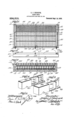
- Figure 1 is a plan view of the machine partially set for operation.
- Fig. 2 is a front elevation of the same fully set.
- Fig. 3 is an enlarged cross section takenon lines 83 of Fig. 2.
- Figs. 4: and 5 are perspective detail views of the mold members.
- Fig. 6 is a small perspective view showing the finished product.
- the machine consists essentially of a box base 10 having a bottom 11 and front and back walls 12 and 13. Across the top of the box there are laced flat bars 14 which turn up on each end at 15 and are provided with tightening screws 16 in their forward upturned ends. Bars 14; restupon front and back pieces 13 and are held at some distance abovethe bottom of the box as is shown in Fig. 3. Lying across bars 14, and supported upon rods 20 across the ends of the box structure, is a plurality of mold members 21 and 22. Members 22, the two outermost ones,'are comprised of a bar 23having recesses 24 reaching from its top and one side so as to form one half of a complete mold.
- a plurality of stick spacing boards 30, these boards extending along the length of the box and being slightly movable transversely thereof.
- the aggre te width of the spacing boards is less than e'inside width of the box so that there is sufficient room remaining for the adjustment of the boards.
- the device is built up in the following manner.
- the spacing boards are all pulled toward the left in Fig. 3 so that the sticks will lie in the position indicated by dotted lines at 28, spacing holes 31 being of an inverted cone shape so as to allow the sticks to assume such a position.
- the end mold member is then placed in position as shown in Fig. 1.
- Sticks 28 are then placed in holes 31 beneath member 22, there being a hole 31 in the spacing boards beneath each circular opening formed by the re 'stration of semicircular notches 25 in the fittom of the half molds. A complete row of sticks is placed in this position, leaning against notches 25 in the position indicated by the dotted lines at 28'.
- One of the mold members 21 is then placed in position against member 22, sticks 28 being thus inclosed within the circular opening in the bottom of the molds.
- the sticks are then placed in position along the front edge of member 21, this operation being repeated until the whole device has been set up, and the set of molds finished by the placement of a second end mold member 22 on the front end. Spacing boards 30 are then pushed into position as shown in Fig; 3
- suckers produced by this device are absolutely sanitary and that they have none of the unattractiveness of those made by hand.
- the time required is also much less than b hand manufacture, the molds being set whi e the batch of candy is cooking, practically all the time of hand working eing thus saved.
- a candy mold comprising a plurality of spaced separable molds, and a s acing means arranged! adjacent the mol s and adapted to space the'ends of sticks whose other ends project into themolds.
- a candy mold comprising a box base, a plurality of movable s acing boards arranged in the bottom of t ebox and having spaced apertures therein for the. reception of a plurallty of vertically extended sticks, a plurality of separable molds arran ed above the'spacing boards, each of the mol s having an a erture in its bottom through which one of t e sticks projects into the mold, and
- a cand mold comprising two separable halves, t 1e halves parting along a verti-' cal plane and having sei'nicircular notches in their bottom walls, the notches adapted to register and form a complete circular openin in the bottom of the mold, and a means below the mold to support a stick projecting through the circular opening up into the mold.
- a candy mold comprising two separable halves having recesses therein of such configuration as to, form a complete mold chamber when the halves are assembled, the mold chamber being open on the top, there being notches in the edges of the bottoms of the mold halves, the notches being registrable to form an opening in the bottom of the assembled mold, and means to vertically support a stick projecting through the open; ing into the mold.
- a cand mold comprising a plurality of members raving half mold recessestherein, and having notches in their bottom walls, the recesses and notches adapted to register when the members are assembled, and means to space and support the ends of sticks projectmlg through the notches into the molds.
- ozt members each having a plurality of half mold recesses spaced therein and notches on the edges'of the half mold Walls, the notches and recesses adapted to register when the members are assembled, means to clamp the members together, and spacing and supporting means arranged adjacent the assembled molds for spacing and supporting the ends. of sticks whose other ends project through the notches into the molds.
Landscapes
- Physics & Mathematics (AREA)
- Health & Medical Sciences (AREA)
- Life Sciences & Earth Sciences (AREA)
- Chemical & Material Sciences (AREA)
- Analytical Chemistry (AREA)
- Biochemistry (AREA)
- General Health & Medical Sciences (AREA)
- General Physics & Mathematics (AREA)
- Immunology (AREA)
- Pathology (AREA)
- Engineering & Computer Science (AREA)
- Mechanical Engineering (AREA)
- Confectionery (AREA)
Description
E. J. HEDRIOK.
OANDY MOLD.
, APPLIOATIOH FILED IAB. 23,1909. 4, 10, Patented Sept. 14.1909.
h2g2? 8; 1a 8 J5 8 8 8 88 8 88 "88822222 8 50 0 o o o o o o a G 0 State 0 EDGAR J. HEDRICK, 01 LOS ANGELES, CALIFORNIA.
CANDY-MOLD.
Specification of Letters Patent.
Patented Sept. 14, 1909.
Application filed March 23, 1909. Serial'No. 485,228.
To all whom 'it-may concern:
Be it known that I, EDGAR J. Hnnmon, a citizen of the United States, residing at Los Angeles in the county of Los Angeles and f California, have invented new and useful Improvements in Candy-Molds, of which the following is a specification.
Heretofore candy products of this class, known as suckers, have been made by hand. The sucker consists of a stick with a small body of candy on its end, the stick being provided so that the candy ma be held without the fingers coming into irect contact with the same. The operation of manufacture has consisted of molding the body of the candy around the end of the stick with the fingers, the candy being worked and handled continuously during the operation. This results in an uninviting "and dirty looking sucker both as to general confi uratiorr, the hand worked sucker being usually form less, and as to general appearance of the surface.
The object of the present invention is to provide a device which will produce suckers quickly and in a perfectly sanitary condition. With the present device the candy portion of the suckers is not touched by the hand at all during the operation of manufacture. The product is possessed of a regular form and has a sanitary and attractive appearance.
In the accompanying drawings :Figure 1 is a plan view of the machine partially set for operation. Fig. 2 is a front elevation of the same fully set. Fig. 3 is an enlarged cross section takenon lines 83 of Fig. 2. Figs. 4: and 5 are perspective detail views of the mold members. Fig. 6 is a small perspective view showing the finished product.
The machine consists essentially of a box base 10 having a bottom 11 and front and back walls 12 and 13. Across the top of the box there are laced flat bars 14 which turn up on each end at 15 and are provided with tightening screws 16 in their forward upturned ends. Bars 14; restupon front and back pieces 13 and are held at some distance abovethe bottom of the box as is shown in Fig. 3. Lying across bars 14, and supported upon rods 20 across the ends of the box structure, is a plurality of mold members 21 and 22. Members 22, the two outermost ones,'are comprised of a bar 23having recesses 24 reaching from its top and one side so as to form one half of a complete mold.
In the edge of the bottom wall of this half;
mold there is cut a semicircular notch 25. Members 21 are similar to members 22 with the exception'that they are double, having the half mold recesses on both sides of the bar '26 of which they are formed. All of the mold members are provided with a V- shaped groove 27 on their lower edges near each end for engagement with square rods 20. When the members are laced position on rods 20 the half mo d recesses are brought into register with each other as is shown in Fig. 1, the semicircular notches 25 also registering to form a complete circular opening in the center of the bottom of the complete mold. This opening is of such a size that it is neatly filled by the sticks 28 of the finished sucker. In the bottom of the box there is arranged a plurality of stick spacing boards 30, these boards extending along the length of the box and being slightly movable transversely thereof. The aggre te width of the spacing boards is less than e'inside width of the box so that there is sufficient room remaining for the adjustment of the boards.
The device is built up in the following manner.. The spacing boards are all pulled toward the left in Fig. 3 so that the sticks will lie in the position indicated by dotted lines at 28, spacing holes 31 being of an inverted cone shape so as to allow the sticks to assume such a position. The end mold member is then placed in position as shown in Fig. 1. Sticks 28 are then placed in holes 31 beneath member 22, there being a hole 31 in the spacing boards beneath each circular opening formed by the re 'stration of semicircular notches 25 in the fittom of the half molds. A complete row of sticks is placed in this position, leaning against notches 25 in the position indicated by the dotted lines at 28'. One of the mold members 21 is then placed in position against member 22, sticks 28 being thus inclosed within the circular opening in the bottom of the molds. The sticks are then placed in position along the front edge of member 21, this operation being repeated until the whole device has been set up, and the set of molds finished by the placement of a second end mold member 22 on the front end. Spacing boards 30 are then pushed into position as shown in Fig; 3
into the 11101 a suitable. distance.
With the molds all placed the candy material is poured over them in a liquid or semiliquid state. Each of the individual molds is thus filled with the candy which immediately hardens around the 11 per ends of the sticks. As soon as the can y has hardened sutliciently the whole. device is overturned and laid out n )on a clean table top. Screws 16 are loosened and the box andother parts of'the device are lifted awa leaving the mold members with the can y underneath them and the sticks projecting above. The mold members are loosened by being slightly worked and are lifted off the finished suckers, which are then picked up by the sticks and placed in boxes ready for shipping. The finished articlehas the appearance depicted in Fig. (3, the body of candy 32 being as nearly rectangular in shape as it is possible to make the molds.
, It will be seen that the suckers produced by this device are absolutely sanitary and that they have none of the unattractiveness of those made by hand. The time required is also much less than b hand manufacture, the molds being set whi e the batch of candy is cooking, practically all the time of hand working eing thus saved. v a
Having'described my invention, I claim 1. .A candy mold, comprising a plurality of spaced separable molds, and a s acing means arranged! adjacent the mol s and adapted to space the'ends of sticks whose other ends project into themolds.
2. A candy mold, comprising a box base, a plurality of movable s acing boards arranged in the bottom of t ebox and having spaced apertures therein for the. reception of a plurallty of vertically extended sticks, a plurality of separable molds arran ed above the'spacing boards, each of the mol s having an a erture in its bottom through which one of t e sticks projects into the mold, and
means for securing the separable parts of the mold together.
.3. A cand mold, comprising two separable halves, t 1e halves parting along a verti-' cal plane and having sei'nicircular notches in their bottom walls, the notches adapted to register and form a complete circular openin in the bottom of the mold, and a means below the mold to support a stick projecting through the circular opening up into the mold.
4. A candy mold, comprising two separable halves having recesses therein of such configuration as to, form a complete mold chamber when the halves are assembled, the mold chamber being open on the top, there being notches in the edges of the bottoms of the mold halves, the notches being registrable to form an opening in the bottom of the assembled mold, and means to vertically support a stick projecting through the open; ing into the mold.
5. A cand mold, comprising a plurality of members raving half mold recessestherein, and having notches in their bottom walls, the recesses and notches adapted to register when the members are assembled, and means to space and support the ends of sticks projectmlg through the notches into the molds.
6. ozt members, each having a plurality of half mold recesses spaced therein and notches on the edges'of the half mold Walls, the notches and recesses adapted to register when the members are assembled, means to clamp the members together, and spacing and supporting means arranged adjacent the assembled molds for spacing and supporting the ends. of sticks whose other ends project through the notches into the molds.-
In witness that I claim the foregoing I have hereunto subscribed my name-this 16th dayof Mareb'if909.
I E. J. HEDRICK.
Witnesses:
' HARRY HARRIS,
JAMES T. BARKELEW.
candy mold, comprising a plurality
Priority Applications (1)
| Application Number | Priority Date | Filing Date | Title |
|---|---|---|---|
| US48522809A US934310A (en) | 1909-03-23 | 1909-03-23 | Candy-mold. |
Applications Claiming Priority (1)
| Application Number | Priority Date | Filing Date | Title |
|---|---|---|---|
| US48522809A US934310A (en) | 1909-03-23 | 1909-03-23 | Candy-mold. |
Publications (1)
| Publication Number | Publication Date |
|---|---|
| US934310A true US934310A (en) | 1909-09-14 |
Family
ID=3002733
Family Applications (1)
| Application Number | Title | Priority Date | Filing Date |
|---|---|---|---|
| US48522809A Expired - Lifetime US934310A (en) | 1909-03-23 | 1909-03-23 | Candy-mold. |
Country Status (1)
| Country | Link |
|---|---|
| US (1) | US934310A (en) |
Cited By (1)
| Publication number | Priority date | Publication date | Assignee | Title |
|---|---|---|---|---|
| US2966127A (en) * | 1958-07-07 | 1960-12-27 | Nicholas D Logan | Confectionary mold |
-
1909
- 1909-03-23 US US48522809A patent/US934310A/en not_active Expired - Lifetime
Cited By (1)
| Publication number | Priority date | Publication date | Assignee | Title |
|---|---|---|---|---|
| US2966127A (en) * | 1958-07-07 | 1960-12-27 | Nicholas D Logan | Confectionary mold |
Similar Documents
| Publication | Publication Date | Title |
|---|---|---|
| US1947055A (en) | Starch tray | |
| US2347041A (en) | Artificial cake | |
| DE3102489C2 (en) | Vacuum film holding plate for a reproduction camera | |
| US2309579A (en) | Toy molding device | |
| US696686A (en) | Mold for molding maple-sugar. | |
| US861046A (en) | Knockdown flower-pot. | |
| US530039A (en) | Manufacture of candy whistles | |
| US1140840A (en) | Mold for poured concrete bricks or blocks. | |
| US780253A (en) | Bread or roll making mold. | |
| US746971A (en) | Mold. | |
| US1780091A (en) | Mold for the manufacture of chocolate articles | |
| US997653A (en) | Potato-baking utensil. | |
| US1526116A (en) | Mold | |
| US818452A (en) | Mold for bricks. | |
| US1708304A (en) | Butter mold | |
| US1090566A (en) | Mold. | |
| US969232A (en) | Mold for cement blocks. | |
| US976886A (en) | Carrot tobacco-mold. | |
| US1260540A (en) | Pool-ball rack and basket. | |
| US1619914A (en) | Multicellular mold | |
| US2592232A (en) | Mold for molding sweetmeats | |
| US1406460A (en) | Multiple brick mold | |
| US1124363A (en) | Baking-pan and mold for biscuits. | |
| US1111567A (en) | Mold for plastic materials. | |
| US382678A (en) | Confectioners mold |