US9315083B2 - Frame hanger for providing thrust angle alignment in vehicle suspension - Google Patents

Frame hanger for providing thrust angle alignment in vehicle suspension Download PDF

Info

Publication number
US9315083B2
US9315083B2 US14/331,661 US201414331661A US9315083B2 US 9315083 B2 US9315083 B2 US 9315083B2 US 201414331661 A US201414331661 A US 201414331661A US 9315083 B2 US9315083 B2 US 9315083B2
Authority
US
United States
Prior art keywords
frame
attachment portion
mounting
bracket
longitudinally extending
Prior art date
Legal status (The legal status is an assumption and is not a legal conclusion. Google has not performed a legal analysis and makes no representation as to the accuracy of the status listed.)
Active
Application number
US14/331,661
Other versions
US20160016449A1 (en
Inventor
Shawn D. Noble
Matthew J. Van Meter
Joseph Martin
Current Assignee (The listed assignees may be inaccurate. Google has not performed a legal analysis and makes no representation or warranty as to the accuracy of the list.)
Hendrickson USA LLC
Original Assignee
Hendrickson USA LLC
Priority date (The priority date is an assumption and is not a legal conclusion. Google has not performed a legal analysis and makes no representation as to the accuracy of the date listed.)
Filing date
Publication date
Application filed by Hendrickson USA LLC filed Critical Hendrickson USA LLC
Priority to US14/331,661 priority Critical patent/US9315083B2/en
Assigned to HENDRICKSON USA, L.L.C. reassignment HENDRICKSON USA, L.L.C. ASSIGNMENT OF ASSIGNORS INTEREST (SEE DOCUMENT FOR DETAILS). Assignors: MARTIN, JOSEPH, NOBLE, SHAWN D., VAN METER, MATTHEW J.
Priority to MX2017000639A priority patent/MX2017000639A/en
Priority to CA2955151A priority patent/CA2955151A1/en
Priority to AU2015290160A priority patent/AU2015290160A1/en
Priority to PCT/US2015/034124 priority patent/WO2016010645A1/en
Priority to CN201580038237.1A priority patent/CN106488850A/en
Priority to BR112017000426A priority patent/BR112017000426A2/en
Priority to EP15730916.2A priority patent/EP3169539A1/en
Publication of US20160016449A1 publication Critical patent/US20160016449A1/en
Publication of US9315083B2 publication Critical patent/US9315083B2/en
Application granted granted Critical
Active legal-status Critical Current
Anticipated expiration legal-status Critical

Links

Images

Classifications

    • BPERFORMING OPERATIONS; TRANSPORTING
    • B60VEHICLES IN GENERAL
    • B60GVEHICLE SUSPENSION ARRANGEMENTS
    • B60G7/00Pivoted suspension arms; Accessories thereof
    • B60G7/02Attaching arms to sprung part of vehicle
    • BPERFORMING OPERATIONS; TRANSPORTING
    • B60VEHICLES IN GENERAL
    • B60GVEHICLE SUSPENSION ARRANGEMENTS
    • B60G9/00Resilient suspensions of a rigid axle or axle housing for two or more wheels
    • B60G9/02Resilient suspensions of a rigid axle or axle housing for two or more wheels the axle or housing being pivotally mounted on the vehicle, e.g. the pivotal axis being parallel to the longitudinal axis of the vehicle
    • BPERFORMING OPERATIONS; TRANSPORTING
    • B60VEHICLES IN GENERAL
    • B60GVEHICLE SUSPENSION ARRANGEMENTS
    • B60G2204/00Indexing codes related to suspensions per se or to auxiliary parts
    • B60G2204/40Auxiliary suspension parts; Adjustment of suspensions
    • B60G2204/43Fittings, brackets or knuckles
    • B60G2204/4302Fittings, brackets or knuckles for fixing suspension arm on the vehicle body or chassis

Definitions

  • the present application generally relates to innovations and improvements in vehicle suspensions. More particularly, the present application relates to a frame hanger and associated vehicle suspension that provides for thrust angle alignment of an axle in a vehicle, and may be useful in multiple axle (i.e., tandem or tridem) on-off highway truck applications, or be applied to a single axle, such as a 4 ⁇ 2 commercial vehicle.
  • the centerline of a vehicle may be viewed as a line drawn through the midpoint between the wheels on a front axle and midpoint between the wheels on a rear axle.
  • the direction of thrust of the vehicle, or the thrust line is normally perpendicular to a position of the rear axle; although with an independent rear suspension, the thrust line is a line derived by splitting the toe angle of the rear wheels on the vehicle. Thus, the thrust line refers to the direction of vehicle thrust.
  • the thrust line and the vehicle centerline coincide and are in alignment with each other.
  • the “thrust angle” is the angle between the centerline of the vehicle and the direction of thrust, or thrust line.
  • the orientation of the front and/or rear axle with respect to the vehicle frame may be adjusted.
  • Prior designs have utilized square U-shaped shims to adjust the thrust angle at the connection of a bar pin at the walking beam, effectively changing the thickness around the bar pin at the walking beam. This method could be used to adjust the thrust angle; however, it also had the undesirable effect of adjusting the pinion angle of the axle. As a result, adjustments to the thrust angle in these circumstances could require further adjustments to the pinion angle of the axle, resulting in additional time, effort, and cost expended during vehicle set up.
  • a frame hanger for use in a vehicle suspension having a frame attachment portion having a first mounting surface and a second mounting surface, a first control arm mounting portion positioned beneath the frame attachment portion, wherein a first plurality of elongated longitudinally extending slots extend through the first mounting surface of the frame attachment portion, and wherein a second plurality of elongated longitudinally extending slots extend through the second mounting surface of the frame attachment portion.
  • a suspension assembly for supporting a longitudinally extending vehicle frame rail having a frame hanger, an axle attachment member mounted to a first vehicle axle, a first control arm having a first end mounted to, and extending from, a first control arm mounting portion positioned on the frame hanger; and said first control arm having a second end mounted to the axle attachment member, wherein the frame hanger includes a frame attachment portion having a first mounting surface and a second mounting surface, wherein the first control arm mounting portion is positioned beneath the frame attachment portion, wherein a first plurality of elongated longitudinally extending slots extend through the first mounting surface of the frame attachment portion, and wherein a second plurality of elongated longitudinally extending slots extend through the second mounting surface of the frame attachment portion.
  • FIG. 1 is a perspective view of vehicle suspension 100 shown with vehicle frame rail in a trailing configuration
  • FIG. 2 is a perspective view of suspension frame hanger 10 and frame brackets 4 and 5 shown in FIG. 1 positioned adjacent vehicle frame rail 30 ;
  • FIG. 3 is a perspective view of frame hanger 10 shown in FIGS. 1 and 2 ;
  • FIG. 4 is a top view of frame hanger 10 shown in FIGS. 1-3 ;
  • FIG. 5 is a rear view of frame hanger 10 shown in FIGS. 1-4 ;
  • FIG. 6 is a perspective view of frame hanger 10 and frame brackets 4 and 5 shown in FIGS. 1 and 2 with the vehicle frame rail 30 removed;
  • FIG. 7A is a right side perspective view of frame bracket 5 shown in FIG. 6 ;
  • FIG. 7B is a left side perspective view of frame bracket 5 shown in FIG. 6 ;
  • FIG. 8A is a right side perspective view of frame bracket 4 shown in FIG. 6 ;
  • FIG. 8B is a left side perspective view of frame bracket 4 shown in FIG. 6 ;
  • FIG. 9 is a another perspective view of frame hanger 10 and frame brackets 4 and 5 shown in FIGS. 1 and 2 with the vehicle frame rail 30 removed;
  • FIG. 10 is a front view of the left side of suspension 100 shown in FIG. 1 shown with shim 210 that can be used to adjust the axle pinion angle;
  • FIG. 11 is a front view of the suspension 100 shown in FIG. 1 ;
  • FIG. 12 is a top view showing how movement of frame hanger 10 forward from prior position of frame hanger 10 ′ and movement of frame hanger 10 a rearward from prior position 10 a ′ can be used to align the axle 40 to be perpendicular to the direction of the direction of thrust 240 , without affecting the axle pinion angle.
  • FIG. 1 is a perspective view of vehicle suspension 100 shown with vehicle frame rail 30 and axle 40 in a trailing configuration.
  • Vehicle frame rail 30 may have various configurations or cross-sections, such as C-shaped or I-shaped frame rails.
  • vehicle wheels (not shown) may be mounted to the ends of the vehicle axle 40 in a known manner. Further, it will be appreciated that the vehicle frame rail 30 may be connected by one or more vehicle frame cross members (not shown).
  • vehicle suspension 100 and the components used therein are exemplary, and that the various components could have different shapes and sizes.
  • frame hanger 10 could have a different shape, and could have an integral frame attachment portion, or a single frame bracket that is attached to frame hanger 15 , as well as first and second frame brackets 4 and 5 as shown in FIG. 1 .
  • control arm is to be broadly construed and may be synonymous with the term “control rod,” and includes any member that is used to connect one vehicle component to another vehicle component.
  • vehicle is used broadly herein to encompass all kinds of vehicles, including, but not limited to, all forms of cars, trucks, buses, recreational vehicles (RVs), etc., whether or not they include an engine.
  • vehicle herein refers to a vehicle or a trailer.
  • a vehicle suspension system refers to a vehicle suspension or a trailer suspension.
  • suspension 100 includes a frame hanger 10 that is attached to a first frame bracket 4 and a second frame bracket 5 , which may be mounted to vehicle frame rail 30 .
  • An upper control arm 8 extends from the frame hanger 10 and is mounted to upper axle attachment member 50 .
  • the upper control arm 8 is mounted to frame hanger 10 using a bushing assembly 14 b having bushing 9 b .
  • a lower control arm 18 extends from frame hanger 10 below the upper control arm 8 , and the lower control arm 18 is mounted to lower axle attachment member 52 .
  • the lower control arm 8 is mounted to frame hanger 10 using a bushing assembly 14 a having bushing 9 a .
  • the upper control arm 8 and lower control arm 18 are attached to axle 40 via upper axle attachment member 50 and lower axle attachment member 52 with U-shaped bolts 60 a and nuts 62 a and 62 b , as well as U-shaped bolt 60 b and nuts (not shown).
  • Suspension 100 is shown in a trailing configuration in FIG. 1 , although it may also be used in a leading configuration if desired.
  • FIG. 2 is a perspective view of suspension frame hanger 10 and frame brackets 4 and 5 shown in FIG. 1 positioned adjacent vehicle frame rail 30 .
  • frame bracket 4 is shown bolted to frame hanger 10 with bolts 22 a and 22 b , which in a preferred embodiment are M16 fasteners. Additional bolts or fasteners of varying sizes, threaded or unthreaded, may also be used to attach frame bracket 4 to frame hanger 10 .
  • Frame bracket 5 is shown bolted to frame hanger 10 with bolts 20 a and 20 b , which in a preferred embodiment are M16 fasteners. Additional bolts or fasteners of varying sizes, threaded or unthreaded, may also be used to attach frame bracket 5 to frame hanger 10 .
  • Frame hanger 10 is shown with bushing assembly 14 b which may be used to attach the upper control arm 8 to frame hanger 10 .
  • bushing assembly 14 b utilizes a cross arm member 12 b .
  • frame hanger 10 is shown with bushing assembly 14 a which may be used to attach the lower control arm 18 to frame hanger 10 .
  • bushing assembly 14 a utilizes a cross arm member 12 a .
  • the frame hanger 10 is shown in an exemplary configuration and could be provided with a different geometry and be configured differently. For example, it could be designed to accommodate a single control arm, or additional control arms. It could also be designed to accommodate different size or style control arms, and different size or style of bushing.
  • frame hanger 10 two separate frame brackets 4 and 5 are shown mounted to frame hanger 10 .
  • a single frame bracket could also be used.
  • FIG. 3 is a perspective view of frame hanger 10 shown in FIGS. 1 and 2 .
  • the frame hanger 10 includes a pair of elongated slots 30 a and 30 b longitudinally extending on mounting surface 90 of frame hanger 10 .
  • the term “longitudinally” as used herein means extending in a direction from the rear of a vehicle to a front of the vehicle.
  • Elongated slots 30 a and 30 b correspond to holes positioned in frame bracket 5 through which bolts 20 a and 20 b extend.
  • frame bracket 5 is mounted to frame hanger 10 by inserting bolts 20 a and 20 b through the frame bracket 5 and through elongated slots 30 a and 30 b on mounting surface 90 of frame hanger 10 .
  • the frame hanger 10 also includes a pair of elongated slots 32 a and 32 b longitudinally extending on mounting surface 90 of frame hanger 10 .
  • Elongated slots 32 a and 32 b correspond to holes positioned in frame bracket 4 through which bolts 22 a and 22 b extend.
  • frame bracket 4 is mounted to frame hanger 10 by inserting bolts 22 a and 22 b through the frame bracket 4 and through elongated slots 32 a and 32 b on mounting surface 90 of frame hanger 10 .
  • Frame hanger 10 also includes voids 37 and 39 that reduce the weight of frame hanger 10 .
  • the frame hanger may be formed as a steel casting, although it could also be fabricated.
  • frame hanger 10 is shown with a first upper bar pin attachment interface 73 , a second upper bar pin attachment interface 77 , and a first control arm slot positioned between the first upper bar pin attachment interface 73 and the second upper bar pin attachment interface 75 .
  • the first upper bar pin attachment interface 73 includes a throughhole 72 and the second upper bar pin attachment interface 77 include a throughhole 76 for mounting to bar pin bushing assembly 14 b (shown in FIGS. 1 and 2 ).
  • Frame hanger 10 is also shown with a first lower bar pin attachment interface 71 , a second lower bar pin attachment interface 75 , and a second control arm slot positioned between the first lower bar pin attachment interface 71 and the second lower bar pin attachment interface 75 .
  • the first lower bar pin attachment interface 71 includes a throughhole 70 and the second lower bar pin attachment interface 75 includes a throughhole 74 for mounting to bar pin bushing assembly 14 a (shown in FIGS. 1 and 2 ).
  • FIG. 4 is a top view of frame hanger 10 shown in FIGS. 1-3 .
  • Void 39 is shown extending between elongated slots 32 a and 30 a on mounting surface 90
  • void 37 is shown extending between elongated slots 32 b and 30 b on mounting surface 90 .
  • a flat surface 82 is shown on the rear end of upper bar pin attachment interface 73 and a flat surface 86 is shown on the rear end of upper bar pin attachment interface 77 .
  • Flat surfaces 82 and 86 are used for the attachment of bolts in the cross arm bushing assembly 14 b (shown in FIGS. 1 and 2 ).
  • a flat surface 80 is shown on the rear end of lower bar pin attachment interface 71 and a flat surface 84 is shown on the rear end of lower bar pin attachment interface 75 .
  • Flat surfaces 80 and 84 are used for the attachment of bolts in the cross arm bushing assembly 14 a (shown in FIGS. 1 and 2 ).
  • FIG. 5 is a rear view of frame hanger 10 shown in FIGS. 1-4 .
  • FIG. 5 discloses throughhole 76 extending through the flat surface 86 on the rear end of upper bar pin interface 77 , and throughhole 72 extending through the flat surface 82 on the rear end of upper bar pin interface 73 .
  • FIG. 5 also discloses throughhole 74 extending through the flat surface 84 on the rear end of lower bar pin interface 75 , and throughhole 70 extending through the flat surface 80 on the rear end of upper bar pin interface 71 .
  • FIG. 6 is a perspective view of frame hanger 10 and frame brackets 4 and 5 shown in FIGS. 1 and 2 with the vehicle frame rail 30 removed.
  • Frame hanger 10 is shown with upper bar pin attachment interface 73 with throughhole 72 , upper bar pin attachment interface 77 , lower bar pin attachment interface 71 with throughhole 70 , and lower bar pin attachment interface 75 with throughhole 74 .
  • FIG. 6 further shows frame bracket 4 mounted to frame hanger 10 with bolts 22 a and 22 b .
  • Frame bracket 4 is formed from a single plate that is bent to form side wall 126 and frame rail mounting wall 136 , as well as base plate 132 and base plate 134 .
  • the structure and configuration of frame bracket 4 provides a strong connection between the frame hanger 10 and a vehicle frame rail.
  • Frame rail mounting holes 128 , 129 , and 130 are positioned in frame rail mounting wall 136 and are used for mounting frame bracket 4 to the vehicle frame rail.
  • FIG. 6 also shows frame bracket 5 mounted to frame hanger 10 with bolts 20 a and 20 b .
  • Frame bracket 5 is also shown formed from a single plate that is bent to form side wall 106 , side wall 107 , and frame rail mounting wall 116 , as well as base plate 112 and base plate 114 .
  • the structure and configuration of frame bracket 5 provides a strong connection between the frame hanger 10 and a vehicle frame rail.
  • Frame rail mounting holes 108 , 109 , and 110 are positioned in frame rail mounting wall 116 and are used for mounting frame bracket 5 to the vehicle frame rail.
  • Frame brackets 4 and 5 could also have different sizes or configurations suitable for attachment of frame hanger 10 to a vehicle frame rail.
  • frame brackets 4 and 5 could be a single frame bracket, or even be formed integrally with frame hanger 10 .
  • Frame brackets 4 and 5 may be made from a steel plate, or could also be made as a casting.
  • FIG. 7A is a right side perspective view of frame bracket 5 shown in FIG. 6
  • FIG. 7B is a left side perspective view of frame bracket 5 shown in FIG. 6
  • FIGS. 7A and 7B show frame bracket 5 with bolts 20 a and 20 b for mounting frame bracket 5 to the frame hanger.
  • Frame bracket 5 is also shown with side wall 106 , side wall 107 , and frame rail mounting wall 116 , as well as base plate 112 and base plate 114 .
  • Frame rail mounting holes 108 , 109 , 110 , and 111 are positioned in frame rail mounting wall 116 and are used for mounting frame bracket 5 to the vehicle frame rail.
  • FIG. 8A is a right side perspective view of frame bracket 4 shown in FIG. 6
  • FIG. 8B is a left side perspective view of frame bracket 4 shown in FIG. 6
  • FIGS. 8A and 8B show frame bracket 4 with bolts 22 a and 22 b for mounting frame bracket 4 to frame hanger 10
  • Frame bracket 4 is shown with side wall 126 and frame rail mounting wall 136 , as well as base plate 132 and base plate 134 .
  • Frame rail mounting holes 128 , 129 , and 130 are positioned in frame rail mounting wall 136 and are used for mounting frame bracket 4 to the vehicle frame rail.
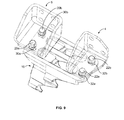
  • FIG. 9 is a another perspective view of frame hanger 10 and frame brackets 4 and 5 shown in FIGS. 1 and 2 with the vehicle frame rail 30 removed.
  • Bolt 22 a is shown extending through frame bracket 4 and through elongated slot 32 a in frame hanger 10
  • bolt 22 b is shown extending through frame bracket 4 and through elongated slot 32 b in frame hanger 10 .
  • bolt 20 a is shown extending through frame bracket 5 and through elongated slot 30 a in frame hanger 10
  • bolt 20 b is shown extending through frame bracket 5 and through elongated slot 30 b in frame hanger 10 .
  • the elongated slots 32 a and 32 b in frame hanger 10 allow for relative longitudinal movement between frame hanger 10 and frame bracket 4
  • elongated slots 30 a and 30 b in frame hanger 10 allow for relative longitudinal movement between frame hanger 10 and frame bracket 5
  • the elongated slots 30 a , 30 b , 32 a , and 32 b may be 0.5 inches in length to accommodate relative longitudinal movement between frame brackets 4 and 5 and frame hanger 10 .
  • This relative longitudinal movement also provides for relative movement between the frame hanger 10 and the vehicle frame rail 30 which the frame brackets 4 and 5 are fixedly mounted to.
  • the frame hanger 10 is attached to the vehicle axle 40 (see FIGS.
  • frame hanger 10 may be moved longitudinally relative to frame brackets 4 and 5 (and thus vehicle frame rail 30 ) to align the axle 40 so that it is perpendicular to a direction of thrust, as is desired. Moreover, the longitudinal movement of the frame hanger does not affect the pinion angle of the axle.
  • FIG. 10 is a front view of the left side of suspension 100 shown in FIG. 1 shown with shim 210 that can be used to adjust the pinion angle of the axle
  • FIG. 11 is a front view of the suspension 100 shown in FIG. 1 .
  • suspension 100 is shown with frame brackets 4 and 5 positioned on vehicle frame rail 30 .
  • Upper control arm 8 is mounted to frame hanger 10 with cross arm bushing assembly 14 b and bolt 72 a
  • lower control arm 18 is mounted to frame hanger 10 with cross arm bushing assembly 14 a and bolt 70 a .
  • Upper control arm 8 is also mounted to vehicle axle 40 via upper axle attachment member 50 and U-shaped bolt 60 a
  • lower control arm 18 is also mounted to vehicle axle 40 via lower axle attachment member 52 and U-shaped bolt.
  • a shock absorber 44 is attached to spring mount 48 and to vehicle frame rail 30 with attachment member 46 .
  • a desired pinion angle of axle 40 may be obtained by adjusting the length of upper control arm 8 and/or lower control arm 18 . Fine adjustments to the pinion angle of axle 40 may be made using shim 210 having a hole 212 .
  • a bolt, such as bolt 72 a from cross arm bushing assembly 14 b may pass through the hole 212 of shim 210 to sandwich shim 210 between a bar pin attachment interface and a bushing of a cross arm bushing assembly.
  • shim 210 b is shown positioned between upper bar pin attachment interface 73 and bushing 9 b of cross arm bushing assembly 14 b and held in place with bolt 72 a .
  • shim 210 a is shown positioned between lower bar pin attachment interface 71 and bushing 9 a of cross arm bushing assembly 14 a and held in place with bolt 70 a.
  • a shim such as shim 210 a or 210 b
  • suspension 100 provides for thrust angle alignment of axle 40 by providing for relative longitudinal movement between frame hanger 10 and frame brackets 4 and 5 .
  • frame bracket 4 may be fixedly mounted to vehicle frame rail 30 using mounting holes 128 , 129 , and 130 in frame rail mounting wall 136 (identified in FIG. 6 ).
  • frame bracket 5 may be fixedly mounted to vehicle frame rail 30 using mounting holes 108 , 109 , 110 , and 111 in frame rail mounting wall 115 (identified in FIG. 6 ).
  • Relative longitudinal movement of the frame hanger 10 with respect to frame brackets 4 and 5 causes the same relative longitudinal movement of axle 40 with respect to vehicle frame rail 30 , allowing for alignment of the axle 40 with the direction of thrust of the vehicle, or the thrust line.
  • axle 40 is connected to the frame hanger 10 via control arms 8 and 18 , longitudinal movement of the frame hanger 10 with respect to the frame brackets 4 and 5 (and vehicle frame rail 30 ) has no effect on the pinion angle of axle 40 . Therefore, thrust angle alignment may be advantageously performed independently of adjusting the pinion angle, and without affecting the pinion angle of the axle 40 after it has been set. Ideally, the axle 40 is aligned to be perpendicular to the direction of thrust.
  • the elongated slots 30 a , 30 b , 32 a , and 32 b of frame hanger 10 allow for adjustment of the thrust angle 1.4 degrees in either direction from center.
  • the base of frame brackets 4 and 5 could be provided with elongated slots, instead of frame hanger 10 , and allow the same relative longitudinal movement between the frame hanger 10 and frame brackets 4 and 5 (and vehicle frame rail 30 ).
  • elongated longitudinal slots could also be provided in frame rail mounting wall 116 of frame bracket 5 and in frame rail mounting wall of frame bracket 4 to provide relative longitudinal movement between frame brackets 4 and 5 (and frame hanger 10 ) with vehicle frame rail 30 .
  • FIG. 12 is a top view showing how movement of frame hanger 10 forward from a prior position of frame hanger 10 ′ and movement of frame hanger 10 a rearward from prior position 10 a ′ can be used to align the axle 40 with the direction of thrust 240 , without affecting the pinion angle of the axle.
  • Frame hanger 10 is shown mounted to vehicle frame rail 30 on one side and frame hanger 10 a is shown mounted to vehicle frame rail 30 a on the other side.
  • Wheels 230 and 230 a are shown attached to axle 40 .
  • Wheels 230 ′ and 230 a ′ are depicted in dotted lines and show that axle 40 is misaligned by thrust angle ⁇ when frame hangers are positioned as frame hangers 10 ′ and 10 a ′ (shown in dotted lines) on frame rails 30 and 30 a .
  • FIG. 12 demonstrates that moving the frame hanger forward longitudinally from position 10 ′ to 10 on vehicle frame rail 30 , and moving the frame hanger rearward longitudinally from position 10 a ′ to 10 a , results in the axle 40 being moved into alignment so that it is perpendicular to direction of thrust 240 .
  • Such axle angle alignment may be performed independently of, and without affecting the pinion angle of axle 40 .

Landscapes

  • Engineering & Computer Science (AREA)
  • Mechanical Engineering (AREA)
  • Vehicle Body Suspensions (AREA)
  • Body Structure For Vehicles (AREA)

Abstract

A frame hanger having a frame attachment portion having a first mounting surface and a second mounting surface, a first control arm mounting portion positioned beneath the frame attachment portion, wherein a first plurality of elongated longitudinally extending slots extend through the first mounting surface of the frame attachment portion, and wherein a second plurality of elongated longitudinally extending slots extend through the second mounting surface of the frame attachment portion.

Description

BACKGROUND
The present application generally relates to innovations and improvements in vehicle suspensions. More particularly, the present application relates to a frame hanger and associated vehicle suspension that provides for thrust angle alignment of an axle in a vehicle, and may be useful in multiple axle (i.e., tandem or tridem) on-off highway truck applications, or be applied to a single axle, such as a 4×2 commercial vehicle.
The centerline of a vehicle may be viewed as a line drawn through the midpoint between the wheels on a front axle and midpoint between the wheels on a rear axle. The direction of thrust of the vehicle, or the thrust line, is normally perpendicular to a position of the rear axle; although with an independent rear suspension, the thrust line is a line derived by splitting the toe angle of the rear wheels on the vehicle. Thus, the thrust line refers to the direction of vehicle thrust.
Ideally, the thrust line and the vehicle centerline coincide and are in alignment with each other. However, given the size of the vehicle, manufacturing tolerances, stresses, and component wear, the vehicle centerline and the thrust line often are not aligned, resulting in a thrust angle. The “thrust angle” is the angle between the centerline of the vehicle and the direction of thrust, or thrust line. In order to align the thrust angle, the orientation of the front and/or rear axle with respect to the vehicle frame may be adjusted. Prior designs have utilized square U-shaped shims to adjust the thrust angle at the connection of a bar pin at the walking beam, effectively changing the thickness around the bar pin at the walking beam. This method could be used to adjust the thrust angle; however, it also had the undesirable effect of adjusting the pinion angle of the axle. As a result, adjustments to the thrust angle in these circumstances could require further adjustments to the pinion angle of the axle, resulting in additional time, effort, and cost expended during vehicle set up.
Consequently, there is a need to provide a way to adjust the thrust angle alignment of an axle on a vehicle that does not also result in a change of the pinion angle of the axle. In other words, it would be desirable to provide a vehicle suspension that could be used to adjust align an axle with the direction of thrust, without affecting the pinion angle of the axle. Thus, there is a need to provide thrust angle alignment of an axle independently from adjustment of the pinion angle of the axle.
SUMMARY
In one aspect, a frame hanger for use in a vehicle suspension is provided having a frame attachment portion having a first mounting surface and a second mounting surface, a first control arm mounting portion positioned beneath the frame attachment portion, wherein a first plurality of elongated longitudinally extending slots extend through the first mounting surface of the frame attachment portion, and wherein a second plurality of elongated longitudinally extending slots extend through the second mounting surface of the frame attachment portion.
In a further aspect, a suspension assembly for supporting a longitudinally extending vehicle frame rail is provided having a frame hanger, an axle attachment member mounted to a first vehicle axle, a first control arm having a first end mounted to, and extending from, a first control arm mounting portion positioned on the frame hanger; and said first control arm having a second end mounted to the axle attachment member, wherein the frame hanger includes a frame attachment portion having a first mounting surface and a second mounting surface, wherein the first control arm mounting portion is positioned beneath the frame attachment portion, wherein a first plurality of elongated longitudinally extending slots extend through the first mounting surface of the frame attachment portion, and wherein a second plurality of elongated longitudinally extending slots extend through the second mounting surface of the frame attachment portion.
BRIEF DESCRIPTION OF THE DRAWINGS
Exemplary embodiments of the invention are described herein with reference to the drawings, wherein like parts are designated by like reference numerals, and wherein:
FIG. 1 is a perspective view of vehicle suspension 100 shown with vehicle frame rail in a trailing configuration;
FIG. 2 is a perspective view of suspension frame hanger 10 and frame brackets 4 and 5 shown in FIG. 1 positioned adjacent vehicle frame rail 30;
FIG. 3 is a perspective view of frame hanger 10 shown in FIGS. 1 and 2;
FIG. 4 is a top view of frame hanger 10 shown in FIGS. 1-3;
FIG. 5 is a rear view of frame hanger 10 shown in FIGS. 1-4;
FIG. 6 is a perspective view of frame hanger 10 and frame brackets 4 and 5 shown in FIGS. 1 and 2 with the vehicle frame rail 30 removed;
FIG. 7A is a right side perspective view of frame bracket 5 shown in FIG. 6;
FIG. 7B is a left side perspective view of frame bracket 5 shown in FIG. 6;
FIG. 8A is a right side perspective view of frame bracket 4 shown in FIG. 6;
FIG. 8B is a left side perspective view of frame bracket 4 shown in FIG. 6;
FIG. 9 is a another perspective view of frame hanger 10 and frame brackets 4 and 5 shown in FIGS. 1 and 2 with the vehicle frame rail 30 removed;
FIG. 10 is a front view of the left side of suspension 100 shown in FIG. 1 shown with shim 210 that can be used to adjust the axle pinion angle;
FIG. 11 is a front view of the suspension 100 shown in FIG. 1; and
FIG. 12 is a top view showing how movement of frame hanger 10 forward from prior position of frame hanger 10′ and movement of frame hanger 10 a rearward from prior position 10 a′ can be used to align the axle 40 to be perpendicular to the direction of the direction of thrust 240, without affecting the axle pinion angle.
DETAILED DESCRIPTION
FIG. 1 is a perspective view of vehicle suspension 100 shown with vehicle frame rail 30 and axle 40 in a trailing configuration. As will be appreciated by those skilled in the art, components for the vehicle suspension 100 may be duplicated on each side of the vehicle. Vehicle frame rail 30 may have various configurations or cross-sections, such as C-shaped or I-shaped frame rails. As will be appreciated by those skilled in the art, vehicle wheels (not shown) may be mounted to the ends of the vehicle axle 40 in a known manner. Further, it will be appreciated that the vehicle frame rail 30 may be connected by one or more vehicle frame cross members (not shown).
It will also be appreciated that vehicle suspension 100, and the components used therein are exemplary, and that the various components could have different shapes and sizes. Thus, for example, frame hanger 10 could have a different shape, and could have an integral frame attachment portion, or a single frame bracket that is attached to frame hanger 15, as well as first and second frame brackets 4 and 5 as shown in FIG. 1. In addition, as used herein, the term “control arm” is to be broadly construed and may be synonymous with the term “control rod,” and includes any member that is used to connect one vehicle component to another vehicle component.
It should be understood that the term “vehicle” is used broadly herein to encompass all kinds of vehicles, including, but not limited to, all forms of cars, trucks, buses, recreational vehicles (RVs), etc., whether or not they include an engine. Moreover, for purposes of this description, unless specifically described otherwise, the term “vehicle” herein refers to a vehicle or a trailer. In this way, for example, a vehicle suspension system refers to a vehicle suspension or a trailer suspension.
As shown in FIG. 1, suspension 100 includes a frame hanger 10 that is attached to a first frame bracket 4 and a second frame bracket 5, which may be mounted to vehicle frame rail 30. An upper control arm 8 extends from the frame hanger 10 and is mounted to upper axle attachment member 50. The upper control arm 8 is mounted to frame hanger 10 using a bushing assembly 14 b having bushing 9 b. A lower control arm 18 extends from frame hanger 10 below the upper control arm 8, and the lower control arm 18 is mounted to lower axle attachment member 52. The lower control arm 8 is mounted to frame hanger 10 using a bushing assembly 14 a having bushing 9 a. The upper control arm 8 and lower control arm 18 are attached to axle 40 via upper axle attachment member 50 and lower axle attachment member 52 with U-shaped bolts 60 a and nuts 62 a and 62 b, as well as U-shaped bolt 60 b and nuts (not shown). Suspension 100 is shown in a trailing configuration in FIG. 1, although it may also be used in a leading configuration if desired.
FIG. 2 is a perspective view of suspension frame hanger 10 and frame brackets 4 and 5 shown in FIG. 1 positioned adjacent vehicle frame rail 30. In FIG. 2, frame bracket 4 is shown bolted to frame hanger 10 with bolts 22 a and 22 b, which in a preferred embodiment are M16 fasteners. Additional bolts or fasteners of varying sizes, threaded or unthreaded, may also be used to attach frame bracket 4 to frame hanger 10. Frame bracket 5 is shown bolted to frame hanger 10 with bolts 20 a and 20 b, which in a preferred embodiment are M16 fasteners. Additional bolts or fasteners of varying sizes, threaded or unthreaded, may also be used to attach frame bracket 5 to frame hanger 10.
Frame hanger 10 is shown with bushing assembly 14 b which may be used to attach the upper control arm 8 to frame hanger 10. In this embodiment, bushing assembly 14 b utilizes a cross arm member 12 b. Similarly, frame hanger 10 is shown with bushing assembly 14 a which may be used to attach the lower control arm 18 to frame hanger 10. In this embodiment, bushing assembly 14 a utilizes a cross arm member 12 a. It will be appreciated by those of skill in the art that the frame hanger 10 is shown in an exemplary configuration and could be provided with a different geometry and be configured differently. For example, it could be designed to accommodate a single control arm, or additional control arms. It could also be designed to accommodate different size or style control arms, and different size or style of bushing.
Furthermore, in the disclosed embodiments, two separate frame brackets 4 and 5 are shown mounted to frame hanger 10. However, a single frame bracket could also be used. Moreover, it is also possible in some embodiment to provide a frame hanger having a frame bracket for attachment to the vehicle frame rail integrally formed with the frame hanger.
FIG. 3 is a perspective view of frame hanger 10 shown in FIGS. 1 and 2. In this embodiment, the frame hanger 10 includes a pair of elongated slots 30 a and 30 b longitudinally extending on mounting surface 90 of frame hanger 10. The term “longitudinally” as used herein means extending in a direction from the rear of a vehicle to a front of the vehicle. Elongated slots 30 a and 30 b correspond to holes positioned in frame bracket 5 through which bolts 20 a and 20 b extend. Thus, frame bracket 5 is mounted to frame hanger 10 by inserting bolts 20 a and 20 b through the frame bracket 5 and through elongated slots 30 a and 30 b on mounting surface 90 of frame hanger 10. Additional elongated slots, or even a single elongated slot, could also be used The frame hanger 10 also includes a pair of elongated slots 32 a and 32 b longitudinally extending on mounting surface 90 of frame hanger 10. Elongated slots 32 a and 32 b correspond to holes positioned in frame bracket 4 through which bolts 22 a and 22 b extend. Thus, frame bracket 4 is mounted to frame hanger 10 by inserting bolts 22 a and 22 b through the frame bracket 4 and through elongated slots 32 a and 32 b on mounting surface 90 of frame hanger 10.
Frame hanger 10 also includes voids 37 and 39 that reduce the weight of frame hanger 10. The frame hanger may be formed as a steel casting, although it could also be fabricated. Further, frame hanger 10 is shown with a first upper bar pin attachment interface 73, a second upper bar pin attachment interface 77, and a first control arm slot positioned between the first upper bar pin attachment interface 73 and the second upper bar pin attachment interface 75. The first upper bar pin attachment interface 73 includes a throughhole 72 and the second upper bar pin attachment interface 77 include a throughhole 76 for mounting to bar pin bushing assembly 14 b (shown in FIGS. 1 and 2).
Frame hanger 10 is also shown with a first lower bar pin attachment interface 71, a second lower bar pin attachment interface 75, and a second control arm slot positioned between the first lower bar pin attachment interface 71 and the second lower bar pin attachment interface 75. The first lower bar pin attachment interface 71 includes a throughhole 70 and the second lower bar pin attachment interface 75 includes a throughhole 74 for mounting to bar pin bushing assembly 14 a (shown in FIGS. 1 and 2).
FIG. 4 is a top view of frame hanger 10 shown in FIGS. 1-3. Void 39 is shown extending between elongated slots 32 a and 30 a on mounting surface 90, and void 37 is shown extending between elongated slots 32 b and 30 b on mounting surface 90. A flat surface 82 is shown on the rear end of upper bar pin attachment interface 73 and a flat surface 86 is shown on the rear end of upper bar pin attachment interface 77. Flat surfaces 82 and 86 are used for the attachment of bolts in the cross arm bushing assembly 14 b (shown in FIGS. 1 and 2). Similarly, a flat surface 80 is shown on the rear end of lower bar pin attachment interface 71 and a flat surface 84 is shown on the rear end of lower bar pin attachment interface 75. Flat surfaces 80 and 84 are used for the attachment of bolts in the cross arm bushing assembly 14 a (shown in FIGS. 1 and 2).
FIG. 5 is a rear view of frame hanger 10 shown in FIGS. 1-4. FIG. 5 discloses throughhole 76 extending through the flat surface 86 on the rear end of upper bar pin interface 77, and throughhole 72 extending through the flat surface 82 on the rear end of upper bar pin interface 73. FIG. 5 also discloses throughhole 74 extending through the flat surface 84 on the rear end of lower bar pin interface 75, and throughhole 70 extending through the flat surface 80 on the rear end of upper bar pin interface 71.
FIG. 6 is a perspective view of frame hanger 10 and frame brackets 4 and 5 shown in FIGS. 1 and 2 with the vehicle frame rail 30 removed. Frame hanger 10 is shown with upper bar pin attachment interface 73 with throughhole 72, upper bar pin attachment interface 77, lower bar pin attachment interface 71 with throughhole 70, and lower bar pin attachment interface 75 with throughhole 74.
FIG. 6 further shows frame bracket 4 mounted to frame hanger 10 with bolts 22 a and 22 b. Frame bracket 4 is formed from a single plate that is bent to form side wall 126 and frame rail mounting wall 136, as well as base plate 132 and base plate 134. The structure and configuration of frame bracket 4 provides a strong connection between the frame hanger 10 and a vehicle frame rail. Frame rail mounting holes 128, 129, and 130 are positioned in frame rail mounting wall 136 and are used for mounting frame bracket 4 to the vehicle frame rail.
FIG. 6 also shows frame bracket 5 mounted to frame hanger 10 with bolts 20 a and 20 b. Frame bracket 5 is also shown formed from a single plate that is bent to form side wall 106, side wall 107, and frame rail mounting wall 116, as well as base plate 112 and base plate 114. The structure and configuration of frame bracket 5 provides a strong connection between the frame hanger 10 and a vehicle frame rail. Frame rail mounting holes 108, 109, and 110 are positioned in frame rail mounting wall 116 and are used for mounting frame bracket 5 to the vehicle frame rail.
Frame brackets 4 and 5 could also have different sizes or configurations suitable for attachment of frame hanger 10 to a vehicle frame rail. In addition, as noted above, frame brackets 4 and 5 could be a single frame bracket, or even be formed integrally with frame hanger 10. Frame brackets 4 and 5 may be made from a steel plate, or could also be made as a casting.
FIG. 7A is a right side perspective view of frame bracket 5 shown in FIG. 6, and FIG. 7B is a left side perspective view of frame bracket 5 shown in FIG. 6. FIGS. 7A and 7B show frame bracket 5 with bolts 20 a and 20 b for mounting frame bracket 5 to the frame hanger. Frame bracket 5 is also shown with side wall 106, side wall 107, and frame rail mounting wall 116, as well as base plate 112 and base plate 114. Frame rail mounting holes 108, 109, 110, and 111 are positioned in frame rail mounting wall 116 and are used for mounting frame bracket 5 to the vehicle frame rail.
FIG. 8A is a right side perspective view of frame bracket 4 shown in FIG. 6, and FIG. 8B is a left side perspective view of frame bracket 4 shown in FIG. 6. FIGS. 8A and 8B show frame bracket 4 with bolts 22 a and 22 b for mounting frame bracket 4 to frame hanger 10. Frame bracket 4 is shown with side wall 126 and frame rail mounting wall 136, as well as base plate 132 and base plate 134. Frame rail mounting holes 128, 129, and 130 are positioned in frame rail mounting wall 136 and are used for mounting frame bracket 4 to the vehicle frame rail.
FIG. 9 is a another perspective view of frame hanger 10 and frame brackets 4 and 5 shown in FIGS. 1 and 2 with the vehicle frame rail 30 removed. Bolt 22 a is shown extending through frame bracket 4 and through elongated slot 32 a in frame hanger 10, and bolt 22 b is shown extending through frame bracket 4 and through elongated slot 32 b in frame hanger 10. Similarly, bolt 20 a is shown extending through frame bracket 5 and through elongated slot 30 a in frame hanger 10, and bolt 20 b is shown extending through frame bracket 5 and through elongated slot 30 b in frame hanger 10.
The elongated slots 32 a and 32 b in frame hanger 10, allow for relative longitudinal movement between frame hanger 10 and frame bracket 4, while elongated slots 30 a and 30 b in frame hanger 10 allow for relative longitudinal movement between frame hanger 10 and frame bracket 5. The elongated slots 30 a, 30 b, 32 a, and 32 b may be 0.5 inches in length to accommodate relative longitudinal movement between frame brackets 4 and 5 and frame hanger 10. This relative longitudinal movement also provides for relative movement between the frame hanger 10 and the vehicle frame rail 30 which the frame brackets 4 and 5 are fixedly mounted to. Furthermore, the frame hanger 10 is attached to the vehicle axle 40 (see FIGS. 1 and 10) via upper control arm 8 and upper axle attachment member 50, and via lower control arm 18 and lower axle attachment member 52. Therefore, relative longitudinal movement of the frame hanger 10 with respect to frame bracket 4 and frame bracket 5 also results in relative longitudinal movement between axle 40 and vehicle frame rail 30, which in turns allows for alignment of the thrust angle of the vehicle. In this manner, frame hanger 10 may be moved longitudinally relative to frame brackets 4 and 5 (and thus vehicle frame rail 30) to align the axle 40 so that it is perpendicular to a direction of thrust, as is desired. Moreover, the longitudinal movement of the frame hanger does not affect the pinion angle of the axle.
FIG. 10 is a front view of the left side of suspension 100 shown in FIG. 1 shown with shim 210 that can be used to adjust the pinion angle of the axle, and FIG. 11 is a front view of the suspension 100 shown in FIG. 1. With reference to FIGS. 10 and 11, suspension 100 is shown with frame brackets 4 and 5 positioned on vehicle frame rail 30. Upper control arm 8 is mounted to frame hanger 10 with cross arm bushing assembly 14 b and bolt 72 a, and lower control arm 18 is mounted to frame hanger 10 with cross arm bushing assembly 14 a and bolt 70 a. Upper control arm 8 is also mounted to vehicle axle 40 via upper axle attachment member 50 and U-shaped bolt 60 a, and lower control arm 18 is also mounted to vehicle axle 40 via lower axle attachment member 52 and U-shaped bolt. A shock absorber 44 is attached to spring mount 48 and to vehicle frame rail 30 with attachment member 46.
It will be appreciated that a desired pinion angle of axle 40 may be obtained by adjusting the length of upper control arm 8 and/or lower control arm 18. Fine adjustments to the pinion angle of axle 40 may be made using shim 210 having a hole 212. A bolt, such as bolt 72 a from cross arm bushing assembly 14 b may pass through the hole 212 of shim 210 to sandwich shim 210 between a bar pin attachment interface and a bushing of a cross arm bushing assembly. In particular, shim 210 b is shown positioned between upper bar pin attachment interface 73 and bushing 9 b of cross arm bushing assembly 14 b and held in place with bolt 72 a. Similarly, shim 210 a is shown positioned between lower bar pin attachment interface 71 and bushing 9 a of cross arm bushing assembly 14 a and held in place with bolt 70 a.
The use of a shim, such as shim 210 a or 210 b, may be used to change the effective length of control arm 8 or 18, and provide for fine adjustments to the pinion angle of axle 40. Once the pinion angle is set, then suspension 100 provides for thrust angle alignment of axle 40 by providing for relative longitudinal movement between frame hanger 10 and frame brackets 4 and 5. As noted above, frame bracket 4 may be fixedly mounted to vehicle frame rail 30 using mounting holes 128, 129, and 130 in frame rail mounting wall 136 (identified in FIG. 6). Similarly, frame bracket 5 may be fixedly mounted to vehicle frame rail 30 using mounting holes 108, 109, 110, and 111 in frame rail mounting wall 115 (identified in FIG. 6). Relative longitudinal movement of the frame hanger 10 with respect to frame brackets 4 and 5 (and thus vehicle frame rail 30) causes the same relative longitudinal movement of axle 40 with respect to vehicle frame rail 30, allowing for alignment of the axle 40 with the direction of thrust of the vehicle, or the thrust line.
Importantly, because the axle 40 is connected to the frame hanger 10 via control arms 8 and 18, longitudinal movement of the frame hanger 10 with respect to the frame brackets 4 and 5 (and vehicle frame rail 30) has no effect on the pinion angle of axle 40. Therefore, thrust angle alignment may be advantageously performed independently of adjusting the pinion angle, and without affecting the pinion angle of the axle 40 after it has been set. Ideally, the axle 40 is aligned to be perpendicular to the direction of thrust. The elongated slots 30 a, 30 b, 32 a, and 32 b of frame hanger 10 allow for adjustment of the thrust angle 1.4 degrees in either direction from center.
It will also be appreciated that in an alternative embodiment, the base of frame brackets 4 and 5 could be provided with elongated slots, instead of frame hanger 10, and allow the same relative longitudinal movement between the frame hanger 10 and frame brackets 4 and 5 (and vehicle frame rail 30). Moreover, elongated longitudinal slots could also be provided in frame rail mounting wall 116 of frame bracket 5 and in frame rail mounting wall of frame bracket 4 to provide relative longitudinal movement between frame brackets 4 and 5 (and frame hanger 10) with vehicle frame rail 30.
FIG. 12 is a top view showing how movement of frame hanger 10 forward from a prior position of frame hanger 10′ and movement of frame hanger 10 a rearward from prior position 10 a′ can be used to align the axle 40 with the direction of thrust 240, without affecting the pinion angle of the axle. Frame hanger 10 is shown mounted to vehicle frame rail 30 on one side and frame hanger 10 a is shown mounted to vehicle frame rail 30 a on the other side. Wheels 230 and 230 a are shown attached to axle 40. Wheels 230′ and 230 a′ are depicted in dotted lines and show that axle 40 is misaligned by thrust angle α when frame hangers are positioned as frame hangers 10′ and 10 a′ (shown in dotted lines) on frame rails 30 and 30 a. FIG. 12 demonstrates that moving the frame hanger forward longitudinally from position 10′ to 10 on vehicle frame rail 30, and moving the frame hanger rearward longitudinally from position 10 a′ to 10 a, results in the axle 40 being moved into alignment so that it is perpendicular to direction of thrust 240. Such axle angle alignment may be performed independently of, and without affecting the pinion angle of axle 40.
Example embodiments have been described above. Those skilled in the art will understand that changes and modifications may be made to the described embodiments without departing from the true scope and spirit of the present invention, which is defined by the claims.

Claims (28)

We claim:
1. A frame hanger for use in a vehicle suspension comprising:
a frame attachment portion having a first mounting surface and a second mounting surface;
a first control arm mounting portion positioned beneath the frame attachment portion;
wherein a first plurality of elongated longitudinally extending slots extend through the first mounting surface of the frame attachment portion; and
wherein a second plurality of elongated longitudinally extending slots extend through the second mounting surface of the frame attachment portion;
wherein the first plurality of elongated longitudinally extending slots on the first mounting surface of the frame attachment portion correspond to a first plurality of holes positioned on a vehicle frame rail for mounting the frame attachment portion to the vehicle frame rail; and
the second plurality of elongated longitudinally extending slots on the second mounting surface of the frame attachment portion correspond to a second plurality of holes positioned on the vehicle frame rail for mounting the frame attachment portion to the vehicle frame rail.
2. The frame hanger of claim 1, wherein the first plurality of elongated longitudinally extending slots on the first mounting surface of the frame attachment portion are positioned in a frame bracket attached to a first end of the frame attachment portion; and
the second plurality of elongated longitudinally extending slots on the second mounting surface of the frame attachment portion are positioned in the frame bracket attached to a second end of the frame attachment portion.
3. The frame hanger of claim 2, wherein the frame bracket is comprised of a first frame bracket portion attached to the first end of the frame attachment portion and a second frame bracket portion, separate from the first frame bracket portion, attached to the second end of the frame attachment portion.
4. A frame hanger for use in a vehicle suspension comprising:
a frame attachment portion having a first mounting surface and a second mounting surface;
a first control arm mounting portion positioned beneath the frame attachment portion;
wherein a first plurality of elongated longitudinally extending slots extend through the first mounting surface of the frame attachment portion;
wherein a second plurality of elongated longitudinally extending slots extend through the second mounting surface of the frame attachment portion;
wherein the first plurality of elongated longitudinally extending slots on the first mounting surface of the frame attachment portion correspond to a first plurality of holes positioned on a frame bracket for mounting the frame attachment portion to the frame bracket;
wherein the second plurality of elongated longitudinally extending slots on the second mounting surface of the frame attachment portion correspond to a second plurality of holes positioned on the frame bracket for mounting the frame attachment portion to the frame bracket;
wherein the frame bracket further includes a third plurality of holes for mounting the frame bracket to a vehicle frame rail; and
wherein the frame bracket further includes a fourth plurality of holes for mounting the frame bracket to the vehicle frame rail.
5. The frame hanger of claim 4, wherein the frame bracket is comprised of a first frame bracket portion attached to the first end of the frame attachment portion and a second frame bracket portion, separate from the first frame bracket portion, attached to the second end of the frame attachment portion.
6. The frame hanger of claim 5, wherein the frame attachment portion may be moved longitudinally relative to the first frame bracket portion and the second frame bracket portion, such that the first plurality of elongated longitudinally extending slots on the first mounting surface still correspond to the first plurality of holes positioned on the first frame bracket and the second plurality of elongated longitudinally extending slots on the second mounting surface still correspond to the second plurality of holes positioned on the second frame bracket.
7. The frame hanger of claim 6, wherein the first control arm mounting portion includes a first upper bar pin attachment interface, a second upper bar pin attachment interface, and a first control arm slot positioned between the first upper bar pin attachment interface and the second upper bar pin attachment interface.
8. The frame hanger of claim 7, wherein the first upper bar pin attachment interface comprises a first curved surface and a first flat surface, with a first throughhole extending from the first curved surface to the first flat surface; and
wherein the second upper bar pin attachment interface comprises a second curved surface and a second flat surface, with a second throughhole extending from the second curved surface to the second flat surface.
9. The frame hanger of claim 7, wherein the frame hanger includes a second control arm mounting portion beneath the first control arm mounting portion, said second control arm mounting portion including a first lower bar pin attachment interface, a second lower bar pin attachment interface, and a second control arm slot positioned between the first lower bar pin attachment interface and the second lower bar pin attachment interface.
10. The frame hanger of claim 9, wherein the first upper bar pin attachment interface comprises a first curved surface and a first flat surface, with a first throughhole extending from the first curved surface to the first flat surface;
wherein the second upper bar pin attachment interface comprises a second curved surface and a second flat surface, with a second throughhole extending from the second curved surface to the second flat surface;
wherein the first lower bar pin attachment interface comprises a third curved surface and a third flat surface, with a third throughhole extending from the third curved surface to the third flat surface; and
wherein the second lower bar pin attachment interface comprises a fourth curved surface and a fourth flat surface, with a fourth throughhole extending from the fourth curved surface to the fourth flat surface.
11. The frame hanger of claim 4, wherein one or more of the first or second plurality of longitudinally extending slots are open at one end.
12. The frame hanger of claim 4, wherein the first control arm mounting portion includes a first upper bar pin attachment interface, a second upper bar pin attachment interface, and a first control arm slot positioned between the first upper bar pin attachment interface and the second upper bar pin attachment interface.
13. The frame hanger of claim 12, wherein the first upper bar pin attachment interface comprises a first curved surface and a first flat surface, with a first throughhole extending from the first curved surface to the first flat surface; and
wherein the second upper bar pin attachment interface comprises a second curved surface and a second flat surface, with a second throughhole extending from the second curved surface to the second flat surface.
14. The frame hanger of claim 12, wherein the frame hanger includes a second control arm mounting portion beneath the first control arm mounting portion, said second control arm mounting portion including a first lower bar pin attachment interface, a second lower bar pin attachment interface, and a second control arm slot positioned between the first lower bar pin attachment interface and the second lower bar pin attachment interface.
15. The frame hanger of claim 14, wherein the first upper bar pin attachment interface comprises a first curved surface and a first flat surface, with a first throughhole extending from the first curved surface to the first flat surface;
wherein the second upper bar pin attachment interface comprises a second curved surface and a second flat surface, with a second throughhole extending from the second curved surface to the second flat surface;
wherein the first lower bar pin attachment interface comprises a third curved surface and a third flat surface, with a third throughhole extending from the third curved surface to the third flat surface; and
wherein the second lower bar pin attachment interface comprises a fourth curved surface and a fourth flat surface, with a fourth throughhole extending from the fourth curved surface to the fourth flat surface.
16. A frame hanger for use in a vehicle suspension comprising:
a frame attachment portion having a first mounting surface and a second mounting surface;
a first control arm mounting portion positioned beneath the frame attachment portion;
a frame bracket mounted to the first and second mounting surfaces of the frame attachment portion; said frame bracket having a first plurality of elongated longitudinally extending slots that correspond to a first plurality of holes in the first mounting surface of the frame attachment portion, and having a second plurality of elongated longitudinally extending slots that correspond to a second plurality of holes in the second mounting surface of the frame attachment portion.
17. The frame hanger of claim 16, wherein the frame bracket is comprised of a first frame bracket portion having the first plurality of elongated longitudinally extending slots, and a second frame bracket portion, separate from the first frame bracket portion, the second frame bracket portion having the second plurality of elongated longitudinally extending slots.
18. The frame hanger of claim 17, wherein the frame attachment portion may be moved longitudinally relative to the first frame bracket portion and the second frame bracket portion, such that the first plurality of elongated longitudinally extending slots on the first frame bracket portion still correspond to a first plurality of holes positioned on the first mounting surface of the frame attachment portion and the second plurality of elongated longitudinally extending slots on the second frame bracket portion still correspond to a second plurality of holes positioned on the second mounting surface of the frame attachment portion.
19. A suspension assembly for supporting a longitudinally extending vehicle frame rail, comprising:
a frame hanger;
an axle attachment member mounted to a first vehicle axle;
a first control arm having a first end mounted to, and extending from, a first control arm mounting portion positioned on the frame hanger; and said first control arm having a second end mounted to the axle attachment member;
wherein the frame hanger includes a frame attachment portion having a first mounting surface and a second mounting surface;
wherein the first control arm mounting portion is positioned beneath the frame attachment portion;
wherein a first plurality of elongated longitudinally extending slots extend through the first mounting surface of the frame attachment portion;
wherein a second plurality of elongated longitudinally extending slots extend through the second mounting surface of the frame attachment portion;
wherein the first plurality of elongated longitudinally extending slots on the first mounting surface of the frame attachment portion correspond to a first plurality of holes positioned on a vehicle frame rail for mounting the frame attachment portion to the vehicle frame rail; and
the second plurality of elongated longitudinally extending slots on the second mounting surface of the frame attachment portion correspond to a second plurality of holes positioned on the vehicle frame rail for mounting the frame attachment portion to the vehicle frame rail.
20. The suspension assembly of claim 19, wherein the first plurality of elongated longitudinally extending slots on the first mounting surface of the frame attachment portion are positioned in a frame bracket attached to a first end of the frame attachment portion; and
the second plurality of elongated longitudinally extending slots on the second mounting surface of the frame attachment portion are positioned in the frame bracket attached to a second end of the frame attachment portion.
21. The suspension assembly of claim 20, wherein the frame bracket is comprised of a first frame bracket portion attached to the first end of the frame attachment portion and a second frame bracket portion, separate from the first frame bracket portion, attached to the second end of the frame attachment portion.
22. The suspension assembly of claim 19, further including a second control arm having a first end mounted to, and extending from, a second control arm mounting portion positioned on the frame hanger; and said second control arm having a second end mounted to the axle attachment member.
23. A suspension assembly for supporting a longitudinally extending vehicle frame rail, comprising:
a frame hanger;
an axle attachment member mounted to a first vehicle axle;
a first control arm having a first end mounted to, and extending from, a first control arm mounting portion positioned on the frame hanger; and said first control arm having a second end mounted to the axle attachment member;
wherein the frame hanger includes a frame attachment portion having a first mounting surface and a second mounting surface;
wherein the first control arm mounting portion is positioned beneath the frame attachment portion;
wherein a first plurality of elongated longitudinally extending slots extend through the first mounting surface of the frame attachment portion;
wherein a second plurality of elongated longitudinally extending slots extend through the second mounting surface of the frame attachment portion; wherein the first plurality of elongated longitudinally extending slots on the first mounting surface of the frame attachment portion are positioned in a frame bracket attached to a first end of the frame attachment portion; and
the second plurality of elongated longitudinally extending slots on the second mounting surface of the frame attachment portion are positioned in the frame bracket attached to a second end of the frame attachment portion.
24. The suspension assembly of claim 23, wherein the frame bracket is comprised of a first frame bracket portion attached to the first end of the frame attachment portion and a second frame bracket portion, separate from the first frame bracket portion, attached to the second end of the frame attachment portion.
25. The suspension assembly of claim 24, wherein the frame attachment portion may be moved longitudinally relative to the first frame bracket portion and the second frame bracket portion, such that the first plurality of elongated longitudinally extending slots on the first frame bracket portion still correspond to a first plurality of holes positioned on the first mounting surface of the frame attachment portion and the second plurality of elongated longitudinally extending slots on the second frame bracket portion still correspond to a second plurality of holes positioned on the second mounting surface of the frame attachment portion; and wherein the longitudinal movement of the frame attachment portion may be used to align the axle with a direction of thrust of the vehicle without adjusting a pinion angle of the axle.
26. A suspension assembly for supporting a longitudinally extending vehicle frame rail, comprising:
a frame hanger;
an axle attachment member mounted to a first vehicle axle;
a first control arm having a first end mounted to, and extending from, a first control arm mounting portion positioned on the frame hanger; and said first control arm having a second end mounted to the axle attachment member;
wherein the frame hanger includes a frame attachment portion having a first mounting surface and a second mounting surface;
wherein the first control arm mounting portion is positioned beneath the frame attachment portion;
wherein a first plurality of elongated longitudinally extending slots extend through the first mounting surface of the frame attachment portion;
wherein a second plurality of elongated longitudinally extending slots extend through the second mounting surface of the frame attachment portion; wherein the first plurality of elongated longitudinally extending slots on the first mounting surface of the frame attachment portion correspond to a first plurality of holes positioned on a frame bracket for mounting the frame attachment portion to the frame bracket;
wherein the second plurality of elongated longitudinally extending slots on the second mounting surface of the frame attachment portion correspond to a second plurality of holes positioned on the frame bracket for mounting the frame attachment portion to the frame bracket,
wherein the frame bracket further includes a third plurality of holes for mounting the frame bracket to a vehicle frame rail; and
wherein the frame bracket further includes a fourth plurality of holes for mounting the frame bracket to the vehicle frame rail.
27. The suspension assembly of claim 26, wherein the frame bracket is comprised of a first frame bracket portion attached to the first mounting surface of the frame attachment portion and a second frame bracket portion, separate from the first frame bracket portion, attached to the second mounting surface of the frame attachment portion.
28. The suspension assembly of claim 27, wherein the frame attachment portion may be moved longitudinally relative to the first frame bracket portion and the second frame bracket portion, such that the plurality of elongated longitudinally extending slots on the first mounting surface still correspond to the first plurality of holes positioned on the first frame bracket portion and the second plurality of elongated longitudinally extending slots on the second mounting surface still correspond to the second plurality of holes positioned on the second frame bracket portion; and wherein the longitudinal movement of the frame attachment portion may be used to align the axle with a direction of thrust of the vehicle without adjusting a pinion angle of the axle.
US14/331,661 2014-07-15 2014-07-15 Frame hanger for providing thrust angle alignment in vehicle suspension Active US9315083B2 (en)

Priority Applications (8)

Application Number Priority Date Filing Date Title
US14/331,661 US9315083B2 (en) 2014-07-15 2014-07-15 Frame hanger for providing thrust angle alignment in vehicle suspension
PCT/US2015/034124 WO2016010645A1 (en) 2014-07-15 2015-06-04 Frame hanger for providing thrust angle alignment in vehicle suspension
CA2955151A CA2955151A1 (en) 2014-07-15 2015-06-04 Frame hanger for providing thrust angle alignment in vehicle suspension
AU2015290160A AU2015290160A1 (en) 2014-07-15 2015-06-04 Frame hanger for providing thrust angle alignment in vehicle suspension
MX2017000639A MX2017000639A (en) 2014-07-15 2015-06-04 Frame hanger for providing thrust angle alignment in vehicle suspension.
CN201580038237.1A CN106488850A (en) 2014-07-15 2015-06-04 For providing the frame hanger of thrust angle calibration in vehicle suspension
BR112017000426A BR112017000426A2 (en) 2014-07-15 2015-06-04 frame support for vehicle suspension thrust angle alignment
EP15730916.2A EP3169539A1 (en) 2014-07-15 2015-06-04 Frame hanger for providing thrust angle alignment in vehicle suspension

Applications Claiming Priority (1)

Application Number Priority Date Filing Date Title
US14/331,661 US9315083B2 (en) 2014-07-15 2014-07-15 Frame hanger for providing thrust angle alignment in vehicle suspension

Publications (2)

Publication Number Publication Date
US20160016449A1 US20160016449A1 (en) 2016-01-21
US9315083B2 true US9315083B2 (en) 2016-04-19

Family

ID=53476992

Family Applications (1)

Application Number Title Priority Date Filing Date
US14/331,661 Active US9315083B2 (en) 2014-07-15 2014-07-15 Frame hanger for providing thrust angle alignment in vehicle suspension

Country Status (8)

Country Link
US (1) US9315083B2 (en)
EP (1) EP3169539A1 (en)
CN (1) CN106488850A (en)
AU (1) AU2015290160A1 (en)
BR (1) BR112017000426A2 (en)
CA (1) CA2955151A1 (en)
MX (1) MX2017000639A (en)
WO (1) WO2016010645A1 (en)

Cited By (7)

* Cited by examiner, † Cited by third party
Publication number Priority date Publication date Assignee Title
US9688318B1 (en) * 2015-06-26 2017-06-27 Link Mfg., Ltd. Axle suspension mounting system
US9827820B2 (en) * 2015-03-20 2017-11-28 Hendrickson Usa, L.L.C. Hanger for axle/suspension systems
US20200331295A1 (en) * 2019-04-17 2020-10-22 Artec Industries, LLC Apex axle truss system
US10967927B2 (en) * 2017-09-22 2021-04-06 Link Mfg., Ltd. Mounting brackets for auxiliary suspension systems
US11820188B2 (en) 2021-07-08 2023-11-21 Link Mfg., Ltd. Driven lift axles and associated systems and methods
US12122457B1 (en) 2023-09-13 2024-10-22 Caterpillar Inc. Space frame kinetic front transition connections
US20250145220A1 (en) * 2020-10-13 2025-05-08 Norco Industries, Inc. Spring hanger for trailer frame

Families Citing this family (2)

* Cited by examiner, † Cited by third party
Publication number Priority date Publication date Assignee Title
JP7063207B2 (en) * 2018-09-12 2022-05-09 トヨタ自動車株式会社 How to manufacture suspension support bracket and suspension support bracket
CN111002777A (en) * 2019-12-24 2020-04-14 北京汽车集团越野车有限公司 Control arm mounting structure on aluminum alloy

Citations (57)

* Cited by examiner, † Cited by third party
Publication number Priority date Publication date Assignee Title
US3231258A (en) 1962-12-19 1966-01-25 Rockwell Standard Co Vehicle suspension
US3531099A (en) 1968-01-26 1970-09-29 Hutchens & Son Metal Products Equalizer assembly
DE1959496A1 (en) 1969-11-27 1971-06-03 Daimler Benz Ag Axle suspension of vehicles
US3653683A (en) 1970-05-18 1972-04-04 Hendrickson Mfg Co Vehicle suspension system
US3730549A (en) 1970-02-17 1973-05-01 Wern C Drop-axle suspension system
US3792871A (en) 1971-06-07 1974-02-19 W Chalmers Linkage component for vehicle suspension
US4465300A (en) 1982-08-19 1984-08-14 Raidel Sr John E Vehicle suspension for rough terrain
US4802690A (en) 1986-11-12 1989-02-07 Raidel John E Suspension assembly for steer axle with single air spring mounted directly over the axle
US5018756A (en) 1989-10-23 1991-05-28 Ridewell Corporation Control for self steering suspension assembly
US5037126A (en) 1990-09-07 1991-08-06 The Boler Company Lightweight beam suspension system
US5230528A (en) 1991-12-23 1993-07-27 Van Raden Industries, Inc. Lift axle wheel assembly
US5346247A (en) 1993-05-14 1994-09-13 Reyco Industries, Inc. Truck air ride suspension
DE4338651A1 (en) 1993-11-12 1995-03-09 Daimler Benz Ag Suspension for a rigid axle of a vehicle, especially a truck or bus
DE4334369A1 (en) 1993-10-08 1995-04-13 Daimler Benz Ag Guidance of a pneumatically sprung axle in commercial vehicles
JPH08156551A (en) 1994-12-09 1996-06-18 Mitsubishi Motors Corp Suspension arm mounting structure in suspension system
US5620194A (en) 1995-06-07 1997-04-15 The Boler Company Self-steering suspension lockout mechanism
US5649719A (en) 1996-02-23 1997-07-22 The Boler Company. Linkage suspension system
US5785345A (en) 1995-10-16 1998-07-28 The Boler Company Means for and method of controlling frame rise in vehicle suspensions
JPH1159154A (en) 1997-08-20 1999-03-02 Nhk Spring Co Ltd Air suspension device
US5887881A (en) 1997-08-11 1999-03-30 The Boler Company. Leaf spring attachment member
US5924712A (en) 1996-05-30 1999-07-20 Neway Anchorlok International, Inc. Dual trailing arm vehicle suspension
US6007078A (en) * 1998-03-31 1999-12-28 The Boler Company. Self-steering, caster adjustable suspension system
US6038163A (en) 1998-11-09 2000-03-14 Lucent Technologies Inc. Capacitor loaded memory cell
US6092819A (en) 1998-10-29 2000-07-25 Timbren Industries Incorporated Suspension system
JP2000233621A (en) 1999-02-15 2000-08-29 Nhk Spring Co Ltd Air suspension device
US6129369A (en) 1998-03-18 2000-10-10 The Boler Company. Leaf spring distal end portion single rotation point attachment part
US6158750A (en) 1998-05-29 2000-12-12 Fluidrive, Inc. Lift axle assembly
US6195266B1 (en) 1999-03-31 2001-02-27 International Business Machines Corporation Electromechanical emissions grounding device for ultra high speed processors
US6209896B1 (en) 1999-09-28 2001-04-03 Meritor Heavy Vehicle Systems Limited Vehicle suspension attachment assemblies
US6311993B1 (en) 2000-10-18 2001-11-06 Link Mfg., Ltd. Lift axle suspension mounting system
US6328322B1 (en) 1998-08-27 2001-12-11 Holland Neway International, Inc. Drive axle suspension
US6390485B1 (en) 1995-08-30 2002-05-21 The Boler Company. Vehicle suspension
US6398236B1 (en) 1999-07-16 2002-06-04 Holland Neway International, Inc. Lift axle suspension with axle reservoir
US6439588B1 (en) 1997-12-30 2002-08-27 Volvo Lastvagnar Ab V-stay mounting for vehicles
US20020117816A1 (en) 2001-02-26 2002-08-29 Dudding Ashley Thomas Vehicle suspension
US6527286B2 (en) 2000-12-06 2003-03-04 The Boler Company Vehicle suspension assembly
US6585286B2 (en) 2000-12-12 2003-07-01 The Boler Company Vehicle suspension
US20040150142A1 (en) 2003-02-05 2004-08-05 Warinner Derek K. Steering beam axle air spring suspension
US6834873B1 (en) 2002-02-21 2004-12-28 Link Mfg., Ltd. Axle suspension system
US20050110233A1 (en) 2003-11-20 2005-05-26 Hedenberg William E. Stabilizing air suspension system
US20050236798A1 (en) * 2004-04-23 2005-10-27 Volvo Trucks North America, Inc. Motion control arm bracket assembly
US20050280238A1 (en) 2004-06-18 2005-12-22 The Boler Company Roll stable vehicle suspension system
US20060180967A1 (en) 2002-04-30 2006-08-17 Adema Daniel R Bushing with anti-walkout feature
US7168718B2 (en) 2004-05-27 2007-01-30 Volvo Trucks North America, Inc. Vehicle suspension arrangement and vehicle provided with such a suspension
US20070126263A1 (en) * 2005-11-18 2007-06-07 Hendrickson Usa, L.L.C. Frame for heavy-duty vehicles
EP1893428A1 (en) 2005-06-24 2008-03-05 Ride & Glide Pty Ltd. Air suspension system
US7500687B2 (en) 2004-01-31 2009-03-10 Lockheed Martin Corporation Vehicle suspension systems
US7748726B2 (en) 2007-04-12 2010-07-06 Hendrickson Usa, L.L.C. Leading and trailing arm suspensions with z-shaped arms
US7926836B2 (en) 2008-03-10 2011-04-19 Hendrickson Usa, Llc. Elastomeric spring vehicle suspension
US20110115184A1 (en) 2009-05-13 2011-05-19 Marc Johnson Suspension system for heavy and vocational vehicles
US20110175314A1 (en) 2010-01-15 2011-07-21 Ford Global Technologies, Llc Combined tramp rod and anti-roll bar
US8052166B2 (en) 2008-03-10 2011-11-08 Hendrickson Usa, Llc. Tie-plate and frame hanger of a suspension assembly
US8152195B2 (en) 2008-03-10 2012-04-10 Hendrickson Usa, Llc Modular suspension system and components thereof
US8192106B2 (en) 2007-09-04 2012-06-05 Hendrickson Usa, Llc. Lightweight heavy duty bushing with easy assembly
US8262112B1 (en) 2011-07-08 2012-09-11 Hendrickson Usa, L.L.C. Vehicle suspension and improved method of assembly
US8302988B2 (en) 2008-03-10 2012-11-06 Hendrickson Usa, L.L.C. Suspension assembly with tie-plate
US8657315B2 (en) 2011-07-08 2014-02-25 Hendrickson Usa, L.L.C. Vehicle suspension and improved method of assembly

Family Cites Families (4)

* Cited by examiner, † Cited by third party
Publication number Priority date Publication date Assignee Title
WO2002090170A1 (en) * 2001-05-04 2002-11-14 The Holland Group, Inc. Trailing beam suspension with alignment adjustment
US7331588B2 (en) * 2004-06-17 2008-02-19 Saf-Holland, Inc. Trailing beam suspension with alignment adjustment assembly
US7296809B2 (en) * 2005-02-16 2007-11-20 Hendrickson Usa, L.L.C. Rotary cam alignment system
GB0511310D0 (en) * 2005-06-03 2005-07-13 Meritor Heavy Vehicle Sys Ltd A suspension trailing arm

Patent Citations (57)

* Cited by examiner, † Cited by third party
Publication number Priority date Publication date Assignee Title
US3231258A (en) 1962-12-19 1966-01-25 Rockwell Standard Co Vehicle suspension
US3531099A (en) 1968-01-26 1970-09-29 Hutchens & Son Metal Products Equalizer assembly
DE1959496A1 (en) 1969-11-27 1971-06-03 Daimler Benz Ag Axle suspension of vehicles
US3730549A (en) 1970-02-17 1973-05-01 Wern C Drop-axle suspension system
US3653683A (en) 1970-05-18 1972-04-04 Hendrickson Mfg Co Vehicle suspension system
US3792871A (en) 1971-06-07 1974-02-19 W Chalmers Linkage component for vehicle suspension
US4465300A (en) 1982-08-19 1984-08-14 Raidel Sr John E Vehicle suspension for rough terrain
US4802690A (en) 1986-11-12 1989-02-07 Raidel John E Suspension assembly for steer axle with single air spring mounted directly over the axle
US5018756A (en) 1989-10-23 1991-05-28 Ridewell Corporation Control for self steering suspension assembly
US5037126A (en) 1990-09-07 1991-08-06 The Boler Company Lightweight beam suspension system
US5230528A (en) 1991-12-23 1993-07-27 Van Raden Industries, Inc. Lift axle wheel assembly
US5346247A (en) 1993-05-14 1994-09-13 Reyco Industries, Inc. Truck air ride suspension
DE4334369A1 (en) 1993-10-08 1995-04-13 Daimler Benz Ag Guidance of a pneumatically sprung axle in commercial vehicles
DE4338651A1 (en) 1993-11-12 1995-03-09 Daimler Benz Ag Suspension for a rigid axle of a vehicle, especially a truck or bus
JPH08156551A (en) 1994-12-09 1996-06-18 Mitsubishi Motors Corp Suspension arm mounting structure in suspension system
US5620194A (en) 1995-06-07 1997-04-15 The Boler Company Self-steering suspension lockout mechanism
US6390485B1 (en) 1995-08-30 2002-05-21 The Boler Company. Vehicle suspension
US5785345A (en) 1995-10-16 1998-07-28 The Boler Company Means for and method of controlling frame rise in vehicle suspensions
US5649719A (en) 1996-02-23 1997-07-22 The Boler Company. Linkage suspension system
US5924712A (en) 1996-05-30 1999-07-20 Neway Anchorlok International, Inc. Dual trailing arm vehicle suspension
US5887881A (en) 1997-08-11 1999-03-30 The Boler Company. Leaf spring attachment member
JPH1159154A (en) 1997-08-20 1999-03-02 Nhk Spring Co Ltd Air suspension device
US6439588B1 (en) 1997-12-30 2002-08-27 Volvo Lastvagnar Ab V-stay mounting for vehicles
US6129369A (en) 1998-03-18 2000-10-10 The Boler Company. Leaf spring distal end portion single rotation point attachment part
US6007078A (en) * 1998-03-31 1999-12-28 The Boler Company. Self-steering, caster adjustable suspension system
US6158750A (en) 1998-05-29 2000-12-12 Fluidrive, Inc. Lift axle assembly
US6328322B1 (en) 1998-08-27 2001-12-11 Holland Neway International, Inc. Drive axle suspension
US6092819A (en) 1998-10-29 2000-07-25 Timbren Industries Incorporated Suspension system
US6038163A (en) 1998-11-09 2000-03-14 Lucent Technologies Inc. Capacitor loaded memory cell
JP2000233621A (en) 1999-02-15 2000-08-29 Nhk Spring Co Ltd Air suspension device
US6195266B1 (en) 1999-03-31 2001-02-27 International Business Machines Corporation Electromechanical emissions grounding device for ultra high speed processors
US6398236B1 (en) 1999-07-16 2002-06-04 Holland Neway International, Inc. Lift axle suspension with axle reservoir
US6209896B1 (en) 1999-09-28 2001-04-03 Meritor Heavy Vehicle Systems Limited Vehicle suspension attachment assemblies
US6311993B1 (en) 2000-10-18 2001-11-06 Link Mfg., Ltd. Lift axle suspension mounting system
US6527286B2 (en) 2000-12-06 2003-03-04 The Boler Company Vehicle suspension assembly
US6585286B2 (en) 2000-12-12 2003-07-01 The Boler Company Vehicle suspension
US20020117816A1 (en) 2001-02-26 2002-08-29 Dudding Ashley Thomas Vehicle suspension
US6834873B1 (en) 2002-02-21 2004-12-28 Link Mfg., Ltd. Axle suspension system
US20060180967A1 (en) 2002-04-30 2006-08-17 Adema Daniel R Bushing with anti-walkout feature
US20040150142A1 (en) 2003-02-05 2004-08-05 Warinner Derek K. Steering beam axle air spring suspension
US20050110233A1 (en) 2003-11-20 2005-05-26 Hedenberg William E. Stabilizing air suspension system
US7500687B2 (en) 2004-01-31 2009-03-10 Lockheed Martin Corporation Vehicle suspension systems
US20050236798A1 (en) * 2004-04-23 2005-10-27 Volvo Trucks North America, Inc. Motion control arm bracket assembly
US7168718B2 (en) 2004-05-27 2007-01-30 Volvo Trucks North America, Inc. Vehicle suspension arrangement and vehicle provided with such a suspension
US20050280238A1 (en) 2004-06-18 2005-12-22 The Boler Company Roll stable vehicle suspension system
EP1893428A1 (en) 2005-06-24 2008-03-05 Ride & Glide Pty Ltd. Air suspension system
US20070126263A1 (en) * 2005-11-18 2007-06-07 Hendrickson Usa, L.L.C. Frame for heavy-duty vehicles
US7748726B2 (en) 2007-04-12 2010-07-06 Hendrickson Usa, L.L.C. Leading and trailing arm suspensions with z-shaped arms
US8192106B2 (en) 2007-09-04 2012-06-05 Hendrickson Usa, Llc. Lightweight heavy duty bushing with easy assembly
US7926836B2 (en) 2008-03-10 2011-04-19 Hendrickson Usa, Llc. Elastomeric spring vehicle suspension
US8052166B2 (en) 2008-03-10 2011-11-08 Hendrickson Usa, Llc. Tie-plate and frame hanger of a suspension assembly
US8152195B2 (en) 2008-03-10 2012-04-10 Hendrickson Usa, Llc Modular suspension system and components thereof
US8302988B2 (en) 2008-03-10 2012-11-06 Hendrickson Usa, L.L.C. Suspension assembly with tie-plate
US20110115184A1 (en) 2009-05-13 2011-05-19 Marc Johnson Suspension system for heavy and vocational vehicles
US20110175314A1 (en) 2010-01-15 2011-07-21 Ford Global Technologies, Llc Combined tramp rod and anti-roll bar
US8262112B1 (en) 2011-07-08 2012-09-11 Hendrickson Usa, L.L.C. Vehicle suspension and improved method of assembly
US8657315B2 (en) 2011-07-08 2014-02-25 Hendrickson Usa, L.L.C. Vehicle suspension and improved method of assembly

Non-Patent Citations (16)

* Cited by examiner, † Cited by third party
Title
Hendrickson Truck Suspension Systems, A Boler Company, R Series Solid Mount, Jul. 1999, 2 pages.
Hendrickson, Comfort Air Single Air Suspension, www.hendrickson-intl.com, 45745-173 Rev. C, 2010, 4 pages.
Hendrickson, HAS Series, Single-axle Air Suspension, www.hendrickson-intl.com, 45745-080 Rev D, 2008, 2 pages.
Hendrickson, Hendrickson suspensions available on Spartan chassis, www.hendrickson-intl.com, 45745-301, 2007, 2 pages.
Hendrickson, Primaax EX Freightliner Vendor Components, 45745-288 Rev. C, 2010, 2 pages.
Hendrickson, RS Series Rubber Load Cushion, Feb. 2000, 2 pages.
Hendrickson, Technical Bulletin, Primaax EX Firemaax Ex/ Primaax Firemaax Series, Pivot Bushing and D-Pin Bushing Inspection, Lit No. SEU-0235, May 2012, Revision A, 4 pages.
Hendrickson, Technical Procedure Comfort Air, Service Instructions, 17730-236, Dec. 2007, Rev. B, 36 pages.
Hendrickson, Technical Procedure, Non-Steerable Suspension Systems, Installation Instructions, H621, Dec. 2013, 16 pages.
Hendrickson, Technical Procedure, Primaax EX Firemaax Ex/ Primaax Firemaax Series, Service Instructions, Lit. No. 17730-238, May 2012, Revision D, 104 pages.
International Searching Authority, International Search Report and Written Opinion for PCT/US2015/034124 mailed Sep. 2, 2015, 9 pages.
Kenworth, Air Suspensions, Example of pre-Mar. 2013 suspension, 8 pages.
Meritor RHP Ride Sentry MPA series, pre-2013, 1 page.
Neway, Neway Ad Series, Drive-Axle Air Suspension, www.safholland.com, XL-PS10448SL-en-US Rev A, 2012, 8 pages.
Neway, Neway ADZ Series Heavy-Duty Drive Axle Air Suspension, www.safholland.com, XL-PS10450SL-en-US Rev C, 2014, 8 pages.
Neway, Severe-Duty Solutions for Trucks, Tractors and Trailers, www.safholland.com, XL-MP10006SL-en-US Rev A, 2014, 10 pages.

Cited By (14)

* Cited by examiner, † Cited by third party
Publication number Priority date Publication date Assignee Title
US9827820B2 (en) * 2015-03-20 2017-11-28 Hendrickson Usa, L.L.C. Hanger for axle/suspension systems
US9688318B1 (en) * 2015-06-26 2017-06-27 Link Mfg., Ltd. Axle suspension mounting system
US20230234657A1 (en) * 2017-09-22 2023-07-27 Link Mfg., Ltd. Mounting brackets for auxiliary suspension systems
US10967927B2 (en) * 2017-09-22 2021-04-06 Link Mfg., Ltd. Mounting brackets for auxiliary suspension systems
US11485435B2 (en) * 2017-09-22 2022-11-01 Link Mfg., Ltd. Mounting brackets for auxiliary suspension systems
US11904963B2 (en) * 2017-09-22 2024-02-20 Link Mfg., Ltd. Mounting brackets for auxiliary suspension systems
US11679626B2 (en) * 2019-04-17 2023-06-20 Artec Industries, LLC Apex axle truss system
US20200331295A1 (en) * 2019-04-17 2020-10-22 Artec Industries, LLC Apex axle truss system
US20240190176A1 (en) * 2019-04-17 2024-06-13 Artec Industries LLC Apex axle truss system
US12311700B2 (en) * 2019-04-17 2025-05-27 Artec Industries, LLC Apex axle truss system
US20250145220A1 (en) * 2020-10-13 2025-05-08 Norco Industries, Inc. Spring hanger for trailer frame
US11820188B2 (en) 2021-07-08 2023-11-21 Link Mfg., Ltd. Driven lift axles and associated systems and methods
US12162321B2 (en) 2021-07-08 2024-12-10 Link Mfg., Ltd. Driven lift axles and associated systems and methods
US12122457B1 (en) 2023-09-13 2024-10-22 Caterpillar Inc. Space frame kinetic front transition connections

Also Published As

Publication number Publication date
WO2016010645A1 (en) 2016-01-21
CA2955151A1 (en) 2016-01-21
US20160016449A1 (en) 2016-01-21
EP3169539A1 (en) 2017-05-24
BR112017000426A2 (en) 2017-10-31
MX2017000639A (en) 2017-04-27
AU2015290160A1 (en) 2017-01-19
CN106488850A (en) 2017-03-08

Similar Documents

Publication Publication Date Title
US9315083B2 (en) Frame hanger for providing thrust angle alignment in vehicle suspension
US7690660B2 (en) Leading and trailing arm suspensions having a fully integrated arm
US9180735B2 (en) V-rod attachment assembly for vehicle suspension
US9114685B2 (en) Reduced weight axle coupling assembly for vehicle suspension systems
CN105307879B (en) Mechanical axle/suspension spring seat for thin-walled axles
CA2683039A1 (en) Leading and trailing arm suspensions with z-shaped arms
US9827820B2 (en) Hanger for axle/suspension systems
US11207934B2 (en) Vehicle suspension assembly
AU2004282200B2 (en) Integral arm axle/suspension system
DE102017218530B4 (en) Longitudinal leaf spring device for the suspension of a motor vehicle body
US9327766B2 (en) Slider pin assembly with integral inboard and outboard stop
US20190337347A1 (en) Suspension Travel Control System
US7540513B2 (en) Anti-roll bar and control arm assembly

Legal Events

Date Code Title Description
AS Assignment

Owner name: HENDRICKSON USA, L.L.C., ILLINOIS

Free format text: ASSIGNMENT OF ASSIGNORS INTEREST;ASSIGNORS:NOBLE, SHAWN D.;VAN METER, MATTHEW J.;MARTIN, JOSEPH;REEL/FRAME:033336/0221

Effective date: 20140617

STCF Information on status: patent grant

Free format text: PATENTED CASE

MAFP Maintenance fee payment

Free format text: PAYMENT OF MAINTENANCE FEE, 4TH YEAR, LARGE ENTITY (ORIGINAL EVENT CODE: M1551); ENTITY STATUS OF PATENT OWNER: LARGE ENTITY

Year of fee payment: 4

MAFP Maintenance fee payment

Free format text: PAYMENT OF MAINTENANCE FEE, 8TH YEAR, LARGE ENTITY (ORIGINAL EVENT CODE: M1552); ENTITY STATUS OF PATENT OWNER: LARGE ENTITY

Year of fee payment: 8