US9310485B2 - Compact, energy-efficient ultrasound imaging probes using CMUT arrays with integrated electronics - Google Patents
Compact, energy-efficient ultrasound imaging probes using CMUT arrays with integrated electronics Download PDFInfo
- Publication number
- US9310485B2 US9310485B2 US13/471,426 US201213471426A US9310485B2 US 9310485 B2 US9310485 B2 US 9310485B2 US 201213471426 A US201213471426 A US 201213471426A US 9310485 B2 US9310485 B2 US 9310485B2
- Authority
- US
- United States
- Prior art keywords
- elements
- cmut
- array
- chip
- cmos chip
- Prior art date
- Legal status (The legal status is an assumption and is not a legal conclusion. Google has not performed a legal analysis and makes no representation as to the accuracy of the status listed.)
- Expired - Fee Related, expires
Links
Images




Classifications
-
- G—PHYSICS
- G01—MEASURING; TESTING
- G01S—RADIO DIRECTION-FINDING; RADIO NAVIGATION; DETERMINING DISTANCE OR VELOCITY BY USE OF RADIO WAVES; LOCATING OR PRESENCE-DETECTING BY USE OF THE REFLECTION OR RERADIATION OF RADIO WAVES; ANALOGOUS ARRANGEMENTS USING OTHER WAVES
- G01S15/00—Systems using the reflection or reradiation of acoustic waves, e.g. sonar systems
- G01S15/88—Sonar systems specially adapted for specific applications
- G01S15/89—Sonar systems specially adapted for specific applications for mapping or imaging
-
- A—HUMAN NECESSITIES
- A61—MEDICAL OR VETERINARY SCIENCE; HYGIENE
- A61B—DIAGNOSIS; SURGERY; IDENTIFICATION
- A61B8/00—Diagnosis using ultrasonic, sonic or infrasonic waves
- A61B8/12—Diagnosis using ultrasonic, sonic or infrasonic waves in body cavities or body tracts, e.g. by using catheters
-
- A—HUMAN NECESSITIES
- A61—MEDICAL OR VETERINARY SCIENCE; HYGIENE
- A61B—DIAGNOSIS; SURGERY; IDENTIFICATION
- A61B8/00—Diagnosis using ultrasonic, sonic or infrasonic waves
- A61B8/44—Constructional features of the ultrasonic, sonic or infrasonic diagnostic device
- A61B8/4444—Constructional features of the ultrasonic, sonic or infrasonic diagnostic device related to the probe
- A61B8/445—Details of catheter construction
-
- A—HUMAN NECESSITIES
- A61—MEDICAL OR VETERINARY SCIENCE; HYGIENE
- A61B—DIAGNOSIS; SURGERY; IDENTIFICATION
- A61B8/00—Diagnosis using ultrasonic, sonic or infrasonic waves
- A61B8/44—Constructional features of the ultrasonic, sonic or infrasonic diagnostic device
- A61B8/4483—Constructional features of the ultrasonic, sonic or infrasonic diagnostic device characterised by features of the ultrasound transducer
- A61B8/4488—Constructional features of the ultrasonic, sonic or infrasonic diagnostic device characterised by features of the ultrasound transducer the transducer being a phased array
-
- A—HUMAN NECESSITIES
- A61—MEDICAL OR VETERINARY SCIENCE; HYGIENE
- A61B—DIAGNOSIS; SURGERY; IDENTIFICATION
- A61B8/00—Diagnosis using ultrasonic, sonic or infrasonic waves
- A61B8/44—Constructional features of the ultrasonic, sonic or infrasonic diagnostic device
- A61B8/4483—Constructional features of the ultrasonic, sonic or infrasonic diagnostic device characterised by features of the ultrasound transducer
- A61B8/4494—Constructional features of the ultrasonic, sonic or infrasonic diagnostic device characterised by features of the ultrasound transducer characterised by the arrangement of the transducer elements
-
- B—PERFORMING OPERATIONS; TRANSPORTING
- B06—GENERATING OR TRANSMITTING MECHANICAL VIBRATIONS IN GENERAL
- B06B—METHODS OR APPARATUS FOR GENERATING OR TRANSMITTING MECHANICAL VIBRATIONS OF INFRASONIC, SONIC, OR ULTRASONIC FREQUENCY, e.g. FOR PERFORMING MECHANICAL WORK IN GENERAL
- B06B1/00—Methods or apparatus for generating mechanical vibrations of infrasonic, sonic, or ultrasonic frequency
- B06B1/02—Methods or apparatus for generating mechanical vibrations of infrasonic, sonic, or ultrasonic frequency making use of electrical energy
- B06B1/0292—Electrostatic transducers, e.g. electret-type
-
- G—PHYSICS
- G01—MEASURING; TESTING
- G01S—RADIO DIRECTION-FINDING; RADIO NAVIGATION; DETERMINING DISTANCE OR VELOCITY BY USE OF RADIO WAVES; LOCATING OR PRESENCE-DETECTING BY USE OF THE REFLECTION OR RERADIATION OF RADIO WAVES; ANALOGOUS ARRANGEMENTS USING OTHER WAVES
- G01S15/00—Systems using the reflection or reradiation of acoustic waves, e.g. sonar systems
- G01S15/88—Sonar systems specially adapted for specific applications
- G01S15/89—Sonar systems specially adapted for specific applications for mapping or imaging
- G01S15/8906—Short-range imaging systems; Acoustic microscope systems using pulse-echo techniques
- G01S15/8909—Short-range imaging systems; Acoustic microscope systems using pulse-echo techniques using a static transducer configuration
- G01S15/8913—Short-range imaging systems; Acoustic microscope systems using pulse-echo techniques using a static transducer configuration using separate transducers for transmission and reception
-
- G—PHYSICS
- G01—MEASURING; TESTING
- G01S—RADIO DIRECTION-FINDING; RADIO NAVIGATION; DETERMINING DISTANCE OR VELOCITY BY USE OF RADIO WAVES; LOCATING OR PRESENCE-DETECTING BY USE OF THE REFLECTION OR RERADIATION OF RADIO WAVES; ANALOGOUS ARRANGEMENTS USING OTHER WAVES
- G01S15/00—Systems using the reflection or reradiation of acoustic waves, e.g. sonar systems
- G01S15/88—Sonar systems specially adapted for specific applications
- G01S15/89—Sonar systems specially adapted for specific applications for mapping or imaging
- G01S15/8906—Short-range imaging systems; Acoustic microscope systems using pulse-echo techniques
- G01S15/8909—Short-range imaging systems; Acoustic microscope systems using pulse-echo techniques using a static transducer configuration
- G01S15/8915—Short-range imaging systems; Acoustic microscope systems using pulse-echo techniques using a static transducer configuration using a transducer array
- G01S15/8925—Short-range imaging systems; Acoustic microscope systems using pulse-echo techniques using a static transducer configuration using a transducer array the array being a two-dimensional transducer configuration, i.e. matrix or orthogonal linear arrays
-
- G—PHYSICS
- G01—MEASURING; TESTING
- G01S—RADIO DIRECTION-FINDING; RADIO NAVIGATION; DETERMINING DISTANCE OR VELOCITY BY USE OF RADIO WAVES; LOCATING OR PRESENCE-DETECTING BY USE OF THE REFLECTION OR RERADIATION OF RADIO WAVES; ANALOGOUS ARRANGEMENTS USING OTHER WAVES
- G01S15/00—Systems using the reflection or reradiation of acoustic waves, e.g. sonar systems
- G01S15/88—Sonar systems specially adapted for specific applications
- G01S15/89—Sonar systems specially adapted for specific applications for mapping or imaging
- G01S15/8906—Short-range imaging systems; Acoustic microscope systems using pulse-echo techniques
- G01S15/8909—Short-range imaging systems; Acoustic microscope systems using pulse-echo techniques using a static transducer configuration
- G01S15/8915—Short-range imaging systems; Acoustic microscope systems using pulse-echo techniques using a static transducer configuration using a transducer array
- G01S15/8927—Short-range imaging systems; Acoustic microscope systems using pulse-echo techniques using a static transducer configuration using a transducer array using simultaneously or sequentially two or more subarrays or subapertures
-
- G—PHYSICS
- G01—MEASURING; TESTING
- G01S—RADIO DIRECTION-FINDING; RADIO NAVIGATION; DETERMINING DISTANCE OR VELOCITY BY USE OF RADIO WAVES; LOCATING OR PRESENCE-DETECTING BY USE OF THE REFLECTION OR RERADIATION OF RADIO WAVES; ANALOGOUS ARRANGEMENTS USING OTHER WAVES
- G01S15/00—Systems using the reflection or reradiation of acoustic waves, e.g. sonar systems
- G01S15/88—Sonar systems specially adapted for specific applications
- G01S15/89—Sonar systems specially adapted for specific applications for mapping or imaging
- G01S15/8906—Short-range imaging systems; Acoustic microscope systems using pulse-echo techniques
- G01S15/8909—Short-range imaging systems; Acoustic microscope systems using pulse-echo techniques using a static transducer configuration
- G01S15/8915—Short-range imaging systems; Acoustic microscope systems using pulse-echo techniques using a static transducer configuration using a transducer array
- G01S15/8922—Short-range imaging systems; Acoustic microscope systems using pulse-echo techniques using a static transducer configuration using a transducer array the array being concentric or annular
-
- G—PHYSICS
- G01—MEASURING; TESTING
- G01S—RADIO DIRECTION-FINDING; RADIO NAVIGATION; DETERMINING DISTANCE OR VELOCITY BY USE OF RADIO WAVES; LOCATING OR PRESENCE-DETECTING BY USE OF THE REFLECTION OR RERADIATION OF RADIO WAVES; ANALOGOUS ARRANGEMENTS USING OTHER WAVES
- G01S15/00—Systems using the reflection or reradiation of acoustic waves, e.g. sonar systems
- G01S15/88—Sonar systems specially adapted for specific applications
- G01S15/89—Sonar systems specially adapted for specific applications for mapping or imaging
- G01S15/8906—Short-range imaging systems; Acoustic microscope systems using pulse-echo techniques
- G01S15/8993—Three dimensional imaging systems
-
- G—PHYSICS
- G01—MEASURING; TESTING
- G01S—RADIO DIRECTION-FINDING; RADIO NAVIGATION; DETERMINING DISTANCE OR VELOCITY BY USE OF RADIO WAVES; LOCATING OR PRESENCE-DETECTING BY USE OF THE REFLECTION OR RERADIATION OF RADIO WAVES; ANALOGOUS ARRANGEMENTS USING OTHER WAVES
- G01S7/00—Details of systems according to groups G01S13/00, G01S15/00, G01S17/00
- G01S7/52—Details of systems according to groups G01S13/00, G01S15/00, G01S17/00 of systems according to group G01S15/00
- G01S7/52017—Details of systems according to groups G01S13/00, G01S15/00, G01S17/00 of systems according to group G01S15/00 particularly adapted to short-range imaging
- G01S7/52046—Techniques for image enhancement involving transmitter or receiver
- G01S7/52047—Techniques for image enhancement involving transmitter or receiver for elimination of side lobes or of grating lobes; for increasing resolving power
-
- G—PHYSICS
- G01—MEASURING; TESTING
- G01S—RADIO DIRECTION-FINDING; RADIO NAVIGATION; DETERMINING DISTANCE OR VELOCITY BY USE OF RADIO WAVES; LOCATING OR PRESENCE-DETECTING BY USE OF THE REFLECTION OR RERADIATION OF RADIO WAVES; ANALOGOUS ARRANGEMENTS USING OTHER WAVES
- G01S7/00—Details of systems according to groups G01S13/00, G01S15/00, G01S17/00
- G01S7/52—Details of systems according to groups G01S13/00, G01S15/00, G01S17/00 of systems according to group G01S15/00
- G01S7/52017—Details of systems according to groups G01S13/00, G01S15/00, G01S17/00 of systems according to group G01S15/00 particularly adapted to short-range imaging
- G01S7/52079—Constructional features
- G01S7/5208—Constructional features with integration of processing functions inside probe or scanhead
Definitions
- Embodiments of the present invention relate to ultrasound imaging probes, and particularly, to flexible, single chip, CMUT based ultrasound imaging probes using various monolithically integrated CMUT arrays on CMOS electronics.
- IVUS intravascular ultrasound
- ICE intracardiac echocardiography
- IVUS imaging systems offer only side-looking capabilities and cannot generate images of, for example, the volume in front of the catheter.
- ICE probes for example, provide only two-dimensional cross sections, but not volumetric images.
- the ability to image fluid and/or tissue directly in front of the probe can be useful in a number of applications.
- An IVUS catheter that can provide forward-looking (FL) volumetric ultrasound images would be a valuable clinical tool for, for example and not limitation, guiding interventions in coronary arteries, for the treatment of chronic total, or near-total, vascular occlusions, and for stent deployment. See, e.g., FIGS. 1 a - 1 b.
- an important aspect of IVUS and ICE probes is the size and flexibility of the probes.
- the rigid section of the probe close to the imaging tip should be as short and as small in diameter as possible.
- Current ultrasound array probes used for these purposes are rigid over several millimeters, limiting their maneuverability.
- the number of electrical connections connecting the probe to the back end imaging system should also be limited. In other words, a larger number of cables make the catheter less flexible.
- the number of external connections is also important, for example, because excessive external connections increase probe size, manufacturing cost, and complexity.
- the frontal area of the probe must be limited.
- the transmit (Tx) and receive (Rx) array elements can be placed in sparse arrays around substantially the entire chip surface and can comprise integrated electronics for control.
- the Tx and Rx array elements should be separated and may further comprise dummy elements to achieve high signal to noise ratio with minimal cross-talk.
- phasing and other control features can enable ultrasound beam forming to enable the shape and/or direction of the ultrasound radiation to be altered for imaging purposes.
- the probe should comprise various optimized chip layouts.
- the probe should comprise improved resolution, reduced imaging time, reduced cross-talk, and improved beam direction and shaping. It is to such an ultrasonic probe that embodiments of the present invention are primarily directed.
- Embodiments of the present invention relate to ultrasound imaging probes and particularly to forward-looking, energy-efficient ultrasound imaging probes with onboard electronics. Embodiments of the present invention can enable improved imaging with reduced sample times. Embodiments of the present invention can enable improved imaging with reduced sample times.
- Embodiments of the present invention can comprise a CMUT on CMOS chip for imaging applications comprising a CMOS chip comprising a CMUT array.
- the CMUT array can comprise a plurality of CMUT transmit (“Tx”) elements, a plurality of CMUT receive (“Rx”) elements, a plurality of dummy CMUT (“Cx”) elements to reduce cross-talk between the plurality of CMUT transmit elements and the plurality of CMUT receive elements.
- the Cx elements can comprise CMUT elements with collapsed diaphragms. In other embodiments, the Cx elements can comprise solid CMUT elements.
- the CMUT on CMOS chip can be connected to one or more outputs disposed proximate the back side of the chip with flex tape.
- the flex tape can be routed through an aperture in the chip to the one or more outputs.
- the flex tape can be routed around one or more locations on the periphery of the chip.
- the flex tape can be disposed such that it overlies at least a portion of the CMUT array.
- the plurality of CMUT Tx elements can be disposed in two or more concentric rings to form a defocused annular array.
- the chip can further comprise a protective layer disposed in an overlying manner to the CMUT array.
- the protective layer comprises a material with substantially the same acoustic impedance as blood.
- Embodiments of the present invention can also comprise a CMUT on CMOS chip for imaging applications comprising a CMOS chip.
- the CMOS chip can comprise a plurality of CMUT transmit (“Tx”) elements and a plurality of CMUT receive (“Rx”) elements.
- Tx CMUT transmit
- Rx CMUT receive
- the Tx elements are disposed in a first, substantially hexagonal, array on the CMOS chip and the Rx elements are disposed in a second, substantially hexagonal, array on the CMOS chip.
- the number of CMUT elements in the first and second arrays is a multiple of 6.
- the first array can be disposed concentrically inside the second array. In other embodiments, the second array can be disposed concentrically inside the first array. In some embodiments, to increase transmission output power, two or more of the Tx elements in the first array can be batch fired. In some embodiments, at least a portion of the plurality of CMUT elements in the hexagonal Tx array can be disposed in two or more concentric rings to form a defocused annular array.
- the first array comprises k central CMUT Tx elements and 6 k peripheral CMUT Tx elements, where k ⁇ 1 and an integer.
- the peripheral CMUT Tx elements can be disposed in a substantially hexagonal array around the central CMUT Tx elements.
- the central CMUT Tx elements can each comprise a central element electrode and the peripheral CMUT Tx elements can each comprise a peripheral element electrode.
- the central elements electrode(s) can be connected to a different circuit than the peripheral element electrode(s) to create a phase shift, a difference in amplitude, or both between the central CMUT Tx elements and the peripheral CMUT Tx elements.
- the central elements electrode(s) are larger than the peripheral element electrode(s).
- the Tx element electrodes each comprise dual electrodes.
- the Tx element electrodes can be sized and shaped to substantially cover the Tx elements and the Rx elements electrodes can be sized and shaped to cover between approximately 50%-80% of the Rx elements.
- Embodiments of the present invention can also comprise a CMUT on CMOS chip for imaging applications comprising a CMOS chip comprising a substantially hexagonal transmit (“Tx”) array.
- the Tx array can comprise a plurality of CMUT Tx subarrays arrays each subarray comprising a plurality of CMUT Tx elements disposed in a substantially hexagonal subarray and a substantially hexagonal receive (“Rx”) array comprising a plurality of CMUT receive (“Rx”) subarrays arrays each comprising a plurality of CMUT Rx elements disposed in a substantially hexagonal subarray.
- one or more of the Tx subarrays further comprises a defocused annular subarray.
- FIGS. 1 a and 1 b depict a forward-looking ultrasound catheter in use in a blood vessel and a heart, respectively, in accordance with some embodiments of the present invention.
- FIG. 2 a depicts a forward-looking ultrasound imaging system, in accordance with some embodiments of the present invention.
- FIG. 2 b depicts a forward-looking ultrasound probe, in accordance with some embodiments of the present invention.
- FIG. 3 depicts a forward-looking ultrasound catheter with external flex tape connections, in accordance with some embodiments of the present invention.
- FIG. 4 depicts a forward-looking ultrasound catheter with internal flex tape connections, in accordance with some embodiments of the present invention.
- FIG. 5 depicts a forward-looking ultrasound catheter with internal flex tape connections and a protective cover, in accordance with some embodiments of the present invention.
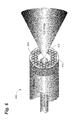
- FIG. 6 depicts a forward-looking ultrasound catheter comprising a hexagonal array, in accordance with some embodiments of the present invention.
- FIG. 7 depicts various embodiments of a hexagonal array, in accordance with some embodiments of the present invention.
- FIGS. 8-9 depict additional hexagonal arrays, in accordance with some embodiments of the present invention.
- FIG. 10 depicts a comparison between images created by a full hexagonal array, a phased hexagonal array, and a synthetically phased hexagonal array, in accordance with some embodiments of the present invention.
- FIGS. 11 a -11 b compares the beam quality between a full hexagonal array and a non-redundant coarray, in accordance with some embodiments of the present invention.
- FIG. 12 depicts a multi-ring transmit (Tx) and receive (Rx) array for use with a forward-looking ultrasound catheter, in accordance with some embodiments of the present invention.
- FIGS. 13 a and 13 b depict a point spread function (PSF) and a simulated image, respectively, for a full set of firings, in accordance with some embodiments of the present invention.
- PSF point spread function
- FIGS. 14 a and 14 b depict a PSF and a simulated image for a set of 256 non-redundant firings, in accordance with some embodiments of the present invention.
- FIGS. 14 c -14 f depict a PSF and a simulated images for arrays optimized using simulated annealing, in accordance with some embodiments of the present invention.
- FIG. 15 depicts a chip for a forward-looking ultrasound catheter comprising Tx, Rx, and dummy (Cx) elements, in accordance with some embodiments of the present invention.
- FIGS. 16 a -16 b depict two possible electrode configurations for the Tx and Rx elements, in accordance with some embodiments of the present invention.
- FIG. 17 compares the pressure output of a 9 element Tx subarray and a single membrane element, in accordance with some embodiments of the present invention.
- Embodiments of the present invention can comprise an ultrasound imaging probe with optimized electronics, intelligent control, and improved architecture. Embodiments of the present invention provide improved image resolution, reduced imaging times, or a combination thereof. Embodiments of the present invention can utilize a multi-faceted approach including, but not limited to, careful selection of probe architecture and connection methods, beam shaping, reduced cross-talk, and improved CMUT on CMOS architecture. To this end, CMUT on CMOS electronics can be devised to improve packaging, beam forming, and transmit power, while reducing energy consumption.
- the system is described below as a system for intravascular ultrasound imaging.
- the system can also be deployed for other ultrasound imaging applications, particularly when a small catheter cross-section is desired.
- the system can also comprise an energy efficient, miniaturized chip for ultrasound imaging.
- the catheter for ultrasound imaging in the heart or blood vessels, e.g., for diagnostic and intervention guiding applications, it is desirable to have a catheter with a smallest possible diameter and rigid section so that the imaging device can be placed in the desired location in, for example, tortuous arteries or can be easily steered to provide an image in the desired direction.
- the catheter it is preferable for the catheter to contain a chip that is both small in diameter and thin. In this manner, the diameter of the catheter can be minimized while its flexibility is maximized.
- CMUT based catheters comprising a single silicon substrate which contains both the CMOS electronics and CMUT ultrasound arrays can be built using CMUT-on-CMOS technology.
- These chips can be designed to require a small number of external electrical connections such as, for example and not limitation, between approximately 5 and 16 connections.
- these electrical connections, or ports can be provided using a flexible connection means, such as, for example, flex-tape or flex circuits, further improving catheter flexibility. This combination can result in an array with a rigid cross-section smaller than 1 mm.
- the flexible interconnect tape can be connected from the front of the chip, back of the chip (e.g., using through vias), or at the sides.
- the chip can be thinned down to approximately 100 ⁇ m.
- the chip can also be attached to a backing layer and/or a small rigid substrate to enable the necessary interconnects (e.g., a flex-tape to coax cable connection).
- the chip can be substantially donut shaped to enable the wire, or other intervention tools, to pass through the center of the chip.
- the chip can be other suitable shapes, such as substantially disk shaped, depending on, for example and not limitation, whether a guide wire is used, where the guide wire is attached to the chip, and/or whether intervention devices are desired.
- the CMUT transmit and receive ultrasound arrays can comprise, for example and not limitation, single or multiple rings, or sparse arrays with multiple frequencies and multiple transmit and receive functions.
- Various transmit and receive schemes and electronic control systems have been disclosed. See, U.S. patent application Ser. No. 13/412,465 entitled, “Compact, Energy-Efficient Ultrasound Imaging Process using CMUT Arrays with Integrated Electronics,” by the inventor herein, filed 15 Mar. 2012, which is hereby incorporate by reference as if set forth in its entirety below.
- embodiments of the present invention can comprise a single chip CMUT-on-CMOS array 102 for use with a flexible ultrasound imaging probe 100 .
- a single chip 102 can contain a plurality of CMUT transmit (Tx) 105 a and receive (Rx) 105 b elements along with CMOS electronics 110 to provide the necessary controls.
- the first level of connection i.e., from the chip 102
- the chip 102 can comprise through vias to enable connection to the rear side of the chip.
- flexible interconnects 115 can be used and can be connected proximate the outer periphery of the chip 102 .
- the flex tape 115 can be folded, for example, around the outside of the chip 102 and below to additional external connections (e.g. coaxial cable connections). This may be desirable because, for example, a solid, disk-shaped chip 102 is used with no internal apertures 120 .
- chip apertures 120 may be otherwise occupied by, for example and not limitation, guide wires and intervention tools. Due to the minimal thickness of the flex tape 115 (e.g., approximately 5-10 ⁇ m), the increase in diameter of the chip 102 is relatively negligible, particularly for cardiac, or other large vessel, imaging.
- the flex tape 115 connections can be made through the center 120 of the chip 102 .
- the flex tape 115 can be connected and folded into the opening 120 and through for connection below the chip 102 . In this configuration, the overall cross-section of the chip 102 can be reduced. This configuration can also reduce the possible shadowing effect of the interconnect structure on the imaging beam generated by the CMUT array elements 105 .
- the flex-tape 115 material e.g. polymer or polyimide material
- the acoustic impedance can be matched closely to that of water and blood.
- the flex-tape 115 can cover substantially the entire surface of the chip 102 without affecting imaging.
- the flex tape 115 can be sandwiched between a protective fluid-like layer 505 such as, for example and not limitation, polydimethylsiloxane (PDMS), which also can have substantially the same acoustic impedance as blood.
- PDMS polydimethylsiloxane
- the protective layer 505 can protect the face of the chip 102 and the flex tape 115 to prevent damage, for example, as the chip 102 is guided through, and contacts vessel walls or other internal bodily structures.
- the protective layer 505 can be approximately 1 mm thick to enable the guide-wire 510 , or intervention tool, to be seen in the image outside the blind region of the array 105 .
- embodiments of the present invention can also comprise a dual hexagonal ring array 600 .
- the hexagonal design can be based on a hexagonal sampling, where a subset of each Tx 605 and Rx 610 subarrays can form a complete uniformly filled hexagonal coarray 600 without any redundancy in spatial frequencies.
- This geometry can provide a large coarray 600 with a reduced number of firing events. This can be achieved, for example, by filling the spatial frequency space uniformly, but with small number of firings.
- the available surface area on the CMUT array surface 615 can be divided into hexagonal shapes which can, in turn, be filled with subarrays 605 , 610 (i.e., a group of CMUT elements).
- subarrays 605 , 610 i.e., a group of CMUT elements.
- FIG. 7 different array configurations with different ring and element 705 , 710 counts and aperture sizes 720 can be formed to meet a variety of imaging needs.
- each of the hexagonal areas 805 , 810 can be subdivided into different CMUT elements 815 .
- the hexagonal subarray 820 can comprise 7 individual CMUTs 815 comprising a central CMUT 815 a , surrounded by a hexagonal array of 6 CMUTs 815 b . Due to the integration provided by CMOS technology, each of these small CMUTs 815 can be connected to a receiver amplifier integrated on the same silicon chip 802 . The outputs of these amplifiers can then be multiplexed using a digital controller and output from the chip 802 using an electrical interconnect.
- each receiving hexagonal sub array 920 is filled with 19 CMUT elements 915 .
- the size of the individual CMUT elements 915 in the hexagonal subarray 920 is smaller than the wavelength of the ultrasonic waves at the frequency of operation.
- the hexagonal arrays 820 , 920 can employ a defocused annular subarray 825 , 925 to emulate a powerful, virtual point-like source, capable of uniformly isonifying substantially the entire image volume.
- the defocused annular array 825 , 925 can comprise a small number of annular Tx array elements 830 , 930 and can generate a circular, symmetric radiation pattern.
- a single element 805 , 905 from the dual hexagonal array 802 , 902 can comprise an annular array 825 , 925 .
- the annular array 825 , 925 can be made, for example, by having circular rings 830 , 930 of membranes, which can then be phased to generate a spherical wave front.
- phasing can be used to create other wave front shapes such as, for example and not limitation, point sources, beams, and steered beams.
- the hexagonal ring array 802 , 902 configuration can provide a scalable design for different array specifications such as, for example and not limitation, available aperture size, number of subarray elements 815 , 915 (e.g., channels), firing count, and element 815 , 915 size.
- the number of subarrays 820 , 920 on each hexagonal ring is a multiple of 6.
- FIGS. 8 and 9 depict schematics of two particular hexagonal dual ring array designs suitable for FL-NUS and FL-ICE imaging.
- the outer 805 , 905 and inner 810 , 910 hexagonal rings can generate a coarray 802 , 902 with a size equal to the sum of the ring sizes. See, e.g., Hoctor, R. T. and Kassam, S. A., The unifying role of the coarray in aperture synthesis for coherent and incoherent imaging, Proceedings of the IEEE, vol. 78, no. 4, pp. 735-752, 1990 (hereinafter, “Hoctor”).
- a uniformly filled hexagonal coarray e.g., non-redundant coarray
- the subset can be chosen in such a way that the number of elements 815 , 915 in each subarray 820 , 920 is substantially equal.
- the transmit 805 , 905 and receive 810 , 910 rings can generally be freely interchanged without altering the coarray 820 , 920 , the small subarray 820 , 920 count on the inner ring 810 , 910 can be more suitable for the receive operation, due to reduced receive channel complexity.
- the hexagonal array 802 , 902 design can enable forming non-redundant coarrays, where each coarray element 815 , 915 can be independently controlled in terms of the spatial location and element weighting. This allows one to form any desired beam pattern
- FIG. 10 depicts a simulation of a particular hexagonal dual ring array with 2.4-mm outer diameter and 10 MHz center frequency and 50% fractional bandwidth for use with a 2.6-mm diameter ICE catheter.
- the simulated point spread functions (“PSF”s) are presented in FIGS. 10, 11 a , and 11 b .
- the hexagonal dual ring array with non-redundant coarrays generate beam quality substantially similar to the full hexagon array.
- Tx-Rx arrays spaced over the entire chip as opposed to rings or clusters that occupy only part of the chip, can provide improved image quality even at lower resolutions (i.e., firing events).
- the CMUT-on-CMOS architecture with improved electronics disclosed herein enables, among other things, improved image resolution and/or reduced sampling times.
- Embodiments of the present invention enable this improved functionality in several ways.
- the CMUT-on-CMOS approach can enable the use of the whole available silicon chip area 1200 , for example, to place arrays with nearly arbitrary element distribution.
- integrated electronics can enable addressing a large number of elements and multiple receive channels enabling faster data acquisition and/or synthetic aperture beamforming, among other things.
- the microfabrication processes disclosed herein also enable CMUT structures to be separately optimized for Tx and Rx operation on the same silicon chip 1200 .
- array elements can be distributed over substantially the entire silicon area 1200 to improve image contrast and/or resolution while increasing the frame rate by reducing the number of firings and using multiple active receive channels.
- image quality can be improved simply by increasing the area, or “spread,” of the Tx-Rx arrays, instead of simply increasing the number of Tx-Rx arrays.
- This configuration can also enable the unused silicon areas created by the use of sparse array elements to implement mechanical structures, or “blanks,” to reduce acoustical cross talk, further improving array performance.
- the power limitations that may be introduced by the sparse CMUT Tx array elements can be overcome by forming groups, or sub-arrays, of Tx components. In this manner, multiple Tx elements can be fired simultaneously, or phased, to increase overall transmit power. These subarrays can, in turn, be phased using bias voltages and/or electrode shapes, while still using a separate Rx array with properly sized elements to increase signal-to-noise ratio (“SNR”) and imaging depth. This can also enable beamforming to control the shape and/or direction of the imaging ultrasound beam for improved imaging.
- SNR signal-to-noise ratio
- FIG. 12 a An example of the type of arrays that can be built using the CMUT technology is schematically shown in FIG. 12 a .
- five annular rings 1205 can be formed with regular periodicity on a donut shaped silicon region 1200 .
- This configuration is practical for an IVUS probe with a center opening 1210 for a guide wire or intervention tools, for example. Since it would be difficult, if not impossible, to both implement the front end electronics required for a phased array on this silicon chip 1200 and to provide the number of required external electrical connections to take full advantage of all the Tx and Rx elements 1215 , in a preferred embodiment, synthetic array processing can be used.
- Numerical modeling tools based on diffraction calculations or available software programs like FIELD-H can be used to evaluate the beam pattern quality and the PSF for a given firing set.
- co-array concepts such as those described in Hoctor can be used to obtain non-redundant Tx-Rx sets for dual-ring arrays to reduce the number of firings required to produce sufficient image quality. This can be done, for example, by choosing particular Tx and Rx combinations to uniformly fill the available coarray space, while eliminating redundant combinations that do not significantly improve the resolution (e.g., because the information is already contained in another combination). By eliminating redundant combinations, substantially the same image resolution can be obtained with significantly fewer transmit events (i.e., Tx 1215 firings). The reduced number of firings, in turn, reduces the time for data collection and computation time and hence can enable, for example, real-time imaging using synthetic arrays.
- FIGS. 13 a -14 b depict an IVUS array with 48 Tx elements and 42 Rx elements.
- FIGS. 14 a and 14 b depict the same array, but utilizing a non-redundant set of 256 firings. As shown, the non-redundant set uses approximately 25 percent of Tx-Rx combinations, while producing substantially equivalent image quality within a 40 dB dynamic range.
- using the whole silicon surface 1200 as in FIG. 12 a , provides additional freedom in choosing the Tx-Rx combinations to achieve the desired beam pattern performance when compared to, for example, single or dual ring annular arrays.
- the non-redundant firing sets can be obtained using optimization techniques such as simulated annealing. See, e.g., Murino, A. T., and C. S. Regazzoni, Synthesis of Unequally Spaced Arrays by Simulated Annealing, IEEE Trans. Signal Processing, 1996, 44, p. 119-123; see, also, An example of this optimization technique is given in the paper “Simulated annealing based optimization of dual-ring arrays for forward-looking IVUS and ICE imaging,” Tekes, C.; Karaman, M.; Degertekin, F. L., 2010 IEEE Ultrasonics Symposium, Page(s): 999-1002.
- the Point Spread Function, H(.), is essentially the beamformed pulse echo response of the array for each point in the space. It can be calculated for a point target using the Rayleigh-Sommerfeld diffraction formula using the following expression:
- H ⁇ ( r , ⁇ , ⁇ ) ⁇ i ⁇ w i ⁇ ⁇ j ⁇ w j ⁇ s ⁇ ( 2 ⁇ r c - t i - t j - ⁇ i - ⁇ j )
- (r, ⁇ , ⁇ ) are the spherical coordinates
- i and j represent the Tx and Rx indices respectively
- s(.) is the excitation pulse
- c is the speed of sound
- t i and t j are the flight times between the point target and Tx and Rx elements respectively
- ⁇ i and ⁇ j are the corresponding focusing delay times.
- w i and w j represent the weighting coefficients. For simplicity, weighting can be used, such that each w i,j is unity. To avoid additional computational complexity, the element factor, obliquity factor, and attenuation effects can be ignored.
- the initial step for the optimization algorithm can be to calculate the PSF, including all the Tx-Rx firing combinations for all the sampled azimuth and elevation angles. This data can then be recorded for further use in the iteration steps to prevent repeating PSF calculations in each perturbation state. To find an optimum solution set from the full set coarray with a desired number of elements, therefore, an energy function can be defined that minimizes the peak side lobe level.
- custom numerical simulations can be performed assuming a dual-ring array of 64 Tx and 58 Rx elements.
- the diameters of the Tx and Rx arrays of the dual-ring array are assumed to be 1200 ⁇ m and 1080 ⁇ m, respectively.
- a hexagonal dual-ring array with 12, 7-element Rx subarrays and 28 Tx subarrays was used.
- the dual-ring circular array has 64 Tx and 58 Rx elements.
- Uniformly sampled coarrays can be obtained using a nearest neighbor technique and the coarrays can be optimized using simulated annealing, as discussed above. In this example, 400 iterations and 4000 perturbations can be used to obtain an optimized set.
- a quarter of the coarray space can be used and then the solution can be extended to the other quarters symmetrically. This also results in symmetric Tx-Rx firing pairs. Additionally, this method performs the optimization on a relatively small search space, which reduces the computational time required to reach an optimum solution.
- the coarrays produced by all the Tx-Rx element pairs (i.e., the full set), uniform sampled subarrays, and optimized subarrays are shown in FIG. 14 c .
- the Gaussian pulse was set to a center frequency of 20 MHz, the speed of sound was 1540 m/s, and the fractional bandwidth was 50%.
- the target is located on the normal of the array (i.e., on the axis of the array) at F-number 4, i.e. at a distance 4 times the diameter of the array.
- the 2-D PSFs in FIG. 14 c represent non-steered beam patterns.
- the optimized coarray configuration has a narrow ⁇ 6 dB main lobe width when compared with uniformly sampled and full set cases.
- the optimized coarray produces a nearly 10 dB reduction compared to the uniformly sampled and full sets.
- the average side lobe level of uniformly sampled coarray decreases under the ⁇ 40 dB level at approximately 10°, a relative rise at approximately ⁇ 35 dB, in the far side lobe region, is also observed.
- the optimized coarrays in both the 512 and 256 element cases there is a significantly flat side lobe level near ⁇ 40 dB.
- the subarrays in the dual hexagonal array can also be reduced and optimized using a simulated annealing optimization technique.
- the optimization results in this case are obtained for 258 and 516 element cases, as opposed to the as the full 1176 elements set (i.e., with redundancies eliminated from the full set).
- iterations and 2000 perturbations were used to obtain an optimized set.
- elements from one sixth of the coarray space can be chosen and extended symmetrically.
- the first side lobe levels are nearly 5 dB lower when compared to the full set and the grating lobes remain under ⁇ 40 dB over an angle of approximately 45°.
- CMUT arrays can be affected by acoustic cross-talk.
- individual Tx and Rx elements are affected by nearby Tx and Rx elements resulting in undesired frequency response and time domain, resulting in image distortion.
- Surface waves present on the CMUT membranes have been identified as the main source of acoustic cross talk. As a result, the mechanical properties of the membranes and the spacing between array elements can improve cross talk performance.
- Embodiments of the present invention can further comprise a CMUT array with dummy, solid (i.e., filled gap, non-moving), or collapsed elements dispersed between active array elements.
- the sparse array approach described above enables the use of these dummy elements, as shown in FIG. 15 , due to the sparse nature of the arrays.
- these Cx elements 1515 can be passive elements and can be, for example and not limitation, solid or collapsed membranes.
- the Cx elements 1515 can be simple active membranes (e.g., membranes with DC bias only such that they do not move).
- the Cx elements 1515 can further comprise mass loading.
- Mass loading can be achieved, for example, by fabricating the CMUT membranes with a non-uniform thickness. Mass loading changes the resonant frequency and vibrational characteristics of the CMUT membrane such that they are different from other elements in the imaging array. In this configuration, the array is prevented from having uniform properties, which disrupts the uniform structure that would otherwise tend to support surface waves and surface resonance.
- the mass loaded membranes can be distributed randomly between Tx 1505 and Rx 1510 CMUT elements to prevent periodicity and strong resonances that may result from periodicity.
- the flexibility in shaping the CMUT structures, and the resulting availability of external electrical connections due to single chip integration, can also be exploited to improve device performance by increasing transmit power levels.
- the DC bias levels for Tx elements for example, can be selected differently from those for Rx elements to improve the overall bandwidth of the imaging system and/or operate these elements in different regimes.
- different electrode structures can be used for Tx elements to increase the pressure level that can be produced.
- dual-ring CMUT arrays can be used with a variety of electrode configurations.
- the TX elements 1605 inner ring
- the Rx elements 1615 outer ring
- dual electrode 1625 Tx elements 1605 can be used with 70% electrode 1620 coverage Rx elements 1615 .
- the Rx element electrodes 1620 can be optimized for reduced parasitic capacitance, while the Tx element electrodes 1610 , 1625 can be optimized to improve acoustic pressure efficiency (i.e., Pa/V) and to maximize output pressure.
- acoustic pressure efficiency i.e., Pa/V
- the electrode size and bias voltage can also be used to create phased arrays of Tx elements to increase transmission pressure. This approach can be used to control radiation pattern and power levels.
- electrode size distribution, DC bias levels, and polarity can be used to form bias-phased and smoothed, or apodized, Tx elements.
- phase delays can be created between elements in common phase arrays to provide the desired power level and/or beam shape without increasing the complexity of the electronics.
- a single chip CMUT array can have a sufficient number of electrical connections to provide multiple DC bias levels.
- DC bias levels can include different amplitudes, for wave shaping, and/or opposite polarity bias levels to provide in and out of phase transmission between elements.
- a higher bias voltage can be applied to the center element than to the surrounding elements. In this configuration, the center element will fire first followed by the outer elements, thus creating the desired rounded profile as well as applying amplitude apodization.
- bias voltages of different polarities can also be used to alter the initial position, or preload, of each element to produce similar or different wave shapes.
- the desired phase delays and amplitude apodizations can essentially be “hardwired” into the chip.
- an element with a large electrode will displace farther than an element with a small electrode in reaction to the same applied bias voltage.
- the bias voltage is removed, or inverted therefore, a difference in amplitude and a phase delay is created between the two elements.
- This concept can be used to shape the beam and/or steer the beam.
- the phase delay can be used to create an asymmetrical beam for sampling areas not directly in front of the probe.
- multiple CMUT elements can be fired simultaneously, or nearly simultaneously (i.e., batch fired) to increase power output or wave size.
- the multiple CMUTs can act as a Tx element of substantially the same size as the combined area of the individual CMUT elements. This can be useful, for example, when the probe must image tissue that is a significant distance from the chip.
- simulations such as finite element analysis (“FEA”), related to the fluid coupling at the CMUT surface, can be used to determine a suitable bias level, polarity, and electrode size for the desired beam shape or direction.
- FEA finite element analysis
- FIG. 17 an initial 1-D FEA shows that a nine membrane, bias-phased, and electrode-apodized CMUT, for example, improves the output pressure by 6 dB in the far field as compared to a single membrane CMUT while still covering substantially the entire angular range.
- embodiments of the present invention are not so limited.
- other suitable components, materials, and layouts could be selected without departing from the spirit of the invention.
- location and configuration used for various features of embodiments of the present invention can be varied according to a particular application or imaging need that requires a slight variation due to, for example, the materials used and/or space or power constraints. Such changes are intended to be embraced within the scope of the invention.
Landscapes
- Engineering & Computer Science (AREA)
- Physics & Mathematics (AREA)
- Health & Medical Sciences (AREA)
- Life Sciences & Earth Sciences (AREA)
- Remote Sensing (AREA)
- Radar, Positioning & Navigation (AREA)
- Acoustics & Sound (AREA)
- Pathology (AREA)
- Public Health (AREA)
- Biomedical Technology (AREA)
- Heart & Thoracic Surgery (AREA)
- Medical Informatics (AREA)
- Molecular Biology (AREA)
- Surgery (AREA)
- Animal Behavior & Ethology (AREA)
- General Health & Medical Sciences (AREA)
- Radiology & Medical Imaging (AREA)
- Veterinary Medicine (AREA)
- Nuclear Medicine, Radiotherapy & Molecular Imaging (AREA)
- Biophysics (AREA)
- Computer Networks & Wireless Communication (AREA)
- General Physics & Mathematics (AREA)
- Gynecology & Obstetrics (AREA)
- Mechanical Engineering (AREA)
- Ultra Sonic Daignosis Equipment (AREA)
Abstract
Description
where (r,θ,φ) are the spherical coordinates; i and j represent the Tx and Rx indices respectively; s(.) is the excitation pulse; c is the speed of sound; ti and tj are the flight times between the point target and Tx and Rx elements respectively; and τi and τj are the corresponding focusing delay times. The terms wi and wj represent the weighting coefficients. For simplicity, weighting can be used, such that each wi,j is unity. To avoid additional computational complexity, the element factor, obliquity factor, and attenuation effects can be ignored. The initial step for the optimization algorithm can be to calculate the PSF, including all the Tx-Rx firing combinations for all the sampled azimuth and elevation angles. This data can then be recorded for further use in the iteration steps to prevent repeating PSF calculations in each perturbation state. To find an optimum solution set from the full set coarray with a desired number of elements, therefore, an energy function can be defined that minimizes the peak side lobe level.
Claims (20)
Priority Applications (1)
| Application Number | Priority Date | Filing Date | Title |
|---|---|---|---|
| US13/471,426 US9310485B2 (en) | 2011-05-12 | 2012-05-14 | Compact, energy-efficient ultrasound imaging probes using CMUT arrays with integrated electronics |
Applications Claiming Priority (4)
| Application Number | Priority Date | Filing Date | Title |
|---|---|---|---|
| US201161485414P | 2011-05-12 | 2011-05-12 | |
| US201161485417P | 2011-05-12 | 2011-05-12 | |
| US201161485423P | 2011-05-12 | 2011-05-12 | |
| US13/471,426 US9310485B2 (en) | 2011-05-12 | 2012-05-14 | Compact, energy-efficient ultrasound imaging probes using CMUT arrays with integrated electronics |
Publications (2)
| Publication Number | Publication Date |
|---|---|
| US20130128702A1 US20130128702A1 (en) | 2013-05-23 |
| US9310485B2 true US9310485B2 (en) | 2016-04-12 |
Family
ID=48426832
Family Applications (1)
| Application Number | Title | Priority Date | Filing Date |
|---|---|---|---|
| US13/471,426 Expired - Fee Related US9310485B2 (en) | 2011-05-12 | 2012-05-14 | Compact, energy-efficient ultrasound imaging probes using CMUT arrays with integrated electronics |
Country Status (1)
| Country | Link |
|---|---|
| US (1) | US9310485B2 (en) |
Cited By (5)
| Publication number | Priority date | Publication date | Assignee | Title |
|---|---|---|---|---|
| US20160144402A1 (en) * | 2014-11-20 | 2016-05-26 | Canon Kabushiki Kaisha | Capacitive transducer and sample information acquisition apparatus |
| US20210311179A1 (en) * | 2013-12-19 | 2021-10-07 | B-K Medical Aps | Ultrasound Imaging Transducer Array with Integrated Apodization |
| US11478221B2 (en) | 2018-02-15 | 2022-10-25 | Koninklijke Philips N.V. | Ultrasound imaging system using an array of transducer elements and an imaging method |
| US20220373664A1 (en) * | 2021-05-21 | 2022-11-24 | Au Optronics Corporation | Ultrasonic detection device |
| US11660073B2 (en) | 2015-10-30 | 2023-05-30 | Georgia Tech Research Corporation | Foldable 2-D CMUT-on-CMOS arrays |
Families Citing this family (27)
| Publication number | Priority date | Publication date | Assignee | Title |
|---|---|---|---|---|
| CN104105449B (en) | 2011-12-01 | 2018-07-17 | 毛伊图像公司 | Motion detection using acoustic pulse and multi-hole Doppler ultrasound |
| CN107028623B (en) | 2012-02-21 | 2020-09-01 | 毛伊图像公司 | Determining Material Stiffness Using Porous Ultrasound |
| WO2013148673A1 (en) | 2012-03-26 | 2013-10-03 | Maui Imaging, Inc. | Systems and methods for improving ultrasound image quality by applying weighting factors |
| WO2014026185A1 (en) | 2012-08-10 | 2014-02-13 | Maui Imaging, Inc. | Calibration of multiple aperture ultrasound probes |
| US20140064513A1 (en) | 2012-09-06 | 2014-03-06 | MUSIC Group IP Ltd. | System and method for remotely controlling audio equipment |
| JP6279725B2 (en) | 2013-06-26 | 2018-02-14 | コーニンクレッカ フィリップス エヌ ヴェKoninklijke Philips N.V. | Integrated circuit devices for ultrasonic transducer arrays. |
| CN104323794B (en) * | 2013-07-22 | 2016-12-28 | 华中科技大学 | A kind of split-type ranks addressing method for 3-D supersonic imaging |
| US9883848B2 (en) | 2013-09-13 | 2018-02-06 | Maui Imaging, Inc. | Ultrasound imaging using apparent point-source transmit transducer |
| JP6722656B2 (en) | 2014-08-18 | 2020-07-15 | マウイ イマギング,インコーポレーテッド | Network-based ultrasound imaging system |
| EP3277187B1 (en) | 2015-03-30 | 2022-05-04 | Maui Imaging, Inc. | Ultrasound imaging methods for detecting object motion |
| EP3282976B1 (en) | 2015-04-13 | 2019-05-15 | Teixeira Dos Santos Paulo, Nelson Jorge | Device for intra-cardiac and intra-vascular surgical procedure having an endoluminal ultrasound probe |
| GB2601942B (en) * | 2015-06-17 | 2022-09-14 | Darkvision Tech Inc | Ultrasonic imaging device and method for wells |
| JP6925286B2 (en) * | 2015-06-30 | 2021-08-25 | コーニンクレッカ フィリップス エヌ ヴェKoninklijke Philips N.V. | Ultrasonic system and ultrasonic pulse transmission method |
| JP6949829B2 (en) * | 2015-09-03 | 2021-10-13 | コーニンクレッカ フィリップス エヌ ヴェKoninklijke Philips N.V. | IC dies, probes, and ultrasonic systems |
| US10856846B2 (en) * | 2016-01-27 | 2020-12-08 | Maui Imaging, Inc. | Ultrasound imaging with sparse array probes |
| JP7096237B2 (en) * | 2016-10-03 | 2022-07-05 | コーニンクレッカ フィリップス エヌ ヴェ | Intraluminal imaging device with a small number of signal channels |
| CN108828603B (en) * | 2018-06-14 | 2019-12-10 | 浙江大学 | Cross-based sparse optimization method for three-dimensional imaging sonar array |
| EP3656294A1 (en) * | 2018-11-22 | 2020-05-27 | Koninklijke Philips N.V. | Capacitive pressure sensor for intraluminal guidewire or catheter |
| US20210298617A1 (en) * | 2018-08-09 | 2021-09-30 | Koninklijke Philips N.V. | Intraluminal device with capacitive pressure sensor |
| FR3097052B1 (en) * | 2019-06-07 | 2021-07-02 | Commissariat Energie Atomique | Method of manufacturing a plurality of resonators |
| CN111184532B (en) * | 2020-04-09 | 2020-07-31 | 上海尽星生物科技有限责任公司 | Ultrasonic system and method of contact type flexible conformal ultrasonic probe |
| JP7724853B2 (en) | 2020-10-21 | 2025-08-18 | マウイ イマギング,インコーポレーテッド | Systems and methods for tissue characterization using multiple aperture ultrasound |
| EP4236811A4 (en) | 2020-11-02 | 2024-10-09 | Maui Imaging, Inc. | SYSTEMS AND METHODS FOR ENHANCING ULTRASOUND IMAGE QUALITY |
| CN113081045A (en) * | 2021-04-20 | 2021-07-09 | 天津市胸科医院 | Intravascular forward-looking detection device |
| EP4252669A1 (en) * | 2022-03-30 | 2023-10-04 | Koninklijke Philips N.V. | Flow measurement |
| EP4389307A1 (en) * | 2022-12-19 | 2024-06-26 | Koninklijke Philips N.V. | Ring array transducer |
| KR102977929B1 (en) | 2023-10-06 | 2026-06-17 | 한국과학기술연구원 | Apparatus and method for generating ultrasound image using nonlinearity of ultrasound |
Citations (21)
| Publication number | Priority date | Publication date | Assignee | Title |
|---|---|---|---|---|
| US5351691A (en) | 1990-08-02 | 1994-10-04 | B.V. Optische Inductrie "De Oude Delft" | Endoscopic probe |
| US5857974A (en) | 1997-01-08 | 1999-01-12 | Endosonics Corporation | High resolution intravascular ultrasound transducer assembly having a flexible substrate |
| US6120454A (en) | 1998-02-03 | 2000-09-19 | Boston Scientific Corporation | Annular array ultrasound catheter |
| US6299580B1 (en) | 1996-11-19 | 2001-10-09 | Hitachi Medical Corporation | Ultrasonic probe and ultrasonic diagnostic apparatus using the same |
| US6497667B1 (en) | 2001-07-31 | 2002-12-24 | Koninklijke Philips Electronics N.V. | Ultrasonic probe using ribbon cable attachment system |
| US6503204B1 (en) * | 2000-03-31 | 2003-01-07 | Acuson Corporation | Two-dimensional ultrasonic transducer array having transducer elements in a non-rectangular or hexagonal grid for medical diagnostic ultrasonic imaging and ultrasound imaging system using same |
| US6589182B1 (en) | 2001-02-12 | 2003-07-08 | Acuson Corporation | Medical diagnostic ultrasound catheter with first and second tip portions |
| US6623432B2 (en) | 2000-08-24 | 2003-09-23 | Koninklijke Philips Electronics N.V. | Ultrasonic diagnostic imaging transducer with hexagonal patches |
| US6865140B2 (en) | 2003-03-06 | 2005-03-08 | General Electric Company | Mosaic arrays using micromachined ultrasound transducers |
| US7052464B2 (en) | 2004-01-01 | 2006-05-30 | General Electric Company | Alignment method for fabrication of integrated ultrasonic transducer array |
| US7088830B2 (en) | 1997-04-30 | 2006-08-08 | American Technology Corporation | Parametric ring emitter |
| US7221077B2 (en) | 2003-04-01 | 2007-05-22 | Olympus Corporation | Ultrasonic transducer and manufacturing method thereof |
| US20070167814A1 (en) | 2004-06-10 | 2007-07-19 | Olympus Corporation | Capacitive ultrasonic probe device |
| US7427825B2 (en) | 2004-03-12 | 2008-09-23 | Siemens Medical Solutions Usa, Inc. | Electrical interconnections and methods for membrane ultrasound transducers |
| US7460439B2 (en) | 2006-07-13 | 2008-12-02 | Postech Foundation | Ultrasonic transducer for ranging measurement with high directionality using parametric transmitting array in air and a method for manufacturing same |
| US7514851B2 (en) | 2005-07-13 | 2009-04-07 | Siemens Medical Solutions Usa, Inc. | Curved capacitive membrane ultrasound transducer array |
| WO2009073752A1 (en) | 2007-12-03 | 2009-06-11 | Kolo Technologies, Inc. | Ultrasound scanner built with capacitive micromachined ultrasonic transducers (cmuts) |
| US7559897B2 (en) | 2003-07-01 | 2009-07-14 | Esaote, S.P.A. | Electronic array probe for ultrasonic imaging |
| US20090270735A1 (en) | 2003-07-01 | 2009-10-29 | Esaote, S.P.A. | Electronic array probe for ultrasonic imaging |
| US7745973B2 (en) * | 2006-05-03 | 2010-06-29 | The Board Of Trustees Of The Leland Stanford Junior University | Acoustic crosstalk reduction for capacitive micromachined ultrasonic transducers in immersion |
| US20120071761A1 (en) * | 2010-09-21 | 2012-03-22 | Toshiba Medical Systems Corporation | Medical ultrasound 2-d transducer array using fresnel lens approach |
-
2012
- 2012-05-14 US US13/471,426 patent/US9310485B2/en not_active Expired - Fee Related
Patent Citations (25)
| Publication number | Priority date | Publication date | Assignee | Title |
|---|---|---|---|---|
| US5351691A (en) | 1990-08-02 | 1994-10-04 | B.V. Optische Inductrie "De Oude Delft" | Endoscopic probe |
| US6299580B1 (en) | 1996-11-19 | 2001-10-09 | Hitachi Medical Corporation | Ultrasonic probe and ultrasonic diagnostic apparatus using the same |
| US6899682B2 (en) | 1997-01-08 | 2005-05-31 | Volcano Therapeutics, Inc. | Intravascular ultrasound transducer assembly having a flexible substrate and method for manufacturing such assembly |
| US5857974A (en) | 1997-01-08 | 1999-01-12 | Endosonics Corporation | High resolution intravascular ultrasound transducer assembly having a flexible substrate |
| US6049958A (en) | 1997-01-08 | 2000-04-18 | Endosonics Corporation | High resolution intravascular ultrasound transducer assembly having a flexible substrate and method for manufacture thereof |
| US7088830B2 (en) | 1997-04-30 | 2006-08-08 | American Technology Corporation | Parametric ring emitter |
| US6120454A (en) | 1998-02-03 | 2000-09-19 | Boston Scientific Corporation | Annular array ultrasound catheter |
| US6503204B1 (en) * | 2000-03-31 | 2003-01-07 | Acuson Corporation | Two-dimensional ultrasonic transducer array having transducer elements in a non-rectangular or hexagonal grid for medical diagnostic ultrasonic imaging and ultrasound imaging system using same |
| US6623432B2 (en) | 2000-08-24 | 2003-09-23 | Koninklijke Philips Electronics N.V. | Ultrasonic diagnostic imaging transducer with hexagonal patches |
| US6589182B1 (en) | 2001-02-12 | 2003-07-08 | Acuson Corporation | Medical diagnostic ultrasound catheter with first and second tip portions |
| US6497667B1 (en) | 2001-07-31 | 2002-12-24 | Koninklijke Philips Electronics N.V. | Ultrasonic probe using ribbon cable attachment system |
| US6865140B2 (en) | 2003-03-06 | 2005-03-08 | General Electric Company | Mosaic arrays using micromachined ultrasound transducers |
| US7221077B2 (en) | 2003-04-01 | 2007-05-22 | Olympus Corporation | Ultrasonic transducer and manufacturing method thereof |
| US7559897B2 (en) | 2003-07-01 | 2009-07-14 | Esaote, S.P.A. | Electronic array probe for ultrasonic imaging |
| US20090270735A1 (en) | 2003-07-01 | 2009-10-29 | Esaote, S.P.A. | Electronic array probe for ultrasonic imaging |
| US7052464B2 (en) | 2004-01-01 | 2006-05-30 | General Electric Company | Alignment method for fabrication of integrated ultrasonic transducer array |
| US7427825B2 (en) | 2004-03-12 | 2008-09-23 | Siemens Medical Solutions Usa, Inc. | Electrical interconnections and methods for membrane ultrasound transducers |
| US20070167814A1 (en) | 2004-06-10 | 2007-07-19 | Olympus Corporation | Capacitive ultrasonic probe device |
| US7514851B2 (en) | 2005-07-13 | 2009-04-07 | Siemens Medical Solutions Usa, Inc. | Curved capacitive membrane ultrasound transducer array |
| US7732992B2 (en) | 2005-07-13 | 2010-06-08 | Siemens Medical Solutions Usa, Inc. | Curved capacitive membrane ultrasound transducer array |
| US7745973B2 (en) * | 2006-05-03 | 2010-06-29 | The Board Of Trustees Of The Leland Stanford Junior University | Acoustic crosstalk reduction for capacitive micromachined ultrasonic transducers in immersion |
| US7460439B2 (en) | 2006-07-13 | 2008-12-02 | Postech Foundation | Ultrasonic transducer for ranging measurement with high directionality using parametric transmitting array in air and a method for manufacturing same |
| WO2009073752A1 (en) | 2007-12-03 | 2009-06-11 | Kolo Technologies, Inc. | Ultrasound scanner built with capacitive micromachined ultrasonic transducers (cmuts) |
| WO2009073753A1 (en) | 2007-12-03 | 2009-06-11 | Kolo Technologies, Inc. | Cmut packaging for ultrasound system |
| US20120071761A1 (en) * | 2010-09-21 | 2012-03-22 | Toshiba Medical Systems Corporation | Medical ultrasound 2-d transducer array using fresnel lens approach |
Cited By (8)
| Publication number | Priority date | Publication date | Assignee | Title |
|---|---|---|---|---|
| US20210311179A1 (en) * | 2013-12-19 | 2021-10-07 | B-K Medical Aps | Ultrasound Imaging Transducer Array with Integrated Apodization |
| US11828884B2 (en) * | 2013-12-19 | 2023-11-28 | Bk Medical Aps | Ultrasound imaging transducer array with integrated apodization |
| US20160144402A1 (en) * | 2014-11-20 | 2016-05-26 | Canon Kabushiki Kaisha | Capacitive transducer and sample information acquisition apparatus |
| US10350636B2 (en) * | 2014-11-20 | 2019-07-16 | Canon Kabushiki Kaisha | Capacitive transducer and sample information acquisition apparatus |
| US11660073B2 (en) | 2015-10-30 | 2023-05-30 | Georgia Tech Research Corporation | Foldable 2-D CMUT-on-CMOS arrays |
| US11478221B2 (en) | 2018-02-15 | 2022-10-25 | Koninklijke Philips N.V. | Ultrasound imaging system using an array of transducer elements and an imaging method |
| US20220373664A1 (en) * | 2021-05-21 | 2022-11-24 | Au Optronics Corporation | Ultrasonic detection device |
| US12111427B2 (en) * | 2021-05-21 | 2024-10-08 | Au Optronics Corporation | Ultrasonic detection device |
Also Published As
| Publication number | Publication date |
|---|---|
| US20130128702A1 (en) | 2013-05-23 |
Similar Documents
| Publication | Publication Date | Title |
|---|---|---|
| US20130128702A1 (en) | Compact, energy-efficient ultrasound imaging probes using cmut arrays with integrated electronics | |
| US11559277B2 (en) | Ultrasound 3D imaging system | |
| CN101443678B (en) | Multi-dimensional CMUT array with integrated beamformation | |
| US9033888B2 (en) | Ultrasound imaging system using beamforming techniques for phase coherence grating lobe suppression | |
| JP6363097B2 (en) | Focused rotation IVUS transducer using single crystal composite material | |
| US8551000B2 (en) | Ultrasound 3D imaging system | |
| US6676602B1 (en) | Two dimensional array switching for beamforming in a volume | |
| US5882309A (en) | Multi-row ultrasonic transducer array with uniform elevator beamwidth | |
| JP2007152127A (en) | Ultrasonic imaging transducer array for synthetic aperture | |
| JP2023051918A (en) | Programmable biological structure and ultrasonic wave imaging device having flow imaging | |
| JP5649576B2 (en) | 3D ultrasonic imaging system | |
| US20120179044A1 (en) | Ultrasound 3d imaging system | |
| Daher et al. | 2-D array for 3-D ultrasound imaging using synthetic aperture techniques | |
| WO2008066598A1 (en) | Helical acoustic array for medical ultrasound | |
| Masoumi et al. | Costas sparse 2-D arrays for high-resolution ultrasound imaging | |
| US5492121A (en) | Method for reducing sidelobes of limited diffracton pulse-echo images | |
| Daft | Conformable transducers for large-volume, operator-independent imaging | |
| Tekes et al. | Optimizing circular ring arrays for forward-looking IVUS imaging | |
| Tournois et al. | A 128/spl times/4 channels 1.5 D curved linear array for medical imaging | |
| US20230346344A1 (en) | Ultrasound 3d imaging system | |
| Bera et al. | Three-dimensional beamforming combining micro-beamformed RF datasets | |
| US20220071594A1 (en) | Two dimensional transducer arrays for ultrasound imaging | |
| Wodnicki et al. | Electronics for diagnostic ultrasound | |
| Tekes et al. | Co-array optimization of CMUT arrays for Forward-Looking IVUS | |
| Kim et al. | Hybrid beamformation for volumetric ultrasound imaging scanners using 2-D array transducers |
Legal Events
| Date | Code | Title | Description |
|---|---|---|---|
| AS | Assignment |
Owner name: GEORGIA TECH RESEARCH CORPORATION, GEORGIA Free format text: ASSIGNMENT OF ASSIGNORS INTEREST;ASSIGNORS:DEGERTEKIN, F. LEVENT;KARAMAN, MUSTAFA;SIGNING DATES FROM 20120806 TO 20120903;REEL/FRAME:030079/0659 |
|
| AS | Assignment |
Owner name: NATIONAL INSTITUTES OF HEALTH (NIH), U.S. DEPT. OF Free format text: CONFIRMATORY LICENSE;ASSIGNOR:GEORGIA TECH RESEARCH CORPORATION;REEL/FRAME:030205/0869 Effective date: 20130404 |
|
| STCF | Information on status: patent grant |
Free format text: PATENTED CASE |
|
| CC | Certificate of correction | ||
| MAFP | Maintenance fee payment |
Free format text: PAYMENT OF MAINTENANCE FEE, 4TH YR, SMALL ENTITY (ORIGINAL EVENT CODE: M2551); ENTITY STATUS OF PATENT OWNER: SMALL ENTITY Year of fee payment: 4 |
|
| FEPP | Fee payment procedure |
Free format text: MAINTENANCE FEE REMINDER MAILED (ORIGINAL EVENT CODE: REM.); ENTITY STATUS OF PATENT OWNER: SMALL ENTITY |
|
| LAPS | Lapse for failure to pay maintenance fees |
Free format text: PATENT EXPIRED FOR FAILURE TO PAY MAINTENANCE FEES (ORIGINAL EVENT CODE: EXP.); ENTITY STATUS OF PATENT OWNER: SMALL ENTITY |
|
| STCH | Information on status: patent discontinuation |
Free format text: PATENT EXPIRED DUE TO NONPAYMENT OF MAINTENANCE FEES UNDER 37 CFR 1.362 |
|
| FP | Lapsed due to failure to pay maintenance fee |
Effective date: 20240412 |