US9309197B2 - Heterocyclic compound, organic light-emitting diode comprising the heterocyclic compound, and flat panel display device comprising the organic light-emitting diode - Google Patents
Heterocyclic compound, organic light-emitting diode comprising the heterocyclic compound, and flat panel display device comprising the organic light-emitting diode Download PDFInfo
- Publication number
- US9309197B2 US9309197B2 US13/399,108 US201213399108A US9309197B2 US 9309197 B2 US9309197 B2 US 9309197B2 US 201213399108 A US201213399108 A US 201213399108A US 9309197 B2 US9309197 B2 US 9309197B2
- Authority
- US
- United States
- Prior art keywords
- group
- unsubstituted
- substituted
- heterocyclic compound
- independently
- Prior art date
- Legal status (The legal status is an assumption and is not a legal conclusion. Google has not performed a legal analysis and makes no representation as to the accuracy of the status listed.)
- Active, expires
Links
- 0 [1*]C1([2*])C2=C(C=CC=C2)C2=C/C3=C(\C=C/21)N(C)C1=C3C=C2CC3=C(C=CC=C3)CC2=C1 Chemical compound [1*]C1([2*])C2=C(C=CC=C2)C2=C/C3=C(\C=C/21)N(C)C1=C3C=C2CC3=C(C=CC=C3)CC2=C1 0.000 description 34
- SPWZTGMMGDUYOX-UHFFFAOYSA-N BrC1=CC=C(C2=CC(C3=CC=CN=C3)=NC(C3=CN=CC=C3)=C2)C=C1 Chemical compound BrC1=CC=C(C2=CC(C3=CC=CN=C3)=NC(C3=CN=CC=C3)=C2)C=C1 SPWZTGMMGDUYOX-UHFFFAOYSA-N 0.000 description 2
- XSDKKRKTDZMKCH-UHFFFAOYSA-N BrC1=CC=C(N2C3=C(C=CC=C3)C3=C2/C=C\C=C/3)C=C1 Chemical compound BrC1=CC=C(N2C3=C(C=CC=C3)C3=C2/C=C\C=C/3)C=C1 XSDKKRKTDZMKCH-UHFFFAOYSA-N 0.000 description 2
- ODNLECMBJILJKV-UHFFFAOYSA-N C1=CC=C(C2(C3=CC=CC=C3)C3=CC4=C(C=C3C3=C2C=CC=C3)C2=C(C=C3C(=C2)OC2=C3C=CC=C2)N4C2=CC=C3C(=C2)/C=C\C2=C3C=CC=C2)C=C1.CC1(C)C2=CC3=C(C=C2C2=C1C=CC=C2)C1=C(C=C2C(=C1)OC1=C2C=CC=C1)N3C1=C2C=CC=CC2=C(C2=C3C=CC=CC3=CC=C2)C2=C1C=CC=C2.CC1(C)C2=CC3=C(C=C2C2=C1C=CC=C2)C1=C(C=C2C(=C1)OC1=C2C=CC=C1)N3C1=CC(C2=CC=CC=C2)=CC(C2=CC=CC=C2)=C1 Chemical compound C1=CC=C(C2(C3=CC=CC=C3)C3=CC4=C(C=C3C3=C2C=CC=C3)C2=C(C=C3C(=C2)OC2=C3C=CC=C2)N4C2=CC=C3C(=C2)/C=C\C2=C3C=CC=C2)C=C1.CC1(C)C2=CC3=C(C=C2C2=C1C=CC=C2)C1=C(C=C2C(=C1)OC1=C2C=CC=C1)N3C1=C2C=CC=CC2=C(C2=C3C=CC=CC3=CC=C2)C2=C1C=CC=C2.CC1(C)C2=CC3=C(C=C2C2=C1C=CC=C2)C1=C(C=C2C(=C1)OC1=C2C=CC=C1)N3C1=CC(C2=CC=CC=C2)=CC(C2=CC=CC=C2)=C1 ODNLECMBJILJKV-UHFFFAOYSA-N 0.000 description 2
- MIKRVMNEDKWTMM-UHFFFAOYSA-N CC1(C)C2=C(C=CC=C2)C2=C/C3=C(\C=C/21)N([Ar])C1=C3C=C2CC3=C(C=CC=C3)CC2=C1 Chemical compound CC1(C)C2=C(C=CC=C2)C2=C/C3=C(\C=C/21)N([Ar])C1=C3C=C2CC3=C(C=CC=C3)CC2=C1 MIKRVMNEDKWTMM-UHFFFAOYSA-N 0.000 description 2
- KJMUTAIBATVKLF-UHFFFAOYSA-N CC1(C)C2=CC(C3=CC=C(Br)C=C3)=CC=C2C2=C1C=CC=C2 Chemical compound CC1(C)C2=CC(C3=CC=C(Br)C=C3)=CC=C2C2=C1C=CC=C2 KJMUTAIBATVKLF-UHFFFAOYSA-N 0.000 description 2
- VDJAAKYKXNOEAU-UHFFFAOYSA-N CC1(C)C2=CC3=C(C=C2C2=C1C=CC=C2)C1=C(/C=C2/CC4=C(C=CC=C4)C/C2=C/1)N3[Ar]N1C2=C(/C=C3/CC4=C(C=CC=C4)C/C3=C/2)C2=C1/C=C1C(=C/2)\C2=C(C=CC=C2)C\1(C)C.[Ar] Chemical compound CC1(C)C2=CC3=C(C=C2C2=C1C=CC=C2)C1=C(/C=C2/CC4=C(C=CC=C4)C/C2=C/1)N3[Ar]N1C2=C(/C=C3/CC4=C(C=CC=C4)C/C3=C/2)C2=C1/C=C1C(=C/2)\C2=C(C=CC=C2)C\1(C)C.[Ar] VDJAAKYKXNOEAU-UHFFFAOYSA-N 0.000 description 2
- GJTWGNWJMJXSBK-UHFFFAOYSA-N CC1(C)C2=CC3=C(C=C2C2=C1C=CC=C2)C1=C(C=C2SC4=C(C=CC=C4)C2=C1)N3C1=C(C2=CC=CC=C2)N=C(C2=CC=CC=C2)N=C1.CC1(C)C2=CC3=C(C=C2C2=C1C=CC=C2)C1=C(C=C2SC4=C(C=CC=C4)C2=C1)N3C1=CC(C2=CC=CC=C2)=NC(C2=CC=CC=C2)=C1.CC1(C)C2=CC3=C(C=C2C2=C1C=CC=C2)C1=C(C=C2SC4=C(C=CC=C4)C2=C1)N3C1=CC=C(N2C(C3=CC=CC=C3)=NC3=C2C=CC=C3)C=C1 Chemical compound CC1(C)C2=CC3=C(C=C2C2=C1C=CC=C2)C1=C(C=C2SC4=C(C=CC=C4)C2=C1)N3C1=C(C2=CC=CC=C2)N=C(C2=CC=CC=C2)N=C1.CC1(C)C2=CC3=C(C=C2C2=C1C=CC=C2)C1=C(C=C2SC4=C(C=CC=C4)C2=C1)N3C1=CC(C2=CC=CC=C2)=NC(C2=CC=CC=C2)=C1.CC1(C)C2=CC3=C(C=C2C2=C1C=CC=C2)C1=C(C=C2SC4=C(C=CC=C4)C2=C1)N3C1=CC=C(N2C(C3=CC=CC=C3)=NC3=C2C=CC=C3)C=C1 GJTWGNWJMJXSBK-UHFFFAOYSA-N 0.000 description 2
- CIBSMFRNZTUOEN-UHFFFAOYSA-M [Li]1OC2=C(C=CC=C2)C2=N1C1=C(C=CC=C1)S2 Chemical compound [Li]1OC2=C(C=CC=C2)C2=N1C1=C(C=CC=C1)S2 CIBSMFRNZTUOEN-UHFFFAOYSA-M 0.000 description 2
- NHWVXAALICYFLO-UHFFFAOYSA-N BCP.C1=CC2=C(C=C1)N(C1=CC=C(C3=CC=C(N4C5=C(C=CC=C5)C5=C4/C=C\C=C/5)C=C3)C=C1)C1=C2C=CC=C1 Chemical compound BCP.C1=CC2=C(C=C1)N(C1=CC=C(C3=CC=C(N4C5=C(C=CC=C5)C5=C4/C=C\C=C/5)C=C3)C=C1)C1=C2C=CC=C1 NHWVXAALICYFLO-UHFFFAOYSA-N 0.000 description 1
- OENSSIVXKJETAN-UHFFFAOYSA-N BN=P.C1=CC=C(N(C2=CC=C(C3=CC=C(N(C4=CC=CC=C4)C4=C5C=CC=CC5=CC=C4)C=C3)C=C2)C2=CC=CC3=C2C=CC=C3)C=C1.C1=CC=C(N(C2=CC=C(N(C3=CC=C(N(C4=CC=CC=C4)C4=CC=C5C=CC=CC5=C4)C=C3)C3=CC=C(N(C4=CC=CC=C4)C4=CC=C5C=CC=CC5=C4)C=C3)C=C2)C2=CC=C3C=CC=CC3=C2)C=C1.C1=CC=C2C(=C1)[Ir]N1=C2C=CC=C1 Chemical compound BN=P.C1=CC=C(N(C2=CC=C(C3=CC=C(N(C4=CC=CC=C4)C4=C5C=CC=CC5=CC=C4)C=C3)C=C2)C2=CC=CC3=C2C=CC=C3)C=C1.C1=CC=C(N(C2=CC=C(N(C3=CC=C(N(C4=CC=CC=C4)C4=CC=C5C=CC=CC5=C4)C=C3)C3=CC=C(N(C4=CC=CC=C4)C4=CC=C5C=CC=CC5=C4)C=C3)C=C2)C2=CC=C3C=CC=CC3=C2)C=C1.C1=CC=C2C(=C1)[Ir]N1=C2C=CC=C1 OENSSIVXKJETAN-UHFFFAOYSA-N 0.000 description 1
- AADSPCIFCKARRD-PPQSCVLNSA-N BN=P.C1=CC=C(N(C2=CC=C(C3=CC=C(N(C4=CC=CC=C4)C4=C5C=CC=CC5=CC=C4)C=C3)C=C2)C2=CC=CC3=C2C=CC=C3)C=C1.CC1=CC=CC(N(C2=CC=CC=C2)C2=CC=C(C3=CC=C(N(C4=CC=CC=C4)C4=CC=CC(C)=C4)C=C3)C=C2)=C1.[2H]P[3H] Chemical compound BN=P.C1=CC=C(N(C2=CC=C(C3=CC=C(N(C4=CC=CC=C4)C4=C5C=CC=CC5=CC=C4)C=C3)C=C2)C2=CC=CC3=C2C=CC=C3)C=C1.CC1=CC=CC(N(C2=CC=CC=C2)C2=CC=C(C3=CC=C(N(C4=CC=CC=C4)C4=CC=CC(C)=C4)C=C3)C=C2)=C1.[2H]P[3H] AADSPCIFCKARRD-PPQSCVLNSA-N 0.000 description 1
- SYACRXBYRNYMLN-UHFFFAOYSA-N BrC1=C2C=CC=CC2=C(C2=CC=CC3=C2C=CC=C3)C2=C1C=CC=C2 Chemical compound BrC1=C2C=CC=CC2=C(C2=CC=CC3=C2C=CC=C3)C2=C1C=CC=C2 SYACRXBYRNYMLN-UHFFFAOYSA-N 0.000 description 1
- RTEAPCBZHJBUQZ-UHFFFAOYSA-N BrC1=CC(C2=CC=CC=C2)=CC(C2=CC=CC=C2)=C1.CC1(C)C2=C(C=CC=C2)C2=C/C3=C(\C=C/21)N(C1=CC(C2=CC=CC=C2)=CC(C2=CC=CC=C2)=C1)C1=C3C=C2OC3=C(C=CC=C3)C2=C1.CC1(C)C2=C(C=CC=C2)C2=C/C3=C(\C=C/21)NC1=C3C=C2OC3=C(C=CC=C3)C2=C1.[I-8] Chemical compound BrC1=CC(C2=CC=CC=C2)=CC(C2=CC=CC=C2)=C1.CC1(C)C2=C(C=CC=C2)C2=C/C3=C(\C=C/21)N(C1=CC(C2=CC=CC=C2)=CC(C2=CC=CC=C2)=C1)C1=C3C=C2OC3=C(C=CC=C3)C2=C1.CC1(C)C2=C(C=CC=C2)C2=C/C3=C(\C=C/21)NC1=C3C=C2OC3=C(C=CC=C3)C2=C1.[I-8] RTEAPCBZHJBUQZ-UHFFFAOYSA-N 0.000 description 1
- SJOKONNBSXFPSN-UHFFFAOYSA-N BrC1=CC(N2C3=C(C=CC=C3)C3=C2C=CC=C3)=CC(N2C3=C(C=CC=C3)C3=C2C=CC=C3)=C1 Chemical compound BrC1=CC(N2C3=C(C=CC=C3)C3=C2C=CC=C3)=CC(N2C3=C(C=CC=C3)C3=C2C=CC=C3)=C1 SJOKONNBSXFPSN-UHFFFAOYSA-N 0.000 description 1
- UZXAPGVUCJRZIJ-UHFFFAOYSA-N BrC1=CC(N2C3=C(C=CC=C3)C3=C2C=CC=C3)=CC(N2C3=C(C=CC=C3)C3=C2C=CC=C3)=C1.CC1(C)C2=CC3=C(C=C2C2=C1C=CC=C2)C1=C(/C=C2C(=C/1)\C1=C(C=CC=C1)C\2(C)C)N3C1=CC(N2C3=C(C=CC=C3)C3=C2C=CC=C3)=CC(N2C3=C(C=CC=C3)C3=C2C=CC=C3)=C1.CC1(C)C2=CC3=C(C=C2C2=C1C=CC=C2)C1=C/C2=C(\C=C/1N3)C(C)(C)C1=CC=CC=C12.[IH-2] Chemical compound BrC1=CC(N2C3=C(C=CC=C3)C3=C2C=CC=C3)=CC(N2C3=C(C=CC=C3)C3=C2C=CC=C3)=C1.CC1(C)C2=CC3=C(C=C2C2=C1C=CC=C2)C1=C(/C=C2C(=C/1)\C1=C(C=CC=C1)C\2(C)C)N3C1=CC(N2C3=C(C=CC=C3)C3=C2C=CC=C3)=CC(N2C3=C(C=CC=C3)C3=C2C=CC=C3)=C1.CC1(C)C2=CC3=C(C=C2C2=C1C=CC=C2)C1=C/C2=C(\C=C/1N3)C(C)(C)C1=CC=CC=C12.[IH-2] UZXAPGVUCJRZIJ-UHFFFAOYSA-N 0.000 description 1
- VFSMIVDZOQKYLB-UHFFFAOYSA-L BrC1=CC2=C(C=C1)C=C(C1=CC3=C(C=CC=C3)C=C1)C=C2.CC(=O)O[Pd]OC(C)=O.CC1(C)C2=CC3=C(C=C2C2=C1C=CC=C2)C1=C/C2=C(\C=C/1N3)C(C)(C)C1=CC=CC=C12.CC1(C)C2=CC3=C(C=C2C2=C1C=CC=C2)C1=C/C2=C(\C=C/1N3C1=CC3=C(C=C1)C=C(C1=CC4=C(C=CC=C4)C=C1)C=C3)C(C)(C)C1=CC=CC=C12.CC1(C)C2=CC=CC=C2C2=C1C=C(Br)C=C2.CC1(C)C2=CC=CC=C2C2=C1C=C(N)C=C2.CC1(C)C2=CC=CC=C2C2=C1C=C(NC1=C/C=C3\C4=C(C=CC=C4)C(C)(C)\C3=C\1)C=C2.[I-3].[I-].[IH-2] Chemical compound BrC1=CC2=C(C=C1)C=C(C1=CC3=C(C=CC=C3)C=C1)C=C2.CC(=O)O[Pd]OC(C)=O.CC1(C)C2=CC3=C(C=C2C2=C1C=CC=C2)C1=C/C2=C(\C=C/1N3)C(C)(C)C1=CC=CC=C12.CC1(C)C2=CC3=C(C=C2C2=C1C=CC=C2)C1=C/C2=C(\C=C/1N3C1=CC3=C(C=C1)C=C(C1=CC4=C(C=CC=C4)C=C1)C=C3)C(C)(C)C1=CC=CC=C12.CC1(C)C2=CC=CC=C2C2=C1C=C(Br)C=C2.CC1(C)C2=CC=CC=C2C2=C1C=C(N)C=C2.CC1(C)C2=CC=CC=C2C2=C1C=C(NC1=C/C=C3\C4=C(C=CC=C4)C(C)(C)\C3=C\1)C=C2.[I-3].[I-].[IH-2] VFSMIVDZOQKYLB-UHFFFAOYSA-L 0.000 description 1
- TZXWKFPHPFWLNA-UHFFFAOYSA-L BrC1=CC2=C(C=C1)O/C1=C/C=C/C=C\21.CC(=O)O[Pd]OC(C)=O.CC1(C)C2=C(C=CC=C2)C2=C/C3=C(\C=C/21)N(C1=NC(C2=CC=CC=C2)=NC(C2=CC=CC=C2)=N1)C1=C3C=C2OC3=C(C=CC=C3)C2=C1.CC1(C)C2=C(C=CC=C2)C2=C/C3=C(\C=C/21)NC1=C3C=C2OC3=C(C=CC=C3)C2=C1.CC1(C)C2=CC=CC=C2C2=C1C=C(N)C=C2.CC1(C)C2=CC=CC=C2C2=C1C=C(NC1=C/C=C3/OC4=C(C=CC=C4)/C3=C\1)C=C2.ClC1=NC(C2=CC=CC=C2)=NC(C2=CC=CC=C2)=N1.[I-7].[I-8] Chemical compound BrC1=CC2=C(C=C1)O/C1=C/C=C/C=C\21.CC(=O)O[Pd]OC(C)=O.CC1(C)C2=C(C=CC=C2)C2=C/C3=C(\C=C/21)N(C1=NC(C2=CC=CC=C2)=NC(C2=CC=CC=C2)=N1)C1=C3C=C2OC3=C(C=CC=C3)C2=C1.CC1(C)C2=C(C=CC=C2)C2=C/C3=C(\C=C/21)NC1=C3C=C2OC3=C(C=CC=C3)C2=C1.CC1(C)C2=CC=CC=C2C2=C1C=C(N)C=C2.CC1(C)C2=CC=CC=C2C2=C1C=C(NC1=C/C=C3/OC4=C(C=CC=C4)/C3=C\1)C=C2.ClC1=NC(C2=CC=CC=C2)=NC(C2=CC=CC=C2)=N1.[I-7].[I-8] TZXWKFPHPFWLNA-UHFFFAOYSA-L 0.000 description 1
- KMTAXNJEZMHCTF-UHFFFAOYSA-N BrC1=CC2=C(C=C1)OC1=C2C=C(N(C2=CC=CC=C2)C2=CC=CC=C2)C=C1 Chemical compound BrC1=CC2=C(C=C1)OC1=C2C=C(N(C2=CC=CC=C2)C2=CC=CC=C2)C=C1 KMTAXNJEZMHCTF-UHFFFAOYSA-N 0.000 description 1
- YIOFCCRRIOIGDU-UHFFFAOYSA-L BrC1=CC2=C(C=C1)S/C1=C/C=C/C=C\21.CC(=O)O[Pd]OC(C)=O.CC1(C)C2=C(C=CC=C2)C2=C/C3=C(\C=C/21)N(C1=NC(C2=CC=C(C4=CC=CC=C4)C=C2)=NC(C2=CC=C(C4=CC=CC=C4)C=C2)=N1)C1=C3C=C2C(=C1)SC1=C2C=CC=C1.CC1(C)C2=C(C=CC=C2)C2=C/C3=C(\C=C/21)NC1=C3C=C2C(=C1)SC1=C2C=CC=C1.CC1(C)C2=CC=CC=C2C2=C1C=C(N)C=C2.CC1(C)C2=CC=CC=C2C2=C1C=C(NC1=C/C=C3/C4=C(C=CC=C4)S/C3=C\1)C=C2.ClC1=NC(C2=CC=C(C3=CC=CC=C3)C=C2)=NC(C2=CC=C(C3=CC=CC=C3)C=C2)=N1.[I-10].[I-11].[I-9] Chemical compound BrC1=CC2=C(C=C1)S/C1=C/C=C/C=C\21.CC(=O)O[Pd]OC(C)=O.CC1(C)C2=C(C=CC=C2)C2=C/C3=C(\C=C/21)N(C1=NC(C2=CC=C(C4=CC=CC=C4)C=C2)=NC(C2=CC=C(C4=CC=CC=C4)C=C2)=N1)C1=C3C=C2C(=C1)SC1=C2C=CC=C1.CC1(C)C2=C(C=CC=C2)C2=C/C3=C(\C=C/21)NC1=C3C=C2C(=C1)SC1=C2C=CC=C1.CC1(C)C2=CC=CC=C2C2=C1C=C(N)C=C2.CC1(C)C2=CC=CC=C2C2=C1C=C(NC1=C/C=C3/C4=C(C=CC=C4)S/C3=C\1)C=C2.ClC1=NC(C2=CC=C(C3=CC=CC=C3)C=C2)=NC(C2=CC=C(C3=CC=CC=C3)C=C2)=N1.[I-10].[I-11].[I-9] YIOFCCRRIOIGDU-UHFFFAOYSA-L 0.000 description 1
- YEOWMSUNCOEEST-UHFFFAOYSA-N BrC1=CC=C(C#CC2=CC3=C(C=CC=C3)C=C2)C=C1 Chemical compound BrC1=CC=C(C#CC2=CC3=C(C=CC=C3)C=C2)C=C1 YEOWMSUNCOEEST-UHFFFAOYSA-N 0.000 description 1
- UHLQLPRWYSKSHZ-UHFFFAOYSA-N BrC1=CC=C(C#CC2=CC=C(Br)C=C2)C=C1.CC1(C)C2=CC3=C(C=C2C2=C1C=CC=C2)C1=C(/C=C2C(=C/1)\C1=C(C=CC=C1)C\2(C)C)N3.CC1(C)C2=CC3=C(C=C2C2=C1C=CC=C2)C1=C(/C=C2C(=C/1)\C1=C(C=CC=C1)C\2(C)C)N3C1=CC=C(C#CC2=CC=C(N3C4=C(C=C5C(=C4)C(C)(C)C4=C5C=CC=C4)C4=C3/C=C3C(=C/4)\C4=C(C=CC=C4)C\3(C)C)C=C2)C=C1.[IH-2] Chemical compound BrC1=CC=C(C#CC2=CC=C(Br)C=C2)C=C1.CC1(C)C2=CC3=C(C=C2C2=C1C=CC=C2)C1=C(/C=C2C(=C/1)\C1=C(C=CC=C1)C\2(C)C)N3.CC1(C)C2=CC3=C(C=C2C2=C1C=CC=C2)C1=C(/C=C2C(=C/1)\C1=C(C=CC=C1)C\2(C)C)N3C1=CC=C(C#CC2=CC=C(N3C4=C(C=C5C(=C4)C(C)(C)C4=C5C=CC=C4)C4=C3/C=C3C(=C/4)\C4=C(C=CC=C4)C\3(C)C)C=C2)C=C1.[IH-2] UHLQLPRWYSKSHZ-UHFFFAOYSA-N 0.000 description 1
- HZXMRTLYANTBFX-UHFFFAOYSA-N BrC1=CC=C(C2=CC3=C(C=CC=C3)C=C2)C=C1.C1=CC=C(N2C3=CC4=C(C=C3C3=C2C=CC=C3)NC2=C4/C=C3/C4=C(C=CC=C4)C(C4=CC=CC=C4)(C4=CC=CC=C4)/C3=C/2)C=C1 Chemical compound BrC1=CC=C(C2=CC3=C(C=CC=C3)C=C2)C=C1.C1=CC=C(N2C3=CC4=C(C=C3C3=C2C=CC=C3)NC2=C4/C=C3/C4=C(C=CC=C4)C(C4=CC=CC=C4)(C4=CC=CC=C4)/C3=C/2)C=C1 HZXMRTLYANTBFX-UHFFFAOYSA-N 0.000 description 1
- KMKMBQQNAMPCSQ-UHFFFAOYSA-N BrC1=CC=C(C2=CC=C(Br)C=C2)C=C1.CC1(C)C2=CC3=C(C=C2C2=C1C=CC=C2)C1=C(/C=C2C(=C/1)\C1=C(C=CC=C1)C\2(C)C)N3C1=CC=C(C2=CC=C(N3C4=C(C=C5C(=C4)C(C)(C)C4=C5C=CC=C4)C4=C3/C=C3C(=C/4)\C4=C(C=CC=C4)C\3(C)C)C=C2)C=C1.CC1(C)C2=CC3=C(C=C2C2=C1C=CC=C2)C1=C/C2=C(\C=C/1N3)C(C)(C)C1=CC=CC=C12.[IH-2] Chemical compound BrC1=CC=C(C2=CC=C(Br)C=C2)C=C1.CC1(C)C2=CC3=C(C=C2C2=C1C=CC=C2)C1=C(/C=C2C(=C/1)\C1=C(C=CC=C1)C\2(C)C)N3C1=CC=C(C2=CC=C(N3C4=C(C=C5C(=C4)C(C)(C)C4=C5C=CC=C4)C4=C3/C=C3C(=C/4)\C4=C(C=CC=C4)C\3(C)C)C=C2)C=C1.CC1(C)C2=CC3=C(C=C2C2=C1C=CC=C2)C1=C/C2=C(\C=C/1N3)C(C)(C)C1=CC=CC=C12.[IH-2] KMKMBQQNAMPCSQ-UHFFFAOYSA-N 0.000 description 1
- UZSPMHOOYSLXNZ-UHFFFAOYSA-N BrC1=CC=C(C2=CC=C(N(C3=CC=CC=C3)C3=CC=C4C=CC=CC4=C3)C=C2)C=C1 Chemical compound BrC1=CC=C(C2=CC=C(N(C3=CC=CC=C3)C3=CC=C4C=CC=CC4=C3)C=C2)C=C1 UZSPMHOOYSLXNZ-UHFFFAOYSA-N 0.000 description 1
- OGENPBMBOLTWLZ-UHFFFAOYSA-N BrC1=CC=C(C2=CC=C(N3C4=C(C=CC=C4)C4=C3/C=C\C=C/4)C=C2)C=C1 Chemical compound BrC1=CC=C(C2=CC=C(N3C4=C(C=CC=C4)C4=C3/C=C\C=C/4)C=C2)C=C1 OGENPBMBOLTWLZ-UHFFFAOYSA-N 0.000 description 1
- KFCDPUVEQUSQPH-UHFFFAOYSA-N BrC1=CC=C(C2=CC=C(N3C4=C(C=CC=C4)C4=C3C=CC=C4)C=C2)C=C1.CC1(C)C2=C(C=CC=C2)C2=C/C3=C(\C=C/21)N(C1=CC=C(C2=CC=C(N4C5=C(C=CC=C5)C5=C4C=CC=C5)C=C2)C=C1)C1=C3C=C2OC3=C(C=CC=C3)C2=C1.CC1(C)C2=C(C=CC=C2)C2=C/C3=C(\C=C/21)NC1=C3C=C2OC3=C(C=CC=C3)C2=C1.[I-8] Chemical compound BrC1=CC=C(C2=CC=C(N3C4=C(C=CC=C4)C4=C3C=CC=C4)C=C2)C=C1.CC1(C)C2=C(C=CC=C2)C2=C/C3=C(\C=C/21)N(C1=CC=C(C2=CC=C(N4C5=C(C=CC=C5)C5=C4C=CC=C5)C=C2)C=C1)C1=C3C=C2OC3=C(C=CC=C3)C2=C1.CC1(C)C2=C(C=CC=C2)C2=C/C3=C(\C=C/21)NC1=C3C=C2OC3=C(C=CC=C3)C2=C1.[I-8] KFCDPUVEQUSQPH-UHFFFAOYSA-N 0.000 description 1
- PZZZQLHQQBQGLU-UHFFFAOYSA-N BrC1=CC=C(C2=CC=C([Si](C3=CC=CC=C3)(C3=CC=CC=C3)C3=CC=CC=C3)C=C2)C=C1 Chemical compound BrC1=CC=C(C2=CC=C([Si](C3=CC=CC=C3)(C3=CC=CC=C3)C3=CC=CC=C3)C=C2)C=C1 PZZZQLHQQBQGLU-UHFFFAOYSA-N 0.000 description 1
- UTOWTOOIQBQHPE-UHFFFAOYSA-N BrC1=CC=C(C2=CC=C3C(=C2)SC2=C3C=CC=C2)C=C1 Chemical compound BrC1=CC=C(C2=CC=C3C(=C2)SC2=C3C=CC=C2)C=C1 UTOWTOOIQBQHPE-UHFFFAOYSA-N 0.000 description 1
- PKJBWOWQJHHAHG-UHFFFAOYSA-N BrC1=CC=C(C2=CC=CC=C2)C=C1 Chemical compound BrC1=CC=C(C2=CC=CC=C2)C=C1 PKJBWOWQJHHAHG-UHFFFAOYSA-N 0.000 description 1
- MUBZZRZIBNKULO-UHFFFAOYSA-N BrC1=CC=C(C2=CN3C=CC=NC3=N2)C=C1 Chemical compound BrC1=CC=C(C2=CN3C=CC=NC3=N2)C=C1 MUBZZRZIBNKULO-UHFFFAOYSA-N 0.000 description 1
- VZWROUDBRYEEQR-UHFFFAOYSA-L BrC1=CC=C(C2=NC(C3=CC=CC=C3)=NC(C3=CC=CC=C3)=N2)C=C1.CC(=O)O[Pd]OC(C)=O.CC1(C)C2=CC3=C(C=C2C2=C1C=CC=C2)C1=C(C=C2C(=C1)N(C1=CC=CC=C1)C1=C2C=CC=C1)N3.CC1(C)C2=CC3=C(C=C2C2=C1C=CC=C2)C1=C(C=C2C(=C1)N(C1=CC=CC=C1)C1=C2C=CC=C1)N3C1=CC=C(C2=NC(C3=CC=CC=C3)=NC(C3=CC=CC=C3)=N2)C=C1.CC1(C)C2=CC=CC=C2C2=C1C=C(N)C=C2.CC1(C)C2=CC=CC=C2C2=C1C=C(NC1=C/C=C3C(=C/1)/C1=C(C=CC=C1)N/3C1=CC=CC=C1)C=C2.IC1=CC2=C(C=C1)N(C1=CC=CC=C1)C1=C2/C=C\C=C/1.[I-5].[I-6].[IH-4] Chemical compound BrC1=CC=C(C2=NC(C3=CC=CC=C3)=NC(C3=CC=CC=C3)=N2)C=C1.CC(=O)O[Pd]OC(C)=O.CC1(C)C2=CC3=C(C=C2C2=C1C=CC=C2)C1=C(C=C2C(=C1)N(C1=CC=CC=C1)C1=C2C=CC=C1)N3.CC1(C)C2=CC3=C(C=C2C2=C1C=CC=C2)C1=C(C=C2C(=C1)N(C1=CC=CC=C1)C1=C2C=CC=C1)N3C1=CC=C(C2=NC(C3=CC=CC=C3)=NC(C3=CC=CC=C3)=N2)C=C1.CC1(C)C2=CC=CC=C2C2=C1C=C(N)C=C2.CC1(C)C2=CC=CC=C2C2=C1C=C(NC1=C/C=C3C(=C/1)/C1=C(C=CC=C1)N/3C1=CC=CC=C1)C=C2.IC1=CC2=C(C=C1)N(C1=CC=CC=C1)C1=C2/C=C\C=C/1.[I-5].[I-6].[IH-4] VZWROUDBRYEEQR-UHFFFAOYSA-L 0.000 description 1
- DXRLALXPCIOIDK-UHFFFAOYSA-N BrC1=CC=C(C2=NC3=C(C=CC=C3)N2C2=CC=CC=C2)C=C1 Chemical compound BrC1=CC=C(C2=NC3=C(C=CC=C3)N2C2=CC=CC=C2)C=C1 DXRLALXPCIOIDK-UHFFFAOYSA-N 0.000 description 1
- FCIIPDJJPUTSPR-UHFFFAOYSA-N C.C.C1=CC=C(N2C3=CC4=C(C=C3C3=C2C=CC=C3)N(C2=CC=C(C3=CC5=C(C=CC=C5)C=C3)C=C2)C2=C4C=C3C(=C2)C(C2=CC=CC=C2)(C2=CC=CC=C2)C2=C3C=CC=C2)C=C1.CC1(C)C2=CC3=C(C=C2C2=C1C=CC=C2)C1=C(C=C2C(=C1)C1=C(C=CC=C1)C2(C)C)N3C1=C2C=CC=CC2=C(N2C3=C(C=C4C(=C3)C(C)(C)C3=C4C=CC=C3)C3=C2C=C2C(=C3)C3=C(C=CC=C3)C2(C)C)C2=C1C=CC=C2.CC1(C)C2=CC3=C(C=C2C2=C1C=CC=C2)C1=C(C=C2C(=C1)C1=C(C=CC=C1)C2(C)C)N3C1=CC=C2C(=C1)C(C)(C)C1=C2C=CC(N2C3=C(C=C4C(=C3)C(C)(C)C3=C4C=CC=C3)C3=C2C=C2C(=C3)C3=C(C=CC=C3)C2(C)C)=C1 Chemical compound C.C.C1=CC=C(N2C3=CC4=C(C=C3C3=C2C=CC=C3)N(C2=CC=C(C3=CC5=C(C=CC=C5)C=C3)C=C2)C2=C4C=C3C(=C2)C(C2=CC=CC=C2)(C2=CC=CC=C2)C2=C3C=CC=C2)C=C1.CC1(C)C2=CC3=C(C=C2C2=C1C=CC=C2)C1=C(C=C2C(=C1)C1=C(C=CC=C1)C2(C)C)N3C1=C2C=CC=CC2=C(N2C3=C(C=C4C(=C3)C(C)(C)C3=C4C=CC=C3)C3=C2C=C2C(=C3)C3=C(C=CC=C3)C2(C)C)C2=C1C=CC=C2.CC1(C)C2=CC3=C(C=C2C2=C1C=CC=C2)C1=C(C=C2C(=C1)C1=C(C=CC=C1)C2(C)C)N3C1=CC=C2C(=C1)C(C)(C)C1=C2C=CC(N2C3=C(C=C4C(=C3)C(C)(C)C3=C4C=CC=C3)C3=C2C=C2C(=C3)C3=C(C=CC=C3)C2(C)C)=C1 FCIIPDJJPUTSPR-UHFFFAOYSA-N 0.000 description 1
- PZJMABIJOYWGNH-ODUHCDLISA-M C1=CC2=C(C=C1)[Ir]13(C4=C(C=CC=C4)C4=N1C=CC=C4)(C1=C(C=CC=C1)C1=N3C=CC=C1)N1=C2C=CC=C1.CC1=CC(C)=O[Ir]2(O1)C1=C(C=CC=C1)C1=N2C=CC=C1.CC1=CC2=N(C=C1)[Ir]C1=C2C=CC=C1 Chemical compound C1=CC2=C(C=C1)[Ir]13(C4=C(C=CC=C4)C4=N1C=CC=C4)(C1=C(C=CC=C1)C1=N3C=CC=C1)N1=C2C=CC=C1.CC1=CC(C)=O[Ir]2(O1)C1=C(C=CC=C1)C1=N2C=CC=C1.CC1=CC2=N(C=C1)[Ir]C1=C2C=CC=C1 PZJMABIJOYWGNH-ODUHCDLISA-M 0.000 description 1
- UCNCUKCKKFJLIU-FCCWIYFKSA-N C1=CC2=CC=C(C3=C4C=CC=CC4=C(C4=CC=C5C=CC=CC5=C4)C4=C3C=CC=C4)C=C2C=C1.C1=CC=C(N2C(C3=CC(C4=NC5C=CC=CC5N4C4=CC=CC=C4)=CC(C4=NC5C=CC=CC5N4C4=CC=CC=C4)=C3)=NC3C=CC=CC32)C=C1.CC(C)(C)C1=CC2=C(C3=CC4=C(C=CC=C4)C=C3)C3=CC=CC=C3C(C3=CC4=C(C=CC=C4)C=C3)=C2C=C1.CCC1(CC)C2=CC(C3=CC4=C(C=C3)C3=CC=C(C5=CC6=C(C=C5)C5=CC=CC=C5C6(CC)CC)C=C3C4(CC)CC)=CC=C2C2=C1C=CC=C2.[3H]P(B)I Chemical compound C1=CC2=CC=C(C3=C4C=CC=CC4=C(C4=CC=C5C=CC=CC5=C4)C4=C3C=CC=C4)C=C2C=C1.C1=CC=C(N2C(C3=CC(C4=NC5C=CC=CC5N4C4=CC=CC=C4)=CC(C4=NC5C=CC=CC5N4C4=CC=CC=C4)=C3)=NC3C=CC=CC32)C=C1.CC(C)(C)C1=CC2=C(C3=CC4=C(C=CC=C4)C=C3)C3=CC=CC=C3C(C3=CC4=C(C=CC=C4)C=C3)=C2C=C1.CCC1(CC)C2=CC(C3=CC4=C(C=C3)C3=CC=C(C5=CC6=C(C=C5)C5=CC=CC=C5C6(CC)CC)C=C3C4(CC)CC)=CC=C2C2=C1C=CC=C2.[3H]P(B)I UCNCUKCKKFJLIU-FCCWIYFKSA-N 0.000 description 1
- GZISTNDLJNKMHN-ZLAGOHOSSA-M C1=CC=C(C(=CC2=CC=C(C3=CC=C(C=C(C4=CC=CC=C4)C4=CC=CC=C4)C=C3)C=C2)C2=CC=CC=C2)C=C1.C1=CC=C(N(C2=CC=CC=C2)C2=CC=C(/C=C/C3=CC=C(C4=CC=C(/C=C/C5=CC=C(N(C6=CC=CC=C6)C6=CC=CC=C6)C=C5)C=C4)C=C3)C=C2)C=C1.CC(C)(C)C1=O[Ir]23(O=C(C(C)(C)C)C1)(C1=C(C(F)=CC(F)=C1)C1=N2C=CC(CO)=C1)C1=C(C(F)=CC(F)=C1)C1=N3C=CC(CO)=C1.FC1=CC2=C(C(F)=C1)N1C=CC=N1[Ir]213(C2=C(C(F)=CC(F)=C2)N2C=CC=N21)C1=C(C(F)=CC(F)=C1)N1C=CC=N13.O=C1O[Ir]2(C3=CC(F)=CC(F)=C3C3=N2C=CC=C3)N2=C1C=CC=C2.[2H]P([V])[BiH2] Chemical compound C1=CC=C(C(=CC2=CC=C(C3=CC=C(C=C(C4=CC=CC=C4)C4=CC=CC=C4)C=C3)C=C2)C2=CC=CC=C2)C=C1.C1=CC=C(N(C2=CC=CC=C2)C2=CC=C(/C=C/C3=CC=C(C4=CC=C(/C=C/C5=CC=C(N(C6=CC=CC=C6)C6=CC=CC=C6)C=C5)C=C4)C=C3)C=C2)C=C1.CC(C)(C)C1=O[Ir]23(O=C(C(C)(C)C)C1)(C1=C(C(F)=CC(F)=C1)C1=N2C=CC(CO)=C1)C1=C(C(F)=CC(F)=C1)C1=N3C=CC(CO)=C1.FC1=CC2=C(C(F)=C1)N1C=CC=N1[Ir]213(C2=C(C(F)=CC(F)=C2)N2C=CC=N21)C1=C(C(F)=CC(F)=C1)N1C=CC=N13.O=C1O[Ir]2(C3=CC(F)=CC(F)=C3C3=N2C=CC=C3)N2=C1C=CC=C2.[2H]P([V])[BiH2] GZISTNDLJNKMHN-ZLAGOHOSSA-M 0.000 description 1
- INOUOHUPWJQDNJ-UHFFFAOYSA-K C1=CC=C(C2=NN=C(C3=CC=CC=C3)N2C2=C3C=CC=CC3=CC=C2)C=C1.CC1=N2C3=C(C=CC=C3O[AlH]23(OC2=CC=C(C4=CC=CC=C4)C=C2)OC2=C4C(=CC=C2)C=CC(C)=N43)C=C1 Chemical compound C1=CC=C(C2=NN=C(C3=CC=CC=C3)N2C2=C3C=CC=CC3=CC=C2)C=C1.CC1=N2C3=C(C=CC=C3O[AlH]23(OC2=CC=C(C4=CC=CC=C4)C=C2)OC2=C4C(=CC=C2)C=CC(C)=N43)C=C1 INOUOHUPWJQDNJ-UHFFFAOYSA-K 0.000 description 1
- KHZYBCPFBLLRPU-UHFFFAOYSA-N C1=CC=C(N2=C(C3=CC=C(C4=CC5=C(C6=CC7=C(C=CC=C7)C=C6)C6=C(C=CC=C6)C(C6=CC7=CC=CC=C7C=C6)=C5C=C4)C=C3)NC3=C2C=CC=C3)C=C1.C1=CC=C2C(=C1)C(C1=CC=C3C=CC=CC3=C1)=C1C=CC(C3=CC=C(C4=CC5=C(C=CC=C5)N=C4)N=C3)=CC1=C2C1=CC=C2C=CC=CC2=C1 Chemical compound C1=CC=C(N2=C(C3=CC=C(C4=CC5=C(C6=CC7=C(C=CC=C7)C=C6)C6=C(C=CC=C6)C(C6=CC7=CC=CC=C7C=C6)=C5C=C4)C=C3)NC3=C2C=CC=C3)C=C1.C1=CC=C2C(=C1)C(C1=CC=C3C=CC=CC3=C1)=C1C=CC(C3=CC=C(C4=CC5=C(C=CC=C5)N=C4)N=C3)=CC1=C2C1=CC=C2C=CC=CC2=C1 KHZYBCPFBLLRPU-UHFFFAOYSA-N 0.000 description 1
- CCOHQTCTGPRMJY-UHFFFAOYSA-N C1=CC=C(N2C3=CC4=C(C=C3C3=C2C=CC=C3)N(C2=CC=C(C3=CC=C5C=CC=CC5=C3)C=C2)C2=C4/C=C3/C4=C(C=CC=C4)C(C4=CC=CC=C4)(C4=CC=CC=C4)/C3=C/2)C=C1.CC1(C)C2=C(C=CC=C2)C2=C/C3=C(\C=C/21)N(C1=CC=C(C2=CC(C4=CC=CC=C4)=CC(C4=CC=CC=C4)=C2)C=C1)C1=C3C=C2C(=C1)C1=C(C=CC=C1)N2C1=CC=CC=C1.CC1(C)C2=CC(N3C4=C(C=C5C(=C4)C4=C(C=CC=C4)N5C4=CC=CC=C4)C4=C3/C=C3C(=C/4)\C4=C(C=CC=C4)C\3(C)C)=CC=C2C2=C1C=C(C1=CC3=C(C=CC=C3)C=C1)C=C2 Chemical compound C1=CC=C(N2C3=CC4=C(C=C3C3=C2C=CC=C3)N(C2=CC=C(C3=CC=C5C=CC=CC5=C3)C=C2)C2=C4/C=C3/C4=C(C=CC=C4)C(C4=CC=CC=C4)(C4=CC=CC=C4)/C3=C/2)C=C1.CC1(C)C2=C(C=CC=C2)C2=C/C3=C(\C=C/21)N(C1=CC=C(C2=CC(C4=CC=CC=C4)=CC(C4=CC=CC=C4)=C2)C=C1)C1=C3C=C2C(=C1)C1=C(C=CC=C1)N2C1=CC=CC=C1.CC1(C)C2=CC(N3C4=C(C=C5C(=C4)C4=C(C=CC=C4)N5C4=CC=CC=C4)C4=C3/C=C3C(=C/4)\C4=C(C=CC=C4)C\3(C)C)=CC=C2C2=C1C=C(C1=CC3=C(C=CC=C3)C=C1)C=C2 CCOHQTCTGPRMJY-UHFFFAOYSA-N 0.000 description 1
- JAENBTDZJJGENE-VZAUBMDSSA-M C1=CC=C2C(=C1)C=CN1=C2C2=CC=CC=C2[Ir]1.CC1=CC(C)=O[Ir]2(O1)C1=C(SC3=CC=CC=C31)C1=CC=CC=N12.CCC1=C(CC)/C2=C/C3=C(CC)C(CC)=C4/C=C5/C(CC)=C(CC)/C6=C/C7=C(CC)C(CC)=C8C=C1N2[Pt](N87)(N34)N65 Chemical compound C1=CC=C2C(=C1)C=CN1=C2C2=CC=CC=C2[Ir]1.CC1=CC(C)=O[Ir]2(O1)C1=C(SC3=CC=CC=C31)C1=CC=CC=N12.CCC1=C(CC)/C2=C/C3=C(CC)C(CC)=C4/C=C5/C(CC)=C(CC)/C6=C/C7=C(CC)C(CC)=C8C=C1N2[Pt](N87)(N34)N65 JAENBTDZJJGENE-VZAUBMDSSA-M 0.000 description 1
- BFTIPCRZWILUIY-UHFFFAOYSA-N CC(C)(C)C1=CC2=CC(C(C)(C)C)=CC3=C2C(=C1)/C1=C/C(C(C)(C)C)=C\C2=C1C3=CC(C(C)(C)C)=C2 Chemical compound CC(C)(C)C1=CC2=CC(C(C)(C)C)=CC3=C2C(=C1)/C1=C/C(C(C)(C)C)=C\C2=C1C3=CC(C(C)(C)C)=C2 BFTIPCRZWILUIY-UHFFFAOYSA-N 0.000 description 1
- NIHHLSFAFFKRHW-UHFFFAOYSA-N CC1(C)C2=C(C=CC=C2)C2=C/C3=C(\C=C/21)N(C1=C2/C=C\C4=C5C(=C(C6=CC=CC=C6)C=C4)C=CC(=C25)C=C1)C1=C3C=C2C(=C1)SC1=C2C=CC=C1.CC1=CC(N2C3=C(C=C4C(=C3)SC3=C4C=CC=C3)C3=C2/C=C2C(=C/3)\C3=C(C=CC=C3)C\2(C)C)=CC=C1C1=C(C)C=C(N2C3=C(C=CC=C3)C3=C2C=CC=C3)C=C1 Chemical compound CC1(C)C2=C(C=CC=C2)C2=C/C3=C(\C=C/21)N(C1=C2/C=C\C4=C5C(=C(C6=CC=CC=C6)C=C4)C=CC(=C25)C=C1)C1=C3C=C2C(=C1)SC1=C2C=CC=C1.CC1=CC(N2C3=C(C=C4C(=C3)SC3=C4C=CC=C3)C3=C2/C=C2C(=C/3)\C3=C(C=CC=C3)C\2(C)C)=CC=C1C1=C(C)C=C(N2C3=C(C=CC=C3)C3=C2C=CC=C3)C=C1 NIHHLSFAFFKRHW-UHFFFAOYSA-N 0.000 description 1
- KKXNAIVYQSYSTR-UHFFFAOYSA-N CC1(C)C2=C(C=CC=C2)C2=C/C3=C(\C=C/21)N(C1=CC(N2C(C4=CC=CC=C4)=NC4=C2C=CC=C4)=CC(N2C(C4=CC=CC=C4)=NC4=C2C=CC=C4)=C1)C1=C3C=C2OC3=C(C=CC=C3)C2=C1.CC1(C)C2=C(C=CC=C2)C2=C/C3=C(\C=C/21)N(C1=CC=C(C2=CC=C(N4C5=C(C=CC=C5)C5=C4C=CC=C5)C=C2)C=C1)C1=C3C=C2OC3=C(C=CC=C3)C2=C1 Chemical compound CC1(C)C2=C(C=CC=C2)C2=C/C3=C(\C=C/21)N(C1=CC(N2C(C4=CC=CC=C4)=NC4=C2C=CC=C4)=CC(N2C(C4=CC=CC=C4)=NC4=C2C=CC=C4)=C1)C1=C3C=C2OC3=C(C=CC=C3)C2=C1.CC1(C)C2=C(C=CC=C2)C2=C/C3=C(\C=C/21)N(C1=CC=C(C2=CC=C(N4C5=C(C=CC=C5)C5=C4C=CC=C5)C=C2)C=C1)C1=C3C=C2OC3=C(C=CC=C3)C2=C1 KKXNAIVYQSYSTR-UHFFFAOYSA-N 0.000 description 1
- KAKXOFYWUAPRED-UHFFFAOYSA-N CC1(C)C2=C(C=CC=C2)C2=C/C3=C(\C=C/21)N(C1=CC=C(C#CC2=CC4=C(C=CC=C4)C=C2)C=C1)C1=C3C=C2C(=C1)C1=C(C=CC=C1)N2C1=CC=CC=C1.CC1(C)C2=C(C=CC=C2)C2=C/C3=C(\C=C/21)N(C1=CC=C(C#CC2=CC=C(N(C4=CC=C(C5=CC=CC=C5)C=C4)C4=CC5=C(C=CC=C5)C=C4)C=C2)C=C1)C1=C3C=C2C(=C1)C1=C(C=CC=C1)N2C1=CC=CC=C1 Chemical compound CC1(C)C2=C(C=CC=C2)C2=C/C3=C(\C=C/21)N(C1=CC=C(C#CC2=CC4=C(C=CC=C4)C=C2)C=C1)C1=C3C=C2C(=C1)C1=C(C=CC=C1)N2C1=CC=CC=C1.CC1(C)C2=C(C=CC=C2)C2=C/C3=C(\C=C/21)N(C1=CC=C(C#CC2=CC=C(N(C4=CC=C(C5=CC=CC=C5)C=C4)C4=CC5=C(C=CC=C5)C=C4)C=C2)C=C1)C1=C3C=C2C(=C1)C1=C(C=CC=C1)N2C1=CC=CC=C1 KAKXOFYWUAPRED-UHFFFAOYSA-N 0.000 description 1
- ABKONNXBYZRYCN-UHFFFAOYSA-N CC1(C)C2=C(C=CC=C2)C2=C/C3=C(\C=C/21)N(C1=CC=C(C2=NC(C4=CC=CC=C4)=CC(C4=CC=CC=C4)=N2)C=C1)C1=C3C=C2C(=C1)C1=C(C=CC=C1)N2C1=CC=CC=C1.CC1(C)C2=CC3=C(C=C2C2=C1C=CC=C2)C1=C(C=C2C(=C1)N(C1=CC=CC=C1)C1=C2C=CC=C1)N3C1=CC=C(N2C3=C(C=C4C(=C3)C3=C(C=CC=C3)N4C3=CC=CC=C3)C3=C2/C=C2C(=C/3)\C3=C(C=CC=C3)C\2(C)C)C=C1 Chemical compound CC1(C)C2=C(C=CC=C2)C2=C/C3=C(\C=C/21)N(C1=CC=C(C2=NC(C4=CC=CC=C4)=CC(C4=CC=CC=C4)=N2)C=C1)C1=C3C=C2C(=C1)C1=C(C=CC=C1)N2C1=CC=CC=C1.CC1(C)C2=CC3=C(C=C2C2=C1C=CC=C2)C1=C(C=C2C(=C1)N(C1=CC=CC=C1)C1=C2C=CC=C1)N3C1=CC=C(N2C3=C(C=C4C(=C3)C3=C(C=CC=C3)N4C3=CC=CC=C3)C3=C2/C=C2C(=C/3)\C3=C(C=CC=C3)C\2(C)C)C=C1 ABKONNXBYZRYCN-UHFFFAOYSA-N 0.000 description 1
- LZYBAPCSMOGGRF-UHFFFAOYSA-N CC1(C)C2=C(C=CC=C2)C2=C1C=C(N(C1=CC=CC=C1)C1=CC=C(C#CC3=CC=C(Br)C=C3)C=C1)C=C2 Chemical compound CC1(C)C2=C(C=CC=C2)C2=C1C=C(N(C1=CC=CC=C1)C1=CC=C(C#CC3=CC=C(Br)C=C3)C=C1)C=C2 LZYBAPCSMOGGRF-UHFFFAOYSA-N 0.000 description 1
- YYKQIUAEXYTPCT-UHFFFAOYSA-N CC1(C)C2=CC(Br)=CC=C2C2=C1C=C(Br)C=C2.CC1(C)C2=CC3=C(C=C2C2=C1C=CC=C2)C1=C(/C=C2C(=C/1)\C1=C(C=CC=C1)C\2(C)C)N3.CC1(C)C2=CC3=C(C=C2C2=C1C=CC=C2)C1=C(/C=C2C(=C/1)\C1=C(C=CC=C1)C\2(C)C)N3C1=CC=C2C(=C1)C(C)(C)C1=C2C=CC(N2C3=C(C=C4C(=C3)C(C)(C)C3=C4C=CC=C3)C3=C2/C=C2C(=C/3)\C3=C(C=CC=C3)C\2(C)C)=C1.[IH-2] Chemical compound CC1(C)C2=CC(Br)=CC=C2C2=C1C=C(Br)C=C2.CC1(C)C2=CC3=C(C=C2C2=C1C=CC=C2)C1=C(/C=C2C(=C/1)\C1=C(C=CC=C1)C\2(C)C)N3.CC1(C)C2=CC3=C(C=C2C2=C1C=CC=C2)C1=C(/C=C2C(=C/1)\C1=C(C=CC=C1)C\2(C)C)N3C1=CC=C2C(=C1)C(C)(C)C1=C2C=CC(N2C3=C(C=C4C(=C3)C(C)(C)C3=C4C=CC=C3)C3=C2/C=C2C(=C/3)\C3=C(C=CC=C3)C\2(C)C)=C1.[IH-2] YYKQIUAEXYTPCT-UHFFFAOYSA-N 0.000 description 1
- MJMFPEIQXSLDAI-UHFFFAOYSA-N CC1(C)C2=CC(Br)=CC=C2C2=C1C=C(N(C1=CC=CC=C1)C1=C3C=CC=CC3=CC=C1)C=C2 Chemical compound CC1(C)C2=CC(Br)=CC=C2C2=C1C=C(N(C1=CC=CC=C1)C1=C3C=CC=CC3=CC=C1)C=C2 MJMFPEIQXSLDAI-UHFFFAOYSA-N 0.000 description 1
- PGAVXOYGLCDTCH-UHFFFAOYSA-N CC1(C)C2=CC(C#CC3=CC=C(N4C5=C6C(=C7C(=C5)C(C)(C)C5=C7C=CC=C5)CCC/C5=C7\C8=C(C=CC=C8)C(C)(C)\C7=C\C4=C65)C=C3)=CC=C2C2=C1C=C(N(C1=CC=CC=C1)C1=CC=CC=C1)C=C2.CC1(C)C2=CC3=C(C=C2C2=C1C=CC=C2)C1=C(C=C2C(=C1)C1=C(C=CC=C1)C2(C)C)N3C1=CC=C(C#CC2=CC=C(N(C3=CC=CC=C3)C3=CC4=C(C=C3)N(C3=CC=CC=C3)C3=C4C=CC=C3)C=C2)C=C1.CC1(C)C2=CC3=C(C=C2C2=C1C=CC=C2)C1=C(C=C2C(=C1)C1=C(C=CC=C1)C2(C)C)N3C1=CC=C(C#CC2=CC=C(N3C4=C(C=C5C(=C4)C(C)(C)C4=C5C=CC=C4)C4=C3C=C3C(=C4)C4=C(C=CC=C4)C3(C)C)C=C2)C=C1 Chemical compound CC1(C)C2=CC(C#CC3=CC=C(N4C5=C6C(=C7C(=C5)C(C)(C)C5=C7C=CC=C5)CCC/C5=C7\C8=C(C=CC=C8)C(C)(C)\C7=C\C4=C65)C=C3)=CC=C2C2=C1C=C(N(C1=CC=CC=C1)C1=CC=CC=C1)C=C2.CC1(C)C2=CC3=C(C=C2C2=C1C=CC=C2)C1=C(C=C2C(=C1)C1=C(C=CC=C1)C2(C)C)N3C1=CC=C(C#CC2=CC=C(N(C3=CC=CC=C3)C3=CC4=C(C=C3)N(C3=CC=CC=C3)C3=C4C=CC=C3)C=C2)C=C1.CC1(C)C2=CC3=C(C=C2C2=C1C=CC=C2)C1=C(C=C2C(=C1)C1=C(C=CC=C1)C2(C)C)N3C1=CC=C(C#CC2=CC=C(N3C4=C(C=C5C(=C4)C(C)(C)C4=C5C=CC=C4)C4=C3C=C3C(=C4)C4=C(C=CC=C4)C3(C)C)C=C2)C=C1 PGAVXOYGLCDTCH-UHFFFAOYSA-N 0.000 description 1
- FDUINKDQCCRYPO-UHFFFAOYSA-N CC1(C)C2=CC(C3=CC(C4=CC5=C(C=C4)C4=C(C=CC=C4)C5(C)C)=CC(Br)=C3)=CC=C2C2=C1C=CC=C2 Chemical compound CC1(C)C2=CC(C3=CC(C4=CC5=C(C=C4)C4=C(C=CC=C4)C5(C)C)=CC(Br)=C3)=CC=C2C2=C1C=CC=C2 FDUINKDQCCRYPO-UHFFFAOYSA-N 0.000 description 1
- XJSRENWHJYFNGB-UHFFFAOYSA-N CC1(C)C2=CC(C3=CC(C4=CC5=C(C=C4)C4=C(C=CC=C4)C5(C)C)=CC(N4C5=C(C=C6C(=C5)C(C)(C)C5=C6C=CC=C5)C5=C4C=C4C(=C5)C5=C(C=CC=C5)C4(C)C)=C3)=CC=C2C2=C1C=CC=C2.CC1(C)C2=CC(C3=CC=C(N4C5=C(C=C6C(=C5)C(C)(C)C5=C6C=CC=C5)C5=C4C=C4C(=C5)C5=C(C=CC=C5)C4(C)C)C=C3)=CC=C2C2=C1C=CC=C2.CC1(C)C2=CC3=C(C=C2C2=C1C=CC=C2)C1=C(C=C2C(=C1)C1=C(C=CC=C1)C2(C)C)N3C1=CC=C2C(=C1)C(C)(C)C1=C2C=CC(C2=CC=CC=C2)=C1 Chemical compound CC1(C)C2=CC(C3=CC(C4=CC5=C(C=C4)C4=C(C=CC=C4)C5(C)C)=CC(N4C5=C(C=C6C(=C5)C(C)(C)C5=C6C=CC=C5)C5=C4C=C4C(=C5)C5=C(C=CC=C5)C4(C)C)=C3)=CC=C2C2=C1C=CC=C2.CC1(C)C2=CC(C3=CC=C(N4C5=C(C=C6C(=C5)C(C)(C)C5=C6C=CC=C5)C5=C4C=C4C(=C5)C5=C(C=CC=C5)C4(C)C)C=C3)=CC=C2C2=C1C=CC=C2.CC1(C)C2=CC3=C(C=C2C2=C1C=CC=C2)C1=C(C=C2C(=C1)C1=C(C=CC=C1)C2(C)C)N3C1=CC=C2C(=C1)C(C)(C)C1=C2C=CC(C2=CC=CC=C2)=C1 XJSRENWHJYFNGB-UHFFFAOYSA-N 0.000 description 1
- FIKIOXWWTWJGRE-UHFFFAOYSA-N CC1(C)C2=CC3=C(C=C2C2=C1C=CC=C2)C1=C(C=C2C(=C1)C1=C(C=CC=C1)C2(C)C)N3C1=C/C=C2C(=C/1)/C1=C(C=CC([SiH2]C3=CC=CC=C3)=C1)N/2C1=CC=CC=C1.CC1(C)C2=CC3=C(C=C2C2=C1C=CC=C2)C1=C(C=C2C(=C1)C1=C(C=CC=C1)C2(C)C)N3C1=CC=C(C2=CC(C3=CC=CN=C3)=NC(C3=CN=CC=C3)=C2)C=C1.CC1(C)C2=CC3=C(C=C2C2=C1C=CC=C2)C1=C(C=C2C(=C1)C1=C(C=CC=C1)C2(C)C)N3C1=CC=C(C2=NC(C3=CC=CC=C3)=NC(C3=CC=CC=C3)=N2)C=C1 Chemical compound CC1(C)C2=CC3=C(C=C2C2=C1C=CC=C2)C1=C(C=C2C(=C1)C1=C(C=CC=C1)C2(C)C)N3C1=C/C=C2C(=C/1)/C1=C(C=CC([SiH2]C3=CC=CC=C3)=C1)N/2C1=CC=CC=C1.CC1(C)C2=CC3=C(C=C2C2=C1C=CC=C2)C1=C(C=C2C(=C1)C1=C(C=CC=C1)C2(C)C)N3C1=CC=C(C2=CC(C3=CC=CN=C3)=NC(C3=CN=CC=C3)=C2)C=C1.CC1(C)C2=CC3=C(C=C2C2=C1C=CC=C2)C1=C(C=C2C(=C1)C1=C(C=CC=C1)C2(C)C)N3C1=CC=C(C2=NC(C3=CC=CC=C3)=NC(C3=CC=CC=C3)=N2)C=C1 FIKIOXWWTWJGRE-UHFFFAOYSA-N 0.000 description 1
- KJJRIHCRPNDXHW-UHFFFAOYSA-N CC1(C)C2=CC3=C(C=C2C2=C1C=CC=C2)C1=C(C=C2C(=C1)C1=C(C=CC=C1)C2(C)C)N3C1=C2/C=C\C3=CC=CC4=C3C2=C(C=C4)C=C1.CC1(C)C2=CC3=C(C=C2C2=C1C=CC=C2)C1=C(C=C2C(=C1)C1=C(C=CC=C1)C2(C)C)N3C1=CC=C(C2=C3/C=C\C4=CC=CC5=C4C3=C(C=C5)C=C2)C=C1.CC1(C)C2=CC3=C(C=C2C2=C1C=CC=C2)C1=C(C=C2C(=C1)C1=C(C=CC=C1)C2(C)C)N3C1=CC=C(C2=CC3=C(C=C2)C2=C(C=CC=C2)C2=C3C=CC=C2)C=C1 Chemical compound CC1(C)C2=CC3=C(C=C2C2=C1C=CC=C2)C1=C(C=C2C(=C1)C1=C(C=CC=C1)C2(C)C)N3C1=C2/C=C\C3=CC=CC4=C3C2=C(C=C4)C=C1.CC1(C)C2=CC3=C(C=C2C2=C1C=CC=C2)C1=C(C=C2C(=C1)C1=C(C=CC=C1)C2(C)C)N3C1=CC=C(C2=C3/C=C\C4=CC=CC5=C4C3=C(C=C5)C=C2)C=C1.CC1(C)C2=CC3=C(C=C2C2=C1C=CC=C2)C1=C(C=C2C(=C1)C1=C(C=CC=C1)C2(C)C)N3C1=CC=C(C2=CC3=C(C=C2)C2=C(C=CC=C2)C2=C3C=CC=C2)C=C1 KJJRIHCRPNDXHW-UHFFFAOYSA-N 0.000 description 1
- LVTMROZLHILZBF-UHFFFAOYSA-N CC1(C)C2=CC3=C(C=C2C2=C1C=CC=C2)C1=C(C=C2C(=C1)C1=C(C=CC=C1)C2(C)C)N3C1=C2C=CC=CC2=C(C2=CC=C(C3=CC=CC=C3)C=C2)C=C1.CC1(C)C2=CC3=C(C=C2C2=C1C=CC=C2)C1=C(C=C2C(=C1)C1=C(C=CC=C1)C2(C)C)N3C1=CC(C2=CC=CC(C3=CC=CC=C3)=C2)=CC(C2=CC(C3=CC=CC=C3)=CC=C2)=C1.CC1(C)C2=CC3=C(C=C2C2=C1C=CC=C2)C1=C(C=C2C(=C1)C1=C(C=CC=C1)C2(C)C)N3C1=CC=C(C2=C3C=CC=CC3=C3C=CC=CC3=C2)C=C1 Chemical compound CC1(C)C2=CC3=C(C=C2C2=C1C=CC=C2)C1=C(C=C2C(=C1)C1=C(C=CC=C1)C2(C)C)N3C1=C2C=CC=CC2=C(C2=CC=C(C3=CC=CC=C3)C=C2)C=C1.CC1(C)C2=CC3=C(C=C2C2=C1C=CC=C2)C1=C(C=C2C(=C1)C1=C(C=CC=C1)C2(C)C)N3C1=CC(C2=CC=CC(C3=CC=CC=C3)=C2)=CC(C2=CC(C3=CC=CC=C3)=CC=C2)=C1.CC1(C)C2=CC3=C(C=C2C2=C1C=CC=C2)C1=C(C=C2C(=C1)C1=C(C=CC=C1)C2(C)C)N3C1=CC=C(C2=C3C=CC=CC3=C3C=CC=CC3=C2)C=C1 LVTMROZLHILZBF-UHFFFAOYSA-N 0.000 description 1
- LQXYVADYKIDHLD-UHFFFAOYSA-N CC1(C)C2=CC3=C(C=C2C2=C1C=CC=C2)C1=C(C=C2C(=C1)C1=C(C=CC=C1)C2(C)C)N3C1=C2C=CC=CC2=C(C2=CC=CC3=C2C=CC=C3)C2=C1C=CC=C2.CC1(C)C2=CC3=C(C=C2C2=C1C=CC=C2)C1=C(C=C2C(=C1)C1=C(C=CC=C1)C2(C)C)N3C1=CC2=C(C=C1)C1=C(C=CC=C1)C1=C2C=CC=C1.CC1(C)C2=CC3=C(C=C2C2=C1C=CC=C2)C1=C(C=C2C(=C1)C1=C(C=CC=C1)C2(C)C)N3C1=CC=C(C2=C3C=CC=CC3=C(C3=C4C=CC=CC4=CC=C3)C3=C2C=CC=C3)C=C1 Chemical compound CC1(C)C2=CC3=C(C=C2C2=C1C=CC=C2)C1=C(C=C2C(=C1)C1=C(C=CC=C1)C2(C)C)N3C1=C2C=CC=CC2=C(C2=CC=CC3=C2C=CC=C3)C2=C1C=CC=C2.CC1(C)C2=CC3=C(C=C2C2=C1C=CC=C2)C1=C(C=C2C(=C1)C1=C(C=CC=C1)C2(C)C)N3C1=CC2=C(C=C1)C1=C(C=CC=C1)C1=C2C=CC=C1.CC1(C)C2=CC3=C(C=C2C2=C1C=CC=C2)C1=C(C=C2C(=C1)C1=C(C=CC=C1)C2(C)C)N3C1=CC=C(C2=C3C=CC=CC3=C(C3=C4C=CC=CC4=CC=C3)C3=C2C=CC=C3)C=C1 LQXYVADYKIDHLD-UHFFFAOYSA-N 0.000 description 1
- JBNYUDMRJQWRGD-UHFFFAOYSA-N CC1(C)C2=CC3=C(C=C2C2=C1C=CC=C2)C1=C(C=C2C(=C1)C1=C(C=CC=C1)C2(C)C)N3C1=CC(C2=CC=CC3=C2SC2=C3C=CC=C2)=CC(C2=C3SC4=C(C=CC=C4)C3=CC=C2)=C1.CC1(C)C2=CC3=C(C=C2C2=C1C=CC=C2)C1=C(C=C2C(=C1)C1=C(C=CC=C1)C2(C)C)N3C1=CC=C(C2=CC=C3C(=C2)SC2=C3C=CC=C2)C=C1.CC1(C)C2=CC3=C(C=C2C2=C1C=CC=C2)C1=C(C=C2C(=C1)C1=C(C=CC=C1)C2(C)C)N3C1=CC=C(N(C2=CC=CC=C2)C2=CC=CC=C2)C=C1 Chemical compound CC1(C)C2=CC3=C(C=C2C2=C1C=CC=C2)C1=C(C=C2C(=C1)C1=C(C=CC=C1)C2(C)C)N3C1=CC(C2=CC=CC3=C2SC2=C3C=CC=C2)=CC(C2=C3SC4=C(C=CC=C4)C3=CC=C2)=C1.CC1(C)C2=CC3=C(C=C2C2=C1C=CC=C2)C1=C(C=C2C(=C1)C1=C(C=CC=C1)C2(C)C)N3C1=CC=C(C2=CC=C3C(=C2)SC2=C3C=CC=C2)C=C1.CC1(C)C2=CC3=C(C=C2C2=C1C=CC=C2)C1=C(C=C2C(=C1)C1=C(C=CC=C1)C2(C)C)N3C1=CC=C(N(C2=CC=CC=C2)C2=CC=CC=C2)C=C1 JBNYUDMRJQWRGD-UHFFFAOYSA-N 0.000 description 1
- XCMILEXLZPWIJO-UHFFFAOYSA-N CC1(C)C2=CC3=C(C=C2C2=C1C=CC=C2)C1=C(C=C2C(=C1)C1=C(C=CC=C1)C2(C)C)N3C1=CC(N2C3=C(C=CC=C3)C3=C2C=CC=C3)=CC(N2C3=C(C=CC=C3)C3=C2C=CC=C3)=C1.CC1(C)C2=CC3=C(C=C2C2=C1C=CC=C2)C1=C(C=C2C(=C1)C1=C(C=CC=C1)C2(C)C)N3C1=CC2=C(C=C1)C1=C(C=CC=C1)S2.CC1(C)C2=CC3=C(C=C2C2=C1C=CC=C2)C1=C(C=C2C(=C1)C1=C(C=CC=C1)C2(C)C)N3C1=CC=C(C2=CC=C(N3C4=C(C=CC=C4)C4=C3C=CC=C4)C=C2)C=C1 Chemical compound CC1(C)C2=CC3=C(C=C2C2=C1C=CC=C2)C1=C(C=C2C(=C1)C1=C(C=CC=C1)C2(C)C)N3C1=CC(N2C3=C(C=CC=C3)C3=C2C=CC=C3)=CC(N2C3=C(C=CC=C3)C3=C2C=CC=C3)=C1.CC1(C)C2=CC3=C(C=C2C2=C1C=CC=C2)C1=C(C=C2C(=C1)C1=C(C=CC=C1)C2(C)C)N3C1=CC2=C(C=C1)C1=C(C=CC=C1)S2.CC1(C)C2=CC3=C(C=C2C2=C1C=CC=C2)C1=C(C=C2C(=C1)C1=C(C=CC=C1)C2(C)C)N3C1=CC=C(C2=CC=C(N3C4=C(C=CC=C4)C4=C3C=CC=C4)C=C2)C=C1 XCMILEXLZPWIJO-UHFFFAOYSA-N 0.000 description 1
- LWWKHWQCEIDBLP-UHFFFAOYSA-N CC1(C)C2=CC3=C(C=C2C2=C1C=CC=C2)C1=C(C=C2C(=C1)C1=C(C=CC=C1)C2(C)C)N3C1=CC2=C(C=C1)C1=C(C=C([SiH2]C3=CC=CC=C3)C=C1)S2.CC1(C)C2=CC3=C(C=C2C2=C1C=CC=C2)C1=C(C=C2C(=C1)C1=C(C=CC=C1)C2(C)C)N3C1=CC2=C(C=C1)C=C(N(C1=CC=C(C3=CC=CC=C3)C=C1)C1=CC3=C(C=C1)C1=C(C=CC=C1)C3(C)C)C=C2.CC1(C)C2=CC3=C(C=C2C2=C1C=CC=C2)C1=C(C=C2C(=C1)C1=C(C=CC=C1)C2(C)C)N3C1=CC=C(C2=CC=C([SiH2]C3=CC=CC=C3)C=C2)C=C1 Chemical compound CC1(C)C2=CC3=C(C=C2C2=C1C=CC=C2)C1=C(C=C2C(=C1)C1=C(C=CC=C1)C2(C)C)N3C1=CC2=C(C=C1)C1=C(C=C([SiH2]C3=CC=CC=C3)C=C1)S2.CC1(C)C2=CC3=C(C=C2C2=C1C=CC=C2)C1=C(C=C2C(=C1)C1=C(C=CC=C1)C2(C)C)N3C1=CC2=C(C=C1)C=C(N(C1=CC=C(C3=CC=CC=C3)C=C1)C1=CC3=C(C=C1)C1=C(C=CC=C1)C3(C)C)C=C2.CC1(C)C2=CC3=C(C=C2C2=C1C=CC=C2)C1=C(C=C2C(=C1)C1=C(C=CC=C1)C2(C)C)N3C1=CC=C(C2=CC=C([SiH2]C3=CC=CC=C3)C=C2)C=C1 LWWKHWQCEIDBLP-UHFFFAOYSA-N 0.000 description 1
- UKKFAEUUFGWRGJ-UHFFFAOYSA-N CC1(C)C2=CC3=C(C=C2C2=C1C=CC=C2)C1=C(C=C2C(=C1)C1=C(C=CC=C1)C2(C)C)N3C1=CC=C(C#CC2=CC=C(N(C3=CC=CC=C3)C3=CC4=C(C=C3)C3=C(C=CC=C3)C4(C)C)C=C2)C=C1.CC1(C)C2=CC3=C(C=C2C2=C1C=CC=C2)C1=C(C=C2C(=C1)C1=C(C=CC=C1)C2(C)C)N3C1=CC=C(C#CC2=CC=C(N(C3=CC=CC=C3)C3=CC4=C(C=CC=C4)C=C3)C=C2)C=C1.CC1(C)C2=CC3=C(C=C2C2=C1C=CC=C2)C1=C(C=C2C(=C1)C1=C(C=CC=C1)C2(C)C)N3C1=CC=C(C#CC2=CC=C(N(C3=CC=CC=C3)C3=CC=CC=C3)C=C2)C=C1 Chemical compound CC1(C)C2=CC3=C(C=C2C2=C1C=CC=C2)C1=C(C=C2C(=C1)C1=C(C=CC=C1)C2(C)C)N3C1=CC=C(C#CC2=CC=C(N(C3=CC=CC=C3)C3=CC4=C(C=C3)C3=C(C=CC=C3)C4(C)C)C=C2)C=C1.CC1(C)C2=CC3=C(C=C2C2=C1C=CC=C2)C1=C(C=C2C(=C1)C1=C(C=CC=C1)C2(C)C)N3C1=CC=C(C#CC2=CC=C(N(C3=CC=CC=C3)C3=CC4=C(C=CC=C4)C=C3)C=C2)C=C1.CC1(C)C2=CC3=C(C=C2C2=C1C=CC=C2)C1=C(C=C2C(=C1)C1=C(C=CC=C1)C2(C)C)N3C1=CC=C(C#CC2=CC=C(N(C3=CC=CC=C3)C3=CC=CC=C3)C=C2)C=C1 UKKFAEUUFGWRGJ-UHFFFAOYSA-N 0.000 description 1
- KCNUQUDFYZDYBP-UHFFFAOYSA-N CC1(C)C2=CC3=C(C=C2C2=C1C=CC=C2)C1=C(C=C2C(=C1)C1=C(C=CC=C1)C2(C)C)N3C1=CC=C(C2=C(C3=CC=CC=C3)N=C3C=CC=CN32)C=C1.CC1(C)C2=CC3=C(C=C2C2=C1C=CC=C2)C1=C(C=C2C(=C1)C1=C(C=CC=C1)C2(C)C)N3C1=CC=C(C2=CN3C=CC=NC3=N2)C=C1.CC1(C)C2=CC3=C(C=C2C2=C1C=CC=C2)C1=C(C=C2C(=C1)C1=C(C=CC=C1)C2(C)C)N3C1=CC=C(C2=NN=C(C3=CC=CC=C3)N2C2=CC=CC=C2)C=C1 Chemical compound CC1(C)C2=CC3=C(C=C2C2=C1C=CC=C2)C1=C(C=C2C(=C1)C1=C(C=CC=C1)C2(C)C)N3C1=CC=C(C2=C(C3=CC=CC=C3)N=C3C=CC=CN32)C=C1.CC1(C)C2=CC3=C(C=C2C2=C1C=CC=C2)C1=C(C=C2C(=C1)C1=C(C=CC=C1)C2(C)C)N3C1=CC=C(C2=CN3C=CC=NC3=N2)C=C1.CC1(C)C2=CC3=C(C=C2C2=C1C=CC=C2)C1=C(C=C2C(=C1)C1=C(C=CC=C1)C2(C)C)N3C1=CC=C(C2=NN=C(C3=CC=CC=C3)N2C2=CC=CC=C2)C=C1 KCNUQUDFYZDYBP-UHFFFAOYSA-N 0.000 description 1
- KUPLZJFUSVJJBA-UHFFFAOYSA-N CC1(C)C2=CC3=C(C=C2C2=C1C=CC=C2)C1=C(C=C2C(=C1)C1=C(C=CC=C1)C2(C)C)N3C1=CC=C(C2=CC=C(N(C3=CC=CC=C3)C3=CC=C4C=CC=CC4=C3)C=C2)C=C1.CC1(C)C2=CC3=C(C=C2C2=C1C=CC=C2)C1=C(C=C2C(=C1)C1=C(C=CC=C1)C2(C)C)N3C1=CC=C(C2=CC=C(N(C3=CC=CC=C3)C3=CC=CC4=C3C=CC=C4)C=C2)C=C1.CC1(C)C2=CC3=C(C=C2C2=C1C=CC=C2)C1=C(C=C2C(=C1)C1=C(C=CC=C1)C2(C)C)N3C1=CC=C2C(=C1)C(C)(C)C1=C2C=CC(N(C2=CC=CC=C2)C2=C3C=CC=CC3=CC=C2)=C1 Chemical compound CC1(C)C2=CC3=C(C=C2C2=C1C=CC=C2)C1=C(C=C2C(=C1)C1=C(C=CC=C1)C2(C)C)N3C1=CC=C(C2=CC=C(N(C3=CC=CC=C3)C3=CC=C4C=CC=CC4=C3)C=C2)C=C1.CC1(C)C2=CC3=C(C=C2C2=C1C=CC=C2)C1=C(C=C2C(=C1)C1=C(C=CC=C1)C2(C)C)N3C1=CC=C(C2=CC=C(N(C3=CC=CC=C3)C3=CC=CC4=C3C=CC=C4)C=C2)C=C1.CC1(C)C2=CC3=C(C=C2C2=C1C=CC=C2)C1=C(C=C2C(=C1)C1=C(C=CC=C1)C2(C)C)N3C1=CC=C2C(=C1)C(C)(C)C1=C2C=CC(N(C2=CC=CC=C2)C2=C3C=CC=CC3=CC=C2)=C1 KUPLZJFUSVJJBA-UHFFFAOYSA-N 0.000 description 1
- XNBFYHBHMOWTQX-UHFFFAOYSA-N CC1(C)C2=CC3=C(C=C2C2=C1C=CC=C2)C1=C(C=C2C(=C1)C1=C(C=CC=C1)C2(C)C)N3C1=CC=C(C2=CC=C(N3C4=C(C=C5C(=C4)C(C)(C)C4=C5C=CC=C4)C4=C3C=C3C(=C4)C4=C(C=CC=C4)C3(C)C)C=C2)C=C1.CC1(C)C2=CC3=C(C=C2C2=C1C=CC=C2)C1=C(C=C2C(=C1)C1=C(C=CC=C1)C2(C)C)N3C1=CC=C(N2C3=C(C=C4C(=C3)C(C)(C)C3=C4C=CC=C3)C3=C2C=C2C(=C3)C3=C(C=CC=C3)C2(C)C)C=C1 Chemical compound CC1(C)C2=CC3=C(C=C2C2=C1C=CC=C2)C1=C(C=C2C(=C1)C1=C(C=CC=C1)C2(C)C)N3C1=CC=C(C2=CC=C(N3C4=C(C=C5C(=C4)C(C)(C)C4=C5C=CC=C4)C4=C3C=C3C(=C4)C4=C(C=CC=C4)C3(C)C)C=C2)C=C1.CC1(C)C2=CC3=C(C=C2C2=C1C=CC=C2)C1=C(C=C2C(=C1)C1=C(C=CC=C1)C2(C)C)N3C1=CC=C(N2C3=C(C=C4C(=C3)C(C)(C)C3=C4C=CC=C3)C3=C2C=C2C(=C3)C3=C(C=CC=C3)C2(C)C)C=C1 XNBFYHBHMOWTQX-UHFFFAOYSA-N 0.000 description 1
- RLLOYOVSJPNWIC-UHFFFAOYSA-N CC1(C)C2=CC3=C(C=C2C2=C1C=CC=C2)C1=C(C=C2C(=C1)C1=C(C=CC=C1)C2(C)C)N3C1=CC=C(C2=CC=C3C(=C2)C2=C(C=CC=C2)N3C2=CC=CC=C2)C=C1.CC1(C)C2=CC3=C(C=C2C2=C1C=CC=C2)C1=C(C=C2C(=C1)C1=C(C=CC=C1)C2(C)C)N3C1=CC=C(N2C3=C(C=CC=C3)C3=C2C=CC=C3)C=C1.CC1(C)C2=CC3=C(C=C2C2=C1C=CC=C2)C1=C(C=C2C(=C1)C1=C(C=CC=C1)C2(C)C)N3C1=CC=C2C(=C1)C1=C(C=CC=C1)N2C1=CC=CC=C1 Chemical compound CC1(C)C2=CC3=C(C=C2C2=C1C=CC=C2)C1=C(C=C2C(=C1)C1=C(C=CC=C1)C2(C)C)N3C1=CC=C(C2=CC=C3C(=C2)C2=C(C=CC=C2)N3C2=CC=CC=C2)C=C1.CC1(C)C2=CC3=C(C=C2C2=C1C=CC=C2)C1=C(C=C2C(=C1)C1=C(C=CC=C1)C2(C)C)N3C1=CC=C(N2C3=C(C=CC=C3)C3=C2C=CC=C3)C=C1.CC1(C)C2=CC3=C(C=C2C2=C1C=CC=C2)C1=C(C=C2C(=C1)C1=C(C=CC=C1)C2(C)C)N3C1=CC=C2C(=C1)C1=C(C=CC=C1)N2C1=CC=CC=C1 RLLOYOVSJPNWIC-UHFFFAOYSA-N 0.000 description 1
- AVZQNTJNJFQTKD-UHFFFAOYSA-N CC1(C)C2=CC3=C(C=C2C2=C1C=CC=C2)C1=C(C=C2C(=C1)C1=C(C=CC=C1)C2(C)C)N3C1=CC=C(C2=CC=C3SC4=C(C=CC=C4)C3=C2)C=C1.CC1(C)C2=CC3=C(C=C2C2=C1C=CC=C2)C1=C(C=C2C(=C1)C1=C(C=CC=C1)C2(C)C)N3C1=CC=C(C2=CC=CC3=C2SC2=C3C=CC=C2)C=C1.CC1(C)C2=CC3=C(C=C2C2=C1C=CC=C2)C1=C(C=C2C(=C1)C1=C(C=CC=C1)C2(C)C)N3C1=CC=C2OC3=C(C=C(C4=CC=CC=C4)C=C3)C2=C1 Chemical compound CC1(C)C2=CC3=C(C=C2C2=C1C=CC=C2)C1=C(C=C2C(=C1)C1=C(C=CC=C1)C2(C)C)N3C1=CC=C(C2=CC=C3SC4=C(C=CC=C4)C3=C2)C=C1.CC1(C)C2=CC3=C(C=C2C2=C1C=CC=C2)C1=C(C=C2C(=C1)C1=C(C=CC=C1)C2(C)C)N3C1=CC=C(C2=CC=CC3=C2SC2=C3C=CC=C2)C=C1.CC1(C)C2=CC3=C(C=C2C2=C1C=CC=C2)C1=C(C=C2C(=C1)C1=C(C=CC=C1)C2(C)C)N3C1=CC=C2OC3=C(C=C(C4=CC=CC=C4)C=C3)C2=C1 AVZQNTJNJFQTKD-UHFFFAOYSA-N 0.000 description 1
- BWWDIYQBSZCTGR-UHFFFAOYSA-N CC1(C)C2=CC3=C(C=C2C2=C1C=CC=C2)C1=C(C=C2C(=C1)C1=C(C=CC=C1)C2(C)C)N3C1=CC=C(C2=NC3=C(C=CC=C3)N2C2=CC=CC=C2)C=C1.CC1(C)C2=CC3=C(C=C2C2=C1C=CC=C2)C1=C(C=C2C(=C1)C1=C(C=CC=C1)C2(C)C)N3C1=CC=C(C2=NN=C(C3=CC=CC=C3)O2)C=C1.CC1(C)C2=CC3=C(C=C2C2=C1C=CC=C2)C1=C(C=C2C(=C1)C1=C(C=CC=C1)C2(C)C)N3C1=CC=C(N2C(C3=CC=CC=C3)=NC3=C2C=CC=C3)C=C1 Chemical compound CC1(C)C2=CC3=C(C=C2C2=C1C=CC=C2)C1=C(C=C2C(=C1)C1=C(C=CC=C1)C2(C)C)N3C1=CC=C(C2=NC3=C(C=CC=C3)N2C2=CC=CC=C2)C=C1.CC1(C)C2=CC3=C(C=C2C2=C1C=CC=C2)C1=C(C=C2C(=C1)C1=C(C=CC=C1)C2(C)C)N3C1=CC=C(C2=NN=C(C3=CC=CC=C3)O2)C=C1.CC1(C)C2=CC3=C(C=C2C2=C1C=CC=C2)C1=C(C=C2C(=C1)C1=C(C=CC=C1)C2(C)C)N3C1=CC=C(N2C(C3=CC=CC=C3)=NC3=C2C=CC=C3)C=C1 BWWDIYQBSZCTGR-UHFFFAOYSA-N 0.000 description 1
- DOCXNWWSYVHWIL-UHFFFAOYSA-N CC1(C)C2=CC3=C(C=C2C2=C1C=CC=C2)C1=C(C=C2C(=C1)C1=C(C=CC=C1)C2(C)C)N3C1=CC=C2C(=C1)C1=C(C=CC(N(C3=CC=CC=C3)C3=CC=CC=C3)=C1)N2C1=CC=CC=C1.CC1(C)C2=CC3=C(C=C2C2=C1C=CC=C2)C1=C(C=C2C(=C1)C1=C(C=CC=C1)C2(C)C)N3C1=CC=C2C(=C1)SC1=C2C=CC(N(C2=CC=CC=C2)C2=CC=CC=C2)=C1.CC1(C)C2=CC3=C(C=C2C2=C1C=CC=C2)C1=C(C=C2C(=C1)C1=C(C=CC=C1)C2(C)C)N3C1=CC=C2OC3=C(C=C(N(C4=CC=CC=C4)C4=CC=CC=C4)C=C3)C2=C1 Chemical compound CC1(C)C2=CC3=C(C=C2C2=C1C=CC=C2)C1=C(C=C2C(=C1)C1=C(C=CC=C1)C2(C)C)N3C1=CC=C2C(=C1)C1=C(C=CC(N(C3=CC=CC=C3)C3=CC=CC=C3)=C1)N2C1=CC=CC=C1.CC1(C)C2=CC3=C(C=C2C2=C1C=CC=C2)C1=C(C=C2C(=C1)C1=C(C=CC=C1)C2(C)C)N3C1=CC=C2C(=C1)SC1=C2C=CC(N(C2=CC=CC=C2)C2=CC=CC=C2)=C1.CC1(C)C2=CC3=C(C=C2C2=C1C=CC=C2)C1=C(C=C2C(=C1)C1=C(C=CC=C1)C2(C)C)N3C1=CC=C2OC3=C(C=C(N(C4=CC=CC=C4)C4=CC=CC=C4)C=C3)C2=C1 DOCXNWWSYVHWIL-UHFFFAOYSA-N 0.000 description 1
- CCHZIHVJFMAGBP-UHFFFAOYSA-N CC1(C)C2=CC3=C(C=C2C2=C1C=CC=C2)C1=C(C=C2C(=C1)N(C1=CC=CC=C1)C1=C2C=CC=C1)N3C1=CC=C(C#CC2=CC3=C(C=CC=C3)C=C2)C=C1.CC1(C)C2=CC3=C(C=C2C2=C1C=CC=C2)C1=C(C=C2C(=C1)N(C1=CC=CC=C1)C1=C2C=CC=C1)N3C1=CC=C(C#CC2=CC=C(N(C3=CC=C(C4=CC=CC=C4)C=C3)C3=CC4=C(C=CC=C4)C=C3)C=C2)C=C1.CC1(C)C2=CC3=C(C=C2C2=C1C=CC=C2)C1=C(C=C2C(=C1)N(C1=CC=CC=C1)C1=C2C=CC=C1)N3C1=CC=C(C2=NC(C3=CC=CC=C3)=CC(C3=CC=CC=C3)=N2)C=C1.CC1(C)C2=CC3=C(C=C2C2=C1C=CC=C2)C1=C(C=C2C(=C1)N(C1=CC=CC=C1)C1=C2C=CC=C1)N3C1=CC=C(C2=NC(C3=CC=CC=C3)=NC(C3=CC=CC=C3)=N2)C=C1 Chemical compound CC1(C)C2=CC3=C(C=C2C2=C1C=CC=C2)C1=C(C=C2C(=C1)N(C1=CC=CC=C1)C1=C2C=CC=C1)N3C1=CC=C(C#CC2=CC3=C(C=CC=C3)C=C2)C=C1.CC1(C)C2=CC3=C(C=C2C2=C1C=CC=C2)C1=C(C=C2C(=C1)N(C1=CC=CC=C1)C1=C2C=CC=C1)N3C1=CC=C(C#CC2=CC=C(N(C3=CC=C(C4=CC=CC=C4)C=C3)C3=CC4=C(C=CC=C4)C=C3)C=C2)C=C1.CC1(C)C2=CC3=C(C=C2C2=C1C=CC=C2)C1=C(C=C2C(=C1)N(C1=CC=CC=C1)C1=C2C=CC=C1)N3C1=CC=C(C2=NC(C3=CC=CC=C3)=CC(C3=CC=CC=C3)=N2)C=C1.CC1(C)C2=CC3=C(C=C2C2=C1C=CC=C2)C1=C(C=C2C(=C1)N(C1=CC=CC=C1)C1=C2C=CC=C1)N3C1=CC=C(C2=NC(C3=CC=CC=C3)=NC(C3=CC=CC=C3)=N2)C=C1 CCHZIHVJFMAGBP-UHFFFAOYSA-N 0.000 description 1
- HDZPAPGGNIETAQ-UHFFFAOYSA-N CC1(C)C2=CC3=C(C=C2C2=C1C=CC=C2)C1=C(C=C2C(=C1)N(C1=CC=CC=C1)C1=C2C=CC=C1)N3C1=CC=C(C2=CC(C3=CC=CC=C3)=CC(C3=CC=CC=C3)=C2)C=C1.CC1(C)C2=CC3=C(C=C2C2=C1C=CC=C2)C1=C(C=C2C(=C1)N(C1=CC=CC=C1)C1=C2C=CC=C1)N3C1=CC=C(N2C3=C(C=C4C(=C3)C3=C(C=CC=C3)N4C3=CC=CC=C3)C3=C2C=C2C(=C3)C3=C(C=CC=C3)C2(C)C)C=C1.CC1(C)C2=CC3=C(C=C2C2=C1C=CC=C2)C1=C(C=C2C(=C1)N(C1=CC=CC=C1)C1=C2C=CC=C1)N3C1=CC=C2C(=C1)C(C)(C)C1=C2C=CC(C2=CC3=C(C=CC=C3)C=C2)=C1 Chemical compound CC1(C)C2=CC3=C(C=C2C2=C1C=CC=C2)C1=C(C=C2C(=C1)N(C1=CC=CC=C1)C1=C2C=CC=C1)N3C1=CC=C(C2=CC(C3=CC=CC=C3)=CC(C3=CC=CC=C3)=C2)C=C1.CC1(C)C2=CC3=C(C=C2C2=C1C=CC=C2)C1=C(C=C2C(=C1)N(C1=CC=CC=C1)C1=C2C=CC=C1)N3C1=CC=C(N2C3=C(C=C4C(=C3)C3=C(C=CC=C3)N4C3=CC=CC=C3)C3=C2C=C2C(=C3)C3=C(C=CC=C3)C2(C)C)C=C1.CC1(C)C2=CC3=C(C=C2C2=C1C=CC=C2)C1=C(C=C2C(=C1)N(C1=CC=CC=C1)C1=C2C=CC=C1)N3C1=CC=C2C(=C1)C(C)(C)C1=C2C=CC(C2=CC3=C(C=CC=C3)C=C2)=C1 HDZPAPGGNIETAQ-UHFFFAOYSA-N 0.000 description 1
- IDCVNOAOFFECBL-UHFFFAOYSA-N CC1(C)C2=CC3=C(C=C2C2=C1C=CC=C2)C1=C(C=C2C(=C1)N(C1=CC=CC=C1)C1=C2C=CC=C1)N3C1=CC=C(C2=CC=C(N3C4=C(C=C5C(=C4)C(C)(C)C4=C5C=CC=C4)C4=C3C=C3C(=C4)C4=C(C=CC=C4)C3(C)C)C=C2)C=C1.CC1(C)C2=CC3=C(C=C2C2=C1C=CC=C2)C1=C(C=C2C(=C1)OC1=C2C=CC=C1)N3C1=CC=C(C2=CC=C(N3C4=C(C=C5C(=C4)C(C)(C)C4=C5C=CC=C4)C4=C3C=C3C(=C4)C4=C(C=CC=C4)C3(C)C)C=C2)C=C1.CC1(C)C2=CC3=C(C=C2C2=C1C=CC=C2)C1=C(C=C2C(=C1)OC1=C2C=CC=C1)N3C1=CC=C(C2=CC=C(N3C4=C(C=C5C(=C4)C4=C(C=CC=C4)N5C4=CC=CC=C4)C4=C3C=C3C(=C4)C4=C(C=CC=C4)C3(C)C)C=C2)C=C1.CC1(C)C2=CC3=C(C=C2C2=C1C=CC=C2)C1=C(C=C2SC4=C(C=CC=C4)C2=C1)N3C1=CC=C(C2=CC=C(N3C4=C(C=C5OC6=C(C=CC=C6)C5=C4)C4=C3C=C3C(=C4)C4=C(C=CC=C4)C3(C)C)C=C2)C=C1 Chemical compound CC1(C)C2=CC3=C(C=C2C2=C1C=CC=C2)C1=C(C=C2C(=C1)N(C1=CC=CC=C1)C1=C2C=CC=C1)N3C1=CC=C(C2=CC=C(N3C4=C(C=C5C(=C4)C(C)(C)C4=C5C=CC=C4)C4=C3C=C3C(=C4)C4=C(C=CC=C4)C3(C)C)C=C2)C=C1.CC1(C)C2=CC3=C(C=C2C2=C1C=CC=C2)C1=C(C=C2C(=C1)OC1=C2C=CC=C1)N3C1=CC=C(C2=CC=C(N3C4=C(C=C5C(=C4)C(C)(C)C4=C5C=CC=C4)C4=C3C=C3C(=C4)C4=C(C=CC=C4)C3(C)C)C=C2)C=C1.CC1(C)C2=CC3=C(C=C2C2=C1C=CC=C2)C1=C(C=C2C(=C1)OC1=C2C=CC=C1)N3C1=CC=C(C2=CC=C(N3C4=C(C=C5C(=C4)C4=C(C=CC=C4)N5C4=CC=CC=C4)C4=C3C=C3C(=C4)C4=C(C=CC=C4)C3(C)C)C=C2)C=C1.CC1(C)C2=CC3=C(C=C2C2=C1C=CC=C2)C1=C(C=C2SC4=C(C=CC=C4)C2=C1)N3C1=CC=C(C2=CC=C(N3C4=C(C=C5OC6=C(C=CC=C6)C5=C4)C4=C3C=C3C(=C4)C4=C(C=CC=C4)C3(C)C)C=C2)C=C1 IDCVNOAOFFECBL-UHFFFAOYSA-N 0.000 description 1
- WZABWVOOLFCMEJ-UHFFFAOYSA-N CC1(C)C2=CC3=C(C=C2C2=C1C=CC=C2)C1=C(C=C2C(=C1)OC1=C2C=CC=C1)N3C1=CC(N2C(C3=CC=CC=C3)=NC3=C2C=CC=C3)=CC(N2C(C3=CC=CC=C3)=NC3=C2C=CC=C3)=C1.CC1(C)C2=CC3=C(C=C2C2=C1C=CC=C2)C1=C(C=C2C(=C1)OC1=C2C=CC=C1)N3C1=CC=C(C2=CC=C(N3C4=C(C=CC=C4)C4=C3C=CC=C4)C=C2)C=C1.CC1(C)C2=CC3=C(C=C2C2=C1C=CC=C2)C1=C(C=C2C(=C1)OC1=C2C=CC=C1)N3C1=NC(C2=CC=CC=C2)=NC(C2=CC=CC=C2)=N1 Chemical compound CC1(C)C2=CC3=C(C=C2C2=C1C=CC=C2)C1=C(C=C2C(=C1)OC1=C2C=CC=C1)N3C1=CC(N2C(C3=CC=CC=C3)=NC3=C2C=CC=C3)=CC(N2C(C3=CC=CC=C3)=NC3=C2C=CC=C3)=C1.CC1(C)C2=CC3=C(C=C2C2=C1C=CC=C2)C1=C(C=C2C(=C1)OC1=C2C=CC=C1)N3C1=CC=C(C2=CC=C(N3C4=C(C=CC=C4)C4=C3C=CC=C4)C=C2)C=C1.CC1(C)C2=CC3=C(C=C2C2=C1C=CC=C2)C1=C(C=C2C(=C1)OC1=C2C=CC=C1)N3C1=NC(C2=CC=CC=C2)=NC(C2=CC=CC=C2)=N1 WZABWVOOLFCMEJ-UHFFFAOYSA-N 0.000 description 1
- YJTVLVHMYIIDLV-UHFFFAOYSA-N CC1(C)C2=CC3=C(C=C2C2=C1C=CC=C2)C1=C(C=C2C(=C1)OC1=C2C=CC=C1)N3C1=CC=C(C2=CC=C(N3C4=C(C=C5C(=C4)C4=C(C=CC=C4)N5C4=CC=CC=C4)C4=C3/C=C3C(=C/4)\C4=C(C=CC=C4)C\3(C)C)C=C2)C=C1.CC1(C)C2=CC3=C(C=C2C2=C1C=CC=C2)C1=C(C=C2SC4=C(C=CC=C4)C2=C1)N3C1=CC=C(C2=CC=C(N3C4=C(C=C5C(=C4)C4=C(C=CC=C4)N5C4=CC=CC=C4)C4=C3/C=C3C(=C/4)\C4=C(C=CC=C4)C\3(C)C)C=C2)C=C1.CC1(C)C2=CC3=C(C=C2C2=C1C=CC=C2)C1=C(C=C2SC4=C(C=CC=C4)C2=C1)N3C1=CC=C(C2=CC=C(N3C4=C(C=C5OC6=C(C=CC=C6)C5=C4)C4=C3/C=C3C(=C/4)\C4=C(C=CC=C4)C\3(C)C)C=C2)C=C1 Chemical compound CC1(C)C2=CC3=C(C=C2C2=C1C=CC=C2)C1=C(C=C2C(=C1)OC1=C2C=CC=C1)N3C1=CC=C(C2=CC=C(N3C4=C(C=C5C(=C4)C4=C(C=CC=C4)N5C4=CC=CC=C4)C4=C3/C=C3C(=C/4)\C4=C(C=CC=C4)C\3(C)C)C=C2)C=C1.CC1(C)C2=CC3=C(C=C2C2=C1C=CC=C2)C1=C(C=C2SC4=C(C=CC=C4)C2=C1)N3C1=CC=C(C2=CC=C(N3C4=C(C=C5C(=C4)C4=C(C=CC=C4)N5C4=CC=CC=C4)C4=C3/C=C3C(=C/4)\C4=C(C=CC=C4)C\3(C)C)C=C2)C=C1.CC1(C)C2=CC3=C(C=C2C2=C1C=CC=C2)C1=C(C=C2SC4=C(C=CC=C4)C2=C1)N3C1=CC=C(C2=CC=C(N3C4=C(C=C5OC6=C(C=CC=C6)C5=C4)C4=C3/C=C3C(=C/4)\C4=C(C=CC=C4)C\3(C)C)C=C2)C=C1 YJTVLVHMYIIDLV-UHFFFAOYSA-N 0.000 description 1
- VDZPLZVEOVFZGC-UHFFFAOYSA-N CC1(C)C2=CC3=C(C=C2C2=C1C=CC=C2)C1=C(C=C2C(=C1)OC1=C2C=CC=C1)N3C1=CC=C(C2=CC=C(N3C4=C(C=C5OC6=C(C=CC=C6)C5=C4)C4=C3/C=C3C(=C/4)\C4=C(C=CC=C4)C\3(C)C)C=C2)C=C1.CC1(C)C2=CC3=C(C=C2C2=C1C=CC=C2)C1=C(C=C2SC4=C(C=CC=C4)C2=C1)N3C1=CC=C(C2=CC=C(N3C4=C(C=C5C(=C4)SC4=C5C=CC=C4)C4=C3/C=C3C(=C/4)\C4=C(C=CC=C4)C\3(C)C)C=C2)C=C1 Chemical compound CC1(C)C2=CC3=C(C=C2C2=C1C=CC=C2)C1=C(C=C2C(=C1)OC1=C2C=CC=C1)N3C1=CC=C(C2=CC=C(N3C4=C(C=C5OC6=C(C=CC=C6)C5=C4)C4=C3/C=C3C(=C/4)\C4=C(C=CC=C4)C\3(C)C)C=C2)C=C1.CC1(C)C2=CC3=C(C=C2C2=C1C=CC=C2)C1=C(C=C2SC4=C(C=CC=C4)C2=C1)N3C1=CC=C(C2=CC=C(N3C4=C(C=C5C(=C4)SC4=C5C=CC=C4)C4=C3/C=C3C(=C/4)\C4=C(C=CC=C4)C\3(C)C)C=C2)C=C1 VDZPLZVEOVFZGC-UHFFFAOYSA-N 0.000 description 1
- YXFTXTIHYFRZRV-UHFFFAOYSA-N CC1(C)C2=CC3=C(C=C2C2=C1C=CC=C2)C1=C(C=C2C(=C1)OC1=C2C=CC=C1)N3C1=CC=C(C2=CC=C(N3C4=C(C=C5OC6=C(C=CC=C6)C5=C4)C4=C3C=C3C(=C4)C4=C(C=CC=C4)C3(C)C)C=C2)C=C1.CC1(C)C2=CC3=C(C=C2C2=C1C=CC=C2)C1=C(C=C2SC4=C(C=CC=C4)C2=C1)N3C1=CC=C(C2=CC=C(N3C4=C(C=C5C(=C4)C(C)(C)C4=C5C=CC=C4)C4=C3C=C3C(=C4)C4=C(C=CC=C4)C3(C)C)C=C2)C=C1.CC1(C)C2=CC3=C(C=C2C2=C1C=CC=C2)C1=C(C=C2SC4=C(C=CC=C4)C2=C1)N3C1=CC=C(C2=CC=C(N3C4=C(C=C5C(=C4)C4=C(C=CC=C4)N5C4=CC=CC=C4)C4=C3C=C3C(=C4)C4=C(C=CC=C4)C3(C)C)C=C2)C=C1.CC1(C)C2=CC3=C(C=C2C2=C1C=CC=C2)C1=C(C=C2SC4=C(C=CC=C4)C2=C1)N3C1=CC=C(C2=CC=C(N3C4=C(C=C5C(=C4)SC4=C5C=CC=C4)C4=C3C=C3C(=C4)C4=C(C=CC=C4)C3(C)C)C=C2)C=C1 Chemical compound CC1(C)C2=CC3=C(C=C2C2=C1C=CC=C2)C1=C(C=C2C(=C1)OC1=C2C=CC=C1)N3C1=CC=C(C2=CC=C(N3C4=C(C=C5OC6=C(C=CC=C6)C5=C4)C4=C3C=C3C(=C4)C4=C(C=CC=C4)C3(C)C)C=C2)C=C1.CC1(C)C2=CC3=C(C=C2C2=C1C=CC=C2)C1=C(C=C2SC4=C(C=CC=C4)C2=C1)N3C1=CC=C(C2=CC=C(N3C4=C(C=C5C(=C4)C(C)(C)C4=C5C=CC=C4)C4=C3C=C3C(=C4)C4=C(C=CC=C4)C3(C)C)C=C2)C=C1.CC1(C)C2=CC3=C(C=C2C2=C1C=CC=C2)C1=C(C=C2SC4=C(C=CC=C4)C2=C1)N3C1=CC=C(C2=CC=C(N3C4=C(C=C5C(=C4)C4=C(C=CC=C4)N5C4=CC=CC=C4)C4=C3C=C3C(=C4)C4=C(C=CC=C4)C3(C)C)C=C2)C=C1.CC1(C)C2=CC3=C(C=C2C2=C1C=CC=C2)C1=C(C=C2SC4=C(C=CC=C4)C2=C1)N3C1=CC=C(C2=CC=C(N3C4=C(C=C5C(=C4)SC4=C5C=CC=C4)C4=C3C=C3C(=C4)C4=C(C=CC=C4)C3(C)C)C=C2)C=C1 YXFTXTIHYFRZRV-UHFFFAOYSA-N 0.000 description 1
- SLFBFAMPKACOTG-UHFFFAOYSA-N CC1(C)C2=CC3=C(C=C2C2=C1C=CC=C2)C1=C(C=C2SC4=C(C=CC=C4)C2=C1)N3C1=C2/C=C\C3=C4C(=C(C5=CC=CC=C5)C=C3)C=CC(=C24)C=C1.CC1(C)C2=CC3=C(C=C2C2=C1C=CC=C2)C1=C(C=C2SC4=C(C=CC=C4)C2=C1)N3C1=NC(C2=CC=C(C3=CC=CC=C3)C=C2)=NC(C2=CC=C(C3=CC=CC=C3)C=C2)=N1.CC1=CC(N2C3=C(C=C4C(=C3)SC3=C4C=CC=C3)C3=C2C=C2C(=C3)C3=C(C=CC=C3)C2(C)C)=CC=C1C1=C(C)C=C(N2C3=C(C=CC=C3)C3=C2C=CC=C3)C=C1 Chemical compound CC1(C)C2=CC3=C(C=C2C2=C1C=CC=C2)C1=C(C=C2SC4=C(C=CC=C4)C2=C1)N3C1=C2/C=C\C3=C4C(=C(C5=CC=CC=C5)C=C3)C=CC(=C24)C=C1.CC1(C)C2=CC3=C(C=C2C2=C1C=CC=C2)C1=C(C=C2SC4=C(C=CC=C4)C2=C1)N3C1=NC(C2=CC=C(C3=CC=CC=C3)C=C2)=NC(C2=CC=C(C3=CC=CC=C3)C=C2)=N1.CC1=CC(N2C3=C(C=C4C(=C3)SC3=C4C=CC=C3)C3=C2C=C2C(=C3)C3=C(C=CC=C3)C2(C)C)=CC=C1C1=C(C)C=C(N2C3=C(C=CC=C3)C3=C2C=CC=C3)C=C1 SLFBFAMPKACOTG-UHFFFAOYSA-N 0.000 description 1
- SROKVJKOLFBBBK-UHFFFAOYSA-N [C-]#[N+]C1=NC2=C(N=C1C#N)C1=C(N=C(C#N)C(C#N)=N1)C1=C2N=C([N+]#[C-])C(C#N)=N1 Chemical compound [C-]#[N+]C1=NC2=C(N=C1C#N)C1=C(N=C(C#N)C(C#N)=N1)C1=C2N=C([N+]#[C-])C(C#N)=N1 SROKVJKOLFBBBK-UHFFFAOYSA-N 0.000 description 1
- VFUDMQLBKNMONU-UHFFFAOYSA-N c(cc1)cc(c2ccccc22)c1[n]2-c(cc1)ccc1-c(cc1)ccc1-[n]1c2ccccc2c2c1cccc2 Chemical compound c(cc1)cc(c2ccccc22)c1[n]2-c(cc1)ccc1-c(cc1)ccc1-[n]1c2ccccc2c2c1cccc2 VFUDMQLBKNMONU-UHFFFAOYSA-N 0.000 description 1
Images

Classifications
-
- C—CHEMISTRY; METALLURGY
- C07—ORGANIC CHEMISTRY
- C07D—HETEROCYCLIC COMPOUNDS
- C07D209/00—Heterocyclic compounds containing five-membered rings, condensed with other rings, with one nitrogen atom as the only ring hetero atom
- C07D209/56—Ring systems containing three or more rings
- C07D209/80—[b, c]- or [b, d]-condensed
- C07D209/82—Carbazoles; Hydrogenated carbazoles
- C07D209/86—Carbazoles; Hydrogenated carbazoles with only hydrogen atoms, hydrocarbon or substituted hydrocarbon radicals, directly attached to carbon atoms of the ring system
-
- H—ELECTRICITY
- H10—SEMICONDUCTOR DEVICES; ELECTRIC SOLID-STATE DEVICES NOT OTHERWISE PROVIDED FOR
- H10K—ORGANIC ELECTRIC SOLID-STATE DEVICES
- H10K85/00—Organic materials used in the body or electrodes of devices covered by this subclass
- H10K85/60—Organic compounds having low molecular weight
- H10K85/649—Aromatic compounds comprising a hetero atom
- H10K85/657—Polycyclic condensed heteroaromatic hydrocarbons
- H10K85/6572—Polycyclic condensed heteroaromatic hydrocarbons comprising only nitrogen in the heteroaromatic polycondensed ring system, e.g. phenanthroline or carbazole
-
- C—CHEMISTRY; METALLURGY
- C07—ORGANIC CHEMISTRY
- C07D—HETEROCYCLIC COMPOUNDS
- C07D401/00—Heterocyclic compounds containing two or more hetero rings, having nitrogen atoms as the only ring hetero atoms, at least one ring being a six-membered ring with only one nitrogen atom
- C07D401/02—Heterocyclic compounds containing two or more hetero rings, having nitrogen atoms as the only ring hetero atoms, at least one ring being a six-membered ring with only one nitrogen atom containing two hetero rings
- C07D401/10—Heterocyclic compounds containing two or more hetero rings, having nitrogen atoms as the only ring hetero atoms, at least one ring being a six-membered ring with only one nitrogen atom containing two hetero rings linked by a carbon chain containing aromatic rings
-
- C—CHEMISTRY; METALLURGY
- C07—ORGANIC CHEMISTRY
- C07D—HETEROCYCLIC COMPOUNDS
- C07D403/00—Heterocyclic compounds containing two or more hetero rings, having nitrogen atoms as the only ring hetero atoms, not provided for by group C07D401/00
- C07D403/02—Heterocyclic compounds containing two or more hetero rings, having nitrogen atoms as the only ring hetero atoms, not provided for by group C07D401/00 containing two hetero rings
- C07D403/10—Heterocyclic compounds containing two or more hetero rings, having nitrogen atoms as the only ring hetero atoms, not provided for by group C07D401/00 containing two hetero rings linked by a carbon chain containing aromatic rings
-
- C—CHEMISTRY; METALLURGY
- C07—ORGANIC CHEMISTRY
- C07D—HETEROCYCLIC COMPOUNDS
- C07D405/00—Heterocyclic compounds containing both one or more hetero rings having oxygen atoms as the only ring hetero atoms, and one or more rings having nitrogen as the only ring hetero atom
- C07D405/02—Heterocyclic compounds containing both one or more hetero rings having oxygen atoms as the only ring hetero atoms, and one or more rings having nitrogen as the only ring hetero atom containing two hetero rings
- C07D405/04—Heterocyclic compounds containing both one or more hetero rings having oxygen atoms as the only ring hetero atoms, and one or more rings having nitrogen as the only ring hetero atom containing two hetero rings directly linked by a ring-member-to-ring-member bond
-
- C—CHEMISTRY; METALLURGY
- C07—ORGANIC CHEMISTRY
- C07D—HETEROCYCLIC COMPOUNDS
- C07D409/00—Heterocyclic compounds containing two or more hetero rings, at least one ring having sulfur atoms as the only ring hetero atoms
- C07D409/02—Heterocyclic compounds containing two or more hetero rings, at least one ring having sulfur atoms as the only ring hetero atoms containing two hetero rings
- C07D409/04—Heterocyclic compounds containing two or more hetero rings, at least one ring having sulfur atoms as the only ring hetero atoms containing two hetero rings directly linked by a ring-member-to-ring-member bond
-
- C—CHEMISTRY; METALLURGY
- C07—ORGANIC CHEMISTRY
- C07D—HETEROCYCLIC COMPOUNDS
- C07D413/00—Heterocyclic compounds containing two or more hetero rings, at least one ring having nitrogen and oxygen atoms as the only ring hetero atoms
- C07D413/02—Heterocyclic compounds containing two or more hetero rings, at least one ring having nitrogen and oxygen atoms as the only ring hetero atoms containing two hetero rings
- C07D413/10—Heterocyclic compounds containing two or more hetero rings, at least one ring having nitrogen and oxygen atoms as the only ring hetero atoms containing two hetero rings linked by a carbon chain containing aromatic rings
-
- C—CHEMISTRY; METALLURGY
- C07—ORGANIC CHEMISTRY
- C07D—HETEROCYCLIC COMPOUNDS
- C07D471/00—Heterocyclic compounds containing nitrogen atoms as the only ring hetero atoms in the condensed system, at least one ring being a six-membered ring with one nitrogen atom, not provided for by groups C07D451/00 - C07D463/00
- C07D471/02—Heterocyclic compounds containing nitrogen atoms as the only ring hetero atoms in the condensed system, at least one ring being a six-membered ring with one nitrogen atom, not provided for by groups C07D451/00 - C07D463/00 in which the condensed system contains two hetero rings
- C07D471/04—Ortho-condensed systems
-
- C—CHEMISTRY; METALLURGY
- C07—ORGANIC CHEMISTRY
- C07D—HETEROCYCLIC COMPOUNDS
- C07D491/00—Heterocyclic compounds containing in the condensed ring system both one or more rings having oxygen atoms as the only ring hetero atoms and one or more rings having nitrogen atoms as the only ring hetero atoms, not provided for by groups C07D451/00 - C07D459/00, C07D463/00, C07D477/00 or C07D489/00
- C07D491/02—Heterocyclic compounds containing in the condensed ring system both one or more rings having oxygen atoms as the only ring hetero atoms and one or more rings having nitrogen atoms as the only ring hetero atoms, not provided for by groups C07D451/00 - C07D459/00, C07D463/00, C07D477/00 or C07D489/00 in which the condensed system contains two hetero rings
- C07D491/04—Ortho-condensed systems
-
- C—CHEMISTRY; METALLURGY
- C07—ORGANIC CHEMISTRY
- C07D—HETEROCYCLIC COMPOUNDS
- C07D495/00—Heterocyclic compounds containing in the condensed system at least one hetero ring having sulfur atoms as the only ring hetero atoms
- C07D495/02—Heterocyclic compounds containing in the condensed system at least one hetero ring having sulfur atoms as the only ring hetero atoms in which the condensed system contains two hetero rings
- C07D495/04—Ortho-condensed systems
-
- C—CHEMISTRY; METALLURGY
- C07—ORGANIC CHEMISTRY
- C07F—ACYCLIC, CARBOCYCLIC OR HETEROCYCLIC COMPOUNDS CONTAINING ELEMENTS OTHER THAN CARBON, HYDROGEN, HALOGEN, OXYGEN, NITROGEN, SULFUR, SELENIUM OR TELLURIUM
- C07F7/00—Compounds containing elements of Groups 4 or 14 of the Periodic Table
- C07F7/02—Silicon compounds
- C07F7/08—Compounds having one or more C—Si linkages
- C07F7/0803—Compounds with Si-C or Si-Si linkages
- C07F7/081—Compounds with Si-C or Si-Si linkages comprising at least one atom selected from the elements N, O, halogen, S, Se or Te
- C07F7/0812—Compounds with Si-C or Si-Si linkages comprising at least one atom selected from the elements N, O, halogen, S, Se or Te comprising a heterocyclic ring
-
- C—CHEMISTRY; METALLURGY
- C09—DYES; PAINTS; POLISHES; NATURAL RESINS; ADHESIVES; COMPOSITIONS NOT OTHERWISE PROVIDED FOR; APPLICATIONS OF MATERIALS NOT OTHERWISE PROVIDED FOR
- C09K—MATERIALS FOR MISCELLANEOUS APPLICATIONS, NOT PROVIDED FOR ELSEWHERE
- C09K11/00—Luminescent materials, e.g. electroluminescent or chemiluminescent
- C09K11/06—Luminescent materials, e.g. electroluminescent or chemiluminescent containing organic luminescent materials
-
- H01L51/0072—
-
- H—ELECTRICITY
- H05—ELECTRIC TECHNIQUES NOT OTHERWISE PROVIDED FOR
- H05B—ELECTRIC HEATING; ELECTRIC LIGHT SOURCES NOT OTHERWISE PROVIDED FOR; CIRCUIT ARRANGEMENTS FOR ELECTRIC LIGHT SOURCES, IN GENERAL
- H05B33/00—Electroluminescent light sources
- H05B33/12—Light sources with substantially two-dimensional [2D] radiating surfaces
- H05B33/14—Light sources with substantially two-dimensional [2D] radiating surfaces characterised by the chemical or physical composition or the arrangement of the electroluminescent material, or by the simultaneous addition of the electroluminescent material in or onto the light source
-
- H—ELECTRICITY
- H10—SEMICONDUCTOR DEVICES; ELECTRIC SOLID-STATE DEVICES NOT OTHERWISE PROVIDED FOR
- H10K—ORGANIC ELECTRIC SOLID-STATE DEVICES
- H10K50/00—Organic light-emitting devices
- H10K50/10—OLEDs or polymer light-emitting diodes [PLED]
- H10K50/11—OLEDs or polymer light-emitting diodes [PLED] characterised by the electroluminescent [EL] layers
-
- C—CHEMISTRY; METALLURGY
- C09—DYES; PAINTS; POLISHES; NATURAL RESINS; ADHESIVES; COMPOSITIONS NOT OTHERWISE PROVIDED FOR; APPLICATIONS OF MATERIALS NOT OTHERWISE PROVIDED FOR
- C09K—MATERIALS FOR MISCELLANEOUS APPLICATIONS, NOT PROVIDED FOR ELSEWHERE
- C09K2211/00—Chemical nature of organic luminescent or tenebrescent compounds
- C09K2211/10—Non-macromolecular compounds
- C09K2211/1003—Carbocyclic compounds
- C09K2211/1007—Non-condensed systems
-
- C—CHEMISTRY; METALLURGY
- C09—DYES; PAINTS; POLISHES; NATURAL RESINS; ADHESIVES; COMPOSITIONS NOT OTHERWISE PROVIDED FOR; APPLICATIONS OF MATERIALS NOT OTHERWISE PROVIDED FOR
- C09K—MATERIALS FOR MISCELLANEOUS APPLICATIONS, NOT PROVIDED FOR ELSEWHERE
- C09K2211/00—Chemical nature of organic luminescent or tenebrescent compounds
- C09K2211/10—Non-macromolecular compounds
- C09K2211/1003—Carbocyclic compounds
- C09K2211/1011—Condensed systems
-
- C—CHEMISTRY; METALLURGY
- C09—DYES; PAINTS; POLISHES; NATURAL RESINS; ADHESIVES; COMPOSITIONS NOT OTHERWISE PROVIDED FOR; APPLICATIONS OF MATERIALS NOT OTHERWISE PROVIDED FOR
- C09K—MATERIALS FOR MISCELLANEOUS APPLICATIONS, NOT PROVIDED FOR ELSEWHERE
- C09K2211/00—Chemical nature of organic luminescent or tenebrescent compounds
- C09K2211/10—Non-macromolecular compounds
- C09K2211/1003—Carbocyclic compounds
- C09K2211/1014—Carbocyclic compounds bridged by heteroatoms, e.g. N, P, Si or B
-
- C—CHEMISTRY; METALLURGY
- C09—DYES; PAINTS; POLISHES; NATURAL RESINS; ADHESIVES; COMPOSITIONS NOT OTHERWISE PROVIDED FOR; APPLICATIONS OF MATERIALS NOT OTHERWISE PROVIDED FOR
- C09K—MATERIALS FOR MISCELLANEOUS APPLICATIONS, NOT PROVIDED FOR ELSEWHERE
- C09K2211/00—Chemical nature of organic luminescent or tenebrescent compounds
- C09K2211/10—Non-macromolecular compounds
- C09K2211/1018—Heterocyclic compounds
- C09K2211/1025—Heterocyclic compounds characterised by ligands
- C09K2211/1029—Heterocyclic compounds characterised by ligands containing one nitrogen atom as the heteroatom
-
- C—CHEMISTRY; METALLURGY
- C09—DYES; PAINTS; POLISHES; NATURAL RESINS; ADHESIVES; COMPOSITIONS NOT OTHERWISE PROVIDED FOR; APPLICATIONS OF MATERIALS NOT OTHERWISE PROVIDED FOR
- C09K—MATERIALS FOR MISCELLANEOUS APPLICATIONS, NOT PROVIDED FOR ELSEWHERE
- C09K2211/00—Chemical nature of organic luminescent or tenebrescent compounds
- C09K2211/10—Non-macromolecular compounds
- C09K2211/1018—Heterocyclic compounds
- C09K2211/1025—Heterocyclic compounds characterised by ligands
- C09K2211/1044—Heterocyclic compounds characterised by ligands containing two nitrogen atoms as heteroatoms
-
- C—CHEMISTRY; METALLURGY
- C09—DYES; PAINTS; POLISHES; NATURAL RESINS; ADHESIVES; COMPOSITIONS NOT OTHERWISE PROVIDED FOR; APPLICATIONS OF MATERIALS NOT OTHERWISE PROVIDED FOR
- C09K—MATERIALS FOR MISCELLANEOUS APPLICATIONS, NOT PROVIDED FOR ELSEWHERE
- C09K2211/00—Chemical nature of organic luminescent or tenebrescent compounds
- C09K2211/10—Non-macromolecular compounds
- C09K2211/1018—Heterocyclic compounds
- C09K2211/1025—Heterocyclic compounds characterised by ligands
- C09K2211/1044—Heterocyclic compounds characterised by ligands containing two nitrogen atoms as heteroatoms
- C09K2211/1048—Heterocyclic compounds characterised by ligands containing two nitrogen atoms as heteroatoms with oxygen
-
- C—CHEMISTRY; METALLURGY
- C09—DYES; PAINTS; POLISHES; NATURAL RESINS; ADHESIVES; COMPOSITIONS NOT OTHERWISE PROVIDED FOR; APPLICATIONS OF MATERIALS NOT OTHERWISE PROVIDED FOR
- C09K—MATERIALS FOR MISCELLANEOUS APPLICATIONS, NOT PROVIDED FOR ELSEWHERE
- C09K2211/00—Chemical nature of organic luminescent or tenebrescent compounds
- C09K2211/10—Non-macromolecular compounds
- C09K2211/1018—Heterocyclic compounds
- C09K2211/1025—Heterocyclic compounds characterised by ligands
- C09K2211/1059—Heterocyclic compounds characterised by ligands containing three nitrogen atoms as heteroatoms
-
- C—CHEMISTRY; METALLURGY
- C09—DYES; PAINTS; POLISHES; NATURAL RESINS; ADHESIVES; COMPOSITIONS NOT OTHERWISE PROVIDED FOR; APPLICATIONS OF MATERIALS NOT OTHERWISE PROVIDED FOR
- C09K—MATERIALS FOR MISCELLANEOUS APPLICATIONS, NOT PROVIDED FOR ELSEWHERE
- C09K2211/00—Chemical nature of organic luminescent or tenebrescent compounds
- C09K2211/10—Non-macromolecular compounds
- C09K2211/1018—Heterocyclic compounds
- C09K2211/1025—Heterocyclic compounds characterised by ligands
- C09K2211/1088—Heterocyclic compounds characterised by ligands containing oxygen as the only heteroatom
-
- C—CHEMISTRY; METALLURGY
- C09—DYES; PAINTS; POLISHES; NATURAL RESINS; ADHESIVES; COMPOSITIONS NOT OTHERWISE PROVIDED FOR; APPLICATIONS OF MATERIALS NOT OTHERWISE PROVIDED FOR
- C09K—MATERIALS FOR MISCELLANEOUS APPLICATIONS, NOT PROVIDED FOR ELSEWHERE
- C09K2211/00—Chemical nature of organic luminescent or tenebrescent compounds
- C09K2211/10—Non-macromolecular compounds
- C09K2211/1018—Heterocyclic compounds
- C09K2211/1025—Heterocyclic compounds characterised by ligands
- C09K2211/1092—Heterocyclic compounds characterised by ligands containing sulfur as the only heteroatom
Definitions
- the present invention relates to a heterocyclic compound, an organic light-emitting diode including the heterocyclic compound, and a flat panel display device including the organic light-emitting diode.
- OLEDs which are self-emitting devices, have advantages such as a wide viewing angle, excellent contrast, quick response, high brightness, excellent driving voltage characteristics, and can provide multicolored images. Thus, OLEDs have drawing attention.
- a general organic light-emitting diode has a structure including a substrate, and an anode, a hole transport layer (HTL), an emission layer (EML), an electron transport layer (ETL), and a cathode which are sequentially stacked on the substrate.
- the HTL, the EML, and the ETL are organic thin films formed of organic compounds.
- emission occurring when singlet excitons drop from an excited state to a ground state refers to “fluorescence”
- emission occurring when triplet excitons drop from an excited state to a ground state refers to “phosphorescence”. Since a probability of excited singlet exciton is 25% in the fluorescence, the light emitting efficiency is limited. However, 75% of excited triplet excitons and 25% of excited singlet excitons can be used in the phosphorescence, and thus internal quantum efficiency increases up to 100%.
- U.S. Pat. Nos. 6,596,415 and 6,465,115 disclose an organic light-emitting diode using 4,4′-N,N-dicarbazole-biphenyl (CBP) as a host of an emission layer.
- CBP is a widly known host material of a phosphorescent emitting material, and an organic light-emitting diode with high emission efficiency of green and red colors and using phosphorescence is well known in the art.
- the organic light-emitting diode includes Ir(ppy) 3 , as a phosphorescent dye having a heavy element such as Ir and Pt with high spin-orbital coupling at its center, PtOEP, as a dopant, and CBP, as a host, so that light is efficiently emitted in a triplet state (phosphorescence).
- Ir(ppy) 3 a phosphorescent dye having a heavy element such as Ir and Pt with high spin-orbital coupling at its center
- PtOEP as a dopant
- CBP as a host
- an iridium (III) complex has been known as a phosphorescent dopant material
- (acac)Ir(btp) 2 , Ir(ppy) 3 and Firpic, and the like are well known in the art for RGB emission.
- an organic light-emitting diode including CBP as a host material of a phosphorescence emitting material, and BCP and Balq in a hole blocking layer is reported, and a high performance organic light-emitting diode using a BAlq derivative as a host is disclosed.
- the organic light-emitting diode has a short lifespan of 150 hours or less. This is because, CBP has a low glass transition temperature Tg of 110° C. or less, is easily crystallized, and has low thermal stability. Thus, CBP deforms during a high-temperature deposition.
- WO2009/148015 discloses an organic light-emitting diode including a polycyclic compound as a host material.
- the polycyclic compound has a ⁇ -conjugated heteroacene backbone crosslinked with carbon atoms, nitrogen atoms, oxygen atom, or sulfur atoms, and is prepared by a synthesis of a halogen compound.
- An organic light-emitting diode including the polycyclic compound has high light emittin efficiency and long lifespan. However, these organic light-emitting diodes have sufficient electrical stability, and thus cannot be commercialized.
- the present invention provides a heterocyclic compound, an organic light-emitting diode including an organic layer that includes the heterocyclic compound, and a flat panel display device including the organic light-emitting diode.
- Ar 1 is a substituted or unsubstituted C 5 -C 60 aryl group, a substituted or unsubstituted C 5 -C 60 aryloxy group, a substituted or unsubstituted C 5 -C 60 arylthio group, a substituted or unsubstituted C 2 -C 60 heteroaryl group, or a substituted or unsubstituted C 2 -C 60 polycyclic condensed group;
- Ar 2 is a substituted or unsubstituted C 5 -C 60 arylene group, a substituted or unsubstituted C 5 -C 60 aryleneoxy group, a substituted or unsubstituted C 5 -C 60 arylenethio group, a substituted or unsubstituted C 2 -C 60 heteroarylene group, or a substituted or unsubstituted C 2 -C 60 polycyclic condensed group; Y 1 , Y 2 , Y
- an organic light-emitting diode including a first electrode; a second electrode disposed opposite to the first electrode; an organic layer interposed between the first electrode and the second electrode, wherein the organic layer includes a heterocyclic compound according to any one of claims 1 to 13 as a single material or a mixture of different materials.
- a flat panel display device including a transistor including a source, a drain, a gate, and an active layer and the above organic light-emitting diode, wherein one of the source and the drain is electrically connected to the first electrode of the organic light-emitting diode.
- FIG. 1 is a schematic cross-sectional view of an organic light-emitting diode according to an embodiment of the present invention.
- the term “and/or” includes any and all combinations of one or more of the associated listed items. Expressions such as “at least one of,” when preceding a list of elements, modify the entire list of elements and do not modify the individual elements of the list.
- X is *—Ar 1 or
- Ar 1 is a substituted or unsubstituted C 5 -C 60 aryl group, a substituted or unsubstituted C 5 -C 60 aryloxy group, a substituted or unsubstituted C 5 -C 60 arylthio group, a substituted or unsubstituted C 2 -C 60 heteroaryl group, or a substituted or unsubstituted C 2 -C 60 polycyclic condensed group;
- Ar 2 is a substituted or unsubstituted C 5 -C 60 arylene group, a substituted or unsubstituted C 5 -C 60 aryleneoxy group, a substituted or unsubstituted C 5 -C 60 arylenethio group, a substituted or unsubstituted C 2 -C 60 heteroarylene group, and a substituted or unsubstituted bivalent C 2 -C 60 polycyclic condensed group; and
- * indicates a binding site
- R 5 , R 6 , and R 7 will be described in detail later.
- a is 1 and b is 0, or a is 0 and b is 1, and c is 1 and d is 0, or c is 0 and d is 1.
- R 1 , R 2 , R 3 , R 4 , R 5 , R 6 and R 7 are each independently a hydrogen atom, a deuterium, a tritium, a halogen atom, a hydroxyl group, a cyano group, a nitro group, a carboxyl group, a silyl group, a substituted or unsubstituted C 1 -C 50 alkyl group, a substituted or unsubstituted C 2 -C 50 alkenyl group, a substituted or unsubstituted C 2 -C 50 alkynyl group, a substituted or unsubstituted C 1 -C 50 alkoxy group, a substituted or unsubstituted C 3 -C 50 cycloalkyl group, a substituted or unsubstituted C 3 -C 50 cycloalkenyl group, a substituted or unsubstituted C 5 -C 60 aryl group,
- Q 1 to Q 2 are each independently a hydrogen atom, a deuterium, a tritium, a halogen atom, a hydroxyl group, a silyl group, a cyano group, a nitro group, a carboxyl group, a substituted or unsubstituted C 1 -C 50 alkyl group, a substituted or unsubstituted C 2 -C 50 alkenyl group, a substituted or unsubstituted C 2 -C 50 alkynyl group, a substituted or unsubstituted C 1 -C 50 alkoxy group, a substituted or unsubstituted C 3 -C 50 cycloalkyl group, a substituted or unsubstituted C 3 -C 50 cycloalkenyl group, a substituted or unsubstituted C 5 -C 60 aryl group, a substituted or unsubstituted C 5 -C 60 aryl group,
- the heterocyclic compound represented by Formula 1 has high glass transition temperature Tg or high melting point since the heterocyclic backbone is introduced into molecules thereof.
- an organic light-emitting diode including the heterocyclic compound represented by Formula 1 is resistant against Joule's heat generated in the organic layer, Joule's heat generated between the organic layers, or Joule's heat generated between the organic layer and a metal electrode during the emission, and thermal resistant thereof increases under high temperature.
- the heterocyclic compound represented by Formula 1 has a fluorene group, resulting in having high glass transition temperature Tg and not crystallized.
- the heterocyclic compound represented by Formula 1 has high electrical stability, high charge transporting capabilities, and excellent emitting capabilities.
- the heterocyclic compound may be efficiently used in fluorescent or phosphorescent devices emitting all colors, for example, red, green, and white colors, and may be used as an electron injecting material or an electron transporting material.
- X may be Ar 1 , wherein Ar 1 may be a substituted or unsubstituted phenyl group, a substituted or unsubstituted biphenyl group, a substituted or unsubstituted pentalenyl, a substituted or unsubstituted indenyl group, a substituted or unsubstituted naphthyl group, a substituted or unsubstituted azulenyl group, a substituted or unsubstituted heptalenyl group, a substituted or unsubstituted indacenyl group, a substituted or unsubstituted acenaphtyl group, a substituted or unsubstituted fluorenyl group, a substituted or unsubstituted spiro-fluorenyl group, a substituted or unsubstituted phenalenyl group, a substituted or
- Ar 1 may be a substituted or unsubstituted phenyl group, a substituted or unsubstituted biphenyl group, a substituted or unsubstituted naphthyl group, a substituted or unsubstituted fluorenyl group, a substituted or unsubstituted phenanthrenyl group, a substituted or unsubstituted anthryl group, a substituted or unsubstituted triphenylrenyl group, a substituted or unsubstituted pyrenyl group, a substituted or unsubstituted imidazolyl group, a substituted or unsubstituted benzoimidazolyl group, a substituted or unsubstituted phenylbenzoimidazolyl group, a substituted or unsubstituted pyridinyl group, a substituted or unsubstituted phenylpyridinyl group, a substituted
- Ar 1 may be one of the groups represented by Formulae 4A to 4X below:
- Z 1 , Z 2 and Z 3 may be each independently a hydrogen atom, a deuterium, a tritium, a halogen atom, a hydroxyl group, a cyano group, a nitro group, a carboxylic group, a silyl group, a substituted or unsubstituted C 1 -C 50 alkyl group, a substituted or unsubstituted C 2 -C 50 alkenyl group, a substituted or unsubstituted C 2 -C 50 alkynyl group, a substituted or unsubstituted C 1 -C 50 alkoxy group, a substituted or unsubstituted C 3 -C 50 cycloalkyl group, a substituted or unsubstituted C 3 -C 50 cycloalkenyl group, a substituted or unsubstituted C 5 -C 60 aryl group, a substituted or unsubstituted C 5 -C
- Q 11 to Q 15 may be each independently a hydrogen atom, a deuterium, a tritium, a halogen atom, a hydroxyl group, a cyano group, a nitro group, a carboxyl group, a substituted or unsubstituted C 1 -C 50 alkyl group, a substituted or unsubstituted C 2 -C 50 alkenyl group, a substituted or unsubstituted C 2 -C 50 alkynyl group, a substituted or unsubstituted C 1 -C 50 alkoxy group, a substituted or unsubstituted C 3 -C 50 cycloalkyl group, a substituted or unsubstituted C 3 -C 50 cycloalkenyl group, a substituted or unsubstituted C 5 -C 60 aryl group, a substituted or unsubstituted C 5 -C 60 aryloxy group, a substituted or
- X may be
- Ar 2 may be a substituted or unsubstituted phenylene group, a substituted or unsubstituted biphenylene group, a substituted or unsubstituted pentalenylene group, a substituted or unsubstituted indenylene group, a substituted or unsubstituted naphtylene group, a substituted or unsubstituted fluorenylene group, a substituted or unsubstituted spiro-fluorenyl group, a substituted or unsubstituted phenalenylene group, a substituted or unsubstituted phenanthrenylene group, a substituted or unsubstituted anthrylene group, a substituted or unsubstituted fluoranthenylene group, a substituted or unsubstituted triphenylenylene group, a substituted or unsubstituted pyrenylene group, a substituted or unsubstitute
- Ar 2 may be one of the groups represented by Formulae 5A to 5E below:
- Z 11 , Z 12 and Z 13 may be each independently a hydrogen atom, a deuterium, a tritium, a halogen atom, a hydroxyl group, a cyano group, a nitro group, a carboxylic group, a silyl group, a substituted or unsubstituted C 1 -C 50 alkyl group, a substituted or unsubstituted C 2 -C 50 alkenyl group, a substituted or unsubstituted C 2 -C 50 alkynyl group, a substituted or unsubstituted C 1 -C 50 alkoxy group, a substituted or unsubstituted C 3 -C 50 cycloalkyl group, a substituted or unsubstituted C 3 -C 50 cycloalkenyl group, a substituted or unsubstituted C 5 -C 60 aryl group, a substituted or unsubstituted C 5 -C
- Q 11 to Q 15 may be each independently a hydrogen atom, a deuterium, a tritium, a halogen atom, a hydroxyl group, a cyano group, a nitro group, a carboxyl group, a silyl group, a substituted or unsubstituted C 1 -C 50 alkyl group, a substituted or unsubstituted C 2 -C 50 alkenyl group, a substituted or unsubstituted C 2 -C 50 alkynyl group, a substituted or unsubstituted C 1 -C 50 alkoxy group, a substituted or unsubstituted C 3 -C 50 cycloalkyl group, a substituted or unsubstituted C 3 -C 50 cycloalkenyl group, a substituted or unsubstituted C 5 -C 60 aryl group, a substituted or unsubstituted C 5 -C 60 aryloxy
- R 1 , R 2 , R 3 and R 4 may be each independently a hydrogen atom, a deuterium, a tritium, a halogen atom, a hydroxyl group, a cyano group, a nitro group, a carboxyl group, a silyl group, a substituted or unsubstituted C 1 -C 50 alkyl group, and a substituted or unsubstituted C 5 -C 60 aryl group, and Y 1 , Y 2 , Y 3 and Y 4 may be each independently CR 5 R 6 , NR 7 , O, or S.
- R 5 , R 6 and R 7 may be each independently a hydrogen atom, a deuterium, a tritium, a halogen atom, a hydroxyl group, a cyano group, a nitro group, a carboxyl group, a silyl group, a substituted or unsubstituted C 1 -C 50 alkyl group, or a substituted or unsubstituted C 5 -C 60 aryl group.
- R 1 , R 2 , R 3 and R 4 may be each independently a substituted or unsubstituted methyl group, a substituted or unsubstituted ethyl group, a substituted or unsubstituted propyl group, or a substituted or unsubstituted butyl group, and Y 1 , Y 2 , Y 3 and Y 4 may be each independently CR 5 R 6 , NR 7 , O, or S.
- R 5 and R 6 may be each independently a substituted or unsubstituted methyl group, a substituted or unsubstituted ethyl group, a substituted or unsubstituted propyl group, or a substituted or unsubstituted butyl group
- R 7 may be a unsubstituted phenyl group, a substituted or unsubstituted biphenyl group, a substituted or unsubstituted naphthyl group, or a substituted or unsubstituted fluorenyl group.
- the heterocyclic compound of Formula 1 may be represented by Formula 6 below.
- Ar 1 may be a substituted or unsubstituted phenyl group, a substituted or unsubstituted biphenyl group, a substituted or unsubstituted naphthyl group, a substituted or unsubstituted fluorenyl group, a substituted or unsubstituted phenanthrenyl group, a substituted or unsubstituted anthryl group, a substituted or unsubstituted triphenylrenyl group, a substituted or unsubstituted pyrenyl group, a substituted or unsubstituted imidazolyl group, a substituted or unsubstituted benzoimidazolyl group, a substituted or unsubstituted phenylbenzoimidazolyl group, a substituted or unsubstituted pyridinyl group, a substituted or unsubstituted phenylpyridinyl group, a substituted
- R 5 and R 6 may be each independently a substituted or unsubstituted methyl group, a substituted or unsubstituted ethyl group, a substituted or unsubstituted propyl group, or a substituted or unsubstituted butyl group
- R 7 may be a unsubstituted phenyl group, a substituted or unsubstituted biphenyl group, a substituted or unsubstituted naphthyl group, or a substituted or unsubstituted fluorenyl group.
- the heterocyclic compound of Formula 1 may be represented by Formula 7 below.
- Ar 1 may be one of the groups represented by Formulae 4A to 4X:
- Z 1 , Z 2 and Z 3 may be each independently a hydrogen atom, a deuterium, a tritium, a halogen atom, a hydroxyl group, a cyano group, a nitro group, a carboxylic group, a silyl group, a substituted or unsubstituted C 1 -C 50 alkyl group, a substituted or unsubstituted C 2 -C 50 alkenyl group, a substituted or unsubstituted C 2 -C 50 alkynyl group, a substituted or unsubstituted C 1 -C 50 alkoxy group, a substituted or unsubstituted C 3 -C 50 cycloalkyl group, a substituted or unsubstituted C 3 -C 50 cycloalkenyl group, a substituted or unsubstituted C 5 -C 60 aryl group, a substituted or unsubstit
- Q 11 to Q 15 are each independently a hydrogen atom, a deuterium, a tritium, a halogen atom, a hydroxyl group, a cyano group, a nitro group, a carboxyl group, a substituted or unsubstituted C 1 -C 50 alkyl group, a substituted or unsubstituted C 2 -C 50 alkenyl group, a substituted or unsubstituted C 2 -C 50 alkynyl group, a substituted or unsubstituted C 1 -C 50 alkoxy group, a substituted or unsubstituted C 3 -C 50 cycloalkyl group, a substituted or unsubstituted C 3 -C 50 cycloalkenyl group, a substituted or unsubstituted C 5 -C 60 aryl group, a substituted or unsubstituted C 5 -C 60 aryloxy group, a substituted or un
- R 5 and R 6 may be each independently a substituted or unsubstituted methyl group, a substituted or unsubstituted ethyl group, a substituted or unsubstituted propyl group, or a substituted or unsubstituted butyl group
- R 7 may be a unsubstituted phenyl group, a substituted or unsubstituted biphenyl group, a substituted or unsubstituted naphthyl group, or a substituted or unsubstituted fluorenyl group.
- the heterocyclic compound of Formula 1 may be represented by Formula 8 below.
- Ar 2 may be a substituted or unsubstituted phenylene group, a substituted or unsubstituted biphenylene group, a substituted or unsubstituted pentarenylene group, a substituted or unsubstituted indenylene group, a substituted or unsubstituted naphthylene group, a substituted or unsubstituted fluorenylene group, a substituted or unsubstituted spiro-fluorenyl group, a substituted or unsubstituted phenalenyl group, a substituted or unsubstituted phenanthrenyl group, a substituted or unsubstituted anthrylene group, a substituted or unsubstituted fluorantenylene group, a substituted or unsubstituted triphenylenylene group, a substituted or unsubstituted pyrenylene group, a substituted or unsubstitute
- R 5 and R 6 may be each independently a substituted or unsubstituted methyl group, a substituted or unsubstituted ethyl group, a substituted or unsubstituted propyl group, or a substituted or unsubstituted butyl group
- R 7 may be a unsubstituted phenyl group, a substituted or unsubstituted biphenyl group, a substituted or unsubstituted naphthyl group, or a substituted or unsubstituted fluorenyl group.
- the heterocyclic compound of Formula 1 may be represented by Formula 9 below.
- Ar 2 may be one of the groups represented by Formulae 5A to 4X:
- Z 11 , Z 12 and Z 13 may be each independently a hydrogen atom, a deuterium, a tritium, a halogen atom, a hydroxyl group, a cyano group, a nitro group, a carboxylic group, a silyl group, a substituted or unsubstituted C 1 -C 50 alkyl group, a substituted or unsubstituted C 2 -C 50 alkenyl group, a substituted or unsubstituted C 2 -C 50 alkynyl group, a substituted or unsubstituted C 1 -C 50 alkoxy group, a substituted or unsubstituted C 3 -C 50 cycloalkyl group, a substituted or unsubstituted C 3 -C 50 cycloalkenyl group, a substituted or unsubstituted C 5 -C 60 aryl group, a substituted or unsubstit
- Q 11 to Q 15 are each independently a hydrogen atom, a deuterium, a tritium, a halogen atom, a hydroxyl group, a cyano group, a nitro group, a carboxyl group, a silyl group, a substituted or unsubstituted C 1 -C 50 alkyl group, a substituted or unsubstituted C 2 -C 50 alkenyl group, a substituted or unsubstituted C 2 -C 50 alkynyl group, a substituted or unsubstituted C 1 -C 50 alkoxy group, a substituted or unsubstituted C 3 -C 50 cycloalkyl group, a substituted or unsubstituted C 3 -C 50 cycloalkenyl group, a substituted or unsubstituted C 5 -C 60 aryl group, a substituted or unsubstituted C 5 -C 60 aryloxy group
- R 5 and R 6 may be each independently a substituted or unsubstituted methyl group, a substituted or unsubstituted ethyl group, a substituted or unsubstituted propyl group, or a substituted or unsubstituted butyl group
- R 7 may be a unsubstituted phenyl group, a substituted or unsubstituted biphenyl group, a substituted or unsubstituted naphthyl group, or a substituted or unsubstituted fluorenyl group.
- the heterocyclic compound represented by Formula 1 may be any one of Compounds 1 to 83 below, but is not limited thereto.
- substituted A in the “a substituted or unsubstituted A (A is any substituent)” used herein refers to A in which at least one hydrogen atom is substituted with a deuterium, a tritium, a halogen atom, a hydroxyl group, a cyano group, a nitro group, a carboxyl group, a silyl group, or a salt derivative thereof, a sulfonic acid group or a salt derivative thereof, a phosphoric acid group or a salt derivative thereof, a C 1 -C 50 alkyl group, a C 2 -C 50 alkenyl group, a C 2 -C 50 alkynyl group, a C 1 -C 50 alkoxy group, a C 3 -C 50 cycloalkyl group, a C 3 -C 50 cycloalkenyl group, a C 5 -C 60 aryl group, a C 5 -C 60 aryloxy
- Q 101 to Q 105 may be each independently a hydrogen atom, a deuterium, a tritium, a halogen atom, a hydroxyl group, a cyano group, an amino group, a nitro group, a carboxyl group, a silyl group, a C 1 -C 50 alkyl group, a C 2 -C 50 alkenyl group, a C 2 -C 50 alkynyl group, a C 1 -C 50 alkoxy group, a C 3 -C 50 cycloalkyl group, a C 3 -C 50 cycloalkenyl group, a C 5 -C 60 aryl group, a C 5 -C 60 aryloxy group, a C 5 -C 60 arylthio group, a C 5 -C 60 heteroaryl group, or a C 2 -C 60 polycyclic condensed group.
- substituted A refers to A in which at least one hydrogen atom is substituted with a deuterium, a tritium, a halogen atom, a hydroxyl group, a cyano group, a nitro group, a carboxyl group, a silyl group, a methyl group, an ethyl group, a propyl group, a butyl group, a pentyl group, a phenyl group, a biphenyl group, a pentarenyl group, an indenyl group, a naphthyl group, an azulenyl group, a heptalenyl group, an indacenyl group, an acenaphthyl group, a fluorenyl group, a spiro-fluorenyl group, a phenalenyl group, a phenanthrenyl group, an anthryl group, a fluorenyl group, a s
- the unsubstituted C 1 -C 50 alkyl group used herein refers to a linear or branched saturated hydrocarbon group lacking one hydrogen atom therefrom.
- Examples of the unsubstituted. C 1 -C 50 alkyl group include methyl, ethyl, propyl, isobutyl, sec-butyl, pentyl, iso-amyl, and hexyl.
- the substituents of the substituted C 1 -C 30 alkyl group are defined as described above with reference to the “substituted A”.
- the unsubstituted C 2 -C 50 alkenyl group used herein refers to a hydrocarbon chain having at least one carbon-carbon double bond within or at a terminal of the unsubstituted C 2 -C 50 alkyl group.
- Examples of the unsubstituted C 2 -C 50 alkenyl group include ethenyl, propenyl, butenyl, pentenyl, hexenyl, heptenyl, octenyl, propadienyl, isoprenyl, and allyl.
- the substituents of the substituted C 2 -C 50 alkenyl group are defined as described above with reference to the “substituted A”.
- the unsubstituted C 2 -C 50 alkynyl group used herein refers to a hydrocarbon chain having at least one carbon-carbon triple bond within or at a terminal of the unsubstituted C 2 -C 50 alkyl group.
- Examples of the unsubstituted C 2 -C 50 alkynyl group include acetylenyl.
- the substituents of the substituted C 2 -C 50 alkynyl group are defined as described above with reference to the “substituted A”.
- the unsubstituted C 1 -C 50 alkoxy group used herein may be represented by —OY, wherein Y is a unsubstituted C 1 -C 50 alkyl group as described above, and may be methoxy, ethoxy, isopropyloxy, butoxy, or pentoxy.
- the substituents of the substituted C 1 -C 50 alkoxy group are defined as described above with reference to the “substituted A”.
- the unsubstituted C 3 -C 50 cycloalkyl group used herein refers to a cyclic saturated hydrocarbon chain, and may be cyclopropyl, cyclobutyl, cyclopentyl, cyclohexyl, or cyclooctyl.
- the substituents of the substituted C 3 -C 50 cycloalkyl group are defined as described above with reference to the “substituted A”.
- the unsubstituted C 3 -C 50 cycloalkenyl group refers to a cyclic unsaturated hydrocarbon chain that has at least one carbon-carbon double bond and is not an aromatic ring.
- Examples of the unsubstituted C 3 -C 60 cycloalkenyl group include cyclopropenyl, cyclobutenyl, cyclopentenyl, cyclohexenyl, cycloheptenyl, 1,3-cyclohexadienyl, 1,4-cyclohexadienyl, 2,4-cycloheptadienyl, and 1,5-cyclooctadienyl.
- the substituents of the substituted C 3 -C 50 cycloalkenyl group are defined as described above with reference to the “substituted A”.
- the unsubstituted C 5 -C 60 aryl group used herein refers to a monocyclic or polycyclic monovalent group including a C 5 -C 60 carbocyclic aromatic system. If the unsubstituted C 5 -C 60 aryl group is a polycyclic group, at least two rings thereof may be fused to each other.
- Examples of the unsubstituted C 5 -C 60 aryl group include a phenyl group, a pentalenyl group, an indenyl group, a naphthyl group, an azulenyl group, a heptalenyl group, an indacenyl group, an acenaphtyl group, a fluorenyl group, a spiro-fluorenyl group, a phenalenyl group, a phenanthrenyl group, an anthryl group, a fluoranthenyl group, a triphenylenyl group, a pyrenyl group, a chrysenyl group, a naphthacenyl group, a picenyl group, a perylenyl group, a pentaphenyl group, and a hexacenyl group.
- the unsubstituted C 5 -C 60 aryloxy group refers to a monovalent group in which carbon atoms of the C 5 -C 60 aryl group are connected to each other by an oxygen linking group (—O—).
- the substituents of the substituted C 5 -C 60 aryloxy group are defined as described above with reference to the “substituted A”.
- the unsubstituted C 5 -C 60 arylthio group refers to a monovalent group in which carbon atoms of the C 5 -C 60 aryl group are connected to each other by a sulfur linking group (—S—).
- Examples of the unsubstituted C 5 -C 60 arylthio group include a phenylthio group, a naphthylthio group, an indanylthio group, and an indenylthio group.
- the substituents of the substituted C 5 -C 60 arylthio group are defined as described above with reference to the “substituted A”.
- the unsubstituted C 2 -C 60 heteroaryl group used herein refers to a monocyclic or polycyclic monavalent group including at least one ring having at least one hetero atom selected from the group consisting of N, O, P, and S. If the unsubstituted C 2 -C 60 heteroaryl group is a polycyclic group, at least two rings thereof may be fused to each other.
- Examples of the unsubstituted C 2 -C 60 heteroaryl group include a pyrrolyl group, an imidazolyl group, a pyrazolyl group, a pyridinyl group, a pyrazinyl group, a pyrimidinyl group, a pyridazinyl group, an isoindolyl group, an indolyl group, an indazolyl group, a purinyl group, a quinolinyl group, a benzoquinolinyl group, a phthalazinyl group, a naphthyridinyl group, a quinoxalinyl group, a quinazolinyl group, a cinnolinyl group, a carbazolyl group, a phenanthridinyl group, an acridinyl group, a phenanthrolinyl group, a phenazinyl group, a benzooxazo
- the unsubstituted C 2 -C 60 polycyclic condensed group refers to a polycyclic monavalent group including at least two fused rings.
- the substituents of the substituted C 2 -C 60 polycyclic condensed group are defined as described above with reference to the “substituted A”.
- the unsubstituted C 1 -C 50 alkylene group used herein refers to a linear or branched divalent hydrocarbon group lacking two hydrogen atoms therefrom. Examples of the unsubstituted alkylene group may be understood with reference to the unsubstituted C 1 -C 50 alkyl group.
- the substituents of the substituted C 1 -C 50 alkylene group are defined as described above with reference to the “substituted A”.
- the unsubstituted C 5 -C 60 arylene group used herein refers to a monocyclic or polycyclic divalent group including a C 6 -C 60 carbocyclic aromatic system. Examples of the unsubstituted C 5 -C 60 arylene group may be understood with reference to the unsubstituted C 5 -C 60 aryl group.
- the substituents of the substituted C 5 -C 60 arylene group are defined as described above with reference to the “substituted A”.
- the unsubstituted C 5 -C 60 aryleneoxy group refers to a divalent group in which carbon atoms of the C 5 -C 60 arylene group are connected to each other by an oxygen linking group (—O—).
- the substituents of the substituted C 5 -C 60 aryleneoxy group are defined as described above with reference to the “substituted A”.
- the unsubstituted C 5 -C 60 arylenethio group refers to a divalent group in which carbon atoms of the C 5 -C 60 arylene group are connected to each other by a sulfur linking group (—S—).
- the substituents of the substituted C 5 -C 60 arylenethio group are defined as described above with reference to the “substituted A”.
- the unsubstituted C 2 -C 60 heteroarylene group used herein refers to a monocyclic or polycyclic divalent group including at least one ring having at least one hetero atom selected from the group consisting of N, O, P, and S.
- Examples of the unsubstituted C 2 -C 60 heteroarylene group may be understood with reference to the unsubstituted C 2 -C 60 heteroaryl group.
- the substituents of the substituted C 2 -C 60 heteroarylene group are defined as described above with reference to the “substituted A”.
- the unsubstituted divalent C 2 -C 60 polycyclic condensed group refers to a polycyclic divalent group having 2 to 60 carbon atoms and including at least two fused rings.
- the substituents of the substituted C 2 -C 60 polycyclic condensed group are defined as described above with reference to the “substituted A”.
- the heterocyclic compound represented by Formula 1 may be synthesized using known organic synthesis methods. The method of synthesizing the heterocyclic compound will be obvious to one or ordinary skill in the art with reference examples that will be described later.
- the heterocyclic compound represented by Formula 1 may be used in an organic layer interposed between a pair of electrodes of an organic light-emitting diode.
- the heterocyclic compound of Formula 1 has excellent light-emitting characteristics and excellent electron transporting characteristics, and thus may be used as electron injecting materials or electron transporting materials suitable for all-color fluorescent and phosphorescent devices, such as red, green, blue, and white fluorescent and phosphorescent devices.
- the heterocyclic compound is efficiently used as light-emitting materials of green, blue, and white fluorescent devices.
- organic light-emitting devices having high efficiency, low driving voltage, high brightness, and long lifespan may be prepared.
- An organic light-emitting diode includes: a first electrode; a second electrode disposed opposite to the first electrode; and an organic layer interposed between the first electrode and the second electrode, wherein the organic layer includes a heterocyclic compound represented by Formula 1 as a single material or a combination of different materials.
- organic layer refers to a single layer or a multi layers interposed between the first electrode and the second electrode.
- the organic layer may include at least one layer selected from the group consisting of a (HIL), a hole transport layer (HTL), a functional layer having both hole injecting and hole transporting capabilities, an electron blocking layer (EBL), an emission layer (EML), a hole blocking layer (HBL), an electron transport layer (ETL), an electron injection layer (EIL) and a functional layer having both electron transporting and electron injecting capabilities.
- HIL hole transport layer
- EBL electron blocking layer
- EML emission layer
- HBL hole blocking layer
- HBL electron transport layer
- ETL electron transport layer
- EIL electron injection layer
- a functional layer having both electron transporting and electron injecting capabilities may include the heterocyclic compound represented by Formula 1.
- the heterocyclic compound represented by Formula 1 may be used in the organic layer as a single material or a combination of different materials.
- Compound 3 may only be contained in the organic layer as a single material, or a combination of Compounds 3 and 52 may be contained in the organic layer. If the organic layer includes both of Compounds 3 and 52, Compounds 3 and 52 may be contained in the same layer, e.g., the EML. Alternatively, Compounds 3 and 52 may be contained in different layers, e.g., Compound 3 may be contained in the EML and Compound 52 may be contained in an ETL.
- the organic layer may include the HIL, the HTL, the EML, the ETL, and the EIL, and the heterocyclic compound represented by Formula 1 may be contained in the EML.
- the organic layer may include the EML, wherein the EML includes the heterocyclic compound represented by Formula 1.
- the organic layer may include the EML, wherein the EML includes a fluorescent or phosphorescent host and the fluorescent or phosphorescent host includes the heterocyclic compound represented by Formula 1.
- the phosphorescent dopant may be an organic metal complex including Ir, Pt, Os, Re, Ti, Zr, Hf, or any combination of at least two thereof, but is not limited thereto.
- the organic layer may include the EML, wherein the EML includes a fluorescent dopant, and the fluorescent dopant includes the heterocyclic compound represented by Formula 1.
- the organic layer may include at least one of the ETL, the EIL and the functional layer having both electron transporting and electron injecting capabilities, and at least one of the ETL, the EIL and the functional layer having both electron transporting and electron injecting capabilities may include the heterocyclic compound represented by Formula 1.
- the organic layer may include at least one of the ETL, the EIL and the functional layer having both electron transporting and electron injecting capabilities, and at least one of the ETL, the EIL and the functional layer having both electron transporting and electron injecting capabilities may include the heterocyclic compound represented by Formula 1 and a metal-containing material.
- the organic layer may include at least one of the ETL, the EIL, the functional layer having both electron transporting and electron injecting capabilities, and an EML having at least one of a red EML, a green EML, a blue EML, and a white EML; wherein at least one of the ETL, the EIL and the functional layer having both electron transporting and electron injecting capabilities includes the heterocyclic compound represented by Formula 1, and the EML includes a phosphorescent compound.
- the organic light-emitting diode may have the following structures between the EML and the second electrode, but is not limited thereto.
- EML heterocyclic compound represented by Formula 1)/ETL/EIL/second electrode
- EML heterocyclic compound represented by Formula 1 as a fluorescent or phosphorescent host
- the EML may include the heterocyclic compound represented by Formula 1 as a single material or may further include another emitting material.
- the EML may further include at least one of an anthracene-based compound, a styryl-based compound, and an arylamino-based compound in addition to the heterocyclic compound represented by Formula 1 (as a single material or as a mixture further including another light-emitting material).
- the EML may further include any combination of Compound 3, the anthracene-based compound (e.g., 9,10-di(naphthalene-2-yl)anthracene (and)) and the styryl-based compound (e.g., distyrylarylene (DSA)).
- the EML may include at least one of a red EML, a green EML, a blue EML, and a white EML.
- the organic light-emitting diode may have the following structures between the EML and the second electrode, but is not limited thereto.
- EML/functional layer having both electron transporting and electron injecting capabilities(heterocyclic compound represented by Formula 1)/second electrode;
- EML/functional layer having both electron transporting and electron injecting capabilities(heterocyclic compound represented by Formula 1+metal-containing material)/second electrode;
- At least one of the ETL, the EIL and the functional layer having both electron transporting and electron injecting capabilities may include the heterocyclic compound represented by Formula 1 as a single material or may further include another emitting material.
- At least one of the ETL, the EIL and the functional layer having both electron transporting and electron injecting capabilities may include the heterocyclic compound represented by Formula 1 as a single material or may further include another emitting material.
- the metal-containing material may include a Li complex. Examples of the Li complex include lithium quinolate (LiQ) or Compound 101 below, but are not limited thereto.
- the EML may include at least one of a red EML, a green EML, a blue EML, and a white EML.
- the organic light-emitting diode may have the following structures between the EML and the second electrode, but is not limited thereto.
- EML (heterocyclic compound represented by Formula 1)/functional layer having both electron transporting and electron injecting capabilities(heterocyclic compound represented by Formula 1+metal-containing material)/second electrode;
- EML heterocyclic compound represented by Formula 1 as a fluorescent or phosphorescent host
- ETL heterocyclic compound represented by Formula 1
- EIL second electrode
- EML heterocyclic compound represented by Formula 1 as a fluorescent or phosphorescent host
- ETL EIL(heterocyclic compound represented by Formula 1)/second electrode
- EML (heterocyclic compound represented by Formula 1 as a fluorescent or phosphorescent host)/functional layer having both electron transporting and electron injecting capabilities(heterocyclic compound represented by Formula 1)/second electrode;
- EML heterocyclic compound represented by Formula 1 as a fluorescent or phosphorescent host
- ETL heterocyclic compound represented by Formula 1
- EIL metal-containing material
- EML (heterocyclic compound represented by Formula 1 as a fluorescent or phosphorescent host)/functional layer having both electron transporting and electron injecting capabilities(heterocyclic compound represented by Formula 1+metal-containing material)/second electrode;
- EML (heterocyclic compound represented by Formula 1 as a fluorescent dopant)/functional layer having both electron transporting and electron injecting capabilities(heterocyclic compound represented by Formula 1)/second electrode;
- EML (heterocyclic compound represented by Formula 1 as a fluorescent dopant)/ETL(heterocyclic compound represented by Formula 1+metal-containing material)/EIL/second electrode;
- EML (heterocyclic compound represented by Formula 1 as a fluorescent dopant)/functional layer having both electron transporting and electron injecting capabilities(heterocyclic compound represented by Formula 1+metal-containing material)/second electrode;
- EML (heterocyclic compound represented by Formula 1+anthracene-based compound)/functional layer having both electron transporting and electron injecting capabilities(heterocyclic compound represented by Formula 1)/second electrode;
- EML (heterocyclic compound represented by Formula 1+anthracene-based compound)/ETL/EIL(heterocyclic compound represented by Formula 1+metal-containing material)/second electrode;
- EML (heterocyclic compound represented by Formula 1+anthracene-based compound)/functional layer having both electron transporting and electron injecting capabilities(heterocyclic compound represented by Formula 1+metal-containing material)/second electrode;
- EML (heterocyclic compound represented by Formula 1+styryl-based compound)/functional layer having both electron transporting and electron injecting capabilities(heterocyclic compound represented by Formula 1)/second electrode;
- EML (heterocyclic compound represented by Formula 1+styryl-based compound)/functional layer having both electron transporting and electron injecting capabilities(heterocyclic compound represented by Formula 1+metal-containing material)/second electrode;
- EML (heterocyclic compound represented by Formula 1+arylamino-based compound)/functional layer having both electron transporting and electron injecting capabilities(heterocyclic compound represented by Formula 1)/second electrode;
- EML heterocyclic compound represented by Formula 1+arylamino-based compound
- functional layer having both electron transporting and electron injecting capabilities(heterocyclic compound represented by Formula 1+metal-containing material)/second electrode;
- the EML may include the heterocyclic compound represented by Formula 1 as a single material or may further include another emitting material.
- At least one of the ETL, the EIL, and the functional layer having both electron transporting and electron injecting capabilities may include the heterocyclic compound represented by Formula 1 as a single material or may further include another emitting material.
- At least one layer of the HIL, the HTL, the functional layer having both hole injecting and hole transporting capabilities, the EBL, the EML, the HIBL, the ETL, the EIL, and the functional layer having both electron transporting and electron injecting capabilities may be formed using deposition or a wet process.
- the “wet process” is a process by which a solution containing a material and a solvent is provided to a substrate, and at least one portion of the solvent is removed by drying and/or heat-treatment to form a layer including the material on the substrate.
- the organic layer may be formed by using a known deposition method.
- a mixture including the heterocyclic compound and a solvent is provided to a region where the first layer will be formed (e.g., on the HTL) by spin coating, spraying, inkjet printing, dipping, casting, gravure coating, bar coating, roll coating, wire-bar coating, screen coating, flexo coating, offset coating, laser induced thermal imaging, or the like, and the mixture is dried and/or heat-treated to remove at least one portion of the solvent to form the organic layer.
- the laser induced thermal imaging including forming the organic layer using a wet process as described above on a base film and transferring the organic layer to a region where the organic layer will be formed (e.g., on the HTL) using a laser beam may also be used.
- the organic layer may include optionally at least one of the HIL, the HTL, and the functional layer having both hole injecting and hole transporting capabilities, and at least one of the HIL, the HTL, and the functional layer having both hole injecting and hole transporting capabilities may further include a charge-generating material.
- the charge-generating material improves conductivity of the layers.
- the charge-generating material may be a p-dopant.
- Examples of the p-dopant include a quinine derivative such as tetracyanoquinonedimethane (TCNQ) and 2,3,5,6-tetrafluoro-tetracyano-1,4-benzoquinonedimethane (F4TCNQ); a metal oxide such as tungsten oxide and molybdenum oxide; and a cyano group-containing compound such as Compound 201 below, but are not limited thereto.
- a quinine derivative such as tetracyanoquinonedimethane (TCNQ) and 2,3,5,6-tetrafluoro-tetracyano-1,4-benzoquinonedimethane (F4TCNQ)
- a metal oxide such as tungsten oxide and molybdenum oxide
- a cyano group-containing compound such as Compound 201 below, but are not limited thereto.
- the charge-generating material may be homogeneously or non-homogeneously dispersed between the layers, or a variety of modifications may be possible.
- FIG. 1 is a schematic cross-sectional view of an organic light-emitting diode 10 according to an embodiment of the present invention.
- the organic light-emitting diode 10 and a method of fabricating the organic light-emitting diode 10 will be described with reference to FIG. 1 .
- the organic light-emitting diode 10 includes a substrate 11 , a first electrode 12 , a HIL 13 , a HTL 14 , an EML 15 , an ETL 16 , an EIL 17 , and a second electrode 18 which are sequentially stacked.
- the substrate 11 which may be any substrate that is commonly used in organic light-emitting diodes, may be a glass substrate or a transparent plastic substrate with excellent mechanical strength, thermal stability, transparency, surface smoothness, ease of handling, and waterproofness.
- the first electrode 12 may be formed on the substrate 11 by depositing or sputtering a material that is used to form the first electrode 12 .
- the material used to form the first electrode 12 may be a high work-function material so as to facilitate hole injection.
- the first electrode 12 may be a reflective electrode or a transmissive electrode.
- Transparent and conductive materials such as indium tin oxide (ITO), indium zinc oxide (IZO), tin oxide (SnO 2 ), and zinc oxide (ZnO) may be used to form the first electrode 12 .
- the first electrode 12 may be formed as a reflective electrode using magnesium (Mg), aluminum (Al), aluminum-lithium (Al—Li), calcium (Ca), magnesium-indium (MgIn), magnesium-silver (Mg—Ag), or the like.
- the first electrode 12 may include two different materials.
- the first electrode 12 may have a double layered structure with two different materials.
- the HIL 13 is disposed on the first electrode 12 .
- the HIL 13 may be formed on the first electrode 12 by vacuum deposition, a wet process, laser induced thermal imaging, or the like.
- the deposition conditions may vary according to a compound that is used to form the HIL 13 , and the structure and thermal characteristics of the HIL 13 to be formed.
- the deposition conditions may include a deposition temperature of 100 to 500° C., a vacuum pressure of 10 ⁇ 8 to 10 ⁇ 3 torr, and a deposition rate of 0.01 to 100 ⁇ /sec, but are not limited thereto.
- coating conditions may vary according to a compound that is used to form the HIL 13 , and the structure and thermal properties of the HIL 13 to be formed.
- the coating conditions may include a coating speed of about 2,000 rpm to about 5,000 rpm, and a thermal treatment temperature of about 80° C. to about 200° C., wherein the thermal treatment is for removing a solvent after coating.
- the coating conditions are not limited thereto.
- hole injecting materials may also be used.
- hole injecting materials include, but are not limited to, a phthalocyanine compound such as copper phthalocyanine, m-MTDATA (refer to the following formula), TDATA (refer to the following formula), 2-TNATA (refer to the following formula), polyaniline/dodecylbenzenesulfonic acid (Pan i/DBSA), poly(3,4-ethylenedioxythiophene)/poly(4-styrenesulfonate) (PEDOT/PSS), polyaniline/camphor sulfonicacid (Pani/CSA), and (polyaniline)/poly(4-styrenesulfonate) (PANI/PSS).
- the thickness of the HIL 13 may be about 100 to about 10,000 ⁇ , and for example, about 100 to about 1,000 ⁇ . When the thickness of the HIL 13 is within this range, the HIL 13 may have excellent hole injecting ability without a substantial increase in driving voltage
- a HTL 14 may be formed on the HIL 13 by vacuum deposition, a wet process, laser induced thermal imaging, or the like.
- the conditions for deposition and coating may be similar to those for the formation of the HIL 13 , although the conditions for the deposition and coating may vary according to the material that is used to form the HTL 14 .
- the HTL 14 may be formed of known hole transporting materials, for example, TPD (refer to the following formula), and NPB (refer to the following formula).
- the thickness of the ETL 14 may be in the range of about 50 to about 1,000 ⁇ , for example, about 100 to about 800 ⁇ . When the thickness of the HTL 14 is within this range, the HTL 14 may have excellent hole transporting ability without a substantial increase in driving voltage.
- an EML 15 may be formed on the HTL 14 by vacuum deposition, a wet process, laser induced thermal imaging, or the like.
- the deposition and coating conditions may be similar to those for formation of the HIL 13 , although the deposition and coating conditions may vary according to a compound that is used to form the EML 15 .
- the EML 15 may include the heterocyclic compound represented by Formula 1 as described above.
- the EML 15 may further include a known phosphorescent host, fluorescent host, phosphorescent dopant, or fluorescent dopant in addition to the heterocyclic compound represented by Formula 1.
- the heterocyclic compound represented by Formula 1 may function as the phosphorescent host, the fluorescent host, or the fluorescent dopant.
- examples of known hosts include 4,4′-N,N′-dicarbazole-biphenyl (CBP), 9,10-di-(naphthalene-2-yl)anthracene (AND, refer to the following formula), TPBI (refer to the following formula), TBADN (refer to the following formula), and E3 (refer to the following formula), but are not limited thereto.
- red dopants examples include PtOEP (refer to the following formula), Ir(piq) 3 (refer to the following formula), and Btp 2 Ir(acac) (refer to the following formula), but are not limited thereto.
- blue dopants examples include F 2 Irpic (refer to the following formula), (F 2 ppy) 2 Ir(tmd) (refer to the following formula), Ir(dfppz) 3 (refer to the following formula), DPVBi (refer to the following formula), 4,4′-bis(4-diphenylaminostyryl)biphenyl (DPAVBi, refer to the following formula), and 2,5,8,11-tetra-t-butyl pherylene (TBPe, refer to the following formula), but are not limited thereto.
- the amount of the dopant may be in the range of about 0.01 to about 15 parts by weight based on 100 parts by weight of the host, but is not limited thereto.
- the thickness of the EML 15 may be in the range of about 100 ⁇ to about 1,000 ⁇ , for example, about 200 ⁇ to about 600 ⁇ . When the thickness of the EML 15 is within this range, the EML 15 may have excellent light emitting ability without a substantial increase in driving voltage.
- a HBL (not shown in FIG. 1 ) may be formed between the HTL 14 and the EML 15 by using vacuum deposition, a wet process, a laser induced thermal imaging, or the like, in order to prevent diffusion of triplet excitons or holes into an ETL 16 .
- the HBL is formed using vacuum deposition or spin coating, the conditions for deposition and coating may be similar to those for the formation of the HIL 13 , although the conditions for deposition and coating may vary according to the material that is used to form the HBL. Any known hole blocking material that is commonly used in the art may be used. Examples of hole blocking materials include an oxadiazole derivative, a triazole derivative, and a phenanthroline derivative.
- the thickness of the HBL may be in a range of about 50 to about 1,000 ⁇ , for example, about 100 to about 300 ⁇ . When the thickness of the HBL is within this range, the HBL may have excellent hole blocking ability without a substantial increase in driving voltage.
- an ETL 16 is formed on the EML 15 (or HBL) using various methods, for example, by vacuum deposition, a wet process, laser induced thermal imaging, or the like.
- the ETL 16 may include the heterocyclic compound represented by Formula 1 as described above.
- the ETL 16 may be formed of a known electron-transporting material. Examples of the electron-transporting material include, but are not limited to, quinoline derivatives, such as tris(8-quinolinolate)aluminum (Alq 3 ), TAZ (refer to the following formula), Balq (refer to the following formula), and beryllium bis(benzoquinolin-10-olate) (Balq 2 ).
- the ETL 160 may include an electron-transporting organic compound and a metal-containing material.
- the electron-transporting organic compound include anthracene-based compounds such as 9,10-di(naphthalene-2-yl)anthracene (ADN), and Compounds 301 and 302 below, but are not limited thereto.
- the metal-containing material may include a Li complex.
- Li complex examples include lithium quinolate (LiQ) or Compound 101 below, but are not limited thereto.
- the thickness of the ETL 16 may be in the range of about 100 ⁇ to about 1,000 ⁇ , for example, about 150 ⁇ to about 500 ⁇ . When the thickness of the ETL 16 is within this range, the ETL 16 may have excellent electron transporting ability without a substantial increase in driving voltage.
- the deposition and coating conditions may be similar to those for formation of the HIL 13 , although the deposition and coating conditions may vary according to a compound that is used to form the ETL 16 .
- an EIL 17 which facilitates injection of electrons from the cathode, may be formed on the ETL 16 .
- materials for forming the EIL 17 include the heterocyclic compound of Formula 1, LiF, NaCl, CsF, Li 2 O, and BaO, which are known in the art.
- the conditions for deposition of the EIL 17 are similar to those for formation of the HIL 13 , although the deposition conditions may vary according to a material that is used to form the EIL 17 .
- the thickness of the EIL 17 may be in the range of about 1 to about 100 ⁇ , for example, in the range of about 3 to about 90 ⁇ . When the thickness of the EIL 17 is within the range described above, the EIL 160 may have satisfactory electron injecting properties without an increase in driving voltage.
- the second electrode 18 is disposed on the EIL 17 .
- the second electrode 18 may be a cathode, which is an electron injecting electrode.
- a metal for forming the second electrode 19 may be a metal, an alloy, an electrically conductive compound, which have a low-work function, or a mixture thereof.
- the second electrode 17 may be a transmissive electrode formed of lithium (Li), magnesium (Mg), aluminum (Al), aluminum (Al)-lithium (Li), calcium (Ca), magnesium (Mg)-indium (In), magnesium (Mg)-silver (Ag), or the like. Meanwhile, in order to manufacture a top-emission type organic light-emitting diode, a transmissive electrode formed of ITO or IZO may be used.
- the organic light-emitting diode may be used in a flat panel display device including a transistor.
- a flat panel display device including a transistor that includes a source, a drain, a gate, and an active layer and an organic light-emitting diode including an organic layer having the heterocyclic compound of Formula 1, wherein one of the source and the drain is electrically connected to the first electrode of the organic light-emitting diode.
- the active layer of the transistor may be an amorphous silicon layer, a crystalline silicon layer, an organic semiconductor layer, an oxide semiconductor layer, or the like.
- Compound 56 was synthesized in the same manner as in Synthesis Example 4, except that 2-amino-9,9′-diphenylfluorene was used instead of 2-amino-9,9′-dimethylfluorene and Intermediates I-27 and I-28 were respectively used instead of Intermediates I-5 and I-6.
- the produced compound was identified using 1 H NMR and MS/FAB. C 59 H 38 N 2 :calc. 774.30. found 775.31.
- Compound 65 was synthesized in the same manner as in Synthesis Example 5, except that 1-bromo-3,5-diphenylbenzene was used instead of 2-chloro-4,6-diphenyltriazine. The produced compound was identified using 1 H NMR and MS/FAB. C 45 H 31 NO:calc. 601.24. found 602.24.
- a Corning 15 ⁇ /cm 2 (1200 ⁇ ) ITO glass substrate was cut to a size of 50 mm ⁇ 50 mm ⁇ 0.7 mm and sonicated in isopropyl alcohol and pure water each for 5 minutes, and then cleaned by irradiation of UV rays for 30 minutes and exposure to ozone.
- the resulting ITO glass substrate was loaded into a vacuum deposition apparatus.
- 2-TNATA was vacuum deposited on the ITO glass substrate to form an HIL having a thickness of 600 ⁇ , and then 4.4′-bis[N-(1-naphthyl)-N-phenylamino]biphenyl (NPB) was vacuum deposited on the HIL to form a HTL having a thickness of 300 ⁇ .
- Compound 3 as a green fluorescent host and Ir(ppy) 3 as a phosphorescent dopant were simultaneously deposited on the HTL in a weight ratio of 93:7 to form an EML with a thickness of 300 ⁇ .
- Alq3 was vacuum deposited on the EML to form an ETL having a thickness of 300 ⁇ .
- LiF was vacuum deposited on the ETL to form an EIL with a thickness of 10 ⁇ and Al was vacuum deposited on the EIL to form a cathode with a thickness of 3,000 ⁇ , thereby completing the manufacture of an organic light-emitting diode.
- An organic light-emitting diode was manufactured in the same manner as in Example 1, except that Compound 20 was used instead of Compound 3 when the EML was formed.
- An organic light-emitting diode was manufactured in the same manner as in Example 1, except that Compound 52 was used instead of Compound 3 as the dopant when the EML was formed.
- An organic light-emitting diode was manufactured in the same manner as in Example 1, except that Compound 60 was used instead of Compound 3 when the EML was formed.
- An organic light-emitting diode was manufactured in the same manner as in Example 1, except that Compound 68 was used instead of Compound 3 when the EML was formed.
- An organic light-emitting diode was manufactured in the same manner as in Example 1, except that Compound 72 was used instead of Compound 3 when the EML was formed.
- An organic light-emitting diode was manufactured in the same manner as in Example 1, except that CBP and Ir(ppy) 3 , as a green phosphorescent dopant, were simultaneously deposited at a weight ratio of 93:7 instead of Compound 3 used as a phosphorescent host.
- Example 1 Light Driving Current emission Color Emitting voltage density Brightness efficiency (Color material (V) (mA/cm 2 ) (cd/m 2 ) (cd/A) coordinates)
- Example 1 Compound 3 6 17.63 3,737 21.2 green (0.30, 0.60)
- Example 2 Compound 20 6 15.22 2,480 16.3 green (0.31, 0.60)
- Example 3 Compound 52 6 13.25 2,610 19.7 green (0.30, 0.61)
- Example 4 Compound 60 6 19.87 4,669 23.5 green (0.30, 0.60)
- Example 5 Compound 68 6 21.56 4,894 22.7 green (0.30, 0.60)
- Example 6 Compound 72 6 20.12 4,748 23.6 green (0.30, 0.60) Comparative CBP 6 11.17 1,268 11.35 green
- Example 1 (0.30, 0.60)
- the organic light-emitting diodes including the heterocyclic compound represented by Formula 1 as a host material of a green phosphorescent EML had excellent I-V-L characteristics with higher current density, brightness, and efficiency, compared with the organic light-demitting diode including the known material CBP (Comparative Example 1).
- the organic light-emitting diodes, prepared according to Examples 1 to 6 had current density improved by about 20 to 90%, brightness improved by about twice to four times, and efficiency of about 40 to 100%, compared to the organic light-emitting diode prepared according to Comparative Example 1.
- the organic light-emitting diode including the heterocyclic compound represented by Formula 1 had high current density and excellent emission efficiency, resulting in having excellent electrical stability, high charge-transporting capability, and excellent emission capability.
- the heterocyclic compound represented by Formula 1 has high glass transition temperature Tg and prevents crystallization.
- an organic light-emitting diode including the heterocyclic compound has high electrical stability, high charge-transporting capability, and excellent light-emitting capability, and thereby having high current density and high light emitting efficiency.
Landscapes
- Chemical & Material Sciences (AREA)
- Organic Chemistry (AREA)
- Engineering & Computer Science (AREA)
- Materials Engineering (AREA)
- Physics & Mathematics (AREA)
- Spectroscopy & Molecular Physics (AREA)
- Optics & Photonics (AREA)
- Electroluminescent Light Sources (AREA)
- Nitrogen Condensed Heterocyclic Rings (AREA)
- Heterocyclic Carbon Compounds Containing A Hetero Ring Having Oxygen Or Sulfur (AREA)
- Indole Compounds (AREA)
- Low-Molecular Organic Synthesis Reactions Using Catalysts (AREA)
- Plural Heterocyclic Compounds (AREA)
Abstract

where X is *—Ar1 or

wherein Ar1, Ar2, R1, R2, R3, R4, Y1, Y2, Y3, Y4, a, b, c, and d are as defined in the specification.
Description


where * indicates a binding site;


wherein Ar2 may be a substituted or unsubstituted phenylene group, a substituted or unsubstituted biphenylene group, a substituted or unsubstituted pentalenylene group, a substituted or unsubstituted indenylene group, a substituted or unsubstituted naphtylene group, a substituted or unsubstituted fluorenylene group, a substituted or unsubstituted spiro-fluorenyl group, a substituted or unsubstituted phenalenylene group, a substituted or unsubstituted phenanthrenylene group, a substituted or unsubstituted anthrylene group, a substituted or unsubstituted fluoranthenylene group, a substituted or unsubstituted triphenylenylene group, a substituted or unsubstituted pyrenylene group, a substituted or unsubstituted chrysenylene group, a substituted or unsubstituted carbazolylene group, and a substituted or unsubstituted diphenylethynylene group, but is not limited thereto.


is as follows:


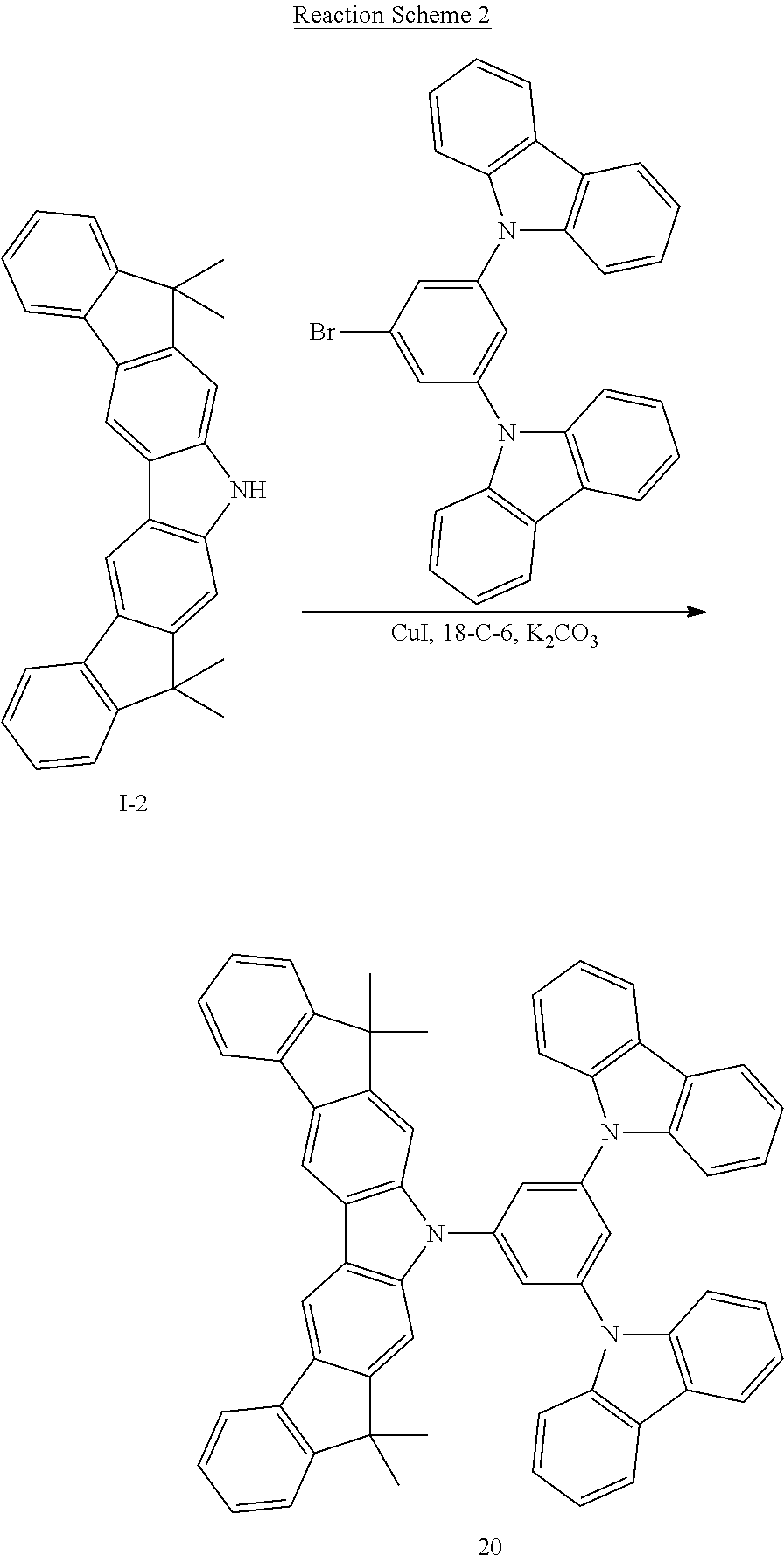

synthesized from carbazole. The produced compound was identified using 1H NMR and MS/FAB. C60H43N3:calc. 805.35. found 806.34.


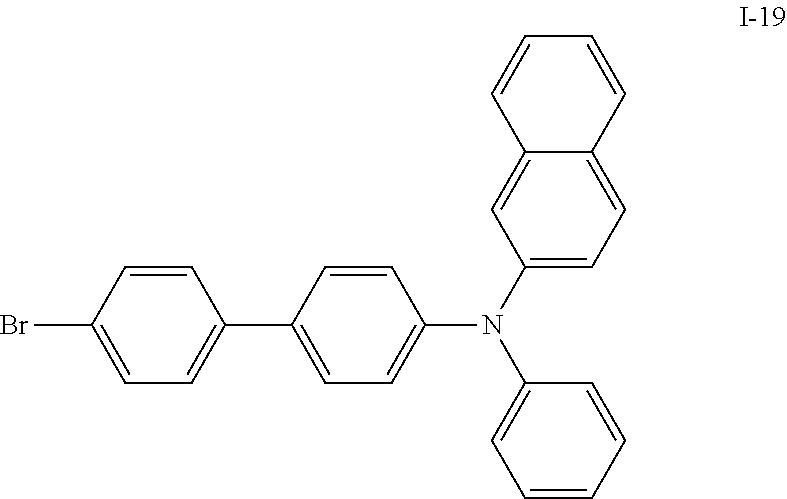


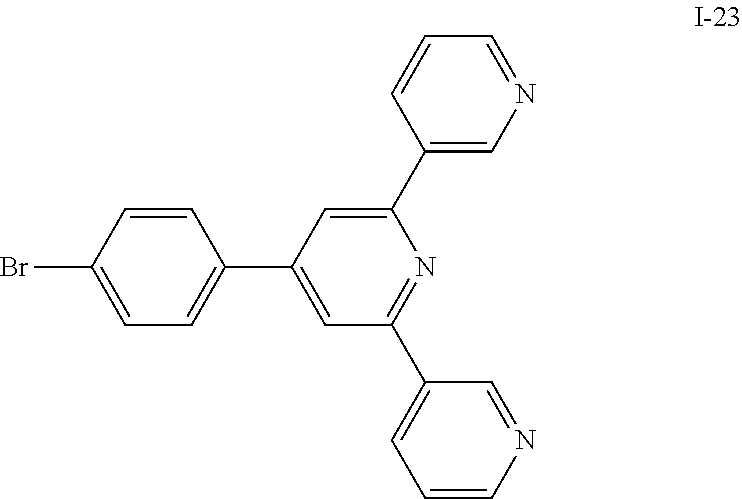


| TABLE 1 | |||||||
| Light | |||||||
| Driving | Current | emission | Color | ||||
| Emitting | voltage | density | Brightness | efficiency | (Color | ||
| material | (V) | (mA/cm2) | (cd/m2) | (cd/A) | coordinates) | ||
| Example 1 | Compound 3 | 6 | 17.63 | 3,737 | 21.2 | green |
| (0.30, 0.60) | ||||||
| Example 2 | Compound 20 | 6 | 15.22 | 2,480 | 16.3 | green |
| (0.31, 0.60) | ||||||
| Example 3 | Compound 52 | 6 | 13.25 | 2,610 | 19.7 | green |
| (0.30, 0.61) | ||||||
| Example 4 | Compound 60 | 6 | 19.87 | 4,669 | 23.5 | green |
| (0.30, 0.60) | ||||||
| Example 5 | Compound 68 | 6 | 21.56 | 4,894 | 22.7 | green |
| (0.30, 0.60) | ||||||
| Example 6 | Compound 72 | 6 | 20.12 | 4,748 | 23.6 | green |
| (0.30, 0.60) | ||||||
| Comparative | CBP | 6 | 11.17 | 1,268 | 11.35 | green |
| Example 1 | (0.30, 0.60) | |||||
Claims (24)


Applications Claiming Priority (2)
| Application Number | Priority Date | Filing Date | Title |
|---|---|---|---|
| KR1020110103057A KR101380335B1 (en) | 2011-10-10 | 2011-10-10 | Heterocyclic compound, organic light-emitting diode comprising the heterocyclic compound and flat display device comprising the organic light-emitting diode |
| KR10-2011-0103057 | 2011-10-10 |
Publications (2)
| Publication Number | Publication Date |
|---|---|
| US20130087768A1 US20130087768A1 (en) | 2013-04-11 |
| US9309197B2 true US9309197B2 (en) | 2016-04-12 |
Family
ID=46690429
Family Applications (1)
| Application Number | Title | Priority Date | Filing Date |
|---|---|---|---|
| US13/399,108 Active 2033-10-18 US9309197B2 (en) | 2011-10-10 | 2012-02-17 | Heterocyclic compound, organic light-emitting diode comprising the heterocyclic compound, and flat panel display device comprising the organic light-emitting diode |
Country Status (6)
| Country | Link |
|---|---|
| US (1) | US9309197B2 (en) |
| EP (1) | EP2581365B1 (en) |
| JP (1) | JP5964610B2 (en) |
| KR (1) | KR101380335B1 (en) |
| CN (1) | CN103030585B (en) |
| TW (1) | TWI582212B (en) |
Families Citing this family (26)
| Publication number | Priority date | Publication date | Assignee | Title |
|---|---|---|---|---|
| CN104177285A (en) * | 2013-05-28 | 2014-12-03 | 海洋王照明科技股份有限公司 | Bipolar blue light phosphorescent host material, preparation method and organic electroluminescent device thereof |
| CN103408568B (en) * | 2013-08-13 | 2015-02-04 | 武汉理工大学 | Condensed ring-structured dithieno [6,5-b:10,11-b']-8H-cyclopentano[1,2-b:4,3-b'] biphenanthrene derivative monomer and copolymer, and application thereof |
| KR102173044B1 (en) * | 2013-08-22 | 2020-11-03 | 삼성디스플레이 주식회사 | Heterocyclic compound and organic light emitting device comprising same |
| KR102191990B1 (en) * | 2013-09-10 | 2020-12-17 | 삼성디스플레이 주식회사 | Condensed compound and organic light emitting diode comprising the same |
| CN103524399B (en) * | 2013-10-21 | 2016-03-02 | 北京绿人科技有限责任公司 | A kind of organic compound and use the electroluminescent device of this organic compound |
| KR102191995B1 (en) * | 2013-10-22 | 2020-12-17 | 삼성디스플레이 주식회사 | Condensed compound and organic light emitting diode comprising the same |
| EP2907815B1 (en) | 2014-02-12 | 2023-12-06 | Samsung Electronics Co., Ltd. | Condensed cyclic compound and organic light-emitting device including the same |
| WO2016024637A1 (en) * | 2014-08-15 | 2016-02-18 | 出光興産株式会社 | Compound, organic electroluminescent device material, organic electroluminescent device, and electronic equipment |
| KR101803599B1 (en) | 2014-09-12 | 2017-12-01 | 주식회사 엘지화학 | Organic light emitting diode |
| KR101748942B1 (en) * | 2015-02-24 | 2017-06-20 | 주식회사 엘지화학 | Hetero-cyclic compound and organic light emitting device comprising the same |
| KR101883772B1 (en) * | 2015-03-20 | 2018-08-01 | 대주전자재료 주식회사 | Benzimidazole derivatives and organic electroluminescent device comprising same |
| WO2017025164A1 (en) * | 2015-08-11 | 2017-02-16 | Merck Patent Gmbh | Materials for organic electroluminescent devices |
| US10703762B2 (en) | 2015-08-28 | 2020-07-07 | Idemitsu Kosan Co., Ltd. | Compound, material for organic electroluminescence device, organic electroluminescence device and electronic apparatus |
| CN106467522A (en) * | 2016-07-25 | 2017-03-01 | 江苏三月光电科技有限公司 | A kind of organic electroluminescence device containing compound in triazine class and its application |
| CN106467516A (en) * | 2016-07-25 | 2017-03-01 | 江苏三月光电科技有限公司 | A kind of compound with triazine as core and its application on organic electroluminescence device |
| CN107880058A (en) * | 2016-09-30 | 2018-04-06 | 江苏三月光电科技有限公司 | A kind of compound containing benzheterocycle and its application in OLED |
| CN107964017A (en) * | 2016-10-19 | 2018-04-27 | 江苏三月光电科技有限公司 | Compound and organic electroluminescence device containing azepine triphenylene |
| WO2018080126A1 (en) * | 2016-10-24 | 2018-05-03 | 주식회사 엘지화학 | Heterocyclic compound and organic light-emitting device comprising same |
| KR102054397B1 (en) * | 2016-10-24 | 2019-12-10 | 주식회사 엘지화학 | Hetero-cyclic compound and organic light emitting device comprising the same |
| CN106674210A (en) * | 2016-12-23 | 2017-05-17 | 江苏三月光电科技有限公司 | Organic compounds using homobenzenes as core and application thereof in organic electroluminescent devices |
| KR102516057B1 (en) * | 2017-11-17 | 2023-03-31 | 삼성디스플레이 주식회사 | Organic light emitting device |
| KR102543684B1 (en) * | 2018-05-14 | 2023-06-16 | 덕산네오룩스 주식회사 | Compound for organic electronic element, organic electronic element using the same, and an electronic device thereof |
| KR102678514B1 (en) | 2018-12-05 | 2024-06-25 | 엘지디스플레이 주식회사 | Organic compounds, light emitting diode and light emitting device having the compounds |
| CN115135657B (en) | 2020-08-25 | 2024-10-01 | 株式会社Lg化学 | New compound and organic light-emitting device containing the same |
| CN115340489A (en) * | 2021-05-15 | 2022-11-15 | 石家庄诚志永华显示材料有限公司 | Amino cyclic compound, organic electroluminescent device, and organic electroluminescent device |
| CN116813531A (en) * | 2021-11-03 | 2023-09-29 | 台州观宇科技有限公司 | Carrier transport material and light-emitting device comprising same |
Citations (12)
| Publication number | Priority date | Publication date | Assignee | Title |
|---|---|---|---|---|
| US6465115B2 (en) | 1998-12-09 | 2002-10-15 | Eastman Kodak Company | Electroluminescent device with anthracene derivatives hole transport layer |
| US20030067266A1 (en) * | 2001-10-10 | 2003-04-10 | Lg. Philips Lcd Co., Ltd. | Organic electroluminescent device |
| US6596415B2 (en) | 1998-12-09 | 2003-07-22 | Eastman Kodak Company | Electroluminescent device with polyphenyl hydrocarbon hole transport layer |
| WO2009148015A1 (en) | 2008-06-05 | 2009-12-10 | 出光興産株式会社 | Halogen compound, polycyclic compound, and organic electroluminescence element comprising the polycyclic compound |
| US20090309488A1 (en) | 2008-06-05 | 2009-12-17 | Idemitsu Kosan Co., Ltd. | Material for organic electroluminescence device and organic electroluminescence device using the same |
| JP2010045281A (en) | 2008-08-18 | 2010-02-25 | Konica Minolta Holdings Inc | Organic electroluminescent element material, organic electroluminescent element, display, and lighting system |
| WO2010083871A1 (en) * | 2009-01-20 | 2010-07-29 | Merck Patent Gmbh | Compounds for electronic devices |
| KR20100105099A (en) | 2009-03-20 | 2010-09-29 | 다우어드밴스드디스플레이머티리얼 유한회사 | Novel organic electroluminescent compounds and organic electroluminescent device using the same |
| WO2010136109A1 (en) | 2009-05-29 | 2010-12-02 | Merck Patent Gmbh | Materials for organic electroluminescent devices |
| KR20110009920A (en) | 2009-07-23 | 2011-01-31 | 다우어드밴스드디스플레이머티리얼 유한회사 | Novel organic light emitting compound and organic electroluminescent device comprising same |
| WO2012013271A1 (en) | 2010-07-30 | 2012-02-02 | Merck Patent Gmbh | Organic electroluminescent device |
| KR20120065214A (en) | 2010-12-10 | 2012-06-20 | (주)씨에스엘쏠라 | Organic light compound and organic light device using the same |
Family Cites Families (3)
| Publication number | Priority date | Publication date | Assignee | Title |
|---|---|---|---|---|
| JP5238025B2 (en) * | 2008-06-05 | 2013-07-17 | 出光興産株式会社 | POLYCYCLIC COMPOUND AND ORGANIC ELECTROLUMINESCENT DEVICE USING SAME |
| KR101182438B1 (en) * | 2009-08-14 | 2012-09-12 | 삼성디스플레이 주식회사 | Organic light emitting device |
| JP5390441B2 (en) * | 2010-03-18 | 2014-01-15 | 新日鉄住金化学株式会社 | Organic electroluminescence device |
-
2011
- 2011-10-10 KR KR1020110103057A patent/KR101380335B1/en active Active
-
2012
- 2012-02-17 US US13/399,108 patent/US9309197B2/en active Active
- 2012-02-24 JP JP2012039197A patent/JP5964610B2/en active Active
- 2012-03-19 TW TW101109293A patent/TWI582212B/en active
- 2012-08-21 EP EP12181193.9A patent/EP2581365B1/en active Active
- 2012-09-07 CN CN201210347177.XA patent/CN103030585B/en active Active
Patent Citations (15)
| Publication number | Priority date | Publication date | Assignee | Title |
|---|---|---|---|---|
| US6596415B2 (en) | 1998-12-09 | 2003-07-22 | Eastman Kodak Company | Electroluminescent device with polyphenyl hydrocarbon hole transport layer |
| US6465115B2 (en) | 1998-12-09 | 2002-10-15 | Eastman Kodak Company | Electroluminescent device with anthracene derivatives hole transport layer |
| US20030067266A1 (en) * | 2001-10-10 | 2003-04-10 | Lg. Philips Lcd Co., Ltd. | Organic electroluminescent device |
| KR20110018340A (en) | 2008-06-05 | 2011-02-23 | 이데미쓰 고산 가부시키가이샤 | Halogen compounds, polycyclic compounds and organic electroluminescent devices using the same |
| WO2009148015A1 (en) | 2008-06-05 | 2009-12-10 | 出光興産株式会社 | Halogen compound, polycyclic compound, and organic electroluminescence element comprising the polycyclic compound |
| US20090309488A1 (en) | 2008-06-05 | 2009-12-17 | Idemitsu Kosan Co., Ltd. | Material for organic electroluminescence device and organic electroluminescence device using the same |
| JP2010045281A (en) | 2008-08-18 | 2010-02-25 | Konica Minolta Holdings Inc | Organic electroluminescent element material, organic electroluminescent element, display, and lighting system |
| WO2010083871A1 (en) * | 2009-01-20 | 2010-07-29 | Merck Patent Gmbh | Compounds for electronic devices |
| US20110266533A1 (en) * | 2009-01-20 | 2011-11-03 | Merck Patent Gmbh | Compounds for electronic devices |
| KR20100105099A (en) | 2009-03-20 | 2010-09-29 | 다우어드밴스드디스플레이머티리얼 유한회사 | Novel organic electroluminescent compounds and organic electroluminescent device using the same |
| WO2010136109A1 (en) | 2009-05-29 | 2010-12-02 | Merck Patent Gmbh | Materials for organic electroluminescent devices |
| US20120068170A1 (en) * | 2009-05-29 | 2012-03-22 | Merck Patent Gmbh | Materials for organic electroluminescent devices |
| KR20110009920A (en) | 2009-07-23 | 2011-01-31 | 다우어드밴스드디스플레이머티리얼 유한회사 | Novel organic light emitting compound and organic electroluminescent device comprising same |
| WO2012013271A1 (en) | 2010-07-30 | 2012-02-02 | Merck Patent Gmbh | Organic electroluminescent device |
| KR20120065214A (en) | 2010-12-10 | 2012-06-20 | (주)씨에스엘쏠라 | Organic light compound and organic light device using the same |
Non-Patent Citations (2)
| Title |
|---|
| European Search Report issued by European Patent Office on Oct. 5, 2012 in the examination of the EP Application No. 12181193.9. |
| Korean Office Action dated Dec. 18, 2012 issued by KIPO for the corresponding Korean Patent application 10-2011-0103057 with Request for Entry of the Accompanying Office Action. |
Also Published As
| Publication number | Publication date |
|---|---|
| JP5964610B2 (en) | 2016-08-03 |
| CN103030585B (en) | 2017-05-03 |
| KR20130039355A (en) | 2013-04-22 |
| US20130087768A1 (en) | 2013-04-11 |
| EP2581365B1 (en) | 2019-10-16 |
| EP2581365A1 (en) | 2013-04-17 |
| CN103030585A (en) | 2013-04-10 |
| KR101380335B1 (en) | 2014-04-10 |
| TW201315794A (en) | 2013-04-16 |
| TWI582212B (en) | 2017-05-11 |
| JP2013082662A (en) | 2013-05-09 |
Similar Documents
| Publication | Publication Date | Title |
|---|---|---|
| US9309197B2 (en) | Heterocyclic compound, organic light-emitting diode comprising the heterocyclic compound, and flat panel display device comprising the organic light-emitting diode | |
| US9362506B2 (en) | Heterocyclic compound and organic light-emitting device including the same | |
| US9564596B2 (en) | Heterocyclic compound and organic light-emitting device comprising same | |
| US9224961B2 (en) | Condensed-cyclic compound, organic light-emitting diode comprising the same and flat panel display device comprising the organic light-emitting diode | |
| US8344365B2 (en) | Organic light emitting device | |
| US9246109B2 (en) | Compound and organic light emitting device including the same | |
| KR101885696B1 (en) | Heterocyclic compound, organic light-emitting diode comprising the same and flat display device | |
| KR20120127683A (en) | Condensed-cyclic compound, organic light-emitting diode comprising the same and flat display device | |
| US9276218B2 (en) | Arylamine compound and organic light-emitting device comprising same | |
| US8771844B2 (en) | Heterocyclic compound and organic light-emitting diode and flat display device including the heterocyclic compound | |
| US8846213B2 (en) | Organic light-emitting device | |
| US9178162B2 (en) | Compound for organic light-emitting device and organic light-emitting device including the same | |
| KR101872407B1 (en) | Heterocyclic compound, organic light-emitting diode comprising the same and flat display device | |
| US9312497B2 (en) | Heterocyclic compound, organic light-emitting diode including the heterocyclic compound, and flat display device including the organic light-emitting diode | |
| KR101940103B1 (en) | Novel heterocyclic compound and organic light emitting device containing same | |
| US9437827B2 (en) | Heterocyclic compound and organic light-emitting device including the same | |
| US9640768B2 (en) | Heterocyclic compound and orgainic light-emitting device including the same | |
| US9444056B2 (en) | Heterocyclic compound and organic light-emitting device including the same |
Legal Events
| Date | Code | Title | Description |
|---|---|---|---|
| AS | Assignment |
Owner name: SAMSUNG MOBILE DISPLAY CO., LTD., A CORPORATION CH Free format text: ASSIGNMENT OF ASSIGNORS INTEREST;ASSIGNORS:KIM, YOUNG-KOOK;HWANG, SEOK-HWAN;JUNG, HYE-JIN;AND OTHERS;REEL/FRAME:028054/0779 Effective date: 20120214 |
|
| AS | Assignment |
Owner name: SAMSUNG DISPLAY CO., LTD., KOREA, REPUBLIC OF Free format text: MERGER;ASSIGNOR:SAMSUNG MOBILE DISPLAY CO., LTD.;REEL/FRAME:029241/0599 Effective date: 20120702 |
|
| FEPP | Fee payment procedure |
Free format text: PAYOR NUMBER ASSIGNED (ORIGINAL EVENT CODE: ASPN); ENTITY STATUS OF PATENT OWNER: LARGE ENTITY |
|
| STCF | Information on status: patent grant |
Free format text: PATENTED CASE |
|
| MAFP | Maintenance fee payment |
Free format text: PAYMENT OF MAINTENANCE FEE, 4TH YEAR, LARGE ENTITY (ORIGINAL EVENT CODE: M1551); ENTITY STATUS OF PATENT OWNER: LARGE ENTITY Year of fee payment: 4 |
|
| MAFP | Maintenance fee payment |
Free format text: PAYMENT OF MAINTENANCE FEE, 8TH YEAR, LARGE ENTITY (ORIGINAL EVENT CODE: M1552); ENTITY STATUS OF PATENT OWNER: LARGE ENTITY Year of fee payment: 8 |