US9295709B2 - Pharmaceutical composition comprising MicroRNA-30B, MicroRNA-133A, or MicroRNA-202-5P inhibitor for inhibiting cancer - Google Patents

Pharmaceutical composition comprising MicroRNA-30B, MicroRNA-133A, or MicroRNA-202-5P inhibitor for inhibiting cancer Download PDF

Info

Publication number
US9295709B2
US9295709B2 US14/625,137 US201514625137A US9295709B2 US 9295709 B2 US9295709 B2 US 9295709B2 US 201514625137 A US201514625137 A US 201514625137A US 9295709 B2 US9295709 B2 US 9295709B2
Authority
US
United States
Prior art keywords
microrna
cancer
pten
inhibitor
mirna
Prior art date
Legal status (The legal status is an assumption and is not a legal conclusion. Google has not performed a legal analysis and makes no representation as to the accuracy of the status listed.)
Active
Application number
US14/625,137
Other versions
US20150238564A1 (en
Inventor
You-Mie Lee
Su Young Oh
Current Assignee (The listed assignees may be inaccurate. Google has not performed a legal analysis and makes no representation or warranty as to the accuracy of the list.)
Industry Academic Cooperation Foundation of KNU
Original Assignee
Industry Academic Cooperation Foundation of KNU
Priority date (The priority date is an assumption and is not a legal conclusion. Google has not performed a legal analysis and makes no representation as to the accuracy of the date listed.)
Filing date
Publication date
Application filed by Industry Academic Cooperation Foundation of KNU filed Critical Industry Academic Cooperation Foundation of KNU
Assigned to KYUNGPOOK NATIONAL UNIVERSITY INDUSTRY-ACADEMIC COOPERATION FOUNDATION reassignment KYUNGPOOK NATIONAL UNIVERSITY INDUSTRY-ACADEMIC COOPERATION FOUNDATION ASSIGNMENT OF ASSIGNORS INTEREST (SEE DOCUMENT FOR DETAILS). Assignors: LEE, YOU-MIE, OH, SU YOUNG
Publication of US20150238564A1 publication Critical patent/US20150238564A1/en
Application granted granted Critical
Publication of US9295709B2 publication Critical patent/US9295709B2/en
Active legal-status Critical Current
Anticipated expiration legal-status Critical

Links

Images

Classifications

    • AHUMAN NECESSITIES
    • A61MEDICAL OR VETERINARY SCIENCE; HYGIENE
    • A61KPREPARATIONS FOR MEDICAL, DENTAL OR TOILETRY PURPOSES
    • A61K38/00Medicinal preparations containing peptides
    • A61K38/16Peptides having more than 20 amino acids; Gastrins; Somatostatins; Melanotropins; Derivatives thereof
    • AHUMAN NECESSITIES
    • A61MEDICAL OR VETERINARY SCIENCE; HYGIENE
    • A61PSPECIFIC THERAPEUTIC ACTIVITY OF CHEMICAL COMPOUNDS OR MEDICINAL PREPARATIONS
    • A61P35/00Antineoplastic agents
    • CCHEMISTRY; METALLURGY
    • C12BIOCHEMISTRY; BEER; SPIRITS; WINE; VINEGAR; MICROBIOLOGY; ENZYMOLOGY; MUTATION OR GENETIC ENGINEERING
    • C12NMICROORGANISMS OR ENZYMES; COMPOSITIONS THEREOF; PROPAGATING, PRESERVING, OR MAINTAINING MICROORGANISMS; MUTATION OR GENETIC ENGINEERING; CULTURE MEDIA
    • C12N15/00Mutation or genetic engineering; DNA or RNA concerning genetic engineering, vectors, e.g. plasmids, or their isolation, preparation or purification; Use of hosts therefor
    • C12N15/09Recombinant DNA-technology
    • C12N15/11DNA or RNA fragments; Modified forms thereof; Non-coding nucleic acids having a biological activity
    • C12N15/113Non-coding nucleic acids modulating the expression of genes, e.g. antisense oligonucleotides; Antisense DNA or RNA; Triplex- forming oligonucleotides; Catalytic nucleic acids, e.g. ribozymes; Nucleic acids used in co-suppression or gene silencing
    • CCHEMISTRY; METALLURGY
    • C12BIOCHEMISTRY; BEER; SPIRITS; WINE; VINEGAR; MICROBIOLOGY; ENZYMOLOGY; MUTATION OR GENETIC ENGINEERING
    • C12NMICROORGANISMS OR ENZYMES; COMPOSITIONS THEREOF; PROPAGATING, PRESERVING, OR MAINTAINING MICROORGANISMS; MUTATION OR GENETIC ENGINEERING; CULTURE MEDIA
    • C12N2310/00Structure or type of the nucleic acid
    • C12N2310/10Type of nucleic acid
    • C12N2310/11Antisense
    • C12N2310/113Antisense targeting other non-coding nucleic acids, e.g. antagomirs
    • CCHEMISTRY; METALLURGY
    • C12BIOCHEMISTRY; BEER; SPIRITS; WINE; VINEGAR; MICROBIOLOGY; ENZYMOLOGY; MUTATION OR GENETIC ENGINEERING
    • C12NMICROORGANISMS OR ENZYMES; COMPOSITIONS THEREOF; PROPAGATING, PRESERVING, OR MAINTAINING MICROORGANISMS; MUTATION OR GENETIC ENGINEERING; CULTURE MEDIA
    • C12N2310/00Structure or type of the nucleic acid
    • C12N2310/10Type of nucleic acid
    • C12N2310/14Type of nucleic acid interfering nucleic acids [NA]
    • C12N2310/141MicroRNAs, miRNAs
    • CCHEMISTRY; METALLURGY
    • C12BIOCHEMISTRY; BEER; SPIRITS; WINE; VINEGAR; MICROBIOLOGY; ENZYMOLOGY; MUTATION OR GENETIC ENGINEERING
    • C12NMICROORGANISMS OR ENZYMES; COMPOSITIONS THEREOF; PROPAGATING, PRESERVING, OR MAINTAINING MICROORGANISMS; MUTATION OR GENETIC ENGINEERING; CULTURE MEDIA
    • C12N2310/00Structure or type of the nucleic acid
    • C12N2310/30Chemical structure
    • C12N2310/31Chemical structure of the backbone
    • C12N2310/318Chemical structure of the backbone where the PO2 is completely replaced, e.g. MMI or formacetal
    • C12N2310/3181Peptide nucleic acid, PNA

Definitions

  • the present invention relates to an anticancer composition, and more particularly, to a pharmaceutical composition for inhibiting cancer, which includes a microRNA-30b, microRNA-133a, or microRNA-202-5p inhibitor as an active ingredient.
  • Cancer is a disease becoming the most major cause of death over the world, exceeding the death due to heart diseases and cerebrovascular diseases. According to the development of economy and changes in a lifestyle and an eating pattern, a type of occurring disease may be changed and cancer incidence increases, resulting in approximately 7,600,000 persons dying of cancer and 12,660,000 new cancer patients occurring in 2008. Therefore, there is a trend of consistent increases in the occurrence of cancer and a death rate caused by cancer. As the society is developed and the population is aging, it is expected that a burden of cancer occurrence will further increase and a cancer incidence in young people gradually increases due to a genetic cause and stress, and therefore the importance of preventing and treating cancer is further magnified. However, since there is no innovative cancer treating method such as development of an anticancer agent having an excellent effect and no side effect, the development of the innovative cancer treating method is urgently needed.
  • a method of inhibiting tumor and cancer cell proliferation by limiting supply of oxygen and nutrients is actively being developed.
  • expression of factors involved in glucose metabolism and angiogenesis among genes of tumors and cancer cells expressed in a hypoxia state and an adaptive mechanism to a surrounding microenvironment are important to understand growth and proliferation of tumors and cancer cells.
  • MicroRNAs are small non-coding RNAs inhibiting expression of a gene in post-transcriptional regulation.
  • MicroRNA has a hair pin structure formed of averagely 18 to 25 nucleotides.
  • MicroRNA complementarily binds to a 3′ UTR region of a target gene sequence, thereby inhibiting degradation of mRNA or translation to a protein, and approximately 5000 or more human genes are defined as targets of microRNA.
  • targets of microRNA As a result, depending on which target gene is regulated, the functions of microRNA in a living organism are diversified into cell differentiation and proliferation, genesis and metabolic regulation, angiogenesis, cell death, etc., and the importance of the role of microRNA is further emphasized and thus the research on microRNA is actively progressing.
  • microRNA expression patterns are reported in various types of cancer, and known to be involved in regulation of cancer promoters or cancer suppressors.
  • microRNA regulates angiogenesis and a new therapeutic method for inhibiting a vascular disease and cancer through such a mechanism is being proposed.
  • an anticancer drug for preventing formation of cancer cells in an early stage through a mechanism of regulating expression of cancer-relating genes by microRNA and suppressing angiogenesis induced by cancer.
  • PTEN phosphatase and tensin homologue
  • PIP3 phosphatidylinositol (3,4,5)-trisphosphate
  • the loss of PTEN reduces sensitivity to Fas, thereby inducing an autoimmune disease, and causes a genetic disease such as Cowden's disease or Lhermitte-Duclos disease, in addition to the occurrence of tumor. It shows that PTEN can play an important role in brain development as well as inhibition of cancer.
  • the inventors found specific microRNA associated with cancer suppression in a hypoxia environment without a side effect and have studied to find an effective composition for cancer treatment, and thus confirmed a recovery effect of inhibiting PTEN expression, in which PTEN is reduced in a hypoxia environment in liver cancer cells when microRNA-30b, microRNA-133a, or microRNA-202-5p is suppressed, resulting in completing the present invention.
  • the present invention is directed to providing a pharmaceutical composition for inhibiting cancer, which includes a microRNA-30b, microRNA-133a, or microRNA-202-5p inhibitor as an active ingredient.
  • a pharmaceutical composition for inhibiting cancer which includes an inhibitor with respect to at least one microRNA selected from the group consisting of microRNA-30b, microRNA-133a, and microRNA-202-5p as an active ingredient, is provided.
  • a method of preventing or treating cancer including administering a pharmaceutically-effective dose of the inhibitor to an individual is provided.
  • a method of using the inhibitor to prevent or treat cancer is provided.
  • the microRNA-30b is composed of a base sequence of SEQ. ID. NO: 1.
  • the microRNA-133a is composed of a base sequence of SEQ. ID. NO: 2.
  • the microRNA-202-5p is composed of a base sequence of SEQ. ID. NO: 3.
  • the inhibitor is a peptide nucleic acid (PNA), a small interfering RNA (siRNA), an aptamer, or an antisense RNA complementarily binding to microRNA.
  • PNA peptide nucleic acid
  • siRNA small interfering RNA
  • aptamer an aptamer
  • antisense RNA complementarily binding to microRNA.
  • the composition exhibits an anticancer effect due to recovery of PTEN expression suppressed in a hypoxia state.
  • the cancer is liver cancer.
  • FIG. 1 shows a result obtained by confirming changes in a PTEN protein expression level by microRNA-30b, microRNA-133a, and microRNA-202-5p inhibitors, and con indicates a control;
  • FIG. 2 is a diagram of a binding site between microRNA-30b and 3′-UTR of PTEN;
  • FIG. 3 is a diagram of a binding site between microRNA-202-5p and 3′-UTR of PTEN;
  • FIG. 4 is a diagram of a binding site between microRNA-133a and 3′-UTR of PTEN;
  • FIG. 5 shows a result obtained by confirming changes in expression of a PTEN protein inhibited in a hypoxia state by mimics of microRNA-30b, microRNA-133a, and microRNA-202-5p, and S indicates a scramble;
  • FIG. 6 shows a result obtained by confirming changes in expression of a PTEN mRNA inhibited in a hypoxia state by mimics of microRNA-30b, microRNA-133a, and microRNA-202-5p, and S indicates a scramble;
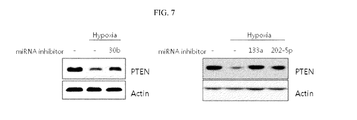
  • FIG. 7 shows a result obtained by confirming recovery of expression of a PTEN protein inhibited in a hypoxia state by microRNA-30b, microRNA-133a, and microRNA-202-5p inhibitors.
  • the present invention provides a pharmaceutical composition for inhibiting cancer, which includes a microRNA-30b, microRNA-133a, or microRNA-202-5p inhibitor as an active ingredient.
  • the inventors expected that when mRNA of PTEN was degraded or suppressed by binding microRNA-30b, microRNA-133a, or microRNA-202-5p to a 3′-UTR site of PTEN, the expression of a PTEN protein would be inhibited, and to this end, investigated whether miRNAs bound to the 3′-UTR site of PTEN using a miRNA target prediction program (DIANA, microrna) and sequence alignment (NCBI).
  • DIANA miRNA target prediction program
  • NCBI sequence alignment
  • the inventors conducted western blotting after the inhibitor and a homologue thereof were applied to liver cancer cell lines (HepG2) and a protein was extracted to confirm how the microRNA-30b, microRNA-133a, or microRNA-202-5p inhibitor and a homologue thereof affected reduced PTEN expression in cancer cells in a hypoxia state (refer to FIGS. 5 and 7 ).
  • the inhibitor increases expression of PTEN, which is a tumor suppressor, and thus is used as an effective therapeutic agent to prevent or treat cancer.
  • the inventors found that the microRNA-30b, microRNA-133a, and microRNA-202-5p serve to stimulate proliferation of a tumor tissue.
  • the results show that cancer cell metastasis and proliferation can be inhibited by inhibiting the microRNA-30b, microRNA-133a, and microRNA-202-5p, and therefore the microRNA-30b, microRNA-133a, and microRNA-202-5p can be effectively used to treat cancer.
  • the term “inhibitor” is a substance complementarily binding to the microRNA-30b, microRNA-133a, and microRNA-202-5p, and may be selected from the group consisting of a peptide nucleic acid (PNA), small interfering RNA (siRNA), an aptamer, and an antisense RNA.
  • PNA peptide nucleic acid
  • siRNA small interfering RNA
  • the inhibitor may be any substance inhibiting expression of miRNA, and thus the present invention is not limited thereto.
  • homologue used herein may be, but is not limited to, a double-stranded RNA oligonucleotide exhibiting the same activity as an endogenous microRNA.
  • anticancer refers to all actions relating to prevention and treatment of cancer, which includes an action of inhibiting proliferation of cancer cells or killing cancer cells, and inhibiting or preventing metastasis of cancer cells.
  • hypoxia state refers to state of decreasing oxygen in cells and tissues below a physiological level, for example, an optimal level.
  • the pharmaceutical composition of the present invention may include a pharmaceutically available carrier.
  • the pharmaceutically available carrier may be, but is not limited to, saline, polyethyleneglycol, ethanol, vegetable oil, or isopropyl myristate.
  • the present invention provides a method of treating cancer by administering a pharmaceutically effective dose of an anticancer composition including a microRNA-30b, microRNA-133a, or microRNA-202-5p inhibitor to an individual.
  • the “individual” used herein means a subject needing to be treated, and more specifically, human or non-human primates, and mammals including mice, rats, dogs, cats, horses, and cows.
  • the “pharmaceutically effective dose” used herein may be controlled in various ranges according to a patient's body weight, age, health condition, diet, administration time, administration method, excretion rate, and severity of a disease, which are clearly understood to one of ordinary skill in the art.
  • An exemplary administration dose of the pharmaceutical composition of the present invention may be suitably determined by one of ordinary skill in the art according to a condition and body weight of a patient, severity of a disease, drug type, administration route, and duration.
  • the composition may be administered at a dose of 0.001 to 100 mg/kg, and preferably, 0.01 to 30 mg/kg.
  • the administration may be performed once or several times a day.
  • the microRNA-30b, microRNA-133a, or microRNA-202-5p inhibitor of the present invention may be present at 0.0001 to 10 wt %, and preferably 0.001 to 1 wt % with respect to a total weight of the composition.
  • the pharmaceutical composition may be administered by various routes to mammals such as rats, mice, livestock, humans, etc. There is no limit to administration methods, and the composition may be administered by an oral, rectal, intravenous, intramuscular, subcutaneous, endometrial, or intracerebroventricular injection.
  • Liver cancer cell lines were added to a DMEM medium containing 10% fetal bovine serum (FBS) and 1% penicillin streptomycin, and cultured in a 37° C. constant temperature incubator with 5% carbon dioxide. When cells were sufficiently grown, the cells were incubated in a 10 cm 2 Petri dish for extraction of RNA (including microRNA) and separation of proteins. When separated into two culture containers, attached cells were detached from a culture container using Trypsin-EDTA, centrifuged at 1000 rpm for 5 minutes, and transferred to a new culture container by the same method as used for the attached cells. When maintained in a hypoxia state, the cells were incubated in an incubator in which 1% O 2 concentration was maintained for 24 hours.
  • FBS fetal bovine serum
  • penicillin streptomycin penicillin streptomycin
  • a lysis buffer (containing 25 mM of Tris, 1% (wt/vol) of Nonidet P-40, 0.25% of sodium deoxycholate, 150 mM of NaCl, 1 mM of EGTA, 1 mM of PMSF, 1 ⁇ g of aprotinin, leupeptin, pepstatin, 1 mM of Na 3 VO 4 , and 1 mM of NaF) was added to the liver cancer cell lines (HepG2) washed with PBS, and maintained on ice for 30 minutes. The resulting mixture was centrifuged at 15,000 rpm and 4° C. for 20 minutes, and a supernatant was taken, quantified, and then stored at ⁇ 70° C. for the next use.
  • a lysis buffer containing 25 mM of Tris, 1% (wt/vol) of Nonidet P-40, 0.25% of sodium deoxycholate, 150 mM of NaCl, 1 mM of EGTA, 1 mM
  • cell extracts were obtained to perform an SDS-containing polyacrylamide gel electrophoresis (SDS-PAGE). After the electrophoresis, transfer was performed onto a nitrocellulose filter at 90 V for 1 hour, and blocking was performed using 5% non-fat milk-containing TBS. Afterward, the filter was reacted with a primary antibody and a secondary antibody, and washed with 0.1% tween-20-containing TBS, and then detection was performed using an ECL detection kit.
  • the used primary antibody was diluted in a concentration of 1:1,000
  • the secondary antibody was diluted in a concentration of 1:5,000.
  • RNAs were separated using Trizol (BD bioscience). A concentration of the separated RNA from the liver cancer cell lines (HepG2) was confirmed, reverse-transcription of 1 ⁇ g of RNA was performed with 150 ng of a random primer, 4 mM of dNTP, 1 ⁇ l of RNasin, and 1 ⁇ l of M-MLV RTase at 37° C. for 1 hour. PCR was performed on cDNA obtained by the reverse transcription. 20 ⁇ l of a reaction solution was used for PCR for 30 to 35 cycles using a PCR machine, thereby obtaining a PCR product. The product was analyzed by electrophoresis.
  • microRNA target prediction program DIANA, microrna
  • NCBI sequence alignment program
  • Example 2 the inventors predicted that PTEN decreased in expression in cancer cells under a hypoxia condition would serve as a target gene of miRNA (miR-30b, miR-133a, or miR-202-5p), and the miRNA would bind to the 3′-UTR site of PTEN, thereby degrading or inhibiting mRNA of PTEN, and therefore the expression of the PTEN protein would be inhibited.
  • miRNA miR-30b, miR-133a, or miR-202-5p
  • DIANA miRNA target prediction program
  • NCBI sequence alignment program
  • HepG2 cells were treated with an miRNA mimic and total RNA was extracted to synthesize cDNA by reverse transcription. As a result of PCR, it was shown that there was no difference in change in mRNA of PTEN.
  • a pharmaceutical composition of the present invention can suppress microRNA-30b, microRNA-133a, or microRNA-202-5p, thereby inhibiting proliferation of cancer cells, and eventually, is expected to be useful for cancer treatment.

Landscapes

  • Health & Medical Sciences (AREA)
  • Life Sciences & Earth Sciences (AREA)
  • Engineering & Computer Science (AREA)
  • Genetics & Genomics (AREA)
  • Chemical & Material Sciences (AREA)
  • Bioinformatics & Cheminformatics (AREA)
  • Biomedical Technology (AREA)
  • General Health & Medical Sciences (AREA)
  • Organic Chemistry (AREA)
  • Wood Science & Technology (AREA)
  • Zoology (AREA)
  • General Engineering & Computer Science (AREA)
  • Biotechnology (AREA)
  • Molecular Biology (AREA)
  • Pharmacology & Pharmacy (AREA)
  • Medicinal Chemistry (AREA)
  • Public Health (AREA)
  • Animal Behavior & Ethology (AREA)
  • Veterinary Medicine (AREA)
  • Immunology (AREA)
  • Gastroenterology & Hepatology (AREA)
  • Epidemiology (AREA)
  • Proteomics, Peptides & Aminoacids (AREA)
  • Plant Pathology (AREA)
  • Microbiology (AREA)
  • Biophysics (AREA)
  • Biochemistry (AREA)
  • Physics & Mathematics (AREA)
  • Chemical Kinetics & Catalysis (AREA)
  • General Chemical & Material Sciences (AREA)
  • Nuclear Medicine, Radiotherapy & Molecular Imaging (AREA)
  • Pharmaceuticals Containing Other Organic And Inorganic Compounds (AREA)
  • Medicines That Contain Protein Lipid Enzymes And Other Medicines (AREA)

Abstract

Provided is an anticancer composition, and particularly, a pharmaceutical composition for inhibiting cancer, which includes a microRNA-30b, microRNA-133a, or microRNA-202-5p inhibitor as an active ingredient. The pharmaceutical composition may suppress microRNA-30b, microRNA-133a, or microRNA-202-5p, thereby inhibiting proliferation of cancer cells, and eventually, is expected to be useful for cancer treatment.

Description

STATEMENT REGARDING GOVERNMENT RIGHTS
This invention was made with government supports of the Republic of Korea under Contract Nos. 1220130 and 2012-007369 awarded by Korean Ministry of Health and Welfare, and the Ministry of Education, respectively. The government has certain rights in the invention.
CROSS-REFERENCE TO RELATED APPLICATION
This application claims priority to and the benefit of Korean Patent Application No. 2014-0020682, filed on Feb. 21, 2014, the disclosure of which is incorporated herein by reference in its entirety.
BACKGROUND
1. Field of the Invention
The present invention relates to an anticancer composition, and more particularly, to a pharmaceutical composition for inhibiting cancer, which includes a microRNA-30b, microRNA-133a, or microRNA-202-5p inhibitor as an active ingredient.
2. Discussion of Related Art
Cancer is a disease becoming the most major cause of death over the world, exceeding the death due to heart diseases and cerebrovascular diseases. According to the development of economy and changes in a lifestyle and an eating pattern, a type of occurring disease may be changed and cancer incidence increases, resulting in approximately 7,600,000 persons dying of cancer and 12,660,000 new cancer patients occurring in 2008. Therefore, there is a trend of consistent increases in the occurrence of cancer and a death rate caused by cancer. As the society is developed and the population is aging, it is expected that a burden of cancer occurrence will further increase and a cancer incidence in young people gradually increases due to a genetic cause and stress, and therefore the importance of preventing and treating cancer is further magnified. However, since there is no innovative cancer treating method such as development of an anticancer agent having an excellent effect and no side effect, the development of the innovative cancer treating method is urgently needed.
For example, a method of inhibiting tumor and cancer cell proliferation by limiting supply of oxygen and nutrients is actively being developed. To this end, expression of factors involved in glucose metabolism and angiogenesis among genes of tumors and cancer cells expressed in a hypoxia state and an adaptive mechanism to a surrounding microenvironment are important to understand growth and proliferation of tumors and cancer cells.
MicroRNAs (miRNAs) are small non-coding RNAs inhibiting expression of a gene in post-transcriptional regulation. MicroRNA has a hair pin structure formed of averagely 18 to 25 nucleotides. MicroRNA complementarily binds to a 3′ UTR region of a target gene sequence, thereby inhibiting degradation of mRNA or translation to a protein, and approximately 5000 or more human genes are defined as targets of microRNA. As a result, depending on which target gene is regulated, the functions of microRNA in a living organism are diversified into cell differentiation and proliferation, genesis and metabolic regulation, angiogenesis, cell death, etc., and the importance of the role of microRNA is further emphasized and thus the research on microRNA is actively progressing.
Modified microRNA expression patterns are reported in various types of cancer, and known to be involved in regulation of cancer promoters or cancer suppressors. In addition, it has also been found that microRNA regulates angiogenesis, and a new therapeutic method for inhibiting a vascular disease and cancer through such a mechanism is being proposed. There is an urgent need for developing an anticancer drug for preventing formation of cancer cells in an early stage through a mechanism of regulating expression of cancer-relating genes by microRNA and suppressing angiogenesis induced by cancer.
Meanwhile, PTEN (phosphatase and tensin homologue) is known as a representative tumor suppressor serving as a phosphatase with respect to a cell membrane phospholipid, that is, phosphatidylinositol (3,4,5)-trisphosphate (PIP3). It is known that when PTEN is lost or modified, a PIP3 pathway is excessively activated and thus occurrence of various cancers such as brain cancer, breast cancer, glioma, prostate cancer, endometrial cancer, etc. are stimulated. The loss of PTEN reduces sensitivity to Fas, thereby inducing an autoimmune disease, and causes a genetic disease such as Cowden's disease or Lhermitte-Duclos disease, in addition to the occurrence of tumor. It shows that PTEN can play an important role in brain development as well as inhibition of cancer.
However, a molecular-level action mechanism of PTEN and a target thereof have not been clearly known so far. Accordingly, identification of the action mechanism of PTEN and development of a new drug for specifically regulating the PTEN mechanism are very important in development of an anticancer drug.
SUMMARY OF THE INVENTION
Therefore, the inventors found specific microRNA associated with cancer suppression in a hypoxia environment without a side effect and have studied to find an effective composition for cancer treatment, and thus confirmed a recovery effect of inhibiting PTEN expression, in which PTEN is reduced in a hypoxia environment in liver cancer cells when microRNA-30b, microRNA-133a, or microRNA-202-5p is suppressed, resulting in completing the present invention.
The present invention is directed to providing a pharmaceutical composition for inhibiting cancer, which includes a microRNA-30b, microRNA-133a, or microRNA-202-5p inhibitor as an active ingredient.
However, technical objects to be achieved in the present invention are not limited to the above-described objects, and others that are not described herein will be clearly understood to one of ordinary skill in the art from the following descriptions.
In one aspect of the present invention, a pharmaceutical composition for inhibiting cancer, which includes an inhibitor with respect to at least one microRNA selected from the group consisting of microRNA-30b, microRNA-133a, and microRNA-202-5p as an active ingredient, is provided.
In another aspect of the present invention, a method of preventing or treating cancer including administering a pharmaceutically-effective dose of the inhibitor to an individual is provided.
In still another aspect of the present invention, a method of using the inhibitor to prevent or treat cancer is provided.
In one embodiment of the present invention, the microRNA-30b is composed of a base sequence of SEQ. ID. NO: 1.
In another embodiment of the present invention, the microRNA-133a is composed of a base sequence of SEQ. ID. NO: 2.
In still another embodiment of the present invention, the microRNA-202-5p is composed of a base sequence of SEQ. ID. NO: 3.
In yet another embodiment of the present invention, the inhibitor is a peptide nucleic acid (PNA), a small interfering RNA (siRNA), an aptamer, or an antisense RNA complementarily binding to microRNA.
In yet another embodiment of the present invention, the composition exhibits an anticancer effect due to recovery of PTEN expression suppressed in a hypoxia state.
In yet another embodiment of the present invention, the cancer is liver cancer.
BRIEF DESCRIPTION OF THE DRAWINGS
The above and other objects, features, and advantages of the present invention will become more apparent to those of ordinary skill in the art by describing in detail exemplary embodiments thereof with reference to the accompanying drawings, in which:
FIG. 1 shows a result obtained by confirming changes in a PTEN protein expression level by microRNA-30b, microRNA-133a, and microRNA-202-5p inhibitors, and con indicates a control;
FIG. 2 is a diagram of a binding site between microRNA-30b and 3′-UTR of PTEN;
FIG. 3 is a diagram of a binding site between microRNA-202-5p and 3′-UTR of PTEN;
FIG. 4 is a diagram of a binding site between microRNA-133a and 3′-UTR of PTEN;
FIG. 5 shows a result obtained by confirming changes in expression of a PTEN protein inhibited in a hypoxia state by mimics of microRNA-30b, microRNA-133a, and microRNA-202-5p, and S indicates a scramble;
FIG. 6 shows a result obtained by confirming changes in expression of a PTEN mRNA inhibited in a hypoxia state by mimics of microRNA-30b, microRNA-133a, and microRNA-202-5p, and S indicates a scramble; and
FIG. 7 shows a result obtained by confirming recovery of expression of a PTEN protein inhibited in a hypoxia state by microRNA-30b, microRNA-133a, and microRNA-202-5p inhibitors.
DETAILED DESCRIPTION OF EXEMPLARY EMBODIMENTS
The present invention provides a pharmaceutical composition for inhibiting cancer, which includes a microRNA-30b, microRNA-133a, or microRNA-202-5p inhibitor as an active ingredient.
Since it is known that expression of a tumor suppressor, that is, PTEN, is reduced in a hypoxia state, the inventors confirmed whether PTEN expression was regulated by obtaining a protein after liver cancer cell lines (HepG2) were treated with a miRNA inhibitor to investigate miRNA regulating the PTEN expression in a hypoxia state. As a result, when inhibitors for three kinds of miRNAs (miR-30b, miR-133a, miR-202-5p) were treated, it was confirmed that PTEN expression was increased in every case (refer to FIG. 1).
In addition, the inventors expected that when mRNA of PTEN was degraded or suppressed by binding microRNA-30b, microRNA-133a, or microRNA-202-5p to a 3′-UTR site of PTEN, the expression of a PTEN protein would be inhibited, and to this end, investigated whether miRNAs bound to the 3′-UTR site of PTEN using a miRNA target prediction program (DIANA, microrna) and sequence alignment (NCBI). As a result, binding of miR-30b and miR-202-5p was confirmed using the miRNA target prediction program (DIANA, microrna), and miR-133a binding was confirmed using the sequence alignment (NCBI) (refer to FIGS. 2 to 4).
Based on such results, the inventors conducted western blotting after the inhibitor and a homologue thereof were applied to liver cancer cell lines (HepG2) and a protein was extracted to confirm how the microRNA-30b, microRNA-133a, or microRNA-202-5p inhibitor and a homologue thereof affected reduced PTEN expression in cancer cells in a hypoxia state (refer to FIGS. 5 and 7).
As a result, it was seen that the inhibitor increases expression of PTEN, which is a tumor suppressor, and thus is used as an effective therapeutic agent to prevent or treat cancer.
Accordingly, the inventors found that the microRNA-30b, microRNA-133a, and microRNA-202-5p serve to stimulate proliferation of a tumor tissue. Eventually, the results show that cancer cell metastasis and proliferation can be inhibited by inhibiting the microRNA-30b, microRNA-133a, and microRNA-202-5p, and therefore the microRNA-30b, microRNA-133a, and microRNA-202-5p can be effectively used to treat cancer.
Mature sequences of the microRNA-30b, microRNA-133a, and microRNA-202-5p of the present invention are shown in Table 1.
TABLE 1
Gene Sequence No. Sequence (5′ -> 3′)
microRNA-30b SEQ. ID. NO: 1 UGUAAACAUCCUACACUCA
GCU
microRNA-133a SEQ. ID. NO: 2 UUUGGUCCCCUUCAACCAG
CUG
microRNA-202- SEQ. ID. NO: 3 UUCCUAUGCAUAUACUUCU
5p UUG
In the present invention, the term “inhibitor” is a substance complementarily binding to the microRNA-30b, microRNA-133a, and microRNA-202-5p, and may be selected from the group consisting of a peptide nucleic acid (PNA), small interfering RNA (siRNA), an aptamer, and an antisense RNA. However, the inhibitor may be any substance inhibiting expression of miRNA, and thus the present invention is not limited thereto.
The term “homologue” used herein may be, but is not limited to, a double-stranded RNA oligonucleotide exhibiting the same activity as an endogenous microRNA.
The term “anticancer” used herein refers to all actions relating to prevention and treatment of cancer, which includes an action of inhibiting proliferation of cancer cells or killing cancer cells, and inhibiting or preventing metastasis of cancer cells.
The term “hypoxia state” used herein refers to state of decreasing oxygen in cells and tissues below a physiological level, for example, an optimal level.
The pharmaceutical composition of the present invention may include a pharmaceutically available carrier. The pharmaceutically available carrier may be, but is not limited to, saline, polyethyleneglycol, ethanol, vegetable oil, or isopropyl myristate.
In addition, the present invention provides a method of treating cancer by administering a pharmaceutically effective dose of an anticancer composition including a microRNA-30b, microRNA-133a, or microRNA-202-5p inhibitor to an individual. The “individual” used herein means a subject needing to be treated, and more specifically, human or non-human primates, and mammals including mice, rats, dogs, cats, horses, and cows. In addition, the “pharmaceutically effective dose” used herein may be controlled in various ranges according to a patient's body weight, age, health condition, diet, administration time, administration method, excretion rate, and severity of a disease, which are clearly understood to one of ordinary skill in the art.
An exemplary administration dose of the pharmaceutical composition of the present invention may be suitably determined by one of ordinary skill in the art according to a condition and body weight of a patient, severity of a disease, drug type, administration route, and duration. However, the composition may be administered at a dose of 0.001 to 100 mg/kg, and preferably, 0.01 to 30 mg/kg. The administration may be performed once or several times a day. The microRNA-30b, microRNA-133a, or microRNA-202-5p inhibitor of the present invention may be present at 0.0001 to 10 wt %, and preferably 0.001 to 1 wt % with respect to a total weight of the composition.
The pharmaceutical composition may be administered by various routes to mammals such as rats, mice, livestock, humans, etc. There is no limit to administration methods, and the composition may be administered by an oral, rectal, intravenous, intramuscular, subcutaneous, endometrial, or intracerebroventricular injection.
Hereinafter, exemplary examples will be provided to help in understanding the present invention. However, the following examples are merely provided to more easily understand the present invention, not to limit the scope of the present invention.
EXAMPLES Example 1 Test Methods
1-1. Cell Culture and Hypoxia Treatment
Liver cancer cell lines (HepG2) were added to a DMEM medium containing 10% fetal bovine serum (FBS) and 1% penicillin streptomycin, and cultured in a 37° C. constant temperature incubator with 5% carbon dioxide. When cells were sufficiently grown, the cells were incubated in a 10 cm2 Petri dish for extraction of RNA (including microRNA) and separation of proteins. When separated into two culture containers, attached cells were detached from a culture container using Trypsin-EDTA, centrifuged at 1000 rpm for 5 minutes, and transferred to a new culture container by the same method as used for the attached cells. When maintained in a hypoxia state, the cells were incubated in an incubator in which 1% O2 concentration was maintained for 24 hours.
1-2. Transfection of miRNA Mimic
A mixture prepared by mixing a Hiperfect reagent (Qiagene), an miRNA mimic (Bioneer), and control miRNA (Bioneer) each at a concentration of 5 nM at room temperature for 15 minutes was transfected to the liver cancer cell lines (HepG2) incubated in Example 1-1. After 24 hours, the cell lines were incubated one more day in an incubator in a hypoxia state.
1-3. Transfection of miRNA Inhibitor
A mixture prepared by mixing a Hiperfect reagent (Qiagene) and 1 μM of an miRNA inhibitor (Panagene) at room temperature for 15 minutes was transfected to the liver cancer cell lines (HepG2) incubated in Example 1-1. After 24 hours, the cell lines were incubated one more day in an incubator in a hypoxia state.
1-4. Separation of Proteins
To separate a protein from a cell, a lysis buffer (containing 25 mM of Tris, 1% (wt/vol) of Nonidet P-40, 0.25% of sodium deoxycholate, 150 mM of NaCl, 1 mM of EGTA, 1 mM of PMSF, 1 μg of aprotinin, leupeptin, pepstatin, 1 mM of Na3VO4, and 1 mM of NaF) was added to the liver cancer cell lines (HepG2) washed with PBS, and maintained on ice for 30 minutes. The resulting mixture was centrifuged at 15,000 rpm and 4° C. for 20 minutes, and a supernatant was taken, quantified, and then stored at −70° C. for the next use.
1-5. Western Blot
According to each condition, cell extracts were obtained to perform an SDS-containing polyacrylamide gel electrophoresis (SDS-PAGE). After the electrophoresis, transfer was performed onto a nitrocellulose filter at 90 V for 1 hour, and blocking was performed using 5% non-fat milk-containing TBS. Afterward, the filter was reacted with a primary antibody and a secondary antibody, and washed with 0.1% tween-20-containing TBS, and then detection was performed using an ECL detection kit. Here, the used primary antibody was diluted in a concentration of 1:1,000, and the secondary antibody was diluted in a concentration of 1:5,000.
1-6. RT-PCR
To prevent RNA degradation caused by an RNase, which occurs easily, test materials and equipment, and a surface of a work station were sufficiently wiped with ethanol. Total RNAs were separated using Trizol (BD bioscience). A concentration of the separated RNA from the liver cancer cell lines (HepG2) was confirmed, reverse-transcription of 1 μg of RNA was performed with 150 ng of a random primer, 4 mM of dNTP, 1 μl of RNasin, and 1 μl of M-MLV RTase at 37° C. for 1 hour. PCR was performed on cDNA obtained by the reverse transcription. 20 μl of a reaction solution was used for PCR for 30 to 35 cycles using a PCR machine, thereby obtaining a PCR product. The product was analyzed by electrophoresis.
1-7. Prediction Program for microRNA-Target Gene Binding Sites
To predict binding sites between microRNA-30b, microRNA-133a and microRNA-202-5p, and a target gene PTEN, a microRNA target prediction program (DIANA, microrna) and a sequence alignment program (NCBI) were used.
Example 2 Screening of miRNA Targeting PTEN Gene
To screen miRNA regulating PTEN expression in a hypoxia state, according to Examples 1-1 to 1-5, HepG2 cells were treated with a PNAs™ miRNA inhibitor (PANAGENE) for 24 hours, thereby obtaining a protein, and western blotting was performed to confirm whether PTEN expression was regulated.
Consequently, as shown in FIG. 1, it was confirmed that PTEN expression increased in all cases that three types of miRNA (miR-30b, miR-133a, and miR-202-5p) inhibitors were treated.
Example 3 Detection of Binding of miRNA (miR-30b, miR-133a, miR-202-5p) with PTEN
According to Example 2, the inventors predicted that PTEN decreased in expression in cancer cells under a hypoxia condition would serve as a target gene of miRNA (miR-30b, miR-133a, or miR-202-5p), and the miRNA would bind to the 3′-UTR site of PTEN, thereby degrading or inhibiting mRNA of PTEN, and therefore the expression of the PTEN protein would be inhibited.
Accordingly, to confirm this, the binding of the miRNA to the 3′-UTR site of PTEN was detected using a miRNA target prediction program (DIANA, microrna) and a sequence alignment program (NCBI).
Consequently, as shown in FIGS. 2 to 4, it was confirmed that the binding site between 3′-UTR of mRNA of PTEN and miRNA (miR-30b, miR-133a, miR-202-5p) was conserved.
Example 4 Regulation of PTEN Expression by miRNA
To confirm an effect of miR-30b, miR-133a, and miR-202-5p on PTEN inhibited in expression due to hypoxia, HepG2 cells were treated with a mimic for each miRNA for 24 hours and incubated for 24 hours in a hypoxia state, and then an expression level of the PTEN protein was detected by western blotting. Here, as the miRNA mimic, an AccuTarget™ human miRNA mimic (BIONEER) was used.
Consequently, as shown in FIG. 5, it was confirmed that expression of the PTEN protein decreased by hypoxia treatment was further decreased or similar when the miRNA-30b, miR-133a, or miR-202-5p mimic was treated.
In addition, as shown in FIG. 6, HepG2 cells were treated with an miRNA mimic and total RNA was extracted to synthesize cDNA by reverse transcription. As a result of PCR, it was shown that there was no difference in change in mRNA of PTEN.
Example 5 Recovery of PTEN Inhibition by miRNA Inhibitor
To confirm an effect of miR-30b, miR-133a, and miR-202-5p on PTEN inhibited in expression due to hypoxia, HepG2 cells were treated with an inhibitor with respect to each miRNA for 24 hours and incubated for 24 hours in a hypoxia state, and then an expression level of the PTEN protein was detected by western blotting. Here, as the miRNA inhibitor, a PNAs™ miRNA inhibitor (PANAGENE) was used.
Consequently, as shown in FIG. 7, it was confirmed that expression of a PTEN protein reduced by a hypoxia treatment was recovered when an miRNA-30b, miR-133a, or miR-202-5p inhibitor was treated.
A pharmaceutical composition of the present invention can suppress microRNA-30b, microRNA-133a, or microRNA-202-5p, thereby inhibiting proliferation of cancer cells, and eventually, is expected to be useful for cancer treatment.
It will be apparent to those skilled in the art that various modifications can be made to the above-described exemplary embodiments of the present invention without departing from the spirit or scope of the invention. Thus, it is intended that the present invention covers all such modifications provided they come within the scope of the appended claims and their equivalents.

Claims (6)

What is claimed is:
1. A method for treating cancer by recovering phosphatase and tensin homologue (PTEN) expression inhibited in a hypoxia state in a subject in need thereof, comprising administering a pharmaceutically effective amount of an inhibitor to at least one microRNA selected from the group consisting of microRNA-30b, microRNA-133a, and microRNA-202-5p to the subject.
2. The method of claim 1, wherein the microRNA-30b is represented by a base sequence of SEQ. ID. NO: 1.
3. The method of claim 1, wherein the microRNA-133a is represented by a base sequence of SEQ. ID. NO: 2.
4. The method of claim 1, wherein the microRNA-202-5p is represented by a base sequence of SEQ. ID. NO: 3.
5. The method of claim 1, wherein the inhibitor is PNA (peptide nucleic acid), siRNA (small interfering RNA), an aptamer, or an antisense RNA complementarily binding to the microRNA.
6. The method of claim 1, wherein the cancer is liver cancer.
US14/625,137 2014-02-21 2015-02-18 Pharmaceutical composition comprising MicroRNA-30B, MicroRNA-133A, or MicroRNA-202-5P inhibitor for inhibiting cancer Active US9295709B2 (en)

Applications Claiming Priority (2)

Application Number Priority Date Filing Date Title
KR1020140020682A KR20150099125A (en) 2014-02-21 2014-02-21 Pharmaceutical composition comprising microRNA-30b, microRNA-133a, or microRNA-202-5p inhibitor for inhibiting cancer
KR10-2014-0020682 2014-02-21

Publications (2)

Publication Number Publication Date
US20150238564A1 US20150238564A1 (en) 2015-08-27
US9295709B2 true US9295709B2 (en) 2016-03-29

Family

ID=53881192

Family Applications (1)

Application Number Title Priority Date Filing Date
US14/625,137 Active US9295709B2 (en) 2014-02-21 2015-02-18 Pharmaceutical composition comprising MicroRNA-30B, MicroRNA-133A, or MicroRNA-202-5P inhibitor for inhibiting cancer

Country Status (2)

Country Link
US (1) US9295709B2 (en)
KR (1) KR20150099125A (en)

Families Citing this family (2)

* Cited by examiner, † Cited by third party
Publication number Priority date Publication date Assignee Title
US11618926B2 (en) 2017-02-28 2023-04-04 Baylor Research Institute Methods for diagnosing, prognosing, and treating colorectal cancer using biomarker expression
KR20190063816A (en) 2017-11-30 2019-06-10 고명국 the direction of the wind of a cold air drier

Citations (1)

* Cited by examiner, † Cited by third party
Publication number Priority date Publication date Assignee Title
WO2008061537A2 (en) * 2006-11-23 2008-05-29 Querdenker Aps Oligonucleotides for modulating target rna activity

Patent Citations (1)

* Cited by examiner, † Cited by third party
Publication number Priority date Publication date Assignee Title
WO2008061537A2 (en) * 2006-11-23 2008-05-29 Querdenker Aps Oligonucleotides for modulating target rna activity

Non-Patent Citations (2)

* Cited by examiner, † Cited by third party
Title
Chiba et al., MicroRNAs and Their Therapeutic Potential for Human Diseases: MiR-133a and Bronchial Smooth Muscle Hyperresponsiveness in Asthma. J Pharmacol Sci, 2010, 114:264-268.
Du et al., A high-throughput screen identifies miRNA inhibitors regulating lung cancer cell survival and response to paclitaxel. RNA Biology, 2013, 10(11):1700-1713.

Also Published As

Publication number Publication date
US20150238564A1 (en) 2015-08-27
KR20150099125A (en) 2015-08-31

Similar Documents

Publication Publication Date Title
JP7103653B2 (en) Compounds, compositions, methods and kits for telomere elongation
US9388411B2 (en) miRNA-212/132 family as a therapeutic target
Zhang et al. Schwann cell-derived CXCL2 contributes to cancer pain by modulating macrophage infiltration in a mouse breast cancer model
Arguello et al. CCAAT enhancer binding protein δ plays an essential role in memory consolidation and reconsolidation
KR101960592B1 (en) Composition for promoting proliferation, differentiation or anti-aging of stem cell using Janus kinase 1 inhibitor
Ma et al. TDAG8 activation attenuates cerebral ischaemia-reperfusion injury via Akt signalling in rats
JP2021506794A (en) Peptides and other drugs to treat pain and increase pain sensitivity
WO2017201425A1 (en) Anabolic enhancers for ameliorating neurodegeneration
US9295709B2 (en) Pharmaceutical composition comprising MicroRNA-30B, MicroRNA-133A, or MicroRNA-202-5P inhibitor for inhibiting cancer
US9879255B2 (en) Modulation of RNA activity and vascular permeability
Botta et al. Targeting and silencing of rhodopsin by ectopic expression of the transcription factor KLF15
US20240207211A1 (en) Composition for promoting bone formation or treating bone disease by acting on osteoblast mitochondria
HK1250243A1 (en) A method of treatment
KR101413581B1 (en) Compositon for preventing or treating cancer comprising miR-186, miR-216b, miR-337-3p and miR-760
KR102208777B1 (en) Composition comprising inhibitors of miR-210 for inhibiting age-related metabolic disease and its screening method
KR101890874B1 (en) A composition for repression of muscle-aging and regeneration of old muscle
US20240263175A1 (en) Composition for treating metastatic solid cancer, comprising tsg6 inhibitor
KR101721811B1 (en) Pharmaceutical composition comprising microRNA-30b, microRNA-133a, or microRNA-202-5p inhibitor for inhibiting cancer
EP3500665A1 (en) Control angiogenesis by regulating phosphorylation of seryl-trna synthetase (serrs)
KR20140143880A (en) Composition for Inhibiting Senescence of Adult Stem Cells By Increasing of miRNA Expression
KR101527749B1 (en) Compositon for anti-aging of cell comprising miR-186, miR-216b, miR-337-3p and miR-760
KR101613709B1 (en) Pharmaceutical Compositions for Inhibiting Invasion and Migration of Brain Cancer
US9012426B2 (en) Pharmaceutical anti-angiogenic composition including a MicroRNA-382 inhibitor
KR102095298B1 (en) Reagent composition for inhibiting Ninj1 comprising microRNA
KR101559131B1 (en) Composition comprising miRNA for enhancing radiation sensitivity

Legal Events

Date Code Title Description
AS Assignment

Owner name: KYUNGPOOK NATIONAL UNIVERSITY INDUSTRY-ACADEMIC CO

Free format text: ASSIGNMENT OF ASSIGNORS INTEREST;ASSIGNORS:LEE, YOU-MIE;OH, SU YOUNG;REEL/FRAME:035024/0303

Effective date: 20150204

STCF Information on status: patent grant

Free format text: PATENTED CASE

MAFP Maintenance fee payment

Free format text: PAYMENT OF MAINTENANCE FEE, 4TH YR, SMALL ENTITY (ORIGINAL EVENT CODE: M2551); ENTITY STATUS OF PATENT OWNER: SMALL ENTITY

Year of fee payment: 4

MAFP Maintenance fee payment

Free format text: PAYMENT OF MAINTENANCE FEE, 8TH YR, SMALL ENTITY (ORIGINAL EVENT CODE: M2552); ENTITY STATUS OF PATENT OWNER: SMALL ENTITY

Year of fee payment: 8