US9284301B2 - Soluble guanylate cyclase activators - Google Patents
Soluble guanylate cyclase activators Download PDFInfo
- Publication number
- US9284301B2 US9284301B2 US13/636,760 US201113636760A US9284301B2 US 9284301 B2 US9284301 B2 US 9284301B2 US 201113636760 A US201113636760 A US 201113636760A US 9284301 B2 US9284301 B2 US 9284301B2
- Authority
- US
- United States
- Prior art keywords
- trifluorobenzyl
- indazol
- diamine
- pyrimidine
- pyrimidin
- Prior art date
- Legal status (The legal status is an assumption and is not a legal conclusion. Google has not performed a legal analysis and makes no representation as to the accuracy of the status listed.)
- Active
Links
- 0 *.CC.[2*]CC.[3*]C1=NC(C)=NC([4*])=C1C Chemical compound *.CC.[2*]CC.[3*]C1=NC(C)=NC([4*])=C1C 0.000 description 18
- IUHGKMWPFHHMBL-UHFFFAOYSA-N CC1=NN(C)C(C)=C1C(C)(C)C Chemical compound CC1=NN(C)C(C)=C1C(C)(C)C IUHGKMWPFHHMBL-UHFFFAOYSA-N 0.000 description 10
- YSHMQTRICHYLGF-UHFFFAOYSA-N CC(C)(C)C1=CC=NC=C1 Chemical compound CC(C)(C)C1=CC=NC=C1 YSHMQTRICHYLGF-UHFFFAOYSA-N 0.000 description 9
- FBUIIWHYTLCORM-UHFFFAOYSA-N CC(C)(C)C1=CN=CC=C1 Chemical compound CC(C)(C)C1=CN=CC=C1 FBUIIWHYTLCORM-UHFFFAOYSA-N 0.000 description 8
- IZDMRLFXYJMCNI-UHFFFAOYSA-N CC1=NC=CC(C(C)(C)C)=C1 Chemical compound CC1=NC=CC(C(C)(C)C)=C1 IZDMRLFXYJMCNI-UHFFFAOYSA-N 0.000 description 7
- IITKWGKDJKDQGU-UHFFFAOYSA-N COC1=C(C(C)(C)C)C=NC=C1 Chemical compound COC1=C(C(C)(C)C)C=NC=C1 IITKWGKDJKDQGU-UHFFFAOYSA-N 0.000 description 7
- QIFTVUYJIAGLGM-UHFFFAOYSA-N COC1=NC=CC=C1C(C)(C)C Chemical compound COC1=NC=CC=C1C(C)(C)C QIFTVUYJIAGLGM-UHFFFAOYSA-N 0.000 description 7
- ULNYBEWVPVWLSM-UHFFFAOYSA-N CC(C)(C)C1=CC(S(C)(=O)=O)=CC=C1 Chemical compound CC(C)(C)C1=CC(S(C)(=O)=O)=CC=C1 ULNYBEWVPVWLSM-UHFFFAOYSA-N 0.000 description 6
- CTAHUBJYOLFLMJ-UHFFFAOYSA-N CC(C)(C)C1=CC(C(F)(F)F)=CN=C1 Chemical compound CC(C)(C)C1=CC(C(F)(F)F)=CN=C1 CTAHUBJYOLFLMJ-UHFFFAOYSA-N 0.000 description 5
- LQPBCTIYMIBHNL-UHFFFAOYSA-N CC(C)(C)C1=CC(F)=CN=C1 Chemical compound CC(C)(C)C1=CC(F)=CN=C1 LQPBCTIYMIBHNL-UHFFFAOYSA-N 0.000 description 5
- JLVLTMGMNOWYKX-UHFFFAOYSA-N CN1C=C(C(C)(C)C)C=N1 Chemical compound CN1C=C(C(C)(C)C)C=N1 JLVLTMGMNOWYKX-UHFFFAOYSA-N 0.000 description 5
- CWVYYJOLOZEZOF-UHFFFAOYSA-N CC(C)(C)C1=C2C=CC=NC2=CC=C1 Chemical compound CC(C)(C)C1=C2C=CC=NC2=CC=C1 CWVYYJOLOZEZOF-UHFFFAOYSA-N 0.000 description 4
- CYWZUCFPMYCJJR-UHFFFAOYSA-N CC(C)(C)C1=C2C=CNC2=NC=C1 Chemical compound CC(C)(C)C1=C2C=CNC2=NC=C1 CYWZUCFPMYCJJR-UHFFFAOYSA-N 0.000 description 4
- HKEAMRLYHZZXIG-UHFFFAOYSA-N CC1=C(C(C)(C)C)C=NC=C1 Chemical compound CC1=C(C(C)(C)C)C=NC=C1 HKEAMRLYHZZXIG-UHFFFAOYSA-N 0.000 description 4
- SVSBKIAWZGIZCO-UHFFFAOYSA-N CC1=NC=C(C(C)(C)C)C=N1 Chemical compound CC1=NC=C(C(C)(C)C)C=N1 SVSBKIAWZGIZCO-UHFFFAOYSA-N 0.000 description 4
- SEBHBUWHGURXIF-UHFFFAOYSA-N CC1=NOC(C)=C1C(C)(C)C Chemical compound CC1=NOC(C)=C1C(C)(C)C SEBHBUWHGURXIF-UHFFFAOYSA-N 0.000 description 4
- ALCTZBPSAKAYDD-UHFFFAOYSA-N CN1N=CC=C1C(C)(C)C Chemical compound CN1N=CC=C1C(C)(C)C ALCTZBPSAKAYDD-UHFFFAOYSA-N 0.000 description 4
- GJEHHBNUJBVQSL-UHFFFAOYSA-N COC1=NC=CC(C(C)(C)C)=C1 Chemical compound COC1=NC=CC(C(C)(C)C)=C1 GJEHHBNUJBVQSL-UHFFFAOYSA-N 0.000 description 4
- BBZDLDNXVLLOKX-UHFFFAOYSA-N CC(C)(C)C1=C(F)C=NC=C1 Chemical compound CC(C)(C)C1=C(F)C=NC=C1 BBZDLDNXVLLOKX-UHFFFAOYSA-N 0.000 description 3
- FUDRERWFWQEEKY-UHFFFAOYSA-N CC(C)(C)C1=CC(C(F)(F)F)=NC=C1 Chemical compound CC(C)(C)C1=CC(C(F)(F)F)=NC=C1 FUDRERWFWQEEKY-UHFFFAOYSA-N 0.000 description 3
- GIWOYKOWKBZXPO-UHFFFAOYSA-N CC(C)(C)C1=CN=C(F)C=C1 Chemical compound CC(C)(C)C1=CN=C(F)C=C1 GIWOYKOWKBZXPO-UHFFFAOYSA-N 0.000 description 3
- QBWHFKOHEXJZSV-UHFFFAOYSA-N CC1=C(C(C)(C)C)C=NN1C Chemical compound CC1=C(C(C)(C)C)C=NN1C QBWHFKOHEXJZSV-UHFFFAOYSA-N 0.000 description 3
- WGZWEEHVPCGJOR-UHFFFAOYSA-N CC1=C(C)C(C)=C(C(C)(C)C)C(C)=C1C Chemical compound CC1=C(C)C(C)=C(C(C)(C)C)C(C)=C1C WGZWEEHVPCGJOR-UHFFFAOYSA-N 0.000 description 3
- QZRPGMSGDHVDIS-UHFFFAOYSA-N CC1=CC(C(C)(C)C)=CN=C1 Chemical compound CC1=CC(C(C)(C)C)=CN=C1 QZRPGMSGDHVDIS-UHFFFAOYSA-N 0.000 description 3
- MEVKSWKZBZQIPL-UHFFFAOYSA-N COC1=CC=CC(C(C)(C)C)=N1 Chemical compound COC1=CC=CC(C(C)(C)C)=N1 MEVKSWKZBZQIPL-UHFFFAOYSA-N 0.000 description 3
- DVTUJXCNAXEPEY-UHFFFAOYSA-N CC(C)(C)C1=CC(C(F)(F)F)=NC2=C1C=CC=C2 Chemical compound CC(C)(C)C1=CC(C(F)(F)F)=NC2=C1C=CC=C2 DVTUJXCNAXEPEY-UHFFFAOYSA-N 0.000 description 2
- MKEUSJZGHJDRHG-UHFFFAOYSA-N CC(C)(C)C1=CC=C(N)N=C1 Chemical compound CC(C)(C)C1=CC=C(N)N=C1 MKEUSJZGHJDRHG-UHFFFAOYSA-N 0.000 description 2
- OJSYLXFMJBEMIP-UHFFFAOYSA-N CC(C)(C)C1=CC=NC2=CC=CC=C21 Chemical compound CC(C)(C)C1=CC=NC2=CC=CC=C21 OJSYLXFMJBEMIP-UHFFFAOYSA-N 0.000 description 2
- RNJGLDVYTATINF-UHFFFAOYSA-N CC(C)(C)C1=CN=CN=C1 Chemical compound CC(C)(C)C1=CN=CN=C1 RNJGLDVYTATINF-UHFFFAOYSA-N 0.000 description 2
- YNQZVOWNJKASKQ-UHFFFAOYSA-N CC(C)(C)C1=NC=CN=C1 Chemical compound CC(C)(C)C1=NC=CN=C1 YNQZVOWNJKASKQ-UHFFFAOYSA-N 0.000 description 2
- UZBRJFVQAJMRNM-UHFFFAOYSA-N CC1=C(C(C)(C)C)C(C(F)(F)F)=NN1C Chemical compound CC1=C(C(C)(C)C)C(C(F)(F)F)=NN1C UZBRJFVQAJMRNM-UHFFFAOYSA-N 0.000 description 2
- VKTZYNDQZGTFEL-UHFFFAOYSA-N CC1=C(C(C)(C)C)SC(C2=CC=CC=C2)=N1 Chemical compound CC1=C(C(C)(C)C)SC(C2=CC=CC=C2)=N1 VKTZYNDQZGTFEL-UHFFFAOYSA-N 0.000 description 2
- UNSFKPRPICHULQ-UHFFFAOYSA-N CC1=CC=C(C(C)(C)C)C=N1 Chemical compound CC1=CC=C(C(C)(C)C)C=N1 UNSFKPRPICHULQ-UHFFFAOYSA-N 0.000 description 2
- LHUREBCKYRVCIS-UHFFFAOYSA-N CC1=NC=CC(C2=C(N)N=C(C3=C4C=CC=NN4C(CC4=C(F)C(F)=CC=C4F)=N3)N=C2)=C1 Chemical compound CC1=NC=CC(C2=C(N)N=C(C3=C4C=CC=NN4C(CC4=C(F)C(F)=CC=C4F)=N3)N=C2)=C1 LHUREBCKYRVCIS-UHFFFAOYSA-N 0.000 description 2
- FLAVWRKXIYPOCS-UHFFFAOYSA-N CC1=NC=CC=C1C(C)(C)C Chemical compound CC1=NC=CC=C1C(C)(C)C FLAVWRKXIYPOCS-UHFFFAOYSA-N 0.000 description 2
- RNLKTCXLKRWXQB-UHFFFAOYSA-N CC1=NN(C)C=C1C(C)(C)C Chemical compound CC1=NN(C)C=C1C(C)(C)C RNLKTCXLKRWXQB-UHFFFAOYSA-N 0.000 description 2
- MKXZJNKTWPBJPQ-UHFFFAOYSA-N CN1C=C(C2=C(N)N=C(N3N=C(CC4=C(F)C(F)=CC=C4F)C4=C3C=CC=N4)N=C2N)C=N1 Chemical compound CN1C=C(C2=C(N)N=C(N3N=C(CC4=C(F)C(F)=CC=C4F)C4=C3C=CC=N4)N=C2N)C=N1 MKXZJNKTWPBJPQ-UHFFFAOYSA-N 0.000 description 2
- WZBJERSVCYIMEC-UHFFFAOYSA-N COC(=O)N(C)C1=C(N)N=C(N2N=C(CC3=C(F)C(F)=CC=C3F)C3=C2C=CC(C2=CC=CC=C2)=C3)N=C1N Chemical compound COC(=O)N(C)C1=C(N)N=C(N2N=C(CC3=C(F)C(F)=CC=C3F)C3=C2C=CC(C2=CC=CC=C2)=C3)N=C1N WZBJERSVCYIMEC-UHFFFAOYSA-N 0.000 description 2
- LTOZBOCLXXPCOF-UHFFFAOYSA-N COC1=CC=C(C(C)(C)C)C=N1 Chemical compound COC1=CC=C(C(C)(C)C)C=N1 LTOZBOCLXXPCOF-UHFFFAOYSA-N 0.000 description 2
- MMCQMOJHUHBSSA-UHFFFAOYSA-N COC1=CN=CC(C(C)(C)C)=C1 Chemical compound COC1=CN=CC(C(C)(C)C)=C1 MMCQMOJHUHBSSA-UHFFFAOYSA-N 0.000 description 2
- KBPRYBBHGOQSGR-UHFFFAOYSA-N COC1=NC(OC)=C(C(C)(C)C)C=C1 Chemical compound COC1=NC(OC)=C(C(C)(C)C)C=C1 KBPRYBBHGOQSGR-UHFFFAOYSA-N 0.000 description 2
- ZAKAMJDRGXTBHK-UHFFFAOYSA-N CSC(=O)N(C)C1=C(N)N=C(N2N=C(CC3=C(F)C(F)=CC(F)=C3)C3=C2C=CC=C3)N=C1N Chemical compound CSC(=O)N(C)C1=C(N)N=C(N2N=C(CC3=C(F)C(F)=CC(F)=C3)C3=C2C=CC=C3)N=C1N ZAKAMJDRGXTBHK-UHFFFAOYSA-N 0.000 description 2
- CQCGDDZOELNXMC-UHFFFAOYSA-N BrC1=C(I)N=C(I)N=C1.C1CCOC1.ClC1=NC(Cl)=C(Br)C=N1.NC1=C(Br)C=NC(I)=N1 Chemical compound BrC1=C(I)N=C(I)N=C1.C1CCOC1.ClC1=NC(Cl)=C(Br)C=N1.NC1=C(Br)C=NC(I)=N1 CQCGDDZOELNXMC-UHFFFAOYSA-N 0.000 description 1
- FEJVLBQMGJQVCB-UHFFFAOYSA-N C#CC1CCCC1.CCOC.CON(C)C(=O)C1=C(Br)C=CC=C1.Cl.NC1=NC(N2N=C(CCC3CCCC3)C3=CC=CC=C32)=NC(N)=C1C1=CN=CC=C1.O=C(C#CC1CCCC1)C1=C(Br)C=CC=C1.O=C(CCC1CCCC1)C1=C(Br)C=CC=C1.O=C(Cl)C1=C(Br)C=CC=C1 Chemical compound C#CC1CCCC1.CCOC.CON(C)C(=O)C1=C(Br)C=CC=C1.Cl.NC1=NC(N2N=C(CCC3CCCC3)C3=CC=CC=C32)=NC(N)=C1C1=CN=CC=C1.O=C(C#CC1CCCC1)C1=C(Br)C=CC=C1.O=C(CCC1CCCC1)C1=C(Br)C=CC=C1.O=C(Cl)C1=C(Br)C=CC=C1 FEJVLBQMGJQVCB-UHFFFAOYSA-N 0.000 description 1
- QCGGSQCLHNFDAK-UHFFFAOYSA-N C.CNC=O Chemical compound C.CNC=O QCGGSQCLHNFDAK-UHFFFAOYSA-N 0.000 description 1
- VFIXRIMHUSJUAA-UHFFFAOYSA-N C.CS(=O)(=O)C1=NC(NCC2=CC=CC=C2)=CC(Cl)=N1.CSC1=NC(Cl)=CC(Cl)=N1.CSC1=NC(NCC2=CC=CC=C2)=CC(Cl)=N1.N=N.NNC1=NC(NCC2=CC=CC=C2)=CC(Cl)=N1.O.[HH] Chemical compound C.CS(=O)(=O)C1=NC(NCC2=CC=CC=C2)=CC(Cl)=N1.CSC1=NC(Cl)=CC(Cl)=N1.CSC1=NC(NCC2=CC=CC=C2)=CC(Cl)=N1.N=N.NNC1=NC(NCC2=CC=CC=C2)=CC(Cl)=N1.O.[HH] VFIXRIMHUSJUAA-UHFFFAOYSA-N 0.000 description 1
- WMSNJPHSNYDEEO-BBEAXDHJSA-L C1=CN=NC=C1.CC1=CC=C(S(=O)(=O)N2N=CC=CC2C#N)C=C1.Cl[Al](Cl)Cl.N#CC1=NN=CC=C1.[2H]B[U].[Cl-].[HH].[NH3+]CC1=NN=CC=C1 Chemical compound C1=CN=NC=C1.CC1=CC=C(S(=O)(=O)N2N=CC=CC2C#N)C=C1.Cl[Al](Cl)Cl.N#CC1=NN=CC=C1.[2H]B[U].[Cl-].[HH].[NH3+]CC1=NN=CC=C1 WMSNJPHSNYDEEO-BBEAXDHJSA-L 0.000 description 1
- JBPLPUUCSGPIJL-UHFFFAOYSA-N CC(=O)NC1=NC=C(C(C)(C)C)C=C1 Chemical compound CC(=O)NC1=NC=C(C(C)(C)C)C=C1 JBPLPUUCSGPIJL-UHFFFAOYSA-N 0.000 description 1
- XYMLDPUBRVMPDS-UHFFFAOYSA-N CC(C)(C)C1=C(F)C(N2CCOCC2)=NC=C1 Chemical compound CC(C)(C)C1=C(F)C(N2CCOCC2)=NC=C1 XYMLDPUBRVMPDS-UHFFFAOYSA-N 0.000 description 1
- SYJMHBADMLZFGF-UHFFFAOYSA-N CC(C)(C)C1=C(S(C)(=O)=O)C=CC=C1 Chemical compound CC(C)(C)C1=C(S(C)(=O)=O)C=CC=C1 SYJMHBADMLZFGF-UHFFFAOYSA-N 0.000 description 1
- MMXWNYGZQMLBJR-UHFFFAOYSA-N CC(C)(C)C1=C2C=C(F)C=CC2=NC=C1 Chemical compound CC(C)(C)C1=C2C=C(F)C=CC2=NC=C1 MMXWNYGZQMLBJR-UHFFFAOYSA-N 0.000 description 1
- OARLBEHCEUPALA-UHFFFAOYSA-N CC(C)(C)C1=C2C=CC(F)=CC2=NC=C1 Chemical compound CC(C)(C)C1=C2C=CC(F)=CC2=NC=C1 OARLBEHCEUPALA-UHFFFAOYSA-N 0.000 description 1
- LLQPELYFCPYKRR-UHFFFAOYSA-N CC(C)(C)C1=CC(N)=NC=C1 Chemical compound CC(C)(C)C1=CC(N)=NC=C1 LLQPELYFCPYKRR-UHFFFAOYSA-N 0.000 description 1
- GDVBYKVCYFXQHV-UHFFFAOYSA-N CC(C)(C)C1=CC2=C(C=CC=C2)N=C1F Chemical compound CC(C)(C)C1=CC2=C(C=CC=C2)N=C1F GDVBYKVCYFXQHV-UHFFFAOYSA-N 0.000 description 1
- FUWLWBDNQPTINE-UHFFFAOYSA-N CC(C)(C)C1=CC2=C(C=CC=C2)N=C1O Chemical compound CC(C)(C)C1=CC2=C(C=CC=C2)N=C1O FUWLWBDNQPTINE-UHFFFAOYSA-N 0.000 description 1
- IJCUWQJHCMMQRC-UHFFFAOYSA-N CC(C)(C)C1=CC=C(S(C)(=O)=O)C=C1 Chemical compound CC(C)(C)C1=CC=C(S(C)(=O)=O)C=C1 IJCUWQJHCMMQRC-UHFFFAOYSA-N 0.000 description 1
- RLMVHQJRMMRIBA-UHFFFAOYSA-N CC(C)(C)C1=CN=CC=C1F Chemical compound CC(C)(C)C1=CN=CC=C1F RLMVHQJRMMRIBA-UHFFFAOYSA-N 0.000 description 1
- UUIMDJFBHNDZOW-UHFFFAOYSA-N CC(C)(C)C1=NC=CC=C1 Chemical compound CC(C)(C)C1=NC=CC=C1 UUIMDJFBHNDZOW-UHFFFAOYSA-N 0.000 description 1
- SVGNGCCLNRYOJL-UHFFFAOYSA-N CC(C)(C)C1=NC=CO1 Chemical compound CC(C)(C)C1=NC=CO1 SVGNGCCLNRYOJL-UHFFFAOYSA-N 0.000 description 1
- DQAIZGWCKXJRSP-UHFFFAOYSA-N CC(C)(C)C1=NC=CS1 Chemical compound CC(C)(C)C1=NC=CS1 DQAIZGWCKXJRSP-UHFFFAOYSA-N 0.000 description 1
- NNPPMTNAJDCUHE-UHFFFAOYSA-N CC(C)C Chemical compound CC(C)C NNPPMTNAJDCUHE-UHFFFAOYSA-N 0.000 description 1
- OEIZGTXQZLSLFL-UHFFFAOYSA-N CC(C)C(=O)NC(C)(C)C Chemical compound CC(C)C(=O)NC(C)(C)C OEIZGTXQZLSLFL-UHFFFAOYSA-N 0.000 description 1
- OZTFKNALDPYZJI-UHFFFAOYSA-N CC(C)C(C)c1c(C)[n](C)nc1C Chemical compound CC(C)C(C)c1c(C)[n](C)nc1C OZTFKNALDPYZJI-UHFFFAOYSA-N 0.000 description 1
- KMJCPIBEAUMMMW-UHFFFAOYSA-N CC(C)CCN1C=C(C(C)(C)C)C=N1 Chemical compound CC(C)CCN1C=C(C(C)(C)C)C=N1 KMJCPIBEAUMMMW-UHFFFAOYSA-N 0.000 description 1
- QYAIDEHXBCLADM-UHFFFAOYSA-N CC(C)CN1C=C(C(C)(C)C)C=N1 Chemical compound CC(C)CN1C=C(C(C)(C)C)C=N1 QYAIDEHXBCLADM-UHFFFAOYSA-N 0.000 description 1
- GKRZKWYQQJJGCZ-UHFFFAOYSA-N CC(C)c1ccncc1F Chemical compound CC(C)c1ccncc1F GKRZKWYQQJJGCZ-UHFFFAOYSA-N 0.000 description 1
- FMQNNCGPZOTWKH-UHFFFAOYSA-N CC.CC1=C(N)N=C(N2/N=C(/CC3=C(C)C(C)=C(C)C(C)=C3C)C3=C2C=CC=C3)N=C1N Chemical compound CC.CC1=C(N)N=C(N2/N=C(/CC3=C(C)C(C)=C(C)C(C)=C3C)C3=C2C=CC=C3)N=C1N FMQNNCGPZOTWKH-UHFFFAOYSA-N 0.000 description 1
- DFXVYXVJTZPDAD-UHFFFAOYSA-N CC1=C(C(C)(C)C)C=CN=C1 Chemical compound CC1=C(C(C)(C)C)C=CN=C1 DFXVYXVJTZPDAD-UHFFFAOYSA-N 0.000 description 1
- ZNTDCYLEECHEPK-UHFFFAOYSA-N CC1=C(C2=CN=C(C3=C4C=CC=NN4C(CC4=C(F)C(F)=CC=C4F)=N3)N=C2N)C(C(F)(F)F)=NN1C Chemical compound CC1=C(C2=CN=C(C3=C4C=CC=NN4C(CC4=C(F)C(F)=CC=C4F)=N3)N=C2N)C(C(F)(F)F)=NN1C ZNTDCYLEECHEPK-UHFFFAOYSA-N 0.000 description 1
- UCTCQRMJUVRZFI-UHFFFAOYSA-N CC1=C(N)N=C(N2N=C(CC3=C(F)C(F)=CC=C3F)C3=C2C=CC(Cl)=C3)N=C1N Chemical compound CC1=C(N)N=C(N2N=C(CC3=C(F)C(F)=CC=C3F)C3=C2C=CC(Cl)=C3)N=C1N UCTCQRMJUVRZFI-UHFFFAOYSA-N 0.000 description 1
- DHDAUJMTCVUDGA-UHFFFAOYSA-N CC1=C(N)N=C(N2N=C(CC3=C(F)C(F)=CC=C3F)C3=C2C=CC(F)=C3)N=C1N Chemical compound CC1=C(N)N=C(N2N=C(CC3=C(F)C(F)=CC=C3F)C3=C2C=CC(F)=C3)N=C1N DHDAUJMTCVUDGA-UHFFFAOYSA-N 0.000 description 1
- COOKYOMGRCNFJP-UHFFFAOYSA-N CC1=C(N)N=C(N2N=C(CC3=C(F)C(F)=CC=C3F)C3=C2C=CC=C3)N=C1N Chemical compound CC1=C(N)N=C(N2N=C(CC3=C(F)C(F)=CC=C3F)C3=C2C=CC=C3)N=C1N COOKYOMGRCNFJP-UHFFFAOYSA-N 0.000 description 1
- QLEFAUJNQOMRKW-UHFFFAOYSA-N CC1=CC(C(C)(C)C)=C2C=CC=CC2=N1 Chemical compound CC1=CC(C(C)(C)C)=C2C=CC=CC2=N1 QLEFAUJNQOMRKW-UHFFFAOYSA-N 0.000 description 1
- XJXUMNASIYDXIL-UHFFFAOYSA-N CC1=CN=C(C2=C3C=CC(F)=CN3C(CC3=C(F)C(F)=CC=C3F)=N2)N=C1N Chemical compound CC1=CN=C(C2=C3C=CC(F)=CN3C(CC3=C(F)C(F)=CC=C3F)=N2)N=C1N XJXUMNASIYDXIL-UHFFFAOYSA-N 0.000 description 1
- KQBYJMIQXWCQPU-UHFFFAOYSA-N CC1=CN=C(C2=C3C=CC=NN3C(CC3=C(C)C(C)=C(C)C(C)=C3C)=N2)N=C1N Chemical compound CC1=CN=C(C2=C3C=CC=NN3C(CC3=C(C)C(C)=C(C)C(C)=C3C)=N2)N=C1N KQBYJMIQXWCQPU-UHFFFAOYSA-N 0.000 description 1
- QAHDGVROZRQISQ-UHFFFAOYSA-N CC1=CN=CC(C2=CC3=C(C=C2)N(C2=NC(N)=C(C4=CC(C(F)(F)F)=CN=C4)C(N)=N2)N=C3CCC2CCCC2)=C1 Chemical compound CC1=CN=CC(C2=CC3=C(C=C2)N(C2=NC(N)=C(C4=CC(C(F)(F)F)=CN=C4)C(N)=N2)N=C3CCC2CCCC2)=C1 QAHDGVROZRQISQ-UHFFFAOYSA-N 0.000 description 1
- PTOBXEJHHGCMTG-UHFFFAOYSA-N CC1=NC=CC(C2=C(N)N=C(N3N=C(CCC4CCCC4)C4=C3C=CC(Cl)=C4)N=C2N)=C1 Chemical compound CC1=NC=CC(C2=C(N)N=C(N3N=C(CCC4CCCC4)C4=C3C=CC(Cl)=C4)N=C2N)=C1 PTOBXEJHHGCMTG-UHFFFAOYSA-N 0.000 description 1
- PEEYRTORHPCCDM-UHFFFAOYSA-N CC1=NC=CC(C2=C(N)N=C(N3N=C(CCC4CCCC4)C4=C3C=CC(F)=C4)N=C2N)=C1 Chemical compound CC1=NC=CC(C2=C(N)N=C(N3N=C(CCC4CCCC4)C4=C3C=CC(F)=C4)N=C2N)=C1 PEEYRTORHPCCDM-UHFFFAOYSA-N 0.000 description 1
- KQVWEJNRQKTCAB-UHFFFAOYSA-N CC1=NC=CC(C2=C(N)N=C(N3N=C(CCC4CCCC4)C4=C3C=CC=C4)N=C2N)=C1 Chemical compound CC1=NC=CC(C2=C(N)N=C(N3N=C(CCC4CCCC4)C4=C3C=CC=C4)N=C2N)=C1 KQVWEJNRQKTCAB-UHFFFAOYSA-N 0.000 description 1
- VSUAVRJZSPYMEI-UHFFFAOYSA-N CC1=NC=CC(C2=C(N)N=C(NC3=CC=CC=C3C(=N)CC3=C(F)C=CC(F)=C3F)N=C2N)=C1 Chemical compound CC1=NC=CC(C2=C(N)N=C(NC3=CC=CC=C3C(=N)CC3=C(F)C=CC(F)=C3F)N=C2N)=C1 VSUAVRJZSPYMEI-UHFFFAOYSA-N 0.000 description 1
- NXRRGLKVZSFGIG-UHFFFAOYSA-N CC1=NCC(C)=C1C(C)(C)C Chemical compound CC1=NCC(C)=C1C(C)(C)C NXRRGLKVZSFGIG-UHFFFAOYSA-N 0.000 description 1
- OWITZBJMCBKCSM-UHFFFAOYSA-N CC1=NN(C(C)(C)C)C=C1C(C)(C)C Chemical compound CC1=NN(C(C)(C)C)C=C1C(C)(C)C OWITZBJMCBKCSM-UHFFFAOYSA-N 0.000 description 1
- YHLDCNVXXHTZAE-UHFFFAOYSA-N CC1=NN(C)C(C(C)(C)C)=C1 Chemical compound CC1=NN(C)C(C(C)(C)C)=C1 YHLDCNVXXHTZAE-UHFFFAOYSA-N 0.000 description 1
- DKWOXKYFFYETQF-UHFFFAOYSA-N CC1=NN(C)C(C)=C1C1=C(N)N=C(N2N=C(CCC3CCCC3)C3=C2C=CC(Cl)=C3)N=C1N Chemical compound CC1=NN(C)C(C)=C1C1=C(N)N=C(N2N=C(CCC3CCCC3)C3=C2C=CC(Cl)=C3)N=C1N DKWOXKYFFYETQF-UHFFFAOYSA-N 0.000 description 1
- RKFNYAQFMFLYAB-UHFFFAOYSA-N CC1=NN(C)C(C)=C1C1=C(N)N=C(N2N=C(CCC3CCCC3)C3=C2C=CC(F)=C3)N=C1N Chemical compound CC1=NN(C)C(C)=C1C1=C(N)N=C(N2N=C(CCC3CCCC3)C3=C2C=CC(F)=C3)N=C1N RKFNYAQFMFLYAB-UHFFFAOYSA-N 0.000 description 1
- RSSWIQFRBVXAKU-UHFFFAOYSA-N CC1=NN(C)C(C)=C1C1=C(N)N=C(N2N=C(CCC3CCCC3)C3=C2C=CC=C3)N=C1N Chemical compound CC1=NN(C)C(C)=C1C1=C(N)N=C(N2N=C(CCC3CCCC3)C3=C2C=CC=C3)N=C1N RSSWIQFRBVXAKU-UHFFFAOYSA-N 0.000 description 1
- BRDYPRVDHUIBSW-UHFFFAOYSA-N CC1=NN(C)C(C)=C1C1=CN=C(C2=C3C=CC=NN3C(CC3=C(F)C(F)=CC=C3F)=N2)N=C1N Chemical compound CC1=NN(C)C(C)=C1C1=CN=C(C2=C3C=CC=NN3C(CC3=C(F)C(F)=CC=C3F)=N2)N=C1N BRDYPRVDHUIBSW-UHFFFAOYSA-N 0.000 description 1
- WTACLANDJGIFQV-UHFFFAOYSA-N CC1=NN(C)C(CCO)=C1C(C)(C)C Chemical compound CC1=NN(C)C(CCO)=C1C(C)(C)C WTACLANDJGIFQV-UHFFFAOYSA-N 0.000 description 1
- IOYPARFBPFBNGR-UHFFFAOYSA-N CC1=NN(CC2CC2)C=C1C(C)(C)C Chemical compound CC1=NN(CC2CC2)C=C1C(C)(C)C IOYPARFBPFBNGR-UHFFFAOYSA-N 0.000 description 1
- KSMLHMORTKKHKG-UHFFFAOYSA-N CCCCCC1=NN(C2=NC(N)=C(C3=C(C)N(C)N=C3C)C(N)=N2)C2=C1C=C(Cl)C=C2 Chemical compound CCCCCC1=NN(C2=NC(N)=C(C3=C(C)N(C)N=C3C)C(N)=N2)C2=C1C=C(Cl)C=C2 KSMLHMORTKKHKG-UHFFFAOYSA-N 0.000 description 1
- ZVGYLPRDJLQANF-UHFFFAOYSA-N CCCCCC1=NN(C2=NC(N)=C(C3=C(C)N(C)N=C3C)C(N)=N2)C2=C1C=CC=C2 Chemical compound CCCCCC1=NN(C2=NC(N)=C(C3=C(C)N(C)N=C3C)C(N)=N2)C2=C1C=CC=C2 ZVGYLPRDJLQANF-UHFFFAOYSA-N 0.000 description 1
- REHLYEOAISPIHJ-UHFFFAOYSA-N CCCCCC1=NN(C2=NC(N)=C(C3=CC(C)=NC=C3)C(N)=N2)C2=C1C=C(Cl)C=C2 Chemical compound CCCCCC1=NN(C2=NC(N)=C(C3=CC(C)=NC=C3)C(N)=N2)C2=C1C=C(Cl)C=C2 REHLYEOAISPIHJ-UHFFFAOYSA-N 0.000 description 1
- ZQRPCXDXMDPDTK-UHFFFAOYSA-N CCCCCC1=NN(C2=NC(N)=C(C3=CN(C)N=C3)C(N)=N2)C2=C1C=C(Cl)C=C2 Chemical compound CCCCCC1=NN(C2=NC(N)=C(C3=CN(C)N=C3)C(N)=N2)C2=C1C=C(Cl)C=C2 ZQRPCXDXMDPDTK-UHFFFAOYSA-N 0.000 description 1
- IIRWVBLYGBKMGV-UHFFFAOYSA-N CCOC(=O)N(C)C1=C(N)N=C(N2N=C(CC3=C(F)C(F)=CC(F)=C3)C3=C2C=CC=C3)N=C1N Chemical compound CCOC(=O)N(C)C1=C(N)N=C(N2N=C(CC3=C(F)C(F)=CC(F)=C3)C3=C2C=CC=C3)N=C1N IIRWVBLYGBKMGV-UHFFFAOYSA-N 0.000 description 1
- OFXHYERWSFIXDD-UHFFFAOYSA-N CCOC(=O)NC1=C(N)N=C(N2N=C(CC3=C(F)C(F)=CC(F)=C3)C3=C2C=CC(Cl)=C3)N=C1N Chemical compound CCOC(=O)NC1=C(N)N=C(N2N=C(CC3=C(F)C(F)=CC(F)=C3)C3=C2C=CC(Cl)=C3)N=C1N OFXHYERWSFIXDD-UHFFFAOYSA-N 0.000 description 1
- XVZKEXFQTKJRJB-UHFFFAOYSA-N CCOC(=O)NC1=C(N)N=C(N2N=C(CC3=C(F)C(F)=CC(F)=C3)C3=C2C=CC=C3)N=C1N Chemical compound CCOC(=O)NC1=C(N)N=C(N2N=C(CC3=C(F)C(F)=CC(F)=C3)C3=C2C=CC=C3)N=C1N XVZKEXFQTKJRJB-UHFFFAOYSA-N 0.000 description 1
- BOTUSAFTBQCZGN-UHFFFAOYSA-N CCOC(=O)NC1=C(N)N=C(N2N=C(CC3=C(F)C(F)=CC=C3F)C3=C2C=CC(Cl)=C3)N=C1N Chemical compound CCOC(=O)NC1=C(N)N=C(N2N=C(CC3=C(F)C(F)=CC=C3F)C3=C2C=CC(Cl)=C3)N=C1N BOTUSAFTBQCZGN-UHFFFAOYSA-N 0.000 description 1
- DEDYUYMNXQXGQB-UHFFFAOYSA-N CCOC(=O)NC1=C(N)N=C(N2N=C(CC3=C(F)C=CC(F)=C3F)C3=C2C=CC=C3)N=C1N Chemical compound CCOC(=O)NC1=C(N)N=C(N2N=C(CC3=C(F)C=CC(F)=C3F)C3=C2C=CC=C3)N=C1N DEDYUYMNXQXGQB-UHFFFAOYSA-N 0.000 description 1
- AGXMSBMRRVIENJ-UHFFFAOYSA-N CN(C)C1=NC=C(C(C)(C)C)C=C1 Chemical compound CN(C)C1=NC=C(C(C)(C)C)C=C1 AGXMSBMRRVIENJ-UHFFFAOYSA-N 0.000 description 1
- LBXCEYFXSMSRIQ-UHFFFAOYSA-N CN(C)c(cc(cccc1)c1n1)c1F Chemical compound CN(C)c(cc(cccc1)c1n1)c1F LBXCEYFXSMSRIQ-UHFFFAOYSA-N 0.000 description 1
- OBXZNRPLIWKLRO-UHFFFAOYSA-N CN(C)c1ccnc2c1cc[nH]2 Chemical compound CN(C)c1ccnc2c1cc[nH]2 OBXZNRPLIWKLRO-UHFFFAOYSA-N 0.000 description 1
- UBNJUPGNURGDDJ-UHFFFAOYSA-N CN1C=C(C2=C(N)N=C(N3N=C(CC4=C(F)C=CC(F)=C4F)C4=CC(Cl)=CC=C43)N=C2N)C=N1 Chemical compound CN1C=C(C2=C(N)N=C(N3N=C(CC4=C(F)C=CC(F)=C4F)C4=CC(Cl)=CC=C43)N=C2N)C=N1 UBNJUPGNURGDDJ-UHFFFAOYSA-N 0.000 description 1
- RPOKBZJKRLRRAC-UHFFFAOYSA-N CN1C=C(C2=C(N)N=C(N3N=C(CCC4CCCC4)C4=C3C=CC(Cl)=C4)N=C2N)C=N1 Chemical compound CN1C=C(C2=C(N)N=C(N3N=C(CCC4CCCC4)C4=C3C=CC(Cl)=C4)N=C2N)C=N1 RPOKBZJKRLRRAC-UHFFFAOYSA-N 0.000 description 1
- MHPWVYBXHWXKSK-UHFFFAOYSA-N CN1C=C(C2=C(N)N=C(N3N=C(CCC4CCCC4)C4=C3C=CC(F)=C4)N=C2N)C=N1 Chemical compound CN1C=C(C2=C(N)N=C(N3N=C(CCC4CCCC4)C4=C3C=CC(F)=C4)N=C2N)C=N1 MHPWVYBXHWXKSK-UHFFFAOYSA-N 0.000 description 1
- PXDWRZFJOWNSMP-UHFFFAOYSA-N CN1C=C(C2=C(N)N=C(N3N=C(CCC4CCCC4)C4=C3C=CC=C4)N=C2N)C(C(F)(F)F)=N1 Chemical compound CN1C=C(C2=C(N)N=C(N3N=C(CCC4CCCC4)C4=C3C=CC=C4)N=C2N)C(C(F)(F)F)=N1 PXDWRZFJOWNSMP-UHFFFAOYSA-N 0.000 description 1
- KXZHCXUJYFIQMC-UHFFFAOYSA-N CN1C=C(C2=C(N)N=C(N3N=C(CCC4CCCC4)C4=C3C=CC=C4)N=C2N)C=N1 Chemical compound CN1C=C(C2=C(N)N=C(N3N=C(CCC4CCCC4)C4=C3C=CC=C4)N=C2N)C=N1 KXZHCXUJYFIQMC-UHFFFAOYSA-N 0.000 description 1
- AGKHNIDBFYAFIF-UHFFFAOYSA-N CN1C=CC2=C(C(C)(C)C)C=CN=C21 Chemical compound CN1C=CC2=C(C(C)(C)C)C=CN=C21 AGKHNIDBFYAFIF-UHFFFAOYSA-N 0.000 description 1
- HBNFTPQDBXDTAH-UHFFFAOYSA-N CN1C=NC=C1C(C)(C)C Chemical compound CN1C=NC=C1C(C)(C)C HBNFTPQDBXDTAH-UHFFFAOYSA-N 0.000 description 1
- WGLKKEYQMDFUOP-UHFFFAOYSA-N COC(=O)N(C)C1=C(N)N=C(C2=C3C=CC=NN3C(CC3=C(F)C(F)=CC=C3F)=N2)N=C1N Chemical compound COC(=O)N(C)C1=C(N)N=C(C2=C3C=CC=NN3C(CC3=C(F)C(F)=CC=C3F)=N2)N=C1N WGLKKEYQMDFUOP-UHFFFAOYSA-N 0.000 description 1
- NWMHZSOEMCGTQV-UHFFFAOYSA-N COC(=O)N(C)C1=C(N)N=C(N2N=C(CC3=C(F)C(F)=CC(F)=C3)C3=C2C=CC(Cl)=C3)N=C1N Chemical compound COC(=O)N(C)C1=C(N)N=C(N2N=C(CC3=C(F)C(F)=CC(F)=C3)C3=C2C=CC(Cl)=C3)N=C1N NWMHZSOEMCGTQV-UHFFFAOYSA-N 0.000 description 1
- FGGPYKGQLFBZJT-UHFFFAOYSA-N COC(=O)N(C)C1=C(N)N=C(N2N=C(CC3=C(F)C(F)=CC(F)=C3)C3=C2C=CC(F)=C3)N=C1N Chemical compound COC(=O)N(C)C1=C(N)N=C(N2N=C(CC3=C(F)C(F)=CC(F)=C3)C3=C2C=CC(F)=C3)N=C1N FGGPYKGQLFBZJT-UHFFFAOYSA-N 0.000 description 1
- XGTWWTSGIOGZTH-UHFFFAOYSA-N COC(=O)N(C)C1=C(N)N=C(N2N=C(CC3=C(F)C(F)=CC(F)=C3)C3=C2C=CC=C3)N=C1N Chemical compound COC(=O)N(C)C1=C(N)N=C(N2N=C(CC3=C(F)C(F)=CC(F)=C3)C3=C2C=CC=C3)N=C1N XGTWWTSGIOGZTH-UHFFFAOYSA-N 0.000 description 1
- RMPAGJYFCLKGIZ-UHFFFAOYSA-N COC(=O)N(C)C1=C(N)N=C(N2N=C(CC3=C(F)C(F)=CC=C3F)C3=C2C=CC(Cl)=N3)N=C1N Chemical compound COC(=O)N(C)C1=C(N)N=C(N2N=C(CC3=C(F)C(F)=CC=C3F)C3=C2C=CC(Cl)=N3)N=C1N RMPAGJYFCLKGIZ-UHFFFAOYSA-N 0.000 description 1
- AHIHSUTZHZEZJO-UHFFFAOYSA-N COC(=O)N(C)C1=C(N)N=C(N2N=C(CC3=C(F)C(F)=CC=C3F)C3=CC(Cl)=CC=C32)N=C1N Chemical compound COC(=O)N(C)C1=C(N)N=C(N2N=C(CC3=C(F)C(F)=CC=C3F)C3=CC(Cl)=CC=C32)N=C1N AHIHSUTZHZEZJO-UHFFFAOYSA-N 0.000 description 1
- JKBMVFZVRUURAN-UHFFFAOYSA-N COC(=O)N(C)C1=C(N)N=C(N2N=C(CC3=C(F)C=CC(F)=C3F)C3=C2C=CC(F)=C3)N=C1N Chemical compound COC(=O)N(C)C1=C(N)N=C(N2N=C(CC3=C(F)C=CC(F)=C3F)C3=C2C=CC(F)=C3)N=C1N JKBMVFZVRUURAN-UHFFFAOYSA-N 0.000 description 1
- PGCQWDDDICUZJQ-UHFFFAOYSA-N COC(=O)N(C)C1=C(N)N=C(N2N=C(CC3=C(F)C=CC(F)=C3F)C3=C2C=CC=C3)N=C1N Chemical compound COC(=O)N(C)C1=C(N)N=C(N2N=C(CC3=C(F)C=CC(F)=C3F)C3=C2C=CC=C3)N=C1N PGCQWDDDICUZJQ-UHFFFAOYSA-N 0.000 description 1
- VCPKDKUYXUDWQI-UHFFFAOYSA-N COC(=O)NC1=C(N)N=C(N2N=C(CC3=C(F)C(Cl)=CC(F)=C3)C3=C2C=CC(F)=C3)N=C1N Chemical compound COC(=O)NC1=C(N)N=C(N2N=C(CC3=C(F)C(Cl)=CC(F)=C3)C3=C2C=CC(F)=C3)N=C1N VCPKDKUYXUDWQI-UHFFFAOYSA-N 0.000 description 1
- HUXVKYYHCOLXMK-UHFFFAOYSA-N COC(=O)NC1=C(N)N=C(N2N=C(CC3=C(F)C(F)=CC(F)=C3)C3=C2C=CC(Cl)=C3)N=C1N Chemical compound COC(=O)NC1=C(N)N=C(N2N=C(CC3=C(F)C(F)=CC(F)=C3)C3=C2C=CC(Cl)=C3)N=C1N HUXVKYYHCOLXMK-UHFFFAOYSA-N 0.000 description 1
- HPYKBMZLDWCCBB-UHFFFAOYSA-N COC(=O)NC1=C(N)N=C(N2N=C(CC3=C(F)C(F)=CC(F)=C3)C3=C2C=CC(F)=C3)N=C1N Chemical compound COC(=O)NC1=C(N)N=C(N2N=C(CC3=C(F)C(F)=CC(F)=C3)C3=C2C=CC(F)=C3)N=C1N HPYKBMZLDWCCBB-UHFFFAOYSA-N 0.000 description 1
- FTDJFQJIAOSZLN-UHFFFAOYSA-N COC(=O)NC1=C(N)N=C(N2N=C(CC3=C(F)C(F)=CC(F)=C3)C3=C2C=CC=C3)N=C1N Chemical compound COC(=O)NC1=C(N)N=C(N2N=C(CC3=C(F)C(F)=CC(F)=C3)C3=C2C=CC=C3)N=C1N FTDJFQJIAOSZLN-UHFFFAOYSA-N 0.000 description 1
- NKXDLRPMNIDJJG-UHFFFAOYSA-N COC(=O)NC1=C(N)N=C(N2N=C(CC3=C(F)C(F)=CC=C3F)C3=C2C=CC(Cl)=N3)N=C1N Chemical compound COC(=O)NC1=C(N)N=C(N2N=C(CC3=C(F)C(F)=CC=C3F)C3=C2C=CC(Cl)=N3)N=C1N NKXDLRPMNIDJJG-UHFFFAOYSA-N 0.000 description 1
- TVWVRFIFQXRRJC-UHFFFAOYSA-N COC(=O)NC1=C(N)N=C(N2N=C(CC3=C(F)C(F)=CC=C3F)C3=C2C=CC=N3)N=C1N Chemical compound COC(=O)NC1=C(N)N=C(N2N=C(CC3=C(F)C(F)=CC=C3F)C3=C2C=CC=N3)N=C1N TVWVRFIFQXRRJC-UHFFFAOYSA-N 0.000 description 1
- VHRRBXAJORNNNP-UHFFFAOYSA-N COC(=O)NC1=C(N)N=C(N2N=C(CC3=C(F)C(F)=CC=C3F)C3=CC(Cl)=CC=C32)N=C1N Chemical compound COC(=O)NC1=C(N)N=C(N2N=C(CC3=C(F)C(F)=CC=C3F)C3=CC(Cl)=CC=C32)N=C1N VHRRBXAJORNNNP-UHFFFAOYSA-N 0.000 description 1
- BVZOPNMHMWDRKT-UHFFFAOYSA-N COC(=O)NC1=C(N)N=C(N2N=C(CC3=C(F)C=CC(C)=C3F)C3=C2C=CC(F)=C3)N=C1N Chemical compound COC(=O)NC1=C(N)N=C(N2N=C(CC3=C(F)C=CC(C)=C3F)C3=C2C=CC(F)=C3)N=C1N BVZOPNMHMWDRKT-UHFFFAOYSA-N 0.000 description 1
- ZMBPLPBLVNHXRP-UHFFFAOYSA-N COC(=O)NC1=C(N)N=C(N2N=C(CC3=C(F)C=CC(F)=C3Cl)C3=C2C=CC(F)=C3)N=C1N Chemical compound COC(=O)NC1=C(N)N=C(N2N=C(CC3=C(F)C=CC(F)=C3Cl)C3=C2C=CC(F)=C3)N=C1N ZMBPLPBLVNHXRP-UHFFFAOYSA-N 0.000 description 1
- AAEDBQPJKMDUCR-UHFFFAOYSA-N COC(=O)NC1=C(N)N=C(N2N=C(CC3=C(F)C=CC(F)=C3F)C3=C2C=CC=C3)N=C1N Chemical compound COC(=O)NC1=C(N)N=C(N2N=C(CC3=C(F)C=CC(F)=C3F)C3=C2C=CC=C3)N=C1N AAEDBQPJKMDUCR-UHFFFAOYSA-N 0.000 description 1
- PPDMDSPTDUFRMS-UHFFFAOYSA-N COC(=O)NC1=NC=C(C(C)(C)C)C=C1 Chemical compound COC(=O)NC1=NC=C(C(C)(C)C)C=C1 PPDMDSPTDUFRMS-UHFFFAOYSA-N 0.000 description 1
- AYAYRTSUUKUCJC-UHFFFAOYSA-N COC(=O)NC1=NC=CC(C(C)(C)C)=C1 Chemical compound COC(=O)NC1=NC=CC(C(C)(C)C)=C1 AYAYRTSUUKUCJC-UHFFFAOYSA-N 0.000 description 1
- XDLGWMNVKTXGCP-UHFFFAOYSA-N COC1=CC(C2=C(N)N=C(NC3=CC=C(F)C=C3C(=N)CC3=C(F)C=CC(F)=C3F)N=C2N)=CC=N1 Chemical compound COC1=CC(C2=C(N)N=C(NC3=CC=C(F)C=C3C(=N)CC3=C(F)C=CC(F)=C3F)N=C2N)=CC=N1 XDLGWMNVKTXGCP-UHFFFAOYSA-N 0.000 description 1
- KDXFAFRBVZFNKU-UHFFFAOYSA-N COC1=CC2=C(C=C1)N(C1=NC(N)=C(C)C(N)=N1)N=C2CC1=C(F)C(F)=CC=C1F Chemical compound COC1=CC2=C(C=C1)N(C1=NC(N)=C(C)C(N)=N1)N=C2CC1=C(F)C(F)=CC=C1F KDXFAFRBVZFNKU-UHFFFAOYSA-N 0.000 description 1
- IPGSPXKLIPOGON-UHFFFAOYSA-N COC1=CC=CC(C(C)(C)C)=C1 Chemical compound COC1=CC=CC(C(C)(C)C)=C1 IPGSPXKLIPOGON-UHFFFAOYSA-N 0.000 description 1
- GVYVHRNYSFDZHU-UHFFFAOYSA-N COC1=NC=C(C(C)(C)C)C(OC)=N1 Chemical compound COC1=NC=C(C(C)(C)C)C(OC)=N1 GVYVHRNYSFDZHU-UHFFFAOYSA-N 0.000 description 1
- WMFLGQMCTGEUPB-UHFFFAOYSA-N COC1=NC=C(C(C)(C)C)C=N1 Chemical compound COC1=NC=C(C(C)(C)C)C=N1 WMFLGQMCTGEUPB-UHFFFAOYSA-N 0.000 description 1
- ZWDPKQUQFNGCRU-UHFFFAOYSA-N COCC1=C(C2=CN=C(C3=C4C=CC=NN4C(CC4=C(F)C(F)=CC=C4F)=N3)N=C2N)C(C)=NN1C Chemical compound COCC1=C(C2=CN=C(C3=C4C=CC=NN4C(CC4=C(F)C(F)=CC=C4F)=N3)N=C2N)C(C)=NN1C ZWDPKQUQFNGCRU-UHFFFAOYSA-N 0.000 description 1
- DBAGVNSWCYHGSP-UHFFFAOYSA-N CS(=O)(=O)C1=NC(CCC2=CC=CC=C2)=C([N+](=O)[O-])C(CCC2=CC=CC=C2)=N1.CSC1=NC(CCC2=CC=CC=C2)=C([N+](=O)[O-])C(CCC2=CC=CC=C2)=N1.CSC1=NC(Cl)=C([N+](=O)[O-])C(Cl)=N1.CSC1=NC(O)=C([N+](=O)[O-])C(O)=N1.CSC1=NC(O)=CC(O)=N1.NN.NNC1=NC(CCC2=CC=CC=C2)=C([N+](=O)[O-])C(CCC2=CC=CC=C2)=N1.O=P(Cl)(Cl)Cl.O=[N+]([O-])O Chemical compound CS(=O)(=O)C1=NC(CCC2=CC=CC=C2)=C([N+](=O)[O-])C(CCC2=CC=CC=C2)=N1.CSC1=NC(CCC2=CC=CC=C2)=C([N+](=O)[O-])C(CCC2=CC=CC=C2)=N1.CSC1=NC(Cl)=C([N+](=O)[O-])C(Cl)=N1.CSC1=NC(O)=C([N+](=O)[O-])C(O)=N1.CSC1=NC(O)=CC(O)=N1.NN.NNC1=NC(CCC2=CC=CC=C2)=C([N+](=O)[O-])C(CCC2=CC=CC=C2)=N1.O=P(Cl)(Cl)Cl.O=[N+]([O-])O DBAGVNSWCYHGSP-UHFFFAOYSA-N 0.000 description 1
- GBVREOIYXHENJI-UHFFFAOYSA-N CSC(=O)NC1=C(N)N=C(N2N=C(CC3=C(Cl)C=CC(Cl)=C3Cl)C3=C2C=CC(F)=C3)N=C1N Chemical compound CSC(=O)NC1=C(N)N=C(N2N=C(CC3=C(Cl)C=CC(Cl)=C3Cl)C3=C2C=CC(F)=C3)N=C1N GBVREOIYXHENJI-UHFFFAOYSA-N 0.000 description 1
- MYBOXGBTRMOKQT-UHFFFAOYSA-N CSC(=O)NC1=C(N)N=C(N2N=C(CC3=C(F)C(F)=CC(F)=C3)C3=C2C=CC(Cl)=C3)N=C1N Chemical compound CSC(=O)NC1=C(N)N=C(N2N=C(CC3=C(F)C(F)=CC(F)=C3)C3=C2C=CC(Cl)=C3)N=C1N MYBOXGBTRMOKQT-UHFFFAOYSA-N 0.000 description 1
- BEJPBFZAGIATSU-UHFFFAOYSA-N CSC(=O)NC1=C(N)N=C(N2N=C(CC3=C(F)C(F)=CC=C3F)C3=CC(Cl)=CC=C32)N=C1N Chemical compound CSC(=O)NC1=C(N)N=C(N2N=C(CC3=C(F)C(F)=CC=C3F)C3=CC(Cl)=CC=C32)N=C1N BEJPBFZAGIATSU-UHFFFAOYSA-N 0.000 description 1
- WAMZWAAKZMEHGC-UHFFFAOYSA-N CSC(=O)NC1=C(N)N=C(N2N=C(CC3=C(F)C=CC(F)=C3F)C3=C2C=CC(F)=C3)N=C1N Chemical compound CSC(=O)NC1=C(N)N=C(N2N=C(CC3=C(F)C=CC(F)=C3F)C3=C2C=CC(F)=C3)N=C1N WAMZWAAKZMEHGC-UHFFFAOYSA-N 0.000 description 1
- VAFVNARYOMXTOL-UHFFFAOYSA-N CSC(=O)NC1=C(N)N=C(N2N=C(CC3=C(F)C=CC(F)=C3F)C3=C2C=CC=C3)N=C1N Chemical compound CSC(=O)NC1=C(N)N=C(N2N=C(CC3=C(F)C=CC(F)=C3F)C3=C2C=CC=C3)N=C1N VAFVNARYOMXTOL-UHFFFAOYSA-N 0.000 description 1
- KLVQFICQQIEBEC-UHFFFAOYSA-N NC1=C(Br)C=NC(I)=N1 Chemical compound NC1=C(Br)C=NC(I)=N1 KLVQFICQQIEBEC-UHFFFAOYSA-N 0.000 description 1
- NVYQEYDROIQGFH-UHFFFAOYSA-N NC1=NC(C2=C3C=CC(F)=CN3C(CC3=C(F)C(F)=CC=C3F)=N2)=NC=C1C1=CC=CN=C1 Chemical compound NC1=NC(C2=C3C=CC(F)=CN3C(CC3=C(F)C(F)=CC=C3F)=N2)=NC=C1C1=CC=CN=C1 NVYQEYDROIQGFH-UHFFFAOYSA-N 0.000 description 1
- CQZXUZWUPLTPJB-UHFFFAOYSA-N NC1=NC(N2N=C(CC3=C(F)C(F)=CC=C3F)C3=C2C=CC=N3)=NC(N)=C1C1=CC=NC=C1 Chemical compound NC1=NC(N2N=C(CC3=C(F)C(F)=CC=C3F)C3=C2C=CC=N3)=NC(N)=C1C1=CC=NC=C1 CQZXUZWUPLTPJB-UHFFFAOYSA-N 0.000 description 1
- JFXLVDREOCQMPG-UHFFFAOYSA-N NC1=NC(N2N=C(CC3=C(F)C(F)=CC=C3F)C3=CC(Cl)=CC=C32)=NC(N)=C1NC(=O)C1CC1 Chemical compound NC1=NC(N2N=C(CC3=C(F)C(F)=CC=C3F)C3=CC(Cl)=CC=C32)=NC(N)=C1NC(=O)C1CC1 JFXLVDREOCQMPG-UHFFFAOYSA-N 0.000 description 1
- CEIZEZVNKWQGEG-UHFFFAOYSA-N NC1=NC(N2N=C(CC3=C(F)C=CC(F)=C3F)C3=C2C=CC(F)=C3)=NC(N)=C1NC(=O)C1CC1 Chemical compound NC1=NC(N2N=C(CC3=C(F)C=CC(F)=C3F)C3=C2C=CC(F)=C3)=NC(N)=C1NC(=O)C1CC1 CEIZEZVNKWQGEG-UHFFFAOYSA-N 0.000 description 1
- MGRHZSMXHWFELV-UHFFFAOYSA-N NC1=NC(N2N=C(CC3=C(F)C=CC(F)=C3F)C3=C2C=CC=C3)=NC(N)=C1NC(=O)C1CC1 Chemical compound NC1=NC(N2N=C(CC3=C(F)C=CC(F)=C3F)C3=C2C=CC=C3)=NC(N)=C1NC(=O)C1CC1 MGRHZSMXHWFELV-UHFFFAOYSA-N 0.000 description 1
- UPCJGKLWZJDZSC-UHFFFAOYSA-N NC1=NC(N2N=C(CCC3CCCC3)C3=C2C=CC(Cl)=C3)=NC(N)=C1C1=CC=CN=C1 Chemical compound NC1=NC(N2N=C(CCC3CCCC3)C3=C2C=CC(Cl)=C3)=NC(N)=C1C1=CC=CN=C1 UPCJGKLWZJDZSC-UHFFFAOYSA-N 0.000 description 1
- FEYXHZQBYCVSTE-UHFFFAOYSA-N NC1=NC(N2N=C(CCC3CCCC3)C3=C2C=CC(F)=C3)=NC(N)=C1C1=CN=CC=C1 Chemical compound NC1=NC(N2N=C(CCC3CCCC3)C3=C2C=CC(F)=C3)=NC(N)=C1C1=CN=CC=C1 FEYXHZQBYCVSTE-UHFFFAOYSA-N 0.000 description 1
- NLOWEPCQTQUSSR-UHFFFAOYSA-N NC1=NC(N2N=C(CCC3CCCC3)C3=C2C=CC=C3)=NC(N)=C1C1=CC(C(F)(F)F)=CN=C1 Chemical compound NC1=NC(N2N=C(CCC3CCCC3)C3=C2C=CC=C3)=NC(N)=C1C1=CC(C(F)(F)F)=CN=C1 NLOWEPCQTQUSSR-UHFFFAOYSA-N 0.000 description 1
- UCOJNMIADYVHEI-UHFFFAOYSA-N NC1=NC(N2N=C(CCC3CCCC3)C3=C2C=CC=C3)=NC(N)=C1C1=CC=NC=C1 Chemical compound NC1=NC(N2N=C(CCC3CCCC3)C3=C2C=CC=C3)=NC(N)=C1C1=CC=NC=C1 UCOJNMIADYVHEI-UHFFFAOYSA-N 0.000 description 1
- CYYQASUJYOLDAM-UHFFFAOYSA-N NC1=NC(N2N=C(CCC3CCCC3)C3=CC=CC=C32)=NC(N)=C1C1=CN=CC=C1 Chemical compound NC1=NC(N2N=C(CCC3CCCC3)C3=CC=CC=C32)=NC(N)=C1C1=CN=CC=C1 CYYQASUJYOLDAM-UHFFFAOYSA-N 0.000 description 1
- SNVBXNZQDNLFBQ-UHFFFAOYSA-N [H]N(C(=O)OC)C1=C(N)N=C(C2=C3C=CC=NN3C(CC3=C(F)C(F)=CC=C3F)=N2)N=C1N Chemical compound [H]N(C(=O)OC)C1=C(N)N=C(C2=C3C=CC=NN3C(CC3=C(F)C(F)=CC=C3F)=N2)N=C1N SNVBXNZQDNLFBQ-UHFFFAOYSA-N 0.000 description 1
Classifications
-
- C—CHEMISTRY; METALLURGY
- C07—ORGANIC CHEMISTRY
- C07D—HETEROCYCLIC COMPOUNDS
- C07D403/00—Heterocyclic compounds containing two or more hetero rings, having nitrogen atoms as the only ring hetero atoms, not provided for by group C07D401/00
- C07D403/14—Heterocyclic compounds containing two or more hetero rings, having nitrogen atoms as the only ring hetero atoms, not provided for by group C07D401/00 containing three or more hetero rings
-
- A—HUMAN NECESSITIES
- A61—MEDICAL OR VETERINARY SCIENCE; HYGIENE
- A61P—SPECIFIC THERAPEUTIC ACTIVITY OF CHEMICAL COMPOUNDS OR MEDICINAL PREPARATIONS
- A61P1/00—Drugs for disorders of the alimentary tract or the digestive system
- A61P1/16—Drugs for disorders of the alimentary tract or the digestive system for liver or gallbladder disorders, e.g. hepatoprotective agents, cholagogues, litholytics
-
- A—HUMAN NECESSITIES
- A61—MEDICAL OR VETERINARY SCIENCE; HYGIENE
- A61P—SPECIFIC THERAPEUTIC ACTIVITY OF CHEMICAL COMPOUNDS OR MEDICINAL PREPARATIONS
- A61P11/00—Drugs for disorders of the respiratory system
-
- A—HUMAN NECESSITIES
- A61—MEDICAL OR VETERINARY SCIENCE; HYGIENE
- A61P—SPECIFIC THERAPEUTIC ACTIVITY OF CHEMICAL COMPOUNDS OR MEDICINAL PREPARATIONS
- A61P11/00—Drugs for disorders of the respiratory system
- A61P11/06—Antiasthmatics
-
- A—HUMAN NECESSITIES
- A61—MEDICAL OR VETERINARY SCIENCE; HYGIENE
- A61P—SPECIFIC THERAPEUTIC ACTIVITY OF CHEMICAL COMPOUNDS OR MEDICINAL PREPARATIONS
- A61P13/00—Drugs for disorders of the urinary system
- A61P13/12—Drugs for disorders of the urinary system of the kidneys
-
- A—HUMAN NECESSITIES
- A61—MEDICAL OR VETERINARY SCIENCE; HYGIENE
- A61P—SPECIFIC THERAPEUTIC ACTIVITY OF CHEMICAL COMPOUNDS OR MEDICINAL PREPARATIONS
- A61P15/00—Drugs for genital or sexual disorders; Contraceptives
-
- A—HUMAN NECESSITIES
- A61—MEDICAL OR VETERINARY SCIENCE; HYGIENE
- A61P—SPECIFIC THERAPEUTIC ACTIVITY OF CHEMICAL COMPOUNDS OR MEDICINAL PREPARATIONS
- A61P3/00—Drugs for disorders of the metabolism
-
- A—HUMAN NECESSITIES
- A61—MEDICAL OR VETERINARY SCIENCE; HYGIENE
- A61P—SPECIFIC THERAPEUTIC ACTIVITY OF CHEMICAL COMPOUNDS OR MEDICINAL PREPARATIONS
- A61P3/00—Drugs for disorders of the metabolism
- A61P3/06—Antihyperlipidemics
-
- A—HUMAN NECESSITIES
- A61—MEDICAL OR VETERINARY SCIENCE; HYGIENE
- A61P—SPECIFIC THERAPEUTIC ACTIVITY OF CHEMICAL COMPOUNDS OR MEDICINAL PREPARATIONS
- A61P3/00—Drugs for disorders of the metabolism
- A61P3/08—Drugs for disorders of the metabolism for glucose homeostasis
- A61P3/10—Drugs for disorders of the metabolism for glucose homeostasis for hyperglycaemia, e.g. antidiabetics
-
- A—HUMAN NECESSITIES
- A61—MEDICAL OR VETERINARY SCIENCE; HYGIENE
- A61P—SPECIFIC THERAPEUTIC ACTIVITY OF CHEMICAL COMPOUNDS OR MEDICINAL PREPARATIONS
- A61P7/00—Drugs for disorders of the blood or the extracellular fluid
- A61P7/02—Antithrombotic agents; Anticoagulants; Platelet aggregation inhibitors
-
- A—HUMAN NECESSITIES
- A61—MEDICAL OR VETERINARY SCIENCE; HYGIENE
- A61P—SPECIFIC THERAPEUTIC ACTIVITY OF CHEMICAL COMPOUNDS OR MEDICINAL PREPARATIONS
- A61P7/00—Drugs for disorders of the blood or the extracellular fluid
- A61P7/10—Antioedematous agents; Diuretics
-
- A—HUMAN NECESSITIES
- A61—MEDICAL OR VETERINARY SCIENCE; HYGIENE
- A61P—SPECIFIC THERAPEUTIC ACTIVITY OF CHEMICAL COMPOUNDS OR MEDICINAL PREPARATIONS
- A61P9/00—Drugs for disorders of the cardiovascular system
-
- A—HUMAN NECESSITIES
- A61—MEDICAL OR VETERINARY SCIENCE; HYGIENE
- A61P—SPECIFIC THERAPEUTIC ACTIVITY OF CHEMICAL COMPOUNDS OR MEDICINAL PREPARATIONS
- A61P9/00—Drugs for disorders of the cardiovascular system
- A61P9/04—Inotropic agents, i.e. stimulants of cardiac contraction; Drugs for heart failure
-
- A—HUMAN NECESSITIES
- A61—MEDICAL OR VETERINARY SCIENCE; HYGIENE
- A61P—SPECIFIC THERAPEUTIC ACTIVITY OF CHEMICAL COMPOUNDS OR MEDICINAL PREPARATIONS
- A61P9/00—Drugs for disorders of the cardiovascular system
- A61P9/08—Vasodilators for multiple indications
-
- A—HUMAN NECESSITIES
- A61—MEDICAL OR VETERINARY SCIENCE; HYGIENE
- A61P—SPECIFIC THERAPEUTIC ACTIVITY OF CHEMICAL COMPOUNDS OR MEDICINAL PREPARATIONS
- A61P9/00—Drugs for disorders of the cardiovascular system
- A61P9/10—Drugs for disorders of the cardiovascular system for treating ischaemic or atherosclerotic diseases, e.g. antianginal drugs, coronary vasodilators, drugs for myocardial infarction, retinopathy, cerebrovascula insufficiency, renal arteriosclerosis
-
- A—HUMAN NECESSITIES
- A61—MEDICAL OR VETERINARY SCIENCE; HYGIENE
- A61P—SPECIFIC THERAPEUTIC ACTIVITY OF CHEMICAL COMPOUNDS OR MEDICINAL PREPARATIONS
- A61P9/00—Drugs for disorders of the cardiovascular system
- A61P9/12—Antihypertensives
-
- C—CHEMISTRY; METALLURGY
- C07—ORGANIC CHEMISTRY
- C07D—HETEROCYCLIC COMPOUNDS
- C07D401/00—Heterocyclic compounds containing two or more hetero rings, having nitrogen atoms as the only ring hetero atoms, at least one ring being a six-membered ring with only one nitrogen atom
- C07D401/14—Heterocyclic compounds containing two or more hetero rings, having nitrogen atoms as the only ring hetero atoms, at least one ring being a six-membered ring with only one nitrogen atom containing three or more hetero rings
-
- C—CHEMISTRY; METALLURGY
- C07—ORGANIC CHEMISTRY
- C07D—HETEROCYCLIC COMPOUNDS
- C07D403/00—Heterocyclic compounds containing two or more hetero rings, having nitrogen atoms as the only ring hetero atoms, not provided for by group C07D401/00
- C07D403/02—Heterocyclic compounds containing two or more hetero rings, having nitrogen atoms as the only ring hetero atoms, not provided for by group C07D401/00 containing two hetero rings
- C07D403/04—Heterocyclic compounds containing two or more hetero rings, having nitrogen atoms as the only ring hetero atoms, not provided for by group C07D401/00 containing two hetero rings directly linked by a ring-member-to-ring-member bond
-
- C—CHEMISTRY; METALLURGY
- C07—ORGANIC CHEMISTRY
- C07D—HETEROCYCLIC COMPOUNDS
- C07D413/00—Heterocyclic compounds containing two or more hetero rings, at least one ring having nitrogen and oxygen atoms as the only ring hetero atoms
- C07D413/14—Heterocyclic compounds containing two or more hetero rings, at least one ring having nitrogen and oxygen atoms as the only ring hetero atoms containing three or more hetero rings
-
- C—CHEMISTRY; METALLURGY
- C07—ORGANIC CHEMISTRY
- C07D—HETEROCYCLIC COMPOUNDS
- C07D417/00—Heterocyclic compounds containing two or more hetero rings, at least one ring having nitrogen and sulfur atoms as the only ring hetero atoms, not provided for by group C07D415/00
- C07D417/14—Heterocyclic compounds containing two or more hetero rings, at least one ring having nitrogen and sulfur atoms as the only ring hetero atoms, not provided for by group C07D415/00 containing three or more hetero rings
-
- C—CHEMISTRY; METALLURGY
- C07—ORGANIC CHEMISTRY
- C07D—HETEROCYCLIC COMPOUNDS
- C07D471/00—Heterocyclic compounds containing nitrogen atoms as the only ring hetero atoms in the condensed system, at least one ring being a six-membered ring with one nitrogen atom, not provided for by groups C07D451/00 - C07D463/00
- C07D471/02—Heterocyclic compounds containing nitrogen atoms as the only ring hetero atoms in the condensed system, at least one ring being a six-membered ring with one nitrogen atom, not provided for by groups C07D451/00 - C07D463/00 in which the condensed system contains two hetero rings
- C07D471/04—Ortho-condensed systems
-
- C—CHEMISTRY; METALLURGY
- C07—ORGANIC CHEMISTRY
- C07D—HETEROCYCLIC COMPOUNDS
- C07D487/00—Heterocyclic compounds containing nitrogen atoms as the only ring hetero atoms in the condensed system, not provided for by groups C07D451/00 - C07D477/00
- C07D487/02—Heterocyclic compounds containing nitrogen atoms as the only ring hetero atoms in the condensed system, not provided for by groups C07D451/00 - C07D477/00 in which the condensed system contains two hetero rings
- C07D487/04—Ortho-condensed systems
Definitions
- Cyclic GMP is an important intracellular messenger which triggers a multitude of different effects via the modulation of cGMP-dependent protein kinases, phosphodiesterases and ion channels. Examples are the relaxation of smooth muscles, the inhibition of thrombocyte activation and the inhibition of the proliferation of smooth-muscle cells and of leukocyte adhesion.
- cGMP is produced by particulate and soluble guanylate cyclases as a response to a number of extracellular and intracellular stimuli. In the case of the particulate guanylate cyclases, stimulation is essentially effected by peptidie messengers, such as the atrial natriuretic peptide or the cerebral natriuretic peptide.
- sGC soluble guanylate cyclases
- sGC soluble guanylate cyclases
- the most important stimulant is nitrogen monoxide (“NO”) or a closely related species.
- NO nitrogen monoxide
- the function of other factors such as carbon monoxide or the hydroxyl radical is still largely unclear.
- the binding of NO to the heme with formation of a penta-coordinate heme-nitrosyl complex is proposed as the mechanism of the activation by NO.
- the associated release of the histidine which is bound in the basal state to the iron converts the enzyme into the active conformation.
- Active soluble guanylate cyclases are composed of an ⁇ and a ⁇ subunit each.
- Several subunit subtypes have been described which differ from one another with respect to sequence, tissue-specific distribution and expression in different development stages.
- the subtypes ⁇ 1 and ⁇ 1 are mainly expressed in brain and lung, while ⁇ 2 is found in particular in liver and kidney.
- the subtype ⁇ 2 was shown to be present in human fetal brain.
- the subunits referred to as ⁇ 3 and ⁇ 3 were isolated from human brain and are homologous to ⁇ 1 and ⁇ 1 .
- More recent works indicate an ⁇ 2i subunit which contains an insert in the catalytic domain. All subunits show great homologies in the region of the catalytic domain.
- the enzymes presumably contain one heme per heterodimer, which is bound via ⁇ 1 -Cys-78 and/or ⁇ 1 -His-105 and is part of the regulatory center.
- guanylate-cyclase-activating factors can be reduced, or their degradation may be promoted owing to the increased occurrence of free radicals.
- the resulting reduced activation of the sGC leads, via a weakening of the respective cGMP-mediated cellular response, for example to an increase of the blood pressure, to platelet activation or to increased cell proliferation and cell adhesion.
- a weakening of the respective cGMP-mediated cellular response for example to an increase of the blood pressure, to platelet activation or to increased cell proliferation and cell adhesion.
- endothelial dysfunction, atherosclerosis, hypertension, stable or unstable angina pectoris, thromboses, myocardial infarction, strokes or erectile dysfunction results.
- Pharmacological stimulation of sGC offers a possibility to normalize cGMP production and therefore makes possible the treatment and/or prevention of such disorders.
- the compounds of the present invention effect a strong activation of guanylate cyclase and are therefore suitable for the therapy and prophylaxis of disorders which are associated with a low cGMP level.
- the present invention relates to compounds which activate soluble guanylate cyclase which are valuable pharmaceutically active compounds for the therapy and prophylaxis of diseases, for example for cardiovascular diseases such as hypertension, heart failure, pulmonary hypertension, angina pectoris, diabetes, cardiac insufficiency, thromboses or atherosclerosis.
- cardiovascular diseases such as hypertension, heart failure, pulmonary hypertension, angina pectoris, diabetes, cardiac insufficiency, thromboses or atherosclerosis.
- the invention furthermore relates to processes for preparing compounds of the Formula I, to their use for the therapy and prophylaxis of the above mentioned diseases and for preparing pharmaceuticals for this purpose, and to pharmaceutical preparations which comprise compounds of the Formula I.
- the invention concerns compounds of Formula I:
- X is N or CH; Z is
- R 3 and R 4 are independently selected from H or NH 2 , wherein at least one is NH 2 ; each R 5 is independently H or —C 1 -C 6 alkyl; each R 6 is independently H, —C 1 -C 6 alkyl or —C 3-10 cycloalkyl; R 8 is —C 1 -C 6 alkyl; each R a , R b , R c , R d and R e is independently H, halo or C 1 -C 6 alkyl, provided no more than two of R a , R b , R c , R d and R e are H; m is 0 or 1; each n is independently
- the invention is directed to compounds of Formula I having structural Formula II:
- the invention is directed to compounds of Formula I having structural Formula III:
- heteroaryl selected from pyrazolyl, pyridinyl, oxazolyl, pyrimidinyl, pyrazinyl, imidazolyl, quinolinyl, isoxazolyl, thiazolyl and
- phenyl or heteroaryl being optionally substituted with one to three substituents independently selected from the group consisting of —(CR 6 2 ) n C 1 -C 6 alkyl, halo, —CF 3 , NR 6 2 , —NR 6 C(O)OR 6 , —S(O) q R 8 , —(CR 6 2 ) n OR 6 , —(CR 6 2 ) n —C 3 -C 10 cycloalkyl, —NR 6 C(O)R 6 , aryl, heteroaryl, and —NR 6 C(O)SR 8 ;
- R 1 is H, halo or phenyl; each R a , R b , R c , R d and R e is independently H or halo, provided no more than two of R a , R b , R c , R d and R e are H; and all other variables are as previously defined in Formula I.
- the invention is directed to compounds of Formula IV:
- Z is a) heteroaryl selected from pyrazolyl or pyridinyl, said heteroaryl being optionally substituted with one to three substituents selected from the group consisting of —C 1 -C 6 alkyl, halo, —CF 3 , or —(CR 6 2 ) n OR 6 , or b) —NR 6 C(O)OR 6 ; each R 1 is independently H or halo; each R 6 is independently H or —C 1 -C 6 alkyl; each R a , R b , R c , R d and R e is independently H or halo, provided no more than two of R a , R b , R c , R d and R e are H; and each n is independently 0, 1, 2, 3, 4, 5 or 6; and all other variables are as previously defined in Formula I.
- Z is a) heteroaryl selected from pyrazolyl, pyridinyl, oxazolyl, pyrimidinyl, pyrazinyl, imidazolyl, quinolinyl, isoxazolyl, thiazolyl and
- phenyl c) —NR 6 C(O)R 6 , d) —NR 6 C(O)OR 6 , or e) —NR 6 C(O)SR 8 ; said phenyl or heteroaryl being optionally substituted with one to three substituents independently selected from the group consisting of —(CR 6 2 ) n C 1 -C 6 alkyl, halo (particularly —F or —Cl), —CF 3 , —NR 6 2 , —NR 6 C(O)OR 6 , —S(O) q R 8 , —(CR 6 2 ) n OR 6 (particularly —OCH 3 ), —(CR 6 2 ) n —C 3 -C 10 cycloalkyl, —NR 6 C(O)R 6 , aryl (particularly phenyl), heteroaryl (particularly pyrazolyl), and —NR 6 C(O)SR 8 .
- Z is (a) an optionally substituted heteroaryl selected from pyrazolyl, pyridinyl, oxazolyl or quinolinyl, and more particularly pyrazolyl or pyridinyl, or (b) —NR 6 C(O)OR 6 .
- Z is optionally substituted with —OCH 3 .
- each R 1 is independently H, halo, —OR 5 , aryl (particularly wherein aryl is phenyl), or heteroaryl (particularly wherein heteroaryl is pyrazolyl), said aryl or heteroaryl being optionally substituted with one to three substituents selected from —C 1 -C 6 alkyl, —CF 3 , or halo, particularly wherein the halo is —F or —Cl.
- each R 1 is independently H or halo, particularly wherein halo is —F or —Cl.
- R 2 is
- R 2 is
- R 2 is —C 1 -C 6 alkyl, said alkyl being optionally substituted with one to three substituents independently selected from —C 1 -C 6 alkyl, —C 3-10 cycloalkyl, —OR 6 , halo, or —CF 3 .
- halo is —F or —Cl.
- each R a , R b , R c , R d and R e is independently H, halo (particularly —F) or —C 1 -C 6 alkyl, provided no more than two of R a , R b , R c , R d and R e are H.
- each R a , R b , R c , R d and R e is independently H or halo, provided no more than two of R a , R b , R c , R d and R e are H.
- compounds of the invention are:
- a compound of the instant invention is:
- alkyl is intended to include both branched- and straight-chain saturated aliphatic hydrocarbon groups having the specified number of carbon atoms.
- the term “cycloalkyl” means carbocycles containing no heteroatoms. Examples of cycloalkyl include cyclopropyl, cyclobutyl, cyclopentyl, cyclohexyl, cycloheptyl, decahydronaphthyl and the like.
- Commonly used abbreviations for alkyl groups are used throughout the specification, e.g. methyl may be represented by conventional abbreviations including “Me” or CH 3 or a symbol that is an extended bond without defined terminal group, e.g.
- ethyl may be represented by “Et” or CH 2 CH 3
- propyl may be represented by “Pr” or CH 2 CH 2 CH 3
- butyl may be represented by “Bu” or CH 2 CH 2 CH 2 CH 3
- “C 1-6 alkyl” (or “C 1 -C 6 alkyl”) for example, means linear or branched chain alkyl groups, including all isomers, having the specified number of carbon atoms.
- C 1-6 alkyl includes all of the hexyl alkyl and pentyl alkyl isomers as well as n-, iso-, sec- and t-butyl, n- and isopropyl, ethyl and methyl, “C 1-4 alkyl” means n-, iso-, sec- and t-butyl, n- and isopropyl, ethyl and methyl. If no number is specified, 1-10 carbon atoms are intended for linear or branched alkyl groups.
- C 1-6 alkyl wherein the alkyl group may be unsubstituted or substituted with 1-3 fluorine atoms” refers to alkyl groups having 0, 1, 2 or 3 fluorine atoms attached to one or more carbon atoms.
- Aryl unless otherwise indicated, means mono- and bicyclic aromatic rings containing 6-12 carbon atoms. Examples of aryl include, but are not limited to, phenyl, naphthyl, indenyl and the like. “Aryl” also includes monocyclic rings fused to an aryl group. Examples include tetrahydronaphthyl, indanyl and the like. Phenyl is preferred
- Heteroaryl means an aromatic or partially aromatic heterocycle that contains at least one ring heteroatom selected from O, S and N. “Heteroaryl” thus includes heteroaryls fused to other kinds of rings, such as aryls, cycloalkyls and heterocycles that are not aromatic.
- heteroaryl groups include pyrrolyl, isoxazolyl, isothiazolyl, pyrazolyl, pyridyl (pyridinyl), oxazolyl, oxadiazolyl (in particular, 1,3,4-oxadiazol-2-yl and 1,2,4-oxadiazol-3-yl), thiadiazolyl, thiazolyl, imidazolyl, triazolyl, tetrazolyl, furyl, triazinyl, thienyl, pyrimidyl, benzisoxazolyl, benzoxazolyl, benzothiazolyl, benzothiadiazolyl, dihydrobenzofuranyl, indolinyl, pyridazinyl, pyrazinyl indazolyl, isoindolyl, dihydrobenzothienyl, indolizinyl, cinnolinyl, phthalazinyl, quinazol
- heteroaryl groups rings and ring systems containing from 3-15 atoms are included, forming 1-3 rings.
- Heteroaryl also includes aromatic heterocyclic groups fused to heterocycles that are non-aromatic or partially aromatic, and aromatic heterocyclic groups fused to cycloalkyl rings. Additional examples of heteroaryls include, but are not limited to, indazolyl, thienopyrazolyl, imidazopyridazinyl, pyrazolopyrazolyl, pyrazolopyridinyl, imidazopyridinyl and imidazothiazolyl. Heteroaryl also includes such groups in charged form, e.g., pyridinium.
- Heterocyclyl or “heterocycle”, unless otherwise indicated, means a 5- or 6-membered monocyclic saturated ring containing at least one heteroatom selected from N, S and 0, in which the point of attachment may be carbon or nitrogen.
- heterocyclyl “heterocycle” include, but are not limited to, pyrrolidinyl, piperidinyl, piperazinyl, morpholinyl, imidazolidinyl, 2,3-dihydrofuro(2,3-b)pyridyl, benzoxazinyl, and the like.
- the term also includes partially unsaturated monocyclic rings that are not aromatic, such as 2- or 4-pyridones attached through the nitrogen or N-substituted-(1H, 3H)-pyrimidine-2,4-diones (N-substituted uracils).
- Heterocyclyl moreover includes such moieties in charged form, e.g., piperidinium.
- Halogen or “halo”, unless otherwise indicated, includes fluorine, chlorine, bromine and iodine. In one embodiment, halo is fluoro (—F) or chloro (—Cl).
- oxo is meant the functional group “ ⁇ O” which is an oxygen atom connected to the molecule via a double bond, such as, for example, (1) “C ⁇ (O)”, that is a carbonyl group; (2) “S ⁇ (O)”, that is, a sulfoxide group; and (3) “N ⁇ (O)”, that is, an N-oxide group, such as pyridyl-N-oxide.
- substitution by a named substituent is permitted on any atom in a ring (e.g., aryl, a heteroaryl ring, or a saturated heterocyclic ring) provided such ring substitution is chemically allowed and results in a stable compound.
- a “stable” compound is a compound which can be prepared and isolated and whose structure and properties remain or can be caused to remain essentially unchanged for a period of time sufficient to allow use of the compound for the purposes described herein (e.g., therapeutic or prophylactic administration to a subject).
- any variable e.g., R 1 , R a , etc.
- its definition on each occurrence is independent of its definition at every other occurrence. Also, combinations of substituents and/or variables are permissible only if such combinations result in stable compounds.
- substituted shall be deemed to include multiple degrees of substitution by a named substitutent. Where multiple substituent moieties are disclosed or claimed, the substituted compound can be independently substituted by one or more of the disclosed or claimed substituent moieties, singly or plurally. By independently substituted, it is meant that the (two or more) substituents can be the same or different.
- patient includes animals, preferably mammals and especially humans, who use the instant active agents for the prohhylaxis or treatment of a medical condition.
- Reference to the compounds of structural Formula I includes the compounds of other generic structural Formulas that fall within the scope of Formula I, including but not limited to Formulas II, III and IV.
- Compounds of structural Formula I may contain one or more asymmetric centers and can thus occur as racemates and racemic mixtures, single enantiomers, diastereoisomeric mixtures and individual diastereoisomers.
- the present invention is meant to comprehend all such isomeric forms of the compounds of structural Formula I.
- the present invention includes all stereoisomeric forms of the compounds of the Formula I. Centers of asymmetry that are present in the compounds of Formula I can all independently of one another have S configuration or R configuration.
- the invention includes all possible enantiomers and diastereomers and mixtures of two or more stereoisomers, for example mixtures of enantiomers and/or diastereomers, in all ratios.
- enantiomers are a subject of the invention in enantiomerically pure form, both as levorotatory and as dextrorotatory antipodes, in the form of racemates and in the form of mixtures of the two enantiomers in all ratios.
- the invention includes both the cis form and the trans form as well as mixtures of these forms in all ratios.
- the preparation of individual stereoisomers can be carried out, if desired, by separation of a mixture by customary methods, for example by chromatography or crystallization, by the use of stereochemically uniform starting materials for the synthesis or by stereoselective synthesis.
- a derivatization can be carried out before a separation of stereoisomers.
- the separation of a mixture of stereoisomers can be carried out at the stage of the compounds of Formula I or at the stage of an intermediate during the synthesis.
- Compounds of structural Formula I may be separated into their individual diastereoisomers by, for example, fractional crystallization from a suitable solvent, for example methanol or ethyl acetate or a mixture thereof, or via chiral chromatography using an optically active stationary phase. If desired, racemic mixtures of the compounds may be separated so that the individual enantiomers are isolated. The separation can be carried out by methods well known in the art, such as the coupling of a racemic mixture of compounds to an enantiomerically pure compound to form a diastereoisomeric mixture, followed by separation of the individual diastereoisomers by standard methods, such as fractional crystallization or chromatography.
- the coupling reaction is often the formation of salts using an enantiomerically pure acid or base.
- the diasteromeric derivatives may then be converted to the pure enantiomers by cleavage of the added chiral residue.
- the racemic mixture of the compounds can also be separated directly by chromatographic methods utilizing chiral stationary phases, which methods are well known in the art.
- any stereoisomer or isomers of a compound of structural Formula I may be obtained by stereospecific synthesis using optically pure starting materials or reagents of known absolute configuration. Absolute stereochemistry may be determined by X-ray crystallography of crystalline products or crystalline intermediates which are derivatized, if necessary, with a reagent containing an asymmetric center of known absolute configuration.
- Some of the compounds described herein may exist as tautomers which have different points of attachment of hydrogen accompanied by one or more double bond shifts.
- a ketone and its enol form are keto-enol tautomers.
- the individual tautomers as well as mixtures thereof are encompassed with compounds of Formula I of the present invention.
- the atoms may exhibit their natural isotopic abundances, or one or more of the atoms may be artificially enriched in a particular isotope having the same atomic number, but an atomic mass or mass number different from the atomic mass or mass number predominately found in nature.
- the present invention is meant to include all suitable isotopic variations of the compounds of structural Formula I.
- different isotopic forms of hydrogen (H) include protium ( 1 H) and deuterium ( 2 H, also denoted as D).
- Protium is the predominant hydrogen isotope found in nature.
- Enriching for deuterium may afford certain therapeutic advantages, such as increasing in vivo half-life or reducing dosage requirements, or may provide a compound useful as a standard for characterization of biological samples.
- Isotopically-enriched compounds within structural Formula I can be prepared without undue experimentation by conventional techniques well known to those skilled in the art or by processes analogous to those described in the Schemes and Examples herein using appropriate isotopically-enriched reagents and/or intermediates.
- references to the compounds of structural Formula I are meant to also include the pharmaceutically acceptable salts, and also salts that are not pharmaceutically acceptable when they are used as precursors to the free compounds or their pharmaceutically acceptable salts or in other synthetic manipulations.
- the compounds of the present invention may be administered in the form of a pharmaceutically acceptable salt.
- pharmaceutically acceptable salt refers to salts prepared from pharmaceutically acceptable non-toxic bases or acids including inorganic or organic bases and inorganic or organic acids. Salts of basic compounds encompassed within the term “pharmaceutically acceptable salt” refer to non-toxic salts of the compounds of this invention which are generally prepared by reacting the free base with a suitable organic or inorganic acid.
- Representative salts of basic compounds of the present invention include, but are not limited to, the following: acetate, ascorbate, benzenesulfonate, benzoate, bicarbonate, bisulfate, bitartrate, borate, bromide, butyrate, camphorate, camphorsulfonate, camsylate, carbonate, chloride, clavulanate, citrate, dihydrochloride, edetate, edisylate, estolate, esylate, fumarate, gluceptate, gluconate, glutamate, glycollylarsanilate, hexylresorcinate, hydrabamine, hydrobromide, hydrochloride, hydroxynaphthoate, iodide, isothionate, lactate, lactobionate, laurate, malate, maleate, mandelate, mesylate, methylbromide, methylnitrate, methylsulfate, methanes
- suitable pharmaceutically acceptable salts thereof include, but are not limited to, salts derived from inorganic bases including aluminum, ammonium, calcium, copper, ferric, ferrous, lithium, magnesium, manganic, mangamous, potassium, sodium, zinc, and the like. Particularly preferred are the ammonium, calcium, magnesium, potassium, and sodium salts.
- Salts derived from pharmaceutically acceptable organic non-toxic bases include salts of primary, secondary, and tertiary amines, cyclic amines, dicyclohexyl amines and basic ion-exchange resins, such as arginine, betaine, caffeine, choline, N,N-dibenzylethylenediamine, diethylamine, 2-diethylaminoethanol, 2-dimethylaminoethanol, ethanolamine, ethylenediamine, N-ethylmorpholine, N-ethylpiperidine, glucamine, glucosamine, histidine, hydrabamine, isopropylamine, lysine, methylglucamine, morpholine, piperazine, piperidine, polyamine resins, procaine, purines, theobromine, triethylamine, trimethylamine, tripropylamine, tromethamine, and the like.
- basic ion-exchange resins such as arg
- esters of carboxylic acid derivatives such as methyl, ethyl, or pivaloyloxymethyl
- acyl derivatives of alcohols such as O-acetyl, O-pivaloyl, O-benzoyl, and O-aminoacyl
- esters and acyl groups known in the art for modifying the solubility or hydrolysis characteristics for use as sustained-release or prodrug formulations.
- Solvates including but not limited to the ethyl acetate solvate, and in particular, the hydrates of the compounds of structural Formula I are included in the present invention as well.
- the invention also includes, in addition to the salt forms mentioned, inner salts or betaines (zwitterions). Salts can be obtained from the compounds of Formula I by customary methods which are known to the person skilled in the art, for example by combination with an organic or inorganic acid or base in a solvent or dispersant, or by anion exchange or cation exchange from other salts.
- the present invention also includes all salts of the compounds of Formula I which, owing to low physiological compatibility, are not directly suitable for use in pharmaceuticals but which can be used, for example, as intermediates for chemical reactions or for the preparation of physiologically acceptable salts.
- physiologically acceptable salt(s)” and “pharmaceutically acceptable salt(s)” are intended to have the same meaning and are used interchangeably herein.
- the present invention also relates to processes for the preparation of the compounds of Formula I which are described in the following and by which the compounds of the invention are obtainable. Exemplifying the invention is the use of the compounds disclosed in the Examples and herein.
- the compounds of Formula I according to the invention effect an increase of cGMP concentration via the activation of the soluble guanylate cyclase (sGC), and they are therefore useful agents for the therapy and prophylaxis of disorders which are associated with a low or decreased cGMP level or which are caused thereby, or for whose therapy or prophylaxis an increase of the present cGMP level is desired.
- the activation of the sGC by the compounds of the Formula I can be examined, for example, in the activity assay described below.
- administration means introducing the compound or a prodrug of the compound into the system of the animal in need of treatment.
- a compound of the invention or prodrug thereof is provided in combination with one or more other active agents (e.g., a cytotoxic agent, etc.)
- administration and its variants are each understood to include concurrent and sequential introduction of the compound or prodrug thereof and other agents.
- composition is intended to encompass a product comprising the specified ingredients in the specified amounts, as well as any product which results, directly or indirectly, from combination of the specified ingredients in the specified amounts.
- therapeutically effective (or efficacious) amount and similar descriptions such as “an amount efficacious for treatment” are intended to mean that amount of a pharmaceutical drug that will elicit the biological or medical response of a tissue, a system, animal or human that is being sought by a researcher, veterinarian, medical doctor or other clinician.
- prophylactically effective (or efficacious) amount and similar descriptions such as “an amount efficacious for prevention” are intended to mean that amount of a pharmaceutical drug that will prevent or reduce the risk of occurrence of the biological or medical event that is sought to be prevented in a tissue, a system, animal or human by a researcher, veterinarian, medical doctor or other clinician.
- the dosage regimen utilizing a compound of the instant invention is selected in accordance with a variety of factors including type, species, age, weight, sex and medical condition of the patient; the severity of the condition to be treated; the potency of the compound chosen to be administered; the route of administration; and the renal and hepatic function of the patient.
- a consideration of these factors is well within the purview of the ordinarily skilled clinician for the purpose of determining the therapeutically effective or prophylactically effective dosage amount needed to prevent, counter, or arrest the progress of the condition. It is understood that a specific daily dosage amount can simultaneously be both a therapeutically effective amount, e.g., for treatment of hypertension, and a prophylactically effective amount, e.g., for prevention of myocardial infarction.
- disorders and pathological conditions which are associated with a low cGMP level or in which an increase of the cGMP level is desired and for whose therapy and prophylaxis it is possible to use compounds of the Formula I are, for example, cardiovascular diseases, such as endothelial dysfunction, diastolic dysfunction, atherosclerosis, hypertension, heart failure, pulmonary hypertension which includes pulmonary arterial hypertension (PAH), stable and unstable angina pectoris, thromboses, restenoses, myocardial infarction, strokes, cardiac insufficiency or pulmonary hypertonia, or, for example, erectile dysfunction, asthma bronchiale, chronic kidney insufficiency and diabetes.
- cardiovascular diseases such as endothelial dysfunction, diastolic dysfunction, atherosclerosis, hypertension, heart failure, pulmonary hypertension which includes pulmonary arterial hypertension (PAH), stable and unstable angina pectoris, thromboses, restenoses, myocardial infarction, strokes, cardiac insufficiency or
- the invention also relates to the use of compounds of the invention for the preparation of a medicament for the treatment and/or prophylaxis of the above-mentioned diseases.
- the compounds of the Formula I and their pharmaceutically acceptable salts can be administered to animals, preferably to mammals, and in particular to humans, as pharmaceuticals by themselves, in mixtures with one another or in the form of pharmaceutical preparations.
- a subject of the present invention therefore also are the compounds of the Formula I and their pharmaceutically acceptable salts for use as pharmaceuticals, their use for activating soluble guanylate cyclase, for normalizing a disturbed cGMP balance and in particular their use in the therapy and prophylaxis of the abovementioned syndromes as well as their use for preparing medicaments for these purposes.
- a subject of the present invention are pharmaceutical preparations (or pharmaceutical compositions) which comprise as active component an effective dose of at least one compound of the Formula I and/or a pharmaceutically acceptable salt thereof and a customary pharmaceutically acceptable carrier, i.e., one or more pharmaceutically acceptable carrier substances and/or additives.
- a subject of the invention are, for example, said compound and its pharmaceutically acceptable salts for use as a pharmaceutical, pharmaceutical preparations which comprise as active component an effective dose of said compound and/or a pharmaceutically acceptable salt thereof and a customary pharmaceutically acceptable carrier, and the uses of said compound and/or a pharmaceutically acceptable salt thereof in the therapy or prophylaxis of the abovementioned syndromes as well as their use for preparing medicaments for these purposes.
- the pharmaceuticals according to the invention can be administered orally, for example in the form of pills, tablets, lacquered tablets, sugar-coated tablets, granules, hard and soft gelatin capsules, aqueous, alcoholic or oily solutions, syrups, emulsions or suspensions, or rectally, for example in the form of suppositories. Administration can also be carried out parenterally, for example subcutaneously, intramuscularly or intravenously in the form of solutions for injection or infusion.
- Suitable administration forms are, for example, percutaneous or topical administration, for example in the form of ointments, tinctures, sprays or transdermal therapeutic systems, or the inhalative administration in the form of nasal sprays or aerosol mixtures, or, for example, microcapsules, implants or rods.
- the preferred administration form depends, for example, on the disease to be treated and on its severity.
- the amount of active compound of Formula I and/or its pharmaceutically acceptable salts in the pharmaceutical preparations normally is from 0.2 to 200 mg, preferably from 1 to 200 mg, per dose, but depending on the type of the pharmaceutical preparation it can also be higher.
- the pharmaceutical preparations usually comprise 0.5 to 90 percent by weight of the compounds of Formula I and/or their pharmaceutically acceptable salts.
- the preparation of the pharmaceutical preparations can be carried out in a manner known per se.
- one or more compounds of Formula I and/or their pharmaceutically acceptable salts together with one or more solid or liquid pharmaceutical carrier substances and/or additives (or auxiliary substances) and, if desired, in combination with other pharmaceutically active compounds having therapeutic or prophylactic action, are brought into a suitable administration form or dosage form which can then be used as a pharmaceutical in human or veterinary medicine.
- Carriers for soft gelatin capsules and suppositories are, for example, fats, waxes, semisolid and liquid polyols, natural or hardened oils, etc.
- Suitable carriers for the preparation of solutions, for example of solutions for injection, or of emulsions or syrups are, for example, water, physiologically sodium chloride solution, alcohols such as ethanol, glycerol, polyols, sucrose, invert sugar, glucose, mannitol, vegetable oils, etc.
- Suitable carriers for microcapsules, implants or rods are, for example, copolymers of glycolic acid and lactic acid.
- the pharmaceutical preparations can also contain customary additives, for example fillers, disintegrants, binders, lubricants, wetting agents, stabilizers, emulsifiers, dispersants, preservatives, sweeteners, colorants, flavorings, aromatizers, thickeners, diluents, buffer substances, solvents, solubilizers, agents for achieving a depot effect, salts for altering the osmotic pressure, coating agents or antioxidants.
- customary additives for example fillers, disintegrants, binders, lubricants, wetting agents, stabilizers, emulsifiers, dispersants, preservatives, sweeteners, colorants, flavorings, aromatizers, thickeners, diluents, buffer substances, solvents, solubilizers, agents for achieving a depot effect, salts for altering the osmotic pressure, coating agents or antioxidants.
- the dosage of the active compound of Formula I or of a pharmaceutically acceptable salt thereof to be administered depends on the individual case and is, as is customary, to be adapted to the individual circumstances to achieve an optimum effect. Thus, it depends on the nature and the severity of the disorder to be treated, and also on the sex, age, weight and individual responsiveness of the human or animal to be treated, on the efficacy and duration of action of the compounds used, on whether the therapy is acute or chronic or prophylactic, or on whether other active compounds are administered in addition to compounds of Formula I.
- a daily dose of approximately 0.01 to 100 mg/kg, preferably 0.01 to 10 mg/kg, in particular 0.3 to 5 mg/kg (in each case mg per kg of bodyweight) is appropriate for administration to an adult weighing approximately 75 kg in order to obtain the desired results.
- the daily dose can be administered in a single dose or, in particular when larger amounts are administered, be divided into several, for example two, three or four individual doses. In some cases, depending on the individual response, it may be necessary to deviate upwards or downwards from the given daily dose. A single daily dose is preferred.
- compositions containing a compound of Formula I described herein will provide immediate release of the drug after administration as that term is understood in the art, but the compositions can be formulated to modify the release rate to achieve controlled, extended or delayed release and the like (collectively referred to herein as controlled release).
- Controlled release dosage forms can be prepared by methods known to those skilled in the art, for example, by granule or tablet enteric coatings or by admixture of a controlled release matrix component in the composition.
- a fixed-dose combination composition containing a compound of Formula I admixed with one or more additional pharmaceutically active agents may have an immediate release or controlled release tablet dissolution profile.
- the compounds of the Formula I activate soluble guanylate cyclase.
- They can also be employed as a scientific tool or as an aid for biochemical investigations in which such an effect on soluble guanylate cyclase is intended, and also for diagnostic purposes, for example in the in vitro diagnosis of cell samples or tissue samples.
- the compounds of Formula I and salts thereof can furthermore be employed, as already mentioned above, as intermediates for the preparation of other pharmaceutically active compounds.
- One or more additional pharmacologically active agents may be administered in combination with a compound of Formula I.
- An additional active agent (or agents) is intended to mean a pharmaceutically active agent (or agents) different from the compound of Formula I.
- any suitable additional active agent or agents including but not limited to anti-hypertensive agents, anti-atherosclerotic agents such as a lipid modifying compound, anti-diabetic agents and/or anti-obesity agents may be used in any combination with the compound of Formula I in a single dosage formulation (a fixed dose drug combination), or may be administered to the patient in one or more separate dosage formulations which allows for concurrent or sequential administration of the active agents (co-administration of the separate active agents).
- angiotensin converting enzyme inhibitors e.g, alacepril, benazepril, captopril, ceronapril, cilazapril, delapril, enalapril, enalaprilat, fosinopril, imidapril, lisinopril, moveltipril, perindopril, quinapril, ramipril, spirapril, temocapril, or trandolapril), angiotensin II receptor antagonists (e.g., losartan, valsartan, candesartan, olmesartan, telmesartan) neutral endopeptidase inhibitors (e.g., thiorphan and phosphoramidon), aldosterone antagonists, renin inhibitors (e.g.
- angiotensin converting enzyme inhibitors e.g, alacepril, benazepril, capto
- urea derivatives of di- and tri-peptides See U.S. Pat. No. 5,116,835), amino acids and derivatives (U.S. Pat. Nos. 5,095,119 and 5,104,869), amino acid chains linked by non-peptidic bonds (U.S. Pat. No. 5,114,937), di- and tri-peptide derivatives (U.S. Pat. No. 5,106,835), peptidyl amino diols (U.S. Pat. Nos. 5,063,208 and 4,845,079) and peptidyl beta-aminoacyl aminodiol carbamates (U.S. Pat. No. 5,089,471); also, a variety of other peptide analogs as disclosed in the following U.S.
- statone-containing peptides U.S. Pat. No. 5,066,643
- enalkrein RO 42-5892
- a 65317 A 65317
- CP 80794 ES 1005
- ES 8891 SQ 34017
- aliskiren (2(S),4(S),5(S),7(S)—N-(2-carbamoyl-2-methylpropyl)-5-amino-4-hydroxy-2,7-diisopropyl-8-[4-methoxy-3-(3-methoxypropoxy)-phenyl]-octanamid hemifumarate) SPP600, SPP630 and SPP635)
- endothelin receptor antagonists e.g., amlodipine, nifedipine, verastrial, diltiazem, gallopamil, niludipine,
- lipid lowering agents e.g., simvastatin, lovastatin, atorvastatin, rosuvastatin, pravastatin ezetimibe
- niacin in immediate-release or controlled release forms and particularly in niacin in combination with a DP antagonist such as laropiprant (TREDAPTIVE®) and/or with an HMG-CoA reductase inhibitor
- niacin receptor agonists such as acipimox and acifran, as well as niacin receptor partial agonists
- metabolic altering agents including insulin sensitizing agents and related compounds (e.g., muraglitazar, glipizide, metformin, rosiglitazone) or with other drugs beneficial for the prevention or the treatment of the above-mentioned diseases including nitroprusside and diazoxide.
- Examples of other active ingredients that may be administered in combination with a compound of Formula I, and either administered separately or in the same pharmaceutical composition include, but are not limited to: (a) PPAR gamma agonists and partial agonists, including both glitazones and non-glitazones (e.g.
- troglitazone pioglitazone, englitazone, MCC-555, rosiglitazone, balaglitazone, netoglitazone, T-131, LY-300512, LY-818, and compounds disclosed in WO02/08188, WO2004/020408, and WO2004/020409;
- biguanides such as metformin and phenformin;
- PIP-1B protein tyrosine phosphatase-1B
- DPP-4 inhibitors such as sitagliptin, saxagliptin, vildagliptin, and alogliptin;
- insulin or insulin mimetics sulfonylureas such as tolbutamide, glimepiride, glipizide, and related materials;
- ⁇ -glucosidase inhibitors such as a
- compounds with the structure I. may be prepared by the sequence depicted in Scheme 1.
- the bromide 2 can be converted to the desired product 1 by cross-coupling to a suitable boronic acid or boronate ester under standard Suzuki reaction conditions in the presence of a suitable catalyst such as dichlorobis[1,1′-bis(diphenylphosphino)ferrocene]palladium (H) dichloromethane adduct, 1,1′-Bis(di-tert-butykphosphino)ferrocene palladium dichloride and a suitable solvent such as 1,4-dioxane and a base such as 1M potassium carbonate.
- a suitable catalyst such as dichlorobis[1,1′-bis(diphenylphosphino)ferrocene]palladium (H) dichloromethane adduct, 1,1′-Bis(di-tert-butykphosphino)ferrocene palladium dichloride and a suitable solvent such as 1,4-dioxane and a base such as 1M potassium carbon
- Scheme 2 outlines the preparation of the bromide intermediate 2 (A-D).
- the amino methyl compound 3 can be coupled with the carboxylic acid 4 using a coupling reagent such as EDC and an organic base such as DIEA or TEA in a solvent like DCM to afford the amide 5.
- This can be converted to the imidazopyridine 6 with phosphorous oxy-chloride in a chlorinated solvent such as DCE under refluxing conditions.
- Iodination of 6 to afford 7 can be accomplished with NIS in solvents like DCM or acetonitrile at ambient temperature or under reflux conditions.
- the iodide 7 can be converted to the boronic acid 8 using standard conditions of magnesium halogen exchange with a suitable Grignard reagent such as isopropyl magnesium chloride in a suitable solvent such as THF followed by treatment with a trialkoxy borate such as trimethyl borate. Hydrolysis of the boronate ester to the desired boronic acid 8 can be accomplished with 2N HCl.
- a suitable Grignard reagent such as isopropyl magnesium chloride in a suitable solvent such as THF
- a trialkoxy borate such as trimethyl borate.
- the boronic acid 8 can be coupled to the iodide 9 (see Scheme 5 for preparation) via a Suzuki reaction in the presence of a catalyst such as dichlorobis[1,1′-bis(diphenylphosphino)ferrocene] palladium (II) dichloromethane adduct, 1,1′-Bis(di-tert-butylphosphino)ferrocene palladium dichloride and a suitable solvent such as 1,4-dioxane and a base such as 1M K 2 CO 3 to afford the desired product 2.
- a catalyst such as dichlorobis[1,1′-bis(diphenylphosphino)ferrocene] palladium (II) dichloromethane adduct, 1,1′-Bis(di-tert-butylphosphino)ferrocene palladium dichloride and a suitable solvent such as 1,4-dioxane and a base such as 1M K 2 CO 3 to
- the amino methyl compound 3A may be prepared as outlined in Scheme 3.
- Pyridazine 10 can be converted to 2-cyano pyridazine 12 using the chemistry described by Dostal, W. and Heinisch, G. Heterocycles 1986, 793.
- Reduction of the nitrile 12 can be accomplished under high pressure hydrogenation conditions using a suitable catalyst such as palladium on carbon in an alcoholic solvent such as methanol or ethanol and a suitable acid such as hydrochloric acid to afford the 2-amino methylpyridazine hydrochloride 3A,
- the amino methyl compounds 3C and 3D may be prepared as outlined in Scheme 4. Addition of diethyl acetamidomalonate to 2-chloro-5-nitropyridine 13 affords compound 14. Reduction of 14 with hydrogen and palladium on carbon gives the amine 15. Sandmeyer reaction of 15 using the indicated conditions gives the halo (chloro or fluoro) pyridine 16. Saponification of 16 with base followed by treatment with hydrochloric acid gives amino methyl compounds 3C and 3D.
- Scheme 2 outlines the synthesis of the intermediate 9.
- 2,4-dichloro-4-bromo pyrimidine 17 can be converted to the di-iodide 185 in the presence of excess hydroiodic acid in a suitable solvent such as DCM using the conditions described by Goodby, J. W. et. al. J. Chem. Soc. Chem. Commun 1996 (24) 2719.
- the iodide 18 can be converted to the 4-amino-pyrimidine 9 by bubbling ammonia gas in a solvent such as THF to afford the desired product.
- compounds with the structure 19 may be prepared by the sequence depicted in Scheme 6.
- the bromide 20 can be converted to the desired product 21 by cross-coupling to a suitable boronic acid under standard Suzuki reactions conditions in the presence of a catalyst such as dichlorobis[1,1′-bis(diphenylphosphino)ferrocene]palladium (II) dichloromethane adduct, 1,1′-Bis(di-tert-butylphosphino)ferrocene palladium dichloride and a suitable solvent such as 1,4-dioxane and a base such as 1M K 2 CO 3 . Removal of the benzyl groups can be accomplished by treatment with a suitable acid such as concentrated sulfuric acid or trifluoromethane sulfonic acid to afford the desired product 19.
- a catalyst such as dichlorobis[1,1′-bis(diphenylphosphino)ferrocene]palladium (II) dichloromethane adduct, 1,1′-Bis(di-tert-butylphosphin
- the preparation of the bromide intermediate 20 is outlined in Scheme 7.
- Treatment of the ketone 22 with the hydrazine 23 (see Scheme 9 for preparation) in the presence of a Lewis acid such as BF 3 .OEt 2 in an alcoholic solvent like methanol or ethanol affords the hydrazone which upon treatment with copper (I) iodide and a suitable ligand such as ethylene dimethyl amine or 1,2-dicylohexyl amine affords the indazole 24.
- Conversion of 24 to 20 can be accomplished by treatment with benzylamine at high temperature followed by bromination using methods by those skilled in the art. One such method involves the reaction of the pyrimidine with bromine in acetic acid to afford 20.
- the ketone 22 may be prepared using methods familiar to those skilled in the art. One method is depicted in Scheme 8.
- the di-anion of a suitable acetic acid can be generated by treatment with excess of a suitable base such as LiHMDS or NaHMDS. Treatment of the di-anion with 2-bromo methyl benzoate 25 followed by acid hydrolysis affords the ketone 22.
- the preparation of the hydrazine intermediate 23 is outlined in Scheme 9.
- Treatment of 26 with a suitable amine such as benzyl amine in the presence of base like DIEA or TEA and a solvent such as 1,4-dioxane affords the mono benzylated pyrimidine 27.
- Oxidation of the methyl sulfide to the sulfone 28 can be accomplished using excess of a suitable oxidizing agent such mCPBA in a solvent like DCM.
- displacement of the sulfone 28 with hydrazine hydrate in an alcoholic solvent such as ethanol or methanol affords the desired product 23.
- compounds with the structure 29 may be prepared by the sequence depicted in Scheme 10.
- compounds with the structure 35 may be prepared by the sequence depicted in Scheme 11.
- Conversion of intermediate 33 to 34 can be accomplished by treatment with a suitable alkyl iodide such as methyl iodide in the presence of an inorganic base such as potassium carbonate in a solvent such as acetone at 50° C. Removal of the benzyl groups can be accomplished by treatment as described in Scheme 10 to afford the desired products of structure 35.
- a suitable alkyl iodide such as methyl iodide
- an inorganic base such as potassium carbonate
- a solvent such as acetone
- Scheme 12 outlines the preparation of the hydrazine intermediate 30.
- the commercially available pyrimidine 36 can be converted to the 5-nitro pyrimidine 37 using standard conditions with nitric acid.
- Conversion to 38 can be accomplished by treatment with phosphorous oxy-chloride.
- the intermediate 38 can be converted 39 by treatment with excess benzyl amine in the presence of a suitable organic base such as DIEA.
- Oxidation of the methyl sulfide to the sulfone 40 can be accomplished using excess of a suitable oxidizing agent such mCPBA in a solvent like DCM.
- compounds with the structure 47 may be prepared by the sequence depicted in Scheme 13.
- a suitable acid chloride such as 2-bromo benzoyl chloride 41
- N,O-dimethyl hydroxyl amine hydrochloride affords the amide 43 which can converted to the ketoalkyne 45 by reacting with a suitably substituted acetylene such as cyclopentyl acetylene 44 in the presence of a strong base such as LiHMDS or LDA.
- Reduction of the triple bond can be accomplished by one skilled in the art using standard catalytic hydrogenation methods.
- One such method involves the use of platinum (IV) oxide as a catalyst in a non-alcoholic solvent such as ethyl acetate to afford 46.
- the ketone 46 is elaborated to the compound 47 using the methods described in Scheme 6.
- Method A Column: Waters Xterra MS C-18, 3.5 ⁇ , 3.0 ⁇ 50 mm
- MS mass range 150-750 amu; positive ion electrospray ionization
- Method B Column: Waters Xterra IS C-18, 3.5 ⁇ , 2.1 ⁇ 20 mm
- MS mass range 150-750 amu; positive ion electrospray ionization
- MS mass range 150-750 amu; positive ion electrospray ionization
- step D To a solution of the intermediate from step D (2.6 g, 9.2 mmol) in 1,2-dichloroethane (25 mL) was added POCl 3 (5 ml, 53 mmol). The resulting mixture was refluxed for 3 hours. The reaction mixture was cooled to room temperature and concentrated. The residue was partitioned between water and ethyl acetate. The aqueous layer was neutralized with solid sodium bicarbonate and extracted with ethyl acetate (3 ⁇ ). The organic layer was washed with brine, dried over anhydrous sodium sulfate, filtered and concentrated.
- step E To a solution of the intermediate form step E (1.7 g, 6.46 mmol) in anhydrous acetonitrile (25 ml) was added a NiS (1.85 g, 8.22 mmol) and resulting mixture was heated to reflux for 20 minutes. The reaction mixture was cooled to room temperature and concentrated. The residue was suspended in ethyl acetate and washed with saturated sodium bicarbonate solution (2 ⁇ ) and saturated sodium thiosulfate (2 ⁇ ). The organic layer was washed with brine, dried over anhydrous sodium sulfate, filtered and concentrated. The residue was purified by flash chromatography on Biotage SP1 using a gradient of 5-50% ethyl acetate-hexanes to afford a bright yellow solid.
- step F To a solution of the intermediate from step F (101 mg, 0.261 mmol) in anhydrous pyridine (3 mL) cooled to 0° C. was added methyl chloroformate (0.026 ml, 0.340 mmol). The ice-bath was removed and the reaction was stirred at room temperature for 10 minutes. The reaction mixture was concentrated and purified by reverse phase HPLC (Gilson) to give the desired compound.
- step F To a solution of the intermediate from step F (41 mg, 0.06 mmol) in DCM (2 mL) was added triflic acid (0.68 mL, 7.67 mmol). Upon completion of the reaction it was quenched by the addition of aqueous potassium carbonate solution. The aqueous layer was extracted with 30% iPA/CHCl 3 and the organic layer concentrated. The residue was purified by reverse phase HPLC (Gilson) with a gradient of 20-100% acetonitrile:water to give the title compound.
- step F To a solution of the intermediate from step F (41 mg, 0.06 mmol) in DCM (10 mL) was added triflic acid (152 ⁇ L, 1.71 mmol). Upon completion of the reaction it was quenched by the addition of aqueous potassium carbonate solution. The aqueous layer was extracted with 30% iPA/CHCl 3 . DMF (15 mL) was added and organic layer concentrated. The residue was purified by reverse phase HPLC (Gilson) to give the title compound.
- Step D The intermediate from Step D (18.7 g, 45.3 mmol) was suspended in 1,4-dioxane (100 ml) and hydrazine hydrate (11.0 ml, 226 mmol) was added. The solution was stirred at room temperature for 1 hour and then concentrated. The residue was suspended in MeOH which formed a heavy precipitate. The crude solid was collected by filtration, washed with cold MeOH and air dried on the filter to give the indicated product.
- step D To a solution of the intermediate from step D (7.11 mmol) in DMF (36 mL) was added copper (I) iodide (1.35 g, 7.11 mmol) and ethylenediamine (1.89 mL, 17.3 mmol). After stirring at room temperature for 15 minutes, the reaction mixture was diluted with ethyl acetate and washed several times with a 5% ammonium hydroxide solution. The organic layer was washed with brine, dried over anhydrous sodium sulfate, filtered and concentrated. The residue was purified by flash chromatography (Biotage) using a gradient of 0-100% ethyl acetate-hexanes to give the desired product.
- step F To a solution of the intermediate from step F (4.63 mmol) in acetic acid (15 mL) was added bromine (0.24 ml, 4.63 mmol) in AcOH (3 mL). The resulting mixture was stirred at room temperature. Upon completion, it was quenched with water and a 1M sodium sulfite solution and concentrated. The residue was suspended in ethyl acetate and water and neutralized with solid potassium carbonate. The organic layer was washed with brine, dried over anhydrous sodium sulfate, filtered and concentrated. The residue was purified by flash chromatography Biotage SP1 using a gradient of 0-30% ethyl acetate-hexanes.
- step G To a solution of the intermediate from step G (100 mg, 0.172 mmol) in 1,4-dioxane (2 mL) was added 3-pyridine boronic acid (106 mg. 0.86 mmol), 1,1 Bis(Di-tert-butylphosphino)palladium dichloride (1.1 mg, 1.72 mmol) and potassium carbonate solution (1.72 mL, 1M). The resulting mixture was degassed and heated in the microwave reactor at 90° C. for 10 minutes. The reaction mixture was filtered and purified by reverse phase HPLC (Gilson) using a gradient of 30-100% acetonitrile:water to give the desired compound.
- 3-pyridine boronic acid 106 mg. 0.86 mmol
- 1,1 Bis(Di-tert-butylphosphino)palladium dichloride 1.1 mg, 1.72 mmol
- potassium carbonate solution 1.72 mL, 1M
- step H To a solution of the intermediate from step H (41 mg, 0.06 mmol) in DCM (2 mL) was added triflic acid (122 ⁇ L, 1.37 mmol). Upon completion of the reaction it was quenched by the addition of aqueous potassium carbonate solution. The aqueous layer was extracted with 30% iPA/CHCl 3 . DMF (15 mL) was added and organic layer concentrated. The residue was purified by reverse phase HPLC (Gilson) to give the title compound.
- cGMP levels affect several physiological processes including vasorelaxation through multiple downstream pathways.
- the rate by which sGC catalyzes cGMP formation is greatly increased by NO and by recently discovered NO-independent activators and stimulators.
- Heme-dependent activators preferentially activate sGC containing a ferrous Deme group.
- the CASA assay was developed to monitor the generation of cGMP in a cell line that stably expresses the heterodimeric sGC protein. Methods: A CHO-K1 cell line stably expressing the sGC ⁇ 1/ ⁇ 1 heterodimer was generated using a standard transfection protocol.
- CHO-K1 cells were transfected with plasmids pIREShyghsGC ⁇ 1 and pIRESneo-hsGC ⁇ 1 simultaneously using FUGENE reagent. Clones that stably express both subunits were selected with hygromycin and neomycin for ⁇ 2 weeks. Clone #7 was chosen for the assay and was designated CHO-K1/sGC. CHO-K1/sGC cells were maintained in F-K12 medium containing 10% heat-inactivated Fetal Bovine Serum (FBS), 100 ⁇ g/mL penicillin/streptomycin, 0.5 mg/mL hygromycin and 0.25 mg/mL G418.
- FBS heat-inactivated Fetal Bovine Serum
- EAB EBSS Assay Buffer
- MgCl2 5 mM MgCl2, 10 mM HEPES (4-(2-hydroxyethyl)piperazine-1-ethanesulfonic acid) and 0.05% BSA (bovine serum albumin) and cell density was adjusted to 2 ⁇ 106/mL with EAB.
- IBMX 3-isobutyl-1-methylxanthin, 0.5 mM was added to inhibit degradation of cGMP.
- Compounds were diluted from DMSO stock solutions and added to the assay at a final DMSO concentration of 1%.
- the compounds of the instant invention had inflection points (IP) less than or equal to 10 ⁇ M and a maximum fold induction over DMSO control of at least 4-fold in the cell based assay described above (without ODQ incubation), and more particularly less than or equal to about 200 nM and equal to or greater than about 20-fold.
- IP inflection points
- Preferred compounds had an IP of less than or equal to about 100 nM and a maximum fold induction over DMSO control of at least 50-fold.
- IP inflection points
Landscapes
- Chemical & Material Sciences (AREA)
- Organic Chemistry (AREA)
- Health & Medical Sciences (AREA)
- Engineering & Computer Science (AREA)
- Bioinformatics & Cheminformatics (AREA)
- General Health & Medical Sciences (AREA)
- General Chemical & Material Sciences (AREA)
- Medicinal Chemistry (AREA)
- Nuclear Medicine, Radiotherapy & Molecular Imaging (AREA)
- Chemical Kinetics & Catalysis (AREA)
- Pharmacology & Pharmacy (AREA)
- Life Sciences & Earth Sciences (AREA)
- Animal Behavior & Ethology (AREA)
- Public Health (AREA)
- Veterinary Medicine (AREA)
- Diabetes (AREA)
- Cardiology (AREA)
- Hematology (AREA)
- Heart & Thoracic Surgery (AREA)
- Obesity (AREA)
- Pulmonology (AREA)
- Endocrinology (AREA)
- Urology & Nephrology (AREA)
- Hospice & Palliative Care (AREA)
- Emergency Medicine (AREA)
- Vascular Medicine (AREA)
- Reproductive Health (AREA)
- Gastroenterology & Hepatology (AREA)
- Nitrogen Condensed Heterocyclic Rings (AREA)
- Pharmaceuticals Containing Other Organic And Inorganic Compounds (AREA)
Abstract

Description

are capable of modulating the body's production of cyclic guanosine monophosphate (“cGMP”) and are generally suitable for the therapy and prophylaxis of diseases which are associated with a disturbed cGMP balance. The invention furthermore relates to processes for preparing compounds of the Formula I, to their use for the therapy and prophylaxis of the above mentioned diseases and for preparing pharmaceuticals for this purpose, and to pharmaceutical preparations which comprise compounds of the Formula I.

or a pharmaceutically acceptable salt thereof, wherein

X is N or CH;
Z is
-
- a) heteroaryl selected from pyrazolyl, pyridinyl, oxazolyl, morpholinyl, pyrimidinyl, pyrazinyl, imidazolyl, quinolinyl, isoxazolyl, thiazolyl and

-
- b) aryl,
- c) —NR6C(O)R6,
- d) —NR6C(O)OR6, or
- e) —NR6C(O)SR8;
said aryl or heteroaryl being optionally substituted with one to three substituents independently selected from the group consisting of —(CR6 2)nC1-C6 alkyl, halo, —CF3, —NR6 2, —NR6C(O)OR6, —S(O)qR8, —(CR6 2)nOR6, —(CR6 2)n—C3-C10 cycloalkyl, —NR6C(O)R6, aryl, heteroaryl, and —NR6C(O)SR8;
R1 is —H, halo, —OR5, aryl, or heteroaryl, said aryl or heteroaryl being optionally substituted with one to three substituents independently selected from the group consisting of —C1-C6 alkyl, —CF3, and halo;
R2 is

or —C1-C6 alkyl, said alkyl being optionally substituted with one to three substituents independently selected from the group consisting of —C1-C6 alkyl, —C3-10 cycloalkyl, —OR6, halo, and —CF3;
R3 and R4 are independently selected from H or NH2, wherein at least one is NH2;
each R5 is independently H or —C1-C6 alkyl;
each R6 is independently H, —C1-C6 alkyl or —C3-10 cycloalkyl;
R8 is —C1-C6 alkyl;
each Ra, Rb, Rc, Rd and Re is independently H, halo or C1-C6 alkyl, provided no more than two of Ra, Rb, Rc, Rd and Re are H;
m is 0 or 1;
each n is independently 0, 1, 2, 3, 4, 5 or 6; and
each q is independently 0, 1 or 2.

or a pharmaceutically acceptable salt thereof, wherein
Z is
-
- a) heteroaryl selected from pyrazolyl, pyridinyl, oxazolyl, pyrazinyl, imidazolyl, quinolinyl, isoxazolyl, thiazolyl and

-
- b) phenyl,
- c) —NR6C(O)R6,
- d) —NR6C(O)OR6, or
- e) —NR6C(O)SR8;
said phenyl or heteroaryl being optionally substituted with one to three substituents independently selected from the group consisting of —(CR6 2)nC1-C6 alkyl, halo, —CF3, —NR6 2, —NR6C(O)OR6, —S(O)qR8, —(CR6 2)nOR6, —(CR6 2)n—C3-C10 cycloalkyl, —NR6C(O)R6, aryl, heteroaryl, and —NR6C(O)SR8;
and all other variables are as previously defined in Formula I.

or a pharmaceutically acceptable salt thereof, wherein
Z is

R1 is H, halo or phenyl;
each Ra, Rb, Rc, Rd and Re is independently H or halo, provided no more than two of Ra, Rb, Rc, Rd and Re are H; and all other variables are as previously defined in Formula I.

or a pharmaceutically acceptable salt thereof, wherein:
Z is a) heteroaryl selected from pyrazolyl or pyridinyl, said heteroaryl being optionally substituted with one to three substituents selected from the group consisting of —C1-C6 alkyl, halo, —CF3, or —(CR6 2)nOR6, or b) —NR6C(O)OR6;
each R1 is independently H or halo;
each R6 is independently H or —C1-C6 alkyl;
each Ra, Rb, Rc, Rd and Re is independently H or halo, provided no more than two of Ra, Rb, Rc, Rd and Re are H; and
each n is independently 0, 1, 2, 3, 4, 5 or 6;
and all other variables are as previously defined in Formula I.

where X is CH or N. In a further embodiment

and X is CH.

and X is N.

b) phenyl, c) —NR6C(O)R6, d) —NR6C(O)OR6, or e) —NR6C(O)SR8;
said phenyl or heteroaryl being optionally substituted with one to three substituents independently selected from the group consisting of —(CR6 2)nC1-C6 alkyl, halo (particularly —F or —Cl), —CF3, —NR6 2, —NR6C(O)OR6, —S(O)qR8, —(CR6 2)nOR6 (particularly —OCH3), —(CR6 2)n—C3-C10 cycloalkyl, —NR6C(O)R6, aryl (particularly phenyl), heteroaryl (particularly pyrazolyl), and —NR6C(O)SR8. In a further embodiment, Z is (a) an optionally substituted heteroaryl selected from pyrazolyl, pyridinyl, oxazolyl or quinolinyl, and more particularly pyrazolyl or pyridinyl, or (b) —NR6C(O)OR6. In a further embodiment, Z is optionally substituted with —OCH3.

or —C1-C6 alkyl, said alkyl being optionally substituted with one to three substituents independently selected from —C1-C6 alkyl, —C3-10 cycloalkyl, —OR6, halo, or —CF3. In another embodiment, R2 is

In another embodiment, R2 is —C1-C6 alkyl, said alkyl being optionally substituted with one to three substituents independently selected from —C1-C6 alkyl, —C3-10 cycloalkyl, —OR6, halo, or —CF3. Preferably halo is —F or —Cl.
| EXAMPLE | IUPAC NAME |
| 2 | 2-[7-(2,3,6-trifluorobenzyl)imidazo[1,5-b]pyridazin-5-yl]-5-(1,3,5- |
| trimethyl-1H-pyrazol-4-yl)pyrimidin-4-amine | |
| 3 | 5-[1,5-dimethyl-3-(trifluoromethyl)-1H-pyrazol-4-yl]-2-[7-(2,3,6- |
| trifluorobenzyl)imidazo[1,5-b]pyridazin-5-yl]pyrimidin-4-amine | |
| 4 | 5-(2-methylpyridin-4-yl)-2-[7-(2,3,6-trifluorobenzyl)imidazo[1,5- |
| b]pyridazin-5-yl]pyrimidin-4-amine | |
| 5 | methyl {4,6-diamino-2-[7-(2,3,6-trifluorobenzyl)imidazo[1,5- |
| b]pyridazin-5-yl]pyrimidin-5-yl}carbamate | |
| 6 | methyl {4,6-diamino-2-[7-(2,3,6-trifluorobenzyl)imidazo[1,5- |
| b]pyridazin-5-yl]pyrimidin-5-yl}methylcarbamate | |
| 7 | 5-quinolin-5-yl-2-[7-(2,3,6-trifluorobenzyl)imidazo[1,5-b]pyridazin-5- |
| yl]pyrimidin-4-amine | |
| 8 | 5-pyridin-4-yl-2-[7-(2,3,6-trifluorobenzyl)imidazo[1,5-b]pyridazin-5- |
| yl]pyrimidin-4-amine | |
| 9 | 5-pyridin-3-yl-2-[7-(2,3,6-trifluorobenzyl)imidazo[1,5-b]pyridazin-5- |
| yl]pyrimidin-4-amine | |
| 10 | 2-[7-(2,3,6-trifluorobenzyl)imidazo[1,5-b]pyridazin-5-yl]-5-[5- |
| (trifluoromethyl)pyridin-3-yl]pyrimidin-4-amine | |
| 11 | 5-(5-fluoropyridin-3-yl)-2-[7-(2,3,6-trifluorobenzyl)imidazo[1,5- |
| b]pyridazin-5-yl]pyrimidin-4-amine | |
| 12 | 5-(2-methoxypyridin-3-yl)-2-[7-(2,3,6-trifluorobenzyl)imidazo[1,5- |
| b]pyridazin-5-yl]pyrimidin-4-amine | |
| 13 | 5-(4-methylpyridin-3-yl)-2-[7-(2,3,6-trifluorobenzyl)imidazo[1,5- |
| b]pyridazin-5-yl]pyrimidin-4-amine | |
| 14 | 5-(4-methoxypyridin-3-yl)-2-[7-(2,3,6-trifluorobenzyl)imidazo[1,5- |
| b]pyridazin-5-yl]pyrimidin-4-amine | |
| 15 | 5-(1-methyl-1H-pyrazol-4-yl)-2-[7-(2,3,6-trifluorobenzyl)imidazo[1,5- |
| b]pyridazin-5-yl]pyrimidin-4-amine | |
| 16 | 5-(1-methyl-1H-pyrazol-5-yl)-2-[7-(2,3,6-trifluorobenzyl)imidazo[1,5- |
| b]pyridazin-5-yl]pyrimidin-4-amine | |
| 17 | 5-(7-fluoroquinolin-4-yl)-2-[7-(2,3,6-trifluorobenzyl)imidazo[1,5- |
| b]pyridazin-5-yl]pyrimidin-4-amine | |
| 18 | 2-[7-(2,3,6-trifluorobenzyl)imidazo[1,5-b]pyridazin-5-yl]-5-[2- |
| (trifluoromethyl)quinolin-4-yl]pyrimidin-4-amine | |
| 19 | 5-(3-fluoropyridin-4-yl)-2-[7-(2,3,6-trifluorobenzyl)imidazo[1,5- |
| b]pyridazin-5-yl]pyrimidin-4-amine | |
| 20 | 2-[7-(2,3,6-trifluorobenzyl)imidazo[1,5-b]pyridazin-5-yl]-5-[2- |
| (trifluoromethyl)pyridin-4-yl]pyrimidin-4-amine | |
| 21 | 2-[7-(2,3,6-trifluorobenzyl)imidazo[1,5-b]pyridazin-5-yl]-5-[2- |
| (trifluoromethyl)quinolin-4-yl]pyrimidin-4-amine | |
| 22 | 5-[1-methyl-3-(trifluoromethyl)-1H-pyrazol-4-yl]-2-[7-(2,3,6- |
| trifluorobenzyl)imidazo[1,5-b]pyridazin-5-yl]pyrimidin-4-amine | |
| 23 | 5-pyridin-4-yl-2-[7-(2,3,5-trifluorobenzyl)imidazo[1,5-b]pyridazin-5- |
| yl]pyrimidin-4-amine | |
| 24 | 5-pyridin-3-yl-2-[7-(2,3,5-trifluorobenzyl)imidazo[1,5-b]pyridazin-5- |
| yl]pyrimidin-4-amine | |
| 25 | 5-(4-methoxypyridin-3-yl)-2-[7-(2,3,5-trifluorobenzyl)imidazo[1,5- |
| b]pyridazin-5-yl]pyrimidin-4-amine | |
| 26 | 5-(4-methylpyridin-3-yl)-2-[7-(2,3,5-trifluorobenzyl)imidazo[1,5- |
| b]pyridazin-5-yl]pyrimidin-4-amine | |
| 27 | 5-quinolin-5-yl-2-[7-(2,3,5-trifluorobenzyl)imidazo[1,5-b]pyridazin-5- |
| yl]pyrimidin-4-amine | |
| 28 | 5-(2-methylpyridin-4-yl)-2-[7-(2,3,5-trifluorobenzyl)imidazo[1,5- |
| b]pyridazin-5-yl]pyrimidin-4-amine | |
| 29 | 2-[7-(2-chloro-3,6-difluorobenzyl)imidazo[1,5-b]pyridazin-5-yl]-5- |
| pyridin-4-ylpyrimidin-4-amine | |
| 30 | 2-[7-(2-chloro-3,6-difluorobenzyl)imidazo[1,5-b]pyridazin-5-yl]-5- |
| (1,3,5-trimethyl-1H-pyrazol-4-yl)pyrimidin-4-amine | |
| 31 | 2-[7-(2-chloro-3,6-difluorobenzyl)imidazo[1,5-b]pyridazin-5-yl]-5-(2- |
| methylpyridin-4-yl)pyrimidin-4-amine | |
| 32 | 2-[7-(2-chloro-3,6-difluorobenzyl)imidazo[1,5-b]pyridazin-5-yl]-5- |
| quinolin-5-ylpyrimidin-4-amine | |
| 33 | 2-[7-(2-chloro-3,6-difluorobenzyl)imidazo[1,5-b]pyridazin-5-yl]-5-[2- |
| (trifluoromethyl)pyridin-4-yl]pyrimidin-4-amine | |
| 34 | 2-[7-(2-chloro-3,6-difluorobenzyl)imidazo[1,5-b]pyridazin-5-yl]-5- |
| pyridin-3-ylpyrimidin-4-amine | |
| 35 | 2-[7-(2-chloro-3,6-difluorobenzyl)imidazo[1,5-b]pyridazin-5-yl]-5-(4- |
| methoxypyridin-3-yl)pyrimidin-4-amine | |
| 36 | 2-[7-(2-chloro-3,6-difluorobenzyl)imidazo[1,5-b]pyridazin-5-yl]-5-[5- |
| (trifluoromethyl)pyridin-3-yl]pyrimidin-4-amine | |
| 37 | 2-[7-(2-chloro-3,6-difluorobenzyl)imidazo[1,5-b]pyridazin-5-yl]-5-(4- |
| methylpyridin-3-yl)pyrimidin-4-amine | |
| 38 | 2-[7-(2-chloro-3,6-difluorobenzyl)imidazo[1,5-b]pyridazin-5-yl]-5-(1- |
| methyl-1H-pyrazol-4-yl)pyrimidin-4-amine | |
| 39 | 2-[7-(2-chloro-3,6-difluorobenzyl)imidazo[1,5-b]pyridazin-5-yl]-5-[1,5- |
| dimethyl-3-(trifluoromethyl)-1H-pyrazol-4-yl]pyrimidin-4-amine | |
| 40 | 2-[7-(2,3,5-trifluorobenzyl)imidazo[1,5-b]pyridazin-5-yl]-5-(1,3,5- |
| trimethyl-1H-pyrazol-4-yl)pyrimidin-4-amine | |
| 41 | 5-[1,5-dimethyl-3-(trifluoromethyl)-1H-pyrazol-4-yl]-2-[7-(2,3,5- |
| trifluorobenzyl)imidazo[1,5-b]pyridazin-5-yl]pyrimidin-4-amine | |
| 42 | 2-[7-(3-chloro-2,6-difluorobenzyl)imidazo[1,5-b]pyridazin-5-yl]-5- |
| (1,3,5-trimethyl-1H-pyrazol-4-yl)pyrimidin-4-amine | |
| 43 | 2-[7-(2,3,5-trifluorobenzyl)imidazo[1,5-b]pyridazin-5-yl]-5-[2- |
| (trifluoromethyl)pyridin-4-yl]pyrimidin-4-amine | |
| 44 | 2-[7-(2,3,5-trifluorobenzyl)imidazo[1,5-b]pyridazin-5-yl]-5-[5- |
| (trifluoromethyl)pyridin-3-yl]pyrimidin-4-amine | |
| 45 | 5-[3-(methylsulfonyl)phenyl]-2-[7-(2,3,5-trifluorobenzyl)imidazo[1,5- |
| b]pyridazin-5-yl]pyrimidin-4-amine | |
| 46 | 2-[7-(2-chloro-3,5-difluorobenzyl)imidazo[1,5-b]pyridazin-5-yl]-5-[3- |
| (methylsulfonyl)phenyl]pyrimidin-4-amine | |
| 47 | 5-[2-(methylsulfonyl)phenyl]-2-[7-(2,3,5-trifluorobenzyl)imidazo[1,5- |
| b]pyridazin-5-yl]pyrimidin-4-amine | |
| 48 | 5-[4-(methylsulfonyl)phenyl]-2-[7-(2,3,5-trifluorobenzyl)imidazo[1,5- |
| b]pyridazin-5-yl]pyrimidin-4-amine | |
| 49 | 5-(3-methoxyphenyl)-2-[7-(2,3,5-trifluorobenzyl)imidazo[1,5- |
| b]pyridazin-5-yl]pyrimidin-4-amine | |
| 50 | 5-(2-methoxypyridin-3-yl)-2-[7-(2,3,4-trifluorobenzyl)imidazo[1,5- |
| b]pyridazin-5-yl]pyrimidin-4-amine | |
| 51 | 5-(4-methoxypyridin-3-yl)-2-[7-(2,3,4-trifluorobenzyl)imidazo[1,5- |
| b]pyridazin-5-yl]pyrimidin-4-amine | |
| 52 | 2-[7-(2,3,4-trifluorobenzyl)imidazo[1,5-b]pyridazin-5-yl]-5-[5- |
| (trifluoromethyl)pyridin-3-yl]pyrimidin-4-amine | |
| 53 | 5-pyridin-4-yl-2-[7-(2,3,4-trifluorobenzyl)imidazo[1,5-b]pyridazin-5- |
| yl]pyrimidin-4-amine | |
| 54 | 5-(1-methyl-1H-pyrazol-5-yl)-2-[7-(2,3,6-trifluorobenzyl)imidazo[1,5- |
| b]pyridazin-5-yl]pyrimidin-4-amine | |
| 55 | 5-[3-(methylsulfonyl)phenyl]-2-[7-(2,3,4-trifluorobenzyl)imidazo[1,5- |
| b]pyridazin-5-yl]pyrimidin-4-amine | |
| 56 | 2-[6-fluoro-3-(2,3,6-trifluorobenzyl)imidazo[1,5-a]pyridin-1-yl]-5- |
| pyridin-3-ylpyrimidin-4-amine | |
| 57 | 2-[6-fluoro-3-(2,3,6-trifluorobenzyl)imidazo[1,5-a]pyridin-1-yl]-5- |
| quinolin-5-ylpyrimidin-4-amine | |
| 58 | 2-[6-fluoro-3-(2,3,6-trifluorobenzyl)imidazo[1,5-a]pyridin-1-yl]-5- |
| pyridin-4-ylpyrimidin-4-amine | |
| 59 | 2-[6-fluoro-3-(2,3,6-trifluorobenzyl)imidazo[1,5-a]pyridin-1-yl]-5-(1,3,5- |
| trimethyl-1H-pyrazol-4-yl)pyrimidin-4-amine | |
| 60 | 2-[6-fluoro-3-(2,3,6-trifluorobenzyl)imidazo[1,5-a]pyridin-1-yl]-5-[5- |
| (trifluoromethyl)pyridin-3-yl]pyrimidin-4-amine | |
| 61 | 5-(5-fluoropyridin-3-yl)-2-[6-fluoro-3-(2,3,6- |
| trifluorobenzyl)imidazo[1,5-a]pyridin-1-yl]pyrimidin-4-amine | |
| 62 | 2-[6-fluoro-3-(2,3,6-trifluorobenzyl)imidazo[1,5-a]pyridin-1-yl]-5-(2- |
| methoxypyridin-3-yl)pyrimidin-4-amine | |
| 63 | 2-[6-fluoro-3-(2,3,6-trifluorobenzyl)imidazo[1,5-a]pyridin-1-yl]-5-(4- |
| methylpyridin-3-yl)pyrimidin-4-amine | |
| 64 | 2-[6-fluoro-3-(2,3,6-trifluorobenzyl)imidazo[1,5-a]pyridin-1-yl]-5-(2- |
| methylpyridin-4-yl)pyrimidin-4-amine | |
| 65 | 2-[6-fluoro-3-(2,3,6-trifluorobenzyl)imidazo[1,5-a]pyridin-1-yl]-5-(4- |
| methoxypyridin-3-yl)pyrimidin-4-amine | |
| 66 | 2-[6-fluoro-3-(2,3,6-trifluorobenzyl)imidazo[1,5-a]pyridin-1-yl]-5,5′- |
| bipyrimidin-4-amine | |
| 67 | 2-[6-fluoro-3-(2,3,6-trifluorobenzyl)imidazo[1,5-a]pyridin-1-yl]-5-(1- |
| methyl-1H-pyrazol-4-yl)pyrimidin-4-amine | |
| 68 | 2-[6-fluoro-3-(2,3,6-trifluorobenzyl)imidazo[1,5-a]pyridin-1-yl]-5-(1- |
| methyl-1H-pyrazol-5-yl)pyrimidin-4-amine | |
| 69 | 5-[1,5-dimethyl-3-(trifluoromethyl)-1H-pyrazol-4-yl]-2-[6-fluoro-3- |
| (2,3,6-trifluorobenzyl)imidazo[1,5-a]pyridin-1-yl]pyrimidin-4-amine | |
| 70 | 2-[6-fluoro-3-(2,3,6-trifluorobenzyl)imidazo[1,5-a]pyridin-1-yl]-5-[2- |
| (trifluoromethyl)pyridin-4-yl]pyrimidin-4-amine | |
| 71 | 5-(3-fluoropyridin-4-yl)-2-[6-fluoro-3-(2,3,6- |
| trifluorobenzyl)imidazo[1,5-a]pyridin-1-yl]pyrimidin-4-amine | |
| 72 | 2-[6-fluoro-3-(2,3,6-trifluorobenzyl)imidazo[1,5-a]pyridin-1-yl]-5-[2- |
| (trifluoromethyl)quinolin-4-yl]pyrimidin-4-amine | |
| 73 | 5-(6-fluoroquinolin-4-yl)-2-[6-fluoro-3-(2,3,6- |
| trifluorobenzyl)imidazo[1,5-a]pyridin-1-yl]pyrimidin-4-amine | |
| 74 | 2-[6-fluoro-3-(2,3,6-trifluorobenzyl)imidazo[1,5-a]pyridin-1-yl]-5- |
| quinolin-4-ylpyrimidin-4-amine | |
| 75 | 2-[6-fluoro-3-(2,3,6-trifluorobenzyl)imidazo[1,5-a]pyridin-1-yl]-5-[1- |
| methyl-3-(trifluoromethyl)-1H-pyrazol-4-yl]pyrimidin-4-amine | |
| 76 | 5-[5-(methoxymethyl)-1,3-dimethyl-1H-pyrazol-4-yl]-2-[7-(2,3,6- |
| trifluorobenzyl)imidazo[1,5-b]pyridazin-5-yl]pyrimidin-4-amine | |
| 77 | 2-[6-fluoro-3-(2,3,6-trifluorobenzyl)imidazo[1,5-a]pyridin-1-yl]-5-(1- |
| methyl-1H-pyrrolo[2,3-b]pyridin-4-yl)pyrimidin-4-amine | |
| 78 | 2-[6-fluoro-3-(2,3,6-trifluorobenzyl)imidazo[1,5-a]pyridin-1-yl]-5-(3- |
| methylpyridin-4-yl)pyrimidin-4-amine | |
| 79 | 2-[6-fluoro-3-(2,3,6-trifluorobenzyl)imidazo[1,5-a]pyridin-1-yl]-5-(2- |
| methoxypyridin-4-yl)pyrimidin-4-amine | |
| 80 | 5-(3,5-dimethylisoxazol-4-yl)-2-[6-fluoro-3-(2,3,6- |
| trifluorobenzyl)imidazo[1,5-a]pyridin-1-yl]pyrimidin-4-amine | |
| 81 | 2-[6-fluoro-3-(2,3,6-trifluorobenzyl)imidazo[1,5-a]pyridin-1-yl]-5-(1- |
| methyl-1H-imidazol-5-yl)pyrimidin-4-amine | |
| 82 | 2-[6-fluoro-3-(2,3,6-trifluorobenzyl)imidazo[1,5-a]pyridin-1-yl]-5-[3- |
| (methylsulfonyl)phenyl]pyrimidin-4-amine | |
| 83 | 2-[5-chloro-3-(2,3,6-trifluorobenzyl)-1H-indazol-1-yl]-5-(1-methyl-1H- |
| pyrazol-4-yl)pyrimidine-4,6-diamine | |
| 84 | 2-[5-chloro-3-(2,3,6-trifluorobenzyl)-1H-indazol-1-yl]-2′-methyl-5,5′- |
| bipyrimidine-4,6-diamine | |
| 85 | 2-[5-chloro-3-(2,3,6-trifluorobenzyl)-1H-indazol-1-yl]-5-pyridin-4- |
| ylpyrimidine-4,6-diamine | |
| 86 | 2-[5-chloro-3-(2,3,6-trifluorobenzyl)-1H-indazol-1-yl]-5-(1-isobutyl-1H- |
| pyrazol-4-yl)pyrimidine-4,6-diamine | |
| 87 | 2-[5-chloro-3-(2,3,6-trifluorobenzyl)-1H-indazol-1-yl]-5-[1-(3- |
| methylbutyl)-1H-pyrazol-4-yl]pyrimidine-4,6-diamine | |
| 88 | 5-(1-tert-butyl-3-methyl-1H-pyrazol-4-yl)-2-[5-chloro-3-(2,3,6- |
| trifluorobenzyl)-1H-indazol-1-yl]pyrimidine-4,6-diamine | |
| 89 | 2-[5-chloro-3-(2,3,6-trifluorobenzyl)-1H-indazol-1-yl]-5-[1- |
| (cyclopropylmethyl)-3-methyl-1H-pyrazol-4-yl]pyrimidine-4,6-diamine | |
| 90 | 2-[5-chloro-3-(2,3,6-trifluorobenzyl)-1H-indazol-1-yl]-5-[5- |
| (methoxymethyl)-1,3-dimethyl-1H-pyrazol-4-yl]pyrimidine-4,6-diamine | |
| 91 | 2-[5-chloro-3-(2,3,6-trifluorobenzyl)-1H-indazol-1-yl]-5-(1,3,5-trimethyl- |
| 1H-pyrazol-4-yl)pyrimidine-4,6-diamine | |
| 92 | 2-[5-chloro-3-(2,3,6-trifluorobenzyl)-1H-indazol-1-yl]-5-pyridin-3- |
| ylpyrimidine-4,6-diamine | |
| 93 | 2-[5-chloro-3-(2,3,6-trifluorobenzyl)-1H-indazol-1-yl]-5-(6- |
| fluoropyridin-3-yl)pyrimidine-4,6-diamine | |
| 94 | 2-[5-chloro-3-(2,3,6-trifluorobenzyl)-1H-indazol-1-yl]-5-[3- |
| (methylsulfonyl)phenyl]pyrimidine-4,6-diamine | |
| 95 | 2-[5-chloro-3-(2,3,6-trifluorobenzyl)-1H-indazol-1-yl]-5-(2- |
| methylpyridin-4-yl)pyrimidine-4,6-diamine | |
| 96 | 2-[5-chloro-3-(2,3,6-trifluorobenzyl)-1H-indazol-1-yl]-5-(5- |
| fluoropyridin-3-yl)pyrimidine-4,6-diamine | |
| 97 | 2-[5-chloro-3-(2,3,6-trifluorobenzyl)-1H-indazol-1-yl]-5-[1-methyl-5- |
| (trifluoromethyl)-1H-pyrazol-4-yl]pyrimidine-4,6-diamine | |
| 98 | 2-[5-chloro-3-(2,3,6-trifluorobenzyl)-1H-indazol-1-yl]-5-(5- |
| methoxypyridin-3-yl)pyrimidine-4,6-diamine | |
| 99 | 2-[5-chloro-3-(2,3,6-trifluorobenzyl)-1H-indazol-1-yl]-5-(3,5- |
| dimethylisoxazol-4-yl)pyrimidine-4,6-diamine | |
| 100 | 2-[5-chloro-3-(2,3,6-trifluorobenzyl)-1H-indazol-1-yl]-5-(2- |
| methylpyridin-3-yl)pyrimidine-4,6-diamine | |
| 101 | 2-[5-chloro-3-(2,3,6-trifluorobenzyl)-1H-indazol-1-yl]-5-(6- |
| methylpyridin-3-yl)pyrimidine-4,6-diamine | |
| 102 | 2-[5-chloro-3-(2,3,6-trifluorobenzyl)-1H-indazol-1-yl]-5-(5- |
| methylpyridin-3-yl)pyrimidine-4,6-diamine | |
| 103 | 2-[5-chloro-3-(2,3,6-trifluorobenzyl)-1H-indazol-1-yl]-5-(1-methyl-1H- |
| pyrazol-5-yl)pyrimidine-4,6-diamine | |
| 104 | 2-[5-chloro-3-(2,3,6-trifluorobenzyl)-1H-indazol-1-yl]-5-(6- |
| methoxypyridin-3-yl)pyrimidine-4,6-diamine | |
| 105 | 2-[5-chloro-3-(2,3,6-trifluorobenzyl)-1H-indazol-1-yl]-5-(2- |
| methoxypyridin-4-yl)pyrimidine-4,6-diamine | |
| 106 | 5-(2-aminopyridin-4-yl)-2-[5-chloro-3-(2,3,6-trifluorobenzyl)-1H- |
| indazol-1-yl]pyrimidine-4,6-diamine | |
| 107 | 2-[5-chloro-3-(2,3,6-trifluorobenzyl)-1H-indazol-1-yl]-5-(3,5-dimethyl- |
| 1H-pyrazol-4-yl)pyrimidine-4,6-diamine | |
| 108 | methyl (4-{4,6-diamino-2-[5-chloro-3-(2,3,6-trifluorobenzyl)-1H- |
| indazol-1-yl]pyrimidin-5-yl}pyridin-2-yl)carbamate | |
| 109 | 2-[5-chloro-3-(2,3,6-trifluorobenzyl)-1H-indazol-1-yl]-5-(6- |
| methoxypyridin-2-yl)pyrimidine-4,6-diamine | |
| 110 | methyl (5-{4,6-diamino-2-[5-chloro-3-(2,3,6-trifluorobenzyl)-1H- |
| indazol-1-yl]pyrimidin-5-yl}pyridin-2-yl)carbamate | |
| 111 | 2-[5-chloro-3-(2,3,6-trifluorobenzyl)-1H-indazol-1-yl]-5-(2- |
| methoxypyridin-3-yl)pyrimidine-4,6-diamine | |
| 112 | 2-[5-chloro-3-(2,3,6-trifluorobenzyl)-1H-indazol-1-yl]-5-(3-fluoro-2- |
| morpholin-4-ylpyridin-4-yl)pyrimidine-4,6-diamine | |
| 113 | 2-[5-chloro-3-(2,3,6-trifluorobenzyl)-1H-indazol-1-yl]-5-pyrazin-2- |
| ylpyrimidine-4,6-diamine | |
| 114 | N-(5-{4,6-diamino-2-[5-chloro-3-(2,3,6-trifluorobenzyl)-1H-indazol-1- |
| yl]pyrimidin-5-yl}pyridin-2-yl)acetamide | |
| 115 | 2-[5-fluoro-3-(2,3,6-trifluorobenzyl)-1H-indazol-1-yl]-5-(2- |
| methoxypyridin-4-yl)pyrimidine-4,6-diamine | |
| 116 | 2-[5-fluoro-3-(2,3,6-trifluorobenzyl)-1H-indazol-yl]-5-[5- |
| (trifluoromethyl)pyridin-3-yl)pyrimidine-4,6-diamine | |
| 117 | 2-[5-fluoro-3-(2,3,6-trifluorobenzyl)-1H-indazol-1-yl]-5-pyridin-3- |
| ylpyrimidine-4,6-diamine | |
| 118 | 5-(6-fluoropyridin-3-yl)-2-[5-fluoro-3-(2,3,6-trifluorobenzyl)-1H- |
| indazol-1-yl]pyrimidine-4,6-diamine | |
| 119 | 5-(6-aminopyridin-3-yl)-2-[5-fluoro-3-(2,3,6-trifluorobenzyl)-1H- |
| indazol-1-yl]pyrimidine-4,6-diamine | |
| 120 | 2-[5-fluoro-3-(2,3,6-trifluorobenzyl)-1H-indazol-1-yl]-5-[3- |
| (methylsulfonyl)phenyl]pyrimidine-4,6-diamine | |
| 121 | 2-[5-fluoro-3-(2,3,6-trifluorobenzyl)-1H-indazol-1-yl]-5-quinolin-5- |
| ylpyrimidine-4,6-diamine | |
| 122 | 2-[5-fluoro-3-(2,3,6-trifluorobenzyl)-1H-indazol-1-yl]-5-(2- |
| methylpyridin-4-yl)pyrimidine-4,6-diamine | |
| 123 | 3-{4,6-diamino-2-[5-fluoro-3-(2,3,6-trifluorobenzyl)-1H-indazol-1- |
| yl]pyrimidin-5-yl}quinolin-2-ol | |
| 124 | 5-(5-fluoropyridin-3-yl)-2-[5-fluoro-3-(2,3,6-trifluorobenzyl)-1H- |
| indazol-1-yl]pyrimidine-4,6-diamine | |
| 125 | 5-(2-fluoroquinolin-3-yl)-2-[5-fluoro-3-(2,3,6-trifluorobenzyl)-1H- |
| indazol-1-yl]pyrimidine-4,6-diamine | |
| 126 | 2-[5-fluoro-3-(2,3,6-trifluorobenzyl)-1H-indazol-1-yl]-5-pyridin-4- |
| ylpyrimidine-4,6-diamine | |
| 127 | 2-[5-fluoro-3-(2,3,6-trifluorobenzyl)-1H-indazol-1-yl]-5-(1,3,5-trimethyl- |
| 1H-pyrazol-4-yl)pyrimidine-4,6-diamine | |
| 128 | 2-[5-fluoro-3-(2,3,6-trifluorobenzyl)-1H-indazol-1-yl]-5-[1-methyl-5- |
| (trifluoromethyl)-1H-pyrazol-4-yl]pyrimidine-4,6-diamine | |
| 129 | 2-[5-fluoro-3-(2,3,6-trifluorobenzyl)-1H-indazol-1-yl]-5-[1-methyl-3- |
| (trifluoromethyl)-1H-pyrazol-5-yl]pyrimidine-4,6-diamine | |
| 130 | 5-(3,5-dimethylisoxazol-4-yl)-2-[5-fluoro-3-(2,3,6-trifluorobenzyl)-1H- |
| indazol-1-yl]pyrimidine-4,6-diamine | |
| 131 | 2-[5-fluoro-3-(2,3,6-trifluorobenzyl)-1H-indazol-1-yl]-5-(2- |
| methoxypyridin-4-yl)pyrimidine-4,6-diamine | |
| 132 | 2-[5-fluoro-3-(2,3,6-trifluorobenzyl)-1H-indazol-1-yl]-2′,4′-dimethoxy- |
| 5,5′-bipyrimidine-4,6-diamine | |
| 133 | 2-[5-fluoro-3-(2,3,6-trifluorobenzyl)-1H-indazol-1-yl]-5-(2- |
| methoxypyridin-3-yl)pyrimidine-4,6-diamine | |
| 134 | 2-[5-fluoro-3-(2,3,6-trifluorobenzyl)-1H-indazol-1-yl]-5-(5- |
| methoxypyridin-3-yl)pyrimidine-4,6-diamine | |
| 135 | 2-[5-fluoro-3-(2,3,6-trifluorobenzyl)-1H-indazol-1-yl]-2′-methyl-5,5′- |
| bipyrimidine-4,6-diamine | |
| 136 | 2-[5-fluoro-3-(2,3,6-trifluorobenzyl)-1H-indazol-1-yl]-2′-methoxy-5,5′- |
| bipyrimidine-4,6-diamine | |
| 137 | 2-[5-fluoro-3-(2,3,6-trifluorobenzyl)-1H-indazol-1-yl]-5-(6- |
| methoxypyridin-2-yl)pyrimidine-4,6-diamine | |
| 138 | 5-(2,6-dimethoxypyridin-3-yl)-2-[5-fluoro-3-(2,3,6-trifluorobenzyl)-1H- |
| indazol-1-yl]pyrimidine-4,6-diamine | |
| 139 | 2-[5-fluoro-3-(2,3,6-trifluorobenzyl)-1H-indazol-1-yl]-5-(4- |
| methoxypyridin-3-yl)pyrimidine-4,6-diamine | |
| 140 | 2-[5-fluoro-3-(2,3,6-trifluorobenzyl)-1H-indazol-1-yl]-5,5′-bipyrimidine- |
| 4,6-diamine | |
| 141 | 5-(4-fluoropyridin-3-yl)-2-[5-fluoro-3-(2,3,6-trifluorobenzyl)-1H- |
| indazol-1-yl]pyrimidine-4,6-diamine | |
| 142 | 2-[5-fluoro-3-(2,3,6-trifluorobenzyl)-1H-indazol-1-yl]-5-(1,3-thiazol-2- |
| yl)pyrimidine-4,6-diamine | |
| 143 | 2-[5-fluoro-3-(2,3,6-trifluorobenzyl)-1H-indazol-1-yl]-5-(4-methyl-2- |
| phenyl-1,3-thiazol-5-yl)pyrimidine-4,6-diamine | |
| 144 | N-{4,6-diamino-2-[5-fluoro-3-(2,3,6-trifluorobenzyl)-1H-indazol-1- |
| yl]pyrimidin-5-yl}-2-methylpropanamide | |
| 145 | 2-[5-fluoro-3-(2,3,6-trifluorobenzyl)-1H-indazol-1-yl]-5-(1,3-oxazol-2- |
| yl)pyrimidine-4,6-diamine | |
| 146 | 5-(2-methylpyridin-4-yl)-2-[3-(2,3,6-trifluorobenzyl)-1H-indazol-1- |
| yl]pyrimidine-4,6-diamine | |
| 147 | 5-(6-fluoropyridin-3-yl)-2-[3-(2,3,6-trifluorobenzyl)-1H-indazol-1- |
| yl]pyrimidine-4,6-diamine | |
| 148 | 2-[3-(2,3,6-trifluorobenzyl)-1H-indazol-1-yl]-5-(1,3,5-trimethyl-1H- |
| pyrazol-4-yl)pyrimidine-4,6-diamine | |
| 149 | 5-(5-fluoropyridin-3-yl)-2-[3-(2,3,6-trifluorobenzyl)-1H-indazol-1- |
| yl]pyrimidine-4,6-diamine | |
| 150 | 5-(1-methyl-1H-pyrazol-4-yl)-2-[3-(2,3,6-trifluorobenzyl)-1H-indazol-1- |
| yl]pyrimidine-4,6-diamine | |
| 151 | 5-(2-methylpyridin-4-yl)-2-[3-(2,3,6-trifluorobenzyl)-1H-indazol-1- |
| yl]pyrimidine-4,6-diamine | |
| 152 | 5-pyridin-4-yl-2-[3-(2,3,6-trifluorobenzyl)-1H-indazol-1-yl]pyrimidine- |
| 4,6-diamine | |
| 153 | 5-pyridin-3-yl-2-[3-(2,3,6-trifluorobenzyl)-1H-indazol-1-yl]pyrimidine- |
| 4,6-diamine | |
| 154 | 5-[1-methyl-5-(trifluoromethyl)-1H-pyrazol-4-yl]-2-[3-(2,3,6- |
| trifluorobenzyl)-1H-indazol-1-yl]pyrimidine-4,6-diamine | |
| 155 | 5-(2-methoxypyridin-4-yl)-2-[3-(2,3,6-trifluorobenzyl)-1H-indazol-1- |
| yl]pyrimidine-4,6-diamine | |
| 156 | 5-(3,5-dimethylisoxazol-4-yl)-2-[3-(2,3,6-trifluorobenzyl)-1H-indazol-1- |
| yl]pyrimidine-4,6-diamine | |
| 157 | 5-(2-methylpyridin-3-yl)-2-[3-(2,3,6-trifluorobenzyl)-1H-indazol-1- |
| yl]pyrimidine-4,6-diamine | |
| 158 | 5-(6-methylpyridin-3-yl)-2-[3-(2,3,6-trifluorobenzyl)-1H-indazol-1- |
| yl]pyrimidine-4,6-diamine | |
| 159 | 2′-methyl-2-[3-(2,3,6-trifluorobenzyl)-1H-indazol-1-yl]-5,5′- |
| bipyrimidine-4,6-diamine | |
| 160 | 5-(3-fluoropyridin-4-yl)-2-[3-(2,3,6-trifluorobenzyl)-1H-indazol-1- |
| yl]pyrimidine-4,6-diamine | |
| 161 | 5-[6-(dimethylamino)pyridin-3-yl]-2-[3-(2,3,6-trifluorobenzyl)-1H- |
| indazol-1-yl]pyrimidine-4,6-diamine | |
| 162 | 5-(2-methoxypyridin-3-yl)-2-[3-(2,3,6-trifluorobenzyl)-1H-indazol-1- |
| yl]pyrimidine-4,6-diamine | |
| 163 | 5-(6-methoxypyridin-3-yl)-2-[3-(2,3,6-trifluorobenzyl)-1H-indazol-1- |
| yl]pyrimidine-4,6-diamine | |
| 164 | 5-(4-methyl-2-phenyl-1,3-thiazol-5-yl)-2-[3-(2,3,6-trifluorobenzyl)-1H- |
| indazol-1-yl]pyrimidine-4,6-diamine | |
| 165 | 5-pyrazin-2-yl-2-[3-(2,3,6-trifluorobenzyl)-1H-indazol-1-yl]pyrimidine- |
| 4,6-diamine | |
| 166 | 5-(4-methoxypyridin-3-yl)-2-[3-(2,3,6-trifluorobenzyl)-1H-indazol-1- |
| yl]pyrimidine-4,6-diamine | |
| 167 | 5-(2,6-dimethoxypyridin-3-yl)-2-[3-(2,3,6-trifluorobenzyl)-1H-indazol-1- |
| yl]pyrimidine-4,6-diamine | |
| 168 | 5-(6-methoxypyridin-2-yl)-2-[3-(2,3,6-trifluorobenzyl)-1H-indazol-1- |
| yl]pyrimidine-4,6-diamine | |
| 169 | 5-pyridin-2-yl-2-[3-(2,3,6-trifluorobenzyl)-1H-indazol-1-yl]pyrimidine- |
| 4,6-diamine | |
| 170 | 2-[5-methoxy-3-(2,3,6-trifluorobenzyl)-1H-indazol-1-yl]-5-(1-methyl- |
| 1H-pyrazol-4-yl)pyrimidine-4,6-diamine | |
| 171 | 2-[5-methoxy-3-(2,3,6-trifluorobenzyl)-1H-indazol-1-yl]-5-pyridin-3- |
| ylpyrimidine-4,6-diamine | |
| 172 | 2-[5-methoxy-3-(2,3,6-trifluorobenzyl)-1H-indazol-1-yl]-5-[5- |
| (trifluoromethyl)pyridin-3-yl]pyrimidine-4,6-diamine | |
| 173 | 2-[5-methoxy-3-(2,3,6-trifluorobenzyl)-1H-indazol-1-yl]-5-(1,3,5- |
| trimethyl-1H-pyrazol-4-yl)pyrimidine-4,6-diamine | |
| 174 | 5-pyridin-4-yl-2-[3-(2,3,6-trifluorobenzyl)-1H-pyrazolo[4,3-b]pyridin-1- |
| yl]pyrimidine-4,6-diamine | |
| 175 | 5-(1-methyl-1H-pyrazol-4-yl)-2-[3-(2,3,6-trifluorobenzyl)-1H- |
| pyrazolo[4,3-b]pyridin-1-yl]pyrimidine-4,6-diamine | |
| 176 | methyl {4,6-diamino-2-[5-chloro-3-(2,3,6-trifluorobenzyl)-1H-indazol-1- |
| yl]pyrimidin-5-yl}carbamate | |
| 177 | methyl {4,6-diamino-2-[5-chloro-3-(2,3,6-trifluorobenzyl)-1H-indazol-1- |
| yl]pyrimidin-5-yl}methylcarbamate | |
| 178 | N-{4,6-diamino-2-[5-chloro-3-(2,3,6-trifluorobenzyl)-1H-indazol-1- |
| yl]pyrimidin-5-yl}cyclopropanecarboxamide | |
| 179 | S-methyl {4,6-diamino-2-[5-chloro-3-(2,3,6-trifluorobenzyl)-1H-indazol- |
| 1-yl]pyrimidin-5-yl}thiocarbamate | |
| 180 | S-methyl {4,6-diamino-2-[5-fluoro-3-(2,3,6-trifluorobenzyl)-1H-indazol- |
| 1-yl]pyrimidin-5-yl}thiocarbamate | |
| 181 | methyl {4,6-diamino-2-[5-fluoro-3-(2,3,6-trifluorobenzyl)-1H-indazol-1- |
| yl]pyrimidin-5-yl}methylcarbamate | |
| 182 | methyl {4,6-diamino-2-[3-(2,3,6-trifluorobenzyl)-1H-indazol-1- |
| yl]pyrimidin-5-yl}carbamate | |
| 183 | S-methyl {4,6-diamino-2-[3-(2,3,6-trifluorobenzyl)-1H-indazol-1- |
| yl]pyrimidin-5-yl}thiocarbamate | |
| 184 | methyl {4,6-diamino-2-[3-(2,3,6-trifluorobenzyl)-1H-indazol-1- |
| yl]pyrimidin-5-yl}methylcarbamate | |
| 185 | ethyl {4,6-diamino-2-[3-(2,3,6-trifluorobenzyl)-1H-indazol-1- |
| yl]pyrimidin-5-yl}carbamate | |
| 186 | methyl {4,6-diamino-2-[5-chloro-3-(2,3,5-trifluorobenzyl)-1H-indazol-1- |
| yl]pyrimidin-5-yl}carbamate | |
| 187 | S-methyl {4,6-diamino-2-[5-chloro-3-(2,3,5-trifluorobenzyl)-1H-indazol- |
| 1-yl]pyrimidin-5-yl}thiocarbamate | |
| 188 | methyl {4,6-diamino-2-[5-chloro-3-(2,3,5-trifluorobenzyl)-1H-indazol-1- |
| yl]pyrimidin-5-yl}methylcarbamate | |
| 189 | methyl {4,6-diamino-2-[3-(2,3,5-trifluorobenzyl)-1H-indazol-1- |
| yl]pyrimidin-5-yl}carbamate | |
| 190 | methyl {4,6-diamino-2-[3-(2,3,5-trifluorobenzyl)-1H-indazol-1- |
| yl]pyrimidin-5-yl}methylcarbamate | |
| 191 | S-methyl {4,6-diamino-2-[3-(2,3,5-trifluorobenzyl)-1H-indazol-1- |
| yl]pyrimidin-5-yl}methylthiocarbamate | |
| 192 | ethyl {4,6-diamino-2-[3-(2,3,5-trifluorobenzyl)-1H-indazol-1- |
| yl]pyrimidin-5-yl}carbamate | |
| 193 | ethyl {4,6-diamino-2-[3-(2,3,5-trifluorobenzyl)-1H-indazol-1- |
| yl]pyrimidin-5-yl}methylcarbamate | |
| 194 | methyl {4,6-diamino-2-[5-phenyl-3-(2,3,6-trifluorobenzyl)-1H-indazol-1- |
| yl]pyrimidin-5-yl}methylcarbamate | |
| 195 | methyl {4,6-diamino-2-[5-fluoro-3-(2,3,5-trifluorobenzyl)-1H-indazol-1- |
| yl]pyrimidin-5-yl}carbamate | |
| 196 | methyl {4,6-diamino-2-[5-fluoro-3-(2,3,5-trifluorobenzyl)-1H-indazol-1- |
| yl]pyrimidin-5-yl}methylcarbamate | |
| 197 | ethyl {4,6-diamino-2-[5-chloro-3-(2,3,6-trifluorobenzyl)-1H-indazol-1- |
| yl]pyrimidin-5-yl}carbamate | |
| 198 | ethyl {4,6-diamino-2-[5-chloro-3-(2,3,5-trifluorobenzyl)-1H-indazol-1- |
| yl]pyrimidin-5-yl}carbamate | |
| 199 | methyl {4,6-diamino-2-[5-chloro-3-(2,3,6-trifluorobenzyl)-1H- |
| pyrazolo[4,3-b]pyridin-1-yl]pyrimidin-5-yl}carbamate | |
| 200 | methyl {4,6-diamino-2-[5-chloro-3-(2,3,6-trifluorobenzyl)-1H- |
| pyrazolo[4,3-b]pyridin-1-yl]pyrimidin-5-yl}methylcarbamate | |
| 201 | methyl {4,6-diamino-2-[3-(2,3,6-trifluorobenzyl)-1H-pyrazolo[4,3- |
| b]pyridin-1-yl]pyrimidin-5-yl}carbamate | |
| 202 | methyl {4,6-diamino-2-[3-(3-chloro-2,5-difluorobenzyl)-5-fluoro-1H- |
| indazol-1-yl]pyrimidin-5-yl}carbamate | |
| 203 | methyl {4,6-diamino-2-[3-(2-chloro-3,6-difluorobenzyl)-5-fluoro-1H- |
| indazol-1-yl]pyrimidin-5-yl}carbamate | |
| 204 | methyl {4,6-diamino-2-[3-(2,6-difluoro-3-methylbenzyl)-5-fluoro-1H- |
| indazol-1-yl]pyrimidin-5-yl}carbamate | |
| 205 | S-methyl {4,6-diamino-2-[5-fluoro-3-(2,3,6-trichlorobenzyl)-1H-indazol- |
| 1-yl]pyrimidin-5-yl}thiocarbamate | |
| 206 | N-{4,6-diamino-2-[5-fluoro-3-(2,3,6-trifluorobenzyl)-1H-indazol-1- |
| yl]pyrimidin-5-yl}cyclopropanecarboxamide | |
| 207 | N-{4,6-diamino-2-[3-(2,3,6-trifluorobenzyl)-1H-indazol-1-yl]pyrimidin- |
| 5-yl}cyclopropanecarboxamide | |
| 208 | 2-[3-(2-cyclopentylethyl)-1H-indazol-1-yl]-5-pyridin-3-ylpyrimidine-4,6- |
| diamine | |
| 209 | 2-[3-(2-cyclopentylethyl)-1H-indazol-1-yl]-5-(1-methyl-1H-pyrazol-4- |
| yl)pyrimidine-4,6-diamine | |
| 210 | 2-[3-(2-cyclopentylethyl)-1H-indazol-1-yl]-5-(2-methylpyridin-4- |
| yl)pyrimidine-4,6-diamine | |
| 211 | 2-[3-(2-cyclopentylethyl)-1H-indazol-1-yl]-5-pyridin-4-ylpyrimidine-4,6- |
| diamine | |
| 212 | 2-[3-(2-cyclopentylethyl)-1H-indazol-1-yl]-5-(1,3,5-trimethyl-1H- |
| pyrazol-4-yl)pyrimidine-4,6-diamine | |
| 213 | 2-[3-(2-cyclopentylethyl)-1H-indazol-1-yl]-5-[5-(trifluoromethyl)pyridin- |
| 3-yl]pyrimidine-4,6-diamine | |
| 214 | 2-[3-(2-cyclopentylethyl)-1H-indazol-1-yl]-5-[1-methyl-3- |
| (trifluoromethyl)-1H-pyrazol-4-yl]pyrimidine-4,6-diamine | |
| 215 | 2-[5-chloro-3-(2-cyclopentylethyl)-1H-indazol-1-yl]-5-pyridin-3- |
| ylpyrimidine-4,6-diamine | |
| 216 | 2-[5-chloro-3-(2-cyclopentylethyl)-1H-indazol-1-yl]-5-(2-methylpyridin- |
| 4-yl)pyrimidine-4,6-diamine | |
| 217 | 2-[5-chloro-3-(2-cyclopentylethyl)-1H-indazol-1-yl]-5-(1-methyl-1H- |
| pyrazol-4-yl)pyrimidine-4,6-diamine | |
| 218 | 2-[5-chloro-3-(2-cyclopentylethyl)-1H-indazol-1-yl]-5-(1,3,5-trimethyl- |
| 1H-pyrazol-4-yl)pyrimidine-4,6-diamine | |
| 219 | 2-{3-(2-cyclopentylethyl)-5-[5-(trifluoromethyl)pyridin-3-yl]-1H-indazol- |
| 1-yl}-5-[5-(trifluoromethyl)pyridin-3-yl]pyrimidine-4,6-diamine | |
| 220 | 2-[3-(2-cyclopentylethyl)-5-fluoro-1H-indazol-1-yl]-5-pyridin-3- |
| ylpyrimidine-4,6-diamine | |
| 221 | 2-[3-(2-cyclopentylethyl)-5-fluoro-1H-indazol-1-yl]-5-(2-methylpyridin- |
| 4-yl)pyrimidine-4,6-diamine | |
| 222 | 2-[3-(2-cyclopentylethyl)-5-fluoro-1H-indazol-1-yl]-5-(1-methyl-1H- |
| pyrazol-4-yl)pyrimidine-4,6-diamine | |
| 223 | 2-[3-(2-cyclopentylethyl)-5-fluoro-1H-indazol-1-yl]-5-(1,3,5-trimethyl- |
| 1H-pyrazol-4-yl)pyrimidine-4,6-diamine | |
| 224 | 2-(5-chloro-3-pentyl-1H-indazol-1-yl)-5-(1-methyl-1H-pyrazol-4- |
| yl)pyrimidine-4,6-diamine | |
| 225 | 2-(5-chloro-3-pentyl-1H-indazol-1-yl)-5-(2-methylpyridin-4- |
| yl)pyrimidine-4,6-diamine | |
| 226 | 2-(5-chloro-3-pentyl-1H-indazol-1-yl)-5-(1,3,5-trimethyl-1H-pyrazol-4- |
| yl)pyrimidine-4,6-diamine | |
| 227 | 2-(3-pentyl-1H-indazol-1-yl)-5-(1,3,5-trimethyl-1H-pyrazol-4- |
| yl)pyrimidine-4,6-diamine | |
or a pharmaceutically acceptable salt thereof.
| 76 | 5-[5-(methoxymethyl)-1,3-dimethyl-1H-pyrazol-4-yl]-2-[7-(2,3,6- |
| trifluorobenzyl)imidazo[1,5-b]pyridazin-5-yl]pyrimidin-4-amine | |
| 83 | 2-[5-chloro-3-(2,3,6-trifluorobenzyl)-1H-indazol-1-yl]-5-(1-methyl- |
| 1H-pyrazol-4-yl)pyrimidine-4,6-diamine | |
| 91 | 2-[5-chloro-3-(2,3,6-trifluorobenzyl)-1H-indazol-1-yl]-5-(1,3,5- |
| trimethyl-1H-pyrazol-4-yl)pyrimidine-4,6-diamine | |
| 92 | 2-[5-chloro-3-(2,3,6-trifluorobenzyl)-1H-indazol-1-yl]-5-pyridin- |
| 3-ylpyrimidine-4,6-diamine | |
| 93 | 2-[5-chloro-3-(2,3,6-trifluorobenzyl)-1H-indazol-1-yl]-5-(6-fluoro- |
| pyridin-3-yl)pyrimidine-4,6-diamine | |
| 96 | 2-[5-chloro-3-(2,3,6-trifluorobenzyl)-1H-indazol-1-yl]-5-(5-fluoro- |
| pyridin-3-yl)pyrimidine-4,6-diamine | |
| 99 | 2-[5-chloro-3-(2,3,6-trifluorobenzyl)-1H-indazol-1-yl]-5-(3,5- |
| dimethylisoxazol-4-yl)pyrimidine-4,6-diamine | |
| 100 | 2-[5-chloro-3-(2,3,6-trifluorobenzyl)-1H-indazol-1-yl]-5-(2-methyl- |
| pyridin-3-yl)pyrimidine-4,6-diamine | |
| 105 | 2-[5-chloro-3-(2,3,6-trifluorobenzyl)-1H-indazol-1-yl]-5-(2- |
| methoxypyridin-4-yl)pyrimidine-4,6-diamine | |
| 118 | 5-(6-fluoropyridin-3-yl)-2-[5-fluoro-3-(2,3,6-trifluorobenzyl)-1H- |
| indazol-1-yl]pyrimidine-4,6-diamine | |
| 122 | 2-[5-fluoro-3-(2,3,6-trifluorobenzyl)-1H-indazol-1-yl]-5-(2-methyl- |
| pyridin-4-yl)pyrimidine-4,6-diamine | |
| 124 | 5-(5-fluoropyridin-3-yl)-2-[5-fluoro-3-(2,3,6-trifluorobenzyl)-1H- |
| indazol-1-yl]pyrimidine-4,6-diamine | |
| 126 | 2-[5-fluoro-3-(2,3,6-trifluorobenzyl)-1H-indazol-1-yl]-5-pyridin- |
| 4-ylpyrimidine-4,6-diamine | |
| 148 | 2-[3-(2,3,6-trifluorobenzyl)-1H-indazol-1-yl]-5-(1,3,5-trimethyl- |
| 1H-pyrazol-4-yl)pyrimidine-4,6-diamine | |
| 149 | 5-(5-fluoropyridin-3-yl)-2-[3-(2,3,6-trifluorobenzyl)-1H-indazol- |
| 1-yl]pyrimidine-4,6-diamine | |
| 150 | 5-(1-methyl-1H-pyrazol-4-yl)-2-[3-(2,3,6-trifluorobenzyl)-1H- |
| indazol-1-yl]pyrimidine-4,6-diamine | |
| 151 | 5-(2-methylpyridin-4-yl)-2-[3-(2,3,6-trifluorobenzyl)-1H-indazol- |
| 1-yl]pyrimidine-4,6-diamine | |
| 152 | 5-pyridin-4-yl-2-[3-(2,3,6-trifluorobenzyl)-1H-indazol-1- |
| yl]pyrimidine-4,6-diamine | |
| 153 | 5-pyridin-3-yl-2-[3-(2,3,6-trifluorobenzyl)-1H-indazol-1- |
| yl]pyrimidine-4,6-diamine | |
| 154 | 5-[1-methyl-5-(trifluoromethyl)-1H-pyrazol-4-yl]-2-[3-(2,3,6- |
| trifluorobenzyl)-1H-indazol-1-yl]pyrimidine-4,6-diamine | |
| 157 | 5-(2-methylpyridin-3-yl)-2-[3-(2,3,6-trifluorobenzyl)-1H-indazol- |
| 1-yl]pyrimidine-4,6-diamine | |
| 162 | 5-(2-methoxypyridin-3-yl)-2-[3-(2,3,6-trifluorobenzyl)-1H-indazol- |
| 1-yl]pyrimidine-4,6-diamine | |
| 163 | 5-(6-methoxypyridin-3-yl)-2-[3-(2,3,6-trifluorobenzyl)-1H-indazol- |
| 1-yl]pyrimidine-4,6-diamine | |
| 176 | methyl {4,6-diamino-2-[5-chloro-3-(2,3,6-trifluorobenzyl)-1H- |
| indazol-1-yl]pyrimidin-5-yl}carbamate | |
| 177 | methyl {4,6-diamino-2-[5-chloro-3-(2,3,6-trifluorobenzyl)-1H- |
| indazol-1-yl]pyrimidin-5-yl}methylcarbamate | |
| 181 | methyl {4,6-diamino-2-[5-fluoro-3-(2,3,6-trifluorobenzyl)-1H- |
| indazol-1-yl]pyrimidin-5-yl}methylcarbamate | |
| 184 | methyl {4,6-diamino-2-[3-(2,3,6-trifluorobenzyl)-1H-indazol- |
| 1-yl]pyrimidin-5-yl}methylcarbamate | |
| 197 | ethyl {4,6-diamino-2-[5-chloro-3-(2,3,6-trifluorobenzyl)-1H- |
| indazol-1-yl]pyrimidin-5-yl}carbamate | |
and the pharmaceutically acceptable salts thereof.

ethyl may be represented by “Et” or CH2CH3, propyl may be represented by “Pr” or CH2CH2CH3, butyl may be represented by “Bu” or CH2CH2CH2CH3, etc. “C1-6 alkyl” (or “C1-C6 alkyl”) for example, means linear or branched chain alkyl groups, including all isomers, having the specified number of carbon atoms. C1-6 alkyl includes all of the hexyl alkyl and pentyl alkyl isomers as well as n-, iso-, sec- and t-butyl, n- and isopropyl, ethyl and methyl, “C1-4 alkyl” means n-, iso-, sec- and t-butyl, n- and isopropyl, ethyl and methyl. If no number is specified, 1-10 carbon atoms are intended for linear or branched alkyl groups. The phrase “C1-6 alkyl, wherein the alkyl group may be unsubstituted or substituted with 1-3 fluorine atoms” refers to alkyl groups having 0, 1, 2 or 3 fluorine atoms attached to one or more carbon atoms. The group “CF3”, for example, is a methyl group having three fluorine atoms attached the same carbon atom.


The bromide 2 can be converted to the desired product 1 by cross-coupling to a suitable boronic acid or boronate ester under standard Suzuki reaction conditions in the presence of a suitable catalyst such as dichlorobis[1,1′-bis(diphenylphosphino)ferrocene]palladium (H) dichloromethane adduct, 1,1′-Bis(di-tert-butykphosphino)ferrocene palladium dichloride and a suitable solvent such as 1,4-dioxane and a base such as 1M potassium carbonate.

Scheme 2 outlines the preparation of the bromide intermediate 2 (A-D). The amino methyl compound 3 can be coupled with the carboxylic acid 4 using a coupling reagent such as EDC and an organic base such as DIEA or TEA in a solvent like DCM to afford the amide 5. This can be converted to the imidazopyridine 6 with phosphorous oxy-chloride in a chlorinated solvent such as DCE under refluxing conditions. Iodination of 6 to afford 7 can be accomplished with NIS in solvents like DCM or acetonitrile at ambient temperature or under reflux conditions. The iodide 7 can be converted to the boronic acid 8 using standard conditions of magnesium halogen exchange with a suitable Grignard reagent such as isopropyl magnesium chloride in a suitable solvent such as THF followed by treatment with a trialkoxy borate such as trimethyl borate. Hydrolysis of the boronate ester to the desired boronic acid 8 can be accomplished with 2N HCl. The boronic acid 8 can be coupled to the iodide 9 (see Scheme 5 for preparation) via a Suzuki reaction in the presence of a catalyst such as dichlorobis[1,1′-bis(diphenylphosphino)ferrocene] palladium (II) dichloromethane adduct, 1,1′-Bis(di-tert-butylphosphino)ferrocene palladium dichloride and a suitable solvent such as 1,4-dioxane and a base such as 1M K2CO3 to afford the desired product 2.

The amino methyl compound 3A may be prepared as outlined in Scheme 3. Pyridazine 10 can be converted to 2-cyano pyridazine 12 using the chemistry described by Dostal, W. and Heinisch, G. Heterocycles 1986, 793. Reduction of the nitrile 12 can be accomplished under high pressure hydrogenation conditions using a suitable catalyst such as palladium on carbon in an alcoholic solvent such as methanol or ethanol and a suitable acid such as hydrochloric acid to afford the 2-amino methylpyridazine hydrochloride 3A,

The amino methyl compounds 3C and 3D may be prepared as outlined in Scheme 4. Addition of diethyl acetamidomalonate to 2-chloro-5-nitropyridine 13 affords compound 14. Reduction of 14 with hydrogen and palladium on carbon gives the amine 15. Sandmeyer reaction of 15 using the indicated conditions gives the halo (chloro or fluoro) pyridine 16. Saponification of 16 with base followed by treatment with hydrochloric acid gives amino methyl compounds 3C and 3D.

Scheme 2 outlines the synthesis of the intermediate 9. Thus, commercially available 2,4-dichloro-4-bromo pyrimidine 17 can be converted to the di-iodide 185 in the presence of excess hydroiodic acid in a suitable solvent such as DCM using the conditions described by Goodby, J. W. et. al. J. Chem. Soc. Chem. Commun 1996 (24) 2719. The iodide 18 can be converted to the 4-amino-pyrimidine 9 by bubbling ammonia gas in a solvent such as THF to afford the desired product.

The bromide 20 can be converted to the desired product 21 by cross-coupling to a suitable boronic acid under standard Suzuki reactions conditions in the presence of a catalyst such as dichlorobis[1,1′-bis(diphenylphosphino)ferrocene]palladium (II) dichloromethane adduct, 1,1′-Bis(di-tert-butylphosphino)ferrocene palladium dichloride and a suitable solvent such as 1,4-dioxane and a base such as 1M K2CO3. Removal of the benzyl groups can be accomplished by treatment with a suitable acid such as concentrated sulfuric acid or trifluoromethane sulfonic acid to afford the desired product 19.

The preparation of the bromide intermediate 20 is outlined in Scheme 7. Treatment of the ketone 22 with the hydrazine 23 (see Scheme 9 for preparation) in the presence of a Lewis acid such as BF3.OEt2 in an alcoholic solvent like methanol or ethanol affords the hydrazone which upon treatment with copper (I) iodide and a suitable ligand such as ethylene dimethyl amine or 1,2-dicylohexyl amine affords the indazole 24. Conversion of 24 to 20 can be accomplished by treatment with benzylamine at high temperature followed by bromination using methods by those skilled in the art. One such method involves the reaction of the pyrimidine with bromine in acetic acid to afford 20.

The di-anion of a suitable acetic acid can be generated by treatment with excess of a suitable base such as LiHMDS or NaHMDS. Treatment of the di-anion with 2-bromo methyl benzoate 25 followed by acid hydrolysis affords the ketone 22.

The preparation of the hydrazine intermediate 23 is outlined in Scheme 9. Treatment of 26 with a suitable amine such as benzyl amine in the presence of base like DIEA or TEA and a solvent such as 1,4-dioxane affords the mono benzylated pyrimidine 27. Oxidation of the methyl sulfide to the sulfone 28 can be accomplished using excess of a suitable oxidizing agent such mCPBA in a solvent like DCM. Finally, displacement of the sulfone 28 with hydrazine hydrate in an alcoholic solvent such as ethanol or methanol affords the desired product 23.


Treatment of the ketone 22 with the hydrazine 30 using conditions described in Scheme 7 affords the hydrazone which upon treatment with copper (I) iodide and a suitable ligand such as ethylene dimethyl amine or 1,2-dicylohexyl amine affords the indazole 31. Reduction of the nitro can be accomplished by one skilled in the art using a reducing agent such as SnCl2 or NaBH4 in the presence of catalytic NiCl2 to afford the amine 32. The amine can be reacted with a suitable acid chloride or chloroformate to afford compounds of the structure 33 (R=alkyl or alkoxy). Finally, removal of the benzyl groups can be accomplished by treatment with a suitable acid such as concentrated sulfuric acid or trifluoromethane sulfonic acid (also known as triflic acid) to give the desired products of structure 29.

Conversion of intermediate 33 to 34 can be accomplished by treatment with a suitable alkyl iodide such as methyl iodide in the presence of an inorganic base such as potassium carbonate in a solvent such as acetone at 50° C. Removal of the benzyl groups can be accomplished by treatment as described in Scheme 10 to afford the desired products of structure 35.

Scheme 12 outlines the preparation of the hydrazine intermediate 30. Thus, the commercially available pyrimidine 36 can be converted to the 5-nitro pyrimidine 37 using standard conditions with nitric acid. Conversion to 38 can be accomplished by treatment with phosphorous oxy-chloride. The intermediate 38 can be converted 39 by treatment with excess benzyl amine in the presence of a suitable organic base such as DIEA. Oxidation of the methyl sulfide to the sulfone 40 can be accomplished using excess of a suitable oxidizing agent such mCPBA in a solvent like DCM. Displacement of the sulfone 40 with hydrazine hydrate in an alcoholic solvent such as ethanol or methanol affords the desired product 30.

Thus, treatment of a suitable acid chloride such as 2-bromo benzoyl chloride 41 with N,O-dimethyl hydroxyl amine hydrochloride affords the amide 43 which can converted to the ketoalkyne 45 by reacting with a suitably substituted acetylene such as cyclopentyl acetylene 44 in the presence of a strong base such as LiHMDS or LDA. Reduction of the triple bond can be accomplished by one skilled in the art using standard catalytic hydrogenation methods. One such method involves the use of platinum (IV) oxide as a catalyst in a non-alcoholic solvent such as ethyl acetate to afford 46. The ketone 46 is elaborated to the compound 47 using the methods described in Scheme 6.
| AcOH is acetic acid | BF3•OEt2 is boron trifluoride diethyl etherate |
| celite is a diatomaceous earth | conc, conc. is concentrated |
| DBU is 1,8-Diazabicyclo[4.3.0]undec-7-ene | DCE is dichloroethane |
| DCM is dichloromethane (methylene | DIEA is N,N-diisopropyl ethyl amine |
| chloride) | |
| DMF is dimethyl formamide | DMSO is dimethyl sulfoxide |
| DPPF is 1,1′-bis(diphenylphosphino)ferrocene | EDC is 1-ethyl-3-(3-dimethylaminopropyl) |
| carbodiimide | |
| EDCI is 1-(3-Dimethylaminopropyl)-3- | EtOAc is ethyl acetate |
| ethylcarbodiimide hydrochloride | |
| EtOH is ethyl alcohol | FRET is Fluorescence Resonance Energy |
| Transfer | |
| iPA is isopropyl alcohol | iPrMgCl is isopropyl magnesium chloride |
| LiHMDS is lithium bis(trimethylsilyl) amide | LDA is lithium diisopropyl amide |
| mCPBA is 3-chloroperoxybenzoic acid | MeOH is methanol |
| NaHMDS is sodium bis(trimethylsilyl) amide | NBS is N-bromo-succinimide |
| NCS is N-chloro-succinimide | NIS is N-iodosuccinimide |
| NMP is N-Methyl-2-pyrrolidone | |
| PdCl2(dppf)•CH2Cl2 is Dichloro 1,1′- | Pd2(dba)3 is Tris(dibenzylideneacetone) |
| bis(diphenylphosphino)ferrocene palladium | dipalladium (0); |
| (II) dichloromethane adduct | |
| Pd(PPh3)4 is tetrakis triphenylphosphine | TEA is Triethanolamine |
| palladium (0) | |
| TFA is trifluoroacetic acid | THF is tetrahydrofuran |
| TRF is Time-Resolved Fluorescence | |

Step A

Step A

Step A

Step A

Step A

| TABLE 1 |
 |
| Retention | m/z | LC | |||||||
| Ex. | Z | Ra | Rb | Rc | Rd | Re | time (min) | (M + 1) | Method |
| 7 |
 |
F | H | H | F | F | 1.01 | 484.54 | B |
| 8 |
 |
F | H | H | F | F | 1.03 | 434.52 | B |
| 9 |
 |
F | H | H | F | F | 1.0 | 434.6 | B |
| 10 |
 |
F | H | H | F | F | 1.09 | 502.54 | B |
| 11 |
 |
F | H | H | F | F | 1.05 | 452.6 | B |
| 12 |
 |
F | H | H | F | F | 1.06 | 464.6 | B |
| 13 |
 |
F | H | H | F | F | 0.99 | 448.47 | B |
| 14 |
 |
F | H | H | F | F | 0.95 | 464.56 | B |
| 15 |
 |
F | H | H | F | F | 1.0 | 436.99 | B |
| 16 |
 |
F | H | H | F | F | 1.08 | 437.44 | B |
| 17 |
 |
F | H | H | F | F | 1.03 | 502 | B |
| 18 |
 |
F | H | H | F | F | 1.07 | 552 | B |
| 19 |
 |
F | H | H | F | F | 1.01 | 452 | B |
| 20 |
 |
F | H | H | F | F | 1.04 | 502 | B |
| 21 |
 |
F | H | H | F | F | 1.07 | 552 | B |
| 22 |
 |
F | H | H | F | F | 1.02 | 505 | B |
| 23 |
 |
H | F | H | F | F | 2.3 | 434.19 | A |
| 24 |
 |
H | F | H | F | F | 2.39 | 434.19 | A |
| 25 |
 |
H | F | H | F | F | 2.33 | 464.23 | A |
| 26 |
 |
H | F | H | F | F | 2.33 | 448.13 | A |
| 27 |
 |
H | F | H | F | F | 2.48 | 484.12 | A |
| 28 |
 |
H | F | H | F | F | 2.31 | 448.14 | A |
| 29 |
 |
F | H | H | F | Cl | 0.97 | 450 | B |
| 30 |
 |
F | H | H | F | Cl | 1.0 | 481 | B |
| 31 |
 |
F | H | H | F | Cl | 0.95 | 464 | B |
| 32 |
 |
F | H | H | F | Cl | 0.99 | 500 | B |
| 33 |
 |
F | H | H | F | Cl | 1.05 | 518 | B |
| 34 |
 |
F | H | H | F | Cl | 0.97 | 450 | B |
| 35 |
 |
F | H | H | F | Cl | 0.92 | 480 | B |
| 36 |
 |
F | H | H | F | Cl | 1.04 | 518 | B |
| 37 |
 |
F | H | H | F | Cl | 0.96 | 464 | B |
| 38 |
 |
F | H | H | F | Cl | 0.99 | 453 | B |
| 39 |
 |
F | H | H | F | Cl | 1.04 | 535 | B |
| 40 |
 |
H | F | H | F | F | 2.71 | 465.24 | A |
| 41 |
 |
H | F | H | F | F | 2.88 | 519.23 | A |
| 42 |
 |
F | H | H | Cl | F | 1.09 | 481 | B |
| 43 |
 |
H | F | H | F | F | 2.84 | 502.54 | A |
| 44 |
 |
H | F | H | F | F | 2.84 | 502.54 | A |
| 45 |
 |
H | F | H | F | F | 2.73 | 511.2 | A |
| 46 |
 |
H | F | H | F | Cl | 1.08 | 527 | B |
| 47 |
 |
H | F | H | F | F | 2.72 | 511.32 | A |
| 48 |
 |
H | F | H | F | F | 2.75 | 511.32 | A |
| 49 |
 |
H | F | H | F | F | 2.94 | 463.10 | A |
| 50 |
 |
H | H | F | F | F | 1.08 | 464 | B |
| 51 |
 |
H | H | F | F | F | 1.01 | 464 | B |
| 52 |
 |
H | H | F | F | F | 1.09 | 502 | B |
| 53 |
 |
H | H | F | F | F | 0.99 | 434 | B |
| 54 |
 |
F | H | H | F | F | 1.08 | 437.4 | B |
| 55 |
 |
H | H | F | F | F | 1.07 | 511 | B |

Step A
| TABLE 2 |
 |
| Retention time | ||||
| Ex. | Substituent Z | (min) | m/z (M + 1) | LC Method |
| 57 |
 |
0.99 | 501.6 | B |
| 58 |
 |
0.99 | 451.5 | B |
| 59 |
 |
1.07 | 482.6 | B |
| 60 |
 |
1.1 | 519.6 | B |
| 61 |
 |
1.06 | 469.6 | B |
| 62 |
 |
1.09 | 481.6 | B |
| 63 |
 |
0.99 | 465.6 | B |
| 64 |
 |
0.99 | 465.6 | B |
| 65 |
 |
0.99 | 481.5 | B |
| 66 |
 |
1.03 | 452.6 | B |
| 67 |
 |
1.01 | 454.02 | B |
| 68 |
 |
1.06 | 454.5 | B |
| 69 |
 |
1.2 | 521 | B |
| 70 |
 |
1.03 | 519 | B |
| 71 |
 |
1.0 | 468 | B |
| 72 |
 |
1.28 | 569 | B |
| 73 |
 |
1.03 | 519 | B |
| 74 |
 |
1.15 | 486 | B |
| 75 |
 |
1.03 | 522 | B |
| 77 |
 |
0.9 | 504 | B |
| 78 |
 |
0.95 | 465 | B |
| 79 |
 |
1.01 | 481 | B |
| 80 |
 |
1.07 | 469 | B |
| 81 |
 |
0.98 | 454 | B |
| 82 |
 |
1.07 | 527 | B |
| Retention time | ||||
| Ex. | Structure | (min) | m/z (M + 1) | LC Method |
| 76 |
 |
1.00 | 512 | B |

Step A
| TABLE 3 |
 |
| Retention time | ||||
| Example | Substituent Z | (min) | m/z (M + 1) | LC Method |
| 84 |
 |
1.11 | 497 | B |
| 85 |
 |
1.10 | 482 | B |
| 86 |
 |
1.17 | 527.8 | B |
| 87 |
 |
1.19 | 570 | B |
| 88 |
 |
1.17 | 541.8 | B |
| 89 |
 |
1.11 | 553.8 | B |
| 90 |
 |
1.14 | 543.73 | B |
| 91 |
 |
1.13 | 513.96 | B |
| 92 |
 |
1.09 | 482.7 | B |
| 93 |
 |
1.14 | 500.91 | B |
| 94 |
 |
1.15 | 559.72 | B |
| 95 |
 |
1.08 | 496 | B |
| 96 |
 |
1.19 | 500.1 | B |
| 97 |
 |
1.15 | 553.06 | B |
| 98 |
 |
1.16 | 512.09 | B |
| 99 |
 |
1.18 | 500.1 | B |
| 100 |
 |
1.1 | 496.1 | B |
| 101 |
 |
1.11 | 495.9 | B |
| 102 |
 |
1.14 | 496.13 | B |
| 103 |
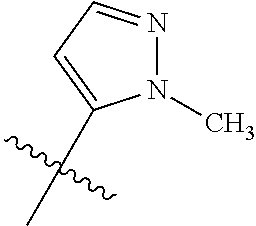 |
1.18 | 485.1 | B |
| 104 |
 |
1.13 | 511.97 | B |
| 105 |
 |
1.14 | 511.98 | B |
| 106 |
 |
1.1 | 496.92 | B |
| 107 |
 |
1.13 | 499.05 | B |
| 108 |
 |
1.18 | 559.2 | B |
| 109 |
 |
1.21 | 512.09 | B |
| 110 |
 |
1.12 | 555.01 | B |
| 111 |
 |
1.13 | 511.97 | B |
| 112 |
 |
1.15 | 585.01 | B |
| 113 |
 |
1.18 | 483 | B |
| 114 |
 |
1.11 | 538.98 | B |

Step A
| TABLE 4 |
 |
| Retention | ||||
| Ex- | time | m/z | LC | |
| ample | Substituent Z | (min) | (M + 1) | Method |
| 116 |
 |
1.14 | 534.65 | B |
| 117 |
 |
1.07 | 466 | B |
| 118 |
 |
1.11 | 484 | B |
| 119 |
 |
1.1 | 481 | B |
| 120 |
 |
1.11 | 543 | B |
| 121 |
 |
1.08 | 516 | B |
| 122 |
 |
1.08 | 480 | B |
| 123 |
 |
1.11 | 532 | B |
| 124 |
 |
1.11 | 483 | B |
| 125 |
 |
1.15 | 534 | B |
| 126 |
 |
1.07 | 466 | B |
| 127 |
 |
1.13 | 497 | B |
| 128 |
 |
1.12 | 537.1 | B |
| 129 |
 |
1.14 | 536.87 | B |
| 130 |
 |
1.14 | 484.21 | B |
| 131 |
 |
1.15 | 496.19 | B |
| 132 |
 |
1.14 | 527.15 | B |
| 133 |
 |
1.14 | 496.17 | B |
| 134 |
 |
1.17 | 496.16 | B |
| 135 |
 |
1.12 | 481.17 | B |
| 136 |
 |
1.14 | 497.14 | B |
| 137 |
 |
1.18 | 496.13 | B |
| 138 |
 |
1.17 | 526.18 | B |
| 139 |
 |
1.08 | 496.13 | B |
| 140 |
 |
1.13 | 467.12 | B |
| 141 |
 |
1.16 | 484.14 | B |
| 142 |
 |
1.13 | 471.8 | B |
| 143 |
 |
1.22 | 562.2 | B |
| 144 |
 |
2.72 | 472.9 | A |
| 145 |
 |
1.2 | 456.1 | B |

Step A
| TABLE 5 |
 |
| Retention | ||||
| Ex- | time | m/z | ||
| ample | Substituent Z | (min) | (M + 1) | LC Method |
| 147 |
 |
1.11 | 466 | B |
| 148 |
 |
1.14 | 479 | B |
| 149 |
 |
1.09 | 500 | B |
| 150 |
 |
1.09 | 466 | B |
| 151 |
 |
1.08 | 450 | B |
| 152 |
 |
1.09 | 448 | B |
| 153 |
 |
1.08 | 448 | B |
| 154 |
 |
1.12 | 519.1 | B |
| 155 |
 |
1.95 | 478.19 | C |
| 156 |
 |
1.11 | 466.2 | B |
| 157 |
 |
1.69 | 462.18 | C |
| 158 |
 |
1.65 | 462.1 | C |
| 159 |
 |
1.09 | 463.1 | B |
| 160 |
 |
1.13 | 466.15 | B |
| 161 |
 |
1.05 | 491.18 | B |
| 162 |
 |
1.83 | 478.17 | C |
| 163 |
 |
1.87 | 478.14 | C |
| 164 |
 |
1.2 | 544.17 | B |
| 165 |
 |
1.12 | 449.2 | B |
| 166 |
 |
1.05 | 478.1 | B |
| 167 |
 |
1.15 | 508.18 | B |
| 168 |
 |
1.15 | 478.19 | B |
| 169 |
 |
1.09 | 448.17 | B |
| TABLE 6 |
 |
| Retention | ||||
| Example | Substituent Z | time (min) | m/z (M + 1) | LC Method |
| 170 |
 |
1.13 | 422.17 | B |
| 171 |
 |
1.08 | 477.95 | B |
| 172 |
 |
1.13 | 546.02 | B |
| 173 |
 |
1.64 | 509.01 | C |
| TABLE 7 | ||||
| Retention | ||||
| Ex- | time | m/z | LC | |
| ample | Structure | (min) | (M + 1) | Method |
| 174 |
 |
2.47 | 449.3 | A |
| 175 |
 |
2.58 | 452.3 | A |

Step A

Step A


| TABLE 8 | ||||
| Retention time | ||||
| Example | Structure | (min) | m/z (M + 1) | LC Method |
| 180 |
 |
2.87 | 478 | A |
| 181 |
 |
2.90 | 476 | A |
| 182 |
 |
2.68 | 444 | A |
| 183 |
 |
1.04 | 460 | B |
| 184 |
 |
2.81 | 458 | A |
| 185 |
 |
2.78 | 458 | A |
| 186 |
 |
2.97 | 478 | A |
| 187 |
 |
1.48 | 494 | B |
| 188 |
 |
3.06 | 492 | A |
| 189 |
 |
1.02 | 444 | B |
| 190 |
 |
2.84 | 458 | A |
| 191 |
 |
1.38 | 460 | B |
| 192 |
 |
1.09 | 458 | B |
| 193 |
 |
2.91 | 472 | A |
| 194 |
 |
2 | 534 | C |
| 195 |
 |
2.78 | 462 | A |
| 196 |
 |
2.88 | 476 | A |
| 197 |
 |
1.07 | 492 | B |
| 198 |
 |
2.98 | 492 | A |
| 199 |
 |
1.05 | 479 | B |
| 200 |
 |
1.1 | 493 | B |
| 201 |
 |
1.0 | 445 | B |
| 202 |
 |
2.83 | 478 | A |
| 203 |
 |
2.8 | 478 | A |
| 204 |
 |
2.94 | 458 | D |
| 205 |
 |
3.12 | 526 | A |
| 206 |
 |
2.71 | 472 | A |
| 207 |
 |
2.71 | 454 | A |

Step A
| TABLE 9 | ||||
| Retention time | ||||
| Example | Structure | (min) | m/z (M + 1) | LC Method |
| 209 |
 |
1.13 | 403.2 | B |
| 210 |
 |
1.08 | 414.1 | B |
| 211 |
 |
1.08 | 400.1 | B |
| 212 |
 |
1.13 | 431.2 | B |
| 213 |
 |
1.16 | 468.1 | B |
| 214 |
 |
1.13 | 537.1 | B |
| 215 |
 |
1.13 | 434.03 | B |
| 216 |
 |
1.13 | 448.04 | B |
| 217 |
 |
1.16 | 483.1 | B |
| 218 |
 |
1.17 | 465.1 | B |
| 219 |
 |
1.21 | 613.1 | B |
| 220 |
 |
1.15 | 418.2 | B |
| 221 |
 |
1.13 | 432.1 | B |
| 222 |
 |
1.15 | 421.2 | B |
| 223 |
 |
1.16 | 449.3 | B |
| 224 |
 |
1.85 | 411 | C |
| 225 |
 |
1.73 | 422.04 | C |
| 226 |
 |
1.89 | 439.05 | C |
| 227 |
 |
1.12 | 405.1 | B |
| EXAMPLE | IUPAC NAME |
| 2 | 2-[7-(2,3,6-trifluorobenzyl)imidazo[1,5-b]pyridazin-5-yl]-5-(1,3,5- |
| trimethyl-1H-pyrazol-4-yl)pyrimidin-4-amine | |
| 3 | 5-[1,5-dimethyl-3-(trifluoromethyl)-1H-pyrazol-4-yl]-2-[7-(2,3,6- |
| trifluorobenzyl)imidazo[1,5-b]pyridazin-5-yl]pyrimidin-4-amine | |
| 4 | 5-(2-methylpyridin-4-yl)-2-[7-(2,3,6-trifluorobenzyl)imidazo[1,5- |
| b]pyridazin-5-yl]pyrimidin-4-amine | |
| 5 | methyl {4,6-diamino-2-[7-(2,3,6-trifluorobenzyl)imidazo[1,5- |
| b]pyridazin-5-yl]pyrimidin-5-yl}carbamate | |
| 6 | methyl {4,6-diamino-2-[7-(2,3,6-trifluorobenzyl)imidazo[1,5- |
| b]pyridazin-5-yl]pyrimidin-5-yl}methylcarbamate | |
| 7 | 5-quinolin-5-yl-2-[7-(2,3,6-trifluorobenzyl)imidazo[1,5-b]pyridazin-5- |
| yl]pyrimidin-4-amine | |
| 8 | 5-pyridin-4-yl-2-[7-(2,3,6-trifluorobenzyl)imidazo[1,5-b]pyridazin-5- |
| yl]pyrimidin-4-amine | |
| 9 | 5-pyridin-3-yl-2-[7-(2,3,6-trifluorobenzyl)imidazo[1,5-b]pyridazin-5- |
| yl]pyrimidin-4-amine | |
| 10 | 2-[7-(2,3,6-trifluorobenzyl)imidazo[1,5-b]pyridazin-5-yl]-5-[5- |
| (trifluoromethyl)pyridin-3-yl]pyrimidin-4-amine | |
| 11 | 5-(5-fluoropyridin-3-yl)-2-[7-(2,3,6-trifluorobenzyl)imidazo[1,5- |
| b]pyridazin-5-yl]pyrimidin-4-amine | |
| 12 | 5-(2-methoxypyridin-3-yl)-2-[7-(2,3,6-trifluorobenzyl)imidazo[1,5- |
| b]pyridazin-5-yl]pyrimidin-4-amine | |
| 13 | 5-(4-methylpyridin-3-yl)-2-[7-(2,3,6-trifluorobenzyl)imidazo[1,5- |
| b]pyridazin-5-yl]pyrimidin-4-amine | |
| 14 | 5-(4-methoxypyridin-3-yl)-2-[7-(2,3,6-trifluorobenzyl)imidazo[1,5- |
| b]pyridazin-5-yl]pyrimidin-4-amine | |
| 15 | 5-(1-methyl-1H-pyrazol-4-yl)-2-[7-(2,3,6-trifluorobenzyl)imidazo[1,5- |
| b]pyridazin-5-yl]pyrimidin-4-amine | |
| 16 | 5-(1-methyl-1H-pyrazol-5-yl)-2-[7-(2,3,6-trifluorobenzyl)imidazo[1,5- |
| b]pyridazin-5-yl]pyrimidin-4-amine | |
| 17 | 5-(7-fluoroquinolin-4-yl)-2-[7-(2,3,6-trifluorobenzyl)imidazo[1,5- |
| b]pyridazin-5-yl]pyrimidin-4-amine | |
| 18 | 2-[7-(2,3,6-trifluorobenzyl)imidazo[1,5-b]pyridazin-5-yl]-5-[2- |
| (trifluoromethyl)quinolin-4-yl]pyrimidin-4-amine | |
| 19 | 5-(3-fluoropyridin-4-yl)-2-[7-(2,3,6-trifluorobenzyl)imidazo[1,5- |
| b]pyridazin-5-yl]pyrimidin-4-amine | |
| 20 | 2-[7-(2,3,6-trifluorobenzyl)imidazo[1,5-b]pyridazin-5-yl]-5-[2- |
| (trifluoromethyl)pyridin-4-yl]pyrimidin-4-amine | |
| 21 | 2-[7-(2,3,6-trifluorobenzyl)imidazo[1,5-b]pyridazin-5-yl]-5-[2- |
| (trifluoromethyl)quinolin-4-yl]pyrimidin-4-amine | |
| 22 | 5-[1-methyl-3-(trifluoromethyl)-1H-pyrazol-4-yl]-2-[7-(2,3,6- |
| trifluorobenzyl)imidazo[1,5-b]pyridazin-5-yl]pyrimidin-4-amine | |
| 23 | 5-pyridin-4-yl-2-[7-(2,3,5-trifluorobenzyl)imidazo[1,5-b]pyridazin-5- |
| yl]pyrimidin-4-amine | |
| 24 | 5-pyridin-3-yl-2-[7-(2,3,5-trifluorobenzyl)imidazo[1,5-b]pyridazin-5- |
| yl]pyrimidin-4-amine | |
| 25 | 5-(4-methoxypyridin-3-yl)-2-[7-(2,3,5-trifluorobenzyl)imidazo[1,5- |
| b]pyridazin-5-yl]pyrimidin-4-amine | |
| 26 | 5-(4-methylpyridin-3-yl)-2-[7-(2,3,5-trifluorobenzyl)imidazo[1,5- |
| b]pyridazin-5-yl]pyrimidin-4-amine | |
| 27 | 5-quinolin-5-yl-2-[7-(2,3,5-trifluorobenzyl)imidazo[1,5-b]pyridazin-5- |
| yl]pyrimidin-4-amine | |
| 28 | 5-(2-methylpyridin-4-yl)-2-[7-(2,3,5-trifluorobenzyl)imidazo[1,5- |
| b]pyridazin-5-yl]pyrimidin-4-amine | |
| 29 | 2-[7-(2-chloro-3,6-difluorobenzyl)imidazo[1,5-b]pyridazin-5-yl]-5- |
| pyridin-4-ylpyrimidin-4-amine | |
| 30 | 2-[7-(2-chloro-3,6-difluorobenzyl)imidazo[1,5-b]pyridazin-5-yl]-5- |
| (1,3,5-trimethyl-1H-pyrazol-4-yl)pyrimidin-4-amine | |
| 31 | 2-[7-(2-chloro-3,6-difluorobenzyl)imidazo[1,5-b]pyridazin-5-yl]-5-(2- |
| methylpyridin-4-yl)pyrimidin-4-amine | |
| 32 | 2-[7-(2-chloro-3,6-difluorobenzyl)imidazo[1,5-b]pyridazin-5-yl]-5- |
| quinolin-5-ylpyrimidin-4-amine | |
| 33 | 2-[7-(2-chloro-3,6-difluorobenzyl)imidazo[1,5-b]pyridazin-5-yl]-5-[2- |
| (trifluoromethyl)pyridin-4-yl]pyrimidin-4-amine | |
| 34 | 2-[7-(2-chloro-3,6-difluorobenzyl)imidazo[1,5-b]pyridazin-5-yl]-5- |
| pyridin-3-ylpyrimidin-4-amine | |
| 35 | 2-[7-(2-chloro-3,6-difluorobenzyl)imidazo[1,5-b]pyridazin-5-yl]-5-(4- |
| methoxypyridin-3-yl)pyrimidin-4-amine | |
| 36 | 2-[7-(2-chloro-3,6-difluorobenzyl)imidazo[1,5-b]pyridazin-5-yl]-5-[5- |
| (trifluoromethyl)pyridin-3-yl]pyrimidin-4-amine | |
| 37 | 2-[7-(2-chloro-3,6-difluorobenzyl)imidazo[1,5-b]pyridazin-5-yl]-5-(4- |
| methylpyridin-3-yl)pyrimidin-4-amine | |
| 38 | 2-[7-(2-chloro-3,6-difluorobenzyl)imidazo[1,5-b]pyridazin-5-yl]-5-(1- |
| methyl-1H-pyrazol-4-yl)pyrimidin-4-amine | |
| 39 | 2-[7-(2-chloro-3,6-difluorobenzyl)imidazo[1,5-b]pyridazin-5-yl]-5-[1,5- |
| dimethyl-3-(trifluoromethyl)-1H-pyrazol-4-yl]pyrimidin-4-amine | |
| 40 | 2-[7-(2,3,5-trifluorobenzyl)imidazo[1,5-b]pyridazin-5-yl]-5-(1,3,5- |
| trimethyl-1H-pyrazol-4-yl)pyrimidin-4-amine | |
| 41 | 5-[1,5-dimethyl-3-(trifluoromethyl)-1H-pyrazol-4-yl]-2-[7-(2,3,5- |
| trifluorobenzyl)imidazo[1,5-b]pyridazin-5-yl]pyrimidin-4-amine | |
| 42 | 2-[7-(3-chloro-2,6-difluorobenzyl)imidazo[1,5-b]pyridazin-5-yl]-5- |
| (1,3,5-trimethyl-1H-pyrazol-4-yl)pyrimidin-4-amine | |
| 43 | 2-[7-(2,3,5-trifluorobenzyl)imidazo[1,5-b]pyridazin-5-yl]-5-[2- |
| (trifluoromethyl)pyridin-4-yl]pyrimidin-4-amine | |
| 44 | 2-[7-(2,3,5-trifluorobenzyl)imidazo[1,5-b]pyridazin-5-yl]-5-[5- |
| (trifluoromethyl)pyridin-3-yl]pyrimidin-4-amine | |
| 45 | 5-[3-(methylsulfonyl)phenyl]-2-[7-(2,3,5-trifluorobenzyl)imidazo[1,5- |
| b]pyridazin-5-yl]pyrimidin-4-amine | |
| 46 | 2-[7-(2-chloro-3,5-difluorobenzyl)imidazo[1,5-b]pyridazin-5-yl]-5-[3- |
| (methylsulfonyl)phenyl]pyrimidin-4-amine | |
| 47 | 5-[2-(methylsulfonyl)phenyl]-2-[7-(2,3,5-trifluorobenzyl)imidazo[1,5- |
| b]pyridazin-5-yl]pyrimidin-4-amine | |
| 48 | 5-[4-(methylsulfonyl)phenyl]-2-[7-(2,3,5-trifluorobenzyl)imidazo[1,5- |
| b]pyridazin-5-yl]pyrimidin-4-amine | |
| 49 | 5-(3-methoxyphenyl)-2-[7-(2,3,5-trifluorobenzyl)imidazo[1,5- |
| b]pyridazin-5-yl]pyrimidin-4-amine | |
| 50 | 5-(2-methoxypyridin-3-yl)-2-[7-(2,3,4-trifluorobenzyl)imidazo[1,5- |
| b]pyridazin-5-yl]pyrimidin-4-amine | |
| 51 | 5-(4-methoxypyridin-3-yl)-2-[7-(2,3,4-trifluorobenzyl)imidazo[1,5- |
| b]pyridazin-5-yl]pyrimidin-4-amine | |
| 52 | 2-[7-(2,3,4-trifluorobenzyl)imidazo[1,5-b]pyridazin-5-yl]-5-[5- |
| (trifluoromethyl)pyridin-3-yl]pyrimidin-4-amine | |
| 53 | 5-pyridin-4-yl-2-[7-(2,3,4-trifluorobenzyl)imidazo[1,5-b]pyridazin-5- |
| yl]pyrimidin-4-amine | |
| 54 | 5-(1-methyl-1H-pyrazol-5-yl)-2-[7-(2,3,6-trifluorobenzyl)imidazo[1,5- |
| b]pyridazin-5-yl]pyrimidin-4-amine | |
| 55 | 5-[3-(methylsulfonyl)phenyl]-2-[7-(2,3,4-trifluorobenzyl)imidazo[1,5- |
| b]pyridazin-5-yl]pyrimidin-4-amine | |
| 56 | 2-[6-fluoro-3-(2,3,6-trifluorobenzyl)imidazo[1,5-a]pyridin-1-yl]-5- |
| pyridin-3-ylpyrimidin-4-amine | |
| 57 | 2-[6-fluoro-3-(2,3,6-trifluorobenzyl)imidazo[1,5-a]pyridin-1-yl]-5- |
| quinolin-5-ylpyrimidin-4-amine | |
| 58 | 2-[6-fluoro-3-(2,3,6-trifluorobenzyl)imidazo[1,5-a]pyridin-1-yl]-5- |
| pyridin-4-ylpyrimidin-4-amine | |
| 59 | 2-[6-fluoro-3-(2,3,6-trifluorobenzyl)imidazo[1,5-a]pyridin-1-yl]-5-(1,3,5- |
| trimethyl-1H-pyrazol-4-yl)pyrimidin-4-amine | |
| 60 | 2-[6-fluoro-3-(2,3,6-trifluorobenzyl)imidazo[1,5-a]pyridin-1-yl]-5-[5- |
| (trifluoromethyl)pyridin-3-yl]pyrimidin-4-amine | |
| 61 | 5-(5-fluoropyridin-3-yl)-2-[6-fluoro-3-(2,3,6- |
| trifluorobenzyl)imidazo[1,5-a]pyridin-1-yl]pyrimidin-4-amine | |
| 62 | 2-[6-fluoro-3-(2,3,6-trifluorobenzyl)imidazo[1,5-a]pyridin-1-yl]-5-(2- |
| methoxypyridin-3-yl)pyrimidin-4-amine | |
| 63 | 2-[6-fluoro-3-(2,3,6-trifluorobenzyl)imidazo[1,5-a]pyridin-1-yl]-5-(4- |
| methylpyridin-3-yl)pyrimidin-4-amine | |
| 64 | 2-[6-fluoro-3-(2,3,6-trifluorobenzyl)imidazo[1,5-a]pyridin-1-yl]-5-(2- |
| methylpyridin-4-yl)pyrimidin-4-amine | |
| 65 | 2-[6-fluoro-3-(2,3,6-trifluorobenzyl)imidazo[1,5-a]pyridin-1-yl]-5-(4- |
| methoxypyridin-3-yl)pyrimidin-4-amine | |
| 66 | 2-[6-fluoro-3-(2,3,6-trifluorobenzyl)imidazo[1,5-a]pyridin-1-yl]-5,5′- |
| bipyrimidin-4-amine | |
| 67 | 2-[6-fluoro-3-(2,3,6-trifluorobenzyl)imidazo[1,5-a]pyridin-1-yl]-5-(1- |
| methyl-1H-pyrazol-4-yl)pyrimidin-4-amine | |
| 68 | 2-[6-fluoro-3-(2,3,6-trifluorobenzyl)imidazo[1,5-a]pyridin-1-yl]-5-(1- |
| methyl-1H-pyrazol-5-yl)pyrimidin-4-amine | |
| 69 | 5-[1,5-dimethyl-3-(trifluoromethyl)-1H-pyrazol-4-yl]-2-[6-fluoro-3- |
| (2,3,6-trifluorobenzyl)imidazo[1,5-a]pyridin-1-yl]pyrimidin-4-amine | |
| 70 | 2-[6-fluoro-3-(2,3,6-trifluorobenzyl)imidazo[1,5-a]pyridin-1-yl]-5-[2- |
| (trifluoromethyl)pyridin-4-yl]pyrimidin-4-amine | |
| 71 | 5-(3-fluoropyridin-4-yl)-2-[6-fluoro-3-(2,3,6- |
| trifluorobenzyl)imidazo[1,5-a]pyridin-1-yl]pyrimidin-4-amine | |
| 72 | 2-[6-fluoro-3-(2,3,6-trifluorobenzyl)imidazo[1,5-a]pyridin-1-yl]-5-[2- |
| (trifluoromethyl)quinolin-4-yl]pyrimidin-4-amine | |
| 73 | 5-(6-fluoroquinolin-4-yl)-2-[6-fluoro-3-(2,3,6- |
| trifluorobenzyl)imidazo[1,5-a]pyridin-1-yl]pyrimidin-4-amine | |
| 74 | 2-[6-fluoro-3-(2,3,6-trifluorobenzyl)imidazo[1,5-a]pyridin-1-yl]-5- |
| quinolin-4-ylpyrimidin-4-amine | |
| 75 | 2-[6-fluoro-3-(2,3,6-trifluorobenzyl)imidazo[1,5-a]pyridin-1-yl]-5-[1- |
| methyl-3-(trifluoromethyl)-1H-pyrazol-4-yl]pyrimidin-4-amine | |
| 76 | 5-[5-(methoxymethyl)-1,3-dimethyl-1H-pyrazol-4-yl]-2-[7-(2,3,6- |
| trifluorobenzyl)imidazo[1,5-b]pyridazin-5-yl]pyrimidin-4-amine | |
| 77 | 2-[6-fluoro-3-(2,3,6-trifluorobenzyl)imidazo[1,5-a]pyridin-1-yl]-5-(1- |
| methyl-1H-pyrrolo[2,3-b]pyridin-4-yl)pyrimidin-4-amine | |
| 78 | 2-[6-fluoro-3-(2,3,6-trifluorobenzyl)imidazo[1,5-a]pyridin-1-yl]-5-(3- |
| methylpyridin-4-yl)pyrimidin-4-amine | |
| 79 | 2-[6-fluoro-3-(2,3,6-trifluorobenzyl)imidazo[1,5-a]pyridin-1-yl]-5-(2- |
| methoxypyridin-4-yl)pyrimidin-4-amine | |
| 80 | 5-(3,5-dimethylisoxazol-4-yl)-2-[6-fluoro-3-(2,3,6- |
| trifluorobenzyl)imidazo[1,5-a]pyridin-1-yl]pyrimidin-4-amine | |
| 81 | 2-[6-fluoro-3-(2,3,6-trifluorobenzyl)imidazo[1,5-a]pyridin-1-yl]-5-(1- |
| methyl-1H-imidazol-5-yl)pyrimidin-4-amine | |
| 82 | 2-[6-fluoro-3-(2,3,6-trifluorobenzyl)imidazo[1,5-a]pyridin-1-yl]-5-[3- |
| (methylsulfonyl)phenyl]pyrimidin-4-amine | |
| 83 | 2-[5-chloro-3-(2,3,6-trifluorobenzyl)-1H-indazol-1-yl]-5-(1-methyl-1H- |
| pyrazol-4-yl)pyrimidine-4,6-diamine | |
| 84 | 2-[5-chloro-3-(2,3,6-trifluorobenzyl)-1H-indazol-1-yl]-2′-methyl-5,5′- |
| bipyrimidine-4,6-diamine | |
| 85 | 2-[5-chloro-3-(2,3,6-trifluorobenzyl)-1H-indazol-1-yl]-5-pyridin-4- |
| ylpyrimidine-4,6-diamine | |
| 86 | 2-[5-chloro-3-(2,3,6-trifluorobenzyl)-1H-indazol-1-yl]-5-(1-isobutyl-1H- |
| pyrazol-4-yl)pyrimidine-4,6-diamine | |
| 87 | 2-[5-chloro-3-(2,3,6-trifluorobenzyl)-1H-indazol-1-yl]-5-[1-(3- |
| methylbutyl)-1H-pyrazol-4-yl]pyrimidine-4,6-diamine | |
| 88 | 5-(1-tert-butyl-3-methyl-1H-pyrazol-4-yl)-2-[5-chloro-3-(2,3,6- |
| trifluorobenzyl)-1H-indazol-1-yl]pyrimidine-4,6-diamine | |
| 89 | 2-[5-chloro-3-(2,3,6-trifluorobenzyl)-1H-indazol-1-yl]-5-[1- |
| (cyclopropylmethyl)-3-methyl-1H-pyrazol-4-yl]pyrimidine-4,6-diamine | |
| 90 | 2-[5-chloro-3-(2,3,6-trifluorobenzyl)-1H-indazol-1-yl]-5-[5- |
| (methoxymethyl)-1,3-dimethyl-1H-pyrazol-4-yl]pyrimidine-4,6-diamine | |
| 91 | 2-[5-chloro-3-(2,3,6-trifluorobenzyl)-1H-indazol-1-yl]-5-(1,3,5-trimethyl- |
| 1H-pyrazol-4-yl)pyrimidine-4,6-diamine | |
| 92 | 2-[5-chloro-3-(2,3,6-trifluorobenzyl)-1H-indazol-1-yl]-5-pyridin-3- |
| ylpyrimidine-4,6-diamine | |
| 93 | 2-[5-chloro-3-(2,3,6-trifluorobenzyl)-1H-indazol-1-yl]-5-(6- |
| fluoropyridin-3-yl)pyrimidine-4,6-diamine | |
| 94 | 2-[5-chloro-3-(2,3,6-trifluorobenzyl)-1H-indazol-1-yl]-5-[3- |
| (methylsulfonyl)phenyl]pyrimidine-4,6-diamine | |
| 95 | 2-[5-chloro-3-(2,3,6-trifluorobenzyl)-1H-indazol-1-yl]-5-(2- |
| methylpyridin-4-yl)pyrimidine-4,6-diamine | |
| 96 | 2-[5-chloro-3-(2,3,6-trifluorobenzyl)-1H-indazol-1-yl]-5-(5- |
| fluoropyridin-3-yl)pyrimidine-4,6-diamine | |
| 97 | 2-[5-chloro-3-(2,3,6-trifluorobenzyl)-1H-indazol-1-yl]-5-[1-methyl-5- |
| (trifluoromethyl)-1H-pyrazol-4-yl]pyrimidine-4,6-diamine | |
| 98 | 2-[5-chloro-3-(2,3,6-trifluorobenzyl)-1H-indazol-1-yl]-5-(5- |
| methoxypyridin-3-yl)pyrimidine-4,6-diamine | |
| 99 | 2-[5-chloro-3-(2,3,6-trifluorobenzyl)-1H-indazol-1-yl]-5-(3,5- |
| dimethylisoxazol-4-yl)pyrimidine-4,6-diamine | |
| 100 | 2-[5-chloro-3-(2,3,6-trifluorobenzyl)-1H-indazol-1-yl]-5-(2- |
| methylpyridin-3-yl)pyrimidine-4,6-diamine | |
| 101 | 2-[5-chloro-3-(2,3,6-trifluorobenzyl)-1H-indazol-1-yl]-5-(6- |
| methylpyridin-3-yl)pyrimidine-4,6-diamine | |
| 102 | 2-[5-chloro-3-(2,3,6-trifluorobenzyl)-1H-indazol-1-yl]-5-(5- |
| methylpyridin-3-yl)pyrimidine-4,6-diamine | |
| 103 | 2-[5-chloro-3-(2,3,6-trifluorobenzyl)-1H-indazol-1-yl]-5-(1-methyl-1H- |
| pyrazol-5-yl)pyrimidine-4,6-diamine | |
| 104 | 2-[5-chloro-3-(2,3,6-trifluorobenzyl)-1H-indazol-1-yl]-5-(6- |
| methoxypyridin-3-yl)pyrimidine-4,6-diamine | |
| 105 | 2-[5-chloro-3-(2,3,6-trifluorobenzyl)-1H-indazol-1-yl]-5-(2- |
| methoxypyridin-4-yl)pyrimidine-4,6-diamine | |
| 106 | 5-(2-aminopyridin-4-yl)-2-[5-chloro-3-(2,3,6-trifluorobenzyl)-1H- |
| indazol-1-yl]pyrimidine-4,6-diamine | |
| 107 | 2-[5-chloro-3-(2,3,6-trifluorobenzyl)-1H-indazol-1-yl]-5-(3,5-dimethyl- |
| 1H-pyrazol-4-yl)pyrimidine-4,6-diamine | |
| 108 | methyl (4-{4,6-diamino-2-[5-chloro-3-(2,3,6-trifluorobenzyl)-1H- |
| indazol-1-yl]pyrimidin-5-yl}pyridin-2-yl)carbamate | |
| 109 | 2-[5-chloro-3-(2,3,6-trifluorobenzyl)-1H-indazol-1-yl]-5-(6- |
| methoxypyridin-2-yl)pyrimidine-4,6-diamine | |
| 110 | methyl (5-{4,6-diamino-2-[5-chloro-3-(2,3,6-trifluorobenzyl)-1H- |
| indazol-1-yl]pyrimidin-5-yl}pyridin-2-yl)carbamate | |
| 111 | 2-[5-chloro-3-(2,3,6-trifluorobenzyl)-1H-indazol-1-yl]-5-(2- |
| methoxypyridin-3-yl)pyrimidine-4,6-diamine | |
| 112 | 2-[5-chloro-3-(2,3,6-trifluorobenzyl)-1H-indazol-1-yl]-5-(3-fluoro-2- |
| morpholin-4-ylpyridin-4-yl)pyrimidine-4,6-diamine | |
| 113 | 2-[5-chloro-3-(2,3,6-trifluorobenzyl)-1H-indazol-1-yl]-5-pyrazin-2- |
| ylpyrimidine-4,6-diamine | |
| 114 | N-(5-{4,6-diamino-2-[5-chloro-3-(2,3,6-trifluorobenzyl)-1H-indazol-1- |
| yl]pyrimidin-5-yl}pyridin-2-yl)acetamide | |
| 115 | 2-[5-fluoro-3-(2,3,6-trifluorobenzyl)-1H-indazol-1-yl]-5-(2- |
| methoxypyridin-4-yl)pyrimidine-4,6-diamine | |
| 116 | 2-[5-fluoro-3-(2,3,6-trifluorobenzyl)-1H-indazol-yl]-5-[5- |
| (trifluoromethyl)pyridin-3-yl)pyrimidine-4,6-diamine | |
| 117 | 2-[5-fluoro-3-(2,3,6-trifluorobenzyl)-1H-indazol-1-yl]-5-pyridin-3- |
| ylpyrimidine-4,6-diamine | |
| 118 | 5-(6-fluoropyridin-3-yl)-2-[5-fluoro-3-(2,3,6-trifluorobenzyl)-1H- |
| indazol-1-yl]pyrimidine-4,6-diamine | |
| 119 | 5-(6-aminopyridin-3-yl)-2-[5-fluoro-3-(2,3,6-trifluorobenzyl)-1H- |
| indazol-1-yl]pyrimidine-4,6-diamine | |
| 120 | 2-[5-fluoro-3-(2,3,6-trifluorobenzyl)-1H-indazol-1-yl]-5-[3- |
| (methylsulfonyl)phenyl]pyrimidine-4,6-diamine | |
| 121 | 2-[5-fluoro-3-(2,3,6-trifluorobenzyl)-1H-indazol-1-yl]-5-quinolin-5- |
| ylpyrimidine-4,6-diamine | |
| 122 | 2-[5-fluoro-3-(2,3,6-trifluorobenzyl)-1H-indazol-1-yl]-5-(2- |
| methylpyridin-4-yl)pyrimidine-4,6-diamine | |
| 123 | 3-{4,6-diamino-2-[5-fluoro-3-(2,3,6-trifluorobenzyl)-1H-indazol-1- |
| yl]pyrimidin-5-yl}quinolin-2-ol | |
| 124 | 5-(5-fluoropyridin-3-yl)-2-[5-fluoro-3-(2,3,6-trifluorobenzyl)-1H- |
| indazol-1-yl]pyrimidine-4,6-diamine | |
| 125 | 5-(2-fluoroquinolin-3-yl)-2-[5-fluoro-3-(2,3,6-trifluorobenzyl)-1H- |
| indazol-1-yl]pyrimidine-4,6-diamine | |
| 126 | 2-[5-fluoro-3-(2,3,6-trifluorobenzyl)-1H-indazol-1-yl]-5-pyridin-4- |
| ylpyrimidine-4,6-diamine | |
| 127 | 2-[5-fluoro-3-(2,3,6-trifluorobenzyl)-1H-indazol-1-yl]-5-(1,3,5-trimethyl- |
| 1H-pyrazol-4-yl)pyrimidine-4,6-diamine | |
| 128 | 2-[5-fluoro-3-(2,3,6-trifluorobenzyl)-1H-indazol-1-yl]-5-[1-methyl-5- |
| (trifluoromethyl)-1H-pyrazol-4-yl]pyrimidine-4,6-diamine | |
| 129 | 2-[5-fluoro-3-(2,3,6-trifluorobenzyl)-1H-indazol-1-yl]-5-[1-methyl-3- |
| (trifluoromethyl)-1H-pyrazol-5-yl]pyrimidine-4,6-diamine | |
| 130 | 5-(3,5-dimethylisoxazol-4-yl)-2-[5-fluoro-3-(2,3,6-trifluorobenzyl)-1H- |
| indazol-1-yl]pyrimidine-4,6-diamine | |
| 131 | 2-[5-fluoro-3-(2,3,6-trifluorobenzyl)-1H-indazol-1-yl]-5-(2- |
| methoxypyridin-4-yl)pyrimidine-4,6-diamine | |
| 132 | 2-[5-fluoro-3-(2,3,6-trifluorobenzyl)-1H-indazol-1-yl]-2′,4′-dimethoxy- |
| 5,5′-bipyrimidine-4,6-diamine | |
| 133 | 2-[5-fluoro-3-(2,3,6-trifluorobenzyl)-1H-indazol-1-yl]-5-(2- |
| methoxypyridin-3-yl)pyrimidine-4,6-diamine | |
| 134 | 2-[5-fluoro-3-(2,3,6-trifluorobenzyl)-1H-indazol-1-yl]-5-(5- |
| methoxypyridin-3-yl)pyrimidine-4,6-diamine | |
| 135 | 2-[5-fluoro-3-(2,3,6-trifluorobenzyl)-1H-indazol-1-yl]-2′-methyl-5,5′- |
| bipyrimidine-4,6-diamine | |
| 136 | 2-[5-fluoro-3-(2,3,6-trifluorobenzyl)-1H-indazol-1-yl]-2′-methoxy-5,5′- |
| bipyrimidine-4,6-diamine | |
| 137 | 2-[5-fluoro-3-(2,3,6-trifluorobenzyl)-1H-indazol-1-yl]-5-(6- |
| methoxypyridin-2-yl)pyrimidine-4,6-diamine | |
| 138 | 5-(2,6-dimethoxypyridin-3-yl)-2-[5-fluoro-3-(2,3,6-trifluorobenzyl)-1H- |
| indazol-1-yl]pyrimidine-4,6-diamine | |
| 139 | 2-[5-fluoro-3-(2,3,6-trifluorobenzyl)-1H-indazol-1-yl]-5-(4- |
| methoxypyridin-3-yl)pyrimidine-4,6-diamine | |
| 140 | 2-[5-fluoro-3-(2,3,6-trifluorobenzyl)-1H-indazol-1-yl]-5,5′-bipyrimidine- |
| 4,6-diamine | |
| 141 | 5-(4-fluoropyridin-3-yl)-2-[5-fluoro-3-(2,3,6-trifluorobenzyl)-1H- |
| indazol-1-yl]pyrimidine-4,6-diamine | |
| 142 | 2-[5-fluoro-3-(2,3,6-trifluorobenzyl)-1H-indazol-1-yl]-5-(1,3-thiazol-2- |
| yl)pyrimidine-4,6-diamine | |
| 143 | 2-[5-fluoro-3-(2,3,6-trifluorobenzyl)-1H-indazol-1-yl]-5-(4-methyl-2- |
| phenyl-1,3-thiazol-5-yl)pyrimidine-4,6-diamine | |
| 144 | N-{4,6-diamino-2-[5-fluoro-3-(2,3,6-trifluorobenzyl)-1H-indazol-1- |
| yl]pyrimidin-5-yl}-2-methylpropanamide | |
| 145 | 2-[5-fluoro-3-(2,3,6-trifluorobenzyl)-1H-indazol-1-yl]-5-(1,3-oxazol-2- |
| yl)pyrimidine-4,6-diamine | |
| 146 | 5-(2-methylpyridin-4-yl)-2-[3-(2,3,6-trifluorobenzyl)-1H-indazol-1- |
| yl]pyrimidine-4,6-diamine | |
| 147 | 5-(6-fluoropyridin-3-yl)-2-[3-(2,3,6-trifluorobenzyl)-1H-indazol-1- |
| yl]pyrimidine-4,6-diamine | |
| 148 | 2-[3-(2,3,6-trifluorobenzyl)-1H-indazol-1-yl]-5-(1,3,5-trimethyl-1H- |
| pyrazol-4-yl)pyrimidine-4,6-diamine | |
| 149 | 5-(5-fluoropyridin-3-yl)-2-[3-(2,3,6-trifluorobenzyl)-1H-indazol-1- |
| yl]pyrimidine-4,6-diamine | |
| 150 | 5-(1-methyl-1H-pyrazol-4-yl)-2-[3-(2,3,6-trifluorobenzyl)-1H-indazol-1- |
| yl]pyrimidine-4,6-diamine | |
| 151 | 5-(2-methylpyridin-4-yl)-2-[3-(2,3,6-trifluorobenzyl)-1H-indazol-1- |
| yl]pyrimidine-4,6-diamine | |
| 152 | 5-pyridin-4-yl-2-[3-(2,3,6-trifluorobenzyl)-1H-indazol-1-yl]pyrimidine- |
| 4,6-diamine | |
| 153 | 5-pyridin-3-yl-2-[3-(2,3,6-trifluorobenzyl)-1H-indazol-1-yl]pyrimidine- |
| 4,6-diamine | |
| 154 | 5-[1-methyl-5-(trifluoromethyl)-1H-pyrazol-4-yl]-2-[3-(2,3,6- |
| trifluorobenzyl)-1H-indazol-1-yl]pyrimidine-4,6-diamine | |
| 155 | 5-(2-methoxypyridin-4-yl)-2-[3-(2,3,6-trifluorobenzyl)-1H-indazol-1- |
| yl]pyrimidine-4,6-diamine | |
| 156 | 5-(3,5-dimethylisoxazol-4-yl)-2-[3-(2,3,6-trifluorobenzyl)-1H-indazol-1- |
| yl]pyrimidine-4,6-diamine | |
| 157 | 5-(2-methylpyridin-3-yl)-2-[3-(2,3,6-trifluorobenzyl)-1H-indazol-1- |
| yl]pyrimidine-4,6-diamine | |
| 158 | 5-(6-methylpyridin-3-yl)-2-[3-(2,3,6-trifluorobenzyl)-1H-indazol-1- |
| yl]pyrimidine-4,6-diamine | |
| 159 | 2′-methyl-2-[3-(2,3,6-trifluorobenzyl)-1H-indazol-1-yl]-5,5′- |
| bipyrimidine-4,6-diamine | |
| 160 | 5-(3-fluoropyridin-4-yl)-2-[3-(2,3,6-trifluorobenzyl)-1H-indazol-1- |
| yl]pyrimidine-4,6-diamine | |
| 161 | 5-[6-(dimethylamino)pyridin-3-yl]-2-[3-(2,3,6-trifluorobenzyl)-1H- |
| indazol-1-yl]pyrimidine-4,6-diamine | |
| 162 | 5-(2-methoxypyridin-3-yl)-2-[3-(2,3,6-trifluorobenzyl)-1H-indazol-1- |
| yl]pyrimidine-4,6-diamine | |
| 163 | 5-(6-methoxypyridin-3-yl)-2-[3-(2,3,6-trifluorobenzyl)-1H-indazol-1- |
| yl]pyrimidine-4,6-diamine | |
| 164 | 5-(4-methyl-2-phenyl-1,3-thiazol-5-yl)-2-[3-(2,3,6-trifluorobenzyl)-1H- |
| indazol-1-yl]pyrimidine-4,6-diamine | |
| 165 | 5-pyrazin-2-yl-2-[3-(2,3,6-trifluorobenzyl)-1H-indazol-1-yl]pyrimidine- |
| 4,6-diamine | |
| 166 | 5-(4-methoxypyridin-3-yl)-2-[3-(2,3,6-trifluorobenzyl)-1H-indazol-1- |
| yl]pyrimidine-4,6-diamine | |
| 167 | 5-(2,6-dimethoxypyridin-3-yl)-2-[3-(2,3,6-trifluorobenzyl)-1H-indazol-1- |
| yl]pyrimidine-4,6-diamine | |
| 168 | 5-(6-methoxypyridin-2-yl)-2-[3-(2,3,6-trifluorobenzyl)-1H-indazol-1- |
| yl]pyrimidine-4,6-diamine | |
| 169 | 5-pyridin-2-yl-2-[3-(2,3,6-trifluorobenzyl)-1H-indazol-1-yl]pyrimidine- |
| 4,6-diamine | |
| 170 | 2-[5-methoxy-3-(2,3,6-trifluorobenzyl)-1H-indazol-1-yl]-5-(1-methyl- |
| 1H-pyrazol-4-yl)pyrimidine-4,6-diamine | |
| 171 | 2-[5-methoxy-3-(2,3,6-trifluorobenzyl)-1H-indazol-1-yl]-5-pyridin-3- |
| ylpyrimidine-4,6-diamine | |
| 172 | 2-[5-methoxy-3-(2,3,6-trifluorobenzyl)-1H-indazol-1-yl]-5-[5- |
| (trifluoromethyl)pyridin-3-yl]pyrimidine-4,6-diamine | |
| 173 | 2-[5-methoxy-3-(2,3,6-trifluorobenzyl)-1H-indazol-1-yl]-5-(1,3,5- |
| trimethyl-1H-pyrazol-4-yl)pyrimidine-4,6-diamine | |
| 174 | 5-pyridin-4-yl-2-[3-(2,3,6-trifluorobenzyl)-1H-pyrazolo[4,3-b]pyridin-1- |
| yl]pyrimidine-4,6-diamine | |
| 175 | 5-(1-methyl-1H-pyrazol-4-yl)-2-[3-(2,3,6-trifluorobenzyl)-1H- |
| pyrazolo[4,3-b]pyridin-1-yl]pyrimidine-4,6-diamine | |
| 176 | methyl {4,6-diamino-2-[5-chloro-3-(2,3,6-trifluorobenzyl)-1H-indazol-1- |
| yl]pyrimidin-5-yl}carbamate | |
| 177 | methyl {4,6-diamino-2-[5-chloro-3-(2,3,6-trifluorobenzyl)-1H-indazol-1- |
| yl]pyrimidin-5-yl}methylcarbamate | |
| 178 | N-{4,6-diamino-2-[5-chloro-3-(2,3,6-trifluorobenzyl)-1H-indazol-1- |
| yl]pyrimidin-5-yl}cyclopropanecarboxamide | |
| 179 | S-methyl {4,6-diamino-2-[5-chloro-3-(2,3,6-trifluorobenzyl)-1H-indazol- |
| 1-yl]pyrimidin-5-yl}thiocarbamate | |
| 180 | S-methyl {4,6-diamino-2-[5-fluoro-3-(2,3,6-trifluorobenzyl)-1H-indazol- |
| 1-yl]pyrimidin-5-yl}thiocarbamate | |
| 181 | methyl {4,6-diamino-2-[5-fluoro-3-(2,3,6-trifluorobenzyl)-1H-indazol-1- |
| yl]pyrimidin-5-yl}methylcarbamate | |
| 182 | methyl {4,6-diamino-2-[3-(2,3,6-trifluorobenzyl)-1H-indazol-1- |
| yl]pyrimidin-5-yl}carbamate | |
| 183 | S-methyl {4,6-diamino-2-[3-(2,3,6-trifluorobenzyl)-1H-indazol-1- |
| yl]pyrimidin-5-yl}thiocarbamate | |
| 184 | methyl {4,6-diamino-2-[3-(2,3,6-trifluorobenzyl)-1H-indazol-1- |
| yl]pyrimidin-5-yl}methylcarbamate | |
| 185 | ethyl {4,6-diamino-2-[3-(2,3,6-trifluorobenzyl)-1H-indazol-1- |
| yl]pyrimidin-5-yl}carbamate | |
| 186 | methyl {4,6-diamino-2-[5-chloro-3-(2,3,5-trifluorobenzyl)-1H-indazol-1- |
| yl]pyrimidin-5-yl}carbamate | |
| 187 | S-methyl {4,6-diamino-2-[5-chloro-3-(2,3,5-trifluorobenzyl)-1H-indazol- |
| 1-yl]pyrimidin-5-yl}thiocarbamate | |
| 188 | methyl {4,6-diamino-2-[5-chloro-3-(2,3,5-trifluorobenzyl)-1H-indazol-1- |
| yl]pyrimidin-5-yl}methylcarbamate | |
| 189 | methyl {4,6-diamino-2-[3-(2,3,5-trifluorobenzyl)-1H-indazol-1- |
| yl]pyrimidin-5-yl}carbamate | |
| 190 | methyl {4,6-diamino-2-[3-(2,3,5-trifluorobenzyl)-1H-indazol-1- |
| yl]pyrimidin-5-yl}methylcarbamate | |
| 191 | S-methyl {4,6-diamino-2-[3-(2,3,5-trifluorobenzyl)-1H-indazol-1- |
| yl]pyrimidin-5-yl}methylthiocarbamate | |
| 192 | ethyl {4,6-diamino-2-[3-(2,3,5-trifluorobenzyl)-1H-indazol-1- |
| yl]pyrimidin-5-yl}carbamate | |
| 193 | ethyl {4,6-diamino-2-[3-(2,3,5-trifluorobenzyl)-1H-indazol-1- |
| yl]pyrimidin-5-yl}methylcarbamate | |
| 194 | methyl {4,6-diamino-2-[5-phenyl-3-(2,3,6-trifluorobenzyl)-1H-indazol-1- |
| yl]pyrimidin-5-yl}methylcarbamate | |
| 195 | methyl {4,6-diamino-2-[5-fluoro-3-(2,3,5-trifluorobenzyl)-1H-indazol-1- |
| yl]pyrimidin-5-yl}carbamate | |
| 196 | methyl {4,6-diamino-2-[5-fluoro-3-(2,3,5-trifluorobenzyl)-1H-indazol-1- |
| yl]pyrimidin-5-yl}methylcarbamate | |
| 197 | ethyl {4,6-diamino-2-[5-chloro-3-(2,3,6-trifluorobenzyl)-1H-indazol-1- |
| yl]pyrimidin-5-yl}carbamate | |
| 198 | ethyl {4,6-diamino-2-[5-chloro-3-(2,3,5-trifluorobenzyl)-1H-indazol-1- |
| yl]pyrimidin-5-yl}carbamate | |
| 199 | methyl {4,6-diamino-2-[5-chloro-3-(2,3,6-trifluorobenzyl)-1H- |
| pyrazolo[4,3-b]pyridin-1-yl]pyrimidin-5-yl}carbamate | |
| 200 | methyl {4,6-diamino-2-[5-chloro-3-(2,3,6-trifluorobenzyl)-1H- |
| pyrazolo[4,3-b]pyridin-1-yl]pyrimidin-5-yl}methylcarbamate | |
| 201 | methyl {4,6-diamino-2-[3-(2,3,6-trifluorobenzyl)-1H-pyrazolo[4,3- |
| b]pyridin-1-yl]pyrimidin-5-yl}carbamate | |
| 202 | methyl {4,6-diamino-2-[3-(3-chloro-2,5-difluorobenzyl)-5-fluoro-1H- |
| indazol-1-yl]pyrimidin-5-yl}carbamate | |
| 203 | methyl {4,6-diamino-2-[3-(2-chloro-3,6-difluorobenzyl)-5-fluoro-1H- |
| indazol-1-yl]pyrimidin-5-yl}carbamate | |
| 204 | methyl {4,6-diamino-2-[3-(2,6-difluoro-3-methylbenzyl)-5-fluoro-1H- |
| indazol-1-yl]pyrimidin-5-yl}carbamate | |
| 205 | S-methyl {4,6-diamino-2-[5-fluoro-3-(2,3,6-trichlorobenzyl)-1H-indazol- |
| 1-yl]pyrimidin-5-yl}thiocarbamate | |
| 206 | N-{4,6-diamino-2-[5-fluoro-3-(2,3,6-trifluorobenzyl)-1H-indazol-1- |
| yl]pyrimidin-5-yl}cyclopropanecarboxamide | |
| 207 | N-{4,6-diamino-2-[3-(2,3,6-trifluorobenzyl)-1H-indazol-1-yl]pyrimidin- |
| 5-yl}cyclopropanecarboxamide | |
| 208 | 2-[3-(2-cyclopentylethyl)-1H-indazol-1-yl]-5-pyridin-3-ylpyrimidine-4,6- |
| diamine | |
| 209 | 2-[3-(2-cyclopentylethyl)-1H-indazol-1-yl]-5-(1-methyl-1H-pyrazol-4- |
| yl)pyrimidine-4,6-diamine | |
| 210 | 2-[3-(2-cyclopentylethyl)-1H-indazol-1-yl]-5-(2-methylpyridin-4- |
| yl)pyrimidine-4,6-diamine | |
| 211 | 2-[3-(2-cyclopentylethyl)-1H-indazol-1-yl]-5-pyridin-4-ylpyrimidine-4,6- |
| diamine | |
| 212 | 2-[3-(2-cyclopentylethyl)-1H-indazol-1-yl]-5-(1,3,5-trimethyl-1H- |
| pyrazol-4-yl)pyrimidine-4,6-diamine | |
| 213 | 2-[3-(2-cyclopentylethyl)-1H-indazol-1-yl]-5-[5-(trifluoromethyl)pyridin- |
| 3-yl]pyrimidine-4,6-diamine | |
| 214 | 2-[3-(2-cyclopentylethyl)-1H-indazol-1-yl]-5-[1-methyl-3- |
| (trifluoromethyl)-1H-pyrazol-4-yl]pyrimidine-4,6-diamine | |
| 215 | 2-[5-chloro-3-(2-cyclopentylethyl)-1H-indazol-1-yl]-5-pyridin-3- |
| ylpyrimidine-4,6-diamine | |
| 216 | 2-[5-chloro-3-(2-cyclopentylethyl)-1H-indazol-1-yl]-5-(2-methylpyridin- |
| 4-yl)pyrimidine-4,6-diamine | |
| 217 | 2-[5-chloro-3-(2-cyclopentylethyl)-1H-indazol-1-yl]-5-(1-methyl-1H- |
| pyrazol-4-yl)pyrimidine-4,6-diamine | |
| 218 | 2-[5-chloro-3-(2-cyclopentylethyl)-1H-indazol-1-yl]-5-(1,3,5-trimethyl- |
| 1H-pyrazol-4-yl)pyrimidine-4,6-diamine | |
| 219 | 2-{3-(2-cyclopentylethyl)-5-[5-(trifluoromethyl)pyridin-3-yl]-1H-indazol- |
| 1-yl}-5-[5-(trifluoromethyl)pyridin-3-yl]pyrimidine-4,6-diamine | |
| 220 | 2-[3-(2-cyclopentylethyl)-5-fluoro-1H-indazol-1-yl]-5-pyridin-3- |
| ylpyrimidine-4,6-diamine | |
| 221 | 2-[3-(2-cyclopentylethyl)-5-fluoro-1H-indazol-1-yl]-5-(2-methylpyridin- |
| 4-yl)pyrimidine-4,6-diamine | |
| 222 | 2-[3-(2-cyclopentylethyl)-5-fluoro-1H-indazol-1-yl]-5-(1-methyl-1H- |
| pyrazol-4-yl)pyrimidine-4,6-diamine | |
| 223 | 2-[3-(2-cyclopentylethyl)-5-fluoro-1H-indazol-1-yl]-5-(1,3,5-trimethyl- |
| 1H-pyrazol-4-yl)pyrimidine-4,6-diamine | |
| 224 | 2-(5-chloro-3-pentyl-1H-indazol-1-yl)-5-(1-methyl-1H-pyrazol-4- |
| yl)pyrimidine-4,6-diamine | |
| 225 | 2-(5-chloro-3-pentyl-1H-indazol-1-yl)-5-(2-methylpyridin-4- |
| yl)pyrimidine-4,6-diamine | |
| 226 | 2-(5-chloro-3-pentyl-1H-indazol-1-yl)-5-(1,3,5-trimethyl-1H-pyrazol-4- |
| yl)pyrimidine-4,6-diamine | |
| 227 | 2-(3-pentyl-1H-indazol-1-yl)-5-(1,3,5-trimethyl-1H-pyrazol-4- |
| yl)pyrimidine-4,6-diamine | |
Cell-based sGC Functional Assay (CASA Assay)
Rationale: sGC is a heme-containing enzyme that converts GTP to secondary messenger cGMP. Increases in cGMP levels affect several physiological processes including vasorelaxation through multiple downstream pathways. The rate by which sGC catalyzes cGMP formation is greatly increased by NO and by recently discovered NO-independent activators and stimulators. Heme-dependent activators (HDAs) preferentially activate sGC containing a ferrous Deme group. To determine the effect of sGC activators on enzyme activity, the CASA assay was developed to monitor the generation of cGMP in a cell line that stably expresses the heterodimeric sGC protein.
Methods: A CHO-K1 cell line stably expressing the sGC α1/β1 heterodimer was generated using a standard transfection protocol. CHO-K1 cells were transfected with plasmids pIREShyghsGCα1 and pIRESneo-hsGCβ1 simultaneously using FUGENE reagent. Clones that stably express both subunits were selected with hygromycin and neomycin for ˜2 weeks. Clone #7 was chosen for the assay and was designated CHO-K1/sGC. CHO-K1/sGC cells were maintained in F-K12 medium containing 10% heat-inactivated Fetal Bovine Serum (FBS), 100 μg/mL penicillin/streptomycin, 0.5 mg/mL hygromycin and 0.25 mg/mL G418. On the day of the assay, cells were harvested in EBSS Assay Buffer (EAB) containing 5 mM MgCl2, 10 mM HEPES (4-(2-hydroxyethyl)piperazine-1-ethanesulfonic acid) and 0.05% BSA (bovine serum albumin) and cell density was adjusted to 2×10⁶/mL with EAB. IBMX (3-isobutyl-1-methylxanthin, 0.5 mM) was added to inhibit degradation of cGMP. Compounds were diluted from DMSO stock solutions and added to the assay at a final DMSO concentration of 1%. Cells were incubated with compounds of the invention, in the presence and/or absence of 10 μM of 1H-(1,2,4)oxadiazolo(4,3-a) quinoxalin-1-one (ODQ), for 1 hr at 37° C. At the end of the incubation period, the reaction was terminated and the cells were lysed. The level of intracellular cGMP was determined using an HTRF-based assay kit (from CisBio, 62GM2PEC), which detects the displacement of a fluorescence labeled cGMP from its specific antibody. HTRF is a TR-FRET based technology that uses the principles of TRF and FRET. The amount of cGMP was plotted against compound concentration in PRISM software and the inflection point (IP) and maximum fold induction over DMSO control were derived from the plot.
| Maximum | |||
| fold induc- | |||
| tion over | |||
| Exam- | IP | DMSO | |
| ple # | IUPAC Name | (nM) | control |
| 3 | 5-[1,5-dimethyl-3-(trifluoromethyl)- | 499 | 71 |
| 1H-pyrazol-4-yl]-2-[7-(2,3,6-trifluoro- | |||
| benzyl)imidazo[1,5-b]pyridazin-5- | |||
| yl]pyrimidin-4-amine | |||
| 4 | 5-(2-methylpyridin-4-yl)-2-[7-(2,3,6- | 178 | 55 |
| trifluorobenzyl)imidazo[1,5- | |||
| b]pyridazin-5-yl]pyrimidin-4-amine | |||
| 7 | 5-quinolin-5-yl-2-[7-(2,3,6- | 296 | 129 |
| trifluorobenzyl)imidazo[1,5- | |||
| b]pyridazin-5-yl]pyrimidin-4-amine | |||
| 56 | 2-[6-fluoro-3-(2,3,6-trifluorobenzyl) | 397 | 322 |
| imidazo[1,5-a]pyridin-1-yl]-5- | |||
| pyridin-3-ylpyrimidin-4-amine | |||
| 73 | 5-(6-fluoroquinolin-4-yl)-2-[6-fluoro- | 170 | 234 |
| 3-(2,3,6-trifluoro-benzyl)imidazo[1,5- | |||
| a]pyridin-1-yl]pyrimidin-4-amine | |||
| 83 | 2-[5-chloro-3-(2,3,6-trifluoro- | 34 | 127 |
| benzyl)-1H-indazol-1-yl]-5-(1-methyl- | |||
| 1H-pyrazol-4-yl)pyrimidine-4,6-diamine | |||
| 176 | methyl {4,6-diamino-2-[5-chloro-3- | 906 | 94 |
| (2,3,6-trifluorobenzyl)-1H-indazol- | |||
| 1-yl]pyrimidin-5-yl}carbamate | |||
| 177 | methyl {4,6-diamino-2-[5-chloro- | 194 | 137 |
| 3-(2,3,6-trifluorobenzyl)-1H-indazol- | |||
| 1-yl]pyrimidin-5-yl}methylcarbamate | |||
| 178 | N-{4,6-diamino-2-[5-chloro-3- | 524 | 74 |
| (2,3,6-trifluorobenzyl)-1H-indazol- | |||
| 1-yl]pyrimidin-5-yl} cyclopropane- | |||
| carboxamide | |||
| 208 | 2-[3-(2-cyclopentylethyl)-1H-indazol- | 540 | 244 |
| 1-yl]-5-pyridin-3-ylpyrimidine-4,6- | |||
| diamine | |||
Claims (4)
Priority Applications (1)
| Application Number | Priority Date | Filing Date | Title |
|---|---|---|---|
| US13/636,760 US9284301B2 (en) | 2010-03-25 | 2011-03-22 | Soluble guanylate cyclase activators |
Applications Claiming Priority (4)
| Application Number | Priority Date | Filing Date | Title |
|---|---|---|---|
| US31753810P | 2010-03-25 | 2010-03-25 | |
| UA61317538 | 2010-03-25 | ||
| US13/636,760 US9284301B2 (en) | 2010-03-25 | 2011-03-22 | Soluble guanylate cyclase activators |
| PCT/US2011/029294 WO2011119518A1 (en) | 2010-03-25 | 2011-03-22 | Soluble guanylate cyclase activators |
Publications (2)
| Publication Number | Publication Date |
|---|---|
| US20130012511A1 US20130012511A1 (en) | 2013-01-10 |
| US9284301B2 true US9284301B2 (en) | 2016-03-15 |
Family
ID=44673559
Family Applications (1)
| Application Number | Title | Priority Date | Filing Date |
|---|---|---|---|
| US13/636,760 Active US9284301B2 (en) | 2010-03-25 | 2011-03-22 | Soluble guanylate cyclase activators |
Country Status (3)
| Country | Link |
|---|---|
| US (1) | US9284301B2 (en) |
| EP (1) | EP2549875B1 (en) |
| WO (1) | WO2011119518A1 (en) |
Cited By (9)
| Publication number | Priority date | Publication date | Assignee | Title |
|---|---|---|---|---|
| US9611278B2 (en) | 2013-12-11 | 2017-04-04 | Merck Sharp & Dohme Corp. | Soluble guanylate cyclase activators |
| US9783552B2 (en) | 2013-12-11 | 2017-10-10 | Merck Sharp & Dohme Corp. | Soluble guanylate cyclase activators |
| US9796733B2 (en) | 2014-06-04 | 2017-10-24 | Merck Sharp & Dohme Corp. | Imidazo-pyrazine derivatives useful as soluble guanylate cyclase activators |
| US9822130B2 (en) | 2014-11-21 | 2017-11-21 | Merck Sharp & Dohme Corp. | Triazolo-pyrazinyl derivatives useful as soluble guanylate cyclase activators |
| US10213429B2 (en) | 2015-05-28 | 2019-02-26 | Merck Sharp & Dohme Corp. | Imidazo-pyrazinyl derivatives useful as soluble guanylate cyclase activators |
| US10245264B2 (en) | 2015-05-27 | 2019-04-02 | Merck Sharp & Dohme Corp. | Substituted imidazo[1,2-a]pyrazines as soluble guanylate cyclase activators |
| US10780092B2 (en) | 2016-05-16 | 2020-09-22 | Merck Sharp & Dohme Corp. | Fused pyrazine derivatives useful as soluble guanylate cyclase stimulators |
| US10925876B2 (en) | 2016-05-18 | 2021-02-23 | Merck Sharp & Dohme Corp. | Methods for using triazolo-pyrazinyl soluble guanylate cyclase activators in fibrotic disorders |
| US11242335B2 (en) | 2017-04-11 | 2022-02-08 | Sunshine Lake Pharma Co., Ltd. | Fluorine-substituted indazole compounds and uses thereof |
Families Citing this family (51)
| Publication number | Priority date | Publication date | Assignee | Title |
|---|---|---|---|---|
| DE102010043379A1 (en) | 2010-11-04 | 2012-05-10 | Bayer Schering Pharma Aktiengesellschaft | Substituted 6-fluoro-1H-pyrazolo [4,3-b] pyridines and their use |
| DE102010043380A1 (en) | 2010-11-04 | 2012-05-10 | Bayer Schering Pharma Aktiengesellschaft | Benzyl-substituted carbamates and their use |
| CN107266433A (en) | 2010-11-09 | 2017-10-20 | 铁木医药有限公司 | sGC stimulators |
| DE102011075398A1 (en) * | 2011-05-06 | 2012-11-08 | Bayer Pharma Aktiengesellschaft | Substituted imidazopyridazines and their use |
| EP2594270A3 (en) | 2011-11-18 | 2013-07-31 | BIP Patents | The use of sGC stimulators, sGC activators, alone and combinations with PDE5 inhibitors for the treatment of systemic sclerosis (SSc) |
| CN106117194A (en) | 2011-12-27 | 2016-11-16 | 铁木医药有限公司 | Can be used as 2 benzyls of SGC stimulant, 3 (pyrimidine 2 base) substituted pyrazoles |
| EP2897953B8 (en) * | 2012-09-19 | 2019-06-26 | Cyclerion Therapeutics, Inc. | Sgc stimulators |
| CN102952084A (en) * | 2012-11-15 | 2013-03-06 | 大连九信生物化工科技有限公司 | A kind of synthetic method of 4,6-dichloro-2-methylthio-5-nitropyrimidine |
| ES2480341B1 (en) | 2013-01-24 | 2015-01-22 | Palobiofarma S.L | New derivatives of pyrimidine as phosphodiesterase 10 (PDE-10) inhibitors |
| EA033168B1 (en) | 2013-03-15 | 2019-09-30 | Сайклерион Терапьютикс, Инк. | STIMULATORS OF sGC |
| EP3076968B1 (en) * | 2013-12-02 | 2019-04-17 | ChemoCentryx, Inc. | Ccr6 compounds |
| CA2933250A1 (en) | 2013-12-11 | 2015-06-18 | Ironwood Pharmaceuticals, Inc. | Sgc stimulators |
| EP3094327A1 (en) | 2014-01-13 | 2016-11-23 | Ironwood Pharmaceuticals, Inc. | USE OF sGC STIMULATORS FOR THE TREATMENT OF NEUROMUSCULAR DISORDERS |
| EP3194382B1 (en) | 2014-09-17 | 2021-09-08 | Cyclerion Therapeutics, Inc. | Pyrazole derivatives as sgc stimulators |
| EP3194386A2 (en) | 2014-09-17 | 2017-07-26 | Ironwood Pharmaceuticals, Inc. | Sgc stimulators |
| US20170298055A1 (en) | 2014-09-17 | 2017-10-19 | Ironwood Pharmaceuticals, Inc. | sGC STIMULATORS |
| MX2017014057A (en) | 2015-05-06 | 2018-04-10 | Bayer Pharma AG | The use of sgc stimulators, sgc activators, alone and combinations with pde5 inhibitors for the treatment of digital ulcers (du) concomitant to systemic sclerosis (ssc). |
| JP6849618B2 (en) | 2015-07-23 | 2021-03-24 | バイエル・ファルマ・アクティエンゲゼルシャフト | Soluble guanylate cyclase (sGC) stimulants and / or activators in combination with neutral endopeptidase inhibitors (NEP inhibitors) and / or angiotensin II antagonists and their use |
| US20180344735A1 (en) | 2015-12-14 | 2018-12-06 | Ironwood Pharmaceuticals, Inc. | USE OF sGC STIMULATORS FOR THE TREATMENT OF GASTROINTESTINAL SPHINCTER DYSFUNCTION |
| WO2017148995A1 (en) | 2016-03-04 | 2017-09-08 | Bayer Pharma Aktiengesellschaft | 1-(pyrimidin-2-yl)-1h-indazoles having bub1 kinase inhibiting activity |
| EA039683B1 (en) | 2016-07-07 | 2022-02-28 | Сайклерион Терапьютикс, Инк. | PHOSPHORUS PRODRUGS OF sGC STIMULATORS |
| CN109563087A (en) | 2016-07-07 | 2019-04-02 | 铁木医药有限公司 | The solid form of sGC stimulant |
| SI3507291T1 (en) | 2016-09-02 | 2021-11-30 | Cyclerion Therapeutics, Inc. | Condensed bicycle SGS stimulators |
| EP3525779B1 (en) | 2016-10-11 | 2024-06-05 | Bayer Pharma Aktiengesellschaft | Combination containing the sgc stimulator vericuguat and the mineralcorticoid receptor antagonist finerenone |
| CN109890379A (en) | 2016-10-11 | 2019-06-14 | 拜耳制药股份公司 | Combination product comprising sGC activator and mineralocorticoid receptor antagonist |
| CN110267949A (en) | 2016-11-08 | 2019-09-20 | 塞科里昂医疗股份有限公司 | sGC stimulator |
| ES2972711T3 (en) | 2016-11-08 | 2024-06-14 | Tisento Therapeutics Inc | Treatment of CNS diseases with sGC stimulators |
| EP3554488A2 (en) | 2016-12-13 | 2019-10-23 | Cyclerion Therapeutics, Inc. | Use of sgc stimulators for the treatment of esophageal motility disorders |
| WO2019081456A1 (en) | 2017-10-24 | 2019-05-02 | Bayer Aktiengesellschaft | Use of activators and stimulators of sgc comprising a beta2 subunit |
| EP3498298A1 (en) | 2017-12-15 | 2019-06-19 | Bayer AG | The use of sgc stimulators and sgc activators alone or in combination with pde5 inhibitors for the treatment of bone disorders including osteogenesis imperfecta (oi) |
| MX2020006433A (en) | 2017-12-19 | 2020-09-17 | Cyclerion Therapeutics Inc | Sgc stimulators. |
| AU2019231724B2 (en) | 2018-03-07 | 2024-06-27 | Tisento Therapeutics Inc. | Crystalline forms of an sGC stimulator |
| EP3787610A1 (en) | 2018-04-30 | 2021-03-10 | Bayer Aktiengesellschaft | The use of sgc activators and sgc stimulators for the treatment of cognitive impairment |
| EP3793553A1 (en) | 2018-05-15 | 2021-03-24 | Bayer Aktiengesellschaft | 1,3-thiazol-2-yl substituted benzamides for the treatment of diseases associated with nerve fiber sensitization |
| EP3574905A1 (en) | 2018-05-30 | 2019-12-04 | Adverio Pharma GmbH | Method of identifying a subgroup of patients suffering from dcssc which benefits from a treatment with sgc stimulators and sgc activators in a higher degree than a control group |
| KR20250141845A (en) | 2018-07-11 | 2025-09-29 | 티센토 쎄라퓨틱스 인크. | USE OF sGC STIMULATORS FOR THE TREATMENT OF MITOCHONRIAL DISORDERS |
| BR112021009958A2 (en) | 2018-11-28 | 2021-08-17 | Topadur Pharma Ag | dual mode of action of soluble guanylate cyclase activators and phosphodiesterase inhibitors and their uses |
| US20220128561A1 (en) | 2019-01-17 | 2022-04-28 | Bayer Aktiengesellschaft | Methods to determine whether a subject is suitable of being treated with an agonist of soluble gyanylyl cyclase (sgc) |
| WO2020164008A1 (en) | 2019-02-13 | 2020-08-20 | Bayer Aktiengesellschaft | Process for the preparation of porous microparticles |
| US20230130739A1 (en) | 2020-03-26 | 2023-04-27 | Cyclerion Therapeutics, Inc. | DEUTERATED sGC STIMULATORS |
| WO2021202546A1 (en) | 2020-03-31 | 2021-10-07 | Cyclerion Therapeutics, Inc. | Early drug interventions to reduce covid-19 related respiratory distress, need for ventilator assistance and death |
| WO2021245192A1 (en) | 2020-06-04 | 2021-12-09 | Topadur Pharma Ag | Novel dual mode of action soluble guanylate cyclase activators and phosphodiesterase inhibitors and uses thereof |
| TW202214574A (en) * | 2020-06-08 | 2022-04-16 | 加拿大商愛彼特生物製藥公司 | Substituted (phthalazin-1-ylmethyl)ureas, substituted n-(phthalazin-1-ylmethyl)amides, and analogues thereof |
| EP4011873A1 (en) | 2020-12-10 | 2022-06-15 | Bayer Aktiengesellschaft | Substituted pyrazolo piperidine carboxylic acids |
| EP4326268A1 (en) | 2021-04-20 | 2024-02-28 | Tisento Therapeutics Inc. | Treatment of cns diseases with sgc stimulators |
| US20240208979A1 (en) | 2021-04-20 | 2024-06-27 | Tisento Therapeutics Inc. | sGC STIMULATORS |
| WO2022265984A1 (en) | 2021-06-14 | 2022-12-22 | Curtails Llc | Use of nep inhibitors for the treatment of gastrointestinal sphincter disorders |
| US20240342188A1 (en) | 2021-08-11 | 2024-10-17 | Curtails Llc | Use of NEP Inhibitors for the Treatment of Laminitis |
| EP4605394A1 (en) | 2022-10-18 | 2025-08-27 | Tisento Therapeutics Inc. | Pyrimidine sgc stimulators |
| EP4605080A1 (en) | 2022-10-18 | 2025-08-27 | Tisento Therapeutics Inc. | Treatment of mitochondrial diseases with sgc stimulators |
| WO2026005535A1 (en) * | 2024-06-28 | 2026-01-02 | 주식회사 대웅제약 | Novel compound, and pharmaceutical composition for preventing or treating cancer or autoimmune disease, comprising same |
Citations (40)
| Publication number | Priority date | Publication date | Assignee | Title |
|---|---|---|---|---|
| US5585381A (en) | 1994-06-01 | 1996-12-17 | Kureha Chemical Industry Co., Ltd. | Pyrimidine derivatives and pharmaceutical composition |
| DE19744027A1 (en) | 1997-10-06 | 1999-04-08 | Hoechst Marion Roussel De Gmbh | New pyrazolo(3,4-b)pyridine derivatives useful as cGMP agonists |
| US6162819A (en) | 1997-10-06 | 2000-12-19 | Aventis Pharma Deutschland Gmbh | Pyrazole derivatives, their preparation and their use in pharmaceuticals |
| US6166027A (en) | 1996-10-14 | 2000-12-26 | Bayer Aktiengesellschaft | Heterocyclylmethyl-substituted pyrazole derivatives and their use for treating cardiovascular diseases |
| WO2001083490A1 (en) | 2000-04-28 | 2001-11-08 | Bayer Aktiengesellschaft | Substituted pyrazole derivative |
| US6613772B1 (en) | 1997-12-18 | 2003-09-02 | Aventis Pharma Deutschland Gmbh | Substituted 2-aryl-4-amino-chinazolines, method for the production and use thereof as medicaments |
| US6693102B2 (en) * | 2000-11-22 | 2004-02-17 | Bayer Aktiengesellschaft | Pyridine-substituted pyrazolopyridine derivatives |
| US20040048866A1 (en) | 2002-03-08 | 2004-03-11 | Teodozyj Kolasa | Indazole derivatives that are activators of soluble guanylate cyclase |
| US20040053915A1 (en) | 2000-11-02 | 2004-03-18 | Volker Geiss | Use of stimulators of soluble guanylate cyclase for treating osteoporosis |
| US6743798B1 (en) | 1998-07-29 | 2004-06-01 | Bayer Aktiengesellschaft | Substituted pyrazole derivatives condensed with six-membered heterocyclic rings |
| US20040121994A1 (en) | 2002-12-20 | 2004-06-24 | Anderson Steven N. | Novel amides that activate soluble guanylate cyclase |
| US6844347B1 (en) | 1998-08-13 | 2005-01-18 | Aventis Pharma Deutschland Gmbh | Substituted 4-amino-2aryl-pyrimidines, their production and use and pharmaceutical preparations containing same |
| EP1390365B1 (en) | 2001-05-11 | 2005-02-02 | Bayer HealthCare AG | Novel sulfonate substituted pyrazol pyridine dervivatives |
| EP1339717B1 (en) | 2000-11-22 | 2005-02-09 | Bayer HealthCare AG | Novel carbamate-substituted pyrazolopyridine derivatives |
| WO2005046725A1 (en) | 2003-11-06 | 2005-05-26 | Bayer Healthcare Ag | Novel combination containing a stimulator of soluble guanylate cyclase and a lipid-lowering substance |
| US20050143405A1 (en) | 2002-02-13 | 2005-06-30 | Markus Boehringer | Pyridine and pyrimidine derivatives |
| US20050147600A1 (en) | 1997-12-11 | 2005-07-07 | Millennium Pharmaceuticals, Inc. | Angiotensin converting enzyme homolog and uses therefor |
| US20050222170A1 (en) | 2002-05-17 | 2005-10-06 | Stefan Weigand | Derivatives of 2-(1-benzyl-1h-pyrazolo(3,4-b)pyridine-3-yl)- 5(-4-pyridiny)l-4- pyrimidinamines and the use thereof as quanylate cyclase stimulators |
| US20060014951A1 (en) | 2002-07-18 | 2006-01-19 | Bayer Healthcare Ag | 4-amino-substituted pyrimidine derivatives |
| US20060052397A1 (en) | 2002-05-08 | 2006-03-09 | Bayer Healthcare Ag | Carbamate-substituted pyrazolopyridines |
| US7045526B2 (en) | 1999-02-05 | 2006-05-16 | Sanofi-Aventis Deutschland Gmbh | Substituted 4-amino-2-aryl-tetrahydroquinazolines, their preparation, their use and pharmaceutical preparations comprising them |
| US20060106041A1 (en) | 2004-11-16 | 2006-05-18 | Industrial Technology Research Institute | Synthesis of indole analogs of 1-benzyl-3-(5'-hydroxymethy 1-2' -furyl) indazole (YC-1) as anti-platelet agents |
| US7115599B2 (en) | 2000-11-22 | 2006-10-03 | Bayer Aktiengesellschaft | Sulfonamide-substituted pyrazolopyridine compounds |
| WO2007003435A2 (en) | 2005-07-06 | 2007-01-11 | Bayer Healthcare Ag | Use of activators of the soluble guanylate cyclase for promoting the healing of wounds |
| WO2007009607A1 (en) | 2005-07-18 | 2007-01-25 | Bayer Healthcare Ag | Novel use of activators and stimulators of soluble guanylate cyclase for the prevention or treatment of renal disorders |
| WO2008031513A1 (en) | 2006-09-15 | 2008-03-20 | Bayer Schering Pharma Aktiengesellschaft | Pyrazolopyridine, indazole, imidazopyridine, imidazopyrimidine, pyrazolopyrazine and pyrazolopyridine derivates as stimulators of guanylate cyclase for cardiovascular disorders |
| WO2008061657A1 (en) | 2006-11-21 | 2008-05-29 | Bayer Schering Pharma Aktiengesellschaft | Novel aza-bicyclic compounds and their use as stimulators of soluble guanylate cyclase |
| US20080188666A1 (en) | 2006-11-08 | 2008-08-07 | Markus Berger | Linear phenyl-substituted indazoles and indoles, a process for their production and their use as anti-inflammatory agents |
| US20080214641A1 (en) | 2006-12-21 | 2008-09-04 | Markus Berger | Chemical compounds 572 |
| US7666867B2 (en) | 2001-10-26 | 2010-02-23 | University Of Connecticut | Heteroindanes: a new class of potent cannabimimetic ligands |
| WO2010065275A1 (en) | 2008-11-25 | 2010-06-10 | Merck Sharp & Dohme Corp. | Soluble guanylate cyclase activators |
| US20110130445A1 (en) | 2009-10-28 | 2011-06-02 | Bayer Schering Pharma Aktiengesellschaft | Substituted 3-phenylpropionic acids and the use thereof |
| WO2011149921A1 (en) | 2010-05-27 | 2011-12-01 | Merck Sharp & Dohme Corp. | Soluble guanylate cyclase activators |
| CA2804471A1 (en) | 2010-07-09 | 2012-01-12 | Bayer Intellectual Property Gmbh | Ring-fused 4 -aminopyrimidines and use thereof as stimulators of soluble guanylate cyclases |
| CA2804470A1 (en) | 2010-07-09 | 2012-01-12 | Bayer Intellectual Property Gmbh | Ring-fused pyrimidines and triazines and use thereof for the treatment and/or prophylaxis of cardiovascular diseases |
| US20120022084A1 (en) | 2010-05-26 | 2012-01-26 | Bayer Schering Pharma Aktiengesellschaft | Substituted 5-fluoro-1H-pyrazolopyridines and their use |
| US20120029002A1 (en) | 2009-01-09 | 2012-02-02 | Bayer Schering Pharma Aktiengesellschaft | Benzimidazole and pyrazolopyridine derivatives for treating and/or preventing cardiovascular diseases |
| US8222262B2 (en) | 2006-10-03 | 2012-07-17 | Neurosearch A/S | Indazolyl derivatives useful as potassium channel modulating agents |
| JP2012165399A (en) | 2005-08-26 | 2012-08-30 | Nec Corp | Provision of downlink packet access services to user equipment in spread spectrum communication network |
| US20130065884A1 (en) | 2010-03-18 | 2013-03-14 | Zaesung No | Anti-Infective Compounds |
-
2011
- 2011-03-22 US US13/636,760 patent/US9284301B2/en active Active
- 2011-03-22 WO PCT/US2011/029294 patent/WO2011119518A1/en not_active Ceased
- 2011-03-22 EP EP20110760012 patent/EP2549875B1/en active Active
Patent Citations (44)
| Publication number | Priority date | Publication date | Assignee | Title |
|---|---|---|---|---|
| US5585381A (en) | 1994-06-01 | 1996-12-17 | Kureha Chemical Industry Co., Ltd. | Pyrimidine derivatives and pharmaceutical composition |
| US6166027A (en) | 1996-10-14 | 2000-12-26 | Bayer Aktiengesellschaft | Heterocyclylmethyl-substituted pyrazole derivatives and their use for treating cardiovascular diseases |
| DE19744027A1 (en) | 1997-10-06 | 1999-04-08 | Hoechst Marion Roussel De Gmbh | New pyrazolo(3,4-b)pyridine derivatives useful as cGMP agonists |
| US6162819A (en) | 1997-10-06 | 2000-12-19 | Aventis Pharma Deutschland Gmbh | Pyrazole derivatives, their preparation and their use in pharmaceuticals |
| US20050147600A1 (en) | 1997-12-11 | 2005-07-07 | Millennium Pharmaceuticals, Inc. | Angiotensin converting enzyme homolog and uses therefor |
| US6613772B1 (en) | 1997-12-18 | 2003-09-02 | Aventis Pharma Deutschland Gmbh | Substituted 2-aryl-4-amino-chinazolines, method for the production and use thereof as medicaments |
| US6743798B1 (en) | 1998-07-29 | 2004-06-01 | Bayer Aktiengesellschaft | Substituted pyrazole derivatives condensed with six-membered heterocyclic rings |
| US6844347B1 (en) | 1998-08-13 | 2005-01-18 | Aventis Pharma Deutschland Gmbh | Substituted 4-amino-2aryl-pyrimidines, their production and use and pharmaceutical preparations containing same |
| US7045526B2 (en) | 1999-02-05 | 2006-05-16 | Sanofi-Aventis Deutschland Gmbh | Substituted 4-amino-2-aryl-tetrahydroquinazolines, their preparation, their use and pharmaceutical preparations comprising them |
| WO2001083490A1 (en) | 2000-04-28 | 2001-11-08 | Bayer Aktiengesellschaft | Substituted pyrazole derivative |
| US20040053915A1 (en) | 2000-11-02 | 2004-03-18 | Volker Geiss | Use of stimulators of soluble guanylate cyclase for treating osteoporosis |
| US7115599B2 (en) | 2000-11-22 | 2006-10-03 | Bayer Aktiengesellschaft | Sulfonamide-substituted pyrazolopyridine compounds |
| US6693102B2 (en) * | 2000-11-22 | 2004-02-17 | Bayer Aktiengesellschaft | Pyridine-substituted pyrazolopyridine derivatives |
| EP1339717B1 (en) | 2000-11-22 | 2005-02-09 | Bayer HealthCare AG | Novel carbamate-substituted pyrazolopyridine derivatives |
| EP1390365B1 (en) | 2001-05-11 | 2005-02-02 | Bayer HealthCare AG | Novel sulfonate substituted pyrazol pyridine dervivatives |
| US7666867B2 (en) | 2001-10-26 | 2010-02-23 | University Of Connecticut | Heteroindanes: a new class of potent cannabimimetic ligands |
| US20050143405A1 (en) | 2002-02-13 | 2005-06-30 | Markus Boehringer | Pyridine and pyrimidine derivatives |
| US20040048866A1 (en) | 2002-03-08 | 2004-03-11 | Teodozyj Kolasa | Indazole derivatives that are activators of soluble guanylate cyclase |
| US20060052397A1 (en) | 2002-05-08 | 2006-03-09 | Bayer Healthcare Ag | Carbamate-substituted pyrazolopyridines |
| US7173037B2 (en) | 2002-05-08 | 2007-02-06 | Bayer Healthcare Ag | Carbamate-substituted pyrazolopyridines |
| US20050222170A1 (en) | 2002-05-17 | 2005-10-06 | Stefan Weigand | Derivatives of 2-(1-benzyl-1h-pyrazolo(3,4-b)pyridine-3-yl)- 5(-4-pyridiny)l-4- pyrimidinamines and the use thereof as quanylate cyclase stimulators |
| EP1509228B1 (en) | 2002-05-17 | 2005-12-14 | Bayer HealthCare AG | Derivatives of 2-(1-benzyl-1h-pyrazolo (3, 4-b)pyridine-3yl) -5-(4-pyridinyl)-4-pyrimidine amine and the use thereof as guanylate cyclase stimulators |
| US20060014951A1 (en) | 2002-07-18 | 2006-01-19 | Bayer Healthcare Ag | 4-amino-substituted pyrimidine derivatives |
| US20040121994A1 (en) | 2002-12-20 | 2004-06-24 | Anderson Steven N. | Novel amides that activate soluble guanylate cyclase |
| WO2005046725A1 (en) | 2003-11-06 | 2005-05-26 | Bayer Healthcare Ag | Novel combination containing a stimulator of soluble guanylate cyclase and a lipid-lowering substance |
| US20060106041A1 (en) | 2004-11-16 | 2006-05-18 | Industrial Technology Research Institute | Synthesis of indole analogs of 1-benzyl-3-(5'-hydroxymethy 1-2' -furyl) indazole (YC-1) as anti-platelet agents |
| WO2007003435A2 (en) | 2005-07-06 | 2007-01-11 | Bayer Healthcare Ag | Use of activators of the soluble guanylate cyclase for promoting the healing of wounds |
| WO2007009607A1 (en) | 2005-07-18 | 2007-01-25 | Bayer Healthcare Ag | Novel use of activators and stimulators of soluble guanylate cyclase for the prevention or treatment of renal disorders |
| JP2012165399A (en) | 2005-08-26 | 2012-08-30 | Nec Corp | Provision of downlink packet access services to user equipment in spread spectrum communication network |
| WO2008031513A1 (en) | 2006-09-15 | 2008-03-20 | Bayer Schering Pharma Aktiengesellschaft | Pyrazolopyridine, indazole, imidazopyridine, imidazopyrimidine, pyrazolopyrazine and pyrazolopyridine derivates as stimulators of guanylate cyclase for cardiovascular disorders |
| US20100029653A1 (en) * | 2006-09-15 | 2010-02-04 | Bayer Schering Pharma Aktiengesellschaft | Pyrazolopyridine, indazole, imidazopyridine, imidazopyrimidine, pyrazolopyrazine and pyrazolopyridine derivatives as stimulators of guanylate cyclase for cardiovascular disorders |
| US8222262B2 (en) | 2006-10-03 | 2012-07-17 | Neurosearch A/S | Indazolyl derivatives useful as potassium channel modulating agents |
| US20080188666A1 (en) | 2006-11-08 | 2008-08-07 | Markus Berger | Linear phenyl-substituted indazoles and indoles, a process for their production and their use as anti-inflammatory agents |
| WO2008061657A1 (en) | 2006-11-21 | 2008-05-29 | Bayer Schering Pharma Aktiengesellschaft | Novel aza-bicyclic compounds and their use as stimulators of soluble guanylate cyclase |
| US8114400B2 (en) | 2006-11-21 | 2012-02-14 | Bayer Pharma Aktiengesellschaft | Aza-bicyclic compounds and their use as stimulators of soluble guanylate cyclase |
| US20080214641A1 (en) | 2006-12-21 | 2008-09-04 | Markus Berger | Chemical compounds 572 |
| WO2010065275A1 (en) | 2008-11-25 | 2010-06-10 | Merck Sharp & Dohme Corp. | Soluble guanylate cyclase activators |
| US20120029002A1 (en) | 2009-01-09 | 2012-02-02 | Bayer Schering Pharma Aktiengesellschaft | Benzimidazole and pyrazolopyridine derivatives for treating and/or preventing cardiovascular diseases |
| US20110130445A1 (en) | 2009-10-28 | 2011-06-02 | Bayer Schering Pharma Aktiengesellschaft | Substituted 3-phenylpropionic acids and the use thereof |
| US20130065884A1 (en) | 2010-03-18 | 2013-03-14 | Zaesung No | Anti-Infective Compounds |
| US20120022084A1 (en) | 2010-05-26 | 2012-01-26 | Bayer Schering Pharma Aktiengesellschaft | Substituted 5-fluoro-1H-pyrazolopyridines and their use |
| WO2011149921A1 (en) | 2010-05-27 | 2011-12-01 | Merck Sharp & Dohme Corp. | Soluble guanylate cyclase activators |
| CA2804470A1 (en) | 2010-07-09 | 2012-01-12 | Bayer Intellectual Property Gmbh | Ring-fused pyrimidines and triazines and use thereof for the treatment and/or prophylaxis of cardiovascular diseases |
| CA2804471A1 (en) | 2010-07-09 | 2012-01-12 | Bayer Intellectual Property Gmbh | Ring-fused 4 -aminopyrimidines and use thereof as stimulators of soluble guanylate cyclases |
Non-Patent Citations (14)
| Title |
|---|
| Compr Ther. Nov. 1982;8(11):43-52. * |
| Hering, K.W., et. al., "The design and synthesis of YC-1 analogues as probes for soluble guanylate cyclase"; Bioorg. Med. Chem. Lett, 2006, vol. 16, pp. 618-621. |
| Hoenick, M.J., "Purified soluble guanylyl cyclase expressed in baculovirus/sf9 system:stimulation by YC-1, nitric oxide and carbon monoxide"; J. Mol. Med., 1999, vol. 77, pp. 14-23. |
| Int'l Preliminary Report on Patentability of PCT/US2011/029294, dated Sep. 25, 2012. |
| Int'l Search Report of PCT/US2011/029294, mailed Jun. 1, 2011. |
| Mulsch, A., et. al., "Effect of YC-1, an NO-independent, super-oxide sensitive stimulator of soluble guanylyl cyclase, on smooth muscle responsiveness to nitrovasodilators", British Journal of Pharmacology, 1997, vol. 120, pp. 681-689. |
| Plantadosi et al, Potential Anticancer agents, Aug. 23, 1963. * |
| Richard B. Silverman, The Organic Chemistry of Drug Design and Drug Action (Academic Press, Inc., 1992). * |
| Stasch, et. al., "Pharmacological actions of a novel NO-independent guanylyl cyclase stimulator, BAY 41-8543: in vitro studies", British Journal of Pharmacology, vol. 135, 2002, pp. 333-343. |
| Stasch, J. P., et. al., "NO-independent regulatory site on soluble guanylate cyclase"; NATURE, vol. 410, 2001, pp. 212-215. |
| Stasch, J.P., et. al., "Cardiovascular actions of a novel NO-independent guanylyl cyclase stimulator, BAY 41-8543: in vivo studies", British Journal of Pharmacology, vol. 135, 2002, pp. 244-355. |
| Straub, A., et. al., "Metabolites of Orally Active NO-independent Pyrazolopyridine Stimulators of Soluble Guanylate Cyclase", Bioorg. Med. Chem., vol. 10, 2002, pp. 1711-1717. |
| Straub, A., et. al., "NO Independent stimulators of Soluble Guanylate Cyclase"; Bioorg. Med.Chem.Lett, vol. 11, 2001, pp. 781-784. |
| Supplementary European Search Report of EP 11 76 0012, dated Jul. 9, 2013; 8 pages. |
Cited By (9)
| Publication number | Priority date | Publication date | Assignee | Title |
|---|---|---|---|---|
| US9611278B2 (en) | 2013-12-11 | 2017-04-04 | Merck Sharp & Dohme Corp. | Soluble guanylate cyclase activators |
| US9783552B2 (en) | 2013-12-11 | 2017-10-10 | Merck Sharp & Dohme Corp. | Soluble guanylate cyclase activators |
| US9796733B2 (en) | 2014-06-04 | 2017-10-24 | Merck Sharp & Dohme Corp. | Imidazo-pyrazine derivatives useful as soluble guanylate cyclase activators |
| US9822130B2 (en) | 2014-11-21 | 2017-11-21 | Merck Sharp & Dohme Corp. | Triazolo-pyrazinyl derivatives useful as soluble guanylate cyclase activators |
| US10245264B2 (en) | 2015-05-27 | 2019-04-02 | Merck Sharp & Dohme Corp. | Substituted imidazo[1,2-a]pyrazines as soluble guanylate cyclase activators |
| US10213429B2 (en) | 2015-05-28 | 2019-02-26 | Merck Sharp & Dohme Corp. | Imidazo-pyrazinyl derivatives useful as soluble guanylate cyclase activators |
| US10780092B2 (en) | 2016-05-16 | 2020-09-22 | Merck Sharp & Dohme Corp. | Fused pyrazine derivatives useful as soluble guanylate cyclase stimulators |
| US10925876B2 (en) | 2016-05-18 | 2021-02-23 | Merck Sharp & Dohme Corp. | Methods for using triazolo-pyrazinyl soluble guanylate cyclase activators in fibrotic disorders |
| US11242335B2 (en) | 2017-04-11 | 2022-02-08 | Sunshine Lake Pharma Co., Ltd. | Fluorine-substituted indazole compounds and uses thereof |
Also Published As
| Publication number | Publication date |
|---|---|
| EP2549875A4 (en) | 2013-08-07 |
| WO2011119518A1 (en) | 2011-09-29 |
| EP2549875B1 (en) | 2015-05-13 |
| US20130012511A1 (en) | 2013-01-10 |
| EP2549875A1 (en) | 2013-01-30 |
Similar Documents
| Publication | Publication Date | Title |
|---|---|---|
| US9284301B2 (en) | Soluble guanylate cyclase activators | |
| US8741910B2 (en) | Soluble guanylate cyclase activators | |
| US9365574B2 (en) | Soluble guanylate cyclase activators | |
| US9783552B2 (en) | Soluble guanylate cyclase activators | |
| US9796733B2 (en) | Imidazo-pyrazine derivatives useful as soluble guanylate cyclase activators | |
| US10584128B2 (en) | Bicyclic dihydropyrimidine-carboxamide derivatives as Rho-Kinase inhibitors | |
| US9822130B2 (en) | Triazolo-pyrazinyl derivatives useful as soluble guanylate cyclase activators | |
| US8507512B2 (en) | Soluble guanylate cyclase activators | |
| US9611278B2 (en) | Soluble guanylate cyclase activators | |
| US9200001B2 (en) | Triazolyl PDE10 inhibitors | |
| US9365562B2 (en) | 1,3 substituted azetidine PDE10 inhibitors | |
| US10245264B2 (en) | Substituted imidazo[1,2-a]pyrazines as soluble guanylate cyclase activators | |
| US11028092B2 (en) | Substituted pyrazolo[3,4-d]pyrimidines as PDE9 inhibitors | |
| US20120165331A1 (en) | Di/tri-aza-spiro-C9-C11alkanes | |
| JP2016514089A (en) | FLAP regulator | |
| US20220081409A1 (en) | Pde9 inhibitor and use thereof | |
| US20240228489A1 (en) | Positive allosteric modulators of the muscarinic acetylcholine receptor m1 | |
| US20130225583A1 (en) | Substituted amino-triazolyl pde10 inhibitors | |
| JP2024123025A (en) | Heteroaryl-substituted spiro piperidinyl derivatives and pharmaceutical uses thereof | |
| US20120101110A1 (en) | Diaza-spiro[5.5]undecanes | |
| US9353104B2 (en) | Substituted pyridizinone derivatives as PDE10 inhibitors | |
| US9428492B2 (en) | Secondary alcohol substituted triazoles as PDE10 inhibitors | |
| KR20170045747A (en) | Pyridazinone derivatives as phosphoinositide 3-kinases inhibitors | |
| US9663513B2 (en) | Pyrimidine PDE10 inhibitors |
Legal Events
| Date | Code | Title | Description |
|---|---|---|---|
| AS | Assignment |
Owner name: MERCK SHARP & DOHME CORP., NEW JERSEY Free format text: ASSIGNMENT OF ASSIGNORS INTEREST;ASSIGNORS:RAGHAVAN, SUBHAREKHA;STELMACH, JOHN;GUO, JIAN;AND OTHERS;SIGNING DATES FROM 20110309 TO 20110329;REEL/FRAME:030158/0822 |
|
| STCF | Information on status: patent grant |
Free format text: PATENTED CASE |
|
| MAFP | Maintenance fee payment |
Free format text: PAYMENT OF MAINTENANCE FEE, 4TH YEAR, LARGE ENTITY (ORIGINAL EVENT CODE: M1551); ENTITY STATUS OF PATENT OWNER: LARGE ENTITY Year of fee payment: 4 |
|
| AS | Assignment |
Owner name: MERCK SHARP & DOHME LLC, NEW JERSEY Free format text: MERGER;ASSIGNOR:MERCK SHARP & DOHME CORP.;REEL/FRAME:061102/0145 Effective date: 20220407 |
|
| MAFP | Maintenance fee payment |
Free format text: PAYMENT OF MAINTENANCE FEE, 8TH YEAR, LARGE ENTITY (ORIGINAL EVENT CODE: M1552); ENTITY STATUS OF PATENT OWNER: LARGE ENTITY Year of fee payment: 8 |