US9278916B2 - Preparation of pet precursor - Google Patents
Preparation of pet precursor Download PDFInfo
- Publication number
- US9278916B2 US9278916B2 US13/989,527 US201113989527A US9278916B2 US 9278916 B2 US9278916 B2 US 9278916B2 US 201113989527 A US201113989527 A US 201113989527A US 9278916 B2 US9278916 B2 US 9278916B2
- Authority
- US
- United States
- Prior art keywords
- compound
- formula
- washing
- water
- acid
- Prior art date
- Legal status (The legal status is an assumption and is not a legal conclusion. Google has not performed a legal analysis and makes no representation as to the accuracy of the status listed.)
- Expired - Fee Related
Links
- 0 *OC(=O)C1(N[Y])CC(OC)C1 Chemical compound *OC(=O)C1(N[Y])CC(OC)C1 0.000 description 5
- TUXOVXNCZONIPD-UHFFFAOYSA-N CCOC(=O)C1(NC(=O)OC(C)(C)C)CC(C)C1 Chemical compound CCOC(=O)C1(NC(=O)OC(C)(C)C)CC(C)C1 TUXOVXNCZONIPD-UHFFFAOYSA-N 0.000 description 3
- NTEDWGYJNHZKQW-KWCOIAHCSA-N NC1(C(=O)O)CC([18F])C1 Chemical compound NC1(C(=O)O)CC([18F])C1 NTEDWGYJNHZKQW-KWCOIAHCSA-N 0.000 description 2
- VKIONHDSHUPICZ-UQUUKLPGSA-M C.CC1CC(N)(C(=O)O)C1.CCOC(=O)C1(N)CC(C)C1.CCOC(=O)C1(N)CC(C)C1.CCOC(=O)C1(NC(=O)OC(C)(C)C)CC(C)C1.CCOC(=O)C1(NC(=O)OC(C)(C)C)CC(C)C1.CCOC(=O)C1(NC(=O)OC(C)(C)C)CC(C)C1.CCOC(=O)C1(NC(=O)OC(C)(C)C)CC(C)C1.CCOC(=O)C1(NC(=O)OC(C)(C)C)CC(O)C1.CCOC(=O)C1(NC(=O)OC(C)(C)C)CC(O)C1.I.II.I[IH]I.NC1(C(=O)O)CC([18F])C1.[V].[V]I Chemical compound C.CC1CC(N)(C(=O)O)C1.CCOC(=O)C1(N)CC(C)C1.CCOC(=O)C1(N)CC(C)C1.CCOC(=O)C1(NC(=O)OC(C)(C)C)CC(C)C1.CCOC(=O)C1(NC(=O)OC(C)(C)C)CC(C)C1.CCOC(=O)C1(NC(=O)OC(C)(C)C)CC(C)C1.CCOC(=O)C1(NC(=O)OC(C)(C)C)CC(C)C1.CCOC(=O)C1(NC(=O)OC(C)(C)C)CC(O)C1.CCOC(=O)C1(NC(=O)OC(C)(C)C)CC(O)C1.I.II.I[IH]I.NC1(C(=O)O)CC([18F])C1.[V].[V]I VKIONHDSHUPICZ-UQUUKLPGSA-M 0.000 description 1
- DXMUDXWXSJUSEI-UHFFFAOYSA-N COC1CC(C)(N)C1 Chemical compound COC1CC(C)(N)C1 DXMUDXWXSJUSEI-UHFFFAOYSA-N 0.000 description 1
- ILOQJTLRHGYIOU-UHFFFAOYSA-N O=C1NC(=O)C2(CCC2)N1 Chemical compound O=C1NC(=O)C2(CCC2)N1 ILOQJTLRHGYIOU-UHFFFAOYSA-N 0.000 description 1
Classifications
-
- C—CHEMISTRY; METALLURGY
- C07—ORGANIC CHEMISTRY
- C07C—ACYCLIC OR CARBOCYCLIC COMPOUNDS
- C07C227/00—Preparation of compounds containing amino and carboxyl groups bound to the same carbon skeleton
- C07C227/38—Separation; Purification; Stabilisation; Use of additives
- C07C227/40—Separation; Purification
-
- C—CHEMISTRY; METALLURGY
- C07—ORGANIC CHEMISTRY
- C07C—ACYCLIC OR CARBOCYCLIC COMPOUNDS
- C07C269/00—Preparation of derivatives of carbamic acid, i.e. compounds containing any of the groups, the nitrogen atom not being part of nitro or nitroso groups
- C07C269/04—Preparation of derivatives of carbamic acid, i.e. compounds containing any of the groups, the nitrogen atom not being part of nitro or nitroso groups from amines with formation of carbamate groups
-
- C—CHEMISTRY; METALLURGY
- C07—ORGANIC CHEMISTRY
- C07B—GENERAL METHODS OF ORGANIC CHEMISTRY; APPARATUS THEREFOR
- C07B59/00—Introduction of isotopes of elements into organic compounds ; Labelled organic compounds per se
-
- C—CHEMISTRY; METALLURGY
- C07—ORGANIC CHEMISTRY
- C07B—GENERAL METHODS OF ORGANIC CHEMISTRY; APPARATUS THEREFOR
- C07B59/00—Introduction of isotopes of elements into organic compounds ; Labelled organic compounds per se
- C07B59/001—Acyclic or carbocyclic compounds
-
- C—CHEMISTRY; METALLURGY
- C07—ORGANIC CHEMISTRY
- C07C—ACYCLIC OR CARBOCYCLIC COMPOUNDS
- C07C229/00—Compounds containing amino and carboxyl groups bound to the same carbon skeleton
- C07C229/46—Compounds containing amino and carboxyl groups bound to the same carbon skeleton having amino or carboxyl groups bound to carbon atoms of rings other than six-membered aromatic rings of the same carbon skeleton
- C07C229/48—Compounds containing amino and carboxyl groups bound to the same carbon skeleton having amino or carboxyl groups bound to carbon atoms of rings other than six-membered aromatic rings of the same carbon skeleton with amino groups and carboxyl groups bound to carbon atoms of the same non-condensed ring
-
- C—CHEMISTRY; METALLURGY
- C07—ORGANIC CHEMISTRY
- C07C—ACYCLIC OR CARBOCYCLIC COMPOUNDS
- C07C269/00—Preparation of derivatives of carbamic acid, i.e. compounds containing any of the groups, the nitrogen atom not being part of nitro or nitroso groups
- C07C269/08—Separation; Purification; Stabilisation; Use of additives
-
- C—CHEMISTRY; METALLURGY
- C07—ORGANIC CHEMISTRY
- C07C—ACYCLIC OR CARBOCYCLIC COMPOUNDS
- C07C271/00—Derivatives of carbamic acids, i.e. compounds containing any of the groups, the nitrogen atom not being part of nitro or nitroso groups
- C07C271/06—Esters of carbamic acids
- C07C271/08—Esters of carbamic acids having oxygen atoms of carbamate groups bound to acyclic carbon atoms
- C07C271/24—Esters of carbamic acids having oxygen atoms of carbamate groups bound to acyclic carbon atoms with the nitrogen atom of at least one of the carbamate groups bound to a carbon atom of a ring other than a six-membered aromatic ring
-
- C—CHEMISTRY; METALLURGY
- C07—ORGANIC CHEMISTRY
- C07C—ACYCLIC OR CARBOCYCLIC COMPOUNDS
- C07C303/00—Preparation of esters or amides of sulfuric acids; Preparation of sulfonic acids or of their esters, halides, anhydrides or amides
- C07C303/26—Preparation of esters or amides of sulfuric acids; Preparation of sulfonic acids or of their esters, halides, anhydrides or amides of esters of sulfonic acids
- C07C303/28—Preparation of esters or amides of sulfuric acids; Preparation of sulfonic acids or of their esters, halides, anhydrides or amides of esters of sulfonic acids by reaction of hydroxy compounds with sulfonic acids or derivatives thereof
-
- C—CHEMISTRY; METALLURGY
- C07—ORGANIC CHEMISTRY
- C07C—ACYCLIC OR CARBOCYCLIC COMPOUNDS
- C07C309/00—Sulfonic acids; Halides, esters, or anhydrides thereof
- C07C309/63—Esters of sulfonic acids
- C07C309/64—Esters of sulfonic acids having sulfur atoms of esterified sulfo groups bound to acyclic carbon atoms
- C07C309/65—Esters of sulfonic acids having sulfur atoms of esterified sulfo groups bound to acyclic carbon atoms of a saturated carbon skeleton
-
- C07C2101/04—
-
- C—CHEMISTRY; METALLURGY
- C07—ORGANIC CHEMISTRY
- C07C—ACYCLIC OR CARBOCYCLIC COMPOUNDS
- C07C2601/00—Systems containing only non-condensed rings
- C07C2601/04—Systems containing only non-condensed rings with a four-membered ring
-
- Y—GENERAL TAGGING OF NEW TECHNOLOGICAL DEVELOPMENTS; GENERAL TAGGING OF CROSS-SECTIONAL TECHNOLOGIES SPANNING OVER SEVERAL SECTIONS OF THE IPC; TECHNICAL SUBJECTS COVERED BY FORMER USPC CROSS-REFERENCE ART COLLECTIONS [XRACs] AND DIGESTS
- Y02—TECHNOLOGIES OR APPLICATIONS FOR MITIGATION OR ADAPTATION AGAINST CLIMATE CHANGE
- Y02P—CLIMATE CHANGE MITIGATION TECHNOLOGIES IN THE PRODUCTION OR PROCESSING OF GOODS
- Y02P20/00—Technologies relating to chemical industry
- Y02P20/50—Improvements relating to the production of bulk chemicals
- Y02P20/55—Design of synthesis routes, e.g. reducing the use of auxiliary or protecting groups
Definitions
- the invention relates to a process for preparation of radiopharmaceutical precursors, and in particular protected amino acid derivatives which are used as precursors for production of radiolabelled amino acids for use in in vivo imaging procedures such as positron emission tomography (PET).
- PET positron emission tomography
- the invention relates to a process for preparation of a precursor of the [ 18 F]-1-amino-3-fluorocyclobutanecarboxylic acid ([ 18 F] FACBC) PET agent and specifically to the work up of this precursor.
- PET is effective in diagnosing a variety of diseases including heart diseases and cancer.
- Nuclear medicine imaging methods involve administering an agent labelled with a suitable radioisotope (a “radiopharmaceutical”) to a patient, followed by detecting ⁇ -rays emitted directly or indirectly from the agent.
- a radiopharmaceutical a radioisotope
- These imaging methods are advantageous over other in vivo imaging methods in that as well as being highly specific and sensitive to diseases, they also provide information on the functionality of lesions.
- the PET radiopharmaceutical [ 18 F]2-fluoro-2-deoxy-D-glucose ([ 18 F]FDG) concentrates in areas of glucose metabolism, thereby making it possible to specifically detect tumours in which glucose metabolism is enhanced.
- Nuclear medicine examination is performed by tracing a distribution of an administered radiopharmaceutical, and data obtained therefrom vary depending on nature of the radiopharmaceutical.
- different radiopharmaceuticals have been developed for a variety of applications, e.g. tumour diagnostic agents, bloodstream diagnostic agents and receptor mapping agents.
- [ 18 F]FACBC radioactive halogen-labelled amino acid compounds including [ 18 F]-1-amino-3-fluorocyclobutanecarboxylic acid ([ 18 F]FACBC) have been designed as novel radiopharmaceuticals.
- [ 18 F]FACBC is considered to be effective as a diagnostic agent for highly proliferative tumours, because it has a property of being taken up specifically by amino acid transporters.
- EP1978015 (A1) provides precursors for the [ 18 F]FACBC compound and processes for producing this in a small scale.
- Scheme 1 shows the synthesis, as outlined in EP1978015, for preparation of [ 18 F] FACBC:
- the synthesis of [ 18 F]FACBC on an automated synthesiser unit is based on nucleophilic displacement of a triflate group by [ 18 F]fluoride from the precursor of formula V.
- the [ 18 F]fluoride may be introduced with a solution of kryptofix (K222), potassium carbonate, water and acetonitrile into the reaction vessel.
- K222 kryptofix
- the 18 F-labelled intermediate compound then undergoes two deprotecting steps, where the ethyl and the Boc protecting groups are removed by basic and acidic hydrolysis, respectively.
- the compound of formula III has a very poor solubility in the aqueous phase due to its lipophilic character, thus no significant loss of the compound is observed when the process of the invention is used for purifying this compound.
- the invention provides of work-up process for preparing a compound of formula IIIa:
- R denotes an alkyl group with 1 to 5 carbon atoms
- X denotes a protecting group for an alcohol
- Y denotes a protecting group for an amine
- process comprises a work-up process comprising the steps of:
- the steps are preferably done in the order as provided above.
- work-up process takes its ordinary meaning in the art and refers to a series of manipulations required to isolate and purify the product of a chemical reaction.
- product of the chemical reaction is the compound of formula IIIa as defined herein.
- alkyl alone or in combination, means a straight-chain or branched-chain alkyl radical having the general formula CH n H 2n+1 .
- examples of such radicals include methyl, ethyl, and isopropyl.
- protecting group is well-known to those skilled in the art. A protecting group is introduced into a molecule by chemical modification of a functional group in order to obtain chemoselectivity in a subsequent chemical reaction. The use of protecting groups is described in ‘Protective Groups in Organic Synthesis’, Theorodora W. Greene and Peter G. M. Wuts, (Fourth Edition, John Wiley & Sons, 2007).
- alcohol herein refers to a substituent comprising the group —OH.
- amine herein refers to the group —NR′R′′ wherein R′ and R′′ are independently hydrogen or an alkyl, and are preferably both hydrogen.
- crude reaction product herein refers to the product of a chemical reaction before any steps of a work-up process have been carried out, wherein the term work-up process is as defined above.
- the crude reaction product refers to the product of the chemical reactions (analogous to steps 1 and 2 of Scheme 1 above) carried out to add Y and R to a compound of formula Ia.
- Step (i) of “providing” said crude reaction product comprises step 2a as illustrated above, and this step is described for the specific compound of formula III in Example 1.
- This step comprises reaction of the compound of formula IIa with a protecting agent for the amine.
- the crude reaction product comprising a compound of formula IIIa comprises salts.
- salt is well-known to the person skilled in the art and refers to ionic compounds that result from the neutralisation of an acid and a base.
- salts are generated from the reagents and intermediates of the process.
- Such salts are likely to include different chloride-containing salts, such as thionyl chloride, but this depends on which specific reagents and protecting groups are used.
- suspension takes its ordinary meaning in the art of chemistry, which is a heterogeneous fluid containing solid particles large enough to sediment.
- the solid particles in the suspension of the present invention are created by addition of the ethyl acetate in step ii), which acts to precipitate out the salts.
- biphasic system used in steps (iii) and (iv) refers to a two-phase system comprising an aqueous phase and an organic phase.
- aqueous phase used in step (iii) refers to a phase comprising water as the solvent and the water-soluble components of the biphasic system.
- organicphase used in steps (iii) and (iv) refers to the phase comprising ethyl acetate and the components of the biphasic system soluble therein.
- acidic aqueous phase used in step (iv) refers to the phase of the biphasic system comprising the acid and the components of the biphasic system of step iv that are soluble therein.
- the “acid” of step (iv) is an inorganic acid, and should be selected such that it does not affect the protecting groups X and Y.
- the acid is preferably hydrochloric acid (HCl), or other inorganic acid providing the same pKa.
- the Y moiety is a protecting group for an amine, such as a carbamate.
- Y is selected from; tert-butyl carbamate (Boc), 9-fluoroenylmethyl carbamate (Fmoc), methyl carbamate, ethyl carbamate, 2-chloro-3-indenylmethyl carbamate (Climoc), benz[f]inden-3-ylmethyl carbamate (Bimoc), 2,2,2-trichloroethyl carbamate (Troc), 2-chloroethyl carbamate, 1,1-dimethyl-2,2-dibromoethyl carbamate (DB-t-BOC), 1,1-dimethyl-2,2,2-trichloroethyl carbamate (TCBOC), benzyl carbamate (Cbz) and diphenylmethyl carbamate.
- Y is tert-butyl carbamate, to provide N-tert-butoxycarbon
- R is an ethyl group
- X is benzyl
- Y is Boc such that the compound of formula IIIa is a compound of formula III.
- step (ii) of the process ethyl acetate is added to the composition comprising the crude compound of formula IIIa.
- the amount of ethyl acetate added compared to the amount of the starting material for the reaction to prepare the crude compound of formula IIIa is e.g. between 15:1 and 25:1, more preferably between 18:1 and 21:1, in volume/weight %.
- the starting material is defined as a composition comprising the compound of formula IIa. Such composition would also include salts.
- step (iii) water is added to the suspension of step (ii) to remove salts.
- the problems associated with the salt generation are avoided if the crude compound of formula IIIa is added water to ensure that the majority of inorganic salts are dissolved in the aqueous phase, and that the salts are transferred into the aqueous phase, which is discarded.
- the compound of formula IIIa will stay in the organic phase, without the salts present, and this phase will continue in the work-up process.
- the amount of water added in step (iii) compared to the amount of the starting material for the reaction to prepare the crude compound of formula IIIa is e.g. between 5:1 and 15:1, more preferably between 9:1 and 10:1, in volume/weight %. Most preferably, the amount of water added in step (iii) is about half the amount of ethyl acetate added in step (ii).
- step (iv) an acid is added to the organic phase of step (iii).
- the acid is added another phase separation occurs, and a biphasic system comprising an organic phase and an acidic aqueous phase is formed.
- the aqueous phase is discarded while the organic phase continues in the work-up process.
- the function of the acid is to protonate the target compound of formula IIIa, to avoid that this compound exists as an anion type of compound that would be extracted into the aqueous phase.
- the amount of acid is preferably about the same amount as the amount of ethyl acetate added in step (ii), and the strength is e.g. 0.2-0.8 Molar, and most preferably 0.5 Molar.
- step (v) the organic phase from step (iv) including the compound of formula IIIa is washed with water, preferably several times.
- This washing step may include the washing with pure water, with aqueous solutions of sodium hydrogen carbonate and with brine.
- this step includes the steps of washing with water twice, followed by washing with an aqueous solution of sodium hydrogen carbonate, followed with washing with water again, before washing with brine.
- Each washing with water is preferably done twice.
- this washing step (v) includes several steps of washing, each time with a given aqueous amount, preferably with water twice, with an aqueous solution of sodium hydrogen carbonate, with water again, and then with brine.
- the given aqueous amount is preferably the same for all these steps, and the aqueous amount is preferably the same amount as the amount of water added in step (iii).
- each separation of an organic phase and an aqueous phase is done by extraction.
- step (v) optional additional steps include concentrating the composition from step (v) such as under reduced pressure, drying this, such as with a suitable drying agent, and purifying e.g. by flash chromatography on a silica gel column.
- the compound of formula III is prepared according to this process.
- the process of the invention is particularly useful when preparing in large scale, such as when preparing 100 grams or more, such as 300 grams, or up to 500 grams or more, of the compound of formula IIIa.
- the generated salts may be removed by filtering, but when scaling up, it was experienced that it was impossible to remove the salts by filtering due to clogging of the filters.
- the process of the invention including washing out the salts has been found much simpler and more efficient and cost efficient. When scaling up it was further found that the process is much less time consuming than a process including filtering off the generated salts. It is expected that 2-4 days are saved when using the process of the invention in large scale, compared to using a process including filtering off salts, if at all possible. If trying to use a process including filtering off the salts, in large scale, expensive equipment for large scale filtering would be needed.
- Y and R are as suitably and preferably defined herein for formula IIIa, and LG is a leaving group; wherein said process comprises preparing the compound of formula IIIa according to the process as suitably and preferably defined herein.
- the leaving group LG is preferably a halogen substituent or a group represented by —OR 2 wherein R 2 is either a fluorosulfonic acid substituent or an aromatic sulfonic acid substituent. Most preferably the leaving group is selected from a toluenesulfonic acid substituent, a nitrobenzenesulfonic acid substituent, a benzenesulfonic acid substituent, a trifluoromethanesulfonic acid substituent, a fluorosulfonic acid substituent, or a perfluoroalkylsulfonic acid substituent.
- the compound of formula Va is preferably a compound of formula V:
- OTf denotes trifluoromethanesulfonate.
- Y in formula IIa is then Boc and R is ethyl.
- 1-amino-3-benzyloxycyclobutane-1-carboxylic acid ethyl ester (compound of formula II) (630 g, included salt residues from previous step) was stirred in ethanol (18500 ml) and triethylamine (2000 ml) under an N 2 -atmosphere and was cooled to ⁇ 5° C. The cooled solution was added tert-butyl dicarbonate (602 g), and the resulting mixture was allowed to come to ambient temperature and stirred for 20 hours while the reaction progress was monitored by TLC analysis. Upon complete reaction the mixture was evaporated in vacuo to dryness at 35° C.
- the organic phase was washed with water (6000 ml, ⁇ 2), followed by a sodium hydrogen carbonate solution (6000 ml), water (6000 ml) and brine (6000 ml, ⁇ 2), and the organic phase was dried over sodium sulfate anhydride, filtered and evaporated in vacuo, to provide the title compound.
Landscapes
- Chemical & Material Sciences (AREA)
- Organic Chemistry (AREA)
- Chemical Kinetics & Catalysis (AREA)
- Organic Low-Molecular-Weight Compounds And Preparation Thereof (AREA)
- Pharmaceuticals Containing Other Organic And Inorganic Compounds (AREA)
Abstract
Description
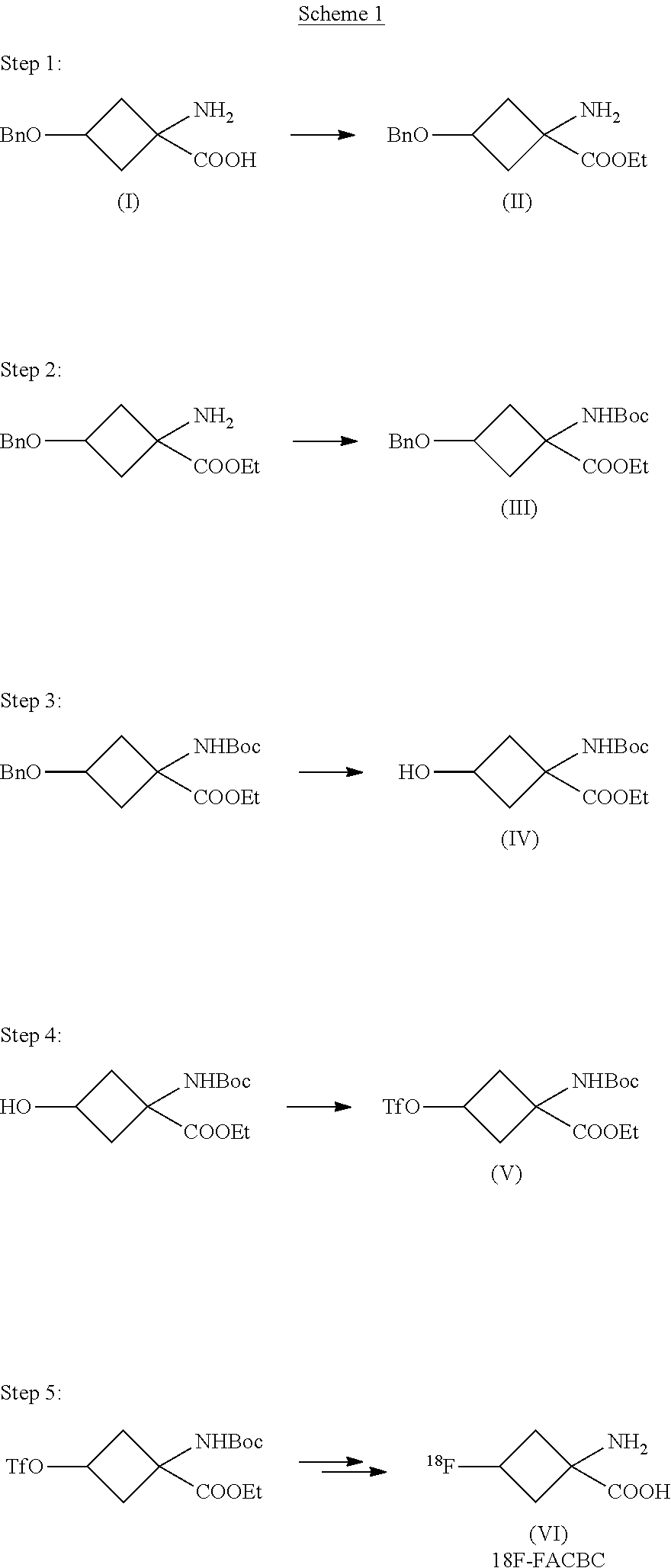

is named 1-(N-(t-butoxycarbonyl)amino)-3-benzyloxy-cyclobutane-1-carboxylic acid ethyl ester. In accordance with Scheme 1 this compound is prepared in a multi-step synthesis from the syn enantiomer of hydantoin. In the work-up of this intermediate ethyl acetate and hydrochloric acid are added to the resulting composition before the organic layer is extracted and washed with water. In this process of preparing the compound of formula III salts are generated. Such large amounts of salts are generated that these have to be removed before the next steps. When the reactions according to step 1 and 2 of Scheme 1 were performed in larger scale, such as in a commercial scale, e.g. preparing up to 500 grams of the compound of formula III, significant problems were observed. Addition of HCl and ethyl acetate to the crude reaction forms an emulsion when performed at a larger scale and the desired bi-phasic system is not formed. Removal of generated salts using filtration was also not possible when preparing at such a large scale as the filter was totally clogged.

wherein:
-
- i) providing a crude reaction product comprising said compound of formula IIIa;
- ii) adding ethyl acetate to the crude reaction product of step i) to prepare a suspension;
- iii) adding water to the suspension of step ii) to form a biphasic system comprising an aqueous phase and an organic phase, and discarding the aqueous phase;
- iv) adding an acid to the organic phase of step iii) to form a biphasic system comprising an acidic aqueous phase and an organic phase, and discarding the acidic aqueous phase;
- v) washing the organic phase of step iv) with water.

wherein in each case X, R and Y are as defined herein for formula IIIa.

which is 5-(3-benzyloxycyclobutane)hydantoin.

wherein Y and R are as suitably and preferably defined herein for formula IIIa, and LG is a leaving group;
wherein said process comprises preparing the compound of formula IIIa according to the process as suitably and preferably defined herein.

which is a direct labeling precursor compound for 18F-FACBC. OTf denotes trifluoromethanesulfonate. Y in formula IIa is then Boc and R is ethyl.

wherein said process comprises preparing the compound of formula IIIa according to the process as suitably and preferably defined herein.
Claims (15)


Priority Applications (1)
| Application Number | Priority Date | Filing Date | Title |
|---|---|---|---|
| US13/989,527 US9278916B2 (en) | 2010-11-29 | 2011-11-28 | Preparation of pet precursor |
Applications Claiming Priority (3)
| Application Number | Priority Date | Filing Date | Title |
|---|---|---|---|
| US41749010P | 2010-11-29 | 2010-11-29 | |
| US13/989,527 US9278916B2 (en) | 2010-11-29 | 2011-11-28 | Preparation of pet precursor |
| PCT/EP2011/071145 WO2012072567A1 (en) | 2010-11-29 | 2011-11-28 | Preparation of pet precursor |
Publications (2)
| Publication Number | Publication Date |
|---|---|
| US20130245307A1 US20130245307A1 (en) | 2013-09-19 |
| US9278916B2 true US9278916B2 (en) | 2016-03-08 |
Family
ID=45418623
Family Applications (1)
| Application Number | Title | Priority Date | Filing Date |
|---|---|---|---|
| US13/989,527 Expired - Fee Related US9278916B2 (en) | 2010-11-29 | 2011-11-28 | Preparation of pet precursor |
Country Status (13)
| Country | Link |
|---|---|
| US (1) | US9278916B2 (en) |
| EP (1) | EP2646411B1 (en) |
| JP (1) | JP6018578B2 (en) |
| KR (1) | KR20130140041A (en) |
| CN (1) | CN103221382B (en) |
| AU (1) | AU2011335084B2 (en) |
| CA (1) | CA2820363A1 (en) |
| DK (1) | DK2646411T3 (en) |
| ES (1) | ES2643500T3 (en) |
| MX (1) | MX2013006050A (en) |
| NO (1) | NO2646411T3 (en) |
| RU (1) | RU2587308C2 (en) |
| WO (1) | WO2012072567A1 (en) |
Cited By (1)
| Publication number | Priority date | Publication date | Assignee | Title |
|---|---|---|---|---|
| US10023525B2 (en) | 2012-08-09 | 2018-07-17 | Ge Healthcare Limited | Preparation of 18F-fluciclovine |
Families Citing this family (1)
| Publication number | Priority date | Publication date | Assignee | Title |
|---|---|---|---|---|
| CN114767929A (en) * | 2022-03-14 | 2022-07-22 | 上海理工大学 | Communicated porous PHBHHx bone filling microsphere material and preparation method thereof |
Citations (4)
| Publication number | Priority date | Publication date | Assignee | Title |
|---|---|---|---|---|
| JPH11302244A (en) | 1998-04-20 | 1999-11-02 | Tokuyama Corp | Method for producing N-hydrocarbon oxycarbonyl amino acid ester |
| US20080281121A1 (en) * | 2005-11-29 | 2008-11-13 | Nihon Medi-Physics Co., Ltd. | Precursor Compound of Radioactive Halogen-Labeled Organic Compound |
| US20090198085A1 (en) | 2006-05-11 | 2009-08-06 | Nihon Medi-Physics Co., Ltd. | Process for Production of Radioactive Fluorine-Labeled Organic Compound |
| US8563771B2 (en) | 2006-12-27 | 2013-10-22 | Nihon Medi-Physics Co., Ltd. | Process for production of precursor compound for radioactive halogen-labeled organic compound |
-
2011
- 2011-11-28 US US13/989,527 patent/US9278916B2/en not_active Expired - Fee Related
- 2011-11-28 ES ES11801996.7T patent/ES2643500T3/en active Active
- 2011-11-28 EP EP11801996.7A patent/EP2646411B1/en not_active Not-in-force
- 2011-11-28 RU RU2013122655/04A patent/RU2587308C2/en not_active IP Right Cessation
- 2011-11-28 AU AU2011335084A patent/AU2011335084B2/en not_active Ceased
- 2011-11-28 JP JP2013540407A patent/JP6018578B2/en not_active Expired - Fee Related
- 2011-11-28 WO PCT/EP2011/071145 patent/WO2012072567A1/en not_active Ceased
- 2011-11-28 KR KR1020137013586A patent/KR20130140041A/en not_active Ceased
- 2011-11-28 NO NO11801996A patent/NO2646411T3/no unknown
- 2011-11-28 MX MX2013006050A patent/MX2013006050A/en unknown
- 2011-11-28 CN CN201180057122.9A patent/CN103221382B/en not_active Expired - Fee Related
- 2011-11-28 CA CA2820363A patent/CA2820363A1/en not_active Abandoned
- 2011-11-28 DK DK11801996.7T patent/DK2646411T3/en active
Patent Citations (4)
| Publication number | Priority date | Publication date | Assignee | Title |
|---|---|---|---|---|
| JPH11302244A (en) | 1998-04-20 | 1999-11-02 | Tokuyama Corp | Method for producing N-hydrocarbon oxycarbonyl amino acid ester |
| US20080281121A1 (en) * | 2005-11-29 | 2008-11-13 | Nihon Medi-Physics Co., Ltd. | Precursor Compound of Radioactive Halogen-Labeled Organic Compound |
| US20090198085A1 (en) | 2006-05-11 | 2009-08-06 | Nihon Medi-Physics Co., Ltd. | Process for Production of Radioactive Fluorine-Labeled Organic Compound |
| US8563771B2 (en) | 2006-12-27 | 2013-10-22 | Nihon Medi-Physics Co., Ltd. | Process for production of precursor compound for radioactive halogen-labeled organic compound |
Non-Patent Citations (1)
| Title |
|---|
| PCT/EP2011/071145 ISRWO Dated Mar. 12, 2012. |
Cited By (1)
| Publication number | Priority date | Publication date | Assignee | Title |
|---|---|---|---|---|
| US10023525B2 (en) | 2012-08-09 | 2018-07-17 | Ge Healthcare Limited | Preparation of 18F-fluciclovine |
Also Published As
| Publication number | Publication date |
|---|---|
| WO2012072567A1 (en) | 2012-06-07 |
| AU2011335084B2 (en) | 2015-08-20 |
| ES2643500T3 (en) | 2017-11-23 |
| CN103221382A (en) | 2013-07-24 |
| MX2013006050A (en) | 2013-06-28 |
| RU2013122655A (en) | 2015-01-10 |
| AU2011335084A1 (en) | 2013-07-04 |
| CN103221382B (en) | 2016-06-01 |
| DK2646411T3 (en) | 2017-10-16 |
| CA2820363A1 (en) | 2012-06-07 |
| KR20130140041A (en) | 2013-12-23 |
| US20130245307A1 (en) | 2013-09-19 |
| NO2646411T3 (en) | 2018-01-13 |
| JP2014506236A (en) | 2014-03-13 |
| RU2587308C2 (en) | 2016-06-20 |
| EP2646411B1 (en) | 2017-08-16 |
| EP2646411A1 (en) | 2013-10-09 |
| JP6018578B2 (en) | 2016-11-02 |
Similar Documents
| Publication | Publication Date | Title |
|---|---|---|
| US11083804B2 (en) | Precursor compound of radioactive halogen-labeled organic compound | |
| EP2230229B1 (en) | Process for production of radioactive-fluorine-labeled organic compound | |
| EP2128130B1 (en) | Process for production of precursor compound for radioactive halogen-labeled organic compound | |
| EP2646411B1 (en) | Preparation of pet precursor | |
| JP6047100B2 (en) | Simplified process for precursor compounds | |
| US9061977B2 (en) | Purification of precursor compound by crystallisation | |
| AU2011347530B2 (en) | Purification of precursor compound by crystallisation |
Legal Events
| Date | Code | Title | Description |
|---|---|---|---|
| AS | Assignment |
Owner name: GE HEALTHCARE LIMITED, UNITED KINGDOM Free format text: ASSIGNMENT OF ASSIGNORS INTEREST;ASSIGNORS:BERG, TOM CHRISTIAN;NILSEN, ANNE;REEL/FRAME:030481/0674 Effective date: 20110216 |
|
| ZAAA | Notice of allowance and fees due |
Free format text: ORIGINAL CODE: NOA |
|
| ZAAB | Notice of allowance mailed |
Free format text: ORIGINAL CODE: MN/=. |
|
| STCF | Information on status: patent grant |
Free format text: PATENTED CASE |
|
| FEPP | Fee payment procedure |
Free format text: PAYER NUMBER DE-ASSIGNED (ORIGINAL EVENT CODE: RMPN); ENTITY STATUS OF PATENT OWNER: LARGE ENTITY Free format text: PAYOR NUMBER ASSIGNED (ORIGINAL EVENT CODE: ASPN); ENTITY STATUS OF PATENT OWNER: LARGE ENTITY |
|
| AS | Assignment |
Owner name: BLUE EARTH DIAGNOSTICS LIMITED, ENGLAND Free format text: ASSIGNMENT OF ASSIGNORS INTEREST;ASSIGNOR:GE HEALTHCARE LIMITED;REEL/FRAME:043664/0417 Effective date: 20170216 |
|
| MAFP | Maintenance fee payment |
Free format text: PAYMENT OF MAINTENANCE FEE, 4TH YEAR, LARGE ENTITY (ORIGINAL EVENT CODE: M1551); ENTITY STATUS OF PATENT OWNER: LARGE ENTITY Year of fee payment: 4 |
|
| FEPP | Fee payment procedure |
Free format text: MAINTENANCE FEE REMINDER MAILED (ORIGINAL EVENT CODE: REM.); ENTITY STATUS OF PATENT OWNER: LARGE ENTITY |
|
| LAPS | Lapse for failure to pay maintenance fees |
Free format text: PATENT EXPIRED FOR FAILURE TO PAY MAINTENANCE FEES (ORIGINAL EVENT CODE: EXP.); ENTITY STATUS OF PATENT OWNER: LARGE ENTITY |
|
| STCH | Information on status: patent discontinuation |
Free format text: PATENT EXPIRED DUE TO NONPAYMENT OF MAINTENANCE FEES UNDER 37 CFR 1.362 |
|
| FP | Lapsed due to failure to pay maintenance fee |
Effective date: 20240308 |