US9259727B2 - Method of modifying nano-porous gas-reforming catalyst with high-temperature stability - Google Patents
Method of modifying nano-porous gas-reforming catalyst with high-temperature stability Download PDFInfo
- Publication number
- US9259727B2 US9259727B2 US13/657,996 US201213657996A US9259727B2 US 9259727 B2 US9259727 B2 US 9259727B2 US 201213657996 A US201213657996 A US 201213657996A US 9259727 B2 US9259727 B2 US 9259727B2
- Authority
- US
- United States
- Prior art keywords
- catalyst
- temperature
- nano
- ceo
- pores
- Prior art date
- Legal status (The legal status is an assumption and is not a legal conclusion. Google has not performed a legal analysis and makes no representation as to the accuracy of the status listed.)
- Expired - Fee Related, expires
Links
Images




Classifications
-
- B—PERFORMING OPERATIONS; TRANSPORTING
- B01—PHYSICAL OR CHEMICAL PROCESSES OR APPARATUS IN GENERAL
- B01J—CHEMICAL OR PHYSICAL PROCESSES, e.g. CATALYSIS OR COLLOID CHEMISTRY; THEIR RELEVANT APPARATUS
- B01J37/00—Processes, in general, for preparing catalysts; Processes, in general, for activation of catalysts
- B01J37/0009—Use of binding agents; Moulding; Pressing; Powdering; Granulating; Addition of materials ameliorating the mechanical properties of the product catalyst
- B01J37/0018—Addition of a binding agent or of material, later completely removed among others as result of heat treatment, leaching or washing,(e.g. forming of pores; protective layer, desintegrating by heat)
-
- B—PERFORMING OPERATIONS; TRANSPORTING
- B01—PHYSICAL OR CHEMICAL PROCESSES OR APPARATUS IN GENERAL
- B01J—CHEMICAL OR PHYSICAL PROCESSES, e.g. CATALYSIS OR COLLOID CHEMISTRY; THEIR RELEVANT APPARATUS
- B01J21/00—Catalysts comprising the elements, oxides, or hydroxides of magnesium, boron, aluminium, carbon, silicon, titanium, zirconium, or hafnium
- B01J21/02—Boron or aluminium; Oxides or hydroxides thereof
- B01J21/04—Alumina
-
- B—PERFORMING OPERATIONS; TRANSPORTING
- B01—PHYSICAL OR CHEMICAL PROCESSES OR APPARATUS IN GENERAL
- B01J—CHEMICAL OR PHYSICAL PROCESSES, e.g. CATALYSIS OR COLLOID CHEMISTRY; THEIR RELEVANT APPARATUS
- B01J21/00—Catalysts comprising the elements, oxides, or hydroxides of magnesium, boron, aluminium, carbon, silicon, titanium, zirconium, or hafnium
- B01J21/18—Carbon
- B01J21/185—Carbon nanotubes
-
- B—PERFORMING OPERATIONS; TRANSPORTING
- B01—PHYSICAL OR CHEMICAL PROCESSES OR APPARATUS IN GENERAL
- B01J—CHEMICAL OR PHYSICAL PROCESSES, e.g. CATALYSIS OR COLLOID CHEMISTRY; THEIR RELEVANT APPARATUS
- B01J23/00—Catalysts comprising metals or metal oxides or hydroxides, not provided for in group B01J21/00
- B01J23/38—Catalysts comprising metals or metal oxides or hydroxides, not provided for in group B01J21/00 of noble metals
- B01J23/54—Catalysts comprising metals or metal oxides or hydroxides, not provided for in group B01J21/00 of noble metals combined with metals, oxides or hydroxides provided for in groups B01J23/02 - B01J23/36
- B01J23/56—Platinum group metals
- B01J23/63—Platinum group metals with rare earths or actinides
-
- B01J35/023—
-
- B01J35/026—
-
- B01J35/1061—
-
- B01J35/1066—
-
- B—PERFORMING OPERATIONS; TRANSPORTING
- B01—PHYSICAL OR CHEMICAL PROCESSES OR APPARATUS IN GENERAL
- B01J—CHEMICAL OR PHYSICAL PROCESSES, e.g. CATALYSIS OR COLLOID CHEMISTRY; THEIR RELEVANT APPARATUS
- B01J35/00—Catalysts, in general, characterised by their form or physical properties
- B01J35/40—Catalysts, in general, characterised by their form or physical properties characterised by dimensions, e.g. grain size
-
- B—PERFORMING OPERATIONS; TRANSPORTING
- B01—PHYSICAL OR CHEMICAL PROCESSES OR APPARATUS IN GENERAL
- B01J—CHEMICAL OR PHYSICAL PROCESSES, e.g. CATALYSIS OR COLLOID CHEMISTRY; THEIR RELEVANT APPARATUS
- B01J35/00—Catalysts, in general, characterised by their form or physical properties
- B01J35/40—Catalysts, in general, characterised by their form or physical properties characterised by dimensions, e.g. grain size
- B01J35/45—Nanoparticles
-
- B—PERFORMING OPERATIONS; TRANSPORTING
- B01—PHYSICAL OR CHEMICAL PROCESSES OR APPARATUS IN GENERAL
- B01J—CHEMICAL OR PHYSICAL PROCESSES, e.g. CATALYSIS OR COLLOID CHEMISTRY; THEIR RELEVANT APPARATUS
- B01J35/00—Catalysts, in general, characterised by their form or physical properties
- B01J35/50—Catalysts, in general, characterised by their form or physical properties characterised by their shape or configuration
- B01J35/55—Cylinders or rings
-
- B—PERFORMING OPERATIONS; TRANSPORTING
- B01—PHYSICAL OR CHEMICAL PROCESSES OR APPARATUS IN GENERAL
- B01J—CHEMICAL OR PHYSICAL PROCESSES, e.g. CATALYSIS OR COLLOID CHEMISTRY; THEIR RELEVANT APPARATUS
- B01J35/00—Catalysts, in general, characterised by their form or physical properties
- B01J35/60—Catalysts, in general, characterised by their form or physical properties characterised by their surface properties or porosity
- B01J35/64—Pore diameter
- B01J35/647—2-50 nm
-
- B—PERFORMING OPERATIONS; TRANSPORTING
- B01—PHYSICAL OR CHEMICAL PROCESSES OR APPARATUS IN GENERAL
- B01J—CHEMICAL OR PHYSICAL PROCESSES, e.g. CATALYSIS OR COLLOID CHEMISTRY; THEIR RELEVANT APPARATUS
- B01J35/00—Catalysts, in general, characterised by their form or physical properties
- B01J35/60—Catalysts, in general, characterised by their form or physical properties characterised by their surface properties or porosity
- B01J35/64—Pore diameter
- B01J35/651—50-500 nm
-
- B—PERFORMING OPERATIONS; TRANSPORTING
- B01—PHYSICAL OR CHEMICAL PROCESSES OR APPARATUS IN GENERAL
- B01J—CHEMICAL OR PHYSICAL PROCESSES, e.g. CATALYSIS OR COLLOID CHEMISTRY; THEIR RELEVANT APPARATUS
- B01J37/00—Processes, in general, for preparing catalysts; Processes, in general, for activation of catalysts
- B01J37/0009—Use of binding agents; Moulding; Pressing; Powdering; Granulating; Addition of materials ameliorating the mechanical properties of the product catalyst
- B01J37/0027—Powdering
- B01J37/0036—Grinding
-
- B—PERFORMING OPERATIONS; TRANSPORTING
- B01—PHYSICAL OR CHEMICAL PROCESSES OR APPARATUS IN GENERAL
- B01J—CHEMICAL OR PHYSICAL PROCESSES, e.g. CATALYSIS OR COLLOID CHEMISTRY; THEIR RELEVANT APPARATUS
- B01J37/00—Processes, in general, for preparing catalysts; Processes, in general, for activation of catalysts
- B01J37/0009—Use of binding agents; Moulding; Pressing; Powdering; Granulating; Addition of materials ameliorating the mechanical properties of the product catalyst
- B01J37/0063—Granulating
-
- B—PERFORMING OPERATIONS; TRANSPORTING
- B01—PHYSICAL OR CHEMICAL PROCESSES OR APPARATUS IN GENERAL
- B01J—CHEMICAL OR PHYSICAL PROCESSES, e.g. CATALYSIS OR COLLOID CHEMISTRY; THEIR RELEVANT APPARATUS
- B01J37/00—Processes, in general, for preparing catalysts; Processes, in general, for activation of catalysts
- B01J37/02—Impregnation, coating or precipitation
- B01J37/0201—Impregnation
-
- B—PERFORMING OPERATIONS; TRANSPORTING
- B01—PHYSICAL OR CHEMICAL PROCESSES OR APPARATUS IN GENERAL
- B01J—CHEMICAL OR PHYSICAL PROCESSES, e.g. CATALYSIS OR COLLOID CHEMISTRY; THEIR RELEVANT APPARATUS
- B01J2235/00—Indexing scheme associated with group B01J35/00, related to the analysis techniques used to determine the catalysts form or properties
-
- B—PERFORMING OPERATIONS; TRANSPORTING
- B82—NANOTECHNOLOGY
- B82Y—SPECIFIC USES OR APPLICATIONS OF NANOSTRUCTURES; MEASUREMENT OR ANALYSIS OF NANOSTRUCTURES; MANUFACTURE OR TREATMENT OF NANOSTRUCTURES
- B82Y40/00—Manufacture or treatment of nanostructures
Definitions
- the present invention relates to a reforming catalyst; more particularly, relates to using an ⁇ -aluminum oxide ( ⁇ -Al 2 O 3 ) carrier to fabricate a reforming catalyst of Pt (platinum)/CeO 2 (cerium oxide)/ ⁇ -Al 2 O 3 ( ⁇ -aluminum oxide), where the Pt and CeO 2 are formed on the ⁇ -Al 2 O 3 carrier in nano-pores of the Pt/CeO 2 / ⁇ -Al 2 O 3 catalyst.
- ⁇ -aluminum oxide ⁇ -Al 2 O 3
- Solid oxide fuel cell is one of the solutions for its high efficiency and low carbon oxide discharge.
- hydrogen reformer for natural gas is a key issue on developing SOFC.
- the nickel-based catalyst is used owing to two reasons.
- the nickel metal can absorb methane and release hydrogen atoms to form hydrogen gas.
- the nickel-based catalyst is cheap.
- the nickel-based catalyst is fabricated through deposition, co-deposition or impregnation.
- the nickel-based catalysts fabricated through deposition and co-deposition have complex procedures for spreading on the carriers uniformly. Hence, impregnation is a common method for fabricating the nickel-based catalyst.
- the nickel-based catalyst achieves a good performance on aluminum oxide (Al 2 O 3 ).
- bulk-Ni may be formed when the nickel carrier is dense, and the bulk-Ni does not react with the carrier. The bulk-Ni may be easily gathered and sintered to make the catalyst inactive.
- the catalyst If no bulk-Ni exists in the catalyst, the more Ni is contained in the catalyst, the better performance is the catalyst. Besides, when more Ni is contained, more hydrogen is consumed and there are more linking effect between hydrogen and aluminum oxide. Thus, distribution of Ni on the catalyst is better; the catalyst will not be easily sintered; and, production of hydrogen is higher. However, after 200 hrs of running, dust is found to choke channels of SOFC while the reformer still functions well. Nevertheless, after processing the reforming reaction at a high temperature ( ⁇ 800° C.), the catalyst is pulverized.
- a carrier including specific surface (relating to distribution of active points), porosity (relating to mass transfer and heat transfer), granular size (relating to voltage drop), mechanical strength, etc.
- Aluminum oxide is one of the most commonly used carriers for a catalyst. But, nickel oxide (NiO) is easily reacted with ⁇ -Al 2 O 3 in a high-temperature oxidant environment to form an inactive NiAl 2 O 4 , which can not be easily reducted.
- a new catalyst, ⁇ -Al 2 O 3 is used as a carrier for having better hardness.
- transition metal or rare-earth oxide can be added to reduce usage amount of the precious metal and to increase surface of the carrier for uniformly distribute atoms or ions of the precious metal on the surface of the carrier.
- cerium oxide (CeO 2 ) is a promoter having a good performance, which forms a Pt—CeO 2 complex structure.
- CeO 2 stores oxygen itself for processing oxidation; and, therefore, activity of the whole catalyst is greatly enhanced.
- carbon deposition can be reduced by adding Pt.
- the Pt—CeO 2 structure is only a non-organic membrane on the surface without pores formed inside.
- the surface for reaction is small and Pt will become bigger after times of use.
- stability of the catalyst used at high temperature is not good.
- the prior arts do not fulfill all users' requests on actual use.
- the main purpose of the present invention is to use an ⁇ -Al 2 O 3 carrier for fabricating a nano-porous Pt/CeO 2 / ⁇ -Al 2 O 3 catalyst, where Pt and CeO 2 are formed on the carrier in nano-pores of the catalyst; the catalyst has expanded surface and, with the nano-pores, Pt does not become bigger as being sintered at a temperature higher than 800° C.
- Another purpose of the present invention is to provide a reforming catalyst for natural gas, which catalyst has a hydrogen producing rate about 67%, a conversion rate higher than 95% and stability on running for 1000 hrs without being pulverized or carbon-deposited.
- the present invention is a method of modifying a nano-porous gas-reforming catalyst with high-temperature stability, comprising steps of: (a) obtaining ⁇ -Al 2 O 3 to be added with active carbon or a carbon nanomaterial; then, mixing ⁇ -Al 2 O 3 and the carbon material through ball milling to be tableted to obtain a cylinder of ⁇ -Al 2 O 3 having nano-pores; (b) putting the cylinder of ⁇ -Al 2 O 3 having nano-pores into a furnace flown with air to be calcined for 6 ⁇ 9 hours (hrs) at a temperature-rising velocity of 5° C.
- FIG. 1 is the flow view showing the preferred embodiment according to the present invention.
- FIG. 2 is the view showing the ⁇ -Al 2 O 3 carrier
- FIG. 3 is the view showing the crystalline phases of the carriers and the final catalyst
- FIG. 4 is the view showing the reforming process of the catalyst
- FIG. 5 is the view showing the resultant compositions after the reforming process.
- FIG. 6 is the view showing the changes in the micro-structures before and after the stability test.
- FIG. 1 and FIG. 2 are a flow view showing the preferred embodiment according to the present invention and a view showing an ⁇ -Al 2 O 3 carrier.
- the present invention is a method of modifying a nano-porous gas-reforming catalyst with high-temperature stability, comprising the following steps:
- (a) Fabricating porous nano-structure 11 At first, ⁇ -aluminum oxide ( ⁇ -Al 2 O 3 ) is obtained to be added with a carbon material of active carbon or a carbon nanotube (CNT). Then, ⁇ -Al2O3 and the carbon material or CNT are mixed through ball milling to be tableted for forming a cylinder of ⁇ -Al 2 O 3 having nano-pores.
- ⁇ -aluminum oxide ⁇ -Al 2 O 3
- CNT carbon nanotube
- (b) Fabricating ⁇ -Al 2 O 3 carrier 12 The cylinder of ⁇ -Al 2 O 3 having nano-pores is put into a furnace flown with 3 liters per minute (LPM) of air to be calcined for 8 hours (hrs) at a temperature-rising velocity of 5° C. per minute (° C./min) until a temperature of 1200 Celsius degrees (° C.). Then, the temperature is lowered down to a room temperature at a temperature-falling velocity of 5° C./min to obtain a cylinder of ⁇ -Al 2 O 3 having nano-pores.
- the cylinder of ⁇ -Al 2 O 3 33 has a granular size of 2.55 millimeters (mm) and a height of 3.10 mm and has nano-pores having a diameter of 50 nanometers (nm).
- cerium nitrate 13 18.6 grams (g) of cerium nitrate (Ce(NO 3 ) 3 .6H 2 O) is obtained to be dissolved into 50 g of deionized water to obtain a solution of cerium nitrate.
- Impregnating 14 40 g of the cylinder of ⁇ -Al 2 O 3 having nano-pores is impregnated in the solution of cerium nitrate for 12 hrs.
- (f) Drying 16 The drained catalyst is put in an oven to be dried at a temperature of 110° C., where the catalyst is a CeO 2 (cerium oxide)/ ⁇ -Al 2 O 3 catalyst and CeO 2 is a carrier on ⁇ -Al 2 O 3 to be embedded in the nano-pores.
- the catalyst is a CeO 2 (cerium oxide)/ ⁇ -Al 2 O 3 catalyst and CeO 2 is a carrier on ⁇ -Al 2 O 3 to be embedded in the nano-pores.
- Impregnating 19 40 g of the calcined CeO 2 / ⁇ -Al 2 O 3 catalyst in step (f) is impregnated in the solution of platinum for 12 hrs.
- FIG. 3 is a view showing crystalline phases of carriers and a final catalyst.
- crystalline phases of catalysts are shown through energy-dispersive X-ray spectroscopy (EDS).
- Diagram (a) in the figure shows an ⁇ -Al 2 O 3 catalyst;
- diagram (b) shows a CeO 2 / ⁇ -Al 2 O 3 catalyst;
- diagram (c) shows a Pt/CeO 2 / ⁇ -Al 2 O 3 catalyst. All shows the same good characteristic peak, which means a good crystalline structure.
- FIG. 4 to FIG. 6 are a view showing a reforming process of catalyst, a view showing resultant compositions after the reforming process and a view showing changes in micro-structures before and after stability test.
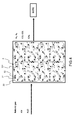
- a metal of Pt and a material of CeO 2 32 are used to form a reforming catalyst 3 on an ⁇ -Al 2 O 3 carrier 33 with nano-pores 331 .
- a reforming reaction is processed through auto-thermal reaction with reactants of natural gas, air and water (H 2 O). After mixing the reactants, the reforming catalyst is used to process a high-temperature reforming reaction for generating hydrogen and, thus, a hydrogen-rich gas is provided for a solid oxide fuel cell (SOFC).
- SOFC solid oxide fuel cell
- a hydrogen density curve 41 reaches 66.57% with a nitrogen density curve 42 reaching 11.31%, a carbon monoxide (CO) density curve 44 reaching 15.48% and a carbon dioxide (CO 2 ) density curve 45 reaching 6%, which shows the production rate of hydrogen is more than 65%.
- a methane (CH 4 ) density curve 43 shows that almost no methane is produced, which indicates a good activity of the Pt/CeO 2 / ⁇ -Al 2 O 3 catalyst on generating hydrogen from natural gas.
- diagram (a) and diagram (b) are the micro-structures of the reforming catalyst 3 before and after 2000 hrs of stability test. After the 2000 hrs of stability test, the reforming catalyst 3 shows its ability on resisting tens of times of 800° C. thermal cycling in SOFC without being pulverized or carbon-deposited.
- the present invention uses an ⁇ -Al 2 O 3 carrier to fabricate a reforming catalyst of Pt/CeO 2 / ⁇ -Al 2 O 3 , where Pt and CeO 2 are formed on the ⁇ -Al 2 O 3 carrier in nano-pores of the Pt/CeO 2 / ⁇ -Al 2 O 3 catalyst.
- the Pt/CeO 2 / ⁇ -Al 2 O 3 catalyst fabricated according to the present invention has increased reaction surface and is prevented from moving and gathering of metal crystallite.
- the catalyst reaches a hydrogen producing rate about 67%, a conversion rate higher than 95% and stability on running even for 2000 hrs.
- interaction between Pt and CeO 2 is reduced through surface expansion for further restraining sintering of Pt and keeping Pt small while stability is still remained at a temperature higher than 800° C.
- the present invention is a method of modifying a nano-porous gas-reforming catalyst with high-temperature stability, where a thermo-resistant and nano-porous ⁇ -Al 2 O 3 carrier is used for fabricating a Pt/CeO 2 / ⁇ -Al 2 O 3 catalyst; Pt and CeO 2 are formed on the carrier in nano-pores of the catalyst; the catalyst has expanded surface and a good hydrogen conversion rate; the catalyst does not pulverized or carbon-deposited under a temperature higher than 800° C. with stability on running even for 2000 hrs; and, with the nano-pores, Pt does not become bigger through being sintered.
Landscapes
- Chemical & Material Sciences (AREA)
- Engineering & Computer Science (AREA)
- Materials Engineering (AREA)
- Organic Chemistry (AREA)
- Chemical Kinetics & Catalysis (AREA)
- Nanotechnology (AREA)
- Catalysts (AREA)
Abstract
Description
Claims (8)
Priority Applications (1)
| Application Number | Priority Date | Filing Date | Title |
|---|---|---|---|
| US13/657,996 US9259727B2 (en) | 2012-10-23 | 2012-10-23 | Method of modifying nano-porous gas-reforming catalyst with high-temperature stability |
Applications Claiming Priority (1)
| Application Number | Priority Date | Filing Date | Title |
|---|---|---|---|
| US13/657,996 US9259727B2 (en) | 2012-10-23 | 2012-10-23 | Method of modifying nano-porous gas-reforming catalyst with high-temperature stability |
Publications (2)
| Publication Number | Publication Date |
|---|---|
| US20140113809A1 US20140113809A1 (en) | 2014-04-24 |
| US9259727B2 true US9259727B2 (en) | 2016-02-16 |
Family
ID=50485862
Family Applications (1)
| Application Number | Title | Priority Date | Filing Date |
|---|---|---|---|
| US13/657,996 Expired - Fee Related US9259727B2 (en) | 2012-10-23 | 2012-10-23 | Method of modifying nano-porous gas-reforming catalyst with high-temperature stability |
Country Status (1)
| Country | Link |
|---|---|
| US (1) | US9259727B2 (en) |
Citations (3)
| Publication number | Priority date | Publication date | Assignee | Title |
|---|---|---|---|---|
| US20030151155A1 (en) * | 2002-01-21 | 2003-08-14 | Ngk Insulators, Ltd. | Method for manufacturing a porous ceramic structure |
| JP2005263537A (en) * | 2004-03-17 | 2005-09-29 | Rikogaku Shinkokai | Method for manufacturing porous ceramic body having through-hole |
| US20100004120A1 (en) * | 2005-12-23 | 2010-01-07 | Sk Energy Co., Ltd. | Platinum based catalyst for oxidation/reduction reaction and its use |
-
2012
- 2012-10-23 US US13/657,996 patent/US9259727B2/en not_active Expired - Fee Related
Patent Citations (3)
| Publication number | Priority date | Publication date | Assignee | Title |
|---|---|---|---|---|
| US20030151155A1 (en) * | 2002-01-21 | 2003-08-14 | Ngk Insulators, Ltd. | Method for manufacturing a porous ceramic structure |
| JP2005263537A (en) * | 2004-03-17 | 2005-09-29 | Rikogaku Shinkokai | Method for manufacturing porous ceramic body having through-hole |
| US20100004120A1 (en) * | 2005-12-23 | 2010-01-07 | Sk Energy Co., Ltd. | Platinum based catalyst for oxidation/reduction reaction and its use |
Also Published As
| Publication number | Publication date |
|---|---|
| US20140113809A1 (en) | 2014-04-24 |
Similar Documents
| Publication | Publication Date | Title |
|---|---|---|
| Adijanto et al. | Synthesis and stability of Pd@ CeO2 core–shell catalyst films in solid oxide fuel cell anodes | |
| Singh et al. | Influence of LaNiO3 shape on its solid-phase crystallization into coke-free reforming catalysts | |
| US9970118B2 (en) | Method for preparing fuel electrode of solid oxide electrolysis cells embedded with bimetallic catalyst | |
| KR101457098B1 (en) | Catalyst, Electrode using the same, Dry reforming method using the catalyst | |
| Zhang et al. | Effect of Gd promoter on the structure and catalytic performance of mesoporous Ni/Al2O3–CeO2 in dry reforming of methane | |
| EP2857554A1 (en) | Electrochemical reactor and method for production of fuel gas | |
| Li et al. | A direct-methane solid oxide fuel cell with a functionally engineered Ni–Fe metal support | |
| Zhang et al. | Pt-based core–shell nanocatalysts with enhanced activity and stability for CO oxidation | |
| US8575060B2 (en) | Method of fabricating fuel reforming catalyst for SOFC power generating system | |
| CN102549822B (en) | Catalyst material and method for reforming hydrocarbon fuels | |
| Wang et al. | A direct n-butane solid oxide fuel cell using Ba (Zr0. 1Ce0. 7Y0. 1Yb0. 1) 0.9 Ni0. 05Ru0. 05O3− δ perovskite as the reforming layer | |
| KR101342605B1 (en) | Hydrocarbon reforming catalyst, method for manufacturing the same and a fuel treatment device comprising the same | |
| CN105862060B (en) | A kind of application method of the electrochemical reforming system of methane and carbon dioxide dry reforming | |
| Yan et al. | Improvement of solid oxide fuel cell performance by a core‐shell structured catalyst using low concentration coal bed methane fuel | |
| US9630166B1 (en) | Method of fabricating catalyst carrier for generating hydrogen through methane reformation | |
| Lortie | Reverse water gas shift reaction over supported Cu-Ni nanoparticle catalysts | |
| US20140113809A1 (en) | Method of Modifying Nano-Porous Gas-Reforming Catalyst with High-Temperature Stability | |
| Yang et al. | Single-chamber solid oxide fuel cells with nanocatalyst-modified anodes capable of in situ activation | |
| KR102662192B1 (en) | Dry reforming catalyst formed by perovskite structure having exsoluted transition metal, method of manufacturing the same, dry reforming catalyst system having the same, and solid oxide fuel cell having the same | |
| CN113457684A (en) | Non-supported methanol reforming hydrogen production catalyst and preparation method and application thereof | |
| KR102755420B1 (en) | Conductive catalysts for reforming biogas and by-product gas, manufacturing methods, and hydrogen and syngas manufacturing methods using the same | |
| KR102864466B1 (en) | Manufacturing Method For Fuel Cell Catalyst Composition Including Physical-Property-Adjusted Porous Support, Fuel Cell Catalyst Composition And Membrane Electrode Assembly | |
| TWI539996B (en) | Method for preparing methane recombinant hydrogen production catalyst carrier | |
| KR20180003694A (en) | Reformer having excellent thermal stability and activity for mobile solid oxide fuel cell | |
| TWI414354B (en) | Water gas shift reactions, water gas shift catalysts, and methods for manufacturing the catalysts |
Legal Events
| Date | Code | Title | Description |
|---|---|---|---|
| AS | Assignment |
Owner name: ATOMIC ENERGY COUNCIL - INSTITUTE OF NUCLEAR RESEA Free format text: ASSIGNMENT OF ASSIGNORS INTEREST;ASSIGNORS:HSU, NING-YIH;JENG, KING-TSAI;CHIOU, SHEAN-DU;AND OTHERS;REEL/FRAME:029172/0511 Effective date: 20121023 |
|
| STCF | Information on status: patent grant |
Free format text: PATENTED CASE |
|
| MAFP | Maintenance fee payment |
Free format text: PAYMENT OF MAINTENANCE FEE, 4TH YEAR, LARGE ENTITY (ORIGINAL EVENT CODE: M1551); ENTITY STATUS OF PATENT OWNER: LARGE ENTITY Year of fee payment: 4 |
|
| FEPP | Fee payment procedure |
Free format text: MAINTENANCE FEE REMINDER MAILED (ORIGINAL EVENT CODE: REM.); ENTITY STATUS OF PATENT OWNER: LARGE ENTITY |
|
| LAPS | Lapse for failure to pay maintenance fees |
Free format text: PATENT EXPIRED FOR FAILURE TO PAY MAINTENANCE FEES (ORIGINAL EVENT CODE: EXP.); ENTITY STATUS OF PATENT OWNER: LARGE ENTITY |
|
| STCH | Information on status: patent discontinuation |
Free format text: PATENT EXPIRED DUE TO NONPAYMENT OF MAINTENANCE FEES UNDER 37 CFR 1.362 |
|
| FP | Lapsed due to failure to pay maintenance fee |
Effective date: 20240216 |