US9249084B2 - Substituted n-pentanamide compounds, preparation method and the use thereof - Google Patents
Substituted n-pentanamide compounds, preparation method and the use thereof Download PDFInfo
- Publication number
- US9249084B2 US9249084B2 US13/982,733 US201213982733A US9249084B2 US 9249084 B2 US9249084 B2 US 9249084B2 US 201213982733 A US201213982733 A US 201213982733A US 9249084 B2 US9249084 B2 US 9249084B2
- Authority
- US
- United States
- Prior art keywords
- acid
- compound
- phenyl
- substituted
- group
- Prior art date
- Legal status (The legal status is an assumption and is not a legal conclusion. Google has not performed a legal analysis and makes no representation as to the accuracy of the status listed.)
- Expired - Fee Related, expires
Links
- 0 CC[C@@H](C1=CC(*O)=CC=C1)[C@@H](C)C(N)=O.CC[C@@H](C1=CC(O)=CC=C1)[C@@H](C)CN(C)C Chemical compound CC[C@@H](C1=CC(*O)=CC=C1)[C@@H](C)C(N)=O.CC[C@@H](C1=CC(O)=CC=C1)[C@@H](C)CN(C)C 0.000 description 43
- QGZKDVFQNNGYKY-UHFFFAOYSA-N N Chemical compound N QGZKDVFQNNGYKY-UHFFFAOYSA-N 0.000 description 32
- ZGTXHDLEUTYDSV-DZGCQCFKSA-N CC[C@@H](C1=CC(C)=CC=C1)[C@@H](C)CN(C)C Chemical compound CC[C@@H](C1=CC(C)=CC=C1)[C@@H](C)CN(C)C ZGTXHDLEUTYDSV-DZGCQCFKSA-N 0.000 description 8
- KWTWDQCKEHXFFR-SMDDNHRTSA-N CC[C@@H](C1=CC(O)=CC=C1)[C@@H](C)CN(C)C Chemical compound CC[C@@H](C1=CC(O)=CC=C1)[C@@H](C)CN(C)C KWTWDQCKEHXFFR-SMDDNHRTSA-N 0.000 description 8
- OJYQBPIIHWXIIX-APWZRJJASA-N CC[C@H](CC(=O)N1C(=O)OC[C@H]1C1=CC=CC=C1)C1=CC(C)=CC=C1 Chemical compound CC[C@H](CC(=O)N1C(=O)OC[C@H]1C1=CC=CC=C1)C1=CC(C)=CC=C1 OJYQBPIIHWXIIX-APWZRJJASA-N 0.000 description 6
- OTZJZNPGUCYIET-TZMCWYRMSA-N CC[C@@H](C1=CC(C)=CC=C1)[C@@H](C)C(=O)N(C)C Chemical compound CC[C@@H](C1=CC(C)=CC=C1)[C@@H](C)C(=O)N(C)C OTZJZNPGUCYIET-TZMCWYRMSA-N 0.000 description 4
- KMGSVEORTNGRLL-UIFIKXQLSA-N CC[C@@H](C1=CC(C)=CC=C1)[C@@H](C)C(=O)N1C(=O)CC[C@H]1C1=CC=CC=C1 Chemical compound CC[C@@H](C1=CC(C)=CC=C1)[C@@H](C)C(=O)N1C(=O)CC[C@H]1C1=CC=CC=C1 KMGSVEORTNGRLL-UIFIKXQLSA-N 0.000 description 4
- IBLHHGXNLCPYGF-AHRSYUTCSA-N CC[C@@H](C1=CC(C)=CC=C1)[C@@H](C)C(=O)N1C(=O)OC[C@H]1C1=CC=CC=C1 Chemical compound CC[C@@H](C1=CC(C)=CC=C1)[C@@H](C)C(=O)N1C(=O)OC[C@H]1C1=CC=CC=C1 IBLHHGXNLCPYGF-AHRSYUTCSA-N 0.000 description 4
- SYBCTKOHLDENKP-OVQGTLEDSA-N CC[C@@H](C1=CC(C)=CC=C1)[C@@H](C)C(=O)N1C(=O)O[C@@H](C)[C@H]1C1=CC=CC=C1 Chemical compound CC[C@@H](C1=CC(C)=CC=C1)[C@@H](C)C(=O)N1C(=O)O[C@@H](C)[C@H]1C1=CC=CC=C1 SYBCTKOHLDENKP-OVQGTLEDSA-N 0.000 description 4
- FAFOFUBNEHIOBT-ZYHUDNBSSA-N CC[C@@H](C1=CC(C)=CC=C1)[C@@H](C)C(=O)O Chemical compound CC[C@@H](C1=CC(C)=CC=C1)[C@@H](C)C(=O)O FAFOFUBNEHIOBT-ZYHUDNBSSA-N 0.000 description 4
- DODSMERYVLNQJR-VANUSSGQSA-N CC[C@H](CC(=O)N1C(=O)O[C@@H](C2=CC=CC=C2)[C@H]1C1=CC=CC=C1)C1=CC(C)=CC=C1 Chemical compound CC[C@H](CC(=O)N1C(=O)O[C@@H](C2=CC=CC=C2)[C@H]1C1=CC=CC=C1)C1=CC(C)=CC=C1 DODSMERYVLNQJR-VANUSSGQSA-N 0.000 description 4
- GGFJZCAQOPPNSH-WGCMWVJHSA-N *.*.CC[C@@H](C1=CC(C)=CC=C1)[C@@H](C)C(=O)N(C)C.CC[C@@H](C1=CC(C)=CC=C1)[C@@H](C)C(=O)O.CC[C@@H](C1=CC(C)=CC=C1)[C@@H](C)C(N)=O.CC[C@@H](C1=CC(C)=CC=C1)[C@@H](C)CN(C)C.CC[C@@H](C1=CC(O)=CC=C1)[C@@H](C)CN(C)C.CC[C@@H](C1=CC(O)=CC=C1)[C@@H](C)CN(C)C Chemical compound *.*.CC[C@@H](C1=CC(C)=CC=C1)[C@@H](C)C(=O)N(C)C.CC[C@@H](C1=CC(C)=CC=C1)[C@@H](C)C(=O)O.CC[C@@H](C1=CC(C)=CC=C1)[C@@H](C)C(N)=O.CC[C@@H](C1=CC(C)=CC=C1)[C@@H](C)CN(C)C.CC[C@@H](C1=CC(O)=CC=C1)[C@@H](C)CN(C)C.CC[C@@H](C1=CC(O)=CC=C1)[C@@H](C)CN(C)C GGFJZCAQOPPNSH-WGCMWVJHSA-N 0.000 description 3
- DJYARUOOORLQKU-MAPHDYQJSA-N *.*.CC[C@@H](C1=CC(C)=CC=C1)[C@@H](C)C(=O)N(C)C.CC[C@@H](C1=CC(C)=CC=C1)[C@@H](C)C(=O)O.CC[C@@H](C1=CC(C)=CC=C1)[C@@H](C)C(N)=O.CC[C@@H](C1=CC(O)=CC=C1)[C@@H](C)C(=O)N(C)C.CC[C@@H](C1=CC(O)=CC=C1)[C@@H](C)CN(C)C.CC[C@@H](C1=CC(O)=CC=C1)[C@@H](C)CN(C)C Chemical compound *.*.CC[C@@H](C1=CC(C)=CC=C1)[C@@H](C)C(=O)N(C)C.CC[C@@H](C1=CC(C)=CC=C1)[C@@H](C)C(=O)O.CC[C@@H](C1=CC(C)=CC=C1)[C@@H](C)C(N)=O.CC[C@@H](C1=CC(O)=CC=C1)[C@@H](C)C(=O)N(C)C.CC[C@@H](C1=CC(O)=CC=C1)[C@@H](C)CN(C)C.CC[C@@H](C1=CC(O)=CC=C1)[C@@H](C)CN(C)C DJYARUOOORLQKU-MAPHDYQJSA-N 0.000 description 3
- PCEAQFMSHJVMSY-GAYDVDJYSA-N *.*.CC[C@@H](C1=CC(C)=CC=C1)[C@@H](C)C(N)=O.CC[C@@H](C1=CC(C)=CC=C1)[C@@H](C)CN(C)C.CC[C@@H](C1=CC(C)=CC=C1)[C@@H](C)CO.CC[C@@H](C1=CC(O)=CC=C1)[C@@H](C)CN(C)C.CC[C@@H](C1=CC(O)=CC=C1)[C@@H](C)CN(C)C.CC[C@H](C)[C@@H](CC)C1=CC(C)=CC=C1 Chemical compound *.*.CC[C@@H](C1=CC(C)=CC=C1)[C@@H](C)C(N)=O.CC[C@@H](C1=CC(C)=CC=C1)[C@@H](C)CN(C)C.CC[C@@H](C1=CC(C)=CC=C1)[C@@H](C)CO.CC[C@@H](C1=CC(O)=CC=C1)[C@@H](C)CN(C)C.CC[C@@H](C1=CC(O)=CC=C1)[C@@H](C)CN(C)C.CC[C@H](C)[C@@H](CC)C1=CC(C)=CC=C1 PCEAQFMSHJVMSY-GAYDVDJYSA-N 0.000 description 3
- GTORLOXDJHBEMT-DVQDXYAYSA-N CC1=CC=CC(/C=C/C(=O)N2C(=O)OC[C@H]2C2=CC=CC=C2)=C1 Chemical compound CC1=CC=CC(/C=C/C(=O)N2C(=O)OC[C@H]2C2=CC=CC=C2)=C1 GTORLOXDJHBEMT-DVQDXYAYSA-N 0.000 description 3
- KLKUWDVNYUTDGL-WCQYABFASA-N CC[C@@H](C1=CC(C)=CC=C1)[C@@H](C)CO Chemical compound CC[C@@H](C1=CC(C)=CC=C1)[C@@H](C)CO KLKUWDVNYUTDGL-WCQYABFASA-N 0.000 description 3
- UDFKKLRNQFSCCE-GXTWGEPZSA-N CC[C@@H](C1=CC(C)=CC=C1)[C@@H](C)COS(C)(=O)=O Chemical compound CC[C@@H](C1=CC(C)=CC=C1)[C@@H](C)COS(C)(=O)=O UDFKKLRNQFSCCE-GXTWGEPZSA-N 0.000 description 3
- HMZLLGPOSDTWTC-SNVBAGLBSA-N CC[C@H](CC(=O)O)C1=CC(C)=CC=C1 Chemical compound CC[C@H](CC(=O)O)C1=CC(C)=CC=C1 HMZLLGPOSDTWTC-SNVBAGLBSA-N 0.000 description 3
- BNUYFSDTEMXHRP-SUISVKHHSA-N *.*.CC[C@@H](C1=CC(C)=CC=C1)[C@@H](C)C(=O)N1C(=O)OC[C@H]1C1=CC=CC=C1.CC[C@@H](C1=CC(C)=CC=C1)[C@@H](C)C(=O)N[C@@H](CO)C1=CC=CC=C1.CC[C@@H](C1=CC(C)=CC=C1)[C@@H](C)CN[C@@H](CO)C1=CC=CC=C1.CC[C@@H](C1=CC(O)=CC=C1)[C@@H](C)CN.CC[C@@H](C1=CC(O)=CC=C1)[C@@H](C)CN(C)C.CC[C@@H](C1=CC(O)=CC=C1)[C@@H](C)CN(C)C Chemical compound *.*.CC[C@@H](C1=CC(C)=CC=C1)[C@@H](C)C(=O)N1C(=O)OC[C@H]1C1=CC=CC=C1.CC[C@@H](C1=CC(C)=CC=C1)[C@@H](C)C(=O)N[C@@H](CO)C1=CC=CC=C1.CC[C@@H](C1=CC(C)=CC=C1)[C@@H](C)CN[C@@H](CO)C1=CC=CC=C1.CC[C@@H](C1=CC(O)=CC=C1)[C@@H](C)CN.CC[C@@H](C1=CC(O)=CC=C1)[C@@H](C)CN(C)C.CC[C@@H](C1=CC(O)=CC=C1)[C@@H](C)CN(C)C BNUYFSDTEMXHRP-SUISVKHHSA-N 0.000 description 2
- MZTNZILGLRHDRO-FFXXJSNISA-N CC/C=C/C(=O)O.CC/C=C/C(N)=O.CC[C@@H](C1=CC(C)=CC=C1)[C@@H](C)C(N)=O.CC[C@H](CC(=O)O)C1=CC(C)=CC=C1.CC[C@H](CC(N)=O)C1=CC(C)=CC=C1.CC[C@H](CC(N)=O)C1=CC(C)=CC=C1 Chemical compound CC/C=C/C(=O)O.CC/C=C/C(N)=O.CC[C@@H](C1=CC(C)=CC=C1)[C@@H](C)C(N)=O.CC[C@H](CC(=O)O)C1=CC(C)=CC=C1.CC[C@H](CC(N)=O)C1=CC(C)=CC=C1.CC[C@H](CC(N)=O)C1=CC(C)=CC=C1 MZTNZILGLRHDRO-FFXXJSNISA-N 0.000 description 2
- FSOFQYDJPRUPOR-DYQZOYDYSA-N CC1=CC=CC(/C=C/C(=O)N2C(=O)O[C@@H](C3=CC=CC=C3)[C@H]2C2=CC=CC=C2)=C1 Chemical compound CC1=CC=CC(/C=C/C(=O)N2C(=O)O[C@@H](C3=CC=CC=C3)[C@H]2C2=CC=CC=C2)=C1 FSOFQYDJPRUPOR-DYQZOYDYSA-N 0.000 description 2
- PLWCZGSAHSMROV-LASZWRMGSA-N CC1=CC=CC(/C=C/C(=O)O)=C1.CC1=CC=CC(/C=C/C(N)=O)=C1.CC[C@@H](C1=CC(C)=CC=C1)[C@@H](C)C(N)=O.CC[C@H](CC(N)=O)C1=CC(C)=CC=C1 Chemical compound CC1=CC=CC(/C=C/C(=O)O)=C1.CC1=CC=CC(/C=C/C(N)=O)=C1.CC[C@@H](C1=CC(C)=CC=C1)[C@@H](C)C(N)=O.CC[C@H](CC(N)=O)C1=CC(C)=CC=C1 PLWCZGSAHSMROV-LASZWRMGSA-N 0.000 description 2
- MWSNFEAQTSJDBM-FSAHKVHBSA-N CC[C@@H](C1=CC(C)=CC=C1)[C@@H](C)C(=O)N1C(=O)O[C@@H](C2=CC=CC=C2)[C@H]1C1=CC=CC=C1 Chemical compound CC[C@@H](C1=CC(C)=CC=C1)[C@@H](C)C(=O)N1C(=O)O[C@@H](C2=CC=CC=C2)[C@H]1C1=CC=CC=C1 MWSNFEAQTSJDBM-FSAHKVHBSA-N 0.000 description 2
- NTATZSLCMJJKMV-WCQYABFASA-N CC[C@@H](C1=CC(C)=CC=C1)[C@@H](C)CBr Chemical compound CC[C@@H](C1=CC(C)=CC=C1)[C@@H](C)CBr NTATZSLCMJJKMV-WCQYABFASA-N 0.000 description 2
- RUMZFODVHWEZGQ-WCQYABFASA-N CC[C@@H](C1=CC(C)=CC=C1)[C@@H](C)CCl Chemical compound CC[C@@H](C1=CC(C)=CC=C1)[C@@H](C)CCl RUMZFODVHWEZGQ-WCQYABFASA-N 0.000 description 2
- YAVRMQNFRSFXNF-FXAWDEMLSA-N CC[C@@H](C1=CC(C)=CC=C1)[C@@H](C)COS(=O)(=O)C1=CC=C(C)C=C1 Chemical compound CC[C@@H](C1=CC(C)=CC=C1)[C@@H](C)COS(=O)(=O)C1=CC=C(C)C=C1 YAVRMQNFRSFXNF-FXAWDEMLSA-N 0.000 description 2
- IMDCZEXOEZGMSZ-ZWNOBZJWSA-N CC[C@@H](C1=CC(O)=CC=C1)[C@@H](C)C(=O)N(C)C Chemical compound CC[C@@H](C1=CC(O)=CC=C1)[C@@H](C)C(=O)N(C)C IMDCZEXOEZGMSZ-ZWNOBZJWSA-N 0.000 description 2
- ZJCYNSWBHOOYOY-JOYOIKCWSA-N CC[C@@H](C1=CC(O)=CC=C1)[C@@H](C)CN Chemical compound CC[C@@H](C1=CC(O)=CC=C1)[C@@H](C)CN ZJCYNSWBHOOYOY-JOYOIKCWSA-N 0.000 description 2
- OJYQBPIIHWXIIX-VQIMIIECSA-N CC[C@H](CC(=O)N1C(=O)OC[C@@H]1C1=CC=CC=C1)C1=CC(C)=CC=C1 Chemical compound CC[C@H](CC(=O)N1C(=O)OC[C@@H]1C1=CC=CC=C1)C1=CC(C)=CC=C1 OJYQBPIIHWXIIX-VQIMIIECSA-N 0.000 description 2
- HXXGCOBYFIOSKK-CMPLNLGQSA-N N.[H][C@]12C3=C(C=CC=C3)C[C@@]1(C)OC(=O)N2C Chemical compound N.[H][C@]12C3=C(C=CC=C3)C[C@@]1(C)OC(=O)N2C HXXGCOBYFIOSKK-CMPLNLGQSA-N 0.000 description 2
- GGURKKKFKHCIGG-NEALPZMGSA-N CC(CN(C)C)C(=O)C1=CC(CO)=CC=C1.CC=C(C1=CC(CO)=CC=C1)[C@@H](C)CN(C)C.CCC(=O)C1=CC(CO)=CC=C1.CC[C@@H](C1=CC(CO)=CC=C1)[C@@H](C)CN(C)C.CC[C@@H](C1=CC(O)=CC=C1)[C@@H](C)CN(C)C.CC[C@](O)(C1=CC(CO)=CC=C1)[C@@H](C)CN(C)C.Cl.Cl.II Chemical compound CC(CN(C)C)C(=O)C1=CC(CO)=CC=C1.CC=C(C1=CC(CO)=CC=C1)[C@@H](C)CN(C)C.CCC(=O)C1=CC(CO)=CC=C1.CC[C@@H](C1=CC(CO)=CC=C1)[C@@H](C)CN(C)C.CC[C@@H](C1=CC(O)=CC=C1)[C@@H](C)CN(C)C.CC[C@](O)(C1=CC(CO)=CC=C1)[C@@H](C)CN(C)C.Cl.Cl.II GGURKKKFKHCIGG-NEALPZMGSA-N 0.000 description 1
- IIIXNQYVSNHXHJ-AHAUYKDXSA-N CC/C=C/C(=O)N1C(=O)OC[C@@H]1C1=CC=CC=C1 Chemical compound CC/C=C/C(=O)N1C(=O)OC[C@@H]1C1=CC=CC=C1 IIIXNQYVSNHXHJ-AHAUYKDXSA-N 0.000 description 1
- ZWFRGRJJKOGPQU-AUMNUSIISA-N CC1=CC=CC(C(=O)C(C)CN(C)C)=C1.CC=C(C1=CC(C)=CC=C1)[C@@H](C)CN(C)C.CCC(=O)C1=CC(C)=CC=C1.CC[C@@H](C1=CC(O)=CC=C1)[C@@H](C)CN(C)C.CC[C@](O)(C1=CC(C)=CC=C1)[C@@H](C)CN(C)C.II Chemical compound CC1=CC=CC(C(=O)C(C)CN(C)C)=C1.CC=C(C1=CC(C)=CC=C1)[C@@H](C)CN(C)C.CCC(=O)C1=CC(C)=CC=C1.CC[C@@H](C1=CC(O)=CC=C1)[C@@H](C)CN(C)C.CC[C@](O)(C1=CC(C)=CC=C1)[C@@H](C)CN(C)C.II ZWFRGRJJKOGPQU-AUMNUSIISA-N 0.000 description 1
- BQKZBQCACTVDCK-BSPBLCDLSA-N CCC(=O)C(C)CN(C)C.CCC(=O)CC.CC[C@@H](C1=CC(CO)=CC=C1)[C@@H](C)CN(C)C.CC[C@@H](C1=CC(O)=CC=C1)[C@@H](C)CN(C)C.CC[C@@](O)(C1=CC(CO)=CC=C1)[C@@H](C)CN(C)C.II Chemical compound CCC(=O)C(C)CN(C)C.CCC(=O)CC.CC[C@@H](C1=CC(CO)=CC=C1)[C@@H](C)CN(C)C.CC[C@@H](C1=CC(O)=CC=C1)[C@@H](C)CN(C)C.CC[C@@](O)(C1=CC(CO)=CC=C1)[C@@H](C)CN(C)C.II BQKZBQCACTVDCK-BSPBLCDLSA-N 0.000 description 1
- UCTXAGSLUMAYIC-AHRSYUTCSA-N CC[C@@H](C1=CC(C)=CC=C1)[C@@H](C)C(=O)N[C@@H](CO)C1=CC=CC=C1 Chemical compound CC[C@@H](C1=CC(C)=CC=C1)[C@@H](C)C(=O)N[C@@H](CO)C1=CC=CC=C1 UCTXAGSLUMAYIC-AHRSYUTCSA-N 0.000 description 1
- OVPNGWJJZOVUPO-WMQCIHAUSA-N CC[C@@H](C1=CC(C)=CC=C1)[C@@H](C)CN[C@@H](CO)C1=CC=CC=C1 Chemical compound CC[C@@H](C1=CC(C)=CC=C1)[C@@H](C)CN[C@@H](CO)C1=CC=CC=C1 OVPNGWJJZOVUPO-WMQCIHAUSA-N 0.000 description 1
- DODSMERYVLNQJR-RFLWCCGPSA-N CC[C@H](CC(=O)N1C(=O)O[C@H](C2=CC=CC=C2)[C@@H]1C1=CC=CC=C1)C1=CC(C)=CC=C1 Chemical compound CC[C@H](CC(=O)N1C(=O)O[C@H](C2=CC=CC=C2)[C@@H]1C1=CC=CC=C1)C1=CC(C)=CC=C1 DODSMERYVLNQJR-RFLWCCGPSA-N 0.000 description 1
- GZBMHXLMKDBQPL-BEFAXECRSA-N CC[C@H](CC(N([C@@H](CO1)c2ccccc2)C1=O)=O)c1cccc(OC)c1 Chemical compound CC[C@H](CC(N([C@@H](CO1)c2ccccc2)C1=O)=O)c1cccc(OC)c1 GZBMHXLMKDBQPL-BEFAXECRSA-N 0.000 description 1
- VRGJQLWMRROTRN-OXQOHEQNSA-N CC[C@H]([C@@H](C)C(N(C)C)=O)c1cccc(OCc2ccccc2)c1 Chemical compound CC[C@H]([C@@H](C)C(N(C)C)=O)c1cccc(OCc2ccccc2)c1 VRGJQLWMRROTRN-OXQOHEQNSA-N 0.000 description 1
- HMLNYJMTIOVIBT-BBXSYUKCSA-N CC[C@H]([C@@H](C)C(N([C@@H]([C@H](c1ccccc1)O1)c2ccccc2)C1=O)=O)c1cccc(OC)c1 Chemical compound CC[C@H]([C@@H](C)C(N([C@@H]([C@H](c1ccccc1)O1)c2ccccc2)C1=O)=O)c1cccc(OC)c1 HMLNYJMTIOVIBT-BBXSYUKCSA-N 0.000 description 1
- JJGICCSXOOKIQM-LAUBAEHRSA-N CC[C@H]([C@@H](C)CN(C)C)c1cc(OCc2ccccc2)ccc1 Chemical compound CC[C@H]([C@@H](C)CN(C)C)c1cc(OCc2ccccc2)ccc1 JJGICCSXOOKIQM-LAUBAEHRSA-N 0.000 description 1
- LGKGIGPFJOFLBY-VHSXEESVSA-N CN([C@@H]([C@H](C1)O2)c3c1cccc3)C2=O Chemical compound CN([C@@H]([C@H](C1)O2)c3c1cccc3)C2=O LGKGIGPFJOFLBY-VHSXEESVSA-N 0.000 description 1
Classifications
-
- C—CHEMISTRY; METALLURGY
- C07—ORGANIC CHEMISTRY
- C07C—ACYCLIC OR CARBOCYCLIC COMPOUNDS
- C07C213/00—Preparation of compounds containing amino and hydroxy, amino and etherified hydroxy or amino and esterified hydroxy groups bound to the same carbon skeleton
- C07C213/02—Preparation of compounds containing amino and hydroxy, amino and etherified hydroxy or amino and esterified hydroxy groups bound to the same carbon skeleton by reactions involving the formation of amino groups from compounds containing hydroxy groups or etherified or esterified hydroxy groups
-
- C—CHEMISTRY; METALLURGY
- C07—ORGANIC CHEMISTRY
- C07C—ACYCLIC OR CARBOCYCLIC COMPOUNDS
- C07C17/00—Preparation of halogenated hydrocarbons
- C07C17/093—Preparation of halogenated hydrocarbons by replacement by halogens
- C07C17/16—Preparation of halogenated hydrocarbons by replacement by halogens of hydroxyl groups
-
- C—CHEMISTRY; METALLURGY
- C07—ORGANIC CHEMISTRY
- C07C—ACYCLIC OR CARBOCYCLIC COMPOUNDS
- C07C215/00—Compounds containing amino and hydroxy groups bound to the same carbon skeleton
- C07C215/46—Compounds containing amino and hydroxy groups bound to the same carbon skeleton having hydroxy groups bound to carbon atoms of at least one six-membered aromatic ring and amino groups bound to acyclic carbon atoms or to carbon atoms of rings other than six-membered aromatic rings of the same carbon skeleton
- C07C215/48—Compounds containing amino and hydroxy groups bound to the same carbon skeleton having hydroxy groups bound to carbon atoms of at least one six-membered aromatic ring and amino groups bound to acyclic carbon atoms or to carbon atoms of rings other than six-membered aromatic rings of the same carbon skeleton with amino groups linked to the six-membered aromatic ring, or to the condensed ring system containing that ring, by carbon chains not further substituted by hydroxy groups
- C07C215/54—Compounds containing amino and hydroxy groups bound to the same carbon skeleton having hydroxy groups bound to carbon atoms of at least one six-membered aromatic ring and amino groups bound to acyclic carbon atoms or to carbon atoms of rings other than six-membered aromatic rings of the same carbon skeleton with amino groups linked to the six-membered aromatic ring, or to the condensed ring system containing that ring, by carbon chains not further substituted by hydroxy groups linked by carbon chains having at least three carbon atoms between the amino groups and the six-membered aromatic ring or the condensed ring system containing that ring
-
- C—CHEMISTRY; METALLURGY
- C07—ORGANIC CHEMISTRY
- C07C—ACYCLIC OR CARBOCYCLIC COMPOUNDS
- C07C217/00—Compounds containing amino and etherified hydroxy groups bound to the same carbon skeleton
- C07C217/54—Compounds containing amino and etherified hydroxy groups bound to the same carbon skeleton having etherified hydroxy groups bound to carbon atoms of at least one six-membered aromatic ring and amino groups bound to acyclic carbon atoms or to carbon atoms of rings other than six-membered aromatic rings of the same carbon skeleton
- C07C217/56—Compounds containing amino and etherified hydroxy groups bound to the same carbon skeleton having etherified hydroxy groups bound to carbon atoms of at least one six-membered aromatic ring and amino groups bound to acyclic carbon atoms or to carbon atoms of rings other than six-membered aromatic rings of the same carbon skeleton with amino groups linked to the six-membered aromatic ring, or to the condensed ring system containing that ring, by carbon chains not further substituted by singly-bound oxygen atoms
- C07C217/62—Compounds containing amino and etherified hydroxy groups bound to the same carbon skeleton having etherified hydroxy groups bound to carbon atoms of at least one six-membered aromatic ring and amino groups bound to acyclic carbon atoms or to carbon atoms of rings other than six-membered aromatic rings of the same carbon skeleton with amino groups linked to the six-membered aromatic ring, or to the condensed ring system containing that ring, by carbon chains not further substituted by singly-bound oxygen atoms linked by carbon chains having at least three carbon atoms between the amino groups and the six-membered aromatic ring or the condensed ring system containing that ring
-
- C—CHEMISTRY; METALLURGY
- C07—ORGANIC CHEMISTRY
- C07C—ACYCLIC OR CARBOCYCLIC COMPOUNDS
- C07C22/00—Cyclic compounds containing halogen atoms bound to an acyclic carbon atom
- C07C22/02—Cyclic compounds containing halogen atoms bound to an acyclic carbon atom having unsaturation in the rings
- C07C22/04—Cyclic compounds containing halogen atoms bound to an acyclic carbon atom having unsaturation in the rings containing six-membered aromatic rings
-
- C—CHEMISTRY; METALLURGY
- C07—ORGANIC CHEMISTRY
- C07C—ACYCLIC OR CARBOCYCLIC COMPOUNDS
- C07C235/00—Carboxylic acid amides, the carbon skeleton of the acid part being further substituted by oxygen atoms
- C07C235/02—Carboxylic acid amides, the carbon skeleton of the acid part being further substituted by oxygen atoms having carbon atoms of carboxamide groups bound to acyclic carbon atoms and singly-bound oxygen atoms bound to the same carbon skeleton
- C07C235/32—Carboxylic acid amides, the carbon skeleton of the acid part being further substituted by oxygen atoms having carbon atoms of carboxamide groups bound to acyclic carbon atoms and singly-bound oxygen atoms bound to the same carbon skeleton the carbon skeleton containing six-membered aromatic rings
- C07C235/34—Carboxylic acid amides, the carbon skeleton of the acid part being further substituted by oxygen atoms having carbon atoms of carboxamide groups bound to acyclic carbon atoms and singly-bound oxygen atoms bound to the same carbon skeleton the carbon skeleton containing six-membered aromatic rings having the nitrogen atoms of the carboxamide groups bound to hydrogen atoms or to acyclic carbon atoms
-
- C—CHEMISTRY; METALLURGY
- C07—ORGANIC CHEMISTRY
- C07C—ACYCLIC OR CARBOCYCLIC COMPOUNDS
- C07C309/00—Sulfonic acids; Halides, esters, or anhydrides thereof
- C07C309/63—Esters of sulfonic acids
- C07C309/64—Esters of sulfonic acids having sulfur atoms of esterified sulfo groups bound to acyclic carbon atoms
- C07C309/65—Esters of sulfonic acids having sulfur atoms of esterified sulfo groups bound to acyclic carbon atoms of a saturated carbon skeleton
- C07C309/66—Methanesulfonates
-
- C—CHEMISTRY; METALLURGY
- C07—ORGANIC CHEMISTRY
- C07C—ACYCLIC OR CARBOCYCLIC COMPOUNDS
- C07C309/00—Sulfonic acids; Halides, esters, or anhydrides thereof
- C07C309/63—Esters of sulfonic acids
- C07C309/72—Esters of sulfonic acids having sulfur atoms of esterified sulfo groups bound to carbon atoms of six-membered aromatic rings of a carbon skeleton
- C07C309/73—Esters of sulfonic acids having sulfur atoms of esterified sulfo groups bound to carbon atoms of six-membered aromatic rings of a carbon skeleton to carbon atoms of non-condensed six-membered aromatic rings
-
- C—CHEMISTRY; METALLURGY
- C07—ORGANIC CHEMISTRY
- C07C—ACYCLIC OR CARBOCYCLIC COMPOUNDS
- C07C309/00—Sulfonic acids; Halides, esters, or anhydrides thereof
- C07C309/63—Esters of sulfonic acids
- C07C309/72—Esters of sulfonic acids having sulfur atoms of esterified sulfo groups bound to carbon atoms of six-membered aromatic rings of a carbon skeleton
- C07C309/75—Esters of sulfonic acids having sulfur atoms of esterified sulfo groups bound to carbon atoms of six-membered aromatic rings of a carbon skeleton containing singly-bound oxygen atoms bound to the carbon skeleton
-
- C—CHEMISTRY; METALLURGY
- C07—ORGANIC CHEMISTRY
- C07C—ACYCLIC OR CARBOCYCLIC COMPOUNDS
- C07C41/00—Preparation of ethers; Preparation of compounds having groups, groups or groups
- C07C41/01—Preparation of ethers
- C07C41/18—Preparation of ethers by reactions not forming ether-oxygen bonds
- C07C41/26—Preparation of ethers by reactions not forming ether-oxygen bonds by introduction of hydroxy or O-metal groups
-
- C—CHEMISTRY; METALLURGY
- C07—ORGANIC CHEMISTRY
- C07C—ACYCLIC OR CARBOCYCLIC COMPOUNDS
- C07C43/00—Ethers; Compounds having groups, groups or groups
- C07C43/02—Ethers
- C07C43/20—Ethers having an ether-oxygen atom bound to a carbon atom of a six-membered aromatic ring
- C07C43/225—Ethers having an ether-oxygen atom bound to a carbon atom of a six-membered aromatic ring containing halogen
-
- C—CHEMISTRY; METALLURGY
- C07—ORGANIC CHEMISTRY
- C07C—ACYCLIC OR CARBOCYCLIC COMPOUNDS
- C07C43/00—Ethers; Compounds having groups, groups or groups
- C07C43/02—Ethers
- C07C43/20—Ethers having an ether-oxygen atom bound to a carbon atom of a six-membered aromatic ring
- C07C43/23—Ethers having an ether-oxygen atom bound to a carbon atom of a six-membered aromatic ring containing hydroxy or O-metal groups
-
- C—CHEMISTRY; METALLURGY
- C07—ORGANIC CHEMISTRY
- C07C—ACYCLIC OR CARBOCYCLIC COMPOUNDS
- C07C59/00—Compounds having carboxyl groups bound to acyclic carbon atoms and containing any of the groups OH, O—metal, —CHO, keto, ether, groups, groups, or groups
- C07C59/40—Unsaturated compounds
- C07C59/58—Unsaturated compounds containing ether groups, groups, groups, or groups
- C07C59/64—Unsaturated compounds containing ether groups, groups, groups, or groups containing six-membered aromatic rings
- C07C59/66—Unsaturated compounds containing ether groups, groups, groups, or groups containing six-membered aromatic rings the non-carboxylic part of the ether containing six-membered aromatic rings
- C07C59/68—Unsaturated compounds containing ether groups, groups, groups, or groups containing six-membered aromatic rings the non-carboxylic part of the ether containing six-membered aromatic rings the oxygen atom of the ether group being bound to a non-condensed six-membered aromatic ring
-
- C—CHEMISTRY; METALLURGY
- C07—ORGANIC CHEMISTRY
- C07D—HETEROCYCLIC COMPOUNDS
- C07D263/00—Heterocyclic compounds containing 1,3-oxazole or hydrogenated 1,3-oxazole rings
- C07D263/02—Heterocyclic compounds containing 1,3-oxazole or hydrogenated 1,3-oxazole rings not condensed with other rings
- C07D263/08—Heterocyclic compounds containing 1,3-oxazole or hydrogenated 1,3-oxazole rings not condensed with other rings having one double bond between ring members or between a ring member and a non-ring member
- C07D263/16—Heterocyclic compounds containing 1,3-oxazole or hydrogenated 1,3-oxazole rings not condensed with other rings having one double bond between ring members or between a ring member and a non-ring member with hetero atoms or with carbon atoms having three bonds to hetero atoms with at the most one bond to halogen, e.g. ester or nitrile radicals, directly attached to ring carbon atoms
- C07D263/18—Oxygen atoms
- C07D263/20—Oxygen atoms attached in position 2
- C07D263/26—Oxygen atoms attached in position 2 with hetero atoms or acyl radicals directly attached to the ring nitrogen atom
-
- C—CHEMISTRY; METALLURGY
- C07—ORGANIC CHEMISTRY
- C07D—HETEROCYCLIC COMPOUNDS
- C07D263/00—Heterocyclic compounds containing 1,3-oxazole or hydrogenated 1,3-oxazole rings
- C07D263/52—Heterocyclic compounds containing 1,3-oxazole or hydrogenated 1,3-oxazole rings condensed with carbocyclic rings or ring systems
-
- C—CHEMISTRY; METALLURGY
- C07—ORGANIC CHEMISTRY
- C07B—GENERAL METHODS OF ORGANIC CHEMISTRY; APPARATUS THEREFOR
- C07B2200/00—Indexing scheme relating to specific properties of organic compounds
- C07B2200/07—Optical isomers
-
- Y—GENERAL TAGGING OF NEW TECHNOLOGICAL DEVELOPMENTS; GENERAL TAGGING OF CROSS-SECTIONAL TECHNOLOGIES SPANNING OVER SEVERAL SECTIONS OF THE IPC; TECHNICAL SUBJECTS COVERED BY FORMER USPC CROSS-REFERENCE ART COLLECTIONS [XRACs] AND DIGESTS
- Y02—TECHNOLOGIES OR APPLICATIONS FOR MITIGATION OR ADAPTATION AGAINST CLIMATE CHANGE
- Y02P—CLIMATE CHANGE MITIGATION TECHNOLOGIES IN THE PRODUCTION OR PROCESSING OF GOODS
- Y02P20/00—Technologies relating to chemical industry
- Y02P20/50—Improvements relating to the production of bulk chemicals
- Y02P20/582—Recycling of unreacted starting or intermediate materials
Definitions
- the invention relates to the field of pharmaceutical chemistry and organic chemistry, specifically, the present invention relates to (2R,3R)-3-(3-substituted phenyl)-2-methyl-n-pentanamide compounds representing by the following structure formula (I), the preparation method thereof, and the use thereof for preparation of tapentadol (II) or its pharmaceutically acceptable salt.
- Tapentadol is central analgesic with a dual action mechanism developed by Johnson & Johnson, since it is both the ⁇ -type opioid receptor agonist and norepinephrine reuptake inhibitor, up to now it is the first single-molecule drug which has both above pharmacological effects. It was approved for marketing on Nov. 21, 2008 by the U.S. Food and Drug Administration, for the treatment of moderate to severe acute pain.
- tapentadol is independent of metabolism activation and has no active metabolite; moreover, it has curative effect on all of the acute, inflammatory and chronic neuropathic pain models, and its effectiveness is between morphine and tramadol; in addition, the satisfactory plasma concentration can be obtained by both intravenous and oral administration of tapentadol, it is not easier to cause analgesic tolerance and physical dependence than morphine, and its clinical application shows mild side effects and well tolerance.
- Its chemical name is: (+)-(1R,2R)-3-(3-dimethylamino-1-ethyl-2-methylpropyl)-phenol, whose structure is represented by the following formula (II):
- the present invention provides (2R,3R)-3-(3-substituted phenyl)-2-methyl n-pentanamide compounds having a structure represented by the following formula I, and the compounds of formula I may be used to synthesize tapentadol or its pharmaceutically acceptable salt economically, conveniently and with a high yield.
- the present invention provides (2R,3R)-3-(3-substituted phenyl)-2-methyl n-pentanamide compounds represented by formula I.
- R is the protecting group of the phenolic hydroxy, R may form an ether group or an ester group with the phenolic hydroxy;
- R may be one selected from the group consisting of C1-C6 linear or branched alkyl group, substituted or unsubstituted aryl, substituted or unsubstituted arylalkyl, alkylsilyl, C1-C6 alkoxymethyl, C1-C6 alkyloyl, substituted or unsubstituted aryloyl; wherein the substituent may be hydroxy, halogen, C1-C6 alkyl, C1-C6 alkoxy, etc.; the aryl may be phenyl, naphthyl, etc.;
- X is O, S or NR 7 , wherein R 7 is hydrogen, C1-C6 branched or linear alkyl;
- Y is O or S
- R 1 is C1-C6 alkyl, substituted or unsubstituted phenyl (Ph), substituted or unsubstituted naphthyl, substituted or unsubstituted benzyl (Bn), C1-C6 alkoxycarbonyl, wherein the substituent on phenyl, naphthyl or benzyl is 1 to 3 substituent(s) selected from hydroxy, halogen, C1-C6 alkyl and C1-C6 alkoxy;
- R 2 and R 3 are each independently selected from H; C1-C6 alkyl; phenyl; phenyl substituted with 1 to 3 substituent(s) selected from hydroxy, halogen, C1-C6 alkyl and C1-C6 alkoxy.
- R may form an ether group or an ester group with the phenolic hydroxy;
- R may be selected from the group consisting of C1-C6 linear or branched alkyl group, substituted or unsubstituted aryl, substituted or unsubstituted arylalkyl, alkylsilyl, C1-C6 alkoxymethyl, C1-C6 alkyloyl, substituted or unsubstituted aryloyl; wherein the substituent may be hydroxy, halogen, C1-C6 alkyl, C1-C6 alkoxy, etc.; the aryl may be phenyl, naphthyl, etc.
- X is O; and Y is O;
- R 1 is C1-C6 alkyl, substituted or unsubstituted phenyl (Ph), or substituted or unsubstituted benzyl (Bn), wherein the substituent on phenyl or benzyl is 1 to 3 substituent(s) selected from hydroxy, halogen, C1-C6 alkyl and C1-C6 alkoxy;
- R 2 and R 3 are each independently selected from H, C1-C6 alkyl and phenyl.
- R is benzyl, methyl, t-butyl, triphenylmethyl, methoxymethyl, trimethylsilyl, t-butyldimethylsilyl, acetyl or benzoyl;
- X is O; and Y is O;
- R 1 is phenyl; phenyl substituted with 1 to 3 substituent(s) selected from hydroxy, halogen, C1-C6 alkyl and C1-C6 alkoxy; or benzyl;
- R 2 and R 3 are each independently selected from H, C1-C6 alkyl and phenyl.
- the present invention provides a method for preparing (2R,3R)-3-(3-substituted phenyl)-2-methyl n-pentanamide compounds as shown in formula I, said method comprises:
- R is a protecting group of the phenolic hydroxy, R may form an ether group or an ester group with the phenolic hydroxy;
- R may be selected from C1-C6 linear or branched alkyl, substituted or unsubstituted aryl, substituted or unsubstituted arylalkyl, alkylsilyl, C1-C6 alkoxymethyl, C1-C6 alkyloyl, substituted or unsubstituted aryloyl; wherein, the said substituent may be hydroxyl, halogen, C1-C6 alkyl, C1-C6 alkoxy, etc.; the said aryl may be phenyl, naphthyl, etc.;
- X is O, S or NR 7 , in which R 7 is hydrogen, C1-C6 branched or linear alkyl; Y is O or S;
- R 1 is C1-C6 alkyl group, substituted or unsubstituted phenyl (Ph), substituted or unsubstituted naphthyl, substituted or unsubstituted benzyl (Bn), C1-C6 alkoxycarbonyl, wherein, the substituent on phenyl, naphthyl or benzyl is 1 to 3 substituent(s) selected from hydroxy, halogen, C1-C6 alkyl and C1-C6 alkoxy;
- R 2 and R 3 are each independently selected from H; C1-C6 alkyl; phenyl; phenyl substituted with 1 to 3 substituent(s) selected from hydroxy, halogen, C1-C6 alkyl and C1-C6 alkoxy.
- the ⁇ -methylation reaction is conducted between a compound of formula III and hydrocarbylation reagent in the presence of strong base or Lewis acid, and a post-treatment is performed by a conventional method to give the compound I;
- the said hydrocarbylation reagent is any one of methyl iodide, methyl bromide, methyl chloride, methyl trifluoromethanesulfonate, methyl benzenesulfonate and methyl fluorosulfonate;
- the said strong base is any one of sodium hexamethyldisilylamide (NaHMDS), lithium hexamethyldisilylamide (LiHMDS), potassium hexamethyldisilylamide (KHMDS), lithium amide, sodium amide, potassium amide, lithium diisopropylamide (LDA) and n-butyl lithium;
- the said Lewis acid is any one of titanium tetrachloride, aluminum trichloride, ferric trichloride, zinc chloride and
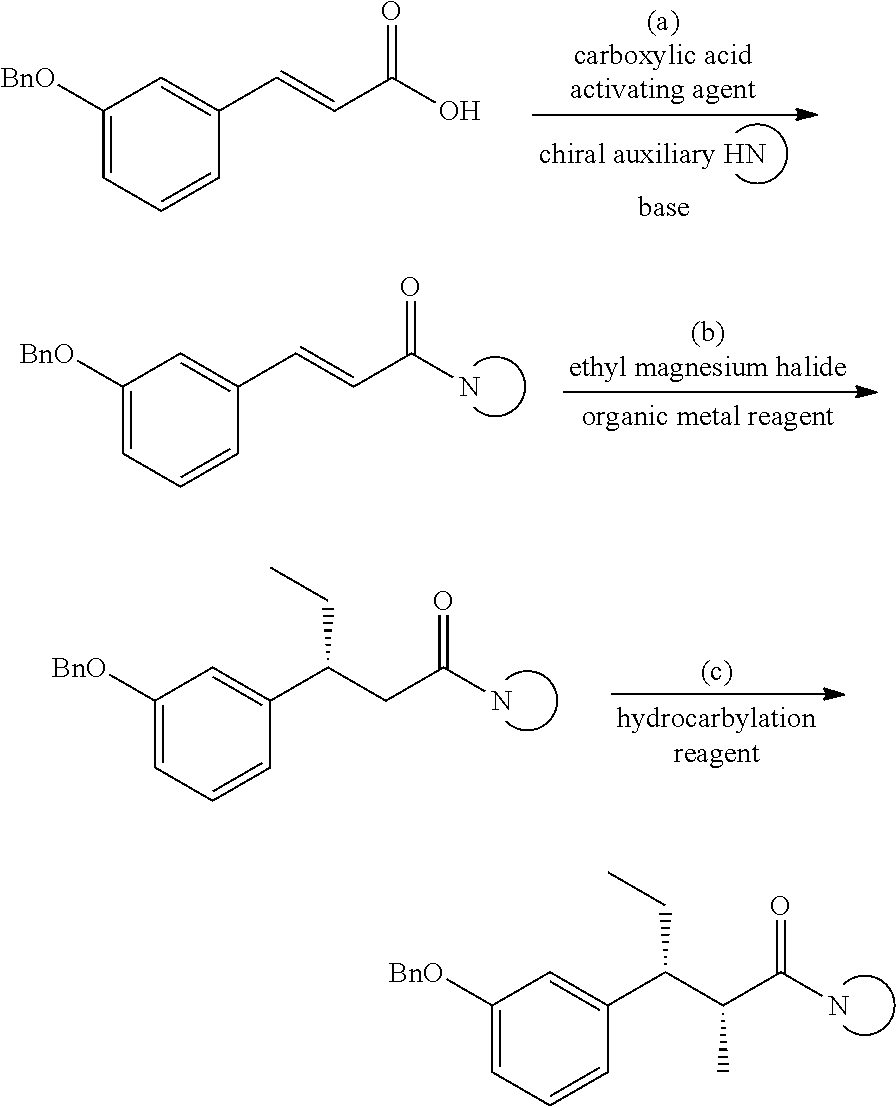
- the method for preparing (2R,3R)-3-(3-substituted phenyl)-2-methyl n-pentanamide compounds shown as formula I comprises: firstly, 3-(3-hydroxy protected phenyl) acrylic acid (IV) is reacted with a chiral auxiliary
- the method comprises the following steps:
- step a 3-(3-hydroxy protected phenyl)acrylic acid (IV) is reacted in the presence of carboxylic acid activating agent, chiral auxiliaries
- the carboxylic acid activating agent is any one of thionyl chloride, oxalyl chloride, pivaloyl chloride, chloroformate, carbodiimides such as dicyclohexyl carbodiimide (DCC), 4-dimethylaminopyridine (DMAP) and carbonyldiimidazole (CDI);
- DEC dicyclohexyl carbodiimide
- DMAP 4-dimethylaminopyridine
- CDI carbonyldiimidazole
- said base is inorganic base or organic base, and may be any one selected from sodium hydride, potassium hydride, alkyl lithium (n-butyl lithium or t-butyl lithium), lithium amide, sodium amide, potassium amide, lithium diisopropylamide (LDA), lithium hexamethyldisilylamide (LiHMDS), sodium hexamethyldisilylamide (NaHMDS), sodium methoxide, sodium ethoxide, potassium tert-butoxide, sodium hydroxide, potassium hydroxide, calcium hydroxide, triethylamine, ethylenediamine, sodium carbonate, potassium carbonate, sodium bicarbonate and potassium bicarbonate;
- LDA lithium hexamethyldisilylamide
- NaHMDS sodium hexamethyldisilylamide
- sodium methoxide, sodium ethoxide, potassium tert-butoxide sodium hydroxide, potassium hydroxide, calcium hydroxide, triethylamine, ethylenedi
- Said organic solvents include: hydrocarbons, such as benzene, xylene, toluene, dichloromethane, chloroform; ethers such as tetrahydrofuran, diethyl ether, dipropyl ether, 1,4-dioxane; amides such as N,N-dimethylformamide, N,N-diethylformamide, N,N-dimethylacetamide; nitriles such as acetonitrile; and the mixtures of the above solvents, wherein, the preferred solvent is tetrahydrofuran, toluene, N,N-dimethylformamide or acetonitrile;
- the reaction temperature is usually in the range of ⁇ 100° C. to 50° C., preferably ⁇ 80° C. to 30° C.
- step b the inert solution of the compound V was slowly added to the mixed solution of Grignard reagent ethyl magnesium halide and organic metal reagent at the suitable temperature, after the reaction was complete, the resultant was post-treated by a conventional method to give the Compound III.
- Said organic metal reagent is any one of cuprous bromide dimethylsulfide, cuprous bromide, cuprous chloride and cuprous iodide.
- Said Grignard reagent ethyl magnesium halide is any one of ethyl magnesium bromide, ethyl magnesium iodide and ethyl magnesium chloride.
- the amount of the Grignard reagent is 1 to 10 times (molar ratio), preferably 1 to 4 times that of the compound V.
- the amount of the organic metal reagent is 0.1 to 5 times (molar ratio), preferably 0.5 to 2 times that of the compound V.
- the reacting temperature of the above reaction may be vary in the range of a certain width, typically from ⁇ 50° C. to 50° C., preferably from ⁇ 40° C. to 25° C.
- the reaction time may vary depending on the solvent and reaction temperature, and is usually preferably 2 to 10 hours.
- Said inert solvent is C1-C4 halogenated hydrocarbons, C6-C8 aromatic hydrocarbons, C2-C6 ether, C2-C6 nitrile, preferably dichloromethane, tetrahydrofuran, acetonitrile.
- step c the ⁇ -methylation reaction is conducted between a compound of formula III and hydrocarbylation reagent in the presence of strong base or Lewis acid, and the resultant is post-treated by a conventional method to give the compound I;
- said hydrocarbylation reagent is any one of methyl iodide, methyl bromide, methyl chloride, methyl trifluoromethanesulfonate, methyl benzenesulfonate, methyl fluorosulfonate;
- said strong base is any one of sodium hexamethyldisilylamide (NaHMDS), lithium hexamethyldisilylamide (LiHMDS), potassium hexamethyldisilylamide (KHMDS), lithium amide, sodium amide, potassium amide, lithium diisopropylamide (LDA), n-butyl lithium;
- said Lewis acid is any one of titanium tetrachloride, aluminum trichloride, ferric trichloride, zinc chloride, anti
- the present invention also provides another method for preparing (2R,3R)-3-(3-substituted phenyl)-2-methyl n-pentanamide compound of formula I, said method comprises: trans-pent-2-enoic acid VI is reacted with a chiral auxiliary
- Z is O, S or NR 8 , wherein R 8 is hydrogen, C1-C6 branched or linear alkyl;
- W is O or S
- R 4 is C1-C6 alkyl, substituted or unsubstituted phenyl (Ph), substituted or unsubstituted naphthyl, substituted or unsubstituted benzyl (Bn), C1-C6 alkoxycarbonyl, wherein, the substituent on phenyl, naphthyl or benzyl group is 1 to 3 substituent(s) selected from hydroxy, halogen, C1-C6 alkyl and C1-C6 alkoxy;
- R 5 and R 6 are each independently selected from H; C1-C6 alkyl; phenyl; phenyl substituted with 1 to 3 substituent(s) selected from hydroxy, halogen, C1-C6 alkyl and C1-C6 alkoxy.
- the method comprises the following steps:
- step d trans-pent-2-enoic acid VI is reacted in the presence of carboxylic acid activating agent, chiral auxiliaries
- the carboxylic acid activating agent is any one of thionyl chloride, oxalyl chloride, pivaloyl chloride, chloroformate and carbodiimides such as dicyclohexyl carbodiimide (DCC), 4-dimethylaminopyridine (DMAP) and carbonyldiimidazole (CDI);
- DCC dicyclohexyl carbodiimide
- DMAP 4-dimethylaminopyridine
- CDI carbonyldiimidazole
- said base may be inorganic base or organic base, and may be any one selected from sodium hydride, potassium hydride, alkyl lithium (n-butyl lithium or t-butyl lithium), lithium amide, sodium amide, potassium amide, lithium diisopropylamide (LDA), lithium hexamethyldisilylamide (LiHMDS), sodium hexamethyldisilylamide (NaHMDS), sodium methoxide, sodium ethoxide, potassium tert-butoxide, sodium hydroxide, potassium hydroxide, calcium hydroxide, triethylamine, ethylenediamine, sodium carbonate, potassium carbonate, sodium bicarbonate and potassium bicarbonate;
- LDA lithium hexamethyldisilylamide
- NaHMDS sodium hexamethyldisilylamide
- sodium methoxide, sodium ethoxide, potassium tert-butoxide sodium hydroxide, potassium hydroxide, calcium hydroxide, triethylamine, ethylened
- Said organic solvent includes: hydrocarbons, such as benzene, xylene, toluene, dichloromethane, chloroform; ethers such as tetrahydrofuran, diethyl ether, dipropyl ether, 1,4-dioxane; amides such as N,N-dimethylformamide, N,N-diethylformamide, N,N-dimethylacetamide; nitriles such as acetonitrile; and the mixtures of the above solvents, wherein, the preferred solvent is tetrahydrofuran, toluene, N,N-dimethylformamide or acetonitrile;
- hydrocarbons such as benzene, xylene, toluene, dichloromethane, chloroform
- ethers such as tetrahydrofuran, diethyl ether, dipropyl ether, 1,4-dioxane
- amides such as
- the reaction temperature is usually in the range of ⁇ 100° C. to 50° C., preferably ⁇ 80° C. to 30° C.
- step e the inert solution of the compound VII is slowly added to the mixed solution of Grignard reagent 3-hydroxy protected phenyl magnesium halide and organic metal reagent at a suitable temperature, after the reaction was complete, the resultant was post-treated by a conventional method to give the product VIII.
- Said organic metal reagent is any one of cuprous bromide dimethylsulfide, cuprous bromide, cuprous chloride and cuprous iodide.
- the Grignard Reagent 3-hydroxy protected phenyl magnesium halide is any one selected from 3-hydroxy protected phenyl magnesium bromide, 3-hydroxy protected phenyl magnesium iodide and 3-hydroxy protected phenyl magnesium chloride.
- the amount of the Grignard reagent is 1 to 10 times (molar ratio), preferably 1 to 4 times that of the compound VII.
- the amount of the organic metal reagent is 0.1 to 5 times (molar ratio), preferably 0.5 to 2 times that of the compound VII.
- the reacting temperature of the above reaction may be vary in a certain range, typically from ⁇ 50° C. to 50° C., preferably from ⁇ 40° C. to 25° C.
- the reaction time may vary depending on the solvent and reaction temperature, and is usually preferably 2 to 10 hours.
- Said inert solvent is C1-C4 halogenated hydrocarbon, C6-C8 aromatic hydrocarbon, C2-C6 ether, C2-C6 nitrile, preferably dichloromethane, tetrahydrofuran, acetonitrile.
- step f the chiral auxiliary residue
- alkali metal hydroxide is any one selected from lithium hydroxide, sodium hydroxide and potassium hydroxide.
- step g the compound IX is reacted in the presence of carboxylic acid activating agent, chiral auxiliaries
- the carboxylic acid activating agent is any one of thionyl chloride, oxalyl chloride, pivaloyl chloride, chloroformate and carbodiimides such as dicyclohexyl carbodiimide (DCC), 4-dimethylaminopyridine (DMAP) and carbonyldiimidazole (CDI);
- DCC dicyclohexyl carbodiimide
- DMAP 4-dimethylaminopyridine
- CDI carbonyldiimidazole
- said base may be inorganic base or organic base, and may be any one selected from sodium hydride, potassium hydride, alkyl lithium (n-butyl lithium or t-butyl lithium), lithium amide, sodium amide, potassium amide, lithium diisopropylamide (LDA), lithium hexamethyldisilylamide (LiHMDS), sodium hexamethyldisilylamide (NaHMDS), sodium methoxide, sodium ethoxide, potassium tert-butoxide, sodium hydroxide, potassium hydroxide, calcium hydroxide, triethylamine, ethylenediamine, sodium carbonate, potassium carbonate, sodium bicarbonate and potassium bicarbonate;
- LDA lithium hexamethyldisilylamide
- NaHMDS sodium hexamethyldisilylamide
- sodium methoxide, sodium ethoxide, potassium tert-butoxide sodium hydroxide, potassium hydroxide, calcium hydroxide, triethylamine, ethylened
- Said organic solvent includes: hydrocarbons, such as benzene, xylene, toluene, dichloromethane, chloroform; ethers such as tetrahydrofuran, diethyl ether, dipropyl ether, 1,4-dioxane; amides such as N,N-dimethylformamide, N,N-diethylformamide, N,N-dimethylacetamide; nitriles such as acetonitrile; and the mixtures of the above solvents, wherein, the preferred solvent is tetrahydrofuran, toluene, N,N-dimethylformamide or acetonitrile;
- hydrocarbons such as benzene, xylene, toluene, dichloromethane, chloroform
- ethers such as tetrahydrofuran, diethyl ether, dipropyl ether, 1,4-dioxane
- amides such as
- the reaction temperature is usually in the range of ⁇ 100° C. to 50° C., preferably ⁇ 80° C. to 30° C.
- step c a ⁇ -methylation reaction is conducted between a compound of formula III and hydrocarbylation reagent in the presence of strong base or Lewis acid, and the resultant is post-treated by a conventional method to give the compound I;
- said hydrocarbylation agent is any one of methyl iodide, methyl bromide, methyl chloride, methyl trifluoromethanesulfonate, methyl benzenesulfonate, methyl fluorosulfonate;
- said strong base is any one of sodium hexamethyldisilylamide (NaHMDS), lithium hexamethyldisilylamide (LiHMDS), potassium hexamethyldisilylamide (KHMDS), lithium amide, sodium amide, potassium amide, lithium diisopropylamide (LDA), n-butyl lithium;
- said Lewis acid is any one of titanium tetrachloride, aluminum trichloride, ferric trichloride, zinc chloride, antimony pentafluoride.
- the invention also relates to a use of (2R,3R)-3-(3-substituted phenyl)-2-methyl n-pentanamide compound as shown in formula I, characterized in that, (2R,3R)-3-(3-substituted phenyl)-2-methyl n-pentanamide compound as shown in formula I can be used for preparing tapentadol or its pharmaceutically acceptable salt according to the following method.
- the substituents R1 to R3 is the same as those defined in the compounds of the formula I, the lactone in the chiral auxiliary residue in the compounds of formula I is hydrolyzed to give compound XIV, and carbonyl group on compound XIV IS reduced to give compound XV, then the protection group on phenolic hydroxy group and the substituents on the amino group are removed to give a primary amine compound XVI, finally it is methylated to give tapentadol; if necessary, the tapentadol may be dissolved in a solvent, and then a suitable acid is added to give a pharmaceutically acceptable salt of tapentadol; or after the methylation reaction, an appropriate acid is directly added therein without separation to give a pharmaceutically acceptable salt of tapentadol, as shown in Reaction Scheme 9:
- the lactone in the chiral auxiliary residue in the compounds of formula I is hydrolyzed to give compound XVII, and carbonyl group on compound XVII is reduced to give compound XVIII, then the protection group on phenolic hydroxy group and the substituents on the amino group are removed to give a primary amine compound XVI, finally it is methylated to give tapentadol; if necessary, the tapentadol may be dissolved in a solvent, and then a suitable acid is added to give a pharmaceutically acceptable salt of tapentadol; or after the methylation reaction, an appropriate acid is directly added without separation to give a pharmaceutically acceptable salt of tapentadol, as shown in Reaction Scheme 10:
- LV represents a leaving group such as halogen, mesyl, phenylsulfonyl, substituted phenylsulfonyl (such as p-tolylsulfonyl) and the like;
- the condition of removing the chiral auxiliary residue may be in the presence of hydrogen peroxide and an alkali metal hydroxide.
- Said alkali metal hydroxide is any one of lithium hydroxide, sodium hydroxide and potassium hydroxide.
- the condition of amidation reaction may be: compound X is reacted with dimethylamine or its salt under the action of a carboxylic acid activating agent to give compound XI.
- the used carboxylic acid activating agent is any one of thionyl chloride, oxalyl chloride, pivaloyl chloride, chloroformate, carbodiimides such as dicyclohexyl carbodiimide (DCC), 4-dimethylaminopyridine (DMAP) and carbonyldiimidazole (CDI); said reduction conditions may be: the reducing agent is any one of lithium aluminum tetrahydride, sodium borohydride/cobaltic chloride, boron trifluoride diethyl ether and zinc chloride; the solvent is diethyl ether, tetrahydrofuran, methanol and the like; said reaction of removing the protection group of phenolic hydroxy group is conducted as the conventional methods depending on the protection groups.
- the reducing agent is any one of lithium aluminum tetrahydride, sodium borohydride/cobaltic chloride, boron trifluoride diethyl ether and zinc chloride
- the solvent is dieth
- R when R is benzyl or substituted benzyl, it may be removed in hydrochloric acid, the concentration range of the hydrochloric acid is selected from 5% to 36%; or it may be removed in the presence of palladium on carbon, formic acid and ammonium formate; alternatively, it may be removed by hydrogenation in an organic solvent in the presence of a metal catalyst, and the metal catalyst may be palladium on carbon, Raney nickel or platinum dioxide; and when R is methyl, it may be removed with hydrobromic acid or boron tribromide.
- the base may be selected from an inorganic or organic base, for example, the inorganic base may be lithium hydroxide, potassium hydroxide, sodium hydroxide, etc.; the organic base may be sodium methoxide, sodium ethoxide, etc.; substituents on the amino group may be removed by hydrogenation in an organic solvent and in the presence of a metal catalyst, the metal catalyst may be palladium on carbon, Raney nickel or platinum dioxide; said methylation reaction may be conducted in the presence of formaldehyde and formic acid; the reaction conditions of converting the hydroxy of the compound XIX to a leaving group is as the conventional methods depending on the protection groups.
- the inorganic base may be lithium hydroxide, potassium hydroxide, sodium hydroxide, etc.
- the organic base may be sodium methoxide, sodium ethoxide, etc.
- substituents on the amino group may be removed by hydrogenation in an organic solvent and in the presence of a metal catalyst, the metal catalyst may be palladium on carbon, Raney nickel or
- the reaction is conducted using the corresponding halogenated reagent, such as thionyl chloride, hydrobromic acid, etc.; when the LV is a sulfonyl group, the reaction is conducted using the corresponding sulfonyl chloride under alkaline conditions; the reaction of said compound XX with dimethylamine or its salt is carried out under alkaline conditions.
- the corresponding halogenated reagent such as thionyl chloride, hydrobromic acid, etc.
- the reaction is conducted using the corresponding sulfonyl chloride under alkaline conditions
- the reaction of said compound XX with dimethylamine or its salt is carried out under alkaline conditions.
- the acid radical of said pharmaceutically acceptable salt of tapentadol may be from inorganic or organic acid, it is characterized in that, the inorganic acid is one of hydrochloric acid, nitric acid, phosphoric acid, sulfuric acid, hydrobromic acid and hydroiodic acid; the organic acid is one of formic acid, acetic acid, propionic acid, butyric acid, malic acid, tartaric acid, amino acid, methanesulfonic acid, benzenesulfonic acid, p-toluenesulfonic acid, naphthalenesulfonic acid, camphorsulfonic acid, taurine, fumaric acid, maleic acid, citric acid, succinic acid, cholic acid and deoxycholic acid.
- the inorganic acid is one of hydrochloric acid, nitric acid, phosphoric acid, sulfuric acid, hydrobromic acid and hydroiodic acid
- the organic acid is one of formic acid, acetic acid, prop
- the present invention also provides the compounds of the following formula III to XX:
- R is the protecting group of the phenolic hydroxy, R can form an ether group or an ester group with the phenolic hydroxy;
- R may be selected from C1-C6 linear or branched alkyl, substituted or unsubstituted aryl, substituted or unsubstituted arylalkyl, alkylsilyl, C1-C6 alkoxymethyl, C1-C6 alkyloyl, substituted or unsubstituted aryloyl; wherein, said substituents may be hydroxyl, halogen, C1-C6 alkyl, C1-C6 alkoxy etc.; said aryl may be phenyl, naphthyl etc.;
- LV represents a leaving group such as halogen, mesyl, phenylsulfonyl, substituted phenylsulfonyl and the like;
- X is O, S or NR 7 , wherein R 7 is hydrogen, C1-C6 branched or linear alkyl; Y is O or S;
- R 1 is C1-C6 alkyl group, substituted or unsubstituted phenyl (Ph), substituted or unsubstituted naphthyl, substituted or unsubstituted benzyl (Bn), C1-C6 alkoxycarbonyl, wherein, the substituent on phenyl, naphthyl or benzyl group is 1 to 3 substituent(s) selected from C1-C6 alkyl and hydroxy;
- R 2 and R 3 are each independently selected from H, C1-C6 alkyl and phenyl;
- Z is O, S or NR 8 , wherein R 8 is hydrogen, C1-C6 branched or linear alkyl; W is O or S;
- R 4 is C1-C6 alkyl group, substituted or unsubstituted phenyl (Ph), substituted or unsubstituted naphthyl, substituted or unsubstituted benzyl (Bn), C1-C6 alkoxycarbonyl, wherein the substituent on phenyl, naphthyl or benzyl group is 1 to 3 substituent(s) selected from hydroxy, halogen, C1-C6 alkyl and C1-C6 alkoxy;
- R 5 and R 6 are each independently selected from H; C1-C6 alkyl; phenyl; phenyl substituted with 1 to 3 substituent(s) selected from hydroxy, halogen, C1-C6 alkyl and C1-C6 alkoxy.
- R is benzyl, methyl, t-butyl, triphenylmethyl, methoxymethyl, trimethylsilyl, t-butyldimethylsilyl, acetyl or benzoyl;
- LV is bromine, iodine, chlorine, mesyl, phenylsulfonyl, substituted phenylsulfonyl and the like;
- X is O; and Y is O;
- R 1 is C1-C6 alkyl group, substituted or unsubstituted phenyl (Ph), substituted or unsubstituted benzyl (Bn), wherein the substituent on phenyl or benzyl group is 1 to 3 substituent(s) selected from hydroxy, halogen, C1-C6 alkyl and C1-C6 alkoxy;
- R 2 and R 3 are each independently selected from H, C1-C6 alkyl and phenyl;
- R 4 is C1-C6 alkyl group, substituted or unsubstituted phenyl (Ph), substituted or unsubstituted benzyl (Bn), wherein the substituent on phenyl or benzyl group is 1 to 3 substituent(s) selected from hydroxy, halogen, C1-C6 alkyl and C1-C6 alkoxy;
- R 5 and R 6 are each independently selected from H, C1-C6 alkyl and phenyl.
- R is benzyl or methyl
- LV is bromine, iodine, chlorine, mesyl, p-tolylsulfonyl and the like;
- X is O; and Y is O;
- R 1 is phenyl; phenyl substituted with 1 to 3 substituent(s) selected from hydroxy, halogen, C1-C6 alkyl and C1-C6 alkoxy; or benzyl; R 2 and R 3 are each independently selected from H, C1-C6 alkyl and phenyl;
- R 4 is phenyl; phenyl substituted with 1 to 3 substituent(s) selected from hydroxy, halogen, C1-C6 alkyl and C1-C6 alkoxy; or benzyl;
- R 5 and R 6 are each independently selected from H, C1-C6 alkyl and phenyl.
- the compounds of the present invention are as follows:
- the new chiral centers is introduced via the stereoselective alkylation in a asymmetric Michael addition reaction controlled by chiral auxiliaries, to form a product which is easily purified by crystallization.
- the resulting intermediate and the final product have a high optical purity, and chiral auxiliaries have the characteristic of easy to be removed, configuration retention, and easier to recycle and use.
- the present method has the advantages of good reactivity, high stereo selectivity, high yield, simple operation, cheap and easy-to-get reagents, recyclable chiral auxiliaries etc., and it can be economically and conveniently used to realize industrial production of tapentadol or the pharmaceutically acceptable salt thereof.
- m-benzyloxy cinnamic acid (9.0 g, 35.4 mmol) was dissolved in thionyl chloride (25 ml) and refluxed for 1 hour, and the mixture was concentrated to remove thionyl chloride for further use.
- 4R-phenyl-2-oxazolidinone (5.6 g, 34.4 mmol) was placed in a three-necked flask, after it was purged with nitrogen, tetrahydrofuran (25 ml) was added and when it was cooled to ⁇ 78° C., n-butyl lithium (1.6M, 22 ml, 35.4 mmol) was added dropwise, and the reaction was carried out for 30 minutes.
- Cuprous bromide dimethyl sulfide complex (7.7 g, 37.5 mmol) was placed in a three-necked flask, after it was purged with nitrogen, tetrahydrofuran (25 ml) was added therein.
- Example 2 The product of Example 2 (8.6 g, 20 mmol) was placed in a double-necked flask, after it was purged with nitrogen, it was cooled to ⁇ 78° C., then tetrahydrofuran (25 ml) was added. The solution of sodium hexamethyldisilylamide (NaHMDS) in tetrahydrofuran (2M, 10 ml, 20 mmol) was slowly added dropwise, and the reaction was carried out at ⁇ 78° C. for 30 min; methyl iodide (2.5 ml, 40 mmol) was added, and the reaction was continued at ⁇ 78° C.
- NaHMDS sodium hexamethyldisilylamide
- the pH of the aqueous phase was adjusted to appropriate 2 with 1N hydrochloric acid, and extracted with dichloromethane for three times, then the organic phases were combined, washed with saturated sodium bicarbonate solution and saturated brine, dried over anhydrous sodium sulfate, concentrated and recrystallized with petroleum ether and ethyl acetate to give a white solid 3.8 g, yield: 91%.
- Example 4 The product of Example 4 (3 g, 10 mmol) was dissolved in dichloromethane (10 ml), oxalyl chloride (2.6 ml, 30 mmol) was added dropwise, and it was reacted at room temperature for 1 hr, then the reaction solution was concentrated to give a pale yellow oil which was further dissolved in dichloromethane. And then the resulted solution was added dropwise to an ice-water bath cooled solution of dimethylamine hydrochloride (1.6 g, 20 mmol) and triethylamine (4.3 ml, 30 mmol) in dichloromethane, then the mixture was slowly warmed to room temperature to react for 1 hour.
- dichloromethane 10 ml
- oxalyl chloride 2.6 ml, 30 mmol
- Lithium aluminum tetrahydride (730 mg, 20 mmol) was suspended in tetrahydrofuran (10 ml), then it was cooled in an ice-water bath and the solution of product of Example 5 (3 g, 9.2 mmol) in tetrahydrofuran (10 ml) was added dropwise.
- the reaction was carried out for 2 hours and quenched by adding 10% NaOH aqueous solution, Then the reaction solution was extracted with ethyl acetate for three times, and the organic phases were combined, washed with saturated brine, dried over anhydrous sodium sulfate and concentrated to give a pale yellow oil 2.7 g, yield: 93%.
- Example 6 The product of Example 6 (2.5 g, 8 mmol) was dissolved in methanol, 5% Pd—C (250 mg) was added, and it was purged with hydrogen for three times, then the reaction was carried out with stirring at room temperature for 1 hr. The reaction solution was filtered to remove Pd—C, the residue was washed with methanol for 3 times, then the organic phases are combined and concentrated to 2 ml. After that, the concentrated hydrochloric acid (670 ml, 8 mmol) was added dropwise, then the resulted solution was concentrated and recrystallized with isopropanol and ethyl acetate to give the target 1.9 g, yield: 90%.
- reaction solution was concentrated to remove tetrahydrofuran and washed with ethyl acetate 3 times, then the organic phases were combined, washed with saturated sodium bicarbonate aqueous solution twice and saturated brine once, dried over anhydrous sodium sulfate, concentrated and recrystallized with petroleum ether and ethyl acetate to give a white solid 8.6 g, yield: 90%.
- Cuprous bromide dimethyl sulfide complex (5.5 g, 26.8 mmol) was placed in a three-necked flask, after purged with nitrogen, tetrahydrofuran was added and it was cooled to ⁇ 40° C., then ethyl magnesium bromide (2.5M, 21.5 ml) was added dropwise, the reaction was carried out with stirring for 10 minutes.
- the boron trifluoride diethyl ether (3.4 ml, 26.8 mmol) was added dropwise, and the reaction was continued for 10 minutes; then the solution of the product of Example 8 (8.0 g, 17.9 mmol) in tetrahydrofuran was added dropwise, after the addition was complete, it was warmed to ⁇ 15° C., and then gradually warmed to room temperature. The reaction was continued for 2 hours and quenched with saturated ammonium chloride solution.
- Example 9 The product of Example 9 (7.5 g, 14.9 mmol) was placed in a double-necked flask, after it was purged with nitrogen and cooled to ⁇ 78° C., tetrahydrofuran was added, and the solution of sodium hexamethyldisilylamide (NaHMDS) in tetrahydrofuran (2M, 7.5 ml, 15 mmol) was slowly added dropwise, and the reaction was kept at ⁇ 78° C. for 30 min; after methyl iodide (1.9 ml, 30 mmol) was added, the reaction was continued at ⁇ 78° C.
- NaHMDS sodium hexamethyldisilylamide
- the 4R-phenyl-2-oxazolidinone (5.6 g, 34.4 mmol) was placed in a three-necked flask, after it was purged with nitrogen, tetrahydrofuran was added and it was cooled to ⁇ 78° C., then n-butyl lithium (1.6M, 22 ml, 35.4 mmol) was added dropwise, and the reaction was carried out for 30 minutes.
- Cuprous bromide dimethyl sulfide complex (7.7 g, 37.5 mmol) was placed in a three-necked flask, and it was purged with nitrogen, then tetrahydrofuran was added and it was cooled to ⁇ 40° C.
- Example 12 The product of Example 12 (7.1 g, 20 mmol) was placed in a double-necked flask, after it was purged with nitrogen and cooled to ⁇ 78° C., tetrahydrofuran was added, and the solution of sodium hexamethyldisilylamide (NaHMDS) in tetrahydrofuran (2M, 10 ml, 20 mmol) was slowly added dropwise, and the reaction was kept at ⁇ 78° C. for 30 min; methyl iodide (2.5 ml, 40 mmol) was added, and the reaction was continued at ⁇ 78° C.
- NaHMDS sodium hexamethyldisilylamide
- the pH of the aqueous phase was adjusted to appropriate 2 with 1N hydrochloric acid, then extracted with dichloromethane for three times, and then the organic phases were combined, washed with saturated sodium bicarbonate solution and saturated brine, dried over anhydrous sodium sulfate concentrated, and recrystallized with petroleum ether and ethyl acetate to give a white solid 3.0 g, yield: 90%.
- Example 14 The product of Example 14 (2.2 g, 10 mmol) was dissolved in dichloromethane (10 ml), oxalyl chloride (2.6 ml, 30 mmol) was added dropwise, and the reaction was carried out at room temperature for 1 hr, then the reaction solution was concentrated to give a pale yellow oil which was thereafter dissolved in dichloromethane, and then the resulted solution was added dropwise to an ice bath cooled solution of dimethylamine hydrochloride (1.6 g, 20 mmol) and triethylamine (4.3 ml, 30 mmol) in dichloromethane. Then it was slowly warmed to room temperature to make the reaction carry out for 1 hour.
- dichloromethane 10 ml
- oxalyl chloride 2.6 ml, 30 mmol
- Lithium aluminum tetrahydride (730 mg, 20 mmol) was suspended in tetrahydrofuran (10 ml), after the mixture was cooled in an ice-water bath, the solution of product of Example 15 (2.2 g, 9.0 mmol) in tetrahydrofuran (10 ml) was added dropwise, then the reaction was carried out for 2 hours, and quenched by adding 10% NaOH aqueous solution, after the reaction solution was extracted with ethyl acetate for three times, the organic phases were combined, washed with saturated brine, dried over anhydrous sodium sulfate and concentrated to give a pale yellow oil 1.9 g, yield: 90%.
- Example 16 The product of Example 16 (1.9 g, 8 mmol) was dissolved in dichloromethane, the mixture was cooled in an ice-water bath, and a solution of boron tribromide (1.9 ml, 20 mmol) in dichloromethane was slowly added dropwise, then it was gradually raised to room temperature to make it react for 15 hrs.
- reaction solution was concentrated to remove tetrahydrofuran and washed with ethyl acetate 3 times, then the organic phases were combined, washed with saturated sodium bicarbonate aqueous solution twice and saturated brine once, dried over anhydrous sodium sulfate concentrated, and recrystallized with petroleum ether and ethyl acetate to give a white solid 7.3 g, yield: 92%.
- Cuprous bromide dimethyl sulfide complex (5.5 g, 26.8 mmol) was placed in a three-necked flask, after it was purged with nitrogen, tetrahydrofuran was added and the mixture was cooled to ⁇ 40° C., then ethyl magnesium bromide (2.5M, 21.5 ml) was added dropwise, and the reaction was carried out with stirring for 10 minutes. After the boron trifluoride diethyl ether (3.4 ml, 26.8 mmol) was added dropwise, the reaction was continued for 10 minutes.
- Example 19 The product of Example 19 (6.2 g, 14.5 mmol) was placed in a double-necked flask, and it was purged with nitrogen and cooled to ⁇ 78° C., then tetrahydrofuran was added, and the solution of sodium hexamethyldisilylamide in tetrahydrofuran (2M, 7.5 ml, 15 mmol) was slowly added dropwise, and then the reaction was kept at ⁇ 78° C. for 30 min; after that, methyl iodide (1.9 ml, 30 mmol) was added, and the reaction was continued at ⁇ 78° C.
- the 4S-phenyl-2-oxazolidinone (5.6 g, 34.4 mmol) was placed in a three-necked flask, after it was purged with nitrogen, tetrahydrofuran was added and it was cooled to ⁇ 78° C., then n-butyl lithium (1.6M, 22 ml, 35.4 mmol) was added dropwise, and the reaction was carried out for 30 minutes. After that, a solution of 2-pentenoyl chloride (4.2 g, 35.5 mmol) in tetrahydrofuran was added dropwise, and the reaction was continued for 30 minutes, then it was slowly raised to 0° C., the reaction was continued for 2 hours and quenched with saturated ammonium chloride solution.
- reaction solution was then concentrated to remove tetrahydrofuran and extracted with ethyl acetate 3 times, then the organic phases were combined, washed with saturated brine, dried over anhydrous sodium sulfate, concentrated, and recrystallized with petroleum ether and ethyl acetate to give a white solid 8 g, yield: 95%.
- Cuprous bromide dimethyl sulfide complex (10.0 g, 48.9 mmol) was placed in a three-necked flask, after it was purged with nitrogen, tetrahydrofuran was added and it was cooled to ⁇ 40° C., then 3-benzyloxy phenyl magnesium bromide (2.5M, 39 ml, 97.8 mmol) was added dropwise, the reaction was carried out with stirring for 10 minutes, and the reaction solution turned yellow; after that, the boron trifluoride diethyl ether (6.2 ml, 48.9 mmol) was added dropwise and the reaction was continued for 10 minutes; then the solution of the product of Example 21 (8 g, 32.6 mmol) in tetrahydrofuran was added dropwise, after the addition was complete, it was warmed to ⁇ 15° C., and then gradually warmed to room temperature.
- reaction was continued for 2 hours, then quenched with saturated ammonium chloride solution.
- the pH of the aqueous phase was adjusted to appropriate 2 with 1N hydrochloric acid, then extracted with dichloromethane for three times, after that, the organic phases were combined, washed with saturated sodium bicarbonate solution and saturated brine, dried over anhydrous sodium sulfate, concentrated, and recrystallized with petroleum ether and ethyl acetate to give a white solid 6.7 g, yield: 92%.
- the 4R-phenyl-2-oxazolidinone (3.5 g, 21.4 mmol) was placed in a three-necked flask, after it was purged with nitrogen, tetrahydrofuran was added and it was cooled to ⁇ 78° C., then n-butyl lithium (1.6M, 13.8 ml, 22 mmol) was added dropwise, and the reaction was carried out for 30 minutes.
- reaction solution was then concentrated to remove tetrahydrofuran and extracted with ethyl acetate 3 times, then the organic phases were combined, washed with saturated brine, dried over anhydrous sodium sulfate, concentrated, and recrystallized with petroleum ether and ethyl acetate to give a white solid 8.6 g, yield: 85%.
- Example 24 The product of Example 24 (8.6 g, 20 mmol) was placed in a double-necked flask, and it was purged with nitrogen and cooled to ⁇ 78° C., then tetrahydrofuran was added, and the solution of sodium hexamethyldisilylamide (NaHMDS) in tetrahydrofuran (2M, 10 ml, 20 mmol) was slowly added dropwise, and the reaction was kept at ⁇ 78° C. for 30 min; after that, methyl iodide (2.5 ml, 40 mmol) was added, and the reaction was continued at ⁇ 78° C.
- NaHMDS sodium hexamethyldisilylamide
- Example 5 The product of Example 5 (3.0 g, 9 mmol) was dissolved in methanol, 5% Pd—C (300 mg) was added therein, after it was purged with hydrogen for three times, the reaction was carried out with stirring at room temperature for 1 hr. Then the reaction solution was filtered to remove Pd—C, the residue was washed with methanol for 3 times, and the organic phases are combined and concentrated to give the target 2.0 g, yield: 95%.
- Lithium aluminum tetrahydride (730 mg, 20 mmol) was suspended in tetrahydrofuran (10 ml), and it was cooled in an ice-water bath, then the solution of product of Example 26 (2 g, 8.5 mmol) in tetrahydrofuran (10 ml) was added dropwise, the reaction was carried out for 2 hours and then quenched by adding 10% NaOH aqueous solution.
- Example 28 The product of Example 28 (5.0 g, 12 mmol) was dissolved in tetrahydrofuran, lithium aluminum tetrahydride (2.3 g, 60 mmol) was added, and the reaction was conducted under reflux for 8 hours, then it was cooled in ice-water bath, and water was added dropwise to quench the reaction. After that, 10% sodium hydroxide aqueous solution was added therein, the reaction solution was filtered, and the filtrate was extracted with ethyl acetate three times, then the organic phases were combined, washed with saturated brine, dried over anhydrous sodium sulfate, concentrated, and then separated through silica gel column chromatography to give the target 4.3 g, yield: 90%.
- Example 29 The product of Example 29 (4.0 g, 10 mmol) was dissolved in methanol, 10% Pd—C (400 mg) was added therein, after it was purged with hydrogen three times, the reaction was carried out with stirring at room temperature for 12 hours. Then the reaction solution was filtered, the residue was washed with methanol three times, and the filtrate was concentrated to give the target 1.74 g, yield: 90%.
- Example 30 The product of Example 30 (1.7 g, 9 mmol) was dissolved in a formaldehyde aqueous solution, 98% formic acid (1.6 ml, 45 mmol) was added thereto, and the reaction was conducted at 80° C. for 2 hours, then the reaction solution was poured into ice-water, after that, the pH was adjusted to 8 with 10% sodium hydroxide solution, and the solution was extracted with dichloromethane three times, then the organic phases were combined, washed with water and saturated brine, dried over anhydrous sodium sulfate and concentrated to obtain an oil.
- 98% formic acid 1.6 ml, 45 mmol
- Example 3 The product of Example 3 (4.5 g, 10 mmol) was dissolved in tetrahydrofuran, lithium aluminum tetrahydride (760 mg, 20 mmol) was added, and the mixture was stirred at room temperature for 3 hours, then water was added to quench the reaction. After that, 10% sodium hydroxide solution was added, the resulted solution was filtered, and the filtrate was extracted with ethyl acetate three times, then the organic phases were combined, washed with saturated brine, dried over anhydrous sodium sulfate, concentrated, and then separated through silica gel column chromatography to give the target 2.6 g, yield: 90%.
- Example 32 The product of Example 32 (2.6 g, 9 mmol) was dissolved in dichloromethane, triethylamine (1.9 ml, 13.5 mmol) was added therein, then it was cooled in ice-water bath, and methanesulfonyl chloride (0.77 ml, 10 mmol) was slowly added dropwise, after the addition was complete, the reaction was continued for 1 hour, and then quenched by adding water. The reaction solution was separated, the aqueous phase was extracted with dichloromethane three times, and the organic phases were combined, washed with saturated brine, dried over anhydrous sodium sulfate, and concentrated to give the target compound 3.0 g, yield: 91%.
- Example 33 The product of Example 33 (2.9 g, 8 mmol) was dissolved in dichloromethane, triethylamine (4.6 ml, 2 mmol) and dimethylamine hydrochloride (1.3 g, 16 mmol) were added therein, the reaction was conducted at room temperature for 8 hours, and the water was add to separate the liquid, then the aqueous phase was extracted with dichloromethane twice, and the organic phases were combined, washed with saturated brine, dried over anhydrous sodium sulfate, concentrated, and then separated through silica gel column chromatography to give target 2.2 g, yield: 90%.
- the m-benzyloxy cinnamic acid (90 g, 354 mmol) was dissolved in dichloromethane (25 ml), oxalyl chloride (45 ml) was added therein and it was reacted at room temperature for 5 hours, then the reaction solution was concentrated to remove the solvent and oxalyl chloride for further use; 4(R)-phenyl-2-oxazolidinone (57 g, 350 mmol) was dissolved in dichloromethane, the mixture was cooled to 0° C., and 4-dimethylamino pyridine (4.3 g, 35 mmol) and triethylamine (76 mL, 525 mmol) was added, then the solution of m-benzyloxy cinnamic acid in dichloromethane was added.
- Cuprous bromide (7 g, 48.9 mmol) was placed in a three-necked flask, after it was purged with nitrogen, tetrahydrofuran was added and it was cooled to ⁇ 20° C., the solution of ethyl magnesium bromide in tetrahydrofuran (2.5M, 39 ml, 97.8 mmol) was added dropwise, the reaction was carried out with stirring for 10 minutes, and the reaction solution turned yellow; after that, boron trifluoride diethyl etherate (6.2 ml, 48.9 mmol) was added dropwise, and the reaction was continued for 10 minutes; then the solution of the product of Example 35 (13 g, 32.6 mmol) in tetrahydrofuran was added dropwise, after the addition was complete, the temperature was raised to ⁇ 5° C., then the reaction was continued for 2 hours and quenched with saturated ammonium chloride solution.
- Example 36 The product of Example 36 (8.58 g, 20 mmol) was placed in a double-necked flask, then it was purged with nitrogen and cooled to ⁇ 20° C., after that, tetrahydrofuran was added, the solution of sodium hexamethyldisilylamide (NaHMDS) in tetrahydrofuran (2M, 10 ml, 20 mmol) was slowly added dropwise, and the reaction was kept at ⁇ 20° C. for 30 min; and then the solution of bromomethane in tetrahydrofuran (2.5M, 16 mL, 40 mmol) was added, the reaction was continued at ⁇ 20° C.
- NaHMDS sodium hexamethyldisilylamide
- Lithium aluminum tetrahydride (730 mg, 20 mmol) was suspended in tetrahydrofuran (10 ml), the product of Example 5 (3.2 g, 10 mmol) was dissolved in toluene, cooled in an ice-water bath, the solution of red aluminum in toluene (9 mL, 30 mmol) was added dropwise, the reaction was carried out for 2 hours and then quenched by adding 10% NaOH aqueous solution. After the reaction solution was separated, the organic phase was washed with saturated brine, dried over anhydrous sodium sulfate, and concentrated to give a pale yellow oil 2.8 g, yield: 90%.
- the HNMR spectrum data is the same as that in Example 6.
- Example 38 20 mL of water and 20 mL of concentrated hydrochloric acid were added to the product of Example 38 (2.5 g, 8 mmol), then it was reacted at 80° C. for 17 hours, after that, the reaction solution was concentrated and recrystallized with isopropanol and isopropyl ether to give the target 1.9 g, yield: 90%.
- the HNMR spectrum data is the same as that in Example 7.
- Example 32 The product of Example 32 (2.6 g, 9 mmol) was dissolved in dichloromethane, triethylamine (1.9 ml, 13.5 mmol) was added therein, and the mixture was cooled in an ice-water bath, then p-toluenesulfonyl chloride (1.9 g, 10 mmol) was slowly added dropwise, after the addition was complete, the reaction was continued for 1 hour and then quenched by adding water. After the reaction solution was separated, the aqueous phase was extracted with dichloromethane three times, and the organic phases were combined, washed with saturated brine, dried over anhydrous sodium sulfate, and concentrated to give the target compound 3.0 g, yield: 91%.
- Example 40 The product of Example 40 (3.7 g, 8 mmol) was dissolved in dichloromethane, triethylamine (4.6 ml, 20 mmol) and dimethylamine hydrochloride (1.3 g, 16 mmol) were added therein, and it was reacted at room temperature for 8 hours, then water was added for separating, the aqueous phase was extracted twice with dichloromethane, and the organic phases were combined, washed with saturated brine, dried over anhydrous sodium sulfate, concentrated, and separated through silica gel column chromatography to give target 2.2 g, yield: 90%.
- Example 32 The product of Example 32 (2.6 g, 9 mmol) was dissolved in dichloromethane, the mixture was cooled in an ice-water bath, then N, N-dimethylformamide (2 drops) was added and thionyl chloride (0.64 mL, 10 mmol) was added dropwise, after the addition was complete, the reaction was conducted under reflux for 6 hours and quenched by adding water. After the reaction solution was separated, the aqueous phase was extracted with dichloromethane three times, and the organic phases were combined, washed with saturated brine, dried over anhydrous sodium sulfate, and concentrated to give the target compound 2.4 g, yield: 90%.
- Example 42 The product of Example 42 (2.4 g, 8 mmol) was dissolved in N,N-dimethylformamide, potassium carbonate (2.7 g, 20 mmol) and dimethylamine hydrochloride (0.7 g, 8 mmol) were added therein, then it was reacted at room temperature for 12 hours. After that, the reaction solution was poured into water, the aqueous phase was extracted with dichloromethane twice, then the organic phases were combined, washed with saturated brine, dried over anhydrous sodium sulfate, concentrated, and separated through silica gel column chromatography to give target 2.2 g, yield: 90%.
- Example 32 The product of Example 32 (2.6 g, 9 mmol) was dissolved in dichloromethane, and the mixture was cooled in an ice-water bath, then 48% hydrobromic acid (0.54 mL, 10 mmol) was added dropwise, after the addition was complete, it was reacted at room temperature for 16 hours. After that, water was added therein for separating, the aqueous phase was extracted with dichloromethane three times, then the organic phases were combined, washed with saturated brine, dried over anhydrous sodium sulfate, and concentrated to give the target compound 2.7 g, yield: 87%.
- Example 44 The product of Example 44 (2.7 g, 8 mmol) was dissolved in N,N-dimethylformamide, potassium carbonate (2.7 g, 20 mmol) and dimethylamine hydrochloride (0.7 g, 8 mmol) were added therein, and it was reacted at room temperature for 12 hours. After the reaction solution was poured into water, the aqueous phase was extracted with dichloromethane twice, then the organic phases were combined, washed with saturated brine, dried over anhydrous sodium sulfate, concentrated, and separated through silica gel column chromatography to give target 2.1 g, yield: 89%.
Landscapes
- Chemical & Material Sciences (AREA)
- Organic Chemistry (AREA)
- Chemical Kinetics & Catalysis (AREA)
- Organic Low-Molecular-Weight Compounds And Preparation Thereof (AREA)
Abstract

Description


is the residue of chiral auxiliaries, which is defined as follows:

- (1) 3-[(2R,3R)-2-methyl-1-oxo-3-[3-(phenylmethoxy)phenyl]pentyl]-4R-phenyl-2-Oxazolidinone

- (2) 3-[(2R,3R)-2-methyl-1-oxo-3-[3-(phenylmethoxy)phenyl]pentyl]-4R,5 S-diphenyl-2-Oxazolidinone

- (3) 3-[(2R,3R)-3-(3-methoxyphenyl)-2-methyl-1-oxopentyl]-4R,5S-di phenyl-2-Oxazolidinone

- (4) 3-[(2R,3R)-3-(3-methoxyphenyl)-2-methyl-1-oxopentyl]-4R-phenyl-2-Oxazolidinone


is the residue of chiral auxiliaries, which is defined as follows:


under the activation of a carboxylic acid activating agent to obtain a compound V; the compound V is subjected to asymmetric Michael addition with ethyl magnesium halide under the condition of organic metal reagent in an inert solvent, then the resultant is post-treated by a conventional method to give Compound III; compound III and hydrocarbylation reagent are conducted the α-methylation reaction in the presence of strong base or Lewis acid, then the resultant is post-treated by a conventional method to give the compound I. The method is shown as Reaction Scheme 5:


are as defined above.

and base, and with the suitable organic solvent and suitable temperatures to form Compound V.


under the activation of a carboxylic acid activating agent to obtain a compound VII; the compound VII is subjected to an asymmetric Michael addition with 3-hydroxy protected phenyl magnesium halide under the condition of organic metal reagent in an inert solvent, then the resultant is post-treated by a conventional method to give a compound VIII; the chiral auxiliary

is removed from the compound VIII to give a compound IX; then the compound IX is reacted with a chiral auxiliary

under the activation of a carboxylic acid activating agent to obtain a compound III; the compound III and hydrocarbylation reagent are conducted the α-methylation reaction in the presence of strong base or Lewis acid, then the resultant is post-treated by a conventional method to give the compound I. The method is shown as Reaction Scheme 6:


are as defined above;

is the residue of chiral auxiliaries, which is defined as follows:


and base, and with a suitable organic solvent and suitable temperature to form Compound VII.

is removed from the compound VIII in the presence of hydrogen peroxide and an alkali metal hydroxide, said alkali metal hydroxide is any one selected from lithium hydroxide, sodium hydroxide and potassium hydroxide.

and base, and with a suitable organic solvent and suitable temperature to form Compound III.


of the compounds as shown in formula I is removed to give compound X; compound X is subjected to the amidation reaction with dimethylamine or its salt under the activation of a carboxylic acid activating agent to give compound XI; compound XI is subjected to carbonyl reduction in a suitable reducing agent and a suitable solvent to give compound XII, then the protection group of the phenolic hydroxy group thereon is removed to give tapentadol II; if necessary, the tapentadol may be dissolved in a solvent, and then a suitable acid may be added therein to give a pharmaceutically acceptable salt of tapentadol; or after the protection group of the phenolic hydroxy group is removed, an appropriate acid is directly added therein without separation to give a pharmaceutically acceptable salt of tapentadol, as shown in Reaction Scheme 7:


of the compounds as shown in formula I is removed to give compound X; compound X is subjected to the amidation reaction with dimethylamine or its salt under the activation of a carboxylic acid activating agent to give compound XI; the protection group of the phenolic hydroxy group on compound XI is removed to give compound XIII, compound XIII is reacted in a suitable reducing agent and a suitable solvent to give tapentadol II; if necessary, the tapentadol may be dissolved in a solvent, and then a suitable acid is added to give a pharmaceutically acceptable salt of tapentadol; or after the carbonyl group is reduced, an appropriate acid is directly added therein without separation to give a pharmaceutically acceptable salt of tapentadol, as shown in Reaction Scheme 8:


the substituents R1 to R3 is the same as those defined in the compounds of the formula I, the lactone in the chiral auxiliary residue in the compounds of formula I is hydrolyzed to give compound XIV, and carbonyl group on compound XIV IS reduced to give compound XV, then the protection group on phenolic hydroxy group and the substituents on the amino group are removed to give a primary amine compound XVI, finally it is methylated to give tapentadol; if necessary, the tapentadol may be dissolved in a solvent, and then a suitable acid is added to give a pharmaceutically acceptable salt of tapentadol; or after the methylation reaction, an appropriate acid is directly added therein without separation to give a pharmaceutically acceptable salt of tapentadol, as shown in Reaction Scheme 9:


the lactone in the chiral auxiliary residue in the compounds of formula I is hydrolyzed to give compound XVII, and carbonyl group on compound XVII is reduced to give compound XVIII, then the protection group on phenolic hydroxy group and the substituents on the amino group are removed to give a primary amine compound XVI, finally it is methylated to give tapentadol; if necessary, the tapentadol may be dissolved in a solvent, and then a suitable acid is added to give a pharmaceutically acceptable salt of tapentadol; or after the methylation reaction, an appropriate acid is directly added without separation to give a pharmaceutically acceptable salt of tapentadol, as shown in Reaction Scheme 10:

or:


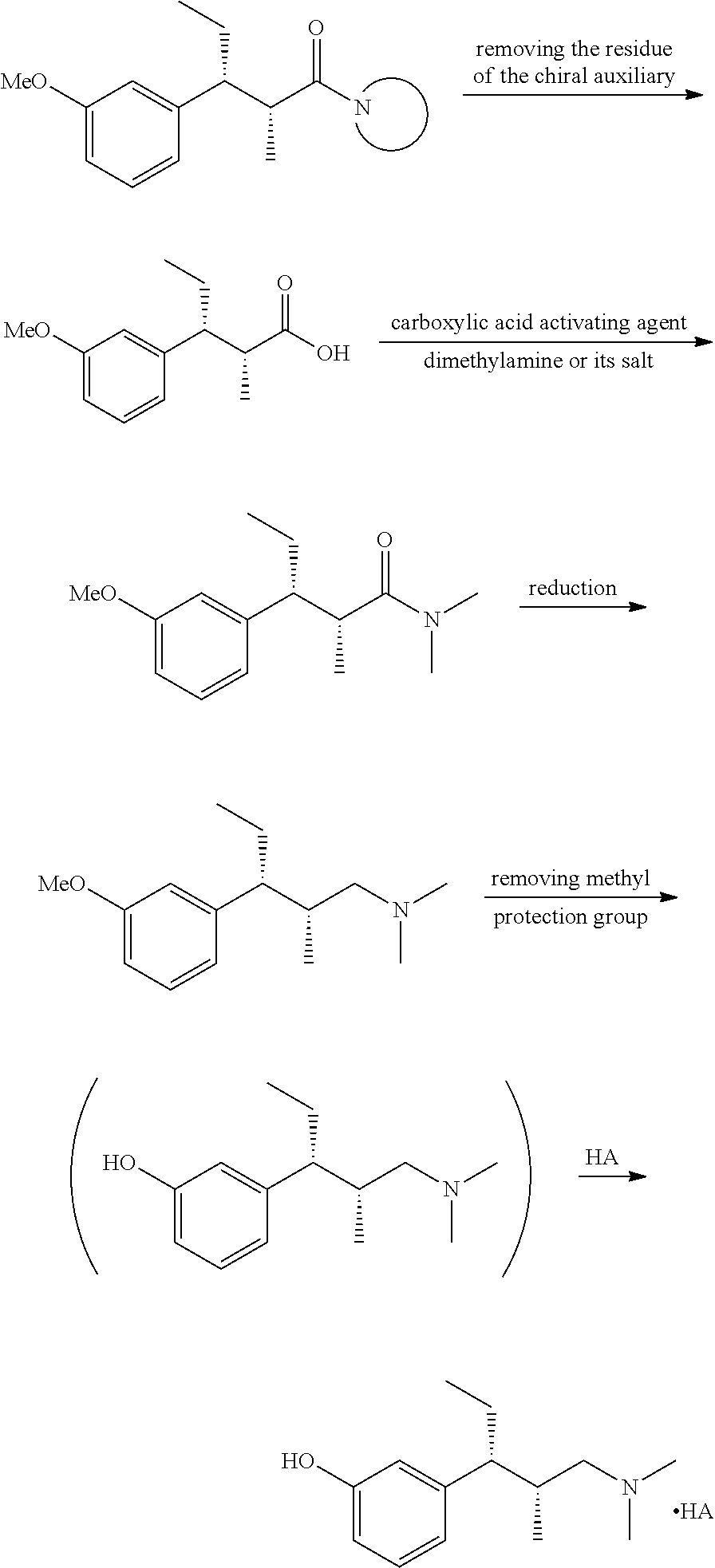


is the chiral auxiliary residue, which is defined as follows:


is chiral auxiliary residue, which is defined as follows:

- (1) 3-[(3R)-1-oxo-3-[3-(phenylmethoxy)phenyl]pentyl]-4R-phenyl-2-Oxazolidinone

- (2) 3-[(3R)-1-oxo-3-[3-(phenylmethoxy)phenyl]pentyl]-4R,5S-diphenyl-2-Oxazolidinone

- (3) 3-[(3R)-3-(3-methoxyphenyl)-1-oxopentyl]-4R-phenyl-2-Oxazolidinone

- (4) 3-[(3R)-3-(3-methoxyphenyl)-1-oxopentyl]-4R,5S-diphenyl-2-Oxazolidinone

- (5) 3-[(3R)-1-oxo-3-[3-(phenylmethoxy)phenyl]pentyl]-4S-phenyl-2-Oxazolidinone

- (6) 3-[(3R)-1-oxo-3-[3-(phenylmethoxy)phenyl]pentyl]-4S,5R-diphenyl-2-Oxazolidinone

- (7) (βR)-ethyl-3-(phenylmethoxy)benzenepropanoic acid

- (8) (βR)-ethyl-3-methoxybenzenepropanoic acid

- (9)(αR,βR)-β-ethyl-α-methyl-3-(phenylmethoxy)benzenepropanoic acid

- (10) (αR,βR)-β-ethyl-3-methoxy-α-methylbenzenepropanoic acid

- (11) (αR,βR)-β-ethyl-N,N,α-trimethyl-3-(phenylmethoxy)benzenepropanamide

- (12) (αR,βR)-β-ethyl-3-methoxy-N,N,α-trimethyl benzenepropanamide

- (13) (αR,βR)-β-ethyl-3-hydroxy-N,N,α-trimethylbenzenepropanamide

- (14) (βR,γR)-γ-ethyl-N,N,β-trimethyl-3-(phenylmethoxy)benzenepropanamine

- (15) 3-[(1R,2R)-3-amino-1-ethyl-2-methylpropyl]phenol

- (16) (βR,γR)-γ-ethyl-β-methyl-3-(phenylmethoxy)benzenepropanol

- (17) (βR,γR)-γ-ethyl-3-methoxy-β-methylbenzenepropanol

- (18) (βR,γR)-γ-ethyl-β-methyl-3-(phenylmethoxy)benzenepropanol 1-methanesulfonate

- (19) (βR,γR)-γ-ethyl-3-methoxy-β-methylbenzenepropanol 1-methanesulfonate

- (20) (βR,γR)-γ-ethyl-β-methyl-3-(phenylmethoxy)benzenepropanol 1-(4-methylbenzenesulfonate)

- (21) 1-[(1R,2R)-3-chloro-1-ethyl-2-methylpropyl]-3-(phenylmethoxy)benzene

- (22) 1-[(1R,2R)-3-bromo-1-ethyl-2-methylpropyl]-3-(phenylmethoxy)benzene


Claims (25)


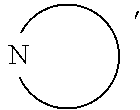


Applications Claiming Priority (4)
| Application Number | Priority Date | Filing Date | Title |
|---|---|---|---|
| CN2011100342024A CN102617501A (en) | 2011-01-31 | 2011-01-31 | Substituted valeramide compound, preparation method and application thereof |
| CN201110034202 | 2011-01-31 | ||
| CN201110034202.4 | 2011-01-31 | ||
| PCT/CN2012/070781 WO2012103799A1 (en) | 2011-01-31 | 2012-01-31 | Substituted n-pentanamide compounds, preparation methods and uses thereof |
Related Parent Applications (1)
| Application Number | Title | Priority Date | Filing Date |
|---|---|---|---|
| PCT/CN2012/070781 A-371-Of-International WO2012103799A1 (en) | 2011-01-31 | 2012-01-31 | Substituted n-pentanamide compounds, preparation methods and uses thereof |
Related Child Applications (1)
| Application Number | Title | Priority Date | Filing Date |
|---|---|---|---|
| US14/975,427 Division US20160102047A1 (en) | 2011-01-31 | 2015-12-18 | Substituted n-pentanamide compounds, preparation method and the use thereof |
Publications (2)
| Publication Number | Publication Date |
|---|---|
| US20140046074A1 US20140046074A1 (en) | 2014-02-13 |
| US9249084B2 true US9249084B2 (en) | 2016-02-02 |
Family
ID=46557763
Family Applications (2)
| Application Number | Title | Priority Date | Filing Date |
|---|---|---|---|
| US13/982,733 Expired - Fee Related US9249084B2 (en) | 2011-01-31 | 2012-01-31 | Substituted n-pentanamide compounds, preparation method and the use thereof |
| US14/975,427 Abandoned US20160102047A1 (en) | 2011-01-31 | 2015-12-18 | Substituted n-pentanamide compounds, preparation method and the use thereof |
Family Applications After (1)
| Application Number | Title | Priority Date | Filing Date |
|---|---|---|---|
| US14/975,427 Abandoned US20160102047A1 (en) | 2011-01-31 | 2015-12-18 | Substituted n-pentanamide compounds, preparation method and the use thereof |
Country Status (4)
| Country | Link |
|---|---|
| US (2) | US9249084B2 (en) |
| EP (1) | EP2671878A4 (en) |
| CN (3) | CN102617501A (en) |
| WO (1) | WO2012103799A1 (en) |
Families Citing this family (9)
| Publication number | Priority date | Publication date | Assignee | Title |
|---|---|---|---|---|
| US9090539B2 (en) | 2013-05-24 | 2015-07-28 | Ampac Fine Chemicals Llc | Compounds and methods for preparing substituted 3-(1-amino-2-methylpentane-3-yl)phenyl compounds |
| CN103254088B (en) * | 2013-05-24 | 2014-08-06 | 合肥市新星医药化工有限公司 | Tapentadol hydrochloride crystal form D as well as preparation method and application thereof |
| SI3083551T1 (en) * | 2013-12-16 | 2018-04-30 | Farma Grs, D.O.O. | Crystalline form of tapentadol intermediate |
| CN103787898B (en) * | 2014-01-17 | 2016-05-25 | 暨明医药科技(苏州)有限公司 | A kind of synthetic method of tapentadol hydrochloride |
| GB2539442A (en) * | 2015-06-16 | 2016-12-21 | Azad Pharmaceutical Ingredients Ag | New synthesis of tapentadol-HCI intermediates |
| CN107779480B (en) * | 2016-08-31 | 2021-03-02 | 安琪酵母股份有限公司 | Preparation method of tapentadol chiral intermediate |
| CN110483432A (en) * | 2018-05-14 | 2019-11-22 | 中国科学院上海药物研究所 | A class of acrylic compound and its preparation method, pharmaceutical composition and application |
| NO20200333A1 (en) * | 2020-03-20 | 2021-03-29 | Axichem As | Synthesis of capsaicin derivatives |
| AU2024267769A1 (en) * | 2023-05-06 | 2025-10-16 | Remegen Co., Ltd. | Preparation method for intermediate of auristatin derivative |
Citations (7)
| Publication number | Priority date | Publication date | Assignee | Title |
|---|---|---|---|---|
| EP0693475A1 (en) | 1994-07-23 | 1996-01-24 | Grünenthal GmbH | 1-Phenyl-3-dimethylamino-propane derivatives having pharmacological activity |
| CN101495445A (en) | 2006-07-24 | 2009-07-29 | 格吕伦塔尔有限公司 | Process for the preparation of (1R,2R)-3-(3-dimethylamino-1-ethyl-2-methyl-propyl)-phenol |
| US20090326271A1 (en) | 2006-07-24 | 2009-12-31 | Gruenenthal Gmbh | Preparation of 3-[(1R,2R)-3-(Dimethylamino)-1Ethyl-2-Methylpropyl]phenol |
| WO2011080756A1 (en) | 2009-12-29 | 2011-07-07 | Ind-Swift Laboratories Limited | Process for the preparation of 1-phenyl-3-dimethylaminopropane derivatives |
| WO2011080736A1 (en) | 2009-12-29 | 2011-07-07 | Mapi Pharma Hk Limited | Intermediate compounds and processes for the preparation of tapentadol and related compounds |
| WO2011092719A2 (en) | 2010-02-01 | 2011-08-04 | Ind-Swift Laboratories Limited | Process for the preparation of l-phenyl-3-dimethylaminopropane derivatives |
| WO2011157390A2 (en) | 2010-06-15 | 2011-12-22 | Grünenthal GmbH | Process for the preparation of substituted 3-(1-amino-2-methylpentane-3-yl)phenyl compounds |
Family Cites Families (3)
| Publication number | Priority date | Publication date | Assignee | Title |
|---|---|---|---|---|
| HRP20100197T1 (en) | 2006-07-24 | 2010-05-31 | Janssen Pharmaceutica N.V. | Preparation of (2r,3r)-3-(3-methoxyphenyl)-n,n,2-trimethylpentanamine |
| CN102083783A (en) * | 2007-10-10 | 2011-06-01 | 安姆根有限公司 | Substituted biphenyl GPR40 modulators |
| CN101948397A (en) * | 2010-09-07 | 2011-01-19 | 天津泰普药品科技发展有限公司 | Method for preparing important intermediate of tapentadol hydrochloride analgesic |
-
2011
- 2011-01-31 CN CN2011100342024A patent/CN102617501A/en not_active Withdrawn
-
2012
- 2012-01-31 US US13/982,733 patent/US9249084B2/en not_active Expired - Fee Related
- 2012-01-31 CN CN201610066542.8A patent/CN105732533A/en not_active Withdrawn
- 2012-01-31 CN CN201280007252.6A patent/CN103339116B/en not_active Expired - Fee Related
- 2012-01-31 EP EP12742093.3A patent/EP2671878A4/en not_active Withdrawn
- 2012-01-31 WO PCT/CN2012/070781 patent/WO2012103799A1/en not_active Ceased
-
2015
- 2015-12-18 US US14/975,427 patent/US20160102047A1/en not_active Abandoned
Patent Citations (8)
| Publication number | Priority date | Publication date | Assignee | Title |
|---|---|---|---|---|
| EP0693475A1 (en) | 1994-07-23 | 1996-01-24 | Grünenthal GmbH | 1-Phenyl-3-dimethylamino-propane derivatives having pharmacological activity |
| CN101495445A (en) | 2006-07-24 | 2009-07-29 | 格吕伦塔尔有限公司 | Process for the preparation of (1R,2R)-3-(3-dimethylamino-1-ethyl-2-methyl-propyl)-phenol |
| US20090326271A1 (en) | 2006-07-24 | 2009-12-31 | Gruenenthal Gmbh | Preparation of 3-[(1R,2R)-3-(Dimethylamino)-1Ethyl-2-Methylpropyl]phenol |
| EP2049464B1 (en) | 2006-07-24 | 2011-07-06 | Grünenthal GmbH | Preparation of 3-[(1r,2r)-3-(dimethylamino)-1ethyl-2-methylpropyl]phenol |
| WO2011080756A1 (en) | 2009-12-29 | 2011-07-07 | Ind-Swift Laboratories Limited | Process for the preparation of 1-phenyl-3-dimethylaminopropane derivatives |
| WO2011080736A1 (en) | 2009-12-29 | 2011-07-07 | Mapi Pharma Hk Limited | Intermediate compounds and processes for the preparation of tapentadol and related compounds |
| WO2011092719A2 (en) | 2010-02-01 | 2011-08-04 | Ind-Swift Laboratories Limited | Process for the preparation of l-phenyl-3-dimethylaminopropane derivatives |
| WO2011157390A2 (en) | 2010-06-15 | 2011-12-22 | Grünenthal GmbH | Process for the preparation of substituted 3-(1-amino-2-methylpentane-3-yl)phenyl compounds |
Non-Patent Citations (4)
| Title |
|---|
| Extended European Search Report issued on Jun. 24, 2014, in corresponding European Patent Application No. 12742093. |
| International Search Report issued in International Application No. PCT/CN2012/070781, mailed on May 3, 2012. |
| Romines, Karen R., et al., "A Facile Asymmetric Synthesis of 1, 2, 3-Substituted Indenes," The Journal of Organic Chemistry, vol. 64, No. 5, Mar. 1, 1999, pp. 1733-1737. |
| Terlinden, R., et al., "In vitro and in vivo characterization of tapentadol metabolites," Methods and Findings in Experimental and Clinical Pharmacology, vol. 32, No. 1, Jan. 1, 2010, pp. 31-38. |
Also Published As
| Publication number | Publication date |
|---|---|
| US20160102047A1 (en) | 2016-04-14 |
| US20140046074A1 (en) | 2014-02-13 |
| CN102617501A (en) | 2012-08-01 |
| CN103339116B (en) | 2016-04-06 |
| EP2671878A1 (en) | 2013-12-11 |
| WO2012103799A1 (en) | 2012-08-09 |
| CN105732533A (en) | 2016-07-06 |
| EP2671878A4 (en) | 2014-07-23 |
| CN103339116A (en) | 2013-10-02 |
Similar Documents
| Publication | Publication Date | Title |
|---|---|---|
| US20140046074A1 (en) | Substituted n-pentanamide compounds, preparation method and the use thereof | |
| US5225585A (en) | Production of fluoxetine and new intermediates | |
| US9309215B2 (en) | Chiral intermediate, process for producing the same and its use in the manufacture of tolterodine, fesoterodine, or the active metabolite thereof | |
| US9353060B2 (en) | Process for the preparation of 3-hydroxypicolinic acids | |
| US8853456B2 (en) | Process for the preparation of tapentadol | |
| US7601741B2 (en) | Process for making montelukast and intermediates therefor | |
| WO2011026318A1 (en) | S-5-substituent-n-2'-(thiophene-2-yl)ethyl-tetralin-2-amine or chiral acid salts thereof and use for preparing rotigotine | |
| US8552219B2 (en) | Process for preparing L-phenyl-3-dimethylaminopropane derivative | |
| WO2009084037A2 (en) | Novel process for preparation of o-desmethylvenlafaxine | |
| US8071788B2 (en) | Method and intermediates for the preparation of derivatives of N-(1-benzhydrylazetidin-3-yl)-N-phenylmethylsulfonamide | |
| US8569483B2 (en) | Process for the preparation of bazedoxifene acetate and intermediates thereof | |
| US20210347759A1 (en) | Method for manufacturing cyclopropane compound | |
| EP2711354B1 (en) | Preparation method for rivastigmine, intermediates thereof, and preparation method for said intermediates | |
| WO2007025481A1 (en) | Process for preparing (s)-n-ethyl-n-methyl-3-[1-(dimethylamino) ethyl]-phenyl carbamate and tartrate thereof | |
| CN101186607A (en) | A kind of synthetic method of palonosetron hydrochloride | |
| JP3492433B2 (en) | 3- (Phenylalkylaminoalkyloxy) -5-phenylpyrazole compounds, methods and intermediates for their preparation and cardiovascular agents containing them | |
| US9862681B2 (en) | N-haloalkylindoline intermediates, their process and use in preparation of Silodosin and its derivatives | |
| US10882819B2 (en) | Synthesis of novel intermediate(s) for preparing rivastigmine | |
| US20090030218A1 (en) | Method For Producing Aminoalcohol Derivative Having Biphenyl Group | |
| KR100686351B1 (en) | Method for preparing tolterodine racemate | |
| US20080086007A1 (en) | 2-(Pyrazole-1-Yl)Pyridine Derivative | |
| CZ293791B6 (en) | Process for preparing N,N-diisopropyl-3-(2-hydroxy-5-methylphenyl)-3-phenylpropyl amine in racemic or optically active form thereof | |
| WO2010010412A2 (en) | Method for the preparation of n-methyl-aryloxy-propanamine derivatives | |
| JPS5951940B2 (en) | Method for producing piperidinoalkanols | |
| EP1805167A2 (en) | Novel product, method and intermediates for the preparation of azetidine derivatives |
Legal Events
| Date | Code | Title | Description |
|---|---|---|---|
| AS | Assignment |
Owner name: SHANGHAI INSTITUTE OF MATERIA MEDICA, CHINESE ACAD Free format text: ASSIGNMENT OF ASSIGNORS INTEREST;ASSIGNORS:ZHANG, QIANG;ZHANG, RONGXIA;LI, JIANFENG;AND OTHERS;REEL/FRAME:031538/0618 Effective date: 20130829 Owner name: TOPHARMAN SHANGHAI CO., LTD., CHINA Free format text: ASSIGNMENT OF ASSIGNORS INTEREST;ASSIGNORS:TIAN, GUANGHUI;ZHU, FUQIANG;REEL/FRAME:031538/0489 Effective date: 20130829 |
|
| STCF | Information on status: patent grant |
Free format text: PATENTED CASE |
|
| FEPP | Fee payment procedure |
Free format text: MAINTENANCE FEE REMINDER MAILED (ORIGINAL EVENT CODE: REM.); ENTITY STATUS OF PATENT OWNER: SMALL ENTITY |
|
| LAPS | Lapse for failure to pay maintenance fees |
Free format text: PATENT EXPIRED FOR FAILURE TO PAY MAINTENANCE FEES (ORIGINAL EVENT CODE: EXP.); ENTITY STATUS OF PATENT OWNER: SMALL ENTITY |
|
| STCH | Information on status: patent discontinuation |
Free format text: PATENT EXPIRED DUE TO NONPAYMENT OF MAINTENANCE FEES UNDER 37 CFR 1.362 |
|
| FP | Lapsed due to failure to pay maintenance fee |
Effective date: 20200202 |