US9249074B2 - Synthesis of tetrahydromyrcenol - Google Patents

Synthesis of tetrahydromyrcenol Download PDF

Info

Publication number
US9249074B2
US9249074B2 US14/647,636 US201314647636A US9249074B2 US 9249074 B2 US9249074 B2 US 9249074B2 US 201314647636 A US201314647636 A US 201314647636A US 9249074 B2 US9249074 B2 US 9249074B2
Authority
US
United States
Prior art keywords
compound
formula
carried out
present
bar
Prior art date
Legal status (The legal status is an assumption and is not a legal conclusion. Google has not performed a legal analysis and makes no representation as to the accuracy of the status listed.)
Active
Application number
US14/647,636
Other versions
US20150329451A1 (en
Inventor
Raphael Beumer
Werner Bonrath
Jonathan Alan Medlock
Current Assignee (The listed assignees may be inaccurate. Google has not performed a legal analysis and makes no representation or warranty as to the accuracy of the list.)
DSM IP Assets BV
Original Assignee
DSM IP Assets BV
Priority date (The priority date is an assumption and is not a legal conclusion. Google has not performed a legal analysis and makes no representation as to the accuracy of the date listed.)
Filing date
Publication date
Application filed by DSM IP Assets BV filed Critical DSM IP Assets BV
Assigned to DSM IP ASSETS B.V. reassignment DSM IP ASSETS B.V. ASSIGNMENT OF ASSIGNORS INTEREST (SEE DOCUMENT FOR DETAILS). Assignors: BEUMER, RAPHAEL, BONRATH, WERNER, MEDLOCK, JONATHAN ALAN
Publication of US20150329451A1 publication Critical patent/US20150329451A1/en
Application granted granted Critical
Publication of US9249074B2 publication Critical patent/US9249074B2/en
Active legal-status Critical Current
Anticipated expiration legal-status Critical

Links

Classifications

    • CCHEMISTRY; METALLURGY
    • C07ORGANIC CHEMISTRY
    • C07CACYCLIC OR CARBOCYCLIC COMPOUNDS
    • C07C29/00Preparation of compounds having hydroxy or O-metal groups bound to a carbon atom not belonging to a six-membered aromatic ring
    • C07C29/17Preparation of compounds having hydroxy or O-metal groups bound to a carbon atom not belonging to a six-membered aromatic ring by hydrogenation of carbon-to-carbon double or triple bonds
    • C07C29/172Preparation of compounds having hydroxy or O-metal groups bound to a carbon atom not belonging to a six-membered aromatic ring by hydrogenation of carbon-to-carbon double or triple bonds with the obtention of a fully saturated alcohol
    • CCHEMISTRY; METALLURGY
    • C07ORGANIC CHEMISTRY
    • C07CACYCLIC OR CARBOCYCLIC COMPOUNDS
    • C07C29/00Preparation of compounds having hydroxy or O-metal groups bound to a carbon atom not belonging to a six-membered aromatic ring
    • C07C29/09Preparation of compounds having hydroxy or O-metal groups bound to a carbon atom not belonging to a six-membered aromatic ring by hydrolysis
    • C07C29/10Preparation of compounds having hydroxy or O-metal groups bound to a carbon atom not belonging to a six-membered aromatic ring by hydrolysis of ethers, including cyclic ethers, e.g. oxiranes
    • CCHEMISTRY; METALLURGY
    • C07ORGANIC CHEMISTRY
    • C07CACYCLIC OR CARBOCYCLIC COMPOUNDS
    • C07C29/00Preparation of compounds having hydroxy or O-metal groups bound to a carbon atom not belonging to a six-membered aromatic ring
    • C07C29/09Preparation of compounds having hydroxy or O-metal groups bound to a carbon atom not belonging to a six-membered aromatic ring by hydrolysis
    • C07C29/10Preparation of compounds having hydroxy or O-metal groups bound to a carbon atom not belonging to a six-membered aromatic ring by hydrolysis of ethers, including cyclic ethers, e.g. oxiranes
    • C07C29/103Preparation of compounds having hydroxy or O-metal groups bound to a carbon atom not belonging to a six-membered aromatic ring by hydrolysis of ethers, including cyclic ethers, e.g. oxiranes of cyclic ethers

Definitions

  • the present invention relates to a new and improved synthesis of tetrahydromyrcenol (IUPAC name: 2,6-dimethyl-2-octanol).
  • flavour and fragrance industry is a well-known compound in the flavour and fragrance industry. It used widely for many applications. It is described olfactory as “fresh, overall citrus-floral and sweet odour with terpenic undertones”.
  • the present invention relates to a process for production of compound of formula (I)
  • the compound of formula (II) can, for example, be prepared from dehydrolinalool by ring closure catalysed by tungsten, molybdenum or polyphosphoric acid (Strickler et al., Helv. Chem. Acta 1966, 49, 2055; Erman et al., Tetrahedron 1976, 34, 2981, and Belgian Patent No. 852 918).
  • the reduction agent used in the process according to the present invention is preferably H 2 gas.
  • the pressure is at least 1 bar, preferably at least 3 bars.
  • a preferred range for the pressure under which the process according to the present invention is carried out is 1-20 bar, more preferably 3-15 bar.
  • the present invention relates to a process for production of compound of formula (I) by a reductive ring-opening of a compound of formula (II), characterized in that the reaction is carried out with H 2 -gas at a pressure of 1-20 bar, preferably at 3-15 bar.
  • the process according to the present invention is usually carried out at temperatures from 15-100° C., preferably from 20-80° C.
  • the present invention relates to a process for production of compound of formula (I) by a reductive ring-opening of a compound of formula (II), characterized in that the reaction is carried out at temperatures from 15-100° C., preferably from 20-80° C.
  • the present invention relates to a process for production of compound of formula (I) by a reductive ring-opening of a compound of formula (II), characterized in that the reaction is carried out with H 2 -gas at a pressure of 1-20 bar, preferably at 3-15 bar and at temperatures from 15-100° C., preferably from 20-80° C.
  • the process according to the present invention can be carried out with or without a solvent.
  • the process according to the present invention is carried out in an inert solvent (or a mixture of solvents).
  • Inert solvent means that the solvent will not take part in the reaction process.
  • the solvent must be liquid at the reaction condition used in a process according to the present invention.
  • Suitable solvents are i.e. alcohols (such methanol, ethanol), hydrocarbons (such as n-hexane, n-heptane), esters, ethers (such as THF), chlorinated hydrocarbons (such as CH 2 Cl 2 ).
  • the present invention relates to a process for production of compound of formula (I) by a reductive ring-opening of a compound of formula (II), characterized in that the reaction is carried out in a solvent or in a mixture of solvents (preferably alcohols, hydrocarbons, esters, ethers and chlorinated hydrocarbons).
  • the present invention relates to a process for production of compound of formula (I) by a reductive ring-opening of a compound of formula (II), characterized in that the reaction is carried out
  • H 2 -gas at a pressure of 1-20 bar, preferably at 3-15 bar and
  • solvents preferably alcohols, hydrocarbons, esters, ethers and chlorinated hydrocarbons.
  • the process according to the present invention is carried out in the presence of a catalyst.
  • the catalyst is a transition metal on a support material.
  • the support material is carbon or a solid acid.
  • Preferred transition metals are Pt, Rh and Pd,
  • Pd/C palladium on carbon
  • a catalyst (CAS number of 7440-05-3) is commercially available for example from Sigma Aldrich.
  • the present invention relates to a process for production of compound of formula (I) by a reductive ring-opening of a compound of formula (II), characterized in that the reaction is carried out is carried out in the presence of a catalyst (preferably a transition metal on a support material, more preferably Pd/C).
  • a catalyst preferably a transition metal on a support material, more preferably Pd/C.
  • the catalyst is present in the process in amount of up to 10 wt-% (based on the weight of compound of formula (II)), more preferably up to 5 wt %.
  • the present invention relates to a process for production of compound of formula (I) by a reductive ring-opening of a compound of formula (II), characterized in that the reaction is carried out
  • H 2 -gas at a pressure of 1-20 bar, preferably at 3-15 bar, and
  • solvents preferably alcohols, hydrocarbons, esters, ethers and chlorinated hydrocarbons
  • the process according to the present invention is usually carried out in the presence of an acid.
  • the acid can be organic as well as inorganic (as well as mixtures).
  • Suitable acids are i.e. HCl, H 2 SO 4 , p-toluenesulfonic acid. It is also possible to use solid acids.
  • the acid is present in an amount of 1-20 wt-% (based on the total weight of compound of formula (II))
  • the present invention relates to a process for production of compound of formula (I) by a reductive ring-opening of a compound of formula (II), characterized in that the reaction is carried out is carried out in the presence of an organic and/or an inorganic acid, as well as mixtures thereof (preferably HCl, H 2 SO 4 , p-toluenesulfonic acid).
  • an organic and/or an inorganic acid as well as mixtures thereof (preferably HCl, H 2 SO 4 , p-toluenesulfonic acid).
  • the present invention relates to a process for production of compound of formula (I) by a reductive ring-opening of a compound of formula (II), characterized in that the reaction is carried out
  • H 2 -gas at a pressure of 3-20 bar, preferably at 3-15 bar, and
  • solvents preferably alcohols, hydrocarbons, esters, ethers and chlorinated hydrocarbons
  • a catalyst preferably a transition metal on a support material, more preferably Pd/C
  • an organic and/or an inorganic acid as well as mixtures thereof (preferably HCl, H 2 SO 4 , p-toluenesulfonic acid).
  • the selectivity and the yield was more than 90%.

Landscapes

  • Chemical & Material Sciences (AREA)
  • Organic Chemistry (AREA)
  • Organic Low-Molecular-Weight Compounds And Preparation Thereof (AREA)
  • Low-Molecular Organic Synthesis Reactions Using Catalysts (AREA)

Abstract

The present invention relates to a new and improved synthesis of tetrahydromyrcenol (IUPAC name: 2,6-dimethyl-2-octanol).

Description

This application is the U.S. national phase of International Application No. PCT/EP2013/075003 filed 28 Nov. 2013 which designated the U.S. and claims priority to EP 12194596.8 filed 28 Nov. 2012, the entire contents of each of which are hereby incorporated by reference.
The present invention relates to a new and improved synthesis of tetrahydromyrcenol (IUPAC name: 2,6-dimethyl-2-octanol).
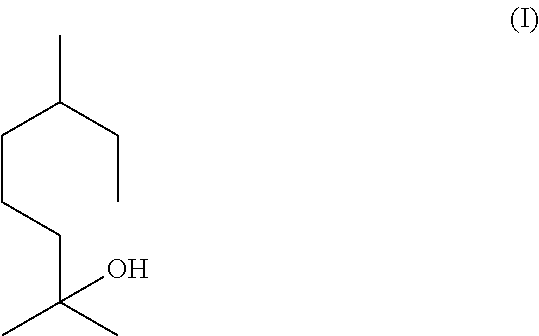
Tetrahydromyrcenol (CAS Number: 18479-57-7), which is the following compound of formula (I)
Figure US09249074-20160202-C00001

is a well-known compound in the flavour and fragrance industry. It used widely for many applications. It is described olfactory as “fresh, overall citrus-floral and sweet odour with terpenic undertones”.
Due to the importance of tetrahydromyrcenol, there is always a need for an improved process for its production.
We found that that the reductive ring opening of a compound of formula (II)
Figure US09249074-20160202-C00002

results in an excellent selectivity and yield of tetrahydromyrcenol.
It is surprising that the reductive ring opening does not result (or only in minimal amounts) in undesired side products such as i.e.
Figure US09249074-20160202-C00003
Furthermore it is surprising that the ring opens selectively at the “correct” position (position 2; which leads to tetrahydromyrcenol) and not at position 6. Such a ring opening would lead (for example) to a compound of formula (VI)
Figure US09249074-20160202-C00004
Compound of formula (VI) is not found in the reaction mixture at the end of the synthesis, as well as other possible reaction products from such ring opening are not found.
Therefore the present invention relates to a process for production of compound of formula (I)
Figure US09249074-20160202-C00005

by a reductive ring-opening of a compound of formula (II)
Figure US09249074-20160202-C00006
The compound of formula (II) can, for example, be prepared from dehydrolinalool by ring closure catalysed by tungsten, molybdenum or polyphosphoric acid (Strickler et al., Helv. Chem. Acta 1966, 49, 2055; Erman et al., Tetrahedron 1976, 34, 2981, and Belgian Patent No. 852 918).
The reduction agent used in the process according to the present invention is preferably H2 gas.
Therefore the process according to the present invention is preferably carried out under pressure.
Usually the pressure is at least 1 bar, preferably at least 3 bars.
A preferred range for the pressure under which the process according to the present invention is carried out, is 1-20 bar, more preferably 3-15 bar.
All the pressures given in the context of the present patent application are always absolute pressures.
Therefore the present invention relates to a process for production of compound of formula (I) by a reductive ring-opening of a compound of formula (II), characterized in that the reaction is carried out with H2-gas at a pressure of 1-20 bar, preferably at 3-15 bar.
The process according to the present invention is usually carried out at temperatures from 15-100° C., preferably from 20-80° C.
Therefore the present invention relates to a process for production of compound of formula (I) by a reductive ring-opening of a compound of formula (II), characterized in that the reaction is carried out at temperatures from 15-100° C., preferably from 20-80° C.
Preferably the present invention relates to a process for production of compound of formula (I) by a reductive ring-opening of a compound of formula (II), characterized in that the reaction is carried out with H2-gas at a pressure of 1-20 bar, preferably at 3-15 bar and at temperatures from 15-100° C., preferably from 20-80° C.
The process according to the present invention can be carried out with or without a solvent.
Preferably the process according to the present invention is carried out in an inert solvent (or a mixture of solvents). Inert solvent means that the solvent will not take part in the reaction process.
The solvent must be liquid at the reaction condition used in a process according to the present invention.
Suitable solvents are i.e. alcohols (such methanol, ethanol), hydrocarbons (such as n-hexane, n-heptane), esters, ethers (such as THF), chlorinated hydrocarbons (such as CH2Cl2).
Therefore the present invention relates to a process for production of compound of formula (I) by a reductive ring-opening of a compound of formula (II), characterized in that the reaction is carried out in a solvent or in a mixture of solvents (preferably alcohols, hydrocarbons, esters, ethers and chlorinated hydrocarbons).
Preferably the present invention relates to a process for production of compound of formula (I) by a reductive ring-opening of a compound of formula (II), characterized in that the reaction is carried out
with H2-gas at a pressure of 1-20 bar, preferably at 3-15 bar and
at temperatures from 15-100° C., preferably from 20-80° C.
and a solvent or in a mixture of solvents (preferably alcohols, hydrocarbons, esters, ethers and chlorinated hydrocarbons).
Preferably the process according to the present invention is carried out in the presence of a catalyst.
The catalyst is a transition metal on a support material. Usually the support material is carbon or a solid acid. Preferred transition metals are Pt, Rh and Pd,
More preferred is palladium on carbon (Pd/C). Such a catalyst (CAS number of 7440-05-3) is commercially available for example from Sigma Aldrich.
Therefore the present invention relates to a process for production of compound of formula (I) by a reductive ring-opening of a compound of formula (II), characterized in that the reaction is carried out is carried out in the presence of a catalyst (preferably a transition metal on a support material, more preferably Pd/C).
Preferably the catalyst is present in the process in amount of up to 10 wt-% (based on the weight of compound of formula (II)), more preferably up to 5 wt %.
Preferably the present invention relates to a process for production of compound of formula (I) by a reductive ring-opening of a compound of formula (II), characterized in that the reaction is carried out
with H2-gas at a pressure of 1-20 bar, preferably at 3-15 bar, and
at temperatures from 15-100° C., preferably from 20-80° C., and
a solvent or in a mixture of solvents (preferably alcohols, hydrocarbons, esters, ethers and chlorinated hydrocarbons), and
in the presence of up to 10 wt-% (based on the total weight of compound of formula (II)) of at least one catalyst (preferably a transition metal on a support material, more preferably Pd/C), preferably up to 5 wt %.
The process according to the present invention is usually carried out in the presence of an acid. The acid can be organic as well as inorganic (as well as mixtures).
Suitable acids are i.e. HCl, H2SO4, p-toluenesulfonic acid. It is also possible to use solid acids.
Preferably the acid is present in an amount of 1-20 wt-% (based on the total weight of compound of formula (II))
Therefore the present invention relates to a process for production of compound of formula (I) by a reductive ring-opening of a compound of formula (II), characterized in that the reaction is carried out is carried out in the presence of an organic and/or an inorganic acid, as well as mixtures thereof (preferably HCl, H2SO4, p-toluenesulfonic acid).
Preferably the present invention relates to a process for production of compound of formula (I) by a reductive ring-opening of a compound of formula (II), characterized in that the reaction is carried out
with H2-gas at a pressure of 3-20 bar, preferably at 3-15 bar, and
at temperatures from 15-100° C., preferably from 20-80° C., and
a solvent or in a mixture of solvents (preferably alcohols, hydrocarbons, esters, ethers and chlorinated hydrocarbons), and
in the presence of a catalyst (preferably a transition metal on a support material, more preferably Pd/C), and
in the presence of an organic and/or an inorganic acid, as well as mixtures thereof (preferably HCl, H2SO4, p-toluenesulfonic acid).
The following examples illustrate the present invention.
All the parts and percentages in the Examples are related to the weight (when not otherwise stated) and the temperature is given in ° C. (when not otherwise stated).
EXAMPLES Example 1
8 mg of the catalyst (Pd/C) was added to a 8 ml glass reactor and 2-ethynyl-2,6,6-trimethyl-tetrahydropyran (210 mg, 95%) was added. Heptane (1.5 g) and concentrated hydrochloric acid (10 μl) were added and the reactor was sealed. The reactor was purged with argon 3 times (by pressurising to 5 bar followed by release of the pressure) and 3 times with hydrogen (pressurise to 5 bar then release). The reaction mixture was heated to 50° C., pressurised to 10 bar hydrogen and stirred until no more hydrogen consumption was observed and then for a further 30-60 minutes. The stirring was stopped and the reaction allowed to cool to room temperature.
The pressure was released and the reactor purged 2 times with argon. After filtration to remove the catalyst, the reaction mixture was analysed by GC to determine conversion and selectivity.
The selectivity and the yield was more than 90%.
The examples in the following table have been synthesised in analogy to example 1. The amount of catalyst, the acid, the amount of acid, the pressure and the reaction temperature have been varied.
TABLE 1
Amount Amount p T Yield
Exp. Solvent Cat [mg] Acid acid [bar] [° C.] [%]
2 THF 14 HCl 10 μl 10 50 68
3 n-heptane 17 HCl 10 μl 10 50 78
4 n-heptane 23 HCl 10 μl 10 30 78
5 n-heptane 26 HCl 10 μl  3 50 74
6 n-heptane  9 HCl 10 μl  3 70 87
7 n-heptane 10 p-toluene- 11 mg 10 50 50
sulfonic acid
The yield and the selectivity are identical due to the fact that the conversion is 100%.

Claims (7)

The invention claimed is:
1. A process for production of compound of formula (I)
Figure US09249074-20160202-C00007
by a reductive ring-opening of a compound of formula (II)
Figure US09249074-20160202-C00008
2. Process according to claim 1, wherein the reducing agent is H2 gas.
3. Process according to claim 2, wherein process is carried out under pressure of at least 1 bar.
4. Process according to claim 1, wherein the process is carried out at temperatures from 15-100° C.
5. Process according to claim 1, wherein the process is carried out with or without a solvent.
6. Process according to claim 1, wherein the process is carried out in the presence of a catalyst.
7. Process according to claim 1, wherein the process is carried out in the presence of an acid.
US14/647,636 2012-11-28 2013-11-28 Synthesis of tetrahydromyrcenol Active US9249074B2 (en)

Applications Claiming Priority (4)

Application Number Priority Date Filing Date Title
EP12194596 2012-11-28
EP12194596.8 2012-11-28
PCT/EP2013/075003 WO2014083121A1 (en) 2012-11-28 2013-11-28 Synthesis of tetrahydromyrcenol

Publications (2)

Publication Number Publication Date
US20150329451A1 US20150329451A1 (en) 2015-11-19
US9249074B2 true US9249074B2 (en) 2016-02-02

Family

ID=47263156

Family Applications (1)

Application Number Title Priority Date Filing Date
US14/647,636 Active US9249074B2 (en) 2012-11-28 2013-11-28 Synthesis of tetrahydromyrcenol

Country Status (7)

Country Link
US (1) US9249074B2 (en)
EP (1) EP2925711B1 (en)
JP (1) JP6288101B2 (en)
CN (1) CN104822645B (en)
ES (1) ES2619528T3 (en)
MX (1) MX360018B (en)
WO (1) WO2014083121A1 (en)

Citations (1)

* Cited by examiner, † Cited by third party
Publication number Priority date Publication date Assignee Title
DE1118190B (en) 1958-09-10 1961-11-30 Int Flavors & Fragrances Inc Process for the preparation of terpene alcohols of the empirical formula C H O and their derivatives with special fragrance properties

Family Cites Families (5)

* Cited by examiner, † Cited by third party
Publication number Priority date Publication date Assignee Title
NL113984C (en) * 1956-04-09
DE1196177B (en) * 1963-07-30 1965-07-08 Basf Ag Process for the preparation of 2-hydroxy-2,3-dihydrocitral
IT1058547B (en) 1976-03-26 1982-05-10 Snam Progetti Dehydro-linalol cyclisation using polyphosphoric acid - prods. being useful as perfume (intermediates)
DE60102272T2 (en) * 2000-09-06 2005-02-24 Dsm Ip Assets B.V. Process for the preparation of substituted pyrans
US7829342B2 (en) * 2007-10-03 2010-11-09 The Board Of Trustees Of The Universiy Of Illinois Selective aliphatic C-H oxidation

Patent Citations (1)

* Cited by examiner, † Cited by third party
Publication number Priority date Publication date Assignee Title
DE1118190B (en) 1958-09-10 1961-11-30 Int Flavors & Fragrances Inc Process for the preparation of terpene alcohols of the empirical formula C H O and their derivatives with special fragrance properties

Non-Patent Citations (4)

* Cited by examiner, † Cited by third party
Title
International Search Report for PCT/EP2013/075003 mailed Jan. 20, 2014, three pages.
L. Gomez et al., "Stereospecific C-H Oxidation with H202 Catalyzed by a Chemically Robust Site-Isolated Iron Catalyst", Angewandte Chemie International Edition, vol. 48, No. 31, Jul. 20, 2009, pp. 5720-5723.
Y. Hitomi et al., "An Iron (III)-Monoamidate Complex Catalyst for Selective Hydroxylation of Alkane C H Bonds with Hydrogen Peroxide", Angewandte Chemie International Edition, vol. 51, No. 14, Apr. 2, 2012, pp. 3448-3452.

Also Published As

Publication number Publication date
JP6288101B2 (en) 2018-03-07
US20150329451A1 (en) 2015-11-19
EP2925711B1 (en) 2016-12-21
MX2015006537A (en) 2015-07-23
EP2925711A1 (en) 2015-10-07
WO2014083121A1 (en) 2014-06-05
ES2619528T3 (en) 2017-06-26
MX360018B (en) 2018-10-10
CN104822645A (en) 2015-08-05
CN104822645B (en) 2016-09-14
JP2015535527A (en) 2015-12-14

Similar Documents

Publication Publication Date Title
US7579295B2 (en) Catalytic hydrogenation processes
US9988268B2 (en) Preparation of 2,6- and 2,7-disubstituted anthraquinone derivatives
CN103415508B (en) Process for preparing substituted N-phenylhydroxylamines
US20150141712A1 (en) Process for the preparation of benzonorbornenes
JP2007070358A (en) Hydrogenation of acetone
US9416082B2 (en) Process for the isomerisation of an exo double bond
US9249074B2 (en) Synthesis of tetrahydromyrcenol
EP2665698B1 (en) Preparation of 4-acetoxy-2-methylbutanal by catalytic carbon carbon double bond hydrogenation
US9656966B2 (en) Method for preparing 1-alkyl-3-difluoromethyl-5-fluor-1H-pyrazole-4-carbaldehydes and 1-alkyl-3-difluoromethyl-5-fluor-1H-pyrazole-4-carboxylates
CN101550077B (en) Manufacturing method of bicyclohexyl derivative
CN109996776B (en) Process for the preparation of (poly)alkylated phenols
US9908847B2 (en) Method for producing specific α,β-unsaturated aldehydes by rearrangement process
KR102485899B1 (en) Recovery and reuse method of homogeneous selective hydrogenation catalyst
US20090112025A1 (en) Catalytic hydrogenation process and novel catalyst for it
CN114195619B (en) Preparation method of 2-methyl-3-buten-2-ol
CN106928039A (en) The method for manufacturing the ketone of 6,10,14 trimethylpentadecane 2
EP3263554B1 (en) Selective transfer hydrogenation of retinal to retinol
EP2479163B1 (en) Method for producing cyclohexyl alkyl ketones
EP4260937A1 (en) Method for preparing catalyst for selective hydrogenation of cyclododecatriene and catalyst prepared by preparation method
EP2765126A1 (en) Hydrogenation of citral in a solvent
JP4915696B2 (en) Process for producing β-aminocarbonyl compound
US20220220071A1 (en) Novel enol-acetates(ii)
JP2003183203A (en) Method for producing ethyl group-containing alicyclic tertiary alcohol
WO2020212164A1 (en) New process for the production of retinal
KR20180116277A (en) Preparation of 3-piperazin-1-yl-propylamine derivative

Legal Events

Date Code Title Description
AS Assignment

Owner name: DSM IP ASSETS B.V., NETHERLANDS

Free format text: ASSIGNMENT OF ASSIGNORS INTEREST;ASSIGNORS:BEUMER, RAPHAEL;BONRATH, WERNER;MEDLOCK, JONATHAN ALAN;SIGNING DATES FROM 20150814 TO 20150818;REEL/FRAME:036815/0875

STCF Information on status: patent grant

Free format text: PATENTED CASE

MAFP Maintenance fee payment

Free format text: PAYMENT OF MAINTENANCE FEE, 4TH YEAR, LARGE ENTITY (ORIGINAL EVENT CODE: M1551); ENTITY STATUS OF PATENT OWNER: LARGE ENTITY

Year of fee payment: 4

MAFP Maintenance fee payment

Free format text: PAYMENT OF MAINTENANCE FEE, 8TH YEAR, LARGE ENTITY (ORIGINAL EVENT CODE: M1552); ENTITY STATUS OF PATENT OWNER: LARGE ENTITY

Year of fee payment: 8