US9246103B2 - Polymers and oligomers with functionalized side groups - Google Patents
Polymers and oligomers with functionalized side groups Download PDFInfo
- Publication number
- US9246103B2 US9246103B2 US14/234,825 US201214234825A US9246103B2 US 9246103 B2 US9246103 B2 US 9246103B2 US 201214234825 A US201214234825 A US 201214234825A US 9246103 B2 US9246103 B2 US 9246103B2
- Authority
- US
- United States
- Prior art keywords
- groups
- independently
- group
- optionally
- optionally substituted
- Prior art date
- Legal status (The legal status is an assumption and is not a legal conclusion. Google has not performed a legal analysis and makes no representation as to the accuracy of the status listed.)
- Active
Links
- 229920000642 polymer Polymers 0.000 title claims abstract description 112
- 125000006850 spacer group Chemical group 0.000 claims abstract description 18
- 125000003118 aryl group Chemical group 0.000 claims description 63
- 125000004432 carbon atom Chemical group C* 0.000 claims description 61
- -1 triarylboranes Chemical class 0.000 claims description 47
- 125000001072 heteroaryl group Chemical group 0.000 claims description 39
- 238000004770 highest occupied molecular orbital Methods 0.000 claims description 39
- 238000004768 lowest unoccupied molecular orbital Methods 0.000 claims description 36
- 125000000217 alkyl group Chemical group 0.000 claims description 30
- AIXAANGOTKPUOY-UHFFFAOYSA-N carbachol Chemical group [Cl-].C[N+](C)(C)CCOC(N)=O AIXAANGOTKPUOY-UHFFFAOYSA-N 0.000 claims description 26
- 125000001183 hydrocarbyl group Chemical group 0.000 claims description 26
- 229910052736 halogen Inorganic materials 0.000 claims description 24
- 150000002367 halogens Chemical class 0.000 claims description 24
- 238000002347 injection Methods 0.000 claims description 23
- 239000007924 injection Substances 0.000 claims description 23
- 125000005842 heteroatom Chemical group 0.000 claims description 22
- 229910052760 oxygen Inorganic materials 0.000 claims description 22
- 230000005525 hole transport Effects 0.000 claims description 18
- 229910052717 sulfur Inorganic materials 0.000 claims description 18
- 229910052739 hydrogen Inorganic materials 0.000 claims description 17
- 125000001181 organosilyl group Chemical group [SiH3]* 0.000 claims description 15
- 229910052799 carbon Inorganic materials 0.000 claims description 14
- 125000002950 monocyclic group Chemical group 0.000 claims description 14
- 125000004435 hydrogen atom Chemical class [H]* 0.000 claims description 13
- 239000000758 substrate Substances 0.000 claims description 13
- 229920001940 conductive polymer Polymers 0.000 claims description 12
- 229910052731 fluorine Inorganic materials 0.000 claims description 12
- 125000000449 nitro group Chemical group [O-][N+](*)=O 0.000 claims description 12
- 229910052801 chlorine Inorganic materials 0.000 claims description 11
- 125000003983 fluorenyl group Chemical class C1(=CC=CC=2C3=CC=CC=C3CC12)* 0.000 claims description 11
- 150000002894 organic compounds Chemical class 0.000 claims description 11
- 239000001257 hydrogen Substances 0.000 claims description 10
- 125000002023 trifluoromethyl group Chemical group FC(F)(F)* 0.000 claims description 10
- 229910006069 SO3H Inorganic materials 0.000 claims description 8
- 229910052785 arsenic Inorganic materials 0.000 claims description 8
- 239000010408 film Substances 0.000 claims description 8
- 229910052757 nitrogen Inorganic materials 0.000 claims description 8
- 125000003003 spiro group Chemical group 0.000 claims description 8
- 229920006395 saturated elastomer Polymers 0.000 claims description 7
- 229910052787 antimony Inorganic materials 0.000 claims description 6
- PJULCNAVAGQLAT-UHFFFAOYSA-N indeno[2,1-a]fluorene Chemical class C1=CC=C2C=C3C4=CC5=CC=CC=C5C4=CC=C3C2=C1 PJULCNAVAGQLAT-UHFFFAOYSA-N 0.000 claims description 6
- 229910052698 phosphorus Inorganic materials 0.000 claims description 6
- 125000000547 substituted alkyl group Chemical group 0.000 claims description 6
- 229930192474 thiophene Natural products 0.000 claims description 6
- 229910052796 boron Inorganic materials 0.000 claims description 5
- 230000005669 field effect Effects 0.000 claims description 5
- 125000005259 triarylamine group Chemical group 0.000 claims description 5
- 125000004183 alkoxy alkyl group Chemical group 0.000 claims description 4
- 125000005103 alkyl silyl group Chemical group 0.000 claims description 4
- 125000006350 alkyl thio alkyl group Chemical group 0.000 claims description 4
- 125000002947 alkylene group Chemical group 0.000 claims description 4
- 125000000753 cycloalkyl group Chemical group 0.000 claims description 4
- 239000010409 thin film Substances 0.000 claims description 4
- 239000003990 capacitor Substances 0.000 claims description 3
- 125000004404 heteroalkyl group Chemical group 0.000 claims description 3
- 238000006467 substitution reaction Methods 0.000 claims description 3
- DXBHBZVCASKNBY-UHFFFAOYSA-N 1,2-Benz(a)anthracene Chemical class C1=CC=C2C3=CC4=CC=CC=C4C=C3C=CC2=C1 DXBHBZVCASKNBY-UHFFFAOYSA-N 0.000 claims description 2
- 125000001931 aliphatic group Chemical group 0.000 claims description 2
- 150000001412 amines Chemical class 0.000 claims description 2
- 150000001454 anthracenes Chemical class 0.000 claims description 2
- 150000003216 pyrazines Chemical class 0.000 claims description 2
- 150000003222 pyridines Chemical class 0.000 claims description 2
- 150000003230 pyrimidines Chemical class 0.000 claims description 2
- 150000003918 triazines Chemical class 0.000 claims description 2
- 125000005529 alkyleneoxy group Chemical group 0.000 claims 1
- 125000003785 benzimidazolyl group Chemical class N1=C(NC2=C1C=CC=C2)* 0.000 claims 1
- 150000001716 carbazoles Chemical class 0.000 claims 1
- 150000002460 imidazoles Chemical class 0.000 claims 1
- VVVPGLRKXQSQSZ-UHFFFAOYSA-N indolo[3,2-c]carbazole Chemical class C1=CC=CC2=NC3=C4C5=CC=CC=C5N=C4C=CC3=C21 VVVPGLRKXQSQSZ-UHFFFAOYSA-N 0.000 claims 1
- 229960005544 indolocarbazole Drugs 0.000 claims 1
- 150000002576 ketones Chemical class 0.000 claims 1
- 150000002979 perylenes Chemical class 0.000 claims 1
- 150000002987 phenanthrenes Chemical class 0.000 claims 1
- 150000005041 phenanthrolines Chemical class 0.000 claims 1
- 150000002988 phenazines Chemical class 0.000 claims 1
- 150000003004 phosphinoxides Chemical class 0.000 claims 1
- 150000003220 pyrenes Chemical class 0.000 claims 1
- 150000004892 pyridazines Chemical class 0.000 claims 1
- 125000002943 quinolinyl group Chemical group N1=C(C=CC2=CC=CC=C12)* 0.000 claims 1
- 150000003252 quinoxalines Chemical class 0.000 claims 1
- 125000000020 sulfo group Chemical group O=S(=O)([*])O[H] 0.000 claims 1
- 150000003577 thiophenes Chemical class 0.000 claims 1
- 239000010410 layer Substances 0.000 description 63
- 0 C.C.C*C(C)C Chemical compound C.C.C*C(C)C 0.000 description 50
- 230000015572 biosynthetic process Effects 0.000 description 38
- 239000000243 solution Substances 0.000 description 38
- 150000001875 compounds Chemical class 0.000 description 35
- YXFVVABEGXRONW-UHFFFAOYSA-N Toluene Chemical compound CC1=CC=CC=C1 YXFVVABEGXRONW-UHFFFAOYSA-N 0.000 description 33
- 239000000463 material Substances 0.000 description 33
- 239000002904 solvent Substances 0.000 description 28
- 239000000178 monomer Substances 0.000 description 27
- 238000000034 method Methods 0.000 description 23
- 239000011229 interlayer Substances 0.000 description 21
- 125000003545 alkoxy group Chemical group 0.000 description 20
- 239000000203 mixture Substances 0.000 description 20
- 101150075118 sub1 gene Proteins 0.000 description 17
- 229910052751 metal Inorganic materials 0.000 description 16
- 239000002184 metal Substances 0.000 description 16
- 230000005693 optoelectronics Effects 0.000 description 16
- 230000000903 blocking effect Effects 0.000 description 15
- 125000001997 phenyl group Chemical group [H]C1=C([H])C([H])=C(*)C([H])=C1[H] 0.000 description 15
- 238000003786 synthesis reaction Methods 0.000 description 15
- 125000004122 cyclic group Chemical group 0.000 description 14
- 238000004088 simulation Methods 0.000 description 14
- 229920000547 conjugated polymer Polymers 0.000 description 13
- CSCPPACGZOOCGX-UHFFFAOYSA-N Acetone Chemical compound CC(C)=O CSCPPACGZOOCGX-UHFFFAOYSA-N 0.000 description 12
- YMWUJEATGCHHMB-UHFFFAOYSA-N Dichloromethane Chemical compound ClCCl YMWUJEATGCHHMB-UHFFFAOYSA-N 0.000 description 12
- 125000004093 cyano group Chemical group *C#N 0.000 description 12
- 125000003710 aryl alkyl group Chemical group 0.000 description 11
- NIHNNTQXNPWCJQ-UHFFFAOYSA-N fluorene Chemical compound C1=CC=C2CC3=CC=CC=C3C2=C1 NIHNNTQXNPWCJQ-UHFFFAOYSA-N 0.000 description 11
- LFQSCWFLJHTTHZ-UHFFFAOYSA-N Ethanol Chemical compound CCO LFQSCWFLJHTTHZ-UHFFFAOYSA-N 0.000 description 10
- YTPLMLYBLZKORZ-UHFFFAOYSA-N Thiophene Chemical compound C=1C=CSC=1 YTPLMLYBLZKORZ-UHFFFAOYSA-N 0.000 description 10
- 238000002484 cyclic voltammetry Methods 0.000 description 10
- 125000000524 functional group Chemical group 0.000 description 10
- YNPNZTXNASCQKK-UHFFFAOYSA-N phenanthrene Chemical compound C1=CC=C2C3=CC=CC=C3C=CC2=C1 YNPNZTXNASCQKK-UHFFFAOYSA-N 0.000 description 10
- 125000003107 substituted aryl group Chemical group 0.000 description 10
- XLYOFNOQVPJJNP-UHFFFAOYSA-N water Substances O XLYOFNOQVPJJNP-UHFFFAOYSA-N 0.000 description 10
- ZMXDDKWLCZADIW-UHFFFAOYSA-N N,N-Dimethylformamide Chemical compound CN(C)C=O ZMXDDKWLCZADIW-UHFFFAOYSA-N 0.000 description 9
- 125000002877 alkyl aryl group Chemical group 0.000 description 9
- 238000003047 austin model 1 Methods 0.000 description 9
- 239000003446 ligand Substances 0.000 description 9
- 125000001424 substituent group Chemical group 0.000 description 9
- 238000003775 Density Functional Theory Methods 0.000 description 8
- 229920001577 copolymer Polymers 0.000 description 8
- 230000006870 function Effects 0.000 description 8
- 125000000623 heterocyclic group Chemical group 0.000 description 8
- 150000002739 metals Chemical class 0.000 description 8
- 239000012044 organic layer Substances 0.000 description 8
- 239000007787 solid Substances 0.000 description 8
- KAESVJOAVNADME-UHFFFAOYSA-N Pyrrole Chemical compound C=1C=CNC=1 KAESVJOAVNADME-UHFFFAOYSA-N 0.000 description 7
- RAHZWNYVWXNFOC-UHFFFAOYSA-N Sulphur dioxide Chemical compound O=S=O RAHZWNYVWXNFOC-UHFFFAOYSA-N 0.000 description 7
- 150000004945 aromatic hydrocarbons Chemical class 0.000 description 7
- 125000004429 atom Chemical group 0.000 description 7
- 238000004364 calculation method Methods 0.000 description 7
- 238000000576 coating method Methods 0.000 description 7
- 238000000151 deposition Methods 0.000 description 7
- WCPAKWJPBJAGKN-UHFFFAOYSA-N oxadiazole Chemical compound C1=CON=N1 WCPAKWJPBJAGKN-UHFFFAOYSA-N 0.000 description 7
- 239000004065 semiconductor Substances 0.000 description 7
- 125000004001 thioalkyl group Chemical group 0.000 description 7
- UJOBWOGCFQCDNV-UHFFFAOYSA-N 9H-carbazole Chemical compound C1=CC=C2C3=CC=CC=C3NC2=C1 UJOBWOGCFQCDNV-UHFFFAOYSA-N 0.000 description 6
- IJGRMHOSHXDMSA-UHFFFAOYSA-N Atomic nitrogen Chemical compound N#N IJGRMHOSHXDMSA-UHFFFAOYSA-N 0.000 description 6
- 125000004104 aryloxy group Chemical group 0.000 description 6
- 229910052794 bromium Inorganic materials 0.000 description 6
- 239000011248 coating agent Substances 0.000 description 6
- 230000021615 conjugation Effects 0.000 description 6
- 238000007641 inkjet printing Methods 0.000 description 6
- 229910052740 iodine Inorganic materials 0.000 description 6
- 125000005010 perfluoroalkyl group Chemical group 0.000 description 6
- BASFCYQUMIYNBI-UHFFFAOYSA-N platinum Chemical compound [Pt] BASFCYQUMIYNBI-UHFFFAOYSA-N 0.000 description 6
- 238000002360 preparation method Methods 0.000 description 6
- ICPSWZFVWAPUKF-UHFFFAOYSA-N 1,1'-spirobi[fluorene] Chemical compound C1=CC=C2C=C3C4(C=5C(C6=CC=CC=C6C=5)=CC=C4)C=CC=C3C2=C1 ICPSWZFVWAPUKF-UHFFFAOYSA-N 0.000 description 5
- HEDRZPFGACZZDS-UHFFFAOYSA-N Chloroform Chemical compound ClC(Cl)Cl HEDRZPFGACZZDS-UHFFFAOYSA-N 0.000 description 5
- 101001035137 Homo sapiens Homocysteine-responsive endoplasmic reticulum-resident ubiquitin-like domain member 1 protein Proteins 0.000 description 5
- 102100039923 Homocysteine-responsive endoplasmic reticulum-resident ubiquitin-like domain member 1 protein Human genes 0.000 description 5
- AFVFQIVMOAPDHO-UHFFFAOYSA-N Methanesulfonic acid Chemical compound CS(O)(=O)=O AFVFQIVMOAPDHO-UHFFFAOYSA-N 0.000 description 5
- 229920001400 block copolymer Polymers 0.000 description 5
- 238000005516 engineering process Methods 0.000 description 5
- 125000002496 methyl group Chemical group [H]C([H])([H])* 0.000 description 5
- 238000004776 molecular orbital Methods 0.000 description 5
- 239000003960 organic solvent Substances 0.000 description 5
- 238000004528 spin coating Methods 0.000 description 5
- 239000013638 trimer Substances 0.000 description 5
- 125000004642 (C1-C12) alkoxy group Chemical group 0.000 description 4
- 125000004400 (C1-C12) alkyl group Chemical group 0.000 description 4
- 102100025828 Centromere protein C Human genes 0.000 description 4
- 101000914241 Homo sapiens Centromere protein C Proteins 0.000 description 4
- 101000927579 Homo sapiens D-dopachrome decarboxylase Proteins 0.000 description 4
- XYFCBTPGUUZFHI-UHFFFAOYSA-N Phosphine Chemical compound P XYFCBTPGUUZFHI-UHFFFAOYSA-N 0.000 description 4
- KYQCOXFCLRTKLS-UHFFFAOYSA-N Pyrazine Chemical compound C1=CN=CC=N1 KYQCOXFCLRTKLS-UHFFFAOYSA-N 0.000 description 4
- JUJWROOIHBZHMG-UHFFFAOYSA-N Pyridine Chemical compound C1=CC=NC=C1 JUJWROOIHBZHMG-UHFFFAOYSA-N 0.000 description 4
- VYPSYNLAJGMNEJ-UHFFFAOYSA-N Silicium dioxide Chemical compound O=[Si]=O VYPSYNLAJGMNEJ-UHFFFAOYSA-N 0.000 description 4
- PMZURENOXWZQFD-UHFFFAOYSA-L Sodium Sulfate Chemical compound [Na+].[Na+].[O-]S([O-])(=O)=O PMZURENOXWZQFD-UHFFFAOYSA-L 0.000 description 4
- 229910000272 alkali metal oxide Inorganic materials 0.000 description 4
- MWPLVEDNUUSJAV-UHFFFAOYSA-N anthracene Chemical compound C1=CC=CC2=CC3=CC=CC=C3C=C21 MWPLVEDNUUSJAV-UHFFFAOYSA-N 0.000 description 4
- 125000002029 aromatic hydrocarbon group Chemical group 0.000 description 4
- 125000000732 arylene group Chemical class 0.000 description 4
- XXPBFNVKTVJZKF-UHFFFAOYSA-N dihydrophenanthrene Natural products C1=CC=C2CCC3=CC=CC=C3C2=C1 XXPBFNVKTVJZKF-UHFFFAOYSA-N 0.000 description 4
- ZUOUZKKEUPVFJK-UHFFFAOYSA-N diphenyl Chemical compound C1=CC=CC=C1C1=CC=CC=C1 ZUOUZKKEUPVFJK-UHFFFAOYSA-N 0.000 description 4
- 238000010438 heat treatment Methods 0.000 description 4
- 229910052741 iridium Inorganic materials 0.000 description 4
- 238000002955 isolation Methods 0.000 description 4
- 230000037230 mobility Effects 0.000 description 4
- 125000004433 nitrogen atom Chemical group N* 0.000 description 4
- 229910052697 platinum Inorganic materials 0.000 description 4
- 239000002244 precipitate Substances 0.000 description 4
- 238000007639 printing Methods 0.000 description 4
- BBEAQIROQSPTKN-UHFFFAOYSA-N pyrene Chemical compound C1=CC=C2C=CC3=CC=CC4=CC=C1C2=C43 BBEAQIROQSPTKN-UHFFFAOYSA-N 0.000 description 4
- 229910052814 silicon oxide Inorganic materials 0.000 description 4
- 229910052938 sodium sulfate Inorganic materials 0.000 description 4
- 238000012546 transfer Methods 0.000 description 4
- 125000001140 1,4-phenylene group Chemical group [H]C1=C([H])C([*:2])=C([H])C([H])=C1[*:1] 0.000 description 3
- ZWEHNKRNPOVVGH-UHFFFAOYSA-N 2-Butanone Chemical compound CCC(C)=O ZWEHNKRNPOVVGH-UHFFFAOYSA-N 0.000 description 3
- RICKKZXCGCSLIU-UHFFFAOYSA-N 2-[2-[carboxymethyl-[[3-hydroxy-5-(hydroxymethyl)-2-methylpyridin-4-yl]methyl]amino]ethyl-[[3-hydroxy-5-(hydroxymethyl)-2-methylpyridin-4-yl]methyl]amino]acetic acid Chemical compound CC1=NC=C(CO)C(CN(CCN(CC(O)=O)CC=2C(=C(C)N=CC=2CO)O)CC(O)=O)=C1O RICKKZXCGCSLIU-UHFFFAOYSA-N 0.000 description 3
- ZOXJGFHDIHLPTG-UHFFFAOYSA-N Boron Chemical group [B] ZOXJGFHDIHLPTG-UHFFFAOYSA-N 0.000 description 3
- XEKOWRVHYACXOJ-UHFFFAOYSA-N Ethyl acetate Chemical compound CCOC(C)=O XEKOWRVHYACXOJ-UHFFFAOYSA-N 0.000 description 3
- LYCAIKOWRPUZTN-UHFFFAOYSA-N Ethylene glycol Chemical compound OCCO LYCAIKOWRPUZTN-UHFFFAOYSA-N 0.000 description 3
- YLQBMQCUIZJEEH-UHFFFAOYSA-N Furan Chemical compound C=1C=COC=1 YLQBMQCUIZJEEH-UHFFFAOYSA-N 0.000 description 3
- YHBTXTFFTYXOFV-UHFFFAOYSA-N Liquid thiophthene Chemical compound C1=CSC2=C1C=CS2 YHBTXTFFTYXOFV-UHFFFAOYSA-N 0.000 description 3
- UFWIBTONFRDIAS-UHFFFAOYSA-N Naphthalene Chemical compound C1=CC=CC2=CC=CC=C21 UFWIBTONFRDIAS-UHFFFAOYSA-N 0.000 description 3
- PCNDJXKNXGMECE-UHFFFAOYSA-N Phenazine Natural products C1=CC=CC2=NC3=CC=CC=C3N=C21 PCNDJXKNXGMECE-UHFFFAOYSA-N 0.000 description 3
- 238000006069 Suzuki reaction reaction Methods 0.000 description 3
- 239000006096 absorbing agent Substances 0.000 description 3
- 239000002253 acid Substances 0.000 description 3
- 125000002015 acyclic group Chemical group 0.000 description 3
- 125000003342 alkenyl group Chemical group 0.000 description 3
- 125000006193 alkinyl group Chemical group 0.000 description 3
- 125000004453 alkoxycarbonyl group Chemical group 0.000 description 3
- 125000005194 alkoxycarbonyloxy group Chemical group 0.000 description 3
- 125000004448 alkyl carbonyl group Chemical group 0.000 description 3
- 125000000129 anionic group Chemical group 0.000 description 3
- RDOXTESZEPMUJZ-UHFFFAOYSA-N anisole Chemical compound COC1=CC=CC=C1 RDOXTESZEPMUJZ-UHFFFAOYSA-N 0.000 description 3
- 230000008901 benefit Effects 0.000 description 3
- 229960001701 chloroform Drugs 0.000 description 3
- 230000000875 corresponding effect Effects 0.000 description 3
- 230000008878 coupling Effects 0.000 description 3
- 238000010168 coupling process Methods 0.000 description 3
- 238000005859 coupling reaction Methods 0.000 description 3
- 230000008021 deposition Effects 0.000 description 3
- HKNRNTYTYUWGLN-UHFFFAOYSA-N dithieno[3,2-a:2',3'-d]thiophene Chemical compound C1=CSC2=C1SC1=C2C=CS1 HKNRNTYTYUWGLN-UHFFFAOYSA-N 0.000 description 3
- 239000000975 dye Substances 0.000 description 3
- 230000005294 ferromagnetic effect Effects 0.000 description 3
- 239000011521 glass Substances 0.000 description 3
- RAXXELZNTBOGNW-UHFFFAOYSA-N imidazole Natural products C1=CNC=N1 RAXXELZNTBOGNW-UHFFFAOYSA-N 0.000 description 3
- 238000005259 measurement Methods 0.000 description 3
- VLKZOEOYAKHREP-UHFFFAOYSA-N n-Hexane Chemical compound CCCCCC VLKZOEOYAKHREP-UHFFFAOYSA-N 0.000 description 3
- PXHVJJICTQNCMI-UHFFFAOYSA-N nickel Substances [Ni] PXHVJJICTQNCMI-UHFFFAOYSA-N 0.000 description 3
- 239000011368 organic material Substances 0.000 description 3
- 229910052762 osmium Inorganic materials 0.000 description 3
- 125000002080 perylenyl group Chemical group C1(=CC=C2C=CC=C3C4=CC=CC5=CC=CC(C1=C23)=C45)* 0.000 description 3
- CSHWQDPOILHKBI-UHFFFAOYSA-N peryrene Natural products C1=CC(C2=CC=CC=3C2=C2C=CC=3)=C3C2=CC=CC3=C1 CSHWQDPOILHKBI-UHFFFAOYSA-N 0.000 description 3
- 229920005604 random copolymer Polymers 0.000 description 3
- 239000011541 reaction mixture Substances 0.000 description 3
- 238000010992 reflux Methods 0.000 description 3
- 229910052703 rhodium Inorganic materials 0.000 description 3
- MABNMNVCOAICNO-UHFFFAOYSA-N selenophene Chemical compound C=1C=C[se]C=1 MABNMNVCOAICNO-UHFFFAOYSA-N 0.000 description 3
- 150000003384 small molecules Chemical class 0.000 description 3
- 125000004434 sulfur atom Chemical group 0.000 description 3
- VJYJJHQEVLEOFL-UHFFFAOYSA-N thieno[3,2-b]thiophene Chemical compound S1C=CC2=C1C=CS2 VJYJJHQEVLEOFL-UHFFFAOYSA-N 0.000 description 3
- 125000000391 vinyl group Chemical group [H]C([*])=C([H])[H] 0.000 description 3
- QPFMBZIOSGYJDE-UHFFFAOYSA-N 1,1,2,2-tetrachloroethane Chemical compound ClC(Cl)C(Cl)Cl QPFMBZIOSGYJDE-UHFFFAOYSA-N 0.000 description 2
- BFIMMTCNYPIMRN-UHFFFAOYSA-N 1,2,3,5-tetramethylbenzene Chemical compound CC1=CC(C)=C(C)C(C)=C1 BFIMMTCNYPIMRN-UHFFFAOYSA-N 0.000 description 2
- JYEUMXHLPRZUAT-UHFFFAOYSA-N 1,2,3-triazine Chemical compound C1=CN=NN=C1 JYEUMXHLPRZUAT-UHFFFAOYSA-N 0.000 description 2
- RFFLAFLAYFXFSW-UHFFFAOYSA-N 1,2-dichlorobenzene Chemical compound ClC1=CC=CC=C1Cl RFFLAFLAYFXFSW-UHFFFAOYSA-N 0.000 description 2
- KVNYFPKFSJIPBJ-UHFFFAOYSA-N 1,2-diethylbenzene Chemical compound CCC1=CC=CC=C1CC KVNYFPKFSJIPBJ-UHFFFAOYSA-N 0.000 description 2
- WJFKNYWRSNBZNX-UHFFFAOYSA-N 10H-phenothiazine Chemical compound C1=CC=C2NC3=CC=CC=C3SC2=C1 WJFKNYWRSNBZNX-UHFFFAOYSA-N 0.000 description 2
- TZMSYXZUNZXBOL-UHFFFAOYSA-N 10H-phenoxazine Chemical compound C1=CC=C2NC3=CC=CC=C3OC2=C1 TZMSYXZUNZXBOL-UHFFFAOYSA-N 0.000 description 2
- YBYIRNPNPLQARY-UHFFFAOYSA-N 1H-indene Chemical compound C1=CC=C2CC=CC2=C1 YBYIRNPNPLQARY-UHFFFAOYSA-N 0.000 description 2
- PDQRQJVPEFGVRK-UHFFFAOYSA-N 2,1,3-benzothiadiazole Chemical compound C1=CC=CC2=NSN=C21 PDQRQJVPEFGVRK-UHFFFAOYSA-N 0.000 description 2
- OJSKLOQFPVDWNU-UHFFFAOYSA-N 2,3-dibromo-11h-indeno[2,1-a]fluoren-1-one Chemical compound C1=CC=C2C3=CC=C(C=4C(C(=O)C(Br)=C(C=4)Br)=C4)C4=C3CC2=C1 OJSKLOQFPVDWNU-UHFFFAOYSA-N 0.000 description 2
- KWTMDWZQRVSNOR-UHFFFAOYSA-N 2,3-diiodofluoren-1-one Chemical compound C1=CC=C2C3=CC(I)=C(I)C(=O)C3=CC2=C1 KWTMDWZQRVSNOR-UHFFFAOYSA-N 0.000 description 2
- TWBPWBPGNQWFSJ-UHFFFAOYSA-N 2-phenylaniline Chemical group NC1=CC=CC=C1C1=CC=CC=C1 TWBPWBPGNQWFSJ-UHFFFAOYSA-N 0.000 description 2
- VQGHOUODWALEFC-UHFFFAOYSA-N 2-phenylpyridine Chemical compound C1=CC=CC=C1C1=CC=CC=N1 VQGHOUODWALEFC-UHFFFAOYSA-N 0.000 description 2
- KDCGOANMDULRCW-UHFFFAOYSA-N 7H-purine Chemical compound N1=CNC2=NC=NC2=C1 KDCGOANMDULRCW-UHFFFAOYSA-N 0.000 description 2
- OKFDIRLFBORCDX-UHFFFAOYSA-N C.C.C.CCN(C)CC=CCN(C)C Chemical compound C.C.C.CCN(C)CC=CCN(C)C OKFDIRLFBORCDX-UHFFFAOYSA-N 0.000 description 2
- ZZKDGTDONADWMS-UHFFFAOYSA-N C.C.C.CC[Y](C)CC Chemical compound C.C.C.CC[Y](C)CC ZZKDGTDONADWMS-UHFFFAOYSA-N 0.000 description 2
- KKQMULGWNZOYRA-SBTUQPRWSA-N CCC.CCC.[2H]1C2=C(C=CC=C2)C2=CC3=C4C(=C12)CC1=CC=CC(=C14)C3 Chemical compound CCC.CCC.[2H]1C2=C(C=CC=C2)C2=CC3=C4C(=C12)CC1=CC=CC(=C14)C3 KKQMULGWNZOYRA-SBTUQPRWSA-N 0.000 description 2
- IAZDPXIOMUYVGZ-UHFFFAOYSA-N Dimethylsulphoxide Chemical compound CS(C)=O IAZDPXIOMUYVGZ-UHFFFAOYSA-N 0.000 description 2
- SIKJAQJRHWYJAI-UHFFFAOYSA-N Indole Chemical compound C1=CC=C2NC=CC2=C1 SIKJAQJRHWYJAI-UHFFFAOYSA-N 0.000 description 2
- KFZMGEQAYNKOFK-UHFFFAOYSA-N Isopropanol Chemical compound CC(C)O KFZMGEQAYNKOFK-UHFFFAOYSA-N 0.000 description 2
- CPLXHLVBOLITMK-UHFFFAOYSA-N Magnesium oxide Chemical compound [Mg]=O CPLXHLVBOLITMK-UHFFFAOYSA-N 0.000 description 2
- YNAVUWVOSKDBBP-UHFFFAOYSA-N Morpholine Chemical compound C1COCCN1 YNAVUWVOSKDBBP-UHFFFAOYSA-N 0.000 description 2
- 239000007832 Na2SO4 Substances 0.000 description 2
- CTQNGGLPUBDAKN-UHFFFAOYSA-N O-Xylene Chemical group CC1=CC=CC=C1C CTQNGGLPUBDAKN-UHFFFAOYSA-N 0.000 description 2
- URLKBWYHVLBVBO-UHFFFAOYSA-N Para-Xylene Chemical group CC1=CC=C(C)C=C1 URLKBWYHVLBVBO-UHFFFAOYSA-N 0.000 description 2
- WTKZEGDFNFYCGP-UHFFFAOYSA-N Pyrazole Chemical compound C=1C=NNC=1 WTKZEGDFNFYCGP-UHFFFAOYSA-N 0.000 description 2
- SMWDFEZZVXVKRB-UHFFFAOYSA-N Quinoline Chemical compound N1=CC=CC2=CC=CC=C21 SMWDFEZZVXVKRB-UHFFFAOYSA-N 0.000 description 2
- CDBYLPFSWZWCQE-UHFFFAOYSA-L Sodium Carbonate Chemical compound [Na+].[Na+].[O-]C([O-])=O CDBYLPFSWZWCQE-UHFFFAOYSA-L 0.000 description 2
- UIIMBOGNXHQVGW-UHFFFAOYSA-M Sodium bicarbonate Chemical class [Na+].OC([O-])=O UIIMBOGNXHQVGW-UHFFFAOYSA-M 0.000 description 2
- 102100031367 Sodium channel protein type 9 subunit alpha Human genes 0.000 description 2
- 101710097939 Sodium channel protein type 9 subunit alpha Proteins 0.000 description 2
- 238000006619 Stille reaction Methods 0.000 description 2
- PPBRXRYQALVLMV-UHFFFAOYSA-N Styrene Chemical compound C=CC1=CC=CC=C1 PPBRXRYQALVLMV-UHFFFAOYSA-N 0.000 description 2
- QAOWNCQODCNURD-UHFFFAOYSA-N Sulfuric acid Chemical compound OS(O)(=O)=O QAOWNCQODCNURD-UHFFFAOYSA-N 0.000 description 2
- MOYAFQVGZZPNRA-UHFFFAOYSA-N Terpinolene Chemical compound CC(C)=C1CCC(C)=CC1 MOYAFQVGZZPNRA-UHFFFAOYSA-N 0.000 description 2
- WYURNTSHIVDZCO-UHFFFAOYSA-N Tetrahydrofuran Chemical compound C1CCOC1 WYURNTSHIVDZCO-UHFFFAOYSA-N 0.000 description 2
- 238000004833 X-ray photoelectron spectroscopy Methods 0.000 description 2
- DGEZNRSVGBDHLK-UHFFFAOYSA-N [1,10]phenanthroline Chemical compound C1=CN=C2C3=NC=CC=C3C=CC2=C1 DGEZNRSVGBDHLK-UHFFFAOYSA-N 0.000 description 2
- YRKCREAYFQTBPV-UHFFFAOYSA-N acetylacetone Chemical compound CC(=O)CC(C)=O YRKCREAYFQTBPV-UHFFFAOYSA-N 0.000 description 2
- 150000007513 acids Chemical class 0.000 description 2
- DZBUGLKDJFMEHC-UHFFFAOYSA-N acridine Chemical compound C1=CC=CC2=CC3=CC=CC=C3N=C21 DZBUGLKDJFMEHC-UHFFFAOYSA-N 0.000 description 2
- 125000003647 acryloyl group Chemical group O=C([*])C([H])=C([H])[H] 0.000 description 2
- 239000011149 active material Substances 0.000 description 2
- 125000005248 alkyl aryloxy group Chemical group 0.000 description 2
- 125000005196 alkyl carbonyloxy group Chemical group 0.000 description 2
- 229920005603 alternating copolymer Polymers 0.000 description 2
- 229910052782 aluminium Inorganic materials 0.000 description 2
- 125000003277 amino group Chemical group 0.000 description 2
- 239000010405 anode material Substances 0.000 description 2
- 150000004982 aromatic amines Chemical group 0.000 description 2
- 125000002102 aryl alkyloxo group Chemical group 0.000 description 2
- CUFNKYGDVFVPHO-UHFFFAOYSA-N azulene Chemical compound C1=CC=CC2=CC=CC2=C1 CUFNKYGDVFVPHO-UHFFFAOYSA-N 0.000 description 2
- 229910052788 barium Inorganic materials 0.000 description 2
- 238000005284 basis set Methods 0.000 description 2
- 230000009286 beneficial effect Effects 0.000 description 2
- IOJUPLGTWVMSFF-UHFFFAOYSA-N benzothiazole Chemical compound C1=CC=C2SC=NC2=C1 IOJUPLGTWVMSFF-UHFFFAOYSA-N 0.000 description 2
- ZDZHCHYQNPQSGG-UHFFFAOYSA-N binaphthyl group Chemical group C1(=CC=CC2=CC=CC=C12)C1=CC=CC2=CC=CC=C12 ZDZHCHYQNPQSGG-UHFFFAOYSA-N 0.000 description 2
- 239000011230 binding agent Substances 0.000 description 2
- 235000010290 biphenyl Nutrition 0.000 description 2
- 239000004305 biphenyl Substances 0.000 description 2
- 125000002529 biphenylenyl group Chemical group C1(=CC=CC=2C3=CC=CC=C3C12)* 0.000 description 2
- 238000009835 boiling Methods 0.000 description 2
- DKPFZGUDAPQIHT-UHFFFAOYSA-N butyl acetate Chemical compound CCCCOC(C)=O DKPFZGUDAPQIHT-UHFFFAOYSA-N 0.000 description 2
- 125000000609 carbazolyl group Chemical group C1(=CC=CC=2C3=CC=CC=C3NC12)* 0.000 description 2
- 150000007942 carboxylates Chemical class 0.000 description 2
- 238000006243 chemical reaction Methods 0.000 description 2
- AYTAKQFHWFYBMA-UHFFFAOYSA-N chromium dioxide Chemical compound O=[Cr]=O AYTAKQFHWFYBMA-UHFFFAOYSA-N 0.000 description 2
- WDECIBYCCFPHNR-UHFFFAOYSA-N chrysene Chemical compound C1=CC=CC2=CC=C3C4=CC=CC=C4C=CC3=C21 WDECIBYCCFPHNR-UHFFFAOYSA-N 0.000 description 2
- 238000012937 correction Methods 0.000 description 2
- 230000007547 defect Effects 0.000 description 2
- TXCDCPKCNAJMEE-UHFFFAOYSA-N dibenzofuran Chemical compound C1=CC=C2C3=CC=CC=C3OC2=C1 TXCDCPKCNAJMEE-UHFFFAOYSA-N 0.000 description 2
- IYYZUPMFVPLQIF-UHFFFAOYSA-N dibenzothiophene Chemical compound C1=CC=C2C3=CC=CC=C3SC2=C1 IYYZUPMFVPLQIF-UHFFFAOYSA-N 0.000 description 2
- 239000003989 dielectric material Substances 0.000 description 2
- 238000010893 electron trap Methods 0.000 description 2
- MTZQAGJQAFMTAQ-UHFFFAOYSA-N ethyl benzoate Chemical compound CCOC(=O)C1=CC=CC=C1 MTZQAGJQAFMTAQ-UHFFFAOYSA-N 0.000 description 2
- 125000002534 ethynyl group Chemical group [H]C#C* 0.000 description 2
- 238000001704 evaporation Methods 0.000 description 2
- 230000005284 excitation Effects 0.000 description 2
- 238000001914 filtration Methods 0.000 description 2
- 239000012530 fluid Substances 0.000 description 2
- GVEPBJHOBDJJJI-UHFFFAOYSA-N fluoranthrene Natural products C1=CC(C2=CC=CC=C22)=C3C2=CC=CC3=C1 GVEPBJHOBDJJJI-UHFFFAOYSA-N 0.000 description 2
- 125000001153 fluoro group Chemical group F* 0.000 description 2
- 229910052732 germanium Inorganic materials 0.000 description 2
- 125000003055 glycidyl group Chemical group C(C1CO1)* 0.000 description 2
- 229910052737 gold Inorganic materials 0.000 description 2
- 239000010931 gold Substances 0.000 description 2
- 150000004820 halides Chemical group 0.000 description 2
- 125000005549 heteroarylene group Chemical group 0.000 description 2
- 238000009396 hybridization Methods 0.000 description 2
- 230000006872 improvement Effects 0.000 description 2
- PQNFLJBBNBOBRQ-UHFFFAOYSA-N indane Chemical compound C1=CC=C2CCCC2=C1 PQNFLJBBNBOBRQ-UHFFFAOYSA-N 0.000 description 2
- 125000001449 isopropyl group Chemical group [H]C([H])([H])C([H])(*)C([H])([H])[H] 0.000 description 2
- AWJUIBRHMBBTKR-UHFFFAOYSA-N isoquinoline Chemical compound C1=NC=CC2=CC=CC=C21 AWJUIBRHMBBTKR-UHFFFAOYSA-N 0.000 description 2
- CTAPFRYPJLPFDF-UHFFFAOYSA-N isoxazole Chemical compound C=1C=NOC=1 CTAPFRYPJLPFDF-UHFFFAOYSA-N 0.000 description 2
- 239000002346 layers by function Substances 0.000 description 2
- XMGQYMWWDOXHJM-UHFFFAOYSA-N limonene Chemical compound CC(=C)C1CCC(C)=CC1 XMGQYMWWDOXHJM-UHFFFAOYSA-N 0.000 description 2
- PQXKHYXIUOZZFA-UHFFFAOYSA-M lithium fluoride Chemical compound [Li+].[F-] PQXKHYXIUOZZFA-UHFFFAOYSA-M 0.000 description 2
- IVSZLXZYQVIEFR-UHFFFAOYSA-N m-xylene Chemical group CC1=CC=CC(C)=C1 IVSZLXZYQVIEFR-UHFFFAOYSA-N 0.000 description 2
- 239000011159 matrix material Substances 0.000 description 2
- 229940098779 methanesulfonic acid Drugs 0.000 description 2
- QPJVMBTYPHYUOC-UHFFFAOYSA-N methyl benzoate Chemical compound COC(=O)C1=CC=CC=C1 QPJVMBTYPHYUOC-UHFFFAOYSA-N 0.000 description 2
- UHOVQNZJYSORNB-UHFFFAOYSA-N monobenzene Natural products C1=CC=CC=C1 UHOVQNZJYSORNB-UHFFFAOYSA-N 0.000 description 2
- 125000006608 n-octyloxy group Chemical group 0.000 description 2
- 230000007935 neutral effect Effects 0.000 description 2
- 230000003287 optical effect Effects 0.000 description 2
- 239000013110 organic ligand Substances 0.000 description 2
- 125000002524 organometallic group Chemical group 0.000 description 2
- 239000001301 oxygen Substances 0.000 description 2
- 125000004430 oxygen atom Chemical group O* 0.000 description 2
- KDLHZDBZIXYQEI-UHFFFAOYSA-N palladium Substances [Pd] KDLHZDBZIXYQEI-UHFFFAOYSA-N 0.000 description 2
- WXHIJDCHNDBCNY-UHFFFAOYSA-N palladium dihydride Chemical class [PdH2] WXHIJDCHNDBCNY-UHFFFAOYSA-N 0.000 description 2
- YJVFFLUZDVXJQI-UHFFFAOYSA-L palladium(ii) acetate Chemical compound [Pd+2].CC([O-])=O.CC([O-])=O YJVFFLUZDVXJQI-UHFFFAOYSA-L 0.000 description 2
- NFHFRUOZVGFOOS-UHFFFAOYSA-N palladium;triphenylphosphane Chemical compound [Pd].C1=CC=CC=C1P(C=1C=CC=CC=1)C1=CC=CC=C1.C1=CC=CC=C1P(C=1C=CC=CC=1)C1=CC=CC=C1.C1=CC=CC=C1P(C=1C=CC=CC=1)C1=CC=CC=C1.C1=CC=CC=C1P(C=1C=CC=CC=1)C1=CC=CC=C1 NFHFRUOZVGFOOS-UHFFFAOYSA-N 0.000 description 2
- RDOWQLZANAYVLL-UHFFFAOYSA-N phenanthridine Chemical compound C1=CC=C2C3=CC=CC=C3C=NC2=C1 RDOWQLZANAYVLL-UHFFFAOYSA-N 0.000 description 2
- 229950000688 phenothiazine Drugs 0.000 description 2
- 125000000843 phenylene group Chemical group C1(=C(C=CC=C1)*)* 0.000 description 2
- 229910000073 phosphorus hydride Inorganic materials 0.000 description 2
- 229920000767 polyaniline Polymers 0.000 description 2
- 238000006068 polycondensation reaction Methods 0.000 description 2
- 229920002098 polyfluorene Polymers 0.000 description 2
- BWHMMNNQKKPAPP-UHFFFAOYSA-L potassium carbonate Chemical compound [K+].[K+].[O-]C([O-])=O BWHMMNNQKKPAPP-UHFFFAOYSA-L 0.000 description 2
- PBMFSQRYOILNGV-UHFFFAOYSA-N pyridazine Chemical compound C1=CC=NN=C1 PBMFSQRYOILNGV-UHFFFAOYSA-N 0.000 description 2
- UMJSCPRVCHMLSP-UHFFFAOYSA-N pyridine Natural products COC1=CC=CN=C1 UMJSCPRVCHMLSP-UHFFFAOYSA-N 0.000 description 2
- AKMJJGSUTRBWGW-UHFFFAOYSA-N pyridine-2-carboxylic acid Chemical compound OC(=O)C1=CC=CC=N1.OC(=O)C1=CC=CC=N1 AKMJJGSUTRBWGW-UHFFFAOYSA-N 0.000 description 2
- XSCHRSMBECNVNS-UHFFFAOYSA-N quinoxaline Chemical compound N1=CC=NC2=CC=CC=C21 XSCHRSMBECNVNS-UHFFFAOYSA-N 0.000 description 2
- 238000010020 roller printing Methods 0.000 description 2
- 238000000926 separation method Methods 0.000 description 2
- 229910052709 silver Inorganic materials 0.000 description 2
- 125000003808 silyl group Chemical group [H][Si]([H])([H])[*] 0.000 description 2
- 239000002356 single layer Substances 0.000 description 2
- PUZPDOWCWNUUKD-UHFFFAOYSA-M sodium fluoride Chemical compound [F-].[Na+] PUZPDOWCWNUUKD-UHFFFAOYSA-M 0.000 description 2
- 235000011152 sodium sulphate Nutrition 0.000 description 2
- 239000008247 solid mixture Substances 0.000 description 2
- 238000005507 spraying Methods 0.000 description 2
- 238000010561 standard procedure Methods 0.000 description 2
- 229920006301 statistical copolymer Polymers 0.000 description 2
- 239000000126 substance Substances 0.000 description 2
- 230000002194 synthesizing effect Effects 0.000 description 2
- 229910052714 tellurium Inorganic materials 0.000 description 2
- 125000000999 tert-butyl group Chemical group [H]C([H])([H])C(*)(C([H])([H])[H])C([H])([H])[H] 0.000 description 2
- CXWXQJXEFPUFDZ-UHFFFAOYSA-N tetralin Chemical compound C1=CC=C2CCCCC2=C1 CXWXQJXEFPUFDZ-UHFFFAOYSA-N 0.000 description 2
- ODHXBMXNKOYIBV-UHFFFAOYSA-N triphenylamine Chemical compound C1=CC=CC=C1N(C=1C=CC=CC=1)C1=CC=CC=C1 ODHXBMXNKOYIBV-UHFFFAOYSA-N 0.000 description 2
- LWIHDJKSTIGBAC-UHFFFAOYSA-K tripotassium phosphate Chemical compound [K+].[K+].[K+].[O-]P([O-])([O-])=O LWIHDJKSTIGBAC-UHFFFAOYSA-K 0.000 description 2
- 238000004402 ultra-violet photoelectron spectroscopy Methods 0.000 description 2
- CYVZZJKCISEJNS-UHFFFAOYSA-N (2,3-dioctyl-9H-fluoren-1-yl)boronic acid Chemical compound C(CCCCCCC)C=1C(=C(C=2CC3=CC=CC=C3C=2C=1)B(O)O)CCCCCCCC CYVZZJKCISEJNS-UHFFFAOYSA-N 0.000 description 1
- 125000003837 (C1-C20) alkyl group Chemical group 0.000 description 1
- 125000004209 (C1-C8) alkyl group Chemical group 0.000 description 1
- 125000006737 (C6-C20) arylalkyl group Chemical group 0.000 description 1
- 125000006738 (C6-C20) heteroaryl group Chemical group 0.000 description 1
- XEQKQBXLFAKLQM-CIZYBWJASA-N *.B.C.C1=CCC=C1.C1=CCC=C1.CC.CC.CC.CC.[2HH] Chemical compound *.B.C.C1=CCC=C1.C1=CCC=C1.CC.CC.CC.CC.[2HH] XEQKQBXLFAKLQM-CIZYBWJASA-N 0.000 description 1
- OZTZIMQTYCZMDP-UHFFFAOYSA-N *.B.CC.CC.CC1(C)C=CC=C1 Chemical compound *.B.CC.CC.CC1(C)C=CC=C1 OZTZIMQTYCZMDP-UHFFFAOYSA-N 0.000 description 1
- UOCLXMDMGBRAIB-UHFFFAOYSA-N 1,1,1-trichloroethane Chemical compound CC(Cl)(Cl)Cl UOCLXMDMGBRAIB-UHFFFAOYSA-N 0.000 description 1
- ZFXBERJDEUDDMX-UHFFFAOYSA-N 1,2,3,5-tetrazine Chemical compound C1=NC=NN=N1 ZFXBERJDEUDDMX-UHFFFAOYSA-N 0.000 description 1
- UGUHFDPGDQDVGX-UHFFFAOYSA-N 1,2,3-thiadiazole Chemical compound C1=CSN=N1 UGUHFDPGDQDVGX-UHFFFAOYSA-N 0.000 description 1
- HTJMXYRLEDBSLT-UHFFFAOYSA-N 1,2,4,5-tetrazine Chemical compound C1=NN=CN=N1 HTJMXYRLEDBSLT-UHFFFAOYSA-N 0.000 description 1
- BBVIDBNAYOIXOE-UHFFFAOYSA-N 1,2,4-oxadiazole Chemical compound C=1N=CON=1 BBVIDBNAYOIXOE-UHFFFAOYSA-N 0.000 description 1
- YGTAZGSLCXNBQL-UHFFFAOYSA-N 1,2,4-thiadiazole Chemical compound C=1N=CSN=1 YGTAZGSLCXNBQL-UHFFFAOYSA-N 0.000 description 1
- FYADHXFMURLYQI-UHFFFAOYSA-N 1,2,4-triazine Chemical compound C1=CN=NC=N1 FYADHXFMURLYQI-UHFFFAOYSA-N 0.000 description 1
- UDGKZGLPXCRRAM-UHFFFAOYSA-N 1,2,5-thiadiazole Chemical compound C=1C=NSN=1 UDGKZGLPXCRRAM-UHFFFAOYSA-N 0.000 description 1
- WSLDOOZREJYCGB-UHFFFAOYSA-N 1,2-Dichloroethane Chemical compound ClCCCl WSLDOOZREJYCGB-UHFFFAOYSA-N 0.000 description 1
- WFLOTYSKFUPZQB-UHFFFAOYSA-N 1,2-difluoroethene Chemical group FC=CF WFLOTYSKFUPZQB-UHFFFAOYSA-N 0.000 description 1
- ZIZMDHZLHJBNSQ-UHFFFAOYSA-N 1,2-dihydrophenazine Chemical compound C1=CC=C2N=C(C=CCC3)C3=NC2=C1 ZIZMDHZLHJBNSQ-UHFFFAOYSA-N 0.000 description 1
- UUSUFQUCLACDTA-UHFFFAOYSA-N 1,2-dihydropyrene Chemical compound C1=CC=C2C=CC3=CCCC4=CC=C1C2=C43 UUSUFQUCLACDTA-UHFFFAOYSA-N 0.000 description 1
- FKASFBLJDCHBNZ-UHFFFAOYSA-N 1,3,4-oxadiazole Chemical compound C1=NN=CO1 FKASFBLJDCHBNZ-UHFFFAOYSA-N 0.000 description 1
- MBIZXFATKUQOOA-UHFFFAOYSA-N 1,3,4-thiadiazole Chemical compound C1=NN=CS1 MBIZXFATKUQOOA-UHFFFAOYSA-N 0.000 description 1
- JIHQDMXYYFUGFV-UHFFFAOYSA-N 1,3,5-triazine Chemical compound C1=NC=NC=N1 JIHQDMXYYFUGFV-UHFFFAOYSA-N 0.000 description 1
- BCMCBBGGLRIHSE-UHFFFAOYSA-N 1,3-benzoxazole Chemical compound C1=CC=C2OC=NC2=C1 BCMCBBGGLRIHSE-UHFFFAOYSA-N 0.000 description 1
- 125000001989 1,3-phenylene group Chemical group [H]C1=C([H])C([*:1])=C([H])C([*:2])=C1[H] 0.000 description 1
- RYHBNJHYFVUHQT-UHFFFAOYSA-N 1,4-Dioxane Chemical compound C1COCCO1 RYHBNJHYFVUHQT-UHFFFAOYSA-N 0.000 description 1
- 125000004958 1,4-naphthylene group Chemical group 0.000 description 1
- FLBAYUMRQUHISI-UHFFFAOYSA-N 1,8-naphthyridine Chemical compound N1=CC=CC2=CC=CN=C21 FLBAYUMRQUHISI-UHFFFAOYSA-N 0.000 description 1
- QCWXDVFBZVHKLV-UHFFFAOYSA-N 1-tert-butyl-4-methylbenzene Chemical compound CC1=CC=C(C(C)(C)C)C=C1 QCWXDVFBZVHKLV-UHFFFAOYSA-N 0.000 description 1
- QWENRTYMTSOGBR-UHFFFAOYSA-N 1H-1,2,3-Triazole Chemical compound C=1C=NNN=1 QWENRTYMTSOGBR-UHFFFAOYSA-N 0.000 description 1
- HYZJCKYKOHLVJF-UHFFFAOYSA-N 1H-benzimidazole Chemical compound C1=CC=C2NC=NC2=C1 HYZJCKYKOHLVJF-UHFFFAOYSA-N 0.000 description 1
- BAXOFTOLAUCFNW-UHFFFAOYSA-N 1H-indazole Chemical compound C1=CC=C2C=NNC2=C1 BAXOFTOLAUCFNW-UHFFFAOYSA-N 0.000 description 1
- USYCQABRSUEURP-UHFFFAOYSA-N 1h-benzo[f]benzimidazole Chemical compound C1=CC=C2C=C(NC=N3)C3=CC2=C1 USYCQABRSUEURP-UHFFFAOYSA-N 0.000 description 1
- UIWLITBBFICQKW-UHFFFAOYSA-N 1h-benzo[h]quinolin-2-one Chemical compound C1=CC=C2C3=NC(O)=CC=C3C=CC2=C1 UIWLITBBFICQKW-UHFFFAOYSA-N 0.000 description 1
- 125000004206 2,2,2-trifluoroethyl group Chemical group [H]C([H])(*)C(F)(F)F 0.000 description 1
- VEPOHXYIFQMVHW-XOZOLZJESA-N 2,3-dihydroxybutanedioic acid (2S,3S)-3,4-dimethyl-2-phenylmorpholine Chemical compound OC(C(O)C(O)=O)C(O)=O.C[C@H]1[C@@H](OCCN1C)c1ccccc1 VEPOHXYIFQMVHW-XOZOLZJESA-N 0.000 description 1
- DCEDTISGIDPBIP-UHFFFAOYSA-N 2-[2-[4-(2-thiophen-2-ylethenyl)phenyl]ethenyl]thiophene Chemical class C=1C=CSC=1C=CC(C=C1)=CC=C1C=CC1=CC=CS1 DCEDTISGIDPBIP-UHFFFAOYSA-N 0.000 description 1
- LYTMVABTDYMBQK-UHFFFAOYSA-N 2-benzothiophene Chemical compound C1=CC=CC2=CSC=C21 LYTMVABTDYMBQK-UHFFFAOYSA-N 0.000 description 1
- 125000004493 2-methylbut-1-yl group Chemical group CC(C*)CC 0.000 description 1
- XBHOUXSGHYZCNH-UHFFFAOYSA-N 2-phenyl-1,3-benzothiazole Chemical compound C1=CC=CC=C1C1=NC2=CC=CC=C2S1 XBHOUXSGHYZCNH-UHFFFAOYSA-N 0.000 description 1
- FIISKTXZUZBTRC-UHFFFAOYSA-N 2-phenyl-1,3-benzoxazole Chemical compound C1=CC=CC=C1C1=NC2=CC=CC=C2O1 FIISKTXZUZBTRC-UHFFFAOYSA-N 0.000 description 1
- 125000003903 2-propenyl group Chemical group [H]C([*])([H])C([H])=C([H])[H] 0.000 description 1
- VHMICKWLTGFITH-UHFFFAOYSA-N 2H-isoindole Chemical compound C1=CC=CC2=CNC=C21 VHMICKWLTGFITH-UHFFFAOYSA-N 0.000 description 1
- XDFUNRTWHPWCKO-UHFFFAOYSA-N 4,5,9,10-tetrahydropyrene Chemical class C1CC2=CC=CC3=C2C2=C1C=CC=C2CC3 XDFUNRTWHPWCKO-UHFFFAOYSA-N 0.000 description 1
- WPCIUCNVWJNRCD-UHFFFAOYSA-N 4,5-dihydropyrene Chemical class C1=CC=C2CCC3=CC=CC4=CC=C1C2=C34 WPCIUCNVWJNRCD-UHFFFAOYSA-N 0.000 description 1
- 125000001255 4-fluorophenyl group Chemical group [H]C1=C([H])C(*)=C([H])C([H])=C1F 0.000 description 1
- NSPMIYGKQJPBQR-UHFFFAOYSA-N 4H-1,2,4-triazole Chemical compound C=1N=CNN=1 NSPMIYGKQJPBQR-UHFFFAOYSA-N 0.000 description 1
- IUDYSJXPRUKBGG-UHFFFAOYSA-N 5-(bromomethyl)-2-iodobenzoic acid Chemical compound OC(=O)C1=CC(CBr)=CC=C1I IUDYSJXPRUKBGG-UHFFFAOYSA-N 0.000 description 1
- WWFBMFJOJPMUNQ-UHFFFAOYSA-N 5-bromo-2-(7-bromo-9,9-dioctylfluoren-2-yl)benzoic acid Chemical compound C1=C2C(CCCCCCCC)(CCCCCCCC)C3=CC(Br)=CC=C3C2=CC=C1C1=CC=C(Br)C=C1C(O)=O WWFBMFJOJPMUNQ-UHFFFAOYSA-N 0.000 description 1
- MZCJSUCRGWIKHH-UHFFFAOYSA-N 6,7-dihydrobenzo[d][1]benzoxepine Chemical class O1CCC2=CC=CC=C2C2=CC=CC=C21 MZCJSUCRGWIKHH-UHFFFAOYSA-N 0.000 description 1
- ZCYVEMRRCGMTRW-UHFFFAOYSA-N 7553-56-2 Chemical compound [I] ZCYVEMRRCGMTRW-UHFFFAOYSA-N 0.000 description 1
- BPMFPOGUJAAYHL-UHFFFAOYSA-N 9H-Pyrido[2,3-b]indole Chemical compound C1=CC=C2C3=CC=CC=C3NC2=N1 BPMFPOGUJAAYHL-UHFFFAOYSA-N 0.000 description 1
- 241000913992 Aprion Species 0.000 description 1
- FMMWHPNWAFZXNH-UHFFFAOYSA-N Benz[a]pyrene Chemical compound C1=C2C3=CC=CC=C3C=C(C=C3)C2=C2C3=CC=CC2=C1 FMMWHPNWAFZXNH-UHFFFAOYSA-N 0.000 description 1
- HKMTVMBEALTRRR-UHFFFAOYSA-N Benzo[a]fluorene Chemical compound C1=CC=CC2=C3CC4=CC=CC=C4C3=CC=C21 HKMTVMBEALTRRR-UHFFFAOYSA-N 0.000 description 1
- ROFVEXUMMXZLPA-UHFFFAOYSA-N Bipyridyl Chemical compound N1=CC=CC=C1C1=CC=CC=N1 ROFVEXUMMXZLPA-UHFFFAOYSA-N 0.000 description 1
- LSNNMFCWUKXFEE-UHFFFAOYSA-M Bisulfite Chemical compound OS([O-])=O LSNNMFCWUKXFEE-UHFFFAOYSA-M 0.000 description 1
- BKWAGRUSJYOFGR-UHFFFAOYSA-N BrC1=CC2=C(C=C1)C1=C(/C=C\C=C/1)C2.C1=CC2=C(C=C1)C1=C(/C=C\C=C/1)C2.CCCCCCCCC1(CCCCCCCC)C2=C(C=CC(B3OC(C)(C)C(C)(C)O3)=C2)C2=C1/C=C\C=C/2.CCCCCCCCC1(CCCCCCCC)C2=C(C=CC(Br)=C2)C2=C1/C=C\C=C/2.CCCCCCCCC1(CCCCCCCC)C2=C(C=CC(C3=C(C(=O)OC)C=C(Br)C=C3)=C2)C2=C1/C=C(Br)\C=C/2.CCCCCCCCC1(CCCCCCCC)C2=C(C=CC(C3=C(C(=O)OC)C=C(Br)C=C3)=C2)C2=C1/C=C\C=C/2.COC(=O)C1=C(I)C=CC(Br)=C1 Chemical compound BrC1=CC2=C(C=C1)C1=C(/C=C\C=C/1)C2.C1=CC2=C(C=C1)C1=C(/C=C\C=C/1)C2.CCCCCCCCC1(CCCCCCCC)C2=C(C=CC(B3OC(C)(C)C(C)(C)O3)=C2)C2=C1/C=C\C=C/2.CCCCCCCCC1(CCCCCCCC)C2=C(C=CC(Br)=C2)C2=C1/C=C\C=C/2.CCCCCCCCC1(CCCCCCCC)C2=C(C=CC(C3=C(C(=O)OC)C=C(Br)C=C3)=C2)C2=C1/C=C(Br)\C=C/2.CCCCCCCCC1(CCCCCCCC)C2=C(C=CC(C3=C(C(=O)OC)C=C(Br)C=C3)=C2)C2=C1/C=C\C=C/2.COC(=O)C1=C(I)C=CC(Br)=C1 BKWAGRUSJYOFGR-UHFFFAOYSA-N 0.000 description 1
- RWUCIYHOBOHUAD-UHFFFAOYSA-N BrC=1C(C2=CC3=C(C=CC=4C=5C(=CC=CC=5CC3=4)Br)C2=CC=1)=O Chemical compound BrC=1C(C2=CC3=C(C=CC=4C=5C(=CC=CC=5CC3=4)Br)C2=CC=1)=O RWUCIYHOBOHUAD-UHFFFAOYSA-N 0.000 description 1
- WKBOTKDWSSQWDR-UHFFFAOYSA-N Bromine atom Chemical compound [Br] WKBOTKDWSSQWDR-UHFFFAOYSA-N 0.000 description 1
- QIKJZKDCQBFMCL-LBOAFHOISA-N C#CC#CC#CC#CC1(C#CC#CC#CC#C)C2=CC(Br)=CC=C2C2=CC3=C(C=C21)C1=CC=C(Br)C=C1C3(C#CC#CC#CC#C)C#CC#CC#CC#C.CC(C)(C)C1=CC=C(N(C2=CC=C(Br)C=C2)C2=CC=C(/C=C/C3=CC=C(Br)C=C3)C=C2)C=C1.CCCCC1=CC=C(N(C2=CC=C(Br)C=C2)C2=CC=C(N(C3=CC=C(Br)C=C3)C3=CC=C(CCCC)C=C3)C=C2)C=C1.CCCCCCCCC1(CCCCCCCC)C2=CC(Br)=CC=C2C2=C1C=C1C3=CC=C(Br)C=C3C(C3=CC=C(C(C)(C)C)C=C3)(C3=CC=C(C(C)(C)C)C=C3)C1=C2.CCCCCCCCC1=C(CCCCCCCC)C2=C/C(B3OCCO3)=C\C=C\2C2=C1C=C(B1OCCO1)C=C2 Chemical compound C#CC#CC#CC#CC1(C#CC#CC#CC#C)C2=CC(Br)=CC=C2C2=CC3=C(C=C21)C1=CC=C(Br)C=C1C3(C#CC#CC#CC#C)C#CC#CC#CC#C.CC(C)(C)C1=CC=C(N(C2=CC=C(Br)C=C2)C2=CC=C(/C=C/C3=CC=C(Br)C=C3)C=C2)C=C1.CCCCC1=CC=C(N(C2=CC=C(Br)C=C2)C2=CC=C(N(C3=CC=C(Br)C=C3)C3=CC=C(CCCC)C=C3)C=C2)C=C1.CCCCCCCCC1(CCCCCCCC)C2=CC(Br)=CC=C2C2=C1C=C1C3=CC=C(Br)C=C3C(C3=CC=C(C(C)(C)C)C=C3)(C3=CC=C(C(C)(C)C)C=C3)C1=C2.CCCCCCCCC1=C(CCCCCCCC)C2=C/C(B3OCCO3)=C\C=C\2C2=C1C=C(B1OCCO1)C=C2 QIKJZKDCQBFMCL-LBOAFHOISA-N 0.000 description 1
- HCILWNNSKHQTPG-UHFFFAOYSA-N C#CC1=C(C#C)C2=C/C(C)=C\C=C\2C2=C1C=C(C)C=C2.CC1=CC=C(C2(C3=CC=C(C)C=C3)C3=CC(C)=CC=C3C3=C2C=C2C4=CC=C(C)C=C4C(CCC4=CC=C(C5=C6C=CC=CC6=C(C6=C7C=CC=CC7=CC=C6)C6=CC=CC=C65)C5=CC=CC=C45)(CCC4=CC=C(C5=C6C=CC=CC6=C(C6=C7C=CC=CC7=CC=C6)C6=CC=CC=C65)C5=CC=CC=C45)C2=C3)C=C1.CC1=CC=C(C2(C3=CC=C(C)C=C3)C3=CC(C)=CC=C3C3=C2C=C2C4=CC=C(C)C=C4C(CCC4=CC=C(C5=C6C=CC=CC6=C(C6=CC=C7C=CC=CC7=C6)C6=CC=CC=C65)C5=CC=CC=C45)(CCC4=CC=C(C5=C6C=CC=CC6=C(C6=CC7=CC=CC=C7C=C6)C6=CC=CC=C65)C5=CC=CC=C45)C2=C3)C=C1.CC1=CC=C2C(=C1)C(CCC1=CC=C(C3=C4C=CC=CC4=C(C4=C5C=CC=CC5=CC=C4)C4=CC=CC=C43)C3=CC=CC=C13)=C(CCC1=CC=C(C3=C4C=CC=CC4=C(C4=C5C=CC=CC5=CC=C4)C4=CC=CC=C43)C3=CC=CC=C13)C1=C2C=CC(C)=C1.CCC1(CC)C2=CC(C)=CC=C2C2=CC3=C(C=C21)C1=CC=C(C)C=C1C3(C1=CC=C(C)C=C1)C1=CC=C(C)C=C1 Chemical compound C#CC1=C(C#C)C2=C/C(C)=C\C=C\2C2=C1C=C(C)C=C2.CC1=CC=C(C2(C3=CC=C(C)C=C3)C3=CC(C)=CC=C3C3=C2C=C2C4=CC=C(C)C=C4C(CCC4=CC=C(C5=C6C=CC=CC6=C(C6=C7C=CC=CC7=CC=C6)C6=CC=CC=C65)C5=CC=CC=C45)(CCC4=CC=C(C5=C6C=CC=CC6=C(C6=C7C=CC=CC7=CC=C6)C6=CC=CC=C65)C5=CC=CC=C45)C2=C3)C=C1.CC1=CC=C(C2(C3=CC=C(C)C=C3)C3=CC(C)=CC=C3C3=C2C=C2C4=CC=C(C)C=C4C(CCC4=CC=C(C5=C6C=CC=CC6=C(C6=CC=C7C=CC=CC7=C6)C6=CC=CC=C65)C5=CC=CC=C45)(CCC4=CC=C(C5=C6C=CC=CC6=C(C6=CC7=CC=CC=C7C=C6)C6=CC=CC=C65)C5=CC=CC=C45)C2=C3)C=C1.CC1=CC=C2C(=C1)C(CCC1=CC=C(C3=C4C=CC=CC4=C(C4=C5C=CC=CC5=CC=C4)C4=CC=CC=C43)C3=CC=CC=C13)=C(CCC1=CC=C(C3=C4C=CC=CC4=C(C4=C5C=CC=CC5=CC=C4)C4=CC=CC=C43)C3=CC=CC=C13)C1=C2C=CC(C)=C1.CCC1(CC)C2=CC(C)=CC=C2C2=CC3=C(C=C21)C1=CC=C(C)C=C1C3(C1=CC=C(C)C=C1)C1=CC=C(C)C=C1 HCILWNNSKHQTPG-UHFFFAOYSA-N 0.000 description 1
- BOACOOBFRIINEV-RBFGEYEDSA-N C(#CC1=C(C2=CC=CC=C2)C=CC=C1)C1=CC=CC=C1C1=CC=CC=C1.CC1=CC=C(C)C(C2=CC(C)=C3C=CC4=C(C5=CC(C)=CC=C5C)C=C(C)/C5=C/C=C/2C3=C45)=C1.CC1=CC=C(N(C2=CC=C(C)C=C2)C2=CC=C3C(C)=CC(=O)OC3=C2)C=C1.CC1=CC=CC(/C=C/C2=CC=C(/C=C/C3=CC=CC(C)=C3)C=C2)=C1 Chemical compound C(#CC1=C(C2=CC=CC=C2)C=CC=C1)C1=CC=CC=C1C1=CC=CC=C1.CC1=CC=C(C)C(C2=CC(C)=C3C=CC4=C(C5=CC(C)=CC=C5C)C=C(C)/C5=C/C=C/2C3=C45)=C1.CC1=CC=C(N(C2=CC=C(C)C=C2)C2=CC=C3C(C)=CC(=O)OC3=C2)C=C1.CC1=CC=CC(/C=C/C2=CC=C(/C=C/C3=CC=CC(C)=C3)C=C2)=C1 BOACOOBFRIINEV-RBFGEYEDSA-N 0.000 description 1
- QGWGNJLWBQICCL-UHFFFAOYSA-N C.C.C.C.CC.CC.CC.CC.CCCC1=CC2=C(C=C1)C1=C(C=C(CCC)C=C1)C21C2=C(C=CC=C2)CC2=C1C=CC=C2 Chemical compound C.C.C.C.CC.CC.CC.CC.CCCC1=CC2=C(C=C1)C1=C(C=C(CCC)C=C1)C21C2=C(C=CC=C2)CC2=C1C=CC=C2 QGWGNJLWBQICCL-UHFFFAOYSA-N 0.000 description 1
- LQDDEMYTUCWLMM-UHFFFAOYSA-N C.C.C.CC(C)(C)C1(C)(C)(C)CCC1(C)C Chemical compound C.C.C.CC(C)(C)C1(C)(C)(C)CCC1(C)C LQDDEMYTUCWLMM-UHFFFAOYSA-N 0.000 description 1
- JEZVKATWXTVZPO-UHFFFAOYSA-N C.CC1=CC=C(N(C2=CC=C(C)C=C2)C2=CC=C(C3(C4=CC=C(N(C5=CC=C(C)C=C5)C5=CC=C(C)C=C5)C=C4)C4=C(C=CC(I)=C4)C4=C3/C=C(I)\C=C/4)C=C2)C=C1.CC1=CC=C(N(C2=CC=CC=C2)C2=CC=C(C)C=C2)C=C1.COS(=O)(=O)O.NC1=CC2=C(C=C1)C1=C(/C=C(N)\C=C/1)C2=O.O=C1C2=C(C=CC(I)=C2)C2=C1/C=C(I)\C=C/2.O=C1C2=C(C=CC(I)=C2)C2=C1/C=C(I)\C=C/2.O=C1C2=C(C=CC([N+](=O)[O-])=C2)C2=C1/C=C([N+](=O)[O-])\C=C/2 Chemical compound C.CC1=CC=C(N(C2=CC=C(C)C=C2)C2=CC=C(C3(C4=CC=C(N(C5=CC=C(C)C=C5)C5=CC=C(C)C=C5)C=C4)C4=C(C=CC(I)=C4)C4=C3/C=C(I)\C=C/4)C=C2)C=C1.CC1=CC=C(N(C2=CC=CC=C2)C2=CC=C(C)C=C2)C=C1.COS(=O)(=O)O.NC1=CC2=C(C=C1)C1=C(/C=C(N)\C=C/1)C2=O.O=C1C2=C(C=CC(I)=C2)C2=C1/C=C(I)\C=C/2.O=C1C2=C(C=CC(I)=C2)C2=C1/C=C(I)\C=C/2.O=C1C2=C(C=CC([N+](=O)[O-])=C2)C2=C1/C=C([N+](=O)[O-])\C=C/2 JEZVKATWXTVZPO-UHFFFAOYSA-N 0.000 description 1
- RNZODWPBWPJOHV-UHFFFAOYSA-N C.CC1=CC=C(N(C2=CC=C(C)C=C2)C2=CC=C(C3(C4=CC=C(N(C5=CC=C(C)C=C5)C5=CC=C(C)C=C5)C=C4)C4=CC5=C(C=C4C4=C3C=C(Br)C=C4)C(C3=CC=C(N(C4=CC=C(C)C=C4)C4=CC=C(I)C=C4)C=C3)(C3=CC=C(N(C4=CC=C(C)C=C4)C4=CC=C(I)C=C4)C=C3)C3=C5C=CC(Br)=C3)C=C2)C=C1.CC1=CC=C(N(C2=CC=CC=C2)C2=CC=C(C)C=C2)C=C1.COS(=O)(=O)O.O=C1C2=CC3=C(C=C2C2=C1C=C(Br)C=C2)C(=O)C1=C3C=CC(Br)=C1 Chemical compound C.CC1=CC=C(N(C2=CC=C(C)C=C2)C2=CC=C(C3(C4=CC=C(N(C5=CC=C(C)C=C5)C5=CC=C(C)C=C5)C=C4)C4=CC5=C(C=C4C4=C3C=C(Br)C=C4)C(C3=CC=C(N(C4=CC=C(C)C=C4)C4=CC=C(I)C=C4)C=C3)(C3=CC=C(N(C4=CC=C(C)C=C4)C4=CC=C(I)C=C4)C=C3)C3=C5C=CC(Br)=C3)C=C2)C=C1.CC1=CC=C(N(C2=CC=CC=C2)C2=CC=C(C)C=C2)C=C1.COS(=O)(=O)O.O=C1C2=CC3=C(C=C2C2=C1C=C(Br)C=C2)C(=O)C1=C3C=CC(Br)=C1 RNZODWPBWPJOHV-UHFFFAOYSA-N 0.000 description 1
- XYKWYXSYEFDUFF-UHFFFAOYSA-N C.CCCCCCCCC1(CCCCCCCC)C2=C(C=CC(Br)=C2)C2=C1C=C1C(=C2)C(=O)C2=C1C=CC(Br)=C2.CCCCCCCCC1(CCCCCCCC)C2=C(C=CC(Br)=C2)C2=C1C=C1C(=C2)C(C2=CC=C(N(C3=CC=CC=C3)C3=CC=C(N(C4=CC=CC=C4)C4=CC=CC=C4)C=C3)C=C2)(C2=CC=C(N(C3=CC=CC=C3)C3=CC=C(N(C4=CC=CC=C4)C4=CC=CC=C4)C=C3)C=C2)C2=C1C=CC(Br)=C2.CCCCCCCCC1(CCCCCCCC)C2=C(C=CC(C3=C(C(=O)O)C=C(Br)C=C3)=C2)C2=C1/C=C(Br)\C=C/2.O=S(=O)(O)O Chemical compound C.CCCCCCCCC1(CCCCCCCC)C2=C(C=CC(Br)=C2)C2=C1C=C1C(=C2)C(=O)C2=C1C=CC(Br)=C2.CCCCCCCCC1(CCCCCCCC)C2=C(C=CC(Br)=C2)C2=C1C=C1C(=C2)C(C2=CC=C(N(C3=CC=CC=C3)C3=CC=C(N(C4=CC=CC=C4)C4=CC=CC=C4)C=C3)C=C2)(C2=CC=C(N(C3=CC=CC=C3)C3=CC=C(N(C4=CC=CC=C4)C4=CC=CC=C4)C=C3)C=C2)C2=C1C=CC(Br)=C2.CCCCCCCCC1(CCCCCCCC)C2=C(C=CC(C3=C(C(=O)O)C=C(Br)C=C3)=C2)C2=C1/C=C(Br)\C=C/2.O=S(=O)(O)O XYKWYXSYEFDUFF-UHFFFAOYSA-N 0.000 description 1
- DEXZSSIXHWMPQI-GGSVOTAFSA-N C1=CC=C(/C=C/C2=CC=CC(/C=C/C3=CC=CC=C3)=C2)C=C1.CC1=CC=C(/C(=C/C2=CC=CC=C2)C2=CC=CC=C2)C=C1.CC1=CC=C(/C(=C/C2=CC=CC=C2)C2=CC=CC=C2)C=C1.CC1=CC=C(C)C2=CC3=CC=CC=C3C=C12.CC1=CC=C(C2=NN(C3=CC=C(C)C=C3)C3=NC4=CC=CC=C4C(C)=C23)C=C1.CC1=CC=C(N2N=C(C3=CC=CC=C3)C(C)=C2C2=CC=CC=C2)C=C1.CC1=CC=CC2=C(C3=CC=C(C4=CC=CC5=C(C)C=CC=C45)C4=NSN=C34)C=CC=C12.CC1=CC=CC2=C(C3=CC=C(C4=CC=CC5=C(C)C=CC=C45)C4=NSN=C34)C=CC=C12 Chemical compound C1=CC=C(/C=C/C2=CC=CC(/C=C/C3=CC=CC=C3)=C2)C=C1.CC1=CC=C(/C(=C/C2=CC=CC=C2)C2=CC=CC=C2)C=C1.CC1=CC=C(/C(=C/C2=CC=CC=C2)C2=CC=CC=C2)C=C1.CC1=CC=C(C)C2=CC3=CC=CC=C3C=C12.CC1=CC=C(C2=NN(C3=CC=C(C)C=C3)C3=NC4=CC=CC=C4C(C)=C23)C=C1.CC1=CC=C(N2N=C(C3=CC=CC=C3)C(C)=C2C2=CC=CC=C2)C=C1.CC1=CC=CC2=C(C3=CC=C(C4=CC=CC5=C(C)C=CC=C45)C4=NSN=C34)C=CC=C12.CC1=CC=CC2=C(C3=CC=C(C4=CC=CC5=C(C)C=CC=C45)C4=NSN=C34)C=CC=C12 DEXZSSIXHWMPQI-GGSVOTAFSA-N 0.000 description 1
- 125000003358 C2-C20 alkenyl group Chemical group 0.000 description 1
- LMRNWOIIWFPFGY-UHFFFAOYSA-M CC#CC1=CC=CC=C1.CC1=CC=C(O[Y])C=C1 Chemical compound CC#CC1=CC=CC=C1.CC1=CC=C(O[Y])C=C1 LMRNWOIIWFPFGY-UHFFFAOYSA-M 0.000 description 1
- JYVICDASHSPMKJ-UHFFFAOYSA-N CC.CC.CC.CC.CC.CC.CC.CC.CC.CC.CC.CC.CC.CC.CC1=CC=C(N(C2=CC=CC=C2)C2=CC=C(C)C=C2)C=C1.CC1=CC=C(N(C2=CC=CC=C2)C2=CC=C(C3=CC=C(N(C4=CC=CC=C4)C4=CC=C(C)C=C4)C=C3)C=C2)C=C1.CC1=CC=C(N(C2=CC=CC=C2)C2=CC=C(N(C3=CC=CC=C3)C3=CC=C(C)C=C3)C=C2)C=C1 Chemical compound CC.CC.CC.CC.CC.CC.CC.CC.CC.CC.CC.CC.CC.CC.CC1=CC=C(N(C2=CC=CC=C2)C2=CC=C(C)C=C2)C=C1.CC1=CC=C(N(C2=CC=CC=C2)C2=CC=C(C3=CC=C(N(C4=CC=CC=C4)C4=CC=C(C)C=C4)C=C3)C=C2)C=C1.CC1=CC=C(N(C2=CC=CC=C2)C2=CC=C(N(C3=CC=CC=C3)C3=CC=C(C)C=C3)C=C2)C=C1 JYVICDASHSPMKJ-UHFFFAOYSA-N 0.000 description 1
- WYRLEFPUHDZUGM-XGPIDDFHSA-N CC.CC.CC.CC.CC1=CC2=C(C=C1)C1=C\C=C(C)/C=C\1C21C2=CC=CC=C2C2=C1C=CC=C2.C[Ar]/C=C/C1=CC2=C(C=C1)C1=C/C=C(/C=C/[Ar]C)\C=C\1C21C2=CC=CC=C2C2=C1C=CC=C2 Chemical compound CC.CC.CC.CC.CC1=CC2=C(C=C1)C1=C\C=C(C)/C=C\1C21C2=CC=CC=C2C2=C1C=CC=C2.C[Ar]/C=C/C1=CC2=C(C=C1)C1=C/C=C(/C=C/[Ar]C)\C=C\1C21C2=CC=CC=C2C2=C1C=CC=C2 WYRLEFPUHDZUGM-XGPIDDFHSA-N 0.000 description 1
- AGAKKWCCVOCKRT-UHFFFAOYSA-N CC.CC.CC.CC.CCCC1=CC2=C(C=C1)C1=C(/C=C(CCC)\C=C/1)C21C2=C(C=CC=C2)CC2=C1C=CC=C2 Chemical compound CC.CC.CC.CC.CCCC1=CC2=C(C=C1)C1=C(/C=C(CCC)\C=C/1)C21C2=C(C=CC=C2)CC2=C1C=CC=C2 AGAKKWCCVOCKRT-UHFFFAOYSA-N 0.000 description 1
- AOPBWPKBKYJVOF-HZYMLZJRSA-N CC.CC.CC1=CC2=C(C=C1)C1=C\C=C(C)/C=C\1C2(C)C.CC1=CC=C(/C=C/C2=CC3=C(C=C2)C2=C/C=C(/C=C/C4=CC=C(C)C=C4)\C=C\2C3(C)C)C=C1 Chemical compound CC.CC.CC1=CC2=C(C=C1)C1=C\C=C(C)/C=C\1C2(C)C.CC1=CC=C(/C=C/C2=CC3=C(C=C2)C2=C/C=C(/C=C/C4=CC=C(C)C=C4)\C=C\2C3(C)C)C=C1 AOPBWPKBKYJVOF-HZYMLZJRSA-N 0.000 description 1
- XKUCARVQPDCHFV-LQCCDGOMSA-N CC.CC.CC1=CC2=C(C=C1)C1=C\C=C(C)/C=C\1C21C2=CC(C)=C(C)C=C2C2=C1C=C(C)C(C)=C2.CC1=CC=C(/C=C/C2=CC3=C(C=C2)C2=C/C=C(/C=C/C4=CC=C(C)C=C4)\C=C\2C32C3=CC(C)=C(C)C=C3C3=C2C=C(C)C(C)=C3)C=C1 Chemical compound CC.CC.CC1=CC2=C(C=C1)C1=C\C=C(C)/C=C\1C21C2=CC(C)=C(C)C=C2C2=C1C=C(C)C(C)=C2.CC1=CC=C(/C=C/C2=CC3=C(C=C2)C2=C/C=C(/C=C/C4=CC=C(C)C=C4)\C=C\2C32C3=CC(C)=C(C)C=C3C3=C2C=C(C)C(C)=C3)C=C1 XKUCARVQPDCHFV-LQCCDGOMSA-N 0.000 description 1
- HKHTYMVHUAGJEZ-ALGRVRKVSA-N CC.CC1=CC=C(/C=C/C2=CC=C(/C=C/C3=CC=C(C)S3)C=C2)S1 Chemical compound CC.CC1=CC=C(/C=C/C2=CC=C(/C=C/C3=CC=C(C)S3)C=C2)S1 HKHTYMVHUAGJEZ-ALGRVRKVSA-N 0.000 description 1
- BWTXOFVOBHEXRV-UHFFFAOYSA-N CC1=C(C)C(C)=C(C)S1.CC1=C(C)C(C)=C(C)[Se]1.CC1=C(C)C(C)=C(C2=C(C)C(C)=C(C)S2)S1.CC1=C(C)C(C)=C(C2=C(C)C(C)=C(C)[Se]2)[Se]1.CC1=C(C)C(C)=C(C2=C(C)C(C)=C(C3=C(C)C(C)=C(C)S3)S2)S1.CC1=C(C)C(C)=C(C2=C(C)C(C)=C(C3=C(C)C(C)=C(C)S3)[Se]2)S1.CC1=C(C)C(C)=C(C2=C(C)C(C)=C(C3=C(C)C(C)=C(C4=C(C)C(C)=C(C)S4)S3)S2)S1.CC1=C(C)C2=C(S1)C(C)=C(C)S2.CC1=C(C)C2=C(S1)SC(C)=C2C Chemical compound CC1=C(C)C(C)=C(C)S1.CC1=C(C)C(C)=C(C)[Se]1.CC1=C(C)C(C)=C(C2=C(C)C(C)=C(C)S2)S1.CC1=C(C)C(C)=C(C2=C(C)C(C)=C(C)[Se]2)[Se]1.CC1=C(C)C(C)=C(C2=C(C)C(C)=C(C3=C(C)C(C)=C(C)S3)S2)S1.CC1=C(C)C(C)=C(C2=C(C)C(C)=C(C3=C(C)C(C)=C(C)S3)[Se]2)S1.CC1=C(C)C(C)=C(C2=C(C)C(C)=C(C3=C(C)C(C)=C(C4=C(C)C(C)=C(C)S4)S3)S2)S1.CC1=C(C)C2=C(S1)C(C)=C(C)S2.CC1=C(C)C2=C(S1)SC(C)=C2C BWTXOFVOBHEXRV-UHFFFAOYSA-N 0.000 description 1
- DQYWTCOEXLATAH-UHFFFAOYSA-N CC1=CC2=C3C(=C1)C(=O)OC1=CC(C)=CC(=C13)C(=O)O2.CC1=CC2=C3C(=C1)OC(=O)C1=CC(C)=CC(=C13)C(=O)O2 Chemical compound CC1=CC2=C3C(=C1)C(=O)OC1=CC(C)=CC(=C13)C(=O)O2.CC1=CC2=C3C(=C1)OC(=O)C1=CC(C)=CC(=C13)C(=O)O2 DQYWTCOEXLATAH-UHFFFAOYSA-N 0.000 description 1
- IRKHCAYFIKAYTH-UHFFFAOYSA-N CC1=CC2=CC3=C(C=C(C)N3)C=C2N1.CC1=CC2=CC3=C(C=C2N1)N=C(C)C3 Chemical compound CC1=CC2=CC3=C(C=C(C)N3)C=C2N1.CC1=CC2=CC3=C(C=C2N1)N=C(C)C3 IRKHCAYFIKAYTH-UHFFFAOYSA-N 0.000 description 1
- OZSWCXXPFRYWLS-CSSJAHKASA-N CC1=CC=C(/C=C(\C)C2=CC=C(/C(C)=C/C3=CC=C(C)C=C3)C=C2)C=C1.CC1=CC=C(/C=C/C2=CC(C)=C(/C=C/C3=CC=C(C)C=C3)C=C2C)C=C1.CC1=CC=C(/C=C/C2=CC(C)=C(C)C=C2C)C=C1 Chemical compound CC1=CC=C(/C=C(\C)C2=CC=C(/C(C)=C/C3=CC=C(C)C=C3)C=C2)C=C1.CC1=CC=C(/C=C/C2=CC(C)=C(/C=C/C3=CC=C(C)C=C3)C=C2C)C=C1.CC1=CC=C(/C=C/C2=CC(C)=C(C)C=C2C)C=C1 OZSWCXXPFRYWLS-CSSJAHKASA-N 0.000 description 1
- DQDLXYXEBXHTOH-MKICQXMISA-N CC1=CC=C(/C=C/C2=CC(C)=C(/C=C/C3=CC=C(C)S3)C=C2C)S1 Chemical compound CC1=CC=C(/C=C/C2=CC(C)=C(/C=C/C3=CC=C(C)S3)C=C2C)S1 DQDLXYXEBXHTOH-MKICQXMISA-N 0.000 description 1
- QDQIYEXRJLFAIS-UHFFFAOYSA-N CC1=CC=C(C2=C3C=CC=CC3=C(C3=C4C=CC=CC4=CC=C3)C3=CC=CC=C32)C2=CC=CC=C12.CC1=CC=C(C2=C3C=CC=CC3=C(C3=CC4=CC=CC=C4C=C3)C3=CC=CC=C32)C2=CC=CC=C12 Chemical compound CC1=CC=C(C2=C3C=CC=CC3=C(C3=C4C=CC=CC4=CC=C3)C3=CC=CC=C32)C2=CC=CC=C12.CC1=CC=C(C2=C3C=CC=CC3=C(C3=CC4=CC=CC=C4C=C3)C3=CC=CC=C32)C2=CC=CC=C12 QDQIYEXRJLFAIS-UHFFFAOYSA-N 0.000 description 1
- ZLYZRMFZJFNXPR-UHFFFAOYSA-N CC1=CC=C(C2=CC=C(N(C3=CC=C(C4=CC=C(C)S4)C=C3)C3=CC=C(C)C(C)=C3)C=C2)S1.CC1=CC=C(C2=CC=C(N(C3=CC=C(C4=CC=C(C)S4)C=C3)C3=NC(C)=NC(C)=N3)C=C2)S1.CC1=CC=C(C2=CC=C(N(C3=CC=C(N(C4=CC=C(C5=CC=C(C)S5)C=C4)C4=CC(C)=C(C)C=C4)C=C3)C3=CC=C(C)C(C)=C3)C=C2)S1 Chemical compound CC1=CC=C(C2=CC=C(N(C3=CC=C(C4=CC=C(C)S4)C=C3)C3=CC=C(C)C(C)=C3)C=C2)S1.CC1=CC=C(C2=CC=C(N(C3=CC=C(C4=CC=C(C)S4)C=C3)C3=NC(C)=NC(C)=N3)C=C2)S1.CC1=CC=C(C2=CC=C(N(C3=CC=C(N(C4=CC=C(C5=CC=C(C)S5)C=C4)C4=CC(C)=C(C)C=C4)C=C3)C3=CC=C(C)C(C)=C3)C=C2)S1 ZLYZRMFZJFNXPR-UHFFFAOYSA-N 0.000 description 1
- SHTDNOXNDWHGRI-UHFFFAOYSA-N CC1=CC=C(N(C2=CC=C(C)C=C2)C2=CC(C3=CC=CC=C3)=CC(N(C3=CC=C(C)C=C3)C3=CC=C(C)C=C3)=C2)C=C1.CC1=CC=C(N(C2=CC=C(C)C=C2)C2=CC(C3=CC=CC=C3)=CC(N(C3=CC=C(C)C=C3)C3=CC=C(C)C=C3)=C2)C=C1.CC1=CC=C(N(C2=CC=C(C)C=C2)C2=CC(N(C3=CC=C(C)C=C3)C3=CC=C(C)C=C3)=CC(N(C3=CC=C(C)C=C3)C3=CC=C(C)C=C3)=C2)C=C1.CC1=CC=C(N(C2=CC=C(C)C=C2)C2=CC(N(C3=CC=C(C)C=C3)C3=CC=C(C)C=C3)=CC(N(C3=CC=C(C)C=C3)C3=CC=C(C)C=C3)=C2)C=C1 Chemical compound CC1=CC=C(N(C2=CC=C(C)C=C2)C2=CC(C3=CC=CC=C3)=CC(N(C3=CC=C(C)C=C3)C3=CC=C(C)C=C3)=C2)C=C1.CC1=CC=C(N(C2=CC=C(C)C=C2)C2=CC(C3=CC=CC=C3)=CC(N(C3=CC=C(C)C=C3)C3=CC=C(C)C=C3)=C2)C=C1.CC1=CC=C(N(C2=CC=C(C)C=C2)C2=CC(N(C3=CC=C(C)C=C3)C3=CC=C(C)C=C3)=CC(N(C3=CC=C(C)C=C3)C3=CC=C(C)C=C3)=C2)C=C1.CC1=CC=C(N(C2=CC=C(C)C=C2)C2=CC(N(C3=CC=C(C)C=C3)C3=CC=C(C)C=C3)=CC(N(C3=CC=C(C)C=C3)C3=CC=C(C)C=C3)=C2)C=C1 SHTDNOXNDWHGRI-UHFFFAOYSA-N 0.000 description 1
- FIEREIJPPOAQED-UHFFFAOYSA-N CC1=CC=C(N(C2=CC=C(C)C=C2)C2=CC=C(C3=CC=C(C4(C5=CC=C(C6=CC=C(N(C7=CC=C(C)C=C7)C7=CC=C(C)C=C7)C=C6)C=C5)C5=CC(I)=CC=C5C5=C\C=C(I)/C=C\54)C=C3)C=C2)C=C1 Chemical compound CC1=CC=C(N(C2=CC=C(C)C=C2)C2=CC=C(C3=CC=C(C4(C5=CC=C(C6=CC=C(N(C7=CC=C(C)C=C7)C7=CC=C(C)C=C7)C=C6)C=C5)C5=CC(I)=CC=C5C5=C\C=C(I)/C=C\54)C=C3)C=C2)C=C1 FIEREIJPPOAQED-UHFFFAOYSA-N 0.000 description 1
- IIPBIDGNDQJBNK-UHFFFAOYSA-N CC1=CC=C(N(C2=CC=C(C3=CC=C4C5=CC6=C(C=C5C(C)(C)C4=C3)C3=CC=CC=C3C6(C)C)C=C2)C2=CC=C(C3=CC=C4C(=C3)C(C)(C)C3=C4C=C4C(=C3)C3=CC=CC=C3C4(C)C)C=C2)C=C1.CC1=CC=C(N(C2=CC=CC=C2)C2=CC=C(C3=CC=C4C5=CC6=C(C=C5C(C)(C)C4=C3)C3=CC=C(C4=CC=C(N(C5=CC=CC=C5)C5=CC=C(C)C=C5)C=C4)C=C3C6(C)C)C=C2)C=C1.CCC.CCC Chemical compound CC1=CC=C(N(C2=CC=C(C3=CC=C4C5=CC6=C(C=C5C(C)(C)C4=C3)C3=CC=CC=C3C6(C)C)C=C2)C2=CC=C(C3=CC=C4C(=C3)C(C)(C)C3=C4C=C4C(=C3)C3=CC=CC=C3C4(C)C)C=C2)C=C1.CC1=CC=C(N(C2=CC=CC=C2)C2=CC=C(C3=CC=C4C5=CC6=C(C=C5C(C)(C)C4=C3)C3=CC=C(C4=CC=C(N(C5=CC=CC=C5)C5=CC=C(C)C=C5)C=C4)C=C3C6(C)C)C=C2)C=C1.CCC.CCC IIPBIDGNDQJBNK-UHFFFAOYSA-N 0.000 description 1
- NIHPWCXNSGILGS-UHFFFAOYSA-N CC1=CC=C2C(=C1)CC1=C(C=CC(C)=C1)N2C Chemical compound CC1=CC=C2C(=C1)CC1=C(C=CC(C)=C1)N2C NIHPWCXNSGILGS-UHFFFAOYSA-N 0.000 description 1
- MIRAJBJSCXQFJA-UHFFFAOYSA-N CC1C=CC1C.CC1CCC1C Chemical compound CC1C=CC1C.CC1CCC1C MIRAJBJSCXQFJA-UHFFFAOYSA-N 0.000 description 1
- BQLXCWZMPJMYIN-UHFFFAOYSA-N CC1CC(C)C2C(C)CC(C)C12 Chemical compound CC1CC(C)C2C(C)CC(C)C12 BQLXCWZMPJMYIN-UHFFFAOYSA-N 0.000 description 1
- DQUFXFJPNSKIOL-UHFFFAOYSA-N CCC(C)C1=CC=C(N(C2=CC=C(B3OC(C)(C)C(C)(C)O3)C=C2)C2=CC=C(B3OC(C)(C)C(C)(C)O3)C=C2)C=C1 Chemical compound CCC(C)C1=CC=C(N(C2=CC=C(B3OC(C)(C)C(C)(C)O3)C=C2)C2=CC=C(B3OC(C)(C)C(C)(C)O3)C=C2)C=C1 DQUFXFJPNSKIOL-UHFFFAOYSA-N 0.000 description 1
- UNKWEPITWLHRSA-UHFFFAOYSA-N CCC12CCC1(C)C2 Chemical compound CCC12CCC1(C)C2 UNKWEPITWLHRSA-UHFFFAOYSA-N 0.000 description 1
- LFNQWPKDDHKUQP-UHFFFAOYSA-N CCC1C(C)CC(C)C1CC.CCC1C(C)CC(C)C1CC Chemical compound CCC1C(C)CC(C)C1CC.CCC1C(C)CC(C)C1CC LFNQWPKDDHKUQP-UHFFFAOYSA-N 0.000 description 1
- GXNFBPMGPCAGMY-UHFFFAOYSA-N CCOC(=O)C1=CC(Br)=C(C(=O)OCC)C=C1Br.CCOC(=O)C1=CC(C2=CC=CC=C2)=C(C(=O)OCC)C=C1C1=CC=CC=C1.O=C(O)C1=CC(C2=CC=CC=C2)=C(C(=O)O)C=C1C1=CC=CC=C1.O=C1C2=CC3=C(C=C2C2=C1C=C(Br)C=C2)C(=O)C1=C3C=CC(Br)=C1.O=C1C2=CC3=C(C=C2C2=C1C=CC=C2)C(=O)C1=C3C=CC=C1.OB(O)C1=CC=CC=C1 Chemical compound CCOC(=O)C1=CC(Br)=C(C(=O)OCC)C=C1Br.CCOC(=O)C1=CC(C2=CC=CC=C2)=C(C(=O)OCC)C=C1C1=CC=CC=C1.O=C(O)C1=CC(C2=CC=CC=C2)=C(C(=O)O)C=C1C1=CC=CC=C1.O=C1C2=CC3=C(C=C2C2=C1C=C(Br)C=C2)C(=O)C1=C3C=CC(Br)=C1.O=C1C2=CC3=C(C=C2C2=C1C=CC=C2)C(=O)C1=C3C=CC=C1.OB(O)C1=CC=CC=C1 GXNFBPMGPCAGMY-UHFFFAOYSA-N 0.000 description 1
- KXDHJXZQYSOELW-UHFFFAOYSA-N Carbamic acid Chemical class NC(O)=O KXDHJXZQYSOELW-UHFFFAOYSA-N 0.000 description 1
- 239000004215 Carbon black (E152) Substances 0.000 description 1
- XFXPMWWXUTWYJX-UHFFFAOYSA-N Cyanide Chemical compound N#[C-] XFXPMWWXUTWYJX-UHFFFAOYSA-N 0.000 description 1
- PXXNTAGJWPJAGM-VCOUNFBDSA-N Decaline Chemical compound C=1([C@@H]2C3)C=C(OC)C(OC)=CC=1OC(C=C1)=CC=C1CCC(=O)O[C@H]3C[C@H]1N2CCCC1 PXXNTAGJWPJAGM-VCOUNFBDSA-N 0.000 description 1
- 229910052692 Dysprosium Inorganic materials 0.000 description 1
- VGGSQFUCUMXWEO-UHFFFAOYSA-N Ethene Chemical compound C=C VGGSQFUCUMXWEO-UHFFFAOYSA-N 0.000 description 1
- 239000005977 Ethylene Substances 0.000 description 1
- PIICEJLVQHRZGT-UHFFFAOYSA-N Ethylenediamine Chemical compound NCCN PIICEJLVQHRZGT-UHFFFAOYSA-N 0.000 description 1
- 229910052693 Europium Inorganic materials 0.000 description 1
- 229910052688 Gadolinium Inorganic materials 0.000 description 1
- 239000004890 Hydrophobing Agent Substances 0.000 description 1
- JCTFKSQJYXOLSH-UHFFFAOYSA-N IC1=CC2=C(C=C1)C1=C(/C=C(I)\C=C/1)C2(C1=CC=C(N(C2=CC=CC=C2)C2=CC=C(N(C3=CC=CC=C3)C3=CC=CC=C3)C=C2)C=C1)C1=CC=C(N(C2=CC=CC=C2)C2=CC=C(N(C3=CC=CC=C3)C3=CC=CC=C3)C=C2)C=C1 Chemical compound IC1=CC2=C(C=C1)C1=C(/C=C(I)\C=C/1)C2(C1=CC=C(N(C2=CC=CC=C2)C2=CC=C(N(C3=CC=CC=C3)C3=CC=CC=C3)C=C2)C=C1)C1=CC=C(N(C2=CC=CC=C2)C2=CC=C(N(C3=CC=CC=C3)C3=CC=CC=C3)C=C2)C=C1 JCTFKSQJYXOLSH-UHFFFAOYSA-N 0.000 description 1
- FUJCRWPEOMXPAD-UHFFFAOYSA-N Li2O Inorganic materials [Li+].[Li+].[O-2] FUJCRWPEOMXPAD-UHFFFAOYSA-N 0.000 description 1
- FXHOOIRPVKKKFG-UHFFFAOYSA-N N,N-Dimethylacetamide Chemical compound CN(C)C(C)=O FXHOOIRPVKKKFG-UHFFFAOYSA-N 0.000 description 1
- 229910005855 NiOx Inorganic materials 0.000 description 1
- ZCQWOFVYLHDMMC-UHFFFAOYSA-N Oxazole Chemical compound C1=COC=N1 ZCQWOFVYLHDMMC-UHFFFAOYSA-N 0.000 description 1
- CBENFWSGALASAD-UHFFFAOYSA-N Ozone Chemical compound [O-][O+]=O CBENFWSGALASAD-UHFFFAOYSA-N 0.000 description 1
- 229920000144 PEDOT:PSS Polymers 0.000 description 1
- 241000282320 Panthera leo Species 0.000 description 1
- 238000003089 Pariser Parr Pople method Methods 0.000 description 1
- SIOXPEMLGUPBBT-UHFFFAOYSA-N Picolinic acid Natural products OC(=O)C1=CC=CC=N1 SIOXPEMLGUPBBT-UHFFFAOYSA-N 0.000 description 1
- 229920000265 Polyparaphenylene Polymers 0.000 description 1
- 229910002842 PtOx Inorganic materials 0.000 description 1
- CZPWVGJYEJSRLH-UHFFFAOYSA-N Pyrimidine Chemical compound C1=CN=CN=C1 CZPWVGJYEJSRLH-UHFFFAOYSA-N 0.000 description 1
- KJTLSVCANCCWHF-UHFFFAOYSA-N Ruthenium Chemical compound [Ru] KJTLSVCANCCWHF-UHFFFAOYSA-N 0.000 description 1
- 229910004438 SUB2 Inorganic materials 0.000 description 1
- 101100311330 Schizosaccharomyces pombe (strain 972 / ATCC 24843) uap56 gene Proteins 0.000 description 1
- XUIMIQQOPSSXEZ-UHFFFAOYSA-N Silicon Chemical compound [Si] XUIMIQQOPSSXEZ-UHFFFAOYSA-N 0.000 description 1
- 238000003477 Sonogashira cross-coupling reaction Methods 0.000 description 1
- PJANXHGTPQOBST-VAWYXSNFSA-N Stilbene Natural products C=1C=CC=CC=1/C=C/C1=CC=CC=C1 PJANXHGTPQOBST-VAWYXSNFSA-N 0.000 description 1
- 229910052771 Terbium Inorganic materials 0.000 description 1
- XBDYBAVJXHJMNQ-UHFFFAOYSA-N Tetrahydroanthracene Natural products C1=CC=C2C=C(CCCC3)C3=CC2=C1 XBDYBAVJXHJMNQ-UHFFFAOYSA-N 0.000 description 1
- DPOPAJRDYZGTIR-UHFFFAOYSA-N Tetrazine Chemical compound C1=CN=NN=N1 DPOPAJRDYZGTIR-UHFFFAOYSA-N 0.000 description 1
- FZWLAAWBMGSTSO-UHFFFAOYSA-N Thiazole Chemical compound C1=CSC=N1 FZWLAAWBMGSTSO-UHFFFAOYSA-N 0.000 description 1
- SLGBZMMZGDRARJ-UHFFFAOYSA-N Triphenylene Natural products C1=CC=C2C3=CC=CC=C3C3=CC=CC=C3C2=C1 SLGBZMMZGDRARJ-UHFFFAOYSA-N 0.000 description 1
- 125000002252 acyl group Chemical group 0.000 description 1
- 125000004423 acyloxy group Chemical group 0.000 description 1
- 239000000853 adhesive Substances 0.000 description 1
- 230000032683 aging Effects 0.000 description 1
- 150000001338 aliphatic hydrocarbons Chemical class 0.000 description 1
- 229910052784 alkaline earth metal Inorganic materials 0.000 description 1
- 229910001618 alkaline earth metal fluoride Inorganic materials 0.000 description 1
- 229910000287 alkaline earth metal oxide Inorganic materials 0.000 description 1
- 150000001342 alkaline earth metals Chemical class 0.000 description 1
- 150000001336 alkenes Chemical group 0.000 description 1
- 125000004414 alkyl thio group Chemical group 0.000 description 1
- 125000001118 alkylidene group Chemical group 0.000 description 1
- 229910045601 alloy Inorganic materials 0.000 description 1
- 239000000956 alloy Substances 0.000 description 1
- WUOACPNHFRMFPN-UHFFFAOYSA-N alpha-terpineol Chemical compound CC1=CCC(C(C)(C)O)CC1 WUOACPNHFRMFPN-UHFFFAOYSA-N 0.000 description 1
- 150000001408 amides Chemical class 0.000 description 1
- 239000002518 antifoaming agent Substances 0.000 description 1
- 239000007864 aqueous solution Substances 0.000 description 1
- RBFQJDQYXXHULB-UHFFFAOYSA-N arsane Chemical class [AsH3] RBFQJDQYXXHULB-UHFFFAOYSA-N 0.000 description 1
- 125000005018 aryl alkenyl group Chemical group 0.000 description 1
- 125000004659 aryl alkyl thio group Chemical group 0.000 description 1
- 125000005015 aryl alkynyl group Chemical group 0.000 description 1
- 125000005199 aryl carbonyloxy group Chemical group 0.000 description 1
- 125000005161 aryl oxy carbonyl group Chemical group 0.000 description 1
- 125000005110 aryl thio group Chemical group 0.000 description 1
- 238000005801 aryl-aryl coupling reaction Methods 0.000 description 1
- 125000005200 aryloxy carbonyloxy group Chemical group 0.000 description 1
- QVGXLLKOCUKJST-UHFFFAOYSA-N atomic oxygen Chemical compound [O] QVGXLLKOCUKJST-UHFFFAOYSA-N 0.000 description 1
- 229910001632 barium fluoride Inorganic materials 0.000 description 1
- RFRXIWQYSOIBDI-UHFFFAOYSA-N benzarone Chemical compound CCC=1OC2=CC=CC=C2C=1C(=O)C1=CC=C(O)C=C1 RFRXIWQYSOIBDI-UHFFFAOYSA-N 0.000 description 1
- HFACYLZERDEVSX-UHFFFAOYSA-N benzidine Chemical compound C1=CC(N)=CC=C1C1=CC=C(N)C=C1 HFACYLZERDEVSX-UHFFFAOYSA-N 0.000 description 1
- WMUIZUWOEIQJEH-UHFFFAOYSA-N benzo[e][1,3]benzoxazole Chemical compound C1=CC=C2C(N=CO3)=C3C=CC2=C1 WMUIZUWOEIQJEH-UHFFFAOYSA-N 0.000 description 1
- FZICDBOJOMQACG-UHFFFAOYSA-N benzo[h]isoquinoline Chemical compound C1=NC=C2C3=CC=CC=C3C=CC2=C1 FZICDBOJOMQACG-UHFFFAOYSA-N 0.000 description 1
- QRUDEWIWKLJBPS-UHFFFAOYSA-N benzotriazole Chemical compound C1=CC=C2N[N][N]C2=C1 QRUDEWIWKLJBPS-UHFFFAOYSA-N 0.000 description 1
- 239000012964 benzotriazole Substances 0.000 description 1
- 125000001797 benzyl group Chemical group [H]C1=C([H])C([H])=C(C([H])=C1[H])C([H])([H])* 0.000 description 1
- 229910052790 beryllium Inorganic materials 0.000 description 1
- 125000002619 bicyclic group Chemical group 0.000 description 1
- JRXXLCKWQFKACW-UHFFFAOYSA-N biphenylacetylene Chemical class C1=CC=CC=C1C#CC1=CC=CC=C1 JRXXLCKWQFKACW-UHFFFAOYSA-N 0.000 description 1
- GDTBXPJZTBHREO-UHFFFAOYSA-N bromine Substances BrBr GDTBXPJZTBHREO-UHFFFAOYSA-N 0.000 description 1
- 125000004369 butenyl group Chemical group C(=CCC)* 0.000 description 1
- 229910052791 calcium Inorganic materials 0.000 description 1
- 125000002915 carbonyl group Chemical group [*:2]C([*:1])=O 0.000 description 1
- 239000010406 cathode material Substances 0.000 description 1
- 238000001311 chemical methods and process Methods 0.000 description 1
- 239000003795 chemical substances by application Substances 0.000 description 1
- MVPPADPHJFYWMZ-UHFFFAOYSA-N chlorobenzene Chemical compound ClC1=CC=CC=C1 MVPPADPHJFYWMZ-UHFFFAOYSA-N 0.000 description 1
- WCZVZNOTHYJIEI-UHFFFAOYSA-N cinnoline Chemical compound N1=NC=CC2=CC=CC=C21 WCZVZNOTHYJIEI-UHFFFAOYSA-N 0.000 description 1
- 238000001816 cooling Methods 0.000 description 1
- 230000002596 correlated effect Effects 0.000 description 1
- 150000001913 cyanates Chemical class 0.000 description 1
- 125000000392 cycloalkenyl group Chemical group 0.000 description 1
- 125000001162 cycloheptenyl group Chemical group C1(=CCCCCC1)* 0.000 description 1
- 125000000582 cycloheptyl group Chemical group [H]C1([H])C([H])([H])C([H])([H])C([H])([H])C([H])(*)C([H])([H])C1([H])[H] 0.000 description 1
- 125000000596 cyclohexenyl group Chemical group C1(=CCCCC1)* 0.000 description 1
- 125000000113 cyclohexyl group Chemical group [H]C1([H])C([H])([H])C([H])([H])C([H])(*)C([H])([H])C1([H])[H] 0.000 description 1
- 125000000522 cyclooctenyl group Chemical group C1(=CCCCCCC1)* 0.000 description 1
- 125000000640 cyclooctyl group Chemical group [H]C1([H])C([H])([H])C([H])([H])C([H])([H])C([H])(*)C([H])([H])C([H])([H])C1([H])[H] 0.000 description 1
- 125000002433 cyclopentenyl group Chemical group C1(=CCCC1)* 0.000 description 1
- 125000001511 cyclopentyl group Chemical group [H]C1([H])C([H])([H])C([H])([H])C([H])(*)C1([H])[H] 0.000 description 1
- 229930007927 cymene Natural products 0.000 description 1
- SQIFACVGCPWBQZ-UHFFFAOYSA-N delta-terpineol Natural products CC(C)(O)C1CCC(=C)CC1 SQIFACVGCPWBQZ-UHFFFAOYSA-N 0.000 description 1
- 239000000412 dendrimer Substances 0.000 description 1
- 229920000736 dendritic polymer Polymers 0.000 description 1
- 230000001419 dependent effect Effects 0.000 description 1
- 238000013461 design Methods 0.000 description 1
- 230000001627 detrimental effect Effects 0.000 description 1
- 150000004985 diamines Chemical class 0.000 description 1
- XUCJHNOBJLKZNU-UHFFFAOYSA-M dilithium;hydroxide Chemical compound [Li+].[Li+].[OH-] XUCJHNOBJLKZNU-UHFFFAOYSA-M 0.000 description 1
- 239000003085 diluting agent Substances 0.000 description 1
- 238000003618 dip coating Methods 0.000 description 1
- 125000005982 diphenylmethyl group Chemical group [H]C1=C([H])C([H])=C(C([H])=C1[H])C([H])(*)C1=C([H])C([H])=C([H])C([H])=C1[H] 0.000 description 1
- 239000002270 dispersing agent Substances 0.000 description 1
- 239000006185 dispersion Substances 0.000 description 1
- RZCSPUKVPNZXPV-UHFFFAOYSA-N dithieno[3,2-a:2',3'-d]pyridine Chemical compound S1C=CC2=C1C=NC1=C2SC=C1 RZCSPUKVPNZXPV-UHFFFAOYSA-N 0.000 description 1
- 238000007606 doctor blade method Methods 0.000 description 1
- KWKXNDCHNDYVRT-UHFFFAOYSA-N dodecylbenzene Chemical compound CCCCCCCCCCCCC1=CC=CC=C1 KWKXNDCHNDYVRT-UHFFFAOYSA-N 0.000 description 1
- 238000001035 drying Methods 0.000 description 1
- 238000001194 electroluminescence spectrum Methods 0.000 description 1
- 238000000609 electron-beam lithography Methods 0.000 description 1
- 125000006575 electron-withdrawing group Chemical group 0.000 description 1
- 238000005538 encapsulation Methods 0.000 description 1
- 125000001495 ethyl group Chemical group [H]C([H])([H])C([H])([H])* 0.000 description 1
- HYCOYJYBHKAKGQ-UHFFFAOYSA-N ethylmesitylene Natural products CCC1=C(C)C=C(C)C=C1C HYCOYJYBHKAKGQ-UHFFFAOYSA-N 0.000 description 1
- 238000011156 evaluation Methods 0.000 description 1
- 230000008020 evaporation Effects 0.000 description 1
- 230000005281 excited state Effects 0.000 description 1
- 239000011737 fluorine Substances 0.000 description 1
- 125000003709 fluoroalkyl group Chemical group 0.000 description 1
- 239000011888 foil Substances 0.000 description 1
- ZHNUHDYFZUAESO-UHFFFAOYSA-N formamide Substances NC=O ZHNUHDYFZUAESO-UHFFFAOYSA-N 0.000 description 1
- 238000009472 formulation Methods 0.000 description 1
- 125000002485 formyl group Chemical group [H]C(*)=O 0.000 description 1
- 150000002240 furans Chemical class 0.000 description 1
- JKFAIQOWCVVSKC-UHFFFAOYSA-N furazan Chemical compound C=1C=NON=1 JKFAIQOWCVVSKC-UHFFFAOYSA-N 0.000 description 1
- 230000009477 glass transition Effects 0.000 description 1
- PCHJSUWPFVWCPO-UHFFFAOYSA-N gold Chemical compound [Au] PCHJSUWPFVWCPO-UHFFFAOYSA-N 0.000 description 1
- 125000005843 halogen group Chemical group 0.000 description 1
- 125000006038 hexenyl group Chemical group 0.000 description 1
- 230000005524 hole trap Effects 0.000 description 1
- 229920001519 homopolymer Polymers 0.000 description 1
- 229930195733 hydrocarbon Natural products 0.000 description 1
- 150000002430 hydrocarbons Chemical group 0.000 description 1
- 230000002209 hydrophobic effect Effects 0.000 description 1
- 125000004356 hydroxy functional group Chemical group O* 0.000 description 1
- JBFYUZGYRGXSFL-UHFFFAOYSA-N imidazolide Chemical compound C1=C[N-]C=N1 JBFYUZGYRGXSFL-UHFFFAOYSA-N 0.000 description 1
- 150000002466 imines Chemical class 0.000 description 1
- 125000001841 imino group Chemical group [H]N=* 0.000 description 1
- 238000010348 incorporation Methods 0.000 description 1
- 229910052738 indium Inorganic materials 0.000 description 1
- AMGQUBHHOARCQH-UHFFFAOYSA-N indium;oxotin Chemical compound [In].[Sn]=O AMGQUBHHOARCQH-UHFFFAOYSA-N 0.000 description 1
- PZOUSPYUWWUPPK-UHFFFAOYSA-N indole Natural products CC1=CC=CC2=C1C=CN2 PZOUSPYUWWUPPK-UHFFFAOYSA-N 0.000 description 1
- RKJUIXBNRJVNHR-UHFFFAOYSA-N indolenine Natural products C1=CC=C2CC=NC2=C1 RKJUIXBNRJVNHR-UHFFFAOYSA-N 0.000 description 1
- HOBCFUWDNJPFHB-UHFFFAOYSA-N indolizine Chemical compound C1=CC=CN2C=CC=C21 HOBCFUWDNJPFHB-UHFFFAOYSA-N 0.000 description 1
- 239000003112 inhibitor Substances 0.000 description 1
- 239000012212 insulator Substances 0.000 description 1
- 239000011630 iodine Substances 0.000 description 1
- GKOZUEZYRPOHIO-UHFFFAOYSA-N iridium atom Chemical compound [Ir] GKOZUEZYRPOHIO-UHFFFAOYSA-N 0.000 description 1
- 229910052742 iron Inorganic materials 0.000 description 1
- XEEYBQQBJWHFJM-UHFFFAOYSA-N iron Substances [Fe] XEEYBQQBJWHFJM-UHFFFAOYSA-N 0.000 description 1
- 125000000959 isobutyl group Chemical group [H]C([H])([H])C([H])(C([H])([H])[H])C([H])([H])* 0.000 description 1
- 239000012948 isocyanate Substances 0.000 description 1
- 150000002513 isocyanates Chemical class 0.000 description 1
- 150000002527 isonitriles Chemical class 0.000 description 1
- ZLTPDFXIESTBQG-UHFFFAOYSA-N isothiazole Chemical compound C=1C=NSC=1 ZLTPDFXIESTBQG-UHFFFAOYSA-N 0.000 description 1
- 150000002540 isothiocyanates Chemical class 0.000 description 1
- 238000007644 letterpress printing Methods 0.000 description 1
- 229940087305 limonene Drugs 0.000 description 1
- 235000001510 limonene Nutrition 0.000 description 1
- 239000007788 liquid Substances 0.000 description 1
- 238000001459 lithography Methods 0.000 description 1
- 230000004807 localization Effects 0.000 description 1
- 239000000314 lubricant Substances 0.000 description 1
- 125000000040 m-tolyl group Chemical group [H]C1=C([H])C(*)=C([H])C(=C1[H])C([H])([H])[H] 0.000 description 1
- 229910052749 magnesium Inorganic materials 0.000 description 1
- 239000008204 material by function Substances 0.000 description 1
- QSHDDOUJBYECFT-UHFFFAOYSA-N mercury Chemical compound [Hg] QSHDDOUJBYECFT-UHFFFAOYSA-N 0.000 description 1
- 229910052753 mercury Inorganic materials 0.000 description 1
- AUHZEENZYGFFBQ-UHFFFAOYSA-N mesitylene Substances CC1=CC(C)=CC(C)=C1 AUHZEENZYGFFBQ-UHFFFAOYSA-N 0.000 description 1
- 125000001827 mesitylenyl group Chemical group [H]C1=C(C(*)=C(C([H])=C1C([H])([H])[H])C([H])([H])[H])C([H])([H])[H] 0.000 description 1
- 229910001092 metal group alloy Inorganic materials 0.000 description 1
- 229910044991 metal oxide Inorganic materials 0.000 description 1
- 150000004706 metal oxides Chemical class 0.000 description 1
- UZKWTJUDCOPSNM-UHFFFAOYSA-N methoxybenzene Substances CCCCOC=C UZKWTJUDCOPSNM-UHFFFAOYSA-N 0.000 description 1
- HUWJHUFOBDSHGG-UHFFFAOYSA-N methyl 5-bromo-2-(7-bromo-9,9-dioctylfluoren-2-yl)benzoate Chemical compound C1=C2C(CCCCCCCC)(CCCCCCCC)C3=CC(Br)=CC=C3C2=CC=C1C1=CC=C(Br)C=C1C(=O)OC HUWJHUFOBDSHGG-UHFFFAOYSA-N 0.000 description 1
- XOENPFQDBFOKLI-UHFFFAOYSA-N methyl 5-bromo-2-(9,9-dioctylfluoren-2-yl)benzoate Chemical compound C1=C2C(CCCCCCCC)(CCCCCCCC)C3=CC=CC=C3C2=CC=C1C1=CC=C(Br)C=C1C(=O)OC XOENPFQDBFOKLI-UHFFFAOYSA-N 0.000 description 1
- 229940095102 methyl benzoate Drugs 0.000 description 1
- 238000004377 microelectronic Methods 0.000 description 1
- 229910003455 mixed metal oxide Inorganic materials 0.000 description 1
- 238000002156 mixing Methods 0.000 description 1
- PJQAYYVKIUMJJH-UHFFFAOYSA-N n-[4-[2,7-diiodo-9-[4-(4-methyl-n-(4-methylphenyl)anilino)phenyl]fluoren-9-yl]phenyl]-4-methyl-n-(4-methylphenyl)aniline Chemical compound C1=CC(C)=CC=C1N(C=1C=CC(=CC=1)C1(C2=CC(I)=CC=C2C2=CC=C(I)C=C21)C=1C=CC(=CC=1)N(C=1C=CC(C)=CC=1)C=1C=CC(C)=CC=1)C1=CC=C(C)C=C1 PJQAYYVKIUMJJH-UHFFFAOYSA-N 0.000 description 1
- 125000004108 n-butyl group Chemical group [H]C([H])([H])C([H])([H])C([H])([H])C([H])([H])* 0.000 description 1
- 125000003136 n-heptyl group Chemical group [H]C([H])([H])C([H])([H])C([H])([H])C([H])([H])C([H])([H])C([H])([H])C([H])([H])* 0.000 description 1
- 125000001280 n-hexyl group Chemical group C(CCCCC)* 0.000 description 1
- 125000003935 n-pentoxy group Chemical group [H]C([H])([H])C([H])([H])C([H])([H])C([H])([H])C([H])([H])O* 0.000 description 1
- 125000000740 n-pentyl group Chemical group [H]C([H])([H])C([H])([H])C([H])([H])C([H])([H])C([H])([H])* 0.000 description 1
- 125000004123 n-propyl group Chemical group [H]C([H])([H])C([H])([H])C([H])([H])* 0.000 description 1
- 125000004957 naphthylene group Chemical group 0.000 description 1
- 229910052759 nickel Inorganic materials 0.000 description 1
- 125000006574 non-aromatic ring group Chemical group 0.000 description 1
- 125000003261 o-tolyl group Chemical group [H]C1=C([H])C(*)=C(C([H])=C1[H])C([H])([H])[H] 0.000 description 1
- 229940078552 o-xylene Drugs 0.000 description 1
- 125000004365 octenyl group Chemical group C(=CCCCCCC)* 0.000 description 1
- 150000007530 organic bases Chemical class 0.000 description 1
- SYQBFIAQOQZEGI-UHFFFAOYSA-N osmium atom Chemical compound [Os] SYQBFIAQOQZEGI-UHFFFAOYSA-N 0.000 description 1
- NFBOHOGPQUYFRF-UHFFFAOYSA-N oxanthrene Chemical compound C1=CC=C2OC3=CC=CC=C3OC2=C1 NFBOHOGPQUYFRF-UHFFFAOYSA-N 0.000 description 1
- 230000003647 oxidation Effects 0.000 description 1
- 238000007254 oxidation reaction Methods 0.000 description 1
- 230000001590 oxidative effect Effects 0.000 description 1
- 229960003540 oxyquinoline Drugs 0.000 description 1
- HFPZCAJZSCWRBC-UHFFFAOYSA-N p-cymene Chemical compound CC(C)C1=CC=C(C)C=C1 HFPZCAJZSCWRBC-UHFFFAOYSA-N 0.000 description 1
- 125000001037 p-tolyl group Chemical group [H]C1=C([H])C(=C([H])C([H])=C1*)C([H])([H])[H] 0.000 description 1
- 238000007649 pad printing Methods 0.000 description 1
- 239000003973 paint Substances 0.000 description 1
- 238000000059 patterning Methods 0.000 description 1
- 230000035515 penetration Effects 0.000 description 1
- SLIUAWYAILUBJU-UHFFFAOYSA-N pentacene Chemical compound C1=CC=CC2=CC3=CC4=CC5=CC=CC=C5C=C4C=C3C=C21 SLIUAWYAILUBJU-UHFFFAOYSA-N 0.000 description 1
- 125000002255 pentenyl group Chemical group C(=CCCC)* 0.000 description 1
- 125000006194 pentinyl group Chemical group 0.000 description 1
- 125000005005 perfluorohexyl group Chemical group FC(F)(F)C(F)(F)C(F)(F)C(F)(F)C(F)(F)C(F)(F)* 0.000 description 1
- 125000005007 perfluorooctyl group Chemical group FC(C(C(C(C(C(C(C(F)(F)F)(F)F)(F)F)(F)F)(F)F)(F)F)(F)F)(F)* 0.000 description 1
- 150000008379 phenol ethers Chemical class 0.000 description 1
- GJSGGHOYGKMUPT-UHFFFAOYSA-N phenoxathiine Chemical compound C1=CC=C2OC3=CC=CC=C3SC2=C1 GJSGGHOYGKMUPT-UHFFFAOYSA-N 0.000 description 1
- 150000003003 phosphines Chemical class 0.000 description 1
- AQSJGOWTSHOLKH-UHFFFAOYSA-N phosphite(3-) Chemical class [O-]P([O-])[O-] AQSJGOWTSHOLKH-UHFFFAOYSA-N 0.000 description 1
- 238000000206 photolithography Methods 0.000 description 1
- 239000000049 pigment Substances 0.000 description 1
- 239000004033 plastic Substances 0.000 description 1
- 229920003023 plastic Polymers 0.000 description 1
- 229920000172 poly(styrenesulfonic acid) Polymers 0.000 description 1
- 125000003367 polycyclic group Chemical group 0.000 description 1
- 229940005642 polystyrene sulfonic acid Drugs 0.000 description 1
- 239000004810 polytetrafluoroethylene Substances 0.000 description 1
- 229920001343 polytetrafluoroethylene Polymers 0.000 description 1
- 229920000123 polythiophene Polymers 0.000 description 1
- XAEFZNCEHLXOMS-UHFFFAOYSA-M potassium benzoate Chemical compound [K+].[O-]C(=O)C1=CC=CC=C1 XAEFZNCEHLXOMS-UHFFFAOYSA-M 0.000 description 1
- 229910000027 potassium carbonate Inorganic materials 0.000 description 1
- 229910000160 potassium phosphate Inorganic materials 0.000 description 1
- 235000011009 potassium phosphates Nutrition 0.000 description 1
- 239000000843 powder Substances 0.000 description 1
- 238000001556 precipitation Methods 0.000 description 1
- 125000002924 primary amino group Chemical group [H]N([H])* 0.000 description 1
- 125000004368 propenyl group Chemical group C(=CC)* 0.000 description 1
- 125000001436 propyl group Chemical group [H]C([*])([H])C([H])([H])C([H])([H])[H] 0.000 description 1
- CPNGPNLZQNNVQM-UHFFFAOYSA-N pteridine Chemical compound N1=CN=CC2=NC=CN=C21 CPNGPNLZQNNVQM-UHFFFAOYSA-N 0.000 description 1
- 125000001348 pyrrole-2,5-diyl group Chemical group N1C(=CC=C1*)* 0.000 description 1
- 150000004040 pyrrolidinones Chemical class 0.000 description 1
- LOAUVZALPPNFOQ-UHFFFAOYSA-N quinaldic acid Chemical compound C1=CC=CC2=NC(C(=O)O)=CC=C21 LOAUVZALPPNFOQ-UHFFFAOYSA-N 0.000 description 1
- JWVCLYRUEFBMGU-UHFFFAOYSA-N quinazoline Chemical compound N1=CN=CC2=CC=CC=C21 JWVCLYRUEFBMGU-UHFFFAOYSA-N 0.000 description 1
- MCJGNVYPOGVAJF-UHFFFAOYSA-N quinolin-8-ol Chemical compound C1=CN=C2C(O)=CC=CC2=C1 MCJGNVYPOGVAJF-UHFFFAOYSA-N 0.000 description 1
- 150000003254 radicals Chemical group 0.000 description 1
- 229910052761 rare earth metal Inorganic materials 0.000 description 1
- 230000009467 reduction Effects 0.000 description 1
- 229910052702 rhenium Inorganic materials 0.000 description 1
- 229910052701 rubidium Inorganic materials 0.000 description 1
- IGLNJRXAVVLDKE-UHFFFAOYSA-N rubidium atom Chemical compound [Rb] IGLNJRXAVVLDKE-UHFFFAOYSA-N 0.000 description 1
- 229910052707 ruthenium Inorganic materials 0.000 description 1
- JZWFDVDETGFGFC-UHFFFAOYSA-N salacetamide Chemical group CC(=O)NC(=O)C1=CC=CC=C1O JZWFDVDETGFGFC-UHFFFAOYSA-N 0.000 description 1
- 238000007650 screen-printing Methods 0.000 description 1
- 125000002914 sec-butyl group Chemical group [H]C([H])([H])C([H])([H])C([H])(*)C([H])([H])[H] 0.000 description 1
- 229910052711 selenium Inorganic materials 0.000 description 1
- 229910052710 silicon Inorganic materials 0.000 description 1
- 239000010703 silicon Substances 0.000 description 1
- 239000010944 silver (metal) Substances 0.000 description 1
- 229910000029 sodium carbonate Inorganic materials 0.000 description 1
- AKHNMLFCWUSKQB-UHFFFAOYSA-L sodium thiosulfate Chemical class [Na+].[Na+].[O-]S([O-])(=O)=S AKHNMLFCWUSKQB-UHFFFAOYSA-L 0.000 description 1
- 239000011877 solvent mixture Substances 0.000 description 1
- 241000894007 species Species 0.000 description 1
- 238000001228 spectrum Methods 0.000 description 1
- 239000003381 stabilizer Substances 0.000 description 1
- 239000007858 starting material Substances 0.000 description 1
- PJANXHGTPQOBST-UHFFFAOYSA-N stilbene Chemical compound C=1C=CC=CC=1C=CC1=CC=CC=C1 PJANXHGTPQOBST-UHFFFAOYSA-N 0.000 description 1
- 235000021286 stilbenes Nutrition 0.000 description 1
- 101150018444 sub2 gene Proteins 0.000 description 1
- 125000005156 substituted alkylene group Chemical group 0.000 description 1
- 150000003460 sulfonic acids Chemical class 0.000 description 1
- 229940116411 terpineol Drugs 0.000 description 1
- IFLREYGFSNHWGE-UHFFFAOYSA-N tetracene Chemical compound C1=CC=CC2=CC3=CC4=CC=CC=C4C=C3C=C21 IFLREYGFSNHWGE-UHFFFAOYSA-N 0.000 description 1
- APBDREXAUGXCCV-UHFFFAOYSA-L tetraethylazanium;carbonate Chemical compound [O-]C([O-])=O.CC[N+](CC)(CC)CC.CC[N+](CC)(CC)CC APBDREXAUGXCCV-UHFFFAOYSA-L 0.000 description 1
- 150000003536 tetrazoles Chemical class 0.000 description 1
- GVIJJXMXTUZIOD-UHFFFAOYSA-N thianthrene Chemical compound C1=CC=C2SC3=CC=CC=C3SC2=C1 GVIJJXMXTUZIOD-UHFFFAOYSA-N 0.000 description 1
- 150000003567 thiocyanates Chemical class 0.000 description 1
- 230000036962 time dependent Effects 0.000 description 1
- JOXIMZWYDAKGHI-UHFFFAOYSA-N toluene-4-sulfonic acid Chemical compound CC1=CC=C(S(O)(=O)=O)C=C1 JOXIMZWYDAKGHI-UHFFFAOYSA-N 0.000 description 1
- 229910052723 transition metal Inorganic materials 0.000 description 1
- 150000003624 transition metals Chemical class 0.000 description 1
- RCHUVCPBWWSUMC-UHFFFAOYSA-N trichloro(octyl)silane Chemical compound CCCCCCCC[Si](Cl)(Cl)Cl RCHUVCPBWWSUMC-UHFFFAOYSA-N 0.000 description 1
- ITMCEJHCFYSIIV-UHFFFAOYSA-M triflate Chemical compound [O-]S(=O)(=O)C(F)(F)F ITMCEJHCFYSIIV-UHFFFAOYSA-M 0.000 description 1
- 125000005580 triphenylene group Chemical group 0.000 description 1
- COIOYMYWGDAQPM-UHFFFAOYSA-N tris(2-methylphenyl)phosphane Chemical compound CC1=CC=CC=C1P(C=1C(=CC=CC=1)C)C1=CC=CC=C1C COIOYMYWGDAQPM-UHFFFAOYSA-N 0.000 description 1
- 125000002221 trityl group Chemical group [H]C1=C([H])C([H])=C([H])C([H])=C1C([*])(C1=C(C(=C(C(=C1[H])[H])[H])[H])[H])C1=C([H])C([H])=C([H])C([H])=C1[H] 0.000 description 1
- 238000001771 vacuum deposition Methods 0.000 description 1
- 238000007738 vacuum evaporation Methods 0.000 description 1
- PXXNTAGJWPJAGM-UHFFFAOYSA-N vertaline Natural products C1C2C=3C=C(OC)C(OC)=CC=3OC(C=C3)=CC=C3CCC(=O)OC1CC1N2CCCC1 PXXNTAGJWPJAGM-UHFFFAOYSA-N 0.000 description 1
- 229920002554 vinyl polymer Polymers 0.000 description 1
- 238000005406 washing Methods 0.000 description 1
- 239000000080 wetting agent Substances 0.000 description 1
- 150000003738 xylenes Chemical class 0.000 description 1
- 229910052725 zinc Inorganic materials 0.000 description 1
- 239000011701 zinc Substances 0.000 description 1
- YVTHLONGBIQYBO-UHFFFAOYSA-N zinc indium(3+) oxygen(2-) Chemical compound [O--].[Zn++].[In+3] YVTHLONGBIQYBO-UHFFFAOYSA-N 0.000 description 1
Classifications
-
- H—ELECTRICITY
- H10—SEMICONDUCTOR DEVICES; ELECTRIC SOLID-STATE DEVICES NOT OTHERWISE PROVIDED FOR
- H10K—ORGANIC ELECTRIC SOLID-STATE DEVICES
- H10K85/00—Organic materials used in the body or electrodes of devices covered by this subclass
- H10K85/10—Organic polymers or oligomers
- H10K85/151—Copolymers
-
- H01L51/0043—
-
- H01L51/0035—
-
- H01L51/0039—
-
- H—ELECTRICITY
- H10—SEMICONDUCTOR DEVICES; ELECTRIC SOLID-STATE DEVICES NOT OTHERWISE PROVIDED FOR
- H10K—ORGANIC ELECTRIC SOLID-STATE DEVICES
- H10K85/00—Organic materials used in the body or electrodes of devices covered by this subclass
- H10K85/10—Organic polymers or oligomers
- H10K85/111—Organic polymers or oligomers comprising aromatic, heteroaromatic, or aryl chains, e.g. polyaniline, polyphenylene or polyphenylene vinylene
-
- H—ELECTRICITY
- H10—SEMICONDUCTOR DEVICES; ELECTRIC SOLID-STATE DEVICES NOT OTHERWISE PROVIDED FOR
- H10K—ORGANIC ELECTRIC SOLID-STATE DEVICES
- H10K85/00—Organic materials used in the body or electrodes of devices covered by this subclass
- H10K85/10—Organic polymers or oligomers
- H10K85/111—Organic polymers or oligomers comprising aromatic, heteroaromatic, or aryl chains, e.g. polyaniline, polyphenylene or polyphenylene vinylene
- H10K85/115—Polyfluorene; Derivatives thereof
-
- H01L51/5012—
-
- H—ELECTRICITY
- H10—SEMICONDUCTOR DEVICES; ELECTRIC SOLID-STATE DEVICES NOT OTHERWISE PROVIDED FOR
- H10K—ORGANIC ELECTRIC SOLID-STATE DEVICES
- H10K50/00—Organic light-emitting devices
- H10K50/10—OLEDs or polymer light-emitting diodes [PLED]
- H10K50/11—OLEDs or polymer light-emitting diodes [PLED] characterised by the electroluminescent [EL] layers
-
- Y—GENERAL TAGGING OF NEW TECHNOLOGICAL DEVELOPMENTS; GENERAL TAGGING OF CROSS-SECTIONAL TECHNOLOGIES SPANNING OVER SEVERAL SECTIONS OF THE IPC; TECHNICAL SUBJECTS COVERED BY FORMER USPC CROSS-REFERENCE ART COLLECTIONS [XRACs] AND DIGESTS
- Y02—TECHNOLOGIES OR APPLICATIONS FOR MITIGATION OR ADAPTATION AGAINST CLIMATE CHANGE
- Y02E—REDUCTION OF GREENHOUSE GAS [GHG] EMISSIONS, RELATED TO ENERGY GENERATION, TRANSMISSION OR DISTRIBUTION
- Y02E10/00—Energy generation through renewable energy sources
- Y02E10/50—Photovoltaic [PV] energy
- Y02E10/549—Organic PV cells
Definitions
- the invention relates to novel compounds containing one or more opto-electronic functional side group(s).
- the invention further relates to the use of these compounds in electronic and electrooptical devices, in particular in organic light emitting devices (OLEDs).
- OLEDs organic light emitting devices
- the invention further relates to OLEDs containing at least one compound of this invention.
- OLEDs have drawn much attention due to their potential application in next generation panel displays. Generally speaking, there are two classes of materials for OLEDs.
- the first class consists of small molecules (SMOLEDs), which are usually deposited by thermal vacuum evaporation.
- Multilayer device structures can be deposited, whereby the optimisation on individual functional layers, for example hole injection layer (HIL), hole transport layer (HTL), emissive layer (EML) and electron transport layer (ETL) can be made for an optimal overall performance.
- HIL hole injection layer
- HTL hole transport layer
- EML emissive layer
- ETL electron transport layer
- the second class are the polymers (PLEDs), which can be processed from solution.
- PLEDs polymers
- An advantage of PLEDs is that large area panel displays may be made using printing technologies, for example inkjet printing.
- the typical PLEDs device consists of a single active layer, where hole transport, electron transport and emissive layer are combined into one layer, thus putting a very strict requirement on the active layer.
- the performance of the PLEDs especially concerning the lifetime (in particular for blue PLEDs) and driving voltage still needs further improvement in order to be commercially successful.
- Single layer PLEDs often show poor lifetime.
- WO 2004/084260 discloses a PLED wherein an interlayer between the hole injection layer (HIL) and the light emitting polymer (LEP) is reported to improve the lifetime compared to conventional single layer PLEDs.
- HIL hole injection layer
- LEP light emitting polymer
- the EML in interlayer PLEDs needs desired emission, electron transport and good solubility.
- the polymer is usually substituted with a long flexible side-chain, typically alkyl or alkyloxy. These long side-chain groups are useful only for solubility, thus film formation. After the film formation, they don't have any contribution to opto-electronic performance of the device. Moreover, they reduce the volume of the active materials. This has consequences on the device performance, especially lifetime and driving voltage.
- binding energies are measured with respect to the vacuum level of the electronic energy levels, especially the “highest occupied molecular orbital” (HOMO), and “lowest unoccupied molecular orbital” (LUMO) levels.
- HOMO highest occupied molecular orbital
- LUMO lowest unoccupied molecular orbital
- photoemission e.g. XPS (X-ray photoelectron spectroscopy) and UPS (Ultra-violet photoelectron spectroscopy) or by cyclic voltammetry (hereinafter referred to as CV) for oxidation and reduction.
- CV cyclic voltammetry
- DFT Density Function Theory
- AM1 Austin Model 1
- US 2006/217527 describes an electroluminescent conjugated polymer containing a side chain with a phosphorescent organometallic complex (such as iridium, platinum, osmium, rubidium, etc.), which is further covalently bound to the backbone of the polymer through a spacer.
- the conjugated polymer may further comprise another side-chain containing a charge transport unit.
- WO 2004/113468 a blend is described containing at least one carbazole dimer, where two carbazole molecules are bound through a spacer.
- WO 2006/137434 describes a fluorene-based luminescent or charge-transporting polymer which has a functional side chain containing at least one functional group selected from the group consisting of a hole-injection group and a transporting group containing one or more heteroatoms other than nitrogen or two or more nitrogen atoms, an electron-injection group and a transporting group containing one or more heteroatoms other than nitrogen or two or more nitrogen atoms, and a luminescent group containing a fused aromatic hydrocarbon or heterocycle, characterized in that the functional group is directly bonded to the saturated carbon atom of the fluorenediyl group or is bonded to the fluorenediyl group through —R k —X— (wherein R k represents alkylene and X represents a direct bond or connecting group).
- a luminescent or charge-transporting polymer compound having a main chain containing a divalent heterocyclic group, a divalent condensed polycyclic hydrocarbon group not including a five-membered ring, a group represented by the formula below or a divalent aromatic amine group as a repeating unit, and a side chain containing at least one functional group selected from the group consisting of hole injecting groups and of transporting groups, electron injecting groups, transporting groups and light-emitting groups.
- This polymer compound is characterized in that the functional group is directly bonded to a saturated carbon atom in the repeating unit or bonded to the repeating unit via X in an —R J —X— group, wherein R J represents an optionally substituted alkylene group, X represents a direct bond, an oxygen atom, a sulfur atom, C ⁇ O, C( ⁇ O)—O, S ⁇ O, SiR 8 R 9 , NR 10 , BR 11 , PR 12 or P( ⁇ O)R 13 .
- the ring A and the ring B independently represent an optionally substituted aromatic hydrocarbon ring, and the aromatic hydrocarbon ring in the ring A and the aromatic hydrocarbon ring in the ring B have different ring structures from each other; two bonding hands are respectively present on the ring A and/or the ring B; R w and R x independently from each other represent a hydrogen atom or a substituent, and R w and R x may combine to form a ring.
- FTO-BT5 green-emitting polymer
- BT low-bandgap 2,1,3-benzothiadiazole
- PF-TPA-OXD blue-light-emitting polyfluorene copolymer
- TPA hole-transporting triphenylamine
- OXD electron-transporting oxadiazole
- Opto-electronic functional groups refer to the groups in an aromatic or heteroaromatic system, which have one or more of the following properties: hole transport, hole blocking, hole injection, electron injection, electron transport, electron blocking, emission, exciton formation, exciton transport, hole trapping, electron trapping, exciton blocking, singlet exciton sensitizer or light absorbing properties.
- Hole injection property refers to a material or unit capable of accepting holes (i.e. positive charges) from an anode under application of a positive voltage. Usually the said material or unit has a HOMO higher than or comparable to the work function of the said anode.
- Hole transport property refers to a material or unit capable of transporting holes (i.e. positive charges) injected from a hole injecting material or an anode.
- Electrode injection property refers to a material or unit capable of accepting electrons (i.e. negative charges) from a cathode under applying a negative voltage. Usually the said material or unit has a LUMO lower than or comparable to the work function of the said cathode.
- Electrode transport property refers to a material or unit capable of transporting electrons (i.e. negative charges) injected from an electron injecting material or a cathode.
- Exciton formation property refers to a material or unit, wherein holes and electrons can recombine to form an exciton, or which can form an exciton by optical excitation, for example by absorbing one photon, in this case a light absorber.
- Emission property refers to a material or unit which, upon receiving excitonic energy by energy transfer from other units, or by forming an exciton either electrically or optically, undergoes radiative decay to emit light.
- Hole trapping property refers to a material or unit having a higher-lying HOMO than the surrounding matrix or backbone, so that the dwelling time of holes on this unit is much longer than on other units.
- Electrode trapping property refers to a material or unit having a lower-lying LUMO than the surrounding matrix or backbone, so that the dwelling time of electrons on this unit is much longer than on other units.
- Electrode blocking property refers to a material or unit which, if coated adjacent to an electron transporting layer in a multilayer structure or an electron transporting segment in a copolymer, prevents the electron flowing through. Usually it has a higher LUMO than that in the adjacent electron transport unit.
- “Hole blocking property” refers to a material or unit which, if coated adjacent to a hole transport layer in a multilayer structure or a hole transporting segment in a copolymer, prevents the hole flowing through. Usually it has a deeper HOMO than the adjacent hole transport unit.
- “Singlet exciton sensitizer” refers to a material or unit which is able to transfer the triplet exciton into the singlet exciton on a singlet emitter through energy transfer, for example Förster transfer; it is usually a phosphorescent emitter, as reported by M. A. Baldo, et al., Nature 2000, 403, 705.
- Exciton blocking property refers to a material or unit which, if coated adjacent to exciton formation layer in a multilayer structure or an exciton formation segment in a copolymer, prevents the exciton flowing through. Usually it has a much bigger energy gap than the adjacent exciton formation unit.
- An “interlayer” as referred to hereinafter means a layer in an OLED device that is situated either between the hole injection layer (HIL) and the emissive layer (EML), or between the electron injection layer (EIL) and the EML, and is intended to prevent electrons from flowing into the HIL, or holes from flowing into the EIL, respectively.
- An interlayer for use between the HIL and the EML should usually contain a material having hole transport and electron blocking properties, and an interlayer for use between the EIL and the EML should contain a material having electron transport and hole blocking properties.
- oligmer refers to a compound, in contrast to a polymer, consists of a finite number of monomer units, for example 6 repeating units.
- polymer includes homopolymers and copolymers, e.g. statistical, alternating or block copolymers.
- conjugated polymer or oligomer means a polymer or oligomer containing in its backbone (or main chain) mainly C atoms with sp 2 -hybridisation (or optionally also sp-hybridisation), which may also be replaced by hetero atoms. In the simplest case this is for example a backbone with alternating C—C single and double (or triple) bonds, but does also include polymers with units like 1,3-phenylene. “Mainly” means in this connection that a polymer with naturally (spontaneously) occurring defects, which may lead to interruption of the conjugation, is still regarded as a conjugated polymer or oligomer.
- polymers or oligomers wherein the backbone comprises for example units like aryl amines, aryl phosphines and/or certain heterocycles (i.e. conjugation via N-, O-, P- or S-atoms) and/or metal organic complexes (i.e. conjugation via a metal atom).
- backbone comprises for example units like aryl amines, aryl phosphines and/or certain heterocycles (i.e. conjugation via N-, O-, P- or S-atoms) and/or metal organic complexes (i.e. conjugation via a metal atom).
- spacer means a unit or block A, which is intentionally integrated in a polymer or oligomer backbone to break the conjugation, usually in the form of P1-A-P2, where P1 and P2 are conjugated segments.
- P1 and P2 are electronically decoupled from each other, i.e., they could virtually be seen as 2 molecules.
- P1(P2) through A to P2 (P1), especially for HOMO and LUMO orbitals. Therefore quantum simulations are considered to be a good tool to investigate the spacer.
- spacer is selected from saturated substituted alkyl, alkylidene or alkylalkylen alkylsilyl, silyl, alkyloxyalkyl or alkylthioalkyl.
- alkylidene or alkylalkylen alkylsilyl silyl
- alkyloxyalkyl or alkylthioalkyl alkylthioalkyl.
- aromatic systems which introduce a big torsion angle in the chain, could be seen as a spacer, for example binaphthyl and its derivatives.
- Backbone group means the group/groups that has/have the highest content of all groups present in a polymer or oligomer, preferably with a ratio larger than or equal to 20%, very preferably larger than or equal to 30%, in particular larger than or equal to 40%, most preferably larger than or equal to 50%.
- Backbone groups can also form electron transporting units, hole transporting units, exciton formation units or emissive units either alone or in combination with other groups. For example, if there are two groups whose contents are clearly higher than those of the other groups present in the polymer, or if there are only two groups present in a polymer, then both groups are considered as backbone groups.
- the backbone groups are hole transporting groups or electron transporting groups.
- unit in a polymer or oligomer according to the present invention means a repeating unit in a polymer or oligomer, which may consist of a single monomeric group or may also be formed by two or more monomeric groups.
- an emissive unit may be formed by an emitter group A em and two backbone groups B and is then given by the formula B-A em -B. Unless stated otherwise, the quantum chemistry simulation is carried out on units of this formula.
- the HOMO/LUMO levels of a set of materials are measured by CV and also calculated by the Gaussian 03W using AM1, or DFT with the same correction functional, for example B3PW91 and the same basis set, for example 6-31G(d).
- the calculated values are then calibrated according to the measured values.
- Such calibration factor is used for further calculation.
- the calculations performed by DFT and AM1 and the measurements were found to be highly correlated. This gives a sound basis for the estimation and comparison of the energy levels by simulation. In doing so, the applicants found that for most of the groups that are equal to or larger than biphenyl, the simulation on the above-mentioned triads, like for example —B-A h -B—, gives very reliable results.
- the energy levels like the HOMO of different units should be measured or calculated with the same method.
- the preferred methods used in this invention are the calibrated DFT and AM1 methods and CV measurement.
- the calibrated AM1 method is particularly preferred for big molecules.
- the HOMO of the entire conjugated polymer or oligomer is determined by the highest HOMO of its different units, and the LUMO of the entire conjugated polymer or oligomer is determined by the lowest LUMO of its different units.
- the present invention relates to a compound comprising units of Formula (2).
- A is a spacer that is not N-substituted, preferably saturated or unsaturated substituted alkyl, alkylsilyl, silyl, alkyloxyalkyl or alkylthioalkyl with 1 to 12 C atoms, wherein the substitution pattern is hydrogen, halogen (F, Cl, Br or I), alkyl, heteroalkyl or cycloalkyl;
- Ar 2 is an opto-electronic functional group selected from a hole injection, a hole transport group, an electron injection, an electron transport or an electron blocking group, a backbone or host group, a photon absorber group, or an emissive group, with the proviso that Ar 2 is not oxidiazole or a derivative of oxidiazole, and that Ar 2 is not a phosphorescent organometallic complex;
- Ar 1 is selected from optionally substituted monocyclic, bicyclic or polycyclic aromatic or heteroaromatic groups, with the proviso that Ar 1
- the flexible spacer A helps increasing the solubility, and to separate the conjugation between the functional group Ar 2 and Ar 1 the polymer (or oligomer) backbone or another function group in the case of small molecule.
- the active components mainly the conjugated part
- the insulating parts mainly the long alkyl or alkyloxy side-chain, which is usually used to enable the good solubility of the conjugated polymers or oligomers, should be reduced at no cost of the solubility of the polymers or oligomers. This can be realised by at least partially replacing the insulating side-chain by the side chain of Formula (3).
- A is a spacer that is not N-substituted, preferably saturated substituted alkyl or alkylsilyl, or silyl, alkyloxyalkyl or alkylthioalkyl with 1 to 12 C atoms, preferably having at least 2 adjacent single bonds along the main chain of A, wherein the substitution pattern can be H, halogen, heteroalkyl, alkyl, cycloalkyl, and Ar 2 is an opto-electronic functional group selected from hole injection/transport/blocking group, electron injection transport/blocking group, backbone group, photon absorber group, exciton formation group, singlet exciton sensitizer, and emissive group.
- the units in a polymer or an oligomer of this invention are preferably of the formula —B-A x -B with at least one side chain of Formula (3) on B or A x , wherein the groups B denote independently of one another identical or different backbone groups, preferably the same backbone group, and A x is a group selected from groups having hole transporting property (A h ), hole injection property (A hi ), hole trapping property (A hp ), hole blocking property (A hb ), electron transport property (A e ), electron injection property (A ei ), electron blocking property (A eb ), exciton formation property (A ex ), exciton blocking property (A exb ), emissive property (A em ), singlet exciton sensitizer (A ss ).
- polymers or oligomers of this invention preferably comprise one or more hole transporting units of formula —B-A h -B—, wherein A h is a group having hole transport property, one or more electron transporting units of formula —B-A e -B—, wherein A e is a group having electron transport property, and one or more exciton formation units of formula —B-A ex -B—, wherein A ex is a group having exciton formation property, one or more emissive units of formula —B-A em -B—, wherein A em is a group having emission property, with at least one side chain of Formula (3) on B or A h or A e or A ex or A em .
- polymer or oligomer of the present invention comprising a conjugated electron transporting main chain, and at least one ETM on side chain.
- the said side chain ETM has a LUMO, whose difference to the LUMO of the main chain is less than 0.2 eV, particularly preferably less then 0.1 eV, very particularly preferably less than 0.05 eV.
- the polymer or oligomer has preferably a general Formulae (4) or (5), wherein Ar 2 is an ETM, and x may be in the range from 0.01 to 0.9, preferably in the range from 0.1 to 0.5, particularly preferably in the range from 0.15 to 0.4, and very particularly preferably in the range from 0.15 to 0.3.
- the polymer or oligomer according to this preferred embodiment may be particularly suitable as electron transport material in organic electronic devices.
- the compounds according to the present invention containing the opto-electronic functional side-group of Formula (2) are preferably in the following forms:
- Ar 3 which may be the same or different, denote, independently if in different repeat units, an optionally substituted mononuclear or polynuclear aryl group, which may be optionally substituted by a bridging group linking different chain residues of Formulae (4) or (5).
- x in any form of Formula (4) and (5) is larger than or equal to 10 vol %, very preferably is larger than or equal to 20 vol %, most preferably is larger than or equal to 30 vol %.
- n in any form of Formulae (4) and (5) is larger than or equal to 2, very preferably n is 1.
- the molecular weight M W of oligomer of Formula (4) is preferably 1500 to 10000 g/mol.
- the weight average molecular weight M W of polymer of Formula (5) is preferably from 10,000 to 900,000 g/mol, very preferably from 50,000 to 500,000 g/mol, most preferably from 200,000 to 400,000 g/mol.
- the compounds can be dendrimers, which comprise the side-chain of Formula (3) in their shell.
- the units Ar 1 , Ar 2 , and Ar 3 are selected from groups A x and B as defined above selected from phenylene, biphenylene, napthalene, anthracene, phenanthrene, dihydrophenanthrene, fluorene, bifluorene, spirobifluorene, phenylene-vinylene, carbazole, pyrene, perylene, 9,10-dihydrophenanthrene, fused thiophene, like thieno[2,3b]thiophene or thieno[3,2b]thiophene, dithienothiophene, dibenzo-thiophene, phenanthroline, trans-indenofluorene, cis-indenofluorene, dibenzo-indenofluorene, indenonaphthalene, triarylamine, binaphthylene, benzenefluorene,
- Preferred backbone groups B are those of Formula (6) (cis- or trans-indenofluorene derivatives)
- the groups R 1 and R 2 form a spiro group with the fluorene group to which they are attached, it is preferably spirobifluorene.
- the groups of Formula (6) are preferably selected from the following Formulae (9) to (13).
- R 1 is as defined in Formula (6), r is 0, 1, 2, 3 or 4, and R has one of the meanings of R 1 .
- R is preferably F, Cl, Br, I, —CN, —NO 2 , —NCO, —NCS, —OCN, —SCN, —C( ⁇ O)NR 0 R 00 , —C( ⁇ O)X, —C( ⁇ O)R 0 , —NR 0 R 00 , optionally substituted silyl, aryl or heteroaryl with 4 to 40, preferably 6 to 20 C atoms, or straight chain, branched or cyclic alkyl, alkoxy, alkylcarbonyl, alkoxycarbonyl, alkylcarbonyloxy or alkoxycarbonyloxy with 1 to 20, preferably 1 to 12 C atoms, wherein one or more H atoms are optionally replaced by F or Cl, and wherein R 0 , R 00 and X are as defined above in Formula (6).
- Preferred groups of Formula (6) are selected from the following Formulae (14) to (17):
- the groups of Formula (6) are also suitable as electron transporting groups A e when used with other groups with low LUMO, especially preferably those of Formula (9), very preferably those of Formula (15).
- backbone groups B are those of Formula (18) (phenanthrene derivatives), as disclosed for example in WO 2005/104264 A1:
- the groups of Formula (18) are preferably selected from the following Formulae (19) and (20).
- R 1 and R 2 are as defined above for Formula (6), and are preferably alkyl or alkoxy with 1 to 12 C atoms or aryl or heteroaryl with 5 to 12 C atoms that is optionally substituted.
- backbone groups B are those of Formula (21) (dihydrophenanthrene derivatives):
- R 1 and R 2 are as defined in Formula (6), R 3 and R 4 have independently of each other one of the meanings of R 1 and R 2 , and Ar 6,7 , X 1,2 , g and h are as defined in Formula (18).
- the groups of Formula (21) are preferably selected from the following Formulae (22) and (23).
- R 1 to R 4 are as defined above in Formula (21).
- the groups of Formula (23) are also suitable as emissive groups A em .
- backbone groups B are those of Formula (24) (spiro-bifluorene derivatives), as disclosed for example in WO 2003/020790 A1:
- Ar 6,7 , X 1,2 , g and h are as defined in Formula (18), X is in each occurrence independently of one another CH, CR 1 or N,
- the groups of Formula (24) are preferably selected from the following Formulae (25) and (26).
- R have independently of each other one of the meanings of for R 1 as defined in Formula (6), r is as defined in Formula (24), and Ar has one of the meanings of Ar 6 and is preferably 1,4-phenylene that is optionally substituted by one or more groups L as defined above in Formulae (14) to (17).
- Particularly preferred groups of Formula (24) are selected from the following Formulae (27) and (28).
- r and L are as defined above for Formulae (14) to (17), and L′′ independently of each other is selected from H or linear, branched or cyclic alkyl or alkoxy having 1 to 20 C atoms, or optionally substituted aryl having 5 to 30 C atoms, or —N(Ar 9 ) 2 , wherein Ar 9 has one of the meanings of Ar 6 as defined above for Formula (18).
- the groups of Formula (27) wherein L′′ is —N(Ar 9 ) 2 are also suitable as hole transporting groups A h .
- the groups of Formulae (27) and (28) are also suitable as emissive groups A em .
- the groups of Formula (42) are preferably selected from the following Formulae (43) and (44).
- R 1 is defined as above in Formula (6).
- R 3 and R 31-36 are independently of each other identical or different groups selected from H, alkyl, aryloxy, an aromatic rest, a condensed aromatic ring system, a heteroaromatic rest, —CH ⁇ CH(E)- or (Z)—CH ⁇ CH—C 6 H 5 , acryloyl, methacryloyl, methylstyryl, —O—CH ⁇ CH2, or glycidyl,
- Y represents acryloyl, methacryloyl, ortho-, or para-methylstyryl, —O—CH ⁇ CH 2 or glycidyl.
- a is 0, 1, 2, or 3, and R1 and R2 are as defined in Formula (6).
- Preferred hole transporting groups A h are those of Formula (47) (triarylamine derivatives):
- the groups of Formula (47) are preferably selected from the following Formulae (48) to (50).
- R is as defined in Formula (6), r is as in Formula (25), and s is 0, 1, 2, 3, 4 or 5.
- Particularly preferred groups of Formula (47) are selected from the following Formulae (51) to (59).
- Very preferred hole transporting groups A h are those of Formula (48).
- the groups of Formula (3) are also suitable as exciton formation groups A ex , especially preferably those of Formula (49).
- Further preferred hole transporting groups A h are those of Formula (60). -(T 1 ) c -(Ar 14 ) d -(T 2 ) e -(Ar 15 ) f — Formula (60) wherein
- the groups T 1 and T 2 are preferably selected from thiophene-2,5-diyl (Formula (61)), selenophene-2,5-diyl (Formula (62)), thieno[3,2b]thiophene-2,5-diyl (Formula (63)), thieno[2,3b]thiophene-2,5-diyl(Formula (64)), dithienothiophene-2,6-diyl (Formula (65)) and pyrrole-2,5-diyl (Formula (66)).
- R 0 and R 5 are defined as in Formula (6).
- the groups of Formula (60) are preferably selected from the following Formulae (67) to (84).
- R 0 is defined as in Formula (6)
- R is defined as in Formula (12)
- s is 0, 1, 2 or 3
- r is 0, 1, 2, 3, or 4
- t is 0, 1, or 2
- R′, R′′, R′′′ and R′′′′ have independently of each other one of the meanings of R 1 as defined in Formula (6).
- Particularly preferred groups of Formula (60) are selected from the following Formulae (85) to (95).
- thiophene, thienothiophene and phenyl groups may also be substituted with one or more groups R′ as defined above, R 0 is as defined above in Formula (6) and is preferably C 1-8 -alkyl, very preferably methyl.
- polymer or oligomer of Formulae (4) and (5) may comprise one or more further groups preferably selected from groups have hole transporting properties.
- Suitable hole transporting groups A h include, without limitation benzidine, triarylphosphine, phenothiazine, phenoxazine, dihydrophenazine, thianthrene, dibenzo-p-dioxine, phenoxathiine, carbazole, azulene, pyrrole and furan derivatives, or further O-, S- or N-containing heterocycles preferably having a high HOMO.
- the amount of said additional groups in the polymer is preferably from 1 to 15 mol %.
- polymer and/or oligomer may comprise one or more units of Formula (47) as exciton formation unit in a concentration so that they act as hole trap instead of hole transport material.
- Typical concentrations are from 0.01 to 15 mol %, very preferably from 0.1 to 10 mol %, most preferably from 1 to 5 mol %.
- emissive groups A em are those selected from the following Formulae:
- R is preferably H, phenyl, or alkyl having 1, 2, 3, 4, 5 or 6 C atoms.
- R′ is preferably n-octyl or n-octyloxy;
- R 1,2 have in each occurrence independently of one another one of the meanings given in Formula (6), and Ar 6,7 , X 1,2 , g and h are as defined in Formula (18).
- the groups of Formula (152) are preferably selected from the following Formulae (153) and (154), as disclosed for example in U.S. Pat. No. 5,962,631:
- R has the same meaning as R 1 in Formula (6)
- Ar has one of the meanings of Ar 6 and is preferably 1,4-phenylene that is optionally substituted by one or more groups L as defined above in Formulae (15) to (17).
- Particularly preferred groups of Formula (152) are selected from the following Formulae (155) and (156).
- r and L are as defined above, and L′′ independently of each other is selected from H or linear, branched or cyclic alkyl or alkoxy having 1 to 20 C atoms, or optionally substituted aryl having 5 to 30 C atoms, or —N(Ar) 2 , wherein Ar has one of the meanings of Ar 6 as defined above.
- the groups of Formulae (154) and (156) are also suitable as emissive groups A em .
- the compound of the present invention may further comprise one or more identical or different phosphorescent emissive groups A em . Suitable groups of this type are known to the expert and are described in the literature.
- groups based on or derived from metal complexes are especially preferred.
- These groups are preferably selected of the formula M(L) z , wherein M is a metal atom, L is in each occurrence independently of one another an organic ligand that is bonded to or coordinated with M via one, two or more positions, and z is an integer larger than 1, preferably 1, 2, 3, 4, 5 or 6, and wherein these groups are linked to the polymer via one or more, preferably one, two or three positions, preferably via the ligands L.
- M is a metal atom preferably selected from transition metals, especially those of group VIII, or lanthanoides, very preferably selected from Rh, Os, Ir, Pt, Au, Sm, Eu, Gd, Tb, Dy, Re, most preferably Os, Ir, Rh or Pt. M may also denote Al, Be or Zn.
- L is preferably a mono- or bidentate organic ligand which can be neutral (non-ionic) or anionic.
- ligands are known in the art.
- Suitable neutral monodentate ligands are for example CO, isonitriles, amines, phosphines, phosphites, arsines, stilbines, or N-heterocycles like pyridine, pyridazine, pyrazine or triazine.
- Suitable anionic monodentate ligands are for example halogenides, cyanide, cyanates, isocyanates, thiocyanates, isothiocyanates, alcoholates, thioalcoholates, amides, carboxylates, or anionic N-heterocycles like pyrrolide, imidazolide, pyrazolide.
- Suitable bidentate ligands are for example diamines like ethylenediamine or its N-alkylated derivatives, imines, diimines, heterocycles with two N atoms like 2,2′-bipyridine or o-phenathroline, diphosphines, 1,3-diketonates derived from 1,3-diketones like acetylacetone, 3-ketonates derived from 3-keto esters, carboxylates derived from amino carboxylic acids like pyridine-2-carboxylic acid, quinoline-2-carboxylic acid, picolinic acid (pyridine-2-carboxylic) acid, salicyl iminates derived from salicyl imines, dialcoholates derived from dialcoholes like ethylene glycol or dithiolates derived from dithioles like 1,2-ethylene dithiolate.
- diamines like ethylenediamine or its N-alkylated derivatives
- Suitable ligands are selected from mono- or polycyclic aromatic or heteroaromatic groups having 4 to 50 C atoms, preferably containing at least one N atom, which are optionally substituted, like for example 8-quinolinol, benzoquinolinol, 2-phenyl pyridine, 2-phenyl benzothiazole, 2-phenyl-benzoxazole, porphyrine or their derivatives.
- Suitable and preferred groups of this type are for example those of the following Formulae (157) to (162) (as disclosed, e.g., in WO 02/68435):
- R 1 and R 3 have the same meaning as R 1 in Formula (6), m is 0, 1, 2, or 3, n is 0, 1, 2, 3, or 4, M is a metal atom as defined above, preferably Rh or Ir, XX is a linkage in the polymer and YY is in each occurrence independently of one another O, S or Se.
- R has one of the meanings of R 1 given above in Formula (6), and one or more, preferably one, two or three groups R, very preferably one group at one, two or three of the ligands, denotes a linkage to neighboring units in the polymer.
- the organic compound according to the present invention is preferably selected of the following Formulae (190) to (193).
- a e is an electron transporting group as defined above
- a ex is an exciton formation group as defined above
- a h is an hole transporting group as defined above
- a em is an emissive group as defined above
- a ex may additionally have emissive property.
- a em may additionally have exciton formation property.
- the groups A e , A ex , A em and B are selected from compounds of Formulae (6) to (148) as indicated above. Further preferably the groups A em are selected from Formulae (157) to (162).
- the compounds of the present invention may comprise one or more units which are typically used as backbone units or as blue emitters in light-emitting polymers. These are generally units which comprise at least one aromatic or otherwise conjugated group, but do not shift the emission wavelength into green or red.
- aromatic groups having 4 to 40 C atoms but also stilbene or tolane derivatives, and some bis(styrene)arylene derivatives) including, but not limited to, substituted or unsubstituted 1,4-phenylene, 1,4-naphthylene, 1,4- or 9,10-anthracenylene, 2,7- or 3,6-phenanthrenylene, 4,4′-biphenylene, 4,4′′-terphenylene, 4,4′-bi-1,1′-naphthylene, 4,4′-stilbene, 4,5-dihydropyrene derivatives, 4,5,9,10-tetrahydropyrenes derivatives (e.g.
- EP 0 699 699 fluorene derivatives
- fluorene derivatives e.g. as disclosed in EP 0 842 208, WO 99/54385, WO 00/22027, WO 00/22026, WO 00/46321
- spirobifluorene derivatives e.g. as disclosed in EP 0 707 020, EP 0 894 107, WO 03/020790, WO 02/077060
- 5,7 dihydrodibenzoxepine derivatives furthermore so-called “Ladder-PPPs” (LPPP) (e.g. as disclosed in WO 92/18552), and PPPS containing ansa structures (e.g. as disclosed in EP 0 690 086).
- LPPP Layer-PPs
- compound comprises one or more identical or different exciton formation units (dyes), which upon absorbing photons, for example from sun light, form excitons, which further dissociate by transferring holes to hole transport unit and electrons to the electron transporting unit in the same compound or the adjacent another compound.
- exciton formation units dyes
- Preferred groups of this type are, perylene derivates as disclosed for example in Angew. Chem. Int. Ed. 2006, 45, 3364-3368, and Ruthenium dyes and their derivatives, as disclosed for example in Nature 1991, 353, pp 737 and Angew. Chem. Int. Ed. 2005, 44, 5740-5744.
- the polymers and oligomers of the present invention may be statistical or random copolymers, alternating or regioregular copolymers, block copolymers or combinations thereof. They may comprise two, three or more distinct monomer units.
- the polymers and oligomers of the present invention may be prepared by any suitable method.
- they can be suitably prepared by aryl-aryl coupling reactions, such as Yamamoto coupling, Suzuki coupling, Stille coupling, Sonogashira coupling or Heck coupling. Suzuki coupling and Yamamoto coupling are especially preferred.
- the monomers which are polymerized to form the repeat units of the polymers of the present invention can be prepared according to suitable methods which are known to the expert and have been disclosed in the literature. Suitable and preferred methods for the preparation of the indenofluorene monomers of Formula (6) are described for example in WO 2004/041901. Suitable and preferred methods for the preparation of the triarylamine monomers of Formula (47) are described for example in WO 99/54385. Suitable and preferred methods for the preparation of the phenanthrene monomers of Formula (5) are described for example in WO 2005/104264 A1. Suitable and preferred methods for the preparation of the vinyltriarylamine monomers of Formula (96) are described for example in DE 102005060473.
- the polymers are prepared from monomers comprising one of the above mentioned groups, which are linked to two polymerisable groups P.
- An example for the monomers based on a backbone group according to general Formula (6) is given in the following Formula (194).
- the groups P are independently of each other selected from Cl, Br, I, O-tosylate, O-triflate, O-mesylate, O-nonaflate, SiMe 3-z F z (wherein z is 1 or 2), O—SO 2 Z, B(OZ 1 ) 2 , —CZ 2 ⁇ C(Z 2 ) 2 , —C ⁇ CH and Sn(Z 3 ) 3 , wherein Z and Z 1-3 are selected from the group consisting of alkyl and aryl, each being optionally substituted, and two groups Z 1 may also form a cyclic group.
- Preferred methods for polymerisation are Suzuki polymerisation, as described for example in WO 00/53656, Yamamoto polymerisation, as described in for example in T. Yamamoto et al., Progress in Polymer Science 1993, 17, 1153-1205 or in WO 2004/022626 A1, and Stille coupling.
- a monomer as described above having two reactive halide groups P is preferably used.
- a monomer as described above is used wherein at least one reactive group P is a boron derivative group.
- Suzuki polymerisation may be used to prepare regioregular, block and random copolymers.
- random copolymers may be prepared from the above monomers wherein one reactive group P is halogen and the other reactive group P is a boron derivative group.
- block copolymers or alternating copolymers, in particular AB-type copolymers may be prepared from a first and a second of the above monomers wherein both reactive groups of the first monomer are boron and both reactive groups of the second monomer are halide.
- AB-type copolymers may be prepared from a first and a second of the above monomers wherein both reactive groups of the first monomer are boron and both reactive groups of the second monomer are halide.
- the synthesis of block copolymers is described in detail for example in WO 2005/014688 A2.
- Suzuki polymerisation employs a Pd(0) complex or a Pd(II) salt.
- Preferred Pd(0) complexes are those bearing at least one phosphine ligand such as Pd(Ph 3 P) 4 .
- Another preferred phosphine ligand is tris(ortho-tolyl)phosphine, i.e. P(o-Tol) 3 .
- Preferred Pd(II) salts include palladium acetate, i.e. Pd(OAc) 2 .
- Suzuki polymerisation is performed in the presence of a base, for example sodium carbonate, potassium phosphate or an organic base such as tetraethylammonium carbonate.
- Yamamoto polymerisation employs a Ni(0) complex, for example bis(1,5-cyclooctadienyl) nickel(0).
- leaving groups of formula —O—SO 2 Z can be used wherein Z is as described above.
- Particular examples of such leaving groups are tosylate, mesylate and triflate.
- a further aspect of the present invention is an electronic or electro-optical device comprising one or more organic compounds as described above and below.
- a further aspect is the use of the organic compounds as described above and below in an electronic or electro-optical device.
- Especially preferred devices are PLEDs.
- the device assembly typically consists of a substrate (like e.g. a glass sheet or a plastic foil), a first electrode, an interlayer comprising a conductive, doped polymer, a semiconductor layer according to the invention, and a second electrode.
- the device is patterned and provided with contacts according to the desired application and then sealed, in order to avoid contact with water and air which could drastically reduce its lifetime. It may also be preferred to use a conductive, electrically doped polymer as electrode, in which case the interlayer comprising the conductive polymer can be omitted.
- the device has to contain a further electrode (gate electrode) in addition to the first and second electrode (source and drain electrode).
- the gate electrode is separated from the organic semiconductor layer by an insulator layer comprising a dielectric material having a dielectric constant that is usually high (but in some cases may also be low). It may also be suitable that the device comprises one or more further layers depending on the desired application.
- the electrodes are selected such their potential matches the potential of the adjacent organic layer, to ensure that hole or electrode injection is as efficient as possible.
- Preferred cathode materials are metals with low electronic work function, metal alloys or multilayered structures comprising different metals, such as alkaline earth metals, alkaline metals, main group metals or lanthanoides (e.g. Ca, Ba, Mg, Al, In, Mg, Yb, etc.).
- alkaline earth metals alkaline metals
- main group metals or lanthanoides e.g. Ca, Ba, Mg, Al, In, Mg, Yb, etc.
- further metals in addition to the above-mentioned metals, which have a relatively high electronic work function, like e.g. Ag.
- normally combinations of metals are used, like e.g. Ca/Ag or Ba/Ag.
- a thin intermediate layer of a material with a high dielectric constant between the metallic cathode and the organic semiconductor are e.g. alkaline or alkaline earth metal fluorides or oxides (e.g. LiF, Li 2 O, BaF 2 , MgO, NaF etc.).
- the thickness of this dielectric layer is preferably from 1 to 10 nm.
- Preferred anode materials are those having a high electronic work function.
- the anode has a potential of more than 4.5 eV (vs. vacuum).
- Suitable materials for this purpose are metals having a high redox potential, like e.g. Ag, Pt or Au.
- metal/metaloxide electrodes e.g. Al/Ni/NiO x , Al/Pt/PtO x ).
- at least one of the electrodes has to be transparent, in order to enable e.g. irradiation of the organic material (in OSCs) or decoupling of light (in OLEDs/PLEDs, O-LASERs).
- a preferred assembly comprises a transparent anode.
- Preferred anode materials for this purpose are conductive mixed metal oxides. Especially preferred are Indium Tin Oxide (ITO) or Indium Zinc Oxide (IZO). Further preferred are also conductive, doped organic materials, especially conductive doped polymers.
- a variety of doped conductive polymers can be used.
- Preferred polymers are those having a conductivity of >10 ⁇ 8 S/cm.
- the potential of the layer is preferably 4 to 6 eV (vs. vacuum).
- the layer thickness is preferably from 10 to 500 nm, very preferably from 20 to 250 nm.
- Very preferably derivatives of polythiophene, like poly(3,4-ethylenedioxy-2,5-thiophene) (PEDOT) and polyaniline (PANI) are used.
- Doping is usually carried out with acids or oxidative agents.
- Preferably doping is carried out with polymeric or polymer bound Brönsted acids.
- Preferred materials for this purpose are polymeric sulfonic acids, especially polystyrene sulfonic acid, polyvinyl sulfonic acid and poly-(2-acrylamido-2-methyl-propane sulfonic acid) (PAMPSA).
- the conductive polymer is usually applied as an aqueous solution or dispersion and is insoluble in organic solvents, which allows applying the subsequent layer from organic solution.
- Preferred alkyl groups include, without limitation, methyl, ethyl, n-propyl, i-propyl, n-butyl, i-butyl, s-butyl, t-butyl, 2-methylbutyl, n-pentyl, s-pentyl, cyclopentyl, n-hexyl, cyclohexyl, 2-ethylhexyl, n-heptyl, cycloheptyl, n-octyl, cyclooctyl, dodecanyl, trifluoromethyl, perfluoro-n-butyl, 2,2,2-trifluoroethyl, perfluorooctyl, perfluorohexyl and related groups.
- groups or indices like Ar 1 , R 1 , a etc. in case of multiple occurrence are selected independently from each other and may be identical or different from each other. Thus, several different groups might be represented by a single label like “R 1 ”.
- A is optionally fluorinated, linear or branched alkylene or alkoxylene with 1 to 12 C atoms.
- Preferred alkoxy groups include, without limitation, methoxy, ethoxy, 2-methoxyethoxy, n-propoxy, i-propoxy, n-butoxy, i-butoxy, s-butoxy, t-butoxy, 2-methylbutoxy, n-pentoxy, n-hexoxy, n-heptoxy, n-octoxy and related groups.
- aryl or “arylene” means an aromatic hydrocarbon group or a group derived from an aromatic hydrocarbon group.
- heteroaryl or “heteroarylene” means an “aryl” or “arylene” group comprising one or more hetero atoms.
- alkyl or “aryl”, “heteroaryl” or other related terms also include multivalent species, for example “alkylene”, “arylene” or “heteroarylene”.
- Aryl groups may be mononuclear, i.e. having only one aromatic ring (like for example phenyl or phenylene), or polynuclear, i.e. having two or more aromatic rings which may be fused (like for example napthyl or naphthylene), individually covalently linked (like for example biphenyl), and/or a combination of both fused and individually linked aromatic rings.
- the aryl group is an aromatic group which is substantially conjugated over substantially the whole group.
- Preferred aryl groups include, without limitation, benzene, biphenylene, triphenylene, [1,1′:3′,1′′]terphenyl-2′-ylene, naphthalene, anthracene, binaphthylene, phenanthrene, pyrene, dihydropyrene, chrysene, perylene, tetracene, pentacene, benzpyrene, fluorene, indene, indenofluorene, spirobifluorene and related groups.
- Preferred heteroaryl groups include, without limitation, 5-membered rings like pyrrole, pyrazole, imidazole, 1,2,3-triazole, 1,2,4-triazole, tetrazole, furan, thiophene, selenophene, oxazole, isoxazole, 1,2-thiazole, 1,3-thiazole, 1,2,3-oxadiazole, 1,2,4-oxadiazole, 1,2,5-oxadiazole, 1,3,4-oxadiazole, 1,2,3-thiadiazole, 1,2,4-thiadiazole, 1,2,5-thiadiazole, 1,3,4-thiadiazole, 6-membered rings like pyridine, pyridazine, pyrimidine, pyrazine, 1,3,5-triazine, 1,2,4-triazine, 1,2,3-triazine, 1,2,4,5-tetrazine, 1,2,3,4-tetrazine, 1,2,3,5-
- Preferred arylalkyl groups include, without limitation, 2-tolyl, 3-tolyl, 4-tolyl, 2,6-dimethylphenyl, 2,6-diethylphenyl, 2,6-di-1-propylphenyl, 2,6-di-t-butylhenyl, o-t-butylphenyl, m-t-butylphenyl, p-t-butylphenyl, 4-phenoxyhenyl, 4-fluorophenyl, 3-carbomethoxyphenyl, 4-carbomethoxyphenyl.
- Preferred alkylaryl groups include, without limitation, benzyl, ethylphenyl, 2-phenoxyethyl, propylphenyl, diphenylmethyl, triphenylmethyl or naphthalinylmethyl.
- Preferred aryloxy groups include, without limitation, phenoxy, naphthoxy, 4-phenylphenoxy, 4-methylphenoxy, biphenyloxy, anthracenyloxy, phenanthrenyloxy.
- the aryl, heteroaryl, carbyl and hydrocarbyl groups optionally comprise one or more substituents, preferably selected from silyl, sulpho, sulphonyl, formyl, amino, imino, nitrilo, mercapto, cyano, nitro, halogen, C 1-12 alkyl, C 6-12 aryl, C 1-12 alkoxy, hydroxy and/or combinations thereof.
- the optional substituents may comprise all chemically possible combinations in the same group and/or a plurality (preferably two) of the aforementioned groups (for example amino and sulphonyl if directly attached to each other represent a sulphamoyl radical).
- Preferred substituents include, without limitation, solubilising groups such as alkyl or alkoxy, electron withdrawing groups such as fluorine, nitro or cyano, and substituents for increasing glass transition temperature of the polymer such as bulky groups, e.g. t.-butyl or optionally substituted aryl.
- Preferred substituents include, without limitation, F, Cl, Br, I, —CN, —NO 2 , —NCO, —NCS, —OCN, —SCN, —C( ⁇ O)NR 0 R 00 , —C( ⁇ O)X 0 , —C( ⁇ O)R 0 , —NR 0 R 00 , optionally substituted silyl, aryl or heteroaryl with 4 to 40, preferably 6 to 20 C atoms, and straight chain or branched alkyl, alkoxy, alkylcarbonyl, alkoxycarbonyl, alkylcarbonlyoxy or alkoxycarbonyloxy with 1 to 20, preferably 1 to 12 C atoms, wherein one or more H atoms are optionally replaced by F or Cl, wherein R 0 and R 00 are as defined above and X 0 is halogen.
- A is ethylene or difluoroethylene.
- the unit of Formula (2) is integrated into an at least partially conjugated copolymer or oligomer.
- Ar 2 is selected from one of the following electron transporting groups: derivatives of anthracene, of binaphthyl-anthracene, of phenanthrene, of fluorene, or of indenofluorene.
- the excitation formation group is an emissive unit and also preferably, the compound is an emissive material.
- the compound is a charge transport material.
- Ar 1 or Ar 2 or Ar 3 is selected from identical or different groups of ETM or backbone groups, for example a backbone group according to Formula (6) or (18) or (21).
- hydrocarbon group denotes any monovalent or multivalent organic radical moiety which comprises at least one carbon atom either without any non-carbon atoms (like for example —C ⁇ C—), or optionally combined with at least one non-carbon atom such as N, O, S, P, Si, Se, As, Te or Ge (for example carbonyl etc.).
- hydrocarbon group or “hydrocarbyl group” denote a carbyl group that does additionally contain one or more H atoms and optionally contains one or more hetero atoms like for example N, O, S, P, Si, Se, As, Te or Ge.
- a carbyl or hydrocarbyl group containing a chain of 3 or more C atoms may be linear, branched and/or cyclic, including spiro and/or fused rings.
- Preferred carbyl and hydrocarbyl groups include alkyl, alkoxy, alkylcarbonyl, alkoxycarbonyl, alkylcarbonyloxy and alkoxycarbonyloxy, each of which is optionally substituted and has 1 to 40, preferably 1 to 25, very preferably 1 to 18 C atoms, furthermore optionally substituted aryl or aryloxy having 6 to 40, preferably 6 to 25 C atoms, furthermore alkylaryl, arylalkyl, alkylaryloxy, arylalkyloxy arylcarbonyl, aryloxycarbonyl, arylcarbonyloxy and aryloxycarbonyloxy, each of which is optionally substituted and has 6 to 40, preferably 6 to 25 C atoms.
- the carbyl or hydrocarbyl group may be a saturated or unsaturated acyclic group, or a saturated or unsaturated cyclic group. Unsaturated acyclic or cyclic groups are preferred, especially alkenyl and alkinyl groups (especially ethinyl). Where the C 1 -C 40 carbyl or hydrocarbyl group is acyclic, the group may be linear or branched.
- Preferred alkenyl groups include, without limitation, ethenyl, propenyl, butenyl, pentenyl, cyclopentenyl, hexenyl, cyclohexenyl, heptenyl, cycloheptenyl, octenyl, cyclooctenyl and related groups
- Preferred alkinyl groups include, without limitation, ethinyl, propinyl, butinyl, pentinyl, hexinyl, octinyl and related groups.
- the C 1 -C 40 carbyl or hydrocarbyl group includes for example: C 1 -C 40 alkyl, C 2 -C 40 alkenyl, C 2 -C 40 alkinyl, C 3 -C 40 allyl group, C 4 -C 40 alkyldienyl, C 4 -C 40 polyenyl, C 6 -C 40 aryl, C 6 -C 40 aryloxy, C 6 -C 40 alkylaryl, C 6 -C 40 arylalkyl, C 6 -C 40 alkylaryloxy, C 6 -C 40 arylalkyloxy, C 6 -C 40 heteroaryl, C 4 -C 40 cycloalkyl, C 4 -C 40 cycloalkenyl, and the like.
- C 1 -C 20 alkyl C 2 -C 20 alkenyl, C 2 -C 20 alkinyl, C 3 -C 20 allyl, C 4 -C 20 alkyldienyl, C 6 -C 12 aryl, C 6 -C 20 arylalkyl and C 6 -C 20 heteroaryl.
- carbyl and hydrocarbyl groups include straight-chain, branched or cyclic alkyl with 1 to 40, preferably 1 to 25 C-atoms, which is unsubstituted, mono- or polysubstituted by F, Cl, Br, I or CN, and wherein one or more non-adjacent CH 2 groups are optionally replaced, in each case independently from one another, by —O—, —S—, —NH—, —NR 0 —, —SiR 0 R 00 —, —CO—, —COO—, —OCO—, —O—CO—O—, —S—CO—, —CO—S—, —CO—NR 0 —, —NR 0 —CO—, —NR 0 —CO—NR 00 —, —CY 1 ⁇ CY 2 — or —C ⁇ C— in such a manner that O and/or S atoms are not linked directly to one another, wherein Y 1
- R 0 and R 00 are preferably selected from H, straight-chain or branched alkyl with 1 to 12 C atoms or aryl with 6 to 12 C atoms.
- Ar 1 or Ar 2 or Ar 3 is selected from one or more identical or different HTM groups, for example Formula (47).
- Ar 1 or Ar 2 or Ar 3 is selected from one or more identical or different emitter groups, for example of Formula (96) and (108).
- a compound according to the invention is an electronic or opto-electronic device, in particular in light emitting diodes (OLEDs).
- OLEDs light emitting diodes
- the electronic or optoelectronic device in particular an OLED, comprises a compound according to the invention.
- the electronic or opto-electronic device according to the invention is preferably a conductive polymer layer and/or a hole transporting layer, and the organic compound is coated directly onto said conductive polymer and/or hole transport layer.
- the invention further relates to an opto-electronic device consisting of an anode, a cathode, a semiconductor or an emissive layer containing a compound as described in this invention, and an interlayer containing a material having hole transporting and electron blocking properties provided between the anode and the semiconductor or emissive layer.
- the electronic or opto-electronic or spintronic device is preferably a light emitting diode (OLED), an organic field effect transistor (OFET), a thin film transistor (TFT), an organic solar cell (O-SC), an organic laser diode (G-laser), an organic integrated circuit (O-IC), a radio frequency identification (RFID) tag, a photodetector, a sensor, a logic circuit, a memory element, a capacitor, a charge injection layer, a Schottky diode, a planarising layer, an antistatic film, a conducting substrate or a conducting pattern, a photoconductor, an electrophotographic element, an organic light emitting transistor (OLET) or an organic spin-valve.
- OLED light emitting diode
- OFET organic field effect transistor
- TFT thin film transistor
- O-SC organic solar cell
- O-laser organic laser diode
- O-IC organic integrated circuit
- RFID radio frequency identification
- said polymer or oligomer of the present invention preferably comprises a conjugated hole transporting main chain, and at least one HTM on side chain. Further preferably, the said side chain HTM has a HOMO, whose difference to the HOMO of the main chain is less than 0.2 eV, more preferably less then 0.1 eV, particularly preferably less than 0.05 eV.
- the polymer or oligomer has preferably a general Formulae (5) or (4), wherein Ar 2 is a HTM, and x may range from 0.01 to 0.9, and preferably from 0.1 to 0.5, and more preferably from 0.15 to 0.4, and particularly preferably from 0.15 to 0.3.
- the polymer or oligomer according to this preferred embodiment may be particularly suitable as active polymer for OFETs.
- said polymer of the present invention comprising a conjugated electron transporting main chain, and at least a unit A ex (proposed exiton formation unit) on side chain, wherein the said side unit A ex has a HOMO, which is at least 0.3 eV, more preferably 0.4 eV, particularly preferably 0.5 eV higher than the HOMO of the main chain.
- the polymer or oligomer has preferably a general formulae (5) or (4), wherein Ar 2 is a unit A ex having exciton formation property, and x may range from 0.001 to 0.2, and preferably from 0.005 to 0.1, and more preferably from 0.01 to 0.05, and particularly preferably from 0.01 to 0.04.
- said polymer of the present invention comprising a conjugated electron transporting main chain, and at least one HTM, wherein the said side chain HTM has a HOMO, which is at least 0.3 eV, more preferably 0.4 eV, particularly preferably 0.5 eV higher than the HOMO of the main chain.
- the polymer or oligomer has preferably a general Formulae (5) or (4), wherein Ar 2 is a HTM having hole transport property, and x may range from 0.05 to 0.6, and preferably from 0.05 to 0.4, and more preferably from 0.1 to 0.3, and particularly preferably from 0.1 to 0.25.
- said polymer of the present invention comprising a conjugated main chain, and at least one emitter group on the side-chain.
- the opto-electronic device contains, in the following order:
- a spin-valve device comprises two ferromagnetic electrodes and an organic layer between the two ferromagnetic electrodes, wherein at least one of the organic layers comprising a compound according the present invention and the ferromagnetic electrode is composed of Co, Ni, Fe, or alloys thereof, or ReMnO 3 or CrO 2 , wherein Re is rare earth element.
- the compound is coated on a device structure which consists of ITO-coated glass which was covered by a layer of conductive polymer.
- the thickness of the conductive polymer can vary between 10 and 200 nm depending on ITO-roughness.
- the compound is then coated from solution onto the conductive polymer in a thickness varying from 20 to 120 nm, preferably from 60 to 100 nm.
- the conductive polymer and the compound is baked after coating to remove rest of solvents (water and organic solvent) for a certain period of time. Baking temperatures vary from the polymers used and are typically in the range of 100 to 200° C. for 1 to 120 minutes, preferably 130 to 200° C. for 1 to 60 minutes and most preferably 150 to 180° C. for 10 to 30 minutes.
- the device After coating the cathode on top of the blend, the device is typically covered by a lid to avoid penetration of moisture and oxygen.
- the compound in another embodiment of this invention can also be coated onto an interlayer.
- the interlayer polymer is coated from organic solution onto the conductive polymer and the film is heated at elevated temperature to form an interlayer. Then, non-solidified residues of the interlayer are washed away with the organic solvent and the blend is coated directly onto the deposited interlayer.
- the organic compound can also be directly coating onto the interlayer. After coating the compound, a heating procedure as described above is applied again.
- the electronic or opto-electronic device can also be for example an organic field effect transistor (OFET), thin film transistor (TFT), organic solar cell (O-SC), organic laser diode (O-laser), organic integrated circuit (O-IC), radio frequency identification (RFID) tag, photodetector, sensor, logic circuit, memory element, capacitor, charge injection layer, Schottky diode, planarising layer, antistatic film, conducting substrate or pattern, photoconductor, electrophotographic element, or organic light emitting transistor (OLET).
- OFET organic field effect transistor
- TFT thin film transistor
- O-SC organic solar cell
- O-laser organic laser diode
- O-IC organic integrated circuit
- RFID radio frequency identification
- Another aspect of the invention relates to a solution comprising one or more organic compounds as described above and below and one or more organic solvents.
- suitable and preferred organic solvents include, without limitation, dichloromethane, trichloromethane, monochlorobenzene, o-dichlorobenzene, tetrahydrofuran, anisole, morpholine, toluene, o-xylene, m-xylene, p-xylene, 1,4-dioxane, acetone, methylethylketone, 1,2-dichloroethane, 1,1,1-trichloroethane, 1,1,2,2-tetrachloroethane, ethyl acetate, n-butyl acetate, dimethylformamide, dimethylacetamide, dimethylsulfoxide, tetraline, decaline, indane, methyl benzoate, ethyl benzoate, mesitylene and/or mixtures thereof.
- the concentration of the polymers in the solution is preferably 0.1 to 10% by weight, more preferably 0.5 to 5% by weight.
- the solution also comprises one or more binders to adjust the rheological properties, as described in WO 2005/055248 A1.
- solutions are evaluated as one of the following categories: complete solution, borderline solution or insoluble.
- the contour line is drawn to outline the solubility parameter-hydrogen bonding limits dividing solubility and insolubility.
- ‘Complete’ solvents falling within the solubility area can be chosen from literature values such as published in “Crowley, J. D., Teague, G. S. Jr and Lowe, J. W. Jr., Journal of Paint Technology, 38, No 496, 296 (1966)”.
- Solvent blends may also be used and can be identified as described in “Solvents, W. H. Ellis, Federation of Societies for Coatings Technology, p 9-10, 1986”. Such a procedure may lead to a blend of ‘non’ solvents that will dissolve both the polymers of the present invention, although it is desirable to have at least one true solvent in a blend.
- Patterning of the layer of the invention may be carried out for example by photolithography or electron beam lithography.
- the organic compound or solutions of the present invention may be deposited by any suitable method.
- Liquid coating of devices such OLEDs is more desirable than vacuum deposition techniques.
- Solution deposition methods are especially preferred.
- Preferred deposition techniques include, without limitation, dip coating, spin coating, ink jet printing, letter-press printing, screen printing, doctor blade coating, roller printing, reverse-roller printing, offset lithography printing, flexographic printing, web printing, spray coating, brush coating or pad printing.
- Ink-jet printing is particularly preferred as it allows high resolution displays to be prepared.
- Selected solutions of the present invention may be applied to prefabricated device substrates by ink jet printing or microdispensing.
- Preferably Industrial piezoelectric print heads such as but not limited to those supplied by Aprion, Hitachi-Koki, InkJet Technology, On Target Technology, Picojet, Spectra, Trident, Xaar may be used to apply the organic semiconductor layer to a substrate.
- semi-industrial heads such as those manufactured by Brother, Epson, Konica, Seiko Instruments Toshiba TEC or single nozzle microdispensers such as those produced by Microdrop and Microfab may be used.
- solvents In order to be applied by ink jet printing or microdispensing, the organic compounds should be first dissolved in a suitable solvent. Solvents must fulfil the requirements stated above and must not have any detrimental effect on the chosen print head. Additionally, solvents should have boiling points larger than 100° C., preferably larger than 140° C. and more preferably larger than 150° C. in order to prevent operability problems caused by the solution drying out inside the print head.
- suitable solvents include substituted and non-substituted xylene derivatives, di-C 1-2 -alkyl formamide, substituted and non-substituted anisoles and other phenol-ether derivatives, substituted heterocycles such as substituted pyridines, pyrazines, pyrimidines, pyrrolidinones, substituted and non-substituted N,N-di-C 1-2 -alkylanilines and other fluorinated or chlorinated aromatics.
- a preferred solvent for depositing a polymer according to the present invention by ink jet printing comprises a benzene derivative which has a benzene ring substituted by one or more substituents wherein the total number of carbon atoms among the one or more substituents is at least three.
- the benzene derivative may be substituted with a propyl group or three methyl groups, in either case there being at least three carbon atoms in total.
- Such a solvent enables an ink jet fluid to be formed comprising the solvent with the polymer, which reduces or prevents clogging of the jets and separation of the components during spraying.
- the solvent(s) may include those selected from the following list of examples: dodecylbenzene, 1-methyl-4-tert-butylbenzene, terpineol limonene, isodurene, terpinolene, cymene, diethylbenzene.
- the solvent may be a solvent mixture, which is a combination of two or more solvents, each solvent preferably having a boiling point larger than 100° C., more preferably larger than 140° C. Such solvent(s) also enhance film formation in the layer deposited and reduce defects in the layer.
- the ink jet fluid (that is mixture of solvent, binder and semiconducting compound) preferably has a viscosity at 20° C. of 1 to 100 mPa ⁇ s, more preferably 1 to 50 mPa ⁇ s and most preferably 1 to 30 mPa ⁇ s.
- the organic compounds or solutions according to the present invention can additionally comprise one or more further components like for example surface-active compounds, lubricating agents, wetting agents, dispersing agents, hydrophobing agents, adhesive agents, flow improvers, defoaming agents, deaerators, diluents which may be reactive or non-reactive, auxiliaries, colourants, dyes or pigments, sensitizers, stabilizers, or inhibitors.
- further components like for example surface-active compounds, lubricating agents, wetting agents, dispersing agents, hydrophobing agents, adhesive agents, flow improvers, defoaming agents, deaerators, diluents which may be reactive or non-reactive, auxiliaries, colourants, dyes or pigments, sensitizers, stabilizers, or inhibitors.
- the backbones PN0 and MIF0 are functionalised by electron-transport group Sub1 and Sub2 through a spacer —CH 2 CH 2 — (herein shown as C—C) in order to get MIF1, MIF2, and PN1.
- the quantum simulations on organic functional materials are conducted in Gaussian 03W (Gaussian Inc.).
- AM1 Austin Model 1
- TD-DFT time-dependent density functional theory
- the calculations give HOMO/LUMO (highest occupied molecular orbital/lowest unoccupied molecular orbital) levels and energies for triplet and singlet excited states.
- the HOMO and LUMO are corrected by cyclic voltammetry (CV) as follows: a set of materials are measured by CV and also calculated by the methods mentioned above. The calculated values are then calibrated according to the measured values.
- HOMO HEh and LUMO HEh are used for further calculation. From the energy calculation one gets HOMO HEh and LUMO HEh in Hartree units. And the HOMO and LUMO values in electron volts is determined with following equations, which are resulted from the calibration using CV measurements.
- HOMO(eV) (( HEh* 27.212) ⁇ 0.9899)/1.1206
- LUMO(eV) (( LEh* 27.212) ⁇ 2.0041)/1.385
- trimers of the polymer are calculated.
- the timers M9-M11-M9 and/or M11-M9-M11 are used in calculation, wherein the polymisable groups are removed and the long alkyl chains are reduced to methyl chain (see bellow).
- the agreement between measurements and simulations on polymers can be referred to WO 2008/011953 A1 and be also seen in the following with the comparison of CV measurements and DFT calculations.
- the quantum chemical simulations on the above-mentioned functionalised backbones are conducted in monomer and trimers using PN0 or MIF0 as mixed backbones, and shows an very good energetic isolation of the functional side group, Sub1 and Sub2 from the conjugated backbone. This helps to increase the volume of active materials, and also an ease and flexibility in material design.
- the conformation of the trimers further indicates a possible good solubility.
- the row “MIF1_2” corresponds to the second highest occupied, i.e. to the molecular orbital HOMO ⁇ 2, and the second lowest unoccupied molecular orbital, i.e to the molecular orbitalLUMO + 2.
- HOMO and LUMO position in Table 1 explain the localisation of the orbitals.
- a HOMO position of MIF1 — 1 on Sub1 means that the HOMO of the molecule MIF1 — 1 is mainly localized on Sub1.
- the quantum simulations on both MIF1 monomer and trimer with PN0 show that there are isolated molecule orbitals (both occupied or unoccupied) on the Sub1 side-chain with almost identical energy level as group Sub1 alone, indicative of an excellent isolation could be achieved between backbone and functional side chain through a short non-conjugated spacer —CH 2 CH 2 —.
- Table 2 shows the quantum simulations for both MIF2 monomer and timer with PN0.
- the results clearly show that there are isolated molecule orbitals (both occupied and unoccupied) on the Sub2 side-chain with almost identical energy level as group Sub2 alone.
- a short non-conjugated spacer like —CH 2 CH 2 — between the backbone and the functional side chain an excellent isolation can be achieved.
- the LUMO level ( ⁇ 2.6 eV) of the two side chains SUB2 in PN0-MIF2-PN0 share almost the same level as the backbone LUMO. This is very helpful for electron transport, because it increases the density of state in the electron transport channel yet keeping low energy disorder.
- the optimised geometry also clearly shows the energetically isolation, which clearly indicates a structure which is beneficial for solubility.
- 9,9-Bis[4-(di-p-tolyl)aminobiphenyl]-2,7-fluorene M2 can be synthesized in analogy to M1.
- M3 can be synthesized in analogy to M1.
- 9,9′-Bis[4-(di-p-tolyl)aminobiphenyl]-2,7-indenofluorene M4 can be synthesized in analogy to M1 using 2,7-Dibromindenofluorenone as starting material.
- 35 g (51.2 mmol) 16 is suspended in 300 ml ethanol and treated with 50 ml 50% KOH/ethanol solution and heated to reflux for 3 h. After cooling to room temperature with reaction mixture is diluted with 200 ml ethanol, with precipitation is collected by filtration, the residue is washed with ethanol and dried in vacuum. 35 g (yield: 98%) of a white solid can be obtained.
- the potassium salt 17 is added to a well stirred sulfuric acid and continuously stirred for 3 h. To the mixture ice is carefully added and the obtained solid is collected by filtration, with residue is washed with water and ethanol and recrystallisated from DMF the give 32 g (yield: 97%) of a white powder.
- the polymers P1 to P5 and the reference polymers V1 to V2 can be synthesized by using the recipe as describe in WO 03/048225 A2 from the following monomer compositions in Table 3, via Suzuki-Cross-Coupling.
- V1, P1, P2, P3 are hole transporting conjugated polymers, and can be used as interlayer for PLED or active layer in OFET. In V1, all functional groups are on main chain, whereas in P1, P2 and P3 part of hole transport units are on the side-chain.
- V2, P4 and P5 are emissive conjugated polymers. In V2, all functional groups are on the main chain, whereas in P4 and P5, the supposed exciton formation units are on side chain.
- Solutions covered by Table 4 can be obtained by the following procedure.
- the compositions are dissolved in 10 ml solvent and stirred to a clear solution.
- the solution is filtered by employing Millipore Millex LS, Hydrophobic PTFE 5.0 ⁇ m.
- Solution S1 is used to be deposited onto the interlayer of OLEDs.
- Solutions S2, S6 and S7 are used in order to be deposited onto the emissive layer (EML) of OLEDs.
- Solutions S1, S3, S4 and S5 can also be used in order to be deposited onto the active layer of OFETs.
- the corresponding solid composition can be obtained by evaporating the solvent.
- the solid composition can further be used for the preparation of other formulations.
- ITO/PEDOT/Interlayer/EML/Cathode can be prepared according to the following procedure:
- PLED1 to PLED3 are characterized with respect to VIL characteristics, EL spectrum and color coordinates, efficiency, driving voltages, and lifetimes.
- PLED2 and PLED 3 show increased performance as compared to PLED1 with respect to driving voltage, efficiency and lietime.
- the best performance is achieved by using P5 as EML (PLED3), followed by a P4 (PLED2).
- one skilled in the art can improve the polymers, solutions and devices in different ways by employing standard techniques without being inventive.
- one way to further optimize the present invention is to use different polymer backbones or other emitter molecules in the same or different compositions.
- Thin-film bottom gate, bottom contact organic field-effect transistors (OFETs) (OFET1-4) are fabricated in a dry nitrogen glove box environment on highly doped silicon substrates with thermally grown silicon oxide (SiO 2 ) insulating layer (thickness 230 nm), where the substrate served as a common gate electrode.
- Transistor source-drain gold contacts are photolithographically defined on the SiO 2 layer. FET substrates are solvent cleaned and then ozone treated for 10 min in a custom built low-pressure mercury lamp setup.
- Devices are then treated with octyltrichlorosilane by immersing substrates in 10 mM solutions in heated toluene (60° C.) for 15 min, followed by a thorough washing with hexane, acetone and isopropanol.
- the organic semiconductor films are then deposited by spin-coating the corresponding solutions (See table 4) at a spin speed of 3,000 rpm.
- the samples are then dried and annealed at 100° C. for 10 min and measured in the absence of light.
- Field effect mobility ⁇ sat is calculated in the saturation regime (V d >(V g ⁇ V o )) using equation (1):
- OFET2-4 show much better mobilities. The best one is achieved by using P1 as active layer, followed by a P2 and P3.
- one skilled in the art can improve the devices in different ways by employing standard techniques and without being inventive.
- one way to further optimize the present invention is to use dielectric materials other than SiO 2 .
Landscapes
- Chemical & Material Sciences (AREA)
- Engineering & Computer Science (AREA)
- Materials Engineering (AREA)
- Electroluminescent Light Sources (AREA)
- Other Resins Obtained By Reactions Not Involving Carbon-To-Carbon Unsaturated Bonds (AREA)
- Polyoxymethylene Polymers And Polymers With Carbon-To-Carbon Bonds (AREA)
- Thin Film Transistor (AREA)
- Photovoltaic Devices (AREA)
Abstract
Description


where n is larger than or equal to 1, A is a spacer that is not N-substituted, preferably saturated or unsaturated substituted alkyl, alkylsilyl, silyl, alkyloxyalkyl or alkylthioalkyl with 1 to 12 C atoms, wherein the substitution pattern is hydrogen, halogen (F, Cl, Br or I), alkyl, heteroalkyl or cycloalkyl; Ar2 is an opto-electronic functional group selected from a hole injection, a hole transport group, an electron injection, an electron transport or an electron blocking group, a backbone or host group, a photon absorber group, or an emissive group, with the proviso that Ar2 is not oxidiazole or a derivative of oxidiazole, and that Ar2 is not a phosphorescent organometallic complex; Ar1 is selected from optionally substituted monocyclic, bicyclic or polycyclic aromatic or heteroaromatic groups, with the proviso that Ar1 is not fluorene or a linear olefin moiety.
-A-Ar2 Formula (3)
where A is a spacer that is not N-substituted, preferably saturated substituted alkyl or alkylsilyl, or silyl, alkyloxyalkyl or alkylthioalkyl with 1 to 12 C atoms, preferably having at least 2 adjacent single bonds along the main chain of A, wherein the substitution pattern can be H, halogen, heteroalkyl, alkyl, cycloalkyl, and Ar2 is an opto-electronic functional group selected from hole injection/transport/blocking group, electron injection transport/blocking group, backbone group, photon absorber group, exciton formation group, singlet exciton sensitizer, and emissive group.

-
- where x+y=1.0, x>0 and y≧0, and 1<m≦6.
2) polymer:
- where x+y=1.0, x>0 and y≧0, and 1<m≦6.

-
- where x+y=1.0, x>0 and y≧0, and m>6.

wherein
- D, E and E′ are independently of each other, and in case of multiple occurrence independently of one another, a divalent group, preferably selected from —CR1R2—, —NR1—, —PR1—, —O—, —S—, —SO—, —SO2—, —CO—, —CS—, —CSe—, —P(═O)R1—, —P(═S)R1— and —SiR1R2—,
- R1 and R2 are independently of each other identical or different groups selected from H, halogen, —CN, —NC, —NCO, —NCS, —OCN, —SCN, —C(═O)NR0R00, —C(═O)X, —C(═O)R0, —NH2, —NR0R00, —SH, —SR0, —SO3H, —SO2R0, —OH, —NO2, —CF3, —SF5, optionally substituted silyl, or carbyl or hydrocarbyl with 1 to 40 C atoms that is optionally substituted and optionally contains one or more hetero atoms, and optionally the groups R1 and R2 form a spiro group with the fluorene moiety to which they are attached,
- X is halogen,
- R0 and R00 are independently of each other H or an optionally substituted carbyl or hydrocarbyl group optionally containing one or more hetero atoms,
- each g is independently 0 or 1 and each corresponding h in the same subunit is the other of 0 or 1,
- m is an integer ≧1,
- Ar4 and Ar5 are independently of each other mono- or polynuclear aryl or heteroaryl that is optionally substituted and optionally fused to the 7,8-positions or 8,9-positions of the indenofluorene group,
- a and b are independently of each other 0 or 1,


wherein R1 is as defined in Formula (6), r is 0, 1, 2, 3 or 4, and R has one of the meanings of R1.

wherein
- L is selected from H, halogen or optionally fluorinated, linear or branched alkyl or alkoxy with 1 to 12 C atoms, and is preferably H, F, methyl, i-propyl, t-butyl, n-pentoxy, or trifluoromethyl, and
- L′ is optionally fluorinated, linear or branched alkyl or alkoxy with 1 to 12 C atoms, and is preferably n-octyl or n-octyloxy.

wherein
- R1 and R2 have independently of each other one of the meanings given in Formula (6),
- X1 and X2 are independently of each other —CR1═CR1—, —C≡C— or —N—Ar8—
- Ar5-8 are in case of multiple occurrence independently of one another a bivalent aromatic or heteroaromatic ring system having from 2 to 40 C atoms, which is optionally substituted by one or more groups R1 as defined in Formula (6),
- g is in each occurrence independently of one another 0 or 1,
- h is in each occurrence independently of one another 0, 1 or 2.

wherein R1 and R2 are as defined above for Formula (6), and are preferably alkyl or alkoxy with 1 to 12 C atoms or aryl or heteroaryl with 5 to 12 C atoms that is optionally substituted.

wherein R1 and R2 are as defined in Formula (6), R3 and R4 have independently of each other one of the meanings of R1 and R2, and Ar6,7, X1,2, g and h are as defined in Formula (18).

wherein R1 to R4 are as defined above in Formula (21).

wherein Ar6,7, X1,2, g and h are as defined in Formula (18),
X is in each occurrence independently of one another CH, CR1 or N,
- Z is in each occurrence independently of one another a single bond, CR5R6, CR5R6—CR5R6, CR5═CR6, O, S, N—R5, C═O, C═CR5R6 or SiR5R6;
- R1,2 have independently of each other the meanings given in Formula (6),
- R5,6 have independently of each other one of the meanings of for R1,
- m is in each occurrence independently of one another 0, 1, 2, or 3, preferably 0, 1, or 2, very preferably 0 or 1,
- n is in each occurrence independently of one another 0, 1, 2, 3, or 4, preferably 0, 1, or 2, very preferably 1 or 2.

wherein R have independently of each other one of the meanings of for R1 as defined in Formula (6), r is as defined in Formula (24), and Ar has one of the meanings of Ar6 and is preferably 1,4-phenylene that is optionally substituted by one or more groups L as defined above in Formulae (14) to (17).

wherein r and L are as defined above for Formulae (14) to (17), and L″ independently of each other is selected from H or linear, branched or cyclic alkyl or alkoxy having 1 to 20 C atoms, or optionally substituted aryl having 5 to 30 C atoms, or —N(Ar9)2, wherein Ar9 has one of the meanings of Ar6 as defined above for Formula (18).
-
- Binaphthyl groups of Formula (29), as disclosed for example in WO 2006/063852 A1:

-
- wherein R, Ar6, Ar7, X1, X2, n, g and h are as defined above in Formula (24), and t is 0 or 1.
- Groups of Formulae (30) and (31), as disclosed for example in WO 2005/056633A1, EP 1344788A1 and WO 2007/043495A1:

-
- wherein ring A, ring B, ring C and ring D independently of each other represent an optionally substituted aromatic hydrocarbon ring; X represents —C(R1R2)—, —O—, —S—, —S(═O)—, —S(═O)2—, —Si(R1R2)—, —B(R1)—, (R1)—, —P(═O)(R1)—, —O—C(R1R2)—, or —N═C(R1)—. If X is —C(R1R2)2, then at least one of ring A and ring B, or at least one of ring C and ring D, is an aromatic hydrocarbon ring obtained by condensing a plurality of benzene rings; and R1 and R2 have one of the meanings given above in Formula (6), and may also together form a ring system. Ring A, ring B, ring C and ring D may have a substituent selected from the group consisting of an alkyl group, alkoxy group, alkylthio group, aryl group, aryloxy group, arylthio group, arylalkyl group, arylalkoxy group, arylalkylthio group, arylalkenyl group, arylalkynyl group, amino group, substituted amino group, silyl group, substituted silyl group, halogen atom, acyl group, acyloxy group, and imino group.
- Preferred groups of Formula (30) are selected from the following Formulae (32) and (33).

-
- wherein R1 and R2 are as defined above in Formula (6),
- Groups of the following Formulae (34) and (35), as disclosed for example in WO 2005/033174 A1:

-
- wherein
- Ar9 and Ar10 independently of each other denote a trivalent aromatic hydrocarbon group or a trivalent heterocyclic group,
- X3 and X4 independently of each other denote O, S, C(═O), S(═O), SO2, C(R1)(R2), Si(R1)(R2), N(R1), B(R1), P(R1) or P(═O)(R1),
- X5 and X6 independently of each other denote N, B, P, C(R1) or Si(R1),
- R1,2 are as defined above in Formula (6),
- and wherein
- X3 and Ar10 are bonded to adjacent carbon atoms in the aromatic ring of Ar10,
- X4 and Ar9 are bonded to adjacent carbon atoms in the aromatic ring of Ar10,
- X5 and Ar10 are bonded to adjacent atoms in the aromatic ring of Ar9, and
- X6 and Ar9 are bonded to adjacent atoms in the aromatic ring of Ar10.
- The groups of Formula (34) are preferably of the following Formula (36):

-
- wherein R1 and R2 are as defined above in Formula (6),
- Groups of Formula (37), as disclosed for example in WO 2003/099901A1:

-
- wherein
- Ar′ and Ar″ denote an aromatic hydrocarbon group or heterocyclic group;
- one of X7 and X8 denotes C(═O) or C(R1)(R2) and the other denotes O, S, C(═O), S(═O), SO2, C(R1)(R2), Si(R1)(R2), N(R1), B(R1), P(R1) or P(═O)(R1),
- Q is X9, X9—X10 or X11═X12,
- X9 and X10 denote independently of each other O, S, C(═O), S(═O), SO2, C(R1)(R2), Si(R1)(R2), N(R1), B(R1), P(R1) or P(═O)(R1),
- X11 and X12 denote independently of each other N, B, P, C(R1) or Si(R1),
- Z denotes —CR1═CR2— or —C≡C—,
- z is 0 or 1,
- R1,2 are as defined above in Formula (6).
- The groups of Formula (37) are preferably selected from the following Formulae (38) and (39).

-
- Groups of Formula (40), as disclosed for example in WO 2006/052457 A2 and WO 2006/118345A1:

-
- wherein
- R11-R18 are independently of each other identical or different groups selected from the group consisting of H, halogen, alkyl, substituted alkyl, aryl, substituted aryl, heteroaryl, substituted heteroaryl, —CN, —CHO, —COR20, —CR20═NR19, —OR20, —SR20, —SO2R20, —POR20R19, —PO3R20, —OCOR20, —CO2R20, —NR20R19, —N═CR20R19, —NR20COR19, and —CONR20R19; and any of R11-18 do optionally form a ring system with adjacent repeating units in the polymer; and R17 and R18 do optionally together form a ring system;
- R19 and R20 are independently of each other selected from the group consisting of H, alkyl, substituted alkyl, aryl, substituted aryl, heteroaryl, and substituted heteroaryl; and adjacent R19,20 groups do optionally together form a ring system;
- and wherein either
- a) R17 forms a ring system with R16 or
- b) R17 forms a ring system with R16, and R18 forms a ring system with R11,
- wherein the two ring systems do optionally share more than one atom.
- The groups of Formula (40) are preferably of the following Formula (41).

-
- wherein R1 and R2 are as defined above in Formula (6).
- Groups of Formula (42), as disclosed for example in DE 102006003710.3:

-
- wherein
- M0 is in case of multiple occurrence independently of one another an aromatic, heteroaromatic or non-aromatic ring system having 2 to 40 C atoms, which is unsubstituted or substituted with one or more identical or different groups R1,
- K1,2 and Y are in case of multiple occurrence independently of one another a bridging group forming a cyclic system with M, selected from B(R1), C(R1)2, Si(R1)2, C═O, C═S, C═Se, C═Te, C═NR1, C═C(R1)2, O, S, S═O, SO2, S(R1)2, N(R1), P(R1), P(═O)R1, P(═S)R1, C≡C or a combination or one, two, three or four of these groups,
- J is a linkage group to the polymer, and may also be a substituted or unsubstituted C—C-double or triple bond, a substituted aromatic or heteroaromatic or non-aromatic cyclic ring system having 2 to 40 C atoms, which is unsubstituted or substituted with one or more identical or different groups R1,
- R1 is as defined in Formula (6),
- x, y, p are in case of multiple occurrence independently of one another 0 or 1, with the proviso that at least one of x and y is 1,
- q is an integer ≧1.

wherein R1 is defined as above in Formula (6).

wherein R3 and R31-36 are independently of each other identical or different groups selected from H, alkyl, aryloxy, an aromatic rest, a condensed aromatic ring system, a heteroaromatic rest, —CH═CH(E)- or (Z)—CH═CH—C6H5, acryloyl, methacryloyl, methylstyryl, —O—CH═CH2, or glycidyl,

wherein Y represents acryloyl, methacryloyl, ortho-, or para-methylstyryl, —O—CH═CH2 or glycidyl.
a is 0, 1, 2, or 3, and R1 and R2 are as defined in Formula (6).

wherein
- Y is N, P, P═O, PF2, P═S, As, As═O, As═S, Sb, Sb═O or Sb═S, preferably N,
- Ar11 which may be the same or different, denote, independently if in different repeat units, a single bond or an optionally substituted mononuclear or polynuclear aryl group,
- Ar12 which may be the same or different, denote, independently if in different repeat units, an optionally substituted mononuclear or polynuclear aryl group,
- Ar13 which may be the same or different, denote, independently if in different repeat units, an optionally substituted mononuclear or polynuclear aryl group, and
- m is 1, 2 or 3.

wherein R is as defined in Formula (6), r is as in Formula (25), and s is 0, 1, 2, 3, 4 or 5.


wherein L is as defined above in Formulae (15) to (17).
-(T1)c-(Ar14)d-(T2)e-(Ar15)f— Formula (60)
wherein
- T1 and T2 are independently of each other selected from thiophene, selenophene, thieno[2,3b]thiophene, thieno[3,2b]thiophene, dithienothiophene and pyrrole, all of which are optionally substituted with R5,
- R5 has in each occurrence independently of one another one of the meanings of R1 in Formula (6) that is different from H,
- Ar14 and Ar15 are independently of each other mononuclear or polynuclear aryl or heteroaryl, which is optionally substituted and optionally fused to the 2,3-positions of one or both of the adjacent thiophene or selenophene groups,
- c and e are independently of each other 0, 1, 2, 3 or 4, with 1<c+e≦6,
- d and f are independently of each other 0, 1, 2, 3 or 4.

wherein both R0 and R5 are defined as in Formula (6).


wherein Y′ is CH or N, k is S or Se, R0 is defined as in Formula (6), R is defined as in Formula (12), s is 0, 1, 2 or 3, r is 0, 1, 2, 3, or 4, t is 0, 1, or 2, and R′, R″, R′″ and R″″ have independently of each other one of the meanings of R1 as defined in Formula (6).

wherein the thiophene, thienothiophene and phenyl groups may also be substituted with one or more groups R′ as defined above, R0 is as defined above in Formula (6) and is preferably C1-8-alkyl, very preferably methyl.
-
- Vinyltriarylamines of Formula (96), as disclosed for example in DE 10 2005 060473:

-
- wherein
- Ar16 is in each occurrence independently of one another mono- or polycyclic aryl or heteroaryl, which is optionally substituted by one or more groups R21,
- Ar17 is in each occurrence independently of one another mono- or polycyclic aryl or heteroaryl, which is optionally substituted by one or more groups R22,
- Ar18 is in each occurrence independently of one another mono- or polycyclic aryl or heteroaryl, which is optionally substituted by one or more groups R23,
- Ar19 is in each occurrence independently of one another mono- or polycyclic aryl or heteroaryl, which is optionally substituted by one or more groups R24,
- Y11 is in case of multiple occurrence independently of one another selected from H, F, Cl or carbyl or hydrocarbyl with 1 to 40 C atoms that is optionally substituted and optionally comprises one or more hetero atoms, and optionally two groups Y11, or a group Y11 and an adjacent group R21, R24, Ar16 or Ar19, do together form an aromatic, mono- or polycyclic ring system,
- R21-24 are independently of each other identical or different groups selected from H, halogen, —CN, —NC, —NCO, —NCS, —OCN, —SCN, —C(═O)NR0R00, —C(═O)X0, —C(═O)R0, —NH2, —NR0R00, —SH, —SR0, —SO3H, —SO2R0, —OH, —NO2, —CF3, —SF5, optionally substituted silyl, or carbyl or hydrocarbyl with 1 to 40 C atoms that is optionally substituted and optionally comprises one or more hetero atoms, and wherein optionally two or more groups R21-24 do together form an aliphatic or aromatic, mono- or polycyclic ring system; and wherein R21, R22 and R23 may also denote a covalent bond in a polymer,
- X, R0 and R00 are as defined in Formula (6),
- i is in each occurrence independently of one another 1, 2 or 3,
- k is in each occurrence independently of one another 1, 2 or 3,
- o is in each occurrence independently of one another 0 or 1.
- The groups of Formula (96) are preferably selected from the following Formulae (97) to (107).


-
- wherein V is a covalent bond in a polymer, v is 0 or 1, and R5 has one of the meanings of R24 given above. The benzene rings are optionally substituted by one or more groups R5.
- 1,4-Bis(2-thienylvinyl)benzenes of Formula (108), as disclosed for example in WO 2005/030827:

-
- wherein R1 and R2 are as defined in Formula (6) and Ar has one of the meanings of Ar11 given in Formula (47).
- The groups of Formula (108) are preferably of the following Formula (109).

-
- wherein L″ has the same meaning as R1 in Formula (6), r is 0, 2, 2, 3 or 4, and L″ is preferably alkyl, aryl, perfluoroalkyl, thioalkyl, cyano, alkoxy, heteroaryl, alkylaryl, or arylalkyl, very preferably H, phenyl, C1-12-alkyl or -alkoxy.
- Very preferred groups of Formula (108) are of the following Formula (110).

-
- wherein L″ is preferably alkyl, aryl, perfluoroalkyl, thioalkyl, cyano, alkoxy, heteroaryl, alkylaryl, or arylalkyl, very preferably H, phenyl, C1-12-alkyl or -alkoxy.
- 1,4-Bis(2-arylenvinyl)benzenes of Formula (111), as disclosed for example in WO 00/46321:

-
- wherein r is 0, 1, 2, 3, or 4, and R has the same meaning of R1 in Formula (6), respectively, and u is 0 or 1.
- The groups of Formula (111) are preferably selected from the following Formulae (112) to (114).

-
- wherein L″ is preferably alkyl, aryl, perfluoroalkyl, thioalkyl, cyano, alkoxy, heteroaryl, alkylaryl, or arylalkyl, very preferably H, phenyl, C1-12-alkyl or -alkoxy; and L′″ is H, F, Cl, CN or optionally fluorinated linear, branched or cyclic alkyl having 1 to 20 C atoms, or optionally substituted aryl having 5 to 30 C atoms, preferably H or phenyl.
- Groups of Formula (115).

-
- wherein
- X21 is O, S, SO2, C(Rx)2 or N—Rx wherein Rx are independently of each other identical or different groups selected from aryl or substituted aryl or aralkyl with 6 to 40 C atoms, or alkyl with 1 to 24 C atoms, preferably aryl with of 6 to 24 C atoms, very preferably alkylated aryl with 6 to 24 C atoms,
- Ar21 is optionally substituted aryl or heteroaryl with 6 to 40, preferably 6 to 24, very preferably 6 to 14 C atoms.
- Groups of the following Formulae (116) and (117).

-
- wherein
- X22 is R27C═CR27 or S, wherein preferably each R27 is independently selected from hydrogen, alkyl, aryl, perfluoroalkyl, thioalkyl, cyano, alkoxy, heteroaryl, alkylaryl, or arylalkyl,
- R25 and R26 have independently of each other one of the meanings of R1 and R2 as defined in Formula (6),
- Ar22 and Ar23 are in case of multiple occurrence independently of one another a bivalent aromatic or heteroaromatic ring system having from 2 to 40 C atoms, which is optionally substituted by one or more groups R25, and
- a1 and b1 are in each occurrence independently of one another 0 or 1.
- Groups of the following Formulae (118) and (119).

-
- wherein X23 is NH, O, or S.
- Groups of the following Formulae (120) to (130).


-
- wherein R and R′ has the same meaning as R1 in Formula (6), and
-
- Groups selected from the following Formulae (131) to (142):


-
- wherein Ph denotes phenyl;
- Further suitable and preferred groups that can be used as exciton formation groups Aex or emissive groups Aem are those selected from the following formulae:
- Triazines of Formula (143):
Ar24—N(Ar25)2 Formula (143) - wherein Ar24 is a substituted heteroaryl group and each Ar25 is the same or different and comprises a substituted aryl or heteroaryl group.
- Preferred groups of this type are the following:

-
- wherein R′ and R″ are as defined above in Formulae (67) to (84);
- Triarylamines of Formula (148) comprising one or more heteroaromatic groups (as disclosed for example in WO 03/35714):
—Ar26—Ar27—N(Ar28)—Ar29—Ar30— Formula (148) - wherein Ar26-30 have independently of each other one of the meanings of Ar1 given above.
- Preferred groups of this type are the following:

-
- wherein R′ and R″ are as defined above and are preferably alkyl, perfluoroalkyl, alkylaryl, arylalkyl, heteroaryl, aryl, alkoxy, aryloxy or thioalkyl.

wherein R1,2 have in each occurrence independently of one another one of the meanings given in Formula (6), and Ar6,7, X1,2, g and h are as defined in Formula (18).

wherein R has the same meaning as R1 in Formula (6), and Ar has one of the meanings of Ar6 and is preferably 1,4-phenylene that is optionally substituted by one or more groups L as defined above in Formulae (15) to (17).

wherein r and L are as defined above, and L″ independently of each other is selected from H or linear, branched or cyclic alkyl or alkoxy having 1 to 20 C atoms, or optionally substituted aryl having 5 to 30 C atoms, or —N(Ar)2, wherein Ar has one of the meanings of Ar6 as defined above.


wherein R1 and R3 have the same meaning as R1 in Formula (6), m is 0, 1, 2, or 3, n is 0, 1, 2, 3, or 4, M is a metal atom as defined above, preferably Rh or Ir, XX is a linkage in the polymer and YY is in each occurrence independently of one another O, S or Se.


wherein R has one of the meanings of R1 given above in Formula (6), and one or more, preferably one, two or three groups R, very preferably one group at one, two or three of the ligands, denotes a linkage to neighboring units in the polymer.

wherein
Ae is an electron transporting group as defined above,
Aex is an exciton formation group as defined above,
Ah is an hole transporting group as defined above,
Aem is an emissive group as defined above,
B is a backbone group as defined above,
0>n1<1,
0>n2<1,
0>n3<1,
0≦n4<1,
preferably n1>each of n2, n3 and n4, and
preferably n1+n2+n3+n4=1.

wherein P is a polymerisable group and R1 is as defined above in Formula (6). The monomers for the units of the other formulae disclosed above are built accordingly.
-
- a first substrate,
- an anode layer,
- optionally a hole injection layer,
- optionally hole transport layer or an interlayer
- a layer having emissive function or charge separation function
- optionally an electron transport layer,
- optionally an electron injection layer,
- a cathode layer,
- optionally a second substrate,
wherein at least one of the organic layer comprising a compound according the present invention.


wherein the dotted line indicates the binding position.
HOMO(eV)=((HEh*27.212)−0.9899)/1.1206
LUMO(eV)=((LEh*27.212)−2.0041)/1.385

| TABLE 1 |
| Simulations on MIF1 |
| HOMO | HOMO | LUMO | LUMO | |
| Unit | Corrected | Position | Corrected | Position |
| Sub1 | −5.4 | −2.6 | ||
| MIF0 | −5.8 | −2.3 | Sub1 | |
| MIF1_1 | −5.4 | Sub1 | −2.6 | Sub1 |
| MIF1_2 | −5.4 | Sub1 | −2.6 | Sub1 |
| MIF1_3 | −5.9 | MIF0 | −2.4 | MIF0 |
| PN0-MIF1-PN0_1 | −5.40 | Sub1 | −2.6 | Sub1 |
| PN0-MIF1-PN0_2 | −5.44 | Sub1 | −2.6 | MIF0 |
| PN0-MIF1-PN0_3 | −5.66 | MIF0 | −2.6 | Sub1 |
| *In MIF1_n and PN0-MIF1-PN0_n, the n relates to the molecular orbital with n = 1(HOMO/LUMO), n = 2 (HOMO − 1/LUMO + 1) and n = 3 (HOMO − 2/LUMO + 2). For example the row “MIF1_2” corresponds to the second highest occupied, i.e. to the molecular orbital HOMO − 2, and the second lowest unoccupied molecular orbital, i.e to the molecular orbitalLUMO + 2. | ||||
| TABLE 2 |
| Simulations on MIF2 |
| HOMO | HOMO | LUMO | LUMO | |
| Unit | Corrected | Position | Corrected | Position |
| Sub2 | −5.4 | −2.6 | ||
| MIF0 | −5.8 | −2.3 | ||
| MIF2_0 | −5.4 | Sub2 | −2.6 | Sub2 |
| MIF2_1 | −5.4 | Sub2 | −2.6 | Sub2 |
| MIF2_2 | −5.9 | MIF0 | −2.4 | MIF0 |
| PN0-MIF2-PN0_0 | −5.4 | Sub2 | −2.6 | Sub2 |
| PN0-MIF2-PN0_1 | −5.4 | Sub2 | −2.6 | Sub2 |
| PN0-MIF2-PN0_2 | −5.6 | MIF0 | −2.6 | MIF0 |


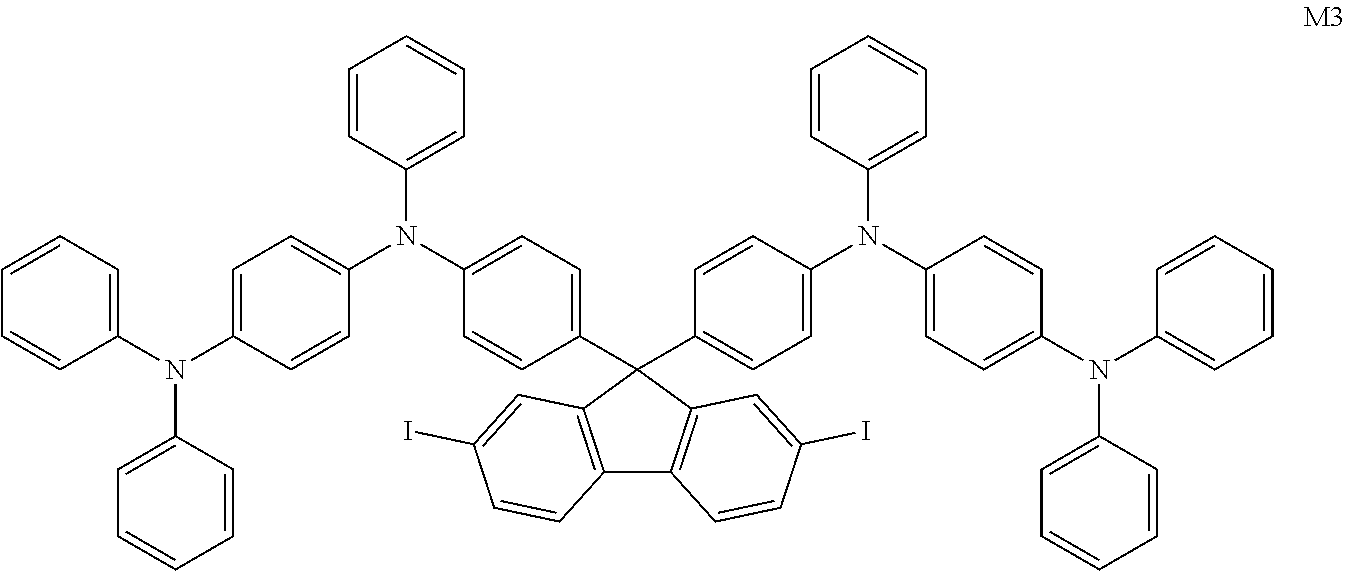


| TABLE 3 |
| Polymer composition in mol % |
| M1 | M2 | M3 | M4 | M5 | M6 | M7 | M8 | M9 | M10 | M11 | Mw | ||
| V1 | 50 | 50 | 213.000 | |||||||||
| V2 | 50 | 46 | 2 | 2 | 307.000 | |||||||
| P1 | 10 | 40 | 50 | 278.000 | ||||||||
| P2 | 10 | 40 | 50 | 251.000 | ||||||||
| P3 | 10 | 40 | 50 | 389.000 | ||||||||
| P4 | 2 | 50 | 46 | 2 | 321.000 | |||||||
| P5 | 2 | 50 | 46 | 2 | 257.000 | |||||||
| TABLE 4 |
| Solutions of polymers P1 to P4 and V1 to V2 |
| Composition | Solvent | Concentration | Use in Device | ||
| S1 | V1 | toluene | 5 mg/ml | PLEDs & OFET1 |
| S2 | V2 | toluene | 8 mg/ml | PLED1 |
| S3 | P1 | toluene | 5 mg/ml | OFET2 |
| S4 | P2 | toluene | 5 mg/ml | OFET3 |
| S5 | P3 | toluene | 5 mg/ml | OFET4 |
| S6 | P4 | toluene | 8 mg/ml | PLED2 |
| S7 | P5 | toluene | 10 mg/ml | PLED3 |
-
- 1. Deposition of 80 nm PEDOT (Baytron P AI 4083) onto ITO coated glass substrate by spin coating, then heating at 120° C. for 10 min in clean room.
- 2. Deposition of 20 nm interlayer by spin coating solution S1 in glovebox.
- 3. Heating interlayer at 180° C. for 1 h in glovebox.
- 4. Depositing the EML layer by spin-coating solution S2 (for PLED1) or S6 (for PLED2) or S7 (for PLED3) to a thickness of 65 nm.
- 5. Heating the device at 180° C. for 10 min.
- 6. Deposition of Ba/Al cathode (3 nm/150 nm) by evaporation onto the emissive layer.
- 7. Encapsulation of the device.
| TABLE 5 |
| Performance comparison PLED1 to PLED3 |
| Max Eff. | U on | U (100) | CIE at | LT DC | ||
| [cd/A] | [V] | [V] | 100 cd/m2 | [hrs at nits] | ||
| PLED1 | 5.82 | 2.99 | 4.48 | (0.15, 0.18) | 253 | 1000 |
| PLED2 | 5.93 | 3.01 | 4.52 | (0.15, 0.18) | 330 | 1000 |
| PLED3 | 6.12 | 3.27 | 5.42 | (0.15, 0.18) | 527 | 1000 |
where W is the channel width, L the channel length, Ci the capacitance of insulating layer, Vd the drain voltage, Vg the gate voltage, V0 the turn-on voltage and Id the drain current. Mobilities of OFET1 to OFET3 are listed in the Table 6.
| TABLE 6 | |||
| Device | Mobility [cm2/Vs] | ||
| OFET1 | 1.4 × 10⁻⁵ | ||
| OFET2 | 2.0 × 10⁻⁴ | ||
| OFET3 | 1.7 × 10⁻⁴ | ||
| OFET4 | 8.3 × 10⁻⁴ | ||
Claims (21)


Applications Claiming Priority (4)
| Application Number | Priority Date | Filing Date | Title |
|---|---|---|---|
| EP11006097 | 2011-07-25 | ||
| EP11006097.7 | 2011-07-25 | ||
| EP11006097 | 2011-07-25 | ||
| PCT/EP2012/002713 WO2013013753A2 (en) | 2011-07-25 | 2012-06-28 | Polymers and oligomers with functionalized side groups |
Publications (2)
| Publication Number | Publication Date |
|---|---|
| US20140175421A1 US20140175421A1 (en) | 2014-06-26 |
| US9246103B2 true US9246103B2 (en) | 2016-01-26 |
Family
ID=46548378
Family Applications (1)
| Application Number | Title | Priority Date | Filing Date |
|---|---|---|---|
| US14/234,825 Active US9246103B2 (en) | 2011-07-25 | 2012-06-28 | Polymers and oligomers with functionalized side groups |
Country Status (4)
| Country | Link |
|---|---|
| US (1) | US9246103B2 (en) |
| EP (1) | EP2737555A2 (en) |
| JP (1) | JP2014527550A (en) |
| WO (1) | WO2013013753A2 (en) |
Cited By (1)
| Publication number | Priority date | Publication date | Assignee | Title |
|---|---|---|---|---|
| US12384965B2 (en) | 2020-12-18 | 2025-08-12 | Samsung Electronics Co., Ltd. | Copolymer, electroluminescent device material including copolymer, and electroluminescent device |
Families Citing this family (6)
| Publication number | Priority date | Publication date | Assignee | Title |
|---|---|---|---|---|
| JP5955660B2 (en) * | 2012-06-20 | 2016-07-20 | 住友化学株式会社 | Composition, polymer compound and light emitting device using them |
| TWI660992B (en) * | 2014-10-31 | 2019-06-01 | 國立研究開發法人產業技術總合研究所 | Photocurable composition and anthracene derivative used in the composition |
| EP3306690B1 (en) * | 2016-10-05 | 2022-09-07 | Raynergy Tek Inc. | Organic semiconducting compounds |
| CN107043452A (en) * | 2017-03-23 | 2017-08-15 | 华南理工大学 | A kind of conjugated polymer based on diaryl-amine group and preparation method and application |
| CN110799571B (en) | 2017-06-30 | 2022-09-20 | 住友化学株式会社 | Polymer compound and light-emitting element using same |
| EP3512307B1 (en) * | 2018-01-10 | 2021-04-21 | Samsung Electronics Co., Ltd. | Polymer material, material for electroluminescence device, composition, thin film, and electroluminescence device comprising the same |
Citations (17)
| Publication number | Priority date | Publication date | Assignee | Title |
|---|---|---|---|---|
| US20020048689A1 (en) | 2000-09-21 | 2002-04-25 | Fuji Photo Film Co., Ltd. | Light-emitting device and iridium complex |
| JP2003212886A (en) | 2002-01-24 | 2003-07-30 | Sumitomo Chem Co Ltd | Amidine compounds and dinuclear transition metal complexes |
| WO2004041901A1 (en) | 2002-11-08 | 2004-05-21 | Covion Organic Semiconductors Gmbh | Aryl-substituted polyindenofluorenes for use in organic electroluminiscent devices |
| EP1424350A1 (en) | 2001-08-31 | 2004-06-02 | Nippon Hoso Kyokai | Phosphor light−emitting compound, phosphor light−emitting composition, and organic light emitting element |
| US20050244672A1 (en) | 2004-04-30 | 2005-11-03 | Chi-Ming Che | Organic light-emitting devices |
| US6963005B2 (en) | 2002-08-15 | 2005-11-08 | E. I. Du Pont De Nemours And Company | Compounds comprising phosphorus-containing metal complexes |
| WO2005118606A1 (en) | 2004-06-04 | 2005-12-15 | National Institute Of Advanced Industrial Science And Technology | Fluorine-substituted iridium complex and luminescent material made with the same |
| US20070111026A1 (en) | 2005-11-15 | 2007-05-17 | Deaton Joseph C | Oled devices with dinuclear copper compounds |
| US20070265473A1 (en) | 2001-09-04 | 2007-11-15 | Covion Organic Semiconductors Gmbh | Conjugated polymers containing spirobifluorene units and the use thereof |
| US20080036370A1 (en) | 2006-01-24 | 2008-02-14 | Tae-Yong Noh | Polymer having 1,8-naphtalimide group and organic light emitting device including the same |
| WO2008019744A1 (en) | 2006-08-17 | 2008-02-21 | Merck Patent Gmbh | Conjugated polymers, process for their preparation and their use |
| WO2010006681A1 (en) | 2008-07-17 | 2010-01-21 | Merck Patent Gmbh | Complexes for use in optoelectronic components |
| US20100026174A1 (en) | 2006-11-27 | 2010-02-04 | Fujifilm Corporation | Organic electroluminescent device |
| US7683183B2 (en) | 2006-07-28 | 2010-03-23 | California Institute Of Technology | Emissive monomeric metal complexes |
| CN101747375A (en) | 2008-12-08 | 2010-06-23 | 中国科学院福建物质结构研究所 | Cooper (I) phosphorescent complexes using 8-phosphinoquinoline derivative as ligand and application thereof |
| WO2011063083A1 (en) | 2009-11-19 | 2011-05-26 | The University Of Southern California | 3-coordinate copper (i) - carbene complexes |
| US20110155954A1 (en) | 2008-09-22 | 2011-06-30 | Merck Patent Gmbh | Materials for Organic Electroluminescence Devices |
Family Cites Families (43)
| Publication number | Priority date | Publication date | Assignee | Title |
|---|---|---|---|---|
| DE4111878A1 (en) | 1991-04-11 | 1992-10-15 | Wacker Chemie Gmbh | LADDER POLYMERS WITH CONJUGATED DOUBLE BINDINGS |
| DE4422670A1 (en) | 1994-06-30 | 1996-01-04 | Hoechst Ag | Conjugated polymers with partial structures and their use as electroluminescent materials |
| DE4431039A1 (en) | 1994-09-01 | 1996-03-07 | Hoechst Ag | Poly (4,5,9,10-tetrahydropyrene-2,7-diyl) derivatives and their use as electroluminescent materials |
| DE4436773A1 (en) | 1994-10-14 | 1996-04-18 | Hoechst Ag | Conjugated polymers with spirocenters and their use as electroluminescent materials |
| JP3865406B2 (en) | 1995-07-28 | 2007-01-10 | 住友化学株式会社 | 2,7-Aryl-9-substituted fluorene and 9-substituted fluorene oligomers and polymers |
| US5708130A (en) | 1995-07-28 | 1998-01-13 | The Dow Chemical Company | 2,7-aryl-9-substituted fluorenes and 9-substituted fluorene oligomers and polymers |
| DE19614971A1 (en) | 1996-04-17 | 1997-10-23 | Hoechst Ag | Polymers with spiro atoms and their use as electroluminescent materials |
| US6309763B1 (en) | 1997-05-21 | 2001-10-30 | The Dow Chemical Company | Fluorene-containing polymers and electroluminescent devices therefrom |
| DE19846768A1 (en) | 1998-10-10 | 2000-04-20 | Aventis Res & Tech Gmbh & Co | A conjugated polymer useful as an organic semiconductor, an electroluminescence material, and for display elements in television monitor and illumination technology contains fluorene building units |
| DE19846766A1 (en) | 1998-10-10 | 2000-04-20 | Aventis Res & Tech Gmbh & Co | A conjugated fluorene-based polymer useful as an organic semiconductor, electroluminescence material, and for display elements |
| KR100663052B1 (en) | 1999-02-04 | 2007-01-02 | 다우 글로벌 테크놀로지스 인크. | Fluorene copolymers and devices made therefrom |
| JP3310658B1 (en) | 1999-03-05 | 2002-08-05 | ケンブリッジ ディスプレイ テクノロジー リミテッド | Polymer synthesis method |
| DE60103442T3 (en) | 2000-03-31 | 2014-05-15 | Sumitomo Chemical Co. Ltd. | Polymeric fluorescent material, process for its preparation, and luminescent polymer device in which it is used |
| DE10109027A1 (en) | 2001-02-24 | 2002-09-05 | Covion Organic Semiconductors | Rhodium and iridium complexes |
| KR100888910B1 (en) | 2001-03-24 | 2009-03-16 | 메르크 파텐트 게엠베하 | Conjugated polymers containing spirobifluorene units and fluorene units and uses thereof |
| SG92833A1 (en) | 2001-03-27 | 2002-11-19 | Sumitomo Chemical Co | Polymeric light emitting substance and polymer light emitting device using the same |
| GB0125620D0 (en) | 2001-10-25 | 2001-12-19 | Cambridge Display Tech Ltd | Monomers and low band gap polymers formed therefrom |
| DE10159946A1 (en) | 2001-12-06 | 2003-06-18 | Covion Organic Semiconductors | Process for the production of aryl-aryl coupled compounds |
| SG128438A1 (en) | 2002-03-15 | 2007-01-30 | Sumitomo Chemical Co | Polymer compound and polymer light emitting deviceusing the same |
| DE10211648A1 (en) | 2002-03-15 | 2003-09-25 | Basf Ag | Polymers based on fluoranthene and their use |
| AU2003241788A1 (en) | 2002-05-28 | 2003-12-12 | Sumitomo Chemical Company, Limited | Polymer and polymeric luminescent element comprising the same |
| DE10241814A1 (en) | 2002-09-06 | 2004-03-25 | Covion Organic Semiconductors Gmbh | Process for the preparation of aryl-aryl coupled compounds |
| GB0306409D0 (en) | 2003-03-20 | 2003-04-23 | Cambridge Display Tech Ltd | Electroluminescent device |
| TWI267545B (en) | 2003-06-17 | 2006-12-01 | Univ Tsinghua | Electroluminescent conjugated polymers containing phosphorescent moieties and the application thereof in LED |
| DE10328627A1 (en) | 2003-06-26 | 2005-02-17 | Covion Organic Semiconductors Gmbh | New materials for electroluminescence |
| DE10337077A1 (en) | 2003-08-12 | 2005-03-10 | Covion Organic Semiconductors | Conjugated copolymers, their preparation and use |
| DE10343606A1 (en) | 2003-09-20 | 2005-04-14 | Covion Organic Semiconductors Gmbh | White-emitting copolymers, their preparation and use |
| CN1863838B (en) | 2003-10-01 | 2010-12-22 | 住友化学株式会社 | Polymer light emitting material and polymer light emitting device |
| ATE475971T1 (en) | 2003-11-28 | 2010-08-15 | Merck Patent Gmbh | ORGANIC SEMICONDUCTOR LAYER FORMULATIONS WITH POLYACENES AND ORGANIC BINDER POLYMERS |
| TW200530373A (en) | 2003-12-12 | 2005-09-16 | Sumitomo Chemical Co | Polymer and light-emitting element using said polymer |
| DE102004020298A1 (en) | 2004-04-26 | 2005-11-10 | Covion Organic Semiconductors Gmbh | Electroluminescent polymers and their use |
| US20060094859A1 (en) | 2004-11-03 | 2006-05-04 | Marrocco Matthew L Iii | Class of bridged biphenylene polymers |
| TW200639193A (en) | 2004-12-18 | 2006-11-16 | Merck Patent Gmbh | Electroluminescent polymers and their use |
| KR20080013926A (en) | 2005-04-28 | 2008-02-13 | 스미또모 가가꾸 가부시키가이샤 | Polymer compound and polymer light emitting device using same |
| DE102005019880A1 (en) | 2005-04-28 | 2006-11-09 | Basf Ag | Synthesis of phenyl-substituted polyfluoranthenes and their use |
| TWI426092B (en) | 2005-06-22 | 2014-02-11 | Sumitomo Chemical Co | Polymer material and polymer light emitting device |
| WO2006137436A1 (en) | 2005-06-22 | 2006-12-28 | Sumitomo Chemical Company, Limited | Polymer material and polymer light-emitting device |
| KR20080058461A (en) | 2005-10-07 | 2008-06-25 | 스미또모 가가꾸 가부시키가이샤 | Copolymer and Polymer Light Emitting Device Using the Same |
| DE102005060473A1 (en) | 2005-12-17 | 2007-06-28 | Merck Patent Gmbh | Conjugated polymers, their preparation and use |
| DE102006003710A1 (en) | 2006-01-26 | 2007-08-02 | Merck Patent Gmbh | New polymer containing an unit exhibiting electron injection and -conducting characteristics, useful for the preparation of a solution and formulation, and in an organic electronic devices, preferably organic optoelectronic device |
| FR2904107A1 (en) | 2006-07-24 | 2008-01-25 | Viamichelin Soc Par Actions Si | METHOD AND GUIDE DEVICE FOR VEHICLE WITH MULTI-MODE DISPLAY |
| EP2044636A1 (en) | 2006-07-25 | 2009-04-08 | Merck Patent GmbH | Polymer blends and their use in organic light emitting devices |
| KR101480278B1 (en) * | 2006-09-22 | 2015-01-09 | 다우 글로벌 테크놀로지스 엘엘씨 | Liquid-gas phase reactor system |
-
2012
- 2012-06-28 US US14/234,825 patent/US9246103B2/en active Active
- 2012-06-28 JP JP2014521967A patent/JP2014527550A/en active Pending
- 2012-06-28 WO PCT/EP2012/002713 patent/WO2013013753A2/en not_active Ceased
- 2012-06-28 EP EP12737710.9A patent/EP2737555A2/en not_active Withdrawn
Patent Citations (21)
| Publication number | Priority date | Publication date | Assignee | Title |
|---|---|---|---|---|
| US20020048689A1 (en) | 2000-09-21 | 2002-04-25 | Fuji Photo Film Co., Ltd. | Light-emitting device and iridium complex |
| EP1424350A1 (en) | 2001-08-31 | 2004-06-02 | Nippon Hoso Kyokai | Phosphor light−emitting compound, phosphor light−emitting composition, and organic light emitting element |
| US20070265473A1 (en) | 2001-09-04 | 2007-11-15 | Covion Organic Semiconductors Gmbh | Conjugated polymers containing spirobifluorene units and the use thereof |
| JP2003212886A (en) | 2002-01-24 | 2003-07-30 | Sumitomo Chem Co Ltd | Amidine compounds and dinuclear transition metal complexes |
| US6963005B2 (en) | 2002-08-15 | 2005-11-08 | E. I. Du Pont De Nemours And Company | Compounds comprising phosphorus-containing metal complexes |
| WO2004041901A1 (en) | 2002-11-08 | 2004-05-21 | Covion Organic Semiconductors Gmbh | Aryl-substituted polyindenofluorenes for use in organic electroluminiscent devices |
| US20050244672A1 (en) | 2004-04-30 | 2005-11-03 | Chi-Ming Che | Organic light-emitting devices |
| WO2005118606A1 (en) | 2004-06-04 | 2005-12-15 | National Institute Of Advanced Industrial Science And Technology | Fluorine-substituted iridium complex and luminescent material made with the same |
| US20070111026A1 (en) | 2005-11-15 | 2007-05-17 | Deaton Joseph C | Oled devices with dinuclear copper compounds |
| US20080036370A1 (en) | 2006-01-24 | 2008-02-14 | Tae-Yong Noh | Polymer having 1,8-naphtalimide group and organic light emitting device including the same |
| US7683183B2 (en) | 2006-07-28 | 2010-03-23 | California Institute Of Technology | Emissive monomeric metal complexes |
| WO2008019744A1 (en) | 2006-08-17 | 2008-02-21 | Merck Patent Gmbh | Conjugated polymers, process for their preparation and their use |
| US20100227974A1 (en) | 2006-08-17 | 2010-09-09 | Niels Schulte | Conjugated polymers, process for their preparation and their use |
| US20100026174A1 (en) | 2006-11-27 | 2010-02-04 | Fujifilm Corporation | Organic electroluminescent device |
| DE102008033563A1 (en) | 2008-07-17 | 2010-01-21 | Merck Patent Gmbh | Complexes with Small Singlet-Triplet Energy Intervals for Use in Opto-Electronic Devices (Singlet Harvesting Effect) |
| WO2010006681A1 (en) | 2008-07-17 | 2010-01-21 | Merck Patent Gmbh | Complexes for use in optoelectronic components |
| US20110108769A1 (en) | 2008-07-17 | 2011-05-12 | Merck Patent Gmbh | Complexes for Use In Optoelectronic Components |
| US20110144366A1 (en) | 2008-07-17 | 2011-06-16 | Merck Patent Gmbh | Organic electroluminescence device |
| US20110155954A1 (en) | 2008-09-22 | 2011-06-30 | Merck Patent Gmbh | Materials for Organic Electroluminescence Devices |
| CN101747375A (en) | 2008-12-08 | 2010-06-23 | 中国科学院福建物质结构研究所 | Cooper (I) phosphorescent complexes using 8-phosphinoquinoline derivative as ligand and application thereof |
| WO2011063083A1 (en) | 2009-11-19 | 2011-05-26 | The University Of Southern California | 3-coordinate copper (i) - carbene complexes |
Non-Patent Citations (9)
| Title |
|---|
| Cheng, Yi-Ming, et al., "Rational Design of Chelating Phosphine Functionalized Ost(II) Emitters and Fabrication of Orange Polymer Light-Emitting Diodes Using Solution Process", Adv. Funct. Mater., vol. 18, (2008), pp. 83-194. |
| Deaton, Joseph C., et al., "E-Type Delayed Fluorescence of a Phosphine-Supported Cu2(mu-NAr2)2 Diamond Core: Harvesting Singlet and Triplet Excitons in OLEDsII", J. Am. Chem. Soc., vol. 132, (2010), pp. 9499-9508. |
| Deaton, Joseph C., et al., "E-Type Delayed Fluorescence of a Phosphine-Supported Cu2(μ-NAr2)2 Diamond Core: Harvesting Singlet and Triplet Excitons in OLEDsII", J. Am. Chem. Soc., vol. 132, (2010), pp. 9499-9508. |
| International Search Report for PCT/EP2012/002713 mailed Mar. 19, 2013. |
| Kui, Steven C.F., et al., "Platinum(II) Complexes with -Conjugated, Naphthyl-Substituted, Cyclometalated Ligands (RCNN): Structures and Photo- and Electroluminescence", Chem. Eur. J., vol. 13, (2007), pp. 417-435. |
| Li et al. Synthesis and electroluminescent properties of a polyfluorenes grafted oligo(phenylenevinylene derivative with two triphenylamine side group); 2010; Gaofenzi Xuebao (2010, (5), 501-507; Chem Abstract 153: 287693. * |
| Miller, Alexander J.M., et al., "Long-Lived and Efficient Emission from Mononuclear Amidophosphine Complexes of Copper", Inorganic Chemistry, vol. 46, No. 18, (2007), pp. 7244-7246. |
| Moudam, Omar, et al., "Electrophosphorescent Homo- and Heteroleptic Copper(I) Complexes Prepared from Various Bis-Phosphine Ligands", Chem. Commun., (2007), pp. 3077-3079. |
| U.S. Appl. No. 14/234,720, filed Jan. 24, 2014, Pan et al. |
Cited By (1)
| Publication number | Priority date | Publication date | Assignee | Title |
|---|---|---|---|---|
| US12384965B2 (en) | 2020-12-18 | 2025-08-12 | Samsung Electronics Co., Ltd. | Copolymer, electroluminescent device material including copolymer, and electroluminescent device |
Also Published As
| Publication number | Publication date |
|---|---|
| WO2013013753A3 (en) | 2013-05-10 |
| WO2013013753A2 (en) | 2013-01-31 |
| US20140175421A1 (en) | 2014-06-26 |
| JP2014527550A (en) | 2014-10-16 |
| EP2737555A2 (en) | 2014-06-04 |
Similar Documents
| Publication | Publication Date | Title |
|---|---|---|
| US9200156B2 (en) | Polymer blends and their use in organic light emitting devices | |
| US8471064B2 (en) | Copolymers of indenofluorene and thiophene | |
| US8581262B2 (en) | Electronic devices comprising multi cyclic hydrocarbons | |
| CN102076729B (en) | Electroluminescent polymers, their preparation methods and their applications | |
| KR101206314B1 (en) | Electroluminescent polymers containing planar arylamine units, the preparation and use thereof | |
| US8529794B2 (en) | Polymers comprising fused selenophene | |
| KR20080091266A (en) | Electroluminescent Materials and Uses thereof | |
| US9178159B2 (en) | Copolymers with functionalized side chains | |
| US20120108731A1 (en) | Polymers comprising substituted anthracenyl units, blends comprising these polymers, and devices comprising these polymers or blends | |
| US20140175421A1 (en) | Polymers and oligomers with functionalized side groups | |
| US8586684B2 (en) | Conjugated copolymer | |
| US7667230B2 (en) | Electronic devices containing acene-thiophene copolymers | |
| KR101660991B1 (en) | Novel polymers having low polydispersity | |
| Hamilton et al. | Optimizing interfacial energetics for conjugated polyelectrolyte electron injection layers in high efficiency and fast responding polymer light emitting diodes |
Legal Events
| Date | Code | Title | Description |
|---|---|---|---|
| AS | Assignment |
Owner name: MERCK PATENT GMBH, GERMANY Free format text: ASSIGNMENT OF ASSIGNORS INTEREST;ASSIGNORS:PAN, JUNYOU;MEYER, FRANK EGON;SCHULTE, NIELS;AND OTHERS;SIGNING DATES FROM 20131022 TO 20131125;REEL/FRAME:032082/0754 |
|
| STCF | Information on status: patent grant |
Free format text: PATENTED CASE |
|
| MAFP | Maintenance fee payment |
Free format text: PAYMENT OF MAINTENANCE FEE, 4TH YEAR, LARGE ENTITY (ORIGINAL EVENT CODE: M1551); ENTITY STATUS OF PATENT OWNER: LARGE ENTITY Year of fee payment: 4 |
|
| MAFP | Maintenance fee payment |
Free format text: PAYMENT OF MAINTENANCE FEE, 8TH YEAR, LARGE ENTITY (ORIGINAL EVENT CODE: M1552); ENTITY STATUS OF PATENT OWNER: LARGE ENTITY Year of fee payment: 8 |