US9245946B2 - Semiconductor device and method of fabricating the same - Google Patents

Semiconductor device and method of fabricating the same Download PDF

Info

Publication number
US9245946B2
US9245946B2 US14/555,138 US201414555138A US9245946B2 US 9245946 B2 US9245946 B2 US 9245946B2 US 201414555138 A US201414555138 A US 201414555138A US 9245946 B2 US9245946 B2 US 9245946B2
Authority
US
United States
Prior art keywords
region
active region
trenches
gate lines
semiconductor device
Prior art date
Legal status (The legal status is an assumption and is not a legal conclusion. Google has not performed a legal analysis and makes no representation as to the accuracy of the status listed.)
Active
Application number
US14/555,138
Other versions
US20150084155A1 (en
Inventor
Hyo-Seok Lee
Seung-Jin Yeom
Sung-won Lim
Current Assignee (The listed assignees may be inaccurate. Google has not performed a legal analysis and makes no representation or warranty as to the accuracy of the list.)
Mimirip LLC
Original Assignee
SK Hynix Inc
Priority date (The priority date is an assumption and is not a legal conclusion. Google has not performed a legal analysis and makes no representation as to the accuracy of the date listed.)
Filing date
Publication date
Priority claimed from KR1020120112479A external-priority patent/KR101950350B1/en
Application filed by SK Hynix Inc filed Critical SK Hynix Inc
Priority to US14/555,138 priority Critical patent/US9245946B2/en
Publication of US20150084155A1 publication Critical patent/US20150084155A1/en
Application granted granted Critical
Publication of US9245946B2 publication Critical patent/US9245946B2/en
Assigned to MIMIRIP LLC reassignment MIMIRIP LLC ASSIGNMENT OF ASSIGNORS INTEREST (SEE DOCUMENT FOR DETAILS). Assignors: SK Hynix Inc.
Active legal-status Critical Current
Anticipated expiration legal-status Critical

Links

Images

Classifications

    • H01L29/0653
    • HELECTRICITY
    • H10SEMICONDUCTOR DEVICES; ELECTRIC SOLID-STATE DEVICES NOT OTHERWISE PROVIDED FOR
    • H10DINORGANIC ELECTRIC SEMICONDUCTOR DEVICES
    • H10D62/00Semiconductor bodies, or regions thereof, of devices having potential barriers
    • H10D62/10Shapes, relative sizes or dispositions of the regions of the semiconductor bodies; Shapes of the semiconductor bodies
    • H10D62/113Isolations within a component, i.e. internal isolations
    • H10D62/115Dielectric isolations, e.g. air gaps
    • H10D62/116Dielectric isolations, e.g. air gaps adjoining the input or output regions of field-effect devices, e.g. adjoining source or drain regions
    • HELECTRICITY
    • H01ELECTRIC ELEMENTS
    • H01LSEMICONDUCTOR DEVICES NOT COVERED BY CLASS H10
    • H01L21/00Processes or apparatus adapted for the manufacture or treatment of semiconductor or solid state devices or of parts thereof
    • H01L21/02Manufacture or treatment of semiconductor devices or of parts thereof
    • H01L21/04Manufacture or treatment of semiconductor devices or of parts thereof the devices having potential barriers, e.g. a PN junction, depletion layer or carrier concentration layer
    • H01L21/18Manufacture or treatment of semiconductor devices or of parts thereof the devices having potential barriers, e.g. a PN junction, depletion layer or carrier concentration layer the devices having semiconductor bodies comprising elements of Group IV of the Periodic Table or AIIIBV compounds with or without impurities, e.g. doping materials
    • H01L21/28Manufacture of electrodes on semiconductor bodies using processes or apparatus not provided for in groups H01L21/20 - H01L21/268
    • H01L21/28008Making conductor-insulator-semiconductor electrodes
    • H01L27/0207
    • H01L27/088
    • H01L29/0657
    • HELECTRICITY
    • H10SEMICONDUCTOR DEVICES; ELECTRIC SOLID-STATE DEVICES NOT OTHERWISE PROVIDED FOR
    • H10DINORGANIC ELECTRIC SEMICONDUCTOR DEVICES
    • H10D62/00Semiconductor bodies, or regions thereof, of devices having potential barriers
    • H10D62/10Shapes, relative sizes or dispositions of the regions of the semiconductor bodies; Shapes of the semiconductor bodies
    • H10D62/117Shapes of semiconductor bodies
    • H10D64/013
    • HELECTRICITY
    • H10SEMICONDUCTOR DEVICES; ELECTRIC SOLID-STATE DEVICES NOT OTHERWISE PROVIDED FOR
    • H10DINORGANIC ELECTRIC SEMICONDUCTOR DEVICES
    • H10D84/00Integrated devices formed in or on semiconductor substrates that comprise only semiconducting layers, e.g. on Si wafers or on GaAs-on-Si wafers
    • H10D84/80Integrated devices formed in or on semiconductor substrates that comprise only semiconducting layers, e.g. on Si wafers or on GaAs-on-Si wafers characterised by the integration of at least one component covered by groups H10D12/00 or H10D30/00, e.g. integration of IGFETs
    • H10D84/82Integrated devices formed in or on semiconductor substrates that comprise only semiconducting layers, e.g. on Si wafers or on GaAs-on-Si wafers characterised by the integration of at least one component covered by groups H10D12/00 or H10D30/00, e.g. integration of IGFETs of only field-effect components
    • H10D84/83Integrated devices formed in or on semiconductor substrates that comprise only semiconducting layers, e.g. on Si wafers or on GaAs-on-Si wafers characterised by the integration of at least one component covered by groups H10D12/00 or H10D30/00, e.g. integration of IGFETs of only field-effect components of only insulated-gate FETs [IGFET]
    • HELECTRICITY
    • H10SEMICONDUCTOR DEVICES; ELECTRIC SOLID-STATE DEVICES NOT OTHERWISE PROVIDED FOR
    • H10DINORGANIC ELECTRIC SEMICONDUCTOR DEVICES
    • H10D89/00Aspects of integrated devices not covered by groups H10D84/00 - H10D88/00
    • H10D89/10Integrated device layouts

Definitions

  • Embodiments of the present invention relate to a method of fabricating a semiconductor device, and more particularly, an active region, a memory cell based on the active region, and a method of fabricating the same.
  • a Shallow Trench Isolation (STI) process has been applied as a method of separating a semiconductor device from an adjacent device.
  • the STI process is a process of electrically separating devices by etching the other regions except for a portion where a semiconductor device is formed, and filling the regions with an insulating layer.
  • the active region where the semiconductor device is formed in the STI process has, for example, a bar shape of ‘—’.
  • Exemplary embodiments of the present invention are directed to provide a semiconductor device which is capable of preventing an active region from being leaning, and a method of fabricating the semiconductor device.
  • a method of fabricating a semiconductor device includes defining a curved active region by forming a plurality of trenches over a semiconductor substrate; forming an insulating layer to fill the plurality of trenches; and forming a pair of gate lines crossing the curved active region.
  • a method of fabricating a semiconductor device include forming a first trench having a major axis and a minor axis over a semiconductor substrate; forming a first insulating layer to fill the first trench; forming a second trench connecting adjacent first trenches in the minor axis direction by etching the semiconductor substrate; defining a curved active area defined by the first and second trenches by filling the second trench with a second insulating layer; and forming a pair of gate lines crossing the curved active region.
  • a semiconductor device in accordance with still another embodiment of the present invention, includes a curved active region defined by a plurality of trenches formed over a semiconductor substrate; an insulating layer to fill the plurality of trenches; and a pair of gate lines crossing the curved active region.
  • a method of fabricating a semiconductor device includes forming first trenches over a semiconductor substrate; and forming second trenches over the semiconductor substrate, wherein curved active regions are defined by using the first and second trenches.
  • FIG. 1 is a plan view illustrating a semiconductor device in accordance with an embodiment.
  • FIG. 2 perspective view briefly illustrating the semiconductor device illustrated in FIG. 1 .
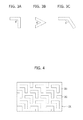
  • FIGS. 3A to 3C are plan views illustrating examples of an active region in accordance with an embodiment.
  • FIG. 4 is an arrangement view of active regions in accordance with an embodiment.
  • FIG. 5 is an arrangement view of gate lines in accordance with an embodiment.
  • FIG. 6 is an arrangement view of gate lines and bit line in accordance with an embodiment.
  • FIGS. 7A to 7D are process plan views illustrating a method of fabricating an active region in accordance with an embodiment.
  • FIGS. 8A to 8E are process plan views illustrating a method of fabricating an active region in accordance with another embodiment.
  • FIG. 1 is a plan view illustrating a semiconductor device in accordance with an embodiment.
  • one active region 100 includes a first region 101 and a second region 102 .
  • the active region includes a source region and a drain region.
  • the source region is formed in a common region of the first region 101 for forming a first transistor and the second region 102 for forming a second transistor.
  • a bit line contact BLC is formed in the source region.
  • the drain region includes a first storage node contact SNC 1 formed in the first region 101 and a second storage node contact SNC 2 formed in the second region 102 .
  • the interior angle ⁇ defined by the first region 101 and the second region 102 that intersect with each other may be 1° to 179° and the bit line contact BLC connected with a bit line may be formed in the common region where the first region 101 and the second region 102 intersect with each other.
  • first storage node contact SNC 1 and the second storage node contact SNC 2 for connection with capacitors are formed at the ends of the first region 101 and the second region 102 , respectively.
  • the first region and the second region support each other, so that inclining or leaning of the active region can be prevented.
  • FIG. 2 is a perspective view briefly illustrating the semiconductor device illustrated in FIG. 1 .
  • one curved active region 100 is formed and two parallel gate lines G 1 and G 2 pass the active region 100 .
  • the gate lines G 1 and G 2 may be buried gates, as illustrated in the figure, and may be applied to all of gate structures such as a planar type, a fin type, and a recess type, other than the buried gate.
  • bit line contact connected with a bit line may be formed in the active region between the gate lines G 1 and G 2 , and storage node contacts respectively connected with capacitors may be formed at both ends of the active region 100 .
  • the first region and the second region support each other, so that inclining or leaning of the active region can be prevented.
  • FIGS. 3A to 3C are plan views illustrating examples of an active region in accordance with an embodiment.
  • an internal angle ⁇ of a curved active region is set to be able to prevent inclining or leaning of the active region, and the active area may have a internal angle of 90° as shown in FIG. 3A , may have an internal angle smaller than 90° as shown in FIG. 3B , or may have an internal angle larger than 90° as shown in FIG. 3C .
  • the internal angle ⁇ of an active region can be adjusted within a range where two gate lines can pass one active region.
  • an internal angle of an active region is 90° for the convenience of description.
  • FIG. 4 is an arrangement view of active regions in accordance with an embodiment.
  • active regions 202 with a curve are formed on a semiconductor substrate 200 .
  • the active regions 202 are defined by an isolation layer 201 .
  • the isolation layer 201 may be formed by a Shallow Trench Isolation (STI) process.
  • the active region 202 may have an internal angle of 1° to 179° and the bending corner of the active region may be arranged in the direction of 0° to 359.9°. Further, the active regions 202 may be formed to be repeated in the same corner direction or may be arranged in various different directions from the adjacent active regions 202 .
  • FIG. 5 is an arrangement view of gate lines in accordance with an embodiment.
  • active regions 302 with a curve are formed on a semiconductor substrate 300 .
  • the active regions 302 are each defined by an isolation layer 301 .
  • the isolation layer 301 may be formed by a Shallow Trench Isolation (STI) process.
  • gate lines 303 pass each of the active regions 302 .
  • Two of gate lines 303 simultaneously passing one active region 302 are arranged to extend in parallel.
  • FIG. 6 is an arrangement view of gate lines and bit lines in accordance with an embodiment.
  • active regions 402 with a curve are formed on a semiconductor substrate 400 .
  • the active regions 402 are each defined by an isolation layer 401 .
  • the isolation layer 401 may be formed by an STI process.
  • gate lines 403 pass each of the active regions 402 .
  • Two of gate lines 403 simultaneously passing one active region 402 are arranged to extend in parallel.
  • bit lines 404 passing the curves of the active region 402 that is the common regions between pairs or gate lines 403 simultaneously passing the active regions 402 are disposed.
  • One bit line 404 is disposed to pass one active region 402 , intersecting the gate line 403 .
  • FIGS. 7A to 7D are process plan view illustrating a method of fabricating an active region in accordance with a first embodiment.
  • a plurality of first trenches 12 with a major axis and a minor axis are formed by etching a semiconductor substrate 11 .
  • the semiconductor substrate 11 may include a silicon-containing material.
  • the semiconductor substrate 11 may include a monocrystal silicon substrate.
  • a process of forming a mask pattern (not illustrated) on the semiconductor substrate 11 and then etching the semiconductor substrate 11 with the mask pattern as an etching barrier may be formed by coating a photosensitive layer and pattering it by exposure and development.
  • one single layer selected from a group of a buffer layer, a hard mask, and an Anti Reflection Coating (ARC), or a stacked layer of them may be additionally form on the semiconductor layer 11 , before the mask pattern (not illustrated) is formed.
  • Reference number ‘ 11 A’ indicates a semiconductor substrate patterned by the first trenches 12 .
  • a plurality of second trenches 13 connecting the adjacent first trenches 12 in the minor axis direction are formed by patterning the semiconductor substrate 11 A.
  • a plurality of curved active regions 11 B are defined by the adjacent first trenches 12 connected in the minor axis direction by the second trenches 13 .
  • a process of forming a mask pattern (not illustrated) that opens a second trench region on the semiconductor substrate 11 A including the first trenches 12 , and etching the semiconductor substrate 11 A with the mask pattern (not illustrated) as an etching barrier may be performed.
  • a protection layer may be buried to prevent attach of the first trenches 12 before the second trenches 13 are formed, and may be removed with the mask pattern (not illustrated) after the second trenches 13 is formed, or may be removed by a protection layer removal process after the mask pattern is removed.
  • an insulating layer 14 is buried in the first trenches 12 and the second trenches 13 .
  • the insulating layer 14 may include an oxide layer.
  • the insulating layer 14 is provided to form an isolation layer for defining an active region, and hereafter, the insulating layer 14 buried in the first and second trenches 12 and 13 is referred to as an ‘isolation layer 14 ’.
  • the curved active regions 11 B defined by the isolation layer 14 formed through the first and second trenches are formed.
  • FIGS. 8A to 8E are process plan views illustrating a method of fabricating an active region in accordance with another embodiment.
  • a plurality of first trenches 22 with a major axis and a minor axis are formed by etching a semiconductor substrate 21 .
  • the semiconductor substrate 21 may include a silicon-containing material.
  • the semiconductor substrate 21 may include a monocrystal silicon substrate.
  • a process of forming a mask pattern (not illustrated) on the semiconductor substrate 21 and then etching the semiconductor substrate 21 with the mask pattern as an etching barrier may be formed by coating a photosensitive layer and pattering it by exposure and development.
  • one single layer selected from a group of a buffer layer, a hard mask, and an ARC, or a stacked layer of them may be additionally form on the semiconductor layer 21 , before the mask pattern (not illustrated) is formed.
  • Reference number ‘ 21 A’ indicates a semiconductor substrate patterned by the first trenches 22 .
  • an insulating layer is buried in the first trenches 22 .
  • the insulating layer may include an oxide layer.
  • the insulating layer buried in the first trenches 22 is referred to as a ‘first isolation layer 22 A’.
  • a plurality of second trenches 23 connecting the adjacent first isolation layers 22 A in the minor axis direction are formed by patterning the semiconductor substrate 21 A.
  • a plurality of curved active regions 21 B are defined by the adjacent isolation layers 22 connected in the minor axis direction by the second trenches 23 .
  • a process of forming a mask pattern (not illustrated) that opens a second trench region on the semiconductor substrate 21 A including the first isolation layer 22 A, and etching the semiconductor substrate 21 A with the mask pattern (not illustrated) as an etching barrier may be performed.
  • an insulating layer is buried in the second trenches 23 .
  • the insulating layer may include an oxide layer.
  • the insulating layer buried in the second trenches 23 is referred to as a ‘second isolation layer 23 A’.
  • the first and second isolation layers 22 A and 23 A are provided to define the curved active regions 21 B, and referred to as an ‘isolation layer 24 ’.
  • the curved active regions 21 B defined by the isolation layer 24 formed through the first and second trenches are formed.
  • the curve active regions 21 B may have an internal angle of 1° to 179° and the curved corner of the active region may be arranged in the direction of 0° to 359.9°.
  • the curve active regions 21 B may be formed to be repeated in the same corner direction or may be disposed in various directions different from the adjacent curve active regions 21 B.

Landscapes

  • Engineering & Computer Science (AREA)
  • Semiconductor Memories (AREA)
  • Physics & Mathematics (AREA)
  • Condensed Matter Physics & Semiconductors (AREA)
  • General Physics & Mathematics (AREA)
  • Manufacturing & Machinery (AREA)
  • Computer Hardware Design (AREA)
  • Microelectronics & Electronic Packaging (AREA)
  • Power Engineering (AREA)
  • Element Separation (AREA)
  • General Engineering & Computer Science (AREA)

Abstract

A method for fabricating a semiconductor device includes defining a curved active region by forming a plurality of trenches over a semiconductor substrate, forming an insulating layer to fill the plurality of trenches, and forming a pair of gate lines crossing the curved active region, so that it is possible to prevent leaning of an active region by forming a curved active region.

Description

CROSS-REFERENCES TO RELATED APPLICATIONS
This application is a division of U.S. patent application Ser. No. 13/717,062, now U.S. Pat. No. 8,921,216, filed on Dec. 17, 2012, which claims priority of Korean Patent Application Nos. 10-2012-0078810and 10-2012-0112479, filed on Jul. 19, 2012and Oct. 10, 2012, respectively. The disclosures of each of the foregoing applications are incorporated herein by reference in their entirety.
BACKGROUND
1. Field
Embodiments of the present invention relate to a method of fabricating a semiconductor device, and more particularly, an active region, a memory cell based on the active region, and a method of fabricating the same.
2. Description of the Related Art
A Shallow Trench Isolation (STI) process has been applied as a method of separating a semiconductor device from an adjacent device. The STI process is a process of electrically separating devices by etching the other regions except for a portion where a semiconductor device is formed, and filling the regions with an insulating layer. The active region where the semiconductor device is formed in the STI process has, for example, a bar shape of ‘—’.
However, as the design rule of semiconductor devices continuously reduces, several concerns due to a short channel effect may be caused. As the line width of the active regions reduces, adjacent active regions may stick to each other due to leaning of the active regions.
SUMMARY
Exemplary embodiments of the present invention are directed to provide a semiconductor device which is capable of preventing an active region from being leaning, and a method of fabricating the semiconductor device.
In accordance with an embodiment of the present invention, a method of fabricating a semiconductor device includes defining a curved active region by forming a plurality of trenches over a semiconductor substrate; forming an insulating layer to fill the plurality of trenches; and forming a pair of gate lines crossing the curved active region.
In accordance with another embodiment of the present invention, a method of fabricating a semiconductor device include forming a first trench having a major axis and a minor axis over a semiconductor substrate; forming a first insulating layer to fill the first trench; forming a second trench connecting adjacent first trenches in the minor axis direction by etching the semiconductor substrate; defining a curved active area defined by the first and second trenches by filling the second trench with a second insulating layer; and forming a pair of gate lines crossing the curved active region.
In accordance with still another embodiment of the present invention, a semiconductor device includes a curved active region defined by a plurality of trenches formed over a semiconductor substrate; an insulating layer to fill the plurality of trenches; and a pair of gate lines crossing the curved active region.
In accordance with still another embodiment of the present invention, a method of fabricating a semiconductor device includes forming first trenches over a semiconductor substrate; and forming second trenches over the semiconductor substrate, wherein curved active regions are defined by using the first and second trenches.
BRIEF DESCRIPTION OF THE DRAWINGS
FIG. 1 is a plan view illustrating a semiconductor device in accordance with an embodiment.
FIG. 2 perspective view briefly illustrating the semiconductor device illustrated in FIG. 1.
FIGS. 3A to 3C are plan views illustrating examples of an active region in accordance with an embodiment.
FIG. 4 is an arrangement view of active regions in accordance with an embodiment.
FIG. 5 is an arrangement view of gate lines in accordance with an embodiment.
FIG. 6 is an arrangement view of gate lines and bit line in accordance with an embodiment.
FIGS. 7A to 7D are process plan views illustrating a method of fabricating an active region in accordance with an embodiment.
FIGS. 8A to 8E are process plan views illustrating a method of fabricating an active region in accordance with another embodiment.
DETAILED DESCRIPTION
Exemplary embodiments of the present invention will be described below in more detail with reference to the accompanying drawings. Only portions needed to understand an operation in accordance with exemplary embodiments of the present invention will be described in the following description. It is to be noted that descriptions of other portions will be omitted so as not to make the subject matters of the present invention obscure.
Exemplary embodiments of the present invention will be described below in more detail with reference to the accompanying drawings such that those skilled in the art can easily achieve the present invention.
FIG. 1 is a plan view illustrating a semiconductor device in accordance with an embodiment.
As illustrated in FIG. 1, one active region 100 includes a first region 101 and a second region 102. The first region 101 that a first gate line passes G1 and a second region 102 that a second gate line G2 passes intersect with each other and an angle is made between the first region 101 and the second region 102. The active region includes a source region and a drain region. The source region is formed in a common region of the first region 101 for forming a first transistor and the second region 102 for forming a second transistor. In the source region, a bit line contact BLC is formed. The drain region includes a first storage node contact SNC1 formed in the first region 101 and a second storage node contact SNC2 formed in the second region 102.
The interior angle θ defined by the first region 101 and the second region 102 that intersect with each other may be 1° to 179° and the bit line contact BLC connected with a bit line may be formed in the common region where the first region 101 and the second region 102 intersect with each other.
Further, the first storage node contact SNC1 and the second storage node contact SNC2 for connection with capacitors are formed at the ends of the first region 101 and the second region 102, respectively.
Consequently, two parallel gate lines G1 and G2 and the bit line BL disposed such that the first and second gate lines G1 and G2 intersect with each other, pass one curved active region 100. Each of the active regions 100 is defined by an isolation layer.
As described above, when the curved active region 100 with an internal angle defined by the first region and the second region intersecting with each other, the first region and the second region support each other, so that inclining or leaning of the active region can be prevented.
FIG. 2 is a perspective view briefly illustrating the semiconductor device illustrated in FIG. 1.
Referring to FIG. 2, one curved active region 100 is formed and two parallel gate lines G1 and G2 pass the active region 100. The gate lines G1 and G2 may be buried gates, as illustrated in the figure, and may be applied to all of gate structures such as a planar type, a fin type, and a recess type, other than the buried gate.
Further, the semiconductor device is briefly illustrated in FIG. 1 for the convenience of description, but a bit line contact connected with a bit line may be formed in the active region between the gate lines G1 and G2, and storage node contacts respectively connected with capacitors may be formed at both ends of the active region 100.
As described above, when the curved active region 100 with an internal angle defined by the first region and the second region intersecting with each other, the first region and the second region support each other, so that inclining or leaning of the active region can be prevented.
FIGS. 3A to 3C are plan views illustrating examples of an active region in accordance with an embodiment.
As illustrated in FIGS. 3A to 3C, an internal angle θ of a curved active region is set to be able to prevent inclining or leaning of the active region, and the active area may have a internal angle of 90° as shown in FIG. 3A, may have an internal angle smaller than 90° as shown in FIG. 3B, or may have an internal angle larger than 90° as shown in FIG. 3C. The internal angle θ of an active region can be adjusted within a range where two gate lines can pass one active region.
It is assumed in the embodiment that an internal angle of an active region is 90° for the convenience of description.
FIG. 4 is an arrangement view of active regions in accordance with an embodiment.
As illustrated in FIG. 4, active regions 202 with a curve are formed on a semiconductor substrate 200. The active regions 202 are defined by an isolation layer 201. The isolation layer 201 may be formed by a Shallow Trench Isolation (STI) process.
The active region 202, as illustrated in FIG. 3, may have an internal angle of 1° to 179° and the bending corner of the active region may be arranged in the direction of 0° to 359.9°. Further, the active regions 202 may be formed to be repeated in the same corner direction or may be arranged in various different directions from the adjacent active regions 202.
For the convenience of description, it is assumed in the embodiment that the active regions having the same shape and the same corner direction are repeated.
FIG. 5 is an arrangement view of gate lines in accordance with an embodiment.
As illustrated in FIG. 5, active regions 302 with a curve are formed on a semiconductor substrate 300. The active regions 302 are each defined by an isolation layer 301. The isolation layer 301 may be formed by a Shallow Trench Isolation (STI) process.
Further, two of gate lines 303 pass each of the active regions 302. Two of gate lines 303 simultaneously passing one active region 302 are arranged to extend in parallel.
FIG. 6 is an arrangement view of gate lines and bit lines in accordance with an embodiment.
As illustrated in FIG. 6, active regions 402 with a curve are formed on a semiconductor substrate 400. The active regions 402 are each defined by an isolation layer 401. The isolation layer 401 may be formed by an STI process.
Further, two of gate lines 403 pass each of the active regions 402. Two of gate lines 403 simultaneously passing one active region 402 are arranged to extend in parallel.
Further, bit lines 404 passing the curves of the active region 402, that is the common regions between pairs or gate lines 403 simultaneously passing the active regions 402 are disposed. One bit line 404 is disposed to pass one active region 402, intersecting the gate line 403.
FIGS. 7A to 7D are process plan view illustrating a method of fabricating an active region in accordance with a first embodiment.
As illustrated in FIG. 7A a plurality of first trenches 12 with a major axis and a minor axis are formed by etching a semiconductor substrate 11. The semiconductor substrate 11 may include a silicon-containing material. The semiconductor substrate 11 may include a monocrystal silicon substrate.
In order to form the first trenches 12, a process of forming a mask pattern (not illustrated) on the semiconductor substrate 11 and then etching the semiconductor substrate 11 with the mask pattern as an etching barrier. The mask pattern (not illustrated) may be formed by coating a photosensitive layer and pattering it by exposure and development. In particular, one single layer selected from a group of a buffer layer, a hard mask, and an Anti Reflection Coating (ARC), or a stacked layer of them may be additionally form on the semiconductor layer 11, before the mask pattern (not illustrated) is formed.
Reference number ‘11A’ indicates a semiconductor substrate patterned by the first trenches 12.
As illustrated in FIG. 7B, a plurality of second trenches 13 connecting the adjacent first trenches 12 in the minor axis direction are formed by patterning the semiconductor substrate 11A. A plurality of curved active regions 11B are defined by the adjacent first trenches 12 connected in the minor axis direction by the second trenches 13.
In order to form the second trenches 13, a process of forming a mask pattern (not illustrated) that opens a second trench region on the semiconductor substrate 11A including the first trenches 12, and etching the semiconductor substrate 11A with the mask pattern (not illustrated) as an etching barrier may be performed.
A protection layer may be buried to prevent attach of the first trenches 12 before the second trenches 13 are formed, and may be removed with the mask pattern (not illustrated) after the second trenches 13 is formed, or may be removed by a protection layer removal process after the mask pattern is removed.
As illustrated in FIG. 7C, an insulating layer 14 is buried in the first trenches 12 and the second trenches 13. The insulating layer 14 may include an oxide layer. The insulating layer 14 is provided to form an isolation layer for defining an active region, and hereafter, the insulating layer 14 buried in the first and second trenches 12 and 13 is referred to as an ‘isolation layer 14’.
As a result, as illustrated in FIG. 7D, the curved active regions 11B defined by the isolation layer 14 formed through the first and second trenches are formed.
FIGS. 8A to 8E are process plan views illustrating a method of fabricating an active region in accordance with another embodiment.
As illustrated in FIG. 8A, a plurality of first trenches 22 with a major axis and a minor axis are formed by etching a semiconductor substrate 21. The semiconductor substrate 21 may include a silicon-containing material. The semiconductor substrate 21 may include a monocrystal silicon substrate.
In order to form the first trenches 22, a process of forming a mask pattern (not illustrated) on the semiconductor substrate 21 and then etching the semiconductor substrate 21 with the mask pattern as an etching barrier. The mask pattern (not illustrated) may be formed by coating a photosensitive layer and pattering it by exposure and development. In particular, one single layer selected from a group of a buffer layer, a hard mask, and an ARC, or a stacked layer of them may be additionally form on the semiconductor layer 21, before the mask pattern (not illustrated) is formed.
Reference number ‘21A’ indicates a semiconductor substrate patterned by the first trenches 22.
As illustrated in FIG. 8B, an insulating layer is buried in the first trenches 22. The insulating layer may include an oxide layer. The insulating layer buried in the first trenches 22 is referred to as a ‘first isolation layer 22A’.
As illustrated in FIG. 8C, a plurality of second trenches 23 connecting the adjacent first isolation layers 22A in the minor axis direction are formed by patterning the semiconductor substrate 21A. A plurality of curved active regions 21B are defined by the adjacent isolation layers 22 connected in the minor axis direction by the second trenches 23.
In order to form the second trenches 23, a process of forming a mask pattern (not illustrated) that opens a second trench region on the semiconductor substrate 21A including the first isolation layer 22A, and etching the semiconductor substrate 21A with the mask pattern (not illustrated) as an etching barrier may be performed.
As illustrated in FIG. 8D, an insulating layer is buried in the second trenches 23. The insulating layer may include an oxide layer. The insulating layer buried in the second trenches 23 is referred to as a ‘second isolation layer 23A’. The first and second isolation layers 22A and 23A are provided to define the curved active regions 21B, and referred to as an ‘isolation layer 24’.
As a result, as illustrated in FIG. 8E, the curved active regions 21B defined by the isolation layer 24 formed through the first and second trenches are formed.
Although it is assumed in the embodiment that the internal angle is 90° for the convenience of description, the curve active regions 21B may have an internal angle of 1° to 179° and the curved corner of the active region may be arranged in the direction of 0° to 359.9°. The curve active regions 21B may be formed to be repeated in the same corner direction or may be disposed in various directions different from the adjacent curve active regions 21B.
While the present invention has been described with respect to the specific embodiments, it should be noted that the embodiments are for describing, not limiting, the present invention. Further, it should be noted that the present invention may be achieved in various ways by those skilled in the art without departing from the scope of the present invention.
According to the embodiments of the present invention it is possible to prevent leaning of an active region by forming an active region with a curve.
While the present invention has been described with respect to the specific embodiments, it will be apparent to those skilled in the art that various changes and modifications may be made without departing from the spirit and scope of the invention. Accordingly, the scope of the invention is not limited to exemplary embodiments as described above and is defined by the following claims and equivalents to the scope the claims.

Claims (4)

What is claimed is:
1. A semiconductor device comprising:
a curved active region defined by a plurality of trenches formed over a semiconductor substrate;
an insulating layer filling the plurality of trenches; and
a pair of gate lines crossing the curved active region,
wherein the curved active region includes a first region which protrudes toward a first direction and a second region which is in contact with the first region and protrudes toward a second direction crossing the first direction, and
wherein one of the pair of gate lines crosses the first region, the other of the pair of gate lines crosses the second region, and the pair of gate lines extend along a third direction crossing the first and second directions.
2. The semiconductor device of claim 1, wherein the pair of gate lines are parallel.
3. The semiconductor device of claim 1, wherein each of the gate lines includes a buried gate line.
4. The semiconductor device of claim 1, further comprising:
a bit line extending to intersect the pair of gate lines in contact with the curved active region.
US14/555,138 2012-07-19 2014-11-26 Semiconductor device and method of fabricating the same Active US9245946B2 (en)

Priority Applications (1)

Application Number Priority Date Filing Date Title
US14/555,138 US9245946B2 (en) 2012-07-19 2014-11-26 Semiconductor device and method of fabricating the same

Applications Claiming Priority (6)

Application Number Priority Date Filing Date Title
KR20120078810 2012-07-19
KR10-2012-0078810 2012-07-19
KR10-2012-0112479 2012-10-10
KR1020120112479A KR101950350B1 (en) 2012-07-19 2012-10-10 Semiconductor device and fabricating for manufacturing the same
US13/717,062 US8921216B2 (en) 2012-07-19 2012-12-17 Semiconductor device and method of fabricating the same
US14/555,138 US9245946B2 (en) 2012-07-19 2014-11-26 Semiconductor device and method of fabricating the same

Related Parent Applications (1)

Application Number Title Priority Date Filing Date
US13/717,062 Division US8921216B2 (en) 2012-07-19 2012-12-17 Semiconductor device and method of fabricating the same

Publications (2)

Publication Number Publication Date
US20150084155A1 US20150084155A1 (en) 2015-03-26
US9245946B2 true US9245946B2 (en) 2016-01-26

Family

ID=49945848

Family Applications (2)

Application Number Title Priority Date Filing Date
US13/717,062 Active 2033-01-30 US8921216B2 (en) 2012-07-19 2012-12-17 Semiconductor device and method of fabricating the same
US14/555,138 Active US9245946B2 (en) 2012-07-19 2014-11-26 Semiconductor device and method of fabricating the same

Family Applications Before (1)

Application Number Title Priority Date Filing Date
US13/717,062 Active 2033-01-30 US8921216B2 (en) 2012-07-19 2012-12-17 Semiconductor device and method of fabricating the same

Country Status (1)

Country Link
US (2) US8921216B2 (en)

Families Citing this family (1)

* Cited by examiner, † Cited by third party
Publication number Priority date Publication date Assignee Title
US9985964B2 (en) * 2016-03-28 2018-05-29 Black Gold Coin, Inc. Systems and methods for providing block chain-based multifactor personal identity verification

Citations (3)

* Cited by examiner, † Cited by third party
Publication number Priority date Publication date Assignee Title
US20080203587A1 (en) * 2006-10-02 2008-08-28 Samsung Electronics Co., Ltd. Semiconductor device including conductive lines with fine line width and method of fabricating the same
US7772641B2 (en) * 2006-03-07 2010-08-10 Kabushiki Kaisha Toshiba Power semiconductor device with a plurality of gate electrodes
US20130170281A1 (en) * 2011-12-29 2013-07-04 Seok-Pyo Song Variable resistance memory device and method for fabricating the same

Family Cites Families (3)

* Cited by examiner, † Cited by third party
Publication number Priority date Publication date Assignee Title
JP2005243759A (en) 2004-02-25 2005-09-08 Oki Electric Ind Co Ltd Semiconductor device and method for evaluating semiconductor device
KR100594326B1 (en) 2005-03-22 2006-06-30 삼성전자주식회사 Non-volatile memory device for 2-bit operation and manufacturing method thereof
JP4994757B2 (en) * 2006-09-15 2012-08-08 三菱電機株式会社 Semiconductor device manufacturing method, semiconductor wafer, and semiconductor device

Patent Citations (3)

* Cited by examiner, † Cited by third party
Publication number Priority date Publication date Assignee Title
US7772641B2 (en) * 2006-03-07 2010-08-10 Kabushiki Kaisha Toshiba Power semiconductor device with a plurality of gate electrodes
US20080203587A1 (en) * 2006-10-02 2008-08-28 Samsung Electronics Co., Ltd. Semiconductor device including conductive lines with fine line width and method of fabricating the same
US20130170281A1 (en) * 2011-12-29 2013-07-04 Seok-Pyo Song Variable resistance memory device and method for fabricating the same

Also Published As

Publication number Publication date
US8921216B2 (en) 2014-12-30
US20140021553A1 (en) 2014-01-23
US20150084155A1 (en) 2015-03-26

Similar Documents

Publication Publication Date Title
KR101610831B1 (en) Semiconductor device having bit line interconnection with enlarged width and lowered level on bit line contact and fabricating methods of the same
US8748970B1 (en) Semiconductor device and method of manufacturing the same
US10096603B2 (en) Method of fabricating semiconductor device
US20150004774A1 (en) Methods of fabricating a semiconductor device including fine patterns
US10103030B2 (en) Methods of fabricating semiconductor devices
KR102081989B1 (en) Magnetic memory device and method of manufacturing the same
KR20120056525A (en) Method for fabricating semiconductor device
US20070284691A1 (en) Semiconductor device with omega gate and method for fabricating a semiconductor device
KR20150131450A (en) Semiconductor devices and method for forming the same
US20170352735A1 (en) Semiconductor memory device and method for manufacturing same
US20170345679A1 (en) Methods of fabricating a semiconductor device
US20170256556A1 (en) Nonvolatile memory device and method for fabricating the same
US20120001346A1 (en) Semiconductor device and method for fabricating the same
US9219071B1 (en) Semiconductor device
US20090258488A1 (en) Methods of fabricating semiconductor devices including storage node landing pads separated from bit line contact plugs
US9245946B2 (en) Semiconductor device and method of fabricating the same
KR101950350B1 (en) Semiconductor device and fabricating for manufacturing the same
CN113471194A (en) Semiconductor memory device with a plurality of memory cells
KR101213725B1 (en) Gate of semiconductor device and method for manufacturing the same
US8846472B2 (en) Method for fabricating semiconductor device
KR101138843B1 (en) Semiconductor memory device and method for manufacturing the same
KR20140028906A (en) Semiconductor device and method for manufacturing the same
US7646051B2 (en) Semiconductor devices having a bit line plug and methods of fabricating the same
CN215342596U (en) Semiconductor memory device with a plurality of memory cells
KR101733771B1 (en) Semiconductor device and method for fabricating the same

Legal Events

Date Code Title Description
FEPP Fee payment procedure

Free format text: PAYOR NUMBER ASSIGNED (ORIGINAL EVENT CODE: ASPN); ENTITY STATUS OF PATENT OWNER: LARGE ENTITY

STCF Information on status: patent grant

Free format text: PATENTED CASE

MAFP Maintenance fee payment

Free format text: PAYMENT OF MAINTENANCE FEE, 4TH YEAR, LARGE ENTITY (ORIGINAL EVENT CODE: M1551); ENTITY STATUS OF PATENT OWNER: LARGE ENTITY

Year of fee payment: 4

MAFP Maintenance fee payment

Free format text: PAYMENT OF MAINTENANCE FEE, 8TH YEAR, LARGE ENTITY (ORIGINAL EVENT CODE: M1552); ENTITY STATUS OF PATENT OWNER: LARGE ENTITY

Year of fee payment: 8

AS Assignment

Owner name: MIMIRIP LLC, TEXAS

Free format text: ASSIGNMENT OF ASSIGNORS INTEREST;ASSIGNOR:SK HYNIX INC.;REEL/FRAME:067335/0246

Effective date: 20240311

Owner name: MIMIRIP LLC, TEXAS

Free format text: ASSIGNMENT OF ASSIGNOR'S INTEREST;ASSIGNOR:SK HYNIX INC.;REEL/FRAME:067335/0246

Effective date: 20240311