US9239303B2 - Material discrimination system - Google Patents
Material discrimination system Download PDFInfo
- Publication number
- US9239303B2 US9239303B2 US13/599,311 US201213599311A US9239303B2 US 9239303 B2 US9239303 B2 US 9239303B2 US 201213599311 A US201213599311 A US 201213599311A US 9239303 B2 US9239303 B2 US 9239303B2
- Authority
- US
- United States
- Prior art keywords
- photons
- image
- neutron
- neutrons
- detection
- Prior art date
- Legal status (The legal status is an assumption and is not a legal conclusion. Google has not performed a legal analysis and makes no representation as to the accuracy of the status listed.)
- Expired - Fee Related, expires
Links
- 239000000463 material Substances 0.000 title claims abstract description 54
- 238000000034 method Methods 0.000 claims abstract description 27
- 238000003384 imaging method Methods 0.000 claims abstract description 21
- 238000001514 detection method Methods 0.000 claims description 57
- 239000000470 constituent Substances 0.000 claims description 54
- 230000000052 comparative effect Effects 0.000 claims description 10
- 230000004907 flux Effects 0.000 claims description 9
- 238000009826 distribution Methods 0.000 claims description 7
- 230000005251 gamma ray Effects 0.000 claims description 4
- 229910052790 beryllium Inorganic materials 0.000 claims description 3
- ATBAMAFKBVZNFJ-UHFFFAOYSA-N beryllium atom Chemical compound [Be] ATBAMAFKBVZNFJ-UHFFFAOYSA-N 0.000 claims description 3
- 238000007689 inspection Methods 0.000 abstract description 2
- 239000002245 particle Substances 0.000 description 27
- 230000002238 attenuated effect Effects 0.000 description 12
- 230000008569 process Effects 0.000 description 9
- 238000006243 chemical reaction Methods 0.000 description 6
- 229910000831 Steel Inorganic materials 0.000 description 5
- 238000001228 spectrum Methods 0.000 description 5
- 239000010959 steel Substances 0.000 description 5
- 238000003860 storage Methods 0.000 description 5
- 239000011824 nuclear material Substances 0.000 description 4
- 239000004698 Polyethylene Substances 0.000 description 3
- 230000008901 benefit Effects 0.000 description 3
- 231100001261 hazardous Toxicity 0.000 description 3
- 239000011368 organic material Substances 0.000 description 3
- -1 polyethylene Polymers 0.000 description 3
- 229920000573 polyethylene Polymers 0.000 description 3
- 230000002285 radioactive effect Effects 0.000 description 3
- 229910052770 Uranium Inorganic materials 0.000 description 2
- 238000011109 contamination Methods 0.000 description 2
- 238000010586 diagram Methods 0.000 description 2
- 239000002117 illicit drug Substances 0.000 description 2
- 238000004519 manufacturing process Methods 0.000 description 2
- 230000004044 response Effects 0.000 description 2
- JFALSRSLKYAFGM-UHFFFAOYSA-N uranium(0) Chemical compound [U] JFALSRSLKYAFGM-UHFFFAOYSA-N 0.000 description 2
- ZOXJGFHDIHLPTG-UHFFFAOYSA-N Boron Chemical compound [B] ZOXJGFHDIHLPTG-UHFFFAOYSA-N 0.000 description 1
- OKTJSMMVPCPJKN-IGMARMGPSA-N Carbon-12 Chemical compound [12C] OKTJSMMVPCPJKN-IGMARMGPSA-N 0.000 description 1
- YZCKVEUIGOORGS-OUBTZVSYSA-N Deuterium Chemical compound [2H] YZCKVEUIGOORGS-OUBTZVSYSA-N 0.000 description 1
- WHXSMMKQMYFTQS-UHFFFAOYSA-N Lithium Chemical compound [Li] WHXSMMKQMYFTQS-UHFFFAOYSA-N 0.000 description 1
- 239000004809 Teflon Substances 0.000 description 1
- 229920006362 Teflon® Polymers 0.000 description 1
- YZCKVEUIGOORGS-NJFSPNSNSA-N Tritium Chemical compound [3H] YZCKVEUIGOORGS-NJFSPNSNSA-N 0.000 description 1
- 238000010521 absorption reaction Methods 0.000 description 1
- XAGFODPZIPBFFR-UHFFFAOYSA-N aluminium Chemical compound [Al] XAGFODPZIPBFFR-UHFFFAOYSA-N 0.000 description 1
- 229910052782 aluminium Inorganic materials 0.000 description 1
- 238000004458 analytical method Methods 0.000 description 1
- 229910052796 boron Inorganic materials 0.000 description 1
- 238000004590 computer program Methods 0.000 description 1
- 229910052805 deuterium Inorganic materials 0.000 description 1
- 230000003292 diminished effect Effects 0.000 description 1
- 239000003814 drug Substances 0.000 description 1
- 229940079593 drug Drugs 0.000 description 1
- 230000009977 dual effect Effects 0.000 description 1
- 238000005516 engineering process Methods 0.000 description 1
- PCHJSUWPFVWCPO-UHFFFAOYSA-N gold Chemical compound [Au] PCHJSUWPFVWCPO-UHFFFAOYSA-N 0.000 description 1
- 239000010931 gold Substances 0.000 description 1
- 229910052737 gold Inorganic materials 0.000 description 1
- 230000008676 import Effects 0.000 description 1
- 229910010272 inorganic material Inorganic materials 0.000 description 1
- 239000011147 inorganic material Substances 0.000 description 1
- 229910052744 lithium Inorganic materials 0.000 description 1
- 239000007769 metal material Substances 0.000 description 1
- 239000000203 mixture Substances 0.000 description 1
- 230000004048 modification Effects 0.000 description 1
- 238000012986 modification Methods 0.000 description 1
- 230000002085 persistent effect Effects 0.000 description 1
- 239000004033 plastic Substances 0.000 description 1
- 229920003023 plastic Polymers 0.000 description 1
- 238000012805 post-processing Methods 0.000 description 1
- 238000012545 processing Methods 0.000 description 1
- 230000005855 radiation Effects 0.000 description 1
- 239000007787 solid Substances 0.000 description 1
- 239000013077 target material Substances 0.000 description 1
- 229910052722 tritium Inorganic materials 0.000 description 1
- XLYOFNOQVPJJNP-UHFFFAOYSA-N water Substances O XLYOFNOQVPJJNP-UHFFFAOYSA-N 0.000 description 1
Images


Classifications
-
- G—PHYSICS
- G01—MEASURING; TESTING
- G01N—INVESTIGATING OR ANALYSING MATERIALS BY DETERMINING THEIR CHEMICAL OR PHYSICAL PROPERTIES
- G01N23/00—Investigating or analysing materials by the use of wave or particle radiation, e.g. X-rays or neutrons, not covered by groups G01N3/00 – G01N17/00, G01N21/00 or G01N22/00
- G01N23/02—Investigating or analysing materials by the use of wave or particle radiation, e.g. X-rays or neutrons, not covered by groups G01N3/00 – G01N17/00, G01N21/00 or G01N22/00 by transmitting the radiation through the material
- G01N23/06—Investigating or analysing materials by the use of wave or particle radiation, e.g. X-rays or neutrons, not covered by groups G01N3/00 – G01N17/00, G01N21/00 or G01N22/00 by transmitting the radiation through the material and measuring the absorption
- G01N23/09—Investigating or analysing materials by the use of wave or particle radiation, e.g. X-rays or neutrons, not covered by groups G01N3/00 – G01N17/00, G01N21/00 or G01N22/00 by transmitting the radiation through the material and measuring the absorption the radiation being neutrons
-
- G—PHYSICS
- G01—MEASURING; TESTING
- G01N—INVESTIGATING OR ANALYSING MATERIALS BY DETERMINING THEIR CHEMICAL OR PHYSICAL PROPERTIES
- G01N23/00—Investigating or analysing materials by the use of wave or particle radiation, e.g. X-rays or neutrons, not covered by groups G01N3/00 – G01N17/00, G01N21/00 or G01N22/00
- G01N23/02—Investigating or analysing materials by the use of wave or particle radiation, e.g. X-rays or neutrons, not covered by groups G01N3/00 – G01N17/00, G01N21/00 or G01N22/00 by transmitting the radiation through the material
- G01N23/06—Investigating or analysing materials by the use of wave or particle radiation, e.g. X-rays or neutrons, not covered by groups G01N3/00 – G01N17/00, G01N21/00 or G01N22/00 by transmitting the radiation through the material and measuring the absorption
- G01N23/083—Investigating or analysing materials by the use of wave or particle radiation, e.g. X-rays or neutrons, not covered by groups G01N3/00 – G01N17/00, G01N21/00 or G01N22/00 by transmitting the radiation through the material and measuring the absorption the radiation being X-rays
-
- G—PHYSICS
- G01—MEASURING; TESTING
- G01N—INVESTIGATING OR ANALYSING MATERIALS BY DETERMINING THEIR CHEMICAL OR PHYSICAL PROPERTIES
- G01N23/00—Investigating or analysing materials by the use of wave or particle radiation, e.g. X-rays or neutrons, not covered by groups G01N3/00 – G01N17/00, G01N21/00 or G01N22/00
- G01N23/02—Investigating or analysing materials by the use of wave or particle radiation, e.g. X-rays or neutrons, not covered by groups G01N3/00 – G01N17/00, G01N21/00 or G01N22/00 by transmitting the radiation through the material
- G01N23/06—Investigating or analysing materials by the use of wave or particle radiation, e.g. X-rays or neutrons, not covered by groups G01N3/00 – G01N17/00, G01N21/00 or G01N22/00 by transmitting the radiation through the material and measuring the absorption
- G01N23/10—Investigating or analysing materials by the use of wave or particle radiation, e.g. X-rays or neutrons, not covered by groups G01N3/00 – G01N17/00, G01N21/00 or G01N22/00 by transmitting the radiation through the material and measuring the absorption the material being confined in a container, e.g. in a luggage X-ray scanners
-
- G01V5/0033—
-
- G—PHYSICS
- G01—MEASURING; TESTING
- G01V—GEOPHYSICS; GRAVITATIONAL MEASUREMENTS; DETECTING MASSES OR OBJECTS; TAGS
- G01V5/00—Prospecting or detecting by the use of ionising radiation, e.g. of natural or induced radioactivity
- G01V5/20—Detecting prohibited goods, e.g. weapons, explosives, hazardous substances, contraband or smuggled objects
- G01V5/22—Active interrogation, i.e. by irradiating objects or goods using external radiation sources, e.g. using gamma rays or cosmic rays
- G01V5/223—Mixed interrogation beams, e.g. using more than one type of radiation beam
-
- G—PHYSICS
- G01—MEASURING; TESTING
- G01N—INVESTIGATING OR ANALYSING MATERIALS BY DETERMINING THEIR CHEMICAL OR PHYSICAL PROPERTIES
- G01N2223/00—Investigating materials by wave or particle radiation
- G01N2223/40—Imaging
- G01N2223/423—Imaging multispectral imaging-multiple energy imaging
Definitions
- This specification generally relates to a material discrimination system, such as may be used in security applications for detecting the presence of concealed hazardous and/or illegal materials.
- the passive detection techniques involve identifying natural radioactive emissions emanating from objects of interest. Such passive techniques can be used to detect various types of nuclear materials, but may not be useful in detecting other types of contraband (e.g., illicit materials like drugs, etc.)
- the active detection techniques involve interrogating the objects with high energy neutrons and/or photons to ascertain the material distribution and composition of the objects.
- This specification describes technologies related to systems, apparatus, and methods for material discrimination.
- the systems, apparatus, and methods disclosed herein feature a materials discrimination system.
- the materials discrimination system includes a single source configured to produce a beam comprising a neutron constituent and a photon constituent, wherein the neutron constituent and the photon constituent are collinear; a single detector aligned with the single source along a path of the beam, the single detector configured to detect neutrons and photons present in the beam, and to produce a signal based on a detection of neutrons or photons, the signal being associated with a value; and a processor configured to receive the signal produced by the single detector.
- the processor is further configured to determine whether the signal represents a detection of a neutron or a photon. Further, in some implementations, determining whether the signal represents a detection of a neutron or a photon comprises comparing the value associated with the signal to a first threshold value and a second threshold value, the second threshold value being greater than the first threshold value. In such implementations, the processor may be configured to determine that the signal represents a photon or a neutron when the value associated with the signal is greater than the first threshold value and less than the second threshold value.
- the single source may be a beryllium target that produces the neutron and the photon when struck by a deuteron and the photons may comprise gamma-ray photons or x-ray photons.
- the single source includes a radio-frequency quadrupole (RFQ) accelerator configured to produce deuterons that create the neutron constituent and the photon constituent.
- RFQ radio-frequency quadrupole
- the neutron constituent and the photon constituent comprise a broad energy distribution.
- the neutron constituent having a flux ranging between approximately 10 9 neutrons/cm 2 sec and 10 11 neutrons/cm 2 sec.
- the photon constituent may have a flux ranging between approximately between 10 5 photons/cm 2 sec and 10 8 photons/cm 2 sec in some versions.
- the single source is further configured to produce multi-energy neutrons, and the single source further comprises a second target.
- Some versions may involve the single source and the single detector being mounted on a structure comprising an opening configured to receive a cargo.
- Such versions may include a conveyor configured to move the cargo through the structure and relative to the single source and the single detector.
- the system is re-locatable.
- Another aspect involves a system for material discrimination that includes a single source configured to produce a beam comprising a neutron constituent and a photon constituent, wherein the neutron constituent and the photon constituent are collinear; a single imaging array aligned with the single source along a path of the beam, the single imaging array configured to detect neutrons and the photons produced by the single source, and to produce a signal primarily, substantially, or partially based on a detection of neutrons or photons, the signal being associated with a value; and a processor.
- the processor is configured to receive signals produced by the single detector, distinguish between signals that represent detection of a neutron and signals that represent detection of a photon; generate a first image of a region primarily based on detection of neutrons, and generate a second image of the region primarily based on detection of photons.
- a display may also be included that is configured to present one or more of the first image or the second image.
- the processor is further configured to determine a ratio between the first image and the second image.
- Yet another aspect involves a method of material discrimination.
- the method includes the actions of generating, from a single source, a beam comprising a neutron constituent and a photon constituent, wherein the neutron constituent and the photon constituent are collinear; directing the beam towards a first side of an object to be imaged; detecting, at a single imaging array on a second side of the object, photons and neutrons; identifying a first signal based on detection of photons and a second signal based on detection of neutrons; and generating a first image based on the first signal and a second image based on the second signal.
- the first side of the object and the second side of the object are opposite sides of the object.
- Some implementations further involve outputting a graphical representation of one or more of the first image or the second image.
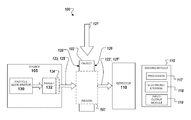
- FIG. 1 is a diagram of an example material discrimination system.
- FIGS. 2A-2C are hypothetical graphs relating detector output signal to particle energy, such as may be ascertained using the detector included in the material discrimination system of FIG. 1 .
- FIG. 3 is a first example arrangement of objects to be scanned by a material discrimination system.
- FIG. 4A is a neutron-enhanced image of the objects of FIG. 3 .
- FIG. 4B is a photon-enhanced image of the objects of FIG. 3 .
- FIG. 4C is a comparative image based on a ratio of the neutron-enhanced image of FIG. 4A and the photon-enhanced image of FIG. 4B .
- FIG. 5 is a second example arrangement of objects to be scanned by a material discrimination system.
- FIG. 6A is a neutron-enhanced image of the objects of FIG. 5 .
- FIG. 6B is a photon-enhanced image of the objects of FIG. 5 .
- FIG. 6C is a comparative image based on a ratio of the neutron-enhanced image of FIG. 6A and the photon-enhanced image of FIG. 6B .
- FIG. 7 is a flow chart illustrating an example process for facilitating material discrimination.
- FIG. 8A is an example neutron energy spectra model.
- FIG. 8B is an example photon energy spectra model.
- This disclosure relates to a material discrimination system including a single source that generates both neutrons and photons, and a single imaging array with a common detector that detects the neutrons and the photons generated from the single source.
- the system allows for a determination of the contents, and/or the effective atomic number (“Z”) of the contents, of an object without physical inspection of the interior of the object.
- the neutrons and photons can be directed towards an object, such as a cargo container, a suitcase, a vehicle carrying packages, a rail car, a shipping container, an airplane that includes a cargo hold, or any other item that may store items or hold items to be transported.
- the system may be placed at a location through which such items pass and/or are stored such as, for example, a border crossing, a checkpoint, a rail station or loading depot, a seaport or harbor, or an airport (either to scan planes or luggage).
- the system may be re-locatable and moveable from one location to another. For example, the system may be re-located from a rail station to an airport.
- Neutrons and photons are attenuated differently by a particular material.
- a material that has a relatively high effective atomic number attenuates photons more strongly than neutrons.
- a high-Z material may have an effective atomic number of approximately twenty or greater.
- a material that has a relatively low effective atomic number attenuates neutrons more strongly than photons.
- a low-Z material may have an effective atomic number between five and fourteen, for example.
- imaging, scanning, or otherwise directing neutrons and photons toward an object may allow determination of the object's effective atomic number and, perhaps, identification of the material(s) included in the object without having to unpack the object or otherwise physically inspect the object.
- the system of this disclosure generates photons and neutrons from a single source, directs the photons and neutrons towards an object, detects the attenuated photons and neutrons that pass through the object with a single imaging array, discriminates between signals arising from the detection of photons and neutrons respectively, and generates an image of the object's attenuation of photons and an image of the object's attenuation of neutrons.
- the image of the object's attenuation of photons may be referred to as a “photon-enhanced image” or a “photon image”, and the image of the object's attenuation of neutrons may be referred to as a “neutron-enhanced image” or a “neutron image.”
- the enhanced images substantially represent the corresponding particle type (e.g., photon or neutron) but may contain some contamination from other particle types.
- the photon-enhanced and neutron-enhanced images may be used to perform material discrimination and/or to determine whether the attenuation is due to organic or metallic materials.
- High-Z materials may be materials that are nuclear materials or used to shield nuclear materials.
- Low-Z materials may include illicit drugs and smuggled foodstuffs.
- the images may be used to identify whether the object contains hazardous and/or illegal items such as illicit drugs, metallic weapons, weaponizable materials, or nuclear materials, or materials that may be associated with hazardous and/or illegal items, such as metallic shielding used to conceal a radioactive item.
- hazardous and/or illegal items such as illicit drugs, metallic weapons, weaponizable materials, or nuclear materials, or materials that may be associated with hazardous and/or illegal items, such as metallic shielding used to conceal a radioactive item.
- FIG. 1 shows a diagram of an example material discrimination system 100 .
- the system 100 images an object 102 by scanning the object with photons and neutrons produced by a source 105 when the object 102 is within or partially in a region 107 .
- the system 100 includes the source 105 , a detector 110 , and an imaging module 115 .
- the imaging module 115 includes a processor 117 , an electronic storage 118 , and an input/output module 119 .
- the electronic storage 118 stores instructions, that when executed, cause a processor coupled to the source 105 to produce a beam 123 , 125 directed at the region 107 . Additionally, the electronic storage 118 may store predefined values that define parameters of the beam 123 , 125 (e.g., energy, duration, and frequency) directed at the region 107 .
- the electronic storage 118 is one or more non-transitory electronic memory modules, and the electronic storage 118 may include non-volatile or persistent memory.
- the processor 117 may be a processor suitable for the execution of a computer program such as a general or special purpose microprocessor, and any one or more processors of any kind of digital computer. Generally, a processor receives instructions and data from a read-only memory or a random access memory or both. The processor 117 receives instruction and data from the components of the system 100 , such as, for example, a location and/or other indication of the object 102 . In some implementations, the system 100 includes more than one processor.
- the input/output module 119 may be any device or module able to transmit data to, and receive data from, the system 100 .
- the input/output device 119 may be a mouse, a touch screen, a stylus, a keyboard, or any other device that enables a user to interact with the system 100 .
- the input/output module 119 may be configured to receive an input from an automated process or a machine and/or configured to provide an output to an automated process or a machine.
- the object 102 moves through the region 107 in a direction 121 .
- the object 102 may be mounted on a conveyor, movable platform, on wheels, or otherwise movable such that the object 102 passes through the region 107 in the direction 121 .
- the conveyor may be multi-directional such that the conveyor may move the object 102 in a direction other than the direction 121 .
- the conveyor may move the object 102 continuously, substantially continuously, or in a step-and-scan mode.
- the conveyor may rest in a particular place to allow a certain portion of the object 102 to be scanned (“spot scan”), or the conveyor may move such that the entire object 102 , or the entire portion of the object 102 is scanned (“primary scan”).
- the source 105 and the detector 110 move together and relative to the object 102 .
- the source 105 and/or the detector 110 may be mounted on a structure (not shown) such as a gantry or on tracks on the interior of a tunnel that receives luggage.
- the source 105 is a single source that produces a beam having a neutron constituent 123 combined with a photon constituent 125 .
- the neutron constituent 123 is a stream of neutron particles
- the photon constituent 125 is a stream of photon particles.
- the photons are gamma-ray photons.
- X-ray photons can also be utilized in one or more embodiments.
- the beam may be isolated, e.g., separated from other beams.
- the neutron and photon streams, which together form the beam, are generated simultaneously and fully integrated with one another so as to be collinear, traveling along a shared path.
- such neutron and photon streams are created by a single source that generates the beam.
- This configuration allows the streams of neutron and photon particles to be aimed at a common target area without accumulating path registration or time delay errors.
- a particular advantage may be that, because the neutron and photon streams are collinear and generated simultaneously, the resulting particle-enhanced images may be more accurate than a system that produces neutrons and photons from different sources from different locations and/or at different times.
- Other advantages may include lower cost, lower complexity, and easier control because dual source interference is not produced.
- such an arrangement may result in a source and a material discrimination system that is more compact and faster than a system that relies on multiple, discrete sources, each of which produces a particular type of particle (e.g., either neutrons or photons individually).
- a source and a material discrimination system that is more compact and faster than a system that relies on multiple, discrete sources, each of which produces a particular type of particle (e.g., either neutrons or photons individually).
- the neutron and photon constituents 123 , 125 of the isolated beam can have a broad energy distribution or spectrum.
- the energy distribution of the neutron constituent 123 can range approximately between nearly 0 MeV and 7.3 MeV (see FIG. 8A ).
- the energy distribution of the photon constituent 125 can range approximately between nearly 0 MeV and 16.9 MeV (see FIG. 8B ).
- the neutron constituent 123 of the isolated beam can provide a relatively high neutron flux, so that proper dosage levels for interrogation of the object 102 can be achieved without requiring an extended exposure time.
- the neutron flux of the neutron constituent 123 can range approximately between 10 9 neutrons/cm 2 sec and 10 11 neutrons/cm 2 sec.
- the photon constituent 125 of the isolated beam can provide a relatively high photon flux.
- the photon flux of the photon constituent 125 can range approximately between 10 5 photons/cm 2 sec and 10 8 photons/cm 2 sec.
- the single source 105 may include a particle accelerator 130 and a target 132 designed to create a predefined type of nuclear reaction that produces a beam that includes both neutrons and photons.
- the accelerator 130 is designed to bombard the target 132 with energized particles to induce nuclear reactions that yield the neutrons and photons.
- the type of nuclear reactions generated by the source 105 is directly related to the materials used (e.g., the type of particles energized by the accelerator and/or the type of target material provided).
- the target 132 is a solid, non-radioactive Be target that produces photons and neutrons in response to a bombardment of deuterons from the accelerator.
- accelerators e.g., proton accelerators
- targets e.g., boron targets, lithium targets, gaseous targets, etc.
- a deuterium or tritium target with a modified window 134 can be used.
- the modified window 134 may be composed of, for example, carbon-12 that produces photons when impinged by deuterons.
- the output energy of the accelerator can also affect the yields of nuclear reactions that are induced, and thus the characteristics of neutron-photon yield. For example, a target bombarded with relatively high energy particles would produce different neutron-photon beam than if an accelerator providing relatively low energy particles were used. In one example, a 3 MeV accelerator could be used to energize deuteron particles.
- Various process parameters can be tuned to achieve desired types of nuclear reactions that yield an isolated, mixed neutron-photon beam with specific characteristics, such as those discussed above.
- a 3.0 MeV deuteron may be used with a Be target.
- the accelerator could be a fixed energy, fixed particle type RFQ accelerator.
- An RFQ accelerator is not required but may be useful and practical to generate optimal neutron and photon energy spectra.
- the resulting neutron flux typically depends on the accelerator average beam current and particle energy, but could be as high as 10 ⁇ 11 n/sec.
- the accelerator beam energy has a strong influence on the emitted neutron and photon energies.
- the single source 105 may produce, alternatively or in addition to the neutrons and the photons, a second combined neutron-photon beam, where the second beam is substantially different from the first by using a second production target.
- the source 105 may produce more than two neutron beams, each having a different mean energy or energy distribution.
- the source 105 may be a multi-energy neutron beam source that produces dual-energy, or broad spectrum energy, neutron beams from a single energy deuteron accelerator.
- the source 105 may include two or more neutron production targets (not shown). The source 105 may be switchable between a state that produces two distinct combined photons and neutron beams.
- the detector 110 is a detector or a type of imaging array that detects both the attenuated neutrons and the attenuated photons.
- the detector 110 is a detector that is made from a material that interacts with incoming neutrons and photons to produce a signal (such as an electrical signal or light), and the material interacts differently with photons than with neutrons.
- the detector 110 may include a plastic scintillator in which both neutrons and photons interact.
- the signal from the detector 110 is provided to the imaging module 115 for analysis and processing, and the electronic processor 118 of the imaging module 115 may assign a value to the signal based on, for example, the magnitude or the shape of the signal or another property that is related to the type of detected particle that caused the signal to be generated.
- a windowed discriminator may be used to distinguish signals arising from photons from those arising from neutrons.
- the windowed discriminator may include at least two thresholds of different values, with each threshold being associated with a value.
- the windowed discriminator may include a first threshold having a first value, and a second threshold having a second value that is greater than the first value.
- the first value may be about 10 mV
- the second value may be about 150 mV.
- the windowed discriminator may accept signals that are above the first threshold and below the second threshold.
- the windowed discriminator only accepts signals that have a peak value greater than or equal to the first threshold and equal to or lower than the second threshold.
- the values of the two thresholds of the windowed discriminator and the detector voltage may be adjusted.
- the windowed discriminator includes more than two threshold values.
- the windowed discriminator can include multiple low and high threshold values, a first set of values (i.e., one low threshold value and one high threshold value) relating to photon energies and a second set of values relating to neutron energies.
- two separate “windows” of detection are provided, each of the windows being specifically tuned for detecting attenuated photons or neutrons.
- the photon and neutron images may be obtained through various techniques.
- the gain and threshold of the single detector 110 may be optimized for neutron detection or for photon detection, by for example, changing the detector gain.
- the object 102 may be scanned twice, once with the detector 110 optimized for neutron detection and once with the detector 110 optimized for photon detection.
- the settings of the detector 110 may be toggled to detect for a fixed percentage of time (such as, for example, 50%) with the settings optimized for detecting neutrons and the remaining amount of time with the settings optimized for detecting photons.
- the detections of neutrons and photons may be separated with post-processing, such as the windowed discriminator discussed above.
- the single imaging array or single detector 110 may include two portions displaced laterally along the direction 121 , with one portion optimized for detecting neutrons and the other portion optimized for detecting photons.
- FIG. 2B shows a second hypothetical graph 200 ′ where the output signal is altered by a positive gain (i.e., a gain greater than one), while the threshold values 208 and 210 remain constant.
- the photon curve 202 ′ is boosted above the upper threshold value 208
- the neutron curve 204 ′ is situated between the upper threshold value and the lower threshold value 210 .
- the detector 110 is optimized for neutron detection.
- the detector 110 is optimized for neutron detection, such that an adjusted value of the output signal can be compared to the upper and lower threshold values 208 and 210 to determine whether the signal represents detection of a neutron. That is, if adjusted output signal is between the upper and lower threshold values 208 and 210 , the detector can determine that the signal represents detection of a neutron.
- FIG. 3 shows a first example arrangement 300 of sample objects 302 - 312 that can be scanned and discriminated by the system 100 .
- the object 302 is Aluminum; the object 304 is Teflon; the object 306 is water; the object 308 is steel; the object 310 is lead; and the object 312 is uranium.
- FIG. 4A shows an example of a neutron image 400 A
- FIG. 4B shows an example of a photon image 400 B
- FIG. 4C shows an example of a ratio between the neutron image 400 A and the photon image of 400 B.
- the images 400 A and 400 B are images of the sample objects 302 - 312 , such as can be generated by the system 100 to facilitate determination of whether the objects include materials that are low-Z, high Z, or both.
- the image 400 C may be color-coded to assist the operator of the system 100 (or an automated process that monitors data from the system 100 ) in identifying high-Z and low-Z regions in the image 400 C (and hence in the set of objects 302 - 312 ).
- low-Z materials may be color coded with a gold or brown color
- high-Z materials may be color coded with a blue color.
- the color coded image may be shaded to show variations of Z within high-Z and low-Z regions.
- All or some of the images 400 A, 400 B, and 400 C may be displayed to an operator of the system 100 on the display 119 .
- the images 400 A, 400 B, 400 C may be presented with other techniques. For example, the images may be printed, uploaded to a remote site, or emailed from the system 100 .
- dosage rates around the system 100 may be monitored with scattered radiation monitors (not shown) to ensure that the dosage rate around the system 100 is within an acceptable limit.
- a first signal primarily based on detected photons is identified, and a second signal primarily based on detected neutrons is identified.
- the signals substantially represent the corresponding particle type (e.g., photon or neutron) but may contain some contamination from other particle types.
- the signals are based primarily on detected particles of the identified type, but there may be a percentage of particles of other types (e.g., up to about 40%). It should be appreciated that the lower the fraction of contaminating particles, the better the material discrimination performance of the system.
- a windowed discriminator can be used to distinguish between a signal associated with the detection of photons and a signal associated with detection of neutrons.
- a photon-enhanced image is generated based on the first signal, and a neutron-enhanced image is generated based on the second signal.
- a comparative image is generated based on a ratio between the photon-enhanced image and the neutron-enhanced image.
- the techniques discussed above may be implemented as a system, a method, a process, a device, or as software on a non-transitory computer-readable medium.
Landscapes
- Health & Medical Sciences (AREA)
- Physics & Mathematics (AREA)
- General Physics & Mathematics (AREA)
- Life Sciences & Earth Sciences (AREA)
- Chemical & Material Sciences (AREA)
- Analytical Chemistry (AREA)
- Biochemistry (AREA)
- General Health & Medical Sciences (AREA)
- Immunology (AREA)
- Pathology (AREA)
- Toxicology (AREA)
- High Energy & Nuclear Physics (AREA)
- General Life Sciences & Earth Sciences (AREA)
- Geophysics (AREA)
- Analysing Materials By The Use Of Radiation (AREA)
- Measurement Of Radiation (AREA)
Priority Applications (1)
| Application Number | Priority Date | Filing Date | Title |
|---|---|---|---|
| US13/599,311 US9239303B2 (en) | 2011-09-01 | 2012-08-30 | Material discrimination system |
Applications Claiming Priority (2)
| Application Number | Priority Date | Filing Date | Title |
|---|---|---|---|
| US201161530165P | 2011-09-01 | 2011-09-01 | |
| US13/599,311 US9239303B2 (en) | 2011-09-01 | 2012-08-30 | Material discrimination system |
Publications (2)
| Publication Number | Publication Date |
|---|---|
| US20130056643A1 US20130056643A1 (en) | 2013-03-07 |
| US9239303B2 true US9239303B2 (en) | 2016-01-19 |
Family
ID=47044762
Family Applications (1)
| Application Number | Title | Priority Date | Filing Date |
|---|---|---|---|
| US13/599,311 Expired - Fee Related US9239303B2 (en) | 2011-09-01 | 2012-08-30 | Material discrimination system |
Country Status (2)
| Country | Link |
|---|---|
| US (1) | US9239303B2 (de) |
| EP (1) | EP2565632A3 (de) |
Families Citing this family (6)
| Publication number | Priority date | Publication date | Assignee | Title |
|---|---|---|---|---|
| US9151852B1 (en) * | 2014-06-04 | 2015-10-06 | Sandia Corporation | Material identification based upon energy-dependent attenuation of neutrons |
| CN106226339A (zh) * | 2016-09-20 | 2016-12-14 | 清华大学 | 中子产生设备,中子成像设备以及成像方法 |
| CN106645229A (zh) * | 2017-02-22 | 2017-05-10 | 中广核久源(成都)科技有限公司 | 中子成像样品连续检测系统 |
| IT201800002327A1 (it) * | 2018-02-02 | 2019-08-02 | Theranosticentre S R L | Apparato per radioterapia intraoperatoria. |
| FR3129210B1 (fr) * | 2021-11-18 | 2023-10-27 | Commissariat Energie Atomique | Dispositif et procédé de détection d’une substance particulière dans un objet par interrogation photonique active |
| US20250054107A1 (en) * | 2023-08-07 | 2025-02-13 | Billion Prima Sdn Bhd | Cargo inspection system and a method for discriminating material in an x-ray imaging cargo inspection |
Citations (9)
| Publication number | Priority date | Publication date | Assignee | Title |
|---|---|---|---|---|
| WO1993021546A1 (en) | 1992-04-09 | 1993-10-28 | Institute Of Geological And Nuclear Sciences Limited | Method and apparatus for detecting concealed substances |
| US5557108A (en) | 1993-10-25 | 1996-09-17 | T+E,Uml U+Ee Mer; T+E,Uml U+Ee May O. | Integrated substance detection and identification system |
| US5838759A (en) * | 1996-07-03 | 1998-11-17 | Advanced Research And Applications Corporation | Single beam photoneutron probe and X-ray imaging system for contraband detection and identification |
| US20060093088A1 (en) * | 2002-12-10 | 2006-05-04 | Sowerby Brian D | Radiographic equipment |
| EP1739460A2 (de) | 2005-06-27 | 2007-01-03 | General Electric Company | Gamma-und Neutronenstrahlungsdetektor |
| US20090067574A1 (en) * | 2007-09-12 | 2009-03-12 | Pratt & Whitney Rocketdyne, Inc. | Neutron-gamma ray tomography |
| US20090140150A1 (en) * | 2007-12-03 | 2009-06-04 | General Electric Company | Integrated neutron-gamma radiation detector with adaptively selected gamma threshold |
| US20100243874A1 (en) | 2005-11-03 | 2010-09-30 | Kejun Kang | Photoneutron conversion target |
| EP1882929B1 (de) | 2006-07-28 | 2011-10-12 | Sage Innovations, Inc. | Detektionssystem und Detektionsverfahren auf Basis von gepulsten energetischen Teilchen |
-
2012
- 2012-08-30 US US13/599,311 patent/US9239303B2/en not_active Expired - Fee Related
- 2012-08-31 EP EP12182665.5A patent/EP2565632A3/de not_active Withdrawn
Patent Citations (9)
| Publication number | Priority date | Publication date | Assignee | Title |
|---|---|---|---|---|
| WO1993021546A1 (en) | 1992-04-09 | 1993-10-28 | Institute Of Geological And Nuclear Sciences Limited | Method and apparatus for detecting concealed substances |
| US5557108A (en) | 1993-10-25 | 1996-09-17 | T+E,Uml U+Ee Mer; T+E,Uml U+Ee May O. | Integrated substance detection and identification system |
| US5838759A (en) * | 1996-07-03 | 1998-11-17 | Advanced Research And Applications Corporation | Single beam photoneutron probe and X-ray imaging system for contraband detection and identification |
| US20060093088A1 (en) * | 2002-12-10 | 2006-05-04 | Sowerby Brian D | Radiographic equipment |
| EP1739460A2 (de) | 2005-06-27 | 2007-01-03 | General Electric Company | Gamma-und Neutronenstrahlungsdetektor |
| US20100243874A1 (en) | 2005-11-03 | 2010-09-30 | Kejun Kang | Photoneutron conversion target |
| EP1882929B1 (de) | 2006-07-28 | 2011-10-12 | Sage Innovations, Inc. | Detektionssystem und Detektionsverfahren auf Basis von gepulsten energetischen Teilchen |
| US20090067574A1 (en) * | 2007-09-12 | 2009-03-12 | Pratt & Whitney Rocketdyne, Inc. | Neutron-gamma ray tomography |
| US20090140150A1 (en) * | 2007-12-03 | 2009-06-04 | General Electric Company | Integrated neutron-gamma radiation detector with adaptively selected gamma threshold |
Non-Patent Citations (1)
| Title |
|---|
| Extended European Search Report for European Application No. 12182665.5, mailed Dec. 8, 2014. |
Also Published As
| Publication number | Publication date |
|---|---|
| US20130056643A1 (en) | 2013-03-07 |
| EP2565632A2 (de) | 2013-03-06 |
| EP2565632A3 (de) | 2015-01-07 |
Similar Documents
| Publication | Publication Date | Title |
|---|---|---|
| US7492862B2 (en) | Computed tomography cargo inspection system and method | |
| JP6469780B2 (ja) | 物質識別のための飛行時間中性子検査方法及びシステム | |
| US10393915B2 (en) | Integrated primary and special nuclear material alarm resolution | |
| JP5173405B2 (ja) | 2エネルギー放射線走査および遅発中性子検出による物体調査 | |
| US6347132B1 (en) | High energy X-ray inspection system for detecting nuclear weapons materials | |
| US7483511B2 (en) | Inspection system and method | |
| US7539283B2 (en) | Combined computed tomography and nuclear resonance fluorescence cargo inspection system and method | |
| US8551785B2 (en) | Dual angle radiation scanning of objects | |
| US9239303B2 (en) | Material discrimination system | |
| US8345812B2 (en) | Distinguishing between classes of fissionable material | |
| Bendahan | Vehicle and cargo scanning for contraband | |
| Stevenson et al. | Linac based photofission inspection system employing novel detection concepts | |
| Bendahan | Review of active interrogation techniques | |
| O'Day III et al. | Initial results from a multiple monoenergetic gamma radiography system for nuclear security | |
| US20080135772A1 (en) | Method and system for special nuclear material detection | |
| Geddes et al. | Impact of monoenergetic photon sources on nonproliferation applications final report | |
| Van Liew et al. | Identification and imaging of special nuclear materials and contraband using active x-ray interrogation | |
| WO2015020710A2 (en) | Integrated primary and special nuclear material alarm resolution | |
| CN211123312U (zh) | 特殊核材料检测装置 | |
| US20200300791A1 (en) | Multi-tiered systems and methods for composition analysis | |
| Toyokawa et al. | Two-dimensional imaging of heavily shielded materials by NRF with laser-compton photon beam | |
| CN110927809A (zh) | 特殊核材料检测装置 | |
| Viesti | Status Report on the detection of illicit materials in cargo containers by using neutron beams. | |
| Rahon | Spectroscopic radiography with monoenergetic neutrons for homeland security applications |
Legal Events
| Date | Code | Title | Description |
|---|---|---|---|
| ZAAA | Notice of allowance and fees due |
Free format text: ORIGINAL CODE: NOA |
|
| ZAAB | Notice of allowance mailed |
Free format text: ORIGINAL CODE: MN/=. |
|
| AS | Assignment |
Owner name: L-3 COMMUNICATIONS SECURITY AND DETECTION SYSTEMS, Free format text: ASSIGNMENT OF ASSIGNORS INTEREST;ASSIGNORS:ZISKIN, VITALIY;PERTICONE, DAVID;REEL/FRAME:036599/0471 Effective date: 20120830 |
|
| STCF | Information on status: patent grant |
Free format text: PATENTED CASE |
|
| MAFP | Maintenance fee payment |
Free format text: PAYMENT OF MAINTENANCE FEE, 4TH YEAR, LARGE ENTITY (ORIGINAL EVENT CODE: M1551); ENTITY STATUS OF PATENT OWNER: LARGE ENTITY Year of fee payment: 4 |
|
| AS | Assignment |
Owner name: L3 SECURITY & DETECTION SYSTEMS, INC., MASSACHUSETTS Free format text: CHANGE OF NAME;ASSIGNOR:L-3 COMMUNICATIONS SECURITY AND DETECTION SYSTEMS, INC.;REEL/FRAME:051947/0263 Effective date: 20171218 |
|
| AS | Assignment |
Owner name: L3 SECURITY & DETECTION SYSTEMS, INC., MASSACHUSETTS Free format text: CORRECTIVE ASSIGNMENT TO CORRECT THE APPLICATION NUMBERS 62/869,350, 62/924,077 PREVIOUSLY RECORDED AT REEL: 051947 FRAME: 0263. ASSIGNOR(S) HEREBY CONFIRMS THE CHANGE OF NAME;ASSIGNOR:L-3 COMMUNICATIONS SECURITY AND DETECTION SYSTEMS, INC.;REEL/FRAME:055817/0808 Effective date: 20171218 |
|
| FEPP | Fee payment procedure |
Free format text: MAINTENANCE FEE REMINDER MAILED (ORIGINAL EVENT CODE: REM.); ENTITY STATUS OF PATENT OWNER: LARGE ENTITY |
|
| LAPS | Lapse for failure to pay maintenance fees |
Free format text: PATENT EXPIRED FOR FAILURE TO PAY MAINTENANCE FEES (ORIGINAL EVENT CODE: EXP.); ENTITY STATUS OF PATENT OWNER: LARGE ENTITY |
|
| STCH | Information on status: patent discontinuation |
Free format text: PATENT EXPIRED DUE TO NONPAYMENT OF MAINTENANCE FEES UNDER 37 CFR 1.362 |
|
| FP | Lapsed due to failure to pay maintenance fee |
Effective date: 20240119 |