US9234844B2 - Chloride ion fluorescence detection method and device, and use thereof - Google Patents
Chloride ion fluorescence detection method and device, and use thereof Download PDFInfo
- Publication number
- US9234844B2 US9234844B2 US14/358,397 US201214358397A US9234844B2 US 9234844 B2 US9234844 B2 US 9234844B2 US 201214358397 A US201214358397 A US 201214358397A US 9234844 B2 US9234844 B2 US 9234844B2
- Authority
- US
- United States
- Prior art keywords
- chloride ion
- fluorescent reagent
- optical fiber
- testing
- measurement
- Prior art date
- Legal status (The legal status is an assumption and is not a legal conclusion. Google has not performed a legal analysis and makes no representation as to the accuracy of the status listed.)
- Expired - Fee Related
Links
- 0 *CC*c(cc1)ccc1C(c1ccc(*)cc1)=C(c1ccc(C2C*CCC2)cc1)c1ccc(C2*CCCC2)cc1 Chemical compound *CC*c(cc1)ccc1C(c1ccc(*)cc1)=C(c1ccc(C2C*CCC2)cc1)c1ccc(C2*CCCC2)cc1 0.000 description 1
- XDSMUHURSAIHHL-UHFFFAOYSA-P CC[NH+](CC)CC1=CC=C(C(C2=CC=C(C[NH+](CC)CC)C=C2)=C(C2=CC=C([N+](C)(CC)CC)C=C2)C2=CC=C([N+](C)(CC)CC)C=C2)C=C1.[I-].[I-].[I-].[I-] Chemical compound CC[NH+](CC)CC1=CC=C(C(C2=CC=C(C[NH+](CC)CC)C=C2)=C(C2=CC=C([N+](C)(CC)CC)C=C2)C2=CC=C([N+](C)(CC)CC)C=C2)C=C1.[I-].[I-].[I-].[I-] XDSMUHURSAIHHL-UHFFFAOYSA-P 0.000 description 1
- SVWDLUJHJZBNKL-MPXBKSSUSA-N [H]C1N(C)CCN1CCOC1=CC=CC(/C2=C3\C=C/C4=C/C5=N/C(=C(/C6=CC=CC(OCCN7CCN(C)C7[H])=C6)C6=CC=C(/C=C7/C=CC2=N7)N6CN43)C=C5)=C1 Chemical compound [H]C1N(C)CCN1CCOC1=CC=CC(/C2=C3\C=C/C4=C/C5=N/C(=C(/C6=CC=CC(OCCN7CCN(C)C7[H])=C6)C6=CC=C(/C=C7/C=CC2=N7)N6CN43)C=C5)=C1 SVWDLUJHJZBNKL-MPXBKSSUSA-N 0.000 description 1
Images


Classifications
-
- G—PHYSICS
- G01—MEASURING; TESTING
- G01N—INVESTIGATING OR ANALYSING MATERIALS BY DETERMINING THEIR CHEMICAL OR PHYSICAL PROPERTIES
- G01N21/00—Investigating or analysing materials by the use of optical means, i.e. using sub-millimetre waves, infrared, visible or ultraviolet light
- G01N21/62—Systems in which the material investigated is excited whereby it emits light or causes a change in wavelength of the incident light
- G01N21/63—Systems in which the material investigated is excited whereby it emits light or causes a change in wavelength of the incident light optically excited
- G01N21/64—Fluorescence; Phosphorescence
- G01N21/6428—Measuring fluorescence of fluorescent products of reactions or of fluorochrome labelled reactive substances, e.g. measuring quenching effects, using measuring "optrodes"
- G01N21/643—Measuring fluorescence of fluorescent products of reactions or of fluorochrome labelled reactive substances, e.g. measuring quenching effects, using measuring "optrodes" non-biological material
-
- G—PHYSICS
- G01—MEASURING; TESTING
- G01N—INVESTIGATING OR ANALYSING MATERIALS BY DETERMINING THEIR CHEMICAL OR PHYSICAL PROPERTIES
- G01N21/00—Investigating or analysing materials by the use of optical means, i.e. using sub-millimetre waves, infrared, visible or ultraviolet light
- G01N21/75—Systems in which material is subjected to a chemical reaction, the progress or the result of the reaction being investigated
- G01N21/77—Systems in which material is subjected to a chemical reaction, the progress or the result of the reaction being investigated by observing the effect on a chemical indicator
- G01N21/7703—Systems in which material is subjected to a chemical reaction, the progress or the result of the reaction being investigated by observing the effect on a chemical indicator using reagent-clad optical fibres or optical waveguides
-
- G—PHYSICS
- G01—MEASURING; TESTING
- G01N—INVESTIGATING OR ANALYSING MATERIALS BY DETERMINING THEIR CHEMICAL OR PHYSICAL PROPERTIES
- G01N21/00—Investigating or analysing materials by the use of optical means, i.e. using sub-millimetre waves, infrared, visible or ultraviolet light
- G01N21/62—Systems in which the material investigated is excited whereby it emits light or causes a change in wavelength of the incident light
- G01N21/63—Systems in which the material investigated is excited whereby it emits light or causes a change in wavelength of the incident light optically excited
- G01N21/64—Fluorescence; Phosphorescence
- G01N2021/6417—Spectrofluorimetric devices
-
- G—PHYSICS
- G01—MEASURING; TESTING
- G01N—INVESTIGATING OR ANALYSING MATERIALS BY DETERMINING THEIR CHEMICAL OR PHYSICAL PROPERTIES
- G01N21/00—Investigating or analysing materials by the use of optical means, i.e. using sub-millimetre waves, infrared, visible or ultraviolet light
- G01N21/62—Systems in which the material investigated is excited whereby it emits light or causes a change in wavelength of the incident light
- G01N21/63—Systems in which the material investigated is excited whereby it emits light or causes a change in wavelength of the incident light optically excited
- G01N21/64—Fluorescence; Phosphorescence
- G01N21/6428—Measuring fluorescence of fluorescent products of reactions or of fluorochrome labelled reactive substances, e.g. measuring quenching effects, using measuring "optrodes"
- G01N2021/6439—Measuring fluorescence of fluorescent products of reactions or of fluorochrome labelled reactive substances, e.g. measuring quenching effects, using measuring "optrodes" with indicators, stains, dyes, tags, labels, marks
-
- G—PHYSICS
- G01—MEASURING; TESTING
- G01N—INVESTIGATING OR ANALYSING MATERIALS BY DETERMINING THEIR CHEMICAL OR PHYSICAL PROPERTIES
- G01N21/00—Investigating or analysing materials by the use of optical means, i.e. using sub-millimetre waves, infrared, visible or ultraviolet light
- G01N21/62—Systems in which the material investigated is excited whereby it emits light or causes a change in wavelength of the incident light
- G01N21/63—Systems in which the material investigated is excited whereby it emits light or causes a change in wavelength of the incident light optically excited
- G01N21/64—Fluorescence; Phosphorescence
- G01N21/645—Specially adapted constructive features of fluorimeters
- G01N2021/6484—Optical fibres
-
- G—PHYSICS
- G01—MEASURING; TESTING
- G01N—INVESTIGATING OR ANALYSING MATERIALS BY DETERMINING THEIR CHEMICAL OR PHYSICAL PROPERTIES
- G01N21/00—Investigating or analysing materials by the use of optical means, i.e. using sub-millimetre waves, infrared, visible or ultraviolet light
- G01N21/75—Systems in which material is subjected to a chemical reaction, the progress or the result of the reaction being investigated
- G01N21/77—Systems in which material is subjected to a chemical reaction, the progress or the result of the reaction being investigated by observing the effect on a chemical indicator
- G01N21/7703—Systems in which material is subjected to a chemical reaction, the progress or the result of the reaction being investigated by observing the effect on a chemical indicator using reagent-clad optical fibres or optical waveguides
- G01N2021/7706—Reagent provision
- G01N2021/772—Tip coated light guide
-
- G—PHYSICS
- G01—MEASURING; TESTING
- G01N—INVESTIGATING OR ANALYSING MATERIALS BY DETERMINING THEIR CHEMICAL OR PHYSICAL PROPERTIES
- G01N21/00—Investigating or analysing materials by the use of optical means, i.e. using sub-millimetre waves, infrared, visible or ultraviolet light
- G01N21/75—Systems in which material is subjected to a chemical reaction, the progress or the result of the reaction being investigated
- G01N21/77—Systems in which material is subjected to a chemical reaction, the progress or the result of the reaction being investigated by observing the effect on a chemical indicator
- G01N2021/7769—Measurement method of reaction-produced change in sensor
- G01N2021/7786—Fluorescence
-
- G—PHYSICS
- G01—MEASURING; TESTING
- G01N—INVESTIGATING OR ANALYSING MATERIALS BY DETERMINING THEIR CHEMICAL OR PHYSICAL PROPERTIES
- G01N21/00—Investigating or analysing materials by the use of optical means, i.e. using sub-millimetre waves, infrared, visible or ultraviolet light
- G01N21/75—Systems in which material is subjected to a chemical reaction, the progress or the result of the reaction being investigated
- G01N21/77—Systems in which material is subjected to a chemical reaction, the progress or the result of the reaction being investigated by observing the effect on a chemical indicator
-
- Y—GENERAL TAGGING OF NEW TECHNOLOGICAL DEVELOPMENTS; GENERAL TAGGING OF CROSS-SECTIONAL TECHNOLOGIES SPANNING OVER SEVERAL SECTIONS OF THE IPC; TECHNICAL SUBJECTS COVERED BY FORMER USPC CROSS-REFERENCE ART COLLECTIONS [XRACs] AND DIGESTS
- Y10—TECHNICAL SUBJECTS COVERED BY FORMER USPC
- Y10T—TECHNICAL SUBJECTS COVERED BY FORMER US CLASSIFICATION
- Y10T436/00—Chemistry: analytical and immunological testing
-
- Y—GENERAL TAGGING OF NEW TECHNOLOGICAL DEVELOPMENTS; GENERAL TAGGING OF CROSS-SECTIONAL TECHNOLOGIES SPANNING OVER SEVERAL SECTIONS OF THE IPC; TECHNICAL SUBJECTS COVERED BY FORMER USPC CROSS-REFERENCE ART COLLECTIONS [XRACs] AND DIGESTS
- Y10—TECHNICAL SUBJECTS COVERED BY FORMER USPC
- Y10T—TECHNICAL SUBJECTS COVERED BY FORMER US CLASSIFICATION
- Y10T436/00—Chemistry: analytical and immunological testing
- Y10T436/19—Halogen containing
Definitions
- the present invention relates to the technical field of photoelectric measurement, and more particularly to a method of fluorescence measurement of chloride ion, its device and use thereof.
- an object of the present invention is to provide a method of fluorescence measurement for chloride ion, the device and application thereof in which characteristics of chloride ion on fluorescence of fluorescent substance is utilized to realize the measurement of chloride ion in order to solve the existing technical problems in chloride ion measurement.
- a method of fluorescence measurement for chloride ion comprising the steps of: providing a fluorescent reagent and determining a chloride ion concentration of a test object through measuring the fluorescence spectrum of the fluorescent reagent, wherein the fluorescent reagent is a photoluminescence organic polymer material utilized for fluorescence measurement of chloride ion;
- photoluminescence organic polymer material is sensitive to chloride ion, wherein optical properties of the photoluminescence organic polymer materials are changed after having interaction with chloride ions.
- the fluorescent reagent is tetra(4,4′,4′′,4′′′-N,N-diethylamino)tetraphenylethene quaternary ammonium salt compound, 5,15-bis[3-(2-(3-methylimidazolium)ethoxy)phenyl]zinc (II) porphyrin hexafluorophosphate, or a methyl orange-silver colloid system.
- the method of fluorescence measurement of chloride ion comprises the steps of: covering a film of fluorescent reagent for chloride ion measurement onto an end surface of an optical fiber, placing the end surface of the optical fiber which is covered with the film of fluorescent reagent in a chloride ion testing environment, exciting the chloride ion sensitive materials on the end surface of the optical fiber by a light source through a coupling unit, placing the end surface of the optical fiber which is covered with the film of fluorescent reagent in the chloride ion testing environment, collecting the excited fluorescence light through the optical fiber and guiding the fluorescence light into a spectrum signal receiving unit through the coupling unit.
- the method of fluorescence measurement for chloride ion comprises the steps of: preparing the fluorescent reagent into a fluorescent testing solution, placing the fluorescent testing solution into a testing container for chloride ion measurement, placing a test object into the testing container, exciting the fluorescent testing solution in the testing container by a light source through an optical fiber or through direct coupling, collecting the excited fluorescence light by the optical fiber and guiding the fluorescence light into a spectrum signal receiving unit through the coupling unit.
- a device for fluorescence measurement of chloride ion comprises a light source, a coupling unit, a testing unit and a spectrum signal receiving unit; wherein the light source, the coupling unit and the testing unit are sequentially connected through an optical fiber, wherein the coupling unit and the spectrum signal receiving unit are connected through optical fiber;
- the testing unit comprises a fluorescent reagent for testing chloride ion, wherein the fluorescent reagent is photoluminescence organic polymer material which is sensitive to chloride ion and the optical properties of the photoluminescence organic polymer materials are changed after having interaction with chloride ions.
- the fluorescent reagent is photoluminescence organic polymer material which is sensitive to chloride ion and the optical properties of the photoluminescence organic polymer materials are changed after having interaction with chloride ions.
- the testing unit is an optical fiber for testing of which an end surface of the optical fiber for testing is coated with a layer of fluorescent reagent in the form of a film for measurement of chloride ion.
- the testing unit is a testing container which contains a fluorescent testing solution, wherein the fluorescent testing solution is a solution of fluorescent reagent for chloride ion measurement.
- the fluorescent reagent is tetra(4,4′,4′′,4′′′-N,N-diethylamino)tetraphenylethene quaternary ammonium salt compound, 5,15-bis[3-(2-(3-methylimidazolium)ethoxy)phenyl]zinc (II) porphyrin hexafluorophosphate, or a methyl orange-silver colloid system.
- An application of the above device for fluorescence measurement of chloride ion includes an on-site analysis of erosion environment of reinforced concrete or chloride ion concentration measurement in a laboratory.
- the present invention provides a method of fluorescence measurement of chloride ion, the device and application thereof in which the characteristic effect of chloride ion on the fluorescence of certain fluorescent substances is utilized to realize the measurement of chloride ion.
- a fluorescent sensor is prepared by these fluorescent substances such that the concentration of chloride ion in a chloride ion existing environment can be measured.
- the erosion conditions of steel can be monitored for which the erosion rate and the erosion pattern can be determined, thereby the safety of the building structure can be ensured. Accordingly, the present invention provides very important theoretical significance and applied value.
- FIG. 1 is fluorescence spectra of tetra tetraphenylethene quaternary ammonium salt compound in chloride ion solution of different concentration respectively according to the preferred embodiment of the present invention.
- FIG. 2 is fluorescence comparison diagram of resulting solutions of 5,15-bis[3-(2-(3-methylimidazolium)ethoxy)phenyl]zinc (II) porphyrin hexafluorophosphate salt after interaction with chloride ion solution of different concentration respectively according to the preferred embodiment of the present invention.
- FIG. 3 is an illustration of occurrence of complexation action between 5,15-bis[3-(2-(3-methylimidazolium)ethoxy)phenyl]zinc (II) porphyrin hexafluorophosphate salt and chloride ion according to the preferred embodiment of the present invention.
- FIG. 4 is an illustration of a film structure model of methyl orange-silver colloid system and a tight adsorption model after chloride ion is added to the methyl orange-silver colloid system according to the preferred embodiment of the present invention.
- FIG. 5 is fluorescence spectra of methyl orange-silver colloid system in chloride ion solution of different concentration respectively according to the preferred embodiment of the present invention.
- FIG. 6 is an illustration of a functional block diagram of the device for chloride ion measurement according to the preferred embodiment of the present invention.
- FIG. 7 is a structural illustration of the testing unit in the form of a chloride ion optical sensor according to the preferred embodiment of the present invention.
- FIG. 8 is a structural illustration of the testing unit in the form of a fluorescent testing solution according to the preferred embodiment of the present invention.
- the present invention provides a method of fluorescence measurement for chloride ion, the device and application thereof.
- the present invention is further described in details in the followings so as to illustrate the objectives and the technical features more clearly and explicitly.
- the following embodiments of the present invention are for the purpose of illustration only and are not intended to restrict the scope of the present invention.
- the method of fluorescence measurement for chloride ion utilizes the characteristic of chloride ion in which the chloride ion is capable of affecting the fluorescence properties of certain fluorescent substances such that changes in the emission spectrum of the particular fluorescent substance is induced, therefore data such as the fluorescence peak wavelength or intensity can be utilized for chloride ion measurement. Accordingly, through the preparation of fluorescent sensor with these fluorescent substances, data such as concentration of chloride ion under environmental conditions with chloride ion can be measured.
- the method of fluorescence measurement for chloride ion makes use of the characteristics of fluorescence spectrum of testing subject to determine the concentration of chloride ion in the testing subject in which the characteristics of fluorescence spectrum includes fluorescence intensity, wavelength, lifetime and etc.
- This method has a relatively high precision level and sensitivity and is convenience to use, that this method can be used under a laboratory condition or conducted under an on-site condition.
- This method is suitable for on-site analysis of erosion environment of reinforced concrete or for measuring concentration of chloride ion under the laboratory condition.
- a particular photoluminescence polymer substance which is sensitive to chloride ion is selected.
- the specific optical properties of the polymer substance are induced to changes by the chloride ion after having interaction with the chloride ion.
- the changes in optical properties includes changes in characteristics of adsorption spectrum or emission spectrum.
- Another core feature is that the polymer substance can easily be coated onto the core of an optical fiber such that engineering application is facilitated.
- a particular photoluminescence organic polymer substance is selected to use as a fluorescent reagent for fluorescence measurement of chloride ion.
- the photoluminescence organic polymer substance is selected, not only the excellent photoluminescence properties of the substance are required, but also the sensitivity and selectivity to chloride ion, and the solubility in certain solvent to facilitate film formation on the surface of optical fiber are important factors for consideration.
- TDETE tetra(4,4′,4′′,4′′′-N,N-diethylamino)tetraphenylethene
- TDETE is a stilbene derivatives which is obtained by reductive coupling synthesis in which the two sides of the alkene double bond are bonded to four relatively large substituents, which is 4-N,N-dimethylaminophenyl.
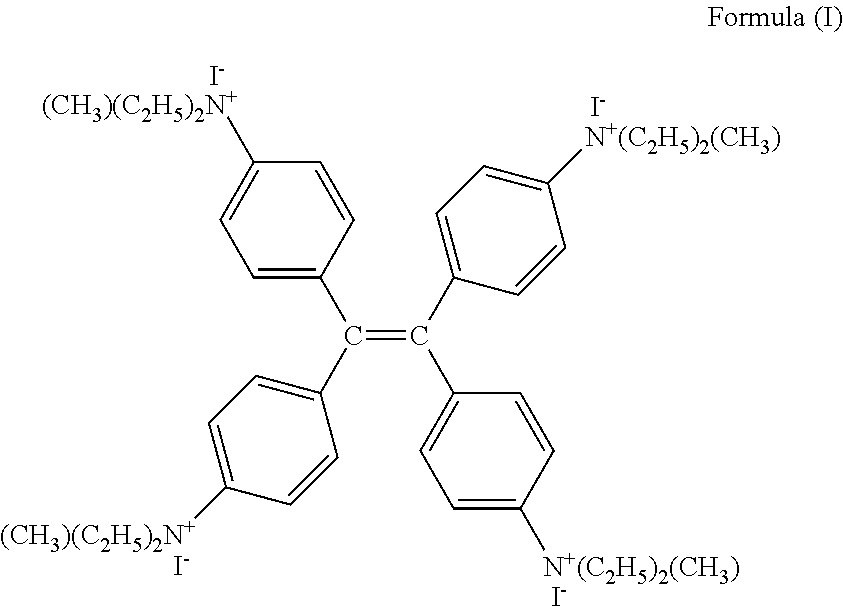
- Tetra(4,4′,4′′,4′′′-N,N-diethylamino)tetraphenylethene (TDETE) reacts with iodomethane to form a quaternary ammonium salt compound with fluorescence characteristics and its molecular structure is shown in formula (I).
- TDETE quaternary ammonium salt compound belongs to a large p-bonding (conjugated) compound.
- the chloride ion can partially substitute the iodide ion since the polarity of chloride ion is higher than the iodide ion, therefore the electron cloud distribution and the electronic energy level structure in the polymer are changed and the changes to the fluorescence spectrum and emission peak wavelength are induced.
- FIG. 2 of the drawings the changes in peak wavelength in the fluorescence emission band of TDETE quaternary ammonium salt compound at different concentration of chloride ion are illustrated.
- the TDETE quaternary ammonium salt compound When the TDETE quaternary ammonium salt compound is placed under the chloride ion environment with concentration of chloride ion at 0.03 mol/L, 0.05 mol/L and 0.07 mol/L, its peak wavelength, which is originally 472.12 nm, is changed to 471.29 nm, 471.54 nm and 471.19 nm respectively, while its fluorescence intensity is lowered. The fluorescence intensity is correlated to the concentration of chloride ion.
- TDETE quaternary ammonium salt compound is sensitive to chloride ion.
- the present invention also provides 5,15-bis[3-(2-(3-methylimidazolium)ethoxy)phenyl]zinc (II) porphyrin hexafluorophosphate salt for use as the fluorescent reagent for fluorescence measurement of chloride ion.
- porphyrin hexafluorophosphate salt is a porphyrin derivatives, which is a purple solid under room temperature and has a molecular structure as follows:
- porphyrin derivatives have strong fluorescence emission.
- the effect of chloride ion on 5,15-bis[3-(2-(3-methylimidazolium)ethoxy)phenyl]zinc (II) porphyrin hexafluorophosphate salt is that, when the concentration of chloride ion in acetonitrile solution is increased, the fluorescence intensity of porphyrin derivatives at 596 nm and 645 nm respectively are lowered significantly, which is shown in FIG. 2 of the drawings.
- the present invention also provides methyl orange for use as the fluorescent reagent for fluorescence measurement for chloride ion.
- the nano silver particle in the methyl orange-silver colloid system has a large surface area with positive charge, therefore when the methyl orange which is an anionic dye is added to the silver colloid, the nano silver particle with positive charge and the —SO 3 ⁇ group of methyl orange will attract each other due to Coulomb interaction. As a result, the dye molecules will longitudinally approaching the colloidal silver particles while the hydrophobic group (the dimethylamino group) at the opposite end of the methyl orange is induced towards the metal surface by action of water repulsion.
- the methyl orange molecule is adsorbed onto the surface of metal particle and aggregate to form methyl orange-silver colloid nano particle. Since the silver particles have a spatial distribution of surface charge, the dye molecules are dispersedly adsorbed onto the surface of silver particles, which is shown in FIGS. 4( a ) and ( b ) of the drawings.
- chloride ion When chloride ion is added to the methyl orange-silver colloid system, the chloride ion is tightly adsorbed onto the colloidal silver surface, which is shown in FIG. 4( c ) of the drawings.
- the pH When the pH is smaller than 3.1, the chloride ion has promoting effect on adsorption and aggregation of molecule on the colloidal silver surface and affects the energy transfer efficiency.
- the addition of chloride ion will increase the aggregation and surface adsorption, and the effect of external solvent on this particular micro environment of aggregation surface will be reduced, when in turn causing the emission peak at 365 nm and 560 nm to have similar intensity and pattern when the pH is greater than 3.1.
- the molecules which are tightly adsorbed on the silver particles will decrease the intensity of light incident on the silver particles, thus decreasing the energy transfer efficiency. Accordingly, the intensity of the characteristic photoluminescence emission peak at 560 nm is lowered after chloride ion is added. Meanwhile, as the level of intensity of adsorption is increased, the order of alignment of methyl orange is increased and the planarity and the rigidity of molecules will be increased, therefore the fluorescence peak intensity at 365 nm of ⁇ - ⁇ *transition associated molecules will be increased, which is shown in FIG. 5 of the drawings. Accordingly, it is determined that methyl orange-silver colloid system has a significant linear response to chloride ion in relation to fluorescence intensity of fluorescence spectrum at 365 nm.
- a measuring device for fluorescence measurement of chloride ion which is capable of utilizing a fluorescent reagent for chloride ion measurement for film formation onto a surface of fiber optics or for preparation of testing solution for measuring the concentration of chloride ion.
- the measuring device for fluorescence measurement of chloride ion comprises a light source unit, a coupling unit, a testing unit and a spectrum signal receiving unit; the light source unit is arranged for light emission at a particular wavelength; and the testing unit is arranged for carrying the fluorescent reagent for chloride ion measurement.
- the light source, the coupling unit and the testing unit are sequentially connected through an optical fiber, the coupling unit device is connected to the spectrum signal receiving unit through an optical fiber.
- the testing unit contains the fluorescent reagent for chloride ion measurement in which the fluorescent reagent is a photoluminescence organic polymer substance which is sensitive to chloride ion such that its optical properties will be changed after having interaction with chloride ion.
- the testing unit can be in the form of an optical fiber for testing in which the optical fiber has one end providing an end surface for coating a layer of fluorescence film for chloride ion measurement.
- the fluorescent reagent is a photoluminescence organic polymer substance which is sensitive to chloride ion.
- the fluorescent reagent can be selected from tetra tetraphenylethene (chemical name tetra(4,4′,4′′,4′′′-N,N-diethylamino)tetraphenylethene) quaternary ammonium salt compound, 5,15-bis[3-(2-(3-methylimidazolium)ethoxy)phenyl]zinc (II) porphyrin hexafluorophosphate salt or methyl orange-silver colloid system.
- tetra tetraphenylethene chemical name tetra(4,4′,4′′,4′′′-N,N-diethylamino)tetraphenylethene
- quaternary ammonium salt compound 5,15-bis[3-(2-(3-methylimidazolium)ethoxy)phenyl]zinc (II) porphyrin hexafluorophosphate salt or methyl orange-silver colloid system.
- the light source is arranged to excite the chloride ion sensitive materials on the end surface of the optical fiber through the coupling unit.
- the end surface of the optical fiber is placed in the chloride ion existing environment for testing, the excited fluorescence light is collected by the optical fiber and is guided into the spectrum signal receiving unit through the coupling unit.
- the testing unit can be in the form of a testing container which contains a testing solution in which the testing solution is a fluorescent reagent for chloride ion measurement.
- the fluorescent reagent is a photoluminescence organic polymer substance which is sensitive to chloride ion.
- the fluorescent reagent can be selected from tetra tetraphenylethene (chemical name tetra(4,4′,4′′,4′′′-N,N-diethylamino) tetraphenylethene) quaternary ammonium salt compound, 5,15-bis[3-(2-(3-methylimidazolium)ethoxy)phenyl]zinc (II) porphyrin hexafluorophosphate salt or methyl orange-silver colloid system.
- tetra tetraphenylethene chemical name tetra(4,4′,4′′,4′′′-N,N-diethylamino) tetraphenylethene
- quaternary ammonium salt compound 5,15-bis[3-(2-(3-methylimidazolium)ethoxy)phenyl]zinc (II) porphyrin hexafluorophosphate salt or methyl orange-silver colloid system.
- the light source unit is coupled with the testing container for chloride ion directly or through an optical fiber to excite the fluorescent reagent for chloride ion measurement inside the testing container.
- the excited fluorescence light is then collected and guided into the spectrum signal receiving unit through the coupling unit. After that, through the changes in fluorescent spectrum characteristics, which includes fluorescent light intensity, wavelength and lifetime, the concentration of chloride ion in the test object is measured.
- a preparation process of coating a layer of fluorescent film for chloride ion measurement on the surface of optical fiber comprise the steps of:
- the film forming materials can be selected from polyvinyl acetaldehyde, polyvinyl butyral, polyvinyl alcohol EG-40 or PVA-124.
- a preparation process of testing solution of fluorescent reagent for chloride ion measurement comprises the steps of:
- tetra tetraphenylethene chemical name tetra(4,4′,4′′,4′′′-N,N-diethylamino)tetraphenylethene
- quaternary ammonium salt compound 5,15-bis[3-(2-(3-methylimidazolium)ethoxy)phenyl]zinc (II) porphyrin hexafluorophosphate salt or methyl orange-silver colloid system and placing into a testing container for chloride ion measurement.
- the light source is coupled with the testing container for chloride ion measurement directly or through an optical fiber to excite the chloride ion sensitive materials inside the testing container for chloride ion measurement.
- the excited fluorescence light is then collected by the optical fiber and is guided into the spectrum signal receiving unit through the coupling unit. After that, through the changes in fluorescent spectrum characteristics, which includes fluorescence light intensity, wavelength and lifetime, the concentration of chloride ion in the test object is measured.
Landscapes
- Health & Medical Sciences (AREA)
- Chemical & Material Sciences (AREA)
- Physics & Mathematics (AREA)
- Immunology (AREA)
- Life Sciences & Earth Sciences (AREA)
- Pathology (AREA)
- Analytical Chemistry (AREA)
- Biochemistry (AREA)
- General Health & Medical Sciences (AREA)
- General Physics & Mathematics (AREA)
- Chemical Kinetics & Catalysis (AREA)
- Molecular Biology (AREA)
- Optics & Photonics (AREA)
- Nuclear Medicine, Radiotherapy & Molecular Imaging (AREA)
- Plasma & Fusion (AREA)
- Engineering & Computer Science (AREA)
- Investigating Or Analysing Materials By The Use Of Chemical Reactions (AREA)
- Investigating, Analyzing Materials By Fluorescence Or Luminescence (AREA)
Abstract
Description

Claims (12)
Applications Claiming Priority (4)
| Application Number | Priority Date | Filing Date | Title |
|---|---|---|---|
| CN201110361199.7 | 2011-11-15 | ||
| CN201110361199 | 2011-11-15 | ||
| CN2011103611997A CN102495032B (en) | 2011-11-15 | 2011-11-15 | Chloride ion fluorescence detection method, device thereof and application thereof |
| PCT/CN2012/083800 WO2013071822A1 (en) | 2011-11-15 | 2012-10-31 | Chloride ion fluorescence detection method and device, and use thereof |
Publications (2)
| Publication Number | Publication Date |
|---|---|
| US20140315321A1 US20140315321A1 (en) | 2014-10-23 |
| US9234844B2 true US9234844B2 (en) | 2016-01-12 |
Family
ID=46186873
Family Applications (1)
| Application Number | Title | Priority Date | Filing Date |
|---|---|---|---|
| US14/358,397 Expired - Fee Related US9234844B2 (en) | 2011-11-15 | 2012-10-31 | Chloride ion fluorescence detection method and device, and use thereof |
Country Status (3)
| Country | Link |
|---|---|
| US (1) | US9234844B2 (en) |
| CN (1) | CN102495032B (en) |
| WO (1) | WO2013071822A1 (en) |
Families Citing this family (13)
| Publication number | Priority date | Publication date | Assignee | Title |
|---|---|---|---|---|
| CN102495032B (en) * | 2011-11-15 | 2013-10-16 | 深圳大学 | Chloride ion fluorescence detection method, device thereof and application thereof |
| CN102866121A (en) * | 2012-08-27 | 2013-01-09 | 长沙牧泰莱电路技术有限公司 | Method for analyzing concentration of chloride ions of electroplating liquid of printed circuit board (PCB) |
| CN105300944B (en) * | 2015-11-11 | 2018-09-28 | 中国船舶重工集团公司第七二五研究所 | A kind of concrete chloride ion corrosion fibre optical sensor and its detection method based on fluorescent quenching |
| CN105510293B (en) * | 2016-01-19 | 2018-07-17 | 海南瑞泽新型建材股份有限公司 | A kind of fluorescent type fibre optical sensor for detecting chlorine ion concentration in concrete |
| CN106117098B (en) * | 2016-06-30 | 2018-07-13 | 广州万粤知识产权运营有限公司 | A kind of fluorescent optical sensor and preparation method thereof of detection chloride ion in cement |
| CN106083677A (en) * | 2016-07-18 | 2016-11-09 | 徐伟鹏 | A kind of chloride test reagent and detect the application of chloride ion in cement |
| CN108896890B (en) * | 2018-08-01 | 2024-05-24 | 深圳供电局有限公司 | System and method for detecting partial discharge signal of cable intermediate connector |
| CN109211859B (en) * | 2018-09-27 | 2023-11-24 | 华南理工大学 | Hydrogel optical fiber based on luminescent MOFs and its preparation method and sensing device |
| CN111019168B (en) * | 2019-12-24 | 2022-02-25 | 福建第一公路工程集团有限公司 | Preparation method of sensitive film of optical fiber sensor for chloride ion detection in concrete pore solution |
| CN116359309A (en) * | 2021-12-27 | 2023-06-30 | 深南电路股份有限公司 | A detection method and detection device for chloride ion content |
| CN117070211B (en) * | 2022-05-09 | 2024-07-09 | 深圳大学 | Composite material and preparation method and application thereof |
| CN116332975B (en) * | 2023-02-21 | 2026-02-17 | 泰安市中心医院(青岛大学附属泰安市中心医院、泰山医养中心) | An aggregation-induced emission fluorescent probe, its preparation method and applications |
| CN119023636B (en) * | 2024-08-16 | 2025-02-25 | 中交四航局第一工程有限公司 | A method and system for monitoring chloride ions in concrete |
Family Cites Families (9)
| Publication number | Priority date | Publication date | Assignee | Title |
|---|---|---|---|---|
| US6358748B1 (en) * | 2000-09-28 | 2002-03-19 | The United States Of America As Represented By The U.S. Department Of Energy | Microbend fiber-optic chemical sensor |
| CN2837836Y (en) * | 2005-11-24 | 2006-11-15 | 复旦大学附属中山医院 | Real-time fluorescence detection system for optical fiber receptor |
| CN101118216A (en) * | 2007-09-07 | 2008-02-06 | 中国科学院长春光学精密机械与物理研究所 | A kind of optical fiber biological probe and its production method and application |
| CN101451959B (en) * | 2008-12-30 | 2011-01-26 | 清华大学 | Hydrogen sensor and pd film hydrogen sensing system |
| CN101566580B (en) * | 2009-05-13 | 2011-06-15 | 南京航空航天大学 | Method for monitoring steel bar corrosion state in concrete by stages and sensor |
| CN101710074B (en) * | 2009-12-25 | 2011-08-31 | 武汉理工大学 | Micro optical fiber biosensor for detecting nitric oxide concentration in organism |
| CN102042975B (en) * | 2010-10-29 | 2012-06-27 | 济南大学 | Research and application of molecular identification-based fluorescence nanocrystal quartz fluorescent sensor for high-selectivity multicomponent saccharide detection |
| GB201100990D0 (en) * | 2011-01-20 | 2011-03-09 | Univ City | Optical sensor |
| CN102495032B (en) * | 2011-11-15 | 2013-10-16 | 深圳大学 | Chloride ion fluorescence detection method, device thereof and application thereof |
-
2011
- 2011-11-15 CN CN2011103611997A patent/CN102495032B/en active Active
-
2012
- 2012-10-31 WO PCT/CN2012/083800 patent/WO2013071822A1/en not_active Ceased
- 2012-10-31 US US14/358,397 patent/US9234844B2/en not_active Expired - Fee Related
Non-Patent Citations (2)
| Title |
|---|
| Nguyen, T. H. et al, Fiber Optic Chloride Sensor Based on Fluorescence Quenching of an Acridinium Dye, 2009, Proceedings of the SPIE-The International Society for Optical Engineering, Volu 7503, p. 750314-1 to 750314-5. * |
| Zhang et al, Spectroscopy studies of methyl orange on silver colloids: pH and Cl-effects, Acta Physics Sinica, Jan. 2007, vol. 56, No. 1, pp. 170-177. * |
Also Published As
| Publication number | Publication date |
|---|---|
| CN102495032A (en) | 2012-06-13 |
| WO2013071822A1 (en) | 2013-05-23 |
| CN102495032B (en) | 2013-10-16 |
| US20140315321A1 (en) | 2014-10-23 |
Similar Documents
| Publication | Publication Date | Title |
|---|---|---|
| US9234844B2 (en) | Chloride ion fluorescence detection method and device, and use thereof | |
| Dhillon et al. | Analytical methods for determination and sensing of fluoride in biotic and abiotic sources: a review | |
| Mohr et al. | Application of chromogenic and fluorogenic reactands in the optical sensing of dissolved aliphatic amines | |
| Dong et al. | A selective, colorimetric, and fluorescent chemodosimeter for relay recognition of fluoride and cyanide anions based on 1, 1′-binaphthyl scaffold | |
| Kumar et al. | Chemical sensors for water detection in organic solvents and their applications | |
| Frankaer et al. | Optical chemical sensor using intensity ratiometric fluorescence signals for fast and reliable pH determination | |
| Swamy et al. | A new fluorescein derivative bearing a boronic acid group as a fluorescent chemosensor for fluoride ion | |
| Zhang et al. | Instant visual detection of trinitrotoluene particulates on various surfaces by ratiometric fluorescence of dual-emission quantum dots hybrid | |
| Xu et al. | Highly efficient detection of Cu2+ and B4O72− based on a recyclable asymmetric salamo‐based probe in aqueous medium | |
| Bai et al. | Fluorescent nanosensors via photoinduced polymerization of hydrophobic inorganic quantum dots for the sensitive and selective detection of nitroaromatics | |
| Huber et al. | Dual lifetime referencing as applied to a chloride optical sensor | |
| Khandare et al. | Fluorescence turn-on chemosensor for the detection of dissolved CO2 based on ion-induced aggregation of tetraphenylethylene derivative | |
| Liao et al. | Optical chemosensors for the gas phase detection of aldehydes: mechanism, material design, and application | |
| Liang et al. | Selective and sensitive detection of picric acid based on a water-soluble fluorescent probe | |
| Licchelli et al. | A prototype for the chemosensing of Ba2+ based on self-assembling fluorescence enhancement | |
| Xu et al. | Multicolor quantum dot encoding for polymeric particle-based optical ion sensors | |
| Mizuta et al. | Lipophilic fluorescent dye liquids: Förster resonance energy transfer-based fluorescence amplification for ion selective optical sensors based on a solvent polymeric membrane | |
| Elabd | A new fluorescent sensor for determination of thorium by thin film of 2-(acetyloxy)-N-(5-nitro-2-thiazolyl)-benzamide embedded in sol–gel matrix | |
| Nishiyabu et al. | Dansyl-containing boronate hydrogel film as fluorescent chemosensor of copper ions in water | |
| CN103497121A (en) | Preparation method of trimesoyl hydrazone series derivatives and application of trimesoyl hydrazone series derivatives as probe molecules for identifying fluorine ions | |
| Ortiz-Gómez et al. | Reversal of a fluorescent fluoride chemosensor from turn-off to turn-on based on aggregation induced emission properties | |
| Shao et al. | Up-/Downconversion fluorescence dual-channel probe based on NaYF4: Yb/Er/Eu nanoparticles for the determination of Cu (II) | |
| CN102495049B (en) | Optical ion sensing membrane for detecting pH and preparation method and application thereof | |
| Mironenko et al. | FRET pumping of rhodamine-based probe in light-harvesting nanoparticles for highly sensitive detection of Cu2+ | |
| Shen et al. | Utilizing excited-state proton transfer fluorescence quenching mechanism, layered rare earth hydroxides enable ultra-sensitive detection of nitroaromatic |
Legal Events
| Date | Code | Title | Description |
|---|---|---|---|
| AS | Assignment |
Owner name: SHENZHEN UNIVERSITY, CHINA Free format text: ASSIGNMENT OF ASSIGNORS INTEREST;ASSIGNORS:LI, XUEJIN;REN, XIANGZHONG;NI, ZHUO;AND OTHERS;REEL/FRAME:032907/0708 Effective date: 20140427 |
|
| STCF | Information on status: patent grant |
Free format text: PATENTED CASE |
|
| MAFP | Maintenance fee payment |
Free format text: PAYMENT OF MAINTENANCE FEE, 4TH YEAR, LARGE ENTITY (ORIGINAL EVENT CODE: M1551); ENTITY STATUS OF PATENT OWNER: LARGE ENTITY Year of fee payment: 4 |
|
| FEPP | Fee payment procedure |
Free format text: MAINTENANCE FEE REMINDER MAILED (ORIGINAL EVENT CODE: REM.); ENTITY STATUS OF PATENT OWNER: LARGE ENTITY |
|
| LAPS | Lapse for failure to pay maintenance fees |
Free format text: PATENT EXPIRED FOR FAILURE TO PAY MAINTENANCE FEES (ORIGINAL EVENT CODE: EXP.); ENTITY STATUS OF PATENT OWNER: LARGE ENTITY |
|
| STCH | Information on status: patent discontinuation |
Free format text: PATENT EXPIRED DUE TO NONPAYMENT OF MAINTENANCE FEES UNDER 37 CFR 1.362 |
|
| FP | Lapsed due to failure to pay maintenance fee |
Effective date: 20240112 |