US9233963B2 - Method for preparing meropenem using zinc powder - Google Patents
Method for preparing meropenem using zinc powder Download PDFInfo
- Publication number
- US9233963B2 US9233963B2 US13/256,178 US201013256178A US9233963B2 US 9233963 B2 US9233963 B2 US 9233963B2 US 201013256178 A US201013256178 A US 201013256178A US 9233963 B2 US9233963 B2 US 9233963B2
- Authority
- US
- United States
- Prior art keywords
- meropenem
- solvent
- phosphate
- pnb
- crystallization
- Prior art date
- Legal status (The legal status is an assumption and is not a legal conclusion. Google has not performed a legal analysis and makes no representation as to the accuracy of the status listed.)
- Expired - Fee Related, expires
Links
- DMJNNHOOLUXYBV-PQTSNVLCSA-N [H][C@]1([C@@H](C)O)C(=O)N2C(C(=O)O)=C(S[C@@H]3CN[C@H](C(=O)N(C)C)C3)[C@H](C)[C@@]21[H] Chemical compound [H][C@]1([C@@H](C)O)C(=O)N2C(C(=O)O)=C(S[C@@H]3CN[C@H](C(=O)N(C)C)C3)[C@H](C)[C@@]21[H] DMJNNHOOLUXYBV-PQTSNVLCSA-N 0.000 description 4
- PJGGEFUAFDAJJT-HROVKISGSA-N [H]C1(C(C)O)C(=O)N2C(C(=O)OCC3=CC=C([N+](=O)[O-])C=C3)=C(SC3CC(C(=O)N(C)C)N(C(=O)OCC4=CC=C([N+](=O)[O-])C=C4)C3)C(C)[C@@]21[H] Chemical compound [H]C1(C(C)O)C(=O)N2C(C(=O)OCC3=CC=C([N+](=O)[O-])C=C3)=C(SC3CC(C(=O)N(C)C)N(C(=O)OCC4=CC=C([N+](=O)[O-])C=C4)C3)C(C)[C@@]21[H] PJGGEFUAFDAJJT-HROVKISGSA-N 0.000 description 2
- BNKYZQJIIIIIAI-LRXANNLKSA-N CC1=CC=C(COC(=O)N2C[C@@H](S)C[C@H]2C(=O)N(C)C)C=C1.[H][C@]1([C@@H](C)O)C(=O)N2C(C(=O)OCC3=CC=C([N+](=O)[O-])C=C3)=C(OP(=O)(OC3=CC=CC=C3)OC3=CC=CC=C3)[C@H](C)[C@@]21[H] Chemical compound CC1=CC=C(COC(=O)N2C[C@@H](S)C[C@H]2C(=O)N(C)C)C=C1.[H][C@]1([C@@H](C)O)C(=O)N2C(C(=O)OCC3=CC=C([N+](=O)[O-])C=C3)=C(OP(=O)(OC3=CC=CC=C3)OC3=CC=CC=C3)[C@H](C)[C@@]21[H] BNKYZQJIIIIIAI-LRXANNLKSA-N 0.000 description 1
- JGYNLAUUUOXECU-XVLABZMYSA-N CN(C)C(=O)C1CC(S)CN1C(=O)OCC1=CC=C([N+](=O)[O-])C=C1.[H]C1(C(C)O)C(=O)N2C(C(=O)O)=C(SC3CNC(C(=O)N(C)C)C3)C(C)[C@@]21[H].[H]C1(C(C)O)C(=O)N2C(C(=O)OCC3=CC=C([N+](=O)[O-])C=C3)=C(OP(=O)(OC3=CC=CC=C3)OC3=CC=CC=C3)C(C)[C@@]21[H].[H]C1(C(C)O)C(=O)N2C(C(=O)OCC3=CC=C([N+](=O)[O-])C=C3)=C(SC3CC(C(=O)N(C)C)N(C(=O)OCC4=CC=C([N+](=O)[O-])C=C4)C3)C(C)[C@@]21[H].[H][C@]12C(C)C(SC3CNC(C(=O)N(C)C)C3)=C(C(=O)O)N1C(=O)C21[H]OC1C Chemical compound CN(C)C(=O)C1CC(S)CN1C(=O)OCC1=CC=C([N+](=O)[O-])C=C1.[H]C1(C(C)O)C(=O)N2C(C(=O)O)=C(SC3CNC(C(=O)N(C)C)C3)C(C)[C@@]21[H].[H]C1(C(C)O)C(=O)N2C(C(=O)OCC3=CC=C([N+](=O)[O-])C=C3)=C(OP(=O)(OC3=CC=CC=C3)OC3=CC=CC=C3)C(C)[C@@]21[H].[H]C1(C(C)O)C(=O)N2C(C(=O)OCC3=CC=C([N+](=O)[O-])C=C3)=C(SC3CC(C(=O)N(C)C)N(C(=O)OCC4=CC=C([N+](=O)[O-])C=C4)C3)C(C)[C@@]21[H].[H][C@]12C(C)C(SC3CNC(C(=O)N(C)C)C3)=C(C(=O)O)N1C(=O)C21[H]OC1C JGYNLAUUUOXECU-XVLABZMYSA-N 0.000 description 1
- QNNGSYUPJPHEIZ-GASTXYCKSA-N CN(C)C(=O)[C@@H]1C[C@H](S)CN1C(=O)OCC1=CC=C([N+](=O)[O-])C=C1.[H][C@]1([C@@H](C)O)C(=O)N2C(C(=O)OCC3=CC=C([N+](=O)[O-])C=C3)=C(OP(=O)(OC3=CC=CC=C3)OC3=CC=CC=C3)[C@H](C)[C@@]21[H] Chemical compound CN(C)C(=O)[C@@H]1C[C@H](S)CN1C(=O)OCC1=CC=C([N+](=O)[O-])C=C1.[H][C@]1([C@@H](C)O)C(=O)N2C(C(=O)OCC3=CC=C([N+](=O)[O-])C=C3)=C(OP(=O)(OC3=CC=CC=C3)OC3=CC=CC=C3)[C@H](C)[C@@]21[H] QNNGSYUPJPHEIZ-GASTXYCKSA-N 0.000 description 1
- PJGGEFUAFDAJJT-ALUDVLAQSA-N [H][C@]1([C@@H](C)O)C(=O)N2C(C(=O)OCC3=CC=C([N+](=O)[O-])C=C3)=C(S[C@H]3C[C@@H](C(=O)N(C)C)N(C(=O)OCC4=CC=C([N+](=O)[O-])C=C4)C3)[C@H](C)[C@@]21[H] Chemical compound [H][C@]1([C@@H](C)O)C(=O)N2C(C(=O)OCC3=CC=C([N+](=O)[O-])C=C3)=C(S[C@H]3C[C@@H](C(=O)N(C)C)N(C(=O)OCC4=CC=C([N+](=O)[O-])C=C4)C3)[C@H](C)[C@@]21[H] PJGGEFUAFDAJJT-ALUDVLAQSA-N 0.000 description 1
Classifications
-
- C—CHEMISTRY; METALLURGY
- C07—ORGANIC CHEMISTRY
- C07D—HETEROCYCLIC COMPOUNDS
- C07D477/00—Heterocyclic compounds containing 1-azabicyclo [3.2.0] heptane ring systems, i.e. compounds containing a ring system of the formula:, e.g. carbapenicillins, thienamycins; Such ring systems being further condensed, e.g. 2,3-condensed with an oxygen-, nitrogen- or sulphur-containing hetero ring
- C07D477/02—Preparation
- C07D477/06—Preparation from compounds already containing the ring or condensed ring systems, e.g. by dehydrogenation of the ring, by introduction, elimination or modification of substituents
- C07D477/08—Modification of a carboxyl group directly attached in position 2, e.g. esterification
-
- C—CHEMISTRY; METALLURGY
- C07—ORGANIC CHEMISTRY
- C07D—HETEROCYCLIC COMPOUNDS
- C07D477/00—Heterocyclic compounds containing 1-azabicyclo [3.2.0] heptane ring systems, i.e. compounds containing a ring system of the formula:, e.g. carbapenicillins, thienamycins; Such ring systems being further condensed, e.g. 2,3-condensed with an oxygen-, nitrogen- or sulphur-containing hetero ring
- C07D477/02—Preparation
- C07D477/04—Preparation by forming the ring or condensed ring systems
-
- C—CHEMISTRY; METALLURGY
- C07—ORGANIC CHEMISTRY
- C07D—HETEROCYCLIC COMPOUNDS
- C07D477/00—Heterocyclic compounds containing 1-azabicyclo [3.2.0] heptane ring systems, i.e. compounds containing a ring system of the formula:, e.g. carbapenicillins, thienamycins; Such ring systems being further condensed, e.g. 2,3-condensed with an oxygen-, nitrogen- or sulphur-containing hetero ring
- C07D477/10—Heterocyclic compounds containing 1-azabicyclo [3.2.0] heptane ring systems, i.e. compounds containing a ring system of the formula:, e.g. carbapenicillins, thienamycins; Such ring systems being further condensed, e.g. 2,3-condensed with an oxygen-, nitrogen- or sulphur-containing hetero ring with hydrogen atoms, hydrocarbon or substituted hydrocarbon radicals, directly attached in position 4, and with a carbon atom having three bonds to hetero atoms with at the most one bond to halogen, e.g. an ester or nitrile radical, directly attached in position 2
-
- C—CHEMISTRY; METALLURGY
- C07—ORGANIC CHEMISTRY
- C07D—HETEROCYCLIC COMPOUNDS
- C07D477/00—Heterocyclic compounds containing 1-azabicyclo [3.2.0] heptane ring systems, i.e. compounds containing a ring system of the formula:, e.g. carbapenicillins, thienamycins; Such ring systems being further condensed, e.g. 2,3-condensed with an oxygen-, nitrogen- or sulphur-containing hetero ring
- C07D477/10—Heterocyclic compounds containing 1-azabicyclo [3.2.0] heptane ring systems, i.e. compounds containing a ring system of the formula:, e.g. carbapenicillins, thienamycins; Such ring systems being further condensed, e.g. 2,3-condensed with an oxygen-, nitrogen- or sulphur-containing hetero ring with hydrogen atoms, hydrocarbon or substituted hydrocarbon radicals, directly attached in position 4, and with a carbon atom having three bonds to hetero atoms with at the most one bond to halogen, e.g. an ester or nitrile radical, directly attached in position 2
- C07D477/12—Heterocyclic compounds containing 1-azabicyclo [3.2.0] heptane ring systems, i.e. compounds containing a ring system of the formula:, e.g. carbapenicillins, thienamycins; Such ring systems being further condensed, e.g. 2,3-condensed with an oxygen-, nitrogen- or sulphur-containing hetero ring with hydrogen atoms, hydrocarbon or substituted hydrocarbon radicals, directly attached in position 4, and with a carbon atom having three bonds to hetero atoms with at the most one bond to halogen, e.g. an ester or nitrile radical, directly attached in position 2 with hydrogen atoms, hydrocarbon or substituted hydrocarbon radicals, attached in position 6
- C07D477/16—Heterocyclic compounds containing 1-azabicyclo [3.2.0] heptane ring systems, i.e. compounds containing a ring system of the formula:, e.g. carbapenicillins, thienamycins; Such ring systems being further condensed, e.g. 2,3-condensed with an oxygen-, nitrogen- or sulphur-containing hetero ring with hydrogen atoms, hydrocarbon or substituted hydrocarbon radicals, directly attached in position 4, and with a carbon atom having three bonds to hetero atoms with at the most one bond to halogen, e.g. an ester or nitrile radical, directly attached in position 2 with hydrogen atoms, hydrocarbon or substituted hydrocarbon radicals, attached in position 6 with hetero atoms or carbon atoms having three bonds to hetero atoms with at the most one bond to halogen, e.g. an ester or nitrile radical, directly attached in position 3
- C07D477/20—Sulfur atoms
Definitions
- the present invention relates to a novel method for preparing meropenem trihydrate which has been recognized as the best antibiotic material of carbapenem, with excellent efficiency and safety.
- the present invention relates to a method for preparing meropenem trihydrate with high purity and yield by conducting a deprotection reaction under a mild reaction condition using zinc powder.
- Meropenem trihydrate (meropenem.3H 2 O) [Chemical name: (4R,5S,6S)-3-((3S,5S)-5-(dimethylcarbamoyl)pyrrolidin-3-ylthio)-6-((R)-1-hydroxyethyl)-4-methyl-7-oxo-1-azabicyclo[3.2.0]hept-2-ene-2-carboxylic acid, trihydrate] is a compound having the structure of the following formula (1):
- U.S. Pat. No. 4,943,569 discloses a method for obtaining amorphous meropenem by coupling-reacting MAP with a side chain material as shown in Reaction Scheme 1 below to prepare meropenem-PNB whose carboxylic group is protected by p-methoxybenzyl group or p-nitrobenzyl group, dissolving it in an appropriate amount of a mixture solvent of tetrahydrofuran and ethanol, hydrogenating at room temperature for 3 hours in a buffer solution of morpholinopropanesulfonic acid in the presence of 10% palladium-carbon with 120% of weight ratio, filtering the catalyst, evaporating tetrahydrofuran and ethanol under vacuum, washing the residual solution with ethyl acetate, evaporating the solvent in an aqueous solution under vacuum, isolating by column chromatography using CHP-20P, and freeze-drying.
- U.S. Pat. No. 4,888,344 introduces a method for obtaining meropenem trihydrate by dissolving meropenem-PNB in a mixture solvent of tetrahydrofuran (THF) and water, adding 10% palladium-carbon thereto and reacting it under hydrogen atmosphere (4.8 atm) at room temperature for 5 hours, filtering the catalyst, evaporating tetrahydrofuran under vacuum, washing the residual solution with dichloromethane, evaporating the solvent in an aqueous solution under vacuum, concentrating by using reverse osmosis condensing apparatus and crystallizing.
- THF tetrahydrofuran
- 4,888,344 does not use a morpholinopropanesulfonic acid buffer solution and conducts the catalyzed hydrogenation reaction in a mixture solvent of water and tetrahydrofuran, it is advantageous that the hydrate can be obtained directly from the aqueous concentrated liquid without using the procedures of column chromatography, freeze-drying, isolation and recovery.
- Korean Laid-open Patent Publication No. 1994-14399 improves the yield of the final target compound by introducing a novel process for synthesizing meropenem-PNB which can reduce the production procedures and carry out the production easily, as compared with a conventional method.
- this method also employs the deprotection procedure of meropenem-PNB of U.S. Pat. No. 4,943,569, a crystallization procedure is further conducted after obtaining meropenem in an amorphous form to obtain more stable trihydrate, resulting in meropenem trihydrate yield of 55.3% (deprotection reaction yield: 69.1%; crystallization yield: 80%).
- the present invention provides a method for preparing meropenem trihydrate of formula (1):
- the present invention provides a method that is industrially safe since it utilizes, under a mild condition using zinc powder, the removal of p-nitrobenzyl group which is a protecting group of carboxylic group in carbapenem-type imine (amine) compounds.
- the present invention achieves the cost-reduction effect by using cheap ion resins, and the quality-improvement effect by efficiently removing phosphate impurities after the reaction.
- the present invention provides additional effects of easiness and productivity improvement by in-situ conducting the coupling procedure for synthesizing meropenem-PNB and the deprotection procedure for removing p-nitrobenzyl group.
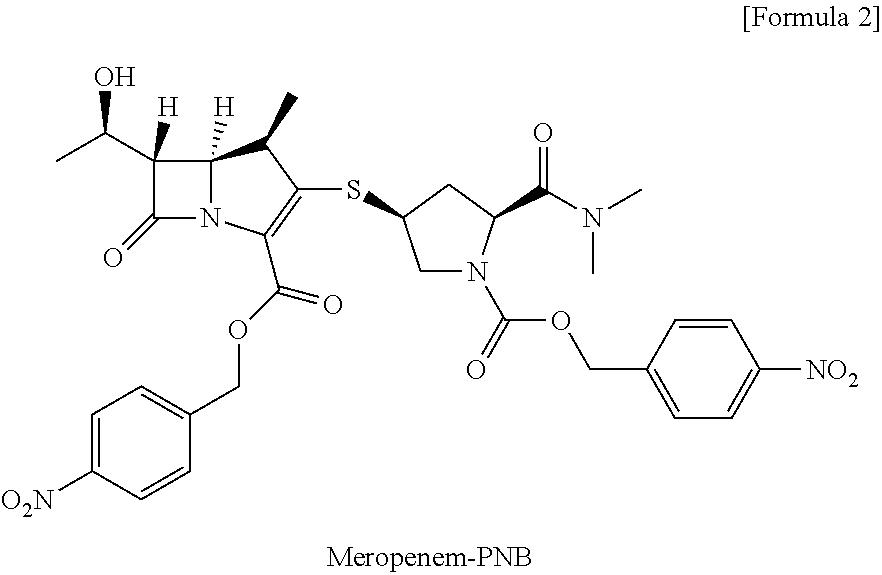
- the procedure for preparing meropenem trihydrate from meropenem-PNB of formula (2) is a deprotection procedure of p-nitrobenzyl group which is a protection group.
- the reaction is conducted in a mixture solvent of an organic solvent capable of dissolving meropenem-PNB and an aqueous solution of phosphate, at 20 to 50° C. for 0.5 to 5 hours, preferably 1 to 1.5 hours.
- the organic solvent capable of dissolving meropenem-PNB is selected from tetrahydrofuran, acetonitrile, acetone, ethyl acetate, methylene chloride, chloroform and the like.
- an aqueous solution of phosphate at 0.5 to 1.6M, preferably 1.5M is added, the temperature is set to about 25° C., and zinc powder is added thereto slowly.
- the mixing ratio of organic solvent:aqueous solution of phosphate is 5:5 to 15:30, preferably 10:20 by volume per weight of meropenem-PNB.
- the phosphate may be selected from KH 2 PO 4 , K 2 HPO 4 , H 3 PO 4 , NaH 2 PO 4 and Na 2 HPO 4 , and KH 2 PO 4 is preferably used. It is preferable that its concentration becomes a nearly saturated state as the meropenem-PNB solution is added. If the concentration of phosphate is low, the reaction ends with an intermediate in which only the nitro part of protection group is reduced to amine, and thus the target compound cannot be obtained with the maximum yield. If a phosphate buffer solution is used, as compared with the use of phosphate alone, a large amount of impurities is generated due to the considerable decomposition of the target compound, causing the yield and content to decrease.
- Zinc powder is added in an amount of 4 to 8 times greater than meropenem-PNB on a weight basis. If zinc powder is added portionwise in order to avoid the decomposition of the target compound due to drastic heat generation, the phenomenon of drastic heat generation can be minimized. If the temperature for deprotection reaction is lower than 20° C., the reaction proceeds up to the primarily reduced amine intermediate only, resulting in incompletion of reaction. If the temperature is higher than 50° C., the reaction rate and completion degree increase but the target compound is decomposed in a large amount, resulting in a decrease in yield and purity.
- filtration is conducted to remove zinc powder.
- the zinc powder remaining on the filter is washed with a mixture liquid of water and a polar organic solvent such as tetrahydrofuran, alcohol, etc. to completely isolate the target compound adsorbed to zinc powder in a large amount.
- the filtrate is then phase-separated, and the aqueous layer is isolated and washed several times with a non-polar organic solvent, e.g., dichloromethane, chloroform, tetrachloromethane, etc.—in order to remove the organic solvent used as a reaction solvent or washing liquid.
- a non-polar organic solvent e.g., dichloromethane, chloroform, tetrachloromethane, etc.
- the target compound is decomposed gradually in the weak acidic reaction solution, which causes a loss in yield and content.
- hydrophilic organic solvent remains in the aqueous layer during the extraction or concentration procedure, it prevents the target compound from adsorbing to the adsorption resin and lets the target compound elute directly, which causes a loss in yield. Accordingly, its removal is preferable.
- the phosphate is removed from the resultant mixture obtained as above.
- the first removal of phosphate can be achieved through crystallization. That is, a large amount of phosphate is first removed in crystal form by adding a solvent which dissolves meropenem but not phosphate—for example, a water-miscible solvent such as methanol, ethanol, isopropyl alcohol, tetrahydrofuran, acetone, acetonitrile, etc., preferably methanol.
- a solvent which dissolves meropenem but not phosphate for example, a water-miscible solvent such as methanol, ethanol, isopropyl alcohol, tetrahydrofuran, acetone, acetonitrile, etc., preferably methanol.
- the aqueous layer containing the target compound is cooled and pre-cooled methanol is added to remove phosphate first.
- Methanol is added in a total volume of 10 to 80 times greater than meropenem-PNB.
- the addition is preferably done at 20° C. or less.
- phosphate crystals are grown and filtered to be removed.
- the product after the first removal of phosphate by crystallization and filtration as explained above may be passed through a cationic resin to further remove phosphate.
- the aqueous layer containing the target compound is cooled and then passed through a pre-rinsed and pre-cooled cationic resin such as BCMB50, BC108, NM60G, Lewit up 1213, Lewit up 1243, IRC86RF, S8227, etc., preferably BCMB50, to further remove phosphate. That is, the aqueous layer containing the target compound is passed through a cationic resin, by which phosphate is further removed and the target is purified.
- a pre-rinsed and pre-cooled cationic resin such as BCMB50, BC108, NM60G, Lewit up 1213, Lewit up 1243, IRC86RF, S8227, etc.
- the pH of the target compound passing through the resin is raised, and the target compound which passed through completely is adjusted to a pH of 5.0 to 7.0, and a buffer solution of 1N-methylmorpholine/acetic acid (pH 6.5 to 7.0) is optionally added and then concentrated to a volume of 3 to 20 times greater than the weight of meropenem-PNB.
- the buffer solution of 1N-methylmorpholine/acetic acid plays a role of suppressing the decomposition of the target compound during the concentration, thereby increasing the final yield another 5% or higher.
- the concentration should be done at low temperature in order to minimize the decomposition by heat, and for this the concentration is carried out by using a reverse-osmosis apparatus at low temperature in a short time.
- the first removal of phosphate may be conducted by using adsorption resin.
- the aqueous layer containing the target compound is cooled and phosphate is then removed by using a pre-cooled adsorption resin such as SP-207, Amberlite®, XAD4, XAD7, Diaion HP-20, HP-40, etc., preferably SP-207. That is, the aqueous layer containing the target compound is adsorbed to the resin, and water is added thereto in an amount 50 to 100 times greater than the aqueous layer to remove the phosphate used for reaction and highly polar impurities.
- a pre-cooled adsorption resin such as SP-207, Amberlite®, XAD4, XAD7, Diaion HP-20, HP-40, etc.
- the target compound is eluted by development with a polar solvent such as methanol, ethanol, isopropyl alcohol, tetrahydrofuran, acetone, acetonitrile, etc., preferably methanol or ethanol, mixed with water at 20 to 80% concentration.
- a polar solvent such as methanol, ethanol, isopropyl alcohol, tetrahydrofuran, acetone, acetonitrile, etc., preferably methanol or ethanol, mixed with water at 20 to 80% concentration.
- the developing solution to be used should be cooled as much as possible in order to minimize the decomposition of the target compound.
- the fractions of the elutant containing the target compound are collected, and a buffer solution of 1N-methylmorpholine/acetic acid (pH 6.5 to 7.0) is optionally added and then concentrated to a volume of 3 to 20 times greater than the weight of meropenem-PNB.
- the buffer solution of 1N-methylmorpholine/acetic acid plays a role in suppressing the decomposition of the target compound during the concentration, thereby increasing the final yield another 5% or higher.
- the concentration should be done at low temperature in order to minimize the decomposition by heat, and for this the concentration is carried out by using a reverse-osmosis apparatus at low temperature in a short time.
- a meropenem-undissolving solvent such as acetone, isopropyl alcohol and tetrahydrofuran, preferably acetone
- acetone is added thereto in a volume 10 to 110 times greater than the weight of meropenem-PNB, and the crystal is generated at room temperature for 1 hour.
- the crystal is grown by cooling to 0 to 5° C. and stirring for 2 hours, filtered, washed with acetone, and dried in vacuum at 25° C.
- the target compound synthesized according to the present process was a material equivalent to the USP standard material of meropenem.
- the resultant liquid after the first removal of phosphate can be concentrated to a volume of 3 to 20 times greater than the weight of meropenem-PNB, without passing it through resin.
- the buffer solution of methylmorpholine/acetic acid as explained above can be used.
- the concentration also should be done at low temperature in order to minimize the decomposition by heat, and for this the concentration is carried out by using a reverse-osmosis apparatus at low temperature in a short time.
- this concentrated liquid also contains a meropenem-dissolving solvent already, a meropenem-undissolving solvent such as acetone, isopropyl alcohol and tetrahydrofuran, preferably acetone, is added thereto in a volume 10 to 110 times greater than the weight of meropenem-PNB, and the crystal is generated at room temperature for 1 hour.
- a meropenem-undissolving solvent such as acetone, isopropyl alcohol and tetrahydrofuran, preferably acetone
- the first crystal of meropenem containing phosphate is slurried in a pre-cooled meropenem-low-dissolving solvent such as water to further remove the remaining phosphate.
- a pre-cooled meropenem-low-dissolving solvent such as water
- the crystal is washed with a cooled mixture solution of isopropanol:water in a volume ratio of 1:2 to 3:1, and the obtained second crystal of meropenem is dried in vacuum at 25° C.
- Such a further removal of phosphate through the second crystallization of meropenem can be applied to the crystal of meropenem obtained from the concentrated liquid of the elutant of a cationic resin or adsorption resin as explained above.
- Meropenem-PNB of formula (2) used in the present invention can be obtained by a coupling-reaction of MAP of the following formula (3) [(4R,5R,6S)-4-nitrobenzyl 3-(diphenoxyphosphoryloxy)-6-((R)-1-hydroxyethyl)-4-methyl-7-oxo-1-azabicyclo[3.2.0]hept-2-ene-2-carboxylate] and the side chain compound of the following formula (4) [(2S,4S)-4-nitrobenzyl 2-(dimethylcarbamoyl)-4-mercaptopyrrolidin-1-carboxylate].
- the deprotection step can be conducted after the crystallization of meropenem-PNB after the coupling step, or without the crystallization it can be conducted in situ in the extraction solvent without isolation and purification.
- Such an in situ procedure is possible because after the coupling procedure, meropenem is dissolved in the aqueous layer and byproducts are dissolved in the organic layer, and thus primary purification is possible only by the extraction procedure. If the deprotection step proceeds in situ, the production time is reduced and the yield is improved, and thus the productivity can be greatly improved.
- the coupling-reaction of MAP of formula (3) and the side chain compound of formula (4) can be conducted by using a highly polar organic solvent such as dimethylacetamide, dimethylformamide, etc. as the reaction solvent in the presence of a base such as diisopropylethylamine.
- the reaction is conducted for 1 to 5 hours at ⁇ 20° C. to room temperature.
- the reaction solution is extracted with an organic solvent, washed with 0.1 to 6N-HCl, saturated salt water, and treated with anhydrous magnesium sulfate and activated carbon.
- the crystallization is directly conducted in ethyl acetate to synthesize meropenem-PNB.
- the in situ extraction liquid state can be used in the subsequent deprotection reaction.
- the method according to the present invention has many advantages as follows:
- the yield loss can be minimized by conducting the deprotection reaction in situ after preparing meropenem-PNB without isolation and purification.
- MAP 20 g was dissolved in 80 mL of dimethylacetamide, and 12.5 g of the side chain compound was added thereto. After cooling to 0 to 5° C. 6.5 mL of diisopropylethylamine was added dropwise. After stirring at 0 to 5° C. for 5 hours, 120 mL of ethyl acetate and 200 mL of water were added, and the reaction mixture was stirred and then phase-separated. 80 mL of 0.5N HCl was added to the ethyl acetate layer to remove the remaining base, and the resultant mixture was washed with 200 mL of saturated salt water. The remaining water and color were removed by using anhydrous magnesium sulfate and activated carbon.
- the aqueous layer was cooled and developed in a column filled with adsorption resin SP-207 for adsorption.
- the resin column was washed with 2 L of water to remove potassium phosphate salt used in the reaction and impurities, and developed with 2 L of 60% methanol to elute meropenem completely.
- the fractions containing meropenem were collected and a buffer solution of N-methylmorpholine/acetic acid (pH 6.5) was added thereto, and concentration was conducted to a volume 10 times greater than the weight of meropenem-PNB. 1100 mL of acetone was added to generate crystal and stirred at room temperature for 1 hour. After filtration and drying, 9.78 g of meropenem trihydrate was obtained.
- the aqueous layer was separated, washed with 200 mL of methylene chloride and developed in a column filled with adsorption resin SP-207 for adsorption.
- the resin column was washed with 2 L of water to remove potassium phosphate monobasic used in the reaction and impurities, and developed with 2 L of 60% methanol to elute meropenem completely.
- the fractions containing meropenem were collected, a buffer solution of N-methylmorpholine/acetic acid (pH 6.5) was added thereto, and concentration was conducted to a volume 10 times greater than the weight of meropenem-PNB. 1100 mL of acetone was added to generate crystal and stirred at room temperature for 1 hour. After filtration and drying, 9.66 g of meropenem trihydrate was obtained.
- the aqueous layer was separated, washed with 200 mL of methylene chloride and developed in a column filled with adsorption resin SP-207 for adsorption.
- the resin column was washed with 2 L of water to remove potassium phosphate monobasic used in the reaction and impurities, and developed with 2 L of 60% methanol to elute meropenem completely.
- the fractions containing meropenem were collected, a buffer solution of N-methylmorpholine/acetic acid (pH 6.5) was added thereto, and concentration was conducted to a volume 10 times greater than the weight of meropenem-PNB. 1100 mL of acetone was added to generate crystal and stirred at room temperature for 1 hour. After filtration and drying, 9.84 g of meropenem trihydrate was obtained.
- MAP 20 g was dissolved in 80 mL of dimethylacetamide and 12.5 g of the side chain compound was added thereto. After cooling to 0 to 5° C., 6.5 mL of diisopropylethylamine was added dropwise. After stirring for 5 hours, 120 mL of ethyl acetate and 200 mL of water were added and the reaction mixture was stirred and then phase-separated. 80 mL of 0.5N HCl was added to the ethyl acetate layer to remove the remaining base, and the resultant mixture was washed with 200 mL of saturated salt water. The remaining water and color were removed by using anhydrous magnesium sulfate and activated carbon.
- the next step was carried out directly in the state of ethyl acetate solution.
- 60 g of potassium phosphate monobasic (KH 2 PO 4 ) dissolved in 400 mL of water was added to the ethyl acetate solution and heated to 30° C. or higher.
- 80 g of zinc powder was added thereto and stirred between 25 and 35° C. for 1 hour.
- zinc powder was filtered and the filtrate was washed with a mixture solution of tetrahydrofuran/water.
- the aqueous layer was separated, washed 4 times with 100 mL of methylene chloride and developed in a column filled with adsorption resin SP-207 for adsorption.
- the resin column was washed with 2 L of water to remove potassium phosphate monobasic used in the reaction and impurities, and developed with 2 L of 60% methanol to elute meropenem completely.
- the fractions containing meropenem were collected, a buffer solution of N-methylmorpholine/acetic acid (pH 6.5) was added thereto, and concentration was conducted to a volume 10 times greater than the weight of meropenem-PNB. 1100 mL of acetone was added to generate crystal and stirred at room temperature for 1 hour. After filtration and drying, 10.30 g of meropenem trihydrate was obtained.
- the aqueous layer was cooled and developed in a column filled with adsorption resin SP-207 for adsorption.
- the resin column was washed with 2 L of water to remove sodium phosphate monobasic used in the reaction and impurities, and developed with 2 L of 60% methanol to elute meropenem completely.
- the fractions containing meropenem were collected and a buffer solution of N-methylmorpholine/acetic acid (pH 6.5) was added thereto, and concentration was conducted to a volume 10 times greater than the weight of meropenem-PNB. 1100 mL of acetone was added to generate crystal and stirred at room temperature for 1 hour. After filtration and drying, 8.53 g of meropenem trihydrate was obtained.
- the target compound synthesized according to the present Example was a material equivalent to the USP standard material of meropenem.
- the target compound synthesized according to the present Example was a material equivalent to the USP standard material of meropenem.
Landscapes
- Chemical & Material Sciences (AREA)
- Organic Chemistry (AREA)
- Health & Medical Sciences (AREA)
- Life Sciences & Earth Sciences (AREA)
- Molecular Biology (AREA)
- Nitrogen Condensed Heterocyclic Rings (AREA)
- Pharmaceuticals Containing Other Organic And Inorganic Compounds (AREA)
Abstract
Description


Claims (17)


Applications Claiming Priority (3)
| Application Number | Priority Date | Filing Date | Title |
|---|---|---|---|
| KR10-2009-0021622 | 2009-03-13 | ||
| KR20090021622 | 2009-03-13 | ||
| PCT/KR2010/001516 WO2010104336A2 (en) | 2009-03-13 | 2010-03-11 | Improved method for preparing meropenem using zinc powder |
Publications (2)
| Publication Number | Publication Date |
|---|---|
| US20120065392A1 US20120065392A1 (en) | 2012-03-15 |
| US9233963B2 true US9233963B2 (en) | 2016-01-12 |
Family
ID=42728952
Family Applications (1)
| Application Number | Title | Priority Date | Filing Date |
|---|---|---|---|
| US13/256,178 Expired - Fee Related US9233963B2 (en) | 2009-03-13 | 2010-03-11 | Method for preparing meropenem using zinc powder |
Country Status (10)
| Country | Link |
|---|---|
| US (1) | US9233963B2 (en) |
| EP (1) | EP2407468B1 (en) |
| JP (1) | JP5656881B2 (en) |
| KR (1) | KR101491871B1 (en) |
| CN (1) | CN102348710B (en) |
| BR (1) | BRPI1009816A2 (en) |
| ES (1) | ES2477290T3 (en) |
| MX (1) | MX2011009532A (en) |
| RU (1) | RU2490270C2 (en) |
| WO (1) | WO2010104336A2 (en) |
Families Citing this family (9)
| Publication number | Priority date | Publication date | Assignee | Title |
|---|---|---|---|---|
| US8729260B2 (en) * | 2010-05-19 | 2014-05-20 | Savior Lifetec Corporation | Process for the preparation of carbapenem using cabapenem intermediates and recovery of cabapenem |
| CN102532140B (en) * | 2010-12-21 | 2015-03-11 | 北大方正集团有限公司 | Method for preparing meropenem trihydrate |
| KR101573049B1 (en) * | 2012-12-04 | 2015-12-02 | 주식회사 대웅제약 | Crystalline form doripenem monohydrate and preparation method thereof |
| WO2014104488A1 (en) * | 2012-12-27 | 2014-07-03 | 제이더블유중외제약 주식회사 | Method for preparing carbapenem antibiotics |
| KR101331762B1 (en) * | 2012-12-28 | 2013-11-20 | 주식회사 대웅제약 | Process for preparing meropenem.trihydrate |
| KR102144777B1 (en) | 2013-06-19 | 2020-08-18 | 제이더블유중외제약 주식회사 | A process for the preparation of crystalline Meropenem trihydrate |
| CN106699760B (en) * | 2016-12-30 | 2019-01-18 | 淄博鑫泉医药技术服务有限公司 | The synthetic method of Meropenem trihydrate |
| CN108191869A (en) * | 2018-01-22 | 2018-06-22 | 重庆天地药业有限责任公司 | The purification process of Meropenem |
| CN111992205B (en) * | 2020-09-07 | 2023-06-16 | 西安凯立新材料股份有限公司 | Method for preparing catalyst for meropenem by one-pot method |
Citations (7)
| Publication number | Priority date | Publication date | Assignee | Title |
|---|---|---|---|---|
| EP0256377A1 (en) | 1986-07-30 | 1988-02-24 | Sumitomo Pharmaceuticals Company, Limited | Carbapenem compound in crystalline form, and its production and use |
| JPH02714A (en) | 1987-12-24 | 1990-01-05 | Lederle Japan Ltd | Method for eliminating protecting group |
| JPH07258258A (en) | 1994-03-15 | 1995-10-09 | Yamanouchi Pharmaceut Co Ltd | Carbapenem derivative |
| KR20060020081A (en) | 2004-08-31 | 2006-03-06 | 한국화학연구원 | 2-arylmethylazetidine carbapenem derivatives and preparation method thereof |
| WO2006035300A2 (en) | 2004-09-30 | 2006-04-06 | Ranbaxy Laboratories Limited | A process for the preparation of meropenem |
| KR20070082294A (en) | 2006-02-16 | 2007-08-21 | 문순구 | Method for preparing carbapenem compound |
| WO2007111328A1 (en) | 2006-03-28 | 2007-10-04 | Kaneka Corporation | Improved process for producing carbapenem compound |
Family Cites Families (5)
| Publication number | Priority date | Publication date | Assignee | Title |
|---|---|---|---|---|
| CA1283906C (en) | 1983-05-09 | 1991-05-07 | Makoto Sunagawa | .beta.-LACTAM COMPOUNDS AND PRODUCTION THEREOF |
| SU1577699A3 (en) * | 1985-04-29 | 1990-07-07 | Бристоль-Мейерз Компани (Фирма) | Method of obtaining derivatives of carbapenem |
| KR0136570B1 (en) | 1992-12-07 | 1998-04-25 | 채영복 | Method for preparing meropenem compound |
| KR100345468B1 (en) * | 2000-07-10 | 2002-07-26 | 한국과학기술연구원 | Novel 1β- methylcarbapenem derivatives and process of preparation thereof |
| BR0209970A (en) * | 2001-05-21 | 2004-04-06 | Kyoto Pharma Ind | Carbapenem Compound |
-
2010
- 2010-03-11 US US13/256,178 patent/US9233963B2/en not_active Expired - Fee Related
- 2010-03-11 CN CN201080011897.8A patent/CN102348710B/en not_active Expired - Fee Related
- 2010-03-11 JP JP2011553952A patent/JP5656881B2/en not_active Expired - Fee Related
- 2010-03-11 RU RU2011141429/04A patent/RU2490270C2/en not_active IP Right Cessation
- 2010-03-11 EP EP10751027.3A patent/EP2407468B1/en not_active Not-in-force
- 2010-03-11 ES ES10751027.3T patent/ES2477290T3/en active Active
- 2010-03-11 BR BRPI1009816-0A patent/BRPI1009816A2/en not_active Application Discontinuation
- 2010-03-11 WO PCT/KR2010/001516 patent/WO2010104336A2/en not_active Ceased
- 2010-03-11 MX MX2011009532A patent/MX2011009532A/en active IP Right Grant
- 2010-03-12 KR KR20100022529A patent/KR101491871B1/en not_active Expired - Fee Related
Patent Citations (9)
| Publication number | Priority date | Publication date | Assignee | Title |
|---|---|---|---|---|
| EP0256377A1 (en) | 1986-07-30 | 1988-02-24 | Sumitomo Pharmaceuticals Company, Limited | Carbapenem compound in crystalline form, and its production and use |
| JPH02714A (en) | 1987-12-24 | 1990-01-05 | Lederle Japan Ltd | Method for eliminating protecting group |
| JP2654076B2 (en) | 1987-12-24 | 1997-09-17 | 日本レダリー株式会社 | Method for removing protecting group |
| JPH07258258A (en) | 1994-03-15 | 1995-10-09 | Yamanouchi Pharmaceut Co Ltd | Carbapenem derivative |
| KR20060020081A (en) | 2004-08-31 | 2006-03-06 | 한국화학연구원 | 2-arylmethylazetidine carbapenem derivatives and preparation method thereof |
| WO2006035300A2 (en) | 2004-09-30 | 2006-04-06 | Ranbaxy Laboratories Limited | A process for the preparation of meropenem |
| KR20070082294A (en) | 2006-02-16 | 2007-08-21 | 문순구 | Method for preparing carbapenem compound |
| WO2007111328A1 (en) | 2006-03-28 | 2007-10-04 | Kaneka Corporation | Improved process for producing carbapenem compound |
| US20100240886A1 (en) | 2006-03-28 | 2010-09-23 | Kaneka Corporation | Process for producing carbapenem compound |
Non-Patent Citations (8)
| Title |
|---|
| Dowex. The Dow Chemical Company. <http://www.dow.com/products/market/healthcare-and-medical/product-line/amberlite-and-dowex-bioprocessing-resins-and-adsorbents/product/dowex-50wx4/> (1995-2014). * |
| Extended European Search Report, EP 10751027.3, Mar. 8, 2012. |
| Kumagai, T. et al, "Mild and chemoselective cleavage of p-Nitrobenzyl Esters and p-Nitrobenzyl amines with zinc dust", Heterocycles, 1993, 36(8), 1729-1734. |
| Kumagai, Toshio. Heterocycles 1993, 36(8). * |
| Nagao et al. "Beta-Lactams. 3. Asymmetric Total Synthesis of New No-natural 1 Betamethylcarbapenems Exhibiting Strong Antimicrobial Activities and Stability Against Human Renal Dehydropeptidase-I."Joumal of Organic Chemistry, ACS, vol. 57, No. 15, Jan. 1, 1992, p. 4243-4249. |
| Nagao, et a l., J. Org. Chern. vol. 57,4243-4249 (1992). |
| Reichardt, Christian. Solvents and Solvent Effects in Organic Chemistry, 3rd Ed., 2004 471-507. * |
| Sigma-Aldrich. Biological Buffers ,<http://www.sigmaaldrich.com/life-science/core-bioreagents/biological-buffers/learning-center/buffer-reference-center.html>, data originally published in 1986. * |
Also Published As
| Publication number | Publication date |
|---|---|
| RU2490270C2 (en) | 2013-08-20 |
| JP5656881B2 (en) | 2015-01-21 |
| BRPI1009816A2 (en) | 2015-08-25 |
| KR20100103427A (en) | 2010-09-27 |
| EP2407468B1 (en) | 2014-04-16 |
| WO2010104336A3 (en) | 2010-12-23 |
| US20120065392A1 (en) | 2012-03-15 |
| CN102348710B (en) | 2014-12-17 |
| EP2407468A4 (en) | 2012-09-05 |
| KR101491871B1 (en) | 2015-02-12 |
| WO2010104336A2 (en) | 2010-09-16 |
| MX2011009532A (en) | 2011-10-24 |
| EP2407468A2 (en) | 2012-01-18 |
| JP2012520293A (en) | 2012-09-06 |
| CN102348710A (en) | 2012-02-08 |
| ES2477290T3 (en) | 2014-07-16 |
| RU2011141429A (en) | 2013-04-20 |
Similar Documents
| Publication | Publication Date | Title |
|---|---|---|
| EP2407468B1 (en) | Improved method for preparing meropenem using zinc powder | |
| CA2740508C (en) | Improved process for the preparation of carbapenem using carbapenem intermediates and recovery of carbapenem | |
| US20120095210A1 (en) | Process for the preparation of beta-lactam antibiotic | |
| KR20090007375A (en) | Improved Method of Making Carbapenem Compounds | |
| EP2401278A1 (en) | An improved process for the preparation of carbapenem antibiotic | |
| US6642377B1 (en) | Process for the preparation of basic antibiotic-inorganic acid addition salts and intermediate oxalates | |
| US8293924B2 (en) | Process for the preparation of carbapenem antibiotic | |
| JP4500814B2 (en) | A novel process for producing imipenem | |
| KR101142757B1 (en) | Process for preparing meropenem trihydrate | |
| CA2596951C (en) | Process for production of carbapenem derivative and crystalline intermediate therefor | |
| KR101573049B1 (en) | Crystalline form doripenem monohydrate and preparation method thereof | |
| WO2014057079A1 (en) | Preparation of ertapenem intermediates | |
| KR100781821B1 (en) | Method for preparing carbapenem compound | |
| KR101050976B1 (en) | Acid addition salts of synthetic intermediates of carbapenem antibiotics and preparation methods thereof | |
| HMe | 2-1. Practical Large-scale Synthesis of Doripenem Hydrate: a Novel 1β-Methylcarbapenem Antibiotic |
Legal Events
| Date | Code | Title | Description |
|---|---|---|---|
| AS | Assignment |
Owner name: DAEWOONG BIO, INC., KOREA, DEMOCRATIC PEOPLE'S REP Free format text: ASSIGNMENT OF ASSIGNORS INTEREST;ASSIGNORS:SONG, YOON SEOK;PARK, SUNG WOO;YOON, YEON JUNG;AND OTHERS;REEL/FRAME:027026/0964 Effective date: 20110726 Owner name: DAEWOONG PHARMACEUTICAL CO., LTD., KOREA, REPUBLIC Free format text: ASSIGNMENT OF ASSIGNORS INTEREST;ASSIGNORS:SONG, YOON SEOK;PARK, SUNG WOO;YOON, YEON JUNG;AND OTHERS;REEL/FRAME:027026/0964 Effective date: 20110726 |
|
| AS | Assignment |
Owner name: DAEWOONG BIO, INC., KOREA, REPUBLIC OF Free format text: ASSIGNMENT OF ASSIGNORS INTEREST;ASSIGNORS:SONG, YOON SEOK;PARK, SUNG WOO;YOON, YEON JUNG;AND OTHERS;REEL/FRAME:027030/0503 Effective date: 20110726 Owner name: DAEWOONG PHARMACEUTICAL CO., LTD., KOREA, DEMOCRAT Free format text: ASSIGNMENT OF ASSIGNORS INTEREST;ASSIGNORS:SONG, YOON SEOK;PARK, SUNG WOO;YOON, YEON JUNG;AND OTHERS;REEL/FRAME:027030/0503 Effective date: 20110726 |
|
| ZAAA | Notice of allowance and fees due |
Free format text: ORIGINAL CODE: NOA |
|
| ZAAB | Notice of allowance mailed |
Free format text: ORIGINAL CODE: MN/=. |
|
| FEPP | Fee payment procedure |
Free format text: PAYOR NUMBER ASSIGNED (ORIGINAL EVENT CODE: ASPN); ENTITY STATUS OF PATENT OWNER: LARGE ENTITY |
|
| STCF | Information on status: patent grant |
Free format text: PATENTED CASE |
|
| MAFP | Maintenance fee payment |
Free format text: PAYMENT OF MAINTENANCE FEE, 4TH YEAR, LARGE ENTITY (ORIGINAL EVENT CODE: M1551); ENTITY STATUS OF PATENT OWNER: LARGE ENTITY Year of fee payment: 4 |
|
| FEPP | Fee payment procedure |
Free format text: MAINTENANCE FEE REMINDER MAILED (ORIGINAL EVENT CODE: REM.); ENTITY STATUS OF PATENT OWNER: LARGE ENTITY |
|
| LAPS | Lapse for failure to pay maintenance fees |
Free format text: PATENT EXPIRED FOR FAILURE TO PAY MAINTENANCE FEES (ORIGINAL EVENT CODE: EXP.); ENTITY STATUS OF PATENT OWNER: LARGE ENTITY |
|
| STCH | Information on status: patent discontinuation |
Free format text: PATENT EXPIRED DUE TO NONPAYMENT OF MAINTENANCE FEES UNDER 37 CFR 1.362 |
|
| FP | Lapsed due to failure to pay maintenance fee |
Effective date: 20240112 |