US9220787B2 - Vitamin E conjugates, and their uses as antioxidants and prodrug delivery vehicles - Google Patents
Vitamin E conjugates, and their uses as antioxidants and prodrug delivery vehicles Download PDFInfo
- Publication number
- US9220787B2 US9220787B2 US13/698,334 US201113698334A US9220787B2 US 9220787 B2 US9220787 B2 US 9220787B2 US 201113698334 A US201113698334 A US 201113698334A US 9220787 B2 US9220787 B2 US 9220787B2
- Authority
- US
- United States
- Prior art keywords
- antioxidant
- vecar
- tocopherol
- disease
- carnosine
- Prior art date
- Legal status (The legal status is an assumption and is not a legal conclusion. Google has not performed a legal analysis and makes no representation as to the accuracy of the status listed.)
- Active
Links
- 0 [1*][C@@H](CCC[C@]1(C)CCC2=C(O1)C(C)=C(C)C(O)=C2C)C([2*])=O Chemical compound [1*][C@@H](CCC[C@]1(C)CCC2=C(O1)C(C)=C(C)C(O)=C2C)C([2*])=O 0.000 description 7
- KJCLHZDQQHMUBU-AALRHGRASA-N CC1=C(O)C(C)=C2CC[C@@](C)(CCCCC(=O)NCCC(=O)NC(CC3=CCC=N3)C(=O)O)OC2=C1C Chemical compound CC1=C(O)C(C)=C2CC[C@@](C)(CCCCC(=O)NCCC(=O)NC(CC3=CCC=N3)C(=O)O)OC2=C1C KJCLHZDQQHMUBU-AALRHGRASA-N 0.000 description 2
- XCOGEVMRUMECCB-PIHDKGLVSA-N C.C.COC(=O)[C@]1(C)CCC2=C(C)C(O[Si](C)(C)C(C)(C)C)=C(C)C(C)=C2O1.[H]C(=O)[C@]1(C)CCC2=C(C)C(O[Si](C)(C)C(C)(C)C)=C(C)C(C)=C2O1 Chemical compound C.C.COC(=O)[C@]1(C)CCC2=C(C)C(O[Si](C)(C)C(C)(C)C)=C(C)C(C)=C2O1.[H]C(=O)[C@]1(C)CCC2=C(C)C(O[Si](C)(C)C(C)(C)C)=C(C)C(C)=C2O1 XCOGEVMRUMECCB-PIHDKGLVSA-N 0.000 description 1
- IQYKIVFCSWXEKQ-XHYQIVGOSA-O C.CC1=C(C[Si](C)(C)C(C)(C)C)C(C)=C2CC[C@@](C)(/C=C/CCCCCCCCCCC(=O)O)OC2=C1C.O=C(O)CCCCCCCCCCC[P+](C1=CC=CC=C1)(C1=CC=CC=C1)C1=CC=CC=C1.[2H]CS.[Br-].[H]C(=O)[C@]1(C)CCC2=C(C)C(O[Si](C)(C)C(C)(C)C)=C(C)C(C)=C2O1.[LiH] Chemical compound C.CC1=C(C[Si](C)(C)C(C)(C)C)C(C)=C2CC[C@@](C)(/C=C/CCCCCCCCCCC(=O)O)OC2=C1C.O=C(O)CCCCCCCCCCC[P+](C1=CC=CC=C1)(C1=CC=CC=C1)C1=CC=CC=C1.[2H]CS.[Br-].[H]C(=O)[C@]1(C)CCC2=C(C)C(O[Si](C)(C)C(C)(C)C)=C(C)C(C)=C2O1.[LiH] IQYKIVFCSWXEKQ-XHYQIVGOSA-O 0.000 description 1
- YJQKTGAKMUJFMB-NJFGRRAESA-N C.CC1=C(O)C(C)=C2CC[C@@](C)(C(=O)O)OC2=C1C.COC(=O)[C@]1(C)CCC2=C(C)C(O)=C(C)C(C)=C2O1.O=S(Cl)Cl Chemical compound C.CC1=C(O)C(C)=C2CC[C@@](C)(C(=O)O)OC2=C1C.COC(=O)[C@]1(C)CCC2=C(C)C(O)=C(C)C(C)=C2O1.O=S(Cl)Cl YJQKTGAKMUJFMB-NJFGRRAESA-N 0.000 description 1
- IXCMUSCRFXCLCD-UHFFFAOYSA-N C.COC(=O)C(CC(=O)CCN)CC1=CNC=N1.NCCC(=O)CC(CC1=CNC=N1)C(=O)O.O=S(Cl)Cl Chemical compound C.COC(=O)C(CC(=O)CCN)CC1=CNC=N1.NCCC(=O)CC(CC1=CNC=N1)C(=O)O.O=S(Cl)Cl IXCMUSCRFXCLCD-UHFFFAOYSA-N 0.000 description 1
- KSUABGDTMFPQOR-PRZSPIBOSA-N C.COC(=O)[C@]1(C)CCC2=C(C)C(O)=C(C)C(C)=C2O1.COC(=O)[C@]1(C)CCC2=C(C)C(O[Si](C)(C)C(C)(C)C)=C(C)C(C)=C2O1.C[SiH](C)C(C)(C)C Chemical compound C.COC(=O)[C@]1(C)CCC2=C(C)C(O)=C(C)C(C)=C2O1.COC(=O)[C@]1(C)CCC2=C(C)C(O[Si](C)(C)C(C)(C)C)=C(C)C(C)=C2O1.C[SiH](C)C(C)(C)C KSUABGDTMFPQOR-PRZSPIBOSA-N 0.000 description 1
- NFABDMJLPPMGDV-UHFFFAOYSA-O C1=CC=C(P(C2=CC=CC=C2)C2=CC=CC=C2)C=C1.O=C(O)CCCCCCCCCCCBr.O=C(O)CCCCCCCCCCC[P+](C1=CC=CC=C1)(C1=CC=CC=C1)C1=CC=CC=C1.[Br-] Chemical compound C1=CC=C(P(C2=CC=CC=C2)C2=CC=CC=C2)C=C1.O=C(O)CCCCCCCCCCCBr.O=C(O)CCCCCCCCCCC[P+](C1=CC=CC=C1)(C1=CC=CC=C1)C1=CC=CC=C1.[Br-] NFABDMJLPPMGDV-UHFFFAOYSA-O 0.000 description 1
- GFBRPWPNTQRHOL-YKCNQNSSSA-O CC(C)(C)[S+](C)Oc(c(C)c1C)c(C)c(CC2)c1O[C@]2(C)/C=C/CCCCCCCCCCC(O)=O Chemical compound CC(C)(C)[S+](C)Oc(c(C)c1C)c(C)c(CC2)c1O[C@]2(C)/C=C/CCCCCCCCCCC(O)=O GFBRPWPNTQRHOL-YKCNQNSSSA-O 0.000 description 1
- KJUIWJYYTDZYNV-JGCGQSQUSA-O CC(C)(C)[SH+](C)(C)Oc(c(C)c1C)c(C)c2c1O[C@](C)(CCCCCCCCCCCCC(O)=O)CC2 Chemical compound CC(C)(C)[SH+](C)(C)Oc(c(C)c1C)c(C)c2c1O[C@](C)(CCCCCCCCCCCCC(O)=O)CC2 KJUIWJYYTDZYNV-JGCGQSQUSA-O 0.000 description 1
- INLNIZLMDMVJLE-FJXZMNFCSA-N CC(C)(C)[Si](C)(C)Oc(c(C)c1C)c(C)c2c1O[C@](C)(CCCCCCCCCCCCC(NCCC(NC(Cc1c[nH]cn1)C(OC)=O)=O)=O)CC2 Chemical compound CC(C)(C)[Si](C)(C)Oc(c(C)c1C)c(C)c2c1O[C@](C)(CCCCCCCCCCCCC(NCCC(NC(Cc1c[nH]cn1)C(OC)=O)=O)=O)CC2 INLNIZLMDMVJLE-FJXZMNFCSA-N 0.000 description 1
- ZXHNKWLAFHJWLC-HSXRMNBHSA-N CC1=C2CC[C@@](C)(/C=C/CCCCCCCCCCC(=O)O)OC2=C(C)C(C)=C1O[Si](C)(C)C(C)(C)C.CC1=C2CC[C@@](C)(CCCCCCCCCCCCC(=O)O)OC2=C(C)C(C)=C1O[Si](C)(C)C(C)(C)C Chemical compound CC1=C2CC[C@@](C)(/C=C/CCCCCCCCCCC(=O)O)OC2=C(C)C(C)=C1O[Si](C)(C)C(C)(C)C.CC1=C2CC[C@@](C)(CCCCCCCCCCCCC(=O)O)OC2=C(C)C(C)=C1O[Si](C)(C)C(C)(C)C ZXHNKWLAFHJWLC-HSXRMNBHSA-N 0.000 description 1
- FBISQILGFSJELN-VQAFSMOUSA-N CC1=C2CC[C@@](C)(CCCCCCCCCCCCC(=O)O)OC2=C(C)C(C)=C1O[Si](C)(C)C(C)(C)C.COC(=O)C(CC1=CNC=N1)NC(=O)CCN.COC(=O)C(CC1=CNC=N1)NC(=O)CCNC(=O)CCCCCCCCCCCC[C@]1(C)CCC2=C(C)C(O[Si](C)(C)C(C)(C)C)=C(C)C(C)=C2O1 Chemical compound CC1=C2CC[C@@](C)(CCCCCCCCCCCCC(=O)O)OC2=C(C)C(C)=C1O[Si](C)(C)C(C)(C)C.COC(=O)C(CC1=CNC=N1)NC(=O)CCN.COC(=O)C(CC1=CNC=N1)NC(=O)CCNC(=O)CCCCCCCCCCCC[C@]1(C)CCC2=C(C)C(O[Si](C)(C)C(C)(C)C)=C(C)C(C)=C2O1 FBISQILGFSJELN-VQAFSMOUSA-N 0.000 description 1
- AXUSCUAPAFAHHN-RXXUUVBOSA-N C[C@@](CCCCCCCCCCCCC(NCCC(NC(Cc1c[nH]cn1)C(OC)=O)=O)=O)(CC1)Oc(c(C)c2C)c1c(C)c2O Chemical compound C[C@@](CCCCCCCCCCCCC(NCCC(NC(Cc1c[nH]cn1)C(OC)=O)=O)=O)(CC1)Oc(c(C)c2C)c1c(C)c2O AXUSCUAPAFAHHN-RXXUUVBOSA-N 0.000 description 1
Classifications
-
- A61K47/48107—
-
- A—HUMAN NECESSITIES
- A61—MEDICAL OR VETERINARY SCIENCE; HYGIENE
- A61K—PREPARATIONS FOR MEDICAL, DENTAL OR TOILETRY PURPOSES
- A61K47/00—Medicinal preparations characterised by the non-active ingredients used, e.g. carriers or inert additives; Targeting or modifying agents chemically bound to the active ingredient
- A61K47/50—Medicinal preparations characterised by the non-active ingredients used, e.g. carriers or inert additives; Targeting or modifying agents chemically bound to the active ingredient the non-active ingredient being chemically bound to the active ingredient, e.g. polymer-drug conjugates
- A61K47/51—Medicinal preparations characterised by the non-active ingredients used, e.g. carriers or inert additives; Targeting or modifying agents chemically bound to the active ingredient the non-active ingredient being chemically bound to the active ingredient, e.g. polymer-drug conjugates the non-active ingredient being a modifying agent
- A61K47/54—Medicinal preparations characterised by the non-active ingredients used, e.g. carriers or inert additives; Targeting or modifying agents chemically bound to the active ingredient the non-active ingredient being chemically bound to the active ingredient, e.g. polymer-drug conjugates the non-active ingredient being a modifying agent the modifying agent being an organic compound
- A61K47/55—Medicinal preparations characterised by the non-active ingredients used, e.g. carriers or inert additives; Targeting or modifying agents chemically bound to the active ingredient the non-active ingredient being chemically bound to the active ingredient, e.g. polymer-drug conjugates the non-active ingredient being a modifying agent the modifying agent being an organic compound the modifying agent being also a pharmacologically or therapeutically active agent, i.e. the entire conjugate being a codrug
- A61K47/551—Medicinal preparations characterised by the non-active ingredients used, e.g. carriers or inert additives; Targeting or modifying agents chemically bound to the active ingredient the non-active ingredient being chemically bound to the active ingredient, e.g. polymer-drug conjugates the non-active ingredient being a modifying agent the modifying agent being an organic compound the modifying agent being also a pharmacologically or therapeutically active agent, i.e. the entire conjugate being a codrug one of the codrug's components being a vitamin, e.g. niacinamide, vitamin B3, cobalamin, vitamin B12, folate, vitamin A or retinoic acid
-
- A—HUMAN NECESSITIES
- A61—MEDICAL OR VETERINARY SCIENCE; HYGIENE
- A61P—SPECIFIC THERAPEUTIC ACTIVITY OF CHEMICAL COMPOUNDS OR MEDICINAL PREPARATIONS
- A61P11/00—Drugs for disorders of the respiratory system
-
- A—HUMAN NECESSITIES
- A61—MEDICAL OR VETERINARY SCIENCE; HYGIENE
- A61P—SPECIFIC THERAPEUTIC ACTIVITY OF CHEMICAL COMPOUNDS OR MEDICINAL PREPARATIONS
- A61P25/00—Drugs for disorders of the nervous system
- A61P25/28—Drugs for disorders of the nervous system for treating neurodegenerative disorders of the central nervous system, e.g. nootropic agents, cognition enhancers, drugs for treating Alzheimer's disease or other forms of dementia
-
- A—HUMAN NECESSITIES
- A61—MEDICAL OR VETERINARY SCIENCE; HYGIENE
- A61P—SPECIFIC THERAPEUTIC ACTIVITY OF CHEMICAL COMPOUNDS OR MEDICINAL PREPARATIONS
- A61P35/00—Antineoplastic agents
-
- A—HUMAN NECESSITIES
- A61—MEDICAL OR VETERINARY SCIENCE; HYGIENE
- A61P—SPECIFIC THERAPEUTIC ACTIVITY OF CHEMICAL COMPOUNDS OR MEDICINAL PREPARATIONS
- A61P9/00—Drugs for disorders of the cardiovascular system
-
- C—CHEMISTRY; METALLURGY
- C07—ORGANIC CHEMISTRY
- C07D—HETEROCYCLIC COMPOUNDS
- C07D311/00—Heterocyclic compounds containing six-membered rings having one oxygen atom as the only hetero atom, condensed with other rings
- C07D311/02—Heterocyclic compounds containing six-membered rings having one oxygen atom as the only hetero atom, condensed with other rings ortho- or peri-condensed with carbocyclic rings or ring systems
- C07D311/04—Benzo[b]pyrans, not hydrogenated in the carbocyclic ring
- C07D311/58—Benzo[b]pyrans, not hydrogenated in the carbocyclic ring other than with oxygen or sulphur atoms in position 2 or 4
-
- C—CHEMISTRY; METALLURGY
- C07—ORGANIC CHEMISTRY
- C07D—HETEROCYCLIC COMPOUNDS
- C07D403/00—Heterocyclic compounds containing two or more hetero rings, having nitrogen atoms as the only ring hetero atoms, not provided for by group C07D401/00
- C07D403/02—Heterocyclic compounds containing two or more hetero rings, having nitrogen atoms as the only ring hetero atoms, not provided for by group C07D401/00 containing two hetero rings
- C07D403/12—Heterocyclic compounds containing two or more hetero rings, having nitrogen atoms as the only ring hetero atoms, not provided for by group C07D401/00 containing two hetero rings linked by a chain containing hetero atoms as chain links
-
- Y—GENERAL TAGGING OF NEW TECHNOLOGICAL DEVELOPMENTS; GENERAL TAGGING OF CROSS-SECTIONAL TECHNOLOGIES SPANNING OVER SEVERAL SECTIONS OF THE IPC; TECHNICAL SUBJECTS COVERED BY FORMER USPC CROSS-REFERENCE ART COLLECTIONS [XRACs] AND DIGESTS
- Y10—TECHNICAL SUBJECTS COVERED BY FORMER USPC
- Y10T—TECHNICAL SUBJECTS COVERED BY FORMER US CLASSIFICATION
- Y10T428/00—Stock material or miscellaneous articles
- Y10T428/29—Coated or structually defined flake, particle, cell, strand, strand portion, rod, filament, macroscopic fiber or mass thereof
- Y10T428/2982—Particulate matter [e.g., sphere, flake, etc.]
Definitions
- This invention pertains to conjugates of vitamin E, and their uses as antioxidants or as pro-drug delivery vehicles.
- Oxidative stress is linked with cardiovascular and other major diseases such as cancer, acute inflammation, Parkinson's, and Alzheimer's. In 2007, an estimated $430 billion was spent to treat 80 million people suffering from some type of cardiovascular disease.
- Antioxidant agents play a vital role in the defense against free radicals and oxidant molecules via radical scavenging, metal ion chelation, and co-antioxidant action.
- the balance between oxidative species and antioxidant systems defines the oxidative stress of a living system.
- the oxidative stress level determines when a biological system is at high risk for various diseases.
- Atherosclerosis in particular has been related to oxidative processes. High levels of oxidant molecules, or low levels of antioxidants are linked to high oxidative stress that can trigger atherosclerosis.
- the “oxidation theory” of atherosclerosis considers free radicals to be precursors in development of the disease.
- Vitamin E especially ⁇ -tocopherol, is a natural antioxidant present in the lipophilic phase of every cell. Among the lipophilic antioxidants, ⁇ -tocopherol is one of the most potent. Other important lipophilic antioxidants are coenzyme Q10 and the carotenoids.
- Low-density lipoprotein comprises a core of cholesterol and triglycerides, surrounded by a layer of fatty acids, cholesteryl esters, apolipoproteins, and phospholipids.
- the outer layer is more hydrophilic, while the core is more hydrophobic. Oxidation of LDLs has been associated with the development of atherosclerosis.
- the ox-LDL i.e. the oxidized form of LDL
- Lipophilic antioxidants inhibit oxidation of the lipid fraction of LDLs, but apolipoproteins are not protected from oxidation even in the presence of lipophilic antioxidants.
- Hydrophilic antioxidants can protect hydrophilic molecules such as proteins, DNA, and carbohydrates from oxidation, and they can also regulate some oxidative molecules for signaling purposes.
- hydrophilic antioxidants include vitamin C and carnosine. Others include uric acid, and certain flavonoids, micronutrients, peptides, and proteins.
- the dipeptide carnosine ( ⁇ -alanyl-L-histidine) is known to have antioxidant properties, and also to suppress protein glycation and crosslinking. Carnosine has also been suggested as an agent for controlling secondary problems in diabetes.
- antioxidants e.g., butylated hydroxytoluene (BHT), butylated hydroxyanisole (BHA), propyl gallate; and vitamin E derivatives, including TroloxTM, 3-oxa-chromanol derivatives, brominated alpha-tocopherol methanol-dimer, raxofelast, vitamin EC, and probucol.
- BHT butylated hydroxytoluene
- BHA butylated hydroxyanisole
- vitamin E derivatives including TroloxTM, 3-oxa-chromanol derivatives, brominated alpha-tocopherol methanol-dimer, raxofelast, vitamin EC, and probucol.
- Several synthetic antioxidant molecules reported in the literature use the OH group of ⁇ -tocopherol to attach other molecules to ⁇ -tocopherol, or to modify the chromanol ring. These prior modifications have, however, decreased the specificity of the ⁇ -TTP interaction for ⁇ -tocop
- ⁇ -tocopherol can act alternatively either as a pro-oxidant or as an anti-oxidant, and that this switch in behavior is induced by the level of oxidative stress.
- ⁇ -tocopherol acts as a pro-oxidant, promoting lipid peroxidation.
- ⁇ -tocopherol acts as an anti-oxidant.
- Co-antioxidants such as coenzyme Q-10 may play a role in promoting the anti-oxidant behavior of ⁇ -tocopherol.
- the pro-oxidant action of vitamin E has not yet been proven in mammals.
- Vitamin E is effective in protecting LDL from oxidation.
- clinical trials involving Vitamin E in patients with coronary artery disease or atherosclerosis have given conflicting results.
- Vitamin E is a lipophilic vitamin with both antioxidant properties and non-antioxidant activities.
- the Vitamin E family includes four tocopherols ( ⁇ , ⁇ , ⁇ , ⁇ ) and four tocotrienols ( ⁇ , ⁇ , ⁇ , ⁇ ), the difference being that the tocotrienols have unsaturated phytyl chains.
- the differences between the ⁇ , ⁇ , ⁇ , and ⁇ compounds lie in the number and positions of the methyl groups on the aromatic ring of the tocopherol or tocotrienol.
- vitamin E The main antioxidant functions of vitamin E are to trap peroxyl radicals, and to break chain reactions of lipid peroxidation. Vitamin E also quenches superoxide anions (O 2 . ⁇ ), singlet oxygen ( 1 O 2 ), and hydroxyl radicals (.OH); and vitamin E inhibits the reaction of nitric oxide (NO) with O 2 . ⁇ .
- the antioxidant activity of tocopherols is related to the methylation pattern and to the number of methyl groups on the phenolic ring in the order: ⁇ > ⁇ > ⁇ > ⁇ .
- Carnosine is a hydrophilic dipeptide ( ⁇ -alanyl-L-histidine) that is synthesized exclusively by mammals. It is found in high concentrations in muscle and brain tissue, both of which can experience high oxidative stress. Human skeletal muscle levels of carnosine range from 2 to 20 mM. In the brain, carnosine is nonuniformly distributed with higher levels (up to 5 mM) in the olfactory epithelium and the bulbs. Carnosine and its analogs homocarnosine and anserine are degraded by the enzyme carnosinase, which is actually a group of intra- and extracellular dipeptidases.
- the imidazole moiety of carnosine has been associated with the dipeptide's antioxidant properties. It has been suggested that the protons on the nitrogen ring and on the methylene carbon adjacent to the imidazole ring are required for antioxidant activity.
- Carnosine can protect proteins from oxidation. Carnosine may also have beneficial effects in diabetes, and in certain neurodegenerative diseases that are associated with high levels of zinc, such as Alzheimer's disease.
- Tatsunori et al. Japanese Patent Application Publication 2008019188A (English abstract, 2008) discloses a carnosine derivative and its use in medicines, skin cosmetics, and the like for treating or preventing diseases caused by damage due to active oxygen species, for preventing aging, and the like.
- vitamin E that are useful, for example, as antioxidants or as pro-drug delivery vehicles.
- the conjugates are amphiphilic, and tend to localize at the interface between water domains and lipid domains.
- Vitamin E is covalently conjugated with a hydrophilic antioxidant, for example carnosine, joined by a bio-stable linker.
- the resulting conjugates possess potent antioxidant properties, and can inhibit oxidation in polyunsaturated fatty acids (PUFAs) and LDL.
- PUFAs polyunsaturated fatty acids
- novel antioxidants which may be formed by covalently conjugating a hydrophobic antioxidant with a hydrophilic antioxidant, joined by a bio-stable linker.
- the hydrophobic component, the hydrophilic component, or both may be natural-occurring antioxidants.
- the novel structure provides better antioxidant performance in both the hydrophilic and hydrophobic regimes (e.g., in both the hydrophilic and the hydrophobic portions of LDL particles).
- the novel structure affords synergetic effects from antioxidant-coantioxidant interactions.
- An important aspect of the novel compounds is that they maintain the biotransport properties that are inherent to natural ⁇ -tocopherol.
- Hydrophilic molecules such as carnosine are not expected to enter into lipophilic pathways in living systems. However, the novel compounds can shuttle such hydrophilic, bioactive molecules into LDL particles, molecules that ordinarily would not be localized there.
- the hydrophilic bioactive molecule is tethered to an ⁇ -tocopherol or vitamin E derivative via a bio-stable linker, such as an alkyl chain, a phytyl chain, or analog.
- conjugates in accordance with the present invention have the following general structure:
- a prodrug in accordance with the present invention When a prodrug in accordance with the present invention is administered, whether orally, by injection, or other route of administration, it is processed in the liver by the enzyme alpha-tocopherol transfer protein, which mediates transfer of the drug to low density lipoprotein (LDL).
- LDL low density lipoprotein
- the active drug molecule will then be sequestered (in whole or in part) in LDL, and thence distributed throughout the body via the bloodstream.
- LDL low density lipoprotein
- the lipophilic tocopherol will be internalized in the LDLs, we expect that the hydrophilic carnosine will tend to reside more toward the polar surface of the LDL particles.
- the complementary positioning of carnosine in polar regions of LDL particles may offer a unique and improved defense against oxidation as compared to vitamin E alone. Additionally, the novel compounds allow delivery of a hydrophilic antioxidant or other bioactive compound to LDLs that would otherwise not normally localize there.
- ⁇ -TTP liver protein ⁇ -tocopherol transfer protein
- ⁇ -TTP liver protein ⁇ -tocopherol transfer protein
- the mechanism of action of ⁇ -TTP is not completely understood, but animal and clinical studies in patients deficient in ⁇ -TTP have shown that the protein is critical in achieving high plasma levels of ⁇ -tocopherol.
- Alpha-TTP has essentially 100% affinity for RRR- ⁇ -tocopherol, 38% affinity for ⁇ -tocopherol, 9% for ⁇ -tocopherol, 2% for ⁇ -tocopherol acetate, and only 9% affinity for Trolox.
- novel conjugates which include an alkyl chain or phytyl chain (or analog) are readily recognized by ⁇ -TTP, and any drugs or other compounds covalently linked in the novel vitamin E conjugate should be readily transported by ⁇ -TTP.
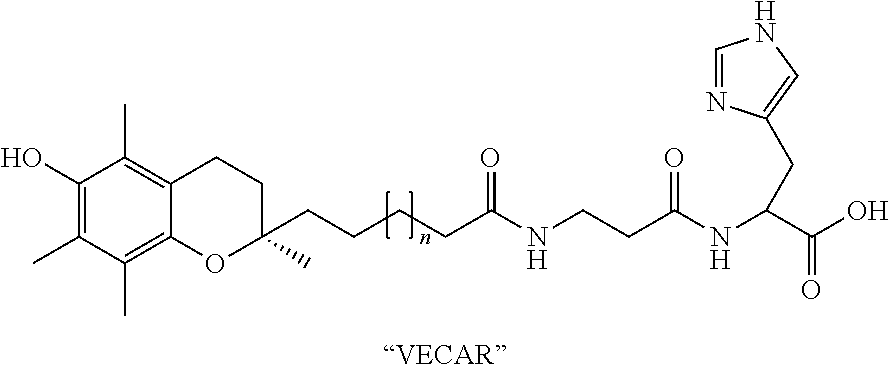
- VECAR Vitamin E and Carnosine
- n The value of n in the VECAR structure is preferably from 8 to 18 (inclusive), and more preferably from 10 to 16 (inclusive), although n may also be higher or lower. In the prototype VECAR conjugate we have synthesized, n was 12.
- one or more side-chain methyl groups could be attached along the —(CH 2 ) n — linker, analogously to the methyl groups found in the phytyl chain of the unmodified alpha-tocopherol molecule (the R 1 groups in the generalized structure previously depicted).
- the parameter “n” is used somewhat differently in different structures depicted in the present specification and claims.
- the novel VECAR conjugate possesses the beneficial antioxidant properties of both its alpha-tocopherol and the carnosine components. But it also possesses a synergy, so that it is truly more than a sum of its parts.
- the —(CH 2 ) n — covalent linker imparts minimal modification upon the conformation of either component, including the alpha tocopherol chromanol ring. Significantly, however, the —(CH 2 ) n — linker is itself a lipophilic domain, enhancing the compound's amphiphilic character.
- the alpha-tocopherol acts as both an antioxidant and as a carrier.
- the carnosine acts as a co-antioxidant, protecting proteins against oxidation.
- VECAR or other conjugates in accordance with this invention may optionally be entrapped in nanoparticles, especially for biomedical uses such as delivery to the arterial wall for antioxidant defense against atherosclerosis.
- nanoparticles may be prepared through methods otherwise known in the art.
- VECAR or other conjugates in accordance with this invention may also be used as a prodrug delivery system.
- Moieties other than carnosine can be attached to alpha tocopherol to treat various diseases. These moieties are not limited to antioxidants, and may include other drugs or compounds generally, including both lipophilic and hydrophilic compounds.
- conjugates are particularly useful for delivering hydrophilic drugs into lipophilic domains, but are not limited to such uses; including, for example, antioxidants such as vitamin C, polyphenols, epicatechin, epigallocatechin, epigallocatechin gallate; fluorescent probes such as coumarin 6, fluorescein, or rhodamin; and chemotherapeutic drugs such as paclitaxel abraxane, doxorubicin, herceptin, derivatives of these compounds, and other chemotherapeutic drugs.
- antioxidants such as vitamin C, polyphenols, epicatechin, epigallocatechin, epigallocatechin gallate
- fluorescent probes such as coumarin 6, fluorescein, or rhodamin
- chemotherapeutic drugs such as paclitaxel abraxane, doxorubicin, herceptin, derivatives of these compounds, and other chemotherapeutic drugs.
- amphiphilic structure of the conjugates causes them to localize at hydrophilic/lipophilic interfaces, for example in LDLs, where they can protect against oxidation.
- Vitamin E is a hydrophobic antioxidant that inhibits lipid oxidation.
- Carnosine is a hydrophilic antioxidant that inhibits oxidation of proteins. With its combined ability to protect both hydrophilic and hydrophobic components of LDLs, VECAR can prevent or ameliorate various oxidative-stress related diseases, such as atherosclerosis.
- amphiphilic antioxidant compounds that will position at the interface between hydrophobic and hydrophilic domains, and provide antioxidant protection for both domains at once.
- VECAR or other conjugates in accordance with this invention can also act as a pro-drug delivery system. Because the alpha-tocopherol moiety remains intact in the conjugate, the alpha-tocopherol moiety should be recognized by alpha-tocopherol transfer protein (alpha-TTP), which will enhance drug delivery.
- alpha-TTP alpha-tocopherol transfer protein
- Oxidized LDL has been associated with atherosclerotic plaques. It is hypothesized that oxidative processes alter artery walls, causing monocytes and macrophages to be recruited from the bloodstream, along with excessive lipid deposition. As part of the process, LDL is oxidized within sub-endothelial spaces.
- the surface of LDL contains molecules such as apoB-100 protein, polar fatty acids, phospholipids, and unesterified cholesterol.
- a typical LDL composition is 20% phospholipids, 40% cholesterol esters, 20% protein, 10% unesterified cholesterol, 5% triglycerides, and 5% other lipophilic components.
- a typical size range for LDLs is from around 20 to around 26 nm.
- An oxidized LDL particle can stimulate expression of adhesion molecules on endothelial cells, the LDL particle can itself be chemotactic, and it can regulate cell scavenger receptors. Wall thickening, vessel narrowing, and plaque formation can result in thrombosis and plaque rupture.
- Vitamin E has been identified in LDL, where it is localized in the lipid phase. However, unmodified vitamin E does not provide strong protection against oxidative damage to apoB-100 on the surface of LDLs. Likewise, merely supplying a non-amphiphilic compound that possesses antioxidant activity (e.g., vitamin C) does not significantly increase protection. By modifying vitamin E with a hydrophilic moiety, the novel conjugate provides enhanced protection against oxidative damage to apoB-100 and other proteins.
- the structure of the ⁇ -tocopherol derivative is maintained as closely as possible to that of the natural conformation, to better preserve the antioxidant properties of the ⁇ -tocopherol derivative and to better ensure that the derivative is recognized and transported by ⁇ -TTP.
- Any modifications are preferably made in the linker, which is apparently not a required moiety for the protein ⁇ -TTP to recognize ⁇ -tocopherol. To achieve these goals, it is preferred that the following three criteria should be observed: (1) The chromanol ring is not modified. (2) The linker (e.g., alkyl chain or phytyl chain) is sufficiently long to confer hydrophobic properties. (3) A second, preferably natural, antioxidant component is covalently linked, preferably at the end of the linker to maximize the separation between the hydrophilic and hydrophobic antioxidant moieties.
- Novel compounds in accordance with the present invention can provide substantially improved antioxidant properties as compared with their individual components (e.g., ⁇ -tocopherol or carnosine, whether alone or in a simple mixture).
- the novel compounds impart improved resistance against oxidation to LDL, and can help to treat or prevent oxidative-stress-associated diseases such as atherosclerosis.
- novel compounds can also treat or prevent neurodegenerative diseases, including but not limited to those associated with high levels of zinc; Alzheimer's and Parkinson's diseases; and various diseases associated with oxidative stress, including cardiovascular diseases such as atherosclerosis; and some cancers.
- neurodegenerative diseases including but not limited to those associated with high levels of zinc; Alzheimer's and Parkinson's diseases; and various diseases associated with oxidative stress, including cardiovascular diseases such as atherosclerosis; and some cancers.
- Methods for drug delivery known in the art may be used in administering compounds of the present invention to a human or other mammal.
- Compounds used in the present invention may be administered to a patient by any suitable means, including oral, intravenous, parenteral, subcutaneous, intrapulmonary, and intranasal administration.
- Parenteral infusions include intramuscular, intravenous, intraarterial, or intraperitoneal administration.
- the compounds may also be administered transdermally, for example in the form of a slow-release subcutaneous implant. They may also be administered by inhalation. Oral administration is preferred where feasible, for enhanced ease of delivery and enhanced patient compliance.
- Pharmaceutically acceptable carrier preparations include sterile, aqueous or non-aqueous solutions, suspensions, and emulsions.
- non-aqueous solvents are propylene glycol, polyethylene glycol, vegetable oils such as olive oil, and injectable organic esters such as ethyl oleate.
- Aqueous carriers include water, alcoholic/aqueous solutions, emulsions or suspensions, including saline and buffered media.
- Parenteral vehicles include sodium chloride solution, Ringer's dextrose, dextrose and sodium chloride, lactated Ringer's, or fixed oils.
- the active therapeutic ingredient may be mixed with excipients that are pharmaceutically acceptable and are compatible with the active ingredient.
- Suitable excipients include water, saline, dextrose, glycerol and ethanol, or combinations thereof.
- Intravenous vehicles include fluid and nutrient replenishers, electrolyte replenishers, such as those based on Ringer's dextrose, and the like.
- Preservatives and other additives may also be present such as, for example, antimicrobials, anti-oxidants, chelating agents, inert gases, and the like.
- compositions for injection may be provided in the form of an ampoule, each containing a unit dose amount, or in the form of a container containing multiple doses.
- a method for controlling the duration of action comprises incorporating the active compound into particles of a polymeric substance such as a polyester, peptide, hydrogel, polylactide/glycolide copolymer, or ethylenevinylacetate copolymers.
- a polymeric substance such as a polyester, peptide, hydrogel, polylactide/glycolide copolymer, or ethylenevinylacetate copolymers.
- an active compound may be encapsulated in microcapsules prepared, for example, by coacervation techniques or by interfacial polymerization, for example, by the use of hydroxymethylcellulose or gelatin-microcapsules or poly(methylmethacrylate) microcapsules, respectively, or in a colloid drug delivery system.
- Colloidal dispersion systems include macromolecule complexes, nanocapsules, microspheres, beads, and lipid-based systems including oil-in-water emulsions, micelles, mixed micelles, and liposomes.
- nanoparticles may be prepared through techniques known in the art.
- an “effective amount” of a compound or of a composition is an amount, that when administered to a patient (whether as a single dose or as a time course of treatment) ameliorates the effects of oxidative stress, or that successfully delivers the drug moiety from a prodrug conjugate; in each case where the desired effect occurs to a clinically significant degree; or alternatively, to a statistically significant degree as compared to control.
- “Statistical significance” means significance at the P ⁇ 0.05 level, or such other measure of statistical significance as would be used by those of skill in the art of biomedical statistics in the context of a particular type of treatment or prophylaxis.
- Reactivity of the novel antioxidants can be determined by any of several assays known in the art. These assays provide data about the rate of protection, free radical scavenging properties, affinity toward particular radicals or oxidant molecules, any pro-oxidant behavior, etc.
- Assays that may be used to measure free radical scavenging properties include, for example, the DPPH assay and the ABTS assay.
- the 1,1-diphenyl-2-picryl hydrazyl (DPPH) radical is a stable free radical of purple color. Adding an antioxidant reduces the DPPH radical, which can be observed by color change (to yellow) in a spectrophotometer, for example by measuring absorbance at 518 nm.
- ABTS 2,2- ⁇ -azino-bis-(3-ethylbenzthiazoline-6-sulfonic acid)
- ABTS ⁇ 2,2- ⁇ -azino-bis-(3-ethylbenzthiazoline-6-sulfonic acid)
- ABTS ⁇ 2,2- ⁇ -azino-bis-(3-ethylbenzthiazoline-6-sulfonic acid
- ABTS ⁇ 2,2- ⁇ -azino-bis-(3-ethylbenzthiazoline-6-sulfonic
- Superoxide anion scavenging properties can be evaluated, for example, by the xanthine-xanthine oxidase assay.
- a superoxide anion is formed by reaction between xanthine and xanthine oxidase.
- the superoxide anion can be detected, for example, at 560 nm via an induced color change in nitroblue tetrazolium (NBT).
- NBT nitroblue tetrazolium
- alkaline DMSO assay alkaline DMSO is used to form superoxide anion, and reduction again may be monitored by spectroscopic observation of NBT at 560 nm, with and without the antioxidant molecule.
- Hydroxyl radical scavenging properties can be measured, for example, by the p-nitroso dimethylaniline (pNDA) bleaching assay.
- pNDA p-nitroso dimethylaniline
- the hydroxyl radical formed by Fenton's reaction of hydrogen peroxide with ferric chloride will bleach pNDA.
- the addition of an antioxidant changes the bleaching profile.
- Absorbance may be measured, for example, at 440 nm.
- hydroxyl radical degrades deoxyribose, which can be measured colorimetrically.
- Nitric oxide scavenging may be evaluated, for example, with nitroprusside.
- nitroprusside liberates nitric acid, which is converted to nitrous acid and subsequently forms nitrite ions on contact with air.
- the final reaction produces a pink color that may be measured at 546 nm.
- Peroxynitrite scavenging performance can be determined by the tyrosine nitration assay. Peroxynitrite will nitrate tyrosine, which can be inhibited by the addition of an antioxidant molecule. Alternatively, the oxidation of dihydrorhodamine may be used in an assay, and its oxidation may be observed by fluorescence measurements.
- TBARS thiobarbituric acid assay
- MDA melondialdehyde
- NMR nuclear magnetic resonance
- TREP total reactive antioxidant potential
- TAA total antioxidant activity
- ORAC oxygen radical absorbing capacity
- TAR total antioxidant reactivity
- Thionyl chloride 99+% and magnesium sulfate 99.5% were purchased from Alfa Aesar.
- Silica gel, porosity: 60 ⁇ , particle size: 40-63 ⁇ m, surface area: 500-600 m 2 /g, pH range: 6.5-7.5, and silica gel of 300 ⁇ porosity were purchased from Sorbent Technologies.
- HBTU O-benzotriazole-N,N,N′,N′-tetramethyl-uronium-hexafluoro-phosphate
- a stock solution of DPPH in methanol, 0.4 mM was prepared and stored in the dark at ⁇ 20° C. prior to use.
- the phosphonium salt S4 (2.927 g, 5.4 mmol) was dissolved in dry THF (55 mL) at room temperature under argon. A solution of LiHMDS in THF (1M in THF, 16 mL, 13.4 mmol) was added dropwise via syringe. The red glide was stirred for 2 h under argon. A solution of S3 (1.85 g) in dry THF (8 mL) was added dropwise. The color changed from red to pale yellow. The suspension was stirred for an additional 3 h, until S3 could no longer be found by TLC. The reaction was quenched with saturated NH 4 Cl (80 mL) and water (80 mL), and then extracted with ethyl acetate.
- the carboxylic acid compound S6 (840 mg, 1.59 mmol), DMAP (19 mg, 0.16 mmol), the carnosine-methyl ester hydrochloride (S7) (662 mg, 2.39 mmol), and triethylamine (1.67 mL, 5 equiv) were added to anhydrous DMF (13.4 ml).
- the solution was cooled to 0° C. in an ice bath.
- HBTU (721 mg, 1.9 mmol) in anhydrous DMF (3 mL) was added to the reaction mixture dropwise, with stirring for an additional 20 minutes at 0° C. The reaction was then stirred at room temperature overnight. Next, the solvent was evaporated and dried under high vacuum.
- the de-protection of (S8) was performed by dissolving S8 (260 mg) in dry THF (10 ml), and adding TBAF (2.9 mL of a 1M THF solution) dropwise via syringe. The solution was stirred for 1.5 hour at room temperature. The THF was evaporated and replaced with chloroform (200 ml). The solution was washed with water three times.
- the crude VECAR product was purified by flash chromatography on reverse phase silica gel (60 ⁇ pore size) using gradient elution with methanol:water (30%), and with methanol:water:ammonium hydroxide (8:1:1). The first two fractions collected the impurities, and pure VECAR was collected in the last fraction. The yield of VECAR was 130 mg (60%).
- Reverse phase silica gel was prepared for purifying the VECAR following the coupling reaction.
- Normal phase silica gel 100 mg was suspended in toluene (500 ml), and 21 ml (0.52 mol) of octadecyltrichlorosilane (C 18 , ODTS) was added dropwise.
- triethylamine 28 ml, 4 equiv. was added to the suspension, and the final suspension was refluxed for 24 hr at 125° C.
- the reverse phase silica gel was washed with toluene (1 L), DCM (1 L), ethyl acetate (1 L), and methanol (4 L). The product was dried under high vacuum and stored until use.
- VECAR The antioxidant behavior of VECAR was studied by DPPH assay. Measurements were performed at 5 concentrations to determine IC 50 , the point at which 50% of DPPH had been reduced by VECAR.
- the IC 50 for VECAR was determined as 24.9 ⁇ 1.4 ⁇ M, nearly identical to the value of 24.4 ⁇ 1.5 ⁇ M for alpha-tocopherol.
- VECAR an amphiphilic derivative of carnosine and alpha-tocopherol with a bio-stable alkyl linker
- the steps were designed to form an alkyl linker with a reactive end group (a carboxylic acid).
- the first step (Trolox esterification) was performed by an acid chloride (thionyl chloride) reaction.
- the selection of the catalyst was based on yield and reaction time, as compared with those seen using p-toluenesulfonic acid as catalyst. The yields increased from 50% to 78% and the time was reduced from 18 hrs to less than 2 hrs when thionyl chloride was used as catalyst instead.
- the second step was to protect the hydroxyl group in the chromanol ring of Trolox with tert-butyldimethylsilyl chloride (TBDMS). This protection allowed the hydroxyl group to be recovered at the end of the synthesis.
- the third step was reduction of the acid to an aldehyde using DIBAL at ⁇ 70° C. This reaction was difficult, because separation of the unreacted ester from the aldehyde required gradient elution-column chromatography. Any water present in the sample would reduce yields and increase the complexity of purification by flash chromatography. The reaction yields of the first three steps were improved by eliminating as much residual water in the samples as feasible.
- a Wittig reaction added a 12-carbon alkyl chain to the chromanol ring.
- the alkyl chain was provided by 12-bromododecanoic acid, from which a phosphonium salt was prepared prior to the Wittig reaction.
- the product was then saturated in the presence of hydrogen.
- the coupling reaction with carnosine was complicated due to the hydrophobic/hydrophilic behavior of the new molecule.
- the carnosine molecule was therefore modified to an ester, both to improve its solubility in polar solvents and to avoid reactions between the carboxylic group of carnosine either with the alpha-tocopherol derivative intermediate, or with the carnosine's own amino terminus.
- the linker chain (which can optionally be used for the attachment of other molecules as well), preserved the antioxidant properties of the alpha-tocopherol portion of the VECAR molecule. As measured by the DPPH assay, the VECAR IC 50 value (24.9 ⁇ 1.4 ⁇ M) was quite close to that of pure alpha-tocopherol (24.4 ⁇ 1.5 ⁇ M).
- VECAR cardiovascular disease
- Optional embodiments include the following: HPLC analysis of tissue/blood/LDL distribution; or synthesis of a “VEPROBE” compound, in which the carnosine moiety of VECAR is replaced by a fluorescent probe (or other probe or reporter), to assist in the analysis of tissue/blood/LDL distribution.
- VEPROBE compound In vivo studies will be performed with a VEPROBE compound to demonstrate the preferential uptake of the vitamin E-linked fluorescent probe as compared to the free fluorophore.
- the preferential uptake is an indicator of the improved bioavailability of the linked drugs or other compounds, presumptively resulting from ⁇ -TTP recognition.
- confocal microscopy and direct quantitation techniques such as HPLC will be employed to determine plasma concentration and tissue distribution of the fluorophore, both when administered in free form and in the linked VEPROBE form.
- VECAR thiobarbituric acid assay
- MDA melondialdehyde
- An iodometric assay can be used to quantify PUFA peroxidation and protein peroxidation, based on the ability of iodide to reduce the hydroperoxides that are formed in lipid peroxidation.
- Other common techniques that may be used to demonstrate the antioxidant activity of VECAR are measuring the total reactive antioxidant potential (TRAP), the total antioxidant activity (TAA), the oxygen radical absorbing capacity (ORAC), and the total antioxidant reactivity (TAR).
- VECAR-enhanced LDLs can be performed either in vitro on VECAR-enhanced LDLs, or in vivo by testing the plasma of animals or patients who have been given VECAR supplements. For example, it will be demonstrated that VECAR protects LDL from oxidation in vivo by showing that animals given a high-fat, atherogenic diet will nevertheless exhibit lower plasma TBARS values when the diet is supplemented with VECAR.
Landscapes
- Chemical & Material Sciences (AREA)
- Health & Medical Sciences (AREA)
- Organic Chemistry (AREA)
- Bioinformatics & Cheminformatics (AREA)
- Engineering & Computer Science (AREA)
- Veterinary Medicine (AREA)
- Medicinal Chemistry (AREA)
- Pharmacology & Pharmacy (AREA)
- Life Sciences & Earth Sciences (AREA)
- Animal Behavior & Ethology (AREA)
- General Health & Medical Sciences (AREA)
- Public Health (AREA)
- General Chemical & Material Sciences (AREA)
- Chemical Kinetics & Catalysis (AREA)
- Nuclear Medicine, Radiotherapy & Molecular Imaging (AREA)
- Neurology (AREA)
- Epidemiology (AREA)
- Biomedical Technology (AREA)
- Neurosurgery (AREA)
- Heart & Thoracic Surgery (AREA)
- Hospice & Palliative Care (AREA)
- Psychiatry (AREA)
- Cardiology (AREA)
- Pulmonology (AREA)
- Pharmaceuticals Containing Other Organic And Inorganic Compounds (AREA)
- Pyrane Compounds (AREA)
Abstract
Description

-
- n=from 1 to 18, more preferably from 2 to 5 (inclusive range in each case)
- R1=H or CH3
- R2=antioxidant, drug, or other moiety of interest. R2 will often be, but need not necessarily be, hydrophilic. Examples include the following compounds and their various derivatives and homologues: carnosine, lutein, vitamin C, cis-platin, flavonoids, resveratrol, co-enzyme Q, polyphenols, epicatechin (EC), epigallocatechin (EGC), epigallocatechin gallate (EGCG), gallic acid, gallic acid derivatives, fluorescent probes, coumarin 6, fluorescein sodium salt; and chemotherapeutic compounds such as abraxane, doxorubicin, herceptin, and paclitaxel; and derivatives of these compounds.
-
- a. Synthesis of vitamin E-carnosine: Synthesis of VECAR (with a 12-carbon linker chain). The synthesis employed protection of the OH group, activation of the carbonyl group, a Wittig reaction to form an ylide, attachment of carnosine, and de-protection of the OH group.
- b. Characterization of the structure of the synthesized VECAR by nuclear magnetic resonance (NMR) and analytic thin-layer chromatography (TLC).
- c. Testing the antioxidant properties of VECAR by DPPH and TBARS.
% change in activity=((AbScontrol−Abssample)/Abscontrol)*100%

Figure 0-1: (S)-6-hydroxy-2,5,7,8-tetramethylchroman-2-carboxylic acid (Trolox) esterification

Figure 0-2: Synthesis of (S)-methyl 6-(tert-butyldimethylsilyloxy)-2,5,7,8-tetramethylchroman-2-carboxylate (S2) to protect the hydroxyl group in position 6.

Reduction of S2 ester to synthesize (S)-6-(tert-butyldimethylsilyloxy)-2,5,7,8-tetramethylchroman-2-carbaldehyde (S3).

Reaction to synthesize (11-carboxyundecyl)triphosphonium bromide (S4) salt.

Wittig reaction to synthesize (S,E)-13-(6-(tert-butyldimethylsilyloxy)-2,5,7,8-tetramethylchroman-2-yl)tridec-12-enoic acid (S5).

Saturation reaction to synthesize (R)-13-(6-(tert-butyldimethylsilyloxy)-2,5,7,8-tetramethylchroman-2-yl)tridecanoic acid (S6).


De-protection of S0 to synthesize methyl 2-(3-(13-((R)-6-hydroxy-2,5,7,8-tetramethylchroman-2-yl)tridecanamido)propanamido)-3-(1H-imidazol-4-yl)propanoate (VECAR).
Claims (17)


Priority Applications (1)
| Application Number | Priority Date | Filing Date | Title |
|---|---|---|---|
| US13/698,334 US9220787B2 (en) | 2010-05-20 | 2011-05-18 | Vitamin E conjugates, and their uses as antioxidants and prodrug delivery vehicles |
Applications Claiming Priority (3)
| Application Number | Priority Date | Filing Date | Title |
|---|---|---|---|
| US34651710P | 2010-05-20 | 2010-05-20 | |
| PCT/US2011/036958 WO2011146589A2 (en) | 2010-05-20 | 2011-05-18 | Vitamin e conjugates, and their uses as antioxidants and prodrug delivery vehicles |
| US13/698,334 US9220787B2 (en) | 2010-05-20 | 2011-05-18 | Vitamin E conjugates, and their uses as antioxidants and prodrug delivery vehicles |
Publications (2)
| Publication Number | Publication Date |
|---|---|
| US20130210702A1 US20130210702A1 (en) | 2013-08-15 |
| US9220787B2 true US9220787B2 (en) | 2015-12-29 |
Family
ID=44992309
Family Applications (1)
| Application Number | Title | Priority Date | Filing Date |
|---|---|---|---|
| US13/698,334 Active US9220787B2 (en) | 2010-05-20 | 2011-05-18 | Vitamin E conjugates, and their uses as antioxidants and prodrug delivery vehicles |
Country Status (3)
| Country | Link |
|---|---|
| US (1) | US9220787B2 (en) |
| CA (1) | CA2816928A1 (en) |
| WO (1) | WO2011146589A2 (en) |
Families Citing this family (3)
| Publication number | Priority date | Publication date | Assignee | Title |
|---|---|---|---|---|
| WO2018193114A1 (en) | 2017-04-20 | 2018-10-25 | Novintum Biotechnology Gmbh | Triphenylphosphonium-tethered tetracycyclines for use in treating cancer |
| GB201809445D0 (en) | 2018-06-08 | 2018-07-25 | Novintum Biotechnology Gmbh | Compounds |
| TWI891362B (en) * | 2024-05-10 | 2025-07-21 | 國立臺灣大學 | Duck egg white hydrolysate and preparation method for improving muscle endurance and anti-fatigue |
Citations (5)
| Publication number | Priority date | Publication date | Assignee | Title |
|---|---|---|---|---|
| EP0238302A1 (en) | 1986-03-17 | 1987-09-23 | Richardson-Vicks, Inc. | Skin treatment composition |
| US20020127252A1 (en) | 2000-12-22 | 2002-09-12 | Klaus Kramer | Use of chroman derivatives in cosmetic or dermatological preparations |
| US20020165268A1 (en) | 1998-12-17 | 2002-11-07 | Wechter William J. | Use of gamma-tocopherol and its oxidative metabolite LLU-alpha in the treatment of disease |
| JP2003267992A (en) | 2002-03-18 | 2003-09-25 | Makoto Fujii | Antioxidants, anti-aging agents and / or anti-cancer agents |
| JP2008019188A (en) | 2006-07-11 | 2008-01-31 | Hamari Chemicals Ltd | Novel carnosine derivatives and compositions |
-
2011
- 2011-05-18 CA CA2816928A patent/CA2816928A1/en not_active Abandoned
- 2011-05-18 US US13/698,334 patent/US9220787B2/en active Active
- 2011-05-18 WO PCT/US2011/036958 patent/WO2011146589A2/en not_active Ceased
Patent Citations (5)
| Publication number | Priority date | Publication date | Assignee | Title |
|---|---|---|---|---|
| EP0238302A1 (en) | 1986-03-17 | 1987-09-23 | Richardson-Vicks, Inc. | Skin treatment composition |
| US20020165268A1 (en) | 1998-12-17 | 2002-11-07 | Wechter William J. | Use of gamma-tocopherol and its oxidative metabolite LLU-alpha in the treatment of disease |
| US20020127252A1 (en) | 2000-12-22 | 2002-09-12 | Klaus Kramer | Use of chroman derivatives in cosmetic or dermatological preparations |
| JP2003267992A (en) | 2002-03-18 | 2003-09-25 | Makoto Fujii | Antioxidants, anti-aging agents and / or anti-cancer agents |
| JP2008019188A (en) | 2006-07-11 | 2008-01-31 | Hamari Chemicals Ltd | Novel carnosine derivatives and compositions |
Non-Patent Citations (10)
| Title |
|---|
| Hosomi, A. et al., "Affinity for Alpha-Tocopherol Transfer Protein as a Determinant of the Biological Activities of Vitamin E Analogs," FEBS Lett, vol. 409, pp. 105-108 (1997). |
| Jewett, (The Effects of Alcohols as a Medicine, 1865). * |
| Leonard, S.W. et al., "Incorporation of Deuterated RRR- or All-Rac-Alpha-Tocopherol in Plasma and Tissues of Alpha-Tocopherol Transfer Protein-Null Mice," American Journal of Clinical Nutrition, vol. 75, pp. 555-560 (2002). |
| Mazzini et al., (Chirality, 2009, 21:519-524). * |
| Mustacich et al., (Free Radical Biology & Medicine, 2006, 41, 1069-1078). * |
| Mustacich et al., Free Radical Biology & Medicine 41 (2006) 1069-1078. * |
| Schuelke, M. et al., "Urinary Alpha-Tocopherol Metabolites in Alpha-Tocopherol Transfer Protein-Deficient Patients," J Lipid Res, vol. 41, pp. 1543-1551 (2000). |
| Stvolinsky, S.L. et al., "Biological Activity of Novel Synthetic Derivatives of Carnosine," Cell Mol Neurobiol, vol. 30, pp. 30, pp. 395-404 (2010) (published online Oct. 2, 2009). |
| Wallert et al., (Free Radical Biology and Medicine, vol. 68, Mar. 2014, pp. 43-51). * |
| Wang, Y.S. et al., "Synthesis of Alpha-Tocohexaenol (Alpha-T6) a Fluorescent, Oxidatively Sensitive Polyene Analogue of Alpha-Tocopherol," Bioorganic & Medicinal Chemistry, vol. 18, pp. 777-786 (2010). |
Also Published As
| Publication number | Publication date |
|---|---|
| US20130210702A1 (en) | 2013-08-15 |
| WO2011146589A8 (en) | 2012-03-15 |
| WO2011146589A2 (en) | 2011-11-24 |
| CA2816928A1 (en) | 2011-11-24 |
| WO2011146589A3 (en) | 2012-05-10 |
Similar Documents
| Publication | Publication Date | Title |
|---|---|---|
| Wu et al. | Aortic plaque-targeted andrographolide delivery with oxidation-sensitive micelle effectively treats atherosclerosis via simultaneous ROS capture and anti-inflammation | |
| Lu et al. | Resveratrol-loaded polymeric micelles protect cells from Aβ-induced oxidative stress | |
| Sou et al. | Loading of curcumin into macrophages using lipid-based nanoparticles | |
| Nie et al. | Enhanced radical scavenging activity by antioxidant-functionalized gold nanoparticles: a novel inspiration for development of new artificial antioxidants | |
| Posner et al. | Orally active, antimalarial, anticancer, artemisinin-derived trioxane dimers with high stability and efficacy | |
| JP5856186B2 (en) | New compounds having skin whitening, antioxidant and PPAR activity and medical use thereof | |
| US20180193286A1 (en) | Compositions comprising a dendrimer-resveratrol complex and methods for making and using the same | |
| JP6000981B2 (en) | New compounds having skin whitening, antioxidant and PPAR activity and medical use thereof | |
| WO2013016696A1 (en) | Antioxidant, neuroprotective and antineoplastic nanoparticles comprising a therapeutic agent on an amphiphilic spacer or an amphiphilic polymer | |
| ITMI941774A1 (en) | PHARMACEUTICAL COMPOSITIONS CONTAINING POLYUNSATURATED FATTY ACIDS, THEIR ESTERS OR SALTS, WITH VITAMINS OR ANTIOXIDANT PROVITAMINS | |
| AU3864699A (en) | Cannabinoids as antioxidants and neuroprotectants | |
| WO2009148698A1 (en) | Nanometer-sized prodrugs of nsaids | |
| KR20130129953A (en) | Methods of increasing solubility of poorly soluble compounds and methods of making and using formulations of such compounds | |
| KR20080074901A (en) | Protection of oxidizing substances | |
| ES2367187T3 (en) | DERIVATIVES OF CHROMEN-4-ONA AS A SELF-BRONZING SUBSTANCE. | |
| WO2015073527A1 (en) | Nitroalkene tocopherols and analogs thereof for use in the treatment and prevention of inflammation related conditions | |
| Trieu et al. | In vivo antioxidant activity of genistein in a murine model of singlet oxygen-induced cerebral stroke | |
| US20130210702A1 (en) | Vitamin E Conjugates, and Their Uses as Antioxidants and Prodrug Delivery Vehicles | |
| EP4226919A1 (en) | Ferroptosis inhibitor | |
| Wang et al. | Local delivery of artesunate dimer liposomes incorporated injectable hydrogel for H2O2 and pH-independent chemodynamic therapy | |
| Imam | The future of non-invasive ways to treat cancer | |
| Borowy-Borowski et al. | Unique technology for solubilization and delivery of highly lipophilic bioactive molecules | |
| Rui et al. | Nanoassemblies of the redox paclitaxel prodrug with the natural active ingredient dihydroartemisinin for therapy of breast cancer | |
| US20090215887A1 (en) | 5-hydroxy-2-methyl-4h-pyran-4-one esters as novel tyrosinase inhibitors | |
| CN1409626A (en) | Catechol oximes and their use in cosmetic and dermatological preparations |
Legal Events
| Date | Code | Title | Description |
|---|---|---|---|
| AS | Assignment |
Owner name: BOARD OF SUPERVISORS OF LOUISIANA STATE UNIVERSITY Free format text: ASSIGNMENT OF ASSIGNORS INTEREST;ASSIGNORS:SABLIOV, CRISTINA M.;ASTETE, CARLOS E;SPIVAK, DAVID;SIGNING DATES FROM 20121214 TO 20121220;REEL/FRAME:029705/0343 |
|
| STCF | Information on status: patent grant |
Free format text: PATENTED CASE |
|
| MAFP | Maintenance fee payment |
Free format text: PAYMENT OF MAINTENANCE FEE, 4TH YEAR, MICRO ENTITY (ORIGINAL EVENT CODE: M3551); ENTITY STATUS OF PATENT OWNER: MICROENTITY Year of fee payment: 4 |
|
| MAFP | Maintenance fee payment |
Free format text: PAYMENT OF MAINTENANCE FEE, 8TH YEAR, MICRO ENTITY (ORIGINAL EVENT CODE: M3552); ENTITY STATUS OF PATENT OWNER: MICROENTITY Year of fee payment: 8 |