US9187448B2 - Flavonoid compounds - Google Patents
Flavonoid compounds Download PDFInfo
- Publication number
- US9187448B2 US9187448B2 US14/237,167 US201214237167A US9187448B2 US 9187448 B2 US9187448 B2 US 9187448B2 US 201214237167 A US201214237167 A US 201214237167A US 9187448 B2 US9187448 B2 US 9187448B2
- Authority
- US
- United States
- Prior art keywords
- hydroxy
- compounds
- group
- mitochondrial
- term
- Prior art date
- Legal status (The legal status is an assumption and is not a legal conclusion. Google has not performed a legal analysis and makes no representation as to the accuracy of the status listed.)
- Active
Links
- 0 [1*]C1=C([2*])C=C(C2([4*])OC3=C([9*])C([8*]O)=C([7*])C(O[6*])=C3CC2([5*])O[3*])C=C1 Chemical compound [1*]C1=C([2*])C=C(C2([4*])OC3=C([9*])C([8*]O)=C([7*])C(O[6*])=C3CC2([5*])O[3*])C=C1 0.000 description 6
- XZDQCAGBWDYEDW-NYRJJRHWSA-N CC(=O)OC1=CC=C(C2OC3=CC(O)=CC(O)=C3C[C@H]2O)C=C1OC(C)=O Chemical compound CC(=O)OC1=CC=C(C2OC3=CC(O)=CC(O)=C3C[C@H]2O)C=C1OC(C)=O XZDQCAGBWDYEDW-NYRJJRHWSA-N 0.000 description 2
- VSJDZJCONALITH-RTBURBONSA-N CC(C)(C)OC(=O)OCO[C@@H]1CC2=C(O)C=C(O)C=C2O[C@@H]1C1=CC(O)=C(O)C=C1 Chemical compound CC(C)(C)OC(=O)OCO[C@@H]1CC2=C(O)C=C(O)C=C2O[C@@H]1C1=CC(O)=C(O)C=C1 VSJDZJCONALITH-RTBURBONSA-N 0.000 description 2
- YVROFEYBQCLHSQ-UUBRJOAOSA-N CC1=CC(OCC2=CC=CC=C2)=C2C[C@@H](O)[C@@H](C3=CC(OCC4=CC=CC=C4)=C(OCC4=CC=CC=C4)C=C3)OC2=C1.CO[C@@H]1CC2=C(OCC3=CC=CC=C3)C=C(C)C=C2O[C@@H]1C1=CC(OCC2=CC=CC=C2)=C(OCC2=CC=CC=C2)C=C1 Chemical compound CC1=CC(OCC2=CC=CC=C2)=C2C[C@@H](O)[C@@H](C3=CC(OCC4=CC=CC=C4)=C(OCC4=CC=CC=C4)C=C3)OC2=C1.CO[C@@H]1CC2=C(OCC3=CC=CC=C3)C=C(C)C=C2O[C@@H]1C1=CC(OCC2=CC=CC=C2)=C(OCC2=CC=CC=C2)C=C1 YVROFEYBQCLHSQ-UUBRJOAOSA-N 0.000 description 2
- XDHBVTFPMHENPT-DNVCBOLYSA-N CCOC(=O)COC1=C(O)C=C([C@H]2OC3=CC(O)=CC(O)=C3C[C@H]2O)C=C1 Chemical compound CCOC(=O)COC1=C(O)C=C([C@H]2OC3=CC(O)=CC(O)=C3C[C@H]2O)C=C1 XDHBVTFPMHENPT-DNVCBOLYSA-N 0.000 description 2
- BBDWMQGDVLQOSW-OEMAIJDKSA-N C[C@@]1(O)CC2=C(O)C=C(O)C=C2OC1C1=CC=C(O)C(O)=C1 Chemical compound C[C@@]1(O)CC2=C(O)C=C(O)C=C2OC1C1=CC=C(O)C(O)=C1 BBDWMQGDVLQOSW-OEMAIJDKSA-N 0.000 description 2
- RUTOXGHPWYYTBD-AAKHLMGASA-N *.*.*.*.*.B.B.B.B.B.C.C.C.C.C.C1=CC=C(C2CCC3=CC=CC=C3O2)C=C1.O[C@@H]1CC2=CC=CC=C2O[C@@H]1C1=CC=CC=C1.O[C@@H]1CC2=CC=CC=C2O[C@H]1C1=CC=CC=C1.O[C@H]1CC2=CC=CC=C2O[C@@H]1C1=CC=CC=C1.O[C@H]1CC2=CC=CC=C2O[C@H]1C1=CC=CC=C1 Chemical compound *.*.*.*.*.B.B.B.B.B.C.C.C.C.C.C1=CC=C(C2CCC3=CC=CC=C3O2)C=C1.O[C@@H]1CC2=CC=CC=C2O[C@@H]1C1=CC=CC=C1.O[C@@H]1CC2=CC=CC=C2O[C@H]1C1=CC=CC=C1.O[C@H]1CC2=CC=CC=C2O[C@@H]1C1=CC=CC=C1.O[C@H]1CC2=CC=CC=C2O[C@H]1C1=CC=CC=C1 RUTOXGHPWYYTBD-AAKHLMGASA-N 0.000 description 1
- RWNGRXINGNRACJ-CRAIPNDOSA-N C=CCOC1=C(O)C=C([C@H]2OC3=CC(O)=CC(O)=C3C[C@H]2O)C=C1 Chemical compound C=CCOC1=C(O)C=C([C@H]2OC3=CC(O)=CC(O)=C3C[C@H]2O)C=C1 RWNGRXINGNRACJ-CRAIPNDOSA-N 0.000 description 1
- IUKVWETUDMFVRQ-CRAIPNDOSA-N C=CCOC1=C(O)C=CC([C@H]2OC3=CC(O)=CC(O)=C3C[C@H]2O)=C1 Chemical compound C=CCOC1=C(O)C=CC([C@H]2OC3=CC(O)=CC(O)=C3C[C@H]2O)=C1 IUKVWETUDMFVRQ-CRAIPNDOSA-N 0.000 description 1
- DGFLKJXTEGDYBM-KBRRISNNSA-N CC(=O)Cl.CC(=O)O[C@@H]1CC2=C(OCC3=CC=CC=C3)C=C(C)C=C2O[C@@H]1C1=CC(OCC2=CC=CC=C2)=C(OCC2=CC=CC=C2)C=C1.CC1=CC(OCC2=CC=CC=C2)=C2C[C@@H](O)[C@@H](C3=CC(OCC4=CC=CC=C4)=C(OCC4=CC=CC=C4)C=C3)OC2=C1 Chemical compound CC(=O)Cl.CC(=O)O[C@@H]1CC2=C(OCC3=CC=CC=C3)C=C(C)C=C2O[C@@H]1C1=CC(OCC2=CC=CC=C2)=C(OCC2=CC=CC=C2)C=C1.CC1=CC(OCC2=CC=CC=C2)=C2C[C@@H](O)[C@@H](C3=CC(OCC4=CC=CC=C4)=C(OCC4=CC=CC=C4)C=C3)OC2=C1 DGFLKJXTEGDYBM-KBRRISNNSA-N 0.000 description 1
- HZUYTMUACNNIHH-FCHVUUORSA-N CC(=O)OC1=CC(OC(C)=O)=C2C[C@@H](O)C(C3=CC=C(OC(C)=O)C(OC(C)=O)=C3)OC2=C1.CC(=O)OC1=CC=C(C2OC3=CC(O)=CC(O)=C3C[C@H]2O)C=C1OC(C)=O.OC1=CC(O)=C2C[C@@H](O)C(C3=CC=C(O)C(O)=C3)OC2=C1 Chemical compound CC(=O)OC1=CC(OC(C)=O)=C2C[C@@H](O)C(C3=CC=C(OC(C)=O)C(OC(C)=O)=C3)OC2=C1.CC(=O)OC1=CC=C(C2OC3=CC(O)=CC(O)=C3C[C@H]2O)C=C1OC(C)=O.OC1=CC(O)=C2C[C@@H](O)C(C3=CC=C(O)C(O)=C3)OC2=C1 HZUYTMUACNNIHH-FCHVUUORSA-N 0.000 description 1
- BKYWAYNSDFXIPL-IKOFQBKESA-N CC(=O)OC1=CC(OC(C)=O)=C2C[C@@H](OC(C)=O)C(C3=CC=C(OC(C)=O)C(OC(C)=O)=C3)OC2=C1 Chemical compound CC(=O)OC1=CC(OC(C)=O)=C2C[C@@H](OC(C)=O)C(C3=CC=C(OC(C)=O)C(OC(C)=O)=C3)OC2=C1 BKYWAYNSDFXIPL-IKOFQBKESA-N 0.000 description 1
- OMECWFVXLSYIGW-BNPHJNHASA-N CC(=O)OC1=CC(OC(C)=O)=C2C[C@@H](OC(C)=O)C(C3=CC=C(OC(C)=O)C(OC(C)=O)=C3)OC2=C1.OC1=CC(O)=C2C[C@@H](O)C(C3=CC=C(O)C(O)=C3)OC2=C1 Chemical compound CC(=O)OC1=CC(OC(C)=O)=C2C[C@@H](OC(C)=O)C(C3=CC=C(OC(C)=O)C(OC(C)=O)=C3)OC2=C1.OC1=CC(O)=C2C[C@@H](O)C(C3=CC=C(O)C(O)=C3)OC2=C1 OMECWFVXLSYIGW-BNPHJNHASA-N 0.000 description 1
- CCTIBFOBERZTCX-IAGOWNOFSA-N CC(=O)O[C@@H]1CC2=C(O)C=C(O)C=C2O[C@@H]1C1=CC(O)=C(O)C=C1 Chemical compound CC(=O)O[C@@H]1CC2=C(O)C=C(O)C=C2O[C@@H]1C1=CC(O)=C(O)C=C1 CCTIBFOBERZTCX-IAGOWNOFSA-N 0.000 description 1
- ZYKRLDODEICJRI-FGZHOGPDSA-N CC(C)N(C(=O)OCO[C@@H]1CC2=C(O)C=C(O)C=C2O[C@@H]1C1=CC(O)=C(O)C=C1)C(C)C Chemical compound CC(C)N(C(=O)OCO[C@@H]1CC2=C(O)C=C(O)C=C2O[C@@H]1C1=CC(O)=C(O)C=C1)C(C)C ZYKRLDODEICJRI-FGZHOGPDSA-N 0.000 description 1
- LPOZMFWFHOHGDE-NTIJNILHSA-N CC(Cl)OC(=O)C(C)C.CC1=CC(OCC2=CC=CC=C2)=C2C[C@@H](O)[C@@H](C3=CC(OCC4=CC=CC=C4)=C(OCC4=CC=CC=C4)C=C3)OC2=C1.CC1=CC(OCC2=CC=CC=C2)=C2C[C@@H](OC(C)OC(=O)C(C)C)[C@@H](C3=CC(OCC4=CC=CC=C4)=C(OCC4=CC=CC=C4)C=C3)OC2=C1.[1*] Chemical compound CC(Cl)OC(=O)C(C)C.CC1=CC(OCC2=CC=CC=C2)=C2C[C@@H](O)[C@@H](C3=CC(OCC4=CC=CC=C4)=C(OCC4=CC=CC=C4)C=C3)OC2=C1.CC1=CC(OCC2=CC=CC=C2)=C2C[C@@H](OC(C)OC(=O)C(C)C)[C@@H](C3=CC(OCC4=CC=CC=C4)=C(OCC4=CC=CC=C4)C=C3)OC2=C1.[1*] LPOZMFWFHOHGDE-NTIJNILHSA-N 0.000 description 1
- HCQJOOCXAYJJLH-JWOXJJEYSA-N CC(OC(=O)C(C)C)O[C@@H]1CC2=C(O)C=C(O)C=C2O[C@@H]1C1=CC(O)=C(O)C=C1 Chemical compound CC(OC(=O)C(C)C)O[C@@H]1CC2=C(O)C=C(O)C=C2O[C@@H]1C1=CC(O)=C(O)C=C1 HCQJOOCXAYJJLH-JWOXJJEYSA-N 0.000 description 1
- IHQLOWPSTNDDJY-LTLDKJAUSA-N CC.CC(=O)O[C@@H]1CC2=C(O)C=C(O)C=C2O[C@@H]1C1=CC(O)=C(O)C=C1.CC(=O)O[C@@H]1CC2=C(OCC3=CC=CC=C3)C=C(C)C=C2O[C@@H]1C1=CC(OCC2=CC=CC=C2)=C(OCC2=CC=CC=C2)C=C1.[HH] Chemical compound CC.CC(=O)O[C@@H]1CC2=C(O)C=C(O)C=C2O[C@@H]1C1=CC(O)=C(O)C=C1.CC(=O)O[C@@H]1CC2=C(OCC3=CC=CC=C3)C=C(C)C=C2O[C@@H]1C1=CC(OCC2=CC=CC=C2)=C(OCC2=CC=CC=C2)C=C1.[HH] IHQLOWPSTNDDJY-LTLDKJAUSA-N 0.000 description 1
- KQPSNRLCDZEHES-IOPMTIKTSA-N CC.CC(OC(=O)C(C)C)O[C@@H]1CC2=C(O)C=C(O)C=C2O[C@@H]1C1=CC(O)=C(O)C=C1.CC1=CC(OCC2=CC=CC=C2)=C2C[C@@H](OC(C)OC(=O)C(C)C)[C@@H](C3=CC(OCC4=CC=CC=C4)=C(OCC4=CC=CC=C4)C=C3)OC2=C1.[HH] Chemical compound CC.CC(OC(=O)C(C)C)O[C@@H]1CC2=C(O)C=C(O)C=C2O[C@@H]1C1=CC(O)=C(O)C=C1.CC1=CC(OCC2=CC=CC=C2)=C2C[C@@H](OC(C)OC(=O)C(C)C)[C@@H](C3=CC(OCC4=CC=CC=C4)=C(OCC4=CC=CC=C4)C=C3)OC2=C1.[HH] KQPSNRLCDZEHES-IOPMTIKTSA-N 0.000 description 1
- DYHAECHWWUKYEX-ILQUEYBGSA-N CC.CC1=CC(OCC2=CC=CC=C2)=C2C[C@@](C)(O)[C@@H](C3=CC(OCC4=CC=CC=C4)=C(OCC4=CC=CC=C4)C=C3)OC2=C1.C[C@@]1(O)CC2=C(O)C=C(O)C=C2O[C@@H]1C1=CC(O)=C(O)C=C1.[HH] Chemical compound CC.CC1=CC(OCC2=CC=CC=C2)=C2C[C@@](C)(O)[C@@H](C3=CC(OCC4=CC=CC=C4)=C(OCC4=CC=CC=C4)C=C3)OC2=C1.C[C@@]1(O)CC2=C(O)C=C(O)C=C2O[C@@H]1C1=CC(O)=C(O)C=C1.[HH] DYHAECHWWUKYEX-ILQUEYBGSA-N 0.000 description 1
- VJGIGHDCKSYFKM-MDUFRYJHSA-N CC.CCCCCCCC(=O)O[C@@H]1CC2=C(O)C=C(O)C=C2OC1C1=CC=C(O)C(O)=C1.CCCCCCCC(=O)O[C@@H]1CC2=C(OCC3=CC=CC=C3)C=C(C)C=C2O[C@@H]1C1=CC(OCC2=CC=CC=C2)=C(OCC2=CC=CC=C2)C=C1.[HH] Chemical compound CC.CCCCCCCC(=O)O[C@@H]1CC2=C(O)C=C(O)C=C2OC1C1=CC=C(O)C(O)=C1.CCCCCCCC(=O)O[C@@H]1CC2=C(OCC3=CC=CC=C3)C=C(C)C=C2O[C@@H]1C1=CC(OCC2=CC=CC=C2)=C(OCC2=CC=CC=C2)C=C1.[HH] VJGIGHDCKSYFKM-MDUFRYJHSA-N 0.000 description 1
- QBGZQIYJCHTGOV-ILQUEYBGSA-N CC.CO[C@@H]1CC2=C(O)C=C(O)C=C2O[C@@H]1C1=CC(O)=C(O)C=C1.CO[C@@H]1CC2=C(OCC3=CC=CC=C3)C=C(C)C=C2O[C@@H]1C1=CC(OCC2=CC=CC=C2)=C(OCC2=CC=CC=C2)C=C1.[HH] Chemical compound CC.CO[C@@H]1CC2=C(O)C=C(O)C=C2O[C@@H]1C1=CC(O)=C(O)C=C1.CO[C@@H]1CC2=C(OCC3=CC=CC=C3)C=C(C)C=C2O[C@@H]1C1=CC(OCC2=CC=CC=C2)=C(OCC2=CC=CC=C2)C=C1.[HH] QBGZQIYJCHTGOV-ILQUEYBGSA-N 0.000 description 1
- CZFAJDFEADDKTD-ZWNLCLBLSA-N CC1=CC(OCC2=CC=CC=C2)=C2CC(=O)[C@@H](C3=CC(OCC4=CC=CC=C4)=C(OCC4=CC=CC=C4)C=C3)OC2=C1.CC1=CC(OCC2=CC=CC=C2)=C2C[C@@](C)(O)[C@@H](C3=CC(OCC4=CC=CC=C4)=C(OCC4=CC=CC=C4)C=C3)OC2=C1 Chemical compound CC1=CC(OCC2=CC=CC=C2)=C2CC(=O)[C@@H](C3=CC(OCC4=CC=CC=C4)=C(OCC4=CC=CC=C4)C=C3)OC2=C1.CC1=CC(OCC2=CC=CC=C2)=C2C[C@@](C)(O)[C@@H](C3=CC(OCC4=CC=CC=C4)=C(OCC4=CC=CC=C4)C=C3)OC2=C1 CZFAJDFEADDKTD-ZWNLCLBLSA-N 0.000 description 1
- YYESBUUIQUKYKO-YTCXAAQRSA-N CC1=CC(OCC2=CC=CC=C2)=C2CC(=O)[C@@H](C3=CC(OCC4=CC=CC=C4)=C(OCC4=CC=CC=C4)C=C3)OC2=C1.CC1=CC(OCC2=CC=CC=C2)=C2C[C@H](O)[C@@H](C3=CC(OCC4=CC=CC=C4)=C(OCC4=CC=CC=C4)C=C3)OC2=C1 Chemical compound CC1=CC(OCC2=CC=CC=C2)=C2CC(=O)[C@@H](C3=CC(OCC4=CC=CC=C4)=C(OCC4=CC=CC=C4)C=C3)OC2=C1.CC1=CC(OCC2=CC=CC=C2)=C2C[C@H](O)[C@@H](C3=CC(OCC4=CC=CC=C4)=C(OCC4=CC=CC=C4)C=C3)OC2=C1 YYESBUUIQUKYKO-YTCXAAQRSA-N 0.000 description 1
- DGVZALWTUPPGIE-ALZOSNSRSA-N CC1=CC(OCC2=CC=CC=C2)=C2C[C@@H](O)[C@@H](C3=CC(OCC4=CC=CC=C4)=C(OCC4=CC=CC=C4)C=C3)OC2=C1.CCCCCCCC(=O)O.CCCCCCCC(=O)O[C@@H]1CC2=C(OCC3=CC=CC=C3)C=C(C)C=C2O[C@@H]1C1=CC(OCC2=CC=CC=C2)=C(OCC2=CC=CC=C2)C=C1 Chemical compound CC1=CC(OCC2=CC=CC=C2)=C2C[C@@H](O)[C@@H](C3=CC(OCC4=CC=CC=C4)=C(OCC4=CC=CC=C4)C=C3)OC2=C1.CCCCCCCC(=O)O.CCCCCCCC(=O)O[C@@H]1CC2=C(OCC3=CC=CC=C3)C=C(C)C=C2O[C@@H]1C1=CC(OCC2=CC=CC=C2)=C(OCC2=CC=CC=C2)C=C1 DGVZALWTUPPGIE-ALZOSNSRSA-N 0.000 description 1
- LABBLCGJNMODRL-QDPRUTSWSA-N CC1=CC(OCC2=CC=CC=C2)=C2C[C@@H](O)[C@@H](C3=CC(OCC4=CC=CC=C4)=C(OCC4=CC=CC=C4)C=C3)OC2=C1.OC1=CC(O)=C2C[C@@H](O)[C@@H](C3=CC(O)=C(O)C=C3)OC2=C1 Chemical compound CC1=CC(OCC2=CC=CC=C2)=C2C[C@@H](O)[C@@H](C3=CC(OCC4=CC=CC=C4)=C(OCC4=CC=CC=C4)C=C3)OC2=C1.OC1=CC(O)=C2C[C@@H](O)[C@@H](C3=CC(O)=C(O)C=C3)OC2=C1 LABBLCGJNMODRL-QDPRUTSWSA-N 0.000 description 1
- LABBLCGJNMODRL-RJTYAZHJSA-N CC1=CC(OCC2=CC=CC=C2)=C2C[C@H](O)[C@@H](C3=CC(OCC4=CC=CC=C4)=C(OCC4=CC=CC=C4)C=C3)OC2=C1.OC1=CC(O)=C2C[C@H](O)[C@@H](C3=CC(O)=C(O)C=C3)OC2=C1 Chemical compound CC1=CC(OCC2=CC=CC=C2)=C2C[C@H](O)[C@@H](C3=CC(OCC4=CC=CC=C4)=C(OCC4=CC=CC=C4)C=C3)OC2=C1.OC1=CC(O)=C2C[C@H](O)[C@@H](C3=CC(O)=C(O)C=C3)OC2=C1 LABBLCGJNMODRL-RJTYAZHJSA-N 0.000 description 1
- BJAIDUIOAJTUSL-KZQYXEPFSA-N CCCCCCCC(=O)OC1=CC=C(C2OC3=CC(O)=CC(O)=C3C[C@H]2O)C=C1OC(=O)CCCCCCC Chemical compound CCCCCCCC(=O)OC1=CC=C(C2OC3=CC(O)=CC(O)=C3C[C@H]2O)C=C1OC(=O)CCCCCCC BJAIDUIOAJTUSL-KZQYXEPFSA-N 0.000 description 1
- OJFKTALSZCEQKG-WHJBDMPFSA-N CCCCCCCC(=O)OC1=CC=C(C2OC3=CC(O)=CC(O)=C3C[C@H]2O)C=C1OC(=O)CCCCCCC.OC1=CC(O)=C2C[C@@H](O)C(C3=CC=C(O)C(O)=C3)OC2=C1 Chemical compound CCCCCCCC(=O)OC1=CC=C(C2OC3=CC(O)=CC(O)=C3C[C@H]2O)C=C1OC(=O)CCCCCCC.OC1=CC(O)=C2C[C@@H](O)C(C3=CC=C(O)C(O)=C3)OC2=C1 OJFKTALSZCEQKG-WHJBDMPFSA-N 0.000 description 1
- FQKHCXJBKHKDGT-FKHAVUOCSA-N CCCCCCCC(=O)O[C@@H]1CC2=C(O)C=C(O)C=C2OC1C1=CC=C(O)C(O)=C1 Chemical compound CCCCCCCC(=O)O[C@@H]1CC2=C(O)C=C(O)C=C2OC1C1=CC=C(O)C(O)=C1 FQKHCXJBKHKDGT-FKHAVUOCSA-N 0.000 description 1
- DLVAKAYUHFLREG-CRAIPNDOSA-N CCCOC1=C(O)C=C([C@H]2OC3=CC(O)=CC(O)=C3C[C@H]2O)C=C1 Chemical compound CCCOC1=C(O)C=C([C@H]2OC3=CC(O)=CC(O)=C3C[C@H]2O)C=C1 DLVAKAYUHFLREG-CRAIPNDOSA-N 0.000 description 1
- FMVPQUDGVGRAJP-CRAIPNDOSA-N CCCOC1=C(O)C=CC([C@H]2OC3=CC(O)=CC(O)=C3C[C@H]2O)=C1 Chemical compound CCCOC1=C(O)C=CC([C@H]2OC3=CC(O)=CC(O)=C3C[C@H]2O)=C1 FMVPQUDGVGRAJP-CRAIPNDOSA-N 0.000 description 1
- JIOFFDNDXDHRBJ-QZTJIDSGSA-N CCCO[C@@H]1CC2=C(O)C=C(O)C=C2O[C@@H]1C1=CC(O)=C(O)C=C1 Chemical compound CCCO[C@@H]1CC2=C(O)C=C(O)C=C2O[C@@H]1C1=CC(O)=C(O)C=C1 JIOFFDNDXDHRBJ-QZTJIDSGSA-N 0.000 description 1
- UTJXNKNKKKRMOS-IIBYNOLFSA-N CCOC(=O)COC1=C(O)C=C([C@H]2OC3=CC(OC)=CC(OC)=C3C[C@H]2O)C=C1 Chemical compound CCOC(=O)COC1=C(O)C=C([C@H]2OC3=CC(OC)=CC(OC)=C3C[C@H]2O)C=C1 UTJXNKNKKKRMOS-IIBYNOLFSA-N 0.000 description 1
- HZOPRCWWVROPQM-DNVCBOLYSA-N CCOC(=O)COC1=C(O)C=CC([C@H]2OC3=CC(O)=CC(O)=C3C[C@H]2O)=C1 Chemical compound CCOC(=O)COC1=C(O)C=CC([C@H]2OC3=CC(O)=CC(O)=C3C[C@H]2O)=C1 HZOPRCWWVROPQM-DNVCBOLYSA-N 0.000 description 1
- XEEYIVFRBQHJFJ-IAGOWNOFSA-N CCO[C@@H]1CC2=C(O)C=C(O)C=C2O[C@@H]1C1=CC(O)=C(O)C=C1 Chemical compound CCO[C@@H]1CC2=C(O)C=C(O)C=C2O[C@@H]1C1=CC(O)=C(O)C=C1 XEEYIVFRBQHJFJ-IAGOWNOFSA-N 0.000 description 1
- BJPJVPMCJWFWIQ-DNVCBOLYSA-N COC(=O)C1=C(OC)C=C([C@H]2OC3=CC(OC)=CC(OC)=C3C[C@H]2O)C=C1 Chemical compound COC(=O)C1=C(OC)C=C([C@H]2OC3=CC(OC)=CC(OC)=C3C[C@H]2O)C=C1 BJPJVPMCJWFWIQ-DNVCBOLYSA-N 0.000 description 1
- YQKIZGSFZXFKBJ-AUUYWEPGSA-N COC1=CC(OC)=C2C[C@@H](O)[C@@H](C3=CC(O)=C(OCC(=O)O)C=C3)OC2=C1 Chemical compound COC1=CC(OC)=C2C[C@@H](O)[C@@H](C3=CC(O)=C(OCC(=O)O)C=C3)OC2=C1 YQKIZGSFZXFKBJ-AUUYWEPGSA-N 0.000 description 1
- JCAHAJQQWAPEEL-AUSIDOKSSA-N COC1=CC(OC)=C2C[C@@H](O)[C@@H](C3=CC(OC)=C(C(=O)N4CCN(C)CC4)C=C3)OC2=C1 Chemical compound COC1=CC(OC)=C2C[C@@H](O)[C@@H](C3=CC(OC)=C(C(=O)N4CCN(C)CC4)C=C3)OC2=C1 JCAHAJQQWAPEEL-AUSIDOKSSA-N 0.000 description 1
- TWEVFHSKTCLFRA-RDTXWAMCSA-N COC1=CC(OC)=C2C[C@@H](O)[C@@H](C3=CC(OC)=C(C(=O)O)C=C3)OC2=C1 Chemical compound COC1=CC(OC)=C2C[C@@H](O)[C@@H](C3=CC(OC)=C(C(=O)O)C=C3)OC2=C1 TWEVFHSKTCLFRA-RDTXWAMCSA-N 0.000 description 1
- BTHGIZMPLJOTOK-FZKQIMNGSA-N COC1=CC(OC)=C2C[C@@H](O)[C@@H](C3=CC(OC)=C(OS(=O)(=O)C(F)(F)F)C=C3)OC2=C1 Chemical compound COC1=CC(OC)=C2C[C@@H](O)[C@@H](C3=CC(OC)=C(OS(=O)(=O)C(F)(F)F)C=C3)OC2=C1 BTHGIZMPLJOTOK-FZKQIMNGSA-N 0.000 description 1
- PDHSAQOQVUXZGQ-HZPDHXFCSA-N CO[C@@H]1CC2=C(O)C=C(O)C=C2O[C@@H]1C1=CC(O)=C(O)C=C1 Chemical compound CO[C@@H]1CC2=C(O)C=C(O)C=C2O[C@@H]1C1=CC(O)=C(O)C=C1 PDHSAQOQVUXZGQ-HZPDHXFCSA-N 0.000 description 1
Images


Classifications
-
- C—CHEMISTRY; METALLURGY
- C07—ORGANIC CHEMISTRY
- C07D—HETEROCYCLIC COMPOUNDS
- C07D311/00—Heterocyclic compounds containing six-membered rings having one oxygen atom as the only hetero atom, condensed with other rings
- C07D311/02—Heterocyclic compounds containing six-membered rings having one oxygen atom as the only hetero atom, condensed with other rings ortho- or peri-condensed with carbocyclic rings or ring systems
- C07D311/04—Benzo[b]pyrans, not hydrogenated in the carbocyclic ring
- C07D311/58—Benzo[b]pyrans, not hydrogenated in the carbocyclic ring other than with oxygen or sulphur atoms in position 2 or 4
- C07D311/60—Benzo[b]pyrans, not hydrogenated in the carbocyclic ring other than with oxygen or sulphur atoms in position 2 or 4 with aryl radicals attached in position 2
- C07D311/62—Benzo[b]pyrans, not hydrogenated in the carbocyclic ring other than with oxygen or sulphur atoms in position 2 or 4 with aryl radicals attached in position 2 with oxygen atoms directly attached in position 3, e.g. anthocyanidins
-
- A—HUMAN NECESSITIES
- A61—MEDICAL OR VETERINARY SCIENCE; HYGIENE
- A61K—PREPARATIONS FOR MEDICAL, DENTAL OR TOILETRY PURPOSES
- A61K31/00—Medicinal preparations containing organic active ingredients
- A61K31/33—Heterocyclic compounds
- A61K31/335—Heterocyclic compounds having oxygen as the only ring hetero atom, e.g. fungichromin
- A61K31/35—Heterocyclic compounds having oxygen as the only ring hetero atom, e.g. fungichromin having six-membered rings with one oxygen as the only ring hetero atom
- A61K31/352—Heterocyclic compounds having oxygen as the only ring hetero atom, e.g. fungichromin having six-membered rings with one oxygen as the only ring hetero atom condensed with carbocyclic rings, e.g. methantheline
- A61K31/353—3,4-Dihydrobenzopyrans, e.g. chroman, catechin
-
- A—HUMAN NECESSITIES
- A61—MEDICAL OR VETERINARY SCIENCE; HYGIENE
- A61K—PREPARATIONS FOR MEDICAL, DENTAL OR TOILETRY PURPOSES
- A61K31/00—Medicinal preparations containing organic active ingredients
- A61K31/33—Heterocyclic compounds
- A61K31/395—Heterocyclic compounds having nitrogen as a ring hetero atom, e.g. guanethidine or rifamycins
- A61K31/495—Heterocyclic compounds having nitrogen as a ring hetero atom, e.g. guanethidine or rifamycins having six-membered rings with two or more nitrogen atoms as the only ring heteroatoms, e.g. piperazine or tetrazines
- A61K31/496—Non-condensed piperazines containing further heterocyclic rings, e.g. rifampin, thiothixene or sparfloxacin
-
- A—HUMAN NECESSITIES
- A61—MEDICAL OR VETERINARY SCIENCE; HYGIENE
- A61P—SPECIFIC THERAPEUTIC ACTIVITY OF CHEMICAL COMPOUNDS OR MEDICINAL PREPARATIONS
- A61P13/00—Drugs for disorders of the urinary system
- A61P13/12—Drugs for disorders of the urinary system of the kidneys
-
- A—HUMAN NECESSITIES
- A61—MEDICAL OR VETERINARY SCIENCE; HYGIENE
- A61P—SPECIFIC THERAPEUTIC ACTIVITY OF CHEMICAL COMPOUNDS OR MEDICINAL PREPARATIONS
- A61P21/00—Drugs for disorders of the muscular or neuromuscular system
-
- A—HUMAN NECESSITIES
- A61—MEDICAL OR VETERINARY SCIENCE; HYGIENE
- A61P—SPECIFIC THERAPEUTIC ACTIVITY OF CHEMICAL COMPOUNDS OR MEDICINAL PREPARATIONS
- A61P25/00—Drugs for disorders of the nervous system
-
- A—HUMAN NECESSITIES
- A61—MEDICAL OR VETERINARY SCIENCE; HYGIENE
- A61P—SPECIFIC THERAPEUTIC ACTIVITY OF CHEMICAL COMPOUNDS OR MEDICINAL PREPARATIONS
- A61P25/00—Drugs for disorders of the nervous system
- A61P25/28—Drugs for disorders of the nervous system for treating neurodegenerative disorders of the central nervous system, e.g. nootropic agents, cognition enhancers, drugs for treating Alzheimer's disease or other forms of dementia
-
- A—HUMAN NECESSITIES
- A61—MEDICAL OR VETERINARY SCIENCE; HYGIENE
- A61P—SPECIFIC THERAPEUTIC ACTIVITY OF CHEMICAL COMPOUNDS OR MEDICINAL PREPARATIONS
- A61P3/00—Drugs for disorders of the metabolism
-
- A—HUMAN NECESSITIES
- A61—MEDICAL OR VETERINARY SCIENCE; HYGIENE
- A61P—SPECIFIC THERAPEUTIC ACTIVITY OF CHEMICAL COMPOUNDS OR MEDICINAL PREPARATIONS
- A61P3/00—Drugs for disorders of the metabolism
- A61P3/02—Nutrients, e.g. vitamins, minerals
-
- A—HUMAN NECESSITIES
- A61—MEDICAL OR VETERINARY SCIENCE; HYGIENE
- A61P—SPECIFIC THERAPEUTIC ACTIVITY OF CHEMICAL COMPOUNDS OR MEDICINAL PREPARATIONS
- A61P3/00—Drugs for disorders of the metabolism
- A61P3/04—Anorexiants; Antiobesity agents
-
- A—HUMAN NECESSITIES
- A61—MEDICAL OR VETERINARY SCIENCE; HYGIENE
- A61P—SPECIFIC THERAPEUTIC ACTIVITY OF CHEMICAL COMPOUNDS OR MEDICINAL PREPARATIONS
- A61P3/00—Drugs for disorders of the metabolism
- A61P3/06—Antihyperlipidemics
-
- A—HUMAN NECESSITIES
- A61—MEDICAL OR VETERINARY SCIENCE; HYGIENE
- A61P—SPECIFIC THERAPEUTIC ACTIVITY OF CHEMICAL COMPOUNDS OR MEDICINAL PREPARATIONS
- A61P3/00—Drugs for disorders of the metabolism
- A61P3/08—Drugs for disorders of the metabolism for glucose homeostasis
- A61P3/10—Drugs for disorders of the metabolism for glucose homeostasis for hyperglycaemia, e.g. antidiabetics
-
- A—HUMAN NECESSITIES
- A61—MEDICAL OR VETERINARY SCIENCE; HYGIENE
- A61P—SPECIFIC THERAPEUTIC ACTIVITY OF CHEMICAL COMPOUNDS OR MEDICINAL PREPARATIONS
- A61P9/00—Drugs for disorders of the cardiovascular system
-
- A—HUMAN NECESSITIES
- A61—MEDICAL OR VETERINARY SCIENCE; HYGIENE
- A61P—SPECIFIC THERAPEUTIC ACTIVITY OF CHEMICAL COMPOUNDS OR MEDICINAL PREPARATIONS
- A61P9/00—Drugs for disorders of the cardiovascular system
- A61P9/04—Inotropic agents, i.e. stimulants of cardiac contraction; Drugs for heart failure
-
- A—HUMAN NECESSITIES
- A61—MEDICAL OR VETERINARY SCIENCE; HYGIENE
- A61P—SPECIFIC THERAPEUTIC ACTIVITY OF CHEMICAL COMPOUNDS OR MEDICINAL PREPARATIONS
- A61P9/00—Drugs for disorders of the cardiovascular system
- A61P9/06—Antiarrhythmics
-
- A—HUMAN NECESSITIES
- A61—MEDICAL OR VETERINARY SCIENCE; HYGIENE
- A61P—SPECIFIC THERAPEUTIC ACTIVITY OF CHEMICAL COMPOUNDS OR MEDICINAL PREPARATIONS
- A61P9/00—Drugs for disorders of the cardiovascular system
- A61P9/10—Drugs for disorders of the cardiovascular system for treating ischaemic or atherosclerotic diseases, e.g. antianginal drugs, coronary vasodilators, drugs for myocardial infarction, retinopathy, cerebrovascula insufficiency, renal arteriosclerosis
-
- A—HUMAN NECESSITIES
- A61—MEDICAL OR VETERINARY SCIENCE; HYGIENE
- A61P—SPECIFIC THERAPEUTIC ACTIVITY OF CHEMICAL COMPOUNDS OR MEDICINAL PREPARATIONS
- A61P9/00—Drugs for disorders of the cardiovascular system
- A61P9/12—Antihypertensives
-
- C—CHEMISTRY; METALLURGY
- C07—ORGANIC CHEMISTRY
- C07D—HETEROCYCLIC COMPOUNDS
- C07D405/00—Heterocyclic compounds containing both one or more hetero rings having oxygen atoms as the only ring hetero atoms, and one or more rings having nitrogen as the only ring hetero atom
- C07D405/02—Heterocyclic compounds containing both one or more hetero rings having oxygen atoms as the only ring hetero atoms, and one or more rings having nitrogen as the only ring hetero atom containing two hetero rings
- C07D405/10—Heterocyclic compounds containing both one or more hetero rings having oxygen atoms as the only ring hetero atoms, and one or more rings having nitrogen as the only ring hetero atom containing two hetero rings linked by a carbon chain containing aromatic rings
-
- C—CHEMISTRY; METALLURGY
- C07—ORGANIC CHEMISTRY
- C07D—HETEROCYCLIC COMPOUNDS
- C07D407/00—Heterocyclic compounds containing two or more hetero rings, at least one ring having oxygen atoms as the only ring hetero atoms, not provided for by group C07D405/00
- C07D407/02—Heterocyclic compounds containing two or more hetero rings, at least one ring having oxygen atoms as the only ring hetero atoms, not provided for by group C07D405/00 containing two hetero rings
- C07D407/04—Heterocyclic compounds containing two or more hetero rings, at least one ring having oxygen atoms as the only ring hetero atoms, not provided for by group C07D405/00 containing two hetero rings directly linked by a ring-member-to-ring-member bond
Definitions
- a pharmaceutical composition further comprising one or more compounds independently selected from the group consisting of nicroandil, a nicorandil derivative, tetracycline antibiotics, glycoprotein IIb/IIIa inhibitors, ADP receptor/P2Y12 inhibitors, prostaglandin analogues, COX inhibitors, antiplatelet drugs, anticoagulants, heparins, direct factor Xa inhibitors, direct thrombin (II) inhibitors, and vasodilators.
- compounds independently selected from the group consisting of nicroandil, a nicorandil derivative, tetracycline antibiotics, glycoprotein IIb/IIIa inhibitors, ADP receptor/P2Y12 inhibitors, prostaglandin analogues, COX inhibitors, antiplatelet drugs, anticoagulants, heparins, direct factor Xa inhibitors, direct thrombin (II) inhibitors, and vasodilators.
- said ischemic or ischemia/reperfusion event is an acute ischemic or ischemia/reperfusion event.
- said acute ischemic event is a total coronary occlusion.
- said acute ischemic event is an acute stroke.
- said acute ischemic event is atrial fibrillation.
- said ischemic or ischemia/reperfusion (IR) condition is the occurrence of medical intervention causing temporary acute ischemia.
- said drug combination is administered between 48 hours prior to said medical intervention and 48 hours following said medical intervention.
- said one or more second compounds are selected from the group consisting of eptifibatide, tirofiban, abciximab, clopidogrel, ticlopidine, prasgurel, betaprost, iloprost, treprostinil, asprin, aloxiprin, ditazole, cloricromen, dipyridamole, indobufen, picotamide, triflusal, coumarins, a 1,3-indandione anticoagulant, heparin, bivalirudin, nicorandil, fendoldopam, hydralazine, nesiritide, nicardipine, nitroglycerine, and nitroprusside.
- a method of reducing tolerance development to vasodilator drugs comprising administering to a subject in need thereof an effective amount of a drug combination comprising a compound or pharmaceutically acceptable salt disclosed herein together with one or more vasodilators.
- disclosed herein is a method of stimulating mitochondrial function in cells, comprising administering one or more compounds or pharmaceutically acceptable salts disclosed herein in an amount effective to stimulate mitochondrial function in said cells.
- said stimulation of mitochondrial function in said cells comprises stimulation of mitochondrial biogenesis in said cells.
- said administration comprises administering at least 0.1 ⁇ M of a compound or pharmaceutically acceptable salt disclosed herein to said cells.
- said animal is selected for said administering step based on a diagnosis that said animal is suffering from or at immediate risk of suffering from one or more conditions selected from the group consisting of an inborn error of mitochondrial biogenesis or bioenergetics, a dietary deficiency, a vitamin deficiency, diabetes, metabolic syndrome, Friedreich's ataxia, pulmonary hypertension, chronic kidney disease (particularly that associated with glomerular epithelial injury or tubulointerstitial fibrosis, including diabetic nephropathy, focal segmental glomeruloscerosis, and chronic renal insufficiency), acute kidney injury (whether due to vascular insufficiency, drug effects, toxins, medical or surgical procedures, or otherwise), hypertension, dementia, heart failure, obesity, hyperlipidemia, insulin resistance, a muscular condition involving decreased mitochondrial function, impaired cognition related to aging, vascular disease, metabolic impairment or neurodegeneration, and a neurological condition involving decreased mitochondrial function.
- said one or more compounds or pharmaceutically acceptable salts disclosed herein to an animal by an oral route in an amount effective to maintain a plasma concentration of at least 1 ⁇ M of said compound in said animal for at least 30 minutes, 1 hour, 3 hours, 12 hours, 24 hours, or 48 hours.
- a method of treating a condition involving decreased mitochondrial function in an animal comprising delivering to said animal one or more compounds or pharmaceutically acceptable salts disclosed herein by a parenteral or enteral route in an amount effective to stimulate mitochondrial function in cells of said animal.
- said condition involving decreased mitochondrial function is selected from the group consisting of an inborn error of mitochondrial biogenesis or bioenergetics, a dietary deficiency, a vitamin deficiency, diabetes, metabolic syndrome, Friedreich's ataxia, pulmonary hypertension, chronic kidney disease (particularly that associated with glomerular epithelial injury or tubulointerstitial fibrosis, including diabetic nephropathy, focal segmental glomeruloscerosis, and chronic renal insufficiency), acute kidney injury (whether due to vascular insufficiency, drug effects, toxins, medical or surgical procedures, or otherwise), hypertension, dementia, heart failure, obesity, hyperlipidemia, insulin resistance, a muscular condition involving decreased mitochondrial function, impaired cognition related to aging, vascular disease, metabolic impairment or neurodegeneration, and a neurological condition involving decreased mitochondrial function.
- said condition involving decreased mitochondrial function is related to the age and/or activity state of said animal.
- said condition involving decreased mitochondrial function is related to a nutritional state of said animal.
- said administering step comprises delivering to said animal said one or more compounds or pharmaceutically acceptable salts disclosed herein by an oral route in an amount effective to maintain a plasma concentration of at least 0.1 ⁇ M of said compound in said animal for at least 30 minutes, 1 hour, 3 hours, 12 hours, 24 hours, or 48 hours.
- said method comprises delivering to said animal said one or more compounds or pharmaceutically acceptable salts disclosed herein by an oral route in an amount effective to maintain a plasma concentration of at least 1 ⁇ M of said compound in said animal for at least 30 minutes, 1 hour, 3 hours, 12 hours, 24 hours, or 48 hours.
- disclosed herein is a method for improving muscle structure or function in an animal, comprising: administering one or more compounds or pharmaceutically acceptable salts disclosed herein to said animal in an amount effective to stimulate mitochondrial function in cells, thereby improving muscle structure or function in said animal.
- disclosed herein is a method for improving mitochondrial effects associated with exercise in an animal, comprising administering one or more compounds or pharmaceutically acceptable salts disclosed herein to said animal in an amount effective to stimulate mitochondrial function in cells, thereby improving mitochondrial effects associated with exercise in said animal.
- disclosed herein is a method for enhancing the capacity for exercise in an animal, comprising: administering one or more compounds or pharmaceutically acceptable salts disclosed herein to said animal in an amount effective to stimulate mitochondrial function in cells, thereby enhancing the capacity for exercise in said animal.
- disclosed herein is a method for enhancing muscle health and function in response to exercise in an animal, comprising administering one or more compounds or pharmaceutically acceptable salts disclosed herein to said animal in an amount effective to stimulate mitochondrial function in cells, thereby enhancing muscle health and function in response to exercise in said animal.
- said administration comprises administering at least 0.1 ⁇ M of said one or more compounds or pharmaceutically acceptable salts disclosed herein to said cells.
- said at least 0.1 ⁇ M of said one or more compounds or pharmaceutically acceptable salts disclosed herein is maintained at least 30 minutes, 1 hour, 3 hours, 12 hours, 24 hours, or 48 hours.
- said at least 1 ⁇ M of said one or more compounds or pharmaceutically acceptable salts disclosed herein is maintained for at least 30 minutes, 1 hour, 3 hours, 12 hours, 24 hours, or 48 hours.
- disclosed herein is a method of ameliorating the effects of a chemical composition which causes a perturbation in mitochondrial number, function, or structure in a subject, comprising administering an effective amount of one or more compounds or pharmaceutically acceptable salts disclosed herein to said subject.
- a pharmaceutical composition comprising a chemical composition which causes a perturbation in mitochondrial number, function, or structure when administered to a subject, and one or more compounds or pharmaceutically acceptable salts disclosed herein.
- alkynyl radicals include ethynyl, propynyl, hydroxypropynyl, butyn-1-yl, butyn-2-yl, pentyn-1-yl, 3-methylbutyn-1-yl, hexyn-2-yl, and the like.
- alkynyl may include “alkynylene” groups.
- benzo and “benz,” as used herein, alone or in combination, refer to the divalent radical C 6 H 4 ⁇ derived from benzene. Examples include benzothiophene and benzimidazole.
- ether refers to an oxy group bridging two moieties linked at carbon atoms.
- lower heteroaryl means either 1) monocyclic heteroaryl comprising five or six ring members, of which between one and four said members may be heteroatoms selected from the group consisting of O, S, and N, or 2) bicyclic heteroaryl, wherein each of the fused rings comprises five or six ring members, comprising between them one to four heteroatoms selected from the group consisting of O, S, and N.
- trihalomethanesulfonamido refers to a X 3 CS(O) 2 NR— group with X is a halogen and R as defined herein.
- trihalomethanesulfonyl refers to a X 3 CS(O) 2 — group where X is a halogen.
- trihalomethoxy refers to a X 3 CO— group where X is a halogen.
- trimethysilyl as used herein, alone or in combination, refers to a silicone group substituted at its three free valences with groups as listed herein under the definition of substituted amino. Examples include trimethysilyl, tert-butyldimethylsilyl, triphenylsilyl and the like.
- any definition herein may be used in combination with any other definition to describe a composite structural group.
- the trailing element of any such definition is that which attaches to the parent moiety.
- the composite group alkylamido would represent an alkyl group attached to the parent molecule through an amido group
- the term alkoxyalkyl would represent an alkoxy group attached to the parent molecule through an alkyl group.
- the term “optionally substituted” means the anteceding group may be substituted or unsubstituted.
- the substituents of an “optionally substituted” group may include, without limitation, one or more substituents independently selected from the following groups or a particular designated set of groups, alone or in combination: lower alkyl, lower alkenyl, lower alkynyl, lower alkanoyl, lower heteroalkyl, lower heterocycloalkyl, lower haloalkyl, lower haloalkenyl, lower haloalkynyl, lower perhaloalkyl, lower perhaloalkoxy, lower cycloalkyl, phenyl, aryl, aryloxy, lower alkoxy, lower haloalkoxy, oxo, lower acyloxy, carbonyl, carboxyl, lower alkylcarbonyl, lower carboxyester, lower carboxamido, cyano, hydrogen, halogen, hydroxy, amino, lower alkylamino
- Two substituents may be joined together to form a fused five-, six-, or seven-membered carbocyclic or heterocyclic ring consisting of zero to three heteroatoms, for example forming methylenedioxy or ethylenedioxy.
- An optionally substituted group may be unsubstituted (e.g., —CH 2 CH 3 ), fully substituted (e.g., —CF 2 CF 3 ), monosubstituted (e.g., —CH 2 CH 2 F) or substituted at a level anywhere in-between fully substituted and monosubstituted (e.g., —CH 2 CF 3 ).
- bonds refers to a covalent linkage between two atoms, or two moieties when the atoms joined by the bond are considered to be part of larger substructure.
- a bond may be single, double, or triple unless otherwise specified.
- a dashed line between two atoms in a drawing of a molecule indicates that an additional bond may be present or absent at that position.
- mitochondrial activity modulator is used herein to refer to a compound that exhibits an effective concentration with respect to increased mitochondrial activity of no more than about 100 ⁇ M and more typically not more than about 50 ⁇ M, as measured in the assays described generally hereinbelow.
- terapéuticaally effective is intended to qualify the amount of active ingredients used in the treatment of a disease or disorder or on the effecting of a clinical endpoint.
- treatment of a patient is intended to include prophylaxis. Treatment may also be preemptive in nature, i.e., it may include prevention of disease. Prevention of a disease may involve complete protection from disease, for example as in the case of prevention of infection with a pathogen, or may involve prevention of disease progression. For example, prevention of a disease may not mean complete foreclosure of any effect related to the diseases at any level, but instead may mean prevention of the symptoms of a disease to a clinically significant or detectable level. Prevention of diseases may also mean prevention of progression of a disease to a later stage of the disease.
- patient is generally synonymous with the term “subject” and includes all mammals including humans. Examples of patients include humans, livestock such as cows, goats, sheep, pigs, and rabbits, and companion animals such as dogs, cats, rabbits, and horses. Preferably, the patient is a human.
- prodrug refers to a compound that is made more active in vivo.
- Certain compounds disclosed herein may also exist as prodrugs, as described in Hydrolysis in Drug and Prodrug Metabolism: Chemistry, Biochemistry, and Enzymology (Testa, Bernard and Mayer, Joachim M. Wiley-VHCA, Zurich, Switzerland 2003).
- Prodrugs of the compounds described herein are structurally modified forms of the compound that readily undergo chemical changes under physiological conditions to provide the compound.
- prodrugs can be converted to the compound by chemical or biochemical methods in an ex vivo environment. For example, prodrugs can be slowly converted to a compound when placed in a transdermal patch reservoir with a suitable enzyme or chemical reagent.
- Prodrugs are often useful because, in some situations, they may be easier to administer than the compound, or parent drug. They may, for instance, be bioavailable by oral administration whereas the parent drug is not. The prodrug may also have improved solubility in pharmaceutical compositions over the parent drug.
- a wide variety of prodrug derivatives are known in the art, such as those that rely on hydrolytic cleavage or oxidative activation of the prodrug.
- An example, without limitation, of a prodrug would be a compound which is administered as an ester (the “prodrug”), but then is metabolically hydrolyzed to the carboxylic acid, the active entity. Additional examples include peptidyl derivatives of a compound.
- terapéuticaally acceptable salt represents salts or zwitterionic forms of the compounds disclosed herein which are water or oil-soluble or dispersible and therapeutically acceptable as defined herein.
- the salts can be prepared during the final isolation and purification of the compounds or separately by reacting the appropriate compound in the form of the free base with a suitable acid.
- basic groups in the compounds disclosed herein can be quaternized with methyl, ethyl, propyl, and butyl chlorides, bromides, and iodides; dimethyl, diethyl, dibutyl, and diamyl sulfates; decyl, lauryl, myristyl, and steryl chlorides, bromides, and iodides; and benzyl and phenethyl bromides.
- acids which can be employed to form therapeutically acceptable addition salts include inorganic acids such as hydrochloric, hydrobromic, sulfuric, and phosphoric, and organic acids such as oxalic, maleic, succinic, and citric. Salts can also be formed by coordination of the compounds with an alkali metal or alkaline earth ion.
- the present invention contemplates sodium, potassium, magnesium, and calcium salts of the compounds disclosed herein, and the like.
- Basic addition salts can be prepared during the final isolation and purification of the compounds by reacting a carboxy group with a suitable base such as the hydroxide, carbonate, or bicarbonate of a metal cation or with ammonia or an organic primary, secondary, or tertiary amine.
- a suitable base such as the hydroxide, carbonate, or bicarbonate of a metal cation or with ammonia or an organic primary, secondary, or tertiary amine.
- a salt of a compound can be made by reacting the appropriate compound in the form of the free base with the appropriate acid.
- compositions disclosed herein may be manufactured in any manner known in the art, e.g., by means of conventional mixing, dissolving, granulating, dragee-making, levigating, emulsifying, encapsulating, entrapping or compression processes.
- Formulations of the compounds disclosed herein suitable for oral administration may be presented as discrete units such as capsules, cachets or tablets each containing a predetermined amount of the active ingredient; as a powder or granules; as a solution or a suspension in an aqueous liquid or a non-aqueous liquid; or as an oil-in-water liquid emulsion or a water-in-oil liquid emulsion.
- the active ingredient may also be presented as a bolus, electuary or paste.
- compositions which can be used orally include tablets, push-fit capsules made of gelatin, as well as soft, sealed capsules made of gelatin and a plasticizer, such as glycerol or sorbitol. Tablets may be made by compression or molding, optionally with one or more accessory ingredients. Compressed tablets may be prepared by compressing in a suitable machine the active ingredient in a free-flowing form such as a powder or granules, optionally mixed with binders, inert diluents, or lubricating, surface active or dispersing agents. Molded tablets may be made by molding in a suitable machine a mixture of the powdered compound moistened with an inert liquid diluent.
- concentrated sugar solutions may be used, which may optionally contain gum arabic, talc, polyvinyl pyrrolidone, carbopol gel, polyethylene glycol, and/or titanium dioxide, lacquer solutions, and suitable organic solvents or solvent mixtures.
- Dyestuffs or pigments may be added to the tablets or dragee coatings for identification or to characterize different combinations of active compound doses.
- the compounds may be formulated for parenteral administration by injection, e.g., by bolus injection or continuous infusion.
- Formulations for injection may be presented in unit dosage form, e.g., in ampoules or in multi-dose containers, with an added preservative.
- the compositions may take such forms as suspensions, solutions or emulsions in oily or aqueous vehicles, and may contain formulatory agents such as suspending, stabilizing and/or dispersing agents.
- the formulations may be presented in unit-dose or multi-dose containers, for example sealed ampoules and vials, and may be stored in powder form or in a freeze-dried (lyophilized) condition requiring only the addition of the sterile liquid carrier, for example, saline or sterile pyrogen-free water, immediately prior to use.
- sterile liquid carrier for example, saline or sterile pyrogen-free water
- Extemporaneous injection solutions and suspensions may be prepared from sterile powders, granules and tablets of the kind previously described.
- Formulations for parenteral administration include aqueous and non-aqueous (oily) sterile injection solutions of the active compounds which may contain antioxidants, buffers, bacteriostats and solutes which render the formulation isotonic with the blood of the intended recipient; and aqueous and non-aqueous sterile suspensions which may include suspending agents and thickening agents.
- Suitable lipophilic solvents or vehicles include fatty oils such as sesame oil, or synthetic fatty acid esters, such as ethyl oleate or triglycerides, or liposomes.
- Aqueous injection suspensions may contain substances which increase the viscosity of the suspension, such as sodium carboxymethyl cellulose, sorbitol, or dextran.
- the suspension may also contain suitable stabilizers or agents which increase the solubility of the compounds to allow for the preparation of highly concentrated solutions.
- the compounds may also be formulated as a depot preparation. Such long acting formulations may be administered by implantation (for example subcutaneously or intramuscularly) or by intramuscular injection.
- the compounds may be formulated with suitable polymeric or hydrophobic materials (for example as an emulsion in an acceptable oil) or ion exchange resins, or as sparingly soluble derivatives, for example, as a sparingly soluble salt.
- Formulations suitable for topical administration include liquid or semi-liquid preparations suitable for penetration through the skin to the site of inflammation such as gels, liniments, lotions, creams, ointments or pastes, and drops suitable for administration to the eye, ear or nose.
- the active ingredient for topical administration may comprise, for example, from 0.001% to 10% w/w (by weight) of the formulation. In certain embodiments, the active ingredient may comprise as much as 10% w/w. In other embodiments, it may comprise less than 5% w/w. In certain embodiments, the active ingredient may comprise from 2% w/w to 5% w/w. In other embodiments, it may comprise from 0.1% to 1% w/w of the formulation.
- compounds may be conveniently delivered from an insufflator, nebulizer pressurized packs or other convenient means of delivering an aerosol spray.
- Pressurized packs may comprise a suitable propellant such as dichlorodifluoromethane, trichlorofluoromethane, dichlorotetrafluoroethane, carbon dioxide or other suitable gas.
- the dosage unit may be determined by providing a valve to deliver a metered amount.
- the compounds according to the invention may take the form of a dry powder composition, for example a powder mix of the compound and a suitable powder base such as lactose or starch.
- the powder composition may be presented in unit dosage form, in for example, capsules, cartridges, gelatin or blister packs from which the powder may be administered with the aid of an inhalator or insufflator.
- compositions of the present invention may also be formulated as nutraceutical compositions.
- the term “nutraceutical composition” as used herein refers to a food product, foodstuff, dietary supplement, nutritional supplement or a supplement composition for a food product or a foodstuff comprising exogenously added catechin and/or epicatechin Details on techniques for formulation and administration of such compositions may be found in Remington, The Science and Practice of Pharmacy 21st Edition (Mack Publishing Co., Easton, Pa.) and Nielloud and Marti-Mestres, Pharmaceutical Emulsions and Suspensions: 2nd Edition (Marcel Dekker, Inc, New York).
- Food products or foodstuffs are for example beverages such as nonalcoholic and alcoholic drinks as well as liquid preparation to be added to drinking water and liquid food
- non-alcoholic drinks are for instance soft drinks, sport drinks, fruit juices, such as for example orange juice, apple juice and grapefruit juice; lemonades, teas, near-water drinks and milk and other dairy drinks such as for example yoghurt drinks, and diet drinks.
- food products or foodstuffs refer to solid or semi-solid foods comprising the composition according to the invention.
- These forms can include, but are not limited to baked goods such as cakes and cookies, puddings, dairy products, confections, snack foods, or frozen confections or novelties (e.g., ice cream, milk shakes), prepared frozen meals, candy, snack products (e.g., chips), liquid food such as soups, spreads, sauces, salad dressings, prepared meat products, cheese, yogurt and any other fat or oil containing foods, and food ingredients (e.g., wheat flour).
- baked goods such as cakes and cookies, puddings, dairy products, confections, snack foods, or frozen confections or novelties (e.g., ice cream, milk shakes), prepared frozen meals, candy, snack products (e.g., chips), liquid food such as soups, spreads, sauces, salad dressings, prepared meat products, cheese, yogurt and any other fat or oil containing foods, and food ingredients (e.g., wheat flour).
- Animal feed including pet food compositions advantageously include food intended to supply necessary dietary requirements, as well as treats (e.g., dog biscuits) or other food supplements.
- the animal feed comprising the composition according to the invention may be in the form of a dry composition (for example, kibble), semi-moist composition, wet composition, or any mixture thereof.
- the animal feed is a supplement, such as a gravy, drinking water, yogurt, powder, suspension, chew, treat (e.g., biscuits) or any other delivery form.
- dietary supplement refers to a small amount of a compound for supplementation of a human or animal diet packaged in single or multiple dose units. Dietary supplements do not generally provide significant amounts of calories but may contain other micronutrients (e.g., vitamins or minerals).
- food products or foodstuffs also includes functional foods and prepared food products pre-packaged for human consumption.
- nutritional supplement refers to a composition comprising a dietary supplement in combination with a source of calories.
- nutritional supplements are meal replacements or supplements (e.g., nutrient or energy bars or nutrient beverages or concentrates).
- Dietary supplements of the present invention may be delivered in any suitable format.
- dietary supplements are formulated for oral delivery.
- the ingredients of the dietary supplement of this invention are contained in acceptable excipients and/or carriers for oral consumption.
- the actual form of the carrier, and thus, the dietary supplement itself, is not critical.
- the carrier may be a liquid, gel, gelcap, capsule, powder, solid tablet (coated or non-coated), tea, or the like.
- the dietary supplement is preferably in the form of a tablet or capsule and most preferably in the form of a hard (shell) capsule.
- Suitable excipient and/or carriers include maltodextrin, calcium carbonate, dicalcium phosphate, tricalcium phosphate, microcrystalline cellulose, dextrose, rice flour, magnesium stearate, stearic acid, croscarmellose sodium, sodium starch glycolate, crospovidone, sucrose, vegetable gums, lactose, methylcellulose, povidone, carboxymethylcellulose, corn starch, and the like (including mixtures thereof).
- Preferred carriers include calcium carbonate, magnesium stearate, maltodextrin, and mixtures thereof.
- the various ingredients and the excipient and/or carrier are mixed and formed into the desired form using conventional techniques.
- the tablet or capsule of the present invention may be coated with an enteric coating that dissolves at a pH of about 6.0 to 7.0.
- a suitable enteric coating that dissolves in the small intestine but not in the stomach is cellulose acetate phthalate.
- the dietary supplement is provided as a powder or liquid suitable for adding by the consumer to a food or beverage.
- the dietary supplement can be administered to an individual in the form of a powder, for instance to be used by mixing into a beverage, or by stirring into a semisolid food such as a pudding, topping, sauce, puree, cooked cereal, or salad dressing, for instance, or by otherwise adding to a food or the dietary supplement e.g. enclosed in caps of food or beverage container for release immediately before consumption.
- the dietary supplement may comprise one or more inert ingredients, especially if it is desirable to limit the number of calories added to the diet by the dietary supplement.
- the dietary supplement of the present invention may also contain optional ingredients including, for example, herbs, vitamins, minerals, enhancers, colorants, sweeteners, flavorants, inert ingredients, and the like.
- the dietary supplements further comprise vitamins and minerals including, but not limited to, calcium phosphate or acetate, tribasic; potassium phosphate, dibasic; magnesium sulfate or oxide; salt (sodium chloride); potassium chloride or acetate; ascorbic acid; ferric orthophosphate; niacinamide; zinc sulfate or oxide; calcium pantothenate; copper gluconate; riboflavin; beta-carotene; pyridoxine hydrochloride; thiamin mononitrate; folic acid; biotin; chromium chloride or picolonate; potassium iodide; sodium selenate; sodium molybdate; phylloquinone; vitamin D3; cyanocobalamin; sodium selenite; copper sulfate; vitamin A; vitamin C; inositol; potassium iodide.
- vitamins and minerals including, but not limited to, calcium phosphate or acetate, tribasic; potassium
- the present invention provides nutritional supplements (e.g., energy bars or meal replacement bars or beverages) comprising the composition according to the invention.
- the nutritional supplement may serve as meal or snack replacement and generally provide nutrient calories.
- the nutritional supplements provide carbohydrates, proteins, and fats in balanced amounts.
- the nutritional supplement can further comprise carbohydrate, simple, medium chain length, or polysaccharides, or a combination thereof.
- a simple sugar can be chosen for desirable organoleptic properties.
- Uncooked cornstarch is one example of a complex carbohydrate.
- the nutritional supplement contains, in one embodiment, combinations of sources of carbohydrate of three levels of chain length (simple, medium and complex; e.g., sucrose, maltodextrins, and uncooked cornstarch).
- Sources of protein to be incorporated into the nutritional supplement of the invention can be any suitable protein utilized in nutritional formulations and can include whey protein, whey protein concentrate, whey powder, egg, soy flour, soy milk soy protein, soy protein isolate, caseinate (e.g., sodium caseinate, sodium calcium caseinate, calcium caseinate, potassium caseinate), animal and vegetable protein and hydrolysates or mixtures thereof.
- caseinate e.g., sodium caseinate, sodium calcium caseinate, calcium caseinate, potassium caseinate
- the biological value of the protein should be considered first, with the highest biological values being found in caseinate, whey, lactalbumin, egg albumin and whole egg proteins.
- the protein is a combination of whey protein concentrate and calcium caseinate. These proteins have high biological value; that is, they have a high proportion of the essential amino acids.
- the nutritional supplement can also contain other ingredients, such as one or a combination of other vitamins, minerals, antioxidants, fiber and other dietary supplements (e.g., protein, amino acids, choline, lecithin). Selection of one or several of these ingredients is a matter of formulation, design, consumer preferences and end-user.
- the amounts of these ingredients added to the dietary supplements of this invention are readily known to the skilled artisan. Guidance to such amounts can be provided by the U.S. RDA doses for children and adults.
- vitamins and minerals that can be added include, but are not limited to, calcium phosphate or acetate, tribasic; potassium phosphate, dibasic; magnesium sulfate or oxide; salt (sodium chloride); potassium chloride or acetate; ascorbic acid; ferric orthophosphate; niacinamide; zinc sulfate or oxide; calcium pantothenate; copper gluconate; riboflavin; beta-carotene; pyridoxine hydrochloride; thiamin mononitrate; folic acid; biotin; chromium chloride or picolonate; potassium iodide; sodium selenate; sodium molybdate; phylloquinone; vitamin D3; cyanocobalamin; sodium selenite; copper sulfate; vitamin A; vitamin C; inositol; potassium iodide.
- the nutritional supplement can be provided in a variety of forms, and by a variety of production methods.
- the liquid ingredients are cooked; the dry ingredients are added with the liquid ingredients in a mixer and mixed until the dough phase is reached; the dough is put into an extruder, and extruded; the extruded dough is cut into appropriate lengths; and the product is cooled.
- the bars may contain other nutrients and fillers to enhance taste, in addition to the ingredients specifically listed herein.
- flavors, coloring agents, spices, nuts and the like may be incorporated into the nutraceutical composition.
- Flavorings can be in the form of flavored extracts, volatile oils, chocolate flavorings, peanut butter flavoring, cookie crumbs, crisp rice, vanilla or any commercially available flavoring.
- useful flavoring include, but are not limited to, pure anise extract, imitation banana extract, imitation cherry extract, chocolate extract, pure lemon extract, pure orange extract, pure peppermint extract, imitation pineapple extract, imitation rum extract, imitation strawberry extract, or pure vanilla extract; or volatile oils, such as balm oil, bay oil, bergamot oil, cedarwood oil, walnut oil, cherry oil, cinnamon oil, clove oil, or peppermint oil; peanut butter, chocolate flavoring, vanilla cookie crumb, butterscotch or toffee.
- the dietary supplement contains cocoa or chocolate.
- Emulsifiers may be added for stability of the nutraceutical compositions.
- suitable emulsifiers include, but are not limited to, lecithin (e.g., from egg or soy), and/or mono- and di-glycerides.
- Other emulsifiers are readily apparent to the skilled artisan and selection of suitable emulsifier(s) will depend, in part, upon the formulation and final product.
- Preservatives may also be added to the nutritional supplement to extend product shelf life.
- preservatives such as potassium sorbate, sodium sorbate, potassium benzoate, sodium benzoate or calcium disodium EDTA are used.
- the nutraceutical composition can contain natural or artificial (preferably low calorie) sweeteners, e.g., saccharides, cyclamates, aspartamine, aspartame, acesulfame K, and/or sorbitol.
- natural or artificial sweeteners e.g., saccharides, cyclamates, aspartamine, aspartame, acesulfame K, and/or sorbitol.
- artificial sweeteners can be desirable if the nutritional supplement is intended to be consumed by an overweight or obese individual, or an individual with type II diabetes who is prone to hyperglycemia.
- the dosage and ratios of catechin and/or epicatechin and additional components administered via a nutraceutical will vary depending upon known factors, such as the physiological characteristics of the particular composition and its mode and route of administration; the age, health and weight of the recipient; the nature and extent of the symptoms; the kind of concurrent treatment; the frequency of treatment; and the effect desired which can determined by the expert in the field with normal trials, or with the usual considerations regarding the formulation of a nutraceutical composition.
- Compounds may be administered orally or via injection at a dose of from 0.1 to 500 mg/kg per day.
- the dose range for adult humans is generally from 5 mg to 2 g/day.
- Tablets or other forms of presentation provided in discrete units may conveniently contain an amount of one or more compounds which is effective at such dosage or as a multiple of the same, for instance, units containing 5 mg to 500 mg, usually around 10 mg to 200 mg.
- the compounds disclosed herein are administered so as to acheive a plasma or cellular concentration of at least 0.1 ⁇ M, at least 0.25 ⁇ M, at least 0.5 ⁇ M, and at least 1 ⁇ M.
- the amount of active ingredient that may be combined with the carrier materials to produce a single dosage form will vary depending upon the host treated and the particular mode of administration.
- the compounds can be administered in various modes, e.g. orally, topically, or by injection.
- the precise amount of compound administered to a patient will be the responsibility of the attendant physician.
- the specific dose level for any particular patient will depend upon a variety of factors including the activity of the specific compound employed, the age, body weight, general health, sex, diets, time of administration, route of administration, rate of excretion, drug combination, the precise disorder being treated, and the severity of the indication or condition being treated.
- the route of administration may vary depending on the condition and its severity.
- the compounds described herein may be administered in combination with another therapeutic agent.
- another therapeutic agent such as a pharmaceutically acceptable salt, ester, or prodrug thereof.
- the therapeutic effectiveness of one of the compounds described herein may be enhanced by administration of an adjuvant (i.e., by itself the adjuvant may only have minimal therapeutic benefit, but in combination with another therapeutic agent, the overall therapeutic benefit to the patient is enhanced).
- the benefit of experienced by a patient may be increased by administering one of the compounds described herein with another therapeutic agent (which also includes a therapeutic regimen) that also has therapeutic benefit.
- another therapeutic agent which also includes a therapeutic regimen
- increased therapeutic benefit may result by also providing the patient with another therapeutic agent for diabetes.
- the overall benefit experienced by the patient may simply be additive of the two therapeutic agents or the patient may experience a synergistic benefit.
- combination therapies include use of certain compounds of the invention with: nicroandil, a nicorandil derivative, tetracycline antibiotics, glycoprotein IIb/IIIa inhibitors, ADP receptor/P2Y12 inhibitors, prostaglandin analogues, COX inhibitors, antiplatelet drugs, anticoagulants, heparins, direct factor Xa inhibitors, direct thrombin (II) inhibitors, vasodilators, eptifibatide, tirofiban, abciximab, clopidogrel, ticlopidine, prasgurel, betaprost, iloprost, treprostinil, asprin, aloxiprin, ditazole, cloricromen, dipyridamole, indobufen, picotamide, triflusal, coumarins, a 1,3-indandione anticoagulant, heparin, bivalirudin, nicorandil
- a compound of the invention is administered together with one or more tetracycline antibiotics such as doxycycline.
- such administration is intravenous.
- such combination is administered in a single pharmaceutical composition.
- the epicatechin derivatives of the present invention can be formulated as disclosed herein or its presence otherwise can be created or increased, in combination with other agents commonly used in cardiac patients including, but not limited to, ACE inhibitors, beta blockers, diuretics, thromobolytic agents, NMDA receptor antagonists, spin-trap agents and aspirin.
- the epicatechin derivatives of the present invention can be formulated with other naturally occurring agents including, but not limited to, resveratrol and vitamin E.
- the epicatechin derivatives of the present invention can also be formulated with other agents administered to healthy individuals including, but not limited to, protein, vitamins, minerals, antioxidants, and the like.
- the multiple therapeutic agents may be administered in any order or even simultaneously. If simultaneously, the multiple therapeutic agents may be provided in a single, unified form, or in multiple forms (by way of example only, either as a single pill or as two separate pills). One of the therapeutic agents may be given in multiple doses, or both may be given as multiple doses. If not simultaneous, the timing between the multiple doses may be any duration of time ranging from a few minutes to four weeks.
- certain embodiments provide methods for treating mitochondrial-mediated disorders in a human or animal subject in need of such treatment comprising administering to said subject an amount of a compound disclosed herein effective to reduce or prevent said disorder in the subject, in combination with at least one additional agent for the treatment of said disorder that is known in the art.
- certain embodiments provide therapeutic compositions comprising at least one compound disclosed herein in combination with one or more additional agents for the treatment of mitochondrial-mediated disorders.
- Further diseases to be treated by the compounds, compositions, and methods disclosed herein include conditions involving decreased mitochondrial function.
- Such conditions can include inborn errors of mitochondrial metabolism, aging of the skin (e.g., due to light exposure), a nutritional or vitamin deficiency, mitochondrial myopathy, diabetes mellitus, insulin resistance, metabolic syndrome, Friedreich's ataxia, pulmonary hypertension, chronic kidney disease (particularly that associated with glomerular epithelial injury or tubulointerstitial fibrosis, including diabetic nephropathy, focal segmental glomeruloscerosis, and chronic renal insufficiency), acute kidney injury (whether due to vascular insufficiency, drug effects, toxins, medical or surgical procedures, or otherwise), hypertension, multiple sclerosis, subacute sclerosing encephalopathy, dementia or other conditions of impaired cognition related to aging, vascular disease, metabolic impairment or neurodegeneration (e.g., Alzheimer's disease or other dementia), myoneurogenic gastrointestinal encephalopathy, Parkinson'
- a compound or composition disclosed herein is administered in an amount effective to stimulate mitochondrial function in cells.
- Stimulation of mitochondrial function in cells may comprise stimulation of one or more of mitochondrial respiration and mitochondrial biogenesis.
- the compounds, compositions, and methods disclosed herein can assist in the prevention of impaired mitochondria biogenesis and thus prevention of the consequences of impaired mitochondrial biogenesis in various diseases and conditions, as well as provide for the active therapy of mitochondrial depletion that may have already occurred.
- a compound or composition disclosed herein is administered in an amount effective to stimulate mitochondrial function in cells.
- Stimulation of mitochondrial function in cells may comprise stimulation of one or more of mitochondrial respiration and mitochondrial biogenesis.
- the methods and compositions described herein can assist in prevention of impaired mitochondria function and biogenesis and thus prevention of the consequences of impaired mitochondrial biogenesis resulting from administration of chemical compositions that exhibit mitochondrial toxicity.
- the present disclosure also provides a method for prophylaxis and/or treatment of, and/or ameliorating the symptoms of, a condition related to mitochondrial function in a mammalian subject, comprising administering to the subject an effective amount one or more epicatechin derivatives of the present invention.
- compositions of the present invention will reduce symptoms from such condition.
- Ischemia and reperfusion are physiologically different events and do not necessarily occur at the same time.
- ischemia refers to deficiency of blood to a part typically due to a thrombus or embolus and reperfusion injury results when the obstruction or constriction is removed, it is possible and desirable to reduce the potential infarct size and adverse remodeling during the ischemia/reperfusion event.
- the disclosure provides methods and compositions useful for inhibiting ischemic and/or reperfusion injury comprising, for example, administering the epicatechin derivatives of the present invention (or pharmaceutically acceptable salts and prodrugs thereof) during the ischemia or alternatively after the ischemia, but before reperfusion has occurred, or alternatively after the ischemia and at the time of reperfusion.
- the epicatechin derivatives of the present invention or pharmaceutically acceptable salts and prodrugs thereof are administered during, prior to, or after an ischemia/reperfusion event.
- cardiac ischemia is often termed “angina,” “heart disease,” or a “heart attack,” and cerebral ischemia is often termed a “stroke”. Both cardiac and cerebral ischemia result from decreased blood and oxygen flow which is often followed by some degree of brain damage, damage to heart tissue, or both. The decrease in blood flow and oxygenation may be the result of occlusion of arteries, rupture of vessels, developmental malformation, altered viscosity or other quality of blood, or physical traumas. Diabetes is a risk factor for ischemia.
- methods and compositions of the disclosure can be used to prevent or inhibit the risk of ischemia or inhibit and reduce the damage caused by ischemic injury in diabetic patients.
- This can include ischemia resulting in vision loss and ulcerations in addition to cardiac and cerebral ischemic injury.
- ROS Reactive oxygen species
- ROS also designated free radicals
- ROS include among other compounds singlet oxygen, the superoxide anion (O 2 —), nitric oxide (NO), and hydroxyl radicals.
- Mitochondria are particularly susceptible to damage included by ROS, as these are generated continuously by the mitochondrial respiratory chain. Production of ROS increases when cells experience a variety of stresses, including organ ischemia and reperfusion, ultraviolet light exposure and other forms of radiation. Reiter et al. (1998) Ann N.Y. Acad. Sci. 854:410-424; Saini et al. (1998) Res. Comm Mol. Pathol. Pharmacol. 101:259-268; Gebicki et al. (1999) Biochem. J. 338:629-636.
- the disclosure provides a method for treating and/or ameliorating the symptoms of an ischemic condition in a mammalian subject, and for treating and/or ameliorating the symptoms of an ischemic condition in a mammalian subject.
- the ischemic condition is selected from the group consisting of cerebral ischemia; intestinal ischemia; spinal cord ischemia; cardiovascular ischemia; myocardial ischemia associated with myocardial infarction; myocardial ischemia associated with CHF, ischemia associated with age-related macular degeneration (AME); liver ischemia; kidney/renal ischemia; dermal ischemia; vasoconstriction-induced tissue ischemia; penile ischemia as a consequence of priapism and erectile dysfunction; ischemia associated with thromboembolytic disease; ischemia associated with microvascular disease; and ischemia associated with diabetic ulcers, gangrenous conditions, post-trauma syndrome, cardiac arrest resuscitation, hypothermia, peripheral nerve damage or
- the method is intended for a subject at risk of neuronal damage that is associated with, or results from, an acute or chronic medical condition.
- Such conditions might arise as a result of medical or surgical treatment planned for the subject (e.g., angioplasty) or as a result of an emergent medical condition such as a stroke or severe blood loss.
- Nucleoside reverse transcriptase inhibitors Nucleoside reverse transcriptase inhibitors (NRTIs); Zidovudine (AZT); Bupivacaine; Lidocaine; Thiazolidinediones (TZD); Doxorubicin (DOX); Sorafenib; Daunorubicin; Epirubicin; Idarubicin; Celecoxib; Diclofenac; Ibuprofen; Indomethacin; Mefenamic acid; Meloxicam; Naproxen; Piroxicam; Sulindac; Atenolol; Pioglitazone; Rosiglitazone.
- Doxorubicin (DOX); Cysplatin; Gentamicin; Cyclosporin A; Ifosfamide; Statins; Tenofovir.
- administration of the compounds and compositions disclosed herein provide a method for improving muscle structure or function; a method for improving mitochondrial effects associated with exercise; a method for enhancing the capacity for exercise in those limited by age, inactivity, diet, or any of the aforementioned diseases and conditions; a method for enhancing muscle health and function in response to exercise; a method for enhancing muscle health and function in the clinical setting of restricted capacity for exercise, whether due to injury, inactivity, obesity, hyperlipidemia, or any of the aforementioned diseases and conditions; and/or a method to enhance recovery of muscles from vigorous activity or from injury associated with vigorous or sustained activity.
- administration of the compounds and compositions disclosed herein provide a method for treatment of a condition related to mitochondrial function in a subject caused by one or more chemical compositions which cause mitochondrial toxicity.
- Mechanisms that perturb mitochondrial function or number can be broadly divided into three categories: (1) modulation of mitochondrial metabolism; (2) injury to the mitochondria such that structural damage or alteration inhibits the important functions of mitochondria such as oxidative phosphorylation or calcium sequestration; and (3) decreased number of mitochondria arising from persistent or extreme injury to the mitochondria and resulting in sustained impairment of mitochondrial function in the absence of biogenesis.
- Chronic mitochondrial depletion and the symptoms arising thereof can occur as a result of drug-associated toxicity or as a combination of drug associated toxicity occurring within a background of biological depletion of mitochondrial number, as occurs in diabetes, obesity, hyperlipidemia, and during the course of aging.
- Examples of drugs whose adverse side effects are associated with perturbation of mitochondrial number, function or structure are nucleoside reverse transcriptase inhibitors, zidovudine, bupivacaine, lidocaine, thiazolidinediones, doxorubicin, sorafenib, daunorubicin, epirubicin, idarubicin, celecoxib, diclofenac, ibuprofen, indomethacin, mefenamic acid, meloxicam, naproxen, piroxicam, sulindac, atenolol, pioglitazone, rosiglitazone, isoniazid, valproic acid, tamoxifen, flutamide, lamivudine, zalcitabine, phenoformin, metformin, nefazodone, abacavir, didanosine, nevirapine, tenofovir, stavudine, ketocon
- the disclosure provides prophylactic treatments for myocardial damage including cell death and/or presence of myocardial edema and/or myocardial infarcts which may be due to ischemic, hypoxic/anoxic, or hemorrhagic events.
- the method is intended for a subject at risk of myocardial damage that is associated with, or results from, an acute or chronic medical condition. Such conditions might arise as a result of medical or surgical treatment planned for the subject (e.g., angioplasty) or as a result of an emergent medical condition such as a myocardial infarction or severe blood loss.
- certain compounds and formulations disclosed herein may also be useful for veterinary treatment of companion animals, exotic animals and farm animals, including mammals, rodents, and the like. More preferred animals include horses, dogs, and cats.
- This mixture was further purified by preparative reverse phase HPLC using a gradient of 1:9 to 8:2 acetonitrile/(0.2% formic acid/water) over 20 min.
- the appropriate fractions were frozen and lyophilized to give as white powders to provide 2-(4-Allyloxy-3-hydroxy-phenyl)-chroman-3,5,7-triol and 2-(3-Allyloxy-4-hydroxy-phenyl)-chroman-3,5,7-triol.
- reaction mass was filtered over celite and excess of solvent was removed under vacuum to afford light brown sticky material, which was further purified using silica gel column and 4% methanol in dichloromethane as eluent to afford (2R,3R)-2-(3,4-dihydroxyphenyl)-3-methoxychroman-5,7-diol as off white sticky material (0.03 gm, 41%).
- Example 15 The compound of Example 15 was synthesized according to the procedure of Example 14.
- reaction mass was filtered over celite and excess of solvent was removed under vacuum to afford light brown sticky material, which was further purified using silica gel column and 4% methanol in dichloromethane as eluent to afford (2R,3R)-2-(3,4-dihydroxyphenyl)-5,7-dihydroxychroman-3-yl acetate as off white sticky material (0.012 gm, 25%).
- reaction mass was filtered over celite and excess of solvent was removed under vacuum to afford light brown sticky material, which was further purified using silica gel column and 3% methanol in dichloromethane as eluent to afford 1-(((2R,3R)-2-(3,4-dihydroxyphenyl)-5,7-dihydroxychroman-3-yl)oxy)ethyl isobutyrate as off white solid powder (0.02 gm, 47%).
- Example 18 The compound of Example 18 was synthesized according to the procedure of Example 17.
- Example 19 The compound of Example 19 was synthesized according to the procedure of Example 17.
- reaction mass was filtered over celite and excess of solvent was removed under vacuum to afford light brown sticky material, which was further purified using silica gel column using 4% methanol in dichloromethane as eluent to afford (2R,3R)-2-(3,4-dihydroxyphenyl)-5,7-dihydroxychroman-3-yl octanoate as off white sticky material (0.02 gm, 53%).
- Blots were probed with a cocktail of monoclonal antibodies to electron transport chain proteins (OXPHOS) (20 KDa subunit of complex I, 26 KDa subunit of complex IV, subunit core 2 of complex III, 30 Kda complex II and ATP synthase 54 Kda complex V).
- OXPHOS electron transport chain proteins
- MitoProfile Total OXPHOS from MitoSciences
- Porin Cell Signaling
- mitofilin Cell Signaling
- Membranes were washed (3 ⁇ for 5 min) in TBS-T and incubated 1 h at room temperature in the presence of HRP-conjugated secondary antibodies (Cell Signaling) diluted 1:10,000 in blocking solution. Membranes were again washed 3 times in TBS-T, and the immunoblots were developed using an ECL Plus detection kit (Amersham-GE). The band intensities were digitally quantified using ImageJ software (http://www.nih.gov).
- FIG. 1 depicts the structures of some epicatechin derivatives tested
- FIG. 2 depicts the results in graphical form.
- Monosubstitution on the B-ring hydroxyls with small alkyl groups generally resulted in an increase in MCP equal to or greater than that seen for ( ⁇ )-epicatechin.
- the methyl, ethyl, and propyl analogs all showed a significant increase in effect relative to ( ⁇ )-epicatechin.
- Ethyl 2-acetyl derivatives also showed a significant increase in effect at complex I but a reduction of effect at complex V relative to ( ⁇ )-epicatechin.
- the trifluoropropyl, 3-methyl-2-butenyl, and benzyl all lost activity relative to ( ⁇ )-epicatechin.
Landscapes
- Health & Medical Sciences (AREA)
- Chemical & Material Sciences (AREA)
- Organic Chemistry (AREA)
- Public Health (AREA)
- Veterinary Medicine (AREA)
- General Health & Medical Sciences (AREA)
- Medicinal Chemistry (AREA)
- Pharmacology & Pharmacy (AREA)
- Life Sciences & Earth Sciences (AREA)
- Animal Behavior & Ethology (AREA)
- Bioinformatics & Cheminformatics (AREA)
- Engineering & Computer Science (AREA)
- Chemical Kinetics & Catalysis (AREA)
- General Chemical & Material Sciences (AREA)
- Nuclear Medicine, Radiotherapy & Molecular Imaging (AREA)
- Diabetes (AREA)
- Cardiology (AREA)
- Heart & Thoracic Surgery (AREA)
- Hematology (AREA)
- Obesity (AREA)
- Epidemiology (AREA)
- Neurology (AREA)
- Neurosurgery (AREA)
- Biomedical Technology (AREA)
- Urology & Nephrology (AREA)
- Hospice & Palliative Care (AREA)
- Child & Adolescent Psychology (AREA)
- Emergency Medicine (AREA)
- Psychiatry (AREA)
- Nutrition Science (AREA)
- Endocrinology (AREA)
- Vascular Medicine (AREA)
- Orthopedic Medicine & Surgery (AREA)
- Physical Education & Sports Medicine (AREA)
- Pharmaceuticals Containing Other Organic And Inorganic Compounds (AREA)
- Pyrane Compounds (AREA)
- Plural Heterocyclic Compounds (AREA)
- Medicines That Contain Protein Lipid Enzymes And Other Medicines (AREA)
Abstract
Description

-
- the compound is the (2R,3R) diastereomer, or a racemic mixture of the (2R,3R) and (2S,3S) diastereomers;
- R1 and R2 are independently in each occurrence selected from the group consisting of hydrogen; hydroxyl; —C1-6 alkoxy, wherein the C1-6 alkoxy is unsubstituted or substituted with 1 substituent selected from the group consisting of amino, hydroxyl, —C(O)OH, —C(O)NH2, and —C(O)O—(C1-3 alkyl), —OCH2-cyclopropyl, —NR12R13, —(CH2)1-2OR11, —(CH2)1-2NR12R13, —C(O)R11, —SO2R11, —C(O)OR11, —SO2NR12R13, —C(O)NR12R13, or, —P(O)OR12OR13; —OA; and —R1 and —R2 taken together with the atoms to which they attach form a 5- or 6-member carbocyclic, heterocyclic, aryl or heteroaryl ring which is unsubstituted or substituted with 1, 2, or 3 substituents independently selected from the list consisting of halo, methyl, and methoxy;
- R3 is —C1-6 alkyl or —C(O)R14, wherein the alkyl is unsubstituted or substituted with 1 substituent selected from the list consisting of —OR11, —NR12R13, —SO2R11, —C(O)OR11, —SO2NR12R13, —C(O)NR12R13, —P(O)OR12OR13; or -A;
- R4 and R5 are independently in each occurrence selected from the group consisting of hydrogen; —C1-4 alkyl; and —R4 and —R5 taken together with the atoms to which they attach form a 3-member ring optionally incorporating O;
- R6 and R8 are independently in each occurrence selected from the group consisting of hydrogen; —C1-4 alkyl, wherein the C1-4 alkyl is unsubstituted or substituted with 1 substituent selected from the group consisting of amino, hydroxyl, —C(O)OH, —C(O)NH2, and —C(O)O—(C1-3 alkyl); —OCH2-cyclopropyl; and -A;
- R7 and R9 are independently in each occurrence selected from the group consisting of hydrogen; —C1-6 alkyl, wherein the C1-6 alkyl is unsubstituted or substituted with 1 substituent selected from the list consisting of amino, —C(O)OH, —C(O)NH2, and —C(O)O—(C1-3 alkyl); —NR12R13; —(—CH2)1-2OR11; —(CH2)1-2NR12R13; —C(O)R11; —SO2R11; —C(O)OR11; —SO2NR12R13; —C(O)NR12R13; —P(O)OR12OR13; R7 and R6 or R8 when taken together with the atoms to which they attach optionally form a 5- to 7-member ring optionally incorporating one or two ring heteroatoms chosen from N, O, or S, and which is unsubstituted or substituted with 1, 2, or 3 substituents independently selected from the list consisting of halo, methyl and methoxy; and R9 and R8 when taken together with the atoms to which they attach optionally form a 5- to 7-member ring optionally incorporating one or two ring heteroatoms chosen from N, O, or S, and which is unsubstituted or substituted with 1, 2, or 3 substituents independently selected from the list consisting of halo, methyl and methoxy; where n is 1, 2, 3, or 4;
- each A is independently selected from the group consisting of

-
- each R11 is independently selected from the group consisting of hydrogen, C1-3 alkyl, or C1-3 haloalkyl;
- each R12 and R13 is independently selected from the group consisting of H; C1-3 alkyl; C1-3 haloalkyl; and R12 and R13 taken together with the atoms to which they attach to form a 5- to 7-member ring optionally incorporating one or two ring heteroatoms chosen from N, O, or S, which is optionally substituted with 1 to 4 substituents selected from the list consisting of halo, methyl and methoxy;
- each R14 and R15 is independently selected from the group consisting of H; C1-6 alkyl; C1-6 haloalkyl; phenyl or phenymethyl, wherein the phenyl portion of the phenyl or phenylmethyl groups are unsubstituted or substituted with 1, 2, or 3 substituents independently selected from the list consisting of halo, methoxy, trifluormethoxy, or amino; and R14 and R15 taken together with the atoms to which they attach form a 5- to 7-member ring optionally incorporating one or two ring heteroatoms chosen from N, O, or S, which is unsubstituted or substituted with 1, 2, or 3 substituents independently selected from the list consisting of halo, methyl and methoxy;
- R16 and R17 are independently in each occurrence hydrogen or C1-10 alkyl; and
- each R18 is independently selected from the group consisting of hydrogen and C1-6 alkyl, wherein the C1-6 alkyl is unsubstituted or substituted with 1 substituent selected from the list consisting of hydroxyl, methoxy, amino, thio, methylthio, —C(O)OH, —C(O)O—(C1-3 alkyl), —CONH2, phenyl, wherein the phenyl is unsubstituted or substituted from the list consisting of halo and hydroxyl; and

-
- the compound is the (2R,3R) diastereomer, or a racemic mixture of the (2R,3R) and (2S,3S) diastereomers;
- R1 and R2 are independently in each occurrence selected from the group consisting of hydrogen; hydroxyl; —C1-6 alkoxy, wherein the C1-6 alkoxy is unsubstituted or substituted with 1 substituent selected from the group consisting of amino, —C(O)OH, —C(O)NH2, and —C(O)O—(C1-3 alkyl); —OCH2-cyclopropyl; —NR12R13; —(CH2)1-2OR11; —(CH2)1-2NR12R13; —C(O)R11; —SO2R11; —C(O)OR11; —SO2NR12R13; —C(O)NR12R13; —P(O)OR12OR13; —OA; and R1 and R2 taken together with the atoms to which they attach form a 5- or 6-member carbocyclic, heterocyclic, aryl or heteroaryl ring which is unsubstituted or substituted with 1, 2, or 3 substituents independently selected from the list consisting of halo, methyl and methoxy;
- R3 is selected from the group consisting of —C1-6 alkyl, wherein the C1-6 alkyl is unsubstituted or substituted with 1 substituent selected from the list consisting of —OR11, —NR12R13, —SO2R11, —C(O)OR11, —SO2NR12R13, —C(O)NR12R13, —P(O)OR12OR13; and -A;
- R4 and R5 are independently in each occurrence selected from the group consisting of hydrogen; —C1-4 alkyl; and R4 and R5 taken together with the atoms to which they attach form a 3-member ring optionally incorporating O;
- R6 and R8 are independently in each occurrence selected from the group consisting of hydrogen; —C1-4 alkyl; and -A;
- with the proviso that when R4 are R5 are both H, the following are not all true: R1 is hydroxyl or methoxy, R2 is hydroxyl or methoxy, R3 is hydroxyl or methoxy, R6 is H or methyl, and R8 is H or methyl.

-
- the compound is the (2R,3R) diastereomer, or a racemic mixture of the (2R,3R) and (2S,3S) diastereomers;
- R1 and R2 are independently in each occurrence selected from the group consisting of hydroxyl; —C1-6 alkoxy, wherein the C1-6 alkoxy is unsubstituted or substituted with 1 substituent selected from the group consisting of amino, hydroxyl, —C(O)OH, —C(O)NH2, and —C(O)O—(C1-3 alkyl); and —O-A;
- R3 is selected from the group consisting of hydrogen; —C1-6 alkyl; -A;
- R6 and R8 are independently in each occurrence selected from the group consisting of hydrogen; —C1-4 alkyl; and -A; with the proviso that the following are not all true: R1 is hydroxyl or methoxy, R2 is hydroxyl or methoxy, R3 is H or methyl, R6 is H or methyl, and R8 is H or methyl.
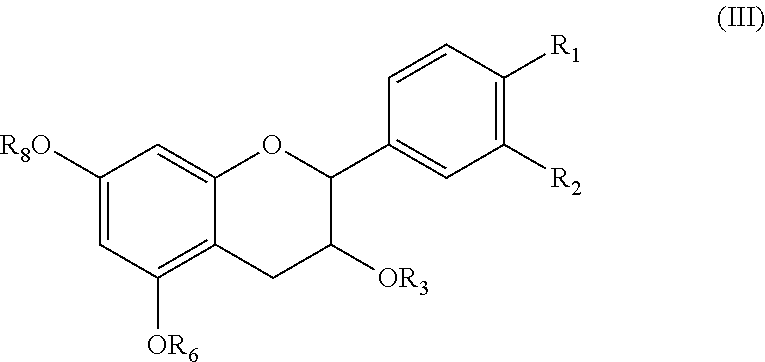
-
- the compound is the (2R,3R) diastereomer, or a racemic mixture of the (2R,3R) and (2S,3S) diastereomers;
- R1 and R2 are independently in each occurrence selected from the group consisting of hydroxyl; and —C1-6 alkoxy, wherein the C1-6 alkoxy is unsubstituted or substituted with 1 substituent selected from the group consisting of amino, hydroxyl, —C(O)OH, —C(O)NH2, and —C(O)O—(C1-3 alkyl);
- R3 is hydrogen or —C1-6 alkyl;
- R6 and R8 are independently in each occurrence hydrogen or —C1-4 alkyl; with the proviso that the following are not all true: R1 is hydroxyl or methoxy, R2 is hydroxyl or methoxy, R3 is H or methyl, R6 is H or methyl, and R8 is H or methyl.

-
- the compound is the (2R,3R) diastereomer, or a racemic mixture of the (2R,3R) and (2S,3S) diastereomers;
- R1 and R2 are independently in each occurrence hydroxyl or —O-A;
- R3 is hydrogen or -A;
- R6 and R8 are independently in each occurrence hydrogen or -A;
- with the proviso that the compound is not epicatechin
- 2-(4-Hydroxy-3-propoxy-phenyl)-chroman-3,5,7-triol;
- 2-(3-Hydroxy-4-propoxy-phenyl)-chroman-3,5,7-triol; 2-(3-Ethoxy-4-hydroxy-phenyl)-chroman-3,5,7-triol;
- 2-(4-Ethoxy-3-hydroxy-phenyl)-chroman-3,5,7-triol;
- 2-(3,4-Dihydroxy-phenyl)-3-propoxy-chroman-5,7-diol;
- methyl 4-((2R,3R)-3-hydroxy-5,7-dimethoxychroman-2-yl)-2-methoxybenzoate;
- methyl 5-((2R,3R)-3-hydroxy-5,7-dimethoxychroman-2-yl)-2-methoxybenzoate;
- (4-((2R,3R)-3-hydroxy-5,7-dimethoxychroman-2-yl)-2-methoxyphenyl)(4-methylpiperazin-1-yl)methanone;
- ethyl 2-(4-((2R,3R)-3-hydroxy-5,7-dimethoxychroman-2-yl)-2-methoxyphenoxy)acetate;
- ethyl 2-(5-((2R,3R)-3-hydroxy-5,7-dimethoxychroman-2-yl)-2-methoxyphenoxy)acetate;
- 2-(4-((2R,3R)-3-hydroxy-5,7-dimethoxychroman-2-yl)-2-methoxyphenoxy)acetic acid;
- ethyl 2-(2-hydroxy-4-((2R,3R)-3,5,7-trihydroxychroman-2-yl)phenoxy)acetate;
- ethyl 2-(2-hydroxy-5-((2R,3R)-3,5,7-trihydroxychroman-2-yl)phenoxy)acetate;
- (2R,3R)-2-(3,4-dihydroxyphenyl)-3-methoxychroman-5,7-diol;
- ((2R,3R)-2-(3,4-dihydroxyphenyl)-3-ethoxychroman-5,7-diol;
- (2R,3R)-2-(3,4-dihydroxyphenyl)-5,7-dihydroxychroman-3-yl acetate;
- 1-(((2R,3R)-2-(3,4-dihydroxyphenyl)-5,7-dihydroxychroman-3-yl)oxy)ethyl isobutyrate;
- (((2R,3R)-2-(3,4-dihydroxyphenyl)-5,7-dihydroxychroman-3-yl)oxy)methyl diisopropylcarbamate;
- tert-butyl ((((2R,3R)-2-(3,4-dihydroxyphenyl)-5,7-dihydroxychroman-3-yl)oxy)methyl)carbonate;
- 4-((2R,3R)-3,5,7-trihydroxychroman-2-yl)-1,2-phenylene dioctanoate;
- (2R,3R)-2-(3,4-dihydroxyphenyl)-5,7-dihydroxychroman-3-yl octanoate;
- (2R,3R)-2-(3,4-diacetoxyphenyl)chroman-3,5,7-triyl triacetate;
- 4-((2R,3R)-3,5,7-trihydroxychroman-2-yl)-1,2-phenylene diacetate;
- 4-((2R,3R)-3,5,7-trihydroxychroman-2-yl)-1,2-phenylene diacetate; and
- (2R,3R)-2-(3,4-dihydroxyphenyl)-3-methylchroman-3,5,7-triol;


where R1 is —O—(CH2)2CH3; R2 and R3 are —OH; and R4, R5, R6, R7, R8 and R9 are —H, is named “(2R,3R)-2-(3-hydroxy-4-propoxyphenyl)chroman-3,5,7-triol.” A compound of Formula I where R1 is —C(O)OCH3; R2 is —OCH3; R3 is —OH; and R4, R5, R7, and R9 are —H; and R6 and R9 are —CH3, is named “methyl 4-((2R,3R)-3-hydroxy-5,7-dimethoxychroman-2-yl)-2-methoxybenzoate.”


Step 1


Step 1


Step 1


Step 1


Step 1


Step 1


Step 1


Step 1


Claims (3)
Priority Applications (1)
| Application Number | Priority Date | Filing Date | Title |
|---|---|---|---|
| US14/237,167 US9187448B2 (en) | 2011-08-05 | 2012-08-06 | Flavonoid compounds |
Applications Claiming Priority (3)
| Application Number | Priority Date | Filing Date | Title |
|---|---|---|---|
| US201161515631P | 2011-08-05 | 2011-08-05 | |
| US14/237,167 US9187448B2 (en) | 2011-08-05 | 2012-08-06 | Flavonoid compounds |
| PCT/US2012/049767 WO2013022846A2 (en) | 2011-08-05 | 2012-08-06 | Flavonoid compounds |
Publications (2)
| Publication Number | Publication Date |
|---|---|
| US20140256741A1 US20140256741A1 (en) | 2014-09-11 |
| US9187448B2 true US9187448B2 (en) | 2015-11-17 |
Family
ID=47669187
Family Applications (1)
| Application Number | Title | Priority Date | Filing Date |
|---|---|---|---|
| US14/237,167 Active US9187448B2 (en) | 2011-08-05 | 2012-08-06 | Flavonoid compounds |
Country Status (5)
| Country | Link |
|---|---|
| US (1) | US9187448B2 (en) |
| EP (1) | EP2739613A4 (en) |
| JP (1) | JP2014521702A (en) |
| CN (1) | CN103987704A (en) |
| WO (1) | WO2013022846A2 (en) |
Cited By (3)
| Publication number | Priority date | Publication date | Assignee | Title |
|---|---|---|---|---|
| US10898465B2 (en) | 2016-06-21 | 2021-01-26 | Epirium Bio Inc. | Utility of (+) epicatechin and their analogs |
| WO2024036223A1 (en) | 2022-08-10 | 2024-02-15 | Epirium Bio Inc. | Epicatechin inhibiting atp hydrolysis |
| WO2024036225A1 (en) | 2022-08-10 | 2024-02-15 | Epirium Bio Inc. | Epicatechin for inhibiting glutamate toxicity |
Families Citing this family (21)
| Publication number | Priority date | Publication date | Assignee | Title |
|---|---|---|---|---|
| US10052316B2 (en) | 2011-06-06 | 2018-08-21 | Cardero Therapeutics, Inc. | Methods and compositions for treatment of mitochondrial toxicity |
| US20140179774A1 (en) * | 2012-12-26 | 2014-06-26 | Industrial Technology Research Institute | Methods for inhibition of shc-1/p66 to combat aging-related diseases |
| ES2927844T3 (en) | 2013-01-11 | 2022-11-11 | Corsair Pharma Inc | Treprostinil Prodrugs |
| US9505737B2 (en) | 2013-01-11 | 2016-11-29 | Corsair Pharma, Inc. | Treprostinil derivative compounds and methods of using same |
| CN105283179A (en) * | 2013-04-04 | 2016-01-27 | 斯法尔制药私人有限公司 | Novel analogues of epicatechin and related polyphenols |
| US10618933B2 (en) | 2014-07-23 | 2020-04-14 | Epirium Bio Inc. | Hydroxysteroid compounds, their intermediates, process of preparation, composition and uses thereof |
| CN104311524B (en) * | 2014-09-30 | 2016-12-07 | 浙江大学 | 3 ', 4 ', 5,7-tetra-ester group catechin method for selective production and product |
| CN104292201B (en) * | 2014-09-30 | 2017-05-10 | 浙江大学 | Method for preparing 3-ester group catechin |
| CN104311542A (en) * | 2014-09-30 | 2015-01-28 | 浙江大学 | Selective preparation method and product of 3-tetrahydropyrane-based catechin |
| CN104311523A (en) * | 2014-09-30 | 2015-01-28 | 浙江大学 | Method for selectively preparing 3',4'-diester-based catechin |
| CN104910119B (en) * | 2015-04-30 | 2017-08-15 | 天津科技大学 | One class cumarin substitution flavone derivative and its preparation method and application |
| US9394227B1 (en) | 2015-06-17 | 2016-07-19 | Corsair Pharma, Inc. | Treprostinil derivatives and compositions and uses thereof |
| US9643911B2 (en) | 2015-06-17 | 2017-05-09 | Corsair Pharma, Inc. | Treprostinil derivatives and compositions and uses thereof |
| US10918655B2 (en) | 2016-06-27 | 2021-02-16 | The General Hospital Corporation | Stimulating platelet generation by activating mitochondrial biogenesis |
| CN112367987A (en) * | 2018-06-05 | 2021-02-12 | 旗舰创业创新五公司 | Active agents and methods for their use in treating metabolic disorders and non-alcoholic fatty liver disease |
| CA3117466A1 (en) | 2018-10-24 | 2020-04-30 | Epirium Bio Inc. | Co-crystals comprising epicatechin and a carboxy-n-heterocyclic co-crystal former |
| JP2021167289A (en) * | 2020-04-10 | 2021-10-21 | 国立大学法人北海道大学 | Lipid nanoparticles containing water-soluble compounds |
| CN111773232B (en) * | 2020-06-29 | 2023-07-25 | 烟台大学 | Application of new flavonoid compound Hip A |
| JP7352596B2 (en) * | 2021-06-01 | 2023-09-28 | 花王株式会社 | Method for producing catechin conjugate |
| CN115385885A (en) * | 2022-05-05 | 2022-11-25 | 深圳海创生物科技有限公司 | Blueberry polyphenol, composition and application of blueberry polyphenol in preparation of medicines or foods with blood fat reducing and/or weight losing effects |
| CN115504970B (en) * | 2022-10-18 | 2023-04-18 | 黑龙江中医药大学 | Flavonoid derivative for treating myocardial ischemia and preparation method thereof |
Citations (1)
| Publication number | Priority date | Publication date | Assignee | Title |
|---|---|---|---|---|
| WO2010121232A1 (en) * | 2009-04-17 | 2010-10-21 | Cardero Therapeutics, Inc. | Methods and compositions for treatment of ischemic conditions and conditions related to mitochondrial function |
Family Cites Families (6)
| Publication number | Priority date | Publication date | Assignee | Title |
|---|---|---|---|---|
| JP2007521239A (en) * | 2003-09-12 | 2007-08-02 | 三井農林株式会社 | Antibacterial composition and method of use |
| GB2435166B (en) * | 2004-11-04 | 2009-07-08 | Univ Tsukuba | High molecular weight polphenols extracted from fermented tea and a method of manufacturing a medicament for the prevention and treatment of diabetes |
| JP2006249056A (en) * | 2005-03-07 | 2006-09-21 | Mitsui Norin Co Ltd | Uterine cancer inhibitor |
| EP2068941A4 (en) * | 2006-07-21 | 2009-09-30 | Mars Inc | IMPROVEMENT OF ARGINASE MIRRORS AND ACTIVITY |
| CN101947319B (en) * | 2009-07-10 | 2015-09-09 | 杏辉天力(杭州)药业有限公司 | Treat and prevent patient because of the medical composition of the discomfort caused by myocardial ischemia |
| CN101984965A (en) * | 2010-11-18 | 2011-03-16 | 安徽农业大学 | Application of epicatechin gallate and derivatives thereof for treating or preventing myocardial infarction and other ischemic heart diseases |
-
2012
- 2012-08-06 WO PCT/US2012/049767 patent/WO2013022846A2/en not_active Ceased
- 2012-08-06 JP JP2014524158A patent/JP2014521702A/en active Pending
- 2012-08-06 EP EP12821887.2A patent/EP2739613A4/en not_active Withdrawn
- 2012-08-06 US US14/237,167 patent/US9187448B2/en active Active
- 2012-08-06 CN CN201280045390.3A patent/CN103987704A/en active Pending
Patent Citations (1)
| Publication number | Priority date | Publication date | Assignee | Title |
|---|---|---|---|---|
| WO2010121232A1 (en) * | 2009-04-17 | 2010-10-21 | Cardero Therapeutics, Inc. | Methods and compositions for treatment of ischemic conditions and conditions related to mitochondrial function |
Cited By (3)
| Publication number | Priority date | Publication date | Assignee | Title |
|---|---|---|---|---|
| US10898465B2 (en) | 2016-06-21 | 2021-01-26 | Epirium Bio Inc. | Utility of (+) epicatechin and their analogs |
| WO2024036223A1 (en) | 2022-08-10 | 2024-02-15 | Epirium Bio Inc. | Epicatechin inhibiting atp hydrolysis |
| WO2024036225A1 (en) | 2022-08-10 | 2024-02-15 | Epirium Bio Inc. | Epicatechin for inhibiting glutamate toxicity |
Also Published As
| Publication number | Publication date |
|---|---|
| JP2014521702A (en) | 2014-08-28 |
| WO2013022846A3 (en) | 2013-10-24 |
| EP2739613A4 (en) | 2015-01-07 |
| EP2739613A2 (en) | 2014-06-11 |
| US20140256741A1 (en) | 2014-09-11 |
| CN103987704A (en) | 2014-08-13 |
| WO2013022846A2 (en) | 2013-02-14 |
Similar Documents
| Publication | Publication Date | Title |
|---|---|---|
| US20140256741A1 (en) | Flavonoid compounds | |
| US20120095063A1 (en) | Methods and compositions for treatment of ischemic conditions and conditions related to mitochondrial function | |
| US20150376225A1 (en) | Novel compounds of 11beta-hydroxy-steroids for use in mitochondria biogenesis and diseases associated with mitochondrial dysfunction or depletion | |
| CN110869024A (en) | Multibiological agents and methods of using the same | |
| KR20210151816A (en) | Cannabinoid acid ester compositions and uses thereof | |
| MX2007010327A (en) | Novel lipoxygenase inhibitors. | |
| JP2018024610A (en) | Virus growth inhibitor | |
| JP2001240539A (en) | Drugs or functional foods for suppressing elevated blood pressure or elevated blood sugar | |
| JP2004519455A (en) | Regulation of lipid and / or bone density and compositions therefor | |
| WO2011153353A1 (en) | Tocopherol derivatives and methods of use | |
| EP2668946B1 (en) | Anti-leishmanial compound and anti-leishmanial drug | |
| EP3482750B1 (en) | Novel use of sesquiterpene derivative | |
| JPWO2006137139A1 (en) | Method for isolating mangosteen, medicine containing the same, and health food | |
| JPH0826989A (en) | Preventing or improving agent for allergic symptom | |
| KR102229760B1 (en) | Fraction of Melissa Leaf Extract and Novel Pharmaceutical Composition Comprising the Same | |
| US20050277600A1 (en) | Compositions and methods of use of dimer digallates | |
| US20230117155A1 (en) | Fraction extract of melissa officinalis leaves and novel pharmaceutical composition including same | |
| US20240270786A1 (en) | Steroid compounds | |
| JP5861182B2 (en) | Flavanol derivative-acetone derivative adduct, production method thereof, amyloid β protein aggregation inhibitor and Alzheimer preventive or therapeutic agent using the same | |
| KR102057773B1 (en) | Pharmaceutical composition for preventing or treating a Malignant Neoplasms Of Breast comprising (-)-epigallocatechin gallate derivatives | |
| JP5936841B2 (en) | 8-Dimethylallyl-(-)-epigallocatechin-3-O-gallate | |
| JP6368270B2 (en) | Monieroside A and its derivatives, or a pharmaceutical composition, health food or cosmetic containing the same as an active ingredient | |
| WO2011068386A2 (en) | Anticancer composition containing a kampheride compound as an active ingredient | |
| KR20200005886A (en) | (-)-epigallocatechin gallate prodrugs, preparation method thereof and composition for inducing autophagy activation | |
| US20250170154A1 (en) | Genistein phosphate derivatives |
Legal Events
| Date | Code | Title | Description |
|---|---|---|---|
| AS | Assignment |
Owner name: CARDERO THERAPEUTICS, INC., CALIFORNIA Free format text: ASSIGNMENT OF ASSIGNORS INTEREST;ASSIGNORS:BECKER, CYRUS K.;SCHREINER, GEORGE F.;DUGAR, SUNDEEP;AND OTHERS;REEL/FRAME:032956/0452 Effective date: 20140421 |
|
| STCF | Information on status: patent grant |
Free format text: PATENTED CASE |
|
| MAFP | Maintenance fee payment |
Free format text: PAYMENT OF MAINTENANCE FEE, 4TH YR, SMALL ENTITY (ORIGINAL EVENT CODE: M2551); ENTITY STATUS OF PATENT OWNER: SMALL ENTITY Year of fee payment: 4 |
|
| AS | Assignment |
Owner name: SPHAERA PHARMA PTE. LTD., SINGAPORE Free format text: ASSIGNMENT OF ASSIGNORS INTEREST;ASSIGNOR:SPHAERA PHARMA PVT. LTD.;REEL/FRAME:057395/0453 Effective date: 20210705 Owner name: SPHAERA PHARMA PTE. LTD., SINGAPORE Free format text: ASSIGNMENT OF ASSIGNORS INTEREST;ASSIGNOR:DUGAR, SUNDEEP;REEL/FRAME:056921/0190 Effective date: 20210524 Owner name: SPHAERA PHARMA PVT. LTD., INDIA Free format text: ASSIGNMENT OF ASSIGNORS INTEREST;ASSIGNOR:MAHAJAN, DINESH;REEL/FRAME:056926/0887 Effective date: 20210526 |
|
| AS | Assignment |
Owner name: EPIRIUM BIO INC., CALIFORNIA Free format text: CHANGE OF NAME;ASSIGNOR:CARDERO THERAPEUTICS, INC.;REEL/FRAME:057595/0415 Effective date: 20191217 |
|
| AS | Assignment |
Owner name: EPIRIUM BIO INC., CALIFORNIA Free format text: ASSIGNMENT OF ASSIGNORS INTEREST;ASSIGNOR:SPHAERA PHARMA PTE. LTD.;REEL/FRAME:060020/0478 Effective date: 20210713 |
|
| MAFP | Maintenance fee payment |
Free format text: PAYMENT OF MAINTENANCE FEE, 8TH YR, SMALL ENTITY (ORIGINAL EVENT CODE: M2552); ENTITY STATUS OF PATENT OWNER: SMALL ENTITY Year of fee payment: 8 |