US9166270B2 - Balun with integrated decoupling as ground shield - Google Patents

Balun with integrated decoupling as ground shield Download PDF

Info

Publication number
US9166270B2
US9166270B2 US13/683,735 US201213683735A US9166270B2 US 9166270 B2 US9166270 B2 US 9166270B2 US 201213683735 A US201213683735 A US 201213683735A US 9166270 B2 US9166270 B2 US 9166270B2
Authority
US
United States
Prior art keywords
region
metallization layer
winding
balun
interconnect
Prior art date
Legal status (The legal status is an assumption and is not a legal conclusion. Google has not performed a legal analysis and makes no representation as to the accuracy of the status listed.)
Active, expires
Application number
US13/683,735
Other versions
US20140139297A1 (en
Inventor
Swaminathan Sankaran
Brian P. Ginsburg
Vijay B. Rentala
Srinath M. Ramaswamy
Eunyoung Seok
Baher Haroun
Bradley A. Kramer
Hassan Ali
Nirmal C. Warke
Current Assignee (The listed assignees may be inaccurate. Google has not performed a legal analysis and makes no representation or warranty as to the accuracy of the list.)
Texas Instruments Inc
Original Assignee
Texas Instruments Inc
Priority date (The priority date is an assumption and is not a legal conclusion. Google has not performed a legal analysis and makes no representation as to the accuracy of the date listed.)
Filing date
Publication date
Application filed by Texas Instruments Inc filed Critical Texas Instruments Inc
Priority to US13/683,735 priority Critical patent/US9166270B2/en
Assigned to TEXAS INSTRUMENTS INCORPORATED reassignment TEXAS INSTRUMENTS INCORPORATED ASSIGNMENT OF ASSIGNORS INTEREST (SEE DOCUMENT FOR DETAILS). Assignors: GINSBERG, BRIAN P., RENTALA, VIJAYA B., SEOK, EUNYOUNG, HAROUN, BAHER, RAMASWAMY, SRINATH M., ALI, HASSAN, KRAMER, BRADLEY A., SANKARAN, SWAMINATHAN, WARKE, NIRMAL C.
Priority to CN201310593903.0A priority patent/CN103840786B/en
Publication of US20140139297A1 publication Critical patent/US20140139297A1/en
Application granted granted Critical
Publication of US9166270B2 publication Critical patent/US9166270B2/en
Active legal-status Critical Current
Adjusted expiration legal-status Critical

Links

Images

Classifications

    • HELECTRICITY
    • H01ELECTRIC ELEMENTS
    • H01PWAVEGUIDES; RESONATORS, LINES, OR OTHER DEVICES OF THE WAVEGUIDE TYPE
    • H01P5/00Coupling devices of the waveguide type
    • H01P5/08Coupling devices of the waveguide type for linking dissimilar lines or devices
    • H01P5/10Coupling devices of the waveguide type for linking dissimilar lines or devices for coupling balanced lines or devices with unbalanced lines or devices
    • HELECTRICITY
    • H03ELECTRONIC CIRCUITRY
    • H03HIMPEDANCE NETWORKS, e.g. RESONANT CIRCUITS; RESONATORS
    • H03H1/00Constructional details of impedance networks whose electrical mode of operation is not specified or applicable to more than one type of network
    • H03H1/0007Constructional details of impedance networks whose electrical mode of operation is not specified or applicable to more than one type of network of radio frequency interference filters
    • HELECTRICITY
    • H05ELECTRIC TECHNIQUES NOT OTHERWISE PROVIDED FOR
    • H05KPRINTED CIRCUITS; CASINGS OR CONSTRUCTIONAL DETAILS OF ELECTRIC APPARATUS; MANUFACTURE OF ASSEMBLAGES OF ELECTRICAL COMPONENTS
    • H05K1/00Printed circuits
    • H05K1/02Details
    • H05K1/0213Electrical arrangements not otherwise provided for
    • H05K1/0216Reduction of cross-talk, noise or electromagnetic interference

Definitions

  • an apparatus comprising a plurality of transmission line cells formed in a first region; a first metallization layer formed over the plurality of transmission line cells within a portion of the first region, wherein at least a portion of the first metallization layer is electrically coupled to the plurality of transmission line cells; a second metallization layer formed over the first metallization layer, wherein the second metallization layer includes: an interconnect portion that at least partially extends into the first region; an overlay portion within the first region; a first balun winding that is electrically coupled to the overlay portion and that partially extends into a second region, wherein the first region partially surrounds the second region; and a third metallization layer formed over the second metallization layer having a second balun winding within the second region, wherein the second winding is generally coaxial with the first balun winding.
  • the first balun winding further comprises a third lead that is coupled to the second overlay portion and that is opposite first and second leads.
  • an apparatus comprising a first region; a second region, wherein the first region substantially surrounds at least a portion of the second region, and wherein the first region includes an opening; a plurality of transmission line cells formed in the first region; a first metallization layer having a plurality of portions formed in the first region that are electrically coupled to the plurality of transmission line cells; a second metallization layer formed over the first metallization layer, wherein the second metallization layer includes: an interconnect portion that at least partially extends into the first region; an overlay portion within the first region; a first balun winding that is electrically coupled to the overlay portion and that partially extends into a second region, wherein the first region partially surrounds the second region; and a third metallization layer formed over the second metallization layer having a second balun winding within the second region, wherein the second winding is generally coaxial with the first balun winding.
  • the interconnect portion further comprises a first interconnect portion and a second interconnect portion.
  • the first and second leads point in a first direction
  • the first balun winding includes first and second leads that extend through the opening and point in a second direction, and wherein the first direction is generally perpendicular to the second direction.
  • the overlay portion further comprises a first overlay portion and a second overlay portion, and wherein the interconnect portion is located between the first and second overlay portions.
  • the first balun winding further comprises a third lead that is coupled to the second overlay portion and that points in a third direction, wherein the third direction is generally perpendicular to the first direction and opposite the second direction.
  • an apparatus comprising a balun having: a first winding formed from a first portion of a first metallization layer, wherein the first winding has first and second leads pointing in a first direction and a third lead pointing in a second direction, and wherein the second direction is opposite the first direction; and a second winding formed from at least a portion of a second metallization layer, wherein the second winding has fourth and fifth leads pointing in a third direction, wherein the third direction is generally perpendicular to the first and second directions, and wherein the second winding is formed over and generally coaxial with the first winding; a transmission line formed along at least a portion of the periphery of the balun, wherein the transmission line includes a plurality of transmission line cells; a first conductive plane formed from at least a portion of a third metallization layer that extends over the transmission line, wherein at least a portion of the first conductive plane is electrically coupled to the transmission line; a second
  • the apparatus further comprises: a first set of vias coupled between the second interconnect and the first conductive plane; and a second set of vias coupled between the fifth lead and the second interconnect.
  • the first, second and third metallization layers are formed of copper or aluminum.
  • the first and second set of vias is formed of tungsten.
  • FIG. 1 is a diagram of an example of a layer of a transformer comprising a transmission line region and a balun region, in accordance with the present invention.
  • FIG. 2 is a diagram of an example of a layer of a transformer, comprising a transmission line region and a balun region, wherein the transmission line region is comprised of cells and vias, in accordance with the present invention.
  • FIG. 3 is a diagram of an example of a layer of a transformer, comprising a transmission line region and a balun region, wherein the transmission line region is comprised of cells and vias, which are electrically coupled to a conductive plane formed from a metallization layer, in accordance with the present invention.
  • FIG. 1 is a diagram of an example of a layer of a transformer comprising a transmission line region and a balun region, in accordance with the present invention.
  • FIG. 2 is a diagram of an example of a layer of a transformer, comprising a transmission line region and a balun region, where
  • the transmission line is generally formed of cells 106 .
  • These cells are more fully described in U.S. Pat. No. 8,476,687, which is entitled “LOW IMPEDANCE TRANSMISSION LINE,” which was filed on Sept. 22, 2010, and which is incorporated by reference herein for all purposes.
  • These cells include vias 108 (which can, for example, be formed of tungsten) that allow them to be electrically coupled to a conductive plane (which can be seen in greater detail in FIG. 3 ).
  • This conductive plane can be formed from metallization layer 114 (which can, for example, be formed of aluminum or copper) and can be formed from portions 110 - 1 to 110 - 3 and strips 112 .
  • Formed over the metallization layer 114 as shown in this example, are vias 113 . It is this metallization layer 114 that can, in part, function as a ground plane.
  • Metallization layer 120 (as shown in FIG. 5 ) can then be formed over metallization layer 118 . As shown in this example, the metallization layer 120 is primarily located within the balun region so as to form a winding of a balun.
  • the winding 117 - 2 formed by metallization layer 120 in this example, is generally coaxial with the winding 117 - 1 formed by portion 116 - 5 .
  • Lead 122 - 5 is coupled to portion 116 - 3 (and the underline ground plane), and lead 122 - 4 can be coupled to portion 116 - 2 through vias 115 , allowing a single-ended signal to be propagated through winding 117 - 2 .
  • interlayer dielectric layers which can, for example, be formed of silicon dioxide.

Landscapes

  • Coils Or Transformers For Communication (AREA)
  • Semiconductor Integrated Circuits (AREA)
  • Coils Of Transformers For General Uses (AREA)

Abstract

An apparatus is provided. Transmission line cells are formed in a first region. A first metallization layer is formed over the transmission line cells within a portion of the first region. At least a portion of the first metallization layer is electrically coupled to the plurality of transmission line cells. A second metallization layer is formed over the first metallization layer with an interconnect portion, and overlay portion, and a first balun. The interconnect portion at least partially extends into the first region, and the overlay portion is within the first region. The first balun winding is electrically coupled to the overlay portion and partially extends into a second region. The first region partially surrounds the second region. A third metallization layer is formed over the second metallization layer having a second balun winding within the second region, where the second winding is generally coaxial with the first balun winding.

Description

TECHNICAL FIELD
The invention relates generally to transformer and, more particularly, to balun with integrated decoupling as a ground shield.
BACKGROUND
Transmission lines employing transmission line units or elements within integrated circuits (ICs) are well-known. Typically, different heights for these transmission line units can vary the characteristics of the cell (and transmission line). Namely, the impedance is inversely proportional to the height. However, there is typically a tradeoff between impedance and space (layout) specifications. Additionally, many components, such as balun, use different input impedances.
One example of a conventional transmission line unit can be seen in U.S. patent application Ser. No. 12/888,208, which is entitled “LOW IMPEDANCE TRANSMISSION LINE,” which was field on Sep. 22, 2010, and which is incorporated by reference herein for all purposes. As shown, a transmission line is coupled to a balun, but this transmission line is substantially linear and is spaced apart from the balun so as to not interfere with the characteristics. As a result, area is wasted. Therefore, there is a desire for a transmission line for use with a balun that does not interfere with its characteristics and uses less area.
SUMMARY
In accordance with the present invention, an apparatus is provided. The apparatus comprises a plurality of transmission line cells formed in a first region; a first metallization layer formed over the plurality of transmission line cells within a portion of the first region, wherein at least a portion of the first metallization layer is electrically coupled to the plurality of transmission line cells; a second metallization layer formed over the first metallization layer, wherein the second metallization layer includes: an interconnect portion that at least partially extends into the first region; an overlay portion within the first region; a first balun winding that is electrically coupled to the overlay portion and that partially extends into a second region, wherein the first region partially surrounds the second region; and a third metallization layer formed over the second metallization layer having a second balun winding within the second region, wherein the second winding is generally coaxial with the first balun winding.
In accordance with the present invention, the first region includes an opening, and wherein the first balun winding includes first and second leads that extend through the opening.
In accordance with the present invention, the overlay portion further comprises a first overlay portion and a second overlay portion, and wherein the interconnect portion is located between the first and second overlay portions.
In accordance with the present invention, the first balun winding further comprises a third lead that is coupled to the second overlay portion and that is opposite first and second leads.
In accordance with the present invention, the interconnect portion further comprises a first interconnect portion and a second interconnect portion.
In accordance with the present invention, the second balun winding further comprises: a fourth lead that is coupled to the first interconnect portion; and a fifth lead that is coupled to the second interconnect portion.
In accordance with the present invention, an apparatus is provided. The apparatus comprises a first region; a second region, wherein the first region substantially surrounds at least a portion of the second region, and wherein the first region includes an opening; a plurality of transmission line cells formed in the first region; a first metallization layer having a plurality of portions formed in the first region that are electrically coupled to the plurality of transmission line cells; a second metallization layer formed over the first metallization layer, wherein the second metallization layer includes: an interconnect portion that at least partially extends into the first region; an overlay portion within the first region; a first balun winding that is electrically coupled to the overlay portion and that partially extends into a second region, wherein the first region partially surrounds the second region; and a third metallization layer formed over the second metallization layer having a second balun winding within the second region, wherein the second winding is generally coaxial with the first balun winding.
In accordance with the present invention, the interconnect portion further comprises a first interconnect portion and a second interconnect portion.
In accordance with the present invention, the second balun winding further comprises: a first lead that is coupled to the first interconnect portion; and a second lead that is coupled to the second interconnect portion.
In accordance with the present invention, the first and second leads point in a first direction, and wherein the first balun winding includes first and second leads that extend through the opening and point in a second direction, and wherein the first direction is generally perpendicular to the second direction.
In accordance with the present invention, the overlay portion further comprises a first overlay portion and a second overlay portion, and wherein the interconnect portion is located between the first and second overlay portions.
In accordance with the present invention, the first balun winding further comprises a third lead that is coupled to the second overlay portion and that points in a third direction, wherein the third direction is generally perpendicular to the first direction and opposite the second direction.
In accordance with the present invention, an apparatus is provided. The apparatus comprises a balun having: a first winding formed from a first portion of a first metallization layer, wherein the first winding has first and second leads pointing in a first direction and a third lead pointing in a second direction, and wherein the second direction is opposite the first direction; and a second winding formed from at least a portion of a second metallization layer, wherein the second winding has fourth and fifth leads pointing in a third direction, wherein the third direction is generally perpendicular to the first and second directions, and wherein the second winding is formed over and generally coaxial with the first winding; a transmission line formed along at least a portion of the periphery of the balun, wherein the transmission line includes a plurality of transmission line cells; a first conductive plane formed from at least a portion of a third metallization layer that extends over the transmission line, wherein at least a portion of the first conductive plane is electrically coupled to the transmission line; a second conductive plane formed from a second portion of the second metallization layer, wherein the second conductive plane extends over at least a portion of the first conductive plane, and wherein the second conductive plane is electrically coupled to the third lead; a first interconnect formed from a third portion of the second metallization layer, wherein the first interconnect is electrically coupled to the fourth lead; and a second interconnect formed from a fourth portion of the second metallization layer, wherein the second interconnect is electrically coupled to the first conductive plane and the fifth lead.
In accordance with the present invention, the apparatus further comprises: a first set of vias coupled between the second interconnect and the first conductive plane; and a second set of vias coupled between the fifth lead and the second interconnect.
In accordance with the present invention, the first, second and third metallization layers are formed of copper or aluminum.
In accordance with the present invention, the first and second set of vias is formed of tungsten.
The foregoing has outlined rather broadly the features and technical advantages of the present invention in order that the detailed description of the invention that follows may be better understood. Additional features and advantages of the invention will be described hereinafter which form the subject of the claims of the invention. It should be appreciated by those skilled in the art that the conception and the specific embodiment disclosed may be readily utilized as a basis for modifying or designing other structures for carrying out the same purposes of the present invention. It should also be realized by those skilled in the art that such equivalent constructions do not depart from the spirit and scope of the invention as set forth in the appended claims.
BRIEF DESCRIPTION OF THE DRAWINGS
For a more complete understanding of the present invention, and the advantages thereof, reference is now made to the following descriptions taken in conjunction with the accompanying drawings, in which:
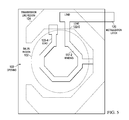
FIG. 1 is a diagram of an example of a layer of a transformer comprising a transmission line region and a balun region, in accordance with the present invention. FIG. 2 is a diagram of an example of a layer of a transformer, comprising a transmission line region and a balun region, wherein the transmission line region is comprised of cells and vias, in accordance with the present invention. FIG. 3 is a diagram of an example of a layer of a transformer, comprising a transmission line region and a balun region, wherein the transmission line region is comprised of cells and vias, which are electrically coupled to a conductive plane formed from a metallization layer, in accordance with the present invention. FIG. 4 is a diagram of an example of a layer of a transformer, comprising a transmission line region and a balun region, wherein the transmission line region is comprised of an overlay portion and an interconnect portion formed on a metallization layer, in accordance with the present invention. FIG. 5 is a diagram of an example of a layer of a transformer, comprising a transmission line region and a balun region, wherein the transmission line region is comprised of a metallization layer forming a winding within the balun region and leads from the winding extends from the balun region into the transmission line region, in accordance with the present invention.
DETAILED DESCRIPTION
Refer now to the drawings wherein depicted elements are, for the sake of clarity, not necessarily shown to scale and wherein like or similar elements are designated by the same reference numeral through the several views.
In FIGS. 1-5, an example of a transformer 100 can be seen. This transformer 100 includes a transmission line and balun that are, respectively, formed within transmission line region 104 and balun region 102. The transmission line generally forms a high-loss, low impedance termination for a terminal of the balun. As shown in this example, the transmission line region 104 is formed along a portion of the periphery of the balun region 102 so as to substantially surround it. This transmission line region 104, in this example, does not completely surround the balun region 102 as there is an opening 103.
As can be more clearly seen in FIG. 2, the transmission line is generally formed of cells 106. These cells are more fully described in U.S. Pat. No. 8,476,687, which is entitled “LOW IMPEDANCE TRANSMISSION LINE,” which was filed on Sept. 22, 2010, and which is incorporated by reference herein for all purposes. These cells include vias 108 (which can, for example, be formed of tungsten) that allow them to be electrically coupled to a conductive plane (which can be seen in greater detail in FIG. 3). This conductive plane can be formed from metallization layer 114 (which can, for example, be formed of aluminum or copper) and can be formed from portions 110-1 to 110-3 and strips 112. Formed over the metallization layer 114, as shown in this example, are vias 113. It is this metallization layer 114 that can, in part, function as a ground plane.
Above metallization layer 114 (as can be seen in FIG. 4), metallization layer 118 can be formed. This metallization layer 118 can also be, for example, of aluminum or copper similar to metallization layer 114. One difference between metallization layers 118 and 114 is that metallization layer 118 extends beyond the transmission line region 104 and into the balum region 102. Within the transmission line region 104, the metallization layer 118 has an overlay portion (which can be comprised of portions 116-1 and 116-4) and a interconnect portion (which can be comprised of portions 116-2 and 116-3). Portion 116-3, in this example, is located entirely within the transmission line region 104 and is coupled to portion 116-4 through vias 115. Portion 116-2, in this example, extends into both the transmission line region 104 and the balun region 102. Within the balun region 104, portion 116-5 of metallization layer 118 can form a winding 117-1 with terminals or leads 122-1 and 122-2 (which can be differential terminals) that extend through the opening 103 in the transmission line region 102. Opposite the leads 122-1 and 122-2 is another lead that is coupled with portion 116-5 to portion 116-4.
Metallization layer 120 (as shown in FIG. 5) can then be formed over metallization layer 118. As shown in this example, the metallization layer 120 is primarily located within the balun region so as to form a winding of a balun. The winding 117-2, formed by metallization layer 120 in this example, is generally coaxial with the winding 117-1 formed by portion 116-5. As shown, there are leads 122-4 and 122-5 that extend from the balun region 102 to the transmission line region 102. Lead 122-5 is coupled to portion 116-3 (and the underline ground plane), and lead 122-4 can be coupled to portion 116-2 through vias 115, allowing a single-ended signal to be propagated through winding 117-2. It should also be noted that interposed, between the metallization layers 114, 118, and 120 and the transmission line, there can be interlayer dielectric layers (which can, for example, be formed of silicon dioxide).
Having thus described the present invention by reference to certain of its preferred embodiments, it is noted that the embodiments disclosed are illustrative rather than limiting in nature and that a wide range of variations, modifications, changes, and substitutions are contemplated in the foregoing disclosure and, in some instances, some features of the present invention may be employed without a corresponding use of the other features. Accordingly, it is appropriate that the appended claims be construed broadly and in a manner consistent with the scope of the invention.

Claims (16)

The invention claimed is:
1. An apparatus comprising:
a plurality of transmission line cells formed in a first region;
a first metallization layer formed over the plurality of transmission line cells within a portion of the first region, wherein at least a portion of the first metallization layer is electrically coupled to the plurality of transmission line cells;
a second metallization layer formed over the first metallization layer, wherein the second metallization layer includes:
an interconnect portion that at least partially extends into the first region;
an overlay portion within the first region;
a first balun winding that is electrically coupled to the overlay portion and that partially extends into a second region, wherein the first region partially surrounds the second region; and
a third metallization layer formed over the second metallization layer having a second balun winding within the second region, wherein the second balun winding is generally coaxial with the first balun winding.
2. The apparatus of claim 1, wherein the first region includes an opening, and wherein the first balun winding includes first and second leads that extend through the opening.
3. The apparatus of claim 2, wherein the overlay portion further comprises a first overlay portion and a second overlay portion, and wherein the interconnect portion is located between the first and second overlay portions.
4. The apparatus of claim 3, wherein the first balun winding further comprises a third lead that is coupled to the second overlay portion and that is opposite first and second leads.
5. The apparatus of claim 4, wherein the interconnect portion further comprises a first interconnect portion and a second interconnect portion.
6. The apparatus of claim 5, wherein the second balun winding further comprises:
a fourth lead that is coupled to the first interconnect portion; and
a fifth lead that is coupled to the second interconnect portion.
7. An apparatus comprising:
a first region;
a second region, wherein the first region substantially surrounds at least a portion of the second region, and wherein the first region includes an opening;
a plurality of transmission line cells formed in the first region;
a first metallization layer having a plurality of portions formed in the first region that are electrically coupled to the plurality of transmission line cells;
a second metallization layer formed over the first metallization layer, wherein the second metallization layer includes:
an interconnect portion that at least partially extends into the first region;
an overlay portion within the first region;
a first balun winding that is electrically coupled to the overlay portion and that partially extends into a second region, wherein the first region partially surrounds the second region; and
a third metallization layer formed over the second metallization layer having a second balun winding within the second region, wherein the second winding is generally coaxial with the first balun winding.
8. The apparatus of claim 7, wherein the interconnect portion further comprises a first interconnect portion and a second interconnect portion.
9. The apparatus of claim 8, wherein the second balun winding further comprises:
a first lead that is coupled to the first interconnect portion; and
a second lead that is coupled to the second interconnect portion.
10. The apparatus of claim 9, wherein the first and second leads point in a first direction, and wherein the first balun winding includes first and second leads that extend through the opening and point in a second direction, and wherein the first direction is generally perpendicular to the second direction.
11. The apparatus of claim 10, wherein the overlay portion further comprises a first overlay portion and a second overlay portion, and wherein the interconnect portion is located between the first and second overlay portions.
12. The apparatus of claim 11, wherein the first balun winding further comprises a third lead that is coupled to the second overlay portion and that points in a third direction, wherein the third direction is generally perpendicular to the first direction and opposite the second direction.
13. An apparatus comprising:
a balun having:
a first winding formed from a first portion of a first metallization layer, wherein the first winding has first and second leads pointing in a first direction and a third lead pointing in a second direction, and wherein the second direction is opposite the first direction; and
a second winding formed from at least a portion of a second metallization layer, wherein the second winding has fourth and fifth leads pointing in a third direction, wherein the third direction is generally perpendicular to the first and second directions, and wherein the second winding is formed over and generally coaxial with the first winding;
a transmission line formed along at least a portion of the periphery of the balun, wherein the transmission line includes a plurality of transmission line cells;
a first conductive plane formed from at least a portion of a third metallization layer that extends over the transmission line, wherein at least a portion of the first conductive plane is electrically coupled to the transmission line;
a second conductive plane formed from a second portion of the second metallization layer, wherein the second conductive plane extends over at least a portion of the first conductive plane, and wherein the second conductive plane is electrically coupled to the third lead;
a first interconnect formed from a third portion of the second metallization layer, wherein the first interconnect is electrically coupled to the fourth lead; and
a second interconnect formed from a fourth portion of the second metallization layer, wherein the second interconnect is electrically coupled to the first conductive plane and the fifth lead.
14. The apparatus of claim 13, wherein the apparatus further comprises:
a first set of vias coupled between the second interconnect and the first conductive plane; and
a second set of vias coupled between the fifth lead and the second interconnect.
15. The apparatus of claim 14, wherein the first, second, and third metallization layers are formed of copper or aluminum.
16. The apparatus of claim 15, wherein the first and second set of vias are formed of tungsten.
US13/683,735 2012-11-21 2012-11-21 Balun with integrated decoupling as ground shield Active 2033-09-09 US9166270B2 (en)

Priority Applications (2)

Application Number Priority Date Filing Date Title
US13/683,735 US9166270B2 (en) 2012-11-21 2012-11-21 Balun with integrated decoupling as ground shield
CN201310593903.0A CN103840786B (en) 2012-11-21 2013-11-21 Balun with integrated decoupling as ground shield

Applications Claiming Priority (1)

Application Number Priority Date Filing Date Title
US13/683,735 US9166270B2 (en) 2012-11-21 2012-11-21 Balun with integrated decoupling as ground shield

Publications (2)

Publication Number Publication Date
US20140139297A1 US20140139297A1 (en) 2014-05-22
US9166270B2 true US9166270B2 (en) 2015-10-20

Family

ID=50727392

Family Applications (1)

Application Number Title Priority Date Filing Date
US13/683,735 Active 2033-09-09 US9166270B2 (en) 2012-11-21 2012-11-21 Balun with integrated decoupling as ground shield

Country Status (2)

Country Link
US (1) US9166270B2 (en)
CN (1) CN103840786B (en)

Citations (2)

* Cited by examiner, † Cited by third party
Publication number Priority date Publication date Assignee Title
US5015972A (en) * 1989-08-17 1991-05-14 Motorola, Inc. Broadband RF transformer
US8476687B2 (en) 2010-09-22 2013-07-02 Texas Instruments Incorporated Low impedance transmisson line

Family Cites Families (3)

* Cited by examiner, † Cited by third party
Publication number Priority date Publication date Assignee Title
AUPP482498A0 (en) * 1998-07-23 1998-08-13 A.C. & E. Pty Limited Balun and associated method for connecting cables
US6407647B1 (en) * 2001-01-23 2002-06-18 Triquint Semiconductor, Inc. Integrated broadside coupled transmission line element
JP2007201666A (en) * 2006-01-25 2007-08-09 Matsushita Electric Ind Co Ltd Baluns and electronic equipment using them

Patent Citations (2)

* Cited by examiner, † Cited by third party
Publication number Priority date Publication date Assignee Title
US5015972A (en) * 1989-08-17 1991-05-14 Motorola, Inc. Broadband RF transformer
US8476687B2 (en) 2010-09-22 2013-07-02 Texas Instruments Incorporated Low impedance transmisson line

Also Published As

Publication number Publication date
CN103840786B (en) 2018-06-05
CN103840786A (en) 2014-06-04
US20140139297A1 (en) 2014-05-22

Similar Documents

Publication Publication Date Title
US10269729B2 (en) Semiconductor packages having wire bond wall to reduce coupling
US9401342B2 (en) Semiconductor package having wire bond wall to reduce coupling
US9633940B2 (en) Structure and method for a high-K transformer with capacitive coupling
US9922763B2 (en) Transformer with two transformation ratio
CN103260340A (en) Multilayered wiring substrate and electronic apparatus
US20090160019A1 (en) Semiconductor capacitor
US8476687B2 (en) Low impedance transmisson line
TWI663785B (en) Electronic device, and radio-frequency device and signal transmission component thereof
US20170148559A1 (en) High q-factor inductor structure and rf integrated circuit including the same
US9166270B2 (en) Balun with integrated decoupling as ground shield
US11696399B2 (en) Circuit board
KR101823232B1 (en) Common mode filter
CN112838162A (en) A circular on-chip high-voltage isolation capacitor
WO2009107182A1 (en) Semiconductor device having electrode pad and radio circuit apparatus comprising the semiconductor device
CN109428141B (en) Balance-unbalance converter
US20210304964A1 (en) Capacitor
JP6680404B2 (en) Circuit module
US20140042515A1 (en) High voltage device
US10748860B2 (en) Amplifier
US20150179573A1 (en) Semiconductor device and method for manufacturing semiconductor device
US20190252331A1 (en) High-voltage capacitor structure and digital isolation apparatus
US20080079170A1 (en) Semiconductor device
JP6346373B2 (en) Electronics
JP5978652B2 (en) Input or output circuit and receiving or transmitting circuit
US20140175619A1 (en) Stripline and reference plane implementation for interposers using an implant layer

Legal Events

Date Code Title Description
AS Assignment

Owner name: TEXAS INSTRUMENTS INCORPORATED, TEXAS

Free format text: ASSIGNMENT OF ASSIGNORS INTEREST;ASSIGNORS:SANKARAN, SWAMINATHAN;GINSBERG, BRIAN P.;RENTALA, VIJAYA B.;AND OTHERS;SIGNING DATES FROM 20121105 TO 20121207;REEL/FRAME:030791/0338

STCF Information on status: patent grant

Free format text: PATENTED CASE

MAFP Maintenance fee payment

Free format text: PAYMENT OF MAINTENANCE FEE, 4TH YEAR, LARGE ENTITY (ORIGINAL EVENT CODE: M1551); ENTITY STATUS OF PATENT OWNER: LARGE ENTITY

Year of fee payment: 4

MAFP Maintenance fee payment

Free format text: PAYMENT OF MAINTENANCE FEE, 8TH YEAR, LARGE ENTITY (ORIGINAL EVENT CODE: M1552); ENTITY STATUS OF PATENT OWNER: LARGE ENTITY

Year of fee payment: 8