US9133177B2 - Ambipolar small molecule hosts for phosphorescent guest emitters - Google Patents
Ambipolar small molecule hosts for phosphorescent guest emitters Download PDFInfo
- Publication number
- US9133177B2 US9133177B2 US13/379,595 US201013379595A US9133177B2 US 9133177 B2 US9133177 B2 US 9133177B2 US 201013379595 A US201013379595 A US 201013379595A US 9133177 B2 US9133177 B2 US 9133177B2
- Authority
- US
- United States
- Prior art keywords
- group
- groups
- ambipolar
- oxadiazole
- mmol
- Prior art date
- Legal status (The legal status is an assumption and is not a legal conclusion. Google has not performed a legal analysis and makes no representation as to the accuracy of the status listed.)
- Expired - Fee Related, expires
Links
- 0 [1*]C1=C([2*])C([3*])=CC(C2=NN=C([Ar])O2)=C1 Chemical compound [1*]C1=C([2*])C([3*])=CC(C2=NN=C([Ar])O2)=C1 0.000 description 47
- LSZJZNNASZFXKN-UHFFFAOYSA-N CC(C)N1C2=C(C=CC=C2)C2=C1/C=C\C=C/2 Chemical compound CC(C)N1C2=C(C=CC=C2)C2=C1/C=C\C=C/2 LSZJZNNASZFXKN-UHFFFAOYSA-N 0.000 description 5
- TWYRHJPFOGABRB-UHFFFAOYSA-N C=CC1CC(C=C)C(CC)C1.C=CC1CC(C=C)C(CC)C1 Chemical compound C=CC1CC(C=C)C(CC)C1.C=CC1CC(C=C)C(CC)C1 TWYRHJPFOGABRB-UHFFFAOYSA-N 0.000 description 2
- YVDWFZIVIIKYBQ-UHFFFAOYSA-N CC1=NN=C(C)O1 Chemical compound CC1=NN=C(C)O1 YVDWFZIVIIKYBQ-UHFFFAOYSA-N 0.000 description 2
- PLSKVBYOBRVKEX-UHFFFAOYSA-N Oc1cccc(-c2nnc(-c3cc(-[n]4c5ccccc5c5c4cccc5)cc(-[n]4c5ccccc5c5c4cccc5)c3)[o]2)c1 Chemical compound Oc1cccc(-c2nnc(-c3cc(-[n]4c5ccccc5c5c4cccc5)cc(-[n]4c5ccccc5c5c4cccc5)c3)[o]2)c1 PLSKVBYOBRVKEX-UHFFFAOYSA-N 0.000 description 2
- VDCGZBYGIGMFMD-UHFFFAOYSA-N BrCCCCCC1CC2C=CC1C2.C1=CC(C2=NN=C(C3=CC(N4C5=C(C=CC=C5)C5=C4C=CC=C5)=CC(N4C5=C(C=CC=C5)C5=C4C=CC=C5)=C3)O2)=CC(OCCCCCC2CC3C=CC2C3)=C1.OC1=CC=CC(C2=NN=C(C3=CC(N4C5=C(C=CC=C5)C5=C4C=CC=C5)=CC(N4C5=C(C=CC=C5)C5=C4C=CC=C5)=C3)O2)=C1 Chemical compound BrCCCCCC1CC2C=CC1C2.C1=CC(C2=NN=C(C3=CC(N4C5=C(C=CC=C5)C5=C4C=CC=C5)=CC(N4C5=C(C=CC=C5)C5=C4C=CC=C5)=C3)O2)=CC(OCCCCCC2CC3C=CC2C3)=C1.OC1=CC=CC(C2=NN=C(C3=CC(N4C5=C(C=CC=C5)C5=C4C=CC=C5)=CC(N4C5=C(C=CC=C5)C5=C4C=CC=C5)=C3)O2)=C1 VDCGZBYGIGMFMD-UHFFFAOYSA-N 0.000 description 1
- JFNLZVQOOSMTJK-UHFFFAOYSA-N C(C1)C2C=CC1C2 Chemical compound C(C1)C2C=CC1C2 JFNLZVQOOSMTJK-UHFFFAOYSA-N 0.000 description 1
- GVWZEIBXXCBSKK-UHFFFAOYSA-N C.CC(C)(C)C1=CC=C(C2=NN=C(C3=CC=CC(C(=O)NN)=C3)O2)C=C1.CC(C)(C)C1=CC=C(C2=NN=C(C3=CC=CC(C4=NN=C(C5=CC(O)=CC=C5)O4)=C3)O2)C=C1.CC(C)(C)C1=CC=C(C2=NN=C(C3=CC=CC(C4=NN=C(C5=CC(OCC6CC7C=CC6C7)=CC=C5)O4)=C3)O2)C=C1.COC1=CC=CC(C(=O)Cl)=C1.COC1=CC=CC(C(=O)NNC(=O)C2=CC(C3=NN=C(C4=CC=C(C(C)(C)C)C=C4)O3)=CC=C2)=C1.COC1=CC=CC(C2=NN=C(C3=CC(C4=NN=C(C5=CC=C(C(C)(C)C)C=C5)O4)=CC=C3)O2)=C1.O=P(Cl)(Cl)Cl Chemical compound C.CC(C)(C)C1=CC=C(C2=NN=C(C3=CC=CC(C(=O)NN)=C3)O2)C=C1.CC(C)(C)C1=CC=C(C2=NN=C(C3=CC=CC(C4=NN=C(C5=CC(O)=CC=C5)O4)=C3)O2)C=C1.CC(C)(C)C1=CC=C(C2=NN=C(C3=CC=CC(C4=NN=C(C5=CC(OCC6CC7C=CC6C7)=CC=C5)O4)=C3)O2)C=C1.COC1=CC=CC(C(=O)Cl)=C1.COC1=CC=CC(C(=O)NNC(=O)C2=CC(C3=NN=C(C4=CC=C(C(C)(C)C)C=C4)O3)=CC=C2)=C1.COC1=CC=CC(C2=NN=C(C3=CC(C4=NN=C(C5=CC=C(C(C)(C)C)C=C5)O4)=CC=C3)O2)=C1.O=P(Cl)(Cl)Cl GVWZEIBXXCBSKK-UHFFFAOYSA-N 0.000 description 1
- DIBOMZZCPYWWJN-UHFFFAOYSA-N C.CCO.COC(=O)C1=CC=CC(I)=C1.NN.NNC(=O)C1=CC=CC(I)=C1 Chemical compound C.CCO.COC(=O)C1=CC=CC(I)=C1.NN.NNC(=O)C1=CC=CC(I)=C1 DIBOMZZCPYWWJN-UHFFFAOYSA-N 0.000 description 1
- VLBCJHOEPCCAOZ-UHFFFAOYSA-N C.CO.COC(=O)C1=CC=CC(I)=C1.O=C(O)C1=CC=CC(I)=C1.O=S(=O)(O)O Chemical compound C.CO.COC(=O)C1=CC=CC(I)=C1.O=C(O)C1=CC=CC(I)=C1.O=S(=O)(O)O VLBCJHOEPCCAOZ-UHFFFAOYSA-N 0.000 description 1
- BLOUSQJNGYFBAE-UHFFFAOYSA-N C.COC(=O)C1=CC=C(I)C=C1.NN.NNC(=O)C1=CC=C(I)C=C1 Chemical compound C.COC(=O)C1=CC=C(I)C=C1.NN.NNC(=O)C1=CC=C(I)C=C1 BLOUSQJNGYFBAE-UHFFFAOYSA-N 0.000 description 1
- WGSFNWVBOAKVRD-UHFFFAOYSA-N C.COC1=CC(C2=NN=C(C3=CC(N4C5=C(C=CC=C5)C5=C4C=CC=C5)=CC(N4C5=C(C=CC=C5)C5=C4C=CC=C5)=C3)O2)=CC=C1 Chemical compound C.COC1=CC(C2=NN=C(C3=CC(N4C5=C(C=CC=C5)C5=C4C=CC=C5)=CC(N4C5=C(C=CC=C5)C5=C4C=CC=C5)=C3)O2)=CC=C1 WGSFNWVBOAKVRD-UHFFFAOYSA-N 0.000 description 1
- OPAPNTXEVPPHMF-UHFFFAOYSA-N C.O=C(OCN1C2=C(C=C(N3C4=C(C=CC=C4)C4=C3C=CC=C4)C=C2)C2=C1/C=C\C(N1C3=C(C=CC=C3)C3=C1C=CC=C3)=C/2)C1CC2C=CC1C2.OCCCCCCCCCCCBr.OCN1C2=C(C=C(I)C=C2)C2=C1/C=C\C(I)=C/2.OCN1C2=C(C=C(N3C4=C(C=CC=C4)C4=C3C=CC=C4)C=C2)C2=C1/C=C\C(N1C3=C(C=CC=C3)C3=C1C=CC=C3)=C/2.[H]N1C2=C(C=C(I)C=C2)C2=C1/C=C\C(I)=C/2 Chemical compound C.O=C(OCN1C2=C(C=C(N3C4=C(C=CC=C4)C4=C3C=CC=C4)C=C2)C2=C1/C=C\C(N1C3=C(C=CC=C3)C3=C1C=CC=C3)=C/2)C1CC2C=CC1C2.OCCCCCCCCCCCBr.OCN1C2=C(C=C(I)C=C2)C2=C1/C=C\C(I)=C/2.OCN1C2=C(C=C(N3C4=C(C=CC=C4)C4=C3C=CC=C4)C=C2)C2=C1/C=C\C(N1C3=C(C=CC=C3)C3=C1C=CC=C3)=C/2.[H]N1C2=C(C=C(I)C=C2)C2=C1/C=C\C(I)=C/2 OPAPNTXEVPPHMF-UHFFFAOYSA-N 0.000 description 1
- RSNIMUHKSYDOML-UHFFFAOYSA-N C1=CC(C2=NN=C(C3=CC(N4C5=C(C=CC=C5)C5=C4C=CC=C5)=CC(N4C5=C(C=CC=C5)C5=C4C=CC=C5)=C3)O2)=CC(OCC2CC3C=CC2C3)=C1.C1=CC(C2=NN=C(C3=CC=C(N4C5=C(C=CC=C5)C5=C4C=CC=C5)C=C3)O2)=CC(OCC2CC3C=CC2C3)=C1.C1=CC(C2=NN=C(C3=CC=CC(N4C5=C(C=CC=C5)C5=C4C=CC=C5)=C3)O2)=CC(OCC2CC3C=CC2C3)=C1 Chemical compound C1=CC(C2=NN=C(C3=CC(N4C5=C(C=CC=C5)C5=C4C=CC=C5)=CC(N4C5=C(C=CC=C5)C5=C4C=CC=C5)=C3)O2)=CC(OCC2CC3C=CC2C3)=C1.C1=CC(C2=NN=C(C3=CC=C(N4C5=C(C=CC=C5)C5=C4C=CC=C5)C=C3)O2)=CC(OCC2CC3C=CC2C3)=C1.C1=CC(C2=NN=C(C3=CC=CC(N4C5=C(C=CC=C5)C5=C4C=CC=C5)=C3)O2)=CC(OCC2CC3C=CC2C3)=C1 RSNIMUHKSYDOML-UHFFFAOYSA-N 0.000 description 1
- RXSAJCCZANDDQC-UHFFFAOYSA-N C1=CC(C2=NN=C(C3=CC=C(N4C5=C(C=CC=C5)C5=C4C=CC=C5)C=C3)O2)=CC(OCC2CC3C=CC2C3)=C1.C=CC1CC(C=C)C(COC2=CC=CC(C3=NN=C(C4=CC=C(N5C6=C(C=CC=C6)C6=C5C=CC=C6)C=C4)O3)=C2)C1 Chemical compound C1=CC(C2=NN=C(C3=CC=C(N4C5=C(C=CC=C5)C5=C4C=CC=C5)C=C3)O2)=CC(OCC2CC3C=CC2C3)=C1.C=CC1CC(C=C)C(COC2=CC=CC(C3=NN=C(C4=CC=C(N5C6=C(C=CC=C6)C6=C5C=CC=C6)C=C4)O3)=C2)C1 RXSAJCCZANDDQC-UHFFFAOYSA-N 0.000 description 1
- JBELWRGYJITEOZ-UHFFFAOYSA-N C1=CC(C2=NN=C(C3=CC=CC(N4C5=C(C=CC=C5)C5=C4C=CC=C5)=C3)O2)=CC(OCC2CC3C=CC2C3)=C1.C=CC1CC(C=C)C(COC2=CC=CC(C3=NN=C(C4=CC=CC(N5C6=C(C=CC=C6)C6=C5C=CC=C6)=C4)O3)=C2)C1 Chemical compound C1=CC(C2=NN=C(C3=CC=CC(N4C5=C(C=CC=C5)C5=C4C=CC=C5)=C3)O2)=CC(OCC2CC3C=CC2C3)=C1.C=CC1CC(C=C)C(COC2=CC=CC(C3=NN=C(C4=CC=CC(N5C6=C(C=CC=C6)C6=C5C=CC=C6)=C4)O3)=C2)C1 JBELWRGYJITEOZ-UHFFFAOYSA-N 0.000 description 1
- OSROVXNGQNGEMI-UHFFFAOYSA-N C1=CC(C2=NN=C(C3=CC=CC(N4C5=C(C=CC=C5)C5=C4C=CC=C5)=C3)O2)=CC(OCC2CC3C=CC2C3)=C1.CC1=CC=C(S(=O)(=O)OCC2CC3C=CC2C3)C=C1.OC1=CC=CC(C2=NN=C(C3=CC=CC(N4C5=C(C=CC=C5)C5=C4C=CC=C5)=C3)O2)=C1 Chemical compound C1=CC(C2=NN=C(C3=CC=CC(N4C5=C(C=CC=C5)C5=C4C=CC=C5)=C3)O2)=CC(OCC2CC3C=CC2C3)=C1.CC1=CC=C(S(=O)(=O)OCC2CC3C=CC2C3)C=C1.OC1=CC=CC(C2=NN=C(C3=CC=CC(N4C5=C(C=CC=C5)C5=C4C=CC=C5)=C3)O2)=C1 OSROVXNGQNGEMI-UHFFFAOYSA-N 0.000 description 1
- FZQYPSFMIRDABR-UHFFFAOYSA-N C1=CC(OCC2CC3C=CC2C3)=CC(C2=NN=C(C3=CC(N4C5=C(C=CC=C5)C5=C4C=CC=C5)=CC(N4C5=C(C=CC=C5)C5=C4C=CC=C5)=C3)O2)=C1.C=CC1CC(C=C)C(COC2=CC(C3=NN=C(C4=CC(N5C6=C(C=CC=C6)C6=C5C=CC=C6)=CC(N5C6=C(C=CC=C6)C6=C5C=CC=C6)=C4)O3)=CC=C2)C1 Chemical compound C1=CC(OCC2CC3C=CC2C3)=CC(C2=NN=C(C3=CC(N4C5=C(C=CC=C5)C5=C4C=CC=C5)=CC(N4C5=C(C=CC=C5)C5=C4C=CC=C5)=C3)O2)=C1.C=CC1CC(C=C)C(COC2=CC(C3=NN=C(C4=CC(N5C6=C(C=CC=C6)C6=C5C=CC=C6)=CC(N5C6=C(C=CC=C6)C6=C5C=CC=C6)=C4)O3)=CC=C2)C1 FZQYPSFMIRDABR-UHFFFAOYSA-N 0.000 description 1
- GBCAGUPEHHJQOI-UHFFFAOYSA-N C1=CC2=C(C=C1)N(C1=CC3=C(C=C1)NC1=C3C=C(N3C4=C(C=CC=C4)C4=C3C=CC=C4)C=C1)C1=C2C=CC=C1.OCC1=CC=CC(C2=NN=C(C3=CC(I)=CC=C3)O2)=C1.OCC1=CC=CC(C2=NN=C(C3=CC(N4C5=C(C=C(N6C7=C(C=CC=C7)C7=C6C=CC=C7)C=C5)C5=C4C=CC(N4C6=C(C=CC=C6)C6=C4C=CC=C6)=C5)=CC=C3)O2)=C1 Chemical compound C1=CC2=C(C=C1)N(C1=CC3=C(C=C1)NC1=C3C=C(N3C4=C(C=CC=C4)C4=C3C=CC=C4)C=C1)C1=C2C=CC=C1.OCC1=CC=CC(C2=NN=C(C3=CC(I)=CC=C3)O2)=C1.OCC1=CC=CC(C2=NN=C(C3=CC(N4C5=C(C=C(N6C7=C(C=CC=C7)C7=C6C=CC=C7)C=C5)C5=C4C=CC(N4C6=C(C=CC=C6)C6=C4C=CC=C6)=C5)=CC=C3)O2)=C1 GBCAGUPEHHJQOI-UHFFFAOYSA-N 0.000 description 1
- RTKMAWUPINQZSS-UHFFFAOYSA-N C1=CC=C(COC2=CC(C3=NN=C(C4=CC(N5C6=C(C=CC=C6)C6=C5C=CC=C6)=CC(N5C6=C(C=CC=C6)C6=C5C=CC=C6)=C4)O3)=CC=C2)C=C1.C=CC1=CC=CC=C1.CCC(C)C.CCOC1=CC(C2=NN=C(C3=CC(N4C5=C(C=CC=C5)C5=C4C=CC=C5)=CC(N4C5=C(C=CC=C5)C5=C4C=CC=C5)=C3)O2)=CC=C1 Chemical compound C1=CC=C(COC2=CC(C3=NN=C(C4=CC(N5C6=C(C=CC=C6)C6=C5C=CC=C6)=CC(N5C6=C(C=CC=C6)C6=C5C=CC=C6)=C4)O3)=CC=C2)C=C1.C=CC1=CC=CC=C1.CCC(C)C.CCOC1=CC(C2=NN=C(C3=CC(N4C5=C(C=CC=C5)C5=C4C=CC=C5)=CC(N4C5=C(C=CC=C5)C5=C4C=CC=C5)=C3)O2)=CC=C1 RTKMAWUPINQZSS-UHFFFAOYSA-N 0.000 description 1
- AHNWEJQGTYMGHT-UHFFFAOYSA-N C1=CC=C(COC2=CC=CC(C3=NN=C(C4=CC=CC(N5C6=C(C=CC=C6)C6=C5C=CC=C6)=C4)O3)=C2)C=C1.C=CC1=CC=CC=C1.CCC(C)C.CCOC1=CC=CC(C2=NN=C(C3=CC=CC(N4C5=C(C=CC=C5)C5=C4C=CC=C5)=C3)O2)=C1 Chemical compound C1=CC=C(COC2=CC=CC(C3=NN=C(C4=CC=CC(N5C6=C(C=CC=C6)C6=C5C=CC=C6)=C4)O3)=C2)C=C1.C=CC1=CC=CC=C1.CCC(C)C.CCOC1=CC=CC(C2=NN=C(C3=CC=CC(N4C5=C(C=CC=C5)C5=C4C=CC=C5)=C3)O2)=C1 AHNWEJQGTYMGHT-UHFFFAOYSA-N 0.000 description 1
- QDBHXDNMUADPAG-UHFFFAOYSA-N C1=CC=CC=C1.C1=CC=CC=C1.C1=CC=CC=C1.C1=CC=CC=C1.CC.CC.CC.CC.CC(C)C.CC(C)C.CC1=NN=C(C)O1.CC1=NN=C([Y]C2=NN=C(C)O2)O1 Chemical compound C1=CC=CC=C1.C1=CC=CC=C1.C1=CC=CC=C1.C1=CC=CC=C1.CC.CC.CC.CC.CC(C)C.CC(C)C.CC1=NN=C(C)O1.CC1=NN=C([Y]C2=NN=C(C)O2)O1 QDBHXDNMUADPAG-UHFFFAOYSA-N 0.000 description 1
- GHVAIMOWXDKDLR-UHFFFAOYSA-N C=C(C)C(=O)OCCBr.C=C(C)C(=O)OCCOC1=CC=CC(C2=NN=C(C3=CC(N4C5=C(C=CC=C5)C5=C4C=CC=C5)=CC(N4C5=C(C=CC=C5)C5=C4C=CC=C5)=C3)O2)=C1.OC1=CC=CC(C2=NN=C(C3=CC(N4C5=C(C=CC=C5)C5=C4C=CC=C5)=CC(N4C5=C(C=CC=C5)C5=C4C=CC=C5)=C3)O2)=C1 Chemical compound C=C(C)C(=O)OCCBr.C=C(C)C(=O)OCCOC1=CC=CC(C2=NN=C(C3=CC(N4C5=C(C=CC=C5)C5=C4C=CC=C5)=CC(N4C5=C(C=CC=C5)C5=C4C=CC=C5)=C3)O2)=C1.OC1=CC=CC(C2=NN=C(C3=CC(N4C5=C(C=CC=C5)C5=C4C=CC=C5)=CC(N4C5=C(C=CC=C5)C5=C4C=CC=C5)=C3)O2)=C1 GHVAIMOWXDKDLR-UHFFFAOYSA-N 0.000 description 1
- UUCYCKVGWLBDQJ-UHFFFAOYSA-N C=C(C)C(=O)OCCBr.C=C(C)C(=O)OCCOC1=CC=CC(C2=NN=C(C3=CC=C(N4C5=C(C=CC=C5)C5=C4/C=C\C=C/5)C=C3)O2)=C1.OC1=CC=CC(C2=NN=C(C3=CC=C(N4C5=C(C=CC=C5)C5=C4/C=C\C=C/5)C=C3)O2)=C1 Chemical compound C=C(C)C(=O)OCCBr.C=C(C)C(=O)OCCOC1=CC=CC(C2=NN=C(C3=CC=C(N4C5=C(C=CC=C5)C5=C4/C=C\C=C/5)C=C3)O2)=C1.OC1=CC=CC(C2=NN=C(C3=CC=C(N4C5=C(C=CC=C5)C5=C4/C=C\C=C/5)C=C3)O2)=C1 UUCYCKVGWLBDQJ-UHFFFAOYSA-N 0.000 description 1
- BDAUEOANPUVJOB-UHFFFAOYSA-N C=C(C)C(=O)OCCBr.C=C(C)C(=O)OCCOC1=CC=CC(C2=NN=C(C3=CC=CC(N4C5=C(C=CC=C5)C5=C4C=CC=C5)=C3)O2)=C1.OC1=CC=CC(C2=NN=C(C3=CC=CC(N4C5=C(C=CC=C5)C5=C4C=CC=C5)=C3)O2)=C1 Chemical compound C=C(C)C(=O)OCCBr.C=C(C)C(=O)OCCOC1=CC=CC(C2=NN=C(C3=CC=CC(N4C5=C(C=CC=C5)C5=C4C=CC=C5)=C3)O2)=C1.OC1=CC=CC(C2=NN=C(C3=CC=CC(N4C5=C(C=CC=C5)C5=C4C=CC=C5)=C3)O2)=C1 BDAUEOANPUVJOB-UHFFFAOYSA-N 0.000 description 1
- GZJUOIGMFHRCPC-UHFFFAOYSA-N C=C(C)C(=O)OCCOC1=CC=CC(C2=NN=C(C3=CC(N4C5=C(C=CC=C5)C5=C4C=CC=C5)=CC(N4C5=C(C=CC=C5)C5=C4C=CC=C5)=C3)O2)=C1.CCC(C)(C)C(=O)OCCOC1=CC(C2=NN=C(C3=CC(N4C5=C(C=CC=C5)C5=C4C=CC=C5)=CC(N4C5=C(C=CC=C5)C5=C4C=CC=C5)=C3)O2)=CC=C1 Chemical compound C=C(C)C(=O)OCCOC1=CC=CC(C2=NN=C(C3=CC(N4C5=C(C=CC=C5)C5=C4C=CC=C5)=CC(N4C5=C(C=CC=C5)C5=C4C=CC=C5)=C3)O2)=C1.CCC(C)(C)C(=O)OCCOC1=CC(C2=NN=C(C3=CC(N4C5=C(C=CC=C5)C5=C4C=CC=C5)=CC(N4C5=C(C=CC=C5)C5=C4C=CC=C5)=C3)O2)=CC=C1 GZJUOIGMFHRCPC-UHFFFAOYSA-N 0.000 description 1
- YOABAWHCBCNMJC-UHFFFAOYSA-N C=C(C)C(=O)OCCOC1=CC=CC(C2=NN=C(C3=CC=C(N4C5=C(C=CC=C5)C5=C4C=CC=C5)C=C3)O2)=C1.CCC(C)(C)C(=O)OCCOC1=CC=CC(C2=NN=C(C3=CC=C(N4C5=C(C=CC=C5)C5=C4C=CC=C5)C=C3)O2)=C1 Chemical compound C=C(C)C(=O)OCCOC1=CC=CC(C2=NN=C(C3=CC=C(N4C5=C(C=CC=C5)C5=C4C=CC=C5)C=C3)O2)=C1.CCC(C)(C)C(=O)OCCOC1=CC=CC(C2=NN=C(C3=CC=C(N4C5=C(C=CC=C5)C5=C4C=CC=C5)C=C3)O2)=C1 YOABAWHCBCNMJC-UHFFFAOYSA-N 0.000 description 1
- SROUKYXOMXSCCZ-UHFFFAOYSA-N C=C(C)C(=O)OCCOC1=CC=CC(C2=NN=C(C3=CC=CC(N4C5=C(C=CC=C5)C5=C4C=CC=C5)=C3)O2)=C1.CCC(C)(C)C(=O)OCCOC1=CC=CC(C2=NN=C(C3=CC=CC(N4C5=C(C=CC=C5)C5=C4C=CC=C5)=C3)O2)=C1 Chemical compound C=C(C)C(=O)OCCOC1=CC=CC(C2=NN=C(C3=CC=CC(N4C5=C(C=CC=C5)C5=C4C=CC=C5)=C3)O2)=C1.CCC(C)(C)C(=O)OCCOC1=CC=CC(C2=NN=C(C3=CC=CC(N4C5=C(C=CC=C5)C5=C4C=CC=C5)=C3)O2)=C1 SROUKYXOMXSCCZ-UHFFFAOYSA-N 0.000 description 1
- KESLYYILVHIXAJ-UHFFFAOYSA-N C=CC1=CC=CC=C1.C=CC1=CC=CC=C1.CCCl.CCOC1=CC=CC(C2=NN=C(C3=CC(N4C5=C(C=CC=C5)C5=C4C=CC=C5)=CC(N4C5=C(C=CC=C5)C5=C4C=CC=C5)=C3)O2)=C1.OC1=CC=CC(C2=NN=C(C3=CC(N4C5=C(C=CC=C5)C5=C4C=CC=C5)=CC(N4C5=C(C=CC=C5)C5=C4C=CC=C5)=C3)O2)=C1 Chemical compound C=CC1=CC=CC=C1.C=CC1=CC=CC=C1.CCCl.CCOC1=CC=CC(C2=NN=C(C3=CC(N4C5=C(C=CC=C5)C5=C4C=CC=C5)=CC(N4C5=C(C=CC=C5)C5=C4C=CC=C5)=C3)O2)=C1.OC1=CC=CC(C2=NN=C(C3=CC(N4C5=C(C=CC=C5)C5=C4C=CC=C5)=CC(N4C5=C(C=CC=C5)C5=C4C=CC=C5)=C3)O2)=C1 KESLYYILVHIXAJ-UHFFFAOYSA-N 0.000 description 1
- OOGRJXOUTSTPIP-UHFFFAOYSA-N C=CC1=CC=CC=C1.C=CC1=CC=CC=C1.CCCl.CCOC1=CC=CC(C2=NN=C(C3=CC=C(N4C5=C(C=CC=C5)C5=C4/C=C\C=C/5)C=C3)O2)=C1.OC1=CC=CC(C2=NN=C(C3=CC=C(N4C5=C(C=CC=C5)C5=C4/C=C\C=C/5)C=C3)O2)=C1 Chemical compound C=CC1=CC=CC=C1.C=CC1=CC=CC=C1.CCCl.CCOC1=CC=CC(C2=NN=C(C3=CC=C(N4C5=C(C=CC=C5)C5=C4/C=C\C=C/5)C=C3)O2)=C1.OC1=CC=CC(C2=NN=C(C3=CC=C(N4C5=C(C=CC=C5)C5=C4/C=C\C=C/5)C=C3)O2)=C1 OOGRJXOUTSTPIP-UHFFFAOYSA-N 0.000 description 1
- IVMAKWMCNAMIHF-UHFFFAOYSA-N C=CC1=CC=CC=C1.C=CC1=CC=CC=C1.CCCl.CCOC1=CC=CC(C2=NN=C(C3=CC=CC(N4C5=C(C=CC=C5)C5=C4C=CC=C5)=C3)O2)=C1.OC1=CC=CC(C2=NN=C(C3=CC=CC(N4C5=C(C=CC=C5)C5=C4C=CC=C5)=C3)O2)=C1 Chemical compound C=CC1=CC=CC=C1.C=CC1=CC=CC=C1.CCCl.CCOC1=CC=CC(C2=NN=C(C3=CC=CC(N4C5=C(C=CC=C5)C5=C4C=CC=C5)=C3)O2)=C1.OC1=CC=CC(C2=NN=C(C3=CC=CC(N4C5=C(C=CC=C5)C5=C4C=CC=C5)=C3)O2)=C1 IVMAKWMCNAMIHF-UHFFFAOYSA-N 0.000 description 1
- MXUIYBXFFQNPSW-UHFFFAOYSA-N C=CC1=CC=CC=C1.C=CC1=CC=CC=C1.CCOC1=CC=CC(C2=NN=C(C3=CC=C(N4C5=C(C=CC=C5)C5=C4C=CC=C5)C=C3)O2)=C1.CCOC1=CC=CC(C2=NN=C(C3=CC=CC(N4C5=C(C=CC=C5)C5=C4C=CC=C5)=C3)O2)=C1 Chemical compound C=CC1=CC=CC=C1.C=CC1=CC=CC=C1.CCOC1=CC=CC(C2=NN=C(C3=CC=C(N4C5=C(C=CC=C5)C5=C4C=CC=C5)C=C3)O2)=C1.CCOC1=CC=CC(C2=NN=C(C3=CC=CC(N4C5=C(C=CC=C5)C5=C4C=CC=C5)=C3)O2)=C1 MXUIYBXFFQNPSW-UHFFFAOYSA-N 0.000 description 1
- OCPGHCUGEPHVDO-UHFFFAOYSA-N C=CC1=CC=CC=C1.CCC(C)C1=CC=CC=C1.CCOC1=CC=CC(C2=NN=C(C3=CC=C(N4C5=C(C=CC=C5)C5=C4C=CC=C5)C=C3)O2)=C1.CCOC1=CC=CC(C2=NN=C(C3=CC=C(N4C5=C(C=CC=C5)C5=C4C=CC=C5)C=C3)O2)=C1 Chemical compound C=CC1=CC=CC=C1.CCC(C)C1=CC=CC=C1.CCOC1=CC=CC(C2=NN=C(C3=CC=C(N4C5=C(C=CC=C5)C5=C4C=CC=C5)C=C3)O2)=C1.CCOC1=CC=CC(C2=NN=C(C3=CC=C(N4C5=C(C=CC=C5)C5=C4C=CC=C5)C=C3)O2)=C1 OCPGHCUGEPHVDO-UHFFFAOYSA-N 0.000 description 1
- GMOVOHAQSSFMOT-UHFFFAOYSA-N C=CC1=CC=CC=C1.CCOC1=CC=CC(C2=NN=C(C3=CC(N4C5=C(C=CC=C5)C5=C4C=CC=C5)=CC(N4C5=C(C=CC=C5)C5=C4C=CC=C5)=C3)O2)=C1 Chemical compound C=CC1=CC=CC=C1.CCOC1=CC=CC(C2=NN=C(C3=CC(N4C5=C(C=CC=C5)C5=C4C=CC=C5)=CC(N4C5=C(C=CC=C5)C5=C4C=CC=C5)=C3)O2)=C1 GMOVOHAQSSFMOT-UHFFFAOYSA-N 0.000 description 1
- OHPQAIXHHVRUMS-NSJNLYRLSA-N C=CC1CC(/C=C\C2CC(C=C)C(COC3=CC=CC(C4=NN=C(C5=CC=CC(C6=NN=C(C7=CC=C(C(C)(C)C)C=C7)O6)=C5)O4)=C3)C2)C(C(=O)OC(CCCCCCCCCC)N2C3=CC=C(N4C5=C(C=CC=C5)C5=C4C=CC=C5)C=C3C3=C2C=CC(N2C4=C(C=CC=C4)C4=C2C=CC=C4)=C3)C1 Chemical compound C=CC1CC(/C=C\C2CC(C=C)C(COC3=CC=CC(C4=NN=C(C5=CC=CC(C6=NN=C(C7=CC=C(C(C)(C)C)C=C7)O6)=C5)O4)=C3)C2)C(C(=O)OC(CCCCCCCCCC)N2C3=CC=C(N4C5=C(C=CC=C5)C5=C4C=CC=C5)C=C3C3=C2C=CC(N2C4=C(C=CC=C4)C4=C2C=CC=C4)=C3)C1 OHPQAIXHHVRUMS-NSJNLYRLSA-N 0.000 description 1
- ZONJYWQAVXDPQR-BOGXZQBTSA-L C=CC1CC(/C=C\C2CC(C=C)C(COC3=CC=CC(C4=NN=C(C5=CC=CC(C6=NN=C(C7=CC=C(C(C)(C)C)C=C7)O6)=C5)O4)=C3)C2)C(C(=O)OCN2C3=CC=C(N4C5=C(C=CC=C5)C5=C4C=CC=C5)C=C3C3=C2C=CC(N2C4=C(C=CC=C4)C4=C2C=CC=C4)=C3)C1.CC(C)(C)C1=CC=C(C2=NN=C(C3=CC(C4=NN=C(C5=CC(OCC6CC7C=CC6C7)=CC=C5)O4)=CC=C3)O2)C=C1.ClCCl.Cl[Ru](Cl)(=CC1=CC=CC=C1)([PH](C1CCCCC1)(C1CCCCC1)C1CCCCC1)[PH](C1CCCCC1)(C1CCCCC1)C1CCCCC1.O=C(OCN1C2=C(C=C(N3C4=C(C=CC=C4)C4=C3C=CC=C4)C=C2)C2=C\C(N3C4=C(C=CC=C4)C4=C3C=CC=C4)=C/C=C\21)C1CC2C=CC1C2 Chemical compound C=CC1CC(/C=C\C2CC(C=C)C(COC3=CC=CC(C4=NN=C(C5=CC=CC(C6=NN=C(C7=CC=C(C(C)(C)C)C=C7)O6)=C5)O4)=C3)C2)C(C(=O)OCN2C3=CC=C(N4C5=C(C=CC=C5)C5=C4C=CC=C5)C=C3C3=C2C=CC(N2C4=C(C=CC=C4)C4=C2C=CC=C4)=C3)C1.CC(C)(C)C1=CC=C(C2=NN=C(C3=CC(C4=NN=C(C5=CC(OCC6CC7C=CC6C7)=CC=C5)O4)=CC=C3)O2)C=C1.ClCCl.Cl[Ru](Cl)(=CC1=CC=CC=C1)([PH](C1CCCCC1)(C1CCCCC1)C1CCCCC1)[PH](C1CCCCC1)(C1CCCCC1)C1CCCCC1.O=C(OCN1C2=C(C=C(N3C4=C(C=CC=C4)C4=C3C=CC=C4)C=C2)C2=C\C(N3C4=C(C=CC=C4)C4=C3C=CC=C4)=C/C=C\21)C1CC2C=CC1C2 ZONJYWQAVXDPQR-BOGXZQBTSA-L 0.000 description 1
- BPPNWQQIICRGRS-UHFFFAOYSA-N C=CC1CC(C=C)C(C(=O)OCN2C3=C(C=C(N4C5=C(C=CC=C5)C5=C4C=CC=C5)C=C3)C3=C\C(N4C5=C(C=CC=C5)C5=C4/C=C\C=C/5)=C/C=C\32)C1.C=CC1CC(C=C)C(COC2=CC=CC(C3=NN=C(C4=CC=CC(C5=NN=C(C6=CC=C(C(C)(C)C)C=C6)O5)=C4)O3)=C2)C1 Chemical compound C=CC1CC(C=C)C(C(=O)OCN2C3=C(C=C(N4C5=C(C=CC=C5)C5=C4C=CC=C5)C=C3)C3=C\C(N4C5=C(C=CC=C5)C5=C4/C=C\C=C/5)=C/C=C\32)C1.C=CC1CC(C=C)C(COC2=CC=CC(C3=NN=C(C4=CC=CC(C5=NN=C(C6=CC=C(C(C)(C)C)C=C6)O5)=C4)O3)=C2)C1 BPPNWQQIICRGRS-UHFFFAOYSA-N 0.000 description 1
- WEJMIXOQRSNTTK-UHFFFAOYSA-N C=CC1CC(C=C)C(COC2=CC(C3=NN=C(C4=CC=CC(C5=NN=C(C6=CC=C(C(C)(C)C)C=C6)O5)=C4)O3)=CC=C2)C1 Chemical compound C=CC1CC(C=C)C(COC2=CC(C3=NN=C(C4=CC=CC(C5=NN=C(C6=CC=C(C(C)(C)C)C=C6)O5)=C4)O3)=CC=C2)C1 WEJMIXOQRSNTTK-UHFFFAOYSA-N 0.000 description 1
- IGZPNDYOWLEUPL-UHFFFAOYSA-N C=Cc1ccc(CCOc2cccc(-c3nnc(-c(cc4)ccc4-[n]4c5ccccc5c5ccccc45)[o]3)c2)cc1 Chemical compound C=Cc1ccc(CCOc2cccc(-c3nnc(-c(cc4)ccc4-[n]4c5ccccc5c5ccccc45)[o]3)c2)cc1 IGZPNDYOWLEUPL-UHFFFAOYSA-N 0.000 description 1
- PPBRXRYQALVLMV-UHFFFAOYSA-N C=Cc1ccccc1 Chemical compound C=Cc1ccccc1 PPBRXRYQALVLMV-UHFFFAOYSA-N 0.000 description 1
- RSTJMYAKXWFBTB-QJTMYURBSA-N CBP.CC(C)(C)C1=CC=C(C2=NN=C(C3=CC=C(C4=CC=CC=C4)C=C3)O2)C=C1.CC1=NC2=C3N=C(C)C=C(C4=CC=CC=C4)C3=CC=C2C(C2=CC=CC=C2)=C1.[2H]PB Chemical compound CBP.CC(C)(C)C1=CC=C(C2=NN=C(C3=CC=C(C4=CC=CC=C4)C=C3)O2)C=C1.CC1=NC2=C3N=C(C)C=C(C4=CC=CC=C4)C3=CC=C2C(C2=CC=CC=C2)=C1.[2H]PB RSTJMYAKXWFBTB-QJTMYURBSA-N 0.000 description 1
- AOUSBQVEVZBMNI-UHFFFAOYSA-N CC(C(OCCBr)=O)=C Chemical compound CC(C(OCCBr)=O)=C AOUSBQVEVZBMNI-UHFFFAOYSA-N 0.000 description 1
- SAJDEGZKULHJET-UHFFFAOYSA-N CC(C(OCCOc1cccc(-c2nnc(-c3cc(-[n]4c(cccc5)c5c5c4cccc5)cc(-[n]4c5ccccc5c5c4cccc5)c3)[o]2)c1)=O)=C Chemical compound CC(C(OCCOc1cccc(-c2nnc(-c3cc(-[n]4c(cccc5)c5c5c4cccc5)cc(-[n]4c5ccccc5c5c4cccc5)c3)[o]2)c1)=O)=C SAJDEGZKULHJET-UHFFFAOYSA-N 0.000 description 1
- XRCAQHHYBREPHZ-XBESNZKESA-N CC(C)(C)C1=CC=C(C2=NN=C(C3=CC=C(C4=CC=CC=C4)C=C3)O2)C=C1.CC(C)(C)C1=CC=C(C2=NN=C(C3=CC=CC(C4=NN=C(C5=CC=C(C(C)(C)C)C=C5)O4)=C3)O2)C=C1.CC1=NN=C(C)O1.[2H-7]OC.[2H]PB Chemical compound CC(C)(C)C1=CC=C(C2=NN=C(C3=CC=C(C4=CC=CC=C4)C=C3)O2)C=C1.CC(C)(C)C1=CC=C(C2=NN=C(C3=CC=CC(C4=NN=C(C5=CC=C(C(C)(C)C)C=C5)O4)=C3)O2)C=C1.CC1=NN=C(C)O1.[2H-7]OC.[2H]PB XRCAQHHYBREPHZ-XBESNZKESA-N 0.000 description 1
- ZVGRTKJRGSTYAK-UHFFFAOYSA-N CC(C)(C)c(cc1)ccc1-c1nnc(-c2cc(-c3nnc(-c4cccc(OCC(C5)C6C=CC5C6)c4)[o]3)ccc2)[o]1 Chemical compound CC(C)(C)c(cc1)ccc1-c1nnc(-c2cc(-c3nnc(-c4cccc(OCC(C5)C6C=CC5C6)c4)[o]3)ccc2)[o]1 ZVGRTKJRGSTYAK-UHFFFAOYSA-N 0.000 description 1
- YZNHRYHEFHWYNY-UHFFFAOYSA-N CC(C)CC(OO)C(C)C.CC(C)OCC(OO)C(C)C Chemical compound CC(C)CC(OO)C(C)C.CC(C)OCC(OO)C(C)C YZNHRYHEFHWYNY-UHFFFAOYSA-N 0.000 description 1
- HIIBZFKVMXEQMR-UHFFFAOYSA-N CC(C)COC(C)C Chemical compound CC(C)COC(C)C HIIBZFKVMXEQMR-UHFFFAOYSA-N 0.000 description 1
- MDCMOPBBGLOMNI-UHFFFAOYSA-N CC(C)COC(C)C.CC(C)OCOC(C)C Chemical compound CC(C)COC(C)C.CC(C)OCOC(C)C MDCMOPBBGLOMNI-UHFFFAOYSA-N 0.000 description 1
- LXFXMSMUNWNTIQ-UHFFFAOYSA-N CC(c1ccc(C=C)cc1)Oc1cccc(-c2nnc(-c3cc(-[n]4c5ccccc5c5ccccc45)cc(-[n]4c5ccccc5c5c4cccc5)c3)[o]2)c1 Chemical compound CC(c1ccc(C=C)cc1)Oc1cccc(-c2nnc(-c3cc(-[n]4c5ccccc5c5ccccc45)cc(-[n]4c5ccccc5c5c4cccc5)c3)[o]2)c1 LXFXMSMUNWNTIQ-UHFFFAOYSA-N 0.000 description 1
- YSGQEMLCIOVDSV-UHFFFAOYSA-K CC1=CC(C)=C(N2CCN(C3=C(C)C=C(C)C=C3C)C2[Ru](Cl)(Cl)(=CC2=CC=CC=C2)(N2=CC=CC(Br)=C2)N2=CC=CC(Br)=C2)C(C)=C1.CC1=CC(C)=C(N2CCN(C3=C(C)C=C(C)C=C3C)C2[Ru](Cl)(Cl)(=CC2=CC=CC=C2)[PH](C2CCCCC2)(C2CCCCC2)C2CCCCC2)C(C)=C1.Cl[Ru](Cl)(=CC1=CC=CC=C1)([PH](C1CCCCC1)(C1CCCCC1)C1CCCCC1)[PH](C1CCCCC1)(C1CCCCC1)C1CCCCC1 Chemical compound CC1=CC(C)=C(N2CCN(C3=C(C)C=C(C)C=C3C)C2[Ru](Cl)(Cl)(=CC2=CC=CC=C2)(N2=CC=CC(Br)=C2)N2=CC=CC(Br)=C2)C(C)=C1.CC1=CC(C)=C(N2CCN(C3=C(C)C=C(C)C=C3C)C2[Ru](Cl)(Cl)(=CC2=CC=CC=C2)[PH](C2CCCCC2)(C2CCCCC2)C2CCCCC2)C(C)=C1.Cl[Ru](Cl)(=CC1=CC=CC=C1)([PH](C1CCCCC1)(C1CCCCC1)C1CCCCC1)[PH](C1CCCCC1)(C1CCCCC1)C1CCCCC1 YSGQEMLCIOVDSV-UHFFFAOYSA-K 0.000 description 1
- GQGKLKUITPHPSE-UHFFFAOYSA-N CC1=CC=CC(C2=NN=C(C3=CC(N4C5=C(C=CC=C5)C5=C4C=CC=C5)=CC=C3)O2)=C1.COC1=CC=CC(C2=NN=C(C3=CC(N4C5=C(C=CC=C5)C5=C4C=CC=C5)=CC=C3)O2)=C1.COC1=CC=CC(C2=NN=C(C3=CC=C(N4C5=C(C=CC=C5)C5=C4C=CC=C5)C=C3)O2)=C1.OC1=CC=CC(C2=NN=C(C3=CC=C(N4C5=C(C=CC=C5)C5=C4C=CC=C5)C=C3)O2)=C1 Chemical compound CC1=CC=CC(C2=NN=C(C3=CC(N4C5=C(C=CC=C5)C5=C4C=CC=C5)=CC=C3)O2)=C1.COC1=CC=CC(C2=NN=C(C3=CC(N4C5=C(C=CC=C5)C5=C4C=CC=C5)=CC=C3)O2)=C1.COC1=CC=CC(C2=NN=C(C3=CC=C(N4C5=C(C=CC=C5)C5=C4C=CC=C5)C=C3)O2)=C1.OC1=CC=CC(C2=NN=C(C3=CC=C(N4C5=C(C=CC=C5)C5=C4C=CC=C5)C=C3)O2)=C1 GQGKLKUITPHPSE-UHFFFAOYSA-N 0.000 description 1
- YZYKYLFMIHONBO-CDKOBAIVSA-N CCC(C)(CC(C)(C)C(=O)OCCCOC1=CC=C(/C=C/C(=O)OC)C=C1)C(=O)OCCCOC1=CC=C(N(C2=CC=C(C3=CC=C(N(C4=CC=CC(F)=C4)C4=CC(C)=CC=C4)C=C3)C=C2)C2=CC(F)=CC=C2)C=C1.CCC(C)N1C2=C(C=CC=C2)C2=C1/C=C\C=C/2.[K]P[V] Chemical compound CCC(C)(CC(C)(C)C(=O)OCCCOC1=CC=C(/C=C/C(=O)OC)C=C1)C(=O)OCCCOC1=CC=C(N(C2=CC=C(C3=CC=C(N(C4=CC=CC(F)=C4)C4=CC(C)=CC=C4)C=C3)C=C2)C2=CC(F)=CC=C2)C=C1.CCC(C)N1C2=C(C=CC=C2)C2=C1/C=C\C=C/2.[K]P[V] YZYKYLFMIHONBO-CDKOBAIVSA-N 0.000 description 1
- ODEGTYBKXGZYNO-UHFFFAOYSA-N CCC(C)c1cccc(CCOc2cccc(-c3nnc(-c(cc4)ccc4-[n]4c5ccccc5c5ccccc45)[o]3)c2)c1 Chemical compound CCC(C)c1cccc(CCOc2cccc(-c3nnc(-c(cc4)ccc4-[n]4c5ccccc5c5ccccc45)[o]3)c2)c1 ODEGTYBKXGZYNO-UHFFFAOYSA-N 0.000 description 1
- IOADNLCRKJKVCD-UHFFFAOYSA-N CCO.COC(=O)C1=CC(I)=CC(I)=C1.NN.NNC(=O)C1=CC(I)=CC(I)=C1 Chemical compound CCO.COC(=O)C1=CC(I)=CC(I)=C1.NN.NNC(=O)C1=CC(I)=CC(I)=C1 IOADNLCRKJKVCD-UHFFFAOYSA-N 0.000 description 1
- YYSITUQNFNKVLR-UHFFFAOYSA-N COC(c1cc(I)cc(I)c1)=O Chemical compound COC(c1cc(I)cc(I)c1)=O YYSITUQNFNKVLR-UHFFFAOYSA-N 0.000 description 1
- ZQNSBWFZCUVOEG-UHFFFAOYSA-N COC1=CC=CC(C(=O)Cl)=C1.COC1=CC=CC(C(=O)NNC(=O)C2=CC(I)=CC(I)=C2)=C1.NNC(=O)C1=CC(I)=CC(I)=C1 Chemical compound COC1=CC=CC(C(=O)Cl)=C1.COC1=CC=CC(C(=O)NNC(=O)C2=CC(I)=CC(I)=C2)=C1.NNC(=O)C1=CC(I)=CC(I)=C1 ZQNSBWFZCUVOEG-UHFFFAOYSA-N 0.000 description 1
- PZSGUYRBLZBIJL-UHFFFAOYSA-N COC1=CC=CC(C(=O)Cl)=C1.COC1=CC=CC(C(=O)NNC(=O)C2=CC=C(I)C=C2)=C1.NNC(=O)C1=CC=C(I)C=C1 Chemical compound COC1=CC=CC(C(=O)Cl)=C1.COC1=CC=CC(C(=O)NNC(=O)C2=CC=C(I)C=C2)=C1.NNC(=O)C1=CC=C(I)C=C1 PZSGUYRBLZBIJL-UHFFFAOYSA-N 0.000 description 1
- AYPPLBHUMWNSQV-UHFFFAOYSA-N COC1=CC=CC(C(=O)Cl)=C1.COC1=CC=CC(C(=O)NNC(=O)C2=CC=CC(I)=C2)=C1.NNC(=O)C1=CC=CC(I)=C1 Chemical compound COC1=CC=CC(C(=O)Cl)=C1.COC1=CC=CC(C(=O)NNC(=O)C2=CC=CC(I)=C2)=C1.NNC(=O)C1=CC=CC(I)=C1 AYPPLBHUMWNSQV-UHFFFAOYSA-N 0.000 description 1
- KDXZQJRDONAPSH-UHFFFAOYSA-N COC1=CC=CC(C(=O)NNC(=O)C2=CC(I)=CC(I)=C2)=C1.COC1=CC=CC(C2=NN=C(C3=CC(I)=CC(I)=C3)O2)=C1.O=P(Cl)(Cl)Cl Chemical compound COC1=CC=CC(C(=O)NNC(=O)C2=CC(I)=CC(I)=C2)=C1.COC1=CC=CC(C2=NN=C(C3=CC(I)=CC(I)=C3)O2)=C1.O=P(Cl)(Cl)Cl KDXZQJRDONAPSH-UHFFFAOYSA-N 0.000 description 1
- HDLBRBIRPZNELE-UHFFFAOYSA-N COC1=CC=CC(C(=O)NNC(=O)C2=CC=C(I)C=C2)=C1.COC1=CC=CC(C2=NN=C(C3=CC=C(I)C=C3)O2)=C1.O=P(Cl)(Cl)Cl Chemical compound COC1=CC=CC(C(=O)NNC(=O)C2=CC=C(I)C=C2)=C1.COC1=CC=CC(C2=NN=C(C3=CC=C(I)C=C3)O2)=C1.O=P(Cl)(Cl)Cl HDLBRBIRPZNELE-UHFFFAOYSA-N 0.000 description 1
- NQTJDXWQLPDFIF-UHFFFAOYSA-N COC1=CC=CC(C(=O)NNC(=O)C2=CC=CC(I)=C2)=C1.COC1=CC=CC(C2=NN=C(C3=CC=CC(I)=C3)O2)=C1.O=P(Cl)(Cl)Cl Chemical compound COC1=CC=CC(C(=O)NNC(=O)C2=CC=CC(I)=C2)=C1.COC1=CC=CC(C2=NN=C(C3=CC=CC(I)=C3)O2)=C1.O=P(Cl)(Cl)Cl NQTJDXWQLPDFIF-UHFFFAOYSA-N 0.000 description 1
- WNXIAVIEXRFPMY-UHFFFAOYSA-N COC1=CC=CC(C2=NN=C(C3=CC(I)=CC(I)=C3)O2)=C1.COC1=CC=CC(C2=NN=C(C3=CC(N4C5=C(C=CC=C5)C5=C4C=CC=C5)=CC(N4C5=C(C=CC=C5)C5=C4C=CC=C5)=C3)O2)=C1.[H]N1C2=C(C=CC=C2)C2=C1/C=C\C=C/2 Chemical compound COC1=CC=CC(C2=NN=C(C3=CC(I)=CC(I)=C3)O2)=C1.COC1=CC=CC(C2=NN=C(C3=CC(N4C5=C(C=CC=C5)C5=C4C=CC=C5)=CC(N4C5=C(C=CC=C5)C5=C4C=CC=C5)=C3)O2)=C1.[H]N1C2=C(C=CC=C2)C2=C1/C=C\C=C/2 WNXIAVIEXRFPMY-UHFFFAOYSA-N 0.000 description 1
- WHRYUGSKTJMXDT-UHFFFAOYSA-N COC1=CC=CC(C2=NN=C(C3=CC(N4C5=C(C=CC=C5)C5=C4C=CC=C5)=CC(N4C5=C(C=CC=C5)C5=C4C=CC=C5)=C3)O2)=C1 Chemical compound COC1=CC=CC(C2=NN=C(C3=CC(N4C5=C(C=CC=C5)C5=C4C=CC=C5)=CC(N4C5=C(C=CC=C5)C5=C4C=CC=C5)=C3)O2)=C1 WHRYUGSKTJMXDT-UHFFFAOYSA-N 0.000 description 1
- DTCKQNVWDNRGKE-UHFFFAOYSA-N COC1=CC=CC(C2=NN=C(C3=CC(N4C5=C(C=CC=C5)C5=C4C=CC=C5)=CC(N4C5=C(C=CC=C5)C5=C4C=CC=C5)=C3)O2)=C1.OC1=CC=CC(C2=NN=C(C3=CC(N4C5=C(C=CC=C5)C5=C4C=CC=C5)=CC(N4C5=C(C=CC=C5)C5=C4C=CC=C5)=C3)O2)=C1 Chemical compound COC1=CC=CC(C2=NN=C(C3=CC(N4C5=C(C=CC=C5)C5=C4C=CC=C5)=CC(N4C5=C(C=CC=C5)C5=C4C=CC=C5)=C3)O2)=C1.OC1=CC=CC(C2=NN=C(C3=CC(N4C5=C(C=CC=C5)C5=C4C=CC=C5)=CC(N4C5=C(C=CC=C5)C5=C4C=CC=C5)=C3)O2)=C1 DTCKQNVWDNRGKE-UHFFFAOYSA-N 0.000 description 1
- PSYSGGABXDAAMC-UHFFFAOYSA-N COC1=CC=CC(C2=NN=C(C3=CC=C(I)C=C3)O2)=C1.COC1=CC=CC(C2=NN=C(C3=CC=C(N4C5=C(C=CC=C5)C5=C4/C=C\C=C/5)C=C3)O2)=C1.[H]N1C2=C(C=CC=C2)C2=C1/C=C\C=C/2 Chemical compound COC1=CC=CC(C2=NN=C(C3=CC=C(I)C=C3)O2)=C1.COC1=CC=CC(C2=NN=C(C3=CC=C(N4C5=C(C=CC=C5)C5=C4/C=C\C=C/5)C=C3)O2)=C1.[H]N1C2=C(C=CC=C2)C2=C1/C=C\C=C/2 PSYSGGABXDAAMC-UHFFFAOYSA-N 0.000 description 1
- UQBJKDUFVFOHFW-UHFFFAOYSA-N COC1=CC=CC(C2=NN=C(C3=CC=C(N4C5=C(C=CC=C5)C5=C4/C=C\C=C/5)C=C3)O2)=C1.OC1=CC=CC(C2=NN=C(C3=CC=C(N4C5=C(C=CC=C5)C5=C4/C=C\C=C/5)C=C3)O2)=C1 Chemical compound COC1=CC=CC(C2=NN=C(C3=CC=C(N4C5=C(C=CC=C5)C5=C4/C=C\C=C/5)C=C3)O2)=C1.OC1=CC=CC(C2=NN=C(C3=CC=C(N4C5=C(C=CC=C5)C5=C4/C=C\C=C/5)C=C3)O2)=C1 UQBJKDUFVFOHFW-UHFFFAOYSA-N 0.000 description 1
- ORWOFYHBOYGLGQ-UHFFFAOYSA-N COC1=CC=CC(C2=NN=C(C3=CC=CC(I)=C3)O2)=C1.COC1=CC=CC(C2=NN=C(C3=CC=CC(N4C5=C(C=CC=C5)C5=C4C=CC=C5)=C3)O2)=C1.[H]N1C2=C(C=CC=C2)C2=C1/C=C\C=C/2 Chemical compound COC1=CC=CC(C2=NN=C(C3=CC=CC(I)=C3)O2)=C1.COC1=CC=CC(C2=NN=C(C3=CC=CC(N4C5=C(C=CC=C5)C5=C4C=CC=C5)=C3)O2)=C1.[H]N1C2=C(C=CC=C2)C2=C1/C=C\C=C/2 ORWOFYHBOYGLGQ-UHFFFAOYSA-N 0.000 description 1
- FLSBETAKVZNBKQ-UHFFFAOYSA-N COC1=CC=CC(C2=NN=C(C3=CC=CC(N4C5=C(C=CC=C5)C5=C4C=CC=C5)=C3)O2)=C1.OC1=CC=CC(C2=NN=C(C3=CC=CC(N4C5=C(C=CC=C5)C5=C4C=CC=C5)=C3)O2)=C1 Chemical compound COC1=CC=CC(C2=NN=C(C3=CC=CC(N4C5=C(C=CC=C5)C5=C4C=CC=C5)=C3)O2)=C1.OC1=CC=CC(C2=NN=C(C3=CC=CC(N4C5=C(C=CC=C5)C5=C4C=CC=C5)=C3)O2)=C1 FLSBETAKVZNBKQ-UHFFFAOYSA-N 0.000 description 1
- BAVYVUBDYLVMKJ-UHFFFAOYSA-N COc1cc(-c2nnc(-c3cccc(-[n]4c(ccc(-[n]5c(cccc6)c6c6c5cccc6)c5)c5c5c4ccc(-[n]4c(cccc6)c6c6c4cccc6)c5)c3)[o]2)ccc1 Chemical compound COc1cc(-c2nnc(-c3cccc(-[n]4c(ccc(-[n]5c(cccc6)c6c6c5cccc6)c5)c5c5c4ccc(-[n]4c(cccc6)c6c6c4cccc6)c5)c3)[o]2)ccc1 BAVYVUBDYLVMKJ-UHFFFAOYSA-N 0.000 description 1
- RUQIUASLAXJZIE-UHFFFAOYSA-N COc1cc(C(Cl)=O)ccc1 Chemical compound COc1cc(C(Cl)=O)ccc1 RUQIUASLAXJZIE-UHFFFAOYSA-N 0.000 description 1
- DRJBGWZBCDFJIB-UHFFFAOYSA-N COc1cccc(-c2nnc(-c3cccc(I)c3)[o]2)c1 Chemical compound COc1cccc(-c2nnc(-c3cccc(I)c3)[o]2)c1 DRJBGWZBCDFJIB-UHFFFAOYSA-N 0.000 description 1
- LBDABVQVSJFQEJ-UHFFFAOYSA-N COc1cccc(C(NNC(c2cc(I)cc(I)c2)=O)=O)c1 Chemical compound COc1cccc(C(NNC(c2cc(I)cc(I)c2)=O)=O)c1 LBDABVQVSJFQEJ-UHFFFAOYSA-N 0.000 description 1
- CIXQZQAYXVLFJZ-UHFFFAOYSA-N NNC(c1cc(-[n]2c(cccc3)c3c3ccccc23)cc(-[n]2c3ccccc3c3c2cccc3)c1)=O Chemical compound NNC(c1cc(-[n]2c(cccc3)c3c3ccccc23)cc(-[n]2c3ccccc3c3c2cccc3)c1)=O CIXQZQAYXVLFJZ-UHFFFAOYSA-N 0.000 description 1
- YPDHSGYQTNEJNA-UHFFFAOYSA-N NNC(c1cc(I)cc(I)c1)=O Chemical compound NNC(c1cc(I)cc(I)c1)=O YPDHSGYQTNEJNA-UHFFFAOYSA-N 0.000 description 1
- OGDZAJUZGODBKX-UHFFFAOYSA-N c(cc1)cc(c2c3cccc2)c1[n]3-c(cc1)cc2c1[nH]c(cc1)c2cc1-[n]1c(cccc2)c2c2c1cccc2 Chemical compound c(cc1)cc(c2c3cccc2)c1[n]3-c(cc1)cc2c1[nH]c(cc1)c2cc1-[n]1c(cccc2)c2c2c1cccc2 OGDZAJUZGODBKX-UHFFFAOYSA-N 0.000 description 1
Images


Classifications
-
- C—CHEMISTRY; METALLURGY
- C07—ORGANIC CHEMISTRY
- C07D—HETEROCYCLIC COMPOUNDS
- C07D413/00—Heterocyclic compounds containing two or more hetero rings, at least one ring having nitrogen and oxygen atoms as the only ring hetero atoms
- C07D413/02—Heterocyclic compounds containing two or more hetero rings, at least one ring having nitrogen and oxygen atoms as the only ring hetero atoms containing two hetero rings
- C07D413/10—Heterocyclic compounds containing two or more hetero rings, at least one ring having nitrogen and oxygen atoms as the only ring hetero atoms containing two hetero rings linked by a carbon chain containing aromatic rings
-
- C—CHEMISTRY; METALLURGY
- C07—ORGANIC CHEMISTRY
- C07D—HETEROCYCLIC COMPOUNDS
- C07D413/00—Heterocyclic compounds containing two or more hetero rings, at least one ring having nitrogen and oxygen atoms as the only ring hetero atoms
- C07D413/14—Heterocyclic compounds containing two or more hetero rings, at least one ring having nitrogen and oxygen atoms as the only ring hetero atoms containing three or more hetero rings
-
- C—CHEMISTRY; METALLURGY
- C08—ORGANIC MACROMOLECULAR COMPOUNDS; THEIR PREPARATION OR CHEMICAL WORKING-UP; COMPOSITIONS BASED THEREON
- C08F—MACROMOLECULAR COMPOUNDS OBTAINED BY REACTIONS ONLY INVOLVING CARBON-TO-CARBON UNSATURATED BONDS
- C08F12/00—Homopolymers and copolymers of compounds having one or more unsaturated aliphatic radicals, each having only one carbon-to-carbon double bond, and at least one being terminated by an aromatic carbocyclic ring
- C08F12/02—Monomers containing only one unsaturated aliphatic radical
- C08F12/04—Monomers containing only one unsaturated aliphatic radical containing one ring
- C08F12/14—Monomers containing only one unsaturated aliphatic radical containing one ring substituted by hetero atoms or groups containing heteroatoms
-
- C—CHEMISTRY; METALLURGY
- C08—ORGANIC MACROMOLECULAR COMPOUNDS; THEIR PREPARATION OR CHEMICAL WORKING-UP; COMPOSITIONS BASED THEREON
- C08F—MACROMOLECULAR COMPOUNDS OBTAINED BY REACTIONS ONLY INVOLVING CARBON-TO-CARBON UNSATURATED BONDS
- C08F12/00—Homopolymers and copolymers of compounds having one or more unsaturated aliphatic radicals, each having only one carbon-to-carbon double bond, and at least one being terminated by an aromatic carbocyclic ring
- C08F12/02—Monomers containing only one unsaturated aliphatic radical
- C08F12/04—Monomers containing only one unsaturated aliphatic radical containing one ring
- C08F12/14—Monomers containing only one unsaturated aliphatic radical containing one ring substituted by hetero atoms or groups containing heteroatoms
- C08F12/22—Oxygen
-
- C—CHEMISTRY; METALLURGY
- C08—ORGANIC MACROMOLECULAR COMPOUNDS; THEIR PREPARATION OR CHEMICAL WORKING-UP; COMPOSITIONS BASED THEREON
- C08F—MACROMOLECULAR COMPOUNDS OBTAINED BY REACTIONS ONLY INVOLVING CARBON-TO-CARBON UNSATURATED BONDS
- C08F12/00—Homopolymers and copolymers of compounds having one or more unsaturated aliphatic radicals, each having only one carbon-to-carbon double bond, and at least one being terminated by an aromatic carbocyclic ring
- C08F12/02—Monomers containing only one unsaturated aliphatic radical
- C08F12/04—Monomers containing only one unsaturated aliphatic radical containing one ring
- C08F12/14—Monomers containing only one unsaturated aliphatic radical containing one ring substituted by hetero atoms or groups containing heteroatoms
- C08F12/26—Nitrogen
-
- C—CHEMISTRY; METALLURGY
- C08—ORGANIC MACROMOLECULAR COMPOUNDS; THEIR PREPARATION OR CHEMICAL WORKING-UP; COMPOSITIONS BASED THEREON
- C08F—MACROMOLECULAR COMPOUNDS OBTAINED BY REACTIONS ONLY INVOLVING CARBON-TO-CARBON UNSATURATED BONDS
- C08F12/00—Homopolymers and copolymers of compounds having one or more unsaturated aliphatic radicals, each having only one carbon-to-carbon double bond, and at least one being terminated by an aromatic carbocyclic ring
- C08F12/02—Monomers containing only one unsaturated aliphatic radical
- C08F12/32—Monomers containing only one unsaturated aliphatic radical containing two or more rings
-
- C—CHEMISTRY; METALLURGY
- C08—ORGANIC MACROMOLECULAR COMPOUNDS; THEIR PREPARATION OR CHEMICAL WORKING-UP; COMPOSITIONS BASED THEREON
- C08F—MACROMOLECULAR COMPOUNDS OBTAINED BY REACTIONS ONLY INVOLVING CARBON-TO-CARBON UNSATURATED BONDS
- C08F120/00—Homopolymers of compounds having one or more unsaturated aliphatic radicals, each having only one carbon-to-carbon double bond, and only one being terminated by only one carboxyl radical or a salt, anhydride, ester, amide, imide or nitrile thereof
- C08F120/02—Monocarboxylic acids having less than ten carbon atoms; Derivatives thereof
- C08F120/10—Esters
- C08F120/34—Esters containing nitrogen, e.g. N,N-dimethylaminoethyl (meth)acrylate
- C08F120/36—Esters containing nitrogen, e.g. N,N-dimethylaminoethyl (meth)acrylate containing oxygen in addition to the carboxy oxygen, e.g. 2-N-morpholinoethyl (meth)acrylate or 2-isocyanatoethyl (meth)acrylate
-
- C—CHEMISTRY; METALLURGY
- C08—ORGANIC MACROMOLECULAR COMPOUNDS; THEIR PREPARATION OR CHEMICAL WORKING-UP; COMPOSITIONS BASED THEREON
- C08F—MACROMOLECULAR COMPOUNDS OBTAINED BY REACTIONS ONLY INVOLVING CARBON-TO-CARBON UNSATURATED BONDS
- C08F220/00—Copolymers of compounds having one or more unsaturated aliphatic radicals, each having only one carbon-to-carbon double bond, and only one being terminated by only one carboxyl radical or a salt, anhydride ester, amide, imide or nitrile thereof
- C08F220/02—Monocarboxylic acids having less than ten carbon atoms; Derivatives thereof
- C08F220/10—Esters
- C08F220/34—Esters containing nitrogen, e.g. N,N-dimethylaminoethyl (meth)acrylate
- C08F220/36—Esters containing nitrogen, e.g. N,N-dimethylaminoethyl (meth)acrylate containing oxygen in addition to the carboxy oxygen, e.g. 2-N-morpholinoethyl (meth)acrylate or 2-isocyanatoethyl (meth)acrylate
-
- C—CHEMISTRY; METALLURGY
- C08—ORGANIC MACROMOLECULAR COMPOUNDS; THEIR PREPARATION OR CHEMICAL WORKING-UP; COMPOSITIONS BASED THEREON
- C08F—MACROMOLECULAR COMPOUNDS OBTAINED BY REACTIONS ONLY INVOLVING CARBON-TO-CARBON UNSATURATED BONDS
- C08F232/00—Copolymers of cyclic compounds containing no unsaturated aliphatic radicals in a side chain, and having one or more carbon-to-carbon double bonds in a carbocyclic ring system
- C08F232/08—Copolymers of cyclic compounds containing no unsaturated aliphatic radicals in a side chain, and having one or more carbon-to-carbon double bonds in a carbocyclic ring system having condensed rings
-
- C—CHEMISTRY; METALLURGY
- C08—ORGANIC MACROMOLECULAR COMPOUNDS; THEIR PREPARATION OR CHEMICAL WORKING-UP; COMPOSITIONS BASED THEREON
- C08G—MACROMOLECULAR COMPOUNDS OBTAINED OTHERWISE THAN BY REACTIONS ONLY INVOLVING UNSATURATED CARBON-TO-CARBON BONDS
- C08G61/00—Macromolecular compounds obtained by reactions forming a carbon-to-carbon link in the main chain of the macromolecule
- C08G61/02—Macromolecular compounds containing only carbon atoms in the main chain of the macromolecule, e.g. polyxylylenes
- C08G61/04—Macromolecular compounds containing only carbon atoms in the main chain of the macromolecule, e.g. polyxylylenes only aliphatic carbon atoms
- C08G61/06—Macromolecular compounds containing only carbon atoms in the main chain of the macromolecule, e.g. polyxylylenes only aliphatic carbon atoms prepared by ring-opening of carbocyclic compounds
- C08G61/08—Macromolecular compounds containing only carbon atoms in the main chain of the macromolecule, e.g. polyxylylenes only aliphatic carbon atoms prepared by ring-opening of carbocyclic compounds of carbocyclic compounds containing one or more carbon-to-carbon double bonds in the ring
-
- C—CHEMISTRY; METALLURGY
- C09—DYES; PAINTS; POLISHES; NATURAL RESINS; ADHESIVES; COMPOSITIONS NOT OTHERWISE PROVIDED FOR; APPLICATIONS OF MATERIALS NOT OTHERWISE PROVIDED FOR
- C09D—COATING COMPOSITIONS, e.g. PAINTS, VARNISHES OR LACQUERS; FILLING PASTES; CHEMICAL PAINT OR INK REMOVERS; INKS; CORRECTING FLUIDS; WOODSTAINS; PASTES OR SOLIDS FOR COLOURING OR PRINTING; USE OF MATERIALS THEREFOR
- C09D125/00—Coating compositions based on homopolymers or copolymers of compounds having one or more unsaturated aliphatic radicals, each having only one carbon-to-carbon double bond, and at least one being terminated by an aromatic carbocyclic ring; Coating compositions based on derivatives of such polymers
- C09D125/18—Homopolymers or copolymers of aromatic monomers containing elements other than carbon and hydrogen
-
- H01L51/004—
-
- H01L51/0043—
-
- H—ELECTRICITY
- H05—ELECTRIC TECHNIQUES NOT OTHERWISE PROVIDED FOR
- H05B—ELECTRIC HEATING; ELECTRIC LIGHT SOURCES NOT OTHERWISE PROVIDED FOR; CIRCUIT ARRANGEMENTS FOR ELECTRIC LIGHT SOURCES, IN GENERAL
- H05B33/00—Electroluminescent light sources
- H05B33/12—Light sources with substantially two-dimensional [2D] radiating surfaces
- H05B33/20—Light sources with substantially two-dimensional [2D] radiating surfaces characterised by the chemical or physical composition or the arrangement of the material in which the electroluminescent material is embedded
-
- H—ELECTRICITY
- H10—SEMICONDUCTOR DEVICES; ELECTRIC SOLID-STATE DEVICES NOT OTHERWISE PROVIDED FOR
- H10K—ORGANIC ELECTRIC SOLID-STATE DEVICES
- H10K50/00—Organic light-emitting devices
- H10K50/10—OLEDs or polymer light-emitting diodes [PLED]
- H10K50/11—OLEDs or polymer light-emitting diodes [PLED] characterised by the electroluminescent [EL] layers
-
- H—ELECTRICITY
- H10—SEMICONDUCTOR DEVICES; ELECTRIC SOLID-STATE DEVICES NOT OTHERWISE PROVIDED FOR
- H10K—ORGANIC ELECTRIC SOLID-STATE DEVICES
- H10K85/00—Organic materials used in the body or electrodes of devices covered by this subclass
- H10K85/10—Organic polymers or oligomers
- H10K85/141—Organic polymers or oligomers comprising aliphatic or olefinic chains, e.g. poly N-vinylcarbazol, PVC or PTFE
-
- H—ELECTRICITY
- H10—SEMICONDUCTOR DEVICES; ELECTRIC SOLID-STATE DEVICES NOT OTHERWISE PROVIDED FOR
- H10K—ORGANIC ELECTRIC SOLID-STATE DEVICES
- H10K85/00—Organic materials used in the body or electrodes of devices covered by this subclass
- H10K85/10—Organic polymers or oligomers
- H10K85/141—Organic polymers or oligomers comprising aliphatic or olefinic chains, e.g. poly N-vinylcarbazol, PVC or PTFE
- H10K85/143—Polyacetylene; Derivatives thereof
-
- H—ELECTRICITY
- H10—SEMICONDUCTOR DEVICES; ELECTRIC SOLID-STATE DEVICES NOT OTHERWISE PROVIDED FOR
- H10K—ORGANIC ELECTRIC SOLID-STATE DEVICES
- H10K85/00—Organic materials used in the body or electrodes of devices covered by this subclass
- H10K85/10—Organic polymers or oligomers
- H10K85/151—Copolymers
-
- H—ELECTRICITY
- H10—SEMICONDUCTOR DEVICES; ELECTRIC SOLID-STATE DEVICES NOT OTHERWISE PROVIDED FOR
- H10K—ORGANIC ELECTRIC SOLID-STATE DEVICES
- H10K85/00—Organic materials used in the body or electrodes of devices covered by this subclass
- H10K85/60—Organic compounds having low molecular weight
- H10K85/649—Aromatic compounds comprising a hetero atom
- H10K85/657—Polycyclic condensed heteroaromatic hydrocarbons
- H10K85/6572—Polycyclic condensed heteroaromatic hydrocarbons comprising only nitrogen in the heteroaromatic polycondensed ring system, e.g. phenanthroline or carbazole
-
- C—CHEMISTRY; METALLURGY
- C08—ORGANIC MACROMOLECULAR COMPOUNDS; THEIR PREPARATION OR CHEMICAL WORKING-UP; COMPOSITIONS BASED THEREON
- C08G—MACROMOLECULAR COMPOUNDS OBTAINED OTHERWISE THAN BY REACTIONS ONLY INVOLVING UNSATURATED CARBON-TO-CARBON BONDS
- C08G2261/00—Macromolecular compounds obtained by reactions forming a carbon-to-carbon link in the main chain of the macromolecule
- C08G2261/10—Definition of the polymer structure
- C08G2261/14—Side-groups
- C08G2261/149—Side-chains having heteroaromatic units
-
- C—CHEMISTRY; METALLURGY
- C08—ORGANIC MACROMOLECULAR COMPOUNDS; THEIR PREPARATION OR CHEMICAL WORKING-UP; COMPOSITIONS BASED THEREON
- C08G—MACROMOLECULAR COMPOUNDS OBTAINED OTHERWISE THAN BY REACTIONS ONLY INVOLVING UNSATURATED CARBON-TO-CARBON BONDS
- C08G2261/00—Macromolecular compounds obtained by reactions forming a carbon-to-carbon link in the main chain of the macromolecule
- C08G2261/40—Polymerisation processes
- C08G2261/41—Organometallic coupling reactions
- C08G2261/418—Ring opening metathesis polymerisation [ROMP]
-
- H01L51/007—
-
- H01L51/0072—
-
- H01L51/5016—
-
- H—ELECTRICITY
- H10—SEMICONDUCTOR DEVICES; ELECTRIC SOLID-STATE DEVICES NOT OTHERWISE PROVIDED FOR
- H10K—ORGANIC ELECTRIC SOLID-STATE DEVICES
- H10K2101/00—Properties of the organic materials covered by group H10K85/00
- H10K2101/10—Triplet emission
-
- H—ELECTRICITY
- H10—SEMICONDUCTOR DEVICES; ELECTRIC SOLID-STATE DEVICES NOT OTHERWISE PROVIDED FOR
- H10K—ORGANIC ELECTRIC SOLID-STATE DEVICES
- H10K85/00—Organic materials used in the body or electrodes of devices covered by this subclass
- H10K85/60—Organic compounds having low molecular weight
- H10K85/649—Aromatic compounds comprising a hetero atom
- H10K85/656—Aromatic compounds comprising a hetero atom comprising two or more different heteroatoms per ring
- H10K85/6565—Oxadiazole compounds
Definitions
- the inventors received partial funding support through the STC Program of the National Science Foundation under Agreement Number DMR-020967 and the Office of Naval Research through a MURI program, Contract Award Number 68A-1060806.
- the Federal Government may retain certain license rights in this invention.
- the inventions disclosed and described herein relate to polymeric ambipolar host materials that can transport all of electrons, holes, and/or excitons to guest phosphorescent materials so as to form the emission layers of organic light emitting diodes (OLEDs).
- OLEDs organic light emitting diodes
- OLEDs organic light-emitting diodes
- Such OLEDs often contain a light emissive layer comprising a luminescent material as a guest, dispersed and/or dissolved in a mixture of host/carrier materials capable of transporting holes, electrons, and/or excitons into contact with the luminescent guest.
- the luminescent guest is excited by the electrons, holes, and/or excitons, and then emits light.
- the light emissive layer is typically disposed between an anode and cathode.
- Single layer OLED devices are known, but typically exhibit very low quantum efficiencies, for a variety of reasons.
- Efficiency has been dramatically improved in some cases by employing additional layers of materials in the OLED devices, such as an additional layer comprising a material whose properties are optimized for transporting holes into contact with the emission layer, and/or an additional electron transport layer comprising a material whose properties are optimized for carrying electrons into contact with the emission layer.
- additional layers of materials in the OLED devices such as an additional layer comprising a material whose properties are optimized for transporting holes into contact with the emission layer, and/or an additional electron transport layer comprising a material whose properties are optimized for carrying electrons into contact with the emission layer.
- the luminescent guest materials can either be fluorescent materials that emit from a singlet excited state, or phosphorescent materials that emit light from a triplet excited state. While phosphorescent triplet emitters can potentially produce significantly enhanced quantum efficiencies as compared with singlet fluorescent emitters, the use of materials that emit from triplet states imposes additional requirements on the other materials of the OLED devices. In phosphorescent OLEDs, in order to reduce the excited state quenching often associated with relatively long exciton lifetimes and triplet-triplet annihilations, etc., the triplet guest emitters of the emission layers are typically inserted as guests into host materials. All the materials should be selected to optimize efficient injection of charges from the electrodes, in the form of holes, electrons, and the formation of singlet and triplet excitons, that are transferred as efficiently as possible by the host materials to the luminescent guest material.
- the energies of both the singlet and triplet states of the hole and/or electron carrying materials in the host should be higher than the energies of the corresponding singlet and triplet states of the guest phosphors. See FIG. 1 .
- the conjugation length of the host materials should be limited, in order to provide a triplet energy level higher than that of the guest phosphors. Such triplet energy requirements become particularly challenging when designing host molecules that also provide the large charge (hole and/or electron) transport mobilities that are desired.
- High-performance phosphorescent OLEDs with good short term luminescence and efficiency have been reported, but most such prior art devices have been fabricated by expensive multilayer vacuum thermal evaporation of small molecule electron or hole transport materials, to provide multi-layer OLED devices, as shown in FIG. 2 .
- host materials comprising carbazoles have been utilized as hole transporter and/or electron blocking materials in OLED applications. Examples of known small molecule carbazole-based hole-carrying materials are shown below.
- Polymeric carbazoles such as PVK are also known for use in the hole carrying layers of OLED devices.
- small-molecule 2,5-diaryl oxadiazoles such as those shown below (PBD and OXD-7) are known as suitable electron carrying materials for use in making electron carrying layers for OLED devices.
- Polymeric oxadiazole based electron transporting polymers have also been reported, such as for example PCT Application Serial No. PCT/EP/20008 068119 filed 19 Dec. 2008, claiming the priority of U.S. Provisional Application 61/015,777 filed 21 Dec. 2007, both of which are hereby incorporated herein by reference for their disclosures relating to monomeric oxadiazoles useful for preparing the disclosed polymers.
- ambipolar polymers “ambipolar” copolymers, and ambipolar small molecules having both hole carrying and electron carrying groups bound thereto, and the use of such ambipolar polymers, copolymers, and/or small molecules as host materials for carrying holes, electrons, and/or excitons into contact with guest light emitters, for use in the emissive layers of electronic devices such as organic light emitting diodes.
- ambipolar homopolymers or copolymers that have at least one hole carrying group and at least one electron carrying group bound to the same subunit of the homopolymer or copolymer backbone.
- a related but different class of ambipolar copolymers have the hole carrying groups and the electron carrying groups bound to different subunits of the polymer or copolymer backbone.
- Many of these classes of ambipolar homopolymers and copolymers are readily soluble in common organic solvents, and therefore can be readily processed in solution (via processes like spin coating or printing) to make layers in organic electronic devices, such as, when co-deposited with phosphorescent metal complexes, emissive layers of OLED devices.
- polymer and/or copolymer backbones derived from polymerizable monomers can be employed to make the homopolymers and copolymers described herein, including for example polymerized styrenes, acrylates, methacrylates, and the like, epoxides, hydroxyacids for forming polyesters, aminoacids for forming polyamides, isocyanides for forming polyisocyanates, and the like, as well as ring opening metathesis polymerization, ROMP, polymerized cyclic olefins such as polynorbornenyl polymer backbones.
- ambipolar small molecules that have at least one hole carrying group and at least one electron carrying group, which can either be solution processed or vacuum sublimed to form organic electronic devices.
- Suitable hole carrying groups bound and/or linked to the ambipolar monomers, polymers, copolymers, and/or small molecules include but are not limited to variously substituted carbazole groups having the basic carbazole ring structure shown below:
- Suitable electron carrying groups bound and/or linked to the ambipolar small molecules, monomers, polymers and/or copolymer include but are not limited to variously substituted 2,5-diaryl-1,3,4-oxadiazole groups (often referred to below as “oxadiazole” groups). Further details regarding suitable carbazole and oxadiazole groups are provided below.
- the inventions relates to monomers, polymers or copolymers wherein at least one of the polymer or copolymer subunits is linked to at least one carbazole group and also at least one oxadiazole group.
- some embodiments of the inventions relate to ambipolar polymers or copolymers having at least one, or more, polymerized styrene (i.e. class (I)), acrylate or methacrylate (class (II)), or norbornene (class (III)) subunits in their polymer backbones, wherein at least some of the polymer or copolymer subunits is linked to at least one carbazole group and also at least one oxadiazole group.
- polymerized styrene i.e. class (I)
- class (II) acrylate or methacrylate
- class (III) norbornene
- ambipolar norbornenyl copolymers of a different class (IV) contain hole carrying groups such as carbazoles and electron carrying groups such as for example oxadiazole groups linked to different norbornenyl subunits within the polymer or copolymer backbone.
- Ambipolar norbornenyl copolymers of class (IV) can also comprise optional additional subunits derived from a wide variety of additional polymerizable monomers.
- the ambipolar copolymers described herein can comprise
- ambipolar copolymers of class (IVa) shown immediately below are norbornenyl copolymers that have at least some, subunits having each of the structures shown below:
- the copolymers of inventions can also comprise one or more additional copolymer subunits as desired.
- the additional copolymer subunits can comprise linkages to crosslinkable groups, or luminescent groups, such as suitable organic phosphors or phosphorescent metal complexes.
- ambipolar polymers and copolymers of the inventions can be prepared by any of a variety of polymerization methods as would be obvious to one of ordinary skill in the art in view of the disclosures herein.
- norbornenyl copolymers wherein some subunits are linked to carbazole groups and other subunits are linked to oxadiazole subunits can be prepared by a process comprising the steps of
- ambipolar copolymers comprising subunits that each are linked to both a carbazole subunit and an oxadiazole subunit can be prepared by polymerization (in some case radical in others living) or copolymerization of suitable monomer compounds, such as substituted styrene monomers (Ia), substituted acrylate or methacrylate monomers (IIa) or substituted norbornene monomers (IIIa)
- FIG. 1 shows a schematic diagram of the energetics of the HOMOs and LUMOs and their corresponding singlet and triplet excited states for both host and guest materials used the emission layers of OLED devices, and how they can be matched to produce good energy transfer to the phosphorescent guests, or mismatched so as to provide pathways for energy dissipation.
- FIG. 2 shows a common physical configuration of multi-layer OLED devices.
- FIG. 3 discloses a generic scheme for the synthesis of certain “linear” isomers of ambipolar compounds comprising both one carbazole and one oxadiazole group, which can serve as synthetic precursors of ambipolar monomers, as further described elsewhere herein and specifically exemplified in Example 1.
- FIG. 4 discloses a generic scheme for the synthesis of certain “non-linear” isomers of ambipolar compounds comprising both one carbazole and one oxadiazole group, which can serve as synthetic precursors of ambipolar monomers, as further described elsewhere herein and specifically exemplified in Example 1.
- FIG. 5 discloses a generic scheme for the synthesis of ambipolar compounds comprising both two carbazole and one oxadiazole groups, which can serve as synthetic precursors of ambipolar monomers, as further described elsewhere herein and specifically exemplified in Example 1.
- FIG. 6 schematically discloses a synthetic scheme for linking polymerizable norbornenyl, styrenyl, or methacrylyl groups to the ambipolar precursor compound from FIG. 3 , to form compounds within generic formulas (Ia), (IIa), and (IIIa).
- FIG. 7 schematically discloses a synthetic scheme for linking polymerizable norbornenyl, styrenyl, or methacrylyl groups to the ambipolar precursor compound from FIG. 4 , to form compounds within generic formulas (Ia), (IIa), and (IIIa).
- FIG. 8 schematically discloses a synthetic scheme for linking polymerizable norbornenyl, styrenyl, or methacrylyl groups to the ambipolar precursor compound from FIG. 5 , to form compounds within generic formulas (Ia), (IIa), and (IIIa).
- FIG. 9 a schematically illustrates the preparation of three ambipolar homopolymers of class (I) by free radical polymerizations of styrene linked ambipolar monomers of classes (Ia).
- FIG. 10 schematically illustrates the preparation of three ambipolar homopolymers of class (III) as carried out by ROMP initiated polymerizations of norbornenyl based monomers of classes (IIIa). See Example 3.
- FIG. 11 a illustrates a ROMP copolymerization reaction described in Example 4 that produced a copolymer of class (IV).
- FIG. 11 b shows the 1 H NMR spectrum of the ambipolar copolymer of class (IV) prepared by the copolymerization reaction of FIG. 11 a . See Example 4.
- FIG. 12 shows the luminescence and external quantum efficiency versus voltage performance of OLED devices having emissive layers comprising three ambipolar polymers of class (II) as a host material and a phosphorescent Iridium complex as a guest. See Example 5.
- FIG. 13 compares the luminescence and external quantum efficiency versus voltage performance of OLED devices having emissive layers comprising an ambipolar polymer of class (II) as a host material with OLED devices with two alternative host materials comprising mixtures of hole and electron carrying materials. See Example 5.
- FIG. 14 shows compares the luminescence and external quantum efficiency versus voltage performance of OLED devices having emissive layers comprising one of the ambipolar polymers of class (II) described herein as a host material with OLED devices employing two alternative host materials that also comprise added hole or electron carrying materials. See Example 5.
- FIG. 15 a shows the electroluminescence spectrum of an OLED device comprising an ambipolar copolymer of class (1V) as described in Example 4.
- FIG. 15 b shows a CIE diagram of the emission from the OLED device of FIG. 15 a that shows that the light emitted from the OLED is almost white. See Example 6.
- FIG. 16 a shows the luminescence and external quantum efficiency versus voltage performance of OLED devices having emissive layers comprising an ambipolar copolymer of class (IV) as a host material and a phosphorescent platinum complex as a guest. See Example 6.
- FIG. 17 a shows the current density versus voltage characteristics of an OLED device comprising an emissive layer comprising 2-(3,5-Dicarbazol-9-ylphenyl)-5-(3-methoxyphenyl)-1,3,4-oxadiazole as a hole and electron carrying host and Ir(ppy) 3 as an emissive guest, as described in Example 7.
- FIG. 17 b shows the luminescence and external quantum efficiency versus voltage performance of the OLED device.
- FIG. 18 a shows the current density versus voltage characteristics of an OLED device comprising an emissive layer comprising 2-(3,5-Dicarbazol-9-ylphenyl)-5-(3-methoxyphenyl)-1,3,4-oxadiazole as a hole and electron carrying host and FIrpic as an emissive guest, and PVK as a hole-transmission layer, as described in Example 7a.
- FIG. 18 b shows the luminescence and external quantum efficiency versus voltage performance of the OLED device.
- FIG. 19 a shows the current density versus voltage characteristics of an OLED device comprising an emissive layer comprising 2-(3,5-Dicarbazol-9-ylphenyl)-5-(3-methoxyphenyl)-1,3,4-oxadiazole and 6% FIrpic as an emissive guest, and TCZ as a hole-transmission layer, as described in Example 7a.
- FIG. 19 b shows the luminescence and external quantum efficiency versus voltage performance of the OLED device.
- FIG. 20 shows a generic synthetic scheme for making a series of 2-(3,5-Dicarbazol-9-ylphenyl)-5-(substituted-phenyl)-1,3,4-oxadiazoles as reported in Example 7a.
- FIG. 21 a shows the current density versus voltage characteristics of an OLED device comprising an emissive layer comprising 24346-(9H-carbazol-9-yl)-9H-3,9′-bicarbazol-9-yl)phenyl)-5-(3-methoxyphenyl)-1,3,4-oxadiazole, and 6% FIrpic as an emissive guest, and PVK as a hole-transmission layer, as described in Example 8.
- FIG. 21 b shows the luminescence and external quantum efficiency versus voltage performance of the OLED device.
- the various inventions and/or their embodiments disclosed herein relate to and include “ambipolar” polymers and copolymers that are bound and/or linked to both hole carrying and electron carrying groups. Those ambipolar polymers and/or copolymers are useful as host materials for luminescent guests, and are capable of carrying holes, electrons, and excitons into contact with the guests.
- the combined host/guest combinations comprising the polymers and/or copolymers described herein are useful as materials for making the emissive layers of electronic devices such as organic light emitting diodes (OLEDs).
- OLEDs organic light emitting diodes
- Some embodiments of the inventions described and/or claimed herein relate to “ambipolar” small molecules, polymerizable monomers, and polymers and/or copolymers that have polymer subunits, each of which have at least one hole carrying group and at least one electron transporting group bound and/or bonded into or linked thereto.
- At least one and sometimes more hole carrying groups are chemically and/or covalently bound into the ambipolar small molecules, polymerizable monomers, and/or linked to the subunits of the polymer and copolymer chains.
- suitable hole-carrying groups bound and/or linked to the polymer subunits include but are not limited to variously substituted carbazole groups having the basic ring structure shown below:
- Suitable electron transporting groups also bound into the ambipolar small molecules and polymerizable monomers, and/or linked to the polymer and/or copolymer backgrounds include but are not limited to variously substituted 2,5-diaryl-1,3,4-oxadiazole groups (shown below and typically referred to herein as “oxadiazole” groups).
- the ambipolar small molecules, polymerizable monomers, and/or polymers and/or copolymers of the invention comprise at least one optionally substituted carbazole group and at least one optionally substituted 2,5-diaryl-1,3,4-oxadiazole group.
- the inventions described and/or claimed herein relate to ambipolar small molecules, polymerizable monomers, and the polymers and copolymers derived therefrom, that comprise an electron transporting 1,5-diaryl 1,3,4-oxadiazole group that is bonded to a carbazole group and also linked to an aryl or heteroaryl “Ar” group, a polymerizable group, or a polymer or copolymer derived therefrom, as shown below:
- Ar is an optionally substituted aryl or heteroaryl group
- n is an integer representing the number of polymer subunits
- L is a linking group connecting the monomeric polymerizable group or polymer subunit(s) to the 2-phenyl ring of the oxadiazole group
- at least one of the R 1 , R 2 and R 3 groups is an optionally substituted carbazole group having the structure
- R 1 , R 2 , R 3 , and optional R 4 , R 5 , and R 6 groups are described below.
- Such ambipolar small molecules, monomers and the polymers or copolymers derived therefrom can be unexpectedly effective as hole and/or electron transport compounds and/or exciton forming and transporting compounds and can be used to make highly efficient and stable OLED devices. Moreover, the ambipolar small molecules, monomers and/or polymers or copolymers derived therefrom can have unexpectedly superior physical properties, such as high solubility and processability, and/or high resistance to crystallization and/or thermal degradation during OLED operation.
- the inventions described and/or claimed herein include certain ambipolar “small molecules”, for example a compound comprising an optionally substituted aryl or heteroaryl group bonded to a 1,3,4-oxadiazole group having one or more carbazole groups bound thereto, the compound having the formula:
- the ambipolar small molecules shown above comprise an Ar group that can be an aryl or heteroaryl group optionally substituted with one to five substitutent groups.
- Any suitable optionally aryl or heteroaryl group can be employed, such as for example optionally substituted phenyl, biphenyl, napthyl, fluorenyl, anthracenyl, pyridyl, bipyridyl, thiophenyl, furanyl, or pyrolyl groups.
- the optionally substituted aryl or heteroaryl group can be a C 1 -C 30 , C 2 -C 20 , or C 5 -C 20 group, including the optional substitutents.
- the optional substituents can be independently selected from non-polymerizable groups such as hydrogen, hydroxyl, fluoride, cyano, or C 1 -C 20 alkyl, perfluoroalkyl, alkoxide, or perfluoroalkoxide groups.
- R 7 -R 11 are independently selected from hydrogen, fluoride cyano, and a C 1 -C 20 alkyl, perfluoroalkyl, alkoxide, or perfluoroalkoxide group.
- At least one of the R 1 , R 2 and R 3 groups is an optionally substituted carbazole group, and the remaining R 1 , R 2 or R 3 groups are independently selected from hydrogen, fluoride, cyano, or a C 1 -C 20 alkyl, perfluoroalkyl, alkoxide, or perfluoroalkoxide groups, and optionally one or more additional optionally substituted carbazole groups.
- Both the first optionally substituted carbazole group, as well as any additional optionally substituted carbazole groups bound to the first carbazole group, can have the structure
- R 5 and R 6 are independently selected from hydrogen, fluoride, cyano, and a C 1 -C 6 organic group selected from alkyls, perfluoroalkyls, alkoxides, and perfluoroalkoxides.
- one of the R 1 , R 2 and R 3 groups comprises an optionally substituted carbazole group, and the remaining R 1 , R 2 or R 3 groups are hydrogen.
- one of the R 1 and R 2 groups has the unsubstituted structure
- R 1 , R 2 or R 3 groups are hydrogen.
- Examples of such “monocarbazole” compounds include compounds having the structure
- R 5 , R 6 , and R 12 are independently selected from hydrogen, fluoride, hydroxide, cyano, and a C 1 -C 6 organic group selected from alkyls, perfluoroalkyls, alkoxides, and perfluoroalkoxides.
- R 5 , R 6 , and R 12 are independently selected from hydrogen, fluoride, hydroxide, cyano, and a C 1 -C 6 organic group selected from alkyls, perfluoroalkyls, alkoxides, and perfluoroalkoxides. Examples of species compounds having these structures whose synthesis is described in the examples include
- both the R 1 and R 3 groups have the structure
- R 2 is hydrogen.
- examples of such compounds include compounds having the structure
- R 5 , R 5′ , R 5 , R 6′ , and R 12 are independently selected from hydrogen, fluoride, cyano, and a C 1 -C 6 organic group selected from alkyls, perfluoroalkyls, alkoxides, and perfluoroalkoxides.
- R 5 , R 5′ , R 5 , R 6′ , and R 12 are independently selected from hydrogen, fluoride, cyano, and a C 1 -C 6 organic group selected from alkyls, perfluoroalkyls, alkoxides, and perfluoroalkoxides.
- This small molecule compound has been used to form very high efficiency emissive layers in several OLEDs, see Example 7 and FIGS. 17-19 .
- one of the R 1 , R 2 and R 3 groups is first optionally substituted carbazole group having “additional” optionally substituted carbazole group bound thereto, such as for example the “tricarbazole groups having the structure
- R 1 , R 2 or R 3 groups are hydrogen.
- examples of such compounds include compounds having the structures
- R 5 , R 5′ , R 5 , R 6′ , and R′ 2 are independently selected from hydrogen, fluoride, cyano, and a C 1 -C 6 organic group selected from alkyls, perfluoroalkyls, alkoxides, and perfluoroalkoxides.
- R 5 , R 5′ , R 6 , and R 6′ are hydrogen or t-butyl.
- ambipolar small molecules described above are either sublimable under high vacuum or readily soluble in common organic solvents, and therefore can be readily processed to form compositions useful in organic electronic devices, especially when mixed and/or co-deposited with phosphors, to form the emission layers of organic light emitting diodes.
- ambipolar small molecules described above can be used as synthetic precursors of ambipolar monomers, polymers, or copolymers described below. It should be understood that any of the disclosures above with respect to the oxadiazole groups, carbazole groups, or their R 1 -R 11 substituents are intended to also apply with respect to the teachings below regarding ambipolar monomers, polymers, or copolymers.
- polymer and/or copolymer subunits can be bound to ambipolar groups having structures equivalent to those of the ambipolar small molecules described above.
- polymer backbones comprising subunits derived from styrenes, acrylate esters, methacrylate esters, norbornenes, and the like can be employed, so long as the polymerized chains are resistant to both oxidation by holes, and reduction by electrons present during the operation of electronic devices such as OLEDs.
- the “ambipolar polymers and/or copolymers typically have at least one subunit having the structure shown below:
- Ar is an optionally substituted aryl or heteroaryl group
- n is a positive integer representing the number of polymer subunits
- L is a linking group connecting the monomeric polymerizable group or polymer subunit(s) to the 2-phenyl ring of the oxadiazole group
- at least one of the R 1 , R 2 and R 3 groups is an optionally substituted carbazole group having the structure
- R 1 , R 2 , R 3 , and optional R 4 , R 5 , and R 6 groups are described below.
- Such polymers and copolymers can comprise at least one polymerized styrenyl, acryl or methacryl, or norbornenyl subunit having the formulas (I), (II), or (III) illustrated below:
- n is an integer representing the number of polymer subunits
- L is a linking group connecting the styrenyl, acryl or methacryl, or norbornenyl subunit(s) to the 2-phenyl ring of the oxadiazole group
- at least one of the R 1 , R 2 and R 3 groups is an optionally substituted carbazole group having the structure
- R 7 is hydrogen (acrylate groups) or methyl (methacrylate) groups.
- styrenyl compounds of formula (I) having only one carbazole group can have one of the isomeric structures shown below:
- R 1 , R 2 or R 3 groups of the compounds of formulas (I) (II), or (III) can be independently selected from hydrogen and various other substituents as further described above and below, including an additional and optionally substituted carbazole group. If an additional optionally substituted carbazole group is present, such a polymeric styrenyl derivative could have subunits having the exemplary structures such as those shown below:
- Analogous polyacrylate, polymethacrylate, and/or polynorbornenyl polymers can have at least one subunit having the structures:
- the polymers or copolymers having one or more subunits having formulas (I), (II), or (III) can have a widely varying number of total subunits, as defined by the index n, which can be any integer between 1 and 10000. In some embodiments, n is an integer between 5 and 5000, or between about 20 and 50000.
- Copolymers having one or more subunits having formulas (I), (II), or (III) can be either random or block copolymers, and the drawings herein and/or “n” indices should not be interpreted as indicating whether the copolymers are random or block unless clearly indicted to the contrary.
- L The “L” groups of polymer subunits of formulas (I), (II), or (III) link the subunits of the polymer or copolymer backbone to the 2-phenyl rings of the oxadiazole groups.
- L can be any chemical group that covalently and stably links the polymer or copolymer backbone to the 2-phenyl rings of the oxadiazole groups, such as inorganic atoms or groups such an oxygen or sulfur atom, a sulfate, sulfone, or sulfoxy group, etc, but in many embodiments L is C 1 -C 20 organic group, or preferably a C 1 -C 4 or C 1 -C 10 organic group which may optionally comprise heteroatoms such as halogens (especially fluoride), O, N, or S.
- the L linking group is effectively resistant to oxidation by holes or reduction by electrons under the operating conditions of OLED devices.
- Examples of L groups are alkylene or alkyleneoxy groups,
- L is a methyleneoxy group having the structure:
- L groups include alkylene ester groups as those illustrated below:
- x is an integer from 1 to 20, or from 1 to 12, or from 1 to 4.
- R 1 , R 2 , R 3 , R 4 , R 5 , and/or R 6 substituent groups for the compounds of formulas (I) and (II) can vary widely, and can include inorganic substituent groups such as hydrogen or halogen (especially fluorine), or C 1 -C 20 organic groups, C 1 -C 12 organic groups, or C 1 -C 6 organic groups.
- inorganic substituent groups such as hydrogen or halogen (especially fluorine), or C 1 -C 20 organic groups, C 1 -C 12 organic groups, or C 1 -C 6 organic groups.
- preferred organic groups include alkyl, cyano, perfluoroalkyl, alkoxide, or perfluoroalkoxide groups
- R 1 , R 2 , R 3 , R 4 , R 5 , R 6 , and/or R 7 groups of the polymers and copolymers can be the same as any of the variety of embodiments of those substituents described above in connection with the ambipolar small molecules.
- R 1 , R 2 , R 3 , R 4 , R 5 , and R 6 , substituent groups can also be rationally varied so as to “tune” the physical and electronic properties of the polymers and/or copolymers to help optimize the efficient transfer of holes, electrons, and/or holes to a luminescent host in the emission layer of an OLED device, and/or provide for improved physical properties and/or lost cost solution processing, and/or application of the polymers during OLED construction, and/or minimize undesirable crystallization, phase separation, and/or thermal decomposition during device operation.
- R 7 substituent of the backbones of the polymers and/or copolymers of formula (II) can be any of the substituents disclosed above, but in many embodiments are either hydrogen (polymers or copolymers derived from acrylate esters) or CH 3 (polymers or copolymers derived from methacrylate esters).
- the invention relates to styrene-based polymers or copolymers having at least one subunit having the structure
- the invention relates to polyacrylate or polymethacrylate-based polymers or copolymers having at least one subunit having the structure
- the invention relates to polynorbornenyl polymers or copolymers having at least one subunit having the structure
- ambipolar copolymers of a different class (IV) contain hole carrying groups such as carbazoles and electron carrying groups such as oxadiazole groups linked to different copolymer subunits within the copolymer chains.
- Copolymers of class (IV) can also contain additional and optional polymerized subunits derived from a wide variety of additional polymerizable monomers, including various optionally substituted vinyl, styrenyl, acryl, methacryl, and/or norbornenyl monomers that can be linked to luminescent groups, such as luminescent metal complexes.
- the ambipolar Copolymers of class (IV) described herein can comprise
- ambipolar norbornenyl copolymers of class IVa shown immediately below have at least some subunits having each of the structures shown below:
- R c carbazole groups can have exemplary structures such as those shown below:
- R ox carbazole groups can have exemplary structures such as those shown below:
- ambipolar copolymers can include at least some subunits having the structures shown below
- copolymers of class IV can also comprise one or more additional polymer subunits as desired.
- the additional monomers can comprise linkages to luminescent groups, such as suitable organic phosphors or phosphorescent metal complexes.
- suitable norbornenes linked to phosphorescent Iridium complexes can be found in PCT publication WO 2009/026235 published Feb. 26, 2009, which is incorporated herein by reference for its disclosures of such norbornene-linked phosphorescent Iridium and similar metal complexes.
- the inventions described herein relate to ambipolar monomers that comprise a polymerizable group linked to both hole carrying and electron carrying groups.
- the inventions relate to a monomer comprising a polymerizable group linked to a 2-phenyl-5-phenyl-1,3,4-oxadiazole group having one or more carbazole groups bound thereto, the monomer having the formula:
- Such monomers and the homopolymers and copolymers derived from them are useful as host materials for the manufacture of emission layers of OLED devices, and are capable of transporting holes, electrons, and/or excitons into contact with guest luminescent materials, so as to excite and/or induce luminescence from such guest luminescent materials.
- the inventions disclosed herein include substituted styrene monomers (Ia), substituted acrylate or methacrylate monomers (IIa), or the substituted norbornene monomers (IIIa) whose structures are shown below:
- R 1 , R 2 and R 3 groups is an optionally substituted carbazole group having the structure
- index n and the L, R 1 , R 2 , R 3 , R 4 , R 5 , R 6 , and/or R 7 groups of one or all of compounds of formula (Ia), (IIa), or (IIIa) can have any of the meanings described above in connection with the corresponding ambipolar small molecules described above, or polymer, or copolymer subunits (I), (II), or (III).
- polymerizable ambipolar monomeric styrene compounds of formula (Ia) include compounds having the structures:
- x is an integer between 1 and 20, or 1 and 10.
- polymerizable ambipolar monomeric norbornene compounds of formula (IIa) include compounds having the structures:
- phenolic carbazole/oxadiazole precursor compounds disclosed in FIGS. 3-5 can be chemically linked to various polymerizable monomeric groups such as styrenes, acrylates, methacrylates, and norbornenes, as is disclosed in FIGS. 6-8 , and specifically exemplified below.
- cyclic olefins can be polymerized via ring-opening metathesis polymerization (ROMP), a living polymerization method resulting in polymers with controlled molecular weights, low polydispersities, and which also allows for the easy formation of either random or block co-polymers.
- RRP ring-opening metathesis polymerization
- ROMP polymerizations can also be carried out with molybdenum or tungsten catalysts such as those described by Schrock ( Olefin Metathesis and Metathesis Polymerization, 2nd Ed.; Ivin, J., Mol, I. C., Eds.; Academic: New York which is respectively incorporated herein by reference for its teachings regarding molybdenum or tungsten catalysts for ROMP polymerizations).
- the inventions relate to a process for preparing norbornenyl copolymers of class (IV) comprising the steps of
- a norbornenyl monomer linked to a trimeric carbazole group was copolymerized with the norbornenyl monomer linked to an oxadiazole monomer via ring opening metathesis as described in Example 4 below, to form a copolymer of class (IV).
- the copolymer was synthesized using a 1:1 molar ratio of the monomers. No steps were taken to control the polymer morphology therefore the copolymer was likely random although no information about the reactivity ratios of the monomers was available that would have lead to an expectation of the formation of a copolymer with a morphology other than random.
- the copolymer was purified by multiple re-precipitations using methanol to obtain.
- copolymerizations can also be carried out the presence of other norbornenyl co-monomers linked to other functional groups, such as cinnamate groups that can used to induce photocrosslinking of the polymers, or phosphorescent “guest” groups such as 3rd row transition metal complexes.
- Some aspects of the present inventions relate to novel organic electronic devices, including light emitting diodes and OLED devices that comprise the various ambipolar compounds, homopolymers, copolymers described above.
- the various ambipolar compounds, homopolymers, copolymers are readily soluble in common organic solvents and can be mixed with compounds that can serve as guest phosphorescent emitters, and the mixture solution processed and/or spin coated onto appropriate substrates to form the emission layer of an OLED device.
- light emitting diodes and/or OLED devices comprise an anode layer, a hole transporting layer, an emission layer, an electron transporting layer, and a cathode layer.
- the OLEDs comprise the following layers:
- the emissive layer comprises at least some of the compound.
- ITO Indium tin oxide
- hole transporting layers including monomeric or polymeric carbazole compounds such as polyvinyl carbazole (PVK).
- PVK polyvinyl carbazole
- Poly-TPD-F structure shown below, see Zhang, et al., Synthesis 2002, 1201 and Domercq, et al., Chem. Mater. 2003, 15, 1491, both of which are incorporated herein by reference in their entirety
- cathode layers can be suitable as cathode layers, one example being a combination of lithium fluoride (LIE) as an electron injecting material coated with a vacuum deposited layer of Aluminum.
- LIE lithium fluoride
- the ambipolar polymers or copolymers of the current inventions can transport both holes and electrons, and therefore can also potentially be used as a substitute for the hole transporting material in the hole transporting layer, or the electron transporting material of the electron transporting layer.
- the emission layer of the device comprises the ambipolar polymers or copolymers of the current inventions, it is also possible to simply omit the hole or electron transporting layers.
- OLED devices comprising the ambipolar polymers or copolymers of the current inventions as guests for Platinum and Iridium complexes as phosphorescent guests are described in the Examples below, which describe the particular photoluminescence properties measured for those exemplary devices. See Examples 5 and 6, and FIGS. 12-16 . In most examples, same device structure was fabricated from different host polymers (as shown in FIG. 5 ).
- Cyclic voltammograms were obtained on a computer controlled BAS 100B electrochemical analyzer, and measurements were carried out under a nitrogen flow in deoxygenated DMF solutions of tetra-n-butylammonium hexafluorophosphate (0.1M). Glassy carbon was used as the working electrode, a Pt wire as the counter electrode, and an Ag wire anodized with AgCl as the pseudo-reference electrode. Potentials were referenced to the ferrocenium/ferrocene (FeCp 2 +/0 ) couple by using ferrocene as an internal standard.
- GPC Gel-permeation chromatography
- Emission measurements were acquired using a Shimadzu RF-5301 PC spectrofluorophotometer. Lifetime measurements were taken using a PTI model C-72 fluorescence laser spectrophotometer with a PTI GL-3300 nitrogen laser. Elemental analyses for C, H, and N were performed using Perkin Elmer Series II CHNS/O Analyzer 2400. Elemental analyses for iridium were provided by Galbraith Laboratories.
- reagents and solvents were purchased from well-known commercial sources (such as Sigma-Aldrich of Milwaukee Wis. or Acros Organics of Geel Belgium, and were used as received without further purification.
- N′-(4-iodobenzoyl)-3-methoxybenzohydrazide (7.0 g, 17.67 mmol) was suspended in POCl 3 (40.0 ml) and heating was started. The reaction was kept at 100° C. During heating white solid of starting materials dissolved into a clear solution and the reaction was monitor by thin layer chromatography. After 1 h, the reaction mixture was brought to room temperature and was carefully dropped into ice-water (500.0 ml). White solid precipitated out was collected by filtration and washed with water. After dry, the crude product was purified by silica gel column chromatography eluting with dichloromethane and ethyl acetate in 25:1 ratio.
- the crude product was purified by silica gel column chromatography using toluene/ethyl acetate (9.7:0.3) as eluent. After evaporating solvent, the white solid was recrystallized from THF/methanol and finally dried under vacuum. Pure product was obtained as white solid in 0.99 g (86.0%) yield.
- the crude product was purified by silica gel column chromatography using toluene/ethyl acetate (9.5:0.5) as eluent. After removal of solvents, glass-like solid was obtained. Acetone (3.0 ml) was added into this glass-like solid, at beginning solid was disappeared. However, after several min, white solid was appeared. The methanol (90%) in water was added into acetone solution under stirring. White solid product was obtained by filtration. After vacuum dry, the product as white solid in 0.99 g (78.6%) was obtained.
- the crude product was purified by silica gel column chromatography using dichloromethane/hexanes (7:3) as eluent. After removal of solvent, white glass-like solid product was dissolved in dichloromethane. The solution was added into methanol (100.0 ml) under stirring. White solid product was obtained and collected by filtration. After vacuum dry, the product as white solid in 0.74 g (88.1%) was obtained.
- the crude product was purified by silica gel column chromatography using dichloromethane/ethyl acetate (9.5:0.5) as eluent. After removal of solvent, white glass-like solid product was obtained. White solid product was obtained and collected from water by filtration. After vacuum dry, the product as white solid in 1.17 g (95.1%) was obtained.
- the crude product was purified by silica gel column chromatography using toluene/ethyl acetate (9.5:0.5) as eluent. After removal of solvents, glass-like solid was obtained. Glass-like solid was dissolved in acetone and the acetone solution was added into methanol/water (100.0 ml) (75:25) under stirring White solid was obtained and collected by filtration. After vacuum dry, the product as white solid in 1.07 g (84.9%) was obtained.
- Step 1 11-(3,6-Diiodo-9H-carbazol-9-yl)undecan-1-ol: To a solution of 3,6-diiodocarbazole (10.0 g, 23.87 mmol) and 11-bromo-1-undecanol (7.0 g, 27.87 mmol) in DMF (100.0 ml) was added K 2 CO 3 (32.0 g, 231.33 mmol). The reaction was carried out at room temperature for 24 h. Water (300 ml) was added. The precipitate was filtered. The crude product was purified by silica gel column using Hexane/ethyl acetate (7:3) as solvent.
- Step 2 11-(6-(9H-Carbazol-9-yl)-9H-3,9′-bicarbazol-9-yl)undecan-1-ol: To a solution of 11-(3,6-Diiodo-9H-carbazol-9-yl)undecan-1-ol (8.0 g, 13.6 mmol), carbazole (6.8 g, 40.7 mmol) in DMSO (50.0 ml) were added Cu (10.0 g, 157.38 mmol) and Na 2 CO 3 (30.0 g, 283.05 mmol). The reaction was stirred at 180° C. for 12 h. Insoluble inorganic salts were removed by filtration and washed with THF.
- Step 3 11-(6-(9H-carbazol-9-yl)-9H-3,9′-bicarbazol-9-yl)undecyl bicyclo[2.2.1]hept-5-ene-2-carboxylate:
- the purified product of prepared in step 2, (0.501 g, 0.75 mmol), 5-norbornene-2-carboxylic acid (0.235 g, 1.70 mmol) and 10 mL of dry THF were combined in a round bottom flask (with stirring) and cooled in an ice bath for 20 minutes.
- DCC (0.17 g, 0.82 mmol
- DMAP 0.02 g, 0.16 mmol
- the flask was subsequently removed from the ice bath and allowed to warm to room temperature. The reaction proceeded overnight for 18 hours. The TLC showed the presence of starting material the next day, therefore more DCC (0.10 g, 0.48 mmol) was added to the reaction flask. After about 4 hours, TLC still showed the presence of the starting material. Additional 5-norbornene-2-carboxylic acid (0.02 g, 0.14 mmol) and DCC (0.04 g, 0.19 mmol) was added to the flask and the reaction was allowed to proceed overnight for 18 hours. TLC still showed the presence of starting material the next day so the reaction was stopped.
- the reaction mixture was filtered to remove the insoluble DCC by-product and the filtrate was rotovapped to give white precipitate.
- the precipitate was recrystallized (2 times) from acetone with methanol but the starting material impurity remained (as observed by TLC).
- the purified product was collected by vacuum filtration and dried overnight at 60° C.
- Step 1 3-(5-(4-tert-butylphenyl)-1,3,4-oxadiazol-2-yl)-N′-(3-methyoxybenzoyl)benzohydrazine: To a solution of 3-(5-(4-tert-butylphenyl)-1,3,4-oxadiazol-2-yl)benzohydrazine (1.5 g, 4.46 mmol) in dry tetrahydrofuran (50.0 ml) and DMF (5.0 ml), was slowly added 3-methoxybenzoyl chloride (0.8 g, 4.69 mmol) at room temperature under nitrogen. During addition of 3-methoxybenzoyl chloride, white solids appeared.
- reaction mixture was stirred at room temperature for 21 hours and then pyridine (10.0 ml) was added and stirred for another hour. Then, water (300.0 ml) was added into the reaction mixture. The white solid was collected by filtration and dried overnight under vacuum and provided 1.9 g (90.4%) yield.
- Step 2 2-(4-tert-Butylphenyl)-5-(3-(5-(3-methoxyphenyl)-1,3,4-oxadiazol-2-yl)phenyl)-1,3,4-oxadiazole: 3-(5-(4-tert-Butylphenyl)-1,3,4-oxadiazol-2-yl)-N′-(3-methyoxy-benzoyl)benzohydrazine (1.75 g, 3.72 mmol) was added in POCl 3 (15.0 ml). The reaction was heated to 90° C. and kept at this temperature for 4 hours. After cooling down to room temperature, the reaction mixture was slowly dropped into ice-water (300.0 ml).
- Step 3 3-(5-(3-(5-(4-tert-Butylphenyl)-1,3,4-oxadiazol-2-yl)phenyl)-1,3,4-oxadiazol-2-yl)phenol (YZ-I-269): To a solution of 2-(4-tert-butylphenyl)-5-(3-(5-(3-methoxyphenyl)-1,3,4-oxadiazol-2-yl)phenyl)-1,3,4-oxadiazole (1.0 g, 2.21 mmol) in dichloromethane (30.0 ml), was dropwise added BBr 3 (16.0 ml, 1M in dichloromethane) at ⁇ 78° C.
- Step 4 2-(3-(Bicyclo[2,2,1]hept-5en-2-ylmethoxy)phenyl)-5-(3-(5-(4-tert-butylphenyl)-1,3,4-oxadiazol-2-yl)phenyl)-1,3,4-oxadiazole: To a solution of 3-(5-(3-(5-(4-tert-butylphenyl)-1,3,4-oxadiazol-2-yl)phenyl)-1,3,4-oxadiazol-2-yl)phenol (0.92 g, 2.10 mmol) and bicyclo[2,2,1]hept-5-en-2-ylmethyl 4-methylbenzenesulfonate (1.6 g, 5.75 mmol) in DMF (45.0 ml), was added Cs 2 CO 3 (4.5 g, 13.81 mmol) at room temperature under nitrogen.
- the reaction was carried out at 100° C. for 2 hours. After cooling down to room temperature, water (100.0 ml) was added into the reaction mixture. A brown solid precipitate was collected by filtration and washed with methanol and then dried under vacuum. The crude product was purified by a silica gel column using dichloromethane/ethyl acetate, ratio (9.3:0.7), as the eluent. After removal of the solvents, a pure white solid product was obtained in 0.97 g (85.1%) yield by recrystallization from dichloromethane/methanol.
- Grubbs' first generation catalyst (0.0076 g, 9.2 ⁇ 10 ⁇ 3 mmol) was weighed out into separate vial. The bottle and vial were placed into a glovebox. 6.0 mL of dry CH 2 Cl 2 was added to the bottle containing the monomers. 1.0 mL of dry CH 2 Cl 2 was added to vial containing Grubbs' first generation catalyst and solution was quickly added to monomer solution. An additional 1.0 mL of CH 2 Cl 2 was added to catalyst vial (for washing) and solution was transferred into the monomer bottle. The polymerization was allowed to proceed overnight for 20 hours.
- reaction mixture was concentrated (under vacuum) and quenched (out of glovebox) with 3.0 mL of ethyl vinyl ether and then transferred (dropwise) into 40.0 mL of methanol to precipitate polymer.
- the polymer was then vacuum filtered and re-dissolved with minimal ( ⁇ 3.0 mL) CH 2 Cl 2 .
- the solution was then added (dropwise) to 30.0 mL of methanol to precipitate polymer.
- Process of isolating, dissolving, and vacuum filtering polymer repeated three more repetitions in order to purify polymer.
- Final product was dried under vacuum to give a white/off-white powder (0.261 g, 53.4%).
- Multi-layer OLED devices were prepared as generally described below, using solutions of the ambiopolar homopolymers described herein and a known monomeric phosphorescent Iridium complex to form the emission layer of the OLED devices, as further described below.
- 35 nm thick hole injection and hole transporting layer of Poly-TPD-F was typically formed by spin coating on a pre-cleaned ITO substrate, then, this hole transporting layer was photo-crosslinked.
- a 40 nm thick emission layer of one of the ambipolar polymers described herein was doped with 10 wt % Ir(ppy) 3 and coated by spin coating.
- the emitting layer was capped with a 40 nm thick layer of BCP used as hole blocking and electron transporting layer by thermally evaporated.
- 2.5 nm of LiF as an electron-injection layer and a 200 nm-thick aluminum cathode were vacuum deposited on the top of BCP.
- 35 nm thick films of the hole-transport material were spin coated (60 s at 1500 rpm, acceleration 10,000) onto air plasma treated indium tin oxide (ITO) coated glass substrates with a sheet resistance of 20 ⁇ / ⁇ (Colorado Concept Coatings, L.L.C.). Films were photo-crosslinked with a standard broad-band UV light with a 0.7 mW/cm 2 power density for 1.0 minute. Subsequently, a 40 nm-thick film of ambipolar polymer doped 6.0% (ratio in weight) of green phosphorescent compound (Ir(ppy) 3 ) was spin coated from its solution on top of the crosslinked hole-transport layer (60 s at 1000 rpm, acceleration 10,000).
- ITO indium tin oxide
- bathocuproine (2,9-dimethyl-4,7-diphenyl-1,10-phenanthroline, BCP) was first purified using gradient zone sublimation, and a film of 40 nm was then thermally evaporated at a rate of 0.4 ⁇ /s and at a pressure below 1 ⁇ 10 ⁇ 7 Torr on top of the emissive layer.
- LiF lithium fluoride
- a 200 nm-thick aluminum cathode were vacuum deposited at a pressure below 1 ⁇ 10 ⁇ 6 Ton and at rates of 0.1 ⁇ /s and 2 ⁇ /s, respectively.
- a shadow mask was used for the evaporation of the metal to form five devices with an area of 0.1 cm 2 per substrate. At no point during fabrication were the devices were exposed to atmospheric conditions. The testing was done right after the deposition of the metal cathode in inert atmosphere without exposing the devices to air.
- FIG. 12 shows the luminance vs. applied voltage and external quantum efficiency vs. applied voltage characteristics for three ambipolar polymers, Ambi-Polymer 1, Ambi-Polymer 2, and Ambi-Polymer 3.
- Devices with Ambi-Polymer 1 and Ambi-Polymer 1 show low turn-on voltage ⁇ 4.5 V, and device with Ambi-Polymer 2 has turn-on voltage ⁇ 5.5 V.
- the external quantum efficiency obtained in the devices were ⁇ 10% for Ambi-Polymer 3 at 100 cd/m 2 , ⁇ 9% for Ambi-Polymer 2 at 100 cd/m 2 and ⁇ 7% for Ambi-Polymer 1 at 100 cd/m 2 .
- the luminance of the all devices can achieved over several thousand cd/m 2 . Based on turn-on voltage, luminance and external quantum efficiency data, Ambi-Polymer 3 arguably gave the best performance among these three host polymers.
- emissive layer host materials comprising the PVK polycarbazole hole carrier, doped with 30% or more of PBD or OXD-7 as small molecule electron carriers, as well as small molecule 3rd row transition metal complexes as phosphorescent guests.
- FIG. 13 compares the results of the OLED device comprising the results of a comparison of the results obtained using the Ambi-Polymer 3 with devices employing a mixture of PVK:PBD, or a mixture of PVK:MMEther, where MMEther is polyoxadiazole having the structure shown below:
- the OLED device employing Ambi-Polymer 3 gave results comparable to the two devices based on mixed host materials, but is likely to be much more stable under heating and/or long-term use.
- FIG. 14 shows that addition of additional hole carrier materials (PVK) or electron carrier materials (PBD) decreased the performance of OLED devices comprising Ambi-Polymer 2.
- PVK hole carrier materials
- PPD electron carrier materials
- An OLED device was fabricated using an ambipolar copolymer host of class (IV) having the structure shown below, to form the emission layer.
- a 50 nm layer was spin coated from a solution of chlorobenzene (10 mg/ml) using the ambipolar host copolymer indicated above and the previously known F—Pt emitter complex (structure shown below) in a weight ratio of 9:1.
- the Electroluminescence spectrum of the OLED device utilizing the ambipolar polymer is shown in FIG. 15 a .
- the EL spectrum of the OLED showed the emissions across the entire visible spectrum, which gave CIE coordinates in the near-white region and a high CRI of 90.
- the CIE coordinates for the WOLED device are shown in FIG. 15 b , as indicated by the arrow on the color coordinate diagram. It can be seen that the observed CIE coordinate of (0.38, 0.36) is close to a white color coordinate (0.33, 0.33). It is also worth noting here that this level of white emission was achieved using less FPt dopant, 10% (by weight percent), than earlier devices employing only hole transport homopolymers requiring around 18% doping levels for near white emission.
- the current density-voltage (J-V) characteristics for the WOLEDs with the ambipolar host are shown in FIG. 16 a .
- the luminance and EQE curves for the respective devices are shown in FIG. 16 b .
- the WOLED device showed an EQE of 0.3 ⁇ 0.1% (1 ⁇ 1 cd/A)
- OLED Device Comprising an Ambipolar Small Molecule Hole and Electron Carrier
- An OLED device was fabricated using the small molecule ambipolar compound 2-(3,5-Dicarbazol-9-ylphenyl)-5-(3-methoxyphenyl)-1,3,4-oxadiazole, whose synthesis is detailed in Example 1, and the known phosphorescent Iridium complex Ir(ppy) 3 (to form the emission layer).
- the hole-transport layer 10 mg of PVK were dissolved in 1 ml of distilled and degassed toluene. 35 nm thick films of the hole-transport material were spin coated (60 s@1500 rpm, acceleration 10,000) onto air plasma treated indium tin oxide (ITO) coated glass substrates with a sheet resistance of 20 ⁇ /square (Colorado Concept Coatings, L.L.C.). For the emitting layer, a concentration of 6% Ir(ppy) 3 was coevaporated into a 20-nm-thick film of 2-(3,5-Dicarbazol-9-ylphenyl)-5-(3-methoxyphenyl)-1,3,4-oxadiazole.
- ITO indium tin oxide
- BCP was vacuum deposited at a pressure below 1 ⁇ 10 ⁇ 6 Torr and at rates of 0.4 ⁇ /s, respectively.
- 2.5 nm of lithium fluoride (LiF) as an electron-injection layer and a 200 nm-thick aluminum cathode were vacuum deposited at a pressure below 1 ⁇ 10 ⁇ 6 Torr and at rates of 0.1 ⁇ /s and 2 ⁇ /s, respectively.
- a shadow mask was used for the evaporation of the metal to form five devices with an area of 0.1 cm 2 per substrate. The testing was done right after the deposition of the metal cathode in inert atmosphere without exposing the devices to air.
- the current-voltage characteristic of the above referenced device is shown in FIG. 17 a .
- the light output and external quantum efficiency as a function of voltage are shown in FIG. 17 b .
- the device referenced above exhibits an external quantum efficiency of 12.4% and 10.1% at a light output level of 100 cd/m 2 and 1,000 cd/m 2 , respectively.
- Additional otherwise similar OLED devices instead utilizing a 6% dispersion of the well known blue-green emitter iridium (III)bis[(4,6-di-fluorophenyl)-pyridinato-N,C2′]picolinate (FIrpic), coevaporated into 2-(3,5-Dicarbazol-9-ylphenyl)-5-(3-methoxyphenyl)-1,3,4-oxadiazole, to supply the emitting layer, together with either PVK or TCZ as hole transport layers were also constructed (five devices each) and tested as already described.
- the current-voltage characteristic of the PVK devices are shown in FIG. 18 a , and the light output and external quantum efficiency as a function of voltage are shown in FIG. 18 b .
- the current-voltage characteristic of the PVK devices are shown in FIG. 19 a , and the light output and external quantum efficiency as a function of voltage are shown in FIG. 19 b
- the energies of the lowest triplet states LUMO orbitals of the oxadiazolecarbazoles (“ODZCBZs”) disclosed herein, as already exemplified by 2-(3,5-Dicarbazol-9-ylphenyl)-5-(3-methoxyphenyl)-1,3,4-oxadiazole as described in Example 7 above, should be rationally tunable, so as to properly match with the energies of the various emitter complexes.
- Cyclic voltammetry (CV) measurements for each of the ODZCBZ-x compounds was done in THE with 0.1 M of (n-Bu) 4 NPF 6 , with Pt wire counter electrode; Ag/AgCl reference electrode; and 50 mV/s scanning rate, using Ferrocene as an internal standard.
- the ODZCBZ-x compounds showed reversible reductions at between about ⁇ 1.5 and ⁇ 2.5 volts vs ferrocene, at the experimental potentials indicated in Table 1.
- the presence of strong electron withdrawing substituents (F, CF3) at the para “R 9 ” position seemed to noticeably lower the reduction potentials.
- OLED devices comprising emissive layers comprising 6% Ir(ppy)co-deposited with the 2-(3-(6-(9H-carbazol-9-yl)-9H-3,9′-bicarbazol-9-yl)phenyl)-5-(3-methoxyphenyl)-1,3,4-oxadiazole were made via the same procedures already described to make OLED devices having the configuration ITO/PVK (40 nm)/[6% Ir(ppy)/3-2-(3-(6-(9H-carbazol-9-yl)-9H-3,9′-bicarbazol-9-yl)phenyl)-5-(3-methoxyphenyl)-1,3,4-oxadiazole (20 nm)/BCP (40 nm)/LiF/Al.
- the current-voltage characteristic of the above referenced devices are shown in FIG. 21 a
- the light output and external quantum efficiency as a function of voltage are shown in FIG. 21 b .
- the device referenced above exhibits an external quantum efficiency of 10.5% and 9.5% at a light output level of 100 cd/m 2 and 1,000 cd/m 2 , respectively.
Landscapes
- Chemical & Material Sciences (AREA)
- Organic Chemistry (AREA)
- Health & Medical Sciences (AREA)
- Polymers & Plastics (AREA)
- Medicinal Chemistry (AREA)
- Chemical Kinetics & Catalysis (AREA)
- Engineering & Computer Science (AREA)
- Materials Engineering (AREA)
- Physics & Mathematics (AREA)
- Life Sciences & Earth Sciences (AREA)
- Wood Science & Technology (AREA)
- Emergency Medicine (AREA)
- Spectroscopy & Molecular Physics (AREA)
- Optics & Photonics (AREA)
- Electroluminescent Light Sources (AREA)
- Addition Polymer Or Copolymer, Post-Treatments, Or Chemical Modifications (AREA)
- Plural Heterocyclic Compounds (AREA)
Abstract

Description


-
- a. at least one first norbornenyl subunit linked to at least one optionally substituted carbazole group; and
- b. at least one second norbornenyl subunit linked to an optionally substituted 2-phenyl-5-phenyl-1,3,4-oxadiazole group; and
- c. optionally one or more additional polymer subunits.

wherein
-
- a. L1 and L2 are independently selected C1-C20 organic linking groups,
- b. Rc comprises at least one carbazole group, and
- c. rox comprises at least one 2-phenyl-5-phenyl-1,3,4-oxadiazole group.
-
- a. mixing
- i. at least one first norbornene monomer comprising a norbornene group linked to a carbazole group; and
- ii. at least one second norbornene monomer comprising a norbornene group linked to an optionally substituted 2-phenyl-5-phenyl-1,3,4-oxadiazole group; and
- iii. optionally one or more additional optionally substituted norbornene monomers; and
- b. polymerizing the mixture of norbornene monomers in the presence of a ROMP catalyst, to produce the copolymer.
- a. mixing


wherein Ar is an optionally substituted aryl or heteroaryl group, n is an integer representing the number of polymer subunits, L is a linking group connecting the monomeric polymerizable group or polymer subunit(s) to the 2-phenyl ring of the oxadiazole group, and at least one of the R1, R2 and R3 groups is an optionally substituted carbazole group having the structure

wherein the various embodiments of the remaining R1, R2, R3, and optional R4, R5, and R6 groups are described below.

wherein
-
- a. Ar is a C1-C30 aryl or heteroaryl group optionally comprising one to five substitutent groups;
- b. at least one of the R1, R2 and R3 groups is an optionally substituted carbazole group, and the remaining R1, R2 or R3 groups are independently selected from hydrogen, fluoride, cyano, or an alkyl, perfluoroalkyl, alkoxide, and perfluoroalkoxide groups, and optionally one or more additional optionally substituted carbazole groups;
- wherein the optionally substituted carbazole groups can have the structure

-
-
- wherein R5 and R6 can be independently selected from hydrogen, fluoride, cyano, and an organic group selected from alkyls, perfluoroalkyls, alkoxides, and perfluoroalkoxides.
-

wherein R7-R11 are independently selected from hydrogen, fluoride cyano, and a C1-C20 alkyl, perfluoroalkyl, alkoxide, or perfluoroalkoxide group.

wherein R5 and R6 are independently selected from hydrogen, fluoride, cyano, and a C1-C6 organic group selected from alkyls, perfluoroalkyls, alkoxides, and perfluoroalkoxides. In some embodiments, one of the R1, R2 and R3 groups comprises an optionally substituted carbazole group, and the remaining R1, R2 or R3 groups are hydrogen. In other related embodiments, one of the R1 and R2 groups has the unsubstituted structure

and the remaining R1, R2 or R3 groups are hydrogen.

wherein R5, R6, and R12 are independently selected from hydrogen, fluoride, hydroxide, cyano, and a C1-C6 organic group selected from alkyls, perfluoroalkyls, alkoxides, and perfluoroalkoxides. Examples of species compounds having these structures whose synthesis is described in the examples include


and R2 is hydrogen. Examples of such compounds include compounds having the structure

wherein R5, R5′, R5, R6′, and R12 are independently selected from hydrogen, fluoride, cyano, and a C1-C6 organic group selected from alkyls, perfluoroalkyls, alkoxides, and perfluoroalkoxides. An example of a species compound whose synthesis is described in the examples include


and the remaining R1, R2 or R3 groups are hydrogen. Examples of such compounds include compounds having the structures

wherein R5, R5′, R5, R6′, and R′2 are independently selected from hydrogen, fluoride, cyano, and a C1-C6 organic group selected from alkyls, perfluoroalkyls, alkoxides, and perfluoroalkoxides.

wherein Ar is an optionally substituted aryl or heteroaryl group, n is a positive integer representing the number of polymer subunits, L is a linking group connecting the monomeric polymerizable group or polymer subunit(s) to the 2-phenyl ring of the oxadiazole group, and at least one of the R1, R2 and R3 groups is an optionally substituted carbazole group having the structure

wherein the various embodiments of the remaining R1, R2, R3, and optional R4, R5, and R6 groups are described below.

wherein n is an integer representing the number of polymer subunits, L is a linking group connecting the styrenyl, acryl or methacryl, or norbornenyl subunit(s) to the 2-phenyl ring of the oxadiazole group, and at least one of the R1, R2 and R3 groups is an optionally substituted carbazole group having the structure

wherein the identities of the remaining R1, R2, R3, and optional R4, R5, and R6 groups are described above and below, and R7 is hydrogen (acrylate groups) or methyl (methacrylate) groups.


wherein x is an integer from 1 to 20, or from 1 to 12, or from 1 to 4. In some embodiments, L is a methyleneoxy group having the structure:


wherein x is an integer from 1 to 20, or from 1 to 12, or from 1 to 4.


Ambipolar Copolymers of Class (IV)
-
- a. at least one first norbornenyl subunit linked to at least one optionally substituted carbazole group; and
- b. at least one second norbornenyl subunit linked to an optionally substituted 2-phenyl-5-phenyl-1,3,4-oxadiazole group; and
- c. optionally one or more additional polymer subunits.

wherein
-
- a. L1 and L2 are independently selected C1-C20 organic linking groups,
- b. Rc comprises at least one optionally substituted carbazole group, and
- c. Rox comprises at least one optionally substituted 2-phenyl-5-phenyl-1,3,4-oxadiazole group.

-
- wherein R1 is selected from hydrogen, fluoride, and a C1-C6 organic group selected from alkyls, cyano, perfluoroalkyls, alkoxides, and perfluoroalkoxides.
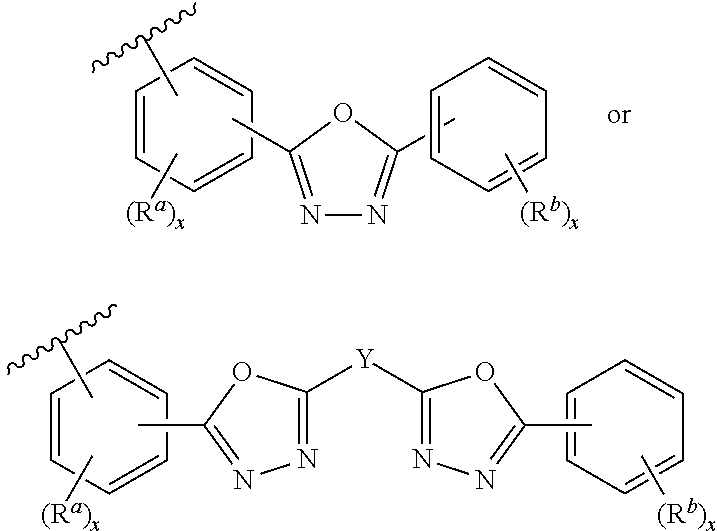
-
- wherein Y is an aryl group, including a phenyl group, and each optional Ra or Rb group is independently selected from hydrogen, fluoride, or one or more C1-20 alkyl, cyano, perfluoroalkyl, alkoxy, or perfluoroalkoxy groups, and each x is an independently selected
integer
- wherein Y is an aryl group, including a phenyl group, and each optional Ra or Rb group is independently selected from hydrogen, fluoride, or one or more C1-20 alkyl, cyano, perfluoroalkyl, alkoxy, or perfluoroalkoxy groups, and each x is an independently selected

-
- wherein x is an integer from 1 to 20.

wherein
-
- a. L is a C1-C20 organic group linking the polymerizable group to the 2-phenyl ring of the oxadiazole group;
- b. at least one of the R1, R2 and R3 groups is an optionally substituted carbazole group, and the remaining R1, R2 or R3 groups are independently selected from hydrogen, fluoride, a C1-C6 alkyl, cyano, perfluoroalkyl, alkoxide, or perfluoroalkoxide groups, and optionally one or more additional optionally substituted carbazole groups;
- wherein the optionally substituted carbazole groups have the structure

-
-
- wherein R5 and R6 are independently selected from hydrogen, fluoride, and a C1-C6 organic group selected from alkyls, cyano, perfluoroalkyls, alkoxides, and perfluoroalkoxides;
- c. R4 is selected from hydrogen, fluoride, and a C1-C6 alkyl, perfluoroalkyl, alkoxide, or perfluoroalkoxide group.
-

wherein one or two of the R1, R2 and R3 groups is an optionally substituted carbazole group having the structure

and wherein the index n and the L, R1, R2, R3, R4, R5, R6, and/or R7 groups of one or all of compounds of formula (Ia), (IIa), or (IIIa) can have any of the meanings described above in connection with the corresponding ambipolar small molecules described above, or polymer, or copolymer subunits (I), (II), or (III).


wherein x is an integer between 1 and 20, or 1 and 10.


-
- wherein R7 can be hydrogen or CH3.


-
- a. mixing
- i. at least one first norbornene monomer comprising a norbornene group linked to a carbazole group; and
- ii. at least one second norbornene monomer comprising a norbornene group linked to an optionally substituted 2-phenyl-5-phenyl-1,3,4-oxadiazole group; and
- iii. optionally one or more additional optionally substituted norbornene monomers; and
- b. polymerizing the mixture of norbornene monomers in the presence of a ROMP catalyst, to produce the copolymer.
- a. mixing
-
- a. an anode layer,
- b. a hole transporting layer,
- c. an emissive layer,
- d. an electron transporting layer, and
- e. a cathode layer.


| TABLE 1 |
| The Reduction Potentials of “ODZCBZ-x” Ambipolar Small Molecules |
 |
| No. | R7 | R8 | R9 | R10 | R11 | E1/2 0/−1 |
| ODZCBZ-1 | —F | —F | —F | —F | —F | −2.05 V |
| ODZCBZ-2 | —H | —H | —F | —H | —H | −2.38 V |
| ODZCBZ-3 | —H | —H | —H | —H | —H | −2.37 V |
| ODZCBZ-4 | —H | —H | —CF3 | —H | —H | −1.50 V |
| ODZCBZ-5 | —H | —H | —CH3 | —H | —H | −2.41 V |
| ODZCBZ-6 | —H | —H | —H | —H | —CF3 | −2.25 V |
| ODZCBZ-7 | —H | —H | —H | —CF3 | —H | −2.29 V |

Claims (15)


Priority Applications (1)
| Application Number | Priority Date | Filing Date | Title |
|---|---|---|---|
| US13/379,595 US9133177B2 (en) | 2009-06-24 | 2010-06-21 | Ambipolar small molecule hosts for phosphorescent guest emitters |
Applications Claiming Priority (3)
| Application Number | Priority Date | Filing Date | Title |
|---|---|---|---|
| US22011609P | 2009-06-24 | 2009-06-24 | |
| PCT/EP2010/058732 WO2010149622A1 (en) | 2009-06-24 | 2010-06-21 | Ambipolar small molecule hosts for phosphorescent guest emitters |
| US13/379,595 US9133177B2 (en) | 2009-06-24 | 2010-06-21 | Ambipolar small molecule hosts for phosphorescent guest emitters |
Publications (2)
| Publication Number | Publication Date |
|---|---|
| US20120168732A1 US20120168732A1 (en) | 2012-07-05 |
| US9133177B2 true US9133177B2 (en) | 2015-09-15 |
Family
ID=42470758
Family Applications (2)
| Application Number | Title | Priority Date | Filing Date |
|---|---|---|---|
| US13/379,595 Expired - Fee Related US9133177B2 (en) | 2009-06-24 | 2010-06-21 | Ambipolar small molecule hosts for phosphorescent guest emitters |
| US13/379,599 Abandoned US20120172556A1 (en) | 2009-06-24 | 2010-06-21 | Polymerizable ambipolar hosts for phosphorescent guest emitters |
Family Applications After (1)
| Application Number | Title | Priority Date | Filing Date |
|---|---|---|---|
| US13/379,599 Abandoned US20120172556A1 (en) | 2009-06-24 | 2010-06-21 | Polymerizable ambipolar hosts for phosphorescent guest emitters |
Country Status (7)
| Country | Link |
|---|---|
| US (2) | US9133177B2 (en) |
| EP (2) | EP2445905A1 (en) |
| JP (1) | JP5712209B2 (en) |
| KR (1) | KR20120039639A (en) |
| CN (1) | CN102596945A (en) |
| TW (3) | TW201120064A (en) |
| WO (3) | WO2010149618A1 (en) |
Families Citing this family (12)
| Publication number | Priority date | Publication date | Assignee | Title |
|---|---|---|---|---|
| TWI549942B (en) * | 2010-08-26 | 2016-09-21 | 首威公司 | N-phenyl triscarbazole |
| TWI551588B (en) * | 2010-10-11 | 2016-10-01 | 首威公司 | N-cycloalkylalkyl triscarbazoles |
| WO2013096918A1 (en) | 2011-12-22 | 2013-06-27 | Georgia Tech Research Corporation | Crosslinking triscarbazole hole transport polymers |
| WO2013096921A1 (en) | 2011-12-22 | 2013-06-27 | Georgia Tech Research Corporation | Non-crosslinked polystyrene triscarbazole hole transport materials |
| WO2014011477A1 (en) * | 2012-07-09 | 2014-01-16 | Georgia Tech Research Corporation | High glass transition temperature "medium-sized" ambipolar host materials |
| WO2014011483A1 (en) | 2012-07-09 | 2014-01-16 | Georgia Tech Research Corporation | Oxadiazole and triazole meta-linked n-phenyl carbazole ambipolar host materials |
| WO2014011491A1 (en) | 2012-07-09 | 2014-01-16 | Georgia Tech Research Corporation | Carbazole substituted triazole, triazine, and tetrazine ambipolar host materials and devices |
| TWI507403B (en) * | 2014-02-25 | 2015-11-11 | Ind Tech Res Inst | Carbazole derivatives and organic electroluminescent devices |
| KR102244081B1 (en) * | 2014-08-13 | 2021-04-26 | 삼성디스플레이 주식회사 | Organic light emitting device |
| GB201507340D0 (en) * | 2015-04-29 | 2015-06-10 | Univ St Andrews | Light emitting devices and compounds |
| CN106433615B (en) * | 2015-08-11 | 2019-05-17 | 中国科学院苏州纳米技术与纳米仿生研究所 | An electron transport material for organic electroluminescent devices |
| CN114133381A (en) * | 2021-12-17 | 2022-03-04 | 淮阴师范学院 | Synthesis and application of nitrile-carbazole/pyridine bipolar host materials |
Citations (13)
| Publication number | Priority date | Publication date | Assignee | Title |
|---|---|---|---|---|
| US20020135296A1 (en) * | 2001-01-26 | 2002-09-26 | Xerox Corporation | Organic light emitting devices |
| JP2002302516A (en) | 2001-04-03 | 2002-10-18 | Fuji Photo Film Co Ltd | New polymer and light emitting device using the same |
| US20030215669A1 (en) * | 2000-11-21 | 2003-11-20 | Elam-T Limited | Electroluminescent device |
| US20040247933A1 (en) | 2003-06-03 | 2004-12-09 | Canon Kabushiki Kaisha | Bipolar asymmetric carbazole-based host materials for electrophosphorescent guest-host OLED systems |
| CN1854136A (en) * | 2005-04-21 | 2006-11-01 | 北京大学 | Oxadiazole derivative containing carbazolyl and its electroluminescent device |
| US20070222376A1 (en) * | 2006-03-21 | 2007-09-27 | Semiconductor Energy Laboratory Co., Ltd. | Light-emitting element, light-emitting device, and electronic device |
| US20080149923A1 (en) * | 2006-11-30 | 2008-06-26 | Semiconductor Energy Laboratory Co., Ltd. | Light-emitting device |
| EP1972625A1 (en) | 2007-03-20 | 2008-09-24 | Semiconductor Energy Laboratory Co., Ltd. | Oxadiazole derivative and light-emitting element, light-emitting device, and electronic device in which the oxadiazole derivative is used |
| CN101314635A (en) * | 2008-05-06 | 2008-12-03 | 武汉大学 | Polymers containing carbazole and oxadiazole units and their use |
| WO2009026235A2 (en) | 2007-08-17 | 2009-02-26 | Georgia Tech Research Corporation | Norbornene-based copolymers with iridium complexes and exiton transport groups in their side-chains and use thereof |
| WO2009080799A2 (en) | 2007-12-20 | 2009-07-02 | Georgia Tech Research Corporation | Carbazole-based hole transport and /or electron blocking materials and /or host polymer materials |
| WO2009080797A1 (en) | 2007-12-21 | 2009-07-02 | Georgia Tech Research Corporation | Romp-polymerizable electron transport materials based on a bis-oxadiazole moiety |
| US8580396B2 (en) * | 2010-08-16 | 2013-11-12 | China Petrochemical Development Corp | Carbazole derivatives and organic light-emitting diode device using the same |
Family Cites Families (11)
| Publication number | Priority date | Publication date | Assignee | Title |
|---|---|---|---|---|
| US6573651B2 (en) * | 2000-12-18 | 2003-06-03 | The Trustees Of Princeton University | Highly efficient OLEDs using doped ambipolar conductive molecular organic thin films |
| US6803124B2 (en) * | 2001-04-03 | 2004-10-12 | Fuji Photo Film Co., Ltd. | Polymer and light emitting element using the same |
| JP4325197B2 (en) * | 2003-01-15 | 2009-09-02 | 三菱化学株式会社 | Organic electroluminescence device |
| WO2006015567A1 (en) * | 2004-08-13 | 2006-02-16 | Novaled Ag | Layer arrangement for a light-emitting component |
| JP5285851B2 (en) * | 2005-12-28 | 2013-09-11 | 株式会社半導体エネルギー研究所 | Oxadiazole derivative and light emitting element using oxadiazole derivative |
| JP4943199B2 (en) * | 2006-03-21 | 2012-05-30 | 株式会社半導体エネルギー研究所 | Oxadiazole derivatives |
| JP5090746B2 (en) * | 2007-01-19 | 2012-12-05 | 株式会社ツジデン | Carbazole-based random copolymer |
| JP5364089B2 (en) * | 2007-04-13 | 2013-12-11 | チェイル インダストリーズ インコーポレイテッド | Material for organic photoelectric device including hole transport unit and electron transport unit, and organic photoelectric device including the same |
| CN101333438B (en) * | 2008-07-15 | 2011-11-30 | 武汉大学 | Material with bipolar carrier transmission performance and uses thereof |
| JP5607959B2 (en) * | 2009-03-20 | 2014-10-15 | 株式会社半導体エネルギー研究所 | Carbazole derivatives, light-emitting elements, light-emitting devices, and electronic devices |
| KR20110122051A (en) * | 2010-05-03 | 2011-11-09 | 제일모직주식회사 | Compound for organic photoelectric device and organic photoelectric device comprising same |
-
2010
- 2010-06-21 EP EP20100725474 patent/EP2445905A1/en not_active Withdrawn
- 2010-06-21 TW TW99120191A patent/TW201120064A/en unknown
- 2010-06-21 WO PCT/EP2010/058728 patent/WO2010149618A1/en not_active Ceased
- 2010-06-21 WO PCT/EP2010/058730 patent/WO2010149620A1/en not_active Ceased
- 2010-06-21 KR KR20127001179A patent/KR20120039639A/en not_active Withdrawn
- 2010-06-21 WO PCT/EP2010/058732 patent/WO2010149622A1/en not_active Ceased
- 2010-06-21 CN CN2010800372625A patent/CN102596945A/en active Pending
- 2010-06-21 TW TW099120188A patent/TWI500634B/en not_active IP Right Cessation
- 2010-06-21 US US13/379,595 patent/US9133177B2/en not_active Expired - Fee Related
- 2010-06-21 TW TW99120192A patent/TW201120017A/en unknown
- 2010-06-21 JP JP2012516685A patent/JP5712209B2/en not_active Expired - Fee Related
- 2010-06-21 US US13/379,599 patent/US20120172556A1/en not_active Abandoned
- 2010-06-21 EP EP10726492.1A patent/EP2569311B1/en not_active Not-in-force
Patent Citations (15)
| Publication number | Priority date | Publication date | Assignee | Title |
|---|---|---|---|---|
| US20030215669A1 (en) * | 2000-11-21 | 2003-11-20 | Elam-T Limited | Electroluminescent device |
| US20020135296A1 (en) * | 2001-01-26 | 2002-09-26 | Xerox Corporation | Organic light emitting devices |
| JP2002302516A (en) | 2001-04-03 | 2002-10-18 | Fuji Photo Film Co Ltd | New polymer and light emitting device using the same |
| US20040247933A1 (en) | 2003-06-03 | 2004-12-09 | Canon Kabushiki Kaisha | Bipolar asymmetric carbazole-based host materials for electrophosphorescent guest-host OLED systems |
| CN1854136A (en) * | 2005-04-21 | 2006-11-01 | 北京大学 | Oxadiazole derivative containing carbazolyl and its electroluminescent device |
| US20070222376A1 (en) * | 2006-03-21 | 2007-09-27 | Semiconductor Energy Laboratory Co., Ltd. | Light-emitting element, light-emitting device, and electronic device |
| US20080149923A1 (en) * | 2006-11-30 | 2008-06-26 | Semiconductor Energy Laboratory Co., Ltd. | Light-emitting device |
| EP1972625A1 (en) | 2007-03-20 | 2008-09-24 | Semiconductor Energy Laboratory Co., Ltd. | Oxadiazole derivative and light-emitting element, light-emitting device, and electronic device in which the oxadiazole derivative is used |
| US20080230747A1 (en) * | 2007-03-20 | 2008-09-25 | Semiconductor Energy Laboratory Co., Ltd. | Oxadiazole derivative and light-emitting element, light-emitting device, and electronic device in which the oxadiazole derivative is used |
| WO2009026235A2 (en) | 2007-08-17 | 2009-02-26 | Georgia Tech Research Corporation | Norbornene-based copolymers with iridium complexes and exiton transport groups in their side-chains and use thereof |
| WO2009080799A2 (en) | 2007-12-20 | 2009-07-02 | Georgia Tech Research Corporation | Carbazole-based hole transport and /or electron blocking materials and /or host polymer materials |
| WO2009080797A1 (en) | 2007-12-21 | 2009-07-02 | Georgia Tech Research Corporation | Romp-polymerizable electron transport materials based on a bis-oxadiazole moiety |
| CN101314635A (en) * | 2008-05-06 | 2008-12-03 | 武汉大学 | Polymers containing carbazole and oxadiazole units and their use |
| US8580396B2 (en) * | 2010-08-16 | 2013-11-12 | China Petrochemical Development Corp | Carbazole derivatives and organic light-emitting diode device using the same |
| US20140175400A1 (en) * | 2010-08-16 | 2014-06-26 | China Petrochemical Development Corporation | Novel Carbazole Derivatives and Organic Light-Emitting Diode Device Using the Same |
Non-Patent Citations (17)
| Title |
|---|
| Boyd, T. et al. "Electroluminescence from New Polynorbornenes That Contain Blue-Light-Emitting and Charge-Transport Side Chains", Macromolecules, 1997, vol. 30, pp. 3553-3559. |
| Cacialli, F. et al. "Light-emitting diodes based on poly(methacrylates) with distyrylbenzene and oxadiazole side chains", Synthetic Metals, 1995, vol. 75, pp. 161-168. |
| Domercq, B. et al. "Photo-Patternable Hole-Transport Polymers for Organic Light-Emitting Diodes", Chem. Mater., 2003, vol. 15, pp. 1491-1496. |
| Furstner, A. "Olefin Metathesis and Beyond", Angewandte Chemie International Addition, 2000, vol. 39, Issue 17, pp. 3013-3043. |
| Guan et al. "High-performance blue electroluminescent devices based on 2-(4-biphenylyl)-5-(4-carbazol-9-yl)phenyl-1, 3, 4-oxadiazole", Chemical Communications-Chemcom, Royla Society of Chemistry, Jan. 1, 2003, No. 21, pp. 2708-2709. |
| Hreha, R. et al. "Synthesis of Photo-Crosslinkable Hole-Transport Polymers with Tunable Oxidation Potentials and Their Use in Organic Light-Emitting Diodes", Synthesis, Mar. 2002, No. 9,pp. 1201-1212. |
| International Search Report in PCT/EP2010/058732 dated Sep. 15, 2010. |
| Jiang, X. et al. "Effect of carbazole-oxadiazole excited-state complexes on the efficiency of dye-doped light-emitting diodes", Journal of Applied Physcis, May 15, 2002, vol. 91, No. 10, p. 6717-6724. |
| Kraft, A. et al. "Electroluminescent Conjugated Polymers-Seeing Polymers in a New Light", Angew. Chem. Int. Ed., 1998, vol. 37, pp. 402-428. |
| Lehman, E. et al. "Admet Polymerization", In Handbook of Metathesis, 2003, vol. 3, pp. 283-353. |
| Office Action in U.S. Appl. No. 13/379,599 dated Feb. 27, 2013. |
| Suzuki, M. et al. "Highly efficient polymer light emitting devices using ambipolar phosphorescent polymer", Applied Physics Letters, 2005, vol. 86, p. 103507. |
| Translation of CN 101314635 A (publication date Dec. 2008). * |
| Translation of CN 1854136 A (publication date Nov. 2006). * |
| Trnka, T. et al. "The Development of L2X2Ru=CHR Olefin Metathesis Catalysts: An Organometallic Success Story", Acc. Chem. Res., 2001, vol. 34, pp. 18-29. |
| Zhang et al., Chem. Mater., (2008), vol. 20, pp. 7324-7331. * |
| Zhang et al., Macromolecular Rapid Communications, (2008), vol. 29, pp. 1817-1822. * |
Also Published As
| Publication number | Publication date |
|---|---|
| US20120172556A1 (en) | 2012-07-05 |
| WO2010149620A1 (en) | 2010-12-29 |
| TW201120017A (en) | 2011-06-16 |
| WO2010149622A1 (en) | 2010-12-29 |
| JP2012530754A (en) | 2012-12-06 |
| EP2569311A1 (en) | 2013-03-20 |
| TW201120064A (en) | 2011-06-16 |
| TW201120058A (en) | 2011-06-16 |
| EP2445905A1 (en) | 2012-05-02 |
| EP2569311B1 (en) | 2016-01-13 |
| US20120168732A1 (en) | 2012-07-05 |
| TWI500634B (en) | 2015-09-21 |
| WO2010149618A1 (en) | 2010-12-29 |
| CN102596945A (en) | 2012-07-18 |
| JP5712209B2 (en) | 2015-05-07 |
| KR20120039639A (en) | 2012-04-25 |
Similar Documents
| Publication | Publication Date | Title |
|---|---|---|
| US9133177B2 (en) | Ambipolar small molecule hosts for phosphorescent guest emitters | |
| US8377572B2 (en) | Polymer and organic photoelectric device including the same | |
| CN102781979B (en) | Polymer for organic electroluminescent element, and organic electroluminescent element using same | |
| JP2019533653A (en) | Compound, coating composition containing the same, organic light-emitting device using the same, and method for producing the same | |
| US20230140039A1 (en) | Novel Polymer and Organic Light Emitting Device Comprising Same | |
| WO2011000873A1 (en) | Phosphorescent platinum complexes, their monomers and copolymers, and uses in organic electronic devices | |
| CN101528890B (en) | Organic light-emitting device | |
| WO2012088316A1 (en) | 2-alkyl-5-phenyl oxadiazole-carbazole hosts for guest emitters | |
| US10050205B2 (en) | Polymer, organic light-emitting device material including the same, and organic light-emitting device including the organic light-emitting device material | |
| US12054565B2 (en) | Polymer and organic light emitting device comprising the same | |
| US20230043088A1 (en) | Organic Light Emitting Device | |
| KR102780663B1 (en) | Organic light emitting device | |
| KR102770440B1 (en) | Organic light emitting device | |
| KR102770365B1 (en) | Organic light emitting device | |
| KR102549459B1 (en) | Novel polymer and organic light emitting device comprising the same | |
| KR20210024966A (en) | Organic light emitting device | |
| US10056552B2 (en) | Compound for organic light-emitting device, cross-linked material thereof, and organic light-emitting device including cross-linked material | |
| KR102836084B1 (en) | Organic light emitting device | |
| KR102780662B1 (en) | Organic light emitting device | |
| KR102734119B1 (en) | Organic light emitting device | |
| KR102799795B1 (en) | Novel compound and organic light emitting device comprising the same | |
| KR102706857B1 (en) | Novel polymer and organic light emitting device comprising the same | |
| KR102549458B1 (en) | Novel polymer and organic light emitting device comprising the same | |
| WO2012088318A1 (en) | Blends of polynorbornenyl polymers comprising hole transporting side groups and polynorbornenyl polymers comprising electron transporting side groups, as host materials for oleds | |
| KR20220036734A (en) | Organic light emitting device |
Legal Events
| Date | Code | Title | Description |
|---|---|---|---|
| AS | Assignment |
Owner name: GEORGIA TECH RESEARCH CORPORATION, GEORGIA Free format text: ASSIGNMENT OF ASSIGNORS INTEREST;ASSIGNORS:ZHANG, YADONG;ZUNIGA, CARLOS;DESHAYES, GAELLE;AND OTHERS;SIGNING DATES FROM 20140610 TO 20140926;REEL/FRAME:034036/0239 |
|
| STCF | Information on status: patent grant |
Free format text: PATENTED CASE |
|
| FEPP | Fee payment procedure |
Free format text: MAINTENANCE FEE REMINDER MAILED (ORIGINAL EVENT CODE: REM.); ENTITY STATUS OF PATENT OWNER: SMALL ENTITY |
|
| FEPP | Fee payment procedure |
Free format text: SURCHARGE FOR LATE PAYMENT, SMALL ENTITY (ORIGINAL EVENT CODE: M2554); ENTITY STATUS OF PATENT OWNER: SMALL ENTITY |
|
| MAFP | Maintenance fee payment |
Free format text: PAYMENT OF MAINTENANCE FEE, 4TH YR, SMALL ENTITY (ORIGINAL EVENT CODE: M2551); ENTITY STATUS OF PATENT OWNER: SMALL ENTITY Year of fee payment: 4 |
|
| FEPP | Fee payment procedure |
Free format text: MAINTENANCE FEE REMINDER MAILED (ORIGINAL EVENT CODE: REM.); ENTITY STATUS OF PATENT OWNER: SMALL ENTITY |
|
| LAPS | Lapse for failure to pay maintenance fees |
Free format text: PATENT EXPIRED FOR FAILURE TO PAY MAINTENANCE FEES (ORIGINAL EVENT CODE: EXP.); ENTITY STATUS OF PATENT OWNER: SMALL ENTITY |
|
| STCH | Information on status: patent discontinuation |
Free format text: PATENT EXPIRED DUE TO NONPAYMENT OF MAINTENANCE FEES UNDER 37 CFR 1.362 |
|
| FP | Lapsed due to failure to pay maintenance fee |
Effective date: 20230915 |