US9120792B2 - Fused heterocyclic compound - Google Patents
Fused heterocyclic compound Download PDFInfo
- Publication number
- US9120792B2 US9120792B2 US14/403,224 US201314403224A US9120792B2 US 9120792 B2 US9120792 B2 US 9120792B2 US 201314403224 A US201314403224 A US 201314403224A US 9120792 B2 US9120792 B2 US 9120792B2
- Authority
- US
- United States
- Prior art keywords
- group
- optionally
- halogen atoms
- atoms
- groups
- Prior art date
- Legal status (The legal status is an assumption and is not a legal conclusion. Google has not performed a legal analysis and makes no representation as to the accuracy of the status listed.)
- Active
Links
- 0 [1*]CC1=C(C[H])C=CC1.[1*]CC1=C(C[H])CC=C1.[1*]CC1=CC=CN1C[H].[1*]CC1=CCC=C1C[H].[1*]CC1CCCC1C1=NC2=CC([2*])=C([3*])C=C2C1 Chemical compound [1*]CC1=C(C[H])C=CC1.[1*]CC1=C(C[H])CC=C1.[1*]CC1=CC=CN1C[H].[1*]CC1=CCC=C1C[H].[1*]CC1CCCC1C1=NC2=CC([2*])=C([3*])C=C2C1 0.000 description 57
- VMGOSBSIJWBPSG-UHFFFAOYSA-N CCCC1=C(C2=NC3=CC(C)=CN=C3N2C)SC(C(F)(F)F)=C1 Chemical compound CCCC1=C(C2=NC3=CC(C)=CN=C3N2C)SC(C(F)(F)F)=C1 VMGOSBSIJWBPSG-UHFFFAOYSA-N 0.000 description 2
- MMJVBKMLTIBOGP-UHFFFAOYSA-N CCSC1=C(C2=NC3=CC(C)=CN=C3N2C)SC(C(F)(F)F)=C1 Chemical compound CCSC1=C(C2=NC3=CC(C)=CN=C3N2C)SC(C(F)(F)F)=C1 MMJVBKMLTIBOGP-UHFFFAOYSA-N 0.000 description 2
- JDWFSXZQBLLUII-UHFFFAOYSA-N CCSC1=C(C2=NC3=CC(C)=CN=C3N2C)SC=C1 Chemical compound CCSC1=C(C2=NC3=CC(C)=CN=C3N2C)SC=C1 JDWFSXZQBLLUII-UHFFFAOYSA-N 0.000 description 2
- ZKIVXJSTGGZHCA-UHFFFAOYSA-N CC(F)(F)C1=CC=C2OC(C3=C(Br)C=CS3)=NC2=C1 Chemical compound CC(F)(F)C1=CC=C2OC(C3=C(Br)C=CS3)=NC2=C1 ZKIVXJSTGGZHCA-UHFFFAOYSA-N 0.000 description 1
- NWVFWGXSYKPQLC-UHFFFAOYSA-N CC1=CC2=C(N=C1)N(C)C(C1=C(Br)SC=C1)=N2 Chemical compound CC1=CC2=C(N=C1)N(C)C(C1=C(Br)SC=C1)=N2 NWVFWGXSYKPQLC-UHFFFAOYSA-N 0.000 description 1
- SPUXVQKDNNMUKR-UHFFFAOYSA-N CC1=CC=C2OC(C3=C(Br)C=CS3)=NC2=C1 Chemical compound CC1=CC=C2OC(C3=C(Br)C=CS3)=NC2=C1 SPUXVQKDNNMUKR-UHFFFAOYSA-N 0.000 description 1
- FNMLLTGFMKLGSK-UHFFFAOYSA-N CC1=CC=C2OC(C3=C(C)C=CS3)=NC2=C1 Chemical compound CC1=CC=C2OC(C3=C(C)C=CS3)=NC2=C1 FNMLLTGFMKLGSK-UHFFFAOYSA-N 0.000 description 1
- SVOPQWUUHBOIMI-UHFFFAOYSA-N CC1=CC=C2SC(C3=C(Br)C=CS3)=NC2=C1 Chemical compound CC1=CC=C2SC(C3=C(Br)C=CS3)=NC2=C1 SVOPQWUUHBOIMI-UHFFFAOYSA-N 0.000 description 1
- DJXVCFGPWGBULD-UHFFFAOYSA-N CC1=CC=C2SC(C3=C(C)C=CS3)=NC2=C1 Chemical compound CC1=CC=C2SC(C3=C(C)C=CS3)=NC2=C1 DJXVCFGPWGBULD-UHFFFAOYSA-N 0.000 description 1
- VTOQAZPJMKIQDH-UHFFFAOYSA-N CC1=CN=C2C(=C1)CC(=O)N2C Chemical compound CC1=CN=C2C(=C1)CC(=O)N2C VTOQAZPJMKIQDH-UHFFFAOYSA-N 0.000 description 1
- PXEZXYJNNPXKRT-UHFFFAOYSA-N CC1=CN=C2C(=C1)N=C(C1=C(Cl)C=CS1)N2C Chemical compound CC1=CN=C2C(=C1)N=C(C1=C(Cl)C=CS1)N2C PXEZXYJNNPXKRT-UHFFFAOYSA-N 0.000 description 1
- FCBSRNBRLFSILK-UHFFFAOYSA-N CC1=CN=C2C(=C1)N=C(Cl)N2C Chemical compound CC1=CN=C2C(=C1)N=C(Cl)N2C FCBSRNBRLFSILK-UHFFFAOYSA-N 0.000 description 1
- DWWAZRMDWHQWCG-UHFFFAOYSA-N CCCC1=C(C2=NC3=CC(C#FC(F)(F)(F)F)=CN=C3N2C)SC(C(F)(F)F)=C1 Chemical compound CCCC1=C(C2=NC3=CC(C#FC(F)(F)(F)F)=CN=C3N2C)SC(C(F)(F)F)=C1 DWWAZRMDWHQWCG-UHFFFAOYSA-N 0.000 description 1
- LVVZVDQLXJHVJW-UHFFFAOYSA-N CCCC1=C(C2=NC3=CC(C)=CN=C3N2C)SC=C1 Chemical compound CCCC1=C(C2=NC3=CC(C)=CN=C3N2C)SC=C1 LVVZVDQLXJHVJW-UHFFFAOYSA-N 0.000 description 1
- GFDMKDPJECRVIG-UHFFFAOYSA-N CCCC1=NC(C(F)(F)F)=NN1C1=NC2=CC(C)=CN=C2N1C Chemical compound CCCC1=NC(C(F)(F)F)=NN1C1=NC2=CC(C)=CN=C2N1C GFDMKDPJECRVIG-UHFFFAOYSA-N 0.000 description 1
- UEBFRZVPCFYMJW-UHFFFAOYSA-N CCCC1=NC=CN1C1=NC2=CC(C)=CN=C2N1C Chemical compound CCCC1=NC=CN1C1=NC2=CC(C)=CN=C2N1C UEBFRZVPCFYMJW-UHFFFAOYSA-N 0.000 description 1
- XOFXDHNDYQVQNI-UHFFFAOYSA-N CCS(=O)(=O)C1=C(C2=NC3=C(N=CC(C)=C3)N2C)C(C(F)(F)F)=NN1C Chemical compound CCS(=O)(=O)C1=C(C2=NC3=C(N=CC(C)=C3)N2C)C(C(F)(F)F)=NN1C XOFXDHNDYQVQNI-UHFFFAOYSA-N 0.000 description 1
- ODPUGMMOXJKIBY-UHFFFAOYSA-N CCS(=O)(=O)C1=C(C2=NC3=C(N=CC(C)=C3)N2C)C=CS1 Chemical compound CCS(=O)(=O)C1=C(C2=NC3=C(N=CC(C)=C3)N2C)C=CS1 ODPUGMMOXJKIBY-UHFFFAOYSA-N 0.000 description 1
- IPRAVGZRACBELV-UHFFFAOYSA-N CCS(=O)(=O)C1=C(C2=NC3=C(N=CC(C)=C3)N2C)N=CS1 Chemical compound CCS(=O)(=O)C1=C(C2=NC3=C(N=CC(C)=C3)N2C)N=CS1 IPRAVGZRACBELV-UHFFFAOYSA-N 0.000 description 1
- SCPSFMOEWNGHDE-UHFFFAOYSA-N CCS(=O)(=O)C1=C(C2=NC3=C(N=CC(C)=C3)N2C)SC=C1 Chemical compound CCS(=O)(=O)C1=C(C2=NC3=C(N=CC(C)=C3)N2C)SC=C1 SCPSFMOEWNGHDE-UHFFFAOYSA-N 0.000 description 1
- PEVLIBCHJKOBSD-UHFFFAOYSA-N CCS(=O)(=O)C1=C(C2=NC3=C(N=CC(C)=C3)S2)C(C(F)(F)F)=NN1C Chemical compound CCS(=O)(=O)C1=C(C2=NC3=C(N=CC(C)=C3)S2)C(C(F)(F)F)=NN1C PEVLIBCHJKOBSD-UHFFFAOYSA-N 0.000 description 1
- VKHDEDJOMDDTDK-UHFFFAOYSA-N CCS(=O)(=O)C1=C(C2=NC3=CC(C)=CC=C3O2)SC=C1 Chemical compound CCS(=O)(=O)C1=C(C2=NC3=CC(C)=CC=C3O2)SC=C1 VKHDEDJOMDDTDK-UHFFFAOYSA-N 0.000 description 1
- QTNCNBURBAALPS-UHFFFAOYSA-N CCS(=O)(=O)C1=C(C2=NC3=CC(C)=CC=C3S2)SC=C1 Chemical compound CCS(=O)(=O)C1=C(C2=NC3=CC(C)=CC=C3S2)SC=C1 QTNCNBURBAALPS-UHFFFAOYSA-N 0.000 description 1
- XGYDDZJUFVAMIR-UHFFFAOYSA-N CCS(=O)(=O)C1=C(C2=NC3=CC(S(C)(=O)=O)=CC=C3O2)SC=C1 Chemical compound CCS(=O)(=O)C1=C(C2=NC3=CC(S(C)(=O)=O)=CC=C3O2)SC=C1 XGYDDZJUFVAMIR-UHFFFAOYSA-N 0.000 description 1
- FVIRAICXUOFQBZ-UHFFFAOYSA-N CCS(=O)(=O)C1=C(C2=NC3=CC(S(C)=O)=CC=C3O2)SC=C1 Chemical compound CCS(=O)(=O)C1=C(C2=NC3=CC(S(C)=O)=CC=C3O2)SC=C1 FVIRAICXUOFQBZ-UHFFFAOYSA-N 0.000 description 1
- QQLJELOYZAGGPQ-UHFFFAOYSA-N CCS(=O)(=O)C1=C(C2=NC3=CC(SC)=CC=C3O2)SC=C1 Chemical compound CCS(=O)(=O)C1=C(C2=NC3=CC(SC)=CC=C3O2)SC=C1 QQLJELOYZAGGPQ-UHFFFAOYSA-N 0.000 description 1
- CKYFYKCAJHZEKH-UHFFFAOYSA-N CCS(=O)(=O)C1=CC=CN1C1=NC2=C(N=CC(C)=C2)N1C Chemical compound CCS(=O)(=O)C1=CC=CN1C1=NC2=C(N=CC(C)=C2)N1C CKYFYKCAJHZEKH-UHFFFAOYSA-N 0.000 description 1
- SCIJUMQMIDMYRL-UHFFFAOYSA-N CCS(=O)(=O)C1=CSC=C1C1=NC2=CC(C)=CN=C2N1C Chemical compound CCS(=O)(=O)C1=CSC=C1C1=NC2=CC(C)=CN=C2N1C SCIJUMQMIDMYRL-UHFFFAOYSA-N 0.000 description 1
- BIJIWTSHUOLIAD-UHFFFAOYSA-N CCS(=O)C1=C(C2=NC3=C(N=CC(C)=C3)N2C)SC=C1 Chemical compound CCS(=O)C1=C(C2=NC3=C(N=CC(C)=C3)N2C)SC=C1 BIJIWTSHUOLIAD-UHFFFAOYSA-N 0.000 description 1
- LKKWCVJWNNBXMZ-UHFFFAOYSA-N CCS(=O)C1=CSC=C1C1=NC2=CC(C)=CN=C2N1C Chemical compound CCS(=O)C1=CSC=C1C1=NC2=CC(C)=CN=C2N1C LKKWCVJWNNBXMZ-UHFFFAOYSA-N 0.000 description 1
- YQBXMXQEVFWGGV-UHFFFAOYSA-N CCS(c1c[s]cc1-c([n]1C)nc2c1ncc(C(F)(F)F)c2)=O Chemical compound CCS(c1c[s]cc1-c([n]1C)nc2c1ncc(C(F)(F)F)c2)=O YQBXMXQEVFWGGV-UHFFFAOYSA-N 0.000 description 1
- DSPBCQWQROOPJA-UHFFFAOYSA-N CCSC1=C(C(=O)CC2=C(NC)N=CC(C)=C2)N=CS1 Chemical compound CCSC1=C(C(=O)CC2=C(NC)N=CC(C)=C2)N=CS1 DSPBCQWQROOPJA-UHFFFAOYSA-N 0.000 description 1
- SOLQQSRLEYTBDG-UHFFFAOYSA-N CCSC1=C(C(=O)O)N=CS1.Cl Chemical compound CCSC1=C(C(=O)O)N=CS1.Cl SOLQQSRLEYTBDG-UHFFFAOYSA-N 0.000 description 1
- WVRPXCJPVJROJA-UHFFFAOYSA-N CCSC1=C(C(C)=O)N=CS1 Chemical compound CCSC1=C(C(C)=O)N=CS1 WVRPXCJPVJROJA-UHFFFAOYSA-N 0.000 description 1
- KATLYSSMCHOEFF-UHFFFAOYSA-N CCSC1=C(C2=NC3=C(N=CC(C)=C3)N2C)C(C(F)(F)F)=NN1C Chemical compound CCSC1=C(C2=NC3=C(N=CC(C)=C3)N2C)C(C(F)(F)F)=NN1C KATLYSSMCHOEFF-UHFFFAOYSA-N 0.000 description 1
- VCBRIHSDLZABLW-UHFFFAOYSA-N CCSC1=C(C2=NC3=C(N=CC(C)=C3)N2C)C=CS1 Chemical compound CCSC1=C(C2=NC3=C(N=CC(C)=C3)N2C)C=CS1 VCBRIHSDLZABLW-UHFFFAOYSA-N 0.000 description 1
- XPZVYCRDLWLHHP-UHFFFAOYSA-N CCSC1=C(C2=NC3=C(N=CC(C)=C3)N2C)N=CS1 Chemical compound CCSC1=C(C2=NC3=C(N=CC(C)=C3)N2C)N=CS1 XPZVYCRDLWLHHP-UHFFFAOYSA-N 0.000 description 1
- WCPDEOLQZFKCGY-UHFFFAOYSA-N CCSC1=C(C2=NC3=C(N=CC(C)=C3)S2)C(C(F)(F)F)=NN1C Chemical compound CCSC1=C(C2=NC3=C(N=CC(C)=C3)S2)C(C(F)(F)F)=NN1C WCPDEOLQZFKCGY-UHFFFAOYSA-N 0.000 description 1
- AIAPCOLMZJOXJF-UHFFFAOYSA-N CCSC1=C(C2=NC3=CC(C#FC(F)(F)(F)F)=CN=C3N2C)SC(C(F)(F)F)=C1 Chemical compound CCSC1=C(C2=NC3=CC(C#FC(F)(F)(F)F)=CN=C3N2C)SC(C(F)(F)F)=C1 AIAPCOLMZJOXJF-UHFFFAOYSA-N 0.000 description 1
- GOOIPUJESXIZKA-UHFFFAOYSA-N CCSC1=CC=CN1C1=NC2=C(N=CC(C)=C2)N1C Chemical compound CCSC1=CC=CN1C1=NC2=C(N=CC(C)=C2)N1C GOOIPUJESXIZKA-UHFFFAOYSA-N 0.000 description 1
- POSXCRNNLLLCAB-UHFFFAOYSA-N CCSC1=CSC=C1Br Chemical compound CCSC1=CSC=C1Br POSXCRNNLLLCAB-UHFFFAOYSA-N 0.000 description 1
- VQMOLWATNZIIQE-UHFFFAOYSA-N CCSC1=CSC=C1C(=O)O Chemical compound CCSC1=CSC=C1C(=O)O VQMOLWATNZIIQE-UHFFFAOYSA-N 0.000 description 1
- HWILLOPAYUTUJQ-UHFFFAOYSA-N CCSC1=CSC=C1C1=NC2=CC(C)=CN=C2N1C Chemical compound CCSC1=CSC=C1C1=NC2=CC(C)=CN=C2N1C HWILLOPAYUTUJQ-UHFFFAOYSA-N 0.000 description 1
- DJGWWNRIWZLLJO-UHFFFAOYSA-N CCSC1=NC(C(F)(F)F)=NN1C1=NC2=CC(C)=CN=C2N1C Chemical compound CCSC1=NC(C(F)(F)F)=NN1C1=NC2=CC(C)=CN=C2N1C DJGWWNRIWZLLJO-UHFFFAOYSA-N 0.000 description 1
- WBNXFLJFZKQXCZ-UHFFFAOYSA-N CCSC1=NC=CN1C1=NC2=CC(C)=CN=C2N1C Chemical compound CCSC1=NC=CN1C1=NC2=CC(C)=CN=C2N1C WBNXFLJFZKQXCZ-UHFFFAOYSA-N 0.000 description 1
- IIOULEHZSLPFDE-UHFFFAOYSA-N CCSc1ccc[n]1-c([n]1C)nc2c1ncc(C(F)(F)F)c2 Chemical compound CCSc1ccc[n]1-c([n]1C)nc2c1ncc(C(F)(F)F)c2 IIOULEHZSLPFDE-UHFFFAOYSA-N 0.000 description 1
- MFXRHTQMLDJMMB-UHFFFAOYSA-N CNC1=C(CC(=O)C2=C(Br)SC=C2)C=C(C)C=N1 Chemical compound CNC1=C(CC(=O)C2=C(Br)SC=C2)C=C(C)C=N1 MFXRHTQMLDJMMB-UHFFFAOYSA-N 0.000 description 1
- DCLFOZGOZWOKBP-UHFFFAOYSA-N CSC1=CC=C2OC(C3=C(Br)C=CS3)=NC2=C1 Chemical compound CSC1=CC=C2OC(C3=C(Br)C=CS3)=NC2=C1 DCLFOZGOZWOKBP-UHFFFAOYSA-N 0.000 description 1
- PSXTYFMIMWBPDK-UHFFFAOYSA-N CSC1=CC=C2OC(C3=C(C)C=CS3)=NC2=C1 Chemical compound CSC1=CC=C2OC(C3=C(C)C=CS3)=NC2=C1 PSXTYFMIMWBPDK-UHFFFAOYSA-N 0.000 description 1
Classifications
-
- C—CHEMISTRY; METALLURGY
- C07—ORGANIC CHEMISTRY
- C07D—HETEROCYCLIC COMPOUNDS
- C07D471/00—Heterocyclic compounds containing nitrogen atoms as the only ring hetero atoms in the condensed system, at least one ring being a six-membered ring with one nitrogen atom, not provided for by groups C07D451/00 - C07D463/00
- C07D471/02—Heterocyclic compounds containing nitrogen atoms as the only ring hetero atoms in the condensed system, at least one ring being a six-membered ring with one nitrogen atom, not provided for by groups C07D451/00 - C07D463/00 in which the condensed system contains two hetero rings
- C07D471/04—Ortho-condensed systems
-
- A—HUMAN NECESSITIES
- A01—AGRICULTURE; FORESTRY; ANIMAL HUSBANDRY; HUNTING; TRAPPING; FISHING
- A01N—PRESERVATION OF BODIES OF HUMANS OR ANIMALS OR PLANTS OR PARTS THEREOF; BIOCIDES, e.g. AS DISINFECTANTS, AS PESTICIDES OR AS HERBICIDES; PEST REPELLANTS OR ATTRACTANTS; PLANT GROWTH REGULATORS
- A01N43/00—Biocides, pest repellants or attractants, or plant growth regulators containing heterocyclic compounds
- A01N43/72—Biocides, pest repellants or attractants, or plant growth regulators containing heterocyclic compounds having rings with nitrogen atoms and oxygen or sulfur atoms as ring hetero atoms
- A01N43/74—Biocides, pest repellants or attractants, or plant growth regulators containing heterocyclic compounds having rings with nitrogen atoms and oxygen or sulfur atoms as ring hetero atoms five-membered rings with one nitrogen atom and either one oxygen atom or one sulfur atom in positions 1,3
- A01N43/76—1,3-Oxazoles; Hydrogenated 1,3-oxazoles
-
- A—HUMAN NECESSITIES
- A01—AGRICULTURE; FORESTRY; ANIMAL HUSBANDRY; HUNTING; TRAPPING; FISHING
- A01N—PRESERVATION OF BODIES OF HUMANS OR ANIMALS OR PLANTS OR PARTS THEREOF; BIOCIDES, e.g. AS DISINFECTANTS, AS PESTICIDES OR AS HERBICIDES; PEST REPELLANTS OR ATTRACTANTS; PLANT GROWTH REGULATORS
- A01N43/00—Biocides, pest repellants or attractants, or plant growth regulators containing heterocyclic compounds
- A01N43/72—Biocides, pest repellants or attractants, or plant growth regulators containing heterocyclic compounds having rings with nitrogen atoms and oxygen or sulfur atoms as ring hetero atoms
- A01N43/74—Biocides, pest repellants or attractants, or plant growth regulators containing heterocyclic compounds having rings with nitrogen atoms and oxygen or sulfur atoms as ring hetero atoms five-membered rings with one nitrogen atom and either one oxygen atom or one sulfur atom in positions 1,3
- A01N43/78—1,3-Thiazoles; Hydrogenated 1,3-thiazoles
-
- A—HUMAN NECESSITIES
- A01—AGRICULTURE; FORESTRY; ANIMAL HUSBANDRY; HUNTING; TRAPPING; FISHING
- A01N—PRESERVATION OF BODIES OF HUMANS OR ANIMALS OR PLANTS OR PARTS THEREOF; BIOCIDES, e.g. AS DISINFECTANTS, AS PESTICIDES OR AS HERBICIDES; PEST REPELLANTS OR ATTRACTANTS; PLANT GROWTH REGULATORS
- A01N43/00—Biocides, pest repellants or attractants, or plant growth regulators containing heterocyclic compounds
- A01N43/90—Biocides, pest repellants or attractants, or plant growth regulators containing heterocyclic compounds having two or more relevant hetero rings, condensed among themselves or with a common carbocyclic ring system
-
- A—HUMAN NECESSITIES
- A61—MEDICAL OR VETERINARY SCIENCE; HYGIENE
- A61P—SPECIFIC THERAPEUTIC ACTIVITY OF CHEMICAL COMPOUNDS OR MEDICINAL PREPARATIONS
- A61P33/00—Antiparasitic agents
- A61P33/14—Ectoparasiticides, e.g. scabicides
-
- C—CHEMISTRY; METALLURGY
- C07—ORGANIC CHEMISTRY
- C07D—HETEROCYCLIC COMPOUNDS
- C07D401/00—Heterocyclic compounds containing two or more hetero rings, having nitrogen atoms as the only ring hetero atoms, at least one ring being a six-membered ring with only one nitrogen atom
- C07D401/02—Heterocyclic compounds containing two or more hetero rings, having nitrogen atoms as the only ring hetero atoms, at least one ring being a six-membered ring with only one nitrogen atom containing two hetero rings
- C07D401/04—Heterocyclic compounds containing two or more hetero rings, having nitrogen atoms as the only ring hetero atoms, at least one ring being a six-membered ring with only one nitrogen atom containing two hetero rings directly linked by a ring-member-to-ring-member bond
-
- C—CHEMISTRY; METALLURGY
- C07—ORGANIC CHEMISTRY
- C07D—HETEROCYCLIC COMPOUNDS
- C07D403/00—Heterocyclic compounds containing two or more hetero rings, having nitrogen atoms as the only ring hetero atoms, not provided for by group C07D401/00
- C07D403/02—Heterocyclic compounds containing two or more hetero rings, having nitrogen atoms as the only ring hetero atoms, not provided for by group C07D401/00 containing two hetero rings
- C07D403/04—Heterocyclic compounds containing two or more hetero rings, having nitrogen atoms as the only ring hetero atoms, not provided for by group C07D401/00 containing two hetero rings directly linked by a ring-member-to-ring-member bond
-
- C—CHEMISTRY; METALLURGY
- C07—ORGANIC CHEMISTRY
- C07D—HETEROCYCLIC COMPOUNDS
- C07D409/00—Heterocyclic compounds containing two or more hetero rings, at least one ring having sulfur atoms as the only ring hetero atoms
- C07D409/02—Heterocyclic compounds containing two or more hetero rings, at least one ring having sulfur atoms as the only ring hetero atoms containing two hetero rings
- C07D409/12—Heterocyclic compounds containing two or more hetero rings, at least one ring having sulfur atoms as the only ring hetero atoms containing two hetero rings linked by a chain containing hetero atoms as chain links
-
- C—CHEMISTRY; METALLURGY
- C07—ORGANIC CHEMISTRY
- C07D—HETEROCYCLIC COMPOUNDS
- C07D413/00—Heterocyclic compounds containing two or more hetero rings, at least one ring having nitrogen and oxygen atoms as the only ring hetero atoms
- C07D413/02—Heterocyclic compounds containing two or more hetero rings, at least one ring having nitrogen and oxygen atoms as the only ring hetero atoms containing two hetero rings
- C07D413/04—Heterocyclic compounds containing two or more hetero rings, at least one ring having nitrogen and oxygen atoms as the only ring hetero atoms containing two hetero rings directly linked by a ring-member-to-ring-member bond
-
- C—CHEMISTRY; METALLURGY
- C07—ORGANIC CHEMISTRY
- C07D—HETEROCYCLIC COMPOUNDS
- C07D417/00—Heterocyclic compounds containing two or more hetero rings, at least one ring having nitrogen and sulfur atoms as the only ring hetero atoms, not provided for by group C07D415/00
- C07D417/02—Heterocyclic compounds containing two or more hetero rings, at least one ring having nitrogen and sulfur atoms as the only ring hetero atoms, not provided for by group C07D415/00 containing two hetero rings
- C07D417/04—Heterocyclic compounds containing two or more hetero rings, at least one ring having nitrogen and sulfur atoms as the only ring hetero atoms, not provided for by group C07D415/00 containing two hetero rings directly linked by a ring-member-to-ring-member bond
-
- C—CHEMISTRY; METALLURGY
- C07—ORGANIC CHEMISTRY
- C07D—HETEROCYCLIC COMPOUNDS
- C07D417/00—Heterocyclic compounds containing two or more hetero rings, at least one ring having nitrogen and sulfur atoms as the only ring hetero atoms, not provided for by group C07D415/00
- C07D417/02—Heterocyclic compounds containing two or more hetero rings, at least one ring having nitrogen and sulfur atoms as the only ring hetero atoms, not provided for by group C07D415/00 containing two hetero rings
- C07D417/12—Heterocyclic compounds containing two or more hetero rings, at least one ring having nitrogen and sulfur atoms as the only ring hetero atoms, not provided for by group C07D415/00 containing two hetero rings linked by a chain containing hetero atoms as chain links
-
- C—CHEMISTRY; METALLURGY
- C07—ORGANIC CHEMISTRY
- C07D—HETEROCYCLIC COMPOUNDS
- C07D513/00—Heterocyclic compounds containing in the condensed system at least one hetero ring having nitrogen and sulfur atoms as the only ring hetero atoms, not provided for in groups C07D463/00, C07D477/00 or C07D499/00 - C07D507/00
- C07D513/02—Heterocyclic compounds containing in the condensed system at least one hetero ring having nitrogen and sulfur atoms as the only ring hetero atoms, not provided for in groups C07D463/00, C07D477/00 or C07D499/00 - C07D507/00 in which the condensed system contains two hetero rings
- C07D513/04—Ortho-condensed systems
Definitions
- the present invention relates to a fused heterocyclic compound and a use thereof for pest control.
- a certain kind of fused heterocyclic compounds is known to have an insecticidal activity (refer to WO 2001/07413 and WO 1999/52882).
- insecticidal activity of these fused heterocyclic compounds is not necessarily sufficient.
- the present invention provides a compound having an excellent effect in the control of pests.
- Het to which R 1 —S(O) n is bonded represents a 5-membered aromatic heterocyclic group represented by the following formula H1, H2, H3 or H4:
- Y 1 represents an oxygen atom, a sulfur atom, or NR 4 ;
- Y 2 represents an oxygen atom, a sulfur atom, or NR 5 ;
- G 1 , G 2 and G 3 are the same or different and represent CR 6 or a nitrogen atom;
- R 1 represents a C1 to C6 alkyl group optionally having one or more atoms or groups selected from group X, a C2 to C6 alkenyl group optionally having one or more atoms or groups selected from group X, a C1 to C6 alkynyl group optionally having one or more atoms or groups selected from group X, or a C3 to C6 alicyclic hydrocarbon group optionally having one or more atoms or groups selected from group Y;
- R 4 and R 6 are the same or different and represent a C1 to C6 chain hydrocarbon group optionally having one or more atoms or groups selected from group X, a phenyl group optionally having one or more atoms
- Group X a group consisting of C1 to C6 alkoxy groups optionally having one or more halogen atoms, C2 to C6 alkenyloxy groups optionally having one or more halogen atoms, C2 to C6 alkynyloxy groups optionally having one or more halogen atoms, C1 to C6 alkylthio groups optionally having one or more halogen atoms, C1 to C6 alkylsulfinyl groups optionally having one or more halogen atoms, C1 to C6 alkylsulfonyl groups optionally having one or more halogen atoms, C2 to C6 alkylcarbonyl groups optionally having one or more halogen atoms, C2 to C6 alkoxycarbonyl groups optionally having one or more halogen atoms, C 3 to C 6 cycloalkyl groups optionally having one or more halogen atoms or one or more C1 to C3 alkyl groups, cyano groups,
- Group Y a group consisting of C1 to C6 chain hydrocarbon groups optionally having one or more halogen atoms, C1 to C6 alkoxy groups optionally having one or more halogen atoms, C2 to C6 alkenyloxy groups optionally having one or more halogen atoms, C2 to C6 alkynyloxy groups optionally having one or more halogen atoms, and halogen atoms.
- Group Z a group consisting of C1 to C6 chain hydrocarbon groups optionally having one or more halogen atoms, C1 to C6 alkoxy groups optionally having one or more halogen atoms, C1 to C6 alkylthio groups optionally having one or more halogen atoms, C1 to C6 alkylsulfinyl groups optionally having one or more halogen atoms, C1 to C6 alkylsulfonyl groups optionally having one or more halogen atoms, C2 to C6 alkylcarbonyl groups optionally having one or more halogen atoms, C2 to C6 alkoxycarbonyl groups optionally having one or more halogen atoms, C1 to C6 alkylamino groups optionally having one or more halogen atoms, C2 to C8 dialkylamino groups optionally having one or more halogen atoms, halogen atoms, amino groups, cyano groups, SF 5 , and nitro groups
- R 1 is a C1 to C6 alkyl group optionally having one or more atoms or groups selected from group X or a C3 to C6 alicyclic hydrocarbon group optionally having one or more atoms or groups selected from group Y;
- R 2 and R 3 are the same or different and are a C1 to C6 chain hydrocarbon group optionally having one or more atoms or groups selected from group X, OR 14 , S(O) q R 14 , SF 5 , a cyano group, a halogen atom, or a hydrogen atom;
- R 4 and R 6 are the same or different and are a C1 to C6 chain hydrocarbon group optionally having one or more atoms or groups selected from group X, a phenyl group optionally having one or more atoms or groups selected from group Z, a 5- or 6-membered heterocyclic group optionally having one or more atoms or groups selected from group Z, OR 7 , S(O) m R 7 , SF 5 , a cyano group, a halogen atom, or a hydrogen atom;
- R 5 is a C1 to C6 chain hydrocarbon group optionally having one or more atoms or groups selected from group X, a 5- or 6-membered heterocyclic group optionally having one or more atoms or groups selected from group Z, OR 12 , S(O) p R 12 , SF 5 , a cyano group, a halogen atom, or a hydrogen atom;
- R 9 is a C1 to C6 chain hydrocarbon group optionally having one
- R 1 is a C2 to C6 alkyl group optionally having one or more atoms or groups selected from halogen atoms and a cyclopropyl group (wherein the cyclopropyl group optionally has one or more halogen atoms or one or more C1 to C3 alkyl groups);
- R 2 is a C1 to C6 alkyl group optionally having one or more halogen atoms, OR 14 , S(O) q R 14 , SF 5 , or a halogen atom;
- R 3 is a hydrogen atom
- R 10 is a hydrogen atom.
- R 9 is a C1 to C6 alkyl group optionally having one or more halogen atoms.
- a 3 is a nitrogen atom
- R 3 is a hydrogen atom.
- R 4 and R 6 are the same or different and are a phenyl group (wherein the phenyl group optionally has one or more atoms or groups selected from C1 to C3 alkyl groups optionally having one or more halogen atoms, C1 to C3 alkoxy groups optionally having one or more halogen atoms, C1 to C3 alkylthio groups optionally having one or more halogen atoms, C1 to C3 alkylsulfinyl groups optionally having one or more halogen atoms, C1 to C3 alkylsulfonyl groups optionally having one or more halogen atoms, halogen atoms and SF 5 ), a 5- or 6-membered heterocyclic group (wherein the 5- or 6-membered heterocyclic group optionally has one or more atoms or groups selected from C1 to C3 alkyl groups optionally having one or more halogen atoms, C1 to C3 alkoxy groups optionally having one or more
- G 1 and G 2 are the same or different and are CR 6 ;
- R 6 is a phenyl group (wherein the phenyl group optionally has one or more atoms or groups selected from C1 to C3 alkyl groups optionally having one or more halogen atoms, C1 to C3 alkoxy groups optionally having one or more halogen atoms, C1 to C3 alkylthio groups optionally having one or more halogen atoms, C1 to C3 alkylsulfinyl groups optionally having one or more halogen atoms, C1 to C3 alkylsulfonyl groups optionally having one or more halogen atoms, halogen atoms and SF 5 ), a 5- or 6-membered heterocyclic group (wherein the 5- or 6-membered heterocyclic group optionally has one or more atoms or groups selected from C1 to C3 alkyl groups optionally having one or more halogen atoms, C1 to C3 alkoxy groups optionally having one or more halogen atoms, C1 to
- G 1 is CH
- G 2 is CR 6 , and CR 6 is a C1 to C6 alkyl group optionally having one or more halogen atoms or a hydrogen atom.
- Y 2 is an oxygen atom or a sulfur atom
- G 1 is a nitrogen atom
- G 2 is CR 6 ;
- R 6 is a phenyl group (wherein the phenyl group optionally has one or more atoms or groups selected from C1 to C3 alkyl groups optionally having one or more halogen atoms, C1 to C3 alkoxy groups optionally having one or more halogen atoms, C1 to C3 alkylthio groups optionally having one or more halogen atoms, C1 to C3 alkylsulfinyl groups optionally having one or more halogen atoms, C1 to C3 alkylsulfonyl groups optionally having one or more halogen atoms, halogen atoms and SF 5 ), a 5- or 6-membered heterocyclic group (wherein the 5- or 6-membered heterocyclic group optionally has one or more atoms or groups selected from C1 to C3 alkyl groups optionally having one or more halogen atoms, C1 to C3 alkoxy groups optionally having one or more halogen atoms, C1 to
- Het to which R 1 —S(O) n is bonded is H3;
- G 1 is a nitrogen atom
- Y 2 is an oxygen atom or a sulfur atom
- G 2 is CR 6 ;
- R 6 is a phenyl group (wherein the phenyl group optionally has one or more atoms or groups selected from C1 to C3 alkyl groups optionally having one or more halogen atoms, C1 to C3 alkoxy groups optionally having one or more halogen atoms, C1 to C3 alkylthio groups optionally having one or more halogen atoms, C1 to C3 alkylsulfinyl groups optionally having one or more halogen atoms, C1 to C3 alkylsulfonyl groups optionally having one or more halogen atoms, halogen atoms and SF 5 ), a 5- or 6-membered heterocyclic group (wherein the 5- or 6-membered heterocyclic group optionally has one or more atoms or groups selected from C1 to C3 alkyl groups optionally having one or more halogen atoms, C1 to C3 alkoxy groups optionally having one or more halogen atoms, C1 to
- Het to which R 1 —S(O) n is bonded is H3;
- G 1 is a nitrogen atom
- Y 2 is a sulfur atom
- G 2 is CR 6 , and CR 6 is a C1 to C6 alkyl group optionally having one or more halogen atoms, or a hydrogen atom.
- Het to which R 1 —S(O) n is bonded is H4;
- G 2 and G 3 are the same or different and are CR 6 ;
- R 6 is a phenyl group (wherein the phenyl group optionally has one or more atoms or groups selected from C1 to C3 alkyl groups optionally having one or more halogen atoms, C1 to C3 alkoxy groups optionally having one or more halogen atoms, C1 to C3 alkylthio groups optionally having one or more halogen atoms, C1 to C3 alkylsulfinyl groups optionally having one or more halogen atoms, C1 to C3 alkylsulfonyl groups optionally having one or more halogen atoms, halogen atoms and SF 5 ), a 5- or 6-membered heterocyclic group (wherein the 5- or 6-membered heterocyclic group optionally has one or more atoms or groups selected from C1 to C3 alkyl groups optionally having one or more halogen atoms, C1 to C3 alkoxy groups optionally having one or more halogen atoms, C1 to
- Het to which R 1 —S(O) n is bonded represents a 5-membered aromatic heterocyclic group represented by the following formula H1, H2, H3 or H4:
- R 1 , Y 1 , Y 2 , G 1 , G 2 , G 3 and n represent the same meaning as those above, A 1 , A 2 , A 3 , R 2 and R 3 represent the same meaning as those above or an N-oxide thereof.
- R 1 represents a C2 to C6 alkyl group optionally having one or more atoms or groups selected from halogen atoms and a cyclopropyl group (wherein the cyclopropyl group optionally has one or more halogen atoms or one or more C1 to C3 alkyl groups);
- R 4 and R 6 are the same or different and represent a phenyl group (wherein the phenyl group optionally has one or more atoms or groups selected from C1 to C3 alkyl groups optionally having one or more halogen atoms, C1 to C6 alkoxy groups optionally having one or more halogen atoms, C1 to C6 alkylthio groups optionally having one or more halogen atoms, C1 to C6 alkylsulfinyl groups optionally having one or more halogen atoms, C1 to C6 alkylsulfonyl groups optionally having one or more halogen atoms, halogen atoms and SF 5 ), a 5- or 6-membered heterocyclic group (wherein the 5- or 6-membered heterocyclic group optionally has one or more atoms or groups selected from C1 to C3 alkyl groups optionally having one or more halogen atoms, C1 to C6 alkoxy groups optionally having one or more
- a pest control agent comprising the compound as defined in any of [1] to [13], and an inert carrier.
- a method for controlling pests comprising a step of applying an effective amount of the compound as defined in any of [1] to [13] to a pest or pest habitats.
- an N-oxide is a compound in which the nitrogen atom constituting the ring on the heterocyclic group is oxidized.
- the heterocyclic group that may form an N-oxide include a pyridine ring and fused rings containing a pyridine ring.
- Ca to Cb chain hydrocarbon group in the present specification represents a straight or branched saturated or unsaturated hydrocarbon group having the number of carbon atoms of a to b.
- C1 to C6 chain hydrocarbon group examples include C1 to C6 alkyl groups such as a methyl group, an ethyl group, a propyl group, an isopropyl group, a butyl group, an isobutyl group, a sec-butyl group, a tert-butyl group, a pentyl group, a neopentyl group and a hexyl group; C2 to C6 alkenyl groups such as a vinyl group, a 1-propenyl group, a 2-propenyl group, a 1-methylvinyl group, a 2-methyl-1-propenyl group, a 1-butenyl group, a 2-butenyl group, a 3-butenyl group, a 1-pentenyl group and a 1-hexenyl group; and C2 to C6 alkynyl groups such as an ethynyl group, a propargyl group, a 2-
- Ca to Cb alkyl group in the present specification represents a straight or branched chain hydrocarbon group having the number of carbon atoms of a to b.
- C1 to C6 alkyl group examples include a methyl group, an ethyl group, a propyl group, an isopropyl group, a butyl group, an isobutyl group, a sec-butyl group, a tert-butyl group, a pentyl group, a neopentyl group, and a hexyl group.
- C2 to C6 alkyl group examples include an ethyl group, a propyl group, an isopropyl group, a butyl group, an isobutyl group, a sec-butyl group, a tert-butyl group, a pentyl group, a neopentyl group, and a hexyl group.
- Examples of the “C1 to C3 alkyl group” include a methyl group, an ethyl group, a propyl group, and an isopropyl group.
- Ca to Cb alkenyl group in the present specification represents a straight or branched chain unsaturated hydrocarbon group having the number of carbon atoms of a to b, and having one or two or more double bonds in the molecule.
- Examples of the “C2 to C6 alkenyl group” include a vinyl group, a 1-propenyl group, a 2-propenyl group, a 1-methylvinyl group, a 2-methyl-1-propenyl group, a 1-butenyl group, a 2-butenyl group, a 3-butenyl group, a 1-pentenyl group, and a 1-hexenyl group.
- Ca to Cb alkynyl group in the present specification represents a straight or branched unsaturated hydrocarbon group having the number of carbon atoms of a to b, and having one or two or more triple bonds in the molecule.
- Examples of the “C2 to C6 alkynyl group” include an ethynyl group, a propargyl group, a 2-butynyl group, a 3-butynyl group, a 1-pentynyl group, and a 1-hexynyl group.
- Ca to Cb haloalkyl group in the present specification represents a straight or branched hydrocarbon group having the number of carbon atoms of a to b, in which one or more hydrogen atoms bound to the carbon atom are substituted by a halogen atom, and at that time, when having two or more halogen atoms, those halogen atoms may be the same or different from each other.
- Examples of the “C1 to C6 haloalkyl group” include a fluoromethyl group, a chloromethyl group, a bromomethyl group, an iodomethyl group, a difluoromethyl group, a dichloromethyl group, a trifluoromethyl group, a chlorodifluoromethyl group, a bromodifluoromethyl group, a trichloromethyl group, a 2-fluoroethyl group, a 2-chloroethyl group, a 2-bromoethyl group, a 2,2-difluoroethyl group, a 2,2,2-trifluoroethyl group, a pentafluoroethyl group, a heptafluoropropyl group, and a heptafluoroisopropyl group.
- Examples of the “C1 to C3 haloalkyl group” include groups exemplified in the “C1 to C6 haloalkyl group” described above.
- the “C1 to C6 perfluoroalkyl group” represents a straight or branched hydrocarbon group having the number of carbon atoms of 1 to 6, in which all hydrogen atoms bound to the carbon atom are substituted by a fluorine atom, and includes a trifluoromethyl group, a pentafluoroethyl group, a heptafluoropropyl group, and a heptafluoroisopropyl group.
- Ca to Cb alkoxy group in the present specification represents a straight or branched group represented by alkyl-O— having the number of carbon atoms of a to b.
- Examples of the “C1 to C6 alkoxy group” include a methoxy group, an ethoxy group, a propoxy group, an isopropoxy group, a butoxy group, an isobutoxy group, a sec-butoxy group, a tert-butoxy group, a pentyloxy group, a neopentyloxy group, and a hexyloxy group.
- Examples of the “C1 to C3 alkoxy group” include a methoxy group, an ethoxy group, a propoxy group, and an isopropoxy group.
- Ca to Cb alkenyloxy group in the present specification represents a straight or branched group represented by alkenyl-O— having the number of carbon atoms of a to b, and having one or two or more double bonds in the molecule.
- Examples of the “C2 to C6 alkenyloxy group” include a vinyloxy group, a 1-propenyloxy group, a 2-propenyloxy group, a 1-methylvinyloxy group, a 2-methyl-1-propenyloxy group, a 1-butenyloxy group, a 2-butenyloxy group, a 3-butenyloxy group, a 1-pentenyloxy group, and a 1-hexenyloxy group.
- Ca to Cb alkynyloxy group in the present specification represents a straight or branched group represented by alkynyl-O— having the number of carbon atoms of a to b, and having one or two or more triple bonds in the molecule.
- C2 to C6 alkynyloxy group examples include an ethynyloxy group, a propargyloxy group, a 2-butynyloxy group, a 3-butynyloxy group, a 1-pentynyloxy group, and a 1-hexynyloxy group.
- Ca to Cb alkylthio group in the present specification represents a straight or branched group represented by alkyl-S— having the number of carbon atoms of a to b.
- C1 to C6 alkylthio group examples include a methylthio group, an ethylthio group, a propylthio group, an isopropylthio group, a butylthio group, a pentylthio group, and a hexylthio group.
- C1 to C3 alkylthio group examples include a methylthio group, an ethylthio group, a propylthio group, and a isopropylthio group.
- Ca to Cb alkylsulfinyl group in the present specification represents a straight or branched group represented by alkyl-S(O)— having the number of carbon atoms of a to b.
- C1 to C6 alkylsulfinyl group examples include a methylsulfinyl group, an ethylsulfinyl group, a propylsulfinyl group, an isopropylsulfinyl group, a butylsulfinyl group, a pentylsulfinyl group, and a hexylsulfinyl group.
- C1 to C3 alkylsulfinyl group examples include a methylsulfinyl group, an ethylsulfinyl group, a propylsulfinyl group, and an isopropylsulfinyl group.
- Ca to Cb alkylsulfonyl group in the present specification represents a straight or branched group represented by alkyl-S(O) 2 — having the number of carbon atoms of a to b.
- C1 to C6 alkylsulfonyl group examples include a methylsulfonyl group, an ethylsulfonyl group, a propylsulfonyl group, an isopropylsulfonyl group, a butylsulfonyl group, a pentylsulfonyl group, and a hexylsulfonyl group.
- C1 to C3 alkylsulfonyl group examples include a methylsulfonyl group, an ethylsulfonyl group, a propylsulfonyl group, and an isopropylsulfonyl group.
- Ca to Cb alkylcarbonyl group in the present specification represents a group represented by a straight or branched alkyl-C(O)— having the number of carbon atoms of a to b.
- C2 to C6 alkylcarbonyl group examples include an acetyl group, a propionyl group, a butyryl group, a pentanoyl group, and a hexanoyl group.
- Ca to Cb alkoxycarbonyl group in the present specification represents a straight or branched group represented by alkyl-O—C(O)— having the number of carbon atoms of a to b.
- C2 to C6 alkoxycarbonyl group examples include a methoxycarbonyl group, an ethoxycarbonyl group, a propoxycarbonyl group, a butoxycarbonyl group, a pentyloxycarbonyl group, and a tert-butoxycarbonyl group.
- Ca to Cb alicyclic hydrocarbon group in the present specification represents a cyclic nonaromatic hydrocarbon group having the number of carbon atoms of a to b.
- C3 to C6 alicyclic hydrocarbon group examples include a cyclopropyl group, a cyclobutyl group, a cyclopentyl group, a cyclohexyl group, a 1-cyclohexenyl group, a 2-cyclohexenyl group, and a 3-cyclohexenyl group.
- Ca to Cb cycloalkyl group in the present specification represents a cyclic alkyl group having the number of carbon atoms of a to b.
- the “C3 to C6 cycloalkyl group” includes a cyclopropyl group, a cyclobutyl group, a cyclopentyl group, and a cyclohexyl group.
- Ca to Cb alkylamino group in the present specification represents a straight or branched group represented by alkyl-NH— having the number of carbon atoms of a to b.
- C1 to C6 alkylamino group examples include a methylamino group, an ethylamino group, a propylamino group, an isopropylamino group, and a butylamino group.
- Ca to Cb dialkylamino group in the present specification represents a straight or branched dialkylamino group having a total number of carbon atoms of each alkyl group of a to b, in which the total number of each alkyl group may be the same or different.
- Examples of the “C2 to C8 dialkylamino group” include a dimethylamino group, a diethylamino group, and a dipropylamino group.
- atoms or groups selected from group Z when having two or more atoms or groups selected from group Z, the atoms or groups selected from group Z may be the same or different each other.
- halogen atoms when having two or more halogen atoms, those halogen atoms may be the same or different each other.
- 5-membered heterocyclic group in the present specification represents a 5-membered heterocyclic compound residue containing one or more atoms selected from the group consisting of a nitrogen atom, an oxygen atom and a sulfur atom, other than a carbon atom, and examples include a 5-membered aromatic heterocyclic group, a 5-membered nonaromatic heterocyclic group, and the like.
- Examples of the “5-membered aromatic heterocyclic group” include a pyrrolyl group, a furyl group, a pyrazolyl group, a thienyl group, an imidazolyl group, a triazolyl group, a tetrazolyl group, and an isoxazolyl group.
- Examples of the “5-membered nonaromatic heterocyclic group” include a pyrrolidinyl group, a pyrazolidinyl group, and a tetrahydrofuryl group.
- 6-membered heterocyclic group in the present specification represents a 6-membered heterocyclic compound residue containing one or more atoms selected from the group consisting of a nitrogen atom, an oxygen atom and a sulfur atom, other than a carbon atom, in the cyclic structure, and examples include a 6-membered aromatic heterocyclic group and a 6-membered nonaromatic heterocyclic group.
- Examples of the “6-membered aromatic heterocyclic group” include a pyrazinyl group, a pyrimidinyl group, and a pyridyl group.
- Examples of the “6-membered nonaromatic heterocyclic group” include a piperidyl group, a morpholinyl group, a piperazinyl group, and a thiomorpholinyl group.
- the “5- or 6-membered heterocyclic group” in the present specification represents a 5-membered heterocyclic group or 6-membered heterocyclic group, and specifically includes a 5- or 6-membered aromatic heterocyclic group and a 5- or 6-membered nonaromatic heterocyclic group.
- halogen atom in the present specification refers to a fluorine atom, a chlorine atom, a bromine atom, and an iodine atom.
- examples of the “C1 to C6 alkyl group optionally having one or more atoms or groups selected from group X” include a methyl group, an ethyl group, a propyl group, an isopropyl group, a butyl group, an isobutyl group, a sec-butyl group, a tert-butyl group, a pentyl group, a neopentyl group, a hexyl group, a trifluoromethyl group, a trichloromethyl group, a 2-fluoroethyl group, a 2,2-difluoroethyl group, a 2,2,2-trifluoroethyl group, a pentafluoroethyl group, a heptafluoroisopropyl group, a cyanomethyl group, a cyanoethyl group, a methoxymethyl group, an ethoxymethyl group
- examples of the “C1 to C6 alkenyl group optionally having one or more atoms or groups selected from group X” include a vinyl group, a 1-propenyl group, a 2-propenyl group, a 1-methylvinyl group, a 2-methyl-1-propenyl group, a 1-butenyl group, a 2-butenyl group, a 3-butenyl group, a 1-pentenyl group, a 1-hexenyl group, a 1,1-difluoroallyl group, a pentafluoroallyl group, and a 1,1-dichloroallyl group.
- examples of the “C1 to C6 alkynyl group optionally having one or more atoms or groups selected from group X” include an ethynyl group, a propargyl group, a 2-butynyl group, a 3-butynyl group, a 1-pentynyl group, a 1-hexynyl group, and a 4,4,4-trifluoro-2-butynyl group.
- examples of the “C3 to C6 alicyclic hydrocarbon group optionally having one or more atoms or groups selected from group Y” include a cyclopropyl group, a 1-methylcyclopropyl group, a cyclobutyl group, a cyclopentyl group, a cyclohexyl group, a 1-cyclohexenyl group, a 2-cyclohexenyl group, a 3-cyclohexenyl group, a 1-methylcyclohexyl group, a 2-methylcyclohexyl group, a 3-methylcyclohexyl group, a 4-methylcyclohexyl group, a 2-methoxylcyclohexyl group, a 3-methoxylcyclohexyl group, a 4-methoxylcyclohexyl group, a 1-fluorocyclohexyl group, a 2-fluorocyclohexyl group, a 3-flu
- examples of the “C1 to C6 chain hydrocarbon group optionally having one or more atoms or groups selected from group X” include a methyl group, an ethyl group, a propyl group, an isopropyl group, a butyl group, an isobutyl group, a sec-butyl group, a tert-butyl group, a pentyl group, a neopentyl group, a hexyl group, a methoxymethyl group, an ethoxymethyl group, a propoxymethyl group, an isopropoxymethyl group, a butoxymethyl group, a sec-butoxymethyl group, a tert-butoxymethyl group, a 2-methoxyethyl group, a 2-ethoxyethyl group, a 2-propoxyethyl group, a 2-isopropoxyethyl group, a 2-butoxyethyl group, a 2-sec-butoxy
- examples of the “phenyl group optionally having one or more atoms or groups selected from group Z” include a phenyl group, a 2-fluorophenyl group, a 3-fluorophenyl group, a 4-fluorophenyl group, a 2,3-difluorophenyl group, a 2,4-difluorophenyl group, a 2,5-difluorophenyl group, a 2,6-difluorophenyl group, a 3,4-difluorophenyl group, a 3,5-difluorophenyl group, a 2,3,4,5,6-pentafluorophenyl group, a 2-chlorophenyl group, a 3-chlorophenyl group, a 4-chlorophenyl group, a 2-bromophenyl group, a 3-bromophenyl group, a 4-bromophenyl group, a 2-iodoph
- examples of the “5-membered heterocyclic group optionally having one or more atoms or groups selected from group Z” include a pyrrolidin-1-yl group, a 2,5-dimethylpyrrolidin-1-yl group, a 3,3,4,4-tetrafluoropyrrolidin-1-yl group, a tetrahydrofuran-2-yl group, a 2-pyrrolyl group, a 2-furyl group, a 3-furyl group, a 4-trifluoromethyl-2-furyl group, a 5-pyrazolyl group, a 4-pyrazolyl group, a 1-pyrrolyl group, a 2-methyl-1-pyrrolyl group, a 2-methylthio-1-pyrrolyl group, a 2-methylsulfinyl-1-pyrrolyl group, a 2-methylsulfonyl-1-pyrrolyl group, a 2-methylamino-1-pyrrolyl group, a 2-
- examples of the “6-membered heterocyclic group optionally having one or more atoms or groups selected from group Z” include a piperidyl group, a morpholinyl group, a thiomorpholinyl group, a pyrazinyl group, a 4-pyrimidinyl group, a 5-trifluoromethyl-pyrimidin-2-yl group, a 5-pentafluoroethyl-pyrimidin-2-yl group, a 5-pyrimidinyl group, a 2-pyridyl group, a 3-pyridyl group, a 4-pyridyl group, a 3-fluoro-2-pyridyl group, a 4-fluoro-2-pyridyl group, a 5-fluoro-2-pyridyl group, a 6-fluoro-2-pyridyl group, a 2-pyrimidinyl group, a 3-chloro-5-trifluoromethylpyridin-2-
- examples of the “C1 to C6 chain hydrocarbon group having one phenyl group (wherein the phenyl group may have one or more atoms or groups selected from group Z)” include a phenylmethyl group, a 4-chlorophenylmethyl group, and a 4-trifluoromethylphenylmethyl group.
- examples of the “C1 to C6 chain hydrocarbon group having one 5- or 6-membered heterocyclic group include a tetrahydrofuran-2-ylmethyl group, a thiozol-5-ylmethyl group, a 2-chlorothiozol-5-ylmethyl group, a tetrahydropyran-2-ylmethyl group, a tetrahydropyran-3-ylmethyl group, a pyridin-3-ylmethyl group, a 6-chloropyridin-3-ylmethyl group, and a 6-trifluoromethylpyridin-3-ylmethyl group.
- examples of the “C1 to C6 chain hydrocarbon group optionally having one or more halogen atoms” include a methyl group, an ethyl group, a propyl group, an isopropyl group, a butyl group, an isobutyl group, a sec-butyl group, a tert-butyl group, a pentyl group, a neopentyl group, a hexyl group, a trifluoromethyl group, a trichloromethyl group, a 2-fluoroethyl group, a 2,2-difluoroethyl group, a 2,2,2-trifluoroethyl group and a pentafluoroethyl group, a heptafluoroisopropyl group, a vinyl group, a 1-propenyl group, a 2-propenyl group, a 1-methylvinyl group, a 2-methyl-1-
- examples of the “C1 to C6 alkoxy groups optionally having one or more halogen atoms” include a methoxy group, a trifluoromethoxy group, an ethoxy group, a 2,2,2-trifluoroethoxy group, a propoxy group, an isopropoxy group, a butoxy group, an isobutoxy group, a sec-butoxy group, a tert-butoxy group, a pentyloxy group, and a hexyloxy group.
- examples of the “C2 to C6 alkenyloxy groups optionally having one or more halogen atoms” include a 2-propenyloxy group, a 2-methyl-2-propenyloxy group, a 2-butenyloxy group, a 3-butenyloxy group, a 2-pentenyloxy group, a 2-hexenyloxy group, a 3,3-difluoroallyloxy group, and a 3,3-dichloroallyloxy group.
- examples of the “C2 to C6 alkynyloxy groups optionally having one or more halogen atoms” include a propargyloxy group, a 2-butynyloxy group, a 3-butynyloxy group, a 2-pentynyloxy group, a 2-hexynyloxy group, and a 4,4,4-trifluoro-2-butynyloxy group.
- examples of the “C1 to C6 alkylthio groups optionally having one or more halogen atoms” include a methylthio group, an ethylthio group, a propylthio group, an isopropylsulthio group, abutylthio group, a pentylthio group, a hexylthio group, a trifluoromethylthio group, a 2,2,2-trifluoroethylthio group, and a pentafluoroethylthio group.
- examples of the “C1 to C6 alkylsulfinyl groups optionally having one or more halogen atoms” include a methylsulfinyl group, an ethylsulfinyl group, a propylsulfinyl group, an isopropylsulfinyl group, a butylsulfinyl group, a pentylsulfinyl group, a hexylsulfinyl group, a trifluoromethylsulfinyl group, a 2,2,2-trifluoroethylsulfinyl group, and a pentafluoroethylsulfinyl group.
- examples of the “C1 to C6 alkylsulfonyl groups optionally having one or more halogen atoms” include a methylsulfonyl group, an ethylsulfonyl group, a propylsulfonyl group, an isopropylsulfonyl group, a butylsulfonyl group, a pentylsulfonyl group, a hexylsulfonyl group, a trifluoromethylsulfonyl group, a 2,2,2-trifluoroethylsulfonyl group, and a pentafluoroethylsulfonyl group.
- examples of the “C2 to C6 alkylcarbonyl groups optionally having one or more halogen atoms” include an acetyl group, a propionyl group, a butyryl group, a pentanoyl group, a hexanoyl group, and a trifluoroacetyl group.
- examples of the “C2 to C6 alkoxycarbonyl groups optionally having one or more halogen atoms” include a methoxycarbonyl group, an ethoxycarbonyl group, a propoxycarbonyl group, a butoxycarbonyl group, a pentyloxycarbonyl group, a tert-butoxycarbonyl group, and a 2,2,2-trifluoroethoxycarbonyl group.
- examples of the “C 3 to C 6 cycloalkyl groups optionally having one or more halogen atoms or one or more C1 to C3 alkyl groups” include a cyclopropyl group, a 2,2-difluorocyclopropyl group, a 2,2-dichlorocyclopropyl group, a 2,2-dibromocyclopropyl group, a cyclobutyl group, a cyclopentyl group, and a cyclohexyl group.
- examples of the “C1 to C6 alkylamino groups optionally having one or more halogen atoms” include a methylamino group, an ethylamino group, a 2,2,2-trifluoroethylamino group, a propylamino group, an isopropylamino group, and a butylamino group.
- examples of the “C2 to C8 dialkylamino groups optionally having one or more halogen atoms” include a dimethylamino group, a diethylamino group, a bis(2,2,2-trifluoroethyl)amino group, and a dipropylamino group.
- examples of the “C2 to C6 alkyl group optionally having one or more atoms or groups selected from the group consisting of halogen atoms and a cyclolpropyl group (wherein the cyclolpropyl group may have one or more halogen atoms or one or more C1 to C3 alkyl groups)” in the compound of the present invention include an ethyl group, a propyl group, an isopropyl group, a butyl group, an isobutyl group, a sec-butyl group, a tert-butyl group, a pentyl group, a neopentyl group, a hexyl group, a 2-fluoroethyl group, a 2,2-difluoroethyl group, a 2,2,2-trifluoroethyl group, a pentafluoroethyl group, a heptafluoroisoprop
- examples of the “C1 to C6 alkyl group optionally having one or more halogen atoms” include a methyl group, a trifluoromethyl group, an ethyl group, a 2,2,2-trifluoroethyl group, a pentafluoroethyl group, a propyl group, an isopropyl group, a heptafluoropropyl group, a butyl group, an isobutyl group, a sec-butyl group, a tert-butyl group, a pentyl group, and a hexyl group.
- examples of the “phenyl group include a phenyl group, a 2-fluorophenyl group, a 3-fluorophenyl group, a 4-fluorophenyl group, a 2,3-difluorophenyl group, a 2,4-difluorophenyl group, a 2,
- examples of the “phenyl group include a phenyl group, a 2-fluorophenyl group, a 3-fluorophenyl group, a 4-fluorophenyl group, a 2,3-difluorophenyl group, a 2,4-difluorophenyl group, a 2,5-difluorophenyl group, a 2,6-difluorophenyl group, a 3,4-difluorophenyl group, a 3,5-difluorophenyl group, a 2,3,4,5,6-pentafluorophenyl group, a 2-chlorophenyl group, a
- Examples of the “5- or 6-membered heterocyclic group (wherein the 5- or 6-membered heterocyclic group may have one or more atoms or groups selected from the group consisting of C1 to C3 alkyl groups optionally having one or more halogen atoms, C1 to C3 alkoxy groups optionally having one or more halogen atoms, C1 to C3 alkylthio groups optionally having one or more halogen atoms, C1 to C3 alkylsulfinyl groups optionally having one or more halogen atoms, C1 to C3 alkylsulfonyl groups optionally having one or more halogen atoms, halogen atoms, and SF 5 )” in the compound of the present invention include a pyrrolidin-1-yl group, a 2,5-dimethylpyrrolidin-1-yl group, a 3,3,4,4-tetrafluoropyrrolidin-1-yl group, a tetrahydro
- Examples of the “5- or 6-membered heterocyclic group (wherein the 5- or 6-membered heterocyclic group may have one or more atoms or groups selected from the group consisting of halogen atoms, C1 to C3 alkyl groups optionally having one or more halogen atoms, OR 7 , S(O) m R 7 , and SF 5 )” in the compound of the present invention include a pyrrolidin-1-yl group, a 2,5-dimethylpyrrolidin-1-yl group, a 3,3,4,4-tetrafluoropyrrolidin-1-yl group, a tetrahydrofuran-2-yl group, a 2-pyrrolyl group, a 2-furyl group, a 3-furyl group, a 4-trifluoromethyl-2-furyl group, a 5-pyrazolyl group, a 4-pyrazolyl group, a 1-pyrrolyl group, a 2-methyl-1-pyrrolyl group,
- Examples of the “C1 to C3 alkyl groups optionally having one or more halogen atoms” in the compound of the present invention include a methyl group, a trifluoromethyl group, an ethyl group, a 2,2,2-trifluoroethyl group, a pentafluoroethyl group, a propyl group, an isopropyl group, and a heptafluoroisopropyl group.
- R 1 , R 4 , R 6 and n represent the same meaning as described above.
- R 1 , R 5 , R 6 and n represent the same meaning as described above.
- R 1 , R 5 , R 6 and n represent the same meaning as described above.
- R 1 , R 6 and n represent the same meaning as described above.
- Examples of the compound of the present invention include the following compounds.
- R 1 is a C1 to C6 alkyl group optionally having one or more atoms or groups selected from group X or a C3 to C6 alicyclic hydrocarbon group optionally having one or more atoms or groups selected from group Y.
- R 1 is a C2 to C6 alkyl group optionally having one or more atoms or groups selected from halogen atoms and a cyclopropyl group (wherein the cyclopropyl group optionally has one or more halogen atoms or one or more C1 to C3 alkyl groups).
- R 1 is a C2 to C6 alkyl group optionally having one or more atoms or groups selected from halogen atoms and a cyclopropyl group (wherein the cyclopropyl group optionally has one or more halogen atoms or one or more C1 to C3 alkyl groups), and R 4 and R 6 are the same or different and are a phenyl group (wherein the phenyl group optionally has one or more halogen atoms, C1 to C3 alkyl groups optionally having one or more halogen atoms, OR 7 , S(O) m R 7 , and SF 5 ), a 5- or 6-membered heterocyclic group (wherein the 5- or 6-membered heterocyclic group optionally has one or more atoms or groups selected from halogen atoms, C1 to C3 alkyl groups optionally having one or more halogen atoms, OR 7 , S(O) m R 7 and
- R 1 is a C2 to C6 alkyl group optionally having one or more atoms or groups selected from halogen atoms and a cyclopropyl group (wherein the cyclopropyl group optionally has one or more halogen atoms or one or more C1 to C3 alkyl groups), and R 4 and R 6 are the same or different and are a phenyl group (wherein the phenyl group optionally has one or more atoms or groups selected from halogen atoms, C1 to C3 alkyls group optionally having one or more halogen atoms, OR 7 , S(O) m R 7 , and SF 5 ), a 5- or 6-membered heterocyclic group (wherein the 5- or 6-membered heterocyclic group optionally has one or more atoms or groups selected from halogen atoms, C1 to C3 alkyl groups optionally having one or more halogen atoms, OR 7 , S(O) m R 7 ,
- R 1 is an ethyl group, a propyl group, a cyclopropyl group, a cyclopropylmethyl group, a trifluoroethyl group, or a trifluoromethyl group.
- R 1 is an ethyl group, a propyl group, a cyclopropyl group, a cyclopropylmethyl group or a trifluoromethyl group
- Y 2 is an oxygen atom or a sulfur atom
- R 4 is a pyrimidin-2-yl group, a pyridin-2-yl group or a 5-trifluoromethylpyridin-2-yl group
- R 6 is a hydrogen atom, a trifluoromethyl group, a difluoromethyl group, a pentafluoroethyl group, a heptafluoroisopropyl group, a trifluoromethoxy group, a trifluoromethylthio group, a trifluoromethylsulfinyl group, a trifluoromethylsulfonyl group, a pyrimidin-2-yl group, a pyridin-2-yl group or a 5-trifluoromethyl group
- R 6-b represents a C1 to C6 chain hydrocarbon group optionally having one or more atoms or groups selected from group X, a phenyl group optionally having one or more atoms or groups selected from group Z, a 5- or 6-membered heterocyclic group optionally having one or more atoms or groups selected from group Z, OR 7 , S(O) m R 7 , SF 5 , a cyano group, a halogen atom or a hydrogen atom, and R 1 , R 4 , R 6 , R 7 , m and n represent the same meaning as described above.
- R 6-b represents a C1 to C6 chain hydrocarbon group optionally having one or more atoms or groups selected from group X, a phenyl group optionally having one or more atoms or groups selected from group Z, a 5- or 6-membered heterocyclic group optionally having one or more atoms or groups selected from group Z, OR 7 , S(O) m R 7 , SF 5 , a cyano group, a halogen atom or a hydrogen atom, and R 1 , R 6 , R 7 , m and n represent the same meaning as described above.
- examples of the compound of the present invention include the following compounds.
- R 2 and R 3 are the same or different and are a C1 to C6 chain hydrocarbon group optionally having one or more halogen atoms, OR 14 , S(O) q R 14 , a halogen atom or a hydrogen atom.
- Examples of the compound of the present invention also include the following compounds.
- examples of the compound of the present invention also include the following compounds.
- Het to which R 1 —S(O) n is bonded is formula H1, H2, H3 or H4,
- Y 1 is an oxygen atom, a sulfur atom or NR 4 , R 4 is a C1 to C3 alkyl group optionally having one or more halogen atoms (particularly, a fluorine atom) or a hydrogen atom,
- Y 2 is an oxygen atom, a sulfur atom or NR 5 , R 5 is a C1 to C3 alkyl group optionally having one or more halogen atoms (particularly, a fluorine atom) or a hydrogen atom,
- G 1 , G 2 and G 3 are the same or different and are CR 6 or a nitrogen atom
- R 6 is a C1 to C3 alkyl group optionally having one or more halogen atoms (particularly, a fluorine atom) or a hydrogen atom
- R 1 is a C1 to C6 alkyl group optionally having one or more atoms or groups selected from halogen atoms (particularly, a fluorine atom) and a cyclopropyl group, a C2 to C6 alkenyl group (particularly, a vinyl group), a C2 to C6 alkynyl group (particularly, an ethynyl group) or a C3 to C6 alicyclic hydrocarbon group (particularly, a cyclopropyl group), R 2 is a C1 to C6 alkyl group optionally having one or more halogen atoms, OR 14 or S(O) q R 14 , R 14 is a C1 to C6 alkyl group optionally having one or more halogen atoms, R 3 is a hydrogen atom, A 1 is an oxygen atom, a sulfur atom or NR 9 , R 9 is a C1 to C6 chain hydrocarbon group (particularly, a C1 to C3 alkyl group), A
- Het to which R 1 —S(O) n is bonded is formula H1, H2, H3 or H4,
- Y 1 is an oxygen atom, a sulfur atom or NR 4 , R 4 is a methyl group, a trifluoromethyl group or a hydrogen atom,
- Y 2 is an oxygen atom, a sulfur atom or NR 5 , R 5 is a methyl group, a trifluoromethyl group or a hydrogen atom,
- G 1 , G 2 and G 3 are the same or different and are CR 6 or a nitrogen atom, R 6 is a methyl group, a trifluoromethyl group or a hydrogen atom,
- R 1 is a C1 to C3 alkyl group (particularly, an ethyl group),
- R 2 is a trifluoromethyl group, a 2,2,2-trifluoromethyl group, a trifluoromethoxy group, a trifluoromethylthio group, a trifluoromethylsulfinyl group or a trifluoromethylsulfonyl group,
- R 3 is a hydrogen atom
- a 1 is an oxygen atom, a sulfur atom or NR 9 , R 9 is a C1 to C3 alkyl group (particularly, a methyl group),
- a 2 is CH
- a 3 is N.
- the compound of the present invention can be produced, for example, according to the following (Production Method 1) to (Production Method 17).
- the compound of the present invention represented by the general formula (1-3) can be produced through step (1-a) and step (1-b), or through step (1-c).
- the compound of the present invention represented by the general formula (1-2) can be produced by subjecting a compound of the present invention represented by the general formula (1-1) to an oxidation reaction.
- the oxidation reaction is usually carried out in the presence of a solvent.
- a solvent include aliphatic halogenated hydrocarbons such as dichloromethane and chloroform, alcohols such as methanol and ethanol, acetic acid, water, and mixtures thereof.
- oxidizing agent examples include sodium periodate and m-chloroperbenzoic acid.
- the oxidizing agent is usually used in a ratio of 1 to 3 mol, based on 1 mol of the compound of the present invention represented by the general formula (1-1).
- the oxidizing agent is used in a ratio of 1 to 1.2 mol, based on the compound of the present invention represented by the general formula (1-1).
- the reaction temperature is usually within the range of ⁇ 20 to 80° C.
- the reaction time is usually within the range of 0.1 to 12 hours.
- the reaction mixture is extracted with an organic solvent, and the organic layer is washed with an aqueous solution of a reducing agent (for example, sodium sulfite, sodium thiosulfate) and an aqueous solution of a base (for example, sodium bicarbonate) as necessary, and is subjected to post-treatment operations such as drying and concentration, whereby the compound of the present invention represented by the general formula (1-2) can be isolated.
- a reducing agent for example, sodium sulfite, sodium thiosulfate
- a base for example, sodium bicarbonate
- the compound of the present invention represented by the general formula (1-3) can be produced by reacting the compound of the present invention represented by the general formula (1-2) with an oxidizing agent.
- the reaction is usually carried out in the presence of a solvent.
- a solvent include aliphatic halogenated hydrocarbons such as dichloromethane and chloroform, alcohols such as methanol and ethanol, acetic acid, water, and mixtures thereof.
- oxidizing agent examples include m-chloroperbenzoic acid and aqueous hydrogen peroxide.
- the oxidizing agent is usually used in a ratio of 1 to 4 mol, based on 1 mol of the compound of the present invention represented by the general formula (1-2).
- the oxidizing agent is used in a ratio of 1 to 2 mol, based on 1 mol of the compound of the present invention represented by the general formula (1-2).
- the reaction temperature is usually within the range of ⁇ 20 to 120° C.
- the reaction time is usually within the range of 0.1 to 12 hours.
- the reaction mixture is extracted with an organic solvent, and the organic layer is washed with an aqueous solution of a reducing agent (for example, sodium sulfite, sodium thiosulfate) and an aqueous solution of a base (for example, sodium bicarbonate) as necessary, and is subjected to post-treatment operations such as drying and concentration, whereby the compound of the present invention represented by the general formula (1-3) can be isolated.
- a reducing agent for example, sodium sulfite, sodium thiosulfate
- a base for example, sodium bicarbonate
- the compound of the present invention represented by the general formula (1-3) also can be further purified by chromatography, recrystallization, or the like.
- the compound of the present invention represented by the general formula (1-3) can be produced by reacting the compound of the present invention represented by the general formula (1-1) with an oxidizing agent.
- the reaction is usually carried out in the presence of a solvent.
- a solvent include aliphatic halogenated hydrocarbons such as dichloromethane and chloroform, alcohols such as methanol and ethanol, acetic acid, water, and mixtures thereof.
- oxidizing agent examples include m-chloroperbenzoic acid and aqueous hydrogen peroxide.
- the oxidizing agent is usually used in a ratio of 2 to 6 mol, based on 1 mol of the compound of the present invention represented by the general formula (1-1).
- the oxidizing agent is used in a ratio of 2 to 3 mol, based on 1 mol of the compound of the present invention represented by the general formula (1-1).
- the reaction temperature is usually within the range of ⁇ 20 to 120° C.
- the reaction time is usually within the range of 0.1 to 12 hours.
- the reaction mixture is extracted with an organic solvent, and the organic layer is washed with an aqueous solution of a reducing agent (for example, sodium sulfite, sodium thiosulfate) and an aqueous solution of a base (for example, sodium bicarbonate) as necessary, and is subjected to post-treatment operations such as drying and concentration, whereby the compound of the present invention represented by the general formula (1-3) can be isolated.
- a reducing agent for example, sodium sulfite, sodium thiosulfate
- a base for example, sodium bicarbonate
- the compound of the present invention represented by the general formula (1-3) also can be further purified by chromatography, recrystallization, or the like.
- the compound of the present invention represented by the general formula (1) can be produced by inducing a compound represented by the general formula (2-2) through step (2-a) or step (2-b), then undergoing step (2-c), or undergoing step (2-d) or step (2-d), as the following scheme.
- the compound represented by the general formula (2-2) can be produced by reacting a compound represented by the general formula (2-1) with the general formula (2-4) in the presence of a condensing agent.
- the reaction is usually carried out in the presence of a solvent.
- the solvent include ethers such as 1,4-dioxane, diethyl ether, tetrahydrofuran (hereinafter, referred to as THF) and tert-butyl methyl ether, halogenated hydrocarbons such as dichloromethane, chloroform, carbon tetrachloride, 1,2-dichloroethane and chlorobenzene, hydrocarbons such as toluene, benzene and xylene, esters such as ethyl acetate and butyl acetate, nitriles such as acetonitrile, aprotic polar solvents such as N,N-dimethylformamide (hereinafter, referred to as DMF), N-methylpyrrolidone (hereinafter, referred to as NMP), 1,3-dimethyl-2-imidazolidinone and dimethyl sulfoxide (hereinafter, referred to
- condensing agent examples include carbodiimides such as 1-ethyl-3-(3-dimethylaminopropyl)carbodiimide hydrochloride (hereinafter, referred to as EDCI hydrochloride) and 1,3-dicyclohexylcarbodiimide.
- carbodiimides such as 1-ethyl-3-(3-dimethylaminopropyl)carbodiimide hydrochloride (hereinafter, referred to as EDCI hydrochloride) and 1,3-dicyclohexylcarbodiimide.
- the reaction can be also carried out by adding a catalyst, as necessary.
- a catalyst examples include 1-hydroxybenzotriazole (hereinafter, referred to as HOBt).
- the general formula (2-4) is usually used in a ratio of 0.5 to 2 mol
- the condensing agent is usually used in a ratio of 1 to 5 mol
- the catalyst is usually used in a ratio of 0.01 to 1 mol, based on 1 mol of the compound represented by the general formula (2-1).
- the reaction temperature is usually within the range of 0 to 120° C.
- the reaction time is usually within the range of 0.1 to 24 hours.
- the compound represented by the general formula (2-2) can be isolated by pouring the reaction mixture into water, then extracting the mixture with an organic solvent, and concentrating the organic layer; collecting a solid generated by pouring the reaction mixture into water by filtration; or collecting a solid generated in the reaction mixture by filtration.
- the isolated compound represented by the general formula (2-2) can be also further purified by recrystallization, chromatography, or the like.
- the compound represented by the general formula (2-2) can be also produced by reacting the compound represented by the general formula (2-1) with a compound represented by the general formula (2-5).
- the reaction is usually carried out in the presence of a solvent.
- a solvent examples include ethers such as THF, ethylene glycol dimethyl ether, tert-butyl methyl ether and 1,4-dioxane, aliphatic hydrocarbons such as hexane, heptane and octane, aromatic hydrocarbons such as toluene and xylene, halogenated hydrocarbons such as chlorobenzene, esters such as ethyl acetate and butyl acetate, nitriles such as acetonitrile, acid amides such as DMF and NMP, sulfoxides such as DMSO, and mixtures thereof.
- ethers such as THF, ethylene glycol dimethyl ether, tert-butyl methyl ether and 1,4-dioxane
- aliphatic hydrocarbons such as hexane, heptane and octane
- the reaction can be also carried out by adding a base, as necessary.
- a base examples include alkali metal carbonates such as sodium carbonate and potassium carbonate, tertiary amines such as triethylamine and diisopropylethylamine, and nitrogen-containing aromatic compounds such as pyridine and 4-dimethylaminopyridine.
- the compound represented by the general formula (2-5) is usually used in a ratio of 1 to 3 mol, and the base is usually used in a ratio of 1 to 10 mol, based on 1 mol of the compound represented by the general formula (2-1).
- the reaction temperature is usually within the range of ⁇ 20 to 100° C.
- the reaction time is usually within the range of 0.1 to 24 hours.
- the compound represented by the general formula (2-2) can be isolated by pouring water to the reaction mixture, then extracting the mixture with an organic solvent, and subjecting the organic layer to post-treatment operations such as drying and concentration.
- the isolated compound represented by the general formula (2-2) can be also further purified by chromatography, recrystallization, or the like.
- the compound of the present invention represented by the general formula (1) can be produced by intramolecular condensation of the compound represented by the general formula (2-2).
- the reaction is usually carried out in the presence of a solvent.
- a solvent examples include ethers such as 1,4-dioxane, diethyl ether, THF and tert-butyl methyl ether, halogenated hydrocarbons such as dichloromethane, chloroform, carbon tetrachloride, 1,2-dichloroethane and chlorobenzene, hydrocarbons such as toluene, benzene and xylene, esters such as ethyl acetate and butyl acetate, nitriles such as acetonitrile, aprotic polar solvents such as DMF, NMP, 1,3-dimethyl-2-imidazolidinone and dimethyl sulfoxide, nitrogen-containing aromatic compounds such as pyridine and quinoline, and mixtures thereof.
- ethers such as 1,4-dioxane, diethyl ether, THF and tert-butyl methyl ether
- the reaction can use a condensing agent, an acid, a base or a chlorinating agent, as necessary.
- condensing agent examples include a mixture of phosphorus oxychloride, acetic anhydride, trifluoroacetic anhydride, EDCI hydrochloride, a mixture of triphenylphosphine, a base and carbon tetrachloride or carbon tetrabromide, and a mixture of triphenylphosphine and azodiesters such as diethyl azodicarboxylate.
- Examples of the acid include sulfonic acids such as p-toluenesolufonic acid, carboxylic acids such as acetic acid, and polyphosphoric acid.
- Examples of the base include nitrogen-containing heterocyclic compounds such as pyridine, picoline, 2,6-lutidine, 1,8-diazabicyclo[5.4.0]-7-undecene (hereinafter referred to as DBU) and 1,5-diazabicyclo[4.3.0]-5-nonene, tertiary amines such as triethylamine and N-ethyldiisopropylamine, and inorganic bases such as tripotassium phosphate, potassium carbonate and sodium hydride.
- nitrogen-containing heterocyclic compounds such as pyridine, picoline, 2,6-lutidine, 1,8-diazabicyclo[5.4.0]-7-undecene (hereinafter referred to as DBU) and 1,5-diazabicyclo[4.3.0]-5-nonene
- tertiary amines such as triethylamine and N-ethyldiisopropylamine
- inorganic bases
- chlorinating agent examples include phosphorus oxychloride.
- the condensing agent when a condensing agent is used, the condensing agent is usually used in a ratio of 1 to 5 mol, when an acid is used, the acid is usually used in a ratio of 0.1 to 5 mol, when a base is used, the base is usually used in a ratio of 1 to 5 mol, and when a chlorinating agent is used, the chlorinating agent is usually used in a ratio of 1 to 5 mol, based on 1 mol of the compound represented by the general formula (2-2).
- the reaction temperature is usually within the range of 0 to 200° C.
- the reaction time is usually within the range of 0.1 to 24 hours.
- the compound of the present invention represented by the general formula (1) can be isolated by pouring the reaction mixture to water, then extracting the mixture with an organic solvent, and concentrating the organic layer; collecting a solid generated by pouring the reaction mixture to water by filtration; or collecting a solid generated in the reaction mixture by filtration.
- the isolated compound of the present invention represented by the general formula (1) can be also further purified by recrystallization, chromatography, or the like.
- the compound of the present invention represented by the general formula (1) can be produced by reacting the compound represented by the general formula (2-1) with a compound represented by the general formula (2-4) in the presence of a condensing agent.
- the reaction is usually carried out in the presence of a solvent.
- a solvent examples include ethers such as 1,4-dioxane, diethyl ether, THF and tert-butyl methyl ether, halogenated hydrocarbons such as dichloromethane, chloroform, carbon tetrachloride, 1,2-dichloroethane and chlorobenzene, hydrocarbons such as toluene, benzene and xylene, esters such as ethyl acetate and butyl acetate, nitriles such as acetonitrile, aprotic polar solvents such as DMF, NMP, 1,3-dimethyl-2-imidazolidinone and dimethyl sulfoxide, nitrogen-containing aromatic compounds such as pyridine and quinolone, and mixtures thereof.
- ethers such as 1,4-dioxane, diethyl ether, THF and tert-butyl methyl
- condensing agent examples include carbodiimides such as EDCI hydrochloride and 1,3-dicyclohexylcarbodiimide.
- the reaction can be also carried out by adding a catalyst, as necessary.
- a catalyst include 1-hydroxybenzotriazole.
- the compound represented by the general formula (2-4) is usually used in a ratio of 0.5 to 2 mol
- the condensing agent is usually used in a ratio of 1 to 5 mol
- the catalyst is usually used in a ratio of 0.01 to 1 mol, based on 1 mol of the compound represented by the general formula (2-1).
- the reaction temperature is usually within the range of 0 to 200° C.
- the reaction time is usually within the range of 0.1 to 24 hours.
- the compound of the present invention represented by the general formula (1) can be isolated by pouring the reaction mixture to water, then extracting the mixture with an organic solvent, and concentrating the organic layer; collecting a solid generated by pouring the reaction mixture to water by filtration; or collecting a solid generated in the reaction mixture by filtration.
- the isolated compound of the present invention represented by the general formula (1) can be also further purified by recrystallization, chromatography, or the like.
- the compound of the present invention represented by the general formula (1) can be produced by reacting the compound represented by the general formula (2-1) with the compound represented by the general formula (2-5).
- the reaction is usually carried out in the presence or absence of a solvent.
- a solvent include ethers such as THF, ethylene glycol dimethyl ether, tert-butyl methyl ether and 1,4-dioxane, aliphatic hydrocarbons such as hexane, heptane and octane, aromatic hydrocarbons such as toluene and xylene, halogenated hydrocarbons such as chlorobenzene, esters such as ethyl acetate and butyl acetate, nitriles such as acetonitrile, acid amides such as DMF and NMP, sulfoxides such as DMSO, and mixtures thereof.
- ethers such as THF, ethylene glycol dimethyl ether, tert-butyl methyl ether and 1,4-dioxane
- aliphatic hydrocarbons such as hexane, heptane and octane
- the reaction can be also carried out by adding a base, as necessary.
- a base examples include alkali metal carbonates such as sodium carbonate and potassium carbonate, tertiary amines such as triethylamine and diisopropylethylamine, and nitrogen-containing aromatic compounds such as pyridine and 4-dimethylaminopyridine.
- the compound represented by the general formula (2-5) is usually used in a ratio of 1 to 3 mol, and the base is usually used in a ratio of 1 to 10 mol, based on 1 mol of the compound represented by the general formula (2-1).
- the reaction temperature is usually within the range of 20 to 200° C.
- the reaction time is usually within the range of 0.1 to 24 hours.
- the compound of the present invention represented by the general formula (1) can be isolated by pouring water to the reaction mixture, then extracting the mixture with an organic solvent, and subjecting the organic layer to post-treatment operations such as drying and concentration.
- the compound of the present invention represented by the general formula (1) can be also further purified by chromatography, recrystallization, or the like.
- a compound of the present invention represented by the general formula (3-3) can be produced by inducing a compound represented by the general formula (3-2) through step (3-a) or step (3-b), then undergoing step (3-c), as the following scheme.
- LG 3 represents a leaving group such as a fluorine atom, a chlorine atom, a bromine atom, an iodine atom, a methanesulfonyloxy group, a p-toluenesulfonyloxy atom, or a trifluoromethanesulfonyloxy group.
- the compound represented by the general formula (3-2) can be produced by reacting a compound represented by the general formula (3-1) with the compound represented by the general formula (2-4) in the presence of a dehydration condensing agent.
- the reaction is usually carried out in the presence or absence of a solvent.
- a solvent include ethers such as THF, ethylene glycol dimethyl ether, tert-butyl methyl ether and 1,4-dioxane, aliphatic hydrocarbons such as hexane, heptane and octane, aromatic hydrocarbons such as toluene and xylene, halogenated hydrocarbons such as chlorobenzene, esters such as ethyl acetate and butyl acetate, nitriles such as acetonitrile, acid amides such as DMF and NMP, sulfoxides such as DMSO, nitrogen-containing aromatic compounds such as pyridine and quinoline, and mixtures thereof.
- ethers such as THF, ethylene glycol dimethyl ether, tert-butyl methyl ether and 1,4-dioxane
- aliphatic hydrocarbons such as hexane
- dehydration condensing agent examples include carbodiimides such as EDCI hydrochloride and 1,3-dicyclohexylcarbodiimide, and BOP reagent.
- the compound represented by the general formula (2-4) is usually used in a ratio of 1 to 3 mol, and the dehydration condensing agent is usually used in a ratio of 1 to 5 mol, based on 1 mol of the compound represented by the general formula (3-1).
- the reaction temperature is usually within the range of 0 to 200° C.
- the reaction time is usually within the range of 0.1 to 24 hours.
- the compound represented by the general formula (3-2) can be isolated by pouring water to the reaction mixture, then extracting the mixture with an organic solvent, and subjecting the organic layer to post-treatment operations such as drying and concentration.
- the isolated compound represented by the general formula (3-2) can be also further purified by chromatography, recrystallization, or the like.
- the compound represented by the general formula (3-2) can be produced by reacting a compound represented by the general formula (3-1) with the compound represented by the general formula (2-5).
- the reaction is usually carried out in the presence or absence of a solvent.
- the reaction can be also carried out by adding a base as necessary.
- the solvent include ethers such as THF, ethylene glycol dimethyl ether, tert-butyl methyl ether and 1,4-dioxane, aliphatic hydrocarbons such as hexane, heptane and octane, aromatic hydrocarbons such as toluene and xylene, halogenated hydrocarbons such as chlorobenzene, esters such as ethyl acetate and butyl acetate, nitriles such as acetonitrile, acid amides such as DMF and NMP, sulfoxides such as DMSO, nitrogen-containing aromatic compounds such as pyridine and quinoline, and mixtures thereof.
- ethers such as THF, ethylene glycol dimethyl ether, tert-butyl methyl ether and 1,4-dioxane
- Examples of the base include alkali metal carbonates such as sodium carbonate and potassium carbonate, tertiary amines such as triethylamine and diisopropylethylamine, and nitrogen-containing aromatic compounds such as pyridine and 4-dimethylaminopyridine.
- alkali metal carbonates such as sodium carbonate and potassium carbonate
- tertiary amines such as triethylamine and diisopropylethylamine
- nitrogen-containing aromatic compounds such as pyridine and 4-dimethylaminopyridine.
- the compound represented by the general formula (2-5) is usually used in a ratio of 1 to 3 mol, and the base is usually used in a ratio of 1 to 5 mol, based on 1 mol of the compound represented by the general formula (3-1).
- the reaction temperature is usually within the range of 0 to 200° C.
- the reaction time is usually within the range of 0.1 to 24 hours.
- the compound represented by the general formula (3-2) can be isolated by pouring water to the reaction mixture, then extracting the mixture with an organic solvent, and subjecting the organic layer to post-treatment operations such as drying and concentration.
- the isolated compound represented by the general formula (3-2) can be also further purified by chromatography, recrystallization, or the like.
- the compound of the present invention represented by the general formula (3-3) can be produced by reacting the compound represented by the general formula (3-2) with a sulfurizing agent.
- the reaction is usually carried out in the presence or absence of a solvent.
- a solvent include ethers such as 1,4-dioxane, diethyl ether, tetrahydrofuran, tert-butyl methyl ether and diglyme, halogenated hydrocarbons such as dichloromethane, chloroform, carbon tetrachloride, 1,2-dichloroethane and chlorobenzene, hydrocarbons such as toluene, benzene and xylene, nitriles such as acetonitrile, pyridines such as pyridine, picoline and lutidine, and mixtures thereof.
- ethers such as 1,4-dioxane, diethyl ether, tetrahydrofuran, tert-butyl methyl ether and diglyme
- halogenated hydrocarbons such as dichloromethane, chloroform, carbon tetrachloride, 1,2-dich
- sulfurizing agent examples include diphosphorus pentasulfide and Lawesson's reagent (2,4-bis-(4-methoxyphenyl)-1,3-dithia-2,4-diphosphetane-2,4-disulfide).
- the sulfurizing agent is usually used in a ratio of 1 to 3 mol, based on 1 mol of the compound represented by the general formula (3-2).
- the reaction temperature is usually within the range of 0 to 200° C.
- the reaction time is usually within the range of 1 to 24 hours.
- the compound of the present invention represented by the general formula (3-3) can be isolated by pouring the reaction mixture to water, then extracting the mixture with an organic solvent, and concentrating the organic layer; collecting a solid generated by pouring the reaction mixture to water by filtration; or collecting a solid generated in the reaction mixture by filtration.
- the isolated compound of the present invention represented by the general formula (3-3) can be also further purified by recrystallization, chromatography, or the like.
- the compound of the present invention represented by the general formula (1) can be produced by reacting a compound represented by the general formula (4-1) with a compound represented by the general formula (4-2), in the presence of an oxidizing agent.
- the reaction is usually carried out in the presence of a solvent.
- the solvent include alcohols such as methanol and ethanol, ethers such as 1,4-dioxane, diethyl ether, THF and tert-butyl methyl ether, halogenated hydrocarbons such as dichloromethane, chloroform, carbon tetrachloride, 1,2-dichloroethane and chlorobenzene, hydrocarbons such as toluene, benzene and xylene, esters such as ethyl acetate and butyl acetate, nitriles such as acetonitrile, aprotic polar solvents such as DMF, NMP, 1,3-dimethyl-2-imidazolidinone and dimethyl sulfoxide, nitrogen-containing aromatic compounds such as pyridine and quinoline, and mixtures thereof.
- alcohols such as methanol and ethanol
- ethers such as 1,4-dioxane,
- the reaction can be also carried out by adding an acid, as necessary.
- the acid include sulfonic acids such as p-toluenesolufonic acid, carboxylic acids such as acetic acid, and polyphosphoric acid.
- the reaction can be also carried out by adding a sulfite, as necessary.
- a sulfite examples include sulfites such as sodium bisulfite and sodium disulfite.
- oxidizing agent examples include oxygen, copper(II) chloride, and DDQ.
- the compound represented by the general formula (4-2) is usually used in a ratio of 1 to 2 mol, when an acid is used, the acid is usually used in a ratio of 0.1 to 2 mol, when a sulfite is used, the sulfite is usually used in a ratio of 1 to 5 mol, and the oxidizing agent is usually used in a ratio of 1 to 5 mol, based on 1 mol of the compound represented by the general formula (4-1).
- the reaction temperature is usually within the range of 0 to 200° C.
- the reaction time is usually within the range of 0.1 to 24 hours.
- the compound of the present invention represented by the general formula (1) can be isolated by pouring the reaction mixture to water, then extracting the mixture with an organic solvent, and concentrating the organic layer; collecting a solid generated by pouring the reaction mixture into water by filtration; or collecting a solid generated in the reaction mixture by filtration.
- the isolated compound of the present invention represented by the general formula (1) can be also further purified by recrystallization, chromatography, or the like.
- the compound of the present invention represented by the general formula (1-1) can be produced by reacting the compound represented by the general formula (5-1) with the compound represented by the general formula (5-2), in the presence of a base.
- LG 5 represents a leaving group such as a fluorine atom, a chlorine atom, a bromine atom, an iodine atom, a methanesulfonyloxy group, a p-toluenesulfonyloxy atom, or a trifluoromethanesulfonyloxy group.
- the reaction is usually carried out in the presence of a solvent.
- a solvent examples include ethers such as THF, ethylene glycol dimethyl ether, tert-butyl methyl ether and 1,4-dioxane, aromatic hydrocarbons such as toluene and xylene, nitriles such as acetonitrile, acid amides such as DMF and NMP, sulfoxides such as DMSO, and mixtures thereof.
- Examples of the base include alkali metal carbonates such as sodium carbonate and potassium carbonate and alkali metal hydrides such as sodium hydride.
- the compound represented by the general formula (5-2) is usually used in a ratio of 1 to 10 mol, and the base is usually used in a ratio of 1 to 10 mol, based on 1 mol of the compound represented by the general formula (5-1).
- the reaction temperature is usually within the range of 0 to 150° C.
- the reaction time is usually within the range of 0.5 to 24 hours.
- the compound of the present invention represented by the general formula (1-1) can be isolated by extracting the reaction mixture with an organic solvent and subjecting the organic layer to post-treatment operations such as drying and concentration.
- the isolated compound of the present invention represented by the general formula (1-1) can be also further purified by chromatography, recrystallization, or the like.
- the compound of the present invention represented by the general formula (1-1) can be produced through step (6-a) and step (6-b), or through step (6-c).
- a compound represented by the general formula (6-2) can be produced, using a compound represented by the general formula (6-1) in place of the compound represented by the general formula (5-1), in accordance with the method of Production Method 5.
- the compound of the present invention represented by the general formula (1-1) can be produced, using the compound represented by the general formula (6-2) in place of the compound represented by the general formula (2-2), in accordance with step (2-c) of the method of Production Method 2.
- the compound of the present invention represented by the general formula (1-1) can be produced, using the compound represented by the general formula (6-1) in place of the compound represented by the general formula (5-1), in accordance with the method of Production Method 5.
- the compound of the present invention represented by the general formula (1-1) can be produced by reacting a compound represented by the general formula (7-1) or a compound represented by the general formula (7-2) with a compound represented by the general formula (7-3), in the presence of a base.
- R 1-7 represents a group other than hydrogen atom of R 1 in the general formula (1)
- LG 7 represents a leaving group such as a chlorine atom, a bromine atom, an iodine atom, a methanesulfonyloxy group, a p-toluenesulfonyloxy atom, or a trifluoromethanesulfonyloxy group.
- the reaction is usually carried out in the presence of a solvent.
- a solvent examples include ethers such as THF, ethylene glycol dimethyl ether, tert-butyl methyl ether and 1,4-dioxane, aromatic hydrocarbons such as toluene and xylene, nitriles such as acetonitrile, acid amides such as DMF and NMP, sulfoxides such as DMSO, and mixtures thereof.
- the base examples include hydrides of alkali metals or alkaline earth metals such as sodium hydride, potassium hydride and calcium hydride, inorganic bases such as sodium carbonate and potassium carbonate, acetates such as sodium acetate, and organic bases such as triethylamine.
- the reaction is usually carried out in the presence of a reducing agent.
- a reducing agent examples include sodium hydroxymethanesulfinate.
- the compound represented by the general formula (7-3) is usually used in a ratio of 1 to 10 mol, and the base is usually used in a ratio of 1 to 10 mol, based on 1 mol of the compound represented by the general formula (7-1).
- the compound represented by the general formula (7-2) that is a disulfide body is used, the compound represented by the general formula (7-3) is usually used in a ratio of 0.5 to 5 mol, the base is usually used in a ratio of 0.5 to 5 mol, and the reducing agent is usually used in a ratio of 0.5 to 5 mol, based on 1 mol of the compound represented by the general formula (7-2).
- the reaction temperature is usually within the range of 0 to 100° C.
- the reaction time is usually within the range of 0.1 to 24 hours.
- the compound of the present invention represented by the general formula (1-1) can be isolated by extracting the reaction mixture with an organic solvent and subjecting the organic layer to post-treatment operations such as drying and concentration.
- the isolated compound of the present invention represented by the general formula (1-1) can be also further purified by chromatography, recrystallization, or the like.
- the compound of the present invention represented by the general formula (1-1) can be produced by reacting the compound represented by the general formula (7-2) with a Grignard reagent represented by the general formula (8-2) or an organic lithium reagent represented by the general formula (8-2).
- the reaction is usually carried out in the presence of a solvent.
- a solvent examples include ethers such as THF, ethylene glycol dimethyl ether, tert-butyl methyl ether and 1,4-dioxane, aromatic hydrocarbons such as toluene and xylene, nitriles such as acetonitrile, acid amides such as DMF and NMP, sulfoxides such as DMSO, and mixtures thereof.
- a compound represented by the general formula (8-1) is usually used in a ratio of 0.5 to 2 mol, based on 1 mol of the compound represented by the general formula (7-2). Also, when the compound represented by the general formula (8-2) is used, the compound represented by the general formula (8-2) is usually used in a ratio of 0.5 to 2 mol, based on 1 mol of the compound represented by the general formula (7-2).
- the reaction temperature is usually within the range of ⁇ 80 to 100° C.
- the reaction time is usually within the range of 0.1 to 24 hours.
- the compound of the present invention represented by the general formula (1-1) can be isolated by extracting the reaction mixture with an organic solvent and subjecting the organic layer to post-treatment operations such as drying and concentration.
- the isolated compound of the present invention represented by the general formula (1-1) can be also further purified by chromatography, recrystallization, or the like.
- a compound of the present invention represented by the general formula (9-3) can be produced by reacting a compound of the present invention represented by the general formula (9-1) with a compound represented by the general formula (9-2), in the presence of a base.
- LG 9 represents a leaving group such as a chlorine atom, a bromine atom, an iodine atom, a methanesulfonyloxy group, a p-toluenesulfonyloxy atom, or a trifluoromethanesulfonyloxy group
- R 9-9 represents any group other than hydrogen atom of R 9 in the general formula (1).
- the reaction is usually carried out in the presence of a solvent.
- a solvent examples include ethers such as THF, ethylene glycol dimethyl ether, tert-butyl methyl ether and 1,4-dioxane, aromatic hydrocarbons such as toluene and xylene, nitriles such as acetonitrile, acid amides such as DMF and NMP, sulfoxides such as DMSO, and mixtures thereof.
- Examples of the base include hydrides of alkali metals or alkaline earth metals such as sodium hydride, potassium hydride and calcium hydride, inorganic bases such as sodium carbonate and potassium carbonate, and organic bases such as triethylamine.
- the compound represented by the general formula (9-2) is usually used in a ratio of 1 to 5 mol, and the base is usually used in a ratio of 1 to 3 mol, based on 1 mol of the compound of the present invention represented by the general formula (9-1).
- the reaction temperature is usually within the range of 0 to 100° C.
- the reaction time is usually within the range of 0.1 to 24 hours.
- the compound of the present invention represented by the general formula (9-3) can be isolated by extracting the reaction mixture with an organic solvent and subjecting the organic layer to post-treatment operations such as drying and concentration.
- the isolated compound of the present invention represented by the general formula (9-3) can be also further purified by chromatography, recrystallization, or the like.
- a compound of the present invention represented by the general formula (10-4) can be produced by reacting a compound of the present invention represented by the general formula (10-1) with a compound represented by the general formula (10-2) or a compound represented by the general formula (10-3), in the presence of copper or a copper compound.
- the reaction is usually carried out in the presence of a solvent.
- a solvent include aromatic hydrocarbons such as toluene and xylene, acid amides such as DMF and NMP, and mixtures thereof.
- Examples of the copper compound include copper(I) iodide.
- the compound represented by the general formula (10-2) when the compound represented by the general formula (10-2) is used, the compound represented by the general formula (10-2) is usually used in a ratio of 1 to 10 mol, and copper or the copper compound is usually used in a ratio of 0.5 to 10 mol, based on 1 mol of the compound of the present invention represented by the general formula (10-1).
- the reaction temperature is usually within the range of 100 to 200° C.
- the reaction time is usually within the range of 0.5 to 48 hours.
- potassium fluoride may be added.
- the compound represented by the general formula (10-3) is usually used in a ratio of 1 to 10 mol
- copper or the copper compound is usually used in a ratio of 0.1 to 10 mol
- potassium fluoride is usually used in a ratio of 0.1 to 5 mol, based on 1 mol of the compound of the present invention represented by the general formula (10-1).
- the reaction temperature is usually within the range of 0 to 150° C.
- the reaction time is usually within the range of 0.5 to 48 hours.
- the compound of the present invention represented by the general formula (10-4) can be isolated by extracting the reaction mixture with an organic solvent and subjecting the organic layer to post-treatment operations such as drying and concentration.
- the isolated compound of the present invention represented by the general formula (10-4) can be also further purified by chromatography, recrystallization, or the like.
- a compound of the present invention represented by the general formula (11-2) can be produced through steps (11-a) and step (11-b), as the following scheme.
- a compound represented by the general formula (11-1) can be produced by reacting the compound of the present invention represented by the general formula (10-1) with a thioesterifying agent, in the presence of a catalyst.
- the reaction is usually carried out in the presence of a solvent.
- a solvent include aromatic hydrocarbons such as toluene and xylene, acid amides such as DMF and NMP, sulfoxides such as DMSO, and mixtures thereof.
- Examples of the thioesterifying agent include thiobenzoic acid and the like.
- Examples of the catalyst include copper(I) chloride, copper(I) bromide, and copper(I) iodide.
- the reaction can be also carried out by adding a ligand as necessary.
- Examples of the ligand include acetylacetone, salen, and phenanthroline.
- the reaction can be also carried out in the presence of a base, as necessary.
- a base examples include potassium carbonate, cesium carbonate, tripotassium phosphate, and triethylamine.
- the thioesterifying agent is usually used in a ratio of 1 to 10 mol
- the catalyst usually used in a ratio of 0.1 to 5 mol
- the ligand is usually used in a ratio of 0.1 to 5 mol
- the base is usually used in a ratio of 1 to 2 mol, based on 1 mol of the compound of the present invention represented by the general formula (10-1).
- the reaction temperature is usually within the range of 50 to 200° C.
- the reaction time is usually within the range of 0.5 to 24 hours.
- the compound represented by the general formula (11-1) can be isolated by extracting the reaction mixture with an organic solvent and subjecting the organic layer to post-treatment operations such as drying and concentration.
- the isolated compound represented by the general formula (11-1) can be also further purified by chromatography, recrystallization, or the like.
- the compound of the present invention represented by the general formula (11-2) can be produced by hydrolyzing the compound represented by the general formula (11-1).
- reaction When hydrolyzed by an acid, the reaction is usually carried out using an aqueous solution of an acid as a solvent.
- Examples of the acid include mineral acids such as hydrochloric acid, nitric acid, phosphoric acid and sulfuric acid, carboxylic acids such as acetic acid and trifluoroacetic acid.
- the reaction temperature of acid hydrolysis is usually within the range of 0 to 100° C.
- the reaction time is usually within the range of 0.1 to 24 hours.
- the compound of the present invention represented by the general formula (11-2) can be isolated by extracting the reaction mixture with an organic solvent and subjecting the organic layer to post-treatment operations such as drying and concentration.
- the isolated compound of the present invention represented by the general formula (11-2) can be also further purified by chromatography, recrystallization, or the like.
- the reaction is usually carried out in the presence of a solvent.
- a solvent include ethers such as THF, ethylene glycol dimethyl ether, tert-butyl methyl ether and 1,4-dioxane, alcohols such as methanol and ethanol, water, and mixtures thereof.
- Examples of the base include alkali metal hydroxides such as sodium hydroxide and potassium hydroxide.
- the base is usually used in a ratio of 1 to 10 mol, based on 1 mol of the compound represented by the general formula (11-1).
- the reaction temperature is usually within the range of 0 to 120° C.
- the reaction time is usually within the range of 0.1 to 24 hours.
- the compound of the present invention represented by the general formula (11-2) can be isolated by acidifying the reaction solution, then extracting the reaction mixture with an organic solvent, and subjecting the organic layer to post-treatment operations such as drying and concentration.
- the isolated compound of the present invention represented by the general formula (11-2) can be also further purified by chromatography, recrystallization, or the like.
- a compound represented by the general formula (12-2) can be produced by reacting the compound of the present invention represented by the general formula (11-2) or a compound represented by the general formula (12-1) that is a disulfide body thereof with a compound represented by the general formula (12-4). Also, a compound of the present invention (12-3) can be produced by oxidizing the compound represented by the general formula (12-2).
- R 14-12 represents any group other than hydrogen atom of R 14 in the general formula (1)
- LG 12 represents a leaving group such as a chlorine atom, a bromine atom, an iodine atom, a methanesulfonyloxy group, a p-toluenesulfonyloxy atom, or a trifluoromethanesulfonyloxy group
- V is 1 or 2.
- the reaction is usually carried out in the presence of a solvent.
- a solvent examples include ethers such as THF, ethylene glycol dimethyl ether, tert-butyl methyl ether and 1,4-dioxane, aromatic hydrocarbons such as toluene and xylene, nitriles such as acetonitrile, acid amides such as DMF and NMP, sulfoxides such as DMSO, and mixtures thereof.
- Examples of the base include hydrides of alkali metals or alkaline earth metals such as sodium hydride, potassium hydride and calcium hydride, inorganic bases such as sodium carbonate and potassium carbonate, and organic bases such as triethylamine.
- the reaction is usually carried out in the presence of a reducing agent.
- a reducing agent examples include sodium hydroxymethanesulfinate.
- the compound represented by the general formula (12-4) is usually used in a ratio of 1 to 10 mol, and the base is usually used in a ratio of 1 to 10 mol, based on 1 mol of the compound of the present invention represented by the general formula (11-2).
- the compound represented by the general formula (12-1) that is a disulfide body is used, the compound represented by the general formula (12-4) is usually used in a ratio of 0.5 to 5 mol, the base is usually used in a ratio of 0.5 to 5 mol, and the reducing agent is usually used in a ratio of 0.5 to 5 mol, based on 1 mol of the compound represented by the general formula (12-1).
- the reaction temperature is usually within the range of 0 to 100° C.
- the reaction time is usually within the range of 0.1 to 24 hours.
- the compound of the present invention represented by the general formula (12-2) can be isolated by extracting the reaction mixture with an organic solvent and subjecting the organic layer to post-treatment operations such as drying and concentration.
- the isolated compound of the present invention represented by the general formula (12-2) can be also further purified by chromatography, recrystallization, or the like.
- the compound of the present invention represented by the general formula (12-3) can be produced by reacting the compound of the present invention represented by the general formula (12-2) with an oxidizing agent.
- the reaction is usually carried out in the presence of a solvent.
- a solvent include aliphatic halogenated hydrocarbons such as dichloromethane and chloroform, alcohols such as methanol and ethanol, acetic acid, water, and mixtures thereof.
- oxidizing agent examples include m-chloroperbenzoic acid and aqueous hydrogen peroxide.
- the reaction can be also carried out, in the presence of a catalyst, as necessary.
- a catalyst examples include sodium tungstate.
- the oxidizing agent is usually used in a ratio of 1 to 5 mol
- the catalyst is usually used in a ratio of 0.01 to 0.5 mol, based on 1 mol of the compound of the present invention represented by the general formula (12-2).
- the oxidizing agent is usually used in a ratio of 0.8 to 1.2 mol, based on 1 mol of the compound of the present invention represented by the general formula (12-2), and in the compound of the present invention represented by the general formula (12-3) in which V is 2, the oxidizing agent is usually used in a ratio of 1.8 to 5 mol, based on 1 mol of the compound of the present invention represented by the general formula (12-2).
- the reaction temperature is usually within the range of ⁇ 20 to 120° C.
- the reaction time is usually within the range of 0.1 to 12 hours.
- the reaction mixture is extracted with an organic solvent, and the organic layer is washed with an aqueous solution of a reducing agent (for example, sodium sulfite, sodium thiosulfate) and an aqueous solution of a base (for example, sodium bicarbonate) as necessary, and is subjected to post-treatment operations such as drying and concentration, whereby the compound of the present invention represented by the general formula (12-3) can be isolated.
- a reducing agent for example, sodium sulfite, sodium thiosulfate
- a base for example, sodium bicarbonate
- the compound of the present invention represented by the general formula (13-2) can be produced by reacting a compound of the present invention represented by the general formula (13-1) with a compound represented by the general formula (13-3), in the presence of a base.
- R 14-13 represents any group other than hydrogen atom of R 14 in the general formula (1)
- LG 13 represents a leaving group such as a chlorine atom, a bromine atom, an iodine atom, a methanesulfonyloxy group, a p-toluenesulfonyloxy atom, or a trifluoromethanesulfonyloxy group.
- the reaction is usually carried out in the presence of a solvent.
- a solvent examples include ethers such as THF, ethylene glycol dimethyl ether, tert-butyl methyl ether and 1,4-dioxane, aromatic hydrocarbons such as toluene and xylene, nitriles such as acetonitrile, acid amides such as DMF and NMP, sulfoxides such as DMSO, and mixtures thereof.
- Examples of the base include hydrides of alkali metals or alkaline earth metals such as sodium hydride, potassium hydride and calcium hydride, inorganic bases such as sodium carbonate and potassium carbonate, and organic bases such as triethylamine.
- the compound represented by the general formula (13-3) is usually used in a ratio of 1 to 10 mol, and the base is usually used in a ratio of 1 to 10 mol, based on 1 mol of the compound of the present invention represented by the general formula (13-1).
- the reaction temperature is usually within the range of 0 to 100° C.
- the reaction time is usually within the range of 0.1 to 24 hours.
- the compound of the present invention represented by the general formula (13-2) can be isolated by extracting the reaction mixture with an organic solvent and subjecting the organic layer to post-treatment operations such as drying and concentration.
- the isolated compound of the present invention represented by the general formula (13-2) can be also further purified by chromatography, recrystallization, or the like.
- the compound of the present invention represented by the general formula (14-2) can be produced through steps (14-a) and step (14-b), as the following scheme.
- R 1 , R 3 , A 1 , A 2 , A 3 , n and Het represent the same meaning as described above.
- a compound represented by the general formula (14-1) can be produced by reacting the compound of the present invention represented by the general formula (13-1) with a base, carbon disulfide and a methylating agent.
- the reaction is carried out in the presence of a solvent.
- a solvent examples include acid amides such as DMF and NMP and sulfoxides such as DMSO.
- Examples of the base include alkali metal hydrides such as sodium hydride.
- methylating agent examples include methyl iodide.
- the base is usually used in a ratio of 1 to 2 mol
- carbon disulfide is usually used in a ratio of 1 to 10 mol
- the methylating agent is usually used in a ratio of 1 to 10 mol, based on 1 mol of the compound of the present invention represented by the general formula (13-1).
- the reaction temperature is usually within the range of 0 to 100° C.
- the reaction time is usually within the range of 0.5 to 24 hours.
- the compound represented by the general formula (14-1) can be isolated by extracting the reaction mixture with an organic solvent and subjecting the organic layer to post-treatment operations such as drying and concentration.
- the isolated compound represented by the general formula (14-1) can be also further purified by chromatography, recrystallization, or the like.
- the compound of the present invention represented by the general formula (14-2) can be produced by reacting the compound represented by the general formula (14-1) with a fluorinating agent, in the presence of a base.
- the reaction is carried out in the presence of a solvent.
- a solvent include halogenated hydrocarbons such as dichloromethane, chloroform, carbon tetrachloride, and 1,2-dichloroethane.
- Examples of the base include 1,3-dibromo-5,5-dimethylhydantoin.
- fluorinating agent examples include tetra-n-butylammonium fluoride and a hydrogen fluoride pyridine complex.
- the base is usually used in a ratio of 1 to 10 mol
- the fluorinating agent is usually used in a ratio of 1 to 10 mol, based on 1 mol of the compound represented by the general formula (14-1).
- the reaction temperature is usually within the range of ⁇ 80 to 50° C.
- the reaction time is usually within the range of 0.5 to 24 hours.
- the compound of the present invention represented by the general formula (14-2) can be isolated by extracting the reaction mixture with an organic solvent and subjecting the organic layer to post-treatment operations such as drying and concentration.
- the isolated compound of the present invention represented by the general formula (14-2) can be also further purified by chromatography, recrystallization, or the like.
- the N-oxide can be produced according to a known method (for example, Organic Syntheses, Coll. Vol. 4, p. 828).
- a compound of the present invention represented by the general formula (16-3) can be produced through steps (16-a) and (16-b) or by reacting a compound represented by the general formula (16-1) with a compound represented by the general formula (16-5), in the presence of a base, as the following scheme.
- R 1 , R 2 , R 3 , A 1 , A 2 , A 3 , G 1 , G 2 , G 3 and n represent the same meaning as described above.
- a compound of the present invention represented by the general formula (16-2) can be produced by reacting the compound represented by the general formula (16-1) with a compound represented by the general formula (16-4), in the presence of a base.
- the reaction is carried out in the presence of a solvent.
- a solvent examples include ethers such as THF, ethylene glycol dimethyl ether, tert-butyl methyl ether and 1,4-dioxane, aromatic hydrocarbons such as toluene and xylene, nitriles such as acetonitrile, acid amides such as DMF and NMP, sulfoxides such as DMSO, and mixtures thereof.
- the base examples include hydrides of alkali metals or alkaline earth metals such as sodium hydride, potassium hydride and calcium hydride, inorganic bases such as sodium carbonate and potassium carbonate, acetates such as sodium acetate, and organic bases such as triethylamine.
- the compound represented by the general formula (16-4) is usually used in a ratio of 1 to 2 mol, and the base is usually used in a ratio of 1 to 10 mol, based on 1 mol of the compound of the present invention represented by the general formula (16-1).
- the reaction temperature is usually within the range of 0 to 100° C.
- the reaction time is usually within the range of 0.1 to 24 hours.
- the compound of the present invention represented by the general formula (16-2) can be isolated by extracting the reaction mixture with an organic solvent and subjecting the organic layer to post-treatment operations such as drying and concentration.
- the isolated compound of the present invention represented by the general formula (16-2) can be also further purified by chromatography, recrystallization, or the like.
- the compound of the present invention represented by the general formula (16-3) can be produced by reacting the compound of the present invention represented by the general formula (16-2) with an oxidizing agent.
- the reaction is usually carried out in the presence of a solvent.
- a solvent include aliphatic halogenated hydrocarbons such as dichloromethane and chloroform, alcohols such as methanol and ethanol, acetic acid, water, and mixtures thereof.
- oxidizing agent examples include m-chloroperbenzoic acid and aqueous hydrogen peroxide.
- the reaction can be also carried out, in the presence of a catalyst, as necessary.
- a catalyst examples include sodium tungstate.
- the oxidizing agent is usually used in a ratio of 1 to 5 mol
- the catalyst is usually used in a ratio of 0.01 to 0.5 mol, based on 1 mol of the compound of the present invention represented by the general formula (16-2).
- the oxidizing agent is usually used in a ratio of 0.8 to 1.2 mol, based on 1 mol of the compound of the present invention represented by the general formula (16-2), and in the compound of the present invention represented by the general formula (16-3) in which n is 2, the oxidizing agent is usually used in a ratio of 1.8 to 5 mol, based on 1 mol of the compound of the present invention represented by the general formula (16-2).
- the reaction temperature is usually within the range of ⁇ 20 to 120° C.
- the reaction time is usually within the range of 0.1 to 12 hours.
- the reaction mixture is extracted with an organic solvent, and the organic layer is washed with an aqueous solution of a reducing agent (for example, sodium sulfite, sodium thiosulfate) and an aqueous solution of a base (for example, sodium bicarbonate) as necessary, and is subjected to post-treatment operations such as drying and concentration, whereby the compound of the present invention represented by the general formula (16-3) can be isolated.
- a reducing agent for example, sodium sulfite, sodium thiosulfate
- a base for example, sodium bicarbonate
- the reaction is carried out in the presence of a solvent.
- a solvent examples include ethers such as THF, ethylene glycol dimethyl ether, tert-butyl methyl ether and 1,4-dioxane, aromatic hydrocarbons such as toluene and xylene, nitriles such as acetonitrile, acid amides such as DMF and NMP, sulfoxides such as DMSO, and mixtures thereof.
- the base examples include hydrides of alkali metals or alkaline earth metals such as sodium hydride, potassium hydride and calcium hydride, inorganic bases such as sodium carbonate and potassium carbonate, acetates such as sodium acetate, and organic bases such as triethylamine.
- the compound represented by the general formula (16-5) is usually used in a ratio of 1 to 2 mol, and the base is usually used in a ratio of 1 to 10 mol, based on 1 mol of the compound of the present invention represented by the general formula (16-1).
- the reaction temperature is usually within the range of 0 to 100° C.
- the reaction time is usually within the range of 0.1 to 24 hours.
- the compound of the present invention represented by the general formula (16-3) can be isolated by extracting the reaction mixture with an organic solvent and subjecting the organic layer to post-treatment operations such as drying and concentration.
- the isolated compound of the present invention represented by the general formula (16-3) can be also further purified by chromatography, recrystallization, or the like.
- the compound of the present invention represented by the general formula (17-3) can be produced through Step (17-a) and Step (17-b), as the following scheme.
- R 1 , R 3 , A 1 , A 2 , A 3 , Het and n represent the same meaning as described above, and X 17 represents a halogen atom.
- a compound represented by the general formula (17-2) can be produced by reacting the compound of the present invention represented by the general formula (17-2) with benzyl alcohol, in the presence of a base.
- the reaction is usually carried out in the presence of a solvent or using benzyl alcohol as a solvent.
- the solvent include aromatic hydrocarbons such as toluene and xylene, acid amides such as DMF and NMP, sulfoxides such as DMSO, and mixtures thereof.
- the reaction can be also carried out by adding a catalyst, as necessary.
- a catalyst include copper(I) chloride, copper(I) bromide, and copper(I) iodide.
- the reaction can be also carried out by adding a ligand as necessary.
- a ligand examples include acetylacetone, salen, and phenanthroline.
- the reaction is usually carried out in the presence of a base.
- a base examples include potassium carbonate, cesium carbonate, and tripotassium phosphate.
- benzyl alcohol is usually used in a ratio of 1 to 10 mol
- the catalyst is usually used in a ratio of 0.1 to 5 mol
- the ligand is usually used in a ratio of 0.1 to 5 mol
- the base is usually used in a ratio of 1 to 2 mol, based on 1 mol of the compound of the present invention represented by the general formula (17-3).
- the reaction temperature is usually within the range of 50 to 200° C.
- the reaction time is usually within the range of 0.5 to 24 hours.
- the compound represented by the general formula (17-2) can be isolated by extracting the reaction mixture with an organic solvent and subjecting the organic layer to post-treatment operations such as drying and concentration.
- the isolated compound represented by the general formula (17-2) can be also further purified by chromatography, recrystallization, or the like.
- the compound of the present invention represented by the general formula (17-3) can be produced by reacting the compound represented by the general formula (17-2) with hydrogen, in the presence of a hydrogenation catalyst.
- the reaction is usually carried out in the presence of a solvent, usually in a hydrogen atmosphere of 1 to 100 atmospheric pressure.
- a solvent usually in a hydrogen atmosphere of 1 to 100 atmospheric pressure.
- the solvent include ethers such as THF, ethylene glycol dimethyl ether, tert-butyl methyl ether and 1,4-dioxane, esters such as ethyl acetate and butyl acetate, alcohols such as methanol and ethanol, water, and mixtures thereof.
- Examples of the hydrogenation catalyst include transition metal compounds such as palladium carbon, palladium hydroxide, Raney nickel, and platinum oxide.
- hydrogen is usually used in a ratio of 3 mol
- the hydrogenation catalyst is usually used in a ratio of 0.001 to 0.5 mol, based on 1 mol of the compound represented by the general formula (17-2).
- the reaction can be also carried out by adding an acid, a base or the like, as necessary.
- Examples of the acid include acetic acid and hydrochloric acid, and examples of the base include tertiary amines such as triethylamine, and magnesium oxide.
- the reaction temperature is usually within the range of ⁇ 20 to 100° C.
- the reaction time is usually within the range of 0.1 to 24 hours.
- the compound of the present invention represented by the general formula (17-3) can be isolated by filtering the reaction mixture, extracting the reaction mixture with an organic solvent as necessary, and subjecting the organic layer to post-treatment operations such as drying and concentration.
- the isolated compound of the present invention represented by the general formula (17-3) can be also further purified by chromatography, recrystallization, or the like.
- the intermediate of the present invention can be produced, for example, by the following method.
- the compound represented by the general formula (A-4) can be produced through step (A-a) and step (A-c) or through step (A-b) and step (A-c), as the following scheme.
- R 2 , R 3 , R 9 , A 2 and A 3 represent the same meaning as described above.
- a compound represented by the general formula (A-3) can be produced by reacting a compound represented by the general formula (A-1) with a compound represented by the general formula (A-5).
- the reaction is usually carried out in the presence of a solvent.
- a solvent examples include ethers such as THF, ethylene glycol dimethyl ether, tert-butyl methyl ether and 1,4-dioxane, aromatic hydrocarbons such as toluene and xylene, nitriles such as acetonitrile, acid amides such as DMF and NMP, sulfoxides such as DMSO, and mixtures thereof.
- the reaction can be also carried out by adding a base, as necessary.
- a base examples include alkali metal hydrides such as sodium hydride, alkali metal carbonates such as sodium carbonate and potassium carbonate, tertiary amines such as triethylamine and diisopropylethylamine, and nitrogen-containing aromatic compounds such as pyridine and 4-dimethylaminopyridine.
- the compound represented by the general formula (A-5) is usually used in a ratio of 1 to 10 mol, and the base is usually used in a ratio of 1 to 10 mol, based on 1 mol of the compound represented by the general formula (A-1).
- the reaction temperature is usually within the range of 0 to 150° C.
- the reaction time is usually within the range of 0.5 to 24 hours.
- the compound represented by the general formula (A-3) can be isolated by extracting the reaction mixture with an organic solvent and subjecting the organic layer to post-treatment operations such as drying and concentration.
- the isolated compound represented by the general formula (A-3) can be also further purified by chromatography, recrystallization, or the like.
- the compound represented by the general formula (A-3) can be produced by reacting a compound represented by the general formula (A-2) with a nitrating agent.
- the reaction is usually carried out in the presence of a solvent.
- a solvent include aliphatic halogenated hydrocarbons such as dichloromethane and chloroform, acetic acid, concentrated sulfuric acid, concentrated nitric acid, water, and mixtures thereof.
- nitrating agent examples include concentrated nitric acid and the like.
- the nitrating agent is usually used in a ratio of 1 to 3 mol, based on 1 mol of the compound represented by the general formula (A-2).
- the reaction temperature is usually within the range of ⁇ 10 to 100° C.
- the reaction time is usually within the range of 0.1 to 24 hours.
- the compound represented by the general formula (A-3) can be isolated by pouring water to the reaction mixture and extracting the mixture with an organic solvent and subjecting the organic layer to post-treatment operations such as drying and concentration.
- the isolated compound represented by the general formula (A-3) can be also further purified by chromatography, recrystallization, or the like.
- R 9 is a hydrogen atom in the compound represented by the general formula (A-3)
- the compound in which R 9 is other than a hydrogen atom in the compound represented by the general formula (A-3) can be produced, using the compound represented by the general formula (A-3) in which R 9 is a hydrogen atom in place of the compound of the present invention represented by the general formula (9-1), in accordance with the method of Production Method 9.
- the compound represented by the general formula (A-4) can be produced by reacting the compound represented by the general formula (A-3) with hydrogen, in the presence of a hydrogenation catalyst.
- the reaction is usually carried out in the presence of a solvent, usually in a hydrogen atmosphere of 1 to 100 atmospheric pressure.
- a solvent usually in a hydrogen atmosphere of 1 to 100 atmospheric pressure.
- the solvent include ethers such as THF, ethylene glycol dimethyl ether, tert-butyl methyl ether and 1,4-dioxane, esters such as ethyl acetate and butyl acetate, alcohols such as methanol and ethanol, water, and mixtures thereof.
- Examples of the hydrogenation catalyst include transition metal compounds such as palladium carbon, palladium hydroxide, Raney nickel, and platinum oxide.
- hydrogen is usually used in a ratio of 3 mol
- the hydrogenation catalyst is usually used in a ratio of 0.001 to 0.5 mol, based on 1 mol of the compound represented by the general formula (A-3).
- the reaction can be also carried out by adding an acid, a base or the like, as necessary.
- Examples of the acid include acetic acid, hydrochloric acid, and the like, and examples of the base include tertiary amines such as triethylamine, magnesium oxide, and the like.
- the reaction temperature is usually within the range of ⁇ 20 to 100° C.
- the reaction time is usually within the range of 0.1 to 24 hours.
- the compound represented by the general formula (A-4) can be isolated by filtering the reaction mixture, extracting the reaction mixture with an organic solvent as necessary, and subjecting the organic layer to post-treatment operations such as drying and concentration.
- the isolated compound represented by the general formula (A-4) can be also further purified by chromatography, recrystallization, or the like.
- the compound represented by the general formula (A-3) can be produced through step (B-a), step (B-b) and step (B-c), as the following scheme.
- R 2 , R 3 , R 9 , A 2 and A 3 represent the same meaning as described above.
- a compound represented by the general formula (B-1) can be produced by reacting the compound represented by the general formula (A-2) with an acylating agent.
- the reaction is usually carried out in the presence of a solvent or using an acylating agent as a solvent.
- the solvent include aliphatic halogenated hydrocarbons such as dichloromethane and chloroform, ethers such as THF, ethylene glycol dimethyl ether, tert-butyl methyl ether and 1,4-dioxane, aromatic hydrocarbons such as toluene and xylene, nitriles such as acetonitrile, acid amides such as DMF and NMP, sulfoxides such as DMSO, acetic anhydride, and mixtures thereof.
- aliphatic halogenated hydrocarbons such as dichloromethane and chloroform
- ethers such as THF, ethylene glycol dimethyl ether, tert-butyl methyl ether and 1,4-dioxane
- aromatic hydrocarbons such as toluene and xylene
- nitriles such as aceton
- acylating agent examples include acetic anhydride and p-acetoxynitrobenzene.
- the reaction can be also carried out by adding a base, as necessary.
- a base include tertiary amines such as triethylamine and diisopropylethylamine and nitrogen-containing aromatic compounds such as pyridine and 4-dimethylaminopyridine.
- the acetylating agent is usually used in a ratio of 1 mol or more, and the base is usually used in a ratio of 0 to 10 mol, based on 1 mol of the compound represented by the general formula (A-2).
- the reaction temperature is usually within the range of 0 to 150° C.
- the reaction time is usually within the range of 0.5 to 24 hours.
- the compound represented by the general formula (B-1) can be isolated by extracting the reaction mixture with an organic solvent and subjecting the organic layer to post-treatment operations such as drying and concentration.
- the isolated compound represented by the general formula (B-1) can be also further purified by chromatography, recrystallization, or the like.
- a compound represented by the general formula (B-2) can be produced, using the compound represented by the general formula (B-1) in place of the compound represented by the general formula (A-2), in accordance with step (A-b) of Reference Production Example A.
- the compound represented by the general formula (A-3) can be produced by hydrolyzing the compound represented by the general formula (B-2), in the presence of an acid or a base.
- the reaction When hydrolyzed by an acid, the reaction is usually carried out using an aqueous solution of an acid as a solvent.
- the acid include mineral acids such as hydrochloric acid and sulfuric acid, carboxylic acids such as acetic acid and trifluoroacetic acid.
- the reaction temperature is usually within the range of 0 to 100° C.
- the reaction time is usually within the range of 0.1 to 24 hours.
- the compound represented by the general formula (A-3) can be isolated by extracting the reaction mixture with an organic solvent and subjecting the organic layer to post-treatment operations such as drying and concentration.
- the isolated compound represented by the general formula (A-3) can be also further purified by chromatography, recrystallization, or the like.
- the reaction is usually carried out in the presence of a solvent.
- a solvent include ethers such as THF, ethylene glycol dimethyl ether, tert-butyl methyl ether and 1,4-dioxane, alcohols such as methanol and ethanol, water, and mixtures thereof.
- Examples of the base include alkali metal hydroxides such as sodium hydroxide and potassium hydroxide and hydrazine.
- the base is usually used in a ratio of 1 to 10 mol, based on 1 mol of the compound represented by the general formula (B-2).
- the reaction temperature is usually within the range of 0 to 120° C.
- the reaction time is usually within the range of 0.1 to 24 hours.
- the compound represented by the general formula (A-3) can be isolated by acidifying the reaction solution, then extracting the reaction mixture with an organic solvent and subjecting the organic layer to post-treatment operations such as drying and concentration.
- the isolated compound represented by the general formula (A-3) can be also further purified by chromatography, recrystallization, or the like.
- the compound represented by the general formula (A-4) can be produced through step (C-a) and step (C-b), as the following scheme.
- R 2 , R 3 , R 9 , A 2 and A 3 represent the same meaning as described above.
- a compound represented by the general formula (C-1) can be produced by reacting the compound represented by the general formula (A-2) with a brominating agent.
- the reaction is usually carried out in the presence of a solvent.
- a solvent examples include water, acetic acid, ethers such as 1,4-dioxane, diethyl ether and THF, esters such as ethyl acetate and butyl acetate, halogenated hydrocarbons such as dichloromethane, chloroform, carbon tetrachloride and 1,2-dichloroethane, nitriles such as acetonitrile, aprotic polar solvents such as DMF and NMP, and mixtures thereof.
- ethers such as 1,4-dioxane, diethyl ether and THF
- esters such as ethyl acetate and butyl acetate
- halogenated hydrocarbons such as dichloromethane, chloroform, carbon tetrachloride and 1,2-dichloroethane
- nitriles such as acetonitrile
- brominating agent examples include N-bromosuccinimide and bromine.
- the brominating agent is usually used in a ratio of 1 to 3 mol, based on 1 mol of the compound represented by the general formula (A-2).
- the reaction temperature is usually within the range of ⁇ 10 to 100° C.
- the reaction time is usually within the range of 0.1 to 24 hours.
- the compound represented by the general formula (C-1) can be isolated by pouring the reaction mixture into water, then extracting the mixture with an organic solvent, and concentrating the organic layer; collecting a solid generated by pouring the reaction mixture into water by filtration; or collecting a solid generated in the reaction mixture by filtration.
- the isolated compound represented by the general formula (C-1) can be also further purified by recrystallization, chromatography, or the like.
- the compound represented by the general formula (A-4) can be produced by reacting the compound represented by the general formula (C-1) with an aminating agent, in the presence of copper or a copper compound.
- the reaction is usually carried out in the presence of a solvent.
- a solvent examples include water, alcohols such as methanol and ethanol, ethers such as 1,4-dioxane, diethyl ether and THF, esters such as ethyl acetate and butyl acetate, halogenated hydrocarbons such as dichloromethane, chloroform, carbon tetrachloride and 1,2-dichloroethane, nitriles such as acetonitrile, aprotic polar solvents such as DMF, NMP and dimethyl sulfoxide, nitrogen-containing aromatic compounds such as pyridine and quinolone, and mixtures thereof.
- aminating agent examples include ammonia, aqueous ammonia, and lithium amide.
- Examples of the copper compound include copper(I) iodide, copper(I) oxide, copper(II) oxide, acetylacetone copper(II), copper(II) acetate, and copper(II) sulfate.
- the reaction can be also carried out by adding a ligand as necessary.
- a ligand examples include acetylacetone, salen, and phenanthroline.
- the reaction can be also carried out by adding a base as necessary.
- a base include nitrogen-containing heterocyclic compounds such as pyridine, picoline, 2,6-lutidine, DBU and 1,5-diazabicyclo[4.3.0]-5-nonene, tertiary amines such as triethylamine and N-ethyldiisopropylamine, and inorganic bases such as tripotassium phosphate, potassium carbonate, cesium carbonate and sodium hydroxide.
- the aminating agent is usually used in a ratio of 1 to 5 mol
- copper or the copper compound is usually used in a ratio of 0.02 to 0.5 mol
- the ligand is usually used in a ratio of 0.02 to 2 mol as necessary
- the base is usually used in a ratio of 1 to 5 mol as necessary, based on 1 mol of the compound represented by the general formula (C-1).
- the reaction temperature is usually within the range of 30 to 200° C.
- the reaction time is usually within the range of 0.1 to 24 hours.
- the compound represented by the general formula (A-4) can be isolated by pouring water into the reaction mixture, then extracting the mixture with an organic solvent, and concentrating the organic layer; collecting a solid generated by pouring the reaction mixture into water by filtration; or collecting a solid generated in the reaction mixture by filtration.
- the isolated compound represented by the general formula (A-4) can be also further purified by recrystallization, chromatography, or the like.
- the compound represented by the general formula (D-3) can be produced through step (D-a) and step (D-b), as the following scheme,
- R 2 , R 3 , A 2 and A 3 represent the same meaning as described above.
- a compound represented by the general formula (D-2) can be produced, using a compound represented by the general formula (D-1) in place of the compound represented by the general formula (A-2), in accordance with step (A-b) of General Production Example A.
- the compound represented by the general formula (D-3) can be produced, using the compound represented by the general formula (D-2) in place of the compound represented by the general formula (A-3), in accordance with step (A-c) of General Production Example A.
- the compound represented by the general formula (E-3) can be produced through step (E-a) and step (E-b), as the following scheme.
- R 2 , R 3 , A 2 and A 3 represent the same meaning as described above.
- a compound represented by the general formula (E-2) can be produced by reacting a compound represented by the general formula (E-1) with thiourea, in the presence of a base.
- the reaction is usually carried out in the presence of a solvent.
- a solvent examples include alcohols such as methanol and ethanol, water, and mixtures thereof.
- Examples of the base include alkali metal hydroxides such as sodium hydroxide and potassium hydroxide.
- thiourea is usually used in a ratio of 0.5 to 3 mol
- the base is usually used in a ratio of 1 to 10 mol, based on 1 mol of the compound represented by the general formula (E-1).
- the reaction temperature is usually within the range of 0 to 100° C.
- the reaction time is usually within the range of 0.1 to 24 hours.
- the compound represented by the general formula (E-2) can be isolated by adding an acid to the reaction mixture, then extracting the mixture with an organic solvent and subjecting the organic layer to post-treatment operations such as drying and concentration.
- the isolated compound represented by the general formula (E-2) can be also further purified by chromatography, recrystallization, or the like.
- the compound represented by the general formula (E-3) can be produced by reacting the compound represented by the general formula (E-2) with a reducing agent.
- the reduction reaction can be carried out, for example, in the presence of a reducing agent; an acid such as hydrochloric acid and acetic acid; and water.
- the reaction is usually carried out in the presence of a solvent.
- a solvent examples include ethers such as THF, ethylene glycol dimethyl ether, tert-butyl methyl ether and 1,4-dioxane, esters such as ethyl acetate and butyl acetate, alcohols such as methanol and ethanol, acid amides such as DMF and NMP, and mixtures thereof.
- the reducing agent includes metal powder such as iron powder and zinc powder and tin dichloride.
- the metal powder or tin dichloride is usually used in a ratio of 3 to 10 mol, based on 1 mol of the compound represented by the general formula (E-2).
- the reaction temperature is usually within the range of 0 to 100° C.
- the reaction time is usually within the range of 0.1 to 24 hours.
- the compound represented by the general formula (E-3) can be isolated by adding water to the reaction mixture, then extracting the mixture with an organic solvent and subjecting the organic layer to post-treatment operations such as drying and concentration.
- the isolated compound represented by the general formula (E-3) can be also further purified by chromatography, recrystallization, or the like.
- the compound represented by the general formula (12-1) can be produced through step (F-a) and step (F-b), as the following scheme.
- R 1 , R 3 , A 1 , A 2 , A 3 , n and Het represent the same meaning as described above, and X F represents a halogen atom.
- the compound of the present invention represented by the general formula (11-2) can be produced by reacting a compound of the present invention represented by the general formula (F-1) with a thiolating agent, in the presence of a catalyst.
- the reaction is usually carried out in the presence of a solvent.
- a solvent include aromatic hydrocarbons such as toluene and xylene, acid amides such as DMF and NMP, sulfoxides such as DMSO, and mixtures thereof.
- Examples of the thiolating agent include sodium sulfide, sodium sulfide nonahydrate, and thiourea.
- Examples of the catalyst include copper(I) chloride, copper(I) bromide, and copper(I) iodide.
- the reaction can be also carried out by adding a ligand as necessary.
- a ligand examples include acetylacetone, salen, and phenanthroline.
- the reaction can be also carried out by adding a base, as necessary.
- a base examples include potassium carbonate, cesium carbonate, tripotassium phosphate, and triethylamine.
- the thiolating agent is usually used in a ratio of 1 to 10 mol
- the catalyst is usually used in a ratio of 0.1 to 5 mol
- the ligand is usually used in a ratio of 0.1 to 5 mol
- the base is usually used in a ratio of 1 to 2 mol, based on 1 mol of the compound of the present invention represented by the general formula (F-1).
- the reaction temperature is usually within the range of 50 to 200° C.
- the reaction time is usually within the range of 0.5 to 24 hours.
- the compound of the present invention represented by the general formula (11-2) can be isolated by extracting the reaction mixture with an organic solvent and subjecting the organic layer to post-treatment operations such as drying and concentration.
- the isolated compound of the present invention represented by the general formula (11-2) can be also further purified by chromatography, recrystallization, or the like.
- the reaction from the compound of the present invention represented by the general formula (11-2) to the compound represented by the general formula (12-1) is likely to occur, and the compound represented by the general formula (12-1) is sometimes produced during synthesis of the compound of the present invention represented by the general formula (11-2).
- the compound represented by the general formula (12-1) can be produced by reacting the compound of the present invention represented by the general formula (11-2) with an oxidizing agent.
- the reaction is usually carried out in the presence of a solvent.
- a solvent examples include water, alcohols such as methanol and ethanol, ethers such as THF, ethylene glycol dimethyl ether, tert-butyl methyl ether and 1,4-dioxane, aromatic hydrocarbons such as toluene and xylene, nitriles such as acetonitrile, acid amides such as DMF and NMP, sulfoxides such as DMSO, carboxylic acids such as acetic acid, and mixtures thereof.
- the solvent include water, alcohols such as methanol and ethanol, ethers such as THF, ethylene glycol dimethyl ether, tert-butyl methyl ether and 1,4-dioxane, aromatic hydrocarbons such as toluene and xylene, nitriles such as acetonitrile, acid amides such as DMF and NMP, sulfoxides such as DMSO,
- oxidizing agent examples include oxygen, iodine, aqueous hydrogen peroxide, and potassium ferricyanide.
- the oxidizing agent is usually used in a ratio of 0.5 to 10 mol, based on 1 mol of the compound of the present invention represented by the general formula (11-2).
- the reaction temperature is usually within the range of 0 to 100° C.
- the reaction time is usually within the range of 0.1 to 24 hours.
- the compound represented by the general formula (12-1) can be isolated by extracting the reaction mixture with an organic solvent and subjecting the organic layer to post-treatment operations such as drying and concentration.
- the isolated compound represented by the general formula (12-1) can be also further purified by chromatography, recrystallization, or the like.
- the compound represented by the general formula (5-1) can be produced by inducing a compound represented by the general formula (6-1) through step (G-a) or step (G-b), then undergoing step (G-c), or undergoing step (G-d) or step (G-e), as the following scheme.
- a compound represented by the general formula (6-1) can be produced, using a compound represented by the general formula (G-1), in place of the compound represented by the general formula (2-4), in accordance with the method of step (2-a) of Production Method 2.
- a compound represented by the general formula (6-1) can be produced, using a compound represented by the general formula (G-2), in place of the compound represented by the general formula (2-5), in accordance with the method of step (2-b) of Production Method 2.
- a compound represented by the general formula (5-1) can be produced, using a compound represented by the general formula (6-1), in place of the compound represented by the general formula (2-2), in accordance with the method of step (2-c) of Production Method 2.
- a compound represented by the general formula (5-1) can be produced, using the compound represented by the general formula (G-1), in place of the compound represented by the general formula (2-4), in accordance with the method of step (2-d) of Production Method 2.
- a compound represented by the general formula (5-1) can be produced, using the compound represented by the general formula (G-2), in place of the compound represented by the general formula (2-5), in accordance with the method of step (2-a) of Production Method 2.
- the compound represented by the general formula (7-2) can be produced through step (H-a) and step (H-b), as the following scheme.
- R 2 , R 3 , A 1 , A 2 , A 3 , LG 5 and Het represent the same meaning as described above.
- the compound represented by the general formula (7-1) can be produced, using sodium sulfide, sodium hydrogen sulfide, hydrogen sulfide or the like, in place of the compound represented by the general formula (5-2), in accordance with the method of step (5-a) of Production Method 5.
- reaction from the compound represented by the general formula (7-1) to the compound represented by the general formula (7-2) is likely to occur, and the compound represented by the general formula (7-2) is sometimes produced during synthesis of the compound represented by the general formula (7-1).
- the compound represented by the general formula (7-2) can be produced by reacting the compound represented by the general formula (7-1) with an oxidizing agent.
- the reaction is usually carried out in the presence of a solvent.
- a solvent examples include water, alcohols such as methanol and ethanol, ethers such as THF, ethylene glycol dimethyl ether, tert-butyl methyl ether and 1,4-dioxane, aromatic hydrocarbons such as toluene and xylene, nitriles such as acetonitrile, acid amides such as DMF and NMP, sulfoxides such as DMSO, carboxylic acids such as acetic acid, and mixtures thereof.
- the solvent include water, alcohols such as methanol and ethanol, ethers such as THF, ethylene glycol dimethyl ether, tert-butyl methyl ether and 1,4-dioxane, aromatic hydrocarbons such as toluene and xylene, nitriles such as acetonitrile, acid amides such as DMF and NMP, sulfoxides such as DMSO,
- oxidizing agent examples include oxygen, iodine, aqueous hydrogen peroxide, and potassium ferricyanide.
- the oxidizing agent is usually used in a ratio of 0.5 to 10 mol, based on 1 mol of the compound represented by the general formula (7-1).
- the reaction temperature is usually within the range of 0 to 100° C.
- the reaction time is usually within the range of 0.1 to 24 hours.
- the compound represented by the general formula (7-2) can be isolated by extracting the reaction mixture with an organic solvent and subjecting the organic layer to post-treatment operations such as drying and concentration.
- the isolated compound represented by the general formula (7-2) can be also further purified by chromatography, recrystallization, or the like.
- the compound represented by the general formula (2-5) can be produced by reacting the compound represented by the general formula (2-4) with a chlorinating agent.
- R 1 , n and Het represent the same meaning as described above.
- the reaction is usually carried out in the presence of a solvent.
- a solvent include ethers such as THF, ethylene glycol dimethyl ether, tert-butyl methyl ether and 1,4-dioxane, aromatic hydrocarbons such as toluene and xylene, aliphatic halogenated hydrocarbons such as dichloromethane and chloroform, and mixtures thereof.
- chlorinating agent examples include thionyl chloride, oxalyl dichloride and phosphorus oxychloride.
- the chlorinating agent is usually used in a ratio of 1 to 5 mol, based on 1 mol of the compound represented by the general formula (2-4).
- the reaction temperature is usually within the range of 0 to 100° C.
- the reaction time is usually within the range of 0.1 to 24 hours.
- the compound represented by the general formula (2-5) can be isolated by distilling the solvent.
- the compound represented by the general formula (2-4) can be produced through step (J-a) and step (J-b), as the following scheme.
- LG J represents a leaving group such as a chlorine atom, a bromine atom, an iodine atom, a methanesulfonyloxy group, a p-toluenesulfonyloxy group, or a trifluoromethanesulfonyloxy group.
- a compound represented by the general formula (J-1) can be produced, using the compound represented by the general formula (G-1), in place of the compound represented by the general formula (5-1), in accordance with the method of step (5-a) of Production Method 5.
- a compound represented by the general formula (2-4) wherein n is 1 can be produced, using the compound represented by the general formula (J-1), in place of the compound represented by the general formula (1-1), in accordance with the method of step (1-a) of Production Method 1.
- a compound represented by the general formula (2-4) wherein n is 2 can be produced, using the compound represented by the general formula (J-1), in place of the compound represented by the general formula (1-1), in accordance with the method of step (1-c) of Production Method 1.
- the compound represented by the general formula (4-2) can be produced through step (K-a) and step (K-b), as the following scheme.
- LG K represents a leaving group such as a chlorine atom, a bromine atom, an iodine atom, a methanesulfonyloxy group, a p-toluenesulfonyloxy group, or a trifluoromethanesulfonyloxy group.
- a compound represented by the general formula (K-2) can be produced, using a compound represented by the general formula (K-1), in place of the compound represented by the general formula (5-1), in accordance with the method of step (5-a) of Production Method 5.
- a compound represented by the general formula (4-2) in which n is 1 can be produced, using the compound represented by the general formula (K-2), in place of the compound represented by the general formula (1-1), in accordance with the method of step (1-a) of Production Method 1.
- the compound represented by the general formula (16-5) can be produced through step (L-a) and step (L-b), as the following scheme.
- R 1-7 , LG 7 , G 1 , G 2 , G 3 and n represent the same meaning as described above.
- the compound represented by the general formula (16-4) can be produced, using a compound represented by the general formula (L-1), in place of the compound represented by the general formula (7-1), in accordance with the method of step (7-a) of Production Method 7.
- a compound represented by the general formula (16-5) in which n is 1 can be produced, using a compound represented by the general formula (16-4), in place of the compound represented by the general formula (1-1), in accordance with the method of step (1-a) of Production Method 1.
- a compound represented by the general formula (16-5) in which n is 2 can be produced, using a compound represented by the general formula (16-4), in place of the compound represented by the general formula (1-1), in accordance with the method of step (1-c) of Production Method 1.
- the compound represented by the general formula (M-6) can be produced through step (M-a) to step (M-d), as the following scheme.
- R 1 and Rf represent the same meaning as described above
- R m-1 and R m-2 are the same or different and represent a C1 to C7 alkyl group
- LG m represents a leaving group such as a methanesulfonyloxy group, a p-toluenesulfonyloxy group, or a trifluoromethanesulfonyloxy group.
- a compound represented by the general formula (M-3) can be produced by reacting a compound represented by the general formula (M-1) with a compound represented by the general formula (M-2), in the presence of a base.
- the reaction is usually carried out in the presence of a solvent.
- a solvent examples include ethers such as THF, ethylene glycol dimethyl ether, tert-butyl methyl ether and 1,4-dioxane, aromatic hydrocarbons such as toluene and xylene, nitriles such as acetonitrile, acid amides such as DMF and NMP, sulfoxides such as DMSO, alcohols such as methanol and ethanol, and mixtures thereof.
- Examples of the base used in the reaction include alkali metal hydrides such as sodium hydride, alkali metal carbonates such as sodium carbonate and potassium carbonate, alkali metal hydroxides such as sodium hydroxide and potassium hydroxide, tertiary amines such as triethylamine and diisopropylethylamine, and nitrogen-containing aromatic compounds such as pyridine and 4-dimethylaminopyridine.
- alkali metal hydrides such as sodium hydride
- alkali metal carbonates such as sodium carbonate and potassium carbonate
- alkali metal hydroxides such as sodium hydroxide and potassium hydroxide
- tertiary amines such as triethylamine and diisopropylethylamine
- nitrogen-containing aromatic compounds such as pyridine and 4-dimethylaminopyridine.
- the compound represented by the general formula (M-2) is usually used in a ratio of 1 to 10 mol, and the base is usually used in a ratio of 1 to 10 mol, based on 1 mol of the compound represented by the general formula (M-1).
- the reaction temperature is usually within the range of 0 to 150° C.
- the reaction time is usually within the range of 0.5 to 24 hours.
- the compound represented by the general formula (M-3) can be isolated by extracting the reaction mixture with an organic solvent and subjecting the organic layer to post-treatment operations such as drying and concentration.
- the isolated compound represented by the general formula (M-3) can be also further purified by chromatography, recrystallization, or the like.
- a compound represented by the general formula (M-4) can be produced by reacting the compound represented by the general formula (M-3) with a sulfonylating agent in the presence of a base.
- the reaction is usually carried out in the presence of a solvent.
- a solvent examples include ethers such as THF, ethylene glycol dimethyl ether, tert-butyl methyl ether and 1,4-dioxane, aromatic hydrocarbons such as toluene and xylene, nitriles such as acetonitrile, acid amides such as DMF and NMP, sulfoxides such as DMSO, and mixtures thereof.
- the base examples include alkali metal hydrides such as sodium hydride, alkali metal carbonates such as sodium carbonate and potassium carbonate, alkali metal hydroxides such as sodium hydroxide and potassium hydroxide, tertiary amines such as triethylamine and diisopropylethylamine, and nitrogen-containing aromatic compounds such as pyridine and 4-dimethylaminopyridine.
- alkali metal hydrides such as sodium hydride
- alkali metal carbonates such as sodium carbonate and potassium carbonate
- alkali metal hydroxides such as sodium hydroxide and potassium hydroxide
- tertiary amines such as triethylamine and diisopropylethylamine
- nitrogen-containing aromatic compounds such as pyridine and 4-dimethylaminopyridine.
- sulfonylating agent examples include p-toluenesulfonyl chloride, methanesulfonyl chloride, trifluoromethanesulfonic anhydride, and N-phenylbis(trifluoromethanesulfonimide) ( ⁇ N,N-bis(trifluoromethylsulfonyl)aniline.
- the sulfonylating agent is usually used in a ratio of 1 to 10 mol
- the base is usually used in a ratio of 1 to 10 mol, based on 1 mol of the compound represented by the general formula (M-3).
- the reaction temperature is usually within the range of 0 to 150° C.
- the reaction time is usually within the range of 0.5 to 24 hours.
- the compound represented by the general formula (M-4) can be isolated by extracting the reaction mixture with an organic solvent and subjecting the organic layer to post-treatment operations such as drying and concentration.
- the isolated compound represented by the general formula (M-4) can be also further purified by chromatography, recrystallization, or the like.
- a compound represented by the general formula (M-5) can be produced, using the compound represented by the general formula (M-4), in place of the compound represented by the general formula (5-1), in accordance with the method of step (5-a) of Production Method 5.
- the compound represented by the general formula (M-6) can be produced by hydrolyzing the compound represented by the general formula (M-5) by a base.
- the reaction is usually carried out in the presence of a solvent.
- a solvent examples include ethers such as THF, ethylene glycol dimethyl ether, tert-butyl methyl ether and 1,4-dioxane, alcohols such as methanol and ethanol, water, and mixtures thereof.
- Examples of the base used in hydrolysis include alkali metal hydroxides such as lithium hydroxide, sodium hydroxide and potassium hydroxide.
- the base is usually used in a ratio of 1 to 10 mol, based on 1 mol of the compound represented by the general formula (M-5).
- the reaction temperature is usually within the range of 0 to 120° C.
- the reaction time is usually within the range of 0.1 to 24 hours.
- the compound represented by the general formula (M-6) can be isolated by acidifying the reaction solution, then extracting the reaction mixture with an organic solvent, and subjecting the organic layer to post-treatment operations such as drying and concentration.
- the compound represented by the general formula (M-6) can be also further purified by chromatography, recrystallization, or the like.
- Examples of the pest on which the composition of the present invention has an effect include arthropod pests such as pest insects and pest mites and nematoda. Specifically, examples of the pests include those shown below.
- Delphacidae such as Laodelphax striatellus, Nilaparvata lugens , and Sogatella furcifera
- Deltocephalidae such as Nephotettix cincticeps, Nephotettix virescens , and Empoasca onukii
- Aphididae such as Aphis gossypii, Myzus persicae, Brevicoryne brassicae, Aphis spiraecola, Macrosiphum euphorbiae, Aulacorthum solani, Rhopalosiphum padi, Toxoptera citricidus , and Hyalopterus pruni
- Pentatomidae such as Nezara antennata, Riptortus clavetus, Leptocorisa chinensis, Eysarcoris parvus , and Halyomorpha mista , Aleyrodi
- Lepidoptera Pyralidae such as Chilo suppressalis, Tryporyza incertulas, Cnaphalocrocis medinalis, Notarcha derogata, Plodia interpunctella, Ostrinia furnacalis, Hellula undalis , and Pediasia teterrellus , Noctuidae such as Spodoptera litura, Spodoptera exigua, Pseudaletia separata, Mamestra brassicae, Agrotis ipsilon, Plusia nigrisigna, Trichoplusia spp., Heliothis spp., and Helicoverpa spp., Pieridae such as Pieris rapae, Adoxophyes spp., Tortricidae such as Grapholita molesta, Leguminivora glycinivorella, Matsumuraeses azukivora, Adoxophyes orana fasciata, Adoxoph
- Yponomeutidae such as Plutella xylostella
- Gelechiidae such as Pectinophora gossypiella and Phthorimaea operculella
- Arctiidae such as Hyphantria cunea
- Tineidae such as Tinea translucens and Tineola bisselliella.
- Thysanoptera Thripidae such as Frankliniella occidentalis, Thrips peri, Scirtothrips dorsalis, Thrips tabaci , and Frankliniella intonsa.
- Diptera Culex such as Culex pipiens pallens, Culex tritaeniorhynchus , and Culex quinquefasciatus, Aedes spp. such as Aedes aegypti and Aedes albopictus, Anopheles spp.
- Anopheles sinensis Chironomidae, Muscidae such as Musca domestica and Muscina stabulans , Calliphoridae, Sarcophagidae, Fanniidae, Anthomyiidae such as Delia platura and Delia antiqua , Agromyzidae such as Agromyza oryzae, Hydrellia griseola, Liriomyza sativae, Liriomyza trifolii , and Chromatomyia horticola , Chloropidae such as Chlorops oryzae , Tephritidae such as Dacus cucurbitae and Ceratitis capitata , Drosophilidae, Phoridae such as Megaselia spiracularis , Psychodidae such as Clogmia albipunctata , Sciaridae, Simuliidae, Tabanidae such as Tabanus tri
- Coleoptera Corn rootworm such as Diabrotica virgifera virgifera and Diabrotica undecimpunctata howardi , Scarabaeidae such as Anomala cuprea, Anomala rufocuprea , and Popillia japonica , Curculionidae such as Sitophilus zeamais, Lissorhoptrus oryzophilus, Callosobruchuys Kunststoffensis, Echinocnemus squameus, Anthonomus grandis , and Sphenophorus venatus , Tenebrionidae such as Tenebrio molitor and Tribolium castaneum , Chrysomelidae such as Oulema oryzae, Aulacophora femoralis, Phyllotreta striolata , and Leptinotarsa decemlineata , Dermestidae such as Anthrenus verbasci and Dermes
- Orthoptera Locusta migratoria, Gryllotalpa africana, Oxya yezoensis, Oxya japonica , and Grylloidea.
- Siphonaptera Ctenocephalides felis, Ctenocephalides canis, Pulex irritans, Xenopsylla cheopis , and the like.
- Anoplura Pediculus humanus corporis, Pediculus humanus humanus, Phthirus pubis, Haematopinus eurysternus, Dalmalinia ovis, Haematopinus suis, Linognathus setosus , and the like.
- Mallophaga Dalmalinia ovis, Dalmalinia bovis, Menopon gallinae, Trichodectes canis, Felicola subrostrata , and the like.
- Hymenoptera Formicidae such as Monomorium pharaosis, Formica fusca japonica, Ochetellus glaber, Pristomyrmex ponnes, Pheidole noda, Acromyrmex spp., Solenopsis spp., and Linepithema humile , Vespidae, Bethylidae, and Tenthredinidae such as Athalia rosae and Athalia japonica.
Landscapes
- Organic Chemistry (AREA)
- Chemical & Material Sciences (AREA)
- Life Sciences & Earth Sciences (AREA)
- Health & Medical Sciences (AREA)
- General Health & Medical Sciences (AREA)
- Dentistry (AREA)
- Plant Pathology (AREA)
- Wood Science & Technology (AREA)
- Zoology (AREA)
- Environmental Sciences (AREA)
- Pest Control & Pesticides (AREA)
- Agronomy & Crop Science (AREA)
- Engineering & Computer Science (AREA)
- Veterinary Medicine (AREA)
- General Chemical & Material Sciences (AREA)
- Chemical Kinetics & Catalysis (AREA)
- Tropical Medicine & Parasitology (AREA)
- Medicinal Chemistry (AREA)
- Nuclear Medicine, Radiotherapy & Molecular Imaging (AREA)
- Pharmacology & Pharmacy (AREA)
- Animal Behavior & Ethology (AREA)
- Public Health (AREA)
- Plural Heterocyclic Compounds (AREA)
- Agricultural Chemicals And Associated Chemicals (AREA)
- Nitrogen Condensed Heterocyclic Rings (AREA)
- Nitrogen And Oxygen Or Sulfur-Condensed Heterocyclic Ring Systems (AREA)
- Pharmaceuticals Containing Other Organic And Inorganic Compounds (AREA)
Abstract

Description

wherein
Het to which R1—S(O)n is bonded represents a 5-membered aromatic heterocyclic group represented by the following formula H1, H2, H3 or H4:

wherein
Y1 represents an oxygen atom, a sulfur atom, or NR4;
Y2 represents an oxygen atom, a sulfur atom, or NR5;
G1, G2 and G3 are the same or different and represent CR6 or a nitrogen atom;
R1 represents a C1 to C6 alkyl group optionally having one or more atoms or groups selected from group X, a C2 to C6 alkenyl group optionally having one or more atoms or groups selected from group X, a C1 to C6 alkynyl group optionally having one or more atoms or groups selected from group X, or a C3 to C6 alicyclic hydrocarbon group optionally having one or more atoms or groups selected from group Y;
R4 and R6 are the same or different and represent a C1 to C6 chain hydrocarbon group optionally having one or more atoms or groups selected from group X, a phenyl group optionally having one or more atoms or groups selected from group Z, a 5- or 6-membered heterocyclic group optionally having one or more atoms or groups selected from group Z, OR7, S(O)mR7, S(O)2NR7R8, NR7R8, NR7CO2R8, NR7C(O)R8, CO2R7, C(O)R8, C(O)NR7R8, SF5, a cyano group, a nitro group, a halogen atom, or a hydrogen atom;
R5 represents a C1 to C6 chain hydrocarbon group optionally having one or more atoms or groups selected from group X, a 5- or 6-membered heterocyclic group optionally having one or more atoms or groups selected from group Z, OR12, S(O)pR12, S(O)2NR12R13, NR12R13, NR12CO2R13, NR12C(O)R13, CO2R12, C(O)R12, C(O)NR12R13, SF5, a cyano group, a nitro group, a halogen atom, or a hydrogen atom;
R7, R8, R12 and R13 are the same or different and represent a C1 to C6 chain hydrocarbon group optionally having one or more atoms or groups selected from group X, or a hydrogen atom;
each m independently represents 0, 1, or 2;
n represents 0, 1, or 2; and
each p independently represents 0, 1, or 2;
wherein, when m is 1 or 2 in S(O)mR7, R7 does not represent a hydrogen atom, and when p is 1 or 2 in S(O)pR12, R12 does not represent a hydrogen atom,
A1 represents an oxygen atom, a sulfur atom, or NR9;
A2 represents a nitrogen atom or CR10;
A3 represents a nitrogen atom or CR11;
R2 and R3 are the same or different and represent a C1 to C6 chain hydrocarbon group optionally having one or more atoms or groups selected from group X, a phenyl group optionally having one or more atoms or groups selected from group Z, a 5- or 6-membered heterocyclic group optionally having one or more atoms or groups selected from group Z, OR14, S(O)qR14, S(O)2NR14R15, NR14R15, NR14CO2R15, NR14C(O)R15, CO2R14, C(O)R15, SF5, a cyano group, a nitro group, a halogen atom, or a hydrogen atom;
R9 represents a C1 to C6 chain hydrocarbon group optionally having one or more atoms or groups selected from group X, a C1 to C6 chain hydrocarbon group having one phenyl group (wherein the phenyl group optionally has one or more atoms or groups selected from group Z), a C1 to C6 chain hydrocarbon group having one 5- or 6-membered heterocyclic group (wherein the 5- or 6-membered heterocyclic group optionally has one or more atoms or groups selected from group Z), CO2R16, C(O)R16, a C3 to C6 alicyclic hydrocarbon group optionally having one or more atoms or groups selected from group Y, or a hydrogen atom;
R10 and R11 are the same or different and represent a C1 to C6 chain hydrocarbon group optionally having one or more halogen atoms, OR17, S(O)rR17, NR17R18, CO2R17, C(O)R17, a cyano group, a nitro group, SF5, a halogen atom, or a hydrogen atom;
R14, R15, R16, R17 and R18 are the same or different and represent a C1 to C6 chain hydrocarbon group optionally having one or more atoms or groups selected from group X, or a hydrogen atom;
each q independently represents 0, 1, or 2; and
each r independently represents 0, 1, or 2;
wherein R2 and R3 do not simultaneously represent a hydrogen atom;
when q is 1 or 2 in S(O)qR14, R14 does not represent a hydrogen atom; and
when r is 1 or 2 in S(O)rR17, R17 does not represent a hydrogen atom.
Group X: a group consisting of C1 to C6 alkoxy groups optionally having one or more halogen atoms, C2 to C6 alkenyloxy groups optionally having one or more halogen atoms, C2 to C6 alkynyloxy groups optionally having one or more halogen atoms, C1 to C6 alkylthio groups optionally having one or more halogen atoms, C1 to C6 alkylsulfinyl groups optionally having one or more halogen atoms, C1 to C6 alkylsulfonyl groups optionally having one or more halogen atoms, C2 to C6 alkylcarbonyl groups optionally having one or more halogen atoms, C2 to C6 alkoxycarbonyl groups optionally having one or more halogen atoms, C3 to C6 cycloalkyl groups optionally having one or more halogen atoms or one or more C1 to C3 alkyl groups, cyano groups, hydroxy groups, and halogen atoms.
Group Y: a group consisting of C1 to C6 chain hydrocarbon groups optionally having one or more halogen atoms, C1 to C6 alkoxy groups optionally having one or more halogen atoms, C2 to C6 alkenyloxy groups optionally having one or more halogen atoms, C2 to C6 alkynyloxy groups optionally having one or more halogen atoms, and halogen atoms.
Group Z: a group consisting of C1 to C6 chain hydrocarbon groups optionally having one or more halogen atoms, C1 to C6 alkoxy groups optionally having one or more halogen atoms, C1 to C6 alkylthio groups optionally having one or more halogen atoms, C1 to C6 alkylsulfinyl groups optionally having one or more halogen atoms, C1 to C6 alkylsulfonyl groups optionally having one or more halogen atoms, C2 to C6 alkylcarbonyl groups optionally having one or more halogen atoms, C2 to C6 alkoxycarbonyl groups optionally having one or more halogen atoms, C1 to C6 alkylamino groups optionally having one or more halogen atoms, C2 to C8 dialkylamino groups optionally having one or more halogen atoms, halogen atoms, amino groups, cyano groups, SF5, and nitro groups.
[2]
R5 is a C1 to C6 chain hydrocarbon group optionally having one or more atoms or groups selected from group X, a 5- or 6-membered heterocyclic group optionally having one or more atoms or groups selected from group Z, OR12, S(O)pR12, SF5, a cyano group, a halogen atom, or a hydrogen atom;
R9 is a C1 to C6 chain hydrocarbon group optionally having one or more atoms or groups selected from group X, a C1 to C6 chain hydrocarbon group having one phenyl group (wherein the phenyl group optionally has one or more atoms or groups selected from group Z), a C1 to C6 chain hydrocarbon group having one 5- or 6-membered heterocyclic group (wherein the 5- or 6-membered heterocyclic group optionally has one or more atoms or groups selected from group Z), or a C3 to C6 alicyclic hydrocarbon group optionally having one or more atoms or groups selected from group Y;
R10 and R11 are the same or different and are a C1 to C6 chain hydrocarbon group optionally having one or more halogen atoms, OR17, S(O)rR17, SF5, a halogen atom, or a hydrogen atom; and
R7, R12, R14 and R17 are the same or different and are a C1 to C6 chain hydrocarbon group optionally having one or more atoms or groups selected from group X.
[3]
[7]
[8]
[10]
[11]
[13]

wherein
Het to which R1—S(O)n is bonded represents a 5-membered aromatic heterocyclic group represented by the following formula H1, H2, H3 or H4:

wherein R1, Y1, Y2, G1, G2, G3 and n represent the same meaning as those above, A1, A2, A3, R2 and R3 represent the same meaning as those above
or an N-oxide thereof.
[15]
R5 represents a 5- or 6-membered heterocyclic group (wherein the 5- or 6-membered heterocyclic group optionally has one or more atoms or groups selected from C1 to C3 alkyl groups optionally having one or more halogen atoms, C1 to C6 alkoxy groups optionally having one or more halogen atoms, C1 to C6 alkylthio groups optionally having one or more halogen atoms, C1 to C6 alkylsulfinyl groups optionally having one or more halogen atoms, C1 to C6 alkylsulfonyl groups optionally having one or more halogen atoms, halogen atoms and SF5) or a C1 to C6 alkyl group optionally having one or more halogen atoms;
A2 represents CH;
R2 and R11 are the same or different and represent a C1 to C6 alkyl group optionally having one or more halogen atoms, OR14, S(O)qR14, SF5, or a halogen atom;
R9 and R14 are the same or different and represent a C1 to C6 alkyl group optionally having one or more halogen atoms; and
R3 represents a hydrogen atom;
wherein, when q is 1 or 2 in S(O)qR14, R14 does not represent a hydrogen atom.
[16]

wherein R1, R4, R6 and n represent the same meaning as described above.

wherein R1, R5, R6 and n represent the same meaning as described above.

wherein R1, R5, R6 and n represent the same meaning as described above.

wherein R1, R6 and n represent the same meaning as described above.

wherein the mark “•” in the left part of the structural formula represents a location bonded to a fused heterocyclic group, and the bond between the fused heterocyclic group and Het and the bond between S(O)nR1 and Het are in a mutually adjacent positional relationship (ortho position), and R6-b represents a C1 to C6 chain hydrocarbon group optionally having one or more atoms or groups selected from group X, a phenyl group optionally having one or more atoms or groups selected from group Z, a 5- or 6-membered heterocyclic group optionally having one or more atoms or groups selected from group Z, OR7, S(O)mR7, SF5, a cyano group, a halogen atom or a hydrogen atom, and R1, R4, R6, R7, m and n represent the same meaning as described above.

wherein the mark “•” in the left part of the structural formula represents a location bonded to a fused heterocyclic group, and the bond between the fused heterocyclic group and Het and the bond between S(O)nR1 and Het are in a mutually adjacent (ortho position) positional relationship, and R6-b represents a C1 to C6 chain hydrocarbon group optionally having one or more atoms or groups selected from group X, a phenyl group optionally having one or more atoms or groups selected from group Z, a 5- or 6-membered heterocyclic group optionally having one or more atoms or groups selected from group Z, OR7, S(O)mR7, SF5, a cyano group, a halogen atom or a hydrogen atom, and R1, R6, R7, m and n represent the same meaning as described above.
R2 is a C1 to C6 alkyl group optionally having one or more halogen atoms, OR14 or S(O)qR14, R14 is a C1 to C6 alkyl group optionally having one or more halogen atoms,
R3 is a hydrogen atom,
A1 is an oxygen atom, a sulfur atom or NR9, R9 is a C1 to C6 chain hydrocarbon group (particularly, a C1 to C3 alkyl group),
A2 is CH,
A3 is a nitrogen atom or CR11, and R11 is a halogen atom or a hydrogen atom.

wherein R1, R2, R3, A1, A2, A3 and Het represent the same meaning as described above.
Step (1-a)

wherein R1, R2, R3, A1, A2, A3, n and Het represent the same meaning as described above.
Step (2-a)

wherein R1, R2, R3, A2, n and Het represent the same meaning as described above, LG3 represents a leaving group such as a fluorine atom, a chlorine atom, a bromine atom, an iodine atom, a methanesulfonyloxy group, a p-toluenesulfonyloxy atom, or a trifluoromethanesulfonyloxy group.)
Step (3-a)

wherein R1, R2, R3, A1, A2, A3, n and Het represent the same meaning as described above.
Step (4-a)

wherein R1, R2, R3, A1, A2, A3 and Het represent the same meaning as described above, LG5 represents a leaving group such as a fluorine atom, a chlorine atom, a bromine atom, an iodine atom, a methanesulfonyloxy group, a p-toluenesulfonyloxy atom, or a trifluoromethanesulfonyloxy group.
Step (5-a)

wherein R1, R2, R3, A1, A2, A3, LG5 and Het represent the same meaning as described above.
Step (6-a)

wherein R2, R3, A1, A2, A3 and Het represent the same meaning as described above, R1-7 represents a group other than hydrogen atom of R1 in the general formula (1), LG7 represents a leaving group such as a chlorine atom, a bromine atom, an iodine atom, a methanesulfonyloxy group, a p-toluenesulfonyloxy atom, or a trifluoromethanesulfonyloxy group.)
Step (7-a)

wherein R1, R2, R3, A1, A2, A3 and Het represent the same meaning as described above, and X represents a chlorine atom, a bromine atom or an iodide atom.
Step (8-a)

wherein R1, R2, R3, A1, A2, A3, n and Het represent the same meaning as described above, LG9 represents a leaving group such as a chlorine atom, a bromine atom, an iodine atom, a methanesulfonyloxy group, a p-toluenesulfonyloxy atom, or a trifluoromethanesulfonyloxy group, and R9-9 represents any group other than hydrogen atom of R9 in the general formula (1).
Step (9-a)

wherein R1, R3, A1, A2, A3, n and Het represent the same meaning as described above, X10 represents a bromine atom or an iodine atom, and Rf represents a C1 to C6 perfluoroalkyl group.
Step (10-a)

wherein R1, R3, A1, A2, A3, n and Het represent the same meaning as described above, and X10 represents a bromine atom or an iodine atom.
Step (11-a)

wherein R1, R3, A1, A2, A3, n and Het represent the same meaning as described above, R14-12 represents any group other than hydrogen atom of R14 in the general formula (1), LG12 represents a leaving group such as a chlorine atom, a bromine atom, an iodine atom, a methanesulfonyloxy group, a p-toluenesulfonyloxy atom, or a trifluoromethanesulfonyloxy group, and V is 1 or 2.
Step (12-a)

wherein R1, R3, A1, A2, A3, n and Het represent the same meaning as described above, R14-13 represents any group other than hydrogen atom of R14 in the general formula (1), and LG13 represents a leaving group such as a chlorine atom, a bromine atom, an iodine atom, a methanesulfonyloxy group, a p-toluenesulfonyloxy atom, or a trifluoromethanesulfonyloxy group.
Step (13-a)


wherein R2, R3, A1, A2, A3, LG5 and Het represent the same meaning as described above.
Step (G-a)


| TABLE 1 | |||||
| R1 | R2 | A3 | n | ||
| Et | CF3 | N | 0 | ||
| CyPr | CF3 | N | 0 | ||
| CF3 | CF3 | N | 0 | ||
| CH2CyPr | CF3 | N | 0 | ||
| Et | OCF3 | N | 0 | ||
| CyPr | OCF3 | N | 0 | ||
| CF3 | OCF3 | N | 0 | ||
| CH2CyPr | OCF3 | N | 0 | ||
| Et | SCF3 | N | 0 | ||
| CyPr | SCF3 | N | 0 | ||
| CF3 | SCF3 | N | 0 | ||
| CH2CyPr | SCF3 | N | 0 | ||
| Et | CF2CF3 | N | 0 | ||
| CyPr | CF2CF3 | N | 0 | ||
| CF3 | CF2CF3 | N | 0 | ||
| CH2CyPr | CF2CF3 | N | 0 | ||
| Et | SOCF3 | N | 0 | ||
| CyPr | SOCF3 | N | 0 | ||
| CF3 | SOCF3 | N | 0 | ||
| CH2CyPr | SOCF3 | N | 0 | ||
| Et | SO2CF3 | N | 0 | ||
| CyPr | SO2CF3 | N | 0 | ||
| CH2CyPr | SO2CF3 | N | 0 | ||
| CF3 | SO2CF3 | N | 0 | ||
| TABLE 2 | |||||
| R1 | R2 | A3 | n | ||
| Et | CF(CF3)2 | N | 0 | ||
| CyPr | CF(CF3)2 | N | 0 | ||
| CF3 | CF(CF3)2 | N | 0 | ||
| CH2CyPr | CF(CF3)2 | N | 0 | ||
| Et | CF3 | CH | 0 | ||
| Pr | CF3 | CH | 0 | ||
| CyPr | CF3 | CH | 0 | ||
| CF3 | CF3 | CH | 0 | ||
| CH2CyPr | CF3 | CH | 0 | ||
| Et | OCF3 | CH | 0 | ||
| CyPr | OCF3 | CH | 0 | ||
| CF3 | OCF3 | CH | 0 | ||
| CH2CyPr | OCF3 | CH | 0 | ||
| Et | SCF3 | CH | 0 | ||
| CyPr | SCF3 | CH | 0 | ||
| CH2CyPr | SCF3 | CH | 0 | ||
| CF3 | SCF3 | CH | 0 | ||
| TABLE 3 | ||||
| R1 | R2 | A3 | n | |
| Et | CF2CF3 | CH | 0 | |
| CyPr | CF2CF3 | CH | 0 | |
| CH2CyPr | CF2CF3 | CH | 0 | |
| CF3 | CF2CF3 | CH | 0 | |
| Et | SOCF3 | CH | 0 | |
| CyPr | SOCF3 | CH | 0 | |
| CH2CyPr | SOCF3 | CH | 0 | |
| CF3 | SOCF3 | CH | 0 | |
| Et | SO2CF3 | CH | 0 | |
| CyPr | SO2CF3 | CH | 0 | |
| CH2CyPr | SO2CF3 | CH | 0 | |
| CF3 | SO2CF3 | CH | 0 | |
| Et | CF(CF3)2 | CH | 0 | |
| CyPr | CF(CF3)2 | CH | 0 | |
| CH2CyPr | CF(CF3)2 | CH | 0 | |
| CF3 | CF(CF3)2 | CH | 0 | |
| Et | CF3 | CF | 0 | |
| CyPr | CF3 | CF | 0 | |
| CH2CyPr | CF3 | CF | 0 | |
| CF3 | CF3 | CF | 0 | |
| Et | OCF3 | CF | 0 | |
| CyPr | OCF3 | CF | 0 | |
| CH2CyPr | OCF3 | CF | 0 | |
| CF3 | OCF3 | CF | 0 | |
| Et | SCF3 | CF | 0 | |
| CyPr | SCF3 | CF | 0 | |
| CH2CyPr | SCF3 | CF | 0 | |
| CF3 | SCF3 | CF | 0 | |
| TABLE 4 | ||||
| R1 | R2 | A3 | n | |
| Et | CF2CF3 | CF | 0 | |
| CyPr | CF2CF3 | CF | 0 | |
| CH2CyPr | CF2CF3 | CF | 0 | |
| CF3 | CF2CF3 | CF | 0 | |
| Et | SOCF3 | CF | 0 | |
| CyPr | SOCF3 | CF | 0 | |
| CH2CyPr | SOCF3 | CF | 0 | |
| CF3 | SOCF3 | CF | 0 | |
| Et | SO2CF3 | CF | 0 | |
| CyPr | SO2CF3 | CF | 0 | |
| CH2CyPr | SO2CF3 | CF | 0 | |
| CF3 | SO2CF3 | CF | 0 | |
| Et | CF(CF3)2 | CF | 0 | |
| CyPr | CF(CF3)2 | CF | 0 | |
| CH2CyPr | CF(CF3)2 | CF | 0 | |
| CF3 | CF(CF3)2 | CF | 0 | |
| TABLE 5 | ||||
| R1 | R2 | A3 | n | |
| Et | CF3 | CBr | 0 | |
| CyPr | CF3 | CBr | 0 | |
| CH2CyPr | CF3 | CBr | 0 | |
| CF3 | CF3 | CBr | 0 | |
| CH═CH2 | CF3 | CBr | 0 | |
| Et | OCF3 | CBr | 0 | |
| CyPr | OCF3 | CBr | 0 | |
| CH2CyPr | OCF3 | CBr | 0 | |
| CF3 | OCF3 | CBr | 0 | |
| Et | SCF3 | CBr | 0 | |
| CyPr | SCF3 | CBr | 0 | |
| CH2CyPr | SCF3 | CBr | 0 | |
| CF3 | SCF3 | CBr | 0 | |
| Et | CF2CF3 | CBr | 0 | |
| CyPr | CF2CF3 | CBr | 0 | |
| CH2CyPr | CF2CF3 | CBr | 0 | |
| CF3 | CF2CF3 | CBr | 0 | |
| Et | SOCF3 | CBr | 0 | |
| CyPr | SOCF3 | CBr | 0 | |
| CH2CyPr | SOCF3 | CBr | 0 | |
| CF3 | SOCF3 | CBr | 0 | |
| Et | SO2CF3 | CBr | 0 | |
| CyPr | SO2CF3 | CBr | 0 | |
| CH2CyPr | SO2CF3 | CBr | 0 | |
| CF3 | SO2CF3 | CBr | 0 | |
| Et | CF(CF3)2 | CBr | 0 | |
| CyPr | CF(CF3)2 | CBr | 0 | |
| CH2CyPr | CF(CF3)2 | CBr | 0 | |
| CF3 | CF(CF3)2 | CBr | 0 | |
| TABLE 6 | ||||
| R1 | R2 | A3 | n | |
| Et | CF3 | N | 1 | |
| CyPr | CF3 | N | 1 | |
| CH2CyPr | CF3 | N | 1 | |
| CF3 | CF3 | N | 1 | |
| Et | OCF3 | N | 1 | |
| CyPr | OCF3 | N | 1 | |
| CH2CyPr | OCF3 | N | 1 | |
| CF3 | OCF3 | N | 1 | |
| Et | SCF3 | N | 1 | |
| CyPr | SCF3 | N | 1 | |
| CH2CyPr | SCF3 | N | 1 | |
| CF3 | SCF3 | N | 1 | |
| Et | CF2CF3 | N | 1 | |
| CyPr | CF2CF3 | N | 1 | |
| CH2CyPr | CF2CF3 | N | 1 | |
| CF3 | CF2CF3 | N | 1 | |
| Et | SOCF3 | N | 1 | |
| CyPr | SOCF3 | N | 1 | |
| CH2CyPr | SOCF3 | N | 1 | |
| CF3 | SOCF3 | N | 1 | |
| Et | SO2CF3 | N | 1 | |
| CyPr | SO2CF3 | N | 1 | |
| CH2CyPr | SO2CF3 | N | 1 | |
| CF3 | SO2CF3 | N | 1 | |
| TABLE 7 | ||||
| R1 | R2 | A3 | n | |
| Et | CF(CF3)2 | N | 1 | |
| CyPr | CF(CF3)2 | N | 1 | |
| CH2CyPr | CF(CF3) 2 | N | 1 | |
| CF3 | CF(CF3) 2 | N | 1 | |
| Et | CF3 | CH | 1 | |
| Pr | CF3 | CH | 1 | |
| CyPr | CF3 | CH | 1 | |
| CH2CyPr | CF3 | CH | 1 | |
| CF3 | CF3 | CH | 1 | |
| Et | OCF3 | CH | 1 | |
| CyPr | OCF3 | CH | 1 | |
| CH2CyPr | OCF3 | CH | 1 | |
| CF3 | OCF3 | CH | 1 | |
| Et | SCF3 | CH | 1 | |
| CyPr | SCF3 | CH | 1 | |
| CH2CyPr | SCF3 | CH | 1 | |
| CF3 | SCF3 | CH | 1 | |
| TABLE 8 | ||||
| R1 | R2 | A3 | n | |
| Et | CF2CF3 | CH | 1 | |
| CyPr | CF2CF3 | CH | 1 | |
| CH2CyPr | CF2CF3 | CH | 1 | |
| CF3 | CF2CF3 | CH | 1 | |
| Et | SOCF3 | CH | 1 | |
| CyPr | SOCF3 | CH | 1 | |
| CH2CyPr | SOCF3 | CH | 1 | |
| CF3 | SOCF3 | CH | 1 | |
| Et | SO2CF3 | CH | 1 | |
| CyPr | SO2CF3 | CH | 1 | |
| CH2CyPr | SO2CF3 | CH | 1 | |
| CF3 | SO2CF3 | CH | 1 | |
| Et | CF(CF3)2 | CH | 1 | |
| CyPr | CF(CF3)2 | CH | 1 | |
| CH2CyPr | CF(CF3)2 | CH | 1 | |
| CF3 | CF(CF3)2 | CH | 1 | |
| Et | CF3 | CF | 1 | |
| CyPr | CF3 | CF | 1 | |
| CH2CyPr | CF3 | CF | 1 | |
| CF3 | CF3 | CF | 1 | |
| Et | OCF3 | CF | 1 | |
| CyPr | OCF3 | CF | 1 | |
| CH2CyPr | OCF3 | CF | 1 | |
| CF3 | OCF3 | CF | 1 | |
| Et | SCF3 | CF | 1 | |
| CyPr | SCF3 | CF | 1 | |
| CH2CyPr | SCF3 | CF | 1 | |
| CF3 | SCF3 | CF | 1 | |
| TABLE 9 | ||||
| R1 | R2 | A3 | n | |
| Et | CF2CF3 | CF | 1 | |
| CyPr | CF2CF3 | CF | 1 | |
| CH2CyPr | CF2CF3 | CF | 1 | |
| CF3 | CF2CF3 | CF | 1 | |
| Et | SOCF3 | CF | 1 | |
| CyPr | SOCF3 | CF | 1 | |
| CH2CyPr | SOCF3 | CF | 1 | |
| CF3 | SOCF3 | CF | 1 | |
| Et | SO2CF3 | CF | 1 | |
| CyPr | SO2CF3 | CF | 1 | |
| CH2CyPr | SO2CF3 | CF | 1 | |
| CF3 | SO2CF3 | CF | 1 | |
| Et | CF(CF3)2 | CF | 1 | |
| CyPr | CF(CF3)2 | CF | 1 | |
| CH2CyPr | CF(CF3) 2 | CF | 1 | |
| CF3 | CF(CF3) 2 | CF | 1 | |
| TABLE 10 | ||||
| R1 | R2 | A3 | n | |
| Et | CF3 | CBr | 1 | |
| CyPr | CF3 | CBr | 1 | |
| CH2CyPr | CF3 | CBr | 1 | |
| CF3 | CF3 | CBr | 1 | |
| CH═CH2 | CF3 | CBr | 1 | |
| Et | OCF3 | CBr | 1 | |
| CyPr | OCF3 | CBr | 1 | |
| CH2CyPr | OCF3 | CBr | 1 | |
| CF3 | OCF3 | CBr | 1 | |
| Et | SCF3 | CBr | 1 | |
| CyPr | SCF3 | CBr | 1 | |
| CH2CyPr | SCF3 | CBr | 1 | |
| CF3 | SCF3 | CBr | 1 | |
| Et | CF2CF3 | CBr | 1 | |
| CyPr | CF2CF3 | CBr | 1 | |
| CH2CyPr | CF2CF3 | CBr | 1 | |
| CF3 | CF2CF3 | CBr | 1 | |
| Et | SOCF3 | CBr | 1 | |
| CyPr | SOCF3 | CBr | 1 | |
| CH2CyPr | SOCF3 | CBr | 1 | |
| CF3 | SOCF3 | CBr | 1 | |
| Et | SO2CF3 | CBr | 1 | |
| CyPr | SO2CF3 | CBr | 1 | |
| CH2CyPr | SO2CF3 | CBr | 1 | |
| CF3 | SO2CF3 | CBr | 1 | |
| Et | CF(CF3)2 | CBr | 1 | |
| CyPr | CF(CF3)2 | CBr | 1 | |
| CH2CyPr | CF(CF3)2 | CBr | 1 | |
| CF3 | CF(CF3)2 | CBr | 1 | |
| TABLE 11 | ||||
| R1 | R2 | A3 | n | |
| Me | CF3 | N | 2 | |
| Et | CF3 | N | 2 | |
| Pr | CF3 | N | 2 | |
| CyPr | CF3 | N | 2 | |
| CH2CyPr | CF3 | N | 2 | |
| CF3 | CF3 | N | 2 | |
| CH═CH2 | CF3 | N | 2 | |
| CH2CF3 | CF3 | N | 2 | |
| C≡CH | CF3 | N | 2 | |
| Me | OCF3 | N | 2 | |
| Et | OCF3 | N | 2 | |
| Pr | OCF3 | N | 2 | |
| CyPr | OCF3 | N | 2 | |
| CH2CyPr | OCF3 | N | 2 | |
| CF3 | OCF3 | N | 2 | |
| CH═CH2 | OCF3 | N | 2 | |
| CH2CF3 | OCF3 | N | 2 | |
| C≡CH | OCF3 | N | 2 | |
| Me | SCF3 | N | 2 | |
| Et | SCF3 | N | 2 | |
| Pr | SCF3 | N | 2 | |
| CyPr | SCF3 | N | 2 | |
| CH2CyPr | SCF3 | N | 2 | |
| CF3 | SCF3 | N | 2 | |
| CH═CH2 | SCF3 | N | 2 | |
| CH2CF3 | SCF3 | N | 2 | |
| C≡CH | SCF3 | N | 2 | |
| TABLE 12 | ||||
| R1 | R2 | A3 | n | |
| Me | CF2CF3 | N | 2 | |
| Et | CF2CF3 | N | 2 | |
| Pr | CF2CF3 | N | 2 | |
| CyPr | CF2CF3 | N | 2 | |
| CH2CyPr | CF2CF3 | N | 2 | |
| CF3 | CF2CF3 | N | 2 | |
| CH═CH2 | CF2CF3 | N | 2 | |
| CH2CF3 | CF2CF3 | N | 2 | |
| C≡CH | CF2CF3 | N | 2 | |
| Me | SOCF3 | N | 2 | |
| Et | SOCF3 | N | 2 | |
| Pr | SOCF3 | N | 2 | |
| CyPr | SOCF3 | N | 2 | |
| CH2CyPr | SOCF3 | N | 2 | |
| CF3 | SOCF3 | N | 2 | |
| CH═CH2 | SOCF3 | N | 2 | |
| CH2CF3 | SOCF3 | N | 2 | |
| C≡CH | SOCF3 | N | 2 | |
| Me | SO2CF3 | N | 2 | |
| Et | SO2CF3 | N | 2 | |
| Pr | SO2CF3 | N | 2 | |
| CyPr | SO2CF3 | N | 2 | |
| CH2CyPr | SO2CF3 | N | 2 | |
| CF3 | SO2CF3 | N | 2 | |
| CH═CH2 | SO2CF3 | N | 2 | |
| CH2CF3 | SO2CF3 | N | 2 | |
| C≡CH | SO2CF3 | N | 2 | |
| TABLE 13 | ||||
| R1 | R2 | A3 | n | |
| Me | CF(CF3)2 | N | 2 | |
| Et | CF(CF3)2 | N | 2 | |
| Pr | CF(CF3)2 | N | 2 | |
| CyPr | CF(CF3)2 | N | 2 | |
| CH2CyPr | CF(CF3)2 | N | 2 | |
| CF3 | CF(CF3)2 | N | 2 | |
| CH═CH2 | CF(CF3)2 | N | 2 | |
| CH2CF3 | CF(CF3)2 | N | 2 | |
| C≡CH | CF(CF3)2 | N | 2 | |
| Me | CF3 | CH | 2 | |
| Et | CF3 | CH | 2 | |
| Pr | CF3 | CH | 2 | |
| CyPr | CF3 | CH | 2 | |
| CH2CyPr | CF3 | CH | 2 | |
| CF3 | CF3 | CH | 2 | |
| CH═CH2 | CF3 | CH | 2 | |
| CH2CF3 | CF3 | CH | 2 | |
| C≡CH | CF3 | CH | 2 | |
| Me | OCF3 | CH | 2 | |
| Et | OCF3 | CH | 2 | |
| Pr | OCF3 | CH | 2 | |
| CyPr | OCF3 | CH | 2 | |
| CH2CyPr | OCF3 | CH | 2 | |
| CF3 | OCF3 | CH | 2 | |
| CH═CH2 | OCF3 | CH | 2 | |
| CH2CF3 | OCF3 | CH | 2 | |
| C≡CH | OCF3 | CH | 2 | |
| Me | SCF3 | CH | 2 | |
| Et | SCF3 | CH | 2 | |
| Pr | SCF3 | CH | 2 | |
| CyPr | SCF3 | CH | 2 | |
| CH2CyPr | SCF3 | CH | 2 | |
| CF3 | SCF3 | CH | 2 | |
| CH═CH2 | SCF3 | CH | 2 | |
| CH2CF3 | SCF3 | CH | 2 | |
| C≡CH | SCF3 | CH | 2 | |
| TABLE 14 | ||||
| R1 | R2 | A3 | n | |
| Me | CF2CF3 | CH | 2 | |
| Et | CF2CF3 | CH | 2 | |
| Pr | CF2CF3 | CH | 2 | |
| CyPr | CF2CF3 | CH | 2 | |
| CH2CyPr | CF2CF3 | CH | 2 | |
| CF3 | CF2CF3 | CH | 2 | |
| CH═CH2 | CF2CF3 | CH | 2 | |
| CH2CF3 | CF2CF3 | CH | 2 | |
| C≡CH | CF2CF3 | CH | 2 | |
| Me | SOCF3 | CH | 2 | |
| Et | SOCF3 | CH | 2 | |
| Pr | SOCF3 | CH | 2 | |
| CyPr | SOCF3 | CH | 2 | |
| CH2CyPr | SOCF3 | CH | 2 | |
| CF3 | SOCF3 | CH | 2 | |
| CH═CH2 | SOCF3 | CH | 2 | |
| CH2CF3 | SOCF3 | CH | 2 | |
| C≡CH | SOCF3 | CH | 2 | |
| Me | SO2CF3 | CH | 2 | |
| Et | SO2CF3 | CH | 2 | |
| Pr | SO2CF3 | CH | 2 | |
| CyPr | SO2CF3 | CH | 2 | |
| CH2CyPr | SO2CF3 | CH | 2 | |
| CF3 | SO2CF3 | CH | 2 | |
| CH═CH2 | SO2CF3 | CH | 2 | |
| CH2CF3 | SO2CF3 | CH | 2 | |
| C≡CH | SO2CF3 | CH | 2 | |
| TABLE 15 | ||||
| R1 | R2 | A3 | n | |
| Me | CF(CF3)2 | CH | 2 | |
| Et | CF(CF3)2 | CH | 2 | |
| Pr | CF(CF3)2 | CH | 2 | |
| CyPr | CF(CF3)2 | CH | 2 | |
| CH2CyPr | CF(CF3)2 | CH | 2 | |
| CF3 | CF(CF3) 2 | CH | 2 | |
| CH═CH2 | CF(CF3) 2 | CH | 2 | |
| CH2CF3 | CF(CF3)2 | CH | 2 | |
| C≡CH | CF(CF3) 2 | CH | 2 | |
| Et | CF3 | CF | 2 | |
| CyPr | CF3 | CF | 2 | |
| CH2CyPr | CF3 | CF | 2 | |
| CF3 | CF3 | CF | 2 | |
| CH═CH2 | CF3 | CF | 2 | |
| Et | OCF3 | CF | 2 | |
| CyPr | OCF3 | CF | 2 | |
| CH2CyPr | OCF3 | CF | 2 | |
| CF3 | OCF3 | CF | 2 | |
| Et | SCF3 | CF | 2 | |
| CyPr | SCF3 | CF | 2 | |
| CH2CyPr | SCF3 | CF | 2 | |
| CF3 | SCF3 | CF | 2 | |
| TABLE 16 | ||||
| R1 | R2 | A3 | n | |
| Et | CF2CF3 | CF | 2 | |
| CyPr | CF2CF3 | CF | 2 | |
| CH2CyPr | CF2CF3 | CF | 2 | |
| CF3 | CF2CF3 | CF | 2 | |
| Et | SOCF3 | CF | 2 | |
| CyPr | SOCF3 | CF | 2 | |
| CH2CyPr | SOCF3 | CF | 2 | |
| CF3 | SOCF3 | CF | 2 | |
| Et | SO2CF3 | CF | 2 | |
| CyPr | SO2CF3 | CF | 2 | |
| CH2CyPr | SO2CF3 | CF | 2 | |
| CF3 | SO2CF3 | CF | 2 | |
| Et | CF(CF3)2 | CF | 2 | |
| CyPr | CF(CF3)2 | CF | 2 | |
| CH2CyPr | CF(CF3)2 | CF | 2 | |
| CF3 | CF(CF3)2 | CF | 2 | |
| TABLE 17 | ||||
| R1 | R2 | A3 | n | |
| Et | CF3 | CBr | 2 | |
| CyPr | CF3 | CBr | 2 | |
| CH2CyPr | CF3 | CBr | 2 | |
| CF3 | CF3 | CBr | 2 | |
| CH═CH2 | CF3 | CBr | 2 | |
| Et | OCF3 | CBr | 2 | |
| CyPr | OCF3 | CBr | 2 | |
| CH2CyPr | OCF3 | CBr | 2 | |
| CF3 | OCF3 | CBr | 2 | |
| Et | SCF3 | CBr | 2 | |
| CyPr | SCF3 | CBr | 2 | |
| CH2CyPr | SCF3 | CBr | 2 | |
| CF3 | SCF3 | CBr | 2 | |
| Et | CF2CF3 | CBr | 2 | |
| CyPr | CF2CF3 | CBr | 2 | |
| CH2CyPr | CF2CF3 | CBr | 2 | |
| CF3 | CF2CF3 | CBr | 2 | |
| Et | SOCF3 | CBr | 2 | |
| CyPr | SOCF3 | CBr | 2 | |
| CH2CyPr | SOCF3 | CBr | 2 | |
| CF3 | SOCF3 | CBr | 2 | |
| Et | SO2CF3 | CBr | 2 | |
| CyPr | SO2CF3 | CBr | 2 | |
| CH2CyPr | SO2CF3 | CBr | 2 | |
| CF3 | SO2CF3 | CBr | 2 | |
| Et | CF(CF3)2 | CBr | 2 | |
| CyPr | CF(CF3)2 | CBr | 2 | |
| CH2CyPr | CF(CF3)2 | CBr | 2 | |
| CF3 | CF(CF3)2 | CBr | 2 | |
(In [Table 1] to [Table 17] above, Me represents a methyl group, Et represents an ethyl group, Pr represents an n-propyl group, and CyPr represents a cyclopropyl group.)


wherein
R100 represents chlorine, bromine or a trifluoromethyl group,
R200 represents chlorine, bromine or a methyl group, and
R300 represents chlorine, bromine or a cyano group, and compounds represented by the following formula (L)

wherein
R1000 represents chlorine, bromine or iodine.


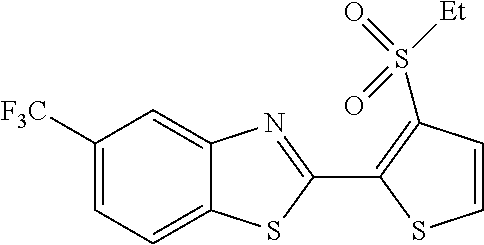


Controlling value(%)={1−(Cb×Tai)/(Cai×Tb)}×100
wherein the symbols represent as follows:
Controlling value (%)={1−(Cb×Tai)/(Cai×Tb)}×100
wherein the symbols represent as follows:
Controlling value (%)={1−(Cb×Tai)/(Cai×Tb)}×100
wherein the symbols represent as follows:
Controlling value (%)={1−(Cb×Tai)/(Cai×Tb)}×100
wherein the symbols represent as follows:
Controlling value (%)={1−(Cb×Tai)/(Cai×Tb)}×100
wherein the symbols represent as follows:
Death rate (%)=(Number of dead insects/Number of tested insects)×100
Death rate (%)=(Number of dead insects/Number of tested insects)×100
Death rate (%)=(Number of dead tick/Number of tested tick)×100
Claims (17)


Applications Claiming Priority (3)
| Application Number | Priority Date | Filing Date | Title |
|---|---|---|---|
| JP2012-124678 | 2012-05-31 | ||
| JP2012124678 | 2012-05-31 | ||
| PCT/JP2013/064962 WO2013180193A1 (en) | 2012-05-31 | 2013-05-23 | Fused heterocyclic compound |
Publications (2)
| Publication Number | Publication Date |
|---|---|
| US20150094329A1 US20150094329A1 (en) | 2015-04-02 |
| US9120792B2 true US9120792B2 (en) | 2015-09-01 |
Family
ID=49673380
Family Applications (1)
| Application Number | Title | Priority Date | Filing Date |
|---|---|---|---|
| US14/403,224 Active US9120792B2 (en) | 2012-05-31 | 2013-05-23 | Fused heterocyclic compound |
Country Status (6)
| Country | Link |
|---|---|
| US (1) | US9120792B2 (en) |
| EP (1) | EP2857396B1 (en) |
| JP (1) | JP6217629B2 (en) |
| CN (1) | CN104334552B (en) |
| BR (1) | BR112014029501B1 (en) |
| WO (1) | WO2013180193A1 (en) |
Cited By (2)
| Publication number | Priority date | Publication date | Assignee | Title |
|---|---|---|---|---|
| US10125139B2 (en) | 2015-04-24 | 2018-11-13 | Syngenta Crop Protection Ag | Pesticidally active polycyclic derivatives with sulfur substituted five-membered ring heterocycles |
| US11570992B2 (en) | 2016-04-01 | 2023-02-07 | Basf Se | Bicyclic compounds |
Families Citing this family (44)
| Publication number | Priority date | Publication date | Assignee | Title |
|---|---|---|---|---|
| US10939682B2 (en) | 2013-07-02 | 2021-03-09 | Syngenta Participations Ag | Pesticidally active bi- or tricyclic heterocycles with sulfur containing substituents |
| US11229208B2 (en) | 2013-07-02 | 2022-01-25 | Syngenta Participations Ag | Pesticidally active bi- or tricyclic heterocycles with sulfur containing substituents |
| EP3030545B1 (en) * | 2013-08-05 | 2020-10-07 | MedImmune Limited | Amino acid derivatives |
| JP6689821B2 (en) | 2014-08-12 | 2020-04-28 | シンジェンタ パーティシペーションズ アーゲー | Pesticidally Active Heterocyclic Derivatives Bearing Sulfur-Containing Substituents |
| EP3186249B1 (en) | 2014-08-25 | 2020-12-09 | Syngenta Participations AG | Pesticidally active heterocyclic derivatives with sulphur containing substituents |
| WO2016039444A1 (en) * | 2014-09-12 | 2016-03-17 | 日本農薬株式会社 | Imidazopyridazine compound or salts thereof, agricultural and horticultural insecticide containing said compound, and use of same |
| ES2806598T3 (en) | 2014-12-11 | 2021-02-18 | Syngenta Participations Ag | Pesticide-active tetracyclic derivatives with sulfur-containing substituents |
| WO2016130501A1 (en) | 2015-02-09 | 2016-08-18 | Incyte Corporation | Aza-heteroaryl compounds as pi3k-gamma inhibitors |
| MX2017010420A (en) * | 2015-02-12 | 2017-11-28 | Nissan Chemical Ind Ltd | Condensed heterocyclic compound and noxious organism control agent. |
| EP3286186B1 (en) | 2015-04-24 | 2020-05-06 | Syngenta Participations AG | Pesticidally active polycyclic derivatives with sulfur substituted five membered ring heterocyles |
| US10202380B2 (en) | 2015-07-01 | 2019-02-12 | Syngenta Participations Ag | Pesticidally active tetracyclic derivatives with sulfur containing substituents |
| CN107735396B (en) * | 2015-07-01 | 2021-03-02 | 先正达参股股份有限公司 | Pesticidally active polycyclic derivatives with sulfur-containing substituents |
| LT3319959T (en) | 2015-07-06 | 2021-12-27 | Alkermes, Inc. | HISTON DEACETYLASE HETERO-HALOGEN INHIBITORS |
| US10421756B2 (en) | 2015-07-06 | 2019-09-24 | Rodin Therapeutics, Inc. | Heterobicyclic N-aminophenyl-amides as inhibitors of histone deacetylase |
| WO2017061497A1 (en) * | 2015-10-06 | 2017-04-13 | 日本農薬株式会社 | Condensed heterocyclic compound or salts thereof, agricultural and horticultural insecticide containing said compound, and method for using same |
| TWI744256B (en) | 2015-11-06 | 2021-11-01 | 美商英塞特公司 | HETEROCYCLIC COMPOUNDS AS PI3K-γ INHIBITORS |
| US10738045B2 (en) | 2015-11-23 | 2020-08-11 | Syngenta Participations Ag | Pesticidally active heterocyclic derivatives with sulphur and cyclopropyl containing substituents |
| TW201734003A (en) | 2016-01-05 | 2017-10-01 | 英塞特公司 | Pyridine and pyridimine compounds as PI3K-gamma inhibitors |
| EA036621B1 (en) | 2016-03-10 | 2020-12-01 | Ниссан Кемикал Корпорейшн | Condensed heterocyclic compounds and pesticides |
| AR108875A1 (en) | 2016-06-24 | 2018-10-03 | Incyte Corp | HETEROCYCLIC COMPOUNDS AS PI3K-g INHIBITORS |
| ES2919558T3 (en) * | 2016-09-14 | 2022-07-27 | Bayer Cropscience Ag | Method for producing halogenated bicyclic compounds |
| CN110352192B (en) * | 2016-09-16 | 2023-03-24 | 住友化学株式会社 | Heterocyclic compound and harmful arthropod control agent containing same |
| CN114456164B (en) | 2016-10-27 | 2024-03-12 | 先正达参股股份有限公司 | Pesticide-active heterocyclic derivatives having sulfur and hydroxylamine substituents |
| WO2018091389A1 (en) | 2016-11-17 | 2018-05-24 | Syngenta Participations Ag | Pesticidally active heterocyclic derivatives with sulphur containing substituents |
| KR20190084310A (en) | 2016-11-23 | 2019-07-16 | 바이엘 크롭사이언스 악티엔게젤샤프트 | 2-yl] -3H-imidazo [4,5-b] pyridine derivatives as an insecticide and similar compounds |
| AU2018208422B2 (en) * | 2017-01-10 | 2021-11-11 | Bayer Aktiengesellschaft | Heterocyclene derivatives as pest control agents |
| UY37556A (en) * | 2017-01-10 | 2018-07-31 | Bayer Ag | HETEROCYCLIC DERIVATIVES AS PESTICIDES |
| ES2909086T3 (en) | 2017-01-11 | 2022-05-05 | Alkermes Inc | Bicyclic histone deacetylase inhibitors |
| US20200128830A1 (en) | 2017-04-24 | 2020-04-30 | Bayer Aktiengesellschaft | Fused bicyclic heterocycle derivatives as pesticides |
| JP2020128340A (en) * | 2017-04-27 | 2020-08-27 | 日本農薬株式会社 | 5-membered ring nitrogen-containing heterocyclic compound or salt thereof, and insecticide for agricultural and horticultural use containing the compound, and method of using the same |
| ES2910854T3 (en) | 2017-05-10 | 2022-05-13 | Basf Se | Bicyclic Pesticide Compounds |
| SG11202000970WA (en) | 2017-08-07 | 2020-02-27 | Rodin Therapeutics Inc | Bicyclic inhibitors of histone deacetylase |
| EP3453706A1 (en) | 2017-09-08 | 2019-03-13 | Basf Se | Pesticidal imidazole compounds |
| AU2018350980C1 (en) | 2017-10-18 | 2024-12-12 | Incyte Corporation | Condensed imidazole derivatives substituted by tertiary hydroxy groups as pi3k-y gamma inhibitors |
| BR122023022434A2 (en) * | 2018-06-26 | 2024-02-20 | Bayer Aktiengesellschaft | HETEROCYCLENE DERIVATIVES AS PEST CONTROL AGENTS |
| CR20250050A (en) | 2018-09-05 | 2025-03-19 | Incyte Corp | Crystalline forms of a phosphoinositide 3-kinase (pi3k) inhibitor |
| TWI820231B (en) | 2018-10-11 | 2023-11-01 | 德商拜耳廠股份有限公司 | Process for preparing substituted imidazole derivatives |
| GB201905721D0 (en) | 2019-04-24 | 2019-06-05 | Univ Dundee | Compounds |
| US20230247994A1 (en) | 2020-07-02 | 2023-08-10 | Bayer Aktiengesellschaft | Heterocyclene derivatives as pest control agents |
| WO2022250069A1 (en) * | 2021-05-26 | 2022-12-01 | 三井化学アグロ株式会社 | Sulfur-containing pyrazole compound and noxious organism control agent including sulfur-containing pyrazole compound as active ingredient |
| WO2023171783A1 (en) * | 2022-03-11 | 2023-09-14 | 三井化学アグロ株式会社 | Pyrazole compound, and noxious organism control agent containing same as active ingredient |
| JP2025134093A (en) * | 2022-08-09 | 2025-09-17 | 日本曹達株式会社 | Imidazolyl azole compounds and pest control agents |
| EP4680028A1 (en) | 2023-03-14 | 2026-01-21 | Syngenta Crop Protection AG | Control of pests resistant to insecticides |
| WO2025026738A1 (en) | 2023-07-31 | 2025-02-06 | Bayer Aktiengesellschaft | 6-[5-(ethylsulfonyl)-1-methyl-1h-imidazol-4-yl]-7-methyl-3-(pentafluoroethyl)-7h-imidazo[4,5-c]pyridazine derivatives as pesticides |
Citations (10)
| Publication number | Priority date | Publication date | Assignee | Title |
|---|---|---|---|---|
| WO1999052882A1 (en) | 1998-04-13 | 1999-10-21 | Nihon Nohyaku Co., Ltd. | 1,2,3-thiadiazole derivative or salt thereof and pest control agent, and method of use thereof |
| JP2000001481A (en) | 1998-04-13 | 2000-01-07 | Nippon Nohyaku Co Ltd | 1,2,3-thiadiazol derivatives or salts thereof, pesticidal agents and use thereof |
| WO2001007413A1 (en) | 1999-07-22 | 2001-02-01 | 3-Dimensional Pharmaceuticals, Inc. | 1-aryl-3-thioalkyl pyrazoles, the synthesis thereof and the use thereof as insecticides |
| US20040048868A1 (en) | 2001-10-26 | 2004-03-11 | Edwards Michael L. | Benzimidazoles |
| US20110039843A1 (en) | 2008-04-21 | 2011-02-17 | Sumitomo Chemical Company, Limited | Harmful arthropod control composition, and fused heterocyclic compound |
| JP2011219420A (en) | 2010-04-09 | 2011-11-04 | Otsuka Agritechno Co Ltd | New pyrazole compound, method for producing the same, and pest controlling agent |
| US20120015975A1 (en) | 2009-04-28 | 2012-01-19 | Masaki Takahashi | Fused heterocyclic compound and use thereof |
| US20120196891A1 (en) | 2009-10-07 | 2012-08-02 | Sumitomo Chemical Company, Limited | Heterocyclic compound and its use for control of an arthropod pest |
| US20140018373A1 (en) | 2010-12-24 | 2014-01-16 | Sumitomo Chemical Company, Limited | Fused heterocyclic compound and use for pest control thereof |
| US20140194290A1 (en) | 2011-08-04 | 2014-07-10 | Sumitomo Chemical Company, Limited | Fused heterocyclic compound and use thereof for pest control |
Family Cites Families (1)
| Publication number | Priority date | Publication date | Assignee | Title |
|---|---|---|---|---|
| JP5039268B2 (en) * | 2001-10-26 | 2012-10-03 | アベンティス・ファーマスーティカルズ・インコーポレイテツド | Benzimidazoles and analogs and their use as protein kinase inhibitors |
-
2013
- 2013-05-23 WO PCT/JP2013/064962 patent/WO2013180193A1/en not_active Ceased
- 2013-05-23 BR BR112014029501A patent/BR112014029501B1/en active IP Right Grant
- 2013-05-23 EP EP13796308.8A patent/EP2857396B1/en active Active
- 2013-05-23 US US14/403,224 patent/US9120792B2/en active Active
- 2013-05-23 JP JP2014518710A patent/JP6217629B2/en active Active
- 2013-05-23 CN CN201380028670.8A patent/CN104334552B/en active Active
Patent Citations (14)
| Publication number | Priority date | Publication date | Assignee | Title |
|---|---|---|---|---|
| JP2000001481A (en) | 1998-04-13 | 2000-01-07 | Nippon Nohyaku Co Ltd | 1,2,3-thiadiazol derivatives or salts thereof, pesticidal agents and use thereof |
| WO1999052882A1 (en) | 1998-04-13 | 1999-10-21 | Nihon Nohyaku Co., Ltd. | 1,2,3-thiadiazole derivative or salt thereof and pest control agent, and method of use thereof |
| WO2001007413A1 (en) | 1999-07-22 | 2001-02-01 | 3-Dimensional Pharmaceuticals, Inc. | 1-aryl-3-thioalkyl pyrazoles, the synthesis thereof and the use thereof as insecticides |
| US20040048868A1 (en) | 2001-10-26 | 2004-03-11 | Edwards Michael L. | Benzimidazoles |
| US20060014756A1 (en) | 2001-10-26 | 2006-01-19 | Aventis Pharmaceuticals Inc. | Benzimidazoles |
| US20120108586A1 (en) | 2008-04-21 | 2012-05-03 | Sumitomo Chemical Company, Limited | Arthropod pest control method and composition |
| US20110039843A1 (en) | 2008-04-21 | 2011-02-17 | Sumitomo Chemical Company, Limited | Harmful arthropod control composition, and fused heterocyclic compound |
| US20120245167A1 (en) | 2008-04-21 | 2012-09-27 | Sumitomo Chemical Company, Limited | Arthropod pest control method and composition |
| US20120178779A1 (en) | 2009-04-28 | 2012-07-12 | Sumitomo Chemical Company, Limited | Fused heterocyclic compound and use thereof |
| US20120015975A1 (en) | 2009-04-28 | 2012-01-19 | Masaki Takahashi | Fused heterocyclic compound and use thereof |
| US20120196891A1 (en) | 2009-10-07 | 2012-08-02 | Sumitomo Chemical Company, Limited | Heterocyclic compound and its use for control of an arthropod pest |
| JP2011219420A (en) | 2010-04-09 | 2011-11-04 | Otsuka Agritechno Co Ltd | New pyrazole compound, method for producing the same, and pest controlling agent |
| US20140018373A1 (en) | 2010-12-24 | 2014-01-16 | Sumitomo Chemical Company, Limited | Fused heterocyclic compound and use for pest control thereof |
| US20140194290A1 (en) | 2011-08-04 | 2014-07-10 | Sumitomo Chemical Company, Limited | Fused heterocyclic compound and use thereof for pest control |
Non-Patent Citations (3)
| Title |
|---|
| Amareshwar et al, "2-Phenyl-4-bis(methylthio)methyleneoxazol-5-one: versatile template for diversity oriented synthesis of heterocycles," Org. Biomol. Chem., vol. 9, No. 16, pp. 5793-5801 (2011). |
| Int'l Search Report issued Jun. 25, 2013 in Int'l Application No. PCT/JP2013/064962. |
| U.S. Appl. No. 14/403,021 by Takahashi, filed Nov. 21, 2014. |
Cited By (2)
| Publication number | Priority date | Publication date | Assignee | Title |
|---|---|---|---|---|
| US10125139B2 (en) | 2015-04-24 | 2018-11-13 | Syngenta Crop Protection Ag | Pesticidally active polycyclic derivatives with sulfur substituted five-membered ring heterocycles |
| US11570992B2 (en) | 2016-04-01 | 2023-02-07 | Basf Se | Bicyclic compounds |
Also Published As
| Publication number | Publication date |
|---|---|
| WO2013180193A1 (en) | 2013-12-05 |
| BR112014029501B1 (en) | 2020-05-19 |
| EP2857396B1 (en) | 2018-11-21 |
| JP6217629B2 (en) | 2017-10-25 |
| US20150094329A1 (en) | 2015-04-02 |
| EP2857396A1 (en) | 2015-04-08 |
| CN104334552B (en) | 2016-08-31 |
| JPWO2013180193A1 (en) | 2016-01-21 |
| BR112014029501A2 (en) | 2017-06-27 |
| EP2857396A4 (en) | 2015-10-28 |
| CN104334552A (en) | 2015-02-04 |
Similar Documents
| Publication | Publication Date | Title |
|---|---|---|
| EP2857396B1 (en) | Fused heterocyclic compounds for pest control | |
| US9364000B2 (en) | Method of controlling pests with fused heterocyclic compound | |
| US9328121B1 (en) | Fused heterocyclic compound | |
| US9271500B2 (en) | Fused heterocyclic compound | |
| US9920050B2 (en) | Fused heterocyclic compound and pest control use thereof | |
| US9185910B2 (en) | Amide compound | |
| US9573963B2 (en) | Fused heterocyclic compound and pest control applications thereof | |
| US9156838B2 (en) | Fused heterocyclic compound | |
| US9884858B2 (en) | Diaryl-azole compound | |
| US9392791B2 (en) | Amide compound and use thereof for pest control | |
| EP2865665B1 (en) | Amide compound and use thereof for pest control | |
| EP2955179A1 (en) | Condensed heterocyclic compound | |
| EP2963022A1 (en) | Fused heterocyclic compound and pest control applications thereof | |
| EP2955178A1 (en) | Condensed heterocyclic compound |
Legal Events
| Date | Code | Title | Description |
|---|---|---|---|
| AS | Assignment |
Owner name: SUMITOMO CHEMICAL COMPANY, LIMITED, JAPAN Free format text: ASSIGNMENT OF ASSIGNORS INTEREST;ASSIGNORS:NOKURA, YOSHIHIKO;ITO, MAI;SHIMIZU, CHIE;AND OTHERS;SIGNING DATES FROM 20140910 TO 20140912;REEL/FRAME:034248/0235 |
|
| STCF | Information on status: patent grant |
Free format text: PATENTED CASE |
|
| MAFP | Maintenance fee payment |
Free format text: PAYMENT OF MAINTENANCE FEE, 4TH YEAR, LARGE ENTITY (ORIGINAL EVENT CODE: M1551); ENTITY STATUS OF PATENT OWNER: LARGE ENTITY Year of fee payment: 4 |
|
| MAFP | Maintenance fee payment |
Free format text: PAYMENT OF MAINTENANCE FEE, 8TH YEAR, LARGE ENTITY (ORIGINAL EVENT CODE: M1552); ENTITY STATUS OF PATENT OWNER: LARGE ENTITY Year of fee payment: 8 |