US9119873B2 - Use of a composition comprising a poly-organosiloxane - Google Patents
Use of a composition comprising a poly-organosiloxane Download PDFInfo
- Publication number
- US9119873B2 US9119873B2 US14/361,164 US201214361164A US9119873B2 US 9119873 B2 US9119873 B2 US 9119873B2 US 201214361164 A US201214361164 A US 201214361164A US 9119873 B2 US9119873 B2 US 9119873B2
- Authority
- US
- United States
- Prior art keywords
- bolus
- composition
- organosiloxane
- poly
- radiation
- Prior art date
- Legal status (The legal status is an assumption and is not a legal conclusion. Google has not performed a legal analysis and makes no representation as to the accuracy of the status listed.)
- Active
Links
Images


Classifications
-
- A—HUMAN NECESSITIES
- A61—MEDICAL OR VETERINARY SCIENCE; HYGIENE
- A61K—PREPARATIONS FOR MEDICAL, DENTAL OR TOILETRY PURPOSES
- A61K41/00—Medicinal preparations obtained by treating materials with wave energy or particle radiation ; Therapies using these preparations
- A61K41/0038—Radiosensitizing, i.e. administration of pharmaceutical agents that enhance the effect of radiotherapy
-
- A—HUMAN NECESSITIES
- A61—MEDICAL OR VETERINARY SCIENCE; HYGIENE
- A61B—DIAGNOSIS; SURGERY; IDENTIFICATION
- A61B90/00—Instruments, implements or accessories specially adapted for surgery or diagnosis and not covered by any of the groups A61B1/00 - A61B50/00, e.g. for luxation treatment or for protecting wound edges
- A61B90/10—Instruments, implements or accessories specially adapted for surgery or diagnosis and not covered by any of the groups A61B1/00 - A61B50/00, e.g. for luxation treatment or for protecting wound edges for stereotaxic surgery, e.g. frame-based stereotaxis
- A61B90/14—Fixators for body parts, e.g. skull clamps; Constructional details of fixators, e.g. pins
-
- A—HUMAN NECESSITIES
- A61—MEDICAL OR VETERINARY SCIENCE; HYGIENE
- A61B—DIAGNOSIS; SURGERY; IDENTIFICATION
- A61B6/00—Apparatus or devices for radiation diagnosis; Apparatus or devices for radiation diagnosis combined with radiation therapy equipment
- A61B6/08—Auxiliary means for directing the radiation beam to a particular spot, e.g. using light beams
-
- A—HUMAN NECESSITIES
- A61—MEDICAL OR VETERINARY SCIENCE; HYGIENE
- A61K—PREPARATIONS FOR MEDICAL, DENTAL OR TOILETRY PURPOSES
- A61K31/00—Medicinal preparations containing organic active ingredients
- A61K31/74—Synthetic polymeric materials
- A61K31/80—Polymers containing hetero atoms not provided for in groups A61K31/755 - A61K31/795
-
- A—HUMAN NECESSITIES
- A61—MEDICAL OR VETERINARY SCIENCE; HYGIENE
- A61L—METHODS OR APPARATUS FOR STERILISING MATERIALS OR OBJECTS IN GENERAL; DISINFECTION, STERILISATION OR DEODORISATION OF AIR; CHEMICAL ASPECTS OF BANDAGES, DRESSINGS, ABSORBENT PADS OR SURGICAL ARTICLES; MATERIALS FOR BANDAGES, DRESSINGS, ABSORBENT PADS OR SURGICAL ARTICLES
- A61L31/00—Materials for other surgical articles, e.g. stents, stent-grafts, shunts, surgical drapes, guide wires, materials for adhesion prevention, occluding devices, surgical gloves, tissue fixation devices
- A61L31/04—Macromolecular materials
- A61L31/06—Macromolecular materials obtained otherwise than by reactions only involving carbon-to-carbon unsaturated bonds
-
- A—HUMAN NECESSITIES
- A61—MEDICAL OR VETERINARY SCIENCE; HYGIENE
- A61N—ELECTROTHERAPY; MAGNETOTHERAPY; RADIATION THERAPY; ULTRASOUND THERAPY
- A61N5/00—Radiation therapy
- A61N5/10—X-ray therapy; Gamma-ray therapy; Particle-irradiation therapy
-
- A—HUMAN NECESSITIES
- A61—MEDICAL OR VETERINARY SCIENCE; HYGIENE
- A61N—ELECTROTHERAPY; MAGNETOTHERAPY; RADIATION THERAPY; ULTRASOUND THERAPY
- A61N5/00—Radiation therapy
- A61N5/10—X-ray therapy; Gamma-ray therapy; Particle-irradiation therapy
- A61N5/103—Treatment planning systems
-
- C—CHEMISTRY; METALLURGY
- C08—ORGANIC MACROMOLECULAR COMPOUNDS; THEIR PREPARATION OR CHEMICAL WORKING-UP; COMPOSITIONS BASED THEREON
- C08L—COMPOSITIONS OF MACROMOLECULAR COMPOUNDS
- C08L83/00—Compositions of macromolecular compounds obtained by reactions forming in the main chain of the macromolecule a linkage containing silicon with or without sulfur, nitrogen, oxygen or carbon only; Compositions of derivatives of such polymers
- C08L83/04—Polysiloxanes
-
- A—HUMAN NECESSITIES
- A61—MEDICAL OR VETERINARY SCIENCE; HYGIENE
- A61N—ELECTROTHERAPY; MAGNETOTHERAPY; RADIATION THERAPY; ULTRASOUND THERAPY
- A61N5/00—Radiation therapy
- A61N5/10—X-ray therapy; Gamma-ray therapy; Particle-irradiation therapy
- A61N2005/1085—X-ray therapy; Gamma-ray therapy; Particle-irradiation therapy characterised by the type of particles applied to the patient
- A61N2005/1087—Ions; Protons
-
- A—HUMAN NECESSITIES
- A61—MEDICAL OR VETERINARY SCIENCE; HYGIENE
- A61N—ELECTROTHERAPY; MAGNETOTHERAPY; RADIATION THERAPY; ULTRASOUND THERAPY
- A61N5/00—Radiation therapy
- A61N5/10—X-ray therapy; Gamma-ray therapy; Particle-irradiation therapy
- A61N2005/1092—Details
- A61N2005/1096—Elements inserted into the radiation path placed on the patient, e.g. bags, bolus, compensators
-
- A—HUMAN NECESSITIES
- A61—MEDICAL OR VETERINARY SCIENCE; HYGIENE
- A61N—ELECTROTHERAPY; MAGNETOTHERAPY; RADIATION THERAPY; ULTRASOUND THERAPY
- A61N5/00—Radiation therapy
- A61N5/10—X-ray therapy; Gamma-ray therapy; Particle-irradiation therapy
- A61N2005/1092—Details
- A61N2005/1097—Means for immobilizing the patient
Definitions
- the object of the present invention belongs to the field of medicine; the invention is related with a composition based on a poly-organosiloxane which is suitable for its use as a bolus in radiotherapy treatments.
- a composition based on a poly-organosiloxane which is suitable for its use as a bolus in radiotherapy treatments.
- Other possible uses of this composition are the production of an immobilizing mask for radio surgery or cranial stereotaxy treatments and the production of an intraoral depressor.
- Radiotherapy is a form of therapy based on the application of radiation to a tumor in order to destroy malignant cells, thereby impeding their growth and reproduction. This therapy may also be applied to normal tissues; however, since tumoral tissues are more sensible to radiation and cannot repair the damage as efficiently as normal tissue, they are destroyed, thus blocking the cellular cycle.
- Radiation penetrates a certain distance through the patient's body, in such a way that most of its effect takes place a predetermined distance under the patient's skin depending on the penetrability of each specific radiation type, the effect falling exponentially from that depth.
- the tumor lies at a depth that is lower than the depth where radiation effect is maximum, such as for example on the patient's skin or very close to it. In those cases, conventional use of radiation hardly has any effect in the tumor area.
- a layer of material having a radiation absorption capability similar to that of the human body may be provided between the radiation source and the skin. If the thickness of the layer is calculated correctly, the radiation acts on the patient's skin.
- bolus Such an element is known as a “bolus”.
- any material used for making a bolus must, in addition to being adaptable to the shape of the patient's skin, have a similar density to that of the human body, that is, to that of water.
- the bolus will respond to radiation in the same way as the body of the patient.
- silicone is considered a material not suitable for making a bolus due to other reasons in addition to its density.
- column 2 lines 16-29 of international application WO 2008/054823 mentions drawbacks related with cost and cleaning problems in connection with a silicone bolus.
- Page 6 lines 30-32 of international application WO 2008/119905 also discloses some drawbacks of using silicone for making a bolus, such as the high cost and handling difficulties.
- compositions currently known for making dental molds in the field of dentistry which is based on a specific type of silicone called poly-organosiloxane having a density different from 1, surprisingly shows unique properties for its use as a bolus in radiotherapy treatments.
- the composition is described in U.S. Pat. No. 6,001,914 as a composition for making dental molds.
- a first aspect of the invention refers to a composition comprising a poly-organosiloxane, herein after “composition of the invention”, for its use as a medicament, or alternatively, to the use of a composition comprising a poly-organosiloxane for the manufacture of a medicament.
- the composition of the invention comprises a crosslinking agent, a platinum catalyst, and a hydrated sodium-aluminum zeolite.
- the poly-organosiloxane has at least one vinyl group in the end part of the linear molecule.
- the crosslinking agent contains silicon-hydrogen groups, and more preferably is a poly-hydrogen organosiloxane.
- the ratio between the zeolite and the platinum catalyst is between 1:0.01 and 1:0.003.
- the zeolite has an average formula of Na 12 (AlO 2 ) 12 (SiO 2 ) 12.27 H 2 O.
- the composition of the invention further comprises at least an additive.
- the additive is selected from the following group: inhibitors, fillers, release agents, colors, and additives to modify the rheological characteristics, or any combination thereof.
- the inhibitors are methyl vinyl cyclotetrasiloxanes.
- the fillers are selected from the group consisting of: quartz, calcium carbonate, silica, talc, or any combination thereof.
- the release agents are paraffin mineral oils.
- the rheological modifiers are selected from the group consisting of: quartz, fumed silica, and any combination thereof.
- the medicament is a bolus.
- Bolus makes reference to a material suitable for being positioned on the skin of a patient and which is capable of partially absorbing radiation employed in radiotherapy treatments with the object of causing its effect to take place on the patient's skin or close thereof.
- Bolus usually have plastic properties for adapting them to the shape of the patient's skin in the area to be treated with radiotherapy.
- radiosurgery refers to a medical procedure where fine radiation beams, generated in megavoltage units (ciclotron, Gamma Knife, linear accelerator (LINAC)) by means of multiple converging and conformed fields for irradiating high, accurately positioned doses in a specific area or anatomic structure, are administered.
- megavoltage units ciclotron, Gamma Knife, linear accelerator (LINAC)
- Stereotaxic radiotherapy allows for the administration of the same amount of radiation (or higher) as in conventional radiosurgery, but applied in small distributed doses in daily treatments (fractioned dosage).
- the fractionation of the dose favors the healing of healthy tissue close to the injury, specially in the case of critic structures such as optic vessels or the cerebral trunk.
- composition having poly-organosiloxane relates to immobilization devices for radiosurgery or cranial stereotaxy, for fixing the patient's head in a predetermined position in order to arrange reference points in a fixed position with respect to the head during the treatment when images are taken.
- the medicament is a mask for immobilizing the patient in radiosurgery or cranial stereotaxy treatments.
- the medicament is an intraoral depressor or tongue depressor.
- the term “medicament” in the context of the present invention refers to a composition comprising a poly-organosiloxane for its use as a bolus in cancer therapy by radiotherapy, for its use as a fractioned stereotaxy immobilizer and as an intraoral depressor.
- cancer is treated by means of radiotherapy, including any radiotherapy medical procedure, such as, for example, without limitation, radiosurgery or stereotaxic radiotherapy.
- radiotherapy including radiosurgery or cranial stereotaxy treatments, are with photon beams.
- kits for producing a composition of the invention comprising two separate components wherein:
- the present invention also refers to a medical device for radiotherapy comprising the composition of the invention.
- another aspect of the invention refers to a bolus for use in the treatment of cancer by radiotherapy, comprising the composition of the invention.
- Another aspect of the invention refers to a mask for its use in the immobilization of a patient in radiosurgery cranial stereotaxy treatments, comprising the composition of the invention.
- Another aspect of the invention refers to an intraoral depressor or tongue depressor, comprising the composition of the invention.
- Another aspect of the invention refers to a method for treating cancer patients with radiotherapy comprising use the bolus, the mask or intraoral depressor for directing the radiation to the tumor.
- the radiotherapy is with photon beam radiation therapy.
- FIG. 1 shows a section made by computed tomography (CT) of a phantom model 062 type “Electron density phantom” of the brand “CIRS: Tissue simulation and phantom technology” on which a sample of a bolus according to the invention and a sample of bone have been provided.
- CT computed tomography
- FIG. 2 illustrates the location change in the area corresponding to the maximum radiation received by a phantom having a piece of the bolus of the invention with a thickness of 1 cm thereon when subjected to a 6 MV photon beam.
- FIGS. 3 a , 3 b and 3 c show respective axial, coronal and sagittal views of the cranium of a patient on which a bolus according to the present invention has been provided.
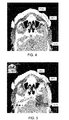
- FIG. 4 shows an example of side radiation with a 6 MV photon beam where the differential effect of the bolus can be seen.
- FIG. 5 shows an image captured by computed tomography (CT) fused with magnetic nuclear resonance (MNR) corresponding to FIG. 4 .
- CT computed tomography
- MNR magnetic nuclear resonance
- composition of the invention is provided by means of two separate components, usually in the form of a paste, which, when mixed, form the composition of the invention and set in some minutes.
- a filler may be added to this first component, such as for example quartz, calcium carbonate, silica, talc, colors, or any combination thereof.
- compositions may be added in order to complete the composition, such as inhibitors, release agents, additives to modify the rheological characteristics, or any combination thereof.
- the preferred inhibitors are methyl vinyl cyclotetrasiloxanes, whilst paraffin mineral oils are advantageously used as release agents.
- quartz and/or fumed silica is preferred.
- the sodium-aluminum zeolite preferably its average formula is Na 12 (AlO 2 ) 12 (SiO 2 ) 12.27 H 2 O, having the appearance of a water-insoluble white powder.
- the particles forming it are cube-shaped with rounded corners and edges.
- the basic elements of the structure of the sodium-aluminum zeolite are shaped like octahedral cubes joined to each other by hexahedrons.
- the sodium ions which compensate the excess negative charge, can move freely within the channels of the zeolite.
- the zeolite has the primary effect of binding the metal ions, which are harmful for the stability of the platinum catalyst.
- the exact mechanism of protection towards platinum is currently not clear, but it has been ascertained that the activity of the zeolite preserves the platinum catalyst from the action of any contaminants contained in the composition, thereby prolonging its life. The presence of contaminants is practically inevitable owing to the nature and origin of the components of the compound in which usually mineral fillers are present. It has been found experimentally that optimum results are achieved with a ratio between the zeolite and the platinum catalyst of 1:0.01 and 1:0.003.
- the zeolite preserves the platinum catalyst, so that the composition maintains a constant setting time longer than normal compositions which do not employ zeolite.
- zeolite in the paste described as “base”, where it acts as a filler.
- zeolites also known as molecular sieves, is available in many other publications.
- composition has been described with detail, in the following some examples of its use as bolus in radiotherapy are disclosed.
- FIG. 1 show a CT section of a phantom model 062 type “Electron density phantom” of the brand CIRS, where the density graph in the foreground shows the density along the white vertical line drawn on the phantom (in the background) downwards from the upper end
- the graph starts with the measure of the density of a piece of the bolus according to the present invention (positioned in the upper end of the white line) and ends with the density of a bone insert of 800 mg/cc (located in the lower end of the white line). It can be seen that both densities are very similar.
- FIG. 2 shows how the distribution of the radiation of a 6 MV photon beam on a phantom changes when a bolus layer of a thickness of 1 cm according to the invention is employed. Note that the original graph presented in the upper left corner a color code corresponding to the different radiation levels. However, since both Spanish and European patent law forbid the use of colors in the figures of a patent application, additional indications disclosing the radiation levels corresponding to each curve have been added.
- the radiation levels corresponding to an area of the phantom where the bolus is not affecting are indicated.
- the distance between the surface of the phantom and the point where a radiation of 150 cGy is found is approximately 1 cm., the maximum of 155 cGy being located at a depth of 1-2 cm; from there, the radiation levels gradually fall as the depth increases.
- the radiation levels corresponding to the central zone of the figure where the bolus of the invention is affecting are indicated.
- the depth where 150 cGy are reached is approximately 0.5 cm from the surface of the bolus.
- the maximum of 155 cGy is located at a depth of approximately 0.5-1 cm, affecting mostly the surface of the phantom located under the bolus.
- the bolus therefore, allows for directing the maximum dose of radiation to the surface of the phantom using a conventional photon beam without the need to employ more expensive electron beams.
- a 6 MV photon beam and a bolus of about 1 cm. of thickness could be used in order to make the maximum radiation affect specifically the skin of the patient.
- This thickness of 1 cm. would be about half the thickness necessary with a conventional bolus having a density equivalent to the density of the tissue of the patient.
- FIGS. 4 and 5 where radiation is shown as a percentage of the maximum dose instead of using cGy.
- regions corresponding to 100% of the doses are represented as hatched areas.
- FIG. 4 shows how the presence of the bolus of the invention on the cranium allows for obtaining a region corresponding to 100% of the doses on the surface of the skin, while without the bolus the 100% region is obtained at a depth of 17 mm.
- FIG. 5 is a fusion of CT and MNR showing how the bolus is virtually invisible in a resonance image, and it does not cause aberrations.
Landscapes
- Health & Medical Sciences (AREA)
- Life Sciences & Earth Sciences (AREA)
- Animal Behavior & Ethology (AREA)
- General Health & Medical Sciences (AREA)
- Public Health (AREA)
- Veterinary Medicine (AREA)
- Engineering & Computer Science (AREA)
- Biomedical Technology (AREA)
- Chemical & Material Sciences (AREA)
- Pathology (AREA)
- Nuclear Medicine, Radiotherapy & Molecular Imaging (AREA)
- Epidemiology (AREA)
- Radiology & Medical Imaging (AREA)
- Surgery (AREA)
- Medicinal Chemistry (AREA)
- Heart & Thoracic Surgery (AREA)
- Pharmacology & Pharmacy (AREA)
- Chemical Kinetics & Catalysis (AREA)
- Medical Informatics (AREA)
- Vascular Medicine (AREA)
- Molecular Biology (AREA)
- Organic Chemistry (AREA)
- Polymers & Plastics (AREA)
- High Energy & Nuclear Physics (AREA)
- Optics & Photonics (AREA)
- Biophysics (AREA)
- Physics & Mathematics (AREA)
- Neurosurgery (AREA)
- Oral & Maxillofacial Surgery (AREA)
- Medicines That Contain Protein Lipid Enzymes And Other Medicines (AREA)
- Pharmaceuticals Containing Other Organic And Inorganic Compounds (AREA)
- Compositions Of Macromolecular Compounds (AREA)
- Dental Preparations (AREA)
Applications Claiming Priority (3)
| Application Number | Priority Date | Filing Date | Title |
|---|---|---|---|
| ES201131637 | 2011-10-11 | ||
| ES201131637A ES2401806B1 (es) | 2011-10-11 | 2011-10-11 | Uso de una composición que comprende un poli-organosiloxano. |
| PCT/EP2012/070167 WO2013053830A1 (en) | 2011-10-11 | 2012-10-11 | Use of a composition comprising a poly-organosiloxane |
Publications (2)
| Publication Number | Publication Date |
|---|---|
| US20150087880A1 US20150087880A1 (en) | 2015-03-26 |
| US9119873B2 true US9119873B2 (en) | 2015-09-01 |
Family
ID=47115809
Family Applications (1)
| Application Number | Title | Priority Date | Filing Date |
|---|---|---|---|
| US14/361,164 Active US9119873B2 (en) | 2011-10-11 | 2012-10-11 | Use of a composition comprising a poly-organosiloxane |
Country Status (4)
| Country | Link |
|---|---|
| US (1) | US9119873B2 (de) |
| EP (2) | EP3415152B1 (de) |
| ES (2) | ES2401806B1 (de) |
| WO (1) | WO2013053830A1 (de) |
Families Citing this family (3)
| Publication number | Priority date | Publication date | Assignee | Title |
|---|---|---|---|---|
| EP3751524A1 (de) * | 2019-06-13 | 2020-12-16 | RaySearch Laboratories AB | Verfahren, computerprogrammprodukt und computersystem zur bereitstellung eines ungefähren bildes |
| EP3750481B1 (de) * | 2019-06-13 | 2025-03-05 | RaySearch Laboratories AB | System und verfahren zur bereitstellung eines erweiterten bildes eines patienten |
| JP7551085B2 (ja) * | 2020-12-14 | 2024-09-17 | シヤチハタ株式会社 | ボーラス材 |
Citations (5)
| Publication number | Priority date | Publication date | Assignee | Title |
|---|---|---|---|---|
| JPH11221293A (ja) | 1998-02-06 | 1999-08-17 | Mochida Shoko Kk | 放射線治療用シリコーンボーラスの製造法 |
| US6231858B1 (en) | 1998-01-09 | 2001-05-15 | Mochida Corporation | Bolus for radiotherapy |
| WO2008054823A2 (en) | 2006-11-03 | 2008-05-08 | Kirkpatrick John P | Bolus materials for radiation therapy and methods of making and using the same |
| WO2008119905A1 (fr) | 2007-02-27 | 2008-10-09 | Institut Curie | Bolus pour radiotherapie, et procede pour determiner la forme d'un tel bolus |
| US20110117008A1 (en) * | 2007-11-26 | 2011-05-19 | Research Development Foundation | Use of avicins to deliver therapeutic and diagnostic agents |
Family Cites Families (4)
| Publication number | Priority date | Publication date | Assignee | Title |
|---|---|---|---|---|
| IT1288292B1 (it) * | 1996-07-30 | 1998-09-11 | Zhermack Spa | Composto siliconico reticolabile stabile allo stoccaggio. |
| HK1041227B (zh) * | 1999-02-14 | 2005-10-28 | 安徽中人科技有限责任公司 | 一種緩釋植入體及其製備方法 |
| FR2867682B1 (fr) * | 2004-03-22 | 2009-06-05 | Galderma Res & Dev | Composition pharmaceutique anhydre associant un agent silicone et un principe actif solubilise. |
| CN101638423B (zh) * | 2008-07-29 | 2012-09-05 | 常州高新技术产业开发区三维工业技术研究所有限公司 | 根皮苷衍生物及其制备方法和用途 |
-
2011
- 2011-10-11 ES ES201131637A patent/ES2401806B1/es active Active
-
2012
- 2012-10-11 US US14/361,164 patent/US9119873B2/en active Active
- 2012-10-11 ES ES17200697T patent/ES2978023T3/es active Active
- 2012-10-11 EP EP17200697.5A patent/EP3415152B1/de active Active
- 2012-10-11 EP EP12780132.2A patent/EP2766023A1/de not_active Withdrawn
- 2012-10-11 WO PCT/EP2012/070167 patent/WO2013053830A1/en not_active Ceased
Patent Citations (7)
| Publication number | Priority date | Publication date | Assignee | Title |
|---|---|---|---|---|
| US6231858B1 (en) | 1998-01-09 | 2001-05-15 | Mochida Corporation | Bolus for radiotherapy |
| JPH11221293A (ja) | 1998-02-06 | 1999-08-17 | Mochida Shoko Kk | 放射線治療用シリコーンボーラスの製造法 |
| WO2008054823A2 (en) | 2006-11-03 | 2008-05-08 | Kirkpatrick John P | Bolus materials for radiation therapy and methods of making and using the same |
| US20080123810A1 (en) | 2006-11-03 | 2008-05-29 | Kirkpatrick John P | Bolus materials for radiation therapy and methods of making and using the same |
| WO2008119905A1 (fr) | 2007-02-27 | 2008-10-09 | Institut Curie | Bolus pour radiotherapie, et procede pour determiner la forme d'un tel bolus |
| US8219354B2 (en) | 2007-02-27 | 2012-07-10 | Institut Curie | Bolus for radiotherapy and method for determining the shape of such a bolus |
| US20110117008A1 (en) * | 2007-11-26 | 2011-05-19 | Research Development Foundation | Use of avicins to deliver therapeutic and diagnostic agents |
Non-Patent Citations (6)
| Title |
|---|
| Farahani, M., et al.; "Metal-polysiloxane shields for radiation therapy of maxillo-facial tumors," Medical Physics, 1991, pp. 273-278, vol. 18. |
| Farahani, M., et al.; "New method for shielding electron beams used for head and neck cancer treatment," Medical Physics, 1993, pp. 1237-1241, vol. 20. |
| Farahani, M., et al.; "Shielding Small-Field High-Energy Electron Beams in Cancer Treatment," Radiation Physics & Chemistry, 1994, pp. 357-360, vol. 43. |
| Havelka, Carole, et al.; "Custom oral appliance for noninvasive immobilization during stereotactic radiotherapy," Pediactric Dentistry, 1995, pp. 212-215, vol. 17. |
| International Search Report dated Feb. 7, 2013. |
| Wang, Russell R., et al.; "A direct method for fabricating tongue-shielding stent," The Journal of Prosthetic Dentistry, 1995, pp. 171-173, vol. 74. |
Also Published As
| Publication number | Publication date |
|---|---|
| EP3415152C0 (de) | 2024-01-03 |
| ES2401806B1 (es) | 2014-06-10 |
| WO2013053830A1 (en) | 2013-04-18 |
| ES2978023T3 (es) | 2024-09-04 |
| EP3415152B1 (de) | 2024-01-03 |
| US20150087880A1 (en) | 2015-03-26 |
| EP2766023A1 (de) | 2014-08-20 |
| EP3415152A1 (de) | 2018-12-19 |
| ES2401806A1 (es) | 2013-04-24 |
Similar Documents
| Publication | Publication Date | Title |
|---|---|---|
| Kondziolka et al. | The role of radiosurgery in the management of chordoma and chondrosarcoma of the cranial base | |
| Kitamori et al. | Evaluation of mouthpiece fixation devices for head and neck radiotherapy patients fabricated in PolyJet photopolymer by a 3D printer | |
| Wolf et al. | Comparison of two different rectal spacers in prostate cancer external beam radiotherapy in terms of rectal sparing and volume consistency | |
| Fukunaga-Johnson et al. | The use of 3D conformal radiotherapy (3D CRT) to spare the cochlea in patients with medulloblastoma | |
| Reynders et al. | Dosimetric assessment of static and helical TomoTherapy in the clinical implementation of breast cancer treatments | |
| US11478568B2 (en) | Radioactive cement | |
| US9119873B2 (en) | Use of a composition comprising a poly-organosiloxane | |
| US8219354B2 (en) | Bolus for radiotherapy and method for determining the shape of such a bolus | |
| Shrotriya et al. | Design and development of an indigenous in-house tissue-equivalent female pelvic phantom for radiological dosimetric applications | |
| Gieger et al. | Response of intracranial melanoma metastases to stereotactic radiosurgery | |
| Lee et al. | Early clinical experience and outcome of helical tomotherapy for multiple metastatic lesions | |
| Van den Berge et al. | Imaging in radiotherapy | |
| JP2999184B2 (ja) | 放射線治療用ボーラス | |
| Radaideh | Dosimetric impact of weight loss and anatomical changes at organs at risk during intensity-modulated radiotherapy for head-and-neck cancer | |
| Nag et al. | Brachytherapy for pediatric tumors | |
| Ziemlewski et al. | Preliminary report of pulsed dose rate brachytherapy in head-and-neck cancer | |
| Ornitz et al. | Clinical observations of early and late normal tissue injury inpatients receiving fast neutron irradiation | |
| Kovácsª et al. | Eye preservation brachytherapy for orbital and adjacent tumors: preliminary results | |
| Liu et al. | Nasopharyngeal carcinoma treated with precision-oriented radiation therapy techniques including intensity-modulated radiotherapy: preliminary results | |
| Pashazadeh et al. | Feasibility of 3D printing for customized radiotherapeutic models to be used in superficial skin cancer therapy | |
| Kaneko et al. | Evaluation of a radiation transport modeling method for radioactive bone cement | |
| Goyal et al. | Improvement in dose homogeneity with electronic tissue compensation over IMRT and conventional RT in whole brain radiotherapy | |
| Won et al. | Application of Patient-Customized Cast Type M3 Wax Bolus using a 3D printing for Photon Beam Radiation Therapy in Patients with Scalp Malignant Tumor. | |
| 工藤 et al. | Effectiveness of newly developed water-equivalent mouthpiece during external beam radiotherapy for oral cancer | |
| Pradeep Kumar et al. | High‐activity iodine‐125 endocurietherapy for head and neck tumors |
Legal Events
| Date | Code | Title | Description |
|---|---|---|---|
| AS | Assignment |
Owner name: SERVICIO ANDALUZ DE SALUD, SPAIN Free format text: ASSIGNMENT OF ASSIGNORS INTEREST;ASSIGNOR:VELAZQUEZ MIRANDA, SANTIAGO;REEL/FRAME:033178/0698 Effective date: 20140509 |
|
| STCF | Information on status: patent grant |
Free format text: PATENTED CASE |
|
| MAFP | Maintenance fee payment |
Free format text: PAYMENT OF MAINTENANCE FEE, 4TH YR, SMALL ENTITY (ORIGINAL EVENT CODE: M2551); ENTITY STATUS OF PATENT OWNER: SMALL ENTITY Year of fee payment: 4 |
|
| MAFP | Maintenance fee payment |
Free format text: PAYMENT OF MAINTENANCE FEE, 8TH YR, SMALL ENTITY (ORIGINAL EVENT CODE: M2552); ENTITY STATUS OF PATENT OWNER: SMALL ENTITY Year of fee payment: 8 |