US9118022B2 - Organic electroluminescent device - Google Patents
Organic electroluminescent device Download PDFInfo
- Publication number
- US9118022B2 US9118022B2 US14/122,272 US201214122272A US9118022B2 US 9118022 B2 US9118022 B2 US 9118022B2 US 201214122272 A US201214122272 A US 201214122272A US 9118022 B2 US9118022 B2 US 9118022B2
- Authority
- US
- United States
- Prior art keywords
- group
- atoms
- formula
- radicals
- substituted
- Prior art date
- Legal status (The legal status is an assumption and is not a legal conclusion. Google has not performed a legal analysis and makes no representation as to the accuracy of the status listed.)
- Active
Links
- 0 C.C.CCC.[1*]C1=C([1*])N2C3=CC=CC=C3N=C2C2=CC=CC=C21.[1*]C1=C([1*])N2C3=CC=CC=C3N=C2C2=CC=CC=C21.[1*]C1=C([1*])N2C3=CC=CC=C3N=C2C2=CC=CC=C21 Chemical compound C.C.CCC.[1*]C1=C([1*])N2C3=CC=CC=C3N=C2C2=CC=CC=C21.[1*]C1=C([1*])N2C3=CC=CC=C3N=C2C2=CC=CC=C21.[1*]C1=C([1*])N2C3=CC=CC=C3N=C2C2=CC=CC=C21 0.000 description 19
- KGXWGPBSKBRXPL-UHFFFAOYSA-N BrC1=C/C2=C(\C=C/1)N=C1C3=CC=CC=C3C=CN12 Chemical compound BrC1=C/C2=C(\C=C/1)N=C1C3=CC=CC=C3C=CN12 KGXWGPBSKBRXPL-UHFFFAOYSA-N 0.000 description 10
- ODEJJTLDSPSKMG-UHFFFAOYSA-N CC1(C)OB(C2=C/C3=C(\C=C/2)N=C2C4=CC=CC=C4C=CN23)OC1(C)C Chemical compound CC1(C)OB(C2=C/C3=C(\C=C/2)N=C2C4=CC=CC=C4C=CN23)OC1(C)C ODEJJTLDSPSKMG-UHFFFAOYSA-N 0.000 description 9
- HNZUKQQNZRMNGS-UHFFFAOYSA-N BrC1=CC(C2=NC(C3=CC=CC=C3)=NC(C3=CC=CC=C3)=N2)=CC=C1 Chemical compound BrC1=CC(C2=NC(C3=CC=CC=C3)=NC(C3=CC=CC=C3)=N2)=CC=C1 HNZUKQQNZRMNGS-UHFFFAOYSA-N 0.000 description 4
- RTRLBUODJAWLHP-UHFFFAOYSA-N BrC1=CN2C(=NC3=C2/C=C(Br)\C=C/3)C2=CC=CC=C12 Chemical compound BrC1=CN2C(=NC3=C2/C=C(Br)\C=C/3)C2=CC=CC=C12 RTRLBUODJAWLHP-UHFFFAOYSA-N 0.000 description 3
- QVYOLYMOMXSODT-UHFFFAOYSA-N BrC1=CN2C(=NC3=C2/C=C(Br)\C=C/3Br)C2=CC=CC=C12 Chemical compound BrC1=CN2C(=NC3=C2/C=C(Br)\C=C/3Br)C2=CC=CC=C12 QVYOLYMOMXSODT-UHFFFAOYSA-N 0.000 description 2
- YZNPZKPHOZBPAO-UHFFFAOYSA-N C1=CC=C(C2=CC(C3=CC=CC=C3)=NC(C3=CC=CC(C4=CC5=C(C=C4)N=C4C6=CC=CC=C6C=CN45)=C3)=N2)C=C1 Chemical compound C1=CC=C(C2=CC(C3=CC=CC=C3)=NC(C3=CC=CC(C4=CC5=C(C=C4)N=C4C6=CC=CC=C6C=CN45)=C3)=N2)C=C1 YZNPZKPHOZBPAO-UHFFFAOYSA-N 0.000 description 2
- LGLMWPWRAYAUQT-UHFFFAOYSA-N C1=CC=C2C(=C1)C=CN1C2=NC2=C1C=C(C1=CC=C(C3=NC4=C(C=CC=C4)S3)C=C1)C=C2 Chemical compound C1=CC=C2C(=C1)C=CN1C2=NC2=C1C=C(C1=CC=C(C3=NC4=C(C=CC=C4)S3)C=C1)C=C2 LGLMWPWRAYAUQT-UHFFFAOYSA-N 0.000 description 2
- FRMFOJBPFRKKSJ-UHFFFAOYSA-N CC1(C)OB(C2=CN3C(=NC4=C3/C=C(B3OC(C)(C)C(C)(C)O3)\C=C/4)C3=CC=CC=C23)OC1(C)C Chemical compound CC1(C)OB(C2=CN3C(=NC4=C3/C=C(B3OC(C)(C)C(C)(C)O3)\C=C/4)C3=CC=CC=C23)OC1(C)C FRMFOJBPFRKKSJ-UHFFFAOYSA-N 0.000 description 2
- DFJBWEQFZRORJQ-UHFFFAOYSA-N CC1(C)OB(C2=CN3C(=NC4=C3/C=C(B3OC(C)(C)C(C)(C)O3)\C=C/4B3OC(C)(C)C(C)(C)O3)C3=CC=CC=C23)OC1(C)C Chemical compound CC1(C)OB(C2=CN3C(=NC4=C3/C=C(B3OC(C)(C)C(C)(C)O3)\C=C/4B3OC(C)(C)C(C)(C)O3)C3=CC=CC=C23)OC1(C)C DFJBWEQFZRORJQ-UHFFFAOYSA-N 0.000 description 2
- VWQCBJNKZBPOLJ-UHFFFAOYSA-N O=C(C1=CC=CC(C2=CC(C3=C/C4=C(\C=C/3)N=C3C5=CC=CC=C5C=CN34)=CC=C2)=C1)C1=CC(C2=CC=CC(C3=CC4=C(C=C3)N=C3C5=CC=CC=C5C=CN34)=C2)=CC=C1 Chemical compound O=C(C1=CC=CC(C2=CC(C3=C/C4=C(\C=C/3)N=C3C5=CC=CC=C5C=CN34)=CC=C2)=C1)C1=CC(C2=CC=CC(C3=CC4=C(C=C3)N=C3C5=CC=CC=C5C=CN34)=C2)=CC=C1 VWQCBJNKZBPOLJ-UHFFFAOYSA-N 0.000 description 2
- HYCYKHYFIWHGEX-UHFFFAOYSA-N OB(O)C1=C(C2=CC=CC=C2)C=CC=C1 Chemical compound OB(O)C1=C(C2=CC=CC=C2)C=CC=C1 HYCYKHYFIWHGEX-UHFFFAOYSA-N 0.000 description 2
- WPRJDBSHSIFANH-UHFFFAOYSA-N c1ccc2nc(c(cccc3)c3c(-c(cc3c4c5)ccc3[s]c4ccc5-c(c3ccccc33)c[n]4c3nc3c4cccc3)c3)[n]3c2c1 Chemical compound c1ccc2nc(c(cccc3)c3c(-c(cc3c4c5)ccc3[s]c4ccc5-c(c3ccccc33)c[n]4c3nc3c4cccc3)c3)[n]3c2c1 WPRJDBSHSIFANH-UHFFFAOYSA-N 0.000 description 2
- AARBMMNIJHWSDI-UHFFFAOYSA-N BrC1=C/C2=C(\C=C/1)N=C1C3=CC=CC=C3C=CN12.C1=CC=C(C2=C(C3=C/C4=C(\C=C/3)N=C3C5=CC=CC=C5C=CN34)C=CC=C2)C=C1.OB(O)C1=C(C2=CC=CC=C2)C=CC=C1 Chemical compound BrC1=C/C2=C(\C=C/1)N=C1C3=CC=CC=C3C=CN12.C1=CC=C(C2=C(C3=C/C4=C(\C=C/3)N=C3C5=CC=CC=C5C=CN34)C=CC=C2)C=C1.OB(O)C1=C(C2=CC=CC=C2)C=CC=C1 AARBMMNIJHWSDI-UHFFFAOYSA-N 0.000 description 1
- SLKFDSDUCSPBMD-UHFFFAOYSA-N BrC1=C/C2=C(\C=C/1)N=C1C3=CC=CC=C3C=CN12.C1=CC=C2C(=C1)C=CN1C2=NC2=C1/C=C\C=C/2 Chemical compound BrC1=C/C2=C(\C=C/1)N=C1C3=CC=CC=C3C=CN12.C1=CC=C2C(=C1)C=CN1C2=NC2=C1/C=C\C=C/2 SLKFDSDUCSPBMD-UHFFFAOYSA-N 0.000 description 1
- GRVIOWCTOWRWMY-UHFFFAOYSA-N BrC1=C/C2=C(\C=C/1)N=C1C3=CC=CC=C3C=CN12.CC1(C)C2=CC=CC=C2N(C2=C/C3=C(\C=C/2)N=C2C4=CC=CC=C4C=CN23)C2=C1C=CC=C2.[H]N1C2=CC=CC=C2C(C)(C)C2=C1C=CC=C2 Chemical compound BrC1=C/C2=C(\C=C/1)N=C1C3=CC=CC=C3C=CN12.CC1(C)C2=CC=CC=C2N(C2=C/C3=C(\C=C/2)N=C2C4=CC=CC=C4C=CN23)C2=C1C=CC=C2.[H]N1C2=CC=CC=C2C(C)(C)C2=C1C=CC=C2 GRVIOWCTOWRWMY-UHFFFAOYSA-N 0.000 description 1
- XYQRSNXFRSZJIC-UHFFFAOYSA-N BrC1=CC(C2=CC(C3=CC=CC=N3)=NC(C3=NC=CC=C3)=C2)=CC=C1 Chemical compound BrC1=CC(C2=CC(C3=CC=CC=N3)=NC(C3=NC=CC=C3)=C2)=CC=C1 XYQRSNXFRSZJIC-UHFFFAOYSA-N 0.000 description 1
- JBTMIKJTZJJZQL-UHFFFAOYSA-N BrC1=CC(C2=CC=CC(Br)=C2)=CC=C1.N#CC1=CC=CC=C1.O=C(C1=CC=CC=C1)C1=CC(C2=CC=CC(Br)=C2)=CC=C1 Chemical compound BrC1=CC(C2=CC=CC(Br)=C2)=CC=C1.N#CC1=CC=CC=C1.O=C(C1=CC=CC=C1)C1=CC(C2=CC=CC(Br)=C2)=CC=C1 JBTMIKJTZJJZQL-UHFFFAOYSA-N 0.000 description 1
- BYDMGWHTARYHKO-UHFFFAOYSA-N BrC1=CC(C2=NC(C3=CC=CC=C3)=CC(C3=CC=CC=C3)=N2)=CC=C1 Chemical compound BrC1=CC(C2=NC(C3=CC=CC=C3)=CC(C3=CC=CC=C3)=N2)=CC=C1 BYDMGWHTARYHKO-UHFFFAOYSA-N 0.000 description 1
- QATSRWJMVQONJI-UHFFFAOYSA-N BrC1=CC(C2N=C3C=CC=CC3N2C2=CC=CC=C2)=CC=C1 Chemical compound BrC1=CC(C2N=C3C=CC=CC3N2C2=CC=CC=C2)=CC=C1 QATSRWJMVQONJI-UHFFFAOYSA-N 0.000 description 1
- FQIRBKKYMJKENC-UHFFFAOYSA-N BrC1=CC=C(C2=NC3=C(C=CC=C3)S2)C=C1 Chemical compound BrC1=CC=C(C2=NC3=C(C=CC=C3)S2)C=C1 FQIRBKKYMJKENC-UHFFFAOYSA-N 0.000 description 1
- AEEIASOJEJVQLK-UHFFFAOYSA-N BrC1=CC=CC(C2=CC(Br)=CC=C2)=C1.N#CC1=CC=CC(C2=CC(Br)=CC=C2)=C1.O=C(C1=CC=CC(C2=CC(Br)=CC=C2)=C1)C1=CC(C2=CC=CC(Br)=C2)=CC=C1 Chemical compound BrC1=CC=CC(C2=CC(Br)=CC=C2)=C1.N#CC1=CC=CC(C2=CC(Br)=CC=C2)=C1.O=C(C1=CC=CC(C2=CC(Br)=CC=C2)=C1)C1=CC(C2=CC=CC(Br)=C2)=CC=C1 AEEIASOJEJVQLK-UHFFFAOYSA-N 0.000 description 1
- LGHQEESYANJWPU-UHFFFAOYSA-N BrC1=CC=CC(C2=CC(C3=CC=CC=C3)=NC(C3=CC=CC=C3)=N2)=C1.C1=CC=C(C2=NC(C3=CC=CC=C3)=NC(C3=CC(C4=CC5=C(C=C4)N=C4C6=CC=CC=C6C=CN45)=CC=C3)=C2)C=C1.CC1(C)OB(C2=C/C3=C(\C=C/2)N=C2C4=CC=CC=C4C=CN23)OC1(C)C Chemical compound BrC1=CC=CC(C2=CC(C3=CC=CC=C3)=NC(C3=CC=CC=C3)=N2)=C1.C1=CC=C(C2=NC(C3=CC=CC=C3)=NC(C3=CC(C4=CC5=C(C=C4)N=C4C6=CC=CC=C6C=CN45)=CC=C3)=C2)C=C1.CC1(C)OB(C2=C/C3=C(\C=C/2)N=C2C4=CC=CC=C4C=CN23)OC1(C)C LGHQEESYANJWPU-UHFFFAOYSA-N 0.000 description 1
- MMKNEELMYOLXLK-UHFFFAOYSA-N BrC1=CC=CC=C1C1=CC(C2=CC=CC=C2)=NC(C2=CC=CC=C2)=N1 Chemical compound BrC1=CC=CC=C1C1=CC(C2=CC=CC=C2)=NC(C2=CC=CC=C2)=N1 MMKNEELMYOLXLK-UHFFFAOYSA-N 0.000 description 1
- IURDUNUBEXVZKY-FEAQHYTASA-N BrC1=CC=CC=C1C1=CC(C2=CC=CC=C2)=NC(C2=CC=CC=C2)=N1.Cl.O=C(/C=C/C1=CC=CC=C1Br)C1=CC=CC=C1.[H]/N=C(/C1=CC=CC=C1)N([H])[H] Chemical compound BrC1=CC=CC=C1C1=CC(C2=CC=CC=C2)=NC(C2=CC=CC=C2)=N1.Cl.O=C(/C=C/C1=CC=CC=C1Br)C1=CC=CC=C1.[H]/N=C(/C1=CC=CC=C1)N([H])[H] IURDUNUBEXVZKY-FEAQHYTASA-N 0.000 description 1
- YMWARWJXMWGDMW-UHFFFAOYSA-N BrC1=CN2C(=NC3=C2/C=C(Br)\C=C/3)C2=CC=CC=C12.C1=CC=C2C(=C1)C=CN1C2=NC2=C1/C=C\C=C/2 Chemical compound BrC1=CN2C(=NC3=C2/C=C(Br)\C=C/3)C2=CC=CC=C12.C1=CC=C2C(=C1)C=CN1C2=NC2=C1/C=C\C=C/2 YMWARWJXMWGDMW-UHFFFAOYSA-N 0.000 description 1
- YGQZEIYXDQWARL-UHFFFAOYSA-N BrC1=CN2C(=NC3=C2/C=C(Br)\C=C/3Br)C2=CC=CC=C12.C1=CC=C2C(=C1)C=CN1C2=NC2=C1/C=C\C=C/2 Chemical compound BrC1=CN2C(=NC3=C2/C=C(Br)\C=C/3Br)C2=CC=CC=C12.C1=CC=C2C(=C1)C=CN1C2=NC2=C1/C=C\C=C/2 YGQZEIYXDQWARL-UHFFFAOYSA-N 0.000 description 1
- GCZALLNUIVKHBD-UHFFFAOYSA-N C1=CC2=C(C=C1)N1C3=CC(N4C5=C(C=CC=C5)C5=C4C=CC=C5)=CC=C3N=C1C1=CN=CC=C12.C1=CC=C2C(=C1)N=C1C3=CC=CC=C3C(/C3=C/N4C5=CC=CC=C5N=C4C4=CC=CC=C43)=CN21.C1=CC=C2C(=C1)N=C1C3=CC=CC=C3C(C3=CC=C(C4=CN5C6=CC=CC=C6N=C5C5=CC=CC=C45)S3)=CN21.C1=CC=C2C(=C1)N=C1C3=CC=CC=C3C(C3=CC=CC(C4=CN5C6=CC=CC=C6N=C5C5=CC=CC=C45)=C3)=CN21 Chemical compound C1=CC2=C(C=C1)N1C3=CC(N4C5=C(C=CC=C5)C5=C4C=CC=C5)=CC=C3N=C1C1=CN=CC=C12.C1=CC=C2C(=C1)N=C1C3=CC=CC=C3C(/C3=C/N4C5=CC=CC=C5N=C4C4=CC=CC=C43)=CN21.C1=CC=C2C(=C1)N=C1C3=CC=CC=C3C(C3=CC=C(C4=CN5C6=CC=CC=C6N=C5C5=CC=CC=C45)S3)=CN21.C1=CC=C2C(=C1)N=C1C3=CC=CC=C3C(C3=CC=CC(C4=CN5C6=CC=CC=C6N=C5C5=CC=CC=C45)=C3)=CN21 GCZALLNUIVKHBD-UHFFFAOYSA-N 0.000 description 1
- SDEFDICGRVDKPH-UHFFFAOYSA-M C1=CC2=CC=CN3=C2C(=C1)O[AlH]3 Chemical compound C1=CC2=CC=CN3=C2C(=C1)O[AlH]3 SDEFDICGRVDKPH-UHFFFAOYSA-M 0.000 description 1
- JDLKGNYXCCJLFU-UHFFFAOYSA-N C1=CC=C(C2(C3=CC=CC=C3)C3=C(C=CC=C3)C3=C2C=C(C2=CN4C5=CC=CC=C5N=C4C4=CC=CC=C24)C=C3)C=C1.C1=CC=C(N2C3=C(C=CC=C3)C3=C2C=C(C2=CN4C5=CC=CC=C5N=C4C4=CC=CC=C24)C=C3)C=C1.C1=CC=C(N2C3=C(C=CC=C3)C3=C2C=CC(C2=CN4C5=CC=CC=C5N=C4C4=CC=CC=C24)=C3)C=C1.CC1(C)C2=C(C=CC=C2)C2=C1C=C(C1=CN3C4=CC=CC=C4N=C3C3=CC=CC=C13)C=C2 Chemical compound C1=CC=C(C2(C3=CC=CC=C3)C3=C(C=CC=C3)C3=C2C=C(C2=CN4C5=CC=CC=C5N=C4C4=CC=CC=C24)C=C3)C=C1.C1=CC=C(N2C3=C(C=CC=C3)C3=C2C=C(C2=CN4C5=CC=CC=C5N=C4C4=CC=CC=C24)C=C3)C=C1.C1=CC=C(N2C3=C(C=CC=C3)C3=C2C=CC(C2=CN4C5=CC=CC=C5N=C4C4=CC=CC=C24)=C3)C=C1.CC1(C)C2=C(C=CC=C2)C2=C1C=C(C1=CN3C4=CC=CC=C4N=C3C3=CC=CC=C13)C=C2 JDLKGNYXCCJLFU-UHFFFAOYSA-N 0.000 description 1
- XSVYUZWKIHYBDH-UHFFFAOYSA-N C1=CC=C(C2(C3=CC=CC=C3)C3=CC=CC=C3N(C3=CC=C(C4=CN5C6=CC=CC=C6/N=C\5C5=CC=CC=C45)C=C3)C3=C2C=CC=C3)C=C1.C1=CC=C(C2=CC3=C(C=C2)N(C2=CN4C5=CC=CC=C5N=C4C4=CC=CC=C42)C2=C(C=C(C4=CC=CC=C4)C=C2)S3)C=C1.C1=CC=C(N2C3=C(C=CC=C3)N(C3=CN4C5=CC=CC=C5N=C4C4=CC=CC=C43)C3=C2C=CC=C3)C=C1.C1=CC=C2C(=C1)N=C1C3=CC=CC=C3C(N3C4=C(C=CC=C4)OC4=C3C=CC=C4)=CN21.CC1(C)C2=CC(C3=CC=CC=C3)=CC=C2N(C2=CC=C(C3=CN4C5=CC=CC=C5/N=C\4C4=CC=CC=C34)C=C2)C2=C1C=CC=C2 Chemical compound C1=CC=C(C2(C3=CC=CC=C3)C3=CC=CC=C3N(C3=CC=C(C4=CN5C6=CC=CC=C6/N=C\5C5=CC=CC=C45)C=C3)C3=C2C=CC=C3)C=C1.C1=CC=C(C2=CC3=C(C=C2)N(C2=CN4C5=CC=CC=C5N=C4C4=CC=CC=C42)C2=C(C=C(C4=CC=CC=C4)C=C2)S3)C=C1.C1=CC=C(N2C3=C(C=CC=C3)N(C3=CN4C5=CC=CC=C5N=C4C4=CC=CC=C43)C3=C2C=CC=C3)C=C1.C1=CC=C2C(=C1)N=C1C3=CC=CC=C3C(N3C4=C(C=CC=C4)OC4=C3C=CC=C4)=CN21.CC1(C)C2=CC(C3=CC=CC=C3)=CC=C2N(C2=CC=C(C3=CN4C5=CC=CC=C5/N=C\4C4=CC=CC=C34)C=C2)C2=C1C=CC=C2 XSVYUZWKIHYBDH-UHFFFAOYSA-N 0.000 description 1
- IVKCELJGNIZWOI-UHFFFAOYSA-N C1=CC=C(C2=C(C3=CN4C(=NC5=C4/C=C(C4=C(C6=CC=CC=C6)C=CC=C4)\C=C/5)C4=CC=CC=C43)C=CC=C2)C=C1 Chemical compound C1=CC=C(C2=C(C3=CN4C(=NC5=C4/C=C(C4=C(C6=CC=CC=C6)C=CC=C4)\C=C/5)C4=CC=CC=C43)C=CC=C2)C=C1 IVKCELJGNIZWOI-UHFFFAOYSA-N 0.000 description 1
- IUHYRFRZPAYCGX-UHFFFAOYSA-N C1=CC=C(C2=C(C3=CN4C(=NC5=C4/C=C(C4=C(C6=CC=CC=C6)C=CC=C4)\C=C/5C4=C(C5=CC=CC=C5)C=CC=C4)C4=CC=CC=C43)C=CC=C2)C=C1 Chemical compound C1=CC=C(C2=C(C3=CN4C(=NC5=C4/C=C(C4=C(C6=CC=CC=C6)C=CC=C4)\C=C/5C4=C(C5=CC=CC=C5)C=CC=C4)C4=CC=CC=C43)C=CC=C2)C=C1 IUHYRFRZPAYCGX-UHFFFAOYSA-N 0.000 description 1
- JGMPJSQPDNHTAN-UHFFFAOYSA-N C1=CC=C(C2=C3C=CC=CC3=C(C3=CC=C(C4=CC5=CC=CC=C5C5=NC6=CC=CC=C6N45)C=C3)C3=CC=CC=C32)C=C1.C1=CC=C(C2=CC(C3=CC=CC=C3)=CC(C3=CC4=CC=CC=C4C4=NC5=CC=CC=C5N34)=C2)C=C1.C1=CC=C2C(=C1)C=C(C1=CC3=C(C=C1)C1=C(C=CC=C1)C31C3=C(C=CC=C3)C3=C1C=CC=C3)N1C3=CC=CC=C3N=C21.C1=CC=C2C=C(C3=CC=C4C=C(C5=CC6=CC=CC=C6C6=NC7=CC=CC=C7N56)C=CC4=C3)C=CC2=C1 Chemical compound C1=CC=C(C2=C3C=CC=CC3=C(C3=CC=C(C4=CC5=CC=CC=C5C5=NC6=CC=CC=C6N45)C=C3)C3=CC=CC=C32)C=C1.C1=CC=C(C2=CC(C3=CC=CC=C3)=CC(C3=CC4=CC=CC=C4C4=NC5=CC=CC=C5N34)=C2)C=C1.C1=CC=C2C(=C1)C=C(C1=CC3=C(C=C1)C1=C(C=CC=C1)C31C3=C(C=CC=C3)C3=C1C=CC=C3)N1C3=CC=CC=C3N=C21.C1=CC=C2C=C(C3=CC=C4C=C(C5=CC6=CC=CC=C6C6=NC7=CC=CC=C7N56)C=CC4=C3)C=CC2=C1 JGMPJSQPDNHTAN-UHFFFAOYSA-N 0.000 description 1
- LPLYRWQDJKZXSK-UHFFFAOYSA-N C1=CC=C(C2=C3C=CC=CC3=C(C3=CC=C(C4=CN5C6=CC=CC=C6N=C5C5=CC=CC=C45)C=C3)C3=CC=CC=C32)C=C1.C1=CC=C(C2=CC=C(C3=CN4C5=CC=CC=C5N=C4C4=CC=CC=C34)S2)C=C1.C1=CC=C2C(=C1)N=C1C3=CC=CC=C3C(C3=CC4=C(C=C3)C3=C(C=CC=C3)C43C4=C(C=CC=C4)C4=C3C=CC=C4)=CN21.C1=CC=C2C(=C1)N=C1C3=CC=CC=C3C(C3=CC=C(C4=CC5=C/C=C/C6=C\5C5=C(C=CC=C45)\C=C/6)C=C3)=CN21 Chemical compound C1=CC=C(C2=C3C=CC=CC3=C(C3=CC=C(C4=CN5C6=CC=CC=C6N=C5C5=CC=CC=C45)C=C3)C3=CC=CC=C32)C=C1.C1=CC=C(C2=CC=C(C3=CN4C5=CC=CC=C5N=C4C4=CC=CC=C34)S2)C=C1.C1=CC=C2C(=C1)N=C1C3=CC=CC=C3C(C3=CC4=C(C=C3)C3=C(C=CC=C3)C43C4=C(C=CC=C4)C4=C3C=CC=C4)=CN21.C1=CC=C2C(=C1)N=C1C3=CC=CC=C3C(C3=CC=C(C4=CC5=C/C=C/C6=C\5C5=C(C=CC=C45)\C=C/6)C=C3)=CN21 LPLYRWQDJKZXSK-UHFFFAOYSA-N 0.000 description 1
- BNUHJWXNVPNELC-UHFFFAOYSA-N C1=CC=C(C2=C3C=CC=CC3=C(C3=CC=C(C4=CN5C6=CC=CC=C6N=C5C5=CN=CC=C45)C=C3)C3=CC=CC=C32)C=C1.C1=CC=C(C2=C3C=CC=CC3=C(C3=CC=C(C4=CN5C6=CN=CC=C6N=C5C5=CC=CC=C45)C=C3)C3=CC=CC=C32)C=C1.C1=CC=C(C2=CN3C4=CC(N5C6=C(C=CC=C6)C6=C5C=CC=C6)=CC=C4N=C3C3=CC=CC=C23)C=C1.CC1(C)C2=CC3=C(C=C2C2=C1C=CC=C2)C1=C(C=CC=C1)N3C1=CC=C(C2=CC=C3N=C4C5=CC=CC=C5C(C5=CC=CC=C5)=CN4C3=C2)C=C1 Chemical compound C1=CC=C(C2=C3C=CC=CC3=C(C3=CC=C(C4=CN5C6=CC=CC=C6N=C5C5=CN=CC=C45)C=C3)C3=CC=CC=C32)C=C1.C1=CC=C(C2=C3C=CC=CC3=C(C3=CC=C(C4=CN5C6=CN=CC=C6N=C5C5=CC=CC=C45)C=C3)C3=CC=CC=C32)C=C1.C1=CC=C(C2=CN3C4=CC(N5C6=C(C=CC=C6)C6=C5C=CC=C6)=CC=C4N=C3C3=CC=CC=C23)C=C1.CC1(C)C2=CC3=C(C=C2C2=C1C=CC=C2)C1=C(C=CC=C1)N3C1=CC=C(C2=CC=C3N=C4C5=CC=CC=C5C(C5=CC=CC=C5)=CN4C3=C2)C=C1 BNUHJWXNVPNELC-UHFFFAOYSA-N 0.000 description 1
- JHUNYPNWCKUAMS-UHFFFAOYSA-N C1=CC=C(C2=CC(C3=C/C4=C(\C=C/3)N=C3C5=CC=CC=C5C=CN34)=CC(C3=CC(N4C5=C(C=CC=C5)C5=C4C=CC=C5)=CC=C3)=C2)C=C1 Chemical compound C1=CC=C(C2=CC(C3=C/C4=C(\C=C/3)N=C3C5=CC=CC=C5C=CN34)=CC(C3=CC(N4C5=C(C=CC=C5)C5=C4C=CC=C5)=CC=C3)=C2)C=C1 JHUNYPNWCKUAMS-UHFFFAOYSA-N 0.000 description 1
- MTTMXIUBOQWKFI-UHFFFAOYSA-N C1=CC=C(C2=CC(C3=CC4=C(C=C3)N3C5=CN=CN=C5N=C3C3=CC=CC=C34)=NC(C3=CC=CC=C3)=N2)C=C1.C1=CC=C(C2=CC(C3=CC=CC=C3)=NC(C3=CC=C4N=C5C6=CN=CC=C6C6=C(C=CC=C6)N5C4=C3)=N2)C=C1.C1=CC=C(C2=NC(C3=CC=CC=C3)=NC(C3=CN=C4N=C5C6=CC=CC=C6C6=C(C=NC=C6)N5C4=C3)=N2)C=C1.C1=CC=C(N2C3=C(C=CC=C3)OC3=C2C=CC(C2=C4C5=C(C=CC=C5)C5=C4/C(=C\C=C/5)C4=NC5=NC=NC=C5N42)=C3)C=C1 Chemical compound C1=CC=C(C2=CC(C3=CC4=C(C=C3)N3C5=CN=CN=C5N=C3C3=CC=CC=C34)=NC(C3=CC=CC=C3)=N2)C=C1.C1=CC=C(C2=CC(C3=CC=CC=C3)=NC(C3=CC=C4N=C5C6=CN=CC=C6C6=C(C=CC=C6)N5C4=C3)=N2)C=C1.C1=CC=C(C2=NC(C3=CC=CC=C3)=NC(C3=CN=C4N=C5C6=CC=CC=C6C6=C(C=NC=C6)N5C4=C3)=N2)C=C1.C1=CC=C(N2C3=C(C=CC=C3)OC3=C2C=CC(C2=C4C5=C(C=CC=C5)C5=C4/C(=C\C=C/5)C4=NC5=NC=NC=C5N42)=C3)C=C1 MTTMXIUBOQWKFI-UHFFFAOYSA-N 0.000 description 1
- UVSNXJKGDQDYTL-UHFFFAOYSA-N C1=CC=C(C2=CC(C3=CC=CC(C4=C5C6=C(C=CC=C6)C6=C5/C(=C\C=C/6)C5=NC6=NC=NC=C6N54)=C3)=NC(C3=CC=CC=C3)=N2)C=C1.C1=CC=C(C2=CC(C3=CC=CC=C3)=CC(C3=C4C5=C(C=CC=C5)C5=C4/C(=C\C=C/5)C4=NC5=NC=NC=C5N43)=C2)C=C1.C1=CC=C(N2C3=CC=CC=C3C3=C2C=CC(C2=C4C5=C(C=CC=C5)C5=C4/C(=C\C=C/5)C4=NC5=NC=NC=C5N42)=C3)C=C1.CC1(C)C2=C(C=CC=C2)N(C2=CC=CC=C2)C2=C1C=C(C1=C3C4=C(C=CC=C4)C4=C3/C(=C\C=C/4)C3=NC4=NC=NC=C4N31)C=C2 Chemical compound C1=CC=C(C2=CC(C3=CC=CC(C4=C5C6=C(C=CC=C6)C6=C5/C(=C\C=C/6)C5=NC6=NC=NC=C6N54)=C3)=NC(C3=CC=CC=C3)=N2)C=C1.C1=CC=C(C2=CC(C3=CC=CC=C3)=CC(C3=C4C5=C(C=CC=C5)C5=C4/C(=C\C=C/5)C4=NC5=NC=NC=C5N43)=C2)C=C1.C1=CC=C(N2C3=CC=CC=C3C3=C2C=CC(C2=C4C5=C(C=CC=C5)C5=C4/C(=C\C=C/5)C4=NC5=NC=NC=C5N42)=C3)C=C1.CC1(C)C2=C(C=CC=C2)N(C2=CC=CC=C2)C2=C1C=C(C1=C3C4=C(C=CC=C4)C4=C3/C(=C\C=C/4)C3=NC4=NC=NC=C4N31)C=C2 UVSNXJKGDQDYTL-UHFFFAOYSA-N 0.000 description 1
- OOBPYYINNBYORL-UHFFFAOYSA-N C1=CC=C(C2=CC(C3=CC=CC(C4=CC5=CC=CC=C5C5=NC6=C7C=CC=CC7=NC=C6N45)=C3)=NC(C3=CC=CC=C3)=N2)C=C1.C1=CC=C(N2C3=CC=CC=C3C3=C2C=CC(C2=CC4=CC=CC=C4C4=NC5=C6C=CC=CC6=NC=C5N24)=C3)C=C1.CC1(C)C2=C(C=CC=C2)N(C2=CC=CC=C2)C2=C1C=C(C1=CC3=CC=CC=C3C3=NC4=C5C=CC=CC5=NC=C4N13)C=C2 Chemical compound C1=CC=C(C2=CC(C3=CC=CC(C4=CC5=CC=CC=C5C5=NC6=C7C=CC=CC7=NC=C6N45)=C3)=NC(C3=CC=CC=C3)=N2)C=C1.C1=CC=C(N2C3=CC=CC=C3C3=C2C=CC(C2=CC4=CC=CC=C4C4=NC5=C6C=CC=CC6=NC=C5N24)=C3)C=C1.CC1(C)C2=C(C=CC=C2)N(C2=CC=CC=C2)C2=C1C=C(C1=CC3=CC=CC=C3C3=NC4=C5C=CC=CC5=NC=C4N13)C=C2 OOBPYYINNBYORL-UHFFFAOYSA-N 0.000 description 1
- RSWIBMVKBBQDEB-UHFFFAOYSA-N C1=CC=C(C2=CC(C3=CC=CC(C4=CC=C5C(=C4)N=C4C6=CC=CC=C6C(C6=CC=CC=C6)=CN54)=C3)=NC(C3=CC=CC=C3)=N2)C=C1.C1=CC=C(C2=CN3C4=CC=C(C5=CC=C(N(C6=CC=CC=C6)C6=CC=CC=C6)C=C5)C=C4N=C3C3=CC=CC=C23)C=C1.C1=CC=C(N(C2=CC=CC=C2)C2=CC=C(C3=CC=C4N=C5C6=CC=CC=C6C(C6=CC=C(N(C7=CC=CC=C7)C7=CC=CC=C7)C=C6)=CN5C4=C3)C=C2)C=C1.CC1(C)C2=CC=CC=C2C2=CC=C(N(C3=CC=C(C4=CC=CC=C4)C=C3)C3=CC=C(C4=CN5C6=CC=CC=C6N=C5C5=CC=CC=C45)C=C3)C=C21 Chemical compound C1=CC=C(C2=CC(C3=CC=CC(C4=CC=C5C(=C4)N=C4C6=CC=CC=C6C(C6=CC=CC=C6)=CN54)=C3)=NC(C3=CC=CC=C3)=N2)C=C1.C1=CC=C(C2=CN3C4=CC=C(C5=CC=C(N(C6=CC=CC=C6)C6=CC=CC=C6)C=C5)C=C4N=C3C3=CC=CC=C23)C=C1.C1=CC=C(N(C2=CC=CC=C2)C2=CC=C(C3=CC=C4N=C5C6=CC=CC=C6C(C6=CC=C(N(C7=CC=CC=C7)C7=CC=CC=C7)C=C6)=CN5C4=C3)C=C2)C=C1.CC1(C)C2=CC=CC=C2C2=CC=C(N(C3=CC=C(C4=CC=CC=C4)C=C3)C3=CC=C(C4=CN5C6=CC=CC=C6N=C5C5=CC=CC=C45)C=C3)C=C21 RSWIBMVKBBQDEB-UHFFFAOYSA-N 0.000 description 1
- YTFNQYVIMKIKOM-UHFFFAOYSA-N C1=CC=C(C2=CC(C3=CC=CC(C4=CN5C6=CC=CC=C6/N=C\5C5=CC=CC=C45)=C3)=CC(C3=CC=CC=C3)=N2)C=C1.C1=CC=C(C2=CC(C3=CC=CC(C4=CN5C6=CC=CC=C6/N=C\5C5=CC=CC=C45)=C3)=NC(C3=CC=CC=C3)=N2)C=C1.C1=CC=C(C2=NC(C3=CC=CC=C3)=NC(C3=CC=C(C4=CN5C6=CC=CC=C6/N=C\5C5=CC=CC=C45)C=C3)=N2)C=C1.C1=CC=C(C2=NC(C3=CC=CC=C3)=NC(C3=CN4C5=CC=CC=C5/N=C\4C4=CC=CC=C34)=N2)C=C1 Chemical compound C1=CC=C(C2=CC(C3=CC=CC(C4=CN5C6=CC=CC=C6/N=C\5C5=CC=CC=C45)=C3)=CC(C3=CC=CC=C3)=N2)C=C1.C1=CC=C(C2=CC(C3=CC=CC(C4=CN5C6=CC=CC=C6/N=C\5C5=CC=CC=C45)=C3)=NC(C3=CC=CC=C3)=N2)C=C1.C1=CC=C(C2=NC(C3=CC=CC=C3)=NC(C3=CC=C(C4=CN5C6=CC=CC=C6/N=C\5C5=CC=CC=C45)C=C3)=N2)C=C1.C1=CC=C(C2=NC(C3=CC=CC=C3)=NC(C3=CN4C5=CC=CC=C5/N=C\4C4=CC=CC=C34)=N2)C=C1 YTFNQYVIMKIKOM-UHFFFAOYSA-N 0.000 description 1
- BBUNUFZOCISBQB-UHFFFAOYSA-N C1=CC=C(C2=CC(C3=CC=CC=C3)=CC(C3=C/C4=C(\C=C/3)N=C3C5=CC=CC=C5C=CN34)=C2)C=C1 Chemical compound C1=CC=C(C2=CC(C3=CC=CC=C3)=CC(C3=C/C4=C(\C=C/3)N=C3C5=CC=CC=C5C=CN34)=C2)C=C1 BBUNUFZOCISBQB-UHFFFAOYSA-N 0.000 description 1
- JTRPXGBBPIAZBO-UHFFFAOYSA-N C1=CC=C(C2=CC(C3=CC=CC=C3)=CC(C3=CC=C4N=C5C6=CC=CC=C6C(C6=CC(C7=CC=CC=C7)=CC(C7=CC=CC=C7)=C6)=CN5C4=C3)=C2)C=C1.C1=CC=C(N2C(C3=CC=C(C4=CN5C6=CC=CC=C6/N=C\5C5=CC=CC=C45)C=C3)=NC3=C2C=CC=C3)C=C1.C1=CC=C2C(=C1)N=C1C3=CC=CC=C3C(C3=CC=C(C4=NC(C5=CC=C(/C6=C/N7C8=CC=CC=C8N=C7C7=C6C=CC=C7)C=C5)=NC(C5=CC=C(C6=CN7C8=CC=CC=C8/N=C\7C7=CC=CC=C67)C=C5)=N4)C=C3)=CN21.C1=CC=C2C=C(C3=CC=C4C=C(C5=CN6C7=CC(C8=CC9=CC=CC=C9C=C8)=CC=C7N=C6C6=CC=CC=C56)C=CC4=C3)C=CC2=C1 Chemical compound C1=CC=C(C2=CC(C3=CC=CC=C3)=CC(C3=CC=C4N=C5C6=CC=CC=C6C(C6=CC(C7=CC=CC=C7)=CC(C7=CC=CC=C7)=C6)=CN5C4=C3)=C2)C=C1.C1=CC=C(N2C(C3=CC=C(C4=CN5C6=CC=CC=C6/N=C\5C5=CC=CC=C45)C=C3)=NC3=C2C=CC=C3)C=C1.C1=CC=C2C(=C1)N=C1C3=CC=CC=C3C(C3=CC=C(C4=NC(C5=CC=C(/C6=C/N7C8=CC=CC=C8N=C7C7=C6C=CC=C7)C=C5)=NC(C5=CC=C(C6=CN7C8=CC=CC=C8/N=C\7C7=CC=CC=C67)C=C5)=N4)C=C3)=CN21.C1=CC=C2C=C(C3=CC=C4C=C(C5=CN6C7=CC(C8=CC9=CC=CC=C9C=C8)=CC=C7N=C6C6=CC=CC=C56)C=CC4=C3)C=CC2=C1 JTRPXGBBPIAZBO-UHFFFAOYSA-N 0.000 description 1
- MIJCKYCXUWGVGP-UHFFFAOYSA-N C1=CC=C(C2=CC(C3=CC=CC=C3)=CC(C3=CN4C5=CC(C6=CC7=C(C=C6)SC6=C7C=CC=C6)=CC=C5N=C4C4=CC=CC=C34)=C2)C=C1.C1=CC=C(C2=CC=C(C3=CC=C4N=C5C6=CC=CC=C6C(C6=CC=CC=C6)=CN5C4=C3)S2)C=C1.C1=CC=C(C2=CN3C4=CC(C5=CC6=C(C=C5)C5=C(C=CC=C5)C65C6=C(C=CC=C6)C6=C5C=CC=C6)=CC=C4N=C3C3=CC=CC=C23)C=C1.C1=CC=C(C2=CN3C4=CC(C5=CC6=C(C=C5)N(C5=CC=CC=C5)C5=C6C=CC=C5)=CC=C4N=C3C3=CC=CC=C23)C=C1.CC1(C)C2=CC3=C(C=C2C2=C1C=CC=C2)C1=C(C=CC=C1)N3C1=CC=C2N=C3C4=CC=CC=C4C(C4=CC=CC=C4)=CN3C2=C1 Chemical compound C1=CC=C(C2=CC(C3=CC=CC=C3)=CC(C3=CN4C5=CC(C6=CC7=C(C=C6)SC6=C7C=CC=C6)=CC=C5N=C4C4=CC=CC=C34)=C2)C=C1.C1=CC=C(C2=CC=C(C3=CC=C4N=C5C6=CC=CC=C6C(C6=CC=CC=C6)=CN5C4=C3)S2)C=C1.C1=CC=C(C2=CN3C4=CC(C5=CC6=C(C=C5)C5=C(C=CC=C5)C65C6=C(C=CC=C6)C6=C5C=CC=C6)=CC=C4N=C3C3=CC=CC=C23)C=C1.C1=CC=C(C2=CN3C4=CC(C5=CC6=C(C=C5)N(C5=CC=CC=C5)C5=C6C=CC=C5)=CC=C4N=C3C3=CC=CC=C23)C=C1.CC1(C)C2=CC3=C(C=C2C2=C1C=CC=C2)C1=C(C=CC=C1)N3C1=CC=C2N=C3C4=CC=CC=C4C(C4=CC=CC=C4)=CN3C2=C1 MIJCKYCXUWGVGP-UHFFFAOYSA-N 0.000 description 1
- LXCFSFDAHQLFAC-UHFFFAOYSA-N C1=CC=C(C2=CC(C3=CC=CC=C3)=CC(C3=NC(C4=CC(C5=CC=CC=C5)=CC(C5=CC=CC=C5)=C4)=NC(C4=CC5=C(C=C4)C4=C(/C=C\C=C/4)C54C5=C(C=CC=C5)C5=C4C=CC=C5)=N3)=C2)C=C1 Chemical compound C1=CC=C(C2=CC(C3=CC=CC=C3)=CC(C3=NC(C4=CC(C5=CC=CC=C5)=CC(C5=CC=CC=C5)=C4)=NC(C4=CC5=C(C=C4)C4=C(/C=C\C=C/4)C54C5=C(C=CC=C5)C5=C4C=CC=C5)=N3)=C2)C=C1 LXCFSFDAHQLFAC-UHFFFAOYSA-N 0.000 description 1
- GHJJBNRXMWGOLE-UHFFFAOYSA-N C1=CC=C(C2=CC(C3=CC=CC=C3)=NC(C3=CC4=CC=CC=C4C4=NC5=CC=CC=C5N34)=N2)C=C1.C1=CC=C(C2=NC(C3=CC=CC=C3)=NC(C3=CC4=CC=CC=C4C4=NC5=CC=CC=C5N34)=N2)C=C1.C1=CC=C(C2=NC(C3=CC=CC=C3)=NC(C3=CC=CC(C4=CC5=CC=CC=C5C5=NC6=CC=CC=C6N45)=C3)=C2)C=C1.C1=CC=C(N2C3=C(C=CC=C3)C3=C2C=CC(C2=CC4=CC=CC=C4C4=NC5=CC=CC=C5N24)=C3)C=C1 Chemical compound C1=CC=C(C2=CC(C3=CC=CC=C3)=NC(C3=CC4=CC=CC=C4C4=NC5=CC=CC=C5N34)=N2)C=C1.C1=CC=C(C2=NC(C3=CC=CC=C3)=NC(C3=CC4=CC=CC=C4C4=NC5=CC=CC=C5N34)=N2)C=C1.C1=CC=C(C2=NC(C3=CC=CC=C3)=NC(C3=CC=CC(C4=CC5=CC=CC=C5C5=NC6=CC=CC=C6N45)=C3)=C2)C=C1.C1=CC=C(N2C3=C(C=CC=C3)C3=C2C=CC(C2=CC4=CC=CC=C4C4=NC5=CC=CC=C5N24)=C3)C=C1 GHJJBNRXMWGOLE-UHFFFAOYSA-N 0.000 description 1
- HDRHCKJCRAZWSO-UHFFFAOYSA-N C1=CC=C(C2=CC(C3=CC=CC=C3)=NC(C3=CC=CC(C4=CC5=C(C=C4)N=C4C6=CC=CC=C6C(C6=CC=CC(C7=CC(C8=CC=CC=C8)=NC(C8=CC=CC=C8)=N7)=C6)=CN45)=C3)=N2)C=C1 Chemical compound C1=CC=C(C2=CC(C3=CC=CC=C3)=NC(C3=CC=CC(C4=CC5=C(C=C4)N=C4C6=CC=CC=C6C(C6=CC=CC(C7=CC(C8=CC=CC=C8)=NC(C8=CC=CC=C8)=N7)=C6)=CN45)=C3)=N2)C=C1 HDRHCKJCRAZWSO-UHFFFAOYSA-N 0.000 description 1
- GKDRHJTVWUQOSO-UHFFFAOYSA-N C1=CC=C(C2=CC(C3=CC=CC=C3)=NC(C3=CC=CC(C4=CC5=C(N=C6C7=CC=CC=C7C(C7=CC=CC(C8=CC(C9=CC=CC=C9)=NC(C9=CC=CC=C9)=N8)=C7)=CN65)C(C5=CC(C6=NC(C7=CC=CC=C7)=CC(C7=CC=CC=C7)=N6)=CC=C5)=C4)=C3)=N2)C=C1 Chemical compound C1=CC=C(C2=CC(C3=CC=CC=C3)=NC(C3=CC=CC(C4=CC5=C(N=C6C7=CC=CC=C7C(C7=CC=CC(C8=CC(C9=CC=CC=C9)=NC(C9=CC=CC=C9)=N8)=C7)=CN65)C(C5=CC(C6=NC(C7=CC=CC=C7)=CC(C7=CC=CC=C7)=N6)=CC=C5)=C4)=C3)=N2)C=C1 GKDRHJTVWUQOSO-UHFFFAOYSA-N 0.000 description 1
- YQAZQAYYPPJODH-UHFFFAOYSA-N C1=CC=C(C2=CC3=C(C=C2)N(C2=C/C4=C(\C=C/2)N=C2C5=CC=CC=C5C=CN24)C2=C(C=CC=C2)S3)C=C1 Chemical compound C1=CC=C(C2=CC3=C(C=C2)N(C2=C/C4=C(\C=C/2)N=C2C5=CC=CC=C5C=CN24)C2=C(C=CC=C2)S3)C=C1 YQAZQAYYPPJODH-UHFFFAOYSA-N 0.000 description 1
- JUMUCRIMCXYMHU-UHFFFAOYSA-N C1=CC=C(C2=CC3=C(C=C2)N(C2=CN4C5=CC=CC=C5N=C4C4=CC=CC=C42)C2=C3C=C(C3=CC=CC=C3)C=C2)C=C1.C1=CC=C(C2C3=C(C=CC=C3)C3=C2C2=C(/C=C\3)C3=C(C=CC=C3)N2C2=CN3C4=CC=CC=C4N=C3C3=CC=CC=C32)C=C1.C1=CC=C2C(=C1)N=C1C3=CC=CC=C3C(C3=CC4=C(C=C3)SC3=C4C=CC=C3)=CN21.C1=CC=C2C(=C1)N=C1C3=CC=CC=C3C(N3C4=C(C=CC=C4)C4=C3C=CC=C4)=CN21.CC1(C)C2=CC3=C(C=C2C2=C1C=CC=C2)C1=C(C=CC=C1)N3C1=CN2C3=CC=CC=C3N=C2C2=CC=CC=C21 Chemical compound C1=CC=C(C2=CC3=C(C=C2)N(C2=CN4C5=CC=CC=C5N=C4C4=CC=CC=C42)C2=C3C=C(C3=CC=CC=C3)C=C2)C=C1.C1=CC=C(C2C3=C(C=CC=C3)C3=C2C2=C(/C=C\3)C3=C(C=CC=C3)N2C2=CN3C4=CC=CC=C4N=C3C3=CC=CC=C32)C=C1.C1=CC=C2C(=C1)N=C1C3=CC=CC=C3C(C3=CC4=C(C=C3)SC3=C4C=CC=C3)=CN21.C1=CC=C2C(=C1)N=C1C3=CC=CC=C3C(N3C4=C(C=CC=C4)C4=C3C=CC=C4)=CN21.CC1(C)C2=CC3=C(C=C2C2=C1C=CC=C2)C1=C(C=CC=C1)N3C1=CN2C3=CC=CC=C3N=C2C2=CC=CC=C21 JUMUCRIMCXYMHU-UHFFFAOYSA-N 0.000 description 1
- MYAYOSQJFRCNEC-UHFFFAOYSA-N C1=CC=C(C2=CC3=CC=CC=C3C3=NC4=CC=C(C5=CC=C(N6C7=CC=CC=C7C7=C6C=CC=C7)C=C5)C=C4N23)C=C1.C1=CC=C(C2=CC=C3C(=C2)C2=C(C=CC(C4=CC=CC=C4)=C2)N3C2=CC=C(C3=CC=C4N=C5C6=CC=CC=C6C=C(C6=CC=CC=C6)N5C4=C3)C=C2)C=C1.C1=CC=C(N(C2=CC=CC=C2)C2=CC=C(C3=CC=C4N=C5C6=CC=CC=C6C=C(C6=CC=C(N(C7=CC=CC=C7)C7=CC=CC=C7)C=C6)N5C4=C3)C=C2)C=C1.C1=CC=C2C(=C1)C=C(C1=CC=C(N3C4=C(C=CC=C4)C4=C3C=CC=C4)C=C1)N1C3=CC(C4=CC=C(N5C6=CC=CC=C6C6=C5C=CC=C6)C=C4)=CC=C3N=C21 Chemical compound C1=CC=C(C2=CC3=CC=CC=C3C3=NC4=CC=C(C5=CC=C(N6C7=CC=CC=C7C7=C6C=CC=C7)C=C5)C=C4N23)C=C1.C1=CC=C(C2=CC=C3C(=C2)C2=C(C=CC(C4=CC=CC=C4)=C2)N3C2=CC=C(C3=CC=C4N=C5C6=CC=CC=C6C=C(C6=CC=CC=C6)N5C4=C3)C=C2)C=C1.C1=CC=C(N(C2=CC=CC=C2)C2=CC=C(C3=CC=C4N=C5C6=CC=CC=C6C=C(C6=CC=C(N(C7=CC=CC=C7)C7=CC=CC=C7)C=C6)N5C4=C3)C=C2)C=C1.C1=CC=C2C(=C1)C=C(C1=CC=C(N3C4=C(C=CC=C4)C4=C3C=CC=C4)C=C1)N1C3=CC(C4=CC=C(N5C6=CC=CC=C6C6=C5C=CC=C6)C=C4)=CC=C3N=C21 MYAYOSQJFRCNEC-UHFFFAOYSA-N 0.000 description 1
- UCWKJFPUPBKFJF-UHFFFAOYSA-N C1=CC=C(C2=CC=C(C3=CC=C4N=C5C6=CC=CC=C6C(C6=CC=C(C7=CC=CC=C7)S6)=CN5C4=C3)S2)C=C1.C1=CC=C(N2C3=C(C=CC=C3)C3=C2C=CC(C2=CC=C4N=C5C6=CC=CC=C6C(C6=CC7=C(C=C6)N(C6=CC=CC=C6)C6=C7C=CC=C6)=CN5C4=C2)=C3)C=C1.C1=CC=C2C(=C1)C(C1=CC3=C(C=C1)C1=C(C=CC=C1)C31C3=C(C=CC=C3)C3=C1C=CC=C3)=CN1C3=CC(C4=CC5=C(C=C4)C4=C(C=CC=C4)C54C5=C(C=CC=C5)C5=C4C=CC=C5)=CC=C3N=C21.C1=CC=C2C(=C1)C(N1C3=C(C=CC=C3)C3=C1C=CC=C3)=CN1C3=CC(N4C5=C(C=CC=C5)C5=C4C=CC=C5)=CC=C3N=C21 Chemical compound C1=CC=C(C2=CC=C(C3=CC=C4N=C5C6=CC=CC=C6C(C6=CC=C(C7=CC=CC=C7)S6)=CN5C4=C3)S2)C=C1.C1=CC=C(N2C3=C(C=CC=C3)C3=C2C=CC(C2=CC=C4N=C5C6=CC=CC=C6C(C6=CC7=C(C=C6)N(C6=CC=CC=C6)C6=C7C=CC=C6)=CN5C4=C2)=C3)C=C1.C1=CC=C2C(=C1)C(C1=CC3=C(C=C1)C1=C(C=CC=C1)C31C3=C(C=CC=C3)C3=C1C=CC=C3)=CN1C3=CC(C4=CC5=C(C=C4)C4=C(C=CC=C4)C54C5=C(C=CC=C5)C5=C4C=CC=C5)=CC=C3N=C21.C1=CC=C2C(=C1)C(N1C3=C(C=CC=C3)C3=C1C=CC=C3)=CN1C3=CC(N4C5=C(C=CC=C5)C5=C4C=CC=C5)=CC=C3N=C21 UCWKJFPUPBKFJF-UHFFFAOYSA-N 0.000 description 1
- IQUBSWMTCOUUEV-UHFFFAOYSA-N C1=CC=C(C2=CC=C(N(C3=CC=CC=C3)C3=CC=C(C4=CC=C5N=C6C7=CC=CC=C7C=C(C7=CC=CC=C7)N6C5=C4)C=C3)C=C2)C=C1.C1=CC=C(C2=CN3C4=CC(C5=CC=C(N(C6=CC=CC=C6)C6=CC=CC=C6)C=C5)=CC=C4N=C3C3=CC=CC=C23)C=C1.CC1(C)C2=C(C=CC=C2)C2=C1C=C(N(C1=CC=C(C3=CC=CC=C3)C=C1)C1=CC=C(C3=CC=C4N=C5C6=CC=CC=C6C(C6=CC=CC=C6)=CN5C4=C3)C=C1)C=C2.CC1=CC(C2=CC=CC=C2)=CC=C1N(C1=CC=C(C2=CC=C3N=C4C5=CC=CC=C5C=C(C5=CC=CC=C5)N4C3=C2)C=C1)C1=C(C)C=C(C2=CC=CC=C2)C=C1 Chemical compound C1=CC=C(C2=CC=C(N(C3=CC=CC=C3)C3=CC=C(C4=CC=C5N=C6C7=CC=CC=C7C=C(C7=CC=CC=C7)N6C5=C4)C=C3)C=C2)C=C1.C1=CC=C(C2=CN3C4=CC(C5=CC=C(N(C6=CC=CC=C6)C6=CC=CC=C6)C=C5)=CC=C4N=C3C3=CC=CC=C23)C=C1.CC1(C)C2=C(C=CC=C2)C2=C1C=C(N(C1=CC=C(C3=CC=CC=C3)C=C1)C1=CC=C(C3=CC=C4N=C5C6=CC=CC=C6C(C6=CC=CC=C6)=CN5C4=C3)C=C1)C=C2.CC1=CC(C2=CC=CC=C2)=CC=C1N(C1=CC=C(C2=CC=C3N=C4C5=CC=CC=C5C=C(C5=CC=CC=C5)N4C3=C2)C=C1)C1=C(C)C=C(C2=CC=CC=C2)C=C1 IQUBSWMTCOUUEV-UHFFFAOYSA-N 0.000 description 1
- JBIOIBKJUHFZCK-UHFFFAOYSA-N C1=CC=C(C2=CC=C(N3C4=C(C=CC=C4)OC4=C3C=CC(C3=CN5C6=CC=CC=C6N=C5C5=CC=CC=C35)=C4)C=C2)C=C1.C1=CC=C(N2C3=C(C=CC=C3)SC3=C2C=CC(C2=CN4C5=CC=CC=C5N=C4C4=CC=CC=C24)=C3)C=C1.C1=CC=C2C(=C1)N=C1C3=CC=CC=C3C(C3=CC4=C(C=C3)OC3=C4C=CC=C3)=CN21.CC1(C)C2=C(C=CC=C2)N(C2=CC=CC=C2)C2=C1C=C(C1=CN3C4=CC=CC=C4N=C3C3=CC=CC=C13)C=C2 Chemical compound C1=CC=C(C2=CC=C(N3C4=C(C=CC=C4)OC4=C3C=CC(C3=CN5C6=CC=CC=C6N=C5C5=CC=CC=C35)=C4)C=C2)C=C1.C1=CC=C(N2C3=C(C=CC=C3)SC3=C2C=CC(C2=CN4C5=CC=CC=C5N=C4C4=CC=CC=C24)=C3)C=C1.C1=CC=C2C(=C1)N=C1C3=CC=CC=C3C(C3=CC4=C(C=C3)OC3=C4C=CC=C3)=CN21.CC1(C)C2=C(C=CC=C2)N(C2=CC=CC=C2)C2=C1C=C(C1=CN3C4=CC=CC=C4N=C3C3=CC=CC=C13)C=C2 JBIOIBKJUHFZCK-UHFFFAOYSA-N 0.000 description 1
- OANTVNQRZBNUHZ-UHFFFAOYSA-N C1=CC=C(C2=CC=C3C(=C2)SC2=C(C=CC(C4=CC=CC=C4)=C2)N3C2=CC=C3/N=C4/C5=CC=CC=C5C(N5C6=CC=C(C7=CC=CC=C7)C=C6SC6=C5C=CC(C5=CC=CC=C5)=C6)=CN4C3=C2)C=C1.C1=CC=C(C2=NC(C3=CC=CC=C3)=NC(C3=C/C=C4C(=C/3)/N=C3/C5=CC=CC=C5/C(C5=CC(C6=CC=CC=C6)=NC(C6=CC=CC=C6)=N5)=C\N/43)=C2)C=C1.C1=CC=C(C2=NC(C3=CC=CC=C3)=NC(C3=C/C=C4C(=C/3)/N=C3/C5=CC=CC=C5/C(C5=NC(C6=CC=CC=C6)=NC(C6=CC=CC=C6)=N5)=C\N/43)=N2)C=C1.CC1(C)C2=C(C=CC=C2)N(C2=CC=CC=C2)C2=C1C=C(C1=CC=C3N=C4C5=CC=CC=C5C(C5=CC6=C(C=C5)N(C5=CC=CC=C5)C5=C(C=CC=C5)C6(C)C)=CN4C3=C1)C=C2 Chemical compound C1=CC=C(C2=CC=C3C(=C2)SC2=C(C=CC(C4=CC=CC=C4)=C2)N3C2=CC=C3/N=C4/C5=CC=CC=C5C(N5C6=CC=C(C7=CC=CC=C7)C=C6SC6=C5C=CC(C5=CC=CC=C5)=C6)=CN4C3=C2)C=C1.C1=CC=C(C2=NC(C3=CC=CC=C3)=NC(C3=C/C=C4C(=C/3)/N=C3/C5=CC=CC=C5/C(C5=CC(C6=CC=CC=C6)=NC(C6=CC=CC=C6)=N5)=C\N/43)=C2)C=C1.C1=CC=C(C2=NC(C3=CC=CC=C3)=NC(C3=C/C=C4C(=C/3)/N=C3/C5=CC=CC=C5/C(C5=NC(C6=CC=CC=C6)=NC(C6=CC=CC=C6)=N5)=C\N/43)=N2)C=C1.CC1(C)C2=C(C=CC=C2)N(C2=CC=CC=C2)C2=C1C=C(C1=CC=C3N=C4C5=CC=CC=C5C(C5=CC6=C(C=C5)N(C5=CC=CC=C5)C5=C(C=CC=C5)C6(C)C)=CN4C3=C1)C=C2 OANTVNQRZBNUHZ-UHFFFAOYSA-N 0.000 description 1
- XJGGFURBTGTTFB-UHFFFAOYSA-N C1=CC=C(C2=CC=C3N=C4C5=CC=CC=C5C=C(C5=CC(C6=CC(C7=CC=CC=C7)=NC(C7=CC=CC=C7)=N6)=CC=C5)N4C3=C2)C=C1.C1=CC=C(C2=CC=C3N=C4C5=CC=CC=C5C=C(C5=CC(C6=CC=CC=C6)=CC(C6=CC=CC=C6)=C5)N4C3=C2)C=C1.C1=CC=C2C(=C1)C=C(C1=CC3=C(C=C1)SC1=C3C=CC=C1)N1C3=CC(C4=CC5=C(C=C4)SC4=C5C=CC=C4)=CC=C3N=C21.C1=CC=C2C(=C1)C=C(N1C3=C(C=CC=C3)C3=C1C=CC=C3)N1C3=CC(N4C5=C(C=CC=C5)C5=C4C=CC=C5)=CC=C3N=C21 Chemical compound C1=CC=C(C2=CC=C3N=C4C5=CC=CC=C5C=C(C5=CC(C6=CC(C7=CC=CC=C7)=NC(C7=CC=CC=C7)=N6)=CC=C5)N4C3=C2)C=C1.C1=CC=C(C2=CC=C3N=C4C5=CC=CC=C5C=C(C5=CC(C6=CC=CC=C6)=CC(C6=CC=CC=C6)=C5)N4C3=C2)C=C1.C1=CC=C2C(=C1)C=C(C1=CC3=C(C=C1)SC1=C3C=CC=C1)N1C3=CC(C4=CC5=C(C=C4)SC4=C5C=CC=C4)=CC=C3N=C21.C1=CC=C2C(=C1)C=C(N1C3=C(C=CC=C3)C3=C1C=CC=C3)N1C3=CC(N4C5=C(C=CC=C5)C5=C4C=CC=C5)=CC=C3N=C21 XJGGFURBTGTTFB-UHFFFAOYSA-N 0.000 description 1
- XRFXTESRGQRIAR-UHFFFAOYSA-N C1=CC=C(C2=CC=C3NC4=C(C=CC=C4)SC3=C2)C=C1 Chemical compound C1=CC=C(C2=CC=C3NC4=C(C=CC=C4)SC3=C2)C=C1 XRFXTESRGQRIAR-UHFFFAOYSA-N 0.000 description 1
- XMYCDZQWVDCZOE-UHFFFAOYSA-N C1=CC=C(C2=CN3=C(CC4=CC=C(C5=CC=C(C6=CC=C7/N=C8/C9=CC=CC=C9C(C9=CC=CC=C9)=CN8C7=C6)C=C5)C=C43)C3=CC=CC=C23)C=C1.C1=CC=C2C(=C1)N=C1C3=CC=CC=C3C(C3=CC=C(C4=CN5C6=CC=CC=C6N=C5C5=CC=CC=C45)C=C3)=CN21.CC(C)(C)C1=CN2C3=CC(C4=CC(C5=CC=CC=C5)=NC(C5=CC=CC=C5)=C4)=CC=C3N=C2C2=CC=CC=C21.CC(C)(C)C1=CN2C3=CC(C4=CC=C5C(=C4)C4=C(C=CC=C4)N5C4=CC=CC=C4)=CC=C3N=C2C2=CC=CC=C21.CC(C)(C)C1=CN2C3=CC(C4=CC=C5SC6=C(C=CC=C6)C5=C4)=CC=C3N=C2C2=CC=CC=C21 Chemical compound C1=CC=C(C2=CN3=C(CC4=CC=C(C5=CC=C(C6=CC=C7/N=C8/C9=CC=CC=C9C(C9=CC=CC=C9)=CN8C7=C6)C=C5)C=C43)C3=CC=CC=C23)C=C1.C1=CC=C2C(=C1)N=C1C3=CC=CC=C3C(C3=CC=C(C4=CN5C6=CC=CC=C6N=C5C5=CC=CC=C45)C=C3)=CN21.CC(C)(C)C1=CN2C3=CC(C4=CC(C5=CC=CC=C5)=NC(C5=CC=CC=C5)=C4)=CC=C3N=C2C2=CC=CC=C21.CC(C)(C)C1=CN2C3=CC(C4=CC=C5C(=C4)C4=C(C=CC=C4)N5C4=CC=CC=C4)=CC=C3N=C2C2=CC=CC=C21.CC(C)(C)C1=CN2C3=CC(C4=CC=C5SC6=C(C=CC=C6)C5=C4)=CC=C3N=C2C2=CC=CC=C21 XMYCDZQWVDCZOE-UHFFFAOYSA-N 0.000 description 1
- AAWYNGZULPVCSZ-UHFFFAOYSA-N C1=CC=C(C2=CN3C4=CC(C5=CC=CC6=C5OC5=C6C=CC=C5)=CC=C4N=C3C3=CC=CC=C23)C=C1 Chemical compound C1=CC=C(C2=CN3C4=CC(C5=CC=CC6=C5OC5=C6C=CC=C5)=CC=C4N=C3C3=CC=CC=C23)C=C1 AAWYNGZULPVCSZ-UHFFFAOYSA-N 0.000 description 1
- YMMIMGRBLQBRNC-UHFFFAOYSA-N C1=CC=C(C2=NC(C3=CC=CC=C3)=NC(C3=CC4=C(C=C3)C3=C(/C=C\C=C/3)C43C4=C(C=CC=C4)C4=C3C=CC=C4)=N2)C=C1 Chemical compound C1=CC=C(C2=NC(C3=CC=CC=C3)=NC(C3=CC4=C(C=C3)C3=C(/C=C\C=C/3)C43C4=C(C=CC=C4)C4=C3C=CC=C4)=N2)C=C1 YMMIMGRBLQBRNC-UHFFFAOYSA-N 0.000 description 1
- NQNVREWQGKVYKH-UHFFFAOYSA-N C1=CC=C(C2=NC(C3=CC=CC=C3)=NC(C3=CC=CC(C4=CC5=C(C=C4)N=C4C6=CC=CC=C6C=CN45)=C3)=N2)C=C1 Chemical compound C1=CC=C(C2=NC(C3=CC=CC=C3)=NC(C3=CC=CC(C4=CC5=C(C=C4)N=C4C6=CC=CC=C6C=CN45)=C3)=N2)C=C1 NQNVREWQGKVYKH-UHFFFAOYSA-N 0.000 description 1
- VTAVUMNJWTVTQD-UHFFFAOYSA-N C1=CC=C(C2=NC(C3=CC=CC=C3)=NC(C3=CC=CC=C3C3=C/C4=C(\C=C/3)N=C3C5=CC=CC=C5C=CN34)=C2)C=C1 Chemical compound C1=CC=C(C2=NC(C3=CC=CC=C3)=NC(C3=CC=CC=C3C3=C/C4=C(\C=C/3)N=C3C5=CC=CC=C5C=CN34)=C2)C=C1 VTAVUMNJWTVTQD-UHFFFAOYSA-N 0.000 description 1
- BUSBXSOMXBHOST-UHFFFAOYSA-N C1=CC=C(C2=NC(C3=NC=CC=C3)=CC(C3=CC(C4=CC5=C(C=C4)N=C4C6=CC=CC=C6C=CN45)=CC=C3)=C2)N=C1 Chemical compound C1=CC=C(C2=NC(C3=NC=CC=C3)=CC(C3=CC(C4=CC5=C(C=C4)N=C4C6=CC=CC=C6C=CN45)=CC=C3)=C2)N=C1 BUSBXSOMXBHOST-UHFFFAOYSA-N 0.000 description 1
- KVWJDKCUKCCBIW-UHFFFAOYSA-N C1=CC=C(N(C2=CC=CC=C2)C2=CC=C(C3=C/C4=C(\C=C/3)N=C3C5=CC=CC=C5C=CN34)C=C2)C=C1 Chemical compound C1=CC=C(N(C2=CC=CC=C2)C2=CC=C(C3=C/C4=C(\C=C/3)N=C3C5=CC=CC=C5C=CN34)C=C2)C=C1 KVWJDKCUKCCBIW-UHFFFAOYSA-N 0.000 description 1
- IWVPYHPGLFYGTM-UHFFFAOYSA-N C1=CC=C(N2C(C3=CC(C4=CC5=C(C=C4)N=C4C6=CC=CC=C6C=CN45)=CC=C3)=NC3=C2C=CC=C3)C=C1 Chemical compound C1=CC=C(N2C(C3=CC(C4=CC5=C(C=C4)N=C4C6=CC=CC=C6C=CN45)=CC=C3)=NC3=C2C=CC=C3)C=C1 IWVPYHPGLFYGTM-UHFFFAOYSA-N 0.000 description 1
- LTOQZROQCRTIIS-UHFFFAOYSA-N C1=CC=C(N2C3=CC(C4=CC=C(C5=CC6=CC=CC=C6C6=NC7=CC=CC=C7N56)C=C4)=CC=C3C3=C2C=CC=C3)C=C1.C1=CC=C2C(=C1)C=C(C1=CC=C(N3C4=C(C=CC=C4)C4=C3C=CC=C4)C=C1)N1C3=CC=CC=C3N=C21.C1=CC=C2C(=C1)C=C(N1C3=C(C=CC=C3)C3=C1C=CC=C3)N1C3=CC=CC=C3N=C21.CC1(C)C2=CC3=C(C=C2C2=C1C=CC=C2)C1=C(C=CC=C1)N3C1=CC=C(/C2=C/C3=CC=CC=C3/C3=N/C4=CC=CC=C4N23)C=C1 Chemical compound C1=CC=C(N2C3=CC(C4=CC=C(C5=CC6=CC=CC=C6C6=NC7=CC=CC=C7N56)C=C4)=CC=C3C3=C2C=CC=C3)C=C1.C1=CC=C2C(=C1)C=C(C1=CC=C(N3C4=C(C=CC=C4)C4=C3C=CC=C4)C=C1)N1C3=CC=CC=C3N=C21.C1=CC=C2C(=C1)C=C(N1C3=C(C=CC=C3)C3=C1C=CC=C3)N1C3=CC=CC=C3N=C21.CC1(C)C2=CC3=C(C=C2C2=C1C=CC=C2)C1=C(C=CC=C1)N3C1=CC=C(/C2=C/C3=CC=CC=C3/C3=N/C4=CC=CC=C4N23)C=C1 LTOQZROQCRTIIS-UHFFFAOYSA-N 0.000 description 1
- UYMOTYDTXJQRNX-UHFFFAOYSA-N C1=CC=C(N2C3=CC=C(C4=CN5C6=CC=CC=C6N=C5C5=CC=CC=C45)C=C3C3=C2C=CC(C2=CN4C5=CC=CC=C5N=C4C4=CC=CC=C24)=C3)C=C1.C1=CC=C2C(=C1)N=C1C3=CC=CC=C3C(C3=CC4=C(C=C3)SC3=C4C=C(/C4=C/N5C6=CC=CC=C6N=C5C5=CC=CC=C54)C=C3)=CN21.C1=CC=C2C(=C1)N=C1C3=CC=CC=C3C(C3=CC=C(C(C4=CC=C(C5=CN6C7=CC=CC=C7N=C6C6=CC=CC=C56)C=C4)C4=CC=C(/C5=C/N6C7=CC=CC=C7/N=C\6C6=CC=CC=C65)C=C4)C=C3)=CN21 Chemical compound C1=CC=C(N2C3=CC=C(C4=CN5C6=CC=CC=C6N=C5C5=CC=CC=C45)C=C3C3=C2C=CC(C2=CN4C5=CC=CC=C5N=C4C4=CC=CC=C24)=C3)C=C1.C1=CC=C2C(=C1)N=C1C3=CC=CC=C3C(C3=CC4=C(C=C3)SC3=C4C=C(/C4=C/N5C6=CC=CC=C6N=C5C5=CC=CC=C54)C=C3)=CN21.C1=CC=C2C(=C1)N=C1C3=CC=CC=C3C(C3=CC=C(C(C4=CC=C(C5=CN6C7=CC=CC=C7N=C6C6=CC=CC=C56)C=C4)C4=CC=C(/C5=C/N6C7=CC=CC=C7/N=C\6C6=CC=CC=C65)C=C4)C=C3)=CN21 UYMOTYDTXJQRNX-UHFFFAOYSA-N 0.000 description 1
- SDVGJWJXQNRXMK-UHFFFAOYSA-N C1=CC=C2C(=C1)C(C1=CC3=C(C=C1)SC1=C3C=CC=C1)=CN1C2=NC2=NC=CN=C21.C1=CC=C2C(=C1)C(C1=CC3=C(C=C1)SC1=C3C=CC=C1)=CN1C3=CN=CC=C3N=C21.C1=CC=C2C(=C1)N=C1C3=CC=CN=C3C(C3=CC4=C(C=C3)SC3=C4C=CC=C3)=CN21.C1=CC=C2C(=C1)N=C1C3=CN=CC=C3C(C3=CC4=C(C=C3)SC3=C4C=CC=C3)=CN21.C1=CC=C2C(=C1)N=C1C3=NC=CC=C3C(C3=CC4=C(C=C3)SC3=C4C=CC=C3)=CN21.C1=CC=C2C(=C1)N=C1C3=NC=CN=C3C(C3=CC4=C(C=C3)SC3=C4C=CC=C3)=CN21 Chemical compound C1=CC=C2C(=C1)C(C1=CC3=C(C=C1)SC1=C3C=CC=C1)=CN1C2=NC2=NC=CN=C21.C1=CC=C2C(=C1)C(C1=CC3=C(C=C1)SC1=C3C=CC=C1)=CN1C3=CN=CC=C3N=C21.C1=CC=C2C(=C1)N=C1C3=CC=CN=C3C(C3=CC4=C(C=C3)SC3=C4C=CC=C3)=CN21.C1=CC=C2C(=C1)N=C1C3=CN=CC=C3C(C3=CC4=C(C=C3)SC3=C4C=CC=C3)=CN21.C1=CC=C2C(=C1)N=C1C3=NC=CC=C3C(C3=CC4=C(C=C3)SC3=C4C=CC=C3)=CN21.C1=CC=C2C(=C1)N=C1C3=NC=CN=C3C(C3=CC4=C(C=C3)SC3=C4C=CC=C3)=CN21 SDVGJWJXQNRXMK-UHFFFAOYSA-N 0.000 description 1
- VEMXJNSOSURVHT-UHFFFAOYSA-N C1=CC=C2C(=C1)C(C1=CC3=C(C=C1)SC1=C3C=CC=C1)=CN1C3=CC(C4=CC5=C(C=C4)SC4=C5C=CC=C4)=CC=C3N=C21.C1=CC=C2C(=C1)C(C1=CC=CC3=C1OC1=C3C=CC=C1)=CN1C3=CC(C4=CC=CC5=C4OC4=C5C=CC=C4)=CC=C3N=C21.C1=CC=C2C(=C1)C(C1=CC=CC3=C1OC1=C3C=CC=C1)=CN1C3=CC(C4=CC=CC5=C4OC4=C5C=CC=C4)=CC=C3N=C21.CC1(C)C2=CC3=C(C=C2C2=C1C=CC=C2)C1=C(C=CC=C1)N3C1=CC=C2N=C3C4=CC=CC=C4C(N4C5=C(C=CC=C5)C5=C4C=C4C(=C5)C5=C(C=CC=C5)C4(C)C)=CN3C2=C1 Chemical compound C1=CC=C2C(=C1)C(C1=CC3=C(C=C1)SC1=C3C=CC=C1)=CN1C3=CC(C4=CC5=C(C=C4)SC4=C5C=CC=C4)=CC=C3N=C21.C1=CC=C2C(=C1)C(C1=CC=CC3=C1OC1=C3C=CC=C1)=CN1C3=CC(C4=CC=CC5=C4OC4=C5C=CC=C4)=CC=C3N=C21.C1=CC=C2C(=C1)C(C1=CC=CC3=C1OC1=C3C=CC=C1)=CN1C3=CC(C4=CC=CC5=C4OC4=C5C=CC=C4)=CC=C3N=C21.CC1(C)C2=CC3=C(C=C2C2=C1C=CC=C2)C1=C(C=CC=C1)N3C1=CC=C2N=C3C4=CC=CC=C4C(N4C5=C(C=CC=C5)C5=C4C=C4C(=C5)C5=C(C=CC=C5)C4(C)C)=CN3C2=C1 VEMXJNSOSURVHT-UHFFFAOYSA-N 0.000 description 1
- XPNPKYIVLCJJAY-UHFFFAOYSA-N C1=CC=C2C(=C1)C=C(C1=CC3=C(C=C1)OC1=C3C=CC=C1)N1C3=CC=CC=C3N=C21.C1=CC=C2C(=C1)C=C(C1=CC3=C(C=C1)SC1=C3C=CC=C1)N1C3=CC=CC=C3N=C21.C1=CC=C2C(=C1)C=C(C1=CC=CC3=C1OC1=C3C=CC=C1)N1C3=CC=CC=C3N=C21.CC1(C)C2=C(C=CC=C2)C2=C1C=CC(C1=CC3=CC=CC=C3C3=NC4=CC=CC=C4N13)=C2 Chemical compound C1=CC=C2C(=C1)C=C(C1=CC3=C(C=C1)OC1=C3C=CC=C1)N1C3=CC=CC=C3N=C21.C1=CC=C2C(=C1)C=C(C1=CC3=C(C=C1)SC1=C3C=CC=C1)N1C3=CC=CC=C3N=C21.C1=CC=C2C(=C1)C=C(C1=CC=CC3=C1OC1=C3C=CC=C1)N1C3=CC=CC=C3N=C21.CC1(C)C2=C(C=CC=C2)C2=C1C=CC(C1=CC3=CC=CC=C3C3=NC4=CC=CC=C4N13)=C2 XPNPKYIVLCJJAY-UHFFFAOYSA-N 0.000 description 1
- HHTBAEMAABGASE-UHFFFAOYSA-N C1=CC=C2C(=C1)C=CN1C2=NC2=C(C3=CC=C4/C=C\C=C/C4=C3)C3=CC=CC=C3C(C3=CC=C4C=CC=CC4=C3)=C21 Chemical compound C1=CC=C2C(=C1)C=CN1C2=NC2=C(C3=CC=C4/C=C\C=C/C4=C3)C3=CC=CC=C3C(C3=CC=C4C=CC=CC4=C3)=C21 HHTBAEMAABGASE-UHFFFAOYSA-N 0.000 description 1
- FUVNLRQWXXPDJU-UHFFFAOYSA-N C1=CC=C2C(=C1)C=CN1C2=NC2=C1/C=C(C1=CC3=C4C=CC=CC4=C4C=CC=CC4=C3C=C1)\C=C/2 Chemical compound C1=CC=C2C(=C1)C=CN1C2=NC2=C1/C=C(C1=CC3=C4C=CC=CC4=C4C=CC=CC4=C3C=C1)\C=C/2 FUVNLRQWXXPDJU-UHFFFAOYSA-N 0.000 description 1
- PARRLDSNRDYSOJ-UHFFFAOYSA-N C1=CC=C2C(=C1)C=CN1C2=NC2=C1/C=C\C=C/2.CC1(C)OB(C2=C/C3=C(\C=C/2)N=C2C4=CC=CC=C4C=CN23)OC1(C)C Chemical compound C1=CC=C2C(=C1)C=CN1C2=NC2=C1/C=C\C=C/2.CC1(C)OB(C2=C/C3=C(\C=C/2)N=C2C4=CC=CC=C4C=CN23)OC1(C)C PARRLDSNRDYSOJ-UHFFFAOYSA-N 0.000 description 1
- YJVRJGPMYDDUKP-UHFFFAOYSA-N C1=CC=C2C(=C1)N=C1C3=CC=CC=C3C(C3=CC(C4=CN5C6=CC=CC=C6N=C5C5=CC=CC=C45)=CC(C4=CN5C6=CC=CC=C6N=C5C5=CC=CC=C45)=C3)=CN21.C1=CC=C2C(=C1)N=C1C3=CC=CC=C3C(C3=CC(C4=CN5C6=CC=CC=C6N=C5C5=CC=CC=C45)=NC(C4=CN5C6=CC=CC=C6N=C5C5=CC=CC=C45)=C3)=CN21.C1=CC=C2C(=C1)N=C1C3=CC=CC=C3C(C3=NN=C(C4=CN5C6=CC=CC=C6N=C5C5=CC=CC=C45)O3)=CN21 Chemical compound C1=CC=C2C(=C1)N=C1C3=CC=CC=C3C(C3=CC(C4=CN5C6=CC=CC=C6N=C5C5=CC=CC=C45)=CC(C4=CN5C6=CC=CC=C6N=C5C5=CC=CC=C45)=C3)=CN21.C1=CC=C2C(=C1)N=C1C3=CC=CC=C3C(C3=CC(C4=CN5C6=CC=CC=C6N=C5C5=CC=CC=C45)=NC(C4=CN5C6=CC=CC=C6N=C5C5=CC=CC=C45)=C3)=CN21.C1=CC=C2C(=C1)N=C1C3=CC=CC=C3C(C3=NN=C(C4=CN5C6=CC=CC=C6N=C5C5=CC=CC=C45)O3)=CN21 YJVRJGPMYDDUKP-UHFFFAOYSA-N 0.000 description 1
- KIACKGGWAJTOKJ-UHFFFAOYSA-N C1=CC=C2C(=C1)N=C1C3=CC=CC=C3C(C3=CC(C4=CN5C6=CC=CC=C6N=C5C5=CC=CC=C45)=NC(C4=CN5C6=CC=CC=C6N=C5C5=CC=CC=C45)=N3)=CN21.C1=CC=C2C(=C1)N=C1C3=CC=CC=C3C(C3=CC4=C(C=C3)SC3=C4C=C(/C4=C/N5C6=CC=CC=C6N=C5C5=CC=CC=C54)C=C3)=CN21.C1=CC=C2C(=C1)N=C1C3=CC=CC=C3C(C3=NC(C4=CN5C6=CC=CC=C6N=C5C5=CC=CC=C45)=NC(C4=CN5C6=CC=CC=C6N=C5C5=CC=CC=C45)=N3)=CN21 Chemical compound C1=CC=C2C(=C1)N=C1C3=CC=CC=C3C(C3=CC(C4=CN5C6=CC=CC=C6N=C5C5=CC=CC=C45)=NC(C4=CN5C6=CC=CC=C6N=C5C5=CC=CC=C45)=N3)=CN21.C1=CC=C2C(=C1)N=C1C3=CC=CC=C3C(C3=CC4=C(C=C3)SC3=C4C=C(/C4=C/N5C6=CC=CC=C6N=C5C5=CC=CC=C54)C=C3)=CN21.C1=CC=C2C(=C1)N=C1C3=CC=CC=C3C(C3=NC(C4=CN5C6=CC=CC=C6N=C5C5=CC=CC=C45)=NC(C4=CN5C6=CC=CC=C6N=C5C5=CC=CC=C45)=N3)=CN21 KIACKGGWAJTOKJ-UHFFFAOYSA-N 0.000 description 1
- AOEBLSFDMOEOOW-UHFFFAOYSA-N C1=CN=C2C(=C1)C(C1=CC3=C(C=C1)SC1=C3C=CC=C1)=CN1C3=CC=NC=C3N=C21.C1=CN=C2C(=C1)C(C1=CC3=C(C=C1)SC1=C3C=CC=C1)=CN1C3=NC=CC=C3N=C21.CC1=CC=CC=C1C1=CC(C2=CC=CC=C2C)=CC(C2=CN3C4=CC=CC=C4N=C3C3=CC=CC=C23)=C1.FC1=C(F)C(F)=C(C2=CN3C4=CC=CC=C4N=C3C3=CC=CC=C32)C(F)=C1F.N#CC1=CC=C(C2=CN3C4=CC=CC=C4N=C3C3=CC=CC=C23)C=C1 Chemical compound C1=CN=C2C(=C1)C(C1=CC3=C(C=C1)SC1=C3C=CC=C1)=CN1C3=CC=NC=C3N=C21.C1=CN=C2C(=C1)C(C1=CC3=C(C=C1)SC1=C3C=CC=C1)=CN1C3=NC=CC=C3N=C21.CC1=CC=CC=C1C1=CC(C2=CC=CC=C2C)=CC(C2=CN3C4=CC=CC=C4N=C3C3=CC=CC=C23)=C1.FC1=C(F)C(F)=C(C2=CN3C4=CC=CC=C4N=C3C3=CC=CC=C32)C(F)=C1F.N#CC1=CC=C(C2=CN3C4=CC=CC=C4N=C3C3=CC=CC=C23)C=C1 AOEBLSFDMOEOOW-UHFFFAOYSA-N 0.000 description 1
- IEFNIOBGCFOVTJ-UHFFFAOYSA-N CC(C)(C)C1=CC=C(N2C3=C(C=CC=C3)C3=C2/C=C\C(C2=C\C4=C(/C=C\2)N=C2C5=CC=CC=C5C=CN24)=C/3)C=C1 Chemical compound CC(C)(C)C1=CC=C(N2C3=C(C=CC=C3)C3=C2/C=C\C(C2=C\C4=C(/C=C\2)N=C2C5=CC=CC=C5C=CN24)=C/3)C=C1 IEFNIOBGCFOVTJ-UHFFFAOYSA-N 0.000 description 1
- IELDIJXUXFNPEB-UHFFFAOYSA-N CC(C)(C)C1=CC=C(N2C3=CC=C(B(O)O)C=C3C3=C2C=CC=C3)C=C1 Chemical compound CC(C)(C)C1=CC=C(N2C3=CC=C(B(O)O)C=C3C3=C2C=CC=C3)C=C1 IELDIJXUXFNPEB-UHFFFAOYSA-N 0.000 description 1
- RPRCVCFYQHSPED-UHFFFAOYSA-N CC1(C)C2=C(C=CC=C2)C2=C/C=C(N(C3=CC4=C(C=C3)C3=CC=CC=C3C43C4=C(C=CC=C4)C4=C3C=CC=C4)C3=CC=CC=C3C3=CC=CC=C3)\C=C\21 Chemical compound CC1(C)C2=C(C=CC=C2)C2=C/C=C(N(C3=CC4=C(C=C3)C3=CC=CC=C3C43C4=C(C=CC=C4)C4=C3C=CC=C4)C3=CC=CC=C3C3=CC=CC=C3)\C=C\21 RPRCVCFYQHSPED-UHFFFAOYSA-N 0.000 description 1
- CKFLVYAFWXTKNH-UHFFFAOYSA-N CC1(C)C2=C(C=CC=C2)N(C2=C/C3=C(\C=C/2)N=C2C4=CC=CC=C4C=CN23)C2=C1C=C(C1=CC=C(N(C3=CC=CC=C3)C3=CC=CC=C3)C=C1)C=C2 Chemical compound CC1(C)C2=C(C=CC=C2)N(C2=C/C3=C(\C=C/2)N=C2C4=CC=CC=C4C=CN23)C2=C1C=C(C1=CC=C(N(C3=CC=CC=C3)C3=CC=CC=C3)C=C1)C=C2 CKFLVYAFWXTKNH-UHFFFAOYSA-N 0.000 description 1
- LGRPUGQWJJRXDW-UHFFFAOYSA-N CC1(C)C2=C(C=CC=C2)N(C2=C/C3=C(\C=C/2)N=C2C4=CC=CC=C4C=CN23)C2=C1C=CC=C2 Chemical compound CC1(C)C2=C(C=CC=C2)N(C2=C/C3=C(\C=C/2)N=C2C4=CC=CC=C4C=CN23)C2=C1C=CC=C2 LGRPUGQWJJRXDW-UHFFFAOYSA-N 0.000 description 1
- KEDDRJFGRGASEJ-UHFFFAOYSA-N CC1(C)C2=CC=CC=C2C2=C1C=C1C(=C2)C2=C(C=CC=C2)N1C1=CC(C2=CC=CC=C2)=CC(C2=CC=CC=C2)=C1 Chemical compound CC1(C)C2=CC=CC=C2C2=C1C=C1C(=C2)C2=C(C=CC=C2)N1C1=CC(C2=CC=CC=C2)=CC(C2=CC=CC=C2)=C1 KEDDRJFGRGASEJ-UHFFFAOYSA-N 0.000 description 1
- YNXIIZKXLNDTCY-UHFFFAOYSA-N CC1(C)C2=CC=CC=C2C2=C1C=C1C(=C2)C2=C(C=CC=C2)N1C1=NC(C2=CC=CC=C2)=CC(C2=CC=CC=C2)=N1 Chemical compound CC1(C)C2=CC=CC=C2C2=C1C=C1C(=C2)C2=C(C=CC=C2)N1C1=NC(C2=CC=CC=C2)=CC(C2=CC=CC=C2)=N1 YNXIIZKXLNDTCY-UHFFFAOYSA-N 0.000 description 1
- YQIQKTOKMDHBSP-UHFFFAOYSA-N CC1(C)C2=CC=CC=C2C2=C1C=C1C(=C2)C2=C(C=CC=C2)N1C1=NC(C2=CC=CC=C2)=NC(C2=CC=CC=C2)=N1 Chemical compound CC1(C)C2=CC=CC=C2C2=C1C=C1C(=C2)C2=C(C=CC=C2)N1C1=NC(C2=CC=CC=C2)=NC(C2=CC=CC=C2)=N1 YQIQKTOKMDHBSP-UHFFFAOYSA-N 0.000 description 1
- JZTLAMZHMMTSJT-UHFFFAOYSA-N CC1(C)C2=CC=CC=C2NC2=C1C=C(C1=CC=C(N(C3=CC=CC=C3)C3=CC=CC=C3)C=C1)C=C2 Chemical compound CC1(C)C2=CC=CC=C2NC2=C1C=C(C1=CC=C(N(C3=CC=CC=C3)C3=CC=CC=C3)C=C1)C=C2 JZTLAMZHMMTSJT-UHFFFAOYSA-N 0.000 description 1
- JSEQNGYLWKBMJI-UHFFFAOYSA-N CC1(C)C2=CC=CC=C2NC2=C1C=CC=C2 Chemical compound CC1(C)C2=CC=CC=C2NC2=C1C=CC=C2 JSEQNGYLWKBMJI-UHFFFAOYSA-N 0.000 description 1
- SFBJXBVMTPPEAT-LWFKIUJUSA-M CC1=CC(C)=O[Ir]2(O1)C1=CC=CC=C1C1=N2C=CC2=CC=CC=C21 Chemical compound CC1=CC(C)=O[Ir]2(O1)C1=CC=CC=C1C1=N2C=CC2=CC=CC=C21 SFBJXBVMTPPEAT-LWFKIUJUSA-M 0.000 description 1
- VMPLMOXGWULJTH-UHFFFAOYSA-N CC1=CC=C(N(C2=CC=C(C)C=C2)C2=CC3=C(C=C2)C2=C(C=C(N(C4=CC=C(C)C=C4)C4=CC=C(C)C=C4)C=C2)C32C3=C(C=CC(N(C4=CC=C(C)C=C4)C4=CC=C(C)C=C4)=C3)C3=C2/C=C(N(C2=CC=C(C)C=C2)C2=CC=C(C)C=C2)\C=C/3)C=C1 Chemical compound CC1=CC=C(N(C2=CC=C(C)C=C2)C2=CC3=C(C=C2)C2=C(C=C(N(C4=CC=C(C)C=C4)C4=CC=C(C)C=C4)C=C2)C32C3=C(C=CC(N(C4=CC=C(C)C=C4)C4=CC=C(C)C=C4)=C3)C3=C2/C=C(N(C2=CC=C(C)C=C2)C2=CC=C(C)C=C2)\C=C/3)C=C1 VMPLMOXGWULJTH-UHFFFAOYSA-N 0.000 description 1
- RVICSUOIBUJDOX-UHFFFAOYSA-N CC1=CC=CN2=C1C1=CC=CC=C1[Ir]2 Chemical compound CC1=CC=CN2=C1C1=CC=CC=C1[Ir]2 RVICSUOIBUJDOX-UHFFFAOYSA-N 0.000 description 1
- DKHNGUNXLDCATP-UHFFFAOYSA-N N#CC1=C(C#N)N=C2C(=N1)C1=NC(C#N)=C(C#N)N=C1/C1=N\C(C#N)=C(C#N)/N=C\21 Chemical compound N#CC1=C(C#N)N=C2C(=N1)C1=NC(C#N)=C(C#N)N=C1/C1=N\C(C#N)=C(C#N)/N=C\21 DKHNGUNXLDCATP-UHFFFAOYSA-N 0.000 description 1
- YSCWQFAGDUZEQF-UHFFFAOYSA-N O=C(C1=CC=CC(C2=CC(Br)=CC=C2)=C1)C1=CC(C2=CC=CC(Br)=C2)=CC=C1 Chemical compound O=C(C1=CC=CC(C2=CC(Br)=CC=C2)=C1)C1=CC(C2=CC=CC(Br)=C2)=CC=C1 YSCWQFAGDUZEQF-UHFFFAOYSA-N 0.000 description 1
- POKORHMSULMRKO-UHFFFAOYSA-N O=C(C1=CC=CC=C1)C1=CC(C2=CC=CC(Br)=C2)=CC=C1 Chemical compound O=C(C1=CC=CC=C1)C1=CC(C2=CC=CC(Br)=C2)=CC=C1 POKORHMSULMRKO-UHFFFAOYSA-N 0.000 description 1
- HULKXIWWOOSFRT-UHFFFAOYSA-N O=C(C1=CC=CC=C1)C1=CC=CC(C2=CC(C3=CN4C(=NC5=C4/C=C(C4=CC(C6=CC=CC(C(=O)C7=CC=CC=C7)=C6)=CC=C4)\C=C/5)C4=CC=CC=C34)=CC=C2)=C1 Chemical compound O=C(C1=CC=CC=C1)C1=CC=CC(C2=CC(C3=CN4C(=NC5=C4/C=C(C4=CC(C6=CC=CC(C(=O)C7=CC=CC=C7)=C6)=CC=C4)\C=C/5)C4=CC=CC=C34)=CC=C2)=C1 HULKXIWWOOSFRT-UHFFFAOYSA-N 0.000 description 1
- QRZNJPYZVRCPEV-UHFFFAOYSA-N O=P(C1=CC=CC=C1)(C1=CC=CC=C1)C1=CC(C2=CC3=C(C=C2)N=C2C4=CC=CC=C4C=CN23)=CC=C1 Chemical compound O=P(C1=CC=CC=C1)(C1=CC=CC=C1)C1=CC(C2=CC3=C(C=C2)N=C2C4=CC=CC=C4C=CN23)=CC=C1 QRZNJPYZVRCPEV-UHFFFAOYSA-N 0.000 description 1
- GZZLAPUQZCXKKT-UHFFFAOYSA-N O=P(C1=CC=CC=C1)(C1=CC=CC=C1)C1=CC=CC(Br)=C1 Chemical compound O=P(C1=CC=CC=C1)(C1=CC=CC=C1)C1=CC=CC(Br)=C1 GZZLAPUQZCXKKT-UHFFFAOYSA-N 0.000 description 1
- IEPJKGDWEMYTIS-UHFFFAOYSA-N O=S1(=O)C2=C(C=CC=C2)N(C2=C/C3=C(\C=C/2)N=C2C4=CC=CC=C4C=CN23)C2=C1C=C(C1=CC=CC=C1)C=C2 Chemical compound O=S1(=O)C2=C(C=CC=C2)N(C2=C/C3=C(\C=C/2)N=C2C4=CC=CC=C4C=CN23)C2=C1C=C(C1=CC=CC=C1)C=C2 IEPJKGDWEMYTIS-UHFFFAOYSA-N 0.000 description 1
- UOFGCMIQVFNQAR-UHFFFAOYSA-N O=S1(=O)C2=CC(C3=CC=CC=C3)=CC=C2NC2=C1C=CC=C2 Chemical compound O=S1(=O)C2=CC(C3=CC=CC=C3)=CC=C2NC2=C1C=CC=C2 UOFGCMIQVFNQAR-UHFFFAOYSA-N 0.000 description 1
- IJKQMYHHQLQHCG-UHFFFAOYSA-N OB(O)C1=CC(C2=CC=C(N3C4=C(C=CC=C4)C4=C3C=CC=C4)C=C2)=CC(C2=CC=CC=C2)=C1 Chemical compound OB(O)C1=CC(C2=CC=C(N3C4=C(C=CC=C4)C4=C3C=CC=C4)C=C2)=CC(C2=CC=CC=C2)=C1 IJKQMYHHQLQHCG-UHFFFAOYSA-N 0.000 description 1
- MRBZYVMZUBUDAX-UHFFFAOYSA-N OB(O)C1=CC(C2=CC=CC=C2)=CC(C2=CC=CC=C2)=C1 Chemical compound OB(O)C1=CC(C2=CC=CC=C2)=CC(C2=CC=CC=C2)=C1 MRBZYVMZUBUDAX-UHFFFAOYSA-N 0.000 description 1
- PXFBSZZEOWJJNL-UHFFFAOYSA-N OB(O)C1=CC2=C3C=CC=CC3=C3C=CC=CC3=C2C=C1 Chemical compound OB(O)C1=CC2=C3C=CC=CC3=C3C=CC=CC3=C2C=C1 PXFBSZZEOWJJNL-UHFFFAOYSA-N 0.000 description 1
- TWWQCBRELPOMER-UHFFFAOYSA-N OB(O)C1=CC=C(N(C2=CC=CC=C2)C2=CC=CC=C2)C=C1 Chemical compound OB(O)C1=CC=C(N(C2=CC=CC=C2)C2=CC=CC=C2)C=C1 TWWQCBRELPOMER-UHFFFAOYSA-N 0.000 description 1
- FQHFBFXXYOQXMN-UHFFFAOYSA-M [Li]1OC2=CC=CC3=CC=CN1=C32 Chemical compound [Li]1OC2=CC=CC3=CC=CN1=C32 FQHFBFXXYOQXMN-UHFFFAOYSA-M 0.000 description 1
- QSDCFLHIBANSKQ-UHFFFAOYSA-N c(cc1)cc2c1nc(c1ccccc11)[n]2cc1-c1nc(-c(c2ccccc22)c[n]3c2nc2ccccc32)nc(-c(c2c3cccc2)c[n]2c3nc3ccccc23)n1 Chemical compound c(cc1)cc2c1nc(c1ccccc11)[n]2cc1-c1nc(-c(c2ccccc22)c[n]3c2nc2ccccc32)nc(-c(c2c3cccc2)c[n]2c3nc3ccccc23)n1 QSDCFLHIBANSKQ-UHFFFAOYSA-N 0.000 description 1
- PANMIUVPFONEGT-UHFFFAOYSA-N c(cc1)cc2c1nc1[n]2cc(-c2ccc(C(c(cc3)ccc3-c(c3c4cccc3)c[n]3c4nc4c3cccc4)c(cc3)ccc3-c(c3c4cccc3)c[n]3c4nc4ccccc34)cc2)c2ccccc12 Chemical compound c(cc1)cc2c1nc1[n]2cc(-c2ccc(C(c(cc3)ccc3-c(c3c4cccc3)c[n]3c4nc4c3cccc4)c(cc3)ccc3-c(c3c4cccc3)c[n]3c4nc4ccccc34)cc2)c2ccccc12 PANMIUVPFONEGT-UHFFFAOYSA-N 0.000 description 1
- HSOXDUQGVORKRG-UHFFFAOYSA-N c(cc1)ccc1-[n]1c(ccc(-c(c2c3cccc2)c[n]2c3nc3ccccc23)c2)c2c2cc(-c(c3ccccc33)c[n]4c3nc3ccccc43)ccc12 Chemical compound c(cc1)ccc1-[n]1c(ccc(-c(c2c3cccc2)c[n]2c3nc3ccccc23)c2)c2c2cc(-c(c3ccccc33)c[n]4c3nc3ccccc43)ccc12 HSOXDUQGVORKRG-UHFFFAOYSA-N 0.000 description 1
Classifications
-
- C—CHEMISTRY; METALLURGY
- C09—DYES; PAINTS; POLISHES; NATURAL RESINS; ADHESIVES; COMPOSITIONS NOT OTHERWISE PROVIDED FOR; APPLICATIONS OF MATERIALS NOT OTHERWISE PROVIDED FOR
- C09K—MATERIALS FOR MISCELLANEOUS APPLICATIONS, NOT PROVIDED FOR ELSEWHERE
- C09K11/00—Luminescent materials, e.g. electroluminescent or chemiluminescent
- C09K11/06—Luminescent materials, e.g. electroluminescent or chemiluminescent containing organic luminescent materials
-
- H—ELECTRICITY
- H10—SEMICONDUCTOR DEVICES; ELECTRIC SOLID-STATE DEVICES NOT OTHERWISE PROVIDED FOR
- H10K—ORGANIC ELECTRIC SOLID-STATE DEVICES
- H10K85/00—Organic materials used in the body or electrodes of devices covered by this subclass
- H10K85/60—Organic compounds having low molecular weight
- H10K85/649—Aromatic compounds comprising a hetero atom
- H10K85/657—Polycyclic condensed heteroaromatic hydrocarbons
- H10K85/6572—Polycyclic condensed heteroaromatic hydrocarbons comprising only nitrogen in the heteroaromatic polycondensed ring system, e.g. phenanthroline or carbazole
-
- H01L51/0072—
-
- H01L51/0067—
-
- H01L51/5016—
-
- H—ELECTRICITY
- H05—ELECTRIC TECHNIQUES NOT OTHERWISE PROVIDED FOR
- H05B—ELECTRIC HEATING; ELECTRIC LIGHT SOURCES NOT OTHERWISE PROVIDED FOR; CIRCUIT ARRANGEMENTS FOR ELECTRIC LIGHT SOURCES, IN GENERAL
- H05B33/00—Electroluminescent light sources
- H05B33/12—Light sources with substantially two-dimensional [2D] radiating surfaces
-
- H—ELECTRICITY
- H05—ELECTRIC TECHNIQUES NOT OTHERWISE PROVIDED FOR
- H05B—ELECTRIC HEATING; ELECTRIC LIGHT SOURCES NOT OTHERWISE PROVIDED FOR; CIRCUIT ARRANGEMENTS FOR ELECTRIC LIGHT SOURCES, IN GENERAL
- H05B33/00—Electroluminescent light sources
- H05B33/12—Light sources with substantially two-dimensional [2D] radiating surfaces
- H05B33/14—Light sources with substantially two-dimensional [2D] radiating surfaces characterised by the chemical or physical composition or the arrangement of the electroluminescent material, or by the simultaneous addition of the electroluminescent material in or onto the light source
-
- H—ELECTRICITY
- H10—SEMICONDUCTOR DEVICES; ELECTRIC SOLID-STATE DEVICES NOT OTHERWISE PROVIDED FOR
- H10K—ORGANIC ELECTRIC SOLID-STATE DEVICES
- H10K50/00—Organic light-emitting devices
-
- H—ELECTRICITY
- H10—SEMICONDUCTOR DEVICES; ELECTRIC SOLID-STATE DEVICES NOT OTHERWISE PROVIDED FOR
- H10K—ORGANIC ELECTRIC SOLID-STATE DEVICES
- H10K50/00—Organic light-emitting devices
- H10K50/10—OLEDs or polymer light-emitting diodes [PLED]
- H10K50/11—OLEDs or polymer light-emitting diodes [PLED] characterised by the electroluminescent [EL] layers
-
- H—ELECTRICITY
- H10—SEMICONDUCTOR DEVICES; ELECTRIC SOLID-STATE DEVICES NOT OTHERWISE PROVIDED FOR
- H10K—ORGANIC ELECTRIC SOLID-STATE DEVICES
- H10K85/00—Organic materials used in the body or electrodes of devices covered by this subclass
- H10K85/60—Organic compounds having low molecular weight
- H10K85/649—Aromatic compounds comprising a hetero atom
- H10K85/654—Aromatic compounds comprising a hetero atom comprising only nitrogen as heteroatom
-
- C—CHEMISTRY; METALLURGY
- C09—DYES; PAINTS; POLISHES; NATURAL RESINS; ADHESIVES; COMPOSITIONS NOT OTHERWISE PROVIDED FOR; APPLICATIONS OF MATERIALS NOT OTHERWISE PROVIDED FOR
- C09K—MATERIALS FOR MISCELLANEOUS APPLICATIONS, NOT PROVIDED FOR ELSEWHERE
- C09K2211/00—Chemical nature of organic luminescent or tenebrescent compounds
- C09K2211/10—Non-macromolecular compounds
- C09K2211/1003—Carbocyclic compounds
- C09K2211/1007—Non-condensed systems
-
- C—CHEMISTRY; METALLURGY
- C09—DYES; PAINTS; POLISHES; NATURAL RESINS; ADHESIVES; COMPOSITIONS NOT OTHERWISE PROVIDED FOR; APPLICATIONS OF MATERIALS NOT OTHERWISE PROVIDED FOR
- C09K—MATERIALS FOR MISCELLANEOUS APPLICATIONS, NOT PROVIDED FOR ELSEWHERE
- C09K2211/00—Chemical nature of organic luminescent or tenebrescent compounds
- C09K2211/10—Non-macromolecular compounds
- C09K2211/1003—Carbocyclic compounds
- C09K2211/1011—Condensed systems
-
- C—CHEMISTRY; METALLURGY
- C09—DYES; PAINTS; POLISHES; NATURAL RESINS; ADHESIVES; COMPOSITIONS NOT OTHERWISE PROVIDED FOR; APPLICATIONS OF MATERIALS NOT OTHERWISE PROVIDED FOR
- C09K—MATERIALS FOR MISCELLANEOUS APPLICATIONS, NOT PROVIDED FOR ELSEWHERE
- C09K2211/00—Chemical nature of organic luminescent or tenebrescent compounds
- C09K2211/10—Non-macromolecular compounds
- C09K2211/1018—Heterocyclic compounds
- C09K2211/1025—Heterocyclic compounds characterised by ligands
- C09K2211/1029—Heterocyclic compounds characterised by ligands containing one nitrogen atom as the heteroatom
-
- C—CHEMISTRY; METALLURGY
- C09—DYES; PAINTS; POLISHES; NATURAL RESINS; ADHESIVES; COMPOSITIONS NOT OTHERWISE PROVIDED FOR; APPLICATIONS OF MATERIALS NOT OTHERWISE PROVIDED FOR
- C09K—MATERIALS FOR MISCELLANEOUS APPLICATIONS, NOT PROVIDED FOR ELSEWHERE
- C09K2211/00—Chemical nature of organic luminescent or tenebrescent compounds
- C09K2211/10—Non-macromolecular compounds
- C09K2211/1018—Heterocyclic compounds
- C09K2211/1025—Heterocyclic compounds characterised by ligands
- C09K2211/1044—Heterocyclic compounds characterised by ligands containing two nitrogen atoms as heteroatoms
-
- C—CHEMISTRY; METALLURGY
- C09—DYES; PAINTS; POLISHES; NATURAL RESINS; ADHESIVES; COMPOSITIONS NOT OTHERWISE PROVIDED FOR; APPLICATIONS OF MATERIALS NOT OTHERWISE PROVIDED FOR
- C09K—MATERIALS FOR MISCELLANEOUS APPLICATIONS, NOT PROVIDED FOR ELSEWHERE
- C09K2211/00—Chemical nature of organic luminescent or tenebrescent compounds
- C09K2211/10—Non-macromolecular compounds
- C09K2211/1018—Heterocyclic compounds
- C09K2211/1025—Heterocyclic compounds characterised by ligands
- C09K2211/1059—Heterocyclic compounds characterised by ligands containing three nitrogen atoms as heteroatoms
-
- C—CHEMISTRY; METALLURGY
- C09—DYES; PAINTS; POLISHES; NATURAL RESINS; ADHESIVES; COMPOSITIONS NOT OTHERWISE PROVIDED FOR; APPLICATIONS OF MATERIALS NOT OTHERWISE PROVIDED FOR
- C09K—MATERIALS FOR MISCELLANEOUS APPLICATIONS, NOT PROVIDED FOR ELSEWHERE
- C09K2211/00—Chemical nature of organic luminescent or tenebrescent compounds
- C09K2211/10—Non-macromolecular compounds
- C09K2211/1018—Heterocyclic compounds
- C09K2211/1025—Heterocyclic compounds characterised by ligands
- C09K2211/1092—Heterocyclic compounds characterised by ligands containing sulfur as the only heteroatom
-
- H—ELECTRICITY
- H10—SEMICONDUCTOR DEVICES; ELECTRIC SOLID-STATE DEVICES NOT OTHERWISE PROVIDED FOR
- H10K—ORGANIC ELECTRIC SOLID-STATE DEVICES
- H10K2101/00—Properties of the organic materials covered by group H10K85/00
- H10K2101/10—Triplet emission
Definitions
- the present invention relates to organic electroluminescent devices which comprise heteroaromatic compounds.
- OLEDs organic electroluminescent devices
- organic semiconductors in which organic semiconductors are employed as functional materials is described, for example, in U.S. Pat. Nos. 4,539,507, 5,151,629, EP 0676461 and WO 98/27136.
- the emitting materials employed here are frequently organometallic complexes which exhibit phosphorescence instead of fluorescence.
- organometallic compounds for quantum-mechanical reasons, an up to four-fold energy and power efficiency is possible using organometallic compounds as phosphorescence emitters.
- the properties of phosphorescent OLEDs are not determined only by the triplet emitters employed.
- the other materials used such as matrix materials, hole-blocking materials, electron-transport materials, hole-transport materials and electron- or exciton-blocking materials, are also of particular importance here. Improvements in these materials may thus also result in significant improvements in the OLED properties. There is still also a need for improvement in the case of these materials for fluorescent OLEDs.
- ketones for example in accordance with WO 2004/093207 or WO 2010/006680
- phosphine oxides for example in accordance with WO 2005/003253
- triazine derivatives for example in accordance with WO 2010/015306
- the object of the present invention is the provision of compounds which are suitable for use in a fluorescent or phosphorescent OLED, in particular a phosphorescent OLED, for example as matrix material or as hole-transport/electron-blocking material or exciton-blocking material or as electron-transport or hole-blocking material.
- the object of the present invention is to provide novel matrix materials for phosphorescent compounds, and novel hole-transport materials and electron-transport materials.
- WO 2010/086089 discloses metal complexes which contain imidazoisoquinoline derivatives as ligands. The use of imidazoisoquinoline derivatives of this type which are not coordinated to a metal in organic electroluminescent devices is not described.
- WO 2010/062065 furthermore discloses benzimidazophenanthridine derivatives.
- benzimidazophenanthridine derivatives there is still a need for improvement in the case of these compounds, in particular with respect to the triplet energy, in order to be able to employ these compounds as matrix material for triplet emitters, in particular also for green triplet emitters.
- the present invention therefore relates to an organic electroluminescent device comprising a compound of one of the following formula (1) or formula (2),
- the organic electroluminescent device comprises anode, cathode and at least one emitting layer, which is arranged between the anode and the cathode, and may also comprise further layers.
- the organic electroluminescent device need not necessarily comprise only layers which are built up from organic or organometallic materials.
- anode, cathode and/or one or more layers to comprise inorganic materials or to be built up entirely from inorganic materials.
- An aryl group in the sense of this invention contains 6 to 60 C atoms; a heteroaryl group in the sense of this invention contains 2 to 60 C atoms and at least one heteroatom, with the proviso that the sum of C atoms and heteroatoms is at least 5.
- the heteroatoms are preferably selected from N, O and/or S.
- An aryl group or heteroaryl group here is taken to mean either a simple aromatic ring, i.e.
- Aromatic rings linked to one another by a single bond such as, for example, biphenyl, are, by contrast, not referred to as an aryl or heteroaryl group, but instead as an aromatic ring system.
- An aromatic ring system in the sense of this invention contains 6 to 80 C atoms in the ring system.
- a heteroaromatic ring system in the sense of this invention contains 2 to 60 C atoms and at least one heteroatom in the ring system, with the proviso that the sum of C atoms and heteroatoms is at least 5.
- the heteroatoms are preferably selected from N, O and/or S.
- An aromatic or heteroaromatic ring system in the sense of this invention is intended to be taken to mean a system which does not necessarily contain only aryl or heteroaryl groups, but instead in which, in addition, a plurality of aryl or heteroaryl groups may be connected by a non-aromatic unit (preferably less than 10% of the atoms other than H), such as, for example, a C, N or O atom.
- a non-aromatic unit preferably less than 10% of the atoms other than H
- systems such as fluorene, 9,9′-spirobifluorene, 9,9-diarylfluorene, triarylamine, diaryl ether, stilbene, etc., are also intended to be taken to be aromatic ring systems in the sense of this invention, as are systems in which two or more aryl groups are connected, for example, by a short alkyl group.
- aromatic rings linked to one another by a single bond such as, for example, biphenyl, are referred to as an aromatic ring system in the sense of this application.
- an aliphatic hydrocarbon radical or an alkyl group or an alkenyl or alkynyl group which may typically contain 1 to 40 or also 1 to 20 C atoms and in which, in addition, individual H atoms or CH 2 groups may be substituted by the above-mentioned groups, is preferably taken to mean the radicals methyl, ethyl, n-propyl, i-propyl, n-butyl, i-butyl, s-butyl, t-butyl, 2-methylbutyl, n-pentyl, s-pentyl, cyclo-pentyl, n-hexyl, cyclohexyl, n-heptyl, cycloheptyl, n-octyl, cyclooctyl, 2-ethylhexyl, trifluoromethyl, pentafluoroethyl, 2,2,2-triflu
- An alkoxy group having 1 to 40 C atoms is preferably taken to mean methoxy, trifluoromethoxy, ethoxy, n-propoxy, i-propoxy, n-butoxy, i-butoxy, s-butoxy, t-butoxy, n-pentoxy, s-pentoxy, 2-methylbutoxy, n-hexoxy, cyclohexyloxy, n-heptoxy, cycloheptyloxy, n-octyloxy, cyclooctyloxy, 2-ethylhexyloxy, pentafluoroethoxy and 2,2,2-trifluoro-ethoxy.
- a thioalkyl group having 1 to 40 C atoms is taken to mean, in particular, methylthio, ethylthio, n-propylthio, i-propylthio, n-butylthio, i-butylthio, s-butylthio, t-butylthio, n-pentylthio, s-pentylthio, n-hexylthio, cyclo-hexylthio, n-heptylthio, cycloheptylthio, n-octylthio, cyclooctylthio, 2-ethyl-hexylthio, trifluoromethylthio, pentafluoroethylthio, 2,2,2-trifluoroethylthio, ethenylthio, propenylthio, butenylthio, pentynylthio,
- alkyl, alkenyl, alkynyl, alkoxy or thioalkyl groups in accordance with the present invention may be straight-chain, branched or cyclic, where one or more non-adjacent CH 2 groups may be replaced by the above-mentioned groups; furthermore, one or more H atoms may also be replaced by D, F, Cl, Br, I, CN or NO 2 , preferably F, Cl or CN, further preferably F or CN, particularly preferably CN.
- An aromatic or heteroaromatic ring system having 5-80 aromatic ring atoms, which may also in each case be substituted by the above-mentioned radicals R 2 or a hydrocarbon radical and which may be linked via any desired positions on the aromatic or heteroaromatic group, is taken to mean, in particular, groups derived from benzene, naphthalene, anthracene, benzanthracene, phenanthrene, benzophenanthrene, pyrene, chrysene, perylene, fluoranthene, naphthacene, pentacene, benzopyrene, biphenyl, biphenylene, terphenyl, triphenylene, fluorene, spirobifluorene, dihydrophenanthrene, dihydropyrene, tetrahydropyrene, cis- or trans-indenofluorene, cis- or trans-indenocarbazole, cis- or trans-
- adjacent radicals R may also form an aliphatic or aromatic ring system with one another.
- the radicals R 1 may form an aliphatic ring system with one another.
- Adjacent radicals in the sense of the present invention are taken to mean radicals which are bonded to atoms which are bonded directly to one another.
- the radicals here are as defined above, and two radicals are in each case bonded to one another with formal elimination of a hydrogen atom. If the radicals R or R 1 are alkyl groups, the formation of a condensed-on cycloalkyl group, for example, is thus possible. If the radicals R are vinyl groups or one vinyl group and one hydrogen atom, the formation of a condensed aryl group, for example, is possible. If the radicals R or R 1 form a ring system, it is preferably a five-membered ring or a six-membered ring.
- adjacent radicals R do not form a ring with one another or form an aliphatic ring with one another. In a particularly preferred embodiment of the invention, adjacent radicals R do not form a ring with one another, and the radicals R 1 do not form a ring with one another.
- a maximum of one group X in each ring stands for N, and the other groups X stand, identically or differently on each occurrence, for CR.
- in total a maximum of one group X in each benzimidazoisoquinoline unit or in each unit derived therefrom stands for N, and the other groups X stand, identically or differently on each occurrence, for CR.
- all groups X stand, identically or differently on each occurrence, for CR.
- Preferred embodiments of the formula (2) are structures of the following formula (12),
- At least one group R and/or R 1 is not equal to H or D. Particularly preferably, precisely in total one or two groups R or R 1 are not equal to H or D.
- Particularly preferred embodiments of the compounds of the formula (3) here are the compounds of the following formulae (3a) to (3i),
- R or R 1 is selected on each occurrence, identically or differently, from the group consisting of H, D, F, CN, N(Ar) 2 , C( ⁇ O)Ar, P( ⁇ O)(Ar) 2 , a straight-chain alkyl group having 1 to 10 C atoms or a branched or cyclic alkyl group having 3 to 10 C atoms or an alkenyl group having 2 to 10 C atoms, each of which may be substituted by one or more radicals R 2 , where one or more non-adjacent CH 2 groups may be replaced by O or S and where one or more H atoms may be replaced by D or F, an aromatic or heteroaromatic ring system having 6 to 30 aromatic ring atoms, which may in each case be substituted by one or more radicals R 2 .
- R or R 2 is selected on each occurrence, identically or differently, from the group consisting of H, D, N(Ar) 2 or an aromatic or heteroaromatic ring system having 6 to 18 aromatic ring atoms, which may in each case be substituted by one or more radicals R 2 .
- the alkyl groups in the radicals R or R 1 or R 2 preferably have not more than four C atoms, particularly preferably not more than one C atom.
- compounds which are substituted by alkyl groups having up to 10 C atoms or those which are substituted by oligoarylene groups, for example ortho-, meta-, para- or branched terphenyl groups or quaterphenyl groups or ortho-, meta- or para-biphenyl groups, are also suitable in particular.
- At least one substituent R and/or R 1 is preferably an electron-deficient group, in particular selected from structures of the following formulae (13) to (17),
- At least one substituent R or R 1 stands for a group of the above-mentioned formula (13), where in each case two or three symbols Z stand for N and the other symbols Z stand for CR 2 .
- Particularly preferred groups R or R 1 are therefore the groups of the following formulae (18) to (24),
- R or R 1 stands for a group of the formula (18)
- R 2 in this group then preferably stands for an aromatic or heteroaromatic ring system having 5 to 24 aromatic ring atoms, which may be substituted by one or more radicals R 3 , in particular for phenyl, ortho-, meta- or para-biphenyl, ortho-, meta-, para- or branched terphenyl or ortho-, meta-, para- or branched quaterphenyl.
- R 2 in these groups then preferably stands, identically or differently on each occurrence, for H, D or an aromatic or heteroaromatic ring system having 5 to 24 aromatic ring atoms, which may be substituted by one or more radicals R 3 , in particular for phenyl, ortho-, meta- or para-biphenyl, ortho-, meta-, para- or branched terphenyl or ortho-, meta-, para- or branched quaterphenyl.
- At least one substituent R or R 1 is preferably selected from the group consisting of —NAr 2 , triarylamine derivatives, carbazole derivatives, indenocarbazole derivatives, indolocarbazole derivatives, azacarbazole derivatives, indole derivatives, furan derivatives, benzofuran derivatives, dibenzofuran derivatives, thiophene derivatives, benzothiophene derivatives or dibenzothiophene derivatives, each of which may be substituted by one or more radicals R 2 .
- These groups are preferably selected from the groups of the following formulae (25) to (42),
- radicals R or R 1 are selected from the group of the aromatic ring systems comprising benzene, naphthalene, fluorene, spirobifluorene, anthracene, benzanthracene, phenanthrene, triphenylene or a combination of two, three or four of these groups, which may be identical or different; these groups may also be substituted by one or more radicals R 2 .
- Particular preference is given to ortho-, meta- or para-biphenyl, ortho-, meta-, para- or branched terphenyl or branched quaterphenyl structures.
- Examples of compounds as can preferably be employed in the organic electroluminescent devices according to the invention are the following compounds.
- the synthesis of the compounds of the formula (1) is carried out starting from compounds which are known from the literature, as depicted below.
- the synthesis of the basic building blocks of the compounds of the formula (1) or formula (2) is known from WO 2011/157339.
- the halogenated, in particular the brominated basic building blocks are suitable as starting material for the synthesis of the compounds of the formula (1) or formula (2).
- These can be converted into the compounds of the formula (1) or formula (2) by standard reactions of organic chemistry, such as, for example, Suzuki coupling, Hartwig-Buchwald coupling, etc.
- the organic electroluminescent device comprises cathode, anode and at least one emitting layer. Apart from these layers, it may also comprise further layers, for example in each case one or more hole-injection layers, hole-transport layers, hole-blocking layers, electron-transport layers, electron-injection layers, exciton-blocking layers, electron-blocking layers and/or charge-generation layers. It is likewise possible for interlayers, which have, for example, an exciton-blocking function, to be introduced between two emitting layers. However, it should be pointed out that each of these layers does not necessarily have to be present.
- the organic electroluminescent device here may comprise one emitting layer or a plurality of emitting layers.
- a plurality of emission layers are present, these preferably have in total a plurality of emission maxima between 380 nm and 750 nm, resulting overall in white emission, i.e. various emitting compounds which are able to fluoresce or phosphoresce are used in the emitting layers.
- various emitting compounds which are able to fluoresce or phosphoresce are used in the emitting layers.
- Particular preference is given to systems having three emitting layers, where the three layers exhibit blue, green and orange or red emission (for the basic structure see, for example, WO 2005/011013).
- These can be fluorescent or phosphorescent emission layers or hybrid systems, in which fluorescent and phosphorescent emission layers are combined with one another.
- the compound of the formula (1) or formula (2) can be employed in various layers, depending on the precise structure.
- the compound of the formula (1) or formula (2) or according to one of the preferred embodiments is employed as matrix material for a fluorescent or phosphorescent compound, in particular for a phosphorescent compound, in an emitting layer.
- the organic electroluminescent device here may comprise one emitting layer or a plurality of emitting layers, where at least one emitting layer comprises at least one compound of the formula (1) or formula (2) or according to one of the preferred embodiments as matrix material.
- the compound of the formula (1) or formula (2) or according to one of the preferred embodiments is employed as matrix material for an emitting compound in an emitting layer, it is preferably employed in combination with one or more phosphorescent materials (triplet emitters).
- Phosphorescence in the sense of this invention is taken to mean the luminescence from an excited state having relatively high spin multiplicity, i.e. a spin state>1, in particular from an excited triplet state.
- phosphorescent transition-metal complexes and luminescent lanthanide complexes are to be regarded as phosphorescent compounds.
- the mixture comprising the compound of the formula (1) or formula (2) or according to one of the preferred embodiments and the emitting compound comprises between 99 and 1% by vol., preferably between 98 and 10% by vol., particularly preferably between 97 and 60% by vol., in particular between 95 and 80% by vol., of the compound of the formula (1) or formula (2) or according to one of the preferred embodiments, based on the entire mixture comprising emitter and matrix material.
- the mixture comprises between 1 and 99% by vol., preferably between 2 and 90% by vol., particularly preferably between 3 and 40% by vol., in particular between 5 and 20% by vol., of the emitter, based on the entire mixture comprising emitter and matrix material.
- a further preferred embodiment of the present invention is the use of the compound of the formula (1) or formula (2) or according to one of the preferred embodiments as matrix material for a phosphorescent emitter in combination with a further matrix material.
- Particularly suitable matrix materials which can be employed in combination with the compounds of the formula (1) or formula (2) or according to one of the preferred embodiments are aromatic ketones, aromatic phosphine oxides or aromatic sulfoxides or sulfones, for example in accordance with WO 2004/013080, WO 2004/093207, WO 2006/005627 or WO 2010/006680, triarylamines, carbazole derivatives, for example CBP (N,N-biscarbazolylbiphenyl) or the carbazole derivatives disclosed in WO 2005/039246, US 2005/0069729, JP 2004/288381, EP 1205527 or WO 2008/086851, indolocarbazole derivatives, for example in accordance with WO 2007/063754 or WO
- Suitable phosphorescent compounds are, in particular, compounds which emit light, preferably in the visible region, on suitable excitation and in addition contain at least one atom having an atomic number greater than 20, preferably greater than 38 and less than 84, particularly preferably greater than 56 and less than 80, in particular a metal having this atomic number.
- the phosphorescent emitters used are preferably compounds which contain copper, molybdenum, tungsten, rhenium, ruthenium, osmium, rhodium, iridium, palladium, platinum, silver, gold or europium, in particular compounds which contain iridium or platinum.
- all luminescent compounds which contain the above-mentioned metals are regarded as phosphorescent compounds.
- Examples of the emitters described above are revealed by the applications WO 00/70655, WO 2001/41512, WO 2002/02714, WO 2002/15645, EP 1191613, EP 1191612, EP 1191614, WO 05/033244, WO 05/019373, US 2005/0258742, WO 2009/146770, WO 2010/015307, WO 2010/031485, WO 2010/054731, WO 2010/054728, WO 2010/086089, WO 2010/099852, WO 2010/102709, WO 2011/032626, WO 2011/066898, WO 2011/157339 and WO 2012/007086.
- the organic electroluminescent device according to the invention does not comprise a separate hole-injection layer and/or hole-transport layer and/or hole-blocking layer and/or electron-transport layer, i.e. the emitting layer is directly adjacent to the hole-injection layer or the anode, and/or the emitting layer is directly adjacent to the electron-transport layer or the electron-injection layer or the cathode, as described, for example, in WO 2005/053051. It is furthermore possible to use a metal complex which is identical or similar to the metal complex in the emitting layer as hole-transport or hole-injection material directly adjacent to the emitting layer, as described, for example, in WO 2009/030981.
- the compound of the formula (1) or formula (2) or according to one of the preferred embodiments is employed as electron-transport material in an electron-transport or electron-injection layer.
- At least one substituent R or R 1 here is preferably selected from structures of the formulae (13) to (24) indicated above.
- the emitting layer here may be fluorescent or phosphorescent. If the compound is employed as electron-transport material, it may be preferred for it to be doped, for example with alkali-metal complexes, such as, for example, Liq (lithium hydroxyquinolinate).
- the compound of the formula (1) or formula (2) or according to one of the preferred embodiments is employed in a hole-blocking layer.
- At least one substituent R or R 1 here is preferably selected from structures of the formulae (13) to (24) indicated above.
- a hole-blocking layer is taken to mean a layer which is directly adjacent to an emitting layer on the cathode side, in particular in a phosphorescent electroluminescent device.
- At least one substituent R or R 1 here is preferably selected from structures of the formulae (13) to (24) indicated above.
- the compound of the formula (1) or formula (2) or according to one of the preferred embodiments is employed in a hole-transport layer or in a hole-injection layer or in an electron-blocking layer or exciton-blocking layer.
- At least one substituent R or R 1 here is preferably selected from structures of the formulae (25) to (42) indicated above.
- an organic electroluminescent device characterised in that one or more layers are coated by means of a sublimation process, in which the materials are vapour-deposited in vacuum sublimation units at an initial pressure of less than 10 ⁇ 5 mbar, preferably less than 10 ⁇ 6 mbar.
- the initial pressure it is also possible for the initial pressure to be even lower or higher, for example less than 10 ⁇ 7 mbar.
- an organic electroluminescent device characterised in that one or more layers are coated by means of the OVPD (organic vapour phase deposition) process or with the aid of carrier-gas sublimation, in which the materials are applied at a pressure between 10 ⁇ 5 mbar and 1 bar.
- OVPD organic vapour phase deposition
- carrier-gas sublimation in which the materials are applied at a pressure between 10 ⁇ 5 mbar and 1 bar.
- OVJP organic vapour jet printing
- an organic electroluminescent device characterised in that one or more layers are produced from solution, such as, for example, by spin coating, or by means of any desired printing process, such as, for example, ink-jet printing, LITI (light induced thermal imaging, thermal transfer printing), screen printing, flexographic printing, offset printing or nozzle printing.
- Soluble compounds which are obtained, for example, by suitable substitution, are necessary for this purpose. These processes are also particularly suitable for oligomers, dendrimers and polymers.
- hybrid processes in which, for example, one or more layers are applied from solution and one or more further layers are applied by vapour deposition.
- the present application therefore furthermore relates to a process for the production of an organic electrluminescent device according to the invention, characterised in that at least one layer is applied by a sublimation process or in that at least one layer is applied by the OVPD process or in that at least one layer is applied from solution of by any desired printing process.
- the corresponding Grignard reagent is prepared from a solution of 31.5 g (101 mmol) of 3,3′-dibromobiphenyl and 1 ml of 1,2-dichloroethane in 30 ml of 1,2-dimethoxyethane and 300 ml of THF and 2.8 g (115 mmol) of magnesium at the boiling point.
- a solution of 10.4 g (101 mmol) of benzo-nitrile in a mixture of 130 ml of THF and 130 ml of toluene is added dropwise to this Grignard solution at 0-5° C. over the course of 20 min. The mixture is subsequently heated under reflux for 16 h. After cooling, the reaction mixture is evaporated to dryness.
- the solid is taken up in 1000 ml of NMP and heated under reflux for 12 h with 40 ml of water and 2 ml of glacial acetic acid. A mixture of 600 ml of methanol and 600 ml of 1N hydrochloric acid is added, and the precipitated solid is separated off by filtration and dried. The crude product is recrystallised from toluene/heptane. The yield, at a purity >98% according to HPLC, is 27.1 g (80.5 mmol) corresponding to 80% of theory.
- the corresponding Grignard reagent is prepared from a solution of 31.5 g (101 mmol) of 3,3′-dibromobiphenyl, 1 ml of 1,2-dichloroethane and 30 ml of 1,2-dimethoxyethane in 300 ml of THF and 2.8 g (115 mmol) of magnesium at the boiling point.
- a solution of 26.06 g (101 mmol) of 3-bromo-3′-cyanobiphenyl in a mixture of 130 ml of THF and 130 ml of toluene is added dropwise to this Grignard solution at 0-5° C. over the course of 20 min. The mixture is subsequently heated under reflux for 16 h.
- OLEDs according to the invention and OLEDs in accordance with the prior art are produced by a general process in accordance with WO 2004/058911, which is adapted to the circumstances described here (layer-thickness variation, materials).
- Examples E1 to E13 The data for various OLEDs are presented in Examples E1 to E13 below (see Tables 1 and 2).
- Glass plates coated with structured ITO (indium tin oxide) in a thickness of 50 or 150 nm are coated with 20 nm of PEDOT (poly(3,4-ethylenedioxy-2,5-thiophene), applied by spin coating from water; purchased from H. C. Starck, Goslar, Germany) for improved processing. These coated glass plates form the substrates to which the OLEDs are applied.
- PEDOT poly(3,4-ethylenedioxy-2,5-thiophene
- the OLEDs basically have the following layer structure: substrate/optional hole-injection layer (HIL)/hole-transport layer (HTL)/optional interlayer (IL)/electron-blocking layer (EBL)/emission layer (EVIL)/optional hole-blocking layer (HBL)/electron-transport layer (ETL)/optional electron-injection layer (EIL) and finally a cathode.
- the cathode is formed by an aluminium layer with a thickness of 100 nm.
- the precise structure of the OLEDs is shown in Table 1.
- the green-emitting OLEDs are produced on ITO with a thickness of 50 nm
- the red-emitting OLEDs are produced on ITO with a thickness of 150 nm.
- the materials used for the production of the OLEDs are shown in Table 3.
- the compounds which are not shown in Table 3, but are merely denoted by a number in bold print relate to the compounds of the present invention, the synthesis of which is described in Examples 1 to 8; the number thus designates the number of the corresponding synthesis example.
- the emission layer here always consists of at least one matrix material (host material) and an emitting dopant (emitter), which is admixed with the matrix material or matrix materials in a certain proportion by volume by co-evaporation.
- the electron-transport layer may analogously also consist of a mixture of two materials.
- the OLEDs are characterised by standard methods. For this purpose, the electroluminescence spectra, the current efficiency (measured in cd/A), the power efficiency (measured in Im/W) and the external quantum efficiency (EQE, measured in percent) as a function of the luminous density, calculated from current/voltage/luminous density characteristic lines (IUL characteristic lines) assuming Lambert emission characteristics, are determined.
- the electroluminescence spectra are determined at a luminous density of 1000 cd/m 2 , and the CIE 1931 ⁇ and y colour coordinates are calculated therefrom.
- the expression U1000 in Table 2 denotes the voltage which is required for a luminous density of 1000 cd/m 2 .
- CE1000 and PE1000 denote the current and power efficiency respectively which are achieved at 1000 cd/m 2 .
- EQE1000 denotes the external quantum efficiency at an operating luminous density of 1000 cd/m 2 .
- the materials according to the invention can either be employed as single matrix (Examples E7 to E10) or in combination with a further matrix material (“mixed matrix”, Examples E1 to E4, E11 to E13).
- a further matrix material (“mixed matrix”, Examples E1 to E4, E11 to E13).
- red- and also green-phosphorescent emitters good to very good performance data are obtained.
- a very good external quantum efficiency of almost 16% is obtained with compound 7 (i.e. the compound according to Example 7).
- Mixing of ST1 with compound 8a according to the invention gives a very low voltage of 3.5 V (Example E4).
- Example E6 On use of compound 7b according to the invention in the electron-transport layer, a voltage of only 3.6 V is required for 1000 cd/m 2 . At this luminous density, an external quantum efficiency of somewhat greater than 16% is obtained (Example E6). If the OLED from Example E6 is operated with a constant current density of 20 mA/cm 2 , the initial luminous density of 9700 cd/m 2 drops to 80% over the course of about 140 h. Besides good voltage and efficiency, good lifetimes are thus also obtained with compounds according to the invention.
Landscapes
- Chemical & Material Sciences (AREA)
- Engineering & Computer Science (AREA)
- Materials Engineering (AREA)
- Physics & Mathematics (AREA)
- Organic Chemistry (AREA)
- Optics & Photonics (AREA)
- Spectroscopy & Molecular Physics (AREA)
- Electroluminescent Light Sources (AREA)
- Nitrogen Condensed Heterocyclic Rings (AREA)
- Nitrogen And Oxygen Or Sulfur-Condensed Heterocyclic Ring Systems (AREA)
Abstract
Description

where the following applies to the symbols and indices used:
- X is on each occurrence, identically or differently, CR or N, with the proviso that in each case a maximum of two groups X which are bonded directly to one another stand for N;
- R, R1 is selected on each occurrence, identically or differently, from the group consisting of H, D, F, Cl, Br, I, CN, NO2, N(Ar)2, N(R2)2, C(═O)Ar, C(═O)R2, P(═O)(Ar)2, a straight-chain alkyl, alkoxy or thioalkyl group having 1 to 40 C atoms or a branched or cyclic alkyl, alkoxy or thioalkyl group having 3 to 40 C atoms or an alkenyl or alkynyl group having 2 to 40 C atoms, each of which may be substituted by one or more radicals R2, where one or more non-adjacent CH2 groups may be replaced by R2C═CR2, C≡C, Si(R2)2, Ge(R2)2, Sn(R2)2, C═O, C═S, C═Se, C═NR2, P(═O)(R2), SO, SO2, NR2, O, S or CONR2 and where one or more H atoms may be replaced by D, F, Cl, Br, I, CN or NO2, an aromatic or heteroaromatic ring system having 5 to 80, preferably 5 to 60, aromatic ring atoms, which may in each case be substituted by one or more radicals R2, an aryloxy or heteroaryloxy group having 5 to 60 aromatic ring atoms, which may be substituted by one or more radicals R2, or an aralkyl or heteroaralkyl group having 5 to 60 aromatic ring atoms, which may be substituted by one or more radicals R2; two or more adjacent substituents R here may form with one another a mono- or polycyclic, aliphatic, aromatic or heteroaromatic ring system, which may be substituted by one or more radicals R2; the two substituents R1 may furthermore form a mono- or polycyclic, aliphatic ring system with one another;
- Ar1 is, identically or differently on each occurrence, a divalent aryl or heteroaryl group having 5 to 18 C atoms, which may be substituted by one or more radicals R2;
- R2 is selected on each occurrence, identically or differently, from the group consisting of H, D, F, Cl, Br, I, CN, NO2, N(Ar)2, N(R3)2, C(═O)Ar, C(═O)R3, P(═O)(Ar)2, a straight-chain alkyl, alkoxy or thioalkyl group having 1 to 40 C atoms or a branched or cyclic alkyl, alkoxy or thioalkyl group having 3 to 40 C atoms or an alkenyl or alkynyl group having 2 to 40 C atoms, each of which may be substituted by one or more radicals R3, where one or more non-adjacent CH2 groups may be replaced by R3C═CR3, C≡C, Si(R3)2, Ge(R3)2, Sn(R3)2, C═O, C═S, C═Se, C═NR3, P(═O)(R3), SO, SO2, NR3, O, S or CONR3 and where one or more H atoms may be replaced by D, F, Cl, Br, I, CN or NO2, an aromatic or heteroaromatic ring system having 5 to 60 aromatic ring atoms, which may in each case be substituted by one or more radicals R3, an aryloxy or heteroaryloxy group having 5 to 60 aromatic ring atoms, which may be substituted by one or more radicals R3, or an aralkyl or heteroaralkyl group having 5 to 60 aromatic ring atoms, where two or more adjacent substituents R2 may optionally form a monocyclic or polycyclic, aliphatic, aromatic or heteroaromatic ring system, which may be substituted by one or more radicals R3;
- Ar is on each occurrence, identically or differently, an aromatic or heteroaromatic ring system having 5-30 aromatic ring atoms, which may be substituted by one or more non-aromatic radicals R3; two radicals Ar here which are bonded to the same N atom or P atom may also be bridged to one another by a single bond or a bridge selected from N(R3), C(R3)2, O or S;
- R3 is selected from the group consisting of H, D, F, CN, an aliphatic hydrocarbon radical having 1 to 20 C atoms, an aromatic or heteroaromatic ring system having 5 to 30 aromatic ring atoms, in which one or more H atoms may be replaced by D, F, Cl, Br, I or CN, where two or more adjacent substituents R3 may form a mono- or polycyclic, aliphatic, aromatic or heteroaromatic ring system with one another;
- q is on each occurrence, identically or differently, 0, 1, 2 or 3;
an organic electroluminescent device comprising the following compound is excluded from the invention:


where the symbols used have the meanings given above.

where the symbols and indices used have the meanings given above.

where the symbols used have the meanings given above and R and R1 are not equal to H or D. Preferred structures here are the compounds of the formulae (3c), (3f) and (3i).

where R2, Ar1 and q have the meanings given above, * indicates the position of the bond to the basic structure of the formula (1) or formula (2) and furthermore:
- Z is on each occurrence, identically or differently, CR2 or N, with the proviso that one group Z, two groups Z or three groups Z stand for N.

where the symbols and indices used have the meanings given above.


where the symbols used have the meanings given above and furthermore:
- E is selected from the group consisting of C(R2)2, NR2, O or S;
- G is selected from the group consisting of NR2, O or S.


- 1. The organic electroluminescent device according to the invention comprising compounds of the formula (1) or formula (2) as matrix material for fluorescent or phosphorescent emitters, result in high efficiencies and long lifetimes. This applies, in particular, if the compounds are employed as matrix material for a phosphorescent emitter.
- 2. The compounds of the formula (1) or formula (2) have high thermal stability, which is advantageous for the production of the organic electroluminescent device according to the invention.
- 3. Organic electroluminescent devices comprising compounds of the formula (1) or formula (2) result in high efficiencies and in steep current/voltage curves with low use voltages.
- 4. Also on use as electron-transport material or as hole-transport material, the compounds of the formula (1) or formula (2) result in good properties with respect to the efficiency, the lifetime and the operating voltage of organic electroluminescent devices.


| Starting | |||
| Ex. | material 1 | Product | Yield |
| 2b |
 |
 |
84% |
| 2c |
 |
 |
79% |

| Starting | Starting | |
| Ex. | material 1 | material 2 |
| 3b |
 |
 |
| 3c |
 |
 |
| 3e |
 |
 |
| 3f |
 |
 |
| 3h |
 |
 |
| 3i |
 |
 |
| 3j |
 |
 |
| Ex. | Product | Yield |
| 3b |
 |
89% |
| 3c |
 |
82% |
| 3e |
 |
77% |
| 3f |
 |
76% |
| 3h |
 |
75% |
| 3i |
 |
68% |
| 3j |
 |
66% |


| Starting | Starting | |
| Ex. | material 1 | material 2 |
| 7a |
 |
 |
| 7b |
 |
 |
| 7c |
 |
 |
| 7e |
 |
 |
| 7f |
 |
 |
| 7h |
 |
 |
| 7i |
 |
 |
| 7j |
 |
 |
| 7k |
 |
 |
| 7l |
 |
 |
| 7m |
 |
 |
| Ex. | Product | Yield |
| 7a |
 |
64% |
| 7b |
 |
73% |
| 7c |
 |
72% |
| 7e |
 |
59% |
| 7f |
 |
63% |
| 7h |
 |
65% |
| 7i |
 |
61% |
| 7j |
 |
79% |
| 7k |
 |
64% |
| 7l |
 |
53% |
| 7m |
 |
55% |

| Starting | Starting | |
| Ex. | material 1 | material 2 |
| 8a |
 |
 |
| 8b |
 |
 |
| 8c |
 |
 |
| 8d |
 |
 |
| Ex. | Product | Yield |
| 8a |
 |
65% |
| 8b |
 |
71% |
| 8c |
 |
73% |
| 8d |
 |
78% |
| TABLE 1 |
| Structure of the OLEDs |
| HIL | HTL | IL | EBL | EML | HBL | ETL | EIL | |
| Ex. | Thickness | Thickness | Thickness | Thickness | Thickness | Thickness | Thickness | Thickness |
| E1 | — | SpA1 | HATCN | SpA2 | ST1:3c:TEG1 | IC1 | ST1:LiQ | — |
| 70 nm | 5 nm | 90 nm | (30%:60%:10%) | 10 nm | (50%:50%) | |||
| 30 nm | 30 nm | |||||||
| E2 | — | SpA1 | HATCN | SpA2 | ST1:3i:TEG1 | IC1 | ST1:LiQ | — |
| 70 nm | 5 nm | 90 nm | (30%:60%:10%) | 10 nm | (50%:50%) | |||
| 30 nm | 30 nm | |||||||
| E3 | — | SpA1 | — | NPB | ST1:3j:TER1 | ST1 | Alq3 | LiF |
| 20 nm | 20 nm | (35%:50%:15%) | 10 nm | 20 nm | 1 nm | |||
| 30 nm | ||||||||
| E4 | — | SpA1 | HATCN | SpA2 | IC1:8a:TEG1 | IC1 | ST1:LiQ | — |
| 70 nm | 5 nm | 90 nm | (65%:25%:10%) | 10 nm | (50%:50%) | |||
| 30 nm | 30 nm | |||||||
| E5 | SpA1 | HATCN | NPB | 3f | IC1:TEG1 | — | ST2:LiQ | — |
| 140 nm | 5 nm | 10 nm | 10 nm | (90%:10%) | (50%:50%) | |||
| 30 nm | 40 nm | |||||||
| E6 | — | SpA1 | HATCN | SpA2 | IC1:TEG1 | — | 7b | LiQ |
| 70 nm | 5 nm | 90 nm | (90%:10%) | 40 nm | 3 nm | |||
| 30 nm | ||||||||
| E7 | — | SpA1 | HATCN | SpA2 | 7:TEG1 | — | ST1:LiQ | — |
| 70 nm | 5 nm | 90 nm | (90%:10%) | (50%:50%) | ||||
| 30 nm | 40 nm | |||||||
| E8 | — | SpA1 | HATCN | SpA2 | 7a:TEG1 | — | ST1:LiQ | — |
| 70 nm | 5 nm | 90 nm | (90%:10%) | (50%:50%) | ||||
| 30 nm | 40 nm | |||||||
| E9 | — | SpA1 | — | NPB | 7e:TER1 | IC1 | Alq3 | LiF |
| 20 nm | 20 nm | (85%:15%) | 10 nm | 20 nm | 1 nm | |||
| 30 nm | ||||||||
| E10 | — | SpA1 | — | NPB | 7h:TER1 | IC2 | Alq3 | LiF |
| 20 nm | 20 nm | (85%:15%) | 10 nm | 20 nm | 1 nm | |||
| 30 nm | ||||||||
| E11 | — | SpA1 | HATCN | SpA2 | ST1:7c:TEG1 | IC1 | ST1:LiQ | — |
| 70 nm | 5 nm | 90 nm | (30%:60%:10%) | 10 nm | (50%:50%) | |||
| 30 nm | 30 nm | |||||||
| E12 | — | SpA1 | HATCN | SpA2 | 7:IC3:TEG1 | IC1 | ST1:LiQ | — |
| 70 nm | 5 nm | 90 nm | (30%:60%:10%) | 10 nm | (50%:50%) | |||
| 30 nm | 30 nm | |||||||
| E13 | — | 8d | HATCN | SpA2 | IC1:TEG1 | — | ST2:LiQ | — |
| 70 nm | 5 nm | 90 nm | (90%:10%) | (50%:50%) | ||||
| 30 nm | 40 nm | |||||||
| TABLE 2 |
| Data for the OLEDs |
| U1000 | CE1000 | PE1000 | EQE | CIE x/y at | |
| Ex. | (V) | (cd/A) | (lm/W) | 1000 | 1000 cd/m2 |
| E1 | 3.6 | 53 | 46 | 14.8% | 0.34/0.62 |
| E2 | 3.9 | 55 | 45 | 15.4% | 0.34/0.62 |
| E3 | 5.1 | 7.7 | 4.7 | 10.8% | 0.69/0.31 |
| E4 | 3.5 | 54 | 48 | 15.0% | 0.33/0.62 |
| E5 | 3.4 | 59 | 55 | 16.5% | 0.34/0.62 |
| E6 | 3.6 | 57 | 50 | 16.1% | 0.34/0.62 |
| E7 | 3.8 | 57 | 48 | 15.9% | 0.34/0.62 |
| E8 | 3.7 | 54 | 46 | 15.1% | 0.34/0.62 |
| E9 | 4.4 | 7.1 | 5.1 | 11.9% | 0.69/0.31 |
| E10 | 5.4 | 7.9 | 4.6 | 13.3% | 0.69/0.31 |
| E11 | 3.6 | 49 | 43 | 13.8% | 0.34/0.62 |
| E12 | 3.7 | 53 | 45 | 14.7% | 0.33/0.62 |
| E13 | 3.5 | 60 | 53 | 16.8% | 0.33/0.62 |
| TABLE 3 |
| Structural formulae of the materials for the OLEDs |
 |
 |
 |
 |
 |
 |
 |
 |
 |
 |
 |
 |
Claims (11)


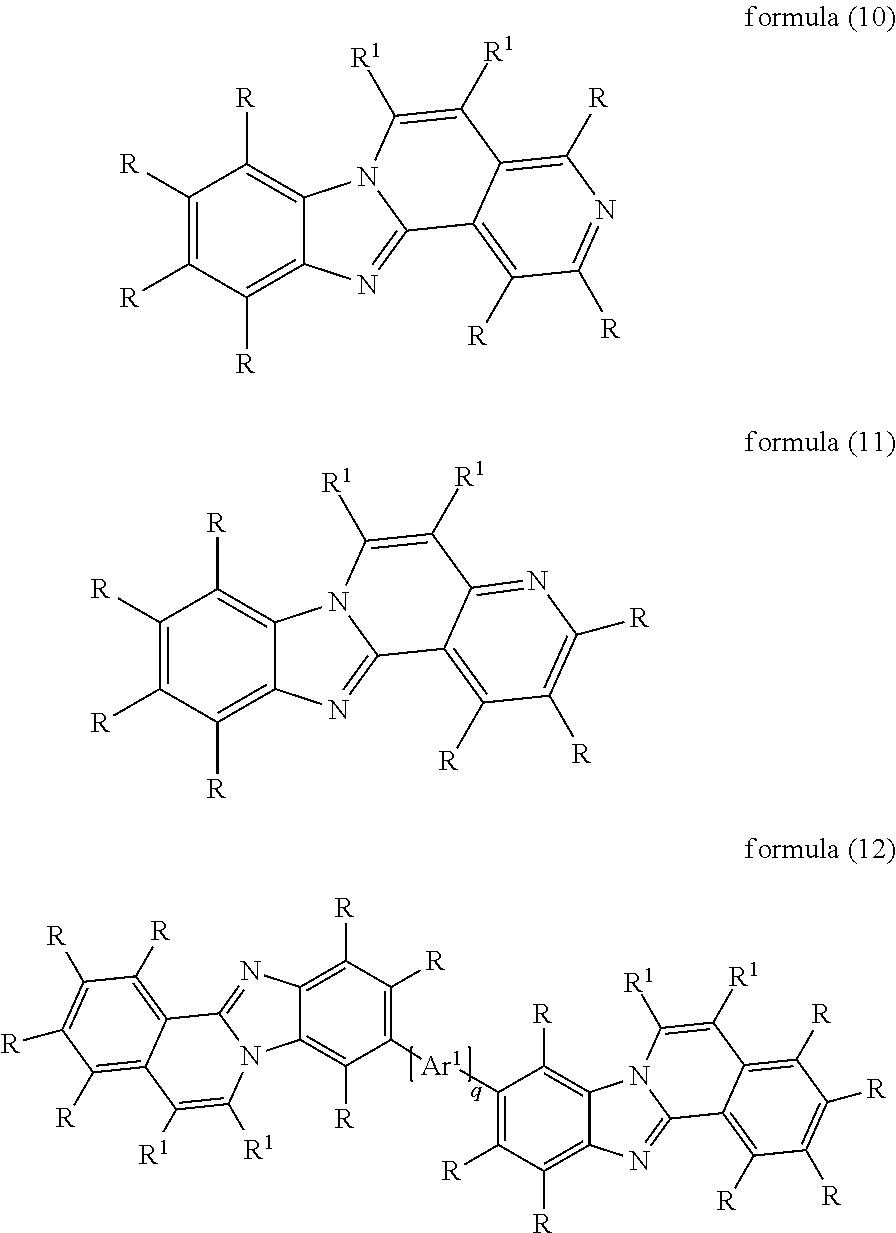


Applications Claiming Priority (4)
| Application Number | Priority Date | Filing Date | Title |
|---|---|---|---|
| EP11004544 | 2011-06-03 | ||
| EP11004544 | 2011-06-03 | ||
| EP11004544.0 | 2011-06-03 | ||
| PCT/EP2012/001950 WO2012163465A1 (en) | 2011-06-03 | 2012-05-07 | Organic electroluminescence device |
Publications (2)
| Publication Number | Publication Date |
|---|---|
| US20140088305A1 US20140088305A1 (en) | 2014-03-27 |
| US9118022B2 true US9118022B2 (en) | 2015-08-25 |
Family
ID=46125391
Family Applications (1)
| Application Number | Title | Priority Date | Filing Date |
|---|---|---|---|
| US14/122,272 Active US9118022B2 (en) | 2011-06-03 | 2012-05-07 | Organic electroluminescent device |
Country Status (6)
| Country | Link |
|---|---|
| US (1) | US9118022B2 (en) |
| EP (1) | EP2714841B1 (en) |
| JP (1) | JP6092195B2 (en) |
| KR (1) | KR101934135B1 (en) |
| CN (1) | CN103619986B (en) |
| WO (1) | WO2012163465A1 (en) |
Families Citing this family (20)
| Publication number | Priority date | Publication date | Assignee | Title |
|---|---|---|---|---|
| DE102010045405A1 (en) | 2010-09-15 | 2012-03-15 | Merck Patent Gmbh | Materials for organic electroluminescent devices |
| KR102003090B1 (en) * | 2011-11-11 | 2019-10-01 | 토소가부시키가이샤 | Cyclic azine compound having nitrogen-containing fused aromatic group, method for producing same, and organic electroluminescent element using same as constituent component |
| EP2837622A4 (en) * | 2012-04-10 | 2016-03-09 | Hodogaya Chemical Co Ltd | COMPOUND HAVING A CYCLIC ACRIDAN STRUCTURE AND ORGANIC ELECTROLUMINESCENT ELEMENT |
| KR102207740B1 (en) * | 2013-08-28 | 2021-01-26 | 덕산네오룩스 주식회사 | Compound for organic electronic element, organic electronic element using the same, and an electronic device thereof |
| KR101772746B1 (en) * | 2014-08-12 | 2017-08-30 | 주식회사 엘지화학 | Organic light emitting diode |
| WO2016024728A1 (en) * | 2014-08-12 | 2016-02-18 | 주식회사 엘지화학 | Organic light-emitting element |
| CN104230930B (en) * | 2014-08-19 | 2016-01-20 | 中节能万润股份有限公司 | A kind of OLED material and application thereof |
| CN104693218B (en) * | 2014-12-04 | 2017-01-18 | 中节能万润股份有限公司 | Organic light emitting diode material as well as preparation method and application thereof |
| EP3266780B1 (en) * | 2015-03-05 | 2020-02-19 | LG Chem, Ltd. | Heterocyclic compound and organic light emitting element comprising same |
| KR101778446B1 (en) * | 2015-06-05 | 2017-09-14 | 주식회사 엘지화학 | Compound and organic electronic device using the same |
| KR102059021B1 (en) | 2015-06-19 | 2019-12-24 | 삼성에스디아이 주식회사 | Composition for organic optoelectronic device, organic optoelectric device and display device |
| WO2016204406A1 (en) * | 2015-06-19 | 2016-12-22 | 삼성에스디아이 주식회사 | Composition for organic photoelectronic element, organic photoelectronic element, and display apparatus |
| KR101919438B1 (en) * | 2015-06-26 | 2018-11-16 | 삼성에스디아이 주식회사 | Composition for organic optoelectric device, organic optoelectric device and display device |
| CN108727388A (en) * | 2017-04-14 | 2018-11-02 | 北京鼎材科技有限公司 | compound and organic electroluminescence device |
| CN108727415A (en) * | 2017-04-14 | 2018-11-02 | 北京鼎材科技有限公司 | compound and organic electroluminescence device |
| WO2019002183A1 (en) * | 2017-06-26 | 2019-01-03 | Merck Patent Gmbh | PROCESS FOR PRODUCING SUBSTITUTED NITROGEN-CONTAINING HETEROCYCLES |
| KR102599414B1 (en) * | 2017-09-21 | 2023-11-08 | 솔루스첨단소재 주식회사 | Organic compounds and organic electro luminescence device comprising the same |
| JP7394050B2 (en) * | 2018-03-23 | 2023-12-07 | 保土谷化学工業株式会社 | Compounds with benzimidazole ring structure and organic electroluminescent devices |
| EP3696180B1 (en) * | 2019-02-15 | 2023-10-04 | Novaled GmbH | Compound and an organic semiconducting layer, an organic electronic device and a display or lighting device comprising the same |
| CN111349090B (en) * | 2020-01-09 | 2021-08-31 | 华中科技大学 | A kind of condensed heterocyclic aromatic hydrocarbon derivative, its preparation and application |
Citations (10)
| Publication number | Priority date | Publication date | Assignee | Title |
|---|---|---|---|---|
| JPH06228544A (en) * | 1993-02-04 | 1994-08-16 | Toyo Ink Mfg Co Ltd | Organic electroluminescent element |
| WO2007011163A1 (en) | 2005-07-22 | 2007-01-25 | Lg Chem. Ltd. | Imidazole derivatives and organic electronic device using the same |
| WO2010086089A1 (en) * | 2009-02-02 | 2010-08-05 | Merck Patent Gmbh | Metal complexes |
| WO2011019156A1 (en) | 2009-08-10 | 2011-02-17 | Rohm And Haas Electronic Materials Korea Ltd. | Novel organic electroluminescent compounds and organic electroluminescent device using the same |
| EP2311826A2 (en) | 2008-11-03 | 2011-04-20 | LG Chem, Ltd. | Novel nitrogen-containing heterocyclic compound and organic electronic device using the same |
| WO2011060867A1 (en) * | 2009-11-18 | 2011-05-26 | Merck Patent Gmbh | Nitrogen-containing condensed heterocyclic compounds for oleds |
| WO2011157339A1 (en) * | 2010-06-15 | 2011-12-22 | Merck Patent Gmbh | Metal complexes |
| WO2011160757A1 (en) * | 2010-06-22 | 2011-12-29 | Merck Patent Gmbh | Materials for electronic devices |
| WO2012007087A1 (en) * | 2010-07-16 | 2012-01-19 | Merck Patent Gmbh | Metal complexes |
| WO2012013271A1 (en) * | 2010-07-30 | 2012-02-02 | Merck Patent Gmbh | Organic electroluminescent device |
Family Cites Families (59)
| Publication number | Priority date | Publication date | Assignee | Title |
|---|---|---|---|---|
| US4539507A (en) | 1983-03-25 | 1985-09-03 | Eastman Kodak Company | Organic electroluminescent devices having improved power conversion efficiencies |
| US5151629A (en) | 1991-08-01 | 1992-09-29 | Eastman Kodak Company | Blue emitting internal junction organic electroluminescent device (I) |
| JPH07133483A (en) | 1993-11-09 | 1995-05-23 | Shinko Electric Ind Co Ltd | Organic light emitting material for EL device and EL device |
| EP0676461B1 (en) | 1994-04-07 | 2002-08-14 | Covion Organic Semiconductors GmbH | Spiro compounds and their application as electroluminescence materials |
| DE19652261A1 (en) | 1996-12-16 | 1998-06-18 | Hoechst Ag | Aryl-substituted poly (p-arylenevinylenes), process for their preparation and their use in electroluminescent devices |
| EP1729327B2 (en) | 1999-05-13 | 2022-08-10 | The Trustees Of Princeton University | Use of a phosphorescent iridium compound as emissive molecule in an organic light emitting device |
| EP1933395B2 (en) | 1999-12-01 | 2019-08-07 | The Trustees of Princeton University | Complexes of form L2IrX |
| US6660410B2 (en) | 2000-03-27 | 2003-12-09 | Idemitsu Kosan Co., Ltd. | Organic electroluminescence element |
| US20020121638A1 (en) | 2000-06-30 | 2002-09-05 | Vladimir Grushin | Electroluminescent iridium compounds with fluorinated phenylpyridines, phenylpyrimidines, and phenylquinolines and devices made with such compounds |
| EP1325671B1 (en) | 2000-08-11 | 2012-10-24 | The Trustees Of Princeton University | Organometallic compounds and emission-shifting organic electrophosphorescence |
| JP4154140B2 (en) | 2000-09-26 | 2008-09-24 | キヤノン株式会社 | Metal coordination compounds |
| JP4154139B2 (en) | 2000-09-26 | 2008-09-24 | キヤノン株式会社 | Light emitting element |
| JP4154138B2 (en) | 2000-09-26 | 2008-09-24 | キヤノン株式会社 | Light emitting element, display device and metal coordination compound |
| ITRM20020411A1 (en) | 2002-08-01 | 2004-02-02 | Univ Roma La Sapienza | SPIROBIFLUORENE DERIVATIVES, THEIR PREPARATION AND USE. |
| US20060063027A1 (en) | 2002-12-23 | 2006-03-23 | Covion Organic Semiconductors Gmbh | Organic electroluminescent element |
| JP4411851B2 (en) | 2003-03-19 | 2010-02-10 | コニカミノルタホールディングス株式会社 | Organic electroluminescence device |
| EP1618170A2 (en) | 2003-04-15 | 2006-01-25 | Covion Organic Semiconductors GmbH | Mixtures of matrix materials and organic semiconductors capable of emission, use of the same and electronic components containing said mixtures |
| JP4635870B2 (en) | 2003-04-23 | 2011-02-23 | コニカミノルタホールディングス株式会社 | Organic electroluminescence element, lighting device and display device |
| JP4773346B2 (en) | 2003-07-07 | 2011-09-14 | メルク パテント ゲーエムベーハー | Mixtures of organic light emitting semiconductors and matrix materials, their use and electronic components comprising said materials. |
| DE10333232A1 (en) | 2003-07-21 | 2007-10-11 | Merck Patent Gmbh | Organic electroluminescent element |
| DE10338550A1 (en) | 2003-08-19 | 2005-03-31 | Basf Ag | Transition metal complexes with carbene ligands as emitters for organic light-emitting diodes (OLEDs) |
| DE10345572A1 (en) | 2003-09-29 | 2005-05-19 | Covion Organic Semiconductors Gmbh | metal complexes |
| US7795801B2 (en) | 2003-09-30 | 2010-09-14 | Konica Minolta Holdings, Inc. | Organic electroluminescent element, illuminator, display and compound |
| WO2005053051A1 (en) | 2003-11-25 | 2005-06-09 | Merck Patent Gmbh | Organic electroluminescent element |
| US7790890B2 (en) | 2004-03-31 | 2010-09-07 | Konica Minolta Holdings, Inc. | Organic electroluminescence element material, organic electroluminescence element, display device and illumination device |
| DE102004023277A1 (en) | 2004-05-11 | 2005-12-01 | Covion Organic Semiconductors Gmbh | New material mixtures for electroluminescence |
| US7598388B2 (en) | 2004-05-18 | 2009-10-06 | The University Of Southern California | Carbene containing metal complexes as OLEDs |
| JP4862248B2 (en) | 2004-06-04 | 2012-01-25 | コニカミノルタホールディングス株式会社 | Organic electroluminescence element, lighting device and display device |
| ITRM20040352A1 (en) | 2004-07-15 | 2004-10-15 | Univ Roma La Sapienza | OLIGOMERIC DERIVATIVES OF SPIROBIFLUORENE, THEIR PREPARATION AND THEIR USE. |
| EP1888706B1 (en) | 2005-05-03 | 2017-03-01 | Merck Patent GmbH | Organic electroluminescent device and boric acid and borinic acid derivatives used therein |
| WO2007063754A1 (en) | 2005-12-01 | 2007-06-07 | Nippon Steel Chemical Co., Ltd. | Compound for organic electroluminescent element and organic electroluminescent element |
| KR100864364B1 (en) * | 2005-12-13 | 2008-10-17 | 주식회사 엘지화학 | Novel imidazoquinazoline derivative, process for preparing the same, and organic electronic device using the same |
| DE102006025777A1 (en) | 2006-05-31 | 2007-12-06 | Merck Patent Gmbh | New materials for organic electroluminescent devices |
| US8062769B2 (en) | 2006-11-09 | 2011-11-22 | Nippon Steel Chemical Co., Ltd. | Indolocarbazole compound for use in organic electroluminescent device and organic electroluminescent device |
| TWI481089B (en) | 2006-12-28 | 2015-04-11 | Universal Display Corp | Phosphorescent organic light-emitting device structure with long service life |
| DE102007002714A1 (en) | 2007-01-18 | 2008-07-31 | Merck Patent Gmbh | New materials for organic electroluminescent devices |
| DE102007053771A1 (en) | 2007-11-12 | 2009-05-14 | Merck Patent Gmbh | Organic electroluminescent devices |
| US7862908B2 (en) | 2007-11-26 | 2011-01-04 | National Tsing Hua University | Conjugated compounds containing hydroindoloacridine structural elements, and their use |
| DE102008027005A1 (en) | 2008-06-05 | 2009-12-10 | Merck Patent Gmbh | Organic electronic device containing metal complexes |
| DE102008033943A1 (en) | 2008-07-18 | 2010-01-21 | Merck Patent Gmbh | New materials for organic electroluminescent devices |
| DE102008036247A1 (en) | 2008-08-04 | 2010-02-11 | Merck Patent Gmbh | Electronic devices containing metal complexes |
| DE102008036982A1 (en) | 2008-08-08 | 2010-02-11 | Merck Patent Gmbh | Organic electroluminescent device |
| DE102008048336A1 (en) | 2008-09-22 | 2010-03-25 | Merck Patent Gmbh | Mononuclear neutral copper (I) complexes and their use for the production of optoelectronic devices |
| KR101506919B1 (en) | 2008-10-31 | 2015-03-30 | 롬엔드하스전자재료코리아유한회사 | Novel compounds for organic electronic material and organic electronic device using the same |
| JP5701766B2 (en) | 2008-11-11 | 2015-04-15 | メルク パテント ゲーエムベーハー | Organic electroluminescent device |
| DE102008056688A1 (en) | 2008-11-11 | 2010-05-12 | Merck Patent Gmbh | Materials for organic electroluminescent devices |
| DE102008057050B4 (en) | 2008-11-13 | 2021-06-02 | Merck Patent Gmbh | Materials for organic electroluminescent devices |
| DE102008057051B4 (en) | 2008-11-13 | 2021-06-17 | Merck Patent Gmbh | Materials for organic electroluminescent devices |
| DE102009011223A1 (en) | 2009-03-02 | 2010-09-23 | Merck Patent Gmbh | metal complexes |
| KR101219487B1 (en) * | 2009-03-03 | 2013-01-15 | 덕산하이메탈(주) | Bis(benzoimidazole) chemiclal and organic electroric element using the same, terminal thererof |
| DE102009013041A1 (en) | 2009-03-13 | 2010-09-16 | Merck Patent Gmbh | Materials for organic electroluminescent devices |
| ES2345380B1 (en) | 2009-03-20 | 2011-07-11 | Fermin Caraballo Sanchez | SET REMOTE FIRE EXTINGUISHING SYSTEM. |
| DE102009023155A1 (en) | 2009-05-29 | 2010-12-02 | Merck Patent Gmbh | Materials for organic electroluminescent devices |
| DE102009031021A1 (en) | 2009-06-30 | 2011-01-05 | Merck Patent Gmbh | Materials for organic electroluminescent devices |
| DE102009041414A1 (en) | 2009-09-16 | 2011-03-17 | Merck Patent Gmbh | metal complexes |
| DE102009048791A1 (en) | 2009-10-08 | 2011-04-14 | Merck Patent Gmbh | Materials for organic electroluminescent devices |
| DE102009057167A1 (en) | 2009-12-05 | 2011-06-09 | Merck Patent Gmbh | Electronic device containing metal complexes |
| DE102010005697A1 (en) | 2010-01-25 | 2011-07-28 | Merck Patent GmbH, 64293 | Connections for electronic devices |
| DE102010027317A1 (en) | 2010-07-16 | 2012-01-19 | Merck Patent Gmbh | metal complexes |
-
2012
- 2012-05-07 KR KR1020147000049A patent/KR101934135B1/en active Active
- 2012-05-07 EP EP12722074.7A patent/EP2714841B1/en active Active
- 2012-05-07 US US14/122,272 patent/US9118022B2/en active Active
- 2012-05-07 WO PCT/EP2012/001950 patent/WO2012163465A1/en not_active Ceased
- 2012-05-07 CN CN201280027264.5A patent/CN103619986B/en active Active
- 2012-05-07 JP JP2014513066A patent/JP6092195B2/en active Active
Patent Citations (12)
| Publication number | Priority date | Publication date | Assignee | Title |
|---|---|---|---|---|
| JPH06228544A (en) * | 1993-02-04 | 1994-08-16 | Toyo Ink Mfg Co Ltd | Organic electroluminescent element |
| WO2007011163A1 (en) | 2005-07-22 | 2007-01-25 | Lg Chem. Ltd. | Imidazole derivatives and organic electronic device using the same |
| EP2311826A2 (en) | 2008-11-03 | 2011-04-20 | LG Chem, Ltd. | Novel nitrogen-containing heterocyclic compound and organic electronic device using the same |
| WO2010086089A1 (en) * | 2009-02-02 | 2010-08-05 | Merck Patent Gmbh | Metal complexes |
| WO2011019156A1 (en) | 2009-08-10 | 2011-02-17 | Rohm And Haas Electronic Materials Korea Ltd. | Novel organic electroluminescent compounds and organic electroluminescent device using the same |
| WO2011060867A1 (en) * | 2009-11-18 | 2011-05-26 | Merck Patent Gmbh | Nitrogen-containing condensed heterocyclic compounds for oleds |
| WO2011157339A1 (en) * | 2010-06-15 | 2011-12-22 | Merck Patent Gmbh | Metal complexes |
| US20130082209A1 (en) * | 2010-06-15 | 2013-04-04 | Merck Patent Gmbh | Metal complexes |
| WO2011160757A1 (en) * | 2010-06-22 | 2011-12-29 | Merck Patent Gmbh | Materials for electronic devices |
| WO2012007087A1 (en) * | 2010-07-16 | 2012-01-19 | Merck Patent Gmbh | Metal complexes |
| WO2012013271A1 (en) * | 2010-07-30 | 2012-02-02 | Merck Patent Gmbh | Organic electroluminescent device |
| US20130168663A1 (en) * | 2010-07-30 | 2013-07-04 | Merck Patent Gmbh | Organic electroluminescent device |
Non-Patent Citations (6)
| Title |
|---|
| International Search Report for PCT/EP2012/001950 mailed Jul. 31, 2012. |
| JP 06228544; EPO machine translation of description, Aug. 16, 1994. * |
| Loones;Tetrahedron, 2007, 63, 8954-8961. * |
| Tomoda, Haruhiko, et al., "Substituent Effects on Fluorescent Properties of Imidazol[1,2-alpha]Pyridiine-Based Compounds", Bull. Chem. Soc. Jpn., vol. 72, (1999), pp. 1327-1334. |
| Tomoda, Haruhiko, et al., "Substituent Effects on Fluorescent Properties of Imidazol[1,2-α]Pyridiine-Based Compounds", Bull. Chem. Soc. Jpn., vol. 72, (1999), pp. 1327-1334. |
| Umeda; Angew. Chem. Int. Ed., 2008, 47, 4019-4022. * |
Also Published As
| Publication number | Publication date |
|---|---|
| EP2714841B1 (en) | 2016-06-22 |
| JP2014522569A (en) | 2014-09-04 |
| CN103619986A (en) | 2014-03-05 |
| EP2714841A1 (en) | 2014-04-09 |
| JP6092195B2 (en) | 2017-03-08 |
| KR20140048189A (en) | 2014-04-23 |
| US20140088305A1 (en) | 2014-03-27 |
| KR101934135B1 (en) | 2019-04-05 |
| CN103619986B (en) | 2017-02-08 |
| WO2012163465A1 (en) | 2012-12-06 |
Similar Documents
| Publication | Publication Date | Title |
|---|---|---|
| US9118022B2 (en) | Organic electroluminescent device | |
| US9978957B2 (en) | Materials for organic electroluminescent devices | |
| US9337430B2 (en) | Organic electroluminescent device | |
| US11538995B2 (en) | Materials for organic electroluminescent devices | |
| US9876181B2 (en) | Materials for organic electroluminescent devices | |
| US9324954B2 (en) | Materials for organic electroluminescent devices | |
| US11107994B2 (en) | Materials for organic electroluminescent devices | |
| US8785636B2 (en) | Substituted indoloacridines for organic electroluminescent devices | |
| US11309497B2 (en) | Materials for organic electroluminescent devices | |
| US9620722B2 (en) | Materials for organic electroluminescent devices | |
| US8835626B2 (en) | Materials for organic electroluminescent devices | |
| US9818948B2 (en) | Carbazole derivatives for organic electroluminescence devices | |
| US9929354B2 (en) | 9,9′-spirobixanthene derivatives for electroluminescent devices | |
| US9139582B2 (en) | Organic electroluminescent devices | |
| US9741942B2 (en) | Materials for organic electroluminescent devices | |
| US20210111351A1 (en) | Materials for organic electroluminescent devices | |
| US10957864B2 (en) | Materials for organic light-emitting devices | |
| US20150340621A1 (en) | Organic electroluminescent device | |
| US10032992B2 (en) | Compounds for organic electroluminescent devices | |
| US12486230B2 (en) | Materials for organic electroluminescent devices | |
| US20180370938A1 (en) | Materials for organic electroluminescent devices | |
| US20160326429A1 (en) | Materials for organic electroluminescent devices | |
| US12035625B2 (en) | Materials for organic electroluminescent devices | |
| US20190352318A1 (en) | Materials for organic electroluminescent devices | |
| US11621396B2 (en) | Materials for organic electroluminescent devices |
Legal Events
| Date | Code | Title | Description |
|---|---|---|---|
| AS | Assignment |
Owner name: MERCK PATENT GMBH, GERMANY Free format text: ASSIGNMENT OF ASSIGNORS INTEREST;ASSIGNORS:PARHAM, AMIR HOSSAIN;BUESING, ARNE;PFLUMM, CHRISTOF;AND OTHERS;REEL/FRAME:031675/0705 Effective date: 20131008 |
|
| STCF | Information on status: patent grant |
Free format text: PATENTED CASE |
|
| MAFP | Maintenance fee payment |
Free format text: PAYMENT OF MAINTENANCE FEE, 4TH YEAR, LARGE ENTITY (ORIGINAL EVENT CODE: M1551); ENTITY STATUS OF PATENT OWNER: LARGE ENTITY Year of fee payment: 4 |
|
| MAFP | Maintenance fee payment |
Free format text: PAYMENT OF MAINTENANCE FEE, 8TH YEAR, LARGE ENTITY (ORIGINAL EVENT CODE: M1552); ENTITY STATUS OF PATENT OWNER: LARGE ENTITY Year of fee payment: 8 |