US9113370B2 - Method and apparatus for handling a stationary user terminal in a network - Google Patents
Method and apparatus for handling a stationary user terminal in a network Download PDFInfo
- Publication number
- US9113370B2 US9113370B2 US13/882,878 US201113882878A US9113370B2 US 9113370 B2 US9113370 B2 US 9113370B2 US 201113882878 A US201113882878 A US 201113882878A US 9113370 B2 US9113370 B2 US 9113370B2
- Authority
- US
- United States
- Prior art keywords
- user terminal
- employ
- stationary status
- processor
- program code
- Prior art date
- Legal status (The legal status is an assumption and is not a legal conclusion. Google has not performed a legal analysis and makes no representation as to the accuracy of the status listed.)
- Expired - Fee Related, expires
Links
- 238000000034 method Methods 0.000 title abstract description 28
- 238000004891 communication Methods 0.000 abstract description 72
- 230000007246 mechanism Effects 0.000 abstract description 8
- 230000006870 function Effects 0.000 description 23
- 238000005259 measurement Methods 0.000 description 22
- 238000004590 computer program Methods 0.000 description 14
- 238000012545 processing Methods 0.000 description 13
- 230000015654 memory Effects 0.000 description 10
- 230000001413 cellular effect Effects 0.000 description 8
- 238000012986 modification Methods 0.000 description 8
- 230000004048 modification Effects 0.000 description 8
- 230000011664 signaling Effects 0.000 description 8
- 238000003860 storage Methods 0.000 description 7
- 230000003321 amplification Effects 0.000 description 6
- 238000003199 nucleic acid amplification method Methods 0.000 description 6
- 230000005540 biological transmission Effects 0.000 description 5
- 238000010586 diagram Methods 0.000 description 4
- 230000010267 cellular communication Effects 0.000 description 3
- 230000007774 longterm Effects 0.000 description 3
- 238000010295 mobile communication Methods 0.000 description 3
- 238000005516 engineering process Methods 0.000 description 2
- 230000003993 interaction Effects 0.000 description 2
- 239000000463 material Substances 0.000 description 2
- 239000000203 mixture Substances 0.000 description 2
- 238000005457 optimization Methods 0.000 description 2
- 230000004044 response Effects 0.000 description 2
- 238000007792 addition Methods 0.000 description 1
- 230000008901 benefit Effects 0.000 description 1
- 230000008571 general function Effects 0.000 description 1
- 238000004519 manufacturing process Methods 0.000 description 1
- 230000006855 networking Effects 0.000 description 1
- 230000008569 process Effects 0.000 description 1
- 238000012546 transfer Methods 0.000 description 1
- 230000001960 triggered effect Effects 0.000 description 1
- 230000000007 visual effect Effects 0.000 description 1
Images


Classifications
-
- H—ELECTRICITY
- H04—ELECTRIC COMMUNICATION TECHNIQUE
- H04W—WIRELESS COMMUNICATION NETWORKS
- H04W60/00—Affiliation to network, e.g. registration; Terminating affiliation with the network, e.g. de-registration
-
- H—ELECTRICITY
- H04—ELECTRIC COMMUNICATION TECHNIQUE
- H04W—WIRELESS COMMUNICATION NETWORKS
- H04W24/00—Supervisory, monitoring or testing arrangements
- H04W24/10—Scheduling measurement reports ; Arrangements for measurement reports
-
- H—ELECTRICITY
- H04—ELECTRIC COMMUNICATION TECHNIQUE
- H04W—WIRELESS COMMUNICATION NETWORKS
- H04W4/00—Services specially adapted for wireless communication networks; Facilities therefor
- H04W4/70—Services for machine-to-machine communication [M2M] or machine type communication [MTC]
-
- H—ELECTRICITY
- H04—ELECTRIC COMMUNICATION TECHNIQUE
- H04W—WIRELESS COMMUNICATION NETWORKS
- H04W8/00—Network data management
- H04W8/02—Processing of mobility data, e.g. registration information at HLR [Home Location Register] or VLR [Visitor Location Register]; Transfer of mobility data, e.g. between HLR, VLR or external networks
- H04W8/08—Mobility data transfer
- H04W8/16—Mobility data transfer selectively restricting mobility data tracking
-
- H04W4/005—
-
- H04W76/04—
-
- H—ELECTRICITY
- H04—ELECTRIC COMMUNICATION TECHNIQUE
- H04W—WIRELESS COMMUNICATION NETWORKS
- H04W76/00—Connection management
- H04W76/20—Manipulation of established connections
-
- H—ELECTRICITY
- H04—ELECTRIC COMMUNICATION TECHNIQUE
- H04W—WIRELESS COMMUNICATION NETWORKS
- H04W84/00—Network topologies
- H04W84/02—Hierarchically pre-organised networks, e.g. paging networks, cellular networks, WLAN [Wireless Local Area Network] or WLL [Wireless Local Loop]
- H04W84/04—Large scale networks; Deep hierarchical networks
-
- H—ELECTRICITY
- H04—ELECTRIC COMMUNICATION TECHNIQUE
- H04W—WIRELESS COMMUNICATION NETWORKS
- H04W84/00—Network topologies
- H04W84/02—Hierarchically pre-organised networks, e.g. paging networks, cellular networks, WLAN [Wireless Local Area Network] or WLL [Wireless Local Loop]
- H04W84/04—Large scale networks; Deep hierarchical networks
- H04W84/042—Public Land Mobile systems, e.g. cellular systems
- H04W84/045—Public Land Mobile systems, e.g. cellular systems using private Base Stations, e.g. femto Base Stations, home Node B
-
- H—ELECTRICITY
- H04—ELECTRIC COMMUNICATION TECHNIQUE
- H04W—WIRELESS COMMUNICATION NETWORKS
- H04W84/00—Network topologies
- H04W84/18—Self-organising networks, e.g. ad-hoc networks or sensor networks
- H04W84/22—Self-organising networks, e.g. ad-hoc networks or sensor networks with access to wired networks
-
- H—ELECTRICITY
- H04—ELECTRIC COMMUNICATION TECHNIQUE
- H04W—WIRELESS COMMUNICATION NETWORKS
- H04W88/00—Devices specially adapted for wireless communication networks, e.g. terminals, base stations or access point devices
- H04W88/02—Terminal devices
- H04W88/04—Terminal devices adapted for relaying to or from another terminal or user
Definitions
- Embodiments of the present invention relate generally to inter-device communications technology and, more particularly, relate to an apparatus and method for handling a stationary user terminal in a network.
- M2M communication has recently become an area of interest for its growth potential. M2M communication is also exciting to many users and developers for its potential for connecting devices for many different purposes such as smart homes, smart metering, fleet management, remote healthcare, access network operation management and numerous other uses.
- M2M communication typically involves the connection of a device or group of devices to a remote server or computer system to enable remote measurement or remote reporting of information by the devices.
- M2M communication involves the use of one or more sensors or other nodes or devices to gather information that can be passed to a network or computing device via some form of gateway device.
- user terminals such as mobile communication devices like cellular phones have been employed as the gateway device in order to enable remote devices or sensors to provide information to a central location or a network for processing.
- the network may be the Internet or some more localized computing or communication network.
- Typical endpoint devices in an M2M communication system may be relatively small battery operated devices with relatively low transmission power capabilities.
- the endpoint devices can operate at low powers and still provide information to remote computing or storage devices via a mobile terminal acting as a gateway to, for example, a cellular network access point.
- the connection between the gateway and the access point in such situations may be provided by cellular network resources
- the connection between the gateway and the endpoint device may be some other short range communication radio (e.g., short range radios employing Bluetooth, wireless local area network (WLAN) and/or the like).
- WLAN wireless local area network
- management of power and/or other communication resources while employing a gateway in an integrated M2M to cellular network may be challenging.
- a M2M to cellular network is one example of a network in which resource management may be desirable.
- a method and apparatus may enable the facilitation of using a mobile terminal as a mobile gateway to integrate with a M2M network.
- Some example embodiments of the present invention may enable optimization (or simplification) of communication with a user terminal that is stationary by providing mechanisms by which the user terminal may communicate its stationary status to the network. The network can then adjust communication configurations involving the user terminal based on the knowledge of the user terminal's status.
- FIG. 1 illustrates one example of a communication system according to an example embodiment of the present invention
- FIG. 2 illustrates a block diagram of an apparatus that may be employed at a network element for managing handling of a stationary user terminal in accordance with an example embodiment of the present invention
- FIG. 3 illustrates a block diagram of an apparatus that may be employed at a user terminal for managing handling of a stationary user terminal in accordance with an example embodiment of the present invention
- FIG. 4 illustrates an RRC connection establishment procedure according to an example embodiment of the present invention
- FIG. 5 illustrates example RRC message structure for an RRCConnectionRequest message according to an example embodiment of the present invention
- FIG. 6 illustrates an example message structure for an RRCConnectionSetup message according to an example embodiment of the present invention
- FIG. 7 illustrates an example in which a logical channel ID structure may include a stationary status signal according to an example embodiment of the present invention
- FIG. 8 illustrates an example MAC PDU (media access control packet data unit) structure including a MAC header, MAC control elements, MAC SDUs (service data unit) and padding according to an example embodiment of the present invention
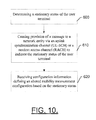
- FIG. 10 illustrates an example flowchart of another method of managing handling of a stationary user terminal in accordance with an example embodiment of the present invention.
- circuitry refers to (a) hardware-only circuit implementations (e.g., implementations in analog circuitry and/or digital circuitry); (b) combinations of circuits and computer program product(s) comprising software and/or firmware instructions stored on one or more computer readable memories that work together to cause an apparatus to perform one or more functions described herein; and (c) circuits, such as, for example, a microprocessor(s) or a portion of a microprocessor(s), that require software or firmware for operation even if the software or firmware is not physically present.
- This definition of ‘circuitry’ applies to all uses of this term herein, including in any claims.
- circuitry also includes an implementation comprising one or more processors and/or portion(s) thereof and accompanying software and/or firmware.
- circuitry as used herein also includes, for example, a baseband integrated circuit or applications processor integrated circuit for a mobile phone or a similar integrated circuit in a server, a cellular network device, other network device, and/or other computing device.
- mobile terminals such as cellular phones may act as gateway devices to integrate in a M2M communication system into a larger network.
- the M2M communication system may include one or more sensors or other low power communication devices (e.g., machines) that cannot, in some examples due to transmission power limitations, but in some other examples perhaps also due to using different radios, communicate directly with a base station or access point of the larger network.
- the mobile terminal may relay communications from the machines to the base station or access point thereby acting as a gateway for the M2M communication system into the larger network.
- the mobile terminal may employ two different radios to perform the relaying function, particularly when employed with M2M communication systems involving relatively low power (e.g., low transmission power) sensors or sensor networks.
- Mobile terminals that can act as a mobile gateway may be said to have the capability to engage in machine type communication (MTC).
- MTC machine type communication
- a gateway device may either not be mobile or may be stationary for a relatively long period of time. In such situations, the typical consideration that is given to mobility measurements or other factors that are typically considered due to the potential mobility of user terminals may not be necessary.
- RRC radio resource control
- the user terminal may be configured by the network to perform mobility measurement reporting, some example embodiments of the present invention may enable simplification of communications between the user terminal and the network (e.g., by avoiding configuration of the user terminal to provide mobility measurement reports).
- FIG. 1 illustrates a generic system diagram in which a device such as a user terminal 10 (or UE), is shown in an example communication environment in which embodiments of the present invention may be employed. As shown in FIG.
- the base site could be, for example a base station that is a part of one or more cellular or mobile networks or an access point that may be coupled to a data network, such as a local area network (LAN), a metropolitan area network (MAN), and/or a wide area network (WAN), such as the Internet.
- a data network such as a local area network (LAN), a metropolitan area network (MAN), and/or a wide area network (WAN), such as the Internet.
- LAN local area network
- MAN metropolitan area network
- WAN wide area network
- processing circuitry e.g., personal computers, server computers or the like
- the network 30 may employ one or more mobile access mechanisms such as wideband code division multiple access (WCDMA), CDMA2000, global system for mobile communications (GSM), general packet radio service (GPRS), long term evolution (LTE), LTE advanced (LTE-A) and/or the like.
- WCDMA wideband code division multiple access
- CDMA2000 global system for mobile communications
- GSM global system for mobile communications
- GPRS general packet radio service
- LTE long term evolution
- LTE-A LTE advanced
- the user terminal 10 (and/or the second communication device 12 ) may be a mobile communication device such as, for example, a personal digital assistant (PDA), wireless telephone, mobile computing device, camera, video recorder, audio/video player, positioning device (e.g., a global positioning system (GPS) device), game device, television device, radio device, or various other like devices or combinations thereof.
- PDA personal digital assistant
- the user terminal 10 may include one or more processors and one or more memories for storing instructions, which when executed by the processor, cause the user terminal 10 to operate in a particular way or execute specific functionality.
- the user terminal 10 may also include communication circuitry and corresponding hardware/software to enable communication with other devices.
- the machine 40 and/or the machine group 42 may be enabled to receive communications over an air interface from either or both of the user terminal 10 and the eNB 20 .
- power limitations or other restrictions may prevent the machine 40 and/or the machine group 42 from directly communicating with the eNB 20 , which is why they may employ the user terminal 10 as a gateway for access to the network 30 via the eNB 20 .
- example embodiments will be described hereinafter that may include either one or multiple machines, it should be appreciated that the use of one or multiple machines in connection with the gateway device is interchangeable.
- each of the sensors or machines, the user terminal 10 and the network 30 or eNB 20 may include processing devices (e.g., a processor) and memory devices for storing instructions that when executed by the processor cause a corresponding functionality to be performed.
- processing devices may embody or otherwise control, in some cases, modules and/or components configured for performing certain functions associated with example embodiments of the present invention.
- FIGS. 2 and 3 illustrate some examples of components that may be employed in connection with some example embodiments.
- FIG. 2 illustrates a block diagram of an apparatus 50 that may be employed at a network element (e.g., the eNB 20 ) for managing connections with M2M devices or systems.
- the apparatus 50 may include or otherwise be in communication with a processor 70 , a communication interface 74 and a memory device 76 .
- the memory device 76 may include, for example, one or more volatile and/or non-volatile memories.
- the memory device 76 may be an electronic storage device (e.g., a computer readable storage medium) comprising gates configured to store data (e.g., bits) that may be retrievable by a machine (e.g., a computing device).
- the memory device 76 may be configured to store information, data, applications, instructions or the like for enabling the apparatus to carry out various functions in accordance with example embodiments of the present invention.
- the memory device 76 could be configured to buffer input data for processing by the processor 70 .
- the memory device 76 could be configured to store instructions for execution by the processor 70 .
- the apparatus 50 may, in some embodiments, be a network device (e.g., eNB 20 ) or a fixed communication device or computing device configured to employ an example embodiment of the present invention. However, in some embodiments, the apparatus 50 may be embodied as a chip or chip set. In other words, the apparatus 50 may comprise one or more physical packages (e.g., chips) including materials, components and/or wires on a structural assembly (e.g., a baseboard). The structural assembly may provide physical strength, conservation of size, and/or limitation of electrical interaction for component circuitry included thereon.
- the apparatus 50 may therefore, in some cases, be configured to implement an embodiment of the present invention on a single chip or as a single “system on a chip.”
- a chip or chipset may constitute means for performing one or more operations for providing the functionalities described herein.
- the processor 70 may be embodied in hardware in a number of different ways.
- the processor 70 may be embodied as one or more of various processing means such as a coprocessor, a microprocessor, a controller, a digital signal processor (DSP), a processing element with or without an accompanying DSP, or various other examples of processing circuitry including integrated circuits such as, for example, an ASIC (application specific integrated circuit), an FPGA (field programmable gate array), a microcontroller unit (MCU), a hardware accelerator, a special-purpose computer chip, or other similar hardware embodiments.
- the processor 70 may be configured to execute instructions stored in the memory device 76 or otherwise accessible to the processor 70 .
- the processor 70 may be configured to execute hard coded functionality.
- the processor 70 may represent an entity (e.g., physically embodied in circuitry) capable of performing operations according to embodiments of the present invention while configured accordingly.
- the processor 70 may be specifically configured hardware for conducting the operations described herein.
- the processor 70 when the processor 70 is embodied as an executor of software instructions, the instructions may specifically configure the processor 70 to perform the algorithms and/or operations described herein when the instructions are executed.
- the processor 70 may be a processor of a specific device (e.g., an eNB, HeNB, AP or other network device) adapted for employing embodiments of the present invention by further configuration of the processor 70 by instructions for performing the algorithms and/or operations described herein.
- the processor 70 may include, among other things, a clock, an arithmetic logic unit (ALU) and logic gates configured to support operation of the processor 70 .
- ALU arithmetic logic unit
- the processor 70 may be embodied as, include or otherwise control a mobility manager 80 .
- the processor 70 may be said to cause, direct or control the execution or occurrence of the various functions attributed to the mobility manager 80 as described herein.
- the mobility manager 80 may be any means such as a device or circuitry operating in accordance with software or otherwise embodied in hardware or a combination of hardware and software (e.g., processor 70 operating under software control, the processor 70 embodied as an ASIC or FPGA specifically configured to perform the operations described herein, or a combination thereof) thereby configuring the device or circuitry to perform the corresponding functions of the connection manager 80 as described herein.
- a device or circuitry e.g., the processor 70 in one example
- executing the software forms the structure associated with such means.
- the mobility manager 80 may be configured to provide configuration instructions to one or more user terminals based on the mobility status of the respective terminals as indicated by reports that the respective terminals send to the mobility manager 80 .
- the mobility manager 80 may be configured to receive messages from user terminals and determine whether a stationary status signal is received from any of the user terminals.
- the stationary status signal may indicate to the mobility manager 80 that the corresponding user terminal that sent the stationary status signal has a stationary status.
- a stationary status may indicate that the corresponding user terminal is not currently mobile.
- a user terminal (e.g., user terminal 10 ) sending the stationary status signal may be fixed (temporarily or permanently) in a particular location to act as a gateway for one or more machines.
- the mobility manager 80 may configure the user terminal 10 to employ simpler configuration of RRC connection reconfiguration procedures.
- the mobility manager 80 may configure the user terminal 10 to not provide mobility measurements, since the user terminal 10 is not mobile at that time, and therefore reports on mobility measurements would unnecessarily consume network resources. In some cases, rather than avoiding all mobility measurements, such measurements may be reduced (or minimized) to save device processing resources and power consumption.
- new or different measurement performance requirements could be defined for the user terminal to, for example, relax communication requirements for non-moving user terminals.
- some parameters can be fixed for RRC connection reconfiguration.
- some parameter could be added to the RRC connection setup procedure in association with the stationary status signal indication such as, for example, an offset for discontinuous reception (DRX) and/or a back-off parameter or paging parameter to be signaled in an RRC setup message from the mobility manager 80 to the user terminal 10 for better system overload control.
- DRX discontinuous reception
- various different mechanisms may be employed by the user terminal 10 to inform the mobility manager 80 of the mobility status of the user terminal 10 .
- the user terminal 10 may include an apparatus 150 for facilitating managing connections with the eNB 20 based on mobility of the user terminal 10 as shown in FIG. 3 .
- the apparatus 150 may be employed in connection with a communication device (e.g., user terminal 10 and/or the second communication device 12 ) practicing an example embodiment of the present invention.
- the apparatus 150 may include or otherwise be in communication with a processor 170 , a user interface 172 , a communication interface 174 and a memory device 176 .
- the apparatus 150 may, in some embodiments, be a user terminal (e.g., user terminal 10 ) or a fixed communication device or computing device configured to employ an example embodiment of the present invention. However, in some embodiments, the apparatus 150 may be embodied as a chip or chip set. In other words, the apparatus 150 may comprise one or more physical packages (e.g., chips) including materials, components and/or wires on a structural assembly (e.g., a baseboard). The structural assembly may provide physical strength, conservation of size, and/or limitation of electrical interaction for component circuitry included thereon.
- the apparatus 150 may therefore, in some cases, be configured to implement an embodiment of the present invention on a single chip or as a single “system on a chip.”
- a chip or chipset may constitute means for performing one or more operations for providing the functionalities described herein.
- the user interface 172 may be in communication with the processor 170 to receive an indication of a user input at the user interface 172 and/or to provide an audible, visual, mechanical or other output to the user.
- the user interface 172 may include, for example, a keyboard, a mouse, a joystick, a display, a touch screen, soft keys, a microphone, a speaker, or other input/output mechanisms.
- the processor 170 may comprise user interface circuitry configured to control at least some functions of one or more elements of the user interface, such as, for example, a speaker, ringer, microphone, display, and/or the like.
- the processor 170 and/or user interface circuitry comprising the processor 170 may be configured to control one or more functions of one or more elements of the user interface through computer program instructions (e.g., software and/or firmware) stored on a memory accessible to the processor 170 (e.g., memory device 176 , and/or the like).
- computer program instructions e.g., software and/or firmware
- the processor 170 may be embodied as, include or otherwise control a mobility status manager 180 .
- the mobility status manager 180 may be any means such as a device or circuitry operating in accordance with software or otherwise embodied in hardware or a combination of hardware and software (e.g., processor 170 operating under software control, the processor 170 embodied as an ASIC or FPGA specifically configured to perform the operations described herein, or a combination thereof) thereby configuring the device or circuitry to perform the corresponding functions of the mobility status manager 180 as described herein.
- a device or circuitry e.g., the processor 170 in one example
- executing the software forms the structure associated with such means.
- the mobility status manager 180 may be configured to indicate a stationary mobility status to the eNB 20 (e.g., to the mobility manager 80 ) by providing the stationary status signal to the mobility manager 80 when the user terminal 10 is stationary (or will be for some minimum length of time).
- the mobility status manager 180 may be configured to provide the stationary status signal to the mobility manager 80 in any of a number of ways. The mobility status manager 180 may provide the stationary status signal when the user terminal 10 is either immobile, or expects to be stationary for a predetermined period of time, during which mobility measurement requirements may be relaxed or omitted all together.
- the stationary status signal may be provided as part of a RRCConnectionRequest message.
- the mobility status manager 180 may be configured to provide a stationary status bit when the user terminal 10 sends the RRCConnectionRequest message over the common control channel (CCCH).
- FIG. 4 illustrates an RRC connection establishment procedure according to an example embodiment.
- the user terminal 10 may provide the RRCConnectionRequest message 200 to the network (e.g., EUTRAN via a network element such as the eNB 20 ) including the stationary status bit (or bits).
- the stationary status bit may be put into a current spare bit in the RRCConnectionRequest message 200 .
- FIG. 5 illustrates an example RRC message structure for the RRCConnectionRequest message 200 . As shown in FIG. 5 , the message includes the same structure previously employed, but includes the stationary status bit 202 as well.
- the network may provide an RRCConnectionSetup message 210 .
- FIG. 6 illustrates an example message structure for the RRCConnectionSetup message 210 .
- the message may include the same structure previously employed, but may include an indication of DRX offset 212 , backoff parameter 214 and/or paging parameter 216 to configure the user terminal 10 for measurement reporting while the user terminal 10 has the stationary status.
- the user terminal 10 may provide the network with a RRCConnectionSetupComplete message 220 , as is also shown in FIG. 4 .
- the provision of the DRX offset 212 , backoff parameter 214 and/or paging parameter 21 may configure the system for better system overload control.
- the mobility status manager 80 may use signaling as part of a media access control (MAC) header for UL-SCH.
- the logical channel identity (LCID) may identify the type of corresponding MAC control element or padding for the UL-SCH.
- FIG. 7 illustrates an example in which the UL-SCH LCID may include the stationary status signal.
- FIG. 7 illustrates how the stationary status signal may be provided as a stationary status bit (or bits) set in the padding bits of the LCID.
- FIG. 7 illustrates an index of the LCID values for various portions of the UL-SCH LCID including the padding 300 , which includes a stationary status bit 310 .
- the stationary status signal may be provided as a part of a RACH message.
- a RACH procedure may be triggered by request of a preamble transmission from higher layers.
- a user terminal that engages in MTC may request bandwidth and time resources in order to transmit data an indicate a user terminal specific identifier in another message (e.g., Msg 3).
- the message (e.g., a random access procedure (RAP) Msg 3 message) may include the stationary status signal.
- the message may be transmitted on a UL-SCH containing a C-RNTI (cell radio network temporary identifier) MAC CE or CCCH SDU (service data unit).
- C-RNTI cell radio network temporary identifier
- CCCH SDU service data unit
- clusters of pico-cells may be defined for stationary user terminal communication, where devices are communicating with a HeNB, or where the devices belong to a closed service group (CSG).
- the stationary user terminal communication clusters may then be prioritized lower to enable load control.
- example embodiments may also be employed in connection with embodiments where congestion problems are not deemed to be likely to occur.
- FIGS. 9 and 10 are flowcharts of a system, method and program product according to some example embodiments of the invention. It will be understood that each block of the flowcharts, and combinations of blocks in the flowcharts, may be implemented by various means, such as hardware, firmware, processor, circuitry and/or other device associated with execution of software including one or more computer program instructions. For example, one or more of the procedures described above may be embodied by computer program instructions. In this regard, the computer program instructions which embody the procedures described above may be stored by a memory device of an apparatus employing an embodiment of the present invention and executed by a processor in the apparatus.
- any such computer program instructions may be loaded onto a computer or other programmable apparatus (e.g., hardware) to produce a machine, such that the resulting computer or other programmable apparatus provides for implementation of the functions specified in the flowcharts block(s).
- These computer program instructions may also be stored in a computer-readable memory that may direct a computer or other programmable apparatus to function in a particular manner, such that the instructions stored in the computer-readable memory produce an article of manufacture the execution of which implements the function specified in the flowcharts block(s).
- the computer program instructions may also be loaded onto a computer or other programmable apparatus to cause a series of operations to be performed on the computer or other programmable apparatus to produce a computer-implemented process such that the instructions which execute on the computer or other programmable apparatus provide operations for implementing the functions specified in the flowcharts block(s).
- blocks of the flowcharts support combinations of means for performing the specified functions, combinations of operations for performing the specified functions and program instruction means for performing the specified functions. It will also be understood that one or more blocks of the flowcharts, and combinations of blocks in the flowcharts, can be implemented by special purpose hardware-based computer systems which perform the specified functions, or combinations of special purpose hardware and computer instructions.
- one embodiment of a method for handling a stationary user terminal in a network from the perspective of a network device includes receiving a message via an uplink synchronization channel (UL-SCH) or a random access channel (RACH) from a user terminal indicating a stationary status of the user terminal at operation 500 .
- the message may include a stationary status bit (or bits) disposed in a MAC header of the UL-SCH or a signaling bit in the padding of the RACH.
- the method may further include causing provision of an altered mobility measurement configuration to the user terminal based on the indication of the stationary status at operation 510 .
- receiving the message may include receiving the message responsive to a determination that the user terminal will be disposed at a location for a predetermined period of time.
- causing provision of the altered mobility measurement configuration may include directing the user terminal to employ simpler configuration of RRC connection reconfiguration procedures such as not providing mobility measurements, providing such measurements according to relaxed requirements or providing parameters to the user terminal to define an offset for discontinuous reception (DRX) and/or a back-off parameter or a paging parameter.
- RRC connection reconfiguration procedures such as not providing mobility measurements, providing such measurements according to relaxed requirements or providing parameters to the user terminal to define an offset for discontinuous reception (DRX) and/or a back-off parameter or a paging parameter.
- FIG. 10 Another embodiment of a method for handling a stationary user terminal from the perspective of a user terminal device (e.g., user terminal 10 ), as shown in FIG. 10 , includes determining a stationary status of the user terminal (e.g., via positioning information provided by a positioning sensor of the user terminal) at operation 600 . Causing provision of a message to a network entity via an uplink synchronization channel (UL-SCH) or a random access channel (RACH) to indicate the stationary status of the user terminal at operation 610 .
- the message may include a stationary status bit disposed in a MAC header of the UL-SCH or a signaling bit (or bits) in the padding of the RACH.
- the altered mobility measurement configuration may include information directing the user terminal to employ simpler configuration of RRC connection reconfiguration procedures such as not providing mobility measurements, providing such measurements according to relaxed requirements or providing parameters to define an offset for discontinuous reception (DRX) and/or a back-off parameter or a paging parameter.
- DRX discontinuous reception
- the processor 70 may be configured to control or even be embodied as the mobility manager 80 , the processor 70 and/or a device or circuitry for executing instructions or executing an algorithm for processing information as described above may also form example means for performing operations 500 - 510 .
- An example of an apparatus may include at least one processor and at least one memory including computer program code.
- the at least one memory and the computer program code may be configured to, with the at least one processor, cause the apparatus to perform the operations 500 - 510 (with or without the modifications and amplifications described above in any combination).
- An example of a computer program product may include at least one computer-readable storage medium having computer-executable program code portions stored therein.
- the computer-executable program code portions may include program code instructions for performing operation 500 - 510 (with or without the modifications and amplifications described above in any combination).
- an apparatus for performing the method of FIG. 10 above may comprise a processor (e.g., the processor 170 ) configured to perform some or each of the operations ( 600 - 620 ) described above.
- the processor may, for example, be configured to perform the operations ( 600 - 620 ) by performing hardware implemented logical functions, executing stored instructions, or executing algorithms for performing each of the operations.
- the apparatus may comprise means for performing each of the operations described above.
- examples of means for performing operations 600 - 620 may comprise, for example, the mobility status manager 180 .
- the processor 170 may be configured to control or even be embodied as the mobility status manager 180 , the processor 170 and/or a device or circuitry for executing instructions or executing an algorithm for processing information as described above may also form example means for performing operations 600 - 620 .
- An example of an apparatus may include at least one processor and at least one memory including computer program code.
- the at least one memory and the computer program code may be configured to, with the at least one processor, cause the apparatus to perform the operations 600 - 620 (with or without the modifications and amplifications described above in any combination).
- An example of a computer program product may include at least one computer-readable storage medium having computer-executable program code portions stored therein.
- the computer-executable program code portions may include program code instructions for performing operation 600 - 620 (with or without the modifications and amplifications described above in any combination).
Landscapes
- Engineering & Computer Science (AREA)
- Computer Networks & Wireless Communication (AREA)
- Signal Processing (AREA)
- Mobile Radio Communication Systems (AREA)
- Databases & Information Systems (AREA)
Priority Applications (1)
| Application Number | Priority Date | Filing Date | Title |
|---|---|---|---|
| US13/882,878 US9113370B2 (en) | 2010-11-01 | 2011-10-28 | Method and apparatus for handling a stationary user terminal in a network |
Applications Claiming Priority (3)
| Application Number | Priority Date | Filing Date | Title |
|---|---|---|---|
| US40887410P | 2010-11-01 | 2010-11-01 | |
| PCT/FI2011/050947 WO2012059636A1 (en) | 2010-11-01 | 2011-10-28 | Method and apparatus for handling a stationary user terminal in a network |
| US13/882,878 US9113370B2 (en) | 2010-11-01 | 2011-10-28 | Method and apparatus for handling a stationary user terminal in a network |
Publications (2)
| Publication Number | Publication Date |
|---|---|
| US20130322360A1 US20130322360A1 (en) | 2013-12-05 |
| US9113370B2 true US9113370B2 (en) | 2015-08-18 |
Family
ID=46024058
Family Applications (1)
| Application Number | Title | Priority Date | Filing Date |
|---|---|---|---|
| US13/882,878 Expired - Fee Related US9113370B2 (en) | 2010-11-01 | 2011-10-28 | Method and apparatus for handling a stationary user terminal in a network |
Country Status (3)
| Country | Link |
|---|---|
| US (1) | US9113370B2 (de) |
| EP (1) | EP2636231A4 (de) |
| WO (1) | WO2012059636A1 (de) |
Cited By (2)
| Publication number | Priority date | Publication date | Assignee | Title |
|---|---|---|---|---|
| US20140177525A1 (en) * | 2011-07-22 | 2014-06-26 | Alcatel Lucent | Machine type communications in a radio network |
| US11546842B2 (en) * | 2014-03-19 | 2023-01-03 | Samsung Electronics Co., Ltd. | Network selection and random access method and apparatus of machine-type communication user equipment in mobile communication system |
Families Citing this family (13)
| Publication number | Priority date | Publication date | Assignee | Title |
|---|---|---|---|---|
| CN103546962B (zh) * | 2012-02-09 | 2017-04-05 | 中兴通讯股份有限公司 | 固定位置登记 |
| US9407302B2 (en) * | 2012-12-03 | 2016-08-02 | Intel Corporation | Communication device, mobile terminal, method for requesting information and method for providing information |
| US9699589B2 (en) | 2012-12-21 | 2017-07-04 | Blackberry Limited | Managing sessions for direct device to device communications |
| US9271302B2 (en) | 2012-12-21 | 2016-02-23 | Blackberry Limited | Network-managed direct device to device communications |
| US9635657B2 (en) | 2012-12-21 | 2017-04-25 | Blackberry Limited | Resource scheduling in direct device to device communications systems |
| US9295044B2 (en) | 2012-12-21 | 2016-03-22 | Blackberry Limited | Resource scheduling in direct device to device communications systems |
| GB2513182A (en) * | 2013-04-19 | 2014-10-22 | Sony Corp | Telecommunications apparatus and methods |
| TWI683563B (zh) | 2014-01-29 | 2020-01-21 | 日商新力股份有限公司 | 在無線電信系統中與基地台通訊的電路、終端裝置、基地台及其操作方法 |
| CN105379367B (zh) * | 2014-03-05 | 2020-04-28 | 华为技术有限公司 | 发射功率控制方法及设备 |
| US10667213B2 (en) | 2015-08-05 | 2020-05-26 | Samsung Electronics Co., Ltd. | Apparatus and method for power saving for cellular internet of things devices |
| GB2541009B (en) * | 2015-08-05 | 2019-03-06 | Samsung Electronics Co Ltd | Power saving for cellular internet of things devices |
| US20170347311A1 (en) * | 2016-05-25 | 2017-11-30 | Qualcomm Incorporated | Identification and/or profiling of stationary users and mobile users |
| US10952119B2 (en) * | 2018-11-16 | 2021-03-16 | T-Mobile Usa, Inc. | Handover optimization based on mobility characteristics of user devices |
Citations (9)
| Publication number | Priority date | Publication date | Assignee | Title |
|---|---|---|---|---|
| US6330446B1 (en) | 1998-04-08 | 2001-12-11 | Oki Electric Industry Co., Ltd. | Velocity-based method of controlling registration in mobile communication systems |
| US20070177682A1 (en) * | 2005-11-28 | 2007-08-02 | Lg Electronics Inc. | Method and apparatus for generating and transmitting code sequence in a wireless communication system |
| US20070218889A1 (en) * | 2004-06-24 | 2007-09-20 | Nortel Networks Limited | Efficient Location Updates, Paging and Short Bursts |
| EP1843482A2 (de) | 2006-04-06 | 2007-10-10 | Broadcom Corporation | Leistungs-Protokollregelung in einem drahtlosen Kommunikationssystem |
| US20080192766A1 (en) * | 2007-01-25 | 2008-08-14 | Ranta-Aho Karri | Collision Detection for Random Access Procedure |
| WO2008115786A1 (en) | 2007-03-21 | 2008-09-25 | Nextwave Broadband Inc. | Methods and apparatus for mobility influenced handoff |
| US20090253470A1 (en) * | 2008-04-02 | 2009-10-08 | Shugong Xu | Control of user equipment discontinuous reception setting via mac lcid |
| US20100298001A1 (en) * | 2007-11-02 | 2010-11-25 | Telefonaktiebolaget Lm Ericsson (Publ) | Speed-Dependent Adaptation of Mobility Parameters with Dual Speed Measurement |
| US20110143660A1 (en) * | 2008-12-26 | 2011-06-16 | Ntt Docomo, Inc. | Mobile communication method and mobile station |
Family Cites Families (1)
| Publication number | Priority date | Publication date | Assignee | Title |
|---|---|---|---|---|
| ATE298494T1 (de) | 2002-01-22 | 2005-07-15 | Nokia Corp | Verfahren, vorrichtung und system zur einstellung einer mobilitätsverwaltung |
-
2011
- 2011-10-28 WO PCT/FI2011/050947 patent/WO2012059636A1/en not_active Ceased
- 2011-10-28 EP EP11837629.2A patent/EP2636231A4/de not_active Ceased
- 2011-10-28 US US13/882,878 patent/US9113370B2/en not_active Expired - Fee Related
Patent Citations (9)
| Publication number | Priority date | Publication date | Assignee | Title |
|---|---|---|---|---|
| US6330446B1 (en) | 1998-04-08 | 2001-12-11 | Oki Electric Industry Co., Ltd. | Velocity-based method of controlling registration in mobile communication systems |
| US20070218889A1 (en) * | 2004-06-24 | 2007-09-20 | Nortel Networks Limited | Efficient Location Updates, Paging and Short Bursts |
| US20070177682A1 (en) * | 2005-11-28 | 2007-08-02 | Lg Electronics Inc. | Method and apparatus for generating and transmitting code sequence in a wireless communication system |
| EP1843482A2 (de) | 2006-04-06 | 2007-10-10 | Broadcom Corporation | Leistungs-Protokollregelung in einem drahtlosen Kommunikationssystem |
| US20080192766A1 (en) * | 2007-01-25 | 2008-08-14 | Ranta-Aho Karri | Collision Detection for Random Access Procedure |
| WO2008115786A1 (en) | 2007-03-21 | 2008-09-25 | Nextwave Broadband Inc. | Methods and apparatus for mobility influenced handoff |
| US20100298001A1 (en) * | 2007-11-02 | 2010-11-25 | Telefonaktiebolaget Lm Ericsson (Publ) | Speed-Dependent Adaptation of Mobility Parameters with Dual Speed Measurement |
| US20090253470A1 (en) * | 2008-04-02 | 2009-10-08 | Shugong Xu | Control of user equipment discontinuous reception setting via mac lcid |
| US20110143660A1 (en) * | 2008-12-26 | 2011-06-16 | Ntt Docomo, Inc. | Mobile communication method and mobile station |
Non-Patent Citations (1)
| Title |
|---|
| International Search Report for Application No. PCT/FI2011/050947 dated Jan. 18, 2012. |
Cited By (2)
| Publication number | Priority date | Publication date | Assignee | Title |
|---|---|---|---|---|
| US20140177525A1 (en) * | 2011-07-22 | 2014-06-26 | Alcatel Lucent | Machine type communications in a radio network |
| US11546842B2 (en) * | 2014-03-19 | 2023-01-03 | Samsung Electronics Co., Ltd. | Network selection and random access method and apparatus of machine-type communication user equipment in mobile communication system |
Also Published As
| Publication number | Publication date |
|---|---|
| EP2636231A4 (de) | 2017-07-26 |
| EP2636231A1 (de) | 2013-09-11 |
| WO2012059636A1 (en) | 2012-05-10 |
| US20130322360A1 (en) | 2013-12-05 |
Similar Documents
| Publication | Publication Date | Title |
|---|---|---|
| US9113370B2 (en) | Method and apparatus for handling a stationary user terminal in a network | |
| US12418884B2 (en) | Paging method, base station and user equipment | |
| US9949237B2 (en) | Method and apparatus for facilitating machine gateway operation | |
| US20230050355A1 (en) | Wus for paging for rrc inactive states | |
| CN113677002B (zh) | 一种通信方法及装置 | |
| EP3592103A1 (de) | Verfahren und vorrichtung zur übertragung von systeminformationen | |
| JP7478161B2 (ja) | Pdcchのモニタリング方法及び装置 | |
| CN104170281A (zh) | 在无线通信网络中的小数据通信 | |
| WO2017193766A1 (zh) | 一种下行数据传输的方法及设备 | |
| WO2021062775A1 (zh) | 一种寻呼消息的检测方法、装置及通信设备 | |
| TW201735604A (zh) | 終端直通通信方法、終端設備和網絡設備 | |
| CN112771914B (zh) | 无线电资源测量的执行方法、无线设备和网络节点 | |
| US20240373494A1 (en) | Communication method and system | |
| CN108934059A (zh) | 免授权频段驻留小区的选择方法及相关设备 | |
| CN110140419A (zh) | 用户装置、基站以及信号发送方法 | |
| WO2015135431A1 (zh) | 一种d2d发送资源池的选择方法及d2d发送ue | |
| CN118843132A (zh) | 一种唤醒方法、邻区测量方法及装置 | |
| WO2021102707A1 (zh) | 一种终端设备接入网络的方法、通信装置 | |
| WO2017121281A1 (zh) | 一种实现数据传输方式切换的方法、装置和系统 | |
| CN114339950B (zh) | 配置方法及装置、终端及网络侧设备 | |
| WO2014181439A1 (ja) | 通信システム、端末装置及び通信方法 | |
| CN103974419B (zh) | 降低干扰的方法和设备 | |
| CN112770366B (zh) | 一种通信方法与通信装置 | |
| CN115316002A (zh) | 无线通信的方法及装置 | |
| EP4586668A1 (de) | Kommunikationsverfahren und -vorrichtung |
Legal Events
| Date | Code | Title | Description |
|---|---|---|---|
| AS | Assignment |
Owner name: NOKIA CORPORATION, FINLAND Free format text: ASSIGNMENT OF ASSIGNORS INTEREST;ASSIGNORS:FAN, JIANKE;KOSKELA, JARKKO T.;HENTTONEN, TERO;SIGNING DATES FROM 20130517 TO 20130731;REEL/FRAME:031025/0354 |
|
| FEPP | Fee payment procedure |
Free format text: PAYOR NUMBER ASSIGNED (ORIGINAL EVENT CODE: ASPN); ENTITY STATUS OF PATENT OWNER: LARGE ENTITY |
|
| AS | Assignment |
Owner name: NOKIA TECHNOLOGIES OY, FINLAND Free format text: ASSIGNMENT OF ASSIGNORS INTEREST;ASSIGNOR:NOKIA CORPORATION;REEL/FRAME:035457/0847 Effective date: 20150116 |
|
| STCF | Information on status: patent grant |
Free format text: PATENTED CASE |
|
| MAFP | Maintenance fee payment |
Free format text: PAYMENT OF MAINTENANCE FEE, 4TH YEAR, LARGE ENTITY (ORIGINAL EVENT CODE: M1551); ENTITY STATUS OF PATENT OWNER: LARGE ENTITY Year of fee payment: 4 |
|
| FEPP | Fee payment procedure |
Free format text: MAINTENANCE FEE REMINDER MAILED (ORIGINAL EVENT CODE: REM.); ENTITY STATUS OF PATENT OWNER: LARGE ENTITY |
|
| LAPS | Lapse for failure to pay maintenance fees |
Free format text: PATENT EXPIRED FOR FAILURE TO PAY MAINTENANCE FEES (ORIGINAL EVENT CODE: EXP.); ENTITY STATUS OF PATENT OWNER: LARGE ENTITY |
|
| STCH | Information on status: patent discontinuation |
Free format text: PATENT EXPIRED DUE TO NONPAYMENT OF MAINTENANCE FEES UNDER 37 CFR 1.362 |
|
| FP | Lapsed due to failure to pay maintenance fee |
Effective date: 20230818 |