US9102782B2 - Transparent copolyester, preparing method thereof and articles made from the same - Google Patents
Transparent copolyester, preparing method thereof and articles made from the same Download PDFInfo
- Publication number
- US9102782B2 US9102782B2 US13/571,317 US201213571317A US9102782B2 US 9102782 B2 US9102782 B2 US 9102782B2 US 201213571317 A US201213571317 A US 201213571317A US 9102782 B2 US9102782 B2 US 9102782B2
- Authority
- US
- United States
- Prior art keywords
- copolyester
- aliphatic
- transparent
- aromatic
- segment
- Prior art date
- Legal status (The legal status is an assumption and is not a legal conclusion. Google has not performed a legal analysis and makes no representation as to the accuracy of the status listed.)
- Active
Links
- 229920001634 Copolyester Polymers 0.000 title claims abstract description 289
- 238000000034 method Methods 0.000 title claims abstract description 58
- 239000005056 polyisocyanate Substances 0.000 claims abstract description 42
- 229920001228 polyisocyanate Polymers 0.000 claims abstract description 42
- JJTUDXZGHPGLLC-UHFFFAOYSA-N lactide Chemical compound CC1OC(=O)C(C)OC1=O JJTUDXZGHPGLLC-UHFFFAOYSA-N 0.000 claims abstract description 32
- 239000003054 catalyst Substances 0.000 claims abstract description 18
- 230000000379 polymerizing effect Effects 0.000 claims abstract description 4
- 238000006243 chemical reaction Methods 0.000 claims description 41
- 238000002834 transmittance Methods 0.000 claims description 33
- 239000000203 mixture Substances 0.000 claims description 27
- 125000003118 aryl group Chemical group 0.000 claims description 19
- 125000001931 aliphatic group Chemical group 0.000 claims description 16
- 150000002009 diols Chemical class 0.000 claims description 14
- 229920000728 polyester Polymers 0.000 claims description 12
- KSBAEPSJVUENNK-UHFFFAOYSA-L tin(ii) 2-ethylhexanoate Chemical compound [Sn+2].CCCCC(CC)C([O-])=O.CCCCC(CC)C([O-])=O KSBAEPSJVUENNK-UHFFFAOYSA-L 0.000 claims description 12
- UPMLOUAZCHDJJD-UHFFFAOYSA-N 4,4'-Diphenylmethane Diisocyanate Chemical group C1=CC(N=C=O)=CC=C1CC1=CC=C(N=C=O)C=C1 UPMLOUAZCHDJJD-UHFFFAOYSA-N 0.000 claims description 10
- 150000003606 tin compounds Chemical class 0.000 claims description 10
- 238000002156 mixing Methods 0.000 claims description 8
- 229920003232 aliphatic polyester Polymers 0.000 claims description 7
- RBGLVWCAGPITBS-UHFFFAOYSA-L bis(trifluoromethylsulfonyloxy)tin Chemical compound [Sn+2].[O-]S(=O)(=O)C(F)(F)F.[O-]S(=O)(=O)C(F)(F)F RBGLVWCAGPITBS-UHFFFAOYSA-L 0.000 claims description 7
- 125000002887 hydroxy group Chemical group [H]O* 0.000 claims description 4
- YXTDAZMTQFUZHK-ZVGUSBNCSA-L (2r,3r)-2,3-dihydroxybutanedioate;tin(2+) Chemical compound [Sn+2].[O-]C(=O)[C@H](O)[C@@H](O)C([O-])=O YXTDAZMTQFUZHK-ZVGUSBNCSA-L 0.000 claims description 3
- UKLDJPRMSDWDSL-UHFFFAOYSA-L [dibutyl(dodecanoyloxy)stannyl] dodecanoate Chemical compound CCCCCCCCCCCC(=O)O[Sn](CCCC)(CCCC)OC(=O)CCCCCCCCCCC UKLDJPRMSDWDSL-UHFFFAOYSA-L 0.000 claims description 3
- 239000012975 dibutyltin dilaurate Substances 0.000 claims description 3
- ZXDVQYBUEVYUCG-UHFFFAOYSA-N dibutyltin(2+);methanolate Chemical compound CCCC[Sn](OC)(OC)CCCC ZXDVQYBUEVYUCG-UHFFFAOYSA-N 0.000 claims description 3
- 229940007163 stannous tartrate Drugs 0.000 claims description 3
- IQPQWNKOIGAROB-UHFFFAOYSA-N isocyanate group Chemical group [N-]=C=O IQPQWNKOIGAROB-UHFFFAOYSA-N 0.000 claims description 2
- 238000002360 preparation method Methods 0.000 abstract description 27
- IJGRMHOSHXDMSA-UHFFFAOYSA-N Atomic nitrogen Chemical compound N#N IJGRMHOSHXDMSA-UHFFFAOYSA-N 0.000 description 46
- OKKJLVBELUTLKV-UHFFFAOYSA-N Methanol Chemical compound OC OKKJLVBELUTLKV-UHFFFAOYSA-N 0.000 description 42
- 229920000747 poly(lactic acid) Polymers 0.000 description 29
- 239000004626 polylactic acid Substances 0.000 description 29
- HVLLSGMXQDNUAL-UHFFFAOYSA-N triphenyl phosphite Chemical compound C=1C=CC=CC=1OP(OC=1C=CC=CC=1)OC1=CC=CC=C1 HVLLSGMXQDNUAL-UHFFFAOYSA-N 0.000 description 28
- HEDRZPFGACZZDS-UHFFFAOYSA-N Chloroform Chemical compound ClC(Cl)Cl HEDRZPFGACZZDS-UHFFFAOYSA-N 0.000 description 24
- HEDRZPFGACZZDS-MICDWDOJSA-N Trichloro(2H)methane Chemical group [2H]C(Cl)(Cl)Cl HEDRZPFGACZZDS-MICDWDOJSA-N 0.000 description 24
- 229910052757 nitrogen Inorganic materials 0.000 description 23
- JJTUDXZGHPGLLC-IMJSIDKUSA-N 4511-42-6 Chemical compound C[C@@H]1OC(=O)[C@H](C)OC1=O JJTUDXZGHPGLLC-IMJSIDKUSA-N 0.000 description 21
- 238000003756 stirring Methods 0.000 description 17
- 239000000047 product Substances 0.000 description 15
- 230000000052 comparative effect Effects 0.000 description 14
- 239000000178 monomer Substances 0.000 description 14
- XLYOFNOQVPJJNP-UHFFFAOYSA-N water Substances O XLYOFNOQVPJJNP-UHFFFAOYSA-N 0.000 description 14
- 229940008841 1,6-hexamethylene diisocyanate Drugs 0.000 description 13
- 238000005160 1H NMR spectroscopy Methods 0.000 description 13
- RRAMGCGOFNQTLD-UHFFFAOYSA-N hexamethylene diisocyanate Chemical compound O=C=NCCCCCCN=C=O RRAMGCGOFNQTLD-UHFFFAOYSA-N 0.000 description 13
- 239000003921 oil Substances 0.000 description 13
- 235000019198 oils Nutrition 0.000 description 13
- 239000002244 precipitate Substances 0.000 description 12
- 239000000463 material Substances 0.000 description 11
- 150000002148 esters Chemical class 0.000 description 9
- OFOBLEOULBTSOW-UHFFFAOYSA-N Malonic acid Chemical compound OC(=O)CC(O)=O OFOBLEOULBTSOW-UHFFFAOYSA-N 0.000 description 8
- KKEYFWRCBNTPAC-UHFFFAOYSA-N Terephthalic acid Chemical compound OC(=O)C1=CC=C(C(O)=O)C=C1 KKEYFWRCBNTPAC-UHFFFAOYSA-N 0.000 description 8
- WERYXYBDKMZEQL-UHFFFAOYSA-N butane-1,4-diol Chemical compound OCCCCO WERYXYBDKMZEQL-UHFFFAOYSA-N 0.000 description 8
- JVTAAEKCZFNVCJ-UHFFFAOYSA-N lactic acid Chemical compound CC(O)C(O)=O JVTAAEKCZFNVCJ-UHFFFAOYSA-N 0.000 description 8
- KDYFGRWQOYBRFD-UHFFFAOYSA-N Succinic acid Natural products OC(=O)CCC(O)=O KDYFGRWQOYBRFD-UHFFFAOYSA-N 0.000 description 7
- 125000004432 carbon atom Chemical group C* 0.000 description 7
- WYURNTSHIVDZCO-UHFFFAOYSA-N Tetrahydrofuran Chemical compound C1CCOC1 WYURNTSHIVDZCO-UHFFFAOYSA-N 0.000 description 6
- -1 amide compound Chemical class 0.000 description 6
- 239000012153 distilled water Substances 0.000 description 6
- 238000010992 reflux Methods 0.000 description 6
- PUPZLCDOIYMWBV-UHFFFAOYSA-N (+/-)-1,3-Butanediol Chemical compound CC(O)CCO PUPZLCDOIYMWBV-UHFFFAOYSA-N 0.000 description 5
- 239000000654 additive Substances 0.000 description 5
- 150000008064 anhydrides Chemical class 0.000 description 5
- 238000007151 ring opening polymerisation reaction Methods 0.000 description 5
- 239000000126 substance Substances 0.000 description 5
- ITXMPLLMIQNXHD-UHFFFAOYSA-N C.C.COC(C)C(C)=O Chemical compound C.C.COC(C)C(C)=O ITXMPLLMIQNXHD-UHFFFAOYSA-N 0.000 description 4
- LFQSCWFLJHTTHZ-UHFFFAOYSA-N Ethanol Chemical compound CCO LFQSCWFLJHTTHZ-UHFFFAOYSA-N 0.000 description 4
- YHWCPXVTRSHPNY-UHFFFAOYSA-N butan-1-olate;titanium(4+) Chemical compound [Ti+4].CCCC[O-].CCCC[O-].CCCC[O-].CCCC[O-] YHWCPXVTRSHPNY-UHFFFAOYSA-N 0.000 description 4
- 125000001142 dicarboxylic acid group Chemical group 0.000 description 4
- 238000005227 gel permeation chromatography Methods 0.000 description 4
- 239000011261 inert gas Substances 0.000 description 4
- 239000004310 lactic acid Substances 0.000 description 4
- 235000014655 lactic acid Nutrition 0.000 description 4
- 239000004014 plasticizer Substances 0.000 description 4
- 239000011347 resin Substances 0.000 description 4
- 229920005989 resin Polymers 0.000 description 4
- PISOFUXJHFFVGJ-UHFFFAOYSA-N C.C.C.C.C.C.COCOC(=O)C1=CC=C(C(C)=O)C=C1.COCOC(=O)CC(C)=O Chemical compound C.C.C.C.C.C.COCOC(=O)C1=CC=C(C(C)=O)C=C1.COCOC(=O)CC(C)=O PISOFUXJHFFVGJ-UHFFFAOYSA-N 0.000 description 3
- RRSCVDMNAXVDSV-UHFFFAOYSA-N CC(=O)NCNC(C)=O Chemical compound CC(=O)NCNC(C)=O RRSCVDMNAXVDSV-UHFFFAOYSA-N 0.000 description 3
- YMWUJEATGCHHMB-UHFFFAOYSA-N Dichloromethane Chemical compound ClCCl YMWUJEATGCHHMB-UHFFFAOYSA-N 0.000 description 3
- LYCAIKOWRPUZTN-UHFFFAOYSA-N Ethylene glycol Chemical compound OCCO LYCAIKOWRPUZTN-UHFFFAOYSA-N 0.000 description 3
- 230000000996 additive effect Effects 0.000 description 3
- 239000003795 chemical substances by application Substances 0.000 description 3
- 150000001875 compounds Chemical class 0.000 description 3
- 238000009833 condensation Methods 0.000 description 3
- 230000005494 condensation Effects 0.000 description 3
- 229920001577 copolymer Polymers 0.000 description 3
- 238000007334 copolymerization reaction Methods 0.000 description 3
- 238000006731 degradation reaction Methods 0.000 description 3
- 238000001125 extrusion Methods 0.000 description 3
- RWXOJQGSZWUIEJ-UHFFFAOYSA-K lanthanum(3+);octadecanoate Chemical compound [La+3].CCCCCCCCCCCCCCCCCC([O-])=O.CCCCCCCCCCCCCCCCCC([O-])=O.CCCCCCCCCCCCCCCCCC([O-])=O RWXOJQGSZWUIEJ-UHFFFAOYSA-K 0.000 description 3
- 238000006068 polycondensation reaction Methods 0.000 description 3
- 229920000642 polymer Polymers 0.000 description 3
- 238000006116 polymerization reaction Methods 0.000 description 3
- 239000001384 succinic acid Substances 0.000 description 3
- YLQBMQCUIZJEEH-UHFFFAOYSA-N tetrahydrofuran Natural products C=1C=COC=1 YLQBMQCUIZJEEH-UHFFFAOYSA-N 0.000 description 3
- POILWHVDKZOXJZ-ARJAWSKDSA-M (z)-4-oxopent-2-en-2-olate Chemical compound C\C([O-])=C\C(C)=O POILWHVDKZOXJZ-ARJAWSKDSA-M 0.000 description 2
- XKRFYHLGVUSROY-UHFFFAOYSA-N Argon Chemical compound [Ar] XKRFYHLGVUSROY-UHFFFAOYSA-N 0.000 description 2
- 239000004215 Carbon black (E152) Substances 0.000 description 2
- 239000004970 Chain extender Substances 0.000 description 2
- WNLRTRBMVRJNCN-UHFFFAOYSA-N adipic acid Chemical compound OC(=O)CCCCC(O)=O WNLRTRBMVRJNCN-UHFFFAOYSA-N 0.000 description 2
- 125000002947 alkylene group Chemical group 0.000 description 2
- 239000003963 antioxidant agent Substances 0.000 description 2
- 230000003078 antioxidant effect Effects 0.000 description 2
- 125000000732 arylene group Chemical group 0.000 description 2
- 238000007664 blowing Methods 0.000 description 2
- 230000015556 catabolic process Effects 0.000 description 2
- 230000007547 defect Effects 0.000 description 2
- 229920006237 degradable polymer Polymers 0.000 description 2
- 238000010096 film blowing Methods 0.000 description 2
- 238000005187 foaming Methods 0.000 description 2
- 238000010438 heat treatment Methods 0.000 description 2
- 229930195733 hydrocarbon Natural products 0.000 description 2
- 230000000977 initiatory effect Effects 0.000 description 2
- 238000001746 injection moulding Methods 0.000 description 2
- NIMLQBUJDJZYEJ-UHFFFAOYSA-N isophorone diisocyanate Chemical compound CC1(C)CC(N=C=O)CC(C)(CN=C=O)C1 NIMLQBUJDJZYEJ-UHFFFAOYSA-N 0.000 description 2
- QQVIHTHCMHWDBS-UHFFFAOYSA-N isophthalic acid Chemical compound OC(=O)C1=CC=CC(C(O)=O)=C1 QQVIHTHCMHWDBS-UHFFFAOYSA-N 0.000 description 2
- 229910052746 lanthanum Inorganic materials 0.000 description 2
- FZLIPJUXYLNCLC-UHFFFAOYSA-N lanthanum atom Chemical compound [La] FZLIPJUXYLNCLC-UHFFFAOYSA-N 0.000 description 2
- 239000000314 lubricant Substances 0.000 description 2
- 238000002844 melting Methods 0.000 description 2
- 230000008018 melting Effects 0.000 description 2
- BDJRBEYXGGNYIS-UHFFFAOYSA-N nonanedioic acid Chemical compound OC(=O)CCCCCCCC(O)=O BDJRBEYXGGNYIS-UHFFFAOYSA-N 0.000 description 2
- XNGIFLGASWRNHJ-UHFFFAOYSA-N phthalic acid Chemical compound OC(=O)C1=CC=CC=C1C(O)=O XNGIFLGASWRNHJ-UHFFFAOYSA-N 0.000 description 2
- WLJVNTCWHIRURA-UHFFFAOYSA-N pimelic acid Chemical compound OC(=O)CCCCCC(O)=O WLJVNTCWHIRURA-UHFFFAOYSA-N 0.000 description 2
- 229920002961 polybutylene succinate Polymers 0.000 description 2
- 239000004631 polybutylene succinate Substances 0.000 description 2
- 239000002861 polymer material Substances 0.000 description 2
- 230000001376 precipitating effect Effects 0.000 description 2
- 238000007142 ring opening reaction Methods 0.000 description 2
- CXMXRPHRNRROMY-UHFFFAOYSA-N sebacic acid Chemical compound OC(=O)CCCCCCCCC(O)=O CXMXRPHRNRROMY-UHFFFAOYSA-N 0.000 description 2
- 239000002904 solvent Substances 0.000 description 2
- RUELTTOHQODFPA-UHFFFAOYSA-N toluene 2,6-diisocyanate Chemical compound CC1=C(N=C=O)C=CC=C1N=C=O RUELTTOHQODFPA-UHFFFAOYSA-N 0.000 description 2
- 239000012745 toughening agent Substances 0.000 description 2
- URAYPUMNDPQOKB-UHFFFAOYSA-N triacetin Chemical compound CC(=O)OCC(OC(C)=O)COC(C)=O URAYPUMNDPQOKB-UHFFFAOYSA-N 0.000 description 2
- DNIAPMSPPWPWGF-VKHMYHEASA-N (+)-propylene glycol Chemical compound C[C@H](O)CO DNIAPMSPPWPWGF-VKHMYHEASA-N 0.000 description 1
- JJTUDXZGHPGLLC-ZXZARUISSA-N (3r,6s)-3,6-dimethyl-1,4-dioxane-2,5-dione Chemical compound C[C@H]1OC(=O)[C@H](C)OC1=O JJTUDXZGHPGLLC-ZXZARUISSA-N 0.000 description 1
- 125000006835 (C6-C20) arylene group Chemical group 0.000 description 1
- VNMOIBZLSJDQEO-UHFFFAOYSA-N 1,10-diisocyanatodecane Chemical compound O=C=NCCCCCCCCCCN=C=O VNMOIBZLSJDQEO-UHFFFAOYSA-N 0.000 description 1
- GFNDFCFPJQPVQL-UHFFFAOYSA-N 1,12-diisocyanatododecane Chemical compound O=C=NCCCCCCCCCCCCN=C=O GFNDFCFPJQPVQL-UHFFFAOYSA-N 0.000 description 1
- OHTRJOZKRSVAOX-UHFFFAOYSA-N 1,3-diisocyanato-2-methylcyclohexane Chemical compound CC1C(N=C=O)CCCC1N=C=O OHTRJOZKRSVAOX-UHFFFAOYSA-N 0.000 description 1
- YPFDHNVEDLHUCE-UHFFFAOYSA-N 1,3-propanediol Substances OCCCO YPFDHNVEDLHUCE-UHFFFAOYSA-N 0.000 description 1
- OVBFMUAFNIIQAL-UHFFFAOYSA-N 1,4-diisocyanatobutane Chemical compound O=C=NCCCCN=C=O OVBFMUAFNIIQAL-UHFFFAOYSA-N 0.000 description 1
- RKDVKSZUMVYZHH-UHFFFAOYSA-N 1,4-dioxane-2,5-dione Chemical compound O=C1COC(=O)CO1 RKDVKSZUMVYZHH-UHFFFAOYSA-N 0.000 description 1
- QUPKOUOXSNGVLB-UHFFFAOYSA-N 1,8-diisocyanatooctane Chemical compound O=C=NCCCCCCCCN=C=O QUPKOUOXSNGVLB-UHFFFAOYSA-N 0.000 description 1
- JIABEENURMZTTI-UHFFFAOYSA-N 1-isocyanato-2-[(2-isocyanatophenyl)methyl]benzene Chemical compound O=C=NC1=CC=CC=C1CC1=CC=CC=C1N=C=O JIABEENURMZTTI-UHFFFAOYSA-N 0.000 description 1
- LFSYUSUFCBOHGU-UHFFFAOYSA-N 1-isocyanato-2-[(4-isocyanatophenyl)methyl]benzene Chemical compound C1=CC(N=C=O)=CC=C1CC1=CC=CC=C1N=C=O LFSYUSUFCBOHGU-UHFFFAOYSA-N 0.000 description 1
- RTBFRGCFXZNCOE-UHFFFAOYSA-N 1-methylsulfonylpiperidin-4-one Chemical compound CS(=O)(=O)N1CCC(=O)CC1 RTBFRGCFXZNCOE-UHFFFAOYSA-N 0.000 description 1
- VZDIRINETBAVAV-UHFFFAOYSA-N 2,4-diisocyanato-1-methylcyclohexane Chemical compound CC1CCC(N=C=O)CC1N=C=O VZDIRINETBAVAV-UHFFFAOYSA-N 0.000 description 1
- WMRCTEPOPAZMMN-UHFFFAOYSA-N 2-undecylpropanedioic acid Chemical compound CCCCCCCCCCCC(C(O)=O)C(O)=O WMRCTEPOPAZMMN-UHFFFAOYSA-N 0.000 description 1
- MGYGFNQQGAQEON-UHFFFAOYSA-N 4-tolyl isocyanate Chemical compound CC1=CC=C(N=C=O)C=C1 MGYGFNQQGAQEON-UHFFFAOYSA-N 0.000 description 1
- VMJDTCDDETVAOQ-UHFFFAOYSA-N C(C)(C)(C)C1=C(C=CC(=C1)C(C)(C)C)P(OP(O)(O)C1=C(C=C(C=C1)C(C)(C)C)C(C)(C)C)(O)O.OCC(CO)(CO)CO Chemical compound C(C)(C)(C)C1=C(C=CC(=C1)C(C)(C)C)P(OP(O)(O)C1=C(C=C(C=C1)C(C)(C)C)C(C)(C)C)(O)O.OCC(CO)(CO)CO VMJDTCDDETVAOQ-UHFFFAOYSA-N 0.000 description 1
- ZHESOIPTRUDICE-UHFFFAOYSA-N CCCCCCCCC.N=C=O.N=C=O.N=C=O Chemical compound CCCCCCCCC.N=C=O.N=C=O.N=C=O ZHESOIPTRUDICE-UHFFFAOYSA-N 0.000 description 1
- 239000005058 Isophorone diisocyanate Substances 0.000 description 1
- CVGYTOLNWAMTRJ-UHFFFAOYSA-N N=C=O.N=C=O.CCCCC(C)C(C)(C)C Chemical compound N=C=O.N=C=O.CCCCC(C)C(C)(C)C CVGYTOLNWAMTRJ-UHFFFAOYSA-N 0.000 description 1
- JTDWCIXOEPQECG-UHFFFAOYSA-N N=C=O.N=C=O.CCCCCC(C)(C)C Chemical compound N=C=O.N=C=O.CCCCCC(C)(C)C JTDWCIXOEPQECG-UHFFFAOYSA-N 0.000 description 1
- 238000005481 NMR spectroscopy Methods 0.000 description 1
- ALQSHHUCVQOPAS-UHFFFAOYSA-N Pentane-1,5-diol Chemical compound OCCCCCO ALQSHHUCVQOPAS-UHFFFAOYSA-N 0.000 description 1
- 239000004793 Polystyrene Substances 0.000 description 1
- 239000004372 Polyvinyl alcohol Substances 0.000 description 1
- ORLQHILJRHBSAY-UHFFFAOYSA-N [1-(hydroxymethyl)cyclohexyl]methanol Chemical compound OCC1(CO)CCCCC1 ORLQHILJRHBSAY-UHFFFAOYSA-N 0.000 description 1
- 239000002250 absorbent Substances 0.000 description 1
- 230000002745 absorbent Effects 0.000 description 1
- 238000010521 absorption reaction Methods 0.000 description 1
- 239000001361 adipic acid Substances 0.000 description 1
- 235000011037 adipic acid Nutrition 0.000 description 1
- JFCQEDHGNNZCLN-UHFFFAOYSA-N anhydrous glutaric acid Natural products OC(=O)CCCC(O)=O JFCQEDHGNNZCLN-UHFFFAOYSA-N 0.000 description 1
- 239000004599 antimicrobial Substances 0.000 description 1
- 229940058905 antimony compound for treatment of leishmaniasis and trypanosomiasis Drugs 0.000 description 1
- 150000001463 antimony compounds Chemical class 0.000 description 1
- 239000002216 antistatic agent Substances 0.000 description 1
- 229910052786 argon Inorganic materials 0.000 description 1
- 230000009286 beneficial effect Effects 0.000 description 1
- 238000006065 biodegradation reaction Methods 0.000 description 1
- IISBACLAFKSPIT-UHFFFAOYSA-N bisphenol A Chemical class C=1C=C(O)C=CC=1C(C)(C)C1=CC=C(O)C=C1 IISBACLAFKSPIT-UHFFFAOYSA-N 0.000 description 1
- 230000000740 bleeding effect Effects 0.000 description 1
- 239000002981 blocking agent Substances 0.000 description 1
- 238000012662 bulk polymerization Methods 0.000 description 1
- KDYFGRWQOYBRFD-NUQCWPJISA-N butanedioic acid Chemical compound O[14C](=O)CC[14C](O)=O KDYFGRWQOYBRFD-NUQCWPJISA-N 0.000 description 1
- AHVOFPQVUVXHNL-UHFFFAOYSA-N butyl prop-2-enoate;methyl 2-methylprop-2-enoate Chemical compound COC(=O)C(C)=C.CCCCOC(=O)C=C AHVOFPQVUVXHNL-UHFFFAOYSA-N 0.000 description 1
- 239000003086 colorant Substances 0.000 description 1
- 238000009264 composting Methods 0.000 description 1
- 238000007796 conventional method Methods 0.000 description 1
- 238000001816 cooling Methods 0.000 description 1
- 125000004122 cyclic group Chemical group 0.000 description 1
- QYQADNCHXSEGJT-UHFFFAOYSA-N cyclohexane-1,1-dicarboxylate;hydron Chemical compound OC(=O)C1(C(O)=O)CCCCC1 QYQADNCHXSEGJT-UHFFFAOYSA-N 0.000 description 1
- KORSJDCBLAPZEQ-UHFFFAOYSA-N dicyclohexylmethane-4,4'-diisocyanate Chemical compound C1CC(N=C=O)CCC1CC1CCC(N=C=O)CC1 KORSJDCBLAPZEQ-UHFFFAOYSA-N 0.000 description 1
- 125000005442 diisocyanate group Chemical group 0.000 description 1
- 238000006471 dimerization reaction Methods 0.000 description 1
- 238000009826 distribution Methods 0.000 description 1
- 238000001035 drying Methods 0.000 description 1
- 230000000694 effects Effects 0.000 description 1
- 239000003480 eluent Substances 0.000 description 1
- 238000003912 environmental pollution Methods 0.000 description 1
- 238000005886 esterification reaction Methods 0.000 description 1
- 230000002349 favourable effect Effects 0.000 description 1
- 239000000945 filler Substances 0.000 description 1
- 239000012757 flame retardant agent Substances 0.000 description 1
- 235000013773 glyceryl triacetate Nutrition 0.000 description 1
- XXMIOPMDWAUFGU-UHFFFAOYSA-N hexane-1,6-diol Chemical compound OCCCCCCO XXMIOPMDWAUFGU-UHFFFAOYSA-N 0.000 description 1
- 229910052747 lanthanoid Inorganic materials 0.000 description 1
- 150000002602 lanthanoids Chemical class 0.000 description 1
- 239000007788 liquid Substances 0.000 description 1
- 238000004519 manufacturing process Methods 0.000 description 1
- 239000000155 melt Substances 0.000 description 1
- 125000001570 methylene group Chemical group [H]C([H])([*:1])[*:2] 0.000 description 1
- 230000004048 modification Effects 0.000 description 1
- 238000012986 modification Methods 0.000 description 1
- RXOHFPCZGPKIRD-UHFFFAOYSA-N naphthalene-2,6-dicarboxylic acid Chemical compound C1=C(C(O)=O)C=CC2=CC(C(=O)O)=CC=C21 RXOHFPCZGPKIRD-UHFFFAOYSA-N 0.000 description 1
- SLCVBVWXLSEKPL-UHFFFAOYSA-N neopentyl glycol Chemical compound OCC(C)(C)CO SLCVBVWXLSEKPL-UHFFFAOYSA-N 0.000 description 1
- 239000002667 nucleating agent Substances 0.000 description 1
- OEIJHBUUFURJLI-UHFFFAOYSA-N octane-1,8-diol Chemical compound OCCCCCCCCO OEIJHBUUFURJLI-UHFFFAOYSA-N 0.000 description 1
- 239000003208 petroleum Substances 0.000 description 1
- 238000005191 phase separation Methods 0.000 description 1
- 229920003023 plastic Polymers 0.000 description 1
- 239000004033 plastic Substances 0.000 description 1
- 229920002223 polystyrene Polymers 0.000 description 1
- 229920000166 polytrimethylene carbonate Polymers 0.000 description 1
- 229920002451 polyvinyl alcohol Polymers 0.000 description 1
- 230000001737 promoting effect Effects 0.000 description 1
- 238000000425 proton nuclear magnetic resonance spectrum Methods 0.000 description 1
- 229910052761 rare earth metal Inorganic materials 0.000 description 1
- 150000002909 rare earth metal compounds Chemical class 0.000 description 1
- 150000002910 rare earth metals Chemical class 0.000 description 1
- 229910052706 scandium Inorganic materials 0.000 description 1
- SIXSYDAISGFNSX-UHFFFAOYSA-N scandium atom Chemical compound [Sc] SIXSYDAISGFNSX-UHFFFAOYSA-N 0.000 description 1
- 150000003384 small molecules Chemical class 0.000 description 1
- 235000012424 soybean oil Nutrition 0.000 description 1
- 239000003549 soybean oil Substances 0.000 description 1
- 239000003017 thermal stabilizer Substances 0.000 description 1
- 150000003609 titanium compounds Chemical class 0.000 description 1
- DVKJHBMWWAPEIU-UHFFFAOYSA-N toluene 2,4-diisocyanate Chemical compound CC1=CC=C(N=C=O)C=C1N=C=O DVKJHBMWWAPEIU-UHFFFAOYSA-N 0.000 description 1
- 238000005809 transesterification reaction Methods 0.000 description 1
- 229960002622 triacetin Drugs 0.000 description 1
- 239000003643 water by type Substances 0.000 description 1
- 229910052727 yttrium Inorganic materials 0.000 description 1
- VWQVUPCCIRVNHF-UHFFFAOYSA-N yttrium atom Chemical compound [Y] VWQVUPCCIRVNHF-UHFFFAOYSA-N 0.000 description 1
- 150000003752 zinc compounds Chemical class 0.000 description 1
- PAPBSGBWRJIAAV-UHFFFAOYSA-N ε-Caprolactone Chemical compound O=C1CCCCCO1 PAPBSGBWRJIAAV-UHFFFAOYSA-N 0.000 description 1
Images

Classifications
-
- C—CHEMISTRY; METALLURGY
- C08—ORGANIC MACROMOLECULAR COMPOUNDS; THEIR PREPARATION OR CHEMICAL WORKING-UP; COMPOSITIONS BASED THEREON
- C08G—MACROMOLECULAR COMPOUNDS OBTAINED OTHERWISE THAN BY REACTIONS ONLY INVOLVING UNSATURATED CARBON-TO-CARBON BONDS
- C08G63/00—Macromolecular compounds obtained by reactions forming a carboxylic ester link in the main chain of the macromolecule
- C08G63/02—Polyesters derived from hydroxycarboxylic acids or from polycarboxylic acids and polyhydroxy compounds
- C08G63/06—Polyesters derived from hydroxycarboxylic acids or from polycarboxylic acids and polyhydroxy compounds derived from hydroxycarboxylic acids
- C08G63/08—Lactones or lactides
-
- C—CHEMISTRY; METALLURGY
- C08—ORGANIC MACROMOLECULAR COMPOUNDS; THEIR PREPARATION OR CHEMICAL WORKING-UP; COMPOSITIONS BASED THEREON
- C08G—MACROMOLECULAR COMPOUNDS OBTAINED OTHERWISE THAN BY REACTIONS ONLY INVOLVING UNSATURATED CARBON-TO-CARBON BONDS
- C08G18/00—Polymeric products of isocyanates or isothiocyanates
- C08G18/06—Polymeric products of isocyanates or isothiocyanates with compounds having active hydrogen
- C08G18/28—Polymeric products of isocyanates or isothiocyanates with compounds having active hydrogen characterised by the compounds used containing active hydrogen
- C08G18/40—High-molecular-weight compounds
- C08G18/42—Polycondensates having carboxylic or carbonic ester groups in the main chain
- C08G18/4205—Polycondensates having carboxylic or carbonic ester groups in the main chain containing cyclic groups
- C08G18/4208—Polycondensates having carboxylic or carbonic ester groups in the main chain containing cyclic groups containing aromatic groups
- C08G18/4211—Polycondensates having carboxylic or carbonic ester groups in the main chain containing cyclic groups containing aromatic groups derived from aromatic dicarboxylic acids and dialcohols
- C08G18/4216—Polycondensates having carboxylic or carbonic ester groups in the main chain containing cyclic groups containing aromatic groups derived from aromatic dicarboxylic acids and dialcohols from mixtures or combinations of aromatic dicarboxylic acids and aliphatic dicarboxylic acids and dialcohols
-
- C—CHEMISTRY; METALLURGY
- C08—ORGANIC MACROMOLECULAR COMPOUNDS; THEIR PREPARATION OR CHEMICAL WORKING-UP; COMPOSITIONS BASED THEREON
- C08G—MACROMOLECULAR COMPOUNDS OBTAINED OTHERWISE THAN BY REACTIONS ONLY INVOLVING UNSATURATED CARBON-TO-CARBON BONDS
- C08G18/00—Polymeric products of isocyanates or isothiocyanates
- C08G18/06—Polymeric products of isocyanates or isothiocyanates with compounds having active hydrogen
- C08G18/28—Polymeric products of isocyanates or isothiocyanates with compounds having active hydrogen characterised by the compounds used containing active hydrogen
- C08G18/30—Low-molecular-weight compounds
- C08G18/34—Carboxylic acids; Esters thereof with monohydroxyl compounds
- C08G18/348—Hydroxycarboxylic acids
-
- C—CHEMISTRY; METALLURGY
- C08—ORGANIC MACROMOLECULAR COMPOUNDS; THEIR PREPARATION OR CHEMICAL WORKING-UP; COMPOSITIONS BASED THEREON
- C08G—MACROMOLECULAR COMPOUNDS OBTAINED OTHERWISE THAN BY REACTIONS ONLY INVOLVING UNSATURATED CARBON-TO-CARBON BONDS
- C08G18/00—Polymeric products of isocyanates or isothiocyanates
- C08G18/06—Polymeric products of isocyanates or isothiocyanates with compounds having active hydrogen
- C08G18/70—Polymeric products of isocyanates or isothiocyanates with compounds having active hydrogen characterised by the isocyanates or isothiocyanates used
- C08G18/72—Polyisocyanates or polyisothiocyanates
- C08G18/73—Polyisocyanates or polyisothiocyanates acyclic
-
- C—CHEMISTRY; METALLURGY
- C08—ORGANIC MACROMOLECULAR COMPOUNDS; THEIR PREPARATION OR CHEMICAL WORKING-UP; COMPOSITIONS BASED THEREON
- C08G—MACROMOLECULAR COMPOUNDS OBTAINED OTHERWISE THAN BY REACTIONS ONLY INVOLVING UNSATURATED CARBON-TO-CARBON BONDS
- C08G63/00—Macromolecular compounds obtained by reactions forming a carboxylic ester link in the main chain of the macromolecule
- C08G63/02—Polyesters derived from hydroxycarboxylic acids or from polycarboxylic acids and polyhydroxy compounds
- C08G63/60—Polyesters derived from hydroxycarboxylic acids or from polycarboxylic acids and polyhydroxy compounds derived from the reaction of a mixture of hydroxy carboxylic acids, polycarboxylic acids and polyhydroxy compounds
-
- C—CHEMISTRY; METALLURGY
- C08—ORGANIC MACROMOLECULAR COMPOUNDS; THEIR PREPARATION OR CHEMICAL WORKING-UP; COMPOSITIONS BASED THEREON
- C08G—MACROMOLECULAR COMPOUNDS OBTAINED OTHERWISE THAN BY REACTIONS ONLY INVOLVING UNSATURATED CARBON-TO-CARBON BONDS
- C08G63/00—Macromolecular compounds obtained by reactions forming a carboxylic ester link in the main chain of the macromolecule
- C08G63/78—Preparation processes
- C08G63/82—Preparation processes characterised by the catalyst used
- C08G63/85—Germanium, tin, lead, arsenic, antimony, bismuth, titanium, zirconium, hafnium, vanadium, niobium, tantalum, or compounds thereof
-
- C—CHEMISTRY; METALLURGY
- C08—ORGANIC MACROMOLECULAR COMPOUNDS; THEIR PREPARATION OR CHEMICAL WORKING-UP; COMPOSITIONS BASED THEREON
- C08G—MACROMOLECULAR COMPOUNDS OBTAINED OTHERWISE THAN BY REACTIONS ONLY INVOLVING UNSATURATED CARBON-TO-CARBON BONDS
- C08G63/00—Macromolecular compounds obtained by reactions forming a carboxylic ester link in the main chain of the macromolecule
- C08G63/91—Polymers modified by chemical after-treatment
-
- C—CHEMISTRY; METALLURGY
- C08—ORGANIC MACROMOLECULAR COMPOUNDS; THEIR PREPARATION OR CHEMICAL WORKING-UP; COMPOSITIONS BASED THEREON
- C08J—WORKING-UP; GENERAL PROCESSES OF COMPOUNDING; AFTER-TREATMENT NOT COVERED BY SUBCLASSES C08B, C08C, C08F, C08G or C08H
- C08J5/00—Manufacture of articles or shaped materials containing macromolecular substances
-
- C—CHEMISTRY; METALLURGY
- C08—ORGANIC MACROMOLECULAR COMPOUNDS; THEIR PREPARATION OR CHEMICAL WORKING-UP; COMPOSITIONS BASED THEREON
- C08L—COMPOSITIONS OF MACROMOLECULAR COMPOUNDS
- C08L67/00—Compositions of polyesters obtained by reactions forming a carboxylic ester link in the main chain; Compositions of derivatives of such polymers
- C08L67/04—Polyesters derived from hydroxycarboxylic acids, e.g. lactones
Definitions
- the present invention relates to a transparent copolyester, a preparing method for the transparent copolyester, a transparent copolyester prepared by the method and an article made from the transparent copolyester.
- Polylactic acid is a well known biodegradable material. Since lactic acid can be derived from renewable resources, the development of lactic acid industry can reduce the demand for petroleum resources and is also beneficial to mitigate greenhouse effect. However, polylactic acid is brittle and has an insufficient toughness. Thus an important aspect for improving the mechanical properties of polylactic acid is to toughen the polylactic acid.
- Copolymerization is an effective method to toughen polylactic acid.
- CN1911983A for example, disclosed a preparing method of a degradable polymer material for shape memory endoluminal stents, wherein two of lactide, glycolide and caprolactone are ring-opening polymerized to provide a hydroxyl-terminated oligomer; and the resulting hydroxyl-terminated oligomer and a linear polyester are subjected to bulk polymerization so as to produce a degradable polymer material; wherein the linear polyester is a polycondensation product of an aliphatic diol and an aliphatic dicarboxylic acid or an aliphatic dicarboxylic anhydride.
- a common way is to blend polylactic acid, a plasticizer, and a toughening agent, and so on.
- a transparent polylactic acid can be prepared by blending polylactic acid, glycerol triacetate, a lubricant and so on; it is disclosed in CN101314666A that a transparent polylactic acid can be obtained by blending polylactic acid, a nanosilica, an amide compound and so on; it is disclosed in CN1687205A that a completely degradable, transparent and toughened polylactic acid material can be obtained by blending polylactic acid, polyvinyl alcohol, epoxidized soybean oil and so on; and it is disclosed in CN101983986A that a transparent and toughened polylactic acid material can be obtained by blending polylactic acid, a methyl methacrylate-butyl acrylate copolyester as toughening agent, a plasticizer and an antioxidant and so
- polylactic acid resin materials prepared by blending suffer problems such as phase separation, bleeding of plasticizers, and so on. Therefore it is desirable to provide a transparent and toughened polylactic acid material without defect(s) of prior art.
- An object of present invention is to provide a transparent copolyester.
- This transparent copolyester overcomes the low-transparency defect of polylactic acid resin materials prepared by prior art copolymerization methods and has a good toughness.
- a transparent copolyester comprising an aliphatic-aromatic copolyester segment A, a segment B having repeating units —O—CH(CH 3 )—C(O)— (i.e. repeating units derived from lactic acid or lactide), and structural units C derived from a polyisocyanate, and wherein the weight ratio for the segment A, the segment B and the structural units C (segment A:segment B:structural units C) is 100:(100-2000):(0.1-10) and wherein the weight-average molecular weight Mw of the transparent copolyester is from 50,000 to 1,000,000.
- segment B is represented by formula (I) below:
- q is an integer from 10 to 100.
- the aliphatic-aromatic copolyester segment A is a random copolyester segment.
- the aliphatic-aromatic copolyester segment A has a weight-average molecular weight Mw of 2,000-40,000, preferably 3,000-40,000.
- the molar ratio between aliphatic polyester repeating units and aromatic polyester repeating units is 1:(0.1-10).
- the terminal groups of the aliphatic-aromatic copolyester segment A are groups derived from a diol.
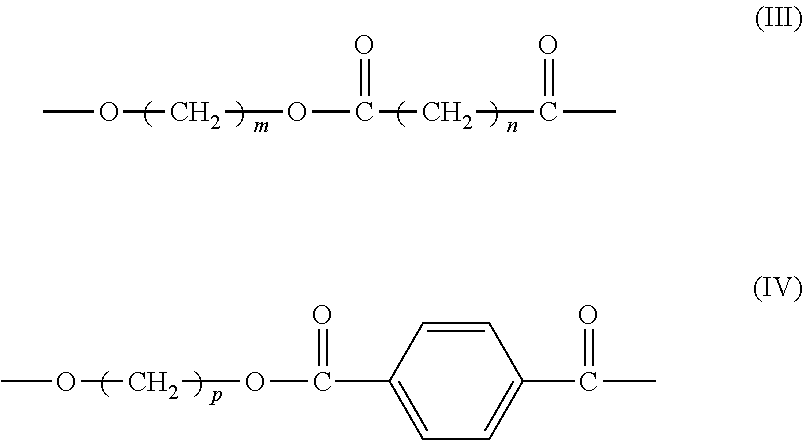
- the aliphatic-aromatic copolyester segment A contains repeating units represented by formula (III) and repeating units represented by formula (IV), and wherein the chain terminals of the aliphatic-aromatic copolyester segment A are each independently —O—(CH 2 ) m —O— or —O—(CH 2 ) p —O—,
- molar ratio between the repeating units represented by formula (III) and repeating units represented by formula (IV) is 1:(0.1-10), m is an integer from 2 to 10, n is an integer from 2 to 8, p is an integer from 2 to 10, and m, n and p are equal to or different from each other.
- the structural units C derived from a polyisocyanate are structural units obtained after the reaction between the polyisocyanate and hydroxyl groups. According to an embodiment, the structural units C are represented by formula (II) below:
- X is a divalent aliphatic group and/or divalent aromatic group.
- X is 1,6-hexamethylene and/or 4,4′-methylene diphenyl.
- the polydispersity index (Mw/Mn) of the transparent copolyester of present invention is from 1.2 to 4, preferably from 1.5 to 2.5.
- Another object of present invention is to provide a method for preparing a transparent copolyester, wherein the method comprises polymerizing lactide, a hydroxyl-terminated aliphatic-aromatic copolyester and a polyisocyanate in the presence of a catalyst; wherein the weight ratio for the aliphatic-aromatic copolyester, lactide and the polyisocyanate (aliphatic-aromatic copolyester:lactide:polyisocyanate) is 100:(100-2000):(0.1-10).
- the transparent copolyester prepared by said method has a weight-average molecular weight Mw of 50,000-1,000,000.
- the catalyst used in said method is an organic tin compound.
- the organic tin compound is selected from the group consisting of stannous octoate, stannous trifluoromethanesulfonate, dibutyltin dilaurate, stannous tartrate and dibutyldimethoxy tin.
- the amount of the organic tin compound used is from 0.05 to 0.5 parts by weight, preferably from 0.07 to 0.2 parts by weight, wherein the total weight of the lactide, the aliphatic-aromatic copolyester and the polyisocyanate is 100 parts by weight.
- the aliphatic-aromatic copolyester used in the method has a weight-average molecular weight Mw of 2,000-40,000, preferably 3,000-40,000.
- the polydispersity index (Mw/Mn) of the aliphatic-aromatic copolyester is from 1.2 to 2.5.
- the reaction conditions for polymerization include a reaction temperature of from 130 to 190° C., preferably 170-190° C., and a reaction period of from 1 to 10 hours, preferably from 1.5 to 5 hours.
- Another aspect of present invention relates to a transparent copolyester prepared from the method according to present invention.
- a yet further aspect of present invention relates to an article made from the transparent copolyester according to present invention.
- the transparency copolyester of present invention has a transmittance of at least 50%, preferably at least 60%, preferably at least 65%, preferably at least 70%, preferably at least 75%, and particularly preferably at least 80%, measured according to China National Standard GB/T 2410-2008.
- the tensile strength at break of the transparent copolyester of present invention is from 19 to 50 MPa, preferably from 22 to 50 MPa, and more preferably from 25 to 50 MPa, measured according to China National Standard GB/T 1040.2-2006.
- the transparent copolyester of present invention comprises or mainly comprises the polylactic acid segment (i.e. the segment B mentioned above) and the aliphatic-aromatic copolyester segment (i.e. the segment A mentioned above) such that the transparent copolyester not only has an excellent biodegradability, but also has a good toughness and transparency.
- the lactide is bulk ring-opening polymerized under the initiation of the hydroxyl-terminated aliphatic-aromatic copolyester in the presence of a catalyst such as an organic tin compound, and the ring-opening polymerization product of lactide is subjected to reaction in the presence of the polyisocyanate (as water absorbent and chain extender), so as to provide a copolyester not only has an excellent biodegradability, but also has a relatively good toughness and transparency.
- a catalyst such as an organic tin compound
- the transparent copolyester of present invention has a good toughness so as to overcome the brittle disadvantage of conventional polylactic acid materials, and also has a good transparency.
- the transparent copolyester of present invention is suitable for extrusion, film-blowing, film-drawing, bottle-blowing, injection moulding, foaming, sheeting and the like so as to obtain various articles.
- the transparent copolyester of present invention has an excellent biodegradability.
- the article made from said transparent copolyester when discarded, can be degraded via conventional biological degradation processes (such as composting process) without leading to environmental pollutions.
- FIG. 1 shows the 1 H NMR spectrum for the transparent copolyester of example 1.
- a transparent copolyester is provided in present invention, wherein the transparent copolyester comprises an aliphatic-aromatic copolyester segment A, a segment B having repeating units —O—CH(CH 3 )—C(O)—, and structural units C derived from a polyisocyanate, and wherein the weight ratio for the segment A, the segment B and the structural units C is 100:(100-2000):0.1-10 and wherein the weight-average molecular weight Mw of the transparent copolyester is from 50,000 to 1,000,000.
- the transparent copolyester not only has an excellent biodegradability, but also has a good toughness and transparency because the transparent copolyester contains mainly the polylactic acid segment and the aliphatic-aromatic copolyester segment.
- the tensile strength at break of the transparent copolyester of present invention can be from 19 to 50 MPa, preferably from 22 to 50 MPa, and more preferably from 25 to 50 MPa.
- the elongation at break of the transparent copolyester of present invention can be from 10 to 60%, preferably from 10 to 50%.
- the transparency copolyester of present invention can has a transmittance of at least 50%, preferably at least 60%, preferably at least 65%, preferably at least 70%, preferably at least 75%, even preferably at least 80%, preferably from 60 to 90%, and more preferably from 69 to 90%.
- the tensile strength at break and the elongation at break are measured according to China National Standard GB/T 1040.2-2006; and the transmittance is measured according to China National Standard GB/T 2410-2008.
- the aliphatic-aromatic copolyester segment in present invention means a aliphatic-aromatic copolyester segment containing two types of dicarboxylic acid units, i.e. aromatic dicarboxylic acid units and aliphatic and/or cycloaliphatic dicarboxylic acid units, and aliphatic and/or cycloaliphatic diol units.
- the aliphatic-aromatic copolyester segment A in the transparent copolyester of present invention is a random copolyester segment.
- random means the distributions of aliphatic polyester repeating units and aromatic polyester repeating units in the aliphatic-aromatic copolyester segment is stochastic.
- the aliphatic polyester repeating units means polyester repeating units obtained from the reaction between an aliphatic diacid, a cycloaliphatic diacid, an ester thereof or a mixture thereof and an aliphatic diol and/or an cycloaliphatic diol; and the aromatic polyester repeating units means polyester repeating units obtained from the reaction between an aromatic diacid, an ester of aromatic diacid, an anhydride of aromatic diacid or a mixture thereof and an aliphatic diol and/or an cycloaliphatic diol.
- the aliphatic diacid and its ester there are no particular limits to the aliphatic diacid and its ester, the cycloaliphatic diacid and its ester, the aliphatic diol, the cycloaliphatic diol, the aromatic diacid, the ester of aromatic diacid, and the anhydride of aromatic diacid, and compounds already known in the art for preparing polyesters can be used.
- the aromatic dicarboxylic acid units in the aliphatic-aromatic copolyester segment are preferably derived from phthalic acid, isophthalic acid, terephthalic acid, 2,6-naphthalenedicarboxylic acid and the like.
- the aromatic dicarboxylic acid units can be derived from anhydrides of the aromatic dicarboxylic acids, or can be derived from esters of the aromatic dicarboxylic acids with an alcohol or a diol such as methanol.
- the aliphatic or cycloaliphatic dicarboxylic acid units in the aliphatic-aromatic copolyester segment are preferably derived from an aliphatic or cycloaliphatic dicarboxylic acid having from 4 to 20 carbon atoms, or can be derived from esters of the aliphatic or cycloaliphatic dicarboxylic acid with an alcohol or a diol such as methanol.
- the aliphatic dicarboxylic acid include, for example, malonic acid, succinic acid, glutaric acid, adipic acid, pimelic acid, azelaic acid, sebacic acid, dodecanedicarboxylic acid and the like.
- the cycloaliphatic diacid can be for example cyclohexane dicarboxylic acid.
- diol units in the aliphatic-aromatic copolyester segment can include the units derived from the following compounds: ethylene glycol, 1,3-propanediol, 1,4-butanediol, 1,5-pentanediol, 1,6-hexanediol, 1,8-octanediol, neopentyl glycol, cyclohexanedimethanol, hydrogenated bisphenol A and the like.
- the weight-average molecular weight Mw of the aliphatic-aromatic copolyester segment A is from 2,000 to 40,000, preferably from 2,500 to 40,000, preferably from 3,000 to 40,000, preferably from 3000 to 30000, preferably from 3500 to 30,000, preferably form 3500 to 20,000 and more preferably from 3500 to 10,000.
- the weight-average molecular weight is measured according to Gel Permeation Chromatography (GPC), as described in following Example section.
- the polydispersity index (Mw/Mn) of the aliphatic-aromatic copolyester segment A is from 1.1 to 4, preferably from 1.2 to 2.5.
- the molar ratio between aliphatic polyester repeating units and aromatic polyester repeating units is 1:(0.1-10), preferably 1:(0.2-5), and more preferably 1:(0.5-2).
- the molar ratio between aliphatic polyester repeating units and aromatic polyester repeating units equals to the molar ratio between the aliphatic and/or cycloaliphatic dicarboxylic acid units and the aromatic dicarboxylic acid units in the aliphatic-aromatic copolyester segment.
- the terminal groups of the aliphatic-aromatic copolyester segment A are groups derived from a diol; that is, the end groups of the aliphatic-aromatic copolyester segment are diol units.
- a diol-terminated aliphatic-aromatic copolyester can be obtained by using an excess amount of diol, relative to the total amount of the aliphatic and/or cycloaliphatic dicarboxylic acid and the aromatic dicarboxylic acid.
- the aliphatic-aromatic copolyester segment A contains repeating units represented by formula (III) and repeating units represented by formula (IV), and wherein the chain terminals of the aliphatic-aromatic copolyester segment A are each independently —O—(CH 2 ) m —O— or —O—(CH 2 ) p —O—,
- m is an integer from 2 to 10, preferably an integer from 2 to 6, for example m is 4; n is an integer from 2 to 8, preferably an integer from 2 to 4, for example n is 4; p is an integer from 2 to 10, preferably an integer from 2 to 6, for example p is 4; and m, n and p can be equal to or different from each other.
- the molar ratio between the repeating units represented by formula (III) and repeating units represented by formula (IV) is 1:(0.1-10), preferably 1:(0.2-5), and more preferably 1:(0.5-2). In a further embodiment, m equals to p.
- the weight ratio for the segment A, the segment B and the structural units C in the transparent copolyester of present invention is 100:(300-700):(1-5).
- the transparent copolyester with such a ratio has a further improved toughness and transparency.
- the transparent copolyester of present invention preferably has a weight-average molecular weight of from 50,000 to 500,000, preferably from 60,000 to 300,000, more preferably from 70,000 to 200,000.
- the polydispersity index of the transparent copolyester of present invention is from 1.2 to 4, preferably from 1.5 to 2.5.
- the segment B in the transparent copolyester of present invention is represented by formula (I) below:
- q is an integer from 10 to 100, preferably an integer from 15 to 90, and more preferably an integer from 20 to 80.
- the segment B can be resulted from the ring-opening polymerization of lactide.
- the lactide used in this invention is a compound formed by the cyclic dimerization of lactic acid and includes stereoisomeric monomers. That is, the isomers of the lactide include L-lactide, D-lactide, the mixture of D-lactide and L-lactide, D,L-lactide and meso-lactide. It is preferred to use D,L-lactide and L-lactide in the present invention. According to a preferred embodiment, the lactide used is L-lactide to make the final transparent copolyester have a better transparency.
- the lactide can be various commercial available lactide products.
- L-lactide is commercial available, L-lactide can also be prepared through conventional methods.
- L-lactide can be obtained via the methods disclosed in CN101585827A (particularly examples 1-8 therein).
- the structural units C in the transparent copolyester of present invention are derived from a polyisocyanate.
- polyisocyanate There are no particular limits to the polyisocyanate and various polyisocyanates commonly known in the art can be used.
- polyisocyanate examples include, but not limited to, 1,4-, 1,3- and/or 1,2-cyclohexane-diisocyanate, 1-methyl-2,4-diisocyanato-cyclohexane, 1-methyl-2,6-diisocyanato-cyclohexane, tetramethylene-diisocyanate, octamethylene-diisocyanate, decamethylene-diisocyanate, dodecamethylene-diisocyanate, H 6 -2,4- and/or 2,6-diisocyanatotoluene, 4,4′-diisocyanatodiphenylmethane, 2,4′-diisocyanatodiphenylmethane, 2,2′-diisocyanatodiphenylmethane, meta- and/or para-xylylene-diisocyanate, 2,4-diisocyanatototoluene and/or 2,
- the polyisocyanate is a diisocyanate.
- X is a divalent aliphatic group and/or divalent aromatic group, preferably X is alkylene and/or arylene.
- the alkylene can be, for example, C 5 -C 14 , preferably C 3 -C 12 alkylene, more preferably 1,6-hexamethylene.
- the arylene can be, for example, C 8 -C 22 , preferably C 6 -C 20 arylene, more preferably 4,4′-methylene diphenyl.
- the polyisocyanate is 1,6-hexamethylene-diisocyanate and/or 4,4′-diphenyl methane diisocyanate.
- the structural units C derived from a polyisocyanate are structural units obtained after the reaction between the isocyanate group of the polyisocyanate and hydroxyl group.
- the present invention further relates to a method for preparing a transparent copolyester, wherein the method comprises polymerizing lactide, a hydroxyl-terminated aliphatic-aromatic copolyester and a polyisocyanate in the presence of a catalyst.
- the weight ratio for the aliphatic-aromatic copolyester, lactide and the polyisocyanate used in said method is 100:(100-2000):(0.1-10).
- the transparent copolyester of present invention can be prepared by said method of present invention for preparing a transparent copolyester.
- a person skilled in the art will thus appreciate that the aliphatic-aromatic copolyester segment A in the transparent copolyester according to present invention corresponds to (or derives from) the hydroxyl-terminated aliphatic-aromatic copolyester in said preparing method, the segment (B) having repeating units —O—CH(CH 3 )—C(O)— derives from the ring-opening polymerization of lactide and the structural units C derives from the polyisocyanate.
- the hydroxyl-terminated aliphatic-aromatic copolyester segment A corresponds to (or derives from) the hydroxyl-terminated aliphatic-aromatic copolyester in said preparing method
- the hydroxyl-terminated aliphatic-aromatic copolyester is almost identical to the aliphatic-aromatic copolyester segment A, except that end groups of them are different. Therefore, the hydroxyl-terminated aliphatic-aromatic copolyester has the same properties and characteristics as those of the aliphatic-aromatic copolyester segment A, such as, for example, types of the repeating units, ratios between repeating units, weight-average molecular weight, polydispersity index and so on.
- the hydroxyl-terminated aliphatic-aromatic copolyester has a weight-average molecular weight Mw of from 2,000 to 40,000, preferably from 2,500 to 40,000, preferably from 3,000 to 40,000, preferably from 3000 to 30000, preferably from 3500 to 30,000, preferably form 3500 to 20,000 and more preferably from 3500 to 10,000.
- Mw/Mn polydispersity index
- the hydroxyl-terminated aliphatic-aromatic copolyester used in the transparent copolyester preparing method according to present invention can be produced through conventional preparing methods for polyesters. Such preparing methods for hydroxyl-terminated aliphatic-aromatic copolyesters are well known to those skilled in the art.
- a preparing method for the hydroxyl-terminated aliphatic-aromatic copolyester can include the steps of:
- step (3) subjecting the prepolymer prepared in step (2) and a second catalyst to polycondensation under vacuum to provide the aliphatic-aromatic copolyester;
- the first catalyst is at least one selected from titanium compounds, antimony compounds, and zinc compounds
- the second catalyst is at least one selected from rare-earth metal compounds, wherein the rare-earth metal is for example at least one selected from lanthanide elements, scandium and yttrium.
- the monomers, catalysts, reaction conditions and so on used in steps (1)-(3) may be identical to those described in CN1807485A, with the except that the polycondensation conditions in step (3) can include a temperature of 200-260° C., an absolute pressure of 0-800 Pa and a reaction period of 0.1-2 hours; and amount of monomer (b) is excess relative to the total amount of monomer (a) and monomer (c) and the molar ratio between the total amount of monomer (a) and monomer (c) and amount of monomer (b) is preferably 1:(1.1-1.3).
- both end groups of the prepared aliphatic-aromatic copolyester are hydroxyls since the amount of monomer (b) is excess relative to the total amount of monomer (a) and monomer (c).
- the polyisocyanate used in the preparing method for the transparent copolyester according to present invention can be various common polyisocyanates that can act as chain extender.
- those polyisocyanates mentioned above can be used.
- 1,6-hexamethylene-diisocyanate and/or 4,4′-diphenyl methane diisocyanate can be used.
- the lactide used in the method according to present invention can be, for example, the lactide described above.
- the catalyst used in the preparing method according present invention for transparent copolyester is any catalyst that is capable of initiating and promoting the bulk ring-opening polymerization of lactide.
- the method of present invention has no particular limits to the catalyst.
- the catalyst is an organic tin compound.
- the organic tin compound is one or more selected from the group consisting of stannous octoate, stannous trifluoromethanesulfonate, dibutyltin dilaurate, stannous tartrate and dibutyldimethoxy tin.
- the amount of the catalyst there are no particular limits to the amount of the catalyst.
- An amount commonly used for catalyzing ring-opening polymerization of lactide can be employed.
- the amount of the organic tin compound used is from 0.05 to 0.5 parts by weight, preferably from 0.07 to 0.2 parts by weight, wherein the total weight of the lactide, the aliphatic-aromatic copolyester and the polyisocyanate is 100 parts by weight.
- the preparing method according present invention for transparent copolyester is carried out at a temperature of from 130 to 250° C., preferably from 130 to 190° C., more preferably from 170 to 190° C.
- the preparing method according present invention for transparent copolyester is carried out for from 1 to 20 hours, preferably from 1 to 10 hours, and more preferably from 1.5 to 5 hours.
- the reaction vessel containing the lactide, the aliphatic-aromatic copolyester, the polyisocyanate and the catalyst is disposed into an oil bath and the temperature for polymerization is controlled by adjusting the temperature of the oil bath such that the polymerization can be conducted at a constant temperature.
- the preparing method according to present invention for transparent copolyester can be conducted in the presence of an inert gas.
- the mixing of the lactide, the aliphatic-aromatic copolyester and the polyisocyanate is preferably carried out in the presence of an inert gas.
- the inert gas can be, for example, nitrogen or other common inert gases such as argon.
- the weight ratio for the aliphatic-aromatic copolyester, lactide and polyisocyanate is 100:(300-700):(1-5).
- the transparent copolyester obtained from the method according to present invention has a weight-average molecular weight of 50,000-1,000,000.
- the preparing method for transparent copolyester can further comprise dissolving the product resulted from the reaction of the aliphatic-aromatic copolyester, lactide and polyisocyanate with a solvent (for example tetrahydrofuran, chloroform, dichloromethane and so on), precipitating in a precipitating agent (for example, methanol, ethanol and the like) and drying the resulting precipitate, so as to recover the produced transparent copolyester.
- a solvent for example tetrahydrofuran, chloroform, dichloromethane and so on
- a precipitating agent for example, methanol, ethanol and the like
- the present invention further provides a transparent copolyester prepared by above method.
- the transparent copolyester prepared by the method has the properties and characteristics specified hereinbefore with respect to the transparent copolyester according to present invention.
- the present invention further relates to articles made from the transparent copolyester according to present invention.
- the articles are made from a composition, wherein the composition comprises the transparent copolyester of present invention as an essential component or the composition is composed of the transparent copolyester of present invention.
- the content of the transparent copolyester can be from 5 to 100% by weight, preferably at least 50% by weight, preferably at least 60% by weight, preferably at least 70% by weight, preferably at least 80% by weight, more preferably at least 90% by weight, based on the weight of the composition.
- the content of the transparent copolyester can be from 95 to 100% by weight in the composition.
- the composition for making articles can also comprise various additives.
- the additives include, but not limited to, plasticizer, thermal stabilizer, lubricant, anti-blocking agent, nucleating agent, biodegradation promote agent, antioxidant, UV absorption agent, antistatic agent, flame-retardant agent, antimicrobial agent, coloring agent, filler and so on, and a mixture thereof.
- the additive can be, for example, pentaerythritol bis(2,4-di-tert-butylphenyl)diphosphite, triphenyl phosphite, and the like.
- the content of the additive can be from 0.01 to 5% by weight, based on the weight of the composition.
- the articles of present invention can be obtained through various forming processes in resin or plastic industry.
- the production of the articles of present invention can be carried out via conventional extrusion, injection moulding, bottle-blowing, foaming, sheeting, film-blowing, film-drawing and so on.
- the process can include: mixing the transparent copolyester and an additive uniformly, and heating to melting (for example heating to about 170-210° C.); optionally, removing small molecule substances such as water and the like with the aid of negative pressure (the absolute pressure may be about 0.05-0.095 MPa) during the melting procedure; and extruding the melt into a sheet blank and cooling at a temperature of 25-50° C.
- polybutylene succinate from Mitsubishi Chemical Holdings Corporation, Japan, under trade name GS-PLA,
- lanthanum stearate prepared according to example A5 in CN1807485A.
- Molecular weight (number-average molecular weight and weight-average molecular weight) and polydispersity index are measured via Gel Permeation Chromatography (GPC) on Waters-208 High Performance Liquid Chromatograph (with a Waters 2410 RI detector, flow rate 1.5 mL/min, 30° C., tetrahydrofuran (THF) as eluent); calibrated by monodisperse linear polystyrene standards.
- GPC Gel Permeation Chromatography
- Transmittance is measured according to China National Standard GB/T 2410-2008.
- the aliphatic-aromatic copolyester has a weight-average molecular weight of 10000, and a polydispersity index of 2.2.
- the q in above formula (I) was calculated to be about 16 according to the data of the 1 H NMR.
- a comparative copolyester was prepared by repeating Example 1, except that the aliphatic-aromatic copolyester was replaced by the same amount (in mole) of polybutylene succinate (GS-PLA; Mw: about 60,000).
- This comparative copolyester is a yellow polymer.
- the weight-average molecular weight of the comparative copolyester is 82,000, and the polydispersity index is 2.15.
- Example 2 In the same way as did in Example 1, a sheet D1 with a size of 15 cm ⁇ 15 cm ⁇ 2 mm was made from the prepared polymer. The biodegradability, tensile strength at break, elongation at break and transmittance of the sheet were then tested and the results are shown in table 1 below.
- lanthanum stearate 0.85 mmol lanthanum stearate was added into the system and the system was condensation polymerized at a temperature of 240° C. under an absolute pressure of less than about 200 Pa for about 3 hour, resulting a white aliphatic-aromatic copolyester.
- the aliphatic-aromatic copolyester has a weight-average molecular weight of 55,000, and a polydispersity index of 1.89.
- a comparative copolyester was prepared in the same way as did in step (2) in Example 1, with the except that the aliphatic-aromatic copolyester (Mw 10,000) used in Example 1 was replaced with the aliphatic-aromatic copolyester (Mw 55,000) prepared in above (1).
- the comparative copolyester was obtained in a yield of 93%.
- the weight-average molecular weight of the comparative copolyester is 122,000, and the polydispersity index is 2.18.
- the aliphatic-aromatic copolyester prepared in Example 1 was used.
- the aliphatic-aromatic copolyester prepared in Example 1 was used.
- the aliphatic-aromatic copolyester prepared in Example 1 was used.
- the aliphatic-aromatic copolyester prepared in Example 1 was used.
- the aliphatic-aromatic copolyester prepared in Example 1 was used.
- the aliphatic-aromatic copolyester prepared in Example 1 was used.
- the aliphatic-aromatic copolyester prepared in Example 1 was used.
- lanthanum stearate 0.85 mmol lanthanum stearate was added into the system and the system was condensation polymerized at a temperature of 240° C. under an absolute pressure of less than about 200 Pa for about 1.5 hour, resulting a white aliphatic-aromatic copolyester.
- the aliphatic-aromatic copolyester has a weight-average molecular weight of 31,000, and a polydispersity index of 1.67.
- the transparent copolyesters and articles thereof of present invention have not only a good biodegradability, but also good toughness and transparency.
- the copolymers prepared with the aliphatic-aromatic copolyesters according to present invention as well as articles thereof have better transparencies than the copolymers prepared with aliphatic polyesters as well as articles thereof, as compared between Example 1 and Comparative example 1.
- the copolymer of Comparative example 2 as well as the article thereof have bad transparencies as compared between Example 1 and Comparative example 2; it is believed that the bad transparency of Comparative example 2 is due to the relative high weight-average molecular weight of the aliphatic-aromatic copolyester employed.
- the terms “first”, “second”, and the like do not denote any order or importance, but rather are used to distinguish one element from another, and the terms “the”, “a”, and “an” do not denote a limitation of quantity, but rather denote the presence of at least one of the referenced item. Furthermore, all ranges disclosed herein are inclusive of the endpoints and independently combinable.
Landscapes
- Chemical & Material Sciences (AREA)
- Health & Medical Sciences (AREA)
- Chemical Kinetics & Catalysis (AREA)
- Medicinal Chemistry (AREA)
- Polymers & Plastics (AREA)
- Organic Chemistry (AREA)
- General Chemical & Material Sciences (AREA)
- Engineering & Computer Science (AREA)
- Manufacturing & Machinery (AREA)
- Materials Engineering (AREA)
- Polyurethanes Or Polyureas (AREA)
- Polyesters Or Polycarbonates (AREA)
Abstract
Description


wherein X is a divalent aliphatic group and/or divalent aromatic group. According to a preferred embodiment, X is 1,6-hexamethylene and/or 4,4′-methylene diphenyl.

wherein m is an integer from 2 to 10, preferably an integer from 2 to 6, for example m is 4; n is an integer from 2 to 8, preferably an integer from 2 to 4, for example n is 4; p is an integer from 2 to 10, preferably an integer from 2 to 6, for example p is 4; and m, n and p can be equal to or different from each other. According to a further preferred embodiment, the molar ratio between the repeating units represented by formula (III) and repeating units represented by formula (IV) is 1:(0.1-10), preferably 1:(0.2-5), and more preferably 1:(0.5-2). In a further embodiment, m equals to p.

wherein q is an integer from 10 to 100, preferably an integer from 15 to 90, and more preferably an integer from 20 to 80.
X—(NCO)s,
wherein s=2 to 5, preferably s is 2 or 3, and X represents an aliphatic hydrocarbon radical having 4 to 36 carbon atoms, preferably having 5 to 14 carbon atoms, a cycloaliphatic hydrocarbon radical having 6 to 15 carbon atoms, an aromatic hydrocarbon radical having 8 to 22 carbon atoms, preferably having 6 to 15 carbon atoms or an araliphatic hydrocarbon radical having 7 to 15 carbon atoms.

wherein X is a divalent aliphatic group and/or divalent aromatic group, preferably X is alkylene and/or arylene. The alkylene can be, for example, C5-C14, preferably C3-C12 alkylene, more preferably 1,6-hexamethylene. The arylene can be, for example, C8-C22, preferably C6-C20 arylene, more preferably 4,4′-methylene diphenyl.
| TABLE 1 | ||||||
| Weight-average | ||||||
| molecular | Polydispersity | Degradation | Tensile | |||
| weight Mw of | index of | rate in 90 | strength at | Elongation | ||
| transparent | transparent | days | break | at | Transmittance | |
| sheet | copolyester | copolyester | (weight %) | (MPa) | break(%) | (%) |
| A1 | 100000 | 1.86 | >60 | 25.6 | 44 | 72 |
| D1 | 82000 | 2.15 | >60 | 22.4 | 45 | 45 |
| D2 | 122000 | 2.18 | >60 | 23.4 | 67 | 25 |
| A2 | 83000 | 2.11 | >60 | 24.7 | 38 | 71 |
| A3 | 97000 | 1.79 | >60 | 27.0 | 42 | 69 |
| A4 | 98000 | 1.98 | >60 | 37.5 | 27 | 75 |
| A5 | 88000 | 2.13 | >60 | 36.4 | 25 | 77 |
| A6 | 92000 | 2.25 | >60 | 33.8 | 25 | 73 |
| A7 | 96000 | 1.78 | >60 | 45.3 | 15 | 81 |
| A8 | 90000 | 2.08 | >60 | 40.8 | 12 | 84 |
| A9 | 81000 | 1.72 | >60 | 27.5 | 47 | 78 |
| A10 | 81000 | 1.84 | >60 | 28.2 | 48 | 80 |
| A11 | 74000 | 2.04 | >60 | 46.0 | 25 | 81 |
| TABLE 2 | ||||
| Tensile | ||||
| Degradation rate in | strength at | Elongation at | Transmittance | |
| sheet | 90 days (weight %) | break (MPa) | break (%) | (%) |
| B1 | >60 | 25.7 | 45 | 73 |
| E1 | >60 | 22.4 | 45 | 44 |
| E2 | >60 | 23.4 | 67 | 25 |
| B2 | >60 | 24.8 | 39 | 72 |
| B3 | >60 | 27.1 | 43 | 70 |
| B4 | >60 | 37.4 | 29 | 76 |
| B5 | >60 | 36.6 | 28 | 78 |
| B6 | >60 | 33.9 | 27 | 73 |
| B7 | >60 | 45.5 | 17 | 82 |
| B8 | >60 | 40.9 | 15 | 85 |
| B9 | >60 | 27.8 | 48 | 79 |
| B10 | >60 | 28.4 | 49 | 82 |
| B11 | >60 | 46.2 | 28 | 83 |
Claims (22)


Applications Claiming Priority (6)
| Application Number | Priority Date | Filing Date | Title |
|---|---|---|---|
| CN201110231138.9 | 2011-08-12 | ||
| CN2011102311389A CN102924902A (en) | 2011-08-12 | 2011-08-12 | Plastic product and its preparation method |
| CN201110231140 | 2011-08-12 | ||
| CN201110231140.6 | 2011-08-12 | ||
| CN201110231138 | 2011-08-12 | ||
| CN201110231140.6A CN102924676B (en) | 2011-08-12 | 2011-08-12 | A kind of transparent copolyester and preparation method thereof |
Publications (2)
| Publication Number | Publication Date |
|---|---|
| US20130041130A1 US20130041130A1 (en) | 2013-02-14 |
| US9102782B2 true US9102782B2 (en) | 2015-08-11 |
Family
ID=47677936
Family Applications (1)
| Application Number | Title | Priority Date | Filing Date |
|---|---|---|---|
| US13/571,317 Active US9102782B2 (en) | 2011-08-12 | 2012-08-09 | Transparent copolyester, preparing method thereof and articles made from the same |
Country Status (3)
| Country | Link |
|---|---|
| US (1) | US9102782B2 (en) |
| JP (1) | JP5530490B2 (en) |
| KR (1) | KR101515823B1 (en) |
Families Citing this family (4)
| Publication number | Priority date | Publication date | Assignee | Title |
|---|---|---|---|---|
| US10106642B2 (en) | 2014-12-05 | 2018-10-23 | Basf Se | Biodegradable copolyesters |
| TWI677739B (en) * | 2017-11-02 | 2019-11-21 | 友達光電股份有限公司 | Block having phase change material and backlight module and display device using the same |
| CN113149831B (en) * | 2021-04-28 | 2023-11-17 | 中国矿业大学 | Preparation method of lanthanum stearate modified lubricating oil and application of lanthanum stearate modified lubricating oil in mine hoisting steel wire rope |
| CN114805778B (en) * | 2022-04-15 | 2023-03-10 | 湖南聚仁化工新材料科技有限公司 | Environment-friendly plasticizer and preparation method thereof |
Citations (18)
| Publication number | Priority date | Publication date | Assignee | Title |
|---|---|---|---|---|
| US5403897A (en) | 1993-03-31 | 1995-04-04 | Dainippon Ink & Chemicals, Inc. | Process for producing lactic acid-based copolyester and packaging material |
| JPH07268057A (en) | 1994-03-31 | 1995-10-17 | Dainippon Ink & Chem Inc | Method for producing lactide polyester containing urethane bond |
| US5605981A (en) * | 1994-07-20 | 1997-02-25 | Dainippon Ink And Chemicals, Inc. | Process for the preparation of high molecular lactic copolymer polyester |
| WO2002044249A1 (en) | 2000-11-30 | 2002-06-06 | Daicel Chemical Industries, Ltd. | Aliphatic polyester copolymer and process for producing the same, biodegradable resin molding based on aliphatic polyester, and lactone-containing resin |
| JP2004285151A (en) | 2003-03-20 | 2004-10-14 | Toray Ind Inc | Polylactic acid block copolymer, method for producing the same, and molded article |
| CN1673276A (en) | 2005-04-15 | 2005-09-28 | 浙江工业大学 | Polylactic acid resin composition |
| CN1687205A (en) | 2005-04-04 | 2005-10-26 | 尚志常 | PLA environmental protection complete degradable plastic |
| CN1807485A (en) | 2004-12-30 | 2006-07-26 | 中国石油化工股份有限公司 | Biodegradable linear random copolyester and its preparation method and uses |
| US20060276617A1 (en) * | 2003-06-27 | 2006-12-07 | Unitika Ltd. | Aliphatic polyester resin composition, preparation method therefor, and molded article and foamed article produced from the resin composition |
| CN1911983A (en) | 2006-08-17 | 2007-02-14 | 同济大学 | Preparation method of degradable polymer material for stent in shape memory pipe cavity |
| CN1927911A (en) | 2006-09-07 | 2007-03-14 | 同济大学 | Preparation method of biodegradation polylactic acid based multicomponent block polymer |
| CN101024696A (en) | 2007-02-13 | 2007-08-29 | 四川大学 | Polylactic-acid block copolymer and its preparing method |
| CN101134807A (en) | 2007-10-25 | 2008-03-05 | 上海同杰良生物材料有限公司 | Polylactic acid radical biological degradable material and method for preparing same |
| CN101314666A (en) | 2007-06-01 | 2008-12-03 | 东丽纤维研究所(中国)有限公司 | Polylactic acid blend and uses thereof |
| CN101338025A (en) | 2008-08-12 | 2009-01-07 | 四川大学 | Polylactic acid/polyethylene terephthalate multi-block copolymer and its preparation method and use |
| CN101585827A (en) | 2008-05-21 | 2009-11-25 | 哈尔滨理工大学 | Method for preparing lactide with high yield |
| CN101684175A (en) | 2008-09-22 | 2010-03-31 | 中国科学院宁波材料技术与工程研究所 | Biodegradable multi-block polyester copolymer and method for preparing same |
| CN101983986A (en) | 2010-10-26 | 2011-03-09 | 中国科学院长春应用化学研究所 | Transparent and toughening polylactic acid resin and method for preparing the same |
-
2012
- 2012-08-09 US US13/571,317 patent/US9102782B2/en active Active
- 2012-08-10 JP JP2012178964A patent/JP5530490B2/en active Active
- 2012-08-13 KR KR1020120088381A patent/KR101515823B1/en active Active
Patent Citations (18)
| Publication number | Priority date | Publication date | Assignee | Title |
|---|---|---|---|---|
| US5403897A (en) | 1993-03-31 | 1995-04-04 | Dainippon Ink & Chemicals, Inc. | Process for producing lactic acid-based copolyester and packaging material |
| JPH07268057A (en) | 1994-03-31 | 1995-10-17 | Dainippon Ink & Chem Inc | Method for producing lactide polyester containing urethane bond |
| US5605981A (en) * | 1994-07-20 | 1997-02-25 | Dainippon Ink And Chemicals, Inc. | Process for the preparation of high molecular lactic copolymer polyester |
| WO2002044249A1 (en) | 2000-11-30 | 2002-06-06 | Daicel Chemical Industries, Ltd. | Aliphatic polyester copolymer and process for producing the same, biodegradable resin molding based on aliphatic polyester, and lactone-containing resin |
| JP2004285151A (en) | 2003-03-20 | 2004-10-14 | Toray Ind Inc | Polylactic acid block copolymer, method for producing the same, and molded article |
| US20060276617A1 (en) * | 2003-06-27 | 2006-12-07 | Unitika Ltd. | Aliphatic polyester resin composition, preparation method therefor, and molded article and foamed article produced from the resin composition |
| CN1807485A (en) | 2004-12-30 | 2006-07-26 | 中国石油化工股份有限公司 | Biodegradable linear random copolyester and its preparation method and uses |
| CN1687205A (en) | 2005-04-04 | 2005-10-26 | 尚志常 | PLA environmental protection complete degradable plastic |
| CN1673276A (en) | 2005-04-15 | 2005-09-28 | 浙江工业大学 | Polylactic acid resin composition |
| CN1911983A (en) | 2006-08-17 | 2007-02-14 | 同济大学 | Preparation method of degradable polymer material for stent in shape memory pipe cavity |
| CN1927911A (en) | 2006-09-07 | 2007-03-14 | 同济大学 | Preparation method of biodegradation polylactic acid based multicomponent block polymer |
| CN101024696A (en) | 2007-02-13 | 2007-08-29 | 四川大学 | Polylactic-acid block copolymer and its preparing method |
| CN101314666A (en) | 2007-06-01 | 2008-12-03 | 东丽纤维研究所(中国)有限公司 | Polylactic acid blend and uses thereof |
| CN101134807A (en) | 2007-10-25 | 2008-03-05 | 上海同杰良生物材料有限公司 | Polylactic acid radical biological degradable material and method for preparing same |
| CN101585827A (en) | 2008-05-21 | 2009-11-25 | 哈尔滨理工大学 | Method for preparing lactide with high yield |
| CN101338025A (en) | 2008-08-12 | 2009-01-07 | 四川大学 | Polylactic acid/polyethylene terephthalate multi-block copolymer and its preparation method and use |
| CN101684175A (en) | 2008-09-22 | 2010-03-31 | 中国科学院宁波材料技术与工程研究所 | Biodegradable multi-block polyester copolymer and method for preparing same |
| CN101983986A (en) | 2010-10-26 | 2011-03-09 | 中国科学院长春应用化学研究所 | Transparent and toughening polylactic acid resin and method for preparing the same |
Non-Patent Citations (3)
| Title |
|---|
| Fernandez, R.T., et al.; Polymer Degradation and Stability, 2010, p. 2641-2647. * |
| Herrera, R., et al.; Journal of Polymer Science Part A: Polymer Chemistry, 2002, p. 4141-4157. * |
| Yuan, H., et al.; Engineering Plastics Applications, 2008, vol. 36, Issue 10, p. 46-50. * |
Also Published As
| Publication number | Publication date |
|---|---|
| US20130041130A1 (en) | 2013-02-14 |
| JP5530490B2 (en) | 2014-06-25 |
| KR20130018206A (en) | 2013-02-20 |
| JP2013047339A (en) | 2013-03-07 |
| KR101515823B1 (en) | 2015-04-29 |
Similar Documents
| Publication | Publication Date | Title |
|---|---|---|
| KR101650923B1 (en) | Blend of polylactic acid resin and copolyester resin and articles using the same | |
| JP5198804B2 (en) | Polylactic acid-based elastic resin composition having excellent heat resistance and molded product thereof | |
| US8993676B2 (en) | Polylactic acid resin and copolymer polyester resin blend, and molded product using same | |
| EP2716711B1 (en) | Hydrolysis resistant and biodegradable aliphatic-aromatic copolyester resin composition | |
| CN102775590B (en) | Poly(butylene succinate) and preparation method thereof | |
| CN102643419B (en) | Preparation method of aliphatic-aromatic copolyester | |
| KR102675032B1 (en) | Polyester resin and preparation method of the same | |
| KR101604113B1 (en) | Biodegradble resin composition | |
| US9102782B2 (en) | Transparent copolyester, preparing method thereof and articles made from the same | |
| JP5223347B2 (en) | Resin composition, method for producing the same, and copolymer | |
| KR101801702B1 (en) | Blend of polylactic acid resin and copolyester resin having superior impact strength and heat resistance and articles using the same | |
| CN106574103A (en) | Composition comprising poly-lactide-based polymer | |
| CN113993926A (en) | Biodegradable resin composition having improved mechanical properties, moldability and weather resistance, and process for producing the same | |
| KR101801705B1 (en) | Blend of polylactic acid resin and copolyester resin having superior impact strength and heat resistance and articles using the same | |
| JP4390273B2 (en) | Biodegradable resin composition | |
| TW201741375A (en) | Flexible polylactic acid resin composition comprising a water scavenger | |
| KR20170015878A (en) | Terminally modified polyethylene terephthalate resin, method for producing same and molded article | |
| JP5050610B2 (en) | Molded product of resin composition with excellent low-temperature characteristics | |
| EP4414405B1 (en) | BIODEGRADABLE POLYMER | |
| CN113493598B (en) | Biodegradable polyester and preparation method thereof | |
| KR20260011509A (en) | Polyester-based polymer with improved cold resistance, chemical resistance, and elasticity | |
| CN102924902A (en) | Plastic product and its preparation method |
Legal Events
| Date | Code | Title | Description |
|---|---|---|---|
| AS | Assignment |
Owner name: BEIJING RESEARCH INSTITUTE OF CHEMICAL INDUSTRY, C Free format text: ASSIGNMENT OF ASSIGNORS INTEREST;ASSIGNORS:XU, NING;ZHU, GUIXIANG;ZHANG, WEI;AND OTHERS;REEL/FRAME:028958/0926 Effective date: 20120904 Owner name: CHINA PETROLEUM & CHEMICAL CORPORATION, CHINA Free format text: ASSIGNMENT OF ASSIGNORS INTEREST;ASSIGNORS:XU, NING;ZHU, GUIXIANG;ZHANG, WEI;AND OTHERS;REEL/FRAME:028958/0926 Effective date: 20120904 |
|
| STCF | Information on status: patent grant |
Free format text: PATENTED CASE |
|
| MAFP | Maintenance fee payment |
Free format text: PAYMENT OF MAINTENANCE FEE, 4TH YEAR, LARGE ENTITY (ORIGINAL EVENT CODE: M1551); ENTITY STATUS OF PATENT OWNER: LARGE ENTITY Year of fee payment: 4 |
|
| MAFP | Maintenance fee payment |
Free format text: PAYMENT OF MAINTENANCE FEE, 8TH YEAR, LARGE ENTITY (ORIGINAL EVENT CODE: M1552); ENTITY STATUS OF PATENT OWNER: LARGE ENTITY Year of fee payment: 8 |