US9056822B2 - Method for producing polycyclic aromatic compound substituted by aryl group - Google Patents
Method for producing polycyclic aromatic compound substituted by aryl group Download PDFInfo
- Publication number
- US9056822B2 US9056822B2 US14/125,119 US201214125119A US9056822B2 US 9056822 B2 US9056822 B2 US 9056822B2 US 201214125119 A US201214125119 A US 201214125119A US 9056822 B2 US9056822 B2 US 9056822B2
- Authority
- US
- United States
- Prior art keywords
- compound
- formula
- substituted
- represented
- reaction
- Prior art date
- Legal status (The legal status is an assumption and is not a legal conclusion. Google has not performed a legal analysis and makes no representation as to the accuracy of the status listed.)
- Expired - Fee Related
Links
- 0 [1*]OB([Ar])O[1*] Chemical compound [1*]OB([Ar])O[1*] 0.000 description 58
- VOXXGUAZBWSUSS-UHFFFAOYSA-N C1=CC=C(B2OB(C3=CC=CC=C3)OB(C3=CC=CC=C3)O2)C=C1 Chemical compound C1=CC=C(B2OB(C3=CC=CC=C3)OB(C3=CC=CC=C3)O2)C=C1 VOXXGUAZBWSUSS-UHFFFAOYSA-N 0.000 description 11
- BBEAQIROQSPTKN-UHFFFAOYSA-N C1=CC2=C3C(=C1)/C=C\C1=CC=CC(=C13)C=C2 Chemical compound C1=CC2=C3C(=C1)/C=C\C1=CC=CC(=C13)C=C2 BBEAQIROQSPTKN-UHFFFAOYSA-N 0.000 description 6
- LHIPUHBRDNQFSY-UHFFFAOYSA-N C1=CC=C(C2=C(B3OB(C4=C(C5=CC=CC=C5)C=CC=C4)OB(C4=C(C5=CC=CC=C5)C=CC=C4)O3)C=CC=C2)C=C1 Chemical compound C1=CC=C(C2=C(B3OB(C4=C(C5=CC=CC=C5)C=CC=C4)OB(C4=C(C5=CC=CC=C5)C=CC=C4)O3)C=CC=C2)C=C1 LHIPUHBRDNQFSY-UHFFFAOYSA-N 0.000 description 6
- GVEPBJHOBDJJJI-UHFFFAOYSA-N C1=CC=C2C(=C1)C1=CC=CC3=CC=CC2=C31 Chemical compound C1=CC=C2C(=C1)C1=CC=CC3=CC=CC2=C31 GVEPBJHOBDJJJI-UHFFFAOYSA-N 0.000 description 6
- SKZSSCAGJZEXEA-UHFFFAOYSA-N CC(C)(C)C1=CC2=C3C(=C1)/C=C\C1=CC(C(C)(C)C)=CC(=C13)C=C2 Chemical compound CC(C)(C)C1=CC2=C3C(=C1)/C=C\C1=CC(C(C)(C)C)=CC(=C13)C=C2 SKZSSCAGJZEXEA-UHFFFAOYSA-N 0.000 description 6
- ZIRQCPUDORIPKP-UHFFFAOYSA-N ClC1=CC=CC=C1B1OB(C2=CC=CC=C2Cl)OB(C2=CC=CC=C2Cl)O1 Chemical compound ClC1=CC=CC=C1B1OB(C2=CC=CC=C2Cl)OB(C2=CC=CC=C2Cl)O1 ZIRQCPUDORIPKP-UHFFFAOYSA-N 0.000 description 5
- QIOJAJHGIJOCEV-UHFFFAOYSA-N C1=CC2=C(C=C1)C(B1OB(C3=CC=CC4=C3C=CC=C4)OB(C3=CC=CC4=C3C=CC=C4)O1)=CC=C2 Chemical compound C1=CC2=C(C=C1)C(B1OB(C3=CC=CC4=C3C=CC=C4)OB(C3=CC=CC4=C3C=CC=C4)O1)=CC=C2 QIOJAJHGIJOCEV-UHFFFAOYSA-N 0.000 description 4
- CSHWQDPOILHKBI-UHFFFAOYSA-N C1=CC2=C3C(=C1)/C=C\C=C/3C1=CC=C/C3=C/C=C\C2=C13 Chemical compound C1=CC2=C3C(=C1)/C=C\C=C/3C1=CC=C/C3=C/C=C\C2=C13 CSHWQDPOILHKBI-UHFFFAOYSA-N 0.000 description 4
- NOUZOVBGCDDMSX-UHFFFAOYSA-N CC(C)(C)C1=CC(=O)C(=O)C(C(C)(C)C)=C1 Chemical compound CC(C)(C)C1=CC(=O)C(=O)C(C(C)(C)C)=C1 NOUZOVBGCDDMSX-UHFFFAOYSA-N 0.000 description 4
- UGNWTBMOAKPKBL-UHFFFAOYSA-N O=C1C(Cl)=C(Cl)C(=O)C(Cl)=C1Cl Chemical compound O=C1C(Cl)=C(Cl)C(=O)C(Cl)=C1Cl UGNWTBMOAKPKBL-UHFFFAOYSA-N 0.000 description 4
- HXITXNWTGFUOAU-UHFFFAOYSA-N OB(O)C1=CC=CC=C1 Chemical compound OB(O)C1=CC=CC=C1 HXITXNWTGFUOAU-UHFFFAOYSA-N 0.000 description 4
- CKDUHNOTCAJKNM-UHFFFAOYSA-N C1=CC2=CC3=C(C=C2C=C1)C1=C(C2=C(C=CC=C2)C2=C1C=CC=C2)C1=C3C=CC=C1 Chemical compound C1=CC2=CC3=C(C=C2C=C1)C1=C(C2=C(C=CC=C2)C2=C1C=CC=C2)C1=C3C=CC=C1 CKDUHNOTCAJKNM-UHFFFAOYSA-N 0.000 description 3
- NDSRMXNIVBRWFG-UHFFFAOYSA-N C1=CC=C(B2OC3=C(C=CC=C3)O2)C=C1 Chemical compound C1=CC=C(B2OC3=C(C=CC=C3)O2)C=C1 NDSRMXNIVBRWFG-UHFFFAOYSA-N 0.000 description 3
- VMBGDJKWTKHRGM-UHFFFAOYSA-N C1=CC=C2C=CC=CC2=C1.CC Chemical compound C1=CC=C2C=CC=CC2=C1.CC VMBGDJKWTKHRGM-UHFFFAOYSA-N 0.000 description 3
- BTMRYSYEOPOPBR-UHFFFAOYSA-N C1=CC=CC=C1.CC Chemical compound C1=CC=CC=C1.CC BTMRYSYEOPOPBR-UHFFFAOYSA-N 0.000 description 3
- XQEVQLVGRIDHNU-UHFFFAOYSA-N CC(C)C1=CC2=C(C(C(C)C)=C1)C1=C(C=C2)C=C(C(C)C)C(C(C)C)=C1C(C)C Chemical compound CC(C)C1=CC2=C(C(C(C)C)=C1)C1=C(C=C2)C=C(C(C)C)C(C(C)C)=C1C(C)C XQEVQLVGRIDHNU-UHFFFAOYSA-N 0.000 description 3
- XCBXOBFHVOBBMF-UHFFFAOYSA-N CC(C)C1=CC=C2C3=C(C=CC(C(C)C)=C13)C1=C3C(=CC=C1)/C=C\C=C\23 Chemical compound CC(C)C1=CC=C2C3=C(C=CC(C(C)C)=C13)C1=C3C(=CC=C1)/C=C\C=C\23 XCBXOBFHVOBBMF-UHFFFAOYSA-N 0.000 description 3
- MXPFNCSRRZDGMJ-UHFFFAOYSA-N CC(C)C1=CC=CC2=CC=CC(C(C)C)=C21 Chemical compound CC(C)C1=CC=CC2=CC=CC(C(C)C)=C21 MXPFNCSRRZDGMJ-UHFFFAOYSA-N 0.000 description 3
- ZONPSSNXEKNTNW-UHFFFAOYSA-N CC(C)OB(OC(C)C)C1=C(C2=CC=CC=C2)C=CC=C1 Chemical compound CC(C)OB(OC(C)C)C1=C(C2=CC=CC=C2)C=CC=C1 ZONPSSNXEKNTNW-UHFFFAOYSA-N 0.000 description 3
- FQMSNYZDFMWLGC-UHFFFAOYSA-N CC1(C)COB(C2=CC=CC=C2)OC1 Chemical compound CC1(C)COB(C2=CC=CC=C2)OC1 FQMSNYZDFMWLGC-UHFFFAOYSA-N 0.000 description 3
- KKLCYBZPQDOFQK-UHFFFAOYSA-N CC1(C)OB(C2=CC=CC=C2)OC1(C)C Chemical compound CC1(C)OB(C2=CC=CC=C2)OC1(C)C KKLCYBZPQDOFQK-UHFFFAOYSA-N 0.000 description 3
- MUOROTQZZRJDLU-UHFFFAOYSA-N CC1=CC(C)=C(B2OB(C3=C(C)C=C(C)C=C3C)OB(C3=C(C)C=C(C)C=C3C)O2)C(C)=C1 Chemical compound CC1=CC(C)=C(B2OB(C3=C(C)C=C(C)C=C3C)OB(C3=C(C)C=C(C)C=C3C)O2)C(C)=C1 MUOROTQZZRJDLU-UHFFFAOYSA-N 0.000 description 3
- FWJLRBMDSLHCDP-UHFFFAOYSA-N CC1=CC(C)=C(C2=CC3=C4C(=CC(C(C)(C)C)=C3)/C=C\C3=CC(C(C)(C)C)=CC2=C34)C(C)=C1 Chemical compound CC1=CC(C)=C(C2=CC3=C4C(=CC(C(C)(C)C)=C3)/C=C\C3=CC(C(C)(C)C)=CC2=C34)C(C)=C1 FWJLRBMDSLHCDP-UHFFFAOYSA-N 0.000 description 3
- AEHDGOBVKFVZOF-UHFFFAOYSA-N CC1=CC=CC=C1B1OB(C2=CC=CC=C2C(F)(F)F)OB(C2=CC=CC=C2C(F)(F)F)O1 Chemical compound CC1=CC=CC=C1B1OB(C2=CC=CC=C2C(F)(F)F)OB(C2=CC=CC=C2C(F)(F)F)O1 AEHDGOBVKFVZOF-UHFFFAOYSA-N 0.000 description 3
- NFWRZQNPZBFBAX-UHFFFAOYSA-N C[B-](C)(C)[Ar].[CH3+] Chemical compound C[B-](C)(C)[Ar].[CH3+] NFWRZQNPZBFBAX-UHFFFAOYSA-N 0.000 description 3
- VRGCYEIGVVTZCC-UHFFFAOYSA-N O=C1C(=O)C(Cl)=C(Cl)C(Cl)=C1Cl Chemical compound O=C1C(=O)C(Cl)=C(Cl)C(Cl)=C1Cl VRGCYEIGVVTZCC-UHFFFAOYSA-N 0.000 description 3
- SFKGMGMTNOFQQE-UHFFFAOYSA-N [Ar]B1OB([Ar])OB([Ar])O1 Chemical compound [Ar]B1OB([Ar])OB([Ar])O1 SFKGMGMTNOFQQE-UHFFFAOYSA-N 0.000 description 3
- KEUDRPCOFYGXRF-RCUQKECRSA-N B.C1=CC=C2C=CC=CC2=C1.C1=CC=C2C=CC=CC2=C1.CC.[2HH] Chemical compound B.C1=CC=C2C=CC=CC2=C1.C1=CC=C2C=CC=CC2=C1.CC.[2HH] KEUDRPCOFYGXRF-RCUQKECRSA-N 0.000 description 2
- YNPNZTXNASCQKK-UHFFFAOYSA-N C1=CC2=C(C=C1)C1=C(C=CC=C1)C=C2 Chemical compound C1=CC2=C(C=C1)C1=C(C=CC=C1)C=C2 YNPNZTXNASCQKK-UHFFFAOYSA-N 0.000 description 2
- JKNRTIYANYKUAT-UHFFFAOYSA-N C1=CC2=C3C(=C1)/C=C\C1=CC=CC(=C13)C=C2.CC.CC Chemical compound C1=CC2=C3C(=C1)/C=C\C1=CC=CC(=C13)C=C2.CC.CC JKNRTIYANYKUAT-UHFFFAOYSA-N 0.000 description 2
- YZDQOWOAGPGNCC-UHFFFAOYSA-N C1=CC=C(/C2=C/C3=CC=CC4=C3C3=C(C=CC=C32)C=C4)C=C1.COB(C)C1=CC=CC=C1.[C+]1=CC=C(C2=CC=CC=C2)C=C1.[H]/C1=C/C2=CC=CC3=C2C2=C(C=CC=C21)C=C3 Chemical compound C1=CC=C(/C2=C/C3=CC=CC4=C3C3=C(C=CC=C32)C=C4)C=C1.COB(C)C1=CC=CC=C1.[C+]1=CC=C(C2=CC=CC=C2)C=C1.[H]/C1=C/C2=CC=CC3=C2C2=C(C=CC=C21)C=C3 YZDQOWOAGPGNCC-UHFFFAOYSA-N 0.000 description 2
- YTUILTQRCVAYNB-UHFFFAOYSA-N C1=CC=C2C(=C1)C1=C3C4=C(C=C1)C1=C5\C(=CC=C\C5=C/C=C/1)/C4=C/C=C/23 Chemical compound C1=CC=C2C(=C1)C1=C3C4=C(C=C1)C1=C5\C(=CC=C\C5=C/C=C/1)/C4=C/C=C/23 YTUILTQRCVAYNB-UHFFFAOYSA-N 0.000 description 2
- UNQLQLIZRWBFQG-UHFFFAOYSA-N C1=CC=C2C(=C1)C1=CC=CC3=C(C4=C5C=CC=CC5=CC=C4)C=CC2=C13 Chemical compound C1=CC=C2C(=C1)C1=CC=CC3=C(C4=C5C=CC=CC5=CC=C4)C=CC2=C13 UNQLQLIZRWBFQG-UHFFFAOYSA-N 0.000 description 2
- MVZVXOZMWBPEFA-UHFFFAOYSA-N CC(C)C1=CC2=C(C(C(C)C)=C1)C1=C(C=C(C(C)C)C(C(C)C)=C1C(C)C)C(C1=C(C3=CC=CC=C3)C=CC=C1)=C2 Chemical compound CC(C)C1=CC2=C(C(C(C)C)=C1)C1=C(C=C(C(C)C)C(C(C)C)=C1C(C)C)C(C1=C(C3=CC=CC=C3)C=CC=C1)=C2 MVZVXOZMWBPEFA-UHFFFAOYSA-N 0.000 description 2
- GAMFAQORBDTSTN-UHFFFAOYSA-N CC(C)C1=CC2=C(C(C(C)C)=C1)C1=C(C=C(C(C)C)C(C(C)C)=C1C(C)C)C1=C2C2=C(C=CC=C2)C2=C1C=CC=C2 Chemical compound CC(C)C1=CC2=C(C(C(C)C)=C1)C1=C(C=C(C(C)C)C(C(C)C)=C1C(C)C)C1=C2C2=C(C=CC=C2)C2=C1C=CC=C2 GAMFAQORBDTSTN-UHFFFAOYSA-N 0.000 description 2
- LSXOMQUFBNPQCH-UHFFFAOYSA-N CC1=CC(C)=C(C)C(C)=C1.CC1=CC=C(C)C=C1.CC1=CC=C(C)C=C1.CC1=CC=C(C)C=C1.CC1=CC=C(C)C=C1.CC1=CC=CC2=C1C=CC=C2.CC1=CC=CC=C1.CC1=CC=CC=C1C.CC1=CC=CC=C1C(F)(F)F.CC1=CC=CC=C1C1=CC=CC=C1.CC1=CC=CC=C1Cl Chemical compound CC1=CC(C)=C(C)C(C)=C1.CC1=CC=C(C)C=C1.CC1=CC=C(C)C=C1.CC1=CC=C(C)C=C1.CC1=CC=C(C)C=C1.CC1=CC=CC2=C1C=CC=C2.CC1=CC=CC=C1.CC1=CC=CC=C1C.CC1=CC=CC=C1C(F)(F)F.CC1=CC=CC=C1C1=CC=CC=C1.CC1=CC=CC=C1Cl LSXOMQUFBNPQCH-UHFFFAOYSA-N 0.000 description 2
- ULGSUZMIPQAOHK-UHFFFAOYSA-N CC1=CC(C)=C(C2=C3C=CC=C4C5=CC=CC=C5C(=C43)C=C2)C(C)=C1 Chemical compound CC1=CC(C)=C(C2=C3C=CC=C4C5=CC=CC=C5C(=C43)C=C2)C(C)=C1 ULGSUZMIPQAOHK-UHFFFAOYSA-N 0.000 description 2
- JUDHWTXKHUUFOR-UHFFFAOYSA-N CC1=CC(C)=C(C2=CC3=C4C(=CC=C3)/C=C\C3=CC=CC2=C34)C(C)=C1 Chemical compound CC1=CC(C)=C(C2=CC3=C4C(=CC=C3)/C=C\C3=CC=CC2=C34)C(C)=C1 JUDHWTXKHUUFOR-UHFFFAOYSA-N 0.000 description 2
- AUHZEENZYGFFBQ-UHFFFAOYSA-N CC1=CC(C)=CC(C)=C1 Chemical compound CC1=CC(C)=CC(C)=C1 AUHZEENZYGFFBQ-UHFFFAOYSA-N 0.000 description 2
- WCKYQOUZYBAIKV-UHFFFAOYSA-N CC1=CC=C(B2OB(C3=CC=C(C(F)(F)F)C=C3)OB(C3=CC=C(C(F)(F)F)C=C3)O2)C=C1 Chemical compound CC1=CC=C(B2OB(C3=CC=C(C(F)(F)F)C=C3)OB(C3=CC=C(C(F)(F)F)C=C3)O2)C=C1 WCKYQOUZYBAIKV-UHFFFAOYSA-N 0.000 description 2
- KQCVRJJUFONPLO-UHFFFAOYSA-N CC1=CC=CC=C1B1OB(C2=CC=CC=C2C)OB(C2=CC=CC=C2C)O1 Chemical compound CC1=CC=CC=C1B1OB(C2=CC=CC=C2C)OB(C2=CC=CC=C2C)O1 KQCVRJJUFONPLO-UHFFFAOYSA-N 0.000 description 2
- WSMFPMJMPZLXHV-UHFFFAOYSA-N CC1=CC=CC=C1C1=C2C=CC=C3C4=CC=CC=C4C(=C32)C=C1 Chemical compound CC1=CC=CC=C1C1=C2C=CC=C3C4=CC=CC=C4C(=C32)C=C1 WSMFPMJMPZLXHV-UHFFFAOYSA-N 0.000 description 2
- CPCJJFKBYGXRMJ-UHFFFAOYSA-N CC1=CC=CC=C1C1=CC2=C3C(=CC=C2)/C=C\C2=CC=CC1=C23 Chemical compound CC1=CC=CC=C1C1=CC2=C3C(=CC=C2)/C=C\C2=CC=CC1=C23 CPCJJFKBYGXRMJ-UHFFFAOYSA-N 0.000 description 2
- ZCHBYQYTFUBZMM-UHFFFAOYSA-N ClC1=CC=C(B2OB(C3=CC=C(Cl)C=C3)OB(C3=CC=C(Cl)C=C3)O2)C=C1 Chemical compound ClC1=CC=C(B2OB(C3=CC=C(Cl)C=C3)OB(C3=CC=C(Cl)C=C3)O2)C=C1 ZCHBYQYTFUBZMM-UHFFFAOYSA-N 0.000 description 2
- DJCJDRMDEKPVLT-UHFFFAOYSA-N ClC1=CC=C(C2=C3C=CC=C4C5=CC=CC=C5C(=C43)C=C2)C=C1 Chemical compound ClC1=CC=C(C2=C3C=CC=C4C5=CC=CC=C5C(=C43)C=C2)C=C1 DJCJDRMDEKPVLT-UHFFFAOYSA-N 0.000 description 2
- QNCADDJXCUPOKC-UHFFFAOYSA-N F[B-](F)(F)C1=CC=CC=C1.[K+] Chemical compound F[B-](F)(F)C1=CC=CC=C1.[K+] QNCADDJXCUPOKC-UHFFFAOYSA-N 0.000 description 2
- HZNVUJQVZSTENZ-UHFFFAOYSA-N N#CC1=C(C#N)C(=O)C(Cl)=C(Cl)C1=O Chemical compound N#CC1=C(C#N)C(=O)C(Cl)=C(Cl)C1=O HZNVUJQVZSTENZ-UHFFFAOYSA-N 0.000 description 2
- YYVYAPXYZVYDHN-UHFFFAOYSA-N O=C1C(=O)C2=C(C=CC=C2)C2=C1C=CC=C2 Chemical compound O=C1C(=O)C2=C(C=CC=C2)C2=C1C=CC=C2 YYVYAPXYZVYDHN-UHFFFAOYSA-N 0.000 description 2
- AZQWKYJCGOJGHM-UHFFFAOYSA-N O=C1C=CC(=O)C=C1 Chemical compound O=C1C=CC(=O)C=C1 AZQWKYJCGOJGHM-UHFFFAOYSA-N 0.000 description 2
- HLFNOFNNWYKECN-UHFFFAOYSA-N [Ar]C1=CC=C2C3=C(/C=C\C([Ar])=C\13)C1=C3C(=C([Ar])C=C1)/C([Ar])=C\C=C\23 Chemical compound [Ar]C1=CC=C2C3=C(/C=C\C([Ar])=C\13)C1=C3C(=C([Ar])C=C1)/C([Ar])=C\C=C\23 HLFNOFNNWYKECN-UHFFFAOYSA-N 0.000 description 2
- TWBRCCCDTKWZSQ-UHFFFAOYSA-N B1OCCCO1.B1OCCO1.CC1(C)COBOC1.CC1(C)OBOC1(C)C Chemical compound B1OCCCO1.B1OCCO1.CC1(C)COBOC1.CC1(C)OBOC1(C)C TWBRCCCDTKWZSQ-UHFFFAOYSA-N 0.000 description 1
- VGTFAMVONAOCAI-UHFFFAOYSA-N C.C.C.C.C.CC1=CC(C)=C(C)C(C)=C1.CC1=CC=C(C)C=C1.CC1=CC=C(C)C=C1.CC1=CC=C(C)C=C1.CC1=CC=C(C)C=C1.CC1=CC=CC2=C1C=CC=C2.CC1=CC=CC=C1.CC1=CC=CC=C1C.CC1=CC=CC=C1C(F)(F)F.CC1=CC=CC=C1C1=CC=CC=C1.CC1=CC=CC=C1Cl Chemical compound C.C.C.C.C.CC1=CC(C)=C(C)C(C)=C1.CC1=CC=C(C)C=C1.CC1=CC=C(C)C=C1.CC1=CC=C(C)C=C1.CC1=CC=C(C)C=C1.CC1=CC=CC2=C1C=CC=C2.CC1=CC=CC=C1.CC1=CC=CC=C1C.CC1=CC=CC=C1C(F)(F)F.CC1=CC=CC=C1C1=CC=CC=C1.CC1=CC=CC=C1Cl VGTFAMVONAOCAI-UHFFFAOYSA-N 0.000 description 1
- PLQHEIHLFVJUPI-UHFFFAOYSA-N C.C.C.CB(O)[Ar].CC1(C)COB([Ar])OC1.CC1(C)OB([Ar])OC1(C)C.[Ar]B1CC2=C(C=CC=C2)C1 Chemical compound C.C.C.CB(O)[Ar].CC1(C)COB([Ar])OC1.CC1(C)OB([Ar])OC1(C)C.[Ar]B1CC2=C(C=CC=C2)C1 PLQHEIHLFVJUPI-UHFFFAOYSA-N 0.000 description 1
- RESWOGBIBWSVHU-UHFFFAOYSA-N C.C.C1=CC2=C(C=C1)C=CC=C2.CC1=CC(C)=CC(C)=C1.CC1=CC(C)=CC(C)=C1.CC1=CC(C)=CC(CO)=C1.CC1=CC=C(C)C(C)=C1C.CC1=CC=C(C)C=C1.CC1=CC=CC(C)=C1.CC1=CC=CC(C)=C1 Chemical compound C.C.C1=CC2=C(C=C1)C=CC=C2.CC1=CC(C)=CC(C)=C1.CC1=CC(C)=CC(C)=C1.CC1=CC(C)=CC(CO)=C1.CC1=CC=C(C)C(C)=C1C.CC1=CC=C(C)C=C1.CC1=CC=CC(C)=C1.CC1=CC=CC(C)=C1 RESWOGBIBWSVHU-UHFFFAOYSA-N 0.000 description 1
- HMZKKDPYPIAEDR-UHFFFAOYSA-N C1=CC2=C(C=C1)C(C1=CC3=C4C(=CC=C3)/C=C\C3=CC=CC1=C34)=CC=C2 Chemical compound C1=CC2=C(C=C1)C(C1=CC3=C4C(=CC=C3)/C=C\C3=CC=CC1=C34)=CC=C2 HMZKKDPYPIAEDR-UHFFFAOYSA-N 0.000 description 1
- IHEKTNYJWABFMI-UHFFFAOYSA-N C1=CC2=C(C=C1)C(C1=CC=C3C4=C(C=CC=C4)/C4=C/C=C\C1=C34)=CC=C2.C1=CC2=C3C(=C1)C1=C(C=CC=C1)/C3=C/C=C\2.[H]C1=CC=CC2=C1C=CC=C2 Chemical compound C1=CC2=C(C=C1)C(C1=CC=C3C4=C(C=CC=C4)/C4=C/C=C\C1=C34)=CC=C2.C1=CC2=C3C(=C1)C1=C(C=CC=C1)/C3=C/C=C\2.[H]C1=CC=CC2=C1C=CC=C2 IHEKTNYJWABFMI-UHFFFAOYSA-N 0.000 description 1
- OEFOBKPSBBUJGO-UHFFFAOYSA-N C1=CC2=C(C=C1)C(C1=CC=C3C4=C(C=CC=C4)/C4=C/C=C\C1=C34)=CC=C2.C1=CC2=C3C(=C1)C1=CC=C4C5=C(C=CC=C5)/C5=C/C=C(/C3=CC=C2)C1=C45 Chemical compound C1=CC2=C(C=C1)C(C1=CC=C3C4=C(C=CC=C4)/C4=C/C=C\C1=C34)=CC=C2.C1=CC2=C3C(=C1)C1=CC=C4C5=C(C=CC=C5)/C5=C/C=C(/C3=CC=C2)C1=C45 OEFOBKPSBBUJGO-UHFFFAOYSA-N 0.000 description 1
- GQDKQZAEQBGVBS-UHFFFAOYSA-N C1=CC2=C(C=C1)C1=C(C3=C2C=CC=C3)C2=C(C=CC=C2)C2=C1C=CC=C2 Chemical compound C1=CC2=C(C=C1)C1=C(C3=C2C=CC=C3)C2=C(C=CC=C2)C2=C1C=CC=C2 GQDKQZAEQBGVBS-UHFFFAOYSA-N 0.000 description 1
- FBSFIURWOBVDRO-UHFFFAOYSA-N C1=CC2=C(C=C1)C1=C(C3=C2C=CC=C3)C2=C(C=CC=C2)C2=C1C=CC=C2.C1=CC2=C(C=C1)C1=C(C=CC=C1)C=C2.COB(C)C1=CC=CC=C1C1=CC=CC=C1 Chemical compound C1=CC2=C(C=C1)C1=C(C3=C2C=CC=C3)C2=C(C=CC=C2)C2=C1C=CC=C2.C1=CC2=C(C=C1)C1=C(C=CC=C1)C=C2.COB(C)C1=CC=CC=C1C1=CC=CC=C1 FBSFIURWOBVDRO-UHFFFAOYSA-N 0.000 description 1
- NUPCODPRTQHRLV-UHFFFAOYSA-N C1=CC2=C3C(=C1)C1=C(C=CC=C1)/C3=C/C=C\2.C1=CC=C(C2=CC=C3C4=C(C=CC=C4)/C4=C/C=C\C2=C34)C=C1.[Ar].[Ar]B1OB([Ar])OB([Ar])O1 Chemical compound C1=CC2=C3C(=C1)C1=C(C=CC=C1)/C3=C/C=C\2.C1=CC=C(C2=CC=C3C4=C(C=CC=C4)/C4=C/C=C\C2=C34)C=C1.[Ar].[Ar]B1OB([Ar])OB([Ar])O1 NUPCODPRTQHRLV-UHFFFAOYSA-N 0.000 description 1
- WTVFHLPWQRICEZ-UHFFFAOYSA-N C1=CC2=C3C(=C1)C1=C(C=CC=C1)/C3=C/C=C\2.CC1=CC(C)=C(C2=CC=C3C4=C(C=CC=C4)/C4=C/C=C\C2=C34)C(C)=C1.[H]C1=C(C)C=C(C)C=C1C Chemical compound C1=CC2=C3C(=C1)C1=C(C=CC=C1)/C3=C/C=C\2.CC1=CC(C)=C(C2=CC=C3C4=C(C=CC=C4)/C4=C/C=C\C2=C34)C(C)=C1.[H]C1=C(C)C=C(C)C=C1C WTVFHLPWQRICEZ-UHFFFAOYSA-N 0.000 description 1
- YVJIYEUMNYINFI-UHFFFAOYSA-N C1=CC2=CC3=C(C=C2C=C1)C1=C(C2=C(C=CC=C2)C2=C1C=CC=C2)C1=C3C=CC=C1.C1=CC2=CC3=C(C=C2C=C1)C1=C(C=CC=C1)C=C3.COB(C)C1=CC=CC=C1C1=CC=CC=C1 Chemical compound C1=CC2=CC3=C(C=C2C=C1)C1=C(C2=C(C=CC=C2)C2=C1C=CC=C2)C1=C3C=CC=C1.C1=CC2=CC3=C(C=C2C=C1)C1=C(C=CC=C1)C=C3.COB(C)C1=CC=CC=C1C1=CC=CC=C1 YVJIYEUMNYINFI-UHFFFAOYSA-N 0.000 description 1
- DXBHBZVCASKNBY-UHFFFAOYSA-N C1=CC2=CC3=C(C=C2C=C1)C1=C(C=CC=C1)C=C3 Chemical compound C1=CC2=CC3=C(C=C2C=C1)C1=C(C=CC=C1)C=C3 DXBHBZVCASKNBY-UHFFFAOYSA-N 0.000 description 1
- UJQBQRMWGAJOEA-UHFFFAOYSA-N C1=CC=C(/C2=C/C3=C(C=CC=C3)C3=C2C=CC=C3)C=C1.COB(C)C1=CC=CC=C1.[Ar].[Ar].[H]/C1=C/C2=C(C=CC=C2)C2=C1C=CC=C2 Chemical compound C1=CC=C(/C2=C/C3=C(C=CC=C3)C3=C2C=CC=C3)C=C1.COB(C)C1=CC=CC=C1.[Ar].[Ar].[H]/C1=C/C2=C(C=CC=C2)C2=C1C=CC=C2 UJQBQRMWGAJOEA-UHFFFAOYSA-N 0.000 description 1
- PECPHBDGMGRKJV-UHFFFAOYSA-N C1=CC=C(/C2=C/C3=CC=CC4=C3C3=C(C=CC=C32)C=C4)C=C1.C1=CC=C(/C2=C/C3=CC=CC4=C3C3=C(C=CC=C32)C=C4)C=C1.CC1=CC=CC=C1.COB(C)C1=CC=CC=C1.[Ar].[Ar].[Ar].[Ar].[H]/C1=C/C2=CC=CC3=C2C2=C(C=CC=C21)C=C3 Chemical compound C1=CC=C(/C2=C/C3=CC=CC4=C3C3=C(C=CC=C32)C=C4)C=C1.C1=CC=C(/C2=C/C3=CC=CC4=C3C3=C(C=CC=C32)C=C4)C=C1.CC1=CC=CC=C1.COB(C)C1=CC=CC=C1.[Ar].[Ar].[Ar].[Ar].[H]/C1=C/C2=CC=CC3=C2C2=C(C=CC=C21)C=C3 PECPHBDGMGRKJV-UHFFFAOYSA-N 0.000 description 1
- TXKKWSKHQBMZCB-UHFFFAOYSA-N C1=CC=C(B2OB(C3=CC=CC=C3)OB(C3=CC=CC=C3)O2)C=C1.C1=CC=C(C2(C3=CC=CC=C3)=C3C=CC=C4C3=C(C=C2)C2=CC=CC3=C2/C4=C\C=C/3)C=C1.C1=CC=C(C2=C3C=CC=C4C3=C(C=C2)C2=CC=CC3=C2/C4=C\C=C/3)C=C1.C1=CC=C(C2=C3C=CC=C4C3=C(C=C2)C2=CC=CC3=C2/C4=C\C=C/3)C=C1.C1=CC=C(C2=CC=C3C4=C(C=CC(C5=CC=CC=C5)=C24)C2=CC=C(C4=CC=CC=C4)C4=C2/C3=C\C=C/4C2=CC=CC=C2)C=C1.C1=CC=C(C2=CC=C3C4=C(C=CC(C5=CC=CC=C5)=C24)C2=CC=CC4=C2/C3=C\C=C/4C2=CC=CC=C2)C=C1.[H]C1=C2C=CC=C3C2=C(C=C1)C1=CC=CC2=C1/C3=C\C=C/2 Chemical compound C1=CC=C(B2OB(C3=CC=CC=C3)OB(C3=CC=CC=C3)O2)C=C1.C1=CC=C(C2(C3=CC=CC=C3)=C3C=CC=C4C3=C(C=C2)C2=CC=CC3=C2/C4=C\C=C/3)C=C1.C1=CC=C(C2=C3C=CC=C4C3=C(C=C2)C2=CC=CC3=C2/C4=C\C=C/3)C=C1.C1=CC=C(C2=C3C=CC=C4C3=C(C=C2)C2=CC=CC3=C2/C4=C\C=C/3)C=C1.C1=CC=C(C2=CC=C3C4=C(C=CC(C5=CC=CC=C5)=C24)C2=CC=C(C4=CC=CC=C4)C4=C2/C3=C\C=C/4C2=CC=CC=C2)C=C1.C1=CC=C(C2=CC=C3C4=C(C=CC(C5=CC=CC=C5)=C24)C2=CC=CC4=C2/C3=C\C=C/4C2=CC=CC=C2)C=C1.[H]C1=C2C=CC=C3C2=C(C=C1)C1=CC=CC2=C1/C3=C\C=C/2 TXKKWSKHQBMZCB-UHFFFAOYSA-N 0.000 description 1
- SORDUNKUUUGTHI-UHFFFAOYSA-N C1=CC=C(B2OB(C3=CC=CC=C3)OB(C3=CC=CC=C3)O2)C=C1.C1=CC=C(C2=C(B3OB(C4=C(C5=CC=CC=C5)C=CC=C4)OB(C4=C(C5=CC=CC=C5)C=CC=C4)O3)C=CC=C2)C=C1.CC1=CC(C)=C(B2OB(C3=C(C)C=C(C)C=C3C)OB(C3=C(C)C=C(C)C=C3C)O2)C(C)=C1 Chemical compound C1=CC=C(B2OB(C3=CC=CC=C3)OB(C3=CC=CC=C3)O2)C=C1.C1=CC=C(C2=C(B3OB(C4=C(C5=CC=CC=C5)C=CC=C4)OB(C4=C(C5=CC=CC=C5)C=CC=C4)O3)C=CC=C2)C=C1.CC1=CC(C)=C(B2OB(C3=C(C)C=C(C)C=C3C)OB(C3=C(C)C=C(C)C=C3C)O2)C(C)=C1 SORDUNKUUUGTHI-UHFFFAOYSA-N 0.000 description 1
- OZKRGXSBOWBKSH-UHFFFAOYSA-N C1=CC=C(C2=C(C3=CC4=C(C=CC=C4)C4=C3C=CC=C4)C=CC=C2)C=C1 Chemical compound C1=CC=C(C2=C(C3=CC4=C(C=CC=C4)C4=C3C=CC=C4)C=CC=C2)C=C1 OZKRGXSBOWBKSH-UHFFFAOYSA-N 0.000 description 1
- SOGRHNUNACVYKE-UHFFFAOYSA-N C1=CC=C(C2=C3C=CC=C4C5=CC=CC=C5C(=C43)C=C2)C=C1 Chemical compound C1=CC=C(C2=C3C=CC=C4C5=CC=CC=C5C(=C43)C=C2)C=C1 SOGRHNUNACVYKE-UHFFFAOYSA-N 0.000 description 1
- JGGISUSKZFMBOJ-UHFFFAOYSA-N C1=CC=C(C2=CC3=C(C=CC=C3)C3=C2C=CC=C3)C=C1 Chemical compound C1=CC=C(C2=CC3=C(C=CC=C3)C3=C2C=CC=C3)C=C1 JGGISUSKZFMBOJ-UHFFFAOYSA-N 0.000 description 1
- YLKHUXJDINOQSH-UHFFFAOYSA-N C1=CC=C(C2=CC3=C4C(=CC=C3)/C=C\C3=CC=CC2=C34)C=C1 Chemical compound C1=CC=C(C2=CC3=C4C(=CC=C3)/C=C\C3=CC=CC2=C34)C=C1 YLKHUXJDINOQSH-UHFFFAOYSA-N 0.000 description 1
- YFKWYSCMJZCHEW-UHFFFAOYSA-N CC(C)(C)C1=CC2=C3C(=C1)/C=C(/C1=CC=CC=C1)C1=CC(C(C)(C)C)=CC(=C13)C=C2.CC(C)(C)C1=CC2=C3C(=C1)/C=C(/C1=CC=CC=C1)C1=CC(C(C)(C)C)=CC(=C13)C=C2.CC1=CC=CC=C1.COB(C)C1=CC=CC=C1.[Ar].[Ar].[Ar].[Ar].[H]/C1=C/C2=CC(C(C)(C)C)=CC3=C2C2=C(C=C3)C=C(C(C)(C)C)C=C21 Chemical compound CC(C)(C)C1=CC2=C3C(=C1)/C=C(/C1=CC=CC=C1)C1=CC(C(C)(C)C)=CC(=C13)C=C2.CC(C)(C)C1=CC2=C3C(=C1)/C=C(/C1=CC=CC=C1)C1=CC(C(C)(C)C)=CC(=C13)C=C2.CC1=CC=CC=C1.COB(C)C1=CC=CC=C1.[Ar].[Ar].[Ar].[Ar].[H]/C1=C/C2=CC(C(C)(C)C)=CC3=C2C2=C(C=C3)C=C(C(C)(C)C)C=C21 YFKWYSCMJZCHEW-UHFFFAOYSA-N 0.000 description 1
- VTCJWVCRZUIHHA-UHFFFAOYSA-N CC(C)(C)C1=CC2=C3C(=C1)/C=C(/C1=CC=CC=C1)C1=CC(C(C)(C)C)=CC(=C13)C=C2.CC1=CC=CC=C1.COB(C)C1=CC=CC=C1.[Ar].[Ar].[Ar].[H]/C1=C/C2=CC(C(C)(C)C)=CC3=C2C2=C(C=C3)C=C(C(C)(C)C)C=C21 Chemical compound CC(C)(C)C1=CC2=C3C(=C1)/C=C(/C1=CC=CC=C1)C1=CC(C(C)(C)C)=CC(=C13)C=C2.CC1=CC=CC=C1.COB(C)C1=CC=CC=C1.[Ar].[Ar].[Ar].[H]/C1=C/C2=CC(C(C)(C)C)=CC3=C2C2=C(C=C3)C=C(C(C)(C)C)C=C21 VTCJWVCRZUIHHA-UHFFFAOYSA-N 0.000 description 1
- YLXIUYWMYAHSJR-UHFFFAOYSA-N CC(C)(C)C1=CC2=C3C(=C1)/C=C\C1=CC(C(C)(C)C)=CC(=C13)/C(C1=CC=CC=C1)=C\2.CC1=CC=CC=C1 Chemical compound CC(C)(C)C1=CC2=C3C(=C1)/C=C\C1=CC(C(C)(C)C)=CC(=C13)/C(C1=CC=CC=C1)=C\2.CC1=CC=CC=C1 YLXIUYWMYAHSJR-UHFFFAOYSA-N 0.000 description 1
- SQXXUAZIJBGOGW-UHFFFAOYSA-N CC(C)(C)C1=CC2=C3C(=C1)/C=C\C1=CC(C(C)(C)C)=CC(=C13)C(C1=CC=CC=C1)=C2 Chemical compound CC(C)(C)C1=CC2=C3C(=C1)/C=C\C1=CC(C(C)(C)C)=CC(=C13)C(C1=CC=CC=C1)=C2 SQXXUAZIJBGOGW-UHFFFAOYSA-N 0.000 description 1
- CZBHVYPRWUQQGU-UHFFFAOYSA-N CC(C)(C)C1=CC2=C3C(=C1)/C=C\C1=CC(C(C)(C)C)=CC(=C13)C(C1=CC=CC=C1Cl)=C2 Chemical compound CC(C)(C)C1=CC2=C3C(=C1)/C=C\C1=CC(C(C)(C)C)=CC(=C13)C(C1=CC=CC=C1Cl)=C2 CZBHVYPRWUQQGU-UHFFFAOYSA-N 0.000 description 1
- IJMTVGVIMMXWMB-UHFFFAOYSA-N CC(C)(C)C1=CC2=C3C(=C1)/C=C\C1=CC(C(C)(C)C)=CC(=C13)C=C2.CC(C)(C)C1=CC2=C3C(=C1)C1=C(C4=C(C=CC=C4)C4=C1C=CC=C4)/C1=C/C(C(C)(C)C)=C\C(=C31)C1=C2C2=C(C=CC=C2)C2=C1C=CC=C2.COB(C)C1=C(C2=CC=CC=C2)C=CC=C1 Chemical compound CC(C)(C)C1=CC2=C3C(=C1)/C=C\C1=CC(C(C)(C)C)=CC(=C13)C=C2.CC(C)(C)C1=CC2=C3C(=C1)C1=C(C4=C(C=CC=C4)C4=C1C=CC=C4)/C1=C/C(C(C)(C)C)=C\C(=C31)C1=C2C2=C(C=CC=C2)C2=C1C=CC=C2.COB(C)C1=C(C2=CC=CC=C2)C=CC=C1 IJMTVGVIMMXWMB-UHFFFAOYSA-N 0.000 description 1
- CVMQJUMNAYBFOI-UHFFFAOYSA-N CC(C)(C)C1=CC2=C3C(=C1)/C=C\C1=CC(C(C)(C)C)=CC(=C13)C=C2.CC(C)(C)C1=CC2=C3C(=C1)C1=C(C4=C(C=CC=C4)C4=C1C=CC=C4)/C1=C/C(C(C)(C)C)=C\C(=C31)C1=C2C2=C3C(=CC=C2)CC/C2=C/C=C\C1=C32.COB(C)C1=C(C2=CC=CC=C2)C=CC=C1 Chemical compound CC(C)(C)C1=CC2=C3C(=C1)/C=C\C1=CC(C(C)(C)C)=CC(=C13)C=C2.CC(C)(C)C1=CC2=C3C(=C1)C1=C(C4=C(C=CC=C4)C4=C1C=CC=C4)/C1=C/C(C(C)(C)C)=C\C(=C31)C1=C2C2=C3C(=CC=C2)CC/C2=C/C=C\C1=C32.COB(C)C1=C(C2=CC=CC=C2)C=CC=C1 CVMQJUMNAYBFOI-UHFFFAOYSA-N 0.000 description 1
- DNPWLUJWJGRUMG-UHFFFAOYSA-N CC(C)(C)C1=CC2=C3C(=C1)/C=C\C1=C\C(C(C)(C)C)=C/C(=C31)C(C1=C(Cl)C=CC=C1)=C2.CC1=C(Cl)C=CC=C1 Chemical compound CC(C)(C)C1=CC2=C3C(=C1)/C=C\C1=C\C(C(C)(C)C)=C/C(=C31)C(C1=C(Cl)C=CC=C1)=C2.CC1=C(Cl)C=CC=C1 DNPWLUJWJGRUMG-UHFFFAOYSA-N 0.000 description 1
- FGGRWSXQWSQVCV-UHFFFAOYSA-N CC(C)(C)C1=CC2=C3C(=C1)C1=C(C4=C(C=CC=C4)C4=C1C=CC=C4)/C1=C/C(C(C)(C)C)=C\C(=C31)C1=C2C2=C(C=CC=C2)C2=C1C=CC=C2 Chemical compound CC(C)(C)C1=CC2=C3C(=C1)C1=C(C4=C(C=CC=C4)C4=C1C=CC=C4)/C1=C/C(C(C)(C)C)=C\C(=C31)C1=C2C2=C(C=CC=C2)C2=C1C=CC=C2 FGGRWSXQWSQVCV-UHFFFAOYSA-N 0.000 description 1
- SSZBMVUIDMULQG-UHFFFAOYSA-N CC(C)C1=C2C3=C(C=C1)C1=C4C(=CC=C1)C=CC=C4/C3=C/C=C\2C(C)C.CC(C)C1=CC=CC2=C(C3=C4C=CC=CC4=CC=C3)C=CC(C(C)C)=C12 Chemical compound CC(C)C1=C2C3=C(C=C1)C1=C4C(=CC=C1)C=CC=C4/C3=C/C=C\2C(C)C.CC(C)C1=CC=CC2=C(C3=C4C=CC=CC4=CC=C3)C=CC(C(C)C)=C12 SSZBMVUIDMULQG-UHFFFAOYSA-N 0.000 description 1
- PXKMXZKUAUCYPI-UHFFFAOYSA-N CC(C)C1=CC2=C(C(C(C)C)=C1)C1=C(C=C(C(C)C)C(C(C)C)=C1C(C)C)C(C1=C(C3=CC=CC=C3)C=CC=C1)=C2.CC(C)C1=CC2=C(C(C(C)C)=C1)C1=C(C=C(C(C)C)C(C(C)C)=C1C(C)C)C1=C2C2=C(C=CC=C2)C2=C1C=CC=C2 Chemical compound CC(C)C1=CC2=C(C(C(C)C)=C1)C1=C(C=C(C(C)C)C(C(C)C)=C1C(C)C)C(C1=C(C3=CC=CC=C3)C=CC=C1)=C2.CC(C)C1=CC2=C(C(C(C)C)=C1)C1=C(C=C(C(C)C)C(C(C)C)=C1C(C)C)C1=C2C2=C(C=CC=C2)C2=C1C=CC=C2 PXKMXZKUAUCYPI-UHFFFAOYSA-N 0.000 description 1
- VZBSRCHVBKLTKA-UHFFFAOYSA-N CC(C)C1=CC2=C(C(C(C)C)=C1)C1=C(C=C(C(C)C)C(C(C)C)=C1C(C)C)C(C1=C(C3=CC=CC=C3)C=CC=C1)=C2.CC(C)C1=CC2=C(C(C(C)C)=C1)C1=C(C=C2)C=C(C(C)C)C(C(C)C)=C1C(C)C Chemical compound CC(C)C1=CC2=C(C(C(C)C)=C1)C1=C(C=C(C(C)C)C(C(C)C)=C1C(C)C)C(C1=C(C3=CC=CC=C3)C=CC=C1)=C2.CC(C)C1=CC2=C(C(C(C)C)=C1)C1=C(C=C2)C=C(C(C)C)C(C(C)C)=C1C(C)C VZBSRCHVBKLTKA-UHFFFAOYSA-N 0.000 description 1
- ZLJNJBXDMUXRPM-UHFFFAOYSA-N CC(C)C1=CC2=C3C(=C1)/C=C\C1=C(C(C)C)C(C(C)C)=CC(=C13)/C=C\2 Chemical compound CC(C)C1=CC2=C3C(=C1)/C=C\C1=C(C(C)C)C(C(C)C)=CC(=C13)/C=C\2 ZLJNJBXDMUXRPM-UHFFFAOYSA-N 0.000 description 1
- NGVCOXKOLUQHEI-UHFFFAOYSA-N CC(C)C1=CC2=C3C(=C1C(C)C)C1=C(C4=C(C=CC=C4)C4=C1C=CC=C4)/C1=C/C(C(C)C)=C/C(=C/31)C1=C2C2=C(C=CC=C2)C2=C1C=CC=C2 Chemical compound CC(C)C1=CC2=C3C(=C1C(C)C)C1=C(C4=C(C=CC=C4)C4=C1C=CC=C4)/C1=C/C(C(C)C)=C/C(=C/31)C1=C2C2=C(C=CC=C2)C2=C1C=CC=C2 NGVCOXKOLUQHEI-UHFFFAOYSA-N 0.000 description 1
- OAWXDZZOSHYKER-UHFFFAOYSA-N CC(C)C1=CC=CC2=C(C3=C4C=CC=CC4=CC=C3)C=CC(C(C)C)=C12.CC(C)C1=CC=CC2=CC=CC(C(C)C)=C21 Chemical compound CC(C)C1=CC=CC2=C(C3=C4C=CC=CC4=CC=C3)C=CC(C(C)C)=C12.CC(C)C1=CC=CC2=CC=CC(C(C)C)=C21 OAWXDZZOSHYKER-UHFFFAOYSA-N 0.000 description 1
- ISWYCLSLWHYASZ-UHFFFAOYSA-N CC(C)C1=CC=CC2=C(C3=C4\C=CC=C\C4=C\C=C\3)C=CC(C(C)C)=C12 Chemical compound CC(C)C1=CC=CC2=C(C3=C4\C=CC=C\C4=C\C=C\3)C=CC(C(C)C)=C12 ISWYCLSLWHYASZ-UHFFFAOYSA-N 0.000 description 1
- HYNXRLBIUBCYHU-UHFFFAOYSA-N CC(C)OB(OC(C)C)C1=C2C=CC=CC2=CC=C1 Chemical compound CC(C)OB(OC(C)C)C1=C2C=CC=CC2=CC=C1 HYNXRLBIUBCYHU-UHFFFAOYSA-N 0.000 description 1
- LKEPEQYQFBMUPH-UHFFFAOYSA-N CC1=CC(C)=C(/C2=C/C3=C4C(=CC(C(C)(C)C)=C3)/C=C\C3=CC(C(C)(C)C)=CC2=C34)C(C)=C1.CC1=CC(C)=C(C)C(C)=C1 Chemical compound CC1=CC(C)=C(/C2=C/C3=C4C(=CC(C(C)(C)C)=C3)/C=C\C3=CC(C(C)(C)C)=CC2=C34)C(C)=C1.CC1=CC(C)=C(C)C(C)=C1 LKEPEQYQFBMUPH-UHFFFAOYSA-N 0.000 description 1
- QZEYINFQBAVTSL-UHFFFAOYSA-N CC1=CC(C)=C(B2OB(C3=C(C)C=C(C)C=C3C)OB(C3=C(C)C=C(C)C=C3C(F)(F)F)O2)C(C)=C1 Chemical compound CC1=CC(C)=C(B2OB(C3=C(C)C=C(C)C=C3C)OB(C3=C(C)C=C(C)C=C3C(F)(F)F)O2)C(C)=C1 QZEYINFQBAVTSL-UHFFFAOYSA-N 0.000 description 1
- QEHLZGJFEAYNLU-UHFFFAOYSA-N CC1=CC(C)=CC(C)=C1.CC1=CC(C)=CC(C)=C1.CC1=CC(C)=CC(C)=C1.CC1=CC(C)=CC(CO)=C1.CC1=CC=CC(C)=C1.COC1=CC=CC(C)=C1 Chemical compound CC1=CC(C)=CC(C)=C1.CC1=CC(C)=CC(C)=C1.CC1=CC(C)=CC(C)=C1.CC1=CC(C)=CC(CO)=C1.CC1=CC=CC(C)=C1.COC1=CC=CC(C)=C1 QEHLZGJFEAYNLU-UHFFFAOYSA-N 0.000 description 1
- QCMBDFTYMPJZCG-UHFFFAOYSA-N CC1=CC=CC=C1C1=CC2=C(C=CC=C2)C2=C1C=CC=C2 Chemical compound CC1=CC=CC=C1C1=CC2=C(C=CC=C2)C2=C1C=CC=C2 QCMBDFTYMPJZCG-UHFFFAOYSA-N 0.000 description 1
- PIYUZWHDLMJPQT-UHFFFAOYSA-N CCCCC1=CC=C(B2OB(C3=CC=C(CCCC)C=C3)OB(C3=CC=C(CCCC)C=C3)O2)C=C1 Chemical compound CCCCC1=CC=C(B2OB(C3=CC=C(CCCC)C=C3)OB(C3=CC=C(CCCC)C=C3)O2)C=C1 PIYUZWHDLMJPQT-UHFFFAOYSA-N 0.000 description 1
- AAJDLAXLAWXTJJ-UHFFFAOYSA-N CCCCC1=CC=C(C2=CC3=C4C(=CC=C3)/C=C\C3=C\C=C/C2=C43)C=C1 Chemical compound CCCCC1=CC=C(C2=CC3=C4C(=CC=C3)/C=C\C3=C\C=C/C2=C43)C=C1 AAJDLAXLAWXTJJ-UHFFFAOYSA-N 0.000 description 1
- HHSBJXFERVLUCV-UHFFFAOYSA-N COC1=CC=C(B2OB(C3=CC=C(CO)C=C3)OB(C3=CC=C(OC)C=C3)O2)C=C1 Chemical compound COC1=CC=C(B2OB(C3=CC=C(CO)C=C3)OB(C3=CC=C(OC)C=C3)O2)C=C1 HHSBJXFERVLUCV-UHFFFAOYSA-N 0.000 description 1
- GSQLEVQBGKPXHL-UHFFFAOYSA-N COC1=CC=C(C2=C3C=CC=C4C5=CC=CC=C5C(=C43)C=C2)C=C1 Chemical compound COC1=CC=C(C2=C3C=CC=C4C5=CC=CC=C5C(=C43)C=C2)C=C1 GSQLEVQBGKPXHL-UHFFFAOYSA-N 0.000 description 1
- KYKMTGANLQLRAL-UHFFFAOYSA-N COC1=CC=CC=C1B1OB(C2=CC=CC=C2CO)OB(C2=CC=CC=C2OC)O1 Chemical compound COC1=CC=CC=C1B1OB(C2=CC=CC=C2CO)OB(C2=CC=CC=C2OC)O1 KYKMTGANLQLRAL-UHFFFAOYSA-N 0.000 description 1
- TYSNVZHNERILFL-UHFFFAOYSA-N ClC1=CC=C(C2=CC3=C4C(=CC=C3)/C=C\C3=C\C=C/C2=C43)C=C1 Chemical compound ClC1=CC=C(C2=CC3=C4C(=CC=C3)/C=C\C3=C\C=C/C2=C43)C=C1 TYSNVZHNERILFL-UHFFFAOYSA-N 0.000 description 1
- LBFFDBGYSBPAGY-UHFFFAOYSA-N ClC1=CC=CC=C1C1=C2C=CC=C3C4=CC=CC=C4C(=C32)C=C1 Chemical compound ClC1=CC=CC=C1C1=C2C=CC=C3C4=CC=CC=C4C(=C32)C=C1 LBFFDBGYSBPAGY-UHFFFAOYSA-N 0.000 description 1
- KSYWUDNKFCJGSZ-UHFFFAOYSA-N ClC1=CC=CC=C1C1=CC2=C(C=CC=C2)C2=C1C=CC=C2 Chemical compound ClC1=CC=CC=C1C1=CC2=C(C=CC=C2)C2=C1C=CC=C2 KSYWUDNKFCJGSZ-UHFFFAOYSA-N 0.000 description 1
- PBYVTCFFMPVETJ-UHFFFAOYSA-N ClC1=CC=CC=C1C1=CC2=C3C(=CC=C2)/C=C\C2=CC=CC1=C23 Chemical compound ClC1=CC=CC=C1C1=CC2=C3C(=CC=C2)/C=C\C2=CC=CC1=C23 PBYVTCFFMPVETJ-UHFFFAOYSA-N 0.000 description 1
- SBMHLLLAZMPZMB-UHFFFAOYSA-N FC(F)(F)C1=CC=C(C2=C3C=CC=C4C5=CC=CC=C5C(=C43)C=C2)C=C1 Chemical compound FC(F)(F)C1=CC=C(C2=C3C=CC=C4C5=CC=CC=C5C(=C43)C=C2)C=C1 SBMHLLLAZMPZMB-UHFFFAOYSA-N 0.000 description 1
- YCQXKOBIVHDUAI-UHFFFAOYSA-N FC(F)(F)C1=CC=C(C2=CC3=C4C(=CC=C3)/C=C\C3=CC=CC2=C34)C=C1 Chemical compound FC(F)(F)C1=CC=C(C2=CC3=C4C(=CC=C3)/C=C\C3=CC=CC2=C34)C=C1 YCQXKOBIVHDUAI-UHFFFAOYSA-N 0.000 description 1
- JKBIRHXOYADKLZ-UHFFFAOYSA-N F[B-](F)(F)[Ar].[Ar][B-](C1=CC=CC=C1)(C1=CC=CC=C1)C1=CC=CC=C1.[K+].[K+] Chemical compound F[B-](F)(F)[Ar].[Ar][B-](C1=CC=CC=C1)(C1=CC=CC=C1)C1=CC=CC=C1.[K+].[K+] JKBIRHXOYADKLZ-UHFFFAOYSA-N 0.000 description 1
- TWBZUJYJAMWVQV-UHFFFAOYSA-N OCC1=CC=CC=C1C1=C2C=CC=C3C4=CC=CC=C4C(=C32)C=C1 Chemical compound OCC1=CC=CC=C1C1=C2C=CC=C3C4=CC=CC=C4C(=C32)C=C1 TWBZUJYJAMWVQV-UHFFFAOYSA-N 0.000 description 1
Images


Classifications
-
- C—CHEMISTRY; METALLURGY
- C07—ORGANIC CHEMISTRY
- C07C—ACYCLIC OR CARBOCYCLIC COMPOUNDS
- C07C13/00—Cyclic hydrocarbons containing rings other than, or in addition to, six-membered aromatic rings
- C07C13/28—Polycyclic hydrocarbons or acyclic hydrocarbon derivatives thereof
- C07C13/32—Polycyclic hydrocarbons or acyclic hydrocarbon derivatives thereof with condensed rings
- C07C13/62—Polycyclic hydrocarbons or acyclic hydrocarbon derivatives thereof with condensed rings with more than three condensed rings
- C07C13/66—Polycyclic hydrocarbons or acyclic hydrocarbon derivatives thereof with condensed rings with more than three condensed rings the condensed ring system contains only four rings
-
- C—CHEMISTRY; METALLURGY
- C07—ORGANIC CHEMISTRY
- C07C—ACYCLIC OR CARBOCYCLIC COMPOUNDS
- C07C15/00—Cyclic hydrocarbons containing only six-membered aromatic rings as cyclic parts
- C07C15/20—Polycyclic condensed hydrocarbons
-
- C—CHEMISTRY; METALLURGY
- C07—ORGANIC CHEMISTRY
- C07C—ACYCLIC OR CARBOCYCLIC COMPOUNDS
- C07C15/00—Cyclic hydrocarbons containing only six-membered aromatic rings as cyclic parts
- C07C15/20—Polycyclic condensed hydrocarbons
- C07C15/38—Polycyclic condensed hydrocarbons containing four rings
-
- C—CHEMISTRY; METALLURGY
- C07—ORGANIC CHEMISTRY
- C07C—ACYCLIC OR CARBOCYCLIC COMPOUNDS
- C07C17/00—Preparation of halogenated hydrocarbons
- C07C17/26—Preparation of halogenated hydrocarbons by reactions involving an increase in the number of carbon atoms in the skeleton
- C07C17/263—Preparation of halogenated hydrocarbons by reactions involving an increase in the number of carbon atoms in the skeleton by condensation reactions
-
- C—CHEMISTRY; METALLURGY
- C07—ORGANIC CHEMISTRY
- C07C—ACYCLIC OR CARBOCYCLIC COMPOUNDS
- C07C17/00—Preparation of halogenated hydrocarbons
- C07C17/361—Preparation of halogenated hydrocarbons by reactions involving a decrease in the number of carbon atoms
-
- C—CHEMISTRY; METALLURGY
- C07—ORGANIC CHEMISTRY
- C07C—ACYCLIC OR CARBOCYCLIC COMPOUNDS
- C07C2/00—Preparation of hydrocarbons from hydrocarbons containing a smaller number of carbon atoms
- C07C2/54—Preparation of hydrocarbons from hydrocarbons containing a smaller number of carbon atoms by addition of unsaturated hydrocarbons to saturated hydrocarbons or to hydrocarbons containing a six-membered aromatic ring with no unsaturation outside the aromatic ring
- C07C2/64—Addition to a carbon atom of a six-membered aromatic ring
- C07C2/66—Catalytic processes
-
- C—CHEMISTRY; METALLURGY
- C07—ORGANIC CHEMISTRY
- C07C—ACYCLIC OR CARBOCYCLIC COMPOUNDS
- C07C2/00—Preparation of hydrocarbons from hydrocarbons containing a smaller number of carbon atoms
- C07C2/86—Preparation of hydrocarbons from hydrocarbons containing a smaller number of carbon atoms by condensation between a hydrocarbon and a non-hydrocarbon
-
- C—CHEMISTRY; METALLURGY
- C07—ORGANIC CHEMISTRY
- C07C—ACYCLIC OR CARBOCYCLIC COMPOUNDS
- C07C22/00—Cyclic compounds containing halogen atoms bound to an acyclic carbon atom
- C07C22/02—Cyclic compounds containing halogen atoms bound to an acyclic carbon atom having unsaturation in the rings
- C07C22/04—Cyclic compounds containing halogen atoms bound to an acyclic carbon atom having unsaturation in the rings containing six-membered aromatic rings
- C07C22/08—Cyclic compounds containing halogen atoms bound to an acyclic carbon atom having unsaturation in the rings containing six-membered aromatic rings containing fluorine
-
- C—CHEMISTRY; METALLURGY
- C07—ORGANIC CHEMISTRY
- C07C—ACYCLIC OR CARBOCYCLIC COMPOUNDS
- C07C25/00—Compounds containing at least one halogen atom bound to a six-membered aromatic ring
- C07C25/18—Polycyclic aromatic halogenated hydrocarbons
- C07C25/22—Polycyclic aromatic halogenated hydrocarbons with condensed rings
-
- C—CHEMISTRY; METALLURGY
- C07—ORGANIC CHEMISTRY
- C07C—ACYCLIC OR CARBOCYCLIC COMPOUNDS
- C07C41/00—Preparation of ethers; Preparation of compounds having groups, groups or groups
- C07C41/01—Preparation of ethers
- C07C41/18—Preparation of ethers by reactions not forming ether-oxygen bonds
- C07C41/30—Preparation of ethers by reactions not forming ether-oxygen bonds by increasing the number of carbon atoms, e.g. by oligomerisation
-
- C—CHEMISTRY; METALLURGY
- C07—ORGANIC CHEMISTRY
- C07C—ACYCLIC OR CARBOCYCLIC COMPOUNDS
- C07C43/00—Ethers; Compounds having groups, groups or groups
- C07C43/02—Ethers
- C07C43/20—Ethers having an ether-oxygen atom bound to a carbon atom of a six-membered aromatic ring
- C07C43/21—Ethers having an ether-oxygen atom bound to a carbon atom of a six-membered aromatic ring containing rings other than six-membered aromatic rings
-
- C07C2103/40—
-
- C07C2103/50—
-
- C07C2103/54—
-
- C—CHEMISTRY; METALLURGY
- C07—ORGANIC CHEMISTRY
- C07C—ACYCLIC OR CARBOCYCLIC COMPOUNDS
- C07C2603/00—Systems containing at least three condensed rings
- C07C2603/02—Ortho- or ortho- and peri-condensed systems
- C07C2603/40—Ortho- or ortho- and peri-condensed systems containing four condensed rings
-
- C—CHEMISTRY; METALLURGY
- C07—ORGANIC CHEMISTRY
- C07C—ACYCLIC OR CARBOCYCLIC COMPOUNDS
- C07C2603/00—Systems containing at least three condensed rings
- C07C2603/02—Ortho- or ortho- and peri-condensed systems
- C07C2603/40—Ortho- or ortho- and peri-condensed systems containing four condensed rings
- C07C2603/42—Ortho- or ortho- and peri-condensed systems containing four condensed rings containing only six-membered rings
- C07C2603/50—Pyrenes; Hydrogenated pyrenes
-
- C—CHEMISTRY; METALLURGY
- C07—ORGANIC CHEMISTRY
- C07C—ACYCLIC OR CARBOCYCLIC COMPOUNDS
- C07C2603/00—Systems containing at least three condensed rings
- C07C2603/02—Ortho- or ortho- and peri-condensed systems
- C07C2603/54—Ortho- or ortho- and peri-condensed systems containing more than five condensed rings
Definitions
- the present invention relates to a method for producing a polycyclic aromatic compound substituted with an aryl group.
- Graphene which is a two-dimensional sheet of sp 2 -bonded carbon atoms, has attracted tremendous attention in almost all scientific and technological fields. Because the shape, width, etc., of graphene determine the properties thereof, synthesis of structurally homogeneous graphene is one of the major objectives in this research field.
- Non-patent Literature 1 to 3 discloses a method for synthesizing PAHs.
- substrates applicable for direct arylation are mostly those having a heteroaromatic ring or a directing group, and there have been few reports concerning direct arylation of PAHs.
- An object of the present invention is to provide a method for producing a polycyclic aromatic compound in which a C—H bond in a desired position is directly arylated can be produced in a simple manner.
- the inventors of the present invention conducted intensive research and found that when PAH is subjected to C—H/C—B coupling using a specific boron compound in the presence of a palladium compound and o-chloranil, a compound in which a C—H bond of the PAH is directly arylated regioselectively can be produced in a simple manner.
- a larger PAH can also be obtained by further performing an annulation reaction after the coupling reaction.
- the present inventors further found that when PAH is subjected to C—H/C—H cross-coupling using a specific aromatic compound in the presence of a palladium compound and o-chloranil, a compound in which a C—H bond of the PAH is directly arylated regioselectively can also be similarly produced in a simple manner.
- the present invention was accomplished as a result of further research based on the above findings. Specifically, the present invention encompasses the inventions described in items 1 to 22 below.
- PAH is subjected to C—H/C—B coupling using a specific boron compound, a palladium compound, and o-chloranil to produce a compound in which a C—H bond of the PAH is directly arylated regioselectively in a simple manner.
- a specific boron compound, a palladium compound, and o-chloranil to produce a compound in which a C—H bond of the PAH is directly arylated regioselectively in a simple manner.
- the C—H bond in position 4 is arylated.
- a larger PAH can also be obtained by further performing an annulation reaction after the coupling reaction.
- PAH when PAH is subjected to C—H/C—H cross-coupling using a specific aromatic compound, a palladium compound, and o-chloranil, a compound in which a C—H bond of the PAH is directly arylated regioselectively can be produced in a simple manner.
- a larger PAH can also be obtained by further performing an annulation reaction after the cross-coupling reaction.
- FIG. 1 is a conceptual diagram showing a projected reaction mechanism for the case in which pyrene is used as a substrate in the production method of the present invention.
- FIG. 2 is a drawing showing a structure of 4-phenylpyrene (2a), produced using the Oak Ridge Thermal Ellipsoid Plot (ORTEP) program (50% probability ellipsoids).
- ORTEP Oak Ridge Thermal Ellipsoid Plot
- FIG. 3 is a drawing showing a structure of 4-(2,4,6-trimethyl phenyl)pyrene (2h), produced using the Oak Ridge Thermal Ellipsoid Plot (ORTEP) program (50% probability ellipsoids).
- ORTEP Oak Ridge Thermal Ellipsoid Plot
- FIG. 4 is a drawing showing a structure of tribenzo[a,c,f]tetraphen (8), produced using the Oak Ridge Thermal Ellipsoid Plot (ORTEP) program (50% probability ellipsoids).
- ORTEP Oak Ridge Thermal Ellipsoid Plot
- FIG. 5 is a drawing showing a structure of 3-phenylfluoranthene, produced using the Oak Ridge Thermal Ellipsoid Plot (ORTEP) program (50% probability ellipsoids).
- ORTEP Oak Ridge Thermal Ellipsoid Plot
- FIG. 6 is a drawing showing a structure of 3-(naphthalene-1-yl)fluoranthene, produced using the Oak Ridge Thermal Ellipsoid Plot (ORTEP) program (50% probability ellipsoids).
- ORTEP Oak Ridge Thermal Ellipsoid Plot
- FIG. 7 shows the results of measuring the optical properties of fluoranthene.
- the solid line represents the absorption spectrum, and the dashed line represents the fluorescence spectrum.
- FIG. 8 shows the results of measuring the optical properties of 3-phenylfluoranthene.
- the solid line represents the absorption spectrum
- the dashed line represents the fluorescence spectrum.
- FIG. 9 shows the results of measuring the optical properties of 3-(naphthalene-1-yl)fluoranthene.
- the solid line represents the absorption spectrum
- the dashed line represents the fluorescence spectrum.
- FIG. 10 shows the results of measuring the optical properties (absorption spectrum) of perylene.
- FIG. 11 shows the results of measuring the optical properties of 3,4,9-triphenyl perylene.
- the solid line represents the absorption spectrum
- the dashed line represents the fluorescence spectrum.
- FIG. 12 shows the results of measuring the optical properties of 3,4,9,10-tetraphenyl perylene.
- the solid line represents the absorption spectrum
- the dashed line represents the fluorescence spectrum.
- the method for producing an aromatic compound according to the first embodiment of the present invention is such that a polycyclic aromatic compound is reacted with a substituted or unsubstituted aryl-containing boron compound in the presence of a palladium compound and o-chloranil to obtain a polycyclic aromatic compound substituted with at least one substituted or unsubstituted aryl group.
- the target compound is obtained through the reaction shown in the reaction scheme below:
- R 2 to R 5 may be the same or different, and each represents hydrogen or C 1-20 , in particular C 1-6 alkyl, Ar is a substituted or unsubstituted C 6-50 aryl, n is an integer of 1 to 4, Ar may bond to any of the cyclic structures, and satisfies any one of the requirements described in (1) to (4) below.
- the polycyclic aromatic compound that is used as a substrate is not particularly limited, as long as it has a structure in which two or more rings are fused.
- polycyclic aromatic compounds represented by Formula (B) are preferable:
- R 2 to R 5 are as defined above.
- the polycyclic aromatic compound used in the present invention preferably has at least a naphthalene skeleton.
- polycyclic aromatic compound (B1) satisfies requirement (1) below, and is naphthalene.
- an arylated naphthalene is obtained by the reaction scheme shown below:
- Ar and n are as defined above; and Ar may bond to either of the two benzene rings.
- Ar is a substituted or unsubstituted aryl that is derived from the boron compound described later.
- the Ar has 6 to 50 carbon atoms and may have one or more substituents.
- Specific examples of the aryl groups include phenyl, naphthyl, anthranil, phenanthrenyl, and biphenyl groups. Among these, phenyl is preferable.
- substituents that may be contained in the aryl include halogen atoms (such as F, Cl, and Br); C 1-20 , in particular C 1-6 alkyl groups (such as methyl, ethyl, and perfluoromethyl) optionally having halogen atoms; and C 1-20 , in particular C 1-6 alkoxy groups (such as methoxy) optionally having halogen.
- the number of substituents is not particularly limited, and is preferably 1 to 3.
- aryl groups include:
- polycyclic aromatic compound (B2) satisfies requirement (2).
- Specific examples thereof include compounds represented by formula (B2):
- R 3 and R 4 are as defined in (2) of formula (B) above.
- R 3 and R 4 are as defined in (2) of Formula (B) above; Ar and n are as defined above; and Ar may bond to any of the cyclic structures.
- R 3 and R 4 bond to each other to form a 5- or 6-membered unsaturated ring.
- a 6-membered unsaturated ring e.g., benzene ring
- the unsaturated ring formed by bonding R 3 and R 4 may further have a monocyclic or fused aromatic ring fused thereto.
- the aromatic ring preferably has 6 carbon atoms.
- a specific example of the monocyclic aromatic rings includes benzene ring.
- Specific examples of the fused aromatic rings include naphthalene ring, phenanthrene ring, and anthracene ring.
- polycyclic aromatic compounds (B2) include perylene represented by the formula below:
- polycyclic aromatic compound (B3) satisfies requirement (3).
- Specific examples thereof include compounds represented by Formula (B3):
- R 2 , R 3 , and R 5 are as defined in (3) of Formula (B).
- an arylated aromatic compound can be obtained by the reaction shown below:
- R 2 , R 3 , and R 5 are as defined in (3) of Formula (B); Ar and n are as defined above; and Ar may bond to any of the cyclic structures.
- R 2 and R 3 bond to each other to form a substituted or unsubstituted aromatic ring.
- the aromatic ring preferably has 6 to 12 carbon atoms.
- examples of the aromatic rings to be fused include benzene ring and naphthalene ring.
- substituents examples include halogen atoms (such as F, Cl, and Br); and C 1-20 , in particular C 1-6 alkyl optionally having halogen.
- the number of substituents is not particularly limited, and is preferably 1 to 6.
- R 5 is hydrogen or C 1-20 , in particular C 1-6 alkyl. Specific examples thereof include hydrogen atom, methyl, ethyl, isopropyl, n-propyl, t-butyl, and n-hexyl groups.
- polycyclic aromatic compounds (B3) include compounds represented by the formulas below:
- R 5 is as defined above; R 5′ is defined in the same manner as R 5 , and R 5 and R 5′ may be the same or different.
- polycyclic aromatic compound (B4) satisfies requirement (4).
- Specific examples thereof include compounds represented by Formula (B4):
- R 2 to R 5 are as defined in (4) of Formula (B):
- R 2 to R 5 are as defined in (4) of Formula (B); Ar and n are as defined above; and Ar may bond to any of the cyclic structures.
- R 2 and R 3 bond to each other to form a substituted or unsubstituted aromatic ring.
- the aromatic ring preferably has 6 to 12 carbon atoms.
- examples of the aromatic rings to be fused include benzene ring and naphthalene ring.
- substituents examples include halogen atoms (such as F, Cl, and Br), and C 1-20 , in particular C 1-6 alkyl optionally having halogen.
- the number of substituents is not particularly limited, and is preferably 1 to 6.
- R 3 and R 4 bond to each other to form a substituted or unsubstituted aromatic ring.
- the aromatic ring preferably has 6 carbon atoms.
- one example of the aromatic ring is benzene ring.
- substituents examples include halogen atoms (such as F, Cl, and Br), and C 1-20 , in particular C 1-6 alkyl optionally having halogen.
- the number of substituents is not particularly limited, and is preferably 1 to 6.
- R 5 is hydrogen or a C 1-20 , in particular C 1-6 alkyl. Specific examples thereof include hydrogen atom, methyl, ethyl, isopropyl, n-propyl, t-butyl, and n-hexyl groups.
- polycyclic aromatic compounds (B4) include compounds represented by the formula below:
- the boron compound used in the present invention contains a substituted or unsubstituted aryl group.
- the substituted or unsubstituted aryl group is the same as the above-mentioned Ar, and examples, etc., of the aryl group are also the same as above.
- the boron compound having such an aryl group may be, for example, an organic boron compound represented by Formula (A1):
- two R 1 may be the same or different, and each represents hydrogen or C 1-20 , particularly C 1-6 , alkyl; two R 1 may bond to each other to form a ring with the adjacent —O—B—O—, and the ring may further have an aromatic ring fused thereto;
- Ar is as defined above; three X may be the same or different, and each is halogen, substituted or unsubstituted C 6-50 aryl; and M is an alkali metal.
- two R 1 each represent hydrogen or C 1-20 , preferably C 1-6 , alkyl. Two R 1 may be the same or different.
- R 1 is alkyl, carbon atoms of alkyl groups may bond to each other to form a ring with boron and oxygen atoms.
- Such a ring may further have an aromatic ring fused thereto.
- Such an aromatic ring preferably has 6 carbon atoms, and a specific example thereof is a benzene ring or the like.
- Examples of the boron compound (A1) include
- the amount of boron compound (A1) used is typically 1 to 6 mol, and preferably 1.5 to 2.5 mol, per mol of the polycyclic aromatic compound (B).
- cyclic organic boron compound (A2) examples include the following.
- the amount of boron compound (A2) used is typically 0.33 to 2 mol, and preferably 0.5 to 0.83 mol, per mol of the polycyclic aromatic compounds (B).
- three X may be the same or different, and each represents halogen or substituted or unsubstituted C 6-50 aryl. Specific examples thereof include fluorine, chlorine, bromine, iodine, phenyl, and the like. Among these, fluorine is preferable.
- M represents an alkali metal. Specific examples thereof include lithium, potassium, sodium, and the like. Among these, potassium is preferable.
- ionic boron compound (A3) examples include the following compounds.
- the amount of boron compound (A3) used is typically 1 to 6 mol, and preferably 1.5 to 2.5 mol, per mol of the polycyclic aromatic compounds (B).
- the reaction is generally performed in the presence of a palladium compound.
- the palladium compounds include known palladium compounds used as a catalyst for synthesizing organic compounds (including polymers).
- the palladium compounds may be either a compound containing a zerovalent palladium, or a compound containing a divalent palladium. When a compound containing a zerovalent palladium is used, the zerovalent palladium is oxidized in the system to form a divalent palladium.
- Pd(OAc) 2 Ac is acetyl
- PdCl 2 PdBr 2
- PdI 2 Pd(OTf) 2
- Tf is trifluoromethylsulfonyl
- Pd(OAc) 2 is preferably used in the present invention.
- the amount of palladium compound is, in terms of the yield, typically 0.01 to 0.5 mol and preferably 0.025 to 0.2 mol, per mol of polycyclic aromatic compound (B), which is the starting material.
- a ligand that is capable of coordinating with the palladium atom, which is the central element of the palladium compound may be combined, if necessary.
- ligands lose their coordinative ability when oxidized due to the oxidizing power of the o-chloranil described later; therefore, when a ligand is used, it is desirable to use a ligand that is strong against oxidation.
- ligands examples include phosphate-based ligands such as triphenyl phosphite, triisopropyl phosphite, tris(2,2,2-trifluoroethyl)phosphite, and tris(1,1,1,3,3,3-hexafluoro isopropyl)phosphite.
- phosphate-based ligands such as triphenyl phosphite, triisopropyl phosphite, tris(2,2,2-trifluoroethyl)phosphite, and tris(1,1,1,3,3,3-hexafluoro isopropyl)phosphite.
- the amount thereof is, in terms of the yield, typically 0.01 to 0.5 mol and preferably 0.025 to 0.2 mol, per mol of polycyclic aromatic compound (B), which is the starting material.
- o-chloranil is used as an oxidant.
- the o-chloranil is represented by the formula below:
- the yield can be improved and the production of by-products such as biphenyl can be suppressed.
- the yield can also be improved when 3,5-di-tert-butyl-1,2-benzoquinone represented by the following formula is used as an oxidant.
- o-chloranil as an oxidant makes it possible, for the first time, to arylate the C—H bonds of a polycyclic aromatic compound in a simple manner.
- the amount of o-chloranil is, in terms of the yield, typically 1 to 5 mol and preferably 1 to 2 mol, per mol of polycyclic aromatic compound (B).
- a silver compound may be co-present in the reaction between the polycyclic aromatic compound (B) and substituted or unsubstituted aryl-containing boron compound (A). This can accelerate the reaction.
- silver compounds examples include AgOTf (Tf is trifluoromethylsulfonyl), AgBF 4 , AgPF 6 , AgSbF 6 , AgTFA (silver trifluoroacetate), AgOAc (Ac is acetyl), Ag 2 CO 3 , and AgF.
- the amount of silver compound is, in terms of the yield, typically 0.01 to 1 mol and preferably 0.025 to 0.4 mol, per mol of the polycyclic aromatic compound (B), which is the starting material.
- the reaction of the first embodiment of the present invention is typically performed in the presence of a reaction solvent.
- the reaction solvents include aliphatic hydrocarbons such as hexane, cyclohexane, and heptane; aromatic hydrocarbons such as toluene, xylene, benzene, chlorobenzene, o-dichlorobenzene, m-dichlorobenzene and p-dichlorobenzene; esters such as methyl acetate, ethyl acetate and butyl acetate; cyclic ethers such as diethyl ether, tetrahydrofuran, dioxane, dimethoxyethane and diisopropyl ether; halogenated hydrocarbons such as 1,2-dichloroethane (1,2-DCE), methyl chloride, chloroform, dichloromethane, dichloroethane and dibromoethane; ketones such as acetone
- solvents may be used singly, or in a combination of two or more.
- 1,2-dichloroethane (1,2-DCE)
- chlorobenzene o-dichlorobenzene
- m-dichlorobenzene p-dichlorobenzene
- dimethoxyethane and the like.
- the reaction temperature of the reaction in the first embodiment of the present invention is typically selected from the range of 20° C. or higher and a temperature not higher than the boiling point of the reaction solvent mentioned above. In view of the yield and site-selectivity, the reaction temperature is preferably in the range of about 70 to 90° C.
- the reaction pressure is not particularly limited, and may be about atmospheric pressure.
- the reaction atmosphere is not particularly limited, and is preferably an inert gas atmosphere selected from an argon gas atmosphere, nitrogen gas atmosphere, or the like.
- reaction mechanism in the present invention is not necessarily clear, but is presumably as shown in FIG. 1 .
- reaction mechanism is explained below using pyrene as an example of the substrate polycyclic aromatic compound (B).
- an ArPd species (wherein Ar is as defined above) produced using the boron compound (A) or the aryl group contained in the boron compound electrophilically attacks position 1 of pyrene to produce an intermediate shown as A in FIG. 1 .
- an intermediate shown as C is produced from the intermediate A via an intermediate B by ⁇ -> ⁇ -> ⁇ isomerization.
- the intermediate C is considered to be the most thermodynamically stable due to its resonance stabilization effect.
- the intermediate C is deprotonated into an intermediate shown as D.
- the intermediate D is converted into pyrene 2 selectively arylated in position 4 by reductive elimination from Pd.
- an intermediate shown as E is produced by ⁇ interaction of an ArPd species with the double bond in positions 4 and 5 (K-region) of pyrene. Then, Pd electrophilically migrates from the intermediate E to position 4 to produce an intermediate shown as C. Then, pyrene 2 selectively arylated in position 4 is obtained in the same manner as in the above reaction mechanism 1.
- an intermediate shown as E is produced in the same manner as in the above reaction mechanism 2. Then, an intermediate shown as F is produced by an Ar/Pd insertion reaction (Heck reaction). At this time, Pd is considered to be selectively added to position 4. Further, by ⁇ hydrogen desorption (or an oxidation reaction after Pd desorption by protonation), pyrene selectively arylated in position 4 is obtained.
- R 8a and R 8b may be the same or different, and each represents a monocyclic or bicyclic aromatic group optionally substituted with 1 to 3 substituents selected from the group consisting of halogen atoms and fluorine-containing or fluorine-free C 1-20 , particularly C 1-6 , alkyl groups (wherein the aromatic group is not phenyl); and m1 and m2 may be the same or different, and each is an integer of 0 to 2 (wherein m1+m2 is an integer of 1 to 4).
- the compound of Formula (F1a) is preferably, for example, a compound represented by Formula (F1a-1):
- R 8c and three R 8d may be the same or different, and R 8c and R 8d may be the same or different, and each represents hydrogen or fluorine-containing or fluorine-free C 1-20 , particularly C 1-6 , alkyl, or a monocyclic or bicyclic aromatic group (wherein none or two of the three R 8c are hydrogen, and none or two of the three R 8d are hydrogen), or
- R 8d is as defined above.
- R 5 and R 7 may be the same or different, and each represents hydrogen or C 1-20 , particularly C 1-6 , alkyl (wherein at least one of R 5 and R 7 is alkyl);
- R 8a and R 8b may be the same or different, and each represents a monocyclic or bicyclic aromatic group optionally substituted with 1 to 3 substituents selected from the group consisting of halogen atoms and fluorine-containing or fluorine-free C 1-20 particularly C 1-6 , alkyl groups; and
- m1 and m2 may be the same or different, and each is an integer of 0 to 2 (wherein m1+m2 is an integer of 1 to 4).
- the compound represented by Formula (F1b) is preferably a compound represented by Formula (F1b-1):
- R 5a and R 7a may be the same or different, and each represents C 1-20 , particularly C 1-6 , alkyl; and R 8c and R 8d are the same as the above; and
- R 5a , R 7a , and R 8d are as defined above.
- R 5-1 and R 7-1 may be the same or different, and each represents hydrogen or C 1-20 , particularly C 1-6 , alkyl, particularly 1 to 6 carbon atoms
- R 9 may be the same or different, and each represents hydrogen, halogen, fluorine-containing or fluorine-free C 1-20 , particularly C 1-6 , alkyl, or a monocyclic or bicyclic aromatic group (wherein none or two of the three R 9 are hydrogen).
- the compound of Formula (F2) is preferably, for example, a compound represented by Formula (F2-1):
- R 9 is as defined above.
- R 10 may be the same or different, and each represents a monocyclic or bicyclic aromatic ring optionally substituted with one to three substituents selected from the group consisting of halogen atoms and fluorine-containing or fluorine-free C 1-20 , particularly C 1-6 , alkyl groups, or hydrogen (wherein none or one of the two R 10 is hydrogen); and two R 10 may bond to each other to form a ring.
- the compound of Formula (F4) is preferably, for example, a compound represented by Formula (F4-1):
- R 10a is a monocyclic or bicyclic aromatic ring optionally substituted with 1 to 3 substituents selected from the group consisting of halogen atoms and fluorine-containing or fluorine-free C 1-20 , particularly C 1-6 , alkyl groups.
- the compounds shown in the Examples are particularly preferable.
- R 11 may be the same or different, and each represents a monocyclic or bicyclic aromatic group optionally substituted with one to three substituents selected from the group consisting of halogen atoms and fluorine-containing or fluorine-free C 1-20 , particularly C 1-6 , alkyl groups.
- the compound represented by this formula (F5) is preferably, for example, a compound represented by Formula (F5-1):
- R 11a may be the same, and each represents a monocyclic or bicyclic aromatic ring optionally substituted with 1 to 3 substituents selected from the group consisting of halogen atoms and fluorine-containing or fluorine-free C 1-20 , preferably C 1-6 , alkyl groups.
- annulation reaction (Step (II) is performed after performing a C—H/C—B coupling reaction or C—H/C—H coupling reaction (Step (I)).
- Step (I) is the same as that in the first embodiment described above and that in the third embodiment explained later.
- Step (II) it is necessary to appropriately select the polycyclic aromatic compound (B), and boron compound (A) or substituted or unsubstituted aryl-containing compound (E), which are the starting materials.
- the components other than those mentioned above, and the reaction conditions may be the same as that in the first embodiment and that in the third embodiment.
- a compound having a phenanthrene skeleton is used as a starting material, because in such a compound, the C—H bonds can be easily regioselectively arylated, and the annulation reaction can be easily performed in subsequent Step (II).
- a starting material satisfies (3) or (4) in Formula (B) above.
- a compound having a structure represented by Formula (B′) below is used.
- an arylated aromatic compound can be obtained by the reaction shown below:
- a compound having a phenanthrene skeleton is a concept including such as pyrene represented by the formula below:
- an arylated aromatic compound can be obtained.
- the compound is encompassed in cyclic organic boron compound (A2).
- the compound is encompassed in cyclic organic boron compound (A2).
- the fluoranthene described above is used as the polycyclic aromatic compound (B), other than the compounds represented by Formula (G′) described above, naphthalene or the like can be used (the compounds represented by Formula (G′) may be collectively called a compound having a naphthalene skeleton).
- the compounds are encompassed in the substituted or unsubstituted aryl-containing compound (E) described later.
- Step (II) a known annulation reaction is performed.
- a polycyclic aromatic compound having a structure represented by Formula (B′) and the boron compound containing an aryl group having a biphenyl skeleton described above are used, due to the reaction shown below:
- the conjugated system can be expanded.
- the annulation reaction is not particularly limited. By combining with a known annulation reaction as described above, the conjugated system can be expanded.
- Such an annulation reaction may be performed by a general oxidation reaction or a Scholl reaction.
- the reaction is not limited to an oxidation reaction, and may be an anionic reaction.
- an oxidation reaction may be performed using antimony pentachloride, aluminum chloride, aluminum bromide, titanium tetrachloride, tin tetrachloride, zinc chloride, copper chloride, iron(III) chloride (FeCl 3 ), boron trifluoride, hydrogen fluoride, phosphoric acid, diphosphorus pentaoxide, polyphosphoric acid, potassium ferricyanide, manganese dioxide, hydrogen peroxide, persulfuric acid, iodine, selenium dioxide, and organic peroxide.
- an anionic reaction using potassium may be performed.
- a Scholl reaction using FeCl 3 or an anionic reaction using potassium is preferable.
- the solvent used in this step may be a nonpolar solvent or polar solvent.
- the usable solvents include alkanes such as hexane, heptane, and octane; haloalkanes such as methylene chloride, chloroform, carbon tetrachloride, and ethylene chloride; benzenes such as benzene, toluene, xylene, mesitylene, and pentamethylbenzene; halobenzenes such as chlorobenzene, 1,2-dichloroethylene (1,2-DCE) and bromobenzene; ethers such as diethyl ether and anisole; methyl nitrate; dimethyl sulfoxide; and nitromethane. These solvents may be used singly, or in a combination of two or more.
- the reaction temperature of the annulation reaction is generally selected from the range of from 0° C. to the boiling point of the solvent.
- the reaction pressure of the annulation reaction of the present invention is generally selected within an atmospheric pressure.
- the reaction time of the annulation reaction is generally selected from the range of 1 to 24 hours.
- the reaction atmosphere is not particularly limited, and is preferably an inert gas atmosphere such as argon gas atmosphere or nitrogen gas atmosphere.
- An air atmosphere may also be adopted.
- R 5 and R 7 are as defined above,
- a compound represented by Formula (F3) a compound represented by Formula (F3-1) is preferable:
- R 5b and R 7b may be the same or different, and each represents a C 1-6 alkyl.
- the method for producing an aromatic compound according to the third embodiment of the present invention is such that a polycyclic aromatic compound and a substituted or unsubstituted aryl-containing compound are reacted in the presence of a palladium compound and o-chloranil to obtain a polycyclic aromatic compound substituted with at least one substituted or unsubstituted aryl group.
- polycyclic aromatic compound (B) As the polycyclic aromatic compound (B), the same compounds as those used in the first embodiment can be used. Specific examples are described below.
- the polycyclic aromatic compound used as a substrate in the present invention is not particularly limited, as long as it has a structure in which two or more rings are fused thereto.
- a polycyclic aromatic compound represented by Formula (B) is preferable:
- R 2 to R 5 may be the same or different, and each represents hydrogen or C 1-20 , in particular C 1-6 alkyl, and satisfies any one of requirements described in (1) to (4) below.
- the polycyclic aromatic compound used in the present invention preferably has at least a naphthalene skeleton.
- polycyclic aromatic compound (B1) satisfies requirement (1), and is naphthalene.
- an arylated naphthalene can be obtained by the reaction scheme shown below:
- Ar is a substituted or unsubstituted C 6-50 aryl; n is an integer of 1 to 4; and Ar may bond to either of the two benzene rings.
- Ar is substituted or unsubstituted C 6-50 aryl derived from the boron compound described above.
- aryl groups include phenyl, naphthyl, anthranil, phenanthryl, and biphenyl groups. Among these, phenyl is preferable.
- substituents that may be contained in the aryl include halogen atoms (such as F, Cl, and Br); C 1-20 , in particular C 1-6 alkyl groups (such as methyl, ethyl, and perfluoromethyl) optionally having halogen; and C 1-20 , in particular C 1-6 alkoxy groups (such as methoxy) optionally having halogen.
- the number of substituents is not particularly limited, and is preferably 1 to 3.
- polycyclic aromatic compound (B2) satisfies requirement (2).
- Specific examples thereof include a compound represented by Formula (B2):
- R 3 and R 4 are as defined in (2) of Formula (B).
- an arylated aromatic compound can be obtained by the reaction shown below:
- R 3 and R 4 are as defined in (2) of Formula (B) above; Ar and n are as defined above; and Ar may bond to any of the cyclic structures.
- R 3 and R 4 bond to each other to form a 5- or 6-membered unsaturated ring.
- a 6-member unsaturated ring e.g., benzene ring
- the unsaturated ring formed by bonding R 3 and R 4 may further have a monocyclic or fused aromatic ring fused thereto.
- the aromatic ring preferably has 6 carbon atoms.
- a specific example of the aromatic ring is a benzene ring.
- Specific examples of the fused aromatic rings include naphthalene ring, phenanthrene ring, and anthracene ring.
- polycyclic aromatic compounds (B2) include perylene represented by the formula below:
- polycyclic aromatic compound (B3) satisfies requirement (3).
- Specific examples thereof include a compound represented by Formula (B3):
- R 2 , R 3 , and R 5 are as defined in (3) of Formula (B).
- an arylated aromatic compound can be obtained by the reaction shown below:
- R 2 , R 3 , and R 5 are as defined in (3) of Formula (B); Ar and n are as defined above; and Ar may bond to any of the cyclic structures.
- R 2 and R 3 bond to each other to form a substituted or unsubstituted aromatic ring.
- the aromatic ring preferably has 6 to 12 carbon atoms.
- examples of the fused aromatic ring include benzene ring and naphthalene ring.
- substituents examples include halogen atoms (such as F, Cl, and Br); and C 1-20 , in particular C 1-6 alkyl optionally having halogen.
- the number of substituents is not particularly limited, and is preferably 1 to 6.
- R 5 is a hydrogen atom or C 1-20 , in particular C 1-6 alkyl. Specific examples thereof include hydrogen atom, methyl, ethyl, isopropyl, n-propyl, t-butyl, and n-hexyl groups.
- polycyclic aromatic compounds (B3) include compounds represented by the formulas below:
- R 5 is as defined above; R 5′ is defined in the same manner as R 5 , and R 5 and R 5′ may be the same or different.
- polycyclic aromatic compound (B4) satisfies requirement (4).
- Specific examples thereof include a compound represented by Formula (B4):
- R 2 to R 5 are as defined in (4) of Formula (B).
- an arylated aromatic compound can be obtained by the reaction shown below:
- R 2 to R 5 are as defined in (4) of Formula (B); Ar and n are as defined above; and Ar may bond to any of the cyclic structures.
- R 2 and R 3 bond to each other to form a substituted or unsubstituted aromatic ring.
- the aromatic ring preferably has 6 to 12 carbon atoms.
- examples of the aromatic rings to be fused include benzene ring and naphthalene ring.
- substituents examples include halogen atoms (such as F, Cl, and Br); and C 1-20 , in particular C 1-6 alkyl optionally having halogen.
- the number of substituents is not particularly limited, and is preferably 1 to 6.
- R 3 and R 4 bond to each other to form a substituted or unsubstituted aromatic ring.
- the aromatic ring preferably has 6 carbon atoms.
- one example of the aromatic ring is a benzene ring.
- substituents examples include halogen atoms (such as F, Cl, and Br); and C 1-20 , in particular C 1-6 alkyl optionally having halogen.
- the number of substituents is not particularly limited, and is preferably 1 to 6.
- R 5 is a hydrogen atom or a C 1-20 , in particular C 1-6 alkyl. Specific examples thereof include hydrogen atom, methyl, ethyl, isopropyl, n-propyl, t-butyl, and n-hexyl groups.
- polycyclic aromatic compounds (B4) include a compound represented by the formula below:
- R 5 and R 5′ are as defined above.
- the same compounds as those used in the first embodiment can be used. Specific examples thereof are described below.
- the reaction is generally performed in the presence of a palladium compound.
- the palladium compound include known palladium compounds used as a catalyst for synthesizing organic compounds (including polymers).
- the palladium compounds may be either a compound containing a zerovalent palladium, or a compound containing a divalent palladium. When a compound containing a zerovalent palladium is used, the zerovalent palladium is oxidized in the system to form a divalent palladium.
- Pd(OAc) 2 Ac is acetyl
- PdCl 2 PdBr 2
- PdI 2 Pd(OTf) 2
- Tf is trifluoromethylsulfonyl
- Pd(OAc) 2 is preferably used in the present invention.
- the amount of palladium compound is, in terms of the yield, typically 0.01 to 0.5 mol and preferably 0.025 to 0.2 mol, per mol of polycyclic aromatic compound (B), which is the starting material.
- a ligand that is capable of coordinating with the palladium atom, which is the central element of the palladium compound may be combined, if necessary.
- ligands lose their coordinative ability when oxidized due to the oxidizing power of the o-chloranil described later; therefore, when a ligand is used, it is desirable to use a ligand that is strong against oxidation.
- ligands examples include phosphate-based ligands such as triphenyl phosphite, triisopropyl phosphite, tris(2,2,2-trifluoroethyl)phosphite, and tris(1,1,1,3,3,3-hexafluoroisopropyl)phosphite.
- phosphate-based ligands such as triphenyl phosphite, triisopropyl phosphite, tris(2,2,2-trifluoroethyl)phosphite, and tris(1,1,1,3,3,3-hexafluoroisopropyl)phosphite.
- the amount thereof is, in terms of the yield, typically 0.01 to 0.5 mol, preferably 0.025 to 0.2 mol, per mol of polycyclic aromatic compound (B), which is the starting material.
- o-chloranil is used as an oxidant in the same manner as in the first embodiment.
- the o-chloranil is represented by the formula below:
- o-chloranil as an oxidant, the yield can be improved and the production of by-products such as biphenyl can be suppressed.
- the yield can also be improved when 3,5-di-tert-butyl-1,2-benzoquinone represented by the following formula is used as an oxidant.
- o-chloranil as an oxidant makes it possible, for the first time, to arylate the C—H bonds of a polycyclic aromatic compound in a simple manner.
- the amount of o-chloranil is, in terms of the yield, typically 1 to 5 mol and preferably 1 to 2 mol, per mol of polycyclic aromatic compound (B).
- the aryl contained in the substituted or unsubstituted aryl-containing compound used in the present invention is the same as the Ar described above, and the specific examples thereof are also the same.
- the substituents that may be contained in the aryl are the same as those described above that the Ar may contain. Specific examples thereof include the following:
- the aryl has 6 to 50 carbon atoms, and may contain one or more substituents.
- the aryl groups include phenyl, naphthyl, anthranil, phenanthrenyl, and biphenyl groups. Among these, phenyl is preferable.
- the substituents that may be contained in the aryl include halogen atoms (such as F, Cl, and Br), C 1-20 , in particular C 1-6 alkyl groups (such as methyl, ethyl, and perfluoromethyl) optionally having halogen; and C 1-20 , in particular C 1-6 alkoxy groups (such as methoxy) optionally having halogen.
- the number of substituents is not particularly limited, and is preferably 1 to 3.
- aryl groups include the following:
- One example of a preferable compound containing a substituted or unsubstituted aryl is a compound represented by Formula (E):
- R 6 may be the same or different, and each represents halogen atom, C 1-20 alkyl, C 1-20 alkoxy, C 3-50 cycloalkyl, or C 6-50 aryl; and l is an integer of 0 to 4; or
- R 6 and l are as defined above; and each R 6 may bond to a benzene ring.
- ll number of R 6a may be the same or different, and each represents a C 1-6 alkyl or C 1-6 alkoxy; and l 1 is an integer of 2 to 4.
- naphthalene is used as a substituted or unsubstituted aryl-containing compound
- the conjugated system in the second embodiment described above can be expanded.
- naphthalene is preferable as the substituted or unsubstituted aryl-containing compound.
- a silver compound may be co-present in the reaction between the polycyclic aromatic compound (B) and the substituted or unsubstituted aryl-containing compound (E). This can accelerate the reaction.
- AgOTf (Tf is trifluoromethylsulfonyl) is preferable as such a silver compound.
- the amount of silver compound is, in terms of the yield, typically 0.01 to 1 mol and preferably 0.025 to 0.4 mol, per mol of the polycyclic aromatic compound (B), which is the starting material.
- solvents examples include aliphatic hydrocarbons such as hexane, cyclohexane and heptane; aromatic hydrocarbons such as toluene, xylene, benzene, chlorobenzene, o-dichlorobenzene, m-dichlorobenzene and p-dichlorobenzene; esters such as methyl acetate, ethyl acetate and butyl acetate; cyclic ethers such as diethyl ether, tetrahydrofuran, dioxane, dimethoxyethane and diisopropyl ether; halogenated hydrocarbons such as 1,2-dichloroethane (1,2-DCE), methyl chloride, chloroform, dichloromethane, dichloroethane and dibromoethane; ketones such as acetone and methyl ethyl ketone; amides such as dimethylformamide and dimethylace
- solvents may be used singly, or in a combination of two or more.
- 1,2-dichloroethane (1,2-DCE)
- chlorobenzene o-dichlorobenzene
- m-dichlorobenzene p-dichlorobenzene
- dimethoxyethane and the like.
- the reaction temperature in the third embodiment of the present invention is generally selected from the range of room temperature or higher, and not higher than the boiling point of the aryl-containing compound (E) that is used as the substrate-solvent.
- the reaction pressure in the third embodiment of the present invention is generally selected from the atmospheric pressure.
- the reaction time in the third embodiment of the present invention is generally selected from the range of 1 to 24 hours.
- the reaction atmosphere is not particularly limited, and is preferably an inert gas atmosphere selected from an argon gas atmosphere, nitrogen gas atmosphere, or the like.
- R 2 to R 5 may be the same or different, and each represents hydrogen or C 1-20 , in particular C 1-6 alkyl, and satisfies any one of requirements described in (1) to (4) below.
- TLC thin-layer chromatography
- PTLC preparative thin-layer chromatography
- a Wakogel® B5-F silica coated plate (0.75 mm) was produced and used.
- Gas chromatography (GC) analysis was performed using Shimadzu GC-2010 equipped with an HP-5 column (30 m ⁇ 0.25 mm, Hewlett-Packard).
- UV lamps (254 nm and 365 nm) were used, and in high-resolution mass spectrometry (HRMS), JMS-T100TD (DART) was used.
- HRMS high-resolution mass spectrometry
- JMS-T100TD JMS-T100TD
- the nuclear magnetic resonance (NMR) spectrum was recorded using an ECS-400 ( 1 H 400 MHz, 13 C 100 MHz) and ECS-600 ( 1 H 600 MHz, 13 C 150 MHz) produced by JEOL Ltd.
- the chemical shift of 1 H NMR was expressed in ppm relative to tetramethylsilane ( ⁇ 0.0 ppm).
- the chemical shift of 13 C NMR was expressed in ppm relative to CDCl 3 ( ⁇ 77.0 ppm).
- Example 2 was prepared in the same manner as Example 1, except that a compound represented by the formula below:
- Example 3 was prepared in the same manner as Example 1, except that a compound represented by the formula below:
- Example 4 was prepared in the same manner as Example 1, except that a compound represented by the formula below:
- Example 5 was prepared in the same manner as Example 1, except that a compound (0.13 mol, 0.67 equivalents) represented by the formula below:
- Example 6 was prepared in the same manner as Example 1, except that a compound represented by the formula below:
- Table 1 shows the GC yields of 4-phenyl pyrene (2a) and biphenyl (BiPh), which were respectively the target product and the by-product of Examples 1 to 6.
- Example 7 to 11 phenylated pyrene was obtained by the reaction of the formula below.
- Example 8 was prepared in the same manner as Example 7, except that the amount of the boron compound used was changed to 0.13 mmol (0.67 equivalents).
- Example 9 was prepared in the same manner as Example 7, except that the amount of the boron compound used was changed to 0.2 mmol (1 equivalent).
- Example 10 was prepared in the same manner as Example 7, except that the amount of the boron compound used was changed to 0.13 mmol (0.67 equivalents), and the stirring temperature was set at 50° C.
- Example 11 was prepared in the same manner as Example 7, except that the amount of the boron compound was changed to 0.13 mmol (0.67 equivalents), and the stirring temperature was set at room temperature (rt).
- Table 2 shows the GC yields of phenylated pyrene (2a) and biphenyl (BiPh), which were respectively the target product and the by-product of Examples 7 to 11.
- Example 12 phenylated pyrene was obtained by the reaction of the formula below.
- Comparative Example 1 was prepared in the same manner as Example 12, except that 44.0 mg (0.20 mol, 1 equivalent) of 3,5-di-tert-butyl-1,2-benzoquinone (o-DBQ) represented by the formula below:
- Comparative Example 2 was prepared in the same manner as Example 12, except that 41.6 mg (0.20 mmol, 1 equivalent) of 9,10-phenanthrenequinone (9,10-PQ) represented by the formula below:
- Comparative Example 3 was prepared in the same manner as Example 12, except that 49.2 mg (0.20 mmol, 1 equivalent) of p-chloranil represented by the formula below:
- Comparative Example 4 was prepared in the same manner as Example 12, except that 45.4 mg (0.20 mmol, 1 equivalent) of 2,3-dichloro-5,6-dicyano-p-benzoquinone represented by the formula below:
- Comparative Example 5 was prepared in the same manner as Example 12, except that 21.6 mg (0.20 mmol, 1 equivalent) of 1,4-benzoquinone represented by the formula below:
- Comparative Example 6 was prepared in the same manner as Example 12, except that 26.9 mg (0.20 mmol, 1 equivalent) of CuCl 2 was used in place of o-chloranil.
- Comparative Example 7 was prepared in the same manner as Example 12, except that 54.0 mg (0.20 mol, 1 equivalent) of K 2 S 2 O 8 was used in place of o-chloranil.
- Table 3 shows the GC yields of 4-phenylated pyrene (2a) and biphenyl (BiPh), which were respectively the target product and the by-product of Example 12 and Comparative Examples 1 to 7.
- Example 14 was prepared in the same manner as Example 13, except that a boron compound represented by the formula below:
- Example 15 was prepared in the same manner as Example 13, except that a boron compound represented by the formula below:
- Example 16 was prepared in the same manner as Example 13, except that a boron compound represented by the formula below:
- Example 17 was prepared in the same manner as Example 13, except that a boron compound represented by the formula below:
- Example 18 was prepared in the same manner as Example 13, except that a boron compound represented by the formula below:
- Example 19 was prepared in the same manner as Example 13, except that a boron compound represented by the formula below:
- Example 20 was prepared in the same manner as Example 13, except that a boron compound represented by the formula below:
- Example 21 was prepared in the same manner as Example 13, except that a boron compound represented by the formula below:
- Example 23 was prepared in the same manner as Example 22, except that a boron compound represented by the formula below:
- Example 24 was prepared in the same manner as Example 22, except that a boron compound represented by the formula below:
- Example 26 was prepared in the same manner as Example 25, except that a boron compound represented by the formula below:
- Example 27 was prepared in the same manner as Example 25, except that a boron compound represented by the formula below:
- Example 29 was prepared in the same manner as Example 28, except that a boron compound represented by the formula below:
- Example 30 was prepared in the same manner as Example 28, except that a boron compound represented by the formula below:
- Example 31 the conjugated system was extended by the reaction of the formula below.
- Example 32 the conjugated system was extended by the reaction of the formula below.
- Example 33 the conjugated system was extended by the reaction of the formula below.
- Example 34 the conjugated system was extended by the reaction of the formula below.
- FIGS. 2 to 4 show the structures according to the Oak Ridge Thermal Ellipsoid Plot (ORTEP) program.
- a Pd(OAc) 2 solution (4.4 mg, 20 mmol, 10 mol %), AgOTf (Tf indicates a trifluoromethylsulfonyl group) (10 mg, 40 ⁇ mol, 20 mol %), o-chloranil (49 mg, 0.20 mmol, 1.0 equivalent), and pyrene (40 mg, 0.20 mmol, 1.0 equivalent) represented by the formula below:
- mesitylene 1.0 mL, 36 equivalents
- Example 36 was prepared in the same manner as Example 35, except that a compound represented by the formula below:
- Example 38 was prepared in the same manner as Example 37, except that a compound represented by the formula below:
- Example 39 was prepared in the same manner as Example 37, except that a compound represented by the formula below:
- Example 40 was prepared in the same manner as Example 37, except that a compound represented by the formula below:
- Example 41 was prepared as Example 37, except that a compound represented by the formula below:
- Example 42 was prepared in the same manner as Example 37, except that a compound represented by the formula below:
- Example 43 was prepared in the same manner as Example 37, except that a compound represented by the formula below:
- Example 44 was prepared in the same manner as Example 37, except that a compound represented by the formula below:
- Example 45 was prepared in the same manner as Example 37, except that a compound represented by the formula below:
- Example 46 was prepared in the same manner as Example 37, except that a compound represented by the formula below:
- Example 47 was prepared in the same manner as Example 37, except that phenylboronic acid represented by the formula below:
- Example 48 was prepared in the same manner as Example 37, except that phenylboronic acid represented by the formula below:
- Example 49 was prepared in the same manner as Example 37, except that a compound represented by the formula below:
- Example 50 a regioselectively arylated (mesitylated) aromatic compound (mesitylated fluoranthene) represented by the reaction (CH/CH coupling) of the formula below:
- mesitylene 1.0 mL, 7.2 mmol, 36 equivalents
- Example 51 a regioselectively arylated (naphthylated) aromatic compound (naphthylated fluoranthene) represented by the reaction (CH/CH coupling) of the formula below:
- Example 52 the conjugated system was extended by the reaction (condensation reaction) of the formula below.
- Table 5 shows the crystal data and strength data of 3-phenylfluoranthene and 3-(naphthalen-1-yl)fluoranthene. Each data was obtained using “Saturn” (trade name, a CCD single-crystal automatic X-ray structure analysis device produced by Rigaku Corporation).
- FIGS. 5 and 6 show the structures according to the Oak Ridge Thermal Ellipsoid Plot (ORTEP) program.
- Fluoranthene, 3-phenylfluoranthene and 3-(naphthalen-1-yl)fluoranthene were the targets for the measurement of optical properties.
- a target solid sample (amorphous) was weighted out to 3 significant figures, and a diluted solution by chloroform was prepared using a 50 mL measuring flask.
- optical properties (fluorescence spectrum) of the diluted solution was measured under the following conditions (device and apparatus used).
- UV-3600 Ultra-violet and visible spectrophotometer
- Spectrofluorophotometer “F-4500” produced by Hitachi Ltd.
- the excitation wavelength used for measuring fluorescence spectrum was the longest maximum absorption wavelength.
- FIGS. 7 to 9 show the results.
- FIGS. 7 , 8 , and 9 respectively show the measurement results of fluoranthene, 3-phenylfluoranthene, and 3-(naphthalen-1-yl)fluoranthene.
- the continuous line indicates an absorption spectrum
- the dashed line indicates an emission spectrum.
- phenylperylene, di-phenylperylene, triphenylperylene, and tetraphenylperylene were obtained. The details are described below.
Landscapes
- Chemical & Material Sciences (AREA)
- Organic Chemistry (AREA)
- Chemical Kinetics & Catalysis (AREA)
- Low-Molecular Organic Synthesis Reactions Using Catalysts (AREA)
- Organic Low-Molecular-Weight Compounds And Preparation Thereof (AREA)
Abstract
Description
- NPL 1: Ackermann, L.; Vicente, R.; Kapdti, A. R. Angew. Chem., Int. Ed. 2009, 48, 9792.
- NPL 2: Chen, X.; Engle, K. M.; Wang, D.-H.; Yu, J.-Q. Angew. Chem., Int. Ed. 2009, 48, 5094.
- NPL 3: Kawai, H.; Kobayashi, Y.; Oi, S.; Inoue, Y. Chem. Commun. 2008, 1464.
- Item 1. A method for producing a polycyclic aromatic compound substituted with at least one substituted or unsubstituted aryl group, the method comprising reacting a polycyclic aromatic compound with a substituted or unsubstituted aryl-containing boron compound in the presence of a palladium compound and o-chloranil.
- Item 2. The method according to item 1, wherein at least one hydrogen atom bonded to sp2 hybridized carbon atoms of the polycyclic aromatic compound is replaced by a substituted or unsubstituted aryl derived from the substituted or unsubstituted aryl-containing boron compound.
- Item 3. The method according to item 1 or 2, wherein the substituted or unsubstituted aryl-containing boron compound is
- an organic boron compound represented by Formula (A1):

- wherein Ar is substituted or unsubstituted C6-50 aryl;
- two R1 may be the same or different, and each represents hydrogen or C1-20 alkyl; or
- two R1 may bond to each other to form a ring with the adjacent —O—B—O—, and the ring may further have an aromatic ring fused thereto;
- a cyclic organic boron compound represented by Formula (A2):

- wherein three Ar may be the same or different, and each is as defined above; or
- an ionic boron compound represented by Formula (A3):

- wherein Ar is as defined above; three X may be the same or different, and each represents halogen or substituted or unsubstituted C6-50 aryl; and M is an alkali metal.
- Item 4. The method according to any one of items 1 to 3, wherein the polycyclic aromatic compound substituted with at least one substituted or unsubstituted aryl group is a compound represented by Formula (D):

- wherein R2 to R5 may be the same or different, and each represents hydrogen or C1-20 alkyl, Ar represents substituted or unsubstituted C6-50 aryl and may bond to any of the cyclic structures, n is an integer of 1 to 4, and one of the following requirements (1) to (4) is satisfied:
- (1) R2 to R5 are each hydrogen;
- (2) R2 and R5 are each hydrogen; R3 and R4 bond to each other to form a 5- or 6-membered unsaturated ring; and the unsaturated ring may further have a monocyclic or fused aromatic ring fused thereto;
- (3) R2 and R3 bond to each other to form a substituted or unsubstituted aromatic ring; R4 is hydrogen; and R5 is hydrogen or C1-20 alkyl;
- (4) R2 and R3 bond to each other to form a substituted or unsubstituted aromatic ring; R3 and R4 bond to each other to form a substituted or unsubstituted aromatic ring; and R5 is hydrogen or C1-20 alkyl, and
- the polycyclic aromatic compound is a compound represented by Formula (B):

- wherein R2 to R5 are as defined above.
- Item 5. The method according to any one of items 1 to 4, wherein the palladium compound comprises zerovalent or divalent palladium.
- Item 6. The method according to any one of items 1 to 5, wherein the reaction of the polycyclic aromatic compound with the substituted or unsubstituted aryl-containing boron compound is performed in the presence of a silver compound.
- Item 7. A method for producing a compound having a structure represented by Formula (C):

the method comprising the steps of:
- (I) reacting a compound having a structure represented by Formula (B′):

with a compound represented by Formula (G):

- in the presence of a palladium compound and o-chloranil to produce a compound of Formula (D′):

- and, (II) subjecting the compound obtained in Step (I) to an annulation reaction.
- Item 8. A method for producing a compound represented by Formula (C′):

the method comprising the steps of:
- (I) reacting a compound represented by Formula (B″):

- with a compound having a naphthalene skeleton in the presence of a palladium compound and o-chloranil to produce a compound having a structure represented by Formula (D″):

- and (II) subjecting the compound obtained in Step (I) to an annulation reaction.
- Item 9. The method according to item 7 or 8, wherein step (II) is a step of performing an oxidation reaction using FeCl3.
- Item 10. A method for producing a polycyclic aromatic compound substituted with at least one substituted or unsubstituted aryl group, the method comprising reacting a polycyclic aromatic compound with a substituted or unsubstituted aryl-containing compound in the presence of a palladium compound and o-chloranil.
- Item 11. The method according to item 10, wherein at least one hydrogen atom bonded to sp2 hybridized carbon atoms of the polycyclic aromatic compound is replaced by a substituted or unsubstituted aryl group derived from the substituted or unsubstituted aryl-containing compound.
- Item 12. The method according to item 10 or 11, wherein the substituted or unsubstituted aryl-containing compound is an aryl-containing compound represented by Formula (E):

- wherein l R6s, wherein l is the number of R6, may be the same or different, and each represents halogen, C1-20 alkyl, C1-20 alkoxy, C3-50 cycloalkyl, or C6-50 aryl; and l is an integer of 0 to 4), or an aryl-containing compound represented by Formula (E′):

- wherein R6 and l are as defined above; and R6 may bond to any of the benzene rings.
- Item 13. The method according to any one of items 10 to 12, wherein the polycyclic aromatic compound substituted with at least one substituted or unsubstituted aryl group is represented by Formula (D):

- wherein R2 to R5 may be the same or different, and each represents hydrogen or C1-20 alkyl, and Ar represents substituted or unsubstituted C6-50 aryl and may bond to any of the cyclic structures, n is an integer of 1 to 4, and one of the following requirements (1) to (4) is satisfied:
- (1) R2 to R5 are each hydrogen;
- (2) R2 and R5 are each hydrogen: R3 and R4 bond to each other to form a 5- or 6-membered unsaturated ring; and the unsaturated ring may further have a monocyclic or fused aromatic ring fused thereto;
- (3) R2 and R3 bond to each other to form a substituted or unsubstituted aromatic ring; R4 is hydrogen; and R5 is hydrogen or C1-20 alkyl;
- (4) R2 and R3 bond to each other to form a substituted or unsubstituted aromatic ring; R3 and R4 bond to each other to form a substituted or unsubstituted aromatic ring; and R5 is hydrogen or C1-20 alkyl and
- the polycyclic aromatic compound is a compound represented by Formula (B):

- wherein R2 to R5 are as defined above.
- Item 14. The method according to any one of items 10 to 13, wherein the reaction of the polycyclic aromatic compound with the aryl-containing compound is performed in the presence of a silver compound.
- Item 15. The method according to item 14, wherein the silver compound is silver trifluoromethanesulfonate.
- Item 16. A compound represented by Formula (F1a):

- wherein R8a and R8b may be the same or different, and each represents a monocyclic or bicyclic aromatic group optionally substituted with 1 to 3 substituents selected from the group consisting of halogen atoms and fluorine-containing or fluorine-free C1-20 alkyl groups (wherein the aromatic group is not phenyl); and m1 and m2 may be the same or different, and each is an integer of 0 to 2 (wherein m1+m2 is an integer of 1 to 4).
- Item 17. A compound represented by Formula (F1b):

- wherein R5 and R7 may be the same or different, and each represents hydrogen or C1-20 alkyl (wherein at least one of R5 and R7 is alkyl); R8a and R8b may be the same or different, and each represents a monocyclic or bicyclic aromatic group optionally substituted with 1 to 3 substituents selected from the group consisting of halogen atoms and fluorine-containing or fluorine-free C1-20 alkyl groups; and m1 and m2 may be the same or different, and each is an integer of 0 to 2 (wherein m1+m2 is an integer of 1 to 4).
- Item 18. A compound represented by Formula (F2):

- wherein R5-1 and R7-1 may be the same or different, and each represents hydrogen or C1-20 alkyl; R9 may be the same or different, and each represents hydrogen, halogen, and fluorine-containing or fluorine-free C1-20 alkyl, or a monocyclic or bicyclic aromatic group (wherein none or two of the three R9 are hydrogen).
- Item 19. A compound represented by Formula:

- Item 20. A compound represented by Formula (F3):

- wherein R5 and R7 may be the same or different, and each represents hydrogen or C1-20 alkyl.
- Item 21. A compound represented by Formula (F4):

- wherein R10 may be the same or different, and each represents a monocyclic or bicyclic aromatic ring optionally substituted with one to three substituents selected from the group consisting of halogen atoms and fluorine-containing or fluorine-free C1-20 alkyl groups, or hydrogen (wherein none or one of the two R10 is hydrogen); and two R10 may bond to each other to form a ring.
- Item 22. A compound represented by Formula (F5):

- wherein R11 may be the same or different, and each represents a monocyclic or bicyclic aromatic group optionally substituted with one to three substituents selected from the group consisting of halogen atoms and fluorine-containing or fluorine-free C1-20 alkyl groups.

- (1) R2 to R5 are each hydrogen.
- (2) R2 and R5 are each hydrogen; R3 and R4 bond to each other to form a 5- or 6-membered unsaturated ring; and the unsaturated ring may further have a monocyclic or fused aromatic ring fused thereto.
- (3) R2 and R3 bond to each other to form a substituted or unsubstituted aromatic ring; R4 is hydrogen; and R5 is hydrogen or C1-20, in particular C1-6 alkyl.
- (4) R2 and R3 bond to each other to form a substituted or unsubstituted aromatic ring; R3 and R4 bond to each other to form a substituted or unsubstituted aromatic ring; and R5 is hydrogen or C1-20, in particular C1-6 alkyl.


Polycyclic Aromatic Compound (B2)


(R5 and R5′ are as defined above).
[1-2] Boron Compound


- (1) R2 to R5 are each hydrogen.
- (2) R2 and R5 are each hydrogen; R3 and R4 bond to each other to form a 5- or 6-membered unsaturated ring; and the unsaturated ring may further have a monocyclic or fused aromatic ring fused thereto.
- (3) R2 and R3 bond to each other to form a substituted or unsubstituted aromatic ring; R4 is hydrogen; and R5 is hydrogen or C1-20, in particular C1-6 alkyl.
- (4) R2 and R3 bond to each other to form a substituted or unsubstituted aromatic ring; R3 and R4 bond to each other to form a substituted or unsubstituted aromatic ring; and R5 is hydrogen or C1-20, in particular C1-6 alkyl.


Polycyclic Aromatic Compound (B2)


- (1) R2 to R5 are each hydrogen.
- (2) R2 and R5 are each hydrogen; R3 and R4 bond to each other to form a 5- or 6-membered unsaturated ring; and the unsaturated ring may further have a monocyclic or fused aromatic ring fused thereto.
- (3) R2 and R3 bond to each other to form a substituted or unsubstituted aromatic ring; R4 is hydrogen; and R5 is hydrogen or C1-20, in particular C1-6 alkyl.
- (4) R2 and R3 bond to each other to form a substituted or unsubstituted aromatic ring; R3 and R4 bond to each other to form a substituted or unsubstituted aromatic ring; and R5 is hydrogen or C1-20, in particular C1-6 alkyl.


and phenylboronic acid (0.40 mmol, 2 equivalents) represented by the formula below:

were introduced into 1,2-dichloroethane (1,2-DCE, 2.0 mL), and the mixture was stirred for 2 hours at 80° C. The GC yield was measured using n-dodecane as an internal standard.

was used as a boron compound.

was used as a boron compound.

was used as a boron compound.

was used as a boron compound.

was used as a boron compound.
| TABLE 1 | |||
| Amount | |||
| of | |||
| boron | |||
| compound | |||
| Ex- | Boron | used | GC yield (%) |
| ample | compound | (equivalent) | 2a | BiPh |
| 1 |
 |
2.0 | 35 | 29 |
| 2 |
 |
2.0 | 4 | nd |
| 3 |
 |
2.0 | 8 | nd |
| 4 |
 |
2.0 | 4 | nd |
| 5 |
 |
0.67 | 50 | 3 |
| 6 |
 |
2.0 | 21 | 1 |


and a boron compound (0.067 mmol, 0.33 equivalents) represented by the formula below:

were introduced into 1,2-dichloroethane (1,2-DCE, 2.0 mL), and the mixture was stirred for 2 hours at 80° C. The GC yield was measured using n-dodecane as an internal standard.
| TABLE 2 | |||||
| Amount of boron | Stirring | ||||
| compound used | temperature | GC yield (%) | |||
| Example | (equivalent) | (° C.) | 2a | BiPh | ||
| 7 | 0.33 | 80 | 36 | 2 | ||
| 8 | 0.67 | 80 | 50 | 3 | ||
| 9 | 1.00 | 80 | 54 | 11 | ||
| 10 | 0.67 | 50 | 51 | 8 | ||
| 11 | 0.67 | rt | 41 | 11 | ||


and a boron compound (0.13 mmol, 0.67 equivalents) represented by the formula below:

were introduced into 1,2-dichloroethane (1,2-DCE, 2.0 mL), and the mixture was stirred for 2 hours at 80° C. The GC yield was measured using n-dodecane as an internal standard.

was used in place of o-chloranil.

was used in place of o-chloranil.

was used in place of o-chloranil.

was used in place of o-chloranil.

was used in place of o-chloranil.
| TABLE 3 | ||||
| GC yield (%) | ||||
| Example | Oxidizing agent | 2a | BiPh | ||
| Example 12 |
 |
50 | 3 | ||
| Comp. Exam. 1 |
 |
28 | 29 | ||
| Comp. Exam. 2 |
 |
<1 | 11 | ||
| Comp. Exam. 3 |
 |
1 | 1 | ||
| Comp. Exam. 4 |
 |
3 | 1 | ||
| Comp. Exam. 5 |
 |
nd | <1 | ||
| Comp. Exam. 6 | CuCl2 | 1 | 1 | ||
| Comp. Exam. 7 | K2S2O8 | nd | 3 | ||


and a boron compound (0.13 mol, 0.67 equivalents) represented by the formula below:

were introduced into 1,2-dichloroethane (1,2-DCE, 2.0 mL), and the mixture was stirred for 2 hours at 80° C. The reaction product was filtered using a silica gel (eluent (


was obtained.

was used as a boron compound. As a result, 4-(4-chlorophenyl)pyrene (2b) represented by the formula below:

was obtained.

was used as a boron compound. As a result, 4-[4-(trifluoromethyl)phenyl]pyrene (2c) represented by the formula below:
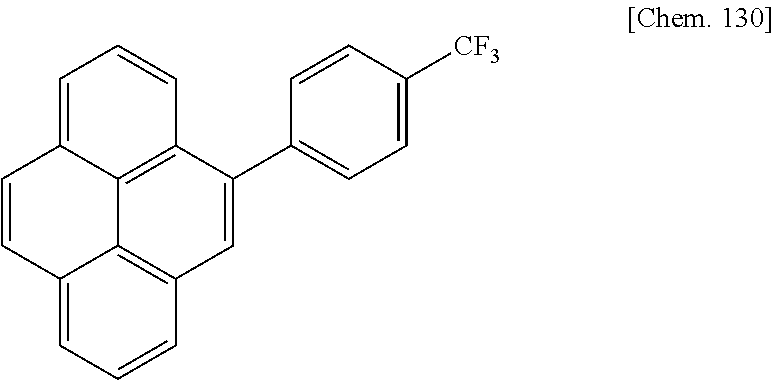
was obtained.

was used as a boron compound. As a result, 4-(4-n-butylphenyl)pyrene (2d) represented by the formula below:

was obtained.

was used as a boron compound. As a result, 4-(2-chlorophenyl)pyrene (2e) represented by the formula below:

was obtained.

was used as a boron compound. As a result, 4-[2-(trifluoromethyl)phenyl]pyrene (2f) represented by the formula below:

was obtained.

was used as a boron compound. As a result, 4-(2-methylphenyl)pyrene (2g) represented by the formula below:

was obtained.

was used as a boron compound. As a result, 4-(2,4,6-trimethylphenyl)pyrene (2h) represented by the formula below:

was obtained.

was used as a boron compound. As a result, 4-(naphthalen-1-yl)pyrene (21) represented by the formula below:

was obtained.


and a boron compound (0.13 mmol, 0.67 equivalents) represented by the formula below:

were introduced into 1,2-dichloroethane (1,2-DCE, 2.0 mL), and the mixture was stirred for 2 hours at 80° C. The reaction product was filtered using a silica gel (eluent: CH2Cl2, 50 mL), and the volatile substance was removed under reduced pressure. The residue was purified by PTLC (eluent: hexane). As a result, 2,7-di-tart-butyl-4-phenyl pyrene (3a) represented by the formula below:

was obtained.

was used as a boron compound. As a result, 2,7-di-tert-butyl-4-(2-chlorophenyl)pyrene (3e) represented by the formula below:

was obtained.

was used as a boron compound. As a result, 2,7-di-tert-butyl-4-(2,4,6-trimethylphenyl)pyrene (3h) represented by the formula below:

was obtained.


and a boron compound (0.20 mmol, 1 equivalent) represented by the formula below:

were introduced into 1,2-dichloroethane (1,2-DCE, 3.0 mL), and the mixture was stirred for 12 hours at 80° C. The reaction product was filtered using a silica gel (eluent: CH2Cl2, 50 mL), and the volatile substance was removed under reduced pressure. The residue was purified by PTLC (eluent: hexane). As a result, 2,7-di-tert-butyl-4,9-di-phenyl pyrene and 2,7-di-tert-butyl-4,10-di-phenyl pyrene (4a) represented by the formula below:

were obtained.

was used as a boron compound. As a result, 2,7-di-tert-butyl-4,9-bis(2-chlorophenyl)pyrene and 2,7-di-tert-butyl-4,10-bis(2-chlorophenyl)pyrene (4e) represented by the formula below:

were obtained.

was used as a boron compound. As a result, 2,7-di-tert-butyl-4,9-bis(2,4,6-trimethylphenyl)pyrene and 2,7-di-tert-butyl-4,10-bis(2,4,6-trimethylphenyl)pyrene (4h) represented by the formula below:

(tBu indicates a t-butyl group. Me indicates a methyl group.)
were obtained.


and a boron compound (0.13 mol, 0.67 equivalents) represented by the formula below:

were introduced into 1,2-dichloroethane (1,2-DCE, 1.0 mL), and the mixture was stirred for 12 hours at 80° C. The reaction product was filtered using a silica gel (eluent: CH2Cl2, 50 mL), and the volatile substance was removed under reduced pressure. The residue was purified by PTLC (eluent: hexane). As a result, 9-phenyl phenanthrene (5a) represented by the formula below:

was obtained.

was used as a boron compound. As a result, 9-(2-chlorophenyl)phenanthrene (5e) represented by the formula below:

was obtained.

was used as a boron compound. As a result, 9-[2-(trifluoromethyl)phenyl]phenanthrene (5f) represented by the formula below:

was obtained.


and a boron compound (64 mg, 0.12 mmol, 0.6 equivalents) represented by the formula below:

were introduced into 1,2-dichloroethane (1,2-DCE, 2.0 mL), and the mixture was stirred for 12 hours at 80° C. The reaction product was filtered using a silica gel (eluent: CH2Cl2. 50 mL), and the volatile substance was removed under reduced pressure. The residue was purified by PTLC (eluent: hexane/CH2Cl2=10:1). As a result, 46 mg of 9-(o-biphenyl)phenyl phenanthrene represented by the formula below:


was obtained (14 mg, yield: 60% in two steps). Spectral data of dibenzo[g,p]chrysene(7) have been reported from Liu et al. (Li, C.-W.; Wang, C.-I.; Liao, H.-Y.; Chaudhuri, R.; Liu, R.-S. J. Org. Chem. 2007, 72, 9203).


and a boron compound (64 mg, 0.12 mmol, 0.6 equivalents) represented by the formula below:

were introduced into 1,2-dichloroethane (1,2-DCE, 2.0 mL), and the mixture was stirred for 12 hours at 80° C. The reaction product was filtered using a silica gel (eluent: CH2Cl2, 50 mL), and the volatile substance was removed under reduced pressure. The residue was purified by PTLC (eluent: hexane/CH2Cl2=10:1). As a result, biphenylated benzo[a]anthracene was obtained as a mixture of position isomers (43 mg, yield 57% in total).

was obtained (4 mg, yield: 12% in two steps).


and a boron compound (1.7 g, 7.0 mmol, 1 equivalent) represented by the formula below:

were introduced into 1,2-dichloroethane (1,2-DCE, 30 mL), and the mixture was stirred for 2 hours at 80° C. The reaction product was filtered using a silica gel (eluent: CH2Cl2, 100 mL), and the volatile substance was removed under reduced pressure. The residue was purified by PTLC (eluent: hexane/CH2Cl2=9:1). As a result, 2,7-di-tert-butylpyrene diarylated with biphenyl was obtained as a mixture of position isomers (1.4 g, yield: 73%).

was obtained (1.2 g, yield: 60% in two steps).


and a boron compound (54 mg, 0.10 enol, 1 equivalent) represented by the formula below:

were introduced into 1,2-dichloroethane (1,2-DCE, 1.0 mL), and the mixture was stirred for 12 hours at 80° C. The reaction product was filtered using a silica gel (eluent: CH2Cl2, 50 mL), and the volatile substance was removed under reduced pressure. The residue was purified by PTLC (eluent: hexane/CH2Cl2=10:1). As a result, 2,7-di-tert-butylpyrene diarylated with biphenyl was obtained as a mixture of position isomers (31 mg, yield: 82%).

was obtained (12 mg, yield: 82% in two steps)
| TABLE 4 | |||
| 2a | 2h | 8 | |
| formula | C22H14 | C25H20 | C30H18 |
| fw | 278.33 | 320.41 | 378.44 |
| T (K) | 103(2) | 103(2) | 103(2) |
| λ (Å) | 0.7107 | 0.7107 | 0.7107 |
| cryst syst | Triclinic | Monoclinic | Triclinic |
| space group | P-1 | P21/c | P-1 |
| a, (Å) | 5.739(3) | 7.910(3) | 3.9020(15) |
| b, (Å) | 10.226(6) | 29.258(11) | 12.153(5) |
| c, (Å) | 12.543(7) | 8.208(3) | 19.400(8) |
| α, (deg | 82.33(2) | 90 | 85.547(12) |
| β, (deg | 77.27(2) | 111.797(6) | 85.134(11) |
| γ, (deg | 75.35(2) | 90 | 78.235(12) |
| V, (Å3) | 692.2(6) | 1763.8(12) | 895.7(6) |
| Z | 2 | 4 | 2 |
| Dcalc, (g/cm3) | 1.335 | 1.207 | 1.403 |
| μ (mm−1) | 0.076 | 0.068 | 0.080 |
| F(000) | 292 | 680 | 396 |
| cryst size (mm) | 0.10 × 0.10 × | 0.10 × 0.05 × | 0.10 × 0.02 × |
| 0.02 | 0.05 | 0.02 | |
| 2 θ range, (deg | 3.34-25.00 | 3.10-25.00 | 3.43-25.00 |
| reflns collected | 6990 | 11789 | 6035 |
| indep reflns/Rint | 2425/0.0488 | 3082/0.0759 | 3107/0.0393 |
| params | 199 | 229 | 271 |
| GOF on F2 | 1.072 | 1.050 | 1.061 |
| R1, wR2 [1 > 2 σ (l)] | 0.0599, 0.1337 | 0.0664, 0.1331 | 0.0564, 0.1211 |
| R1, wR2 (all data) | 0.0935, 0.1552 | 0.1193, 0.1555 | 0.0954, 0.1419 |


were introduced into mesitylene (1.0 mL, 36 equivalents) represented by the formula below:

and the mixture was stirred for 14 hours at 50° C. The reaction product was filtered using a silica gel (eluent: CH2Cl2, 50 mL), and the volatile substance was removed under reduced pressure. The residue was purified by PTLC (hexane/CH2Cl2=10:1). As a result, 28 mg of 4-(2,4,6-trimethylphenyl)pyrene (2h) represented by the formula below:

was obtained at a yield of 44%.

was used in place of pyrene. As a result, 49 mg of 2,7-di-tert-butyl 4-(2,4,6-trimethylphenyl)pyrene (3h) represented by the formula below:

was obtained at a yield of 57%.


and a boron compound (0.13 mmol, 0.67 equivalents) represented by the formula below:

were introduced into dry 1,2-dichloroethane (1,2-DCE, 1.0 mL), and the mixture was stirred for 2 hours at 80° C. After cooling to room temperature, the reaction product was filtered using a silica gel (eluent: CH2Cl2, 50 mL). The regioselectivity was determined by the GC analysis of the filtrate using n-dodecane as an inner standard. The volatile substance was removed under reduced pressure, and the residue was purified by PTLC (main eluent: hexane). As a result, 27.6 mg of 3-phenylfluoranthene represented by the formula below:

was obtained at a yield of 50% and a selectivity of 88%.

was used as a boron compound. Thus, 28.6 mg of 3-(o-toluoyl)fluoranthene represented by the formula below:

was obtained at a yield of 49% and a selectivity of 98%.

was used as a boron compound. Thus, 58.4 mg of 3-mesityl fluoranthene represented by the formula below:

was obtained at a yield of 71% and a selectivity of 99% or more.

was used as a boron compound, and an eluent for PTLC was changed to hexane/ethyl acetate-19:1. Thus, 26.1 mg of 3-(2-methoxyphenyl)fluoranthene represented by the formula below:

was obtained at a yield of 42% and a selectivity of 97%.

was used as a boron compound, and an eluent for PTLC was changed to hexane/ethyl acetate-19:1. Thus, 24.6 mg of 3-(4-methoxyphenyl)fluoranthene represented by the formula below:

was obtained at a yield of 40% and a selectivity of 78%.

was used as a boron compound. Thus, 39.3 mg of 3-[2-(trifluoromethyl)phenyl]fluoranthene represented by the formula below:

was obtained at a yield of 57% and a selectivity of 99%.

was used as a boron compound. Thus, 29.5 mg of 3-[4-(trifluoromethyl)phenyl]fluoranthene represented by the formula below:

was obtained at a yield of 43% and a selectivity of 86%.

was used as a boron compound. Thus, 23.6 mg of 3-(2-chlorophenyl)fluoranthene represented by the formula below:

was obtained at a yield of 38% and a selectivity of 94%.

was used as a boron compound. Thus, 29.2 mg of 3-(4-chlorophenyl)fluoranthene represented by the formula below:

was obtained at a yield of 47% and a selectivity of 88%.

was used as a boron compound. Thus, 13.1 mg of 3-(naphthalen-1-yl)fluoranthene represented by the formula below:

was obtained at a yield of 20% and a selectivity of 92%.

was used as a boron compound, and a silver compound was not used. Thus, 3-phenylfluoranthene was obtained at a yield of 28% and a selectivity of 92%.

was used as a boron compound. Thus, 3-phenylfluoranthene was obtained at a yield of 36% and a selectivity of 92%.

was used as a boron compound. Thus, 3-phenylfluoranthene was obtained at a yield of 50% and a selectivity of 90%.

was obtained. The details are described below.

were introduced into mesitylene (1.0 mL, 7.2 mmol, 36 equivalents) represented by the formula below:

and the mixture was stirred for 14 hours at 50° C. After cooling to room temperature, the reaction product was filtered using a silica gel (eluent: CH2Cl2, 50 mL), and the volatile substance was removed under reduced pressure. The residue was purified by PTLC (eluent: hexane). As a result, 47.7 mg of 3-mesityl fluoranthene represented by the formula below:

was obtained at a yield of 74%.

was obtained. The details are described below.

and naphthalene (256 mg, 2.0 mmol, 20 equivalents) were introduced into dry 1,2-dichloroethane (1,2-DCE, 200 μL), and the mixture was stirred for 12 hours at 80° C. After cooling to room temperature, the reaction product was filtered using a silica gel (eluent: CH2Cl2, 50 mL), and the volatile substance was removed under reduced pressure. The residue was purified by PTLC (eluent: hexane). As a result, 3.3 mg of 3-(naphthalen-1-yl)fluoranthene represented by the formula below:

was obtained at a yield of 10%.


was obtained at a yield of 17% as an orange solid.
| TABLE 5 | ||||
| 3-(Naphthalen-1- | ||||
| 3-Phenylfluoranthene | yl)fluoranthene | |||
| formula | C22H14 | C26H16 | ||
| fw | 278.33 | 328.39 | ||
| T (K) | 103(2) | 103(2) | ||
| λ (Å) | 0.7107 | 0.7107 | ||
| cryst syst | Orthorhombic | Monoclinic | ||
| space group | P212121 | P21/a | ||
| a, (Å) | 7.521(2) | 9.587(4) | ||
| b, (Å) | 16.456(5) | 6.368(2) | ||
| c, (Å) | 23.063(7) | 27.417(11) | ||
| α, (deg) | 90 | 90 | ||
| β, (deg) | 90 | 96.254(6) | ||
| γ, (deg) | 90 | 90 | ||
| V, (Å3) | 2854.6(14) | 1663.7(11) | ||
| Z | 8 | 4 | ||
| Dcalc, (g/cm3) | 1.295 | 1.311 | ||
| μ (mm−1) | 0.073 | 0.074 | ||
| F(000) | 1168 | 688 | ||
| cryst size (mm) | 020 × 0.05 × 0.01 | 0.10 × 0.05 × 0.01 | ||
| 2 θ range, (deg) | 3.04-25.00 | 3.29-25.00 | ||
| reflns collected | 19297 | 10557 | ||
| indep reflns/Rint | 5005/0.1296 | 2926/0.0983 | ||
| params | 397 | 235 | ||
| GOF on F2 | 1.074 | 1.040 | ||
| R1, wR2 [l > 2 σ (l)] | 0.0974, 0.2133 | 0.0909, 0.2140 | ||
| R1, wR2 (all data) | 0.1377, 0.2403 | 0.1623, 0.2694 | ||

phenylperylene, di-phenylperylene, triphenylperylene, and tetraphenylperylene were obtained. The details are described below.

and a boron compound (311 mg, 1.0 mmol, 1.0 equivalent) represented by the formula below:

were introduced into dry 1,2-dichloroethane (1,2-DCE, 20 mL). The mixture was stirred for 2 hours at 80° C. After cooling to room temperature, the reaction product was filtered using a silica gel (eluent: CH2Cl2, 100 mL). After the filtrate was evaporated, the residue was purified by silica gel column chromatography (eluent: hexane/CH2Cl2=100/0 to 85/15) to obtain 56.2 mg of 3-phenylperylene at a yield of 17%, 97.5 mg of di-phenylperylene at a yield of 24%, 54.2 mg of 3,4,9-triphenylperylene at a yield of 11%, and 3.7 mg of tetraphenylperylene at a yield of 0.7%.
| TABLE 6 | |||
| Absorption | Fluorescence | ||
| ε | λ max | λ em | luminescent | ||
| [M−1cm−1] | [nm] | [nm] | φF | color | |
| Perylene | 34000 | 438 | 448 | 0.89 | Blue |
| Triphenyl- | 37000 | 473 | 500 | 0.93 | Green |
| perylene | |||||
| Tetraphenyl- | 42000 | 486 | 520 | 0.93 | Green |
| perylene | |||||
Claims (14)


Applications Claiming Priority (3)
| Application Number | Priority Date | Filing Date | Title |
|---|---|---|---|
| JP2011-130547 | 2011-06-10 | ||
| JP2011130547 | 2011-06-10 | ||
| PCT/JP2012/064845 WO2012169635A1 (en) | 2011-06-10 | 2012-06-08 | Method for producing polycyclic aromatic compound substituted by aryl group |
Publications (2)
| Publication Number | Publication Date |
|---|---|
| US20140206908A1 US20140206908A1 (en) | 2014-07-24 |
| US9056822B2 true US9056822B2 (en) | 2015-06-16 |
Family
ID=47296187
Family Applications (1)
| Application Number | Title | Priority Date | Filing Date |
|---|---|---|---|
| US14/125,119 Expired - Fee Related US9056822B2 (en) | 2011-06-10 | 2012-06-08 | Method for producing polycyclic aromatic compound substituted by aryl group |
Country Status (5)
| Country | Link |
|---|---|
| US (1) | US9056822B2 (en) |
| EP (1) | EP2730554A4 (en) |
| JP (1) | JP5988051B2 (en) |
| CN (1) | CN103649024B (en) |
| WO (1) | WO2012169635A1 (en) |
Cited By (1)
| Publication number | Priority date | Publication date | Assignee | Title |
|---|---|---|---|---|
| CN107585753A (en) * | 2017-08-23 | 2018-01-16 | 杭州万杵材料科技有限公司 | A kind of production method of big size graphene material |
Families Citing this family (10)
| Publication number | Priority date | Publication date | Assignee | Title |
|---|---|---|---|---|
| JPWO2012017680A1 (en) | 2010-08-05 | 2013-10-03 | 出光興産株式会社 | Organic electroluminescence device |
| CN104583161B (en) * | 2012-08-30 | 2016-12-14 | 巴斯夫欧洲公司 | The naphthalene prepared as the convenience of the construction unit of organic electronic material and dyestuff and derivant |
| CN104326869B (en) * | 2014-10-28 | 2016-03-09 | 常州大学 | The chloro-2-bromobenzene of a kind of synthesis 1-method that also [9,10] are luxuriant and rich with fragrance |
| JP6843758B2 (en) * | 2015-03-19 | 2021-03-17 | ボード オブ リージェンツ オブ ザ ネヴァダ システム オブ ハイヤー エデュケーション オン ビハーフ オブ ザ ユニヴァーシティー オブ ネヴァダ リノ | Aryl compounds and polymers and methods for producing and using them |
| JP2018184393A (en) * | 2017-04-24 | 2018-11-22 | 東ソー株式会社 | Fused ring compound and process for producing the same |
| JP2020172584A (en) * | 2019-04-10 | 2020-10-22 | 帝人株式会社 | Method for manufacturing modified polymer |
| JP7455190B2 (en) * | 2020-03-19 | 2024-03-25 | 帝人株式会社 | Polycyclic aromatic hydrocarbon compound, its crystal and its manufacturing method |
| EP4192504A4 (en) * | 2020-08-07 | 2025-04-16 | Cornell University | Therapeutic cure-pro compounds for targeted degradation of bet domain proteins, and methods of making and using them |
| JPWO2022250087A1 (en) * | 2021-05-25 | 2022-12-01 | ||
| CN116854553B (en) * | 2022-03-28 | 2025-07-22 | 武汉大学 | Synthesis method of phenanthrene compound |
Citations (11)
| Publication number | Priority date | Publication date | Assignee | Title |
|---|---|---|---|---|
| JPH10189248A (en) | 1996-11-07 | 1998-07-21 | Mitsui Chem Inc | Organic electroluminescent element |
| WO2004018587A1 (en) | 2002-08-23 | 2004-03-04 | Idemitsu Kosan Co., Ltd. | Organic electroluminescence device and anthracene derivative |
| US20040076853A1 (en) | 2002-04-24 | 2004-04-22 | Eastman Kodak Company | Organic light-emitting diode devices with improved operational stability |
| JP2008270397A (en) | 2007-04-18 | 2008-11-06 | Mitsui Chemicals Inc | Organic transistor |
| JP2009016693A (en) | 2007-07-07 | 2009-01-22 | Idemitsu Kosan Co Ltd | Host material and organic EL element |
| US20100048904A1 (en) | 2006-05-30 | 2010-02-25 | Martin Koenemann | Dibenzorylenetetracarboximides as infrared absorbers |
| US20100187505A1 (en) | 2007-05-29 | 2010-07-29 | Philipp Stoessel | Benzanthracene derivatives for organic electroluminescent devices |
| JP2010222268A (en) | 2009-03-19 | 2010-10-07 | Mitsui Chemicals Inc | Aromatic amine derivatives and organic electroluminescent devices using them |
| JP2010222261A (en) | 2009-03-19 | 2010-10-07 | Mitsui Chemicals Inc | Aromatic amine derivatives and organic electroluminescent devices using them |
| US20100258791A1 (en) | 2009-04-06 | 2010-10-14 | Idemitsu Kosan Co., Ltd. | Organic electroluminescence device and material for organic electroluminescence device |
| JP2010238924A (en) | 2009-03-31 | 2010-10-21 | Idemitsu Kosan Co Ltd | Benzofluoranthene compound and organic thin film solar cell using the same |
Family Cites Families (1)
| Publication number | Priority date | Publication date | Assignee | Title |
|---|---|---|---|---|
| DE10159946A1 (en) * | 2001-12-06 | 2003-06-18 | Covion Organic Semiconductors | Process for the production of aryl-aryl coupled compounds |
-
2012
- 2012-06-08 US US14/125,119 patent/US9056822B2/en not_active Expired - Fee Related
- 2012-06-08 WO PCT/JP2012/064845 patent/WO2012169635A1/en not_active Ceased
- 2012-06-08 EP EP12797336.0A patent/EP2730554A4/en not_active Withdrawn
- 2012-06-08 JP JP2013519551A patent/JP5988051B2/en not_active Expired - Fee Related
- 2012-06-08 CN CN201280027991.1A patent/CN103649024B/en not_active Expired - Fee Related
Patent Citations (12)
| Publication number | Priority date | Publication date | Assignee | Title |
|---|---|---|---|---|
| JPH10189248A (en) | 1996-11-07 | 1998-07-21 | Mitsui Chem Inc | Organic electroluminescent element |
| US20040076853A1 (en) | 2002-04-24 | 2004-04-22 | Eastman Kodak Company | Organic light-emitting diode devices with improved operational stability |
| WO2004018587A1 (en) | 2002-08-23 | 2004-03-04 | Idemitsu Kosan Co., Ltd. | Organic electroluminescence device and anthracene derivative |
| US20060043858A1 (en) | 2002-08-23 | 2006-03-02 | Idemitsu Kosan Co., Ltd. | Organic electroluminescence device and anthracene derivative |
| US20100048904A1 (en) | 2006-05-30 | 2010-02-25 | Martin Koenemann | Dibenzorylenetetracarboximides as infrared absorbers |
| JP2008270397A (en) | 2007-04-18 | 2008-11-06 | Mitsui Chemicals Inc | Organic transistor |
| US20100187505A1 (en) | 2007-05-29 | 2010-07-29 | Philipp Stoessel | Benzanthracene derivatives for organic electroluminescent devices |
| JP2009016693A (en) | 2007-07-07 | 2009-01-22 | Idemitsu Kosan Co Ltd | Host material and organic EL element |
| JP2010222268A (en) | 2009-03-19 | 2010-10-07 | Mitsui Chemicals Inc | Aromatic amine derivatives and organic electroluminescent devices using them |
| JP2010222261A (en) | 2009-03-19 | 2010-10-07 | Mitsui Chemicals Inc | Aromatic amine derivatives and organic electroluminescent devices using them |
| JP2010238924A (en) | 2009-03-31 | 2010-10-21 | Idemitsu Kosan Co Ltd | Benzofluoranthene compound and organic thin film solar cell using the same |
| US20100258791A1 (en) | 2009-04-06 | 2010-10-14 | Idemitsu Kosan Co., Ltd. | Organic electroluminescence device and material for organic electroluminescence device |
Non-Patent Citations (17)
| Title |
|---|
| Abdelaziz Jouaiti et al., "Molecular Tectonics: Design of 1-D Coordination Networks Based on Pyrene Bearing Pyrazolyl Units" European Journal of Inorganic Chemistry, 2003, No. 1, pp. 57- 61, Scheme 1. |
| Chemical Abstracts, 1951, vol. 45, No. 16, the abstract No. 7094e-i, 7095a and a cover page. |
| Domingo Garcia-Cuadrado et al., "Proton Abstraction Mechanism for the Palladium-Catalyzed Intramolecular Arylation," Journal of the American Chemical Society, 2006, vol. 128, pp. 1066-1067, Table 1. |
| Hiroshi Kawai et al., "Direct C-H bond arylation of arenes with aryltin reagents catalysed by palladium complexes," Chemical Communications, 2008, vol. 12, pp. 1464-1466. |
| Hiroto Yoshida et al., "Platinum-catalysed diborylation of arynes: synthesis and reaction of 1,2-diborylarenes," Chemical Communications, 2010, vol. 46, No. 10, pp. 1763-1765. |
| International Search Report dated Aug. 7, 2012 and Written Opinion, issued for PCT/JP2012/064845. |
| Kami L. Hull et al., "Catalytic and Highly Regioselective Cross-Coupling of Aromatic C-H Substrates," Journal of American Chemical Society, vol. 129, pp. 11904-11905, (2007). |
| Katsuaki Kawasumi et al., "Pd-catalyzed C-H/C-B Arylation of Polycyclic Aromatic Hydrocarbons," The 91st CSJ(the Chemical Society of Japan) Annual Meeting 2011, KoenYokoshu, 2011, p. 1437, 1 C9-44 and cover pages. |
| Kenji Mochida et al., "Direct Arylation of Polycyclic Aromatic Hydrocarbons through Palladium Catalysis," Journal of the American Chemical Society, 2011, vol. 133, pp. 10716-10719. |
| Kenji Mochida et al., "Pd-catalyzed C-H/C-H Arylation of Polycyclic Aromatic Hydrocarbons," The 91st CSJ(the Chemical Society of Japan) Annual Meeting 2011, KoenYokoshu, 2011, p. 1436, 1C9-43 and cover pages. |
| Lutz Ackermann et al., "Transition-Metal-Catalyzed Direct Arylation of (Hetero)Arenes by C-H Bond Cleavage," Angewandte Chemie International Edition, 2009, vol. 48, No. 51, pp. 9792-9826. |
| Supplementary European search report dated Mar. 13, 2015 for EP Patent Application No. 12797336.0. |
| Takanori Matsuda et al., "Synthesis of Pyrenes by Twofold Hydroarylation of 2,6-Dialkynylbiphenyls," Chemistry Letters, 2011, vol. 40, pp. 40-41. |
| Ute Anton et al., "Synthesis of n-Alkyl-Substituted Perylenes and Terrylenes via Alkali-Metal Induced Cyclization of Oligonaphthylenes," Chemische Berichte, 1992, vol. 125, No. 10, pp. 2325-2330. |
| Xiao Chen et al., "Palladium(II)-Catalyzed C-H Activation/C-C Cross Coupling Reactions: Versatility and Practicality," Angewandte Chemie International Edition, 2009, vol. 48, No. 28, pp. 5094-5115. |
| Ying Rong et al., "Palladium(II)-Catalyzed Coupling of p-Xylene via Regioselective C-H Activation in TFA," Organometallics, vol. 26, No. 18, Aug. 1, 2007, pp. 4376-4378. |
| Zong-Fan Duan et al., "A Novel Thiophene-Fused Polycyclic Aromatic with a Tetracene Core: Synthesis, Characterization, Optical and Electrochemical Properties," Molecules, 2011, vol. 16, pp. 4467-4481, Scheme 1. |
Cited By (1)
| Publication number | Priority date | Publication date | Assignee | Title |
|---|---|---|---|---|
| CN107585753A (en) * | 2017-08-23 | 2018-01-16 | 杭州万杵材料科技有限公司 | A kind of production method of big size graphene material |
Also Published As
| Publication number | Publication date |
|---|---|
| JP5988051B2 (en) | 2016-09-14 |
| US20140206908A1 (en) | 2014-07-24 |
| CN103649024A (en) | 2014-03-19 |
| JPWO2012169635A1 (en) | 2015-04-30 |
| CN103649024B (en) | 2016-08-17 |
| EP2730554A4 (en) | 2015-04-15 |
| EP2730554A1 (en) | 2014-05-14 |
| WO2012169635A1 (en) | 2012-12-13 |
Similar Documents
| Publication | Publication Date | Title |
|---|---|---|
| US20140206908A1 (en) | Method for producing polycyclic aromatic compound substituted by aryl group | |
| US11643414B2 (en) | Materials for organic electroluminescent devices | |
| EP2778160B1 (en) | Cyclic azine compound having nitrogen-containing fused aromatic group, method for producing same, and organic electroluminescent element using same as constituent component | |
| US8158835B2 (en) | Fluorene compound and organic electroluminescence device | |
| US11201290B2 (en) | Tetraphenylene anthracene compounds | |
| US7723520B2 (en) | Red electroluminescent compounds and organic electroluminescent device using the same | |
| US20210115069A1 (en) | Organic luminescent material having an ancillary ligand with a partially fluorine-substituted substituent | |
| US12398150B2 (en) | Organic electroluminescent material and device thereof | |
| US20200277283A1 (en) | Organic electroluminescent materials and devices | |
| US20170279050A1 (en) | Compound and organic electronic device using the same | |
| CN111187228B (en) | Organic electronic material based on phenanthrene and benzonitrile and application thereof | |
| US20190109284A1 (en) | Crosslinkable deuterated charge transporting compound, an organic electroluminescent device comprising the compound, and a solution formulation | |
| CN113429302A (en) | Naphthofluorene derivative, luminescent material, luminescent element and consumer product | |
| JP2009158582A (en) | Organic electroluminescence device | |
| CN117105795B (en) | Aromatic amine derivative and organic electroluminescent device thereof | |
| JP4674454B2 (en) | Organic light emitting material and organic electroluminescent device | |
| CN115322215B (en) | A method for synthesizing silicon-containing electron transport materials | |
| JP2016181556A (en) | Compound for organic electroluminescent element and organic electroluminescent element using the same | |
| US10164194B2 (en) | Compound for organic electroluminescent device | |
| JP4646157B2 (en) | Organic electroluminescent material and device using the same | |
| JP2012092047A (en) | Pyrazoloindole compound, and organic light emitting element employing the same | |
| CN114094023B (en) | Organic electroluminescent element containing compound based on tribenzotriindene | |
| KR20160045569A (en) | Delayed fluorescence compound, and Organic light emitting diode device and Display device using the same | |
| CN117024430B (en) | Bipyrimidine fluorene compound, organic electroluminescent element and consumer product | |
| US20090160326A1 (en) | Organic electroluminescence material and element using the same |
Legal Events
| Date | Code | Title | Description |
|---|---|---|---|
| AS | Assignment |
Owner name: NATIONAL UNIVERSITY CORPORATION NAGOYA UNIVERSITY, Free format text: ASSIGNMENT OF ASSIGNORS INTEREST;ASSIGNORS:ITAMI, KENICHIRO;MOCHIDA, KENJI;KAWASUMI, KATSUAKI;AND OTHERS;SIGNING DATES FROM 20131119 TO 20131129;REEL/FRAME:032367/0326 |
|
| STCF | Information on status: patent grant |
Free format text: PATENTED CASE |
|
| FEPP | Fee payment procedure |
Free format text: MAINTENANCE FEE REMINDER MAILED (ORIGINAL EVENT CODE: REM.); ENTITY STATUS OF PATENT OWNER: SMALL ENTITY |
|
| LAPS | Lapse for failure to pay maintenance fees |
Free format text: PATENT EXPIRED FOR FAILURE TO PAY MAINTENANCE FEES (ORIGINAL EVENT CODE: EXP.); ENTITY STATUS OF PATENT OWNER: SMALL ENTITY |
|
| STCH | Information on status: patent discontinuation |
Free format text: PATENT EXPIRED DUE TO NONPAYMENT OF MAINTENANCE FEES UNDER 37 CFR 1.362 |
|
| FP | Lapsed due to failure to pay maintenance fee |
Effective date: 20190616 |