US9055099B2 - Method of preventing TCP-based denial-of-service attacks on mobile devices - Google Patents
Method of preventing TCP-based denial-of-service attacks on mobile devices Download PDFInfo
- Publication number
- US9055099B2 US9055099B2 US12/672,408 US67240810A US9055099B2 US 9055099 B2 US9055099 B2 US 9055099B2 US 67240810 A US67240810 A US 67240810A US 9055099 B2 US9055099 B2 US 9055099B2
- Authority
- US
- United States
- Prior art keywords
- packet
- mobile device
- tcp
- base station
- syn
- Prior art date
- Legal status (The legal status is an assumption and is not a legal conclusion. Google has not performed a legal analysis and makes no representation as to the accuracy of the status listed.)
- Expired - Fee Related, expires
Links
Images




Classifications
-
- H—ELECTRICITY
- H04—ELECTRIC COMMUNICATION TECHNIQUE
- H04L—TRANSMISSION OF DIGITAL INFORMATION, e.g. TELEGRAPHIC COMMUNICATION
- H04L63/00—Network architectures or network communication protocols for network security
- H04L63/14—Network architectures or network communication protocols for network security for detecting or protecting against malicious traffic
- H04L63/1441—Countermeasures against malicious traffic
- H04L63/1458—Denial of Service
-
- H—ELECTRICITY
- H04—ELECTRIC COMMUNICATION TECHNIQUE
- H04W—WIRELESS COMMUNICATION NETWORKS
- H04W12/00—Security arrangements; Authentication; Protecting privacy or anonymity
- H04W12/12—Detection or prevention of fraud
-
- H—ELECTRICITY
- H04—ELECTRIC COMMUNICATION TECHNIQUE
- H04W—WIRELESS COMMUNICATION NETWORKS
- H04W12/00—Security arrangements; Authentication; Protecting privacy or anonymity
- H04W12/12—Detection or prevention of fraud
- H04W12/126—Anti-theft arrangements, e.g. protection against subscriber identity module [SIM] cloning
-
- H—ELECTRICITY
- H04—ELECTRIC COMMUNICATION TECHNIQUE
- H04L—TRANSMISSION OF DIGITAL INFORMATION, e.g. TELEGRAPHIC COMMUNICATION
- H04L69/00—Network arrangements, protocols or services independent of the application payload and not provided for in the other groups of this subclass
- H04L69/16—Implementation or adaptation of Internet protocol [IP], of transmission control protocol [TCP] or of user datagram protocol [UDP]
-
- Y—GENERAL TAGGING OF NEW TECHNOLOGICAL DEVELOPMENTS; GENERAL TAGGING OF CROSS-SECTIONAL TECHNOLOGIES SPANNING OVER SEVERAL SECTIONS OF THE IPC; TECHNICAL SUBJECTS COVERED BY FORMER USPC CROSS-REFERENCE ART COLLECTIONS [XRACs] AND DIGESTS
- Y02—TECHNOLOGIES OR APPLICATIONS FOR MITIGATION OR ADAPTATION AGAINST CLIMATE CHANGE
- Y02D—CLIMATE CHANGE MITIGATION TECHNOLOGIES IN INFORMATION AND COMMUNICATION TECHNOLOGIES [ICT], I.E. INFORMATION AND COMMUNICATION TECHNOLOGIES AIMING AT THE REDUCTION OF THEIR OWN ENERGY USE
- Y02D30/00—Reducing energy consumption in communication networks
- Y02D30/70—Reducing energy consumption in communication networks in wireless communication networks
Definitions
- the present invention relates to a method of preventing a Transmission Control Protocol (TCP)-based Denial of Service (DoS) attack on a mobile device, and more particularly, to a method of efficiently preventing a DoS attack on a mobile device, which wirelessly and constantly transmits TCP packets to the mobile device using a TCP protocol and thereby exhausts resources of a wireless network and battery power of the mobile device depending on a battery.
- TCP Transmission Control Protocol
- DoS Denial of Service
- FIG. 1 is an overall conceptual diagram for describing a general state transition operation, and illustrates an entire standard finite state machine used to better describe the TCP protocol for establishing and terminating a TCP connection. In FIG. 1 , all states and transitions are illustrated for reliability.
- TCP connection states are defined below.
- LISTEN a state in which a daemon of a server is executed and waits for a connection request.
- SYN_SENT a state in which a local client application has requested a remote host for connection.
- SYN_RCVD a state in which a server has received a connection request from a remote client, has replied to the client, but has not yet received an acknowledgement message.
- ESTABLISHED a state in which a server and a client are connected with each other after three-way handshaking is completed.
- FIN_WAIT — 1 states in which a server requests a client to terminate a connection, receives a reply, and terminates the connection.
- CLOSING an uncommon state in which an acknowledgement message is lost during transfer.
- TIME_WAIT a state in which a socket is open for a while for a slow segment that might have been lost although a connection is terminated.
- CLOSED a state in which a connection is completely terminated.
- the three-way handshaking procedure must be performed to establish a TCP connection between a client and a server.
- connection request (synchronous SYN), connection request/acknowledgement (synchronous/acknowledge SYN/ACK), and acknowledgement (acknowledge ACK) packets must be transmitted and received so that a client performs TCP communication with a server.
- connection request SYN connection request/acknowledge SYN/ACK
- acknowledge ACK acknowledge ACK
- Such a conventional TCP state transition shows what state of a TCP stack the TCP state transition is in according to the flag of a packet.
- an incoming packet is not thoroughly verified, and thus abuse of such vulnerability frequently occurs.
- an attack abusing the three-way handshaking procedure e.g., a DoS attack such as SYN flooding
- a DoS attack such as SYN flooding
- the entire above-described TCP state transition may or may not be supported according to an operating system installed in a mobile device.
- an initial three-way handshaking step there is no checking process for performing the entire TCP state transition suggested by the TCP specification. Therefore, when a network connection is attempted by a SYN flooding attack frequently used as a TCP-based DoS attack upon a mobile device that is mostly in a dormant state to save energy, the mobile device switches to an awake state and consumes energy.
- a packet transmitted to a mobile device may constantly attempt a connection to the mobile device and awake the same. In this case, resources of a wireless line are occupied, and also battery power of the mobile device is wasted.
- the present invention is directed to a method of efficiently preventing a Denial of Service (DoS) attack on a mobile device, which wirelessly and constantly transmits Transmission Control Protocol (TCP) packets to the mobile device using a TCP protocol and thereby exhausts resources of a wireless network and also battery power of the mobile device depending on a battery.
- DoS Denial of Service
- TCP Transmission Control Protocol
- a first aspect of the present invention provides a method of preventing a Denial of Service (DoS) attack by checking flow of packets transmitted between a base station and a mobile device using a Transmission Control Protocol (TCP) protocol, the method comprising the steps of: when the base station transmits a connection request SYN packet for a TCP connection to the mobile device, and then the mobile device receives the transmitted connection request SYN packet, transmitting, at the mobile device, a connection request acknowledgement SYN/ACK — 1 packet to the base station; when the transmitted connection request acknowledgement SYN/ACK — 1 packet is received, transmitting, at the base station, an acknowledgement ACK — 2 packet corresponding to the connection request acknowledgement SYN/ACK — 1 packet to the mobile device; when the mobile device receives the transmitted acknowledgement ACK — 2 packet, establishing the TCP connection; and when the TCP connection is established, and then the mobile device receives a packet, in which a reset RST or connection request SYN flag is set, transmitted from the base
- the mobile device when the TCP connection is established, and then the mobile device cannot receive any packet during a previously set timeout period, it may be determined that the base station has abnormally terminated the TCP connection, and the mobile device may safely terminate the TCP connection.
- the timeout period may be set to 0.5 seconds.
- a second aspect of the present invention provides a method of preventing a DoS attack by checking flow of packets transmitted between a base station and a mobile device using a TCP protocol, the method comprising the steps of: when the base station transmits a connection request SYN packet for a TCP connection to the mobile device, and then the mobile device receives the transmitted connection request SYN packet, transmitting, at the mobile device, a connection request acknowledgement SYN/ACK — 1 packet to the base station; receiving, at the base station, the transmitted connection request acknowledgement SYN/ACK — 1 packet and then transmitting a finish FIN packet to the mobile device; and when the mobile device receives the transmitted finish FIN packet, terminating the TCP connection.
- a third aspect of the present invention provides a method of preventing a DoS attack by checking flow of packets transmitted between a base station and a mobile device using a TCP protocol, the method comprising the steps of: when the base station transmits a connection request SYN packet for a TCP connection to the mobile device, and then the mobile device receives the transmitted connection request SYN packet, transmitting, at the mobile device, a connection request acknowledgement SYN/ACK — 1 packet to the base station; receiving, at the base station, the transmitted connection request acknowledgement SYN/ACK — 1 packet and then transmitting an acknowledgement finish ACK — 2/FIN packet, in which an acknowledgement ACK — 2 flag corresponding to the connection request acknowledgement SYN/ACK — 1 packet and a FIN flag are set, to the mobile device; and when the mobile device receives the transmitted acknowledgement finish ACK — 2/FIN packet, terminating the TCP connection.
- a fourth aspect of the present invention provides a method of preventing a DoS attack by checking flow of packets transmitted between a base station and a mobile device using a TCP protocol, the method comprising the steps of: when the base station transmits a connection request SYN packet for a TCP connection to the mobile device, and then the mobile device receives the transmitted connection request SYN packet, transmitting, at the mobile device, a connection request acknowledgement SYN/ACK — 1 packet to the base station; receiving, at the base station, the transmitted connection request acknowledgement SYN/ACK — 1 packet and then retransmitting the connection request SYN packet to the mobile device; and when the mobile device receives the retransmitted connection request SYN packet, terminating the TCP connection.
- the mobile device when the mobile device cannot receive any packet during a previously set timeout period after transmitting the connection request acknowledgement SYN/ACK — 1 packet to the base station, it may be determined that the base station has abnormally terminated the TCP connection, and the mobile device may safely terminate the TCP connection.
- the timeout period may be set to 0.5 seconds.
- a fifth aspect of the present invention provides a method of preventing a DoS attack by checking flow of packets transmitted between a base station and a mobile device using a TCP protocol, the method comprising the step of: safely terminating a TCP connection when, after the TCP connection is established between the base station and the mobile device, the mobile device transmits a finish/acknowledgement FIN/ACK packet for normally terminating the TCP connection to the base station and then cannot receive an acknowledgement ACK — 3 packet from the base station during a previously set timeout period.
- the timeout period may be set to 0.5 seconds.
- a sixth aspect of the present invention provides a recording medium storing a program for executing the above-described method of preventing a TCP-based DoS attack on a mobile device.
- TCP Transmission Control Protocol
- DoS Denial of Service
- FIG. 1 is an overall conceptual diagram for describing a general state transition operation
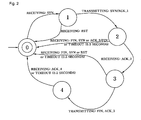
- FIG. 2 is an overall conceptual diagram of a model for implementing a method of preventing a Transmission Control Protocol (TCP)-based Denial of Service (DoS) attack on a mobile device according to an exemplary embodiment of the present invention
- TCP Transmission Control Protocol
- DoS Denial of Service
- FIG. 3 illustrates the flow of packets and TCP state transition operations in a process of normally establishing a TCP connection between a base station and a mobile device
- FIG. 4 illustrates the flow of packets and TCP state transition operations in a process of normally terminating a TCP connection between a base station and a mobile device
- FIG. 5 illustrates the flow of packets and TCP state transition operations in a first example of an abnormal TCP connection
- FIG. 6 illustrates the flow of packets and TCP state transition operations in a second example of an abnormal TCP connection
- FIG. 7 illustrates the flow of packets and TCP state transition operations in a third example of an abnormal TCP connection
- FIG. 8 illustrates the flow of packets and TCP state transition operations in a fourth example of an abnormal TCP connection
- FIG. 9 illustrates the flow of packets and TCP state transition operations in a fifth example of an abnormal TCP connection.
- the present invention can be applied to any case in which a mobile device supplied with power from a battery wirelessly receives Transmission Control Protocol (TCP) packets and thereby receives service.
- TCP Transmission Control Protocol
- the present invention is a protection means that can be applied to a mobile device, a smart phone, etc., using, for example, a Web Personal Digital Assistant (PDA), a second generation (2G)-Evolution-Data Optimized (EVDO) cellular network, a 3G/4G data service cellular network, etc., capable of receiving TCP service outside the field of sensor network for which a protocol has not yet determined.
- PDA Web Personal Digital Assistant
- EVDO second generation
- 3G/4G data service cellular network etc.
- the present invention is implemented in a mobile device and checks and processes resource-consuming TCP packets. Therefore, the present invention is a method of efficiently managing wireless resources and the mobile device's resources, and also can be used as a method of safely protecting the mobile device when a connection is attempted through a wireless network by a Denial of Service (DoS) attack.
- DoS Denial of Service
- FIG. 2 is an overall conceptual diagram of a model for implementing a method of preventing a TCP-based DoS attack on a mobile device according to an exemplary embodiment of the present invention.
- the entire model for implementing a method of preventing a TCP-based DoS attack on a mobile device consists of 5 states 0 to 4, and the 5 states are connected in various forms according to the flow of packets transmitted/received between a base station and the mobile device, e.g., a cellular phone, a PDA, a WebPDA, another wireless mobile device capable of supporting TCP networking, and so on.
- a base station e.g., a cellular phone, a PDA, a WebPDA, another wireless mobile device capable of supporting TCP networking, and so on.
- the model applied to an exemplary embodiment of the present invention checks and determines whether or not a packet transmitted and received for TCP state transition conforms to a TCP specification while monitoring packets transmitted and received between the base station and the mobile device.
- the present invention performs a conventional checking function according to TCP state transition. Therefore, in each step, it is possible to check what state will be next according to the flag of a transmitted and received packet, and what flag must be set in a received packet in a current state.
- one session goes through the first state 0 to the fifth state 4 and returns to the first state 0.
- the flags of packets constituting the session it is possible to check the order of the steps 0 to 4 and whether a packet that should not be input is received.
- the first state 0 indicates the start and end of one session.
- FIG. 3 illustrates the flow of packets and TCP state transition operations in a process of normally establishing a TCP connection between a base station and a mobile device.
- the TCP state of the mobile device 200 is set to the first state 0, which indicates the start and end of one session.
- the base station 100 transmits a connection request SYN packet, in which a SYN flag is set, to a specific port of the mobile device 200 desired to connect thereto.
- the mobile device 200 checks the reception of the connection request SYN packet transmitted from the base station 100 according to the present invention, the TCP state of the mobile device 200 changes from the first state 0 to the second state 1.
- the mobile device 200 transmits a connection request acknowledgement SYN/ACK — 1 packet, in which a connection request SYN flag and an acknowledgement ACK — 1 flag of the mobile device 200 are set, to the base station 100 in the way of accepting the connection request.
- the TCP state of the mobile device 200 changes from the second state 1 to the third state 2.
- the base station 100 transmits an acknowledgement ACK — 2 packet corresponding to the connection request acknowledgement SYN/ACK — 1 packet to the mobile device 200 .
- the mobile device 200 checks the reception of the acknowledgement ACK — 2 packet transmitted from the base station 100 according to the present invention, the TCP state of the mobile device 200 changes from the third state 2 to the fourth state 3, thereby establishing a TCP connection. After this, data transmission may be performed between the base station 100 and the mobile device 200 .
- a TCP packet received by the mobile device 200 must be the connection request SYN packet.
- the TCP connection with a node to which the TCP connection was attempted is established.
- the mobile device 200 transmits the connection request acknowledgement SYN/ACK — 1 packet and receives the acknowledgement ACK — 2 packet as a reply to the connection request acknowledgement SYN/ACK — 1 packet.
- the process is completely performed, one TCP connection is established.
- the present invention provides pointers to the steps of the first state 0 to the fourth state 3 so that the mobile device 200 can check each step for establishing a TCP connection one by one. Because a pointer exists in each step since the connection request SYN packet initially attempts the TCP connection until three-way handshaking is completed, it is possible to immediately catch a moment that the process is abnormally performed and also appropriately cope with the malfunction.
- FIG. 4 illustrates the flow of packets and TCP state transition operations in a process of normally terminating a TCP connection between a base station and a mobile device.
- the mobile device 200 transmits a finish acknowledgement FIN/ACK — 3 packet, in which a FIN flag is set, to a specific port of the base station 100 in order to terminate the TCP connection with the base station 100 .
- the finish acknowledgement FIN/ACK — 3 packet transmitted from the mobile device 200 is received, the base station 100 transmits an acknowledgement ACK — 4 packet, corresponding to the finish acknowledgement FIN/ACK — 3 packet, to the mobile device 200 to inform that termination of the TCP connection is recognized.
- the TCP state of the mobile device 200 changes from the fourth state 3 to the fifth state 4.
- the base station 100 transmits the acknowledgement ACK — 4 packet corresponding to the finish acknowledgement FIN/ACK — 3 packet.
- the mobile device 200 checks the reception of the acknowledgement ACK — 4 packet transmitted from the base station 100 according to the present invention, the TCP state of the mobile device 200 changes from the fifth state 4 to the first state 0, thereby terminating the TCP connection.
- the TCP state of the mobile device 200 changes from the fifth state 4 to the first state 0, thereby safely terminating the TCP connection.
- a method of preventing a TCP-based DoS attack on a mobile device will be described in detail below with reference to several examples of an abnormal TCP connection.
- the mobile device 200 can check and cope with a DoS attack using the model applied to the present invention when DoS attacks are made. Most DoS attacks that the mobile device 200 can cope with make an abnormal attempt to establish a TCP connection.
- FIG. 5 illustrates the flow of packets and TCP state transition operations in a first example of an abnormal TCP connection.
- the TCP state of the mobile device 200 changes from the first state 0 to the second state 1. And then, when the mobile device 200 checks the transmission of a connection request acknowledgement SYN/ACK — 1 packet to the base station 100 , the TCP state of the mobile device 200 changes from the second state 1 to the third state 2.
- the TCP state of the mobile device 200 changes from the third state 2 to the fourth state 3, thereby establishing a TCP connection.
- the mobile device 200 checks the reception of a packet, in which a reset RST or connection request SYN flag is set, i.e., the connection request packet, transmitted from the base station 100 , the TCP state of the mobile device 200 changes from the fourth state 3 directly to the first state 0, thereby safely terminating the TCP connection.
- a timeout is triggered according to the present invention, and the mobile device 200 directly switches to the first state 0 in order to terminate the TCP connection.
- the TCP state of the mobile device 200 changes from the fourth state 3 directly to the first state 0, thereby safely terminating the TCP connection.
- the mobile device 200 switches from the first state 0 to the fourth state 3 sequentially as described above and then switches back to the first state 0, thereby not receiving the packet.
- FIG. 6 illustrates the flow of packets and TCP state transition operations in a second example of an abnormal TCP connection.
- the TCP state of the mobile device 200 changes from the first state 0 to the second state 1. And then, when the mobile device 200 checks the transmission of a connection request acknowledgement SYN/ACK — 1 packet to the base station 100 , the TCP state of the mobile device 200 changes from the second state 1 to the third state 2.
- the mobile device 200 receives a finish FIN packet transmitted from the base station 100 , it is determined that the base station 100 has abnormally terminated the connection, and the TCP state of the mobile device 200 changes from the third state 2 directly to the first state 0, thereby safely terminating the TCP connection.
- the base station 100 abnormally terminates the connection without transmitting any packet in the third state 2, a timeout is triggered, and the mobile device 200 also switches directly to the first state 0 in order to terminate the TCP connection.
- the TCP state of the mobile device 200 changes from the third state 2 directly to the first state 0, thereby safely terminating the TCP connection.
- the mobile device 200 when the unexpected finish FIN packet is received from the base station 100 , the mobile device 200 constantly waits in the awake state and consumes battery power. Therefore, in this case, the mobile device 200 switches from the first state 0 to the third state 2 sequentially, and switches back to the first state 0, thereby terminating the TCP connection to prevent the waste of resources.
- the TCP state of the mobile device 200 changes from the first state 0 to the third state 2 sequentially and changes back to the first state 0, and then the TCP connection is terminated, it is possible to solve the problems of battery consumption and resource allocation.
- FIG. 7 illustrates the flow of packets and TCP state transition operations in a third example of an abnormal TCP connection.
- a case is illustrated in which a finish FIN packet is transmitted while completing three-way handshaking.
- the TCP state of the mobile device 200 changes from the first state 0 to the second state 1.
- the TCP state of the mobile device 200 changes from the second state 1 to the third state 2.
- the base station 100 may transmit to the mobile device 200 an acknowledgement finish ACK — 2/FIN packet, in which an acknowledgement ACK — 2 flag corresponding to the connection request acknowledgement SYN/ACK — 1 packet and a FIN flag are set.
- the TCP state of the mobile device 200 changes from the third state 2 directly to the first state 0, thereby safely terminating the TCP connection.
- a timeout is triggered according to the present invention, and the mobile device 200 also switches directly to the first state 0 in order to terminate the TCP connection.
- the TCP state of the mobile device 200 changes from the third state 2 directly to the first state 0, thereby safely terminating the TCP connection.
- FIG. 8 illustrates the flow of packets and TCP state transition operations in a fourth example of an abnormal TCP connection.
- the TCP state of the mobile device 200 changes from the first state 0 to the second state 1. And then, when the mobile device 200 checks the transmission of a connection request acknowledgement SYN/ACK — 1 packet to the base station 100 , the TCP state of the mobile device 200 changes from the second state 1 to the third state 2.
- the same base station 100 may continuously transmit the same connection request SYN packet to the mobile device 200 in the third state 2.
- the TCP state of the mobile device 200 changes from the third state 2 directly to the first state 0, thereby safely terminating the TCP connection.
- the mobile device 200 switches from the first state 0 to the third state 2 sequentially, and then switches back to the first state 0 when receiving the same connection request SYN packet, thereby safely terminating the TCP connection.
- it is possible to efficiently prevent wireless resources and battery power of the mobile device 200 from being wasted.
- FIG. 9 illustrates the flow of packets and TCP state transition operations in a fifth example of an abnormal TCP connection.
- a timeout is triggered.
- the mobile device 200 when the mobile device 200 wants to terminate a TCP connection after the TCP connection is established between the base station 100 and the mobile device 200 , i.e., in the fourth state 3, the mobile device 200 switches from the fourth state 3 to the fifth state 4 and waits for an acknowledgement ACK — 2 packet from the base station 100 after transmitting a finish acknowledgement FIN/ACK — 1 packet to the base station 100 .
- the TCP state of the mobile device 200 changes from the fifth state 4 directly to the first state 0, thereby safely terminating the TCP connection.
- the method of preventing a TCP-based DoS attack on a mobile device can be stored in a computer-readable recording medium using a computer code.
- the computer-readable recording medium may be any recordable device storing data that can be read by a computer system.
- the computer-readable recording medium may be a read-only memory (ROM), a random-access memory (RAM), a compact disk read-only memory (CD-ROM), a magnetic tape, a hard disk, a floppy disk, a mobile storage device, a nonvolatile memory (flash memory), an optical data storage device, and so on.
- the recording medium may be carrier waves, e.g., transmission over the Internet.
- the computer-readable recording medium may be distributed among computer systems connected via a communication network and stored in the form of a code that can be read and executed by a de-centralized method.
Landscapes
- Engineering & Computer Science (AREA)
- Computer Security & Cryptography (AREA)
- Computer Networks & Wireless Communication (AREA)
- Signal Processing (AREA)
- Computer Hardware Design (AREA)
- Computing Systems (AREA)
- General Engineering & Computer Science (AREA)
- Mobile Radio Communication Systems (AREA)
- Data Exchanges In Wide-Area Networks (AREA)
- Communication Control (AREA)
Applications Claiming Priority (3)
| Application Number | Priority Date | Filing Date | Title |
|---|---|---|---|
| KR1020070079637A KR100889670B1 (ko) | 2007-08-08 | 2007-08-08 | 모바일 디바이스상에서 tcp 기반의 서비스거부 공격의 차단 방법 |
| KR10-2007-0079637 | 2007-08-08 | ||
| PCT/KR2007/004440 WO2009020255A1 (en) | 2007-08-08 | 2007-09-14 | Method of preventing tcp-based denial-of-service attacks on mobile devices |
Publications (2)
| Publication Number | Publication Date |
|---|---|
| US20100299753A1 US20100299753A1 (en) | 2010-11-25 |
| US9055099B2 true US9055099B2 (en) | 2015-06-09 |
Family
ID=40341466
Family Applications (1)
| Application Number | Title | Priority Date | Filing Date |
|---|---|---|---|
| US12/672,408 Expired - Fee Related US9055099B2 (en) | 2007-08-08 | 2007-09-14 | Method of preventing TCP-based denial-of-service attacks on mobile devices |
Country Status (6)
| Country | Link |
|---|---|
| US (1) | US9055099B2 (de) |
| EP (1) | EP2176989B1 (de) |
| JP (1) | JP2010536221A (de) |
| KR (1) | KR100889670B1 (de) |
| CN (1) | CN101779415B (de) |
| WO (1) | WO2009020255A1 (de) |
Families Citing this family (10)
| Publication number | Priority date | Publication date | Assignee | Title |
|---|---|---|---|---|
| KR100977365B1 (ko) * | 2007-12-20 | 2010-08-20 | 삼성에스디에스 주식회사 | 바이러스 및 네트워크 공격에 대한 자기 방어 기능을 갖는모바일 디바이스 및 이를 이용한 자기 방어 방법 |
| US8543807B2 (en) | 2009-07-14 | 2013-09-24 | Electronics And Telecommunications Research Institute | Method and apparatus for protecting application layer in computer network system |
| KR101231801B1 (ko) * | 2009-07-14 | 2013-02-08 | 한국전자통신연구원 | 네트워크 상의 응용 계층 보호 방법 및 장치 |
| WO2011102312A1 (ja) * | 2010-02-16 | 2011-08-25 | 日本電気株式会社 | パケット転送装置、通信システム、処理規則の更新方法およびプログラム |
| US9590913B2 (en) * | 2011-02-07 | 2017-03-07 | LiveQoS Inc. | System and method for reducing bandwidth usage of a network |
| CN102244663B (zh) * | 2011-08-16 | 2013-12-18 | 山东盛世光明软件技术有限公司 | 基于构造tcp数据包技术的用户身份识别方法和系统 |
| KR20130084442A (ko) * | 2012-01-17 | 2013-07-25 | 삼성전자주식회사 | 통신 시스템에서 서비스 거부 공격을 감지하기 위한 기지국 및 그 방법 |
| TWI566616B (zh) * | 2015-03-04 | 2017-01-11 | 瑞昱半導體股份有限公司 | 三方交握方法以及電腦可讀媒體 |
| KR20180082697A (ko) * | 2017-01-10 | 2018-07-19 | (주) 코콤 | 효율적인 수요관리를 위한 보안성이 강화된 홈 영역 네트워크 운영방법 |
| KR101952357B1 (ko) * | 2017-08-03 | 2019-02-26 | (주)엔토빌소프트 | Tls/ssl 통신 연결을 제어하는 장치 및 그 방법 |
Citations (48)
| Publication number | Priority date | Publication date | Assignee | Title |
|---|---|---|---|---|
| US20020065924A1 (en) * | 1999-10-14 | 2002-05-30 | Barrall Geoffrey S. | Apparatus and method for hardware implementation or acceleration of operating system functions |
| US20030084321A1 (en) | 2001-10-31 | 2003-05-01 | Tarquini Richard Paul | Node and mobile device for a mobile telecommunications network providing intrusion detection |
| US20030095535A1 (en) * | 2001-11-16 | 2003-05-22 | Khiem Le | Enhanced transmission of critical data |
| US20030119454A1 (en) * | 2001-12-20 | 2003-06-26 | Kabushiki Kaisha Toshiba | Mobile communication terminal capable of displaying communication mode |
| US20040034773A1 (en) * | 2002-08-19 | 2004-02-19 | Balabine Igor V. | Establishing authenticated network connections |
| US20040120255A1 (en) * | 2002-12-20 | 2004-06-24 | Gross Gerhard W. | Method and apparatus to determine whether data flow is restricted by a sending node, a receiving node, or by a network |
| US20040152439A1 (en) * | 2001-07-10 | 2004-08-05 | Fujitsu Limited | Mobile device communications system and method |
| US20040236802A1 (en) * | 2003-05-22 | 2004-11-25 | International Business Machines Corporation | Method, apparatus, and program for informing a client when a server is busy in the transfer control protocol |
| US20040252692A1 (en) * | 2003-06-11 | 2004-12-16 | Jae-Hee Shim | Method and apparatus for controlling packet transmission and generating packet billing data on wired and wireless network |
| US20040252671A1 (en) * | 2003-05-13 | 2004-12-16 | Benq Corporation | TCP/IP header compression format over wireless network |
| US20050053023A1 (en) * | 2003-09-04 | 2005-03-10 | Samsung Electronics Co., Ltd. | Apparatus and method for reducing paging channel loading for broadcast multicast services in a wireless network |
| US20050060535A1 (en) * | 2003-09-17 | 2005-03-17 | Bartas John Alexander | Methods and apparatus for monitoring local network traffic on local network segments and resolving detected security and network management problems occurring on those segments |
| US20050070246A1 (en) * | 2003-09-30 | 2005-03-31 | Motorola, Inc. | Method and apparatus for preventing a spurious retransmission after a planned interruption of communications |
| US6925060B2 (en) * | 2000-02-11 | 2005-08-02 | Mitsubishi Denki Kabushiki Kaisha | Method and unit for controlling the flow of a TCP connection on a flow controlled network |
| US20050180419A1 (en) * | 2004-02-13 | 2005-08-18 | Hyoung-Joon Park | Managing transmission control protocol (TCP) connections |
| US6950947B1 (en) * | 2000-06-20 | 2005-09-27 | Networks Associates Technology, Inc. | System for sharing network state to enhance network throughput |
| US20050216954A1 (en) * | 2004-01-09 | 2005-09-29 | Anantha Ramaiah | Preventing network reset denial of service attacks using embedded authentication information |
| US20050267965A1 (en) * | 2004-05-13 | 2005-12-01 | Ixi Mobile (R&D) Ltd. | Mobile router graceful shutdown system and method |
| US20050286527A1 (en) * | 2004-06-28 | 2005-12-29 | Ivivity, Inc. | TCP segment re-ordering in a high-speed TOE device |
| US20060075119A1 (en) * | 2004-09-10 | 2006-04-06 | Hussain Muhammad R | TCP host |
| US20060123079A1 (en) * | 2001-09-12 | 2006-06-08 | Netmotion Wireless, Inc. | Mobile networking system and method |
| WO2006082507A1 (en) | 2005-02-04 | 2006-08-10 | Nokia Corporation | Apparatus, method and computer program product to reduce tcp flooding attacks while conserving wireless network bandwidth |
| US20060190720A1 (en) * | 2003-08-08 | 2006-08-24 | T.T.T. Kabushikikaisha | TCP/IP-based communication system and associated methodology providing an enhanced transport layer protocol |
| US20060200849A1 (en) * | 2004-12-30 | 2006-09-07 | Prabakar Sundarrajan | Systems and methods for providing client-side accelerated access to remote applications via TCP pooling |
| US20060229022A1 (en) | 2005-03-30 | 2006-10-12 | Tian Bu | Detection of power-drain denial-of-service attacks in wireless networks |
| US20060227811A1 (en) * | 2005-04-08 | 2006-10-12 | Hussain Muhammad R | TCP engine |
| US20060230450A1 (en) | 2005-03-31 | 2006-10-12 | Tian Bu | Methods and devices for defending a 3G wireless network against a signaling attack |
| US20070011319A1 (en) * | 2002-01-15 | 2007-01-11 | Mcclure Stuart C | System and method for network vulnerability detection and reporting |
| US20070044150A1 (en) * | 2004-01-09 | 2007-02-22 | Mitesh Dalal | Preventing network reset denial of service attacks |
| US20070047457A1 (en) * | 2005-08-29 | 2007-03-01 | Harijono Indra G | Method and system for reassembling packets prior to searching |
| US20070130255A1 (en) * | 2003-04-17 | 2007-06-07 | Lionel Wolovitz | Data access, replication or communication system comprising a distributed software application |
| US20070162777A1 (en) * | 2006-01-06 | 2007-07-12 | Canon Kabushiki Kaisha | Information processing apparatus having communication function, and power control method therefor |
| US20070168468A1 (en) * | 2006-01-18 | 2007-07-19 | Digital Accoustics, Inc. | Method and apparatus for multiple audio connections over networks |
| US20070192593A1 (en) * | 2005-12-29 | 2007-08-16 | Boisjolie Darren R | Method and system for transparent bridging and bi-directional management of network data |
| US20070195800A1 (en) * | 2006-02-22 | 2007-08-23 | Zheng Yang | Communication using private IP addresses of local networks |
| US20070202835A1 (en) * | 2006-02-01 | 2007-08-30 | Samsung Electronics Co., Ltd | Power saving method for a wireless communication apparatus |
| US20070245409A1 (en) * | 2006-04-12 | 2007-10-18 | James Harris | Systems and Methods for Providing Levels of Access and Action Control Via an SSL VPN Appliance |
| US20070291749A1 (en) * | 2005-02-24 | 2007-12-20 | Fujitsu Limited | Information processing apparatus, line release method for information processing apparatus, and computer product |
| US7363652B2 (en) * | 2002-07-18 | 2008-04-22 | Huawei Technologies Co., Ltd. | Method for preventing transmission control protocol synchronous package flood attack |
| US20080095138A1 (en) * | 2006-10-24 | 2008-04-24 | Nokia Corporation | Method for performing handovers in a communication system |
| US20080170501A1 (en) * | 2007-01-17 | 2008-07-17 | Alpesh Patel | Enhancing transmission reliability of monitored data |
| US20080177829A1 (en) * | 2004-04-29 | 2008-07-24 | International Business Machines Corporation | Data Communications Through A Split Connection Proxy |
| US20080212484A1 (en) * | 2007-03-02 | 2008-09-04 | Cisco Technology, Inc. | Tracing connection paths through transparent proxies |
| US7554972B2 (en) * | 2005-09-29 | 2009-06-30 | Kyocera Corporation | Wireless communication terminal and wireless communication method |
| US20090238344A1 (en) * | 2006-07-04 | 2009-09-24 | Duaxes Corporation | Communication control device and communication control method |
| US20090247115A1 (en) * | 2006-07-04 | 2009-10-01 | Duaxes Corporation | Communication control device and communication control method |
| US20090279429A1 (en) * | 2006-09-21 | 2009-11-12 | Ipanema Technologies | Optimisation process of the control of traffic in a packet telecommunications network |
| US20100135324A1 (en) * | 2006-11-01 | 2010-06-03 | Solarflare Communications Inc. | Driver level segmentation |
Family Cites Families (8)
| Publication number | Priority date | Publication date | Assignee | Title |
|---|---|---|---|---|
| TW518864B (en) * | 2000-05-12 | 2003-01-21 | Ibm | Methods and system for defeating TCP SYN flooding attacks |
| JP2002073433A (ja) | 2000-08-28 | 2002-03-12 | Mitsubishi Electric Corp | 侵入検知装置及び不正侵入対策管理システム及び侵入検知方法 |
| US7398317B2 (en) * | 2000-09-07 | 2008-07-08 | Mazu Networks, Inc. | Thwarting connection-based denial of service attacks |
| JP2002290407A (ja) | 2001-03-23 | 2002-10-04 | Mitsubishi Electric Corp | 安全通信保証装置 |
| US6851062B2 (en) | 2001-09-27 | 2005-02-01 | International Business Machines Corporation | System and method for managing denial of service attacks |
| JP3923346B2 (ja) * | 2002-03-29 | 2007-05-30 | 京セラ株式会社 | 無線通信機 |
| JP4557815B2 (ja) * | 2005-06-13 | 2010-10-06 | 富士通株式会社 | 中継装置および中継システム |
| KR100806492B1 (ko) | 2006-11-13 | 2008-02-21 | 삼성에스디에스 주식회사 | Tcp 상태천이를 이용한 서비스거부 공격의 차단방법 |
-
2007
- 2007-08-08 KR KR1020070079637A patent/KR100889670B1/ko not_active Expired - Fee Related
- 2007-09-14 WO PCT/KR2007/004440 patent/WO2009020255A1/en not_active Ceased
- 2007-09-14 EP EP07808231.0A patent/EP2176989B1/de not_active Not-in-force
- 2007-09-14 US US12/672,408 patent/US9055099B2/en not_active Expired - Fee Related
- 2007-09-14 JP JP2010519844A patent/JP2010536221A/ja active Pending
- 2007-09-14 CN CN2007801001832A patent/CN101779415B/zh not_active Expired - Fee Related
Patent Citations (57)
| Publication number | Priority date | Publication date | Assignee | Title |
|---|---|---|---|---|
| US20020065924A1 (en) * | 1999-10-14 | 2002-05-30 | Barrall Geoffrey S. | Apparatus and method for hardware implementation or acceleration of operating system functions |
| US6925060B2 (en) * | 2000-02-11 | 2005-08-02 | Mitsubishi Denki Kabushiki Kaisha | Method and unit for controlling the flow of a TCP connection on a flow controlled network |
| US6950947B1 (en) * | 2000-06-20 | 2005-09-27 | Networks Associates Technology, Inc. | System for sharing network state to enhance network throughput |
| US20040152439A1 (en) * | 2001-07-10 | 2004-08-05 | Fujitsu Limited | Mobile device communications system and method |
| US7554992B2 (en) * | 2001-07-10 | 2009-06-30 | Fujitsu Limited | Mobile device communications system and method |
| US20060123079A1 (en) * | 2001-09-12 | 2006-06-08 | Netmotion Wireless, Inc. | Mobile networking system and method |
| US20030084321A1 (en) | 2001-10-31 | 2003-05-01 | Tarquini Richard Paul | Node and mobile device for a mobile telecommunications network providing intrusion detection |
| US20030095535A1 (en) * | 2001-11-16 | 2003-05-22 | Khiem Le | Enhanced transmission of critical data |
| US20030119454A1 (en) * | 2001-12-20 | 2003-06-26 | Kabushiki Kaisha Toshiba | Mobile communication terminal capable of displaying communication mode |
| US20060003801A1 (en) * | 2001-12-20 | 2006-01-05 | Kabushiki Kaisha Toshiba | Mobile communication terminal capable of displaying communication mode |
| US20070011319A1 (en) * | 2002-01-15 | 2007-01-11 | Mcclure Stuart C | System and method for network vulnerability detection and reporting |
| US7363652B2 (en) * | 2002-07-18 | 2008-04-22 | Huawei Technologies Co., Ltd. | Method for preventing transmission control protocol synchronous package flood attack |
| US20040034773A1 (en) * | 2002-08-19 | 2004-02-19 | Balabine Igor V. | Establishing authenticated network connections |
| US20040120255A1 (en) * | 2002-12-20 | 2004-06-24 | Gross Gerhard W. | Method and apparatus to determine whether data flow is restricted by a sending node, a receiving node, or by a network |
| US20070130255A1 (en) * | 2003-04-17 | 2007-06-07 | Lionel Wolovitz | Data access, replication or communication system comprising a distributed software application |
| US20040252671A1 (en) * | 2003-05-13 | 2004-12-16 | Benq Corporation | TCP/IP header compression format over wireless network |
| US7403543B2 (en) * | 2003-05-13 | 2008-07-22 | Qisda Corporation | TCP/IP header compression format and method over wireless network |
| US20040236802A1 (en) * | 2003-05-22 | 2004-11-25 | International Business Machines Corporation | Method, apparatus, and program for informing a client when a server is busy in the transfer control protocol |
| US20040252692A1 (en) * | 2003-06-11 | 2004-12-16 | Jae-Hee Shim | Method and apparatus for controlling packet transmission and generating packet billing data on wired and wireless network |
| US20060190720A1 (en) * | 2003-08-08 | 2006-08-24 | T.T.T. Kabushikikaisha | TCP/IP-based communication system and associated methodology providing an enhanced transport layer protocol |
| US20050053023A1 (en) * | 2003-09-04 | 2005-03-10 | Samsung Electronics Co., Ltd. | Apparatus and method for reducing paging channel loading for broadcast multicast services in a wireless network |
| US20050060535A1 (en) * | 2003-09-17 | 2005-03-17 | Bartas John Alexander | Methods and apparatus for monitoring local network traffic on local network segments and resolving detected security and network management problems occurring on those segments |
| US20050070246A1 (en) * | 2003-09-30 | 2005-03-31 | Motorola, Inc. | Method and apparatus for preventing a spurious retransmission after a planned interruption of communications |
| US20050216954A1 (en) * | 2004-01-09 | 2005-09-29 | Anantha Ramaiah | Preventing network reset denial of service attacks using embedded authentication information |
| US7458097B2 (en) * | 2004-01-09 | 2008-11-25 | Cisco Technology, Inc. | Preventing network reset denial of service attacks |
| US7203961B1 (en) * | 2004-01-09 | 2007-04-10 | Cisco Technology, Inc. | Preventing network reset denial of service attacks |
| US20070044150A1 (en) * | 2004-01-09 | 2007-02-22 | Mitesh Dalal | Preventing network reset denial of service attacks |
| US20050180419A1 (en) * | 2004-02-13 | 2005-08-18 | Hyoung-Joon Park | Managing transmission control protocol (TCP) connections |
| US20080177829A1 (en) * | 2004-04-29 | 2008-07-24 | International Business Machines Corporation | Data Communications Through A Split Connection Proxy |
| US20050267965A1 (en) * | 2004-05-13 | 2005-12-01 | Ixi Mobile (R&D) Ltd. | Mobile router graceful shutdown system and method |
| US20050286527A1 (en) * | 2004-06-28 | 2005-12-29 | Ivivity, Inc. | TCP segment re-ordering in a high-speed TOE device |
| US20100023626A1 (en) * | 2004-09-10 | 2010-01-28 | Cavium Networks, Inc. | Method and apparatus for reducing host overhead in a socket server implementation |
| US20060075119A1 (en) * | 2004-09-10 | 2006-04-06 | Hussain Muhammad R | TCP host |
| US20060200849A1 (en) * | 2004-12-30 | 2006-09-07 | Prabakar Sundarrajan | Systems and methods for providing client-side accelerated access to remote applications via TCP pooling |
| US20060230129A1 (en) | 2005-02-04 | 2006-10-12 | Nokia Corporation | Apparatus, method and computer program product to reduce TCP flooding attacks while conserving wireless network bandwidth |
| WO2006082507A1 (en) | 2005-02-04 | 2006-08-10 | Nokia Corporation | Apparatus, method and computer program product to reduce tcp flooding attacks while conserving wireless network bandwidth |
| US20070291749A1 (en) * | 2005-02-24 | 2007-12-20 | Fujitsu Limited | Information processing apparatus, line release method for information processing apparatus, and computer product |
| US20060229022A1 (en) | 2005-03-30 | 2006-10-12 | Tian Bu | Detection of power-drain denial-of-service attacks in wireless networks |
| US20060230450A1 (en) | 2005-03-31 | 2006-10-12 | Tian Bu | Methods and devices for defending a 3G wireless network against a signaling attack |
| US20060227811A1 (en) * | 2005-04-08 | 2006-10-12 | Hussain Muhammad R | TCP engine |
| US20070047457A1 (en) * | 2005-08-29 | 2007-03-01 | Harijono Indra G | Method and system for reassembling packets prior to searching |
| US7554972B2 (en) * | 2005-09-29 | 2009-06-30 | Kyocera Corporation | Wireless communication terminal and wireless communication method |
| US7716472B2 (en) * | 2005-12-29 | 2010-05-11 | Bsecure Technologies, Inc. | Method and system for transparent bridging and bi-directional management of network data |
| US20070192593A1 (en) * | 2005-12-29 | 2007-08-16 | Boisjolie Darren R | Method and system for transparent bridging and bi-directional management of network data |
| US20070162777A1 (en) * | 2006-01-06 | 2007-07-12 | Canon Kabushiki Kaisha | Information processing apparatus having communication function, and power control method therefor |
| US20070168468A1 (en) * | 2006-01-18 | 2007-07-19 | Digital Accoustics, Inc. | Method and apparatus for multiple audio connections over networks |
| US20070202835A1 (en) * | 2006-02-01 | 2007-08-30 | Samsung Electronics Co., Ltd | Power saving method for a wireless communication apparatus |
| US20070195800A1 (en) * | 2006-02-22 | 2007-08-23 | Zheng Yang | Communication using private IP addresses of local networks |
| US20070245409A1 (en) * | 2006-04-12 | 2007-10-18 | James Harris | Systems and Methods for Providing Levels of Access and Action Control Via an SSL VPN Appliance |
| US20090247115A1 (en) * | 2006-07-04 | 2009-10-01 | Duaxes Corporation | Communication control device and communication control method |
| US20090238344A1 (en) * | 2006-07-04 | 2009-09-24 | Duaxes Corporation | Communication control device and communication control method |
| US20090279429A1 (en) * | 2006-09-21 | 2009-11-12 | Ipanema Technologies | Optimisation process of the control of traffic in a packet telecommunications network |
| US8064345B2 (en) * | 2006-09-21 | 2011-11-22 | Ipanema Technologies | Optimisation process of the control of traffic in a packet telecommunications network |
| US20080095138A1 (en) * | 2006-10-24 | 2008-04-24 | Nokia Corporation | Method for performing handovers in a communication system |
| US20100135324A1 (en) * | 2006-11-01 | 2010-06-03 | Solarflare Communications Inc. | Driver level segmentation |
| US20080170501A1 (en) * | 2007-01-17 | 2008-07-17 | Alpesh Patel | Enhancing transmission reliability of monitored data |
| US20080212484A1 (en) * | 2007-03-02 | 2008-09-04 | Cisco Technology, Inc. | Tracing connection paths through transparent proxies |
Non-Patent Citations (5)
| Title |
|---|
| An analysis of TCP reset behaviour on the internet ,Martin Arlitt et al, Jan. 2005, ACM SIGCOMM computer communications review, vol. 35, No. 1, pp. 37-44. * |
| Bruschi, Danilo, et al., Disarming offense to facilitate defense, Proceedings of the New Security Paradigms Workshop (NSPW), Sep. 18-22, 2000, pp. 69-75 (XP000988603), Ballycotton, County Cork, Ireland. |
| Comer,Douglas E., Internetworking with TCP/IP, vol. I: Principles, Protocols, and Arthitecture, Fourth Edition, Jan. 1, 2001, pp. 209-251 (XP002310034), Chapter 13-TCP, Sections 13.23 and 13.26. |
| Information Sciences Institute University of Southern California, "Transmission Control Protocol", Sep. 1981, 89 pages. |
| Schuba, Christoph, et al., Analysis of a Denial of Service Attack on TCP, Security and Privacy (1997), IEEE 1997, pp. 208-223, Los Alamitos, CA. |
Also Published As
| Publication number | Publication date |
|---|---|
| WO2009020255A1 (en) | 2009-02-12 |
| CN101779415B (zh) | 2013-03-27 |
| HK1146168A1 (en) | 2011-05-13 |
| KR100889670B1 (ko) | 2009-03-19 |
| EP2176989A1 (de) | 2010-04-21 |
| JP2010536221A (ja) | 2010-11-25 |
| CN101779415A (zh) | 2010-07-14 |
| KR20090015364A (ko) | 2009-02-12 |
| US20100299753A1 (en) | 2010-11-25 |
| EP2176989B1 (de) | 2015-06-17 |
| EP2176989A4 (de) | 2014-03-05 |
Similar Documents
| Publication | Publication Date | Title |
|---|---|---|
| US9055099B2 (en) | Method of preventing TCP-based denial-of-service attacks on mobile devices | |
| Tsaoussidis et al. | Open issues on TCP for mobile computing | |
| US8925068B2 (en) | Method for preventing denial of service attacks using transmission control protocol state transition | |
| US10530644B2 (en) | Techniques for establishing a communication connection between two network entities via different network flows | |
| KR20090094362A (ko) | 모바일 운영 환경을 위한 안전한 애플리케이션 간 통신 제공 | |
| CN101147376A (zh) | 降低tcp洪泛攻击同时节省无线网络带宽的装置、方法和计算机程序产品 | |
| US8744447B2 (en) | Method, apparatus, and system for wireless connection | |
| US8589586B2 (en) | Method and apparatus for managing transmission of TCP data segments | |
| US8520694B1 (en) | Mobile handset power conservation using connection-release buffering | |
| EP3490293B1 (de) | Datenempfangsverfahren, datensendeverfahren, empfangsvorrichtung und system | |
| CN117896809A (zh) | 低功耗的数据链路层协议的实现方法及应用 | |
| US20140177575A1 (en) | Method for establishing an application session, device and corresponding notification | |
| Arunachalam et al. | Low power TCP for enhanced battery life in mobile devices | |
| CN104244457A (zh) | 无线链路资源释放的方法及用户设备 | |
| HK1146168B (en) | Method of preventing tcp-based denial-of-service attacks on mobile devices | |
| US7860079B2 (en) | Method and apparatus to protect wireless networks from unsolicited packets triggering radio resource consumption | |
| CN118339786A (zh) | 对于从无线装置传送的数据的早期确认 | |
| CN121619070A (zh) | 数据传输方法及相关装置 | |
| CN103986691B (zh) | 终端网络请求数据的转发方法和装置 | |
| CN118945215A (zh) | 连接迁移的探测方法、装置、电子设备及存储介质 | |
| CN118827078A (zh) | 慢攻击处理方法及相关装置 |
Legal Events
| Date | Code | Title | Description |
|---|---|---|---|
| AS | Assignment |
Owner name: SAMSUNG SDS CO., LTD., KOREA, REPUBLIC OF Free format text: ASSIGNMENT OF ASSIGNORS INTEREST;ASSIGNOR:YOO, IN SEON;REEL/FRAME:024352/0961 Effective date: 20100319 |
|
| FEPP | Fee payment procedure |
Free format text: PAYOR NUMBER ASSIGNED (ORIGINAL EVENT CODE: ASPN); ENTITY STATUS OF PATENT OWNER: LARGE ENTITY |
|
| STCF | Information on status: patent grant |
Free format text: PATENTED CASE |
|
| MAFP | Maintenance fee payment |
Free format text: PAYMENT OF MAINTENANCE FEE, 4TH YEAR, LARGE ENTITY (ORIGINAL EVENT CODE: M1551); ENTITY STATUS OF PATENT OWNER: LARGE ENTITY Year of fee payment: 4 |
|
| FEPP | Fee payment procedure |
Free format text: MAINTENANCE FEE REMINDER MAILED (ORIGINAL EVENT CODE: REM.); ENTITY STATUS OF PATENT OWNER: LARGE ENTITY |
|
| LAPS | Lapse for failure to pay maintenance fees |
Free format text: PATENT EXPIRED FOR FAILURE TO PAY MAINTENANCE FEES (ORIGINAL EVENT CODE: EXP.); ENTITY STATUS OF PATENT OWNER: LARGE ENTITY |
|
| STCH | Information on status: patent discontinuation |
Free format text: PATENT EXPIRED DUE TO NONPAYMENT OF MAINTENANCE FEES UNDER 37 CFR 1.362 |
|
| FP | Lapsed due to failure to pay maintenance fee |
Effective date: 20230609 |