US9054918B2 - Method and device for network traffic manipulation - Google Patents
Method and device for network traffic manipulation Download PDFInfo
- Publication number
- US9054918B2 US9054918B2 US13/813,496 US201013813496A US9054918B2 US 9054918 B2 US9054918 B2 US 9054918B2 US 201013813496 A US201013813496 A US 201013813496A US 9054918 B2 US9054918 B2 US 9054918B2
- Authority
- US
- United States
- Prior art keywords
- http
- target
- http request
- response
- proxy
- Prior art date
- Legal status (The legal status is an assumption and is not a legal conclusion. Google has not performed a legal analysis and makes no representation as to the accuracy of the status listed.)
- Expired - Fee Related, expires
Links
- 238000000034 method Methods 0.000 title claims description 30
- 238000004891 communication Methods 0.000 claims abstract description 17
- 238000002347 injection Methods 0.000 claims abstract description 11
- 239000007924 injection Substances 0.000 claims abstract description 11
- 239000000523 sample Substances 0.000 description 13
- 238000010586 diagram Methods 0.000 description 4
- 238000012544 monitoring process Methods 0.000 description 4
- 238000009434 installation Methods 0.000 description 3
- 238000012986 modification Methods 0.000 description 3
- 230000004048 modification Effects 0.000 description 3
- 230000000694 effects Effects 0.000 description 2
- 230000000670 limiting effect Effects 0.000 description 2
- 230000002860 competitive effect Effects 0.000 description 1
- 230000002596 correlated effect Effects 0.000 description 1
- 230000000593 degrading effect Effects 0.000 description 1
- 238000003780 insertion Methods 0.000 description 1
- 230000037431 insertion Effects 0.000 description 1
- 230000007246 mechanism Effects 0.000 description 1
Images


Classifications
-
- H—ELECTRICITY
- H04—ELECTRIC COMMUNICATION TECHNIQUE
- H04L—TRANSMISSION OF DIGITAL INFORMATION, e.g. TELEGRAPHIC COMMUNICATION
- H04L61/00—Network arrangements, protocols or services for addressing or naming
- H04L61/45—Network directories; Name-to-address mapping
- H04L61/4505—Network directories; Name-to-address mapping using standardised directories; using standardised directory access protocols
- H04L61/4511—Network directories; Name-to-address mapping using standardised directories; using standardised directory access protocols using domain name system [DNS]
-
- H04L29/08099—
-
- H04L29/12066—
-
- H04L61/1511—
-
- H—ELECTRICITY
- H04—ELECTRIC COMMUNICATION TECHNIQUE
- H04L—TRANSMISSION OF DIGITAL INFORMATION, e.g. TELEGRAPHIC COMMUNICATION
- H04L65/00—Network arrangements, protocols or services for supporting real-time applications in data packet communication
- H04L65/40—Support for services or applications
-
- H—ELECTRICITY
- H04—ELECTRIC COMMUNICATION TECHNIQUE
- H04L—TRANSMISSION OF DIGITAL INFORMATION, e.g. TELEGRAPHIC COMMUNICATION
- H04L67/00—Network arrangements or protocols for supporting network services or applications
- H04L67/01—Protocols
- H04L67/02—Protocols based on web technology, e.g. hypertext transfer protocol [HTTP]
- H04L67/025—Protocols based on web technology, e.g. hypertext transfer protocol [HTTP] for remote control or remote monitoring of applications
-
- H04L67/2804—
-
- H04L67/2814—
-
- H—ELECTRICITY
- H04—ELECTRIC COMMUNICATION TECHNIQUE
- H04L—TRANSMISSION OF DIGITAL INFORMATION, e.g. TELEGRAPHIC COMMUNICATION
- H04L67/00—Network arrangements or protocols for supporting network services or applications
- H04L67/34—Network arrangements or protocols for supporting network services or applications involving the movement of software or configuration parameters
-
- H—ELECTRICITY
- H04—ELECTRIC COMMUNICATION TECHNIQUE
- H04L—TRANSMISSION OF DIGITAL INFORMATION, e.g. TELEGRAPHIC COMMUNICATION
- H04L67/00—Network arrangements or protocols for supporting network services or applications
- H04L67/50—Network services
- H04L67/56—Provisioning of proxy services
- H04L67/561—Adding application-functional data or data for application control, e.g. adding metadata
-
- H—ELECTRICITY
- H04—ELECTRIC COMMUNICATION TECHNIQUE
- H04L—TRANSMISSION OF DIGITAL INFORMATION, e.g. TELEGRAPHIC COMMUNICATION
- H04L67/00—Network arrangements or protocols for supporting network services or applications
- H04L67/50—Network services
- H04L67/56—Provisioning of proxy services
- H04L67/563—Data redirection of data network streams
-
- H—ELECTRICITY
- H04—ELECTRIC COMMUNICATION TECHNIQUE
- H04L—TRANSMISSION OF DIGITAL INFORMATION, e.g. TELEGRAPHIC COMMUNICATION
- H04L67/00—Network arrangements or protocols for supporting network services or applications
- H04L67/01—Protocols
- H04L67/02—Protocols based on web technology, e.g. hypertext transfer protocol [HTTP]
Definitions
- the present invention relates to a method and a device for monitoring and manipulating network traffic and, in particular, for installing applications on remote terminals.
- devices which allow to modify network traffic on-the-fly: these devices are based on code injection techniques. These techniques allow to intercept and modify data packets in transit on the network during download on the part of the user who uses the terminal onto which one wishes to install the application, generally referenced as the target terminal.
- devices that perform code injection are probes that operate in in-line mode: in other words, the traffic passes physically within a probe, entering through a network port and exiting from another port.
- One side communicates with the terminal, or client, and the other side communicates with the server to which the user is connected.
- the probe can modify its content, adding the data required for the installation of the desired application.
- the devices known in the art are not free from drawbacks: in particular, the need to place the equipment physically in the middle of the communication is a requirement that limits their use. In some cases it is in fact impossible to interrupt a cable to place a probe in order to make network traffic pass within it. In other cases this operation, although possible, requires designing a very complex architecture, especially if the probe has to be inserted in the network of an Internet Service Provider: in this case it is in fact necessary to ensure the reliability and redundancy of the probe in case of fault, since it is not desirable for a fault on the probe to cause interruption of network service for the target.
- the aim of the present invention is to devise a method and a device for manipulating network traffic that is capable of overcoming the limitations of the background art described above.
- an object of the invention is to provide a device and a method for monitoring network traffic and for injecting code in network traffic without requiring said traffic to pass physically within the device.
- Another object of the invention is to provide a device and a method that can operate selectively only on the connections to be modified.
- Another object of the invention is to provide the code injection operations for specific targets effectively, efficiently and transparently for said targets.
- Another object of the invention is to provide a device that is highly reliable, relatively easy to provide and at competitive costs.
- the second domain sent in the first HTTP request reply is a fictitious subdomain of the first domain.
- a device for manipulating data traffic related to a target connected to a data communications network whose elements communicate by means of the HTTP protocol comprising: a redirection device, which is adapted to be connected to the data communications network by means of a plurality of sniffing interfaces and a packet sending interface; a proxy, which is adapted to be connected to the data communications network by means of an HTTP connection interface, a packet receiving interface and a packet injection interface; the redirection device being configured to monitor, by means of said sniffing interfaces, network traffic in order to identify within the network traffic at least one data packet associated with the target and to redirect, by means of the packet sending interface, said at least one data packet associated with the target toward the proxy, the proxy being in turn configured to send, by means of the HTTP connection interface, an HTTP request toward elements of the data communications network, the HTTP request being based on the content of the data packet associated with the target, and to send, by means of the packet injection interface, data to the target which are based on the data received in response to the
- FIG. 1 is a block diagram of an exemplary embodiment of the interface between the traffic manipulation device according to the invention and the Internet;
- FIG. 2 is a block diagram of an exemplary architecture of the traffic manipulation device according to the invention.
- FIG. 3 is a flowchart of an exemplary embodiment of the method for manipulating network traffic according to the invention.
- FIG. 1 is a schematic view of a portion of the Internet and of a possible placement of the traffic manipulation device according to the invention in the layout diagram.
- the figure comprises a plurality of clients 20 , among which a particular client, termed target 20 ′, an access switch 40 , the device according to the invention 50 , a generic server 60 and a DNS server 70 are shown.
- the client 20 (or the target 20 ′) is any device configured to access the Internet, for example a personal computer or a smartphone.
- the clients 20 access the network by means of an Internet service provider (ISP).
- ISP Internet service provider
- the provider has one or more access switches 40 , i.e., known network devices which group the uplink connections of a plurality of users and are capable of selectively forwarding in downlink the packets received toward the appropriate output port.
- the access switch 40 in general manages a large quantity of connections and therefore high data traffic.
- the access switch 40 is connected to the Internet 80 , to which a server 60 and a DNS server 70 are also connected by way of example.
- the server 60 in a preferred embodiment, is a known type of web server, i.e., a computer capable of serving requests from clients sent by means of the HTTP protocol; requests can comprise files of any type, from web pages to executable files.
- the DNS server 70 is a server of the known type which is adapted to resolve domain names into IP addresses and vice versa.
- the traffic manipulation device according to the invention or selective probe 50 is a device placed between the access switch 40 and the Internet.
- the traffic manipulation device 50 according to the invention is located proximate to the access switch 40 related to the target 20 ′ whose traffic one wishes to manipulate, for reasons that will become better apparent hereinafter.
- the traffic manipulation device 50 according to the invention comprises a functionality of the passive probe type, i.e., a probe that is capable of monitoring network traffic without said traffic passing physically through the device, as will be described now in greater detail with reference to FIG. 2 .
- FIG. 2 is a block diagram that illustrates a possible embodiment of the traffic manipulation device 50 according to the invention of FIG. 1 .
- the traffic manipulation device 50 comprises two main components: a redirection device 90 and a proxy 100 .
- the redirection device 90 is a network device which comprises one or more network interfaces, known as sniffing interfaces 110 , which monitor the uplink traffic that originates from the access switch 40 ; these interfaces use sniffing techniques, i.e., techniques for passive interception and decoding of the data packets in transit.
- the redirection device 90 further comprises an additional network interface, the packet sending interface 120 , by means of which the redirection device 90 sends to the proxy 100 an adapted selection of the monitored packets, according to criteria that will be described in greater detail hereinafter.
- the proxy 100 is a network device which comprises a packet receiving interface 120 ′, by means of which the proxy 100 receives the packets rerouted by the redirection device 90 .
- the proxy 100 further comprises an HTTP connection interface 130 , by means of which HTTP communication occurs between the proxy 100 and the remote servers, for example with the server 60 and with the DNS server 70 .
- the proxy 100 comprises a packet injection interface 140 , by means of which the modified data packets are sent to the target 20 ′.
- the packet receiving interface 120 ′ and the packet injection interface 140 coincide.
- redirection device 90 and the proxy 100 are not connected one another; in a preferred embodiment, they are installed on the same machine, but in alternative embodiments they might be positioned in different points of the network.
- the redirection device 90 by means of the sniffing interfaces 100 , monitors the traffic, identifies the packets that originate from the target 20 ′ and identifies the HTTP connection to be modified. Once the individual HTTP connection to be modified has been identified, the redirection device 90 diverts said connection toward the proxy 100 by means of the packet sending interface 120 . In this manner, the target 20 ′ connects to the proxy 100 , which connects to the server, indicated in the HTTP connection, from which the data are to be downloaded.
- the proxy 100 modifies said data in a streamline and on-the-fly mode and sends them to the target 20 ′ by means of the packet injection interface 140 .
- the result, from the point of view of the target 20 ′, as regards the download request forwarded to the network, is thus the same that would occur if the file had been downloaded directly from the server from which the data originate.
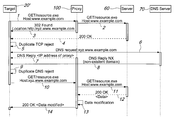
- FIG. 3 illustrates the steps of the communication between the target 20 ′, the proxy 100 , the server 60 and the DNS server 70 described in FIGS. 1 and 2 .
- the method begins in step 1 , in which the target 20 ′ sends to the server 60 an HTTP request; by way of example, said request can be a request of the GET type for a resource termed “resource.exe”, hosted on a site that has the domain name www.example.com, i.e., the domain name of the server 60 . As described earlier, this request is identified, with known sniffing or passive interception techniques, by the redirection device 90 .
- the SEQ and ACK numbers of the TCP protocol related to the connection in progress are detected and stored; in step 2 , the HTTP request reaches the remote server 60 ; in step 3 , the proxy 100 sends to the target 20 ′ an HTTP response related to the sent request, which is thus received by the target 20 ′ as if it had been sent by the server 60 .
- This step can be performed by adopting techniques for spoofing the source address which are known in the art, which use the SEQ and ACK numbers of the TCP protocol obtained in step 1 .
- the HTTP response sent by the proxy 100 is a redirection of the address sent in the request, typically obtained by returning the status code “ 302 Found”; moreover, the redirection is performed toward a non-existent host, which is preferably characterized in that it appears as a subdomain of the one sent in the request.
- the subdomain might be of the type “xyz.www.example.com”. In this manner, the target 20 ′ will be convinced that the resource has been shifted to a subdomain of the main server, as is common practice, and will consider the source to be trusted.
- step 4 the server 60 responds independently to the request sent by the target 20 ′ in step 1 , typically with an HTTP response that contains the status code “200 OK”. However, since the target 20 ′ has already accepted a response to the request of step 1 in the TCP stream (i.e., the response sent by the proxy 100 in step 3 ), in step 5 the response of the server 60 is rejected as duplicate.
- step 3 provides for step 3 to be performed necessarily before step 4 , i.e., for the response sent by the proxy 100 to reach the target 20 ′ before the response sent by the server 60 , so that the latter, not the response of the proxy 100 , is rejected by the target 20 ′ as duplicate.
- this situation generally is not deterministic, in the sense that these are two independent and concurrent activities, and therefore the response of the server 60 might arrive before the response of the proxy 100 .
- step 4 i.e., for the response sent by the proxy 100 to reach the target 20 ′ before the response sent by the server 60 , so that the latter, not the response of the proxy 100 , is rejected by the target 20 ′ as duplicate.
- this situation generally is not deterministic, in the sense that these are two independent and concurrent activities, and therefore the response of the server 60 might arrive before the response of the proxy 100 .
- the device 50 according to the invention is located as close as possible to the target 20 ′, this ensures that the round-trip time of the packets toward the remote server 60 is longer than the round-trip time from the target 20 ′ to the device 50 ; in other words, for an appropriate placement of the device 50 according to the invention, it is ensured that the proxy 100 always wins the so-called race condition on remote servers.
- step 6 the target 20 ′ sends a DNS query to the DNS server 70 to resolve the (non-existent) host name received in step 3 .
- this step must actually entail a query to the DNS server 70 and not for example a resolution of the domain name with locally-found information. For this reason, it is necessary, as indicated in step 3 , for the subdomain received by the target 20 ′ in step 3 to be not valid: if the subdomain to which the target 20 ′ is redirected were valid, it might already be in the cache of the target 20 ′ for prefetch DNS mechanisms implemented in latest-generation browsers.
- the DNS query sent in step 6 also is sniffed by the device 50 according to the invention in a manner similar to what has occurred in step 1 , and, by virtue of this, in step 7 the proxy 100 sends to the target 20 ′ a DNS response to the DNS query of step 6 , which is characterized in that it contains the association between the non-existent domain and the IP address of the proxy 100 .
- step 8 the DNS server 70 sends the DNS response related to the query of step 6 , typically a response that indicates that the domain is non-existent “(“NX non existent domain”). However, as occurred in step 5 , in this case also in step 9 the response is rejected because a response for the same query has already been received in step 7 . In this situation also, as already seen as regards steps 3 and 4 , correct operation of the method provides for step 7 to be performed necessarily before step 8 , i.e., the proxy 100 must always win the race condition on the DNS server 70 , and in this case also this is ensured by the placement of the device 50 according to the invention.
- step 10 the target 20 ′ performs the same HTTP request as in step 1 , but using the IP address received in step 7 , i.e., the IP address of the proxy 100 ; the proxy 100 then performs a legitimate HTTP request toward the original server 60 , for example the request of the “resource.exe” resource of step 1 .
- step 12 the server 60 sends the requested data to the proxy 100 ; as the data are downloaded, in steps 13 and 14 , the proxy 100 thus modifies said data and sends the modified data to the target 20 ′.
- the target 20 ′ will have thus downloaded a resource, named “resource.exe”, that it will consider to be the one requested in step 1 but has instead been modified by the proxy 100 .
- the method according to the invention is conceived so as to divert only the connections that actually have to be modified, and so that it does not have to send again the received packets; thanks to these characteristics, the performance required to ensure that the traffic flow does not degrade is lower than required in the background art, with an advantageous impact on costs.
Landscapes
- Engineering & Computer Science (AREA)
- Computer Networks & Wireless Communication (AREA)
- Signal Processing (AREA)
- Library & Information Science (AREA)
- Multimedia (AREA)
- Data Exchanges In Wide-Area Networks (AREA)
- Computer And Data Communications (AREA)
Applications Claiming Priority (1)
| Application Number | Priority Date | Filing Date | Title |
|---|---|---|---|
| PCT/IT2010/000352 WO2012017457A1 (en) | 2010-08-03 | 2010-08-03 | Method and device for network traffic manipulation |
Publications (2)
| Publication Number | Publication Date |
|---|---|
| US20130132571A1 US20130132571A1 (en) | 2013-05-23 |
| US9054918B2 true US9054918B2 (en) | 2015-06-09 |
Family
ID=43859593
Family Applications (1)
| Application Number | Title | Priority Date | Filing Date |
|---|---|---|---|
| US13/813,496 Expired - Fee Related US9054918B2 (en) | 2010-08-03 | 2010-08-03 | Method and device for network traffic manipulation |
Country Status (11)
| Country | Link |
|---|---|
| US (1) | US9054918B2 (de) |
| EP (1) | EP2601774B1 (de) |
| KR (1) | KR101643955B1 (de) |
| AU (1) | AU2010358711B2 (de) |
| BR (1) | BR112013002676A2 (de) |
| CA (1) | CA2807011A1 (de) |
| MX (1) | MX2013001429A (de) |
| NZ (1) | NZ607743A (de) |
| RU (1) | RU2541157C2 (de) |
| SG (1) | SG187244A1 (de) |
| WO (1) | WO2012017457A1 (de) |
Families Citing this family (2)
| Publication number | Priority date | Publication date | Assignee | Title |
|---|---|---|---|---|
| CN109471713B (zh) * | 2017-09-07 | 2022-11-08 | 北京京东尚科信息技术有限公司 | 用于查询信息的方法和装置 |
| KR102127272B1 (ko) * | 2017-12-22 | 2020-06-29 | 주식회사 웨어밸리 | 통계적 sql 패턴 분석을 통한 sql 튜닝 자동화 방법 및 시스템 |
Citations (6)
| Publication number | Priority date | Publication date | Assignee | Title |
|---|---|---|---|---|
| US20020178381A1 (en) * | 2001-05-22 | 2002-11-28 | Trend Micro Incorporated | System and method for identifying undesirable content in responses sent in reply to a user request for content |
| US6687732B1 (en) | 1998-09-28 | 2004-02-03 | Inktomi Corporation | Adaptive traffic bypassing in an intercepting network driver |
| US20060031404A1 (en) * | 2004-05-14 | 2006-02-09 | Mobilaps, Llc | Method of providing a web page with inserted content |
| US20080201413A1 (en) * | 2005-05-24 | 2008-08-21 | Sullivan Alan T | Enhanced Features for Direction of Communication Traffic |
| US8200752B2 (en) * | 2009-12-23 | 2012-06-12 | Citrix Systems, Inc. | Systems and methods for policy based transparent client IP insertion |
| US20130311677A1 (en) * | 2010-05-06 | 2013-11-21 | Desvio, Inc. | Method and system for monitoring and redirecting http requests away from unintended web sites |
Family Cites Families (2)
| Publication number | Priority date | Publication date | Assignee | Title |
|---|---|---|---|---|
| US6389462B1 (en) * | 1998-12-16 | 2002-05-14 | Lucent Technologies Inc. | Method and apparatus for transparently directing requests for web objects to proxy caches |
| RU2387002C2 (ru) * | 2003-06-30 | 2010-04-20 | Майкрософт Корпорейшн | Выравнивание сетевой нагрузки с помощью управления соединением |
-
2010
- 2010-08-03 NZ NZ607743A patent/NZ607743A/en not_active IP Right Cessation
- 2010-08-03 SG SG2013007083A patent/SG187244A1/en unknown
- 2010-08-03 MX MX2013001429A patent/MX2013001429A/es active IP Right Grant
- 2010-08-03 BR BR112013002676A patent/BR112013002676A2/pt not_active IP Right Cessation
- 2010-08-03 US US13/813,496 patent/US9054918B2/en not_active Expired - Fee Related
- 2010-08-03 CA CA2807011A patent/CA2807011A1/en not_active Abandoned
- 2010-08-03 AU AU2010358711A patent/AU2010358711B2/en not_active Ceased
- 2010-08-03 KR KR1020137005146A patent/KR101643955B1/ko not_active Expired - Fee Related
- 2010-08-03 RU RU2013109289/08A patent/RU2541157C2/ru not_active IP Right Cessation
- 2010-08-03 EP EP10771534.4A patent/EP2601774B1/de not_active Not-in-force
- 2010-08-03 WO PCT/IT2010/000352 patent/WO2012017457A1/en not_active Ceased
Patent Citations (6)
| Publication number | Priority date | Publication date | Assignee | Title |
|---|---|---|---|---|
| US6687732B1 (en) | 1998-09-28 | 2004-02-03 | Inktomi Corporation | Adaptive traffic bypassing in an intercepting network driver |
| US20020178381A1 (en) * | 2001-05-22 | 2002-11-28 | Trend Micro Incorporated | System and method for identifying undesirable content in responses sent in reply to a user request for content |
| US20060031404A1 (en) * | 2004-05-14 | 2006-02-09 | Mobilaps, Llc | Method of providing a web page with inserted content |
| US20080201413A1 (en) * | 2005-05-24 | 2008-08-21 | Sullivan Alan T | Enhanced Features for Direction of Communication Traffic |
| US8200752B2 (en) * | 2009-12-23 | 2012-06-12 | Citrix Systems, Inc. | Systems and methods for policy based transparent client IP insertion |
| US20130311677A1 (en) * | 2010-05-06 | 2013-11-21 | Desvio, Inc. | Method and system for monitoring and redirecting http requests away from unintended web sites |
Non-Patent Citations (3)
| Title |
|---|
| International Search Report for corresponding international application No. PCT/IT2010/000352 filed on Aug. 3, 2010; Mail date May 2, 2011. |
| Reply to Written Opinion for corresponding international application No. PCT/IT2010/000352 filed on Aug. 3, 2010; Dec. 5, 2011. |
| Written Opinion for corresponding international application No. PCT/IT2010/000352 filed on Aug. 3, 2010; Mail date May 2, 2011. |
Also Published As
| Publication number | Publication date |
|---|---|
| WO2012017457A1 (en) | 2012-02-09 |
| KR101643955B1 (ko) | 2016-07-29 |
| BR112013002676A2 (pt) | 2016-05-31 |
| RU2541157C2 (ru) | 2015-02-10 |
| AU2010358711B2 (en) | 2016-05-26 |
| US20130132571A1 (en) | 2013-05-23 |
| AU2010358711A1 (en) | 2013-03-14 |
| EP2601774A1 (de) | 2013-06-12 |
| CA2807011A1 (en) | 2012-02-09 |
| MX2013001429A (es) | 2013-06-28 |
| KR20130096250A (ko) | 2013-08-29 |
| EP2601774B1 (de) | 2016-10-19 |
| SG187244A1 (en) | 2013-03-28 |
| RU2013109289A (ru) | 2014-09-10 |
| NZ607743A (en) | 2014-06-27 |
Similar Documents
| Publication | Publication Date | Title |
|---|---|---|
| US11159563B2 (en) | Identifying a denial-of-service attack in a cloud-based proxy service | |
| JP7083460B2 (ja) | Httpsトランザクションにおける中間者の検出 | |
| US10097520B2 (en) | Method and apparatus for causing delay in processing requests for internet resources received from client devices | |
| US9843590B1 (en) | Method and apparatus for causing a delay in processing requests for internet resources received from client devices | |
| US20090037976A1 (en) | System and Method for Securing a Network Session | |
| US20230344917A1 (en) | Systems and methods for reducing server load with HTTPS cache | |
| US20170104630A1 (en) | System, Method, Software, and Apparatus for Computer Network Management | |
| US10218805B2 (en) | Method and apparatus for causing delay in processing requests for internet resources received from client devices | |
| Nakatsuka et al. | PDoT: private DNS-over-TLS with TEE support | |
| US9054918B2 (en) | Method and device for network traffic manipulation | |
| Al-Qudah et al. | Anycast-aware transport for content delivery networks | |
| Singanamalla et al. | Respect the ORIGIN! a best-case evaluation of connection coalescing in the wild | |
| Lee et al. | Analyzing spatial differences in the TLS security of delegated web services | |
| 이준희 | A TLS Downgrade Attack using Spatial Differences in Security Configurations | |
| Kontaxis et al. | Protecting Insecure Communications with Topology-aware Network Tunnels | |
| KR20100123979A (ko) | 대규모 대역폭 공격 상황에서 연속적 서비스 제공을 위한 분산 중계기술 및 구성 방법 | |
| WO2009006003A9 (en) | System and method for securing a network session | |
| JP2017188763A (ja) | ネットワーク疎通確認システムおよびネットワーク疎通確認方法 |
Legal Events
| Date | Code | Title | Description |
|---|---|---|---|
| AS | Assignment |
Owner name: HT S.R.L., ITALY Free format text: ASSIGNMENT OF ASSIGNORS INTEREST;ASSIGNORS:ORNAGHI, ALBERTO;VALLERI, MARCO;MILAN, DANIELE;AND OTHERS;REEL/FRAME:029729/0874 Effective date: 20130129 |
|
| STCF | Information on status: patent grant |
Free format text: PATENTED CASE |
|
| FEPP | Fee payment procedure |
Free format text: MAINTENANCE FEE REMINDER MAILED (ORIGINAL EVENT CODE: REM.); ENTITY STATUS OF PATENT OWNER: LARGE ENTITY |
|
| LAPS | Lapse for failure to pay maintenance fees |
Free format text: PATENT EXPIRED FOR FAILURE TO PAY MAINTENANCE FEES (ORIGINAL EVENT CODE: EXP.); ENTITY STATUS OF PATENT OWNER: LARGE ENTITY |
|
| STCH | Information on status: patent discontinuation |
Free format text: PATENT EXPIRED DUE TO NONPAYMENT OF MAINTENANCE FEES UNDER 37 CFR 1.362 |
|
| FP | Lapsed due to failure to pay maintenance fee |
Effective date: 20190609 |