US9034516B2 - Materials prepared by metal extraction - Google Patents
Materials prepared by metal extraction Download PDFInfo
- Publication number
- US9034516B2 US9034516B2 US14/253,764 US201414253764A US9034516B2 US 9034516 B2 US9034516 B2 US 9034516B2 US 201414253764 A US201414253764 A US 201414253764A US 9034516 B2 US9034516 B2 US 9034516B2
- Authority
- US
- United States
- Prior art keywords
- metal
- lithium
- battery
- halide
- materials
- Prior art date
- Legal status (The legal status is an assumption and is not a legal conclusion. Google has not performed a legal analysis and makes no representation as to the accuracy of the status listed.)
- Active
Links
- WUESPRPNFORHII-UHFFFAOYSA-N C.[Li]B Chemical compound C.[Li]B WUESPRPNFORHII-UHFFFAOYSA-N 0.000 description 1
Images




Classifications
-
- H—ELECTRICITY
- H01—ELECTRIC ELEMENTS
- H01M—PROCESSES OR MEANS, e.g. BATTERIES, FOR THE DIRECT CONVERSION OF CHEMICAL ENERGY INTO ELECTRICAL ENERGY
- H01M4/00—Electrodes
- H01M4/02—Electrodes composed of, or comprising, active material
- H01M4/36—Selection of substances as active materials, active masses, active liquids
- H01M4/48—Selection of substances as active materials, active masses, active liquids of inorganic oxides or hydroxides
- H01M4/50—Selection of substances as active materials, active masses, active liquids of inorganic oxides or hydroxides of manganese
- H01M4/505—Selection of substances as active materials, active masses, active liquids of inorganic oxides or hydroxides of manganese of mixed oxides or hydroxides containing manganese for inserting or intercalating light metals, e.g. LiMn2O4 or LiMn2OxFy
-
- C—CHEMISTRY; METALLURGY
- C01—INORGANIC CHEMISTRY
- C01G—COMPOUNDS CONTAINING METALS NOT COVERED BY SUBCLASSES C01D OR C01F
- C01G53/00—Compounds of nickel
- C01G53/40—Complex oxides containing nickel and at least one other metal element
- C01G53/42—Complex oxides containing nickel and at least one other metal element containing alkali metals, e.g. LiNiO2
- C01G53/44—Complex oxides containing nickel and at least one other metal element containing alkali metals, e.g. LiNiO2 containing manganese
- C01G53/50—Complex oxides containing nickel and at least one other metal element containing alkali metals, e.g. LiNiO2 containing manganese of the type (MnO2)n-, e.g. Li(NixMn1-x)O2 or Li(MyNixMn1-x-y)O2
-
- H—ELECTRICITY
- H01—ELECTRIC ELEMENTS
- H01M—PROCESSES OR MEANS, e.g. BATTERIES, FOR THE DIRECT CONVERSION OF CHEMICAL ENERGY INTO ELECTRICAL ENERGY
- H01M10/00—Secondary cells; Manufacture thereof
- H01M10/05—Accumulators with non-aqueous electrolyte
- H01M10/052—Li-accumulators
- H01M10/0525—Rocking-chair batteries, i.e. batteries with lithium insertion or intercalation in both electrodes; Lithium-ion batteries
-
- H—ELECTRICITY
- H01—ELECTRIC ELEMENTS
- H01M—PROCESSES OR MEANS, e.g. BATTERIES, FOR THE DIRECT CONVERSION OF CHEMICAL ENERGY INTO ELECTRICAL ENERGY
- H01M4/00—Electrodes
- H01M4/02—Electrodes composed of, or comprising, active material
- H01M4/04—Processes of manufacture in general
-
- H—ELECTRICITY
- H01—ELECTRIC ELEMENTS
- H01M—PROCESSES OR MEANS, e.g. BATTERIES, FOR THE DIRECT CONVERSION OF CHEMICAL ENERGY INTO ELECTRICAL ENERGY
- H01M4/00—Electrodes
- H01M4/02—Electrodes composed of, or comprising, active material
- H01M4/36—Selection of substances as active materials, active masses, active liquids
- H01M4/48—Selection of substances as active materials, active masses, active liquids of inorganic oxides or hydroxides
- H01M4/485—Selection of substances as active materials, active masses, active liquids of inorganic oxides or hydroxides of mixed oxides or hydroxides for inserting or intercalating light metals, e.g. LiTi2O4 or LiTi2OxFy
-
- H—ELECTRICITY
- H01—ELECTRIC ELEMENTS
- H01M—PROCESSES OR MEANS, e.g. BATTERIES, FOR THE DIRECT CONVERSION OF CHEMICAL ENERGY INTO ELECTRICAL ENERGY
- H01M4/00—Electrodes
- H01M4/02—Electrodes composed of, or comprising, active material
- H01M4/36—Selection of substances as active materials, active masses, active liquids
- H01M4/48—Selection of substances as active materials, active masses, active liquids of inorganic oxides or hydroxides
- H01M4/52—Selection of substances as active materials, active masses, active liquids of inorganic oxides or hydroxides of nickel, cobalt or iron
- H01M4/525—Selection of substances as active materials, active masses, active liquids of inorganic oxides or hydroxides of nickel, cobalt or iron of mixed oxides or hydroxides containing iron, cobalt or nickel for inserting or intercalating light metals, e.g. LiNiO2, LiCoO2 or LiCoOxFy
-
- H—ELECTRICITY
- H01—ELECTRIC ELEMENTS
- H01M—PROCESSES OR MEANS, e.g. BATTERIES, FOR THE DIRECT CONVERSION OF CHEMICAL ENERGY INTO ELECTRICAL ENERGY
- H01M6/00—Primary cells; Manufacture thereof
- H01M6/005—Devices for making primary cells
-
- H—ELECTRICITY
- H01—ELECTRIC ELEMENTS
- H01M—PROCESSES OR MEANS, e.g. BATTERIES, FOR THE DIRECT CONVERSION OF CHEMICAL ENERGY INTO ELECTRICAL ENERGY
- H01M6/00—Primary cells; Manufacture thereof
- H01M6/14—Cells with non-aqueous electrolyte
-
- Y—GENERAL TAGGING OF NEW TECHNOLOGICAL DEVELOPMENTS; GENERAL TAGGING OF CROSS-SECTIONAL TECHNOLOGIES SPANNING OVER SEVERAL SECTIONS OF THE IPC; TECHNICAL SUBJECTS COVERED BY FORMER USPC CROSS-REFERENCE ART COLLECTIONS [XRACs] AND DIGESTS
- Y02—TECHNOLOGIES OR APPLICATIONS FOR MITIGATION OR ADAPTATION AGAINST CLIMATE CHANGE
- Y02E—REDUCTION OF GREENHOUSE GAS [GHG] EMISSIONS, RELATED TO ENERGY GENERATION, TRANSMISSION OR DISTRIBUTION
- Y02E60/00—Enabling technologies; Technologies with a potential or indirect contribution to GHG emissions mitigation
- Y02E60/10—Energy storage using batteries
-
- Y02E60/122—
-
- Y—GENERAL TAGGING OF NEW TECHNOLOGICAL DEVELOPMENTS; GENERAL TAGGING OF CROSS-SECTIONAL TECHNOLOGIES SPANNING OVER SEVERAL SECTIONS OF THE IPC; TECHNICAL SUBJECTS COVERED BY FORMER USPC CROSS-REFERENCE ART COLLECTIONS [XRACs] AND DIGESTS
- Y02—TECHNOLOGIES OR APPLICATIONS FOR MITIGATION OR ADAPTATION AGAINST CLIMATE CHANGE
- Y02P—CLIMATE CHANGE MITIGATION TECHNOLOGIES IN THE PRODUCTION OR PROCESSING OF GOODS
- Y02P70/00—Climate change mitigation technologies in the production process for final industrial or consumer products
- Y02P70/50—Manufacturing or production processes characterised by the final manufactured product
-
- Y—GENERAL TAGGING OF NEW TECHNOLOGICAL DEVELOPMENTS; GENERAL TAGGING OF CROSS-SECTIONAL TECHNOLOGIES SPANNING OVER SEVERAL SECTIONS OF THE IPC; TECHNICAL SUBJECTS COVERED BY FORMER USPC CROSS-REFERENCE ART COLLECTIONS [XRACs] AND DIGESTS
- Y10—TECHNICAL SUBJECTS COVERED BY FORMER USPC
- Y10T—TECHNICAL SUBJECTS COVERED BY FORMER US CLASSIFICATION
- Y10T29/00—Metal working
- Y10T29/49—Method of mechanical manufacture
- Y10T29/49002—Electrical device making
- Y10T29/49108—Electric battery cell making
Definitions
- the present invention is in the field of battery technology and, more particularly, in the area of improved active materials for use in electrodes in electrochemical cells.
- OLO over-lithiated layered oxide
- OLO materials suffer from a large irreversible capacity loss during the first cycle of use in an electrochemical cell.
- Batteries fabricated with OLO materials are assembled using a non-activated form of the OLO material.
- the non-activated material is electrochemically activated by simultaneous extraction of lithium in the form of Li + and oxygen in the form of O 2 or other oxygen-containing gasses.
- This activation process has several drawbacks.
- gas is generated, which can lead to problems in cell manufacture.
- defects may be generated in the surface and bulk, which can reduce rate capability, increase the rate of metal dissolution, and increase the rate of electrolyte oxidation.
- the extracted lithium may form unstable lithium species on the anode that interfere with typical anode stabilization.
- OLO has been chemically activated by reaction with aqueous acids, such as hydrochloric acid (HCl).
- aqueous acids such as hydrochloric acid (HCl).
- HCl hydrochloric acid
- organo-fluorides such as polyvinylidenefluoride (PVdF) and polytetrafluoroethylene (PTFE)
- PVdF polyvinylidenefluoride
- PTFE polytetrafluoroethylene
- the organo-fluoride was used to remove both alkali ions and oxygen. See, e.g., T. Ozawa et al., Inorg. Chem, 49, (2010) 3044 and T. Ozawa et al., Inorg. Chem, 51 (11), (2012).
- the reaction was used to remove all of the alkali-ion from the material.
- AlF 3 aluminum fluoride
- a method for extracting ions from an active material for use in a battery electrode includes mixing the active material and an activating compound to form a mixture.
- the mixture is annealed such that an amount of ions is extracted from the active material, an amount of oxygen is liberated from the active material, and an activated active material is formed.
- the reaction products are optionally separated from the activated active material and the battery electrode is formed.
- Embodiments of the invention include the activated active material, the electrode, and the primary and secondary batteries formed from such activated active materials.
- the mixture is annealed such that a controlled amount of lithium is extracted by preselecting the amount of activating material in the mixture.
- a non-gaseous oxygen reaction product may be formed.
- a method of extracting alkali ions from a material includes mixing the material and an amount of activating compound to form a mixture wherein the activating compound is a non-fluorinated organo-halide.
- the mixture is annealed such that a controlled amount of alkali ions is extracted from the active material.
- the amount is controlled by preselecting the amount of activating material in the mixture.
- a non-gaseous oxygen reaction product may be formed.
- FIG. 1 illustrates a voltage trace for a conventional OLO material and depicts the irreversible capacity loss after the first cycle.
- FIG. 2 illustrates voltage traces comparing a conventional OLO material to a material according to an embodiment of the invention and depicts an improvement in irreversible capacity loss after the first cycle.
- FIG. 3 illustrates voltage traces comparing a conventional OLO material to a material according to an embodiment of the invention and depicts an improvement in irreversible capacity loss after the first cycle in a full cell with a carbon anode.
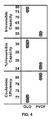
- FIG. 4 is a table of data illustrating improved performance attributable to compounds and methods according to embodiments of the invention as compared to conventional materials in a full cell with a carbon anode.
- FIG. 5 illustrates voltage traces comparing a conventional OLO material to a material according to an embodiment of the invention and depicts an improvement in irreversible capacity loss after the first cycle.
- FIG. 6 illustrates a graph comparing a conventional OLO material to a material according to an embodiment of the invention and depicts rate performance improvements.
- FIGS. 7A , 7 B, and 7 C are each scanning electron micrographs depicting the morphology of a conventional material ( FIG. 7A ), a milled material ( FIG. 7B ), and a material mixed using a low-energy process ( FIG. 7C ).
- the low-energy process substantially preserves the original morphology.
- FIG. 8 illustrates voltage traces comparing a conventional OLO material to a material according to an embodiment of the invention and depicts an improvement in irreversible capacity loss after the first cycle.
- FIG. 9 illustrates a voltage trace for a primary battery in which the cathode material was delithiated according to an embodiment of the invention.
- FIGS. 10A , 10 B, 10 C, and 10 D illustrate x-ray diffraction patterns for a conventional lithium rich NMC material and the lithium rich NMC material pre-activated according to embodiments of the invention.
- FIG. 11 illustrates voltage traces comparing a conventional lithium rich NMC material to the lithium rich NMC material pre-activated according to embodiments of the invention and depicts an improvement in irreversible capacity loss after the first cycle.
- FIG. 12 graphically depicts first cycle coulombic efficiency for a conventional lithium rich NMC material and for the lithium rich NMC material pre-activated according to embodiments of the invention.
- FIG. 13 graphically depicts first cycle discharge capacity for a conventional lithium rich NMC material and for the lithium rich NMC material pre-activated according to embodiments of the invention.
- FIG. 14 graphically depicts rate capability for a conventional lithium rich NMC material and for the lithium rich NMC material pre-activated according to embodiments of the invention.
- transition metal refers to a chemical element in groups 3 through 12 of the periodic table, including scandium (Sc), titanium (Ti), vanadium (V), chromium (Cr), manganese (Mn), iron (Fe), cobalt (Co), nickel (Ni), copper (Cu), zinc (Zn), yttrium (Y), zirconium (Zr), niobium (Nb), molybdenum (Mo), technetium (Tc), ruthenium (Ru), rhodium (Rh), palladium (Pd), silver (Ag), cadmium (Cd), hafnium (Hf), tantalum (Ta), tungsten (W), rhenium (Re), osmium (Os), iridium (Ir), platinum (Pt), gold (Au), mercury (Hg), rutherfordium (Rf), dubnium (Db), seaborgium (Sg), bohrium (Bh), hassium (H
- halogen refers to any of the chemical elements in group 17 of the periodic table, including fluorine (F), chlorine (Cl), bromine (Br), iodine (I), and astatine (At).
- chalcogen refers to any of chemical elements in group 16 of the periodic table, including oxygen (O), sulfur (S), selenium (Se), tellurium (Te), and polonium (Po).
- alkali metal refers to any of the chemical elements in group 1 of the periodic table, including lithium (Li), sodium (Na), potassium (K), rubidium (Rb), cesium (Cs), and francium (Fr).
- alkaline earth metals refers to any of the chemical elements in group 2 of the periodic table, including beryllium (Be), magnesium (Mg), calcium (Ca), strontium (Sr), barium (Ba), and radium (Ra).
- rare earth element refers to scandium (Sc), yttrium (Y), lanthanum (La), cerium (Ce), praseodymium (Pr), neodymium (Nd), promethium (Pm), samarium (Sm), europium (Eu), gadolinium (Gd), terbium (Tb), dysprosium (Dy), holmium (Ho), erbium (Er), thulium (Tm), ytterbium (Yb), and lutetium (Lu).
- pool metal refers to the elements aluminum (Al), gallium (Ga), indium (In), thallium (TI), tin (Sn), lead (Pb), bismuth (Bi) and polonium (Po).
- metal refers to a chemical element with properties that are in-between or a mixture of those of metals and nonmetals, including boron (B), silicon (Si), germanium (Ge), arsenic (As), antimony (Sb), tellurium (Te), carbon (C), aluminum (Al), selenium (Se), polonium (Po), and astatine (At).
- metal includes metalloids, poor metals, alkaline earth metals, alkali metals, and transition metals as each of those terms is defined herein.
- organic moiety refers to carbon-containing chemical compounds, as the term “organic” is widely understood in the chemical arts.
- specific capacity refers to the amount (e.g., total or maximum amount) of electrons or lithium ions a material is able to hold (or discharge) per unit mass and can be expressed in units of mAh/g.
- specific capacity can be measured in a constant current discharge (or charge) analysis, which includes discharge (or charge) at a defined rate over a defined voltage range against a defined counterelectrode. For example, specific capacity can be measured upon discharge at a rate of about 0.05 C (e.g., about 12.5 mA/g) from 4.8 V to 2.0 V versus a Li/Li+ counterelectrode.
- discharge rates and other voltage ranges also can be used, such as a rate of about 0.1 C (e.g., about 25 mA/g), or about 0.5 C (e.g., about 125 mA/g), or about 1.0 C (e.g., about 250 mA/g).
- a rate “C” refers to either (depending on context) the discharge current as a fraction or multiple relative to a “1 C” current value under which a battery (in a substantially fully charged state) would substantially fully discharge in one hour, or the charge current as a fraction or multiple relative to a “1 C” current value under which the battery (in a substantially fully discharged state) would substantially fully charge in one hour.
- NMC refers to materials of Formulas (I) or (II) in which nickel, manganese, and cobalt are present.
- Formula (II) depicts lithium-rich NMC materials, also referred to herein at “OLO” materials.
- Ranges presented herein are inclusive of their endpoints.
- the range 1 to 3 includes the values 1 and 3 as well as intermediate values.
- milling and “mixing” are used interchangeably, except in the instances where low energy mixing processes are specified. In such instances, the materials were predominantly mixed rather than milled.
- a component of the OLO active material can be represented as: Li 1+a [Mn b Ni c Co d ]O 2 (I) where 0.9 ⁇ a+b+c+d ⁇ 1.1 and b is non-zero.
- the material represented by Formula (I) has a lithium ion vacancy such that it can be represented as: Li 1+a-y [Mn b Ni c Co d ]O 2-x (II) where 0.9 ⁇ a+b+c+d ⁇ 1.1, b is non-zero, 0.1 ⁇ y ⁇ 1.1, and 0 ⁇ x ⁇ 2.
- the loss of a lithium ion creates a vacancy and it is this vacancy in the active material represented by Formula (II) that facilitates lithium ion transfer in an electrochemical cell.
- the active material represented by Formula (II) advantageously can be formed prior to assembly of the electrochemical cell, thereby avoiding significant irreversible capacity losses during the first cycle of use of the electrochemical cell.
- formation of the active material represented by Formula (II) occurs via the following generalized reaction:
- A is an organic moiety or a metal
- B is a halogen or a chalcogen
- 0 ⁇ x ⁇ 2 a, b, c, d, & y retain the values defined for them in Formulas (I) and (II).
- the “AB-type” materials of Formula (III) can be referred to as activating compounds when used according to embodiments of the invention.
- the reaction can extract both an alkali metal, such as lithium, and an anion, such as an oxygen ion.
- lithium oxide materials react with the AB compound such that the lithium reacts with the halogen or chalcogen.
- a binary alkali halide salt or a binary alkali chalcogenide salt is formed, and the formation of these salts provides the thermodynamic driving force for substantial chemical delithiation.
- embodiments of the invention relate to metal extraction from ceramic materials by high temperature reaction with an organo-halide or organo-chalcogenide.
- the halide or chalcogenide component reacts with the ceramic to form a metal-halide or metal-chalcogenide compound or complex.
- the organo-halide or organo-chalcogenide extracts metal from the ceramic.
- the metal is an alkali metal or an alkaline-earth metal.
- reaction of Formula (III) One of the advantages of the reaction of Formula (III) is that any oxygen liberated during the reaction is easily removed from the system prior to fabrication of the cathode.
- Another advantage of the reaction of Formula (III) is that the extraction of lithium from the material represented by Formula (I) can be stoichiometric. Control over the reaction is exercised by preselecting the amount of activating compound.
- certain known methods of extracting lithium from the material represented by Formula (I) rely on the first cycle of an assembled cell to extract lithium. Such prior art methods of lithium extraction can release oxygen, which is problematic in an assembled cell, and do not allow for stoichiometric control of the lithium extraction.
- Another advantage of certain embodiments is that by pre-activating the active material of the cathode, the cathode is effectively chemically charged rather than electrochemically charged.
- a chemically charged or activated material such as the material represented by Formula (II)
- conventional OLO materials are presently used only in secondary batteries where they can be electrochemically activated during a charge/discharge cycle.
- embodiments of the invention could be used for activation of battery materials, including full removal of alkali or alkaline-earth metal ions from a cathode material, to enable such a cathode material to be used in a primary battery.
- Formula (V) illustrates the case where oxygen is liberated and reacts with the carbon of the PVdF.
- Other reaction products including, but not limited to, CO, CO 2 , H 2 O, CO 2 F, C, and/or C x H y , may be formed.
- the irreversible capacity loss in OLO materials is reduced by pre-activating OLO materials via the reaction represented by Formula (III).
- Organo-halides, organo-chalcogenides, and metal halides are preferred materials for facilitating this chemical activation of OLO materials.
- the activation process uses conventional materials for the formation of cathode materials based on lithium-rich layered oxides, such as Li 2 CO 3 , LiOH, Ni(OH) 2 , NiO, NiOOH, NiCO 3 , MnO 2 , Mn 2 O 3 , MnCO 3 , CoO, Co 2 O 3 , and Co(OH) 2 , as well as various nitrates, sulfates, halides, and acetates for Li, Ni, Mn, and Co.
- These starting materials are milled using conventional milling processes or mixing processes with activating compounds represented in Formula (III), such as organo-halides, organo-chalcogenides, metal halides, or combinations thereof. This milled mixture is then annealed.
- the metal is preferably an alkali or alkaline-earth metal.
- the metal may be a transition metal.
- the metal may be an element from group 13, 14 or 15 of the periodic table or a rare earth element.
- the organic moiety preferably contains a functional group that forms stable complexes with alkali or alkaline earth metals.
- preferable classes of organic moieties include fluoro-polymers, chloro-polymers, carbon-halides, alkyl fluorides, aryl fluorides, and combinations thereof.
- preferable fluoro-polymers include PVdF and PTFE.
- preferable chloro-polymers include polyvinylchloride (PVC).
- PVC polyvinylchloride
- Examples of preferable carbon-halides include carbon monofluoride (CFx).
- preferable aryl fluorides include octafluoronapthalene.
- the halogen is not fluorine.
- the AB material of Formula (III) is an organo-halide based on chlorine, such as polyvinyl chloride (PVC).
- PVC polyvinyl chloride
- the AB compound is preferably cadmium telluride, indium sulfide, zinc telluride, or sodium selenide.
- the annealing process may promote reaction of the “B” materials with the lithium contained in the cathode starting materials.
- the high temperature may promote fluorine reaction with the lithium contained in a layered oxide material.
- the “A” materials may react with any oxygen liberated in this process.
- an organic “A” material such as carbon can react with liberated oxygen to form CO N .
- Such a process results in an OLO material that has some amount of lithium pre-discharged or extracted, and provides an improvement in the observed irreversible capacity loss during first cycle.
- the milling is accomplished via a conventional milling process, such as ball-milling or other substantially equivalent milling processes.
- low energy mixing processes are preferable for materials where the low energy milling process preserves the morphology of the particles. Milling can deform particles and certain ceramics or cathode materials from which the metal is extracted benefit from a low energy mixing process.
- the milled or mixed mixture is annealed at a relatively high temperature for a sufficient time.
- a suitable temperature range may be from about 150 degrees C. to about 800 degrees C., from about 200 degrees C. to about 800 degrees C., from about 250 degrees C. to about 800 degrees C., from about 300 degrees C. to about 800 degrees C., from about 350 degrees C. to about 800 degrees C., from about 400 degrees C. to about 800 degrees C., from about 450 degrees C. to about 800 degrees C., from about 500 degrees C. to about 800 degrees C., from about 550 degrees C. to about 800 degrees C., from about 600 degrees C. to about 800 degrees C., from about 650 degrees C. to about 800 degrees C., or from about 700 degrees C. to about 800 degrees C.
- a preferable temperature range may be from about 200 degrees C. to about 600 degrees C.
- the annealing time may vary from about 0 hours to about 24 hours. More preferably, the annealing time varies from about 1 hours to about 6 hours, from about 1.5 hours to about 6 hours, from about 2.0 hours to about 6 hours, from about 2.5 hours to about 6 hours, from about 3.0 hours to about 6 hours, from about 3.5 hours to about 6 hours, from about 4.0 hours to about 6 hours, from about 4.5 hours to about 6 hours, or from about 5.0 hours to about 6 hours.
- embodiments of the invention are described herein as relating to lithium extraction from OLO materials, certain embodiments are related more generally to the extraction of alkali metals from ceramic materials by high temperature reaction with an organo-halide, organo-chalcogenide, metal halide, or other activating materials disclosed herein. Certain embodiments disclosed herein can activate battery materials other than OLO materials and can be used to extract alkali ions, such as lithium, from the active materials of primary batteries.
- metal halides are used to pre-activate (or chemically activate prior to any electrochemical activation in the assembled cell) lithium rich layered oxides.
- lithium rich layered oxides can be pre-activated by direct reaction with metal fluorides such as AlF 3 , MgF 2 , BF 3 , CaF 2 , CoF 2 , TiF 3 , MnF 2 , NiF 2 , and combinations thereof.
- Cathode materials based on lithium rich layered oxides are prepared by a co-precipitation method disclosed herein and then annealed with metal halides such as BF 3 or TiF 3 to pre-activate the material. This process results in a layered oxide material that has some amount of lithium extracted prior to assembly of the full cell, and provides a significant improvement in the important battery performance characteristics, such as observed irreversible capacity loss.
- the fluoride component reacts with the lithium rich layered oxides to form a composition represented as: M x M′ y X z (VI) where M and M′ are each a metal, X is oxygen or fluorine or a combination of both.
- M and M′ are each a metal, X is oxygen or fluorine or a combination of both.
- M Li[Li 0.2 Mn 0.54 Ni 0.13 CO 0.13 ]O 2
- M Li
- M′ Li, Mn, Ni, Co
- X ⁇ O the metal M is preferably an alkali or alkaline-earth metal and M′ is a transition metal, a poor metal, a metalloid, an alkali metal, or an alkaline-earth metal.
- the fluorine reacts with the bulk of the lithium rich layered oxide material to form a fluorinated lithium rich layered oxide. That is, some of the oxygen sites are doped with fluorine (or other halide when other halides are used as a precursor).
- the metal of the metal halide precursor can react with oxygen coming from certain reaction to form a compound represented as: M′O y . (VII) where M′ can be an alkali metal, an alkaline-earth metal, a transition metal, a poor metal, or a metalloid. Still further, the metal of the metal halide precursor could also be doped into the lithium-rich layer oxide.
- Layered Oxide Activation An organo-halide and lithium-rich layered oxide material were mixed using a milling process. In some instances a low energy mixing process was used. Milling vessels were loaded with the organo-halide precursor (5 wt %), the lithium-rich layered oxide, and optionally a solvent, such as acetone. The vessels were then sealed and milled. After milling, solvents were evaporated from the mixture at 60 degrees C. and the mixture was subsequently annealed in air, for example at from about 350 degrees C. to about 450 degrees C. Reaction products may be optionally removed by rinsing or other methods.
- Electrode Formulation Cathodes based on the activated layered oxide material were prepared using a formulation composition of 85:7.5:7.5 (active material:binder:conductive additive) according to the following formulation method: 198 mg PVdF (Sigma Aldrich) was dissolved in 15 mL NMP (Sigma Aldrich) overnight. 198 mg of conductive additive was added to the solution and allowed to stir for several hours. 150 mg of the activated layered oxide material was then added to 1 mL of this solution and stirred overnight. Films were cast by dropping about 50 ⁇ L of slurry onto stainless steel current collectors and drying at 150 degrees C. for about 1 hour. Dried films were allowed to cool, and were then pressed at 1 ton/cm 2 . Electrodes were further dried at 150 degrees C. under vacuum for 12 hours before being brought into a glove box for battery assembly.
- Electrochemical Characterization All batteries were assembled in a high purity argon filled glove box (M-Braun, O 2 and humidity contents ⁇ 0.1 ppm), unless otherwise specified. Half cells were made using lithium as an anode, Celgard 2400 separator, and 90 ⁇ L of 1M LiPF6 in 1:2 EC:EMC electrolyte. Electrodes and cells were electrochemically characterized at 25 degrees C. with a constant current C/10 charge and discharge rate between 4.7 V and 2.5 V. No constant voltage step was included.
- Layered Oxide Activation An organo-halide and OLO material were mixed using a milling process. Milling vessels were loaded with the organo-halide precursor (5 wt %), the OLO, and optionally a solvent, such as acetone. The vessels were then sealed and milled. After milling, solvents were evaporated from the mixture at 60 degrees C. and the mixture was subsequently annealed in air at 450 degrees C. Reaction products may be optionally removed by rinsing or other methods.
- Electrode Formulation Cathodes based on the activated layered oxide material were prepared using a formulation composition of 85:7.5:7.5 (active material:binder:conductive additive) according to the following formulation method: 198 mg PVdF (Sigma Aldrich) was dissolved in 15 mL NMP (Sigma Aldrich) overnight. 198 mg of conductive additive was added to the solution and allowed to stir for several hours. 150 mg of the activated layered oxide material was then added to 1 mL of this solution and stirred overnight. Films were cast by dropping about 66 ⁇ L of slurry onto stainless steel current collectors and drying at 150 degrees C. for about 1 hour. Dried films were allowed to cool, and were then pressed at 1 ton/cm 2 . Electrodes were further dried at 150 degrees C. under vacuum for 12 hours before being brought into a glove box for battery assembly.
- Anodes based on MCMB were prepared using a formulation composition of 85:7:8 (active material:binder:conductive additive) according to the following formulation method: 132 mg PVdF (Sigma Aldrich), 115 mg of conductive additive, and 1400 mg of MCMB were dissolved in 10 mL NMP (Sigma Aldrich) overnight. Films were cast by dropping about 50 ⁇ L of slurry onto stainless steel current collectors and drying at 150 degrees C. for about 1 hour. Dried films were allowed to cool, and were then pressed at 1 ton/cm 2 . Electrodes were further dried at 150 degrees C. under vacuum for 12 hours before being brought into a glove box for battery assembly.
- Electrochemical Characterization All batteries were assembled in a high purity argon filled glove box (M-Braun, O 2 and humidity contents ⁇ 0.1 ppm), unless otherwise specified. Full cells were made using MCMB as an anode, Celgard 2400 separator, and 90 ⁇ L of 1M LiPF6 in 1:1 EC:EMC electrolyte. Electrodes and cells were electrochemically characterized at 30 degrees C. with a constant current C/20 charge and discharge rate between 4.6V and 2.0V.
- Lithium Nickel Oxide Delithiation The organo-halide and lithium nickel oxide material were mixed using a low energy mixing process. Mixing vessels were loaded with the organo-halide precursor (70 molar ration) and the lithium nickel oxide. The mixture was then annealed at about 450 degrees C. for about 6 hours in an inert atmosphere.
- Electrode Formulation Cathodes based on the lithium nickel oxide material were prepared using a formulation composition of 79:21 (delithiated materials:carbon) according to the following formulation method: 1 g of delithiated materials was mixed with 267 mg of carbon followed by adding 66.7 ⁇ L of KOH (9M). 450 mg of well-mixed materials were transferred into a cathode can and pressed by hand. 2.4 g of Zn slurry was added to the anode can and enclosed by insulator ring. The separator was wetted using KOH (9M) and placed into the cathode can with cellophane tape facing the cathode film. The cathode can and the anode can were crimped together by hand.
- Electrochemical Characterization Batteries were assembled in air. Electrodes and cells were electrochemically characterized at 25 degrees C. with a constant current C/40 discharge rate between about 2.5V and about 0.2V. No constant voltage step was included.
- Lithium rich layered oxide materials were prepared via a co-precipitation process.
- Metal nitrates were used as precursors for the Li, Mn, Ni, and Co components of the lithium rich layered oxide material.
- the as-received precursors were dissolved in de-ionized water.
- the resulting metal nitrate solutions were mixed together in stoichiometric ratios for the target composition.
- NH 4 HCO 3 solution was added slowly to the mixed metal nitrate solution as the co-precipitant. After mixing for 0.5 hours, the solutions were dried overnight at 60 degrees Celsius. The dried material was then heated to 200 degrees Celsius and held for 3 hours. Then, the material was annealed for 10 hours at 900 degrees Celsius. All drying, heating, and annealing steps were performed in air.
- Layered Oxide Activation by Direct Reaction with Metal Fluorides were used as precursors.
- metal fluorides for example, BF 3 .2H 2 O or TiF 3 from Sigma-Aldrich
- 5 mL of deionized water was added to a crucible containing 500 mg of as-synthesized lithium-rich material from the above synthesis step.
- a selected amount of BF 3 .2H 2 O was added to the crucible.
- the resulting contents of the crucible were mixed for 0.5 hours and then dried overnight at 60 degrees Celsius.
- the dried material was annealed at 400 degrees Celsius for 6 hours.
- the annealing step can take place in air or nitrogen.
- Electrode Formulation Cathodes based on the activated layered oxide material were prepared using a formulation composition of 80:10:10 of active material:binder:conductive additive. Specifically, 198 mg of binder (poly(vinylidene fluoride) from Sigma-Aldrich) was dissolved overnight in 11 mL of solvent (N-Methyl-2-pyrrolidone from Sigma-Aldrich). 198 mg of conductive carbon SuperLi was added to the solution and allowed to stir for several hours. 144 mg of the activated layered oxide material was then added to 1 mL of this solution (to yield the desired 80:10:10 ratio) and stirred overnight.
- binder poly(vinylidene fluoride) from Sigma-Aldrich
- solvent N-Methyl-2-pyrrolidone from Sigma-Aldrich
- Films were cast by dropping approximately 50 ⁇ L of this slurry onto stainless steel current collectors, which were then dried at 150 degrees Celsius for about 1 hour. The dried films were allowed to cool and the pressed at 1 ton/cm 2 . The pressed electrode films were further dried at 150 degrees Celsius under vacuum for 12 hours.
- Electrochemical Characterization All batteries were assembled in a high purity argon filled glove box (M-Braun, O 2 and humidity contents less than 0.1 ppm), unless otherwise specified. Cells were made using lithium as an anode, Celgard 2400 separator, and an electrolyte formulation of 90 ⁇ L of 1M LiPF 6 in an organic solvent 1:2 mixture of ethylene carbonate (EC):ethyl methyl carbonate (EMC). Electrodes and cells were electrochemically characterized at 30 degrees Celsius with a constant current charge and discharge rate of C/10 (25 mA/g) between 4.8 V and 2.0 V. No constant voltage step was included in the characterization cycles.
- FIG. 1 is a voltage trace illustrating the irreversible capacity loss after the first cycle in a conventional OLO material.
- the coulombic efficiency (labeled “CE” in the graph) of this conventional, unmodified material was measured to be 78%.
- FIG. 1 demonstrates the irreversible capacity loss in prior art OLO materials.
- FIG. 2 is a voltage trace illustrating an improvement in irreversible capacity loss using compounds and methods according to embodiments of the invention as compared to conventional materials.
- An OLO material was chemically delitiathed using PVdF as the “AB” material (an organo-fluoride) in the process described above.
- FIG. 2 demonstrates an improvement in irreversible capacity loss—24 mAh/g for the chemically delithiated material (labeled “PVdF treated”) versus 71 mAh/g for the conventional material.
- the coulombic efficiency of the chemically delithiated material was measured to be 91%.
- FIG. 3 is a voltage trace illustrating an improvement in irreversible capacity loss using compounds and methods according to embodiments of the invention as compared to conventional materials.
- the chemically delitiathed material shows an improved irreversible capacity loss.
- the materials were measured in a full cell using a carbon anode.
- the irreversible capacity loss improved from 76 mAh/g for the conventional OLO material to 49 mAh/g for the OLO material chemically delithiated with PVdF.
- the coulombic efficiency improved from 77.2% for the conventional OLO material to 82.0% for the OLO material chemically delithiated with PVdF.
- FIG. 4 is a table of data illustrating improved performance attributable to compounds and methods according to embodiments of the invention as compared to conventional materials in a full cell with a carbon anode.
- the top row compares the actual irreversible capacity loss on the first cycle for conventional OLO materials and an OLO material chemically delithiated with PVdF.
- the OLO material has an irreversible capacity loss between about 80 mAh/g and about 75 mAh/g while the chemically delithiated material has an irreversible capacity loss of about 55 mAh/g.
- the middle row compares the percent irreversible capacity loss on the first cycle for conventional OLO materials and an OLO material chemically delithiated with PVdF.
- the OLO material has an irreversible capacity loss between about 31% and about 29% while the chemically delithiated material has an irreversible capacity loss between about 25% and about 24%.
- the bottom row compares the coulombic efficiency for conventional OLO materials and an OLO material chemically delithiated with PVdF.
- the OLO material has a coulombic efficiency around about 77% while the chemically delithiated material has a coulombic efficiency around about 81%.
- FIG. 5 is a voltage trace comparison for conventional lithium-rich materials and materials chemically delithiated using PVdF.
- FIG. 5 demonstrates that the irreversible capacity has been reduced from 18.7% to 3.9% by chemically delithiating the OLO material without any decrease in specific capacity. Further, FIG. 5 shows that coulombic efficiency on first charge increases from 81.3% to 96.1% for the chemically delithiated material.
- FIG. 6 is a rate performance comparison between a conventional OLO material that has been chemically delithiated (circles) and one that has not been chemically delithiated (squares).
- FIGS. 7A , 7 B, and 7 C are each scanning electron microscopy images of various materials according to embodiments of the invention.
- FIG. 7A is an image of an unprocessed, as-received OLO material.
- FIG. 7B is an image of the OLO material processed using a ball-milling mixing process.
- FIG. 7C is an image of the OLO material processed using a lower energy mixing process and FIG. 7C demonstrates that the low energy mixing process preserves the initial morphology.
- the performance improvements shown in FIGS. 5 and 6 are accomplished without modifying the original particle morphology ( FIG. 7A ), as shown in FIG. 7C .
- the as-received particle morphology is maintained while still improving irreversible capacity and rate performance.
- FIG. 8 is a voltage trace comparison between a conventional OLO material (solid line) and the same material that has been chemically delithiated using PTFE (dashed line).
- FIG. 8 demonstrates that the irreversible capacity has been reduced from 18.7% to 5.5% while also maintaining similar specific capacity between the materials.
- Table 1 provides a summary of data for a conventional OLO compared to the same material that has been chemically delithiated using PVdF. Table 1 shows that capacity, coulombic efficiency, rate performance, and cycle life are similar or better for the chemically delithiated material.
- FIG. 9 is a voltage trace for a primary battery cell with a LiNiO 2 cathode material delithiated using PVdF.
- FIG. 9 demonstrates an extraction efficiency of approximately 70% for a solid state lithium extraction process using PVdF. From these results, it is understood that a ratio of PVdF to the nickel oxide starting material in excess of 100% is required to fully delithiate LiNiO 2 .
- FIGS. 10A , 10 B, and 10 C illustrate x-ray diffraction patterns for a control lithium rich NMC material as compared to lithium rich NMC materials reacted with different amounts of a metal fluoride (in this case, BF 3 ).
- FIG. 10A depicts the full range of the diffraction patterns
- FIGS. 10B and 10C depict the peaks in the diffraction patterns circled and labeled as “B” and “C,” respectively.
- the amount of BF 3 reacted varied was 0.7 weight percent, 1.3 weight percent, or 2 weight percent.
- FIG. 10A demonstrates that the lithium rich NMC material was the major phase in all the tested samples.
- Lattice expansion is consistent with a mechanism such as doping of a reactant into the lithium rich NMC material.
- fluorine atoms can be doped into the oxygen sites of the lithium rich NMC material, which would increase at least one lattice parameter.
- the data in FIGS. 10A , 10 B, and 10 C confirms that the metal fluoride materials are reacting with the lithium rich NMC material to produce a reaction product.
- the reaction product is structurally distinct from unreacted lithium rich NMC.
- the x-ray diffraction pattern would show the superposition of the diffraction pattern of the pristine lithium rich NMC material and the diffraction pattern of the metal fluoride. That is, no peaks would be shifted in the lithium rich NMC material, but additional peaks related to the metal fluoride material would appear in the diffraction pattern.
- FIG. 11 is a series of voltage traces illustrating an improvement in irreversible capacity loss using compounds and methods according to embodiments of the invention as compared to conventional materials (as-synthesized lithium rich NMC).
- FIG. 11 illustrates an improvement in irreversible capacity with increasing concentration of BF 3 .
- the improved materials were generated by pre-activating as-synthesized lithium rich NMC with various amount of BF 3 , including 0.7 weight percent, 1.3 weight percent, and 2 weight percent.
- the irreversible capacity has been reduced from 15.1% in the untreated lithium rich NMC material to 5.5% using the lithium rich NMC material pre-activated with 2 wt % BF 3 without any decrease in specific discharge capacity.
- FIG. 11 illustrates that the coulombic efficiency as measured on the first charge increases from 84.9% in the untreated lithium rich NMC material to 94.5% using the lithium rich NMC material pre-activated with 2 wt % BF 3 .
- Table 2 provides a summary of data for a conventional lithium rich NMC material compared to that material that has been pre-activated using a metal halide (in this case BF 3 ).
- Table 2 shows improvement in the irreversible capacity and the coulombic efficiency of electrodes formed by pre-activation with a metal fluoride. Notably, the discharge capacity remained essential constant while the irreversible capacity and the coulombic efficiency improved.
- the cells were cycled between 4.8 V and 2.0 V at a rate of C/10 and at a temperature of 30 degrees Celsius.
- FIG. 12 illustrates the first cycle coulombic efficiency for electrode materials in cells cycled between 4.8 V and 2.0 V at a rate of 0.1 C and at a temperature of 30 degrees Celsius.
- the left-most column shows the data (represented with a solid circle) for the control material (as-synthesized lithium rich NMC material).
- the open circles represent data collected for electrode materials pre-activated by direct reaction a metal fluoride according to embodiments described herein.
- the open circles correspond to pre-activation of as-synthesized lithium rich NMC using AlF 3 (concentrations of 4.4 weight percent and 6.2 weight percent), BF 3 (concentrations of 0.7 weight percent, 1.3 weight percent, and 2 weight percent) and TiF 3 (concentrations of 1 weight percent, 2 weight percent, and 3 weight percent).
- AlF 3 concentration of 4.4 weight percent and 6.2 weight percent
- BF 3 concentration of 0.7 weight percent, 1.3 weight percent, and 2 weight percent
- TiF 3 concentration dependent increase in coulombic efficiency.
- FIG. 12 shows data from additional examples in which certain metal nitrates and NH 4 F solution were used as the precursors.
- FIG. 13 illustrates the first cycle discharge capacity for electrode materials in cells cycled between 4.8 V and 2.0 V at a rate of 0.1 C and at a temperature of 30 degrees Celsius.
- the left-most column shows the data (represented with a solid circle) for the control material (as-synthesized lithium rich NMC material).
- the open circles represent data collected for electrode materials pre-activated by direct reaction a metal fluoride according to embodiments described herein. Specifically, the open circles correspond to pre-activation of as-synthesized lithium rich NMC using AlF 3 (concentrations of 4.4 weight percent and 6.2 weight percent), BF 3 (concentrations of 0.7 weight percent, 1.3 weight percent, and 2 weight percent) and TiF 3 (concentrations of 1 weight percent, 2 weight percent, and 3 weight percent).
- FIG. 13 demonstrates comparable discharge capacity across several examples of pre-activation. As with FIG. 12 , the triangles indicate the use of metal nitrates and NH 4 F solution as the precursors.
- FIG. 14 illustrates the rate capability (the percentage of 0.1 C rate capacity retained at discharge at a 1 C rate) for electrode materials in cells cycled between 4.8 V and 3.0 V at a temperature of 30 degrees Celsius.
- the left-most column shows the data (represented with a solid circle) for the control material (as-synthesized lithium rich NMC material).
- the open circles represent data collected for electrode materials pre-activated by direct reaction a metal fluoride according to embodiments described herein.
- FIG. 14 shows the additional examples demonstrating the improvement in the rate capability of lithium-rich NMC material using a chemical activation step with metal fluorides. Both AlF 3 and NH 4 F showed 1 C capacity retention over 85%.
- the improvement in coulombic efficiency may be applicable to other ceramic materials (such as lithium-excess battery cathode materials).
- metal halides based on chlorine can function in a manner similar to metal fluorides but as a lower cost alternative (for example, AlCl 3 ), as described herein with respect to organo-halides.
- Metal chlorides could be used for extraction of other alkali or alkaline-earth ions, in addition to lithium, from layered oxide materials.
- metal-halide reactions disclosed herein could be used for activation of primary battery materials similar to the uses of organo-halides for primary batteries disclosed herein.
- removal of alkali metal ions or alkaline earth metal ions via reaction with metal halides can enable a cathode material to be used in a primary battery.
- One of the important advantages of the metal-halide reactions disclosed herein is that the reactions can be performed in air. This feature of the reaction provides significant gains in efficiency and scalability over prior art reaction methods.
- conventional OLO materials can be improved using a chemical delithiation process such that the rate performance improves and the irreversible capacity loss at first cycle is less than 5%. These and other performance gains are achieved without diminishing other properties such as specific capacity. Particle morphology can be preserved as well.
Landscapes
- Chemical & Material Sciences (AREA)
- Chemical Kinetics & Catalysis (AREA)
- Electrochemistry (AREA)
- General Chemical & Material Sciences (AREA)
- Inorganic Chemistry (AREA)
- Engineering & Computer Science (AREA)
- Manufacturing & Machinery (AREA)
- Organic Chemistry (AREA)
- Materials Engineering (AREA)
- Battery Electrode And Active Subsutance (AREA)
Abstract
Description
xLi2MnO3·(1−x)Li[MniNijCok]O2
where 0≦x≦1, i+j+k=1, and i is non-zero. Such OLO materials are promising candidates for next generation batteries because of their high specific capacity.
Li1+a[MnbNicCod]O2 (I)
where 0.9≦a+b+c+d≧1.1 and b is non-zero. In its activated form, the material represented by Formula (I) has a lithium ion vacancy such that it can be represented as:
Li1+a-y[MnbNicCod]O2-x (II)
where 0.9≦a+b+c+d≧1.1, b is non-zero, 0.1≦y≧1.1, and 0≦x<2. The loss of a lithium ion creates a vacancy and it is this vacancy in the active material represented by Formula (II) that facilitates lithium ion transfer in an electrochemical cell.

where A is an organic moiety or a metal; B is a halogen or a chalcogen; 0≦x<2; a, b, c, d, & y retain the values defined for them in Formulas (I) and (II). The “AB-type” materials of Formula (III) can be referred to as activating compounds when used according to embodiments of the invention. The reaction can extract both an alkali metal, such as lithium, and an anion, such as an oxygen ion.
LiNiO2+C2H2F2→NiO2+LiF (IV)
or
LiNiO2+C2H2F2→NiO2-x+LiF+xCO (or CO2) (V)
Formula (V) illustrates the case where oxygen is liberated and reacts with the carbon of the PVdF. Other reaction products, including, but not limited to, CO, CO2, H2O, CO2F, C, and/or CxHy, may be formed.
MxM′yXz (VI)
where M and M′ are each a metal, X is oxygen or fluorine or a combination of both. For example, in the OLO material Li[Li0.2Mn0.54Ni0.13CO0.13]O2, M=Li; M′=Li, Mn, Ni, Co; X═O. The metal M is preferably an alkali or alkaline-earth metal and M′ is a transition metal, a poor metal, a metalloid, an alkali metal, or an alkaline-earth metal.
M′Oy. (VII)
where M′ can be an alkali metal, an alkaline-earth metal, a transition metal, a poor metal, or a metalloid. Still further, the metal of the metal halide precursor could also be doped into the lithium-rich layer oxide.
| TABLE 1 |
| Cathode performance data with and without |
| activation by an organo-halide |
| Metric | Activated | Control | ||
| Specific Capacity at Cycle 1 (mAh/g) | 254 | 260 | ||
| Coulombic Efficiency at Cycle 1 (%) | 96.1 | 81.3 | ||
| Rate Performance (2 C/0.2 C) | 76.1 | 64.5 | ||
| Cycle Life 25th cycle/5th cycle (%) | 93.0 | 91.4 | ||
| TABLE 2 |
| Cathode performance data with and without |
| activation by a metal halide |
| Metal | Irreversible | |||
| Fluoride | Charge | Discharge | Capacity | |
| Precursor | Capacity | Capacity | Loss | Coulombic |
| (weight %) | (mAh/g) | (mAh/g) | (mAh/g) | Efficiency (%) |
| 0.0 (Control) | 300.1 | 255.2 | 44.9 | 85.0 |
| 0.7 | 293.8 | 262.5 | 31.3 | 89.3 |
| 1.3 | 284.4 | 260.5 | 23.9 | 91.6 |
| 2.0 | 276.1 | 260.5 | 15.6 | 94.3 |
Claims (20)
Priority Applications (4)
| Application Number | Priority Date | Filing Date | Title |
|---|---|---|---|
| US14/253,764 US9034516B2 (en) | 2012-07-28 | 2014-04-15 | Materials prepared by metal extraction |
| JP2015077469A JP6190411B2 (en) | 2014-04-15 | 2015-04-06 | Materials made by metal extraction |
| CN201510171088.8A CN105024049B (en) | 2014-04-15 | 2015-04-10 | The material prepared by METAL EXTRACTION |
| KR1020150050992A KR101826676B1 (en) | 2014-04-15 | 2015-04-10 | Materials Prepared by Metal Extraction |
Applications Claiming Priority (3)
| Application Number | Priority Date | Filing Date | Title |
|---|---|---|---|
| US201261676942P | 2012-07-28 | 2012-07-28 | |
| US13/831,933 US8795887B2 (en) | 2012-07-28 | 2013-03-15 | Materials prepared by metal extraction |
| US14/253,764 US9034516B2 (en) | 2012-07-28 | 2014-04-15 | Materials prepared by metal extraction |
Related Parent Applications (1)
| Application Number | Title | Priority Date | Filing Date |
|---|---|---|---|
| US13/831,933 Continuation-In-Part US8795887B2 (en) | 2012-07-28 | 2013-03-15 | Materials prepared by metal extraction |
Publications (2)
| Publication Number | Publication Date |
|---|---|
| US20140302388A1 US20140302388A1 (en) | 2014-10-09 |
| US9034516B2 true US9034516B2 (en) | 2015-05-19 |
Family
ID=51654669
Family Applications (1)
| Application Number | Title | Priority Date | Filing Date |
|---|---|---|---|
| US14/253,764 Active US9034516B2 (en) | 2012-07-28 | 2014-04-15 | Materials prepared by metal extraction |
Country Status (1)
| Country | Link |
|---|---|
| US (1) | US9034516B2 (en) |
Families Citing this family (3)
| Publication number | Priority date | Publication date | Assignee | Title |
|---|---|---|---|---|
| US11862784B2 (en) | 2017-06-28 | 2024-01-02 | Basf Se | Process for making a cathode active material for a lithium ion battery |
| PL3573148T3 (en) * | 2018-05-23 | 2025-09-15 | Samsung Sdi Co., Ltd. | Positive electrode for rechargeable lithium battery and rechargeable lithium battery including same |
| CN109659537A (en) * | 2018-12-19 | 2019-04-19 | 上海纳米技术及应用国家工程研究中心有限公司 | Citrate assists Fluorin doped ternary nano piece/polypyrrole preparation method and product and application |
Citations (9)
| Publication number | Priority date | Publication date | Assignee | Title |
|---|---|---|---|---|
| US5916516A (en) | 1998-02-18 | 1999-06-29 | Mitsubishi Chemical Corporation | Fluoridated electrode materials and associated process for fabrication |
| US6703166B1 (en) * | 1999-12-08 | 2004-03-09 | Samsung Sdi Co., Ltd. | Negative active material slurry composition for rechargeable lithium battery and method of manufacturing negative electrode using same |
| US20080131777A1 (en) * | 2003-10-27 | 2008-06-05 | Naoki Hatta | Cathode Material for Secondary Battery, Method for Producing Cathode Material for Secondary Battery and Secondary Battery |
| US20090087362A1 (en) | 2005-04-15 | 2009-04-02 | Yang Kook Sun | Cathode Active Material Coated With Fluorine Compound for Lithium Secondary Batteries and Method for Preparing the Same |
| US20090194747A1 (en) | 2008-02-04 | 2009-08-06 | Vale Inco Limited | Method for improving environmental stability of cathode materials for lithium batteries |
| US20100323244A1 (en) | 2009-06-23 | 2010-12-23 | A123 Systems, Inc. | Battery electrodes and methods of manufacture |
| WO2011054441A1 (en) | 2009-11-05 | 2011-05-12 | Umicore | Core-shell lithium transition metal oxides |
| US20120070725A1 (en) * | 2010-09-22 | 2012-03-22 | Subramanian Venkatachalam | Metal halide coatings on lithium ion battery positive electrode materials and corresponding batteries |
| US20120263998A1 (en) | 2010-11-17 | 2012-10-18 | Uchicago Argonne, Llc | ELECTRODE STRUCTURES AND SURFACES FOR Li BATTERIES |
-
2014
- 2014-04-15 US US14/253,764 patent/US9034516B2/en active Active
Patent Citations (9)
| Publication number | Priority date | Publication date | Assignee | Title |
|---|---|---|---|---|
| US5916516A (en) | 1998-02-18 | 1999-06-29 | Mitsubishi Chemical Corporation | Fluoridated electrode materials and associated process for fabrication |
| US6703166B1 (en) * | 1999-12-08 | 2004-03-09 | Samsung Sdi Co., Ltd. | Negative active material slurry composition for rechargeable lithium battery and method of manufacturing negative electrode using same |
| US20080131777A1 (en) * | 2003-10-27 | 2008-06-05 | Naoki Hatta | Cathode Material for Secondary Battery, Method for Producing Cathode Material for Secondary Battery and Secondary Battery |
| US20090087362A1 (en) | 2005-04-15 | 2009-04-02 | Yang Kook Sun | Cathode Active Material Coated With Fluorine Compound for Lithium Secondary Batteries and Method for Preparing the Same |
| US20090194747A1 (en) | 2008-02-04 | 2009-08-06 | Vale Inco Limited | Method for improving environmental stability of cathode materials for lithium batteries |
| US20100323244A1 (en) | 2009-06-23 | 2010-12-23 | A123 Systems, Inc. | Battery electrodes and methods of manufacture |
| WO2011054441A1 (en) | 2009-11-05 | 2011-05-12 | Umicore | Core-shell lithium transition metal oxides |
| US20120070725A1 (en) * | 2010-09-22 | 2012-03-22 | Subramanian Venkatachalam | Metal halide coatings on lithium ion battery positive electrode materials and corresponding batteries |
| US20120263998A1 (en) | 2010-11-17 | 2012-10-18 | Uchicago Argonne, Llc | ELECTRODE STRUCTURES AND SURFACES FOR Li BATTERIES |
Non-Patent Citations (13)
| Title |
|---|
| Arai and Sakurai, "Characteristics of LixNiO2 obtained by chemical delithiation," Journal of Power Sources 81-82 (1999) 401-405. |
| Arai et al, "Nickel dioxide polymorphs as lithium insertion electrodes," Electrochimica Acta 47 (2002) 2697-2705. |
| International Search Report and Written Opinion Issued on Oct. 24, 2013, in connection with PCT/US2013/051597. |
| Ozawa and Sasaki, "An Alkali-Metal Ion Extracted Layered Compound as a Template for a Metastable Phase Synthesis in a Low-Temperature Solid-State Reaction: Preparation of Brookite from K0.8Ti1.73Li0.2704," Inorg. Chem. 2010, 49, 3044-3050. |
| Ozawa and Sasaki, "Exploration of Mid-Temperature Alkali-Metal-Ion Extraction Route Using PTFE (AEP): Transformation of alpha-NaFeO2-Type Layered Oxides into Rutile-Type Binary Oxides," Inorg. Chem. 2012, 51, 7317-7323. |
| Ozawa and Sasaki, "Exploration of Mid-Temperature Alkali-Metal-Ion Extraction Route Using PTFE (AEP): Transformation of α-NaFeO2-Type Layered Oxides into Rutile-Type Binary Oxides," Inorg. Chem. 2012, 51, 7317-7323. |
| Park et al., Improvement of structural and electrochemical properties of AIF3-coated Li[Ni1/3Co1/3Mn1/3j02 cathode materialson high voltage region, Journal of Power Sources, 178 (2008) 826-831. |
| Sun et al, "The Role of AIF3 Coatings in Improving Electrochemical Cycling of Li-Enriched Nickel-Manganese Oxide Electrodes for Li-Ion Batteries," Adv. Mater. 2012, 24, 1192-1196. |
| Sun et al., Improvement of structural and electrochemical properties of AIF3-coated Li[Ni1/3Co1/3Mn1/3]O2 cathode materials on high voltage region, Journal of Power Sources, 178 (2008) 826-831. * |
| Thackeray et al., Enhancing the rate capability of high capacity xLi2Mn03-(1-x)LiM02(M=Mn,Ni, Co) electrodes by Li-Ni-PO4 treatment, Electrochemistry Communications 11 (2009) 748-751. |
| Thackeray et al., Enhancing the rate capability of high capacity xLi2MnO3-(1-x)LiMO2 (M=Mn, Ni, Co) electrodes by Li-Ni-PO4 treatment, Electrochemistry Communications 11 (2009) 748-751. * |
| Yang et al., The effects of quenching treatment and AIF3 coating on LiNi0.5Mn0.5O2 cathode materials for lithium-ion battery, Materials Chemistry and Physics 119 (2010) 519-523. * |
| Yang et al., The effects of quenching treatment and AIF3 coating on LiNiO.5MnO.502 cathodematerials for lithium-ion battery, Materials Chemistry and Physics 119 (2010) 519-523. |
Also Published As
| Publication number | Publication date |
|---|---|
| US20140302388A1 (en) | 2014-10-09 |
Similar Documents
| Publication | Publication Date | Title |
|---|---|---|
| US9159994B2 (en) | High energy materials for a battery and methods for making and use | |
| JP4523807B2 (en) | Positive electrode active material for lithium secondary battery, method for producing the same, and lithium secondary battery including the same | |
| JP5762828B2 (en) | Sodium secondary battery | |
| CN117916908B (en) | Cathode with coated disordered rock salt material | |
| CN101542787A (en) | Cation-substituted spinel oxide and oxyfluoride cathodes for lithium ion batteries | |
| WO2016009768A1 (en) | Sulfide-based solid electrolyte for lithium ion batteries | |
| WO2010042434A2 (en) | Positive electrode materials for lithium ion batteries having a high specific discharge capacity and processes for the synthesis of these materials | |
| JP2015515719A (en) | Metal salt electrode | |
| JP2013539594A (en) | Extremely long-term cycling of lithium-ion batteries using lithium-rich cathode materials | |
| JP2013030494A (en) | Secondary electrochemical cell | |
| US10153487B2 (en) | Lithium complex oxide | |
| JP2015507333A (en) | Sulfate electrode | |
| US20170104212A1 (en) | Compositions for High Energy Electrodes and Methods of Making and Use | |
| US9034516B2 (en) | Materials prepared by metal extraction | |
| US10903483B2 (en) | High energy materials for a battery and methods for making and use | |
| JP5245210B2 (en) | Cathode active material for non-aqueous electrolyte battery and non-aqueous electrolyte battery using the same | |
| KR20200032662A (en) | Sodium-Based Electrode Active Material and Secondary Battery Having the Same | |
| JP5819786B2 (en) | Lithium cuprate positive electrode material, method for producing the positive electrode material, and lithium secondary battery containing the positive electrode material as a positive electrode active material | |
| JP6190411B2 (en) | Materials made by metal extraction | |
| US8795887B2 (en) | Materials prepared by metal extraction | |
| US10205167B2 (en) | High energy materials for a battery and methods for making and use | |
| JP3961514B2 (en) | Method for producing Li-Ni-Ti composite oxide electrode material and battery using the electrode material | |
| HK1161654A (en) | Positive electrode materials for lithium ion batteries having a high specific discharge capacity and processes for the synthesis of these materials |
Legal Events
| Date | Code | Title | Description |
|---|---|---|---|
| AS | Assignment |
Owner name: WILDCAT DISCOVERY TECHNOLOGIES, INC, CALIFORNIA Free format text: ASSIGNMENT OF ASSIGNORS INTEREST;ASSIGNORS:LI, BIN;YANG, JEN HSIEN;TONG, WEI;SIGNING DATES FROM 20141022 TO 20141122;REEL/FRAME:034467/0251 |
|
| STCF | Information on status: patent grant |
Free format text: PATENTED CASE |
|
| AS | Assignment |
Owner name: SILICON VALLEY BANK, CALIFORNIA Free format text: SECURITY INTEREST;ASSIGNOR:WILDCAT DISCOVERY TECHNOLOGIES, INC.;REEL/FRAME:041255/0427 Effective date: 20160926 |
|
| MAFP | Maintenance fee payment |
Free format text: PAYMENT OF MAINTENANCE FEE, 4TH YEAR, LARGE ENTITY (ORIGINAL EVENT CODE: M1551); ENTITY STATUS OF PATENT OWNER: LARGE ENTITY Year of fee payment: 4 |
|
| AS | Assignment |
Owner name: WILDCAT DISCOVERY TECHNOLOGIES, INC., CALIFORNIA Free format text: RELEASE BY SECURED PARTY;ASSIGNOR:SILICON VALLEY BANK;REEL/FRAME:060063/0733 Effective date: 20220512 |
|
| MAFP | Maintenance fee payment |
Free format text: PAYMENT OF MAINTENANCE FEE, 8TH YEAR, LARGE ENTITY (ORIGINAL EVENT CODE: M1552); ENTITY STATUS OF PATENT OWNER: LARGE ENTITY Year of fee payment: 8 |