US9004532B1 - Utility vehicle with ROPS and loading platform - Google Patents

Utility vehicle with ROPS and loading platform Download PDF

Info

Publication number
US9004532B1
US9004532B1 US14/197,468 US201414197468A US9004532B1 US 9004532 B1 US9004532 B1 US 9004532B1 US 201414197468 A US201414197468 A US 201414197468A US 9004532 B1 US9004532 B1 US 9004532B1
Authority
US
United States
Prior art keywords
space
boarding
posts
loading platform
vehicle body
Prior art date
Legal status (The legal status is an assumption and is not a legal conclusion. Google has not performed a legal analysis and makes no representation as to the accuracy of the status listed.)
Active
Application number
US14/197,468
Other versions
US20150084321A1 (en
Inventor
Yoshimi Hirooka
Current Assignee (The listed assignees may be inaccurate. Google has not performed a legal analysis and makes no representation or warranty as to the accuracy of the list.)
Kubota Corp
Original Assignee
Kubota Corp
Priority date (The priority date is an assumption and is not a legal conclusion. Google has not performed a legal analysis and makes no representation as to the accuracy of the date listed.)
Filing date
Publication date
Application filed by Kubota Corp filed Critical Kubota Corp
Assigned to KUBOTA CORPORATION reassignment KUBOTA CORPORATION ASSIGNMENT OF ASSIGNORS INTEREST (SEE DOCUMENT FOR DETAILS). Assignors: HIROOKA, YOSHIMI
Publication of US20150084321A1 publication Critical patent/US20150084321A1/en
Application granted granted Critical
Publication of US9004532B1 publication Critical patent/US9004532B1/en
Active legal-status Critical Current
Anticipated expiration legal-status Critical

Links

Images

Classifications

    • BPERFORMING OPERATIONS; TRANSPORTING
    • B60VEHICLES IN GENERAL
    • B60RVEHICLES, VEHICLE FITTINGS, OR VEHICLE PARTS, NOT OTHERWISE PROVIDED FOR
    • B60R21/00Arrangements or fittings on vehicles for protecting or preventing injuries to occupants or pedestrians in case of accidents or other traffic risks
    • B60R21/02Occupant safety arrangements or fittings, e.g. crash pads
    • B60R21/13Roll-over protection
    • BPERFORMING OPERATIONS; TRANSPORTING
    • B60VEHICLES IN GENERAL
    • B60NSEATS SPECIALLY ADAPTED FOR VEHICLES; VEHICLE PASSENGER ACCOMMODATION NOT OTHERWISE PROVIDED FOR
    • B60N2/00Seats specially adapted for vehicles; Arrangement or mounting of seats in vehicles
    • B60N2/24Seats specially adapted for vehicles; Arrangement or mounting of seats in vehicles for particular purposes or particular vehicles
    • B60N2/30Non-dismountable or dismountable seats storable in a non-use position, e.g. foldable spare seats
    • B60N2/3002Non-dismountable or dismountable seats storable in a non-use position, e.g. foldable spare seats back-rest movements
    • B60N2/3029Non-dismountable or dismountable seats storable in a non-use position, e.g. foldable spare seats back-rest movements by composed movement
    • B60N2/3031Non-dismountable or dismountable seats storable in a non-use position, e.g. foldable spare seats back-rest movements by composed movement in a longitudinal-vertical plane
    • BPERFORMING OPERATIONS; TRANSPORTING
    • B60VEHICLES IN GENERAL
    • B60NSEATS SPECIALLY ADAPTED FOR VEHICLES; VEHICLE PASSENGER ACCOMMODATION NOT OTHERWISE PROVIDED FOR
    • B60N2/00Seats specially adapted for vehicles; Arrangement or mounting of seats in vehicles
    • B60N2/24Seats specially adapted for vehicles; Arrangement or mounting of seats in vehicles for particular purposes or particular vehicles
    • B60N2/30Non-dismountable or dismountable seats storable in a non-use position, e.g. foldable spare seats
    • B60N2/3038Cushion movements
    • B60N2/304Cushion movements by rotation only
    • B60N2/3045Cushion movements by rotation only about transversal axis
    • B60N2/305Cushion movements by rotation only about transversal axis the cushion being hinged on the vehicle frame
    • BPERFORMING OPERATIONS; TRANSPORTING
    • B60VEHICLES IN GENERAL
    • B60PVEHICLES ADAPTED FOR LOAD TRANSPORTATION OR TO TRANSPORT, TO CARRY, OR TO COMPRISE SPECIAL LOADS OR OBJECTS
    • B60P3/00Vehicles adapted to transport, to carry or to comprise special loads or objects
    • B60P3/42Vehicles adapted to transport, to carry or to comprise special loads or objects convertible from one use to a different one
    • B60P3/423Vehicles adapted to transport, to carry or to comprise special loads or objects convertible from one use to a different one from transport of persons to transport of goods
    • BPERFORMING OPERATIONS; TRANSPORTING
    • B62LAND VEHICLES FOR TRAVELLING OTHERWISE THAN ON RAILS
    • B62DMOTOR VEHICLES; TRAILERS
    • B62D23/00Combined superstructure and frame, i.e. monocoque constructions
    • B62D23/005Combined superstructure and frame, i.e. monocoque constructions with integrated chassis in the whole shell, e.g. meshwork, tubes, or the like
    • BPERFORMING OPERATIONS; TRANSPORTING
    • B62LAND VEHICLES FOR TRAVELLING OTHERWISE THAN ON RAILS
    • B62DMOTOR VEHICLES; TRAILERS
    • B62D33/00Superstructures for load-carrying vehicles
    • B62D33/02Platforms; Open load compartments
    • B62D33/023Sideboard or tailgate structures
    • B62D33/027Sideboard or tailgate structures movable
    • B62D33/0273Movable tailboards for vehicles comprising non-movable sideboards, e.g. pick-up trucks
    • BPERFORMING OPERATIONS; TRANSPORTING
    • B62LAND VEHICLES FOR TRAVELLING OTHERWISE THAN ON RAILS
    • B62DMOTOR VEHICLES; TRAILERS
    • B62D33/00Superstructures for load-carrying vehicles
    • B62D33/06Drivers' cabs
    • B62D33/0617Drivers' cabs for tractors or off-the-road vehicles
    • B62D33/0625Drivers' cabs for tractors or off-the-road vehicles open

Definitions

  • the present invention relates to a utility vehicle including a ROPS (roll over protection structure) delimiting a front boarding space acting as a ride-in space of a front boarding section and a rear boarding space acting as a ride-in space of a rear boarding section, and a platform system.
  • the platform system has a loading platform switchable between a first position in which a front end of the loading platform is positioned rearward of the rear boarding space and a second position in which the front end of the loading platform enters the rear boarding space.
  • the rear boarding space can be used as a storing space for the loading platform thanks to the characteristic structure of the platform system described above.
  • the front end of the loading platform enters the rear boarding space beyond rear posts forming the ROPS, and thus the rear posts disadvantageously obstruct access to the loading platform from a lateral side.
  • An object of the present invention is to secure easy access to the loading platform in any position in the utility vehicle of the above type.
  • a utility vehicle includes a vehicle frame extending in a fore-and-aft direction of a vehicle body, a front boarding section mounted forward of the vehicle body, a rear boarding section mounted rearward of the front boarding section and including a rear seat unit, a ROPS delimiting space including a front boarding space acting as a ride-in space of the front boarding section and a rear boarding space acting as a ride-in space of the rear boarding section, the ROPS including a plurality of posts supported to the vehicle frame and an upper frame supported to the posts and delimiting upper space of the front boarding space and the rear boarding space, and a platform system with a loading platform mounted rearward of the vehicle body to be switchable between a first position in which a front end of the loading platform is positioned rearward of the rear boarding space and a second position in which the front end of the loading platform enters the rear boarding space.
  • the posts of the ROPS are arranged so as not to overlap the loading platform in both of the first position and the second
  • the posts of the ROPS include a pair of right and left front posts and a pair of right and left rear posts, each of the front posts and the rear posts being spaced from each other in a transverse direction of the vehicle body, and the rear posts are positioned forward of the front end of the loading platform in the second position between the front boarding space and the rear boarding space in the fore-and-aft direction. Since the rear posts supporting the upper frame in cooperation with the front posts are also positioned forward of the rear boarding space in the fore-and-aft direction, the rear posts do not obstruct the access to the loading platform from the lateral side.
  • the upper frame delimiting the upper space of the front boarding space and the rear boarding space is supported only by the posts positioned forward of the boarding space in the fore-and-aft direction of the vehicle body. This provides easy access to the rear boarding space from the lateral side of the vehicle body.
  • the rear posts are positioned forward of the rear seat unit in a preferred embodiment of the present invention.
  • the rear posts are connected to the upper frame at intermediate portions of the upper frame in the fore-and-aft direction of the vehicle body.
  • the present invention further provides a pair of right and left reinforcement beams extending diagonally for connecting the rear posts to the upper frame at portions rearward of connecting points to the rear posts.
  • the front end of the loading platform in the second position enters the rear boarding space with the rear seat unit being in the use position, it is required to increase the attaching level for the loading platform due to the presence of the rear seat unit. If the attaching level for the loading platform is reduced, the rear seat unit would hamper the loading platform from entering the rear boarding space and thus a sufficient length of the loading platform for entering the rear boarding space cannot be secured.
  • the rear seat unit has a foldable structure to allow the rear seat unit to be switched between a use position in which the rear seat unit is developed in a rear region of the rear boarding space and a storing position in which the rear seat unit is folded in a front region of the rear boarding space, and the front end of the loading platform in the second position enters the open rear region of the rear boarding space created by shifting the rear seat unit to the storing position.
  • the front end of the loading platform in the second position since the front end of the loading platform in the second position enters the free space that is created by switching the rear seat unit to the storing position, it is not required to raise the loading platform to a higher level. Further, the sufficient length of the loading platform for entering the rear boarding space can be secured, as a result of which a large area forward and rearward of the rear boarding space can be used as a space for accommodating the loading platform.
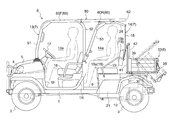
  • FIG. 1 is an overall side view of a utility vehicle with a loading platform shifted to a first position
  • FIG. 2 is an overall side view of the utility vehicle with the loading platform shifted to a second position
  • FIG. 3 is an overall plan view of the utility vehicle with the loading platform shifted to the first position
  • FIG. 4 is a side view of a rear seat unit and a partition
  • FIG. 5 is a perspective view of a ROPS
  • FIG. 6 is a perspective view of the loading platform in the first position
  • FIG. 7 is a perspective view of the loading platform in the second position
  • FIG. 8 is an illustration showing a process of switching the loading platform
  • FIG. 9 is an overall side view of the utility vehicle according to a first alternative embodiment.
  • FIG. 10 is an overall side view of the utility vehicle according to a second alternative embodiment.
  • a utility vehicle includes a vehicle body having a pair of right and left front wheels 2 and a pair of right and left rear wheels 3 provided under a vehicle frame 1 , a front cover 5 with front lights 4 provided at a front end of the vehicle body, a boarding section 7 with a ROPS 6 mounted in the vehicle body at a portion rearward of the front cover 5 , and a loading platform 8 mounted rearward of the vehicle body.
  • An engine 9 is mounted in the vehicle body between the front wheels 2 and the rear wheels 3 .
  • the utility vehicle in the current embodiment is a four-wheel drive type in which drive power outputted from the engine 9 is inputted to a transmission 10 and is shifted there to drive the front wheels 2 and the rear wheels 3 .
  • the boarding section 7 is divided into a front boarding section 13 disposed forward of the boarding section 7 , and a rear boarding section 14 disposed rearward of the front boarding section 13 .
  • the front boarding section 13 has a front boarding space 13 a acting as a ride-in space
  • the rear boarding section 14 has a rear boarding space 14 a also acting as a ride-in space.
  • An upper frame 50 of the ROPS 60 delimits upper space of the front boarding space 13 a and the rear boarding space 14 a .
  • the front boarding space 13 a and the rear boarding space 14 a are separated from rear loading space by a partition 15 .
  • a driver's seat unit 16 is mounted in a left area of the front boarding space 13 a , and a steering wheel 17 is provided forward of the driver's seat unit 16 for steering the pair of right and left front wheels 2 .
  • the front boarding section 13 acts as the boarding section for a driver.
  • the front boarding section 13 includes a front passenger's seat unit 18 mounted in a right side of the front boarding space 13 a for allowing two-person riding.
  • the driver's seat unit 16 and the front passenger's seat unit 18 are separated from each other, in which seat and backrest for the driver's seat unit 16 are separated from seat and backrest for the front passenger's seat unit 18 .
  • the rear boarding section 14 includes a rear seat unit 19 .
  • the rear seat unit 19 has a wide seat for two persons, and thus the rear boarding section 14 allows two-person riding.
  • the rear seat unit 19 is switchable between a use position shown in two-dot chain line and a storing position shown in solid line in FIG. 4 .
  • the rear seat unit 19 has a specific construction as follows.
  • the rear seat unit 19 includes a wide seat 19 a and a wide backrest 19 b.
  • the seat 19 a is supported to a support element 22 of a rear seat support 21 through an attachment 20 mounted on a front end of the rear seat unit 19 .
  • the seat 19 a is pivotable in a fore-and-aft direction about an axis of a connecting rod for connecting the attachment 20 to the support element 22 .
  • the seat 19 a switchable by the pivotal movement in the fore-and-aft direction between the use position determined above the top of the rear seat support 21 and the storing position determined behind the driver's seat unit 16 and the front passenger's seat unit 18 .
  • the seat 19 a is configured to open or close an inspection opening formed in the top of the rear seat support element 21 by switching between the use position and the storing position.
  • the rear seat support 21 accommodates the engine 9 and also acts as an engine hood. That is, the seat 19 a has a function as a lid for the inspection opening for inspection and maintenance for the interior of the rear seat support 21 and the engine 9 .
  • the backrest 19 b is connected to upper ends of a pair of right and left armrests 23 distributed in lateral opposite sides of the rear seat unit 19 and to a lower end of the partition 15 .
  • Each of the right and left armrests 23 has a lower end pivotably supported to the rear seat support 21 .
  • Each of the upper ends of the right and left armrests 23 is pivotably connected to a coupling element 25 mounted in the back side of the backrest 19 b .
  • the partition 15 has an upper end pivotably connected to extensions of a pair of right and left support arms 24 extending from the upper frame 50 of the ROPS 6 to be pivotable downward in the fore-and-aft direction, and a lower end connected to a connecting element 25 mounted in the back side of the backrest 19 b .
  • the lower end of the partition 15 is connected to a connecting slot formed in the connecting element 25 to slide and pivot.
  • the partition 15 has a partition frame formed of a cross element and a vertical element, and a net element 15 a stretched in the partition frame.
  • the armrests 23 are pivoted in the fore-and-aft direction about connecting points acting as pivotal points between the armrests 23 and the rear seat support 21 .
  • the partition 15 is moved in the fore-and-aft direction in the rear boarding space 14 a with the support arms 24 being pivoted about connecting points acting as pivotal points between the support arms 24 and the upper frame 50 .
  • the backrest 19 b is movable in the fore-and-aft direction between a use position above the use position of the seat 19 a and a storing position above the storing position of the seat 19 a.
  • the seat 19 a and the backrest 19 b are shifted to the respective use positions and firmly fixed in place by an unillustrated lock device, thereby to hold the rear seat unit 19 in a seating position defined in a rear part of the rear boarding space 14 a to be used.
  • the utility vehicle assumes a two-row seat arrangement in which both of the front boarding section 13 and the rear boarding section 14 are available.
  • the partition 15 can be moved to a rear partitioning position for the two-row seat arrangement defined in the rear end of the rear boarding section 14 , that is, a rear partitioning position for dividing the rear boarding space 14 a from the rear loading space.
  • the seat 19 a and the backrest 19 b are shifted to the respective storing positions and firmly fixed in place by an unillustrated lock device, thereby to hold the rear seat unit 19 in a part forward of the seating position of the rear boarding space 14 a to be stored.
  • the utility vehicle assumes a single-row seat arrangement in which only the front boarding section 13 is available.
  • the partition 15 can be moved to a front partitioning position for the single-row seat arrangement defined in the forward part of the rear boarding space 14 a , that is, a front partitioning position for dividing the front boarding space 13 a from the rear loading space.
  • the loading platform 8 of the platform system is supported to the vehicle body to be vertically pivotable through a dump support axis 30 extending transversely of the vehicle body at the rear end of the vehicle body.
  • the loading platform 8 is vertically operated between a loading position defined horizontally or substantially horizontally on the vehicle body, and a dumping position with a front end thereof being elevated from the vehicle body through a lift cylinder 31 disposed between a back surface of the loading platform 8 and the vehicle frame 1 .
  • the loading platform 8 includes a loading platform body 33 having a bottom plate 34 with the back surface to which the lift cylinder 31 is connected, an extending loading unit 40 having an extending bottom plate 41 connected to a front end of the bottom plate 34 at a rear end thereof.
  • the loading platform body 33 includes a rear plate 35 connected to a rear end of the bottom plate 34 , and side plates 36 connected to opposite lateral ends of the bottom plate 34 .
  • the extending loading unit 40 includes a front plate 42 connected to a front end of the extending bottom plate 41 to be pivotable about an axis 42 a (see FIG. 8 (B)), and extending side plates 43 connected to front ends of the right and left side plates 36 of the loading platform body 33 to be pivotable about axes 43 a (see FIG. 8(A) ) in the transverse direction of the loading platform.
  • the extending bottom plate 41 is pivotable about an axis 41 a (see FIG. 8(C) ) relative to the bottom plate 34 of the loading platform body 33 , thereby to switch the extending loading unit 40 between a folded position shown in FIGS. 1 and 6 and a stretched position shown in FIGS. 2 and 7 .
  • FIG. 8 is an illustration showing a switching process of the loading platform 8 .
  • the extending loading unit 40 shown in FIG. 8(A) is in the stretched position, and the extending loading unit 40 shown in FIG. 8(D) is in the folded position.
  • the right and left extending side plates 43 are pivoted inward to the folded position to extend along the front edge of the bottom plate 34 .
  • the front plate 42 is pivoted toward the top surface of the extending bottom plate 41 to lie over the top surface of the extending bottom plate 41 .
  • the extending bottom plate 41 is pivoted toward the folded extending side plates 43 to lie over outer surfaces of the extending side plates 43 , thereby to switch the extending loading unit 40 to the folded position.
  • the loading platform 8 is switched to a first position in which the longitudinal dimension of the extending loading unit 40 is reduced.
  • the right and left side plates 43 is positioned inward of the extending bottom plate 41 .
  • the longitudinal dimension of the loading platform 8 in the first position can be reduced because it is determined by a thickness of the extending side plates 43 .
  • the extending bottom plate 41 is pivoted forward to fall down to the stretched position to be flush or substantially flush with the bottom plate 34 .
  • the front plate 42 is pivoted to stand up to the stretched position to rise from the front end of the extending bottom plate 41 .
  • the right and left extending side plates 43 are pivoted outward of the loading platform to the stretched position to be flush or substantially flush with the side plates 36 , which allows the extending loading unit 40 to be shifted to the stretched position.
  • the loading platform 8 is switched to the second position in which the longitudinal dimension of the extending loading unit 40 is increased.
  • the front end thereof enters the rear boarding space 14 a due to the increase of the longitudinal dimension.
  • the rear seat unit 19 is switched to the storing position, and the partition 15 is moved to the front partitioning position for the single-row seat arrangement, thereby to allow the front end of the loading platform 8 to enter the rear boarding space 14 a .
  • the front end of the loading platform 8 enters a free space created by moving the rear seat unit 19 to the storing position (space in which the rear seat unit 19 in the use position is present).
  • eight rope hooks 45 and 46 are provided inside of the loading platform 8 .
  • the eight rope hooks 45 and 46 are distributed in two longitudinal positions in the lateral opposite ends of the bottom plate 34 and two longitudinal positions in the lateral opposite ends of the extending bottom plate 41 .
  • One of the two hooks 46 provided in each of the lateral opposite ends of the extending bottom plate 41 that is closer to the bottom plate 34 is positioned in a gap between the front plate 42 and one of the extending side plates 43 when the loading platform 8 is shifted to the first position.
  • the ROPS includes, in addition to the upper frame 50 extending in the fore-and-aft direction of the vehicle body above the front boarding space 13 a and rear boarding space 14 a , a pair of right and left front posts 51 extending downward of the vehicle body and distributed in the lateral opposite sides of the vehicle body at the front end of the front boarding space 13 a , and a pair of right and left rear posts 52 extending downward of the vehicle body and distributed in the lateral opposite sides of the vehicle body between the front boarding space 13 a and the rear boarding space 14 a .
  • the front posts 51 and the rear posts 52 are arranged not to overlap the loading platform 8 in both of the first position and the second position as viewed from the side.
  • the front posts 51 and the rear posts 52 will be described hereinafter.
  • the pair of right and left front posts 51 have upper ends connected to lateral opposite ends of the front end of the upper frame 50 , respectively, and lower ends connected to upper ends of a pair of right and left front support frames 1 F mounted on the vehicle frame 1 and extending downward of the vehicle body, respectively.
  • the pair of right and left front posts 51 support the front end of the upper frame 50 , and the front end of the ROPS 6 is supported to the vehicle frame 1 .
  • the pair of right and left rear posts 52 have upper ends connected to lateral opposite ends of an intermediate portion of the upper frame 50 , respectively, and lower ends connected to upper ends of a pair of right and left rear support frames 1 R mounted on the vehicle frame 1 and extending upward of the vehicle body, respectively.
  • the pair of right and left rear posts 52 support the intermediate portion of the upper frame 50 , and the rear end of the ROPS 6 is supported to the vehicle frame 1 .
  • Each of the right and left front support frames 1 F and each of the right and left rear support frames 1 R are formed of a single bent frame element with the front and rear sides extending downward of the vehicle body and with the intermediate portion extending in the fore-and-aft direction of the vehicle body.
  • the right and left rear posts 52 are positioned forward of the front end of the loading platform 8 in the second position. Referring to FIG. 1 , the right and left rear posts 52 are positioned forward of the rear seat unit 19 to provide easy access to the space between the rear seat unit 19 and the rear posts 52 .
  • s reinforcement beam 53 is connected between the lower end of each of the right and left rear posts 52 and a portion of the upper frame 50 positioned rearward of the connecting portion to the corresponding rear post 52 .
  • the right and left reinforcement beams 53 have lower ends connected to each other through a cross connecting beam 54 .
  • the upper frame 50 will be described hereinafter.
  • the upper frame 50 includes a pair of right and left main beams 60 extending in the fore-and-aft direction, a front cross beam 61 connected to front ends of the right and left main beams 60 , a rear cross beam 62 connected to rear ends of the right and left main beams 60 , and a center cross beam 63 connected to longitudinal intermediate portions of the right and left main beams 60 .
  • a portion close to the left end of the center cross beam 63 is connected to a forward end portion of the left main beam 60 through a left connecting frame 64 extending diagonally.
  • a portion close to the right end of the center cross beam 63 is connected to a forward end portion of the right main beam 60 through a right connecting frame 65 extending diagonally.
  • the center cross beam 63 and the rear cross beam 62 are connected to each other at their intermediate portions through a rear center cross beam 66 extending in the fore-and-aft direction.
  • Each of the right and left main beams 60 includes a beam section 60 F positioned forward of the connecting portion to the corresponding rear post (front beam section), a beam section 60 R positioned rearward of the connecting portion to the corresponding rear post (rear beam section), and a connecting element 67 for connecting the front beam section to the rear beam section.
  • the front post 51 , the rear post 52 and the front beam section 60 F of the main beam 60 are formed of a single bent frame element with the front end thereof representing the front post 51 , the rear end thereof representing the rear post 52 , and the intermediate portion thereof representing the front beam section 60 F.
  • the right and left rear beam sections 60 R of the main beam 60 and the rear cross beam 62 are formed of a single bent frame element with the lateral opposite sides thereof representing the rear beam sections 60 R of the main beam 60 , and the intermediate portion thereof representing the rear cross beam 62 .
  • FIG. 9 is an overall side view of the utility vehicle provided with a construction according to a first alternative embodiment.
  • This type of utility vehicle includes the boarding section 7 having the front boarding section 13 and the rear boarding section 14 , but does not include any function to switch the loading platform 8 to the second position, which provides only the two-rows seat arrangement.
  • the ROPS 6 of this type of utility vehicle has the same construction as the ROPS 6 shown in FIGS. 1 , 3 and 5 .
  • FIG. 10 is an overall side view of the utility vehicle provided with a construction according to a second alternative embodiment.
  • This type of utility vehicle includes a driver's boarding section 70 corresponding to the front boarding section 13 without the rear boarding section, which provides only the single-row seat arrangement.
  • the ROPS 6 of this type of utility vehicle has the same construction as the ROPS 6 shown in FIGS. 1 , 3 and 5 .
  • the front end of the loading platform 8 enters a space defined under a section 6 R of the ROPS 6 positioned rearward of the rear posts 52 .
  • the structure 6 R of the ROPS 6 positioned rearward of the rear posts 52 that is, the structure including the right and left rear beam sections 60 R of the main frame 60 and the rear cross beam 62 is detachable from the vehicle body, open space can be advantageously secured above the loading platform 8 . Further, the structure 6 R of the upper frame 50 positioned rearward of the rear posts 52 may be folded forward.
  • the foldable type of extending loading unit 40 is employed to switch the loading platform 8 between the first position and the second position.
  • the loading platform 8 is switchable between the first position and the second position by varying the longitudinal dimension of the loading platform.
  • the entire loading platform 8 may be slidable relative to the vehicle body in the fore-and-aft direction, thereby to switch the loading platform 8 between the first position and the second position.
  • the rear seat unit 19 is switched to the storing position to allow the front end of the loading platform 8 to enter the vacant seating space. Instead, the front end of the loading platform 8 may enter the rear boarding space 14 a with the rear seat unit 19 being in the use position.
  • the partition 15 is moved in the fore-and-aft direction by switching the rear seat unit 19 between the use position and the storing position.
  • the operation for switching the rear seat unit 19 between the use position and the storing position may be performed separately from the operation for moving the partition 15 in the fore-and-aft direction.
  • the rear posts 52 are positioned forward of the rear seat unit 19 .
  • the rear posts 52 may be positioned in the lateral sides of the rear seat unit 19 , overlapping the rear seat unit 19 as viewed from the side.
  • reinforcement beams 53 are provided in the first embodiment, they are dispensable.
  • the present invention may be applied to a utility vehicle having the front boarding section 13 and the rear boarding section 14 each accommodating less than or more than two persons, or a utility vehicle accommodating the different number of persons between the front boarding section 13 and the rear boarding section 14 .

Landscapes

  • Engineering & Computer Science (AREA)
  • Mechanical Engineering (AREA)
  • Transportation (AREA)
  • Chemical & Material Sciences (AREA)
  • Combustion & Propulsion (AREA)
  • Aviation & Aerospace Engineering (AREA)
  • Health & Medical Sciences (AREA)
  • Public Health (AREA)
  • Body Structure For Vehicles (AREA)

Abstract

A utility vehicle includes a front boarding section, a rear boarding section having a rear seat unit, a ROPS delimiting space including a front boarding space acting as a ride-in space of the front boarding section and a rear boarding space acting as a ride-in space of the rear boarding section, and a loading platform mounted rearward of the vehicle body. The ROPS includes a plurality of posts and an upper frame supported to the posts and delimiting upper space of the front boarding space and the rear boarding space. The loading platform is switchable between a first position in which a front end of the loading platform is positioned rearward of the rear boarding space and a second position in which the front end of the loading platform enters the rear boarding space.

Description

CROSS REFERENCE TO RELATED APPLICATION
This application claims priority to Japanese Patent Application No. 2013-200370 filed Sep. 26, 2013, the disclosure of which is hereby incorporated in its entirety by reference.
TECHNICAL FIELD OF THE INVENTION
The present invention relates to a utility vehicle including a ROPS (roll over protection structure) delimiting a front boarding space acting as a ride-in space of a front boarding section and a rear boarding space acting as a ride-in space of a rear boarding section, and a platform system. The platform system has a loading platform switchable between a first position in which a front end of the loading platform is positioned rearward of the rear boarding space and a second position in which the front end of the loading platform enters the rear boarding space.
RELATED ART OF THE INVENTION
An example of the utility vehicle of the above type is known from Japanese Unexamined Patent Application Publication No. 2011-116318 (U.S. Pat. No. 8,499,870). In such a utility vehicle, the rear boarding space can be used as a storing space for the loading platform thanks to the characteristic structure of the platform system described above. However, when the loading platform is moved to the second position, the front end of the loading platform enters the rear boarding space beyond rear posts forming the ROPS, and thus the rear posts disadvantageously obstruct access to the loading platform from a lateral side.
SUMMARY OF INVENTION
An object of the present invention is to secure easy access to the loading platform in any position in the utility vehicle of the above type.
A utility vehicle according to the present invention includes a vehicle frame extending in a fore-and-aft direction of a vehicle body, a front boarding section mounted forward of the vehicle body, a rear boarding section mounted rearward of the front boarding section and including a rear seat unit, a ROPS delimiting space including a front boarding space acting as a ride-in space of the front boarding section and a rear boarding space acting as a ride-in space of the rear boarding section, the ROPS including a plurality of posts supported to the vehicle frame and an upper frame supported to the posts and delimiting upper space of the front boarding space and the rear boarding space, and a platform system with a loading platform mounted rearward of the vehicle body to be switchable between a first position in which a front end of the loading platform is positioned rearward of the rear boarding space and a second position in which the front end of the loading platform enters the rear boarding space. The posts of the ROPS are arranged so as not to overlap the loading platform in both of the first position and the second position as viewed from a lateral side of the vehicle body.
With the above arrangement, since the posts of the ROPS do not overlap the loading platform as viewed from the side when the loading platform is shifted to either of the first position and the second position, easy access to the loading platform from the lateral side can be secured. In other words, loading and unloading operations relative to the loading platform can be conveniently performed from the lateral side, in whichever of the first position and the second position the loading platform is.
In a preferred embodiment of the present invention, the posts of the ROPS include a pair of right and left front posts and a pair of right and left rear posts, each of the front posts and the rear posts being spaced from each other in a transverse direction of the vehicle body, and the rear posts are positioned forward of the front end of the loading platform in the second position between the front boarding space and the rear boarding space in the fore-and-aft direction. Since the rear posts supporting the upper frame in cooperation with the front posts are also positioned forward of the rear boarding space in the fore-and-aft direction, the rear posts do not obstruct the access to the loading platform from the lateral side. More particularly, in the ROPS according to the present invention, the upper frame delimiting the upper space of the front boarding space and the rear boarding space is supported only by the posts positioned forward of the boarding space in the fore-and-aft direction of the vehicle body. This provides easy access to the rear boarding space from the lateral side of the vehicle body.
Further, in order to allow a passenger to get on and off the rear seat unit, in addition to providing easy access to the loading platform, the rear posts are positioned forward of the rear seat unit in a preferred embodiment of the present invention.
Additionally, in order to secure the strength for supporting the upper frame extending from the upper space of the front boarding space to the upper space of the rear boarding space, the rear posts are connected to the upper frame at intermediate portions of the upper frame in the fore-and-aft direction of the vehicle body. Further, in order to increase the strength for supporting the upper frame, the present invention further provides a pair of right and left reinforcement beams extending diagonally for connecting the rear posts to the upper frame at portions rearward of connecting points to the rear posts.
When the front end of the loading platform in the second position enters the rear boarding space with the rear seat unit being in the use position, it is required to increase the attaching level for the loading platform due to the presence of the rear seat unit. If the attaching level for the loading platform is reduced, the rear seat unit would hamper the loading platform from entering the rear boarding space and thus a sufficient length of the loading platform for entering the rear boarding space cannot be secured. Therefore, according to the present invention, the rear seat unit has a foldable structure to allow the rear seat unit to be switched between a use position in which the rear seat unit is developed in a rear region of the rear boarding space and a storing position in which the rear seat unit is folded in a front region of the rear boarding space, and the front end of the loading platform in the second position enters the open rear region of the rear boarding space created by shifting the rear seat unit to the storing position. With such an arrangement, since the front end of the loading platform in the second position enters the free space that is created by switching the rear seat unit to the storing position, it is not required to raise the loading platform to a higher level. Further, the sufficient length of the loading platform for entering the rear boarding space can be secured, as a result of which a large area forward and rearward of the rear boarding space can be used as a space for accommodating the loading platform.
BRIEF DESCRIPTION OF THE DRAWINGS
FIG. 1 is an overall side view of a utility vehicle with a loading platform shifted to a first position;
FIG. 2 is an overall side view of the utility vehicle with the loading platform shifted to a second position;
FIG. 3 is an overall plan view of the utility vehicle with the loading platform shifted to the first position;
FIG. 4 is a side view of a rear seat unit and a partition;
FIG. 5 is a perspective view of a ROPS;
FIG. 6 is a perspective view of the loading platform in the first position;
FIG. 7 is a perspective view of the loading platform in the second position;
FIG. 8 is an illustration showing a process of switching the loading platform;
FIG. 9 is an overall side view of the utility vehicle according to a first alternative embodiment; and
FIG. 10 is an overall side view of the utility vehicle according to a second alternative embodiment.
DETAILED DESCRIPTION OF THE INVENTION
Embodiments of the present invention will be described hereinafter in reference to the accompanying drawings.
Referring to FIGS. 1 to 3, a utility vehicle includes a vehicle body having a pair of right and left front wheels 2 and a pair of right and left rear wheels 3 provided under a vehicle frame 1, a front cover 5 with front lights 4 provided at a front end of the vehicle body, a boarding section 7 with a ROPS 6 mounted in the vehicle body at a portion rearward of the front cover 5, and a loading platform 8 mounted rearward of the vehicle body.
An engine 9 is mounted in the vehicle body between the front wheels 2 and the rear wheels 3. The utility vehicle in the current embodiment is a four-wheel drive type in which drive power outputted from the engine 9 is inputted to a transmission 10 and is shifted there to drive the front wheels 2 and the rear wheels 3.
Next, the boarding section 7 will be described hereinafter.
In addition to having the ROPS 6, the boarding section 7 is divided into a front boarding section 13 disposed forward of the boarding section 7, and a rear boarding section 14 disposed rearward of the front boarding section 13. The front boarding section 13 has a front boarding space 13 a acting as a ride-in space, and the rear boarding section 14 has a rear boarding space 14 a also acting as a ride-in space. An upper frame 50 of the ROPS 60 delimits upper space of the front boarding space 13 a and the rear boarding space 14 a. The front boarding space 13 a and the rear boarding space 14 a are separated from rear loading space by a partition 15.
A driver's seat unit 16 is mounted in a left area of the front boarding space 13 a, and a steering wheel 17 is provided forward of the driver's seat unit 16 for steering the pair of right and left front wheels 2. Thus, the front boarding section 13 acts as the boarding section for a driver.
The front boarding section 13 includes a front passenger's seat unit 18 mounted in a right side of the front boarding space 13 a for allowing two-person riding. The driver's seat unit 16 and the front passenger's seat unit 18 are separated from each other, in which seat and backrest for the driver's seat unit 16 are separated from seat and backrest for the front passenger's seat unit 18.
The rear boarding section 14 includes a rear seat unit 19. The rear seat unit 19 has a wide seat for two persons, and thus the rear boarding section 14 allows two-person riding.
The rear seat unit 19 is switchable between a use position shown in two-dot chain line and a storing position shown in solid line in FIG. 4. The rear seat unit 19 has a specific construction as follows.
The rear seat unit 19 includes a wide seat 19 a and a wide backrest 19 b.
The seat 19 a is supported to a support element 22 of a rear seat support 21 through an attachment 20 mounted on a front end of the rear seat unit 19. The seat 19 a is pivotable in a fore-and-aft direction about an axis of a connecting rod for connecting the attachment 20 to the support element 22. The seat 19 a switchable by the pivotal movement in the fore-and-aft direction between the use position determined above the top of the rear seat support 21 and the storing position determined behind the driver's seat unit 16 and the front passenger's seat unit 18. The seat 19 a is configured to open or close an inspection opening formed in the top of the rear seat support element 21 by switching between the use position and the storing position. The rear seat support 21 accommodates the engine 9 and also acts as an engine hood. That is, the seat 19 a has a function as a lid for the inspection opening for inspection and maintenance for the interior of the rear seat support 21 and the engine 9.
The backrest 19 b is connected to upper ends of a pair of right and left armrests 23 distributed in lateral opposite sides of the rear seat unit 19 and to a lower end of the partition 15. Each of the right and left armrests 23 has a lower end pivotably supported to the rear seat support 21. Each of the upper ends of the right and left armrests 23 is pivotably connected to a coupling element 25 mounted in the back side of the backrest 19 b. The partition 15 has an upper end pivotably connected to extensions of a pair of right and left support arms 24 extending from the upper frame 50 of the ROPS 6 to be pivotable downward in the fore-and-aft direction, and a lower end connected to a connecting element 25 mounted in the back side of the backrest 19 b. The lower end of the partition 15 is connected to a connecting slot formed in the connecting element 25 to slide and pivot. As shown in FIG. 5, the partition 15 has a partition frame formed of a cross element and a vertical element, and a net element 15 a stretched in the partition frame.
More particularly, when the backrest 19 b is moved in the fore-and-aft direction, the armrests 23 are pivoted in the fore-and-aft direction about connecting points acting as pivotal points between the armrests 23 and the rear seat support 21. Further, the partition 15 is moved in the fore-and-aft direction in the rear boarding space 14 a with the support arms 24 being pivoted about connecting points acting as pivotal points between the support arms 24 and the upper frame 50. As a result, the backrest 19 b is movable in the fore-and-aft direction between a use position above the use position of the seat 19 a and a storing position above the storing position of the seat 19 a.
Referring to FIGS. 1 and 4, the seat 19 a and the backrest 19 b are shifted to the respective use positions and firmly fixed in place by an unillustrated lock device, thereby to hold the rear seat unit 19 in a seating position defined in a rear part of the rear boarding space 14 a to be used. When the rear seat unit 19 is moved to the position for use, the utility vehicle assumes a two-row seat arrangement in which both of the front boarding section 13 and the rear boarding section 14 are available. When the rear seat unit 19 is switched to the use position, the partition 15 can be moved to a rear partitioning position for the two-row seat arrangement defined in the rear end of the rear boarding section 14, that is, a rear partitioning position for dividing the rear boarding space 14 a from the rear loading space.
Referring to FIGS. 2 and 4, the seat 19 a and the backrest 19 b are shifted to the respective storing positions and firmly fixed in place by an unillustrated lock device, thereby to hold the rear seat unit 19 in a part forward of the seating position of the rear boarding space 14 a to be stored. When the rear seat unit 19 is moved to the storing position, the utility vehicle assumes a single-row seat arrangement in which only the front boarding section 13 is available. When the rear seat unit 19 is switched to the storing position, the partition 15 can be moved to a front partitioning position for the single-row seat arrangement defined in the forward part of the rear boarding space 14 a, that is, a front partitioning position for dividing the front boarding space 13 a from the rear loading space.
Next, a platform system will be described hereinafter.
Referring to FIG. 1, the loading platform 8 of the platform system is supported to the vehicle body to be vertically pivotable through a dump support axis 30 extending transversely of the vehicle body at the rear end of the vehicle body. The loading platform 8 is vertically operated between a loading position defined horizontally or substantially horizontally on the vehicle body, and a dumping position with a front end thereof being elevated from the vehicle body through a lift cylinder 31 disposed between a back surface of the loading platform 8 and the vehicle frame 1.
As shown in FIGS. 2 and 7, the loading platform 8 includes a loading platform body 33 having a bottom plate 34 with the back surface to which the lift cylinder 31 is connected, an extending loading unit 40 having an extending bottom plate 41 connected to a front end of the bottom plate 34 at a rear end thereof.
In addition to the bottom plate 34, the loading platform body 33 includes a rear plate 35 connected to a rear end of the bottom plate 34, and side plates 36 connected to opposite lateral ends of the bottom plate 34.
In addition to the extending bottom plate 41, the extending loading unit 40 includes a front plate 42 connected to a front end of the extending bottom plate 41 to be pivotable about an axis 42 a (see FIG. 8(B)), and extending side plates 43 connected to front ends of the right and left side plates 36 of the loading platform body 33 to be pivotable about axes 43 a (see FIG. 8(A)) in the transverse direction of the loading platform. The extending bottom plate 41 is pivotable about an axis 41 a (see FIG. 8(C)) relative to the bottom plate 34 of the loading platform body 33, thereby to switch the extending loading unit 40 between a folded position shown in FIGS. 1 and 6 and a stretched position shown in FIGS. 2 and 7.
FIG. 8 is an illustration showing a switching process of the loading platform 8. The extending loading unit 40 shown in FIG. 8(A) is in the stretched position, and the extending loading unit 40 shown in FIG. 8(D) is in the folded position. As shown in FIG. 8(B), the right and left extending side plates 43 are pivoted inward to the folded position to extend along the front edge of the bottom plate 34. Next, as shown in FIG. 8(C), the front plate 42 is pivoted toward the top surface of the extending bottom plate 41 to lie over the top surface of the extending bottom plate 41. Subsequently, as shown in FIG. 8(D), the extending bottom plate 41 is pivoted toward the folded extending side plates 43 to lie over outer surfaces of the extending side plates 43, thereby to switch the extending loading unit 40 to the folded position.
As the extending loading unit 40 is switched to the folded position, the loading platform 8 is switched to a first position in which the longitudinal dimension of the extending loading unit 40 is reduced. In the folded position of the extending loading unit 40, the right and left side plates 43 is positioned inward of the extending bottom plate 41. Thus, compared with a folded position in which the right and left side plates 43 is positioned outward of the extending bottom plate 41, the longitudinal dimension of the loading platform 8 in the first position can be reduced because it is determined by a thickness of the extending side plates 43.
Referring to FIGS. 1 and 3, when the loading platform 8 is shifted to the first position, the front end thereof is positioned rearward of the rear boarding space 14 a due to the reduction of the longitudinal dimension, which allows the utility vehicle to provide the two-row seat arrangement.
As shown in FIG. 8(C), the extending bottom plate 41 is pivoted forward to fall down to the stretched position to be flush or substantially flush with the bottom plate 34. Next, as shown in FIG. 8(B), the front plate 42 is pivoted to stand up to the stretched position to rise from the front end of the extending bottom plate 41. Then, as shown in FIG. 8(A), the right and left extending side plates 43 are pivoted outward of the loading platform to the stretched position to be flush or substantially flush with the side plates 36, which allows the extending loading unit 40 to be shifted to the stretched position.
As the extending loading unit 40 is switched to the stretched position, the loading platform 8 is switched to the second position in which the longitudinal dimension of the extending loading unit 40 is increased.
Referring to FIG. 2, when the loading platform 8 is shifted to the second position, the front end thereof enters the rear boarding space 14 a due to the increase of the longitudinal dimension. In this situation, the rear seat unit 19 is switched to the storing position, and the partition 15 is moved to the front partitioning position for the single-row seat arrangement, thereby to allow the front end of the loading platform 8 to enter the rear boarding space 14 a. The front end of the loading platform 8 enters a free space created by moving the rear seat unit 19 to the storing position (space in which the rear seat unit 19 in the use position is present).
Referring to FIG. 7, eight rope hooks 45 and 46 are provided inside of the loading platform 8. The eight rope hooks 45 and 46 are distributed in two longitudinal positions in the lateral opposite ends of the bottom plate 34 and two longitudinal positions in the lateral opposite ends of the extending bottom plate 41. One of the two hooks 46 provided in each of the lateral opposite ends of the extending bottom plate 41 that is closer to the bottom plate 34 is positioned in a gap between the front plate 42 and one of the extending side plates 43 when the loading platform 8 is shifted to the first position.
Next, the ROPS 6 will be described hereinafter.
Referring to FIGS. 1, 3 and 5, the ROPS includes, in addition to the upper frame 50 extending in the fore-and-aft direction of the vehicle body above the front boarding space 13 a and rear boarding space 14 a, a pair of right and left front posts 51 extending downward of the vehicle body and distributed in the lateral opposite sides of the vehicle body at the front end of the front boarding space 13 a, and a pair of right and left rear posts 52 extending downward of the vehicle body and distributed in the lateral opposite sides of the vehicle body between the front boarding space 13 a and the rear boarding space 14 a. The front posts 51 and the rear posts 52 are arranged not to overlap the loading platform 8 in both of the first position and the second position as viewed from the side.
The front posts 51 and the rear posts 52 will be described hereinafter.
The pair of right and left front posts 51 have upper ends connected to lateral opposite ends of the front end of the upper frame 50, respectively, and lower ends connected to upper ends of a pair of right and left front support frames 1F mounted on the vehicle frame 1 and extending downward of the vehicle body, respectively. The pair of right and left front posts 51 support the front end of the upper frame 50, and the front end of the ROPS 6 is supported to the vehicle frame 1.
The pair of right and left rear posts 52 have upper ends connected to lateral opposite ends of an intermediate portion of the upper frame 50, respectively, and lower ends connected to upper ends of a pair of right and left rear support frames 1R mounted on the vehicle frame 1 and extending upward of the vehicle body, respectively. The pair of right and left rear posts 52 support the intermediate portion of the upper frame 50, and the rear end of the ROPS 6 is supported to the vehicle frame 1.
Each of the right and left front support frames 1F and each of the right and left rear support frames 1R are formed of a single bent frame element with the front and rear sides extending downward of the vehicle body and with the intermediate portion extending in the fore-and-aft direction of the vehicle body.
Referring to FIG. 2, the right and left rear posts 52 are positioned forward of the front end of the loading platform 8 in the second position. Referring to FIG. 1, the right and left rear posts 52 are positioned forward of the rear seat unit 19 to provide easy access to the space between the rear seat unit 19 and the rear posts 52.
Referring to FIGS. 1 to 5, s reinforcement beam 53 is connected between the lower end of each of the right and left rear posts 52 and a portion of the upper frame 50 positioned rearward of the connecting portion to the corresponding rear post 52. The right and left reinforcement beams 53 have lower ends connected to each other through a cross connecting beam 54.
The upper frame 50 will be described hereinafter.
Referring to FIGS. 3 and 5, the upper frame 50 includes a pair of right and left main beams 60 extending in the fore-and-aft direction, a front cross beam 61 connected to front ends of the right and left main beams 60, a rear cross beam 62 connected to rear ends of the right and left main beams 60, and a center cross beam 63 connected to longitudinal intermediate portions of the right and left main beams 60.
A portion close to the left end of the center cross beam 63 is connected to a forward end portion of the left main beam 60 through a left connecting frame 64 extending diagonally. A portion close to the right end of the center cross beam 63 is connected to a forward end portion of the right main beam 60 through a right connecting frame 65 extending diagonally. The center cross beam 63 and the rear cross beam 62 are connected to each other at their intermediate portions through a rear center cross beam 66 extending in the fore-and-aft direction.
Each of the right and left main beams 60 includes a beam section 60F positioned forward of the connecting portion to the corresponding rear post (front beam section), a beam section 60R positioned rearward of the connecting portion to the corresponding rear post (rear beam section), and a connecting element 67 for connecting the front beam section to the rear beam section.
In each of the right and left sides of the ROPS 6, the front post 51, the rear post 52 and the front beam section 60F of the main beam 60 are formed of a single bent frame element with the front end thereof representing the front post 51, the rear end thereof representing the rear post 52, and the intermediate portion thereof representing the front beam section 60F. The right and left rear beam sections 60R of the main beam 60 and the rear cross beam 62 are formed of a single bent frame element with the lateral opposite sides thereof representing the rear beam sections 60R of the main beam 60, and the intermediate portion thereof representing the rear cross beam 62.
Alternative Embodiments
FIG. 9 is an overall side view of the utility vehicle provided with a construction according to a first alternative embodiment. This type of utility vehicle includes the boarding section 7 having the front boarding section 13 and the rear boarding section 14, but does not include any function to switch the loading platform 8 to the second position, which provides only the two-rows seat arrangement. The ROPS 6 of this type of utility vehicle has the same construction as the ROPS 6 shown in FIGS. 1, 3 and 5.
FIG. 10 is an overall side view of the utility vehicle provided with a construction according to a second alternative embodiment. This type of utility vehicle includes a driver's boarding section 70 corresponding to the front boarding section 13 without the rear boarding section, which provides only the single-row seat arrangement. The ROPS 6 of this type of utility vehicle has the same construction as the ROPS 6 shown in FIGS. 1, 3 and 5. The front end of the loading platform 8 enters a space defined under a section 6R of the ROPS 6 positioned rearward of the rear posts 52.
In this type of utility vehicle, when the structure 6R of the ROPS 6 positioned rearward of the rear posts 52, that is, the structure including the right and left rear beam sections 60R of the main frame 60 and the rear cross beam 62 is detachable from the vehicle body, open space can be advantageously secured above the loading platform 8. Further, the structure 6R of the upper frame 50 positioned rearward of the rear posts 52 may be folded forward.
In the first embodiment, the foldable type of extending loading unit 40 is employed to switch the loading platform 8 between the first position and the second position. Instead, it is possible to employ an extending loading unit supported to slide relative to the loading platform body 33 in the fore-and-aft direction so that a length projecting forward from the loading platform body 33 is adjustable.
In the first embodiment, the loading platform 8 is switchable between the first position and the second position by varying the longitudinal dimension of the loading platform. Instead of varying the longitudinal dimension of the loading platform, the entire loading platform 8 may be slidable relative to the vehicle body in the fore-and-aft direction, thereby to switch the loading platform 8 between the first position and the second position.
In the first embodiment, the rear seat unit 19 is switched to the storing position to allow the front end of the loading platform 8 to enter the vacant seating space. Instead, the front end of the loading platform 8 may enter the rear boarding space 14 a with the rear seat unit 19 being in the use position.
In the first embodiment, the partition 15 is moved in the fore-and-aft direction by switching the rear seat unit 19 between the use position and the storing position. Instead, the operation for switching the rear seat unit 19 between the use position and the storing position may be performed separately from the operation for moving the partition 15 in the fore-and-aft direction.
In the first embodiment, the rear posts 52 are positioned forward of the rear seat unit 19. When the front end of the loading platform 8 enters the rear boarding space 14 a with the rear seat unit 19 being in the use position, the rear posts 52 may be positioned in the lateral sides of the rear seat unit 19, overlapping the rear seat unit 19 as viewed from the side.
While the reinforcement beams 53 are provided in the first embodiment, they are dispensable.
In addition to the utility vehicle having the front boarding section 13 and the rear boarding section 14 each accommodating two persons, the present invention may be applied to a utility vehicle having the front boarding section 13 and the rear boarding section 14 each accommodating less than or more than two persons, or a utility vehicle accommodating the different number of persons between the front boarding section 13 and the rear boarding section 14.
Claims (7)

What is claimed is:
1. A utility vehicle comprising:
a vehicle frame extending in a fore-and-aft direction of a vehicle body;
a front boarding section mounted forward of the vehicle body;
a rear boarding section mounted rearward of the front boarding section and including a rear seat unit;
a roll over protection structure (ROPS) delimiting space including a front boarding space acting as a ride-in space of the front boarding section and a rear boarding space acting as a ride-in space of the rear boarding section, the ROPS including a plurality of posts supported to the vehicle frame and an upper frame supported to the posts and delimiting upper space of the front boarding space and the rear boarding space; and
a platform system with a loading platform mounted rearward of the vehicle body to be switchable between a first position in which a front end of the loading platform is positioned rearward of the rear boarding space and a second position in which the front end of the loading platform enters the rear boarding space;
wherein all of the posts of the ROPS are arranged so as not to overlap the loading platform in both of the first position and the second position as viewed from a lateral side of the vehicle body.
2. The utility vehicle according to claim 1, wherein the posts of the ROPS include a pair of right and left front posts and a pair of right and left rear posts, each of the front posts and the rear posts being spaced from each other in a transverse direction of the vehicle body, and the rear posts are positioned forward of the front end of the loading platform in the second position between the front boarding space and the rear boarding space in the fore-and-aft direction.
3. The utility vehicle according to claim 2, wherein the rear posts are positioned forward of the rear seat unit.
4. The utility vehicle according to claim 2, wherein the rear posts are connected to the upper frame at intermediate portions of the upper frame in the fore-and-aft direction of the vehicle body.
5. The utility vehicle according to claim 1, wherein the rear seat unit has a foldable structure to allow the rear seat unit to be switched between a use position in which the rear seat unit is developed in a rear region of the rear boarding space and a storing position in which the rear seat unit is folded in a front region of the rear boarding space, and the front end of the loading platform in the second position enters the open rear region of the rear boarding space created by shifting the rear seat unit to the storing position.
6. The utility vehicle according to claim 1, wherein the upper frame includes a front upper frame section delimiting upper space of the front boarding space and a rear upper frame section delimiting upper space of the rear boarding space, the rear upper frame section being detachable.
7. A utility vehicle comprising:
a vehicle frame extending in a fore-and-aft direction of a vehicle body;
a front boarding section mounted forward of the vehicle body;
a rear boarding section mounted rearward of the front boarding section and including a rear seat unit;
a roll over protection structure (ROPS) delimiting space including a front boarding space acting as a ride-in space of the front boarding section and a rear boarding space acting as a ride-in space of the rear boarding section, the ROPS including a plurality of posts supported to the vehicle frame and an upper frame supported to the posts and delimiting upper space of the front boarding space and the rear boarding space; and
a platform system with a loading platform mounted rearward of the vehicle body to be switchable between a first position in which a front end of the loading platform is positioned rearward of the rear boarding space and a second position in which the front end of the loading platform enters the rear boarding space;
wherein the posts of the ROPS are arranged so as not to overlap the loading platform in both of the first position and the second position as viewed from a lateral side of the vehicle body;
wherein the posts of the ROPS include a pair of right and left front posts and a pair of right and left rear posts, each of the front posts and the rear posts being spaced from each other in a transverse direction of the vehicle body, and the rear posts are positioned forward of the front end of the loading platform in the second position between the front boarding space and the rear boarding space in the fore-and-aft direction; and
wherein the utility vehicle further comprises a pair of right and left reinforcement beams extending diagonally for connecting the rear posts to the upper frame at portions rearward of connecting points to the rear posts.
US14/197,468 2013-09-26 2014-03-05 Utility vehicle with ROPS and loading platform Active US9004532B1 (en)

Applications Claiming Priority (2)

Application Number Priority Date Filing Date Title
JP2013-200370 2013-09-26
JP2013200370A JP5963724B2 (en) 2013-09-26 2013-09-26 Work vehicle

Publications (2)

Publication Number Publication Date
US20150084321A1 US20150084321A1 (en) 2015-03-26
US9004532B1 true US9004532B1 (en) 2015-04-14

Family

ID=52690295

Family Applications (1)

Application Number Title Priority Date Filing Date
US14/197,468 Active US9004532B1 (en) 2013-09-26 2014-03-05 Utility vehicle with ROPS and loading platform

Country Status (2)

Country Link
US (1) US9004532B1 (en)
JP (1) JP5963724B2 (en)

Cited By (6)

* Cited by examiner, † Cited by third party
Publication number Priority date Publication date Assignee Title
US9457756B2 (en) * 2014-09-30 2016-10-04 Kubota Corporation Work vehicle
US9764768B1 (en) 2016-02-25 2017-09-19 Honda Motor Co., Ltd. Lateral retention member
US20200010120A1 (en) * 2011-02-11 2020-01-09 Polaris Industries Inc. Side-by-side all terrain vehicle
US10640155B2 (en) 2018-04-30 2020-05-05 Deere & Company Utility vehicle transformable cargo box
US12017702B2 (en) 2013-03-15 2024-06-25 Polaris Industries Inc. Utility vehicle
USD1067123S1 (en) 2023-01-20 2025-03-18 Polaris Industries Inc. Off-road vehicle

Families Citing this family (13)

* Cited by examiner, † Cited by third party
Publication number Priority date Publication date Assignee Title
USD764349S1 (en) * 2015-03-24 2016-08-23 Kubota Corporation Transport vehicle
USD778784S1 (en) * 2015-03-24 2017-02-14 Kubota Corporation Transport vehicle
US9902292B2 (en) 2015-08-03 2018-02-27 Kubota Corporation Work vehicle
JP6494463B2 (en) * 2015-08-03 2019-04-03 株式会社クボタ Work vehicle
JP6525797B2 (en) * 2015-08-03 2019-06-05 株式会社クボタ Work vehicle
JP6494464B2 (en) * 2015-08-03 2019-04-03 株式会社クボタ vehicle
JP6770801B2 (en) * 2015-12-24 2020-10-21 株式会社クボタ Tractor
EP3734401B1 (en) * 2015-12-24 2022-03-23 Kubota Corporation Tractor and work vehicle
US10640029B2 (en) 2016-05-06 2020-05-05 Kubota Corporation Work vehicle
US10112659B2 (en) * 2016-12-29 2018-10-30 Kawasaki Jukogyo Kabushiki Kaisha Utility vehicle with cargo bed
WO2019220418A2 (en) * 2018-05-17 2019-11-21 Bombardier Recreational Products Inc. Method for assembling vehicles of a family of vehicles and corresponding vehicles
US11987288B2 (en) 2020-03-27 2024-05-21 Polaris Industries Inc. Utility vehicle
WO2023173112A1 (en) * 2022-03-11 2023-09-14 Tuga-Global, Inc. Expanding length vehicle chassis

Citations (6)

* Cited by examiner, † Cited by third party
Publication number Priority date Publication date Assignee Title
US7249798B2 (en) * 2004-02-23 2007-07-31 Kawasaki Jukogyo Kabushiki Kaisha Utility vehicle with cabin frame
US20100060026A1 (en) * 2008-09-11 2010-03-11 Bowers Lee N Vehicles Having Utility Dump Bed And Folding Seat Assembly
USRE42086E1 (en) * 2004-02-23 2011-02-01 Kawasaki Jukogyo Kabushiki Kaisha Utility vehicle with cabin frame
US20110132678A1 (en) 2009-12-07 2011-06-09 Kubota Corporation Work Vehicle with Engine, Air Cleaner, and Battery
US20120056411A1 (en) * 2008-07-25 2012-03-08 Kubota Corporation Work Vehicle
US8550500B2 (en) * 2011-12-28 2013-10-08 Kawasaki Jukogyo Kabushiki Kaisha Utility vehicle

Family Cites Families (6)

* Cited by examiner, † Cited by third party
Publication number Priority date Publication date Assignee Title
JP2574536Y2 (en) * 1992-03-10 1998-06-18 関東自動車工業株式会社 Single cab truck with double cab function
JPH08268346A (en) * 1995-03-29 1996-10-15 Suzuki Motor Corp Car body structure
US7735896B2 (en) * 2008-01-22 2010-06-15 Yamaha Hatsudoki Kabushiki Kaisha All terrain vehicle with folding rear seat and enclosed container compartment
US7874606B2 (en) * 2008-01-22 2011-01-25 Yamaha Hatsudoki Kabushiki Kaisha Utility vehicle
JP2010030364A (en) * 2008-07-25 2010-02-12 Kubota Corp Work vehicle
US7992911B2 (en) * 2009-12-30 2011-08-09 Kawasaki Jukogyo Kabushiki Kaisha Pick-up style utility vehicle with expandable cargo bed

Patent Citations (7)

* Cited by examiner, † Cited by third party
Publication number Priority date Publication date Assignee Title
US7249798B2 (en) * 2004-02-23 2007-07-31 Kawasaki Jukogyo Kabushiki Kaisha Utility vehicle with cabin frame
USRE42086E1 (en) * 2004-02-23 2011-02-01 Kawasaki Jukogyo Kabushiki Kaisha Utility vehicle with cabin frame
US20120056411A1 (en) * 2008-07-25 2012-03-08 Kubota Corporation Work Vehicle
US20100060026A1 (en) * 2008-09-11 2010-03-11 Bowers Lee N Vehicles Having Utility Dump Bed And Folding Seat Assembly
US20110132678A1 (en) 2009-12-07 2011-06-09 Kubota Corporation Work Vehicle with Engine, Air Cleaner, and Battery
JP2011116318A (en) 2009-12-07 2011-06-16 Kubota Corp Working vehicle
US8550500B2 (en) * 2011-12-28 2013-10-08 Kawasaki Jukogyo Kabushiki Kaisha Utility vehicle

Cited By (11)

* Cited by examiner, † Cited by third party
Publication number Priority date Publication date Assignee Title
US20200010120A1 (en) * 2011-02-11 2020-01-09 Polaris Industries Inc. Side-by-side all terrain vehicle
US11104384B2 (en) * 2011-02-11 2021-08-31 Polaris Industries Inc. Side-by-side all terrain vehicle
US11912337B2 (en) 2011-02-11 2024-02-27 Polaris Industries Inc. Side-by-side all terrain vehicle
US12017702B2 (en) 2013-03-15 2024-06-25 Polaris Industries Inc. Utility vehicle
US20240359746A1 (en) * 2013-03-15 2024-10-31 Polaris Industries Inc. Utility vehicle
US9457756B2 (en) * 2014-09-30 2016-10-04 Kubota Corporation Work vehicle
US9764768B1 (en) 2016-02-25 2017-09-19 Honda Motor Co., Ltd. Lateral retention member
US10427636B2 (en) 2016-02-25 2019-10-01 Honda Motor Co., Ltd. Lateral retention member
US10640155B2 (en) 2018-04-30 2020-05-05 Deere & Company Utility vehicle transformable cargo box
USD1067123S1 (en) 2023-01-20 2025-03-18 Polaris Industries Inc. Off-road vehicle
USD1103845S1 (en) 2023-01-20 2025-12-02 Polaris Industries Inc. Grille for an off-road vehicle

Also Published As

Publication number Publication date
US20150084321A1 (en) 2015-03-26
JP5963724B2 (en) 2016-08-03
JP2015066992A (en) 2015-04-13

Similar Documents

Publication Publication Date Title
US9004532B1 (en) Utility vehicle with ROPS and loading platform
JP6309418B2 (en) Work vehicle
US12459351B2 (en) Tailgate with structurally integrated CNG system
US7464963B2 (en) Military motor vehicle for transporting personnel
EP1350673B1 (en) Hatchback vehicle with a rear luggage compartment structure
US9016759B2 (en) Vehicle including net structure
EP1864850A1 (en) Extendable seat unit for transport vehicle, and corresponding transport vehicle
EP2578443B1 (en) Utility vehicle having a convertible cargo rack
CN103253308A (en) A rear structure for a vehicle body
US20180022398A1 (en) Cargo system for a vehicle
FR2692861A1 (en) Cabin of a motor vehicle equipped with partitioning means.
JP2019077999A (en) Cab of work vehicle, work vehicle and wheel loader
US9403560B2 (en) Work vehicle
DE112011101835B4 (en) Rear structure of a vehicle body
US9327621B2 (en) Storage structure of off-road vehicle
US20140210195A1 (en) Wheeled vehicle having a seat with a lateral restraining member
WO2016076141A1 (en) Multipurpose vehicle
JP5830052B2 (en) Car body rear structure
JP2016094131A (en) Multipurpose vehicle
JP6323855B2 (en) Multipurpose vehicle
JP6390042B2 (en) Multipurpose vehicle
CN211196390U (en) Pick-up truck
CN211166634U (en) Pick-up truck
DE102018101834A1 (en) Battery-powered towed or platform vehicle with multifunctional use of the battery compartment
JP2018158700A (en) Vehicle transporter

Legal Events

Date Code Title Description
AS Assignment

Owner name: KUBOTA CORPORATION, JAPAN

Free format text: ASSIGNMENT OF ASSIGNORS INTEREST;ASSIGNOR:HIROOKA, YOSHIMI;REEL/FRAME:033579/0606

Effective date: 20140422

STCF Information on status: patent grant

Free format text: PATENTED CASE

FEPP Fee payment procedure

Free format text: PAYOR NUMBER ASSIGNED (ORIGINAL EVENT CODE: ASPN); ENTITY STATUS OF PATENT OWNER: LARGE ENTITY

MAFP Maintenance fee payment

Free format text: PAYMENT OF MAINTENANCE FEE, 4TH YEAR, LARGE ENTITY (ORIGINAL EVENT CODE: M1551); ENTITY STATUS OF PATENT OWNER: LARGE ENTITY

Year of fee payment: 4

MAFP Maintenance fee payment

Free format text: PAYMENT OF MAINTENANCE FEE, 8TH YEAR, LARGE ENTITY (ORIGINAL EVENT CODE: M1552); ENTITY STATUS OF PATENT OWNER: LARGE ENTITY

Year of fee payment: 8