US8994596B2 - Multi-band antenna - Google Patents

Multi-band antenna Download PDF

Info

Publication number
US8994596B2
US8994596B2 US13/557,397 US201213557397A US8994596B2 US 8994596 B2 US8994596 B2 US 8994596B2 US 201213557397 A US201213557397 A US 201213557397A US 8994596 B2 US8994596 B2 US 8994596B2
Authority
US
United States
Prior art keywords
main radiation
radiation part
band antenna
inverted
antenna
Prior art date
Legal status (The legal status is an assumption and is not a legal conclusion. Google has not performed a legal analysis and makes no representation as to the accuracy of the status listed.)
Expired - Fee Related, expires
Application number
US13/557,397
Other versions
US20130033413A1 (en
Inventor
Jian-Jhih Du
Kuo-Chang Lo
Chih-Yung Huang
Current Assignee (The listed assignees may be inaccurate. Google has not performed a legal analysis and makes no representation or warranty as to the accuracy of the list.)
Arcadyan Technology Corp
Original Assignee
Arcadyan Technology Corp
Priority date (The priority date is an assumption and is not a legal conclusion. Google has not performed a legal analysis and makes no representation as to the accuracy of the date listed.)
Filing date
Publication date
Application filed by Arcadyan Technology Corp filed Critical Arcadyan Technology Corp
Assigned to ARCADYAN TECHNOLOGY CORPORATION reassignment ARCADYAN TECHNOLOGY CORPORATION ASSIGNMENT OF ASSIGNORS INTEREST (SEE DOCUMENT FOR DETAILS). Assignors: DU, JIAN-JHIH, HUANG, CHIH-YUNG, LO, KUO-CHANG
Publication of US20130033413A1 publication Critical patent/US20130033413A1/en
Application granted granted Critical
Publication of US8994596B2 publication Critical patent/US8994596B2/en
Expired - Fee Related legal-status Critical Current
Adjusted expiration legal-status Critical

Links

Images

Classifications

    • HELECTRICITY
    • H01ELECTRIC ELEMENTS
    • H01QANTENNAS, i.e. RADIO AERIALS
    • H01Q1/00Details of, or arrangements associated with, antennas
    • H01Q1/12Supports; Mounting means
    • H01Q1/22Supports; Mounting means by structural association with other equipment or articles
    • H01Q1/24Supports; Mounting means by structural association with other equipment or articles with receiving set
    • H01Q1/241Supports; Mounting means by structural association with other equipment or articles with receiving set used in mobile communications, e.g. GSM
    • H01Q1/242Supports; Mounting means by structural association with other equipment or articles with receiving set used in mobile communications, e.g. GSM specially adapted for hand-held use
    • H01Q1/243Supports; Mounting means by structural association with other equipment or articles with receiving set used in mobile communications, e.g. GSM specially adapted for hand-held use with built-in antennas
    • H01Q5/0058
    • H01Q5/0062
    • H01Q5/0072
    • HELECTRICITY
    • H01ELECTRIC ELEMENTS
    • H01QANTENNAS, i.e. RADIO AERIALS
    • H01Q5/00Arrangements for simultaneous operation of antennas on two or more different wavebands, e.g. dual-band or multi-band arrangements
    • H01Q5/30Arrangements for providing operation on different wavebands
    • HELECTRICITY
    • H01ELECTRIC ELEMENTS
    • H01QANTENNAS, i.e. RADIO AERIALS
    • H01Q5/00Arrangements for simultaneous operation of antennas on two or more different wavebands, e.g. dual-band or multi-band arrangements
    • H01Q5/30Arrangements for providing operation on different wavebands
    • H01Q5/307Individual or coupled radiating elements, each element being fed in an unspecified way
    • H01Q5/342Individual or coupled radiating elements, each element being fed in an unspecified way for different propagation modes
    • H01Q5/357Individual or coupled radiating elements, each element being fed in an unspecified way for different propagation modes using a single feed point
    • H01Q5/364Creating multiple current paths
    • H01Q5/371Branching current paths
    • HELECTRICITY
    • H01ELECTRIC ELEMENTS
    • H01QANTENNAS, i.e. RADIO AERIALS
    • H01Q5/00Arrangements for simultaneous operation of antennas on two or more different wavebands, e.g. dual-band or multi-band arrangements
    • H01Q5/30Arrangements for providing operation on different wavebands
    • H01Q5/378Combination of fed elements with parasitic elements
    • HELECTRICITY
    • H01ELECTRIC ELEMENTS
    • H01QANTENNAS, i.e. RADIO AERIALS
    • H01Q5/00Arrangements for simultaneous operation of antennas on two or more different wavebands, e.g. dual-band or multi-band arrangements
    • H01Q5/40Imbricated or interleaved structures; Combined or electromagnetically coupled arrangements, e.g. comprising two or more non-connected fed radiating elements
    • HELECTRICITY
    • H01ELECTRIC ELEMENTS
    • H01QANTENNAS, i.e. RADIO AERIALS
    • H01Q9/00Electrically-short antennas having dimensions not more than twice the operating wavelength and consisting of conductive active radiating elements
    • H01Q9/04Resonant antennas
    • H01Q9/30Resonant antennas with feed to end of elongated active element, e.g. unipole
    • H01Q9/42Resonant antennas with feed to end of elongated active element, e.g. unipole with folded element, the folded parts being spaced apart a small fraction of the operating wavelength

Definitions

  • the application relates in general to a multi-band inverted-F antenna.
  • wireless communication products are directed towards miniaturization and lightweight.
  • the interior of a wireless communication device has limited space available for antenna.
  • antenna size and function have much to do with the consumer's acceptance of the product.
  • Inverted-F antenna is a popular hidden antenna, which can be hidden in a mobile phone, a personal digital assistant (PDA), or a notebook computer.
  • Conventional inverted-F antenna mainly includes: a main radiation part, a signal feeding circuit and a short-circuit line connected to ground plane.
  • conventional inverted-F antenna still has many issues to resolve, for example narrow bandwidth, and complicated and easily-deformed structure.
  • the application is directed to an inverted-F antenna with a miniaturized structure. Dual oscillation frequencies are achieved by two main radiation parts. Via coupling effect of a slot, and a metal radiation part extended from ground plane, a third resonance band is formed.
  • a multi-band inverted-F antenna including a ground plane, a signal feeding circuit, a first main radiation part, a second main radiation part, and a third main radiation part.
  • the signal feeding circuit electrically isolated from the ground plane, receives/transmits wireless signals.
  • the first main radiation part physically and electrically connected to the signal feeding circuit, generates a first band operation mode for the inverted-F antenna.
  • the second main radiation part physically and electrically connected to the signal feeding circuit, generates a second band operation mode for the inverted-F antenna.
  • the third main radiation part is extended from the ground plane and is electrically isolated from the signal feeding circuit, the first main radiation part and the second main radiation part.
  • the third main radiation part generates a third band operation mode for the inverted-F antenna via a signal coupling between the first and the third main radiation parts and/or a signal coupling between the second and the third main radiation parts.
  • FIGS. 1 and 2 respectively show a plan view and a stereoscopic view of an inverted-F antenna according to an embodiment of the application;
  • FIGS. 3A and 3B respectively show a front view and a top view of an inverted-F antenna according to another embodiment of the application;
  • FIGS. 4A and 4B respectively show a left side view and a right side view of the inverted-F antenna in FIGS. 3A and 3B ;
  • FIGS. 5A and 5B respectively show stereoscopic views of the inverted-F antenna in FIGS. 3A and 3B ;
  • FIG. 6 shows a VSWR experiment diagram of the inverted-F antenna according to the above two embodiments of the application
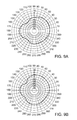
  • FIGS. 7A ⁇ 7D , FIGS. 8A ⁇ 8D and FIGS. 9A ⁇ 9D show radiation patterns of total gain polarization (horizontal polarization and vertical polarization) of the inverted-F antennas according to the above two embodiments of the application.
  • dual oscillation frequencies are achieved by two main radiation parts. Via coupling effect of a slot, and a metal radiation part extended from ground plane, a third resonance band is formed and bandwidth is thus increased.
  • an inverted-F antenna 10 of the embodiment of the application includes main radiation parts 11 ⁇ 13 , a low-band impedance match 14 , a slot 15 , a short-circuit line 16 , a ground plane 17 and a signal feeding circuit 18 .
  • the inverted-F antenna 10 of the embodiment of the application in FIG. 1 includes two printed circuit boards (PCB) 10 A and 10 B.
  • the main radiation parts 11 ⁇ 13 , the low-band impedance match 14 and the short-circuit line 16 are on the PCB 10 A.
  • the slot 15 , the ground plane 17 and the signal feeding circuit 18 are on the PCB 10 B.
  • the PCB 10 A is vertically inserted into the PCB 10 B. That is, after assembly, the PCB 10 A and the PCB 10 B form an L-shaped structure. Thus, overall height of the inverted-F antenna 10 is reduced without affecting its radiation efficiency.
  • the main radiation part 11 is as a main radiation part for a first band of the inverted-F antenna 10 .
  • the main radiation part 11 is for generating a first frequency band operation mode.
  • the first frequency band is normally a low-frequency band, exemplarily but not restrictively, between 824 MHz ⁇ 960 MHz.
  • the first frequency band may be adjusted through adjustment in the dimension of the main radiation part 11 .
  • the main radiation part 11 is physically and electrically connected to the signal feeding circuit 18 for receiving/transmitting wireless signals.
  • the main radiation part 11 has a meander extended towards the signal feeding circuit 18 , and the size of the main radiation part 11 is effectively reduced.
  • the main radiation part 12 is used as a main radiation part for a second frequency band of the inverted-F antenna 10 .
  • the second frequency band is normally a medium frequency band, exemplarily but not restrictively, between 1710 MHz ⁇ 18xx MHz.
  • the main radiation part 12 is adjacent to the meander of the main radiation part 11 .
  • the main radiation part 12 generates a second frequency band operation mode for the inverted-F antenna.
  • the second frequency band may be adjusted through adjustment in the dimension of the main radiation part 12 .
  • the main radiation part 12 is physically and electrically connected to the signal feeding circuit 18 for receiving/transmitting wireless signals.
  • the main radiation part 13 is as a main radiation part for a third frequency band of the inverted-F antenna 10 .
  • the third frequency band is normally a high-frequency band, exemplarily but not restrictively, between 18xx MHz ⁇ 2170 MHz.
  • the main radiation part 13 generates a third frequency band operation mode for the inverted-F antenna.
  • the third frequency band may be adjusted through adjustment in the dimension of the main radiation part 13 .
  • the main radiation part 13 is extended from the ground plane 17 and adjacent to the main radiation part 11 and the main radiation part 12 .
  • the main radiation part 13 is electrically isolated from the signal feeding circuit 18 , the main radiation part 11 and the second main radiation part 12 .
  • the main radiation part 13 may be used as a high-frequency band main radiation part of the inverted-F antenna 10 .
  • the signal coupling path P 1 is formed between the main radiation part 11 and the main radiation part 13 , for signal coupling between the main radiation part 11 and the main radiation part 13 .
  • the signal coupling path P 2 is formed between the main radiation part 12 and the main radiation part 13 for signal coupling between the main radiation part 12 and the main radiation part 13 .
  • a slot is formed between the main radiation part 11 and the main radiation part 13
  • another slot is formed between the main radiation part 12 and the main radiation part 13 .
  • the third frequency band may be adjusted through adjustment in the dimension of the main radiation part 13 . Via the main radiation part 13 , the bandwidth of the inverted-F antenna 10 of the embodiment of the application is increased.
  • the low-frequency band impedance match 14 is extended from the main radiation part 11 and is used for impedance match. In the present embodiment of the application, the low-frequency band impedance match 14 is optional and is extended away from the meander of the main radiation part 11 .
  • the slot 15 formed on the PCB 10 B, is formed between the main radiation part 13 , the ground plane 17 and the signal feeding circuit 18 .
  • the slot 15 is for high-frequency impedance match.
  • the short-circuit line 16 is used as short-circuit of the inverted-F antenna 10 and also used for adjusting impedance match.
  • the short-circuit line 16 is electrically connected to the meander of the main radiation part 11 , which is adjacent to the short-circuit line 16 .
  • the ground plane 17 is used as a ground plane for the inverted-F antenna 10 .
  • the inverted-F antenna 10 is electrically connected to the ground plane 17 through the short-circuit line 16 .
  • the signal feeding circuit 18 feeds wireless signals to the main radiation parts 11 and 12 , and receives wireless signals received by the main radiation parts 11 and 12 .
  • the inverted-F antenna of the embodiment of the application includes printed circuit boards, so the inverted-F antenna has a robust structure and does not deform easily.
  • the inverted-F antenna of the embodiment of the application may adjust its oscillation frequency to achieve a suitable frequency bandwidth.
  • the dimension of the inverted-F antenna of the embodiment of the application may be reduced to be about 0.16 ⁇ .
  • the inverted-F antenna 20 of the application includes: main radiation parts 21 ⁇ 23 , low-frequency band impedance match 24 , a slot 25 , a short-circuit line 26 , a ground plane 27 , a signal feeding circuit 28 and a pin 29 .
  • slashed regions denote hollowed regions.
  • the main radiation part 23 further includes an impedance match 23 A.
  • the impedance match 23 A is extended from the main radiation part 23 and is for impedance matching for the third band. Via the pin 29 , the inverted-F antenna 20 of the application may be inserted into circuit board (not illustrated) of wireless communication devices.
  • a part or a totality of the inverted-F antenna 20 of the application may be formed by metal pieces (for example iron pieces) to reduce cost.
  • metal pieces for example iron pieces
  • the main radiation parts 21 ⁇ 23 , the impedance match 23 A, the low-band impedance match 24 , the short-circuit line 26 and the pin 29 are on an iron piece, while the slot 25 , the ground plane 27 and the signal feeding circuit 28 are on another iron piece.
  • the two iron pieces may form an L shape.
  • FIGS. 4A and 4B respectively show a left side view and a right side view of the inverted-F antenna 20 of the application.
  • FIGS. 5A and 5B respectively show two stereoscopic views of the inverted-F antenna 20 .
  • the appearance of the inverted-F antenna 20 of the application is L-shaped, so that the overall height of the L inverted-F antenna 20 is reduced without affecting its radiation efficiency.
  • the inverted-F antenna 20 of the application may adjust its oscillation frequency for a suitable bandwidth.
  • FIG. 6 shows a voltage standing wave ratio (VSWR) experiment diagram of the inverted-F antenna according the above two embodiments of the application.
  • VSWR voltage standing wave ratio
  • the inverted-F antenna of the two embodiments of the application may effectively support bands between 824 MHz ⁇ 960 MHz, between 1700 MHz ⁇ 18XX MHz and between 18XX MHz ⁇ 2170 MHz.
  • the inverted-F antenna of the embodiments of the application is almost an excellent multi-band antenna.
  • FIGS. 7A ⁇ 7D gain polarization radiation patterns on the XY plane of the inverted-F antenna according to the embodiments of the application are shown.
  • FIGS. 7A ⁇ 7D respectively show radiation patterns of total gain polarization of the inverted-F antenna operated at 824 MHz, 960 MHz, 1710 MHz and 2170 MH.
  • FIGS. 8A ⁇ 8D gain polarization radiation patterns on the XZ plane of the inverted-F antenna according to the embodiments of the application are shown.
  • FIGS. 8A ⁇ 8D respectively show gain polarization radiation patterns of the inverted-F antenna operated at 824 MHz, 960 MHz, 1710 MHz and 2170 MHz.
  • FIGS. 9A ⁇ 9D gain polarization radiation patterns on the YZ plane of the inverted-F antenna according to the embodiments of the application are shown.
  • FIGS. 9A ⁇ 9D respectively show gain polarization radiation patterns of the inverted-F antenna operated at 824 MHz, 960 MHz, 1710 MHz and 2170 MHz.
  • the inverted-F antenna of the embodiments of the application have excellent gain polarization radiation patterns, which indicate excellent radiation efficiency.

Landscapes

  • Engineering & Computer Science (AREA)
  • Computer Networks & Wireless Communication (AREA)
  • Physics & Mathematics (AREA)
  • Electromagnetism (AREA)
  • Waveguide Aerials (AREA)

Abstract

A multi-band inverted-F antenna including a ground plane, a signal feeding circuit, first, second and third main radiation parts is provided. The signal feeding circuit is electrically isolated from the ground plane and receives/transmits wireless signals. The first and the second main radiation part are both physically and electrically connected to the signal feeding circuit, and generate first and second frequency band operation modes for the inverted-F antenna, respectively. The third main radiation part is electrically isolated from the signal feeding circuit, the first and the second main radiation parts, and generates a third frequency band operation mode for the inverted-F antenna via to signal coupling between the first and the third main radiation parts and/or signal coupling between the second and the third main radiation parts.

Description

This application claims the benefit of Taiwan application Serial No. 100127804, filed Aug. 4, 2011, the subject matter of which is incorporated herein by reference.
BACKGROUND PLANE
1. Technical
The application relates in general to a multi-band inverted-F antenna.
2. Description of the Related Art
To satisfy mobility requirement, wireless communication products are directed towards miniaturization and lightweight. The interior of a wireless communication device has limited space available for antenna. For a hidden antenna, antenna size and function have much to do with the consumer's acceptance of the product.
Inverted-F antenna is a popular hidden antenna, which can be hidden in a mobile phone, a personal digital assistant (PDA), or a notebook computer. Conventional inverted-F antenna mainly includes: a main radiation part, a signal feeding circuit and a short-circuit line connected to ground plane. However, conventional inverted-F antenna still has many issues to resolve, for example narrow bandwidth, and complicated and easily-deformed structure.
SUMMARY OF THE APPLICATION
The application is directed to an inverted-F antenna with a miniaturized structure. Dual oscillation frequencies are achieved by two main radiation parts. Via coupling effect of a slot, and a metal radiation part extended from ground plane, a third resonance band is formed.
According to an exemplary embodiment of the present application, a multi-band inverted-F antenna including a ground plane, a signal feeding circuit, a first main radiation part, a second main radiation part, and a third main radiation part is provided. The signal feeding circuit, electrically isolated from the ground plane, receives/transmits wireless signals. The first main radiation part, physically and electrically connected to the signal feeding circuit, generates a first band operation mode for the inverted-F antenna. The second main radiation part, physically and electrically connected to the signal feeding circuit, generates a second band operation mode for the inverted-F antenna. The third main radiation part is extended from the ground plane and is electrically isolated from the signal feeding circuit, the first main radiation part and the second main radiation part. The third main radiation part generates a third band operation mode for the inverted-F antenna via a signal coupling between the first and the third main radiation parts and/or a signal coupling between the second and the third main radiation parts.
The above and other contents of the application will become better understood with regard to the following detailed description of the preferred but non-limiting embodiment (s). The following description is made with reference to the accompanying drawings.
BRIEF DESCRIPTION OF THE DRAWINGS
FIGS. 1 and 2 respectively show a plan view and a stereoscopic view of an inverted-F antenna according to an embodiment of the application;
FIGS. 3A and 3B respectively show a front view and a top view of an inverted-F antenna according to another embodiment of the application;
FIGS. 4A and 4B respectively show a left side view and a right side view of the inverted-F antenna in FIGS. 3A and 3B;
FIGS. 5A and 5B respectively show stereoscopic views of the inverted-F antenna in FIGS. 3A and 3B;
FIG. 6 shows a VSWR experiment diagram of the inverted-F antenna according to the above two embodiments of the application;
FIGS. 7A˜7D, FIGS. 8A˜8D and FIGS. 9A˜9D show radiation patterns of total gain polarization (horizontal polarization and vertical polarization) of the inverted-F antennas according to the above two embodiments of the application.
DETAILED DESCRIPTION OF EMBODIMENTS OF THE APPLICATION
In embodiments of the application, dual oscillation frequencies are achieved by two main radiation parts. Via coupling effect of a slot, and a metal radiation part extended from ground plane, a third resonance band is formed and bandwidth is thus increased.
Referring to FIGS. 1 and 2, a plan view and a stereoscopic view of an inverted-F antenna according to an embodiment of the application are respectively shown. As indicated in FIGS. 1 and 2, an inverted-F antenna 10 of the embodiment of the application includes main radiation parts 11˜13, a low-band impedance match 14, a slot 15, a short-circuit line 16, a ground plane 17 and a signal feeding circuit 18.
The inverted-F antenna 10 of the embodiment of the application in FIG. 1 includes two printed circuit boards (PCB) 10A and 10B. The main radiation parts 11˜13, the low-band impedance match 14 and the short-circuit line 16 are on the PCB 10A. The slot 15, the ground plane 17 and the signal feeding circuit 18 are on the PCB 10B.
As indicated in FIG. 2, the PCB 10A is vertically inserted into the PCB 10B. That is, after assembly, the PCB 10A and the PCB 10B form an L-shaped structure. Thus, overall height of the inverted-F antenna 10 is reduced without affecting its radiation efficiency.
The main radiation part 11 is as a main radiation part for a first band of the inverted-F antenna 10. The main radiation part 11 is for generating a first frequency band operation mode. The first frequency band is normally a low-frequency band, exemplarily but not restrictively, between 824 MHz˜960 MHz. The first frequency band may be adjusted through adjustment in the dimension of the main radiation part 11. The main radiation part 11 is physically and electrically connected to the signal feeding circuit 18 for receiving/transmitting wireless signals. In the present embodiment of the application, the main radiation part 11 has a meander extended towards the signal feeding circuit 18, and the size of the main radiation part 11 is effectively reduced.
The main radiation part 12 is used as a main radiation part for a second frequency band of the inverted-F antenna 10. The second frequency band is normally a medium frequency band, exemplarily but not restrictively, between 1710 MHz˜18xx MHz. In the present embodiment of the application, the main radiation part 12 is adjacent to the meander of the main radiation part 11. The main radiation part 12 generates a second frequency band operation mode for the inverted-F antenna. The second frequency band may be adjusted through adjustment in the dimension of the main radiation part 12. The main radiation part 12 is physically and electrically connected to the signal feeding circuit 18 for receiving/transmitting wireless signals.
The main radiation part 13 is as a main radiation part for a third frequency band of the inverted-F antenna 10. The third frequency band is normally a high-frequency band, exemplarily but not restrictively, between 18xx MHz˜2170 MHz. The main radiation part 13 generates a third frequency band operation mode for the inverted-F antenna. The third frequency band may be adjusted through adjustment in the dimension of the main radiation part 13. The main radiation part 13 is extended from the ground plane 17 and adjacent to the main radiation part 11 and the main radiation part 12. The main radiation part 13 is electrically isolated from the signal feeding circuit 18, the main radiation part 11 and the second main radiation part 12. However, via signal coupling paths P1 and P2, the main radiation part 13 may be used as a high-frequency band main radiation part of the inverted-F antenna 10. The signal coupling path P1 is formed between the main radiation part 11 and the main radiation part 13, for signal coupling between the main radiation part 11 and the main radiation part 13. The signal coupling path P2 is formed between the main radiation part 12 and the main radiation part 13 for signal coupling between the main radiation part 12 and the main radiation part 13. In other words, a slot is formed between the main radiation part 11 and the main radiation part 13, and another slot is formed between the main radiation part 12 and the main radiation part 13. The third frequency band may be adjusted through adjustment in the dimension of the main radiation part 13. Via the main radiation part 13, the bandwidth of the inverted-F antenna 10 of the embodiment of the application is increased.
The low-frequency band impedance match 14 is extended from the main radiation part 11 and is used for impedance match. In the present embodiment of the application, the low-frequency band impedance match 14 is optional and is extended away from the meander of the main radiation part 11.
The slot 15, formed on the PCB 10B, is formed between the main radiation part 13, the ground plane 17 and the signal feeding circuit 18. The slot 15 is for high-frequency impedance match.
The short-circuit line 16 is used as short-circuit of the inverted-F antenna 10 and also used for adjusting impedance match. In the present embodiment of the application, the short-circuit line 16 is electrically connected to the meander of the main radiation part 11, which is adjacent to the short-circuit line 16.
The ground plane 17 is used as a ground plane for the inverted-F antenna 10. The inverted-F antenna 10 is electrically connected to the ground plane 17 through the short-circuit line 16. The signal feeding circuit 18 feeds wireless signals to the main radiation parts 11 and 12, and receives wireless signals received by the main radiation parts 11 and 12.
The inverted-F antenna of the embodiment of the application includes printed circuit boards, so the inverted-F antenna has a robust structure and does not deform easily. For compatible with a lot of wireless systems, the inverted-F antenna of the embodiment of the application may adjust its oscillation frequency to achieve a suitable frequency bandwidth.
Besides, the dimension of the inverted-F antenna of the embodiment of the application may be reduced to be about 0.16 λ.
Referring to FIGS. 3A and 3B, a front view and a top view of an inverted-F antenna 20 according to another embodiment of the application are respectively shown. As indicated in FIGS. 3A and 3B, the inverted-F antenna 20 of the application includes: main radiation parts 21˜23, low-frequency band impedance match 24, a slot 25, a short-circuit line 26, a ground plane 27, a signal feeding circuit 28 and a pin 29. In FIGS. 3A and 3B, slashed regions denote hollowed regions.
Operations and functions of the main radiation parts 21˜23, the low-frequency band impedance match 24, the slot 25, the short-circuit line 26, the ground plane 27 and the signal feeding circuit 28 of the inverted-F antenna 20 are the same or similar with that of the inverted-F antenna 10, and the details are not repeated here. To improve impedance match, the main radiation part 23 further includes an impedance match 23A. The impedance match 23A is extended from the main radiation part 23 and is for impedance matching for the third band. Via the pin 29, the inverted-F antenna 20 of the application may be inserted into circuit board (not illustrated) of wireless communication devices.
A part or a totality of the inverted-F antenna 20 of the application may be formed by metal pieces (for example iron pieces) to reduce cost. For example, the main radiation parts 21˜23, the impedance match 23A, the low-band impedance match 24, the short-circuit line 26 and the pin 29 are on an iron piece, while the slot 25, the ground plane 27 and the signal feeding circuit 28 are on another iron piece. The two iron pieces may form an L shape.
FIGS. 4A and 4B respectively show a left side view and a right side view of the inverted-F antenna 20 of the application. FIGS. 5A and 5B respectively show two stereoscopic views of the inverted-F antenna 20. As indicated in FIGS. 4A, 4B, 5A and 5B, the appearance of the inverted-F antenna 20 of the application is L-shaped, so that the overall height of the L inverted-F antenna 20 is reduced without affecting its radiation efficiency.
To compatible with different wireless communication systems, the inverted-F antenna 20 of the application may adjust its oscillation frequency for a suitable bandwidth.
FIG. 6 shows a voltage standing wave ratio (VSWR) experiment diagram of the inverted-F antenna according the above two embodiments of the application. Compared with a reference line (VSWR=3), the inverted-F antenna of the two embodiments of the application may effectively support bands between 824 MHz˜960 MHz, between 1700 MHz˜18XX MHz and between 18XX MHz˜2170 MHz. As indicated in FIG. 6, the inverted-F antenna of the embodiments of the application is almost an excellent multi-band antenna.
Referring to FIGS. 7A˜7D, gain polarization radiation patterns on the XY plane of the inverted-F antenna according to the embodiments of the application are shown. FIGS. 7A˜7D respectively show radiation patterns of total gain polarization of the inverted-F antenna operated at 824 MHz, 960 MHz, 1710 MHz and 2170 MH.
Referring to FIGS. 8A˜8D, gain polarization radiation patterns on the XZ plane of the inverted-F antenna according to the embodiments of the application are shown. FIGS. 8A˜8D respectively show gain polarization radiation patterns of the inverted-F antenna operated at 824 MHz, 960 MHz, 1710 MHz and 2170 MHz.
Referring to FIGS. 9A˜9D, gain polarization radiation patterns on the YZ plane of the inverted-F antenna according to the embodiments of the application are shown. FIGS. 9A˜9D respectively show gain polarization radiation patterns of the inverted-F antenna operated at 824 MHz, 960 MHz, 1710 MHz and 2170 MHz.
As indicated in FIGS. 7A˜9D, the inverted-F antenna of the embodiments of the application have excellent gain polarization radiation patterns, which indicate excellent radiation efficiency.
It will be apparent to those skilled in the art that various modifications and variations can be made to the disclosed embodiments. It is intended that the specification and examples be considered as exemplary only, with a true scope of the disclosure being indicated by the following claims and their equivalents.

Claims (13)

What is claimed is:
1. A multi band antenna, comprising:
a ground plane;
a signal feeding portion, electrically isolated from the ground plane, for receiving/transmitting wireless signals;
a first main radiation part, physically and electrically connected to the signal feeding portion, for generating a first frequency band operation mode for the multi band antenna;
a second main radiation part, physically and electrically connected to the signal feeding portion, for generating a second frequency band operation mode for the multi band antenna; and
a third main radiation part, extending from the ground plane, the third main radiation part electrically isolated from the signal feeding portion, the first main radiation part and the second main radiation part, the third main radiation part generating a third frequency band operation mode for the multi band antenna via a signal coupling between the first and the third main radiation parts and/or a signal coupling between the second and the third main radiation parts;
wherein
the first, the second and the third main radiation parts are on a first plane;
the ground plane and the signal feeding portion are on a second plane; and
the first plane and the second plane are L-shaped.
2. The multi-band antenna according to claim 1, further comprising:
a first impedance match extended from the first main radiation part for impedance match in the first frequency band operation mode.
3. The multi-band antenna according to claim 2, wherein, a slot is formed among the third main radiation part, the signal feeding portion and the ground plane, for impedance match in the third frequency band operation mode.
4. The multi-band antenna according to claim 3, further comprising a short-circuit line as a short circuit of the multi band antenna,
wherein the short-circuit line is electrically connected to the ground plane, and the short-circuit line is for adjusting an impedance match of the multi band antenna.
5. The multi-band antenna according to claim 4, wherein:
the first, the second and the third main radiation parts, the first impedance match and the short-circuit line are on a first circuit board;
the slot, the ground plane and the signal feeding portion are on a second circuit board; and
the first circuit board and the second circuit board are L-shaped.
6. The multi-band antenna according to claim 4, wherein, the third main radiation part further comprises a second impedance match extended from the third main radiation part, for impedance match in the third frequency band operation mode.
7. The multi-band antenna according to claim 6, wherein:
the first, the second and the third main radiation parts, the first impedance match, the second impedance match and the short-circuit line form an integral first metal piece;
the slot, the ground plane and the signal feeding portion form an integral second metal piece; and
the first metal piece and the second metal piece are L-shaped.
8. The multi-band antenna according to claim 4, wherein, the first main radiation part has a meander extended towards the signal feeding portion.
9. The multi-band antenna according to claim 8, wherein, the second main radiation part is adjacent to the first main radiation part and the meander of the first main radiation part.
10. The multi-band antenna according to claim 9, wherein, the third main radiation part is adjacent to the first and the second main radiation parts.
11. The multi-band antenna according to claim 8, wherein, the first impedance match is extended away from the meander of the first main radiation part.
12. The multi-band antenna according to claim 8, wherein, the short-circuit line is electrically connected to the meander of the first main radiation part and is adjacent to the meander of the first main radiation part.
13. The multi-band antenna according to claim 1, wherein the first main radiation part has direct signal coupling with the third main radiation part; and the second main radiation part has direct signal coupling with the third main radiation part.
US13/557,397 2011-08-04 2012-07-25 Multi-band antenna Expired - Fee Related US8994596B2 (en)

Applications Claiming Priority (3)

Application Number Priority Date Filing Date Title
TW100127804A TWI542073B (en) 2011-08-04 2011-08-04 Multi-band inverted-f antenna
TW100127804 2011-08-04
TW100127804A 2011-08-04

Publications (2)

Publication Number Publication Date
US20130033413A1 US20130033413A1 (en) 2013-02-07
US8994596B2 true US8994596B2 (en) 2015-03-31

Family

ID=47554257

Family Applications (1)

Application Number Title Priority Date Filing Date
US13/557,397 Expired - Fee Related US8994596B2 (en) 2011-08-04 2012-07-25 Multi-band antenna

Country Status (4)

Country Link
US (1) US8994596B2 (en)
CN (1) CN102916255B (en)
DE (1) DE102012015440A1 (en)
TW (1) TWI542073B (en)

Cited By (2)

* Cited by examiner, † Cited by third party
Publication number Priority date Publication date Assignee Title
US20130194150A1 (en) * 2010-05-12 2013-08-01 Heikki Korva Antenna of a laptop device and methods
US10826182B2 (en) 2016-10-12 2020-11-03 Carrier Corporation Through-hole inverted sheet metal antenna

Families Citing this family (7)

* Cited by examiner, † Cited by third party
Publication number Priority date Publication date Assignee Title
US9444130B2 (en) 2013-04-10 2016-09-13 Apple Inc. Antenna system with return path tuning and loop element
US9276319B2 (en) 2013-05-08 2016-03-01 Apple Inc. Electronic device antenna with multiple feeds for covering three communications bands
CN104795629A (en) * 2015-04-23 2015-07-22 深圳市共进电子股份有限公司 Microstrip antenna
CN108206329A (en) * 2017-10-17 2018-06-26 中兴通讯股份有限公司 A kind of terminal
TWI685143B (en) * 2018-10-30 2020-02-11 廣達電腦股份有限公司 Mobile device
CN111769362B (en) * 2020-07-08 2021-07-23 Oppo广东移动通信有限公司 Antenna modules and electronic equipment
TWI783638B (en) * 2021-08-18 2022-11-11 微星科技股份有限公司 Antenna structure and electronic device with the antenna structure

Citations (25)

* Cited by examiner, † Cited by third party
Publication number Priority date Publication date Assignee Title
TW575979B (en) 2003-01-24 2004-02-11 Kin Lu Wong An inverted-F antenna
CN1753248A (en) 2004-09-22 2006-03-29 华硕电脑股份有限公司 Mobile communication device and its planar antenna structure
US7050010B2 (en) * 2004-01-30 2006-05-23 Yageo Corporation Dual-band inverted-F antenna with shorted parasitic elements
US20070176835A1 (en) 2003-06-12 2007-08-02 Yihong Qi Multiple-element antenna with floating antenna element
TWM326712U (en) 2007-06-28 2008-02-01 Wha Yu Ind Co Ltd Wide band antenna structure
US20080180333A1 (en) * 2006-11-16 2008-07-31 Galtronics Ltd. Compact antenna
US20100026585A1 (en) 2008-07-30 2010-02-04 Chi Mei Communication Systems, Inc. Multiband antenna
US20100123631A1 (en) 2008-11-17 2010-05-20 Cheng-Wei Chang Multi-band Antenna for a Wireless Communication Device
EP2202845A1 (en) 2008-12-26 2010-06-30 Arcadyan Technology Corp. Multi-band antenna
CN101783435A (en) 2010-04-23 2010-07-21 上海大学 Novel three-frequency plane inverted F-shaped antenna
US7768460B2 (en) 2008-07-24 2010-08-03 Cheng Uei Precision Industry Co., Ltd. Multi-band antenna
WO2010090573A1 (en) 2009-02-04 2010-08-12 Proant Ab Antenna
US20100214174A1 (en) 2009-02-24 2010-08-26 Fujikura Ltd. Antenna and wireless communication apparatus
US20100265157A1 (en) 2009-04-20 2010-10-21 Yang Wen-Chieh Multi-band antenna
US7830326B2 (en) 2007-05-07 2010-11-09 Hon Hai Precision Ind. Co., Ltd. Multi-band antenna
US20100283685A1 (en) 2009-05-06 2010-11-11 Yung-Chih Tsai Multi-band antenna
US20100315294A1 (en) 2009-06-11 2010-12-16 Pao-Sui Chang Integrated multi-band antenna module
US20110001681A1 (en) 2009-07-02 2011-01-06 Hon Hai Precision Industry Co., Ltd. Multiband antenna
US7868831B2 (en) 2007-04-27 2011-01-11 Hon Hai Precision Ind. Co., Ltd. Complex antenna
US20110032166A1 (en) 2009-08-06 2011-02-10 Ambit Microsystems (Shanghai) Ltd. Multiband antenna
US20110074636A1 (en) 2009-09-29 2011-03-31 Yung-Chih Tsai Multi-Band Antenna
US7928916B2 (en) 2007-10-26 2011-04-19 Hon Hai Precision Ind. Co., Ltd. Multi-band antenna
US7928912B2 (en) 2007-07-13 2011-04-19 Tsinghua University Multiband antenna
WO2011059088A1 (en) 2009-11-13 2011-05-19 日立金属株式会社 Frequency variable antenna circuit, antenna component constituting the same, and wireless communication device using those
US7990321B2 (en) 2009-01-16 2011-08-02 Hon Hai Precision Industry Co., Ltd. Multiband antenna

Family Cites Families (5)

* Cited by examiner, † Cited by third party
Publication number Priority date Publication date Assignee Title
FI115173B (en) * 2002-12-31 2005-03-15 Filtronic Lk Oy Antenna for a collapsible radio
CN2612086Y (en) * 2003-04-14 2004-04-14 启碁科技股份有限公司 Inverted-F dual-frequency antenna and electronic device with wireless communication function
US7265731B2 (en) * 2004-12-29 2007-09-04 Sony Ericsson Mobile Communications Ab Method and apparatus for improving the performance of a multi-band antenna in a wireless terminal
CN101777692B (en) * 2009-01-13 2012-11-07 广达电脑股份有限公司 Antenna device
KR101052558B1 (en) * 2009-04-15 2011-07-29 광주과학기술원 Antenna device

Patent Citations (27)

* Cited by examiner, † Cited by third party
Publication number Priority date Publication date Assignee Title
TW575979B (en) 2003-01-24 2004-02-11 Kin Lu Wong An inverted-F antenna
US20070176835A1 (en) 2003-06-12 2007-08-02 Yihong Qi Multiple-element antenna with floating antenna element
US7050010B2 (en) * 2004-01-30 2006-05-23 Yageo Corporation Dual-band inverted-F antenna with shorted parasitic elements
CN1753248A (en) 2004-09-22 2006-03-29 华硕电脑股份有限公司 Mobile communication device and its planar antenna structure
EP1641077A1 (en) 2004-09-22 2006-03-29 ASUSTeK Computer Inc. Mobile telecommunication device and planar antenna therefor
US20080180333A1 (en) * 2006-11-16 2008-07-31 Galtronics Ltd. Compact antenna
US7868831B2 (en) 2007-04-27 2011-01-11 Hon Hai Precision Ind. Co., Ltd. Complex antenna
US7830326B2 (en) 2007-05-07 2010-11-09 Hon Hai Precision Ind. Co., Ltd. Multi-band antenna
TWM326712U (en) 2007-06-28 2008-02-01 Wha Yu Ind Co Ltd Wide band antenna structure
US7928912B2 (en) 2007-07-13 2011-04-19 Tsinghua University Multiband antenna
US7928916B2 (en) 2007-10-26 2011-04-19 Hon Hai Precision Ind. Co., Ltd. Multi-band antenna
US7768460B2 (en) 2008-07-24 2010-08-03 Cheng Uei Precision Industry Co., Ltd. Multi-band antenna
US20100026585A1 (en) 2008-07-30 2010-02-04 Chi Mei Communication Systems, Inc. Multiband antenna
US8223075B2 (en) * 2008-07-30 2012-07-17 Chi Mei Communication Systems, Inc. Multiband antenna
US20100123631A1 (en) 2008-11-17 2010-05-20 Cheng-Wei Chang Multi-band Antenna for a Wireless Communication Device
EP2202845A1 (en) 2008-12-26 2010-06-30 Arcadyan Technology Corp. Multi-band antenna
US7990321B2 (en) 2009-01-16 2011-08-02 Hon Hai Precision Industry Co., Ltd. Multiband antenna
WO2010090573A1 (en) 2009-02-04 2010-08-12 Proant Ab Antenna
US20100214174A1 (en) 2009-02-24 2010-08-26 Fujikura Ltd. Antenna and wireless communication apparatus
US20100265157A1 (en) 2009-04-20 2010-10-21 Yang Wen-Chieh Multi-band antenna
US20100283685A1 (en) 2009-05-06 2010-11-11 Yung-Chih Tsai Multi-band antenna
US20100315294A1 (en) 2009-06-11 2010-12-16 Pao-Sui Chang Integrated multi-band antenna module
US20110001681A1 (en) 2009-07-02 2011-01-06 Hon Hai Precision Industry Co., Ltd. Multiband antenna
US20110032166A1 (en) 2009-08-06 2011-02-10 Ambit Microsystems (Shanghai) Ltd. Multiband antenna
US20110074636A1 (en) 2009-09-29 2011-03-31 Yung-Chih Tsai Multi-Band Antenna
WO2011059088A1 (en) 2009-11-13 2011-05-19 日立金属株式会社 Frequency variable antenna circuit, antenna component constituting the same, and wireless communication device using those
CN101783435A (en) 2010-04-23 2010-07-21 上海大学 Novel three-frequency plane inverted F-shaped antenna

Cited By (2)

* Cited by examiner, † Cited by third party
Publication number Priority date Publication date Assignee Title
US20130194150A1 (en) * 2010-05-12 2013-08-01 Heikki Korva Antenna of a laptop device and methods
US10826182B2 (en) 2016-10-12 2020-11-03 Carrier Corporation Through-hole inverted sheet metal antenna

Also Published As

Publication number Publication date
US20130033413A1 (en) 2013-02-07
CN102916255B (en) 2015-09-02
TWI542073B (en) 2016-07-11
TW201308751A (en) 2013-02-16
DE102012015440A1 (en) 2013-02-07
CN102916255A (en) 2013-02-06

Similar Documents

Publication Publication Date Title
US8994596B2 (en) Multi-band antenna
CN101043100B (en) A Multi-frequency Antenna with Slot Conductor and Strip Conductor
KR101718032B1 (en) Mobile terminal
TWI628848B (en) Antenna structure and wireless communication device with same
US9306282B2 (en) Antenna arrangement
US7642966B2 (en) Carrier and device
US8823590B2 (en) Wideband antenna
US8779988B2 (en) Surface mount device multiple-band antenna module
US9444142B2 (en) Dual band antenna and wireless communication device employing same
US20100188294A1 (en) Planar antenna
US20150061952A1 (en) Broadband Antenna
CN103178344A (en) Multi-frequency-band rear metal cover mobile phone antenna
US20120182187A1 (en) Thin antenna and an electronic device having the thin antenna
TW201104960A (en) Shorted monopole antenna
US10008776B2 (en) Wideband antenna
US8009103B2 (en) Triple-band antenna
KR100848038B1 (en) Multiband antenna
CN101098040B (en) Planar Turning RF Pocket Invisible Antenna
US20090278745A1 (en) Dual-band inverted-f antenna
CN108134194B (en) A miniaturized WLAN dual-band PIFA antenna
CN201156582Y (en) Double-frequency inverted F-shaped antenna
EP2360781B1 (en) Wireless communication device and method thereof
JP2007013596A (en) Multiband monopole antenna
KR101218718B1 (en) Diversity antenna device and mobile using the same
CN119481687B (en) electronic devices

Legal Events

Date Code Title Description
AS Assignment

Owner name: ARCADYAN TECHNOLOGY CORPORATION, TAIWAN

Free format text: ASSIGNMENT OF ASSIGNORS INTEREST;ASSIGNORS:DU, JIAN-JHIH;LO, KUO-CHANG;HUANG, CHIH-YUNG;REEL/FRAME:028632/0730

Effective date: 20120719

STCF Information on status: patent grant

Free format text: PATENTED CASE

FEPP Fee payment procedure

Free format text: MAINTENANCE FEE REMINDER MAILED (ORIGINAL EVENT CODE: REM.); ENTITY STATUS OF PATENT OWNER: LARGE ENTITY

LAPS Lapse for failure to pay maintenance fees

Free format text: PATENT EXPIRED FOR FAILURE TO PAY MAINTENANCE FEES (ORIGINAL EVENT CODE: EXP.); ENTITY STATUS OF PATENT OWNER: LARGE ENTITY

STCH Information on status: patent discontinuation

Free format text: PATENT EXPIRED DUE TO NONPAYMENT OF MAINTENANCE FEES UNDER 37 CFR 1.362

FP Lapsed due to failure to pay maintenance fee

Effective date: 20190331