US8975202B2 - Polymerization catalysts and method for preservation of same - Google Patents
Polymerization catalysts and method for preservation of same Download PDFInfo
- Publication number
- US8975202B2 US8975202B2 US13/382,722 US201013382722A US8975202B2 US 8975202 B2 US8975202 B2 US 8975202B2 US 201013382722 A US201013382722 A US 201013382722A US 8975202 B2 US8975202 B2 US 8975202B2
- Authority
- US
- United States
- Prior art keywords
- group
- component
- polymerization catalyst
- zirconium dichloride
- catalyst
- Prior art date
- Legal status (The legal status is an assumption and is not a legal conclusion. Google has not performed a legal analysis and makes no representation as to the accuracy of the status listed.)
- Active, expires
Links
- 0 FF.[2*][2H]([3*])C Chemical compound FF.[2*][2H]([3*])C 0.000 description 4
- MKCBRYIXFFGIKN-UHFFFAOYSA-N C1C2CC1C2 Chemical compound C1C2CC1C2 MKCBRYIXFFGIKN-UHFFFAOYSA-N 0.000 description 1
- HTNACZWZOBEEPP-UHFFFAOYSA-N C1C2CC1C2.F Chemical compound C1C2CC1C2.F HTNACZWZOBEEPP-UHFFFAOYSA-N 0.000 description 1
Classifications
-
- C—CHEMISTRY; METALLURGY
- C08—ORGANIC MACROMOLECULAR COMPOUNDS; THEIR PREPARATION OR CHEMICAL WORKING-UP; COMPOSITIONS BASED THEREON
- C08F—MACROMOLECULAR COMPOUNDS OBTAINED BY REACTIONS ONLY INVOLVING CARBON-TO-CARBON UNSATURATED BONDS
- C08F10/00—Homopolymers and copolymers of unsaturated aliphatic hydrocarbons having only one carbon-to-carbon double bond
-
- C—CHEMISTRY; METALLURGY
- C08—ORGANIC MACROMOLECULAR COMPOUNDS; THEIR PREPARATION OR CHEMICAL WORKING-UP; COMPOSITIONS BASED THEREON
- C08F—MACROMOLECULAR COMPOUNDS OBTAINED BY REACTIONS ONLY INVOLVING CARBON-TO-CARBON UNSATURATED BONDS
- C08F4/00—Polymerisation catalysts
- C08F4/42—Metals; Metal hydrides; Metallo-organic compounds; Use thereof as catalyst precursors
- C08F4/44—Metals; Metal hydrides; Metallo-organic compounds; Use thereof as catalyst precursors selected from light metals, zinc, cadmium, mercury, copper, silver, gold, boron, gallium, indium, thallium, rare earths or actinides
- C08F4/60—Metals; Metal hydrides; Metallo-organic compounds; Use thereof as catalyst precursors selected from light metals, zinc, cadmium, mercury, copper, silver, gold, boron, gallium, indium, thallium, rare earths or actinides together with refractory metals, iron group metals, platinum group metals, manganese, rhenium technetium or compounds thereof
- C08F4/62—Refractory metals or compounds thereof
- C08F4/64—Titanium, zirconium, hafnium or compounds thereof
- C08F4/647—Catalysts containing a specific non-metal or metal-free compound
- C08F4/649—Catalysts containing a specific non-metal or metal-free compound organic
- C08F4/6491—Catalysts containing a specific non-metal or metal-free compound organic hydrocarbon
- C08F4/6492—Catalysts containing a specific non-metal or metal-free compound organic hydrocarbon containing aliphatic unsaturation
-
- C—CHEMISTRY; METALLURGY
- C08—ORGANIC MACROMOLECULAR COMPOUNDS; THEIR PREPARATION OR CHEMICAL WORKING-UP; COMPOSITIONS BASED THEREON
- C08F—MACROMOLECULAR COMPOUNDS OBTAINED BY REACTIONS ONLY INVOLVING CARBON-TO-CARBON UNSATURATED BONDS
- C08F110/00—Homopolymers of unsaturated aliphatic hydrocarbons having only one carbon-to-carbon double bond
- C08F110/04—Monomers containing three or four carbon atoms
- C08F110/06—Propene
-
- C—CHEMISTRY; METALLURGY
- C08—ORGANIC MACROMOLECULAR COMPOUNDS; THEIR PREPARATION OR CHEMICAL WORKING-UP; COMPOSITIONS BASED THEREON
- C08F—MACROMOLECULAR COMPOUNDS OBTAINED BY REACTIONS ONLY INVOLVING CARBON-TO-CARBON UNSATURATED BONDS
- C08F110/00—Homopolymers of unsaturated aliphatic hydrocarbons having only one carbon-to-carbon double bond
- C08F110/14—Monomers containing five or more carbon atoms
-
- C—CHEMISTRY; METALLURGY
- C08—ORGANIC MACROMOLECULAR COMPOUNDS; THEIR PREPARATION OR CHEMICAL WORKING-UP; COMPOSITIONS BASED THEREON
- C08F—MACROMOLECULAR COMPOUNDS OBTAINED BY REACTIONS ONLY INVOLVING CARBON-TO-CARBON UNSATURATED BONDS
- C08F2500/00—Characteristics or properties of obtained polyolefins; Use thereof
- C08F2500/17—Viscosity
-
- C—CHEMISTRY; METALLURGY
- C08—ORGANIC MACROMOLECULAR COMPOUNDS; THEIR PREPARATION OR CHEMICAL WORKING-UP; COMPOSITIONS BASED THEREON
- C08F—MACROMOLECULAR COMPOUNDS OBTAINED BY REACTIONS ONLY INVOLVING CARBON-TO-CARBON UNSATURATED BONDS
- C08F4/00—Polymerisation catalysts
- C08F4/42—Metals; Metal hydrides; Metallo-organic compounds; Use thereof as catalyst precursors
- C08F4/44—Metals; Metal hydrides; Metallo-organic compounds; Use thereof as catalyst precursors selected from light metals, zinc, cadmium, mercury, copper, silver, gold, boron, gallium, indium, thallium, rare earths or actinides
- C08F4/60—Metals; Metal hydrides; Metallo-organic compounds; Use thereof as catalyst precursors selected from light metals, zinc, cadmium, mercury, copper, silver, gold, boron, gallium, indium, thallium, rare earths or actinides together with refractory metals, iron group metals, platinum group metals, manganese, rhenium technetium or compounds thereof
- C08F4/62—Refractory metals or compounds thereof
- C08F4/64—Titanium, zirconium, hafnium or compounds thereof
- C08F4/659—Component covered by group C08F4/64 containing a transition metal-carbon bond
- C08F4/65908—Component covered by group C08F4/64 containing a transition metal-carbon bond in combination with an ionising compound other than alumoxane, e.g. (C6F5)4B-X+
-
- C—CHEMISTRY; METALLURGY
- C08—ORGANIC MACROMOLECULAR COMPOUNDS; THEIR PREPARATION OR CHEMICAL WORKING-UP; COMPOSITIONS BASED THEREON
- C08F—MACROMOLECULAR COMPOUNDS OBTAINED BY REACTIONS ONLY INVOLVING CARBON-TO-CARBON UNSATURATED BONDS
- C08F4/00—Polymerisation catalysts
- C08F4/42—Metals; Metal hydrides; Metallo-organic compounds; Use thereof as catalyst precursors
- C08F4/44—Metals; Metal hydrides; Metallo-organic compounds; Use thereof as catalyst precursors selected from light metals, zinc, cadmium, mercury, copper, silver, gold, boron, gallium, indium, thallium, rare earths or actinides
- C08F4/60—Metals; Metal hydrides; Metallo-organic compounds; Use thereof as catalyst precursors selected from light metals, zinc, cadmium, mercury, copper, silver, gold, boron, gallium, indium, thallium, rare earths or actinides together with refractory metals, iron group metals, platinum group metals, manganese, rhenium technetium or compounds thereof
- C08F4/62—Refractory metals or compounds thereof
- C08F4/64—Titanium, zirconium, hafnium or compounds thereof
- C08F4/659—Component covered by group C08F4/64 containing a transition metal-carbon bond
- C08F4/65912—Component covered by group C08F4/64 containing a transition metal-carbon bond in combination with an organoaluminium compound
-
- C—CHEMISTRY; METALLURGY
- C08—ORGANIC MACROMOLECULAR COMPOUNDS; THEIR PREPARATION OR CHEMICAL WORKING-UP; COMPOSITIONS BASED THEREON
- C08F—MACROMOLECULAR COMPOUNDS OBTAINED BY REACTIONS ONLY INVOLVING CARBON-TO-CARBON UNSATURATED BONDS
- C08F4/00—Polymerisation catalysts
- C08F4/42—Metals; Metal hydrides; Metallo-organic compounds; Use thereof as catalyst precursors
- C08F4/44—Metals; Metal hydrides; Metallo-organic compounds; Use thereof as catalyst precursors selected from light metals, zinc, cadmium, mercury, copper, silver, gold, boron, gallium, indium, thallium, rare earths or actinides
- C08F4/60—Metals; Metal hydrides; Metallo-organic compounds; Use thereof as catalyst precursors selected from light metals, zinc, cadmium, mercury, copper, silver, gold, boron, gallium, indium, thallium, rare earths or actinides together with refractory metals, iron group metals, platinum group metals, manganese, rhenium technetium or compounds thereof
- C08F4/62—Refractory metals or compounds thereof
- C08F4/64—Titanium, zirconium, hafnium or compounds thereof
- C08F4/659—Component covered by group C08F4/64 containing a transition metal-carbon bond
- C08F4/6592—Component covered by group C08F4/64 containing a transition metal-carbon bond containing at least one cyclopentadienyl ring, condensed or not, e.g. an indenyl or a fluorenyl ring
- C08F4/65922—Component covered by group C08F4/64 containing a transition metal-carbon bond containing at least one cyclopentadienyl ring, condensed or not, e.g. an indenyl or a fluorenyl ring containing at least two cyclopentadienyl rings, fused or not
- C08F4/65927—Component covered by group C08F4/64 containing a transition metal-carbon bond containing at least one cyclopentadienyl ring, condensed or not, e.g. an indenyl or a fluorenyl ring containing at least two cyclopentadienyl rings, fused or not two cyclopentadienyl rings being mutually bridged
-
- Y—GENERAL TAGGING OF NEW TECHNOLOGICAL DEVELOPMENTS; GENERAL TAGGING OF CROSS-SECTIONAL TECHNOLOGIES SPANNING OVER SEVERAL SECTIONS OF THE IPC; TECHNICAL SUBJECTS COVERED BY FORMER USPC CROSS-REFERENCE ART COLLECTIONS [XRACs] AND DIGESTS
- Y10—TECHNICAL SUBJECTS COVERED BY FORMER USPC
- Y10S—TECHNICAL SUBJECTS COVERED BY FORMER USPC CROSS-REFERENCE ART COLLECTIONS [XRACs] AND DIGESTS
- Y10S526/00—Synthetic resins or natural rubbers -- part of the class 520 series
- Y10S526/943—Polymerization with metallocene catalysts
Definitions
- the present invention relates to a polymerization catalyst produced by bringing components (A) to (D) into contact with one another, wherein the component (A) is a transition metal compound, the component (B) is a solid boron compound capable of forming an ion pair with component (A), the component (C) is an organoaluminum compound, and the component (D) is one or more unsaturated hydrocarbon compounds selected from among an ⁇ -olefin, an internal olefin, and a polyene; and to a method of storing the catalyst.
- the component (A) is a transition metal compound
- the component (B) is a solid boron compound capable of forming an ion pair with component (A)
- the component (C) is an organoaluminum compound
- the component (D) is one or more unsaturated hydrocarbon compounds selected from among an ⁇ -olefin, an internal olefin, and a polyene
- polymerization of an ⁇ -olefin in the presence of a metallocene catalyst employs methylaluminoxane or a boron compound as a promoter.
- a homogeneous catalyst is prepared before polymerization by bringing the boron compound into contact with a transition metal compound in a hydrocarbon solvent in the presence or absence of an organoaluminum compound (see, for example, Patent Document 1 or 2).
- Such a technique facilitates supply of a catalyst to a polymerization reaction system.
- a catalyst used in such a reaction system is required to exhibit further improved polymerization activity.
- the catalyst prepared through this technique is also required to exhibit further improved polymerization activity.
- the present inventors have found that when a catalyst is produced by bringing components (A) to (D) into contact with one another in specific proportions by mole in a hydrocarbon solvent under specific temperature conditions, wherein the component (A) is a transition metal compound, the component (B) is a solid boron compound capable of forming an ion pair with component (A), the component (C) is an organoaluminum compound, and the component (D) is one or more unsaturated hydrocarbon compounds selected from among an ⁇ -olefin, an internal olefin, and a polyene, the resultant catalyst exhibits high activity. Also, the present inventors have found that storage of the catalyst requires specific temperature conditions.
- the present invention has been accomplished on the basis of these findings.
- the present invention provides:
- a polymerization catalyst produced by bringing components (A) to (D) into contact with one another in a hydrocarbon solvent at 30 to 60° C., wherein the component (A) is a transition metal compound, the component (B) is a solid boron compound capable of forming an ion pair with the component (A), the component (C) is an organoaluminum compound, and the component (D) is one or more unsaturated hydrocarbon compounds selected from among an ⁇ -olefin, an internal olefin, and a polyene; and the amounts of the component (B) and the component (C) are 1.2 to 4.0 mol and 5.0 to 50.0 mol, respectively, on the basis of 1 mol of the component (A);
- a polymerization catalyst according to claim 1 wherein the component (D) is a C3 to C30 ⁇ -olefin, and the amount of the component (D) is 1.0 to 200 parts by mass on the basis of 1 part by mass of the component (A); and
- the polymerization catalyst of the present invention is a transition metal compound-organoboron compound catalyst which exhibits high activity and can be readily supplied to a polymerization reaction system.
- the polymerization catalyst of the present invention is produced by bringing components (A) to (D) into contact with one another in a hydrocarbon solvent at 30 to 60° C., wherein the component (A) is a transition metal compound, the component (B) is a solid boron compound capable of forming an ion pair with the component (A), the component (C) is an organoaluminum compound, and the component (D) is one or more unsaturated hydrocarbon compounds selected from among an ⁇ -olefin, an internal olefin, and a polyene; and the amounts of the component (B) and the component (C) are 1.2 to 4.0 mol and 5.0 to 50.0 mol, respectively, on the basis of 1 mol of the component (A).
- transition metal compound (component (A)) employed in the present invention examples include a chelate complex, and a metallocene complex having a non-cross-linked or cross-linked ligand.
- Examples of the chelate complex include N,N′-bis(2,6-diisopropylphenyl)-1,2-dimethylethylenediiminonickel dibromide and N,N′-bis(2,6-diisopropylphenyl)-1,2-dimethylethylenediiminopalladium dibromide.
- Examples of the metallocene complex having a non-cross-linked ligand include biscyclopentadienylzirconium dichloride, bis(n-butylcyclopentadienyl)zirconium dichloride, bis(pentamethylcyclopentadienyl)zirconium dichloride, bisindenylzirconium dichloride, and bis(tetramethylcyclopentadienyl)zirconium dichloride.
- a metallocene complex in which the ligands form a cross-linked structure via a cross-linking group exhibits polymerization activity higher than that of a metallocene complex in which the ligands do not form a cross-linked structure.
- metallocene complexes a metallocene complex in which the ligands form a cross-linked structure via a cross-linking group is preferred, a single-cross-linked metallocene complex and a double-cross-linked metallocene complex are more preferred, and a double-cross-linked metallocene complex is most preferred.
- Examples of the single-cross-linked metallocene complex include dimethylsilylene(tetramethylcyclopentadienyl) (3-tert-butyl-5-methyl-2-phenoxy)zirconium dichloride, dimethylsilylene(tetramethylcyclopentadienyl) (tert-butylamido)zirconium dichloride, dimethylsilylenebis(2-methyl-4,5-benzoindenyl)zirconium dichloride, dimethylsilylenebis(2-methyl-4-phenylindenyl)zirconium dichloride, dimethylsilylenebis(2-methyl-4-naphthylindenyl)zirconium dichloride, dimethylsilylenebis(2-methylindenyl)zirconium dichloride, and ethylenebis(2-methylindenyl)zirconium dichloride, and ethylenebisindenylzirconium dichloride.
- double-cross-linked metallocene complexes represented by the following formula (I):
- each of E 1 and E 2 represents a ligand selected from among a substituted cyclopentadienyl group, an indenyl group, a substituted indenyl group, a heterocyclopentadienyl group, a substituted heterocyclopentadienyl group, an amido group, a phosphido group, a hydrocarbon group, and a silicon-containing group
- E 1 and E 2 form a cross-linked structure via A 1 and A 2
- E 1 and E 2 may be identical to or different from each other
- X represents a ⁇ -bonding ligand, and, when a plurality of ligands X are present, the ligands X may be identical to or different from one another, and one ligand X may be cross-linked with another ligand X, E 1 , E 2 , or Y
- Y represents a
- M represents a metal element belonging to Groups 3 to 10 of the periodic table or the lanthanoid series.
- the metal element include titanium, zirconium, hafnium, yttrium, vanadium, chromium, manganese, nickel, cobalt, palladium, and lanthanoid series metals.
- titanium, zirconium, and hafnium are preferred, from the viewpoint of, for example, olefin polymerization activity.
- Each of E 1 and E 2 represents a ligand selected from among a substituted cyclopentadienyl group, an indenyl group, a substituted indenyl group, a heterocyclopentadienyl group, a substituted heterocyclopentadienyl group, an amido group (—N ⁇ ), a phosphine group (—P ⁇ ), a hydrocarbon group [>CR—, >C ⁇ ], and a silicon-containing group [>SiR—, >Si ⁇ ] (wherein R represents a hydrogen atom, a C1 to C20 hydrocarbon group, or a heteroatom-containing group), and E 1 and E 2 form a cross-linked structure via A 1 and A 2 .
- E 1 and E 2 may be identical to or different from each other.
- E 1 or E 2 is preferably a substituted cyclopentadienyl group, an indenyl group, or a substituted indenyl group, from the viewpoint of further improvement of polymerization activity.
- X represents a ⁇ -bonding ligand.
- the ligands X may be identical to or different from one another, and one ligand X may be cross-linked with another ligand X, E 1 , E 2 , or Y.
- the ligand X include a halogen atom, a C1 to C20 hydrocarbon group, a C1 to C20 alkoxy group, a C6 to C20 aryloxy group, a C1 to C20 amido group, a C1 to C20 silicon-containing group, a C1 to C20 phosphido group, a C1 to C20 sulfide group, and a C1 to C20 acyl group.
- Y represents a Lewis base.
- the bases Y may be identical to or different from one another, and one base Y may be cross-linked with another base Y, E 1 , E 2 , or X.
- Specific examples of the Lewis base Y include amines, ethers, phosphines, and thioethers.
- Each of A 1 and A 2 represents a divalent cross-linking group for bonding two ligands and represents a C1 to C20 hydrocarbon group, a C1 to C20 halogen-containing hydrocarbon group, a silicon-containing group, a germanium-containing group, a tin-containing group, —O—, —CO—, —S—, —SO 2 —, —Se—, —NR 1 —, —PR 1 —, —P(O)R 1 —, —BR 1 —, or —AlR 1 — (wherein R 1 represents a hydrogen atom, a halogen atom, a C1 to C20 hydrocarbon group, or a C1 to C20 halogen-containing hydrocarbon group).
- a 1 and A 2 may be identical to or different from each other.
- cross-linking group examples include those represented by the following formula:
- each of R 2 and R 3 represents a hydrogen atom or a C1 to C20 hydrocarbon group, and R 2 and R 3 may be identical to or different from each other, and may bond together to form a ring structure; and e is an integer from 1 to 4).
- cross-linking group examples include a methylene group, an ethylene group, an ethylidene group, a propylidene group, an isopropylidene group, a cyclohexylidene group, a 1,2-cyclohexylene group, a vinylidene group (CH 2 ⁇ C ⁇ ), a dimethylsilylene group, a diphenylsilylene group, a methylphenylsilylene group, dimethylgermylene group, a dimethylstannylene group, a tetramethyldisilylene group, and a diphenyldisilylene group.
- an ethylene group, an isopropylidene group, and a dimethylsilylene group are preferred, from the viewpoint of further improvement of polymerization activity.
- q is an integer from 1 to 5 [(valence of M) ⁇ 2], and r is an integer from 0 to 3.
- a metallocene complex having, as a ligand, a double-cross-linked biscyclopentadienyl derivative is preferred, from the viewpoint of further improvement of polymerization activity.
- X 1 represents a ⁇ -bonding ligand.
- the ligands X 1 may be identical to or different from one another, and one ligand X 1 may be cross-linked with another ligand X 1 or Y 1 .
- ligand X 1 include the same as those exemplified above with regard to X of formula (I).
- Y 1 represents a Lewis base.
- the bases Y 1 may be identical to or different from one another, and one base Y 1 may be cross-linked with another base Y 1 or X 1 .
- base Y 1 examples include the same as those exemplified above with regard to Y of formula (I).
- Each of R 4 to R 9 represents a hydrogen atom, a halogen atom, a C1 to C20 hydrocarbon group, a C1 to C20 halogen-containing hydrocarbon group, a silicon-containing group, or a heteroatom-containing group. It is required that at least one of R 4 to R 9 is not a hydrogen atom.
- R 4 to R 9 may be identical to or different from one another. Adjacent groups of R 4 to R 9 may bond together to form a ring.
- R 6 and R 7 form a ring
- R 8 and R 9 form a ring, from the viewpoint of further improvement of polymerization activity.
- R 4 or R 5 is preferably a group containing a heteroatom such as oxygen, halogen, or silicon, from the viewpoint of improvement of polymerization activity.
- the metallocene complex having, as a ligand, a double-cross-linked biscyclopentadienyl derivative preferably contains silicon in the cross-linking group of the ligand.
- the double-cross-linked metallocene complex represented by formula (I) include (1,2′-ethylene) (2,1′-ethylene)-bis(indenyl)zirconium dichloride, (1,2′-methylene) (2,1′-methylene)-bis(indenyl)zirconium dichloride, (1,2′-isopropylidene) (2,1′-isopropylidene)-bis(indenyl)zirconium dichloride, (1,2′-ethylene) (2,1′-ethylene)-bis(3-methylindenyl)zirconium dichloride, (1,2′-ethylene) (2,1′-ethylene)-bis(4,5-benzoindenyl)zirconium dichloride, (1,2′-ethylene) (2,1′-ethylene)-bis(4-isopropylindenyl)zirconium dichloride, (1,2′-ethylene) (2,1′-ethylene)-bis(5,6-dimethylindenyl
- the double-cross-linked metallocene complex is not limited to these examples.
- the double-cross-linked metallocene complex may be an analog compound containing a metal element belonging to another Group of the periodic table or the lanthanoid series.
- (1,1′-) (2,2′-) may be replaced with (1,2′-) (2,1′-), or (1,2′-) (2,1′-) may be replaced with (1,1′-) (2,2′-).
- Component (B) employed in the present invention i.e., a solid organoboron compound capable of forming an ion pair with component (A), may be, for example, a coordination complex compound formed of a cation and an anion in which a plurality of groups are bonded to a metal.
- Examples of the coordination complex compound formed of a cation and an anion in which a plurality of groups are bonded to a metal include various complex compounds.
- L 2 represents M 1 , R 10 R 11 M 2 , or R 12 3 C as described below
- L 1 represents a Lewis base
- M 1 represents a metal selected from those belonging to Groups 1 and 8 to 12 of the periodic table
- M 2 represents a metal selected from those belonging to Groups 8 to 10 of the periodic table
- each of Z 1 to Z 4 represents a hydrogen atom, a dialkylamino group, an alkoxy group, an aryloxy group, a C1 to C20 alkyl group, a C6 to C20 aryl group, an alkylaryl group, an aryl
- M 1 represents a metal selected from those belonging to Groups 1 and 8 to 12 of the periodic table, and specific examples thereof include atoms such as Ag, Cu, Na, and Li.
- M 2 represents a metal selected from those belonging to Groups 8 to 10 of the periodic table, and specific examples thereof include atoms such as Fe, Co, and Ni.
- each of Z 1 to Z 4 include a dialkylamino group such as a dimethylamino group or a diethylamino group; an alkoxy group such as a methoxy group, an ethoxy group, or an n-butoxy group; an aryloxy group such as a phenoxy group, a 2,6-dimethylphenoxy group, or a naphthyloxy group; a C1 to C20 alkyl group such as a methyl group, an ethyl group, an n-propyl group, an isopropyl group, an n-butyl group, an n-octyl group, or a 2-ethylhexyl group; a C6 to 20 aryl, alkylaryl, or arylalkyl group such as a phenyl group, a p-tolyl group, a benzyl group, a pentafluorophenyl group,
- substituted cyclopentadienyl group represented by each of R 10 and R 11 include a methylcyclopentadienyl group, a butylcyclopentadienyl group, and a pentamethylcyclopentadienyl group.
- specific examples of the anion in which a plurality of groups are bonded to a metal include B(C 6 F 5 ) 4 ⁇ , B(C 6 HF 4 ) 4 ⁇ , B(C 6 H 2 F 3 ) 4 ⁇ , B(C 6 H 3 F 2 ) 4 ⁇ , B(C 6 H 4 F) 4 ⁇ , B(C 6 CF 3 F 4 ) 4 ⁇ , B(C 6 H 5 ) 4 ⁇ , and BF 4 ⁇ .
- Examples of the metallic cation include Cp 2 Fe + , (MeCp) 2 Fe + , (tBuCp) 2 Fe + , (Me 2 Cp) 2 Fe + , (Me 3 Cp) 2 Fe + , (Me 4 Cp) 2 Fe + , (Me 5 Cp) 2 Fe + , Ag + , Na + , and Li + .
- Examples of other cations include nitrogen-containing compounds such as pyridinium, 2,4-dinitro-N,N-diethylanilinium, diphenylammonium, p-nitroanilinium, 2,5-dichloroaniline, p-nitro-N,N-dimethylanilinium, quinolinium, N,N-dimethylanilinium, and N,N-diethylanilinium; carbenium compounds such as triphenylcarbenium, tri(4-methylphenyl)carbenium, and tri(4-methoxyphenyl)carbenium; alkylphosphonium ions such as CH 3 PH 3 + , C 2 H 5 PH 3 + , C 3 H 7 PH 3 + , (CH 3 ) 2 PH 2 + , (C 2 H 5 ) 2 PH 2 + , (C 3 H 7 ) 2 PH 2 + , (CH 3 ) 3 PH + , (C 2 H 5 ) 3 PH + ,
- a coordination complex compound formed of any combination of the aforementioned metallic cations and anions.
- Examples of the compound represented by formula (III) include triethylammonium tetraphenylborate, tri(n-butyl)ammonium tetraphenylborate, trimethylammonium tetraphenylborate, triethylammonium tetrakis(pentafluorophenyl)borate, tri(n-butyl)ammonium tetrakis(pentafluorophenyl)borate, triethylammonium hexafluoroarsenate, pyridinium tetrakis(pentafluorophenyl)borate, pyrrolinium tetrakis(pentafluorophenyl)borate, N,N-dimethylanilinium tetrakis(pentafluorophenyl)borate, and methyldiphenylammonium tetrakis(pentafluorophenyl)borate.
- Examples of the compound represented by formula (IV) include ferrocenium tetraphenylborate, dimethylferrocenium tetrakis(pentafluorophenyl)borate, ferrocenium tetrakis(pentafluorophenyl)borate, decamethylferrocenium tetrakis(pentafluorophenyl)borate, acetylferrocenium tetrakis(pentafluorophenyl)borate, formylferrocenium tetrakis(pentafluorophenyl)borate, cyanoferrocenium tetrakis(pentafluorophenyl)borate, silver tetraphenylborate, silver tetrakis(pentafluorophenyl)borate, trityl tetraphenylborate, trityl tetrakis(pentafluoropheny
- Examples of preferred coordination complex compounds include those formed of a non-coordinating anion and a substituted triarylcarbenium.
- the non-coordinating anion may be, for example, a compound represented by the following formula (V): (BZ 1 Z 2 Z 3 Z 4 ) ⁇ (V) [wherein each of Z 1 to Z 4 represents a hydrogen atom, a dialkylamino group, an alkoxy group, an aryloxy group, a C1 to C20 alkyl group, a C6 to C20 aryl group (including a halogen-substituted aryl group), an alkylaryl group, an arylalkyl group, a substituted alkyl group, an organometalloid group, or a halogen atom].
- the substituted triarylcarbenium may be, for example, a compound represented by the following formula (VI): [CR 13 R 14 R 15 ] + (VI).
- each of R 13 , R 14 , and R 15 represents an aryl group such as a phenyl group, a substituted phenyl group, a naphthyl group, or an anthracenyl group.
- R 13 , R 14 , and R 15 may be identical to or different from one another. However, at least one of R 13 , R 14 , and R 15 is a substituted phenyl group, a naphthyl group, or an anthracenyl group.
- the substituted phenyl group is represented by, for example, the following formula (VII): C 6 H 5-k R 16 k (VII).
- R 16 represents a C1 to C10 hydrocarbyl group, an alkoxy group, an aryloxy group, a thioalkoxy group, a thioaryloxy group, an amino group, an amido group, a carboxyl group, or a halogen atom; and k is an integer from 1 to 5.
- a plurality of groups R 16 may be identical to or different from one another.
- non-coordinating anion represented by formula (V) include tetra(fluorophenyl)borate, tetrakis(difluorophenyl)borate, tetrakis(trifluorophenyl)borate, tetrakis(tetrafluorophenyl)borate, tetrakis(pentafluorophenyl)borate, tetrakis(trifluoromethylphenyl)borate, tetra(toluoyl)borate, tetra(xylyl)borate, (triphenyl, pentafluorophenyl)borate, [tris(pentafluorophenyl), phenyl]borate, and tridecahydride-7,8-dicarbaundecaborate.
- substituted triarylcarbenium represented by formula (VI) include tri(toluoyl)carbenium, tri(methoxyphenyl)carbenium, tri(chlorophenyl)carbenium, tri(fluorophenyl)carbenium, tri(xylyl)carbenium, [di(toluoyl), phenyl]carbenium, [di(methoxyphenyl), phenyl]carbenium, [di(chlorophenyl), phenyl]carbenium, [toluoyl, di(phenyl)]carbenium, [methoxyphenyl, di(phenyl)]carbenium, and [chlorophenyl, di(phenyl)]carbenium.
- the catalyst of the present invention contains, in addition to the aforementioned components (A) and (B), an organoaluminum compound as component (C).
- the organoaluminum compound (component (C)) may be, for example, a compound represented by the following formula (VIII): R 20 v AlJ 3-v (VII) [wherein R 20 represents a C1 to C10 alkyl group; J represents a hydrogen atom, a C1 to C20 alkoxy group, a C6 to C20 aryl group, or a halogen atom; and v is an integer from 1 to 3].
- Specific examples of the compound represented by formula (VIII) include trimethylaluminum, triethylaluminum, triisopropylaluminum, triisobutylaluminum, dimethylaluminum chloride, diethylaluminum chloride, methylaluminum dichloride, ethylaluminum dichloride, dimethylaluminum fluoride, diisobutylaluminum hydride, diethylaluminum hydride, and ethylaluminum sesquichloride.
- organoaluminum compounds may be employed singly or in combination of two or more species.
- the organoaluminum compound (compound (C)) may be, for example, a chain aluminoxane represented by the following formula (IX):
- R 21 represents a C1 to C20 (preferably C1 to C12) hydrocarbon group, such as an alkyl group, an alkenyl group, an aryl group, or an arylalkyl group, or a halogen atom; w represents an average degree of polymerization (which is generally an integer from 2 to 50 (preferably from 2 to 40)); and the groups R 21 may be identical to or different from one another); or a cyclic aluminoxane represented by the following formula (X):
- Examples of the compound represented by formula (IX) or (X) include linear-chain or cyclic alumoxanes, such as tetramethyldialumoxane, tetraisobutyldialumoxane, methylalumoxane, ethylalumoxane, butylalumoxane, and isobutylalumoxane.
- linear-chain or cyclic alumoxanes such as tetramethyldialumoxane, tetraisobutyldialumoxane, methylalumoxane, ethylalumoxane, butylalumoxane, and isobutylalumoxane.
- Such an aluminoxane may be produced through, for example, a method in which an alkylaluminum is brought into contact with a condensing agent (e.g., water).
- a condensing agent e.g., water
- aluminoxanes may be employed singly or in combination of two or more species.
- Component (D) employed in the present invention is one or more unsaturated hydrocarbon compounds selected from among an ⁇ -olefin, an internal olefin, and a polyene.
- Examples of the internal olefin include 2-butene, 2-pentene, 2-hexene, 3-hexene, 2-heptene, 3-heptene, 2-octene, 3-octene, 4-octene, and 5-decene.
- polyene examples include diene compounds, such as 1,3-butadiene, 1,5-hexadiene, and 1,7-octadiene.
- Examples of the ⁇ -olefin include propylene, 1-butene, 1-pentene, 4-methyl-1-pentene, 1-hexene, 1-octene, 1-decene, 1-dodecene, 1-tetradecene, 1-hexadecene, 1-octadecene, and 1-eicosene.
- One or more of these compounds may be employed.
- Component (D) is preferably an ⁇ -olefin, particularly preferably a C3 to C30 ⁇ -olefin, from the viewpoint of improvement of catalyst activity. More specifically, component (D) is preferably propylene, 1-butene, 1-tetradecene, 1-hexadecene, 1-octadecene, or 1-eicosene, more preferably propylene, 1-tetradecene, or 1-hexadecene.
- ⁇ -olefin having a boiling point of 50° C. or higher at ambient temperature i.e., an ⁇ -olefin having a boiling point equal to or higher than that of 1-pentene
- a reactor employed for preparation of the catalyst is not required to have pressure resistance, and the corresponding poly- ⁇ -olefin (preliminarily polymerized polymer) is less likely to precipitate during storage of the thus-prepared catalyst, whereby problems which would otherwise occur upon transfer of the prepared catalyst (e.g., clogging of a pump) can be prevented.
- bringing components (A) to (D) into contact with one another in the presence of a hydrocarbon solvent facilitates production of a preliminarily polymerized polymer (e.g., control of intrinsic viscosity or preparation of a homogeneous catalyst).
- hydrocarbon solvent employed in the present invention examples include aromatic hydrocarbons such as benzene, toluene, xylene, and ethylbenzene; alicyclic hydrocarbons such as cyclopentane, cyclohexane, methylcyclohexane, ethylcyclohexane, decalin, and tetralin; aliphatic hydrocarbons such as pentane, hexane, heptane, and octane; and halogenated hydrocarbons such as chloroform and dichloromethane. These solvents may be employed singly or in combination of two or more species.
- the hydrocarbon solvent employed is preferably an aliphatic hydrocarbon solvent or an alicyclic hydrocarbon solvent, from the viewpoint of safety and health.
- the polymerization catalyst of the present invention may be prepared by adding, to a hydrocarbon solvent, component (D); i.e., one or more unsaturated hydrocarbon compounds selected from among an ⁇ -olefin, an internal olefin, and a polyene, and component (C); i.e., an organoaluminum compound, and then adding, to the resultant mixture, component (A); i.e., a transition metal compound, and component (B); i.e., a solid organoboron compound capable of forming an ion pair with component (A), followed by contact (or preliminary polymerization) treatment.
- component (D) i.e., one or more unsaturated hydrocarbon compounds selected from among an ⁇ -olefin, an internal olefin, and a polyene
- component (C) i.e., an organoaluminum compound
- Preparation of the Polymerization Catalyst May be carried out in the presence of hydrogen (0.005 to 1.0 MPa).
- the contact (preliminary polymerization) temperature must be 30 to 60° C., and is preferably 35 to 55° C., more preferably 35 to 45° C. When the contact temperature falls outside the aforementioned range, the polymerization catalyst may fail to exhibit sufficiently improved activity.
- the contact (preliminary polymerization) time is generally 10 minutes to 30 days, and is preferably one hour to 15 days.
- Component (A) and component (B) react with each other while being dissolved in a solvent, to thereby form an active site. Therefore, formation of a homogeneous catalyst system greatly affects improvement of catalyst activity.
- the contact (preliminary polymerization) time is excessively short, sufficient catalyst activity improvement effect may fail to be achieved, whereas when the contact (preliminary polymerization) time is excessively long, catalyst activity may be reduced.
- the amount of component (B) employed must be 1.2 to 4.0 mol, and is preferably 1.2 to 3.0 mol, more preferably 1.5 to 2.0 mol, on the basis of 1 mol of component (A).
- the amount of component (B) is less than 1.2 mol on the basis of 1 mol of component (A)
- solvent-insoluble matter may be generated, resulting in difficulty in handing of the resultant catalyst solution
- excess component (B) goes to waste.
- the amount of component (C) employed must be 5.0 to 50.0 mol, and is preferably 5.0 to 30.0 mol, more preferably 7.0 to 10.0 mol, on the basis of 1 mol of component (A).
- amount of component (C) is less than 5.0 mol on the basis of 1 mol of component (A)
- sufficient catalyst activity may fail to be obtained, whereas when the amount of component (C) exceeds 50.0 mol on the basis of 1 mol of component (A), excess component (C) goes to waste.
- the amount of component (D) employed is preferably 1.0 to 200 parts by mass, more preferably 5.0 to 100 parts by mass, much more preferably 5.0 to 50 parts by mass, on the basis of 1 part by mass of component (A).
- the amount of component (D) is 1 part by mass or more on the basis of 1 part by mass of component (A)
- the activity of the polymerization catalyst is not reduced over time; i.e., the catalyst exhibits improved storage property
- the amount of component (D) is 200 parts by mass or less on the basis of 1 part by mass of component (A)
- the resultant catalyst solution does not exhibit excessively high viscosity, and thus the solution is easily supplied to a polymerization system.
- the intrinsic viscosity of a poly- ⁇ -olefin (preliminarily polymerized polymer) produced through preliminary polymerization is preferably 0.05 dL/g or more and less than 15 dL/g.
- the maximum of the intrinsic viscosity is more preferably less than 10 dL/g, much more preferably less than 5 dL/g.
- the viscosity of the resultant polymerization catalyst solution increases accordingly, which may cause a problem upon supply of the polymerization catalyst solution to a polymerization system.
- the intrinsic viscosity [ ⁇ ] is measured in a decalin solvent at 135° C. by means of an automatic viscometer (model: VMR-053, product of Rigo Co., Ltd.)
- component (B) When an aromatic hydrocarbon is employed as a solvent in the aforementioned catalyst preparation method, a homogeneous polymerization catalyst is generally produced. However, when the ratio by mole of component (B) to component (A) is adjusted to 5 or more, and the concentration of component (A) is adjusted to 10 ⁇ mol/mL or higher, a non-homogeneous catalyst is likely to be produced.
- the C3 to C30 ⁇ -olefin employed for main polymerization may be the same as the aforementioned ⁇ -olefin employed as component (D).
- ⁇ -olefin examples include propylene, 1-butene, 1-pentene, 4-methyl-1-pentene, 1-hexene, 1-octene, 1-decene, 1-dodecene, 1-tetradecene, 1-hexadecene, 1-octadecene, and 1-eicosene.
- propylene 1-butene
- 1-pentene 4-methyl-1-pentene
- 1-hexene 1-octene
- 1-decene 1-dodecene
- 1-tetradecene 1-hexadecene
- 1-octadecene 1-eicosene
- the polymerization temperature is generally ⁇ 100 to 250° C., preferably ⁇ 50 to 200° C., more preferably 0 to 130° C.
- the polymerization pressure is preferably ambient pressure to 20 MPa (gauge), more preferably ambient pressure to 10 MPa (gauge).
- the polymerization time is generally five minutes to 15 hours.
- the ratio by mole of the C1 to C30 ⁇ -olefin to component (A) in the polymerization catalyst is preferably 1 to 10 8 , more preferably 100 to 10 5 .
- component (C) may be further added to the polymerization catalyst of the present invention produced by bringing components (A), (B), (C), and (D) into contact with one another.
- Examples of preferred organoaluminum compounds include trialkylaluminums such as trimethylaluminum, triethylaluminum, triisobutylaluminum, and trioctylaluminum; and alumoxanes such as tetraisobutylalumoxane, methylalumoxane, and isobutylalumoxane.
- trialkylaluminums such as trimethylaluminum, triethylaluminum, triisobutylaluminum, and trioctylaluminum
- alumoxanes such as tetraisobutylalumoxane, methylalumoxane, and isobutylalumoxane.
- the molecular weight of the poly- ⁇ -olefin may be regulated through, for example, selection of the type of each catalyst component, the amount of use thereof, or the polymerization temperature, or polymerization in the presence of hydrogen.
- the main polymerization process is carried out through bulk polymerization, solution polymerization, or suspension polymerization.
- the solvent employed for main polymerization may optionally be the same as the hydrocarbon solvent employed for preparation of the catalyst.
- hydrocarbon solvent examples include aromatic hydrocarbons such as benzene, toluene, xylene, and ethylbenzene; alicyclic hydrocarbons such as cyclopentane, cyclohexane, methylcyclohexane, decalin, and tetralin; aliphatic hydrocarbons such as pentane, hexane, heptane, and octane; and halogenated hydrocarbons such as chloroform and dichloromethane. Toluene, xylene, or decalin is preferably employed.
- solvents may be employed singly or in combination of two or more species.
- a monomer such as an ⁇ -olefin may be employed as a solvent.
- the main polymerization process may optionally be carried out in the absence of a solvent.
- the present invention also provides a method of storing the polymerization catalyst of the present invention prepared as described above, wherein the polymerization catalyst is stored at 0 to 35° C., preferably at 3 to 30° C., more preferably at 5 to 20° C.
- the storage temperature falls outside the above range, the activity of the polymerization catalyst is reduced over time; i.e., the catalyst exhibits impaired storage property.
- the polymerization catalyst of the present invention is stored in an inert gas atmosphere, and furthermore, under light shielding conditions.
- the polymerization catalyst can be stored over a long period of time.
- the storage period is preferably about one month to about six years, more preferably one month to one year.
- the above-produced lithium salt was dissolved in toluene (50 mL) under a stream of nitrogen.
- the resultant solution was cooled to ⁇ 78° C., and a suspension of zirconium tetrachloride (1.2 g, 5.1 mmol) in toluene (20 mL) which had been cooled to ⁇ 78° C. in advance was added dropwise to the solution.
- the resultant mixture was stirred at room temperature for six hours. The solvent was removed from the reaction mixture through evaporation.
- Toluene (treated with sufficient nitrogen bubbling) (196 mL) was added to a 1-L autoclave equipped with a stirrer at room temperature under a stream of nitrogen. Subsequently, triisobutylaluminum (4.5 mL, 9 mmol, 2M), (1,2′-dimethylsilylene) (2,1′-dimethylsilylene)bis(3-trimethylsilylmethyl-indenyl)zirconium dichloride (40 mL, 1,200 ⁇ mol, 30 ⁇ mol/mL), and a heptane slurry of dimethylanilinium tetrakis(pentafluorophenyl)borate (60 mL, 1,800 ⁇ mol, 30 ⁇ mol/mL) were sequentially added to the autoclave with stirring.
- triisobutylaluminum 4.5 mL, 9 mmol, 2M
- Heptane 400 mL was added to a 1-L autoclave at 25° C. under a stream of nitrogen, and a heptane solution of triisobutylaluminum (2 M, 0.4 mmol, 0.2 mL) was added thereto. After one-minute stirring, catalyst 1 (0.05 mL, 0.2 ⁇ mol) was added to the autoclave. Subsequently, while hydrogen (0.04 MPa) and propylene (total pressure: 0.74 MPa) were added, the resultant mixture was heated to 70° C. over about three minutes with stirring. After addition of propylene, polymerization was carried out for 15 minutes. Thereafter, ethanol (5 mL) was added, and polymerization was stopped. After release of pressure, the resultant polymerization mixture was dried at 80° C. under reduced pressure, to thereby produce a propylene polymer.
- the catalyst Since the catalyst is uniformly dissolved in a solvent, the catalyst components added to an autoclave upon initiation of polymerization are collected by means of a syringe. Upon collection of the catalyst solution by means of the syringe, when the catalyst solution exhibits high viscosity, the syringe piston is difficult to draw out of the syringe. Handleability of the catalyst solution was evaluated on the basis of the following criteria (ease of drawing out of the syringe piston):
- AA the syringe piston is very easy to draw out
- BB the syringe piston is easy to draw out
- Example 1 The procedure of Example 1 (preparation of catalyst 1) was repeated, except that the amount of toluene employed was changed from 196 mL to 176 mL; the amount of a heptane slurry of dimethylanilinium tetrakis(pentafluorophenyl)borate employed was changed from (60 mL, 1,800 ⁇ mol, 30 ⁇ mol/mL) to (80 mL, 2,400 ⁇ mol, 30 ⁇ mol/mL); and the temperature of preliminary polymerization was changed from 30° C. to 40° C., to thereby produce a propylene polymer.
- Table 1 shows catalyst preparation conditions and evaluation results (based on the polymer).
- Example 1 The procedure of Example 1 (preparation of catalyst 1) was repeated, except that the temperature of preliminary polymerization was changed from 30° C. to 60° C., to thereby produce a propylene polymer.
- Table 1 shows catalyst preparation conditions and evaluation results (based on the polymer).
- Example 1 The procedure of Example 1 (preparation of catalyst 1) was repeated, except that the amount of propylene consumed was changed from 8.7 L to 4.4 L, to thereby produce a propylene polymer.
- Table 1 shows catalyst preparation conditions and evaluation results (based on the polymer).
- Example 2 shows catalyst preparation conditions and evaluation results (based on the polymer).
- Example 2 shows catalyst preparation conditions and evaluation results (based on the polymer).
- Example 1 The procedure of Example 1 (preparation of catalyst 1) was repeated, except that the amount of toluene employed was changed from 196 mL to 212 mL, and the amount of a heptane slurry of dimethylanilinium tetrakis(pentafluorophenyl)borate employed was changed from (60 mL, 1,800 ⁇ mol, 30 mmol/mL) to (44 mL, 1,320 ⁇ mol, 30 ⁇ mol/mL), to thereby produce a propylene polymer.
- Table 2 shows catalyst preparation conditions and evaluation results (based on the polymer).
- Example 1 The procedure of Example 1 (preparation of catalyst 1) was repeated, except that the amount of toluene employed was changed from 196 mL to 200 mL, and the amount of triisobutylaluminum employed was changed from (4.5 mL, 9 mmol, 2 M) to (1.2 mL, 2.4 mmol, 2 M), to thereby produce a propylene polymer.
- Table 2 shows catalyst preparation conditions and evaluation results (based on the polymer).
- Linealene 18 (1-octadecene, product of Idemitsu Kosan Co., Ltd.) (400 mL) was added to a 1-L autoclave at 85° C. under a stream of nitrogen, and a heptane solution of triisobutylaluminum (2 M, 1 mmol, 0.5 mL) was added thereto.
- catalyst 2 (1 mL, 2 ⁇ mol) was added to the autoclave.
- hydrogen (0.15 MPa) was added, and then the resultant mixture was heated to 90° C. over about one minute with stirring.
- ethanol 5 mL was added to the mixture.
- the resultant polymerization mixture was cooled to 50° C.
- Example 5 The procedure of Example 5 (preparation of catalyst 2) was repeated, except that the amount of toluene employed was changed from 13 mL to 11 mL, and the amount of Linealene 18 (1-octadecene, product of Idemitsu Kosan Co., Ltd.) employed was changed from (2 mL, 1.5 g) to (4 mL, 3.0 g), to thereby produce a polymer.
- Table 1 shows catalyst preparation conditions and evaluation results (based on the polymer).
- Example 5 preparation of catalyst 2 was repeated, except that the temperature of preliminary polymerization was changed from 60° C. to 20° C., to thereby produce a polymer.
- Table 2 shows catalyst preparation conditions and evaluation results (based on the polymer).
- Example 5 The procedure of Example 5 (preparation of catalyst 2) was repeated, except that the amount of toluene employed was changed from 13 mL to 9 mL, and the amount of Linealene 18 (1-octadecene, product of Idemitsu Kosan Co., Ltd.) employed was changed from (2 mL, 1.5 g) to (6 mL, 4.5 g), to thereby produce a polymer.
- Table 2 shows catalyst preparation conditions and evaluation results (based on the polymer).
- Linealene 18 (1-octadecene, product of Idemitsu Kosan Co., Ltd.) (400 mL) was added to a 1-L autoclave at 85° C. under a stream of nitrogen, and a heptane solution of triisobutylaluminum (2 M, 1 mmol, 0.5 mL) was added thereto.
- catalyst 3 0.5 mL, 1 ⁇ mol was added to the autoclave.
- hydrogen (0.15 MPa) was added, and then the resultant mixture was heated to 90° C. over about one minute with stirring. Sixty minutes later, ethanol (5 mL) was added to the mixture.
- the resultant polymerization mixture was cooled to 50° C. and then added to acetone (400 mL). Thereafter, the supernatant was discarded, and acetone (400 mL) was added to the residue. The resultant mixture was stirred and allowed to stand still, and then the supernatant was discarded. The thus-polymerized product was dried at 140° C. under reduced pressure, to thereby produce a polymer of interest.
- Example 7 The procedure of Example 7 (preparation of catalyst 3) was repeated, except that the temperature of preliminary polymerization was changed from 30° C. to 0° C., to thereby produce a polymer.
- Table 2 shows catalyst preparation conditions and evaluation results (based on the polymer).
- Solution-form catalyst 1 prepared in Example 1 was stored at 5° C. for one month, and then the polymerization activity of the catalyst was evaluated in a manner similar to that described in Example 1.
- percent activity maintenance of the catalyst i.e., (the amount of a polymer produced in Example 8)/(the amount of a polymer produced in Example 1), was determined. The results are shown in Table 3.
- Example 8 The procedure of Example 8 was repeated, except that the respective solution-form catalysts were stored at the temperatures shown in Table 3, to thereby evaluate the percent activity maintenance of the catalysts. The results are shown in Table 3.
- the polymerization catalyst of the present invention exhibits excellent polymerization activity, and thus realizes easy production of poly- ⁇ -olefin at high yield and low cost.
Landscapes
- Chemical & Material Sciences (AREA)
- Health & Medical Sciences (AREA)
- Chemical Kinetics & Catalysis (AREA)
- Medicinal Chemistry (AREA)
- Polymers & Plastics (AREA)
- Organic Chemistry (AREA)
- Transition And Organic Metals Composition Catalysts For Addition Polymerization (AREA)
- Addition Polymer Or Copolymer, Post-Treatments, Or Chemical Modifications (AREA)
- Engineering & Computer Science (AREA)
- Materials Engineering (AREA)
Abstract
Description
- Patent Document 1: Japanese Patent No. 2918193
- Patent Document 2: Japanese Patent No. 2939321
- Patent Document 3: International Publication WO 2006/117983

[wherein M represents a metal element belonging to Groups 3 to 10 of the periodic table or the lanthanoid series; each of E1 and E2 represents a ligand selected from among a substituted cyclopentadienyl group, an indenyl group, a substituted indenyl group, a heterocyclopentadienyl group, a substituted heterocyclopentadienyl group, an amido group, a phosphido group, a hydrocarbon group, and a silicon-containing group, E1 and E2 form a cross-linked structure via A1 and A2, and E1 and E2 may be identical to or different from each other; X represents a σ-bonding ligand, and, when a plurality of ligands X are present, the ligands X may be identical to or different from one another, and one ligand X may be cross-linked with another ligand X, E1, E2, or Y; Y represents a Lewis base, and, when a plurality of Lewis bases Y are present, the bases Y may be identical to or different from one another, and one base Y may be cross-linked with another base Y, E1, E2, or X; each of A1 and A2 represents a divalent cross-linking group for bonding two ligands and represents a C1 to C20 hydrocarbon group, a C1 to C20 halogen-containing hydrocarbon group, a silicon-containing group, a germanium-containing group, a tin-containing group, —O—, —CO—, —S—, —SO2—, —Se—, —NR1—, —PR1—, —P(O)R1—, —BR1—, or —AlR1— (wherein R1 represents a hydrogen atom, a halogen atom, a C1 to C20 hydrocarbon group, or a C1 to C20 halogen-containing hydrocarbon group), and A1 and A2 may be identical to or different from each other; q is an integer from 1 to 5 [(valence of M)−2]; and r is an integer from 0 to 3].

(wherein D represents carbon, silicon, or tin; each of R2 and R3 represents a hydrogen atom or a C1 to C20 hydrocarbon group, and R2 and R3 may be identical to or different from each other, and may bond together to form a ring structure; and e is an integer from 1 to 4).
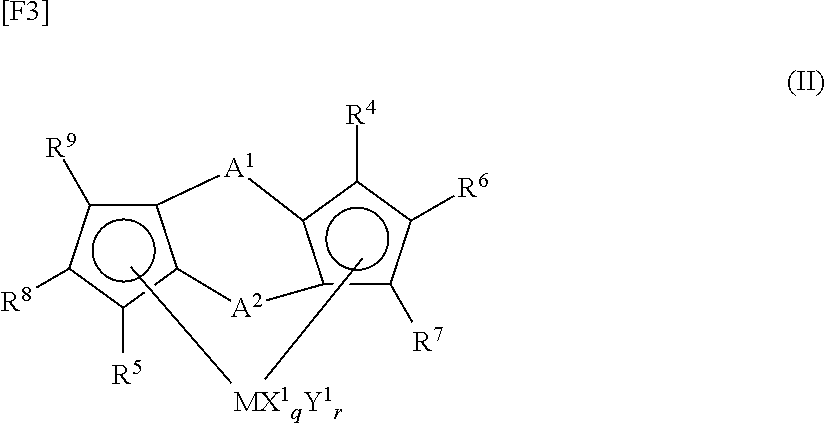
(i.e., a metallocene complex having, as a ligand, a double-cross-linked biscyclopentadienyl derivative) is preferred, from the viewpoint of further improvement of polymerization activity.
([L1-H]s+)t([BZ1Z2Z3Z4]−)1 (III)
([L2]s+)t([BZ1Z2Z3Z4]−)1 (IV)
[in formula (III) or (IV), L2 represents M1, R10R11M2, or R12 3C as described below; L1 represents a Lewis base; M1 represents a metal selected from those belonging to Groups 1 and 8 to 12 of the periodic table; M2 represents a metal selected from those belonging to Groups 8 to 10 of the periodic table; and each of Z1 to Z4 represents a hydrogen atom, a dialkylamino group, an alkoxy group, an aryloxy group, a C1 to C20 alkyl group, a C6 to C20 aryl group, an alkylaryl group, an arylalkyl group, a substituted alkyl group, an organometalloid group, or a halogen atom;
each of R10 and R11 represents a cyclopentadienyl group, a substituted cyclopentadienyl group, an indenyl group, or a fluorenyl group; R12 represents an alkyl group;
s represents an ionic valence of L1-H or L2 and is an integer from 1 to 7; t is an integer of 1 or more; and l=t×s].
(BZ1Z2Z3Z4)− (V)
[wherein each of Z1 to Z4 represents a hydrogen atom, a dialkylamino group, an alkoxy group, an aryloxy group, a C1 to C20 alkyl group, a C6 to C20 aryl group (including a halogen-substituted aryl group), an alkylaryl group, an arylalkyl group, a substituted alkyl group, an organometalloid group, or a halogen atom].
[CR13R14R15]+ (VI).
C6H5-kR16 k (VII).
R20 vAlJ3-v (VII)
[wherein R20 represents a C1 to C10 alkyl group; J represents a hydrogen atom, a C1 to C20 alkoxy group, a C6 to C20 aryl group, or a halogen atom; and v is an integer from 1 to 3].

(wherein R21 represents a C1 to C20 (preferably C1 to C12) hydrocarbon group, such as an alkyl group, an alkenyl group, an aryl group, or an arylalkyl group, or a halogen atom; w represents an average degree of polymerization (which is generally an integer from 2 to 50 (preferably from 2 to 40)); and the groups R21 may be identical to or different from one another); or a cyclic aluminoxane represented by the following formula (X):

(wherein R21 and w have the same meanings as defined above in formula (IX)).
| TABLE 1 | ||
| Examples | ||
| 1 | 2 | 3 | 4 | 5 | 6 | 7 | ||
| Catalyst | (A) Transition metal compound | (μmol) | 1200 | 1200 | 1200 | 1200 | 40 | 40 | 40 |
| preparation | (B) Boron compound | (μmol) | 1800 | 2400 | 1800 | 1800 | 60 | 60 | 60 |
| conditions | (B) Boron compound/ | (mol/mol) | 1.5 | 2 | 1.5 | 1.5 | 1.5 | 1.5 | 1.5 |
| (A) Transition metal compound | |||||||||
| (C) Organoaluminum | (mmol) | 9 | 9 | 9 | 9 | 0.4 | 0.4 | 0.4 | |
| (C) Organoaluminum/ | (mol/mol) | 7.5 | 7.5 | 7.5 | 7.5 | 10 | 10 | 10 | |
| (A) Transition metal compound | |||||||||
| (D) Unsaturated hydrocarbon compound | (g) | 16.3 | 16.3 | 16.3 | 8.2 | 1.5 | 3.0 | 1.5 | |
| employed for catalyst preparation | |||||||||
| (D) Unsaturated hydrocarbon compound/ | (mass/mass) | 20 | 20 | 20 | 10 | 90 | 179 | 93 | |
| (A) Transition metal compound | |||||||||
| Preliminary polymerization temperature | (° C.) | 30 | 40 | 60 | 30 | 60 | 60 | 30 | |
| Evaluation | Polymerization activity | (g) | 105 | 110 | 98 | 105 | 150 | 156 | 148 |
| Viscosity-based handleability | AA | AA | AA | AA | BB | BB | BB | ||
| TABLE 2 | ||
| Comparative Examples | ||
| 1 | 2 | 3 | 4 | 5 | 6 | 7 | ||
| Catalyst | (A) Transition metal compound | (μmol) | 1200 | 1200 | 1200 | 1200 | 40 | 40 | 40 |
| preparation | (B) Boron compound | (μmol) | 1800 | 1800 | 1320 | 1800 | 60 | 60 | 60 |
| conditions | (B) Boron compound/ | (mol/mol) | 1.5 | 1.5 | 1.1 | 1.5 | 1.5 | 1.5 | 1.5 |
| (A) Transition metal compound | |||||||||
| (C) Organoaluminum | (mmol) | 9 | 9 | 9 | 2.4 | 0.4 | 0.4 | 0.4 | |
| (C) Organoaluminum/ | (mol/mol) | 7.5 | 7.5 | 7.5 | 2 | 10 | 10 | 10 | |
| (A) Transition metal compound | |||||||||
| (D) Unsaturated hydrocarbon compound | (g) | 16.3 | 16.3 | 16.3 | 16.3 | 1.5 | 4.5 | 1.5 | |
| employed for catalyst preparation | |||||||||
| (D) Unsaturated hydrocarbon compound/ | (mass/mass) | 20 | 20 | 20 | 20 | 90 | 269 | 93 | |
| (A) Transition metal compound | |||||||||
| Preliminary polymerization temperature | (° C.) | 20 | 80 | 40 | 40 | 20 | 30 | 0 | |
| Evaluation | Polymerization activity | (g) | 67 | 73 | 68 | 80 | 90 | 150 | 90 |
| Viscosity-based handleability | AA | AA | AA | AA | BB | CC | BB | ||
| TABLE 3 | ||||
| Percent activity | ||||
| Storage | Catalyst | maintenance | ||
| temperature | employed | (%) | ||
| Example 8 | 5° C. | Catalyst 1 | 98 |
| Example 9 | 5° C. | Catalyst 2 | 99 |
| Example 10 | 25° C. | Catalyst 1 | 97 |
| Example 11 | 25° C. | Catalyst 2 | 98 |
| Example 12 | 30° C. | Catalyst 1 | 83 |
| Example 13 | 30° C. | Catalyst 2 | 89 |
| Comparative Example 8 | −5° C. | Catalyst 1 | 63 |
| Comparative Example 9 | −5° C. | Catalyst 2 | 59 |
| Comparative Example 10 | 40° C. | Catalyst 1 | 45 |
| Comparative Example 11 | 40° C. | Catalyst 2 | 42 |
Claims (26)
(BZ1Z2Z3Z4)−

Applications Claiming Priority (3)
| Application Number | Priority Date | Filing Date | Title |
|---|---|---|---|
| JP2009-161752 | 2009-07-08 | ||
| JP2009161752A JP5600403B2 (en) | 2009-07-08 | 2009-07-08 | Polymerization catalyst and storage method thereof |
| PCT/JP2010/059849 WO2011004676A1 (en) | 2009-07-08 | 2010-06-10 | Polymerization catalysts and method for preservation of same |
Publications (2)
| Publication Number | Publication Date |
|---|---|
| US20120129683A1 US20120129683A1 (en) | 2012-05-24 |
| US8975202B2 true US8975202B2 (en) | 2015-03-10 |
Family
ID=43429102
Family Applications (1)
| Application Number | Title | Priority Date | Filing Date |
|---|---|---|---|
| US13/382,722 Active 2031-05-09 US8975202B2 (en) | 2009-07-08 | 2010-06-10 | Polymerization catalysts and method for preservation of same |
Country Status (4)
| Country | Link |
|---|---|
| US (1) | US8975202B2 (en) |
| EP (1) | EP2452954B1 (en) |
| JP (1) | JP5600403B2 (en) |
| WO (1) | WO2011004676A1 (en) |
Cited By (2)
| Publication number | Priority date | Publication date | Assignee | Title |
|---|---|---|---|---|
| US9869978B2 (en) | 2011-11-03 | 2018-01-16 | 3-East, Llc | System, method and apparatus for creating and maintaining biometric secure safe deposit boxes, and similar containers and facilities |
| US10304266B1 (en) | 2011-11-03 | 2019-05-28 | 3-East, Llc | System, method and apparatus for creating and maintaining biometric secure safe deposit boxes, and similar containers and facilities |
Families Citing this family (3)
| Publication number | Priority date | Publication date | Assignee | Title |
|---|---|---|---|---|
| EP2669301A4 (en) | 2010-11-26 | 2014-07-09 | Idemitsu Kosan Co | Α-OLEFIN POLYMER AND PROCESS FOR PRODUCING THE SAME |
| JP6452305B2 (en) * | 2014-04-11 | 2019-01-16 | 出光興産株式会社 | Olefin polymer production method and olefin polymerization catalyst |
| JP6561655B2 (en) * | 2014-08-08 | 2019-08-21 | 日本ポリプロ株式会社 | Process for producing olefin polymer |
Citations (7)
| Publication number | Priority date | Publication date | Assignee | Title |
|---|---|---|---|---|
| EP0773239A2 (en) | 1992-06-22 | 1997-05-14 | Fina Technology, Inc. | Method for controlling the melting points and molecular weights of syndiotactic polyolefins using metallocene catalyst systems |
| EP1359166A1 (en) | 2000-12-19 | 2003-11-05 | Sunallomer Ltd | Olefin polymerization catalyst, catalyst component for olefin polymerization, method of storing these, and process for producing olefin polymer |
| US20050159566A1 (en) | 2002-04-23 | 2005-07-21 | Idemitsu Kosan Co., Ltd | Process for producing highly flowable propylene polymer and highly flowable propylene polymer |
| WO2006117983A1 (en) | 2005-04-28 | 2006-11-09 | Idemitsu Kosan Co., Ltd. | POLYMERIZATION CATALYST AND METHOD FOR PRODUCING POLY-α-OLEFIN USING THE CATALYST |
| JP2007186718A (en) | 2000-12-19 | 2007-07-26 | Sunallomer Ltd | Olefin polymerization catalyst, olefin polymerization catalyst component and storage method thereof, and process for producing olefin polymer |
| WO2008102729A1 (en) | 2007-02-19 | 2008-08-28 | Idemitsu Kosan Co., Ltd. | α-OLEFIN POLYMER AND PROCESS FOR PRODUCTION THEREOF |
| WO2009066689A1 (en) | 2007-11-19 | 2009-05-28 | Mitsui Chemicals, Inc. | Bridged metallocene compound, olefin polymerization catalyst using the compound and ethylene polymer obtained by using the catalyst |
-
2009
- 2009-07-08 JP JP2009161752A patent/JP5600403B2/en active Active
-
2010
- 2010-06-10 WO PCT/JP2010/059849 patent/WO2011004676A1/en not_active Ceased
- 2010-06-10 EP EP10796987.5A patent/EP2452954B1/en not_active Not-in-force
- 2010-06-10 US US13/382,722 patent/US8975202B2/en active Active
Patent Citations (11)
| Publication number | Priority date | Publication date | Assignee | Title |
|---|---|---|---|---|
| EP0773239A2 (en) | 1992-06-22 | 1997-05-14 | Fina Technology, Inc. | Method for controlling the melting points and molecular weights of syndiotactic polyolefins using metallocene catalyst systems |
| EP0773239A3 (en) | 1992-06-22 | 1998-02-11 | Fina Technology, Inc. | Method for controlling the melting points and molecular weights of syndiotactic polyolefins using metallocene catalyst systems |
| EP1359166A1 (en) | 2000-12-19 | 2003-11-05 | Sunallomer Ltd | Olefin polymerization catalyst, catalyst component for olefin polymerization, method of storing these, and process for producing olefin polymer |
| US20040054102A1 (en) | 2000-12-19 | 2004-03-18 | Satoru Ishigaki | Olefin polymerization catalyst, catalyst component for olefin polymerization, method of storing these, and process for producing olefin polymer |
| JP2007186718A (en) | 2000-12-19 | 2007-07-26 | Sunallomer Ltd | Olefin polymerization catalyst, olefin polymerization catalyst component and storage method thereof, and process for producing olefin polymer |
| US20050159566A1 (en) | 2002-04-23 | 2005-07-21 | Idemitsu Kosan Co., Ltd | Process for producing highly flowable propylene polymer and highly flowable propylene polymer |
| WO2006117983A1 (en) | 2005-04-28 | 2006-11-09 | Idemitsu Kosan Co., Ltd. | POLYMERIZATION CATALYST AND METHOD FOR PRODUCING POLY-α-OLEFIN USING THE CATALYST |
| US20090124771A1 (en) | 2005-04-28 | 2009-05-14 | Idemitsu Kosan Co., Ltd | Polymerization catalyst and method for producing poly-alpha-olefin using the catalyst |
| WO2008102729A1 (en) | 2007-02-19 | 2008-08-28 | Idemitsu Kosan Co., Ltd. | α-OLEFIN POLYMER AND PROCESS FOR PRODUCTION THEREOF |
| US20100036066A1 (en) | 2007-02-19 | 2010-02-11 | Idemitsu Kosan Co., Ltd. | Alpha-olefin polymer and process for production thereof |
| WO2009066689A1 (en) | 2007-11-19 | 2009-05-28 | Mitsui Chemicals, Inc. | Bridged metallocene compound, olefin polymerization catalyst using the compound and ethylene polymer obtained by using the catalyst |
Non-Patent Citations (3)
| Title |
|---|
| Extended European Search Report issued Feb. 17, 2014 in Patent Application No. 10796987.5. |
| International Search Report issued on Sep. 7, 2010 in PCT/JP10/059849 filed on Jun. 10, 2010. |
| U.S. Appl. No. 13/699,679, filed Dec. 11, 2012, Yabukami, et al. |
Cited By (2)
| Publication number | Priority date | Publication date | Assignee | Title |
|---|---|---|---|---|
| US9869978B2 (en) | 2011-11-03 | 2018-01-16 | 3-East, Llc | System, method and apparatus for creating and maintaining biometric secure safe deposit boxes, and similar containers and facilities |
| US10304266B1 (en) | 2011-11-03 | 2019-05-28 | 3-East, Llc | System, method and apparatus for creating and maintaining biometric secure safe deposit boxes, and similar containers and facilities |
Also Published As
| Publication number | Publication date |
|---|---|
| JP5600403B2 (en) | 2014-10-01 |
| EP2452954B1 (en) | 2015-08-19 |
| EP2452954A4 (en) | 2014-03-19 |
| US20120129683A1 (en) | 2012-05-24 |
| WO2011004676A1 (en) | 2011-01-13 |
| EP2452954A1 (en) | 2012-05-16 |
| JP2011016893A (en) | 2011-01-27 |
Similar Documents
| Publication | Publication Date | Title |
|---|---|---|
| EP0513380B1 (en) | Process for producing olefinic polymer | |
| JP4667901B2 (en) | Process for producing unsaturated hydrocarbon compounds | |
| JP5674474B2 (en) | Method for producing α-olefin polymer, α-olefin polymer, and lubricating oil composition | |
| WO2011093295A1 (en) | α-OLEFIN (CO)POLYMER, HYDROGENATED α-OLEFIN (CO)POLYMER AND LUBRICATING OIL COMPOSITION CONTAINING THE SAME | |
| EP2452954B1 (en) | Polymerization catalysts and method for preservation of same | |
| JP3264333B2 (en) | Method for producing ethylene polymer composition | |
| JPWO2013008401A1 (en) | Process for producing olefin polymer | |
| JP5688236B2 (en) | Catalyst composition and method for producing olefin polymer using the catalyst composition | |
| JPH05320248A (en) | Production of ethylenic polymer composition | |
| JP4852038B2 (en) | Polymerization catalyst and method for producing poly-α-olefin using the catalyst | |
| JP3262137B2 (en) | Method for producing ethylene polymer | |
| JP3299275B2 (en) | Method for producing polyolefin | |
| JP2012149188A (en) | Method for producing olefin polymer | |
| JPWO1993024541A1 (en) | Polyolefin manufacturing method | |
| US10150825B2 (en) | Production method for olefin-based polymer, and olefin polymerization catalyst | |
| JPH0543618A (en) | Production of olefin polymer | |
| JP2010138257A (en) | Terminating method of polymerization reaction, and method for manufacturing polyolefin | |
| JP5735367B2 (en) | Process for producing olefin polymer | |
| KR20020089178A (en) | Process for producing vinyl compound polymer | |
| JP5606144B2 (en) | Method for producing polyolefin | |
| WO2000044793A1 (en) | Catalyst for olefin polymerization and process for producing olefin polymer | |
| JP3070256B2 (en) | Method for producing olefin polymer | |
| JPH0770222A (en) | Olefin polymerization catalyst and method for producing polyolefin using the catalyst | |
| JPH10168112A (en) | Catalyst for copolymerization of alpha-olefin and aromatic vinyl compound, production of copolymer of alpha-olefin and aromatic vinyl compound, and new transition metal compound | |
| JPH05279418A (en) | Production of polyolefin |
Legal Events
| Date | Code | Title | Description |
|---|---|---|---|
| AS | Assignment |
Owner name: IDEMITSU KOSAN CO., LTD., JAPAN Free format text: ASSIGNMENT OF ASSIGNORS INTEREST;ASSIGNORS:KANAMARU, MASAMI;FUJIMURA, TAKENORI;YABUKAMI, MINORU;REEL/FRAME:027648/0742 Effective date: 20111221 |
|
| STCF | Information on status: patent grant |
Free format text: PATENTED CASE |
|
| FEPP | Fee payment procedure |
Free format text: PAYOR NUMBER ASSIGNED (ORIGINAL EVENT CODE: ASPN); ENTITY STATUS OF PATENT OWNER: LARGE ENTITY |
|
| MAFP | Maintenance fee payment |
Free format text: PAYMENT OF MAINTENANCE FEE, 4TH YEAR, LARGE ENTITY (ORIGINAL EVENT CODE: M1551); ENTITY STATUS OF PATENT OWNER: LARGE ENTITY Year of fee payment: 4 |
|
| MAFP | Maintenance fee payment |
Free format text: PAYMENT OF MAINTENANCE FEE, 8TH YEAR, LARGE ENTITY (ORIGINAL EVENT CODE: M1552); ENTITY STATUS OF PATENT OWNER: LARGE ENTITY Year of fee payment: 8 |