US8968950B2 - Method of starting operation of solid polymer electrolyte fuel cell - Google Patents

Method of starting operation of solid polymer electrolyte fuel cell Download PDF

Info

Publication number
US8968950B2
US8968950B2 US13/109,739 US201113109739A US8968950B2 US 8968950 B2 US8968950 B2 US 8968950B2 US 201113109739 A US201113109739 A US 201113109739A US 8968950 B2 US8968950 B2 US 8968950B2
Authority
US
United States
Prior art keywords
oxygen
flow field
fuel gas
containing gas
gas flow
Prior art date
Legal status (The legal status is an assumption and is not a legal conclusion. Google has not performed a legal analysis and makes no representation as to the accuracy of the status listed.)
Active, expires
Application number
US13/109,739
Other versions
US20110287331A1 (en
Inventor
Masahiro Mohri
Yasunori Kotani
Chikara Iwasawa
Junji Uehara
Hiroto Chiba
Osamu Ohgami
Hiroaki Ohta
Current Assignee (The listed assignees may be inaccurate. Google has not performed a legal analysis and makes no representation or warranty as to the accuracy of the list.)
Honda Motor Co Ltd
Original Assignee
Honda Motor Co Ltd
Priority date (The priority date is an assumption and is not a legal conclusion. Google has not performed a legal analysis and makes no representation as to the accuracy of the date listed.)
Filing date
Publication date
Application filed by Honda Motor Co Ltd filed Critical Honda Motor Co Ltd
Assigned to HONDA MOTOR CO., LTD. reassignment HONDA MOTOR CO., LTD. ASSIGNMENT OF ASSIGNORS INTEREST (SEE DOCUMENT FOR DETAILS). Assignors: CHIBA, HIROTO, IWASAWA, CHIKARA, KOTANI, YASUNORI, MOHRI, MASAHIRO, OHGAMI, OSAMU, OHTA, HIROAKI, UEHARA, JUNJI
Publication of US20110287331A1 publication Critical patent/US20110287331A1/en
Application granted granted Critical
Publication of US8968950B2 publication Critical patent/US8968950B2/en
Active legal-status Critical Current
Adjusted expiration legal-status Critical

Links

Images

Classifications

    • HELECTRICITY
    • H01ELECTRIC ELEMENTS
    • H01MPROCESSES OR MEANS, e.g. BATTERIES, FOR THE DIRECT CONVERSION OF CHEMICAL ENERGY INTO ELECTRICAL ENERGY
    • H01M8/00Fuel cells; Manufacture thereof
    • H01M8/04Auxiliary arrangements, e.g. for control of pressure or for circulation of fluids
    • H01M8/04223Auxiliary arrangements, e.g. for control of pressure or for circulation of fluids during start-up or shut-down; Depolarisation or activation, e.g. purging; Means for short-circuiting defective fuel cells
    • HELECTRICITY
    • H01ELECTRIC ELEMENTS
    • H01MPROCESSES OR MEANS, e.g. BATTERIES, FOR THE DIRECT CONVERSION OF CHEMICAL ENERGY INTO ELECTRICAL ENERGY
    • H01M8/00Fuel cells; Manufacture thereof
    • H01M8/02Details
    • H01M8/0202Collectors; Separators, e.g. bipolar separators; Interconnectors
    • H01M8/0258Collectors; Separators, e.g. bipolar separators; Interconnectors characterised by the configuration of channels, e.g. by the flow field of the reactant or coolant
    • HELECTRICITY
    • H01ELECTRIC ELEMENTS
    • H01MPROCESSES OR MEANS, e.g. BATTERIES, FOR THE DIRECT CONVERSION OF CHEMICAL ENERGY INTO ELECTRICAL ENERGY
    • H01M8/00Fuel cells; Manufacture thereof
    • H01M8/02Details
    • H01M8/0202Collectors; Separators, e.g. bipolar separators; Interconnectors
    • H01M8/0267Collectors; Separators, e.g. bipolar separators; Interconnectors having heating or cooling means, e.g. heaters or coolant flow channels
    • HELECTRICITY
    • H01ELECTRIC ELEMENTS
    • H01MPROCESSES OR MEANS, e.g. BATTERIES, FOR THE DIRECT CONVERSION OF CHEMICAL ENERGY INTO ELECTRICAL ENERGY
    • H01M8/00Fuel cells; Manufacture thereof
    • H01M8/04Auxiliary arrangements, e.g. for control of pressure or for circulation of fluids
    • HELECTRICITY
    • H01ELECTRIC ELEMENTS
    • H01MPROCESSES OR MEANS, e.g. BATTERIES, FOR THE DIRECT CONVERSION OF CHEMICAL ENERGY INTO ELECTRICAL ENERGY
    • H01M8/00Fuel cells; Manufacture thereof
    • H01M8/04Auxiliary arrangements, e.g. for control of pressure or for circulation of fluids
    • H01M8/04223Auxiliary arrangements, e.g. for control of pressure or for circulation of fluids during start-up or shut-down; Depolarisation or activation, e.g. purging; Means for short-circuiting defective fuel cells
    • H01M8/04225Auxiliary arrangements, e.g. for control of pressure or for circulation of fluids during start-up or shut-down; Depolarisation or activation, e.g. purging; Means for short-circuiting defective fuel cells during start-up
    • HELECTRICITY
    • H01ELECTRIC ELEMENTS
    • H01MPROCESSES OR MEANS, e.g. BATTERIES, FOR THE DIRECT CONVERSION OF CHEMICAL ENERGY INTO ELECTRICAL ENERGY
    • H01M8/00Fuel cells; Manufacture thereof
    • H01M8/04Auxiliary arrangements, e.g. for control of pressure or for circulation of fluids
    • H01M8/04223Auxiliary arrangements, e.g. for control of pressure or for circulation of fluids during start-up or shut-down; Depolarisation or activation, e.g. purging; Means for short-circuiting defective fuel cells
    • H01M8/04228Auxiliary arrangements, e.g. for control of pressure or for circulation of fluids during start-up or shut-down; Depolarisation or activation, e.g. purging; Means for short-circuiting defective fuel cells during shut-down
    • HELECTRICITY
    • H01ELECTRIC ELEMENTS
    • H01MPROCESSES OR MEANS, e.g. BATTERIES, FOR THE DIRECT CONVERSION OF CHEMICAL ENERGY INTO ELECTRICAL ENERGY
    • H01M8/00Fuel cells; Manufacture thereof
    • H01M8/04Auxiliary arrangements, e.g. for control of pressure or for circulation of fluids
    • H01M8/04298Processes for controlling fuel cells or fuel cell systems
    • H01M8/043Processes for controlling fuel cells or fuel cell systems applied during specific periods
    • H01M8/04302Processes for controlling fuel cells or fuel cell systems applied during specific periods applied during start-up
    • HELECTRICITY
    • H01ELECTRIC ELEMENTS
    • H01MPROCESSES OR MEANS, e.g. BATTERIES, FOR THE DIRECT CONVERSION OF CHEMICAL ENERGY INTO ELECTRICAL ENERGY
    • H01M8/00Fuel cells; Manufacture thereof
    • H01M8/24Grouping of fuel cells, e.g. stacking of fuel cells
    • H01M8/2465Details of groupings of fuel cells
    • H01M8/2483Details of groupings of fuel cells characterised by internal manifolds
    • YGENERAL TAGGING OF NEW TECHNOLOGICAL DEVELOPMENTS; GENERAL TAGGING OF CROSS-SECTIONAL TECHNOLOGIES SPANNING OVER SEVERAL SECTIONS OF THE IPC; TECHNICAL SUBJECTS COVERED BY FORMER USPC CROSS-REFERENCE ART COLLECTIONS [XRACs] AND DIGESTS
    • Y02TECHNOLOGIES OR APPLICATIONS FOR MITIGATION OR ADAPTATION AGAINST CLIMATE CHANGE
    • Y02EREDUCTION OF GREENHOUSE GAS [GHG] EMISSIONS, RELATED TO ENERGY GENERATION, TRANSMISSION OR DISTRIBUTION
    • Y02E60/00Enabling technologies; Technologies with a potential or indirect contribution to GHG emissions mitigation
    • Y02E60/30Hydrogen technology
    • Y02E60/50Fuel cells

Definitions

  • the present invention relates to a method of starting operation of a solid polymer electrolyte fuel cell, which generates electrical energy by means of electrochemical reactions occurring between an oxygen-containing gas and a fuel gas.
  • the solid polymer electrolyte fuel cell is formed by stacking a membrane electrode assembly and separators.
  • the membrane electrode assembly includes a cathode and an anode as a pair of electrodes, with an electrolyte interposed between the cathode and the anode.
  • the solid polymer electrolyte fuel cell has an oxygen-containing gas flow field for supplying an oxygen-containing gas to the cathode, and a fuel gas flow field for supplying a fuel gas to the anode.
  • a solid polymer electrolyte fuel cell employs an electrolyte membrane.
  • the electrolyte membrane is a polymer ion exchange membrane.
  • the electrolyte membrane is interposed between an anode and a cathode in order to form a membrane electrode assembly (MEA).
  • MEA membrane electrode assembly
  • the membrane electrode assembly is sandwiched between a pair of separators, so as to form a unit cell for generating electricity.
  • a predetermined number of unit cells are stacked together to make up a fuel cell stack.
  • the fuel cell stack is mounted in a vehicle, for example.
  • a fuel gas flow field is formed on a surface of one separator, which faces the anode, for supplying fuel gas to the anode
  • an oxygen-containing gas flow field is formed on a surface of the other separator, which faces the cathode, for supplying oxygen-containing gas to the cathode.
  • a coolant flow field is formed between adjacent separators of the fuel cells for supplying a coolant into electrode areas of the separators.
  • the fuel cell system includes a fuel cell for generating electrical energy using a fuel gas, which is supplied to a fuel gas flow field, and an oxygen-containing gas, which is supplied to an oxygen-containing gas flow field.
  • the fuel cell system also includes a first fuel gas supply means for supplying fuel gas to the fuel gas flow field, an oxygen-containing gas supply means for supplying oxygen-containing gas to the oxygen-containing gas flow field, and a second fuel gas supply means for selectively supplying fuel gas to the oxygen-containing gas flow field.
  • gas that remains when the fuel cell system is started is utilized to suppress a corrosive reaction of carbon in the electrodes of the fuel cell.
  • degradation of the cathode (oxygen-containing gas electrode) which may occur when the starting operation is carried out, is suppressed effectively without requiring the system to be large in size.
  • An object of the present invention is to provide a method of starting operation of a solid polymer electrolyte fuel cell, including simple and economical steps, which suitably suppress degradation of the fuel cell.
  • the present invention relates to a method of starting operation of a solid polymer electrolyte fuel cell, in which electrical energy is generated by electrochemical reactions that take place between an oxygen-containing gas and a fuel gas.
  • the solid polymer electrolyte fuel cell is formed by stacking a membrane electrode assembly and separators.
  • the membrane electrode assembly includes a cathode and an anode as a pair of electrodes, and an electrolyte interposed between the cathode and the anode.
  • the solid polymer electrolyte fuel cell has an oxygen-containing gas flow field for supplying oxygen-containing gas to the cathode, and a fuel gas flow field for supplying fuel gas to the anode.
  • the method includes the steps of performing gas replacement by supplying the fuel gas to the fuel gas flow field from a downstream side of the fuel gas flow field, and supplying the oxygen-containing gas to the oxygen-containing gas flow field from an upstream side of the oxygen-containing gas flow field, and after the step of performing gas replacement, performing normal power generation by supplying the fuel gas to the fuel gas flow field from an upstream side of the fuel gas flow field, and supplying the oxygen-containing gas to the oxygen-containing gas flow field from the upstream side of the oxygen-containing gas flow field.
  • the fuel gas is supplied to the fuel gas flow field from a downstream side of the fuel gas flow field. Therefore, even though water tends to be retained easily on the downstream side of the fuel gas flow field, the water can be moved toward the upstream side of the fuel gas flow field where only a small amount of water is present. Therefore, the occurrence of a high potential on the downstream side of the oxygen-containing gas flow field is suitably suppressed, and the amount of fuel gas that is discarded wastefully can be reduced reliably. Thus, with simple and economical steps, degradation of the fuel cell stack when operation of the fuel cell stack is started can suitably be suppressed.
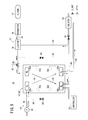
  • FIG. 1 is a diagram schematically showing the structure of a fuel cell system, to which a method of starting operation of the fuel cell system according to an embodiment of the present invention is applied;
  • FIG. 2 is an exploded perspective view showing a fuel cell of the fuel cell system
  • FIG. 3 is a flow chart showing the method of starting operation of the fuel cell system
  • FIG. 4 is a diagram showing a gas replacement process carried out on an anode side of the fuel cell system
  • FIG. 5 is a diagram showing a state at a time when the fuel cell system generates power
  • FIG. 6 is a diagram showing a state at a time when a scavenging process is carried out on the fuel cell system
  • FIG. 7 is a cross sectional view showing potential behaviors in the fuel cell, at a time when operation of the fuel cell system is started;
  • FIG. 8 is a graph showing the potential at a time when operation of a conventional fuel cell system is started.
  • FIG. 9 is a graph showing an amount of water in a membrane electrode assembly at a time when power generation is stopped.
  • FIG. 10 is a graph showing the potential at a time when operation of the fuel cell system according to the present embodiment is started.
  • a fuel cell system 10 to which a method of starting operation of the fuel cell system 10 according to an embodiment of the present invention is applied, includes a fuel cell stack 12 , an oxygen-containing gas supply apparatus 14 for supplying an oxygen-containing gas to the fuel cell stack 12 , a fuel gas supply apparatus 16 for supplying a fuel gas to the fuel cell stack 12 , a coolant supply apparatus (not shown) for supplying a coolant to the fuel cell stack 12 , and a controller 18 for controlling operations of the fuel cell system 10 as a whole.
  • the fuel cell stack 12 is formed by stacking a plurality of fuel cells 20 . As shown in FIG. 2 , each of the fuel cells 20 includes a membrane electrode assembly 22 , and a first separator 24 and a second separator 26 sandwiching the membrane electrode assembly 22 therebetween.
  • first and second separators 24 , 26 are steel plates, stainless steel plates, aluminum plates, plated steel sheets, or metal plates, which have anti-corrosive surfaces formed by carrying out a surface treatment thereon.
  • Each of the first separator 24 and the second separator 26 has a rectangular shape as viewed in plan, and is formed by corrugating a metal thin plate under pressure to have grooves and ridges therein as viewed in cross section.
  • metal separators for example, carbon separators may be used as the first separator 24 and the second separator 26 .
  • Each of the first separator 24 and the second separator 26 has a rectangular shape. Long sides of the first and second separators 24 , 26 extend in the direction of gravity, as indicated by the arrow C, and short sides of the first and second separators 24 , 26 extend in a horizontal direction as indicated by the arrow B. Alternatively, long sides of the first and second separators 24 , 26 may extend in the horizontal direction, while the short sides of the first and second separators 24 , 26 extend in the direction of gravity.
  • an oxygen-containing gas supply passage 28 a is provided for supplying an oxygen-containing gas
  • a fuel gas supply passage 30 a is provided for supplying a hydrogen-containing gas.
  • the oxygen-containing gas supply passage 28 a and the fuel gas supply passage 30 a extend through the fuel cells 20 in the direction indicated by the arrow A.
  • a fuel gas discharge passage 30 b is provided for discharging the fuel gas
  • an oxygen-containing gas discharge passage 28 b is provided for discharging the oxygen-containing gas.
  • the fuel gas discharge passage 30 b and the oxygen-containing gas discharge passage 28 b extend through the fuel cell 20 in the direction indicated by the arrow A.
  • two coolant supply passages 32 a are provided at symmetrical locations for supplying a coolant.
  • the coolant supply passages 32 a extend through the fuel cell 20 in the direction indicated by the arrow A.
  • two coolant discharge passages 32 b are provided at symmetrical locations for discharging the coolant.
  • the coolant discharge passages 32 b extend through the fuel cell 20 in the direction indicated by the arrow A.
  • the first separator 24 On a surface 24 a of the first separator 24 that faces the membrane electrode assembly 22 , the first separator 24 has an oxygen-containing gas flow field 34 that extends vertically, and which serves to connect the oxygen-containing gas supply passage 28 a and the oxygen-containing gas discharge passage 28 b .
  • An inlet buffer 36 a and an outlet buffer 36 b are provided adjacent to the inlet and the outlet of the oxygen-containing gas flow field 34 .
  • Plural embossments are formed in the inlet buffer 36 a and the outlet buffer 36 b .
  • a coolant flow field 38 is partially formed on a surface 24 b of the first separator 24 opposite to the surface 24 a.
  • the second separator 26 On a surface 26 a of the second separator 26 that faces the membrane electrode assembly 22 , the second separator 26 has a fuel gas flow field 40 that extends vertically, and which serves to connect the fuel gas supply passage 30 a and the fuel gas discharge passage 30 b .
  • An inlet buffer 42 a and an outlet buffer 42 b are provided adjacent to the inlet and the outlet of the fuel gas flow field 40 .
  • Plural embossments are formed in the inlet buffer 42 a and the outlet buffer 42 b.
  • the coolant flow field 38 which is connected to the coolant supply passages 32 a and the coolant discharge passages 32 b , is formed between a surface 26 b of the second separator 26 and the surface 24 b of the first separator 24 .
  • An inlet buffer 44 a and an outlet buffer 44 b are provided adjacent to the inlet and the outlet of the coolant flow field 38 .
  • Plural embossments are formed in the inlet buffer 44 a and the outlet buffer 44 b.
  • a first seal member 46 is formed around the first separator 24 integrally with the surfaces 24 a , 24 b of the first separator 24 .
  • a second seal member 48 is formed around the second separator 26 integrally with the surfaces 26 a , 26 b of the second separator 26 .
  • the first and second seal members 46 , 48 are made, for example, from a sealant material, a cushion material or a packing material, such as elastic EPDM (ethylene propylene diene monomer), NBR (nitrile butadiene rubber), fluoro rubber, silicone rubber, fluoro silicone rubber, butyl rubber (isobutene-isoprene rubber), natural rubber, styrene rubber, chloroprene rubber, or acrylic rubber.
  • elastic EPDM ethylene propylene diene monomer
  • NBR nitrile butadiene rubber
  • fluoro rubber silicone rubber
  • fluoro silicone rubber fluoro silicone rubber
  • butyl rubber isobutene-isoprene rubber
  • the membrane electrode assembly 22 includes a cathode 52 , an anode 54 , and a solid polymer electrolyte membrane 50 interposed between the cathode 52 and the anode 54 .
  • the solid polymer electrolyte membrane 50 may be formed by impregnating a thin membrane of perfluorosulfonic acid with water, for example.
  • Each of the cathode 52 and the anode 54 has a gas diffusion layer, such as carbon paper, and an electrode catalyst layer made up of a platinum alloy supported on porous carbon particles. The carbon particles are deposited uniformly on the surface of the gas diffusion layer.
  • the electrode catalyst layer of the cathode 52 and the electrode catalyst layer of the anode 54 are fixed to opposite surfaces of the solid polymer electrolyte membrane 50 , respectively.
  • the oxygen-containing gas supply apparatus 14 includes an air pump 60 for compressing atmospheric air and for supplying the compressed air.
  • the air pump 60 is provided in an air supply channel 62 .
  • the air supply channel 62 is connected to an oxygen-containing gas supply passage 28 a of the fuel cell stack 12 .
  • An air branch channel 64 branches from a position in the middle of the air supply channel 62 .
  • An opening/closing valve 66 is provided in the air branch channel 64 .
  • the air branch channel 64 is connected to the fuel gas discharge passage 30 b of the fuel cell stack 12 .
  • the oxygen-containing gas supply apparatus 14 has an air discharge channel 68 connected to the oxygen-containing gas discharge passage 28 b .
  • the air discharge channel 68 is connected to a diluter 70 .
  • the fuel gas supply apparatus 16 includes a hydrogen tank 72 for storing high pressure hydrogen (hydrogen-containing gas).
  • the hydrogen tank 72 is connected through a hydrogen supply channel 74 to the fuel gas supply passage 30 a of the fuel cell stack 12 .
  • a regulator 76 , an ejector 78 , and a three-way valve 80 are provided in the hydrogen supply channel 74 .
  • a discharge pipe 82 for example, which is connected to the three-way valve 80 , is connected to the diluter 70 for diluting the exhaust gas using air.
  • the fuel gas supply apparatus 16 has a fuel gas discharge channel 84 , which is connected to the fuel gas discharge passage 30 b .
  • the fuel gas discharge channel 84 is connected to the diluter 70 through an opening/closing valve 86 , and the fuel gas discharge channel 84 is connected to a hydrogen circulation channel 88 .
  • the hydrogen circulation channel 88 is connected to an ejector 78 .
  • Hydrogen gas is supplied from the hydrogen tank 72 to the ejector 78 , and then, the hydrogen gas is supplied into the fuel cell stack 12 through the hydrogen supply channel 74 .
  • Exhaust gas which contains hydrogen gas that was consumed in the fuel cell stack 12 , is sucked from the hydrogen circulation channel 88 , and is supplied again as fuel gas into the fuel cell stack 12 .
  • the fuel gas discharge channel 84 is connected through the fuel gas branch channel 90 to the hydrogen supply channel 74 , between the ejector 78 and the three-way valve 80 .
  • An opening/closing valve 92 is provided in the fuel gas branch channel 90 .
  • the oxygen-containing gas flow field 34 and the fuel gas flow field 40 of the fuel cell stack 12 are filled, for example, with the oxygen-containing gas.
  • the fuel gas is supplied from the downstream side, i.e., from the fuel gas discharge passage 30 b , of each of the fuel gas flow fields 40 that make up the fuel cell stack 12 (step S 1 ).
  • the opening/closing valves 66 , 86 are closed, and the opening/closing valve 92 is opened. Further, by switching operation of the three-way valve 80 , the connection between the hydrogen supply channel 74 and the fuel gas supply passage 30 a is interrupted, and the fuel gas supply passage 30 a becomes connected to the discharge pipe 82 .
  • fuel gas (hydrogen-gas) is supplied from the hydrogen tank 72 to the hydrogen supply channel 74 .
  • the fuel gas flows through the fuel gas branch channel 90 , and is supplied from the fuel gas discharge channel 84 into each of the fuel gas discharge passages 30 b of the fuel cell stack 12 .
  • air that fills the fuel gas flow field 40 moves from the downstream side to the upstream side of the fuel gas flow field 40 , and the fuel gas is discharged from the fuel gas supply passage 30 a into the discharge pipe 82 .
  • the discharged air and fuel gas are supplied to the diluter 70 as necessary.
  • step S 2 supply of the fuel gas is started.
  • supply of the oxygen-containing gas to each of the oxygen-containing gas flow fields 34 is started (step S 2 ).
  • the predetermined period of time referred to herein implies a given period of time, which is required for gas to be replaced in the fuel gas flow field 40 using the fuel gas. This period of time can be determined beforehand by measuring the time experimentally.
  • air oxygen-containing gas
  • air oxygen-containing gas
  • the air pump 60 by operation of the air pump 60 , air (oxygen-containing gas) is supplied from the air supply channel 62 into each of the oxygen-containing gas supply passages 28 a of the fuel cell stack 12 . Therefore, air is supplied from the oxygen-containing gas supply passage 28 a into the oxygen-containing gas flow field 34 in each of the fuel cells 20 . Discharged air, which is discharged from the oxygen-containing gas flow field 34 , is supplied to the diluter 70 through the air discharge channel 68 .
  • step S 3 it is determined whether or not the above gas replacement process has been completed. More specifically, it is determined whether or not the predetermined period of time (i.e., a period of time required for completion of gas replacement, which can be determined beforehand by measuring the time experimentally) has elapsed. Alternatively, the concentration of hydrogen discharged from the fuel gas supply passage 30 a may be detected in order to determine completion of the gas replacement process. Meanwhile, in the oxygen-containing gas flow field 34 , it is determined whether or not air has been supplied for the predetermined period of time, or alternatively, the concentration of oxygen discharged from the oxygen-containing gas discharge passage 28 b may be detected in order to determine completion of the gas replacement process.
  • the predetermined period of time i.e., a period of time required for completion of gas replacement, which can be determined beforehand by measuring the time experimentally
  • the concentration of hydrogen discharged from the fuel gas supply passage 30 a may be detected in order to determine completion of the gas replacement process.
  • the oxygen-containing gas flow field 34 it is determined whether or not air has been
  • step S 4 in which the fuel gas is supplied from the fuel gas supply passage 30 a , and the oxygen-containing gas is supplied from the oxygen-containing gas supply passage 28 a . More specifically, as shown in FIG. 5 , by closing the opening/closing valves 66 , 86 and 92 , and by switching operation of the three-way valve 80 , the hydrogen supply channel 74 becomes connected to the fuel gas supply passage 30 a.
  • step S 5 power generation (i.e., a normal power generation process) of the fuel cell stack 12 is started.
  • a fuel gas such as a hydrogen-containing gas is supplied to the fuel gas supply passage 30 a .
  • pure water, ethylene glycol, or oil is supplied to the coolant supply passages 32 a.
  • the oxygen-containing gas from the oxygen-containing gas supply passage 28 a flows into the oxygen-containing gas flow field 34 of the first separator 24 .
  • the oxygen-containing gas flows along the oxygen-containing gas flow field 34 in the direction of gravity, and the oxygen-containing gas is supplied to the cathode 52 of the membrane electrode assembly 22 .
  • fuel gas is supplied from the fuel gas supply passage 30 a into the fuel gas flow field 40 of the second separator 26 .
  • the fuel gas flows along the fuel gas flow field 40 in the direction of gravity, as indicated by the arrow C, and the fuel gas is supplied to the anode 54 of the membrane electrode assembly 22 .
  • the oxygen-containing gas, which is supplied to the cathode 52 , and the fuel gas, which is supplied to the anode 54 are consumed in electrochemical reactions that take place at catalyst layers of the cathode 52 and the anode 54 , for thereby generating electricity.
  • the oxygen-containing gas which is consumed at the cathode 52 of the membrane electrode assembly 22 , is discharged along the oxygen-containing gas discharge passage 28 b in the direction indicated by the arrow A.
  • the oxygen-containing gas is supplied to the diluter 70 through the air discharge channel 68 (see FIG. 5 ).
  • the fuel gas which is consumed at the anode 54 of the membrane electrode assembly 22 , is discharged along the fuel gas discharge passage 30 b in the direction indicated by the arrow A. As shown in FIG. 5 , the fuel gas is discharged into the fuel gas discharge channel 84 , and is sucked by the ejector 78 through the hydrogen circulation channel 88 .
  • the coolant which is supplied to the pair of coolant supply passages 32 a , is guided into the coolant flow field 38 between the first separator 24 and the second separator 26 .
  • the coolant moves temporarily in a horizontal direction, as indicated by the arrow B, the coolant moves in the direction of gravity, as indicated by the arrow C, in order to cool the membrane electrode assembly 22 .
  • the coolant is discharged into the pair of coolant discharge passages 32 b.
  • step S 6 When generation of power by the fuel cell stack 12 is stopped (step S 6 ), the supply of air and the supply of fuel gas to the fuel cell stack 12 both are stopped. The routine then proceeds to step S 7 to carry out a scavenging process using air.
  • the opening/closing valve 66 is opened, while the opening/closing valves 86 , 92 are closed.
  • the connection between the hydrogen supply channel 74 and the fuel gas supply passage 30 a is interrupted. Therefore, when the air pump 60 supplies air into the air supply channel 62 , the air is supplied into each of the oxygen-containing gas supply passages 28 a of the fuel cell stack 12 , and further is supplied through the air branch channel 64 into each of the fuel gas discharge passages 30 b of the fuel cell stack 12 .
  • step S 8 operation of the fuel cell system 10 as a whole is stopped.
  • the fuel gas flow field 40 may be filled, for example, with hydrogen gas instead of air.
  • the amount of water contained in the lower part of the membrane electrode assembly 22 is considerably larger than the amount of water contained in the upper part of the membrane electrode assembly 22 .
  • the reaction A i.e., H 2 ⁇ 2H + +2e ⁇
  • 2H + migrates through the membrane electrode assembly 22 and moves toward the oxygen-containing gas flow field 34 .
  • the oxygen-containing gas is supplied to the oxygen-containing gas flow field 34 , and the reaction B, i.e., 1 ⁇ 2O 2 +2H + +2e ⁇ ⁇ H 2 O, is induced.
  • reaction C Water remaining on the downstream side of the oxygen-containing gas flow field 34 induces the reaction C, i.e., H 2 O ⁇ 1 ⁇ 2O 2 +2H + +2e ⁇ and H 2 O+1 ⁇ 2C (C in the electrode catalyst layer) ⁇ 1 ⁇ 2CO 2 +2H + +2e ⁇ .
  • 2H + migrates from the downstream side of the oxygen-containing gas flow field 34 to the downstream side of the fuel gas flow field 40 , so as to induce the reaction D, i.e., 1 ⁇ 2O 2 +2H + +2e ⁇ ⁇ H 2 O.
  • the reaction C acts as a rate-determining step. Inasmuch as the amount of water becomes large, all of the reactions A to D are induced and the potential becomes high.
  • the cathode potential Vca and the anode potential Van exhibit the relationship shown in FIG. 8 . Further, as shown in FIG. 9 , the amount of water increases from the upstream side to the downstream side of the flow field.
  • the period of time 1 is significantly shorter in comparison with the period of time L, during which the peak potential appears in the conventional method (1 ⁇ L).
  • the oxygen-containing gas flow field 34 and the fuel gas flow field 40 are scavenged using air, air is supplied from the downstream side of the fuel gas flow field 40 . Therefore, although water, which is produced during power generation, tends to be retained on the downstream side of the oxygen-containing gas flow field 34 and the fuel gas flow field 40 , according to the structure of the present invention, it is possible for the water to be moved toward the upstream side, whereby uniform water distribution within the membrane electrode assembly 22 is achieved. Thus, degradation of the membrane electrode assembly 22 can suitably be suppressed.
  • the oxygen-containing gas flows through the oxygen-containing gas flow field 34 , and the fuel gas flows through the fuel gas flow field 40 , from upper to lower positions thereof in the direction of gravity.
  • the present invention is not limited in this respect.
  • the oxygen-containing gas may flow in a horizontal direction through the oxygen-containing gas flow field 34
  • the fuel gas may flow in a horizontal direction through the fuel gas flow field 40 .
  • the oxygen-containing gas and the fuel gas should flow in parallel in the same direction, and the oxygen-containing gas discharge passage 28 b and the fuel gas discharge passage 30 b should extend through the same end of the fuel cell stack 12 .

Landscapes

  • Life Sciences & Earth Sciences (AREA)
  • Engineering & Computer Science (AREA)
  • Manufacturing & Machinery (AREA)
  • Sustainable Development (AREA)
  • Sustainable Energy (AREA)
  • Chemical & Material Sciences (AREA)
  • Chemical Kinetics & Catalysis (AREA)
  • Electrochemistry (AREA)
  • General Chemical & Material Sciences (AREA)
  • Fuel Cell (AREA)

Abstract

A method of starting operation of a fuel cell stack includes the steps of performing gas replacement by supplying a fuel gas to a fuel gas flow field from a downstream side of the fuel gas flow field through a fuel gas discharge passage, and supplying an oxygen-containing gas to an oxygen-containing gas flow field from an upstream side of the oxygen-containing gas flow field through an oxygen-containing gas supply passage. After the step of performing gas replacement, normal power generation is carried out by supplying the fuel gas to the fuel gas flow field from an upstream side of the fuel gas flow field through a fuel gas supply passage, and supplying the oxygen-containing gas to the oxygen-containing gas flow field from the upstream side of the oxygen-containing gas flow field through the oxygen-containing gas supply passage.

Description

CROSS-REFERENCE TO RELATED APPLICATION
This application is based upon and claims the benefit of priority from Japanese Patent Applications No. 2010-114712 filed on May 18, 2010 and No. 2011-006688 filed on Jan. 17, 2011, of which the contents are incorporated herein by reference.
BACKGROUND OF THE INVENTION
1. Field of the Invention
The present invention relates to a method of starting operation of a solid polymer electrolyte fuel cell, which generates electrical energy by means of electrochemical reactions occurring between an oxygen-containing gas and a fuel gas. The solid polymer electrolyte fuel cell is formed by stacking a membrane electrode assembly and separators. The membrane electrode assembly includes a cathode and an anode as a pair of electrodes, with an electrolyte interposed between the cathode and the anode. The solid polymer electrolyte fuel cell has an oxygen-containing gas flow field for supplying an oxygen-containing gas to the cathode, and a fuel gas flow field for supplying a fuel gas to the anode.
2. Description of the Related Art
For example, a solid polymer electrolyte fuel cell employs an electrolyte membrane. The electrolyte membrane is a polymer ion exchange membrane. The electrolyte membrane is interposed between an anode and a cathode in order to form a membrane electrode assembly (MEA). The membrane electrode assembly is sandwiched between a pair of separators, so as to form a unit cell for generating electricity. In use, normally, a predetermined number of unit cells are stacked together to make up a fuel cell stack. The fuel cell stack is mounted in a vehicle, for example.
In the fuel cell, a fuel gas flow field is formed on a surface of one separator, which faces the anode, for supplying fuel gas to the anode, and an oxygen-containing gas flow field is formed on a surface of the other separator, which faces the cathode, for supplying oxygen-containing gas to the cathode. Further, a coolant flow field is formed between adjacent separators of the fuel cells for supplying a coolant into electrode areas of the separators.
In this type of fuel cell, water is produced during power generation. When power generation is stopped, the water, which was produced during power generation, tends to be retained on the downstream side of the oxygen-containing gas flow field and the fuel gas flow field. Further, when operation of the fuel cell is stopped, in a case where scavenging of the oxygen-containing gas flow field and the fuel gas flow field is performed using air, the cathode may become degraded undesirably, in particular, due to a high potential on the downstream side of the oxygen-containing gas flow field at a time when operation of the fuel cell is started.
In an attempt to address this problem, a fuel cell system disclosed in Japanese Laid-Open Patent Publication No. 2005-149838 is known. The fuel cell system includes a fuel cell for generating electrical energy using a fuel gas, which is supplied to a fuel gas flow field, and an oxygen-containing gas, which is supplied to an oxygen-containing gas flow field. The fuel cell system also includes a first fuel gas supply means for supplying fuel gas to the fuel gas flow field, an oxygen-containing gas supply means for supplying oxygen-containing gas to the oxygen-containing gas flow field, and a second fuel gas supply means for selectively supplying fuel gas to the oxygen-containing gas flow field.
When operation of the fuel cell system is started, supply of fuel gas to the oxygen-containing gas flow field is started before the fuel gas flows over at least the fuel gas flow field. Further, after the fuel gas starts to flow over at least the fuel gas flow field, switching is carried out in order to supply the oxygen-containing gas to the oxygen-containing gas flow field.
In this manner, gas that remains when the fuel cell system is started is utilized to suppress a corrosive reaction of carbon in the electrodes of the fuel cell. According to the disclosure of Japanese Laid-Open Patent Publication No. 2005-149838, degradation of the cathode (oxygen-containing gas electrode), which may occur when the starting operation is carried out, is suppressed effectively without requiring the system to be large in size.
In Japanese Laid-Open Patent Publication No. 2005-149838, fuel gas is supplied over the entire fuel gas flow field, as well as over the entire oxygen-containing gas flow field when operation of the fuel cell system is started. Therefore, the amount of wastefully consumed fuel gas is large, which is uneconomical. Further, in the cathode system, catalytic combustion tends to occur due to mixing of hydrogen and oxygen, resulting in degradation of the electrode.
SUMMARY OF THE INVENTION
The present invention has been made to solve the aforementioned problems. An object of the present invention is to provide a method of starting operation of a solid polymer electrolyte fuel cell, including simple and economical steps, which suitably suppress degradation of the fuel cell.
The present invention relates to a method of starting operation of a solid polymer electrolyte fuel cell, in which electrical energy is generated by electrochemical reactions that take place between an oxygen-containing gas and a fuel gas. The solid polymer electrolyte fuel cell is formed by stacking a membrane electrode assembly and separators. The membrane electrode assembly includes a cathode and an anode as a pair of electrodes, and an electrolyte interposed between the cathode and the anode. The solid polymer electrolyte fuel cell has an oxygen-containing gas flow field for supplying oxygen-containing gas to the cathode, and a fuel gas flow field for supplying fuel gas to the anode.
The method includes the steps of performing gas replacement by supplying the fuel gas to the fuel gas flow field from a downstream side of the fuel gas flow field, and supplying the oxygen-containing gas to the oxygen-containing gas flow field from an upstream side of the oxygen-containing gas flow field, and after the step of performing gas replacement, performing normal power generation by supplying the fuel gas to the fuel gas flow field from an upstream side of the fuel gas flow field, and supplying the oxygen-containing gas to the oxygen-containing gas flow field from the upstream side of the oxygen-containing gas flow field.
According to the present invention, first, the fuel gas is supplied to the fuel gas flow field from a downstream side of the fuel gas flow field. Therefore, even though water tends to be retained easily on the downstream side of the fuel gas flow field, the water can be moved toward the upstream side of the fuel gas flow field where only a small amount of water is present. Therefore, the occurrence of a high potential on the downstream side of the oxygen-containing gas flow field is suitably suppressed, and the amount of fuel gas that is discarded wastefully can be reduced reliably. Thus, with simple and economical steps, degradation of the fuel cell stack when operation of the fuel cell stack is started can suitably be suppressed.
The above and other objects, features and advantages of the present invention will become more apparent from the following description when taken in conjunction with the accompanying drawings in which a preferred embodiment of the present invention is shown by way of illustrative example.
BRIEF DESCRIPTION OF THE DRAWINGS
FIG. 1 is a diagram schematically showing the structure of a fuel cell system, to which a method of starting operation of the fuel cell system according to an embodiment of the present invention is applied;
FIG. 2 is an exploded perspective view showing a fuel cell of the fuel cell system;
FIG. 3 is a flow chart showing the method of starting operation of the fuel cell system;
FIG. 4 is a diagram showing a gas replacement process carried out on an anode side of the fuel cell system;
FIG. 5 is a diagram showing a state at a time when the fuel cell system generates power;
FIG. 6 is a diagram showing a state at a time when a scavenging process is carried out on the fuel cell system;
FIG. 7 is a cross sectional view showing potential behaviors in the fuel cell, at a time when operation of the fuel cell system is started;
FIG. 8 is a graph showing the potential at a time when operation of a conventional fuel cell system is started;
FIG. 9 is a graph showing an amount of water in a membrane electrode assembly at a time when power generation is stopped; and
FIG. 10 is a graph showing the potential at a time when operation of the fuel cell system according to the present embodiment is started.
DESCRIPTION OF THE PREFERRED EMBODIMENTS
As shown in FIG. 1, a fuel cell system 10, to which a method of starting operation of the fuel cell system 10 according to an embodiment of the present invention is applied, includes a fuel cell stack 12, an oxygen-containing gas supply apparatus 14 for supplying an oxygen-containing gas to the fuel cell stack 12, a fuel gas supply apparatus 16 for supplying a fuel gas to the fuel cell stack 12, a coolant supply apparatus (not shown) for supplying a coolant to the fuel cell stack 12, and a controller 18 for controlling operations of the fuel cell system 10 as a whole.
The fuel cell stack 12 is formed by stacking a plurality of fuel cells 20. As shown in FIG. 2, each of the fuel cells 20 includes a membrane electrode assembly 22, and a first separator 24 and a second separator 26 sandwiching the membrane electrode assembly 22 therebetween.
For example, the first and second separators 24, 26 are steel plates, stainless steel plates, aluminum plates, plated steel sheets, or metal plates, which have anti-corrosive surfaces formed by carrying out a surface treatment thereon. Each of the first separator 24 and the second separator 26 has a rectangular shape as viewed in plan, and is formed by corrugating a metal thin plate under pressure to have grooves and ridges therein as viewed in cross section. Instead of metal separators, for example, carbon separators may be used as the first separator 24 and the second separator 26.
Each of the first separator 24 and the second separator 26 has a rectangular shape. Long sides of the first and second separators 24, 26 extend in the direction of gravity, as indicated by the arrow C, and short sides of the first and second separators 24, 26 extend in a horizontal direction as indicated by the arrow B. Alternatively, long sides of the first and second separators 24, 26 may extend in the horizontal direction, while the short sides of the first and second separators 24, 26 extend in the direction of gravity.
At an upper end of the fuel cell 20 in a longitudinal direction indicated by the arrow C, an oxygen-containing gas supply passage 28 a is provided for supplying an oxygen-containing gas, and a fuel gas supply passage 30 a is provided for supplying a hydrogen-containing gas. The oxygen-containing gas supply passage 28 a and the fuel gas supply passage 30 a extend through the fuel cells 20 in the direction indicated by the arrow A.
At a lower end of the fuel cell 20 in the longitudinal direction, a fuel gas discharge passage 30 b is provided for discharging the fuel gas, and an oxygen-containing gas discharge passage 28 b is provided for discharging the oxygen-containing gas. The fuel gas discharge passage 30 b and the oxygen-containing gas discharge passage 28 b extend through the fuel cell 20 in the direction indicated by the arrow A.
At upper positions on both sides of the fuel cell 20 in the lateral direction, as indicated by the arrow B, two coolant supply passages 32 a are provided at symmetrical locations for supplying a coolant. The coolant supply passages 32 a extend through the fuel cell 20 in the direction indicated by the arrow A. At lower positions on both sides of the fuel cell 20, two coolant discharge passages 32 b are provided at symmetrical locations for discharging the coolant. The coolant discharge passages 32 b extend through the fuel cell 20 in the direction indicated by the arrow A.
On a surface 24 a of the first separator 24 that faces the membrane electrode assembly 22, the first separator 24 has an oxygen-containing gas flow field 34 that extends vertically, and which serves to connect the oxygen-containing gas supply passage 28 a and the oxygen-containing gas discharge passage 28 b. An inlet buffer 36 a and an outlet buffer 36 b are provided adjacent to the inlet and the outlet of the oxygen-containing gas flow field 34. Plural embossments are formed in the inlet buffer 36 a and the outlet buffer 36 b. A coolant flow field 38, to be described later, is partially formed on a surface 24 b of the first separator 24 opposite to the surface 24 a.
On a surface 26 a of the second separator 26 that faces the membrane electrode assembly 22, the second separator 26 has a fuel gas flow field 40 that extends vertically, and which serves to connect the fuel gas supply passage 30 a and the fuel gas discharge passage 30 b. An inlet buffer 42 a and an outlet buffer 42 b are provided adjacent to the inlet and the outlet of the fuel gas flow field 40. Plural embossments are formed in the inlet buffer 42 a and the outlet buffer 42 b.
The coolant flow field 38, which is connected to the coolant supply passages 32 a and the coolant discharge passages 32 b, is formed between a surface 26 b of the second separator 26 and the surface 24 b of the first separator 24. An inlet buffer 44 a and an outlet buffer 44 b are provided adjacent to the inlet and the outlet of the coolant flow field 38. Plural embossments are formed in the inlet buffer 44 a and the outlet buffer 44 b.
A first seal member 46 is formed around the first separator 24 integrally with the surfaces 24 a, 24 b of the first separator 24. A second seal member 48 is formed around the second separator 26 integrally with the surfaces 26 a, 26 b of the second separator 26. The first and second seal members 46, 48 are made, for example, from a sealant material, a cushion material or a packing material, such as elastic EPDM (ethylene propylene diene monomer), NBR (nitrile butadiene rubber), fluoro rubber, silicone rubber, fluoro silicone rubber, butyl rubber (isobutene-isoprene rubber), natural rubber, styrene rubber, chloroprene rubber, or acrylic rubber.
The membrane electrode assembly 22 includes a cathode 52, an anode 54, and a solid polymer electrolyte membrane 50 interposed between the cathode 52 and the anode 54. The solid polymer electrolyte membrane 50 may be formed by impregnating a thin membrane of perfluorosulfonic acid with water, for example.
Each of the cathode 52 and the anode 54 has a gas diffusion layer, such as carbon paper, and an electrode catalyst layer made up of a platinum alloy supported on porous carbon particles. The carbon particles are deposited uniformly on the surface of the gas diffusion layer. The electrode catalyst layer of the cathode 52 and the electrode catalyst layer of the anode 54 are fixed to opposite surfaces of the solid polymer electrolyte membrane 50, respectively.
As shown in FIG. 1, the oxygen-containing gas supply apparatus 14 includes an air pump 60 for compressing atmospheric air and for supplying the compressed air. The air pump 60 is provided in an air supply channel 62. The air supply channel 62 is connected to an oxygen-containing gas supply passage 28 a of the fuel cell stack 12. An air branch channel 64 branches from a position in the middle of the air supply channel 62. An opening/closing valve 66 is provided in the air branch channel 64. The air branch channel 64 is connected to the fuel gas discharge passage 30 b of the fuel cell stack 12.
The oxygen-containing gas supply apparatus 14 has an air discharge channel 68 connected to the oxygen-containing gas discharge passage 28 b. The air discharge channel 68 is connected to a diluter 70.
The fuel gas supply apparatus 16 includes a hydrogen tank 72 for storing high pressure hydrogen (hydrogen-containing gas). The hydrogen tank 72 is connected through a hydrogen supply channel 74 to the fuel gas supply passage 30 a of the fuel cell stack 12. A regulator 76, an ejector 78, and a three-way valve 80 are provided in the hydrogen supply channel 74. A discharge pipe 82, for example, which is connected to the three-way valve 80, is connected to the diluter 70 for diluting the exhaust gas using air.
The fuel gas supply apparatus 16 has a fuel gas discharge channel 84, which is connected to the fuel gas discharge passage 30 b. The fuel gas discharge channel 84 is connected to the diluter 70 through an opening/closing valve 86, and the fuel gas discharge channel 84 is connected to a hydrogen circulation channel 88. The hydrogen circulation channel 88 is connected to an ejector 78.
Hydrogen gas is supplied from the hydrogen tank 72 to the ejector 78, and then, the hydrogen gas is supplied into the fuel cell stack 12 through the hydrogen supply channel 74. Exhaust gas, which contains hydrogen gas that was consumed in the fuel cell stack 12, is sucked from the hydrogen circulation channel 88, and is supplied again as fuel gas into the fuel cell stack 12.
The fuel gas discharge channel 84 is connected through the fuel gas branch channel 90 to the hydrogen supply channel 74, between the ejector 78 and the three-way valve 80. An opening/closing valve 92 is provided in the fuel gas branch channel 90.
With reference to the flow chart shown in FIG. 3, operations of the fuel cell system 10 will be described below in connection with a method for starting operation of the fuel cell system 10 according to the embodiment of the present invention.
In the fuel cell system 10, as described later, when operation of the fuel cell system 10 is stopped, the oxygen-containing gas flow field 34 and the fuel gas flow field 40 of the fuel cell stack 12 are filled, for example, with the oxygen-containing gas. Thus, when operation of the fuel cell system 10 is started, first, the fuel gas is supplied from the downstream side, i.e., from the fuel gas discharge passage 30 b, of each of the fuel gas flow fields 40 that make up the fuel cell stack 12 (step S1).
More specifically, as shown in FIG. 4, the opening/ closing valves 66, 86 are closed, and the opening/closing valve 92 is opened. Further, by switching operation of the three-way valve 80, the connection between the hydrogen supply channel 74 and the fuel gas supply passage 30 a is interrupted, and the fuel gas supply passage 30 a becomes connected to the discharge pipe 82.
Therefore, in the fuel gas supply apparatus 16, fuel gas (hydrogen-gas) is supplied from the hydrogen tank 72 to the hydrogen supply channel 74. After the fuel gas has been depressurized by the regulator 76, the fuel gas flows through the fuel gas branch channel 90, and is supplied from the fuel gas discharge channel 84 into each of the fuel gas discharge passages 30 b of the fuel cell stack 12.
In the structure of the present invention, air that fills the fuel gas flow field 40 moves from the downstream side to the upstream side of the fuel gas flow field 40, and the fuel gas is discharged from the fuel gas supply passage 30 a into the discharge pipe 82. The discharged air and fuel gas are supplied to the diluter 70 as necessary.
Then, supply of the fuel gas is started. After elapse of a predetermined period of time, supply of the oxygen-containing gas to each of the oxygen-containing gas flow fields 34 is started (step S2). The predetermined period of time referred to herein implies a given period of time, which is required for gas to be replaced in the fuel gas flow field 40 using the fuel gas. This period of time can be determined beforehand by measuring the time experimentally.
In the oxygen-containing gas supply apparatus 14, by operation of the air pump 60, air (oxygen-containing gas) is supplied from the air supply channel 62 into each of the oxygen-containing gas supply passages 28 a of the fuel cell stack 12. Therefore, air is supplied from the oxygen-containing gas supply passage 28 a into the oxygen-containing gas flow field 34 in each of the fuel cells 20. Discharged air, which is discharged from the oxygen-containing gas flow field 34, is supplied to the diluter 70 through the air discharge channel 68.
In step S3, it is determined whether or not the above gas replacement process has been completed. More specifically, it is determined whether or not the predetermined period of time (i.e., a period of time required for completion of gas replacement, which can be determined beforehand by measuring the time experimentally) has elapsed. Alternatively, the concentration of hydrogen discharged from the fuel gas supply passage 30 a may be detected in order to determine completion of the gas replacement process. Meanwhile, in the oxygen-containing gas flow field 34, it is determined whether or not air has been supplied for the predetermined period of time, or alternatively, the concentration of oxygen discharged from the oxygen-containing gas discharge passage 28 b may be detected in order to determine completion of the gas replacement process.
Next, the routine proceeds to step S4, in which the fuel gas is supplied from the fuel gas supply passage 30 a, and the oxygen-containing gas is supplied from the oxygen-containing gas supply passage 28 a. More specifically, as shown in FIG. 5, by closing the opening/ closing valves 66, 86 and 92, and by switching operation of the three-way valve 80, the hydrogen supply channel 74 becomes connected to the fuel gas supply passage 30 a.
Then, in step S5, power generation (i.e., a normal power generation process) of the fuel cell stack 12 is started. During power generation, as shown in FIG. 2, an oxygen-containing gas is supplied to the oxygen-containing gas supply passage 28 a, and a fuel gas such as a hydrogen-containing gas is supplied to the fuel gas supply passage 30 a. Further, pure water, ethylene glycol, or oil is supplied to the coolant supply passages 32 a.
Thus, the oxygen-containing gas from the oxygen-containing gas supply passage 28 a flows into the oxygen-containing gas flow field 34 of the first separator 24.
As indicated by the arrow C, the oxygen-containing gas flows along the oxygen-containing gas flow field 34 in the direction of gravity, and the oxygen-containing gas is supplied to the cathode 52 of the membrane electrode assembly 22.
Further, fuel gas is supplied from the fuel gas supply passage 30 a into the fuel gas flow field 40 of the second separator 26. The fuel gas flows along the fuel gas flow field 40 in the direction of gravity, as indicated by the arrow C, and the fuel gas is supplied to the anode 54 of the membrane electrode assembly 22.
Thus, in the membrane electrode assembly 22, the oxygen-containing gas, which is supplied to the cathode 52, and the fuel gas, which is supplied to the anode 54, are consumed in electrochemical reactions that take place at catalyst layers of the cathode 52 and the anode 54, for thereby generating electricity.
The oxygen-containing gas, which is consumed at the cathode 52 of the membrane electrode assembly 22, is discharged along the oxygen-containing gas discharge passage 28 b in the direction indicated by the arrow A. The oxygen-containing gas is supplied to the diluter 70 through the air discharge channel 68 (see FIG. 5).
As shown in FIG. 2, the fuel gas, which is consumed at the anode 54 of the membrane electrode assembly 22, is discharged along the fuel gas discharge passage 30 b in the direction indicated by the arrow A. As shown in FIG. 5, the fuel gas is discharged into the fuel gas discharge channel 84, and is sucked by the ejector 78 through the hydrogen circulation channel 88.
As shown in FIG. 2, the coolant, which is supplied to the pair of coolant supply passages 32 a, is guided into the coolant flow field 38 between the first separator 24 and the second separator 26. After the coolant flows temporarily in a horizontal direction, as indicated by the arrow B, the coolant moves in the direction of gravity, as indicated by the arrow C, in order to cool the membrane electrode assembly 22. After the coolant has moved toward both sides in the direction indicated by the arrow B, the coolant is discharged into the pair of coolant discharge passages 32 b.
When generation of power by the fuel cell stack 12 is stopped (step S6), the supply of air and the supply of fuel gas to the fuel cell stack 12 both are stopped. The routine then proceeds to step S7 to carry out a scavenging process using air.
More specifically, as shown in FIG. 6, the opening/closing valve 66 is opened, while the opening/ closing valves 86, 92 are closed. By switching operation of the three-way valve 80, the connection between the hydrogen supply channel 74 and the fuel gas supply passage 30 a is interrupted. Therefore, when the air pump 60 supplies air into the air supply channel 62, the air is supplied into each of the oxygen-containing gas supply passages 28 a of the fuel cell stack 12, and further is supplied through the air branch channel 64 into each of the fuel gas discharge passages 30 b of the fuel cell stack 12.
Thus, in the oxygen-containing gas flow field 34, air is supplied from the upstream side to the downstream side thereof, whereas in the fuel gas flow field 40, air is supplied from the downstream side to the upstream side thereof (see FIG. 6).
After the oxygen-containing gas flow field 34 and the fuel gas flow field 40 have been filled with air, operation of the fuel cell system 10 as a whole is stopped (FULL STOP) (step S8).
When operation of the fuel cell system 10 is stopped, normally, air is supplied into the fuel gas supply passage 30 a, and such air is supplied from the upstream side to the downstream side of the fuel gas flow field 40. Therefore, advantageously, water can be discharged smoothly from the fuel gas flow field 40.
Further, after scavenging, the fuel gas flow field 40 may be filled, for example, with hydrogen gas instead of air.
In this case, a large amount of water is produced during power generation of the fuel cell stack 12. The water thus produced tends to be retained on the downstream side of the oxygen-containing gas flow field 34, as well as on the downstream side of the fuel gas flow field 40. Therefore, the amount of water contained in the lower part of the membrane electrode assembly 22 is considerably larger than the amount of water contained in the upper part of the membrane electrode assembly 22.
Therefore, when operation of the fuel cell 20 is started, similar to the conventional method, when oxygen-containing gas (air) is supplied from the upstream side to the downstream side of the oxygen-containing gas flow field 34, and fuel gas (hydrogen gas) is supplied from the upstream side to the downstream side of the fuel gas flow field 40, the potential behaviors shown in FIG. 7 are exhibited (i.e., in order of reaction A, reaction B, reaction C, and reaction D).
More specifically, on the upstream side of the fuel gas flow field 40, when the fuel gas is supplied, the reaction A, i.e., H2→2H++2e, is induced. Thus, 2H+ migrates through the membrane electrode assembly 22 and moves toward the oxygen-containing gas flow field 34. The oxygen-containing gas is supplied to the oxygen-containing gas flow field 34, and the reaction B, i.e., ½O2+2H++2e→H2O, is induced.
Water remaining on the downstream side of the oxygen-containing gas flow field 34 induces the reaction C, i.e., H2O→½O2+2H++2e and H2O+½C (C in the electrode catalyst layer)→½CO2+2H++2e. Meanwhile, 2H+ migrates from the downstream side of the oxygen-containing gas flow field 34 to the downstream side of the fuel gas flow field 40, so as to induce the reaction D, i.e., ½O2+2H++2e→H2O. The reaction C acts as a rate-determining step. Inasmuch as the amount of water becomes large, all of the reactions A to D are induced and the potential becomes high.
In the conventional method, the cathode potential Vca and the anode potential Van exhibit the relationship shown in FIG. 8. Further, as shown in FIG. 9, the amount of water increases from the upstream side to the downstream side of the flow field.
Therefore, since the upstream side of the fuel gas flow field 40 tends to be dry, the fuel gas, which is supplied to the upstream side of the fuel gas flow field 40, flows easily through the diffusion layer of the anode 54. Thus, considerable time is required for the fuel gas, which is supplied to the upstream side of the fuel gas flow field 40, to move to the downstream side of the fuel gas flow field 40. Consequently, a high potential V2 appears on the downstream side of the flow field for a relatively long period of time L (see FIG. 8).
In the present embodiment, first, as shown in FIG. 4, fuel gas is supplied from the downstream side of the fuel gas flow field 40, i.e., from the fuel gas discharge passage 30 b to the fuel gas flow field 40. Thus, water tends to be retained in the membrane electrode assembly 22 on the downstream side of the fuel gas flow field 40. In contrast thereto, the amount of retained water is small on the upstream side of the fuel gas flow field 40 of the membrane electrode assembly 22. Therefore, since the progress of reaction C shown in FIG. 7 is slow, as shown in FIG. 10, the upstream side of the flow field has a low potential V1 (V1<V2).
Further, since a large amount of water is present on the downstream side of the fuel gas flow field 40, the fuel gas that is supplied to the downstream side of the fuel gas flow field 40 does not flow through the diffusion layer of the anode 54, and the fuel gas promptly moves to the upstream side of the fuel gas flow field 40. Thus, as shown in FIGS. 8 and 10, the period of time 1, during which the peak potential appears according to the present invention, is significantly shorter in comparison with the period of time L, during which the peak potential appears in the conventional method (1<L).
Therefore, occurrence of a high potential on the downstream side of the oxygen-containing gas flow field 34 is suitably suppressed, and the amount of fuel gas that is discarded wastefully is reliably reduced. Thus, with a simple and economical structure, it is possible to suitably suppress degradation of the fuel cell stack 12 when operation of the fuel cell stack 12 is started.
Further, when the oxygen-containing gas flow field 34 and the fuel gas flow field 40 are scavenged using air, air is supplied from the downstream side of the fuel gas flow field 40. Therefore, although water, which is produced during power generation, tends to be retained on the downstream side of the oxygen-containing gas flow field 34 and the fuel gas flow field 40, according to the structure of the present invention, it is possible for the water to be moved toward the upstream side, whereby uniform water distribution within the membrane electrode assembly 22 is achieved. Thus, degradation of the membrane electrode assembly 22 can suitably be suppressed.
Further, in the present embodiment, the oxygen-containing gas flows through the oxygen-containing gas flow field 34, and the fuel gas flows through the fuel gas flow field 40, from upper to lower positions thereof in the direction of gravity. However, the present invention is not limited in this respect. For example, the oxygen-containing gas may flow in a horizontal direction through the oxygen-containing gas flow field 34, and the fuel gas may flow in a horizontal direction through the fuel gas flow field 40. In this case, the oxygen-containing gas and the fuel gas should flow in parallel in the same direction, and the oxygen-containing gas discharge passage 28 b and the fuel gas discharge passage 30 b should extend through the same end of the fuel cell stack 12.
While the invention has been particularly shown and described with reference to a preferred embodiment, it will be understood that variations and modifications can be made to the embodiment by persons skilled in the art without departing from the essence and gist of the invention, as set forth in the appended claims.

Claims (3)

What is claimed is:
1. A method of starting operation of a solid polymer electrolyte fuel cell for generating electrical energy by electrochemical reactions taking place between an oxygen-containing gas and a fuel gas, the solid polymer electrolyte fuel cell being formed by stacking a membrane electrode assembly and separators, the membrane electrode assembly including a cathode and an anode as a pair of electrodes, and an electrolyte interposed between the cathode and the anode, the solid polymer electrolyte fuel cell having an oxygen-containing gas flow field for supplying the oxygen-containing gas to the cathode, and a fuel gas flow field for supplying the fuel gas to the anode, the method comprising the steps of:
performing gas replacement by supplying the fuel gas to the fuel gas flow field from a fuel gas discharge passage provided at a downstream side of the fuel gas flow field, and supplying the oxygen-containing gas to the oxygen-containing gas flow field from an oxygen-containing gas supply passage provided at an upstream side of the oxygen-containing gas flow field; and
after the step of performing gas replacement, performing normal power generation by supplying the fuel gas to the fuel gas flow field from a fuel gas supply passage provided at an upstream side of the fuel gas flow field, and supplying the oxygen-containing gas to the oxygen-containing gas flow field from the oxygen-containing gas supply passage provided at the upstream side of the oxygen-containing gas flow field.
2. The operation starting method according to claim 1, wherein in the step of performing gas replacement, after the fuel gas has been supplied to the fuel gas flow field, the oxygen-containing gas is supplied to the oxygen-containing gas flow field.
3. The operation starting method according to claim 1, wherein the separator has a separator surface oriented vertically in the direction of gravity; and
the fuel gas and the oxygen-containing gas are supplied through the fuel gas flow field and the oxygen-containing gas flow field from upper to lower positions thereof in the direction of gravity in the normal operation.
US13/109,739 2010-05-18 2011-05-17 Method of starting operation of solid polymer electrolyte fuel cell Active 2032-09-07 US8968950B2 (en)

Applications Claiming Priority (4)

Application Number Priority Date Filing Date Title
JP2010114712 2010-05-18
JP2010-114712 2010-05-18
JP2011006688A JP5112525B2 (en) 2010-05-18 2011-01-17 Starting method for polymer electrolyte fuel cell
JP2011-006688 2011-01-17

Publications (2)

Publication Number Publication Date
US20110287331A1 US20110287331A1 (en) 2011-11-24
US8968950B2 true US8968950B2 (en) 2015-03-03

Family

ID=44972744

Family Applications (1)

Application Number Title Priority Date Filing Date
US13/109,739 Active 2032-09-07 US8968950B2 (en) 2010-05-18 2011-05-17 Method of starting operation of solid polymer electrolyte fuel cell

Country Status (2)

Country Link
US (1) US8968950B2 (en)
JP (1) JP5112525B2 (en)

Families Citing this family (2)

* Cited by examiner, † Cited by third party
Publication number Priority date Publication date Assignee Title
TWI458996B (en) 2012-12-07 2014-11-01 Ind Tech Res Inst Fuel cell failure prediction apparatus and method
CN104608942B (en) * 2015-02-13 2017-05-17 中国科学院宁波材料技术与工程研究所 Ultra-high speed aircraft thermal protection and drag reduction system

Citations (3)

* Cited by examiner, † Cited by third party
Publication number Priority date Publication date Assignee Title
JP2005149838A (en) 2003-11-13 2005-06-09 Nissan Motor Co Ltd Fuel cell system
US20080292930A1 (en) * 2007-05-24 2008-11-27 Honda Motor Co., Ltd. Fuel cell
US20090169929A1 (en) 2007-12-28 2009-07-02 Honda Motor Co., Ltd. Fuel cell system, method of stopping operation of the fuel cell system, and method of starting operation of the fuel cell system

Family Cites Families (7)

* Cited by examiner, † Cited by third party
Publication number Priority date Publication date Assignee Title
JP2006040611A (en) * 2004-07-23 2006-02-09 Nissan Motor Co Ltd Fuel cell and fuel cell system using the same
JP2006073299A (en) * 2004-09-01 2006-03-16 Nissan Motor Co Ltd Fuel cell system
JP2007165103A (en) * 2005-12-13 2007-06-28 Toyota Motor Corp FUEL CELL SYSTEM, ITS OPERATION METHOD, AND MOBILE BODY
US20090029201A1 (en) * 2006-02-15 2009-01-29 Junji Morita Fuel cell system
JP5347253B2 (en) * 2007-09-06 2013-11-20 日産自動車株式会社 Fuel cell starting method, fuel cell starting device and vehicle equipped with the starting device
JP2009076247A (en) * 2007-09-19 2009-04-09 Nissan Motor Co Ltd Fuel cell system and control method thereof
JP5199645B2 (en) * 2007-11-02 2013-05-15 本田技研工業株式会社 Fuel cell system

Patent Citations (4)

* Cited by examiner, † Cited by third party
Publication number Priority date Publication date Assignee Title
JP2005149838A (en) 2003-11-13 2005-06-09 Nissan Motor Co Ltd Fuel cell system
US20080292930A1 (en) * 2007-05-24 2008-11-27 Honda Motor Co., Ltd. Fuel cell
US20090169929A1 (en) 2007-12-28 2009-07-02 Honda Motor Co., Ltd. Fuel cell system, method of stopping operation of the fuel cell system, and method of starting operation of the fuel cell system
JP2009163919A (en) 2007-12-28 2009-07-23 Honda Motor Co Ltd FUEL CELL SYSTEM, OPERATION STOP METHOD, AND ITS START-UP METHOD

Also Published As

Publication number Publication date
US20110287331A1 (en) 2011-11-24
JP5112525B2 (en) 2013-01-09
JP2012004101A (en) 2012-01-05

Similar Documents

Publication Publication Date Title
US7736785B2 (en) Fuel cell
US9160016B2 (en) Fuel cell
US20050186464A1 (en) Fuel cell
JP5941791B2 (en) Fuel cell system
JP2012067343A (en) Method for stopping operation of high-pressure water electrolysis device
JP2017152174A (en) Stop control method for fuel cell system
JP5538192B2 (en) Fuel cell system
US8968950B2 (en) Method of starting operation of solid polymer electrolyte fuel cell
US9318760B2 (en) Fuel cell and method of operating fuel cell
US7981554B2 (en) Fuel cell system
JP5920721B2 (en) Method for activating a fuel cell stack
JP5351003B2 (en) Fuel cell stack and starting method thereof
CN118451574A (en) Method for conditioning an electrochemical cell
JP2006040846A (en) Fuel cell system and operation method thereof
JP5074724B2 (en) Fuel cell
JP4599927B2 (en) Fuel cell system and operation method thereof
JP5806951B2 (en) Fuel cell system
JP6082183B2 (en) Operation method of fuel cell
JP5591315B2 (en) Operation method of fuel cell
JP2012182090A (en) Fuel cell system and method for operating the same
JP5550961B2 (en) Fuel cell stack
JP2008305702A (en) Fuel cell system
JP2025020591A (en) Air-cooled fuel cell system
JP2009252640A (en) Fuel cell system
JP2009104919A (en) Operation method of polymer electrolyte fuel cell

Legal Events

Date Code Title Description
AS Assignment

Owner name: HONDA MOTOR CO., LTD., JAPAN

Free format text: ASSIGNMENT OF ASSIGNORS INTEREST;ASSIGNORS:MOHRI, MASAHIRO;KOTANI, YASUNORI;IWASAWA, CHIKARA;AND OTHERS;REEL/FRAME:026607/0183

Effective date: 20110301

FEPP Fee payment procedure

Free format text: PAYOR NUMBER ASSIGNED (ORIGINAL EVENT CODE: ASPN); ENTITY STATUS OF PATENT OWNER: LARGE ENTITY

STCF Information on status: patent grant

Free format text: PATENTED CASE

MAFP Maintenance fee payment

Free format text: PAYMENT OF MAINTENANCE FEE, 4TH YEAR, LARGE ENTITY (ORIGINAL EVENT CODE: M1551); ENTITY STATUS OF PATENT OWNER: LARGE ENTITY

Year of fee payment: 4

MAFP Maintenance fee payment

Free format text: PAYMENT OF MAINTENANCE FEE, 8TH YEAR, LARGE ENTITY (ORIGINAL EVENT CODE: M1552); ENTITY STATUS OF PATENT OWNER: LARGE ENTITY

Year of fee payment: 8