US8946442B2 - Foamed ionic compounds - Google Patents
Foamed ionic compounds Download PDFInfo
- Publication number
- US8946442B2 US8946442B2 US12/974,006 US97400610A US8946442B2 US 8946442 B2 US8946442 B2 US 8946442B2 US 97400610 A US97400610 A US 97400610A US 8946442 B2 US8946442 B2 US 8946442B2
- Authority
- US
- United States
- Prior art keywords
- group
- cation
- hcf
- anion
- ocf
- Prior art date
- Legal status (The legal status is an assumption and is not a legal conclusion. Google has not performed a legal analysis and makes no representation as to the accuracy of the status listed.)
- Expired - Fee Related, expires
Links
- 0 C[N+](C)(C)CCO.C[P+](C)(C)CCO.[1*]N1=C([2*])C([3*])=C2C([4*])=C([5*])C([6*])=C([12*])C2=C1[13*].[1*]N1=C2C([12*])=C([6*])C([5*])=C([4*])C2=C([3*])C([2*])=C1[13*].[1*]c1c([2*])c([3*])n([4*])c([5*])c1[6*].[1*]c1nc([5*])c([4*])n([3*])c1[2*].[1*]c1nc([5*])c([4*])n([3*])c1[2*].[1*]n1c([2*])oc([3*])c1[4*].[1*]n1c([2*])sc([3*])c1[4*].[1*]n1c([5*])c([4*])c([3*])n1[2*].[1*]n1c([5*])c([4*])n([3*])c1[2*].[1*]n1nc([4*])n([3*])c1[2*].[1*]n1nc([5*])c([4*])c([3*])c1[2*].[7*][N+]([8*])([9*])[10*].[7*][P+]([8*])([9*])[10*].[7*][S+]([8*])[9*].[72*]nc(n[82*])n[92*] Chemical compound C[N+](C)(C)CCO.C[P+](C)(C)CCO.[1*]N1=C([2*])C([3*])=C2C([4*])=C([5*])C([6*])=C([12*])C2=C1[13*].[1*]N1=C2C([12*])=C([6*])C([5*])=C([4*])C2=C([3*])C([2*])=C1[13*].[1*]c1c([2*])c([3*])n([4*])c([5*])c1[6*].[1*]c1nc([5*])c([4*])n([3*])c1[2*].[1*]c1nc([5*])c([4*])n([3*])c1[2*].[1*]n1c([2*])oc([3*])c1[4*].[1*]n1c([2*])sc([3*])c1[4*].[1*]n1c([5*])c([4*])c([3*])n1[2*].[1*]n1c([5*])c([4*])n([3*])c1[2*].[1*]n1nc([4*])n([3*])c1[2*].[1*]n1nc([5*])c([4*])c([3*])c1[2*].[7*][N+]([8*])([9*])[10*].[7*][P+]([8*])([9*])[10*].[7*][S+]([8*])[9*].[72*]nc(n[82*])n[92*] 0.000 description 5
Classifications
-
- C—CHEMISTRY; METALLURGY
- C07—ORGANIC CHEMISTRY
- C07D—HETEROCYCLIC COMPOUNDS
- C07D233/00—Heterocyclic compounds containing 1,3-diazole or hydrogenated 1,3-diazole rings, not condensed with other rings
- C07D233/54—Heterocyclic compounds containing 1,3-diazole or hydrogenated 1,3-diazole rings, not condensed with other rings having two double bonds between ring members or between ring members and non-ring members
- C07D233/56—Heterocyclic compounds containing 1,3-diazole or hydrogenated 1,3-diazole rings, not condensed with other rings having two double bonds between ring members or between ring members and non-ring members with only hydrogen atoms or radicals containing only hydrogen and carbon atoms, attached to ring carbon atoms
- C07D233/58—Heterocyclic compounds containing 1,3-diazole or hydrogenated 1,3-diazole rings, not condensed with other rings having two double bonds between ring members or between ring members and non-ring members with only hydrogen atoms or radicals containing only hydrogen and carbon atoms, attached to ring carbon atoms with only hydrogen atoms or radicals containing only hydrogen and carbon atoms, attached to ring nitrogen atoms
Definitions
- the invention relates to the field of foams. More specifically, the invention relates to foams of an ionic compound and methods of making the foams.
- Foams are typically made of organic polymers, such as polyurethane, and are widely used as thermal insulating building materials, adhesives, cellular scaffolding for bone regeneration, and for acoustical vibration control. Conductive polyurethane foams are also known.
- Conductive polyurethane foams are prepared in various ways. For example, metal ion salts or conductive solid fillers, such as carbon or metals, can be added to the foam formulation, or conductive polyurethane foams can be made by imbibing the foam with a solvent containing a conductive material. A polyurethane foam can also be coated with a conductive material to form a conductive foam. More recently, U.S. Patent Application Publication No. 2008/0073622 has described conductive polyurethane foams that are produced using a foam formulation and a conductive component that has at least one organic compound, such as an ionic liquid, at least one metal salt and/or combinations thereof.
- Foamable poly(ionic liquids) bearing tert-butyl ester groups that are microwave sensitive have been prepared by Amajjahe et al as described in Macromol. Rapid Commun. 30:94-98, 2009.
- polyurethane provide a foam with useful properties
- a need remains for ionic foams, which would be useful for many additional applications such as catalysis, separations, gas storage, biosensors, electronic and electrochemical applications.
- the inventions hereof address the above need by providing, in one embodiment, a foam that is prepared from an ionic compound, and methods of preparing the foam.
- the inventions hereof provide a foam that includes, and/or can be prepared from, an ionic compound and/or a compound that is a solid at a temperature above about 20° C.
- a foam hereof consists essentially of an ionic compound.
- a foam hereof is non-polymeric, includes a non-polymeric composition and/or is formed from a non-polymeric composition.
- a foam hereof is an ionic foam.
- a foam hereof is electrically conductive.
- a foam hereof is flexible or rigid.
- a foam hereof is a solid state foam.
- a foam hereof is open-cell or closed cell.
- a foam hereof is microcellular or nanocellular.
- the inventions hereof provide an ionic, non-polymeric foam.
- the inventions hereof provide a foam that consists essentially of at least one ionic, non-polymeric composition or ionic compound.
- the inventions hereof provide a method of making a foam comprising (a) exposing a solid, ionic non-polymeric composition or an ionic compound to a blowing agent under pressure for a time sufficient to liquefy the composition or compound, thereby forming a metastable liquid comprising the composition or compound and the blowing agent; and (b) reducing the pressure to release the blowing agent from the metastable liquid, thereby forming an ionic foam.
- the inventions hereof provide a method of making a foam comprising (a) heating an ionic non-polymeric composition or an ionic compound to a temperature sufficient to form a liquid therefrom; (b) adding a blowing agent to the composition or compound, thereby forming a composition comprising the ionic compound and the blowing agent; (c) cooling the composition to a temperature sufficient to form therefrom a metastable liquid comprising the ionic compound and the blowing agent; and (d) removing the blowing agent from the metastable liquid, thereby forming an ionic foam.
- foam refers to a solid material that is formed by trapping gas bubbles in an ionic compound.
- An ionic foam is characterized by the presence therein of the same charged species that are contained in the ionic compound.
- blowing agent refers to a gaseous composition that is used to enhance the expansion of a foam.
- metal salt refers to a liquid composition comprising a dissolved gas, wherein the dissolved gas is present at a concentration above its solubility limit.
- a foam that includes and/or is prepared from an ionic compound. Also disclosed herein is an ionic foam, which can further be a non-polymeric foam.
- the foams disclosed herein can be used for catalysis, separations, gas storage, biosensors, electronic, and electrochemical applications.
- Ionic compounds are formed from and contain therein charged species such as ions.
- Ionic compounds suitable for use herein to prepare a foam preferably include ionic compounds that exist as solids at a temperature above about 20° C. Many such ionic compounds are formed by reacting a nitrogen-containing heterocyclic ring, preferably a heteroaromatic ring, with an alkylating agent (for example, an alkyl halide) to form a quaternary ammonium salt, and performing ion exchange or other suitable reactions with various Lewis acids or their conjugate bases to form the ionic compound.
- alkylating agent for example, an alkyl halide
- suitable heteroaromatic rings include substituted pyridines, imidazole, substituted imidazole, pyrrole and substituted pyrroles.
- These rings can be alkylated with virtually any straight, branched or cyclic C 1-20 alkyl group, but preferably, the alkyl groups are C 1-16 groups.
- Various triarylphosphines, thioethers and cyclic and non-cyclic quaternary ammonium salts may also be used for this purpose.
- Ionic compounds suitable for use herein may also be synthesized by salt metathesis, by an acid-base neutralization reaction or by quaternizing a selected nitrogen-containing compound; or they may be obtained commercially from several companies such as Merck (Darmstadt, Germany), BASF (Mount Olive, N.J.), Fluka Chemical Corp. (Milwaukee, Wis.), and Sigma-Aldrich (St. Louis, Mo.).
- ionic compounds suitable for use herein are included among those that are described in sources such as J. Chem. Tech. Biotechnol., 68:351-356 (1997); Chem. Ind., 68:249-263 (1996); J. Phys. Condensed Matter, 5: (supp 34B):B99-B106 (1993); Chemical and Engineering News, Mar. 30, 1998, 32-37 ; J. Mater. Chem., 8:2627-2636 (1998); Chem. Rev., 99:2071-2084 (1999); and US 2004/0133058 and US 2008/0028777 (each of which is by this reference incorporated in its entirety as a part hereof for all purposes).
- a library i.e.
- a combinatorial library of ionic compounds may be prepared, for example, by preparing various alkyl derivatives of a quaternary ammonium cation, and varying the associated anions.
- the acidity of the ionic compounds can be adjusted by varying the molar equivalents and type and combinations of Lewis acids.
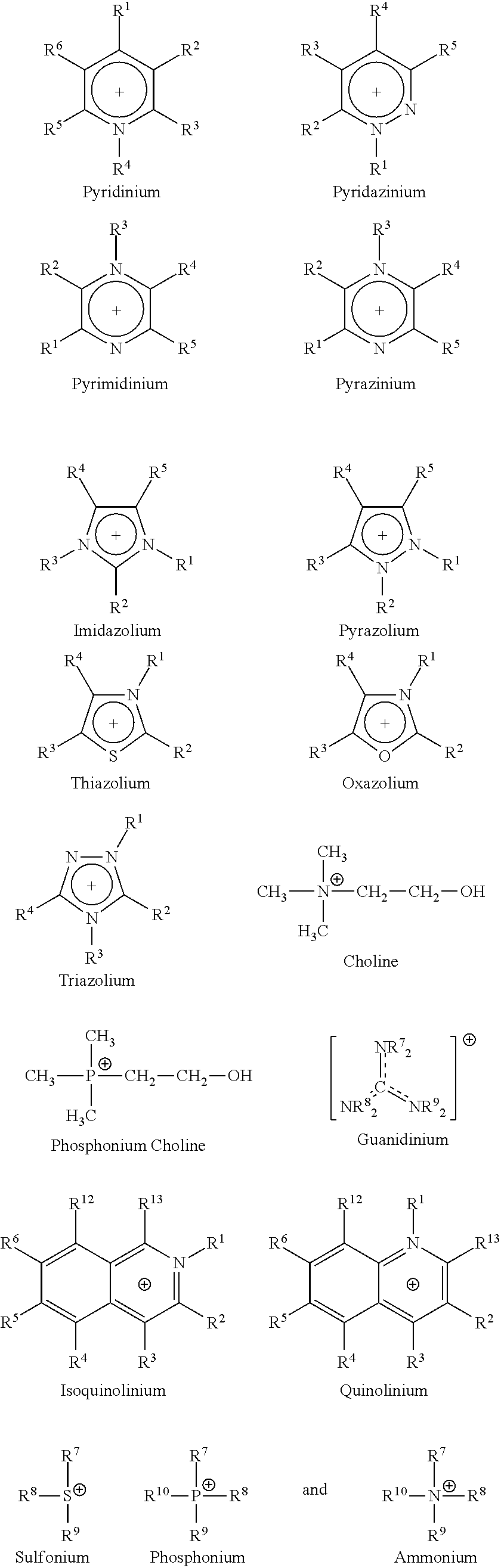
- Ionic compounds suitable for use herein include an anion and a cation, and the cation, in various alternative embodiments, may be selected from the group consisting of cations represented by the structures of the following formulae:
- an ionic compound includes a cation selected from one or more members of the group consisting of pyridinium, pyridazinium, pyrimidinium, pyrazinium, imidazolium, pyrazolium, thiazolium, oxazolium, triazolium, phosphonium, ammonium, benzyltrimethylammonium, choline, dimethylimidazolium, guanidinium, phosphonium choline, tetramethylammonium, and tetramethylphosphonium.
- ionic compounds suitable for use herein include those having fluorinated cations wherein at least one member selected from R 1 , R 2 , R 3 , R 4 , R 5 , R 6 , R 7 , R 8 , R 9 and R 10 , as described above, comprises F ⁇ .
- an ionic compound as used herein includes an anion selected from one or more members of the group consisting of: [CH 3 CO 2 ] ⁇ , [HSO 4 ] ⁇ , [CH 3 OSO 3 ] ⁇ , [C 2 H 5 OSO 3 ] ⁇ , [AlCl 4 ] ⁇ , [CO 3 ] 2 ⁇ , [HCO 3 ] ⁇ , [NO 2 ] ⁇ , [NO 3 ] ⁇ , [SO 4 ] 2 ⁇ , [PO 3 ] 3 ⁇ , [HPO 3 ] 2 ⁇ , [H 2 PO 3 ] 1 ⁇ , [PO 4 ] 3 ⁇ , [HPO 4 ] 2 ⁇ , [H 2 PO 4 ] ⁇ , [HSO 3 ] ⁇ , [CuCl 2 ] ⁇ , Cl ⁇ , Br ⁇ , I ⁇ , SCN ⁇ ; carborates optionally substituted with alkyl or substituted alkyl or substituted al
- an ionic compound as used herein includes an anion selected from one or more members of the group consisting of aminoacetate, ascorbate, benzoate, catecholate, citrate, dimethylphosphate, formate, fumarate, gallate, glycolate, glyoxylate, iminodiacetate, isobutyrate, kojate, lactate, levulinate, oxalate, pivalate, propionate, pyruvate, salicylate, succinamate, succinate, tiglate, tetrafluoroborate, tetrafluoroethanesulfonate, tropolonate, [CH 3 CO 2 ] ⁇ , [HSO 4 ] ⁇ , [CH 3 OSO 3 ] ⁇ , [C 2 H 5 OSO 3 ] ] , [AlCl 4 ] ⁇ , [CO 3 ] 2 ⁇ , [HCO 3 ] ⁇ , [NO 2 ] ⁇ , [NO 3 ] , [NO
- R 11 is selected from the group consisting of:
- ionic compounds suitable for use herein comprise a cation selected from the group consisting of pyridinium, pyridazinium, pyrimidinium, pyrazinium, imidazolium, pyrazolium, thiazolium, oxazolium, triazolium, phosphonium, and ammonium ions, as described above; and an anion selected from the group consisting of [CH 3 CO 2 ] ⁇ , [HSO 4 ] ⁇ , [CH 3 OSO 3 ] ⁇ , [C 2 H 5 OSO 3 ] ] , [AlCl 4 ] ⁇ , [CO 3 ] ⁇ , [HCO 3 ] ⁇ , [NO 2 ] ⁇ , [NO 3 ] ⁇ , [SO 4 ] 2 ⁇ , [PO 4 ] 3 ⁇ , [HPO 4 ] 2 ⁇ , [H 2 PO 4 ] ⁇ , [HSO 3 ] ⁇ ,
- ionic compounds suitable for use herein comprise a cation selected from the group consisting of pyridinium, pyridazinium, pyrimidinium, pyrazinium, imidazolium, pyrazolium, thiazolium, oxazolium, triazolium, phosphonium, and ammonium ions, as described above; and an anion selected from the group consisting of [BF 4 ] ⁇ , [PF 6 ] ⁇ , [SbF 6 ] ⁇ , [CF 3 SO 3 ] ⁇ , [HCF 2 CF 2 SO 3 ] ⁇ , [CF 3 HFCCF 2 SO 3 ] ⁇ , [HCClFCF 2 SO 3 ] ⁇ , [(CF 3 SO 2 ) 2 N] ⁇ , [(CF 3 CF 2 SO 2 ) 2 N] ⁇ , [(CF 3 SO 2 ) 3 C] ⁇ , [CF 3 CO 2 ] ⁇ , [CF 3 CO 2
- ionic compounds suitable for use herein have a cation selected from the group consisting of pyridinium, pyridazinium, pyrimidinium, pyrazinium, imidazolium, pyrazolium, thiazolium, oxazolium, triazolium, phosphonium, and ammonium ions, as described above, wherein at least one member selected from R 1 , R 2 , R 3 , R 4 , R 5 , R 6 , R 7 , R 8 , R 9 , and R 10 comprises F ⁇ ; and an anion selected from the group consisting of [CH 3 CO 2 ] ⁇ , [HSO 4 ] ⁇ , [CH 3 OSO 3 ] ⁇ , [C 2 H 5 OSO 3 ] ] , [AlCl 4 ] ⁇ , [CO 3 ] 2 ⁇ , [HCO 3 ] ⁇ , [NO 2 ] ⁇ , [NO 3 ]
- ionic compounds suitable for use herein have a cation selected from the group consisting of pyridinium, pyridazinium, pyrimidinium, pyrazinium, imidazolium, pyrazolium, thiazolium, oxazolium, triazolium, phosphonium, and ammonium ions, as described above, wherein at least one member selected from R 1 , R 2 , R 3 , R 4 , R 5 , R 6 , R 7 , R 8 , R 9 , and R 10 comprises F ⁇ ; and an anion selected from the group consisting of [BF 4 ] ⁇ , [PF 6 ] ⁇ , [SbF 6 ] ⁇ , [CF 3 SO 3 ] ⁇ , [HCF 2 CF 2 SO 3 ] ⁇ , [CF 3 HFCCF 2 SO 3 ] ⁇ , [HCClFCF 2 SO 3 ] ⁇ , [(CF 3 SO 2 ] , [
- ionic compounds suitable for use in this invention include those comprising:
- cations suitable as part of an ionic compound as used herein include 1,2-dimethylpyridinium, 1-methyl-2-ethylpyridinium, 1-methyl-2-ethyl-6-methylpyridinium, N-methylpyridinium, 1-butyl-2-methylpyridinium, 1-butyl-2-ethylpyridinium, 1-butyl-2-ethyl-6-methylpyridinium, N-butylpyridinium, 1-butyl-4-methylpyridinium, 1,3-dimethylimidazolium, 1,2,3-trimethylimidazolium, 1-n-butyl-3-methylimidazolium, 1,3,4,5-tetramethylimidazolium, 1,3,4-trimethylimidazolium, 2,3-dimethylimidazolium, 1-butyl-2,3-dimethylimidazolium, 3,4-dimethylimidazolium, 2-ethyl-3,4-dimethylimidazolium
- ionic compounds suitable for use herein also include those selected from the group consisting of:
- ionic compounds suitable for use herein also include those selected from the group consisting of:
- an ionic compound as used herein is 1-butyl-3-methylimidazolium chloride.
- the inventions hereof provide an ionic foam, or a foam that includes, and/or can be prepared from an ionic compound (such as a non-polymeric ionic compound), which compound is preferably a solid at a temperature above about 20° C.
- a foam hereof consists essentially of an ionic compound.
- a foam hereof is non-polymeric, includes a non-polymeric composition or compound, and/or is formed from a non-polymeric composition or compound.
- a non-polymeric foam is a foam that does not contain, excludes and has not been prepared to any extent from an oligomer, a polymer (such as a polyurethane or polystyrene) or a polymeric composition.
- An ionic, non-polymeric composition is a composition that contains an ionic compound and other components, but does not contain, excludes and is not prepared to any extent from a polymer (such as a polyurethane or polystyrene) or an oligomer, and in which neither the composition nor the ionic compound have to any extent been polymerized.
- a non-polymeric compound is a compound that does not contain, excludes and is not prepared to any extent from a polymer (such as a polyurethane or polystyrene) or an oligomer, and that has not to any extent been polymerized.
- a foam hereof consists essentially of a non-polymeric composition or an ionic compound, it does not contain, excludes and is not prepared to any extent from a polymer (such as a polyurethane or polystyrene) or an oligomer, and in which neither the composition nor the ionic compound have to any extent been polymerized.
- An ionic compound suitable for use herein preferably is a solid up to at least about 25° C., or is a solid up to at least about 30° C., or is a solid up to at least about 35° C., or is a solid up to at least about 40° C., or is a solid up to at least about 45° C., or is a solid up to at least about 50° C., or is a solid up to at least about 55° C.
- An ionic compound suitable for use herein preferably has in addition, however, a melting temperature that is about 150° C. or less, or a melting temperature that is about 125° C. or less, or a melting temperature that is about 110° C. or less, or a melting temperature that is about 100° C. or less, or a melting temperature that is about 95° C. or less, or a melting temperature that is about 90° C. or less.
- a foam hereof is an ionic foam. In another alternative embodiment hereof, a foam hereof is electrically conductive. In another alternative embodiment hereof, a foam hereof is flexible or rigid. In another alternative embodiment hereof, a foam hereof is a solid state foam. In another alternative embodiment hereof, a foam hereof is open-cell or closed cell. In another alternative embodiment hereof, a foam hereof is microcellular or nanocellular.
- a foam as provided herein is prepared from at least one non-polymeric composition or ionic compound that is in a solid state.
- the solid composition or compound is exposed under pressure to a blowing agent for a time sufficient to liquefy the composition or compound, thereby forming a metastable liquid comprising the liquefied composition or compound, and the blowing agent.
- the composition or compound absorbs the blowing agent, which lowers its melting temperature, resulting in the formation of the metastable liquid.
- the non-polymeric composition or ionic compound may be exposed to the blowing agent at an elevated pressure to accelerate its liquefaction.
- composition or compound can be exposed to the blowing agent at a pressure that is at least about 1 atm, or is at least about 1.25 atm, or is at least about 1.5 atm, or is at least about 2 atm, or is at least about 3 atm, or is at least about 5 atm, and yet is about 10 atm or less, or is about 7.5 atm or less, or is about 5 atm or less, or is about 3 atm or less, or is about 2 atm or less, or is about 1.5 atm or less.
- Blowing agents suitable for use herein to prepare a foam include blowing agents that are in the gaseous state at atmospheric pressure and room temperature, many of which are known in the art.
- blowing agents include without limitation carbon dioxide, ammonia, fluorocarbons such as tetrafluoromethane (Freon 14), fluoroform (Freon 23), and hexafluoroethane (Freon 116); hydrofluorocarbons such as difluoromethane (HFC-32), 1,1-difluoroethane, 1,1,2,2-tetrafluoroethane (HFC-134), 1,1,1,2-tetrafluoroethane (HFC-134a), 1,1,1-trifluoroethane (HFC-143a), 1,1-difluoroethane (HFC-152a), fluoroethane (HFC-161), pentafluoroethane (HFC-125), 1,1,1,3,3-pentafluoropropan
- the blowing agent is selected from the group consisting of ammonia, difluoromethane, 1,1,1,2-tetrafluoroethane, carbon dioxide, and 2,3,3,3-tetrafluoroprop-1-ene.
- the ionic compound absorbs at least about 25 mole percent of the blowing agent relative to the moles of the ionic compound.
- additives may be incorporated into the foamed ionic compound by adding them to the metastable liquid.
- Suitable additives include, but are not limited to, surfactants, colorants, flame retardants, antimicrobials, plasticizers, antioxidants, and the like.
- the pressure is reduced to release the blowing agent from the metastable liquid, thereby forming a foam from the non-polymeric composition or the ionic compound.
- the blowing agent may be released from the metastable liquid in a variety of ways including, for example, by vigorously agitating the liquid. Alternatively, the blowing agent may be released from the metastable liquid by ejecting the metastable liquid from an elevated pressure to atmospheric pressure. The rate of release of the blowing agent can be used to control the porosity of the foam thereby formed.
- a foam may be prepared from at least one non-polymeric composition ionic compound that is in a liquid state.
- the composition or compound is heated to a temperature sufficient to melt the composition or compound, thereby forming a liquid therefrom.
- a blowing agent is then added to the liquid, thereby forming a liquid composition that includes the non-polymeric composition or ionic compound and the blowing agent.
- the blowing agent may be added by bubbling it through the liquid composition or compound for a time sufficient to saturate the composition or compound with the blowing agent.
- the blowing agent may be added at atmospheric pressure or at an elevated pressure, as set forth above.
- composition or compound absorbs at least about 25 mole percent of the blowing agent relative to the moles of composition or compound. In another alternative embodiment, the composition or compound expands in volume by at least about 10% relative to its initial volume upon absorption of the blowing agent.
- the liquid composition is then cooled to a temperature below the melting temperature of the ionic compound, or to room temperature, e.g. about 20 ⁇ 25° C., thereby forming a metastable liquid that contains the non-polymeric composition or ionic compound and the blowing agent. Then, the blowing agent is removed from the metastable liquid, thereby forming a foam from the composition or compound.
- the blowing agent may be removed or driven from the metastable liquid in the same manner as described above, such as by reduction or pressure or agitation.
- additives as described above, may be incorporated into the foam by adding them to the non-polymeric composition or ionic compound, the liquid composition of the composition or compound, and/or the metastable liquid.
- foamed non-polymeric compositions or ionic compounds hereof the foams prepared from non-polymeric compositions or ionic compounds as herein, and the ionic foams prepared by the methods hereof, have many potential applications.
- these foams are useful as catalysts for chemical transformations.
- a suitable catalyst may be introduced into the metastable liquid or the composition or compound before the formation of the foam.
- the foams may also be used for gas storage applications due to their ability to absorb quantities of gases such as carbon dioxide.
- the foam may be incorporated into a gas storage device.
- the foams hereof are conductive and may be used in the manufacture of biosensors and electrodes for sensing applications.
- a foam hereof is incorporated into the biosensor or electrode.
- foams hereof are useful in electrochemical cells, including fuel cells and batteries.
- a foam hereof is used as an electrode, electrode component, and/or electrochemical cell separator.
- the foams hereof may also be used as immobilization supports for the immobilization of biological materials, for example, enzymes, antibodies, nucleic acids, and microbial cells.
- biological material for example, enzymes, antibodies, nucleic acids, and microbial cells.
- the biological material may be adsorbed onto or chemically attached to the foam.
- the immobilization support may be used, for example, for biocatalysis.
- the foams hereof may also be used as a separation membrane to separate ionic from non-ionic materials.
- foams hereof may be used in electronic applications, for example, as an anti-static material for protecting sensitive electronics during shipping, handling and/or storage.
- range includes the endpoints thereof and all the individual integers and fractions within the range, and also includes each of the narrower ranges therein formed by all the various possible combinations of those endpoints and internal integers and fractions to form subgroups of the larger group of values within the stated range to the same extent as if each of those narrower ranges was explicitly recited.
- range of numerical values is stated herein as being greater than a stated value, the range is nevertheless finite and is bounded on its upper end by a value that is operable within the context of the invention as described herein.
- range of numerical values is stated herein as being less than a stated value, the range is nevertheless bounded on its lower end by a non-zero value.
Landscapes
- Chemical & Material Sciences (AREA)
- Organic Chemistry (AREA)
- Organic Low-Molecular-Weight Compounds And Preparation Thereof (AREA)
- Secondary Cells (AREA)
- Electric Double-Layer Capacitors Or The Like (AREA)
Abstract
Description

wherein:
-
- (a) R1, R2, R3, R4, R5, R6, R12 and R13 are independently selected from the group consisting of:
- (i) H,
- (ii) halogen,
- (iii) —CH3, —C2H5, or C3 to C25 straight-chain, branched or cyclic alkane or alkene, optionally substituted with at least one member selected from the group consisting of Cl, Br, F, I, OH, NH2 and SH;
- (iv) —CH3, —C2H5, or C3 to C25 straight-chain, branched or cyclic alkane or alkene comprising one to three heteroatoms selected from the group consisting of O, N, Si and S, and optionally substituted with at least one member selected from the group consisting of Cl, Br, F, I, OH, NH2 and SH;
- (v) C6 to C20 unsubstituted aryl, or C3 to C25 unsubstituted heteroaryl having one to three heteroatoms independently selected from the group consisting of O, N, Si and S;
- (vi) C6 to C25 substituted aryl, or C3 to C25 substituted heteroaryl having one to three heteroatoms independently selected from the group consisting of O, N, Si and S; and wherein said substituted aryl or substituted heteroaryl has one to three substituents independently selected from the group consisting of:
- (A) —CH3, —C2H5, or C3 to C25 straight-chain, branched or cyclic alkane or alkene, optionally substituted with at least one member selected from the group consisting of Cl, Br, F, I, OH, NH2 and SH,
- (B) OH,
- (C) NH2, and
- (D) SH; and
- (vii) —(CH2)n, Si(CH2)mCH3, —(CH2)nSi(CH3)3, —(CH2)nOSi(CH3)m, where n is independently 1-4 and m is independently 0-4;
- b) R7, R8, R9, and R10 are independently selected from the group consisting of:
- (i) —CH3, —C2H5, or C3 to C25 straight-chain, branched or cyclic alkane or alkene, optionally substituted with at least one member selected from the group consisting of Cl, Br, F, I, OH, NH2 and SH;
- (ii) —CH3, —C2H5, or C3 to C25 straight-chain, branched or cyclic alkane or alkene comprising one to three heteroatoms selected from the group consisting of O, N, Si and S, and optionally substituted with at least one member selected from the group consisting of Cl, Br, F, I, OH, NH2 and SH;
- (iii) C6 to C25 unsubstituted aryl, or C3 to C25 unsubstituted heteroaryl having one to three heteroatoms independently selected from the group consisting of O, N, Si and S; and
- (iv) C6 to C25 substituted aryl, or C3 to C25 substituted heteroaryl having one to three heteroatoms independently selected from the group consisting of O, N, Si and S; and wherein said substituted aryl or substituted heteroaryl has one to three substituents independently selected from the group consisting of:
- (A) —CH3, —C2H5, or C3 to C25 straight-chain, branched or cyclic alkane or alkene, optionally substituted with at least one member selected from the group consisting of Cl, Br, F, I, OH, NH2 and SH,
- (B) OH,
- (C) NH2, and
- (D) SH; and
- (v) —(CH2)nSi(CH2)mCH3, —(CH2)nSi (CH3)3, —(CH2)nOSi(CH3)m, where n is independently 1-4 and m is independently 0-4; and
- c) optionally, at least two of R1, R2, R3, R4, R5, R6, R7, R8, R9, and R10 can together form a cyclic or bicyclic alkanyl or alkenyl group.
- (a) R1, R2, R3, R4, R5, R6, R12 and R13 are independently selected from the group consisting of:

wherein R11 is selected from the group consisting of:
-
- (a) —CH3, —C2H5, or C3 to C10 straight-chain, branched or cyclic alkane or alkene, optionally substituted with at least one member selected from the group consisting of Cl, Br, F, I, OH, NH2 and SH;
- (b) —CH3, —C2H5, or C3 to C10 straight-chain, branched or cyclic alkane or alkene comprising one to three heteroatoms selected from the group consisting of O, N, Si and S, and optionally substituted with at least one member selected from the group consisting of Cl, Br, F, I, OH, NH2 and SH;
- (c) C6 to C10 unsubstituted aryl, or C3 to C10 unsubstituted heteroaryl having one to three heteroatoms independently selected from the group consisting of O, N, Si and S; and
- (d) C6 to C10 substituted aryl, or C3 to C10 substituted heteroaryl having one to three heteroatoms independently selected from the group consisting of O, N, Si and S; and wherein said substituted aryl or substituted heteroaryl has one to three substituents independently selected from the group consisting of:
- (i) —CH3, —C2H5, or C3 to C10 straight-chain, branched or cyclic alkane or alkene, optionally substituted with at least one member selected from the group consisting of Cl, Br, F, I, OH, NH2 and SH,
- (ii) OH,
- (iii) NH2, and
- (iv) SH.
Claims (19)


Priority Applications (1)
| Application Number | Priority Date | Filing Date | Title |
|---|---|---|---|
| US12/974,006 US8946442B2 (en) | 2009-12-21 | 2010-12-21 | Foamed ionic compounds |
Applications Claiming Priority (3)
| Application Number | Priority Date | Filing Date | Title |
|---|---|---|---|
| US28851009P | 2009-12-21 | 2009-12-21 | |
| US28850609P | 2009-12-21 | 2009-12-21 | |
| US12/974,006 US8946442B2 (en) | 2009-12-21 | 2010-12-21 | Foamed ionic compounds |
Publications (2)
| Publication Number | Publication Date |
|---|---|
| US20110319633A1 US20110319633A1 (en) | 2011-12-29 |
| US8946442B2 true US8946442B2 (en) | 2015-02-03 |
Family
ID=45353135
Family Applications (1)
| Application Number | Title | Priority Date | Filing Date |
|---|---|---|---|
| US12/974,006 Expired - Fee Related US8946442B2 (en) | 2009-12-21 | 2010-12-21 | Foamed ionic compounds |
Country Status (1)
| Country | Link |
|---|---|
| US (1) | US8946442B2 (en) |
Cited By (1)
| Publication number | Priority date | Publication date | Assignee | Title |
|---|---|---|---|---|
| US20140014885A1 (en) * | 2011-03-24 | 2014-01-16 | Merck Patent Gmbh | Organic ionic functional materials |
Families Citing this family (1)
| Publication number | Priority date | Publication date | Assignee | Title |
|---|---|---|---|---|
| WO2014144523A2 (en) * | 2013-03-15 | 2014-09-18 | Materials Modification Inc. | Functionalized ionic liquids and their applacations |
Citations (5)
| Publication number | Priority date | Publication date | Assignee | Title |
|---|---|---|---|---|
| US20040133058A1 (en) | 2001-03-20 | 2004-07-08 | Wolfgang Arlt | Ionic liquids as selective additives for separation of close-boiling or azeotropic mixtures |
| US20080028777A1 (en) | 2004-05-21 | 2008-02-07 | Basf Aktiengesellschaft | Novel Pairs Of Working Substances For Absorption Heat Pumps, Absorption Refrigeration Machines And Heat Transformers |
| US20080073622A1 (en) | 2006-09-22 | 2008-03-27 | Inolex Investment Corporation | Conductive polyurethane foam and methods for making same |
| EP1920824A1 (en) | 2006-10-17 | 2008-05-14 | The Queen's University of Belfast | Ionic liquids and uses thereof |
| US20080319164A1 (en) | 2007-06-20 | 2008-12-25 | Susana Filipe Barreiros | Synthesis and application of a family of new materials resulting from the chemical cross-linking between gelatine and organic salts |
-
2010
- 2010-12-21 US US12/974,006 patent/US8946442B2/en not_active Expired - Fee Related
Patent Citations (5)
| Publication number | Priority date | Publication date | Assignee | Title |
|---|---|---|---|---|
| US20040133058A1 (en) | 2001-03-20 | 2004-07-08 | Wolfgang Arlt | Ionic liquids as selective additives for separation of close-boiling or azeotropic mixtures |
| US20080028777A1 (en) | 2004-05-21 | 2008-02-07 | Basf Aktiengesellschaft | Novel Pairs Of Working Substances For Absorption Heat Pumps, Absorption Refrigeration Machines And Heat Transformers |
| US20080073622A1 (en) | 2006-09-22 | 2008-03-27 | Inolex Investment Corporation | Conductive polyurethane foam and methods for making same |
| EP1920824A1 (en) | 2006-10-17 | 2008-05-14 | The Queen's University of Belfast | Ionic liquids and uses thereof |
| US20080319164A1 (en) | 2007-06-20 | 2008-12-25 | Susana Filipe Barreiros | Synthesis and application of a family of new materials resulting from the chemical cross-linking between gelatine and organic salts |
Non-Patent Citations (10)
Cited By (2)
| Publication number | Priority date | Publication date | Assignee | Title |
|---|---|---|---|---|
| US20140014885A1 (en) * | 2011-03-24 | 2014-01-16 | Merck Patent Gmbh | Organic ionic functional materials |
| US9923152B2 (en) * | 2011-03-24 | 2018-03-20 | Merck Patent Gmbh | Organic ionic functional materials |
Also Published As
| Publication number | Publication date |
|---|---|
| US20110319633A1 (en) | 2011-12-29 |
Similar Documents
| Publication | Publication Date | Title |
|---|---|---|
| Mallakpour et al. | Ionic liquids as green solvents: progress and prospects | |
| US10913881B2 (en) | Method of stabilization of a haloolefin-based composition | |
| US9725318B2 (en) | Method for preparing imide salts containing a fluorosulphonyl group | |
| Mirzaei et al. | Syntheses of 1-alkyl-1, 2, 4-triazoles and the formation of quaternary 1-alkyl-4-polyfluoroalkyl-1, 2, 4-triazolium salts leading to ionic liquids | |
| Greaves et al. | Protic ionic liquids: evolving structure–property relationships and expanding applications | |
| EP3130649B1 (en) | Haloolefin-based composition | |
| Olivier-Bourbigou et al. | Ionic liquids: perspectives for organic and catalytic reactions | |
| Wu et al. | Vapor pressure of aqueous choline chloride-based deep eutectic solvents (ethaline, glyceline, maline and reline) at 30–70 C | |
| Liu et al. | Vapor–liquid equilibrium of three hydrofluorocarbons with [HMIM][Tf2N] | |
| Wang et al. | Chloride ion-catalyzed generation of difluorocarbene for efficient preparation of gem-difluorinated cyclopropenes and cyclopropanes | |
| Aissaoui et al. | Computational investigation of the microstructural characteristics and physical properties of glycerol-based deep eutectic solvents | |
| Mejía et al. | On the high-pressure solubilities of carbon dioxide in several ionic liquids | |
| Canongia Lopes et al. | Protonic ammonium nitrate ionic liquids and their mixtures: Insights into their thermophysical behavior | |
| US9845380B2 (en) | Ionic polyimide materials and methods of use | |
| US10774021B2 (en) | Process for preparation of hydrofluoroalkenes by selective catalytic consecutive hydrodefluorination | |
| US11949071B2 (en) | Ionic liquids for solvating cyclic carbonates | |
| Fillion et al. | The viscosity and density of ionic liquid+ tetraglyme mixtures and the effect of tetraglyme on CO2 Solubility | |
| CN103384641A (en) | Process for producing fluorine-containing sulfonylimide salt | |
| EP2504468A2 (en) | New ionic liquids | |
| Frizzo et al. | Anion effect on the aggregation behavior of the long-chain spacers dicationic imidazolium-based ionic liquids | |
| Bagh et al. | Solubility of sodium chloride in phosphonium-based deep eutectic solvents | |
| US20110319633A1 (en) | Foamed ionic compounds | |
| Klein et al. | Oligoether carboxylates: task-specific room-temperature ionic liquids | |
| Baker et al. | Synthesis and characterization of anilinium ionic liquids: Exploring effect of π-π ring stacking | |
| Cai et al. | Systematic study on the general preparation of ionic liquids with high purity via hydroxide intermediates |
Legal Events
| Date | Code | Title | Description |
|---|---|---|---|
| AS | Assignment |
Owner name: E. I. DU PONT DE NEMOURS AND COMPANY, DELAWARE Free format text: ASSIGNMENT OF ASSIGNORS INTEREST;ASSIGNOR:SHIFLETT, MARK BRANDON;REEL/FRAME:033846/0501 Effective date: 20140929 |
|
| STCF | Information on status: patent grant |
Free format text: PATENTED CASE |
|
| MAFP | Maintenance fee payment |
Free format text: PAYMENT OF MAINTENANCE FEE, 4TH YEAR, LARGE ENTITY (ORIGINAL EVENT CODE: M1551) Year of fee payment: 4 |
|
| AS | Assignment |
Owner name: DUPONT POLYMERS, INC., DELAWARE Free format text: ASSIGNMENT OF ASSIGNORS INTEREST;ASSIGNOR:E. I. DU PONT DE NEMOURS AND COMPANY;REEL/FRAME:049587/0098 Effective date: 20190617 |
|
| FEPP | Fee payment procedure |
Free format text: MAINTENANCE FEE REMINDER MAILED (ORIGINAL EVENT CODE: REM.); ENTITY STATUS OF PATENT OWNER: LARGE ENTITY |
|
| LAPS | Lapse for failure to pay maintenance fees |
Free format text: PATENT EXPIRED FOR FAILURE TO PAY MAINTENANCE FEES (ORIGINAL EVENT CODE: EXP.); ENTITY STATUS OF PATENT OWNER: LARGE ENTITY |
|
| STCH | Information on status: patent discontinuation |
Free format text: PATENT EXPIRED DUE TO NONPAYMENT OF MAINTENANCE FEES UNDER 37 CFR 1.362 |
|
| FP | Lapsed due to failure to pay maintenance fee |
Effective date: 20230203 |