US8941846B2 - Copy machine and non-transitory computer readable recording medium stored with control program for copy machine - Google Patents
Copy machine and non-transitory computer readable recording medium stored with control program for copy machine Download PDFInfo
- Publication number
- US8941846B2 US8941846B2 US13/495,622 US201213495622A US8941846B2 US 8941846 B2 US8941846 B2 US 8941846B2 US 201213495622 A US201213495622 A US 201213495622A US 8941846 B2 US8941846 B2 US 8941846B2
- Authority
- US
- United States
- Prior art keywords
- reading
- time required
- document
- image forming
- unit
- Prior art date
- Legal status (The legal status is an assumption and is not a legal conclusion. Google has not performed a legal analysis and makes no representation as to the accuracy of the status listed.)
- Active, expires
Links
- 238000000034 method Methods 0.000 claims abstract description 429
- 238000011946 reduction process Methods 0.000 claims description 25
- 238000012545 processing Methods 0.000 description 15
- 238000010586 diagram Methods 0.000 description 12
- 238000012805 post-processing Methods 0.000 description 6
- 238000005516 engineering process Methods 0.000 description 4
- 230000015654 memory Effects 0.000 description 3
- 238000007639 printing Methods 0.000 description 3
- 238000004364 calculation method Methods 0.000 description 2
- 238000004891 communication Methods 0.000 description 2
- 230000006870 function Effects 0.000 description 2
- 238000003384 imaging method Methods 0.000 description 2
- 230000003287 optical effect Effects 0.000 description 2
- 238000006243 chemical reaction Methods 0.000 description 1
- 239000000835 fiber Substances 0.000 description 1
- 230000005693 optoelectronics Effects 0.000 description 1
- 230000002093 peripheral effect Effects 0.000 description 1
- 238000004080 punching Methods 0.000 description 1
Images




Classifications
-
- G—PHYSICS
- G03—PHOTOGRAPHY; CINEMATOGRAPHY; ANALOGOUS TECHNIQUES USING WAVES OTHER THAN OPTICAL WAVES; ELECTROGRAPHY; HOLOGRAPHY
- G03G—ELECTROGRAPHY; ELECTROPHOTOGRAPHY; MAGNETOGRAPHY
- G03G15/00—Apparatus for electrographic processes using a charge pattern
- G03G15/60—Apparatus which relate to the handling of originals
-
- H—ELECTRICITY
- H04—ELECTRIC COMMUNICATION TECHNIQUE
- H04N—PICTORIAL COMMUNICATION, e.g. TELEVISION
- H04N1/00—Scanning, transmission or reproduction of documents or the like, e.g. facsimile transmission; Details thereof
- H04N1/23—Reproducing arrangements
- H04N1/2307—Circuits or arrangements for the control thereof, e.g. using a programmed control device, according to a measured quantity
- H04N1/2323—Circuits or arrangements for the control thereof, e.g. using a programmed control device, according to a measured quantity according to characteristics of the reproducing medium, e.g. type, size or availability
-
- H—ELECTRICITY
- H04—ELECTRIC COMMUNICATION TECHNIQUE
- H04N—PICTORIAL COMMUNICATION, e.g. TELEVISION
- H04N1/00—Scanning, transmission or reproduction of documents or the like, e.g. facsimile transmission; Details thereof
- H04N1/23—Reproducing arrangements
- H04N1/2307—Circuits or arrangements for the control thereof, e.g. using a programmed control device, according to a measured quantity
- H04N1/2369—Selecting a particular reproducing mode from amongst a plurality of modes, e.g. paper saving or normal, or simplex or duplex
-
- H—ELECTRICITY
- H04—ELECTRIC COMMUNICATION TECHNIQUE
- H04N—PICTORIAL COMMUNICATION, e.g. TELEVISION
- H04N1/00—Scanning, transmission or reproduction of documents or the like, e.g. facsimile transmission; Details thereof
- H04N1/23—Reproducing arrangements
- H04N1/2307—Circuits or arrangements for the control thereof, e.g. using a programmed control device, according to a measured quantity
- H04N1/2384—Circuits or arrangements for the control thereof, e.g. using a programmed control device, according to a measured quantity for fitting data onto a particular reproducing medium without modifying the image data
-
- G—PHYSICS
- G03—PHOTOGRAPHY; CINEMATOGRAPHY; ANALOGOUS TECHNIQUES USING WAVES OTHER THAN OPTICAL WAVES; ELECTROGRAPHY; HOLOGRAPHY
- G03G—ELECTROGRAPHY; ELECTROPHOTOGRAPHY; MAGNETOGRAPHY
- G03G2215/00—Apparatus for electrophotographic processes
- G03G2215/00172—Apparatus for electrophotographic processes relative to the original handling
- G03G2215/00177—Apparatus for electrophotographic processes relative to the original handling for scanning
Definitions
- the present invention relates to a copy machine that reads an image of a document and makes a copy of the document, and a non-transitory computer readable recording medium that is stored with a control program for the copy machine.
- Multi-Function Peripheral: MFP Multi-Function Peripheral: MFP
- An MFP is provided with an automatic document transport device (Auto Document Feeder: ADF) that feeds a document to an image reading unit for reading an image of the document, and can read a plurality of documents in a row.
- ADF Automatic Document Feeder
- the document When copying processes of a document are performed by an MFP having an ADF, normally, the document is set in the ADF such that the short-side direction of the document matches the transport direction of the document, and the document is fed from the ADF to an image reading unit by LEF (Long Edge Feed).
- LEF Long Edge Feed
- An image of the document fed by LEF is read by a line sensor that is provided to extend in a direction orthogonal to the transport direction of the document, where the long-side direction of the document is in line with the reading main scan direction and the short-side direction of the document is in line with the reading sub-scan direction.
- an image which is based on image data acquired by the line sensor by reading the image of the document, is formed on a sheet of paper that is fed from a paper feed tray to an image forming unit by LEF.
- the image forming unit has an optical unit that is formed with a laser oscillator, a polygon mirror and so on, and forms an image on the sheet of paper fed by LEF, such that the long-side direction of the sheet is in line with the writing main scan direction and the short-side direction is in line with the writing sub-scan direction.
- the time required for the reading process of the document becomes short compared to a case where a document is fed from an ADF by SEF (Short Edge Feed) and an image of the document is read such that the long-side direction of the document is in line with the reading sub-scan direction.
- the time required for the image forming process on paper becomes short compared to a case where paper is fed from a paper feed tray to an image forming unit by SEF and an image is formed such that the long-side direction of paper is in line with the writing sub-scan direction.
- the orientation of image data acquired by reading a document and the orientation of paper match, it is not necessary to rotate the orientation of image data through 90 degrees, and the time required for copying processes can be minimized.
- ADFs that can set a document only in the orientation of SEF and that can feed a document to an image reading unit only by SEF. Also, even if an ADF is able to set a document in either direction of LEF/SEF, depending on the users, cases might occur where a document is set in the direction of SEF and the document is fed to an image reading unit by SEF.
- feeding paper by SEF may make it unnecessary to rotate image data and consequently make the time required for copying processes short, or feeding paper by LEF may make the time required for the image forming process short and consequently make the time required for copying processes short. Consequently, in the event a document is fed by SEF and an image of the document is read such that the long-side direction of the document is in line with the reading sub-scan direction, it is preferable to appropriately switch the feeding direction of paper on which an image is going to be formed and shorten the time required for copying processes.
- Unexamined Japanese Patent Publication No. H09-018690 discloses a technology for, in copying processes of a document, feeding paper in an orientation that matches the orientation of a document from a paper feed tray, and forming an image.
- this technology it is not necessary to rotate image data, when a document is fed by SEF, the time required for copying processes does not always become short.
- Unexamined Japanese Patent Publication No. 2001-322326 discloses a technology for, in a printing process of forming an image based on print data on paper, selecting the paper feeding direction to give the shorter printing time, by considering the difference in the time required for an image forming process on paper that is fed by LEF/SEF, and the time required for the process of rotating image data.
- this technology is specific to a printing process and does not take into account reading of an image of a document by an image reading unit.
- the present invention is made in view of the above problems. It is therefore an object of the present invention to provide a copy machine and a non-transitory computer readable recording medium that is stored with a control program for the copy machine that can reduce the time required for copying processes, in copying processes of reading an image of a document such that the long-side direction of the document is in line with the reading sub-scan direction and the short-side direction is in line with the reading main scan direction and making a copy of the document.
- a copy machine reflecting one aspect of the present invention includes: a reading unit that reads an image of a document such that a long-side direction of the document is in line with a reading sub-scan direction and a short-side direction is in line with a reading main scan direction; a rotation unit that rotates image data acquired by reading the image of the document by the reading unit; an image forming unit that forms the image on paper based on image data acquired by reading the image of the document by the reading unit or based on the image data rotated by the rotation unit, such that a transport direction of the paper is in line with a writing sub-scan direction and a direction orthogonal to the writing sub-scan direction is in line with a writing main scan direction; a selection unit that selects either of a first direction in which a long-side direction of the paper matches the writing sub-scan direction and a second direction in which a short-side direction of the paper matches the writing sub-scan direction, that makes the time required
- the above copy machine preferably further has a reduction unit that reduces the image data; the selection unit preferably selects either of the first and second directions with further considering the time required for a reduction process of the image data and, when the reduction process is performed, after the reading process for one document is complete, the control unit preferably performs control to make the reduction unit perform the reduction process with respect to the document.
- the above copy machine preferably further has an enlargement unit that enlarges the image data; the selection unit preferably selects either of the first and second directions with further considering the time required for an enlargement process of the image data; and, when the enlargement process is performed, the control unit preferably performs control to make the reading unit read part of the image of the document, and, after the reading process of the part of the image is complete, make the enlargement unit perform the enlargement process.
- the reading unit is preferably configured to be able to select first mode to perform the reading process at first reading speed and second mode to perform the reading process of higher resolution than the first mode at second reading speed that is slower than the first reading speed, and the time required for the reading process preferably varies when the first mode is selected and when the second mode is selected.
- the time required for the reading process of one document by the reading unit is preferably longer than the time required for the image forming process with respect to the one document by the image forming unit.
- FIG. 1 is a schematic front view showing a structure of an MFP according to an embodiment of the present invention.
- FIG. 2 is a block diagram showing a structure of the MFP illustrated in FIG. 1 .
- FIG. 3 is a flowchart illustrating the steps of a copying process executed by an MFP.
- FIG. 4 is a flowchart illustrating the steps of the first copying process shown in step S 106 in FIG. 3 .
- FIG. 5 is a flowchart illustrating the steps of the second copying process shown in step S 108 in FIG. 3 .
- FIG. 6 is a diagram showing the time required for copying processes by SEF and the time required for copying processes by LEF, in the event multiple copies of one document are printed at 1 ⁇ magnification.
- FIG. 7 is a diagram showing the time required for copying processes by SEF and the time required for copying processes by LEF, in the event three documents are printed in one copy each at 1 ⁇ magnification.
- FIG. 8 is a diagram showing the time required for copying processes by SEF and the time required for copying processes by LEF, in the event three documents are printed in multiple copies each at 1 ⁇ magnification.
- FIG. 9 is a diagram showing the time required for copying processes by SEF and the time required for copying processes by LEF, in the event four documents are printed in one copy each at reduced magnification.
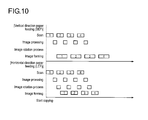
- FIG. 10 is a diagram showing the time required for copying processes by SEF and the time required for copying processes by LEF, in the event four documents are printed in one copy each at enlarging magnification.
- FIG. 11 is a flowchart showing a variation of a copying process executed by an MFP.
- FIG. 12 is a flowchart illustrating the steps of the third copying process shown in step S 407 in FIG. 11 .
- FIG. 1 is a schematic front view showing a structure of an MFP according to an embodiment of the present invention
- FIG. 2 is a block diagram showing a structure of the MFP illustrated in FIG. 1 .
- An MFP 100 which serves as a copy machine, has a control unit 110 , an operation panel unit 120 , an image reading unit 130 , a paper feed unit 140 , an image forming unit 150 , and a post-processing unit 160 , and these are connected mutually via a bus 170 to exchange signals.
- the control unit 110 has a main CPU (Central Processing Unit) 101 , a ROM (Read Only Memory) 102 , a RAM (Random Access Memory) 103 , a hard disk 104 , a first image processing circuit 105 , a second image processing circuit 106 and a communication interface 107 .
- a main CPU Central Processing Unit
- ROM Read Only Memory
- RAM Random Access Memory
- the main CPU 101 controls the above various parts and performs various calculation processes according to programs.
- the ROM 102 stores various programs and various data.
- the RAM 103 serves as a work space by storing programs and data on a temporary basis.
- the hard disk 104 stores various programs and various data to control the basic operations of the MFP 100 . Also, the hard disk 104 stores a program for selecting the orientation (LEF/SEF) of paper to be fed from the paper feed unit 140 to the image forming unit 150 , upon execution of copying processes by the MFP 100 .
- LEF/SEF orientation
- the first image processing circuit 105 performs image processing on image data acquired by reading an image of a document by the image reading unit 130 .
- the first image processing circuit 105 performs image processing for enlarging or reducing the image data.
- the second image processing circuit 106 performs image processing on image data that is generated when a job is executed, and transfers the image data after the image processing to the image forming unit 150 .
- the second image processing circuit 106 performs a rotation process of rotating the orientation of image data through 90 degrees, according to the orientation of paper fed from the paper feed unit 140 .
- the communication interface 107 is an interface for communicating with other devices, and includes a network interface and a USB (Universal Serial Bus) interface.
- the network interface is an interface for communicating with other devices via a network, and adopts a standard such as Ethernet, TokenRing, and FDDI (Fiber Distributed Data Interface).
- the USB interface is an interface that can connect and disconnect devices that comply with the USB standard, such as USB memories and so on, to the MFP 100 in a state the MFP 100 is powered on.
- the operation panel unit 120 has elements such as a touch panel, ten-keys, a start button and a stop button, and is used to display various information and input various commands.
- the image reading unit 130 has a scanner CPU 131 , a CCD (Charge Coupled Devices) image sensor 132 , an IR/ADF motor 133 , and a motor driver 134 .
- the scanner CPU 131 controls the above various parts and performs various calculation processes according to programs.
- the IR/ADF motor 133 is a motor to drive the image reading device (Image Reader: IR) and ADF, and the motor driver 134 controls the IR/ADF motor 133 .
- a document can be set in the ADF of the present embodiment only in the orientation in which the long-side direction of the document and the transport direction of the document match.
- the image reading unit 130 illuminates a document that is set in a predetermined reading position on a document tray, or a document that is transported by an ADF to the predetermined reading position, by a light source such as a fluorescent lamp, performs an opto-electronic conversion of the reflected light by a CCD imaging sensor 132 , and generates image data from the electrical signal.
- the CCD image sensor 132 is a line sensor in which a predetermined number of reading pixels extend in the direction (reading main scan direction) orthogonal to the document transport direction.
- the image reading unit 130 of the present embodiment is configured to be able to select between high quality mode to read an image of a document at high resolution and low quality mode to read an image of a document at low resolution.
- the paper feed unit 140 stocks paper on which an image is formed.
- the paper feed unit 140 has a plurality of paper feed trays 140 a to 140 c and a manual feed tray 140 d , and sends out the paper stocked in the paper feed trays 140 a to 140 c and manual feed tray 140 d one sheet at a time to the image forming unit 150 .
- the plurality of paper feed trays 140 a to 140 c stock paper of different sizes and different orientations.
- A4 size paper is stocked vertically so that paper is fed to the image forming unit 150 by SEF.
- the second paper feed tray 140 b A4 size paper is stocked horizontally so that paper is fed to the image forming unit 150 by LEF.
- the image forming unit 150 forms an image on paper based on image data transferred from the second image processing circuit 106 , using known imaging processes such as electronic photographic processes and so on.
- the image forming unit 150 has an optical unit (not illustrated) formed with a laser oscillator, a polygon mirror, a photosensitive body and so on, and forms an electrostatic latent image on the photosensitive body, by scanning a laser beam emitted from the laser oscillator by the polygon mirror in the writing main scan direction.
- a toner image which is acquired by supplying toner to the electrostatic latent image, is transferred on paper that is transported in the writing sub-scan direction of the laser beam (the rotation direction of the photosensitive body).
- the post-processing unit 160 discharges paper on which an image has been formed by the image forming unit 150 .
- the post-processing unit 160 has a plurality of paper discharge trays, and paper on which an image is formed is discharged to a predetermined paper discharge tray.
- the post-processing unit 160 is provided with post-processing devices (not illustrated) for applying post-processing including a stapling process, a punching process and so on.
- the MFP 100 may include components other than the above components or may not include part of the above components.
- the orientation of paper on which an image is going to be formed is switched depending on the content of the copying processes, in order to reduce the time required for the copying processes.
- the operations of the MFP 100 will be described below with reference to FIG. 3 to FIG. 12 .
- FIG. 3 is a flowchart illustrating the steps of a copying process executed by the MFP. Note that the algorithms illustrated in the flowchart of FIG. 3 are stored in the hard disk 104 of the MFP 100 in the form of a program and implemented by the main CPU 101 . Prior to execution of copying processes, a document is set in the ADF such that the document is fed to the image reading unit 130 by SEF and an image of the document is read such that the long-side direction of the document is in line with the reading sub-scan direction.
- the copy settings are accepted (step S 101 ).
- the copy settings set up by the user are accepted.
- the copy settings include the image quality setting, the setting as to the number of copies and the enlargement/reduction setting.
- the number of documents is input by the user, and the number of documents is accepted. Note that, unlike the present embodiment, the number of documents may be determined by detecting the weight and thickness of documents, and be set automatically.
- step S 102 the time required for copying processes in the event paper is fed by SEF is calculated.
- the time required after the reading process is started until the image forming process is complete is calculated.
- the time required for copying processes is calculated considering the number of documents, the number of copies, the time required for the image forming process on paper fed by SEF, the reading speed corresponding to the image quality setting (that is to say, the time required for the reading process) and the content of the enlargement/reduction process.
- the time required for the copying processes is calculated based on the number of documents, the number of copies, the time required for the image forming process, the time required for the reading process, and the time the reading process and the image forming process for the same document overlap. Also, in the event of copying processes involving enlargement/reduction, the time required for the copying processes is calculated based on the number of documents, the number of copies, the time required for the image forming process, the time required for the reading process and the time required for the enlargement/reduction process.
- step S 103 the time required for copying processes in the event paper is fed by LEF is calculated.
- the time required after the reading process is started until the image forming process is complete is calculated.
- the time required for copying processes is calculated considering the number of documents, the number of copies, the time required for the image forming process on paper that is fed by LEF, the time required for the reading process, the content of the enlargement/reduction process, and the time required for the rotation process of image data.
- the time required for the copying processes is calculated based on the number of documents, the number of copies, the time required for the image forming process, the time required for the reading process and the time required for the rotation process. Also, in the event of copying processes involving enlargement/reduction, the time required for the copying processes is calculated based on the number of documents, the number of copies, the time required for the image forming process, the time required for the reading process, the time required for the rotation process, and the time required for the enlargement/reduction process.
- step S 104 whether or not the time required for copying processes when paper is fed by SEF is shorter than the time required when paper is fed by LEF is determined.
- the time calculated in the process illustrated in step S 102 and the time calculated in the process illustrated in step S 103 are compared, and whether or not the time required for copying processes when paper is fed by SEF is shorter than the time required for copying processes when paper is fed by LEF, is determined.
- step S 104 When the time required for copying processes when paper is fed by SEF is determined to be shorter than the time required when paper is fed by LEF (step S 104 : YES), SEF is selected (step S 105 ). In the present embodiment, it is determined that the time required for copying processes becomes shorter by feeding paper by SEF and performing an image forming process than by feeding paper by LEF and performing an image forming process, and therefore SEF is selected.
- step S 106 a first copying process is executed (step S 106 ), and the process is finished.
- the first copying process of performing an image forming process on paper that is fed by SEF is executed.
- the first copying process illustrated in step S 106 will be described later in detail.
- step S 104 when the time required for copying processes when paper is fed by SEF is determined to be longer than the time required when paper is fed by LEF (step S 104 : NO), LEF is selected (step S 107 ).
- LEF is selected. In the present embodiment, it is determined that the time required for copying processes becomes shorter by feeding paper by LEF and performing an image forming process than by feeding paper by SEF and performing an image forming process, and therefore LEF is selected.
- step S 108 a second copying process is executed (step S 108 ), and the process is finished.
- the second copying process of performing an image forming process on paper that is fed by LEF is executed.
- the second copying process illustrated in step S 108 will be described later in detail.
- the feeding direction of the one that makes the time required for copying processes shorter is selected based on the content of copying processes, and copying processes in accordance with this selection result are executed.
- FIG. 4 is a flowchart illustrating the steps of the first copying process illustrated in step S 106 in FIG. 3 .
- the first copying process an image of a document fed by SEF is read, and an image is formed on paper that is fed by SEF.
- step S 201 whether or not 1 ⁇ -magnification copying is performed is determined.
- whether the copying processes involve reduced or enlarging copying, or 1 ⁇ -magnification copying is determined.
- step S 201 When it is determined that 1 ⁇ -magnification copying is not performed (step S 201 : NO), the step moves on to the process of step S 209 . On the other hand, when it is determined that 1 ⁇ -magnification copying is performed (step S 201 : YES), a reading process of the document is started (step S 202 ). In the present embodiment, for a document that is fed by SEF, the image reading unit 130 starts reading an image such that the long-side direction of the document is in line with the reading sub-scan direction.
- step S 203 whether or not the document has been read up to a predetermined position is determined.
- whether or not image has been read up to a predetermined position in the long-side direction of the document (reading sub-scan direction) is determined.
- step S 203 When it is determined that the document has not been read up to a predetermined position (step S 203 : NO), the document is waited to be read up to a predetermined position.
- step S 204 when it is determined that the document has been read up to a predetermined position (step S 203 : YES), an image forming process is started (step S 204 ).
- an image starts being formed on paper that is fed by SEF based on image data generated following the advancement of reading by the image reading unit 130 in the reading sub-scan direction.
- an image is formed such that the long-side direction of paper is in line with the writing sub-scan direction.
- step 205 whether or not the reading process is complete is determined.
- whether or not reading of an image is complete is determined.
- step S 205 NO
- step S 205 NO
- step S 205 YES
- step S 206 whether or not there is a next document is determined. In the present embodiment, whether or not a document is left in the ADF is determined. Note that image data acquired when the reading process is complete is stored in the RAM 103 for recycle use.
- step S 206 When it is determined that there is a next document (step S 206 : YES), the step returns to the process of step S 202 . As a result of this, until the reading process is complete with respect to all documents set in the ADF, the processes of step S 202 and onward are repeated.
- step S 207 when it is determined that there is not a next document (step S 206 : NO), whether or not multiple copies are to be printed is determined (step S 207 ). In the present embodiment, based on the copy settings accepted in the process illustrated in step S 101 of FIG. 3 , whether or not the number of copies is set two or greater is determined.
- step S 207 When it is determined that multiple copies are to be printed (step S 207 : YES), the number of copies left is output (step S 208 ). In the present embodiment, based on the image data of the document stored in the RAM 103 , image forming is executed for the number of copies left. On the other hand, when it is determined that not multiple copies are to be printed (step S 207 : NO), the process is finished.
- an image of a document that is fed by SEF is read and meanwhile an image is formed on paper that is fed by SEF.
- the orientation of the image data of the document and the orientation of paper match, so that there is no need to rotate the image data, and the image forming process is started before the reading process of one document is complete. That is to say, in the event copies are printed in 1 ⁇ -magnification by SEF, the time in which the reading process is executed and the time in which the image forming process is executed for the same document partly overlap, and therefore the time after reading process is started until image forming process is started is short.
- step S 209 a reading process of the document is started (step S 209 ).
- an image starts being read such that the long-side direction of the document is in line with the reading sub-scan direction.
- step 210 whether or not the reading process is complete is determined. In the event the reading process is determined not to be complete (step S 210 : NO), the reading process is waited to be complete. On the other hand, in the event the reading process is determined to be complete (step S 210 : YES), an enlargement/reduction process of the image is executed (step S 211 ). In the present embodiment, based on the copy settings, an enlargement or reduction process is applied to the image data acquired by reading the image of the document by the image reading unit 130 .
- an image forming process is started (step S 212 ).
- an image starts being formed on paper that is fed by SEF.
- an image is formed such that the long-side direction of paper is in line with the writing sub-scan direction.
- step S 213 whether or not there is a next document is determined.
- step S 213 YES
- step S 213 NO
- the step returns to the process of step S 209 .
- step S 213 NO
- the number of copies left is output according to the copy settings (steps S 207 and S 208 ), and then the process is finished.
- FIG. 5 is a flowchart illustrating the steps of the second copying process illustrated in step S 108 in FIG. 3 .
- an image of a document fed by SEF is read, and an image is formed on paper that is fed by LEF.
- step S 301 whether or not 1 ⁇ -magnification copying is performed is determined.
- step S 301 NO
- step S 301 NO
- step S 309 a reading process of the document is started.
- step S 302 a reading process of the document is started.
- an image starts being read such that the long-side direction of the document is in line with the reading sub-scan direction.
- step S 303 whether or not the reading process is complete is determined. In the event the reading process is determined not to be complete (step S 303 : NO), the reading process is waited to be complete.
- a rotation process of the image is executed (step S 304 ).
- a rotation process of rotating image data through 90 degrees is applied to the image data acquired by reading the image of the document by the image reading unit 130 .
- the orientation of image data is rotated through 90 degrees, it becomes possible to form an image based on image data that is acquired by reading an image of a document fed by SEF, on paper that is fed by LEF.
- an image forming process is started (step S 305 ).
- an image starts being formed on paper that is fed by LEF, based on the image data rotated in the process illustrated in step S 304 .
- an image is formed such that the short-side direction of paper is in line with the writing sub-scan direction.
- step S 306 whether or not there is a next document is determined.
- step S 306 YES
- step S 306 NO
- step S 307 whether or not multiple copies are to be printed is determined.
- step S 307 When it is determined that multiple copies are to be printed (step S 307 : YES), the number of copies left is output (step S 308 ). On the other hand, when it is determined that not multiple copies are to be printed (step S 307 : NO), the process is finished.
- an image of a document fed by SEF is read, and, after a rotation process of the image is executed, an image is formed on paper that is fed by LEF.
- step S 309 the reading process of the document is started (step S 309 ).
- an image starts being read such that the long-side direction of the document is in line with the reading sub-scan direction.
- step 310 whether or not the reading process is complete is determined. In the event the reading process is determined not to be complete (step S 310 : NO), the reading process is waited to be complete. On the other hand, in the event the reading process is determined to be complete (step S 310 : YES), an enlargement/reduction process of the image is executed (step S 311 ).
- step S 312 a rotation process of the image is executed (step S 312 ), and an image forming process is started (step S 313 ).
- an image is formed such that the short-side direction of paper is in line with the writing sub-scan direction.
- step S 314 whether or not there is a next document is determined.
- step S 314 determines whether or not there is a next document.
- step S 314 determines whether or not there is a next document.
- step S 314 determines whether or not there is a next document.
- an image of a document fed by SEF is read, and, after an enlargement/reduction process and rotation process of the image are executed, an image is formed on paper that is fed by LEF.
- FIG. 6 to FIG. 10 are time charts to show the time required for copying processes when paper is fed by SEF and the time required for copying processes when paper is fed by LEF.
- the horizontal axis in each drawing is the time past from the time copying is started.
- the upper part in each drawing is the copying processes in the event paper is fed by SEF, and the lower part in each drawing is the copying process in the event paper is fed by LEF.
- the time required for the image forming process based on image data of one document is shorter than the time required for the reading process of one document.
- the time required for the reading process changes depending on the reading speed corresponding to image quality mode.
- FIG. 6 is a diagram showing the time required for copying processes by SEF and the time required for copying processes by LEF in the event multiple copies of one document are printed at 1 ⁇ magnification.
- the document reading process is performed one time, which equals the number of documents
- the image forming process is performed a number of times, which equals the product of the number of documents and the number of copies.
- the rotation process is performed one time, which equals the number of documents.
- the time required for copying processes is shorter with SEF. That is to say, the time calculated in step S 102 in FIG. 3 is shorter than the time calculated in step S 103 .
- the time required for copying processes is shorter with LEF. That is to say, the time calculated in step S 103 in FIG. 3 is shorter than the time calculated in step S 102 .
- the time required for copying processes by SEF and the time required for copying processes by LEF are both calculated, based on the copy settings.
- the time required for the copying processes is calculated considering that the image forming process is started before the reading process is complete
- the time required for the copying processes is calculated considering that the rotation process is executed after the reading process is complete, and then the image forming process is started. Then, based on the times calculated, the one feeding direction to make the time for copying processes shorter is selected, and copying processes are executed in the selected feeding direction.
- FIG. 7 is a diagram showing the time required for copying processes by SEF and the time required for copying processes by LEF in the event three documents are printed in one copy each at 1 ⁇ magnification
- FIG. 8 is a diagram showing the time required for copying processes by SEF and the time required for copying processes by LEF in the event three documents are printed in multiple copies each at 1 ⁇ magnification.
- the document reading process is performed three times, which equals the number of documents
- the image forming process is performed three times, which equals the product of the number of documents and the number of copies.
- the rotation process is performed three times, which equals the number of documents.
- the time required for copying processes becomes shorter by SEF than by LEF. That is to say, the time calculated in step S 102 of FIG. 3 becomes shorter than the time calculated in step S 103 . Consequently, in the copying processes of the present embodiment, SEF is selected, and the image forming process is performed on paper that is fed by SEF.
- the time required for copying processes becomes shorter by LEF than by SEF. That is to say, the time calculated in step S 103 of FIG. 3 becomes shorter than the time calculated in step S 102 . Consequently, in the copying processes of the present embodiment, LEF is selected, and the image forming process is performed on paper that is fed by LEF. In either case of SEF or LEF, the document reading process is performed three times, which equals the number of documents, and the image forming process is performed a number of times, which equals the product of the number of documents and the number of copies. Also, as with LEF, the rotation process is performed three times, which equals the number of documents.
- FIG. 9 is a diagram showing the time required for copying processes by SEF and the time required for copying processes by LEF, in the event four documents are printed in one copy each at reduced magnification.
- FIG. 10 is a diagram showing the time required for copying processes by SEF and the time required for copying processes by LEF, in the event four documents are printed in one copy each at enlarging magnification.
- the one direction that makes the time required for the copying processes shorter is selected as the feeding direction of paper on which an image is going to be formed. Then, copying processes are executed in the selected feeding direction. According to this configuration, the time required for copying processes is reduced.
- FIG. 11 is a flowchart showing a variation of a copying process executed by an MFP.
- step S 401 the copy settings are accepted (step S 401 ).
- step S 402 whether or not 1 ⁇ -magnification copying is performed is determined.
- step S 408 LEF is selected.
- LEF is selected.
- step S 403 whether or not one copy of one document is printed is determined. In the present embodiment, whether or not the number of documents is one and the number of copies set by the user is one, is determined.
- step S 406 When it is determined that one copy of one document is printed (step S 403 : YES), SEF is selected (step S 406 ).
- SEF is selected in the present embodiment, in the event one copy of one document is printed, it is possible to start the image forming process before the document reading process is complete, and complete the image forming process nearly at the same time the reading process is complete, so that SEF is selected.
- step S 403 when it is determined that one copy of one document is not printed in the process illustrated in step S 403 (step S 403 : NO), the number of copies N, which serves as the basis for switching between SEF and LEF, is calculated based on the copy settings (step S 404 ). In the present embodiment, based on the copy settings and the number of documents accepted in the process illustrated in step S 401 , a number of copies N to reverse the time required for copying processes by SEF and the time required for copying processes by LEF is calculated.
- step S 405 whether or not the number of copies set by the user is equal to or greater than N is determined. In the present embodiment, whether or not the number of copies accepted in the process illustrated in step S 401 is equal to or greater than the number of copies N calculated in the process illustrated in step S 404 is determined.
- step S 405 NO
- SEF is selected (step S 406 ).
- step S 407 a third copying process is executed (step S 407 ), and the process is finished.
- FIG. 12 is a flowchart illustrating the steps of the third copying process illustrated in step S 407 in FIG. 11 .
- the processes illustrated in steps S 501 to S 507 in FIG. 12 are the same as the processes illustrated in step S 202 to S 208 in FIG. 4 , and therefore detailed explanation of the third copying process will be omitted.
- an image of a document that is fed by SEF is read and meanwhile an image is formed on paper that is fed by SEF.
- step S 405 LEF is selected (step S 408 ). Then, the second copying process is executed (step S 409 ), and the process is finished.
- the second copying process is the same as the process in the flowchart illustrated in FIG. 5 , and therefore its explanation will be omitted.
- the present invention may be applied to an MFP.
- the present invention may be applied to a copier as well.
- the units and methods to perform various processes in the copy machine according to the present embodiment may be implemented by either dedicated hardware circuits or a programmed computer.
- the above program may be provided by means of, for example, a computer readable recording medium such as a flexible disk or CD-ROM, or may be provided online via a network such as the Internet. In this case, the program that is recorded in the computer readable recording medium is transferred to a memory unit such as a hard disk and stored therein. Also, the above program may be provided as single application software or may be incorporated as one function of a copy machine in the software of this machine.
Landscapes
- Engineering & Computer Science (AREA)
- Multimedia (AREA)
- Signal Processing (AREA)
- Physics & Mathematics (AREA)
- General Physics & Mathematics (AREA)
- Control Or Security For Electrophotography (AREA)
- Editing Of Facsimile Originals (AREA)
- Facsimiles In General (AREA)
Abstract
Description
Claims (21)
Applications Claiming Priority (2)
| Application Number | Priority Date | Filing Date | Title |
|---|---|---|---|
| JP2011135344A JP2013003400A (en) | 2011-06-17 | 2011-06-17 | Copying device and control program for the same |
| JP2011-135344 | 2011-06-17 |
Publications (2)
| Publication Number | Publication Date |
|---|---|
| US20120320398A1 US20120320398A1 (en) | 2012-12-20 |
| US8941846B2 true US8941846B2 (en) | 2015-01-27 |
Family
ID=47353450
Family Applications (1)
| Application Number | Title | Priority Date | Filing Date |
|---|---|---|---|
| US13/495,622 Active 2033-01-06 US8941846B2 (en) | 2011-06-17 | 2012-06-13 | Copy machine and non-transitory computer readable recording medium stored with control program for copy machine |
Country Status (3)
| Country | Link |
|---|---|
| US (1) | US8941846B2 (en) |
| JP (1) | JP2013003400A (en) |
| CN (1) | CN102843483A (en) |
Families Citing this family (3)
| Publication number | Priority date | Publication date | Assignee | Title |
|---|---|---|---|---|
| JP5942678B2 (en) * | 2012-08-02 | 2016-06-29 | ブラザー工業株式会社 | Copier |
| JP5954027B2 (en) * | 2012-08-02 | 2016-07-20 | ブラザー工業株式会社 | Copier |
| JP6672788B2 (en) * | 2015-12-25 | 2020-03-25 | ブラザー工業株式会社 | Ink jet recording device |
Citations (8)
| Publication number | Priority date | Publication date | Assignee | Title |
|---|---|---|---|---|
| JPH0865443A (en) | 1994-06-15 | 1996-03-08 | Ricoh Co Ltd | Digital copier |
| JPH0918690A (en) | 1995-06-26 | 1997-01-17 | Fuji Xerox Co Ltd | Image processing unit |
| JPH09312735A (en) | 1996-05-23 | 1997-12-02 | Fuji Xerox Co Ltd | Image forming device |
| JP2001322326A (en) | 2000-05-16 | 2001-11-20 | Fuji Xerox Co Ltd | Imaging apparatus |
| US20050100358A1 (en) * | 2003-11-06 | 2005-05-12 | Masaru Ushio | Image forming apparatus and image forming method |
| US20050111894A1 (en) * | 2003-11-26 | 2005-05-26 | Oki Data Corporation | Image processing apparatus with simplified mode selection |
| JP2006128794A (en) | 2004-10-26 | 2006-05-18 | Canon Inc | Copying apparatus and control method thereof |
| JP2009200548A (en) | 2008-02-19 | 2009-09-03 | Ricoh Co Ltd | Image forming apparatus |
-
2011
- 2011-06-17 JP JP2011135344A patent/JP2013003400A/en active Pending
-
2012
- 2012-06-13 US US13/495,622 patent/US8941846B2/en active Active
- 2012-06-13 CN CN2012101940320A patent/CN102843483A/en active Pending
Patent Citations (10)
| Publication number | Priority date | Publication date | Assignee | Title |
|---|---|---|---|---|
| JPH0865443A (en) | 1994-06-15 | 1996-03-08 | Ricoh Co Ltd | Digital copier |
| CN1128363A (en) | 1994-06-15 | 1996-08-07 | 株式会社理光 | Digital copying machine having selective paper feed based on copy productivity |
| US5550623A (en) | 1994-06-15 | 1996-08-27 | Ricoh Company, Ltd. | Digital copying machine having selective paper feed based on copy productivity |
| JPH0918690A (en) | 1995-06-26 | 1997-01-17 | Fuji Xerox Co Ltd | Image processing unit |
| JPH09312735A (en) | 1996-05-23 | 1997-12-02 | Fuji Xerox Co Ltd | Image forming device |
| JP2001322326A (en) | 2000-05-16 | 2001-11-20 | Fuji Xerox Co Ltd | Imaging apparatus |
| US20050100358A1 (en) * | 2003-11-06 | 2005-05-12 | Masaru Ushio | Image forming apparatus and image forming method |
| US20050111894A1 (en) * | 2003-11-26 | 2005-05-26 | Oki Data Corporation | Image processing apparatus with simplified mode selection |
| JP2006128794A (en) | 2004-10-26 | 2006-05-18 | Canon Inc | Copying apparatus and control method thereof |
| JP2009200548A (en) | 2008-02-19 | 2009-09-03 | Ricoh Co Ltd | Image forming apparatus |
Non-Patent Citations (4)
| Title |
|---|
| Chinese Office Action, Application or Patent No. 201210194032.0. Issuing No. 2014061200877650. Issuing Date: Jun. 17, 2014 (9 pages). |
| English translation of Chinese Office Action, Application or Patent No. 201210194032.0. Issuing No. 2014061200877650. Issuing Date: Jun. 17, 2014 (12 pages). |
| Japanese Office Action, Decision of Refusal, Patent Application No. 2011-135344. Dispatch Date: Mar. 4, 2014, with English translation thereof. |
| Official Notice of Reason for Refusal dated Aug. 20, 2013 in Japanese Patent Application No. 2011-135344. |
Also Published As
| Publication number | Publication date |
|---|---|
| CN102843483A (en) | 2012-12-26 |
| US20120320398A1 (en) | 2012-12-20 |
| JP2013003400A (en) | 2013-01-07 |
Similar Documents
| Publication | Publication Date | Title |
|---|---|---|
| US6449064B1 (en) | Method and apparatus for image formation that can handle simultaneously input data without causing a delay | |
| US9057999B2 (en) | Image forming apparatus capable of printing at a plurality of speeds | |
| US5987300A (en) | Image forming apparatus printing on both sides of a printing medium | |
| US20120320398A1 (en) | Copy machine and non-transitory computer readable recording medium stored with control program for copy machine | |
| US6480688B1 (en) | Image forming apparatus and method using divided image areas of an original | |
| KR20150118911A (en) | PRINTING APPARATUS, CONTROL METHOD THEREOF | |
| JP2014236343A (en) | Image forming apparatus, image processing system, its control method, and program | |
| US6831751B1 (en) | Forming apparatus and method for controlling the double-side printing to the different original sizes | |
| JP6070051B2 (en) | Image forming apparatus | |
| JP2005225039A (en) | Imaging method and imaging device | |
| US8820732B2 (en) | Image forming apparatus that uses sheets in sets, method of controlling the same, and storage medium | |
| US20090284796A1 (en) | Image forming apparatus, image forming method and recording medium | |
| JP5423735B2 (en) | Copying apparatus and control program for copying apparatus | |
| US6415116B2 (en) | Image forming apparatus, job controlling apparatus, and job controlling method | |
| JP2003098915A (en) | Image forming device | |
| JP3700425B2 (en) | Image forming apparatus | |
| JP6165066B2 (en) | Image forming apparatus and image forming method | |
| JP2005258151A (en) | Image output device | |
| JP7040249B2 (en) | Image forming device and printing start time adjustment method | |
| JP3428873B2 (en) | Image forming device capable of double-sided printing | |
| US20130135680A1 (en) | Image forming device and method for displaying image information | |
| JP2001069286A (en) | Linked image forming system | |
| US20110044712A1 (en) | Image forming apparatus | |
| JP2006284772A (en) | Image forming apparatus, paper supply / discharge method and program for image printing | |
| JPH11231730A (en) | Image forming device |
Legal Events
| Date | Code | Title | Description |
|---|---|---|---|
| AS | Assignment |
Owner name: KONICA MINOLTA BUSINESS TECHNOLOGIES, INC., JAPAN Free format text: ASSIGNMENT OF ASSIGNORS INTEREST;ASSIGNORS:KATSUDA, TAKEO;MIYAKE, SHINYA;REEL/FRAME:028369/0168 Effective date: 20120604 |
|
| FEPP | Fee payment procedure |
Free format text: PAYOR NUMBER ASSIGNED (ORIGINAL EVENT CODE: ASPN); ENTITY STATUS OF PATENT OWNER: LARGE ENTITY |
|
| AS | Assignment |
Owner name: KONICA MINOLTA HOLDINGS, INC., JAPAN Free format text: MERGER;ASSIGNOR:KONICA MINOLTA BUSINESS TECHNOLOGIES, INC.;REEL/FRAME:032214/0569 Effective date: 20130401 Owner name: KONICA MINOLTA, INC., JAPAN Free format text: CHANGE OF NAME;ASSIGNOR:KONICA MINOLTA HOLDINGS, INC.;REEL/FRAME:032214/0757 Effective date: 20130401 |
|
| STCF | Information on status: patent grant |
Free format text: PATENTED CASE |
|
| MAFP | Maintenance fee payment |
Free format text: PAYMENT OF MAINTENANCE FEE, 4TH YEAR, LARGE ENTITY (ORIGINAL EVENT CODE: M1551) Year of fee payment: 4 |
|
| MAFP | Maintenance fee payment |
Free format text: PAYMENT OF MAINTENANCE FEE, 8TH YEAR, LARGE ENTITY (ORIGINAL EVENT CODE: M1552); ENTITY STATUS OF PATENT OWNER: LARGE ENTITY Year of fee payment: 8 |