US8940807B2 - Method for producing metal oxide organic compound composite - Google Patents
Method for producing metal oxide organic compound composite Download PDFInfo
- Publication number
- US8940807B2 US8940807B2 US13/049,602 US201113049602A US8940807B2 US 8940807 B2 US8940807 B2 US 8940807B2 US 201113049602 A US201113049602 A US 201113049602A US 8940807 B2 US8940807 B2 US 8940807B2
- Authority
- US
- United States
- Prior art keywords
- gel
- refractive index
- organic compound
- metal oxide
- mmol
- Prior art date
- Legal status (The legal status is an assumption and is not a legal conclusion. Google has not performed a legal analysis and makes no representation as to the accuracy of the status listed.)
- Active, expires
Links
- 0 *C(Cl)CO.*C(O)CO.*C1CO1.*CCO.*CCO.*CCO.O.O.O.O.O.O.O.O.O.O.O.O.[Cl-].[Cl-].[Cl-].[Cl-].[Cl-].[Cl-].[Cl-].[H+].[H+].[H+].[OH-].[Y+3].[Y+3] Chemical compound *C(Cl)CO.*C(O)CO.*C1CO1.*CCO.*CCO.*CCO.O.O.O.O.O.O.O.O.O.O.O.O.[Cl-].[Cl-].[Cl-].[Cl-].[Cl-].[Cl-].[Cl-].[H+].[H+].[H+].[OH-].[Y+3].[Y+3] 0.000 description 1
- AHIPJALLQVEEQF-UHFFFAOYSA-N C1=CC(N(CC2CO2)CC2CO2)=CC=C1OCC1CO1 Chemical compound C1=CC(N(CC2CO2)CC2CO2)=CC=C1OCC1CO1 AHIPJALLQVEEQF-UHFFFAOYSA-N 0.000 description 1
- WPYCRFCQABTEKC-UHFFFAOYSA-N C1=CC(OCC2CO2)=CC(OCC2CO2)=C1 Chemical compound C1=CC(OCC2CO2)=CC(OCC2CO2)=C1 WPYCRFCQABTEKC-UHFFFAOYSA-N 0.000 description 1
- FQYUMYWMJTYZTK-UHFFFAOYSA-N C1=CC=C(OCC2CO2)C=C1 Chemical compound C1=CC=C(OCC2CO2)C=C1 FQYUMYWMJTYZTK-UHFFFAOYSA-N 0.000 description 1
Images

Classifications
-
- C—CHEMISTRY; METALLURGY
- C08—ORGANIC MACROMOLECULAR COMPOUNDS; THEIR PREPARATION OR CHEMICAL WORKING-UP; COMPOSITIONS BASED THEREON
- C08F—MACROMOLECULAR COMPOUNDS OBTAINED BY REACTIONS ONLY INVOLVING CARBON-TO-CARBON UNSATURATED BONDS
- C08F2/00—Processes of polymerisation
- C08F2/46—Polymerisation initiated by wave energy or particle radiation
- C08F2/48—Polymerisation initiated by wave energy or particle radiation by ultraviolet or visible light
-
- C—CHEMISTRY; METALLURGY
- C08—ORGANIC MACROMOLECULAR COMPOUNDS; THEIR PREPARATION OR CHEMICAL WORKING-UP; COMPOSITIONS BASED THEREON
- C08F—MACROMOLECULAR COMPOUNDS OBTAINED BY REACTIONS ONLY INVOLVING CARBON-TO-CARBON UNSATURATED BONDS
- C08F2/00—Processes of polymerisation
- C08F2/44—Polymerisation in the presence of compounding ingredients, e.g. plasticisers, dyestuffs, fillers
-
- C—CHEMISTRY; METALLURGY
- C08—ORGANIC MACROMOLECULAR COMPOUNDS; THEIR PREPARATION OR CHEMICAL WORKING-UP; COMPOSITIONS BASED THEREON
- C08F—MACROMOLECULAR COMPOUNDS OBTAINED BY REACTIONS ONLY INVOLVING CARBON-TO-CARBON UNSATURATED BONDS
- C08F220/00—Copolymers of compounds having one or more unsaturated aliphatic radicals, each having only one carbon-to-carbon double bond, and only one being terminated by only one carboxyl radical or a salt, anhydride ester, amide, imide or nitrile thereof
- C08F220/02—Monocarboxylic acids having less than ten carbon atoms; Derivatives thereof
- C08F220/10—Esters
- C08F220/26—Esters containing oxygen in addition to the carboxy oxygen
- C08F220/30—Esters containing oxygen in addition to the carboxy oxygen containing aromatic rings in the alcohol moiety
- C08F220/301—Esters containing oxygen in addition to the carboxy oxygen containing aromatic rings in the alcohol moiety and one oxygen in the alcohol moiety
-
- C—CHEMISTRY; METALLURGY
- C08—ORGANIC MACROMOLECULAR COMPOUNDS; THEIR PREPARATION OR CHEMICAL WORKING-UP; COMPOSITIONS BASED THEREON
- C08F—MACROMOLECULAR COMPOUNDS OBTAINED BY REACTIONS ONLY INVOLVING CARBON-TO-CARBON UNSATURATED BONDS
- C08F220/00—Copolymers of compounds having one or more unsaturated aliphatic radicals, each having only one carbon-to-carbon double bond, and only one being terminated by only one carboxyl radical or a salt, anhydride ester, amide, imide or nitrile thereof
- C08F220/02—Monocarboxylic acids having less than ten carbon atoms; Derivatives thereof
- C08F220/10—Esters
- C08F220/26—Esters containing oxygen in addition to the carboxy oxygen
- C08F220/32—Esters containing oxygen in addition to the carboxy oxygen containing epoxy radicals
- C08F220/325—Esters containing oxygen in addition to the carboxy oxygen containing epoxy radicals containing glycidyl radical, e.g. glycidyl (meth)acrylate
-
- C08F2220/301—
-
- C08F2220/325—
-
- C—CHEMISTRY; METALLURGY
- C08—ORGANIC MACROMOLECULAR COMPOUNDS; THEIR PREPARATION OR CHEMICAL WORKING-UP; COMPOSITIONS BASED THEREON
- C08K—Use of inorganic or non-macromolecular organic substances as compounding ingredients
- C08K3/00—Use of inorganic substances as compounding ingredients
- C08K3/18—Oxygen-containing compounds, e.g. metal carbonyls
- C08K3/20—Oxides; Hydroxides
- C08K3/22—Oxides; Hydroxides of metals
Definitions
- the present invention relates to a method for producing a metal oxide organic compound composite.
- the present invention provides a new method for producing a metal oxide organic compound composite.
- a method for obtaining a metal oxide organic compound composite includes dissolving a hydrated yttrium chloride and an epoxide in a solvent, and obtaining a gel including the metal organic compound composite.
- a method for producing a metal oxide organic compound composite includes dissolving a metal chloride in a presence of an epoxide having a first refractive index to obtain a gel, and washing the gel with a solution including a material having a second refractive index different from the first refractive index of the epoxide.
- a method for producing a metal oxide organic compound composite includes dissolving a metal chloride in a presence of an epoxide to obtain a gel with a refractive index, and replacing the epoxide of the gel with a material to change the refractive index.
- FIG. 1 illustrates the refractive index as a function of wavelength of sol-gel monoliths according to an embodiment of the invention.
- an epoxide can be used in a sol-gel process.
- the process includes a dissolving step (a), and a drying step (b).
- a metal chloride and an epoxide are dissolved in a solvent in the presence of water to obtain a gel including the metal oxide organic compound composite.
- a metal salt is dissolved in a suitable solvent.
- Water can either be added separately or may already be included in the salt as water of hydration.
- the obtained solution is stable, until an epoxide is added.
- a mixture including the metal chloride, the epoxide, and the solvent can be aged.
- Metal ions are Lewis acids, and the hydrogens from their aqueous shell are easily abstracted, therefore acting as Broenstead acids and lowering the pH of the solution (See a chemical reaction [1] below).
- the epoxide increases the pH of the solution by binding H + through a ring opening reaction.
- the metal oxide becomes insoluble and phase separates, resulting in the formation of a hydrogel.
- the removal of H + from the solution is only the favored reaction if the counterion is a better nucleophile than water (See chemical reactions [2] to [4]).
- the solvent can be selected from, for example, one or more of absolute methanol, ethanol, and water.
- a hydrated metal chloride (ex., yttrium chloride) liberates a hydrogen ion as described in the reaction [1], that can then open the epoxide ring as described in the reaction [2], as well as assist in subsequent aqueous chemistry with respect to the resulting alcohol, as described in the reactions [3] and [4].
- the epoxide in the gel may be thermally or photochemically polymerized and/or cross-linked.
- R can be selected from, for example, methyl, methacryloxymethyl, phenoxymethyl, m-(glycidyloxy)phenoxymethyl, p-(N,N-diglycidylamino)phenoxymethyl and N-glycidyl-N-(p-(glycidyloxy)phenyl)aminomethyl.
- the obtained gel is dried after an appropriate aging time to become a dense monolith which is denser than the gel before the drying step.
- the monolith that forms in a scintillation vial is dried at room temperature by controlled evaporation of the volatile solvent used in the dissolving process, and forms a dense void-free xerogel.
- a curing step and/or polishing step may optionally be executed.
- the hydrated metal chloride can be selected from, for example, at least one of TiCl 3 .6H 2 O, ZrCl 3 .6H 2 O, and YCl 3 .6H 2 O.
- the epoxide catalyst can be selected from among, for example, at least one of propylene oxide, glycidyl methacrylate, resorcinol diglycidyl ether (hereinafter, “RDGE”), N,N-diglycidyl-4-glycidyloxyaniline (hereinafter, “NGA”), 1,2-epoxy-3-phenoxypropane (hereinafter, “EPP”), and cyclohexene sulfide.
- RDGE resorcinol diglycidyl ether
- NDA N,N-diglycidyl-4-glycidyloxyaniline
- EPP 1,2-epoxy-3-phenoxypropane
- cyclohexene sulfide cyclohexene sulfide
- XCl 3 .nH 2 O is used as the hydrated metal chloride, where X can be Y, Ti, Zr, Lu, Sc, or La, and where n, the number of hydrated water, depends on the metal species used.
- the formation of the monoliths takes place via a sol gel route.
- a metal halide salt e.g. XCl 3 .nH 2 O
- X 3+ is a strong Lewis acid, therefore the pH of the solution is decreased.
- an acid scavenger like propylene oxide, glycidyl methacrylate or any other organic compound with an epoxide functionality
- the pH increases and the solubility of X 3+ ions is decreased.
- a metal oxidic gel is formed, and this formation can occur in a mold.
- the gel can be dried to form a denser monolith, also known as a xerogel.
- a mechanism for the reaction is disclosed by using chemical reactions [1] to [4] above for the case of X ⁇ Y (yttrium).
- reaction [1] YCl 3 .6H 2 O is shown in equilibrium with its deprotonated state, the created proton decreasing the pH of the solution.
- the proton then reacts with an available epoxy group and an intermediate is formed.
- the intermediate can react with available water to form a diol with another proton being created Product A (reaction [3]). This does not lead to an increase of the pH.
- the other possibility is that the intermediate reacts with a chloride ion to form Product B (reaction [4]).
- YCl 3 .6H 2 O is used as the hydrated metal chloride.
- the sol-gel synthesis process comprises a step for dissolving YCl 3 .6H 2 O and an epoxide in a solvent to obtain a gel, and a step for drying the gel.
- the epoxide may comprise one or more of the epoxides described above, such as for example propylene oxide and/or glycidyl methacrylate.
- the solvent may include alcohols.
- a material, which has a high refractive index compared to the epoxide, such as the propylene oxide and/or glycidyl methacrylate may be included in the solvent.
- a washing step can be applied to the sol-gel synthesis process as described later.
- the sample can be exposed with UV light (20 mW/cm 2 ) for 15 min.
- the disclosed process for yttrium oxide sol-gels can be executed at relatively low temperature.
- a sample of thick sol-gel monolith can be obtained.
- the thickness of the sample can be approximately 1 mm.
- the epoxide, glycidyl methacrylate was found to be able to provide both a catalytic functionality and a cross-linked organic network for increasing the strength of the yttrium oxide portion.
- Thick samples of the metal oxide organic compound composite could be made by using glycidyl methacrylate.
- a washing step can be introduced to the disclosed sol-gel synthesis process. Specifically, after gelation occurs in the presence of an epoxide having a first refractive index to obtain a gel and before the drying process, the washing step can be executed to wash the gel with another solution including another material having a second refractive index different from the first refractive index of the epoxide. The washing step might be applied even after the drying step.
- the first refractive index of the gel can be increased by the execution of the washing step.
- the refractive index of the gel can be controlled.
- the material used in the washing step can comprise an organic compound including at least one substituent group selected from the group consisting of sulfur, chlorine, bromine, iodine, and aromatic ring.
- the washing step the epoxide can be replaced with a material whose refractive index is different from that of the epoxide. Therefore, the washing step can be called an active washing process.
- the active washing process the epoxide which reacted and/or didn't react during gelation may be replaced with a second material used in the washing step. Therefore, the active washing process can change the optical properties of the obtained gel.
- the replacement material can be thermally or photochemically cured. This leads to the formation of a polymeric network that stabilizes the gel.
- Photochemical curing involves the formation of reactive species from a photoinitiator upon the illumination of the material with light of a certain wavelength.
- the reactive species reacts with the replacement material and initiates a polymerization.
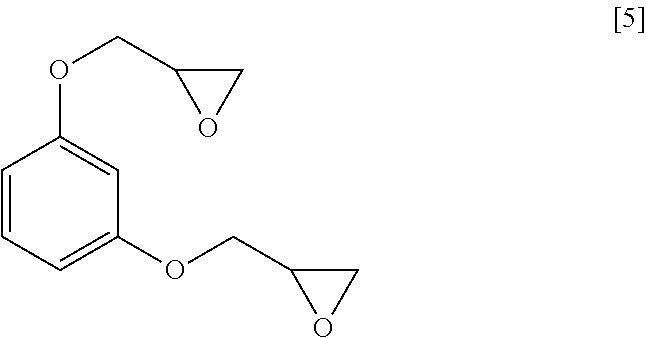
- the replacement material can be at least one member selected from the group consisting of benzyl methacrylate, styrene, trimethylolpropane triacrylate (TMPTA), RDGE, NGA, and EPP. “RDGE” is described by the following chemical formula [5].
- TMPTA trimethylolpropane triacrylate
- RDGE is described by the following chemical formula [5].
- These replacement materials might be added into a solution used for dissolving the metal chloride.
- the solution used for dissolving the metal chloride can comprise at least one of benzyl methacrylate, styrene, and trimethylolpropane triacrylate (TMPTA).
- TMPTA trimethylolpropane triacrylate
- the solution can also comprise an organic compound including at least one substituent group selected from the group consisting of sulfur, chlorine, bromine, iodine, and aromatic ring.
- the monolith After the drying process the monolith is cured under a UV source in an argon atmosphere for 30 min. After curing the monolith is polished on both sides.
- the active washing process is used to change the refractive index of the gel.
- a solution of curable monomer and photoinitiator dissolved in the solvent used during the sol gel process is added to the undried hydrogel. Through diffusion the epoxide is removed from the gel and the monomer is incorporated into the gel.
- Example Y2-1 The gels were prepared according to the description of the Example 1, and before the drying process, one of the gels was washed by using a methanol based solution of benzyl methacrylate and Irgacure 184, described in detail below (Example Y2-1).
- FIG. 1 a graph comparing the refractive indices of two gels made with epoxides of similar refractive index is shown. One of the gels was actively washed (illustrated in circles), and the other one was not washed (illustrated in squares).
- the monolith was soaked in 10 mL of dry methanol for 1 day, which was twice repeated.
- the monolith was soaked for 1 day in 10 mL of the washing solution which was prepared from benzyl methacrylate (31.7 g, 180 mmol), Irgacure 184 (2.11 g, 10.3 mmol), and dry methanol (120 mL). This treatment was repeated three times. The resulting gel was dried at ambient temperature to give a yellowish slightly-hazy solid.
- the monolith was soaked in 10 mL of dry methanol for 1 day, which was twice repeated.
- the monolith was soaked for 1 day in 10 mL of the washing solution which was prepared from benzyl methacrylate (31.7 g, 180 mmol), Irgacure 184 (2.11 g, 10.3 mmol), and dry methanol (120 mL). This treatment was repeated three times. The resulting gel was dried at ambient temperature to give colorless slightly-hazy solid.
- the monolith was soaked in 10 mL of dry methanol for 1 day, which was twice repeated. Then, the monolith was soaked for 1 day in 10 mL of the washing solution which was prepared from 1,3-dithiole-2-thione (1.00 g, 7.45 mmol), benzyl methacrylate (9.00 g, 51.1 mmol), Irgacure 184 (0.701 g, 3.43 mmol), and dry methanol (40 mL). This treatment was repeated three times. The resulting gel was dried at ambient temperature to give a light-orange clear solid.
- the monolith was soaked in 10 mL of dry methanol for 1 day, which was repeated twice. Then, the monolith was soaked for 1 day in 10 mL of the washing solution which was prepared from benzyl methacrylate (26.5 g, 150 mmol), Irgacure 184 (1.75 g, 8.57 mmol), and dry methanol (100 mL). This treatment was repeated three times. The resulting gel was dried at ambient temperature to give a slightly-yellow clear solid.
- the monolith was soaked in 10 mL of dry methanol for 1 day, which was repeated twice. Then, the monolith was soaked for 1 day in 10 mL of the washing solution which was prepared from benzyl methacrylate (26.5 g, 150 mmol), Irgacure 184 (1.75 g, 8.57 mmol), and dry methanol (100 mL). This treatment was repeated three times. The resulting gel was dried at ambient temperature to give a slightly-orange clear solid.
- the monolith was soaked in 10 mL of dry methanol for 1 day, which was repeated twice. Then, the monolith was soaked for 1 day in 10 mL of the washing solution which was prepared from benzyl methacrylate (26.5 g, 150 mmol), Irgacure 184 (1.75 g, 8.57 mmol), and dry methanol (100 mL). This treatment was repeated three times. The resulting gel was dried at ambient temperature to give light-orange clear solid.
- the monolith was soaked in 10 mL of dry methanol for 1 day, which was repeated twice. Then, the monolith was soaked for 1 day in 10 mL of the washing solution which was prepared from benzyl methacrylate (26.5 g, 150 mmol), Irgacure 184 (1.75 g, 8.57 mmol), and dry methanol (100 mL). This treatment was repeated three times. The resulting gel was dried at ambient temperature to give light-orange clear solid.
- the monolith was soaked in 10 mL of dry methanol for 1 day, which was repeated twice. Then, the monolith was soaked for 1 day in 10 mL of the washing solution which was prepared from 1,3-dithiole-2-thione (1.00 g, 7.45 mmol), benzyl methacrylate (9.03 g, 51.2 mmol), Irgacure 184 (0.700 g, 3.43 mmol), and dry methanol (40 mL). This treatment was repeated three times. The resulting gel was dried at ambient temperature to give light-orange clear solid.
- the monolith was soaked in 10 mL of dry methanol for 1 day, which was repeated twice. Then, the monolith was soaked for 1 day in 10 mL of the washing solution which was prepared from cyclohexene sulfide (0.854 g, 7.48 mmol), benzyl methacrylate (9.00 g, 51.1 mmol), Irgacure 184 (0.699 g, 3.42 mmol), and 2-isopropoxyethanol (40 mL). This treatment was repeated three times. The resulting gel was dried at ambient temperature to give a colorless clear solid.
- the monolith was soaked in 10 mL of dry methanol for 1 day, which was repeated twice. Then, the monolith was soaked for 1 day in 10 mL of the washing solution which was prepared from benzyl methacrylate (21.17 g, 120 mmol) and Irgacure 184 (1.401 g, 6.86 mmol). This treatment was repeated three times. The resulting gel was dried at ambient temperature to give light-orange clear solid.
- the monolith was soaked in 10 mL of dry methanol for 1 day, which was repeated twice. Then, the monolith was soaked for 1 day in 10 mL of the washing solution which was prepared from cyclohexene sulfide (1.708 g, 15.0 mmol), benzyl methacrylate (18.01 g, 102 mmol), and Irgacure 184 (1.419 g, 6.95 mmol). This treatment was repeated three times. The resulting gel was dried at ambient temperature to give a slightly-orange clear solid.
- organic washing compound(s) containing at least one of sulfur atoms, halogen atoms except for fluorine, and aromatic rings and soaking the obtained gel with said organic compounds are effective.
- the described method may realize a desired monolith with high refractive index and/or high Abbe number produced through a low temperature process (ex. room temperature). Glass material with similar properties is usually produced by using a process at several hundred to thousands of degrees.
- the described synthetic method may be used for incorporating organic and/or inorganic functionality into the Y 2 O 3 network structure. For example, dyes for sensing, coloring, or laser applications can be introduced into the Y 2 O 3 network structure.
- the mechanical and/or optical properties of the xerogel may be controlled.
Landscapes
- Chemical & Material Sciences (AREA)
- Health & Medical Sciences (AREA)
- Chemical Kinetics & Catalysis (AREA)
- Medicinal Chemistry (AREA)
- Polymers & Plastics (AREA)
- Organic Chemistry (AREA)
- Epoxy Compounds (AREA)
- Addition Polymer Or Copolymer, Post-Treatments, Or Chemical Modifications (AREA)
Abstract
Description



Claims (8)
Priority Applications (1)
| Application Number | Priority Date | Filing Date | Title |
|---|---|---|---|
| US13/049,602 US8940807B2 (en) | 2011-03-16 | 2011-03-16 | Method for producing metal oxide organic compound composite |
Applications Claiming Priority (1)
| Application Number | Priority Date | Filing Date | Title |
|---|---|---|---|
| US13/049,602 US8940807B2 (en) | 2011-03-16 | 2011-03-16 | Method for producing metal oxide organic compound composite |
Publications (2)
| Publication Number | Publication Date |
|---|---|
| US20120238700A1 US20120238700A1 (en) | 2012-09-20 |
| US8940807B2 true US8940807B2 (en) | 2015-01-27 |
Family
ID=46828966
Family Applications (1)
| Application Number | Title | Priority Date | Filing Date |
|---|---|---|---|
| US13/049,602 Active 2032-07-20 US8940807B2 (en) | 2011-03-16 | 2011-03-16 | Method for producing metal oxide organic compound composite |
Country Status (1)
| Country | Link |
|---|---|
| US (1) | US8940807B2 (en) |
Families Citing this family (1)
| Publication number | Priority date | Publication date | Assignee | Title |
|---|---|---|---|---|
| KR20160009120A (en) * | 2014-07-15 | 2016-01-26 | 한양대학교 산학협력단 | Inorganic layer structure comprising organic linking material, and method of fabricating the same |
Citations (8)
| Publication number | Priority date | Publication date | Assignee | Title |
|---|---|---|---|---|
| US3291579A (en) * | 1963-06-06 | 1966-12-13 | Chevron Res | Process for gelling alcohols |
| US3458306A (en) * | 1966-09-27 | 1969-07-29 | Chevron Res | Preparation of metals and metal alloys |
| US3625673A (en) * | 1969-02-03 | 1971-12-07 | Chevron Res | Preparation of metals and metal alloys |
| US3655360A (en) * | 1969-11-24 | 1972-04-11 | Chevron Res | Metals and metal alloys and preparation thereof |
| US6355821B1 (en) * | 1997-11-07 | 2002-03-12 | Sustainable Technologies Australia Limited | Preparation of metal alkoxides |
| JP4077508B2 (en) | 2005-08-29 | 2008-04-16 | 松下電器産業株式会社 | Lens manufacturing method |
| US20100179288A1 (en) * | 2004-11-03 | 2010-07-15 | Ohio Aerospace Institute | Highly porous and mechanically strong ceramic oxide aerogels |
| US20120115989A1 (en) * | 2010-11-10 | 2012-05-10 | Enis Tuncer | Method of forming nanodielectrics |
-
2011
- 2011-03-16 US US13/049,602 patent/US8940807B2/en active Active
Patent Citations (9)
| Publication number | Priority date | Publication date | Assignee | Title |
|---|---|---|---|---|
| US3291579A (en) * | 1963-06-06 | 1966-12-13 | Chevron Res | Process for gelling alcohols |
| US3458306A (en) * | 1966-09-27 | 1969-07-29 | Chevron Res | Preparation of metals and metal alloys |
| US3625673A (en) * | 1969-02-03 | 1971-12-07 | Chevron Res | Preparation of metals and metal alloys |
| US3655360A (en) * | 1969-11-24 | 1972-04-11 | Chevron Res | Metals and metal alloys and preparation thereof |
| US6355821B1 (en) * | 1997-11-07 | 2002-03-12 | Sustainable Technologies Australia Limited | Preparation of metal alkoxides |
| US20100179288A1 (en) * | 2004-11-03 | 2010-07-15 | Ohio Aerospace Institute | Highly porous and mechanically strong ceramic oxide aerogels |
| JP4077508B2 (en) | 2005-08-29 | 2008-04-16 | 松下電器産業株式会社 | Lens manufacturing method |
| US20100134888A1 (en) | 2005-08-29 | 2010-06-03 | Matsushita Electric Industrial Co., Ltd. | Diffractive optical element and method for manufacturing the same, and imaging apparatus using the diffractive optical element |
| US20120115989A1 (en) * | 2010-11-10 | 2012-05-10 | Enis Tuncer | Method of forming nanodielectrics |
Non-Patent Citations (3)
| Title |
|---|
| Gash, A. E.; Tillotson, T. M.; Satcher, J. H.; Hrubesh, L. W.; Simpson, R. L., "New sol-gel synthetic route to transition and main-group metal oxide aerogels using inorganic salt precursors." J. Non-Cryst. Solids 2001, 285, 22. |
| Gash, A. E.; Tillotson, T. M.; Satcher, J. H.; Poco, J. F.; Hrubesh, L. W.; Simpson, R. L., "Use of epoxides in the sol-gel synthesis of porous iron (III) oxide monoliths from Fe (III) salts." Chem. Mater. 2001, 13, 999. |
| Reibold, R. A.; Poco, J. F.; Baumann, T. F.; Simpson, R. L.; Satcher, J. H, "Synthesis and characterization of a nanocrystalline thoria aerogel." J. Non-Cryst. Solids 2004, 341, 35. |
Also Published As
| Publication number | Publication date |
|---|---|
| US20120238700A1 (en) | 2012-09-20 |
Similar Documents
| Publication | Publication Date | Title |
|---|---|---|
| JP7334368B2 (en) | Photochromic compounds, photochromic compositions, photochromic articles and spectacles | |
| Yao et al. | Preparation and properties of high refractive index ZrO2 nano-hybrid materials | |
| JP7493607B2 (en) | Optical articles, glasses and photochromic compounds | |
| JP7545023B2 (en) | Polymerizable composition, and optical material and color-changing material obtained therefrom | |
| WO2005006086A1 (en) | Hologram recording material, process for producing the same and hologram recording medium | |
| Lee et al. | Multifunctional mesoporous ionic gels and scaffolds derived from polyhedral oligomeric silsesquioxanes | |
| CN102746480B (en) | A kind of polymerizable macromolecular photoinitiator and preparation method thereof | |
| EP3087146A1 (en) | Liquid polymerizable composition comprising an amide or a thioamide derivative monomer and mineral nanoparticles dispersed therein, and its use to manufacture an optical article | |
| WO2022168989A1 (en) | Photochromic compound, photochromic composition, photochromic article, and eyeglasses | |
| US20120238700A1 (en) | Method for producing metal oxide organic compound composite | |
| JP3987179B2 (en) | Sulfur-containing epoxy compounds and uses thereof | |
| JP2003226718A (en) | High refractive index photocurable composition and cured product thereof | |
| He et al. | Penta-methine cyanine IRTs: Enabling NIR or visible photoinduced polymerization of acrylate and thiol–ene for preparation of polychromatic and color-changing polymers | |
| CN107544207A (en) | A kind of holographic photopolymer based on mercaptan alkene click-reaction | |
| CN114349965A (en) | A kind of preparation method of high refractive index optical resin containing S element | |
| TWI444432B (en) | Novel hydrophobic gel contact lenses | |
| JP5732749B2 (en) | Method for producing (poly) episulfide compound for optical material | |
| JP4235795B2 (en) | Sulfur-containing polyene compound and high refractive index cured product | |
| CN104918931A (en) | Epoxide and thioepoxide functional, polymerizable compositions and methods of preparing optical articles therefrom | |
| TW202600637A (en) | Components for self-forming optical waveguides, self-forming optical waveguides, and methods for manufacturing self-forming optical waveguides. | |
| JP4028941B2 (en) | Optical products | |
| CN107216606B (en) | Epoxy resin/sulfide nanocomposite preparation method | |
| US20180248213A1 (en) | Polymer electrolyte membrane production method, polymer electrolyte membrane produced using same, membrane electrode assembly comprising said polymer electrolyte membrane, and fuel cell comprising said membrane electrode assembly | |
| WO2024181425A1 (en) | Photochromic compound, photochromic composition, photochromic article, and eyeglasses | |
| CN121064176A (en) | Optical monomer and preparation method and application thereof |
Legal Events
| Date | Code | Title | Description |
|---|---|---|---|
| AS | Assignment |
Owner name: THE ARIZONA BOARD OF REGENTS ON BEHALF OF THE UNIV Free format text: ASSIGNMENT OF ASSIGNORS INTEREST;ASSIGNORS:NORWOOD, ROBERT ANDREW;LOY, DOUGLAS A.;HIMMELHUBER, ROLAND;SIGNING DATES FROM 20110308 TO 20110309;REEL/FRAME:025970/0442 Owner name: CANON KABUSHIKI KAISHA, JAPAN Free format text: ASSIGNMENT OF ASSIGNORS INTEREST;ASSIGNOR:KATO, JUN;REEL/FRAME:025970/0430 Effective date: 20110308 |
|
| STCF | Information on status: patent grant |
Free format text: PATENTED CASE |
|
| MAFP | Maintenance fee payment |
Free format text: PAYMENT OF MAINTENANCE FEE, 4TH YEAR, LARGE ENTITY (ORIGINAL EVENT CODE: M1551) Year of fee payment: 4 |
|
| MAFP | Maintenance fee payment |
Free format text: PAYMENT OF MAINTENANCE FEE, 8TH YEAR, LARGE ENTITY (ORIGINAL EVENT CODE: M1552); ENTITY STATUS OF PATENT OWNER: LARGE ENTITY Year of fee payment: 8 |
|
| MAFP | Maintenance fee payment |
Free format text: PAYMENT OF MAINTENANCE FEE, 12TH YEAR, LARGE ENTITY (ORIGINAL EVENT CODE: M1553); ENTITY STATUS OF PATENT OWNER: LARGE ENTITY Year of fee payment: 12 |