US8932795B2 - Resist composition, method of forming resist pattern, novel compound, and acid generator - Google Patents
Resist composition, method of forming resist pattern, novel compound, and acid generator Download PDFInfo
- Publication number
- US8932795B2 US8932795B2 US13/106,691 US201113106691A US8932795B2 US 8932795 B2 US8932795 B2 US 8932795B2 US 201113106691 A US201113106691 A US 201113106691A US 8932795 B2 US8932795 B2 US 8932795B2
- Authority
- US
- United States
- Prior art keywords
- group
- compound
- nmr
- carbon atoms
- acid
- Prior art date
- Legal status (The legal status is an assumption and is not a legal conclusion. Google has not performed a legal analysis and makes no representation as to the accuracy of the status listed.)
- Active, expires
Links
- 0 C.C*([1*]C(F)(F)S(=O)(=O)[O-])[2*]*[Y] Chemical compound C.C*([1*]C(F)(F)S(=O)(=O)[O-])[2*]*[Y] 0.000 description 36
- ZQXAYIZCEDYMCW-MXGYIUITSA-N *.B.B.C.C.C.C1=CC=[NH+]C=C1.O=C(OCCS(=O)(=O)[O-])C1C2C=CC(C2)C1C(=O)OC1C2CC3C1OS(=O)(=O)C3C2.[2HH] Chemical compound *.B.B.C.C.C.C1=CC=[NH+]C=C1.O=C(OCCS(=O)(=O)[O-])C1C2C=CC(C2)C1C(=O)OC1C2CC3C1OS(=O)(=O)C3C2.[2HH] ZQXAYIZCEDYMCW-MXGYIUITSA-N 0.000 description 1
- XUWMUQHWJCANSB-KTTJZPQESA-N *.B.B.C.C.C.O=C(O)C1C2C=CC(C2)C1C(=O)OC1C2CC3C1OS(=O)(=O)C3C2.[2HH] Chemical compound *.B.B.C.C.C.O=C(O)C1C2C=CC(C2)C1C(=O)OC1C2CC3C1OS(=O)(=O)C3C2.[2HH] XUWMUQHWJCANSB-KTTJZPQESA-N 0.000 description 1
- DNTASOXYCQPLLM-AOZJVWGDSA-M *.B.B.C.C.C1=CC=[NH+]C=C1.CC1=CC=C([S+](C2=CC=CC=C2)C2=CC=CC=C2)C=C1.CC1=CC=C([S+](C2=CC=CC=C2)C2=CC=CC=C2)C=C1.O=C(OCCS(=O)(=O)[O-])C1C2C=CC(C2)C1C(=O)OC1C2CC3C1OS(=O)(=O)C3C2.O=C(OCCS(=O)(=O)[O-])C1C2C=CC(C2)C1C(=O)OC1C2CC3C1OS(=O)(=O)C3C2.[2HH].[Br-] Chemical compound *.B.B.C.C.C1=CC=[NH+]C=C1.CC1=CC=C([S+](C2=CC=CC=C2)C2=CC=CC=C2)C=C1.CC1=CC=C([S+](C2=CC=CC=C2)C2=CC=CC=C2)C=C1.O=C(OCCS(=O)(=O)[O-])C1C2C=CC(C2)C1C(=O)OC1C2CC3C1OS(=O)(=O)C3C2.O=C(OCCS(=O)(=O)[O-])C1C2C=CC(C2)C1C(=O)OC1C2CC3C1OS(=O)(=O)C3C2.[2HH].[Br-] DNTASOXYCQPLLM-AOZJVWGDSA-M 0.000 description 1
- HQZWWIOWRPWYSK-AOZJVWGDSA-N *.B.B[BH3-].C.C1=CC=[NH+]C=C1.CC1=CC=C([S+](C2=CC=CC=C2)C2=CC=CC=C2)C=C1.CC1=CC=C([S+](C2=CC=CC=C2)C2=CC=CC=C2)C=C1.COC(=O)C1C2C=CC(C2)C1C(=O)OCC12CC3CC(CC(C3)C1)C2.CS(=O)(=O)[O-].F.O=C(OCCS(=O)(=O)[O-])C1C2C=CC(C2)C1C(=O)OCC12CC3CC(CC(C3)C1)C2.[2HH].[Br-] Chemical compound *.B.B[BH3-].C.C1=CC=[NH+]C=C1.CC1=CC=C([S+](C2=CC=CC=C2)C2=CC=CC=C2)C=C1.CC1=CC=C([S+](C2=CC=CC=C2)C2=CC=CC=C2)C=C1.COC(=O)C1C2C=CC(C2)C1C(=O)OCC12CC3CC(CC(C3)C1)C2.CS(=O)(=O)[O-].F.O=C(OCCS(=O)(=O)[O-])C1C2C=CC(C2)C1C(=O)OCC12CC3CC(CC(C3)C1)C2.[2HH].[Br-] HQZWWIOWRPWYSK-AOZJVWGDSA-N 0.000 description 1
- YIUQKFAHUFEYCG-UHFFFAOYSA-N *.B.C.C.C.C1=CC=[NH+]C=C1.O=C(OCCS(=O)(=O)[O-])C1C2C=CC(O2)C1C(=O)OC1C2CC3C1OS(=O)(=O)C3C2 Chemical compound *.B.C.C.C.C1=CC=[NH+]C=C1.O=C(OCCS(=O)(=O)[O-])C1C2C=CC(O2)C1C(=O)OC1C2CC3C1OS(=O)(=O)C3C2 YIUQKFAHUFEYCG-UHFFFAOYSA-N 0.000 description 1
- WGODKKHHGLIFCT-KTTJZPQESA-N *.B.C.C.C.C1=CC=[NH+]C=C1.O=C1OC2C(OC(=O)C3C4C=CC(C4)C3C(=O)OCCS(=O)(=O)[O-])C3CC1C2O3.[2HH] Chemical compound *.B.C.C.C.C1=CC=[NH+]C=C1.O=C1OC2C(OC(=O)C3C4C=CC(C4)C3C(=O)OCCS(=O)(=O)[O-])C3CC1C2O3.[2HH] WGODKKHHGLIFCT-KTTJZPQESA-N 0.000 description 1
- UOJAHCDZEGCWJD-UHFFFAOYSA-N *.B.C.C.C.C1=CC=[NH+]C=C1.O=C1OC2C(OC(=O)C3C4C=CC(O4)C3C(=O)OCCS(=O)(=O)[O-])C3CC1C2O3 Chemical compound *.B.C.C.C.C1=CC=[NH+]C=C1.O=C1OC2C(OC(=O)C3C4C=CC(O4)C3C(=O)OCCS(=O)(=O)[O-])C3CC1C2O3 UOJAHCDZEGCWJD-UHFFFAOYSA-N 0.000 description 1
- FIMNVPRJDSDWCW-AOZJVWGDSA-O *.B.C.C.C1=CC2=C(C=C1)C1=C(/C=C\C=C/1)[SH+]2.C1=CC=[NH+]C=C1.CC1=CC([S+]2C3=C(C=CC=C3)C3=C2/C=C\C=C/3)=CC(C)=C1O.CC1=CC=CC(C)=C1.O.O=C(OCCS(=O)(=O)[O-])C1C2C=CC(C2)C1C(=O)OC1C2CC3C1OS(=O)(=O)C3C2.O=C(OCCS(=O)(=O)[O-])C1C2C=CC(C2)C1C(=O)OC1C2CC3C1OS(=O)(=O)C3C2.[2HH].[Br-] Chemical compound *.B.C.C.C1=CC2=C(C=C1)C1=C(/C=C\C=C/1)[SH+]2.C1=CC=[NH+]C=C1.CC1=CC([S+]2C3=C(C=CC=C3)C3=C2/C=C\C=C/3)=CC(C)=C1O.CC1=CC=CC(C)=C1.O.O=C(OCCS(=O)(=O)[O-])C1C2C=CC(C2)C1C(=O)OC1C2CC3C1OS(=O)(=O)C3C2.O=C(OCCS(=O)(=O)[O-])C1C2C=CC(C2)C1C(=O)OC1C2CC3C1OS(=O)(=O)C3C2.[2HH].[Br-] FIMNVPRJDSDWCW-AOZJVWGDSA-O 0.000 description 1
- YPDJBSZHUNPNLP-CIZYBWJASA-M *.B.C.C.C1=CC=C([I+]C2=CC=CC=C2)C=C1.C1=CC=C([I+]C2=CC=CC=C2)C=C1.C1=CC=[NH+]C=C1.O=C(OCCS(=O)(=O)[O-])C1C2C=CC(C2)C1C(=O)OC1C2CC3C1OS(=O)(=O)C3C2.O=C(OCCS(=O)(=O)[O-])C1C2C=CC(C2)C1C(=O)OC1C2CC3C1OS(=O)(=O)C3C2.[2HH].[Br-] Chemical compound *.B.C.C.C1=CC=C([I+]C2=CC=CC=C2)C=C1.C1=CC=C([I+]C2=CC=CC=C2)C=C1.C1=CC=[NH+]C=C1.O=C(OCCS(=O)(=O)[O-])C1C2C=CC(C2)C1C(=O)OC1C2CC3C1OS(=O)(=O)C3C2.O=C(OCCS(=O)(=O)[O-])C1C2C=CC(C2)C1C(=O)OC1C2CC3C1OS(=O)(=O)C3C2.[2HH].[Br-] YPDJBSZHUNPNLP-CIZYBWJASA-M 0.000 description 1
- FYEGMJIRFKTSCZ-CIZYBWJASA-M *.B.C.C.C1=CC=C([S+](C2=C3C=CC=CC3=CC=C2)C2=C3C=CC=CC3=CC=C2)C=C1.C1=CC=C([S+](C2=C3C=CC=CC3=CC=C2)C2=C3C=CC=CC3=CC=C2)C=C1.C1=CC=[NH+]C=C1.O=C(OCCS(=O)(=O)[O-])C1C2C=CC(C2)C1C(=O)OC1C2CC3C1OS(=O)(=O)C3C2.O=C(OCCS(=O)(=O)[O-])C1C2C=CC(C2)C1C(=O)OC1C2CC3C1OS(=O)(=O)C3C2.[2HH].[Br-] Chemical compound *.B.C.C.C1=CC=C([S+](C2=C3C=CC=CC3=CC=C2)C2=C3C=CC=CC3=CC=C2)C=C1.C1=CC=C([S+](C2=C3C=CC=CC3=CC=C2)C2=C3C=CC=CC3=CC=C2)C=C1.C1=CC=[NH+]C=C1.O=C(OCCS(=O)(=O)[O-])C1C2C=CC(C2)C1C(=O)OC1C2CC3C1OS(=O)(=O)C3C2.O=C(OCCS(=O)(=O)[O-])C1C2C=CC(C2)C1C(=O)OC1C2CC3C1OS(=O)(=O)C3C2.[2HH].[Br-] FYEGMJIRFKTSCZ-CIZYBWJASA-M 0.000 description 1
- WUNZFVGIFQUWQB-CIZYBWJASA-M *.B.C.C.C1=CC=C([S+](C2=CC=CC=C2)C2=C3C=CC=CC3=CC=C2)C=C1.C1=CC=C([S+](C2=CC=CC=C2)C2=C3C=CC=CC3=CC=C2)C=C1.C1=CC=[NH+]C=C1.O=C(OCCS(=O)(=O)[O-])C1C2C=CC(C2)C1C(=O)OC1C2CC3C1OS(=O)(=O)C3C2.O=C(OCCS(=O)(=O)[O-])C1C2C=CC(C2)C1C(=O)OC1C2CC3C1OS(=O)(=O)C3C2.[2HH].[Br-] Chemical compound *.B.C.C.C1=CC=C([S+](C2=CC=CC=C2)C2=C3C=CC=CC3=CC=C2)C=C1.C1=CC=C([S+](C2=CC=CC=C2)C2=C3C=CC=CC3=CC=C2)C=C1.C1=CC=[NH+]C=C1.O=C(OCCS(=O)(=O)[O-])C1C2C=CC(C2)C1C(=O)OC1C2CC3C1OS(=O)(=O)C3C2.O=C(OCCS(=O)(=O)[O-])C1C2C=CC(C2)C1C(=O)OC1C2CC3C1OS(=O)(=O)C3C2.[2HH].[Br-] WUNZFVGIFQUWQB-CIZYBWJASA-M 0.000 description 1
- OMPXZOWFZXZBLQ-UHFFFAOYSA-M *.B.C.C.C1=CC=C([S+]2C3=C(C=CC=C3)C3=C2/C=C\C=C/3)C=C1.C1=CC=C([S+]2C3=C(C=CC=C3)C3=C2/C=C\C=C/3)C=C1.C1=CC=[NH+]C=C1.O=C1OC2C(OC(=O)C3C4C=CC(O4)C3C(=O)OCCS(=O)(=O)[O-])C3CC1C2O3.O=C1OC2C(OC(=O)C3C4C=CC(O4)C3C(=O)OCCS(=O)(=O)[O-])C3CC1C2O3.[Br-] Chemical compound *.B.C.C.C1=CC=C([S+]2C3=C(C=CC=C3)C3=C2/C=C\C=C/3)C=C1.C1=CC=C([S+]2C3=C(C=CC=C3)C3=C2/C=C\C=C/3)C=C1.C1=CC=[NH+]C=C1.O=C1OC2C(OC(=O)C3C4C=CC(O4)C3C(=O)OCCS(=O)(=O)[O-])C3CC1C2O3.O=C1OC2C(OC(=O)C3C4C=CC(O4)C3C(=O)OCCS(=O)(=O)[O-])C3CC1C2O3.[Br-] OMPXZOWFZXZBLQ-UHFFFAOYSA-M 0.000 description 1
- GDJFWVKSHZEDLS-UHFFFAOYSA-M *.B.C.C.C1=CC=C([S+]2C=CC3=C2/C=C\C=C/3)C=C1.C1=CC=C([S+]2C=CC3=C2/C=C\C=C/3)C=C1.C1=CC=[NH+]C=C1.O=C1OC2C(OC(=O)C3C4C=CC(O4)C3C(=O)OCCS(=O)(=O)[O-])C3CC1C2O3.O=C1OC2C(OC(=O)C3C4C=CC(O4)C3C(=O)OCCS(=O)(=O)[O-])C3CC1C2O3.[Br-] Chemical compound *.B.C.C.C1=CC=C([S+]2C=CC3=C2/C=C\C=C/3)C=C1.C1=CC=C([S+]2C=CC3=C2/C=C\C=C/3)C=C1.C1=CC=[NH+]C=C1.O=C1OC2C(OC(=O)C3C4C=CC(O4)C3C(=O)OCCS(=O)(=O)[O-])C3CC1C2O3.O=C1OC2C(OC(=O)C3C4C=CC(O4)C3C(=O)OCCS(=O)(=O)[O-])C3CC1C2O3.[Br-] GDJFWVKSHZEDLS-UHFFFAOYSA-M 0.000 description 1
- HIVLFSDBJGINFR-CIZYBWJASA-M *.B.C.C.C1=CC=C([S+]2CCCCC2)C=C1.C1=CC=C([S+]2CCCCC2)C=C1.C1=CC=[NH+]C=C1.O=C(OCCS(=O)(=O)[O-])C1C2C=CC(C2)C1C(=O)OC1C2CC3C1OS(=O)(=O)C3C2.O=C(OCCS(=O)(=O)[O-])C1C2C=CC(C2)C1C(=O)OC1C2CC3C1OS(=O)(=O)C3C2.[2HH].[Br-] Chemical compound *.B.C.C.C1=CC=C([S+]2CCCCC2)C=C1.C1=CC=C([S+]2CCCCC2)C=C1.C1=CC=[NH+]C=C1.O=C(OCCS(=O)(=O)[O-])C1C2C=CC(C2)C1C(=O)OC1C2CC3C1OS(=O)(=O)C3C2.O=C(OCCS(=O)(=O)[O-])C1C2C=CC(C2)C1C(=O)OC1C2CC3C1OS(=O)(=O)C3C2.[2HH].[Br-] HIVLFSDBJGINFR-CIZYBWJASA-M 0.000 description 1
- JRHRMHLFRIVIHI-CIZYBWJASA-M *.B.C.C.C1=CC=C([S+]2CCCCC2)C=C1.C1=CC=C([S+]2CCCCC2)C=C1.C1=CC=[NH+]C=C1.O=C1OC2C(OC(=O)C3C4C=CC(C4)C3C(=O)OCCS(=O)(=O)[O-])C3CC1C2O3.O=C1OC2C(OC(=O)C3C4C=CC(C4)C3C(=O)OCCS(=O)(=O)[O-])C3CC1C2O3.[2HH].[Br-] Chemical compound *.B.C.C.C1=CC=C([S+]2CCCCC2)C=C1.C1=CC=C([S+]2CCCCC2)C=C1.C1=CC=[NH+]C=C1.O=C1OC2C(OC(=O)C3C4C=CC(C4)C3C(=O)OCCS(=O)(=O)[O-])C3CC1C2O3.O=C1OC2C(OC(=O)C3C4C=CC(C4)C3C(=O)OCCS(=O)(=O)[O-])C3CC1C2O3.[2HH].[Br-] JRHRMHLFRIVIHI-CIZYBWJASA-M 0.000 description 1
- MXYNQBLUGHBUNP-QDRNYSQESA-O *.B.C.C.C1=CC=C([SH+]C2=CC=CC=C2)C=C1.C1=CC=[NH+]C=C1.C=C(/C=C(C)\C(O)=C\C)[S+](C1=CC=CC=C1)C1=CC=CC=C1.CC1=CC=CC(C)=C1.O.O=C(OCCS(=O)(=O)[O-])C1C2C=CC(C2)C1C(=O)OC1C2CC3C1OS(=O)(=O)C3C2.O=C(OCCS(=O)(=O)[O-])C1C2C=CC(C2)C1C(=O)OC1C2CC3C1OS(=O)(=O)C3C2.[2HH].[Br-] Chemical compound *.B.C.C.C1=CC=C([SH+]C2=CC=CC=C2)C=C1.C1=CC=[NH+]C=C1.C=C(/C=C(C)\C(O)=C\C)[S+](C1=CC=CC=C1)C1=CC=CC=C1.CC1=CC=CC(C)=C1.O.O=C(OCCS(=O)(=O)[O-])C1C2C=CC(C2)C1C(=O)OC1C2CC3C1OS(=O)(=O)C3C2.O=C(OCCS(=O)(=O)[O-])C1C2C=CC(C2)C1C(=O)OC1C2CC3C1OS(=O)(=O)C3C2.[2HH].[Br-] MXYNQBLUGHBUNP-QDRNYSQESA-O 0.000 description 1
- PREUWHDCUJHZSW-LWCZQYMRSA-M *.B.C.C.C1=CC=[NH+]C=C1.C=C(/C=C(C)\C(=C\C)OCCCC(F)(F)CC(F)(F)C(F)(F)F)[S+](C1=CC=CC=C1)C1=CC=CC=C1.CC1=CC([S+](C2=CC=CC=C2)C2=CC=CC=C2)=CC(C)=C1OCCCC(F)(F)CC(F)(F)C(F)(F)F.O=C(OCCS(=O)(=O)[O-])C1C2C=CC(C2)C1C(=O)OC1C2CC3C1OS(=O)(=O)C3C2.O=C(OCCS(=O)(=O)[O-])C1C2C=CC(C2)C1C(=O)OC1C2CC3C1OS(=O)(=O)C3C2.[2HH].[Br-] Chemical compound *.B.C.C.C1=CC=[NH+]C=C1.C=C(/C=C(C)\C(=C\C)OCCCC(F)(F)CC(F)(F)C(F)(F)F)[S+](C1=CC=CC=C1)C1=CC=CC=C1.CC1=CC([S+](C2=CC=CC=C2)C2=CC=CC=C2)=CC(C)=C1OCCCC(F)(F)CC(F)(F)C(F)(F)F.O=C(OCCS(=O)(=O)[O-])C1C2C=CC(C2)C1C(=O)OC1C2CC3C1OS(=O)(=O)C3C2.O=C(OCCS(=O)(=O)[O-])C1C2C=CC(C2)C1C(=O)OC1C2CC3C1OS(=O)(=O)C3C2.[2HH].[Br-] PREUWHDCUJHZSW-LWCZQYMRSA-M 0.000 description 1
- BXZKALSNNSCYQK-BGJRRYPFSA-M *.B.C.C.C1=CC=[NH+]C=C1.C=C/C=C(\C=C)[S+](C(=C)/C=C(C)\C(=C\C)OCC(=O)OCC(=O)OC1(C)C2CC3CC(C2)CC1C3)C1=CC=CC=C1.CC1=CC([S+](C2=CC=CC=C2)C2=CC=CC=C2)=CC(C)=C1OCC(=O)OCC(=O)OC(C)C1CC2CCCC(C2)C1.O=C(OCCS(=O)(=O)[O-])C1C2C=CC(C2)C1C(=O)OC1C2CC3C1OS(=O)(=O)C3C2.O=C(OCCS(=O)(=O)[O-])C1C2C=CC(C2)C1C(=O)OC1C2CC3C1OS(=O)(=O)C3C2.[2HH].[Br-] Chemical compound *.B.C.C.C1=CC=[NH+]C=C1.C=C/C=C(\C=C)[S+](C(=C)/C=C(C)\C(=C\C)OCC(=O)OCC(=O)OC1(C)C2CC3CC(C2)CC1C3)C1=CC=CC=C1.CC1=CC([S+](C2=CC=CC=C2)C2=CC=CC=C2)=CC(C)=C1OCC(=O)OCC(=O)OC(C)C1CC2CCCC(C2)C1.O=C(OCCS(=O)(=O)[O-])C1C2C=CC(C2)C1C(=O)OC1C2CC3C1OS(=O)(=O)C3C2.O=C(OCCS(=O)(=O)[O-])C1C2C=CC(C2)C1C(=O)OC1C2CC3C1OS(=O)(=O)C3C2.[2HH].[Br-] BXZKALSNNSCYQK-BGJRRYPFSA-M 0.000 description 1
- GDMWIOHFIOTWOJ-VEMANTFPSA-M *.B.C.C.C1=CC=[NH+]C=C1.C=C/C=C(\C=C)[S+](C1=CC=CC=C1)C1=CC(C)=C(OC(=O)C23CC4CC(CC(C4)C2)C3)C(C)=C1.CC1=CC([S+](C2=CC=CC=C2)C2=CC=CC=C2)=CC(C)=C1OC(=O)C12CC3CC(CC(C3)C1)C2.O=C(OCCS(=O)(=O)[O-])C1C2C=CC(C2)C1C(=O)OC1C2CC3C1OS(=O)(=O)C3C2.O=C(OCCS(=O)(=O)[O-])C1C2C=CC(C2)C1C(=O)OC1C2CC3C1OS(=O)(=O)C3C2.[2HH].[Br-] Chemical compound *.B.C.C.C1=CC=[NH+]C=C1.C=C/C=C(\C=C)[S+](C1=CC=CC=C1)C1=CC(C)=C(OC(=O)C23CC4CC(CC(C4)C2)C3)C(C)=C1.CC1=CC([S+](C2=CC=CC=C2)C2=CC=CC=C2)=CC(C)=C1OC(=O)C12CC3CC(CC(C3)C1)C2.O=C(OCCS(=O)(=O)[O-])C1C2C=CC(C2)C1C(=O)OC1C2CC3C1OS(=O)(=O)C3C2.O=C(OCCS(=O)(=O)[O-])C1C2C=CC(C2)C1C(=O)OC1C2CC3C1OS(=O)(=O)C3C2.[2HH].[Br-] GDMWIOHFIOTWOJ-VEMANTFPSA-M 0.000 description 1
- AIZMJASVHCWJLQ-YGJSGPBNSA-M *.B.C.C.C1=CC=[NH+]C=C1.C=C/C=C\C=C\[S+](C1=CC=CC=C1)C1=CC(C)=C(OCC(=O)OC23CC4CC(C2)C(=O)C(C4)C3)C(C)=C1.CC1=CC([S+](C2=CC=CC=C2)C2=CC=CC=C2)=CC(C)=C1OCC(=O)OC12CC3CC(C1)C(=O)C(C3)C2.O=C(OCCS(=O)(=O)[O-])C1C2C=CC(C2)C1C(=O)OC1C2CC3C1OS(=O)(=O)C3C2.O=C(OCCS(=O)(=O)[O-])C1C2C=CC(C2)C1C(=O)OC1C2CC3C1OS(=O)(=O)C3C2.[2HH].[Br-] Chemical compound *.B.C.C.C1=CC=[NH+]C=C1.C=C/C=C\C=C\[S+](C1=CC=CC=C1)C1=CC(C)=C(OCC(=O)OC23CC4CC(C2)C(=O)C(C4)C3)C(C)=C1.CC1=CC([S+](C2=CC=CC=C2)C2=CC=CC=C2)=CC(C)=C1OCC(=O)OC12CC3CC(C1)C(=O)C(C3)C2.O=C(OCCS(=O)(=O)[O-])C1C2C=CC(C2)C1C(=O)OC1C2CC3C1OS(=O)(=O)C3C2.O=C(OCCS(=O)(=O)[O-])C1C2C=CC(C2)C1C(=O)OC1C2CC3C1OS(=O)(=O)C3C2.[2HH].[Br-] AIZMJASVHCWJLQ-YGJSGPBNSA-M 0.000 description 1
- FHQLPFATAKMRBE-CIZYBWJASA-M *.B.C.C.C1=CC=[NH+]C=C1.CC(=O)OCC(=O)OC1=C(C)C=C([S+](C2=CC=CC=C2)C2=CC=CC=C2)C=C1C.CC(=O)OCC(=O)OC1=C(C)C=C([S+](C2=CC=CC=C2)C2=CC=CC=C2)C=C1C.O=C(OCCS(=O)(=O)[O-])C1C2C=CC(C2)C1C(=O)OC1C2CC3C1OS(=O)(=O)C3C2.O=C(OCCS(=O)(=O)[O-])C1C2C=CC(C2)C1C(=O)OC1C2CC3C1OS(=O)(=O)C3C2.[2HH].[Br-] Chemical compound *.B.C.C.C1=CC=[NH+]C=C1.CC(=O)OCC(=O)OC1=C(C)C=C([S+](C2=CC=CC=C2)C2=CC=CC=C2)C=C1C.CC(=O)OCC(=O)OC1=C(C)C=C([S+](C2=CC=CC=C2)C2=CC=CC=C2)C=C1C.O=C(OCCS(=O)(=O)[O-])C1C2C=CC(C2)C1C(=O)OC1C2CC3C1OS(=O)(=O)C3C2.O=C(OCCS(=O)(=O)[O-])C1C2C=CC(C2)C1C(=O)OC1C2CC3C1OS(=O)(=O)C3C2.[2HH].[Br-] FHQLPFATAKMRBE-CIZYBWJASA-M 0.000 description 1
- CBIHIVNXJRXHNA-CIZYBWJASA-M *.B.C.C.C1=CC=[NH+]C=C1.CC(C)(C)C1=CC=C([S+](C2=CC=C(C(C)(C)C)C=C2)C(F)(F)F)C=C1.CC(C)(C)C1=CC=C([S+](C2=CC=C(C(C)(C)C)C=C2)C(F)(F)F)C=C1.O=C(OCCS(=O)(=O)[O-])C1C2C=CC(C2)C1C(=O)OC1C2CC3C1OS(=O)(=O)C3C2.O=C(OCCS(=O)(=O)[O-])C1C2C=CC(C2)C1C(=O)OC1C2CC3C1OS(=O)(=O)C3C2.[2HH].[Br-] Chemical compound *.B.C.C.C1=CC=[NH+]C=C1.CC(C)(C)C1=CC=C([S+](C2=CC=C(C(C)(C)C)C=C2)C(F)(F)F)C=C1.CC(C)(C)C1=CC=C([S+](C2=CC=C(C(C)(C)C)C=C2)C(F)(F)F)C=C1.O=C(OCCS(=O)(=O)[O-])C1C2C=CC(C2)C1C(=O)OC1C2CC3C1OS(=O)(=O)C3C2.O=C(OCCS(=O)(=O)[O-])C1C2C=CC(C2)C1C(=O)OC1C2CC3C1OS(=O)(=O)C3C2.[2HH].[Br-] CBIHIVNXJRXHNA-CIZYBWJASA-M 0.000 description 1
- STDLSUHGHWMLCF-CIZYBWJASA-M *.B.C.C.C1=CC=[NH+]C=C1.CC(C)(C)C1=CC=C([S+]2CCCCC2)C=C1.CC(C)(C)C1=CC=C([S+]2CCCCC2)C=C1.O=C(OCCS(=O)(=O)[O-])C1C2C=CC(C2)C1C(=O)OC1C2CC3C1OS(=O)(=O)C3C2.O=C(OCCS(=O)(=O)[O-])C1C2C=CC(C2)C1C(=O)OC1C2CC3C1OS(=O)(=O)C3C2.[2HH].[Br-] Chemical compound *.B.C.C.C1=CC=[NH+]C=C1.CC(C)(C)C1=CC=C([S+]2CCCCC2)C=C1.CC(C)(C)C1=CC=C([S+]2CCCCC2)C=C1.O=C(OCCS(=O)(=O)[O-])C1C2C=CC(C2)C1C(=O)OC1C2CC3C1OS(=O)(=O)C3C2.O=C(OCCS(=O)(=O)[O-])C1C2C=CC(C2)C1C(=O)OC1C2CC3C1OS(=O)(=O)C3C2.[2HH].[Br-] STDLSUHGHWMLCF-CIZYBWJASA-M 0.000 description 1
- SJYZTMAOMZHPLK-CIZYBWJASA-M *.B.C.C.C1=CC=[NH+]C=C1.CC1(OC(=O)C[S+]2CCCC2)C2CC3CC(C2)CC1C3.CC1(OC(=O)C[S+]2CCCC2)C2CC3CC(C2)CC1C3.O=C(OCCS(=O)(=O)[O-])C1C2C=CC(C2)C1C(=O)OC1C2CC3C1OS(=O)(=O)C3C2.O=C(OCCS(=O)(=O)[O-])C1C2C=CC(C2)C1C(=O)OC1C2CC3C1OS(=O)(=O)C3C2.[2HH].[Br-] Chemical compound *.B.C.C.C1=CC=[NH+]C=C1.CC1(OC(=O)C[S+]2CCCC2)C2CC3CC(C2)CC1C3.CC1(OC(=O)C[S+]2CCCC2)C2CC3CC(C2)CC1C3.O=C(OCCS(=O)(=O)[O-])C1C2C=CC(C2)C1C(=O)OC1C2CC3C1OS(=O)(=O)C3C2.O=C(OCCS(=O)(=O)[O-])C1C2C=CC(C2)C1C(=O)OC1C2CC3C1OS(=O)(=O)C3C2.[2HH].[Br-] SJYZTMAOMZHPLK-CIZYBWJASA-M 0.000 description 1
- GCRCZJOUDUFMQN-CIZYBWJASA-M *.B.C.C.C1=CC=[NH+]C=C1.CC1=CC([S+](C2=CC=CC=C2)C2=CC=CC=C2)=CC(C)=C1OC(=O)CC12CC3CC(CC(C3)C1)C2.CC1=CC([S+](C2=CC=CC=C2)C2=CC=CC=C2)=CC(C)=C1OC(=O)CC12CC3CC(CC(C3)C1)C2.O=C(OCCS(=O)(=O)[O-])C1C2C=CC(C2)C1C(=O)OC1C2CC3C1OS(=O)(=O)C3C2.O=C(OCCS(=O)(=O)[O-])C1C2C=CC(C2)C1C(=O)OC1C2CC3C1OS(=O)(=O)C3C2.[2HH].[Br-] Chemical compound *.B.C.C.C1=CC=[NH+]C=C1.CC1=CC([S+](C2=CC=CC=C2)C2=CC=CC=C2)=CC(C)=C1OC(=O)CC12CC3CC(CC(C3)C1)C2.CC1=CC([S+](C2=CC=CC=C2)C2=CC=CC=C2)=CC(C)=C1OC(=O)CC12CC3CC(CC(C3)C1)C2.O=C(OCCS(=O)(=O)[O-])C1C2C=CC(C2)C1C(=O)OC1C2CC3C1OS(=O)(=O)C3C2.O=C(OCCS(=O)(=O)[O-])C1C2C=CC(C2)C1C(=O)OC1C2CC3C1OS(=O)(=O)C3C2.[2HH].[Br-] GCRCZJOUDUFMQN-CIZYBWJASA-M 0.000 description 1
- OCAMNRRGHOZDBL-CIZYBWJASA-O *.B.C.C.C1=CC=[NH+]C=C1.CC1=CC([S+](C2=CC=CC=C2)C2=CC=CC=C2)=CC(C)=C1OCC(=O)O.CC1=CC([S+](C2=CC=CC=C2)C2=CC=CC=C2)=CC(C)=C1OCC(=O)O.O=C(OCCS(=O)(=O)[O-])C1C2C=CC(C2)C1C(=O)OC1C2CC3C1OS(=O)(=O)C3C2.O=C(OCCS(=O)(=O)[O-])C1C2C=CC(C2)C1C(=O)OC1C2CC3C1OS(=O)(=O)C3C2.[2HH].[Br-] Chemical compound *.B.C.C.C1=CC=[NH+]C=C1.CC1=CC([S+](C2=CC=CC=C2)C2=CC=CC=C2)=CC(C)=C1OCC(=O)O.CC1=CC([S+](C2=CC=CC=C2)C2=CC=CC=C2)=CC(C)=C1OCC(=O)O.O=C(OCCS(=O)(=O)[O-])C1C2C=CC(C2)C1C(=O)OC1C2CC3C1OS(=O)(=O)C3C2.O=C(OCCS(=O)(=O)[O-])C1C2C=CC(C2)C1C(=O)OC1C2CC3C1OS(=O)(=O)C3C2.[2HH].[Br-] OCAMNRRGHOZDBL-CIZYBWJASA-O 0.000 description 1
- VSXBZEXFKZAUCC-CIZYBWJASA-M *.B.C.C.C1=CC=[NH+]C=C1.CC1=CC([S+](C2=CC=CC=C2)C2=CC=CC=C2)=CC(C)=C1OCC(=O)OC1(C)C2CC3CC(C2)CC1C3.CC1=CC([S+](C2=CC=CC=C2)C2=CC=CC=C2)=CC(C)=C1OCC(=O)OC1(C)C2CC3CC(C2)CC1C3.O=C(OCCS(=O)(=O)[O-])C1C2C=CC(C2)C1C(=O)OC1C2CC3C1OS(=O)(=O)C3C2.O=C(OCCS(=O)(=O)[O-])C1C2C=CC(C2)C1C(=O)OC1C2CC3C1OS(=O)(=O)C3C2.[2HH].[Br-] Chemical compound *.B.C.C.C1=CC=[NH+]C=C1.CC1=CC([S+](C2=CC=CC=C2)C2=CC=CC=C2)=CC(C)=C1OCC(=O)OC1(C)C2CC3CC(C2)CC1C3.CC1=CC([S+](C2=CC=CC=C2)C2=CC=CC=C2)=CC(C)=C1OCC(=O)OC1(C)C2CC3CC(C2)CC1C3.O=C(OCCS(=O)(=O)[O-])C1C2C=CC(C2)C1C(=O)OC1C2CC3C1OS(=O)(=O)C3C2.O=C(OCCS(=O)(=O)[O-])C1C2C=CC(C2)C1C(=O)OC1C2CC3C1OS(=O)(=O)C3C2.[2HH].[Br-] VSXBZEXFKZAUCC-CIZYBWJASA-M 0.000 description 1
- RFUJWDVOSVZKAP-UHFFFAOYSA-M *.B.C.C.C1=CC=[NH+]C=C1.CC1=CC([S+](C2=CC=CC=C2)C2=CC=CC=C2)=CC(C)=C1OCC(=O)OC1(C)C2CC3CC(C2)CC1C3.CC1=CC([S+](C2=CC=CC=C2)C2=CC=CC=C2)=CC(C)=C1OCC(=O)OC1(C)C2CC3CC(C2)CC1C3.O=C1OC2C(OC(=O)C3C4C=CC(O4)C3C(=O)OCCS(=O)(=O)[O-])C3CC1C2O3.O=C1OC2C(OC(=O)C3C4C=CC(O4)C3C(=O)OCCS(=O)(=O)[O-])C3CC1C2O3.[Br-] Chemical compound *.B.C.C.C1=CC=[NH+]C=C1.CC1=CC([S+](C2=CC=CC=C2)C2=CC=CC=C2)=CC(C)=C1OCC(=O)OC1(C)C2CC3CC(C2)CC1C3.CC1=CC([S+](C2=CC=CC=C2)C2=CC=CC=C2)=CC(C)=C1OCC(=O)OC1(C)C2CC3CC(C2)CC1C3.O=C1OC2C(OC(=O)C3C4C=CC(O4)C3C(=O)OCCS(=O)(=O)[O-])C3CC1C2O3.O=C1OC2C(OC(=O)C3C4C=CC(O4)C3C(=O)OCCS(=O)(=O)[O-])C3CC1C2O3.[Br-] RFUJWDVOSVZKAP-UHFFFAOYSA-M 0.000 description 1
- MLBQMAJADFXXSS-CIZYBWJASA-M *.B.C.C.C1=CC=[NH+]C=C1.CC1=CC([S+](C2=CC=CC=C2)C2=CC=CC=C2)=CC(C)=C1OCC(=O)OC1(C)CCCC1.CC1=CC([S+](C2=CC=CC=C2)C2=CC=CC=C2)=CC(C)=C1OCC(=O)OC1(C)CCCC1.O=C(OCCS(=O)(=O)[O-])C1C2C=CC(C2)C1C(=O)OC1C2CC3C1OS(=O)(=O)C3C2.O=C(OCCS(=O)(=O)[O-])C1C2C=CC(C2)C1C(=O)OC1C2CC3C1OS(=O)(=O)C3C2.[2HH].[Br-] Chemical compound *.B.C.C.C1=CC=[NH+]C=C1.CC1=CC([S+](C2=CC=CC=C2)C2=CC=CC=C2)=CC(C)=C1OCC(=O)OC1(C)CCCC1.CC1=CC([S+](C2=CC=CC=C2)C2=CC=CC=C2)=CC(C)=C1OCC(=O)OC1(C)CCCC1.O=C(OCCS(=O)(=O)[O-])C1C2C=CC(C2)C1C(=O)OC1C2CC3C1OS(=O)(=O)C3C2.O=C(OCCS(=O)(=O)[O-])C1C2C=CC(C2)C1C(=O)OC1C2CC3C1OS(=O)(=O)C3C2.[2HH].[Br-] MLBQMAJADFXXSS-CIZYBWJASA-M 0.000 description 1
- DWWBARQSQOTUEW-CIZYBWJASA-M *.B.C.C.C1=CC=[NH+]C=C1.CC1=CC([S+](C2=CC=CC=C2)C2=CC=CC=C2)=CC(C)=C1OCC(=O)OC12CC3CC(C(=O)O1)C2C3.CC1=CC([S+](C2=CC=CC=C2)C2=CC=CC=C2)=CC(C)=C1OCC(=O)OC12CC3CC(C(=O)O1)C2C3.O=C(OCCS(=O)(=O)[O-])C1C2C=CC(C2)C1C(=O)OC1C2CC3C1OS(=O)(=O)C3C2.O=C(OCCS(=O)(=O)[O-])C1C2C=CC(C2)C1C(=O)OC1C2CC3C1OS(=O)(=O)C3C2.[2HH].[Br-] Chemical compound *.B.C.C.C1=CC=[NH+]C=C1.CC1=CC([S+](C2=CC=CC=C2)C2=CC=CC=C2)=CC(C)=C1OCC(=O)OC12CC3CC(C(=O)O1)C2C3.CC1=CC([S+](C2=CC=CC=C2)C2=CC=CC=C2)=CC(C)=C1OCC(=O)OC12CC3CC(C(=O)O1)C2C3.O=C(OCCS(=O)(=O)[O-])C1C2C=CC(C2)C1C(=O)OC1C2CC3C1OS(=O)(=O)C3C2.O=C(OCCS(=O)(=O)[O-])C1C2C=CC(C2)C1C(=O)OC1C2CC3C1OS(=O)(=O)C3C2.[2HH].[Br-] DWWBARQSQOTUEW-CIZYBWJASA-M 0.000 description 1
- SBFOZCVCEAPCHG-CIZYBWJASA-M *.B.C.C.C1=CC=[NH+]C=C1.CC1=CC([S+](C2=CC=CC=C2)C2=CC=CC=C2)=CC(C)=C1OCC(=O)OC12CC3CC(CC(C3)C1)C2.CC1=CC([S+](C2=CC=CC=C2)C2=CC=CC=C2)=CC(C)=C1OCC(=O)OC12CC3CC(CC(C3)C1)C2.O=C(OCCS(=O)(=O)[O-])C1C2C=CC(C2)C1C(=O)OC1C2CC3C1OS(=O)(=O)C3C2.O=C(OCCS(=O)(=O)[O-])C1C2C=CC(C2)C1C(=O)OC1C2CC3C1OS(=O)(=O)C3C2.[2HH].[Br-] Chemical compound *.B.C.C.C1=CC=[NH+]C=C1.CC1=CC([S+](C2=CC=CC=C2)C2=CC=CC=C2)=CC(C)=C1OCC(=O)OC12CC3CC(CC(C3)C1)C2.CC1=CC([S+](C2=CC=CC=C2)C2=CC=CC=C2)=CC(C)=C1OCC(=O)OC12CC3CC(CC(C3)C1)C2.O=C(OCCS(=O)(=O)[O-])C1C2C=CC(C2)C1C(=O)OC1C2CC3C1OS(=O)(=O)C3C2.O=C(OCCS(=O)(=O)[O-])C1C2C=CC(C2)C1C(=O)OC1C2CC3C1OS(=O)(=O)C3C2.[2HH].[Br-] SBFOZCVCEAPCHG-CIZYBWJASA-M 0.000 description 1
- HRPSVYKFKHCMGU-CIZYBWJASA-M *.B.C.C.C1=CC=[NH+]C=C1.CC1=CC([S+](C2=CC=CC=C2)C2=CC=CC=C2)=CC(C)=C1OCC(=O)OC12CC3CC1C(C3)S(=O)(=O)O2.CC1=CC([S+](C2=CC=CC=C2)C2=CC=CC=C2)=CC(C)=C1OCC(=O)OC12CC3CC1C(C3)S(=O)(=O)O2.O=C(OCCS(=O)(=O)[O-])C1C2C=CC(C2)C1C(=O)OC1C2CC3C1OS(=O)(=O)C3C2.O=C(OCCS(=O)(=O)[O-])C1C2C=CC(C2)C1C(=O)OC1C2CC3C1OS(=O)(=O)C3C2.[2HH].[Br-] Chemical compound *.B.C.C.C1=CC=[NH+]C=C1.CC1=CC([S+](C2=CC=CC=C2)C2=CC=CC=C2)=CC(C)=C1OCC(=O)OC12CC3CC1C(C3)S(=O)(=O)O2.CC1=CC([S+](C2=CC=CC=C2)C2=CC=CC=C2)=CC(C)=C1OCC(=O)OC12CC3CC1C(C3)S(=O)(=O)O2.O=C(OCCS(=O)(=O)[O-])C1C2C=CC(C2)C1C(=O)OC1C2CC3C1OS(=O)(=O)C3C2.O=C(OCCS(=O)(=O)[O-])C1C2C=CC(C2)C1C(=O)OC1C2CC3C1OS(=O)(=O)C3C2.[2HH].[Br-] HRPSVYKFKHCMGU-CIZYBWJASA-M 0.000 description 1
- ITMSHNIKSNDYMW-UHFFFAOYSA-M *.B.C.C.C1=CC=[NH+]C=C1.CC1=CC([S+](C2=CC=CC=C2)C2=CC=CC=C2)=CC(C)=C1OCC(=O)OC12CC3CC1C(C3)S(=O)(=O)O2.CC1=CC([S+](C2=CC=CC=C2)C2=CC=CC=C2)=CC(C)=C1OCC(=O)OC12CC3CC1C(C3)S(=O)(=O)O2.O=C(OCCS(=O)(=O)[O-])C1C2C=CC(O2)C1C(=O)OC1C2CC3C1OS(=O)(=O)C3C2.O=C(OCCS(=O)(=O)[O-])C1C2C=CC(O2)C1C(=O)OC1C2CC3C1OS(=O)(=O)C3C2.[Br-] Chemical compound *.B.C.C.C1=CC=[NH+]C=C1.CC1=CC([S+](C2=CC=CC=C2)C2=CC=CC=C2)=CC(C)=C1OCC(=O)OC12CC3CC1C(C3)S(=O)(=O)O2.CC1=CC([S+](C2=CC=CC=C2)C2=CC=CC=C2)=CC(C)=C1OCC(=O)OC12CC3CC1C(C3)S(=O)(=O)O2.O=C(OCCS(=O)(=O)[O-])C1C2C=CC(O2)C1C(=O)OC1C2CC3C1OS(=O)(=O)C3C2.O=C(OCCS(=O)(=O)[O-])C1C2C=CC(O2)C1C(=O)OC1C2CC3C1OS(=O)(=O)C3C2.[Br-] ITMSHNIKSNDYMW-UHFFFAOYSA-M 0.000 description 1
- JLXBRKLKBVADQU-CIZYBWJASA-M *.B.C.C.C1=CC=[NH+]C=C1.CC1=CC([S+](C2=CC=CC=C2)C2=CC=CC=C2)=CC(C)=C1OCC(=O)OC12CC3CC1C(C3)S(=O)(=O)O2.CC1=CC([S+](C2=CC=CC=C2)C2=CC=CC=C2)=CC(C)=C1OCC(=O)OC12CC3CC1C(C3)S(=O)(=O)O2.O=C1OC2C(OC(=O)C3C4C=CC(C4)C3C(=O)OCCS(=O)(=O)[O-])C3CC1C2O3.O=C1OC2C(OC(=O)C3C4C=CC(C4)C3C(=O)OCCS(=O)(=O)[O-])C3CC1C2O3.[2HH].[Br-] Chemical compound *.B.C.C.C1=CC=[NH+]C=C1.CC1=CC([S+](C2=CC=CC=C2)C2=CC=CC=C2)=CC(C)=C1OCC(=O)OC12CC3CC1C(C3)S(=O)(=O)O2.CC1=CC([S+](C2=CC=CC=C2)C2=CC=CC=C2)=CC(C)=C1OCC(=O)OC12CC3CC1C(C3)S(=O)(=O)O2.O=C1OC2C(OC(=O)C3C4C=CC(C4)C3C(=O)OCCS(=O)(=O)[O-])C3CC1C2O3.O=C1OC2C(OC(=O)C3C4C=CC(C4)C3C(=O)OCCS(=O)(=O)[O-])C3CC1C2O3.[2HH].[Br-] JLXBRKLKBVADQU-CIZYBWJASA-M 0.000 description 1
- DQGMIURERSXZED-UHFFFAOYSA-M *.B.C.C.C1=CC=[NH+]C=C1.CC1=CC([S+](C2=CC=CC=C2)C2=CC=CC=C2)=CC(C)=C1OCC(=O)OC12CC3CC1C(C3)S(=O)(=O)O2.CC1=CC([S+](C2=CC=CC=C2)C2=CC=CC=C2)=CC(C)=C1OCC(=O)OC12CC3CC1C(C3)S(=O)(=O)O2.O=C1OC2C(OC(=O)C3C4C=CC(O4)C3C(=O)OCCS(=O)(=O)[O-])C3CC1C2O3.O=C1OC2C(OC(=O)C3C4C=CC(O4)C3C(=O)OCCS(=O)(=O)[O-])C3CC1C2O3.[Br-] Chemical compound *.B.C.C.C1=CC=[NH+]C=C1.CC1=CC([S+](C2=CC=CC=C2)C2=CC=CC=C2)=CC(C)=C1OCC(=O)OC12CC3CC1C(C3)S(=O)(=O)O2.CC1=CC([S+](C2=CC=CC=C2)C2=CC=CC=C2)=CC(C)=C1OCC(=O)OC12CC3CC1C(C3)S(=O)(=O)O2.O=C1OC2C(OC(=O)C3C4C=CC(O4)C3C(=O)OCCS(=O)(=O)[O-])C3CC1C2O3.O=C1OC2C(OC(=O)C3C4C=CC(O4)C3C(=O)OCCS(=O)(=O)[O-])C3CC1C2O3.[Br-] DQGMIURERSXZED-UHFFFAOYSA-M 0.000 description 1
- ZRIZKJZHPWKXPV-CIZYBWJASA-M *.B.C.C.C1=CC=[NH+]C=C1.CC1=CC([S+](C2=CC=CC=C2)C2=CC=CC=C2)=CC(C)=C1OCC(=O)OC1CCOC1=O.CC1=CC([S+](C2=CC=CC=C2)C2=CC=CC=C2)=CC(C)=C1OCC(=O)OC1CCOC1=O.O=C(OCCS(=O)(=O)[O-])C1C2C=CC(C2)C1C(=O)OC1C2CC3C1OS(=O)(=O)C3C2.O=C(OCCS(=O)(=O)[O-])C1C2C=CC(C2)C1C(=O)OC1C2CC3C1OS(=O)(=O)C3C2.[2HH].[Br-] Chemical compound *.B.C.C.C1=CC=[NH+]C=C1.CC1=CC([S+](C2=CC=CC=C2)C2=CC=CC=C2)=CC(C)=C1OCC(=O)OC1CCOC1=O.CC1=CC([S+](C2=CC=CC=C2)C2=CC=CC=C2)=CC(C)=C1OCC(=O)OC1CCOC1=O.O=C(OCCS(=O)(=O)[O-])C1C2C=CC(C2)C1C(=O)OC1C2CC3C1OS(=O)(=O)C3C2.O=C(OCCS(=O)(=O)[O-])C1C2C=CC(C2)C1C(=O)OC1C2CC3C1OS(=O)(=O)C3C2.[2HH].[Br-] ZRIZKJZHPWKXPV-CIZYBWJASA-M 0.000 description 1
- ZYZUTEILTVWTRD-CIZYBWJASA-M *.B.C.C.C1=CC=[NH+]C=C1.CC1=CC([S+](C2=CC=CC=C2)C2=CC=CC=C2)=CC(C)=C1OCCCN(C)C.CC1=CC([S+](C2=CC=CC=C2)C2=CC=CC=C2)=CC(C)=C1OCCCN(C)C.O=C(OCCS(=O)(=O)[O-])C1C2C=CC(C2)C1C(=O)OC1C2CC3C1OS(=O)(=O)C3C2.O=C(OCCS(=O)(=O)[O-])C1C2C=CC(C2)C1C(=O)OC1C2CC3C1OS(=O)(=O)C3C2.[2HH].[Br-] Chemical compound *.B.C.C.C1=CC=[NH+]C=C1.CC1=CC([S+](C2=CC=CC=C2)C2=CC=CC=C2)=CC(C)=C1OCCCN(C)C.CC1=CC([S+](C2=CC=CC=C2)C2=CC=CC=C2)=CC(C)=C1OCCCN(C)C.O=C(OCCS(=O)(=O)[O-])C1C2C=CC(C2)C1C(=O)OC1C2CC3C1OS(=O)(=O)C3C2.O=C(OCCS(=O)(=O)[O-])C1C2C=CC(C2)C1C(=O)OC1C2CC3C1OS(=O)(=O)C3C2.[2HH].[Br-] ZYZUTEILTVWTRD-CIZYBWJASA-M 0.000 description 1
- HGVVBJVSIRWVCO-CIZYBWJASA-M *.B.C.C.C1=CC=[NH+]C=C1.CC1=CC([S+](C2=CC=CC=C2)C2=CC=CC=C2)=CC(C)=C1OS(=O)(=O)C(F)(F)F.CC1=CC([S+](C2=CC=CC=C2)C2=CC=CC=C2)=CC(C)=C1OS(=O)(=O)C(F)(F)F.O=C(OCCS(=O)(=O)[O-])C1C2C=CC(C2)C1C(=O)OC1C2CC3C1OS(=O)(=O)C3C2.O=C(OCCS(=O)(=O)[O-])C1C2C=CC(C2)C1C(=O)OC1C2CC3C1OS(=O)(=O)C3C2.[2HH].[Br-] Chemical compound *.B.C.C.C1=CC=[NH+]C=C1.CC1=CC([S+](C2=CC=CC=C2)C2=CC=CC=C2)=CC(C)=C1OS(=O)(=O)C(F)(F)F.CC1=CC([S+](C2=CC=CC=C2)C2=CC=CC=C2)=CC(C)=C1OS(=O)(=O)C(F)(F)F.O=C(OCCS(=O)(=O)[O-])C1C2C=CC(C2)C1C(=O)OC1C2CC3C1OS(=O)(=O)C3C2.O=C(OCCS(=O)(=O)[O-])C1C2C=CC(C2)C1C(=O)OC1C2CC3C1OS(=O)(=O)C3C2.[2HH].[Br-] HGVVBJVSIRWVCO-CIZYBWJASA-M 0.000 description 1
- SMTJVZLQVFIQMA-CIZYBWJASA-M *.B.C.C.C1=CC=[NH+]C=C1.CC1=CC([S+]2C3=C(C=CC=C3)C3=C2/C=C\C=C/3)=CC(C)=C1OCC(=O)OC1(C)C2CC3CC(C2)CC1C3.CC1=CC([S+]2C3=C(C=CC=C3)C3=C2/C=C\C=C/3)=CC(C)=C1OCC(=O)OC1(C)C2CC3CC(C2)CC1C3.O=C(OCCS(=O)(=O)[O-])C1C2C=CC(C2)C1C(=O)OC1C2CC3C1OS(=O)(=O)C3C2.O=C(OCCS(=O)(=O)[O-])C1C2C=CC(C2)C1C(=O)OC1C2CC3C1OS(=O)(=O)C3C2.[2HH].[Br-] Chemical compound *.B.C.C.C1=CC=[NH+]C=C1.CC1=CC([S+]2C3=C(C=CC=C3)C3=C2/C=C\C=C/3)=CC(C)=C1OCC(=O)OC1(C)C2CC3CC(C2)CC1C3.CC1=CC([S+]2C3=C(C=CC=C3)C3=C2/C=C\C=C/3)=CC(C)=C1OCC(=O)OC1(C)C2CC3CC(C2)CC1C3.O=C(OCCS(=O)(=O)[O-])C1C2C=CC(C2)C1C(=O)OC1C2CC3C1OS(=O)(=O)C3C2.O=C(OCCS(=O)(=O)[O-])C1C2C=CC(C2)C1C(=O)OC1C2CC3C1OS(=O)(=O)C3C2.[2HH].[Br-] SMTJVZLQVFIQMA-CIZYBWJASA-M 0.000 description 1
- IEDDJGBYMYHZGB-CIZYBWJASA-M *.B.C.C.C1=CC=[NH+]C=C1.CC1=CC([S+]2CCCC2)=CC(C)=C1OC(=O)C12CC3CC(CC(C3)C1)C2.CC1=CC([S+]2CCCC2)=CC(C)=C1OC(=O)C12CC3CC(CC(C3)C1)C2.O=C(OCCS(=O)(=O)[O-])C1C2C=CC(C2)C1C(=O)OC1C2CC3C1OS(=O)(=O)C3C2.O=C(OCCS(=O)(=O)[O-])C1C2C=CC(C2)C1C(=O)OC1C2CC3C1OS(=O)(=O)C3C2.[2HH].[Br-] Chemical compound *.B.C.C.C1=CC=[NH+]C=C1.CC1=CC([S+]2CCCC2)=CC(C)=C1OC(=O)C12CC3CC(CC(C3)C1)C2.CC1=CC([S+]2CCCC2)=CC(C)=C1OC(=O)C12CC3CC(CC(C3)C1)C2.O=C(OCCS(=O)(=O)[O-])C1C2C=CC(C2)C1C(=O)OC1C2CC3C1OS(=O)(=O)C3C2.O=C(OCCS(=O)(=O)[O-])C1C2C=CC(C2)C1C(=O)OC1C2CC3C1OS(=O)(=O)C3C2.[2HH].[Br-] IEDDJGBYMYHZGB-CIZYBWJASA-M 0.000 description 1
- GIENWXVRXVEILL-CIZYBWJASA-M *.B.C.C.C1=CC=[NH+]C=C1.CC1=CC([S+]2CCCCC2)=CC(C)=C1OC(=O)C12CC3CC(CC(C3)C1)C2.CC1=CC([S+]2CCCCC2)=CC(C)=C1OC(=O)C12CC3CC(CC(C3)C1)C2.O=C(OCCS(=O)(=O)[O-])C1C2C=CC(C2)C1C(=O)OC1C2CC3C1OS(=O)(=O)C3C2.O=C(OCCS(=O)(=O)[O-])C1C2C=CC(C2)C1C(=O)OC1C2CC3C1OS(=O)(=O)C3C2.[2HH].[Br-] Chemical compound *.B.C.C.C1=CC=[NH+]C=C1.CC1=CC([S+]2CCCCC2)=CC(C)=C1OC(=O)C12CC3CC(CC(C3)C1)C2.CC1=CC([S+]2CCCCC2)=CC(C)=C1OC(=O)C12CC3CC(CC(C3)C1)C2.O=C(OCCS(=O)(=O)[O-])C1C2C=CC(C2)C1C(=O)OC1C2CC3C1OS(=O)(=O)C3C2.O=C(OCCS(=O)(=O)[O-])C1C2C=CC(C2)C1C(=O)OC1C2CC3C1OS(=O)(=O)C3C2.[2HH].[Br-] GIENWXVRXVEILL-CIZYBWJASA-M 0.000 description 1
- NAHHMKPKWKXRFF-PSZXADNCSA-M *.B.C.C.C1=CC=[NH+]C=C1.CC1=CC=C([S+](C2=CC=CC=C2)C2=CC=CC=C2)C=C1.CC1=CC=C([S+](C2=CC=CC=C2)C2=CC=CC=C2)C=C1.COC(=O)C1C2C=CC(C2)C1C(=O)OCCS(=O)(=O)[O-].COC(=O)C1C2C=CC(C2)C1C(=O)OCCS(=O)(=O)[O-].F.[2HH].[BH3-][BH3-].[Br-] Chemical compound *.B.C.C.C1=CC=[NH+]C=C1.CC1=CC=C([S+](C2=CC=CC=C2)C2=CC=CC=C2)C=C1.CC1=CC=C([S+](C2=CC=CC=C2)C2=CC=CC=C2)C=C1.COC(=O)C1C2C=CC(C2)C1C(=O)OCCS(=O)(=O)[O-].COC(=O)C1C2C=CC(C2)C1C(=O)OCCS(=O)(=O)[O-].F.[2HH].[BH3-][BH3-].[Br-] NAHHMKPKWKXRFF-PSZXADNCSA-M 0.000 description 1
- BHOSVLVJWWIXHK-CIZYBWJASA-M *.B.C.C.C1=CC=[NH+]C=C1.CCC1(OC(=O)COC2=C(C)C=C([S+](C3=CC=CC=C3)C3=CC=CC=C3)C=C2C)CCCC1.CCC1(OC(=O)COC2=C(C)C=C([S+](C3=CC=CC=C3)C3=CC=CC=C3)C=C2C)CCCC1.O=C(OCCS(=O)(=O)[O-])C1C2C=CC(C2)C1C(=O)OC1C2CC3C1OS(=O)(=O)C3C2.O=C(OCCS(=O)(=O)[O-])C1C2C=CC(C2)C1C(=O)OC1C2CC3C1OS(=O)(=O)C3C2.[2HH].[Br-] Chemical compound *.B.C.C.C1=CC=[NH+]C=C1.CCC1(OC(=O)COC2=C(C)C=C([S+](C3=CC=CC=C3)C3=CC=CC=C3)C=C2C)CCCC1.CCC1(OC(=O)COC2=C(C)C=C([S+](C3=CC=CC=C3)C3=CC=CC=C3)C=C2C)CCCC1.O=C(OCCS(=O)(=O)[O-])C1C2C=CC(C2)C1C(=O)OC1C2CC3C1OS(=O)(=O)C3C2.O=C(OCCS(=O)(=O)[O-])C1C2C=CC(C2)C1C(=O)OC1C2CC3C1OS(=O)(=O)C3C2.[2HH].[Br-] BHOSVLVJWWIXHK-CIZYBWJASA-M 0.000 description 1
- CSJZAEMTOLMYQP-UHFFFAOYSA-M *.B.C.C.C1=CC=[NH+]C=C1.CCC1(OC(=O)COC2=C(C)C=C([S+](C3=CC=CC=C3)C3=CC=CC=C3)C=C2C)CCCC1.CCC1(OC(=O)COC2=C(C)C=C([S+](C3=CC=CC=C3)C3=CC=CC=C3)C=C2C)CCCC1.O=C(OCCS(=O)(=O)[O-])C1C2C=CC(O2)C1C(=O)OC1C2CC3C1OS(=O)(=O)C3C2.O=C(OCCS(=O)(=O)[O-])C1C2C=CC(O2)C1C(=O)OC1C2CC3C1OS(=O)(=O)C3C2.[Br-] Chemical compound *.B.C.C.C1=CC=[NH+]C=C1.CCC1(OC(=O)COC2=C(C)C=C([S+](C3=CC=CC=C3)C3=CC=CC=C3)C=C2C)CCCC1.CCC1(OC(=O)COC2=C(C)C=C([S+](C3=CC=CC=C3)C3=CC=CC=C3)C=C2C)CCCC1.O=C(OCCS(=O)(=O)[O-])C1C2C=CC(O2)C1C(=O)OC1C2CC3C1OS(=O)(=O)C3C2.O=C(OCCS(=O)(=O)[O-])C1C2C=CC(O2)C1C(=O)OC1C2CC3C1OS(=O)(=O)C3C2.[Br-] CSJZAEMTOLMYQP-UHFFFAOYSA-M 0.000 description 1
- GBXQUHQYAVPMQT-UHFFFAOYSA-M *.B.C.C.C1=CC=[NH+]C=C1.CCC1(OC(=O)COC2=C(C)C=C([S+](C3=CC=CC=C3)C3=CC=CC=C3)C=C2C)CCCC1.CCC1(OC(=O)COC2=C(C)C=C([S+](C3=CC=CC=C3)C3=CC=CC=C3)C=C2C)CCCC1.O=C1OC2C(OC(=O)C3C4C=CC(O4)C3C(=O)OCCS(=O)(=O)[O-])C3CC1C2O3.O=C1OC2C(OC(=O)C3C4C=CC(O4)C3C(=O)OCCS(=O)(=O)[O-])C3CC1C2O3.[Br-] Chemical compound *.B.C.C.C1=CC=[NH+]C=C1.CCC1(OC(=O)COC2=C(C)C=C([S+](C3=CC=CC=C3)C3=CC=CC=C3)C=C2C)CCCC1.CCC1(OC(=O)COC2=C(C)C=C([S+](C3=CC=CC=C3)C3=CC=CC=C3)C=C2C)CCCC1.O=C1OC2C(OC(=O)C3C4C=CC(O4)C3C(=O)OCCS(=O)(=O)[O-])C3CC1C2O3.O=C1OC2C(OC(=O)C3C4C=CC(O4)C3C(=O)OCCS(=O)(=O)[O-])C3CC1C2O3.[Br-] GBXQUHQYAVPMQT-UHFFFAOYSA-M 0.000 description 1
- GZEGEFRASQWXFG-CIZYBWJASA-M *.B.C.C.C1=CC=[NH+]C=C1.CCC1(OC(=O)COC2=C(C)C=C([S+](C3=CC=CC=C3)C3=CC=CC=C3)C=C2C)CCCCC1.CCC1(OC(=O)COC2=C(C)C=C([S+](C3=CC=CC=C3)C3=CC=CC=C3)C=C2C)CCCCC1.O=C(OCCS(=O)(=O)[O-])C1C2C=CC(C2)C1C(=O)OC1C2CC3C1OS(=O)(=O)C3C2.O=C(OCCS(=O)(=O)[O-])C1C2C=CC(C2)C1C(=O)OC1C2CC3C1OS(=O)(=O)C3C2.[2HH].[Br-] Chemical compound *.B.C.C.C1=CC=[NH+]C=C1.CCC1(OC(=O)COC2=C(C)C=C([S+](C3=CC=CC=C3)C3=CC=CC=C3)C=C2C)CCCCC1.CCC1(OC(=O)COC2=C(C)C=C([S+](C3=CC=CC=C3)C3=CC=CC=C3)C=C2C)CCCCC1.O=C(OCCS(=O)(=O)[O-])C1C2C=CC(C2)C1C(=O)OC1C2CC3C1OS(=O)(=O)C3C2.O=C(OCCS(=O)(=O)[O-])C1C2C=CC(C2)C1C(=O)OC1C2CC3C1OS(=O)(=O)C3C2.[2HH].[Br-] GZEGEFRASQWXFG-CIZYBWJASA-M 0.000 description 1
- XGVFQVHXRHWHSW-CIZYBWJASA-M *.B.C.C.C1=CC=[NH+]C=C1.CCCCCCCCCCC(=O)OC1=C(C)C=C([S+](C2=CC=CC=C2)C2=CC=CC=C2)C=C1C.CCCCCCCCCCC(=O)OC1=C(C)C=C([S+](C2=CC=CC=C2)C2=CC=CC=C2)C=C1C.O=C(OCCS(=O)(=O)[O-])C1C2C=CC(C2)C1C(=O)OC1C2CC3C1OS(=O)(=O)C3C2.O=C(OCCS(=O)(=O)[O-])C1C2C=CC(C2)C1C(=O)OC1C2CC3C1OS(=O)(=O)C3C2.[2HH].[Br-] Chemical compound *.B.C.C.C1=CC=[NH+]C=C1.CCCCCCCCCCC(=O)OC1=C(C)C=C([S+](C2=CC=CC=C2)C2=CC=CC=C2)C=C1C.CCCCCCCCCCC(=O)OC1=C(C)C=C([S+](C2=CC=CC=C2)C2=CC=CC=C2)C=C1C.O=C(OCCS(=O)(=O)[O-])C1C2C=CC(C2)C1C(=O)OC1C2CC3C1OS(=O)(=O)C3C2.O=C(OCCS(=O)(=O)[O-])C1C2C=CC(C2)C1C(=O)OC1C2CC3C1OS(=O)(=O)C3C2.[2HH].[Br-] XGVFQVHXRHWHSW-CIZYBWJASA-M 0.000 description 1
- FQVBGAZBTYMNMY-CIZYBWJASA-M *.B.C.C.C1=CC=[NH+]C=C1.CCCCCCCCCCC(=O)OC1=C(C)C=C([S+](C2=CC=CC=C2)C2=CC=CC=C2)C=C1C.CCCCCCCCCCC(=O)OC1=C(C)C=C([S+](C2=CC=CC=C2)C2=CC=CC=C2)C=C1C.O=C1OC2C(OC(=O)C3C4C=CC(C4)C3C(=O)OCCS(=O)(=O)[O-])C3CC1C2O3.O=C1OC2C(OC(=O)C3C4C=CC(C4)C3C(=O)OCCS(=O)(=O)[O-])C3CC1C2O3.[2HH].[Br-] Chemical compound *.B.C.C.C1=CC=[NH+]C=C1.CCCCCCCCCCC(=O)OC1=C(C)C=C([S+](C2=CC=CC=C2)C2=CC=CC=C2)C=C1C.CCCCCCCCCCC(=O)OC1=C(C)C=C([S+](C2=CC=CC=C2)C2=CC=CC=C2)C=C1C.O=C1OC2C(OC(=O)C3C4C=CC(C4)C3C(=O)OCCS(=O)(=O)[O-])C3CC1C2O3.O=C1OC2C(OC(=O)C3C4C=CC(C4)C3C(=O)OCCS(=O)(=O)[O-])C3CC1C2O3.[2HH].[Br-] FQVBGAZBTYMNMY-CIZYBWJASA-M 0.000 description 1
- WQAPCAJMWMPGHP-CIZYBWJASA-M *.B.C.C.C1=CC=[NH+]C=C1.CCCC[S+](CCCC)CCCC.CCCC[S+](CCCC)CCCC.O=C(OCCS(=O)(=O)[O-])C1C2C=CC(C2)C1C(=O)OC1C2CC3C1OS(=O)(=O)C3C2.O=C(OCCS(=O)(=O)[O-])C1C2C=CC(C2)C1C(=O)OC1C2CC3C1OS(=O)(=O)C3C2.[2HH].[Br-] Chemical compound *.B.C.C.C1=CC=[NH+]C=C1.CCCC[S+](CCCC)CCCC.CCCC[S+](CCCC)CCCC.O=C(OCCS(=O)(=O)[O-])C1C2C=CC(C2)C1C(=O)OC1C2CC3C1OS(=O)(=O)C3C2.O=C(OCCS(=O)(=O)[O-])C1C2C=CC(C2)C1C(=O)OC1C2CC3C1OS(=O)(=O)C3C2.[2HH].[Br-] WQAPCAJMWMPGHP-CIZYBWJASA-M 0.000 description 1
- OIUPIHVKPXGMNZ-KTTJZPQESA-N *.B.C.C.C1=CC=[NH+]C=C1.COC(=O)C1C2C=CC(C2)C1C(=O)OCCS(=O)(=O)[O-].F.[2HH] Chemical compound *.B.C.C.C1=CC=[NH+]C=C1.COC(=O)C1C2C=CC(C2)C1C(=O)OCCS(=O)(=O)[O-].F.[2HH] OIUPIHVKPXGMNZ-KTTJZPQESA-N 0.000 description 1
- LVHFBFVYHKQAOM-CIZYBWJASA-M *.B.C.C.C1=CC=[NH+]C=C1.COC(=O)COC1=C(C)C=C([S+](C2=CC=CC=C2)C2=CC=CC=C2)C=C1C.COC(=O)COC1=C(C)C=C([S+](C2=CC=CC=C2)C2=CC=CC=C2)C=C1C.O=C(OCCS(=O)(=O)[O-])C1C2C=CC(C2)C1C(=O)OC1C2CC3C1OS(=O)(=O)C3C2.O=C(OCCS(=O)(=O)[O-])C1C2C=CC(C2)C1C(=O)OC1C2CC3C1OS(=O)(=O)C3C2.[2HH].[Br-] Chemical compound *.B.C.C.C1=CC=[NH+]C=C1.COC(=O)COC1=C(C)C=C([S+](C2=CC=CC=C2)C2=CC=CC=C2)C=C1C.COC(=O)COC1=C(C)C=C([S+](C2=CC=CC=C2)C2=CC=CC=C2)C=C1C.O=C(OCCS(=O)(=O)[O-])C1C2C=CC(C2)C1C(=O)OC1C2CC3C1OS(=O)(=O)C3C2.O=C(OCCS(=O)(=O)[O-])C1C2C=CC(C2)C1C(=O)OC1C2CC3C1OS(=O)(=O)C3C2.[2HH].[Br-] LVHFBFVYHKQAOM-CIZYBWJASA-M 0.000 description 1
- FVTOGWVVOFTCAR-CIZYBWJASA-M *.B.C.C.C1=CC=[NH+]C=C1.COC(=O)COC1=CC=C([S+]2CCCC2)C2=C1C=CC=C2.COC(=O)COC1=CC=C([S+]2CCCC2)C2=C1C=CC=C2.O=C(OCCS(=O)(=O)[O-])C1C2C=CC(C2)C1C(=O)OC1C2CC3C1OS(=O)(=O)C3C2.O=C(OCCS(=O)(=O)[O-])C1C2C=CC(C2)C1C(=O)OC1C2CC3C1OS(=O)(=O)C3C2.[2HH].[Br-] Chemical compound *.B.C.C.C1=CC=[NH+]C=C1.COC(=O)COC1=CC=C([S+]2CCCC2)C2=C1C=CC=C2.COC(=O)COC1=CC=C([S+]2CCCC2)C2=C1C=CC=C2.O=C(OCCS(=O)(=O)[O-])C1C2C=CC(C2)C1C(=O)OC1C2CC3C1OS(=O)(=O)C3C2.O=C(OCCS(=O)(=O)[O-])C1C2C=CC(C2)C1C(=O)OC1C2CC3C1OS(=O)(=O)C3C2.[2HH].[Br-] FVTOGWVVOFTCAR-CIZYBWJASA-M 0.000 description 1
- SJBAHEPQHIVJDN-CIZYBWJASA-M *.B.C.C.C1=CC=[NH+]C=C1.COC1=C(C)C=C([S+](C2=CC=CC=C2)C2=CC=CC=C2)C=C1C.COC1=C(C)C=C([S+](C2=CC=CC=C2)C2=CC=CC=C2)C=C1C.O=C(OCCS(=O)(=O)[O-])C1C2C=CC(C2)C1C(=O)OC1C2CC3C1OS(=O)(=O)C3C2.O=C(OCCS(=O)(=O)[O-])C1C2C=CC(C2)C1C(=O)OC1C2CC3C1OS(=O)(=O)C3C2.[2HH].[Br-] Chemical compound *.B.C.C.C1=CC=[NH+]C=C1.COC1=C(C)C=C([S+](C2=CC=CC=C2)C2=CC=CC=C2)C=C1C.COC1=C(C)C=C([S+](C2=CC=CC=C2)C2=CC=CC=C2)C=C1C.O=C(OCCS(=O)(=O)[O-])C1C2C=CC(C2)C1C(=O)OC1C2CC3C1OS(=O)(=O)C3C2.O=C(OCCS(=O)(=O)[O-])C1C2C=CC(C2)C1C(=O)OC1C2CC3C1OS(=O)(=O)C3C2.[2HH].[Br-] SJBAHEPQHIVJDN-CIZYBWJASA-M 0.000 description 1
- OJYBNLMHNZSEBD-CIZYBWJASA-M *.B.C.C.C1=CC=[NH+]C=C1.C[S+](C)C1=CC=CC=C1.C[S+](C)C1=CC=CC=C1.O=C(OCCS(=O)(=O)[O-])C1C2C=CC(C2)C1C(=O)OC1C2CC3C1OS(=O)(=O)C3C2.O=C(OCCS(=O)(=O)[O-])C1C2C=CC(C2)C1C(=O)OC1C2CC3C1OS(=O)(=O)C3C2.[2HH].[Br-] Chemical compound *.B.C.C.C1=CC=[NH+]C=C1.C[S+](C)C1=CC=CC=C1.C[S+](C)C1=CC=CC=C1.O=C(OCCS(=O)(=O)[O-])C1C2C=CC(C2)C1C(=O)OC1C2CC3C1OS(=O)(=O)C3C2.O=C(OCCS(=O)(=O)[O-])C1C2C=CC(C2)C1C(=O)OC1C2CC3C1OS(=O)(=O)C3C2.[2HH].[Br-] OJYBNLMHNZSEBD-CIZYBWJASA-M 0.000 description 1
- GUIFMQULUPKWSG-CIZYBWJASA-M *.B.C.C.C1=CC=[NH+]C=C1.C[S+](C1=CC=C(C(C)(C)C)C=C1)C1=CC=C(C(C)(C)C)C=C1.C[S+](C1=CC=C(C(C)(C)C)C=C1)C1=CCC(C(C)(C)C)C=C1.O=C(OCCS(=O)(=O)[O-])C1C2C=CC(C2)C1C(=O)OC1C2CC3C1OS(=O)(=O)C3C2.O=C(OCCS(=O)(=O)[O-])C1C2C=CC(C2)C1C(=O)OC1C2CC3C1OS(=O)(=O)C3C2.[2HH].[Br-].[Br-] Chemical compound *.B.C.C.C1=CC=[NH+]C=C1.C[S+](C1=CC=C(C(C)(C)C)C=C1)C1=CC=C(C(C)(C)C)C=C1.C[S+](C1=CC=C(C(C)(C)C)C=C1)C1=CCC(C(C)(C)C)C=C1.O=C(OCCS(=O)(=O)[O-])C1C2C=CC(C2)C1C(=O)OC1C2CC3C1OS(=O)(=O)C3C2.O=C(OCCS(=O)(=O)[O-])C1C2C=CC(C2)C1C(=O)OC1C2CC3C1OS(=O)(=O)C3C2.[2HH].[Br-].[Br-] GUIFMQULUPKWSG-CIZYBWJASA-M 0.000 description 1
- YMGVDRYGWLNGSK-KTTJZPQESA-N *.B.C.C.C1=CC=[NH+]C=C1.F.O=C(OCCS(=O)(=O)[O-])C1C2C=CC(C2)C1C(=O)OCC12CC3CC(CC(C3)C1)C2.[2HH] Chemical compound *.B.C.C.C1=CC=[NH+]C=C1.F.O=C(OCCS(=O)(=O)[O-])C1C2C=CC(C2)C1C(=O)OCC12CC3CC(CC(C3)C1)C2.[2HH] YMGVDRYGWLNGSK-KTTJZPQESA-N 0.000 description 1
- FMXNBGBSVFLTKN-CIZYBWJASA-M *.B.C.C.C1=CC=[NH+]C=C1.FC(F)(F)[S+](C1=CC=CC=C1)C1=CC=CC=C1.FC(F)(F)[S+](C1=CC=CC=C1)C1=CC=CC=C1.O=C(OCCS(=O)(=O)[O-])C1C2C=CC(C2)C1C(=O)OC1C2CC3C1OS(=O)(=O)C3C2.O=C(OCCS(=O)(=O)[O-])C1C2C=CC(C2)C1C(=O)OC1C2CC3C1OS(=O)(=O)C3C2.[2HH].[Br-] Chemical compound *.B.C.C.C1=CC=[NH+]C=C1.FC(F)(F)[S+](C1=CC=CC=C1)C1=CC=CC=C1.FC(F)(F)[S+](C1=CC=CC=C1)C1=CC=CC=C1.O=C(OCCS(=O)(=O)[O-])C1C2C=CC(C2)C1C(=O)OC1C2CC3C1OS(=O)(=O)C3C2.O=C(OCCS(=O)(=O)[O-])C1C2C=CC(C2)C1C(=O)OC1C2CC3C1OS(=O)(=O)C3C2.[2HH].[Br-] FMXNBGBSVFLTKN-CIZYBWJASA-M 0.000 description 1
- TYKATGGBJXCZDW-CIZYBWJASA-M *.B.C.C.C1=CC=[NH+]C=C1.O=C(COC1=CC=C([S+]2CCCC2)C2=C1C=CC=C2)OC1C2CC3CC(C2)CC1C3.O=C(COC1=CC=C([S+]2CCCC2)C2=C1C=CC=C2)OC1C2CC3CC(C2)CC1C3.O=C(OCCS(=O)(=O)[O-])C1C2C=CC(C2)C1C(=O)OC1C2CC3C1OS(=O)(=O)C3C2.O=C(OCCS(=O)(=O)[O-])C1C2C=CC(C2)C1C(=O)OC1C2CC3C1OS(=O)(=O)C3C2.[2HH].[Br-] Chemical compound *.B.C.C.C1=CC=[NH+]C=C1.O=C(COC1=CC=C([S+]2CCCC2)C2=C1C=CC=C2)OC1C2CC3CC(C2)CC1C3.O=C(COC1=CC=C([S+]2CCCC2)C2=C1C=CC=C2)OC1C2CC3CC(C2)CC1C3.O=C(OCCS(=O)(=O)[O-])C1C2C=CC(C2)C1C(=O)OC1C2CC3C1OS(=O)(=O)C3C2.O=C(OCCS(=O)(=O)[O-])C1C2C=CC(C2)C1C(=O)OC1C2CC3C1OS(=O)(=O)C3C2.[2HH].[Br-] TYKATGGBJXCZDW-CIZYBWJASA-M 0.000 description 1
- IUPZPICMXUXWBK-CIZYBWJASA-M *.B.C.C.C1=CC=[NH+]C=C1.O=C(OCCS(=O)(=O)[O-])C1C2C=CC(C2)C1C(=O)OC1C2CC3C1OS(=O)(=O)C3C2.O=C(OCCS(=O)(=O)[O-])C1C2C=CC(C2)C1C(=O)OC1C2CC3C1OS(=O)(=O)C3C2.O=C(O[S+]1CCCC1)C1=CC=CC=C1.O=C(O[S+]1CCCC1)C1=CC=CC=C1.[2HH].[Br-] Chemical compound *.B.C.C.C1=CC=[NH+]C=C1.O=C(OCCS(=O)(=O)[O-])C1C2C=CC(C2)C1C(=O)OC1C2CC3C1OS(=O)(=O)C3C2.O=C(OCCS(=O)(=O)[O-])C1C2C=CC(C2)C1C(=O)OC1C2CC3C1OS(=O)(=O)C3C2.O=C(O[S+]1CCCC1)C1=CC=CC=C1.O=C(O[S+]1CCCC1)C1=CC=CC=C1.[2HH].[Br-] IUPZPICMXUXWBK-CIZYBWJASA-M 0.000 description 1
- XTRDCABFLMCCIL-CIZYBWJASA-M *.B.C.C.C1=CC=[NH+]C=C1.O=C(OCCS(=O)(=O)[O-])C1C2C=CC(C2)C1C(=O)OC1C2CC3C1OS(=O)(=O)C3C2.O=C(OCCS(=O)(=O)[O-])C1C2C=CC(C2)C1C(=O)OC1C2CC3C1OS(=O)(=O)C3C2.O=C1C2=CC=CC=C2[S+](C2=CC=CC=C2)C2=C1C=C(C(F)(F)F)C=C2.O=C1C2=CC=CC=C2[S+](C2=CC=CC=C2)C2=C1C=C(C(F)(F)F)C=C2.[2HH].[Br-] Chemical compound *.B.C.C.C1=CC=[NH+]C=C1.O=C(OCCS(=O)(=O)[O-])C1C2C=CC(C2)C1C(=O)OC1C2CC3C1OS(=O)(=O)C3C2.O=C(OCCS(=O)(=O)[O-])C1C2C=CC(C2)C1C(=O)OC1C2CC3C1OS(=O)(=O)C3C2.O=C1C2=CC=CC=C2[S+](C2=CC=CC=C2)C2=C1C=C(C(F)(F)F)C=C2.O=C1C2=CC=CC=C2[S+](C2=CC=CC=C2)C2=C1C=C(C(F)(F)F)C=C2.[2HH].[Br-] XTRDCABFLMCCIL-CIZYBWJASA-M 0.000 description 1
- WJHPSQSMNOHYKL-UHFFFAOYSA-M *.B.C.C.C1=CC=[NH+]C=C1.O=C(OCCS(=O)(=O)[O-])C1C2C=CC(O2)C1C(=O)OC1C2CC3C1OS(=O)(=O)C3C2.O=C(OCCS(=O)(=O)[O-])C1C2C=CC(O2)C1C(=O)OC1C2CC3C1OS(=O)(=O)C3C2.O=C(O[S+]1CCCC1)C1=CC=CC=C1.O=C(O[S+]1CCCC1)C1=CC=CC=C1.[Br-] Chemical compound *.B.C.C.C1=CC=[NH+]C=C1.O=C(OCCS(=O)(=O)[O-])C1C2C=CC(O2)C1C(=O)OC1C2CC3C1OS(=O)(=O)C3C2.O=C(OCCS(=O)(=O)[O-])C1C2C=CC(O2)C1C(=O)OC1C2CC3C1OS(=O)(=O)C3C2.O=C(O[S+]1CCCC1)C1=CC=CC=C1.O=C(O[S+]1CCCC1)C1=CC=CC=C1.[Br-] WJHPSQSMNOHYKL-UHFFFAOYSA-M 0.000 description 1
- OBGQKIWRTXAOGH-CIZYBWJASA-M *.B.C.C.C1=CC=[NH+]C=C1.O=C(O[S+]1CCCC1)C1=CC=CC=C1.O=C(O[S+]1CCCC1)C1=CC=CC=C1.O=C1OC2C(OC(=O)C3C4C=CC(C4)C3C(=O)OCCS(=O)(=O)[O-])C3CC1C2O3.O=C1OC2C(OC(=O)C3C4C=CC(C4)C3C(=O)OCCS(=O)(=O)[O-])C3CC1C2O3.[2HH].[Br-] Chemical compound *.B.C.C.C1=CC=[NH+]C=C1.O=C(O[S+]1CCCC1)C1=CC=CC=C1.O=C(O[S+]1CCCC1)C1=CC=CC=C1.O=C1OC2C(OC(=O)C3C4C=CC(C4)C3C(=O)OCCS(=O)(=O)[O-])C3CC1C2O3.O=C1OC2C(OC(=O)C3C4C=CC(C4)C3C(=O)OCCS(=O)(=O)[O-])C3CC1C2O3.[2HH].[Br-] OBGQKIWRTXAOGH-CIZYBWJASA-M 0.000 description 1
- PDKXKYFCGSPHNH-RCUQKECRSA-N *.B.C.C.O=C(O)C1C2C=CC(C2)C1C(=O)OCC12CC3CC(CC(C3)C1)C2.[2HH] Chemical compound *.B.C.C.O=C(O)C1C2C=CC(C2)C1C(=O)OCC12CC3CC(CC(C3)C1)C2.[2HH] PDKXKYFCGSPHNH-RCUQKECRSA-N 0.000 description 1
- BQKCPIRKVGDOSP-UHFFFAOYSA-N *.B.C.C.O=C(O)C1C2C=CC(O2)C1C(=O)OC1C2CC3C1OS(=O)(=O)C3C2 Chemical compound *.B.C.C.O=C(O)C1C2C=CC(O2)C1C(=O)OC1C2CC3C1OS(=O)(=O)C3C2 BQKCPIRKVGDOSP-UHFFFAOYSA-N 0.000 description 1
- VEKKNYWSQLWYPX-RCUQKECRSA-N *.B.C.C.O=C1OC2C(OC(=O)C3C4C=CC(C4)C3C(=O)O)C3CC1C2O3.[2HH] Chemical compound *.B.C.C.O=C1OC2C(OC(=O)C3C4C=CC(C4)C3C(=O)O)C3CC1C2O3.[2HH] VEKKNYWSQLWYPX-RCUQKECRSA-N 0.000 description 1
- QUOXXFXVUHIMDE-UHFFFAOYSA-N *.B.C.C.O=C1OC2C(OC(=O)C3C4C=CC(O4)C3C(=O)O)C3CC1C2O3 Chemical compound *.B.C.C.O=C1OC2C(OC(=O)C3C4C=CC(O4)C3C(=O)O)C3CC1C2O3 QUOXXFXVUHIMDE-UHFFFAOYSA-N 0.000 description 1
- ZMOCYGYARYDRQK-MXGYIUITSA-M *.B.C.C1=CC=C([S+]2C3=C(C=CC=C3)C3=C2/C=C\C=C/3)C=C1.C1=CC=C([S+]2C3=C(C=CC=C3)C3=C2/C=C\C=C/3)C=C1.C1=CC=[NH+]C=C1.O=C(OCCS(=O)(=O)[O-])C1C2C=CC(C2)C1C(=O)OC1C2CC3C1OS(=O)(=O)C3C2.O=C(OCCS(=O)(=O)[O-])C1C2C=CC(C2)C1C(=O)OC1C2CC3C1OS(=O)(=O)C3C2.[2HH].[Br-] Chemical compound *.B.C.C1=CC=C([S+]2C3=C(C=CC=C3)C3=C2/C=C\C=C/3)C=C1.C1=CC=C([S+]2C3=C(C=CC=C3)C3=C2/C=C\C=C/3)C=C1.C1=CC=[NH+]C=C1.O=C(OCCS(=O)(=O)[O-])C1C2C=CC(C2)C1C(=O)OC1C2CC3C1OS(=O)(=O)C3C2.O=C(OCCS(=O)(=O)[O-])C1C2C=CC(C2)C1C(=O)OC1C2CC3C1OS(=O)(=O)C3C2.[2HH].[Br-] ZMOCYGYARYDRQK-MXGYIUITSA-M 0.000 description 1
- JEPIDUUOQGNZGC-UHFFFAOYSA-M *.B.C.C1=CC=C([S+]2C3=C(C=CC=C3)C3=C2/C=C\C=C/3)C=C1.C1=CC=C([S+]2C3=C(C=CC=C3)C3=C2/C=C\C=C/3)C=C1.C1=CC=[NH+]C=C1.O=C(OCCS(=O)(=O)[O-])C1C2C=CC(O2)C1C(=O)OC1C2CC3C1OS(=O)(=O)C3C2.O=C(OCCS(=O)(=O)[O-])C1C2C=CC(O2)C1C(=O)OC1C2CC3C1OS(=O)(=O)C3C2.[Br-] Chemical compound *.B.C.C1=CC=C([S+]2C3=C(C=CC=C3)C3=C2/C=C\C=C/3)C=C1.C1=CC=C([S+]2C3=C(C=CC=C3)C3=C2/C=C\C=C/3)C=C1.C1=CC=[NH+]C=C1.O=C(OCCS(=O)(=O)[O-])C1C2C=CC(O2)C1C(=O)OC1C2CC3C1OS(=O)(=O)C3C2.O=C(OCCS(=O)(=O)[O-])C1C2C=CC(O2)C1C(=O)OC1C2CC3C1OS(=O)(=O)C3C2.[Br-] JEPIDUUOQGNZGC-UHFFFAOYSA-M 0.000 description 1
- SABKOELLAWTUDG-MXGYIUITSA-M *.B.C.C1=CC=C([S+]2C3=C(C=CC=C3)C3=C2/C=C\C=C/3)C=C1.C1=CC=C([S+]2C3=C(C=CC=C3)C3=C2/C=C\C=C/3)C=C1.C1=CC=[NH+]C=C1.O=C1OC2C(OC(=O)C3C4C=CC(C4)C3C(=O)OCCS(=O)(=O)[O-])C3CC1C2O3.O=C1OC2C(OC(=O)C3C4C=CC(C4)C3C(=O)OCCS(=O)(=O)[O-])C3CC1C2O3.[2HH].[Br-] Chemical compound *.B.C.C1=CC=C([S+]2C3=C(C=CC=C3)C3=C2/C=C\C=C/3)C=C1.C1=CC=C([S+]2C3=C(C=CC=C3)C3=C2/C=C\C=C/3)C=C1.C1=CC=[NH+]C=C1.O=C1OC2C(OC(=O)C3C4C=CC(C4)C3C(=O)OCCS(=O)(=O)[O-])C3CC1C2O3.O=C1OC2C(OC(=O)C3C4C=CC(C4)C3C(=O)OCCS(=O)(=O)[O-])C3CC1C2O3.[2HH].[Br-] SABKOELLAWTUDG-MXGYIUITSA-M 0.000 description 1
- ZDJVVKVFNNRLJB-MXGYIUITSA-M *.B.C.C1=CC=C([S+]2C=CC3=C2/C=C\C=C/3)C=C1.C1=CC=C([S+]2C=CC3=C2/C=C\C=C/3)C=C1.C1=CC=[NH+]C=C1.O=C(OCCS(=O)(=O)[O-])C1C2C=CC(C2)C1C(=O)OC1C2CC3C1OS(=O)(=O)C3C2.O=C(OCCS(=O)(=O)[O-])C1C2C=CC(C2)C1C(=O)OC1C2CC3C1OS(=O)(=O)C3C2.[2HH].[Br-] Chemical compound *.B.C.C1=CC=C([S+]2C=CC3=C2/C=C\C=C/3)C=C1.C1=CC=C([S+]2C=CC3=C2/C=C\C=C/3)C=C1.C1=CC=[NH+]C=C1.O=C(OCCS(=O)(=O)[O-])C1C2C=CC(C2)C1C(=O)OC1C2CC3C1OS(=O)(=O)C3C2.O=C(OCCS(=O)(=O)[O-])C1C2C=CC(C2)C1C(=O)OC1C2CC3C1OS(=O)(=O)C3C2.[2HH].[Br-] ZDJVVKVFNNRLJB-MXGYIUITSA-M 0.000 description 1
- QBDRQPPTWCCBPB-MXGYIUITSA-M *.B.C.C1=CC=C([S+]2C=CC3=C2/C=C\C=C/3)C=C1.C1=CC=C([S+]2C=CC3=C2/C=C\C=C/3)C=C1.C1=CC=[NH+]C=C1.O=C1OC2C(OC(=O)C3C4C=CC(C4)C3C(=O)OCCS(=O)(=O)[O-])C3CC1C2O3.O=C1OC2C(OC(=O)C3C4C=CC(C4)C3C(=O)OCCS(=O)(=O)[O-])C3CC1C2O3.[2HH].[Br-] Chemical compound *.B.C.C1=CC=C([S+]2C=CC3=C2/C=C\C=C/3)C=C1.C1=CC=C([S+]2C=CC3=C2/C=C\C=C/3)C=C1.C1=CC=[NH+]C=C1.O=C1OC2C(OC(=O)C3C4C=CC(C4)C3C(=O)OCCS(=O)(=O)[O-])C3CC1C2O3.O=C1OC2C(OC(=O)C3C4C=CC(C4)C3C(=O)OCCS(=O)(=O)[O-])C3CC1C2O3.[2HH].[Br-] QBDRQPPTWCCBPB-MXGYIUITSA-M 0.000 description 1
- SZUWFXPCQFYSDX-UHFFFAOYSA-M *.B.C.C1=CC=C([S+]2C=CC3=C2C=CC=C3)C=C1.C1=CC=C([S+]2C=CC3=C2C=CC=C3)C=C1.C1=CC=[NH+]C=C1.O=C(OCCS(=O)(=O)[O-])C1C2C=CC(O2)C1C(=O)OC1C2CC3C1OS(=O)(=O)C3C2.O=C(OCCS(=O)(=O)[O-])C1C2C=CC(O2)C1C(=O)OC1C2CC3C1OS(=O)(=O)C3C2.[Br-] Chemical compound *.B.C.C1=CC=C([S+]2C=CC3=C2C=CC=C3)C=C1.C1=CC=C([S+]2C=CC3=C2C=CC=C3)C=C1.C1=CC=[NH+]C=C1.O=C(OCCS(=O)(=O)[O-])C1C2C=CC(O2)C1C(=O)OC1C2CC3C1OS(=O)(=O)C3C2.O=C(OCCS(=O)(=O)[O-])C1C2C=CC(O2)C1C(=O)OC1C2CC3C1OS(=O)(=O)C3C2.[Br-] SZUWFXPCQFYSDX-UHFFFAOYSA-M 0.000 description 1
- KOGOMBIIPOCWFT-UHFFFAOYSA-M *.B.C.C1=CC=C([S+]2CCCCC2)C=C1.C1=CC=C([S+]2CCCCC2)C=C1.C1=CC=[NH+]C=C1.O=C(OCCS(=O)(=O)[O-])C1C2C=CC(O2)C1C(=O)OC1C2CC3C1OS(=O)(=O)C3C2.O=C(OCCS(=O)(=O)[O-])C1C2C=CC(O2)C1C(=O)OC1C2CC3C1OS(=O)(=O)C3C2.[Br-] Chemical compound *.B.C.C1=CC=C([S+]2CCCCC2)C=C1.C1=CC=C([S+]2CCCCC2)C=C1.C1=CC=[NH+]C=C1.O=C(OCCS(=O)(=O)[O-])C1C2C=CC(O2)C1C(=O)OC1C2CC3C1OS(=O)(=O)C3C2.O=C(OCCS(=O)(=O)[O-])C1C2C=CC(O2)C1C(=O)OC1C2CC3C1OS(=O)(=O)C3C2.[Br-] KOGOMBIIPOCWFT-UHFFFAOYSA-M 0.000 description 1
- DTJPPZJQULLXIJ-UHFFFAOYSA-M *.B.C.C1=CC=C([S+]2CCCCC2)C=C1.C1=CC=C([S+]2CCCCC2)C=C1.C1=CC=[NH+]C=C1.O=C1OC2C(OC(=O)C3C4C=CC(O4)C3C(=O)OCCS(=O)(=O)[O-])C3CC1C2O3.O=C1OC2C(OC(=O)C3C4C=CC(O4)C3C(=O)OCCS(=O)(=O)[O-])C3CC1C2O3.[Br-] Chemical compound *.B.C.C1=CC=C([S+]2CCCCC2)C=C1.C1=CC=C([S+]2CCCCC2)C=C1.C1=CC=[NH+]C=C1.O=C1OC2C(OC(=O)C3C4C=CC(O4)C3C(=O)OCCS(=O)(=O)[O-])C3CC1C2O3.O=C1OC2C(OC(=O)C3C4C=CC(O4)C3C(=O)OCCS(=O)(=O)[O-])C3CC1C2O3.[Br-] DTJPPZJQULLXIJ-UHFFFAOYSA-M 0.000 description 1
- LNRHBRBXXZXRQJ-AOZJVWGDSA-N *.B.C.C1=CC=C([SH+]C2=CC=CC=C2)C=C1.C1=CC=[NH+]C=C1.CC1=CC([S+](C2=CC=CC=C2)C2=CC=CC=C2)=CC(C)=C1OCC(=O)OC12CC3CC(C(=O)O1)C2O3.CC1=CC=CC(C)=C1.O=C(CO)OC12CC3CC(C(=O)O1)C2O3.O=C(OCCS(=O)(=O)[O-])C1C2C=CC(C2)C1C(=O)OC1C2CC3C1OS(=O)(=O)C3C2.O=C(OCCS(=O)(=O)[O-])C1C2C=CC(C2)C1C(=O)OC1C2CC3C1OS(=O)(=O)C3C2.[2HH].[Br-] Chemical compound *.B.C.C1=CC=C([SH+]C2=CC=CC=C2)C=C1.C1=CC=[NH+]C=C1.CC1=CC([S+](C2=CC=CC=C2)C2=CC=CC=C2)=CC(C)=C1OCC(=O)OC12CC3CC(C(=O)O1)C2O3.CC1=CC=CC(C)=C1.O=C(CO)OC12CC3CC(C(=O)O1)C2O3.O=C(OCCS(=O)(=O)[O-])C1C2C=CC(C2)C1C(=O)OC1C2CC3C1OS(=O)(=O)C3C2.O=C(OCCS(=O)(=O)[O-])C1C2C=CC(C2)C1C(=O)OC1C2CC3C1OS(=O)(=O)C3C2.[2HH].[Br-] LNRHBRBXXZXRQJ-AOZJVWGDSA-N 0.000 description 1
- YCWLEKNXYITBJT-IFESAIAHSA-M *.B.C.C1=CC=[NH+]C=C1.C=C/C(=C\C=C\[S+](C1=CC=C(C(C)(C)C)C=C1)C1=CC=C(C(C)(C)C)C=C1)C(C)(C)C.CC(C)(C)C1=CC=C([S+](C2=CC=C(C(C)(C)C)C=C2)C2=CC=C(C(C)(C)C)C=C2)C=C1.O=C(OCCS(=O)(=O)[O-])C1C2C=CC(C2)C1C(=O)OC1C2CC3C1OS(=O)(=O)C3C2.O=C(OCCS(=O)(=O)[O-])C1C2C=CC(C2)C1C(=O)OC1C2CC3C1OS(=O)(=O)C3C2.[2HH].[Br-] Chemical compound *.B.C.C1=CC=[NH+]C=C1.C=C/C(=C\C=C\[S+](C1=CC=C(C(C)(C)C)C=C1)C1=CC=C(C(C)(C)C)C=C1)C(C)(C)C.CC(C)(C)C1=CC=C([S+](C2=CC=C(C(C)(C)C)C=C2)C2=CC=C(C(C)(C)C)C=C2)C=C1.O=C(OCCS(=O)(=O)[O-])C1C2C=CC(C2)C1C(=O)OC1C2CC3C1OS(=O)(=O)C3C2.O=C(OCCS(=O)(=O)[O-])C1C2C=CC(C2)C1C(=O)OC1C2CC3C1OS(=O)(=O)C3C2.[2HH].[Br-] YCWLEKNXYITBJT-IFESAIAHSA-M 0.000 description 1
- PEKRKEIYXOCJFF-MXGYIUITSA-M *.B.C.C1=CC=[NH+]C=C1.CC1=CC([S+](C2=CC=CC=C2)C2=CC=CC=C2)=CC(C)=C1OCC(=O)OC(C)(C)C.CC1=CC([S+](C2=CC=CC=C2)C2=CC=CC=C2)=CC(C)=C1OCC(=O)OC(C)(C)C.O=C(OCCS(=O)(=O)[O-])C1C2C=CC(C2)C1C(=O)OC1C2CC3C1OS(=O)(=O)C3C2.O=C(OCCS(=O)(=O)[O-])C1C2C=CC(C2)C1C(=O)OC1C2CC3C1OS(=O)(=O)C3C2.[2HH].[Br-] Chemical compound *.B.C.C1=CC=[NH+]C=C1.CC1=CC([S+](C2=CC=CC=C2)C2=CC=CC=C2)=CC(C)=C1OCC(=O)OC(C)(C)C.CC1=CC([S+](C2=CC=CC=C2)C2=CC=CC=C2)=CC(C)=C1OCC(=O)OC(C)(C)C.O=C(OCCS(=O)(=O)[O-])C1C2C=CC(C2)C1C(=O)OC1C2CC3C1OS(=O)(=O)C3C2.O=C(OCCS(=O)(=O)[O-])C1C2C=CC(C2)C1C(=O)OC1C2CC3C1OS(=O)(=O)C3C2.[2HH].[Br-] PEKRKEIYXOCJFF-MXGYIUITSA-M 0.000 description 1
- SXSRPXOYONPJPA-UHFFFAOYSA-M *.B.C.C1=CC=[NH+]C=C1.CC1=CC([S+](C2=CC=CC=C2)C2=CC=CC=C2)=CC(C)=C1OCC(=O)OC1(C)C2CC3CC(C2)CC1C3.CC1=CC([S+](C2=CC=CC=C2)C2=CC=CC=C2)=CC(C)=C1OCC(=O)OC1(C)C2CC3CC(C2)CC1C3.O=C(OCCS(=O)(=O)[O-])C1C2C=CC(O2)C1C(=O)OC1C2CC3C1OS(=O)(=O)C3C2.O=C(OCCS(=O)(=O)[O-])C1C2C=CC(O2)C1C(=O)OC1C2CC3C1OS(=O)(=O)C3C2.[Br-] Chemical compound *.B.C.C1=CC=[NH+]C=C1.CC1=CC([S+](C2=CC=CC=C2)C2=CC=CC=C2)=CC(C)=C1OCC(=O)OC1(C)C2CC3CC(C2)CC1C3.CC1=CC([S+](C2=CC=CC=C2)C2=CC=CC=C2)=CC(C)=C1OCC(=O)OC1(C)C2CC3CC(C2)CC1C3.O=C(OCCS(=O)(=O)[O-])C1C2C=CC(O2)C1C(=O)OC1C2CC3C1OS(=O)(=O)C3C2.O=C(OCCS(=O)(=O)[O-])C1C2C=CC(O2)C1C(=O)OC1C2CC3C1OS(=O)(=O)C3C2.[Br-] SXSRPXOYONPJPA-UHFFFAOYSA-M 0.000 description 1
- OGHZJIAGHWXLON-MXGYIUITSA-M *.B.C.C1=CC=[NH+]C=C1.CC1=CC([S+](C2=CC=CC=C2)C2=CC=CC=C2)=CC(C)=C1OCC(=O)OC1(C)C2CC3CC(C2)CC1C3.CC1=CC([S+](C2=CC=CC=C2)C2=CC=CC=C2)=CC(C)=C1OCC(=O)OC1(C)C2CC3CC(C2)CC1C3.O=C1OC2C(OC(=O)C3C4C=CC(C4)C3C(=O)OCCS(=O)(=O)[O-])C3CC1C2O3.O=C1OC2C(OC(=O)C3C4C=CC(C4)C3C(=O)OCCS(=O)(=O)[O-])C3CC1C2O3.[2HH].[Br-] Chemical compound *.B.C.C1=CC=[NH+]C=C1.CC1=CC([S+](C2=CC=CC=C2)C2=CC=CC=C2)=CC(C)=C1OCC(=O)OC1(C)C2CC3CC(C2)CC1C3.CC1=CC([S+](C2=CC=CC=C2)C2=CC=CC=C2)=CC(C)=C1OCC(=O)OC1(C)C2CC3CC(C2)CC1C3.O=C1OC2C(OC(=O)C3C4C=CC(C4)C3C(=O)OCCS(=O)(=O)[O-])C3CC1C2O3.O=C1OC2C(OC(=O)C3C4C=CC(C4)C3C(=O)OCCS(=O)(=O)[O-])C3CC1C2O3.[2HH].[Br-] OGHZJIAGHWXLON-MXGYIUITSA-M 0.000 description 1
- ZIZBEVBIUNORAD-MXGYIUITSA-M *.B.C.C1=CC=[NH+]C=C1.CC1=CC([S+](C2=CC=CC=C2)C2=CC=CC=C2)=CC(C)=C1OCC(=O)OCCC(F)(F)F.CC1=CC([S+](C2=CC=CC=C2)C2=CC=CC=C2)=CC(C)=C1OCC(=O)OCCC(F)(F)F.O=C(OCCS(=O)(=O)[O-])C1C2C=CC(C2)C1C(=O)OC1C2CC3C1OS(=O)(=O)C3C2.O=C(OCCS(=O)(=O)[O-])C1C2C=CC(C2)C1C(=O)OC1C2CC3C1OS(=O)(=O)C3C2.[2HH].[Br-] Chemical compound *.B.C.C1=CC=[NH+]C=C1.CC1=CC([S+](C2=CC=CC=C2)C2=CC=CC=C2)=CC(C)=C1OCC(=O)OCCC(F)(F)F.CC1=CC([S+](C2=CC=CC=C2)C2=CC=CC=C2)=CC(C)=C1OCC(=O)OCCC(F)(F)F.O=C(OCCS(=O)(=O)[O-])C1C2C=CC(C2)C1C(=O)OC1C2CC3C1OS(=O)(=O)C3C2.O=C(OCCS(=O)(=O)[O-])C1C2C=CC(C2)C1C(=O)OC1C2CC3C1OS(=O)(=O)C3C2.[2HH].[Br-] ZIZBEVBIUNORAD-MXGYIUITSA-M 0.000 description 1
- GLBOTTCHJDMJHG-MXGYIUITSA-M *.B.C.C1=CC=[NH+]C=C1.CC1=CC=C([S+](C2=CC=CC=C2)C2=CC=CC=C2)C=C1.CC1=CC=C([S+](C2=CC=CC=C2)C2=CC=CC=C2)C=C1.O=C1OC2C(OC(=O)C3C4C=CC(C4)C3C(=O)OCCS(=O)(=O)[O-])C3CC1C2O3.O=C1OC2C(OC(=O)C3C4C=CC(C4)C3C(=O)OCCS(=O)(=O)[O-])C3CC1C2O3.[2HH].[Br-] Chemical compound *.B.C.C1=CC=[NH+]C=C1.CC1=CC=C([S+](C2=CC=CC=C2)C2=CC=CC=C2)C=C1.CC1=CC=C([S+](C2=CC=CC=C2)C2=CC=CC=C2)C=C1.O=C1OC2C(OC(=O)C3C4C=CC(C4)C3C(=O)OCCS(=O)(=O)[O-])C3CC1C2O3.O=C1OC2C(OC(=O)C3C4C=CC(C4)C3C(=O)OCCS(=O)(=O)[O-])C3CC1C2O3.[2HH].[Br-] GLBOTTCHJDMJHG-MXGYIUITSA-M 0.000 description 1
- OHIWBMVPWXWUBP-UHFFFAOYSA-M *.B.C.C1=CC=[NH+]C=C1.CC1=CC=C([S+](C2=CC=CC=C2)C2=CC=CC=C2)C=C1.CC1=CC=C([S+](C2=CC=CC=C2)C2=CC=CC=C2)C=C1.O=C1OC2C(OC(=O)C3C4C=CC(O4)C3C(=O)OCCS(=O)(=O)[O-])C3CC1C2O3.O=C1OC2C(OC(=O)C3C4C=CC(O4)C3C(=O)OCCS(=O)(=O)[O-])C3CC1C2O3.[Br-] Chemical compound *.B.C.C1=CC=[NH+]C=C1.CC1=CC=C([S+](C2=CC=CC=C2)C2=CC=CC=C2)C=C1.CC1=CC=C([S+](C2=CC=CC=C2)C2=CC=CC=C2)C=C1.O=C1OC2C(OC(=O)C3C4C=CC(O4)C3C(=O)OCCS(=O)(=O)[O-])C3CC1C2O3.O=C1OC2C(OC(=O)C3C4C=CC(O4)C3C(=O)OCCS(=O)(=O)[O-])C3CC1C2O3.[Br-] OHIWBMVPWXWUBP-UHFFFAOYSA-M 0.000 description 1
- GDWDXGJIOJWFIU-MXGYIUITSA-M *.B.C.C1=CC=[NH+]C=C1.CCC1(OC(=O)COC2=C(C)C=C([S+](C3=CC=CC=C3)C3=CC=CC=C3)C=C2C)CCCC1.CCC1(OC(=O)COC2=C(C)C=C([S+](C3=CC=CC=C3)C3=CC=CC=C3)C=C2C)CCCC1.O=C1OC2C(OC(=O)C3C4C=CC(C4)C3C(=O)OCCS(=O)(=O)[O-])C3CC1C2O3.O=C1OC2C(OC(=O)C3C4C=CC(C4)C3C(=O)OCCS(=O)(=O)[O-])C3CC1C2O3.[2HH].[Br-] Chemical compound *.B.C.C1=CC=[NH+]C=C1.CCC1(OC(=O)COC2=C(C)C=C([S+](C3=CC=CC=C3)C3=CC=CC=C3)C=C2C)CCCC1.CCC1(OC(=O)COC2=C(C)C=C([S+](C3=CC=CC=C3)C3=CC=CC=C3)C=C2C)CCCC1.O=C1OC2C(OC(=O)C3C4C=CC(C4)C3C(=O)OCCS(=O)(=O)[O-])C3CC1C2O3.O=C1OC2C(OC(=O)C3C4C=CC(C4)C3C(=O)OCCS(=O)(=O)[O-])C3CC1C2O3.[2HH].[Br-] GDWDXGJIOJWFIU-MXGYIUITSA-M 0.000 description 1
- GWITZXIVRMSCIM-UHFFFAOYSA-M *.B.C.C1=CC=[NH+]C=C1.CCCCCCCCCCC(=O)OC1=C(C)C=C([S+](C2=CC=CC=C2)C2=CC=CC=C2)C=C1C.CCCCCCCCCCC(=O)OC1=C(C)C=C([S+](C2=CC=CC=C2)C2=CC=CC=C2)C=C1C.O=C(OCCS(=O)(=O)[O-])C1C2C=CC(O2)C1C(=O)OC1C2CC3C1OS(=O)(=O)C3C2.O=C(OCCS(=O)(=O)[O-])C1C2C=CC(O2)C1C(=O)OC1C2CC3C1OS(=O)(=O)C3C2.[Br-] Chemical compound *.B.C.C1=CC=[NH+]C=C1.CCCCCCCCCCC(=O)OC1=C(C)C=C([S+](C2=CC=CC=C2)C2=CC=CC=C2)C=C1C.CCCCCCCCCCC(=O)OC1=C(C)C=C([S+](C2=CC=CC=C2)C2=CC=CC=C2)C=C1C.O=C(OCCS(=O)(=O)[O-])C1C2C=CC(O2)C1C(=O)OC1C2CC3C1OS(=O)(=O)C3C2.O=C(OCCS(=O)(=O)[O-])C1C2C=CC(O2)C1C(=O)OC1C2CC3C1OS(=O)(=O)C3C2.[Br-] GWITZXIVRMSCIM-UHFFFAOYSA-M 0.000 description 1
- VUJIAANBPOEYTF-UHFFFAOYSA-M *.B.C.C1=CC=[NH+]C=C1.CCCCCCCCCCC(=O)OC1=C(C)C=C([S+](C2=CC=CC=C2)C2=CC=CC=C2)C=C1C.CCCCCCCCCCC(=O)OC1=C(C)C=C([S+](C2=CC=CC=C2)C2=CC=CC=C2)C=C1C.O=C1OC2C(OC(=O)C3C4C=CC(O4)C3C(=O)OCCS(=O)(=O)[O-])C3CC1C2O3.O=C1OC2C(OC(=O)C3C4C=CC(O4)C3C(=O)OCCS(=O)(=O)[O-])C3CC1C2O3.[Br-] Chemical compound *.B.C.C1=CC=[NH+]C=C1.CCCCCCCCCCC(=O)OC1=C(C)C=C([S+](C2=CC=CC=C2)C2=CC=CC=C2)C=C1C.CCCCCCCCCCC(=O)OC1=C(C)C=C([S+](C2=CC=CC=C2)C2=CC=CC=C2)C=C1C.O=C1OC2C(OC(=O)C3C4C=CC(O4)C3C(=O)OCCS(=O)(=O)[O-])C3CC1C2O3.O=C1OC2C(OC(=O)C3C4C=CC(O4)C3C(=O)OCCS(=O)(=O)[O-])C3CC1C2O3.[Br-] VUJIAANBPOEYTF-UHFFFAOYSA-M 0.000 description 1
- PDFWYCDMEXVMFM-MXGYIUITSA-M *.B.C.C1=CC=[NH+]C=C1.CCCCCCOC1=C(C)C=C([S+](C2=CC=CC=C2)C2=CC=CC=C2)C=C1C.CCCCCCOC1=C(C)C=C([S+](C2=CC=CC=C2)C2=CC=CC=C2)C=C1C.O=C(OCCS(=O)(=O)[O-])C1C2C=CC(C2)C1C(=O)OC1C2CC3C1OS(=O)(=O)C3C2.O=C(OCCS(=O)(=O)[O-])C1C2C=CC(C2)C1C(=O)OC1C2CC3C1OS(=O)(=O)C3C2.[2HH].[Br-] Chemical compound *.B.C.C1=CC=[NH+]C=C1.CCCCCCOC1=C(C)C=C([S+](C2=CC=CC=C2)C2=CC=CC=C2)C=C1C.CCCCCCOC1=C(C)C=C([S+](C2=CC=CC=C2)C2=CC=CC=C2)C=C1C.O=C(OCCS(=O)(=O)[O-])C1C2C=CC(C2)C1C(=O)OC1C2CC3C1OS(=O)(=O)C3C2.O=C(OCCS(=O)(=O)[O-])C1C2C=CC(C2)C1C(=O)OC1C2CC3C1OS(=O)(=O)C3C2.[2HH].[Br-] PDFWYCDMEXVMFM-MXGYIUITSA-M 0.000 description 1
- YDFHPIUPVZYUAZ-MXGYIUITSA-M *.B.C.C1=CC=[NH+]C=C1.CCCCCCOC1=C(C)C=C([S+]2C3=C(C=CC=C3)C3=C2/C=C\C=C/3)C=C1C.CCCCCCOC1=C(C)C=C([S+]2C3=C(C=CC=C3)C3=C2C=CC=C3)C=C1C.O=C(OCCS(=O)(=O)[O-])C1C2C=CC(C2)C1C(=O)OC1C2CC3C1OS(=O)(=O)C3C2.O=C(OCCS(=O)(=O)[O-])C1C2C=CC(C2)C1C(=O)OC1C2CC3C1OS(=O)(=O)C3C2.[2HH].[Br-] Chemical compound *.B.C.C1=CC=[NH+]C=C1.CCCCCCOC1=C(C)C=C([S+]2C3=C(C=CC=C3)C3=C2/C=C\C=C/3)C=C1C.CCCCCCOC1=C(C)C=C([S+]2C3=C(C=CC=C3)C3=C2C=CC=C3)C=C1C.O=C(OCCS(=O)(=O)[O-])C1C2C=CC(C2)C1C(=O)OC1C2CC3C1OS(=O)(=O)C3C2.O=C(OCCS(=O)(=O)[O-])C1C2C=CC(C2)C1C(=O)OC1C2CC3C1OS(=O)(=O)C3C2.[2HH].[Br-] YDFHPIUPVZYUAZ-MXGYIUITSA-M 0.000 description 1
- MAWZBXRDMXUSIR-MXGYIUITSA-M *.B.C.C1=CC=[NH+]C=C1.COC1=C(C)C=C([S+](C2=CC=CC=C2)C(F)(F)F)C=C1C.COC1=C(C)C=C([S+](C2=CC=CC=C2)C(F)(F)F)C=C1C.O=C(OCCS(=O)(=O)[O-])C1C2C=CC(C2)C1C(=O)OC1C2CC3C1OS(=O)(=O)C3C2.O=C(OCCS(=O)(=O)[O-])C1C2C=CC(C2)C1C(=O)OC1C2CC3C1OS(=O)(=O)C3C2.[2HH].[Br-] Chemical compound *.B.C.C1=CC=[NH+]C=C1.COC1=C(C)C=C([S+](C2=CC=CC=C2)C(F)(F)F)C=C1C.COC1=C(C)C=C([S+](C2=CC=CC=C2)C(F)(F)F)C=C1C.O=C(OCCS(=O)(=O)[O-])C1C2C=CC(C2)C1C(=O)OC1C2CC3C1OS(=O)(=O)C3C2.O=C(OCCS(=O)(=O)[O-])C1C2C=CC(C2)C1C(=O)OC1C2CC3C1OS(=O)(=O)C3C2.[2HH].[Br-] MAWZBXRDMXUSIR-MXGYIUITSA-M 0.000 description 1
- VFFHQBHOAMEFPS-UHFFFAOYSA-M *.B.C.C1=CC=[NH+]C=C1.O=C(C[S+]1CCCC1)C1=CC=CC=C1.O=C(C[S+]1CCCC1)C1=CC=CC=C1.O=C1OC2C(OC(=O)C3C4C=CC(O4)C3C(=O)OCCS(=O)(=O)[O-])C3CC1C2O3.O=C1OC2C(OC(=O)C3C4C=CC(O4)C3C(=O)OCCS(=O)(=O)[O-])C3CC1C2O3.[Br-] Chemical compound *.B.C.C1=CC=[NH+]C=C1.O=C(C[S+]1CCCC1)C1=CC=CC=C1.O=C(C[S+]1CCCC1)C1=CC=CC=C1.O=C1OC2C(OC(=O)C3C4C=CC(O4)C3C(=O)OCCS(=O)(=O)[O-])C3CC1C2O3.O=C1OC2C(OC(=O)C3C4C=CC(O4)C3C(=O)OCCS(=O)(=O)[O-])C3CC1C2O3.[Br-] VFFHQBHOAMEFPS-UHFFFAOYSA-M 0.000 description 1
- HXYCTARCFILRFQ-UHFFFAOYSA-N C.C.C.C.C.C.C.C.C.C.CCC(C)(C)C(=O)OC(C)(C)C.CCC(C)(C)C(=O)OC1(C)CCCCC1.CCC(C)(C)OC(=O)C(C)(C)CC.CCC1(OC(=O)C(C)(C)CC)CCCC1.CCC1(OC(=O)C(C)(C)CC)CCCCC1 Chemical compound C.C.C.C.C.C.C.C.C.C.CCC(C)(C)C(=O)OC(C)(C)C.CCC(C)(C)C(=O)OC1(C)CCCCC1.CCC(C)(C)OC(=O)C(C)(C)CC.CCC1(OC(=O)C(C)(C)CC)CCCC1.CCC1(OC(=O)C(C)(C)CC)CCCCC1 HXYCTARCFILRFQ-UHFFFAOYSA-N 0.000 description 1
- DXZOADVTLALLLI-UHFFFAOYSA-N C.C.C.C.C.C.C.C.C.C.CCC(C)(C)C(=O)OC(C)(C)C12CC3CC(CC(C3)C1)C2.CCC(C)(C)C(=O)OC1(C)C2CC3CC(C2)CC1C3.CCC(C)(C)C(=O)OC1(CC)C2CC3CC(C2)CC1C3.CCCCC(C)(OC(=O)C(C)(C)CC)C12CC3CC(CC(C3)C1)C2.CCCCC1(OC(=O)C(C)(C)CC)C2CC3CC(C2)CC1C3 Chemical compound C.C.C.C.C.C.C.C.C.C.CCC(C)(C)C(=O)OC(C)(C)C12CC3CC(CC(C3)C1)C2.CCC(C)(C)C(=O)OC1(C)C2CC3CC(C2)CC1C3.CCC(C)(C)C(=O)OC1(CC)C2CC3CC(C2)CC1C3.CCCCC(C)(OC(=O)C(C)(C)CC)C12CC3CC(CC(C3)C1)C2.CCCCC1(OC(=O)C(C)(C)CC)C2CC3CC(C2)CC1C3 DXZOADVTLALLLI-UHFFFAOYSA-N 0.000 description 1
- ZGXXYDWGPSEXAH-UHFFFAOYSA-N C.C.C.C.C.C.C.C.C.C.CCC(C)(C)C(=O)OC1(C(C)C)C2CC3CC(C2)CC1C3.CCC(C)(C)C(=O)OC1(C(C)C)CC2CC1C1C3CCC(C3)C21.CCC(C)(C)C(=O)OC1(C(C)C)CC2CCC1C2.CCC(C)(C)C(=O)OC1(C(C)C)CCC2CCCCC2C1.CCC(C)(C)C(=O)OC1(C(C)C)CCCCC1 Chemical compound C.C.C.C.C.C.C.C.C.C.CCC(C)(C)C(=O)OC1(C(C)C)C2CC3CC(C2)CC1C3.CCC(C)(C)C(=O)OC1(C(C)C)CC2CC1C1C3CCC(C3)C21.CCC(C)(C)C(=O)OC1(C(C)C)CC2CCC1C2.CCC(C)(C)C(=O)OC1(C(C)C)CCC2CCCCC2C1.CCC(C)(C)C(=O)OC1(C(C)C)CCCCC1 ZGXXYDWGPSEXAH-UHFFFAOYSA-N 0.000 description 1
- JHEVAXYMTKPIHX-UHFFFAOYSA-N C.C.C.C.C.C.C.C.C.C.CCC(C)(C)C(=O)OC1(C)C2(C)CCC(C2)C1(C)C.CCC(C)(C)C(=O)OC1(C)CC2CC1C1CCCC21.CCC(C)(C)C(=O)OC1(C)CC2CCC1(C)C2(C)C.CCC(C)(C)C(=O)OC1(C)CC2CCC1C2.CCC(C)(C)C(=O)OC1(CC)CC2CCC1C2 Chemical compound C.C.C.C.C.C.C.C.C.C.CCC(C)(C)C(=O)OC1(C)C2(C)CCC(C2)C1(C)C.CCC(C)(C)C(=O)OC1(C)CC2CC1C1CCCC21.CCC(C)(C)C(=O)OC1(C)CC2CCC1(C)C2(C)C.CCC(C)(C)C(=O)OC1(C)CC2CCC1C2.CCC(C)(C)C(=O)OC1(CC)CC2CCC1C2 JHEVAXYMTKPIHX-UHFFFAOYSA-N 0.000 description 1
- QKORFLKTYFJRQN-UHFFFAOYSA-N C.C.C.C.C.C.C.C.CCC(C)(C)C(=O)OC(C)(C)C12CC3CC(CC1C3)C2.CCC(C)(C)C(=O)OC1(C)CC2CC1C1C3CCC(C3)C21.CCC(C)(C)C(=O)OC1(C)CCC2CCCCC2C1.CCC(C)(C)C(=O)OC1(C)CCCC2CCCCC21.CCC(C)(C)C(=O)OC1(CC)CC2CC1C1C3CCC(C3)C21 Chemical compound C.C.C.C.C.C.C.C.CCC(C)(C)C(=O)OC(C)(C)C12CC3CC(CC1C3)C2.CCC(C)(C)C(=O)OC1(C)CC2CC1C1C3CCC(C3)C21.CCC(C)(C)C(=O)OC1(C)CCC2CCCCC2C1.CCC(C)(C)C(=O)OC1(C)CCCC2CCCCC21.CCC(C)(C)C(=O)OC1(CC)CC2CC1C1C3CCC(C3)C21 QKORFLKTYFJRQN-UHFFFAOYSA-N 0.000 description 1
- RVOIAOZKLJUZPK-UHFFFAOYSA-N C.C.C.C.C.C.C.C.CCC(C)(C)C(=O)OC(C)OC1C2CC3CC(C2)CC1C3.CCC(C)(C)C(=O)OC(C)OC1CC2CCC1C2.CCC(C)(C)C(=O)OCOC1CC2CC1C1C3CCC(C3)C21.CCC(C)(C)C(=O)OCOC1CC2CCC1C2 Chemical compound C.C.C.C.C.C.C.C.CCC(C)(C)C(=O)OC(C)OC1C2CC3CC(C2)CC1C3.CCC(C)(C)C(=O)OC(C)OC1CC2CCC1C2.CCC(C)(C)C(=O)OCOC1CC2CC1C1C3CCC(C3)C21.CCC(C)(C)C(=O)OCOC1CC2CCC1C2 RVOIAOZKLJUZPK-UHFFFAOYSA-N 0.000 description 1
- RNVRESYVMPTEJG-UHFFFAOYSA-N C.C.C.C.C.C.C.C.CCC(C)(C)C(=O)OC(C)OC1CC2CC1C1C3CCC(C3)C21.CCC(C)(C)C(=O)OC1(C(C)C)CCCC1.CCC(C)(C)C(=O)OC1(C)CCCCCCC1.CCC1(OC(=O)C(C)(C)CC)CCCCCCC1 Chemical compound C.C.C.C.C.C.C.C.CCC(C)(C)C(=O)OC(C)OC1CC2CC1C1C3CCC(C3)C21.CCC(C)(C)C(=O)OC1(C(C)C)CCCC1.CCC(C)(C)C(=O)OC1(C)CCCCCCC1.CCC1(OC(=O)C(C)(C)CC)CCCCCCC1 RNVRESYVMPTEJG-UHFFFAOYSA-N 0.000 description 1
- PNKUOLVEENAJSH-UHFFFAOYSA-N C.C.C.C.C.C.C.C.CCC(C)(C)C(=O)OC1(C)CCCC1.CCC(C)(C)C(=O)OC1(C)CCCCCC1.CCC(C)(C)C(=O)OC1(C)CCCCCCCCC1.CCC(C)(C)C(=O)OC1(C)CCCCCCCCCCC1.CCC1(OC(=O)C(C)(C)CC)CCCCCC1 Chemical compound C.C.C.C.C.C.C.C.CCC(C)(C)C(=O)OC1(C)CCCC1.CCC(C)(C)C(=O)OC1(C)CCCCCC1.CCC(C)(C)C(=O)OC1(C)CCCCCCCCC1.CCC(C)(C)C(=O)OC1(C)CCCCCCCCCCC1.CCC1(OC(=O)C(C)(C)CC)CCCCCC1 PNKUOLVEENAJSH-UHFFFAOYSA-N 0.000 description 1
- PHIHEOHOKLCGRJ-UHFFFAOYSA-N C.C.C.C.C.C.C.C.CCC(C)(C)C(=O)OCC(=O)OC1(C)CCCC1.CCC(C)(C)C(=O)OCCC(=O)OC1(C)CCCC1.CCC1(OC(=O)CCOC(=O)C(C)(C)CC)CCCC1.CCC1(OC(=O)COC(=O)C(C)(C)CC)CCCC1 Chemical compound C.C.C.C.C.C.C.C.CCC(C)(C)C(=O)OCC(=O)OC1(C)CCCC1.CCC(C)(C)C(=O)OCCC(=O)OC1(C)CCCC1.CCC1(OC(=O)CCOC(=O)C(C)(C)CC)CCCC1.CCC1(OC(=O)COC(=O)C(C)(C)CC)CCCC1 PHIHEOHOKLCGRJ-UHFFFAOYSA-N 0.000 description 1
- QSJKYRIXWQIWQI-UHFFFAOYSA-N C.C.C.C.C.C.C.C.CCC(C)(C)C(=O)OCC(=O)OC1(C)CCCCC1.CCC(C)(C)C(=O)OCCC(=O)OC1(C)CCCCC1.CCC1(OC(=O)CCOC(=O)C(C)(C)CC)CCCCC1.CCC1(OC(=O)COC(=O)C(C)(C)CC)CCCCC1 Chemical compound C.C.C.C.C.C.C.C.CCC(C)(C)C(=O)OCC(=O)OC1(C)CCCCC1.CCC(C)(C)C(=O)OCCC(=O)OC1(C)CCCCC1.CCC1(OC(=O)CCOC(=O)C(C)(C)CC)CCCCC1.CCC1(OC(=O)COC(=O)C(C)(C)CC)CCCCC1 QSJKYRIXWQIWQI-UHFFFAOYSA-N 0.000 description 1
- WGFVTXVRHNZTLL-UHFFFAOYSA-N C.C.C.C.C.C.C.C.CCC(C)(C)C(=O)OCOC1C2CC3CC(C2)C(=O)C1C3.CCC(C)(C)C(=O)OCOC1C2CC3CC(C2)CC1C3.CCC(C)(C)C(=O)OCOC1CCCCC1.CCC(C)(C)C(=O)OCOCC12CC3CC(CC(C3)C1)C2 Chemical compound C.C.C.C.C.C.C.C.CCC(C)(C)C(=O)OCOC1C2CC3CC(C2)C(=O)C1C3.CCC(C)(C)C(=O)OCOC1C2CC3CC(C2)CC1C3.CCC(C)(C)C(=O)OCOC1CCCCC1.CCC(C)(C)C(=O)OCOCC12CC3CC(CC(C3)C1)C2 WGFVTXVRHNZTLL-UHFFFAOYSA-N 0.000 description 1
- ABHBRLISIBHPRJ-UHFFFAOYSA-N C.C.C.C.C.C.C.C.CCC(C)(C)C(=O)OCOC1CCCC1.CCC(C)(C)C(=O)OCOC1CCCCCC1.CCC(C)(C)C(=O)OCOCC1CCCC1.CCC(C)(C)C(=O)OCOCC1CCCCC1 Chemical compound C.C.C.C.C.C.C.C.CCC(C)(C)C(=O)OCOC1CCCC1.CCC(C)(C)C(=O)OCOC1CCCCCC1.CCC(C)(C)C(=O)OCOCC1CCCC1.CCC(C)(C)C(=O)OCOCC1CCCCC1 ABHBRLISIBHPRJ-UHFFFAOYSA-N 0.000 description 1
- DZHKYPANKJQLHM-UHFFFAOYSA-N C.C.C.C.C.C.CCC(C)(C)C(=O)OC(C)OC1CC2CCC1(C)C2(C)C.CCC(C)(C)C(=O)OCOCC1(C)C2CC3CC(C2)CC1C3.CCC(C)(C)C(=O)OCOCC1(C)CC2CCC1C2.CCC(C)(C)C(=O)OCOCC1(C)CCCCC1 Chemical compound C.C.C.C.C.C.CCC(C)(C)C(=O)OC(C)OC1CC2CCC1(C)C2(C)C.CCC(C)(C)C(=O)OCOCC1(C)C2CC3CC(C2)CC1C3.CCC(C)(C)C(=O)OCOCC1(C)CC2CCC1C2.CCC(C)(C)C(=O)OCOCC1(C)CCCCC1 DZHKYPANKJQLHM-UHFFFAOYSA-N 0.000 description 1
- UPHYGZCPMTZAHO-UHFFFAOYSA-N C.C.C.C.C.C.CCC(C)(C)C(=O)OC1CC2CC(C(=O)OC3(C)C4CC5CC(C4)CC3C5)C1C2.CCC(C)(C)C(=O)OC1CC2CC1C1C3CC(CC3C(=O)OC3(C)CCCCC3)C21.CCC1(OC(=O)C2CC3CC2C2C4CC(CC4OC(=O)C(C)(C)CC)C32)CCCCC1 Chemical compound C.C.C.C.C.C.CCC(C)(C)C(=O)OC1CC2CC(C(=O)OC3(C)C4CC5CC(C4)CC3C5)C1C2.CCC(C)(C)C(=O)OC1CC2CC1C1C3CC(CC3C(=O)OC3(C)CCCCC3)C21.CCC1(OC(=O)C2CC3CC2C2C4CC(CC4OC(=O)C(C)(C)CC)C32)CCCCC1 UPHYGZCPMTZAHO-UHFFFAOYSA-N 0.000 description 1
- LQNVYTZYKFJGRN-UHFFFAOYSA-N C.C.C.C.C.C.CCC(C)(C)C(=O)OC1CC2CC(C(=O)OC3(C)CCCC3)C1C2.CCC(C)(C)C(=O)OCC(=O)OC1(C)C2CC3CC(C2)CC1C3.CCC1(OC(=O)C2CC3CC(OC(=O)C(C)(C)CC)C2C3)CCCC1 Chemical compound C.C.C.C.C.C.CCC(C)(C)C(=O)OC1CC2CC(C(=O)OC3(C)CCCC3)C1C2.CCC(C)(C)C(=O)OCC(=O)OC1(C)C2CC3CC(C2)CC1C3.CCC1(OC(=O)C2CC3CC(OC(=O)C(C)(C)CC)C2C3)CCCC1 LQNVYTZYKFJGRN-UHFFFAOYSA-N 0.000 description 1
- IDSUNTZVNQFJLD-UHFFFAOYSA-N C.C.C.C.C.C.CCC(C)(C)C(=O)OC1CC2CC(C(=O)OC3(C)CCCCC3)C1C2.CCC(C)(C)C(=O)OC1CC2CC(C(=O)OC3(CC)C4CC5CC(C4)CC3C5)C1C2.CCC1(OC(=O)C2CC3CC(OC(=O)C(C)(C)CC)C2C3)CCCCC1 Chemical compound C.C.C.C.C.C.CCC(C)(C)C(=O)OC1CC2CC(C(=O)OC3(C)CCCCC3)C1C2.CCC(C)(C)C(=O)OC1CC2CC(C(=O)OC3(CC)C4CC5CC(C4)CC3C5)C1C2.CCC1(OC(=O)C2CC3CC(OC(=O)C(C)(C)CC)C2C3)CCCCC1 IDSUNTZVNQFJLD-UHFFFAOYSA-N 0.000 description 1
- WCNJAIPBAWCTGI-UHFFFAOYSA-N C.C.C.C.C.C.CCC(C)(C)C(=O)OC1CC2CC(C(=O)OCOC)C1C2.CCC(C)(C)C(=O)OCC(=O)OCC(=O)OC1(C)CCCC1.CCC(C)(C)C(=O)OCC(=O)OCC(=O)OC1(CC)C2CC3CC(C2)CC1C3 Chemical compound C.C.C.C.C.C.CCC(C)(C)C(=O)OC1CC2CC(C(=O)OCOC)C1C2.CCC(C)(C)C(=O)OCC(=O)OCC(=O)OC1(C)CCCC1.CCC(C)(C)C(=O)OCC(=O)OCC(=O)OC1(CC)C2CC3CC(C2)CC1C3 WCNJAIPBAWCTGI-UHFFFAOYSA-N 0.000 description 1
- KGXJDFYJYZNWJT-UHFFFAOYSA-N C.C.C.C.C.C.CCC(C)(C)C(=O)OC1CC2CC(C(=O)OCOC34CC5CC(CC(C5)C3=O)C4)C1C2.CCC(C)(C)C(=O)OC1CC2CC(C(=O)OCOC3CCCCC3)C1C2.CCC(C)(C)C(=O)OC1CC2CC(C(=O)OCOCC3CCCCC3)C1C2 Chemical compound C.C.C.C.C.C.CCC(C)(C)C(=O)OC1CC2CC(C(=O)OCOC34CC5CC(CC(C5)C3=O)C4)C1C2.CCC(C)(C)C(=O)OC1CC2CC(C(=O)OCOC3CCCCC3)C1C2.CCC(C)(C)C(=O)OC1CC2CC(C(=O)OCOCC3CCCCC3)C1C2 KGXJDFYJYZNWJT-UHFFFAOYSA-N 0.000 description 1
- GPARDPXBGCMNBY-UHFFFAOYSA-N C.C.C.C.C.C.CCC(C)(C)C(=O)OC1CC2CC(C(=O)OCOC3C4CC5CC(C4)CC3C5)C1C2.CCC(C)(C)C(=O)OC1CC2CC(C(=O)OCOCC34CC5CC(CC(C5)C3)C4)C1C2.CCOCOC(=O)C1CC2CC(OC(=O)C(C)(C)CC)C1C2 Chemical compound C.C.C.C.C.C.CCC(C)(C)C(=O)OC1CC2CC(C(=O)OCOC3C4CC5CC(C4)CC3C5)C1C2.CCC(C)(C)C(=O)OC1CC2CC(C(=O)OCOCC34CC5CC(CC(C5)C3)C4)C1C2.CCOCOC(=O)C1CC2CC(OC(=O)C(C)(C)CC)C1C2 GPARDPXBGCMNBY-UHFFFAOYSA-N 0.000 description 1
- CPNMZPYZEGADLA-UHFFFAOYSA-N C.C.C.C.C.C.CCC(C)(C)C(=O)OC1CC2CC1C1C3CC(CC3C(=O)OC3(C)CCCC3)C21.CCC(C)(C)C(=O)OC1CC2CC1C1C3CC(CC3C(=O)OC3(CC)C4CC5CC(C4)CC3C5)C21.CCC1(OC(=O)C2CC3CC2C2C4CC(CC4OC(=O)C(C)(C)CC)C32)CCCC1 Chemical compound C.C.C.C.C.C.CCC(C)(C)C(=O)OC1CC2CC1C1C3CC(CC3C(=O)OC3(C)CCCC3)C21.CCC(C)(C)C(=O)OC1CC2CC1C1C3CC(CC3C(=O)OC3(CC)C4CC5CC(C4)CC3C5)C21.CCC1(OC(=O)C2CC3CC2C2C4CC(CC4OC(=O)C(C)(C)CC)C32)CCCC1 CPNMZPYZEGADLA-UHFFFAOYSA-N 0.000 description 1
- ADNGHCQLULWPJH-UHFFFAOYSA-N C.C.C.C.C.C.CCC(C)(C)C(=O)OCC(=O)OC1(CC)C2CC3CC(C2)CC1C3.CCC(C)(C)C(=O)OCCC(=O)OC1(C)C2CC3CC(C2)CC1C3.CCC(C)(C)C(=O)OCCC(=O)OC1(CC)C2CC3CC(C2)CC1C3 Chemical compound C.C.C.C.C.C.CCC(C)(C)C(=O)OCC(=O)OC1(CC)C2CC3CC(C2)CC1C3.CCC(C)(C)C(=O)OCCC(=O)OC1(C)C2CC3CC(C2)CC1C3.CCC(C)(C)C(=O)OCCC(=O)OC1(CC)C2CC3CC(C2)CC1C3 ADNGHCQLULWPJH-UHFFFAOYSA-N 0.000 description 1
- XVWVJFLAOQNZFS-UHFFFAOYSA-N C.C.C.C.C.C.CCC(C)(C)C(=O)OCC(=O)OCC(=O)OC1(C)C2CC3CC(C2)CC1C3.CCC1(OC(=O)COC(=O)COC(=O)C(C)(C)CC)CCCCC1.CCC1(OC(=O)COCCOC(=O)C(C)(C)CC)CCCCC1 Chemical compound C.C.C.C.C.C.CCC(C)(C)C(=O)OCC(=O)OCC(=O)OC1(C)C2CC3CC(C2)CC1C3.CCC1(OC(=O)COC(=O)COC(=O)C(C)(C)CC)CCCCC1.CCC1(OC(=O)COCCOC(=O)C(C)(C)CC)CCCCC1 XVWVJFLAOQNZFS-UHFFFAOYSA-N 0.000 description 1
- OKBBMPWBIFVQPO-UHFFFAOYSA-N C.C.C.C.C.C.CCC(C)(C)C(=O)OCCOCC(=O)OC1(C)C2CC3CC(C2)CC1C3.CCC(C)(C)C(=O)OCCOCC(=O)OC1(C)CCCCC1.CCC(C)(C)C(=O)OCCOCC(=O)OC1(CC)C2CC3CC(C2)CC1C3 Chemical compound C.C.C.C.C.C.CCC(C)(C)C(=O)OCCOCC(=O)OC1(C)C2CC3CC(C2)CC1C3.CCC(C)(C)C(=O)OCCOCC(=O)OC1(C)CCCCC1.CCC(C)(C)C(=O)OCCOCC(=O)OC1(CC)C2CC3CC(C2)CC1C3 OKBBMPWBIFVQPO-UHFFFAOYSA-N 0.000 description 1
- GXSZKYXWGVTTFM-UHFFFAOYSA-N C.C.C.C.CCC(C)(C)C(=O)OC1CC2CC1C1C3CC(CC3C(=O)OCOC3C4CC5CC(C4)C(=O)C3C5)C21.CCC(C)(C)C(=O)OC1CC2CC1C1C3CC(CC3C(=O)OCOCC3CCCCC3)C21 Chemical compound C.C.C.C.CCC(C)(C)C(=O)OC1CC2CC1C1C3CC(CC3C(=O)OCOC3C4CC5CC(C4)C(=O)C3C5)C21.CCC(C)(C)C(=O)OC1CC2CC1C1C3CC(CC3C(=O)OCOCC3CCCCC3)C21 GXSZKYXWGVTTFM-UHFFFAOYSA-N 0.000 description 1
- AFTPAJJLIUVRBI-UHFFFAOYSA-N C.C.C.C.CCC(C)(C)C(=O)OC1CC2CC1C1C3CC(CC3C(=O)OCOC3C4CC5CC(C4)CC3C5)C21.CCOCOC(=O)C1CC2CC1C1C3CC(CC3OC(=O)C(C)(C)CC)C21 Chemical compound C.C.C.C.CCC(C)(C)C(=O)OC1CC2CC1C1C3CC(CC3C(=O)OCOC3C4CC5CC(C4)CC3C5)C21.CCOCOC(=O)C1CC2CC1C1C3CC(CC3OC(=O)C(C)(C)CC)C21 AFTPAJJLIUVRBI-UHFFFAOYSA-N 0.000 description 1
- IJZLCTJSAPFHMZ-UHFFFAOYSA-N C.C.C.C.CCC(C)(C)C(=O)OC1CC2CC1C1C3CC(CC3C(=O)OCOC3CC4CCC3C4)C21.CCC(C)(C)C(=O)OC1CC2CC1C1C3CC(CC3C(=O)OCOCC3CC4CCC3C4)C21 Chemical compound C.C.C.C.CCC(C)(C)C(=O)OC1CC2CC1C1C3CC(CC3C(=O)OCOC3CC4CCC3C4)C21.CCC(C)(C)C(=O)OC1CC2CC1C1C3CC(CC3C(=O)OCOCC3CC4CCC3C4)C21 IJZLCTJSAPFHMZ-UHFFFAOYSA-N 0.000 description 1
- YTHKMGOZGDHGAP-UHFFFAOYSA-N C.C.C.C.CCC(C)(C)C(=O)OC1CC2CC1C1C3CC(CC3C(=O)OCOC3CCCCC3)C21.CCC(C)(C)C(=O)OC1CC2CC1C1C3CC(CC3C(=O)OCOCC34CC5CC(CC(C5)C3)C4)C21 Chemical compound C.C.C.C.CCC(C)(C)C(=O)OC1CC2CC1C1C3CC(CC3C(=O)OCOC3CCCCC3)C21.CCC(C)(C)C(=O)OC1CC2CC1C1C3CC(CC3C(=O)OCOCC34CC5CC(CC(C5)C3)C4)C21 YTHKMGOZGDHGAP-UHFFFAOYSA-N 0.000 description 1
- FMNYIDFQXYMZQZ-UHFFFAOYSA-N C.C.CCC(C)(C)C(=O)OC1CC2CC1C1C3CC(CC3C(=O)OC3(C)C4CC5CC(C4)CC3C5)C21.CCCOCOC(=O)C(C)(C)CC.CCOC(C)OC(=O)C(C)(C)CC Chemical compound C.C.CCC(C)(C)C(=O)OC1CC2CC1C1C3CC(CC3C(=O)OC3(C)C4CC5CC(C4)CC3C5)C21.CCCOCOC(=O)C(C)(C)CC.CCOC(C)OC(=O)C(C)(C)CC FMNYIDFQXYMZQZ-UHFFFAOYSA-N 0.000 description 1
- YFIAEHHSSBDPBJ-UHFFFAOYSA-M C.CC1=CC=C([S+](C2=CC=CC=C2)C2=CC=CC=C2)C=C1.CCC(C)(C)C(=O)O.CCC(C)(C)C(=O)OCC(=O)OCC(F)(F)F.CCC1(OC(=O)C(C)(C)CC)CCCCCCC1.O=C(CS(=O)(=O)[O-])OCCOC(=O)C12CC3CC(CC(C3)C1)C2 Chemical compound C.CC1=CC=C([S+](C2=CC=CC=C2)C2=CC=CC=C2)C=C1.CCC(C)(C)C(=O)O.CCC(C)(C)C(=O)OCC(=O)OCC(F)(F)F.CCC1(OC(=O)C(C)(C)CC)CCCCCCC1.O=C(CS(=O)(=O)[O-])OCCOC(=O)C12CC3CC(CC(C3)C1)C2 YFIAEHHSSBDPBJ-UHFFFAOYSA-M 0.000 description 1
- XPYKAAUPKWIIKU-UHFFFAOYSA-F C1=CC2=C(C=C1)C=CC=C2.C1=CC=CC=C1.C1C2CC3CC1CC(C2)C3.C1C2CC3CC1CC(C2)C3.C1CC2CCC1C2.CC.CC.CC.CC.CC.CC.CC.CC(=O)OCCS(=O)(=O)[O-].CC(=O)OCOC(=O)CS(=O)(=O)[O-].CCC(=O)OCOC(=O)CS(=O)(=O)[O-].CCOC(=O)CS(=O)(=O)[O-].CCOC(=O)CS(=O)(=O)[O-].CCOC(=O)CS(=O)(=O)[O-].CCOC(=O)CS(=O)(=O)[O-].CCOC(=O)CS(=O)(=O)[O-].O=C1OC2CC3CC1C2C3.O=S1(=O)OC2CC3CC2C1C3 Chemical compound C1=CC2=C(C=C1)C=CC=C2.C1=CC=CC=C1.C1C2CC3CC1CC(C2)C3.C1C2CC3CC1CC(C2)C3.C1CC2CCC1C2.CC.CC.CC.CC.CC.CC.CC.CC(=O)OCCS(=O)(=O)[O-].CC(=O)OCOC(=O)CS(=O)(=O)[O-].CCC(=O)OCOC(=O)CS(=O)(=O)[O-].CCOC(=O)CS(=O)(=O)[O-].CCOC(=O)CS(=O)(=O)[O-].CCOC(=O)CS(=O)(=O)[O-].CCOC(=O)CS(=O)(=O)[O-].CCOC(=O)CS(=O)(=O)[O-].O=C1OC2CC3CC1C2C3.O=S1(=O)OC2CC3CC2C1C3 XPYKAAUPKWIIKU-UHFFFAOYSA-F 0.000 description 1
- SNFCDSJPUNHVBF-UHFFFAOYSA-N C1=CC=C([S+](C2=C3C=CC=CC3=CC=C2)C2=C3C=CC=CC3=CC=C2)C=C1.CCC1(OC(=O)COC2=C(C)C=C([S+](C3=CC=CC=C3)C3=CC=CC=C3)C=C2C)CCCCC1.CCCCCCCCCCC(=O)OC1=C(C)C=C([S+](C2=CC=CC=C2)C2=CC=CC=C2)C=C1C Chemical compound C1=CC=C([S+](C2=C3C=CC=CC3=CC=C2)C2=C3C=CC=CC3=CC=C2)C=C1.CCC1(OC(=O)COC2=C(C)C=C([S+](C3=CC=CC=C3)C3=CC=CC=C3)C=C2C)CCCCC1.CCCCCCCCCCC(=O)OC1=C(C)C=C([S+](C2=CC=CC=C2)C2=CC=CC=C2)C=C1C SNFCDSJPUNHVBF-UHFFFAOYSA-N 0.000 description 1
- HWEUGCNDVIMDOR-UHFFFAOYSA-N C1=CC=C([S+](C2=CC=CC=C2)C2=CC=C(OCOC3C4CC5CC(C4)CC3C5)C=C2)C=C1.C1=CC=C([S+](C2=CC=CC=C2)C2=CC=CC=C2)C=C1.CC1=CC([S+](C2=CC=CC=C2)C2=CC=CC=C2)=CC(C)=C1OCOC1C2CC3CC(C2)CC1C3.COC1=C(C)C=C([S+](C2=CC=CC=C2)C2=CC=CC=C2)C=C1C.COC1=CC=C([S+](C2=CC=CC=C2)C2=CC=CC=C2)C=C1 Chemical compound C1=CC=C([S+](C2=CC=CC=C2)C2=CC=C(OCOC3C4CC5CC(C4)CC3C5)C=C2)C=C1.C1=CC=C([S+](C2=CC=CC=C2)C2=CC=CC=C2)C=C1.CC1=CC([S+](C2=CC=CC=C2)C2=CC=CC=C2)=CC(C)=C1OCOC1C2CC3CC(C2)CC1C3.COC1=C(C)C=C([S+](C2=CC=CC=C2)C2=CC=CC=C2)C=C1C.COC1=CC=C([S+](C2=CC=CC=C2)C2=CC=CC=C2)C=C1 HWEUGCNDVIMDOR-UHFFFAOYSA-N 0.000 description 1
- BQUGDXNCBPNZGU-UHFFFAOYSA-N C1=CC=C([S+]2C3=C(C=CC=C3)C3=C2/C=C\C=C/3)C=C1.CC1=CC([S+]2C3=C(C=CC=C3)C3=C2/C=C\C=C/3)=CC(C)=C1OCC(=O)OC1(C)C2CC3CC(C2)CC1C3.CC1=CC([S+]2C3=C(C=CC=C3)C3=C2/C=C\C=C/3)=CC(C)=C1OCOC1C2CC3CC(C2)CC1C3.COC1=C(C)C=C([S+]2C3=C(C=CC=C3)C3=C2/C=C\C=C/3)C=C1C Chemical compound C1=CC=C([S+]2C3=C(C=CC=C3)C3=C2/C=C\C=C/3)C=C1.CC1=CC([S+]2C3=C(C=CC=C3)C3=C2/C=C\C=C/3)=CC(C)=C1OCC(=O)OC1(C)C2CC3CC(C2)CC1C3.CC1=CC([S+]2C3=C(C=CC=C3)C3=C2/C=C\C=C/3)=CC(C)=C1OCOC1C2CC3CC(C2)CC1C3.COC1=C(C)C=C([S+]2C3=C(C=CC=C3)C3=C2/C=C\C=C/3)C=C1C BQUGDXNCBPNZGU-UHFFFAOYSA-N 0.000 description 1
- FGCFNFIXRNXYKB-UHFFFAOYSA-O C1=CC=C([S+]2C=CC3=C/C=C/C=C\32)C=C1.CC1=CC([S+]2C3=C(C=CC=C3)C3=C2/C=C\C=C/3)=CC(C)=C1O.CCCCCCOC1=C(C)C=C([S+]2C3=C(C=CC=C3)C3=C2/C=C\C=C/3)C=C1C Chemical compound C1=CC=C([S+]2C=CC3=C/C=C/C=C\32)C=C1.CC1=CC([S+]2C3=C(C=CC=C3)C3=C2/C=C\C=C/3)=CC(C)=C1O.CCCCCCOC1=C(C)C=C([S+]2C3=C(C=CC=C3)C3=C2/C=C\C=C/3)C=C1C FGCFNFIXRNXYKB-UHFFFAOYSA-O 0.000 description 1
- RFBUKVQAXAAEDY-UHFFFAOYSA-M C1=CC=[NH+]C=C1.CC(C)N=C=NC(C)C.O=C(O)C1C2C=CC(C2)C1C(=O)OC1C2CC3C1OS(=O)(=O)C3C2.O=C(OCCS(=O)(=O)[O-])C1C2C=CC(C2)C1C(=O)OC1C2CC3C1OS(=O)(=O)C3C2.O=S(=O)([O-])CCO.[Na+] Chemical compound C1=CC=[NH+]C=C1.CC(C)N=C=NC(C)C.O=C(O)C1C2C=CC(C2)C1C(=O)OC1C2CC3C1OS(=O)(=O)C3C2.O=C(OCCS(=O)(=O)[O-])C1C2C=CC(C2)C1C(=O)OC1C2CC3C1OS(=O)(=O)C3C2.O=S(=O)([O-])CCO.[Na+] RFBUKVQAXAAEDY-UHFFFAOYSA-M 0.000 description 1
- OMGMANUMFCEFLU-UHFFFAOYSA-M C1=CC=[NH+]C=C1.CC(C)N=C=NC(C)C.O=C(O)C1C2C=CC(C2)C1C(=O)OCC12CC3CC(CC(C3)C1)C2.O=C(OCCS(=O)(=O)[O-])C1C2C=CC(C2)C1C(=O)OCC12CC3CC(CC(C3)C1)C2.O=S(=O)([O-])CCO.[Na+] Chemical compound C1=CC=[NH+]C=C1.CC(C)N=C=NC(C)C.O=C(O)C1C2C=CC(C2)C1C(=O)OCC12CC3CC(CC(C3)C1)C2.O=C(OCCS(=O)(=O)[O-])C1C2C=CC(C2)C1C(=O)OCC12CC3CC(CC(C3)C1)C2.O=S(=O)([O-])CCO.[Na+] OMGMANUMFCEFLU-UHFFFAOYSA-M 0.000 description 1
- VTGJZLNCNAKNIR-UHFFFAOYSA-M C1=CC=[NH+]C=C1.CC(C)N=C=NC(C)C.O=C(O)C1C2C=CC(O2)C1C(=O)OC1C2CC3C1OS(=O)(=O)C3C2.O=C(OCCS(=O)(=O)[O-])C1C2C=CC(O2)C1C(=O)OC1C2CC3C1OS(=O)(=O)C3C2.O=S(=O)([O-])CCO.[Na+] Chemical compound C1=CC=[NH+]C=C1.CC(C)N=C=NC(C)C.O=C(O)C1C2C=CC(O2)C1C(=O)OC1C2CC3C1OS(=O)(=O)C3C2.O=C(OCCS(=O)(=O)[O-])C1C2C=CC(O2)C1C(=O)OC1C2CC3C1OS(=O)(=O)C3C2.O=S(=O)([O-])CCO.[Na+] VTGJZLNCNAKNIR-UHFFFAOYSA-M 0.000 description 1
- RMSJPMQTFBMTQW-UHFFFAOYSA-M C1=CC=[NH+]C=C1.CC(C)N=C=NC(C)C.O=C1OC2C(OC(=O)C3C4C=CC(C4)C3C(=O)O)C3CC1C2O3.O=C1OC2C(OC(=O)C3C4C=CC(C4)C3C(=O)OCCS(=O)(=O)[O-])C3CC1C2O3.O=S(=O)([O-])CCO.[Na+] Chemical compound C1=CC=[NH+]C=C1.CC(C)N=C=NC(C)C.O=C1OC2C(OC(=O)C3C4C=CC(C4)C3C(=O)O)C3CC1C2O3.O=C1OC2C(OC(=O)C3C4C=CC(C4)C3C(=O)OCCS(=O)(=O)[O-])C3CC1C2O3.O=S(=O)([O-])CCO.[Na+] RMSJPMQTFBMTQW-UHFFFAOYSA-M 0.000 description 1
- SDAFKOHILRESOT-UHFFFAOYSA-M C1=CC=[NH+]C=C1.CC(C)N=C=NC(C)C.O=C1OC2C(OC(=O)C3C4C=CC(O4)C3C(=O)O)C3CC1C2O3.O=C1OC2C(OC(=O)C3C4C=CC(O4)C3C(=O)OCCS(=O)(=O)[O-])C3CC1C2O3.O=S(=O)([O-])CCO.[Na+] Chemical compound C1=CC=[NH+]C=C1.CC(C)N=C=NC(C)C.O=C1OC2C(OC(=O)C3C4C=CC(O4)C3C(=O)O)C3CC1C2O3.O=C1OC2C(OC(=O)C3C4C=CC(O4)C3C(=O)OCCS(=O)(=O)[O-])C3CC1C2O3.O=S(=O)([O-])CCO.[Na+] SDAFKOHILRESOT-UHFFFAOYSA-M 0.000 description 1
- UDSPNOQYDHMKIC-UHFFFAOYSA-M C1=CC=[NH+]C=C1.CC(C)N=CNC(C)C.COC(=O)C1C2C=CC(C2)C1C(=O)O.COC(=O)C1C2C=CC(C2)C1C(=O)OCCS(=O)(=O)[O-].O=S(=O)([O-])CCO.[Na+] Chemical compound C1=CC=[NH+]C=C1.CC(C)N=CNC(C)C.COC(=O)C1C2C=CC(C2)C1C(=O)O.COC(=O)C1C2C=CC(C2)C1C(=O)OCCS(=O)(=O)[O-].O=S(=O)([O-])CCO.[Na+] UDSPNOQYDHMKIC-UHFFFAOYSA-M 0.000 description 1
- ZIAPSPNRFXYVLI-UHFFFAOYSA-M C1=CC=[NH+]C=C1.CC1=CC=C([S+](C2=CC=CC=C2)C2=CC=CC=C2)C=C1.CC1=CC=C([S+](C2=CC=CC=C2)C2=CC=CC=C2)C=C1.O=C(OCCS(=O)(=O)[O-])C1C2C=CC(O2)C1C(=O)OC1C2CC3C1OS(=O)(=O)C3C2.O=C(OCCS(=O)(=O)[O-])C1C2C=CC(O2)C1C(=O)OC1C2CC3C1OS(=O)(=O)C3C2.[Br-] Chemical compound C1=CC=[NH+]C=C1.CC1=CC=C([S+](C2=CC=CC=C2)C2=CC=CC=C2)C=C1.CC1=CC=C([S+](C2=CC=CC=C2)C2=CC=CC=C2)C=C1.O=C(OCCS(=O)(=O)[O-])C1C2C=CC(O2)C1C(=O)OC1C2CC3C1OS(=O)(=O)C3C2.O=C(OCCS(=O)(=O)[O-])C1C2C=CC(O2)C1C(=O)OC1C2CC3C1OS(=O)(=O)C3C2.[Br-] ZIAPSPNRFXYVLI-UHFFFAOYSA-M 0.000 description 1
- OTANGDYKUASYQJ-UHFFFAOYSA-N CC(C)(CS(OC)(=O)=O)C(CCC1)CC1=O Chemical compound CC(C)(CS(OC)(=O)=O)C(CCC1)CC1=O OTANGDYKUASYQJ-UHFFFAOYSA-N 0.000 description 1
- IHHCFZPXSFBWGG-UHFFFAOYSA-N CC.CC.CC.CC.CC.CC.CC.CC.CC.CC.O=C1CCCO1.O=C1OC2CC3CC(C2)CC1C3.O=C1OC2CC3CC1C2C3.O=C1OCC2C3CC(C12)C1C2CCC(C2)C31.O=C1OCC2C3CCC(C3)C12.O=C1OCCC12CC1CC2C2C3CCC(C3)C12.O=S1(=O)CC2CC3CC2C1C3.O=S1(=O)CCCC1.O=S1(=O)CCCO1.O=S1(=O)OC2CC3CC2C1C3 Chemical compound CC.CC.CC.CC.CC.CC.CC.CC.CC.CC.O=C1CCCO1.O=C1OC2CC3CC(C2)CC1C3.O=C1OC2CC3CC1C2C3.O=C1OCC2C3CC(C12)C1C2CCC(C2)C31.O=C1OCC2C3CCC(C3)C12.O=C1OCCC12CC1CC2C2C3CCC(C3)C12.O=S1(=O)CC2CC3CC2C1C3.O=S1(=O)CCCC1.O=S1(=O)CCCO1.O=S1(=O)OC2CC3CC2C1C3 IHHCFZPXSFBWGG-UHFFFAOYSA-N 0.000 description 1
- BTPQCBCMOGVGTA-UHFFFAOYSA-N CC1(OC(=O)COC2=CC=C([S+](C3=CC=CC=C3)C3=CC=CC=C3)C=C2)C2CC3CC(C2)CC1C3.CC1=CC(OCC(=O)OC2(C)C3CC4CC(C3)CC2C4)=CC=C1[S+](C1=CC=CC=C1)C1=CC=CC=C1.CC1=CC([S+](C2=CC=CC=C2)C2=CC=CC=C2)=CC(C)=C1OCC(=O)OC1(C)C2CC3CC(C2)CC1C3.CC1=CC=C([S+](C2=CC=CC=C2)C2=CC=CC=C2)C=C1 Chemical compound CC1(OC(=O)COC2=CC=C([S+](C3=CC=CC=C3)C3=CC=CC=C3)C=C2)C2CC3CC(C2)CC1C3.CC1=CC(OCC(=O)OC2(C)C3CC4CC(C3)CC2C4)=CC=C1[S+](C1=CC=CC=C1)C1=CC=CC=C1.CC1=CC([S+](C2=CC=CC=C2)C2=CC=CC=C2)=CC(C)=C1OCC(=O)OC1(C)C2CC3CC(C2)CC1C3.CC1=CC=C([S+](C2=CC=CC=C2)C2=CC=CC=C2)C=C1 BTPQCBCMOGVGTA-UHFFFAOYSA-N 0.000 description 1
- MKPIRGHTVKCVMH-UHFFFAOYSA-N CC1=CC(OCOC2C3CC4CC(C3)CC2C4)=CC=C1[S+](C1=CC=CC=C1)C1=CC=CC=C1.CC1=CC([S+](C2=CC=CC=C2)C2=CC=CC=C2)=CC(C)=C1OCC(=O)OC12CC3CC(C(=O)O1)C2O3.CC1=CC([S+](C2=CC=CC=C2)C2=CC=CC=C2)=CC(C)=C1OCC(=O)OC1C2CC3C1OS(=O)(=O)C3C2 Chemical compound CC1=CC(OCOC2C3CC4CC(C3)CC2C4)=CC=C1[S+](C1=CC=CC=C1)C1=CC=CC=C1.CC1=CC([S+](C2=CC=CC=C2)C2=CC=CC=C2)=CC(C)=C1OCC(=O)OC12CC3CC(C(=O)O1)C2O3.CC1=CC([S+](C2=CC=CC=C2)C2=CC=CC=C2)=CC(C)=C1OCC(=O)OC1C2CC3C1OS(=O)(=O)C3C2 MKPIRGHTVKCVMH-UHFFFAOYSA-N 0.000 description 1
- IROGVFMLDLCDIK-UHFFFAOYSA-P CC1=CC([S+](C2=CC=CC=C2)C2=CC=CC=C2)=CC(C)=C1O.CC1=CC([S+](C2=CC=CC=C2)C2=CC=CC=C2)=CC(C)=C1OCC(=O)O.CC1=CC([S+](C2=CC=CC=C2)C2=CC=CC=C2)=CC(C)=C1OCC(=O)OC1(C)CCCC1.CCC1(OC(=O)COC2=C(C)C=C([S+](C3=CC=CC=C3)C3=CC=CC=C3)C=C2C)CCCC1 Chemical compound CC1=CC([S+](C2=CC=CC=C2)C2=CC=CC=C2)=CC(C)=C1O.CC1=CC([S+](C2=CC=CC=C2)C2=CC=CC=C2)=CC(C)=C1OCC(=O)O.CC1=CC([S+](C2=CC=CC=C2)C2=CC=CC=C2)=CC(C)=C1OCC(=O)OC1(C)CCCC1.CCC1(OC(=O)COC2=C(C)C=C([S+](C3=CC=CC=C3)C3=CC=CC=C3)C=C2C)CCCC1 IROGVFMLDLCDIK-UHFFFAOYSA-P 0.000 description 1
- PQSKICVMSAIIDN-UHFFFAOYSA-N CC1=CC([S+](C2=CC=CC=C2)C2=CC=CC=C2)=CC(C)=C1OCC(=O)OC(C)(C)C.CC1=CC([S+](C2=CC=CC=C2)C2=CC=CC=C2)=CC(C)=C1OCC(=O)OCCC(F)(F)F.CCCCCCOC1=C(C)C=C([S+](C2=CC=CC=C2)C2=CC=CC=C2)C=C1C Chemical compound CC1=CC([S+](C2=CC=CC=C2)C2=CC=CC=C2)=CC(C)=C1OCC(=O)OC(C)(C)C.CC1=CC([S+](C2=CC=CC=C2)C2=CC=CC=C2)=CC(C)=C1OCC(=O)OCCC(F)(F)F.CCCCCCOC1=C(C)C=C([S+](C2=CC=CC=C2)C2=CC=CC=C2)C=C1C PQSKICVMSAIIDN-UHFFFAOYSA-N 0.000 description 1
- APKHNAWQGBUJIR-UHFFFAOYSA-M CC1=CC([S+](C2=CC=CC=C2)C2=CC=CC=C2)=CC(C)=C1OCC(=O)OC1(C)C2CC3CC(C2)CC1C3.O=C(CS(=O)(=O)[O-])OC1C2CC3COC1C3C2 Chemical compound CC1=CC([S+](C2=CC=CC=C2)C2=CC=CC=C2)=CC(C)=C1OCC(=O)OC1(C)C2CC3CC(C2)CC1C3.O=C(CS(=O)(=O)[O-])OC1C2CC3COC1C3C2 APKHNAWQGBUJIR-UHFFFAOYSA-M 0.000 description 1
- ZTJNFLQYEHOGJV-UHFFFAOYSA-N CC1=CC=C([S+](C2=CC=CC=C2)C2=CC=CC=C2)C=C1.CCC(=O)OC1C2CC3C1OS(=O)(=O)C3C2 Chemical compound CC1=CC=C([S+](C2=CC=CC=C2)C2=CC=CC=C2)C=C1.CCC(=O)OC1C2CC3C1OS(=O)(=O)C3C2 ZTJNFLQYEHOGJV-UHFFFAOYSA-N 0.000 description 1
- MUVXXNOIHSTMKR-WAQMIOGISA-N CC1C2[CH+]C3C1OS(=O)(=O)C3C2.COS(=O)(=O)C1CCCCC1.COS(=O)(=O)CCCC(C)(C)C1CCCC(=O)C1.C[C@@H]1CCS(=O)(=O)C1.C[C@@H]1CCS(=O)(=O)O1 Chemical compound CC1C2[CH+]C3C1OS(=O)(=O)C3C2.COS(=O)(=O)C1CCCCC1.COS(=O)(=O)CCCC(C)(C)C1CCCC(=O)C1.C[C@@H]1CCS(=O)(=O)C1.C[C@@H]1CCS(=O)(=O)O1 MUVXXNOIHSTMKR-WAQMIOGISA-N 0.000 description 1
- KVMGTHAOQNNLSJ-UHFFFAOYSA-N CCC(C)(C)C(=O)OC(C)(C)C(=O)OC1C2CC3C(=O)OC1C3C2.CCC(C)(C)C(=O)OC(C)(C)CC(=O)OC1C2CC3C(=O)OC1C3C2.CCC(C)(C)C(=O)OC(C)C(=O)OC1C2CC3C(=O)OC1C3C2 Chemical compound CCC(C)(C)C(=O)OC(C)(C)C(=O)OC1C2CC3C(=O)OC1C3C2.CCC(C)(C)C(=O)OC(C)(C)CC(=O)OC1C2CC3C(=O)OC1C3C2.CCC(C)(C)C(=O)OC(C)C(=O)OC1C2CC3C(=O)OC1C3C2 KVMGTHAOQNNLSJ-UHFFFAOYSA-N 0.000 description 1
- VKMWICIMDLKJTB-UHFFFAOYSA-N CCC(C)(C)C(=O)OC(C)(C)C(=O)OC1CCOC1=O.CCC(C)(C)C(=O)OC(C)C(=O)OC1CCOC1=O.CCC(C)(C)C(=O)OC1C2CC3C(=O)OC1C3C2.CCC(C)(C)C(=O)OCCC(=O)OC1CCOC1=O Chemical compound CCC(C)(C)C(=O)OC(C)(C)C(=O)OC1CCOC1=O.CCC(C)(C)C(=O)OC(C)C(=O)OC1CCOC1=O.CCC(C)(C)C(=O)OC1C2CC3C(=O)OC1C3C2.CCC(C)(C)C(=O)OCCC(=O)OC1CCOC1=O VKMWICIMDLKJTB-UHFFFAOYSA-N 0.000 description 1
- QRKGLUPVGAONMK-UHFFFAOYSA-N CCC(C)(C)C(=O)OC(C)(C)C1CCOC1=O.CCC(C)(C)C(=O)OC(C)(C)C1COC(=O)C1.CCC(C)(C)C(=O)OC1(C)CCOC(=O)C1.CCC(C)(C)C(=O)OC1(C)COC(=O)C1.CCC(C)(C)C(=O)OCC(=O)OC1CCOC1=O Chemical compound CCC(C)(C)C(=O)OC(C)(C)C1CCOC1=O.CCC(C)(C)C(=O)OC(C)(C)C1COC(=O)C1.CCC(C)(C)C(=O)OC1(C)CCOC(=O)C1.CCC(C)(C)C(=O)OC1(C)COC(=O)C1.CCC(C)(C)C(=O)OCC(=O)OC1CCOC1=O QRKGLUPVGAONMK-UHFFFAOYSA-N 0.000 description 1
- SYAAIUIRJQMNNP-UHFFFAOYSA-N CCC(C)(C)C(=O)OC(C)OC.CCC(C)(C)C(=O)OC(C)OC1C2(C)CCC(C2)C1(C)C.CCC(C)(C)C(=O)OCOC.CCC(C)(C)C(=O)OCOC1C2(C)CCC(C2)C1(C)C.CCC(C)(C)C(=O)OCOC1CC2CCC1(C)C2(C)C Chemical compound CCC(C)(C)C(=O)OC(C)OC.CCC(C)(C)C(=O)OC(C)OC1C2(C)CCC(C2)C1(C)C.CCC(C)(C)C(=O)OCOC.CCC(C)(C)C(=O)OCOC1C2(C)CCC(C2)C1(C)C.CCC(C)(C)C(=O)OCOC1CC2CCC1(C)C2(C)C SYAAIUIRJQMNNP-UHFFFAOYSA-N 0.000 description 1
- CQUONQAUFWTYIB-UHFFFAOYSA-N CCC(C)(C)C(=O)OC1(C(C)C)C2CC3CC(C2)CC1C3.CCC(C)(C)C(=O)OC1(C)CCCC1.CCC(C)(C)C(=O)OC12CC3CC(CC(O)(C3)C1)C2.CCC(C)(C)C(=O)OC1CCOC1=O.CCC(C)(C)C(=O)OCC(=O)OC1C2CC3C1OS(=O)(=O)C3C2 Chemical compound CCC(C)(C)C(=O)OC1(C(C)C)C2CC3CC(C2)CC1C3.CCC(C)(C)C(=O)OC1(C)CCCC1.CCC(C)(C)C(=O)OC12CC3CC(CC(O)(C3)C1)C2.CCC(C)(C)C(=O)OC1CCOC1=O.CCC(C)(C)C(=O)OCC(=O)OC1C2CC3C1OS(=O)(=O)C3C2 CQUONQAUFWTYIB-UHFFFAOYSA-N 0.000 description 1
- AQDOBXVMZZWRBZ-UHFFFAOYSA-N CCC(C)(C)C(=O)OC1(C)C2CC3C(=O)OC1C3C2.CCC(C)(C)C(=O)OC1(C)C2CC3C(=O)OC1C3O2.CCC(C)(C)C(=O)OC1C2CC3C(=O)OC1C3O2.CCC(C)(C)C(=O)OC1C2CC3C1OC(=O)C3C2C(=O)OC.CCC(C)(C)C(=O)OC1C2OC(=O)C3C2OC1C3C(=O)OC Chemical compound CCC(C)(C)C(=O)OC1(C)C2CC3C(=O)OC1C3C2.CCC(C)(C)C(=O)OC1(C)C2CC3C(=O)OC1C3O2.CCC(C)(C)C(=O)OC1C2CC3C(=O)OC1C3O2.CCC(C)(C)C(=O)OC1C2CC3C1OC(=O)C3C2C(=O)OC.CCC(C)(C)C(=O)OC1C2OC(=O)C3C2OC1C3C(=O)OC AQDOBXVMZZWRBZ-UHFFFAOYSA-N 0.000 description 1
- ASZQBIZUQYTBNY-UHFFFAOYSA-N CCC(C)(C)C(=O)OC1(C)C2CC3CC(C2)CC1C3.CCC(C)(C)C(=O)OC12CC3CC(CC(O)(C3)C1)C2.CCC(C)(C)C(=O)OC1CCOC1=O Chemical compound CCC(C)(C)C(=O)OC1(C)C2CC3CC(C2)CC1C3.CCC(C)(C)C(=O)OC12CC3CC(CC(O)(C3)C1)C2.CCC(C)(C)C(=O)OC1CCOC1=O ASZQBIZUQYTBNY-UHFFFAOYSA-N 0.000 description 1
- FEUPQMDZSDRJPZ-UHFFFAOYSA-N CCC(C)(C)C(=O)OC1(C)CCOC1=O.CCC(C)(C)C(=O)OC1C(=O)OCC1(C)C.CCC(C)(C)C(=O)OC1C(=O)OCC1C.CCC(C)(C)C(=O)OC1CCOC1=O.CCC(C)(C)C(=O)OC1COC(=O)C1 Chemical compound CCC(C)(C)C(=O)OC1(C)CCOC1=O.CCC(C)(C)C(=O)OC1C(=O)OCC1(C)C.CCC(C)(C)C(=O)OC1C(=O)OCC1C.CCC(C)(C)C(=O)OC1CCOC1=O.CCC(C)(C)C(=O)OC1COC(=O)C1 FEUPQMDZSDRJPZ-UHFFFAOYSA-N 0.000 description 1
- RAVAISMIZLAHLF-UHFFFAOYSA-N CCC(C)(C)C(=O)OC1C(C)C2CC1C1(CCOC1=O)C2.CCC(C)(C)C(=O)OC1C(C)C2CC1C1C2C2CC1C1(COC(=O)C1)C2.CCC(C)(C)C(=O)OC1CC2CC1C1C2C2CC1C1(COC(=O)C1)C2.CCC(C)(C)C(=O)OC1CC2CC1C1C3CC(C21)C1(COC(=O)C1)C3.CCC(C)(C)C(=O)OCC(=O)OC1CC2CC1C1(CCOC1=O)C2 Chemical compound CCC(C)(C)C(=O)OC1C(C)C2CC1C1(CCOC1=O)C2.CCC(C)(C)C(=O)OC1C(C)C2CC1C1C2C2CC1C1(COC(=O)C1)C2.CCC(C)(C)C(=O)OC1CC2CC1C1C2C2CC1C1(COC(=O)C1)C2.CCC(C)(C)C(=O)OC1CC2CC1C1C3CC(C21)C1(COC(=O)C1)C3.CCC(C)(C)C(=O)OCC(=O)OC1CC2CC1C1(CCOC1=O)C2 RAVAISMIZLAHLF-UHFFFAOYSA-N 0.000 description 1
- ZRRVTUDTPCZSMJ-UHFFFAOYSA-N CCC(C)(C)C(=O)OC1C(C)C2CC1C1C3CC(C4COC(=O)C43)C21.CCC(C)(C)C(=O)OCC(=O)OC1CC2CC1C1C3CC(C4C(=O)OCC34)C21.CCC(C)(C)C(=O)OCC(=O)OC1CC2CC1C1C3CC(C4COC(=O)C43)C21 Chemical compound CCC(C)(C)C(=O)OC1C(C)C2CC1C1C3CC(C4COC(=O)C43)C21.CCC(C)(C)C(=O)OCC(=O)OC1CC2CC1C1C3CC(C4C(=O)OCC34)C21.CCC(C)(C)C(=O)OCC(=O)OC1CC2CC1C1C3CC(C4COC(=O)C43)C21 ZRRVTUDTPCZSMJ-UHFFFAOYSA-N 0.000 description 1
- PKOGZSMHQYVANP-UHFFFAOYSA-N CCC(C)(C)C(=O)OC1C(C)C2CC1C1COC(=O)C21.CCC(C)(C)C(=O)OC1C2CC(C1OC)C1C(=O)OCC21.CCC(C)(C)C(=O)OC1CC2CC1C1C(=O)OCC21.CCC(C)(C)C(=O)OC1CC2CC1C1COC(=O)C21.CCOC1C2CC(C3COC(=O)C32)C1OC(=O)C(C)(C)CC Chemical compound CCC(C)(C)C(=O)OC1C(C)C2CC1C1COC(=O)C21.CCC(C)(C)C(=O)OC1C2CC(C1OC)C1C(=O)OCC21.CCC(C)(C)C(=O)OC1CC2CC1C1C(=O)OCC21.CCC(C)(C)C(=O)OC1CC2CC1C1COC(=O)C21.CCOC1C2CC(C3COC(=O)C32)C1OC(=O)C(C)(C)CC PKOGZSMHQYVANP-UHFFFAOYSA-N 0.000 description 1
- ODVXZNAUHGKCCO-UHFFFAOYSA-N CCC(C)(C)C(=O)OC1C(CO)C2CC1C1C3CC(C4COC(=O)C43)C21.CCC(C)(C)C(=O)OC1CC2CC1C1C3CC(C4C(=O)OCC34)C21.CCC(C)(C)C(=O)OC1CC2CC1C1C3CC(C4COC(=O)C43)C21.CCC(C)(C)C(=O)OCC(=O)OC1CC2CC1C1C2C2CC1C1(CCOC1=O)C2 Chemical compound CCC(C)(C)C(=O)OC1C(CO)C2CC1C1C3CC(C4COC(=O)C43)C21.CCC(C)(C)C(=O)OC1CC2CC1C1C3CC(C4C(=O)OCC34)C21.CCC(C)(C)C(=O)OC1CC2CC1C1C3CC(C4COC(=O)C43)C21.CCC(C)(C)C(=O)OCC(=O)OC1CC2CC1C1C2C2CC1C1(CCOC1=O)C2 ODVXZNAUHGKCCO-UHFFFAOYSA-N 0.000 description 1
- DYQGBOIGPMGAMQ-UHFFFAOYSA-N CCC(C)(C)C(=O)OC1C2CC3C(=O)OC1(C)C3C2.CCC(C)(C)C(=O)OC1C2CC3OC(=O)C1(C)C3C2.CCC(C)(C)C(=O)OC1C2CC3OC(=O)C1C3C2.CCC(C)(C)C(=O)OC1C2OC(=O)C3CC1(C)CC32.CCC(C)(C)C(=O)OC1C2OC(=O)C3CC1C(C)(C)C32 Chemical compound CCC(C)(C)C(=O)OC1C2CC3C(=O)OC1(C)C3C2.CCC(C)(C)C(=O)OC1C2CC3OC(=O)C1(C)C3C2.CCC(C)(C)C(=O)OC1C2CC3OC(=O)C1C3C2.CCC(C)(C)C(=O)OC1C2OC(=O)C3CC1(C)CC32.CCC(C)(C)C(=O)OC1C2OC(=O)C3CC1C(C)(C)C32 DYQGBOIGPMGAMQ-UHFFFAOYSA-N 0.000 description 1
- XRSVXBJWFMJIKS-UHFFFAOYSA-N CCC(C)(C)C(=O)OC1CC2CC1C1(CCOC1=O)C2.CCC(C)(C)C(=O)OC1CC2CC1C1(COC(=O)C1)C2.CCC(C)(C)C(=O)OC1CC2CC1C1C2C2CC1C1(CCOC1=O)C2.CCC(C)(C)C(=O)OC1CC2CC1C1C3CC(C21)C1(CCOC1=O)C3.CCC(C)(C)C(=O)OC1CC2CC1CC21CCOC1=O.CCC(C)(C)C(=O)OC1CC2CC1CC21COC(=O)C1 Chemical compound CCC(C)(C)C(=O)OC1CC2CC1C1(CCOC1=O)C2.CCC(C)(C)C(=O)OC1CC2CC1C1(COC(=O)C1)C2.CCC(C)(C)C(=O)OC1CC2CC1C1C2C2CC1C1(CCOC1=O)C2.CCC(C)(C)C(=O)OC1CC2CC1C1C3CC(C21)C1(CCOC1=O)C3.CCC(C)(C)C(=O)OC1CC2CC1CC21CCOC1=O.CCC(C)(C)C(=O)OC1CC2CC1CC21COC(=O)C1 XRSVXBJWFMJIKS-UHFFFAOYSA-N 0.000 description 1
- PTEXNDRGFVQENJ-UHFFFAOYSA-N CCC(C)(C)C(=O)OCC(=O)OC1(C)C2CC3CC(C2)CC1C3.CCC(C)C1=CC=C(O)C=C1.CCC1(OC(=O)C(C)(C)CC)CCCCCCC1 Chemical compound CCC(C)(C)C(=O)OCC(=O)OC1(C)C2CC3CC(C2)CC1C3.CCC(C)C1=CC=C(O)C=C1.CCC1(OC(=O)C(C)(C)CC)CCCCCCC1 PTEXNDRGFVQENJ-UHFFFAOYSA-N 0.000 description 1
- QJCZRURXKUDOEM-UHFFFAOYSA-N CCC(C)(C)C(=O)OCC(=O)OC1C2CC3C(=O)OC1C3C2.CCC(C)(C)C(=O)OCC(=O)OC1C2CC3C(=O)OC1C3O2.CCC(C)(C)C(=O)OCCC(=O)OC1C2CC3C(=O)OC1C3C2 Chemical compound CCC(C)(C)C(=O)OCC(=O)OC1C2CC3C(=O)OC1C3C2.CCC(C)(C)C(=O)OCC(=O)OC1C2CC3C(=O)OC1C3O2.CCC(C)(C)C(=O)OCCC(=O)OC1C2CC3C(=O)OC1C3C2 QJCZRURXKUDOEM-UHFFFAOYSA-N 0.000 description 1
- YKGJHRWOVBWOPA-QHWNNBGSSA-N CCC(C)(C)CC.C[C@@H]1C2C=CC(C2)[C@@H]1C.C[C@@H]1C2C=CC(O2)[C@@H]1C.C[C@@H]1C2CC(C3C4C=CC(C4)C32)[C@@H]1C.C[C@@H]1C2CC(C3C4CCC(C4)C32)[C@@H]1C.C[C@@H]1C2CCC(O2)[C@@H]1C.C[C@H]1C2CCC(C2)[C@H]1C.C[C@H]1CC=CC[C@H]1C.C[C@H]1CCCC[C@H]1C.C[C@]12CC3CC(C1)C[C@](C)(C3)C2 Chemical compound CCC(C)(C)CC.C[C@@H]1C2C=CC(C2)[C@@H]1C.C[C@@H]1C2C=CC(O2)[C@@H]1C.C[C@@H]1C2CC(C3C4C=CC(C4)C32)[C@@H]1C.C[C@@H]1C2CC(C3C4CCC(C4)C32)[C@@H]1C.C[C@@H]1C2CCC(O2)[C@@H]1C.C[C@H]1C2CCC(C2)[C@H]1C.C[C@H]1CC=CC[C@H]1C.C[C@H]1CCCC[C@H]1C.C[C@]12CC3CC(C1)C[C@](C)(C3)C2 YKGJHRWOVBWOPA-QHWNNBGSSA-N 0.000 description 1
- FQOISKAMOHZKOB-PGLCSRSCSA-N CCCCO(O)SO/N=C(C)\C(C)=N\OSO(O)CCCC.CCCCOOSON=C(C#N)C1=CC(C(C#N)=NOSO(O)CCCC)=CC=C1.OO(C#CC#C(F)(F)(F)(F)(F)(F)(F)(F)F)SON=C(C1=CC2=C(C=C1)C1=C(C=CC=C1)C2)C(F)C(F)(F)C(F)(F)C(F)(F)C(F)(F)C(F)F.OO(C#CC#C(F)(F)(F)(F)(F)(F)(F)(F)F)SON=C(C1=CC2=C(C=C1)C1=C(C=CC=C1)C2)C(F)C(F)(F)C(F)(F)C(F)F.[H]F.[H]F Chemical compound CCCCO(O)SO/N=C(C)\C(C)=N\OSO(O)CCCC.CCCCOOSON=C(C#N)C1=CC(C(C#N)=NOSO(O)CCCC)=CC=C1.OO(C#CC#C(F)(F)(F)(F)(F)(F)(F)(F)F)SON=C(C1=CC2=C(C=C1)C1=C(C=CC=C1)C2)C(F)C(F)(F)C(F)(F)C(F)(F)C(F)(F)C(F)F.OO(C#CC#C(F)(F)(F)(F)(F)(F)(F)(F)F)SON=C(C1=CC2=C(C=C1)C1=C(C=CC=C1)C2)C(F)C(F)(F)C(F)(F)C(F)F.[H]F.[H]F FQOISKAMOHZKOB-PGLCSRSCSA-N 0.000 description 1
- HADKAQCIZZUZGC-UHFFFAOYSA-N CCNCC.O=[SH](=O)N[SH](=O)=O Chemical compound CCNCC.O=[SH](=O)N[SH](=O)=O HADKAQCIZZUZGC-UHFFFAOYSA-N 0.000 description 1
- SEQOHENYZCOVRW-JNVDKQOZSA-N COC1C2CC(C3COC(=O)C32)[C@H]1C.COS(=O)(=O)C1CCCCC1.COS(=O)(=O)CC12CCC(CC1=O)C2(C)C.C[C@@H]1C2CC3C(=O)OC1C3C2.C[C@@H]1C2CC3C1OS(=O)(=O)C3C2.C[C@@H]1CC2CC1C1C(=O)OCC21.C[C@@H]1CCC(=O)O1.C[C@@H]1CCOC1=O.C[C@@H]1CCS(=O)(=O)C1.C[C@@H]1CCS(=O)(=O)O1.C[C@H]1C2CC3CC(C2)C(=O)OC1C3.C[C@H]1COC(=O)C1 Chemical compound COC1C2CC(C3COC(=O)C32)[C@H]1C.COS(=O)(=O)C1CCCCC1.COS(=O)(=O)CC12CCC(CC1=O)C2(C)C.C[C@@H]1C2CC3C(=O)OC1C3C2.C[C@@H]1C2CC3C1OS(=O)(=O)C3C2.C[C@@H]1CC2CC1C1C(=O)OCC21.C[C@@H]1CCC(=O)O1.C[C@@H]1CCOC1=O.C[C@@H]1CCS(=O)(=O)C1.C[C@@H]1CCS(=O)(=O)O1.C[C@H]1C2CC3CC(C2)C(=O)OC1C3.C[C@H]1COC(=O)C1 SEQOHENYZCOVRW-JNVDKQOZSA-N 0.000 description 1
- CAGVBQMCIXQVBF-UHFFFAOYSA-N COS(C1CCCCC1)(=O)=O Chemical compound COS(C1CCCCC1)(=O)=O CAGVBQMCIXQVBF-UHFFFAOYSA-N 0.000 description 1
- CJYAJQTZZDSISG-UNTLYYQASA-N C[C@@H]1C2C=CC(C2)[C@@H]1C.C[C@@H]1C2C=CC(O2)[C@@H]1C.C[C@@H]1C2CC(C3C4C=CC(C4)C32)[C@@H]1C.C[C@@H]1C2CC(C3C4CCC(C4)C32)[C@@H]1C.C[C@@H]1C2CCC(O2)[C@@H]1C.C[C@H]1C2CCC(C2)[C@H]1C.C[C@H]1CC=CC[C@H]1C.C[C@H]1CCCC[C@H]1C Chemical compound C[C@@H]1C2C=CC(C2)[C@@H]1C.C[C@@H]1C2C=CC(O2)[C@@H]1C.C[C@@H]1C2CC(C3C4C=CC(C4)C32)[C@@H]1C.C[C@@H]1C2CC(C3C4CCC(C4)C32)[C@@H]1C.C[C@@H]1C2CCC(O2)[C@@H]1C.C[C@H]1C2CCC(C2)[C@H]1C.C[C@H]1CC=CC[C@H]1C.C[C@H]1CCCC[C@H]1C CJYAJQTZZDSISG-UNTLYYQASA-N 0.000 description 1
- CMJLMPKFQPJDKP-RXMQYKEDSA-N C[C@H](CC1)CS1(=O)=O Chemical compound C[C@H](CC1)CS1(=O)=O CMJLMPKFQPJDKP-RXMQYKEDSA-N 0.000 description 1
- RAEHYISCRHEVNT-SCSAIBSYSA-N C[C@H](CC1)OS1(=O)=O Chemical compound C[C@H](CC1)OS1(=O)=O RAEHYISCRHEVNT-SCSAIBSYSA-N 0.000 description 1
- DBGQKKCHAPBERJ-UHFFFAOYSA-O ClCCl.O=C(O)C1C2C=CC(C2)C1C(=O)OC1C2CC3C1OS(=O)(=O)C3C2.O=C1OC(=O)C2C3C=CC(C3)C12.O=S1(=O)OC2C(O)C3CC2C1C3.[H+] Chemical compound ClCCl.O=C(O)C1C2C=CC(C2)C1C(=O)OC1C2CC3C1OS(=O)(=O)C3C2.O=C1OC(=O)C2C3C=CC(C3)C12.O=S1(=O)OC2C(O)C3CC2C1C3.[H+] DBGQKKCHAPBERJ-UHFFFAOYSA-O 0.000 description 1
- WTEGZYURYKPBPO-UHFFFAOYSA-O ClCCl.O=C(O)C1C2C=CC(C2)C1C(=O)OCC12CC3CC(CC(C3)C1)C2.O=C1OC(=O)C2C3C=CC(C3)C12.OCC12CC3CC(CC(C3)C1)C2.[H+] Chemical compound ClCCl.O=C(O)C1C2C=CC(C2)C1C(=O)OCC12CC3CC(CC(C3)C1)C2.O=C1OC(=O)C2C3C=CC(C3)C12.OCC12CC3CC(CC(C3)C1)C2.[H+] WTEGZYURYKPBPO-UHFFFAOYSA-O 0.000 description 1
- KIRHBBQTJUZBOX-UHFFFAOYSA-O ClCCl.O=C(O)C1C2C=CC(O2)C1C(=O)OC1C2CC3C1OS(=O)(=O)C3C2.O=C1OC(=O)C2C3C=CC(O3)C12.O=S1(=O)OC2C(O)C3CC2C1C3.[H+] Chemical compound ClCCl.O=C(O)C1C2C=CC(O2)C1C(=O)OC1C2CC3C1OS(=O)(=O)C3C2.O=C1OC(=O)C2C3C=CC(O3)C12.O=S1(=O)OC2C(O)C3CC2C1C3.[H+] KIRHBBQTJUZBOX-UHFFFAOYSA-O 0.000 description 1
- FXXVSTQVRBLJGG-UHFFFAOYSA-O ClCCl.O=C1OC(=O)C2C3C=CC(C3)C12.O=C1OC2C(O)C3CC1C2O3.O=C1OC2C(OC(=O)C3C4C=CC(C4)C3C(=O)O)C3CC1C2O3.[H+] Chemical compound ClCCl.O=C1OC(=O)C2C3C=CC(C3)C12.O=C1OC2C(O)C3CC1C2O3.O=C1OC2C(OC(=O)C3C4C=CC(C4)C3C(=O)O)C3CC1C2O3.[H+] FXXVSTQVRBLJGG-UHFFFAOYSA-O 0.000 description 1
- MTCLIEFDBPHDJF-UHFFFAOYSA-O ClCCl.O=C1OC(=O)C2C3C=CC(O3)C12.O=C1OC2C(O)C3CC1C2O3.O=C1OC2C(OC(=O)C3C4C=CC(O4)C3C(=O)O)C3CC1C2O3.[H+] Chemical compound ClCCl.O=C1OC(=O)C2C3C=CC(O3)C12.O=C1OC2C(O)C3CC1C2O3.O=C1OC2C(OC(=O)C3C4C=CC(O4)C3C(=O)O)C3CC1C2O3.[H+] MTCLIEFDBPHDJF-UHFFFAOYSA-O 0.000 description 1
- AHFPOWVOXVUUOH-UHFFFAOYSA-J O=C(OCCS(=O)(=O)[O-])C1C2C=CC(C2)C1C(=O)OC1C2CC3C1OS(=O)(=O)C3C2.O=C(OCCS(=O)(=O)[O-])C1C2C=CC(O2)C1C(=O)OC1C2CC3C1OS(=O)(=O)C3C2.O=C1OC2C(OC(=O)C3C4C=CC(C4)C3C(=O)OCCS(=O)(=O)[O-])C3CC1C2O3.O=C1OC2C(OC(=O)C3C4C=CC(O4)C3C(=O)OCCS(=O)(=O)[O-])C3CC1C2O3 Chemical compound O=C(OCCS(=O)(=O)[O-])C1C2C=CC(C2)C1C(=O)OC1C2CC3C1OS(=O)(=O)C3C2.O=C(OCCS(=O)(=O)[O-])C1C2C=CC(O2)C1C(=O)OC1C2CC3C1OS(=O)(=O)C3C2.O=C1OC2C(OC(=O)C3C4C=CC(C4)C3C(=O)OCCS(=O)(=O)[O-])C3CC1C2O3.O=C1OC2C(OC(=O)C3C4C=CC(O4)C3C(=O)OCCS(=O)(=O)[O-])C3CC1C2O3 AHFPOWVOXVUUOH-UHFFFAOYSA-J 0.000 description 1
Classifications
-
- C—CHEMISTRY; METALLURGY
- C07—ORGANIC CHEMISTRY
- C07C—ACYCLIC OR CARBOCYCLIC COMPOUNDS
- C07C317/00—Sulfones; Sulfoxides
- C07C317/02—Sulfones; Sulfoxides having sulfone or sulfoxide groups bound to acyclic carbon atoms
- C07C317/04—Sulfones; Sulfoxides having sulfone or sulfoxide groups bound to acyclic carbon atoms of an acyclic saturated carbon skeleton
-
- C—CHEMISTRY; METALLURGY
- C07—ORGANIC CHEMISTRY
- C07D—HETEROCYCLIC COMPOUNDS
- C07D333/00—Heterocyclic compounds containing five-membered rings having one sulfur atom as the only ring hetero atom
- C07D333/50—Heterocyclic compounds containing five-membered rings having one sulfur atom as the only ring hetero atom condensed with carbocyclic rings or ring systems
- C07D333/52—Benzo[b]thiophenes; Hydrogenated benzo[b]thiophenes
-
- C—CHEMISTRY; METALLURGY
- C07—ORGANIC CHEMISTRY
- C07D—HETEROCYCLIC COMPOUNDS
- C07D333/00—Heterocyclic compounds containing five-membered rings having one sulfur atom as the only ring hetero atom
- C07D333/50—Heterocyclic compounds containing five-membered rings having one sulfur atom as the only ring hetero atom condensed with carbocyclic rings or ring systems
- C07D333/76—Dibenzothiophenes
-
- C—CHEMISTRY; METALLURGY
- C07—ORGANIC CHEMISTRY
- C07D—HETEROCYCLIC COMPOUNDS
- C07D493/00—Heterocyclic compounds containing oxygen atoms as the only ring hetero atoms in the condensed system
- C07D493/12—Heterocyclic compounds containing oxygen atoms as the only ring hetero atoms in the condensed system in which the condensed system contains three hetero rings
- C07D493/18—Bridged systems
-
- C—CHEMISTRY; METALLURGY
- C07—ORGANIC CHEMISTRY
- C07D—HETEROCYCLIC COMPOUNDS
- C07D497/00—Heterocyclic compounds containing in the condensed system at least one hetero ring having oxygen and sulfur atoms as the only ring hetero atoms
- C07D497/02—Heterocyclic compounds containing in the condensed system at least one hetero ring having oxygen and sulfur atoms as the only ring hetero atoms in which the condensed system contains two hetero rings
- C07D497/08—Bridged systems
-
- G—PHYSICS
- G03—PHOTOGRAPHY; CINEMATOGRAPHY; ANALOGOUS TECHNIQUES USING WAVES OTHER THAN OPTICAL WAVES; ELECTROGRAPHY; HOLOGRAPHY
- G03F—PHOTOMECHANICAL PRODUCTION OF TEXTURED OR PATTERNED SURFACES, e.g. FOR PRINTING, FOR PROCESSING OF SEMICONDUCTOR DEVICES; MATERIALS THEREFOR; ORIGINALS THEREFOR; APPARATUS SPECIALLY ADAPTED THEREFOR
- G03F7/00—Photomechanical, e.g. photolithographic, production of textured or patterned surfaces, e.g. printing surfaces; Materials therefor, e.g. comprising photoresists; Apparatus specially adapted therefor
- G03F7/004—Photosensitive materials
- G03F7/0045—Photosensitive materials with organic non-macromolecular light-sensitive compounds not otherwise provided for, e.g. dissolution inhibitors
-
- G—PHYSICS
- G03—PHOTOGRAPHY; CINEMATOGRAPHY; ANALOGOUS TECHNIQUES USING WAVES OTHER THAN OPTICAL WAVES; ELECTROGRAPHY; HOLOGRAPHY
- G03F—PHOTOMECHANICAL PRODUCTION OF TEXTURED OR PATTERNED SURFACES, e.g. FOR PRINTING, FOR PROCESSING OF SEMICONDUCTOR DEVICES; MATERIALS THEREFOR; ORIGINALS THEREFOR; APPARATUS SPECIALLY ADAPTED THEREFOR
- G03F7/00—Photomechanical, e.g. photolithographic, production of textured or patterned surfaces, e.g. printing surfaces; Materials therefor, e.g. comprising photoresists; Apparatus specially adapted therefor
- G03F7/004—Photosensitive materials
- G03F7/0046—Photosensitive materials with perfluoro compounds, e.g. for dry lithography
-
- G—PHYSICS
- G03—PHOTOGRAPHY; CINEMATOGRAPHY; ANALOGOUS TECHNIQUES USING WAVES OTHER THAN OPTICAL WAVES; ELECTROGRAPHY; HOLOGRAPHY
- G03F—PHOTOMECHANICAL PRODUCTION OF TEXTURED OR PATTERNED SURFACES, e.g. FOR PRINTING, FOR PROCESSING OF SEMICONDUCTOR DEVICES; MATERIALS THEREFOR; ORIGINALS THEREFOR; APPARATUS SPECIALLY ADAPTED THEREFOR
- G03F7/00—Photomechanical, e.g. photolithographic, production of textured or patterned surfaces, e.g. printing surfaces; Materials therefor, e.g. comprising photoresists; Apparatus specially adapted therefor
- G03F7/004—Photosensitive materials
- G03F7/0047—Photosensitive materials characterised by additives for obtaining a metallic or ceramic pattern, e.g. by firing
-
- G—PHYSICS
- G03—PHOTOGRAPHY; CINEMATOGRAPHY; ANALOGOUS TECHNIQUES USING WAVES OTHER THAN OPTICAL WAVES; ELECTROGRAPHY; HOLOGRAPHY
- G03F—PHOTOMECHANICAL PRODUCTION OF TEXTURED OR PATTERNED SURFACES, e.g. FOR PRINTING, FOR PROCESSING OF SEMICONDUCTOR DEVICES; MATERIALS THEREFOR; ORIGINALS THEREFOR; APPARATUS SPECIALLY ADAPTED THEREFOR
- G03F7/00—Photomechanical, e.g. photolithographic, production of textured or patterned surfaces, e.g. printing surfaces; Materials therefor, e.g. comprising photoresists; Apparatus specially adapted therefor
- G03F7/004—Photosensitive materials
- G03F7/039—Macromolecular compounds which are photodegradable, e.g. positive electron resists
- G03F7/0392—Macromolecular compounds which are photodegradable, e.g. positive electron resists the macromolecular compound being present in a chemically amplified positive photoresist composition
- G03F7/0397—Macromolecular compounds which are photodegradable, e.g. positive electron resists the macromolecular compound being present in a chemically amplified positive photoresist composition the macromolecular compound having an alicyclic moiety in a side chain
-
- H—ELECTRICITY
- H10—SEMICONDUCTOR DEVICES; ELECTRIC SOLID-STATE DEVICES NOT OTHERWISE PROVIDED FOR
- H10P—GENERIC PROCESSES OR APPARATUS FOR THE MANUFACTURE OR TREATMENT OF DEVICES COVERED BY CLASS H10
- H10P76/00—Manufacture or treatment of masks on semiconductor bodies, e.g. by lithography or photolithography
- H10P76/20—Manufacture or treatment of masks on semiconductor bodies, e.g. by lithography or photolithography of masks comprising organic materials
-
- G—PHYSICS
- G03—PHOTOGRAPHY; CINEMATOGRAPHY; ANALOGOUS TECHNIQUES USING WAVES OTHER THAN OPTICAL WAVES; ELECTROGRAPHY; HOLOGRAPHY
- G03F—PHOTOMECHANICAL PRODUCTION OF TEXTURED OR PATTERNED SURFACES, e.g. FOR PRINTING, FOR PROCESSING OF SEMICONDUCTOR DEVICES; MATERIALS THEREFOR; ORIGINALS THEREFOR; APPARATUS SPECIALLY ADAPTED THEREFOR
- G03F7/00—Photomechanical, e.g. photolithographic, production of textured or patterned surfaces, e.g. printing surfaces; Materials therefor, e.g. comprising photoresists; Apparatus specially adapted therefor
- G03F7/20—Exposure; Apparatus therefor
- G03F7/2041—Exposure; Apparatus therefor in the presence of a fluid, e.g. immersion; using fluid cooling means
Definitions
- the present invention relates to a resist composition, a method of forming a resist pattern using the same, a novel compound useful as an acid generator for a resist composition, and an acid generator.
- a resist film composed of a resist material is formed on a substrate, and the resist film is subjected to selective exposure of radial rays such as light or electron beam through a mask having a predetermined pattern, followed by development, thereby forming a resist pattern having a predetermined shape on the resist film.
- a resist material in which the exposed portions become soluble in a developing solution is called a positive-type
- a resist material in which the exposed portions become insoluble in a developing solution is called a negative-type
- miniaturization techniques involve shortening the wavelength (increasing the energy) of the exposure light source.
- ultraviolet radiation typified by g-line and i-line radiation
- KrF excimer lasers and ArF excimer lasers are starting to be introduced in mass production.
- lithography techniques that use an exposure light source having a wavelength shorter (energy higher) than these excimer lasers, such as electron beam, extreme ultraviolet radiation (EUV), and X ray.
- EUV extreme ultraviolet radiation
- Resist materials for use with these types of exposure light sources require lithography properties such as a high resolution capable of reproducing patterns of minute dimensions, and a high level of sensitivity to these types of exposure light sources.
- a chemically amplified composition which includes a base material component that exhibits a changed solubility in an alkali developing solution under the action of acid and an acid-generator component that generates acid upon exposure.
- a chemically amplified positive resist contains, as a base component (base resin), a resin which exhibits increased solubility in an alkali developing solution under action of acid, and an acid generator is typically used. If the resist film formed using the resist composition is selectively exposed during formation of a resist pattern, then within the exposed portions, acid is generated from the acid-generator component, and the action of this acid causes an increase in the solubility of the resin component in an alkali developing solution, making the exposed portions soluble in the alkali developing solution.
- base resin base resin
- acid generator is typically used.
- acid generators usable in a chemically amplified resist composition various types have been proposed including, for example, onium salt acid generators such as iodonium salts and sulfonium salts; oxime sulfonate acid generators; diazomethane acid generators; nitrobenzylsulfonate acid generators; iminosulfonate acid generators; and disulfone acid generators.
- onium salt acid generators such as iodonium salts and sulfonium salts
- oxime sulfonate acid generators such as iodonium salts and sulfonium salts
- diazomethane acid generators diazomethane acid generators
- nitrobenzylsulfonate acid generators iminosulfonate acid generators
- disulfone acid generators disulfone acid generators.
- onium salt acid generators having an onium ion such as triphenylsulfonium as the cation moiety are particularly used.
- an alkylsulfonate ion or a fluorinated alkylsulfonate ion in which part or all of the hydrogen atoms within the aforementioned alkylsulfonate ion has been substituted with fluorine atoms is typically used.
- R 8 O represents a hydroxy group or a substituted or unsubstituted linear, branched or cyclic organooxy group of 1 to 20 carbon atoms
- R 9 represents a divalent aliphatic group of 1 to 20 carbon atoms which may have a substituent containing a hetero atom such as an oxygen atom, a nitrogen atom or a sulfur atom, provided that R 9 may form a monocyclic or polycyclic structure with R 8 O.
- onium salt-based acid generators having a perfluoroalkylsulfonic acid ion as the anion moiety are generally used.
- the present invention takes the above circumstances into consideration, with an object of providing a compound useful as an acid generator for a resist composition, an acid generator including the compound, a resist composition containing the acid generator, and a method of forming a resist pattern using the resist composition.
- the present invention employs the following aspects.
- a first aspect of the present invention is a resist composition including a base component (A) which exhibits changed solubility in an alkali developing solution under action of acid and an acid-generator component (B) which generates acid upon exposure, the acid-generator component (B) including an acid generator (B1) represented by general formula (b1-1) shown below.
- R X represents a divalent aliphatic group of 3 to 20 carbon atoms
- R Y represents a monovalent aliphatic group of 3 to 20 carbon atoms having —C( ⁇ O)—O— or —S( ⁇ O) 2 —
- each of R 1 and R 2 independently represents a divalent linking group
- Z + represents a monovalent organic cation.
- a second aspect of the present invention is a method of forming a resist pattern, including forming a resist film on a substrate using a resist composition according to the first aspect, subjecting the resist film to exposure, and subjecting the resist film to alkali developing to form a resist pattern.
- a third aspect of the present invention is a compound represented by general formula (b0-1) shown below.
- R X represents a divalent aliphatic group of 3 to 20 carbon atoms
- R Y represents a monovalent aliphatic group of 3 to 20 carbon atoms having —C( ⁇ O)—O— or —S( ⁇ O) 2 —
- each of R 1 and R 2 independently represents a divalent linking group
- Z′ + represents a monovalent cation.
- a fourth aspect of the present invention is an acid generator including the compound of the third aspect wherein Z′ + in general formula (b0-1) is an organic cation.
- an “alkyl group” includes linear, branched or cyclic, monovalent saturated hydrocarbon, unless otherwise specified.
- alkylene group includes linear, branched or cyclic divalent saturated hydrocarbon, unless otherwise specified.
- a “lower alkyl group” is an alkyl group of 1 to 5 carbon atoms.
- a “halogenated alkyl group” is a group in which part or all of the hydrogen atoms of an alkyl group is substituted with a halogen atom.
- the halogen atom include a fluorine atom, a chlorine atom, a bromine atom and an iodine atom.
- aliphatic is a relative concept used in relation to the term “aromatic”, and defines a group or compound that has no aromaticity.
- structural unit refers to a monomer unit that contributes to the formation of a polymeric compound (polymer, copolymer).
- exposure is used as a general concept that includes irradiation with any form of radiation.
- (meth)acrylic acid is a generic term that includes either or both of acrylic acid having a hydrogen atom bonded to the ⁇ -position and methacrylic acid having a methyl group bonded to the ⁇ -position.
- (meth)acrylate ester is a generic term that includes either or both of the acrylate ester having a hydrogen atom bonded to the ⁇ -position and the methacrylate ester having a methyl group bonded to the ⁇ -position.
- (meth)acrylate is a generic term that includes either or both of the acrylate having a hydrogen atom bonded to the ⁇ -position and the methacrylate having a methyl group bonded to the ⁇ -position.
- a compound useful as an acid generator for a resist composition an acid generator including the compound, a resist composition containing the acid generator, and a method of forming a resist pattern using the resist composition.
- a resist pattern with excellent lithography properties such as mask reproducibility and exposure latitude and reduced roughness can be formed.
- the resist composition according to the first aspect of the present invention includes a base component (A) which exhibits changed solubility in an alkali developing solution under action of acid (hereafter, referred to as “component (A)”) and an acid-generator component (B) which generates acid upon exposure (hereafter, referred to as “component (B)”).
- component (A) which exhibits changed solubility in an alkali developing solution under action of acid
- component (B) which generates acid upon exposure
- a resist film formed using the resist composition when a selective exposure is conducted during formation of a resist pattern, acid is generated from the component (B), and the generated acid acts on the component (A) to change the solubility of the component (A) in an alkali developing solution.
- the solubility of the exposed portions in an alkali developing solution is changed, whereas the solubility of the unexposed portions in an alkali developing solution remains unchanged. Therefore, the exposed portions are dissolved and removed by alkali developing in the case of a positive resist composition, whereas unexposed portions are dissolved and removed in the case of a negative resist composition, and hence, a resist pattern can be formed.
- the resist composition of the present invention may be either a negative resist composition or a positive resist composition.
- an organic compound typically used as a base component for a chemically amplified resist composition can be used alone, or two or more of such organic compounds can be mixed together.
- the term “base component” refers to an organic compound capable of forming a film, and is preferably an organic compound having a molecular weight of 500 or more.
- the organic compound has a molecular weight of 500 or more, the film-forming ability is improved, and a resist pattern of nano level can be easily formed.
- the “organic compound having a molecular weight of 500 or more” which can be used as a base component is broadly classified into non-polymers and polymers.
- any of those which have a molecular weight in the range of 500 to less than 4,000 is used.
- a non-polymer having a molecular weight in the range of 500 to less than 4,000 is referred to as a low molecular weight compound.
- any of those which have a molecular weight of 1,000 or more is generally used.
- a polymer having a molecular weight of 1,000 or more is referred to as a polymeric compound.
- the “molecular weight” is the weight average molecular weight in terms of the polystyrene equivalent value determined by gel permeation chromatography (GPC).
- GPC gel permeation chromatography
- a polymeric compound is frequently referred to simply as a “resin”.
- component (A) a resin component which exhibits changed solubility in an alkali developing solution under action of acid may be used.
- component (A) a low molecular weight material which exhibits changed solubility in an alkali developing solution under action of acid may be used.
- the resist composition of the present invention is a negative resist composition
- a base component that is soluble in an alkali developing solution is used, and a cross-linking agent is blended in the negative resist composition.
- the action of the generated acid causes cross-linking between the base component and the cross-linking agent, and the cross-linked portion becomes insoluble in an alkali developing solution. Therefore, in the formation of a resist pattern, by conducting selective exposure of a resist film formed by applying the negative resist composition onto a substrate, the exposed portions become insoluble in an alkali developing solution, whereas the unexposed portions remain soluble in an alkali developing solution, and hence, a resist pattern can be formed by alkali developing.
- alkali-soluble resin a resin that is soluble in an alkali developing solution
- alkali soluble resin examples include a resin having a structural unit derived from at least one of ⁇ -(hydroxyalkyl)acrylic acid and an alkyl ester of ⁇ -(hydroxyalkyl)acrylic acid (preferably an alkyl ester having 1 to 5 carbon atoms), as disclosed in Japanese Unexamined Patent Application, First Publication No. 2000-206694; a (meth)acrylic resin or polycycloolefin resin having a sulfoneamide group, as disclosed in U.S. Pat. No. 6,949,325; a resin having a fluorinated alcohol, as disclosed in U.S. Pat. No. 6,949,325, Japanese Unexamined Patent Application, First Publication No.
- ⁇ -(hydroxyalkyl)acrylic acid refers to one or both of acrylic acid in which a hydrogen atom is bonded to the carbon atom on the ⁇ -position having the carboxyl group bonded thereto, and ⁇ -hydroxyalkylacrylic acid in which a hydroxyalkyl group (preferably a hydroxyalkyl group of 1 to 5 carbon atoms) is bonded to the carbon atom on the ⁇ -position.
- an amino-based cross-linking agent such as a glycoluril having a methylol group or alkoxymethyl group, or a melamine-based cross-linking agent is preferable, as it enables formation of a resist pattern with minimal swelling.
- the amount of the cross-linker added is preferably within a range from 1 to 50 parts by weight, relative to 100 parts by weight of the alkali-soluble resin.
- component (A) a base component which exhibits increased solubility in an alkali developing solution by action of acid (hereafter, referred to as “component (A0)”) is used.
- the component (A0) is substantially insoluble in an alkali developing solution prior to exposure, but when acid is generated from the component (B) upon exposure, the action of this acid causes an increase in the solubility of the base component in an alkali developing solution. Therefore, in the formation of a resist pattern, by conducting selective exposure of a resist film formed by applying the positive resist composition onto a substrate, the exposed portions changes from an insoluble state to a soluble state in an alkali developing solution, whereas the unexposed portions remain insoluble in an alkali developing solution, and hence, a resist pattern can be formed by alkali developing.
- the component (A) is preferably a base component (A0) which exhibits increased solubility in an alkali developing solution under action of acid. That is, the resist composition of the present invention is preferably a positive resist composition.
- the component (A0) may be a resin component (A1) that exhibits increased solubility in an alkali developing solution under the action of acid (hereafter, frequently referred to as “component (A1)”), a low molecular weight material (A2) that exhibits increased solubility in an alkali developing solution under the action of acid (hereafter, frequently referred to as “component (A2)”), or a mixture thereof.
- component (A1) a resin component (A1) that exhibits increased solubility in an alkali developing solution under the action of acid
- component (A2) a low molecular weight material
- a resin component (base resin) typically used as a base component for a chemically amplified resist composition can be used alone, or two or more of such resin components can be mixed together.
- the component (A1) include a structural unit derived from an acrylate ester.
- structural unit derived from an acrylate ester refers to a structural unit that is formed by the cleavage of the ethylenic double bond of an acrylate ester.
- acrylate ester is a generic term that includes acrylate esters having a hydrogen atom bonded to the carbon atom on the ⁇ -position, and acrylate esters having a substituent (an atom other than a hydrogen atom or a group) bonded to the carbon atom on the ⁇ -position.
- substituent include an alkyl group of 1 to 5 carbon atoms and a halogenated alkyl group of 1 to 5 carbon atoms.
- the “ ⁇ -position (the carbon atom on the ⁇ -position)” refers to the carbon atom having the carbonyl group bonded thereto, unless specified otherwise.
- alkyl group of 1 to 5 carbon atoms for the substituent at the ⁇ -position include linear or branched alkyl groups such as a methyl group, an ethyl group, a propyl group, an isopropyl group, an n-butyl group, an isobutyl group, a tert-butyl group, a pentyl group, an isopentyl group, and a neopentyl group.
- halogenated alkyl group of 1 to 5 carbon atoms include groups in which part or all of the hydrogen atoms of the aforementioned “alkyl group of 1 to 5 carbon atoms for the substituent at the ⁇ -position” are substituted with halogen atoms.
- halogen atom include a fluorine atom, a chlorine atom, a bromine atom and an iodine atom, and a fluorine atom is particularly desirable.
- a hydrogen atom, an alkyl group of 1 to 5 carbon atoms or a halogenated alkyl group of 1 to 5 carbon atoms is bonded to the ⁇ -position of the acrylate ester, a hydrogen atom, an alkyl group of 1 to 5 carbon atoms or a fluorinated alkyl group of 1 to 5 carbon atoms is more preferable, and in terms of industrial availability, a hydrogen atom or a methyl group is the most desirable.
- the component (A1) include a structural unit (a1) derived from an acrylate ester containing an acid dissociable, dissolution inhibiting group.
- the component (A1) include a structural unit (a2) derived from an acrylate ester containing a lactone-containing cyclic group, as well as the structural unit (a1).
- the component (A1) include a structural unit (a3) derived from an acrylate ester containing a polar group-containing aliphatic hydrocarbon group, as well as the structural unit (a1), or the structural unit (a1) and the structural unit (a2).
- the component (A1) may also include a structural unit other than the aforementioned structural units (a1) to (a3).
- the structural unit (a1) is a structural unit derived from an acrylate ester containing an acid dissociable, dissolution inhibiting group.
- any of the groups that have been proposed as acid dissociable, dissolution inhibiting groups for the base resins of chemically amplified resists can be used, provided the group has an alkali dissolution-inhibiting effect that renders the entire component (A1) insoluble in an alkali developing solution prior to dissociation, and then following dissociation by action of acid, increases the solubility of the entire component (A1) in the alkali developing solution.
- a tertiary alkyl ester describes a structure in which an ester is formed by substituting the hydrogen atom of a carboxyl group with a chain-like or cyclic tertiary alkyl group, and a tertiary carbon atom within the chain-like or cyclic tertiary alkyl group is bonded to the oxygen atom at the terminal of the carbonyloxy group (—C( ⁇ O)—O—).
- the action of acid causes cleavage of the bond between the oxygen atom and the tertiary carbon atom.
- the chain-like or cyclic alkyl group may have a substituent.
- tertiary alkyl ester-type acid dissociable, dissolution inhibiting groups groups that exhibit acid dissociability as a result of the formation of a tertiary alkyl ester with a carboxyl group are referred to as “tertiary alkyl ester-type acid dissociable, dissolution inhibiting groups”.
- tertiary alkyl ester-type acid dissociable, dissolution inhibiting groups include aliphatic branched, acid dissociable, dissolution inhibiting groups and aliphatic cyclic group-containing acid dissociable, dissolution inhibiting groups.
- aliphatic branched refers to a branched structure having no aromaticity.
- the “aliphatic branched, acid dissociable, dissolution inhibiting group” is not limited to be constituted of only carbon atoms and hydrogen atoms (not limited to hydrocarbon groups), but is preferably a hydrocarbon group.
- hydrocarbon group may be either saturated or unsaturated, but is preferably saturated.
- Examples of aliphatic branched, acid dissociable, dissolution inhibiting groups include tertiary alkyl groups of 4 to 8 carbon atoms, and specific examples include a tert-butyl group, tert-pentyl group and tert-heptyl group.
- aliphatic cyclic group refers to a monocyclic group or polycyclic group that has no aromaticity.
- the “aliphatic cyclic group” within the structural unit (a1) may or may not have a substituent.
- substituents include lower alkyl groups of 1 to 5 carbon atoms, lower alkoxy groups of 1 to 5 carbon atoms, fluorine atom, fluorinated lower alkyl groups of 1 to 5 carbon atoms, and oxygen atom ( ⁇ O).
- the basic ring of the “aliphatic cyclic group” exclusive of substituents is not limited to be constituted from only carbon and hydrogen (not limited to hydrocarbon groups), but is preferably a hydrocarbon group.
- hydrocarbon group may be either saturated or unsaturated, but is preferably saturated.
- aliphatic cyclic group is preferably a polycyclic group.
- aliphatic cyclic groups groups in which one or more hydrogen atoms have been removed from a monocycloalkane or a polycycloalkane such as a bicycloalkane, tricycloalkane or tetracycloalkane which may or may not be substituted with a lower alkyl group, a fluorine atom or a fluorinated alkyl group, may be used.
- Specific examples include groups in which one or more hydrogen atoms have been removed from a monocycloalkane such as cyclopentane and cyclohexane; and groups in which one or more hydrogen atoms have been removed from a polycycloalkane such as adamantane, norbornane, isobornane, tricyclodecane or tetracyclododecane.
- aliphatic cyclic group-containing acid dissociable, dissolution inhibiting group for example, a group which has a tertiary carbon atom on the ring structure of the cycloalkyl group can be used.
- a group which has a tertiary carbon atom on the ring structure of the cycloalkyl group can be used.
- Specific examples include 2-methyl-2-adamantyl group and a 2-ethyl-2-adamantyl group.
- groups having an aliphatic cyclic group such as an adamantyl group, cyclohexyl group, cyclopentyl group, norbornyl group, tricyclodecyl group or tetracyclododecyl group, and a branched alkylene group having a tertiary carbon atom bonded thereto, as the groups bonded to the oxygen atom of the carbonyl group (—C(O)—O—) within the structural units represented by general formulas (a1′′-1) to (a1′′-6) shown below, can be used.
- R represents a hydrogen atom, a lower alkyl group or a halogenated lower alkyl group
- R 15 and R 16 each independently represent an alkyl group (which may be linear or branched, and preferably has 1 to 5 carbon atoms).
- the lower alkyl group or halogenated lower alkyl group for R are the same as the alkyl group of 1 to 5 carbon atoms or halogenated alkyl group of 1 to 5 carbon atoms which can be bonded to the ⁇ -position of the aforementioned acrylate ester.
- An “acetal-type acid dissociable, dissolution inhibiting group” generally substitutes a hydrogen atom at the terminal of an alkali-soluble group such as a carboxy group or hydroxyl group, so as to be bonded with an oxygen atom.
- an alkali-soluble group such as a carboxy group or hydroxyl group
- the generated acid acts to break the bond between the acetal-type acid dissociable, dissolution inhibiting group and the oxygen atom to which the acetal-type, acid dissociable, dissolution inhibiting group is bonded.
- acetal-type acid dissociable, dissolution inhibiting groups include groups represented by general formula (p1) shown below.
- R 1 ′ and R 2 ′ each independently represent a hydrogen atom or a lower alkyl group; n represents an integer of 0 to 3; and Y represents a lower alkyl group or an aliphatic cyclic group.
- n is preferably an integer of 0 to 2, more preferably 0 or 1, and most preferably 0.
- R 1 ′ and R 2 ′ the same lower alkyl groups as those described above for R can be used, although a methyl group or ethyl group is preferable, and a methyl group is particularly desirable.
- R 1 ′ and R 2 ′ be a hydrogen atom. That is, it is preferable that the acid dissociable, dissolution inhibiting group (p1) is a group represented by general formula (p1-1) shown below.
- R 1 ′, n and Y are the same as defined above.
- any of the aliphatic monocyclic/polycyclic groups which have been proposed for conventional ArF resists and the like can be appropriately selected for use.
- the same groups described above in connection with the “aliphatic cyclic group” can be used.
- acetal-type, acid dissociable, dissolution inhibiting group groups represented by general formula (p2) shown below can also be used.
- R 17 and R 18 each independently represent a linear or branched alkyl group or a hydrogen atom; and R 19 represents a linear, branched or cyclic alkyl group; or R 17 and R 19 each independently represents a linear or branched alkylene group, and the terminal of R 17 is bonded to the terminal of R 19 to form a ring.
- the alkyl group for R 17 and R 18 preferably has 1 to 15 carbon atoms, and may be either linear or branched.
- As the alkyl group an ethyl group or a methyl group is preferable, and a methyl group is most preferable.
- R 17 and R 18 be a hydrogen atom, and the other be a methyl group.
- R 19 represents a linear, branched or cyclic alkyl group which preferably has 1 to 15 carbon atoms, and may be any of linear, branched or cyclic.
- R 19 represents a linear or branched alkyl group, it is preferably an alkyl group of 1 to 5 carbon atoms, more preferably an ethyl group or methyl group, and most preferably an ethyl group.
- R 19 represents a cycloalkyl group, it preferably has 4 to 15 carbon atoms, more preferably 4 to 12 carbon atoms, and most preferably 5 to 10 carbon atoms.
- the cycloalkyl group groups in which one or more hydrogen atoms have been removed from a monocycloalkane or a polycycloalkane such as a bicycloalkane, tricycloalkane or tetracycloalkane, which may or may not be substituted with a fluorine atom or a fluorinated alkyl group, may be used.
- a group in which one or more hydrogen atoms have been removed from adamantane is preferable.
- R 17 and R 19 may each independently represent a linear or branched alkylene group (preferably an alkylene group of 1 to 5 carbon atoms), and the terminal of R 19 may be bonded to the terminal of R 17 .
- a cyclic group is formed by R 17 , R 19 , the oxygen atom having R 19 bonded thereto, and the carbon atom having the oxygen atom and R 17 bonded thereto.
- a cyclic group is preferably a 4- to 7-membered ring, and more preferably a 4- to 6-membered ring.
- Specific examples of the cyclic group include tetrahydropyranyl group and tetrahydrofuranyl group.
- structural unit (a1) it is preferable to use at least one member selected from the group consisting of structural units represented by formula (a1-0-1) shown below and structural units represented by formula (a1-0-2) shown below.
- R represents a hydrogen atom, a lower alkyl group or a halogenated lower alkyl group
- X 1 represents an acid dissociable, dissolution inhibiting group
- R represents a hydrogen atom, a lower alkyl group or a halogenated lower alkyl group
- X 2 represents an acid dissociable, dissolution inhibiting group
- Y 2 represents a divalent linking group.
- the lower alkyl group or halogenated lower alkyl group for R are the same as the alkyl group of 1 to 5 carbon atoms or halogenated alkyl group of 1 to 5 carbon atoms which can be bonded to the ⁇ -position of the aforementioned acrylate ester.
- X 1 is not particularly limited as long as it is an acid dissociable, dissolution inhibiting group.
- examples thereof include the aforementioned tertiary alkyl ester-type acid dissociable, dissolution inhibiting groups and acetal-type acid dissociable, dissolution inhibiting groups, and tertiary alkyl ester-type acid dissociable, dissolution inhibiting groups are preferable.
- R is the same as defined above.
- X 2 is the same as defined for X 1 in general formula (a1-0-1).
- divalent linking group for Y 2 an alkylene group, a divalent aliphatic cyclic group or a divalent linking group containing a hetero atom can be mentioned.
- aliphatic cyclic group the same as those used above in connection with the explanation of “aliphatic cyclic group” can be used, except that two hydrogen atoms have been removed therefrom.
- Y 2 represents an alkylene group, it preferably has 1 to 10 carbon atoms, more preferably 1 to 6, still more preferably 1 to 4, and most preferably 1 to 3.
- Y 2 represents a divalent aliphatic cyclic group
- the divalent aliphatic cyclic group be a group in which two or more hydrogen atoms have been removed from cyclopentane, cyclohexane, norbornane, isobornane, adamantane, tricyclodecane or tetracyclododecane.
- Y 2 represents a divalent linking group containing a hetero atom
- examples thereof include —O—, —C( ⁇ O)—O—, —C( ⁇ O)—, —O—C( ⁇ O)—O—, —C( ⁇ O)—NH—, —NH— (H may be substituted with a substituent such as an alkyl group or an acyl group), —S—, —S( ⁇ O) 2 —, —S( ⁇ O) 2 —O—, and “-A-O—B— (wherein O is an oxygen atom, and each of A and B independently represents a divalent hydrocarbon group which may have a substituent)”.
- Y 2 represents a divalent linking group —NH— and the H in the formula is replaced with a substituent such as an alkyl group or an acyl group
- the substituent preferably has 1 to 10 carbon atoms, more preferably 1 to 8 carbon atoms, and most preferably 1 to 5 carbon atoms.
- each of A and B independently represents a divalent hydrocarbon group which may have a substituent.
- a hydrocarbon “has a substituent” means that part or all of the hydrogen atoms within the hydrocarbon group is substituted with groups or atoms other than hydrogen atom.
- the hydrocarbon group for A may be either an aliphatic hydrocarbon group, or an aromatic hydrocarbon group.
- An “aliphatic hydrocarbon group” refers to a hydrocarbon group that has no aromaticity.
- the aliphatic hydrocarbon group for A may be either saturated or unsaturated. In general, the aliphatic hydrocarbon group is preferably saturated.
- aliphatic hydrocarbon group for A a linear or branched aliphatic hydrocarbon group, and an aliphatic hydrocarbon group having a ring in the structure thereof can be given.
- the linear or branched aliphatic hydrocarbon group preferably has 1 to 10 carbon atoms, more preferably 1 to 8, still more preferably 2 to 5, and most preferably 2.
- a linear alkylene group is preferable, and specific examples include a methylene group, an ethylene group [—(CH 2 ) 2 —], a trimethylene group [—(CH 2 ) 3 —], a tetramethylene group [—(CH 2 ) 4 —] and a pentamethylene group [—(CH 2 ) 5 —].
- a branched alkylene group is preferable, and specific examples include alkylalkylene groups, e.g., alkylmethylene groups such as —CH(CH 3 )—, —CH(CH 2 CH 3 )—, —C(CH 3 ) 2 —, —C(CH 3 )(CH 2 CH 3 )—, —C(CH 3 )(CH 2 CH 2 CH 3 )— and —C(CH 2 CH 3 ) 2 —; alkylethylene groups such as —CH(CH 3 )CH 2 —, —CH(CH 3 )CH(CH 3 )—, —C(CH 3 ) 2 CH 2 — and —CH(CH 2 CH 3 )CH 2 —; alkyltrimethylene groups such as —CH(CH 3 )CH 2 CH 2 — and —CH 2 CH(CH 3 )CH 2 —; and alkyltetramethylene groups such as —CH(CH 3 )CH 2 CH 2 — and
- the linear or branched aliphatic hydrocarbon group may or may not have a substituent.
- substituents include a fluorine atom, a fluorinated lower alkyl group of 1 to 5 carbon atoms, and an oxygen atom ( ⁇ O).
- hydrocarbon group containing a ring a cyclic aliphatic hydrocarbon group (a group in which two hydrogen atoms have been removed from an aliphatic hydrocarbon ring), and a group in which the cyclic aliphatic hydrocarbon group is bonded to the terminal of the aforementioned chain-like aliphatic hydrocarbon group or interposed within the aforementioned chain-like aliphatic hydrocarbon group, can be given.
- the cyclic aliphatic hydrocarbon group preferably has 3 to 20 carbon atoms, and more preferably 3 to 12 carbon atoms.
- the cyclic aliphatic hydrocarbon group may be either a polycyclic group or a monocyclic group.
- the monocyclic group a group in which two hydrogen atoms have been removed from a monocycloalkane of 3 to 6 carbon atoms is preferable.
- the monocycloalkane include cyclopentane and cyclohexane.
- polycyclic group a group in which two hydrogen atoms have been removed from a polycycloalkane of 7 to 12 carbon atoms is preferable.
- examples of the polycycloalkane include adamantane, norbornane, isobornane, tricyclodecane and tetracyclododecane.
- the cyclic aliphatic hydrocarbon group may or may not have a substituent.
- substituents include a lower alkyl group of 1 to 5 carbon atoms, a fluorine atom, a fluorinated lower alkyl group of 1 to 5 carbon atoms, and an oxygen atom ( ⁇ O).
- a linear aliphatic hydrocarbon group is preferable, more preferably a linear alkylene group, still more preferably a linear alkylene group of 2 to 5 carbon atoms, and most preferably an ethylene group.
- hydrocarbon group for A examples include a divalent aromatic hydrocarbon group in which one hydrogen atom has been removed from a benzene ring of a monovalent aromatic hydrocarbon group such as a phenyl group, a biphenyl group, a fluorenyl group, a naphthyl group, an anthryl group or a phenanthryl group; an aromatic hydrocarbon group in which part of the carbon atoms constituting the ring of the aforementioned divalent aromatic hydrocarbon group has been substituted with a hetero atom such as an oxygen atom, a sulfur atom or a nitrogen atom; and an aromatic hydrocarbon group in which one hydrogen atom has been removed from a benzene ring of an arylalkyl group such as a benzyl group, a phenethyl group, a 1-naphthylmethyl group, a 2-naphthylmethyl group, a 1-naphthylethyl group or a 2-naph
- the aromatic hydrocarbon group may or may not have a substituent.
- substituents include an alkyl group of 1 to 5 carbon atoms, a fluorine atom, a fluorinated alkyl group of 1 to 5 carbon atoms, and an oxygen atom ( ⁇ O).
- hydrocarbon group for B the same divalent hydrocarbon groups as those described above for A can be used.
- a linear or branched aliphatic hydrocarbon group is preferable, and a methylene group or an alkylmethylene group is particularly desirable.
- the alkyl group within the alkyl methylene group is preferably a linear alkyl group of 1 to 5 carbon atoms, more preferably a linear alkyl group of 1 to 3 carbon atoms, and most preferably a methyl group.
- structural unit (a1) examples include structural units represented by general formulas (a1-1) to (a1-4) shown below.
- X′ represents a tertiary alkyl ester-type acid dissociable, dissolution inhibiting group
- Y represents a lower alkyl group of 1 to 5 carbon atoms or an aliphatic cyclic group
- n represents an integer of 0 to 3
- Y 2 represents a divalent linking group
- R is the same as defined above; and each of R 1 ′ and R 2 ′ independently represents a hydrogen atom or a lower alkyl group of 1 to 5 carbon atoms.
- Examples of the tertiary alkyl ester-type acid dissociable, dissolution inhibiting group for X′ include the same tertiary alkyl ester-type acid dissociable, dissolution inhibiting groups as those described above for X 1 .
- R 1 ′, R 2 ′, n and Y are respectively the same as defined for R 1 ′, R 2 ′, n and Y in general formula (p1) described above in connection with the “acetal-type acid dissociable, dissolution inhibiting group”.
- Y 2 As examples of Y 2 , the same groups as those described above for Y 2 in general formula (a1-0-2) can be given.
- R ⁇ represents a hydrogen atom, a methyl group or a trifluoromethyl group.
- one type of structural unit may be used alone, or two or more types of structural units may be used in combination.
- structural units represented by general formula (a1-1) or (a1-3) are preferable. More specifically, at least one structural unit selected from the group consisting of structural units represented by formulas (a1-1-1) to (a-1-1-4), (a1-1-16), (a1-1-17), (a1-1-20) to (a1-1-23), (a1-1-26), (a1-1-32), (a1-1-33) and (a1-3-25) to (a1-3-28) is more preferable.
- R represents a hydrogen atom, a lower alkyl group or a halogenated lower alkyl group
- R 21 represents a lower alkyl group
- R 22 represents a lower alkyl group.
- h represents an integer of 1 to 6.
- R is the same as defined above.
- the lower alkyl group for R 21 is the same as defined for the lower alkyl group for R above, a linear or branched alkyl group is preferable, and a methyl group, an ethyl group or an isopropyl group is particularly desirable.
- R is the same as defined above.
- the lower alkyl group for R 22 is the same as defined for the lower alkyl group for R above, a linear or branched alkyl group is preferable, and a methyl group or an ethyl group is particularly desirable.
- h is preferably 1 or 2.
- R represents a hydrogen atom, a lower alkyl group or a halogenated lower alkyl group
- R 24 represents a lower alkyl group
- R 23 represents a hydrogen atom or a methyl group
- y represents an integer of 1 to 10.
- R represents a hydrogen atom, a lower alkyl group or a halogenated lower alkyl group
- R 24 represents a lower alkyl group
- R 23 represents a hydrogen atom or a methyl group
- y represents an integer of 1 to 10
- n′ represents an integer of 1 to 6.
- R is the same as defined above.
- R 23 is preferably a hydrogen atom.
- the lower alkyl group for R 24 is the same as defined for the lower alkyl group for R, and is preferably a methyl group or an ethyl group.
- y is preferably an integer of 1 to 8, more preferably an integer of 2 to 5, and most preferably 2.
- the amount of the structural unit (a1) based on the combined total of all structural units constituting the component (A1) is preferably 10 to 80 mol %, more preferably 20 to 70 mol %, and still more preferably 25 to 50 mol %.
- the amount of the structural unit (a1) is at least as large as the lower limit of the above-mentioned range, a pattern can be easily formed using a resist composition prepared from the component (A1).
- the amount of the structural unit (a1) is no more than the upper limit of the above-mentioned range, a good balance can be achieved with the other structural units.
- the structural unit (a2) is a structural unit derived from an acrylate ester containing a lactone-containing cyclic group.
- lactone-containing cyclic group refers to a cyclic group including one ring containing a —O—C(O)— structure (lactone ring).
- lactone ring refers to a single ring containing a —O—C(O)— structure, and this ring is counted as the first ring.
- a lactone-containing cyclic group in which the only ring structure is the lactone ring is referred to as a monocyclic group, and groups containing other ring structures are described as polycyclic groups regardless of the structure of the other rings.
- the lactone-containing cyclic group of the structural unit (a2) is effective in improving the adhesion between the resist film and the substrate, and increasing the compatibility with the developing solution containing water.
- the structural unit (a2) there is no particular limitation, and an arbitrary structural unit may be used.
- lactone-containing monocyclic groups include a group in which one hydrogen atom has been removed from a 4- to 6-membered lactone ring, such as a group in which one hydrogen atom has been removed from ⁇ -propionolatone, a group in which one hydrogen atom has been removed from ⁇ -butyrolactone, and a group in which one hydrogen atom has been removed from ⁇ -valerolactone.
- lactone-containing polycyclic groups include groups in which one hydrogen atom has been removed from a lactone ring-containing bicycloalkane, tricycloalkane or tetracycloalkane.
- examples of the structural unit (a2) include structural units represented by general formulas (a2-1) to (a2-5) shown below.
- R represents a hydrogen atom, a lower alkyl group or a halogenated lower alkyl group; each R′ independently represents a hydrogen atom, an alkyl group of 1 to 5 carbon atoms, an alkoxy group of 1 to 5 carbon atoms or —COOR′′, wherein R′′ represents a hydrogen atom or an alkyl group; R 29 represents a single bond or a divalent linking group; s′′ represents an integer of 0 to 2; A′′ represents an oxygen atom, a sulfur atom or an alkylene group of 1 to 5 carbon atoms which may contain an oxygen atom or a sulfur atom; and m represents 0 or 1.
- R is the same as defined for R in the structural unit (a1).
- Examples of the alkyl group of 1 to 5 carbon atoms for R′ include a methyl group, an ethyl group, a propyl group, an n-butyl group and a tert-butyl group.
- Examples of the alkoxy group of 1 to 5 carbon atoms for R′ include a methoxy group, an ethoxy group, an n-propoxy group, an iso-propoxy group, an n-butoxy group and a tert-butoxy group
- R′ is preferably a hydrogen atom.
- R′′ preferably represents a hydrogen atom or a linear, branched or cyclic alkyl group of 1 to 15 carbon atoms.
- R′′ is a linear or branched alkyl group, it preferably has 1 to 10 carbon atoms, more preferably 1 to 5 carbon atoms.
- R′′ is a cyclic alkyl group (cycloalkyl group), it preferably has 3 to 15 carbon atoms, more preferably 4 to 12 carbon atoms, and most preferably 5 to 10 carbon atoms.
- the cycloalkyl group groups in which one or more hydrogen atoms have been removed from a monocycloalkane or a polycycloalkane such as a bicycloalkane, tricycloalkane or tetracycloalkane, which may or may not be substituted with a fluorine atom or a fluorinated alkyl group, may be used.
- an alkylene group of 1 to 5 carbon atoms or —O— is preferable, more preferably an alkylene group of 1 to 5 carbon atoms, and most preferably a methylene group.
- R 29 represents a single bond or a divalent linking group.
- divalent linking groups include the same divalent linking groups as those described above for Y 2 in general formula (a1-0-2). Among these, an alkylene group, an ester bond (—C( ⁇ O)—O—) or a combination thereof is preferable.
- the alkylene group as a divalent linking group for R 29 is preferably a linear or branched alkylene group. Specific examples include the same linear alkylene groups and branched alkylene groups as those described above for the aliphatic cyclic group A in Y 2 .
- s′′ is preferably 1 or 2.
- R ⁇ represents a hydrogen atom, a methyl group or a trifluoromethyl group.
- one type of structural unit may be used, or two or more types may be used in combination.
- At least one structural unit selected from the group consisting of formulas (a2-1) to (a2-5) is preferable, and at least one structural unit selected from the group consisting of formulas (a2-1) to (a2-3) is more preferable.
- the amount of the structural unit (a2) based on the combined total of all structural units constituting the component (A1) is preferably 5 to 60 mol %, more preferably 10 to 50 mol %, and still more preferably 20 to 50 mol %.
- the amount of the structural unit (a2) is at least as large as the lower limit of the above-mentioned range, the effect of using the structural unit (a2) can be satisfactorily achieved.
- the amount of the structural unit (a2) is no more than the upper limit of the above-mentioned range, a good balance can be achieved with the other structural units.
- the structural unit (a3) is a structural unit derived from an acrylate ester containing a polar group-containing aliphatic hydrocarbon group.
- the component (A1) includes the structural unit (a3)
- the hydrophilicity of the component (A) is improved, and hence, the compatibility of the component (A) with the developing solution is improved.
- the alkali solubility of the exposed portions improves, which contributes to favorable improvements in the resolution.
- Examples of the polar group include a hydroxyl group, cyano group, carboxyl group, or hydroxyalkyl group in which some of the hydrogen atoms of the alkyl group have been substituted with fluorine atoms, although a hydroxyl group is particularly desirable.
- aliphatic hydrocarbon group examples include linear or branched hydrocarbon groups (preferably alkylene groups) of 1 to 10 carbon atoms, and cyclic aliphatic hydrocarbon groups (cyclic groups). These cyclic groups can be selected appropriately from the multitude of groups that have been proposed for the resins of resist compositions designed for use with ArF excimer lasers.
- the cyclic group is preferably a polycyclic group, more preferably a polycyclic group of 7 to 30 carbon atoms.
- structural units derived from an acrylate ester that include an aliphatic polycyclic group that contains a hydroxyl group, cyano group, carboxyl group or a hydroxyalkyl group in which part of the hydrogen atoms of the alkyl group have been substituted with fluorine atoms are particularly desirable.
- the polycyclic group include groups in which two or more hydrogen atoms have been removed from a bicycloalkane, tricycloalkane, tetracycloalkane or the like.
- groups in which two or more hydrogen atoms have been removed from a polycycloalkane such as adamantane, norbornane, isobornane, tricyclodecane or tetracyclododecane.
- adamantane norbornane
- isobornane tricyclodecane or tetracyclododecane.
- groups in which two or more hydrogen atoms have been removed from adamantane, norbornane or tetracyclododecane are preferred industrially.
- the structural unit (a3) is preferably a structural unit derived from a hydroxyethyl ester of acrylic acid.
- the hydrocarbon group is a polycyclic group, structural units represented by formulas (a3-1), (a3-2) and (a3-3) shown below are preferable.
- R is the same as defined above; j is an integer of 1 to 3; k is an integer of 1 to 3; t′ is an integer of 1 to 3; 1 is an integer of 1 to 5; and s is an integer of 1 to 3.
- j is preferably 1 or 2, and more preferably 1.
- j is 2, it is preferable that the hydroxyl groups be bonded to the 3rd and 5th positions of the adamantyl group.
- j is 1, it is preferable that the hydroxyl group be bonded to the 3rd position of the adamantyl group.
- j is preferably 1, and it is particularly desirable that the hydroxyl group be bonded to the 3rd position of the adamantyl group.
- k is preferably 1.
- the cyano group is preferably bonded to the 5th or 6th position of the norbornyl group.
- t′ is preferably 1.
- l is preferably 1.
- s is preferably 1.
- a 2-norbornyl group or 3-norbornyl group be bonded to the terminal of the carboxy group of the acrylic acid.
- the fluorinated alkyl alcohol is preferably bonded to the 5th or 6th position of the norbornyl group.
- one type of structural unit may be used, or two or more types may be used in combination.
- the amount of the structural unit (a3) within the component (A1) based on the combined total of all structural units constituting the component (A1) is preferably 5 to 50 mol %, more preferably 5 to 40 mol %, and still more preferably 5 to 25 mol %.
- the amount of the structural unit (a3) is at least as large as the lower limit of the above-mentioned range, the effect of using the structural unit (a3) can be satisfactorily achieved.
- the amount of the structural unit (a3) is no more than the upper limit of the above-mentioned range, a good balance can be achieved with the other structural units.
- the component (A1) may also have a structural unit other than the above-mentioned structural units (a1) to (a3), as long as the effects of the present invention are not impaired.
- any other structural unit which cannot be classified as one of the above structural units (a1) to (a3) can be used without any particular limitation, and any of the multitude of conventional structural units used within resist resins for ArF excimer lasers or KrF excimer lasers (and particularly for ArF excimer lasers) can be used.
- Examples of other structural units include a structural unit (a4) derived from an acrylate ester containing a non-acid-dissociable aliphatic polycyclic group, a structural unit (a5) derived from an acrylate ester containing a sultone structure on the side chain, a structural unit (a6) derived from hydroxystyrene or vinyl(hydroxynaphthalene), and a structural unit (a7) derived from styrene or vinylnaphthalene.
- the structural unit (a4) is a structural unit derived from an acrylate ester containing a non-acid dissociable, aliphatic polycyclic group.
- examples of this polycyclic group include the same groups as those described above in relation to the aforementioned structural unit (a1), and any of the multitude of conventional polycyclic groups used within the resin component of resist compositions for ArF excimer lasers or KrF excimer lasers (and particularly for ArF excimer lasers) can be used.
- At least one polycyclic group selected from amongst a tricyclodecyl group, adamantyl group, tetracyclododecyl group, isobornyl group, and norbornyl group is particularly desirable.
- These polycyclic groups may be substituted with a linear or branched alkyl group of 1 to 5 carbon atoms.
- structural unit (a4) include units with structures represented by general formulas (a-4-1) to (a-4-5) shown below.
- R is the same as defined above.
- the amount of the structural unit (a4) based on the combined total of all the structural units that constitute the component (A1) is preferably within the range from 1 to 30 mol %, and more preferably from 10 to 20 mol %.
- the structural unit (a5) is a structural unit derived from an acrylate ester having a sultone structure on the side chain thereof. By including the structural unit (a5), lithography properties such as resolution and resist pattern shape can be improved. Specific examples include structural units represented by general formula (a5-1) shown below.
- R is the same as defined above;
- R 3 ′ represents a linear or branched alkylene group;
- A′ represents an oxygen atom, a sulfur atom or an alkylene group of 1 to 5 carbon atoms which may contain an oxygen atom or a sulfur atom; and
- n 10 represents 0 to 2.
- the linear or branched alkylene group for R 3 ′ preferably has 1 to 10 carbon atoms, more preferably 1 to 8, still more preferably 1 to 5, still more preferably 1 to 3, and most preferably 1 or 2.
- A′ is preferably a methylene group, an oxygen atom (—O—) or a sulfur atom (—S—).
- n 10 is preferably 0 or 1.
- one type of structural unit may be used alone, or two or more types of structural units may be used in combination.
- the amount of the structural unit (a5) based on the combined total of all structural units constituting the component (A1) is preferably 1 to 60 mol %, more preferably 5 to 55 mol %, and still more preferably 10 to 50 mol %.
- a “structural unit derived from a hydroxystyrene” refers to a structural unit that is formed by the cleavage of the ethylenic double bond of a hydroxystyrene.
- a hydroxystyrene is a compound which has 1 vinyl group and at least 1 hydroxy group bonded to a benzene ring.
- the number of hydroxy groups bonded to the benzene ring is preferably 1 to 3, and most preferably 1.
- the bonding position of the hydroxy group on the benzene ring is not particularly limited. When there is 1 hydroxy group, a para-4th position from the bonding position of the vinyl group is preferable. When there are 2 or more hydroxy groups, a desired combination of the bonding positions can be used.
- a hydroxystyrene in which the hydrogen atom bonded to the carbon atom on the ⁇ position has been substituted with a substituent is referred to as an ⁇ -substituted hydroxystyrene.
- hydroxystyrenes and ⁇ -substituted hydroxystyrenes are collectively referred to as ( ⁇ -substituted) hydroxystyrene.
- the substituent other than a hydroxy group which may be bonded to the benzene ring of an ( ⁇ -substituted) hydroxystyrene is not particularly limited, and examples thereof include a halogen atom, an alkyl group of 1 to 5 carbon atoms and a halogneated alkyl group of 1 to 5 carbon atoms.
- the halogen atom include a fluorine atom, a chlorine atom, a bromine atom and an iodine atom, and a fluorine atom is particularly desirable.
- a “structural unit derived from a vinyl(hydroxynaphthalene)” refers to a structural unit that is formed by the cleavage of the ethylenic double bond of a vinyl(hydroxynaphthalene).
- a vinyl(hydroxynaphthalene) is a compound which has 1 vinyl group and at least 1 hydroxy group bonded to a naphthalene ring.
- the vinyl group may be bonded to the 1st or 2nd position of the naphthalene ring.
- the number of hydroxy groups bonded to the naphthalene ring is preferably 1 to 3, and most preferably 1.
- the bonding position of the hydroxy group on the naphthalene ring is not particularly limited. When the vinyl group is bonded to the 1st or 2nd position of the naphthalene ring, the hydroxy group is preferably bonded to either one of the 5th to 8th position of the naphthalene ring.
- the hydroxy group is preferably bonded to either one of the 5th to 7th position of the naphthalene ring, and more preferably the 5th or 6th position.
- a desired combination of the bonding positions can be used.
- a vinyl(hydroxynaphthalene) in which the hydrogen atom bonded to the carbon atom on the ⁇ position has been substituted with a substituent is referred to as an ⁇ -substituted vinyl(hydroxynaphthalene).
- vinyl(hydroxynaphthalenes) and ⁇ -substituted vinyl(hydroxynaphthalenes) are collectively referred to as ( ⁇ -substituted) vinyl(hydroxynaphthalene).
- substituent other than a hydroxy group which may be bonded to the naphthanlene ring of the ( ⁇ -substituted) vinyl(hydroxynaphthalene) the same substituents as those described above for the substituent other than a hydroxy group which may be bonded to the benzene ring of the ( ⁇ -substituted) hydroxystyrene can be mentioned.
- one type of structural unit may be used alone, or two or more types of structural units may be used in combination.
- the amount of the structural unit (a6) based on the combined total of all structural units constituting the component (A1) is preferably 10 to 90 mol %, more preferably 20 to 85 mol %, and still more preferably 30 to 80 mol %.
- a “structural unit derived from styrene” refers to a structural unit that is formed by the cleavage of the ethylenic double bond of styrene.
- styrene in which the hydrogen atom bonded to the carbon atom on the ⁇ position has been substituted with a substituent is referred to as an ⁇ -substituted styrene.
- the benzene ring of the ⁇ -substituted styrene may have a substituent.
- substituents include a fluorine atom, an alkyl group or fluorinated alkyl group of 1 to 5 carbon atoms, and a cyclic alkyl group of 3 to 20 carbon atoms.
- a “structural unit derived from vinylnaphthalene” refers to a structural unit that is formed by the cleavage of the ethylenic double bond of a vinylnaphthalene.
- a vinylnaphthalene in which the hydrogen atom bonded to the carbon atom on the ⁇ position has been substituted with a substituent is referred to as an ⁇ -substituted vinylnaphthalene.
- the naphthalene ring of the ⁇ -substituted vinylnaphthalene may have a substituent.
- substituents include a fluorine atom, an alkyl group or fluorinated alkyl group of 1 to 5 carbon atoms, and a cyclic alkyl group of 3 to 15 carbon atoms.
- one type of structural unit may be used, or two or more types may be used in combination.
- the amount of the structural unit (a7) based on the combined total of all the structural units that constitute the component (A1) is preferably within the range from 1 to 40 mol %, and more preferably from 1 to 30 mol %.
- the component (A1) is preferably a polymeric compound having a structural unit (a1).
- Examples of the component (A1) include a copolymer consisting of the structural units (a1) and (a2) and (a3), a copolymer consisting of the structural units (a1), (a2), (a3) and (a4), a copolymer consisting of the structural units (a1), (a2), (a3) and (a5), and a copolymer consisting of the structural units (a1) and (a6).
- one type may be used alone, or two or more types may be used in combination.
- component (A1) a polymeric compound that includes a combination of structural units such as that shown below is particularly desirable.
- R and R 21 are the same as defined above, and the plurality of R may be the same or different from each other.
- the lower alkyl group for R 21 is the same as the lower alkyl group for R above, preferably a methyl group or an ethyl group, and most preferably a methyl group.
- the component (A1) can be obtained, for example, by a conventional radical polymerization or the like of the monomers corresponding with each of the structural units, using a radical polymerization initiator such as azobisisobutyronitrile (AIBN).
- a radical polymerization initiator such as azobisisobutyronitrile (AIBN).
- a —C(CF 3 ) 2 —OH group can be introduced at the terminals of the component (A1).
- a chain transfer agent such as HS—CH 2 —CH 2 —CH 2 —C(CF 3 ) 2 —OH
- a —C(CF 3 ) 2 —OH group can be introduced at the terminals of the component (A1).
- Such a copolymer having introduced a hydroxyalkyl group in which some of the hydrogen atoms of the alkyl group are substituted with fluorine atoms is effective in reducing developing defects and LER (line edge roughness: unevenness of the side walls of a line pattern).
- the weight average molecular weight (Mw) (the polystyrene equivalent value determined by gel permeation chromatography) of the component (A1) is not particularly limited, but is preferably 1,000 to 50,000, more preferably 1,500 to 30,000, and most preferably 2,500 to 20,000.
- Mw the polystyrene equivalent value determined by gel permeation chromatography
- the resist composition exhibits a satisfactory solubility in a resist solvent.
- the weight average molecular weight is at least as large as the lower limit of the above-mentioned range, dry etching resistance and the cross-sectional shape of the resist pattern becomes satisfactory.
- the dispersity (Mw/Mn) of the component (A1) is preferably 1.0 to 5.0, more preferably 1.0 to 3.0, and most preferably 1.0 to 2.5.
- Mn is the number average molecular weight.
- the component (A) may contain “a base component which exhibits increased solubility in an alkali developing solution under action of acid” other than the component (A1).
- Such base component other than the component (A1) is not particularly limited, and any of the multitude of conventional base components used within chemically amplified resist compositions (e.g., a novolak resin, a polyhydroxystyrene-based resin (PHS), a low molecular weight component (component (A2))) can be appropriately selected for use.
- a novolak resin e.g., a polyhydroxystyrene-based resin (PHS), a low molecular weight component (component (A2))
- PHS polyhydroxystyrene-based resin
- component (A2)) e.g., a low molecular weight component
- Examples of the component (A2) include low molecular weight compounds that have a molecular weight of at least 500 and less than 2,000, contains a hydrophilic group, and also contains an acid dissociable, dissolution inhibiting group described above in connection with the component (A1).
- Specific examples of the low molecular weight compound include compounds containing a plurality of phenol skeletons in which a part of the hydrogen atoms within hydroxyl groups have been substituted with the aforementioned acid dissociable, dissolution inhibiting groups.
- the component (A) one type may be used, or two or more types of compounds may be used in combination.
- the amount of the component (A1) based on the total weight of the component (A) is preferably 25% by weight or more, more preferably 50% by weight or more, still more preferably 75% by weight or more, and may be even 100% by weight.
- the amount of the component (A1) is 25% by weight or more, a resist pattern exhibiting a high resolution and a high rectangularity can be formed.
- the amount of the component (A) can be appropriately adjusted depending on the thickness of the resist film to be formed, and the like.
- the component (B) includes an acid generator (B1) containing a compound represented by general formula (b1) shown below (hereafter, this acid generator (B1) is referred to as “component (B1)”).
- R X represents a divalent aliphatic group of 3 to 20 carbon atoms
- R Y represents a monovalent aliphatic group of 3 to 20 carbon atoms having —C( ⁇ O)—O— or —S( ⁇ O) 2 —
- each of R 1 and R 2 independently represents a divalent linking group
- Z + represents a monovalent organic cation.
- R X represents a divalent aliphatic group of 3 to 20 carbon atoms.
- aliphatic group refers to a group that has no aromaticity, and includes aliphatic hydrocarbon groups and groups containing a hetero atom within the hydrocarbon groups.
- the aliphatic group for R X has 3 to 20 carbon atoms, preferably 3 to 16, more preferably 3 to 12, and most preferably 3 to 10.
- Preferable examples of the aliphatic group for R X include divalent hydrocarbon groups of 3 to 20 carbon atoms.
- the hydrocarbon group may have a substituent, or part of the carbon atoms constituting the hydrocarbon group may be substituted with a hetero atom.
- a hydrocarbon “has a substituent” means that part or all of the hydrogen atoms within the hydrocarbon group is substituted with groups or atoms other than hydrogen.
- the hydrocarbon group for the aliphatic group represented by R X may be either saturated or unsaturated.
- a linear or branched aliphatic hydrocarbon group (chain-like group), and an aliphatic hydrocarbon group containing a ring in the structure thereof can be given.
- the linear or branched aliphatic hydrocarbon group (chain-like group) preferably has 3 to 12 carbon atoms, more preferably 3 to 10, and most preferably 3 to 8.
- chain-like group examples include a linear alkylene group such as a methylene group, an ethylene group [—(CH 2 ) 2 —], a trimethylene group [—(CH 2 ) 3 —], a tetramethylene group [—(CH 2 ) 4 —] or a pentamethylene group [—(CH 2 ) 5 —]; and a branched alkylene group such as an alkylalkylene group.
- a linear alkyl group such as a methylene group, an ethylene group [—(CH 2 ) 2 —], a trimethylene group [—(CH 2 ) 3 —], a tetramethylene group [—(CH 2 ) 4 —] or a pentamethylene group [—(CH 2 ) 5 —]
- a branched alkylene group such as an alkylalkylene group.
- alkyl group within the alkylalkylene group a linear alkyl group of 1 to 5 carbon atoms
- alkylalkylene group examples include an alkylmethylene group such as —CH(CH 3 )—, —CH(CH 2 CH 3 )—, —C(CH 3 ) 2 —, —C(CH 3 )(CH 2 CH 3 )—, —C(CH 3 )(CH 2 CH 2 CH 3 )— or —C(CH 2 CH 3 ) 2 —; an alkylethylene group such as —CH(CH 3 )CH 2 —, —CH(CH 3 )CH(CH 3 )—, —C(CH 3 ) 2 CH 2 — or —CH(CH 2 CH 3 )CH 2 —; an alkyltrimethylene group such as —CH(CH 3 )CH 2 CH 2 —, —CH 2 CH(CH 3 )CH 2 — or —CH 2 C(CH 3 )(CH 3 )CH 2 —; and an alkyltetramethylene group such as —CH(CH 3 )CH 2 CH 2
- the chain-like group may or may not have a substituent.
- substituents include an alkoxyalkyl group of 1 to 5 carbon atoms, a fluorine atom, a fluorinated lower alkyl group of 1 to 5 carbon atoms, and an oxygen atom ( ⁇ O). Further, part of the carbon atoms constituting the chain-like group may be substituted with a hetero atom.
- a cyclic aliphatic hydrocarbon group (a group in which two hydrogen atoms have been removed from an aliphatic hydrocarbon ring, i.e., a divalent alicyclic group), and a group in which the cyclic aliphatic hydrocarbon group is bonded to the terminal of the aforementioned chain-like group or interposed within the aforementioned chain-like group, can be given.
- the cyclic aliphatic hydrocarbon group (divalent alicyclic group) preferably has 3 to 16 carbon atoms, and more preferably 3 to 12 carbon atoms.
- the cyclic aliphatic hydrocarbon group may be either a polycyclic group or a monocyclic group.
- divalent monocyclic group a group in which two hydrogen atoms have been removed from a monocycloalkane of 3 to 6 carbon atoms is preferable.
- monocycloalkane include cyclopentane and cyclohexane.
- divalent polycyclic group a group in which two hydrogen atoms have been removed from a polycycloalkane of 7 to 12 carbon atoms is preferable.
- the polycycloalkane include adamantane, norbornane, isobornane, tricyclodecane and tetracyclododecane.
- the aliphatic hydrocarbon group containing a ring in the structure thereof may or may not have a substituent.
- substituents include lower alkyl groups of 1 to 5 carbon atoms, alkoxyalkyl groups of 1 to 5 carbon atoms, fluorine atom, fluorinated lower alkyl groups of 1 to 5 carbon atoms, and oxygen atom ( ⁇ O). Further, part of the carbon atoms constituting the alicyclic group may be substituted with a hetero atom.
- R X in terms of improving the solubility in an organic solvent, a divalent alicyclic group of 3 to 20 carbon atoms is preferable, and a divalent polycyclic group of 3 to 20 carbon atoms is particularly desirable.
- divalent aliphatic group of 3 to 20 carbon atoms for R X are shown below.
- the 2 dotted lines (bonds) extending from an aliphatic group are bonded to R 1 and R 2 .
- R Y represents a monovalent aliphatic group of 3 to 20 carbon atoms having —C( ⁇ O)—O— or —S( ⁇ O) 2 —.
- the aliphatic group for R Y preferably has 3 to 16 carbon atoms, more preferably 3 to 12, and most preferably 4 to 9.
- Preferable examples of the aliphatic group for R Y include a monovalent hydrocarbon group of 3 to 20 carbon atoms.
- the hydrocarbon group may have a substituent, or part of the carbon atoms constituting the hydrocarbon group may be substituted with a hetero atom.
- a hydrocarbon “has a substituent” means that part or all of the hydrogen atoms within the hydrocarbon group is substituted with groups or atoms other than hydrogen.
- the hydrocarbon group for the aliphatic group represented by R Y may be either saturated or unsaturated.
- hydrocarbon group examples include the same monovalent hydrocarbon groups as those described above for the aliphatic group represented by R X , i.e., a linear or branched aliphatic hydrocarbon group (chain-like group), and an aliphatic hydrocarbon group containing a ring in the structure thereof.
- R Y represents an aliphatic hydrocarbon group containing a ring in the structure thereof, —C( ⁇ O)—O— or —S( ⁇ O) 2 — may or may not be contained in the ring skeleton of the alicyclic group.
- —C( ⁇ O)—O— or —S( ⁇ O) 2 — is contained in the ring skeleton of the alicyclic group” means that part of the carbon atoms constituting the alicyclic group has been substituted with —C( ⁇ O)—O—, —S( ⁇ O) 2 — or a group containing either one of these, or part of the hydrogen atoms of the alicyclic group has been substituted with —C( ⁇ O)—O—, —S( ⁇ O) 2 — or a group containing either one of these.
- —C( ⁇ O)—O— or —S( ⁇ O) 2 — is not contained in the ring skeleton of the alicyclic group means that —C( ⁇ O)—O— or —S( ⁇ O) 2 — is present between the alicyclic group and R 2 .
- R Y include a monocycloalkane in which 1 hydrogen atom removed therefrom and “—CH 2 —” constituting the ring skeleton of the monocyclic group has been substituted with “—SO 2 —”, a monocycloalkane in which 1 hydrogen atom has been removed therefrom and “—CH 2 —CH 2 —” constituting the ring skeleton of the monocyclic group has been substituted with “—O—SO 2 —” and a group represented by the formula: “(a monocycloalkane having 1 hydrogen atom removed therefrom)-R 98 —S( ⁇ O) 2 —O—”.
- a polycycloalkane (a bicycloalkane, a tricycloalkane, a tetracycloalkane or the like) in which 1 hydrogen atom has been removed therefrom and “—CH 2 —” constituting the ring skeleton of the polycyclic group has been substituted with “—SO 2 —”, a polycycloalkane in which 1 hydrogen atom has been removed therefrom and “—CH 2 —CH 2 —” constituting the ring skeleton of the polycyclic group has been substituted with “—O—SO 2 —”, a polycycloalkane in which 1 hydrogen atom has been removed therefrom and “—CH 2 —CH 2 —” constituting the ring skeleton of the polycyclic group has been substituted with “—O—C( ⁇ O)—”, and a group represented by the formula: “(a polycycloalkane having 1 hydrogen atom removed therefrom)-R 99 —S( ⁇ O) 2 —O—”.
- each of R 98 and R 99 independently represents a single bond or an alkylene group.
- the alkylene group preferably has 1 to 12 carbon atoms, more preferably 1 to 5, and most preferably 1 to 3 (a methylene group, an ethylene group or a propylene group).
- R Y a cyclic group containing —C( ⁇ O)—O— or —S( ⁇ O) 2 — is particularly desirable, as diffusion of acid generated upon exposure can be suppressed, and lithography properties can be improved.
- R Y having —C( ⁇ O)—O— or —S( ⁇ O) 2 —
- the dotted line (bond) extending from an aliphatic group is bonded to R 2 .
- A′ represents an oxygen atom (—O—), a sulfur atom (—S—), or an alkylene group of 1 to 5 carbon atoms which may contain an oxygen atom or a sulfur atom.
- alkylene group of 1 to 5 carbon atoms represented by A′ a linear or branched alkylene group is preferable, and examples thereof include a methylene group, an ethylene group, an n-propylene group and an isopropylene group.
- alkylene groups that contain an oxygen atom or a sulfur atom include the aforementioned alkylene groups in which —O— or —S— is bonded to the terminal of the alkylene group or present between the carbon atoms of the alkylene group.
- Specific examples of such alkylene groups include —O—CH 2 —, —CH 2 —O—CH 2 —, —S—CH 2 — and —CH 2 —S—CH 2 —.
- an alkylene group of 1 to 5 carbon atoms or —O— is preferable, more preferably an alkylene group of 1 to 5 carbon atoms, and a methylene group is particularly desirable.
- each of R 1 and R 2 independently represents a divalent linking group.
- the divalent linking group for R 1 and R 2 is the same as defined for the divalent linking group for Y 2 in general formula (a1-0-2), and preferable examples thereof include an alkylene group, a divalent aliphatic cyclic group and a divalent linking group containing a hetero atom.
- the divalent linking group for R 1 and R 2 include non-hydrocarbon, oxygen atom-containing linking groups such as an ether bond (—O—), an ester bond (—C( ⁇ O)—O—), an amido bond (—C( ⁇ O)—NH—), a carbonyl group (—C( ⁇ O)—) and a carbonate bond (—O—C( ⁇ O)—O—); and combinations of the aforementioned non-hydrocarbon, oxygen atom-containing linking groups with an alkylene group.
- oxygen atom-containing linking groups such as an ether bond (—O—), an ester bond (—C( ⁇ O)—O—), an amido bond (—C( ⁇ O)—NH—), a carbonyl group (—C( ⁇ O)—) and a carbonate bond (—O—C( ⁇ O)—O—); and combinations of the aforementioned non-hydrocarbon, oxygen atom-containing linking groups with an alkylene group.
- the alkylene group for R 91 to R 93 is preferably a linear or branched alkylene group, more preferably an alkylene group of 1 to 8 carbon atoms, still more preferably an alkylene group of 1 to 5 carbon atoms, and most preferably an alkylene group of 1 to 3 carbon atoms (a methylene group, an ethylene group or a propylene group).
- R 1 and R 2 an ester bond or a divalent linking group containing an ester bond is preferable, and —C( ⁇ O)—O— or —C( ⁇ O)—O—R 92 — is more preferable. It is particularly desirable that R 1 represent —C( ⁇ O)—O—R 92 — and R 2 represents —C( ⁇ O)—O—.
- a sulfonium ion or an iodonium ion is preferable, and a sulfonium ion is particularly desirable.
- an organic cation represented by general formula (b1-c1) or (b1-c2) shown below can be given.
- each of R 1 ′′ to R 3 ′′, R 5 ′′ and R 6 ′′ independently represents an aryl group, alkyl group or alkenyl group which may have a substituent, provided that at least one of R 1 ′′ to R 3 ′′ represents an aryl group, and at least one of R 5 ′′ and R 6 ′′ represents an aryl group.
- formula (b1-c1) two of R 1 ′′ to R 3 ′′ may be mutually bonded to form a ring with the sulfur atom.
- each of R 1 ′′ to R 3 ′′ independently represents an aryl group, alkyl group or alkenyl group which may have a substituent. Two of R 1 ′′ to R 3 ′′ may be mutually bonded to form a ring with the sulfur atom.
- R 1 ′′ to R 3 ′′ at least one group represents an aryl group.
- two or more groups are preferably aryl groups, and it is particularly desirable that all of R 1 ′′ to R 3 ′′ are aryl groups.
- Examples of the aryl group for R 1 ′′ to R 3 ′′ include an unsubstituted aryl group of 6 to 20 carbon atoms; a substituted aryl group in which part or all of the hydrogen atoms of the aforementioned unsubstituted aryl group has been substituted with an alkyl group, an alkoxy group, an alkoxyalkyloxy group, an alkoxycarbonylalkyloxy group, a halogen atom, a hydroxy group, an oxo group ( ⁇ O), an aryl group, —C( ⁇ O)—O—R 6 ′, —O—C( ⁇ O)—R 7 ′ or —O—R 8 ′; and —(R 4 ′)—C( ⁇ O)—R 5 ′.
- R 4 ′ represents an alkylene group of 1 to 5 carbon atoms.
- R 5 ′ represents an aryl group.
- the same aryl groups as those described above for R 1 ′′ to R 3 ′′ can be mentioned.
- Each of R 6 ′, R 7 ′ and R 8 ′ independently represents a linear or branched saturated hydrocarbon group of 1 to 15 atoms, a cyclic saturated hydrocarbon group of 3 to 20 carbon atoms or a linear or branched, aliphatic unsaturated hydrocarbon group of 2 to 5 carbon atoms.
- the linear or branched saturated hydrocarbon group has 1 to 15 carbon atoms, and preferably 4 to 10 carbon atoms.
- linear, saturated hydrocarbon group examples include a methyl group, an ethyl group, a propyl group, a butyl group, a pentyl group, a hexyl group, a heptyl group, an octyl group, a nonyl group and a decyl group.
- Examples of the branched, saturated hydrocarbon group include a 1-methylethyl group, a 1-methylpropyl group, a 2-methylpropyl group, a 1-methylbutyl group, a 2-methylbutyl group, a 3-methylbutyl group, a 1-ethylbutyl group, a 2-ethylbutyl group, a 1-methylpentyl group, a 2-methylpentyl group, a 3-methylpentyl group and a 4-methylpentyl group, but excluding tertiary alkyl groups.
- the linear or branched, saturated hydrocarbon group may have a substituent.
- substituents include an alkoxy group, a halogen atom, a halogenated alkyl group, a hydroxyl group, an oxygen atom ( ⁇ O), a cyano group and a carboxy group.
- the alkoxy group as the substituent for the linear or branched saturated hydrocarbon group is preferably an alkoxy group having 1 to 5 carbon atoms, more preferably a methoxy group, an ethoxy group, an n-propoxy group, an iso-propoxy group, an n-butoxy group or a tert-butoxy group, and most preferably a methoxy group or an ethoxy group.
- Example of the halogenated alkyl group as the substituent for the linear or branched, saturated hydrocarbon group includes a group in which part or all of the hydrogen atoms within the aforementioned linear or branched, saturated hydrocarbon group have been substituted with the aforementioned halogen atoms.
- the cyclic saturated hydrocarbon group of 3 to 20 carbon atoms for R 6 ′, R 7 ′ and R 8 ′ may be either a polycyclic group or a monocyclic group, and examples thereof include groups in which one hydrogen atom has been removed from a monocycloalkane, and groups in which one hydrogen atom has been removed from a polycycloalkane (e.g., a bicycloalkane, a tricycloalkane or a tetracycloalkane).
- More specific examples include groups in which one hydrogen atom has been removed from a monocycloalkane such as cyclopentane, cyclohexane, cycloheptane or cyclooctane; and groups in which one or more hydrogen atoms have been removed from a polycycloalkane such as adamantane, norbornane, isobornane, tricyclodecane or tetracyclododecane.
- a monocycloalkane such as cyclopentane, cyclohexane, cycloheptane or cyclooctane
- groups in which one or more hydrogen atoms have been removed from a polycycloalkane such as adamantane, norbornane, isobornane, tricyclodecane or tetracyclododecane.
- the cyclic, saturated hydrocarbon group may have a substituent.
- part of the carbon atoms constituting the ring within the cyclic alkyl group may be substituted with a hetero atom, or a hydrogen atom bonded to the ring within the cyclic alkyl group may be substituted with a substituent.
- a heterocycloalkane in which part of the carbon atoms constituting the ring within the aforementioned monocycloalkane or polycycloalkane has been substituted with a hetero atom such as an oxygen atom, a sulfur atom or a nitrogen atom, and one hydrogen atom has been removed therefrom, can be used. Further, the ring may contain an ester bond (—C( ⁇ O)—O—).
- More specific examples include a lactone-containing monocyclic group, such as a group in which one hydrogen atom has been removed from ⁇ -butyrolactone; and a lactone-containing polycyclic group, such as a group in which one hydrogen atom has been removed from a bicycloalkane, tricycloalkane or tetracycloalkane containing a lactone ring.
- a lactone-containing monocyclic group such as a group in which one hydrogen atom has been removed from ⁇ -butyrolactone
- a lactone-containing polycyclic group such as a group in which one hydrogen atom has been removed from a bicycloalkane, tricycloalkane or tetracycloalkane containing a lactone ring.
- R 6 ′, R 7 ′ and R 8 ′ may be a combination of a linear or branched alkyl group and a cyclic group.
- Examples of the combination of a linear or branched alkyl group with a cyclic alkyl group include groups in which a cyclic alkyl group as a substituent is bonded to a linear or branched alkyl group, and groups in which a linear or branched alkyl group as a substituent is bonded to a cyclic alkyl group.
- Examples of the linear aliphatic unsaturated hydrocarbon group for R 6 ′, R 7 ′ and R 8 ′ include a vinyl group, a propenyl group (an allyl group) and a butynyl group.
- Examples of the branched aliphatic unsaturated hydrocarbon group for R 6 ′, R 7 ′ and R 8 ′ include a 1-methylpropenyl group and a 2-methylpropenyl group.
- the aforementioned linear or branched, aliphatic unsaturated hydrocarbon group may have a substituent.
- substituents include the same substituents as those which the aforementioned linear or branched alkyl group may have.
- the unsubstituted aryl group for R 1 ′′ to R 3 ′′ is preferably an aryl group having 6 to 10 carbon atoms because it can be synthesized at a low cost. Specific examples thereof include a phenyl group and a naphthyl group.
- the alkyl group as the substituent for the substituted aryl group represented by R 1 ′′ to R 3 ′′ is preferably an alkyl group having 1 to 5 carbon atoms, and a methyl group, an ethyl group, a propyl group, an n-butyl group, or a tert-butyl group is particularly desirable.
- the alkoxy group as the substituent for the substituted aryl group is preferably an alkoxy group having 1 to 5 carbon atoms, and a methoxy group, an ethoxy group, an n-propoxy group, an iso-propoxy group, an n-butoxy group or a tert-butoxy group is particularly desirable.
- the halogen atom as the substituent for the substituted aryl group is preferably a fluorine atom.
- aryl group within the substituted aryl group the same aryl groups as those described above for R 1 ′′ to R 3 ′′ can be mentioned, and an aryl group of 6 to 20 carbon atoms is preferable, an aryl group of 6 to 10 carbon atoms is more preferable, and a phenyl group or a naphthyl group is still more preferable.
- alkoxyalkyloxy groups as the substituent for the substituted aryl group include groups represented by a general formula shown below: —O—C(R 47 )(R 48 )—O—R 49
- R 47 and R 48 each independently represents a hydrogen atom or a linear or branched alkyl group; and R 49 represents an alkyl group.
- the alkyl group for R 47 and R 48 preferably has 1 to 5 carbon atoms, and may be either linear or branched.
- As the alkyl group an ethyl group or a methyl group is preferable, and a methyl group is most preferable.
- R 47 and R 48 be a hydrogen atom. It is particularly desirable that at least one of R 47 and R 48 be a hydrogen atom, and the other be a hydrogen atom or a methyl group.
- the alkyl group for R 49 preferably has 1 to 15 carbon atoms, and may be linear, branched or cyclic.
- the linear or branched alkyl group for R 49 preferably has 1 to 5 carbon atoms. Examples thereof include a methyl group, an ethyl group, a propyl group, an n-butyl group and a tert-butyl group.
- the cyclic alkyl group for R 49 preferably has 4 to 15 carbon atoms, more preferably 4 to 12, and most preferably 5 to 10. Specific examples thereof include groups in which one or more hydrogen atoms have been removed from a monocycloalkane or a polycycloalkane such as a bicycloalkane, tricycloalkane or tetracycloalkane, and which may or may not be substituted with an alkyl group of 1 to 5 carbon atoms, a fluorine atom or a fluorinated alkyl group.
- Examples of the monocycloalkane include cyclopentane and cyclohexane.
- polycycloalkanes examples include adamantane, norbornane, isobornane, tricyclodecane and tetracyclododecane.
- adamantane norbornane
- isobornane examples include tricyclodecane and tetracyclododecane.
- a group in which one or more hydrogen atoms have been removed from adamantane is preferable.
- alkoxycarbonylalkyloxy group as the substituent for the substituted aryl group include groups represented by a general formula shown below: —O—R 50 —C( ⁇ O)—O—R 56
- R 50 represents a linear or branched alkylene group
- R 56 represents a tertiary alkyl group
- the linear or branched alkylene group for R 50 preferably has 1 to 5 carbon atoms, and examples thereof include a methylene group, an ethylene group, a trimethylene group, a tetramethylene group and a 1,1-dimethylethylene group.
- Examples of the tertiary alkyl group for R 56 include a 2-methyl-2-adamantyl group, a 2-ethyl-2-adamantyl group, a 1-methyl-1-cyclopentyl group, a 1-ethyl-1-cyclopentyl group, a 1-methyl-1-cyclohexyl group, a 1-ethyl-1-cyclohexyl group, a 1-(1-adamantyl)-1-methylethyl group, a 1-(1-adamantyl)-1-methylpropyl group, a 1-(1-adamantyl)-1-methylbutyl group, a 1-(1-adamantyl)-1-methylpentyl group, a 1-(1-cyclopentyl)-1-methylethyl group, a 1-(1-cyclopentyl)-1-methylpropyl group, a 1-(1-cyclopentyl)-1-methylbutyl group, a 1-(1-
- R 56 group in the aforementioned formula may be substituted with R 56 ′.
- R 56 ′ represents a hydrogen atom, a fluorinated alkyl group or an aliphatic cyclic group containing a hetero atom in the ring structure.
- Specific examples of the aliphatic cyclic group containing a hetero atom in the ring structure include groups represented by formulas (L1) to (L6) and (S1) to (S4) described later.
- the aryl group for each of R 1 ′′ to R 3 ′′ is preferably a phenyl group or a naphthyl group.
- Examples of the alkyl group for R 1 ′′ to R 3 ′′ include linear, branched or cyclic alkyl groups of 1 to 10 carbon atoms. Among these, alkyl groups of 1 to 5 carbon atoms are preferable as the resolution becomes excellent.
- a methyl group examples thereof include a methyl group, an ethyl group, an n-propyl group, an isopropyl group, an n-butyl group, an isobutyl group, an n-pentyl group, a cyclopentyl group, a hexyl group, a cyclohexyl group, a nonyl group, and a decyl group, and a methyl group is most preferable because it is excellent in resolution and can be synthesized at a low cost.
- the alkenyl group for R 1 ′′ to R 3 ′′ preferably has 2 to 10 carbon atoms, more preferably 2 to 5, and still more preferably 2 to 4. Specific examples thereof include a vinyl group, a propenyl group (an allyl group), a butynyl group, a 1-methylpropenyl group and a 2-methylpropenyl group.
- the remaining one of R 1 ′′ to R 3 ′′ is preferably an aryl group.
- the aryl group the same as the above-mentioned aryl groups for R 1 ′′ to R 3 ′′ can be given.
- organic cation represented by general formula (b1-c1) include triphenylsulfonium, (3,5-dimethylphenyl)diphenylsulfonium, (4-(2-adamantoxymethyloxy)-3,5-dimethylphenyl)diphenylsulfonium, (4-(2-adamantoxymethyloxy)phenyl)diphenylsulfonium, (4-(tert-butoxycarbonylmethyloxy)phenyl)diphenylsulfonium, (4-(tert-butoxycarbonylmethyloxy)-3,5-dimethylphenyl)diphenylsulfonium, (4-(2-methyl-2-adamantyloxycarbonylmethyloxy)phenyl)diphenylsulfonium, (4-(2-methyl-2-adamantyloxycarbonylmethyloxy)-3,5-dimethylphenyl) diphenylsulfonium, tri(4-methylphenyl)sulfonium,
- each of R 5 ′′ and R 6 ′′ independently represents an aryl group, alkyl group or alkenyl group which may have a substituent.
- At least one of R 5 ′′ and R 6 ′′ represents an aryl group. It is preferable that both R 5 ′′ and R 6 ′′ represent an aryl group.
- aryl group for R 5 ′′ and R 6 ′′ the same as the aryl groups for R 1 ′′ to R 3 ′′ can be used.
- alkyl group for R 5 ′′ and R 6 ′′ the same as the alkyl groups for R 1 ′′ to R 3 ′′ can be used.
- alkenyl group for R 5 ′′ and R 6 ′′ the same as the alkenyl groups for R 1 ′′ to R 3 ′′ can be used.
- both of R 5 ′′ and R 6 ′′ represents a phenyl group.
- cation moiety represented by general formula (b1-c2) include diphenyliodonium and bis(4-tert-butylphenyl)iodonium.
- each of R 9 and R 19 independently represents a phenyl group or naphthyl group which may have a substituent, an alkyl group of 1 to 5 carbon atoms, an alkoxy group or a hydroxy group.
- u is an integer of 1 to 3, and most preferably 1 or 2.
- R 40 represents a hydrogen atom or an alkyl group
- R 41 represents an alkyl group, an acetyl group, a carboxy group or a hydroxyalkyl group
- each of R 42 to R 46 independently represents an alkyl group, an acetyl group, an alkoxy group, a carboxy group, or a hydroxyalkyl group
- each of n 0 to n 5 independently represents an integer of 0 to 3, provided that n 0 +n 1 is 5 or less
- n 6 represents an integer of 0 to 2.
- the alkyl group for R 40 is preferably an alkyl group of 1 to 15 carbon atoms, more preferably an alkyl group of 1 to 10 carbon atoms, and still more preferably an alkyl group of 1 to 4 carbon atoms. Among these, a linear or branched alkyl group is preferable.
- the alkyl group is preferably an alkyl group of 1 to 5 carbon atoms, more preferably a linear or branched alkyl group, and most preferably a methyl group, an ethyl group, a propyl group, an isopropyl group, an n-butyl group or a tert butyl group.
- the alkoxy group is preferably an alkoxy group of 1 to 5 carbon atoms, more preferably a linear or branched alkoxy group, and most preferably a methoxy group or ethoxy group.
- the hydroxyalkyl group is preferably the aforementioned alkyl group in which one or more hydrogen atoms have been substituted with hydroxy groups, and examples thereof include a hydroxymethyl group, a hydroxyethyl group and a hydroxypropyl group.
- the two or more of the OR 40 group may be the same or different from each other.
- the two or more of the individual R 41 to R 46 group may be the same or different from each other.
- n 0 is preferably 0 or 1.
- n 1 is preferably 0 to 2.
- n 2 and n 3 each independently represent 0 or 1, and more preferably 0.
- n 4 is preferably 0 to 2, and more preferably 0 or 1.
- n 5 is preferably 0 or 1, and more preferably 0.
- n 6 is preferably 0 or 1.
- any cation other than those described above can be used, for example, the organic cations shown in the ⁇ Synthesis of novel compound> described later in the Examples can be mentioned.
- a compound represented by general formula (b1-1-0) shown below is particularly desirable.
- R 1 ′′ to R 3 ′′, R X , R Y , R 1 and R 2 are the same as defined above.
- component (B1) one type of compound may be used, or two or more types of compounds may be used in combination.
- the amount of the component (B1), relative to 100 parts by weight of the component (A) is preferably within the range of 0.5 to 65 parts by weight, more preferably within the range of 0.5 to 50 parts by weight, still more preferably within the range of 0.5 to 40 parts by weight, and most preferably within the range of 1 to 30 parts by weight.
- the amount of the component (B1) is at least as large as the lower limit of the above-mentioned range, various lithography properties of the resist composition are improved. Further, a resist pattern having an excellent shape can be obtained. On the other hand, when the amount is no more than the upper limit of the above-mentioned range, a uniform solution can be obtained and the storage stability becomes satisfactory.
- the amount of the component (B1) based on the total weight of the component (B) is preferably 20% by weight or more, more preferably 40% by weight, and may be even 100% by weight.
- the amount of the component (B1) is most preferably 100% by weight.
- the component (B) may further contain an acid generator other than the component (B1) (hereafter, referred to as “component (B2)”).
- the component (B2) is not particularly limited as long as it is an acid generator that does not fall under the category of the component (B1).
- Examples of such an acid generator are numerous, and include onium salt acid generators such as iodonium salts and sulfonium salts; oxime sulfonate acid generators; diazomethane acid generators such as bisalkyl or bisaryl sulfonyl diazomethanes and poly(bis-sulfonyl)diazomethanes; nitrobenzylsulfonate acid generators; iminosulfonate acid generators; and disulfone acid generators.
- onium salt acid generators such as iodonium salts and sulfonium salts
- oxime sulfonate acid generators such as bisalkyl or bisaryl sulfonyl diazomethanes and poly(bis-sulfonyl)diazomethanes
- each of R 1 ′′ to R 3 ′′ independently represents an aryl group, alkyl group or alkenyl group which may have a substituent, provided that at least one of R 1 ′′ to R 3 ′′ represents an aryl group, and two of R 1 ′′ to R 3 ′′ may be bonded to each other to form a ring with the sulfur atom.
- R 5 ′′ and R 6 ′′ each independently represent an aryl group, alkyl group or alkenyl group which may have a substituent, provided that and at least one of R 5 ′′ and R 6 ′′ represents an aryl group.
- R 4 ′′ represents a halogenated alkyl group, an aryl group or an alkenyl group which may have a substituent.
- R 1 ′′ to R 3 ′′ are respectively the same as defined for R 1 ′′ to R 3 ′′ in general formula (b1-c1).
- R 5 ′′ and R 6 ′′ are respectively the same as defined for R 5 ′′ to R 6 ′′ in general formula (b1-c2).
- R 4 ′′ represents a halogenated alkyl group, an aryl group or an alkenyl group which may have a substituent.
- halogenated alkyl group for R 4 ′′ a group in which part of or all of the hydrogen atoms of a linear, branched or cyclic alkyl group have been substituted with halogen atoms can be given.
- halogen atom include a fluorine atom, a chlorine atom, a bromine atom and an iodine atom, and a fluorine atom is preferable.
- the alkyl group within the halogenated alkyl group is a linear or branched alkyl group, it preferably has 1 to 10 carbon atoms, more preferably 1 to 8 carbon atoms, and most preferably 1 to 4 carbon atoms.
- the alkyl group within the halogenated alkyl group is a cyclic alkyl group, it preferably has 4 to 15 carbon atoms, more preferably 4 to 10 carbon atoms, and most preferably 6 to 10 carbon atoms.
- the percentage of the number of halogen atoms based on the total number of halogen atoms and hydrogen atoms is preferably 10 to 100%, more preferably 50 to 100%, and most preferably 100%. Higher halogenation ratios are preferable, as they result in increased acid strength.
- the aryl group for R 4 ′′ is preferably an aryl group of 6 to 20 carbon atoms.
- the alkenyl group for R 4 ′′ is preferably an alkenyl group of 2 to 10 carbon atoms.
- the expression “may have a substituent” means that part of or all of the hydrogen atoms within the aforementioned linear, branched or cyclic alkyl group, halogenated alkyl group, aryl group or alkenyl group may be substituted with substituents (atoms other than hydrogen atoms, or groups).
- R 4 ′′ may have one substituent, or two or more substituents.
- substituents examples include a halogen atom, a hetero atom, an alkyl group, and a group represented by the formula X-Q 2 - (in the formula, Q 2 represents a divalent linking group containing an oxygen atom; and X represents a hydrocarbon group of 3 to 30 carbon atoms which may have a substituent).
- halogen atoms and alkyl groups as substituents for R 4 ′′ include the same halogen atoms and alkyl groups as those described above with respect to the halogenated alkyl group for R 4 ′′.
- hetero atoms include an oxygen atom, a nitrogen atom, and a sulfur atom.
- Q 2 represents a divalent linking group containing an oxygen atom.
- Q 2 may contain an atom other than an oxygen atom.
- atoms other than oxygen include a carbon atom, a hydrogen atom, a sulfur atom and a nitrogen atom.
- divalent linking groups containing an oxygen atom examples include non-hydrocarbon, oxygen atom-containing linking groups such as an oxygen atom (an ether bond; —O—), an ester bond (—C( ⁇ O)—O—), an amido bond (—C( ⁇ O)—NH—), a carbonyl group (—C( ⁇ O)—) and a carbonate bond (—O—C( ⁇ O)—O—); and combinations of the aforementioned non-hydrocarbon, hetero atom-containing linking groups with an alkylene group.
- oxygen atom-containing linking groups such as an oxygen atom (an ether bond; —O—), an ester bond (—C( ⁇ O)—O—), an amido bond (—C( ⁇ O)—NH—), a carbonyl group (—C( ⁇ O)—) and a carbonate bond (—O—C( ⁇ O)—O—); and combinations of the aforementioned non-hydrocarbon, hetero atom-containing linking groups with an alkylene group.
- each of R 91 to R 93 are the same as defined above, and independently represents an alkylene group).
- the alkylene group for R 91 to R 93 is preferably a linear or branched alkylene group, and preferably has 1 to 12 carbon atoms, more preferably 1 to 5, and most preferably 1 to 3.
- alkylene groups include a methylene group [—CH 2 —]; alkylmethylene groups such as —CH(CH 3 )—, —CH(CH 2 CH 3 )—, —C(CH 3 ) 2 —, —C(CH 3 )(CH 2 CH 3 )—, —C(CH 3 )(CH 2 CH 2 CH 3 )— and —C(CH 2 CH 3 ) 2 —; an ethylene group [—CH 2 CH 2 —]; alkylethylene groups such as —CH(CH 3 )CH 2 —, —CH(CH 3 )CH(CH 3 )—, —C(CH 3 ) 2 CH 2 — and —CH(CH 2 CH 3 )CH 2 —; a trimethylene group (n-propylene group) [—CH 2 CH 2 CH 2 —]; alkyltrimethylene groups such as —CH(CH 3 )CH 2 CH 2 — and —CH 2 CH(CH 3 )CH 2 —;
- a divalent linking group containing an ester bond or an ether bond is preferable, and —R 91 —O—, —R 92 —O—C( ⁇ O)— or —C( ⁇ O)—O—R 93 —O—C( ⁇ O)— is more preferable.
- the hydrocarbon group for X may be either an aromatic hydrocarbon group or an aliphatic hydrocarbon group.
- the aromatic hydrocarbon group is a hydrocarbon group having an aromatic ring.
- the aromatic hydrocarbon ring preferably has 3 to 30 carbon atoms, more preferably 5 to 30, still more preferably 5 to 20, still more preferably 6 to 15, and most preferably 6 to 12.
- the number of carbon atoms within a substituent(s) is not included in the number of carbon atoms of the aromatic hydrocarbon group.
- aromatic hydrocarbon groups include an aryl group which is an aromatic hydrocarbon ring having one hydrogen atom removed therefrom, such as a phenyl group, a biphenyl group, a fluorenyl group, a naphthyl group, an anthryl group or a phenanthryl group; and an alkylaryl group such as a benzyl group, a phenethyl group, a 1-naphthylmethyl group, a 2-naphthylmethyl group, a 1-naphthylethyl group, or a 2-naphthylethyl group.
- the alkyl chain within the arylalkyl group preferably has 1 to 4 carbon atom, more preferably 1 or 2, and most preferably 1.
- the aromatic hydrocarbon group may have a substituent.
- part of the carbon atoms constituting the aromatic ring within the aromatic hydrocarbon group may be substituted with a hetero atom, or a hydrogen atom bonded to the aromatic ring within the aromatic hydrocarbon group may be substituted with a substituent.
- a heteroaryl group in which part of the carbon atoms constituting the ring within the aforementioned aryl group has been substituted with a hetero atom such as an oxygen atom, a sulfur atom or a nitrogen atom, and a heteroarylalkyl group in which part of the carbon atoms constituting the aromatic hydrocarbon ring within the aforementioned arylalkyl group has been substituted with the aforementioned heteroatom can be used.
- an alkyl group, an alkoxy group, a halogen atom, a halogenated alkyl group, a hydroxyl group, an oxygen atom ( ⁇ O) or the like can be used as the substituent for the aromatic hydrocarbon group.
- the alkyl group as the substituent for the aromatic hydrocarbon group is preferably an alkyl group of 1 to 5 carbon atoms, and a methyl group, an ethyl group, a propyl group, an n-butyl group or a tert-butyl group is particularly desirable.
- the alkoxy group as the substituent for the aromatic hydrocarbon group is preferably an alkoxy group having 1 to 5 carbon atoms, more preferably a methoxy group, ethoxy group, n-propoxy group, iso-propoxy group, n-butoxy group or tert-butoxy group, and most preferably a methoxy group or an ethoxy group.
- halogen atom as the substituent for the aromatic hydrocarbon group include a fluorine atom, a chlorine atom, a bromine atom and an iodine atom, and a fluorine atom is preferable.
- Example of the halogenated alkyl group as the substituent for the aromatic hydrocarbon group includes a group in which part or all of the hydrogen atoms within the aforementioned alkyl group have been substituted with the aforementioned halogen atoms.
- the aliphatic hydrocarbon group for X may be either a saturated aliphatic hydrocarbon group, or an unsaturated aliphatic hydrocarbon group. Further, the aliphatic hydrocarbon group may be linear, branched or cyclic.
- part of the carbon atoms constituting the aliphatic hydrocarbon group may be substituted with a substituent group containing a hetero atom, or part or all of the hydrogen atoms constituting the aliphatic hydrocarbon group may be substituted with a substituent group containing a hetero atom.
- hetero atom for X, there is no particular limitation as long as it is an atom other than carbon and hydrogen.
- hetero atoms include a halogen atom, an oxygen atom, a sulfur atom and a nitrogen atom.
- the halogen atom include a fluorine atom, a chlorine atom, an iodine atom and a bromine atom.
- the substituent group containing a hetero atom may consist of a hetero atom, or may be a group containing a group or atom other than a hetero atom.
- substituent group for substituting part of the carbon atoms include —O—, —C( ⁇ O)—O—, —C( ⁇ O)—, —O—C( ⁇ O)—O—, —C( ⁇ O)—NH—, —NH— (the H may be replaced with a substituent such as an alkyl group or an acyl group), —S—, —S( ⁇ O) 2 — and —S( ⁇ O) 2 —O—.
- the aliphatic hydrocarbon group is cyclic, the aliphatic hydrocarbon group may contain any of these substituent groups in the ring structure.
- Examples of the substituent group for substituting part or all of the hydrogen atoms include an alkoxy group, a halogen atom, a halogenated alkyl group, a hydroxyl group, an oxygen atom ( ⁇ O) and a cyano group.
- the aforementioned alkoxy group is preferably an alkoxy group having 1 to 5 carbon atoms, more preferably a methoxy group, ethoxy group, n-propoxy group, iso-propoxy group, n-butoxy group or tert-butoxy group, and most preferably a methoxy group or an ethoxy group.
- halogen atom examples include a fluorine atom, a chlorine atom, a bromine atom and an iodine atom, and a fluorine atom is preferable.
- Example of the aforementioned halogenated alkyl group includes a group in which part or all of the hydrogen atoms within an alkyl group of 1 to 5 carbon atoms (e.g., a methyl group, an ethyl group, a propyl group, an n-butyl group or a tert-butyl group) have been substituted with the aforementioned halogen atoms.
- an alkyl group of 1 to 5 carbon atoms e.g., a methyl group, an ethyl group, a propyl group, an n-butyl group or a tert-butyl group
- aliphatic hydrocarbon group a linear or branched saturated hydrocarbon group, a linear or branched monovalent unsaturated hydrocarbon group, or a cyclic aliphatic hydrocarbon group (aliphatic cyclic group) is preferable.
- the linear saturated hydrocarbon group preferably has 1 to 20 carbon atoms, more preferably 1 to 15, and most preferably 1 to 10.
- Specific examples include a methyl group, an ethyl group, a propyl group, a butyl group, a pentyl group, a hexyl group, a heptyl group, an octyl group, a nonyl group, a decanyl group, an undecyl group, a dodecyl group, a tridecyl group, an isotridecyl group, a tetradecyl group, a pentadecyl group, a hexadecyl group, an isohexadecyl group, a heptadecyl group, an octadecyl group, a nonadecyl group, an icosyl group, a henicosyl group and a docosyl group.
- the branched saturated hydrocarbon group preferably has 3 to 20 carbon atoms, more preferably 3 to 15, and most preferably 3 to 10.
- Specific examples include a 1-methylethyl group, a 1-methylpropyl group, a 2-methylpropyl group, a 1-methylbutyl group, a 2-methylbutyl group, a 3-methylbutyl group, a 1-ethylbutyl group, a 2-ethylbutyl group, a 1-methylpentyl group, a 2-methylpentyl group, a 3-methylpentyl group and a 4-methylpentyl group.
- the unsaturated hydrocarbon group preferably has 2 to 10 carbon atoms, more preferably 2 to 5, still more preferably 2 to 4, and most preferably 3.
- Examples of linear monovalent unsaturated hydrocarbon groups include a vinyl group, a propenyl group (an allyl group) and a butynyl group.
- Examples of branched monovalent unsaturated hydrocarbon groups include a 1-methylpropenyl group and a 2-methylpropenyl group.
- a propenyl group is particularly desirable.
- the aliphatic cyclic group may be either a monocyclic group or a polycyclic group.
- the aliphatic cyclic group preferably has 3 to 30 carbon atoms, more preferably 5 to 30, still more preferably 5 to 20, still more preferably 6 to 15, and most preferably 6 to 12.
- aliphatic cyclic group a group in which one or more hydrogen atoms have been removed from a monocycloalkane or a polycycloalkane such as a bicycloalkane, tricycloalkane or tetracycloalkane can be used.
- Specific examples include groups in which one or more hydrogen atoms have been removed from a monocycloalkane such as cyclopentane or cyclohexane; and groups in which one or more hydrogen atoms have been removed from a polycycloalkane such as adamantane, norbornane, isobornane, tricyclodecane or tetracyclododecane.
- the aliphatic cyclic group is preferably a polycyclic group, more preferably a group in which one or more hydrogen atoms have been removed from a polycycloalkane, and a group in which one or more hydrogen atoms have been removed from adamantane is particularly desirable.
- the hetero atom-containing substituent group is preferably —O—, —C( ⁇ O)—O—, —S—, —S( ⁇ O) 2 — or —S( ⁇ O) 2 —O—.
- Specific examples of such aliphatic cyclic groups include groups represented by formulas (L1) to (L6) and (S1) to (S4) shown below.
- Q′′ represents an alkylene group of 1 to 5 carbon atoms, —O—, —S—, —O—R 94 — or —S—R 95 — (wherein each of R 94 and R 95 independently represents an alkylene group of 1 to 5 carbon atoms); and m represents 0 or 1.
- R 94 and R 95 the same alkylene groups as those described above for R 91 to R 93 can be used.
- substituents include an alkyl group, an alkoxy group, a halogen atom, a halogenated alkyl group, a hydroxyl group and an oxygen atom ( ⁇ O).
- an alkyl group of 1 to 5 carbon atoms is preferable, and a methyl group, an ethyl group, a propyl group, an n-butyl group or a tert-butyl group is particularly desirable.
- the same groups as the substituent groups for substituting part or all of the hydrogen atoms can be used.
- a cyclic group which may have a substituent is preferable.
- the cyclic group may be either an aromatic hydrocarbon group which may have a substituent, or an aliphatic cyclic group which may have a substituent, and an aliphatic cyclic group which may have a substituent is preferable.
- aromatic hydrocarbon group a naphthyl group which may have a substituent, or a phenyl group which may have a substituent is preferable.
- an aliphatic polycyclic group which may have a substituent is preferable.
- the aliphatic polycyclic group the aforementioned group in which one or more hydrogen atoms have been removed from a polycycloalkane, and groups represented by the aforementioned formulas (L2) to (L5), (S3) and (S4) are preferable.
- X have a polar moiety, because it results in improved lithographic properties and resist pattern shape.
- X having a polar moiety include those in which a part of the carbon atoms constituting the aliphatic hydrocarbon group for X is substituted with a substituent group containing a hetero atom such as —O—, —C( ⁇ O)—O—, —C( ⁇ O)—, —O—C( ⁇ O)—O—, —C( ⁇ O)—NH—, —NH— (wherein H may be substituted with a substituent such as an alkyl group or an acyl group), —S—, —S( ⁇ O) 2 — and —S( ⁇ O) 2 —O—.
- a substituent group containing a hetero atom such as —O—, —C( ⁇ O)—O—, —C( ⁇ O)—, —O—C( ⁇ O)—O—, —C( ⁇ O)—NH—, —NH— (wherein H may be substituted with a substituent such as an alkyl group or an
- R 4 ′′ preferably has X-Q 2 - as a substituent.
- R 4 ′′ is preferably a group represented by formula X-Q 2 -Y 3 — [wherein Q 2 and X are the same as defined above; and Y 3 represents an alkylene group of 1 to 4 carbon atoms which may have a substituent, or a fluorinated alkylene group of 1 to 4 carbon atoms which may have a substituent].
- the fluorinated alkylene group for Y 3 the aforementioned alkylene group in which part or all of the hydrogen atoms has been substituted with fluorine atoms can be used.
- Y 3 examples include —CF 2 —, —CF 2 CF 2 —, —CF 2 CF 2 CF 2 —, —CF(CF 3 )CF 2 —, —CF(CF 2 CF 3 )—, —C(CF 3 ) 2 —, —CF 2 CF 2 CF 2 —, —CF(CF 3 )CF 2 CF 2 —, —CF 2 CF(CF 3 )CF 2 —, —CF(CF 3 )CF(CF 3 )—, —C(CF 3 ) 2 CF 2 —, —CF(CF 2 CF 3 )CF 2 —, —CF(CF 2 CF 3 )—, —C(CF 3 )(CF 2 CF 3 )—; —CHF—, —CH 2 CF 2 —, —CH 2 CH 2 CF 2 —, —CH 2 CF 2 CF 2 —, —CH(CF 3 )CH 2
- Y 3 is preferably a fluorinated alkylene group, and particularly preferably a fluorinated alkylene group in which the carbon atom bonded to the adjacent sulfur atom is fluorinated.
- fluorinated alkylene groups include —CF 2 —, —CF 2 CF 2 —, —CF 2 CF 2 CF 2 —, —CF(CF 3 )CF 2 —, —CF 2 CF 2 CF 2 —, —CF(CF 3 )CF 2 CF 2 —, —CF 2 CF(CF 3 )CF 2 —, —CF(CF 3 )CF(CF 3 )—, —C(CF 3 ) 2 CF 2 —, —CF(CF 2 CF 3 )CF 2 —; —CH 2 CF 2 —, —CH 2 CH 2 CF 2 —, —CH 2 CF 2 CF 2 —; —CH 2 CH 2 CH 2 CF 2 —, —CH 2 CH 2 CH 2
- —CF 2 —, —CF 2 CF 2 —, —CF 2 CF 2 CF 2 — or CH 2 CF 2 CF 2 — is preferable, —CF 2 —, —CF 2 CF 2 — or —CF 2 CF 2 CF 2 — is more preferable, and —CF 2 — is particularly desirable.
- the alkylene group or fluorinated alkylene group may have a substituent.
- the alkylene group or fluorinated alkylene group “has a substituent” means that part or all of the hydrogen atoms or fluorine atoms in the alkylene group or fluorinated alkylene group has been substituted with groups other than hydrogen atoms and fluorine atoms.
- substituents which the alkylene group or fluorinated alkylene group may have include an alkyl group of 1 to 4 carbon atoms, an alkoxy group of 1 to 4 carbon atoms, and a hydroxyl group.
- suitable onium salt acid generators represented by formula (b-1) or (b-2) include diphenyliodonium trifluoromethanesulfonate or nonafluorobutanesulfonate; bis(4-tert-butylphenyl)iodonium trifluoromethanesulfonate or nonafluorobutanesulfonate; triphenylsulfonium trifluoromethanesulfonate, heptafluoropropanesulfonate or nonafluorobutanesulfonate; tri(4-methylphenyl)sulfonium trifluoromethanesulfonate, heptafluoropropanesulfonate or nonafluorobutanesulfonate; dimethyl(4-hydroxynaphthyl)sulfonium trifluoromethanesulfonate, heptafluoropropanesulfonate or nonafluorobutanesul
- onium salts in which the anion moiety of these onium salts is replaced by an alkyl sulfonate such as methanesulfonate, n-propanesulfonate, n-butanesulfonate, n-octanesulfonate, 1-adamantanesulfonate, or 2-norbornanesulfonate; or a sulfonate such as d-camphor-10-sulfonate, benzenesulfonate, perfluorobenzenesulfonate, or p-toluenesulfonate.
- alkyl sulfonate such as methanesulfonate, n-propanesulfonate, n-butanesulfonate, n-octanesulfonate, 1-adamantanesulfonate, or 2-norbornanesulfonate
- a sulfonate such as d
- onium salts in which the anion moiety of these onium salts is replaced by an anion moiety represented by any one of formulas (b1) to (b8) shown below can also be used.
- z0 represents an integer of 1 to 3; each of q1 and q2 independently represents an integer of 1 to 5; q3 represents an integer of 1 to 12; t3 represents an integer of 1 to 3; each of r1 and r2 independently represents an integer of 0 to 3; i represents an integer of 1 to 20; R 7 represents a substituent; each of m1 to m5 independently represents 0 or 1; each of v0 to v5 independently represents an integer of 0 to 3; each of w1 to w5 independently represents an integer of 0 to 3; and Q′′ is the same as defined above.
- substituent for R 7 the same groups as those which the aforementioned aliphatic hydrocarbon group or aromatic hydrocarbon group for X may have as a substituent can be used.
- the two or more of the R 7 groups may be the same or different from each other.
- the onium salt-based acid generator represented by formula (b-1) or (b-2) preferably has an anion moiety in which a fluorine atom is bonded to a carbon atom adjacent to the sulfur atom of the —SO 3 ⁇ group, more preferably an anion moiety in which R 4 ′′ represents a halogenated alkyl group which may have a substituent, and most preferably an anion moiety represented by any one of formulas (b1) to (b8).
- onium salt-based acid generators in which the anion moiety in general formula (b-1) or (b-2) is replaced by an anion moiety represented by general formula (b-3) or (b-4) shown below (the cation moiety is the same as (b-1) or (b-2)) may also be used.
- X′′ represents an alkylene group of 2 to 6 carbon atoms in which at least one hydrogen atom has been substituted with a fluorine atom
- each of Y′′ and Z′′ independently represents an alkyl group of 1 to 10 carbon atoms in which at least one hydrogen atom has been substituted with a fluorine atom.
- X′′ represents a linear or branched alkylene group in which at least one hydrogen atom has been substituted with a fluorine atom, and the alkylene group has 2 to 6 carbon atoms, preferably 3 to 5 carbon atoms, and most preferably 3 carbon atoms.
- Each of Y′′ and Z′′ independently represents a linear or branched alkyl group in which at least one hydrogen atom has been substituted with a fluorine atom, and the alkyl group has 1 to 10 carbon atoms, preferably 1 to 7 carbon atoms, and most preferably 1 to 3 carbon atoms.
- the number of hydrogen atoms substituted with fluorine atoms is as large as possible because the acid strength increases and the transparency to high energy radiation of 200 nm or less or electron beam is improved.
- the fluorination ratio of the alkylene group or alkyl group is preferably from 70 to 100%, more preferably from 90 to 100%, and it is particularly desirable that the alkylene group or alkyl group be a perfluoroalkylene group or perfluoroalkyl group in which all hydrogen atoms are substituted with fluorine atoms.
- an onium salt-based acid generator in which the anion moiety (R 4 ′′SO 3 ⁇ ) in general formula (b-1) or (b-2) has been replaced with R a —COO ⁇ (in the formula, R a represents an alkyl group or a fluorinated alkyl group) can also be used (the cation moiety is the same as that in general formula (b-1) or (b-2)).
- R a the same groups as those described above for R 4 ′′ can be used.
- R a —COO ⁇ examples include a trifluoroacetic acid ion, an acetic acid ion, and a 1-adamantanecarboxylic acid ion.
- onium salts having a cation moiety represented by general formula (I-5) or (I-6) above, and having a fluorinated alkylsulfonate ion e.g., the anion moiety (R 4 ′′SO 3 ⁇ ) in general formula (b-1) or (b-2) above
- an anion moiety represented by general formula (b-3) or (b-4) above as the anion moiety can be used.
- an oximesulfonate acid generator is a compound having at least one group represented by general formula (B-1) shown below, and has a feature of generating acid by irradiation.
- Such oximesulfonate acid generators are widely used for a chemically amplified resist composition, and can be appropriately selected.
- each of R 31 and R 32 independently represents an organic group.
- the organic group for R 31 and R 32 refers to a group containing a carbon atom, and may include atoms other than carbon atoms (e.g., a hydrogen atom, an oxygen atom, a nitrogen atom, a sulfur atom, a halogen atom (such as a fluorine atom and a chlorine atom) and the like).
- atoms other than carbon atoms e.g., a hydrogen atom, an oxygen atom, a nitrogen atom, a sulfur atom, a halogen atom (such as a fluorine atom and a chlorine atom) and the like).
- a linear, branched, or cyclic alkyl group or aryl group is preferable.
- the alkyl group or the aryl group may have a substituent.
- the substituent is not particularly limited, and examples thereof include a fluorine atom and a linear, branched, or cyclic alkyl group having 1 to 6 carbon atoms.
- the alkyl group or the aryl group “has a substituent” means that part or all of the hydrogen atoms of the alkyl group or the aryl group is substituted with a substituent.
- the alkyl group preferably has 1 to 20 carbon atoms, more preferably 1 to 10 carbon atoms, still more preferably 1 to 8 carbon atoms, still more preferably 1 to 6 carbon atoms, and most preferably 1 to 4 carbon atoms.
- a partially or completely halogenated alkyl group (hereinafter, sometimes referred to as a “halogenated alkyl group”) is particularly desirable.
- the “partially halogenated alkyl group” refers to an alkyl group in which part of the hydrogen atoms are substituted with halogen atoms and the “completely halogenated alkyl group” refers to an alkyl group in which all of the hydrogen atoms are substituted with halogen atoms.
- halogen atoms include fluorine atoms, chlorine atoms, bromine atoms and iodine atoms, and fluorine atoms are particularly desirable.
- the halogenated alkyl group is preferably a fluorinated alkyl group.
- the aryl group preferably has 4 to 20 carbon atoms, more preferably 4 to 10 carbon atoms, and most preferably 6 to 10 carbon atoms.
- partially or completely halogenated aryl group is particularly desirable.
- the “partially halogenated aryl group” refers to an aryl group in which some of the hydrogen atoms are substituted with halogen atoms and the “completely halogenated aryl group” refers to an aryl group in which all of hydrogen atoms are substituted with halogen atoms.
- an alkyl group of 1 to 4 carbon atoms which has no substituent or a fluorinated alkyl group of 1 to 4 carbon atoms is particularly desirable.
- organic group for R 32 a linear, branched, or cyclic alkyl group, aryl group, or cyano group is preferable.
- alkyl group and the aryl group for R 32 include the same alkyl groups and aryl groups as those described above for R 31 .
- R 32 a cyano group, an alkyl group of 1 to 8 carbon atoms having no substituent or a fluorinated alkyl group of 1 to 8 carbon atoms is particularly desirable.
- Preferred examples of the oxime sulfonate acid generator include compounds represented by general formula (B-2) or (B-3) shown below.
- R 33 represents a cyano group, an alkyl group having no substituent or a halogenated alkyl group
- R 34 represents an aryl group
- R 35 represents an alkyl group having no substituent or a halogenated alkyl group.
- R 36 represents a cyano group, an alkyl group having no substituent or a halogenated alkyl group
- R 37 represents a divalent or trivalent aromatic hydrocarbon group
- R 38 represents an alkyl group having no substituent or a halogenated alkyl group
- p′′ represents 2 or 3.
- the alkyl group having no substituent or the halogenated alkyl group for R 33 preferably has 1 to 10 carbon atoms, more preferably 1 to 8 carbon atoms, and most preferably 1 to 6 carbon atoms.
- a halogenated alkyl group is preferable, and a fluorinated alkyl group is more preferable.
- the fluorinated alkyl group for R 33 preferably has 50% or more of the hydrogen atoms thereof fluorinated, more preferably 70% or more, and most preferably 90% or more.
- Examples of the aryl group for R 34 include groups in which one hydrogen atom has been removed from an aromatic hydrocarbon ring, such as a phenyl group, a biphenyl group, a fluorenyl group, a naphthyl group, an anthryl group, and a phenanthryl group, and heteroaryl groups in which some of the carbon atoms constituting the ring(s) of these groups are substituted with hetero atoms such as an oxygen atom, a sulfur atom, and a nitrogen atom.
- a fluorenyl group is preferable.
- the aryl group for R 34 may have a substituent such as an alkyl group of 1 to 10 carbon atoms, a halogenated alkyl group, or an alkoxy group.
- the alkyl group and halogenated alkyl group as the substituent preferably has 1 to 8 carbon atoms, and more preferably 1 to 4 carbon atoms.
- the halogenated alkyl group is preferably a fluorinated alkyl group.
- the alkyl group having no substituent or the halogenated alkyl group for R 35 preferably has 1 to 10 carbon atoms, more preferably 1 to 8 carbon atoms, and most preferably 1 to 6 carbon atoms.
- a halogenated alkyl group is preferable, and a fluorinated alkyl group is more preferable.
- the fluorinated alkyl group for R 35 preferably has 50% or more of the hydrogen atoms fluorinated, more preferably 70% or more, still more preferably 90% or more.
- a completely fluorinated alkyl group in which 100% of the hydrogen atoms are substituted with fluorine atoms is particularly desirable.
- Examples of the divalent or trivalent aromatic hydrocarbon group for R 37 include groups in which one or two hydrogen atoms have been removed from the aryl group for R 34 .
- alkyl group having no substituent or the halogenated alkyl group for R 38 the same one as the alkyl group having no substituent or the halogenated alkyl group for R 35 can be used.
- p′′ is preferably 2.
- Suitable oxime sulfonate acid generators include ⁇ -(p-toluenesulfonyloxyimino)-benzyl cyanide, ⁇ -(p-chlorobenzenesulfonyloxyimino)-benzyl cyanide, ⁇ -(4-nitrobenzenesulfonyloxyimino)-benzyl cyanide, ⁇ -(4-nitro-2-trifluoromethylbenzenesulfonyloxyimino)-benzyl cyanide, ⁇ -(benzenesulfonyloxyimino)-4-chlorobenzyl cyanide, ⁇ -(benzenesulfonyloxyimino)-2,4-dichlorobenzyl cyanide, ⁇ -(benzenesulfonyloxyimino)-2,6-dichlorobenzyl cyanide, ⁇ -(benzenesulfonyloxyimino
- oxime sulfonate acid generators disclosed in Japanese Unexamined Patent Application, First Publication No. Hei 9-208554 (Chemical Formulas 18 and 19 shown in paragraphs [0012] to [0014]) and oxime sulfonate acid generators disclosed in WO 2004/074242A2 (Examples 1 to 40 described at pages 65 to 85) may be preferably used.
- suitable bisalkyl or bisaryl sulfonyl diazomethanes include bis(isopropylsulfonyl)diazomethane, bis(p-toluenesulfonyl)diazomethane, bis(1,1-dimethylethylsulfonyl)diazomethane, bis(cyclohexylsulfonyl)diazomethane, and bis(2,4-dimethylphenylsulfonyl)diazomethane.
- diazomethane acid generators disclosed in Japanese Unexamined Patent Application, First Publication No. Hei 11-035551, Japanese Unexamined Patent Application, First Publication No. Hei 11-035552 and Japanese Unexamined Patent Application, First Publication No. Hei 11-035573 may be preferably used.
- poly(bis-sulfonyl)diazomethanes those disclosed in Japanese Unexamined Patent Application, First Publication No. Hei 11-322707, including 1,3-bis(phenylsulfonyldiazomethylsulfonyl)propane, 1,4-bis(phenylsulfonyldiazomethylsulfonyl)butane, 1,6-bis(phenylsulfonyldiazomethylsulfonyl)hexane, 1,10-bis(phenylsulfonyldiazomethylsulfonyl)decane, 1,2-bis(cyclohexylsulfonyldiazomethylsulfonyl)ethane, 1,3-bis(cyclohexylsulfonyldiazomethylsulfonyl)propane, 1,6-bis(cyclohexylsulfonyldiazomethylsulfonyldiazomethyl
- one type of acid generator may be used, or two or more types may be used in combination.
- the total amount of the component (B) relative to 100 parts by weight of the component (A) is preferably 0.5 to 50 parts by weight, and more preferably 1 to 40 parts by weight.
- the amount of the component (B) is within the above-mentioned range, formation of a resist pattern can be satisfactorily performed. Further, by virtue of the above-mentioned range, a uniform solution can be obtained and the storage stability becomes satisfactory.
- the resist composition of the present invention further includes a nitrogen-containing organic compound (D) (hereafter referred to as the component (D)) as an optional component.
- D nitrogen-containing organic compound
- the component (D) there is no particular limitation as long as it functions as an acid diffusion control agent, i.e., a quencher which traps the acid generated from the component (B) upon exposure.
- a quencher which traps the acid generated from the component (B) upon exposure.
- a multitude of these components (D) have already been proposed, and any of these known compounds may be used.
- an aliphatic amine particularly a secondary aliphatic amine or tertiary aliphatic amine, and an aromatic amine is preferable.
- An aliphatic amine is an amine having one or more aliphatic groups, and the aliphatic groups preferably have 1 to 12 carbon atoms.
- aliphatic amines examples include amines in which at least one hydrogen atom of ammonia (NH 3 ) has been substituted with an alkyl group or hydroxyalkyl group of no more than 12 carbon atoms (i.e., alkylamines or alkylalcoholamines), and cyclic amines.
- NH 3 hydrogen atom of ammonia
- alkylamines and alkylalcoholamines include monoalkylamines such as n-hexylamine, n-heptylamine, n-octylamine, n-nonylamine, and n-decylamine; dialkylamines such as diethylamine, di-n-propylamine, di-n-heptylamine, di-n-octylamine, and dicyclohexylamine; trialkylamines such as trimethylamine, triethylamine, tri-n-propylamine, tri-n-butylamine, tri-n-hexylamine, tri-n-pentylamine, tri-n-heptylamine, tri-n-octylamine, tri-n-nonylamine, tri-n-decylamine, and tri-n-dodecylamine; and alkyl alcohol amines such as diethanolamine, triethanolamine, di
- Examples of the cyclic amine include heterocyclic compounds containing a nitrogen atom as a hetero atom.
- the heterocyclic compound may be a monocyclic compound (aliphatic monocyclic amine), or a polycyclic compound (aliphatic polycyclic amine).
- aliphatic monocyclic amine examples include piperidine, and piperazine.
- the aliphatic polycyclic amine preferably has 6 to 10 carbon atoms, and specific examples thereof include 1,5-diazabicyclo[4.3.0]-5-nonene, 1,8-diazabicyclo[5.4.0]-7-undecene, hexamethylenetetramine, and 1,4-diazabicyclo[2.2.2]octane.
- aliphatic amines other than those described above can be used.
- examples of other aliphatic amines include tris(2-methoxymethoxyethyl)amine, tris ⁇ 2-(2-methoxyethoxy)ethyl ⁇ amine, tris ⁇ 2-(2-methoxyethoxymethoxy)ethyl ⁇ amine, tris ⁇ 2-(1-methoxyethoxy)ethyl ⁇ amine, tris ⁇ 2-(1-ethoxyethoxy)ethyl ⁇ amine, tris ⁇ 2-(1-ethoxypropoxy)ethyl ⁇ amine and tris[2- ⁇ 2-(2-hydroxyethoxy)ethoxy ⁇ ethyl]amine.
- aromatic amines include aniline compounds such as aniline, N,N-n-butyl-aniline, 2,6-diisopropylaniline, N-isopropylaniline, 3-isopropoxyaniline and N-ethylaniline, pyridine, 4-dimethylaminopyridine, pyrrole, indole, pyrazole, imidazole and derivatives thereof, as well as diphenylamine, triphenylamine and tribenzylamine.
- component (D) one type of compound may be used alone, or two or more types may be used in combination.
- the component (D) is typically used in an amount within a range from 0.01 to 5.0 parts by weight, relative to 100 parts by weight of the component (A). When the amount of the component (D) is within the above-mentioned range, the shape of the resist pattern and the post exposure stability of the latent image formed by the pattern-wise exposure of the resist layer are improved.
- At least one compound (E) (hereafter referred to as the component (E)) selected from the group consisting of an organic carboxylic acid, or a phosphorus oxo acid or derivative thereof can be added.
- Suitable organic carboxylic acids include acetic acid, malonic acid, citric acid, malic acid, succinic acid, benzoic acid, and salicylic acid.
- Examples of phosphorus oxo acids include phosphoric acid, phosphonic acid and phosphinic acid. Among these, phosphonic acid is particularly desirable.
- oxo acid derivatives include esters in which a hydrogen atom within the above-mentioned oxo acids is substituted with a hydrocarbon group.
- hydrocarbon group include an alkyl group of 1 to 5 carbon atoms and an aryl group of 6 to 15 carbon atoms.
- phosphoric acid derivatives examples include phosphoric acid esters such as di-n-butyl phosphate and diphenyl phosphate.
- phosphonic acid derivatives include phosphonic acid esters such as dimethyl phosphonate, di-n-butyl phosphonate, phenylphosphonic acid, diphenyl phosphonate and dibenzyl phosphonate.
- phosphinic acid derivatives include phosphinic acid esters such as phenylphosphinic acid.
- one type may be used alone, or two or more types may be used in combination.
- an organic carboxylic acid is preferred, and salicylic acid is particularly desirable.
- the component (E) is typically used in an amount within a range from 0.01 to 5.0 parts by weight, relative to 100 parts by weight of the component (A).
- a fluorine additive for imparting water repellency to the resist film, a fluorine additive (hereafter, referred to as “component (F)”) can be added.
- component (F) for example, a fluorine-containing polymeric compound described in Japanese Unexamined Patent Application, First Publication No. 2010-002870 can be used.
- a polymer having a structural unit represented by formula (f1-1) shown below can be mentioned, and is preferably a polymer (homopolymer) consisting of a structural unit represented by formula (f1-1) shown below, a copolymer having a structural unit represented by formula (f1-1) shown below and the aforementioned structural unit (a1), or a copolymer having a structural unit represented by formula (f1-1) shown below, a structural unit derived from an acrylate ester or a methacrylate ester and the aforementioned structural unit (a1).
- the structural unit (a1) to be copolymerized with a structural unit represented by formula (f1-1) shown below the structural unit represented by the aforementioned formula (a1-1-32) is preferable.
- R is the same as defined above; a1 represents an integer of 1 to 5; and R 2 ′′ represents an organic group containing a fluorine atom.
- R 2 ′′ represents an organic group containing a fluorine atom, and is preferably a hydrocarbon group containing a fluorine atom.
- the hydrocarbon group containing a fluorine atom include linear or branched alkyl groups (preferably linear alkyl groups) in which part or all of the hydrogen atoms have been substituted with fluorine atoms.
- R 2 ′′ a group represented by the formula “—(CH 2 )o-CF 3 ” (in the formula, o represents an integer of 1 to 3) is preferable.
- a1 represents an integer of 1 to 5, preferably an integer of 1 to 3, and more preferably 1 or 2.
- R is the same as defined above.
- R a hydrogen atom or a methyl group is preferable.
- component (F) one type of compound may be used, or two or more types may be used in combination.
- the amount of the compound (F) relative to 100 parts by weight of the component (A) is preferably in the range of 0.1 to 10 parts by weight.
- miscible additives can also be added to the resist composition of the present invention.
- miscible additives include additive resins for improving the performance of the resist film, surfactants for improving the applicability, dissolution inhibitors, plasticizers, stabilizers, colorants, halation prevention agents, and dyes.
- the resist composition of the present invention can be produced by dissolving the materials for the resist composition in an organic solvent (hereafter, referred to as “component (S)”).
- the component (S) may be any organic solvent which can dissolve the respective components to give a uniform solution, and one or more kinds of any organic solvent can be appropriately selected from those which have been conventionally known as solvents for a chemically amplified resist.
- component (S) examples include lactones such as ⁇ -butyrolactone; ketones such as acetone, methyl ethyl ketone, cyclohexanone (CH), methyl-n-pentyl ketone, methyl isopentyl ketone, and 2-heptanone; polyhydric alcohols, such as ethylene glycol, diethylene glycol, propylene glycol and dipropylene glycol; compounds having an ester bond, such as ethylene glycol monoacetate, diethylene glycol monoacetate, propylene glycol monoacetate, and dipropylene glycol monoacetate; polyhydric alcohol derivatives including compounds having an ether bond, such as a monoalkylether (e.g., monomethylether, monoethylether, monopropylether or monobutylether) or monophenylether of any of these polyhydric alcohols or compounds having an ester bond (among these, propylene glycol monomethyl ether acetate (PGMEA) and
- the component (S) can be used individually, or in combination as a mixed solvent.
- cyclohexanone (CH), ⁇ -butyrolactone, propylene glycol monomethyl ether acetate (PGMEA), propylene glycol monomethyl ether (PGME) and ethyl lactate (EL) are preferable, and ⁇ -butyrolactone, PGMEA and PGME are particularly desirable.
- a mixed solvent obtained by mixing PGMEA with a polar solvent is preferable.
- the mixing ratio (weight ratio) of the mixed solvent can be appropriately determined, taking into consideration the compatibility of the PGMEA with the polar solvent, but is preferably in the range of 1:9 to 9:1, more preferably from 2:8 to 8:2.
- the PGMEA:EL weight ratio is preferably from 1:9 to 9:1, and more preferably from 2:8 to 8:2.
- the PGMEA:PGME weight ratio is preferably from 1:9 to 9:1, more preferably from 2:8 to 8:2, and still more preferably 3:7 to 7:3.
- the PGMEA:CH weight ratio is preferably from 1:9 to 9:1, and more preferably from 2:8 to 9:1.
- a mixed solvent of at least one of PGMEA and EL with ⁇ -butyrolactone is also preferable.
- the mixing ratio (former:latter) of such a mixed solvent is preferably from 70:30 to 95:5.
- the amount of the component (S) is not particularly limited, and is adjusted appropriately to a concentration that enables application of a coating solution to a substrate in accordance with the thickness of the coating film.
- the component (S) is used in an amount that yields a solid content for the resist composition that is preferably within a range from 0.5 to 20% by weight, and more preferably from 1 to 15% by weight.
- Dissolving of the components for a resist composition in the component (S) can be conducted by simply mixing and stirring each of the above components together using conventional methods, and where required, the composition may also be mixed and dispersed using a dispersion device such as a dissolver, a homogenizer, or a triple roll mill. Furthermore, following mixing, the composition may also be filtered using a mesh, or a membrane filter or the like.
- a dispersion device such as a dissolver, a homogenizer, or a triple roll mill.
- the composition may also be filtered using a mesh, or a membrane filter or the like.
- the resist composition of the present invention is advantageous in that excellent lithography properties can be achieved, and a resist pattern having an excellent shape can be formed.
- the resist composition of the present invention includes an acid generator (B1) containing a novel compound represented by general formula (b1-1).
- the component (B1) has 2 aliphatic groups (R X and R Y ) in the anion moiety thereof.
- a monovalent aliphatic group of 3 to 20 carbon atoms (R Y ) having —C( ⁇ O)—O— or —S( ⁇ O) 2 — is positioned on one terminal of the anion moiety.
- a divalent aliphatic group of 3 to 20 carbon atoms is positioned between the linking groups (R 1 and R 2 ).
- the anion moiety has linking groups (R 1 and R 2 ) so as to have an extremely bulky structure. As a result, diffusion of acid generated upon exposure can be suppressed.
- the resist composition of the present invention can achieve the aforementioned effects.
- the resist composition of the present invention containing the component (B1) is capable of forming a resist pattern with a high rectangularity and an excellent shape. Further, the formed resist pattern has reduced roughness (such as line width roughness (LWR)), and exhibit excellent mask reproducibility (such as mask error factor) and process margin (EL margin).
- LWR line width roughness
- EL margin mask reproducibility
- the method of forming a resist pattern according to the second aspect of the present invention includes: using a resist composition according to the first aspect of the present invention to form a resist film on a substrate; conducting exposure of the resist film; and alkali-developing the resist film to form a resist pattern.
- the method for forming a resist pattern according to the present invention can be performed, for example, as follows.
- a resist composition of the present invention is applied onto a substrate using a spinner or the like, and a prebake (post applied bake (PAB)) is conducted under temperature conditions of 80 to 150° C. for 40 to 120 seconds, preferably 60 to 90 seconds to form a resist film.
- a prebake post applied bake (PAB)
- PAB post applied bake
- the resist film is selectively exposed to an electron beam (EB) through a desired mask pattern, followed by post exposure bake (PEB) under temperature conditions of 80 to 150° C. for 40 to 120 seconds, preferably 60 to 90 seconds.
- EB electron beam
- PEB post exposure bake
- alkali developing is conducted using an alkali developing solution such as a 0.1 to 10% by weight aqueous solution of tetramethylammonium hydroxide (TMAH), preferably followed by rinsing with pure water, and drying.
- TMAH tetramethylammonium hydroxide
- bake treatment post bake
- a resist pattern that is faithful to the mask pattern can be obtained.
- the substrate is not specifically limited and a conventionally known substrate can be used.
- substrates for electronic components and such substrates having wiring patterns formed thereon can be used.
- Specific examples of the material of the substrate include metals such as silicon wafer, copper, chromium, iron and aluminum; and glass.
- Suitable materials for the wiring pattern include copper, aluminum, nickel, and gold.
- any one of the above-mentioned substrates provided with an inorganic and/or organic film on the surface thereof may be used.
- an inorganic antireflection film inorganic BARC
- an organic antireflection film organic BARC
- the wavelength to be used for exposure is not particularly limited and the exposure can be conducted using radiation such as ArF excimer laser, KrF excimer laser, F 2 excimer laser, extreme ultraviolet rays (EUV), vacuum ultraviolet rays (VUV), electron beam (EB), X-rays, and soft X-rays.
- radiation such as ArF excimer laser, KrF excimer laser, F 2 excimer laser, extreme ultraviolet rays (EUV), vacuum ultraviolet rays (VUV), electron beam (EB), X-rays, and soft X-rays.
- the resist composition of the present invention is effective to KrF excimer laser, ArF excimer laser, EB and EUV, and particularly effective to EB or EUV.
- the exposure of the resist film can be either a general exposure (dry exposure) conducted in air or an inert gas such as nitrogen, or immersion exposure (immersion lithography).
- immersion lithography exposure (immersion exposure) is conducted in a state where the region between the lens and the resist layer formed on a wafer (which was conventionally filled with air or an inert gas such as nitrogen) is filled with a solvent (a immersion medium) that has a larger refractive index than the refractive index of air.
- the region between the resist film formed in the above-described manner and lens at the lowermost portion of the exposure apparatus is filled with a solvent (a immersion medium) that has a larger refractive index than the refractive index of air, and in this state, the resist film is subjected to exposure (immersion exposure) through a desired mask pattern.
- a solvent a immersion medium
- the immersion medium preferably exhibits a refractive index larger than the refractive index of air but smaller than the refractive index of the resist film to be subjected to immersion exposure.
- the refractive index of the immersion medium is not particularly limited as long at it satisfies the above-mentioned requirements.
- Examples of this immersion medium which exhibits a refractive index that is larger than the refractive index of air but smaller than the refractive index of the resist film include water, fluorine-based inert liquids, silicon-based solvents and hydrocarbon-based solvents.
- the fluorine-based inert liquids include liquids containing a fluorine-based compound such as C 3 HCl 2 F 5 , C 4 F 9 OCH 3 , C 4 F 9 OC 2 H 5 or C 5 H 3 F 7 as the main component, which have a boiling point within a range from 70 to 180° C. and preferably from 80 to 160° C.
- a fluorine-based inert liquid having a boiling point within the above-mentioned range is advantageous in that the removal of the immersion medium after the exposure can be conducted by a simple method.
- a perfluoroalkyl compound in which all of the hydrogen atoms of the alkyl group are substituted with fluorine atoms is particularly desirable.
- these perfluoroalkyl compounds include perfluoroalkylether compounds and perfluoroalkylamine compounds.
- a suitable perfluoroalkylether compound is perfluoro(2-butyl-tetrahydrofuran) (boiling point 102° C.), and an example of a suitable perfluoroalkylamine compound is perfluorotributylamine (boiling point 174° C.).
- the method of forming a resist pattern according to the present invention is also applicable to a double exposure method or a double patterning method.
- the compound according to a third aspect of the present invention is a compound represented by general formula (b0-1) shown below.
- R X represents a divalent aliphatic group of 3 to 20 carbon atoms
- R Y represents a monovalent aliphatic group of 3 to 20 carbon atoms having —C( ⁇ O)—O— or —S( ⁇ O) 2 —
- each of R 1 and R 2 independently represents a divalent linking group
- Z′ + represents a monovalent cation.
- R X , R Y , R 1 and R 2 are respectively the same as defined for R X , R Y , R 1 and R 2 in the aforementioned formula (b1-1).
- Z′ + represents a monovalent cation, and examples thereof include an alkali metal ion, an organic ammonium ion and other organic cations.
- alkali metal ions include a sodium ion, a lithium ion and a potassium ion, and a sodium ion or a lithium ion is preferable.
- organic ammonium ion examples include those represented by general formula (b0-1-0) shown below.
- each of R 3 to R 6 independently represents a hydrogen atom or a hydrocarbon group which may have a substituent, provided that at least one of R 3 to R 6 represents a hydrocarbon group; and at least two of R 3 to R 6 may be mutually bonded to form a ring.
- each of R 3 to R 6 independently represents a hydrogen atom or a hydrocarbon group which may have a substituent, provided that at least one of R 3 to R 6 represents a hydrocarbon group.
- hydrocarbon group for R 3 to R 6 the same hydrocarbon groups as those described above for X in the aforementioned component (B2) can be mentioned.
- the hydrocarbon group may be either an aliphatic hydrocarbon group or an aromatic hydrocarbon group.
- the hydrocarbon group is an aliphatic hydrocarbon group, it is particularly desirable that the hydrocarbon group is an alkyl group of 1 to 12 carbon atoms which may have a substituent.
- At least one of R 3 to R 6 is a hydrocarbon group, and it is preferable that two or three groups are hydrocarbon groups.
- At least two of R 3 to R 6 may be mutually bonded to form a ring.
- two of R 3 to R 6 may be bonded to form a ring, three of R 3 to R 6 may be bonded to form a ring, or two of R 3 to R 6 may be bonded to form a ring, and the remaining two may be bonded to form another ring.
- the ring which is formed by at least two of R 3 to R 6 bonded together with the nitrogen atom may be either an aliphatic hetero ring, or an aromatic hetero ring. Further, the hetero ring may be either a monocyclic group or a polycyclic group.
- ammonium ion represented by general formula (b0-1-0) include ammonium ions derived from an amine.
- an “ammonium ion derived from an amine” refers to an amine having a hydrogen atom bonded to the nitrogen atom to become a cation, and a tertiary ammonium ion in which a substituent has been bonded to the nitrogen atom of an amine.
- the amine from which the ammonium ion is derived may be either an aliphatic amine or an aromatic amine.
- an amine in which at least one hydrogen atom of ammonia (NH 3 ) has been substituted with an alkyl group or hydroxyalkyl group of no more than 12 carbon atoms (i.e., alkylamines or alkylalcoholamines), or a cyclic amine is particularly desirable.
- alkylamines and alkylalcoholamines include monoalkylamines such as n-hexylamine, n-heptylamine, n-octylamine, n-nonylamine, and n-decylamine; dialkylamines such as diethylamine, di-n-propylamine, di-n-heptylamine, di-n-octylamine, and dicyclohexylamine; trialkylamines such as trimethylamine, triethylamine, tri-n-propylamine, tri-n-butylamine, tri-n-hexylamine, tri-n-pentylamine, tri-n-heptylamine, tri-n-octylamine, tri-n-nonylamine, tri-n-decylamine, and tri-n-dodecylamine; and alkyl alcohol amines such as diethanolamine, triethanolamine, di
- Examples of the cyclic amine include heterocyclic compounds containing a nitrogen atom as a hetero atom.
- the heterocyclic compound may be a monocyclic compound (aliphatic monocyclic amine), or a polycyclic compound (aliphatic polycyclic amine).
- aliphatic monocyclic amine examples include piperidine, and piperazine.
- the aliphatic polycyclic amine preferably has 6 to 10 carbon atoms, and specific examples thereof include 1,5-diazabicyclo[4.3.0]-5-nonene, 1,8-diazabicyclo[5.4.0]-7-undecene, hexamethylenetetramine, and 1,4-diazabicyclo[2.2.2]octane.
- aromatic amines examples include aniline, pyridine, 4-dimethylaminopyridine (DMAP), pyrrole, indole, pyrazole, and imidazole.
- tertiary ammonium ion examples include a tetramethylammonium ion, a tetraethylammonium ion and a tetrabutylammonium ion.
- organic cation other than organic ammonium ion the same organic cations as those described above for the monovalent organic cation represented by Z + in the aforementioned formula (b1-1) can be mentioned.
- the compound of the present invention described above is a novel compound useful as a compound for deriving an acid generator for a resist composition or a precursor of a compound to be used as an acid generator.
- the acid generator according to a fourth aspect of the present invention is the compound according to the third aspect of the present invention in which Z′ + in the aforementioned general formula (b0-1) represents an organic cation.
- R Y in general formula (b0-1) preferably represents a cyclic group containing —C( ⁇ O)—O— or —S( ⁇ O) 2 — in the ring structure thereof.
- R X in general formula (b0-1) preferably represents a divalent alicyclic group of 3 to 20 carbon atoms.
- each of R 1 ′′ to R 3 ′′, R 5 ′′ and R 6 ′′ independently represents an aryl group, alkyl group or alkenyl group which may have a substituent, provided that at least one of R 1 ′′ to R 3 ′′ represents an aryl group, and at least one of R 5 ′′ and R 6 ′′ represents an aryl group.
- formula (b1-c1) two of R 1 ′′ to R 3 ′′ may be mutually bonded to form a ring with the sulfur atom.
- the acid generator is useful for a chemically amplified resist composition, for example, the acid-generator component (B) of the resist composition according to the first aspect of the present invention.
- the acid generator (B1-1-0) according to the present invention can be produced, for example by a method including the steps of:
- ester reaction step (R2) in which the compound (III) obtained in the ester reaction step (R1) is reacted with a compound (IV) shown below in the presence of pyridine and isopropylcarbodiimide to obtain a diester, and
- ester reaction step (R2) by using diisopropylcarbodiimide as a condensing agent and pyridine as a solvent, the ester reactivity is increased, so that the diester can be obtained with a high purity.
- R X represents a divalent aliphatic group of 3 to 20 carbon atoms
- R Y represents a monovalent aliphatic group of 3 to 20 carbon atoms having —C( ⁇ O)—O— or —S( ⁇ O) 2 —
- R 01 represents a linear or branched alkylene group of 1 to 8 carbon atoms which may have a fluorine atom
- B ⁇ represents a non-nucleophilic ion
- Z + is the same as defined for Z + in general formula (b1-1).
- ester reaction step (R1) can be performed as follows.
- a compound (I) and a compound (II) are dissolved in an appropriate solvent (dichloromethane, acetonitrile, chloroform, methylene chloride or the like), and a reaction is performed by stirring or the like while cooling. Then, the reaction liquid obtained by the reaction is dropwise added to a base for maturing.
- the maturing time is preferably 1 to 6 hours, and more preferably 2 to 4 hours.
- the base include inorganic bases such as sodium hydride, K 2 CO 3 and Cs 2 CO 3 ; and organic bases such as triethylamine and 4-dimethylaminopyridine (DMAP). Thereafter, an acid treatment is conducted, thereby obtaining a compound (III).
- ester reaction step (R2) can be performed as follows.
- the compound (III) obtained in the ester reaction step (R1) is dissolved in pyridine, and diisopropylcarbodiimide is added thereto, followed by stirring while cooling. While cooling, a compound (IV) is dropwise added, and maturing is conducted.
- the cooling temperature is preferably 10° C. or lower, and more preferably 3 to 7° C.
- the maturing time is preferably 6 to 48 hours, and more preferably 8 to 24 hours.
- reaction liquid obtained by the maturing is washed with a solvent such as water, tert-butylmethylether (TBME) or the like.
- a solvent such as water, tert-butylmethylether (TBME) or the like.
- the second ester reaction can be selectively proceeded without the compound (III) obtained in the ester reaction step (R1) being decomposed. Further, after the ester reaction, diisopropylcarbodiimide can be easily removed from the reaction system. In addition, the compound (IV) exhibits a high solubility in pyridine. As a result, by using pyridine as the solvent, the ester reaction of the compound (III) and the compound (IV) can be performed by dissolving and mixing.
- a compound (V′) which is a sodium salt can be obtained as a diester. Thereafter, pyridine hydrochloride is added, and extraction or the like is conducted, thereby obtaining a compound (V) which is a pyridinium salt.
- the compound (V′) may be used as a diester in the subsequent salt exchange step. However, it is preferable to use the compound (V) which is a pyridinium salt because the salt exchange reaction can be reliably proceeded.
- the salt exchange step can be performed as follows.
- a compound (VI) is dissolved in an appropriate organic solvent (e.g., dichloromethane, acetonitrile, methanol, chloroform, methylene chloride or the like), and the compound (V) is added thereto, followed by stirring or the like to effect a salt exchange reaction.
- an appropriate organic solvent e.g., dichloromethane, acetonitrile, methanol, chloroform, methylene chloride or the like
- the reaction temperature is preferably 10 to 30° C., and more preferably 15 to 25° C.
- the reaction time is preferably 0.5 to 3 hours, and more preferably 0.5 to 2 hours.
- B ⁇ is a non-nucleophilic ion, and examples thereof include a halogen ion such as a bromine ion or a chlorine ion; an ion capable of forming an acid exhibiting a lower acidity than the compound (V); BF 4 ⁇ , AsF 6 ⁇ , SbF 6 ⁇ , PF 6 ⁇ and ClO 4 ⁇ .
- ions which are capable of forming an acid exhibiting a lower acidity include sulfonate ions such as a p-toluenesulfonate ion, a methanesulfonate ion and a benzenesulfonate ion.
- the structure of the compound obtained after each of the steps described above can be confirmed by a general organic analysis method such as 1 H-nuclear magnetic resonance (NMR) spectrometry, 13 C-NMR spectrometry, 19 F-NMR spectrometry, infrared absorption (IR) spectrometry, mass spectrometry (MS), elementary analysis and X-ray diffraction analysis.
- NMR 1 H-nuclear magnetic resonance
- 13 C-NMR spectrometry 13 C-NMR spectrometry
- 19 F-NMR spectrometry infrared absorption (IR) spectrometry
- MS mass spectrometry
- elementary analysis X-ray diffraction analysis.
- novel compounds of the present invention was synthesized in accordance with the examples shown below. Further, comparative compounds were synthesized in accordance with the comparative examples shown below.
- the internal standard for 1 H-NMR is tetramethylsilane (TMS)
- the internal standard for 19 F-NMR is hexafluorobenzene (the peak of hexafluorobenzene was regarded as ⁇ 160 ppm).
- the obtained compound (2) was analyzed by 1 H-NMR, and the structure thereof was identified by the following results.
- the obtained compound (4) was analyzed by 1 H-NMR and 19 F-NMR, and the structure thereof was identified by the following results.
- the obtained compound (B1-1-1) was analyzed by 1 H-NMR and 19 F-NMR, and the structure thereof was identified by the following results.
- Example 1 The same procedure as in i) of Example 1 was performed, except that a compound (5) (1-adamantanemethanol) was used instead of the compound (1), thereby obtaining a compound (6) in the form of a white solid.
- the obtained compound (6) was analyzed by 1 H-NMR, and the structure thereof was identified by the following results.
- Example 1 The same procedure as in ii) of Example 1 was performed, except that a compound (6) was used instead of the compound (2), thereby obtaining a compound (7) in the form of a white solid.
- the obtained compound (7) was analyzed by 1 H-NMR and 19 F-NMR, and the structure thereof was identified by the following results.
- Example 1 The same procedure as in iii) of Example 1 was performed, except that a compound (7) was used instead of the compound (4), thereby obtaining a compound (B2-1) in the form of a white solid.
- the obtained compound (B2-1) was analyzed by 1 H-NMR and 19 F-NMR, and the structure thereof was identified by the following results.
- Example 1 The same procedure as in ii) of Example 1 was performed, except that monomethyl HIMIC acid was used instead of the compound (2), thereby obtaining a compound (8) in the form of a white solid.
- the obtained compound (8) was analyzed by 1 H-NMR and 19 F-NMR, and the structure thereof was identified by the following results.
- Example 2 The same procedure as in iii) of Example 1 was performed, except that a compound (8) was used instead of the compound (4), thereby obtaining a compound (B2-2) in the form of a white solid.
- the obtained compound (B2-2) was analyzed by 1 H-NMR and 19 F-NMR, and the structure thereof was identified by the following results.
- Example 1 The same procedure as in i) of Example 1 was performed, except that a compound (9) was used instead of the compound (1), thereby obtaining a compound (10) in the form of a white solid.
- the obtained compound (10) was analyzed by 1 H-NMR, and the structure thereof was identified by the following results.
- Example 1 The same procedure as in ii) of Example 1 was performed, except that a compound (10) was used instead of the compound (2), thereby obtaining a compound (11) in the form of a white solid.
- the obtained compound (11) was analyzed by 1 H-NMR and 19 F-NMR, and the structure thereof was identified by the following results.
- Example 1 The same procedure as in iii) of Example 1 was performed, except that a compound (11) was used instead of the compound (4), thereby obtaining a compound (B1-1-2) in the form of a white solid.
- the obtained compound (B1-1-2) was analyzed by 1 H-NMR and 19 F-NMR, and the structure thereof was identified by the following results.
- Example 2 The same procedure as in i) of Example 1 was performed, except that exo-3,6-epoxy-1,2,3,5-tetrahydrophthalic acid anhydride was used instead of HIMIC anhydride, thereby obtaining a compound (12) in the form of a white solid.
- the obtained compound (12) was analyzed by 1 H-NMR, and the structure thereof was identified by the following results.
- Example 1 The same procedure as in ii) of Example 1 was performed, except that a compound (12) was used instead of the compound (2), thereby obtaining a compound (13) in the form of a white solid.
- the obtained compound (13) was analyzed by 1 H-NMR and 19 F-NMR, and the structure thereof was identified by the following results.
- Example 1 The same procedure as in iii) of Example 1 was performed, except that a compound (13) was used instead of the compound (4), thereby obtaining a compound (B1-1-3) in the form of a white solid.
- the obtained compound (B1-1-3) was analyzed by 1 H-NMR and 19 F-NMR, and the structure thereof was identified by the following results.
- Example 2 The same procedure as in i) of Example 2 was performed, except that exo-3,6-epoxy-1,2,3,5-tetrahydrophthalic acid anhydride was used instead of HIMIC anhydride, thereby obtaining a compound (14) in the form of a white solid.
- the obtained compound (14) was analyzed by 1 H-NMR, and the structure thereof was identified by the following results.
- Example 1 The same procedure as in ii) of Example 1 was performed, except that a compound (14) was used instead of the compound (2), thereby obtaining a compound (15) in the form of a white solid.
- the obtained compound (15) was analyzed by 1 H-NMR and 19 F-NMR, and the structure thereof was identified by the following results.
- Example 1 The same procedure as in iii) of Example 1 was performed, except that a compound (15) was used instead of the compound (4), thereby obtaining a compound (B1-1-4) in the form of a white solid.
- the obtained compound (B1-1-4) was analyzed by 1 H-NMR and 19 F-NMR, and the structure thereof was identified by the following results.
- Example 2 The same procedure as in iii) of Example 1 was performed, except that a compound (16) was used instead of 4-methylphenyldiphenylsulfonium bromide, thereby obtaining a compound (B1-1-5) in the form of a white solid.
- the obtained compound (B1-1-5) was analyzed by 1 H-NMR and 19 F-NMR, and the structure thereof was identified by the following results.
- Example 2 The same procedure as in iii) of Example 1 was performed, except that a compound (17) was used instead of 4-methylphenyldiphenylsulfonium bromide, thereby obtaining a compound (B1-1-6) in the form of a white solid.
- the obtained compound (B1-1-6) was analyzed by 1 H-NMR and 19 F-NMR, and the structure thereof was identified by the following results.
- Example 1 The same procedure as in iii) of Example 1 was performed, except that a compound (18) was used instead of 4-methylphenyldiphenylsulfonium bromide, thereby obtaining a compound (B1-1-7) in the form of a white solid.
- the obtained compound (B1-1-7) was analyzed by 1 H-NMR and 19 F-NMR, and the structure thereof was identified by the following results.
- Example 2 The same procedure as in iii) of Example 1 was performed, except that a compound (19) was used instead of 4-methylphenyldiphenylsulfonium bromide, thereby obtaining a compound (B1-1-8) in the form of a white solid.
- the obtained compound (B1-1-8) was analyzed by 1 H-NMR and 19 F-NMR, and the structure thereof was identified by the following results.
- Example 2 The same procedure as in iii) of Example 1 was performed, except that a compound (20) was used instead of 4-methylphenyldiphenylsulfonium bromide, thereby obtaining a compound (B1-1-9) in the form of a white solid.
- the obtained compound (B1-1-9) was analyzed by 1 H-NMR and 19 F-NMR, and the structure thereof was identified by the following results.
- Example 2 The same procedure as in iii) of Example 1 was performed, except that a compound (21) was used instead of 4-methylphenyldiphenylsulfonium bromide, thereby obtaining a compound (B1-1-10) in the form of a white solid.
- the obtained compound (B1-1-10) was analyzed by 1 H-NMR and 19 F-NMR, and the structure thereof was identified by the following results.
- Example 2 The same procedure as in iii) of Example 1 was performed, except that a compound (22) was used instead of 4-methylphenyldiphenylsulfonium bromide, thereby obtaining a compound (B1-1-11) in the form of a white solid.
- the obtained compound (B1-1-11) was analyzed by 1 H-NMR and 19 F-NMR, and the structure thereof was identified by the following results.
- Example 2 The same procedure as in iii) of Example 1 was performed, except that a compound (23) was used instead of 4-methylphenyldiphenylsulfonium bromide, thereby obtaining a compound (B1-1-12) in the form of a white solid.
- the obtained compound (B1-1-12) was analyzed by 1 H-NMR and 19 F-NMR, and the structure thereof was identified by the following results.
- Example 2 The same procedure as in iii) of Example 2 was performed, except that a compound (16) was used instead of 4-methylphenyldiphenylsulfonium bromide, thereby obtaining a compound (B1-1-13) in the form of a white solid.
- the obtained compound (B1-1-13) was analyzed by 1 H-NMR and 19 F-NMR, and the structure thereof was identified by the following results.
- Example 2 The same procedure as in iii) of Example 2 was performed, except that a compound (17) was used instead of 4-methylphenyldiphenylsulfonium bromide, thereby obtaining a compound (B1-1-14) in the form of a white solid.
- the obtained compound (B1-1-14) was analyzed by 1 H-NMR and 19 F-NMR, and the structure thereof was identified by the following results.
- Example 2 The same procedure as in iii) of Example 2 was performed, except that a compound (18) was used instead of 4-methylphenyldiphenylsulfonium bromide, thereby obtaining a compound (B1-1-15) in the form of a white solid.
- the obtained compound (B1-1-15) was analyzed by 1 H-NMR and 19 F-NMR, and the structure thereof was identified by the following results.
- Example 2 The same procedure as in iii) of Example 2 was performed, except that a compound (19) was used instead of 4-methylphenyldiphenylsulfonium bromide, thereby obtaining a compound (B1-1-16) in the form of a white solid.
- the obtained compound (B1-1-16) was analyzed by 1 H-NMR and 19 F-NMR, and the structure thereof was identified by the following results.
- Example 2 The same procedure as in iii) of Example 2 was performed, except that a compound (20) was used instead of 4-methylphenyldiphenylsulfonium bromide, thereby obtaining a compound (B1-1-17) in the form of a white solid.
- the obtained compound (B1-1-17) was analyzed by 1 H-NMR and 19 F-NMR, and the structure thereof was identified by the following results.
- Example 2 The same procedure as in iii) of Example 2 was performed, except that a compound (21) was used instead of 4-methylphenyldiphenylsulfonium bromide, thereby obtaining a compound (B1-1-18) in the form of a white solid.
- the obtained compound (B1-1-18) was analyzed by 1 H-NMR and 19 F-NMR, and the structure thereof was identified by the following results.
- Example 2 The same procedure as in iii) of Example 2 was performed, except that a compound (22) was used instead of 4-methylphenyldiphenylsulfonium bromide, thereby obtaining a compound (B1-1-19) in the form of a white solid.
- the obtained compound (B1-1-19) was analyzed by 1 H-NMR and 19 F-NMR, and the structure thereof was identified by the following results.
- Example 2 The same procedure as in iii) of Example 2 was performed, except that a compound (23) was used instead of 4-methylphenyldiphenylsulfonium bromide, thereby obtaining a compound (B1-1-20) in the form of a white solid.
- the obtained compound (B1-1-20) was analyzed by 1 H-NMR and 19 F-NMR, and the structure thereof was identified by the following results.
- Example 3 The same procedure as in iii) of Example 3 was performed, except that a compound (16) was used instead of 4-methylphenyldiphenylsulfonium bromide, thereby obtaining a compound (B1-1-21) in the form of a white solid.
- the obtained compound (B1-1-21) was analyzed by 1 H-NMR and 19 F-NMR, and the structure thereof was identified by the following results.
- Example 3 The same procedure as in iii) of Example 3 was performed, except that a compound (17) was used instead of 4-methylphenyldiphenylsulfonium bromide, thereby obtaining a compound (B1-1-22) in the form of a white solid.
- the obtained compound (B1-1-22) was analyzed by 1 H-NMR and 19 F-NMR, and the structure thereof was identified by the following results.
- Example 3 The same procedure as in iii) of Example 3 was performed, except that a compound (18) was used instead of 4-methylphenyldiphenylsulfonium bromide, thereby obtaining a compound (B1-1-23) in the form of a white solid.
- the obtained compound (B1-1-23) was analyzed by 1 H-NMR and 19 F-NMR, and the structure thereof was identified by the following results.
- Example 3 The same procedure as in iii) of Example 3 was performed, except that a compound (19) was used instead of 4-methylphenyldiphenylsulfonium bromide, thereby obtaining a compound (B1-1-24) in the form of a white solid.
- the obtained compound (B1-1-24) was analyzed by 1 H-NMR and 19 F-NMR, and the structure thereof was identified by the following results.
- Example 3 The same procedure as in iii) of Example 3 was performed, except that a compound (20) was used instead of 4-methylphenyldiphenylsulfonium bromide, thereby obtaining a compound (B1-1-25) in the form of a white solid.
- the obtained compound (B1-1-25) was analyzed by 1 H-NMR and 19 F-NMR, and the structure thereof was identified by the following results.
- Example 3 The same procedure as in iii) of Example 3 was performed, except that a compound (21) was used instead of 4-methylphenyldiphenylsulfonium bromide, thereby obtaining a compound (B1-1-26) in the form of a white solid.
- the obtained compound (B1-1-26) was analyzed by 1 H-NMR and 19 F-NMR, and the structure thereof was identified by the following results.
- Example 3 The same procedure as in iii) of Example 3 was performed, except that a compound (22) was used instead of 4-methylphenyldiphenylsulfonium bromide, thereby obtaining a compound (B1-1-27) in the form of a white solid.
- the obtained compound (B1-1-27) was analyzed by 1 H-NMR and 19 F-NMR, and the structure thereof was identified by the following results.
- Example 3 The same procedure as in iii) of Example 3 was performed, except that a compound (23) was used instead of 4-methylphenyldiphenylsulfonium bromide, thereby obtaining a compound (B1-1-28) in the form of a white solid.
- the obtained compound (B1-1-28) was analyzed by 1 H-NMR and 19 F-NMR, and the structure thereof was identified by the following results.
- Example 4 The same procedure as in iii) of Example 4 was performed, except that a compound (16) was used instead of 4-methylphenyldiphenylsulfonium bromide, thereby obtaining a compound (B1-1-29) in the form of a white solid.
- the obtained compound (B1-1-29) was analyzed by 1 H-NMR and 19 F-NMR, and the structure thereof was identified by the following results.
- Example 4 The same procedure as in iii) of Example 4 was performed, except that a compound (17) was used instead of 4-methylphenyldiphenylsulfonium bromide, thereby obtaining a compound (B1-1-30) in the form of a white solid.
- the obtained compound (B1-1-30) was analyzed by 1 H-NMR and 19 F-NMR, and the structure thereof was identified by the following results.
- Example 4 The same procedure as in iii) of Example 4 was performed, except that a compound (18) was used instead of 4-methylphenyldiphenylsulfonium bromide, thereby obtaining a compound (B1-1-31) in the form of a white solid.
- the obtained compound (B1-1-31) was analyzed by 1 H-NMR and 19 F-NMR, and the structure thereof was identified by the following results.
- Example 4 The same procedure as in iii) of Example 4 was performed, except that a compound (19) was used instead of 4-methylphenyldiphenylsulfonium bromide, thereby obtaining a compound (B1-1-32) in the form of a white solid.
- the obtained compound (B1-1-32) was analyzed by 1 H-NMR and 19 F-NMR, and the structure thereof was identified by the following results.
- Example 4 The same procedure as in iii) of Example 4 was performed, except that a compound (20) was used instead of 4-methylphenyldiphenylsulfonium bromide, thereby obtaining a compound (B1-1-33) in the form of a white solid.
- the obtained compound (B1-1-33) was analyzed by 1 H-NMR and 19 F-NMR, and the structure thereof was identified by the following results.
- Example 4 The same procedure as in iii) of Example 4 was performed, except that a compound (21) was used instead of 4-methylphenyldiphenylsulfonium bromide, thereby obtaining a compound (B1-1-34) in the form of a white solid.
- the obtained compound (B1-1-34) was analyzed by 1 H-NMR and 19 F-NMR, and the structure thereof was identified by the following results.
- Example 4 The same procedure as in iii) of Example 4 was performed, except that a compound (22) was used instead of 4-methylphenyldiphenylsulfonium bromide, thereby obtaining a compound (B1-1-35) in the form of a white solid.
- the obtained compound (B1-1-35) was analyzed by 1 H-NMR and 19 F-NMR, and the structure thereof was identified by the following results.
- Example 4 The same procedure as in iii) of Example 4 was performed, except that a compound (23) was used instead of 4-methylphenyldiphenylsulfonium bromide, thereby obtaining a compound (B1-1-36) in the form of a white solid.
- the obtained compound (B1-1-36) was analyzed by 1 H-NMR and 19 F-NMR, and the structure thereof was identified by the following results.
- Example 2 The same procedure as in iii) of Example 1 was performed, except that a compound (24) was used instead of 4-methylphenyldiphenylsulfonium bromide, thereby obtaining a compound (B1-1-37) in the form of a white solid.
- the obtained compound (B1-1-37) was analyzed by 1 H-NMR and 19 F-NMR, and the structure thereof was identified by the following results.
- Example 2 The same procedure as in iii) of Example 1 was performed, except that a compound (25) was used instead of 4-methylphenyldiphenylsulfonium bromide, thereby obtaining a compound (B1-1-38) in the form of a white solid.
- the obtained compound (B1-1-38) was analyzed by 1 H-NMR and 19 F-NMR, and the structure thereof was identified by the following results.
Landscapes
- Chemical & Material Sciences (AREA)
- Organic Chemistry (AREA)
- Physics & Mathematics (AREA)
- Spectroscopy & Molecular Physics (AREA)
- General Physics & Mathematics (AREA)
- Engineering & Computer Science (AREA)
- Ceramic Engineering (AREA)
- Materials For Photolithography (AREA)
- Exposure And Positioning Against Photoresist Photosensitive Materials (AREA)
- Organic Low-Molecular-Weight Compounds And Preparation Thereof (AREA)
Abstract

Description
R8OC(═O)R9—COOCH2CF2SO3 −H+ (1a)
- [Patent Document 1] Japanese Unexamined Patent Application, First Publication No. 2003-241385
- [Patent Document 2] Japanese Unexamined Patent Application, First Publication No. 2009-258695

In the formula, RX represents a divalent aliphatic group of 3 to 20 carbon atoms; RY represents a monovalent aliphatic group of 3 to 20 carbon atoms having —C(═O)—O— or —S(═O)2—; each of R1 and R2 independently represents a divalent linking group; and Z+ represents a monovalent organic cation.

In the formula, RX represents a divalent aliphatic group of 3 to 20 carbon atoms; RY represents a monovalent aliphatic group of 3 to 20 carbon atoms having —C(═O)—O— or —S(═O)2—; each of R1 and R2 independently represents a divalent linking group; and Z′+ represents a monovalent cation.


In the formulas, R represents a hydrogen atom, a lower alkyl group or a halogenated lower alkyl group; and R15 and R16 each independently represent an alkyl group (which may be linear or branched, and preferably has 1 to 5 carbon atoms).

In the formula, R1′ and R2′ each independently represent a hydrogen atom or a lower alkyl group; n represents an integer of 0 to 3; and Y represents a lower alkyl group or an aliphatic cyclic group.

In the formula, R1′, n and Y are the same as defined above.

In the formula, R17 and R18 each independently represent a linear or branched alkyl group or a hydrogen atom; and R19 represents a linear, branched or cyclic alkyl group; or R17 and R19 each independently represents a linear or branched alkylene group, and the terminal of R17 is bonded to the terminal of R19 to form a ring.

In the formula, R represents a hydrogen atom, a lower alkyl group or a halogenated lower alkyl group; and X1 represents an acid dissociable, dissolution inhibiting group.

In the formula, R represents a hydrogen atom, a lower alkyl group or a halogenated lower alkyl group; X2 represents an acid dissociable, dissolution inhibiting group; and Y2 represents a divalent linking group.

In the formulas, X′ represents a tertiary alkyl ester-type acid dissociable, dissolution inhibiting group; Y represents a lower alkyl group of 1 to 5 carbon atoms or an aliphatic cyclic group; n represents an integer of 0 to 3; Y2 represents a divalent linking group; R is the same as defined above; and each of R1′ and R2′ independently represents a hydrogen atom or a lower alkyl group of 1 to 5 carbon atoms.


In the formula, R represents a hydrogen atom, a lower alkyl group or a halogenated lower alkyl group; R21 represents a lower alkyl group; R22 represents a lower alkyl group. h represents an integer of 1 to 6.

In the formula, R represents a hydrogen atom, a lower alkyl group or a halogenated lower alkyl group; R24 represents a lower alkyl group; R23 represents a hydrogen atom or a methyl group; and y represents an integer of 1 to 10.

In the formula, R represents a hydrogen atom, a lower alkyl group or a halogenated lower alkyl group; R24 represents a lower alkyl group; R23 represents a hydrogen atom or a methyl group; y represents an integer of 1 to 10; and n′ represents an integer of 1 to 6.

In the formulas, R represents a hydrogen atom, a lower alkyl group or a halogenated lower alkyl group; each R′ independently represents a hydrogen atom, an alkyl group of 1 to 5 carbon atoms, an alkoxy group of 1 to 5 carbon atoms or —COOR″, wherein R″ represents a hydrogen atom or an alkyl group; R29 represents a single bond or a divalent linking group; s″ represents an integer of 0 to 2; A″ represents an oxygen atom, a sulfur atom or an alkylene group of 1 to 5 carbon atoms which may contain an oxygen atom or a sulfur atom; and m represents 0 or 1.


In the formulas, R is the same as defined above; j is an integer of 1 to 3; k is an integer of 1 to 3; t′ is an integer of 1 to 3; 1 is an integer of 1 to 5; and s is an integer of 1 to 3.

In the formulas, R is the same as defined above.

In the formula, R is the same as defined above; R3′ represents a linear or branched alkylene group; A′ represents an oxygen atom, a sulfur atom or an alkylene group of 1 to 5 carbon atoms which may contain an oxygen atom or a sulfur atom; and n10 represents 0 to 2.

In the formula, R and R21 are the same as defined above, and the plurality of R may be the same or different from each other.

In the formula, RX represents a divalent aliphatic group of 3 to 20 carbon atoms; RY represents a monovalent aliphatic group of 3 to 20 carbon atoms having —C(═O)—O— or —S(═O)2—; each of R1 and R2 independently represents a divalent linking group; and Z+ represents a monovalent organic cation.


In the formulas, each of R1″ to R3″, R5″ and R6″ independently represents an aryl group, alkyl group or alkenyl group which may have a substituent, provided that at least one of R1″ to R3″ represents an aryl group, and at least one of R5″ and R6″ represents an aryl group. In formula (b1-c1), two of R1″ to R3″ may be mutually bonded to form a ring with the sulfur atom.
—O—C(R47)(R48)—O—R49
—O—R50—C(═O)—O—R56


In the formulas, R40 represents a hydrogen atom or an alkyl group; R41 represents an alkyl group, an acetyl group, a carboxy group or a hydroxyalkyl group; each of R42 to R46 independently represents an alkyl group, an acetyl group, an alkoxy group, a carboxy group, or a hydroxyalkyl group; each of n0 to n5 independently represents an integer of 0 to 3, provided that n0+n1 is 5 or less; and n6 represents an integer of 0 to 2.


In the formula, R1″ to R3″, RX, RY, R1 and R2 are the same as defined above.

In formula (b-1), each of R1″ to R3″ independently represents an aryl group, alkyl group or alkenyl group which may have a substituent, provided that at least one of R1″ to R3″ represents an aryl group, and two of R1″ to R3″ may be bonded to each other to form a ring with the sulfur atom. In formula (b-2), R5″ and R6″ each independently represent an aryl group, alkyl group or alkenyl group which may have a substituent, provided that and at least one of R5″ and R6″ represents an aryl group. R4″ represents a halogenated alkyl group, an aryl group or an alkenyl group which may have a substituent.

In the formula, Q″ represents an alkylene group of 1 to 5 carbon atoms, —O—, —S—, —O—R94— or —S—R95— (wherein each of R94 and R95 independently represents an alkylene group of 1 to 5 carbon atoms); and m represents 0 or 1.

In the formulas, z0 represents an integer of 1 to 3; each of q1 and q2 independently represents an integer of 1 to 5; q3 represents an integer of 1 to 12; t3 represents an integer of 1 to 3; each of r1 and r2 independently represents an integer of 0 to 3; i represents an integer of 1 to 20; R7 represents a substituent; each of m1 to m5 independently represents 0 or 1; each of v0 to v5 independently represents an integer of 0 to 3; each of w1 to w5 independently represents an integer of 0 to 3; and Q″ is the same as defined above.

In the formulas, X″ represents an alkylene group of 2 to 6 carbon atoms in which at least one hydrogen atom has been substituted with a fluorine atom; and each of Y″ and Z″ independently represents an alkyl group of 1 to 10 carbon atoms in which at least one hydrogen atom has been substituted with a fluorine atom.

In the formula, each of R31 and R32 independently represents an organic group.

In the formula, R33 represents a cyano group, an alkyl group having no substituent or a halogenated alkyl group; R34 represents an aryl group; and R35 represents an alkyl group having no substituent or a halogenated alkyl group.

In the formula, R36 represents a cyano group, an alkyl group having no substituent or a halogenated alkyl group; R37 represents a divalent or trivalent aromatic hydrocarbon group; R38 represents an alkyl group having no substituent or a halogenated alkyl group; and p″ represents 2 or 3.


In the formula, R is the same as defined above; a1 represents an integer of 1 to 5; and R2″ represents an organic group containing a fluorine atom.

In the formula, RX represents a divalent aliphatic group of 3 to 20 carbon atoms; RY represents a monovalent aliphatic group of 3 to 20 carbon atoms having —C(═O)—O— or —S(═O)2—; each of R1 and R2 independently represents a divalent linking group; and Z′+ represents a monovalent cation.

In the formula, each of R3 to R6 independently represents a hydrogen atom or a hydrocarbon group which may have a substituent, provided that at least one of R3 to R6 represents a hydrocarbon group; and at least two of R3 to R6 may be mutually bonded to form a ring.

In the formulas, each of R1″ to R3″, R5″ and R6″ independently represents an aryl group, alkyl group or alkenyl group which may have a substituent, provided that at least one of R1″ to R3″ represents an aryl group, and at least one of R5″ and R6″ represents an aryl group. In formula (b1-c1), two of R1″ to R3″ may be mutually bonded to form a ring with the sulfur atom.

In the formula, RX represents a divalent aliphatic group of 3 to 20 carbon atoms; RY represents a monovalent aliphatic group of 3 to 20 carbon atoms having —C(═O)—O— or —S(═O)2—; R01 represents a linear or branched alkylene group of 1 to 8 carbon atoms which may have a fluorine atom; B− represents a non-nucleophilic ion; and Z+ is the same as defined for Z+ in general formula (b1-1).


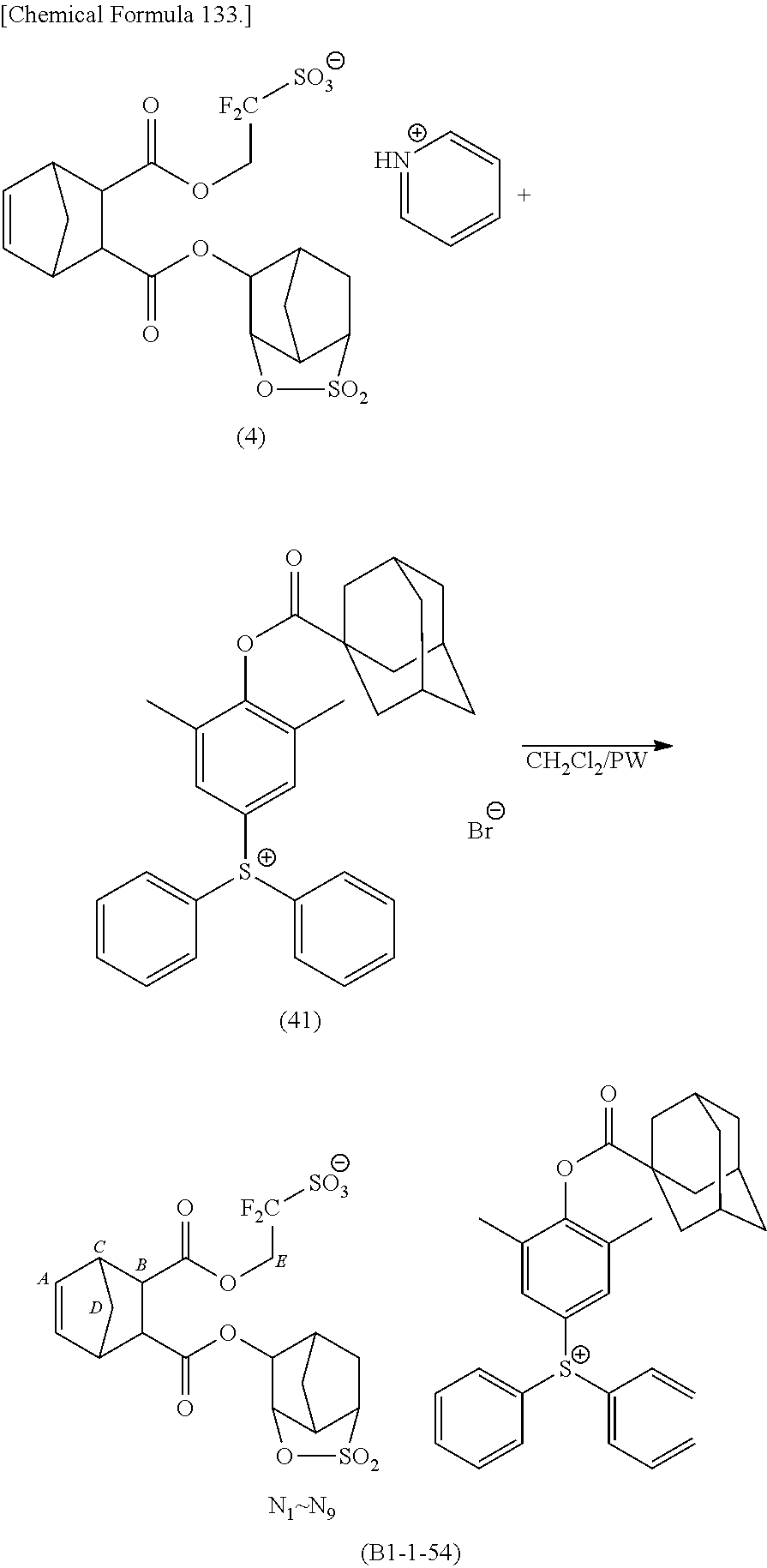


| TABLE 1 | ||
| Compound | Compound | |
| (B1-1-1) | (B2-3) | |
| (S)-1 | 10 | wt % | <1 | wt % |
| (S)-2 | <1 | wt % | <1 | wt % |
| (S)-3 | 10 | wt % | 3 | wt % |
| (S)-4 | 10 | wt % | 10 | wt % |
| (S)-5 | 10 | wt % | <1 | wt % |
| TABLE 2 | |||||
| Component | Component | Component | Component | ||
| (A) | (B) | (D) | (E) | Component (S) | |
| Ex. 78 | (A)-1 | (B)-1 | (D)-1 | (E)-1 | (S)-6 | (S)-5 |
| [100] | [10.75] | [1.20] | [1.32] | [10.00] | [2120] | |
| Comp. Ex. | (A)-1 | (B)-2 | (D)-1 | (E)-1 | (S)-6 | (S)-5 |
| 3 | [100] | [10.42] | [1.20] | [1.32] | [10.00] | [2120] |
| Comp. Ex. | (A)-1 | (B)-3 | (D)-1 | (E)-1 | (S)-6 | (S)-5 |
| 4 | [100] | [8.56] | [1.20] | [1.32] | [10.00] | [2120] |
| Ex. 79 | (A)-1 | (B)-4 | (D)-1 | (E)-1 | (S)-6 | (S)-5 |
| [100] | [10.28] | [1.20] | [1.32] | [10.00] | [2120] | |
| Ex. 80 | (A)-1 | (B)-5 | (D)-1 | (E)-1 | (S)-6 | (S)-5 |
| [100] | [10.78] | [1.20] | [1.32] | [10.00] | [2120] | |
| Ex. 81 | (A)-1 | (B)-6 | (D)-1 | (E)-1 | (S)-6 | (S)-5 |
| [100] | [10.31] | [1.20] | [1.32] | [10.00] | [2120] | |

MEF=|CD130−CD120|/|MD130−MD120|
EL margin (%)=(|E1−E2|/Eop)×100
| TABLE 3 | ||||||
| Comp. | Comp. | |||||
| Ex. 78 | Ex. 3 | Ex. 4 | Ex. 79 | Ex. 80 | Ex. 81 | |
| Eop | 57.5 | 48.3 | 39.9 | 55.0 | 54.1 | 53.1 |
| (mJ/cm2) | ||||||
| LWR (nm) | 9.3 | 11.6 | 12.2 | 9.6 | 10.1 | 10.3 |
| MEF | 1.58 | 2.30 | 2.35 | 1.78 | 1.74 | 1.82 |
| EL margin | 9.14 | 7.74 | 7.29 | 8.81 | 8.77 | 8.56 |
| (%) | ||||||
| TABLE 4 | ||||||
| Component | Component | Component | ||||
| (A) | Component (B) | (E) | (F) | Component (S) | |
| Ex. 82 | (A)-2 | (B)-7 | (B)-10 | (E)-1 | (F)-1 | (S)-6 | (S)-5 |
| [100] | [11.06] | [3.4] | [0.25] | [3.0] | [25] | [2400] | |
| Comp. | (A)-2 | (B)-8 | (B)-10 | (E)-1 | (F)-1 | (S)-6 | (S)-5 |
| Ex. 5 | [100] | [8.91] | [3.4] | [0.25] | [3.0] | [25] | [2400] |
| Comp. | (A)-2 | (B)-9 | (B)-10 | (E)-1 | (F)-1 | (S)-6 | (S)-5 |
| Ex. 6 | [100] | [9.4] | [3.4] | [0.25] | [3.0] | [25] | [2400] |

[Mw=6,900, Mw/Mn=1.61, the subscript numerals shown to the bottom right of the parentheses ( ) indicate the percentage (mol %) of the respective structural units within the copolymer.]

[Mw=20,000, Mw/Mn=1.5, the subscript numerals shown to the bottom right of the parentheses ( ) indicate the percentage (mol %) of the respective structural units within the copolymer.]
| TABLE 5 | ||||
| Eop | EL | LWR | ||
| (mJ/cm2) | (nm/(mJ/cm2)) | (nm) | MEF | |
| Ex. 82 | 36.4 | 1.49 | 4.37 | 2.52 |
| Comp. | 28.3 | 1.90 | 4.59 | 2.63 |
| Ex. 5 | ||||
| Comp. | 22.4 | 2.86 | 4.94 | 3.03 |
| Ex. 6 | ||||
| TABLE 6 | ||||||
| Component | Component | Component | Component | Component | EL margin | |
| (A) | (B) | (D) | (E) | (S) | (%) | |
| Ex. 83 | (A)-3 | (B)-11 | (D)-2 | (E)-1 | (S)-5 | 14 |
| [100] | [46.0] | [2.0] | [0.8] | [3000] | ||
| Comp. | (A)-3 | (B)-12 | (D)-2 | (E)-1 | (S)-5 | 8 |
| Ex. 7 | [100] | [39.2] | [2.0] | [0.8] | [3000] | |

[Mw=7,000, Mw/Mn=1.7, the subscript numerals shown to the bottom right of the parentheses ( ) indicate the percentage (mol %) of the respective structural units within the copolymer.]

Claims (6)


Applications Claiming Priority (2)
| Application Number | Priority Date | Filing Date | Title |
|---|---|---|---|
| JP2010-115452 | 2010-05-19 | ||
| JP2010115452 | 2010-05-19 |
Publications (2)
| Publication Number | Publication Date |
|---|---|
| US20110287362A1 US20110287362A1 (en) | 2011-11-24 |
| US8932795B2 true US8932795B2 (en) | 2015-01-13 |
Family
ID=44972759
Family Applications (1)
| Application Number | Title | Priority Date | Filing Date |
|---|---|---|---|
| US13/106,691 Active 2031-06-12 US8932795B2 (en) | 2010-05-19 | 2011-05-12 | Resist composition, method of forming resist pattern, novel compound, and acid generator |
Country Status (3)
| Country | Link |
|---|---|
| US (1) | US8932795B2 (en) |
| JP (1) | JP5798792B2 (en) |
| KR (1) | KR101688665B1 (en) |
Cited By (2)
| Publication number | Priority date | Publication date | Assignee | Title |
|---|---|---|---|---|
| US11680040B2 (en) | 2018-10-11 | 2023-06-20 | Lg Chem, Ltd. | Compound, photoresist composition comprising same, photoresist pattern comprising same, and method for manufacturing photoresist pattern |
| US11834419B2 (en) | 2018-10-11 | 2023-12-05 | Lg Chem, Ltd. | Compound, photoresist composition comprising same, photoresist pattern comprising same, and method for manufacturing photoresist pattern |
Families Citing this family (26)
| Publication number | Priority date | Publication date | Assignee | Title |
|---|---|---|---|---|
| KR101811881B1 (en) * | 2010-07-29 | 2017-12-22 | 스미또모 가가꾸 가부시끼가이샤 | Salt and photoresist composition |
| JP2012194292A (en) * | 2011-03-15 | 2012-10-11 | Jsr Corp | Photoresist composition |
| JP2012242813A (en) * | 2011-05-24 | 2012-12-10 | Jsr Corp | Radiation sensitive resin composition and method for forming resist pattern |
| JP5814072B2 (en) * | 2011-10-25 | 2015-11-17 | 東京応化工業株式会社 | Resist composition, resist pattern forming method, novel compound, acid generator |
| JP6097568B2 (en) * | 2012-01-19 | 2017-03-15 | 住友化学株式会社 | Salt, resist composition and method for producing resist pattern |
| JP5948090B2 (en) * | 2012-03-02 | 2016-07-06 | 東京応化工業株式会社 | Compound, polymer compound, acid generator, resist composition, resist pattern forming method |
| WO2013156509A2 (en) * | 2012-04-19 | 2013-10-24 | Basf Se | Sulfonium compounds, their preparation and use |
| JP5830503B2 (en) * | 2012-09-15 | 2015-12-09 | ローム アンド ハース エレクトロニック マテリアルズ エルエルシーRohm and Haas Electronic Materials LLC | Acid generator compound and photoresist containing the same |
| JP5790631B2 (en) * | 2012-12-10 | 2015-10-07 | 信越化学工業株式会社 | Sulfonium salt and polymer compound, resist material, pattern forming method, and method for producing the polymer compound |
| JP6025600B2 (en) * | 2013-02-19 | 2016-11-16 | 富士フイルム株式会社 | Actinic ray-sensitive or radiation-sensitive resin composition, actinic ray-sensitive or radiation-sensitive film and pattern forming method |
| US9921475B1 (en) * | 2016-08-31 | 2018-03-20 | Rohm And Haas Electronic Materials Llc | Photoacid-generating compound, polymer derived therefrom, photoresist composition including the photoacid-generating compound or polymer, and method of forming a photoresist relief image |
| JP7197988B2 (en) * | 2017-03-28 | 2022-12-28 | 住友化学株式会社 | Salt, acid generator, resist composition and method for producing resist pattern |
| JP7101541B2 (en) | 2018-05-28 | 2022-07-15 | 東京応化工業株式会社 | Resist composition and resist pattern forming method |
| JP7186516B2 (en) * | 2018-05-28 | 2022-12-09 | 東京応化工業株式会社 | Resist composition, resist pattern forming method, compound, and acid generator |
| KR102707717B1 (en) * | 2018-05-28 | 2024-09-19 | 도오꾜오까고오교 가부시끼가이샤 | Resist composition, method of forming resist pattern, compound, and acid generator |
| JP7285695B2 (en) * | 2018-05-28 | 2023-06-02 | 東京応化工業株式会社 | Resist composition, resist pattern forming method, compound, and acid generator |
| JP7178800B2 (en) * | 2018-05-28 | 2022-11-28 | 東京応化工業株式会社 | Resist composition and resist pattern forming method |
| JP7094144B2 (en) * | 2018-05-28 | 2022-07-01 | 東京応化工業株式会社 | Resist composition and resist pattern forming method, as well as compounds and acid generators |
| JP2019207300A (en) * | 2018-05-28 | 2019-12-05 | 東京応化工業株式会社 | Resist composition and resist pattern forming method |
| KR102673929B1 (en) | 2018-05-28 | 2024-06-10 | 도오꾜오까고오교 가부시끼가이샤 | Resist composition and method of forming resist pattern |
| KR102710876B1 (en) * | 2018-05-28 | 2024-09-27 | 도오꾜오까고오교 가부시끼가이샤 | Resist composition, and method of forming resist pattern |
| JP7094146B2 (en) * | 2018-05-28 | 2022-07-01 | 東京応化工業株式会社 | Resist composition and resist pattern forming method |
| JP7412144B2 (en) * | 2018-11-26 | 2024-01-12 | 住友化学株式会社 | Resist composition and resist pattern manufacturing method |
| JP7503376B2 (en) * | 2018-12-10 | 2024-06-20 | 住友化学株式会社 | Salt, acid generator, resist composition and method for producing resist pattern |
| JP7509563B2 (en) * | 2019-04-18 | 2024-07-02 | 住友化学株式会社 | Salt, acid generator, resist composition and method for producing resist pattern |
| JP7587365B2 (en) * | 2019-07-29 | 2024-11-20 | 住友化学株式会社 | Salt, acid generator, resist composition and method for producing resist pattern |
Citations (21)
| Publication number | Priority date | Publication date | Assignee | Title |
|---|---|---|---|---|
| JPH09208554A (en) | 1996-02-02 | 1997-08-12 | Tokyo Ohka Kogyo Co Ltd | Oxime sulfonate compound and acid generating agent for resist |
| JPH1135552A (en) | 1997-07-24 | 1999-02-09 | Tokyo Ohka Kogyo Co Ltd | New diazomethane compound |
| JPH1135551A (en) | 1997-07-24 | 1999-02-09 | Tokyo Ohka Kogyo Co Ltd | New sulfonyldiazomethane compound |
| JPH1135573A (en) | 1997-07-24 | 1999-02-09 | Tokyo Ohka Kogyo Co Ltd | New bissulfonyldiazomethane |
| US5945517A (en) | 1996-07-24 | 1999-08-31 | Tokyo Ohka Kogyo Co., Ltd. | Chemical-sensitization photoresist composition |
| JPH11322707A (en) | 1998-05-18 | 1999-11-24 | Tokyo Ohka Kogyo Co Ltd | Poly (disulfonyldiazomethane) compound |
| JP2000206694A (en) | 1998-11-10 | 2000-07-28 | Tokyo Ohka Kogyo Co Ltd | Negative resist composition |
| US6153733A (en) | 1998-05-18 | 2000-11-28 | Tokyo Ohka Kogyo Co., Ltd. | (Disulfonyl diazomethane compounds) |
| JP2003241385A (en) | 2001-12-03 | 2003-08-27 | Tokyo Ohka Kogyo Co Ltd | Positive resist composition and method of forming resist pattern using the same |
| WO2004074242A2 (en) | 2003-02-19 | 2004-09-02 | Ciba Specialty Chemicals Holding Inc. | Halogenated oxime derivatives and the use thereof as latent acids |
| US6949325B2 (en) | 2003-09-16 | 2005-09-27 | International Business Machines Corporation | Negative resist composition with fluorosulfonamide-containing polymer |
| JP2005336452A (en) | 2004-04-27 | 2005-12-08 | Tokyo Ohka Kogyo Co Ltd | Resin for resist composition, negative type resist composition and method for forming resist pattern |
| JP2006259582A (en) | 2005-03-18 | 2006-09-28 | Tokyo Ohka Kogyo Co Ltd | Negative resist composition and resist pattern forming method |
| JP2006317803A (en) | 2005-05-13 | 2006-11-24 | Tokyo Ohka Kogyo Co Ltd | Negative resist composition and resist pattern forming method |
| US20080220369A1 (en) * | 2007-03-07 | 2008-09-11 | Sumitomo Chemical Company, Limited | Chemically amplified resist composition |
| US20080311522A1 (en) * | 2007-06-13 | 2008-12-18 | Tokyo Ohka Kogyo Co., Ltd. | Resist composition, method of forming resist pattern, compound and acid generator |
| US20090162788A1 (en) * | 2007-12-21 | 2009-06-25 | Tokyo Ohka Kogyo Co., Ltd. | Novel compound and method of producing the same, acid generator, resist composition and method of forming resist pattern |
| US20090214982A1 (en) * | 2008-02-22 | 2009-08-27 | Tokyo Ohka Kogyo Co., Ltd. | Positive resist composition, method of forming resist pattern, and polymeric compound |
| US20090246694A1 (en) * | 2008-03-25 | 2009-10-01 | Youichi Ohsawa | Novel photoacid generator, resist composition, and patterning process |
| US20090317743A1 (en) | 2008-06-23 | 2009-12-24 | Tokyo Ohka Kogyo Co., Ltd. | Resist composition for immersion exposure, method of forming resist pattern, and flourine-containing polymeric compound |
| US20100323296A1 (en) * | 2009-06-23 | 2010-12-23 | Sumitomo Chemical Company, Limited | Resin and resist composition |
Family Cites Families (9)
| Publication number | Priority date | Publication date | Assignee | Title |
|---|---|---|---|---|
| JP5245326B2 (en) * | 2006-08-22 | 2013-07-24 | 住友化学株式会社 | Salt for acid generator of chemically amplified resist composition |
| KR20080070559A (en) * | 2007-01-25 | 2008-07-30 | 삼성전자주식회사 | Photoacid generator, photoresist composition and pattern formation method comprising the same |
| JP5687442B2 (en) * | 2009-06-22 | 2015-03-18 | ローム・アンド・ハース・エレクトロニック・マテリアルズ,エル.エル.シー. | Photoacid generator and photoresist containing the same |
| JP5756265B2 (en) * | 2009-07-27 | 2015-07-29 | 住友化学株式会社 | Chemically amplified resist composition and salt used therefor |
| JP5598274B2 (en) * | 2009-11-18 | 2014-10-01 | 住友化学株式会社 | Salt and resist composition for acid generator |
| JP5598275B2 (en) * | 2009-11-18 | 2014-10-01 | 住友化学株式会社 | Salt and resist composition for acid generator |
| JP5703702B2 (en) * | 2009-11-18 | 2015-04-22 | 住友化学株式会社 | Salt and resist composition for acid generator |
| KR20120128680A (en) * | 2010-03-17 | 2012-11-27 | 제이에스알 가부시끼가이샤 | Radiation-sensitive resin composition and resist pattern formation method |
| JP2012005907A (en) * | 2011-10-14 | 2012-01-12 | Sanyo Product Co Ltd | Game machine |
-
2011
- 2011-05-12 US US13/106,691 patent/US8932795B2/en active Active
- 2011-05-13 JP JP2011108667A patent/JP5798792B2/en active Active
- 2011-05-16 KR KR1020110045531A patent/KR101688665B1/en active Active
Patent Citations (25)
| Publication number | Priority date | Publication date | Assignee | Title |
|---|---|---|---|---|
| JPH09208554A (en) | 1996-02-02 | 1997-08-12 | Tokyo Ohka Kogyo Co Ltd | Oxime sulfonate compound and acid generating agent for resist |
| US5945517A (en) | 1996-07-24 | 1999-08-31 | Tokyo Ohka Kogyo Co., Ltd. | Chemical-sensitization photoresist composition |
| JPH1135552A (en) | 1997-07-24 | 1999-02-09 | Tokyo Ohka Kogyo Co Ltd | New diazomethane compound |
| JPH1135551A (en) | 1997-07-24 | 1999-02-09 | Tokyo Ohka Kogyo Co Ltd | New sulfonyldiazomethane compound |
| JPH1135573A (en) | 1997-07-24 | 1999-02-09 | Tokyo Ohka Kogyo Co Ltd | New bissulfonyldiazomethane |
| US6153733A (en) | 1998-05-18 | 2000-11-28 | Tokyo Ohka Kogyo Co., Ltd. | (Disulfonyl diazomethane compounds) |
| JPH11322707A (en) | 1998-05-18 | 1999-11-24 | Tokyo Ohka Kogyo Co Ltd | Poly (disulfonyldiazomethane) compound |
| JP2000206694A (en) | 1998-11-10 | 2000-07-28 | Tokyo Ohka Kogyo Co Ltd | Negative resist composition |
| US6444397B2 (en) | 1998-11-10 | 2002-09-03 | Tokyo Ohka Kogyo Co., Ltd. | Negative-working photoresist composition |
| JP2003241385A (en) | 2001-12-03 | 2003-08-27 | Tokyo Ohka Kogyo Co Ltd | Positive resist composition and method of forming resist pattern using the same |
| US7074543B2 (en) | 2001-12-03 | 2006-07-11 | Tokyo Ohka Kogyo Co., Ltd. | Positive resist composition and method of forming resist pattern from the same |
| WO2004074242A2 (en) | 2003-02-19 | 2004-09-02 | Ciba Specialty Chemicals Holding Inc. | Halogenated oxime derivatives and the use thereof as latent acids |
| US6949325B2 (en) | 2003-09-16 | 2005-09-27 | International Business Machines Corporation | Negative resist composition with fluorosulfonamide-containing polymer |
| JP2005336452A (en) | 2004-04-27 | 2005-12-08 | Tokyo Ohka Kogyo Co Ltd | Resin for resist composition, negative type resist composition and method for forming resist pattern |
| JP2006259582A (en) | 2005-03-18 | 2006-09-28 | Tokyo Ohka Kogyo Co Ltd | Negative resist composition and resist pattern forming method |
| JP2006317803A (en) | 2005-05-13 | 2006-11-24 | Tokyo Ohka Kogyo Co Ltd | Negative resist composition and resist pattern forming method |
| US20080220369A1 (en) * | 2007-03-07 | 2008-09-11 | Sumitomo Chemical Company, Limited | Chemically amplified resist composition |
| US20080311522A1 (en) * | 2007-06-13 | 2008-12-18 | Tokyo Ohka Kogyo Co., Ltd. | Resist composition, method of forming resist pattern, compound and acid generator |
| US20090162788A1 (en) * | 2007-12-21 | 2009-06-25 | Tokyo Ohka Kogyo Co., Ltd. | Novel compound and method of producing the same, acid generator, resist composition and method of forming resist pattern |
| US20090214982A1 (en) * | 2008-02-22 | 2009-08-27 | Tokyo Ohka Kogyo Co., Ltd. | Positive resist composition, method of forming resist pattern, and polymeric compound |
| US20090246694A1 (en) * | 2008-03-25 | 2009-10-01 | Youichi Ohsawa | Novel photoacid generator, resist composition, and patterning process |
| JP2009258695A (en) | 2008-03-25 | 2009-11-05 | Shin Etsu Chem Co Ltd | New photoacid generator, resist material, and patterning process |
| US20090317743A1 (en) | 2008-06-23 | 2009-12-24 | Tokyo Ohka Kogyo Co., Ltd. | Resist composition for immersion exposure, method of forming resist pattern, and flourine-containing polymeric compound |
| JP2010002870A (en) | 2008-06-23 | 2010-01-07 | Tokyo Ohka Kogyo Co Ltd | Resist composition for liquid immersion lithography, resist pattern forming method, and fluorine-containing polymer compound |
| US20100323296A1 (en) * | 2009-06-23 | 2010-12-23 | Sumitomo Chemical Company, Limited | Resin and resist composition |
Cited By (2)
| Publication number | Priority date | Publication date | Assignee | Title |
|---|---|---|---|---|
| US11680040B2 (en) | 2018-10-11 | 2023-06-20 | Lg Chem, Ltd. | Compound, photoresist composition comprising same, photoresist pattern comprising same, and method for manufacturing photoresist pattern |
| US11834419B2 (en) | 2018-10-11 | 2023-12-05 | Lg Chem, Ltd. | Compound, photoresist composition comprising same, photoresist pattern comprising same, and method for manufacturing photoresist pattern |
Also Published As
| Publication number | Publication date |
|---|---|
| JP5798792B2 (en) | 2015-10-21 |
| JP2012003249A (en) | 2012-01-05 |
| US20110287362A1 (en) | 2011-11-24 |
| KR20110127601A (en) | 2011-11-25 |
| KR101688665B1 (en) | 2016-12-21 |
Similar Documents
| Publication | Publication Date | Title |
|---|---|---|
| US8932795B2 (en) | Resist composition, method of forming resist pattern, novel compound, and acid generator | |
| US9023581B2 (en) | Resist composition, method of forming resist pattern, polymeric compound, and compound | |
| US8497395B2 (en) | Compound | |
| US9005874B2 (en) | Compound, polymeric compound, acid generator, resist composition, and method of forming resist pattern | |
| US8338076B2 (en) | Resist composition, method of forming resist pattern, novel compound, and acid generator | |
| US8541157B2 (en) | Resist composition, method of forming resist pattern, compound and acid generator including the same | |
| US8268529B2 (en) | Positive resist composition, method of forming resist pattern using the same, and polymeric compound | |
| US8367297B2 (en) | Resist composition, method of forming resist pattern, novel compound and acid generator | |
| US9040220B2 (en) | Compound and method of producing the same, acid generator, resist composition and method of forming resist pattern | |
| US7776510B2 (en) | Resist composition, method of forming resist pattern, compound and acid generator | |
| US8685620B2 (en) | Resist composition, method of forming resist pattern and polymeric compound | |
| US8283105B2 (en) | Positive resist composition and method of forming resist pattern | |
| US8487056B2 (en) | Positive resist composition and method of forming resist pattern | |
| US7960091B2 (en) | Resist composition and method of forming resist pattern | |
| US8765352B2 (en) | Resist composition, method of forming resist pattern, novel compound, and acid generator | |
| US20090226842A1 (en) | Resist composition and method of forming resist pattern | |
| US7488568B2 (en) | Resist composition, method of forming resist pattern, compound and acid generator | |
| US8916332B2 (en) | Resist composition, method of forming resist pattern, and polymeric compound | |
| US20120015299A1 (en) | Resist composition, method of forming resist pattern, novel compound, and acid generator | |
| US8703387B2 (en) | Resist composition, method of forming resist pattern, novel compound, and acid generator | |
| US8247160B2 (en) | Resist composition, method of forming resist pattern, and novel compound and acid generator | |
| US8927191B2 (en) | Resist composition, method of forming resist pattern and polymeric compound | |
| US8367296B2 (en) | Positive resist composition, method of forming resist pattern, and polymeric compound | |
| US8268530B2 (en) | Positive resist composition, method of forming resist pattern, polymeric compound, and compound | |
| US8735045B2 (en) | Positive resist composition, method of forming resist pattern, and polymeric compound |
Legal Events
| Date | Code | Title | Description |
|---|---|---|---|
| AS | Assignment |
Owner name: TOKYO OHKA KOGYO CO., LTD., JAPAN Free format text: ASSIGNMENT OF ASSIGNORS INTEREST;ASSIGNORS:SESHIMO, TAKEHIRO;UTSUMI, YOSHIYUKI;DOHTANI, KAZUSHIGE;REEL/FRAME:026303/0391 Effective date: 20110509 |
|
| STCF | Information on status: patent grant |
Free format text: PATENTED CASE |
|
| CC | Certificate of correction | ||
| MAFP | Maintenance fee payment |
Free format text: PAYMENT OF MAINTENANCE FEE, 4TH YEAR, LARGE ENTITY (ORIGINAL EVENT CODE: M1551) Year of fee payment: 4 |
|
| MAFP | Maintenance fee payment |
Free format text: PAYMENT OF MAINTENANCE FEE, 8TH YEAR, LARGE ENTITY (ORIGINAL EVENT CODE: M1552); ENTITY STATUS OF PATENT OWNER: LARGE ENTITY Year of fee payment: 8 |