US8928512B2 - Digital to analog converter and method for controlling current source array in digital to analog converter - Google Patents

Digital to analog converter and method for controlling current source array in digital to analog converter Download PDF

Info

Publication number
US8928512B2
US8928512B2 US14/142,597 US201314142597A US8928512B2 US 8928512 B2 US8928512 B2 US 8928512B2 US 201314142597 A US201314142597 A US 201314142597A US 8928512 B2 US8928512 B2 US 8928512B2
Authority
US
United States
Prior art keywords
bit
unit
diagonal
unit switches
temperature code
Prior art date
Legal status (The legal status is an assumption and is not a legal conclusion. Google has not performed a legal analysis and makes no representation as to the accuracy of the status listed.)
Active
Application number
US14/142,597
Other versions
US20140197974A1 (en
Inventor
Haiquan YUAN
Peng Gao
Current Assignee (The listed assignees may be inaccurate. Google has not performed a legal analysis and makes no representation or warranty as to the accuracy of the list.)
Huawei Technologies Co Ltd
Original Assignee
Huawei Technologies Co Ltd
Priority date (The priority date is an assumption and is not a legal conclusion. Google has not performed a legal analysis and makes no representation as to the accuracy of the date listed.)
Filing date
Publication date
Application filed by Huawei Technologies Co Ltd filed Critical Huawei Technologies Co Ltd
Publication of US20140197974A1 publication Critical patent/US20140197974A1/en
Assigned to HUAWEI TECHNOLOGIES CO., LTD. reassignment HUAWEI TECHNOLOGIES CO., LTD. ASSIGNMENT OF ASSIGNORS INTEREST (SEE DOCUMENT FOR DETAILS). Assignors: GAO, PENG, YUAN, HAIQUAN
Application granted granted Critical
Publication of US8928512B2 publication Critical patent/US8928512B2/en
Active legal-status Critical Current
Anticipated expiration legal-status Critical

Links

Images

Classifications

    • HELECTRICITY
    • H03ELECTRONIC CIRCUITRY
    • H03MCODING; DECODING; CODE CONVERSION IN GENERAL
    • H03M1/00Analogue/digital conversion; Digital/analogue conversion
    • H03M1/66Digital/analogue converters
    • H03M1/68Digital/analogue converters with conversions of different sensitivity, i.e. one conversion relating to the more significant digital bits and another conversion to the less significant bits
    • H03M1/682Digital/analogue converters with conversions of different sensitivity, i.e. one conversion relating to the more significant digital bits and another conversion to the less significant bits both converters being of the unary decoded type
    • H03M1/685Digital/analogue converters with conversions of different sensitivity, i.e. one conversion relating to the more significant digital bits and another conversion to the less significant bits both converters being of the unary decoded type the quantisation value generators of both converters being arranged in a common two-dimensional array
    • HELECTRICITY
    • H03ELECTRONIC CIRCUITRY
    • H03MCODING; DECODING; CODE CONVERSION IN GENERAL
    • H03M1/00Analogue/digital conversion; Digital/analogue conversion
    • H03M1/66Digital/analogue converters
    • H03M1/74Simultaneous conversion
    • H03M1/742Simultaneous conversion using current sources as quantisation value generators
    • H03M1/747Simultaneous conversion using current sources as quantisation value generators with equal currents which are switched by unary decoded digital signals

Definitions

  • the present invention relates to the field of electronic technologies, and in particular, to a digital to analog converter and a method for controlling a current source array in a digital to analog converter.
  • a high-speed DAC generally is a current source DAC, and a high precision requires good matching between unit current sources.
  • DAC Digital Analog Converter
  • the prior art has introduced a lot, and a current source DAC has been widely applied to various industrial scenarios.
  • a system error is one of main factors that affect the matching between the unit current sources.
  • System errors mainly include a linear gradient error and a square gradient error.
  • a random error generally can be reduced significantly by increasing the area of a unit current source, but the system error may deteriorate with the increase of the circuit area.
  • the system error can be changed by designing different turn-on sequences for unit current sources in a current source array.
  • solutions for controlling a turn-on sequence of unit current sources in a current source array mainly include: sequential turn-on, symmetrical turn-on, layered symmetrical turn-on, random turn-on, and so on.
  • the existing solutions for controlling a turn-on sequence of unit current sources are not ideal for eliminating a system error.
  • Embodiments of the present invention provide a digital to analog converter and a method for controlling a current source array in a digital to analog converter, which are used to reduce a system error, thereby improving conversion precision of the digital to analog converter.
  • a digital to analog converter including a decoding module, a switch array connected to the decoding module, and a current source array connected to the switch array, where:
  • the first diagonals are non-middle diagonals
  • the second diagonal is a middle diagonal
  • n is greater than or equal to 3
  • the switching all unit switches on a second diagonal except the 2 n ⁇ 1 first diagonals in the 2 n ⁇ 2 n matrix according to a preset sequence includes:
  • the switching all unit switches on the second diagonal in ascending order of distances away from two quartering points except the midpoint on the second diagonal in the 2 n ⁇ 2 n matrix includes:
  • the decoding module includes:
  • control module is specifically configured to control, under the control of a software driver and by using the 2 n ⁇ 1-bit first temperature code and the 2 n ⁇ 1-bit second temperature code, the working sequence of the 2 n ⁇ 2 n ⁇ 1 unit switches in the manner.
  • a method for controlling a current source array in a digital to analog converter includes a switch array and a current source array connected to the switch array;
  • the switch array includes 2 n ⁇ 2 n ⁇ 1 unit switches, which include 2 n ⁇ (2 n ⁇ 1) high-order unit switches and 2 n ⁇ 1 low-order unit switches;
  • the current source array includes 2 n ⁇ 2 n ⁇ 1 unit current sources; each unit switch is configured to control an output of one unit current source; outputs of the 2 n ⁇ 2 n ⁇ 1 unit current sources are used to generate an output of the digital to analog converter;
  • n is a positive integer; and the method includes:
  • the first diagonals are non-middle diagonals
  • the second diagonal is a middle diagonal
  • n is greater than or equal to 3
  • the switching all unit switches on a second diagonal except the 2 n ⁇ 1 first diagonals in the 2 n ⁇ 2 n matrix according to a preset sequence includes:
  • the switching all unit switches on the second diagonal in ascending order of distances away from two quartering points except the midpoint on the second diagonal in the 2 n ⁇ 2 n matrix includes:
  • a method for controlling a current source array in a digital to analog converter used to control outputs of unit current sources included in the current source array, where the current source array includes 2 n ⁇ 2 n ⁇ 1 unit current sources, n is a positive integer, and the method includes:
  • the first diagonals are non-middle diagonals
  • the second diagonal is a middle diagonal
  • n is greater than or equal to 3
  • the switching all unit switches on a second diagonal except the 2 n ⁇ 1 first diagonals in the 2 n ⁇ 2 n matrix according to a preset sequence and by using the 2 n ⁇ 1-bit second temperature code includes: switching all unit switches on the middle diagonal in ascending order of distances away from two quartering points except the midpoint on the middle diagonal in the 2 n ⁇ 2 n matrix by using the 2 n ⁇ 1-bit second temperature code, where the two quartering points are 2 n-2 elements away from the midpoint.
  • any bit of a 2 n ⁇ 1-bit first temperature code generated by using high n bits of an input 2n-bit binary digital signal is used to control and switch unit switches of all unit current sources on any one of 2 n ⁇ 1 first diagonals
  • any bit of a 2 n ⁇ 1-bit second temperature code generated by using low n bits of the 2n-bit binary digital signal input into the digital to analog converter is used to control and switch a unit switch of any unit current source on the remaining second diagonal, so that control over a current source array in the digital to analog converter is implemented and a system error caused by the unit current sources controlled by the high n bits is reduced, thereby improving conversion precision of the digital to analog converter and solving a problem in the prior art that conversion precision of a digital to analog converter is not high because of a system error.
  • FIG. 1 is a structural diagram of a digital to analog converter according to an embodiment of the present invention
  • FIG. 2 is a schematic structural diagram of a digital to analog converter according to an embodiment of the present invention.
  • FIG. 3(A) illustrates linear gradient errors of unit current sources in a current source array controlled by a 6-bit binary digital signal, according to an embodiment of the present invention
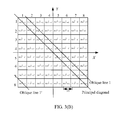
  • FIG. 3(B) illustrates square gradient errors of unit current sources in a current source array controlled by a 6-bit binary digital signal, according to an embodiment of the present invention
  • FIG. 4 is a contrastive diagram of system errors caused by different control methods when a gradient angle is 45 degrees, according to an embodiment of the present invention
  • FIG. 5 is a contrastive diagram of system errors caused by different control methods when a gradient angle is 53 degrees, according to an embodiment of the present invention
  • FIG. 6 is a contrastive diagram of system errors caused by different control methods when a unit error changes, according to an embodiment of the present invention.
  • FIG. 7 is a flowchart of a method for controlling a current source array in a digital to analog converter according to an embodiment of the present invention.
  • FIG. 1 shows a digital to analog converter 100 according to an embodiment of the present invention, where the digital to analog converter 100 includes a decoding module 10 , a switch array 20 connected to the decoding module 10 , and a current source array 30 connected to the switch array 20 .
  • the switch array 20 includes 2 n ⁇ 2 n ⁇ 1 unit switches, which include 2 n ⁇ (2 n ⁇ 1) high-order unit switches and 2 n ⁇ 1 low-order unit switches.
  • the current source array 30 includes 2 n ⁇ 2 n ⁇ 1 unit current sources.
  • Each unit switch is configured to control an output of one unit current source; and outputs of the 2 n ⁇ 2 n ⁇ 1 unit current sources are used to generate an output of the digital to analog converter.
  • the decoding module 10 is configured to generate a 2 n ⁇ 1-bit first temperature code by using high n bits of an input 2n-bit binary digital signal, and generate a 2 n ⁇ 1-bit second temperature code by using low n bits of the 2n-bit binary digital signal, where any bit of the 2 n ⁇ 1-bit first temperature code is used to control 2 n high-order unit switches, and any bit of the 2 n ⁇ 1-bit second temperature code is used to control one low-order unit switch;
  • a maximum numerical value after the conversion is 2 n ⁇ 2 n ⁇ 1. Therefore, in this embodiment of the present invention, at least 2 n ⁇ 2 n ⁇ 1 unit current sources are arranged in the digital to analog converter 100 , and 2 n ⁇ 2 n ⁇ 1 unit switches are arranged correspondingly, so as to control all unit current sources correspondingly in a one-to-one manner.
  • 2 n ⁇ 2 n unit current sources and 2 n ⁇ 2 n unit switches may also be arranged. That is to say, both the switch array 20 and the current source array 30 may be a 2 n ⁇ 2 n matrix with one element missing, and may be a matrix including 2 n ⁇ 2 n elements.
  • the decoding module 10 is further configured to control, by using the 2 n ⁇ 1-bit first temperature code and the 2 n ⁇ 1-bit second temperature code, a working sequence of the 2 n ⁇ 2 n ⁇ 1 unit switches in the following manner:
  • the decoding module 10 may include:
  • the control module may control, under the control of a software driver and by using the 2 n ⁇ 1-bit first temperature code and the 2 n ⁇ 1-bit second temperature code, the working sequence of the 2 n ⁇ 2 n ⁇ 1 unit switches in the manner.
  • Code of the software driver may be stored in a memory, and the control module may read the code in the memory to execute the software driver.
  • a diagonal in this embodiment of the present invention includes 2 n diagonals and specifically includes a middle diagonal and 2 n ⁇ 1 non-middle diagonals, where the middle diagonal and the non-middle diagonals are parallel to each other.
  • the so-called middle diagonal may refer to a principal diagonal from the upper left to the lower right, or may refer to a secondary diagonal from the upper right to the lower left.
  • the meaning of a non-middle diagonal is to be described in detail in the following by using a middle diagonal serving as a principal diagonal as an example. For a specific matrix form, reference may be made to FIG. 3(A) .
  • Diagonals that are parallel to the principal diagonal and located on the upper right of the principal diagonal are successively called oblique line 1, oblique line 2, . . . , oblique line i, . . . , in ascending order, and diagonals that are located on the lower left of the principal diagonal are successively called oblique line (n ⁇ 1)′, oblique line (n ⁇ 2)′, . . . , oblique line i′, . . . , in descending order.
  • a combination of any oblique line i and oblique line i′ is called a non-middle diagonal parallel to the principal diagonal.
  • the number of elements passed through by two oblique lines which form the non-middle diagonal is the same as that of the principal diagonal. That is to say, the number of elements in the matrix that are passed through by any one of the diagonals is the same.
  • both the first diagonal and the second diagonal are any one of the foregoing diagonals, and each diagonal includes 2 n elements, where there are 2 n ⁇ 1 first diagonals and one second diagonal.
  • this unit current source that does not function is located on the second diagonal. Further, preferably, this unit current source that does not function is located at one of two ends of the second diagonal.
  • the current source array 30 is a 2 n ⁇ 2 n matrix including 2 n ⁇ 2 n ⁇ 1 elements
  • the first diagonal is a diagonal that is among the foregoing diagonals and includes 2 n elements
  • the second diagonal is a diagonal that is among the foregoing diagonals and includes 2 n ⁇ 1 elements.
  • the element missing from the 2 n ⁇ 2 n matrix including 2 n ⁇ 2 n ⁇ 1 elements is located at one of two ends of the second diagonal.
  • the first diagonal and the second diagonal may also be defined by using the secondary diagonal of the 2 n ⁇ 2 n matrix as a reference standard.
  • a defining method is similar to the above, which is not described herein again.
  • each unit switch is configured to control an output of one unit current source
  • the switch array 20 is configured to guide outputs of currents of unit current sources on the first diagonals under the control of the first temperature code, and guide outputs of currents of unit current sources on the second diagonal under the control of the second temperature code.
  • a unit switch may be a single-pole single-throw switch or a single-pole double-throw switch.
  • the switch array 20 may control guidance of outputs of currents of all unit current sources of the current source array 30 and use the sum of the currents of all unit current sources as an output of the digital to analog converter 100 .
  • the switch array 20 may separately guide the currents output by the current source array 30 to a positive output terminal or a negative output terminal of the digital to analog converter.
  • Either output terminal of the two output terminals may be used as the output of the digital to analog converter 100 , or a difference between the two output terminals may be used as the output of the digital to analog converter 100 .
  • the unit switch may include another type, and the output of the digital to analog converter 100 may also be implemented by using another method, which is not limited in this embodiment.
  • FIG. 2 is a schematic structural diagram of the digital to analog converter 100 when the unit switch is a single-pole single-throw switch.
  • a digital electrical signal input into the digital to analog converter 100 is a 6-bit binary digital signal, low 3 bits of the 6-bit binary digital signal are marked as b0, b1, and b2, and high 3 bits are marked as b3, b4, and b5.
  • decoders mentioned in this embodiment include two parts, a first decoder and a second decoder. The actual quantity of decoders can be configured flexibly, and the decoders may be implemented by any one or more decoder devices.
  • the first decoder generates a 7-bit first temperature code by using the high 3 bits, where each bit of the 7-bit first temperature code is marked as MSB1, MSB2, . . . , and MSB7, and each bit of the 7-bit first temperature code controls and switches unit switches of eight unit current sources on a first diagonal, so as to control the eight unit current sources. Eight unit current sources on each first diagonal are marked as an MSB, which is actually composed of eight unit current sources (each marked as an LSB).
  • the second decoder generates a 7-bit second temperature code by using the low 3 bits, where each bit of the 7-bit second temperature code is marked as LSB1, LSB2, . . .
  • each bit of the 7-bit second temperature code controls and switches a unit switch of one unit current source on the second diagonal, and the unit current source on the second diagonal is marked as an LSB (unit current source).
  • LSB unit current source
  • the sum of the currents of all the unit current sources may be used as the output of the digital to analog converter 100 , and the current is output through an output port (output).
  • Each bit of the temperature code has two states, 1 and 0, so as to control a switch corresponding to a unit current source, where the switch may be an MOS (metal-oxide semiconductor) switch.
  • the temperature code 1 may indicate that the switch is on and 0 indicates that the switch is off, and vice versa.
  • the digital electrical signal input into the digital to analog converter 100 is a 6-bit binary digital signal for description.
  • the current source array 30 is an 8 ⁇ 8 matrix including 63 elements. That is, the number of unit current sources is 63; the number of first diagonals is 7, and the number of unit current sources on each first diagonal is 8; the number of second diagonals is 1, and the number of unit current sources on the second diagonal is 7; and the number of unit switches in the switch array is 63.
  • a 7-bit temperature code is represented as:
  • bits of the 7-bit temperature code are identified as bit 0 to bit 6 from right to left, and it can be known that bits 1 , 2 , and 4 of the 7-bit temperature code are in the state “1” and that bits 0 , 3 , 5 , and 6 are in the state “0”.
  • bits 1 , 2 , and 4 may be used to control and switch unit switches of unit current sources on any three of the first diagonals in the current source array 30 , so as to guide the currents of the unit current sources on the three first diagonals to an output terminal; and bits 0 , 3 , 5 , and 6 may be used to control and switch on-off of unit switches of unit current sources on the remaining 4 first diagonals in the current source array 30 . In this case, the currents of the current sources are not guided to the output terminal.
  • bits 1 , 2 , and 4 may be used to control and switch unit switches of any three unit current sources on the second diagonal in the current source array 30 , so as to guide the currents of the three unit current sources to an output terminal; and bits 0 , 3 , 5 , and 6 may be used to control and switch on-off of unit switches of the four remaining unit current sources on the second diagonal of the current source array 30 .
  • any bit of the 2 n ⁇ 1-bit first temperature code is used to control and switch unit switches of all unit current sources on any one of the 2 n ⁇ 1 first diagonals may include that the 2 n ⁇ 1-bit first temperature code is used to control and switch unit switches of all unit current sources on the 2 n ⁇ 1 first diagonals correspondingly in a one-to-one manner.
  • bit 7 of the first temperature code can be used to control and switch unit switches of unit current sources on the three first diagonals of the combination of oblique line 2 and oblique line 2′, the combination of oblique line 3 and oblique line 3′, and the combination of oblique line 5 and oblique line 5′.
  • the first diagonals are non-middle diagonals
  • the second diagonal is a middle diagonal
  • the switching all the unit switches on a second diagonal except the 2 n ⁇ 1 first diagonals in the 2 n ⁇ 2 n matrix according to a preset sequence may include:
  • the middle diagonal may be a principal diagonal or a secondary diagonal.
  • the middle diagonal is selected as a principal diagonal for description.
  • the switching all unit switches on the second diagonal in ascending order of distances away from two quartering points except the midpoint on the second diagonal in the 2 n ⁇ 2 n matrix includes:
  • Each unit current source in a current source array on a chip has a certain error because of processing craft differences, temperatures, stresses, and the like.
  • ⁇ (x, y) indicates an error of a unit current source with center coordinates (x, y) relative to the midpoint, a 0 , a 11 , . . . are coefficients of different items.
  • a first-degree item and a square item can accurately express the relative error, and a high-order item can be ignored.
  • the current source array may be regarded as an 8 ⁇ 8 matrix
  • the unit current sources may be regarded as elements of the 8 ⁇ 8 matrix
  • a space occupied by each element that is, each unit current source
  • the center of the current source array is the midpoint of the coordinates, and the relative error of the midpoint is assumed to be 0.
  • FIG. 3(B) in which a square gradient error of each unit current source relative to the midpoint is illustrated.
  • Reducing the system error of the digital to analog converter 100 is essentially reducing an accumulation of system errors of the digital to analog converter 100 , so as to ensure linearity of the DAC.
  • the second temperature code controls and switches a unit switch of a current source on the second diagonal according to a preset sequence (which is equivalent to a sequence in ascending order of distances away from the two quartering points except the midpoint on the middle diagonal).
  • the second diagonal is the principal diagonal
  • the eight unit current sources on the principal diagonal may be divided into two categories according to their distances away from the two quartering points except the midpoint on the principal diagonal.
  • the first category includes a 33 , a 22 , a 77 , and a 66
  • the second category includes a 44 , a 11 , a 55 , and a 88 , where a ii indicates a unit current source on a unit block of row i column i in the 8 ⁇ 8 matrix.
  • the 7-bit second temperature code controls and switches a unit switch of any one of the unit current sources a 33 , a 22 , a 77 , and a 66 ; and when the number of bits with the state “1” in the 7-bit second temperature code is 3, the 7-bit second temperature code controls and switches unit switches of any three of the unit current sources a 33 , a 22 , a 77 , and a 66 .
  • the preset switching sequence may include: firstly switching a unit switch of a unit current source which is the first distance away from one of the two quartering points except the midpoint, and then symmetrically switching a unit switch of a unit current source which is the first distance away from the other of the two quartering points.
  • the preset sequence may be a 33 , a 22 , a 77 , and a 66 .
  • the 7-bit second temperature code controls and switches the unit switch of a 33 ; and when the number of bits with the state “1” in the 7-bit second temperature code is 3, the 7-bit second temperature code controls and switches the unit switches of a 33 , a 22 , and a 77 .
  • is a gradient angle
  • a gradient angle of the relative error of each unit current source is related to the craft and is uncontrollable. Therefore, in digital to analog converters adopting different solutions to control and switch unit switches of unit current sources, when the gradient angle is taken as a reference standard, the less sensitive to the gradient angle, the higher precision the digital to analog converter has.
  • unit errors ⁇ x and ⁇ y between unit current sources may be set according to specific experimental data. Therefore, in digital to analog converters adopting different solutions to control and switch unit switches of unit current sources, when the unit errors are taken as a reference standard, the less sensitive to the unit errors, the higher precision the digital to analog converter has.
  • this embodiment takes that the digital electrical signal selected to be input into the digital to analog converter is an 8-bit binary digital signal as an example for description.
  • FIG. 4 and FIG. 5 are contrastive schematic diagrams in which when the digital electrical signal input into a digital to analog converter is an 8-bit binary digital signal and the gradient angles of the linear relative error relative to the x axis are 45 degrees and 53 degrees, system errors of the digital to analog converter under different control solutions change as the 8-bit binary digital signal changes
  • a, b, and c are contrastive schematic diagrams in which system errors of digital to analog converters, which adopt a sequential method, a common symmetrical solution, and a layered symmetrical solution to control unit switches of unit current sources, change as the 8-bit binary digital signal changes
  • d is a contrastive schematic diagram in which the system error of the digital to analog converter 100 provided in this solution changes as the 8-bit binary digital signal changes. It can be known from the figures that the digital to analog converter 100 provided in this solution is the least sensitive to the gradient angle.
  • FIG. 6 is a contrastive schematic diagram in which when the digital electrical signal input into the digital to analog converter 100 is an 8-bit binary digital signal and the unit errors ⁇ x and ⁇ y are enlarged by ten times compared with FIG. 4 or FIG.
  • a, b, and c are the contrastive schematic diagrams in which system errors of digital to analog converters, which adopt a sequential method, a common symmetrical solution and a layered symmetrical solution to control unit switches of unit current sources, change as the 8-bit binary digital signal changes
  • d is a contrastive schematic diagram in which the system error of the digital to analog converter 100 provided in this solution changes as the 8-bit binary digital signal changes. It can be known from the figure that the digital to analog converter 100 provided in this solution is the least sensitive to the unit errors.
  • the degrees of sensitiveness of a digital to analog converter, which adopts the random turn-on control solution, to the gradient angle and the unit errors ⁇ x and ⁇ y between unit current sources is very close to a simulation result of the digital to analog converter 100 provided in this solution.
  • the random turn-on control solution is usually not adopted.
  • any bit of a 2 n ⁇ 1-bit first temperature code generated by using high n bits of an input 2n-bit binary digital signal is used to control and switch unit switches of all unit current sources on any one of 2 n ⁇ 1 first diagonals
  • any bit of a 2 n ⁇ 1-bit second temperature code generated by using low n bits of the 2n-bit binary digital signal input into the digital to analog converter is used to control and switch a unit switch of any unit current source on the remaining second diagonal, so that control over a current source array in the digital to analog converter is implemented and a system error caused by the unit current sources controlled by the high n bits is reduced, thereby improving conversion precision of the digital to analog converter and solving a problem in the prior art that conversion precision of a digital to analog converter is not high.
  • the DAC in this embodiment may be implemented by a logic integrated circuit.
  • the DAC may be integrated on a substrate by using semiconductor craft.
  • FIG. 7 shows a method for controlling a current source array in a digital to analog converter according to an embodiment of the present invention, where the digital to analog converter includes a switch array and a current source array connected to the switch array.
  • the switch array includes 2 n ⁇ 2 n ⁇ 1 unit switches that include 2 n ⁇ (2 n ⁇ 1) high-order unit switches and 2 n ⁇ 1 low-order unit switches;
  • the current source array includes 2 n ⁇ 2 n ⁇ 1 unit current sources; each unit switch is configured to control an output of one unit current source; outputs of the 2 n ⁇ 2 n ⁇ 1 unit current sources are used to generate an output of the digital to analog converter; and n is a positive integer.
  • the method includes the following steps:
  • Step 701 Generate a 2 n ⁇ 1-bit first temperature code by using high n bits of an input 2n-bit binary digital signal, and generate a 2 n ⁇ 1-bit second temperature code by using low n bits of the 2n-bit binary digital signal, where any bit of the 2 n ⁇ 1-bit first temperature code is used to control 2 n high-order unit switches, and any bit of the 2 n ⁇ 1-bit second temperature code is used to control one low-order unit switch.
  • a maximum numerical value after the conversion is 2 n ⁇ 2 n ⁇ 1. Therefore, under the method of the embodiment of the present invention, at least 2 n ⁇ 2 n ⁇ 1 unit current sources are arranged in the digital to analog converter, and 2 n ⁇ 2 n ⁇ 1 unit switches are arranged correspondingly, so as to control all unit current sources correspondingly in a one-to-one manner.
  • 2 n ⁇ 2 n unit current sources and 2 n ⁇ 2 n unit switches may also be arranged. That is to say, both the switch array and the current source array may be a 2 n ⁇ 2 n matrix with one element missing, and may be a matrix including 2 n ⁇ 2 n elements.
  • Step 702 Control, by using the 2 n ⁇ 1-bit first temperature code and the 2 n ⁇ 1-bit second temperature code, a working sequence of the 2 n ⁇ 2 n ⁇ 1 unit switches in the following manner: switching all unit switches on any one of 2 n ⁇ 1 first diagonals in a 2 n ⁇ 2 n matrix formed by the 2 n ⁇ 2 n ⁇ 1 unit switches, where all elements on the 2 n ⁇ 1 first diagonals correspond to the 2 n ⁇ (2 n ⁇ 1) high-order unit switches; and switching all unit switches on a second diagonal except the 2 n ⁇ 1 first diagonals in the 2 n ⁇ 2 n matrix according to a preset sequence, where 2 n ⁇ 1 elements on the second diagonal correspond to the 2 n ⁇ 1 low-order unit switches.
  • a diagonal in this embodiment of the present invention includes 2 n diagonals and specifically includes a middle diagonal and 2 n ⁇ 1 non-middle diagonals, where the middle diagonal and the non-middle diagonals are parallel to each other.
  • the so-called middle diagonal may refer to a principal diagonal from the upper left to the lower right, or may refer to a secondary diagonal from the upper right to the lower left.
  • the meaning of a non-middle diagonal is to be described in detail in the following by using a middle diagonal serving as a principal diagonal as an example.
  • Diagonals that are parallel to the principal diagonal and located on the upper right of the principal diagonal are successively called oblique line 1, oblique line 2, . . . , oblique line i, . . . , in ascending order, and diagonals that are located on the lower left of the principal diagonal are successively called oblique line (n ⁇ 1)′, oblique line (n ⁇ 2)′, . . . , oblique line i′, . . . , in descending order.
  • a combination of any oblique line i and oblique line i′ is called a non-middle diagonal parallel to the principal diagonal.
  • the number of elements passed through by two oblique lines which form the non-middle diagonal is the same as that of the principal diagonal. That is to say, the number of elements in the matrix that are passed through by any one of the diagonals is the same.
  • both the first diagonal and the second diagonal are any one of the foregoing diagonals, and each diagonal includes 2 n elements, where there are 2 n ⁇ 1 first diagonals and one second diagonal.
  • this unit current source that does not function is located on the second diagonal. Further, preferably, this unit current source that does not function is located at one of two ends of the second diagonal.
  • the current source array is a 2 n ⁇ 2 n matrix including 2 n ⁇ 2 n ⁇ 1 elements
  • the first diagonal is a diagonal that is among the foregoing diagonals and includes 2 n elements
  • the second diagonal is a diagonal that is among the foregoing diagonals and includes 2 n ⁇ 1 elements.
  • the element missing from the 2 n ⁇ 2 n matrix including 2 n ⁇ 2 n ⁇ 1 elements is located at one of two ends of the second diagonal.
  • the first diagonal and the second diagonal may also be defined by using the secondary diagonal of the 2 n ⁇ 2 n matrix as a reference standard.
  • a defining method is similar to the above, which is not described herein again.
  • each unit switch is configured to control an output of one unit current source
  • the switch array is configured to guide outputs of currents of unit current sources on the first diagonals under the control of the first temperature code, and guide outputs of currents of unit current sources on the second diagonal under the control of the second temperature code.
  • a unit switch may be a single-pole single-throw switch or a single-pole double-throw switch.
  • the switch array 20 may control guidance of outputs of currents of all unit current sources of the current source array 30 and use the sum of the currents of all unit current sources as an output of the digital to analog converter 100 .
  • the switch array 20 may separately guide the currents output by the current source array 30 to a positive output terminal or a negative output terminal of the digital to analog converter.
  • Either output terminal of the two output terminals may be used as the output of the digital to analog converter 100 , or a difference between the two output terminals may be used as the output of the digital to analog converter 100 .
  • the unit switch may include another type, and the output of the digital to analog converter 100 may also be implemented by using another method, which is not limited in this embodiment.
  • an embodiment of the present invention provides another method for controlling a current source array in a digital to analog converter, where the method is used to control outputs of unit current sources included in the current source array, the current source array includes 2 n ⁇ 2 n ⁇ 1 unit current sources, and n is a positive integer.
  • the method includes:
  • the first diagonals are non-middle diagonals
  • the second diagonal is a middle diagonal
  • n is greater than or equal to 3
  • the switching all unit switches on a second diagonal except the 2 n ⁇ 1 first diagonals in the 2 n ⁇ 2 n matrix according to a preset sequence and by using the 2 n ⁇ 1-bit second temperature code includes: switching all unit switches on the middle diagonal in ascending order of distances away from two quartering points except the midpoint on the middle diagonal in the 2 n ⁇ 2 n matrix by using the 2 n ⁇ 1-bit second temperature code, where the two quartering points are 2 n-2 elements away from the midpoint.
  • the switching all unit switches on the second diagonal in ascending order of distances away from two quartering points except the midpoint on the second diagonal in the 2 n ⁇ 2 n matrix includes: firstly switching a unit switch which is a first distance away from one quartering point of the two quartering points, and then symmetrically switching a unit switch which is the first distance away from the other quartering point of the two quartering points.
  • any bit of a 2 n ⁇ 1-bit first temperature code generated by using high n bits of an input 2n-bit binary digital signal is used to control and switch unit switches of all unit current sources on any one of 2 n ⁇ 1 first diagonals
  • any bit of a 2 n ⁇ 1-bit second temperature code generated by using low n bits of the 2n-bit binary digital signal input into the digital to analog converter is used to control and switch a unit switch of any unit current source on the remaining second diagonal, so that control over a current source array in the digital to analog converter is implemented and a system error caused by the unit current sources controlled by the high n bits is reduced, thereby improving conversion precision of the digital to analog converter and solving a problem in the prior art that conversion precision of a digital to analog converter is not high.
  • the foregoing program may be stored in a computer readable storage medium. When the program runs, the foregoing steps of the foregoing method embodiments are performed.
  • the foregoing storage medium includes various media capable of storing program codes, such as a ROM, a RAM, a magnetic disk, or an optical disk.

Landscapes

  • Engineering & Computer Science (AREA)
  • Theoretical Computer Science (AREA)
  • Analogue/Digital Conversion (AREA)

Abstract

A digital to analog converter and a method for controlling a current source array in a digital to analog converter relate to the field of electronics technologies, and are used to reduce a system error. The digital to analog converter includes: a decoding module, a switch array, and a current source array, where the decoding module is configured to generate a 2n−1-bit first temperature code by using high n bits of an input 2n-bit binary digital signal, generate a 2n−1-bit second temperature code by using low n bits of the 2n-bit binary digital signal, and control, by using the 2n−1-bit first temperature code and the 2n−1-bit second temperature code, a working sequence of 2n×2n−1 unit switches.

Description

CROSS-REFERENCE TO RELATED APPLICATIONS
This application claims priority to Chinese Patent Application No. 201310012963.9, filed on Jan. 14, 2013, which is hereby incorporated by reference in its entirety.
TECHNICAL FIELD
The present invention relates to the field of electronic technologies, and in particular, to a digital to analog converter and a method for controlling a current source array in a digital to analog converter.
BACKGROUND
Rapid development of a digital signal processing technology results an obvious demand for a high-speed high-precision digital to analog converter (Digital Analog Converter, DAC for short). A high-speed DAC generally is a current source DAC, and a high precision requires good matching between unit current sources. For a specific current source DAC, the prior art has introduced a lot, and a current source DAC has been widely applied to various industrial scenarios. However, for circuit implementation of a DAC, a system error is one of main factors that affect the matching between the unit current sources. System errors mainly include a linear gradient error and a square gradient error. A random error generally can be reduced significantly by increasing the area of a unit current source, but the system error may deteriorate with the increase of the circuit area. The system error can be changed by designing different turn-on sequences for unit current sources in a current source array. In the prior art, solutions for controlling a turn-on sequence of unit current sources in a current source array mainly include: sequential turn-on, symmetrical turn-on, layered symmetrical turn-on, random turn-on, and so on. However, the existing solutions for controlling a turn-on sequence of unit current sources are not ideal for eliminating a system error.
SUMMARY
Embodiments of the present invention provide a digital to analog converter and a method for controlling a current source array in a digital to analog converter, which are used to reduce a system error, thereby improving conversion precision of the digital to analog converter.
In order to achieve the foregoing objective, the following technical solutions are adopted in the embodiments of the present invention:
In a first aspect, a digital to analog converter is provided, including a decoding module, a switch array connected to the decoding module, and a current source array connected to the switch array, where:
    • the switch array includes 2n×2n−1 unit switches, which include 2n×(2n−1) high-order unit switches and 2n−1 low-order unit switches;
    • the current source array includes 2n×2n−1 unit current sources;
    • each unit switch is configured to control an output of one unit current source; and outputs of the 2n×2n−1 unit current sources are used to generate an output of the digital to analog converter;
    • the decoding module is configured to generate a 2n−1-bit first temperature code by using high n bits of an input 2n-bit binary digital signal, and generate a 2n−1-bit second temperature code by using low n bits of the 2n-bit binary digital signal, where any bit of the 2n−1-bit first temperature code is used to control 2n high-order unit switches, and any bit of the 2n−1-bit second temperature code is used to control one low-order unit switch;
    • the decoding module is further configured to control, by using the 2n−1-bit first temperature code and the 2n−1-bit second temperature code, a working sequence of the 2n×2n−1 unit switches in the following manner:
    • switching, by using the 2n−1-bit first temperature code, all unit switches on any one of 2n−1 first diagonals in a 2n×2n matrix formed by the 2n×2n−1 unit switches, where all elements on the 2n−1 first diagonals correspond to the 2n×(2n−1) high-order unit switches; and
    • switching all unit switches on a second diagonal except the 2n−1 first diagonals in the 2n×2n matrix according to a preset sequence and by using the 2n−1-bit second temperature code, where 2n−1 elements on the second diagonal correspond to the 2n−1 low-order unit switches; and
    • n is a positive integer.
In a first possible implementation, according to the first aspect, the first diagonals are non-middle diagonals, and the second diagonal is a middle diagonal.
In a second possible implementation, according to the first possible implementation, n is greater than or equal to 3, and the switching all unit switches on a second diagonal except the 2n−1 first diagonals in the 2n×2n matrix according to a preset sequence includes:
    • switching all unit switches on the middle diagonal in ascending order of distances away from two quartering points except the midpoint on the middle diagonal in the 2n×2n matrix, where the two quartering points are 2n-2 elements away from the midpoint.
In a third possible implementation, according to the second possible implementation, the switching all unit switches on the second diagonal in ascending order of distances away from two quartering points except the midpoint on the second diagonal in the 2n×2n matrix includes:
    • firstly switching a unit switch which is a first distance away from one quartering point of the two quartering points, and then symmetrically switching a unit switch which is the first distance away from the other quartering point of the two quartering points.
In a fourth possible implementation, with reference to the first aspect or any of the first possible implementation to the third possible implementation, the decoding module includes:
    • a first decoder, configured to decode the high n bits of the 2n-bit binary digital signal to obtain the 2n−1-bit first temperature code;
    • a second decoder, configured to decode the low n bits of the 2n-bit binary digital signal to obtain the 2n−1-bit second temperature code; and
    • a control module, configured to control, by using the 2n−1-bit first temperature ode and the 2n−1-bit second temperature code, the working sequence of the 2n×2n−1 unit switches in the manner.
In a fifth possible implementation, according to the fourth possible implementation, the control module is specifically configured to control, under the control of a software driver and by using the 2n−1-bit first temperature code and the 2n−1-bit second temperature code, the working sequence of the 2n×2n−1 unit switches in the manner.
In a second aspect, a method for controlling a current source array in a digital to analog converter is provided, where the digital to analog converter includes a switch array and a current source array connected to the switch array; the switch array includes 2n×2n−1 unit switches, which include 2n×(2n−1) high-order unit switches and 2n−1 low-order unit switches; the current source array includes 2n×2n−1 unit current sources; each unit switch is configured to control an output of one unit current source; outputs of the 2n×2n−1 unit current sources are used to generate an output of the digital to analog converter; n is a positive integer; and the method includes:
    • generating a 2n−1-bit first temperature code by using high n bits of an input 2n-bit binary digital signal, and generating a 2n−1-bit second temperature code by using low n bits of the 2n-bit binary digital signal, where any bit of the 2n−1-bit first temperature code is used to control 2n high-order unit switches, and any bit of the 2n−1-bit second temperature code is used to control one low-order unit switch; and
    • controlling, by using the 2n−1-bit first temperature code and the 2n−1-bit second temperature code, a working sequence of the 2n×2n−1 unit switches in the following manner: switching, by using the 2n−1-bit first temperature code, all unit switches on any one of 2n−1 first diagonals in a 2n×2n matrix formed by the 2n×2n−1 unit switches, where all elements on the 2n−1 first diagonals correspond to the 2n×(2n−1) high-order unit switches; and switching all unit switches on a second diagonal except the 2n−1 first diagonals in the 2n×2n matrix according to a preset sequence and by using the 2n−1-bit second temperature code, where 2n−1 elements on the second diagonal correspond to the 2n−1 low-order unit switches.
In a first possible implementation, according to the second aspect, the first diagonals are non-middle diagonals, and the second diagonal is a middle diagonal.
In a second possible implementation, according to the first possible implementation, n is greater than or equal to 3, and the switching all unit switches on a second diagonal except the 2n−1 first diagonals in the 2n×2n matrix according to a preset sequence includes:
    • switching all unit switches on the middle diagonal in ascending order of distances away from two quartering points except the midpoint on the middle diagonal in the 2n×2n matrix, where the two quartering points are 2n-2 elements away from the midpoint.
In a third possible implementation, according to the second possible implementation, the switching all unit switches on the second diagonal in ascending order of distances away from two quartering points except the midpoint on the second diagonal in the 2n×2n matrix includes:
    • firstly switching a unit switch which is a first distance away from one quartering point of the two quartering points, and then symmetrically switching a unit switch which is the first distance away from the other quartering point of the two quartering points.
In a third aspect, a method for controlling a current source array in a digital to analog converter is provided, used to control outputs of unit current sources included in the current source array, where the current source array includes 2n×2n−1 unit current sources, n is a positive integer, and the method includes:
    • generating a 2n−1-bit first temperature code by using high n bits of an input 2n-bit binary digital signal, and generating a 2n−1-bit second temperature code by using low n bits of the 2n-bit binary digital signal, where any bit of the 2n−1-bit first temperature code is used to control 2n high-order unit switches, and any bit of the 2n−1-bit second temperature code is used to control one low-order unit switch;
    • switching, by using the 2n−1-bit first temperature code, all unit switches on any one of 2n−1 first diagonals in a 2n×2n matrix formed by the 2n×2n−1 unit switches, where all elements on the 2n−1 first diagonals correspond to the 2n×(2n−1) high-order unit switches, so as to control outputs of unit current sources corresponding to the 2n×(2n−1) high-order unit switches in the current source array; and
    • switching all unit switches on a second diagonal except the 2n−1 first diagonals in the 2n×2n matrix according to a preset sequence and by using the 2n−1-bit second temperature code, where 2n−1 elements on the second diagonal correspond to the 2n−1 low-order unit switches, so as to control outputs of unit current sources corresponding to the 2n−1 low-order unit switches in the current source array.
In a first possible implementation, according to the third aspect, the first diagonals are non-middle diagonals, and the second diagonal is a middle diagonal.
In a second possible implementation, according to the first possible implementation, n is greater than or equal to 3, and the switching all unit switches on a second diagonal except the 2n−1 first diagonals in the 2n×2n matrix according to a preset sequence and by using the 2n−1-bit second temperature code includes: switching all unit switches on the middle diagonal in ascending order of distances away from two quartering points except the midpoint on the middle diagonal in the 2n×2n matrix by using the 2n−1-bit second temperature code, where the two quartering points are 2n-2 elements away from the midpoint.
In a second possible implementation, the following possibility exists: firstly switching a unit switch which is a first distance away from one quartering point of the two quartering points, and then symmetrically switching a unit switch which is the first distance away from the other quartering point of the two quartering points.
According to the digital to analog converter and the method for controlling a current source array in a digital to analog converter that are provided in the embodiments of the present invention, any bit of a 2n−1-bit first temperature code generated by using high n bits of an input 2n-bit binary digital signal is used to control and switch unit switches of all unit current sources on any one of 2n−1 first diagonals, and any bit of a 2n−1-bit second temperature code generated by using low n bits of the 2n-bit binary digital signal input into the digital to analog converter is used to control and switch a unit switch of any unit current source on the remaining second diagonal, so that control over a current source array in the digital to analog converter is implemented and a system error caused by the unit current sources controlled by the high n bits is reduced, thereby improving conversion precision of the digital to analog converter and solving a problem in the prior art that conversion precision of a digital to analog converter is not high because of a system error.
BRIEF DESCRIPTION OF DRAWINGS
To illustrate the technical solutions in the embodiments of the present invention more clearly, the following briefly introduces the accompanying drawings required for describing the embodiments. Apparently, the accompanying drawings in the following description show merely some embodiments of the present invention, and persons of ordinary skill in the art may still derive other drawings from these accompanying drawings without creative efforts.
FIG. 1 is a structural diagram of a digital to analog converter according to an embodiment of the present invention;
FIG. 2 is a schematic structural diagram of a digital to analog converter according to an embodiment of the present invention;
FIG. 3(A) illustrates linear gradient errors of unit current sources in a current source array controlled by a 6-bit binary digital signal, according to an embodiment of the present invention;
FIG. 3(B) illustrates square gradient errors of unit current sources in a current source array controlled by a 6-bit binary digital signal, according to an embodiment of the present invention;
FIG. 4 is a contrastive diagram of system errors caused by different control methods when a gradient angle is 45 degrees, according to an embodiment of the present invention;
FIG. 5 is a contrastive diagram of system errors caused by different control methods when a gradient angle is 53 degrees, according to an embodiment of the present invention;
FIG. 6 is a contrastive diagram of system errors caused by different control methods when a unit error changes, according to an embodiment of the present invention; and
FIG. 7 is a flowchart of a method for controlling a current source array in a digital to analog converter according to an embodiment of the present invention.
DESCRIPTION OF EMBODIMENTS
The following clearly describes the technical solutions in the embodiments of the present invention with reference to the accompanying drawings in the embodiments of the present invention. Apparently, the described embodiments are merely a part rather than all of the embodiments of the present invention. All other embodiments obtained by persons of ordinary skill in the art based on the embodiments of the present invention without creative efforts shall fall within the protection scope of the present invention.
In one aspect, refer to FIG. 1, which shows a digital to analog converter 100 according to an embodiment of the present invention, where the digital to analog converter 100 includes a decoding module 10, a switch array 20 connected to the decoding module 10, and a current source array 30 connected to the switch array 20.
The switch array 20 includes 2n×2n−1 unit switches, which include 2n×(2n−1) high-order unit switches and 2n−1 low-order unit switches.
The current source array 30 includes 2n×2n−1 unit current sources.
Each unit switch is configured to control an output of one unit current source; and outputs of the 2n×2n−1 unit current sources are used to generate an output of the digital to analog converter.
The decoding module 10 is configured to generate a 2n−1-bit first temperature code by using high n bits of an input 2n-bit binary digital signal, and generate a 2n−1-bit second temperature code by using low n bits of the 2n-bit binary digital signal, where any bit of the 2n−1-bit first temperature code is used to control 2n high-order unit switches, and any bit of the 2n−1-bit second temperature code is used to control one low-order unit switch;
Exemplarily, for conversion of a 2n-bit binary digital signal, a maximum numerical value after the conversion is 2n×2n−1. Therefore, in this embodiment of the present invention, at least 2n×2n−1 unit current sources are arranged in the digital to analog converter 100, and 2n×2n−1 unit switches are arranged correspondingly, so as to control all unit current sources correspondingly in a one-to-one manner. Certainly, 2n×2n unit current sources and 2n×2n unit switches may also be arranged. That is to say, both the switch array 20 and the current source array 30 may be a 2n×2n matrix with one element missing, and may be a matrix including 2n×2n elements.
The decoding module 10 is further configured to control, by using the 2n−1-bit first temperature code and the 2n−1-bit second temperature code, a working sequence of the 2n×2n−1 unit switches in the following manner:
    • switching all unit switches on any one of 2n−1 first diagonals in a 2n×2n matrix formed by the 2n×2n−1 unit switches, where all elements on the 2n−1 first diagonals correspond to the 2n×(2n−1) high-order unit switches; and
    • switching all unit switches on a second diagonal except the 2n−1 first diagonals in the 2n×2n matrix according to a preset sequence, where 2n−1 elements on the second diagonal correspond to the 2n−1 low-order unit switches;
    • where, n is a positive integer.
Further, the decoding module 10 may include:
    • a first decoder, configured to decode the high n bits of the 2n-bit binary digital signal to obtain the 2n−1-bit first temperature code;
    • a second decoder, configured to decode the low n bits of the 2n-bit binary digital signal to obtain the 2n−1-bit second temperature code; and
    • a control module, configured to control, by using the 2n−1-bit first temperature code and the 2n−1-bit second temperature code, the working sequence of the 2n×2n−1 unit switches in the manner.
The control module may control, under the control of a software driver and by using the 2n−1-bit first temperature code and the 2n−1-bit second temperature code, the working sequence of the 2n×2n−1 unit switches in the manner. Code of the software driver may be stored in a memory, and the control module may read the code in the memory to execute the software driver.
The following introduces the meaning of a diagonal in this embodiment of the present invention: for a 2n×2n matrix, it includes 2n diagonals and specifically includes a middle diagonal and 2n−1 non-middle diagonals, where the middle diagonal and the non-middle diagonals are parallel to each other. The so-called middle diagonal may refer to a principal diagonal from the upper left to the lower right, or may refer to a secondary diagonal from the upper right to the lower left. The meaning of a non-middle diagonal is to be described in detail in the following by using a middle diagonal serving as a principal diagonal as an example. For a specific matrix form, reference may be made to FIG. 3(A).
Diagonals that are parallel to the principal diagonal and located on the upper right of the principal diagonal are successively called oblique line 1, oblique line 2, . . . , oblique line i, . . . , in ascending order, and diagonals that are located on the lower left of the principal diagonal are successively called oblique line (n−1)′, oblique line (n−2)′, . . . , oblique line i′, . . . , in descending order. A combination of any oblique line i and oblique line i′ is called a non-middle diagonal parallel to the principal diagonal. The number of elements passed through by two oblique lines which form the non-middle diagonal is the same as that of the principal diagonal. That is to say, the number of elements in the matrix that are passed through by any one of the diagonals is the same.
If the current source array 30 is a 2n×2n matrix including 2n×2n elements, both the first diagonal and the second diagonal are any one of the foregoing diagonals, and each diagonal includes 2n elements, where there are 2n−1 first diagonals and one second diagonal. In this embodiment of the present invention, because only 2n×2n−1 unit current sources function in the current source array 30, there will inevitably be one unit current source that does not function. Preferably, this unit current source that does not function is located on the second diagonal. Further, preferably, this unit current source that does not function is located at one of two ends of the second diagonal.
If the current source array 30 is a 2n×2n matrix including 2n×2n−1 elements, the first diagonal is a diagonal that is among the foregoing diagonals and includes 2n elements, and the second diagonal is a diagonal that is among the foregoing diagonals and includes 2n−1 elements. Preferably, the element missing from the 2n×2n matrix including 2n×2n−1 elements is located at one of two ends of the second diagonal.
The first diagonal and the second diagonal may also be defined by using the secondary diagonal of the 2n×2n matrix as a reference standard. A defining method is similar to the above, which is not described herein again.
Exemplarily, each unit switch is configured to control an output of one unit current source, and the switch array 20 is configured to guide outputs of currents of unit current sources on the first diagonals under the control of the first temperature code, and guide outputs of currents of unit current sources on the second diagonal under the control of the second temperature code. How multiple power sources of a current source DAC output and generate an output result of the DAC belongs to the prior art and is not described in detail in this embodiment.
A unit switch may be a single-pole single-throw switch or a single-pole double-throw switch. When the unit switch is a single-pole single-throw switch, the switch array 20 may control guidance of outputs of currents of all unit current sources of the current source array 30 and use the sum of the currents of all unit current sources as an output of the digital to analog converter 100. When the unit switch is a single-pole double-throw switch, the switch array 20 may separately guide the currents output by the current source array 30 to a positive output terminal or a negative output terminal of the digital to analog converter. Either output terminal of the two output terminals may be used as the output of the digital to analog converter 100, or a difference between the two output terminals may be used as the output of the digital to analog converter 100. Certainly, the unit switch may include another type, and the output of the digital to analog converter 100 may also be implemented by using another method, which is not limited in this embodiment.
Optionally, refer to FIG. 2, which is a schematic structural diagram of the digital to analog converter 100 when the unit switch is a single-pole single-throw switch.
A digital electrical signal input into the digital to analog converter 100 is a 6-bit binary digital signal, low 3 bits of the 6-bit binary digital signal are marked as b0, b1, and b2, and high 3 bits are marked as b3, b4, and b5. In FIG. 2, decoders mentioned in this embodiment include two parts, a first decoder and a second decoder. The actual quantity of decoders can be configured flexibly, and the decoders may be implemented by any one or more decoder devices.
The first decoder generates a 7-bit first temperature code by using the high 3 bits, where each bit of the 7-bit first temperature code is marked as MSB1, MSB2, . . . , and MSB7, and each bit of the 7-bit first temperature code controls and switches unit switches of eight unit current sources on a first diagonal, so as to control the eight unit current sources. Eight unit current sources on each first diagonal are marked as an MSB, which is actually composed of eight unit current sources (each marked as an LSB). The second decoder generates a 7-bit second temperature code by using the low 3 bits, where each bit of the 7-bit second temperature code is marked as LSB1, LSB2, . . . , and LSB7, each bit of the 7-bit second temperature code controls and switches a unit switch of one unit current source on the second diagonal, and the unit current source on the second diagonal is marked as an LSB (unit current source). For a specific control process, reference may be made to the following embodiment.
The sum of the currents of all the unit current sources may be used as the output of the digital to analog converter 100, and the current is output through an output port (output).
A process in which the temperature codes control the unit switches of the unit current sources in the current source array is described in detail in the following. Each bit of the temperature code has two states, 1 and 0, so as to control a switch corresponding to a unit current source, where the switch may be an MOS (metal-oxide semiconductor) switch. For example, the temperature code 1 may indicate that the switch is on and 0 indicates that the switch is off, and vice versa. The digital electrical signal input into the digital to analog converter 100 is a 6-bit binary digital signal for description.
As can be seen from the digital electrical signal that is input into the digital to analog converter 100 and is a 6-bit binary digital signal, the current source array 30 is an 8×8 matrix including 63 elements. That is, the number of unit current sources is 63; the number of first diagonals is 7, and the number of unit current sources on each first diagonal is 8; the number of second diagonals is 1, and the number of unit current sources on the second diagonal is 7; and the number of unit switches in the switch array is 63.
For example, a 7-bit temperature code is represented as:
Figure US08928512-20150106-C00001
The bits of the 7-bit temperature code are identified as bit 0 to bit 6 from right to left, and it can be known that bits 1, 2, and 4 of the 7-bit temperature code are in the state “1” and that bits 0, 3, 5, and 6 are in the state “0”.
When the 7-bit temperature code represents the first temperature code, bits 1, 2, and 4 may be used to control and switch unit switches of unit current sources on any three of the first diagonals in the current source array 30, so as to guide the currents of the unit current sources on the three first diagonals to an output terminal; and bits 0, 3, 5, and 6 may be used to control and switch on-off of unit switches of unit current sources on the remaining 4 first diagonals in the current source array 30. In this case, the currents of the current sources are not guided to the output terminal.
When the 7-bit temperature code represents the second temperature code, bits 1, 2, and 4 may be used to control and switch unit switches of any three unit current sources on the second diagonal in the current source array 30, so as to guide the currents of the three unit current sources to an output terminal; and bits 0, 3, 5, and 6 may be used to control and switch on-off of unit switches of the four remaining unit current sources on the second diagonal of the current source array 30.
Further, in order to make the control process simple and clear and to make conversion precision of the digital to analog converter 100 higher, preferably, that any bit of the 2n−1-bit first temperature code is used to control and switch unit switches of all unit current sources on any one of the 2n−1 first diagonals may include that the 2n−1-bit first temperature code is used to control and switch unit switches of all unit current sources on the 2n−1 first diagonals correspondingly in a one-to-one manner.
Exemplarily, when a digital electrical signal input into the digital to analog converter 100 is a 6-bit binary digital signal, the first diagonal is a combination of oblique line i and oblique line i′ (i=1, 2, . . . , 7). It may be set that bit 0 of the 7-bit first temperature code is used to control and switch unit switches of eight unit current sources on the combination of oblique line 1 and oblique line 1′, that bit 1 is used to control and switch unit switches of eight unit current sources on the combination of oblique line 2 and oblique line 2′, . . . , and that bit 6 is used to control and switch unit switches of eight unit current sources on the combination of oblique line 7 and oblique line 7′. Then, when bits 1, 2, and 4 of the 7-bit first temperature code are in the state “1”, bit 7 of the first temperature code can be used to control and switch unit switches of unit current sources on the three first diagonals of the combination of oblique line 2 and oblique line 2′, the combination of oblique line 3 and oblique line 3′, and the combination of oblique line 5 and oblique line 5′.
Further, in order to reduce a system error of the digital to analog converter 100 and improve the conversion precision, preferably, the first diagonals are non-middle diagonals, and the second diagonal is a middle diagonal.
When n is greater than or equal to 3, the switching all the unit switches on a second diagonal except the 2n−1 first diagonals in the 2n×2n matrix according to a preset sequence may include:
    • switching all unit switches on the middle diagonal in ascending order of distances away from two quartering points except the midpoint on the middle diagonal in the 2n×2n matrix, where the two quartering points are 2n-2 elements away from the midpoint.
Exemplarily, the middle diagonal may be a principal diagonal or a secondary diagonal. In this embodiment, the middle diagonal is selected as a principal diagonal for description.
Further, preferably, the switching all unit switches on the second diagonal in ascending order of distances away from two quartering points except the midpoint on the second diagonal in the 2n×2n matrix includes:
    • firstly switching a unit switch which is a first distance away from one quartering point of the two quartering points, and then symmetrically switching a unit switch which is the first distance away from the other quartering point of the two quartering points.
The following describes in detail that the system error can be reduced by adopting the foregoing preferred method when the principal diagonal serves as the second diagonal.
1. Relative Error Model of Unit Current Sources in the Current Source Array
Each unit current source in a current source array on a chip has a certain error because of processing craft differences, temperatures, stresses, and the like. When a horizontal coordinate axis x and a vertical coordinate axis y are given, the error of the coordinate midpoint is assumed to be 0, and then an error of each unit current source relative to the midpoint in the range of the x-y coordinate axes may be recorded as:
ε(x,y)=a 0 +a 11 ·x+a 12 ·y+a 21 ·x 2 +a 22 ·y 2 +a 23 xy+a 31 x 3+  (1)
ε(x, y) indicates an error of a unit current source with center coordinates (x, y) relative to the midpoint, a0, a11, . . . are coefficients of different items. Generally, a first-degree item and a square item can accurately express the relative error, and a high-order item can be ignored. That is, the relative error may be recorded as: εtotallq, where εtotal indicates the error of the unit current source with center coordinates (x, y) relative to the midpoint after the high-order item is ignored, εl indicates a linear gradient error which may be represented as εl=a11·x+a12·y, and εq is a square gradient error which may be represented as εq=a21·x2+a22·y2.
A more general expression is in which it is
ɛ l ( x , y ) = ɛ · cos θ · x + ɛ · sin θ · y ɛ q ( x , y ) = k · ( x 2 + y 2 ) + C , ( 2 )
assumed that the square gradient error has a same relative error in directions of the x axis and the y axis, where εl(x, y) indicates a linear gradient error of the unit current source with center coordinates (x, y) relative to the midpoint, εq(x, y) indicates a square gradient error of the unit current source with center coordinates (x, y) relative to the midpoint, ε is a slope of a linear relative error, θ is a gradient angle of the linear relative error, C is a constant value, and k is a constant, and the square gradient error and the linear gradient error are mutually independent.
2. Relative Error of Each Unit Current Source in the Current Source Array after the Coordinates are Established
Refer to the layout of the current source array in FIG. 3(A) and FIG. 3(B). The current source array may be regarded as an 8×8 matrix, the unit current sources may be regarded as elements of the 8×8 matrix, and a space occupied by each element (that is, each unit current source) is called a unit block, where no unit current source is arranged in the unit block of row 8 column 8. The center of the current source array is the midpoint of the coordinates, and the relative error of the midpoint is assumed to be 0.
Refer to FIG. 3(A), in which a linear gradient error of each unit current source relative to the midpoint is illustrated. A unit error of each unit current source in the direction of the x axis relative to the midpoint is ε·cos θ=Δ, and a unit error in the direction of y axis relative to the midpoint is ε·sin θ=2Δ.
A process for calculating a linear gradient error of a unit current source is as follows: the unit current source on the unit block of row 4 column 5 is used as an example, coordinates of the center of the unit block are (1, 1), and therefore the relative error of the unit current source of the unit block is Δ+2Δ=3Δ.
Refer to FIG. 3(B), in which a square gradient error of each unit current source relative to the midpoint is illustrated. FIG. 3(B) may be obtained according to FIG. 3(A) and εq(x, y)=k·(x2+y2)+C in the formula (2).
A process for calculating a square gradient error of a unit current source is as follows: the unit current source on the unit block of row 4 column 5 is used as an example, coordinates of the center of the unit block are (1, 1), and Δx=Δy=Δ is assumed for a square gradient error, and therefore, the relative error of the unit current source of the unit block is (Δx)2+(Δy)2+C=2Δ2+C. Since the mean value of relative errors is zero, it can be known that C=−42Δ2 for a square error.
3. System Error of the Digital to Analog Converter 100
Reducing the system error of the digital to analog converter 100 is essentially reducing an accumulation of system errors of the digital to analog converter 100, so as to ensure linearity of the DAC.
(1) The first temperature code controls and switches unit switches of all current sources on the first diagonals.
Refer to FIG. 3(A) and FIG. 3(B). When the principal diagonal serves as the second diagonal, a first diagonal is a combination of oblique line i and oblique line i′ (i=1, 2, . . . , 7). The combination of oblique line 1 and oblique line 1′ serving as the first diagonal is used as an example, the sum of errors of the eight unit current sources on the first diagonal is: εtotallq=(9+7+5+3+1−1−3−21)Δ+(36Δ2+8C)=0. It can be known through calculation that the sum of linear gradient errors and the sum of square gradient errors of the eight unit current sources on any one of other first diagonals are both zero. That is, any bit of the first temperature code controls and switches the unit switches of all unit current sources on any one of the first diagonals, which enables the system error of the digital to analog converter 100 to be 0.
(2) The second temperature code controls and switches a unit switch of a current source on the second diagonal according to a preset sequence (which is equivalent to a sequence in ascending order of distances away from the two quartering points except the midpoint on the middle diagonal).
Exemplarily, referring to FIG. 3(A) and FIG. 3(B), it is assumed that the second diagonal is the principal diagonal, and the eight unit current sources on the principal diagonal may be divided into two categories according to their distances away from the two quartering points except the midpoint on the principal diagonal. The first category includes a33, a22, a77, and a66, and the second category includes a44, a11, a55, and a88, where aii indicates a unit current source on a unit block of row i column i in the 8×8 matrix. The distances from any unit current source in either category to the two quartering points except the midpoint on the principal diagonal are equal, and distances from unit current sources in the first category to the two quartering points except the midpoint on the principal diagonal are shorter than distances from unit current sources in the second category to the two quartering points except the midpoint on the principal diagonal. For example, when the number of bits with the state “1” in the 7-bit second temperature code is 1, the 7-bit second temperature code controls and switches a unit switch of any one of the unit current sources a33, a22, a77, and a66; and when the number of bits with the state “1” in the 7-bit second temperature code is 3, the 7-bit second temperature code controls and switches unit switches of any three of the unit current sources a33, a22, a77, and a66.
For a switch of a unit current source which is a first distance away from both the quartering points except the midpoint, restraining both the accumulation of linear gradient errors and the accumulation of square gradient errors is considered. Preferably, the preset switching sequence may include: firstly switching a unit switch of a unit current source which is the first distance away from one of the two quartering points except the midpoint, and then symmetrically switching a unit switch of a unit current source which is the first distance away from the other of the two quartering points.
Exemplarily, for the four unit current sources in the first category, the preset sequence may be a33, a22, a77, and a66. For example, when the number of bits with the state “1” in the 7-bit second temperature code is 1, the 7-bit second temperature code controls and switches the unit switch of a33; and when the number of bits with the state “1” in the 7-bit second temperature code is 3, the 7-bit second temperature code controls and switches the unit switches of a33, a22, and a77.
Further, in formula (2), θ is a gradient angle, and a gradient angle of the relative error of each unit current source is related to the craft and is uncontrollable. Therefore, in digital to analog converters adopting different solutions to control and switch unit switches of unit current sources, when the gradient angle is taken as a reference standard, the less sensitive to the gradient angle, the higher precision the digital to analog converter has.
Further, the unit errors Δx and Δy between unit current sources may be set according to specific experimental data. Therefore, in digital to analog converters adopting different solutions to control and switch unit switches of unit current sources, when the unit errors are taken as a reference standard, the less sensitive to the unit errors, the higher precision the digital to analog converter has.
In order to compare more clearly degrees of sensitiveness of digital to analog converters, which adopt different solutions to control and switch unit switches of unit current sources, to the gradient angle of the linear gradient error and the unit errors Δx and Δy, this embodiment takes that the digital electrical signal selected to be input into the digital to analog converter is an 8-bit binary digital signal as an example for description.
Refer to FIG. 4 and FIG. 5, which are contrastive schematic diagrams in which when the digital electrical signal input into a digital to analog converter is an 8-bit binary digital signal and the gradient angles of the linear relative error relative to the x axis are 45 degrees and 53 degrees, system errors of the digital to analog converter under different control solutions change as the 8-bit binary digital signal changes where a, b, and c are contrastive schematic diagrams in which system errors of digital to analog converters, which adopt a sequential method, a common symmetrical solution, and a layered symmetrical solution to control unit switches of unit current sources, change as the 8-bit binary digital signal changes, and d is a contrastive schematic diagram in which the system error of the digital to analog converter 100 provided in this solution changes as the 8-bit binary digital signal changes. It can be known from the figures that the digital to analog converter 100 provided in this solution is the least sensitive to the gradient angle.
Refer to FIG. 6, which is a contrastive schematic diagram in which when the digital electrical signal input into the digital to analog converter 100 is an 8-bit binary digital signal and the unit errors Δx and Δy are enlarged by ten times compared with FIG. 4 or FIG. 5, system errors of a digital to analog converter under different control solutions change as the 8-bit binary digital signal changes where a, b, and c are the contrastive schematic diagrams in which system errors of digital to analog converters, which adopt a sequential method, a common symmetrical solution and a layered symmetrical solution to control unit switches of unit current sources, change as the 8-bit binary digital signal changes, and d is a contrastive schematic diagram in which the system error of the digital to analog converter 100 provided in this solution changes as the 8-bit binary digital signal changes. It can be known from the figure that the digital to analog converter 100 provided in this solution is the least sensitive to the unit errors.
The degrees of sensitiveness of a digital to analog converter, which adopts the random turn-on control solution, to the gradient angle and the unit errors Δx and Δy between unit current sources is very close to a simulation result of the digital to analog converter 100 provided in this solution. However, subject to a defect of wiring difficulty, the random turn-on control solution is usually not adopted.
According to the digital to analog converter provided in this embodiment of the present invention, any bit of a 2n−1-bit first temperature code generated by using high n bits of an input 2n-bit binary digital signal is used to control and switch unit switches of all unit current sources on any one of 2n−1 first diagonals, and any bit of a 2n−1-bit second temperature code generated by using low n bits of the 2n-bit binary digital signal input into the digital to analog converter is used to control and switch a unit switch of any unit current source on the remaining second diagonal, so that control over a current source array in the digital to analog converter is implemented and a system error caused by the unit current sources controlled by the high n bits is reduced, thereby improving conversion precision of the digital to analog converter and solving a problem in the prior art that conversion precision of a digital to analog converter is not high.
The DAC in this embodiment may be implemented by a logic integrated circuit. For example, the DAC may be integrated on a substrate by using semiconductor craft.
In one aspect, refer to FIG. 7, which shows a method for controlling a current source array in a digital to analog converter according to an embodiment of the present invention, where the digital to analog converter includes a switch array and a current source array connected to the switch array. The switch array includes 2n×2n−1 unit switches that include 2n×(2n−1) high-order unit switches and 2n−1 low-order unit switches; the current source array includes 2n×2n−1 unit current sources; each unit switch is configured to control an output of one unit current source; outputs of the 2n×2n−1 unit current sources are used to generate an output of the digital to analog converter; and n is a positive integer. The method includes the following steps:
Step 701: Generate a 2n−1-bit first temperature code by using high n bits of an input 2n-bit binary digital signal, and generate a 2n−1-bit second temperature code by using low n bits of the 2n-bit binary digital signal, where any bit of the 2n−1-bit first temperature code is used to control 2n high-order unit switches, and any bit of the 2n−1-bit second temperature code is used to control one low-order unit switch.
Exemplarily, for conversion of a 2n-bit binary digital signal, a maximum numerical value after the conversion is 2n×2n−1. Therefore, under the method of the embodiment of the present invention, at least 2n×2n−1 unit current sources are arranged in the digital to analog converter, and 2n×2n−1 unit switches are arranged correspondingly, so as to control all unit current sources correspondingly in a one-to-one manner. Certainly, 2n×2n unit current sources and 2n×2n unit switches may also be arranged. That is to say, both the switch array and the current source array may be a 2n×2n matrix with one element missing, and may be a matrix including 2n×2n elements.
Step 702: Control, by using the 2n−1-bit first temperature code and the 2n−1-bit second temperature code, a working sequence of the 2n×2n−1 unit switches in the following manner: switching all unit switches on any one of 2n−1 first diagonals in a 2n×2n matrix formed by the 2n×2n−1 unit switches, where all elements on the 2n−1 first diagonals correspond to the 2n×(2n−1) high-order unit switches; and switching all unit switches on a second diagonal except the 2n−1 first diagonals in the 2n×2n matrix according to a preset sequence, where 2n−1 elements on the second diagonal correspond to the 2n−1 low-order unit switches.
The following introduces the meaning of a diagonal in this embodiment of the present invention: for a 2n×2n matrix, it includes 2n diagonals and specifically includes a middle diagonal and 2n−1 non-middle diagonals, where the middle diagonal and the non-middle diagonals are parallel to each other. The so-called middle diagonal may refer to a principal diagonal from the upper left to the lower right, or may refer to a secondary diagonal from the upper right to the lower left. The meaning of a non-middle diagonal is to be described in detail in the following by using a middle diagonal serving as a principal diagonal as an example.
Diagonals that are parallel to the principal diagonal and located on the upper right of the principal diagonal are successively called oblique line 1, oblique line 2, . . . , oblique line i, . . . , in ascending order, and diagonals that are located on the lower left of the principal diagonal are successively called oblique line (n−1)′, oblique line (n−2)′, . . . , oblique line i′, . . . , in descending order. A combination of any oblique line i and oblique line i′ is called a non-middle diagonal parallel to the principal diagonal. The number of elements passed through by two oblique lines which form the non-middle diagonal is the same as that of the principal diagonal. That is to say, the number of elements in the matrix that are passed through by any one of the diagonals is the same.
If the current source array is a 2n×2n matrix including 2n×2n elements, both the first diagonal and the second diagonal are any one of the foregoing diagonals, and each diagonal includes 2n elements, where there are 2n−1 first diagonals and one second diagonal. In this embodiment of the present invention, because only 2n×2n−1 unit current sources function in the current source array, there will inevitably be one unit current source that does not function. Preferably, this unit current source that does not function is located on the second diagonal. Further, preferably, this unit current source that does not function is located at one of two ends of the second diagonal.
If the current source array is a 2n×2n matrix including 2n×2n−1 elements, the first diagonal is a diagonal that is among the foregoing diagonals and includes 2n elements, and the second diagonal is a diagonal that is among the foregoing diagonals and includes 2n−1 elements. Preferably, the element missing from the 2n×2n matrix including 2n×2n−1 elements is located at one of two ends of the second diagonal.
The first diagonal and the second diagonal may also be defined by using the secondary diagonal of the 2n×2n matrix as a reference standard. A defining method is similar to the above, which is not described herein again.
Exemplarily, each unit switch is configured to control an output of one unit current source, and the switch array is configured to guide outputs of currents of unit current sources on the first diagonals under the control of the first temperature code, and guide outputs of currents of unit current sources on the second diagonal under the control of the second temperature code.
A unit switch may be a single-pole single-throw switch or a single-pole double-throw switch. When the unit switch is a single-pole single-throw switch, the switch array 20 may control guidance of outputs of currents of all unit current sources of the current source array 30 and use the sum of the currents of all unit current sources as an output of the digital to analog converter 100. When the unit switch is a single-pole double-throw switch, the switch array 20 may separately guide the currents output by the current source array 30 to a positive output terminal or a negative output terminal of the digital to analog converter. Either output terminal of the two output terminals may be used as the output of the digital to analog converter 100, or a difference between the two output terminals may be used as the output of the digital to analog converter 100. Certainly, the unit switch may include another type, and the output of the digital to analog converter 100 may also be implemented by using another method, which is not limited in this embodiment.
For a specific working principle and benefits of the method process, reference may be made to the descriptions of the previous apparatus embodiment, and no specific description is provided herein.
Similarly, an embodiment of the present invention provides another method for controlling a current source array in a digital to analog converter, where the method is used to control outputs of unit current sources included in the current source array, the current source array includes 2n×2n−1 unit current sources, and n is a positive integer. The method includes:
    • generating a 2n−1-bit first temperature code by using high n bits of an input 2n-bit binary digital signal, and generating a 2n−1-bit second temperature code by using low n bits of the 2n-bit binary digital signal, where any bit of the 2n−1-bit first temperature code is used to control 2n high-order unit switches, and any bit of the 2n−1-bit second temperature code is used to control one low-order unit switch;
    • switching, by using the 2n−1-bit first temperature code, all unit switches on any one of 2n−1 first diagonals in a 2n×2n matrix formed by the 2n×2n−1 unit switches, where all elements on the 2n−1 first diagonals correspond to the 2n×(2n−1) high-order unit switches, so as to control outputs of unit current sources corresponding to the 2n×(2n−1) high-order unit switches in the current source array; and
    • switching all unit switches on a second diagonal except the 2n−1 first diagonals in the 2n×2n matrix according to a preset sequence and by using the 2n−1-bit second temperature code, where 2n−1 elements on the second diagonal correspond to the 2n−1 low-order unit switches, so as to control outputs of unit current sources corresponding to the 2n−1 low-order unit switches in the current source array.
Optionally, the first diagonals are non-middle diagonals, and the second diagonal is a middle diagonal.
Optionally, n is greater than or equal to 3, and the switching all unit switches on a second diagonal except the 2n−1 first diagonals in the 2n×2n matrix according to a preset sequence and by using the 2n−1-bit second temperature code includes: switching all unit switches on the middle diagonal in ascending order of distances away from two quartering points except the midpoint on the middle diagonal in the 2n×2n matrix by using the 2n−1-bit second temperature code, where the two quartering points are 2n-2 elements away from the midpoint.
Optionally, the switching all unit switches on the second diagonal in ascending order of distances away from two quartering points except the midpoint on the second diagonal in the 2n×2n matrix includes: firstly switching a unit switch which is a first distance away from one quartering point of the two quartering points, and then symmetrically switching a unit switch which is the first distance away from the other quartering point of the two quartering points.
According to the method for controlling a current source in a digital to analog converter provided in this embodiment of the present invention, any bit of a 2n−1-bit first temperature code generated by using high n bits of an input 2n-bit binary digital signal is used to control and switch unit switches of all unit current sources on any one of 2n−1 first diagonals, and any bit of a 2n−1-bit second temperature code generated by using low n bits of the 2n-bit binary digital signal input into the digital to analog converter is used to control and switch a unit switch of any unit current source on the remaining second diagonal, so that control over a current source array in the digital to analog converter is implemented and a system error caused by the unit current sources controlled by the high n bits is reduced, thereby improving conversion precision of the digital to analog converter and solving a problem in the prior art that conversion precision of a digital to analog converter is not high.
Persons of ordinary skill in the art may understand that all or a part of the steps of the foregoing method embodiments may be implemented by a program instructing relevant hardware. The foregoing program may be stored in a computer readable storage medium. When the program runs, the foregoing steps of the foregoing method embodiments are performed. The foregoing storage medium includes various media capable of storing program codes, such as a ROM, a RAM, a magnetic disk, or an optical disk.
The foregoing descriptions are merely specific embodiments of the present invention, but are not intended to limit the protection scope of the present invention. Any variation or replacement readily figured out by a person skilled in the art within the technical scope disclosed in the present invention shall fall within the protection scope of the present invention. Therefore, the protection scope of the present invention shall be subject to the protection scope of the claims

Claims (8)

What is claimed is:
1. A digital to analog converter, comprising: a decoding module, a switch array connected to the decoding module, and a current source array connected to the switch array, wherein:
the switch array comprises 2n×2n−1 unit switches, which comprise 2n×(2n−1) high-order unit switches and 2n−1 low-order unit switches;
the current source array comprises 2n×2n−1 unit current sources;
each unit switch is configured to control an output of one unit current source; and outputs of the 2n×2n−1 unit current sources are used to generate an output of the digital to analog converter;
the decoding module is configured to generate a 2n−1-bit first temperature code by using high n bits of an input 2n-bit binary digital signal, and generate a 2n−1-bit second temperature code by using low n bits of the 2n-bit binary digital signal, wherein any bit of the 2n−1-bit first temperature code is used to control 2n high-order unit switches, and any bit of the 2n−1-bit second temperature code is used to control one low-order unit switch;
the decoding module is further configured to control, by using the 2n−1-bit first temperature code and the 2n−1-bit second temperature code, a working sequence of the 2n×2n−1 unit switches in the following manner:
switching, by using the 2n−1-bit first temperature code, all unit switches on any one of 2n−1 first diagonals in a 2n×2n matrix formed by the 2n×2n−1 unit switches, wherein all elements on the 2n−1 first diagonals correspond to the 2n×(2n−1) high-order unit switches; and
switching all unit switches on a second diagonal except the 2n−1 first diagonals in the 2n×2n matrix according to a preset sequence and by using the 2n−1-bit second temperature code, wherein 2n−1 elements on the second diagonal correspond to the 2n−1 low-order unit switches;
wherein n is a positive integer which is greater than or equal to 3, and the first diagonals are non-middle diagonals and the second diagonal is a middle diagonal; and
switching all the unit switches on the second diagonal except the 2n−1 first diagonals in the 2n×2n matrix according to the preset sequence comprises: switching all the unit switches on the middle diagonal in ascending order of distances away from two quartering points except the midpoint on the middle diagonal in the 2n×2n matrix, wherein the two quartering points are 2n-2 elements away from the midpoint.
2. The digital to analog converter according to claim 1, wherein the switching all unit switches on the second diagonal in ascending order of distances away from two quartering points except the midpoint on the second diagonal in the 2n×2n matrix comprises:
firstly switching a unit switch which is a first distance away from one quartering point of the two quartering points, and then symmetrically switching a unit switch which is the first distance away from the other quartering point of the two quartering points.
3. The digital to analog converter according to claim 1, wherein the decoding module comprises:
a first decoder, configured to decode the high n bits of the 2n-bit binary digital signal to obtain the 2n−1-bit first temperature code;
a second decoder, configured to decode the low n bits of the 2n-bit binary digital signal to obtain the 2n−1-bit second temperature code; and
a control module, configured to control, by using the 2n−1-bit first temperature code and the 2n−1-bit second temperature code, the working sequence of the 2n×2n−1 unit switches in the manner.
4. The digital to analog converter according to claim 3, wherein the control module is specifically configured to control, under the control of a software driver and by using the 2n−1-bit first temperature code and the 2n−1-bit second temperature code, the working sequence of the 2n×2n−1 unit switches in the manner.
5. A method for controlling a current source array in a digital to analog converter, wherein the digital to analog converter comprises a switch array and a current source array connected to the switch array; the switch array comprises 2n×2n−1 unit switches, which comprise 2n×(2n−1) high-order unit switches and 2n−1 low-order unit switches; the current source array comprises 2n×2n−1 unit current sources; each unit switch is configured to control an output of one unit current source; outputs of the 2n×2n−1 unit current source are used to generate an output of the digital to analog converter; n is a positive integer which is greater than or equal to 3; and the method comprises:
generating a 2n−1-bit first temperature code by using high n bits of an input 2n-bit binary digital signal, and generating a 2n−1-bit second temperature code by using low n bits of the 2n-bit binary digital signal, wherein any bit of the 2n−1-bit first temperature code is used to control 2n high-order unit switches, and any bit of the 2n−1-bit second temperature code is used to control one low-order unit switch; and
controlling, by using the 2n−1-bit first temperature code and the 2n−1-bit second temperature code, a working sequence of the 2n×2n−1 unit switches in the following manner switching, by using the 2n−1-bit first temperature code, all unit switches on any one of 2n−1 first diagonals in a 2n×2n matrix formed by the 2n×2n−1 unit switches, wherein all elements on the 2n−1 first diagonals correspond to the 2n×(2n−1) high-order unit switches; and switching all unit switches on a second diagonal except the 2n−1 first diagonals in the 2n×2n matrix according to a preset sequence and by using the 2n−1-bit second temperature code, wherein 2n−1 elements on the second diagonal correspond to the 2n−1 low-order unit switches;
wherein the first diagonals are non-middle diagonals and the second diagonal is a middle diagonal; and
switching all the unit switches on the second diagonal except the 2n−1 first diagonals in the 2n×2n matrix according to the preset sequence comprises: switching all the unit switches on the middle diagonal in ascending order of distances away from two quartering points except the midpoint on the middle diagonal in the 2n×2n matrix, wherein the two quartering points are 2n-2 elements away from the midpoint.
6. The control method according to claim 5, wherein the switching all unit switches on the second diagonal in ascending order of distances away from two quartering points except the midpoint on the second diagonal in the 2n×2n matrix comprises:
firstly switching a unit switch which is a first distance away from one quartering point of the two quartering points, and then symmetrically switching a unit switch which is the first distance away from the other quartering point of the two quartering points.
7. A method for controlling a current source array in a digital to analog converter, used to control outputs of unit current sources comprised in the current source array, wherein the current source array comprises 2n×2n−1 unit current sources, n is a positive integer which is greater than or equal to 3, and the method comprises:
generating a 2n−1-bit first temperature code by using high n bits of an input 2n-bit binary digital signal, and generating a 2n−1-bit second temperature code by using low n bits of the 2n-bit binary digital signal, wherein any bit of the 2n−1-bit first temperature code is used to control 2n high-order unit switches, and any bit of the 2n−1-bit second temperature code is used to control one low-order unit switch;
switching, by using the 2n−1-bit first temperature code, all unit switches on any one of 2n−1 first diagonals in a 2n×2n matrix formed by the 2n×2n−1 unit switches, wherein all elements on the 2n−1 first diagonals correspond to the 2n×(2n−1) high-order unit switches, so as to control outputs of unit current sources corresponding to the 2n×(2n−1) high-order unit switches in the current source array; and
switching all unit switches on a second diagonal except the 2n−1 first diagonals in the 2n×2n matrix according to a preset sequence and by using the 2n−1-bit second temperature code, wherein 2n−1 elements on the second diagonal correspond to the 2n−1 low-order unit switches, so as to control outputs of unit current sources corresponding to the 2n−1 low-order unit switches in the current source array;
wherein the first diagonals are non-middle diagonals and the second diagonal is a middle diagonal; and
switching all the unit switches on the second diagonal except the 2n−1 first diagonals in the 2n×2n matrix according to the preset sequence comprises: switching all the unit switches on the middle diagonal in ascending order of distances away from two quartering points except the midpoint on the middle diagonal in the 2n×2n matrix, wherein the two quartering points are 2n-2 elements away from the midpoint.
8. The control method according to claim 7, wherein the switching all unit switches on the second diagonal in ascending order of distances away from two quartering points except the midpoint on the second diagonal in the 2n×2n matrix comprises:
firstly switching a unit switch which is a first distance away from one quartering point of the two quartering points, and then symmetrically switching a unit switch which is the first distance away from the other quartering point of the two quartering points.
US14/142,597 2013-01-14 2013-12-27 Digital to analog converter and method for controlling current source array in digital to analog converter Active US8928512B2 (en)

Applications Claiming Priority (3)

Application Number Priority Date Filing Date Title
CN201310012963.9A CN103929180B (en) 2013-01-14 2013-01-14 Digital analog converter and method for controlling current source array in digital analog converter
CN201310012963.9 2013-01-14
CN201310012963 2013-01-14

Publications (2)

Publication Number Publication Date
US20140197974A1 US20140197974A1 (en) 2014-07-17
US8928512B2 true US8928512B2 (en) 2015-01-06

Family

ID=51147278

Family Applications (1)

Application Number Title Priority Date Filing Date
US14/142,597 Active US8928512B2 (en) 2013-01-14 2013-12-27 Digital to analog converter and method for controlling current source array in digital to analog converter

Country Status (2)

Country Link
US (1) US8928512B2 (en)
CN (1) CN103929180B (en)

Cited By (6)

* Cited by examiner, † Cited by third party
Publication number Priority date Publication date Assignee Title
US9136854B1 (en) * 2014-06-30 2015-09-15 Cadence Design Systems, Inc. Current switching digital-to-analog converter with hybrid current switching circuit having low-memory effect
US9712183B2 (en) 2015-12-04 2017-07-18 Via Alliance Semiconductor Co., Ltd. Axially and centrally symmetric current source array
US10498351B1 (en) * 2018-05-24 2019-12-03 Invecas, Inc. High-speed DAC
US20230412188A1 (en) * 2022-06-17 2023-12-21 Apple Inc. Digital-to-analog converter with dynamic alternating fill order systems and methods
US12003250B2 (en) 2021-06-10 2024-06-04 Samsung Electronics Co., Ltd. Digital-to-analog converter including current cell array
US12040816B2 (en) 2022-06-17 2024-07-16 Apple Inc. Digital-to-analog converter with static alternating fill order systems and methods

Families Citing this family (3)

* Cited by examiner, † Cited by third party
Publication number Priority date Publication date Assignee Title
US9258010B1 (en) * 2014-08-29 2016-02-09 Cisco Technology, Inc. Monotonic segmented digital to analog converter
US11387836B2 (en) * 2019-10-30 2022-07-12 Micron Technology, Inc. Method for compensating electrical device variabilities in configurable-output circuit and device
CN113810050B (en) * 2021-11-19 2022-02-08 深圳百瑞互联技术有限公司 DAC with concentric parallelogram wiring and output impedance compensation

Citations (9)

* Cited by examiner, † Cited by third party
Publication number Priority date Publication date Assignee Title
US5014054A (en) * 1987-07-22 1991-05-07 Nippondenso Co., Ltd. Digital-to-analog converter of the resistor string type
US5568145A (en) 1994-10-19 1996-10-22 Analog Devices, Inc. MOS current source layout technique to minimize deviation
US6157333A (en) * 1997-09-19 2000-12-05 Alcatel Method for selecting a sequence of cells inside a bidimensional matrix structure of a digital-analog converter and corresponding converter
US6496131B2 (en) * 2000-09-26 2002-12-17 Nec Corporation Capacitor-array D/A converter including a thermometer decoder and a capacitor array
US6954164B2 (en) * 2002-10-22 2005-10-11 Samsung Electronics Co., Ltd. Digital to analog converter transistor array and method of layout
US7068201B1 (en) * 2005-01-17 2006-06-27 Novatek Microelectronics Corp. Digital-to-analog converter
US7439894B2 (en) * 2006-07-21 2008-10-21 Beyond Innovation Technology Co., Ltd. Electronic apparatus for current source array and layout method thereof
CN201966893U (en) 2010-12-31 2011-09-07 苏州云芯微电子科技有限公司 Current mirror array layout distribution structure of binary current-steering digital to analog converter
US8232903B2 (en) * 2010-04-30 2012-07-31 Taiwan Semiconductor Manufacturing Co., Ltd. Finger-split and finger-shifted technique for high-precision current mirror

Family Cites Families (2)

* Cited by examiner, † Cited by third party
Publication number Priority date Publication date Assignee Title
CN101924561B (en) * 2010-07-02 2013-06-19 清华大学 Current source conduction array used in current-mode digital to analog converter and configuration method thereof
CN102130687B (en) * 2010-12-29 2014-05-07 上海贝岭股份有限公司 Sequence arranging method for current source switch array of digital-analog converter

Patent Citations (9)

* Cited by examiner, † Cited by third party
Publication number Priority date Publication date Assignee Title
US5014054A (en) * 1987-07-22 1991-05-07 Nippondenso Co., Ltd. Digital-to-analog converter of the resistor string type
US5568145A (en) 1994-10-19 1996-10-22 Analog Devices, Inc. MOS current source layout technique to minimize deviation
US6157333A (en) * 1997-09-19 2000-12-05 Alcatel Method for selecting a sequence of cells inside a bidimensional matrix structure of a digital-analog converter and corresponding converter
US6496131B2 (en) * 2000-09-26 2002-12-17 Nec Corporation Capacitor-array D/A converter including a thermometer decoder and a capacitor array
US6954164B2 (en) * 2002-10-22 2005-10-11 Samsung Electronics Co., Ltd. Digital to analog converter transistor array and method of layout
US7068201B1 (en) * 2005-01-17 2006-06-27 Novatek Microelectronics Corp. Digital-to-analog converter
US7439894B2 (en) * 2006-07-21 2008-10-21 Beyond Innovation Technology Co., Ltd. Electronic apparatus for current source array and layout method thereof
US8232903B2 (en) * 2010-04-30 2012-07-31 Taiwan Semiconductor Manufacturing Co., Ltd. Finger-split and finger-shifted technique for high-precision current mirror
CN201966893U (en) 2010-12-31 2011-09-07 苏州云芯微电子科技有限公司 Current mirror array layout distribution structure of binary current-steering digital to analog converter

Cited By (6)

* Cited by examiner, † Cited by third party
Publication number Priority date Publication date Assignee Title
US9136854B1 (en) * 2014-06-30 2015-09-15 Cadence Design Systems, Inc. Current switching digital-to-analog converter with hybrid current switching circuit having low-memory effect
US9712183B2 (en) 2015-12-04 2017-07-18 Via Alliance Semiconductor Co., Ltd. Axially and centrally symmetric current source array
US10498351B1 (en) * 2018-05-24 2019-12-03 Invecas, Inc. High-speed DAC
US12003250B2 (en) 2021-06-10 2024-06-04 Samsung Electronics Co., Ltd. Digital-to-analog converter including current cell array
US20230412188A1 (en) * 2022-06-17 2023-12-21 Apple Inc. Digital-to-analog converter with dynamic alternating fill order systems and methods
US12040816B2 (en) 2022-06-17 2024-07-16 Apple Inc. Digital-to-analog converter with static alternating fill order systems and methods

Also Published As

Publication number Publication date
US20140197974A1 (en) 2014-07-17
CN103929180A (en) 2014-07-16
CN103929180B (en) 2017-04-26

Similar Documents

Publication Publication Date Title
US8928512B2 (en) Digital to analog converter and method for controlling current source array in digital to analog converter
EP2710735B1 (en) Compensated current cell to scale switching glitches in digital to analog convertors
CN101299610B (en) High speed digital-analog converter with ten bits current rudder structure
US20190179872A1 (en) Higher accuracy of non-volatile memory-based vector multiplication
EP3726402A1 (en) Arrangement method for dac current source array, and common-source current source array layout
CN115802599B (en) A layout structure and related chip
KR20220143562A (en) Memory device and operation method thereof
US8232903B2 (en) Finger-split and finger-shifted technique for high-precision current mirror
Ghoshal et al. A bit swap logic (BSL) based bubble error correction (BEC) method for flash ADCs
CN110389746B (en) Hardware acceleration circuit, microcontroller chip and system
JP4757006B2 (en) Current source cell arrangement structure and DA converter
US9712183B2 (en) Axially and centrally symmetric current source array
Van der Plas et al. Mondriaan: A tool for automated layout synthesis of array-type analog blocks
CN103647556A (en) Layout structure of current source array of current steering digital-to-analog converter
JP6295847B2 (en) Control system, control method, and storage medium
US9991901B2 (en) Method of optimizing CMOS IDAC linearity performance using golden ratio
CN102522988B (en) Symmetrical current source array switching sequence generation method and device and application thereof
US7119728B2 (en) Analog/digital converting device
Liehr AIM Photonics: Tomorrow's Technology at the Speed of Light
CN101098145B (en) Digital-to-analog data converter and conversion method thereof
Oko-Odion et al. Universal Digital Calibration of Mismatched DACs: Enabling Sub-0.02 mm2 Area with Redundancy and Segmented Correction
CN210274034U (en) High-precision DAC
CN102522993A (en) Method and device for generating on/off sequence of asymmetric current source array and application thereof
WO2018123201A1 (en) Differential-output d/a converter and a/d converter
US20220360277A1 (en) Method of vernier digital-to-analog conversion

Legal Events

Date Code Title Description
AS Assignment

Owner name: HUAWEI TECHNOLOGIES CO., LTD., CHINA

Free format text: ASSIGNMENT OF ASSIGNORS INTEREST;ASSIGNORS:YUAN, HAIQUAN;GAO, PENG;REEL/FRAME:034184/0659

Effective date: 20140905

STCF Information on status: patent grant

Free format text: PATENTED CASE

MAFP Maintenance fee payment

Free format text: PAYMENT OF MAINTENANCE FEE, 4TH YEAR, LARGE ENTITY (ORIGINAL EVENT CODE: M1551)

Year of fee payment: 4

MAFP Maintenance fee payment

Free format text: PAYMENT OF MAINTENANCE FEE, 8TH YEAR, LARGE ENTITY (ORIGINAL EVENT CODE: M1552); ENTITY STATUS OF PATENT OWNER: LARGE ENTITY

Year of fee payment: 8