US8923402B2 - Multi-view video coding method - Google Patents

Multi-view video coding method Download PDF

Info

Publication number
US8923402B2
US8923402B2 US13/226,892 US201113226892A US8923402B2 US 8923402 B2 US8923402 B2 US 8923402B2 US 201113226892 A US201113226892 A US 201113226892A US 8923402 B2 US8923402 B2 US 8923402B2
Authority
US
United States
Prior art keywords
target picture
macroblocks
picture
macroblock
reference macroblock
Prior art date
Legal status (The legal status is an assumption and is not a legal conclusion. Google has not performed a legal analysis and makes no representation as to the accuracy of the status listed.)
Expired - Fee Related, expires
Application number
US13/226,892
Other versions
US20120230412A1 (en
Inventor
Pei-Jun Lee
Jin-Shun Huang
Current Assignee (The listed assignees may be inaccurate. Google has not performed a legal analysis and makes no representation or warranty as to the accuracy of the list.)
National Chi Nan University
Original Assignee
National Chi Nan University
Priority date (The priority date is an assumption and is not a legal conclusion. Google has not performed a legal analysis and makes no representation as to the accuracy of the date listed.)
Filing date
Publication date
Application filed by National Chi Nan University filed Critical National Chi Nan University
Assigned to NATIONAL CHIN NAN UNIVERSITY reassignment NATIONAL CHIN NAN UNIVERSITY ASSIGNMENT OF ASSIGNORS INTEREST (SEE DOCUMENT FOR DETAILS). Assignors: HUANG, Jin-shun, LEE, PEI-JUN
Publication of US20120230412A1 publication Critical patent/US20120230412A1/en
Assigned to NATIONAL CHI NAN UNIVERSITY reassignment NATIONAL CHI NAN UNIVERSITY CORRECTIVE ASSIGNMENT TO CORRECT THE ASSIGNEE NAME PREVIOUSLY RECORDED AT REEL: 026866 FRAME: 0693. ASSIGNOR(S) HEREBY CONFIRMS THE ASSIGNMENT. Assignors: HUANG, Jin-shun, LEE, PEI-JUN
Application granted granted Critical
Publication of US8923402B2 publication Critical patent/US8923402B2/en
Expired - Fee Related legal-status Critical Current
Adjusted expiration legal-status Critical

Links

Images

Classifications

    • HELECTRICITY
    • H04ELECTRIC COMMUNICATION TECHNIQUE
    • H04NPICTORIAL COMMUNICATION, e.g. TELEVISION
    • H04N19/00Methods or arrangements for coding, decoding, compressing or decompressing digital video signals
    • H04N19/50Methods or arrangements for coding, decoding, compressing or decompressing digital video signals using predictive coding
    • H04N19/597Methods or arrangements for coding, decoding, compressing or decompressing digital video signals using predictive coding specially adapted for multi-view video sequence encoding
    • H04N19/00024
    • HELECTRICITY
    • H04ELECTRIC COMMUNICATION TECHNIQUE
    • H04NPICTORIAL COMMUNICATION, e.g. TELEVISION
    • H04N19/00Methods or arrangements for coding, decoding, compressing or decompressing digital video signals
    • H04N19/10Methods or arrangements for coding, decoding, compressing or decompressing digital video signals using adaptive coding
    • H04N19/102Methods or arrangements for coding, decoding, compressing or decompressing digital video signals using adaptive coding characterised by the element, parameter or selection affected or controlled by the adaptive coding
    • H04N19/132Sampling, masking or truncation of coding units, e.g. adaptive resampling, frame skipping, frame interpolation or high-frequency transform coefficient masking
    • H04N19/00151
    • H04N19/00218
    • H04N19/00278
    • H04N19/00769
    • HELECTRICITY
    • H04ELECTRIC COMMUNICATION TECHNIQUE
    • H04NPICTORIAL COMMUNICATION, e.g. TELEVISION
    • H04N19/00Methods or arrangements for coding, decoding, compressing or decompressing digital video signals
    • H04N19/10Methods or arrangements for coding, decoding, compressing or decompressing digital video signals using adaptive coding
    • H04N19/102Methods or arrangements for coding, decoding, compressing or decompressing digital video signals using adaptive coding characterised by the element, parameter or selection affected or controlled by the adaptive coding
    • H04N19/103Selection of coding mode or of prediction mode
    • H04N19/105Selection of the reference unit for prediction within a chosen coding or prediction mode, e.g. adaptive choice of position and number of pixels used for prediction
    • HELECTRICITY
    • H04ELECTRIC COMMUNICATION TECHNIQUE
    • H04NPICTORIAL COMMUNICATION, e.g. TELEVISION
    • H04N19/00Methods or arrangements for coding, decoding, compressing or decompressing digital video signals
    • H04N19/10Methods or arrangements for coding, decoding, compressing or decompressing digital video signals using adaptive coding
    • H04N19/134Methods or arrangements for coding, decoding, compressing or decompressing digital video signals using adaptive coding characterised by the element, parameter or criterion affecting or controlling the adaptive coding
    • H04N19/136Incoming video signal characteristics or properties
    • H04N19/137Motion inside a coding unit, e.g. average field, frame or block difference
    • H04N19/139Analysis of motion vectors, e.g. their magnitude, direction, variance or reliability
    • HELECTRICITY
    • H04ELECTRIC COMMUNICATION TECHNIQUE
    • H04NPICTORIAL COMMUNICATION, e.g. TELEVISION
    • H04N19/00Methods or arrangements for coding, decoding, compressing or decompressing digital video signals
    • H04N19/10Methods or arrangements for coding, decoding, compressing or decompressing digital video signals using adaptive coding
    • H04N19/134Methods or arrangements for coding, decoding, compressing or decompressing digital video signals using adaptive coding characterised by the element, parameter or criterion affecting or controlling the adaptive coding
    • H04N19/157Assigned coding mode, i.e. the coding mode being predefined or preselected to be further used for selection of another element or parameter
    • H04N19/159Prediction type, e.g. intra-frame, inter-frame or bidirectional frame prediction
    • HELECTRICITY
    • H04ELECTRIC COMMUNICATION TECHNIQUE
    • H04NPICTORIAL COMMUNICATION, e.g. TELEVISION
    • H04N19/00Methods or arrangements for coding, decoding, compressing or decompressing digital video signals
    • H04N19/10Methods or arrangements for coding, decoding, compressing or decompressing digital video signals using adaptive coding
    • H04N19/169Methods or arrangements for coding, decoding, compressing or decompressing digital video signals using adaptive coding characterised by the coding unit, i.e. the structural portion or semantic portion of the video signal being the object or the subject of the adaptive coding
    • H04N19/17Methods or arrangements for coding, decoding, compressing or decompressing digital video signals using adaptive coding characterised by the coding unit, i.e. the structural portion or semantic portion of the video signal being the object or the subject of the adaptive coding the unit being an image region, e.g. an object
    • H04N19/176Methods or arrangements for coding, decoding, compressing or decompressing digital video signals using adaptive coding characterised by the coding unit, i.e. the structural portion or semantic portion of the video signal being the object or the subject of the adaptive coding the unit being an image region, e.g. an object the region being a block, e.g. a macroblock
    • HELECTRICITY
    • H04ELECTRIC COMMUNICATION TECHNIQUE
    • H04NPICTORIAL COMMUNICATION, e.g. TELEVISION
    • H04N19/00Methods or arrangements for coding, decoding, compressing or decompressing digital video signals
    • H04N19/60Methods or arrangements for coding, decoding, compressing or decompressing digital video signals using transform coding

Definitions

  • the invention relates to a multi-view video coding method, and more particularly to a multi-view video coding method using a hierarchical B-picture (HBP) prediction structure.
  • HBP hierarchical B-picture
  • FIG. 1 illustrates a conventional multi-view video coding method using a hierarchical B-picture (HBP) prediction structure.
  • the HBP prediction structure includes a plurality of image sequences, each of which includes a plurality of pictures that are captured from an individual viewpoint (S 0 , S 1 , S 2 , S 3 , S 4 ) at consecutive time-points (T 1 , T 2 , T 3 , T 4 , T 5 , T 6 , T 7 , T 8 ).
  • an individual viewpoint S 0 , S 1 , S 2 , S 3 , S 4
  • T 5 , T 6 , T 7 , T 8 consecutive time-points
  • two pictures corresponding respectively to the time-points (T 0 , T 8 ) denote anchor pictures
  • the other pictures denote non-anchor pictures.
  • video data in each non-anchor picture is encoded by using two pictures in the same image sequence corresponding to two other time-points as references.
  • the video data of the B 1 picture corresponding to the viewpoint (S 0 ) and the time-point (T 4 ) is encoded by using the I picture corresponding to the viewpoint (S 0 ) and the time-point (T 0 ), and the I picture corresponding to the viewpoint (S 0 ) and the time-point (T 8 ).
  • video data in each non-anchor picture is encoded by using two pictures in the same image sequence corresponding to the two other time-points, and two pictures from two adjacent image sequences corresponding to the same time-point.
  • video data in the B 3 picture corresponding to the viewpoint (S 1 ) and the time-point (T 2 ) is encoded by using the B 1 picture corresponding to the viewpoint (S 1 ) and the time-point (T 0 ), the B 2 picture corresponding to the viewpoint (S 1 ) and the time-point (T 4 ), the B 2 picture corresponding to the viewpoint (S 0 ) and the time-point (T 2 ), and the B 2 picture corresponding to the viewpoint (S 2 ) and the time-point (T 2 ).
  • the pictures in the image sequence corresponding to the viewpoint (S 2 ) have to be encoded before the pictures in the image sequence corresponding to the viewpoint (S 1 ) are encoded.
  • the pictures in the image sequence corresponding to the viewpoint (S 4 ) have to be encoded before the pictures in the image sequence corresponding to the viewpoint (S 3 ) are encoded.
  • an object of the present invention is to provide a multi-view video coding method that can overcome the aforesaid drawbacks of the prior art.
  • a multi-view video coding method using a hierarchical B-picture (HBP) prediction structure includes a plurality of image sequences. Each of the image sequences corresponds to an individual viewpoint, and includes a plurality of pictures corresponding respectively to consecutive time-points.
  • the multi-view video coding method comprises the steps of:
  • FIG. 1 is a schematic view illustrating a hierarchical B-picture (HBP) prediction structure used in a conventional multi-view video coding method
  • FIG. 2 is a schematic view illustrating an HBP prediction structure used in the preferred embodiment of a multi-view video coding method according to the present invention
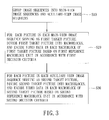
  • FIG. 3 is a flow chart illustrating the preferred embodiment
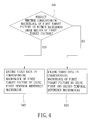
  • FIG. 4 is a flow chart illustrating the preferred embodiment about how each macroblock of a first target picture is encoded in accordance with first decision criteria
  • FIG. 5 is a schematic view showing an example of encoding video data in a macroblock of a first target picture
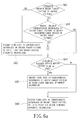
  • FIGS. 6 a and 6 b are flow charts illustrating the preferred embodiment about how each macroblock of a second target picture is encoded in accordance with second decision criteria
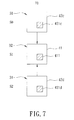
  • FIG. 7 is a schematic view showing an example of encoding video data in a macroblock of a second target picture when the second target picture is an anchor picture;
  • FIGS. 8 and 9 are schematic views illustrating an example of encoding video data in a macroblock of a second target picture when the second target picture is a non-anchor picture.
  • FIG. 10 shows various two-dimensional test pictures.
  • FIG. 2 illustrates an HEP predict ion structure used in the preferred embodiment of a multi-view video coding method according to the present invention.
  • the HBP prediction structure includes a plurality of image sequences, each of which corresponds to an individual viewpoint (S 0 , S 1 , S 2 , S 3 , S 4 ) and includes a plurality of pictures corresponding respectively to consecutive time-points (T 0 , T 1 , T 2 , T 3 , T 4 , T 5 , T 6 , T 7 , T 8 ).
  • the viewpoint (S 1 ) is located at the left of the viewpoint (S(i+1)), where 0 ⁇ i ⁇ 3.
  • two pictures corresponding respectively to the time-points (T 0 , T 8 ) denote anchor pictures, and the other pictures denote non-anchor pictures.
  • FIG. 3 is a flow chart illustrating the preferred embodiment.
  • step S 10 the image sequences in the HBP prediction structure are grouped into main-view image sequences denoted by the reference numerals 31 and auxiliary-view image sequences denoted by the reference numerals 32 .
  • Each auxiliary-view image sequence 32 is configured to be disposed between corresponding two adjacent main-view image sequences 31 .
  • each picture to be encoded in each main-view image sequence 31 serves as a first target picture.
  • the first target picture is divided into a plurality of macroblocks, each of which is in the form of an n ⁇ n pixel array, such as a 16 ⁇ 16 pixel array.
  • video data in each macroblock of the first target picture is encoded based on a first reference macroblock unit, which is associated with a corresponding macroblock of the first target picture, in accordance with first decision criteria. It is noted that the macroblocks of the first target picture are encoded in the order of upper left to lower right.
  • the first reference macroblock unit includes a first temporal reference macroblock and a second temporal reference macroblock.
  • a corresponding macroblock of one picture which corresponds to an earlier time-point relative to that of the first target picture, serves as the first temporal reference macroblock.
  • a corresponding macroblock of one picture which corresponds to a later time-point relative to that of the first target picture, serves as the second temporal reference macroblock.
  • FIG. 4 is a flow chart illustrating how the corresponding macroblock of the first target picture is encoded in accordance with the first decision criteria.
  • step S 41 the first decision criteria are configured to predict whether the corresponding macroblock of the first target picture is within a background image region of the first target picture. If the result is affirmative, the flow goes to step S 42 . Otherwise, the flow goes to step S 43 .
  • step S 42 whether the corresponding macroblock of the first target picture is within the background image of the first target picture that is predicted based on a motion vector value (MV) associated with a left, upper or upper left macroblock relative to the corresponding one of the macroblocks of the first target picture.
  • MV motion vector value
  • x t (k,l) denotes each pixel value of the left, upper or upper left macroblock of the first target picture
  • x t-1 (k+i,l+j) denotes a corresponding pixel value of a macroblock of the target picture leading the left, upper or upper left macroblock.
  • the motion vector value (MV) when the motion vector value (MV) is zero, the corresponding macroblock of the first target picture is predicted to be within the background image region.
  • the motion vector value (MV) is not zero, the corresponding macroblock of the first target picture is predicted to be not within the background image region.
  • step S 42 when the motion vector value (MV) is zero, the video data in the corresponding macroblock of the first target picture is encoded by using the first temporal reference macroblock of the first reference macroblock unit.
  • step S 43 when motion vector value (MV) is not zero, the video data in the corresponding macroblock of the first target picture is encoded by using the first and second temporal reference macroblock of the first reference macroblock unit.
  • video data in a macroblock 351 of a first target picture 35 which corresponds to the time-point (T 4 ) is encoded by using a corresponding macroblock ( 361 a ) of a picture ( 36 a ) corresponding to the time-point (T 0 ) when a motion vector value (MV) associated with a left macroblock 352 , an upper macroblock 354 or an upper left macroblock 353 is zero, and by using the corresponding macroblock ( 361 a ) of the picture ( 36 a ), and a corresponding macroblock ( 361 b ) of a picture ( 36 b ) corresponding to the time-point (T 8 ) when the motion vector value (MV) is not zero.
  • the macroblocks ( 361 a , 361 b ) serve respectively as the first and second temporal reference macroblocks of the first reference macroblock unit.
  • each picture to be encoded in each auxiliary-view image sequence 32 serves as a second target picture.
  • the second target picture is divided into a plurality of macroblocks, each of which is in the form of an n ⁇ n pixel array, such as a 16 ⁇ 16 pixel array.
  • video data in each macroblock of the second target picture is encoded based on a second reference macroblock unit, which is associated with a corresponding macroblock of the second target picture, in accordance with second decision criteria. Similar to the first target picture, the macroblocks of the second target picture are encoded in the order of upper left to lower right.
  • the second reference macroblock unit includes a pair of first and second temporal reference macroblocks, and a pair of first and second spatial reference macroblocks.
  • a corresponding macroblock of one picture which is in one main-view image sequence 31 adjacent to a corresponding auxiliary-view image sequence 32 and corresponding to a viewpoint at the left of that of the corresponding auxiliary-view image sequence 32 , and which corresponds to the same time-point as that of the second target picture, serves as the first spatial reference macroblock.
  • a corresponding macroblock of one picture which is in one main-view image sequence 31 adjacent to the corresponding auxiliary-view image sequence 32 and corresponding to a viewpoint at the right of that of the corresponding auxiliary-view image sequence 32 , and which corresponds to the same time-point as that of the second target picture, serves as the second spatial reference macroblock. Furthermore, in the corresponding auxiliary-view image sequence 32 , a corresponding macroblock of one picture, which corresponds to an earlier time-point relative to that of the second target picture, serves as the first temporal reference macroblock of the second reference macroblock unit, and a corresponding macroblock of one picture, which corresponds to a later time-point relative to that of the second target picture, serves as the second temporal reference macroblock of the second reference macroblock unit.
  • FIGS. 6 a and 6 b are flow charts illustrating how the corresponding macroblock of the second target picture is encoded in accordance with the second decision criteria.
  • step S 61 the second decision criteria are configured to determine whether the second target picture is an anchor picture. If the result is affirmative, the flow goes to step S 62 . Otherwise, the flow goes to step S 63 .
  • step S 62 when the second target picture is an anchor picture, the video data in the corresponding macroblock of the second target picture is encoded by using the first and second spatial reference macroblocks of the second reference macroblock unit.
  • video data in a macroblock 411 of a second target picture 41 which corresponds to the time-point (T 0 ), i.e., an anchor picture, is encoded by using a corresponding macroblock ( 421 c ) of a picture ( 42 c ), which is in an adjacent main-view image sequence 31 corresponding to the viewpoint (S 0 ), and which corresponds to the time-point (T 0 ), and a corresponding macroblock ( 421 d ) of a picture ( 42 d ), which is in an adjacent main-view image 31 corresponding to the viewpoint (S 2 ), and which corresponds to the time-point (T 0 ).
  • the macroblock ( 421 d ) of a picture ( 42 d ) which is in an adjacent main-view image 31 corresponding to the viewpoint (
  • step S 63 when the second target picture is not an anchor picture, i.e., the second target picture is a non-anchor picture, the second decision criteria are configured to predict whether the corresponding macroblock of the second target picture is within a background image region of the second target picture. If the result is affirmative, the flow goes to step S 64 . Otherwise, the flow goes to step S 67 .
  • whether the corresponding macroblock of the second target picture is within the background image of the first target picture that is predicted based on a motion vector complexity value (MD) and an average motion vector value (MV average ) associated with at most left, upper and upper left macroblocks relative to the corresponding macroblock of the second target picture.
  • the motion vector complexity value (MD) can be obtained by the following Equations (3), (4) and (5):
  • MD x ⁇ ( m , n ) 1 48 ⁇ ⁇ ( i , j ) ⁇ Z ⁇ ⁇ ⁇ mvx i , j - 1 48 ⁇ ⁇ ( u , v ) ⁇ Z ⁇ ⁇ mvx u , v ⁇ ( 3 )
  • the average motion vector value (MV average ) can be obtained by the following Equation (6):
  • MV average 1 48 ⁇ ( ⁇ ( u , v ) ⁇ Z ⁇ ⁇ mvx u , v ) 2 + ( ⁇ ( u , v ) ⁇ Z ⁇ ⁇ mvy u , v ) 2 ( 6 )
  • mvx denotes a component value of a motion vector in an X-axis direction corresponding to a 4 ⁇ 4 pixel array of each of the left, upper and upper left macroblocks
  • mvy denotes a component value of a motion vector in a Y-axis direction corresponding to a 4 ⁇ 4 pixel array of each of the left, upper and upper left macroblocks.
  • the motion vector complexity value (MD) and the average motion vector value (MV average ) are respectively smaller than a predetermined first threshold value, such as 8, and a predetermined second threshold value, such as 1, the corresponding macroblock of the second target picture is predicted to be within the background image region of the second target picture.
  • an upper macroblock 434 and an upper left macroblock 433 are obtained so as to predict whether the macroblock 43 of the second target picture 43 is within a background image region of the second target picture 43 .
  • step S 64 when the motion vector complexity value (MD) is smaller than the predetermined first threshold value while the average motion vector value (MV average ) is smaller than the predetermined second threshold value, the second decision criteria are configured to determine whether the average motion vector value (MV average ) is zero. If the result is affirmative, the flow goes to step S 65 . Otherwise, the flow goes to step S 66 .
  • step S 65 when the average motion vector value MV average ) is zero, the video data in the corresponding macroblock of the second target picture is encoded by using the first temporal reference macroblock of the second reference macroblock unit.
  • the average motion vector value (MV average ) associated with the left, upper and upper lefts 432 , 434 , 433 is zero
  • video data in the macroblock 431 of the second target picture 43 is encoded by using a corresponding macroblock ( 441 a ) of a picture ( 44 a ), which is in the same auxiliary-view image sequence 32 as the second target picture 43 and which corresponds to the time-point (T 2 ).
  • step S 66 when the average motion vector value (MV average ) is not zero, the video data in the corresponding macroblock of the second target picture is encoded by using the first and second temporal reference macroblocks of the second reference macroblock unit. As the same example shown in FIG.
  • the video data in the macroblock 431 of the second target picture 43 is encoded by using the macroblock ( 441 a ), and a corresponding macroblock ( 441 b ) of a picture ( 44 b ), which is in the same auxiliary-view image sequence 32 as the second target picture ( 43 ) and which corresponds to the time-point (T 4 ).
  • the macroblocks ( 441 a , 441 b ) serve respectively as the first and second temporal reference macroblocks of the second reference macroblock unit.
  • step S 67 when one of the motion vector complexity value (MD) and the average motion vector value (MV average ) is not smaller than a corresponding one of the predetermined first and second threshold values, i.e., the corresponding macroblock of the second target picture is predicted to be within a foreground image region of the second target picture, the second decision criteria are configured to determine whether the corresponding macroblock of the second target picture is within a left image region of the second target picture. If the result is affirmative, the flow goes to step S 68 . Otherwise, the flow goes to step S 69 .
  • the left image region of the second target picture is a rectangular region with a width equal to six times the width of a macroblock of the second picture target.
  • step S 68 when the corresponding macroblock of the second target picture is within the left image region of the second target picture, the video data in the corresponding macroblock of the second target picture is encoded by using the first spatial reference macroblock.
  • the first spatial reference macroblock For example, as shown in FIG. 9 , for the second target picture 43 in FIG. 8 , when a macroblock 431 ′ of the second target picture 43 is within a left image region 430 ′ of the second target picture 43 , video data in the macroblock 431 ′ is encoded by using a corresponding macroblock ( 441 c ′) of a picture ( 44 c ), which is in an adjacent main-view image sequence 31 corresponding to the viewpoint (S 0 ), and which corresponds to the time-point (T 3 ).
  • the macroblock ( 441 c ′) serves as the first spatial reference macroblock of the second reference macroblock unit.
  • step S 69 the second decision criteria are configured to determine whether the corresponding macroblock of the second target picture is within a right image region of the second target picture. If the result is affirmative, the flow goes to step S 70 . Otherwise, the flow goes to step S 71 .
  • the right image region has the same size as that of the left image region.
  • step S 70 when the corresponding macroblock of the second target picture is within the right image region of the second target picture, the video data in the corresponding macroblock of the second target picture is encoded by using the second spatial reference macroblock.
  • the second spatial reference macroblock For example, as shown in FIG. 9 , for the second target picture 43 in FIG. 8 , when a macroblock 431 ′′ of the second target picture 43 is within a right image region 430 ′′ of the second target picture 43 , video data in the macroblock 431 ′′ is encoded by using a corresponding macroblock ( 441 d ′′) of a picture ( 44 d ), which is in an adjacent main-view-image sequence 31 corresponding to the viewpoint (S 2 ), and which corresponds to the time-point (T 3 ).
  • the macroblock ( 441 d ′′) serves as the second spatial reference macroblock of the second reference macroblock unit.
  • step S 71 when the corresponding macroblock of the second target picture is not within any one of the left and right image regions of the second target picture, the video data in the corresponding macroblock of the second target picture is encoded by using the first and second spatial reference macroblocks of the second reference macroblock unit. As the same example shown in FIG.
  • the video data in the macroblock 431 of the second target picture 43 is encoded by using a corresponding macroblock ( 441 c ) of the picture ( 44 c ) corresponding to the viewpoint (S 0 ) and the time-point (T 3 ), and a corresponding macroblock ( 441 d ) of the picture ( 44 d ) corresponding to the viewpoint (S 2 ) and the time-point (T 3 ).
  • the macroblocks ( 441 c , 441 d ) serve respectively as the first and second spatial reference macroblocks of the second reference macroblock unit.
  • FIG. 10 illustrates three representative pictures (P 1 , P 2 , P 3 ) corresponding respectively to various multi-view image sequences provided from “The Middlebury Computer Vision Pages” (http://vision.middlebury.edu/).
  • JVT Joint Video Team
  • MPEG Moving Picture Experts Group
  • SR search ranges
  • QP various quantization parameters
  • the experimental results related to peak signal-to-noise ratio (PSNR) for encoded data generated using each of the JMVC method and the preferred embodiment, bit rate for each pixel, and processing time required by each of the JMVC method and the preferred embodiment are shown in Tables 1, 2 and 3 below.
  • the macroblock in the preferred embodiment is a
  • the preferred embodiment can provide PSNR similar to that of the JMVC method. Particularly, the preferred embodiment can reduce processing time so much as compared to the JMVC method.
  • the Shen method the experimental results related to PSNR for encoded data generated using each of the JMVC method, the Shen method and the preferred embodiment, bit-rate for each pixel, and processing time required by each of the conventional JMVC method, the Shen method and the preferred embodiment are shown in Tables 4, 5 and 6 below.
  • the preferred embodiment can provide PSNR and bit rate similar to those of the JMVC method and the Shen method.
  • the Shen method and the preferred embodiment can reduce processing time so much as compared to the JMVC method.
  • the preferred embodiment since each picture in each auxiliary-view image sequence has been divided into a plurality of macroblocks, video data encoding is processed in a unit of a macroblock not a whole picture, only a part of the macroblocks for one picture to be referenced needs to be stored during decoding. Therefore, the preferred embodiment can reduce requirement for picture buffers during decoding as compared to the JMVC method and the Shen method.
  • view number denotes the number of image sequences
  • GOP denotes the number of a group of pictures (GOP), such as 8.
  • the preferred embodiment can effectively save picture buffer space required during decoding.

Landscapes

  • Engineering & Computer Science (AREA)
  • Multimedia (AREA)
  • Signal Processing (AREA)
  • Compression Or Coding Systems Of Tv Signals (AREA)

Abstract

In a multi-view video coding method using a hierarchical B-picture (HBP) prediction structure, multiple image sequences in the HBP prediction structure are grouped into main-view image sequences, and auxiliary-view image sequences, each of which is configured to be disposed between corresponding two adjacent main-view image sequences. Each picture to be encoded in each main-view image sequence serves as a first target picture, and is divided into multiple macroblocks. Video data in each macroblock of the first target picture is encoded based on a first reference macroblock unit in accordance with first decision criteria. Each picture to be encoded in each auxiliary-view image sequence serves as a second target picture, and is divided into multiple macroblocks. Video data in each macroblock of the second target picture is encoded based on a second reference macroblock unit in accordance with second decision criteria.

Description

CROSS-REFERENCE TO RELATED APPLICATION
This application claims priority to Taiwanese Application No. 100108096, filed on Mar. 10, 2011.
BACKGROUND OF THE INVENTION
1. Field of the Invention
The invention relates to a multi-view video coding method, and more particularly to a multi-view video coding method using a hierarchical B-picture (HBP) prediction structure.
2. Description of the Related Art
FIG. 1 illustrates a conventional multi-view video coding method using a hierarchical B-picture (HBP) prediction structure. The HBP prediction structure includes a plurality of image sequences, each of which includes a plurality of pictures that are captured from an individual viewpoint (S0, S1, S2, S3, S4) at consecutive time-points (T1, T2, T3, T4, T5, T6, T7, T8). In each image sequence, two pictures corresponding respectively to the time-points (T0, T8) denote anchor pictures, and the other pictures denote non-anchor pictures. For each of the image sequences corresponding to the viewpoints (S0, S2, S4), video data in each non-anchor picture is encoded by using two pictures in the same image sequence corresponding to two other time-points as references. For example, the video data of the B1 picture corresponding to the viewpoint (S0) and the time-point (T4) is encoded by using the I picture corresponding to the viewpoint (S0) and the time-point (T0), and the I picture corresponding to the viewpoint (S0) and the time-point (T8). For each of the image sequences corresponding to the viewpoints (S1, S3), video data in each non-anchor picture is encoded by using two pictures in the same image sequence corresponding to the two other time-points, and two pictures from two adjacent image sequences corresponding to the same time-point. For example, video data in the B3 picture corresponding to the viewpoint (S1) and the time-point (T2) is encoded by using the B1 picture corresponding to the viewpoint (S1) and the time-point (T0), the B2 picture corresponding to the viewpoint (S1) and the time-point (T4), the B2 picture corresponding to the viewpoint (S0) and the time-point (T2), and the B2 picture corresponding to the viewpoint (S2) and the time-point (T2). From this example, the pictures in the image sequence corresponding to the viewpoint (S2) have to be encoded before the pictures in the image sequence corresponding to the viewpoint (S1) are encoded. Similarly, the pictures in the image sequence corresponding to the viewpoint (S4) have to be encoded before the pictures in the image sequence corresponding to the viewpoint (S3) are encoded.
It is noted that, during encoding of each non-anchor pictures in each of the image sequences corresponding to the viewpoints (S1, S3), there are four pictures typically used as references, thereby resulting in a huge amount of computation and longer processing time. In addition, a relatively large number of encoding/decoding picture buffers are required. As such, improvements may be made to the above techniques.
SUMMARY OF THE INVENTION
Therefore, an object of the present invention is to provide a multi-view video coding method that can overcome the aforesaid drawbacks of the prior art.
According to the present invention, there is provided a multi-view video coding method using a hierarchical B-picture (HBP) prediction structure. The HBP prediction structure includes a plurality of image sequences. Each of the image sequences corresponds to an individual viewpoint, and includes a plurality of pictures corresponding respectively to consecutive time-points. The multi-view video coding method comprises the steps of:
a) grouping the image sequences into main-view image sequences and auxiliary-view image sequences, and configuring each of the auxiliary-view image sequences to be disposed between corresponding two adjacent ones of the main-view image sequences;
b) for each of the pictures to be encoded in each of the main-view image sequences that serves as a first target picture,
    • dividing the first target picture into a plurality of macroblocks, each of which is in the form of an n×n pixel array, and
    • encoding video data in each of the macroblocks to be encoded of the first target picture based on a first reference macroblock unit, which is associated with a corresponding one of the macroblocks of the first target picture, in accordance with first decision criteria; and
c) for each of the pictures to be encoded in each of the auxiliary-view image sequences that serves as a second target picture,
    • dividing the second target picture into a plurality of macroblocks, each of which is in the form of an n×n pixel array, and
    • encoding video data in each of the macroblocks to be encoded of the second target picture based on a second reference macroblock unit, which is associated with a corresponding one of the macroblocks of the second target picture, in accordance with second decision criteria.
BRIEF DESCRIPTION OF THE DRAWINGS
Other features and advantages of the present invention will become apparent in the following detailed description of the preferred embodiments with reference to the accompanying drawings, of which:
FIG. 1 is a schematic view illustrating a hierarchical B-picture (HBP) prediction structure used in a conventional multi-view video coding method;
FIG. 2 is a schematic view illustrating an HBP prediction structure used in the preferred embodiment of a multi-view video coding method according to the present invention;
FIG. 3 is a flow chart illustrating the preferred embodiment;
FIG. 4 is a flow chart illustrating the preferred embodiment about how each macroblock of a first target picture is encoded in accordance with first decision criteria;
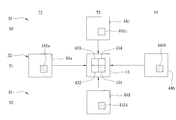
FIG. 5 is a schematic view showing an example of encoding video data in a macroblock of a first target picture;
FIGS. 6 a and 6 b are flow charts illustrating the preferred embodiment about how each macroblock of a second target picture is encoded in accordance with second decision criteria;
FIG. 7 is a schematic view showing an example of encoding video data in a macroblock of a second target picture when the second target picture is an anchor picture;
FIGS. 8 and 9 are schematic views illustrating an example of encoding video data in a macroblock of a second target picture when the second target picture is a non-anchor picture; and
FIG. 10 shows various two-dimensional test pictures.
DETAILED DESCRIPTION OF THE PREFERRED EMBODIMENT
FIG. 2 illustrates an HEP predict ion structure used in the preferred embodiment of a multi-view video coding method according to the present invention. The HBP prediction structure includes a plurality of image sequences, each of which corresponds to an individual viewpoint (S0, S1, S2, S3, S4) and includes a plurality of pictures corresponding respectively to consecutive time-points (T0, T1, T2, T3, T4, T5, T6, T7, T8). The viewpoint (S1) is located at the left of the viewpoint (S(i+1)), where 0≦i≦3. In each image sequence, two pictures corresponding respectively to the time-points (T0, T8) denote anchor pictures, and the other pictures denote non-anchor pictures.
FIG. 3 is a flow chart illustrating the preferred embodiment.
In step S10, the image sequences in the HBP prediction structure are grouped into main-view image sequences denoted by the reference numerals 31 and auxiliary-view image sequences denoted by the reference numerals 32. Each auxiliary-view image sequence 32 is configured to be disposed between corresponding two adjacent main-view image sequences 31.
In step S20, each picture to be encoded in each main-view image sequence 31 serves as a first target picture. The first target picture is divided into a plurality of macroblocks, each of which is in the form of an n×n pixel array, such as a 16×16 pixel array. Then, video data in each macroblock of the first target picture is encoded based on a first reference macroblock unit, which is associated with a corresponding macroblock of the first target picture, in accordance with first decision criteria. It is noted that the macroblocks of the first target picture are encoded in the order of upper left to lower right.
In this embodiment, the first reference macroblock unit includes a first temporal reference macroblock and a second temporal reference macroblock. In addition, a corresponding macroblock of one picture, which corresponds to an earlier time-point relative to that of the first target picture, serves as the first temporal reference macroblock. A corresponding macroblock of one picture, which corresponds to a later time-point relative to that of the first target picture, serves as the second temporal reference macroblock.
FIG. 4 is a flow chart illustrating how the corresponding macroblock of the first target picture is encoded in accordance with the first decision criteria.
In step S41, the first decision criteria are configured to predict whether the corresponding macroblock of the first target picture is within a background image region of the first target picture. If the result is affirmative, the flow goes to step S42. Otherwise, the flow goes to step S43. In this embodiment, whether the corresponding macroblock of the first target picture is within the background image of the first target picture that is predicted based on a motion vector value (MV) associated with a left, upper or upper left macroblock relative to the corresponding one of the macroblocks of the first target picture. The motion vector value (MV) can be obtained by the following Equations (1) and (2):
MAE ( i , j ) = 1 N 2 k = 1 N l = 1 N x t ( k , l ) - x t - 1 ( k + i , l + j ) ( 1 ) MV = ( Veci , Vecj ) = ( i , j ) | min MAE ( i , j ) ( 2 )
where xt(k,l) denotes each pixel value of the left, upper or upper left macroblock of the first target picture, and xt-1(k+i,l+j) denotes a corresponding pixel value of a macroblock of the target picture leading the left, upper or upper left macroblock. Thus, when the motion vector value (MV) is zero, the corresponding macroblock of the first target picture is predicted to be within the background image region. When the motion vector value (MV) is not zero, the corresponding macroblock of the first target picture is predicted to be not within the background image region.
In step S42, when the motion vector value (MV) is zero, the video data in the corresponding macroblock of the first target picture is encoded by using the first temporal reference macroblock of the first reference macroblock unit.
In step S43, when motion vector value (MV) is not zero, the video data in the corresponding macroblock of the first target picture is encoded by using the first and second temporal reference macroblock of the first reference macroblock unit.
For example, as shown in FIG. 5, in the main-view image sequence 31 corresponding to the viewpoint (S0), video data in a macroblock 351 of a first target picture 35, which corresponds to the time-point (T4), is encoded by using a corresponding macroblock (361 a) of a picture (36 a) corresponding to the time-point (T0) when a motion vector value (MV) associated with a left macroblock 352, an upper macroblock 354 or an upper left macroblock 353 is zero, and by using the corresponding macroblock (361 a) of the picture (36 a), and a corresponding macroblock (361 b) of a picture (36 b) corresponding to the time-point (T8) when the motion vector value (MV) is not zero. In this example, the macroblocks (361 a, 361 b) serve respectively as the first and second temporal reference macroblocks of the first reference macroblock unit.
In step S30, each picture to be encoded in each auxiliary-view image sequence 32 serves as a second target picture. The second target picture is divided into a plurality of macroblocks, each of which is in the form of an n×n pixel array, such as a 16×16 pixel array. Then, video data in each macroblock of the second target picture is encoded based on a second reference macroblock unit, which is associated with a corresponding macroblock of the second target picture, in accordance with second decision criteria. Similar to the first target picture, the macroblocks of the second target picture are encoded in the order of upper left to lower right.
In this embodiment, the second reference macroblock unit includes a pair of first and second temporal reference macroblocks, and a pair of first and second spatial reference macroblocks. In addition, a corresponding macroblock of one picture, which is in one main-view image sequence 31 adjacent to a corresponding auxiliary-view image sequence 32 and corresponding to a viewpoint at the left of that of the corresponding auxiliary-view image sequence 32, and which corresponds to the same time-point as that of the second target picture, serves as the first spatial reference macroblock. A corresponding macroblock of one picture, which is in one main-view image sequence 31 adjacent to the corresponding auxiliary-view image sequence 32 and corresponding to a viewpoint at the right of that of the corresponding auxiliary-view image sequence 32, and which corresponds to the same time-point as that of the second target picture, serves as the second spatial reference macroblock. Furthermore, in the corresponding auxiliary-view image sequence 32, a corresponding macroblock of one picture, which corresponds to an earlier time-point relative to that of the second target picture, serves as the first temporal reference macroblock of the second reference macroblock unit, and a corresponding macroblock of one picture, which corresponds to a later time-point relative to that of the second target picture, serves as the second temporal reference macroblock of the second reference macroblock unit.
FIGS. 6 a and 6 b are flow charts illustrating how the corresponding macroblock of the second target picture is encoded in accordance with the second decision criteria.
In step S61, the second decision criteria are configured to determine whether the second target picture is an anchor picture. If the result is affirmative, the flow goes to step S62. Otherwise, the flow goes to step S63.
In step S62, when the second target picture is an anchor picture, the video data in the corresponding macroblock of the second target picture is encoded by using the first and second spatial reference macroblocks of the second reference macroblock unit. For example, as shown in FIG. 7, in the auxiliary-view image sequence 32 corresponding to the viewpoint (S1), video data in a macroblock 411 of a second target picture 41, which corresponds to the time-point (T0), i.e., an anchor picture, is encoded by using a corresponding macroblock (421 c) of a picture (42 c), which is in an adjacent main-view image sequence 31 corresponding to the viewpoint (S0), and which corresponds to the time-point (T0), and a corresponding macroblock (421 d) of a picture (42 d), which is in an adjacent main-view image 31 corresponding to the viewpoint (S2), and which corresponds to the time-point (T0). In this example, the macroblocks (421 c, 421 d) serve respectively as the first and second spatial reference macroblocks of the second reference macroblock unit.
In step S63, when the second target picture is not an anchor picture, i.e., the second target picture is a non-anchor picture, the second decision criteria are configured to predict whether the corresponding macroblock of the second target picture is within a background image region of the second target picture. If the result is affirmative, the flow goes to step S64. Otherwise, the flow goes to step S67. In this embodiment, whether the corresponding macroblock of the second target picture is within the background image of the first target picture that is predicted based on a motion vector complexity value (MD) and an average motion vector value (MVaverage) associated with at most left, upper and upper left macroblocks relative to the corresponding macroblock of the second target picture. The motion vector complexity value (MD) can be obtained by the following Equations (3), (4) and (5):
MD x ( m , n ) = 1 48 ( i , j ) Z mvx i , j - 1 48 ( u , v ) Z mvx u , v ( 3 ) MD y ( m , n ) = 1 48 ( i , j ) Z mvy i , j - 1 48 ( u , v ) Z mvy u , v ( 4 ) MD ( m , n ) = MD x 2 ( m , n ) + MD y 2 ( m , n ) ( 5 )
The average motion vector value (MVaverage) can be obtained by the following Equation (6):
MV average = 1 48 ( ( u , v ) Z mvx u , v ) 2 + ( ( u , v ) Z mvy u , v ) 2 ( 6 )
where mvx denotes a component value of a motion vector in an X-axis direction corresponding to a 4×4 pixel array of each of the left, upper and upper left macroblocks, and mvy denotes a component value of a motion vector in a Y-axis direction corresponding to a 4×4 pixel array of each of the left, upper and upper left macroblocks. Thus, when the motion vector complexity value (MD) and the average motion vector value (MVaverage) are respectively smaller than a predetermined first threshold value, such as 8, and a predetermined second threshold value, such as 1, the corresponding macroblock of the second target picture is predicted to be within the background image region of the second target picture.
For example, as shown in FIG. 8, for a macroblock 431 of a second target picture 43, which is in the auxiliary-view image sequence 32 corresponding to the viewpoint (S1) and which corresponds to the time-point (T3), a motion vector complexity value (MD) and the average motion vector value (MVaverage) associated with a left macroblock 432, an upper macroblock 434 and an upper left macroblock 433 are obtained so as to predict whether the macroblock 43 of the second target picture 43 is within a background image region of the second target picture 43.
In step S64, when the motion vector complexity value (MD) is smaller than the predetermined first threshold value while the average motion vector value (MVaverage) is smaller than the predetermined second threshold value, the second decision criteria are configured to determine whether the average motion vector value (MVaverage) is zero. If the result is affirmative, the flow goes to step S65. Otherwise, the flow goes to step S66.
In step S65, when the average motion vector value MVaverage) is zero, the video data in the corresponding macroblock of the second target picture is encoded by using the first temporal reference macroblock of the second reference macroblock unit. As the same example shown in FIG. 8, when the average motion vector value (MVaverage) associated with the left, upper and upper lefts 432, 434, 433 is zero, video data in the macroblock 431 of the second target picture 43 is encoded by using a corresponding macroblock (441 a) of a picture (44 a), which is in the same auxiliary-view image sequence 32 as the second target picture 43 and which corresponds to the time-point (T2).
In step S66, when the average motion vector value (MVaverage) is not zero, the video data in the corresponding macroblock of the second target picture is encoded by using the first and second temporal reference macroblocks of the second reference macroblock unit. As the same example shown in FIG. 8, when the average motion vector value (MVaverage) associated with the left, upper and upper lefts 432, 434, 433 is not zero, the video data in the macroblock 431 of the second target picture 43 is encoded by using the macroblock (441 a), and a corresponding macroblock (441 b) of a picture (44 b), which is in the same auxiliary-view image sequence 32 as the second target picture (43) and which corresponds to the time-point (T4). Thus, in this example, the macroblocks (441 a, 441 b) serve respectively as the first and second temporal reference macroblocks of the second reference macroblock unit.
In step S67, when one of the motion vector complexity value (MD) and the average motion vector value (MVaverage) is not smaller than a corresponding one of the predetermined first and second threshold values, i.e., the corresponding macroblock of the second target picture is predicted to be within a foreground image region of the second target picture, the second decision criteria are configured to determine whether the corresponding macroblock of the second target picture is within a left image region of the second target picture. If the result is affirmative, the flow goes to step S68. Otherwise, the flow goes to step S69. In this embodiment, the left image region of the second target picture is a rectangular region with a width equal to six times the width of a macroblock of the second picture target.
In step S68, when the corresponding macroblock of the second target picture is within the left image region of the second target picture, the video data in the corresponding macroblock of the second target picture is encoded by using the first spatial reference macroblock. For example, as shown in FIG. 9, for the second target picture 43 in FIG. 8, when a macroblock 431′ of the second target picture 43 is within a left image region 430′ of the second target picture 43, video data in the macroblock 431′ is encoded by using a corresponding macroblock (441 c′) of a picture (44 c), which is in an adjacent main-view image sequence 31 corresponding to the viewpoint (S0), and which corresponds to the time-point (T3). In this example, the macroblock (441 c′) serves as the first spatial reference macroblock of the second reference macroblock unit.
In step S69, the second decision criteria are configured to determine whether the corresponding macroblock of the second target picture is within a right image region of the second target picture. If the result is affirmative, the flow goes to step S70. Otherwise, the flow goes to step S71. In this embodiment, the right image region has the same size as that of the left image region.
In step S70, when the corresponding macroblock of the second target picture is within the right image region of the second target picture, the video data in the corresponding macroblock of the second target picture is encoded by using the second spatial reference macroblock. For example, as shown in FIG. 9, for the second target picture 43 in FIG. 8, when a macroblock 431″ of the second target picture 43 is within a right image region 430″ of the second target picture 43, video data in the macroblock 431″ is encoded by using a corresponding macroblock (441 d″) of a picture (44 d), which is in an adjacent main-view-image sequence 31 corresponding to the viewpoint (S2), and which corresponds to the time-point (T3). In this example, the macroblock (441 d″) serves as the second spatial reference macroblock of the second reference macroblock unit.
In step S71, when the corresponding macroblock of the second target picture is not within any one of the left and right image regions of the second target picture, the video data in the corresponding macroblock of the second target picture is encoded by using the first and second spatial reference macroblocks of the second reference macroblock unit. As the same example shown in FIG. 8, if the macroblock 431 of the second target picture 43 is not within any one of the left and right image regions of the second target picture 43, the video data in the macroblock 431 of the second target picture 43 is encoded by using a corresponding macroblock (441 c) of the picture (44 c) corresponding to the viewpoint (S0) and the time-point (T3), and a corresponding macroblock (441 d) of the picture (44 d) corresponding to the viewpoint (S2) and the time-point (T3). In this example, the macroblocks (441 c, 441 d) serve respectively as the first and second spatial reference macroblocks of the second reference macroblock unit.
FIG. 10 illustrates three representative pictures (P1, P2, P3) corresponding respectively to various multi-view image sequences provided from “The Middlebury Computer Vision Pages” (http://vision.middlebury.edu/). In an experiment for encoding main-view image sequences corresponding to each of the pictures (P1, P2, P3) using a conventional multi-view video coding method, which has been developed by the Joint Video Team (JVT) of Video Coding Experts Groups (VCEG) and Moving Picture Experts Group (MPEG) (hereinafter referred to as the JMVC method), and the preferred embodiment under various search ranges (SR) and various quantization parameters (QP), the experimental results related to peak signal-to-noise ratio (PSNR) for encoded data generated using each of the JMVC method and the preferred embodiment, bit rate for each pixel, and processing time required by each of the JMVC method and the preferred embodiment are shown in Tables 1, 2 and 3 below. In this experiment, the macroblock in the preferred embodiment is a 16×16 pixel array, the search ranges are respectively 32 and 96, and the quantization parameters are respectively 22, 27, 32 and 37.
TABLE 1
Processing
SR QP Method PSNR Bit rate time
P1
32 37 JMVC 31.7974 220.5692 4292.33
Preferred 31.7377 226.0778 2784.33
embodiment
32 JMVC 34.5172 394.4522 4438.73
Preferred 34.4772 403.1202 2936.64
embodiment
27 JMVC 37.1067 744.9226 4621.37
Preferred 37.0751 756.415 3083.19
embodiment
22 JMVC 39.3342 1609.507 4834.69
Preferred 39.2742 1618.512 3297.13
embodiment
96 37 JMVC 31.7806 216.8074 6992.17
Preferred 31.757 221.0234 4992.59
embodiment
32 JMVC 34.5161 390.3944 7479.25
Preferred 34.5017 396.7556 5143.37
embodiment
27 JMVC 37.104 740.8876 7957.41
Preferred 37.0935 751.1364 5474.31
embodiment
22 JMVC 39.3316 1606.266 8539.91
Preferred 39.3107 1616.977 6287.47
embodiment
TABLE 2
Processing
SR QP Method PSNR Bit rate time
P2
32 37 JMVC 35.4648 161.2758 4226.014
Preferred 35.3397 164.4642 2653.14
embodiment
32 JMVC 37.4226 283.1466 4447.594
Preferred 37.3363 289.0065 2932.828
embodiment
27 JMVC 38.8046 570.5758 4707.14
Preferred 38.7614 582.8622 3182.186
embodiment
22 JMVC 40.0154 1534.136 5106.826
Preferred 39.9989 1562.798 3570.843
embodiment
96 37 JMVC 35.4492 159.105 7385.921
Preferred 35.3218 162.5649 4657.108
embodiment
32 JMVC 37.4182 279.9729 8485.968
Preferred 37.3292 286.5003 5643.657
embodiment
27 JMVC 38.8002 566.5608 9790.905
Preferred 38.7564 579.033 6654.655
embodiment
22 JMVC 40.0131 1525.652 11494.66
Preferred 39.9963 1554.378 8142.766
embodiment
TABLE 3
Processing
SR QP Method PSNR Bit rate time
P3
32 37 JMVC 34.341 92.2148 4059.78
Preferred 34.256 95.7886 2599.94
embodiment
32 JMVC 36.661 165.4242 4178.34
Preferred 36.605 168.4462 2769.59
embodiment
27 JMVC 38.524 331.5154 4318.12
Preferred 38.484 336.543 2939.09
embodiment
22 JMVC 40.095 937.3912 4581.94
Preferred 40.033 944.1636 3291.78
embodiment
96 37 JMVC 34.3455 92.4038 5922.264
Preferred 34.31325 93.9904 4468.671
embodiment
32 JMVC 36.65845 163.401 6331.749
Preferred 36.63968 166.061 4663.734
embodiment
27 JMVC 38.52798 329.044 6797.015
Preferred 38.5139 334.1302 5220.015
embodiment
22 JMVC 40.09358 935.1128 7798.892
Preferred 40.06868 940.6548 6156.077
embodiment
As shown in Tables 1, 2 and 3, the preferred embodiment can provide PSNR similar to that of the JMVC method. Particularly, the preferred embodiment can reduce processing time so much as compared to the JMVC method.
In an experiment for encoding auxiliary-view image sequences corresponding to each of the pictures (P1, P2, P3) using the JMVC method, another conventional multi-view video coding method, which has been proposed in an article by Zhang et al., entitled “Selective Disparity Estimation and Variable Size Motion Estimation Based on Motion Homogeneity for Multi-View Coding,” IEEE Trans. on Broadcasting, pp. 1-766, December 2009 (hereinafter referred to as the Shen method), and the preferred embodiment under the same conditions as the above experiment, the experimental results related to PSNR for encoded data generated using each of the JMVC method, the Shen method and the preferred embodiment, bit-rate for each pixel, and processing time required by each of the conventional JMVC method, the Shen method and the preferred embodiment are shown in Tables 4, 5 and 6 below.
TABLE 4
Processing
SR QP Method PSNR Bit rate time
P1
32 22 JMVC 40.09 1185.18 2136.5
Shen 40.06 1214.69 1108.56
Preferred 40.06 1213.56 1105.12
embodiment
27 JMVC 37.9 531.6 1926.89
Shen 37.86 534.62 989.25
Preferred 37.85 545.24 1005.21
embodiment
32 JMVC 35.16 272.43 1897.930
Shen 35.09 281.52 870.22
Preferred 35.08 282.97 890.31
embodiment
37 JMVC 32.36 156.37 1726.43
Shen 32.28 161.86 754.68
Preferred 32.25 163.25 778.54
embodiment
96 22 JMVC 39.21 1386.57 5487.57
Shen 39.19 1418.54 2824.26
Preferred 39.19 1414.15 2784
embodiment
27 JMVC 37.91 525.26 5048.73
Shen 37.88 540.69 2462.32
Preferred 37.87 542.22 2480.21
embodiment
32 JMVC 35.18 267.4 4668.73
Shen 35.14 276.8 2189.56
Preferred 35.14 277.51 2239.71
embodiment
37 JMVC 32.36 152.34 4114.42
Shen 32.33 156.68 1995.26
Preferred 32.32 158 1984.42
embodiment
TABLE 5
Processing
SR QP Method PSNR Bit rate time
P1
32 22 JMVC 40.2396 1246.62 2232.14
Shen 40.2169 1270.568 1510.564
Preferred 40.219 1264.324 1544.421
embodiment
27 JMVC 38.8864 428.9697 1797.922
Shen 38.8569 437.568 1095.689
Preferred 38.8654 438.5645 1125.599
embodiment
32 JMVC 37.3795 206.9796 1902.531
Shen 37.3498 211.248 1041.265
Preferred 37.3568 212.8704 1051.703
embodiment
37 JMVC 35.2861 119.712 1582.437
Shen 35.2589 122.365 792.568
Preferred 35.2698 123.665 795.2545
embodiment
96 22 JMVC 40.1898 1242.202 5385.156
Shen 40.1685 1272.568 3524.268
Preferred 40.1727 1267.752 3616.719
embodiment
27 JMVC 38.8932 427.968 4456.812
Shen 38.8659 436.578 2635.987
Preferred 38.8724 435.901 2846.171
embodiment
32 JMVC 37.3607 203.9016 3772.235
Shen 37.3387 208.184 2091.591
Preferred 37.3302 209.1172 2209.578
embodiment
37 JMVC 35.2973 118.3548 3185.219
Shen 35.2611 120.664 1548.854
Preferred 35.2589 121.598 1686.268
embodiment
TABLE 6
PSNR Processing
SR QP Method (dB) Bit rate time (sec)
P1 32 22 JMVC 40.1249 826.8144 2687.39
Shen 40.1119 832.5897 1486.598
Preferred 40.1018 832.108 1473.984
embodiment
27 JMVC 38.5695 252.5898 2455.646
Shen 38.5348 255.891 1273.598
Preferred 38.5288 255.254 1289.368
embodiment
32 JMVC 36.9137 121.1984 2551.656
Shen 36.8898 122.985 1020.598
Preferred 36.8859 123.4136 1000.125
embodiment
37 JMVC 34.5589 68.2567 2101.598
Shen 34.5487 69.2891 965.268
Preferred 34.5297 69.9198 905.265
embodiment
96 22 JMVC 40.0766 811.6184 4930.218
Shen 40.0668 820.981 2406.598
Preferred 40.0595 820.268 2478.568
embodiment
27 JMVC 38.6795 249.3312 4474.86
Shen 38.6587 252.2691 2189.568
Preferred 38.6422 253.0683 2169.257
embodiment
32 JMVC 36.8644 115.892 4096.125
Shen 36.8356 117.3897 2004.598
Preferred 36.8256 117.581 1939.256
embodiment
37 JMVC 34.62 67.0744 3759.203
Shen 34.5921 68.1289 1798.597
Preferred 34.5894 68.8136 1702.569
embodiment
As shown in Tables 4, 5 and 6, the preferred embodiment can provide PSNR and bit rate similar to those of the JMVC method and the Shen method. Particularly, the Shen method and the preferred embodiment can reduce processing time so much as compared to the JMVC method. However, in the preferred embodiment, since each picture in each auxiliary-view image sequence has been divided into a plurality of macroblocks, video data encoding is processed in a unit of a macroblock not a whole picture, only a part of the macroblocks for one picture to be referenced needs to be stored during decoding. Therefore, the preferred embodiment can reduce requirement for picture buffers during decoding as compared to the JMVC method and the Shen method.
For encoded data of an auxiliary-view image sequence generated using the JMVC method and the Shen method, the minimum number of picture buffers (picture buffermin) and the maximum number of picture buffers (picture buffermax) required during decoding can be obtained by the following Expressions:
picture buffermin=view number+3
picture buffermax=view number+2×GOP+3
Where “view number” denotes the number of image sequences, and “GOP” denotes the number of a group of pictures (GOP), such as 8.
For encoded data of an auxiliary-view image sequence generated using the preferred embodiment, the minimum number of picture buffers (Picture bufferMB,min) and the maximum number of picture buffers (Picture bufferMB,max) required during decoding can be obtained by the following Expressions:
picture bufferMB,min=(view number+3)×(frame size)/(16×16)
picture bufferMB,max=(view number+2×GOP+3)×(frame size)/(16×16)
where “frame size” denotes the number of pixels in a picture.
In an experiment for requirements for picture buffers during decoding encoded data corresponding to each of pictures (P1, P2, P3) shown in FIG. 10 and generated using each of the JMVC method, the Shen method and the preferred embodiment, the experimental results related to picture buffer space and picture buffer saving ratio are show in Table 7 below.
TABLE 7
Buffer space Saving ratio
Method (frame/Macroblock) (%)
P1 JMVC 27/32400 0
Shen 27/32400 0
Preferred 18.6/22311   31
embodiment
P2 JMVC 27/82944 0
Shen 27/82944 0
Preferred 20.6/63277   24
embodiment
P3 JMVC 27/32400 0
Shen 27/32400 0
Preferred 15.9/19091   41
embodiment
As shown in Table 7, the preferred embodiment can effectively save picture buffer space required during decoding.
While the present invention has been described in connection with what is considered the most practical and preferred embodiment, it is understood that this invention is not limited to the disclosed embodiment but is intended to cover various arrangements included within the spirit and scope of the broadest interpretation so as to encompass all such modifications and equivalent arrangements.
Claims (11)

What is claimed is:
1. A multi-view video coding method using a hierarchical B-picture (HBP) prediction structure that includes a plurality of image sequences, each of the image sequences corresponding to an individual viewpoint, and including a plurality of pictures corresponding respectively to consecutive time-points, said multi-view video coding method comprising the steps of:
a) grouping the image sequences into main-view image sequences and auxiliary-view image sequences, and configuring each of the auxiliary-view image sequences to be disposed between corresponding two adjacent ones of the main-view image sequences;
b) for each of the pictures to be encoded in each of the main-view image sequences that serves as a first target picture,
dividing the first target picture into a plurality of macroblocks, each of which is in the form of an n×n pixel array, and
encoding video data in each of the macroblocks to be encoded of the first target picture based on a first reference macroblock unit, which is associated with a corresponding one of the macroblocks of the first target picture, in accordance with first decision criteria; and
c) for each of the pictures to be encoded in each of the auxiliary-view image sequences that serves as a second target picture,
dividing the second target picture into a plurality of macroblocks, each of which is in the form of an n×n pixel array, and
encoding video data in each of the macroblocks to be encoded of the second target picture based on a second reference macroblock unit, which is associated with a corresponding one of the macroblocks of the second target picture, in accordance with second decision criteria, wherein, in step b):
the first reference macroblock unit includes a first temporal reference macroblock and a second temporal reference macroblock; and
the first decision criteria are configured to
predict whether the corresponding one of the macroblocks of the first target picture is within a background image region of the first target picture, and
encode the video data in the corresponding one of the macroblocks of the first trarget picture by using the first temporal reference macroblock of the first reference macroblock unit upon predicting that the corres ondin one of the macroblocks is within the back round image region, and by using the first and second temporal reference macroblocks of the first reference macroblock unit upon predicting that the corresponding one of the macroblocks of the first target picture is not within the background image region, wherein whether the corresponding one of the macroblocks of the first target picture is within the background image region is predicted based on a motion vector value associated with a left, upper or upper left macroblock relative to the corresponding one of the macroblocks of the first target picture.
2. The multi-view video coding method as claimed in claim 1, wherein
when the motion vector value is zero, the corresponding one of the macroblocks of the first target picture is predicted to be within the background image region.
3. The multi-view video coding method as claimed in claim 1, wherein, in step b), in a corresponding one of the main-view image sequences,
a corresponding macroblock of one picture, which corresponds to an earlier time-point relative to that of the first target picture, serves as the first temporal reference macroblock, and
a corresponding macroblock of one picture, which corresponds to a later time-point relative to that of the first target picture, serves as the second temporal reference macroblock.
4. The multi-view video coding method as claimed in claim 1, wherein, in step c):
the second reference macroblock unit includes a pair of first and second temporal reference macroblocks, and a pair of first and second spatial reference macroblocks; and
the second decision criteria are configured to
determine whether the second target picture is an anchor picture,
encode the video data in the corresponding one of the macroblocks of the second target picture by using the first and second spatial reference macroblocks of the second reference macroblock unit upon detecting that the second target picture is an anchor picture, and
upon detecting that the second target picture is not an anchor picture,
predict whether the corresponding one of the macroblocks of the second target picture is within a background image region of the second target picture, and
encode the video data in the corresponding one of the macroblocks of the second target picture by using at least one of the first and second temporal reference macroblocks of the second reference macroblock unit upon predicting that the corresponding one of the macroblocks of the second target picture is within the background image region, and by using at least one of the first and second spatial reference macroblocks of the second reference macroblock unit upon predicting that the corresponding one of the macroblocks of the second target picture is not within the background image region.
5. The multi-view video coding method as claimed in claim 4, wherein, when the second target picture is an anchor picture,
a corresponding macroblock of one picture, which is in one of the main-view image sequences adjacent to a corresponding of the auxiliary-view image sequences and corresponding to a viewpoint at the left of that of the corresponding one of the auxiliary-view image sequences, and which corresponds to the same time-point as that of the second target picture, serves as the first spatial reference macroblock, and
a corresponding macroblock of one picture, which is in one of the main-view image sequences adjacent to the corresponding one of the auxiliary-view image sequences and corresponding to a viewpoint at the right of that of the corresponding one of the auxiliary-view image sequences, and which corresponds to the same time-point as that of the second target picture, serves as the second spatial reference macroblock.
6. The multi-view video coding method as claimed in claim 4, wherein, when the second target picture is not an anchor picture, whether the corresponding one of the macroblocks of the second target picture is within the background image region is predicted based on a motion vector complexity value and an average motion vector value associated with at most left, upper and upper left ones of the macroblocks relative to the corresponding one of the macroblocks of the second target picture.
7. The multi-view video coding method as claimed in claim 6, wherein, when the motion vector complexity value and the average motion vector value are respectively smaller than a predetermined first threshold value and a predetermined second threshold value, the corresponding one of the macroblocks of the second target picture is predicted to be within the background image region.
8. The multi-view video coding method as claimed in claim 7, wherein, in the corresponding one of the auxiliary-view image sequences:
a corresponding macroblock of one picture, which corresponds to an earlier time-point relative to that of the second target picture, serves as the first temporal reference macroblock of the second reference macroblock unit; and
a corresponding macroblock of one picture, which corresponds to a later time-point relative to that of the second target picture, serves as the second temporal reference macroblock of the second reference macroblock unit.
9. The multi-view video coding method as claimed in claim 8, wherein:
when the average motion vector value is zero, the video data in the corresponding one of the macroblocks of the second target picture is encoded by using the first temporal reference macroblock; and
when the average motion vector value is not zero, the video data in the corresponding one of the macroblocks of the second target picture is encoded by using the first and second temporal reference macroblocks.
10. Th multi-view video coding method as claimed in claim 6, wherein:
when one of the motion vector complexity value and the average motion vector value is not smaller than a corresponding one of the predetermined first threshold value and the predetermined second threshold value, the corresponding one of the macroblocks of the second target picture is predicted to be within the foreground image region;
a corresponding macroblock of one picture, which is in one of the main-view image sequences adjacent to the corresponding of the auxiliary-view image sequences and corresponding to a viewpoint at the left of that of the corresponding one of the auxiliary-view image sequnces and which corresponds to the same time-point as that of the second target picture, serves as the first spatial reference macroblock; and
a corresponding macroblock of one picture, which is in one of the main-view image sequences adjacent to the corresponding one of the auxiliary-view image sequences and corresponding to a viewpoint at the right of that of the corresponding one of the auxiliary-view image sequences and which corresponds to the same time-point as that of the second target picture, serves as the second spatial reference macroblock.
11. The multi-view video coding method as claimed in claim 10, wherein:
the second decision criteria are configured to determine whether the corresponding one of the macroblocks of the second target picture is within any one of a left image region and a right image region of the second target picture;
upon detecting that the corresponding one of the macroblocks of the second target picture is within the left image region of the second target picture, the video data in the corresponding one of the macroblocks is encoded by using the first spatial reference macroblock of the second reference macroblock unit;
upon detecting that the corresponding one of the macroblocks of the second target picture is within the right image region of the second target picture, the video data in the corresponding one of the macroblocks is encoded by using the second spatial reference macroblock of the second reference macroblock unit; and
upon detecting that the corresponding one of the macroblocks of the second target picture is not within the left image region nor the right image region of the second target picture, the video data in the corresponding one of the macroblocks is encoded by using the first and second spatial reference macroblocks of the second reference macroblock unit.
US13/226,892 2011-03-10 2011-09-07 Multi-view video coding method Expired - Fee Related US8923402B2 (en)

Applications Claiming Priority (3)

Application Number Priority Date Filing Date Title
TW100108096 2011-03-10
TW100108096A 2011-03-10
TW100108096A TWI489876B (en) 2011-03-10 2011-03-10 A Multi - view Video Coding Method That Can Save Decoding Picture Memory Space

Publications (2)

Publication Number Publication Date
US20120230412A1 US20120230412A1 (en) 2012-09-13
US8923402B2 true US8923402B2 (en) 2014-12-30

Family

ID=46795577

Family Applications (1)

Application Number Title Priority Date Filing Date
US13/226,892 Expired - Fee Related US8923402B2 (en) 2011-03-10 2011-09-07 Multi-view video coding method

Country Status (2)

Country Link
US (1) US8923402B2 (en)
TW (1) TWI489876B (en)

Cited By (1)

* Cited by examiner, † Cited by third party
Publication number Priority date Publication date Assignee Title
US10110925B2 (en) 2014-01-03 2018-10-23 Hfi Innovation Inc. Method of reference picture selection and signaling in 3D and multi-view video coding

Families Citing this family (5)

* Cited by examiner, † Cited by third party
Publication number Priority date Publication date Assignee Title
US9503702B2 (en) 2012-04-13 2016-11-22 Qualcomm Incorporated View synthesis mode for three-dimensional video coding
US9571827B2 (en) * 2012-06-08 2017-02-14 Apple Inc. Techniques for adaptive video streaming
US10178410B2 (en) * 2012-10-03 2019-01-08 Mediatek Inc. Method and apparatus of motion information management in video coding
EP2936816B1 (en) 2013-04-09 2020-04-29 MediaTek Singapore Pte Ltd. Method and apparatus for non-square intra mode coding
CN114567775B (en) * 2022-04-29 2022-09-09 中国科学技术大学 Image division method and device

Citations (2)

* Cited by examiner, † Cited by third party
Publication number Priority date Publication date Assignee Title
US20080273599A1 (en) * 2007-05-02 2008-11-06 Samsung Electronics Co., Ltd. Method and apparatus for encoding and decoding multi-view video data
US20100091841A1 (en) * 2008-10-07 2010-04-15 Motorola, Inc. System and method of optimized bit extraction for scalable video coding

Patent Citations (2)

* Cited by examiner, † Cited by third party
Publication number Priority date Publication date Assignee Title
US20080273599A1 (en) * 2007-05-02 2008-11-06 Samsung Electronics Co., Ltd. Method and apparatus for encoding and decoding multi-view video data
US20100091841A1 (en) * 2008-10-07 2010-04-15 Motorola, Inc. System and method of optimized bit extraction for scalable video coding

Non-Patent Citations (4)

* Cited by examiner, † Cited by third party
Title
"Selective disparity estimation and variable size motion estimation based on motion homogeneity for multi-view coding," IEEE Trans. on Broadcasting, pp. 761-7666, Dec. 2009.
"The Middlebury Computer Vision Pages" (http://vision.middlebury.edu/stereo/data), accessed on Mar. 26, 2012.
J.C. Chiang, L.M. Liu, and W.N. Lie, "A hierarchical two-stage neural-classifier for mode decision of H. 264/AVC stereo video encoding," Proc. Of 2nd IEEE 3D TV Conference (3D-TV Conf), Istanbul, Turkey, May 2008.
The Search Report appended in an Office Action issued to Taiwanese Counterpart Application No. 100108096 by the Taiwan Intellectual Property Office on Aug. 28, 2014 along with an English translation thereof provided by the applicant.

Cited By (1)

* Cited by examiner, † Cited by third party
Publication number Priority date Publication date Assignee Title
US10110925B2 (en) 2014-01-03 2018-10-23 Hfi Innovation Inc. Method of reference picture selection and signaling in 3D and multi-view video coding

Also Published As

Publication number Publication date
TWI489876B (en) 2015-06-21
US20120230412A1 (en) 2012-09-13
TW201238353A (en) 2012-09-16

Similar Documents

Publication Publication Date Title
US10291925B2 (en) Techniques for hardware video encoding
US7362809B2 (en) Computational reduction in motion estimation based on lower bound of cost function
US8923402B2 (en) Multi-view video coding method
CA2880465C (en) Method and apparatus for encoding and decoding motion vector
US8428136B2 (en) Dynamic image encoding method and device and program using the same
US8873627B2 (en) Method and apparatus of video coding using picture structure with low-delay hierarchical B group
US20070206872A1 (en) Method of and apparatus for video intraprediction encoding/decoding
JP4752631B2 (en) Image coding apparatus and image coding method
US8711941B2 (en) Motion estimation for a video transcoder
US20140064368A1 (en) Image encoding device, image decoding device, image encoding method, image decoding method, and image prediction device
US10652570B2 (en) Moving image encoding device, moving image encoding method, and recording medium for recording moving image encoding program
US8559515B2 (en) Apparatus and method for encoding and decoding multi-view video
US8155213B2 (en) Seamless wireless video transmission for multimedia applications
EP3020192B1 (en) Hierarchical motion estimation method and apparatus based on adaptive sampling
US20120014442A1 (en) Image processing device and image processing method
US20140219355A1 (en) Motion estimation device
US20060193386A1 (en) Method for fast mode decision of variable block size coding
US20160269737A1 (en) Intra prediction device and intra prediction method
US20170070555A1 (en) Video data flow compression method
US20160353121A1 (en) Method and device for transcoding video data from h.264 to h.265
EP2648409B1 (en) Quantization control device and method, and quantization control program
US9509972B2 (en) Encoding/decoding method and apparatus using a skip mode
US20170302930A1 (en) Method of transcoding video data with fusion of coding units, computer program, transcoding module and telecommunications equipment associated therewith
KR101242560B1 (en) Device and method for adjusting search range
US10148954B2 (en) Method and system for determining intra mode decision in H.264 video coding

Legal Events

Date Code Title Description
AS Assignment

Owner name: NATIONAL CHIN NAN UNIVERSITY, TAIWAN

Free format text: ASSIGNMENT OF ASSIGNORS INTEREST;ASSIGNORS:LEE, PEI-JUN;HUANG, JIN-SHUN;REEL/FRAME:026866/0693

Effective date: 20110828

AS Assignment

Owner name: NATIONAL CHI NAN UNIVERSITY, TAIWAN

Free format text: CORRECTIVE ASSIGNMENT TO CORRECT THE ASSIGNEE NAME PREVIOUSLY RECORDED AT REEL: 026866 FRAME: 0693. ASSIGNOR(S) HEREBY CONFIRMS THE ASSIGNMENT;ASSIGNORS:LEE, PEI-JUN;HUANG, JIN-SHUN;REEL/FRAME:034443/0476

Effective date: 20110828

STCF Information on status: patent grant

Free format text: PATENTED CASE

MAFP Maintenance fee payment

Free format text: PAYMENT OF MAINTENANCE FEE, 4TH YR, SMALL ENTITY (ORIGINAL EVENT CODE: M2551)

Year of fee payment: 4

FEPP Fee payment procedure

Free format text: MAINTENANCE FEE REMINDER MAILED (ORIGINAL EVENT CODE: REM.); ENTITY STATUS OF PATENT OWNER: SMALL ENTITY

LAPS Lapse for failure to pay maintenance fees

Free format text: PATENT EXPIRED FOR FAILURE TO PAY MAINTENANCE FEES (ORIGINAL EVENT CODE: EXP.); ENTITY STATUS OF PATENT OWNER: SMALL ENTITY

STCH Information on status: patent discontinuation

Free format text: PATENT EXPIRED DUE TO NONPAYMENT OF MAINTENANCE FEES UNDER 37 CFR 1.362

FP Lapsed due to failure to pay maintenance fee

Effective date: 20221230