US8916701B2 - Methods of making diastereomeric organic compounds - Google Patents
Methods of making diastereomeric organic compounds Download PDFInfo
- Publication number
- US8916701B2 US8916701B2 US13/921,145 US201113921145A US8916701B2 US 8916701 B2 US8916701 B2 US 8916701B2 US 201113921145 A US201113921145 A US 201113921145A US 8916701 B2 US8916701 B2 US 8916701B2
- Authority
- US
- United States
- Prior art keywords
- alkyl
- formula
- compound
- cycloalkyl
- making
- Prior art date
- Legal status (The legal status is an assumption and is not a legal conclusion. Google has not performed a legal analysis and makes no representation as to the accuracy of the status listed.)
- Active
Links
- 0 CC.CC.[1*]C.[4*][C@@H](C1=CC=CC=C1)N1CC[C@](CC(C)(C)O)(C2=CC=CC=C2)OC1=O Chemical compound CC.CC.[1*]C.[4*][C@@H](C1=CC=CC=C1)N1CC[C@](CC(C)(C)O)(C2=CC=CC=C2)OC1=O 0.000 description 17
- FJLPGLNQJNGQOL-LMOVPXPDSA-N C=CC[C@](O)(CC(C)(C)O[Si](C)(C)C)C1=CC=CC=C1.CC Chemical compound C=CC[C@](O)(CC(C)(C)O[Si](C)(C)C)C1=CC=CC=C1.CC FJLPGLNQJNGQOL-LMOVPXPDSA-N 0.000 description 2
- TULRLJMSAQMMBO-NTISSMGPSA-N CC.CC(C)(C[C@@](O)(CC=O)C1=CC=CC=C1)O[Si](C)(C)C Chemical compound CC.CC(C)(C[C@@](O)(CC=O)C1=CC=CC=C1)O[Si](C)(C)C TULRLJMSAQMMBO-NTISSMGPSA-N 0.000 description 2
- QMRCDWOBCNEWRG-UHFFFAOYSA-N CC.CC[Si](=O)CC(C)(C)CC(=O)C1=CC=CC=C1 Chemical compound CC.CC[Si](=O)CC(C)(C)CC(=O)C1=CC=CC=C1 QMRCDWOBCNEWRG-UHFFFAOYSA-N 0.000 description 2
- YJOFPYMHYVBUHH-UBLMFWRDSA-N B.C[C@H](N)C1=CC=C(Br)C=C1.C[C@H](NCC[C@](O)(CC(C)(C)O)C1=CC=CC=C1)C1=CC=C(Br)C=C1.[H]C(=O)C[C@](O)(CC(C)(C)O[Si](C)(C)C)C1=CC=CC=C1.[NaH] Chemical compound B.C[C@H](N)C1=CC=C(Br)C=C1.C[C@H](NCC[C@](O)(CC(C)(C)O)C1=CC=CC=C1)C1=CC=C(Br)C=C1.[H]C(=O)C[C@](O)(CC(C)(C)O[Si](C)(C)C)C1=CC=CC=C1.[NaH] YJOFPYMHYVBUHH-UBLMFWRDSA-N 0.000 description 1
- ROVUGKOJBOFSRF-FCQHKQNSSA-N C.C=CCB1OCCCO1.C=CC[C@](O)(CC(C)(C)O[Si](C)(C)C)C1=CC=CC=C1.CC(C)(CC(=O)C1=CC=CC=C1)O[Si](C)(C)C Chemical compound C.C=CCB1OCCCO1.C=CC[C@](O)(CC(C)(C)O[Si](C)(C)C)C1=CC=CC=C1.CC(C)(CC(=O)C1=CC=CC=C1)O[Si](C)(C)C ROVUGKOJBOFSRF-FCQHKQNSSA-N 0.000 description 1
- JCPDULUVWZXUTE-XOSXPEQCSA-I C.C=CCB1OCCCO1.C=CC[C@](O)(CC(C)(C)O[Si](C)(C)C)C1=CC=CC=C1.CC.CC.CC(C)(C[C@@](O)(CC=O)C1=CC=CC=C1)O[Si](C)(C)C.CI.ICI.I[IH]I.I[V](I)I.I[V]I.OOO Chemical compound C.C=CCB1OCCCO1.C=CC[C@](O)(CC(C)(C)O[Si](C)(C)C)C1=CC=CC=C1.CC.CC.CC(C)(C[C@@](O)(CC=O)C1=CC=CC=C1)O[Si](C)(C)C.CI.ICI.I[IH]I.I[V](I)I.I[V]I.OOO JCPDULUVWZXUTE-XOSXPEQCSA-I 0.000 description 1
- QKTIDYFNKWGXMA-UHFFFAOYSA-L C.CC.CC.CC(=O)C1=CC=CC=C1.CC(C)(O)CC(=O)C1=CC=CC=C1.CC(C)=O.CI.I[V]I Chemical compound C.CC.CC.CC(=O)C1=CC=CC=C1.CC(C)(O)CC(=O)C1=CC=CC=C1.CC(C)=O.CI.I[V]I QKTIDYFNKWGXMA-UHFFFAOYSA-L 0.000 description 1
- XRCVQADKRGXCRL-UHFFFAOYSA-L C=CCB(OC)OC.C=CCB1OCCCO1.C=CC[B-](OC)(OC)OC.C=CC[Mg]Cl.CC(=O)Cl.COB(OC)OC.OCCCO.[Mg+]Cl Chemical compound C=CCB(OC)OC.C=CCB1OCCCO1.C=CC[B-](OC)(OC)OC.C=CC[Mg]Cl.CC(=O)Cl.COB(OC)OC.OCCCO.[Mg+]Cl XRCVQADKRGXCRL-UHFFFAOYSA-L 0.000 description 1
- UFQXEQPSBUOEJP-MCXHNFCDSA-N C=CC[C@](O)(CC(C)(C)O[Si](C)(C)C)C1=CC=CC=C1.OOO.[H]C(=O)C[C@](O)(CC(C)(C)C)C1=CC=CC=C1 Chemical compound C=CC[C@](O)(CC(C)(C)O[Si](C)(C)C)C1=CC=CC=C1.OOO.[H]C(=O)C[C@](O)(CC(C)(C)C)C1=CC=CC=C1 UFQXEQPSBUOEJP-MCXHNFCDSA-N 0.000 description 1
- INWRVGHMUPEDKM-UHFFFAOYSA-N CC(=O)C1=CC=CC=C1.CC(C)(C)CC(=O)C1=CC=CC=C1.CC(C)(O)CC(=O)C1=CC=CC=C1 Chemical compound CC(=O)C1=CC=CC=C1.CC(C)(C)CC(=O)C1=CC=CC=C1.CC(C)(O)CC(=O)C1=CC=CC=C1 INWRVGHMUPEDKM-UHFFFAOYSA-N 0.000 description 1
- GFBSEEAQASRCAB-AMVQCLHOSA-N CC(C)(C)C[C@](O)(CC=O)C1=CC=CC=C1.C[C@@H](C1=CC=C(C2=CC(=O)N(C)C=C2)C=C1)N(CC[C@@](O)(CC(C)(C)O)C1=CC=CC=C1)C(=O)OC1=CC=CC=C1.C[C@H](N)C1=CC=C(C2=CC(=O)N(C)C=C2)C=C1 Chemical compound CC(C)(C)C[C@](O)(CC=O)C1=CC=CC=C1.C[C@@H](C1=CC=C(C2=CC(=O)N(C)C=C2)C=C1)N(CC[C@@](O)(CC(C)(C)O)C1=CC=CC=C1)C(=O)OC1=CC=CC=C1.C[C@H](N)C1=CC=C(C2=CC(=O)N(C)C=C2)C=C1 GFBSEEAQASRCAB-AMVQCLHOSA-N 0.000 description 1
- GQSOMVRWJNIFSY-WBLAWDBBSA-N CC(C)(CC(=O)C1=CC=CC=C1)O[Si](C)(C)C.C[C@H](NC(=O)CBr)C1=CC=C(Br)C=C1.C[C@H](NC(=O)C[C@](O)(CC(C)(C)O)C1=CC=CC=C1)C1=CC=C(Br)C=C1 Chemical compound CC(C)(CC(=O)C1=CC=CC=C1)O[Si](C)(C)C.C[C@H](NC(=O)CBr)C1=CC=C(Br)C=C1.C[C@H](NC(=O)C[C@](O)(CC(C)(C)O)C1=CC=CC=C1)C1=CC=C(Br)C=C1 GQSOMVRWJNIFSY-WBLAWDBBSA-N 0.000 description 1
- BNQTVJXXHGXMQX-UHFFFAOYSA-N COCOC1=C(F)C=C2C=CC=CC2=C1C1=C(OCOC)C(F)=CC2=CC=CC=C21.COCOC1=CC=C2C=CC=CC2=C1C1=C(OCOC)C=CC2=CC=CC=C21.F/N=[SH]/I Chemical compound COCOC1=C(F)C=C2C=CC=CC2=C1C1=C(OCOC)C(F)=CC2=CC=CC=C21.COCOC1=CC=C2C=CC=CC2=C1C1=C(OCOC)C=CC2=CC=CC=C21.F/N=[SH]/I BNQTVJXXHGXMQX-UHFFFAOYSA-N 0.000 description 1
- ZTRJLQOQYXDMSD-UHFFFAOYSA-O COCOC1=C(F)C=C2C=CC=CC2=C1C1=C(OCOC)C(F)=CC2=CC=CC=C21.OC1=C(F)C=C2C=CC=CC2=C1C1=C(O)C(F)=CC2=CC=CC=C21.[H+] Chemical compound COCOC1=C(F)C=C2C=CC=CC2=C1C1=C(OCOC)C(F)=CC2=CC=CC=C21.OC1=C(F)C=C2C=CC=CC2=C1C1=C(O)C(F)=CC2=CC=CC=C21.[H+] ZTRJLQOQYXDMSD-UHFFFAOYSA-O 0.000 description 1
- CNLDCCSAIKIPDV-UHFFFAOYSA-N COCOC1=CC=C2C=CC=CC2=C1C1=C(OCOC)C=CC2=CC=CC=C21.OC1=CC=C2C=CC=CC2=C1C1=C(O)C=CC2=CC=CC=C21 Chemical compound COCOC1=CC=C2C=CC=CC2=C1C1=C(OCOC)C=CC2=CC=CC=C21.OC1=CC=C2C=CC=CC2=C1C1=C(O)C=CC2=CC=CC=C21 CNLDCCSAIKIPDV-UHFFFAOYSA-N 0.000 description 1
- FRMKJPALIIQZHA-CFLCCSEQSA-N C[C@@H](C1=CC=C(Br)C=C1)N(CC[C@](O)(CC(C)(C)O)C1=CC=CC=C1)C(=O)OC1=CC=CC=C1.C[C@@H](C1=CC=C(Br)C=C1)N1CC[C@](CC(C)(C)O)(C2=CC=CC=C2)OC1=O Chemical compound C[C@@H](C1=CC=C(Br)C=C1)N(CC[C@](O)(CC(C)(C)O)C1=CC=CC=C1)C(=O)OC1=CC=CC=C1.C[C@@H](C1=CC=C(Br)C=C1)N1CC[C@](CC(C)(C)O)(C2=CC=CC=C2)OC1=O FRMKJPALIIQZHA-CFLCCSEQSA-N 0.000 description 1
- JSEHCWYICURROA-KJDFUEAGSA-N C[C@@H](C1=CC=C(Br)C=C1)N(CC[C@](O)(CC(C)(C)O)C1=CC=CC=C1)C(=O)OC1=CC=CC=C1.C[C@H](NCC[C@](O)(CC(C)(C)O)C1=CC=CC=C1)C1=CC=C(Br)C=C1.O=C(Cl)OC1=CC=CC=C1 Chemical compound C[C@@H](C1=CC=C(Br)C=C1)N(CC[C@](O)(CC(C)(C)O)C1=CC=CC=C1)C(=O)OC1=CC=CC=C1.C[C@H](NCC[C@](O)(CC(C)(C)O)C1=CC=CC=C1)C1=CC=C(Br)C=C1.O=C(Cl)OC1=CC=CC=C1 JSEHCWYICURROA-KJDFUEAGSA-N 0.000 description 1
- DNGAQKDEHIEQAQ-AOMKIAJQSA-N C[C@@H](C1=CC=C(Br)C=C1)N1CC[C@](CC(C)(C)O)(C2=CC=CC=C2)OC1=O Chemical compound C[C@@H](C1=CC=C(Br)C=C1)N1CC[C@](CC(C)(C)O)(C2=CC=CC=C2)OC1=O DNGAQKDEHIEQAQ-AOMKIAJQSA-N 0.000 description 1
- WNVMKVJZXZUPHC-WRFOGDIGSA-N C[C@@H](C1=CC=C(C2=CC(=O)N(C)C=C2)C=C1)N(CC[C@@](O)(CC(C)(C)O)C1=CC=CC=C1)C(=O)OC1=CC=CC=C1.C[C@@H](C1=CC=C(C2=CC(=O)N(C)C=C2)C=C1)N1CC[C@](CC(C)(C)O)(C2=CC=CC=C2)OC1=O Chemical compound C[C@@H](C1=CC=C(C2=CC(=O)N(C)C=C2)C=C1)N(CC[C@@](O)(CC(C)(C)O)C1=CC=CC=C1)C(=O)OC1=CC=CC=C1.C[C@@H](C1=CC=C(C2=CC(=O)N(C)C=C2)C=C1)N1CC[C@](CC(C)(C)O)(C2=CC=CC=C2)OC1=O WNVMKVJZXZUPHC-WRFOGDIGSA-N 0.000 description 1
- TXNPQZGSVXLGGP-MMTVBGGISA-N C[C@@H](C1=CC=C(C2=CC(=O)N(C)C=C2)C=C1)N1CC[C@](CC(C)(C)O)(C2=CC=CC=C2)OC1=O Chemical compound C[C@@H](C1=CC=C(C2=CC(=O)N(C)C=C2)C=C1)N1CC[C@](CC(C)(C)O)(C2=CC=CC=C2)OC1=O TXNPQZGSVXLGGP-MMTVBGGISA-N 0.000 description 1
- KXFUKCIICDTIQJ-BTYIYWSLSA-N C[C@@H](c(cc1)ccc1Br)NC(C[C@](CC(C)(C)O)(c1ccccc1)O)=O Chemical compound C[C@@H](c(cc1)ccc1Br)NC(C[C@](CC(C)(C)O)(c1ccccc1)O)=O KXFUKCIICDTIQJ-BTYIYWSLSA-N 0.000 description 1
- MLMPMGCDWIEGQS-KKSFZXQISA-N C[C@@H](c(cc1)ccc1Br)NCC[C@](CC(C)(C)O)(c1ccccc1)O Chemical compound C[C@@H](c(cc1)ccc1Br)NCC[C@](CC(C)(C)O)(c1ccccc1)O MLMPMGCDWIEGQS-KKSFZXQISA-N 0.000 description 1
- VHDKKRUVOUJYMM-ROYXELRDSA-N C[C@H](N)C1=CC=C(Br)C=C1.C[C@H](NC(=O)CBr)C1=CC=C(Br)C=C1.O=C(Br)CBr Chemical compound C[C@H](N)C1=CC=C(Br)C=C1.C[C@H](NC(=O)CBr)C1=CC=C(Br)C=C1.O=C(Br)CBr VHDKKRUVOUJYMM-ROYXELRDSA-N 0.000 description 1
- IJIRNPDRZQDUKW-XXWCBGTKSA-N C[C@H](NC(=O)C[C@](O)(CC(C)(C)O)C1=CC=CC=C1)C1=CC=C(Br)C=C1.C[C@H](NCC[C@](O)(CC(C)(C)O)C1=CC=CC=C1)C1=CC=C(Br)C=C1.[C-]#[O+].[C-]#[O+].[C-]#[O+].[C-]#[O+].[C-]#[O+].[C-]#[O+].[C-]#[O+].[C-]#[O+].[C-]#[O+].[C-]#[O+].[C-]#[O+].[C-]#[O+].[H][Si](C)(C)O[Si]([H])(C)C.[Ru][Ru][Ru] Chemical compound C[C@H](NC(=O)C[C@](O)(CC(C)(C)O)C1=CC=CC=C1)C1=CC=C(Br)C=C1.C[C@H](NCC[C@](O)(CC(C)(C)O)C1=CC=CC=C1)C1=CC=C(Br)C=C1.[C-]#[O+].[C-]#[O+].[C-]#[O+].[C-]#[O+].[C-]#[O+].[C-]#[O+].[C-]#[O+].[C-]#[O+].[C-]#[O+].[C-]#[O+].[C-]#[O+].[C-]#[O+].[H][Si](C)(C)O[Si]([H])(C)C.[Ru][Ru][Ru] IJIRNPDRZQDUKW-XXWCBGTKSA-N 0.000 description 1
- UFJYWDVUNQBCDK-UHFFFAOYSA-N OC1=C(F)C=C2C=CC=CC2=C1C1=C(O)C(F)=CC2=CC=CC=C21 Chemical compound OC1=C(F)C=C2C=CC=CC2=C1C1=C(O)C(F)=CC2=CC=CC=C21 UFJYWDVUNQBCDK-UHFFFAOYSA-N 0.000 description 1
Classifications
-
- C—CHEMISTRY; METALLURGY
- C07—ORGANIC CHEMISTRY
- C07D—HETEROCYCLIC COMPOUNDS
- C07D413/00—Heterocyclic compounds containing two or more hetero rings, at least one ring having nitrogen and oxygen atoms as the only ring hetero atoms
- C07D413/02—Heterocyclic compounds containing two or more hetero rings, at least one ring having nitrogen and oxygen atoms as the only ring hetero atoms containing two hetero rings
- C07D413/10—Heterocyclic compounds containing two or more hetero rings, at least one ring having nitrogen and oxygen atoms as the only ring hetero atoms containing two hetero rings linked by a carbon chain containing aromatic rings
-
- A—HUMAN NECESSITIES
- A61—MEDICAL OR VETERINARY SCIENCE; HYGIENE
- A61P—SPECIFIC THERAPEUTIC ACTIVITY OF CHEMICAL COMPOUNDS OR MEDICINAL PREPARATIONS
- A61P3/00—Drugs for disorders of the metabolism
- A61P3/04—Anorexiants; Antiobesity agents
-
- A—HUMAN NECESSITIES
- A61—MEDICAL OR VETERINARY SCIENCE; HYGIENE
- A61P—SPECIFIC THERAPEUTIC ACTIVITY OF CHEMICAL COMPOUNDS OR MEDICINAL PREPARATIONS
- A61P3/00—Drugs for disorders of the metabolism
- A61P3/08—Drugs for disorders of the metabolism for glucose homeostasis
- A61P3/10—Drugs for disorders of the metabolism for glucose homeostasis for hyperglycaemia, e.g. antidiabetics
-
- A—HUMAN NECESSITIES
- A61—MEDICAL OR VETERINARY SCIENCE; HYGIENE
- A61P—SPECIFIC THERAPEUTIC ACTIVITY OF CHEMICAL COMPOUNDS OR MEDICINAL PREPARATIONS
- A61P43/00—Drugs for specific purposes, not provided for in groups A61P1/00-A61P41/00
-
- C—CHEMISTRY; METALLURGY
- C07—ORGANIC CHEMISTRY
- C07C—ACYCLIC OR CARBOCYCLIC COMPOUNDS
- C07C271/00—Derivatives of carbamic acids, i.e. compounds containing any of the groups, the nitrogen atom not being part of nitro or nitroso groups
- C07C271/06—Esters of carbamic acids
- C07C271/40—Esters of carbamic acids having oxygen atoms of carbamate groups bound to carbon atoms of six-membered aromatic rings
- C07C271/42—Esters of carbamic acids having oxygen atoms of carbamate groups bound to carbon atoms of six-membered aromatic rings with the nitrogen atoms of the carbamate groups bound to hydrogen atoms or to acyclic carbon atoms
- C07C271/48—Esters of carbamic acids having oxygen atoms of carbamate groups bound to carbon atoms of six-membered aromatic rings with the nitrogen atoms of the carbamate groups bound to hydrogen atoms or to acyclic carbon atoms to carbon atoms of hydrocarbon radicals substituted by singly-bound oxygen atoms
-
- C—CHEMISTRY; METALLURGY
- C07—ORGANIC CHEMISTRY
- C07D—HETEROCYCLIC COMPOUNDS
- C07D213/00—Heterocyclic compounds containing six-membered rings, not condensed with other rings, with one nitrogen atom as the only ring hetero atom and three or more double bonds between ring members or between ring members and non-ring members
- C07D213/02—Heterocyclic compounds containing six-membered rings, not condensed with other rings, with one nitrogen atom as the only ring hetero atom and three or more double bonds between ring members or between ring members and non-ring members having three double bonds between ring members or between ring members and non-ring members
- C07D213/04—Heterocyclic compounds containing six-membered rings, not condensed with other rings, with one nitrogen atom as the only ring hetero atom and three or more double bonds between ring members or between ring members and non-ring members having three double bonds between ring members or between ring members and non-ring members having no bond between the ring nitrogen atom and a non-ring member or having only hydrogen or carbon atoms directly attached to the ring nitrogen atom
- C07D213/60—Heterocyclic compounds containing six-membered rings, not condensed with other rings, with one nitrogen atom as the only ring hetero atom and three or more double bonds between ring members or between ring members and non-ring members having three double bonds between ring members or between ring members and non-ring members having no bond between the ring nitrogen atom and a non-ring member or having only hydrogen or carbon atoms directly attached to the ring nitrogen atom with hetero atoms or with carbon atoms having three bonds to hetero atoms with at the most one bond to halogen, e.g. ester or nitrile radicals, directly attached to ring carbon atoms
- C07D213/62—Oxygen or sulfur atoms
- C07D213/63—One oxygen atom
- C07D213/64—One oxygen atom attached in position 2 or 6
-
- C—CHEMISTRY; METALLURGY
- C07—ORGANIC CHEMISTRY
- C07D—HETEROCYCLIC COMPOUNDS
- C07D265/00—Heterocyclic compounds containing six-membered rings having one nitrogen atom and one oxygen atom as the only ring hetero atoms
- C07D265/04—1,3-Oxazines; Hydrogenated 1,3-oxazines
- C07D265/06—1,3-Oxazines; Hydrogenated 1,3-oxazines not condensed with other rings
- C07D265/08—1,3-Oxazines; Hydrogenated 1,3-oxazines not condensed with other rings having one double bond between ring members or between a ring member and a non-ring member
- C07D265/10—1,3-Oxazines; Hydrogenated 1,3-oxazines not condensed with other rings having one double bond between ring members or between a ring member and a non-ring member with oxygen atoms directly attached to ring carbon atoms
Definitions
- This application relates to methods of making diastereomers of 1,3-disubstituted oxazinan-2-ones.
- the process of the invention provides the diastereomers in high yield and substantially free of the corresponding enantiomers.
- the compounds prepared by the process of the invention can be used to prepare pharmaceutically active compounds such as 11- ⁇ -hydroxysteroid hydrogenase type 1 (11- ⁇ -HSD1) inhibitors.
- 1,3-disubstituted derivatives of oxazinan-2-ones are reportedly useful as inhibitors of 11- ⁇ -hydroxysteroid hydrogenase type 1 (“11- ⁇ -HSD1”) and for treatment of disorders associated 11 ⁇ -HSD1 activity including, for example, diabetes mellitus (e.g., type II diabetes), obesity, symptoms of metabolic syndrome, glucose intolerance, hyperglycemica (see, e.g., WO/2009/134400).
- diabetes mellitus e.g., type II diabetes
- obesity symptoms of metabolic syndrome
- glucose intolerance e.g., glucose intolerance
- hyperglycemica see, e.g., WO/2009/134400.
- the oxazinan-2-one 11- ⁇ -HSD1 inhibitors can be prepared, for example, by methods described in WO/2009/134400 and WO/2010/010150.
- a compound of formula (A) is allowed to react with an appropriate Grignard reagent RMgBr to provide the oxazinan-2-one 11- ⁇ -HSD1 inhibitor of formula (B) as depicted below:
- the invention relates to a method of making the compound of formula (I):
- R 1 is a leaving group selected from chloro, bromo, iodo, methoxy, arylsulfonyloxy and trifluoromethanesulfonyloxy; or R 1 is a carbocyclic or heterocyclic ring selected from phenyl, thienyl, pyridyl, N-oxo-pyridyl, cyclopropyl, piperidinyl, piperazinyl, morpholinyl, thiazolyl, oxadiazolyl, thiadiazolyl, pyrazolyl, S,S-dioxothiazinyl, pyridazinyl, pyrimidinyl, pyrazinyl, benzimidazolyl, benztriazolyl, oxodihydropyridyl, oxod
- the invention relates to a method of making the compound of formula (I), wherein R 1 is bromo; and R 4 is —(C 1 -C 6 )alkyl.
- the invention relates to a method of making the compound of formula (I), wherein m and n are each 0.
- the invention relates to a method of making the compound of formula (I) according to any of the embodiments above, wherein R 4 is methyl.
- the invention relates to a method of making the compound of formula (I) according to any of the embodiments above, wherein R 5 is phenyl.
- the invention relates to a method of making the compound of formula (I) according to the broadest embodiment above, wherein R 1 is bromo; R 4 is —(C 1 -C 6 )alkyl; R 5 is phenyl; and m and n are each 0.
- the invention relates to a method of making the compound of formula (I) according to the embodiment immediately above, wherein R 4 is methyl.
- the invention relates to a method of making the compound of formula (I) as described in the broadest embodiment above, wherein R 1 is oxodihydropyrid-4-yl; and wherein said nitrogen atom of said oxodihydropyrid-4-yl is substituted by methyl or cyclohexyl.
- the invention relates to a method of making the compound of formula (I) as described in the embodiment immediately above, wherein R 1 is oxodihydropyrid-4-yl and wherein said nitrogen atom of said oxodihydropyrid-4-yl is substituted by methyl or cyclohexyl; R 4 is methyl; and m and n are each 0.
- the invention relates to a method of making the compound of formula (I) according to any of the embodiments described above, wherein the base is selected from aqueous sodium hydroxide, aqueous potassium hydroxide and a mixture thereof.
- the invention relates to a method of making the compound of formula (I) according to any of the embodiments described above, further comprising an aprotic organic solvent that is miscible with water.
- the invention relates to a method of making the compound of formula (I) according to the embodiment described immediately above, wherein the aprotic organic solvent is N-methylpyrrolidone.
- the invention also relates to methods of making the compound of formula (II):
- R 5 is a leaving group selected from chloro, bromo, iodo, methoxy, arylsulfonyloxy and trifluoromethanesulfonyloxy; or R 1 is a carbocyclic or heterocyclic ring selected from phenyl, thienyl, pyridyl, N-oxo-pyridyl, cyclopropyl, piperidinyl, piperazinyl, morpholinyl, thiazolyl, oxadiazolyl, thiadiazolyl, pyrazolyl, S,S-dioxothiazinyl, pyridazinyl, pyrimidinyl, pyrazinyl, benzimidazolyl, benztriazolyl,
- the invention relates to a method of making the compound of formula (II), wherein R 1 is bromo; and R 4 is —(C 1 -C 6 )alkyl.
- the invention relates to a method of making the compound of formula (II), wherein m and n are each 0.
- the invention relates to a method of making the compound of formula (II), according to any of the embodiments above, wherein R 4 is methyl.
- the invention relates to a method of making the compound of formula (II), according to any of the embodiments above wherein R 5 is phenyl.
- the invention relates to a method of making the compound of formula (II) according to any of the embodiments, above wherein R 7 is chloro.
- the invention relates to a method of making the compound of formula (II) according to the broadest embodiment above, wherein R 1 is bromo; R 4 is —(C 1 -C 6 )alkyl; R 5 is phenyl; R 7 is chloro; and m and n are each 0.
- the invention relates to a method of making the compound of formula (II) according to the embodiment immediately above, wherein R 4 is methyl.
- the invention relates to a method of making the compound of formula (II) as described in the broadest embodiment above, wherein R 1 is oxodihydropyrid-4-yl; and wherein said nitrogen atom of said oxodihydropyrid-4-yl is substituted by methyl or cyclohexyl.
- the invention relates to a method of making the compound of formula (II) as described in the embodiment immediately above, wherein R 1 is oxodihydropyrid-4-yl and wherein said nitrogen atom of said oxodihydropyrid-4-yl is substituted by methyl or cyclohexyl; R 4 is methyl; and m and n are each 0.
- the invention relates to a method of making the compound of formula (II) according to the two embodiments immediately above, wherein R 5 is phenyl and R 7 is chloro.
- the invention also relates to methods of making the compound of formula (IV):
- the method comprises allowing a compound of formula (III)
- a transition metal catalyst to provide the compound of formula (IV), wherein m and n are each independently 0, 1 or 2; R 1 is a leaving group selected from chloro, bromo, iodo, methoxy, arylsulfonyloxy and trifluoromethanesulfonyloxy; or
- R 1 is a carbocyclic or heterocyclic ring selected from phenyl, thienyl, pyridyl, N-oxo-pyridyl, cyclopropyl, piperidinyl, piperazinyl, morpholinyl, thiazolyl, oxadiazolyl, thiadiazolyl, pyrazolyl, S,S-dioxothiazinyl, pyridazinyl, pyrimidinyl, pyrazinyl, benzimidazolyl, benztriazolyl, oxodihydropyridyl, oxodihydropyridazinyl, oxodihydropyrimidinyl and oxodihydropyrazinyl; wherein each of the foregoing R 1 carbocyclic or heterocyclic rings may be optionally substituted by 1 to 4 groups; wherein substituents for ring carbon atoms of
- each R 2 and R 3 is independently selected from —(C 1 -C 6 )alkyl, —O(C 1 -C 6 )alkyl, and —(C 3 -C 6 )cycloalkyl; wherein each of the —(C 1 -C 6 )alkyl, —O(C 1 -C 6 )alkyl, and —(C 3 -C 6 )cycloalkyl of said R 2 and R 3 is optionally independently substituted with one to three R 6 groups; R 4 is selected from —(C 1 -C 6 )alkyl and —(C 3 -C 6 )cycloalkyl; wherein the —(C 1 -C 6 )alkyl and —(C 3 -C 6 )cycloalkyl of said R 4 is optionally substituted with one to three R 6 groups; and each R 6 is independently selected from halo, —(C 1 -C 6 )alkyl, —O(C 1
- the invention relates to the first method of making the compound of formula (IV), wherein R 1 is bromo; and R 4 is —(C 1 -C 6 )alkyl.
- the invention relates to the first method of making the compound of formula (IV), wherein m and n are each 0.
- the invention relates to the first method of making the compound of formula (IV) according to any of the embodiments above, wherein R 4 is methyl.
- the invention relates to the first method of making the compound of formula (IV) according to the broadest embodiment above, wherein R 1 is bromo; R 4 is —(C 1 -C 6 )alkyl; and m and n are each 0.
- the invention relates to the first method of making the compound of formula (IV) according to the embodiment immediately above, wherein R 4 is methyl.
- the invention relates to the first method of making the compound of formula (IV) as described in the broadest embodiment above, wherein R 1 is oxodihydropyrid-4-yl; and wherein said nitrogen atom of said oxodihydropyrid-4-yl is substituted by methyl or cyclohexyl.
- the invention relates to the first method of making the compound of formula (IV) as described in the embodiment immediately above, wherein R 1 is oxodihydropyrid-4-yl and wherein said nitrogen atom of said oxodihydropyrid-4-yl is substituted by methyl or cyclohexyl; R 4 is methyl; and m and n are each 0.
- the invention relates to the first method of making the compound of formula (II) according to any of the embodiments described above, wherein the transition metal catalyst is Ru 3 (CO) 10 .
- a method of making the compound of formula (IV) comprises allowing a compound formula (VIII):
- R 1 is a leaving group selected from chloro, bromo, iodo, methoxy, arylsulfonyloxy and trifluoromethanesulfonyloxy; or R 1 is a carbocyclic or heterocyclic ring selected from phenyl, thienyl, pyridyl, N-oxo-pyridyl, cyclopropyl, piperidinyl, piperazinyl, morpholinyl, thiazolyl, oxadiazolyl, thiadiazolyl, pyrazolyl, S,S-dioxothiazinyl, pyridazinyl, pyrimidinyl, pyrazinyl, benzimidazolyl, benztriazolyl, oxodihydropyridyl, oxo
- the invention relates to the second process for making the compound of formula (IV), wherein R 1 is bromo; and R 4 is —(C 1 -C 6 )alkyl;
- the invention relates to the second process for making the compound of formula (IV) according to any of the embodiments above, wherein m and n are each 0.
- the invention relates to the second process for making the compound of formula (IV) according to any of the embodiments above, wherein R 4 is methyl.
- the invention relates to the second process for making the compound of formula (IV) according to the broadest embodiment above, wherein R 1 is bromo; R 4 is —(C 1 -C 6 )alkyl; and m and n are each 0.
- the invention relates to the second process for making the compound of formula (IV) according to the embodiment immediately above, wherein R 4 is methyl.
- the invention relates to the second method of making the compound of formula (IV) as described in the broadest embodiment above, wherein R 1 is oxodihydropyrid-4-yl; and wherein said nitrogen atom of said oxodihydropyrid-4-yl is substituted by methyl or cyclohexyl.
- the invention relates to the second method of making the compound of formula (IV) as described in the embodiment immediately above, wherein R 1 is oxodihydropyrid-4-yl and wherein said nitrogen atom of said oxodihydropyrid-4-yl is substituted by methyl or cyclohexyl; R 4 is methyl; and m and n are each 0.
- the invention relates to the second process for making the compound of formula (IV) according to any of the embodiments above, wherein the reducing agent is sodium borohydride.
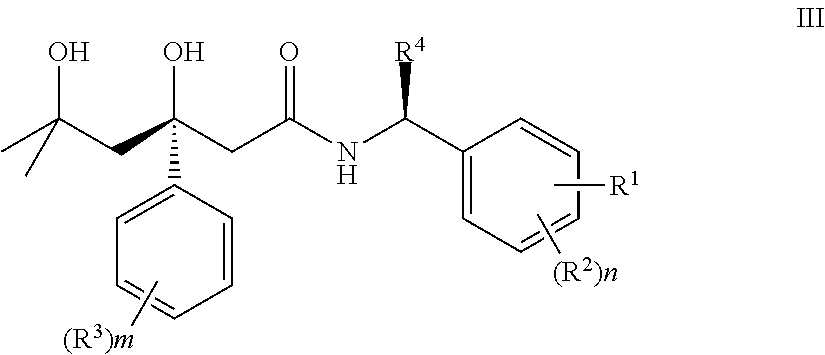
- a method of making the compound of formula (III) comprises allowing a compound formula (VI):
- R 1 is a leaving group selected from chloro, bromo, iodo, methoxy, arylsulfonyloxy and trifluoromethanesulfonyloxy; or R 1 is a carbocyclic or heterocyclic ring selected from phenyl, thienyl, pyridyl, N-oxo-pyridyl, cyclopropyl, piperidinyl, piperazinyl, morpholinyl, thiazolyl, oxadiazolyl, thiadiazolyl, pyrazolyl, S,S-dioxothiazinyl, pyridazinyl, pyrimidinyl, pyrazinyl, benzimidazolyl, benztriazolyl, oxodihydropyridyl, oxodi
- the invention relates to a method of making the compound of formula (III) according to the broadest embodiment above, wherein R 1 is bromo; and R 4 is —(C 1 -C 6 )alkyl;
- the invention relates to a method of making the compound of formula (III) according to any of the embodiments above, wherein m and n are each 0.
- the invention relates to a method of making the compound of formula (III) according to any of the embodiments above, wherein R 4 is methyl.
- the invention relates to a method of making the compound of formula (III) according to the broadest embodiment above, wherein R 1 is bromo; R 4 is —(C 1 -C 6 )alkyl; and m and n are each 0.
- the invention relates to a method of making the compound of formula (III) according to the embodiment immediately above, wherein R 4 is methyl.
- the invention relates to a method of making the compound of formula (III) as described in the embodiment immediately above, wherein R 1 is oxodihydropyrid-4-yl and wherein said nitrogen atom of said oxodihydropyrid-4-yl is substituted by methyl or cyclohexyl; R 4 is methyl; and m and n are each 0.
- the invention relates to a method of making the compound of formula (III) according to any of the embodiments above, wherein the reducing agent is sodium borohydride.
- the invention relates to a method of making the compound of formula (III) according to any of the embodiments above, wherein the catalyst is NiCl 2 dppe/Et 2 Zn.
- the invention relates to a method of making the compound of formula (VIII)
- each R 3 is independently selected from —(C 1 -C 6 )alkyl, —O(C 1 -C 6 )alkyl, and —(C 3 -C 6 )cycloalkyl; wherein each of the —(C 1 -C 6 )alkyl, —O(C 1 -C 6 )alkyl, and —(C 3 -C 6 )cycloalkyl of said R 3 is optionally independently substituted with one to three R 6 groups; and each R 6 is independently selected from halo, —(C 1 -C 6 )alkyl, —O(C 1 -C 6 )alkyl, and —(C 3 -C 6 )cycloalkyl.
- the invention relates to a method for making the compound of formula (VIII), wherein m is 0.
- the invention relates to a method of making the compound of formula (XII):
- each R 3 is independently selected from —(C 1 -C 6 )alkyl, —O(C 1 -C 6 )alkyl, and —(C 3 -C 6 )cycloalkyl; wherein each of the —(C 1 -C 6 )alkyl, —O(C 1 -C 6 )alkyl, and —(C 3 -C 6 )cycloalkyl of said R 3 is optionally independently substituted with one to three R 6 groups; and each R 6 is independently selected from halo, —(C 1 -C 6 )alkyl, —O(C 1 -C 6 )alkyl, and
- the invention relates to a method for making the compound of formula (XII) according to any of the embodiments above, wherein m is 0.
- the invention relates to a method for making the compound of formula (XII) according to any of the embodiments above, wherein the (R)-3,3′-dihalo-1,1′-binaphthyl-2,2′-diol is selected from (R)-3,3′-difluoro-1,1′-binaphthyl-2,2′-diol, (R)-3,3′-dibromo-1,1′-binaphthyl-2,2′-diol and (R)-3,3′-dichloro-1,1′-binaphthyl-2,2′-diol.
- the invention relates to a method for making the compound of formula (XII) according to any of the embodiments above, wherein the (R)-3,3′-dihalo-1,1′-binaphthyl-2,2′-diol is (R)-3,3′-dibromo-1,1′-binaphthyl-2,2′-diol.
- the invention relates to a method for making the compound of formula (XII) according to any of the embodiments above, wherein the (R)-3,3′-dihalo-1,1′-binaphthyl-2,2′-diol is (R)-3,3′-difluoro-1,1′-binaphthyl-2,2′-diol.
- the invention relates to a compound of formula (II):
- R 1 is selected from chloro, bromo, iodo, methoxy, arylsulfonyloxy and trifluoromethanesulfonyloxy
- each R 2 and R 3 is independently selected from —(C 1 -C 6 )alkyl, —O(C 1 -C 6 )alkyl, and —(C 3 -C 6 )cycloalkyl; wherein each of the —(C 1 -C 6 )alkyl, —O(C 1 -C 6 )alkyl, and —(C 3 -C 6 )cycloalkyl of said R 2 and R 3 is optionally independently substituted with one to three R 6 groups;
- R 4 is selected from —(C 1 -C 6 )alkyl and —(C 3 -C 6 )cycloalkyl; wherein the —(C 1 -C 6 )alkyl and —(C 1 -C 6 )alkyl and
- the invention relates to a compound of formula (II), wherein R 1 is bromo; R 4 is —(C 1 -C 6 )alkyl; R 5 is phenyl; and m and n are each 0.
- the invention relates to a compound of formula (II) as described in any of the embodiments above, wherein R 1 is bromo; R 4 is methyl, R 5 is phenyl; and m and n are each 0.
- the invention relates to a compound of formula (III):
- R 1 is selected from chloro, bromo, iodo, methoxy, arylsulfonyloxy and trifluoromethanesulfonyloxy
- each R 2 and R 3 is independently selected from —(C 1 -C 6 )alkyl, —O(C 1 -C 6 )alkyl, and —(C 3 -C 6 )cycloalkyl; wherein each of the —(C 1 -C 6 )alkyl, —O(C 1 -C 6 )alkyl, and —(C 3 -C 6 )cycloalkyl of said R 2 and R 3 is optionally independently substituted with one to three R 6 groups;
- R 4 is selected from —(C 1 -C 6 )alkyl and —(C 3 -C 6 )cycloalkyl; wherein the —(C 1 -C 6 )alkyl and —(C 3 -C 6 )cycloalkyl
- the invention relates to a compound of formula (III), wherein R 1 is bromo; R 4 is —(C 1 -C 6 )alkyl; and m and n are each 0.
- the invention relates to a compound of formula (III) as described in any of the embodiments above, wherein R 1 is bromo; R 4 is methyl; and m and n are each 0.
- the invention relates to a compound of formula (IV):
- R 1 is selected from chloro, bromo, iodo, methoxy, arylsulfonyloxy and trifluoromethanesulfonyloxy
- each R 2 and R 3 is independently selected from —(C 1 -C 6 )alkyl, —O(C 1 -C 6 )alkyl, and —(C 3 -C 6 )cycloalkyl; wherein each of the —(C 1 -C 6 )alkyl, —O(C 1 -C 6 )alkyl, and —(C 3 -C 6 )cycloalkyl of said R 2 and R 3 is optionally independently substituted with one to three R 6 groups;
- R 4 is selected from —(C 1 -C 6 )alkyl and —(C 3 -C 6 )cycloalkyl; wherein the —(C 1 -C 6 )alkyl and —(C 1 -C 6 )alkyl and
- the invention relates to a compound of formula (IV), wherein R 1 is bromo; R 4 is —(C 1 -C 6 )alkyl; and m and n are each 0.
- the invention relates to a compound of formula (IV) as described in any of the embodiments above, wherein R 1 is bromo; R 4 is methyl; and m and n are each 0.
- the invention relates to (R)-2,2′-bis(methoxymethoxy)-1,1′-binaphthyl.
- DIBAL-H diisobutylaluminum hydride
- NFSI N-fluoro-N-(phenylsulfonyl)benzenesulfonamide
- TMSCl trimethylchlorosilane
- (C 1 -C 6 )alkyl refers to branched and unbranched alkyl groups having from 1 to 6 carbon atoms.
- Examples of —(C 1 -C 6 )alkyls include methyl, ethyl, n-propyl, isopropyl, n-butyl, sec-butyl, isobutyl, tert-butyl, n-pentane, iso-pentyl, neopentyl, n-hexane, iso-hexanes (e.g., 2-methylpentyl, 3-methylpentyl, 2,3-dimethylbutyl, and 2,2-dimethylbutyl). It will be understood that any chemically feasible carbon atom of the (C 1 -C 6 )alkyl group can be the point of attachment to another group or moiety.
- (C 3 -C 6 )cycloalkyl refers to a nonaromatic 3- to 6-membered monocyclic carbocyclic radical.
- Examples of “(C 3 -C 6 )cycloalkyls include cyclopropyl, cyclobutyl, cyclohexyl, cyclopentyl and cyclohexyl.
- halo or halogen refers to fluoro, chloro, bromo or iodo.
- the subject invention relates to compounds of formulae (II), (III), and (IV).
- the subject invention also relates to methods of making the compounds of formulae (I), (II), (III), (IV), (VIII) and (XII).
- These compounds are useful as intermediates for making 1,3-disubstited oxazinan-2-one 11- ⁇ -HSD1 inhibitors.
- Scheme 1 below depicts an exemplary method for making the compounds of formulae (I), (II), and (IV) according the processes of the invention.
- the compound of formula (I) can be prepared by allowing the compound of formula (II) to cyclize in the presence of base to provide the compound of formula (I).
- the cyclization can be carried out under aqueous or nonaqueous conditions.
- bases useful for carrying out the cyclization include aqueous bases comprising LiOH, NaOH, KOH, and CsOH.
- Nonlimiting examples of bases useful for carrying out the cyclization under non-aqueous conditions include KO-t-Bu, KO-t-pentyl, NaOMe, NaOEt, KOMe, KOEt, LiN(SiMe 3 ) 2 , NaN(SiMe 3 ) 2 , KN(SiMe 3 ) 2 , and NaH.
- the cyclization may be carried out at a temperature of from about 2° C. to about 100° C.; typically about 25° C.
- the compound of formula (II) can be prepared by allowing the compound of formula (III) to react with a reducing agent, e.g., 1,1,3,3-tetramethyldisiloxane, in the presence of a transition metal catalyst, e.g., Ru 3 (CO) 10 , to provide a compound of formula (IV).
- a transition metal catalyst e.g., Ru 3 (CO) 10
- the compound of formula (IV) is then allowed to react with the compound of formula (V) to provide the compound of formula (II).
- the compound of formula (IV) is not isolated prior to carrying out the reaction with the compound of formula (V).
- the compound of formula (II) can be prepared by methods described in WO2010089303 which provide a mixture of diastereomers of the compound of formula (II).
- the compound of formula (II) can then be isolated from the mixture of diastereomers using known methods, e.g., recrystallization and/or chromatography (e.g., chiral chromatography).
- the compounds of formula (I) where R 1 is a carbocyclic or heterocyclic ring as defined above are useful as 11- ⁇ -HSD1 inhibitors.
- compounds of formula (I) where R 1 is a leaving group as defined above are useful intermediates for making 11- ⁇ -HSD1 inhibitors.
- the compound of formula (I) where R 1 is a leaving group can be reacted with a Grignard reagent of formula RMgBr (where R is a carbocyclic or heterocyclic ring as defined for R 1 above) to provide a 11- ⁇ -HSD1 inhibitor of formula (I) useful as an 11- ⁇ -HSD1 inhibitor (see, e.g., WO/2009/134400 and WO/2010/010150).
- Schemes 2 and 3 below depict exemplary methods for making the compound of formula (III) according to the first process and second process of the invention.
- Scheme 2 depicts an exemplary first process for making the compound of formula (III) according to the invention.
- the compound of formula (VI) is then allowed to react with the compound of formula (VII) in the presence of a catalyst (e.g., NiCl 2 dppe/Et 2 Zn) at reduced temperature (e.g., about ⁇ 4° C.) to provide the compound of formula (III).
- a catalyst e.g., NiCl 2 dppe/Et 2 Zn
- reduced temperature e.g., about ⁇ 4° C.
- Compounds of formula (IX) are commercially available or can be made by known methods.
- the compound of formula (IX) is enantiomerically pure, i.e., the enantiomer depicted in Scheme 2 is present in at least about 90%, more preferably 95%; most preferably at least about 99%, based on the total amount of both enantiomers of the compound of formula (IX).
- the compound of formula (III) can also be prepared using methods analogous to those described in, e.g., Devant, R. et al., Chemische Berichte 119: 2191-207 (1986).
- the compound of formula (VII) can also be made by known methods (see Odenkirk et al, Tetrahedron Lett. 1992, 33, 5729; Le Roux et al. Synlett 1998, 11, 1249; Chancharunee et al. Tetrahedron Lett. 2003, 44, 5683) or by the method depicted below in Scheme 2a using the procedure of Schneider et al, Chem. Eur. J. 2005, 11, 3010-3021.
- a compound of formula (X) is allowed to react with acetone and n-BuLi in the presence of an amine (e.g., diisopropylamine) at reduced temperature.
- the compound of formula (XI) may also be prepared under milder conditions (e.g., 0° C.) using the procedure of Mukaiyama et al, Organic Syntheses, 1987, 65, 6.
- Scheme 3 depicts an exemplary method for making the compound of formula (III) according to the second process of the invention.
- the compound of formula (VII) is allowed to react with 2-(2-propen-1-yl)-1,3,2-dioxaborinane in the presence of a biaryl catalyst such as (R)-3,3′-dibromo-1,1′-binaphthyl-2,2′-diol ((R)-DBBINOL), (R)-3,3′-dichloro-1,1′-binaphthyl-2,2′-diol or (R)-3,3′-difluoro-1,1′-binaphthyl-2,2′-diol and 2 equivalents of tertiary alcohol such as t-BuOH and t-amyl alcohol to provide the compound of formula (XII).
- a biaryl catalyst such as (R)-3,3′-dibromo-1,1′-binaphthyl-2,2′-diol ((R)-DBBINOL), (R)
- the compound of formula (XII) is then subject to ozonolysis to provide the compound of formula (VIII) which is further allowed to undergo reductive amination with the compound of formula (IX) in the presence of reducing agent (e.g., NaBH 4 ) in alcoholic solvent to provide the compound of formula (III).
- reducing agent e.g., NaBH 4
- 2-(2-propen-1-yl)-1,3,2-dioxaborinane can be prepared by the method described below in the Examples section or literature methods (see e.g., D. S. Barnett et al., Angewandte Chemie, International Edition, 48: 8679-8682 (2009) and H. C. Brown et al., Journal of Organic Chemistry, 55: 1868-74 (1990)).
- (R)-3,3′-dibromo-1,1′-binaphthyl-2,2′-diol ((R)-DBBINOL) and (R)-3,3′-dichloro-1,1′-binaphthyl-2,2′-diol can be prepared by known methods (see, e.g., Ooi et al., J. Am Chem. Soc. 125(17): 5139-5151 (2003) and Egami et al., J. Am Chem. Soc. 131(17): 6082-6083 ((2009)).
- (R)-3,3′-difluoro-1,1′-binaphthyl-2,2′-diol can be prepared by the method described below in the Examples section.
- the compound of formula (IX) used in Schemes 2 and 3 is enantiomerically pure, i.e., the enantiomer depicted in Schemes 2 and 3 is present in at least about 90%, more preferably 95%; most preferably at least about 99%, based on the total amount of both enantiomers of the compound of formula (IX).
- the other chiral center of the diastereomeric compounds is determined by the process conditions described above and in the Examples.
- products formed by this process substantially comprise only two diastereomers. This allows for easier purification of product and improved overall yield.
- HPLC high performance liquid chromatography
- NMR nuclear magnetic resonance
- a flask is charged with THF (1 L), cooled to ⁇ 50° C., and treated with lithium diisopropylamide (LDA) (1.05 L, 1.89 mol, 1.1 equiv, 1.8M in THF/heptane/ethylbenzene).
- LDA lithium diisopropylamide
- the reactor contents are then treated with acetophenone (200 mL, 1.71 mol, 1.0 equiv) at a rate to maintain the batch at about ⁇ 50° C.
- the reaction mixture is stirred at about ⁇ 50° C. for 30 minutes then treated with acetone (151 mL, 2.06 mol, 1.2 equiv) at a rate to maintain the mixture at about ⁇ 50° C.
- the reaction mixture is stirred at about ⁇ 50° C.
- a flask is charged with 1 (120.0 g, 0.366 mol), 2 (120.0 g, 0.479 mol) and NiCl 2 (dppe) (1.93 g, 3.66 mmol).
- the flask is purged with nitrogen and charged with DME (240 mL).
- the resultant slurry is cooled to about ⁇ 20° C. and treated with diethylzinc (30 wt. % solution in toluene, 477 mL, 1.097 mol) at a rate to keep the temperature of the reaction mixture between ⁇ 15 to ⁇ 5° C.
- the reaction mixture is then stirred at ⁇ 5 to 0° C.
- Preparation 1 Compound 5 was first prepared by cooling a reaction mixture prepared according to Step 4 above to about 10° C. and treating it drop-wise with phenyl chloroformate (1.25 molar equivalents based on the molar amount of compound 3 used in Step 4). The reaction mixture is stirred at 20-25° C. for 2-18 hours, extracted with EtOAc, and the organic extract washed with 3N aqueous HCl. The combined organic phases are distilled to remove EtOAc and DME. The resultant solution is treated with heptane (30 mL), cooled to about 5° C., and held at about 5° C. for 3 hours. The resultant solids are collected by filtration, washed with heptane, and dried under vacuum at 25° C. for 18 hours to provide 5 as an off-white solid.
- Preparation 2 Using a procedure similar to that described in Preparation 1 above, the reaction mixture from Step 4 above is cooled to about 10° C. and treated drop-wise with phenyl chloroformate (5.2 mL, 41.3 mmol). The reaction mixture is stirred at 20-25° C. for 2-18 hours, extracted with EtOAc, and the organic extract washed with 3N aqueous HCl. The combined organic phases are distilled to remove EtOAc and DME. The resultant solution is treated with heptane (30 mL), cooled to about 5° C., seeded with 5 (obtained from Preparation 1 immediately above), and held at about 5° C. for 3 hours.
- phenyl chloroformate 5.2 mL, 41.3 mmol
- Example 2 describes an alternative preparation of (S)-6-((S)-1-(4-bromophenyl)ethylamino)-2-methyl-4-phenylhexane-2,4-diol (4) described in Step 4 of Example 1 above.
- a reactor is purged with N 2 and charged with 2M allylmagnesium chloride in THF (850 mL, 1.7 mol), anhydrous THF (755.7 g, 850 mL, 10.48 mol) and methyl-t-butyl ether (629.0 g, 850 mL, 7.1 mol), cooled to ⁇ 65° C., and treated with trimethylboronate (176.7 g, 1.7 mol) while maintaining a temperature of less than ⁇ 60° C.
- the resultant milky solution is maintained at ⁇ 55 to ⁇ 60° C. for 30 minutes and slowly warmed to 0° C. over 30 minutes.
- the mixture is then treated with acetyl chloride (120.1 g, 1.53 mol) while maintaining a temperature of less than 5° C.
- the mixture is allowed to slowly warm to about 20° C. over 30 minutes and treated with 1,3-propanediol (116.4 g, 1.53 mol).
- the reaction mixture is maintained at about 20° C. for 6 hours, concentrated to about 1 ⁇ 3 of its original volume under reduced pressure at a temperature of less than about 29° C., and treated with MTBE (580 mL) and heptane (720 ml).
- the resultant mixture is again reduced to about 1 ⁇ 3 of its original volume under reduced pressure, filtered through Celite, and the Celite plug rinsed with MTBE (3.5 L).
- a flask is charged with 2 (4.1 g; 16.5 mmol) (see Step 2 of Example 1 above), 17 mol % of (R)-DBBINOL (1.3 g; 2.9 mmol), and 2.4 eq. of t-BuOH (2.9 g; 39.1 mmol) under nitrogen atmosphere.
- the reaction mixture is then treated with 7 (3.7 g; 29.4 mmol) from Step 1 above at 23° C. and stirred for about 24 hours.
- the mixture is treated with water (50 mL), hexanes (50 mL), 3M HCl (1 mL), and stirred for 1 hour.
- Ozone is bubbled through a solution of 8 (0.5 g) in 10% MeOH/CH 2 Cl 2 (20 mL) at ⁇ 70 to ⁇ 78° C. until a blue color persists. O 2 is then bubbled through the solution for 10 min followed by N 2 bubbling for 5 min. The solution is then treated with triphenylphosphine (Ph 3 P) and warmed to 22° C. The mixture is concentrated, purified on silica gel (Combiflash; eluent: 5% EtOAc in hexane), and concentrated to provide 9 as clear colorless oil. Yield: 0.35 g, 1.18 mmol; 93%.
- Step 3 Synthesis (R)-3,3′-difluoro-1,1′-binaphthyl-2,2′-diol (10)
- Amberlyst® 15 (Aldrich) 15 (6 g) is added to a stirred solution of 12 (5.6 g, 13.7 mmol) in 1:1 THF/MeOH (vol/vol) (60 mL). The resultant mixture is heated at reflux for 3 hours then allowed to cool to about 25° C. The mixture is then filtered through a Celite pad, and the filtrate is concentrated. The resultant residue is redissolved in a minimum volume of toluene, added to a silica gel column, eluted with hexane/EtOAc, and concentrated to provide 10 as a white solid. Yield: 4.3 g, 97%.
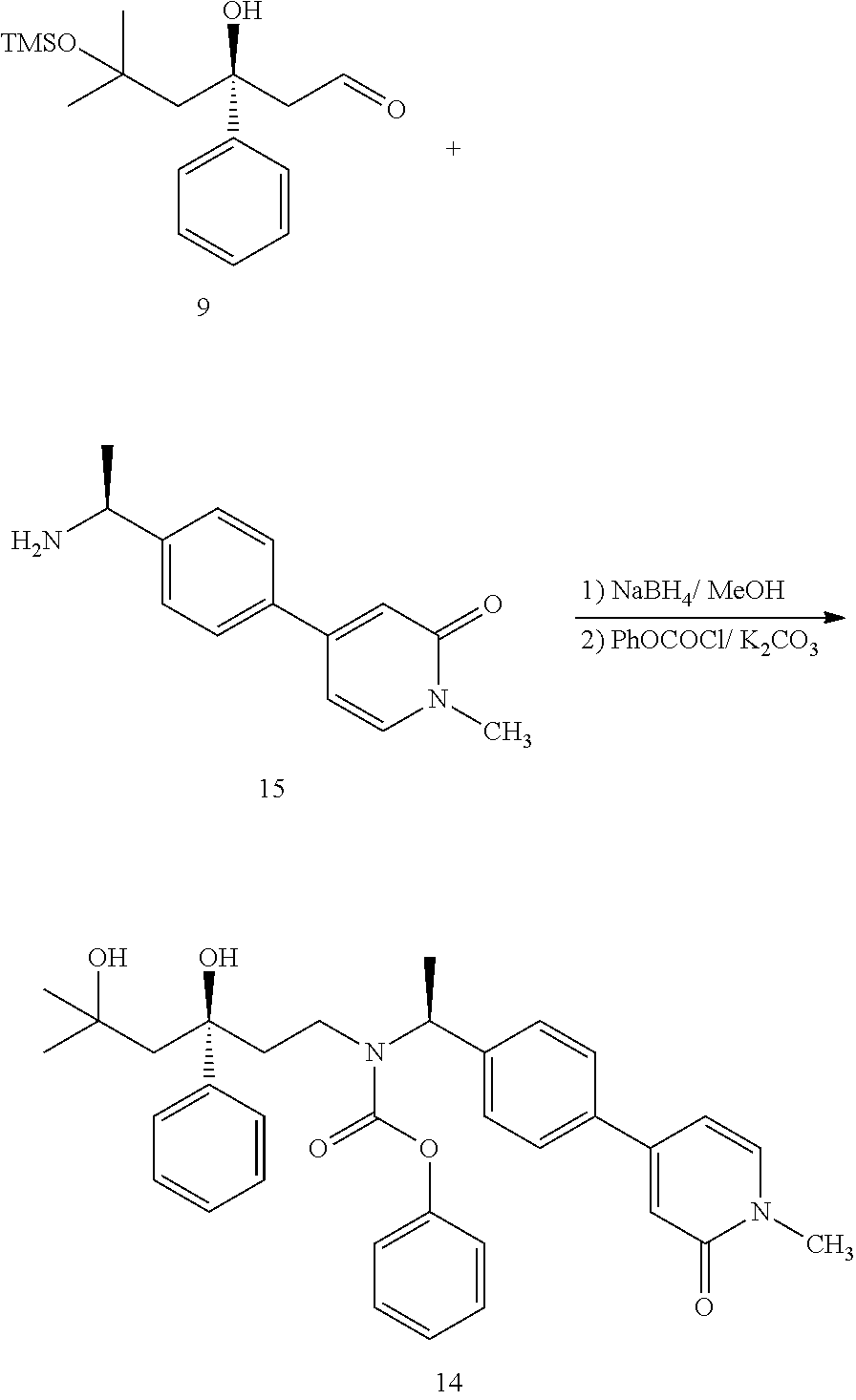
- Step 1 Preparation of phenyl (S)-3,5-dihydroxy-5-methyl-3-phenylhexyl((S)-1-(4-(1-methyl-2-oxo-1,2-dihydropyridin-4-yl)phenyl)ethyl)carbamate (14)
- NaBII 4 (0.226 g, 5.97 mmol) is added in portions to a mixture of 9 (1.17 g, 3.98 mmol) and (S)-4-(4-(1-aminoethyl)phenyl)-1-methylpyridin-2(1H)-one (15) (1.00 g, 4.37 g) in MeOH (5 mL). The mixture is stirred at 25° C. for 15 h, then treated with K 2 CO 3 (1.65 g, 11.93 mmol) followed by phenyl chloroformate (0.93, 5.97 mmol). The resultant suspension is then stirred at 25° C. for 1 hour, treated with water (15 mL) over 30 min, and stirred at 25° C. for 2 hours.
Landscapes
- Organic Chemistry (AREA)
- Chemical & Material Sciences (AREA)
- Health & Medical Sciences (AREA)
- Diabetes (AREA)
- General Health & Medical Sciences (AREA)
- Bioinformatics & Cheminformatics (AREA)
- Medicinal Chemistry (AREA)
- Nuclear Medicine, Radiotherapy & Molecular Imaging (AREA)
- Chemical Kinetics & Catalysis (AREA)
- Pharmacology & Pharmacy (AREA)
- Life Sciences & Earth Sciences (AREA)
- Animal Behavior & Ethology (AREA)
- Engineering & Computer Science (AREA)
- Public Health (AREA)
- Veterinary Medicine (AREA)
- General Chemical & Material Sciences (AREA)
- Hematology (AREA)
- Obesity (AREA)
- Emergency Medicine (AREA)
- Endocrinology (AREA)
- Child & Adolescent Psychology (AREA)
- Pharmaceuticals Containing Other Organic And Inorganic Compounds (AREA)
- Plural Heterocyclic Compounds (AREA)
- Organic Low-Molecular-Weight Compounds And Preparation Thereof (AREA)
- Low-Molecular Organic Synthesis Reactions Using Catalysts (AREA)
- Heterocyclic Carbon Compounds Containing A Hetero Ring Having Nitrogen And Oxygen As The Only Ring Hetero Atoms (AREA)
Abstract

wherein m, n and R1 to R4 are as defined herein. The process of the invention provides the compound of formula (I) in high yield and substantially free of the corresponding diastereomers. The compounds of formula (I) prepared by the process of the invention are useful for making pharmaceutically active compounds such as 11-β-hydroxysteroid hydrogenase type 1 (11-β-HSD1) inhibitors.
Description


comprising allowing a compound of formula (II):

to react in the presence of base to form the compound of formula (I), wherein:
m and n are each independently 0, 1 or 2;
R1 is a leaving group selected from chloro, bromo, iodo, methoxy, arylsulfonyloxy and trifluoromethanesulfonyloxy; or
R1 is a carbocyclic or heterocyclic ring selected from phenyl, thienyl, pyridyl, N-oxo-pyridyl, cyclopropyl, piperidinyl, piperazinyl, morpholinyl, thiazolyl, oxadiazolyl, thiadiazolyl, pyrazolyl, S,S-dioxothiazinyl, pyridazinyl, pyrimidinyl, pyrazinyl, benzimidazolyl, benztriazolyl, oxodihydropyridyl, oxodihydropyridazinyl, oxodihydropyrimidinyl and oxodihydropyrazinyl; wherein each of the foregoing R1 carbocyclic or heterocyclic rings may be optionally substituted by 1 to 4 groups; wherein substituents for ring carbon atoms of said carbocyclic or heterocyclic rings are independently selected from halogen, cyano, oxo, nitro, —(C1-C6)alkyl, —O(C1-C6)alkyl, and —(C3-C6)cycloalkyl; and wherein substituents for ring nitrogen atoms of said heterocyclic rings, when present, are selected from —(C1-C6)alkyl and —(C3-C6)cycloalkyl;
each R2 and R3 is independently selected from —(C1-C6)alkyl, —O(C1-C6)alkyl, and —(C3-C6)cycloalkyl; wherein each of the —(C1-C6)alkyl, —O(C1-C6)alkyl, and —(C3-C6)cycloalkyl of said R2 and R3 is optionally independently substituted with one to three R6 groups;
R4 is selected from —(C1-C6)alkyl and —(C3-C6)cycloalkyl; wherein the —(C1-C6)alkyl and —(C3-C6)cycloalkyl of said R4 is optionally substituted with one to three R6 groups;
R5 is selected from —(C1-C6)alkyl, —(C3-C6)cycloalkyl, and phenyl; and
each R6 is independently selected from halo, —(C1-C6)alkyl, —O(C1-C6)alkyl, and —(C3-C6)cycloalkyl.
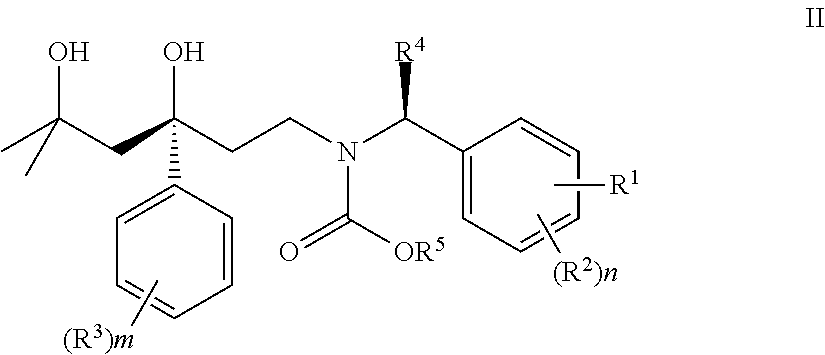
comprising allowing a compound of formula (IV),

to react with a compound of formula (V):
R5—O—C(O)—R7 V
to provide the compound of formula (II), wherein
m and n are each independently 0, 1 or 2;
R1 is a leaving group selected from chloro, bromo, iodo, methoxy, arylsulfonyloxy and trifluoromethanesulfonyloxy; or
R1 is a carbocyclic or heterocyclic ring selected from phenyl, thienyl, pyridyl, N-oxo-pyridyl, cyclopropyl, piperidinyl, piperazinyl, morpholinyl, thiazolyl, oxadiazolyl, thiadiazolyl, pyrazolyl, S,S-dioxothiazinyl, pyridazinyl, pyrimidinyl, pyrazinyl, benzimidazolyl, benztriazolyl, oxodihydropyridyl, oxodihydropyridazinyl, oxodihydropyrimidinyl and oxodihydropyrazinyl; wherein each of the foregoing R1 carbocyclic or heterocyclic rings may be optionally substituted by 1 to 4 groups; wherein substituents for ring carbon atoms of said carbocyclic or heterocyclic rings are independently selected from halogen, cyano, oxo, nitro, —(C1-C6)alkyl, —O(C1-C6)alkyl, and —(C3-C6)cycloalkyl; and wherein substituents for ring nitrogen atoms of said heterocyclic rings, when present, are selected from —(C1-C6)alkyl and —(C3-C6)cycloalkyl;
each R2 and R3 is independently selected from —(C1-C6)alkyl, —O(C1-C6)alkyl, and —(C3-C6)cycloalkyl; wherein each of the —(C1-C6)alkyl, —O(C1-C6)alkyl, and —(C3-C6)cycloalkyl of said R2 and R3 is optionally independently substituted with one to three R6 groups;
R4 is selected from —(C1-C6)alkyl and —(C3-C6)cycloalkyl; wherein the —(C1-C6)alkyl and —(C3-C6)cycloalkyl of said R4 is optionally substituted with one to three R6 groups;
R5 is selected from —(C1-C6)alkyl, —(C3-C6)cycloalkyl, and phenyl;
each R6 is independently selected from halo, —(C1-C6)alkyl, —O(C1-C6)alkyl, and —(C3-C6)cycloalkyl; and
R7 is selected from chloro, iodo, and bromo.

to react with 1,1,3,3-tetramethyldisiloxane ([CH3)2SiH]2O) in the presence of a transition metal catalyst to provide the compound of formula (IV), wherein
m and n are each independently 0, 1 or 2;
R1 is a leaving group selected from chloro, bromo, iodo, methoxy, arylsulfonyloxy and trifluoromethanesulfonyloxy; or
R4 is selected from —(C1-C6)alkyl and —(C3-C6)cycloalkyl; wherein the —(C1-C6)alkyl and —(C3-C6)cycloalkyl of said R4 is optionally substituted with one to three R6 groups; and
each R6 is independently selected from halo, —(C1-C6)alkyl, —O(C1-C6)alkyl, and —(C3-C6)cycloalkyl.

to react with the compound of formula (IX)

in the presence of a reducing agent to provide the compound of formula (III), wherein
m and n are each independently 0, 1 or 2;
R1 is a leaving group selected from chloro, bromo, iodo, methoxy, arylsulfonyloxy and trifluoromethanesulfonyloxy; or
R1 is a carbocyclic or heterocyclic ring selected from phenyl, thienyl, pyridyl, N-oxo-pyridyl, cyclopropyl, piperidinyl, piperazinyl, morpholinyl, thiazolyl, oxadiazolyl, thiadiazolyl, pyrazolyl, S,S-dioxothiazinyl, pyridazinyl, pyrimidinyl, pyrazinyl, benzimidazolyl, benztriazolyl, oxodihydropyridyl, oxodihydropyridazinyl, oxodihydropyrimidinyl and oxodihydropyrazinyl; wherein each of the foregoing R1 carbocyclic or heterocyclic rings may be optionally substituted by 1 to 4 groups; wherein substituents for ring carbon atoms of said carbocyclic or heterocyclic rings are independently selected from halogen, cyano, oxo, nitro, —(C1-C6)alkyl, —O(C1-C6)alkyl, and —(C3-C6)cycloalkyl; and wherein substituents for ring nitrogen atoms of said heterocyclic rings, when present, are selected from —(C1-C6)alkyl and —(C3-C6)cycloalkyl;
each R2 and R3 is independently selected from —(C1-C6)alkyl, —O(C1-C6)alkyl, and —(C3-C6)cycloalkyl; wherein each of the —(C1-C6)alkyl, —O(C1-C6)alkyl, and —(C3-C6)cycloalkyl of said R2 and R3 is optionally independently substituted with one to three R6 groups;
R4 is selected from —(C1-C6)alkyl and —(C3-C6)cycloalkyl; wherein the —(C1-C6)alkyl and —(C3-C6)cycloalkyl of said R4 is optionally substituted with one to three R6 groups; and
each R6 is independently selected from halo, —(C1-C6)alkyl, —O(C1-C6)alkyl, and —(C3-C6)cycloalkyl.

to react with a compound of formula (VII)

in the presence of a catalyst to provide the compound of formula (III), wherein
m and n are each independently 0, 1 or 2;
R1 is a leaving group selected from chloro, bromo, iodo, methoxy, arylsulfonyloxy and trifluoromethanesulfonyloxy; or
R1 is a carbocyclic or heterocyclic ring selected from phenyl, thienyl, pyridyl, N-oxo-pyridyl, cyclopropyl, piperidinyl, piperazinyl, morpholinyl, thiazolyl, oxadiazolyl, thiadiazolyl, pyrazolyl, S,S-dioxothiazinyl, pyridazinyl, pyrimidinyl, pyrazinyl, benzimidazolyl, benztriazolyl, oxodihydropyridyl, oxodihydropyridazinyl, oxodihydropyrimidinyl and oxodihydropyrazinyl; wherein each of the foregoing R1 carbocyclic or heterocyclic rings may be optionally substituted by 1 to 4 groups; wherein substituents for ring carbon atoms of said carbocyclic or heterocyclic rings are independently selected from halogen, cyano, oxo, nitro, —(C1-C6)alkyl, —O(C1-C6)alkyl, and —(C3-C6)cycloalkyl; and wherein substituents for ring nitrogen atoms of said heterocyclic rings, when present, are selected from —(C1-C6)alkyl and —(C3-C6)cycloalkyl;
each R2 and R3 is independently selected from —(C1-C6)alkyl, —O(C1-C6)alkyl, and —(C3-C6)cycloalkyl; wherein each of the —(C1-C6)alkyl, —O(C1-C6)alkyl, and —(C3-C6)cycloalkyl of said R2 and R3 is optionally independently substituted with one to three R6 groups;
R4 is selected from —(C1-C6)alkyl and —(C3-C6)cycloalkyl; wherein the —(C1-C6)alkyl and —(C3-C6)cycloalkyl of said R4 is optionally substituted with one to three R6 groups; and
each R6 is independently selected from halo, —(C1-C6)alkyl, —O(C1-C6)alkyl, and —(C3-C6)cycloalkyl.

comprising allowing a compound of formula (XII)

to react with ozone to provide the compound of formula (VIII), wherein
m is 0, 1 or 2;
each R3 is independently selected from —(C1-C6)alkyl, —O(C1-C6)alkyl, and —(C3-C6)cycloalkyl; wherein each of the —(C1-C6)alkyl, —O(C1-C6)alkyl, and —(C3-C6)cycloalkyl of said R3 is optionally independently substituted with one to three R6 groups; and
each R6 is independently selected from halo, —(C1-C6)alkyl, —O(C1-C6)alkyl, and —(C3-C6)cycloalkyl.

comprising allowing a compound of formula (VII)

to react with 2-(2-propen-1-yl)-1,3,2-dioxaborinane in the presence of (R)-3,3′-dihalo-1,1′-binaphthyl-2,2′-diol to provide the compound of formula (XII), wherein
m is 0, 1 or 2;
each R3 is independently selected from —(C1-C6)alkyl, —O(C1-C6)alkyl, and —(C3-C6)cycloalkyl; wherein each of the —(C1-C6)alkyl, —O(C1-C6)alkyl, and —(C3-C6)cycloalkyl of said R3 is optionally independently substituted with one to three R6 groups; and
each R6 is independently selected from halo, —(C1-C6)alkyl, —O(C1-C6)alkyl, and —(C3-C6)cycloalkyl.

wherein:
m and n are each independently 0, 1 or 2;
R1 is selected from chloro, bromo, iodo, methoxy, arylsulfonyloxy and trifluoromethanesulfonyloxy;
each R2 and R3 is independently selected from —(C1-C6)alkyl, —O(C1-C6)alkyl, and —(C3-C6)cycloalkyl; wherein each of the —(C1-C6)alkyl, —O(C1-C6)alkyl, and —(C3-C6)cycloalkyl of said R2 and R3 is optionally independently substituted with one to three R6 groups;
R4 is selected from —(C1-C6)alkyl and —(C3-C6)cycloalkyl; wherein the —(C1-C6)alkyl and —(C3-C6)cycloalkyl of said R4 is optionally substituted with one to three R6 groups;
R5 is selected from —(C1-C6)alkyl, —(C3-C6)cycloalkyl, and phenyl;
each R6 is independently selected from halo, —(C1-C6)alkyl, —O(C1-C6)alkyl, and —(C3-C6)cycloalkyl.

wherein
m and n are each independently 0, 1 or 2;
R1 is selected from chloro, bromo, iodo, methoxy, arylsulfonyloxy and trifluoromethanesulfonyloxy;
each R2 and R3 is independently selected from —(C1-C6)alkyl, —O(C1-C6)alkyl, and —(C3-C6)cycloalkyl; wherein each of the —(C1-C6)alkyl, —O(C1-C6)alkyl, and —(C3-C6)cycloalkyl of said R2 and R3 is optionally independently substituted with one to three R6 groups;
R4 is selected from —(C1-C6)alkyl and —(C3-C6)cycloalkyl; wherein the —(C1-C6)alkyl and —(C3-C6)cycloalkyl of said R4 is optionally substituted with one to three R6 groups; and
each R6 is independently selected from halo, —(C1-C6)alkyl, —O(C1-C6)alkyl, and —(C3-C6)cycloalkyl.

wherein:
m and n are each independently 0, 1 or 2;
R1 is selected from chloro, bromo, iodo, methoxy, arylsulfonyloxy and trifluoromethanesulfonyloxy;
each R2 and R3 is independently selected from —(C1-C6)alkyl, —O(C1-C6)alkyl, and —(C3-C6)cycloalkyl; wherein each of the —(C1-C6)alkyl, —O(C1-C6)alkyl, and —(C3-C6)cycloalkyl of said R2 and R3 is optionally independently substituted with one to three R6 groups;
R4 is selected from —(C1-C6)alkyl and —(C3-C6)cycloalkyl; wherein the —(C1-C6)alkyl and —(C3-C6)cycloalkyl of said R4 is optionally substituted with one to three R6 groups; and
each R6 is independently selected from halo, —(C1-C6)alkyl, —O(C1-C6)alkyl, and —(C3-C6)cycloalkyl.



Claims (6)


Priority Applications (1)
| Application Number | Priority Date | Filing Date | Title |
|---|---|---|---|
| US13/921,145 US8916701B2 (en) | 2010-12-20 | 2011-12-15 | Methods of making diastereomeric organic compounds |
Applications Claiming Priority (4)
| Application Number | Priority Date | Filing Date | Title |
|---|---|---|---|
| US201061424834P | 2010-12-20 | 2010-12-20 | |
| US201161528321P | 2011-08-29 | 2011-08-29 | |
| PCT/US2011/065013 WO2012087720A1 (en) | 2010-12-20 | 2011-12-15 | Methods of making diastereomeric organic compounds |
| US13/921,145 US8916701B2 (en) | 2010-12-20 | 2011-12-15 | Methods of making diastereomeric organic compounds |
Publications (2)
| Publication Number | Publication Date |
|---|---|
| US20140135493A1 US20140135493A1 (en) | 2014-05-15 |
| US8916701B2 true US8916701B2 (en) | 2014-12-23 |
Family
ID=45498103
Family Applications (1)
| Application Number | Title | Priority Date | Filing Date |
|---|---|---|---|
| US13/921,145 Active US8916701B2 (en) | 2010-12-20 | 2011-12-15 | Methods of making diastereomeric organic compounds |
Country Status (4)
| Country | Link |
|---|---|
| US (1) | US8916701B2 (en) |
| EP (1) | EP2655349B1 (en) |
| JP (1) | JP2014508125A (en) |
| WO (1) | WO2012087720A1 (en) |
Citations (1)
| Publication number | Priority date | Publication date | Assignee | Title |
|---|---|---|---|---|
| WO2010089303A1 (en) | 2009-02-04 | 2010-08-12 | Boehringer Ingelheim International Gmbh | CYCLIC INHIBITORS OF 11 β-HYDROXYSTEROID DEHYDROGENASE 1 |
Family Cites Families (5)
| Publication number | Priority date | Publication date | Assignee | Title |
|---|---|---|---|---|
| WO2007011910A2 (en) * | 2005-07-19 | 2007-01-25 | Trustees Of Boston University | Chiral amine-catalyzed asymmetric addition of carbon-centered nucleophiles to imines |
| JP5451611B2 (en) * | 2007-07-26 | 2014-03-26 | ヴァイティー ファーマシューティカルズ,インコーポレイテッド | Cyclic inhibitor of 11β-hydroxysteroid dehydrogenase 1 |
| KR20110002492A (en) * | 2008-05-01 | 2011-01-07 | 비타이 파마슈티컬즈, 인코포레이티드 | Cyclic Inhibitor of 11beta-hydroxysteroid Dehydrogenase 1 |
| CA2723032A1 (en) * | 2008-05-01 | 2009-11-05 | Vitae Pharmaceuticals, Inc. | Cyclic inhibitors of 11beta-hydroxysteroid dehydrogenase 1 |
| CA2729993A1 (en) | 2008-07-25 | 2010-01-28 | Boehringer Ingelheim International Gmbh | Synthesis of inhibitors of 11beta-hydroxysteroid dehydrogenase type 1 |
-
2011
- 2011-12-15 WO PCT/US2011/065013 patent/WO2012087720A1/en not_active Ceased
- 2011-12-15 EP EP11810721.8A patent/EP2655349B1/en not_active Not-in-force
- 2011-12-15 US US13/921,145 patent/US8916701B2/en active Active
- 2011-12-15 JP JP2013546218A patent/JP2014508125A/en active Pending
Patent Citations (1)
| Publication number | Priority date | Publication date | Assignee | Title |
|---|---|---|---|---|
| WO2010089303A1 (en) | 2009-02-04 | 2010-08-12 | Boehringer Ingelheim International Gmbh | CYCLIC INHIBITORS OF 11 β-HYDROXYSTEROID DEHYDROGENASE 1 |
Non-Patent Citations (1)
| Title |
|---|
| International Search Report and Written Opinion for PCT/US2011/065013 mailed Mar. 7, 2012. |
Also Published As
| Publication number | Publication date |
|---|---|
| JP2014508125A (en) | 2014-04-03 |
| WO2012087720A1 (en) | 2012-06-28 |
| EP2655349B1 (en) | 2014-10-15 |
| US20140135493A1 (en) | 2014-05-15 |
| EP2655349A1 (en) | 2013-10-30 |
Similar Documents
| Publication | Publication Date | Title |
|---|---|---|
| US8648189B2 (en) | Method for the preparation of rivoraxaban | |
| US10851085B2 (en) | Pyrazole derivatives | |
| US11434192B2 (en) | Process and intermediates | |
| US9126906B2 (en) | Asymmetric synthetic processes for the preparation of aminosulfone compounds | |
| JPWO2014021281A1 (en) | Partially saturated nitrogen-containing heterocyclic compounds | |
| US20110087030A1 (en) | Process for the manufacture of enantiomerically pure antifungal azoles as ravuconazole and isavuconazole | |
| US20090005354A1 (en) | New Amino Derivatives and Their Use as Pharmaceuticals | |
| TW201028374A (en) | Method of preparing ezetimibe and intermediates used therein | |
| US20100113778A1 (en) | Process for preparing o-chloromethylphenylglyoxylic esters, improved process for preparing (e)-2-(2-chloromethylphenyl)-2-alkoximinoacetic esters, and novel intermediates for their preparation | |
| JP2007326784A (en) | Process for producing 1-substituted-5-fluoroalkylpyrazole-4-carboxylic acid ester | |
| US20090253918A1 (en) | Novel intermediate for glyt1 inhibitor | |
| US20140135493A1 (en) | Methods of making diastereomeric organic compounds | |
| US9376409B2 (en) | Methods for making oxetan-3-ylmethanamines | |
| AU2017258665A1 (en) | Process for the preparation of herbicidal compounds | |
| EP1937662B1 (en) | Process for the preparation of duloxetine | |
| JP4956614B2 (en) | Novel process for producing 3-amino-5-fluoro-4-dialkoxypentanoic acid ester | |
| TWI920144B (en) | Method for producing octahydrothienoquinoline compound, and production intermediate thereof | |
| Kawazoe et al. | Synthesis of Optically Active Thromboxane A2 and Leukotriene D4 Receptor Antagonists | |
| AU2017258668A1 (en) | Process for the preparation of herbicidal pyridinylimidazolone compounds | |
| JP4267125B2 (en) | Method for producing pyridine alcohol derivative | |
| US8975447B2 (en) | Process for asymetric methylallylation in the presence of a 2,2′-substituted 1,1′-BI-2-naphthol catalyst | |
| AU2009307309B2 (en) | Method for producing oxadiazolinone compound and intermediate thereof | |
| JP2023027698A (en) | OPTICALLY ACTIVE PYRROLIDINE DERIVATIVE OR ACIDIC SALT THEREOF, OPTICALLY ACTIVE α-CARBOLINE DERIVATIVE, AND METHOD FOR PRODUCING THEM | |
| JP2004250340A (en) | Method for producing 4-hydrazinotetrahydropyran compound or acid salt thereof | |
| JP2016175859A (en) | Process for producing optically active uracil derivative and its intermediate |
Legal Events
| Date | Code | Title | Description |
|---|---|---|---|
| AS | Assignment |
Owner name: BOEHRINGER INGELHEIM INTERNATIONAL GMBH, GERMANY Free format text: ASSIGNMENT OF ASSIGNORS INTEREST;ASSIGNORS:FANDRICK, DANIEL ROBERT;LU, ZHI-HUI;REEVES, DIANA CRIMHILDA;AND OTHERS;SIGNING DATES FROM 20131011 TO 20131211;REEL/FRAME:031790/0723 |
|
| STCF | Information on status: patent grant |
Free format text: PATENTED CASE |
|
| FEPP | Fee payment procedure |
Free format text: PAYOR NUMBER ASSIGNED (ORIGINAL EVENT CODE: ASPN); ENTITY STATUS OF PATENT OWNER: LARGE ENTITY |
|
| MAFP | Maintenance fee payment |
Free format text: PAYMENT OF MAINTENANCE FEE, 4TH YEAR, LARGE ENTITY (ORIGINAL EVENT CODE: M1551) Year of fee payment: 4 |
|
| MAFP | Maintenance fee payment |
Free format text: PAYMENT OF MAINTENANCE FEE, 8TH YEAR, LARGE ENTITY (ORIGINAL EVENT CODE: M1552); ENTITY STATUS OF PATENT OWNER: LARGE ENTITY Year of fee payment: 8 |
|
| MAFP | Maintenance fee payment |
Free format text: PAYMENT OF MAINTENANCE FEE, 12TH YEAR, LARGE ENTITY (ORIGINAL EVENT CODE: M1553); ENTITY STATUS OF PATENT OWNER: LARGE ENTITY Year of fee payment: 12 |