US8912308B2 - Copolymer, organic solar cell using the same and manufacturing method thereof - Google Patents
Copolymer, organic solar cell using the same and manufacturing method thereof Download PDFInfo
- Publication number
- US8912308B2 US8912308B2 US13/566,837 US201213566837A US8912308B2 US 8912308 B2 US8912308 B2 US 8912308B2 US 201213566837 A US201213566837 A US 201213566837A US 8912308 B2 US8912308 B2 US 8912308B2
- Authority
- US
- United States
- Prior art keywords
- group
- substituted
- unsubstituted
- copolymer
- carbazole
- Prior art date
- Legal status (The legal status is an assumption and is not a legal conclusion. Google has not performed a legal analysis and makes no representation as to the accuracy of the status listed.)
- Active
Links
- 0 CC.CC.[1*]N1C2=C(C=C(C)C=C2)C2=C1/C=C\C(C)=C/2 Chemical compound CC.CC.[1*]N1C2=C(C=C(C)C=C2)C2=C1/C=C\C(C)=C/2 0.000 description 16
- KEJFBBUEAOCCAR-UHFFFAOYSA-N CC.CC.CC1=CC2=C(C=C1)C1=C(/C=C(C)\C=C/1)N2C Chemical compound CC.CC.CC1=CC2=C(C=C1)C1=C(/C=C(C)\C=C/1)N2C KEJFBBUEAOCCAR-UHFFFAOYSA-N 0.000 description 2
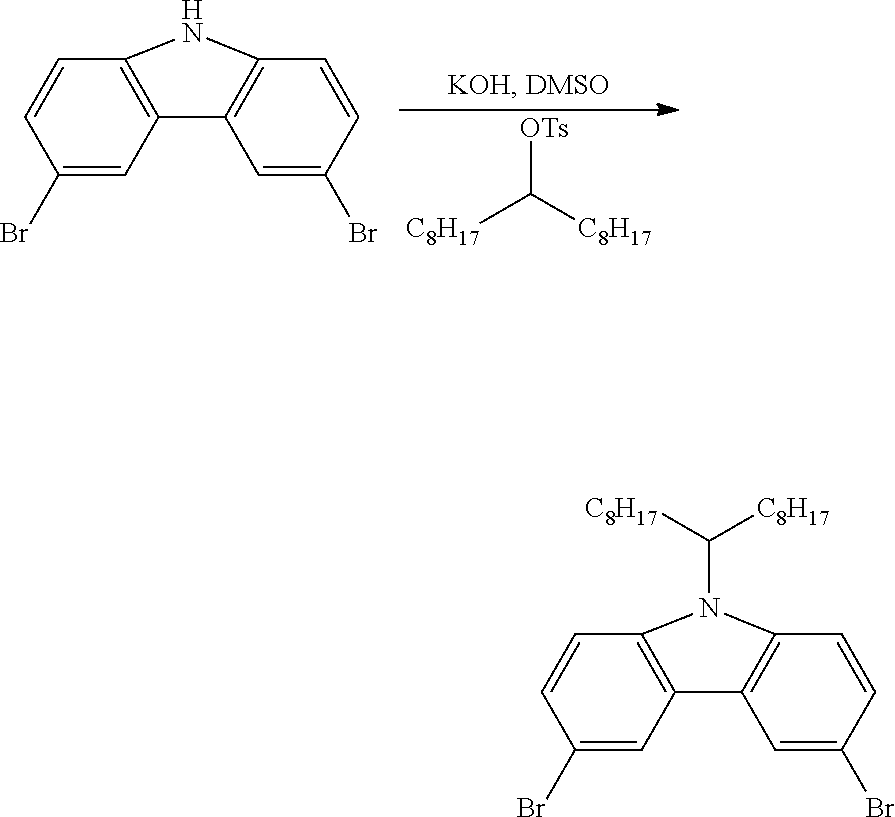
- WTXKYSDXHWZZGG-UHFFFAOYSA-N BrC1=CC2=C(C=C1)CC1=C2C=C(Br)C=C1.CCCCCCCCC(CCCCCCCC)N1C2=C(C=C(Br)C=C2)C2=C1C=CC(Br)=C2.CCCCCCCCC(CCCCCCCC)OS(=O)(=O)C1=CC=C(C)C=C1 Chemical compound BrC1=CC2=C(C=C1)CC1=C2C=C(Br)C=C1.CCCCCCCCC(CCCCCCCC)N1C2=C(C=C(Br)C=C2)C2=C1C=CC(Br)=C2.CCCCCCCCC(CCCCCCCC)OS(=O)(=O)C1=CC=C(C)C=C1 WTXKYSDXHWZZGG-UHFFFAOYSA-N 0.000 description 1
- IAUNEGJEZHAHKC-UHFFFAOYSA-N BrC1=CC=C(C2=CC=C(C3=CC=C(Br)S3)C3=NSN=C23)S1.CCCCCCCCC(CCCCCCCC)N1C2=C(C=C(B3OC(C)(C)C(C)(C)O3)C=C2)C2=C1C=CC(B1OC(C)(C)C(C)(C)O1)=C2.CCCCCCCCC(CCCCCCCC)N1C2=C(C=C(C)C=C2)C2=C1C=CC(C1=CC=C(C3=CC=C(C4=CC=C(C5=CC6=C(C=C5)C5=C(C=C(C7=CC=C(C8=CC=C(C9=CC=C(C)S9)C9=NSN=C89)S7)C=C5)N6C(CCCCCCCC)CCCCCCCC)S4)C4=NSN=C34)S1)=C2.CCCCCCCCC(CCCCCCCC)N1C2=C(C=CC(B3OC(C)(C)C(C)(C)O3)=C2)C2=C1C=C(B1OC(C)(C)C(C)(C)O1)C=C2 Chemical compound BrC1=CC=C(C2=CC=C(C3=CC=C(Br)S3)C3=NSN=C23)S1.CCCCCCCCC(CCCCCCCC)N1C2=C(C=C(B3OC(C)(C)C(C)(C)O3)C=C2)C2=C1C=CC(B1OC(C)(C)C(C)(C)O1)=C2.CCCCCCCCC(CCCCCCCC)N1C2=C(C=C(C)C=C2)C2=C1C=CC(C1=CC=C(C3=CC=C(C4=CC=C(C5=CC6=C(C=C5)C5=C(C=C(C7=CC=C(C8=CC=C(C9=CC=C(C)S9)C9=NSN=C89)S7)C=C5)N6C(CCCCCCCC)CCCCCCCC)S4)C4=NSN=C34)S1)=C2.CCCCCCCCC(CCCCCCCC)N1C2=C(C=CC(B3OC(C)(C)C(C)(C)O3)=C2)C2=C1C=C(B1OC(C)(C)C(C)(C)O1)C=C2 IAUNEGJEZHAHKC-UHFFFAOYSA-N 0.000 description 1
- ZZRFKJILVRHGLD-KRWSFVHGSA-N C/C=N/C(C)(C)C.CC(C)(C)/N=C/C1=CC=CC=C1.CC(C)(C)/N=C/CC1=CC=CC=C1.CC/C=N/C(C)(C)C Chemical compound C/C=N/C(C)(C)C.CC(C)(C)/N=C/C1=CC=CC=C1.CC(C)(C)/N=C/CC1=CC=CC=C1.CC/C=N/C(C)(C)C ZZRFKJILVRHGLD-KRWSFVHGSA-N 0.000 description 1
- MDMZGZMKAVWRFX-UHFFFAOYSA-N C1=CC2=C(C=C1)C1(CCCC1)C1=C2/C=C\C=C\1.C1=CC=C2C(=C1)C1=C(C=CC=C1)C21C2=C(C=CC=C2)C2=C1/C=C/C=C\2 Chemical compound C1=CC2=C(C=C1)C1(CCCC1)C1=C2/C=C\C=C\1.C1=CC=C2C(=C1)C1=C(C=CC=C1)C21C2=C(C=CC=C2)C2=C1/C=C/C=C\2 MDMZGZMKAVWRFX-UHFFFAOYSA-N 0.000 description 1
- YSCKTCHURZWTID-UHFFFAOYSA-N C1=CC=C(C2(C3=CC=CC=C3)C3=C(C=CC=C3)C3=C2/C=C/C=C\3)C=C1.CC1(C)C2=C(C=CC=C2)C2=C1/C=C/C=C\2 Chemical compound C1=CC=C(C2(C3=CC=CC=C3)C3=C(C=CC=C3)C3=C2/C=C/C=C\3)C=C1.CC1(C)C2=C(C=CC=C2)C2=C1/C=C/C=C\2 YSCKTCHURZWTID-UHFFFAOYSA-N 0.000 description 1
- NBXUEWMDAPYMLV-UHFFFAOYSA-N CC(C)(C)C(=O)N1CCCC1.CC(C)(C)C(=O)NC1=CC=CC=C1.CC(C)(C)C(=O)NC1CCCC1.CC(C)(C)C(N)=O.CC(C)C(=O)NCC1=CC=CC=C1.CC(C)NC(=O)C(C)(C)C.CCNC(=O)C(C)(C)C.CNC(=O)C(C)(C)C Chemical compound CC(C)(C)C(=O)N1CCCC1.CC(C)(C)C(=O)NC1=CC=CC=C1.CC(C)(C)C(=O)NC1CCCC1.CC(C)(C)C(N)=O.CC(C)C(=O)NCC1=CC=CC=C1.CC(C)NC(=O)C(C)(C)C.CCNC(=O)C(C)(C)C.CNC(=O)C(C)(C)C NBXUEWMDAPYMLV-UHFFFAOYSA-N 0.000 description 1
- VAUXPOGRJXNHBL-UHFFFAOYSA-N CC(C)(C)C(=O)OC1=CC=CC=C1.CC(C)(C)C(=O)OC1CCCC1.CC(C)OC(=O)C(C)(C)C.CCOC(=O)C(C)(C)C.COC(=O)C(C)(C)C Chemical compound CC(C)(C)C(=O)OC1=CC=CC=C1.CC(C)(C)C(=O)OC1CCCC1.CC(C)OC(=O)C(C)(C)C.CCOC(=O)C(C)(C)C.COC(=O)C(C)(C)C VAUXPOGRJXNHBL-UHFFFAOYSA-N 0.000 description 1
- DJOSLHNQNHPHLN-UHFFFAOYSA-N CC(C)OB1OC(C)(C)C(C)(C)O1.CCCCCCCCC(CCCCCCCC)N1C2=C(C=C(B3OC(C)(C)C(C)(C)O3)C=C2)C2=C1C=CC(B1OC(C)(C)C(C)(C)O1)=C2.CCCCCCCCC(CCCCCCCC)N1C2=C(C=C(Br)C=C2)C2=C1C=CC(Br)=C2 Chemical compound CC(C)OB1OC(C)(C)C(C)(C)O1.CCCCCCCCC(CCCCCCCC)N1C2=C(C=C(B3OC(C)(C)C(C)(C)O3)C=C2)C2=C1C=CC(B1OC(C)(C)C(C)(C)O1)=C2.CCCCCCCCC(CCCCCCCC)N1C2=C(C=C(Br)C=C2)C2=C1C=CC(Br)=C2 DJOSLHNQNHPHLN-UHFFFAOYSA-N 0.000 description 1
Images


Classifications
-
- C—CHEMISTRY; METALLURGY
- C08—ORGANIC MACROMOLECULAR COMPOUNDS; THEIR PREPARATION OR CHEMICAL WORKING-UP; COMPOSITIONS BASED THEREON
- C08G—MACROMOLECULAR COMPOUNDS OBTAINED OTHERWISE THAN BY REACTIONS ONLY INVOLVING UNSATURATED CARBON-TO-CARBON BONDS
- C08G61/00—Macromolecular compounds obtained by reactions forming a carbon-to-carbon link in the main chain of the macromolecule
- C08G61/12—Macromolecular compounds containing atoms other than carbon in the main chain of the macromolecule
- C08G61/122—Macromolecular compounds containing atoms other than carbon in the main chain of the macromolecule derived from five- or six-membered heterocyclic compounds, other than imides
- C08G61/123—Macromolecular compounds containing atoms other than carbon in the main chain of the macromolecule derived from five- or six-membered heterocyclic compounds, other than imides derived from five-membered heterocyclic compounds
-
- H01L51/0043—
-
- C—CHEMISTRY; METALLURGY
- C08—ORGANIC MACROMOLECULAR COMPOUNDS; THEIR PREPARATION OR CHEMICAL WORKING-UP; COMPOSITIONS BASED THEREON
- C08G—MACROMOLECULAR COMPOUNDS OBTAINED OTHERWISE THAN BY REACTIONS ONLY INVOLVING UNSATURATED CARBON-TO-CARBON BONDS
- C08G61/00—Macromolecular compounds obtained by reactions forming a carbon-to-carbon link in the main chain of the macromolecule
- C08G61/12—Macromolecular compounds containing atoms other than carbon in the main chain of the macromolecule
- C08G61/122—Macromolecular compounds containing atoms other than carbon in the main chain of the macromolecule derived from five- or six-membered heterocyclic compounds, other than imides
- C08G61/123—Macromolecular compounds containing atoms other than carbon in the main chain of the macromolecule derived from five- or six-membered heterocyclic compounds, other than imides derived from five-membered heterocyclic compounds
- C08G61/124—Macromolecular compounds containing atoms other than carbon in the main chain of the macromolecule derived from five- or six-membered heterocyclic compounds, other than imides derived from five-membered heterocyclic compounds with a five-membered ring containing one nitrogen atom in the ring
-
- C—CHEMISTRY; METALLURGY
- C08—ORGANIC MACROMOLECULAR COMPOUNDS; THEIR PREPARATION OR CHEMICAL WORKING-UP; COMPOSITIONS BASED THEREON
- C08G—MACROMOLECULAR COMPOUNDS OBTAINED OTHERWISE THAN BY REACTIONS ONLY INVOLVING UNSATURATED CARBON-TO-CARBON BONDS
- C08G61/00—Macromolecular compounds obtained by reactions forming a carbon-to-carbon link in the main chain of the macromolecule
- C08G61/12—Macromolecular compounds containing atoms other than carbon in the main chain of the macromolecule
- C08G61/122—Macromolecular compounds containing atoms other than carbon in the main chain of the macromolecule derived from five- or six-membered heterocyclic compounds, other than imides
- C08G61/123—Macromolecular compounds containing atoms other than carbon in the main chain of the macromolecule derived from five- or six-membered heterocyclic compounds, other than imides derived from five-membered heterocyclic compounds
- C08G61/126—Macromolecular compounds containing atoms other than carbon in the main chain of the macromolecule derived from five- or six-membered heterocyclic compounds, other than imides derived from five-membered heterocyclic compounds with a five-membered ring containing one sulfur atom in the ring
-
- C—CHEMISTRY; METALLURGY
- C08—ORGANIC MACROMOLECULAR COMPOUNDS; THEIR PREPARATION OR CHEMICAL WORKING-UP; COMPOSITIONS BASED THEREON
- C08G—MACROMOLECULAR COMPOUNDS OBTAINED OTHERWISE THAN BY REACTIONS ONLY INVOLVING UNSATURATED CARBON-TO-CARBON BONDS
- C08G73/00—Macromolecular compounds obtained by reactions forming a linkage containing nitrogen with or without oxygen or carbon in the main chain of the macromolecule, not provided for in groups C08G12/00 - C08G71/00
- C08G73/06—Polycondensates having nitrogen-containing heterocyclic rings in the main chain of the macromolecule
-
- H—ELECTRICITY
- H01—ELECTRIC ELEMENTS
- H01B—CABLES; CONDUCTORS; INSULATORS; SELECTION OF MATERIALS FOR THEIR CONDUCTIVE, INSULATING OR DIELECTRIC PROPERTIES
- H01B1/00—Conductors or conductive bodies characterised by the conductive materials; Selection of materials as conductors
- H01B1/06—Conductors or conductive bodies characterised by the conductive materials; Selection of materials as conductors mainly consisting of other non-metallic substances
- H01B1/12—Conductors or conductive bodies characterised by the conductive materials; Selection of materials as conductors mainly consisting of other non-metallic substances organic substances
-
- H01L51/0036—
-
- H—ELECTRICITY
- H10—SEMICONDUCTOR DEVICES; ELECTRIC SOLID-STATE DEVICES NOT OTHERWISE PROVIDED FOR
- H10F—INORGANIC SEMICONDUCTOR DEVICES SENSITIVE TO INFRARED RADIATION, LIGHT, ELECTROMAGNETIC RADIATION OF SHORTER WAVELENGTH OR CORPUSCULAR RADIATION
- H10F19/00—Integrated devices, or assemblies of multiple devices, comprising at least one photovoltaic cell covered by group H10F10/00, e.g. photovoltaic modules
-
- H—ELECTRICITY
- H10—SEMICONDUCTOR DEVICES; ELECTRIC SOLID-STATE DEVICES NOT OTHERWISE PROVIDED FOR
- H10K—ORGANIC ELECTRIC SOLID-STATE DEVICES
- H10K30/00—Organic devices sensitive to infrared radiation, light, electromagnetic radiation of shorter wavelength or corpuscular radiation
- H10K30/30—Organic devices sensitive to infrared radiation, light, electromagnetic radiation of shorter wavelength or corpuscular radiation comprising bulk heterojunctions, e.g. interpenetrating networks of donor and acceptor material domains
-
- H—ELECTRICITY
- H10—SEMICONDUCTOR DEVICES; ELECTRIC SOLID-STATE DEVICES NOT OTHERWISE PROVIDED FOR
- H10K—ORGANIC ELECTRIC SOLID-STATE DEVICES
- H10K85/00—Organic materials used in the body or electrodes of devices covered by this subclass
- H10K85/10—Organic polymers or oligomers
- H10K85/111—Organic polymers or oligomers comprising aromatic, heteroaromatic, or aryl chains, e.g. polyaniline, polyphenylene or polyphenylene vinylene
- H10K85/113—Heteroaromatic compounds comprising sulfur or selene, e.g. polythiophene
-
- H—ELECTRICITY
- H10—SEMICONDUCTOR DEVICES; ELECTRIC SOLID-STATE DEVICES NOT OTHERWISE PROVIDED FOR
- H10K—ORGANIC ELECTRIC SOLID-STATE DEVICES
- H10K85/00—Organic materials used in the body or electrodes of devices covered by this subclass
- H10K85/10—Organic polymers or oligomers
- H10K85/151—Copolymers
-
- C—CHEMISTRY; METALLURGY
- C08—ORGANIC MACROMOLECULAR COMPOUNDS; THEIR PREPARATION OR CHEMICAL WORKING-UP; COMPOSITIONS BASED THEREON
- C08G—MACROMOLECULAR COMPOUNDS OBTAINED OTHERWISE THAN BY REACTIONS ONLY INVOLVING UNSATURATED CARBON-TO-CARBON BONDS
- C08G2261/00—Macromolecular compounds obtained by reactions forming a carbon-to-carbon link in the main chain of the macromolecule
- C08G2261/10—Definition of the polymer structure
- C08G2261/12—Copolymers
- C08G2261/124—Copolymers alternating
-
- C—CHEMISTRY; METALLURGY
- C08—ORGANIC MACROMOLECULAR COMPOUNDS; THEIR PREPARATION OR CHEMICAL WORKING-UP; COMPOSITIONS BASED THEREON
- C08G—MACROMOLECULAR COMPOUNDS OBTAINED OTHERWISE THAN BY REACTIONS ONLY INVOLVING UNSATURATED CARBON-TO-CARBON BONDS
- C08G2261/00—Macromolecular compounds obtained by reactions forming a carbon-to-carbon link in the main chain of the macromolecule
- C08G2261/30—Monomer units or repeat units incorporating structural elements in the main chain
- C08G2261/32—Monomer units or repeat units incorporating structural elements in the main chain incorporating heteroaromatic structural elements in the main chain
- C08G2261/322—Monomer units or repeat units incorporating structural elements in the main chain incorporating heteroaromatic structural elements in the main chain non-condensed
- C08G2261/3223—Monomer units or repeat units incorporating structural elements in the main chain incorporating heteroaromatic structural elements in the main chain non-condensed containing one or more sulfur atoms as the only heteroatom, e.g. thiophene
-
- C—CHEMISTRY; METALLURGY
- C08—ORGANIC MACROMOLECULAR COMPOUNDS; THEIR PREPARATION OR CHEMICAL WORKING-UP; COMPOSITIONS BASED THEREON
- C08G—MACROMOLECULAR COMPOUNDS OBTAINED OTHERWISE THAN BY REACTIONS ONLY INVOLVING UNSATURATED CARBON-TO-CARBON BONDS
- C08G2261/00—Macromolecular compounds obtained by reactions forming a carbon-to-carbon link in the main chain of the macromolecule
- C08G2261/30—Monomer units or repeat units incorporating structural elements in the main chain
- C08G2261/32—Monomer units or repeat units incorporating structural elements in the main chain incorporating heteroaromatic structural elements in the main chain
- C08G2261/324—Monomer units or repeat units incorporating structural elements in the main chain incorporating heteroaromatic structural elements in the main chain condensed
- C08G2261/3241—Monomer units or repeat units incorporating structural elements in the main chain incorporating heteroaromatic structural elements in the main chain condensed containing one or more nitrogen atoms as the only heteroatom, e.g. carbazole
-
- C—CHEMISTRY; METALLURGY
- C08—ORGANIC MACROMOLECULAR COMPOUNDS; THEIR PREPARATION OR CHEMICAL WORKING-UP; COMPOSITIONS BASED THEREON
- C08G—MACROMOLECULAR COMPOUNDS OBTAINED OTHERWISE THAN BY REACTIONS ONLY INVOLVING UNSATURATED CARBON-TO-CARBON BONDS
- C08G2261/00—Macromolecular compounds obtained by reactions forming a carbon-to-carbon link in the main chain of the macromolecule
- C08G2261/30—Monomer units or repeat units incorporating structural elements in the main chain
- C08G2261/32—Monomer units or repeat units incorporating structural elements in the main chain incorporating heteroaromatic structural elements in the main chain
- C08G2261/324—Monomer units or repeat units incorporating structural elements in the main chain incorporating heteroaromatic structural elements in the main chain condensed
- C08G2261/3246—Monomer units or repeat units incorporating structural elements in the main chain incorporating heteroaromatic structural elements in the main chain condensed containing nitrogen and sulfur as heteroatoms
-
- C—CHEMISTRY; METALLURGY
- C08—ORGANIC MACROMOLECULAR COMPOUNDS; THEIR PREPARATION OR CHEMICAL WORKING-UP; COMPOSITIONS BASED THEREON
- C08G—MACROMOLECULAR COMPOUNDS OBTAINED OTHERWISE THAN BY REACTIONS ONLY INVOLVING UNSATURATED CARBON-TO-CARBON BONDS
- C08G2261/00—Macromolecular compounds obtained by reactions forming a carbon-to-carbon link in the main chain of the macromolecule
- C08G2261/40—Polymerisation processes
- C08G2261/41—Organometallic coupling reactions
- C08G2261/411—Suzuki reactions
-
- C—CHEMISTRY; METALLURGY
- C08—ORGANIC MACROMOLECULAR COMPOUNDS; THEIR PREPARATION OR CHEMICAL WORKING-UP; COMPOSITIONS BASED THEREON
- C08G—MACROMOLECULAR COMPOUNDS OBTAINED OTHERWISE THAN BY REACTIONS ONLY INVOLVING UNSATURATED CARBON-TO-CARBON BONDS
- C08G2261/00—Macromolecular compounds obtained by reactions forming a carbon-to-carbon link in the main chain of the macromolecule
- C08G2261/90—Applications
- C08G2261/91—Photovoltaic applications
-
- H01L2251/308—
-
- H01L51/0037—
-
- H01L51/4253—
-
- H—ELECTRICITY
- H10—SEMICONDUCTOR DEVICES; ELECTRIC SOLID-STATE DEVICES NOT OTHERWISE PROVIDED FOR
- H10K—ORGANIC ELECTRIC SOLID-STATE DEVICES
- H10K2102/00—Constructional details relating to the organic devices covered by this subclass
- H10K2102/10—Transparent electrodes, e.g. using graphene
- H10K2102/101—Transparent electrodes, e.g. using graphene comprising transparent conductive oxides [TCO]
- H10K2102/103—Transparent electrodes, e.g. using graphene comprising transparent conductive oxides [TCO] comprising indium oxides, e.g. ITO
-
- H—ELECTRICITY
- H10—SEMICONDUCTOR DEVICES; ELECTRIC SOLID-STATE DEVICES NOT OTHERWISE PROVIDED FOR
- H10K—ORGANIC ELECTRIC SOLID-STATE DEVICES
- H10K30/00—Organic devices sensitive to infrared radiation, light, electromagnetic radiation of shorter wavelength or corpuscular radiation
- H10K30/50—Photovoltaic [PV] devices
-
- H—ELECTRICITY
- H10—SEMICONDUCTOR DEVICES; ELECTRIC SOLID-STATE DEVICES NOT OTHERWISE PROVIDED FOR
- H10K—ORGANIC ELECTRIC SOLID-STATE DEVICES
- H10K85/00—Organic materials used in the body or electrodes of devices covered by this subclass
- H10K85/10—Organic polymers or oligomers
- H10K85/111—Organic polymers or oligomers comprising aromatic, heteroaromatic, or aryl chains, e.g. polyaniline, polyphenylene or polyphenylene vinylene
- H10K85/113—Heteroaromatic compounds comprising sulfur or selene, e.g. polythiophene
- H10K85/1135—Polyethylene dioxythiophene [PEDOT]; Derivatives thereof
-
- H—ELECTRICITY
- H10—SEMICONDUCTOR DEVICES; ELECTRIC SOLID-STATE DEVICES NOT OTHERWISE PROVIDED FOR
- H10K—ORGANIC ELECTRIC SOLID-STATE DEVICES
- H10K85/00—Organic materials used in the body or electrodes of devices covered by this subclass
- H10K85/20—Carbon compounds, e.g. carbon nanotubes or fullerenes
- H10K85/211—Fullerenes, e.g. C60
-
- Y—GENERAL TAGGING OF NEW TECHNOLOGICAL DEVELOPMENTS; GENERAL TAGGING OF CROSS-SECTIONAL TECHNOLOGIES SPANNING OVER SEVERAL SECTIONS OF THE IPC; TECHNICAL SUBJECTS COVERED BY FORMER USPC CROSS-REFERENCE ART COLLECTIONS [XRACs] AND DIGESTS
- Y02—TECHNOLOGIES OR APPLICATIONS FOR MITIGATION OR ADAPTATION AGAINST CLIMATE CHANGE
- Y02E—REDUCTION OF GREENHOUSE GAS [GHG] EMISSIONS, RELATED TO ENERGY GENERATION, TRANSMISSION OR DISTRIBUTION
- Y02E10/00—Energy generation through renewable energy sources
- Y02E10/50—Photovoltaic [PV] energy
- Y02E10/52—PV systems with concentrators
-
- Y—GENERAL TAGGING OF NEW TECHNOLOGICAL DEVELOPMENTS; GENERAL TAGGING OF CROSS-SECTIONAL TECHNOLOGIES SPANNING OVER SEVERAL SECTIONS OF THE IPC; TECHNICAL SUBJECTS COVERED BY FORMER USPC CROSS-REFERENCE ART COLLECTIONS [XRACs] AND DIGESTS
- Y02—TECHNOLOGIES OR APPLICATIONS FOR MITIGATION OR ADAPTATION AGAINST CLIMATE CHANGE
- Y02E—REDUCTION OF GREENHOUSE GAS [GHG] EMISSIONS, RELATED TO ENERGY GENERATION, TRANSMISSION OR DISTRIBUTION
- Y02E10/00—Energy generation through renewable energy sources
- Y02E10/50—Photovoltaic [PV] energy
- Y02E10/549—Organic PV cells
Definitions
- the present disclosure relates to a novel copolymer, an organic solar cell comprising the same and a method for fabricating the organic solar cell.
- Such solar cells include heterojunction thin film devices comprising a mixture of an organic copolymer, which absorbs light, with a C60 or C70 fullerene derivative which has a very high electron affinity.
- These heterojunction thin film devices comprise a transparent positive electrode made of indium tin oxide (ITO) and a negative electrode made of a metal such as Al, which has a low work function.
- the photoactive layer comprising the organic copolymer absorbs light to form electron-hole pairs or excitons.
- the electron-hole pairs move to the interface between the copolymer and the C60 or C70 fullerene derivative at which they are separated into electrons and holes. Then, the electrons move to the metal electrode, and the holes move to the transparent electrode, thereby generating electrodes.
- the efficiency of the organic copolymer solar cell is still low compared to the maximum efficiency (about 39%) of solar cells based on silicon.
- the development of organic polymer solar cells having a higher efficiency is required.
- Korean Patent Laid-Open Publication No. 10-2010-0111767 discloses a conductive copolymer comprising 2,7-carbazole in the main chain, and an organic solar cell comprising the same. According to the disclosure of the above patent publication, the conductive copolymer comprising 2,7-carbazole in the main chain improves light absorption and hole mobility to improve the efficiency of the solar cell.
- the present disclosure provides a copolymer comprising a first unit represented by the following formula 1 and at least one unit different from the first unit, wherein the first unit is present in an amount of greater than 0 mole % and 45 mole % or less based on the total moles of monomers constituting the copolymer:
- R a and R b are the same or different and are each independently selected from the group consisting of hydrogen, deuterium, a halogen group, a nitrile group, a nitro group, an imide group, an amide group, a hydroxyl group, a substituted or unsubstituted alkyl group, a substituted or unsubstituted cycloalkyl group, a substituted or unsubstituted alkoxy group, a substituted or unsubstituted aryloxy group, a substituted or unsubstituted alkylthioxy group, a substituted or unsubstituted arylthioxy group, a substituted or unsubstituted alkylsulfoxy group, a substituted or unsubstituted arylsulfoxy group, a substituted or unsubstituted alkenyl group, a substituted or unsubsti
- the present disclosure provides a copolymer comprising a first unit represented by the following formula 1, a second unit represented by the following formula 3 and a third unit represented by the following formula 4:
- R 1 and R′′ are the same or different and are each independently selected from the group consisting of hydrogen, deuterium, a halogen group, a nitrile group, a nitro group, an imide group, an amide group, a hydroxyl group, a substituted or unsubstituted alkyl group, a substituted or unsubstituted cycloalkyl group, a substituted or unsubstituted alkoxy group, a substituted or unsubstituted aryloxy group, a substituted or unsubstituted alkylthioxy group, a substituted or unsubstituted arylthioxy group, a substituted or unsubstituted alkylsulfoxy group, a substituted or unsubstituted arylsulfoxy group, a substituted or unsubstituted arylsulfoxy group, a substituted or unsubstituted arylsulfoxy group, a substituted or
- the present disclosure provides an organic solar cell comprising: a first electrode; a second electrode opposite the first electrode; one or more organic material layers interposed between the first and second electrodes and including a photoactive layer, wherein one or more of the organic material layers comprise the copolymer comprising the first unit of formula 1.
- the present disclosure provides a method for fabricating an organic solar cell, the method comprising the steps of: preparing a substrate; forming a first electrode on a region of rear sides of the substrate; forming on the first electrode an organic material layer comprising the copolymer including the first unit of formula 1; and forming a second electrode on the organic material layer.
- FIG. 1 is a graphic diagram showing a comparison of charge mobility between 3,6-carbazole-containing copolymers and 2,7-carbazole-containing copolymers.
- FIG. 2 is a graphic diagram showing current-voltage curves for organic solar cells of Examples 2 to 4 and Comparative Examples 1 and 2.
- the present disclosure provides a copolymer comprising a first unit represented by formula 1 and at least one unit different from the first unit.
- unit means the polymerized form of a repeating monomer unit in the copolymer.
- the first unit of formula 1 contains a substituted or unsubstituted 3,6-carbazole group.
- An organic solar cell comprising the copolymer including the first unit has high charge mobility compared to an organic solar cell comprising a 2,7-carbazole-containing copolymer, and the first unit of formula 1 contributes to the stability of the copolymer.
- FIG. 1 is a graphic diagram showing a comparison of charge mobility between 3,6-carbazole-containing copolymers and 2,7-carbazole-containing copolymers.
- the first unit of formula 1 is preferably present in an amount of greater than 0 mole % and 45 mole % or less based on the total moles of monomers constituting the copolymer.
- the content of the first unit of formula 1 is 0.1-30 mole % based on the total moles of the monomers. In still another embodiment, the content of the first unit of formula 1 is 0.5-20 mole % based on the total moles of the monomers. In yet another embodiment, the content of the first unit of formula 1 is 0.5-15 mole % based on the total moles of the monomers. In another further embodiment, the content of the first unit of formula 1 is 1-10 mole % based on the total moles of the monomers.
- the present disclosure provides an organic semiconductor material, which can exhibit excellent electrical properties thanks to the balance between hole mobility and electron mobility and has high photovoltaic conversion efficiency, and an organic solar cell comprising the same.
- the content of the first unit of formula 1 in the copolymer comprising the first unit of formula 1 is 45 mole % or less based on the total moles of monomers constituting the copolymer, a reduction in the optical absorption of the copolymer, which results from the relatively low absorbance of the carbazole group, can be minimized.
- a copolymer having a suitable molecular weight can be prepared.
- the unit different from the first unit in the copolymer includes at least one electron acceptor.
- the electron acceptor is present in an amount of greater than 0 mole % and 50 mole % or less based on the total moles of monomers constituting the copolymer.
- the unit different from the first unit in the copolymer includes at least one electron acceptor and at least one electron donor.
- the unit different from the first unit in the copolymer includes at least two electron acceptors and at least one electron donor.
- the alkyl group may be a straight or branched-chain alkyl group, and the number of carbon atoms thereof is preferably 1 to 20, but is not limited thereto.
- Specific examples of the alkyl group include, but are not limited to, methyl, ethyl, propyl, isopropyl, butyl, t-butyl, pentyl, hexyl and heptyl groups.
- the alkenyl group may be a straight or branched-chain alkenyl group, and the number of carbon atoms thereof is preferably 2 to 40, but is not limited thereto.
- Specific examples of the alkenyl group include, but are not limited to, aryl-substituted alkenyl groups, such as stylbenzyl and styrenyl groups.
- the alkoxy group may be a straight, branched or cyclic chain alkoxy group.
- the number of carbon atoms of the alkoxy group is preferably 1 to 25, but is not limited thereto.
- Specific examples of the alkoxy group include, but are not limited to, methoxy, ethoxy, n-propyloxy, iso-propyloxy, n-butyloxy and cyclopentyloxy groups.
- the cycloalkyl group preferably contains 3 to 60 carbon atoms, but is not limited thereto. Particularly preferred examples of the cycloalkyl group include cyclopentyl and cyclohexyl groups.
- the halogen group may be fluorine, chlorine, bromine or iodine.
- the aryl group may be monocyclic, and the number of carbon atoms thereof is preferably 6 to 60, but is not limited thereto.
- Specific examples of the aryl group include, but are not limited to, monocyclic aromatic groups, such as phenyl, biphenyl, triphenyl, terphenyl or stilbene groups, and polycyclic aromatic groups, such as naphthyl, anthracenyl, phenanthrenyl, pyrenyl, perylenyl, tetracenyl, chrysenyl, fluorenyl, acenaphthacenyl, triphenylene or fluoranthene groups.
- the heterocyclic group is a heterocyclic group containing at least one heteroatom selected from among O, N and S, and the number of carbon atoms thereof is preferably 2 to 60, but is not limited thereto.
- the heterocyclic group include, but are not limited to, thiophene, furan, pyrrol, imidazole, thiazole, oxazole, oxadiazole, triazole, pyridyl, bipyridyl, triazine, acridyl, pyridazine, quinolinyl, isoquinolinyl, indole, carbazole, benzoxazole, benzothiazole, benzimidazole, benzocarbazole, benzothiophene, dibenzothiophene, benzofuranyl, phenanthroline and dibenzofuranyl groups.
- the imide group preferably contains 1 to 25 carbon atoms, but is not limited thereto.
- Specific examples of the imide group include, but are not limited to, compounds having the following formulas:
- the amide group is an amide group whose nitrogen may be mono- or di-substituted with hydrogen, a straight, branched or cyclic chain alkyl group containing 1 to 25 carbon atoms or an aryl group containing 6 to 25 carbon atoms.
- Specific examples of the amide group include, but are not limited to, compounds having the following formulas:
- the ester group is an ester group whose oxygen may be substituted with a straight, branched or cyclic chain alkyl group containing 1 to 25 carbon atoms or an aryl group containing 6 to 25 carbon atoms.
- Specific examples of the ester group include, but are not limited to, compounds having the following formulas:
- the heteroaryl group may be selected from among the above-described examples of the heterocyclic group.
- the fluorenyl group has a structure in which two cyclic organic compounds are linked to each other by one atom, and examples thereof include
- the fluorenyl groups include an open fluorenyl group having a structure in which one of two cyclic compounds linked to each other by one atom is broken.
- Examples of the open fluorenyl group include
- the amine group preferably contains 1 to 30 carbon atoms, but is not limited thereto.
- Specific examples of the amine group include, but are not limited to, methylamine, dimethylamine, ethylamine, diethylamine, phenylamine, naphthylamine, biphenylamine, anthracenylamine, 9-methyl-anthracenylamine, diphenylamine, phenylnaphthylamine, ditolylamine, phenyltolylamine and triphenylamine groups.
- examples of the arylamine group include substituted or unsubstituted monocyclic diarylamine, substituted or unsubstituted polycyclic diarylamine, and substituted or unsubstituted monocyclic or polycyclic diarylamine groups.
- the aryl group of the aryloxy, arylthioxy, arylsulfoxy and aralkylamine groups is as defined above for the aryl group.
- alkyl group of the alkylthioxy, alkylsulfoxy, alkylamine and aralkylamine groups is as defined above for the alkyl group.
- heteroaryl group of the heteroarylamine group may be selected from among the above-described examples of the heterocyclic group.
- the arylene, alkenylene, fluorenylene, carbazolylene and heteroarylene groups are divalent aryl, alkenyl, fluorenyl and carbazole groups, respectively. These groups are as defined above for the aryl, alkenyl, fluorenyl and carbazole groups, except that they are divalent groups.
- substituted or unsubstituted means that it is unsubstituted or substituted with one or more selected from the group consisting of deuterium, a halogen group, an alkyl group, an alkenyl group, an alkoxy group, a cycloalkyl group, a silyl group, an arylalkenyl group, an aryl group, an aryloxy group, an alkylthioxy group, an alkylsulfoxy group, an arylsulfoxy group, a boron group, an alkylamine group, an aralkylamine group, an arylamine group, a heteroaryl group, a carbazole group, an arylamine group, an aryl group, a fluorenyl group, a nitrile group, a nitro group, a hydroxyl group, and a heterocyclic group containing at least one heteroatom selected from among N, O and S.
- the electron acceptor and the electron donor may be any conventional electron acceptor and electron donor known in the field of organic solar cells.
- the electron acceptor is a carbon-based aromatic compound or a heteroaromatic compound containing at least one heteroatom selected from among sulfur, phosphorus, nitrogen, selenium and the like.
- the unit different from the first unit in the copolymer includes at least one of electron acceptors represented by the following formulas:
- R 2 to R 5 are the same or different and are each independently selected from the group consisting of hydrogen, deuterium, a halogen group, a nitrile group, a nitro group, an imide group, an amide group, a hydroxyl group, a substituted or unsubstituted alkyl group, a substituted or unsubstituted cycloalkyl group, a substituted or unsubstituted alkoxy group, a substituted or unsubstituted aryloxy group, a substituted or unsubstituted alkylthioxy group, a substituted or unsubstituted arylthioxy group, a substituted or unsubstituted alkylsulfoxy group, a substituted or unsubstituted arylsulfoxy group, a substituted or unsubstituted alkenyl group, a substituted or unsubstituted silyl group, a substituted or unsubstituted
- the unit different from the first unit in the copolymer includes at least one of the electron donors represented by the following formulas:
- R 2 and R 3 are the same or different and are each independently selected from the group consisting of hydrogen, deuterium, a halogen group, a nitrile group, a nitro group, an imide group, an amide group, a hydroxyl group, a substituted or unsubstituted alkyl group, a substituted or unsubstituted cycloalkyl group, a substituted or unsubstituted alkoxy group, a substituted or unsubstituted aryloxy group, a substituted or unsubstituted alkylthioxy group, a substituted or unsubstituted arylthioxy group, a substituted or unsubstituted alkylsulfoxy group, a substituted
- the copolymer comprises one represented by the following formula 2:
- l is a mole fraction in the range of 0 ⁇ 1 ⁇ l
- m is a mole fraction in the range of 0 ⁇ m ⁇ 1
- l+m 1
- n is an integer ranging from 1 to 10,000
- A is represented by formula 1
- B, C and D are the same or different and are each independently an electron acceptor or an electron donor; and at least one of B, C and D is an electron acceptor.
- B in formula 2 is an electron acceptor.
- D in formula 2 is an electron acceptor
- B and D in formula 4 are each an electron acceptor.
- the electron acceptor in the copolymer is represented by the following formula 3:
- R 8 to R 11 are the same or different and are each independently selected from the group consisting of hydrogen, deuterium, a halogen group, a nitrile group, a nitro group, an imide group, an amide group, a hydroxyl group, a substituted or unsubstituted alkyl group, a substituted or unsubstituted cycloalkyl group, a substituted or unsubstituted alkoxy group, a substituted or unsubstituted aryloxy group, a substituted or unsubstituted alkylthioxy group, a substituted or unsubstituted arylthioxy group, a substituted or unsubstituted alkylsulfoxy group, a substituted or unsubstituted arylsulfoxy group, a substituted or unsubstituted alkenyl group, a substituted or unsubstit
- the electron donor in the copolymer is represented by the following formula 4:
- R 6 and R 7 are the same or different and are each independently selected from the group consisting of hydrogen, deuterium, a halogen group, a nitrile group, a nitro group, an imide group, an amide group, a hydroxyl group, a substituted or unsubstituted alkyl group, a substituted or unsubstituted cycloalkyl group, a substituted or unsubstituted alkoxy group, a substituted or unsubstituted aryloxy group, a substituted or unsubstituted alkylthioxy group, a substituted or unsubstituted arylthioxy group, a substituted or unsubstituted alkylsulfoxy group, a substituted or unsubstituted arylsulfoxy group, a substituted or unsubstituted alkenyl group, a substituted or unsubstitute
- the copolymer of the present disclosure comprises a 2,7-carbazole unit in addition to a 3,6-carbazole unit.
- This 2,7-carbazole unit provides low band gap energy and is highly stable against chemical and thermal attacks, air and moisture compared to other electron donors, so that it improves the efficiency of the organic solar cell comprising the copolymer.
- the unit of formula 4 in the copolymer is present in an amount of more than 0 mole % and 40 mole % or less based on the total moles of monomers constituting the copolymer.
- the present disclosure provides a copolymer comprising the first unit of formula 1, the second unit of formula 3 and the third unit of formula 4.
- the present disclosure provides a copolymer comprising the first unit of formula 1, the second unit of formula 3 and the third unit of formula 4, wherein the first unit of formula 1 is present in an amount of greater than 0 mole % and 10 mole % or less based on the total moles of monomers constituting the copolymer, the second unit of formula 3 is present in an amount of greater than 0 mole % and 50 mole % or less based on the total moles of the monomers, and the third unit of formula 4 is present in an amount of more than 0 mole % and 40 mole % or less based on the total moles of the monomers.
- unit C of formula 2 is the electron acceptor of formula 3.
- unit B of formula 2 is the electron donor of formula 4.
- unit D of formula 2 is the electron donor of formula 4.
- units B and C of formula 2 are each represented by formula 4.
- the copolymer is represented by the following formula 5:
- R a is hydrogen
- R b is hydrogen
- s and t are each 1.
- R 8 is hydrogen
- R 9 is hydrogen
- R is hydrogen
- the copolymer further comprises a fourth unit represented by the following formula 6 and a fifth unit represented by the following formula 7:
- the end group of the copolymer is selected from the group consisting of hydrogen, deuterium, a halogen group, a nitrile group, a nitro group, an imide group, an amide group, a hydroxyl group, a substituted or unsubstituted alkyl group, a substituted or unsubstituted cycloalkyl group, a substituted or unsubstituted alkoxy group, a substituted or unsubstituted aryloxy group, a substituted or unsubstituted alkylthioxy group, a substituted or unsubstituted arylthioxy group, a substituted or unsubstituted alkylsulfoxy group, a substituted or unsubstituted arylsulfoxy group, a substituted or unsubstituted alkenyl group, a substituted or unsubstituted silyl group, a substituted or unsubstituted
- the end group of the copolymer is a heterocyclic group.
- the end group of the copolymer is an aryl group.
- the copolymer preferably has a number-average molecular weight of 500-1,000,000 g/mol, and more preferably 10,000-100,000 g/mol.
- the copolymer may have a molecular weight distribution of 1-100.
- the copolymer has a molecular weight distribution of 1-3.
- the electrical and mechanical properties of the copolymer improve.
- the copolymer in order for the copolymer to have a specific level or higher of solubility so that a solution application method is advantageously applied, preferably has a number-average molecular weight of 100,000 or less.
- copolymer comprising the unit of formula 1 can be prepared based on Preparation Examples as described below.
- the copolymer according to the present disclosure can be prepared by a multi-step chemical reaction. Specifically, monomers can be prepared by an alkylation reaction, the Grignard reaction, the Suzuki coupling reaction and the Stille coupling reaction, after final polymers can be prepared from the monomers by a carbon-carbon coupling reaction such as the Stille coupling reaction.
- the substituent to be introduced is a boronic acid or boronic ester compound
- the copolymer can be prepared by the Suzuki coupling reaction
- the substituent to be introduced is a tributyltin compound
- the copolymer can be prepared by the Stille coupling reaction, but is not limited thereto.
- the present disclosure provides an organic solar cell comprising the copolymer containing the unit of formula 1.
- an organic solar cell comprising: a first electrode; a second electrode opposite the first electrode; and one or more organic material layers interposed between the first electrode and the second electrode and including a photoactive layer, wherein one or more of the organic material layers comprise the above-described copolymer.
- the organic solar cell comprises the first electrode, the photoactive layer and the second electrode.
- the organic solar cell may further comprise a substrate, a hole transport layer and/or an electron transport layer.
- the substrate may be a glass or transparent substrate having excellent transparency, surface smoothness, ease of handling, and water resistance, but is not limited thereto.
- the substrate is not limited as long as it is commonly used in organic solar cells.
- Specific examples of the substrate include, but are not limited to, polyethylene terephthalate (PET), polyethylene naphthalate (PEN), polypropylene (PP), polyimide (PI) and triacetyl cellulose (TAC).
- the first electrode may be made of a transparent, highly conductive material, but is not limited thereto.
- Specific examples of the material of the first electrode include, but are not limited to, indium tin oxide (ITO), tin oxide (SnO 2 ) and zinc oxide (ZnO).
- the second electrode may be made of a metal having a low work function, but is not limited thereto.
- Specific examples of the material of the second electrode include, but are not limited to, metals, such as lithium, magnesium or aluminum, alloys thereof, and multilayer materials, such as Al:Li, Al:BaF 2 , or Al:BaF 2 :Ba.
- the hole transport layer and/or the electron transport layer may be made of a material which efficiently transfers electrons and holes to the photoactive layer to increase the mobility of produced charges to the electrodes, but is not limited thereto.
- Examples of the material of the hole transport layer induce PEDOT:PSS (poly(3,4-ethylenediocythiophene) doped with poly(styrenesulfonic acid)), and N,N′-bis(3-methylphenyl)-N,N′-diphenyl-[1,1′-biphenyl]-4,4′-diamine (TPD).
- PEDOT:PSS poly(3,4-ethylenediocythiophene) doped with poly(styrenesulfonic acid)
- TPD N,N′-bis(3-methylphenyl)-N,N′-diphenyl-[1,1′-biphenyl]-4,4′-diamine
- Examples of the material of the electron transport layer include aluminum trihydroxyquinoline (Alq 3 ), the 1,3,4-oxadiazole derivative PBD (2-(4-biphenyl)-5-phenyl-1,3,4-oxadiazole), the quinoxaline derivative TPQ (1,3,4-tris[(3-phenyl-6-trifluoromethyl)quinoxaline-2-yl]benzene), and triazole derivatives.
- the photoactive layer may comprise an electron donor material and an electron acceptor material.
- the electron donor material is the copolymer comprising the first unit of formula 1.
- the electron acceptor material may be selected from the group consisting of fullerene, fullerene derivatives, vasocuproin, semiconductor elements, semiconductor compounds, or combinations thereof.
- the electron acceptor material may be phenyl C 61 -butyric acid methyl ester (PC 61 BM) or phenyl C 71 -butyric acid methyl ester (PC 71 BM).
- the electron donor material and the electron acceptor material in the photoactive layer can form a bulk heterojunction (BHJ).
- the electron donor material and the electron acceptor material may be mixed with each other at a ratio of 1:10-10:1 (w/w). After the electron donor material and the electron acceptor material have been mixed, they may be annealed at a temperature of 30 to 300° C. for 1 second to 24 hours in order to maximize the characteristics thereof.
- the thickness of the photoactive layer may be 10-10,000 ⁇ , but is not limited thereto.
- a buffer layer may further be introduced between the photoactive layer and the first electrode, and an electron transfer layer, a hole blocking layer or an optical space layer may further be introduced between the photoactive layer and the second electrode.
- the organic solar cell comprises the substrate, the first electrode, the photoactive layer and the second electrode.
- the photoactive layer comprises an electrode donor made of the copolymer, which comprises the first unit of formula 1, and an electron acceptor made of a C60 fullerene derivative or a C70 fullerene derivative.
- the photovoltaic material of the photoactive layer comprises the copolymer comprising the first unit of formula 1, and the electron acceptor, which are mixed with each other at a weight ratio of 1:0.5-1:4.
- the photovoltaic material of the photoactive layer comprises the copolymer comprising the first unit of formula 1, and a C60 fullerene derivative or a C70 fullerene derivative, which are mixed with each other at a weight ratio of 1:0.5-1:4.
- the fullerene derivative is used at a weight ratio of less than 0.5 relative to the copolymer comprising the first unit of formula 1, the mobility of electrons will be insufficient, because the content of the crystallized fullerene derivative will be insufficient, and if the fullerene derivative is used at a weight ratio of more than 4, the efficient absorption of light into the photoactive layer will not be achieved, because the amount of the copolymer comprising the first unit of formula 1 is relatively reduced.
- the organic solar cell may either comprise an anode, a photoactive electrode and a cathode, which are arranged in that order, or comprise a cathode, a photoactive layer and an anode, which are arranged in that order, but the scope of the present invention is not limited thereto.
- the organic solar cell may either comprise an anode, a hole transport layer, a photoactive layer, an electron transport layer and a cathode, which are arranged in that order, or comprise a cathode, an electron transport layer, a photoactive layer, a hole transport layer and an anode, which are arranged in that order, but the scope of the present invention is not limited thereto.
- the organic solar cell of the present disclosure can be fabricated using the same materials and method as known in the art, except that the organic material layers comprise the copolymer comprising the first unit of formula which is the compound of the present disclosure.
- the present disclosure provides a method for fabricating an organic solar cell, the method comprising the steps of: preparing a substrate; forming a first electrode on a region of rear sides of the substrate; forming on the first layer an organic material layer comprising the copolymer including the first unit of formula 1; and forming a second electrode on the organic material layer.
- the organic solar cell of the present invention can be fabricated, for example, by sequentially depositing the first electrode, the organic material layer and the second electrode on the substrate.
- the deposition can be performed using wet coating methods, including gravure printing, offset printing, screen printing, inkjet printing, spin coating, and spray coating, but is not limited thereto.
- the copolymer can serve as an electron donor.
- N-9′-Heptadecanyl-3,6-dibromocarbazole (4.00 q, 7.10 mmol) was added to and dissolved in 30 ml of anhydrous tetrahydrofuran) and cooled to ⁇ 78° C., and 1.7 M n-butyllithium in hexane (17.5 ml, 29.8 mmol) was added thereto. The mixture was stirred for 1 hour, and then 2-isopropoxy-4,4,5,5-tetramethyl-1,3,2-dioxaborolane (5.28 g, 28.4 mmol) was added at a time thereto. Then, the mixture was warmed to room temperature and stirred for 12 hours.
- Weight-average molecular weight 20,500 g/mol
- a glass substrate coated with ITO was ultrasonically washed with distilled water, acetone and 2-propanol, and the surface of the ITO was treated with ozone for 10 minutes, and then spin-coated with PEDOT:PSS (AI 4083) to a thickness of 25 nm, followed by heat treatment at 235° C. for 10 minutes.
- PEDOT:PSS PEDOT:PSS
- each of the polymer-PC 71 BM composite solutions was filtered with a 0.45- ⁇ m PP syringe filter and spin-coated on the PEDOT:PSS layer, followed by heat treatment at 120° C. for 5 minutes.
- LiF was deposited on the photoactive layer to a thickness of 6 ⁇ under a vacuum of 3 ⁇ 10 ⁇ 8 torr using a thermal evaporator, after which Al was deposited on the LiF to a thickness of 120 nm.
- the photovoltaic properties of the organic solar cells fabricated as described above were measured under a condition of 100 mW/cm 2 (AM 1.5), and the results of the measurement are shown in Table 1 below.
- FIG. 2 is a graphic diagram showing current-voltage curves for the organic solar cells.
- the organic solar cells of Examples 2 to 4 which comprise the copolymer including the first unit of formula 1, had increased efficiency compared to the organic solar cell of Comparative Example 1, comprising the copolymer which does not include the first unit of formula 1, and the organic solar cell of Comparative Example 2, which comprises the copolymer including only the first unit of formula 1.
- the copolymer of the present disclosure can be used as a material for the organic material layer of an organic solar cell, and an organic solar cell comprising the same can exhibit excellent properties, including increased open voltage and increased efficiency.
- the novel copolymer according to the present disclosure has a deep HOMO level and high charge mobility, and thus can exhibit excellent properties.
- the copolymer according to the present invention may be used in a pure or impure form in an organic solar cell and may be applied using a solution application method.
- the copolymer of the present disclosure can increase the optical efficiency of the organic solar cell and improve the cycle life characteristics of the organic solar cell thanks to its thermal stability.
Landscapes
- Chemical & Material Sciences (AREA)
- Polymers & Plastics (AREA)
- Health & Medical Sciences (AREA)
- Chemical Kinetics & Catalysis (AREA)
- Medicinal Chemistry (AREA)
- Organic Chemistry (AREA)
- Materials Engineering (AREA)
- Engineering & Computer Science (AREA)
- Physics & Mathematics (AREA)
- Electromagnetism (AREA)
- Spectroscopy & Molecular Physics (AREA)
- Photovoltaic Devices (AREA)
- Polyoxymethylene Polymers And Polymers With Carbon-To-Carbon Bonds (AREA)
Abstract
Description
- Korean Patent Laid-Open Publication No. 10-2010-0111767
- Macromolecules 2011, 44(7), 1909-1919
- Nature Photonics, 2009, 3, 649-653
- B. Nicolas, M. Alexandre, M. Leclerc, Adv. Mater. 19, 2295-2300
- Y. Human, A. Solyman, I. Ahmed, W. C. Darren, K. James, L. G. David, J. Mater. Chem. 21, 13649-13656

wherein
o and p are each an integer ranging from 0 to 3;
Ra and Rb are the same or different and are each independently selected from the group consisting of hydrogen, deuterium, a halogen group, a nitrile group, a nitro group, an imide group, an amide group, a hydroxyl group, a substituted or unsubstituted alkyl group, a substituted or unsubstituted cycloalkyl group, a substituted or unsubstituted alkoxy group, a substituted or unsubstituted aryloxy group, a substituted or unsubstituted alkylthioxy group, a substituted or unsubstituted arylthioxy group, a substituted or unsubstituted alkylsulfoxy group, a substituted or unsubstituted arylsulfoxy group, a substituted or unsubstituted alkenyl group, a substituted or unsubstituted silyl group, a substituted or unsubstituted boron group, a substituted or unsubstituted alkylamine group, a substituted or unsubstituted aralkylamine group, a substituted or unsubstituted arylamine group, a substituted or unsubstituted heteroarylamine group, a substituted or unsubstituted aryl group, a substituted or unsubstituted fluorenyl group, a substituted or unsubstituted carbazole group, and a substituted or unsubstituted heterocyclic group containing at least one heteroatom selected from among N, O and S, or adjacent two of Ra and Rb may form a condensed ring; and
R1 is selected from the group consisting of hydrogen, deuterium, a halogen group, a nitrile group, a nitro group, an imide group, an amide group, a hydroxyl group, a substituted or unsubstituted alkyl group, a substituted or unsubstituted cycloalkyl group, a substituted or unsubstituted alkoxy group, a substituted or unsubstituted aryloxy group, a substituted or unsubstituted alkylthioxy group, a substituted or unsubstituted arylthioxy group, a substituted or unsubstituted alkylsulfoxy group, a substituted or unsubstituted arylsulfoxy group, a substituted or unsubstituted alkenyl group, a substituted or unsubstituted silyl group, a substituted or unsubstituted boron group, a substituted or unsubstituted alkylamine group, a substituted or unsubstituted aralkylamine group, a substituted or unsubstituted arylamine group, a substituted or unsubstituted heteroarylamine group, a substituted or unsubstituted aryl group, a substituted or unsubstituted fluorenyl group, a substituted or unsubstituted carbazole group, and a substituted or unsubstituted heterocyclic group containing at least one heteroatom selected from among N, O and S.

wherein
o, p, q and r are each an integer ranging from 0 to 3;
s and t are each an integer ranging from 0 to 4;
R1 and R″ are the same or different and are each independently selected from the group consisting of hydrogen, deuterium, a halogen group, a nitrile group, a nitro group, an imide group, an amide group, a hydroxyl group, a substituted or unsubstituted alkyl group, a substituted or unsubstituted cycloalkyl group, a substituted or unsubstituted alkoxy group, a substituted or unsubstituted aryloxy group, a substituted or unsubstituted alkylthioxy group, a substituted or unsubstituted arylthioxy group, a substituted or unsubstituted alkylsulfoxy group, a substituted or unsubstituted arylsulfoxy group, a substituted or unsubstituted alkenyl group, a substituted or unsubstituted silyl group, a substituted or unsubstituted boron group, a substituted or unsubstituted alkylamine group, a substituted or unsubstituted aralkylamine group, a substituted or unsubstituted arylamine group, a substituted or unsubstituted heteroarylamine group, a substituted or unsubstituted aryl group, a substituted or unsubstituted fluorenyl group, a substituted or unsubstituted carbazole group, and a substituted or unsubstituted heterocyclic group containing at least one heteroatom selected from among N, O and S;
Ra, Rb and R6 to R11 are the same or different and are each independently selected from the group consisting of hydrogen, deuterium, a halogen group, a nitrile group, a nitro group, an imide group, an amide group, a hydroxyl group, a substituted or unsubstituted alkyl group, a substituted or unsubstituted cycloalkyl group, a substituted or unsubstituted alkoxy group, a substituted or unsubstituted aryloxy group, a substituted or unsubstituted alkylthioxy group, a substituted or unsubstituted arylthioxy group, a substituted or unsubstituted alkylsulfoxy group, a substituted or unsubstituted arylsulfoxy group, a substituted or unsubstituted alkenyl group, a substituted or unsubstituted silyl group, a substituted or unsubstituted boron group, a substituted or unsubstituted alkylamine group, a substituted or unsubstituted aralkylamine group, a substituted or unsubstituted arylamine group, a substituted or unsubstituted heteroarylamine group, a substituted or unsubstituted aryl group, a substituted or unsubstituted fluorenyl group, a substituted or unsubstituted carbazole group, and a substituted or unsubstituted heterocyclic group containing at least one heteroatom selected from among N, O and S, or adjacent two of Ra, Rb and R6 to R11 may form a condensed ring.


and the like.

and the like.

wherein
R2 to R5 are the same or different and are each independently selected from the group consisting of hydrogen, deuterium, a halogen group, a nitrile group, a nitro group, an imide group, an amide group, a hydroxyl group, a substituted or unsubstituted alkyl group, a substituted or unsubstituted cycloalkyl group, a substituted or unsubstituted alkoxy group, a substituted or unsubstituted aryloxy group, a substituted or unsubstituted alkylthioxy group, a substituted or unsubstituted arylthioxy group, a substituted or unsubstituted alkylsulfoxy group, a substituted or unsubstituted arylsulfoxy group, a substituted or unsubstituted alkenyl group, a substituted or unsubstituted silyl group, a substituted or unsubstituted boron group, a substituted or unsubstituted alkylamine group, a substituted or unsubstituted aralkylamine group, a substituted or unsubstituted arylamine group, a substituted or unsubstituted heteroarylamine group, a substituted or unsubstituted aryl group, a substituted or unsubstituted fluorenyl group, a substituted or unsubstituted carbazole group, and a substituted or unsubstituted heterocyclic group containing at least one heteroatom selected from among N, O and S, or adjacent two of R2 to R5 may form a condensed ring;
X1 and X2 are the same or different and are each independently selected from the group consisting of CRR′, NR, O, SiRR′, PR, S, GeRR′, Se and Te; and
Y1 to Y4 are the same or different and are each independently selected from the group consisting of CR, N, SiR, P and GeR, wherein R and R′ are the same or different and are each independently selected from the group consisting of hydrogen, deuterium, a halogen group, a nitrile group, a nitro group, an imide group, an amide group, a hydroxyl group, a substituted or unsubstituted alkyl group, a substituted or unsubstituted cycloalkyl group, a substituted or unsubstituted alkoxy group, a substituted or unsubstituted aryloxy group, a substituted or unsubstituted alkylthioxy group, a substituted or unsubstituted arylthioxy group, a substituted or unsubstituted alkylsulfoxy group, a substituted or unsubstituted arylsulfoxy group, a substituted or unsubstituted alkenyl group, a substituted or unsubstituted silyl group, a substituted or unsubstituted boron group, a substituted or unsubstituted alkylamine group, a substituted or unsubstituted aralkylamine group, a substituted or unsubstituted arylamine group, a substituted or unsubstituted heteroarylamine group, a substituted or unsubstituted aryl group, a substituted or unsubstituted fluorenyl group, a substituted or unsubstituted carbazole group, and a substituted or unsubstituted heterocyclic group containing at least one heteroatom selected from among N, O and S, or adjacent two of R and R′ may form a condensed ring.


wherein
a is an integer ranging from 0 to 4;
b is an integer ranging from 0 to 6;
c is an integer ranging from 0 to 8;
d and e are each an integer ranging from 0 to 3;
R2 and R3 are the same or different and are each independently selected from the group consisting of hydrogen, deuterium, a halogen group, a nitrile group, a nitro group, an imide group, an amide group, a hydroxyl group, a substituted or unsubstituted alkyl group, a substituted or unsubstituted cycloalkyl group, a substituted or unsubstituted alkoxy group, a substituted or unsubstituted aryloxy group, a substituted or unsubstituted alkylthioxy group, a substituted or unsubstituted arylthioxy group, a substituted or unsubstituted alkylsulfoxy group, a substituted or unsubstituted arylsulfoxy group, a substituted or unsubstituted alkenyl group, a substituted or unsubstituted silyl group, a substituted or unsubstituted boron group, a substituted or unsubstituted alkylamine group, a substituted or unsubstituted aralkylamine group, a substituted or unsubstituted arylamine group, a substituted or unsubstituted heteroarylamine group, a substituted or unsubstituted aryl group, a substituted or unsubstituted fluorenyl group, a substituted or unsubstituted carbazole group, and a substituted or unsubstituted heterocyclic group containing at least one heteroatom selected from among N, O and S, or adjacent two of R2 and R3 may form a condensed ring;
X1 to X3 are the same or different and are each independently selected from the group consisting of CRR′, NR, O, SiRR′, PR, S, GeRR′, Se and Te;
Y1 and Y2 are the same or different and are each independently selected from the group consisting of CR, N, SiR, P and GeR; wherein R and R′ are the same or different and are each independently selected from the group consisting of hydrogen, deuterium, a halogen group, a nitrile group, a nitro group, an imide group, an amide group, a hydroxyl group, a substituted or unsubstituted alkyl group, a substituted or unsubstituted cycloalkyl group, a substituted or unsubstituted alkoxy group, a substituted or unsubstituted aryloxy group, a substituted or unsubstituted alkylthioxy group, a substituted or unsubstituted arylthioxy group, a substituted or unsubstituted alkylsulfoxy group, a substituted or unsubstituted arylsulfoxy group, a substituted or unsubstituted alkenyl group, a substituted or unsubstituted silyl group, a substituted or unsubstituted boron group, a substituted or unsubstituted alkylamine group, a substituted or unsubstituted aralkylamine group, a substituted or unsubstituted arylamine group, a substituted or unsubstituted heteroarylamine group, a substituted or unsubstituted aryl group, a substituted or unsubstituted fluorenyl group, a substituted or unsubstituted carbazole group, and a substituted or unsubstituted heterocyclic group containing at least one heteroatom selected from among N, O and S, or adjacent two of R and R′ may form a condensed ring.

wherein l is a mole fraction in the range of 0<1≦l;
m is a mole fraction in the range of 0≦m<1; l+m=1;
n is an integer ranging from 1 to 10,000;
A is represented by
B, C and D are the same or different and are each independently an electron acceptor or an electron donor; and
at least one of B, C and D is an electron acceptor.

wherein
s and t are each an integer ranging from 0 to 4; and
R8 to R11 are the same or different and are each independently selected from the group consisting of hydrogen, deuterium, a halogen group, a nitrile group, a nitro group, an imide group, an amide group, a hydroxyl group, a substituted or unsubstituted alkyl group, a substituted or unsubstituted cycloalkyl group, a substituted or unsubstituted alkoxy group, a substituted or unsubstituted aryloxy group, a substituted or unsubstituted alkylthioxy group, a substituted or unsubstituted arylthioxy group, a substituted or unsubstituted alkylsulfoxy group, a substituted or unsubstituted arylsulfoxy group, a substituted or unsubstituted alkenyl group, a substituted or unsubstituted silyl group, a substituted or unsubstituted boron group, a substituted or unsubstituted alkylamine group, a substituted or unsubstituted aralkylamine group, a substituted or unsubstituted arylamine group, a substituted or unsubstituted heteroarylamine group, a substituted or unsubstituted aryl group, a substituted or unsubstituted fluorenyl group, a substituted or unsubstituted carbazole group, and a substituted or unsubstituted heterocyclic group containing at least one heteroatom selected from among N, O and S, or adjacent two of R8 to R11 may form a condensed ring.

wherein
q and r are each an integer ranging from 0 to 3;
R6 and R7 are the same or different and are each independently selected from the group consisting of hydrogen, deuterium, a halogen group, a nitrile group, a nitro group, an imide group, an amide group, a hydroxyl group, a substituted or unsubstituted alkyl group, a substituted or unsubstituted cycloalkyl group, a substituted or unsubstituted alkoxy group, a substituted or unsubstituted aryloxy group, a substituted or unsubstituted alkylthioxy group, a substituted or unsubstituted arylthioxy group, a substituted or unsubstituted alkylsulfoxy group, a substituted or unsubstituted arylsulfoxy group, a substituted or unsubstituted alkenyl group, a substituted or unsubstituted silyl group, a substituted or unsubstituted boron group, a substituted or unsubstituted alkylamine group, a substituted or unsubstituted aralkylamine group, a substituted or unsubstituted arylamine group, a substituted or unsubstituted heteroarylamine group, a substituted or unsubstituted aryl group, a substituted or unsubstituted fluorenyl group, a substituted or unsubstituted carbazole group, and a substituted or unsubstituted heterocyclic group containing at least one heteroatom selected from among N, O and S, or adjacent two of R6 and R7 may form a condensed ring; and R″ is selected from the group consisting of hydrogen, deuterium, a halogen group, a nitrile group, a nitro group, an imide group, an amide group, a hydroxyl group, a substituted or unsubstituted alkyl group, a substituted or unsubstituted cycloalkyl group, a substituted or unsubstituted alkoxy group, a substituted or unsubstituted aryloxy group, a substituted or unsubstituted alkylthioxy group, a substituted or unsubstituted arylthioxy group, a substituted or unsubstituted alkylsulfoxy group, a substituted or unsubstituted arylsulfoxy group, a substituted or unsubstituted alkenyl group, a substituted or unsubstituted silyl group, a substituted or unsubstituted boron group, a substituted or unsubstituted alkylamine group, a substituted or unsubstituted aralkylamine group, a substituted M or unsubstituted arylamine group, a substituted or unsubstituted heteroarylamine group, a substituted or unsubstituted aryl group, a substituted or unsubstituted fluorenyl group, a substituted or unsubstituted carbazole group, and a substituted or unsubstituted heterocyclic group containing at least one heteroatom selected from among N, O and S.

wherein R1, Ra, Rb, o and p are as defined in
q and r are each an integer ranging from 0 to 3;
s and t are each an integer ranging from 0 to 4;
l is a mole fraction in the range of 0<l≦1;
m is a mole fraction in the range of 0≦m<1; l+m=1;
n is an integer ranging from 1 to 10,000;
R″ are the same or different and are each independently selected from the group consisting of hydrogen, deuterium, a halogen group, a nitrile group, a nitro group, an imide group, an amide group, a hydroxyl group, a substituted or unsubstituted alkyl group, a substituted or unsubstituted cycloalkyl group, a substituted or unsubstituted alkoxy group, a substituted or unsubstituted aryloxy group, a substituted or unsubstituted alkylthioxy group, a substituted or unsubstituted arylthioxy group, a substituted or unsubstituted alkylsulfoxy group, a substituted or unsubstituted arylsulfoxy group, a substituted or unsubstituted alkenyl group, a substituted or unsubstituted silyl group, a substituted or unsubstituted boron group, a substituted or unsubstituted alkylamine group, a substituted or unsubstituted aralkylamine group, a substituted or unsubstituted arylamine group, a substituted or unsubstituted heteroarylamine group, a substituted or unsubstituted aryl group, a substituted or unsubstituted fluorenyl group, a substituted or unsubstituted carbazole group, and a substituted or unsubstituted heterocyclic group containing at least one heteroatom selected from among N, O and S; and
R6 to R11 are the same or different and are each independently selected from the group consisting of hydrogen, deuterium, a halogen group, a nitrile group, a nitro group, an imide group, an amide group, a hydroxyl group, a substituted or unsubstituted alkyl group, a substituted or unsubstituted cycloalkyl group, a substituted or unsubstituted alkoxy group, a substituted or unsubstituted aryloxy group, a substituted or unsubstituted alkylthioxy group, a substituted or unsubstituted arylthioxy group, a substituted or unsubstituted alkylsulfoxy group, a substituted or unsubstituted arylsulfoxy group, a substituted or unsubstituted alkenyl group, a substituted or unsubstituted silyl group, a substituted or unsubstituted boron group, a substituted or unsubstituted alkylamine group, a substituted or unsubstituted aralkylamine group, a substituted or unsubstituted arylamine group, a substituted or unsubstituted heteroarylamine group, a substituted or unsubstituted aryl group, a substituted or unsubstituted fluorenyl group, a substituted or unsubstituted carbazole group, and a substituted or unsubstituted heterocyclic group containing at least one heteroatom selected from among N, O and S; or adjacent two of R6 to R11 may form a condensed ring.

wherein
l is a mole fraction in the range of 0<l≦1;
m is a mole fraction in the range of 0≦m<1;
l+m=1;
R1 is as defined in
R″ is as defined in


| TABLE 1 |
| Properties of organic solar cells |
| short circuit | open circuit | power conversion | ||||
| Molar ratio (%) | current density | voltage | Fill | efficiency | ||
| Copolymer | of 3,6-carbazole | (mA/cm2) | (V) | factor | (%) | |
| Example 2 | |
1 | 13.6 | 0.91 | 50 | 6.2 | |
| Example 3 | |
5 | 10.5 | 0.91 | 50.9 | 4.9 | |
| Example 4 | |
10 | 10.9 | 0.92 | 41.3 | 4.2 | |
| | Copolymer | 4 | 0 | 12.6 | 0.91 | 39.6 | 4.6 |
| Example 1 | |||||||
| Comparative | Copolymer 5 | 100 | 1.8 | 0.50 | 23.6 | 0.2 | |
| Example 2 | |||||||
Claims (22)


Applications Claiming Priority (2)
| Application Number | Priority Date | Filing Date | Title |
|---|---|---|---|
| KR20110077495 | 2011-08-03 | ||
| KR10-2011-0077495 | 2011-08-03 |
Publications (2)
| Publication Number | Publication Date |
|---|---|
| US20130032209A1 US20130032209A1 (en) | 2013-02-07 |
| US8912308B2 true US8912308B2 (en) | 2014-12-16 |
Family
ID=47626164
Family Applications (4)
| Application Number | Title | Priority Date | Filing Date |
|---|---|---|---|
| US14/235,731 Abandoned US20140318625A1 (en) | 2011-08-03 | 2011-08-26 | Conductive polymer comprising 3,6-carbazole and organic solar cell using same |
| US13/566,837 Active US8912308B2 (en) | 2011-08-03 | 2012-08-03 | Copolymer, organic solar cell using the same and manufacturing method thereof |
| US13/566,818 Active US8921506B2 (en) | 2011-08-03 | 2012-08-03 | Copolymer, organic solar cell using the same and manufacturing method thereof |
| US13/566,846 Abandoned US20130056073A1 (en) | 2011-08-03 | 2012-08-03 | Copolymer, organic solar cell using the same and manufacturing method thereof |
Family Applications Before (1)
| Application Number | Title | Priority Date | Filing Date |
|---|---|---|---|
| US14/235,731 Abandoned US20140318625A1 (en) | 2011-08-03 | 2011-08-26 | Conductive polymer comprising 3,6-carbazole and organic solar cell using same |
Family Applications After (2)
| Application Number | Title | Priority Date | Filing Date |
|---|---|---|---|
| US13/566,818 Active US8921506B2 (en) | 2011-08-03 | 2012-08-03 | Copolymer, organic solar cell using the same and manufacturing method thereof |
| US13/566,846 Abandoned US20130056073A1 (en) | 2011-08-03 | 2012-08-03 | Copolymer, organic solar cell using the same and manufacturing method thereof |
Country Status (3)
| Country | Link |
|---|---|
| US (4) | US20140318625A1 (en) |
| KR (3) | KR101407098B1 (en) |
| WO (1) | WO2013018951A1 (en) |
Families Citing this family (20)
| Publication number | Priority date | Publication date | Assignee | Title |
|---|---|---|---|---|
| US20140318625A1 (en) | 2011-08-03 | 2014-10-30 | Lg Chem, Ltd. | Conductive polymer comprising 3,6-carbazole and organic solar cell using same |
| CN103280530B (en) * | 2013-04-23 | 2015-11-18 | 中国科学院宁波材料技术与工程研究所 | A kind of organic solar batteries and preparation method thereof |
| CN105377941B (en) * | 2013-07-15 | 2017-05-31 | 株式会社Lg化学 | Copolymers and organic solar cells containing them |
| KR101666700B1 (en) * | 2013-07-15 | 2016-10-17 | 주식회사 엘지화학 | Polymer and organic solar cell comprising the same |
| KR101631757B1 (en) * | 2013-07-31 | 2016-06-20 | 주식회사 엘지화학 | Copolymer and organic solar cell comprising the same |
| KR101638220B1 (en) * | 2013-08-12 | 2016-07-08 | 주식회사 엘지화학 | Copolymer and organic solar cell comprising the same |
| US9777108B2 (en) | 2013-09-16 | 2017-10-03 | Lg Chem, Ltd. | Copolymer and organic solar cell comprising same |
| CN103483560B (en) * | 2013-09-17 | 2015-12-02 | 武汉工程大学 | A kind of 2,1,3-diazosulfide 1,4-Dithiapentalene derives conjugated polymers and the synthetic method thereof of bromo-derivative and carbazole |
| KR101664533B1 (en) * | 2013-10-08 | 2016-10-10 | 단국대학교 산학협력단 | Novel thiophene derivatives, manufacturing method thereof and organic solar cell containing the same |
| TWI550929B (en) | 2014-02-14 | 2016-09-21 | Lg化學股份有限公司 | Copolymer and organic solar cell comprising the same |
| JP6408023B2 (en) * | 2014-03-21 | 2018-10-17 | エルジー・ケム・リミテッド | Polymer and organic solar cell including the same |
| WO2015147598A1 (en) * | 2014-03-27 | 2015-10-01 | 주식회사 엘지화학 | Copolymer and organic solar cell comprising same |
| KR101687807B1 (en) | 2014-10-27 | 2017-01-02 | 주식회사 엘지화학 | Ink composition for use in manufacturing of solar cell and method for producing solar cell using the same |
| KR101729236B1 (en) | 2015-06-01 | 2017-04-21 | (주)노터스생명과학 | TLR7 agonist agent for treatment and prevention of liver disease |
| KR101968899B1 (en) * | 2016-01-27 | 2019-04-15 | 주식회사 엘지화학 | Copolymer and organic solar cell comprising the same |
| KR20160141683A (en) | 2016-09-21 | 2016-12-09 | (주)노터스생명과학 | TLR7 agonist agent for treatment and prevention of liver disease |
| KR20170010887A (en) | 2017-01-20 | 2017-02-01 | (주)노터스생명과학 | TLR7 agonist agent for treatment and prevention of liver disease |
| KR101902129B1 (en) | 2017-05-24 | 2018-09-28 | 주식회사 엘지화학 | Heterocyclic compound and organic electronic device comprising the same |
| KR102626760B1 (en) * | 2020-11-23 | 2024-01-19 | 한국과학기술원 | Polymer donor for organic solar cell and organic solar cell including the same |
| US12258441B1 (en) * | 2024-05-24 | 2025-03-25 | Imam Mohammad Ibn Saud Islamic University | Fabrication of a conjugated polymer |
Citations (5)
| Publication number | Priority date | Publication date | Assignee | Title |
|---|---|---|---|---|
| KR20100037403A (en) | 2008-10-01 | 2010-04-09 | (주)매트릭스 | Green color polymer, the method of synthesizing thereof, the color conversion liquid using thereof, the color conversion filter using thereof, and the method of producing color conversion filter |
| WO2010117158A2 (en) | 2009-04-08 | 2010-10-14 | 한국화학연구원 | Conductive polymer containing carbazole, and organic photovoltaic device using same |
| CN101875716A (en) | 2009-04-30 | 2010-11-03 | 中国科学院化学研究所 | A kind of block conjugated polymer and its preparation method and application |
| US20130032209A1 (en) | 2011-08-03 | 2013-02-07 | Postech Academy-Industry Foundation | Copolymer, organic solar cell using the same and manufacturing method thereof |
| JP2014185192A (en) | 2011-08-03 | 2014-10-02 | Lg Chem Ltd | Copolymer, organic solar cell using the same and manufacturing method thereof |
Family Cites Families (5)
| Publication number | Priority date | Publication date | Assignee | Title |
|---|---|---|---|---|
| US6309763B1 (en) | 1997-05-21 | 2001-10-30 | The Dow Chemical Company | Fluorene-containing polymers and electroluminescent devices therefrom |
| US6630254B2 (en) * | 2001-04-10 | 2003-10-07 | National Research Council Of Canada | Conjugated polycarbazole derivatives in Organic Light Emitting Diodes |
| JP5090746B2 (en) | 2007-01-19 | 2012-12-05 | 株式会社ツジデン | Carbazole-based random copolymer |
| US8383762B2 (en) | 2008-11-26 | 2013-02-26 | University Of Florida Research Foundation, Inc. | Black soluble conjugated polymers with high charge carrier mobilities |
| KR20110072529A (en) | 2009-12-23 | 2011-06-29 | 부산대학교 산학협력단 | New high molecular compound having cyano group in vinyl group |
-
2011
- 2011-08-26 US US14/235,731 patent/US20140318625A1/en not_active Abandoned
- 2011-08-26 WO PCT/KR2011/006322 patent/WO2013018951A1/en not_active Ceased
-
2012
- 2012-08-03 US US13/566,837 patent/US8912308B2/en active Active
- 2012-08-03 US US13/566,818 patent/US8921506B2/en active Active
- 2012-08-03 US US13/566,846 patent/US20130056073A1/en not_active Abandoned
- 2012-08-03 KR KR1020120085431A patent/KR101407098B1/en active Active
- 2012-08-03 KR KR1020120085429A patent/KR101340737B1/en active Active
- 2012-08-03 KR KR1020120085430A patent/KR101407138B1/en active Active
Patent Citations (11)
| Publication number | Priority date | Publication date | Assignee | Title |
|---|---|---|---|---|
| KR20100037403A (en) | 2008-10-01 | 2010-04-09 | (주)매트릭스 | Green color polymer, the method of synthesizing thereof, the color conversion liquid using thereof, the color conversion filter using thereof, and the method of producing color conversion filter |
| WO2010117158A2 (en) | 2009-04-08 | 2010-10-14 | 한국화학연구원 | Conductive polymer containing carbazole, and organic photovoltaic device using same |
| KR20100111767A (en) | 2009-04-08 | 2010-10-18 | 한국화학연구원 | Polymers incorporating carbazole derivatives and organic photovoltaic devices using them |
| KR101102079B1 (en) | 2009-04-08 | 2012-01-04 | 한국화학연구원 | Conductive Polymer Containing Carbazole and Organic Photovoltaic Device Using the Same |
| US20120018715A1 (en) | 2009-04-08 | 2012-01-26 | Korea Research Institute Of Chemical Technology | Conductive polymer containing carbazole, and organic photovoltaic device using same |
| CN102405247A (en) | 2009-04-08 | 2012-04-04 | 韩国化学研究院 | Conductive polymer containing carbazole, and organic photovoltaic device using same |
| CN101875716A (en) | 2009-04-30 | 2010-11-03 | 中国科学院化学研究所 | A kind of block conjugated polymer and its preparation method and application |
| US20130032209A1 (en) | 2011-08-03 | 2013-02-07 | Postech Academy-Industry Foundation | Copolymer, organic solar cell using the same and manufacturing method thereof |
| US20130056072A1 (en) | 2011-08-03 | 2013-03-07 | Lg Chem, Ltd. | Copolymer, organic solar cell using the same and manufacturing method thereof |
| JP2014185192A (en) | 2011-08-03 | 2014-10-02 | Lg Chem Ltd | Copolymer, organic solar cell using the same and manufacturing method thereof |
| JP2014185193A (en) | 2011-08-03 | 2014-10-02 | Lg Chem Ltd | Copolymer, organic solar cell using the same and manufacturing method thereof |
Non-Patent Citations (12)
| Title |
|---|
| Advanced Materials Research vols. 197-198 (2011) pp. 1221-1224. |
| Fu et al. Journal of Polymer Science Part A: Polymer Chemistry 2011, 49, 4368-4378. * |
| Fu, Yuanhe et al.; "Parameters Influencing the Molecular Weight of 3,6-Carbazole-Based D-n-A-Type Copolymers." Jul. 2011; Journal of Polymer Science Part A: Polymer Chemistry. vol. 49, p. 4368-4378. |
| Guan et al. Dyes and Pigments 78 (2008) 165-172. * |
| Jian Huang, et al.: "Novel Red Electroluminescent Polymers Derived from Carbazole and 4,7-Bis(2-thienyl)-2, 1,3-benzo-thiadiazole", Macromol., Rapid Commun., 2002, 23, pp. 709-712. |
| Lai, Mei-Hsiu et al.; "Syntheses of New 3, 6-Carbazole-Based Donor/Acceptor Conjugated Copolymers for Optoelectronic Device Applications." Macromolecular Chemistry and Physics; 2010, vol. 211. p. 2017-2025. |
| Macromolecules 2012, 45, 3004-3009. |
| Park et al., Journal of Polymer Science Part A: Polymer Chemistry 2011, 49, 4416-4424. * |
| Rong Guan, et al.: Amino-containing saturated red light-emitting copolymers based on fluorene and carbazole units, Science Direct, Dyes and Pigments, 2008, pp. 165-172. |
| Ruiping Qin, et al.: "A Planar Copolymer for High Efficiency Polymer Solar Cells", J. Am. Chem. Soc., 2009, 131, pp. 14612-14613. |
| Yuanhe Fu, et al., Parameters Influencing the Molecular Weight of 3,6-Carbazole-Based D-pi-A-Type Copolymers, Journal of Polymer Chemistry, Oct. 2011, vol. 49, Issue 20, p. 4368-4378. |
| Yuanhe Fu, et al., Parameters Influencing the Molecular Weight of 3,6-Carbazole-Based D-π-A-Type Copolymers, Journal of Polymer Chemistry, Oct. 2011, vol. 49, Issue 20, p. 4368-4378. |
Also Published As
| Publication number | Publication date |
|---|---|
| US8921506B2 (en) | 2014-12-30 |
| KR20130016132A (en) | 2013-02-14 |
| US20130056072A1 (en) | 2013-03-07 |
| US20140318625A1 (en) | 2014-10-30 |
| US20130056073A1 (en) | 2013-03-07 |
| US20130032209A1 (en) | 2013-02-07 |
| KR101407138B1 (en) | 2014-06-20 |
| KR101407098B1 (en) | 2014-06-17 |
| KR101340737B1 (en) | 2013-12-12 |
| WO2013018951A1 (en) | 2013-02-07 |
| KR20130016130A (en) | 2013-02-14 |
| KR20130016131A (en) | 2013-02-14 |
Similar Documents
| Publication | Publication Date | Title |
|---|---|---|
| US8921506B2 (en) | Copolymer, organic solar cell using the same and manufacturing method thereof | |
| US9184392B2 (en) | Polymer and organic solar cell including same | |
| US10644241B2 (en) | Polymer and organic solar cell comprising same | |
| JP2016531171A (en) | Copolymer and organic solar cell including the same | |
| EP3018160B1 (en) | Copolymer and organic solar cell comprising same | |
| KR101595147B1 (en) | Aromatic compound and organic solar cell comprising the same | |
| US9666804B2 (en) | Copolymer and organic solar cell using same | |
| KR20110062295A (en) | Conducting polymer incorporating with dithiophene-thiazolothiazole derivatives, organic photoelectric device using it and organic solar cell | |
| JP2014185191A (en) | Copolymer, organic solar cell using the same and manufacturing method thereof | |
| KR101562426B1 (en) | Heterofused-ring compound and organic solar cell comprising the same | |
| KR101637058B1 (en) | Nitrogen-containg compound and organic solar cell comprising the same | |
| US11711966B2 (en) | Polymer and organic solar cell comprising same | |
| KR101214546B1 (en) | Organic photoelectric transfer polymer and organic photovoltaic device | |
| US20190378988A1 (en) | Organic solar cell | |
| TWI534175B (en) | Copolymer, organic solar cell using the same and manufacturing method thereof | |
| KR101585288B1 (en) | Aromatic compound and organic solar cell comprising the same | |
| TW201406809A (en) | Copolymer, organic solar cell using the same and manufacturing method thereof | |
| KR20120100529A (en) | Organic photoelectric transfer polymer and organic photovoltaic device |
Legal Events
| Date | Code | Title | Description |
|---|---|---|---|
| AS | Assignment |
Owner name: LG CHEM, LTD., KOREA, REPUBLIC OF Free format text: ASSIGNMENT OF ASSIGNORS INTEREST;ASSIGNORS:LEE, GANG-YOUNG;IM, MINJEONG;SONG, SEULKI;AND OTHERS;SIGNING DATES FROM 20120908 TO 20121005;REEL/FRAME:029146/0070 Owner name: POSTECH ACADEMY- INDUSTRY FOUNDATION, KOREA, REPUB Free format text: ASSIGNMENT OF ASSIGNORS INTEREST;ASSIGNORS:LEE, GANG-YOUNG;IM, MINJEONG;SONG, SEULKI;AND OTHERS;SIGNING DATES FROM 20120908 TO 20121005;REEL/FRAME:029146/0070 |
|
| AS | Assignment |
Owner name: LG CHEM, LTD AND POSTECH ACADEMY-INDUSTRY FOUNDATI Free format text: CORRECTIVE ASSIGNMENT TO CORRECT THE THE FIRST INVENTOR'S NAME IS MISSPELLED SHOULD READ "JINSECK KIM" PREVIOUSLY RECORDED ON REEL 029146 FRAME 0070. ASSIGNOR(S) HEREBY CONFIRMS THE ASSIGNMENT;ASSIGNORS:KIM, JINSECK;PARK, TAIHO;LEE, JAECHOL;AND OTHERS;SIGNING DATES FROM 20120908 TO 20121005;REEL/FRAME:032552/0398 |
|
| STCF | Information on status: patent grant |
Free format text: PATENTED CASE |
|
| FEPP | Fee payment procedure |
Free format text: PAYOR NUMBER ASSIGNED (ORIGINAL EVENT CODE: ASPN); ENTITY STATUS OF PATENT OWNER: LARGE ENTITY |
|
| MAFP | Maintenance fee payment |
Free format text: PAYMENT OF MAINTENANCE FEE, 4TH YEAR, LARGE ENTITY (ORIGINAL EVENT CODE: M1551) Year of fee payment: 4 |
|
| MAFP | Maintenance fee payment |
Free format text: PAYMENT OF MAINTENANCE FEE, 8TH YEAR, LARGE ENTITY (ORIGINAL EVENT CODE: M1552); ENTITY STATUS OF PATENT OWNER: LARGE ENTITY Year of fee payment: 8 |
|
| MAFP | Maintenance fee payment |
Free format text: PAYMENT OF MAINTENANCE FEE, 12TH YEAR, LARGE ENTITY (ORIGINAL EVENT CODE: M1553); ENTITY STATUS OF PATENT OWNER: LARGE ENTITY Year of fee payment: 12 |