US8905809B2 - System and method for directing smoke in a model train system - Google Patents
System and method for directing smoke in a model train system Download PDFInfo
- Publication number
- US8905809B2 US8905809B2 US13/273,688 US201113273688A US8905809B2 US 8905809 B2 US8905809 B2 US 8905809B2 US 201113273688 A US201113273688 A US 201113273688A US 8905809 B2 US8905809 B2 US 8905809B2
- Authority
- US
- United States
- Prior art keywords
- smoke
- drive rod
- piston
- model train
- motor
- Prior art date
- Legal status (The legal status is an assumption and is not a legal conclusion. Google has not performed a legal analysis and makes no representation as to the accuracy of the status listed.)
- Expired - Fee Related, expires
Links
Images


Classifications
-
- A—HUMAN NECESSITIES
- A63—SPORTS; GAMES; AMUSEMENTS
- A63H—TOYS, e.g. TOPS, DOLLS, HOOPS OR BUILDING BLOCKS
- A63H19/00—Model railways
- A63H19/02—Locomotives; Motor coaches
- A63H19/14—Arrangements for imitating locomotive features, e.g. whistling, signalling, puffing
Definitions
- the present invention relates to model devices, or more particularly, to a system and method for directing smoke in a model train system, including at least one model train.
- model vehicles such as model trains
- Some smoke generating devices generate smoke that drifts out of a smokestack to simulate the production of smoke from the burning of fuel, such as coal or wood.
- Other model trains may use a smoke generator to simulate steam escaping from valves or cylinders.
- More sophisticated model trains may even use a blower fan coupled with a smoke-generating device in order to force smoke out of an opening.
- the present invention provides a system and method for directing smoke in a model train system.
- Preferred embodiments of the present invention operate in accordance with a model train that includes a smoke unit and a smoke chamber physically connected to the smoke unit.
- the smoke unit functions to produce smoke, which is then provided to at least one smoke chamber.
- Each smoke chamber includes at least one exhaust opening and a valve for selectively moving smoke out of the exhaust opening(s). By positioning the exhaust openings near the wheels of the model train, the smoke system can be used to simulate steam escaping from valves or cylinders.
- the smoke unit further includes a smoke generator for generating smoke and a fan for moving the smoke to the smoke chamber.
- the smoke chamber includes an intake opening, at least two exhaust openings, a piston core and a piston driven by a drive rod. By moving the drive rod, the piston can be moved through the piston core, resulting in the movement of smoke out of the exhaust openings. For example, when the piston is located over the second exhaust opening, smoke is moved out of the first exhaust opening. Similarly, when the piston is located over the first exhaust opening, smoke is moved out of the second exhaust opening.
- a wheel can be connected to the drive rod, and rotated about a central axis to move the piston through the piston core.
- the wheel can be rotated using either an existing train component (e.g., a wheel axel, a drive motor, etc.) or an added component (e.g., a motor, etc.), which is used to control at least the exhaustion of smoke from the smoke chamber.
- an electromagnetic coil and a return spring can be used to move the piston through the piston core.
- an electric field can be generated and used to move (i.e., push or pull) the piston through the piston core in a first direction.
- a return spring e.g., a torsion or compression spring
- a processor in the model train can then be used to control the application of power to the electromagnetic coil. The manner in which power is applied to the coil can be determined by the processor itself and/or by signals provided by a user via a remote control.
- a first electromagnetic coil can be positioned near a first end of the smoke chamber, and a second electromagnetic coil can be positioned near a second end of the smoke chamber.
- electric (or magnetic) fields can be generated and used to move (e.g., push or pull) the piston through the piston core.
- the piston can either be made out of a magnetic material or include a plurality of magnets.
- a processor in the model train can be used to control the application of power to the electromagnetic coils. As in the previous embodiment, the manner in which power is applied can either be determined by the processor itself or by a user via a remote control.
- a lever can be connected to the drive rod and moved about an axis to move the piston through the piston core.
- the lever can be rotated using either an existing train component or an added component (e.g., a motor, etc.), which is used to control at least the exhaustion of smoke from the smoke chamber.
- FIG. 1 illustrates a smoke directing system in accordance with a preferred embodiment of the present invention, comprising a smoke unit and a smoke chamber physically connected to the smoke unit;
- FIGS. 2 and 3 illustrate a smoke directing system in accordance with one embodiment of the present invention, wherein the smoke chamber includes a piston that is moved through a piston core to exhaust smoke from a plurality of exhaust openings;
- FIG. 4 illustrates a first exemplary system for moving the piston through the piston core
- FIG. 5 illustrates a second exemplary system for moving the piston through the piston core
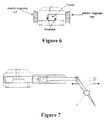
- FIG. 6 illustrates a third exemplary system for moving the piston through the piston core
- FIG. 7 illustrates a fourth exemplary system for moving the piston through the piston core.
- the present invention provides a system and method for directing smoke in a model train system.
- a model train e.g., a steam engine, diesel engine, etc.
- the smoke unit functions to produce smoke, which is then provided (e.g., via a plurality of tubes or paths) to at least one smoke chamber.
- Each smoke chamber includes at least one exhaust opening and a valve (e.g., a piston, etc.) for selectively moving smoke out of the exhaust opening(s).
- the smoke system can be used to simulate steam escaping from valves or cylinders.
- Such a system can be used alone, or in conjunction with the smoke redirection system disclosed in Ser. No. 12/488,373, filed Jun. 19, 2009, which is incorporated herein by reference, in its entirety.
- the present invention is not limited to the production and distribution of smoke.
- the production and distribution of other visual substances like steam (e.g., in a steam locomotive, a diesel locomotive, etc.) are within the spirit and scope of the present invention.
- the present invention is not limited to exhaust openings near the wheels of the model train. Exhausting smoke from other locations (e.g., a smokestack, etc.) is within the spirit and scope of the present invention. This may be achieve using a plurality of tubes (or paths) to direct smoke to a plurality of exhaust openings, and (optionally) individual valves to release smoke from individual exhaust openings.
- the exhaustion of smoke needs to be controlled (e.g., to simulated the opening/closing of cylinder cocks, the starting/stopping of a dynamo, etc.)
- at least one valve should be positioned in the corresponding smoke chamber, wherein the valve is controlled electrically and/or mechanically.
- the exhaustion of smoke does not need to be controlled (e.g., to simulate a smokestack, a steam leak, etc.)
- a valve in the corresponding smoke chamber many not be necessary. In such a situation, the activation of the smoke unit would (by itself) result in the exhaustion of smoke from the corresponding smoke chamber.
- the smoke unit (or components included therein) and/or the valves may be automatically controlled by the model train (or a processor included therein) (e.g., to simulate a start-up condition, to simulate movement of a train, etc.) and/or by a user via a remote control.
- a user may choose to operate the model train so that smoke is being exhausted from around the train's wheels and from the train's smokestack when the train is in operation.
- the smoke unit further includes a smoke generator for generating smoke and a fan for moving the smoke to the smoke chamber.
- the smoke chamber includes an intake opening, at least two exhaust openings, a piston core and a piston driven by a drive rod.
- the drive rod e.g., substantially horizontally
- the piston can be moved through the piston core, resulting in the movement of smoke out of the exhaust openings.
- smoke is moved out of the first exhaust opening.
- first exhaust opening see FIG. 3
- smoke is moved out of the second exhaust opening.
- the present invention is not limited to the smoke system shown in FIGS. 2 and 3 .
- a smoke system that includes different components (e.g., a bellow instead of a fan, etc.), additional components (e.g., a bellow that functions together with the fan, etc.), or components in different locations (e.g., a fan located in the smoke chamber, etc.) is within the spirit and scope of the present invention.
- smoke can be prevented from moving out of either exhaust opening by using a second valve in conjunction with the intake opening, or positioning the piston over the intake opening, thereby preventing the smoke from entering the piston core.
- the present invention is not limited to any particular method of moving the piston through the piston core.
- a wheel can be connected to the drive rod, and rotated about a central axis to move the piston through the piston core.
- the wheel can be rotated using either an existing train component (e.g., a wheel axel, a drive motor, etc.) or an added component (e.g., a motor, etc.), which is used to control at least the exhaustion of smoke from the smoke chamber.
- an existing train component e.g., a wheel axel, a drive motor, etc.
- an added component e.g., a motor, etc.
- an electromagnetic coil and a return spring can be used to move the piston through the piston core.
- an electric field can be generated and used to move (i.e., push or pull) the piston through the piston core in a first direction.
- a return spring e.g., a torsion or compression spring
- a processor in the model train can be used to control the application of power to the electromagnetic coil.
- the manner (e.g., start, duration, frequency, etc.) in which power is applied to the coil can be determined by the processor itself (e.g., based on signals received from other devices, signals received from sensors, at least one program stored in a memory in communication with the processor, etc.) and/or by signals provided by a user via a remote control.
- a first electromagnetic coil can be positioned near a first end of the smoke chamber, and a second electromagnetic coil can be positioned near a second end of the smoke chamber.
- electric (or magnetic) fields can be generated and used to move (e.g., push or pull) the piston through the piston core.
- the piston can either be made out of a magnetic material or include a plurality of magnets (as shown in FIG. 6 ).
- a drive rod may not be necessary since the electromagnetic coils are being used directly to move the piston through the piston core.
- a processor in the model train can be used to control the application of power to the electromagnetic coils. As in the previous embodiment, the manner in which power is applied can either be determined by the processor itself or by a user via a remote control.
- a lever can be connected to the drive rod and moved about an axis to move (or toggle) the piston through the piston core. It should be appreciated that the lever can be rotated using either an existing train component or an added component (e.g., a motor, etc.), which is used to control at least the exhaustion of smoke from the smoke chamber.
- the foregoing system may be used in conjunction with a sound system configured to use information (e.g., signals from sensors, signals used to move the drive rod, signals used to move the piston through the piston core, etc.) to synchronize sound (e.g., steam whistle, “chuffing” sound, “hissing” sound, etc.) to an exhaustion of smoke.
- a signal from a processor in the train that is used to apply power to an electromagnetic device, resulting in the exhaustion of smoke from a first exhaust opening, can also be used to activate a particular sound associated with that exhaustion of smoke.
Landscapes
- Toys (AREA)
Abstract
Description
Claims (18)
Priority Applications (1)
| Application Number | Priority Date | Filing Date | Title |
|---|---|---|---|
| US13/273,688 US8905809B2 (en) | 2010-10-14 | 2011-10-14 | System and method for directing smoke in a model train system |
Applications Claiming Priority (2)
| Application Number | Priority Date | Filing Date | Title |
|---|---|---|---|
| US39321510P | 2010-10-14 | 2010-10-14 | |
| US13/273,688 US8905809B2 (en) | 2010-10-14 | 2011-10-14 | System and method for directing smoke in a model train system |
Publications (2)
| Publication Number | Publication Date |
|---|---|
| US20120094570A1 US20120094570A1 (en) | 2012-04-19 |
| US8905809B2 true US8905809B2 (en) | 2014-12-09 |
Family
ID=45934551
Family Applications (1)
| Application Number | Title | Priority Date | Filing Date |
|---|---|---|---|
| US13/273,688 Expired - Fee Related US8905809B2 (en) | 2010-10-14 | 2011-10-14 | System and method for directing smoke in a model train system |
Country Status (1)
| Country | Link |
|---|---|
| US (1) | US8905809B2 (en) |
Families Citing this family (3)
| Publication number | Priority date | Publication date | Assignee | Title |
|---|---|---|---|---|
| US9492761B2 (en) * | 2014-11-27 | 2016-11-15 | Shih-Ming Chao | Model locomotive with vapor-smoking and furnace-firing-and-lighting effects |
| CN218529771U (en) * | 2022-09-30 | 2023-02-28 | 陈斯先 | Toy train |
| TWI852891B (en) * | 2024-03-01 | 2024-08-11 | 趙世銘 | Train model clean smoke distribution structure |
Citations (28)
| Publication number | Priority date | Publication date | Assignee | Title |
|---|---|---|---|---|
| US360037A (en) * | 1887-03-29 | Mechanical toy | ||
| US1608142A (en) * | 1925-10-02 | 1926-11-23 | Melvin J Stephenson | Toy tractor |
| US1737787A (en) * | 1928-09-17 | 1929-12-03 | Rudolph C Dombrow | Smoking toy locomotive |
| US2317974A (en) * | 1940-11-23 | 1943-05-04 | Gilbert Co A C | Pseudo steam puffing apparatus for toy trains |
| US2413284A (en) * | 1944-06-13 | 1946-12-31 | Lionel Corp | Smoke producing toy |
| US2461664A (en) * | 1941-08-30 | 1949-02-15 | Gilbert Co A C | Vapor generation and puffing with audible effects in toys |
| US2520916A (en) * | 1944-02-25 | 1950-09-05 | Gilbert Co A C | Toy puffing locomotive |
| US2610438A (en) * | 1946-08-20 | 1952-09-16 | Gilbert Co A C | Stack recharged puffing unit for toys |
| US2610437A (en) * | 1946-06-20 | 1952-09-16 | Gilbert Co A C | Automatic puffing unit for toys |
| US2658303A (en) * | 1947-12-16 | 1953-11-10 | Lionel Corp | Toy smoke-producing apparatus |
| US2673419A (en) * | 1948-10-09 | 1954-03-30 | Louis Marx & Company | Toy smoking locomotive |
| US3003279A (en) * | 1958-05-14 | 1961-10-10 | Lionel Corp | Smoke generator |
| US3074201A (en) * | 1961-12-19 | 1963-01-22 | Marx & Co Louis | Toy locomotive |
| US3117393A (en) * | 1962-02-08 | 1964-01-14 | Walter E Heller & Company | Smoke puffing device for toy locomotives |
| US3160980A (en) * | 1959-01-27 | 1964-12-15 | Seuthe Eberhard | Device to produce steam for mobile and stationary toys |
| US3178850A (en) * | 1961-01-05 | 1965-04-20 | Earle R Brown | Electrical smoke generator |
| US3255551A (en) * | 1962-10-20 | 1966-06-14 | Scheihing Erwin | Smoke producing device for toys |
| USRE26563E (en) * | 1966-12-14 | 1969-04-15 | Device to produce steam for mobile and stationary toys | |
| US5205771A (en) * | 1992-02-10 | 1993-04-27 | Anson Sims | Toy bomber for generating smoke-filled bubbles |
| US5312281A (en) * | 1991-12-10 | 1994-05-17 | Tdk Corporation | Ultrasonic wave nebulizer |
| US5512001A (en) * | 1995-02-03 | 1996-04-30 | Stephen Schwartz Design | Toy vehicle |
| US6280278B1 (en) * | 1999-07-16 | 2001-08-28 | M.T.H. Electric Trains | Smoke generation system for model toy applications |
| US6485347B1 (en) * | 2000-05-17 | 2002-11-26 | Lionel, L.L.C. | Puffing fan driven smoke unit for a model train |
| US20040005836A1 (en) * | 2002-07-05 | 2004-01-08 | Pierson Martin D. | Smart smoke unit |
| US6676473B2 (en) * | 2001-10-01 | 2004-01-13 | Lionel Llc | Smart smoke unit |
| US20100015880A1 (en) * | 2008-07-15 | 2010-01-21 | Grubba Robert A | Smoke production system for model locomotive |
| US20100062675A1 (en) * | 2008-09-08 | 2010-03-11 | Zahornacky Jon F | System and method for substantially synchronizing sound and smoke in a model vehicle |
| US20100323578A1 (en) * | 2009-06-19 | 2010-12-23 | Lionel L.L.C. | System and method for redirecting smoke effects in a model vehicle |
-
2011
- 2011-10-14 US US13/273,688 patent/US8905809B2/en not_active Expired - Fee Related
Patent Citations (34)
| Publication number | Priority date | Publication date | Assignee | Title |
|---|---|---|---|---|
| US360037A (en) * | 1887-03-29 | Mechanical toy | ||
| US1608142A (en) * | 1925-10-02 | 1926-11-23 | Melvin J Stephenson | Toy tractor |
| US1737787A (en) * | 1928-09-17 | 1929-12-03 | Rudolph C Dombrow | Smoking toy locomotive |
| US2317974A (en) * | 1940-11-23 | 1943-05-04 | Gilbert Co A C | Pseudo steam puffing apparatus for toy trains |
| US2461664A (en) * | 1941-08-30 | 1949-02-15 | Gilbert Co A C | Vapor generation and puffing with audible effects in toys |
| US2520916A (en) * | 1944-02-25 | 1950-09-05 | Gilbert Co A C | Toy puffing locomotive |
| US2413284A (en) * | 1944-06-13 | 1946-12-31 | Lionel Corp | Smoke producing toy |
| US2610437A (en) * | 1946-06-20 | 1952-09-16 | Gilbert Co A C | Automatic puffing unit for toys |
| US2610438A (en) * | 1946-08-20 | 1952-09-16 | Gilbert Co A C | Stack recharged puffing unit for toys |
| US2658303A (en) * | 1947-12-16 | 1953-11-10 | Lionel Corp | Toy smoke-producing apparatus |
| US2673419A (en) * | 1948-10-09 | 1954-03-30 | Louis Marx & Company | Toy smoking locomotive |
| US3003279A (en) * | 1958-05-14 | 1961-10-10 | Lionel Corp | Smoke generator |
| US3160980A (en) * | 1959-01-27 | 1964-12-15 | Seuthe Eberhard | Device to produce steam for mobile and stationary toys |
| US3178850A (en) * | 1961-01-05 | 1965-04-20 | Earle R Brown | Electrical smoke generator |
| US3074201A (en) * | 1961-12-19 | 1963-01-22 | Marx & Co Louis | Toy locomotive |
| US3117393A (en) * | 1962-02-08 | 1964-01-14 | Walter E Heller & Company | Smoke puffing device for toy locomotives |
| US3255551A (en) * | 1962-10-20 | 1966-06-14 | Scheihing Erwin | Smoke producing device for toys |
| USRE26563E (en) * | 1966-12-14 | 1969-04-15 | Device to produce steam for mobile and stationary toys | |
| US5312281A (en) * | 1991-12-10 | 1994-05-17 | Tdk Corporation | Ultrasonic wave nebulizer |
| US5205771A (en) * | 1992-02-10 | 1993-04-27 | Anson Sims | Toy bomber for generating smoke-filled bubbles |
| US5512001A (en) * | 1995-02-03 | 1996-04-30 | Stephen Schwartz Design | Toy vehicle |
| US6280278B1 (en) * | 1999-07-16 | 2001-08-28 | M.T.H. Electric Trains | Smoke generation system for model toy applications |
| US6485347B1 (en) * | 2000-05-17 | 2002-11-26 | Lionel, L.L.C. | Puffing fan driven smoke unit for a model train |
| US20040198135A1 (en) * | 2001-10-01 | 2004-10-07 | Pierson Martin D. | Smart smoke unit |
| US6676473B2 (en) * | 2001-10-01 | 2004-01-13 | Lionel Llc | Smart smoke unit |
| US7125309B2 (en) * | 2001-10-01 | 2006-10-24 | Lionel L.L.C. | Smart smoke unit |
| US20040005836A1 (en) * | 2002-07-05 | 2004-01-08 | Pierson Martin D. | Smart smoke unit |
| US7297045B2 (en) * | 2002-07-05 | 2007-11-20 | Lionel L.L.C. | Smart smoke unit |
| US20100015880A1 (en) * | 2008-07-15 | 2010-01-21 | Grubba Robert A | Smoke production system for model locomotive |
| US7749040B2 (en) * | 2008-07-15 | 2010-07-06 | Grubba Robert A | Smoke production system for model locomotive |
| US20100062675A1 (en) * | 2008-09-08 | 2010-03-11 | Zahornacky Jon F | System and method for substantially synchronizing sound and smoke in a model vehicle |
| US8025545B2 (en) * | 2008-09-08 | 2011-09-27 | Lionel L.L.C. | System and method for substantially synchronizing sound and smoke in a model vehicle |
| US20100323578A1 (en) * | 2009-06-19 | 2010-12-23 | Lionel L.L.C. | System and method for redirecting smoke effects in a model vehicle |
| US8393931B2 (en) * | 2009-06-19 | 2013-03-12 | Lionel L.L.C. | System and method for redirecting smoke effects in a model vehicle |
Also Published As
| Publication number | Publication date |
|---|---|
| US20120094570A1 (en) | 2012-04-19 |
Similar Documents
| Publication | Publication Date | Title |
|---|---|---|
| US20120094570A1 (en) | System and method for directing smoke in a model train system | |
| WO2005045710A3 (en) | Simulation system and computer-implemented method for simulation and verifying a control system | |
| JP2012520417A (en) | Injector emulation device | |
| US7749040B2 (en) | Smoke production system for model locomotive | |
| CN107208586A (en) | Method of simulating extreme or faulty solenoid valves for vehicle diagnostic system certification showing fault results and fault identification | |
| US6485347B1 (en) | Puffing fan driven smoke unit for a model train | |
| CN106227186B (en) | A kind of test macro and method of electric car heat management pipeline | |
| CN110487528A (en) | The test device and its test method of socket mechanical life | |
| US8393931B2 (en) | System and method for redirecting smoke effects in a model vehicle | |
| JP2018059516A (en) | Exhaust gas turbocharger | |
| JP2017198518A (en) | Test device | |
| US8025545B2 (en) | System and method for substantially synchronizing sound and smoke in a model vehicle | |
| CN204406876U (en) | Corolla electronic throttle brassboard | |
| CN108944845A (en) | A kind of braking pedal device and its braking method based on permanent magnet | |
| CN109695487A (en) | A kind of electromagnetic valve structure for variable lift valve operating camshaft | |
| GB0619876D0 (en) | Throttle valve control device | |
| CN110696795B (en) | Pedal feel simulator based on electromagnetic adjustment | |
| DE102006061564A1 (en) | Sound influencing method for use in vehicle, involves generating sound-influencing signal based on detected sound emission of sound damper in exhaust gas system, and generating sound influencing signal depending on operating mode of engine | |
| WO2021160826A1 (en) | Vehicle having apparatus for simulating operating sounds of a desired internal combustion engine and associated methods | |
| Sneed et al. | Development of smart material-hydraulic pumps and actuators | |
| CN106249070A (en) | A kind of test system and method for electric automobile heat management pipeline | |
| US5799489A (en) | Torque compensating apparatus and method for a turbo-charger | |
| Mitchell et al. | Design, Control, Assembly and Testing of a Camless Valve System | |
| CN204952192U (en) | A scene device that is used for situation simulated training / recreation | |
| CN203202388U (en) | Electro-pneumatic valve positioner based on two-position type limit switch |
Legal Events
| Date | Code | Title | Description |
|---|---|---|---|
| AS | Assignment |
Owner name: LIONEL L.L.C., MICHIGAN Free format text: ASSIGNMENT OF ASSIGNORS INTEREST;ASSIGNORS:MOSHER, RICHARD JAMES;ROHDE, JAMES M.;REEL/FRAME:027982/0083 Effective date: 20120303 |
|
| AS | Assignment |
Owner name: WELLS FARGO BANK, NATIONAL ASSOCIATION, NEW YORK Free format text: SECURITY INTEREST;ASSIGNOR:LIONEL L.L.C.;REEL/FRAME:029162/0523 Effective date: 20121011 |
|
| STCF | Information on status: patent grant |
Free format text: PATENTED CASE |
|
| FEPP | Fee payment procedure |
Free format text: MAINTENANCE FEE REMINDER MAILED (ORIGINAL EVENT CODE: REM.) |
|
| FEPP | Fee payment procedure |
Free format text: SURCHARGE FOR LATE PAYMENT, SMALL ENTITY (ORIGINAL EVENT CODE: M2554); ENTITY STATUS OF PATENT OWNER: SMALL ENTITY |
|
| MAFP | Maintenance fee payment |
Free format text: PAYMENT OF MAINTENANCE FEE, 4TH YR, SMALL ENTITY (ORIGINAL EVENT CODE: M2551); ENTITY STATUS OF PATENT OWNER: SMALL ENTITY Year of fee payment: 4 |
|
| AS | Assignment |
Owner name: JPMORGAN CHASE BANK, N.A., FLORIDA Free format text: GRANT OF SECURITY INTEREST IN PATENT RIGHTS;ASSIGNOR:LIONEL L.L.C.;REEL/FRAME:054053/0628 Effective date: 20201001 |
|
| FEPP | Fee payment procedure |
Free format text: MAINTENANCE FEE REMINDER MAILED (ORIGINAL EVENT CODE: REM.); ENTITY STATUS OF PATENT OWNER: SMALL ENTITY |
|
| LAPS | Lapse for failure to pay maintenance fees |
Free format text: PATENT EXPIRED FOR FAILURE TO PAY MAINTENANCE FEES (ORIGINAL EVENT CODE: EXP.); ENTITY STATUS OF PATENT OWNER: SMALL ENTITY |
|
| STCH | Information on status: patent discontinuation |
Free format text: PATENT EXPIRED DUE TO NONPAYMENT OF MAINTENANCE FEES UNDER 37 CFR 1.362 |
|
| FP | Lapsed due to failure to pay maintenance fee |
Effective date: 20221209 |
|
| AS | Assignment |
Owner name: LIONEL L.L.C., NORTH CAROLINA Free format text: RELEASE BY SECURED PARTY;ASSIGNOR:WELLS FARGO BANK, NATIONAL ASSOCIATION;REEL/FRAME:069275/0200 Effective date: 20200930 |
|
| FEPP | Fee payment procedure |
Free format text: PETITION RELATED TO MAINTENANCE FEES FILED (ORIGINAL EVENT CODE: PMFP); ENTITY STATUS OF PATENT OWNER: SMALL ENTITY |
|
| FEPP | Fee payment procedure |
Free format text: PETITION RELATED TO MAINTENANCE FEES DISMISSED (ORIGINAL EVENT CODE: PMFS); ENTITY STATUS OF PATENT OWNER: SMALL ENTITY |