US8896607B1 - Inverse kinematics for rigged deformable characters - Google Patents
Inverse kinematics for rigged deformable characters Download PDFInfo
- Publication number
- US8896607B1 US8896607B1 US12/475,268 US47526809A US8896607B1 US 8896607 B1 US8896607 B1 US 8896607B1 US 47526809 A US47526809 A US 47526809A US 8896607 B1 US8896607 B1 US 8896607B1
- Authority
- US
- United States
- Prior art keywords
- pose
- response
- model
- values
- processor
- Prior art date
- Legal status (The legal status is an assumption and is not a legal conclusion. Google has not performed a legal analysis and makes no representation as to the accuracy of the status listed.)
- Active, expires
Links
Images



Classifications
-
- G—PHYSICS
- G06—COMPUTING OR CALCULATING; COUNTING
- G06T—IMAGE DATA PROCESSING OR GENERATION, IN GENERAL
- G06T13/00—Animation
- G06T13/20—Three-dimensional [3D] animation
- G06T13/40—Three-dimensional [3D] animation of characters, e.g. humans, animals or virtual beings
Definitions
- the present invention relates to computer animation. More specifically, the present invention relates to computer animation based upon motion captured data.
- a user In computer animation, a user, known as an animator, typically specifies poses for models of an object on a computer system. Based upon the specified poses with respect to time, the object may appear to be animated in a series of rendered images.
- the inventors of the present invention have recognized that specifying poses of objects via object models is a very time consuming process.
- a face of an animated character may have about 100 individually adjustable parameters that determine positions for 20,000 surface points. Accordingly, animation of a character's face, for example, is a slow and painstaking process.
- ImageMovers Digital has pioneered the use of physical motion capture techniques using live actors.
- ImageMovers has used a combination of motion capture techniques and traditional computer animation techniques to produce feature-length films including: “The Polar Express” (2004), “Monster House” (2006), “Beowulf” (2007), which have garnered several Academy Award nominations.
- the inventors of the present invention have recognized that although motion captured data may assist an animator in the animation process, animators still need to refine such animation, by hand.
- motion capture data especially of the face of an actor, typically only provides low-resolution, wire-frame-like data, that provides very coarse animation data.
- Another reason is that when motion captured data alone is used to drive computer animation, the resulting computer animation often looks stiff and not esthetically pleasing.
- One problem recognized by the inventors of the present invention with animators modifying motion captured data includes, that it is very easy for an animator to pose “off-model.”In other words, it may be easy for an animator to stray from desired characteristic poses.
- an animator may start with a the motion captured mannerism, but then may ruin such poses unintentionally when refining the animation.
- the resulting posed model would be considered “off-model” because the object does not behave the way the actor did.
- the present invention relates to computer animation. More specifically, the present invention relates to computer animation based upon motion captured data.
- motion capture data of an object is captured in a number of characteristic poses.
- a rigged models is determined including animation variables. Values for animation variables are selected to emulate the characteristic poses for the object. These animation variable values, along with a deformed surface are stored in a database.
- a user such as an animator
- displaces a point on the surface of the object a determination is made as to which pose surface should be used to best represent the object.
- the values for the animation variables associated with the closest pose surface are then retrieved and the applied to the rigged model. Accordingly, the animator can freely deform the surface of the object, while staying “on-model,” i.e. maintaining the characteristic poses and appearance of the object.
- a method for a computer system includes receiving a surface deformation for a surface of a model of an object from a user via a user input device of the computer system, wherein the model of the object comprises a plurality of animation variables, wherein values for the plurality of animation variables are used to determine the surface of the model.
- a process includes determining a predefined pose for the model of the object from a plurality of pre-defined poses for the model of the object in response to the surface deformation, wherein the plurality of predefined poses includes a first predefined pose, wherein the first predefined pose comprises a first plurality of values for the plurality of animation variables, wherein the first plurality of values for the plurality of animation variables is determined in response to physical motion capture data of surface positions of the object physically posed in a first pose.
- a method may include posing the model of the object in a pose in response to the first plurality of values of the plurality of animation variables, and displaying the model of the object in the pose to a user on a display of the computer system.
- One apparatus may include a memory configured to store a model of an object comprising a plurality of animation variables, wherein values for the plurality of animation variables are used to determine a surface of the model of the object, and configured to store a plurality of predefined poses including a first predefined pose, wherein the first predefined pose comprises a first plurality of values for the plurality of animation variables, wherein the first plurality of values for the plurality of animation variables are determined in response to physical motion capture data of surface positions of the object physically posed in a first pose.
- a device may include a user input device configured to receive an input from the user, and a processor coupled to the memory and to the user input device, wherein the processor is configured to determine a surface deformation for the surface of the model of the object in response to the input from the user, wherein the processor is configured to determine the first predefined pose for the model of the object from the plurality of pre-defined poses for the model of the object in response to the surface deformation, wherein the processor is configured to pose the model of the object in a pose in response to the first plurality of values of the plurality of animation variables.
- a system may include a display coupled to the processor, wherein the display is configured to display the model of the object in the pose to the user.
- the computer program product may include code that directs the processor to receive a surface deformation for a surface of a model of an object from a user via the user input device, wherein the model of the object comprises a plurality of animation variables, wherein values for the plurality of animation variables are used to determine the surface of the model, and code that directs the processor to determine at least a first predefined pose for the model of the object from a plurality of pre-defined poses for the model of the object in response to the surface deformation, wherein the first predefined pose comprises a first plurality of values for the plurality of animation variables, wherein the first plurality of values for the plurality of animation variables are determined in response to physical motion capture data of surface positions of the object physically posed in a first pose.
- the code my include code that directs the processor to pose the model of the object in a pose in response to the first plurality of values of the plurality of animation variables, and code that directs the processor to display the model of the object in the pose to a user on the display.
- the tangible medium may be optical media (e.g. DVD, CD-ROM, Blu-Ray, or the like), semiconductor media (e.g. RAM, Flash memory, or the like), magnetic media (e.g. hard disk, storage area network, or the like).
- FIG. 1 illustrates a block diagram of various aspects of embodiments of the present invention
- FIG. 2 illustrates an example according to various embodiments of the present invention
- FIGS. 3A-D illustrate examples of various embodiments of the present invention
- FIGS. 4A-C illustrate a block diagram of a flow chart according to various embodiments of the present invention.
- FIG. 5 is a block diagram of typical computer system according to various embodiments of the present invention.
- FIG. 1 illustrates a block diagram of various aspects of embodiments of the present invention. More specifically, FIG. 1 illustrates various embodiments of a facial motion capture system.
- a motion capture system 100 is used to capture different performances and/or poses of an object 110 .
- object 110 may be a human actor, an animal, or other object capable of assuming different poses often with regards to time.
- object 110 is a human actor
- motion capture system 100 is used to capture poses of the face 120 of the human actor.
- the poses may include achieving a smile, achieving a frown, donning a mad expression, performing a wink, flashing a smirk, or the like, as will be discussed below.
- motion capture system 100 includes one or more camera booms 130 and 140 . Additionally, each camera boom may include one or more image capture devices 150 , 160 . In various embodiments of the present invention, image capture devices 150 , 160 may include one or more high resolution video cameras (e.g. HD resolution), or the like.
- high resolution video cameras e.g. HD resolution
- Images captured with image capture devices 150 , 160 are stored in a storage unit 190 , typically attached to object 110 .
- video data from image capture devices 150 , 160 may be stored in storage unit 190 , that may include a processing unit including a mass storage device (e.g. hard disk, SSD, etc.).
- mass storage device e.g. hard disk, SSD, etc.
- image capture devices 150 , 160 capture images of the actor in different poses from the different vantage points.
- an animation software model of object 110 may be created in three-dimensions.
- FIG. 2 illustrates an example according to various embodiments of the present invention.
- Shown in FIG. 2 are a number of examples of facial poses 200 of an object, e.g. a face of an actor, or other three-dimensional object.
- the face of the actor is actor is told to assume any number of facial expressions, for example a relaxed or default expression 210 , an angry expression 220 , a surprised expression 230 , a sad expression 240 , and the like.
- the number of facial expressions may be on the order of tens of facial expressions, e.g. 10, 20, 50, 80, or greater.
- any number of optical marks may be used on the face of the actor to track the position of different portions of the actor's face.
- the number of locations on a face that are optically tracked may be on the order of tens to hundreds, e.g. 50, 200, etc.
- an object modeler creates a rigged model 310 of the actor's face for use within an animation environment.
- rigged model 310 includes a number of user (e.g. an animator) definable inputs, e.g. animation variable inputs, and model 310 provides a definition of a deformed surface of model 310 .
- the object is posed in a particular pose and the surface of the object is deformed.
- the surface of model 310 may be represented by a tessellated mesh, or the like, to an animator on a display.
- a model of a face may include an animation variable related to the position of an eyelid of the face. In such an example, for an animation variable input of 0.0, the eyelid may be closed; for an animation variable of 1.0, the eyelid may be fully open; etc. If an animator sets both animation variables of the eyelids on a face to 0.3, for example, the object may appear sleepy, sheepish, or the like.
- a user e.g. an animator
- the user specifies values for the animation variables such that the deformed surface of model 310 approximates each of facial poses 200 .
- an angry modeled pose 330 is determined to be similar to angry expression 220 ;
- a surprised modeled pose 340 is determined to represent surprised expression;
- a sad modeled expression 350 is determined to represent sad expression 240 ; and the like.
- a “neutral” facial pose 370 may also be determined.
- the deformed surfaces and corresponding animation variables values corresponding to each modeled poses 320 and neutral facial pose 370 are typically stored in a database 360 .
- the neutral surface and deformed surfaces (along with corresponding animation variables) are stored for later retrieval from database 360 .
- FIGS. 3A-B illustrate examples of various embodiments of the present invention. More specifically, FIGS. 3A-B illustrate use of deformed surfaces and corresponding animation variables stored in database 360 .
- a user retrieves a beginning pose 400 for an object, such as neutral facial pose 370 from database 360 , on a display within an animation environment.
- the surface of the object within the beginning pose may be represented by a mesh, a tessellation, or the like, having any number of vertices that are connected to neighboring vertices. Surfaces may also be represented by curves having control “knots,” of the like.
- the animation environment may be any conventional or proprietary animation environment, such as Maya (Autodesk), Menv (Pixar), or the like.
- other poses than a “neutral pose” may also be used during this process.
- a beginning pose may be an ending pose from a previous animation sequence; the beginning pose may be a preset pose (e.g. angry, happy, sad, or the like); or any other pose.
- the user may deform the beginning pose. For example, as illustrated in deformed pose 410 , the user has selected a point 420 on the forehead of beginning pose 400 , and “pulled it down” the face to location 430 . In various embodiments, this may be accomplished by selecting a vertex or surface of the mesh, tessellation, or the like of the surface, and dragging the point or geometric feature. In some embodiments, point 420 may be perturbed or modified in two-dimensional space, or three-dimensional space, depending upon the specific requirements.
- point 420 may be perturbed “up,” “down,” “left” or “right” along the surface of the object; point 420 may be perturbed “into” or “out” of the surface of the object; or point 420 may be perturbed in any of a combination of directions, described above.
- the system in response to the surface perturbation, refers to modeled poses 320 stored in database 360 for a match, FIG. 3B . More specifically, referring to the deformed surfaces of modeled poses 320 , the system attempts to determine one or more modeled poses 320 that have point 420 moved to location 430 . In the present example, the system determines that the surface of angry modeled pose 33 has a modification in the same manner as point 430 , e.g. the center of the forehead of the face is furrowed Accordingly, angry modeled pose 330 is retrieved from database 360 and becomes modeled pose 440 , FIG. 3C . This is accomplished, in various embodiments, by retrieving the set of values for the animation variables associated with angry modeled pose 330 from database 360 , and applying the retrieved values to rigged object model 310 .
- more than one modeled pose may be “matched” based upon the surface perturbation
- the surface deformations of two or more modeled poses 450 and 460 may match the animator input (e.g. raising a point on the forehead).
- the user e.g. animator may be prompted to select which modeled pose to use.
- values for animation variables are then set to the selected modeled pose.
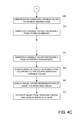
- FIG. 4 illustrates a block diagram of a flow chart according to various embodiments of the present invention
- an object such as an actor is placed within a motion capture environment, step 500 .
- the object e.g. human actor, articulated object, animal, or the like is typically equipped with a number of motion capture points, e.g. reflective balls, reflective paints, black dots, etc. and placed within the field of view of a number of motion capture sensors, e.g. visible light cameras, infrared light cameras, or the like.
- a portion of the actor in motion such as the face, the hands, the feet, the body, or the like, may be captured.
- the object assumes characteristic poses, or the object performs a characteristic movement, and the position of the motion capture points are determined, step 510 . Based upon the motion capture points, and predefined geometry of the motion capture environment, optics of the motion capture sensors, and the like, the three-dimensional surface positions of the motion capture points are determined for each characteristic pose/performance, step 520 .
- a user may determine a model of the object, step 530 .
- a default model of the object may be a tweaked model of a generic object, may be a model based upon a surface scan of the object, or the like.
- a user e.g. a modeler, may also determine any number of animation variables that may be used to modify the surface of the model of the object in response to various user-defined input values.
- the user e.g. modeler
- the modeler may define values for the animation variables, such that the model of the object can be approximately posed in the characteristic poses or have approximately the same characteristic movement, step 540 .
- the modeler determines modeled poses for the object in order recreate the actual motion-captured motion of the object.
- the values for the animation variables, along with the posed model surfaces are then stored, step 550 .
- a surface descriptor of a happy modeled pose and corresponding animation variable values; a surface descriptor of a sad modeled pose and corresponding animation variable values; or the like are stored within a data storage, e.g. a database.
- the posed model surfaces may be represented by a series of surface displacements between a “neutral” pose of the model of the object and the modeled pose.
- an angry modeled pose may be characterized by a point on the middle of the forehead of an actor being displaced towards the nose, and points of the outer eyebrows being displaced towards the hairline, thus representing a furrowed brow.
- the angry modeled pose may be characterized by the corners of the mouth being displaced towards the chin, thus representing a grimaced mouth.
- a surface descriptor data and animation variable values of an initial or default pose may be retrieved and displayed, typically, to a different user, e.g. animator, step 555 .
- the object may be posed in a neutral pose, or any other pose, as determined by the values for the corresponding animation variables. For instance values may be set for animation variables of the model of the object such that the object is posed in a surprised expression, a depressed expression, or the like.
- the surface of the object may be represented by a grid mesh, a tessellation, or using any other surface representation scheme, to a user.
- the object may select one or more surface indicator, e.g. vertex, triangle, square, control point or the like, on the surface, step 560 .
- the user may perform this via a mouse, stylus, or the like.
- the user moves or displaces the one or more surface indicators in space, step 570 .
- the user may move along the surface of the object, into the surface of the object, out of the surface of the object, or any other combination of movement of the selected surface indicator. Accordingly, the movement may be considered within two-dimensional or three-dimensional space.
- the system refers to the surface descriptors of the poses stored within the data storage, to determine one or more poses that match the surface deformations or displacements determined in step 570 .
- the surface deformations for each modeled pose may be represented by movements of particular surface positions of the object with respect to a default or neutral pose.
- the system may determine a modeled pose that has approximately the same surface deformations as the displacement determined in step 570 .
- database 360 determines a pose having the same sort of deformation.
- step 580 the values for the animation variables for the modeled pose are retrieved from data store 360 , step 590 .
- a posed based upon an interpolation of modeled poses may be determined to have the most similar deformations.
- the retrieved values for the animation variables of the modeled pose or of the interpolated modeled pose are applied to the model of the object, step 600 , and the modeled pose (or interpolated modeled pose) of the object is displayed to the user, e.g. animator, step 610 .
- the user may be prompted to select which modeled pose the model of the object will be used.
- the user may make further value changes to the animation variables based upon further artistic considerations, or the like, step 630 .
- the values for the animation frame are recorded to memory, step 640 .
- the modeled pose with the further changes may be used as a key frame for animation.
- the values for the animation variables for the animation frame may be retrieved from memory, step 645 , and used for rendering an animation frame including a representation of the object, step 650 .
- this rendering step may be for pre-production visualization, production rendering, or the like for an animated feature; for display (e.g. for computer gaming); or the like.
- Representation of rendered images that are determined may be displayed to the user and/or stored in a transportable or removable memory, e.g. hard-disk, optical-disk, film media, or the like, step 660 .
- the rendered images are then retrieved from the memory and displayed to a user (e.g. at a public theater, home theater, computer display, or the like), step 670 .
- FIG. 5 is a block diagram of typical computer system 700 according to various embodiment of the present invention.
- computer system 700 typically includes a monitor 710 , computer 720 , a keyboard 730 , a user input device 740 , a network interface 750 , and the like.
- user input device 740 is typically embodied as a computer mouse, a trackball, a track pad, wireless remote, and the like.
- User input device 740 typically allows a user to select objects, icons, text, control points and the like that appear on the monitor 710 .
- monitor 710 and user input device 740 may be integrated, such as with a touch screen display or pen based display such as a Cintiq marketed by Wacom.
- Embodiments of user input devices are illustrated as pedals 745 . However, any other such device, such as a joystick, may be used.
- Embodiments of network interface 750 typically include an Ethernet card, a modem (telephone, satellite, cable, ISDN), (asynchronous) digital subscriber line (DSL) unit, and the like.
- Network interface 750 are typically coupled to a computer network as shown.
- network interface 750 may be physically integrated on the motherboard of computer 720 , may be a software program, such as soft DSL, or the like.
- Computer 720 typically includes familiar computer components such as a processor 760 , and memory storage devices, such as a random access memory (RAM) 770 , disk drives 780 , and system bus 790 interconnecting the above components.
- processor 760 processor 760
- memory storage devices such as a random access memory (RAM) 770 , disk drives 780 , and system bus 790 interconnecting the above components.
- RAM random access memory
- computer 720 is a PC compatible computer having multiple microprocessors such as XeonTM microprocessor from Intel Corporation. Further, in the present embodiment, computer 720 typically includes a UNIX-based operating system.
- RAM 770 and disk drive 780 are examples of tangible media for storage of animation asset data, audio/video files, computer programs, operating system, embodiments of the present invention, including rendering engines, program code, and the like.
- Other types of tangible media include floppy disks, removable hard disks, optical storage media such as CD-ROMS, DVDs, Blu-Ray disks, semiconductor memories such as flash memories, read-only-memories (ROMS), battery-backed volatile memories, networked storage devices, and the like.
- computer system 700 may also include software that enables communications over a network such as the HTTP, TCP/IP, RTP/RTSP protocols, and the like.
- software that enables communications over a network
- HTTP HyperText Transfer Protocol
- TCP/IP Transmission Control Protocol
- RTP/RTSP protocols Remote Method Protocol
- other communications software and transfer protocols may also be used, for example IPX, UDP or the like.
- FIG. 5 is representative of computer systems capable of embodying the present invention. It will be readily apparent to one of ordinary skill in the art that many other hardware and software configurations are suitable for use with the present invention. For example, the use of other microprocessors are contemplated, such as CoreTM or ItaniumTM microprocessors; OpteronTM or PhenomTM microprocessors from Advanced Micro Devices, Inc; and the like. Additionally, graphics processing units (GPUs) from NVidia, ATI, or the like, may also be used to accelerate rendering.
- GPUs graphics processing units
- Windows® operating system such as WindowsVista®, WindowsNT®, or the like from Microsoft Corporation
- Solaris from Sun Microsystems
- LINUX UNIX
- MAC OS from Apple Corporation
- embodiments of the present invention may be directed towards real-time computer animation, such as found in video games. Similar to the process described above, characteristic poses for an object (e.g. facial poses) are determined, modeled, and stored in a database. Next, during gameplay, the player may specify a surface displacement for an object (e.g. petting a virtual animal, touching a virtual patient, or the like). In response, the most appropriate characteristic pose parameters are retrieved, and the object is posed accordingly. In other embodiments, the computer game itself may select the particular pose by specifying a displacement, or the like on the surface.
- characteristic poses for an object e.g. facial poses
- the player may specify a surface displacement for an object (e.g. petting a virtual animal, touching a virtual patient, or the like).
- the most appropriate characteristic pose parameters are retrieved, and the object is posed accordingly.
- the computer game itself may select the particular pose by specifying a displacement, or the like on the surface.
- the system may retrieve a predefined pose where the character's left eye is closed. Then over several frame times, the character's face may achieve the left-eye closed pose.
- the deformed surfaces may be applied to other portions of an object that illustrated above, such as: a human hand, a human body, a face of an animal, or the like.
- rendering may refer to a high quality process of converting an image from a mathematical description of a scene using a program such as Pixar's RenderMan®. Additionally, “rendering” may refer to any graphical visualization of the mathematical description of the scene, or any conversion of geometry to pixels, for example “rendering” with a lower quality rendering engine, or the like, such as GL and GPU hardware and software renderers, and the like. In some embodiments of the present invention, this type of real-time rendering may be used for entertainment programs, such as computer of console gaming. In various embodiments, the rendered object may be incorporated into computer animation, computer generated imagery, into live-action scenes, or the like.
Landscapes
- Physics & Mathematics (AREA)
- General Physics & Mathematics (AREA)
- Engineering & Computer Science (AREA)
- Theoretical Computer Science (AREA)
- Processing Or Creating Images (AREA)
Abstract
Description
Claims (17)
Priority Applications (1)
| Application Number | Priority Date | Filing Date | Title |
|---|---|---|---|
| US12/475,268 US8896607B1 (en) | 2009-05-29 | 2009-05-29 | Inverse kinematics for rigged deformable characters |
Applications Claiming Priority (1)
| Application Number | Priority Date | Filing Date | Title |
|---|---|---|---|
| US12/475,268 US8896607B1 (en) | 2009-05-29 | 2009-05-29 | Inverse kinematics for rigged deformable characters |
Publications (1)
| Publication Number | Publication Date |
|---|---|
| US8896607B1 true US8896607B1 (en) | 2014-11-25 |
Family
ID=51901799
Family Applications (1)
| Application Number | Title | Priority Date | Filing Date |
|---|---|---|---|
| US12/475,268 Active 2032-07-17 US8896607B1 (en) | 2009-05-29 | 2009-05-29 | Inverse kinematics for rigged deformable characters |
Country Status (1)
| Country | Link |
|---|---|
| US (1) | US8896607B1 (en) |
Cited By (1)
| Publication number | Priority date | Publication date | Assignee | Title |
|---|---|---|---|---|
| US20150279075A1 (en) * | 2014-03-27 | 2015-10-01 | Knockout Concepts, Llc | Recording animation of rigid objects using a single 3d scanner |
Citations (5)
| Publication number | Priority date | Publication date | Assignee | Title |
|---|---|---|---|---|
| US6016148A (en) * | 1997-06-06 | 2000-01-18 | Digital Equipment Corporation | Automated mapping of facial images to animation wireframes topologies |
| US20030184544A1 (en) * | 2000-07-24 | 2003-10-02 | Prudent Jean Nicholson | Modeling human beings by symbol manipulation |
| US6967658B2 (en) * | 2000-06-22 | 2005-11-22 | Auckland Uniservices Limited | Non-linear morphing of faces and their dynamics |
| US20090310828A1 (en) * | 2007-10-12 | 2009-12-17 | The University Of Houston System | An automated method for human face modeling and relighting with application to face recognition |
| US20100034462A1 (en) * | 2008-06-16 | 2010-02-11 | University Of Southern California | Automated Single Viewpoint Human Action Recognition by Matching Linked Sequences of Key Poses |
-
2009
- 2009-05-29 US US12/475,268 patent/US8896607B1/en active Active
Patent Citations (5)
| Publication number | Priority date | Publication date | Assignee | Title |
|---|---|---|---|---|
| US6016148A (en) * | 1997-06-06 | 2000-01-18 | Digital Equipment Corporation | Automated mapping of facial images to animation wireframes topologies |
| US6967658B2 (en) * | 2000-06-22 | 2005-11-22 | Auckland Uniservices Limited | Non-linear morphing of faces and their dynamics |
| US20030184544A1 (en) * | 2000-07-24 | 2003-10-02 | Prudent Jean Nicholson | Modeling human beings by symbol manipulation |
| US20090310828A1 (en) * | 2007-10-12 | 2009-12-17 | The University Of Houston System | An automated method for human face modeling and relighting with application to face recognition |
| US20100034462A1 (en) * | 2008-06-16 | 2010-02-11 | University Of Southern California | Automated Single Viewpoint Human Action Recognition by Matching Linked Sequences of Key Poses |
Cited By (1)
| Publication number | Priority date | Publication date | Assignee | Title |
|---|---|---|---|---|
| US20150279075A1 (en) * | 2014-03-27 | 2015-10-01 | Knockout Concepts, Llc | Recording animation of rigid objects using a single 3d scanner |
Similar Documents
| Publication | Publication Date | Title |
|---|---|---|
| US8334872B2 (en) | Inverse kinematics for motion-capture characters | |
| US10860838B1 (en) | Universal facial expression translation and character rendering system | |
| US12236510B2 (en) | Enhanced system for generation of facial models and animation | |
| US12169889B2 (en) | Enhanced system for generation of facial models and animation | |
| US11887232B2 (en) | Enhanced system for generation of facial models and animation | |
| CN107154069B (en) | Data processing method and system based on virtual roles | |
| CN105654537B (en) | It is a kind of to realize and the expression cloning method and device of virtual role real-time interactive | |
| Starck et al. | Surface capture for performance-based animation | |
| US11354774B2 (en) | Facial model mapping with a neural network trained on varying levels of detail of facial scans | |
| US9036898B1 (en) | High-quality passive performance capture using anchor frames | |
| US9734637B2 (en) | Semantic rigging of avatars | |
| US9196074B1 (en) | Refining facial animation models | |
| CN111028330A (en) | Method, device, device and storage medium for generating three-dimensional expression base | |
| US11158104B1 (en) | Systems and methods for building a pseudo-muscle topology of a live actor in computer animation | |
| CA3143520C (en) | Method of computing simulated surfaces for animation generation and other purposes | |
| WO2018080849A1 (en) | Simulating depth of field | |
| EP3980975B1 (en) | Method of inferring microdetail on skin animation | |
| CN120236005B (en) | Methods, systems, devices and storage media for constructing 3D avatar models | |
| KR101780496B1 (en) | Method for producing 3D digital actor image based on character modelling by computer graphic tool | |
| JP2005523488A (en) | Automatic 3D modeling system and method | |
| JP5920858B1 (en) | Program, information processing apparatus, depth definition method, and recording medium | |
| Tian et al. | Research on Visual Design of Computer 3D Simulation Special Effects Technology in the Shaping of Sci-Fi Animation Characters | |
| CN117876271B (en) | Network training and digital human animation driving method, device, equipment and medium | |
| US12293466B2 (en) | Systems and methods for generating a model database with blendshape representation | |
| US20250118027A1 (en) | Face micro detail recovery via patch scanning, interpolation, and style transfer |
Legal Events
| Date | Code | Title | Description |
|---|---|---|---|
| AS | Assignment |
Owner name: IMAGEMOVERS DIGITAL LLC, CALIFORNIA Free format text: ASSIGNMENT OF ASSIGNORS INTEREST;ASSIGNORS:EPPS, DOUG;REID, NATE;REEL/FRAME:023118/0370 Effective date: 20090709 |
|
| AS | Assignment |
Owner name: TWO PIC MC LLC, CALIFORNIA Free format text: CHANGE OF NAME;ASSIGNOR:IMAGEMOVERS DIGITAL LLC;REEL/FRAME:027675/0270 Effective date: 20110330 |
|
| STCF | Information on status: patent grant |
Free format text: PATENTED CASE |
|
| CC | Certificate of correction | ||
| MAFP | Maintenance fee payment |
Free format text: PAYMENT OF MAINTENANCE FEE, 4TH YEAR, LARGE ENTITY (ORIGINAL EVENT CODE: M1551) Year of fee payment: 4 |
|
| MAFP | Maintenance fee payment |
Free format text: PAYMENT OF MAINTENANCE FEE, 8TH YEAR, LARGE ENTITY (ORIGINAL EVENT CODE: M1552); ENTITY STATUS OF PATENT OWNER: LARGE ENTITY Year of fee payment: 8 |
|
| FEPP | Fee payment procedure |
Free format text: MAINTENANCE FEE REMINDER MAILED (ORIGINAL EVENT CODE: REM.); ENTITY STATUS OF PATENT OWNER: LARGE ENTITY |