US8896570B2 - Detecting method for a touch device - Google Patents

Detecting method for a touch device Download PDF

Info

Publication number
US8896570B2
US8896570B2 US13/841,775 US201313841775A US8896570B2 US 8896570 B2 US8896570 B2 US 8896570B2 US 201313841775 A US201313841775 A US 201313841775A US 8896570 B2 US8896570 B2 US 8896570B2
Authority
US
United States
Prior art keywords
difference
value
frame
base
base value
Prior art date
Legal status (The legal status is an assumption and is not a legal conclusion. Google has not performed a legal analysis and makes no representation as to the accuracy of the status listed.)
Active, expires
Application number
US13/841,775
Other versions
US20140160060A1 (en
Inventor
Ching-Ting CHIU
Po-Hao Kuo
Chia-Hsing Lin
Current Assignee (The listed assignees may be inaccurate. Google has not performed a legal analysis and makes no representation or warranty as to the accuracy of the list.)
Elan Microelectronics Corp
Original Assignee
Elan Microelectronics Corp
Priority date (The priority date is an assumption and is not a legal conclusion. Google has not performed a legal analysis and makes no representation as to the accuracy of the date listed.)
Filing date
Publication date
Application filed by Elan Microelectronics Corp filed Critical Elan Microelectronics Corp
Assigned to ELAN MICROELECTRONICS CORPORATION reassignment ELAN MICROELECTRONICS CORPORATION ASSIGNMENT OF ASSIGNORS INTEREST (SEE DOCUMENT FOR DETAILS). Assignors: CHIU, CHING-TING, KUO, PO-HAO, LIN, CHIA-HSING
Publication of US20140160060A1 publication Critical patent/US20140160060A1/en
Application granted granted Critical
Publication of US8896570B2 publication Critical patent/US8896570B2/en
Active legal-status Critical Current
Adjusted expiration legal-status Critical

Links

Images

Classifications

    • GPHYSICS
    • G06COMPUTING OR CALCULATING; COUNTING
    • G06FELECTRIC DIGITAL DATA PROCESSING
    • G06F3/00Input arrangements for transferring data to be processed into a form capable of being handled by the computer; Output arrangements for transferring data from processing unit to output unit, e.g. interface arrangements
    • G06F3/01Input arrangements or combined input and output arrangements for interaction between user and computer
    • G06F3/03Arrangements for converting the position or the displacement of a member into a coded form
    • G06F3/041Digitisers, e.g. for touch screens or touch pads, characterised by the transducing means
    • G06F3/044Digitisers, e.g. for touch screens or touch pads, characterised by the transducing means by capacitive means
    • G06F3/0446Digitisers, e.g. for touch screens or touch pads, characterised by the transducing means by capacitive means using a grid-like structure of electrodes in at least two directions, e.g. using row and column electrodes
    • GPHYSICS
    • G06COMPUTING OR CALCULATING; COUNTING
    • G06FELECTRIC DIGITAL DATA PROCESSING
    • G06F3/00Input arrangements for transferring data to be processed into a form capable of being handled by the computer; Output arrangements for transferring data from processing unit to output unit, e.g. interface arrangements
    • G06F3/01Input arrangements or combined input and output arrangements for interaction between user and computer
    • G06F3/03Arrangements for converting the position or the displacement of a member into a coded form
    • G06F3/041Digitisers, e.g. for touch screens or touch pads, characterised by the transducing means
    • G06F3/044Digitisers, e.g. for touch screens or touch pads, characterised by the transducing means by capacitive means
    • GPHYSICS
    • G06COMPUTING OR CALCULATING; COUNTING
    • G06FELECTRIC DIGITAL DATA PROCESSING
    • G06F3/00Input arrangements for transferring data to be processed into a form capable of being handled by the computer; Output arrangements for transferring data from processing unit to output unit, e.g. interface arrangements
    • G06F3/01Input arrangements or combined input and output arrangements for interaction between user and computer
    • G06F3/03Arrangements for converting the position or the displacement of a member into a coded form
    • G06F3/041Digitisers, e.g. for touch screens or touch pads, characterised by the transducing means
    • G06F3/0416Control or interface arrangements specially adapted for digitisers
    • G06F3/04166Details of scanning methods, e.g. sampling time, grouping of sub areas or time sharing with display driving
    • GPHYSICS
    • G06COMPUTING OR CALCULATING; COUNTING
    • G06FELECTRIC DIGITAL DATA PROCESSING
    • G06F3/00Input arrangements for transferring data to be processed into a form capable of being handled by the computer; Output arrangements for transferring data from processing unit to output unit, e.g. interface arrangements
    • G06F3/01Input arrangements or combined input and output arrangements for interaction between user and computer
    • G06F3/03Arrangements for converting the position or the displacement of a member into a coded form
    • G06F3/041Digitisers, e.g. for touch screens or touch pads, characterised by the transducing means
    • G06F3/0416Control or interface arrangements specially adapted for digitisers
    • G06F3/0418Control or interface arrangements specially adapted for digitisers for error correction or compensation, e.g. based on parallax, calibration or alignment
    • G06F3/04186Touch location disambiguation

Definitions

  • the present invention relates to the field of touch devices, and more particularly, to a detecting method for a touch device.
  • Detecting methods for a touch device have been disclosed in the prior art. According to the prior art detecting methods, whether there is an object in contact with a touch panel of the touch device is determined by comparing all sensed values of a base frame that are pre-stored in a memory are compared with all sensed values of a frame that is read at a subsequent time point. However, if there is any flaw in the pre-stored base frame, the comparison result may lead to malfunction of the touch device.
  • Examples of the present invention may provide a detecting method for a touch device, which comprises steps of: reading all sensed values of a frame associated with the touch device; computing a difference between a maximum sensed value and a minimum sensed value of all the sensed values of the frame; comparing the difference with a base value so as to generate a comparison result and executing a corresponding operation based on the comparison result.
  • Some examples of the present invention may provide a detecting method for a touch device, which comprises steps of: defining a plurality of continuous time points; reading, at each of the plurality of continuous time points, all sensed values of a frame associated with the touch device corresponding to the time point; computing a difference between a maximum sensed value and a minimum sensed value of all the sensed values of a frame read at each of the time points; comparing the difference computed at each of the time points with a base value so as to generate a comparison result and executing a corresponding operation based on the comparison result.
  • FIG. 1 is a schematic view of a frame associated with a touch device
  • FIG. 2 is a schematic view illustrating the computation of the difference associated with the frame
  • FIG. 3 is a schematic view of a detecting method for a touch device according to an embodiment of the present invention.
  • FIG. 4 is a flowchart of the detecting method shown in FIG. 3 ;
  • FIG. 5 is a schematic view of a detecting method for a touch device according to another embodiment of the present invention.
  • FIG. 6 is a flowchart of the detecting method shown in FIG. 5 ;
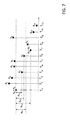
  • FIG. 7 is a schematic view of a detecting method for a touch device according to yet another embodiment of the present invention.
  • FIG. 8 is a flowchart of the detecting method shown in FIG. 7 ;
  • FIG. 9 to FIG. 11 showing the variants of the embodiments shown in FIG. 3 to FIG. 8 .
  • FIG. 1 is a schematic view of a frame associated with a touch device.
  • a touch panel 11 of the touch device 10 may include a plurality of sensing lines arranged in rows and columns, and a plurality of sensing points P are formed at intersections of the rows and the columns of the sensing lines.
  • the touch device 10 reads sensed value of each of the sensing points P on the touch device 10 by mutual-capacitance scanning and takes the sensed values as a frame F; however, this is only illustrated as an example but is not to limit the present invention.
  • the touch device 10 may also read sensed values of all the sensing lines by self-capacitance scanning and take the sensed values as the frame F.
  • FIG. 2 is a schematic view illustrating the computation of the difference associated with the frame.
  • the touch device 10 reads the frame F at each time point (including the power-on time point T 0 ) after being powered on.
  • the frame (referred to as “the initial frame F 0 ” in the following description) read by the touch device 10 at the power-on time point T 0 is stored in a memory and is used as a base frame F B .
  • the touch device 10 includes a difference between a maximum sensed value C max, B and a minimum sensed value C min, B of all the sensed values of the base frame F B , and sets the difference as a base value ⁇ B . For example, as shown in FIG.
  • sensed values C 0, 0 , C 0, 1 , . . . C 3, 2 , C 3, 3 of the sensing points corresponding to the lower left region of the touch panel will be smaller than sensed values of sensing points corresponding to other regions of the touch panel.
  • the maximum sensed value C max, B of the base frame F B may be, for example, C 9, 6
  • the minimum sensed value C min, B of the base frame F B may be, for example, C 1, 1
  • the base value ⁇ B is (C 9, 6 ⁇ C 1, 1 ) in this example.
  • the touch device 10 After being powered on, the touch device 10 reads sensed values corresponding to sensing points of a frame F n at each time point T n , computes a difference ⁇ n between a maximum sensed value C max, n and a minimum sensed value C min, n of the sensed values corresponding to the sensing points of the frame F n , compares the difference ⁇ n with the base value ⁇ B to generate a comparison result, and executes an operation associated with the touch device 10 based on the comparison result, as will be described in detail below.
  • FIG. 3 is a schematic view of a detecting method for a touch device according to an embodiment of the present invention.
  • the touch device 10 computes the difference ⁇ n between the maximum sensed value C max, n and the minimum sensed value C min, n at each time point T n .
  • the touch device 10 computes a difference ⁇ 1 at a time point T 1 and computes a difference ⁇ 2 at a time point T 2 , and so on.
  • the touch device 10 computes a difference ⁇ 10 at a time point T 10 .
  • the touch device 10 compares the computed difference ⁇ 1 with the base value ⁇ B .
  • the base value ⁇ B and the base frame F B is not updated; that is, the base value ⁇ B is retained as the difference ⁇ 0 and the base frame F B is retained as the initial frame F 0 .
  • the touch device 10 compares the computed difference ⁇ 2 with the base value ⁇ B .
  • the base value ⁇ B and the base frame F B is still not updated; that is, the base value ⁇ B is still retained as the difference ⁇ 0 , and the base frame F B is still retained as the initial frame F 0 .
  • the touch device 10 compares the computed difference ⁇ 3 with the base value ⁇ B .
  • the touch device 10 updates the base value ⁇ B and the base frame F B .
  • the base value ⁇ B is updated to be the difference ⁇ 3 ; and the base frame F B is updated to be a frame F 3 read at the time point T 3 .
  • the base value ⁇ B is further updated to be the difference ⁇ 7 .
  • the base frame F B is further updated to be a frame F 7 read at the time point T 7 , and so on.
  • the base value ⁇ B is further updated to be the difference ⁇ 10
  • the base frame F B is further updated to be a frame F 10 read at the time point T 10 .
  • the base value ⁇ B is updated to be a smaller value successively.
  • the smaller the base value ⁇ B the more uniformly all the sensed values of the corresponding base frame F B are distributed, which directs to a condition that no object is sensed when being in contact with the touch panel 11 with a smaller sensed value. Therefore, as the base value ⁇ B decreases successively, the corresponding base frame F B becomes more flawless.
  • the ideal base frame F B corresponds to sensed values of the sensing points which are not affected, that directs to a condition that no object is in contact with the touch panel 11 .
  • the sensed values of the sensing points shall be approximate values with small differences therebetween.
  • the difference ⁇ n between the maximum sensed value C max, n and the minimum sensed value C min, n of the sensing points of the same frame F will be greater than the difference (i.e., the base value ⁇ B ) of the ideal base frame F B .
  • the present invention can determine whether to update the base frame F B and the base value ⁇ B .
  • the base frame F B can be successively updated as a frame with a smaller difference so that the updated base frame F B is close to the ideal frame F B .
  • the affected base frame F B can still be updated as a more ideal base frame by means of the updating mechanism of the present invention.
  • FIG. 4 A flowchart of the aforementioned embodiment is as shown in FIG. 4
  • FIG. 5 is a schematic view of a detecting method for a touch device according to another embodiment of the present invention.
  • the touch device 10 compares the difference ⁇ n computed at the subsequent time point T n with a product of the base value ⁇ B multiplied by a predetermined scaling factor R. If the difference ⁇ n is smaller than the product of the base value ⁇ B multiplied by the predetermined scaling factor R, the base value ⁇ B is updated to be the difference ⁇ n , and the base frame F B is updated to be a frame F n read at the time point T n . Otherwise, the base value ⁇ B and the base frame F B are kept unchanged.
  • the predetermined scaling factor R is smaller than or equal to 1.
  • the difference ⁇ 0 computed at the power-on time point T 0 is set as the base value ⁇ B and the frame F 0 read at the power-on time point T 0 is set to be the base frame F B .
  • the predetermined scaling factor R is set as 50% (but is not limited thereto), and the difference ⁇ n computed at the subsequent time point T n is compared with ( ⁇ B ⁇ 50%).
  • the base value ⁇ B is updated to be the difference ⁇ 7 .
  • the base frame F B is updated to be a frame F 7 read at the time point T 7 .
  • the differences ⁇ 8 to ⁇ 11 computed at the subsequent time points T 8 to T 11 are compared with ( ⁇ B ⁇ 50%) (wherein the base value ⁇ B has been updated to be the difference ⁇ 7 ). Since the difference ⁇ 11 computed at the time point T 11 is smaller than ( ⁇ B ⁇ 50%), the base value ⁇ B is further updated to be the difference ⁇ 11 . Meanwhile, the base frame F B is further updated to be a frame F 11 read at the time point T 11 .
  • a flowchart of the aforementioned embodiment is as shown in FIG. 6 .
  • FIG. 7 is a schematic view of a detecting method for a touch device according to another embodiment of the present invention.
  • the touch device 10 compares the difference ⁇ n computed at the subsequent time point T n with the base value ⁇ B .
  • the base value ⁇ B is updated to be the difference ⁇ n
  • the base frame F B is updated to be a frame F n read at the subsequent time point T n . Otherwise, the base value ⁇ B and the base frame F B are kept unchanged.
  • the difference ⁇ 0 computed at the power-on time point T 0 is set to be the base value ⁇ B
  • the frame F 0 read at the power-on time point T 0 is set to be the base frame F B . Since the differences ⁇ 1 and ⁇ 2 computed at the subsequent time points T 1 and T 2 respectively are greater than the base value ⁇ B , the base value ⁇ B and the base frame F B are kept unchanged.
  • the difference ⁇ 3 computed at the subsequent time point T 3 is smaller than the base value ⁇ B and the absolute value
  • the base value ⁇ B and the base frame F B are kept unchanged.
  • the difference ⁇ 6 computed at the subsequent time point T 6 is smaller than the base value ⁇ B and the absolute value
  • the difference ⁇ 7 computed at the subsequent time point T 7 is smaller than the base value ⁇ B and the absolute value
  • a flowchart of the aforementioned embodiment is as shown in FIG. 8 .
  • the base frame F B is not limited to the frame F 0 read by the touch device 10 at the power-on time point T 0 ; instead, the base frame F B may also be a default frame F Def pre-stored in a programmable read only memory (PROM). Moreover, a difference ⁇ Def between a maximum value and a minimum value of all values of the default frame F Def is set to be the base value ⁇ B .
  • Flowcharts of the aforementioned variants are shown in FIG. 9 to FIG. 11 respectively.
  • the touch device 10 determines that there is an object in contact with the touch panel 11 . Otherwise, if the difference ⁇ n is smaller than the base value ⁇ B , the touch device 10 determines that there is no object in contact with the touch panel 11 .
  • the touch device 10 will wake up an internal processor thereof and deactivate a sleeping mode of the processor.
  • the specification may have presented the method and/or process of the present invention as a particular sequence of steps. However, to the extent that the method or process does not rely on the particular order of steps set forth herein, the method or process should not be limited to the particular sequence of steps described. As one of ordinary skill in the art would appreciate, other sequences of steps may be possible. Therefore, the particular order of the steps set forth in the specification should not be construed as limitations on the claims. In addition, the claims directed to the method and/or process of the present invention should not be limited to the performance of their steps in the order written, and one skilled in the art can readily appreciate that the sequences may be varied and still remain within the spirit and scope of the present invention.

Landscapes

  • Engineering & Computer Science (AREA)
  • General Engineering & Computer Science (AREA)
  • Theoretical Computer Science (AREA)
  • Human Computer Interaction (AREA)
  • Physics & Mathematics (AREA)
  • General Physics & Mathematics (AREA)
  • Position Input By Displaying (AREA)
  • Image Analysis (AREA)

Abstract

A detecting method for a touch device, the method includes the steps of reading all sensed values of a frame associated with the touch device, computing a difference between a maximum sensed value and a minimum sensed value of all the sensed values of the frame, comparing the difference with a base value to generate a comparison result and executing a corresponding operation based on the comparison result.

Description

CROSS REFERENCE TO RELATED APPLICATION
This application claims priority to Taiwan Patent Application No. 101146021 filed on Dec. 7, 2012.
BACKGROUND OF THE INVENTION
The present invention relates to the field of touch devices, and more particularly, to a detecting method for a touch device.
Detecting methods for a touch device have been disclosed in the prior art. According to the prior art detecting methods, whether there is an object in contact with a touch panel of the touch device is determined by comparing all sensed values of a base frame that are pre-stored in a memory are compared with all sensed values of a frame that is read at a subsequent time point. However, if there is any flaw in the pre-stored base frame, the comparison result may lead to malfunction of the touch device.
It may therefore desirable to have a detecting method for a touch device to overcome the aforementioned defects.
BRIEF SUMMARY OF THE INVENTION
Examples of the present invention may provide a detecting method for a touch device, which comprises steps of: reading all sensed values of a frame associated with the touch device; computing a difference between a maximum sensed value and a minimum sensed value of all the sensed values of the frame; comparing the difference with a base value so as to generate a comparison result and executing a corresponding operation based on the comparison result.
Some examples of the present invention may provide a detecting method for a touch device, which comprises steps of: defining a plurality of continuous time points; reading, at each of the plurality of continuous time points, all sensed values of a frame associated with the touch device corresponding to the time point; computing a difference between a maximum sensed value and a minimum sensed value of all the sensed values of a frame read at each of the time points; comparing the difference computed at each of the time points with a base value so as to generate a comparison result and executing a corresponding operation based on the comparison result.
Additional features and advantages of the present invention will be set forth in part in the description which follows, and in part will be obvious from the description, or may be learned by practice of the invention. The features and advantages of the invention will be realized and attained by means of the elements and combinations particularly pointed out in the appended claims.
It is to be understood that both the foregoing general description and the following detailed description are exemplary and explanatory only and are not restrictive of the invention, as claimed.
BRIEF DESCRIPTION OF THE SEVERAL VIEWS OF THE DRAWINGS
The foregoing summary, as well as the following detailed description of the invention, will be better understood when read in conjunction with the appended drawings. For the purpose of illustrating the invention, there are shown in the drawings examples which are presently preferred. It should be understood, however, that the invention is not limited to the precise arrangements and instrumentalities shown.
In the drawings:
FIG. 1 is a schematic view of a frame associated with a touch device;
FIG. 2 is a schematic view illustrating the computation of the difference associated with the frame;
FIG. 3 is a schematic view of a detecting method for a touch device according to an embodiment of the present invention;
FIG. 4 is a flowchart of the detecting method shown in FIG. 3;
FIG. 5 is a schematic view of a detecting method for a touch device according to another embodiment of the present invention;
FIG. 6 is a flowchart of the detecting method shown in FIG. 5;
FIG. 7 is a schematic view of a detecting method for a touch device according to yet another embodiment of the present invention;
FIG. 8 is a flowchart of the detecting method shown in FIG. 7; and
FIG. 9 to FIG. 11 showing the variants of the embodiments shown in FIG. 3 to FIG. 8.
DETAILED DESCRIPTION OF THE INVENTION
Reference will now be made in detail to the present examples of the invention, examples of which are illustrated in the accompanying drawings. Wherever possible, the same reference numbers will be used throughout the drawings to refer to the same or like parts.
FIG. 1 is a schematic view of a frame associated with a touch device. As shown in FIG. 1, a touch panel 11 of the touch device 10 may include a plurality of sensing lines arranged in rows and columns, and a plurality of sensing points P are formed at intersections of the rows and the columns of the sensing lines. In this embodiment, the touch device 10 reads sensed value of each of the sensing points P on the touch device 10 by mutual-capacitance scanning and takes the sensed values as a frame F; however, this is only illustrated as an example but is not to limit the present invention. In another embodiment of the present invention, the touch device 10 may also read sensed values of all the sensing lines by self-capacitance scanning and take the sensed values as the frame F.
FIG. 2 is a schematic view illustrating the computation of the difference associated with the frame. The touch device 10 reads the frame F at each time point (including the power-on time point T0) after being powered on. The frame (referred to as “the initial frame F0” in the following description) read by the touch device 10 at the power-on time point T0 is stored in a memory and is used as a base frame FB. Moreover, the touch device 10 includes a difference between a maximum sensed value Cmax, B and a minimum sensed value Cmin, B of all the sensed values of the base frame FB, and sets the difference as a base value ΔB. For example, as shown in FIG. 3, if a user's palm contacts a lower left region of the touch panel 11 of the touch device 10 when the touch device 10 is powered on, sensed values C0, 0, C0, 1, . . . C3, 2, C3, 3 of the sensing points corresponding to the lower left region of the touch panel will be smaller than sensed values of sensing points corresponding to other regions of the touch panel. The maximum sensed value Cmax, B of the base frame FB may be, for example, C9, 6, and the minimum sensed value Cmin, B of the base frame FB may be, for example, C1, 1, and the base value ΔB is (C9, 6−C1, 1) in this example.
After being powered on, the touch device 10 reads sensed values corresponding to sensing points of a frame Fn at each time point Tn, computes a difference Δn between a maximum sensed value Cmax, n and a minimum sensed value Cmin, n of the sensed values corresponding to the sensing points of the frame Fn, compares the difference Δn with the base value ΔB to generate a comparison result, and executes an operation associated with the touch device 10 based on the comparison result, as will be described in detail below.
FIG. 3 is a schematic view of a detecting method for a touch device according to an embodiment of the present invention. As shown in FIG. 3, the touch device 10 computes the difference Δn between the maximum sensed value Cmax, n and the minimum sensed value Cmin, n at each time point Tn. For example, the touch device 10 computes a difference Δ1 at a time point T1 and computes a difference Δ2 at a time point T2, and so on. The touch device 10 computes a difference Δ10 at a time point T10.
At the time point T1, the touch device 10 compares the computed difference Δ1 with the base value ΔB. In this embodiment, since the difference Δ1 is greater than the base value ΔB, the base value ΔB and the base frame FB is not updated; that is, the base value ΔB is retained as the difference Δ0 and the base frame FB is retained as the initial frame F0.
Subsequently, at the next time point T2, the touch device 10 compares the computed difference Δ2 with the base value ΔB. In this embodiment, since the difference Δ2 is greater than the base value ΔB, the base value ΔB and the base frame FB is still not updated; that is, the base value ΔB is still retained as the difference Δ0, and the base frame FB is still retained as the initial frame F0.
Subsequently, at the next time point T3, the touch device 10 compares the computed difference Δ3 with the base value ΔB. At this point, since the difference Δ3 is smaller than the base value ΔB, the touch device 10 updates the base value ΔB and the base frame FB. The base value ΔB is updated to be the difference Δ3; and the base frame FB is updated to be a frame F3 read at the time point T3.
As the above embodiment, the touch device 10 compares the differences Δ4, Δ5 and Δ6, which are computed at the subsequent time points T4, T5 and T6 respectively, with the updated base value ΔB B3). Since the difference Δ6 is smaller than the updated base value ΔB, the base value ΔB is further updated, and the further updated base value ΔB is equal to the difference Δ6. Meanwhile, the base frame FB is further updated, and the further updated base frame FB is a frame F6 read at the time point T6.
According to the above embodiment, since the difference Δ7 computed at the subsequent time point T7 is smaller than the further updated base value ΔB, the base value ΔB is further updated to be the difference Δ7. Meanwhile, the base frame FB is further updated to be a frame F7 read at the time point T7, and so on. At the time point T10, the base value ΔB is further updated to be the difference Δ10, and the base frame FB is further updated to be a frame F10 read at the time point T10.
According to the above embodiment, the base value ΔB is updated to be a smaller value successively. The smaller the base value ΔB, the more uniformly all the sensed values of the corresponding base frame FB are distributed, which directs to a condition that no object is sensed when being in contact with the touch panel 11 with a smaller sensed value. Therefore, as the base value ΔB decreases successively, the corresponding base frame FB becomes more flawless.
In other words, the ideal base frame FB corresponds to sensed values of the sensing points which are not affected, that directs to a condition that no object is in contact with the touch panel 11. In such condition, the sensed values of the sensing points shall be approximate values with small differences therebetween. However, as there is an object in contact with the touch panel 11, the sensed values of sensing points affected by the object will vary greatly. Therefore, the difference Δn between the maximum sensed value Cmax, n and the minimum sensed value Cmin, n of the sensing points of the same frame F will be greater than the difference (i.e., the base value ΔB) of the ideal base frame FB. Therefore, by comparing the difference Δn between the maximum sensed value Cmax, n and the minimum sensed value Cmin, n of each frame F, the present invention can determine whether to update the base frame FB and the base value ΔB. In this way, the base frame FB can be successively updated as a frame with a smaller difference so that the updated base frame FB is close to the ideal frame FB.
Thus, even if an object (e.g., the palm of the user) accidentally makes contact with the touch panel 11 when the touch device 10 is powered on, and given that the frame F0 read at the power-on time point T0, which is affected by the object, is used as the base frame FB, the affected base frame FB can still be updated as a more ideal base frame by means of the updating mechanism of the present invention.
A flowchart of the aforementioned embodiment is as shown in FIG. 4
FIG. 5 is a schematic view of a detecting method for a touch device according to another embodiment of the present invention. In this embodiment of the present invention, the touch device 10 compares the difference Δn computed at the subsequent time point Tn with a product of the base value ΔB multiplied by a predetermined scaling factor R. If the difference Δn is smaller than the product of the base value ΔB multiplied by the predetermined scaling factor R, the base value ΔB is updated to be the difference Δn, and the base frame FB is updated to be a frame Fn read at the time point Tn. Otherwise, the base value ΔB and the base frame FB are kept unchanged. In this embodiment, the predetermined scaling factor R is smaller than or equal to 1.
Furthermore, as shown in FIG. 5, the difference Δ0 computed at the power-on time point T0 is set as the base value ΔB and the frame F0 read at the power-on time point T0 is set to be the base frame FB. Moreover, the predetermined scaling factor R is set as 50% (but is not limited thereto), and the difference Δn computed at the subsequent time point Tn is compared with (ΔB×50%).
Since the differences Δ1 to Δ6 computed at the subsequent time points T1 to T6 are all greater than (ΔB×50%), the base value ΔB and the base frame FB are not updated.
Thereafter, since the difference Δ7 computed at the time point T7 is smaller than (ΔB×50%), the base value ΔB is updated to be the difference Δ7. Meanwhile, the base frame FB is updated to be a frame F7 read at the time point T7.
Thereafter, the differences Δ8 to Δ11 computed at the subsequent time points T8 to T11 are compared with (ΔB×50%) (wherein the base value ΔB has been updated to be the difference Δ7). Since the difference Δ11 computed at the time point T11 is smaller than (ΔB×50%), the base value ΔB is further updated to be the difference Δ11. Meanwhile, the base frame FB is further updated to be a frame F11 read at the time point T11.
A flowchart of the aforementioned embodiment is as shown in FIG. 6.
FIG. 7 is a schematic view of a detecting method for a touch device according to another embodiment of the present invention. In this embodiment of the present invention, the touch device 10 compares the difference Δn computed at the subsequent time point Tn with the base value ΔB. If the difference Δn is smaller than the base value ΔB, and if an absolute value |Δn, B| of a difference value Δn, B between the difference Δn and the base value ΔB is greater than a predetermined threshold ΔTH (wherein the predetermined threshold ΔTH is a positive value), the base value ΔB is updated to be the difference Δn, and the base frame FB is updated to be a frame Fn read at the subsequent time point Tn. Otherwise, the base value ΔB and the base frame FB are kept unchanged.
Furthermore, as shown in FIG. 7, the difference Δ0 computed at the power-on time point T0 is set to be the base value ΔB, and the frame F0 read at the power-on time point T0 is set to be the base frame FB. Since the differences Δ1 and Δ2 computed at the subsequent time points T1 and T2 respectively are greater than the base value ΔB, the base value ΔB and the base frame FB are kept unchanged.
The difference Δ3 computed at the subsequent time point T3 is smaller than the base value ΔB and the absolute value |Δ3, B| of the difference value Δ3, B between the difference Δ3 and the base value ΔB is smaller than the predetermined threshold ΔTH, the base value ΔB and the base frame FB are still kept unchanged.
Next, since the differences Δ4 and Δ5 computed at the subsequent time points T4 and T5 respectively are greater than the base value ΔB, the base value ΔB and the base frame FB are kept unchanged. Thereafter, the difference Δ6 computed at the subsequent time point T6 is smaller than the base value ΔB and the absolute value |Δ6, B| of the difference value Δ6, 8 between the difference Δ6 and the base value ΔB is still smaller than the predetermined threshold ΔTH, the base value ΔB and the base frame FB are still kept unchanged.
Thereafter, the difference Δ7 computed at the subsequent time point T7 is smaller than the base value ΔB and the absolute value |Δ7, B| of the difference value Δ7, B between the difference Δ7 and the base value ΔB is greater than the predetermined threshold ΔTH, the base value ΔB is updated to be the difference Δ7, and the base frame FB is updated to be a frame F7 read at the time point T7.
A flowchart of the aforementioned embodiment is as shown in FIG. 8.
On the other hand, in the variants of the embodiments described above by reference to FIG. 3 to FIG. 8, the base frame FB is not limited to the frame F0 read by the touch device 10 at the power-on time point T0; instead, the base frame FB may also be a default frame FDef pre-stored in a programmable read only memory (PROM). Moreover, a difference ΔDef between a maximum value and a minimum value of all values of the default frame FDef is set to be the base value ΔB. Flowcharts of the aforementioned variants are shown in FIG. 9 to FIG. 11 respectively.
Furthermore, in the embodiment described above with reference to FIG. 3 to FIG. 4, if the difference Δn computed at the subsequent time point Tn is greater than the base value ΔB (the base value ΔB may be the difference Δ0 between the maximum sensed value and the minimum sensed value of the initial frame F0, or the difference ΔDef between the maximum value and the minimum value of the default frame FDef), the touch device 10 determines that there is an object in contact with the touch panel 11. Otherwise, if the difference Δn is smaller than the base value ΔB, the touch device 10 determines that there is no object in contact with the touch panel 11.
In another embodiment, if the difference Δn is greater than the base value ΔB (which represents that there is an object in contact with the touch panel 11; e.g., the user places his/her finger on the touch panel 11), then the touch device 10 will wake up an internal processor thereof and deactivate a sleeping mode of the processor.
It will be appreciated by those skilled in the art that changes could be made to the examples described above without departing from the broad inventive concept thereof. It is understood, therefore, that this invention is not limited to the particular examples disclosed, but it is intended to cover modifications within the spirit and scope of the present invention as defined by the appended claims.
Further, in describing representative examples of the present invention, the specification may have presented the method and/or process of the present invention as a particular sequence of steps. However, to the extent that the method or process does not rely on the particular order of steps set forth herein, the method or process should not be limited to the particular sequence of steps described. As one of ordinary skill in the art would appreciate, other sequences of steps may be possible. Therefore, the particular order of the steps set forth in the specification should not be construed as limitations on the claims. In addition, the claims directed to the method and/or process of the present invention should not be limited to the performance of their steps in the order written, and one skilled in the art can readily appreciate that the sequences may be varied and still remain within the spirit and scope of the present invention.

Claims (25)

We claim:
1. A detecting method for a touch device comprising steps of:
reading all sensed values in a single frame;
computing a difference between a maximum sensed value and a minimum sensed value of all the sensed values of the frame;
comparing the difference with a base value to generate a comparison result; and
executing a corresponding operation based on the comparison result.
2. The detecting method of claim 1, wherein in the step of reading all sensed values in a single frame, the sensed values of the frame corresponding to all sensing points of the touch device are read by mutual-capacitance scanning.
3. The detecting method of claim 1, wherein in the step of reading all sensed values of the frame associated with the touch device, the sensed values of the frame corresponding to all sensing lines of the touch device are read by self-capacitance scanning.
4. The detecting method of claim 1, further comprising steps of:
pre-storing a base frame; and
using a difference between a maximum sensed value and a minimum sensed value of all sensed values of the base frame as the base value.
5. The detecting method of claim 4, wherein it is determined that an object exists on the touch device if the difference is greater than the base value, and determined that no object exists on the touch device if the difference is smaller than or equal to the base value.
6. The detecting method of claim 4, wherein if the difference is smaller than the base value, the frame with the difference smaller than the base value replaces an original base frame as an updated base frame, and a difference between a maximum sensed value and a minimum sensed value of all sensed values of the updated base frame is used as an updated base value.
7. The detecting method of claim 6, wherein when the difference is smaller than the base value multiplied by a scaling factor smaller than or equal to one, the base value is updated correspondingly.
8. The detecting method of claim 6, wherein if the difference is smaller than the base value, and if an absolute value of a difference value between the difference and the base value is greater than a threshold, the base value is updated correspondingly.
9. The detecting method of claim 1, wherein when an initial frame is read, the initial frame is stored to be a base frame, and a difference between a maximum sensed value and a minimum sensed value of all sensed values of the base frame is used as the base value.
10. The detecting method of claim 9, wherein it is determined that an object exists on the touch device if the difference is greater than the base value, and determined that no object exists on the touch device if the difference is smaller than or equal to the base value.
11. The detecting method of claim 9, wherein if the difference is smaller than the base value, the frame with the difference smaller than the base value replaces an original base frame as an updated base frame, and a difference between a maximum sensed value and a minimum sensed value of all sensed values of the updated base frame is used as an updated base value.
12. The detecting method of claim 11, wherein when the difference is smaller than the base value multiplied by a scaling factor smaller than or equal to one, the base value is updated correspondingly.
13. The detecting method of claim 11, wherein if the comparison result represents that the difference is smaller than the base value, and represents that an absolute value of a difference value between the difference and the base value is greater than a threshold, the base value is updated correspondingly.
14. The detecting method of claim 1, wherein if the difference is greater than the base value, a sleeping mode of a processor of the touch device is deactivated.
15. A detecting method for a touch device, comprising steps of:
defining a plurality of continuous time points;
reading, at each of the plurality of continuous time points, all sensed values in a single frame corresponding to the time point;
computing a difference between a maximum sensed value and a minimum sensed value of all the sensed values of each of the frames;
comparing the difference with a base value to generate a comparison result; and
executing a corresponding operation based on the comparison result.
16. The detecting method of claim 15, further comprising steps of:
pre-storing a base frame; and
using a difference between a maximum sensed value and a minimum sensed value of all sensed values of the base frame as the base value.
17. The detecting method of claim 16, wherein if the difference calculated at one of the plurality of continuous time points is smaller than the base value, the base value is updated to be the difference calculated at the time point and the base frame is updated to be a frame read at the time point.
18. The detecting method of claim 17, wherein if the difference calculated at the time point is smaller than the base value multiplied by a scaling factor smaller than or equal to one, the base value is updated to be the difference calculated at the time point, and the base frame is updated to be the frame read at the time point.
19. The detecting method of claim 17, wherein if the difference calculated at the time point is smaller than the base value, and if an absolute value of a difference value between the difference calculated at the time point and the base value is greater than a threshold, the base value is updated to be the difference calculated at the time point, and the base frame is updated to be the frame read at the time point.
20. The detecting method of claim 15, wherein a frame read at the first one of the plurality of continuous time points is stored as a base frame, and a difference between a maximum sensed value and a minimum sensed value of all sensed values of the base frame is used as the base value.
21. The detecting method of claim 20, wherein if the difference calculated at one of the plurality of continuous time points is smaller than the base value, the base value is updated to be the difference calculated at the time point and the base frame is updated to be a frame read at the time point.
22. The detecting method of claim 21, wherein if the difference calculated at the time point is smaller than the base value multiplied by a scaling factor smaller than or equal to one, the base value is updated to be the difference calculated at the time point, and the base frame is updated to be the frame read at the time point.
23. The detecting method of claim 21, wherein if the comparison result generated at the time point represents that the difference calculated at the time point is smaller than the base value, and represents that an absolute value of a difference value between the difference calculated at the time point and the base value is greater than a threshold, the base value is updated to be the difference calculated at the time point, and the base frame is updated to be the frame read at the time point.
24. The detecting method of claim 15, wherein it is determined that an object exists on the touch device if the difference calculated at one of the plurality of continuous time points is greater than the base value, and determined that no object exists on the touch device if the difference calculated at one of the plurality of continuous time points is smaller than or equal to the base value.
25. The detecting method of claim 15, wherein if the difference calculated at one of the plurality of continuous time points is greater than the base value, a sleeping mode of a processor of the touch device is deactivated.
US13/841,775 2012-12-07 2013-03-15 Detecting method for a touch device Active 2033-07-17 US8896570B2 (en)

Applications Claiming Priority (3)

Application Number Priority Date Filing Date Title
TW101146021A 2012-12-07
TW101146021 2012-12-07
TW101146021A TWI461987B (en) 2012-12-07 2012-12-07 Detecting method for a touch device

Publications (2)

Publication Number Publication Date
US20140160060A1 US20140160060A1 (en) 2014-06-12
US8896570B2 true US8896570B2 (en) 2014-11-25

Family

ID=50880443

Family Applications (1)

Application Number Title Priority Date Filing Date
US13/841,775 Active 2033-07-17 US8896570B2 (en) 2012-12-07 2013-03-15 Detecting method for a touch device

Country Status (4)

Country Link
US (1) US8896570B2 (en)
JP (1) JP5637487B2 (en)
CN (1) CN103870048B (en)
TW (1) TWI461987B (en)

Families Citing this family (5)

* Cited by examiner, † Cited by third party
Publication number Priority date Publication date Assignee Title
TWI602099B (en) * 2016-10-21 2017-10-11 鹽光股份有限公司 Capacitive Sensor Device And Detecting Method For A Touch event in A Conductive Matter Thereon
CN106680643B (en) * 2016-12-30 2020-06-09 武汉华星光电技术有限公司 Incell self-contained module panel detection method
DE102021002801A1 (en) * 2021-05-26 2022-12-01 Mercedes-Benz Group AG Procedure for signal evaluation
CN113986046B (en) * 2021-11-12 2024-04-05 北京集创北方科技股份有限公司 Point reporting method and device for touch detection and electronic equipment
TWI830325B (en) * 2022-08-05 2024-01-21 義隆電子股份有限公司 Force sensing processing method of a touchpad

Citations (5)

* Cited by examiner, † Cited by third party
Publication number Priority date Publication date Assignee Title
US20100214253A1 (en) * 2009-02-25 2010-08-26 Ite Tech. Inc. Drift compensation apparatus of capacitive touch panel and drift compensation method thereof
US20120056851A1 (en) 2010-09-07 2012-03-08 Chimei Innolux Corporation Method and driving apparatus for identifying sensing value of touch panel
US20120262395A1 (en) 2011-04-12 2012-10-18 Raydium Semiconductor Corporation Method of updating baseline output values of touch panel
US20130076700A1 (en) * 2011-09-22 2013-03-28 Elan Microelectronics Corporation Method for identifying touch object
US20130138387A1 (en) * 2011-11-25 2013-05-30 Rich IP Technology Inc. Method and system for object location detection in a space

Family Cites Families (6)

* Cited by examiner, † Cited by third party
Publication number Priority date Publication date Assignee Title
JP2009048233A (en) * 2007-08-13 2009-03-05 Mitsubishi Electric Corp Touch panel input device
JP2009176114A (en) * 2008-01-25 2009-08-06 Mitsubishi Electric Corp Touch panel device and user interface device
EP2511804A4 (en) * 2009-10-09 2014-06-11 Egalax Empia Technology Inc METHOD AND DEVICE FOR DETECTING POSITION
TW201120711A (en) * 2009-12-07 2011-06-16 Wintek Corp Calculation method of touch position
TW201131454A (en) * 2010-03-12 2011-09-16 Raydium Semiconductor Corp Touch panel and touch sensing method thereof
TWI416396B (en) * 2010-09-06 2013-11-21 Au Optronics Corp Touch point detecting method

Patent Citations (5)

* Cited by examiner, † Cited by third party
Publication number Priority date Publication date Assignee Title
US20100214253A1 (en) * 2009-02-25 2010-08-26 Ite Tech. Inc. Drift compensation apparatus of capacitive touch panel and drift compensation method thereof
US20120056851A1 (en) 2010-09-07 2012-03-08 Chimei Innolux Corporation Method and driving apparatus for identifying sensing value of touch panel
US20120262395A1 (en) 2011-04-12 2012-10-18 Raydium Semiconductor Corporation Method of updating baseline output values of touch panel
US20130076700A1 (en) * 2011-09-22 2013-03-28 Elan Microelectronics Corporation Method for identifying touch object
US20130138387A1 (en) * 2011-11-25 2013-05-30 Rich IP Technology Inc. Method and system for object location detection in a space

Also Published As

Publication number Publication date
CN103870048B (en) 2016-12-28
CN103870048A (en) 2014-06-18
JP5637487B2 (en) 2014-12-10
JP2014115967A (en) 2014-06-26
TWI461987B (en) 2014-11-21
US20140160060A1 (en) 2014-06-12
TW201423503A (en) 2014-06-16

Similar Documents

Publication Publication Date Title
US8896570B2 (en) Detecting method for a touch device
JP5213831B2 (en) Touch point detection method and apparatus
CN108027692B (en) A method for improving the fault tolerance of a touch screen and a touch screen terminal
US9041684B2 (en) Senseline data adjustment method, circuit, and system to reduce the detection of false touches in a touch screen
JP2015011401A (en) Electronic device and control program
US20160291792A1 (en) Touch sensor control device
US9626546B2 (en) Electronic device and control method thereof
US20180150678A1 (en) Touch device and waking up method thereof
CN109428969A (en) Edge touch control method, device and the computer readable storage medium of double screen terminal
US8730008B2 (en) Authentication method
JP5960295B2 (en) Touch panel device and control method of touch panel device
JP6089906B2 (en) Input device, input program, and input method
US20140223328A1 (en) Apparatus and method for automatically controlling display screen density
CN111522470B (en) Touch data processing method and device, electronic equipment and storage medium
CN113835558A (en) Screen parameter adjustment method, device and electronic device
CN108762485B (en) Key font adjusting method and device, mobile terminal and storage medium
US20130106711A1 (en) Hierarchical sensing method
US20110025613A1 (en) Touch apparatus and touch sensing method thereof
TWI439909B (en) Baseline Value Setting and Calibration Method of Capacitive Touch Panel Capacitor
US20120235836A1 (en) State determination device, state determination method, and program
CN104731503A (en) Control method and electronic equipment
US20160328087A1 (en) Portable electronic device and touch control chip and touch control method thereof
CN107807755B (en) Adjust the method and device of touch-control block size on display panel
CN112447225B (en) Method, device and storage medium for improving reliability of system DRAM
US9349106B2 (en) Boundary graph machine learning algorithm for regression and classification

Legal Events

Date Code Title Description
AS Assignment

Owner name: ELAN MICROELECTRONICS CORPORATION, TAIWAN

Free format text: ASSIGNMENT OF ASSIGNORS INTEREST;ASSIGNORS:CHIU, CHING-TING;KUO, PO-HAO;LIN, CHIA-HSING;REEL/FRAME:030090/0653

Effective date: 20130315

STCF Information on status: patent grant

Free format text: PATENTED CASE

MAFP Maintenance fee payment

Free format text: PAYMENT OF MAINTENANCE FEE, 4TH YEAR, LARGE ENTITY (ORIGINAL EVENT CODE: M1551)

Year of fee payment: 4

MAFP Maintenance fee payment

Free format text: PAYMENT OF MAINTENANCE FEE, 8TH YEAR, LARGE ENTITY (ORIGINAL EVENT CODE: M1552); ENTITY STATUS OF PATENT OWNER: LARGE ENTITY

Year of fee payment: 8