US8893942B2 - Apparatus for correcting belt-meandering for secondary battery - Google Patents

Apparatus for correcting belt-meandering for secondary battery Download PDF

Info

Publication number
US8893942B2
US8893942B2 US13/181,415 US201113181415A US8893942B2 US 8893942 B2 US8893942 B2 US 8893942B2 US 201113181415 A US201113181415 A US 201113181415A US 8893942 B2 US8893942 B2 US 8893942B2
Authority
US
United States
Prior art keywords
meandering
base material
wrinkle
rollers
sensor
Prior art date
Legal status (The legal status is an assumption and is not a legal conclusion. Google has not performed a legal analysis and makes no representation as to the accuracy of the status listed.)
Active, expires
Application number
US13/181,415
Other versions
US20120043408A1 (en
Inventor
Dae-Sik Oh
Keon-Soo Bae
Gi-Bong Cho
Sung-Jea Park
Current Assignee (The listed assignees may be inaccurate. Google has not performed a legal analysis and makes no representation or warranty as to the accuracy of the list.)
Samsung SDI Co Ltd
Original Assignee
Samsung SDI Co Ltd
Priority date (The priority date is an assumption and is not a legal conclusion. Google has not performed a legal analysis and makes no representation as to the accuracy of the date listed.)
Filing date
Publication date
Application filed by Samsung SDI Co Ltd filed Critical Samsung SDI Co Ltd
Assigned to SAMSUNG SDI CO., LTD reassignment SAMSUNG SDI CO., LTD ASSIGNMENT OF ASSIGNORS INTEREST (SEE DOCUMENT FOR DETAILS). Assignors: BAE, KEON-SOO, CHO, GI-BONG, OH, DAE-SIK, PARK, SUNG-JEA
Publication of US20120043408A1 publication Critical patent/US20120043408A1/en
Application granted granted Critical
Publication of US8893942B2 publication Critical patent/US8893942B2/en
Active legal-status Critical Current
Adjusted expiration legal-status Critical

Links

Images

Classifications

    • HELECTRICITY
    • H01ELECTRIC ELEMENTS
    • H01MPROCESSES OR MEANS, e.g. BATTERIES, FOR THE DIRECT CONVERSION OF CHEMICAL ENERGY INTO ELECTRICAL ENERGY
    • H01M10/00Secondary cells; Manufacture thereof
    • H01M10/04Construction or manufacture in general
    • H01M10/0404Machines for assembling batteries
    • H01M10/0409Machines for assembling batteries for cells with wound electrodes
    • HELECTRICITY
    • H01ELECTRIC ELEMENTS
    • H01MPROCESSES OR MEANS, e.g. BATTERIES, FOR THE DIRECT CONVERSION OF CHEMICAL ENERGY INTO ELECTRICAL ENERGY
    • H01M10/00Secondary cells; Manufacture thereof
    • H01M10/04Construction or manufacture in general
    • H01M10/0431Cells with wound or folded electrodes
    • YGENERAL TAGGING OF NEW TECHNOLOGICAL DEVELOPMENTS; GENERAL TAGGING OF CROSS-SECTIONAL TECHNOLOGIES SPANNING OVER SEVERAL SECTIONS OF THE IPC; TECHNICAL SUBJECTS COVERED BY FORMER USPC CROSS-REFERENCE ART COLLECTIONS [XRACs] AND DIGESTS
    • Y02TECHNOLOGIES OR APPLICATIONS FOR MITIGATION OR ADAPTATION AGAINST CLIMATE CHANGE
    • Y02EREDUCTION OF GREENHOUSE GAS [GHG] EMISSIONS, RELATED TO ENERGY GENERATION, TRANSMISSION OR DISTRIBUTION
    • Y02E60/00Enabling technologies; Technologies with a potential or indirect contribution to GHG emissions mitigation
    • Y02E60/10Energy storage using batteries
    • Y02E60/12
    • YGENERAL TAGGING OF NEW TECHNOLOGICAL DEVELOPMENTS; GENERAL TAGGING OF CROSS-SECTIONAL TECHNOLOGIES SPANNING OVER SEVERAL SECTIONS OF THE IPC; TECHNICAL SUBJECTS COVERED BY FORMER USPC CROSS-REFERENCE ART COLLECTIONS [XRACs] AND DIGESTS
    • Y02TECHNOLOGIES OR APPLICATIONS FOR MITIGATION OR ADAPTATION AGAINST CLIMATE CHANGE
    • Y02PCLIMATE CHANGE MITIGATION TECHNOLOGIES IN THE PRODUCTION OR PROCESSING OF GOODS
    • Y02P70/00Climate change mitigation technologies in the production process for final industrial or consumer products
    • Y02P70/50Manufacturing or production processes characterised by the final manufactured product

Definitions

  • the described technology generally relates to an apparatus for correcting a belt-meandering for a secondary battery, and more particularly, to an apparatus that precisely corrects the meandering of a jelly roll wound at a high speed in a winding operation for a secondary battery.
  • a secondary battery is manufactured by winding, at a high speed, a positive electrode collector coated with a positive electrode active material, a negative electrode collector coated with a negative electrode active material, and an insulation film for insulating the two collectors from each other.
  • the winding of a base material including positive/negative electrode materials and two insulation films is performed by repeatedly performing stopping/winding with respect to a roller at a high speed.
  • a meandering in a direction vertical to a transfer direction may be generated during the transfer of the base material according to a possible unequal coating of the positive/negative electrode materials, the vibration in winding or the degree of equipment.
  • Such a meandering phenomenon causes a winding failure, and therefore, the quality of a final battery product generally degrades.
  • One inventive aspect is an apparatus for correcting belt-meandering, which can minimize stresses applied to a base material transferred at a high speed through a simple configuration.
  • Another aspect is an apparatus for correcting belt-meandering, which can precisely control meandering.
  • Another aspect is an apparatus for correcting belt-meandering, the apparatus including a driver portion, upper and lower rollers, a support portion and a transverse moving mechanism.
  • the upper and lower rollers transfers a base material while being rotated by receiving a rotation force provided from the driving portion.
  • the support portion supports rotation shafts of the driving portion and the upper and lower rollers.
  • the transverse moving mechanism moves the support portion in a direction perpendicular to a transfer direction of the base material.
  • the apparatus may further include a meandering sensor and a control portion.
  • the meandering sensor senses a meandering of the base material.
  • the control portion controls the transverse moving mechanism to move the support portion in a direction in which the meandering of the base material is corrected.
  • control portion may stop the transverse moving mechanism.
  • the transverse moving mechanism may be provided with an electric motor controlled by the control portion and a ball-screw type moving mechanism that converts the rotation of the electric motor into a linear motion.
  • the meandering sensor may be provided at an entry side of the upper and lower rollers.
  • the upper and lower rollers may be subjected to surface treatment for increasing a frictional coefficient.
  • a material with a high frictional coefficient may be coated on outer circumferential surfaces of the upper and lower rollers.
  • the apparatus may further include an air pressure cylinder that controls pressure applied to the base material by the upper and lower rollers.
  • the apparatus may further include a wrinkle sensing portion.
  • the wrinkle sensing portion senses a wrinkle on the base material transferred by the upper and lower rollers.
  • the control portion controls the pressure control cylinder for a certain period of time so that the pressure applied to the base material by the upper and lower rollers is decreased.
  • the wrinkle sensing portion may be provided at an entry side of the upper and lower rollers.
  • the wrinkle sensing portion may include a pulse laser transmitter that irradiates laser and a receiving sensor that receives the laser irradiated from the pulse laser transmitter.
  • the base material transferred by the upper and lower rollers may be an electrode plate.
  • Another aspect is an apparatus for correcting a belt-meandering of a jelly roll wound at a high speed in a winding operation for a secondary battery, the apparatus comprising: upper and lower rollers configured to receive a base material therebetween, wherein the base material comprises positive and negative electrode materials and an insulating material interposed between the electrode materials; a driver portion configured to rotate the upper and lower rollers such that the base material is transferred in a first direction during the rotation; a support portion configured to support shafts of the driver portion and the upper and lower rollers; and a transverse moving mechanism configured to move the support portion in a second direction substantially perpendicular to the first direction.
  • the above apparatus further comprises: a meandering sensor configured to detect a meandering of the base material; and a control portion configured to control the transverse moving mechanism based on the detected meandering to move the support portion in a direction in which the meandering of the base material is at least partially corrected.
  • the control portion is configured to stop the transverse moving mechanism when no meandering of the base material is detected.
  • the transverse moving mechanism comprises an electric motor controlled by the control portion and a ball-screw type moving mechanism configured to convert the rotation of the electric motor into a substantially linear motion.
  • the meandering sensor is located adjacent to an entry side of the upper and lower rollers where the base material is received.
  • the meandering sensor is configured to detect i) an occurrence of the meandering, ii) the direction of the meandering and iii) the degree of the meandering, and wherein the control portion is configured to control the transverse moving mechanism so as to move the support portion by the meandering degree in the opposite direction to the detected meandering direction.
  • the meandering sensor is configured to detect i) an occurrence of the meandering and ii) the direction of the meandering, and wherein the control portion is configured to control the transverse moving mechanism based on the detected meandering direction so as to move the support portion in a direction in which the meandering is at least partially corrected.
  • at least one of the upper and lower rollers has an outer surface treated so as to increase its frictional coefficient.
  • a material having a high frictional coefficient is coated on outer circumferential surfaces of the upper and lower rollers.
  • the above apparatus further comprises an air pressure cylinder configured to control pressure applied to the base material by the upper and lower rollers.
  • the above apparatus further comprises at least one wrinkle sensor configured to detect a wrinkle on the base material during the rotation, wherein the control portion is configured to control the pressure cylinder based on the detected winkle for a certain period of time so as to decrease the pressure applied to the base material by the upper and lower rollers.
  • the wrinkle sensor is located adjacent to an entry side of the upper and lower rollers where the base material is received.
  • the wrinkle sensor comprises a pulse laser transmitter configured to irradiate laser and a receiving sensor configured to receive the laser irradiated from the pulse laser transmitter.
  • Another aspect is an apparatus for correcting meandering of a base material while being transferred, the apparatus comprising: first and second rollers adjacent to each other and configured to receive the base material therebetween; a driver configured to rotate the rollers such that the base material is transferred in a first direction during the rotation; and a transverse moving mechanism configured to move the rollers in a second direction substantially perpendicular to the first direction.
  • the above apparatus is configured to correct a meandering of a jelly roll wound at a high speed in a winding operation for a secondary battery, and wherein the base material comprises positive and negative electrode materials and an insulating material interposed between the electrode materials.
  • the above apparatus further comprises a support structure accommodating shafts of the driver portion and the rollers, wherein the transverse moving mechanism is further configured to move the support structure in the second direction.
  • the above apparatus further comprises: a meandering sensor configured to detect a meandering of the base material; and a controller configured to control the transverse moving mechanism based on the detected meandering to move the support portion in a direction in which the meandering of the base material is at least partially corrected.
  • the meandering sensor is configured to detect i) an occurrence of the meandering, ii) the direction of the meandering and iii) the degree of the meandering, and wherein the control portion is configured to control the transverse moving mechanism so as to move the support portion by the meandering degree in the opposite direction to the detected meandering direction.
  • Another aspect is an apparatus for correcting meandering of a base material while being transferred, the apparatus comprising: first and second rollers adjacent to each other and configured to receive the base material therebetween; a driver configured to rotate the rollers such that the base material is transferred in a first direction during the rotation; a transverse moving mechanism configured to move the rollers in a second direction substantially perpendicular to the first direction; means for detecting at least one of 1) a meandering of the base material and 2) a wrinkle on the base material; and a controller configured to control the transverse moving mechanism based on the detection so as to move the rollers in a direction in which at least one of the meandering and wrinkle of the base material is at least partially corrected.
  • the detecting means comprise: a meandering sensor configured to detect a meandering of the base material during the rotation; and a wrinkle sensor configured to detect a wrinkle on the base material during the rotation, wherein the meandering sensor and wrinkle sensor are located on opposite sides of the rollers.
  • FIG. 1 is a perspective view of an apparatus of correcting belt-meandering according to an embodiment.
  • FIG. 2 is a schematic view illustrating a transverse moving mechanism according to an embodiment.
  • FIG. 3 is a schematic view illustrating positions at which a meandering sensor and a wrinkle sensing portion are provided, respectively.
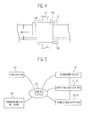
  • FIG. 4 is a schematic view illustrating a state that meandering of a base material is generated.
  • FIG. 5 is a block diagram of an apparatus of correcting belt-meandering according to an embodiment.
  • a belt-meandering of a jelly roll of a secondary battery is controlled in a manner that a base material is correctly transferred by applying a constant pressure to the base material using a transverse moving motor based on a correction value read by a sensor for sensing a meandering.
  • a meandering control method when the transfer speed of a base material is slow, the stress applied to the base material is low, and therefore, it is unlikely that a wrinkle or the like is generated on the base material.
  • a constant pressure is applied to the base material in a direction substantially vertical to the transfer speed of the base material, and therefore, wrinkles are frequently generated.
  • tension is rapidly increased by upper/lower rollers as applied to the base material, which likely adversely affects a subsequent process.
  • Electrode assemblies used in secondary batteries may be classified into, for example, a winding-type electrode assembly and a stacking-type electrode assembly.
  • the winding-type electrode assembly is formed by winding long sheet-shaped positive and negative electrode plates insulated by a separator.
  • the positive electrode plate, the negative electrode plate and the separator, which are wound as described above, are called as an electrode plate.
  • the electrode plate includes a positive electrode collector coated with a positive electrode active material, a negative electrode collector coated with a negative electrode active material, and an insulation film for insulating the two collectors from each other.
  • the electrode plate is referred to as a base material for the convenience of description.
  • the apparatus 100 of correcting belt-meandering includes a driver portion 110 , upper and lower rollers 120 and 130 , a support portion (or a support structure) 150 and a transverse moving mechanism 200 .
  • the base material is an electrode plate for a secondary battery.
  • the base material may be used for a device other than a secondary battery and include a sheet or a plate being transferred by rollers.
  • the driver portion 110 drives the apparatus 100 by converting electric energy into rotational kinetic energy.
  • the driver portion 110 provides a driving force to a gear portion 115 through a rotation shaft.
  • the gear portion 115 provides a rotation force to a first rotation shaft 121 to which the upper roller 120 is fixed and a second rotation shaft 131 to which the lower roller 130 is fixed, which will be described later, using gears and various types of belt pulleys.
  • the driver portion 110 rotates the first and second rotation shafts 121 and 131 reversely with respect to each other using a spur gear or the like.
  • the gear portion 115 may be configured using various gears, belt pulleys, timing belts and the like, but they are all referred to as a gear portion for convenience of description.
  • the upper and lower rollers 120 and 130 align and transfer a base material 10 that enters between the two rollers while being rotated in reverse directions to each other.
  • the upper roller 120 is connected to the first rotation shaft 121 rotated by the driver portion 110
  • the lower roller 130 is connected to the second rotation shaft 131 rotated by the driver portion 110 .
  • the frictional force of the upper and lower rollers 120 and 130 may be increased so that the base material 10 is effectively transferred.
  • the surfaces of the upper and lower rollers 120 and 130 may be properly treated so as to increase the frictional force.
  • the frictional force generated between the upper roller 120 and/or lower roller 130 and base material 10 may be increased by coating a material with a high frictional coefficient on the outer circumferential surfaces of the upper and lower rollers 120 and 130 .
  • the support portion 150 constitutes a body of the apparatus 100 .
  • the support portion 150 supports the driver portion 110 , the gear portion including a driving shaft, the first rotation shaft 121 to which the upper roller 120 is fixed, and the second rotation shaft 131 to which the lower roller 130 is fixed.
  • the transverse moving mechanism 200 moves the support portion 150 in a direction substantially perpendicular to the transfer direction D 1 ( FIG. 1 ) of the base material 10 .
  • the transverse moving mechanism 200 may be implemented by installing separate guide rails or by using an air or oil pressure cylinder.
  • a ball-screw type moving mechanism for converting a rotation motion into a rectilinear motion may be used to perform a precise movement.
  • a meandering sensor 135 senses a meandering while the base material 10 is transferred.
  • the meandering sensor 135 may be provided at an entry side of the upper and lower rollers 120 and 130 .
  • a meandering M in a direction substantially vertical to a transfer direction may occur during the transfer of the base material 10 due to a possible unequal coating of the positive/negative electrode materials, vibration in winding process or the quality of equipment.
  • the meandering sensor 135 senses the meandering M and provides the meandering M as an electrical signal to a control portion (or a controller) 300 ( FIG. 5 ) which will be described later.
  • a pressure control cylinder 140 controls the pressure applied to the base material 10 by the upper and lower rollers 120 and 130 .
  • the pressure control cylinder 140 controls the high and low of the first rotation shaft 121 to which the upper roller 120 is fixed by using an air or oil pressure cylinder.
  • the air or oil pressure cylinder is used to simplify the configuration of the apparatus 100 , it is not limited thereto. That is, the air or oil pressure cylinder may be replaced by a high and low controlling mechanism using various methods.
  • control portion 300 controls the transverse moving mechanism 200 based on a sensing signal, including the generation of a meandering, detected by the meandering sensor 135 .
  • the control portion 300 continuously receives the sensing signal from the meandering sensor 135 , while the base material 10 is transferred.
  • the sensing signal may include information about generation of the meandering, the generation direction of the meandering and the generation degree of the meandering.
  • the control portion 300 may control, based on the sensing signal, the transverse moving mechanism 200 to be moved in the direction in which the meandering provided from the meandering sensor 135 is corrected. For example, the control portion 300 controls the transverse moving mechanism 200 to move the support portion 150 by the generation degree of the meandering in the opposite direction to the generation direction of the meandering.
  • This embodiment relates to a case where the meandering sensor 135 does not provide the generation degree of a meandering to the control portion 300 . That is, the meandering sensor 135 provides only information about generation of the meandering and the generation direction of the meandering to the control portion 300 . In this case, if the control portion 300 controls the transverse moving mechanism 200 to be moved in the direction R in which the meandering is corrected, the entire support portion 150 including the upper and lower rollers 120 and 130 are moved in the corrected direction R ( FIG. 4 ).
  • the meandering sensor 130 no longer provides information about the presence of the meandering to the control portion 300 . Then, the control portion 300 stops the position control of the transverse moving mechanism 200 .
  • Each of wrinkle sensing portions (or at least one wrinkle sensor) 136 and 137 senses a wrinkle generated on the transferred base material 10 .
  • each of the wrinkle sensing portions 136 and 137 includes a pulse laser transmitter (e.g., 136 ) that irradiates with a laser and has a receiving sensor (e.g., 137 ) that receives the laser irradiated from the pulse laser transmitter 136 .
  • a plurality of transmitters 136 are provided according to the height of the base material 10
  • a plurality of receiving sensors 137 are provided as many as the number of the transmitters 136 .
  • the laser beam normally reaches the plurality of receiving sensors 137 .
  • the laser does not reach the plurality of receiving sensors 137 .
  • each of the wrinkle sensing portions 136 and 137 may be provided at the entry side of the upper and lower rollers 120 and 130 , at which wrinkles are frequently generated during the transfer of the base material 10 .
  • the control portion 300 controls the pressure control cylinder 140 for a certain period of time so that the pressure applied to the base material 10 by the upper and lower rollers 120 and 130 is decreased. In a case where the upper and lower rollers 120 and 130 transfer the base material 10 at a weak pressure while being continuously rotated, the wrinkle generated on the base material 10 is smoothed out.
  • meandering can be more precisely corrected.
  • rollers for controlling meandering are driven at a line speed identical to the transfer speed of a base material, so that stress applied to the base material can be reduced in a transverse movement for controlling the meandering, thereby enhancing the quality of a secondary battery so manufactured.

Landscapes

  • Engineering & Computer Science (AREA)
  • Manufacturing & Machinery (AREA)
  • Chemical & Material Sciences (AREA)
  • Chemical Kinetics & Catalysis (AREA)
  • Electrochemistry (AREA)
  • General Chemical & Material Sciences (AREA)
  • Battery Electrode And Active Subsutance (AREA)
  • Registering, Tensioning, Guiding Webs, And Rollers Therefor (AREA)

Abstract

An apparatus of correcting belt-meandering for a secondary battery is disclosed. In one embodiment, the apparatus includes i) upper and lower rollers configured to receive a base material therebetween, wherein the base material comprises positive and negative electrode materials and an insulating material interposed between the electrode materials and ii) a driver portion configured to rotate the upper and lower rollers such that the base material is transferred in a first direction during the rotation. The apparatus may also include i) a support portion configured to support shafts of the driver portion and the upper and lower rollers and ii) a transverse moving mechanism configured to move the support portion in a second direction substantially perpendicular to the first direction.

Description

RELATED APPLICATIONS
This application claims priority to and the benefit of Korean Patent Application No. 10-2010-0080293, filed on Aug. 19, 2010, in the Korean Intellectual Property Office, the entire content of which is incorporated herein by reference.
BACKGROUND
1. Field
The described technology generally relates to an apparatus for correcting a belt-meandering for a secondary battery, and more particularly, to an apparatus that precisely corrects the meandering of a jelly roll wound at a high speed in a winding operation for a secondary battery.
2. Description of the Related Technology
A secondary battery is manufactured by winding, at a high speed, a positive electrode collector coated with a positive electrode active material, a negative electrode collector coated with a negative electrode active material, and an insulation film for insulating the two collectors from each other. According to a winding method in such a configuration, the winding of a base material including positive/negative electrode materials and two insulation films is performed by repeatedly performing stopping/winding with respect to a roller at a high speed.
In this instance, a meandering in a direction vertical to a transfer direction may be generated during the transfer of the base material according to a possible unequal coating of the positive/negative electrode materials, the vibration in winding or the degree of equipment. Such a meandering phenomenon causes a winding failure, and therefore, the quality of a final battery product generally degrades.
SUMMARY
One inventive aspect is an apparatus for correcting belt-meandering, which can minimize stresses applied to a base material transferred at a high speed through a simple configuration.
Another aspect is an apparatus for correcting belt-meandering, which can precisely control meandering.
Another aspect is an apparatus for correcting belt-meandering, the apparatus including a driver portion, upper and lower rollers, a support portion and a transverse moving mechanism. The upper and lower rollers transfers a base material while being rotated by receiving a rotation force provided from the driving portion. The support portion supports rotation shafts of the driving portion and the upper and lower rollers. The transverse moving mechanism moves the support portion in a direction perpendicular to a transfer direction of the base material.
The apparatus may further include a meandering sensor and a control portion. The meandering sensor senses a meandering of the base material. When the meandering sensor senses the meandering of the base material, the control portion controls the transverse moving mechanism to move the support portion in a direction in which the meandering of the base material is corrected.
When the meandering sensor no longer senses the meandering of the base material, the control portion may stop the transverse moving mechanism.
The transverse moving mechanism may be provided with an electric motor controlled by the control portion and a ball-screw type moving mechanism that converts the rotation of the electric motor into a linear motion.
The meandering sensor may be provided at an entry side of the upper and lower rollers.
The upper and lower rollers may be subjected to surface treatment for increasing a frictional coefficient.
A material with a high frictional coefficient may be coated on outer circumferential surfaces of the upper and lower rollers.
The apparatus may further include an air pressure cylinder that controls pressure applied to the base material by the upper and lower rollers.
The apparatus may further include a wrinkle sensing portion. The wrinkle sensing portion senses a wrinkle on the base material transferred by the upper and lower rollers. When a wrinkle is sensed, the control portion controls the pressure control cylinder for a certain period of time so that the pressure applied to the base material by the upper and lower rollers is decreased.
The wrinkle sensing portion may be provided at an entry side of the upper and lower rollers.
The wrinkle sensing portion may include a pulse laser transmitter that irradiates laser and a receiving sensor that receives the laser irradiated from the pulse laser transmitter.
The base material transferred by the upper and lower rollers may be an electrode plate. Another aspect is an apparatus for correcting a belt-meandering of a jelly roll wound at a high speed in a winding operation for a secondary battery, the apparatus comprising: upper and lower rollers configured to receive a base material therebetween, wherein the base material comprises positive and negative electrode materials and an insulating material interposed between the electrode materials; a driver portion configured to rotate the upper and lower rollers such that the base material is transferred in a first direction during the rotation; a support portion configured to support shafts of the driver portion and the upper and lower rollers; and a transverse moving mechanism configured to move the support portion in a second direction substantially perpendicular to the first direction.
The above apparatus further comprises: a meandering sensor configured to detect a meandering of the base material; and a control portion configured to control the transverse moving mechanism based on the detected meandering to move the support portion in a direction in which the meandering of the base material is at least partially corrected. In the above apparatus, the control portion is configured to stop the transverse moving mechanism when no meandering of the base material is detected.
In the above apparatus, the transverse moving mechanism comprises an electric motor controlled by the control portion and a ball-screw type moving mechanism configured to convert the rotation of the electric motor into a substantially linear motion.
In the above apparatus, the meandering sensor is located adjacent to an entry side of the upper and lower rollers where the base material is received. In the above apparatus, the meandering sensor is configured to detect i) an occurrence of the meandering, ii) the direction of the meandering and iii) the degree of the meandering, and wherein the control portion is configured to control the transverse moving mechanism so as to move the support portion by the meandering degree in the opposite direction to the detected meandering direction.
In the above apparatus, the meandering sensor is configured to detect i) an occurrence of the meandering and ii) the direction of the meandering, and wherein the control portion is configured to control the transverse moving mechanism based on the detected meandering direction so as to move the support portion in a direction in which the meandering is at least partially corrected. In the above apparatus, at least one of the upper and lower rollers has an outer surface treated so as to increase its frictional coefficient.
In the above apparatus, a material having a high frictional coefficient is coated on outer circumferential surfaces of the upper and lower rollers. The above apparatus further comprises an air pressure cylinder configured to control pressure applied to the base material by the upper and lower rollers. The above apparatus further comprises at least one wrinkle sensor configured to detect a wrinkle on the base material during the rotation, wherein the control portion is configured to control the pressure cylinder based on the detected winkle for a certain period of time so as to decrease the pressure applied to the base material by the upper and lower rollers.
In the above apparatus, the wrinkle sensor is located adjacent to an entry side of the upper and lower rollers where the base material is received. In the above apparatus, the wrinkle sensor comprises a pulse laser transmitter configured to irradiate laser and a receiving sensor configured to receive the laser irradiated from the pulse laser transmitter.
Another aspect is an apparatus for correcting meandering of a base material while being transferred, the apparatus comprising: first and second rollers adjacent to each other and configured to receive the base material therebetween; a driver configured to rotate the rollers such that the base material is transferred in a first direction during the rotation; and a transverse moving mechanism configured to move the rollers in a second direction substantially perpendicular to the first direction.
The above apparatus is configured to correct a meandering of a jelly roll wound at a high speed in a winding operation for a secondary battery, and wherein the base material comprises positive and negative electrode materials and an insulating material interposed between the electrode materials.
The above apparatus further comprises a support structure accommodating shafts of the driver portion and the rollers, wherein the transverse moving mechanism is further configured to move the support structure in the second direction. The above apparatus further comprises: a meandering sensor configured to detect a meandering of the base material; and a controller configured to control the transverse moving mechanism based on the detected meandering to move the support portion in a direction in which the meandering of the base material is at least partially corrected.
In the above apparatus, the meandering sensor is configured to detect i) an occurrence of the meandering, ii) the direction of the meandering and iii) the degree of the meandering, and wherein the control portion is configured to control the transverse moving mechanism so as to move the support portion by the meandering degree in the opposite direction to the detected meandering direction.
Another aspect is an apparatus for correcting meandering of a base material while being transferred, the apparatus comprising: first and second rollers adjacent to each other and configured to receive the base material therebetween; a driver configured to rotate the rollers such that the base material is transferred in a first direction during the rotation; a transverse moving mechanism configured to move the rollers in a second direction substantially perpendicular to the first direction; means for detecting at least one of 1) a meandering of the base material and 2) a wrinkle on the base material; and a controller configured to control the transverse moving mechanism based on the detection so as to move the rollers in a direction in which at least one of the meandering and wrinkle of the base material is at least partially corrected.
In the above apparatus, the detecting means comprise: a meandering sensor configured to detect a meandering of the base material during the rotation; and a wrinkle sensor configured to detect a wrinkle on the base material during the rotation, wherein the meandering sensor and wrinkle sensor are located on opposite sides of the rollers.
BRIEF DESCRIPTION OF THE DRAWINGS
FIG. 1 is a perspective view of an apparatus of correcting belt-meandering according to an embodiment.
FIG. 2 is a schematic view illustrating a transverse moving mechanism according to an embodiment.
FIG. 3 is a schematic view illustrating positions at which a meandering sensor and a wrinkle sensing portion are provided, respectively.
FIG. 4 is a schematic view illustrating a state that meandering of a base material is generated.
FIG. 5 is a block diagram of an apparatus of correcting belt-meandering according to an embodiment.
DETAILED DESCRIPTION
Generally, a belt-meandering of a jelly roll of a secondary battery is controlled in a manner that a base material is correctly transferred by applying a constant pressure to the base material using a transverse moving motor based on a correction value read by a sensor for sensing a meandering. In such a meandering control method, when the transfer speed of a base material is slow, the stress applied to the base material is low, and therefore, it is unlikely that a wrinkle or the like is generated on the base material. However, in a case where the base material is transferred at a high speed, a constant pressure is applied to the base material in a direction substantially vertical to the transfer speed of the base material, and therefore, wrinkles are frequently generated. Further, when winding is initially performed, i.e., when the base material is stopped and then transferred at a high speed, tension is rapidly increased by upper/lower rollers as applied to the base material, which likely adversely affects a subsequent process.
Embodiments will be described with reference to the accompanying drawings, which are illustrative in nature and not restrictive. In addition, when an element is referred to as being “on” another element, it can be directly on that element or be indirectly on the element with one or more intervening elements interposed therebetween. Also, when an element is referred to as being “connected to” another element, it can be directly or indirectly connected to that element. Hereinafter, like reference numerals refer to like elements. In the drawings, the thickness or size of layers may be exaggerated for clarity and not necessarily drawn to scale.
Electrode assemblies used in secondary batteries may be classified into, for example, a winding-type electrode assembly and a stacking-type electrode assembly. The winding-type electrode assembly is formed by winding long sheet-shaped positive and negative electrode plates insulated by a separator. The positive electrode plate, the negative electrode plate and the separator, which are wound as described above, are called as an electrode plate. The electrode plate includes a positive electrode collector coated with a positive electrode active material, a negative electrode collector coated with a negative electrode active material, and an insulation film for insulating the two collectors from each other. Hereinafter, the electrode plate is referred to as a base material for the convenience of description.
First Embodiment
Referring to FIGS. 1 and 2, the apparatus 100 of correcting belt-meandering includes a driver portion 110, upper and lower rollers 120 and 130, a support portion (or a support structure) 150 and a transverse moving mechanism 200. Hereinafter, each of the components will be described in detail. In one embodiment, the base material is an electrode plate for a secondary battery. The base material may be used for a device other than a secondary battery and include a sheet or a plate being transferred by rollers.
The driver portion 110 drives the apparatus 100 by converting electric energy into rotational kinetic energy. The driver portion 110 provides a driving force to a gear portion 115 through a rotation shaft. The gear portion 115 provides a rotation force to a first rotation shaft 121 to which the upper roller 120 is fixed and a second rotation shaft 131 to which the lower roller 130 is fixed, which will be described later, using gears and various types of belt pulleys. In one embodiment, the driver portion 110 rotates the first and second rotation shafts 121 and 131 reversely with respect to each other using a spur gear or the like. The gear portion 115 may be configured using various gears, belt pulleys, timing belts and the like, but they are all referred to as a gear portion for convenience of description.
The upper and lower rollers 120 and 130 align and transfer a base material 10 that enters between the two rollers while being rotated in reverse directions to each other. In this instance, the upper roller 120 is connected to the first rotation shaft 121 rotated by the driver portion 110, and the lower roller 130 is connected to the second rotation shaft 131 rotated by the driver portion 110.
Meanwhile, the frictional force of the upper and lower rollers 120 and 130 may be increased so that the base material 10 is effectively transferred. The surfaces of the upper and lower rollers 120 and 130 may be properly treated so as to increase the frictional force. In addition, the frictional force generated between the upper roller 120 and/or lower roller 130 and base material 10 may be increased by coating a material with a high frictional coefficient on the outer circumferential surfaces of the upper and lower rollers 120 and 130.
The support portion 150 constitutes a body of the apparatus 100. The support portion 150 supports the driver portion 110, the gear portion including a driving shaft, the first rotation shaft 121 to which the upper roller 120 is fixed, and the second rotation shaft 131 to which the lower roller 130 is fixed.
Referring to FIGS. 1 and 2, the transverse moving mechanism 200 moves the support portion 150 in a direction substantially perpendicular to the transfer direction D1 (FIG. 1) of the base material 10. The transverse moving mechanism 200 may be implemented by installing separate guide rails or by using an air or oil pressure cylinder. However, a ball-screw type moving mechanism for converting a rotation motion into a rectilinear motion may be used to perform a precise movement.
Referring to FIGS. 3 and 4, a meandering sensor 135 senses a meandering while the base material 10 is transferred. The meandering sensor 135 may be provided at an entry side of the upper and lower rollers 120 and 130. As shown in FIG. 4, while the base material 10 is transferred, a meandering M in a direction substantially vertical to a transfer direction may occur during the transfer of the base material 10 due to a possible unequal coating of the positive/negative electrode materials, vibration in winding process or the quality of equipment. In this case, the meandering sensor 135 senses the meandering M and provides the meandering M as an electrical signal to a control portion (or a controller) 300 (FIG. 5) which will be described later.
Referring to FIG. 1, a pressure control cylinder 140 controls the pressure applied to the base material 10 by the upper and lower rollers 120 and 130. The pressure control cylinder 140 controls the high and low of the first rotation shaft 121 to which the upper roller 120 is fixed by using an air or oil pressure cylinder. Although the air or oil pressure cylinder is used to simplify the configuration of the apparatus 100, it is not limited thereto. That is, the air or oil pressure cylinder may be replaced by a high and low controlling mechanism using various methods.
In one embodiment, as shown in FIG. 5, the control portion 300 controls the transverse moving mechanism 200 based on a sensing signal, including the generation of a meandering, detected by the meandering sensor 135.
In one embodiment, the control portion 300 continuously receives the sensing signal from the meandering sensor 135, while the base material 10 is transferred. The sensing signal may include information about generation of the meandering, the generation direction of the meandering and the generation degree of the meandering. The control portion 300 may control, based on the sensing signal, the transverse moving mechanism 200 to be moved in the direction in which the meandering provided from the meandering sensor 135 is corrected. For example, the control portion 300 controls the transverse moving mechanism 200 to move the support portion 150 by the generation degree of the meandering in the opposite direction to the generation direction of the meandering.
Second Embodiment
Another embodiment will be described with reference to FIG. 4. This embodiment relates to a case where the meandering sensor 135 does not provide the generation degree of a meandering to the control portion 300. That is, the meandering sensor 135 provides only information about generation of the meandering and the generation direction of the meandering to the control portion 300. In this case, if the control portion 300 controls the transverse moving mechanism 200 to be moved in the direction R in which the meandering is corrected, the entire support portion 150 including the upper and lower rollers 120 and 130 are moved in the corrected direction R (FIG. 4). If the base material 10 is returned to a normal position while the meandering sensor 135 continuously monitors the position of the base material 10, the meandering sensor 130 no longer provides information about the presence of the meandering to the control portion 300. Then, the control portion 300 stops the position control of the transverse moving mechanism 200.
Third Embodiment
Yet another embodiment will be described with reference to FIG. 3. Each of wrinkle sensing portions (or at least one wrinkle sensor) 136 and 137 senses a wrinkle generated on the transferred base material 10. In this embodiment, each of the wrinkle sensing portions 136 and 137 includes a pulse laser transmitter (e.g., 136) that irradiates with a laser and has a receiving sensor (e.g., 137) that receives the laser irradiated from the pulse laser transmitter 136. In this instance, a plurality of transmitters 136 are provided according to the height of the base material 10, and a plurality of receiving sensors 137 are provided as many as the number of the transmitters 136. In a case where no wrinkle is generated on the base material 10, the laser beam normally reaches the plurality of receiving sensors 137. In a case where a wrinkle is generated on the base material 10, the laser does not reach the plurality of receiving sensors 137.
Meanwhile, as shown in FIG. 3, each of the wrinkle sensing portions 136 and 137 may be provided at the entry side of the upper and lower rollers 120 and 130, at which wrinkles are frequently generated during the transfer of the base material 10.
In a case where a wrinkle is sensed by the receiving sensor 137, the control portion 300 controls the pressure control cylinder 140 for a certain period of time so that the pressure applied to the base material 10 by the upper and lower rollers 120 and 130 is decreased. In a case where the upper and lower rollers 120 and 130 transfer the base material 10 at a weak pressure while being continuously rotated, the wrinkle generated on the base material 10 is smoothed out.
According to at least one of the disclosed embodiments, meandering can be more precisely corrected.
Also, rollers for controlling meandering are driven at a line speed identical to the transfer speed of a base material, so that stress applied to the base material can be reduced in a transverse movement for controlling the meandering, thereby enhancing the quality of a secondary battery so manufactured.
While the disclosed embodiments have been described with reference to the accompanying drawings, it is to be understood that the disclosed embodiments are not considered limiting. The appended claims will cover various modifications and equivalent arrangements.

Claims (18)

What is claimed is:
1. An apparatus for correcting a belt-meandering of a jelly roll wound at a high speed in a winding operation for a secondary battery, the apparatus comprising:
upper and lower rollers configured to receive a base material therebetween, wherein the base material comprises positive and negative electrode materials and an insulating material interposed between the electrode materials;
a driver portion configured to rotate the upper and lower rollers such that the base material is transferred in a first direction during the rotation;
a support portion configured to support shafts of the driver portion and the upper and lower rollers;
a transverse moving mechanism configured to move the support portion in a second direction substantially perpendicular to the first direction;
an air pressure cylinder configured to control pressure applied to the base material by the upper and lower rollers;
at least one wrinkle sensor configured to detect a wrinkle on the base material during the rotation; and
a control portion configured to control the pressure cylinder based on the detected wrinkle for a certain period of time so as to decrease the pressure applied to the base material by the upper and lower rollers.
2. The apparatus according to claim 1, further comprising:
a meandering sensor configured to detect a meandering of the base material,
wherein the control portion is further configured to control the transverse moving mechanism based on the detected meandering to move the support portion in a direction in which the meandering of the base material is at least partially corrected.
3. The apparatus according to claim 2, wherein the control portion is configured to stop the transverse moving mechanism when no meandering of the base material is detected.
4. The apparatus according to claim 2, wherein the transverse moving mechanism comprises an electric motor controlled by the control portion and a ball-screw type moving mechanism configured to convert the rotation of the electric motor into a substantially linear motion.
5. The apparatus according to claim 2, wherein the meandering sensor is located adjacent to an exit side of the upper and lower rollers where the base material is received.
6. The apparatus according to claim 2, wherein the meandering sensor is configured to detect i) an occurrence of the meandering; ii) the direction of the meandering and iii) the degree of the meandering, and wherein the control portion is configured to control the transverse moving mechanism so as to move the support portion by the meandering degree in the opposite direction to the detected meandering direction.
7. The apparatus according to claim 2, wherein the meandering sensor is configured to detect i) an occurrence of the meandering and ii) the direction of the meandering, and wherein the control portion is configured to control the transverse moving mechanism based on the detected meandering direction so as to move the support portion in a direction in which the meandering is at least partially corrected.
8. The apparatus according to claim 1, wherein at least one of the upper and lower rollers has an outer surface treated so as to increase its frictional coefficient.
9. The apparatus according to claim 1, wherein a material having a high frictional coefficient is coated on outer circumferential surfaces of the upper and lower rollers.
10. The apparatus according to claim 1, wherein the wrinkle sensor is located adjacent to an entry side of the upper and lower rollers where the base material is received.
11. The apparatus according to claim 1, wherein the wrinkle sensor comprises a pulse laser transmitter configured to irradiate laser and a receiving sensor configured to receive the laser irradiated from the pulse laser transmitter.
12. An apparatus for correcting meandering of a base material while being transferred, the apparatus comprising:
first and second rollers adjacent to each other and configured to receive the base material therebetween;
a driver configured to rotate the rollers such that the base material is transferred in a first direction during the rotation;
a transverse moving mechanism configured to move the rollers in a second direction substantially perpendicular to the first direction;
an air pressure cylinder configured to control pressure applied to the base material by the upper and lower rollers;
at least one wrinkle sensor configured to detect a wrinkle on the base material during the rotation; and
a controller configured to control the pressure cylinder based on the detected wrinkle for a certain period of time so as to decrease the pressure applied to the base material by the first and second rollers.
13. The apparatus according to claim 12, wherein the apparatus is configured to correct a meandering of a jelly roll wound at a high speed in a winding operation for a secondary battery, and wherein the base material comprises positive and negative electrode materials and an insulating material interposed between the electrode materials.
14. The apparatus according to claim 12, further comprising a support structure accommodating shafts of the driver portion and the rollers, wherein the transverse moving mechanism is further configured to move the support structure in the second direction.
15. The apparatus according to claim 12, further comprising:
a meandering sensor configured to detect a meandering of the base material,
wherein the controller if further configured to control the transverse moving mechanism based on the detected meandering to move the support portion in a direction in which the meandering of the base material is at least partially corrected.
16. The apparatus according to claim 15, wherein the meandering sensor is configured to detect i) an occurrence of the meandering, ii) the direction of the meandering and iii) the degree of the meandering, and wherein the controller is configured to control the transverse moving mechanism so as to move the support portion by the meandering degree in the opposite direction to the detected meandering direction.
17. An apparatus for correcting meandering of a base material while being transferred, the apparatus comprising:
first and second rollers adjacent to each other and configured to receive the base material therebetween;
a driver configured to rotate the rollers such that the base material is transferred in a first direction during the rotation;
a transverse moving mechanism configured to move the rollers in a second direction substantially perpendicular to the first direction;
means for detecting at least one of 1) a meandering of the base material and 2) a wrinkle on the base material;
a controller configured to control the transverse moving mechanism based on the detection so as to move the rollers in a direction in which at least one of the meandering and wrinkle of the base material is at least partially corrected;
an air pressure cylinder configured to control pressure applied to the base material by the upper and lower rollers; and
at least one wrinkle sensor configured to detect a wrinkle on the base material during the rotation,
wherein the controller is configured to control the pressure cylinder based on the detected wrinkle for a certain period of time so as to decrease the pressure applied to the base material by the first and second rollers.
18. The apparatus according to claim 17, wherein the detecting means comprise:
a meandering sensor configured to detect a meandering of the base material during the rotation; and
the wrinkle sensor,
wherein the meandering sensor and wrinkle sensor are located on opposite sides of the rollers.
US13/181,415 2010-08-19 2011-07-12 Apparatus for correcting belt-meandering for secondary battery Active 2033-07-03 US8893942B2 (en)

Applications Claiming Priority (2)

Application Number Priority Date Filing Date Title
KR10-2010-0080293 2010-08-19
KR1020100080293A KR101113424B1 (en) 2010-08-19 2010-08-19 apparatus of correcting belt-meandering for secondary battery

Publications (2)

Publication Number Publication Date
US20120043408A1 US20120043408A1 (en) 2012-02-23
US8893942B2 true US8893942B2 (en) 2014-11-25

Family

ID=45593286

Family Applications (1)

Application Number Title Priority Date Filing Date
US13/181,415 Active 2033-07-03 US8893942B2 (en) 2010-08-19 2011-07-12 Apparatus for correcting belt-meandering for secondary battery

Country Status (3)

Country Link
US (1) US8893942B2 (en)
KR (1) KR101113424B1 (en)
CN (1) CN102437362B (en)

Cited By (4)

* Cited by examiner, † Cited by third party
Publication number Priority date Publication date Assignee Title
US20220244040A1 (en) * 2019-08-27 2022-08-04 Lg Energy Solution, Ltd. Apparatus and method for measuring thickness of unit cell
EP4152457A4 (en) * 2021-02-26 2024-08-14 LG Energy Solution, Ltd. SINUOSITY CORRECTION DEVICE FOR ELECTRODE AND SINUOSITY CORRECTION METHOD FOR ELECTRODE
EP4156359A4 (en) * 2021-02-26 2024-08-14 LG Energy Solution, Ltd. SINUOSITY CORRECTION DEVICE FOR ELECTRODE AND SINUOSITY CORRECTION METHOD FOR ELECTRODE
EP4152458A4 (en) * 2021-02-26 2024-08-14 LG Energy Solution, Ltd. MEANDER CORRECTION DEVICE FOR AN ELECTRODE AND MEANDER CORRECTION METHOD FOR AN ELECTRODE

Families Citing this family (20)

* Cited by examiner, † Cited by third party
Publication number Priority date Publication date Assignee Title
KR101965707B1 (en) * 2012-11-01 2019-04-05 삼성에스디아이 주식회사 Winder for electrode assembly of rechargeable battery
KR101587322B1 (en) * 2013-08-05 2016-01-20 주식회사 엘지화학 Correction apparatus of zigzag line for electrode assembly
US9300003B2 (en) 2013-08-05 2016-03-29 Lg Chem, Ltd. Meandering correction apparatus for electrode assembly
KR101888211B1 (en) * 2013-12-09 2018-08-13 주식회사 엘지화학 An Apparatus for Aligning Stepped Battery and a Method thereof
KR101633168B1 (en) * 2014-01-06 2016-06-23 주식회사 엘지화학 An Aligning Apparatus for Stepped Battery and a Method thereof
CN104525774B (en) * 2014-12-08 2016-10-12 深圳市吉阳自动化科技有限公司 Pole piece conveying and deviation rectifying device
CN104668383A (en) * 2015-02-25 2015-06-03 昆山宝锦激光拼焊有限公司 Correcting device for guide center of feeding roller
CN105921635A (en) * 2016-04-28 2016-09-07 藤县顺舟造船有限公司 Plate winding machine
CN105834318A (en) * 2016-04-28 2016-08-10 藤县顺舟造船有限公司 Material conveying mechanism of plate reeling machine
CN105947758A (en) * 2016-07-01 2016-09-21 无锡先导智能装备股份有限公司 Automatic deviation correction device
KR200493852Y1 (en) * 2017-04-03 2021-06-16 주식회사 엘지에너지솔루션 Electrode Lamination Device Comprising Feeding Conveyor
KR101888052B1 (en) * 2017-09-26 2018-08-13 장명희 Device for Laminating Electrode Assembly Used in Manufacturing Secondary Battery
CN108217250A (en) * 2017-12-29 2018-06-29 徐雪华 The anti-deviation adaptive control system of Metal Substrate coiled material sawing sheet
CN109693962B (en) * 2019-01-04 2024-09-03 无锡先导智能装备股份有限公司 Correction mechanism and feeding device
KR102800521B1 (en) 2021-05-26 2025-04-25 주식회사 엘지에너지솔루션 Electrode meandering correction device and electrode meandering correction method thereof
KR102758790B1 (en) 2021-05-26 2025-01-23 주식회사 엘지에너지솔루션 Electrode meandering correction device and electrode meandering correction method thereof
CN113104634B (en) * 2021-04-13 2023-04-14 内蒙古联晟新能源材料有限公司 Control system for automatic feeding of casting blank plates
CN113389039B (en) * 2021-04-23 2023-05-12 安徽甬安雨具有限公司 Cloth transmission cutting integrated equipment for raincoat production
CN116081370B (en) * 2023-03-22 2023-09-08 宁德时代新能源科技股份有限公司 Pole piece feeding device, winding equipment and pole piece deviation correcting method
CN116767934A (en) * 2023-07-27 2023-09-19 中色科技股份有限公司 Automatic centering device for aluminum plate strip stub bar

Citations (12)

* Cited by examiner, † Cited by third party
Publication number Priority date Publication date Assignee Title
JPH09221252A (en) 1996-02-16 1997-08-26 Sony Corp Traveling device for belt-shaped member and travel method for belt-shaped member
JPH10175752A (en) 1996-12-18 1998-06-30 Canon Inc Sheet conveying device, image reading device and image forming device provided with the same
US6059285A (en) 1996-12-18 2000-05-09 Canon Kabushiki Kaisha Sheet conveying apparatus
JP2002093408A (en) 2000-09-14 2002-03-29 Toshiba Battery Co Ltd Machining method and device for battery electrode sheet
JP2005079079A (en) 2003-08-28 2005-03-24 Kaido Seisakusho:Kk Meander correction device for battery element winding device
JP2005116492A (en) 2003-10-06 2005-04-28 Kaido Seisakusho:Kk Battery device winding device (roller outer diameter variable type) meandering correction device
JP2007161474A (en) 2005-12-09 2007-06-28 Kaido Seisakusho:Kk For thin ribbon winding device (roller position variable type) meandering correction device
JP2008063150A (en) 2007-12-14 2008-03-21 Hirano Tecseed Co Ltd Web meandering correction device
WO2009019781A1 (en) 2007-08-09 2009-02-12 Kaido Manufacturing Co., Ltd. Displacement correction device for winding device
JP2009132524A (en) 2007-11-30 2009-06-18 Toyota Motor Corp Carrier film wrinkle detection apparatus and method
WO2009125298A2 (en) * 2008-04-10 2009-10-15 Toyota Jidosha Kabushiki Kaisha Web conveying apparatus and web conveying control method
WO2010010705A1 (en) 2008-07-25 2010-01-28 株式会社Ihi Method and plant for manufacturing separator in solid polymer fuel cell

Patent Citations (13)

* Cited by examiner, † Cited by third party
Publication number Priority date Publication date Assignee Title
JPH09221252A (en) 1996-02-16 1997-08-26 Sony Corp Traveling device for belt-shaped member and travel method for belt-shaped member
JPH10175752A (en) 1996-12-18 1998-06-30 Canon Inc Sheet conveying device, image reading device and image forming device provided with the same
US6059285A (en) 1996-12-18 2000-05-09 Canon Kabushiki Kaisha Sheet conveying apparatus
JP2002093408A (en) 2000-09-14 2002-03-29 Toshiba Battery Co Ltd Machining method and device for battery electrode sheet
JP2005079079A (en) 2003-08-28 2005-03-24 Kaido Seisakusho:Kk Meander correction device for battery element winding device
JP2005116492A (en) 2003-10-06 2005-04-28 Kaido Seisakusho:Kk Battery device winding device (roller outer diameter variable type) meandering correction device
JP2007161474A (en) 2005-12-09 2007-06-28 Kaido Seisakusho:Kk For thin ribbon winding device (roller position variable type) meandering correction device
WO2009019781A1 (en) 2007-08-09 2009-02-12 Kaido Manufacturing Co., Ltd. Displacement correction device for winding device
JP2009132524A (en) 2007-11-30 2009-06-18 Toyota Motor Corp Carrier film wrinkle detection apparatus and method
JP2008063150A (en) 2007-12-14 2008-03-21 Hirano Tecseed Co Ltd Web meandering correction device
WO2009125298A2 (en) * 2008-04-10 2009-10-15 Toyota Jidosha Kabushiki Kaisha Web conveying apparatus and web conveying control method
WO2010010705A1 (en) 2008-07-25 2010-01-28 株式会社Ihi Method and plant for manufacturing separator in solid polymer fuel cell
US20110111329A1 (en) 2008-07-25 2011-05-12 Ihi Corporation Method and facility for producing separator for use in polymer electrolyte fuel cell

Non-Patent Citations (2)

* Cited by examiner, † Cited by third party
Title
Chinese Office Action dated Dec. 16, 2013 for Chinese Patent Application No. CN 201110234338.X which shares priority of Korean Patent Application No. KR 10-2010-0080293 with captioned U.S. Appl. No. 13/181,415, and cites the above-identified references numbered 1-3.
Machine Translation of WO 2009/019781 A1, Feb. 12, 2009. *

Cited By (5)

* Cited by examiner, † Cited by third party
Publication number Priority date Publication date Assignee Title
US20220244040A1 (en) * 2019-08-27 2022-08-04 Lg Energy Solution, Ltd. Apparatus and method for measuring thickness of unit cell
US12038269B2 (en) * 2019-08-27 2024-07-16 Lg Energy Solution, Ltd. Apparatus and method for measuring thickness of unit cell
EP4152457A4 (en) * 2021-02-26 2024-08-14 LG Energy Solution, Ltd. SINUOSITY CORRECTION DEVICE FOR ELECTRODE AND SINUOSITY CORRECTION METHOD FOR ELECTRODE
EP4156359A4 (en) * 2021-02-26 2024-08-14 LG Energy Solution, Ltd. SINUOSITY CORRECTION DEVICE FOR ELECTRODE AND SINUOSITY CORRECTION METHOD FOR ELECTRODE
EP4152458A4 (en) * 2021-02-26 2024-08-14 LG Energy Solution, Ltd. MEANDER CORRECTION DEVICE FOR AN ELECTRODE AND MEANDER CORRECTION METHOD FOR AN ELECTRODE

Also Published As

Publication number Publication date
US20120043408A1 (en) 2012-02-23
CN102437362A (en) 2012-05-02
KR20120017597A (en) 2012-02-29
KR101113424B1 (en) 2012-03-02
CN102437362B (en) 2014-09-03

Similar Documents

Publication Publication Date Title
US8893942B2 (en) Apparatus for correcting belt-meandering for secondary battery
US9415942B2 (en) Conveyor and conveying method
US10243228B2 (en) Device and method for manufacturing membrane-electrode assembly of fuel cell
CN103660506B (en) Laminating device and equipment comprising same
US9902563B2 (en) Conveyor and conveying method
US20250136400A1 (en) Winding method and winding system
JP2012129147A (en) Electrode material roll press facility
CN113140805B (en) Laser winding all-in-one machine
CA2731558C (en) Method and facility for producing separator for use in polymer electrolyte fuel cell
US20140311867A1 (en) Conveyor and conveying method
CN212768885U (en) Material belt cache device and battery cell lamination system
CN110963342A (en) Pole piece deviation correcting device, pole piece cache assembly and square power electric core winding machine
JP2009038276A (en) Thin film laminate manufacturing equipment
EP4318775A1 (en) Separator thickness adjusting device and method, and wound electrode assembly production system
KR101264517B1 (en) Laminating apparatus for electrode substrate
WO2012099073A1 (en) Glass roll, glass roll manufacturing apparatus, and glass roll manufacturing method
CN104669808B (en) Tension control system and printing machine
EP0796732A2 (en) Method for manufacturing laminates and apparatus performing the method
CN209896204U (en) Unwinding device and lamination machine
CN215946274U (en) Film processing equipment and film offset correction device
EP2463402A1 (en) Apparatus for producing a thin-film lamination
US20140349825A1 (en) Roll-to-roll press device with tension controller
CN219368597U (en) Thickness measuring device
JP2009160910A (en) Sheet laminating apparatus having function of detecting thickness of laminate
EP3715116B1 (en) Automatic laminating machine

Legal Events

Date Code Title Description
AS Assignment

Owner name: SAMSUNG SDI CO., LTD, KOREA, REPUBLIC OF

Free format text: ASSIGNMENT OF ASSIGNORS INTEREST;ASSIGNORS:OH, DAE-SIK;BAE, KEON-SOO;CHO, GI-BONG;AND OTHERS;REEL/FRAME:026588/0542

Effective date: 20110707

FEPP Fee payment procedure

Free format text: PAYOR NUMBER ASSIGNED (ORIGINAL EVENT CODE: ASPN); ENTITY STATUS OF PATENT OWNER: LARGE ENTITY

STCF Information on status: patent grant

Free format text: PATENTED CASE

MAFP Maintenance fee payment

Free format text: PAYMENT OF MAINTENANCE FEE, 4TH YEAR, LARGE ENTITY (ORIGINAL EVENT CODE: M1551)

Year of fee payment: 4

MAFP Maintenance fee payment

Free format text: PAYMENT OF MAINTENANCE FEE, 8TH YEAR, LARGE ENTITY (ORIGINAL EVENT CODE: M1552); ENTITY STATUS OF PATENT OWNER: LARGE ENTITY

Year of fee payment: 8